Article

Sensitive Aflatoxin M1 Detection in Milk by ELISA: Investigation of Different Assay Configurations


by
Dimitra Kourti
1,2,
Michailia Angelopoulou
1,
Panagiota Petrou
1,* and
Sotirios Kakabakos
1
1
Immunoassays/Immunosensors Lab, Institute of Nuclear & Radiological Sciences & Technology, Energy & Safety, NCSR “Demokritos”, 15341 Aghia Paraskevi, Greece
2
Analytical Chemistry Lab, Department of Chemistry, University of Athens, Panepistimiopolis Zografou, 15771 Athens, Greece
*
Author to whom correspondence should be addressed.
Toxins 2024, 16(12), 515; https://doi.org/10.3390/toxins16120515

Submission received: 6 November 2024 / Revised: 22 November 2024 / Accepted: 27 November 2024 / Published: 29 November 2024
(This article belongs to the Section Mycotoxins)

Abstract

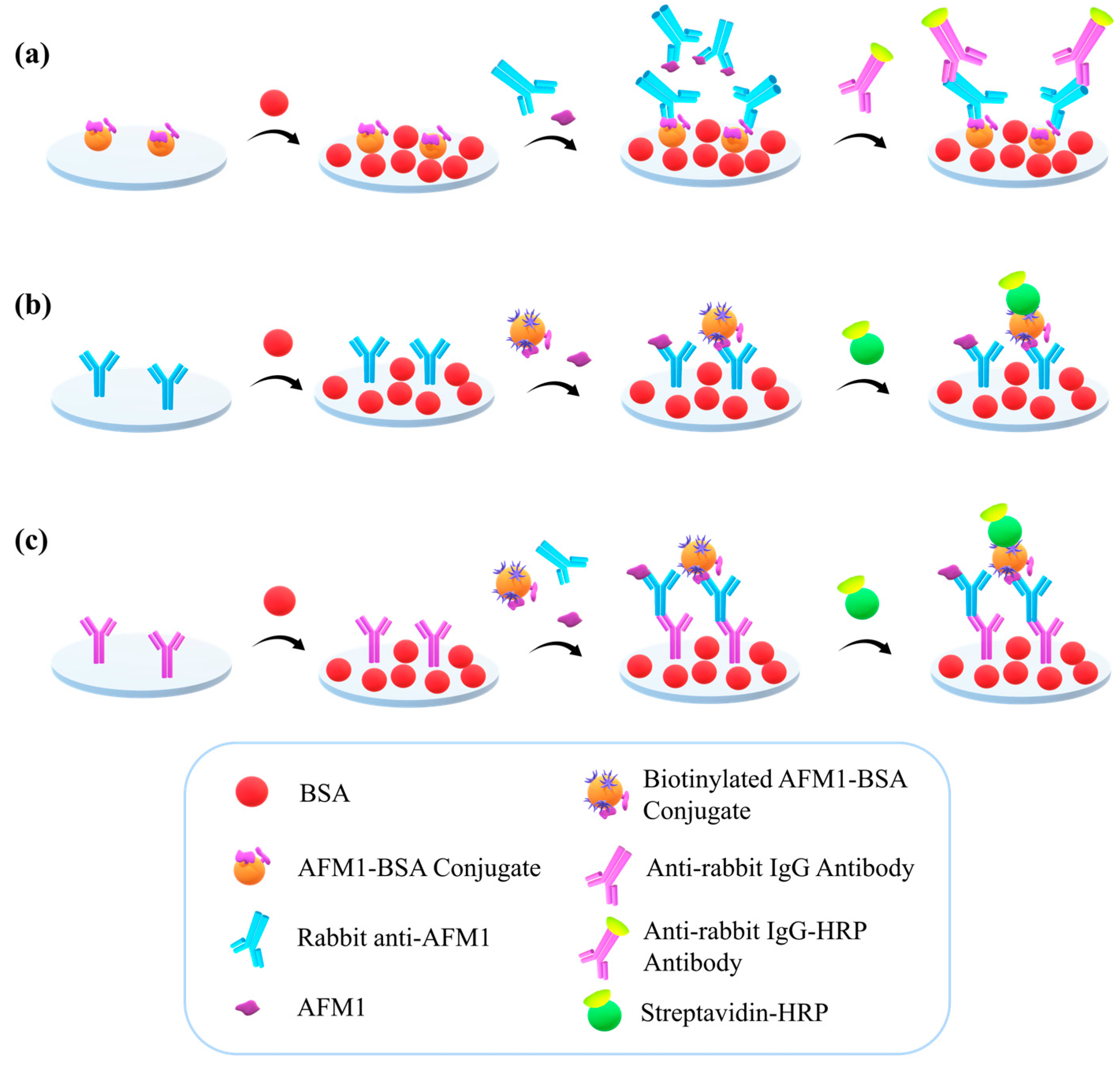
Aflatoxin M1 (AFM1) exposure through dairy products is associated with adverse health effects, including hepatotoxicity and carcinogenicity. Therefore, the AFM1 presence in milk and dairy products is strictly regulated. In this context, the current work focuses on the investigation of different competitive enzyme immunoassay configurations for the determination of AFM1 in milk with high sensitivity and short assay duration. Amongst the configurations tested, the one based on incubation of the anti-AFM1 specific antibody along with the calibrators/samples and a biotinylated conjugate of AFM1 with bovine serum albumin (BSA) in microwells coated with a secondary antibody provided a six-fold lower detection limit than the configuration involving immobilized AFM1-BSA conjugate and liquid phase antibody. The detection limit achieved was 5.0 pg/mL, with a dynamic range of up to 2.0 ng/mL. The assay was repeatable with intra- and inter-assay coefficients of variations lower than 3.2% and 6.5%, respectively, and accurate with recovery values from 87.5 to 108%. Moreover, the assay was completed in 1.5 h. The excellent analytical characteristics and short analysis time make the proposed assay suitable for use by the food industry. Furthermore, the proposed configuration could be employed to enhance the detection sensitivity of competitive immunoassays for other low-molecular-weight analytes.
Keywords: aflatoxin M1; ELISA; milk safety; immunoassay aflatoxin M1; ELISA; milk safety; immunoassay