

Neurochemical Effects of Chronic Administration of Calcitriol in Rats

Abstract
1. Introduction
2. Experimental Section
2.1. Animals and Drug Administration
2.2. VDR Protein Analysis and Serum Biochemical Assays
2.3. Neurochemistry Analysis
2.4. Real-Time PCR Analysis

| Amplicon length | |||
|---|---|---|---|
| GAD65 (NM012563) | GCTCTACGGAGACTCTGAGAAG | CGGTTGGTCTGACAATTCCC | 318 bp |
| GAD67 (NM017007) | TGTGGCGTAGCCCATGGATG | ACTGGTGTGGGTGGTGGAAG | 320 bp |
| GS (NM017073) | CCACTGTCCCTGGGCTTAGTTTA | AGTGACATGCTAGTCCCACCAA | 147 bp |
| TPH2 (NM173839) | GGGTTACTTTCCTCCATCGGA | AAGCAGGTTGTCTTCGGGTC | 86 bp |
| MAOA (NM033653) | GTGTGGAACCCCTTGGCATA | GTCCCATTCCTGAGCGTGTC | 130 bp |
| IDO (NM023973) | CCAGTCCGTGAGTTTGTCATTTT | CAGTCCCTCTGTTTTCCGTGTTT | 196 bp |
| TH (NM012740) | ACCACCTGGTCACCAAGTTT | GCAATCTCTTCCGCTGTGTA | 160 bp |
| COMT (NM012531) | ATCTTCACGGGGTTTCAGTG | GAGCTGCTGGGGACAGTAAG | 145 bp |
| β-Actin (NM031144) | CATCCTGCGTCTGGACCTGG | TAATGTCACGCACGATTTCC | 116bp |
2.5. Statistical Analysis
3. Results
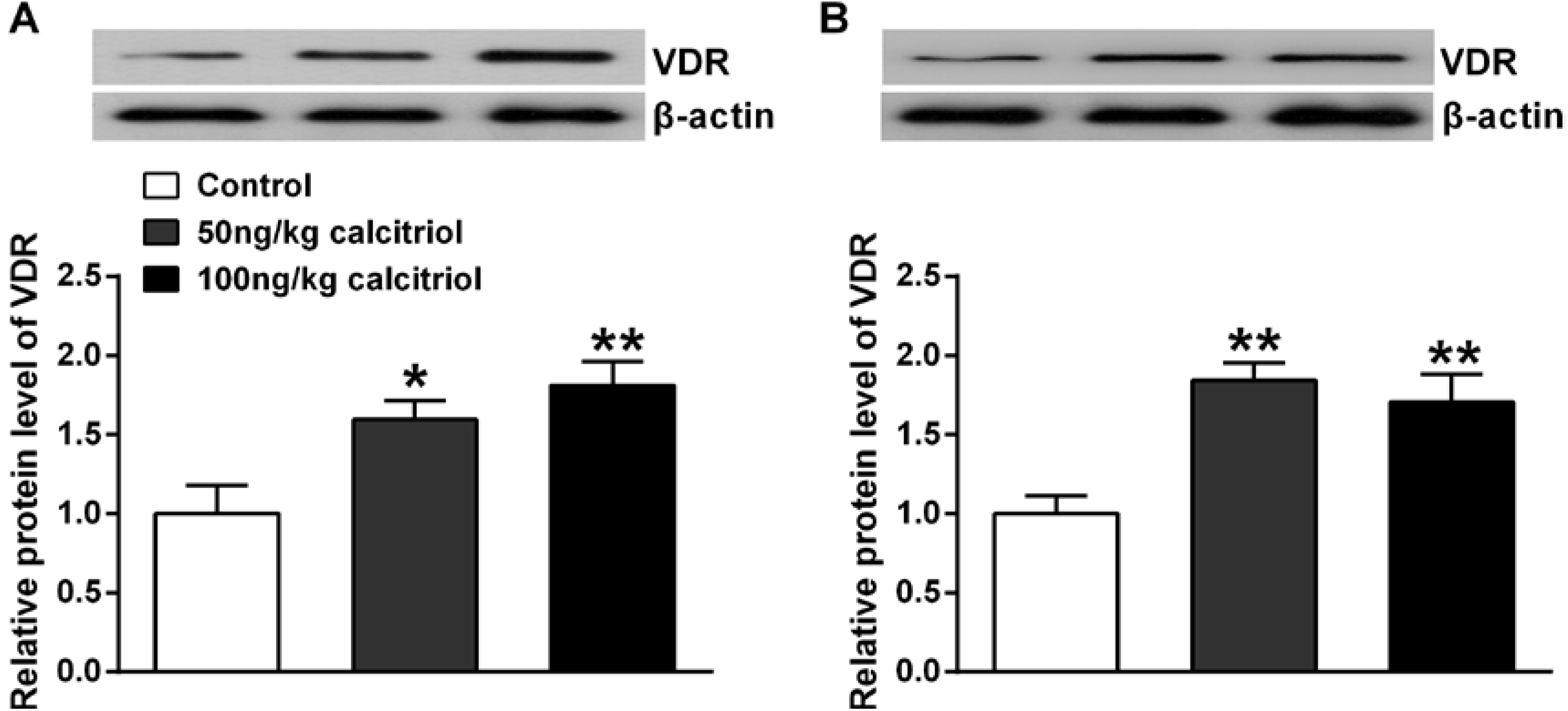
3.1. VDR Expression and Serum Levels of Calcium and Phosphorus
| Groups | Body weight gain (g) | Calcium (mmol/L) | Phosphate (mmol/L) |
|---|---|---|---|
| Control | 162.25 ± 5.77 | 2.30 ± 0.06 | 2.59 ± 0.15 |
| 50 ng/kg calcitriol | 170.02 ± 6.75 | 2.38 ± 0.04 | 2.68 ± 0.11 |
| 100 ng/kg calcitriol | 161.25 ± 7.49 | 2.46 ± 0.05 | 2.56 ± 0.10 |
3.2. Brain Neurochemistry and Gene Expression
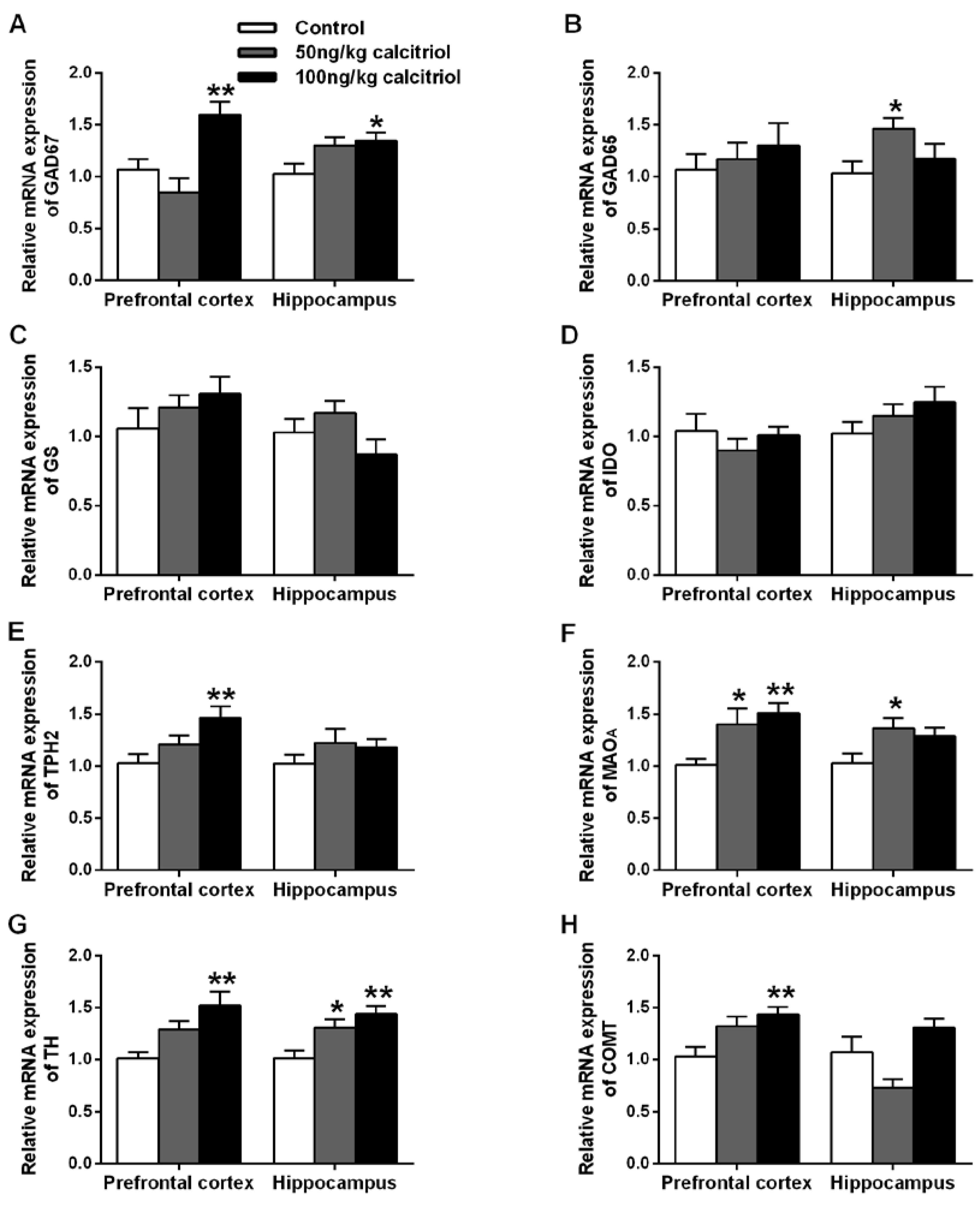
| Hippocampus | ||||||
|---|---|---|---|---|---|---|
| 100 ng/kg calcitriol | ||||||
| GABA (µg/g) | 28.2 ± 2.4 | 31.2 ± 2.3 | 38.3 ± 3.1 * | 20.4 ± 2.8 | 35.7 ± 3.2 ** | 31.5 ± 3.7 * |
| Glu (µg/g) | 90.5 ± 6.5 | 101.8 ± 5.9 | 134.5 ± 6.8 ** | 80.1 ± 3.5 | 82.9 ± 10.2 | 99.2 ± 14.3 |
| Gln (µg/g) | 49.8 ± 3.6 | 56.7 ± 4.9 | 68.5 ± 4.5 * | 38.1 ± 2.3 | 41.69 ± 2.69 | 45.90 ± 4.35 |
| TRY (µg/g) | 5.6 ± 1.0 | 5.5 ± 1.4 | 5.3 ± 0.6 | 5.4 ± 0.7 | 5.2 ± 0.4 | 5.3 ± 1.2 |
| 5-HT (ng/g) | 919.6 ± 64.6 | 838.1 ± 54.3 | 945.7 ± 30.8 | 747.2 ± 32.7 | 833.9 ± 46.3 | 762.1 ± 28.1 |
| 5-HIAA (ng/g) | 232.7 ± 31.6 | 624.1 ± 99.8 ** | 544.9 ± 52.7 ** | 343.1 ± 54.5 | 554.6 ± 83.6 | 573.5 ± 57.1 * |
| KYN (ng/g) | 337.3 ± 24.0 | 284.5 ± 64.5 | 239.9 ± 37.1 | 394.4 ± 107.5 | 287.4 ± 82.3 | 416.0 ± 46.2 |
| DA (ng/g) | 551.5 ± 104.3 | 613.4 ± 81.0 | 516.7 ± 51.9 | 335.1 ± 26.1 | 399.1 ± 60.2 | 337.8 ± 16.7 |
| NE (ng/g) | 609.2 ± 65.4 | 533.5 ± 60.3 | 536.6 ± 29.2 | 546.6 ± 113.5 | 571.1 ±54.6 | 591.2 ± 64.7 |
| DOPAC (ng/g) | 115.8 ± 16.6 | 149.2 ± 11.9 | 190.9 ± 20.5 * | 30.5 ± 5.1 | 66.1 ±7.9 ** | 41.7 ± 4.4 |
| HVA (ng/g) | 104.9 ± 9.5 | 158.9 ± 18.9 * | 163.6 ± 11.4 * | 83.2 ± 10.1 | 127.9 ± 11.0 * | 178.1 ± 17.2 ** |
4. Discussion
5. Conclusions
Acknowledgments
Author Contributions
Conflicts of Interest
References
- Groves, N.J.; McGrath, J.J.; Burne, T.H. Vitamin D as a neurosteroid affecting the developing and adult brain. Annu. Rev. Nutr. 2014, 34, 117–141. [Google Scholar] [CrossRef] [PubMed]
- Stewart, A.; Wong, K.; Cachat, J.; Elegante, M.; Gilder, T.; Mohnot, S.; Wu, N.; Minasyan, A.; Tuohimaa, P.; Kalueff, A.V. Neurosteroid vitamin d system as a nontraditional drug target in neuropsychopharmacology. Behav. Pharmacol. 2010, 21, 420–426. [Google Scholar] [CrossRef] [PubMed]
- DeLuca, G.C.; Kimball, S.M.; Kolasinski, J.; Ramagopalan, S.V.; Ebers, G.C. Review: The role of vitamin d in nervous system health and disease. Neuropathol. Appl. Neurobiol. 2013, 39, 458–484. [Google Scholar] [CrossRef] [PubMed]
- Eyles, D.W.; Liu, P.Y.; Josh, P.; Cui, X. Intracellular distribution of the vitamin d receptor in the brain: Comparison with classic target tissues and redistribution with development. Neuroscience 2014, 268, 1–9. [Google Scholar] [CrossRef] [PubMed]
- Patrick, R.P.; Ames, B.N. Vitamin d hormone regulates serotonin synthesis. Part 1: Relevance for autism. FASEB J. 2014, 28, 2398–2413. [Google Scholar] [CrossRef] [PubMed]
- Wang, J.Y.; Wu, J.N.; Cherng, T.L.; Hoffer, B.J.; Chen, H.H.; Borlongan, C.V.; Wang, Y. Vitamin D(3) attenuates 6-hydroxydopamine-induced neurotoxicity in rats. Brain Res. 2001, 904, 67–75. [Google Scholar] [CrossRef] [PubMed]
- Cass, W.A.; Peters, L.E.; Fletcher, A.M.; Yurek, D.M. Calcitriol promotes augmented dopamine release in the lesioned striatum of 6-hydroxydopamine treated rats. Neurochem. Res. 2014, 39, 1467–1476. [Google Scholar] [CrossRef] [PubMed]
- Orme, R.P.; Bhangal, M.S.; Fricker, R.A. Calcitriol imparts neuroprotection in vitro to midbrain dopaminergic neurons by upregulating GDNF expression. PLoS One 2013, 8. [Google Scholar] [CrossRef] [PubMed]
- Groves, N.J.; Kesby, J.P.; Eyles, D.W.; McGrath, J.J.; Mackay-Sim, A.; Burne, T.H. Adult vitamin D deficiency leads to behavioural and brain neurochemical alterations in C57BL/6J and BALB/c mice. Behav. Brain Res. 2013, 241, 120–131. [Google Scholar] [CrossRef] [PubMed]
- Byrne, J.H.; Voogt, M.; Turner, K.M.; Eyles, D.W.; McGrath, J.J.; Burne, T.H. The impact of adult vitamin d deficiency on behaviour and brain function in male sprague-dawley rats. PLoS One 2013, 8. [Google Scholar] [CrossRef] [PubMed]
- Kesby, J.P.; Cui, X.; O’Loan, J.; McGrath, J.J.; Burne, T.H.; Eyles, D.W. Developmental vitamin D deficiency alters dopamine-mediated behaviors and dopamine transporter function in adult female rats. Psychopharmacology 2010, 208, 159–168. [Google Scholar] [CrossRef] [PubMed]
- Kesby, J.P.; Cui, X.; Ko, P.; McGrath, J.J.; Burne, T.H.; Eyles, D.W. Developmental vitamin D deficiency alters dopamine turnover in neonatal rat forebrain. Neurosci. Lett. 2009, 461, 155–158. [Google Scholar] [CrossRef] [PubMed]
- Cass, W.A.; Peters, L.E.; Fletcher, A.M.; Yurek, D.M. Evoked dopamine overflow is augmented in the striatum of calcitriol treated rats. Neurochem. Int. 2012, 60, 186–191. [Google Scholar] [CrossRef] [PubMed][Green Version]
- Tenenhouse, A.; Warner, M.; Commissiong, J.W. Neurotransmitters in the cns of the vitamin D deficient, hypocalcemic rat. Neurochem. Int. 1991, 18, 249–255. [Google Scholar] [CrossRef] [PubMed]
- Ahmed, M.A. Impact of vitamin D3 on cardiovascular responses to glucocorticoid excess. J. Physiol. Biochem. 2013, 69, 267–276. [Google Scholar] [CrossRef] [PubMed]
- Jiang, P.; Xue, Y.; Li, H.D.; Liu, Y.P.; Cai, H.L.; Tang, M.M.; Zhang, L.H. Dysregulation of vitamin D metabolism in the brain and myocardium of rats following prolonged exposure to dexamethasone. Psychopharmacology 2014, 231, 3445–3451. [Google Scholar] [CrossRef] [PubMed]
- Cai, H.L.; Zhu, R.H.; Li, H.D. Determination of dansylated monoamine and amino acid neurotransmitters and their metabolites in human plasma by liquid chromatography-electrospray ionization tandem mass spectrometry. Anal. Biochem. 2010, 396, 103–111. [Google Scholar] [CrossRef] [PubMed]
- Zella, L.A.; Meyer, M.B.; Nerenz, R.D.; Lee, S.M.; Martowicz, M.L.; Pike, J.W. Multifunctional enhancers regulate mouse and human vitamin d receptor gene transcription. Mol. Endocrinol 2010, 24, 128–147. [Google Scholar] [CrossRef] [PubMed]
- Sun, X.; Zemel, M.B. 1α,25-dihydroxyvitamin d and corticosteroid regulate adipocyte nuclear vitamin D receptor. Int. J. Obes. 2008, 32, 1305–1311. [Google Scholar] [CrossRef] [Green Version]
- Jiang, P.; Zhang, W.Y.; Li, H.D.; Cai, H.L.; Liu, Y.P.; Chen, L.Y. Stress and vitamin D: Altered vitamin D metabolism in both the hippocampus and myocardium of chronic unpredictable mild stress exposed rats. Psychoneuroendocrinology 2013, 38, 2091–2098. [Google Scholar] [CrossRef] [PubMed]
- Cui, X.; Groves, N.J.; Burne, T.H.; Eyles, D.W.; McGrath, J.J. Low vitamin D concentration exacerbates adult brain dysfunction. Am. J. Clin. Nutr. 2013, 97, 907–908. [Google Scholar] [CrossRef] [PubMed]
- Jiang, P.; Zhang, W.Y.; Li, H.D.; Cai, H.L.; Xue, Y. Repeated haloperidol administration has no effect on vitamin D signaling but increase retinoid X receptors and Nur77 expression in rat prefrontal cortex. Cell. Mol. Neurobiol. 2013, 33, 309–312. [Google Scholar] [CrossRef] [PubMed]
- Kesby, J.P.; Eyles, D.W.; Burne, T.H.; McGrath, J.J. The effects of vitamin D on brain development and adult brain function. Mol. Cell. Endocrinol. 2011, 347, 121–127. [Google Scholar] [CrossRef] [PubMed]
- Cass, W.A.; Smith, M.P.; Peters, L.E. Calcitriol protects against the dopamine- and serotonin-depleting effects of neurotoxic doses of methamphetamine. Ann. N. Y. Acad. Sci. 2006, 1074, 261–271. [Google Scholar] [CrossRef] [PubMed]
- Liu, W.; Sheng, H.; Xu, Y.; Liu, Y.; Lu, J.; Ni, X. Swimming exercise ameliorates depression-like behavior in chronically stressed rats: Relevant to proinflammatory cytokines and IDO activation. Behav. Brain Res. 2013, 242, 110–116. [Google Scholar] [CrossRef] [PubMed]
- Fernandes de Abreu, D.A.; Eyles, D.; Feron, F. Vitamin D, a neuro-immunomodulator: Implications for neurodegenerative and autoimmune diseases. Psychoneuroendocrinology 2009, 34, S265–277. [Google Scholar]
- Wrzosek, M.; Lukaszkiewicz, J.; Jakubczyk, A.; Matsumoto, H.; Piatkiewicz, P.; Radziwon-Zaleska, M.; Wojnar, M.; Nowicka, G. Vitamin D and the central nervous system. Pharmacol. Rep. 2013, 65, 271–278. [Google Scholar] [CrossRef] [PubMed]
- Leke, R.; Silveira, T.R.; Escobar, T.D.; Schousboe, A. Expression of glutamate decarboxylase (GAD) mrna in the brain of bile duct ligated rats serving as a model of hepatic encephalopathy. Neurochem. Res. 2014, 39, 605–611. [Google Scholar] [CrossRef] [PubMed]
- Pehrson, A.L.; Bondi, C.O.; Totah, N.K.; Moghaddam, B. The influence of NMDA and GABA(A) receptors and glutamic acid decarboxylase (GAD) activity on attention. Psychopharmacology 2013, 225, 31–39. [Google Scholar] [CrossRef] [PubMed]
- Gao, S.F.; Klomp, A.; Wu, J.L.; Swaab, D.F.; Bao, A.M. Reduced GAD(65/67) immunoreactivity in the hypothalamic paraventricular nucleus in depression: A postmortem study. J. Affect. Disord. 2013, 149, 422–425. [Google Scholar] [CrossRef] [PubMed]
- Walls, A.B.; Nilsen, L.H.; Eyjolfsson, E.M.; Vestergaard, H.T.; Hansen, S.L.; Schousboe, A.; Sonnewald, U.; Waagepetersen, H.S. GAD65 is essential for synthesis of gaba destined for tonic inhibition regulating epileptiform activity. J. Neurochem. 2010, 115, 1398–1408. [Google Scholar] [CrossRef] [PubMed]
- Kesby, J.P.; O’Loan, J.C.; Alexander, S.; Deng, C.; Huang, X.F.; McGrath, J.J.; Eyles, D.W.; Burne, T.H. Developmental vitamin D deficiency alters MK-801-induced behaviours in adult offspring. Psychopharmacology 2012, 220, 455–463. [Google Scholar] [CrossRef] [PubMed]
© 2014 by the authors; licensee MDPI, Basel, Switzerland. This article is an open access article distributed under the terms and conditions of the Creative Commons Attribution license (http://creativecommons.org/licenses/by/4.0/).
Share and Cite
Jiang, P.; Zhang, L.-H.; Cai, H.-L.; Li, H.-D.; Liu, Y.-P.; Tang, M.-M.; Dang, R.-L.; Zhu, W.-Y.; Xue, Y.; He, X. Neurochemical Effects of Chronic Administration of Calcitriol in Rats. Nutrients 2014, 6, 6048-6059. https://doi.org/10.3390/nu6126048
Jiang P, Zhang L-H, Cai H-L, Li H-D, Liu Y-P, Tang M-M, Dang R-L, Zhu W-Y, Xue Y, He X. Neurochemical Effects of Chronic Administration of Calcitriol in Rats. Nutrients. 2014; 6(12):6048-6059. https://doi.org/10.3390/nu6126048
Chicago/Turabian StyleJiang, Pei, Li-Hong Zhang, Hua-Lin Cai, Huan-De Li, Yi-Ping Liu, Mi-Mi Tang, Rui-Li Dang, Wen-Ye Zhu, Ying Xue, and Xin He. 2014. "Neurochemical Effects of Chronic Administration of Calcitriol in Rats" Nutrients 6, no. 12: 6048-6059. https://doi.org/10.3390/nu6126048
APA StyleJiang, P., Zhang, L.-H., Cai, H.-L., Li, H.-D., Liu, Y.-P., Tang, M.-M., Dang, R.-L., Zhu, W.-Y., Xue, Y., & He, X. (2014). Neurochemical Effects of Chronic Administration of Calcitriol in Rats. Nutrients, 6(12), 6048-6059. https://doi.org/10.3390/nu6126048

