Article

Effect of Antioxidants and B-Group Vitamins on Risk of Infections in Patients with Type 2 Diabetes Mellitus

1
Internal Medicine, Faculty of Medicine & Health Sciences, United Arab Emirates University, Al Ain, PO Box 17666, United Arab Emirates
2
Tawam Hospital, Al Ain, PO Box 15258, United Arab Emirates
*
Author to whom correspondence should be addressed.
Nutrients 2013, 5(3), 711-724; https://doi.org/10.3390/nu5030711
Submission received: 6 December 2012 / Revised: 14 January 2013 / Accepted: 25 January 2013 / Published: 5 March 2013
(This article belongs to the Special Issue Nutrition and Infectious Diseases)

Abstract

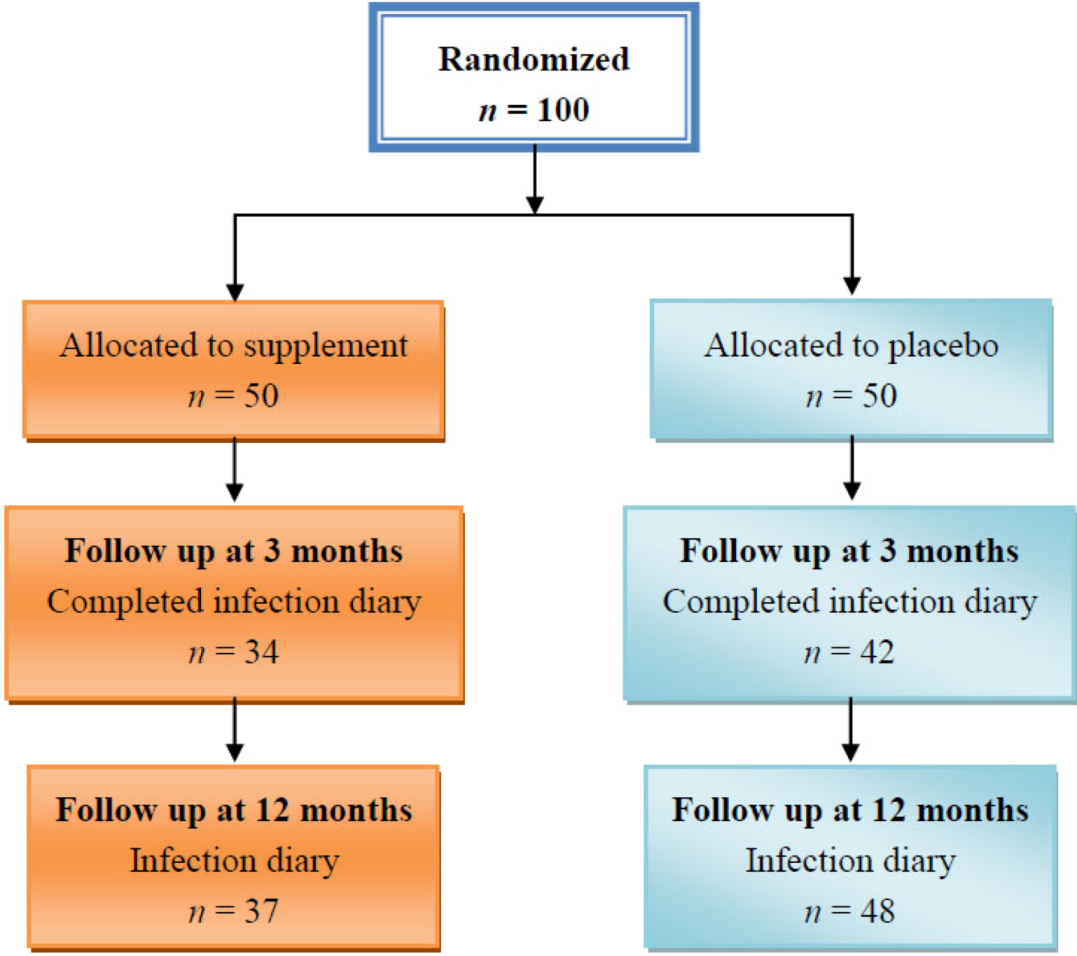
Previous studies have revealed that diabetic patients have a decline in immunity and an increased risk of infections, and this may be associated with poor micronutrient status. The aim of this study was to measure the effect of dietary supplements on risk of infection in patients with type 2 diabetes mellitus. One hundred patients with type 2 diabetes mellitus were randomly assigned to receive an oral dose of daily B-group vitamins and antioxidant vitamins (n = 50) or an identical placebo (n = 50) daily for 90 days. Patients had baseline, three and 12 month assessment for nutritional status, fruits and vegetables intake, physical activity and self-reported infections. Supplementation with antioxidants and B-group vitamins significantly increased the plasma concentration of vitamin E and folate and reduced homocysteine in the intervention group (p-values were 0.006, 0.001 and 0.657, respectively). The number of infections reported by the treatment group after three months of supplements was less than that reported by the placebo group, 9 (27%) vs. 15 (36%) (p = 0.623). Corresponding numbers of infections at 12 months were 25 (67.5%) and 27 (56.3%), respectively (p = 0.488). Up to 90% of the diabetic patients were either overweight or obese with a sedentary life style, and their body weight increased further during three months of follow up. The study showed that multivitamin supplements improved vitamin blood concentrations; however, this did not reduce the number of infections in diabetic patients.
Keywords: dietary supplement; risk of infection; type 2 diabetes mellitus; B-group vitamins; antioxidant vitamins dietary supplement; risk of infection; type 2 diabetes mellitus; B-group vitamins; antioxidant vitamins