Iodine Content of Commercially Available Iodized Salts in Hungary Determined by Iodometric Titration: Implications for the Effectiveness of Salt Iodization

 ,
,  , , ,
, , ,  ,
,
Abstract
1. Introduction
1.1. Hypothyroidism
1.2. Iodine Deficiency
1.3. Iodine Prophylaxis and the Use of Iodized Salt
2. Materials and Methods
2.1. Salt Samples
2.2. Measurement Method, Iodometric Titration
2.2.1. Reagents and Chemicals
2.2.2. Calculation of Iodine Content
2.2.3. Procedure for the Determination of Potassium Iodide (KI)
Testing for the Presence of Stabilizers (Reducing Agents)
Titration Procedure
Method Testing and Optimization for Potassium Iodide (KI) Determination
2.3. Validation
2.4. Wholesale Micro-Survey
3. Results
3.1. Iodometric Titration
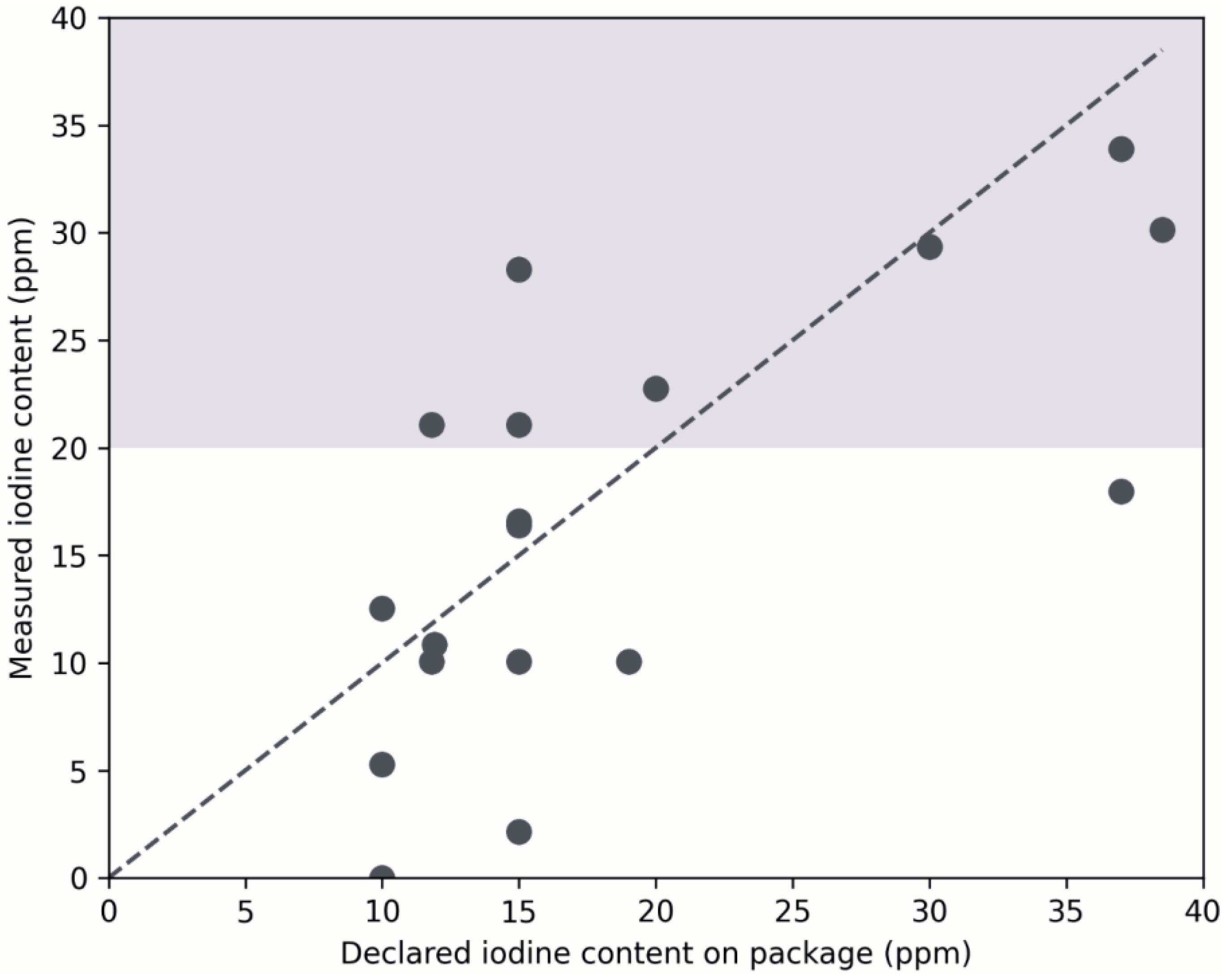
3.2. Iodine Content Declared on the Packaging
3.3. Presence of Stabilizers in KI Fortified Salts
3.4. Wholesale Micro-Survey
4. Discussion
4.1. Iodometric Titration
4.2. Iodine Content Declared on the Packaging
4.3. Presence of Stabilizers in KI Fortified Salts
4.4. Wholesale Micro-Survey
4.5. Limitations
5. Conclusions
Supplementary Materials
Author Contributions
Funding
Institutional Review Board Statement
Informed Consent Statement
Data Availability Statement
Acknowledgments
Conflicts of Interest
Abbreviations
| FT4 | Free thyroxine |
| HACCP | Hazard Analysis and Critical Control Points |
| H2SO4 | Sulfuric acid |
| IGN | Iodine Global Network |
| ISO | International Organization for Standardization |
| I2 | Molecular iodine |
| I− | Iodide ion |
| KI | Potassium iodide |
| KIO3 | Potassium iodate |
| LT4 | Levothyroxine |
| NaCl | Sodium chloride |
| Na2S2O3 | Sodium thiosulfate |
| NaOCl | Sodium hypochlorite |
| ND | No data |
| ppm | Parts per million |
| RSD | Relative standard deviation |
| TSH | Thyroid-stimulating hormone |
| UIC | Urinary iodine concentration |
| USI | Universal salt iodization |
| WHO | World Health Organization |
References
- Chaker, L.; Bianco, A.C.; Jonklaas, J.; Peeters, R.P. Hypothyroidism. Lancet 2017, 390, 1550–1562. [Google Scholar] [CrossRef] [PubMed]
- Zimmermann, M.B. Iodine deficiency. Endocr. Rev. 2009, 30, 376–408. [Google Scholar] [CrossRef]
- Vanderpump, M.P. The epidemiology of thyroid disease. Br. Med. Bull. 2011, 99, 39–51. [Google Scholar] [CrossRef]
- Surks, M.I.; Ortiz, E.; Daniels, G.H.; Sawin, C.T.; Col, N.F.; Cobin, R.H.; Franklyn, J.A.; Hershman, J.M.; Burman, K.D.; Denke, M.A.; et al. Subclinical thyroid disease: Scientific review and guidelines for diagnosis and management. JAMA 2004, 291, 228–238. [Google Scholar] [CrossRef] [PubMed]
- The EUthyroid Consortium. The Krakow Declaration on Iodine: Tasks and responsibilities for prevention programs targeting iodine deficiency disorders. Eur. Thyroid. J. 2018, 7, 201–204. [Google Scholar] [CrossRef]
- Mendes, D.; Alves, C.; Silverio, N.; Batel Marques, F. Prevalence of undiagnosed hypothyroidism in Europe: A systematic review and meta-analysis. Eur. Thyroid. J. 2019, 8, 130–143. [Google Scholar] [CrossRef] [PubMed]
- Szabolcs, I.; Podoba, J.; Feldkamp, J.; Dohan, O.; Farkas, I.; Sajgó, M.; Takáts, K.I.; Góth, M.; Kovács, L.; Kressinszky, K.; et al. Comparative screening for thyroid disorders in old age in areas of iodine deficiency, long-term iodine prophylaxis and abundant iodine intake. Clin. Endocrinol. 1997, 47, 87–92. [Google Scholar] [CrossRef] [PubMed]
- Hungarian Central Statistical Office (KSH). Main Diseases of People Aged 19 and Over Registered by General Practitioners. Available online: https://statinfo.ksh.hu/Statinfo/index.jsp (accessed on 6 March 2026).
- Berta, E.; Lengyel, I.M.; Hegedűs, L.; Papini, E.; Perros, P.; Negro, R.; Attanasio, R.; Nagy, V.E.; Bodor, M. Pajzsmirigyhormon-kezelési szokások Magyarországon: A THESIS kérdőíves felmérés eredményei [Use of thyroid hormones in hypothyroid and euthyroid patients: A THESIS questionnaire survey of Hungarian physicians]. Orv. Hetil. 2022, 163, 463–472. [Google Scholar] [CrossRef]
- Jonklaas, J.; Bianco, A.C.; Bauer, A.J.; Burman, K.D.; Cappola, A.R.; Celi, F.S.; Cooper, D.S.; Kim, B.W.; Peeters, R.P.; Rosenthal, M.S.; et al. Guidelines for the treatment of hypothyroidism: Prepared by the American Thyroid Association Task Force on Thyroid Hormone Replacement. Thyroidr 2014, 24, 1670–1751. [Google Scholar] [CrossRef]
- Garber, J.R.; Cobin, R.H.; Gharib, H.; Hennessey, J.V.; Klein, I.; Mechanick, J.I.; Pessah-Pollack, R.; Singer, P.A.; Woeber, K.A.; American Association of Clinical Endocrinologists; et al. Clinical practice guidelines for hypothyroidism in adults: Cosponsored by the American Association of Clinical Endocrinologists and the American Thyroid Association. Endocr. Pract. 2012, 18, 988–1028. [Google Scholar] [CrossRef]
- Ko, Y.J.; Kim, J.Y.; Lee, J.; Song, H.J.; Kim, J.Y.; Choi, N.K.; Park, B.J. Levothyroxine dose and fracture risk according to the osteoporosis status in elderly women. J. Prev. Med. Public Health 2014, 47, 36–46. [Google Scholar] [CrossRef] [PubMed]
- Wu, C.C.; Islam, M.M.; Nguyen, P.A.; Poly, T.N.; Wang, C.H.; Iqbal, U.; Li, Y.J.; Yang, H.C. Risk of cancer in long-term levothyroxine users: Retrospective population-based study. Cancer Sci. 2021, 112, 2533–2541. [Google Scholar] [CrossRef]
- Oblak, A.; Hribar, M.; Hristov, H.; Gregorič, M.; Blaznik, U.; Osredkar, J.; Kušar, A.; Žmitek, K.; Lavriša, Ž.; Zaletel, T.; et al. Interpreting urinary iodine concentration: Effects of urine dilution and collection timing. Eur. J. Clin. Nutr. 2024, 78, 1105–1110. [Google Scholar] [CrossRef]
- Zimmermann, M.B.; Andersson, M. Assessment of iodine nutrition in populations: Past, present, and future. Nutr. Rev. 2012, 70, 553–570. [Google Scholar] [CrossRef]
- Hatch-McChesney, A.; Lieberman, H.R. Iodine and Iodine Deficiency: A Comprehensive Review of a Re-Emerging Issue. Nutrients 2022, 14, 3474. [Google Scholar] [CrossRef]
- World Health Organization (WHO). Recommended Iodine Levels in Salt and Guidelines for Monitoring Their Adequacy and Effectiveness; WHO/NUT/96.13; WHO: Geneva, Switzerland, 1996; Available online: https://www.who.int/publications/i/item/WHO-NUT-96.13 (accessed on 6 March 2026).
- Lin, J.; Tan, H.L.; Ge, H. Global, regional, and national burden of iodine deficiency in reproductive women from 1990 to 2019, and projections to 2035: A systematic analysis for the Global Burden of Disease Study 2019. Int. J. Womens Health 2025, 17, 1863–1875. [Google Scholar] [CrossRef]
- Iodine Global Network (IGN). Global Scorecard of Iodine Nutrition 2025; IGN: Ottawa, ON, Canada, 2025; Available online: https://ign.org/app/uploads/2025/10/Scorecard_2025_FINAL_22-April-2025.pdf (accessed on 6 March 2026).
- World Health Organization Regional Office for Europe. Prevention and Control of Iodine Deficiency in the WHO European Region: Adapting to Changes in Diet and Lifestyle; WHO Regional Office for Europe: Copenhagen, Denmark, 2024; Available online: https://www.who.int/europe/publications/i/item/9789289061193 (accessed on 6 March 2026).
- Taylor, P.N.; Albrecht, D.; Scholz, A.; Gutierrez-Buey, G.; Lazarus, J.H.; Dayan, C.M.; Okosieme, O.E. Global epidemiology of hyperthyroidism and hypothyroidism. Nat. Rev. Endocrinol. 2018, 14, 301–316. [Google Scholar] [CrossRef] [PubMed]
- Péter, F.; Podoba, J.; Muzsnai, Á. Iodine status of schoolchildren in Hungary: Improvement a decade on. Eur. Thyroid. J. 2015, 4, 71–72. [Google Scholar] [CrossRef] [PubMed]
- Andersson, M.; Karumbunathan, V.; Zimmermann, M.B. Global iodine status in 2011 and trends over the past decade. J. Nutr. 2012, 142, 744–750. [Google Scholar] [CrossRef]
- Mezosi, E.; Molnar, I.; Jakab, A.; Balogh, E.; Karanyi, Z.; Pakozdy, Z.; Nagy, P.; Gyory, F.; Szabo, J.; Bajnok, L.; et al. Prevalence of iodine deficiency and goitre during pregnancy in East Hungary. Eur. J. Endocrinol. 2000, 143, 479–483. [Google Scholar] [CrossRef][Green Version]
- Konrády, A.; Székely, M. Results of regional studies on iodine excretion in counties North-Pest and West-Nógrád [Regionális jódürítési vizsgálatok eredményei Észak-Pest és Nyugat-Nógrád megyében]. Egészségtudomány 2000, 44, 49–55. [Google Scholar]
- Csáthy, L.; Molnár, I.; Szász, G.; Tarczali, D.; Máth, J. Studies on neonatal iodine metabolism in Hajdú-Bihar county [Újszülöttkori jódanyagcsere-vizsgálatok Hajdú-Bihar megyében]. Gyermekgyógyászat 2006, 57, 535–542. [Google Scholar]
- Sámson, L.; Varga, Z.; Posta, J.; Bodor, M.; Balogh, E.; Gazsó, A.; Karányi, Z.; Katkó, M.; Nagy, D.M.; Andrási, D.; et al. A jódellátottságot befolyásoló tényezők terhesség és szoptatás alatt [Factors affecting iodine intake during pregnancy and lactation]. Magy. Belorv. Arch. 2013, 66, 256–262. [Google Scholar]
- Katko, M.; Gazso, A.A.; Hircsu, I.; Bhattoa, H.P.; Molnar, Z.; Kovacs, B.; Andrasi, D.; Aranyosi, J.; Makai, R.; Veress, L.; et al. Thyroglobulin level at week 16 of pregnancy is superior to urinary iodine concentration in revealing preconceptual and first trimester iodine supply. Matern. Child Nutr. 2018, 14, e12470. [Google Scholar] [CrossRef]
- Allen, L.; de Benoist, B.; Dary, O.; Hurrell, R. (Eds.) Guidelines on Food Fortification with Micronutrients; World Health Organization and Food and Agriculture Organization of the United Nations: Geneva, Switzerland, 2006; Available online: https://iris.who.int/handle/10665/43412 (accessed on 6 March 2026).
- World Health Organization (WHO); United Nations Children’s Fund (UNICEF); International Council for Control of Iodine Deficiency Disorders (ICCIDD). Assessment of Iodine Deficiency Disorders and Monitoring Their Elimination: A Guide for Programme Managers, 3rd ed.; World Health Organization: Geneva, Switzerland, 2007. [Google Scholar]
- World Health Organization (WHO). Households Consuming Adequately Iodized Salt (≥15 Parts per Million). Nutrition Landscape Information System (NLiS). Available online: https://www.who.int/data/nutrition/nlis/info/households-consuming-adequately-iodized-salt-%28-15-parts-per-million%29 (accessed on 6 March 2026).
- World Health Organization (WHO). Salt as a Vehicle for Fortification: Report of a WHO Expert Consultation, Luxembourg, 21–22 March 2007; World Health Organization: Geneva, Switzerland, 2008; Available online: https://iris.who.int/server/api/core/bitstreams/af563a7b-b3cd-48ef-b322-c7e189853633/content (accessed on 6 March 2026).
- United Nations Children’s Fund (UNICEF). Iodine. Available online: https://data.unicef.org/topic/nutrition/iodine/ (accessed on 6 March 2026).
- World Health Organization Regional Office for Europe. People in the WHO European Region at Greater Risk of Iodine Deficiency Due to Changing Diets. Available online: https://www.who.int/europe/news/item/28-06-2024-people-in-the-who-european-region-at-greater-risk-of-iodine-deficiency-due-to-changing-diets (accessed on 6 March 2026).
- ISO 10007:2017; Quality Management—Guidelines for Configuration Management. International Organization for Standardization: Geneva, Switzerland, 2017.
- Péter, F. A “silent” jódprofilaxis csak részben korrigálja a jódhiányt: A magyar történet (1970–2020) [“Silent” iodine prophylaxis only partially corrects iodine deficiency: The Hungarian story (1970–2020)]. Orv. Hetil. 2020, 161, 2107–2114. [Google Scholar] [CrossRef] [PubMed]
- Vithanage, M.; Herath, I.; Achinthya, S.S.; Bandara, T.; Weerasundara, L.; Mayakaduwa, S.S.; Jayawardhana, Y.; Kumarathilaka, P. Iodine in commercial edible iodized salts and assessment of iodine exposure in Sri Lanka. Arch. Public Health 2016, 74, 21. [Google Scholar] [CrossRef] [PubMed]
- Islam, M.S.; Habib, M.A.; Alam, M.A.U.; Halima, O.; Parvin, N.; Karim, M.R.; Shanna, A.R.; Romel, R.J.; Sakib, A.R.; Islam, M.A. Determination of iodine concentration in commonly consumed salt and its potential impact on household consumers: An examination and assessment of consumed salt. Public Health Chall. 2024, 3, e70012. [Google Scholar] [CrossRef]
- Abdurrahim, M.; Haque, S.E.M.; Roy, D.C.; Arefin, P.; Ruchita, F.F.; Sarkar, M.R.; Faroque, A.B.M. Iodine concentration in edible salt from production to retail level in Bangladeshi territory: A comparative study following standard regulations. J. Food Compos. Anal. 2023, 120, 105334. [Google Scholar] [CrossRef]
- Deresa, E.M.; Befkadu, D.M.; Hamda, M.G. Investigation of the effects of heat and light on iodine content of packaged and open salt brands collected from Jimma town. Heliyon 2023, 9, e20412. [Google Scholar] [CrossRef]
- Shawel, D.; Hagos, S.; Lachat, C.K.; Kimanya, M.E.; Kolsteren, P. Post-production losses in iodine concentration of salt hamper the control of iodine deficiency disorders: A case study in northern Ethiopia. J. Health Popul. Nutr. 2010, 28, 238–244. [Google Scholar] [CrossRef]
- Desta, A.A.; Kulkarni, U.; Abraha, K.; Worku, S.; Sahle, B.W. Iodine level concentration, coverage of adequately iodized salt consumption and factors affecting proper iodized salt utilization among households in North Ethiopia: A community based cross-sectional study. BMC Nutr. 2019, 5, 28. [Google Scholar] [CrossRef]
- Anteneh, Z.A.; Engidayehu, M.; Abeje, G. Iodine content of dietary salt at household level and associated factors using iodometric titration methods in Dera District, Northwest Ethiopia. BMC Nutr. 2017, 3, 83. [Google Scholar] [CrossRef]
- Simbo, R.T.; Nyuma, F.F.; Gueta, M.F.R.D. Iodine concentration of iodized salts consumed in Harper. Open J. Appl. Sci. 2022, 12, 1655–1663. [Google Scholar] [CrossRef]
- Abughoush, M.; Olaimat, A.N.; Al-Holy, M.; Al-Awwad, N.J.; Al-Dalali, S.; Al-Hourani, H.; Daseh, L.; Abazeed, B.; Al-Dabbas, M.; Abuawad, B.; et al. Quantitative determination of iodine content in iodized table salt marketed in Jordan as an indicator of compliance with national salt iodization standards: A cross-sectional study. Ital. J. Food Sci. 2024, 36, 72–81. [Google Scholar] [CrossRef]
- Al-Dakheel, M.H.; Haridi, H.K.; Al-Bashir, B.M.; Al-Shangiti, A.M.; Al-Shehri, S.N.; Hussein, I. Assessment of household use of iodized salt and adequacy of salt iodization: A cross-sectional national study in Saudi Arabia. Nutr. J. 2018, 17, 35. [Google Scholar] [CrossRef] [PubMed]
- Rajković, M.B. Determination of potassium iodide in table salt. J. Agric. Sci. 2009, 54, 152–165. [Google Scholar] [CrossRef]
- Bilgin, M.G.; Bayir, A.G.; Özkan, B. Determining the amount of iodine in edible salts obtained from markets and district bazaars in İstanbul. Bezmialem Sci. 2022, 10, 488–492. [Google Scholar] [CrossRef]
- Brezean, I.; Ferechide, D.; Lupusoru, M.; Barbilian, A.; Moga, M.; Lupusoru, G.E.; Vilcu, M.E.; Pantea, I. Iodized salt between myth and reality: Assessment of iodine content in table salt commercially available in Romania. Rev. Chim. 2017, 68, 2963–2966. [Google Scholar] [CrossRef]
- National Food Chain Safety Office (NÉBIH). Só-Termékteszt 2.0—Avagy Mitől Különbek a “Speciális” Sók? Available online: https://portal.nebih.gov.hu/-/so-termekteszt-2-0-avagy-mitol-kulonbek-a-specialis-sok- (accessed on 6 March 2026).
- Rulebook on Quality and Other Requirements for Common Salt and Salt for Foodstuff Industry; No. 39/2001; Official Gazette of the Federal Republic of Yugoslavia: Belgrade, Serbia, 2001.
- Andersson, M.; de Benoist, B.; Rogers, L. Epidemiology of iodine deficiency: Salt iodisation and iodine status. Best Pract. Res. Clin. Endocrinol. Metab. 2010, 24, 1–11. [Google Scholar] [CrossRef]
- ISO 9001:2015; Quality Management Systems—Requirements. International Organization for Standardization: Geneva, Switzerland, 2015.
- ISO 22000:2018; Food Safety Management Systems—Requirements for Any Organization in the Food Chain. International Organization for Standardization: Geneva, Switzerland, 2018.
- Ekott, E.J.; Etukudo, U.I. Iodine stability in iodized salt: A review. Int. J. Eng. Tech. Res. 2025, 15, 2454–4698. [Google Scholar]
- Kelly, F.C. Studies on the stability of iodine compounds in iodized salt. Bull. World Health Organ. 1953, 9, 217–230. [Google Scholar] [PubMed]
- Zeb, A.; Yasin, M.; Mehmood, Z.; Ahmad, T.; Arshad, M.S. Evaluation of KIO3 stability in iodized salts stored under different packaging and climatic conditions in Pakistan. J. Food Compos. Anal. 2025, 148, 108494. [Google Scholar] [CrossRef]


| Sample ID and Packaging | Declared Iodine Compound and Content (µg/100 g) | Declared Elemental Iodine Equivalent (ppm 1) | Country/Place of Origin | Manufacturer | Distributor | Best-Before Date |
|---|---|---|---|---|---|---|
| #1 Plastic bag 1 kg | KIO3 1000 | 10 | EU, Romania Transylvanian Salt Mines | Só-Center Packaging and Trade Social Cooperative, Nyírmada, Hungary | Reál Hungaria Food Ltd., Biatorbágy, Hungary | 16 August 2027 |
| #2 Paper box 1 kg | KIO3 3000 | 30 | Mediterranean Sea | Compagnia Italiana Sali S.p.a., Porto Viro, Italy | Hun-Trade Ltd., Budapest, Hungary | ND |
| #3 Plastic bag 1 kg | KIO3 1000 | 10 | EU, Romania Transylvanian Salt Mines | Só-Center Packaging and Trade Social Cooperative, Nyírmada, Hungary | CO-OP Hungary Zrt., Budapest, Hungary | 11 December 2027 |
| #4 Plastic bag 1 kg | KIO3 ND | ND | ND | ND | KOTÁNYI Hungaria Ltd., Budaörs, Hungary | 5 January 2028 |
| #5 Plastic bottle 0.5 kg | KIO3 1180 | 11.8 | EU, Turda, Romania, Salt Mine: Salina Valea Sarata | Laminoristilor str. 145F, Campia Turzii, Cluj, Romania | ND | 17 November 2027 |
| #6 Plastic bag 1 kg | KIO3 min. 20 mg/kg | 11.9 | EU | ND 2 | Koch’s Torma (Hungaria) Ltd., Kiskunfélegyháza, Hungary | 27 October 2027 |
| #7 Plastic bag 1 kg | KIO3 1180 | 11.8 | Bosnia and Herzegovina | Solinwest 2000 Ltd. Tuzsér, Kálongatanya, Hungary info@solinwest.hu | ND 2 | 16 December 2027 |
| #8 Plastic bag 1 kg | KIO3 1500 | 15 | ND 2 | ND 2 | METRO Trading Ltd., Budaörs, Hungary | 26 January 2028 |
| #9 Plastic bag 1 kg | KIO3 2000 | 20 | ND 2 | Solinwest 2000 Ltd. Tuzsér, Kálongatanya, Hungary | ND 2 | 13 October 2027 |
| #10 Plastic bag 1 kg | KIO3 1000 | 10 | EU, Romania Transylvanian Salt Mines | Só-Center Packaging and Trade Social Cooperative, Nyírmada, Hungary | ND 2 | 26 August 2027 |
| #11 Plastic bag 1 kg | KI 15–25 mg/kg | 11–19 | Trinidad Sal Pans in the Ebro River Delta Nature Reserve on the Mediterranean coast of Spain | INFOSA, Tarragona, Spain | TONA Hungary Ltd., Gyál, Hungary | 16 June 2028 |
| #12 Plastic bottle 0.4 kg | ND iodine: 3700 | 37 | Greece | KALAS S.A., Athens, Greece | EPIMPEX Ltd., Budapest, Hungary | 28 August 2028 |
| #13 Plastic bag 1 kg | KI 1500 | 15 | Hallstatt, Austria | ND 2 | Salinen Budapest Ltd., Budapest, Hungary | 13 October 2028 |
| #14 Plastic bag 1 kg | KI 3700 | 37 | Greece | KALAS S.A., Athens, Greece | EPIMPEX Ltd., Budapest, Hungary | 13 October 2028 |
| #15 Plastic bag 1 kg | KI 1500 | 15 | Austria | ND 2 | Maresi Foodbroker Ltd., Budapest, Hungary | 15 September 2028 |
| #16 Plastic bottle 0.2 kg | KI (40–60 ppm) 5000 (75 ug/1.5 g) stabilizers: sodium carbonate (0.1%), magnesium carbonate (0.5%) | 31–46 | Greece | CHION S. A., Patras, Greece | Hellas-Invest Ltd., Törökbálint, Budapest | 15 September 2030 |
| #17 Plastic bag 1 kg | KI max. 1900 | 19 | Wieliczka, Poland | ND 2 | Kotányi Hungaria Ltd., Budapest, Hungary | August 2028 |
| #18 Plastic bag 1 kg | KI 1500 | 15 | Austria | ND 2 | Maresi Foodbroker Ltd., Budapest, Hungary | 15 December 2028 |
| #19 Plastic bag 1 kg | KI 1500 stabilizer: sodium sulphate 0.2% | 15 | Romania | ND 2 | Hadászi Ltd., Debrecen, Hungary | 7 January 2028 |
| #20 Plastic bag 1 kg | ND 2 | ND 2 | Pakistan | ND 2 | VOG Export-Import Ltd., Bük, Hungary | Indefinite shelf life |
| Sample ID and Packaging | Declared Iodine Compound | Declared Elemental Iodine Equivalent (ppm) | Mean Measured Elemental Iodine (I) Content in ppm (n = 3) | Relative Standard Deviation (RSD, %) |
|---|---|---|---|---|
| #1 Plastic bag 1 kg | KIO3 | 10 | 12.57 | 2.04 |
| #2 Paper box 1 kg | KIO3 | 30 | 29.32 | 1.34 |
| #3 Plastic bag 1 kg | KIO3 | 10 | 5.21 | 2.84 |
| #4 Plastic bag 1 kg | KIO3 | ND 1 | 17.95 | 1.43 |
| #5 Plastic bottle 0.5 kg | KIO3 | 11.8 | 10.09 | 1.47 |
| #6 Plastic bag 1 kg | KIO3 | 11.9 | 10.88 | 0.00 |
| #7 Plastic bag 1 kg | KIO3 | 11.8 | 21.16 | 1.41 |
| #8 Plastic bag 1 kg | KIO3 | 15 | 21.25 | 0.00 |
| #9 Plastic bag 1 kg | KIO3 | 20 | 22.80 | 1.97 |
| #10 Plastic bag 1 kg | KIO3 | 10 | 0 | - |
| #11 Plastic bag 1 kg | KI | 11–19 | 28.34 | 1.03 |
| #12 Plastic bottle 0.4 kg | KI | 37 | 17.94 | 0.82 |
| #13 Plastic bag 1 kg | KI | 15 | 16.50 | 1.54 |
| #14 Plastic bag 1 kg | KI | 37 | 33.92 | 0.86 |
| #15 Plastic bag 1 kg | KI | 15 | 9.98 | 1.47 |
| #16 Plastic bottle 0.2 kg | KI | 31–46 | 30.20 | 0.89 |
| #17 Plastic bag 1 kg | KI | 19 | 10.07 | 1.55 |
| #18 Plastic bag 1 kg | KI | 15 | 16.36 | 0.95 |
| #19 Plastic bag 1 kg | KI | 15 | 2.16 | 0 |
| #20 Plastic bag 1 kg | KI | ND 1 | 5.30 | 2.94 |
| Iodine Concentration Category (ppm) | Samples (IDs) | Number (n) | Percentage |
|---|---|---|---|
| <10 ppm | #3, 10, 19, 20 | 4 | 20% |
| 10–20 ppm | #1, 4, 5, 6, 12, 13, 15, 17, 18 | 9 | 45% |
| 20–40 ppm | #2, 7, 8, 9, 11, 14, 16 | 7 | 35% |
| >40 ppm | – | 0 | 0% |
| Total | 20 | 100% |
Disclaimer/Publisher’s Note: The statements, opinions and data contained in all publications are solely those of the individual author(s) and contributor(s) and not of MDPI and/or the editor(s). MDPI and/or the editor(s) disclaim responsibility for any injury to people or property resulting from any ideas, methods, instructions or products referred to in the content. |
© 2026 by the authors. Licensee MDPI, Basel, Switzerland. This article is an open access article distributed under the terms and conditions of the Creative Commons Attribution (CC BY) license.
Share and Cite
Hunter, N.; Berényi, K.; Csergő, Á.; Zand, A.; Bufa, A.; Dörnyei, Á.; Németh, B.; Kiss, I.; Árvay, B.; Szendi, K. Iodine Content of Commercially Available Iodized Salts in Hungary Determined by Iodometric Titration: Implications for the Effectiveness of Salt Iodization. Nutrients 2026, 18, 1164. https://doi.org/10.3390/nu18071164
Hunter N, Berényi K, Csergő Á, Zand A, Bufa A, Dörnyei Á, Németh B, Kiss I, Árvay B, Szendi K. Iodine Content of Commercially Available Iodized Salts in Hungary Determined by Iodometric Titration: Implications for the Effectiveness of Salt Iodization. Nutrients. 2026; 18(7):1164. https://doi.org/10.3390/nu18071164
Chicago/Turabian StyleHunter, Nicole, Károly Berényi, Ágnes Csergő, Afshin Zand, Anita Bufa, Ágnes Dörnyei, Balázs Németh, István Kiss, Bálint Árvay, and Katalin Szendi. 2026. "Iodine Content of Commercially Available Iodized Salts in Hungary Determined by Iodometric Titration: Implications for the Effectiveness of Salt Iodization" Nutrients 18, no. 7: 1164. https://doi.org/10.3390/nu18071164
APA StyleHunter, N., Berényi, K., Csergő, Á., Zand, A., Bufa, A., Dörnyei, Á., Németh, B., Kiss, I., Árvay, B., & Szendi, K. (2026). Iodine Content of Commercially Available Iodized Salts in Hungary Determined by Iodometric Titration: Implications for the Effectiveness of Salt Iodization. Nutrients, 18(7), 1164. https://doi.org/10.3390/nu18071164