Effects of Probiotic Supplementation on Core Symptoms of Autism Spectrum Disorder in Children



Abstract
1. Introduction
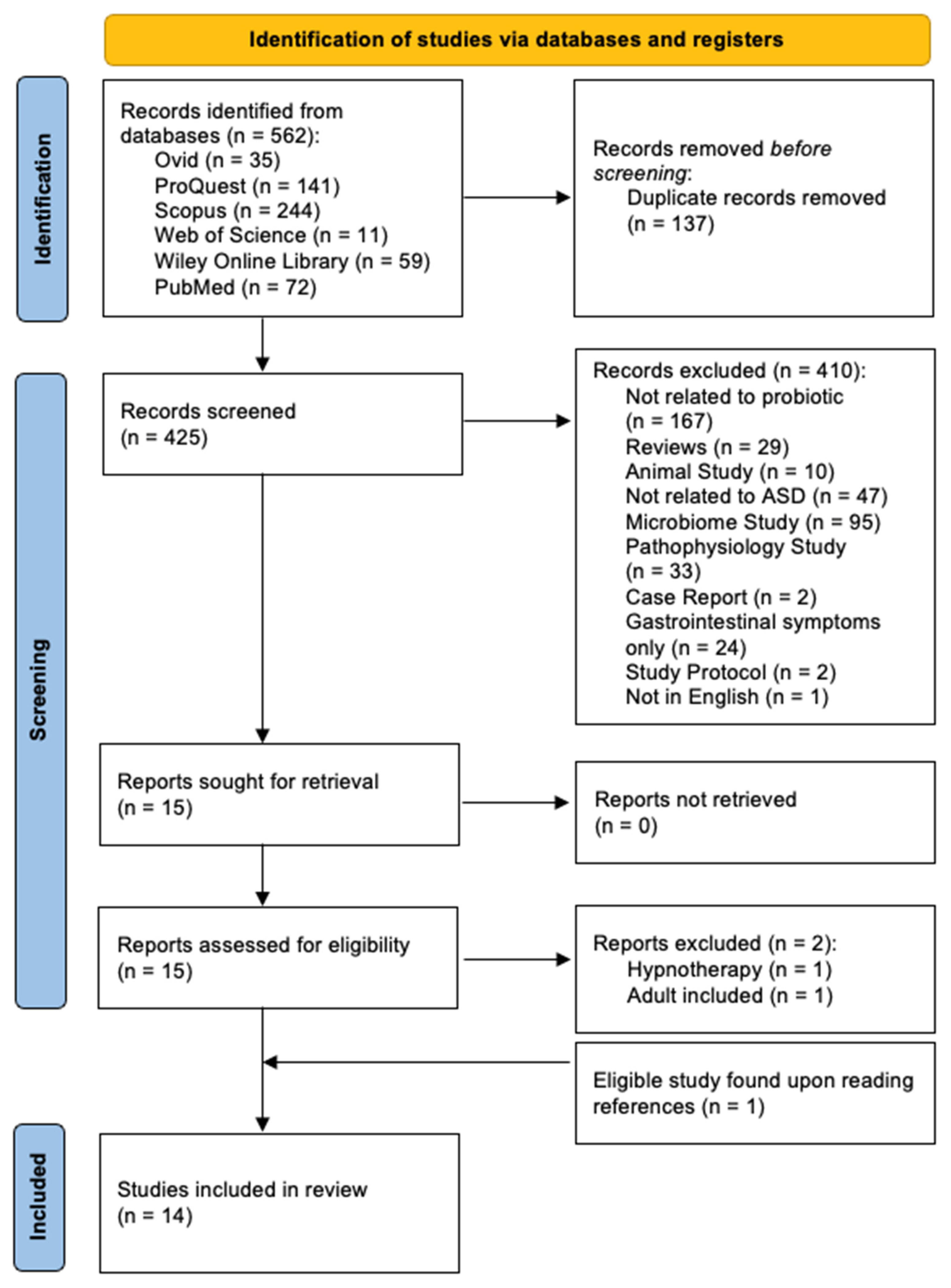
2. Materials and Methods
3. Results
3.1. Study Characteristics

| Author (Year) | Country/Region | Type of Trial | Population | Intervention | Dose | CFU | Evaluation Tool | Findings | Limitations |
|---|---|---|---|---|---|---|---|---|---|
| Shaaban et al. (2017) [42] | Egypt | Prospective, open-label study | 30 ASD 19 ♂ 11 ♀ Age 5–9 yrs | 2 Lact strains (acidophilus, rhamnosus) + 1 Bifid strain (longum) | 5 g/day for 3 months | 5 × 10⁸ | ATEC | Significant reductions in total ATEC scores, as well as improvements across all four subdomains: speech/language/communication, sociability, sensory/cognitive awareness, and health/physical/behavior. | Small sample size; no control group; unblinded study |
| Liu et al. (2019) [29] | Taiwan | Randomized, double-blinded, placebo-controlled trial | 80 ASD (39 with PRO, 41 with PLA) ♂ ♀ missing Age 7–15 yrs | Lactobacillus plantarum PS128 with microcrystalline cellulose as carrier to be stored at 4–8 °C | 1 capsule/day for 4 weeks | 3 × 10¹⁰ | ABC-T SRS SNAP-IV CGI | SNAP-IV-opposition/defiance and SNAP-IV-total score improved significantly in subjects aged 7–12 years in PS128 group. Only significant when stratified by age. | Short intervention period |
| Niu et al. (2019) [36] | China | Nonrandomized, unblinded, placebo-controlled trial | 65 ASD (37 with PRO, 28 with PLA) ♂ ♀ missing Age 3–8 years | Probiotic strains not reported + ABA training | 6 g/day for 4 weeks | 3.6 × 10⁹ | ATEC | ATEC total and all subdomains improved significantly in the probiotic group. Improvement in ASD groups without GI events was higher than those with GI events. (86.7% vs. 78.9%) | Small sample size; short intervention period; unblinded study |
| Arnold et al. (2019) [43] | United States | Randomized, double-blinded, controlled clinical trial | 10 ASD (6 PRO then PLA, 4 PLA then PRO) 6 ♂ 4 ♀ Age 3–12 yrs | Strep thermophilus + 3 Bifid strains (breve, longum, infantis) + 4 Lact strains (acidophilus, plantarum, para-casei, delbrueckii subsp. bulgaricus) | 1 packet/day for 8 weeks → 3 weeks washout → 8 weeks placebo Option for 2 packets/day at 4-week or 15-week visit if no effect was noted | 9 × 10¹¹ per packet | ABC SRS | Each outcome measure showed improvement over baseline, with probiotic phase showing more improvement than placebo phase, but not statistically significant. | Small sample size; no placebo-only control group; short intervention period |
| Santocchi et al. (2020) [44] | Italy | Randomized, double-blinded, placebo-controlled trial | 85 ASD (42 with PRO, 43 with PLA) 71 ♂ 14 ♀ Age 18–72 mths | Strep thermophilus + 3 Bifid strains (breve, longum, infantis) + 4 Lact strains (acidophilus, plantarum, para-casei, delbrueckii subsp. bulgaricus) dissolved directly at mouth or in a cold, not carbonated liquid | 2 packets/day in the first mth and 1 packet/day for the next 5 mths | 4.5 × 10¹¹ per packet | ADOS-CSS RRB VABS-II SCQ | In group without GI symptoms, ADOS-CSS scores (total and social affect) significantly decline in the probiotic group. In group with GI symptoms, VABS-II increased significantly in probiotic group in all subscales (receptive skills, domestic skills, and coping skills) in probiotic group. Only significant when segregated by GI symptoms. | High dropout rate; small age range |
| Mensi et al. (2021) [47] | Italy | Open-label, non-randomized clinical trial | 131 ASD (105 with LP, 26 with OP) 112 ♂ 19 ♀ 86.1 ± 41.1 mnths (7.2 ± 3.4 yrs) | Lactobacillus plantarum PS128 | 1 packet/day (BW < 30 kg) or 2 packets/day (BW ≥ 30 kg) for 6 mths | 3 × 10¹⁰ per packet | CGI | CGI-Improvement of 1–3 in 77.1% of all patients; correlation between younger age and improvement is observed (R = 0.283). CGI-I of 1–3 was reported for 91 patients of the LP group (86.7%). | No randomization; uneven number of participants in LP and OP groups; no placebo group; unblinded study |
| Sherman et al. (2022) [48] | Taiwan | Randomized, double-blinded, placebo-controlled trial | 35 ASD (18 with PRO, 17 with PLA) 26 ♂ 9 ♀ 3–20 yrs | Lactobacillus plantarum PS128 | 6 × 10¹⁰ CFUs/day for 16 weeks | 6 × 10¹⁰ | SRS ABC-2 CGI | In probiotic group, changes in CGI-I, ABC-2 total score, and stereotypic behavior sub-score were positively correlated with baseline titers of anti-lysoganglioside GM1. Change in ABC-2 inappropriate speech sub-score was positively correlated with baseline titers of anti-dopamine receptor D1 in probiotic group. Change in SRS motivation sub-score was positively correlated with baseline titers of anti-tubulin in probiotic group. Change in serum GFAP concentration was positively correlated with baseline ABC-2 inappropriate speech sub-score in probiotic group. Change in Shannon index of gut microbiome was positively correlated with baseline CGI-S, SRS total score, SRS subscales (cognition and motivation), and ABC-2 subscales (hyperactivity/noncompliance and social withdrawal) | Small sample size; abundance of correlational tests; wide age range |
| Guidetti et al. (2022) [38] | Italy | Randomized double-blinded crossover clinical trial | 61 ASD (30 with PRO then PLA, 31 with PLA then PRO) 50 ♂ 11 ♀ Age 2–16 yrs | 3 Lact strains (fermentum LF10, salivarius LS03, plantarium LP01) + 5 Bifid longum strains (DLBL07–DLBL11) | 2 sachets/day at first mth 1 sachet/day for 2 mths | 1 × 10¹⁰ per sachet | PSI VABS PEP 3rd edition ASRS | Significant improvement in communication skills in VABS and receptive language. Significant improvement in PSI for both parents | Small sample size |
| Guiducci et al. (2022) [45] | Italy | Randomized double-blinded placebo-controlled trial | 63 ASD (31 with PRO, 32 with PLA) ♂ ♀ missing Age 3–5 yrs | Strep thermophilus + 3 Bifid strains (breve, longum, infantis) + 4 Lact strains (acidophilus, plantarum, para-casei, delbrueckii subsp. bulgaricus) | 2 packets/day in the first mth and 1 packet/day for the next 5 mths | 4.5 × 10¹¹ per packet | ADOS | Children in the “ADOS Total Score Improved” Group in the Probiotic group showed the highest 25(OH)D status at 29.9 ± 9.9 ng/mL. 25(OH)D below 30 ng/mL carries 5.6× higher risk of no improvement in ADOS. | No statistical analysis of ADOS score between treatment and control group; small sample size |
| Billeci et al. (2023) [46] | Italy | Randomized, double-blinded, placebo-controlled trial | 46 ASD (26 with PRO, 20 with PLA) 35 ♂ 11 ♀ Age 18–72 mths | Strep thermophilus + 3 Bifid strains (breve, longum, infantis) + 4 Lact strains (acidophilus, plantarum, para-casei, delbrueckii subsp. bulgaricus) | 2 packets/day in the first mth and 1 packet/day for the next 5 mths | 4.5 × 10¹¹ per packet | ADOS-2 CARS SCQ RBS-R CBCL VABS-II | No significant changes in all the scales measured. | Small sample size; focused on EEG findings |
| Mazzone et al. (2023) [37] | USA | Randomized, double-blinded, placebo-controlled trial | 43 ASD (21 with PRO, 22 with PLA) 35 ♂ 8 ♀ Age 6.23 ± 1.15 years | Limosilactobacillus reuteri DSM17938 and ATCC PTA 6475 | 2 tablets/day for 6 mths | 2 × 10⁸ per tablet | ADOS-2 SRS CBCL ABAS-2 | The total T score and social communication domain score of SRS significantly improved. Social adaptive composite score in ABAS-2 significantly improved. | Small sample size |
| Li et al. (2024) [31] | China | Open-label, single-arm pilot study | 53 ASD (49 ♂ 4 ♀); age 6.49 ± 3.08 yrs 45 TD (41 ♂ 4 ♀) Age 7.68 ± 3.61 yrs | Bifid animalis subsp. lactis Probio-M8 + Balanced diet (30–40 kcal/kg with 40% carbohydrate, 30% fats, 30% proteins) | Dry powder 2 g/day for 12 weeks | 1 × 10¹¹ | CARS | CARS scores significantly decreased by 15.22%. | No placebo control group; unblinded study; high dropout rate (19 out of 72) |
| Rojo-Marticella et al. (2025) [49] | Spain | Randomized, double-blinded, placebo-controlled trial | 42 ASD (21 with PRO, 21 with PLA) 35 ♂ 7 ♀ Age 5–16 yrs | Lactiplantibacillus plantarum + Levilactobacillus brevis (1:1 ratio) | 1 sachet/day for 12 weeks | 1 × 10⁹ | CPT-3/ K-CPT 2 SRS-2 | Hyperactivity–impulsivity symptoms significantly improved (7.20 ± 3.76) in younger children (5–9 years old). | Small sample size |
| Khanna et al. (2025) [30] | India | Randomized single-blinded placebo-controlled trial | 180 ASD (90 with PRO, 90 with PLA) 139 ♂ 41 ♀ 2–9 years | Saccharomyces boulardii + 4 Bifid strains (breve, brevebifidum, animalis lactis, longum infantis) + 6 Lact strains (reuteri, rhamanosus, planetarium, acidophilus, casie, delbrueckii bulgaricus) + Streptococcus thermophilus mixed with 50 mL of lukewarm milk or water | 5 g/day for 3 mths | 9 × 10⁹ | SRS-2 ABC-2 | Significant improvements in SRS-2 total T score and significant reduction in percentage of children with severe SCI and RRBI subscores. Significant reductions of percentage of children with severe social withdrawal, stereotypic behavior, hyperactivity, and inappropriate speech. | Not double-blinded |
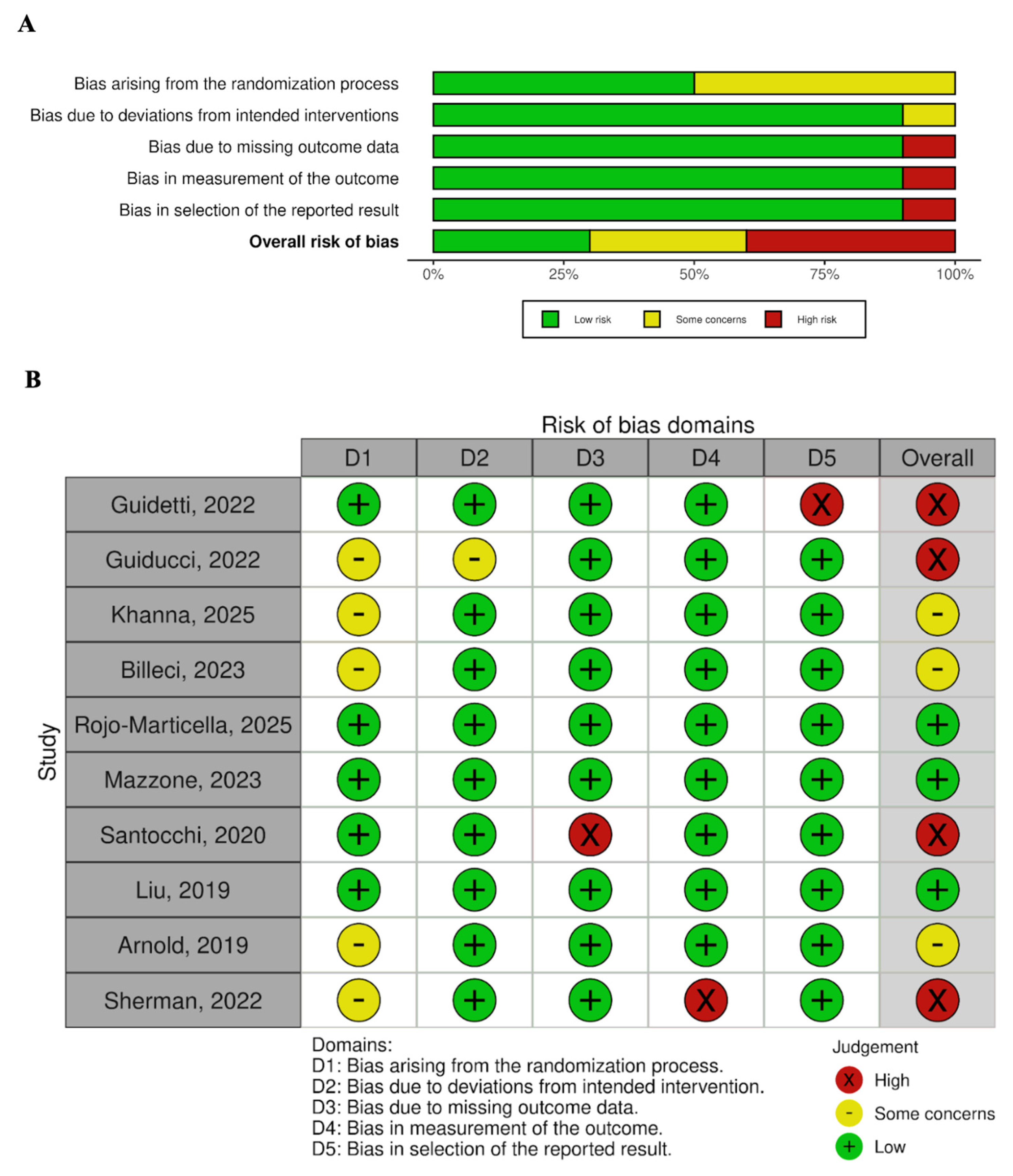
3.2. Study Quality
3.3. Main Findings
3.4. Main Findings According to Domains of Core ASD Symptoms
| Domain | Risk of Bias | Author | Intervention | Main Findings | p Value |
|---|---|---|---|---|---|
| SC | Low | Mazzone et al. [37] | L. reuteri DSM17938 and ATCC PTA 6475 2 tablets/day (0.4 billion CFUs in total) for 6 mths | Social communication subscore of SRS improved from 12.3 ± 5.1 to 10.3 ± 3.5 in the probiotic group. Social adaptive composite score of ABAS-2 improved from 65.60 ± 12.73 to 69.70 ± 14.45 in the probiotic group. | p = 0.005 p = 0.018 |
| Some concerns | Khanna et al. [30] | Saccharomyces boulardii + 4 Bifid strains (breve, brevebifidum, animalis lactis, longum infantis) + 6 Lact strains (reuteri, rhamanosus, planetarium, acidophilus, casie, delbrueckii bulgaricus) + Streptococcus thermophilus 5 g/day (9 billion CFUs in total) for 3 mths | SRS-2 total T score reduced from 76.59 ± 6.76 to 70.49 ± 8.51. Percentage of children with severe SCI T score of SRS decreased from 58.90% to 16.70% of total participants in the probiotic group. Percentage of children with severe social withdrawal or lethargy and inappropriate speech of ABC-2 decreased for 40% and 32.22%, respectively. | p = 0.340 p < 0.001 p < 0.001 | |
| High | Guidetti et al. [38] | 3 Lact strains (fermentum LF10, salivarius LS03, plantarium LP01) + 5 Bifid longum strains (DLBL07–DLBL11) 2 sachet/day (20 billion CFUs in total) at 1st mth, 1 sachet/day (10 billion CFUs in total) onwards for total of 3 mths | Significant improvement in communication skills in VABS (+11.3 ± 4.6) and receptive language (+18 ± 8.44) | p = 0.01 p = 0.03 | |
| Santocchi et al. [44] | Strep thermophilus + 3 Bifid strains (breve, longum, infantis) + 4 Lact strains (acidophilus, plantarum, para-casei, delbrueckii subsp. bulgaricus) 2 packets/day (900 billion bacteria) in the first mth and 1 packet/day (450 billion bacteria) for the next 5 mths | Social-affect subscale in ADOS-CSS improved from 6.09 ± 2.00 to 4.95 ± 1.56 in the group of participants without baseline gastrointestinal symptoms. Receptive scale in VABS-II improved from 4.78 ± 3.03 to 7.11 ± 3.14 in the group of participants with baseline gastrointestinal symptoms. | p = 0.027 p = 0.010 | ||
| Serious | Niu et al. [36] | Probiotic strains not reported + ABA training 6 g/day (36 billion CFU in total) for 4 weeks | Speech/language/communication score of ATEC improved from 14.6 to 13.2 (standard deviation not reported). Sociability score of ATEC improved from 16.6 to 14.3 (standard deviation not reported) | p < 0.001 p < 0.001 | |
| Shaaban et al. [42] | 2 Lact strains (acidophilus, rhamnosus) + 1 Bifid strain (longum) 5 g/day (0.5 billion CFUs in total) for 3 months | Speech/language/communication score of ATEC improved from 18.60 ± 4.61 to 18.30 ± 4.59 Sociability score of ATEC improved from 17.50 ± 4.75 to 15.73 ± 4.28 | p = 0.017 p = 0.001 | ||
| RRB | Some concerns | Khanna et al. [30] | Saccharomyces boulardii + 4 Bifid strains (breve, brevebifidum, animalis lactis, longum infantis) + 6 Lact strains (reuteri, rhamanosus, planetarium, acidophilus, casie, delbrueckii bulgaricus) + Streptococcus thermophilus 5 g/day (9 billion CFUs in total) for 3 mths | Percentage of children with severe RRBI T score of SRS decreased from 57.80% to 15.60% of total participants in the probiotic group. Percentage of children with severe stereotypic behavior subscale of ABC-2 decreased for 37.77%. | p < 0.001 p < 0.001 |
| Serious | Niu et al. [36] | Probiotic strains not reported + ABA training 6 g/day (36 billion CFU in total) for 4 weeks | Health/physical/behavior score of ATEC improved from 17.8 to 14.2. (standard deviation not reported). | p < 0.001 | |
| Shaaban et al. [42] | 2 Lact strains (acidophilus, rhamnosus) + 1 Bifid strain (longum) 5 g/day (0.5 billion CFUs in total) for 3 months | Health/physical/behavior score of ATEC improved from 36.83 ± 8.32 to 27.10 ± 5.83. | p < 0.001 | ||
| AF/DLS | High | Santocchi et al. [44] | Strep thermophilus + 3 Bifid strains (breve, longum, infantis) + 4 Lact strains (acidophilus, plantarum, para-casei, delbrueckii subsp. bulgaricus) 2 packets/day (900 billion bacteria) in the first mth and 1 packet/day (450 billion bacteria) for the next 5 mths | Domestic skills in VABS-II improved from 9.44 ± 5.50 to 12.66 ± 2.74 in the group of participants with baseline gastrointestinal symptoms. Coping skills in VABS-II improved from 9.11 ± 4.01 to 10.22 ± 2.17 in the group of participants with baseline gastrointestinal symptoms. | p = 0.047 p = 0.012 |
| Serious | Niu et al. [36] | Probiotic strains not reported + ABA training 6 g/day (36 billion CFU in total) for 4 weeks | Health/physical/behavior score of ATEC improved from 17.8 to 14.2 (standard deviation not reported). | p < 0.001 | |
| Shaaban et al. [42] | 2 Lact strains (acidophilus, rhamnosus) + 1 Bifid strain (longum) 5 g/day (0.5 billion CFUs in total) for 3 months | Health/physical/behavior score of ATEC improved from 36.83 ± 8.32 to 27.10 ± 5.83. | p < 0.001 | ||
| SCP | Serious | Niu et al. [36] | Probiotic strains not reported + ABA training 6 g/day (36 billion CFU in total) for 4 weeks | Sensory/cognitive awareness score of ATEC improved from 18.1 to 16.4 (standard deviation not reported). | p = 0.003 |
| Shaaban et al. [42] | 2 Lact strains (acidophilus, rhamnosus) + 1 Bifid strain (longum) 5 g/day (0.5 billion CFUs in total) for 3 months | Sensory/cognitive awareness score of ATEC improved from 20.47 ± 4.26 to 19.67 ± 4.17. | p = 0.026 |
3.5. Findings from Other Studies Not According to the Domain
3.6. Risk of Bias and Reported Improvements
3.7. Evaluation Tools of ASD Across Studies
3.8. Attempts to Control Confounding Factors
| Author (Year) | Diet Status | Nutritional Status | Birth History | Breastfeeding | Other Medication Use/Therapies |
|---|---|---|---|---|---|
| Shaaban et al. (2017) [42] | Assessed at baseline; excluded patients on special diet. | Assessed at baseline and after intervention | - | - | Excluded patients on anti-fungal, antibiotics, psychiatric medications within the preceding 3 months. No other therapies 2 weeks before and during the study period. |
| Liu et al. (2019) [29] | - | Assessed at baseline | - | - | Excluded patients on antibiotics, yogurt, or probiotic products in preceding 2 weeks. Excluded patients on antibiotics during the study period. Asked to refrain from yogurt or probiotic products during the study period. |
| Niu et al. (2019) [36] | Assessed before and after intervention. | - | - | - | Excluded patients on antibiotic, probiotics, or other GI treatments in preceding 1 month. |
| Arnold et al. (2019) [43] | Diet logs were completed for 3 days before each stool sample collection. | Excluded patients with weight or height less than 3rd percentile for age | - | - | Excluded patients on antibiotics or chronic anti-inflammatory use within the preceding 2 months.Excluded patients on probiotics within the preceding 6 months. |
| Santocchi et al. (2020) [44] | Assessed at baseline. Excluded patients on special diets. | Assessed at baseline | Excluded severe premature birth, birth asphyxia, or perinatal injuries. | Assessed | Administration of antibiotics, NSAIDs, paracetamol, steroids, psychotropic drugs, and other drugs was recorded during the study period. |
| Mensi et al. (2021) [47] | - | - | - | - | - |
| Sherman et al. (2022) [48] | - | - | - | - | Excluded patients on psychotropic medications.Excluded patients who had received oxytocin or probiotic treatment within the last 4 weeks.Excluded patients on antibiotics during study period. |
| Guidetti et al. (2022) [38] | Parents were informed to try limiting excessive food consumption or any food abuse. | - | Assessed | Assessed | Excluded patients on long-term antibiotics, other probiotics, cortisone, anti-inflammatory drugs, amiodarone, valproate, and statins one month before and during the enrollment.Use of antibiotics less than 10 days during the enrollment was reported. |
| Guiducci et al. (2022) [45] | Excluded patients on special diets | Assessed at baseline | Excluded birth asphyxia, severe premature birth, or perinatal injuries. | - | - |
| Billeci et al. (2023) [46] | Weekly food diaries filled in by caregivers. Excluded patients on special diets. | Assessed at baseline and after intervention | Excluded birth asphyxia, severe premature birth, or perinatal injuries. | - | Detailed treatment data was assessed at baseline; concomitant drug consumption monitored by caregiver’s interview. |
| Mazzone et al. (2023) [37] | Weekly diary to report modification in daily diet; excluded patients on special diets. | - | - | - | Weekly diary reporting concomitant medications (antibiotics, anti-inflammatory); allowed to continue the concomitant therapies, such as behavioral and speech therapy, as long as no modification of intervention during the study period. |
| Li et al. (2024) [31] | Medium-carbohydrate diet incorporated in intervention. | Excluded patients diagnosed malnutrition.Assessed at baseline. | - | - | Excluded patients on immunosuppressants, antibiotics, probiotics, prebiotics, or postbiotics within 1 month before or during the intervention. |
| Rojo-Marticella et al. (2025) [49] | Diet quality assessed before and after the intervention. | Assessed before and after intervention. | - | - | Excluded patients on antibiotic at the start of intervention. |
| Khanna et al. (2025) [30] | Excluded patients on special diets; Assessed at baseline (semisolid or solid). | Assessed at baseline. | Excluded birth asphyxia, severe premature birth, or perinatal injuries. | Assessed at baseline (breastfed, formula-fed, or both) | Patients with ongoing behavioral therapy recorded at baseline.Excluded patients on antibiotics within 2 months or long-term use.Excluded patients on psychotropic medications within 3 months.Excluded patients on probiotic supplement within 6 months. |
4. Discussion
4.1. Evidence of Probiotics on Improving Core ASD Symptoms
4.2. Effect of Probiotics on “Social and Communication” Domain
4.3. Effect of Probiotics on Other Domains
4.4. L. reuteri Related to Improvement in “Social & Communication” Domain
4.5. Role of Baseline Gastrointestinal Symptoms on Efficacy of Probiotics
4.6. Choice of ASD Evaluation Tools on Reported Efficacy of Probiotics
4.7. Confounding Factors
4.8. Role of Vitamin D Status on Efficacy of Probiotics
4.9. Probiotics as a Nutritional Intervention
4.10. Strengths and Limitations
5. Conclusions
Supplementary Materials
Author Contributions
Funding
Institutional Review Board Statement
Informed Consent Statement
Data Availability Statement
Acknowledgments
Conflicts of Interest
Abbreviations
| ASD | Autism spectrum disorder |
| ADOS | Autism Diagnostic Observation Schedule |
| ADOS-2 | Autism Diagnostic Observation Schedule—Second Edition |
| CARS-2 | Childhood Autism Rating Scale—Second Edition |
| ABC | Autism Behavior Checklist |
| ATEC | Autism Treatment Evaluation Checklist |
| VABS-II | Vineland Adaptive Behavior Scales, Second Edition |
| SRS | Social Responsiveness Scale |
| AS | Asperger Syndrome |
| PDD-NOS | Pervasive Developmental Disorder Not Otherwise Specified |
| FMT | Fecal microbiota transplantation |
| PRISMA | Preferred Reporting Items for Systematic Reviews and Meta-Analyses |
| RoB 2 | Version 2 of the Cochrane risk-of-bias tool for randomized trials |
| ROBINS-I V2 | Risk Of Bias in Non-randomized Studies—of Interventions, Version 2 |
| ABAS-2 | Adaptive Behavior Assessment System—Second Edition |
| ABC-2 | Aberrant Behavior Checklist—Second Edition |
| ABC-T | Autism Behavior Checklist—Taiwan Version |
| ADOS-2 | Autism Diagnostic Observation Schedule, Second Edition |
| ADOS-CSS | Autism Diagnostic Observation Schedule—Calibrated Severity Score |
| ASRS | Autism Spectrum Rating Scales |
| CBCL | Child Behavior Checklist |
| CFU | Colony-forming units |
| CGI | Clinical Global Impressions Scale |
| CPT-3 | Conners Continuous Performance Test—Third Edition |
| EEG | Electroencephalogram |
| K-CPT 2 | Kiddie Conners Continuous Performance Test—Second Edition |
| LP | Lactobacillus plantarum |
| OP | Other probiotic |
| PEP | Psychoeducational Profile |
| PGIA | Parent Global Impression of Autism |
| PLA | Placebo |
| PRO | Probiotic |
| RBS-R | Repetitive Behavior Scale—Revised |
| RRB | Restricted and repetitive behaviors |
| SCQ | Social Communication Questionnaire |
| SNAP-IV | Swanson, Nolan, and Pelham Rating Scale—Version IV |
| SRS-2 | Social Responsiveness Scale—Second Edition |
| VABS | Vineland Adaptive Behavior Scales |
| GI | Gastrointestinal |
| ABA | Applied behavioral analysis |
| RCT | Randomized controlled trial |
| AF/DLS | Adaptive functioning/daily living skills |
| SC | Social and communication |
| SCP | Sensory and cognitive processing |
References
- American Psychiatric Association. Diagnostic and Statistical Manual of Mental Disorders; American Psychiatric Association: Arlington, VA, USA, 2013. [Google Scholar] [CrossRef]
- Idring, S.; Lundberg, M.; Sturm, H.; Dalman, C.; Gumpert, C.; Rai, D.; Lee, B.K.; Magnusson, C. Changes in Prevalence of Autism Spectrum Disorders in 2001–2011: Findings from the Stockholm Youth Cohort. J. Autism Dev. Disord. 2014, 45, 1766–1773. [Google Scholar] [CrossRef]
- Baird, G.; Simonoff, E.; Pickles, A.; Chandler, S.; Loucas, T.; Meldrum, D.; Charman, T. Prevalence of disorders of the autism spectrum in a population cohort of children in South Thames: The Special Needs and Autism Project (SNAP). Lancet 2006, 368, 210–215. [Google Scholar] [CrossRef] [PubMed]
- Zeidan, J.; Fombonne, E.; Scorah, J.; Ibrahim, A.; Durkin, M.S.; Saxena, S.; Yusuf, A.; Shih, A.; Elsabbagh, M. Global Prevalence of autism: A Systematic Review Update. Autism Res. 2022, 15, 778–790. [Google Scholar] [CrossRef] [PubMed]
- Rutter, M. Diagnosis and definition of childhood autism. J. Autism Child. Schizophr. 1978, 8, 139–161. [Google Scholar] [CrossRef] [PubMed]
- King, M.; Bearman, P. Diagnostic change and the increased prevalence of autism. Int. J. Epidemiol. 2009, 38, 1224–1234. [Google Scholar] [CrossRef]
- Boat, T.F.; Wu, J.T. Prevalence of Autism Spectrum Disorder. In Mental Disorders and Disabilities Among Low-Income Children; National Academies Press: Washington, DC, USA, 2015. Available online: https://www.ncbi.nlm.nih.gov/books/NBK332896/ (accessed on 12 November 2025).
- Weir, E.; Allison, C.; Warrier, V.; Baron-Cohen, S. Increased prevalence of non-communicable physical health conditions among autistic adults. Autism 2020, 25, 136236132095365. [Google Scholar] [CrossRef]
- Qin, L.; Wang, H.; Ning, W.; Cui, M.; Wang, Q. New advances in the diagnosis and treatment of autism spectrum disorders. Eur. J. Med. Res. 2024, 29, 322. [Google Scholar] [CrossRef]
- Hamdan, S.Z.; Bennett, A. Autism-Friendly Healthcare: A Narrative Review of the Literature. Cureus 2024, 16, e64108. [Google Scholar] [CrossRef]
- Rosenau, K.A.; Kim, J.; Cho, A.-C.B.; Seltzer, M.; Ugueto, A.M.; Weisz, J.R.; Wood, J.J. Meta-analysis of Psychotherapy for Autistic Youth. Child Psychiatry Hum. Dev. 2024, 57, 289–300. [Google Scholar] [CrossRef]
- McCrimmon, A.; Rostad, K. Test Review: Autism Diagnostic Observation Schedule, Second Edition (ADOS-2) Manual (Part II): Toddler Module. J. Psychoeduc. Assess. 2013, 32, 88–92. [Google Scholar] [CrossRef]
- Vaughan, C.A. Test Review: E. Schopler, M. E. Van Bourgondien, G. J. Wellman, & S. R. Love Childhood Autism Rating Scale (2nd ed.). Los Angeles, CA: Western Psychological Services, 2010. J. Psychoeduc. Assess. 2011, 29, 489–493. [Google Scholar] [CrossRef]
- Cassidy, A. Autism Behavior Checklist. In Encyclopedia of Autism Spectrum Disorders; Springer: New York, NY, USA, 2013; pp. 342–343. [Google Scholar] [CrossRef]
- Mahapatra, S.; Vyshedsky, D.; Martinez, S.; Kannel, B.; Braverman, J.; Edelson, S.; Vyshedskiy, A. Autism Treatment Evaluation Checklist (ATEC) Norms: A ‘Growth Chart’ for ATEC Score Changes as a Function of Age. Children 2018, 5, 25. [Google Scholar] [CrossRef] [PubMed]
- Sparrow, S.S.; Cicchetti, D.; Balla, D.A. Vineland Adaptive Behavior Scales, 2nd ed.; NCS Pearson Inc.: Minneapolis, MN, USA, 2005. [Google Scholar] [CrossRef]
- Constantino, J.N.; Davis, S.B.; Todd, R.D.; Schindler, M.K.; Gross, M.M.; Brophy, S.D.; Metzger, L.C.; Shoushtari, C.S.; Splinter, R.; Reich, W. Social Responsiveness Scale; APA PsycTests: Washington, DC, USA, 2003. [Google Scholar] [CrossRef]
- Randall, M.; Egberts, K.J.; Samtani, A.; Scholten, R.J.; Hooft, L.; Livingstone, N.; Sterling-Levis, K.; Woolfenden, S.; Williams, K. Diagnostic tests for autism spectrum disorder (ASD) in preschool children. Cochrane Database Syst. Rev. 2018, 7, CD009044. [Google Scholar] [CrossRef] [PubMed]
- Lucato, C.; Barreto, I.I.; Floriano, I.; Tristão, L.S.; Silvinato, A.; Bernardo, W.M. Screening and diagnostic tools for autism spectrum disorder: Systematic review and meta-analysis. Clinics 2024, 79, 100323. [Google Scholar] [CrossRef]
- Kaat, A.J.; Lecavalier, L.; Aman, M.G. Validity of the Aberrant Behavior Checklist in Children with Autism Spectrum Disorder. J. Autism Dev. Disord. 2013, 44, 1103–1116. [Google Scholar] [CrossRef]
- Memari, A.H.; Shayestehfar, M.; Mirfazeli, F.-S.; Rashidi, T.; Ghanouni, P.; Hafizi, S. Cross-cultural adaptation, reliability, and validity of the autism treatment evaluation checklist in persian. Iran. J. Pediatr. 2013, 23, 269–275. [Google Scholar]
- Magiati, I.; Moss, J.; Yates, R.; Charman, T.; Howlin, P. Is the Autism Treatment Evaluation Checklist a useful tool for monitoring progress in children with autism spectrum disorders? J. Intellect. Disabil. Res. 2011, 55, 302–312. [Google Scholar] [CrossRef]
- Nguyen, P.H.; Ocansey, M.E.; Miller, M.; Le, D.T.K.; Schmidt, R.J.; Prado, E.L. The reliability and validity of the social responsiveness scale to measure autism symptomology in Vietnamese children. Autism Res. 2019, 12, 1706–1718. [Google Scholar] [CrossRef]
- Martin, C.R.; Osadchiy, V.; Kalani, A.; Mayer, E.A. The Brain-Gut-Microbiome Axis. Cell. Mol. Gastroenterol. Hepatol. 2018, 6, 133–148. [Google Scholar] [CrossRef]
- Maiuolo, J.; Gliozzi, M.; Musolino, V.; Carresi, C.; Scarano, F.; Nucera, S.; Scicchitano, M.; Oppedisano, F.; Bosco, F.; Ruga, S.; et al. The Contribution of Gut Microbiota–Brain Axis in the Development of Brain Disorders. Front. Neurosci. 2021, 15, 616883. [Google Scholar] [CrossRef]
- Carabotti, M.; Scirocco, A.; Maselli, M.A.; Severi, C. The gut-brain axis: Interactions between enteric microbiota, central and enteric nervous systems. Ann. Gastroenterol. 2015, 28, 203–209. [Google Scholar]
- Taniya, M.A.; Chung, H.-J.; Al Mamun, A.; Alam, S.; Aziz, M.A.; Emon, N.U.; Islam, M.M.; Hong, S.-T.S.; Podder, B.R.; Ara Mimi, A.; et al. Role of Gut Microbiome in Autism Spectrum Disorder and Its Therapeutic Regulation. Front. Cell. Infect. Microbiol. 2022, 12, 915701. [Google Scholar] [CrossRef] [PubMed]
- Morton, J.T.; Jin, D.-M.; Mills, R.H.; Shao, Y.; Rahman, G.; McDonald, D.; Zhu, Q.; Balaban, M.; Jiang, Y.; Cantrell, K.; et al. Multi-level analysis of the gut–brain axis shows autism spectrum disorder-associated molecular and microbial profiles. Nat. Neurosci. 2023, 26, 1208–1217. [Google Scholar] [CrossRef] [PubMed]
- Liu, Y.-W.; Liong, M.T.; Chung, Y.-C.E.; Huang, H.-Y.; Peng, W.-S.; Cheng, Y.-F.; Lin, Y.-S.; Wu, Y.-Y.; Tsai, Y.-C. Effects of Lactobacillus plantarum PS128 on Children with Autism Spectrum Disorder in Taiwan: A Randomized, Double-Blind, Placebo-Controlled Trial. Nutrients 2019, 11, 820. [Google Scholar] [CrossRef]
- Khanna, H.N.; Roy, S.; Shaikh, A.; Chhabra, R.; Uddin, A. Impact of probiotic supplements on behavioural and gastrointestinal symptoms in children with autism spectrum disorder: A randomized controlled trial. BMJ Paediatr. Open 2025, 9, e003045. [Google Scholar] [CrossRef]
- Li, Y.; Hu, W.; Lin, B.; Ma, T.; Zhang, Z.; Hu, W.; Zhou, R.; Kwok, L.-Y.; Sun, Z.; Zhu, C.; et al. Omic characterizing and targeting gut dysbiosis in children with autism spectrum disorder: Symptom alleviation through combined probiotic and medium-carbohydrate diet intervention—A pilot study. Gut Microbes 2024, 16, 2434675. [Google Scholar] [CrossRef]
- Tomova, A.; Husarova, V.; Lakatosova, S.; Bakos, J.; Vlkova, B.; Babinska, K.; Ostatnikova, D. Gastrointestinal microbiota in children with autism in Slovakia. Physiol. Behav. 2015, 138, 179–187. [Google Scholar] [CrossRef]
- Adams, J.B.; Johansen, L.J.; Powell, L.D.; Quig, D.; Rubin, R.A. Gastrointestinal flora and gastrointestinal status in children with autism–comparisons to typical children and correlation with autism severity. BMC Gastroenterol. 2011, 11, 22. [Google Scholar] [CrossRef]
- Pärtty, A.; Kalliomäki, M.; Wacklin, P.; Salminen, S.; Isolauri, E. A possible link between early probiotic intervention and the risk of neuropsychiatric disorders later in childhood: A randomized trial. Pediatr. Res. 2015, 77, 823–828. [Google Scholar] [CrossRef]
- Huang, H.-L.; Xu, H.-M.; Liu, Y.-D.; Shou, D.-W.; Chen, H.-T.; Nie, Y.-Q.; Li, Y.-Q.; Zhou, Y.-J. First Application of Fecal Microbiota Transplantation in Adult Asperger Syndrome With Digestive Symptoms—A Case Report. Front. Psychiatry 2022, 13, 695481. [Google Scholar] [CrossRef]
- Niu, M.; Li, Q.; Zhang, J.; Wen, F.; Dang, W.; Duan, G.; Li, H.; Ruan, W.; Yang, P.; Guan, C.; et al. Characterization of Intestinal Microbiota and Probiotics Treatment in Children With Autism Spectrum Disorders in China. Front. Neurol. 2019, 10, 1084. [Google Scholar] [CrossRef]
- Mazzone, L.; Dooling, S.W.; Volpe, E.; Uljarević, M.; Waters, J.L.; Sabatini, A.; Arturi, L.; Abate, R.; Riccioni, A.; Siracusano, M.; et al. Precision microbial intervention improves social behavior but not autism severity: A pilot double-blind randomized placebo-controlled trial. Cell Host Microbe 2023, 32, 106–116.e6. [Google Scholar] [CrossRef] [PubMed]
- Guidetti, C.; Salvini, E.; Viri, M.; Deidda, F.; Amoruso, A.; Visciglia, A.; Drago, L.; Calgaro, M.; Vitulo, N.; Pane, M.; et al. Randomized Double-Blind Crossover Study for Evaluating a Probiotic Mixture on Gastrointestinal and Behavioral Symptoms of Autistic Children. J. Clin. Med. 2022, 11, 5263. [Google Scholar] [CrossRef] [PubMed]
- Page, M.J.; Moher, D.; Bossuyt, P.M.; Boutron, I.; Hoffmann, T.C.; Mulrow, C.D.; Shamseer, L.; Tetzlaff, J.M.; Akl, E.A.; Brennan, S.E.; et al. PRISMA 2020 Explanation and elaboration: Updated Guidance and Exemplars for Reporting Systematic Reviews. BMJ 2021, 372, n160. [Google Scholar] [CrossRef] [PubMed]
- Sterne, J.A.C.; Savović, J.; Page, M.J.; Elbers, R.G.; Blencowe, N.S.; Boutron, I.; Cates, C.J.; Cheng, H.-Y.; Corbett, M.S.; Eldridge, S.M.; et al. RoB 2: A revised tool for assessing risk of bias in randomized trials. BMJ 2019, 366, l4898. [Google Scholar] [CrossRef]
- Sterne, J.A.; Hernán, M.A.; Reeves, B.C.; Savović, J.; Berkman, N.D.; Viswanathan, M.; Henry, D.; Altman, D.G.; Ansari, M.T.; Boutron, I.; et al. ROBINS-I: A tool for assessing risk of bias in non-randomized studies of interventions. BMJ 2016, 355, i4919. [Google Scholar] [CrossRef]
- Shaaban, S.Y.; El Gendy, Y.G.; Mehanna, N.S.; El-Senousy, W.M.; El-Feki, H.S.A.; Saad, K.; El-Asheer, O.M. The role of probiotics in children with autism spectrum disorder: A prospective, open-label study. Nutr. Neurosci. 2017, 21, 676–681. [Google Scholar] [CrossRef]
- Arnold, L.E.; Luna, R.A.; Williams, K.; Chan, J.; Parker, R.A.; Wu, Q.; Hollway, J.A.; Jeffs, A.; Lu, F.; Coury, D.L.; et al. Probiotics for Gastrointestinal Symptoms and Quality of Life in Autism: A Placebo-Controlled Pilot Trial. J. Child Adolesc. Psychopharmacol. 2019, 29, 659–669. [Google Scholar] [CrossRef]
- Santocchi, E.; Guiducci, L.; Prosperi, M.; Calderoni, S.; Gaggini, M.; Apicella, F.; Tancredi, R.; Billeci, L.; Mastromarino, P.; Grossi, E.; et al. Effects of Probiotic Supplementation on Gastrointestinal, Sensory and Core Symptoms in Autism Spectrum Disorders: A Randomized Controlled Trial. Front. Psychiatry 2020, 11, 550593. [Google Scholar] [CrossRef]
- Guiducci, L.; Vassalle, C.; Prosperi, M.; Santocchi, E.; Morales, M.A.; Muratori, F.; Calderoni, S. Vitamin D Status in Children with Autism Spectrum Disorders: Determinants and Effects of the Response to Probiotic Supplementation. Metabolites 2022, 12, 611. [Google Scholar] [CrossRef]
- Billeci, L.; Callara, A.L.; Guiducci, L.; Prosperi, M.; Morales, M.A.; Calderoni, S.; Muratori, F.; Santocchi, E. A randomized controlled trial into the effects of probiotics on electroencephalography in preschoolers with autism. Autism 2023, 27, 117–132. [Google Scholar] [CrossRef] [PubMed]
- Mensi, M.M.; Rogantini, C.; Marchesi, M.; Borgatti, R.; Chiappedi, M. Lactobacillus plantarum PS128 and Other Probiotics in Children and Adolescents with Autism Spectrum Disorder: A Real-World Experience. Nutrients 2021, 13, 2036. [Google Scholar] [CrossRef] [PubMed]
- Sherman, H.T.; Liu, K.; Kwong, K.; Chan, S.-T.; Li, A.C.; Kong, X.-J. Carbon monoxide (CO) correlates with symptom severity, autoimmunity, and responses to probiotics treatment in a cohort of children with autism spectrum disorder (ASD): A post-hoc analysis of a randomized controlled trial. BMC Psychiatry 2022, 22, 536. [Google Scholar] [CrossRef] [PubMed]
- Rojo-Marticella, M.; Arija, V.; Canals-Sans, J. Effect of Probiotics on the Symptomatology of Autism Spectrum Disorder and/or Attention Deficit/Hyperactivity Disorder in Children and Adolescents: Pilot Study. Res. Child Adolesc. Psychopathol. 2025, 53, 163–178. [Google Scholar] [CrossRef]
- Soleimanpour, S.; Abavisani, M.; Khoshrou, A.; Sahebkar, A. Probiotics for autism spectrum disorder: An updated systematic review and meta-analysis of effects on symptoms. J. Psychiatr. Res. 2024, 179, 92–104. [Google Scholar] [CrossRef]
- Lewandowska-Pietruszka, Z.; Figlerowicz, M.; Mazur-Melewska, K. Microbiota in Autism Spectrum Disorder: A Systematic Review. Int. J. Mol. Sci. 2023, 24, 16660. [Google Scholar] [CrossRef]
- Liu, J.; Wan, G.; Huang, M.; Agyapong, G.; Zou, T.; Zhang, X.; Liu, Y.-W.; Song, Y.; Tsai, Y.-C.; Kong, X. Probiotic Therapy for Treating Behavioral and Gastrointestinal Symptoms in Autism Spectrum Disorder: A Systematic Review of Clinical Trials. Curr. Med. Sci. 2019, 39, 173–184. [Google Scholar] [CrossRef]
- Kong, Q.; Wang, B.; Tian, P.; Li, X.; Zhao, J.; Zhang, H.; Wang, G. Daily intake of Lactobacillus alleviates autistic-like behaviors by ameliorating the 5-hydroxytryptamine metabolic disorder in VPA-treated rats during weaning and sexual maturation. Food Funct. 2021, 12, 2591–2604. [Google Scholar] [CrossRef]
- Foss-Feig, J.H.; Adkinson, B.D.; Ji, J.L.; Yang, G.; Srihari, V.H.; McPartland, J.C.; Krystal, J.H.; Murray, J.D.; Anticevic, A. Searching for Cross-Diagnostic Convergence: Neural Mechanisms Governing Excitation and Inhibition Balance in Schizophrenia and Autism Spectrum Disorders. Biol. Psychiatry 2017, 81, 848–861. [Google Scholar] [CrossRef]
- Tabouy, L.; Getselter, D.; Ziv, O.; Karpuj, M.; Tabouy, T.; Lukic, I.; Maayouf, R.; Werbner, N.; Ben-Amram, H.; Nuriel-Ohayon, M.; et al. Dysbiosis of microbiome and probiotic treatment in a genetic model of autism spectrum disorders. Brain Behav. Immun. 2018, 73, 310–319. [Google Scholar] [CrossRef]
- Wang, X.; Yang, J.; Zhang, H.; Yu, J.; Yao, Z. Oral probiotic administration during pregnancy prevents autism-related behaviors in offspring induced by maternal immune activation via anti-inflammation in mice. Autism Res. 2019, 12, 576–588. [Google Scholar] [CrossRef] [PubMed]
- Buffington, S.A.; Di Prisco, G.V.; Auchtung, T.A.; Ajami, N.J.; Petrosino, J.F.; Costa-Mattioli, M. Microbial Reconstitution Reverses Maternal Diet-Induced Social and Synaptic Deficits in Offspring. Cell 2016, 165, 1762–1775. [Google Scholar] [CrossRef] [PubMed]
- Basta-Kaim, A.; Fijał, K.; Ślusarczyk, J.; Trojan, E.; Głombik, K.; Budziszewska, B.; Leśkiewicz, M.; Regulska, M.; Kubera, M.; Lasoń, W.; et al. Prenatal administration of lipopolysaccharide induces sex-dependent changes in glutamic acid decarboxylase and parvalbumin in the adult rat brain. Neuroscience 2015, 287, 78–92. [Google Scholar] [CrossRef] [PubMed]
- de Theije, C.G.M.; Wu, J.; da Silva, S.L.; Kamphuis, P.J.; Garssen, J.; Korte, S.M.; Kraneveld, A.D. Pathways underlying the gut-to-brain connection in autism spectrum disorders as future targets for disease management. Eur. J. Pharmacol. 2011, 668, S70–S80. [Google Scholar] [CrossRef]
- Hsiao Elaine, Y.; McBride Sara, W.; Hsien, S.; Sharon, G.; Hyde Embriette, R.; McCue, T.; Codelli Julian, A.; Chow, J.; Reisman Sarah, E.; Petrosino Joseph, F.; et al. Microbiota Modulate Behavioral and Physiological Abnormalities Associated with Neurodevelopmental Disorders. Cell 2013, 155, 1451–1463. [Google Scholar] [CrossRef]
- Adıgüzel, E.; Çiçek, B.; Ünal, G.; Aydın, M.F.; Barlak-Keti, D. Probiotics and prebiotics alleviate behavioral deficits, inflammatory response, and gut dysbiosis in prenatal VPA-induced rodent model of autism. Physiol. Behav. 2022, 256, 113961. [Google Scholar] [CrossRef]
- Byndloss, M.X.; Olsan, E.E.; Rivera-Chávez, F.; Tiffany, C.R.; Cevallos, S.A.; Lokken, K.L.; Torres, T.P.; Byndloss, A.J.; Faber, F.; Gao, Y.; et al. Microbiota-activated PPAR-γ signaling inhibits dysbiotic Enterobacteriaceae expansion. Science 2017, 357, 570–575. [Google Scholar] [CrossRef]
- Sherwin, E.; Bordenstein, S.R.; Quinn, J.L.; Dinan, T.G.; Cryan, J.F. Microbiota and the social brain. Science 2019, 366, eaar2016. [Google Scholar] [CrossRef]
- Desbonnet, L.; Clarke, G.; Shanahan, F.; Dinan, T.G.; Cryan, J.F. Microbiota is essential for social development in the mouse. Mol. Psychiatry 2013, 19, 146–148. [Google Scholar] [CrossRef]
- Sgritta, M.; Dooling, S.W.; Buffington, S.A.; Momin, E.N.; Francis, M.B.; Britton, R.A.; Costa-Mattioli, M. Mechanisms Underlying Microbial-Mediated Changes in Social Behavior in Mouse Models of Autism Spectrum Disorder. Neuron 2019, 101, 246–259.e6. [Google Scholar] [CrossRef]
- Buffington, S.A.; Dooling, S.W.; Sgritta, M.; Noecker, C.; Murillo, O.D.; Felice, D.F.; Turnbaugh, P.J.; Costa-Mattioli, M. Dissecting the contribution of host genetics and the microbiome in complex behaviors. Cell 2021, 184, 1740–1756.e16. [Google Scholar] [CrossRef] [PubMed]
- Chen, C.-M.; Wu, C.-C.; Kim, Y.; Hsu, W.-Y.; Tsai, Y.-C.; Chiu, S.-L. Enhancing social behavior in an autism spectrum disorder mouse model: Investigating the underlying mechanisms of Lactiplantibacillus plantarum intervention. Gut Microbes 2024, 16, 2359501. [Google Scholar] [CrossRef] [PubMed]
- Chernikova, M.A.; Flores, G.D.; Kilroy, E.; Labus, J.S.; Mayer, E.A.; Aziz-Zadeh, L. The Brain-Gut-Microbiome System: Pathways and Implications for Autism Spectrum Disorder. Nutrients 2021, 13, 4497. [Google Scholar] [CrossRef]
- Israelyan, N.; Margolis, K.G. Serotonin as a link between the gut-brain-microbiome axis in autism spectrum disorders. Pharmacol. Res. 2018, 132, 1–6. [Google Scholar] [CrossRef]
- Hassib, L.; Kanashiro, A.; Pedrazzi, J.F.C.; Vercesi, B.F.; Higa, S.; Arruda, Í.; Soares, Y.; de Jesus de Souza, A.; Barichello, T.; Guimarães, F.S.; et al. Microbiota-based therapies as novel targets for autism spectrum disorder: A systematic review and meta-analysis. Prog. Neuro-Psychopharmacol. Biol. Psychiatry 2025, 139, 111385. [Google Scholar] [CrossRef]
- Chevallier, C.; Kohls, G.; Troiani, V.; Brodkin, E.S.; Schultz, R.T. The social motivation theory of autism. Trends Cogn. Sci. 2012, 16, 231–239. [Google Scholar] [CrossRef]
- Martínez-Aranzales, J.R.; Córdoba-Agudelo, M.; Pérez-Jaramillo, J.E. Fecal microbiome and functional prediction profiles of horses with and without crib-biting behavior: A comparative study. J. Equine Vet. Sci. 2024, 142, 105198. [Google Scholar] [CrossRef]
- Fang, J.; Guo, J.; Lao, Y.; Kang, S.-G.; Huang, K.; Tong, T. L-tyrosine alleviates autism-like behavior in mice by remodeling the gut microbiota. Brain Behav. Immun. 2025, 127, 358–374. [Google Scholar] [CrossRef]
- Darwesh, M.-A.K.; Bakr, W.; Omar El-Kholy, M.A.; Azzam, N.F. Unraveling the relative abundance of psychobiotic bacteria in children with Autism Spectrum Disorder. Sci. Rep. 2024, 14, 24321. [Google Scholar] [CrossRef]
- Kim, H.; Lim, C.-S.; Kaang, B.-K. Neuronal mechanisms and circuits underlying repetitive behaviors in mouse models of autism spectrum disorder. Behav. Brain Funct. 2016, 12, 3. [Google Scholar] [CrossRef]
- Comparan-Meza, M.; Vargas de la Cruz, I.; Jauregui-Huerta, F.; Gonzalez-Castañeda, R.E.; Gonzalez-Perez, O.; Galvez-Contreras, A.Y. Biopsychological correlates of repetitive and restricted behaviors in autism spectrum disorders. Brain Behav. 2021, 11, e2341. [Google Scholar] [CrossRef]
- Sato, W.; Uono, S. The atypical social brain network in autism. Curr. Opin. Neurol. 2019, 32, 617–621. [Google Scholar] [CrossRef] [PubMed]
- Sato, W.; Uono, S.; Kochiyama, T. Neurocognitive Mechanisms Underlying Social Atypicalities in Autism: Weak Amygdala’s Emotional Modulation Hypothesis. Front. Psychiatry 2020, 11, 864. [Google Scholar] [CrossRef]
- Mazzoli, A.; Spagnuolo, M.S.; Palma, F.D.; Petecca, N.; Porzio, A.D.; Barrella, V.; Troise, A.D.; Culurciello, R.; Pascale, S.D.; Scaloni, A.; et al. Limosilactobacillus reuteri DSM 17938 relieves inflammation, endoplasmic reticulum stress, and autophagy in hippocampus of western diet-fed rats by modulation of systemic inflammation. BioFactors 2024, 50, 1236–1250. [Google Scholar] [CrossRef] [PubMed]
- Mazzoli, A.; Maria, S.S.; Nazzaro, M.; Angela, D.P.; Barrella, V.; Antonio, D.T.; Sabrina, D.P.; Scaloni, A.; Mauriello, G.; Iossa, S.; et al. Modulation of the Nuclear factor erythroid 2-related factor 2 (Nrf2) pathway by the probiotic Limosilactobacillus reuteri DSM 17938 prevents diet-induced rat brain dysfunction. J. Funct. Foods 2024, 116, 106162. [Google Scholar] [CrossRef]
- Tyagi, A.; Choi, Y.-Y.; Shan, L.; Annadurai Vinothkanna Lee, E.-S.; Chelliah, R.; Kaliyan Barathikannan Raman, S.T.; Park, S.J.; Jia, A.-Q.; Choi, G.P.; Oh, D.H. Limosilactobacillus reuteri fermented brown rice alleviates anxiety improves cognition and modulates gut microbiota in stressed mice. npj Sci. Food 2025, 9, 5. [Google Scholar] [CrossRef]
- Mo, X.; Guo, S.; He, D.; Cheng, Q.; Yang, Y.; Wang, H.; Ren, Y.; Liu, L.; Xie, P. Lactobacillus reuteri DSM 17,938 ameliorates LPS-induced depression-like and anxiety-like behaviors by modulating gut microbiota and brain metabolic function. Gut Pathog. 2025, 17, 65. [Google Scholar] [CrossRef]
- Enwere, M.; Irobi, E.; Onu, A.; Davies, E.; Ogungbade, G.; Omoniwa, O.; Omale, C.; Neufeld, M.; Chime, V.; Ezeogu, A.; et al. Keystone Species Restoration: Therapeutic Effects of Bifidobacterium infantis and Lactobacillus reuteri on Metabolic Regulation and Gut–Brain Axis Signaling—A Qualitative Systematic Review (QualSR). Gastrointest. Disord. 2025, 7, 62. [Google Scholar] [CrossRef]
- Dooling, S.W.; Sgritta, M.; Wang, I.; Duque, A.L.R.F.; Costa-Mattioli, M. The Effect of Limosilactobacillus reuteri on Social Behavior Is Independent of the Adaptive Immune System. mSystems 2022, 7, e0035822. [Google Scholar] [CrossRef]
- Veenstra-VanderWeele, J.; Cook, E.H.; King, B.H.; Zarevics, P.; Cherubini, M.; Walton-Bowen, K.; Bear, M.F.; Wang, P.P.; Carpenter, R.L. Arbaclofen in Children and Adolescents with Autism Spectrum Disorder: A Randomized, Controlled, Phase 2 Trial. Neuropsychopharmacology 2016, 42, 1390–1398. [Google Scholar] [CrossRef]
- Hollander, E.; Uzunova, G. Are there new advances in the pharmacotherapy of autism spectrum disorders? World Psychiatry 2017, 16, 101–102. [Google Scholar] [CrossRef]
- Angel, L.; Ailey, S.; Delaney, K.; Mohr, L. Presentation of Depressive Symptoms in Autism Spectrum Disorders. West. J. Nurs. Res. 2023, 45, 854–861. [Google Scholar] [CrossRef]
- Sandercock, R.; Lamarche, E.; Klinger, M.; Klinger, L. Assessing the convergence of self-report and informant measures for adults with autism spectrum disorder. Autism 2019, 24, 2256–2268. [Google Scholar] [CrossRef] [PubMed]
- Kerr-Gaffney, J.; Harrison, A.; Tchanturia, K. The social responsiveness scale is an efficient screening tool for autism spectrum disorder traits in adults with anorexia nervosa. Eur. Eat. Disord. Rev. 2020, 28, 433–444. [Google Scholar] [CrossRef] [PubMed]
- Duvekot, J.; van der Ende, J.; Verhulst, F.C.; Greaves-Lord, K. The Screening Accuracy of the Parent and Teacher-Reported Social Responsiveness Scale (SRS): Comparison with the 3Di and ADOS. J. Autism Dev. Disord. 2014, 45, 1658–1672. [Google Scholar] [CrossRef] [PubMed]
- Nabil, S.A.; Abdulrahman, A.A.; Salaheldin, F.B.; Ateik, M.M. Normative Data of Autism Treatment Evaluation Checklist in Saudi Arabia. Sage Open 2024, 14, 21582440241297764. [Google Scholar] [CrossRef]
- Ali, H.H.; Mohsin, M.N.; Nazir, M. META-ANALYSIS OF IDENTIFICATION TOOLS FOR AUTISM SPECTRUM DISORDER. Kashf J. Multidiscip. Res. 2025, 2, 10–18. [Google Scholar] [CrossRef]
- Wan Azamudin, W.Z.; Syafeeza, A.R.; Ali, N.A.; Nor, N.K. A Review of Autism Spectrum Disorder Diagnostic Tools. Int. J. Integr. Eng. 2022, 14, 329–345. [Google Scholar] [CrossRef]
- Pretzsch, C.; Floris, D.; Schäfer, T.; Bletsch, A.; Gurr, C.; Lombardo, M.; Chatham, C.; Tillmann, J.; Charman, T.; Arenella, M.; et al. Cross-sectional and longitudinal neuroanatomical profiles of distinct clinical (adaptive) outcomes in autism. Mol. Psychiatry 2023, 28, 2158–2169. [Google Scholar] [CrossRef]
- Livingston, L.; Happé, F. Conceptualising compensation in neurodevelopmental disorders: Reflections from autism spectrum disorder. Neurosci. Biobehav. Rev. 2017, 80, 729–742. [Google Scholar] [CrossRef]
- Matute, S.; Iyavoo, S. Exploring the gut microbiota: Lifestyle choices, disease associations, and personal genomics. Front. Nutr. 2023, 10, 1225120. [Google Scholar] [CrossRef]
- Rinninella, E.; Cintoni, M.; Raoul, P.; Lopetuso, L.; Scaldaferri, F.; Pulcini, G.; Miggiano, G.; Gasbarrini, A.; Mele, M. Food Components and Dietary Habits: Keys for a Healthy Gut Microbiota Composition. Nutrients 2019, 11, 2393. [Google Scholar] [CrossRef] [PubMed]
- Hasan, N.; Yang, H. Factors affecting the composition of the gut microbiota, and its modulation. PeerJ 2019, 7, e7502. [Google Scholar] [CrossRef] [PubMed]
- Arboleya, S.; Sánchez, B.; Milani, C.; Duranti, S.; Solís, G.; Fernández, N.; De Los Reyes-Gavilán, C.; Ventura, M.; Margolles, A.; Gueimonde, M. Intestinal microbiota development in preterm neonates and effect of perinatal antibiotics. J. Pediatr. 2015, 166, 538–544. [Google Scholar] [CrossRef] [PubMed]
- Ma, J.; Li, Z.; Zhang, W.; Zhang, C.; Zhang, Y.; Mei, H.; Zhuo, N.; Wang, H.; Wang, L.; Wu, D. Comparison of gut microbiota in exclusively breast-fed and formula-fed babies: A study of 91 term infants. Sci. Rep. 2020, 10, 15792. [Google Scholar] [CrossRef]
- Ozler, E.; Şanlıer, N. Nutritional Approaches in Autism Spectrum Disorder: A Scoping Review. Curr. Nutr. Rep. 2025, 14, 61. [Google Scholar] [CrossRef]
- Pérez-Cabral, I.; Bernal-Mercado, A.; Islas-Rubio, A.; Suárez-Jiménez, G.; Robles-García, M.; Puebla-Duarte, A.; Del-Toro-Sánchez, C. Exploring Dietary Interventions in Autism Spectrum Disorder. Foods 2024, 13, 3010. [Google Scholar] [CrossRef]
- Al-Beltagi, M. Nutritional management and autism spectrum disorder: A systematic review. World J. Clin. Pediatr. 2024, 13, 99649. [Google Scholar] [CrossRef]
- Hill, C.; Lynch, D.; Murphy, K.; Murphy, K.; Ulaszewska, M.; Jeffery, I.; O’Shea, C.; Watkins, C.; Dempsey, E.; Mattivi, F.; et al. Evolution of gut microbiota composition from birth to 24 weeks in the INFANTMET Cohort. Microbiome 2017, 5, 4. [Google Scholar] [CrossRef]
- Arboleya, S.; Binetti, A.; Salazar, N.; Fernández, N.; Solís, G.; Hernández-Barranco, A.; Margolles, A.; De Los Reyes-Gavilán, C.; Gueimonde, M. Establishment and development of intestinal microbiota in preterm neonates. FEMS Microbiol. Ecol. 2012, 79, 763–772. [Google Scholar] [CrossRef]
- Sim, K.; Powell, E.; Cornwell, E.; Kroll, S.; Shaw, A. Development of the gut microbiota during early life in premature and term infants. Gut Pathog. 2022, 15, 3. [Google Scholar] [CrossRef] [PubMed]
- Toubon, G.; Patin, C.; Delannoy, J.; Rozé, J.; Barbut, F.; Ancel, P.; Charles, M.; Butel, M.; Lepage, P.; Aires, J. Very preterm gut microbiota development from the first week of life to 3.5 years of age: A prospective longitudinal multicenter study. Microbiol. Spectr. 2025, 13, e0163624. [Google Scholar] [CrossRef] [PubMed]
- Jia, Q.; Yu, X.; Chang, Y.; You, Y.; Chen, Z.; Wang, Y.; Liu, B.; Chen, L.D.; Xing, Y.; Tong, X. Dynamic Changes of the Gut Microbiota in Preterm Infants With Different Gestational Age. Front. Microbiol. 2022, 13, 923273. [Google Scholar] [CrossRef] [PubMed]
- Korpela, K.; Blakstad, E.; Moltu, S.; Strømmen, K.; Nakstad, B.; Rønnestad, A.; Brække, K.; Iversen, P.; Drevon, C.; De Vos, W. Intestinal microbiota development and gestational age in preterm neonates. Sci. Rep. 2018, 8, 2453. [Google Scholar] [CrossRef]
- Ho, N.; Li, F.; Lee-Sarwar, K.; Tun, H.; Tun, H.; Brown, B.; Brown, B.; Brown, B.; Pannaraj, P.; Bender, J.; et al. Meta-analysis of effects of exclusive breastfeeding on infant gut microbiota across populations. Nat. Commun. 2018, 9, 4169. [Google Scholar] [CrossRef]
- Stinson, L.; Norrish, I.; Mhembere, F.; Cheema, A.; Mullally, C.; Payne, M.; Geddes, D. Seeding and feeding: Nutrition and birth-associated exposures shape gut microbiome assembly in breastfed infants. Gut Microbes 2025, 17, 2557981. [Google Scholar] [CrossRef]
- Vila, V.; Collij, V.; Sanna, S.; Sinha, T.; Imhann, F.; Bourgonje, A.; Mujagic, Z.; Jonkers, D.; Masclee, A.; Fu, J.; et al. Impact of commonly used drugs on the composition and metabolic function of the gut microbiota. Nat. Commun. 2020, 11, 362. [Google Scholar] [CrossRef]
- Bastard, Q.; Al-Ghalith, G.; Grégoire, M.; Chapelet, G.; Javaudin, F.; Dailly, É.; Batard, E.; Knights, D.; Montassier, E. Systematic review: Human gut dysbiosis induced by non-antibiotic prescription medications. Aliment. Pharmacol. Ther. 2018, 47, 332–345. [Google Scholar] [CrossRef]
- Huang, C.; Feng, S.; Huo, F.; Liu, H. Effects of Four Antibiotics on the Diversity of the Intestinal Microbiota. Microbiol. Spectr. 2022, 10, e0190421. [Google Scholar] [CrossRef]
- Singh, P.; Rawat, A.; Alwakeel, M.; Sharif, E.; Khodor, A. The potential role of vitamin D supplementation as a gut microbiota modifier in healthy individuals. Sci. Rep. 2020, 10, 21641. [Google Scholar] [CrossRef]
- Bellerba, F.; Muzio, V.; Gnagnarella, P.; Facciotti, F.; Chiocca, S.; Bossi, P.; Cortinovis, D.; Chiaradonna, F.; Serrano, D.; Raimondi, S.; et al. The Association between Vitamin D and Gut Microbiota: A Systematic Review of Human Studies. Nutrients 2021, 13, 3378. [Google Scholar] [CrossRef] [PubMed]
- Singh, P.; Rawat, A.; Saadaoui, M.; Elhag, D.; Tomei, S.; Elanbari, M.; Akobeng, A.; Mustafa, A.; Abdelgadir, I.; Udassi, S.; et al. Tipping the Balance: Vitamin D Inadequacy in Children Impacts the Major Gut Bacterial Phyla. Biomedicines 2022, 10, 278. [Google Scholar] [CrossRef] [PubMed]
- Wang, J.; Thingholm, L.B.; Skiecevičienė, J.; Rausch, P.; Kummen, M.; Hov, J.R.; Degenhardt, F.; Heinsen, F.A.; Rühlemann, M.C.; Szymczak, S.; et al. Genome-wide association analysis identifies variation in vitamin D receptor and other host factors influencing the gut microbiota. Nat. Genet. 2016, 48, 1396–1406. [Google Scholar] [CrossRef] [PubMed]
- Bakke, D.; Sun, J. Ancient Nuclear Receptor VDR With New Functions: Microbiome and Inflammation. Inflamm. Bowel Dis. 2018, 24, 1149–1154. [Google Scholar] [CrossRef]
- Wang, T.-T.; Nestel, F.P.; Bourdeau, V.; Nagai, Y.; Wang, Q.; Liao, J.; Tavera-Mendoza, L.; Lin, R.; Hanrahan, J.W.; Mader, S.; et al. Cutting Edge: 1,25-Dihydroxyvitamin D3 Is a Direct Inducer of Antimicrobial Peptide Gene Expression. J. Immunol. 2004, 173, 2909–2912. [Google Scholar] [CrossRef]
- Gupta, P.; Dabas, A.; Seth, A.; Bhatia, V.; Khadgawat, R.; Kumar, P.; Balasubramanian, S.; Khadilkar, V.; Mallikarjuna, H.; Godbole, T.; et al. Indian Academy of Pediatrics Revised (2021) Guidelines on Prevention and Treatment of Vitamin D Deficiency and Rickets. Indian Pediatr. 2021, 59, 142–158. [Google Scholar] [CrossRef]
- Taylor, S. Vitamin D in Toddlers, Preschool Children, and Adolescents. Ann. Nutr. Metab. 2020, 76, 30–41. [Google Scholar] [CrossRef]
- Braegger, C.; Campoy, C.; Colomb, V.; Decsi, T.; Domellof, M.; Fewtrell, M.; Hojsak, I.; Mihatsch, W.; Mølgaard, C.; Shamir, R.; et al. Vitamin D in the Healthy European Paediatric Population. J. Pediatr. Gastroenterol. Nutr. 2013, 56, 692–701. [Google Scholar] [CrossRef]
- Li, X.; Gong, W.; Tang, K.; Kang, J.; Song, F.; Wang, Y. The effect of oral nutritional supplementation combined with probiotics on the liver function and intestinal microflora in lung cancer chemotherapy patients through the gut-liver axis. Sci. Rep. 2025, 15, 10063. [Google Scholar] [CrossRef]
- Climent, E.; Hevilla, F.; Padial, M.; Barril-Cuadrado, G.; Blanca, M.; Jiménez-Salcedo, T.; López-Picasso, M.; Nogueira-Pérez, Á.; Olveira, G. Psychobiotic Protection of Nutritional Supplements and Probiotics in Patients Undergoing Hemodialysis: A Randomized Trial. Nutrients 2025, 17, 652. [Google Scholar] [CrossRef]
- Chen, X.; Hu, Y.; Yuan, X.; Yang, J.; Li, K. Effect of early enteral nutrition combined with probiotics in patients with stroke: A meta-analysis of randomized controlled trials. Eur. J. Clin. Nutr. 2021, 76, 592–603. [Google Scholar] [CrossRef]
- Moher, D.; Liberati, A.; Tetzlaff, J.; Altman, D.G.; Prisma, G. Preferred reporting items for systematic reviews and meta-analyses: The PRISMA statement. Ann. Intern. Med. 2009, 151, 264–269. [Google Scholar] [CrossRef]


| First Author, Year | Risk Due to Confounding | Risk in Classification of Interventions | Risk in Selection of Participants into the Study | Risk Due to Deviations from Intended Interventions | Risk Due to Missing Data | Risk Arising from Measurement of the Outcome | Risk in Selection of the Report Result | Overall Risk of Bias |
|---|---|---|---|---|---|---|---|---|
| Mensi, 2021 [47] | - | - | - | - | - | - | - | Critical (not to proceed with assessment) |
| Li, 2024 [31] | Low | Low | Low | Low | Serious | Serious | Low | Serious |
| Niu, 2019 [36] | Serious | Low | Low | Low | Low | Moderate | Serious | Serious |
| Shaaban, 2017 [42] | Serious | Moderate | Low | Low | Low | Moderate | Low | Serious |
| Type of Study | Risk of Bias | Domains Reported to Have Significant Improvement After Probiotic Intervention | Improvement in Overall Score | Related to Metabolite Change | No Significant Improvement | |||
|---|---|---|---|---|---|---|---|---|
| SC | RRB | AF/DLS | SCP | |||||
| RCTs | Low | Mazzone et al. [37] | - | - | - | - | - | Liu et al. [29] Rojo-Marticella et al. [49] |
| Some concerns | Khanna et al. [30] | Khanna et al. [30] | - | - | - | - | Arnold et al. [43] Billeci et al. [46] | |
| High | Guidetti et al. [38] Santocchi et al. [44] | - | Santocchi et al. [44] | - | - | Guiducci et al. [45] Sherman et al. [48] | - | |
| Non-RCTs | Serious | Niu et al. [36] Shaaban et al. [42] | Niu et al. [36] Shaaban et al. [42] | Niu et al. [36] Shaaban et al. [42] | Niu et al. [36] Shaaban et al. [42] | Li et al. [31] | - | - |
| Critical | - | - | - | - | Mensi et al. [47] | - | - | |
| Mode of Evaluation | ASD Evaluation Tool | Author | Risk of Bias | Significant Improvement in Tool Measured | Percentage of Significant Improvement Reported |
|---|---|---|---|---|---|
| Objective evaluation by clinician | ADOS/ADOS-2 | Mazzone et al. [37] | Low | No | 50.00% |
| Billeci et al. [46] | Some concerns | No | |||
| Santocchi et al. [44] | High | Yes (Only in NGI group) | |||
| Guiducci et al. [45] | High | Yes (Indirect) | |||
| CARS | Billeci et al. [46] | Some concerns | No | ||
| Li et al. [31] | Serious | Yes | |||
| Mixed objective evaluation by clinician and subjective reporting by caretaker | VABS/VABS-II | Billeci et al. [46] | Some concerns | No | 75.00% |
| Santocchi et al. [44] | High | Yes (Only in GI group) | |||
| Guidetti et al. [38] | High | Yes | |||
| ABAS-2 | Mazzone et al. [37] | Low | Yes | ||
| Subjective reporting by caretaker | ATEC | Niu et al. [36] | Serious | Yes | 58.33% |
| Shaaban et al. [42] | Serious | Yes | |||
| ABC/ABC-2 | Liu et al. [29] | Low | No | ||
| Khanna et al. [30] | Some concerns | Yes | |||
| Arnold et al. [43] | Some concerns | No | |||
| Sherman et al. [48] | High | Yes (Indirectly) | |||
| SRS/SRS-2 | Mazzone et al. [37] | Low | Yes | ||
| Li et al. [31] | Low | No | |||
| Rojo-Marticella et al. [49] | Low | No | |||
| Khanna et al. [30] | Some concerns | Yes | |||
| Arnold et al. [43] | Some concerns | No | |||
| Sherman et al. [48] | High | Yes (Indirectly) |
Disclaimer/Publisher’s Note: The statements, opinions and data contained in all publications are solely those of the individual author(s) and contributor(s) and not of MDPI and/or the editor(s). MDPI and/or the editor(s) disclaim responsibility for any injury to people or property resulting from any ideas, methods, instructions or products referred to in the content. |
© 2026 by the authors. Licensee MDPI, Basel, Switzerland. This article is an open access article distributed under the terms and conditions of the Creative Commons Attribution (CC BY) license.
Share and Cite
Chan, M.X.; Hoh, C.Y.; Teh, Y.Y.; Toh, X.Y.; Ismail, N.A.S. Effects of Probiotic Supplementation on Core Symptoms of Autism Spectrum Disorder in Children. Nutrients 2026, 18, 1127. https://doi.org/10.3390/nu18071127
Chan MX, Hoh CY, Teh YY, Toh XY, Ismail NAS. Effects of Probiotic Supplementation on Core Symptoms of Autism Spectrum Disorder in Children. Nutrients. 2026; 18(7):1127. https://doi.org/10.3390/nu18071127
Chicago/Turabian StyleChan, Meng Xian, Chui Yan Hoh, Ying Yi Teh, Xin Yian Toh, and Noor Akmal Shareela Ismail. 2026. "Effects of Probiotic Supplementation on Core Symptoms of Autism Spectrum Disorder in Children" Nutrients 18, no. 7: 1127. https://doi.org/10.3390/nu18071127
APA StyleChan, M. X., Hoh, C. Y., Teh, Y. Y., Toh, X. Y., & Ismail, N. A. S. (2026). Effects of Probiotic Supplementation on Core Symptoms of Autism Spectrum Disorder in Children. Nutrients, 18(7), 1127. https://doi.org/10.3390/nu18071127