Habitual Tea Consumption Is Associated with a Low Prevalence of Self-Reported Lifetime History of Depression in Taiwanese Population Study

 , and
, and
Abstract
1. Introduction
2. Materials and Methods
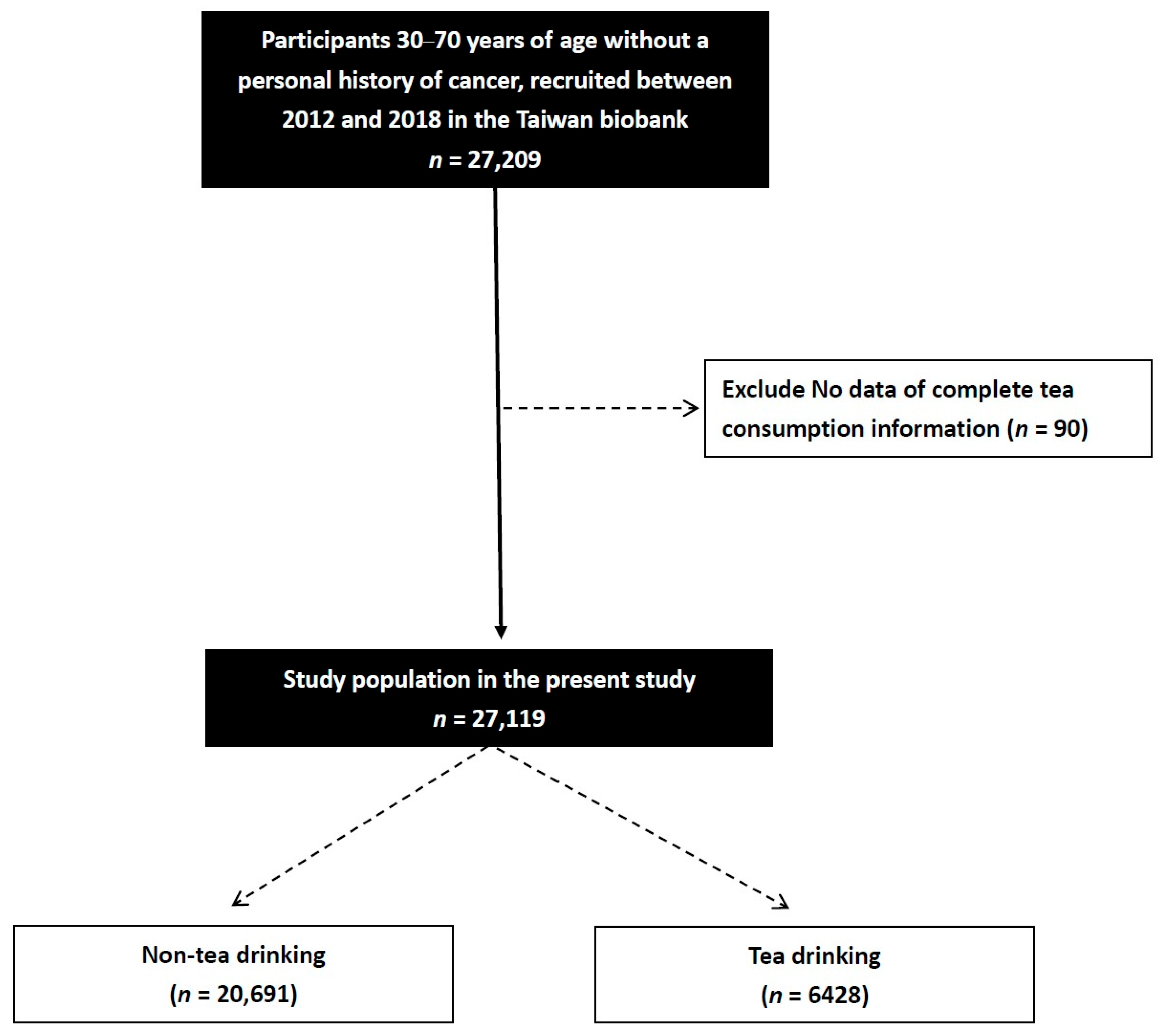
2.1. Identification of the Study Cohort
2.2. Assessment of Tea Consumption
- “What type of tea do you usually drink?” Based on their answer, they were further classified as “fully fermented”, “semi-fermented” or “non-fermented” tea drinkers.
- “How many cups of tea (one cup = 350 mL) do you usually drink per day?” Based on their answer, their daily intake was classified into “none”, “one”, “two” or “three or more” cups per day subgroups.
- “How often do you drink tea (frequency)?” Based on their answer, they were classified into “never”, “daily”, “weekly” (frequency less than daily), and “monthly” (frequency less than weekly) frequency subgroups.
2.3. Self-Reported Lifetime History of Depression
2.4. Covariates
2.5. Statistical Analysis
3. Results
3.1. Comparison of Clinical Characteristics Between the Participants with and Without Self-Reported Lifetime History of Depression
3.2. Association Between Tea Consumption and Self-Reported Lifetime History of Depression
3.3. Associations Among the Type of Tea, Intake and Frequency of Tea Consumption with Self-Reported Lifetime History of Depression
3.4. Associations Among Tea Consumption and Self-Reported Lifetime History of Depression in Subgroup Analyses
4. Discussion
5. Conclusions
Author Contributions
Funding
Institutional Review Board Statement
Informed Consent Statement
Data Availability Statement
Conflicts of Interest
References
- Kessler, R.C.; Berglund, P.; Demler, O.; Jin, R.; Merikangas, K.R.; Walters, E.E. Lifetime prevalence and age-of-onset distributions of DSM-IV disorders in the National Comorbidity Survey Replication. Arch. Gen. Psychiatry 2005, 62, 593–602. [Google Scholar] [CrossRef]
- Rakofsky, J.J.; Schettler, P.J.; Kinkead, B.L.; Frank, E.; Judd, L.L.; Kupfer, D.J.; Rush, A.J.; Thase, M.E.; Yonkers, K.A.; Rapaport, M.H. The prevalence and severity of depressive symptoms along the spectrum of unipolar depressive disorders: A post hoc analysis. J. Clin. Psychiatry 2013, 74, 1084–1091. [Google Scholar] [CrossRef]
- Daly, E.J.; Trivedi, M.H.; Wisniewski, S.R.; Nierenberg, A.A.; Gaynes, B.N.; Warden, D.; Morris, D.W.; Luther, J.F.; Farabaugh, A.; Cook, I.; et al. Health-related quality of life in depression: A STAR*D report. Ann. Clin. Psychiatry 2010, 22, 43–55. [Google Scholar] [CrossRef]
- Greenberg, P.E.; Fournier, A.A.; Sisitsky, T.; Pike, C.T.; Kessler, R.C. The economic burden of adults with major depressive disorder in the United States (2005 and 2010). J. Clin. Psychiatry 2015, 76, 155–162. [Google Scholar] [CrossRef]
- Kessler, R.C.; Ormel, J.; Petukhova, M.; McLaughlin, K.A.; Green, J.G.; Russo, L.J.; Stein, D.J.; Zaslavsky, A.M.; Aguilar-Gaxiola, S.; Alonso, J.; et al. Development of lifetime comorbidity in the World Health Organization world mental health surveys. Arch. Gen. Psychiatry 2011, 68, 90–100. [Google Scholar] [CrossRef] [PubMed]
- Collaborators, G.D.a.I. Global burden of 369 diseases and injuries in 204 countries and territories, 1990-2019: A systematic analysis for the Global Burden of Disease Study 2019. Lancet 2020, 396, 1204–1222. [Google Scholar] [CrossRef]
- Hughes, J.L.; Horowitz, L.M.; Ackerman, J.P.; Adrian, M.C.; Campo, J.V.; Bridge, J.A. Suicide in young people: Screening, risk assessment, and intervention. Bmj 2023, 381, e070630. [Google Scholar] [CrossRef]
- Dunlop, B.W.; Nemeroff, C.B. The role of dopamine in the pathophysiology of depression. Arch. Gen. Psychiatry 2007, 64, 327–337. [Google Scholar] [CrossRef] [PubMed]
- Clark, M.S.; Neumaier, J.F. The 5-HT1B receptor: Behavioral implications. Psychopharmacol. Bull. 2001, 35, 170–185. [Google Scholar] [CrossRef] [PubMed]
- Xu, W.; Yao, X.; Zhao, F.; Zhao, H.; Cheng, Z.; Yang, W.; Cui, R.; Xu, S.; Li, B. Changes in Hippocampal Plasticity in Depression and Therapeutic Approaches Influencing These Changes. Neural Plast. 2020, 2020, 8861903. [Google Scholar] [CrossRef]
- Hurley, L.L.; Tizabi, Y. Neuroinflammation, neurodegeneration, and depression. Neurotox. Res. 2013, 23, 131–144. [Google Scholar] [CrossRef]
- Wray, N.R.; Ripke, S.; Mattheisen, M.; Trzaskowski, M.; Byrne, E.M.; Abdellaoui, A.; Adams, M.J.; Agerbo, E.; Air, T.M.; Andlauer, T.M.F.; et al. Genome-wide association analyses identify 44 risk variants and refine the genetic architecture of major depression. Nat. Genet. 2018, 50, 668–681. [Google Scholar] [CrossRef] [PubMed]
- McLaughlin, K.A.; Greif Green, J.; Gruber, M.J.; Sampson, N.A.; Zaslavsky, A.M.; Kessler, R.C. Childhood adversities and first onset of psychiatric disorders in a national sample of US adolescents. Arch. Gen. Psychiatry 2012, 69, 1151–1160. [Google Scholar] [CrossRef]
- Alto, M.E.; Warmingham, J.M.; Handley, E.D.; Manly, J.T.; Cicchetti, D.; Toth, S.L. The Association Between Patterns of Trauma Exposure, Family Dysfunction, and Psychopathology Among Adolescent Females with Depressive Symptoms from Low-Income Contexts. Child. Maltreat 2023, 28, 130–140. [Google Scholar] [CrossRef]
- Seo, J.S.; Wei, J.; Qin, L.; Kim, Y.; Yan, Z.; Greengard, P. Cellular and molecular basis for stress-induced depression. Mol. Psychiatry 2017, 22, 1440–1447. [Google Scholar] [CrossRef]
- Achterhof, R.; Kirtley, O.J.; Schneider, M.; Hagemann, N.; Hermans, K.; Hiekkaranta, A.P.; Lecei, A.; Decoster, J.; Derom, C.; De Hert, M.; et al. General psychopathology and its social correlates in the daily lives of youth. J. Affect. Disord. 2022, 309, 428–436. [Google Scholar] [CrossRef] [PubMed]
- Amiri, S. Unemployment associated with major depression disorder and depressive symptoms: A systematic review and meta-analysis. Int. J. Occup. Saf. Ergon. 2022, 28, 2080–2092. [Google Scholar] [CrossRef] [PubMed]
- Zhou, Y.; Kivimäki, M.; Lim, C.C.W.; Carrillo-Larco, R.M.; Qi, S.; Wu, X.; Xu, X. Bidirectional Associations Between Cardiometabolic Multimorbidity and Depression and Mediation of Lifestyles: A Multicohort Study. JACC Asia 2024, 4, 657–671. [Google Scholar] [CrossRef]
- Musselman, D.L.; Nemeroff, C.B. Depression and endocrine disorders: Focus on the thyroid and adrenal system. Br. J. Psychiatry Suppl. 1996, 168, 123–128. [Google Scholar]
- Zhang, Y.; Chen, Y.; Ma, L. Depression and cardiovascular disease in elderly: Current understanding. J. Clin. Neurosci. 2018, 47, 1–5. [Google Scholar] [CrossRef]
- Repousi, N.; Masana, M.F.; Sanchez-Niubo, A.; Haro, J.M.; Tyrovolas, S. Depression and metabolic syndrome in the older population: A review of evidence. J. Affect. Disord. 2018, 237, 56–64. [Google Scholar] [CrossRef] [PubMed]
- Xiang, Y.; Xu, H.; Chen, H.; Tang, D.; Huang, Z.; Zhang, Y.; Wang, Z.; Wang, Z.; Yangla; Han, M.; et al. Tea consumption and attenuation of biological aging: A longitudinal analysis from two cohort studies. Lancet Reg. Health West. Pac. 2024, 42, 100955. [Google Scholar] [CrossRef] [PubMed]
- Sirotkin, A.V.; Kolesárová, A. The anti-obesity and health-promoting effects of tea and coffee. Physiol. Res. 2021, 70, 161–168. [Google Scholar] [CrossRef]
- Zhang, X.; Yu, H.; Sun, P.; Huang, M.; Li, B. Antiviral Effects and Mechanisms of Active Ingredients in Tea. Molecules 2024, 29, 5218. [Google Scholar] [CrossRef]
- Iso, H.; Date, C.; Wakai, K.; Fukui, M.; Tamakoshi, A. The relationship between green tea and total caffeine intake and risk for self-reported type 2 diabetes among Japanese adults. Ann. Intern. Med. 2006, 144, 554–562. [Google Scholar] [CrossRef]
- Guo, J.; Li, K.; Lin, Y.; Liu, Y. Protective effects and molecular mechanisms of tea polyphenols on cardiovascular diseases. Front. Nutr. 2023, 10, 1202378. [Google Scholar] [CrossRef]
- Jin, X.; Zheng, R.H.; Li, Y.M. Green tea consumption and liver disease: A systematic review. Liver Int. 2008, 28, 990–996. [Google Scholar] [CrossRef] [PubMed]
- Kurahashi, N.; Sasazuki, S.; Iwasaki, M.; Inoue, M.; Tsugane, S. Green tea consumption and prostate cancer risk in Japanese men: A prospective study. Am. J. Epidemiol. 2008, 167, 71–77. [Google Scholar] [CrossRef] [PubMed]
- Wang, W.; Yang, Y.; Zhang, W.; Wu, W. Association of tea consumption and the risk of oral cancer: A meta-analysis. Oral. Oncol. 2014, 50, 276–281. [Google Scholar] [CrossRef]
- Yi, Y.; Liang, H.; Jing, H.; Jian, Z.; Guang, Y.; Jun, Z.; Zhu, H.; Jian, L. Green Tea Consumption and Esophageal Cancer Risk: A Meta-analysis. Nutr. Cancer 2020, 72, 513–521. [Google Scholar] [CrossRef]
- Okekpa, S.I.; Mydin, R.B.S.; Ganeson, S.; Gopalan, S.; Musa, M.Y. The Association between Tea Consumption and Nasopharyngeal Cancer: A Systematic Review and Meta-Analysis. Asian Pac. J. Cancer Prev. 2020, 21, 2183–2187. [Google Scholar] [CrossRef] [PubMed]
- Tang, N.; Wu, Y.; Zhou, B.; Wang, B.; Yu, R. Green tea, black tea consumption and risk of lung cancer: A meta-analysis. Lung Cancer 2009, 65, 274–283. [Google Scholar] [CrossRef]
- Zhan, X.; Wang, J.; Pan, S.; Lu, C. Tea consumption and the risk of ovarian cancer: A meta-analysis of epidemiological studies. Oncotarget 2017, 8, 37796–37806. [Google Scholar] [CrossRef]
- Wang, X.; Lin, Y.W.; Wang, S.; Wu, J.; Mao, Q.Q.; Zheng, X.Y.; Xie, L.P. A meta-analysis of tea consumption and the risk of bladder cancer. Urol. Int. 2013, 90, 10–16. [Google Scholar] [CrossRef]
- Ng, T.P.; Gao, Q.; Gwee, X.; Chua, D.Q.L. Tea Consumption and Depression from Follow Up in the Singapore Longitudinal Ageing Study. J. Nutr. Health Aging 2021, 25, 295–301. [Google Scholar] [CrossRef]
- Lopes Sakamoto, F.; Metzker Pereira Ribeiro, R.; Amador Bueno, A.; Oliveira Santos, H. Psychotropic effects of (L)-theanine and its clinical properties: From the management of anxiety and stress to a potential use in schizophrenia. Pharmacol. Res. 2019, 147, 104395. [Google Scholar] [CrossRef]
- Bayes, J.; Schloss, J.; Sibbritt, D. Effects of Polyphenols in a Mediterranean Diet on Symptoms of Depression: A Systematic Literature Review. Adv. Nutr. 2020, 11, 602–615. [Google Scholar] [CrossRef] [PubMed]
- Chen, C.H.; Yang, J.H.; Chiang, C.W.K.; Hsiung, C.N.; Wu, P.E.; Chang, L.C.; Chu, H.W.; Chang, J.; Song, I.W.; Yang, S.L.; et al. Population structure of Han Chinese in the modern Taiwanese population based on 10,000 participants in the Taiwan Biobank project. Hum. Mol. Genet. 2016, 25, 5321–5331. [Google Scholar] [CrossRef]
- Fan, C.T.; Hung, T.H.; Yeh, C.K. Taiwan Regulation of Biobanks. J. Law. Med. Ethics 2015, 43, 816–826. [Google Scholar] [CrossRef]
- Inker, L.A.; Eneanya, N.D.; Coresh, J.; Tighiouart, H.; Wang, D.; Sang, Y.; Crews, D.C.; Doria, A.; Estrella, M.M.; Froissart, M.; et al. New Creatinine- and Cystatin C-Based Equations to Estimate GFR without Race. N. Engl. J. Med. 2021, 385, 1737–1749. [Google Scholar] [CrossRef] [PubMed]
- American College of Sports Medicine. ACSM’s Guidelines for Exercise Testing and Prescription; Lippincott Williams & Wilkins: Philadelphia, PA, USA, 2013. [Google Scholar]
- Lorant, V.; Deliege, D.; Eaton, W.; Robert, A.; Philippot, P.; Ansseau, M. Socioeconomic inequalities in depression: A meta-analysis. Am. J. Epidemiol. 2003, 157, 98–112. [Google Scholar] [CrossRef]
- Lopresti, A.L.; Hood, S.D.; Drummond, P.D. A review of lifestyle factors that contribute to important pathways associated with major depression: Diet, sleep and exercise. J. Affect. Disord. 2013, 148, 12–27. [Google Scholar] [CrossRef]
- Lee, J.I.; Busler, J.N.; Millett, C.E.; Principe, J.L.; Levin, L.L.; Corrigan, A.; Burdick, K.E. Association between visceral adipose tissue and major depressive disorder across the lifespan: A scoping review. Bipolar Disord. 2022, 24, 375–391. [Google Scholar] [CrossRef]
- Tseng, H.; Lee, J.I.; Geng, J.H.; Chen, S.C. Sex difference in the associations among risk factors with depression in a large Taiwanese population study. Front. Public. Health 2023, 11, 1070827. [Google Scholar] [CrossRef]
- Dong, X.; Gu, Y.; Rayamajhi, S.; Thapa, A.; Meng, G.; Zhang, Q.; Liu, L.; Wu, H.; Zhang, S.; Zhang, T.; et al. Green tea consumption and risk of depressive symptoms: Results from the TCLSIH Cohort Study. J. Affect. Disord. 2022, 310, 183–188. [Google Scholar] [CrossRef]
- Yao, Y.; Chen, H.; Chen, L.; Ju, S.Y.; Yang, H.; Zeng, Y.; Gu, D.; Ng, T.P. Type of tea consumption and depressive symptoms in Chinese older adults. BMC Geriatr. 2021, 21, 331. [Google Scholar] [CrossRef]
- Williams, J.; Sergi, D.; McKune, A.J.; Georgousopoulou, E.N.; Mellor, D.D.; Naumovski, N. The beneficial health effects of green tea amino acid l-theanine in animal models: Promises and prospects for human trials. Phytother. Res. 2019, 33, 571–583. [Google Scholar] [CrossRef]
- Nani, A.; Murtaza, B.; Sayed Khan, A.; Khan, N.A.; Hichami, A. Antioxidant and Anti-Inflammatory Potential of Polyphenols Contained in Mediterranean Diet in Obesity: Molecular Mechanisms. Molecules 2021, 26, 985. [Google Scholar] [CrossRef] [PubMed]
- Anas Sohail, A.; Ortiz, F.; Varghese, T.; Fabara, S.P.; Batth, A.S.; Sandesara, D.P.; Sabir, A.; Khurana, M.; Datta, S.; Patel, U.K. The Cognitive-Enhancing Outcomes of Caffeine and L-theanine: A Systematic Review. Cureus 2021, 13, e20828. [Google Scholar] [CrossRef] [PubMed]
- Lardner, A.L. Neurobiological effects of the green tea constituent theanine and its potential role in the treatment of psychiatric and neurodegenerative disorders. Nutr. Neurosci. 2014, 17, 145–155. [Google Scholar] [CrossRef] [PubMed]
- Bekhbat, M.; Li, Z.; Mehta, N.D.; Treadway, M.T.; Lucido, M.J.; Woolwine, B.J.; Haroon, E.; Miller, A.H.; Felger, J.C. Functional connectivity in reward circuitry and symptoms of anhedonia as therapeutic targets in depression with high inflammation: Evidence from a dopamine challenge study. Mol. Psychiatry 2022, 27, 4113–4121. [Google Scholar] [CrossRef]
- Kongpichitchoke, T.; Chiu, M.T.; Huang, T.C.; Hsu, J.L. Gallic Acid Content in Taiwanese Teas at Different Degrees of Fermentation and Its Antioxidant Activity by Inhibiting PKCδ Activation: In Vitro and in Silico Studies. Molecules 2016, 21, 1346. [Google Scholar] [CrossRef]
- Nanri, A.; Eguchi, M.; Kochi, T.; Kabe, I.; Mizoue, T. Green Tea Consumption and Depressive Symptoms among Japanese Workers: The Furukawa Nutrition and Health Study. Nutrients 2021, 14, 167. [Google Scholar] [CrossRef] [PubMed]
- Jee, H.J.; Lee, S.G.; Bormate, K.J.; Jung, Y.S. Effect of Caffeine Consumption on the Risk for Neurological and Psychiatric Disorders: Sex Differences in Human. Nutrients 2020, 12, 3080. [Google Scholar] [CrossRef]
- Feng, L.; Yan, Z.; Sun, B.; Cai, C.; Jiang, H.; Kua, E.H.; Ng, T.P.; Qiu, C. Tea consumption and depressive symptoms in older people in rural China. J. Am. Geriatr. Soc. 2013, 61, 1943–1947. [Google Scholar] [CrossRef]
- Nascimento, C.P.; Luz, D.A.; da Silva, C.C.S.; Malcher, C.M.R.; Fernandes, L.M.P.; Dalla Santa, H.S.; Gomes, A.R.Q.; Monteiro, M.C.; Ribeiro, C.; Fontes-Júnior, E.A.; et al. Ganoderma lucidum Ameliorates Neurobehavioral Changes and Oxidative Stress Induced by Ethanol Binge Drinking. Oxid. Med. Cell Longev. 2020, 2020, 2497845. [Google Scholar] [CrossRef] [PubMed]
- Brown, P.J.; Rutherford, B.R.; Yaffe, K.; Tandler, J.M.; Ray, J.L.; Pott, E.; Chung, S.; Roose, S.P. The Depressed Frail Phenotype: The Clinical Manifestation of Increased Biological Aging. Am. J. Geriatr. Psychiatry 2016, 24, 1084–1094. [Google Scholar] [CrossRef]
- Swan, G.E.; Lessov-Schlaggar, C.N. The effects of tobacco smoke and nicotine on cognition and the brain. Neuropsychol. Rev. 2007, 17, 259–273. [Google Scholar] [CrossRef]
- Khawagi, W.Y.; Al-Kuraishy, H.M.; Hussein, N.R.; Al-Gareeb, A.I.; Atef, E.; Elhussieny, O.; Alexiou, A.; Papadakis, M.; Jabir, M.S.; Alshehri, A.A.; et al. Depression and type 2 diabetes: A causal relationship and mechanistic pathway. Diabetes Obes. Metab. 2024, 26, 3031–3044. [Google Scholar] [CrossRef]
- Binnewies, J.; Nawijn, L.; van Tol, M.J.; van der Wee, N.J.A.; Veltman, D.J.; Penninx, B. Associations between depression, lifestyle and brain structure: A longitudinal MRI study. Neuroimage 2021, 231, 117834. [Google Scholar] [CrossRef] [PubMed]
- Ferraris, R.P. Effect of aging and caloric restriction on intestinal sugar and amino acid transport. Front. Biosci. 1997, 2, e108–e115. [Google Scholar] [CrossRef] [PubMed]
- Wu, C.S.; Hsu, L.Y.; Shen, C.Y.; Chen, W.J.; Wang, S.H. Validation of Self-reported Medical Condition in the Taiwan Biobank. J. Epidemiol. 2025, 35, 141–146. [Google Scholar] [CrossRef] [PubMed]


| Characteristics | Self-Reported Lifetime History of Depression (−) (n = 25,997) | Self-Reported Lifetime History of Depression (+) (n = 1122) | p |
|---|---|---|---|
| Age (year) | 55.0 ± 10.3 | 56.4 ± 9.7 | <0.001 |
| Male sex (%) | 35.9 | 23.9 | <0.001 |
| Diabetes mellitus (%) | 7.6 | 9.4 | 0.034 |
| Hypertension (%) | 17.8 | 19.5 | 0.143 |
| Smoking history (%) | 25.6 | 25.6 | 0.986 |
| Alcohol history (%) | 10.7 | 9.8 | 0.352 |
| Habitual tea drinkers (%) | 23.9 | 18.0 | <0.001 |
| Coffee consumption (%) | 41.2 | 40.9 | 0.858 |
| Regular exercise habits (%) | 48.2 | 49.6 | 0.352 |
| Ever married (%) | 92.6 | 91.4 | 0.152 |
| Education status | <0.001 | ||
| Elementary school and below (%) | 7.3 | 7.8 | |
| Junior/senior high school (%) | 43.7 | 49.3 | |
| University or above (%) | 49.0 | 43.0 | |
| Systolic BP (mmHg) | 124.9 ± 19.5 | 122.0 ± 18.2 | <0.001 |
| Diastolic BP (mmHg) | 74.3 ± 11.4 | 72.9 ± 10.9 | <0.001 |
| Body mass index (kg/m2) | 24.3 ± 3.6 | 24.2 ± 3.8 | 0.273 |
| Laboratory parameters | |||
| Fasting glucose (mg/dL) | 97.4 ± 21.8 | 97.5 ± 20.9 | 0.935 |
| Hemoglobin (g/dL) | 13.7 ± 1.6 | 13.6 ± 1.4 | 0.003 |
| Triglyceride (mg/dL) | 119.9 ± 97.1 | 125.1 ± 93.3 | 0.074 |
| Total cholesterol (mg/dL) | 196.1 ± 36.2 | 199.3 ± 35.7 | 0.003 |
| HDL-C (mg/dL) | 54.5 ± 13.5 | 55.3 ± 13.4 | 0.049 |
| LDL-C (mg/dL) | 120.1 ± 31.9 | 121.8 ± 31.8 | 0.086 |
| eGFR (mL/min/1.73 m2) | 98.0 ± 15.1 | 97.0 ± 15.0 | 0.021 |
| Uric acid (mg/dL) | 5.4 ± 1.4 | 5.3 ± 1.3 | 0.001 |
| Variables | Multivariable | |
|---|---|---|
| OR (95% CI) | p | |
| Age (per 1 year) | 1.018 (1.009–1.027) | <0.001 |
| Male sex (vs. female) | 0.400 (0.323–0.496) | <0.001 |
| Diabetes mellitus | 1.295 (1.009–1.663) | 0.043 |
| Hypertension | 1.183 (0.994–1.407) | 0.059 |
| Smoking history | 1.700 (1.421–2.032) | <0.001 |
| Alcohol history | 1.115 (0.892–1.393) | 0.339 |
| Habitual tea drinkers | 0.736 (0.628–0.862) | <0.001 |
| Coffee consumption | 0.990 (0.875–1.121) | 0.876 |
| Regular exercise habits | 0.989 (0.871–1.125) | 0.872 |
| Ever married | 0.751 (0.600–0.939) | 0.012 |
| Education status | ||
| Elementary school and below | Reference | |
| Junior/senior high school | 1.212 (0.955–1.539) | 0.113 |
| University or above | 1.129 (0.878–1.451) | 0.345 |
| Systolic BP (per 1 mmHg) | 0.988 (0.985–0.992) | <0.001 |
| Body mass index (per 1 kg/m2) | 1.010 (0.991–1.029) | 0.316 |
| Laboratory parameters | ||
| Fasting glucose (per 1 mg/dL) | 0.998 (0.994–1.001) | 0.231 |
| Hemoglobin (per 1 g/dL) | 1.058 (1.005–1.114) | 0.030 |
| Triglyceride (per 1 mg/dL) | 1.001 (1.000–1.001) | 0.030 |
| Total cholesterol (per 1 mg/dL) | 1.001 (1.000–1.003) | 0.149 |
| eGFR (per 1 mL/min/1.73 m2) | 0.994 (0.989–1.000) | 0.043 |
| Uric acid (per 1 mg/dL) | 0.976 (0.923–1.032) | 0.388 |
| Tea Consumption (Number of Self-Reported Lifetime History of Depression Cases/Subgroup Number) | Multivariable | |
|---|---|---|
| OR (95% CI) | p | |
| Types of tea | ||
| Non-tea (920/20,691) | Reference | |
| Fully fermented tea (43/950) | 1.094 (0.798–1.500) | 0.577 |
| Semi- or non-fermented tea (159/5478) | 0.674 (0.566–0.803) | <0.001 |
| Daily cups | ||
| None (690/20,691) | Reference | |
| 1 cup * per day (60/2030) | 0.665 (0.509–0.869) | 0.003 |
| 2 cups * per day (65/2312) | 0.668 (0.516–0.864) | 0.002 |
| ≥3 cups * per day (77/2086) | 0.891 (0.699–1.136) | 0.352 |
| Frequency | ||
| None (920/20,691) | Reference | |
| Per day (180/5931) | 0.710 (0.601–0.839) | <0.001 |
| Per week (20/477) | 0.977 (0.620–1.541) | 0.921 |
| Per month (2/20) | 2.784 (0.635–12.218) | 0.175 |
| Subgroups (Number of Self-Reported Lifetime History of Depression Cases/Subgroup Number) | Self-Reported Lifetime History of Depression OR (95% CI) | p | Interaction p |
|---|---|---|---|
| Age | 0.885 | ||
| <65 years (868/21,563) | 0.728 (0.609–0.870) | <0.001 | |
| ≥65 years (254/5556) | 0.764 (0.538–1.085) | 0.133 | |
| Sex | 0.199 | ||
| Male (268/9589) | 0.675 (0.507–0.898) | 0.007 | |
| Female (854/17,530) | 0.776 (0.641–0.939) | 0.009 | |
| Diabetes mellitus | 0.703 | ||
| Yes (105/2090) | 0.703 (0.429–1.151) | 0.161 | |
| No (1017/25,029) | 0.742 (0.628–0.878) | 0.001 | |
| Hypertension | 0.576 | ||
| Yes (219/4848) | 0.671 (0.470–0.960) | 0.029 | |
| No (903/2227) | 0.753 (0.630–0.899) | 0.002 | |
| Smoking | 0.911 | ||
| Yes (287/6943) | 0.778 (0.594–1.019) | 0.068 | |
| No (835/20,176) | 0.712 (0.584–0.867) | 0.001 | |
| Alcohol | 0.962 | ||
| Yes (110/2886) | 0.784 (0.513–1.196) | 0.259 | |
| No (1012/24,233) | 0.729 (0.614–0.866) | <0.001 | |
| Regular exercise habits | 0.881 | ||
| Yes (557/13,094) | 0.741 (0.591–0.930) | 0.010 | |
| No (565/14,025) | 0.735 (0.588–0.919) | 0.007 |
Disclaimer/Publisher’s Note: The statements, opinions and data contained in all publications are solely those of the individual author(s) and contributor(s) and not of MDPI and/or the editor(s). MDPI and/or the editor(s) disclaim responsibility for any injury to people or property resulting from any ideas, methods, instructions or products referred to in the content. |
© 2026 by the authors. Licensee MDPI, Basel, Switzerland. This article is an open access article distributed under the terms and conditions of the Creative Commons Attribution (CC BY) license.
Share and Cite
Chang, S.-M.; Geng, J.-H.; Wu, P.-Y.; Huang, J.-C.; Chen, S.-C. Habitual Tea Consumption Is Associated with a Low Prevalence of Self-Reported Lifetime History of Depression in Taiwanese Population Study. Nutrients 2026, 18, 841. https://doi.org/10.3390/nu18050841
Chang S-M, Geng J-H, Wu P-Y, Huang J-C, Chen S-C. Habitual Tea Consumption Is Associated with a Low Prevalence of Self-Reported Lifetime History of Depression in Taiwanese Population Study. Nutrients. 2026; 18(5):841. https://doi.org/10.3390/nu18050841
Chicago/Turabian StyleChang, Si-Meng, Jiun-Hung Geng, Pei-Yu Wu, Jiun-Chi Huang, and Szu-Chia Chen. 2026. "Habitual Tea Consumption Is Associated with a Low Prevalence of Self-Reported Lifetime History of Depression in Taiwanese Population Study" Nutrients 18, no. 5: 841. https://doi.org/10.3390/nu18050841
APA StyleChang, S.-M., Geng, J.-H., Wu, P.-Y., Huang, J.-C., & Chen, S.-C. (2026). Habitual Tea Consumption Is Associated with a Low Prevalence of Self-Reported Lifetime History of Depression in Taiwanese Population Study. Nutrients, 18(5), 841. https://doi.org/10.3390/nu18050841