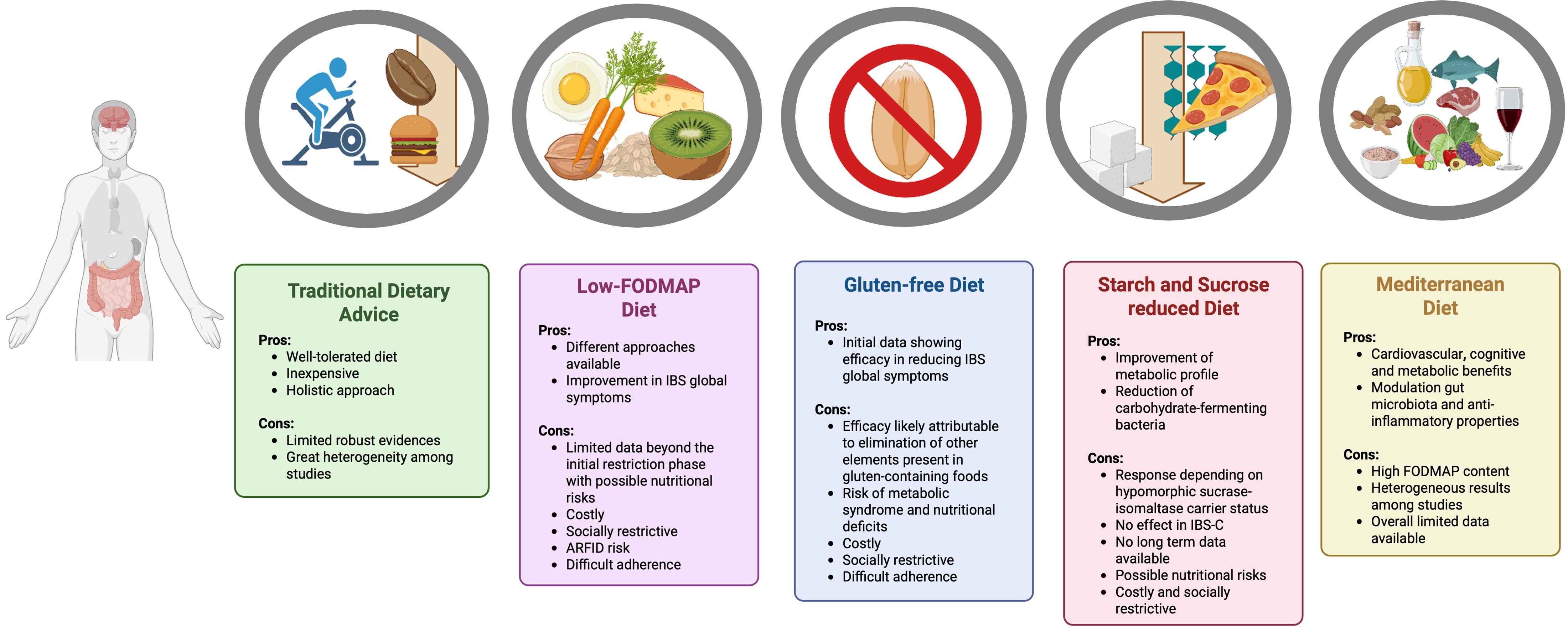
Nutritional Management of Irritable Bowel Syndrome

 ,
,  , , ,
, , , 
Abstract
1. Introduction
2. Traditional Dietary Advice

| Diet Guidelines | Italian [11] | United Kingdom [9] | European [10] | American [34] | Canadian [35] |
|---|---|---|---|---|---|
| Traditional dietary advice | First-line diet (recommendation: strong, quality of evidence: very low) | First-line diet (recommendation: strong, quality of evidence: weak) | First-line diet (recommendation: not stated, quality of evidence not stated) | Not explicitly recommended | Not mentioned |
| Low-FODMAP diet | Second-line diet (recommendation: conditional, quality of evidence: low) | Second-line diet (recommendation: weak, quality of evidence very low) | Second-line diet (recommendation: strong, quality of evidence low) | First-line diet (recommendation: conditional, quality of evidence: very low) | First-line diet (recommendation: conditional, quality of evidence: very low) |
| Gluten-free diet | Recommendation against its use (recommendation: strong, quality of evidence: very low) | Recommendation against its use (recommendation: weak, quality of evidence very low) | Recommendation against its use (recommendation: strong, quality of evidence low) | Not mentioned | Recommendation against its use (recommendation: conditional, quality of evidence: very low) |
| Mediterranean diet | Not mentioned | Not mentioned | Not mentioned | Not mentioned | Not mentioned |
| Starch and sucrose-reduced diet | Not mentioned | Not mentioned | Not mentioned | Not mentioned | Not mentioned |
3. Low-FODMAP Diet
4. Gluten-Free Diet
5. Mediterranean Diet
6. Starch- and Sucrose-Reduced Diet
7. Other Diets
7.1. Low-Lactose Diet
7.2. Fructose-Reduced Diet
7.3. Tritordeum-Based Diet
7.4. ARFID Risk and Implementation Diets
8. Conclusions
Author Contributions
Funding
Data Availability Statement
Conflicts of Interest
Abbreviations
| IBS | Irritable Bowel Syndrome |
| DGBI | Disorders of Gut–Brain Interaction |
| TDA | Traditional Dietary Advice |
| LFD | Low-FODMAP Diet |
| FODMAP | Fermentable Oligosaccharides, Disaccharides, Monosaccharides and Polyols |
| RCT | Randomized Controlled Trial |
| GFD | Gluten-Free Diet |
| CD | Celiac Disease |
| SSRD | Starch- and Sucrose-Reduced Diet |
| MD | Mediterranean Diet |
| IBS-SSS | Irritable Bowel Syndrome Symptom Severity Scale |
| NICE | National Institute for Health and Care Excellence |
| BDA | British Dietetic Association |
| TRPV1 | Transient Receptor Potential Vanilloid 1 |
| SCFAs | Short-Chain Fatty Acids |
| OB | Otilonium Bromide |
| ATIs | α-Amylase–Trypsin Inhibitors |
| CSID | Congenital Sucrase-Isomaltase Deficiency |
| SI | Sucrase-Isomaltase |
| OR | Odds Ratio |
| LLD | Low-Lactose Diet |
| FM | Fructose Malabsorption |
| GLUT | Glucose Transporter |
| TBD | Tritordeum-Based Diet |
| IBS-QoL | IBS Quality of Life Questionnaire |
| ARFID | Avoidant/Restrictive Food Intake Disorder |
| FOS | Fructooligosaccharides |
| GOS | Galactooligosaccharides |
References
- Enck, P.; Aziz, Q.; Barbara, G.; Farmer, A.D.; Fukudo, S.; Mayer, E.A.; Niesler, B.; Quigley, E.M.M.; Rajilić-Stojanović, M.; Schemann, M.; et al. Irritable Bowel Syndrome. Nat. Rev. Dis. Primers 2016, 2, 1–24. [Google Scholar] [CrossRef]
- Sperber, A.D.; Bangdiwala, S.I.; Drossman, D.A.; Ghoshal, U.C.; Simren, M.; Tack, J.; Whitehead, W.E.; Dumitrascu, D.L.; Fang, X.; Fukudo, S.; et al. Worldwide Prevalence and Burden of Functional Gastrointestinal Disorders, Results of Rome Foundation Global Study. Gastroenterology 2021, 160, 99–114.e3. [Google Scholar] [CrossRef] [PubMed]
- Marasco, G.; Cremon, C.; Barbaro, M.R.; Stanghellini, V.; Barbara, G. Gut Microbiota Signatures and Modulation in Irritable Bowel Syndrome. Microbiome Res. Rep. 2022, 1, 11. [Google Scholar] [CrossRef]
- Barbara, G.; Barbaro, M.R.; Fuschi, D.; Palombo, M.; Falangone, F.; Cremon, C.; Marasco, G.; Stanghellini, V. Inflammatory and Microbiota-Related Regulation of the Intestinal Epithelial Barrier. Front. Nutr. 2021, 8, 718356. [Google Scholar] [CrossRef] [PubMed]
- Hod, K.; Marasco, G.; Colecchia, L.; Cremon, C.; Barbaro, M.R.; Cacciari, G.; Falangone, F.; Kagramanova, A.; Bordin, D.; Drug, V.; et al. Psychological and Clinical Factors Mediate Post-COVID-19 Irritable Bowel Syndrome. Neurogastroenterol. Motil. 2025, e70079. [Google Scholar] [CrossRef]
- Barbara, G.; Grover, M.; Bercik, P.; Corsetti, M.; Ghoshal, U.C.; Ohman, L.; Rajili C-Stojanovi, M. Rome Foundation Working Team Report on Post-Infection Irritable Bowel Syndrome. Gastroenterology 2019, 156, 46–58. [Google Scholar] [CrossRef] [PubMed]
- Ford, A.C.; Staudacher, H.M.; Talley, N.J. Postprandial Symptoms in Disorders of Gut-Brain Interaction and Their Potential as a Treatment Target. Gut 2024, 73, 1199–1211. [Google Scholar] [CrossRef]
- Marasco, G.; Cremon, C.; Salvi, D.; Meacci, D.; Dajti, E.; Colecchia, L.; Barbaro, M.R.; Stanghellini, V.; Barbara, G. Functional Foods and Nutraceuticals in Irritable Bowel Syndrome. J. Clin. Med. 2025, 14, 1830. [Google Scholar] [CrossRef]
- Vasant, D.H.; Paine, P.A.; Black, C.J.; Houghton, L.A.; Everitt, H.A.; Corsetti, M.; Agrawal, A.; Aziz, I.; Farmer, A.D.; Eugenicos, M.P.; et al. British Society of Gastroenterology Guidelines on the Management of Irritable Bowel Syndrome. Gut 2021, 70, 1214–1240. [Google Scholar] [CrossRef]
- Savarino, E.; Zingone, F.; Barberio, B.; Marasco, G.; Akyuz, F.; Akpinar, H.; Barboi, O.; Bodini, G.; Bor, S.; Chiarioni, G.; et al. Functional Bowel Disorders with Diarrhoea: Clinical Guidelines of the United European Gastroenterology and European Society for Neurogastroenterology and Motility. United Eur. Gastroenterol. J. 2022, 10, 556–584. [Google Scholar] [CrossRef]
- Barbara, G.; Cremon, C.; Bellini, M.; Corsetti, M.; Di Nardo, G.; Falangone, F.; Fuccio, L.; Galeazzi, F.; Iovino, P.; Sarnelli, G.; et al. Italian Guidelines for the Management of Irritable Bowel Syndrome: Joint Consensus from the Italian Societies of: Gastroenterology and Endoscopy (SIGE), Neurogastroenterology and Motility (SINGEM), Hospital Gastroenterologists and Endoscopists (AIGO), Digestive Endoscopy (SIED), General Medicine (SIMG), Gastroenterology, Hepatology and Pediatric Nutrition (SIGENP) and Pediatrics (SIP). Dig. Liver Dis. 2023, 55, 187–207. [Google Scholar] [CrossRef]
- Nybacka, S.; Törnblom, H.; Josefsson, A.; Hreinsson, J.P.; Böhn, L.; Frändemark, Å.; Weznaver, C.; Störsrud, S.; Simrén, M. A Low FODMAP Diet plus Traditional Dietary Advice versus a Low-Carbohydrate Diet versus Pharmacological Treatment in Irritable Bowel Syndrome (CARIBS): A Single-Centre, Single-Blind, Randomised Controlled Trial. Lancet Gastroenterol. Hepatol. 2024, 9, 507–520. [Google Scholar] [CrossRef] [PubMed]
- Black, C.J.; Staudacher, H.M.; Ford, A.C. Efficacy of a Low FODMAP Diet in Irritable Bowel Syndrome: Systematic Review and Network Meta-Analysis. Gut 2022, 71, 1117–1126. [Google Scholar] [CrossRef]
- Rej, A.; Sanders, D.S.; Shaw, C.C.; Buckle, R.; Trott, N.; Agrawal, A.; Aziz, I. Efficacy and Acceptability of Dietary Therapies in Non-Constipated Irritable Bowel Syndrome: A Randomized Trial of Traditional Dietary Advice, the Low FODMAP Diet, and the Gluten-Free Diet. Clin. Gastroenterol. Hepatol. 2022, 20, 2876–2887.e15. [Google Scholar] [CrossRef]
- Seiler, C.L.; Rueda, G.H.; Miranda, P.M.; Nardelli, A.; Borojevic, R.; Hann, A.; Rahmani, S.; De Souza, R.; Caminero, A.; Curella, V.; et al. Effect of Gluten and Wheat on Symptoms and Behaviours in Adults with Irritable Bowel Syndrome: A Single-Centre, Randomised, Double-Blind, Sham-Controlled Crossover Trial. Lancet Gastroenterol. Hepatol. 2025, 10, 794–805. [Google Scholar] [CrossRef] [PubMed]
- Roth, B.; Nseir, M.; Jeppsson, H.; D’Amato, M.; Sundquist, K.; Ohlsson, B. A Starch- and Sucrose-Reduced Diet Has Similar Efficiency as Low FODMAP in IBS—A Randomized Non-Inferiority Study. Nutrients 2024, 16, 3039. [Google Scholar] [CrossRef]
- Henström, M.; Diekmann, L.; Bonfiglio, F.; Hadizadeh, F.; Kuech, E.M.; Von Köckritz-Blickwede, M.; Thingholm, L.B.; Zheng, T.; Assadi, G.; DIerks, C.; et al. Functional Variants in the Sucrase-Isomaltase Gene Associate with Increased Risk of Irritable Bowel Syndrome. Gut 2018, 67, 263–270. [Google Scholar] [CrossRef]
- Roth, B.; Myllyvainio, J.; D’amato, M.; Larsson, E.; Ohlsson, B. A Starch-and Sucrose-Reduced Diet in Irritable Bowel Syndrome Leads to Lower Circulating Levels of PAI-1 and Visfatin: A Randomized Controlled Study. Nutrients 2022, 14, 1688. [Google Scholar] [CrossRef] [PubMed]
- Paduano, D.; Cingolani, A.; Tanda, E.; Usai, P. Effect of Three Diets (Low-FODMAP, Gluten-Free and Balanced) on Irritable Bowel Syndrome Symptoms and Health-Related Quality of Life. Nutrients 2019, 11, 1566. [Google Scholar] [CrossRef]
- Staudacher, H.M.; Mahoney, S.; Canale, K.; Opie, R.S.; Loughman, A.; So, D.; Beswick, L.; Hair, C.; Jacka, F.N. Clinical Trial: A Mediterranean Diet Is Feasible and Improves Gastrointestinal and Psychological Symptoms in Irritable Bowel Syndrome. Aliment. Pharmacol. Ther. 2024, 59, 492–503. [Google Scholar] [CrossRef]
- Singh, P.; Dean, G.; Iram, S.; Peng, W.; Chey, S.W.; Rifkin, S.; Lothen-Kline, C.; Muir, J.; Lee, A.A.; Eswaran, S.; et al. Efficacy of Mediterranean Diet vs. Low-FODMAP Diet in Patients With Nonconstipated Irritable Bowel Syndrome: A Pilot Randomized Controlled Trial. Neurogastroenterol. Motil. 2025, 37, e70060. [Google Scholar] [CrossRef]
- Cuffe, M.S.; Staudacher, H.M.; Aziz, I.; Adame, E.C.; Krieger-Grubel, C.; Madrid, A.M.; Ohlsson, B.; Black, C.J.; Ford, A.C. Efficacy of Dietary Interventions in Irritable Bowel Syndrome: A Systematic Review and Network Meta-Analysis. Lancet Gastroenterol. Hepatol. 2025, 10, 520–536. [Google Scholar] [CrossRef]
- McKenzie, Y.A.; Bowyer, R.K.; Leach, H.; Gulia, P.; Horobin, J.; O’Sullivan, N.A.; Pettitt, C.; Reeves, L.B.; Seamark, L.; Williams, M.; et al. British Dietetic Association Systematic Review and Evidence-Based Practice Guidelines for the Dietary Management of Irritable Bowel Syndrome in Adults (2016 Update). J. Hum. Nutr. Diet. 2016, 29, 549–575. [Google Scholar] [CrossRef]
- Bagyánszki, M.; Krecsmarik, M.; De Winter, B.Y.; De Man, J.G.; Fekete, É.V.A.; Pelckmans, P.A.; Adriaensen, D.; Kroese, A.B.A.; Van Nassauw, L.; Timmermans, J.P. Chronic Alcohol Consumption Affects Gastrointestinal Motility and Reduces the Proportion of Neuronal NOS-Immunoreactive Myenteric Neurons in the Murine Jejunum. Anat. Rec. 2010, 293, 1536–1542. [Google Scholar] [CrossRef]
- Chen, G.; Shi, F.; Yin, W.; Guo, Y.; Liu, A.; Shuai, J.; Sun, J. Gut Microbiota Dysbiosis: The Potential Mechanisms by Which Alcohol Disrupts Gut and Brain Functions. Front. Microbiol. 2022, 13, 916765. [Google Scholar] [CrossRef] [PubMed]
- Boekema, P.J.; Samsom, M.; Van Berge Henegouwen, G.P.; Smout, A.J.P.M. Coffee and Gastrointestinal Function: Facts and Fiction: A Review. Scand. J. Gastroenterol. 1999, 33, 35–39. [Google Scholar] [CrossRef] [PubMed]
- Rao, S.S.C.; Welcher, K.; Zimmerman, B.; Stumbo, P. Is Coffee a Colonic Stimulant? Eur. J. Gastroenterol. Hepatol. 1998, 10, 113–118. [Google Scholar] [CrossRef]
- Bhat, Y.M.; Bielefeldt, K. Capsaicin Receptor (TRPV1) and Non-Erosive Reflux Disease. Eur. J. Gastroenterol. Hepatol. 2006, 18, 263–270. [Google Scholar] [CrossRef]
- Akbar, A.; Yiangou, Y.; Facer, P.; Walters, J.R.F.; Anand, P.; Ghosh, S. Increased Capsaicin Receptor TRPV1-Expressing Sensory Fibres in Irritable Bowel Syndrome and Their Correlation with Abdominal Pain. Gut 2008, 57, 923–929. [Google Scholar] [CrossRef]
- Eswaran, S.L.; Chey, W.D.; Han-Markey, T.; Ball, S.; Jackson, K. A Randomized Controlled Trial Comparing the Low FODMAP Diet vs. Modified NICE Guidelines in US Adults with IBS-D. Am. J. Gastroenterol. 2016, 111, 1824–1832. [Google Scholar] [CrossRef] [PubMed]
- Böhn, L.; Störsrud, S.; Liljebo, T.; Collin, L.; Lindfors, P.; Törnblom, H.; Simrén, M. Diet Low in FODMAPs Reduces Symptoms of Irritable Bowel Syndrome as Well as Traditional Dietary Advice: A Randomized Controlled Trial. Gastroenterology 2015, 149, 1399–1407.e2. [Google Scholar] [CrossRef] [PubMed]
- Zahedi, M.J.; Behrouz, V.; Azimi, M. Low Fermentable Oligo-Di-Mono-Saccharides and Polyols Diet versus General Dietary Advice in Patients with Diarrhea-Predominant Irritable Bowel Syndrome: A Randomized Controlled Trial. J. Gastroenterol. Hepatol. 2018, 33, 1192–1199. [Google Scholar] [CrossRef] [PubMed]
- Rej, A.; Penny, H.A. Current Evidence for Dietary Therapies in Irritable Bowel Syndrome. Curr. Opin. Gastroenterol. 2023, 39, 219–226. [Google Scholar] [CrossRef] [PubMed]
- Lacy, B.E.; Pimentel, M.; Brenner, D.M.; Chey, W.D.; Keefer, L.A.; Long, M.D.; Moshiree, B. ACG Clinical Guideline: Management of Irritable Bowel Syndrome. Am. J. Gastroenterol. 2021, 116, 17–44. [Google Scholar] [CrossRef]
- Moayyedi, P.; Andrews, C.N.; MacQueen, G.; Korownyk, C.; Marsiglio, M.; Graff, L.; Kvern, B.; Lazarescu, A.; Liu, L.; Paterson, W.G.; et al. Canadian Association of Gastroenterology Clinical Practice Guideline for the Management of Irritable Bowel Syndrome (IBS). J. Can. Assoc. Gastroenterol. 2019, 2, 6–29. [Google Scholar] [CrossRef]
- Whelan, K.; Martin, L.D.; Staudacher, H.M.; Lomer, M.C.E. The Low FODMAP Diet in the Management of Irritable Bowel Syndrome: An Evidence-Based Review of FODMAP Restriction, Reintroduction and Personalisation in Clinical Practice. J. Hum. Nutr. Diet. 2018, 31, 239–255. [Google Scholar] [CrossRef]
- Magge, S.; Lembo, A. Low-FODMAP Diet for Treatment of Irritable Bowel Syndrome. Gastroenterol. Hepatol. 2012, 8, 739–745. [Google Scholar]
- Ong, D.K.; Mitchell, S.B.; Barrett, J.S.; Shepherd, S.J.; Irving, P.M.; Biesiekierski, J.R.; Smith, S.; Gibson, P.R.; Muir, J.G. Manipulation of Dietary Short Chain Carbohydrates Alters the Pattern of Gas Production and Genesis of Symptoms in Irritable Bowel Syndrome. J. Gastroenterol. Hepatol. 2010, 25, 1366–1373. [Google Scholar] [CrossRef]
- Halmos, E.P. Role of FODMAP Content in Enteral Nutrition-Associated Diarrhea. J. Gastroenterol. Hepatol. 2013, 28, 25–28. [Google Scholar] [CrossRef]
- Murray, K.; Wilkinson-Smith, V.; Hoad, C.; Costigan, C.; Cox, E.; Lam, C.; Marciani, L.; Gowland, P.; Spiller, R.C. Differential Effects of FODMAPs (Fermentable Oligo-, Di-, Mono-Saccharides and Polyols) on Small and Large Intestinal Contents in Healthy Subjects Shown by MRI. Am. J. Gastroenterol. 2014, 109, 110–119. [Google Scholar] [CrossRef]
- Barrett, J.S.; Gearry, R.B.; Muir, J.G.; Irving, P.M.; Rose, R.; Rosella, O.; Haines, M.L.; Shepherd, S.J.; Gibson, P.R. Dietary Poorly Absorbed, Short-Chain Carbohydrates Increase Delivery of Water and Fermentable Substrates to the Proximal Colon. Aliment. Pharmacol. Ther. 2010, 31, 874–882. [Google Scholar] [CrossRef] [PubMed]
- Christopher, N.L.; Bayless, T.M. Role of the Small Bowel and Colon in Lactose-Induced Diarrhea. Gastroenterology 1971, 60, 845–852. [Google Scholar] [CrossRef]
- Gibson, P.R.; Shepherd, S.J. Personal View: Food for Thought–Western Lifestyle and Susceptibility to Crohn’s Disease. The FODMAP Hypothesis. Aliment. Pharmacol. Ther. 2005, 21, 1399–1409. [Google Scholar] [CrossRef]
- Singh, P.; Tuck, C.; Gibson, P.R.; Chey, W.D. The Role of Food in the Treatment of Bowel Disorders: Focus on Irritable Bowel Syndrome and Functional Constipation. Am. J. Gastroenterol. 2022, 117, 947–957. [Google Scholar] [CrossRef]
- Dugum, M.; Barco, K.; Garg, S. Managing Irritable Bowel Syndrome: The Low-FODMAP Diet. Clevel. Clin. J. Med. 2016, 83, 655–662. [Google Scholar] [CrossRef]
- Bertin, L.; Zanconato, M.; Crepaldi, M.; Marasco, G.; Cremon, C.; Barbara, G.; Barberio, B.; Zingone, F.; Savarino, E.V. The Role of the FODMAP Diet in IBS. Nutrients 2024, 16, 370. [Google Scholar] [CrossRef]
- Halmos, E.P.; Gibson, P.R. Controversies and Reality of the FODMAP Diet for Patients with Irritable Bowel Syndrome. J. Gastroenterol. Hepatol. 2019, 34, 1134–1142. [Google Scholar] [CrossRef]
- Wu, P.; Wang, Y.-P.; Hsieh, J.-C.; Cheng, C.-M.; Lu, C.-L. Sa1618 Low fodmap diet attenuates the symptoms and alters brain activity in non-constipated ibs patients: Preliminary report from a randomized sham-controlled trial. Gastroenterology 2023, 164, S-409. [Google Scholar] [CrossRef]
- Singh, P.; Chey, S.W.; Nee, J.; Eswaran, S.; Dean, G.; Iturrino, J.; Rangan, V.; Lembo, A.; Chey, W.D. Is a Simplified, Less Restrictive Low FODMAP Diet Possible? Results From a Double-Blind, Pilot Randomized Controlled Trial. Clin. Gastroenterol. Hepatol. 2025, 23, 362–364.e2. [Google Scholar] [CrossRef] [PubMed]
- Vervier, K.; Moss, S.; Kumar, N.; Adoum, A.; Barne, M.; Browne, H.; Kaser, A.; Kiely, C.J.; Neville, B.A.; Powell, N.; et al. Two Microbiota Subtypes Identified in Irritable Bowel Syndrome with Distinct Responses to the Low FODMAP Diet. Gut 2022, 71, 1821–1830. [Google Scholar] [CrossRef] [PubMed]
- McIntosh, K.; Reed, D.E.; Schneider, T.; Dang, F.; Keshteli, A.H.; De Palma, G.; Madsen, K.; Bercik, P.; Vanner, S. FODMAPs Alter Symptoms and the Metabolome of Patients with IBS: A Randomised Controlled Trial. Gut 2017, 66, 1241–1251. [Google Scholar] [CrossRef] [PubMed]
- Prospero, L.; Riezzo, G.; Linsalata, M.; Orlando, A.; D’attoma, B.; Russo, F. Psychological and Gastrointestinal Symptoms of Patients with Irritable Bowel Syndrome Undergoing a Low-FODMAP Diet: The Role of the Intestinal Barrier. Nutrients 2021, 13, 2469. [Google Scholar] [CrossRef]
- Carbone, F.; Van Den Houte, K.; Besard, L.; Tack, C.; Arts, J.; Caenepeel, P.; Piessevaux, H.; Vandenberghe, A.; Matthys, C.; Biesiekierski, J.; et al. Diet or Medication in Primary Care Patients with IBS: The DOMINO Study—A Randomised Trial Supported by the Belgian Health Care Knowledge Centre (KCE Trials Programme) and the Rome Foundation Research Institute. Gut 2022, 71, 2226–2232. [Google Scholar] [CrossRef]
- Bogdanowska-Charkiewicz, D.; Malinowska, U.; Daniluk, J. An Umbrella Review of Meta-Analyses on the Low-FODMAP Diet in IBS. Front. Nutr. 2026, 12, 1714281. [Google Scholar] [CrossRef]
- Staudacher, H.M.; Irving, P.M.; Lomer, M.C.E.; Whelan, K. The Challenges of Control Groups, Placebos and Blinding in Clinical Trials of Dietary Interventions. Proc. Nutr. Soc. 2017, 76, 203–212. [Google Scholar] [CrossRef]
- Krogsgaard, L.R.; Lyngesen, M.; Bytzer, P. Systematic Review: Quality of Trials on the Symptomatic Effects of the Low FODMAP Diet for Irritable Bowel Syndrome. Aliment. Pharmacol. Ther. 2017, 45, 1506–1513. [Google Scholar] [CrossRef] [PubMed]
- Kuźmin, L.; Kubiak, K.; Lange, E. Efficacy of a Low-FODMAP Diet on the Severity of Gastrointestinal Symptoms and Quality of Life in the Treatment of Gastrointestinal Disorders—A Systematic Review of Randomized Controlled Trials. Nutrients 2025, 17, 2045. [Google Scholar] [CrossRef] [PubMed]
- Wilson, B.; Rossi, M.; Kanno, T.; Parkes, G.C.; Anderson, S.; Mason, A.J.; Irving, P.M.; Lomer, M.C.; Whelan, K. β-Galactooligosaccharide in Conjunction with Low FODMAP Diet Improves Irritable Bowel Syndrome Symptoms but Reduces Fecal Bifidobacteria. Am. J. Gastroenterol. 2020, 115, 906–915. [Google Scholar] [CrossRef]
- Bellini, M.; Tonarelli, S.; Nagy, A.G.; Pancetti, A.; Costa, F.; Ricchiuti, A.; de Bortoli, N.; Mosca, M.; Marchi, S.; Rossi, A. Low FODMAP Diet: Evidence, Doubts, and Hopes. Nutrients 2020, 12, 148. [Google Scholar] [CrossRef]
- Staudacher, H.M.; Lomer, M.C.E.; Anderson, J.L.; Barrett, J.S.; Muir, J.G.; Irving, P.M.; Whelan, K. Fermentable Carbohydrate Restriction Reduces Luminal Bifidobacteria and Gastrointestinal Symptoms in Patients with Irritable Bowel Syndrome. J. Nutr. 2012, 142, 1510–1518. [Google Scholar] [CrossRef]
- Bellini, M.; Gambaccini, D.; Bazzichi, L.; Bassotti, G.; Mumolo, M.G.; Fani, B.; Costa, F.; Ricchiuti, A.; De Bortoli, N.; Mosca, M.; et al. Bioelectrical Impedance Vector Analysis in Patients with Irritable Bowel Syndrome on a Low FODMAP Diet: A Pilot Study. Tech. Coloproctol. 2017, 21, 451–459. [Google Scholar] [CrossRef]
- Mari, A.; Hosadurg, D.; Martin, L.; Zarate-Lopez, N.; Passananti, V.; Emmanuel, A. Adherence with a Low-FODMAP Diet in Irritable Bowel Syndrome: Are Eating Disorders the Missing Link? Eur. J. Gastroenterol. Hepatol. 2019, 31, 178–182. [Google Scholar] [CrossRef]
- Sultan, N.; Varney, J.E.; Halmos, E.P.; Biesiekierski, J.R.; Yao, C.K.; Muir, J.G.; Gibson, P.R.; Tuck, C.J. How to Implement the 3-Phase FODMAP Diet Into Gastroenterological Practice. J. Neurogastroenterol. Motil. 2022, 28, 343–356. [Google Scholar] [CrossRef]
- Pinto-Sanchez, M.I.; Nardelli, A.; Borojevic, R.; De Palma, G.; Calo, N.C.; McCarville, J.; Caminero, A.; Basra, D.; Mordhorst, A.; Ignatova, E.; et al. Gluten-Free Diet Reduces Symptoms, Particularly Diarrhea, in Patients With Irritable Bowel Syndrome and Antigliadin IgG. Clin. Gastroenterol. Hepatol. 2021, 19, 2343–2352.e8. [Google Scholar] [CrossRef]
- Schnedl, W.J.; Michaelis, S.; Mangge, H.; Enko, D. A Personalized Management Approach in Disorders of the Irritable Bowel Syndrome Spectrum. Clin. Nutr. ESPEN 2023, 57, 96–105. [Google Scholar] [CrossRef] [PubMed]
- Manza, F.; Lungaro, L.; Costanzini, A.; Caputo, F.; Carroccio, A.; Mansueto, P.; Seidita, A.; Raju, S.A.; Volta, U.; De Giorgio, R.; et al. Non-Celiac Gluten/Wheat Sensitivity—State of the Art: A Five-Year Narrative Review. Nutrients 2025, 17, 220. [Google Scholar] [CrossRef] [PubMed]
- Rej, A.; Sanders, D.S. Gluten-Free Diet and Its ‘Cousins’ in Irritable Bowel Syndrome. Nutrients 2018, 10, 1727. [Google Scholar] [CrossRef] [PubMed]
- Staudacher, H.M.; Gibson, P.R. Traditional Dietary Advice, Low FODMAP Diet, or Gluten-Free Diet for IBS: Growing Understanding but Uncertainties Remain. Clin. Gastroenterol. Hepatol. 2023, 21, 1119–1120. [Google Scholar] [CrossRef]
- Rej, A.; Sanders, D.S.; Aziz, I. Traditional Dietary Advice, Low FODMAP Diet, or Gluten-Free Diet for IBS: Growing Understanding but Uncertainties Remain Reply. Clin. Gastroenterol. Hepatol. 2023, 21, 1120–1121. [Google Scholar] [CrossRef]
- Skodje, G.I.; Sarna, V.K.; Minelle, I.H.; Rolfsen, K.L.; Muir, J.G.; Gibson, P.R.; Veierød, M.B.; Henriksen, C.; Lundin, K.E.A. Fructan, Rather Than Gluten, Induces Symptoms in Patients With Self-Reported Non-Celiac Gluten Sensitivity. Gastroenterology 2018, 154, 529–539.e2. [Google Scholar] [CrossRef]
- Algera, J.P.; Magnusson, M.K.; Öhman, L.; Störsrud, S.; Simrén, M.; Törnblom, H. Randomised Controlled Trial: Effects of Gluten-Free Diet on Symptoms and the Gut Microenvironment in Irritable Bowel Syndrome. Aliment. Pharmacol. Ther. 2022, 56, 1318–1327. [Google Scholar] [CrossRef]
- Marciniak, M.; Szymczak-Tomczak, A.; Mahadea, D.; Eder, P.; Dobrowolska, A.; Krela-Kaźmierczak, I. Multidimensional Disadvantages of a Gluten-Free Diet in Celiac Disease: A Narrative Review. Nutrients 2021, 13, 643. [Google Scholar] [CrossRef] [PubMed]
- Vici, G.; Belli, L.; Biondi, M.; Polzonetti, V. Gluten Free Diet and Nutrient Deficiencies: A Review. Clin. Nutr. 2016, 35, 1236–1241. [Google Scholar] [CrossRef] [PubMed]
- Davis, C.; Bryan, J.; Hodgson, J.; Murphy, K. Definition of the Mediterranean Diet: A Literature Review. Nutrients 2015, 7, 9139–9153. [Google Scholar] [CrossRef]
- Guasch-Ferré, M.; Willett, W.C. The Mediterranean Diet and Health: A Comprehensive Overview. J. Intern. Med. 2021, 290, 549–566. [Google Scholar] [CrossRef]
- Parletta, N.; Zarnowiecki, D.; Cho, J.; Wilson, A.; Bogomolova, S.; Villani, A.; Itsiopoulos, C.; Niyonsenga, T.; Blunden, S.; Meyer, B.; et al. A Mediterranean-Style Dietary Intervention Supplemented with Fish Oil Improves Diet Quality and Mental Health in People with Depression: A Randomized Controlled Trial (HELFIMED). Nutr. Neurosci. 2019, 22, 474–487. [Google Scholar] [CrossRef]
- Masana, M.F.; Haro, J.M.; Mariolis, A.; Piscopo, S.; Valacchi, G.; Bountziouka, V.; Anastasiou, F.; Zeimbekis, A.; Tyrovola, D.; Gotsis, E.; et al. Mediterranean Diet and Depression among Older Individuals: The Multinational MEDIS Study. Exp. Gerontol. 2018, 110, 67–72. [Google Scholar] [CrossRef]
- Bayes, J.; Schloss, J.; Sibbritt, D. The Effect of a Mediterranean Diet on the Symptoms of Depression in Young Males (the “AMMEND: A Mediterranean Diet in MEN with Depression” Study): A Randomized Controlled Trial. Am. J. Clin. Nutr. 2022, 116, 572–580. [Google Scholar] [CrossRef]
- De Filippis, F.; Pellegrini, N.; Vannini, L.; Jeffery, I.B.; La Storia, A.; Laghi, L.; I Serrazanetti, D.; Di Cagno, R.; Ferrocino, I.; Lazzi, C.; et al. High-Level Adherence to a Mediterranean Diet Beneficially Impacts the Gut Microbiota and Associated Metabolome. Gut 2016, 65, 1812–1821. [Google Scholar] [CrossRef]
- Del Chierico, F.; Vernocchi, P.; Dallapiccola, B.; Putignani, L. Mediterranean Diet and Health: Food Effects on Gut Microbiota and Disease Control. Int. J. Mol. Sci. 2014, 15, 11678–11699. [Google Scholar] [CrossRef] [PubMed]
- Galland, L. Diet and Inflammation. Nutr. Clin. Pract. 2010, 25, 634–640. [Google Scholar] [CrossRef] [PubMed]
- Perrone, P.; D’Angelo, S. Gut Microbiota Modulation Through Mediterranean Diet Foods: Implications for Human Health. Nutrients 2025, 17, 948. [Google Scholar] [CrossRef]
- Marx, W.; Lane, M.; Hockey, M.; Aslam, H.; Berk, M.; Walder, K.; Borsini, A.; Firth, J.; Pariante, C.M.; Berding, K.; et al. Diet and Depression: Exploring the Biological Mechanisms of Action. Mol. Psychiatry 2021, 26, 134–150. [Google Scholar] [CrossRef]
- Chen, E.Y.; Mahurkar-Joshi, S.; Liu, C.; Jaffe, N.; Labus, J.S.; Dong, T.S.; Gupta, A.; Patel, S.; Mayer, E.A.; Chang, L. The Association Between a Mediterranean Diet and Symptoms of Irritable Bowel Syndrome. Clinical Gastroenterology and Hepatology 2024, 22, 164–172.e6. [Google Scholar] [CrossRef]
- Bamidele, J.O.; Brownlow, G.M.; Flack, R.M.; Buckle, R.L.; Shaw, C.C.; Shiha, M.G.; Aziz, I. The Mediterranean Diet for Irritable Bowel Syndrome: A Randomized Clinical Trial. Ann. Intern. Med. 2025, 178, 1709–1717. [Google Scholar] [CrossRef] [PubMed]
- Danialifar, T.F.; Chumpitazi, B.P.; Mehta, D.I.; Di Lorenzo, C. Genetic and Acquired Sucrase-Isomaltase Deficiency: A Clinical Review. J. Pediatr. Gastroenterol. Nutr. 2024, 78, 774–782. [Google Scholar] [CrossRef] [PubMed]
- Foley, A.; Halmos, E.P.; Husein, D.M.; Fehily, S.R.; Löscher, B.S.; Franke, A.; Naim, H.Y.; Gibson, P.R.; D’Amato, M. Adult Sucrase-Isomaltase Deficiency Masquerading as IBS. Gut 2022, 71, 1237–1238. [Google Scholar] [CrossRef]
- Garcia-Etxebarria, K.; Zheng, T.; Bonfiglio, F.; Bujanda, L.; Dlugosz, A.; Lindberg, G.; Schmidt, P.T.; Karling, P.; Ohlsson, B.; Simren, M.; et al. Increased Prevalence of Rare Sucrase-Isomaltase Pathogenic Variants in Irritable Bowel Syndrome Patients. Clin. Gastroenterol. Hepatol. 2018, 16, 1673–1676. [Google Scholar] [CrossRef]
- Zamfir-Taranu, A.; Löscher, B.S.; Husein, D.M.; Hoter, A.; Garcia-Etxebarria, K.; Etxeberria, U.; Gayoso, L.; Mayr, G.; Nilholm, C.; Gustafsson, R.J.; et al. Sucrase-Isomaltase Genotype and Response to a Starch-Reduced and Sucrose-Reduced Diet in IBS-D Patients. Gut 2023, 73, 706–708. [Google Scholar] [CrossRef]
- Nilholm, C.; Larsson, E.; Sonestedt, E.; Roth, B.; Ohlsson, B. Assessment of a 4-Week Starch-and Sucrose-Reduced Diet and Its Effects on Gastrointestinal Symptoms and Inflammatory Parameters among Patients with Irritable Bowel Syndrome. Nutrients 2021, 13, 416. [Google Scholar] [CrossRef] [PubMed]
- Nilholm, C.; Manoharan, L.; Roth, B.; D’Amato, M.; Ohlsson, B. A Starch- and Sucrose-Reduced Dietary Intervention in Irritable Bowel Syndrome Patients Produced a Shift in Gut Microbiota Composition along with Changes in Phylum, Genus, and Amplicon Sequence Variant Abundances, without Affecting the Micro-RNA Levels. United Eur. Gastroenterol. J. 2022, 10, 363–375. [Google Scholar] [CrossRef]
- Catanzaro, R.; Sciuto, M.; Marotta, F. Lactose Intolerance—Old and New Knowledge on Pathophysiological Mechanisms, Diagnosis, and Treatment. SN Compr. Clin. Med. 2021, 3, 499–509. [Google Scholar] [CrossRef]
- Windey, K.; Houben, E.; Deroover, L.; Verbeke, K. Contribution of Colonic Fermentation and Fecal Water Toxicity to the Pathophysiology of Lactose-Intolerance. Nutrients 2015, 7, 7505–7522. [Google Scholar] [CrossRef]
- Varjú, P.; Gede, N.; Szakács, Z.; Hegyi, P.; Cazacu, I.M.; Pécsi, D.; Fábián, A.; Szepes, Z.; Vincze, Á.; Tenk, J.; et al. Lactose Intolerance but Not Lactose Maldigestion Is More Frequent in Patients with Irritable Bowel Syndrome than in Healthy Controls: A Meta-Analysis. Neurogastroenterol. Motil. 2019, 31, e13527. [Google Scholar] [CrossRef]
- Schöfl, R.; Ferenci, P.; Vogelsang, H.; Gangl, A. Effect of a Lactose-Free Diet on Irritable Bowel Syndrome. Wien. Klin. Wochenschr. 1993, 105, 342–345. [Google Scholar]
- Krieger-Grübel, C.; Hutter, S.; Hiestand, M.; Brenner, I.; Güsewell, S.; Borovicka, J. Treatment Efficacy of a Low FODMAP Diet Compared to a Low Lactose Diet in IBS Patients: A Randomized, Cross-over Designed Study. Clin. Nutr. ESPEN 2020, 40, 83–89. [Google Scholar] [CrossRef]
- DiNicolantonio, J.J.; Lucan, S.C. Is Fructose Malabsorption a Cause of Irritable Bowel Syndrome? Med. Hypotheses 2015, 85, 295–297. [Google Scholar] [CrossRef] [PubMed]
- Ebert, K.; Witt, H. Fructose Malabsorption. Mol. Cell. Pediatr. 2016, 3, 10. [Google Scholar] [CrossRef] [PubMed]
- Melchior, C.; Douard, V.; Coëffier, M.; Gourcerol, G. Fructose and Irritable Bowel Syndrome. Nutr. Res. Rev. 2020, 33, 235–243. [Google Scholar] [CrossRef] [PubMed]
- Benardout, M.; Le Gresley, A.; ElShaer, A.; Wren, S.P. Fructose Malabsorption: Causes, Diagnosis and Treatment. Br. J. Nutr. 2022, 127, 481–489. [Google Scholar] [CrossRef]
- Shepherd, S.J.; Parker, F.C.; Muir, J.G.; Gibson, P.R. Dietary Triggers of Abdominal Symptoms in Patients With Irritable Bowel Syndrome: Randomized Placebo-Controlled Evidence. Clin. Gastroenterol. Hepatol. 2008, 6, 765–771. [Google Scholar] [CrossRef] [PubMed]
- Moritz, K.; Sesztak-Greinecker, G.; Hemmer, W.; Jung, P.; Götz, M.; Jarisch, R.; Wantke Katharina Moritz, F.; Wantke, F. Effect of a Fructose and Lactose Elimination Diet in Patients with Irritable Bowel Syndrome: A Randomized Double-Blind Placebo-Controlled Study. J. Gastroenterol. Hepatol. Res. 2013, 2, 833–839. [Google Scholar] [CrossRef]
- Nitride, C.; D’Auria, G.; Dente, A.; Landolfi, V.; Picariello, G.; Mamone, G.; Blandino, M.; Romano, R.; Ferranti, P. Tritordeum as an Innovative Alternative to Wheat: A Comparative Digestion Study on Bread. Molecules 2022, 27, 1308. [Google Scholar] [CrossRef]
- Russo, F.; Riezzo, G.; Orlando, A.; Linsalata, M.; D’Attoma, B.; Prospero, L.; Ignazzi, A.; Giannelli, G. A Comparison of the Low-FODMAPs Diet and a Tritordeum-Based Diet on the Gastrointestinal Symptom Profile of Patients Suffering from Irritable Bowel Syndrome-Diarrhea Variant (IBS-D): A Randomized Controlled Trial. Nutrients 2022, 14, 1544. [Google Scholar] [CrossRef] [PubMed]
- Riezzo, G.; Prospero, L.; Orlando, A.; Linsalata, M.; D’Attoma, B.; Ignazzi, A.; Giannelli, G.; Russo, F. A Tritordeum-Based Diet for Female Patients with Diarrhea-Predominant Irritable Bowel Syndrome: Effects on Abdominal Bloating and Psychological Symptoms. Nutrients 2023, 15, 1361. [Google Scholar] [CrossRef] [PubMed]
- Attia, E.; Becker, A.E.; Bryant-Waugh, R.; Hoek, H.W.; Kreipe, R.E.; Marcus, M.D.; Mitchell, J.E.; Striegel, R.H.; Timothy Walsh, B.; Wilson, G.T.; et al. Feeding and Eating Disorders in DSM-5. Am. J. Psychiatry 2013, 170, 1237–1239. [Google Scholar] [CrossRef]
- Fink, M.; Simons, M.; Tomasino, K.; Pandit, A.; Taft, T. When Is Patient Behavior Indicative of Avoidant Restrictive Food Intake Disorder (ARFID) Vs Reasonable Response to Digestive Disease? Clin. Gastroenterol. Hepatol. 2022, 20, 1241–1250. [Google Scholar] [CrossRef]
- Flack, R.; Brownlow, G.; Burton-Murray, H.; Palsson, O.; Aziz, I. The Prevalence and Burden of Avoidant/Restrictive Food Intake Disorder Symptoms in Adults With Disorders of Gut-Brain Interaction: A Population-Based Study. Gastroenterology 2025, 170, 365–374. [Google Scholar] [CrossRef]
- Scarlata, K.; Zickgraf, H.F.; Satherley, R.M.; Shapiro, J.M.; Adams, D.W.; Smith, J.; Collins, S.; Taft, T. A Call to Action: Unraveling the Nuance of Adapted Eating Behaviors in Individuals With Gastrointestinal Conditions. Clin. Gastroenterol. Hepatol. 2025, 23, 893–901.e2. [Google Scholar] [CrossRef]
- Chang, L.; Chey, W.D.; Imdad, A.; Almario, C.V.; Bharucha, A.E.; Diem, S.; Greer, K.B.; Hanson, B.; Harris, L.A.; Ko, C.; et al. American Gastroenterological Association-American College of Gastroenterology Clinical Practice Guideline: Pharmacological Management of Chronic Idiopathic Constipation. Gastroenterology 2023, 164, 1086–1106. [Google Scholar] [CrossRef]
- Gill, S.K.; Rossi, M.; Bajka, B.; Whelan, K. Dietary Fibre in Gastrointestinal Health and Disease. Nat. Rev. Gastroenterol. Hepatol. 2021, 18, 101–116. [Google Scholar] [CrossRef]
- Cremon, C.; Barbaro, M.R.; Ventura, M.; Barbara, G. Pre- and Probiotic Overview. Curr. Opin. Pharmacol. 2018, 43, 87–92. [Google Scholar] [CrossRef]
- Gibson, G.R.; Hutkins, R.; Sanders, M.E.; Prescott, S.L.; Reimer, R.A.; Salminen, S.J.; Scott, K.; Stanton, C.; Swanson, K.S.; Cani, P.D.; et al. Expert Consensus Document: The International Scientific Association for Probiotics and Prebiotics (ISAPP) Consensus Statement on the Definition and Scope of Prebiotics. Nat. Rev. Gastroenterol. Hepatol. 2017, 14, 491–502. [Google Scholar] [CrossRef]
- Hutkins, R.; Walter, J.; Gibson, G.R.; Bedu-Ferrari, C.; Scott, K.; Tancredi, D.J.; Wijeyesekera, A.; Sanders, M.E. Classifying Compounds as Prebiotics—Scientific Perspectives and Recommendations. Nat. Rev. Gastroenterol. Hepatol. 2025, 22, 54–70. [Google Scholar] [CrossRef]
- Goetze, O.; Fruehauf, H.; Pohl, D.; Giarrè, M.; Rochat, F.; Ornstein, K.; Menne, D.; Fried, M.; Thumshirn, M. Effect of a Prebiotic Mixture on Intestinal Comfort and General Wellbeing in Health. Br. J. Nutr. 2008, 100, 1077–1085. [Google Scholar] [CrossRef]
- Hustoft, T.N.; Hausken, T.; Ystad, S.O.; Valeur, J.; Brokstad, K.; Hatlebakk, J.G.; Lied, G.A. Effects of Varying Dietary Content of Fermentable Short-Chain Carbohydrates on Symptoms, Fecal Microenvironment, and Cytokine Profiles in Patients with Irritable Bowel Syndrome. Neurogastroenterol. Motil. 2017, 29, e12969. [Google Scholar] [CrossRef]
- Silk, D.B.A.; Davis, A.; Vulevic, J.; Tzortzis, G.; Gibson, G.R. Clinical Trial: The Effects of a Trans-Galactooligosaccharide Prebiotic on Faecal Microbiota and Symptoms in Irritable Bowel Syndrome. Aliment. Pharmacol. Ther. 2009, 29, 508–518. [Google Scholar] [CrossRef] [PubMed]
- Huaman, J.W.; Mego, M.; Manichanh, C.; Cañellas, N.; Cañueto, D.; Segurola, H.; Jansana, M.; Malagelada, C.; Accarino, A.; Vulevic, J.; et al. Effects of Prebiotics vs a Diet Low in FODMAPs in Patients With Functional Gut Disorders. Gastroenterology 2018, 155, 1004–1007. [Google Scholar] [CrossRef] [PubMed]
- Vulevic, J.; Tzortzis, G.; Juric, A.; Gibson, G.R. Effect of a Prebiotic Galactooligosaccharide Mixture (B-GOS®) on Gastrointestinal Symptoms in Adults Selected from a General Population Who Suffer with Bloating, Abdominal Pain, or Flatulence. Neurogastroenterol. Motil. 2018, 30, e13440. [Google Scholar] [CrossRef] [PubMed]
| Traditional Dietary Advice | Low-FODMAP Diet | Gluten-Free Diet | Mediterranean Diet | Starch and Sucrose-Reduced Diet |
|---|---|---|---|---|
| Fried/fatty foods; spicy foods; alcohol; coffee; cola; carbonated drinks; lactose-rich dairy if intolerant; beans; lentils; cabbage; broccoli; onion; garlic; high-fructose fruits (e.g., apples; pear; watermelon); trigger foods; honey; sorbitol; xylitol; and ultra-processed foods. | Wheat; barley; rye; onion; garlic; leek; artichokes; asparagus; cauliflower; mushrooms; legumes; apples; pears; mango; cherries; prunes; watermelon; honey; sorbitol; mannitol; xylitol; and lactose-rich dairy. | Wheat; barley; rye; malt; gluten-containing sauces; and beer. | No strict exclusions. Excess fried/processed foods; too many sweet fruits; sugary desserts; sodas; packaged snacks; excess red meat; excess dairy and eggs. | Apples; apricots; bananas; dates; mangoes; oranges; peaches; pineapples; starches contained in beets; legumes; carrots; onions; potatoes; yams; and other sources of sugars such as confectionaries; soda; and processed foods. |
Disclaimer/Publisher’s Note: The statements, opinions and data contained in all publications are solely those of the individual author(s) and contributor(s) and not of MDPI and/or the editor(s). MDPI and/or the editor(s) disclaim responsibility for any injury to people or property resulting from any ideas, methods, instructions or products referred to in the content. |
© 2026 by the authors. Licensee MDPI, Basel, Switzerland. This article is an open access article distributed under the terms and conditions of the Creative Commons Attribution (CC BY) license.
Share and Cite
Colecchia, L.; Marasco, G.; Meacci, D.; Cremon, C.; Pivetti, A.; Manni, G.; Gobbato, A.; Xhuveli, M.; Di Biase, A.R.; Colecchia, A.; et al. Nutritional Management of Irritable Bowel Syndrome. Nutrients 2026, 18, 699. https://doi.org/10.3390/nu18040699
Colecchia L, Marasco G, Meacci D, Cremon C, Pivetti A, Manni G, Gobbato A, Xhuveli M, Di Biase AR, Colecchia A, et al. Nutritional Management of Irritable Bowel Syndrome. Nutrients. 2026; 18(4):699. https://doi.org/10.3390/nu18040699
Chicago/Turabian StyleColecchia, Luigi, Giovanni Marasco, David Meacci, Cesare Cremon, Alessandra Pivetti, Giulia Manni, Arianna Gobbato, Mira Xhuveli, Anna Rita Di Biase, Antonio Colecchia, and et al. 2026. "Nutritional Management of Irritable Bowel Syndrome" Nutrients 18, no. 4: 699. https://doi.org/10.3390/nu18040699
APA StyleColecchia, L., Marasco, G., Meacci, D., Cremon, C., Pivetti, A., Manni, G., Gobbato, A., Xhuveli, M., Di Biase, A. R., Colecchia, A., & Barbara, G. (2026). Nutritional Management of Irritable Bowel Syndrome. Nutrients, 18(4), 699. https://doi.org/10.3390/nu18040699