The Association Between Periconceptional Consumption of Ultra-Processed Food and the Incidence of Adverse Pregnancy Outcomes

 , ,
, ,
Abstract
1. Introduction
2. Materials and Methods
3. Results
4. Discussion
5. Conclusions
Supplementary Materials
Author Contributions
Funding
Institutional Review Board Statement
Informed Consent Statement
Data Availability Statement
Acknowledgments
Conflicts of Interest
Abbreviations
| UPF | Ultra-processed foods |
| APOs | Adverse pregnancy outcomes |
| nuMoM2b | Nulliparous Pregnancy Outcomes Study: Monitoring Mothers-to-Be |
| % kcal/day | Percentage of daily kilocalories |
| HDP | Hypertensive disorders of pregnancy |
| GDM | Gestational diabetes mellitus |
| SGA | Small for gestational age |
| LGA | Large for gestational age |
| OR | Odds ratio |
| AOR | Adjusted odds ratio |
| CI | Confidence interval |
| DASH | Data and Specimen Hub |
| FFQ | Food frequency questionnaire |
| FDC | FoodData Central |
| TEI | Total energy intake |
| SD | Standard deviation |
| IQR | Interquartile range |
| rs | Spearman correlation coefficients |
| MET | Metabolic equivalent task |
| BMI | Body mass index |
| MNT | Medical nutrition therapy |
References
- Marshall, N.E.; Abrams, B.; Barbour, L.A.; Catalano, P.; Christian, P.; Friedman, J.E.; Hay, W.W.; Hernandez, T.L.; Krebs, N.F.; Oken, E.; et al. The importance of nutrition in pregnancy and lactation: Lifelong consequences. Am. J. Obs. Gynecol. 2022, 226, 607–632. [Google Scholar] [CrossRef] [Scilit] [PubMed]
- Mousa, A.; Naqash, A.; Lim, S. Macronutrient and Micronutrient Intake during Pregnancy: An Overview of Recent Evidence. Nutrients 2019, 11, 443. [Google Scholar] [CrossRef] [Scilit] [PubMed]
- Abdollahi, S.; Soltani, S.; de Souza, R.J.; Forbes, S.C.; Toupchian, O.; Salehi-Abargouei, A. Associations between Maternal Dietary Patterns and Perinatal Outcomes: A Systematic Review and Meta-Analysis of Cohort Studies. Adv. Nutr. 2021, 12, 1332–1352. [Google Scholar] [CrossRef] [Scilit]
- Montagnoli, C.; Santoro, C.B.; Buzzi, T.; Bortolus, R. Maternal periconceptional nutrition matters. A scoping review of the current literature. J. Matern. Fetal Neonatal Med. 2022, 35, 8123–8140. [Google Scholar] [CrossRef] [Scilit]
- U.S. Department of Agriculture; U.S. Department of Health and Human Services. Dietary Guidelines for Americans, 2020–2025. 2020. Available online: https://www.dietaryguidelines.gov/ (accessed on 20 October 2025).
- Notario-Barandiaran, L.; Signes-Pastor, A.J.; Himes, K.P.; Karagas, M.R. 2020–2025 Dietary Guidelines for Americans in Pregnancy: Adherence Shortfalls and Associations with Gestational Weight Gain. J. Nutr. 2025, 156, 101198. [Google Scholar] [CrossRef] [Scilit]
- Jin, Q.; Parisi, S.M.; Kirkpatrick, S.I.; Naimi, A.I.; Bodnar, L.M. Does Diet Quality Change from Periconception to 3 y Postpartum? Findings from a Large United States Cohort. J. Nutr. 2025, 155, 3997–4005. [Google Scholar] [CrossRef] [Scilit]
- Oladebo, T.; Bobholz, F.; Folivi, K.; Dickson-Gomez, J.; Anguzu, R.; Lopez, A.A.; Akinola, I.; Olson, J.; Palatnik, A. A Scoping Review on Nutrition Knowledge and Nutrition Literacy Among Pregnant Women and the Prevalence of Pregnancy Complications and Adverse Pregnancy Outcomes. Nutrients 2025, 17, 3488. [Google Scholar] [CrossRef] [Scilit]
- Venkatesh, K.K.; Walker, D.M.; Yee, L.M.; Wu, J.; Garner, J.; McNeil, B.; Haas, D.M.; Mercer, B.; Reddy, U.M.; Silver, R.; et al. Association of Living in a Food Desert and Poor Periconceptional Diet Quality in a Cohort of Nulliparous Pregnant Individuals. J. Nutr. 2023, 153, 2432–2441. [Google Scholar] [CrossRef] [Scilit]
- Nansel, T.R.; Cummings, J.R.; Burger, K.; Siega-Riz, A.M.; Lipsky, L.M. Greater Ultra-Processed Food Intake during Pregnancy and Postpartum Is Associated with Multiple Aspects of Lower Diet Quality. Nutrients 2022, 14, 3933. [Google Scholar] [CrossRef] [Scilit]
- Rohatgi, K.W.; Tinius, R.A.; Cade, W.T.; Steele, E.M.; Cahill, A.G.; Parra, D.C. Relationships between consumption of ultra-processed foods, gestational weight gain and neonatal outcomes in a sample of US pregnant women. PeerJ 2017, 5, e4091. [Google Scholar] [CrossRef] [Scilit]
- Monteiro, C.A.; Cannon, G.; Moubarac, J.C.; Levy, R.B.; Louzada, M.L.C.; Jaime, P.C. The UN Decade of Nutrition, the NOVA food classification and the trouble with ultra-processing. Public Health Nutr. 2018, 21, 5–17. [Google Scholar] [CrossRef] [Scilit]
- Vadiveloo, M.K.; Gardner, C.D.; Bleich, S.N.; Khandpur, N.; Lichtenstein, A.H.; Otten, J.J.; Rebholz, C.M.; Singleton, C.R.; Vos, M.B.; Wang, S.; et al. Ultraprocessed Foods and Their Association with Cardiometabolic Health: Evidence, Gaps, and Opportunities: A Science Advisory from the American Heart Association. Circulation 2025, 152, e245–e263. [Google Scholar] [PubMed]
- Lane, M.M.; Gamage, E.; Du, S.; Ashtree, D.N.; McGuinness, A.J.; Gauci, S.; Baker, P.; Lawrence, M.; Rebholz, C.M.; Srour, B.; et al. Ultra-processed food exposure and adverse health outcomes: Umbrella review of epidemiological meta-analyses. BMJ 2024, 384, e077310. [Google Scholar] [CrossRef] [Scilit] [PubMed]
- Srour, B.; Fezeu, L.K.; Kesse-Guyot, E.; Allès, B.; Debras, C.; Druesne-Pecollo, N.; Chazelas, E.; Deschasaux, M.; Hercberg, S.; Galan, P.; et al. Ultraprocessed Food Consumption and Risk of Type 2 Diabetes Among Participants of the NutriNet-Santé Prospective Cohort. JAMA Intern. Med. 2020, 180, 283–291. [Google Scholar] [CrossRef] [Scilit]
- Schnabel, L.; Kesse-Guyot, E.; Alles, M.; Touvier, M.; Srour, B.; Hercberg, S.; Buscail, C.; Julia, C. Association Between Ultraprocessed Food Consumption and Risk of Mortality Among Middle-aged Adults in France. JAMA Intern. Med. 2019, 179, 490–498. [Google Scholar] [CrossRef] [Scilit]
- Paula, W.O.; Patriota, E.S.O.; Goncalves, V.S.S.; Pizato, N. Maternal Consumption of Ultra-Processed Foods-Rich Diet and Perinatal Outcomes: A Systematic Review and Meta-Analysis. Nutrients 2022, 14, 3242. [Google Scholar] [CrossRef] [Scilit]
- Talebi, S.; Mehrabani, S.; Ghoreishy, S.M.; Wong, A.; Moghaddam, A.; Feyli, P.R.; Amirian, P.; Zarpoosh, M.; Kermani, M.A.H.; Moradi, S. The association between ultra-processed food and common pregnancy adverse outcomes: A dose-response systematic review and meta-analysis. BMC Pregnancy Childbirth 2024, 24, 369. [Google Scholar] [CrossRef] [Scilit]
- Yisahak, S.F.; Hinkle, S.N.; Mumford, S.L.; Gleason, J.L.; Grantz, K.L.; Zhang, C.; Grewal, J. Periconceptional and First Trimester Ultraprocessed Food Intake and Maternal Cardiometabolic Outcomes. Diabetes Care 2022, 45, 2028–2036. [Google Scholar] [CrossRef] [Scilit]
- Huang, X.; Lee, K.; Wang, M.C.; Shah, N.S.; Perak, A.M.; Venkatesh, K.K.; Grobman, W.A.; Khan, S.S. Maternal Nativity and Preterm Birth. JAMA Pediatr. 2024, 178, 65–72. [Google Scholar] [CrossRef] [Scilit]
- Ahmed, A.M.; Grandi, S.M.; Pullenayegum, E.; McDonald, S.D.; Beltempo, M.; Premji, S.S.; Pole, J.D.; Bacchini, F.; Shah, P.S.; Pechlivanoglou, P. Term and Long-Term Mortality Risk After Preterm Birth. JAMA Netw. Open 2024, 7, e2445871. [Google Scholar] [CrossRef] [Scilit]
- Bruno, A.M.; Allshouse, A.A.; Metz, T.D.; Theilen, L.H. Trends in Hypertensive Disorders of Pregnancy in the United States From 1989 to 2020. Obs. Gynecol. 2022, 140, 83–86. [Google Scholar] [CrossRef] [Scilit] [PubMed]
- Khan, K.S.; Wojdyla, D.; Say, L.; Gülmezoglu, A.M.; Van Look, P.F. WHO analysis of causes of maternal death: A systematic review. Lancet 2006, 367, 1066–1074. [Google Scholar] [CrossRef] [Scilit] [PubMed]
- Haas, D.M.; Parker, C.B.; Wing, D.A.; Parry, S.; Grobman, W.A.; Mercer, B.M.; Simhan, H.N.; Hoffman, M.K.; Silver, R.M.; Wadhwa, P.; et al. A description of the methods of the Nulliparous Pregnancy Outcomes Study: Monitoring mothers-to-be (nuMoM2b). Am. J. Obs. Gynecol. 2015, 212, 539.e1–539.e24. [Google Scholar] [CrossRef] [Scilit]
- Block, G.; Woods, M.; Potosky, A.; Clifford, C. Validation of a self-administered diet history questionnaire using multiple diet records. J. Clin. Epidemiol. 1990, 43, 1327–1335. [Google Scholar] [CrossRef] [Scilit]
- Monteiro, C.G.; Cannon, G.; Levy, R.; Moubarac, J.-C.; Jaime, P.; Martins, A.P.; Canella, D.; Louzada, M.; Parra, D. NOVA The star shines bright. World Nutr. 2016, 7, 28–38. [Google Scholar]
- Agricultural Research Service, Beltsville Human Nutrition Research Center. FoodData Central. Available online: https://fdc.nal.usda.gov/ (accessed on 4 November 2025).
- Duryea, E.L.; Hawkins, J.S.; McIntire, D.D.; Casey, B.M.; Leveno, K.J. A revised birth weight reference for the United States. Obs. Gynecol. 2014, 124, 16–22. [Google Scholar] [CrossRef] [Scilit]
- Talge, N.M.; Mudd, L.M.; Sikorskii, A.; Basso, O. United States birth weight reference corrected for implausible gestational age estimates. Pediatrics 2014, 133, 844–853. [Google Scholar] [CrossRef] [Scilit]
- American College of Obstetricians and Gynecologists. ACOG Practice Bulletin No. 202: Gestational Hypertension and Preeclampsia. Obs. Gynecol. 2019, 133, 1. [Google Scholar]
- American College of Obstetricians and Gynecologists. ACOG Practice Bulletin No. 190: Gestational Diabetes Mellitus. Obs. Gynecol. 2018, 131, e49–e64. [Google Scholar] [CrossRef] [Scilit]
- Bennette, C.; Vickers, A. Against quantiles: Categorization of continuous variables in epidemiologic research, and its discontents. BMC Med. Res. Methodol. 2012, 29, 12–21. [Google Scholar] [CrossRef] [Scilit]
- Collins, G.S.; Ogundimu, E.O.; Cook, J.A.; Le Manach, Y.; Altman, D.G. Quantifying the impact of different approaches for handling continuous predictors on the performance of a prognostic model. Stat. Med. 2016, 35, 4124–4135. [Google Scholar] [CrossRef] [Scilit] [PubMed]
- Naggara, O.; Raymond, J.; Guilbert, F.; Roy, D.; Weill, A.; Altman, D. Analysis by categorizing or dichotomizing continuous variables is inadvisable: An example from the natural history of unruptured aneurysms. Am. J. Neuroradiol. 2011, 32, 437–440. [Google Scholar] [CrossRef] [Scilit] [PubMed]
- Ma, J.; Dhiman, P.; Qi, C.; Bullock, G.; van Smeden, M.; Riley, R.D.; Collins, G.S. Poor handling of continuous predictors in clinical prediction models using logistic regression: A systematic review. J. Clin. Epidemiol. 2023, 161, 140–151. [Google Scholar] [CrossRef] [Scilit]
- Van Walraven, C.; Hart, R.G. Leave ‘em alone—Why continuous variables should be analyzed as such. Neuroepidemiology 2008, 30, 138–139. [Google Scholar] [CrossRef] [Scilit]
- Altman, D.G.; Royston, P. The cost of dichotomising continuous variables. BMJ 2006, 332, 1080. [Google Scholar] [CrossRef] [Scilit]
- Raghavan, R.; Dreibelbis, C.; Kingshipp, B.L.; Wong, Y.P.; Abrams, B.; Gernand, A.D.; Rasmussen, K.M.; Siega-Riz, A.M.; Stang, J.; O Casavale, K.; et al. Dietary patterns before and during pregnancy and birth outcomes: A systematic review. Am. J. Clin. Nutr. 2019, 109, 729S–756S. [Google Scholar] [CrossRef] [Scilit]
- Gete, D.G.; Waller, M.; Mishra, G.D. Effects of maternal diets on preterm birth and low birth weight: A systematic review. Br. J. Nutr. 2020, 123, 446–461. [Google Scholar] [CrossRef] [Scilit]
- Borgen, I.; Aamodt, G.; Harsem, N.; Haugen, M.; Meltzer, H.M.; Brantsæter, A.L. Maternal sugar consumption and risk of preeclampsia in nulliparous Norwegian women. Eur. J. Clin. Nutr. 2012, 66, 920–925. [Google Scholar] [CrossRef] [Scilit]
- Brantsaeter, A.L.; Haugen, M.; Samuelsen, S.O.; Torjusen, H.; Trogstad, L.; Alexander, J.; Magnus, P.; Meltzer, H.M. A dietary pattern characterized by high intake of vegetables, fruits, and vegetable oils is associated with reduced risk of preeclampsia in nulliparous pregnant Norwegian women. J. Nutr. 2009, 139, 1162–1168. [Google Scholar] [CrossRef] [Scilit]
- Ikem, E.; Halldorsson, T.I.; Birgisdottir, B.E.; Rasmussen, M.; Olsen, S.; Maslova, E. Dietary patterns and the risk of pregnancy-associated hypertension in the Danish National Birth Cohort: A prospective longitudinal study. BJOG 2019, 126, 663–673. [Google Scholar] [CrossRef] [Scilit]
- Barchitta, M.; Magnano San Lio, R.; La Rosa, M.C.; La Mastra, C.; Favara, G.; Ferrante, G.; Galvani, F.; Pappalardo, E.; Ettore, C.; Ettore, G.; et al. The Effect of Maternal Dietary Patterns on Birth Weight for Gestational Age: Findings from the MAMI-MED Cohort. Nutrients 2023, 15, 1922. [Google Scholar] [CrossRef] [Scilit] [PubMed]
- Alves-Santos, N.H.; Cocate, P.G.; Benaim, C.; Farias, D.R.; Emmett, P.M.; Kac, G. Prepregnancy Dietary Patterns and Their Association with Perinatal Outcomes: A Prospective Cohort Study. J. Acad. Nutr. Diet. 2019, 119, 1439–1451. [Google Scholar] [CrossRef] [Scilit] [PubMed]
- Tamada, H.; Ebara, T.; Matsuki, T.; Kato, S.; Sato, H.; Ito, Y.; Saitoh, S.; Kamijima, M.; Sugiura-Ogasawara, M.; on behalf of the Japan Environment and Children’s Study Group. Impact of ready-meal consumption during pregnancy on birth outcomes: The Japan Environment and Children’s Study. Nutrients 2022, 14, 895. [Google Scholar] [CrossRef] [Scilit]
- Hercberg, S.; Touvier, M.; Salas-Salvado, J.; on behalf of Group of European scientists supporting the implementation of Nutri-Score in Europe. The Nutri-Score nutrition label. Int. J. Vitam. Nutr. Res. 2022, 92, 147–157. [Google Scholar] [CrossRef] [Scilit]
- Cummings, J.R.; Lipsky, L.M.; Schwedhelm, C.; Liu, A.; Nansel, T.R. Associations of ultra-processed food intake with maternal weight change and cardiometabolic health and infant growth. Int. J. Behav. Nutr. Phys. Act. 2022, 19, 61. [Google Scholar] [CrossRef] [Scilit]
- Monteiro, C.A.; Louzada, M.L.; Steele-Martinez, E.; Cannon, G.; Andrade, G.C.; Baker, P.; Bes-Rastrollo, M.; Bonaccio, M.; Gearhardt, A.N.; Khandpur, N.; et al. Ultra-processed foods and human health: The main thesis and evidence. Lancet 2025, 406, 2667–2684. [Google Scholar] [CrossRef] [Scilit]
- Ben-Avraham, S.; Kohn, E.; Tepper, S.; Lubetzky, R.; Mandel, D.; Berkovitch, M.; Shahar, D.R. Ultra-processed food (UPF) intake in pregnancy and maternal and neonatal outcomes. Eur. J. Nutr. 2023, 62, 1403–1413. [Google Scholar] [CrossRef] [Scilit]
- Paula, W.O.; Goncalves, V.S.S.; Patriota, E.S.O.; Franceschini, S.C.C.; Pizato, N. Impact of ultra-processed food consumption on quality of diet among Brazilian pregnant women assisted in primary health care. Int. J. Env. Res. Public Health 2023, 20, 1015. [Google Scholar] [CrossRef] [Scilit]
- Rasmussen, L.; Knorr, S.; Antoniussen, C.S.; Bruun, J.M.; Ovesen, P.G.; Fuglsang, J.; Kampmann, U. The Impact of Lifestyle, Diet and Physical Activity on Epigenetic Changes in the Offspring-A Systematic Review. Nutrients 2021, 13, 2821. [Google Scholar] [CrossRef] [Scilit]
- Mila-Guasch, M.; Ramirez, S.; Llana, S.R.; Fos-Domènech, J.; Dropmann, L.M.; Pozo, M.; Eyre, E.; Gómez-Valadés, A.G.; Obri, A.; Haddad-Tóvolli, R.; et al. Maternal emulsifier consumption programs offspring metabolic and neuropsychological health in mice. PLoS Biol. 2023, 21, e3002171. [Google Scholar] [CrossRef] [Scilit]
- Louie, J.C.Y. Are all ultra-processed foods bad? A critical review of the NOVA classification system. Proc. Nutr. Soc. 2025, 1–9. [Google Scholar] [CrossRef] [Scilit]
- D’Abbronzo, G.; Quaglia, C.; Di Constanzo, G.; Testa, R.; Giacco, R.; Riccardi, G.; Vaccaro, O.; Vitale, M. Assessing the Consumption of Ultra-Processed Foods in People with Diabetes: Is a Specific NOVA Questionnaire Always Necessary? Nutrients 2024, 17, 1. [Google Scholar] [CrossRef] [Scilit]
- Martinez-Perez, C.; Daimiel, L.; Climent-Mainar, C.; Martínez-González, M.Á.; Salas-Salvadó, J.; Corella, D.; Schröder, H.; Martinez, J.A.; Alonso-Gómez, Á.M.; Wärnberg, J.; et al. Integrative development of a short screening questionnaire of highly processed food consumption (sQ-HPF). Int. J. Behav. Nutr. Phys. Act. 2022, 19, 6. [Google Scholar] [CrossRef] [Scilit]

| n | Median (IQR) | Correlation (rs) with UPF Intake 1 | p | |
|---|---|---|---|---|
| Age (y) | 6693 | 28.0 (23.0–31.0) | −0.319 | <0.001 |
| Pre-pregnancy BMI (kg/m2) | 6598 | 24.5 (22.0–28.9) | 0.031 | 0.01 |
| Physical activity per week, reported as total metabolic equivalents | 5962 | 13.3 (7.0–23.2) | −0.196 | <0.001 |
| Gestational age at birth (weeks) | 6647 | 39.6 (38.7–40.4) | −0.088 | <0.001 |
| Birthweight (grams) | 6623 | 3325 (3000–3635) | −0.059 | <0.001 |
| n | n (%) | UPF intake as a percentage of daily intake (mean ± SD) 2 | p | |
| Ethnicity | 6693 | <0.001 | ||
| Not Hispanic or Latino | 5603 (84) | 51.6 ± 12.8 | ||
| Hispanic or Latino | 1090 (16) | 49.8 ± 12.5 | ||
| Race | 6137 | <0.001 | ||
| American Indian/Alaska Native | 7 (<1) | 50.9 ± 9.3 | ||
| Asian | 289 (5) | 43.1 ± 12.3 | ||
| Black/African American | 653 (11) | 58.3 ± 12.4 | ||
| Native Hawaiian/Other Pacific Islander | 23 (<1) | 51.5 ± 9.6 | ||
| White | 4797 (78) | 51.0 ± 12.4 | ||
| More than one race | 368 (6) | 53.2 ± 12.9 | ||
| Education | 6692 | <0.001 | ||
| High school education or less | 1039 (16) | 57.4 ± 13.1 | ||
| Greater than high school education | 5653 (84) | 50.2 ± 12.3 | ||
| Insurance | 6661 | <0.001 | ||
| Public insurance | 1574 (24) | 54.9 ± 13.3 | ||
| Commercial insurance | 5087 (76) | 50.2 ± 12.3 | ||
| Household income | 5682 | <0.001 | ||
| <100% of the federal poverty level | 731 (13) | 56.3 ± 12.9 | ||
| ≥100% of the federal poverty level | 4951 (87) | 49.8 ± 12.3 | ||
| Pregestational diabetes | 6642 | 0.88 | ||
| No | 6546 (99) | 51.3 ± 12.7 | ||
| Yes | 96 (1) | 51.6 ± 14.6 | ||
| Chronic hypertension | 6636 | 0.02 | ||
| No | 6481 (98) | 51.3 ± 12.7 | ||
| Yes | 155 (2) | 53.7 ± 12.4 | ||
| Tobacco exposure | 6689 | <0.001 | ||
| No | 5616 (84) | 51.0 ± 12.6 | ||
| Yes | 1073 (16) | 53.0 ± 13.3 | ||
| Mode of delivery | 6642 | 0.002 | ||
| Vaginal | 4810 (72) | 51.6 ± 12.8 | ||
| Cesarean | 1832 (28) | 50.6 ± 12.4 | ||
| NICU admission | 6456 | 0.10 | ||
| No | 5557 (86) | 51.3 ± 12.7 | ||
| Yes | 899 (14) | 52.0 ± 12.8 |
| UPF Items from the FFQ | UPF Intake as a Percentage of Daily Food Intake (Mean ± SD) |
|---|---|
| Ultra-processed grains: Buns, tortillas (corn or flour), bread (white, wheat, low carb), cornbread, pancakes, cooked cereal, cold cereal (low carb, cheerios, total, fiber one, product 19, all bran, other fiber, sweetened, cornflakes), bagels, biscuits | 13.2 ± 6.9% |
| Processed meats and proteins: Sausage, hamburger (with or without cheese), meat substitutes, hot dogs (including low fat), bologna (including low fat), fried chicken (with or without skin), fried fish (with or without skin), refried beans | 5.2 ± 3.5% |
| Entrees: Soups, pizza, spaghetti (with or without meat), macaroni, other noodles, breakfast sandwiches | 11.1 ± 6.7% |
| Snacks: Power bars, crackers, pretzels, salty snacks, breakfast bars (low carb, low fat), yogurt, fries | 6.6 ± 4.7% |
| Desserts: Donuts, cookies, cakes, pudding, ice cream, pie, candy | 6.2 ± 5.0% |
| Condiments: Salad dressing (including low carb and low fat), peanut butter, mustard, barbeque sauce, ketchup, mayo, salsa, jelly, chocolate syrup | 3.9 ± 2.9% |
| Drinks: Diet shakes, HI-C, Kool-Aid, some juices, soft drinks | 5.5 ± 7.4% |
| Total UPF daily intake | 51.3 ± 12.7% |
| n | n (%) | UPF Intake as a Percentage of Daily Intake (Mean ± SD) | p | OR 1 (95% CI), p | AOR 2 (95% CI), p | |
|---|---|---|---|---|---|---|
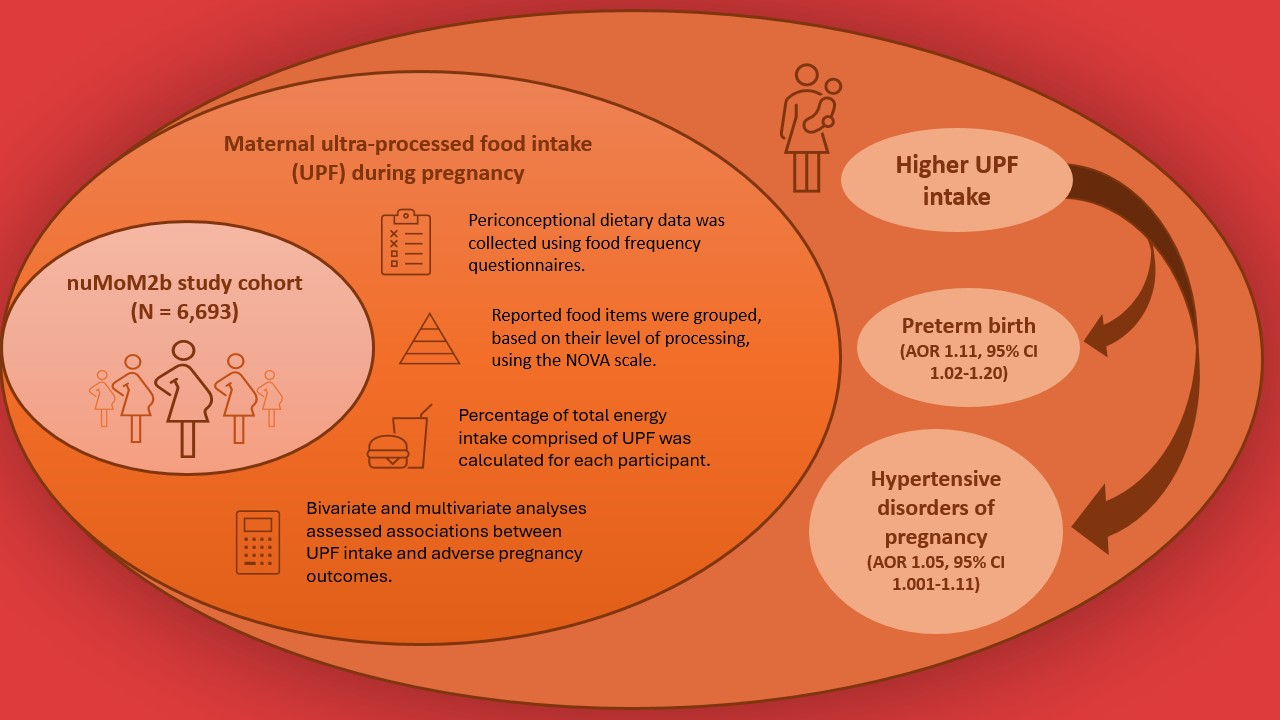
| Preterm birth | 6668 | <0.001 | 1.15 (1.07–1.23), 0.002 | 1.11 (1.02–1.21), 0.02 | ||
| No | 6166 (92) | 51.2 ± 12.7 | ||||
| Yes | 522 (8) | 53.4 ± 12.9 | ||||
| HDP | 6636 | 0.02 | 1.06 (1.01–1.11), 0.02 | 1.05 (1.001–1.11), 0.04 | ||
| No | 5114 (77) | 51.1 ± 12.7 | ||||
| Yes | 1522 (24) | 52.0 ± 12.6 | ||||
| SGA | 6623 | 0.03 | 1.08 (1.01–1.15), 0.03 | 1.06 (0.98–1.14), 0.17 | ||
| No | 6024 (91) | 51.2 ± 12.7 | ||||
| Yes | 599 (9) | 52.4 ± 13.1 | ||||
| LGA | 6456 | 0.32 | 0.97 (0.90–1.04), 0.32 | 1.00 (0.92–1.08), 0.97 | ||
| No | 5936 (92) | 51.4 ± 12.7 | ||||
| Yes | 518 (8) | 50.8 ± 12.6 | ||||
| GDM | 6693 | 0.38 | 0.96 (0.88–1.05), 0.38 | 1.00 (0.90–1.10), 0.94 | ||
| No | 6382 (95) | 51.4 ± 12.8 | ||||
| Yes | 311 (5) | 50.7 ± 12.0 | ||||
| Fetal or neonatal demise 3 | 6437 | 0.003 | 1.42 (1.13–1.78), 0.003 | 1.22 (0.91–1.62), 0.19 | ||
| No | 6391 (99) | 51.3 ± 12.7 | ||||
| Yes | 46 (1) | 56.9 ± 11.3 |
Disclaimer/Publisher’s Note: The statements, opinions and data contained in all publications are solely those of the individual author(s) and contributor(s) and not of MDPI and/or the editor(s). MDPI and/or the editor(s) disclaim responsibility for any injury to people or property resulting from any ideas, methods, instructions or products referred to in the content. |
© 2026 by the authors. Licensee MDPI, Basel, Switzerland. This article is an open access article distributed under the terms and conditions of the Creative Commons Attribution (CC BY) license.
Share and Cite
Hall, R.; Hernandez, A.M.; Rosas-Rogers, S.; Liegl, M.; Pan, A.Y.; Cohen, C.; Palatnik, A. The Association Between Periconceptional Consumption of Ultra-Processed Food and the Incidence of Adverse Pregnancy Outcomes. Nutrients 2026, 18, 627. https://doi.org/10.3390/nu18040627
Hall R, Hernandez AM, Rosas-Rogers S, Liegl M, Pan AY, Cohen C, Palatnik A. The Association Between Periconceptional Consumption of Ultra-Processed Food and the Incidence of Adverse Pregnancy Outcomes. Nutrients. 2026; 18(4):627. https://doi.org/10.3390/nu18040627
Chicago/Turabian StyleHall, Raven, Alyssa M. Hernandez, Suzette Rosas-Rogers, Melodee Liegl, Amy Y. Pan, Catherine Cohen, and Anna Palatnik. 2026. "The Association Between Periconceptional Consumption of Ultra-Processed Food and the Incidence of Adverse Pregnancy Outcomes" Nutrients 18, no. 4: 627. https://doi.org/10.3390/nu18040627
APA StyleHall, R., Hernandez, A. M., Rosas-Rogers, S., Liegl, M., Pan, A. Y., Cohen, C., & Palatnik, A. (2026). The Association Between Periconceptional Consumption of Ultra-Processed Food and the Incidence of Adverse Pregnancy Outcomes. Nutrients, 18(4), 627. https://doi.org/10.3390/nu18040627