
Risk Factors for Postnatal Growth Faltering and Undernutrition at Discharge in Very Preterm Infants: A Retrospective Study Applying the ESPGHAN Consensus Definitions

 ,
,  and
and
Abstract
1. Introduction
2. Materials and Methods
- Prenatal data: maternal variables which could be related to postnatal infant growth were included in the database: chorioamnionitis, maternal hypertension, prenatal steroid and magnesium sulphate prophylaxis. As for fetal variables, twin status and intrauterine growth restriction (IUGR) diagnosis [15] were included, as deemed relevant for further growth evaluation.
- Perinatal data: the following perinatal variables were collected: type of delivery, infant sex, GA, 5’ Apgar score, and anthropometry at birth (BW, length and head circumference [HC], with their respective centile and z-scores).
- Neonatal data: the presence of the main neonatal comorbidities was assessed by checking the infants’ medical records. Specifically, the following variables were recorded and staged according to the definitions provided by the Vermont Oxford Network [16]: intraventricular hemorrhage (IVH), periventricular leukomalacia (PVL), early- and late-onset sepsis (EOS and LOS), necrotizing enterocolitis (NEC), and patent ductus arteriosus (PDA). Bronchopulmonary dysplasia (BPD) was diagnosed and staged according to the definition proposed in 2019 by Jensen et al. [17].
- Discharge data: length of hospital stay and postmenstrual age (PMA) at discharge were recorded. Provision of human milk (HM) at discharge was recorded. Growth was assessed using the Intergrowth 21st charts for postnatal growth of preterm infants [18], in line with international consensus and following the guidelines for monitoring growth in preterm infants issued by the Italian Society of Neonatology [19], which recommend using the Intergrowth 21st charts up to six months corrected age, and the WHO growth charts from then on.
- At birth, infants were classified as small for gestational age (SGA) when the BW centile was <3rd, while a definition of growth restriction (GR) was made if BW was <3rd or <−2 SD or in the presence of at least three of the following: BW < 10th percentile, HC at birth < 10th centile, length at birth < 10th centile, prenatal diagnosis of IUGR or maternal hypertension/preeclampsia [20].
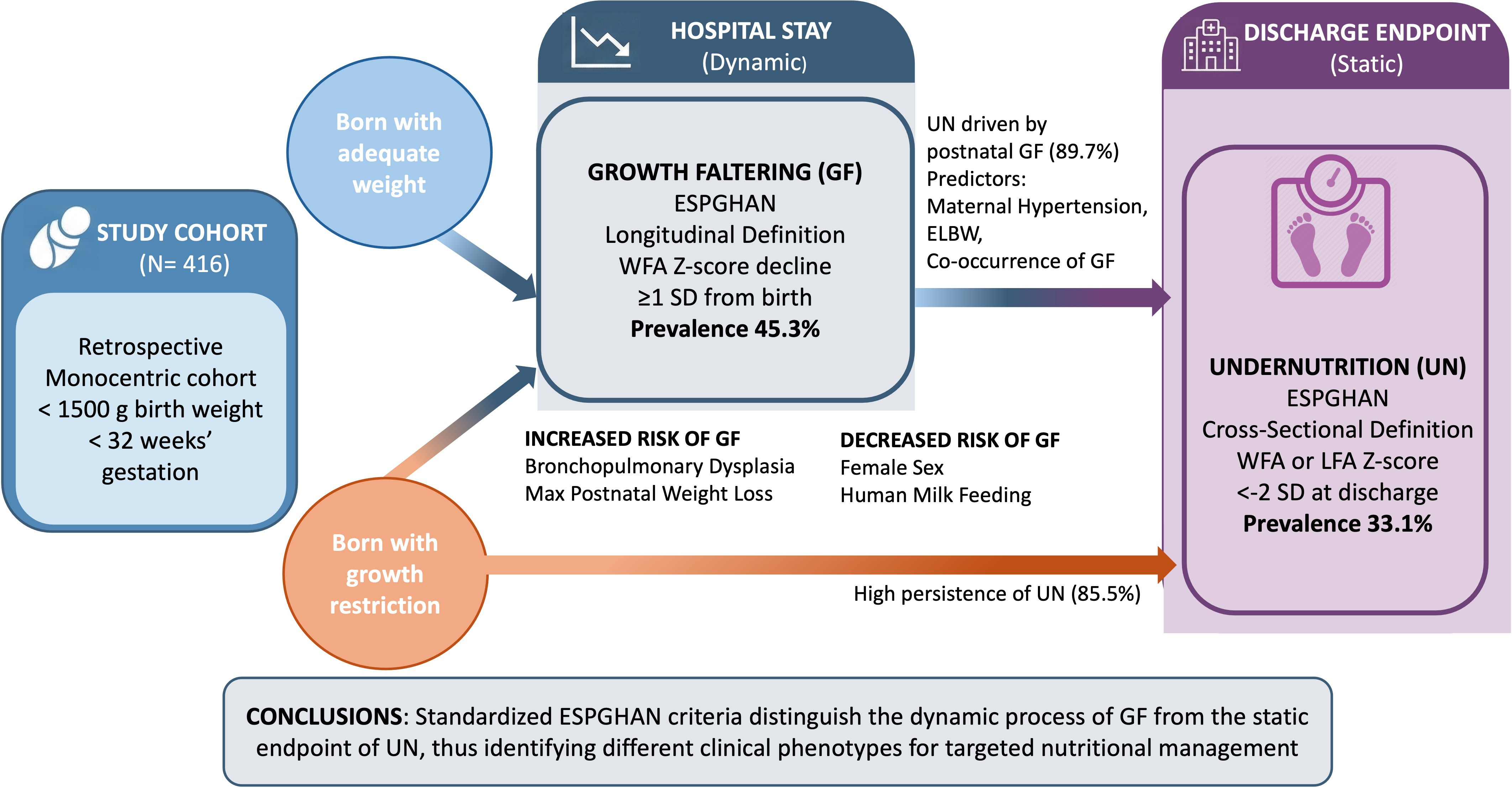
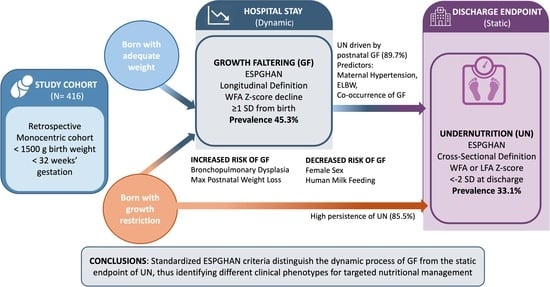
- At discharge, GF was defined as a fall in weight for age (WFA) z-score ≥ 1.0 from birth, while undernutrition (UN) as a weight for age (WFA) or length for age (LFA) z-score < −2 SDs.
2.1. Nutritional and Clinical Management
2.2. Statistical Analysis
3. Results
3.1. Growth Faltering at Discharge
3.2. Undernutrition at Discharge
4. Discussion
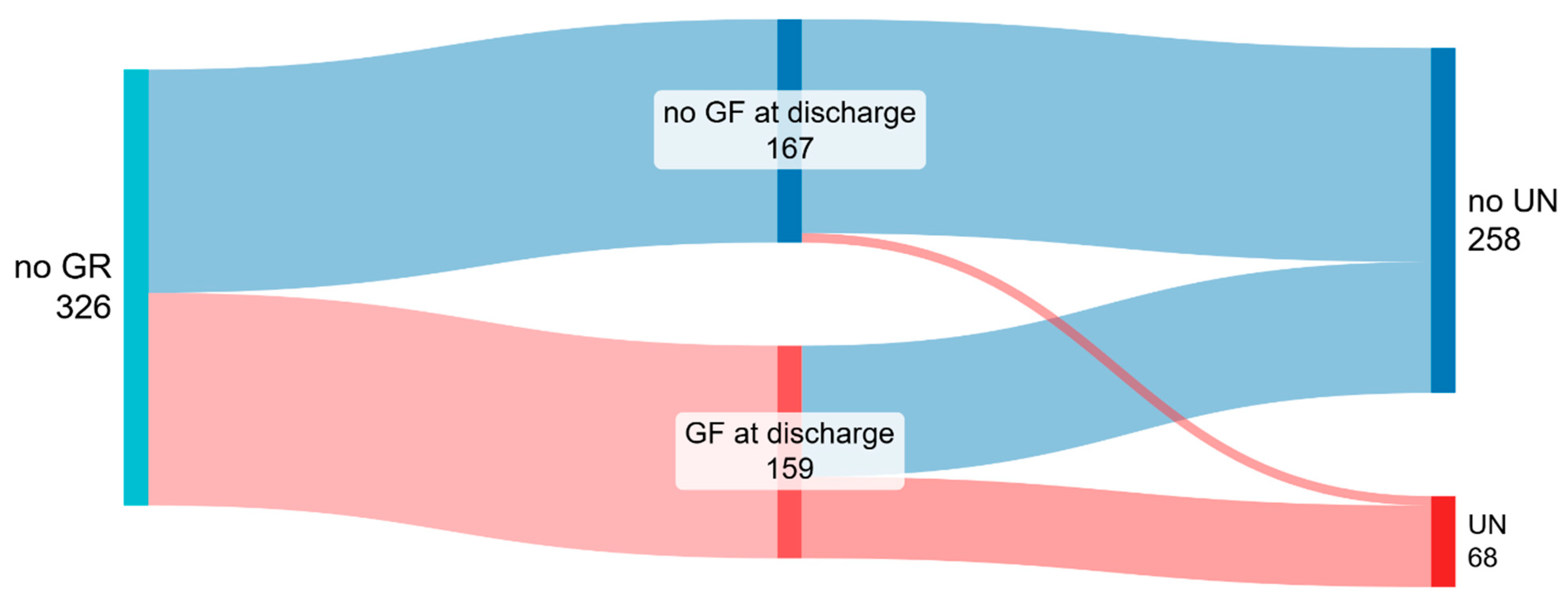
- Infants with an adequate nutritional status at birth, suffering from a significant GF during hospital stay leading to a discharge WFA and/or LFA < −2 SDs.
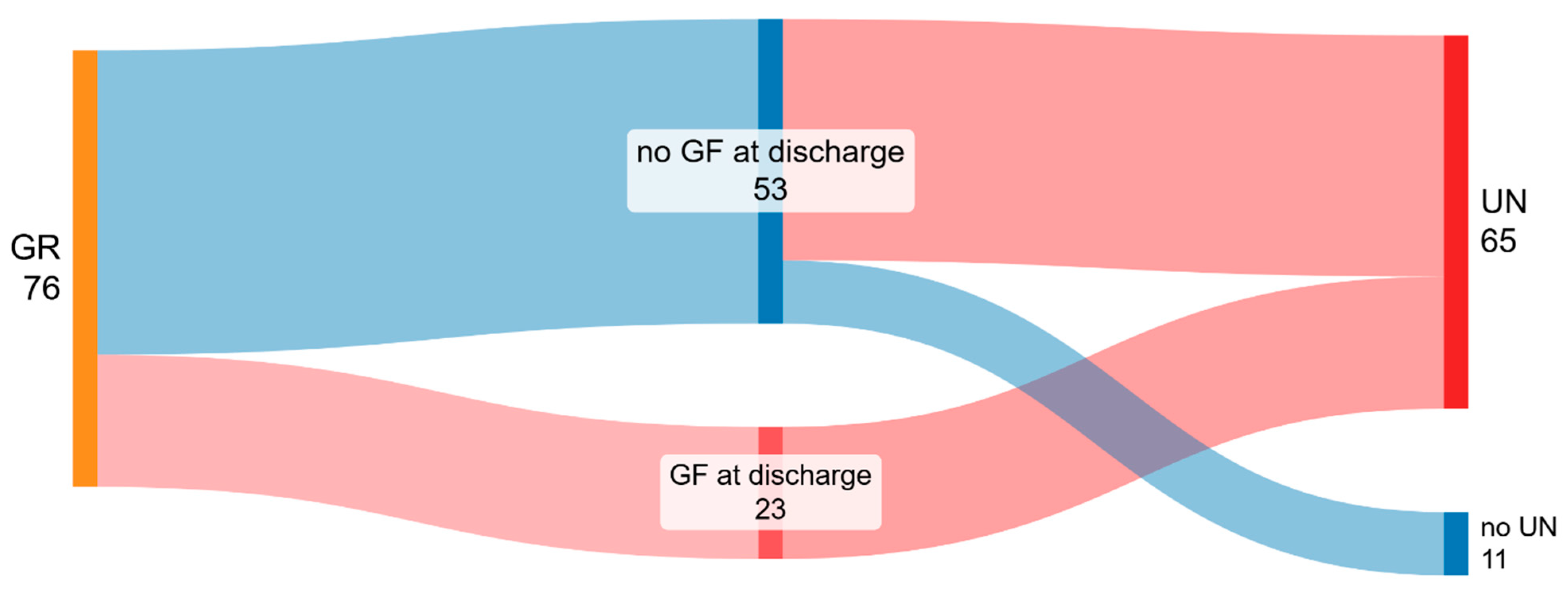
- Infants with GR who, despite an adequate postnatal growth, fail to reach a discharge WFA and/or LFA > −2 SDs.
- Infants with both GR and GF, leading to a discharge WFA and/or LFA < −2 SDs.
5. Conclusions
Author Contributions
Funding
Institutional Review Board Statement
Informed Consent Statement
Data Availability Statement
Conflicts of Interest
Abbreviations
| BPD | bronchopulmonary dysplasia |
| BW | birth weight |
| EOS | early onset sepsis |
| ESPGHAN | European Society for Paediatric Gastroenterology, Hepatology and Nutrition |
| GA | gestational age |
| GF | growth faltering |
| GR | growth restriction |
| HC | head circumference |
| HM | human milk |
| IQR | interquartile range |
| IUGR | intrauterine growth restriction |
| IVH | intraventricular hemorrhage |
| LFA | length for age |
| LOS | late onset sepsis |
| NEC | necrotizing enterocolitis |
| NICU | neonatal intensive care unit |
| PDA | patent ductus arteriosus |
| PMA | postmenstrual age |
| PVL | periventricular leukomalacia |
| SD | standard deviation |
| SGA | small for gestational age |
| UN | undernutrition |
| VLBW | very low birth weight |
| VLGA | very low gestational age |
| WFA | weight for age |
References
- Haiden, N.; Luque, V.; Domellöf, M.; Braegger, C.; Bronsky, J.; Cai, W.; Campoy, C.; Carnielli, V.; Darmaun, D.; Decsi, T.; et al. Assessment of Growth Status and Nutritional Management of Prematurely Born Infants After Hospital Discharge: A Position Paper of the ESPGHAN Nutrition Committee. J. Pediatr. Gastroenterol. Nutr. 2025, 81, 421–441. [Google Scholar] [CrossRef]
- Peila, C.; Spada, E.; Giuliani, F.; Maiocco, G.; Raia, M.; Cresi, F.; Coscia, A.; Bertino, E. Extrauterine Growth Restriction: Definitions and Predictability of Outcomes in a Cohort of Very Low Birth Weight Infants or Preterm Neonates. Nutrients 2020, 12, 1224. [Google Scholar] [CrossRef] [PubMed]
- González-López, C.; Solís-Sánchez, G.; Lareu-Vidal, S.; Fernández-Sarmiento, J.M.; González-Caballero, D.; Blanco-Rodríguez, A.; López-Ramos, M.G.; Reyes-Domínguez, A. Variability in Definitions and Criteria of Extrauterine Growth Restriction and Its Association With Neurodevelopmental Outcomes in Preterm Infants: A Narrative Review. Nutrients 2024, 16, 968. [Google Scholar] [CrossRef] [PubMed]
- De Rose, D.U.; Cota, F.; Gallini, F.; Bottoni, A.; Ricci, C.; Bersani, I.; Savarese, I.; D’Antuono, A.; Giliberti, P.; Vento, G. Extra-Uterine Growth Restriction in Preterm Infants: Neurodevelopmental Outcomes According to Different Definitions. Eur. J. Paediatr. Neurol. 2021, 33, 135–145. [Google Scholar] [CrossRef]
- Kakatsaki, I.; Papanikolaou, S.; Roumeliotaki, T.; Koropouli, M.; Hatzidaki, E. The Prevalence of Small for Gestational Age and Extrauterine Growth Restriction Among Extremely and Very Preterm Neonates, Using Different Growth Curves, and Its Association With Clinical and Nutritional Factors. Nutrients 2023, 15, 3290. [Google Scholar] [CrossRef]
- Starc, M.; Giangreco, M.; Centomo, G.; Travan, L.; Bua, J. Extrauterine Growth Restriction in Very Low Birth Weight Infants According to Different Growth Charts: A Retrospective 10 Years Observational Study. PLoS ONE 2023, 18, e0283367. [Google Scholar] [CrossRef]
- Kim, Y.J.; Shin, S.H.; Cho, H.; Song, I.G.; Chung, S.H.; Kim, H.S.; Kim, E.K.; Kim, B.I.; Choi, C.W. Extrauterine Growth Restriction in Extremely Preterm Infants Based on the Intergrowth-21st Project Preterm Postnatal Follow-Up Study Growth Charts and the Fenton Growth Charts. Eur. J. Pediatr. 2021, 180, 817–824. [Google Scholar] [CrossRef]
- Consales, A.; Porro, M.; Gangi, S.; Leonardi, S.; Gagliano, V.; Gardon, L.; Rossi, S.; Giannì, M.L.; Roggero, P.; Mosca, F. In-hospital growth and long-term neurodevelopmental outcomes of very low birth weight infants. Front. Pediatr. 2023, 11, 1180068. [Google Scholar] [CrossRef] [PubMed]
- Massirio, P.; Battaglini, M.; Bonato, I.; Arnaudo, P.; Schiaffino, G.; Mancardi, M.M.; Severino, M.; Traggiai, C.; Ramenghi, L.A. Early Extra-Uterine Growth Restriction in Very-Low-Birth-Weight Neonates with Normal or Mildly Abnormal Brain MRI: Effects on a 2–3-Year Neurodevelopmental Outcome. Nutrients 2024, 16, 449. [Google Scholar] [CrossRef]
- Martínez-Jiménez, M.D.; Gómez-García, F.J.; Gil-Campos, M.; Pérez-Navero, J.L. Comorbidities in Childhood Associated with Extrauterine Growth Restriction in Preterm Infants: A Scoping Review. Eur. J. Pediatr. 2020, 179, 1255–1265. [Google Scholar] [CrossRef]
- Figueras-Aloy, J.; Palet-Trujols, C.; Matas-Barceló, I.; Botet-Mussons, F.; Carbonell-Estrany, X. Extrauterine Growth Restriction in Very Preterm Infant: Etiology, Diagnosis, and 2-Year Follow-Up. Eur. J. Pediatr. 2020, 179, 1469–1479. [Google Scholar] [CrossRef]
- Makker, K.; Ji, Y.; Hong, X.; Wang, X. Antenatal and Neonatal Factors Contributing to Extra Uterine Growth Failure (EUGR) Among Preterm Infants in Boston Birth Cohort (BBC). J. Perinatol. 2021, 41, 1025–1032. [Google Scholar] [CrossRef] [PubMed]
- Wang, L.; Lin, X.Z.; Shen, W.; Chen, H.L.; Zhang, H.; Guo, X.H.; Liu, X.M.; Xia, S.W.; Li, S. Risk Factors of Extrauterine Growth Restriction in Very Preterm Infants With Bronchopulmonary Dysplasia: A Multi-Center Study in China. BMC Pediatr. 2022, 22, 363. [Google Scholar] [CrossRef] [PubMed]
- Bozzetti, V.; Dui, L.G.; Zannin, E.; Tagliabue, P.E.; Ventura, M.L. AI to Predict Extrauterine Growth Restriction During Transitional Nutrition of Preterm Infants: A Retrospective Study. J. Perinatol. 2025, epub ahead of print. [Google Scholar] [CrossRef]
- Gordijn, S.J.; Beune, I.M.; Thilaganathan, B.; Papageorghiou, A.; Baschat, A.A.; Baker, P.N.; Silver, R.M.; Molewijk, K.; Ganzevoort, W. Consensus definition of fetal growth restriction: A Delphi procedure. Ultrasound Obstet. Gynecol. 2016, 48, 333–339. [Google Scholar] [CrossRef]
- Vermont Oxford Network. Vermont Oxford Network Manual 2025. Available online: https://vtoxford.zendesk.com/hc/en-us/categories/360000861394-Manuals-and-Forms (accessed on 16 December 2025).
- Jensen, E.A.; Dysart, K.; Gantz, M.G.; McDonald, S.; Bamat, N.A.; Keszler, M.; Kirpalani, H.; Laughon, M.M.; Ehrenkranz, R.A.; Schmidt, B. The Diagnosis of Bronchopulmonary Dysplasia in Very Preterm Infants. An Evidence-based Approach. Am. J. Respir. Crit. Care Med. 2019, 200, 751–759. [Google Scholar] [CrossRef]
- Villar, J.; Giuliani, F.; Bhutta, Z.A.; Bertino, E.; Ohuma, E.O.; Ismail, L.C.; Barros, F.C.; Victora, C.G.; Albernaz, E.; Jaffer, Y.A.; et al. Postnatal growth standards for preterm infants: The Preterm Postnatal Follow-up Study of the INTERGROWTH-21st Project. Lancet Glob. Health 2015, 3, e681–e691. [Google Scholar] [CrossRef]
- Italian Society of Neonatology. Preterm Infant Follow-Up. The First Six Years of Life; Task force on Preterm Infant Follow-Up: 2022; iDeaCpa Editore: Rome, Italy, 2022; ISBN 978-88-946318-7-6. Available online: https://blog.sin-neonatologia.it/wp-content/uploads/2023/04/Manuale-follow-up_sin22_06.04.2023.pdf (accessed on 16 December 2025).
- Beune, I.M.; Bloomfield, F.H.; Ganzevoort, W.; Embleton, N.D.; Rozance, P.J.; Hay, W.W.; van Wassenaer-Leemhuis, A.G.; Gordijn, S.J. Consensus based definition of growth restriction In the newborn. J. Pediatr. 2018, 196, 71–76.e1. [Google Scholar] [CrossRef] [PubMed]
- Fenton, T.R.; Kim, J.H. A systematic review and meta-analysis to revise the Fenton growth chart for preterm infants. BMC Pediatr. 2013, 13, 59. [Google Scholar] [CrossRef]
- Embleton, N.D.; Moltu, S.J.; Lapillonne, A.; van den Akker, C.H.P.; Carnielli, V.; Fusch, C.; Gerasimidis, K.; van Goudoever, J.B.; Haiden, N.; Iacobelli, S.; et al. Enteral Nutrition in Preterm Infants (2022): A Position Paper From the ESPGHAN Committee on Nutrition and Invited Experts. J. Pediatr. Gastroenterol. Nutr. 2023, 76, 248–268. [Google Scholar] [CrossRef]
- Dassios, T.; Williams, E.E.; Hickey, A.; Bunce, C.; Greenough, A. Bronchopulmonary dysplasia and postnatal growth following extremely preterm birth. Arch. Dis. Child. Fetal Neonatal Ed. 2021, 106, 386–391. [Google Scholar] [CrossRef]
- Kimoto, Y.; Hirata, K.; Hirano, S.; Wada, K.; Moriichi, A.; Ito, Y.; Cho, K.; Mizuno, K.; Toyoshima, K.; Kushima, R.; et al. Post-Discharge Growth Among Extremely Preterm Infants With or Without Bronchopulmonary Dysplasia. Pediatr. Pulmonol. 2025, 60, e27388. [Google Scholar] [CrossRef]
- Shimotsuma, T.; Tomotaki, S.; Akita, M.; Araki, R.; Tomotaki, H.; Iwanaga, K.; Kobayashi, A.; Saitoh, A.; Fushimi, Y.; Takita, J.; et al. Severe Bronchopulmonary Dysplasia Adversely Affects Brain Growth in Preterm Infants. Neonatology 2024, 121, 724–732. [Google Scholar] [CrossRef]
- Valentine, G.C.; Perez, K.M.; Wood, T.R.; Carlson, T.G.; Conlon, L.; McCarter, R.M.; Belfort, M.B.; Hansmann, G. Postnatal maximal weight loss, fluid administration, and outcomes in extremely preterm newborns. J. Perinatol. 2022, 42, 1008–1016. [Google Scholar] [CrossRef] [PubMed]
- Valentine, G.C.; Brandon, O.C.; Perez, K.M.; Strobel, K.M.; Mayock, D.E.; Law, J.B.; Neches, S.; German, K.; Kolnik, S.; Heagerty, P.J.; et al. Time to regain birthweight and in-hospital outcomes among United States-born extremely preterm newborns. Pediatr. Res. 2025, 1–9. [Google Scholar] [CrossRef]
- Chen, W.; Cai, W.; Lin, Z.; Ye, X.; Chen, B.; Mei, S.; Huang, T.; Ren, Y. Third-day weight changes and bronchopulmonary dysplasia risk in preterm infants: A cohort study. Front. Pediatr. 2025, 13, 1592069. [Google Scholar] [CrossRef]
- Jiang, W.; Mo, M.; Si, S.; Wang, X.; Shao, B.; Hua, J. Association of hypertensive disorders of pregnancy with infant growth in the first 36 months of life. Eur. J. Pediatr. 2022, 181, 133–141. [Google Scholar] [CrossRef] [PubMed]
- Calek, E.; Binder, J.; Palmrich, P.; Pateisky, P.; Eppel, W.; Berger, A.; Werther, T.; Worda, C. Preeclampsia and Future Implications on Growth and Body Composition in Preterm Infants. Nutrients 2024, 16, 3627. [Google Scholar] [CrossRef] [PubMed]
- Cerasani, J.; Ceroni, F.; De Cosmi, V.; Mazzocchi, A.; Syren, M.L.; Roggero, P.; Agostoni, C.; Giannì, M.L. Human Milk Feeding and Preterm Infants’ Growth and Body Composition: A Literature Review. Nutrients 2020, 12, 1155. [Google Scholar] [CrossRef]
- Dharel, D.; Singhal, N.; Wood, C.; Sun, J.; Shah, P.S.; Canadian Neonatal Network (CNN) and Canadian Preterm Birth Network (CPTBN) Investigators. Rates and Determinants of Mother’s Own Milk Feeding in Infants Born Very Preterm. J. Pediatr. 2021, 236, 21–27.e4. [Google Scholar] [CrossRef]
- Hoban, R.; Bowker, R.M.; Gross, M.E.; Ford, S.; Sela, D.A.; Underwood, M.A. Maternal production of milk for infants in the neonatal intensive care unit. Semin. Perinatol. 2021, 45, 151381. [Google Scholar] [CrossRef] [PubMed]
- Bardanzellu, F.; Peroni, D.G.; Fanos, V. Human Breast Milk: Bioactive Components, from Stem Cells to Health Outcomes. Curr. Nutr. Rep. 2020, 9, 1–13. [Google Scholar] [CrossRef]
- Ramel, S.E.; Gray, H.L.; Christiansen, E.; Boys, C.; Georgieff, M.K.; Demerath, E.W. Greater Early Gains in Fat-Free Mass, but Not Fat Mass, Are Associated with Improved Neurodevelopment at 1 Year Corrected Age for Prematurity in Very Low Birth Weight Preterm Infants. J. Pediatr. 2016, 173, 108–115. [Google Scholar] [CrossRef]
- Belfort, M.B.; Rifas-Shiman, S.L.; Sullivan, T.; Collins, C.T.; McPhee, A.J.; Ryan, P.; Kleinman, K.P.; Gillman, M.W.; Gibson, R.A.; Makrides, M. Infant growth before and after term: Effects on neurodevelopment in preterm infants. Pediatrics 2011, 128, e899–e906. [Google Scholar] [CrossRef]
- Ramel, S.E.; Demerath, E.W.; Gray, H.L.; Younge, N.; Boys, C.; Georgieff, M.K. The relationship of poor linear growth velocity with neonatal illness and two-year neurodevelopment in preterm infants. Neonatology 2012, 102, 19–24. [Google Scholar] [CrossRef]
- Young, A.; Beattie, R.M.; Johnson, M.J. Optimising Growth in Very Preterm Infants: Reviewing the Evidence. Arch. Dis. Child. Fetal Neonatal Ed. 2023, 108, 2–9. [Google Scholar] [CrossRef]
- Simon, L.; Frondas-Chauty, A.; Senterre, T.; Darmaun, D.; Rozé, J.C. Determinants of Body Composition in Preterm Infants at the Time of Hospital Discharge. Am. J. Clin. Nutr. 2014, 100, 98–104. [Google Scholar] [CrossRef]
- Wiechers, C.; Avellina, V.; Luger, B.; Böckmann, K.; Minarski, M.; Maas, C.; Bernhard, W.; Poets, C.F.; Franz, A.R. Body Composition of Preterm Infants Following Rapid Transition to Enteral Feeding. Neonatology 2022, 119, 246–254. [Google Scholar] [CrossRef] [PubMed]
- Lafeber, A.H.; de Kraker, L.C.D.; van Goudoever, J.B.; de Groof, F. Nutritional Strategies and Their Influence on Growth and Body Composition in Moderate and Late Preterm Infants: A Systematic Review of Recent Literature. Curr. Opin. Clin. Nutr. Metab. Care 2026, 29. [Google Scholar] [CrossRef] [PubMed]
- Jain, S.; Alshaikh, B.N.; Elmrayed, S.; Fenton, T.R. Short- and Longer-Term Growth and Development of Fat Mass in Preterm Infants. Semin. Fetal Neonatal Med. 2025, 30, 101636. [Google Scholar] [CrossRef]



| Growth Faltering (n = 182) | Adequate Growth (n = 220) | p | |
|---|---|---|---|
| Prenatal data | |||
| Maternal hypertension | 39/173 [22.5] | 60/203 [29.6] | 0.129 |
| Antenatal steroids | 148/170 [87.1] | 181/204 [88.7] | 0.636 |
| Antenatal MgSO4 | 59/156 [37.8] | 55/187 [63.2] | 0.108 |
| IUGR | 32/157 [20.4] | 56/187 [30.0] | 0.048 |
| Twin status | 56/182 [30.8] | 80/220 [36.4] | 0.246 |
| Perinatal data | |||
| Vaginal delivery | 71/181 [39.2] | 75/220 [34.1] | 0.299 |
| Gestational age (weeks) | 29.00 (4.93) | 31.00 (2.68) | <0.001 |
| Birth weight (g) | 1156 (602) | 1339.5 (318) | <0.001 |
| ELBW | 72/182 [39.6] | 39/220 [17.7] | <0.001 |
| Growth restriction at birth | 23/182 [12.6] | 52/220 [23.6] | 0.005 |
| SGA < 3rd centile | 9/182 [4.9] | 26/220 [11.8] | 0.020 |
| Birth length (cm) | 37 (7) | 39 (4) | <0.001 |
| Birth head circumference (cm) | 27 (5) | 28 (2.5) | <0.001 |
| Sex (female) | 71/182 [39.0] | 122/220 [55.5] | 0.001 |
| Neonatal data | |||
| Weight loss after birth (max value-%) | 12.40 (8.02) | 10.40 (6.61) | <0.001 |
| IVH | 58/182 [31.9] | 49/220 [22.3] | 0.032 |
| PVL | 10/180 [5.6] | 4/219 [1.8] | 0.056 |
| EOS | 10/181 [5.5] | 11/220 [5.0] | 0.826 |
| LOS | 42/181 [23.2] | 20/220 [9.1] | <0.001 |
| BPD | 50/182 [27.5] | 20/219 [9.1] | <0.001 |
| PDA requiring treatment | 59/182 [32.4] | 40/220 [18.2] | 0.001 |
| NEC stage ≥ 2 | 10/182 [5.5] | 3/219 [1.4] | 0.024 |
| Human milk at discharge | 129/181 [71.3] | 187/219 [85.4] | <0.001 |
| Length of hospital stay (days) | 57 (50) | 34 (22) | <0.001 |
| Post-menstrual age at discharge (weeks) | 37.14 (4.00) | 35.85 (2.15) | <0.001 |
| B | S.E. | Exp (B) | p | |
|---|---|---|---|---|
| ELBW | 0.500 | 0.316 | 1.648 | 0.114 |
| GR at birth | −0.572 | 0.337 | 0.564 | 0.890 |
| Sex | −1.000 | 0.243 | 0.368 | <0.001 |
| IVH | −0.026 | 0.276 | 0.974 | 0.924 |
| LOS | 0.690 | 0.359 | 1.994 | 0.055 |
| BPD | 0.742 | 0.371 | 2.101 | 0.045 |
| PDA | 0.204 | 0.298 | 1.227 | 0.493 |
| NEC stage ≥ 2 | 0.730 | 0.864 | 2.076 | 0.398 |
| Weight loss | 0.060 | 0.021 | 1.062 | 0.005 |
| HM at discharge | −0.906 | 0.300 | 0.404 | 0.003 |
| Constant | −0.065 | 0.409 | 0.937 | 0.874 |
| B | S.E. | Exp (B) | p | |
|---|---|---|---|---|
| Maternal hypertension | 1.254 | 0.401 | 3.505 | 0.002 |
| ELBW | 0.811 | 0.388 | 2.250 | 0.037 |
| Sex | −0.550 | 0.344 | 0.577 | 0.110 |
| LOS | 0.250 | 0.398 | 1.284 | 0.530 |
| BPD | 0.425 | 0.425 | 1.529 | 0.317 |
| HM at discharge | −0.233 | 0.370 | 0.800 | 0.546 |
| GF at discharge | 2.368 | 0.452 | 10.678 | <0.001 |
| Constant | −3.344 | 0.593 | 0.035 | <0.001 |
Disclaimer/Publisher’s Note: The statements, opinions and data contained in all publications are solely those of the individual author(s) and contributor(s) and not of MDPI and/or the editor(s). MDPI and/or the editor(s) disclaim responsibility for any injury to people or property resulting from any ideas, methods, instructions or products referred to in the content. |
© 2026 by the authors. Licensee MDPI, Basel, Switzerland. This article is an open access article distributed under the terms and conditions of the Creative Commons Attribution (CC BY) license.
Share and Cite
Beghetti, I.; Magno, D.; Benvenuti, E.; Aceti, A.; Corvaglia, L.T. Risk Factors for Postnatal Growth Faltering and Undernutrition at Discharge in Very Preterm Infants: A Retrospective Study Applying the ESPGHAN Consensus Definitions. Nutrients 2026, 18, 286. https://doi.org/10.3390/nu18020286
Beghetti I, Magno D, Benvenuti E, Aceti A, Corvaglia LT. Risk Factors for Postnatal Growth Faltering and Undernutrition at Discharge in Very Preterm Infants: A Retrospective Study Applying the ESPGHAN Consensus Definitions. Nutrients. 2026; 18(2):286. https://doi.org/10.3390/nu18020286
Chicago/Turabian StyleBeghetti, Isadora, Dalila Magno, Ettore Benvenuti, Arianna Aceti, and Luigi Tommaso Corvaglia. 2026. "Risk Factors for Postnatal Growth Faltering and Undernutrition at Discharge in Very Preterm Infants: A Retrospective Study Applying the ESPGHAN Consensus Definitions" Nutrients 18, no. 2: 286. https://doi.org/10.3390/nu18020286
APA StyleBeghetti, I., Magno, D., Benvenuti, E., Aceti, A., & Corvaglia, L. T. (2026). Risk Factors for Postnatal Growth Faltering and Undernutrition at Discharge in Very Preterm Infants: A Retrospective Study Applying the ESPGHAN Consensus Definitions. Nutrients, 18(2), 286. https://doi.org/10.3390/nu18020286