Undernutrition and Feeding Difficulties Among Children with Disabilities in Uganda: A Cross-Sectional Study

 , , ,
, , ,
Abstract
1. Introduction
2. Materials and Methods
2.1. Study Setting and Participants
2.2. Sample Size Estimation
2.3. Nutritional Status and Feeding Assessments
2.3.1. Anthropometric Measurements
2.3.2. Anemia Screening
2.3.3. Screening for Feeding Difficulties
2.3.4. Assessment of Feeding Practices
2.4. Developmental Screening
2.5. Qualitative Data Collection
2.6. Statistical Analysis
2.6.1. Data Management
2.6.2. Quantitative Data Analysis
2.6.3. Qualitative Data Analysis
2.7. Ethical Considerations
3. Results
3.1. Characteristics of Study Participants
3.2. Nutritional and Feeding Status
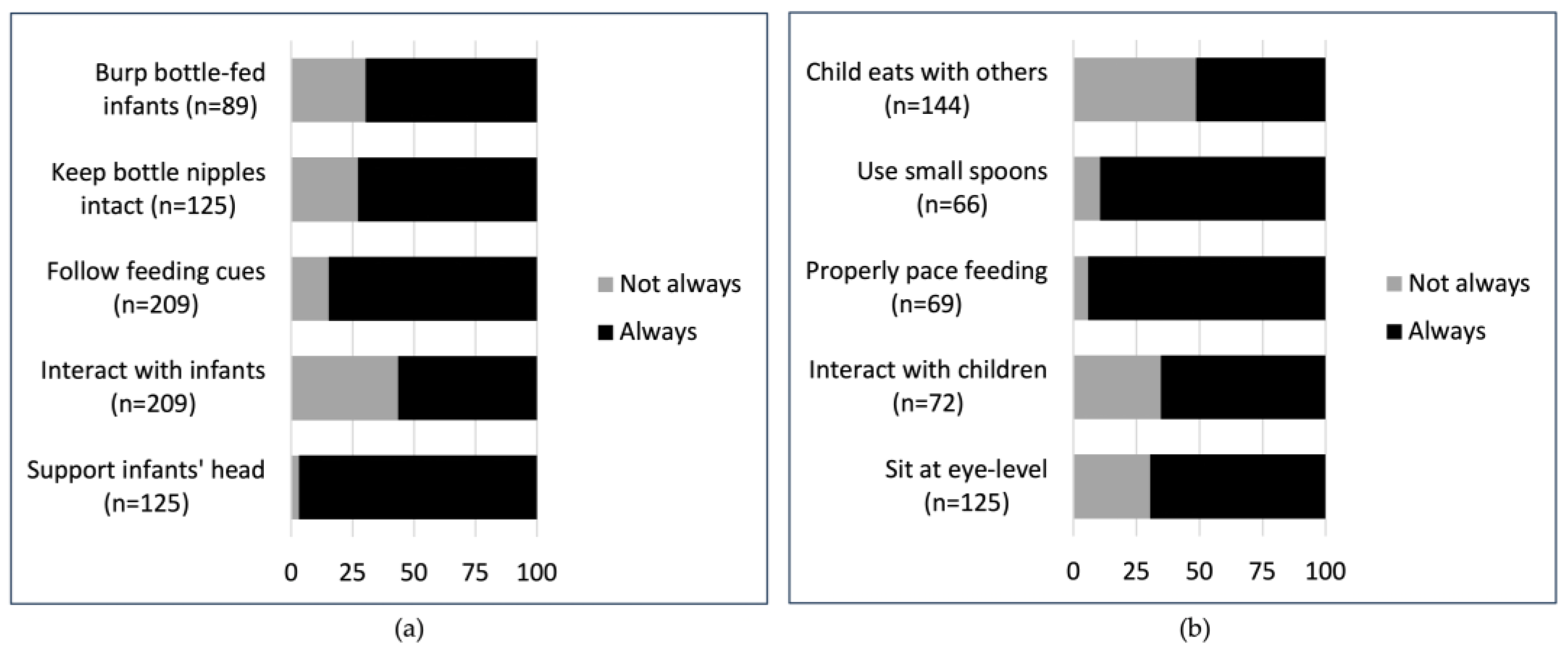
3.3. Reported Feeding Practices
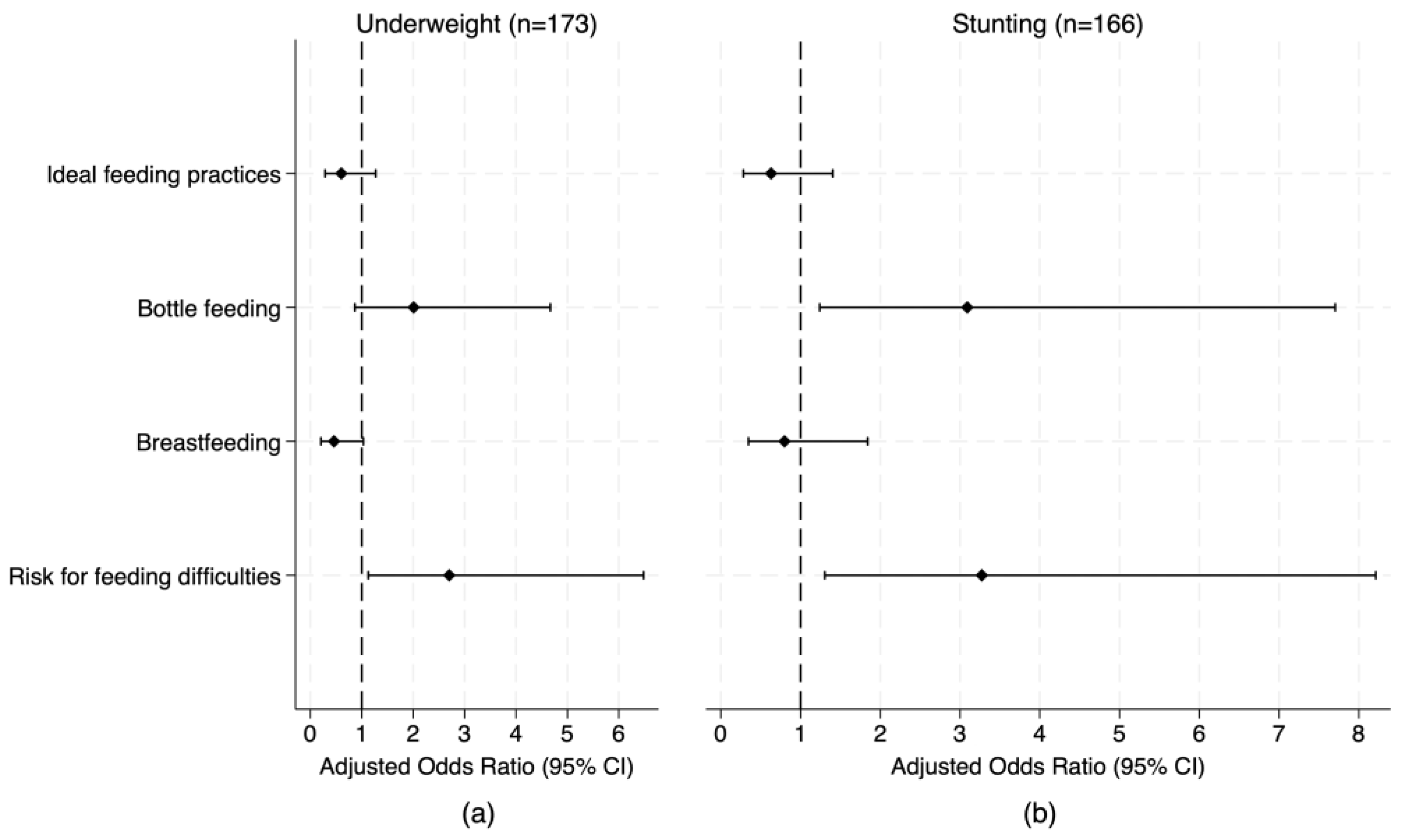
3.4. Association of Risk for Feeding Difficulties with Undernutrition
3.5. Qualitative Results
3.5.1. Barriers
3.5.2. Enabling Factors
3.5.3. Recommendations
4. Discussion
4.1. Comparison with National Averages
4.2. Comparison with Evidence from Uganda and the Region
4.2.1. Children with Cleft Lip and/or Palate
4.2.2. Children with Cerebral Palsy
4.3. Interplay Between Health Conditions and Contextual Factors
4.4. Study Limitations
4.5. Implications for Practice and Research
- Mainstream nutrition programs must be adapted to include children with disabilities, and targeted services must be available, incorporating feeding assessments, early feeding support, caregiver counseling, and linkages to rehabilitation services. In Uganda, such integration could be operationalized through existing Ministry of Health nutrition services, community-based rehabilitation structures, and referral linkages between district health facilities and specialized rehabilitation centers, ensuring disability-inclusive nutrition support without creating parallel systems.
- National data should be disaggregated by disability, used in health planning and to inform nutrition policies and strategies, ensuring nutrition interventions reach those most at risk for undernutrition.
- Future research should examine potential determinants of undernutrition (e.g., maternal education, food insecurity, socioeconomic status), quantify the relative contribution of feeding difficulties and contextual factors (i.e., barriers and enablers) to undernutrition in children with disabilities (for example, via longitudinal cohorts or intervention trials), and investigate the effective measures of reducing barriers to nutrition services, so that interventions can be prioritized and evaluated.
5. Conclusions
Supplementary Materials
Author Contributions
Funding
Institutional Review Board Statement
Informed Consent Statement
Data Availability Statement
Acknowledgments
Conflicts of Interest
Abbreviations
| AOR | Adjusted odds ratio |
| CFM | Child Functioning Module |
| CI | Confidence interval |
| CoRSU | Comprehensive Rehabilitation Services for People with Disability in Uganda |
| GMFCS | Gross Motor Function Classification System |
| ICF | International Classification of Functioning |
| L/HAZ | Length/height-for-age z-score |
| LR | Likelihood ratio |
| MICS | Multiple Indicator Cluster Survey |
| MUAC | Mid-upper arm circumference |
| OR | Odds ratio |
| SD | Standard deviation |
| WASH | Water, sanitation, and hygiene |
| WAZ | Weight-for-age z-score |
| WHO | World Health Organization |
| WL/HZ | Weight-for-length/height z-score |
References
- UNICEF. Seen, Counted, Included: Using Data to Shed Light on the Well-Being of Children with Disabilities; United Nations Children’s Fund (UNICEF): New York, NY, USA, 2021; Available online: https://data.unicef.org/resources/children-with-disabilities-report-2021/ (accessed on 25 October 2025).
- Kerac, M.; Postels, D.G.; Mallewa, M.; Alusine Jalloh, A.; Voskuijl, W.P.; Groce, N.; Gladstone, M.; Molyneux, E. The interaction of malnutrition and neurologic disability in Africa. Semin. Pediatr. Neurol. 2014, 21, 42–49. [Google Scholar] [CrossRef]
- Groce, N.; Challenger, E.; Berman-Bieler, R.; Farkas, A.; Yilmaz, N.; Schultink, W.; Clark, D.; Kaplan, C.; Kerac, M. Malnutrition and disability: Unexplored opportunities for collaboration. Paediatr. Int. Child Health 2014, 34, 308–314. [Google Scholar] [CrossRef]
- Hume-Nixon, M.; Kuper, H. The association between malnutrition and childhood disability in low-and middle-income countries: Systematic review and meta-analysis of observational studies. Trop. Med. Int. Health 2018, 23, 1158–1175. [Google Scholar] [CrossRef]
- Lefton-Greif, M.A.; Arvedson, J.C. Pediatric feeding and swallowing disorders: State of health, population trends, and application of the international classification of functioning, disability, and health. Semin. Speech Lang. 2007, 28, 161–165. [Google Scholar] [CrossRef]
- Arvedson, J.C. Feeding children with cerebral palsy and swallowing difficulties. Eur. J. Clin. Nutr. 2013, 67, S9–S12. [Google Scholar] [CrossRef]
- UNICEF. UNICEF Fact Sheet: Children with Disabilities; United Nations Children’s Fund (UNICEF): New York, NY, USA, 2022; Available online: https://www.unicef.org/media/128976/file/UNICEF%20Fact%20Sheet%20:%20Children%20with%20Disabilities.pdf (accessed on 31 October 2025).
- Oxford Poverty and Human Development Initiative (OPHI). Global Multidimensional Poverty for Children with Disabilities: A 40 Countries Study [Seminar 15 October 2024]. Available online: https://ophi.org.uk/node/3920 (accessed on 12 November 2025).
- Klein, A.; Uyehara, M.; Cunningham, A.; Olomi, M.; Cashin, K.; Kirk, C.M. Nutritional care for children with feeding difficulties and disabilities: A scoping review. PLoS Glob. Public Health 2023, 3, e0001130. [Google Scholar] [CrossRef]
- Engl, M.; Binns, P.; Trehan, I.; Lelijveld, N.; Angood, C.; McGrath, M.; Groce, N.; Kerac, M. Children living with disabilities are neglected in severe malnutrition protocols: A guideline review. Arch. Dis. Child. 2022, 107, 637–643. [Google Scholar] [CrossRef] [PubMed]
- WHO. WHO Guideline on the Prevention and Management of Wasting and Nutritional Oedema (Acute Malnutrition) in Infants and Children Under 5 Years; World Health Organization (WHO): Geneva, Switzerland, 2023; Available online: https://www.who.int/publications/i/item/9789240082830 (accessed on 12 November 2025).
- Atim P’Odong, P.; Jjuuko, A. Uganda—Revised Country Report; University of Pretoria Centre for Human Rights (CHR): Hatfield, South Africa; Repository on Disability Rights in Africa (RODRA): Pretoria, South Africa, 2019; Available online: http://rodra.co.za/country-reports-uganda/52-countries/uganda/219-uganda-revised-country-report#:~:text=At%20the%20moment%2C%20Uganda%20has,%5B66%5D (accessed on 12 November 2025).
- United Nations Human Rights Treaty Bodies. UN Treaty Body Database, Ratification Status for Uganda. Available online: https://tbinternet.ohchr.org/_layouts/15/TreatyBodyExternal/Treaty.aspx?CountryID=182&Lang=en (accessed on 2 November 2025).
- United Nations. United Nations (UN) Convention on the Rights of Persons with Disabilities, A/RES/61/106. 2006. Available online: https://www.un.org/en/development/desa/population/migration/generalassembly/docs/globalcompact/A_RES_61_106.pdf (accessed on 20 October 2025).
- United Nations. United Nations (UN) Convention on the Rights of the Child, A/RES/44/25. 1989. Available online: https://www.un.org/en/development/desa/population/migration/generalassembly/docs/globalcompact/A_RES_44_25.pdf (accessed on 20 October 2025).
- Ministry of Gender Labour and Social Development. Revised National Policy on Persons with Disabilities 2023; Ministry of Gender, Labour, and Social Development: Kampala, Uganda, 2023. Available online: https://mglsd.go.ug/wp-content/uploads/2023/07/FINAL-REVISED-NATIONAL-POLICY-ON-PWDs-2023.pdf (accessed on 2 November 2025).
- Government of Uganda. Uganda’s Commitments to the Second Global Disability Summit 16–17th February 2022; Government of Uganda: Kampala, Uganda, 2022. Available online: https://mglsd.go.ug/wp-content/uploads/2022/04/Disability-Summit-commitments-2022-1.pdf (accessed on 14 November 2025).
- Ministry of Gender Labour and Social Development. Situational Analysis of Persons with Disabilities in Uganda; Ministry of Gender, Labour, and Social Development: Kampala, Uganda, 2020; Available online: https://www.developmentpathways.co.uk/wp-content/uploads/2020/09/Webready-DP1294-ESP-Disability-Uganda-Sept-2020.pdf (accessed on 14 November 2025).
- Office of the Prime Minister. Uganda Nutrition Action Plan (2020–2025): Leaving No-One Behind in Scaling up Nutrition Actions; Office of the Prime Minister: Kampala, Uganda, 2020. [Google Scholar]
- Washington Group on Disability Statistics. WG/UNICEF Child Functioning Module (CFM). Available online: https://www.washingtongroup-disability.com/question-sets/wg-unicef-child-functioning-module-cfm/ (accessed on 1 November 2025).
- Uganda Bureau of Statistics. Uganda Demographic and Health Survey 2022; Uganda Bureau of Statistics: Kampala, Uganda, 2023; Volume 1, Available online: https://www.ubos.org/wp-content/uploads/publications/UDHS-2022-Report.pdf (accessed on 2 November 2025).
- Uganda Bureau of Statistics. The National Population and Housing Census 2024—Final Report; Uganda Bureau of Statistics: Kampala, Uganda, 2024; Volume 1, Available online: https://www.ubos.org/wp-content/uploads/2024/12/National-Population-and-Housing-Census-2024-Final-Report-Volume-1-Main.pdf (accessed on 2 November 2025).
- Andrews, C.; Kakooza-Mwesige, A.; Almeida, R.; Swartling Peterson, S.; Wabwire-Mangen, F.; Eliasson, A.C.; Forssberg, H. Impairments, functional limitations, and access to services and education for children with cerebral palsy in Uganda: A population-based study. Dev. Med. Child Neurol. 2020, 62, 454–462. [Google Scholar] [CrossRef] [PubMed]
- Kakooza-Mwesige, A.; Andrews, C.; Peterson, S.; Wabwire Mangen, F.; Eliasson, A.C.; Forssberg, H. Prevalence of cerebral palsy in Uganda: A population-based study. Lancet Glob. Health 2017, 5, e1275–e1282. [Google Scholar] [CrossRef]
- Mbuga, J.; Galiwango, G.; Tungotyo, M. Anthropometric nutrition outcomes of children under 5 years undergoing cleft palate repair at CoRSU rehabilitation hospital Uganda; trends, patterns and determinants. Int. J. Contemp. Pediatr. 2021, 8, 420. [Google Scholar] [CrossRef]
- Hamid Namaganda, L.; Andrews, C.; Wabwire-Mangen, F.; Peterson, S.; Forssberg, H.; Kakooza-Mwesige, A. Nutritional status and growth of children and adolescents with and without cerebral palsy in eastern Uganda: A longitudinal comparative analysis. PLoS Glob. Public Health 2023, 3, e0001241. [Google Scholar] [CrossRef]
- Rice, I.; Opondo, C.; Nyesigomwe, L.; Ekude, D.; Magezi, J.; Kalanzi, A.; Kerac, M.; Hayes, J.; Robello, M.; Halfman, S.; et al. Children with disabilities lack access to nutrition, health and WASH services: A secondary data analysis. Matern. Child Nutr. 2024, 20, e13642. [Google Scholar] [CrossRef]
- Tungotyo, M.; Atwine, D.; Nanjebe, D.; Hodges, A.; Situma, M. The prevalence and factors associated with malnutrition among infants with cleft palate and/or lip at a hospital in Uganda: A cross-sectional study. BMC Pediatr. 2017, 17, 17. [Google Scholar] [CrossRef]
- WHO. International Classification of Functioning, Disability and Health: ICF; World Health Organization (WHO): Geneva, Switzerland, 2001; Available online: https://iris.who.int/bitstream/handle/10665/42407/9241545429-eng.pdf (accessed on 1 November 2025).
- CoRSU Rehabilitation Hospital. About CoRSU. Available online: www.corsuhospital.org/about-us/ (accessed on 1 November 2025).
- Liu, R.H.; Manana, W.; Tollefson, T.T.; Ntirenganya, F.; Shaye, D.A. Perspectives on the state of cleft lip and cleft palate patient care in Africa. Curr. Opin. Otolaryngol. Head Neck Surg. 2024, 32, 202–208. [Google Scholar] [CrossRef]
- Hardy, J.; Kuter, H.; Campbell, M.; Canoy, D. Reliability of anthropometric measurements in children with special needs. Arch. Dis. Child. 2018, 103, 757–762. [Google Scholar] [CrossRef]
- Sørensen, S.J.; Brekke, G.; Kok, K.; Sørensen, J.L.; Born, A.P.; Mølgaard, C.; Høi-Hansen, C.E. Nutritional screening of children and adolescents with cerebral palsy: A scoping review. Dev. Med. Child Neurol. 2021, 63, 1374–1381. [Google Scholar] [CrossRef] [PubMed]
- Cashin, K.; Oot, L. Guide to Anthropometry: A Practical Tool for Program Planners, Managers, and Implementers; Food and Nutrition Technical Assistance III Project (FANTA)/FHI 360: Washington, DC, USA, 2018; Available online: https://www.fantaproject.org/sites/default/files/resources/FANTA-Anthropometry-Guide-May2018.pdf (accessed on 25 October 2025).
- WHO; UNICEF. Recommendations for Data Collection, Analysis and Reporting on Anthropometric Indicators in Children Under 5 Years Old; 9241515554; World Health Organization (WHO): Geneva, Switzerland; United Nations Children’s Fund (UNICEF): New York, NY, USA, 2019; Available online: https://iris.who.int/bitstream/handle/10665/324791/9789241515559-eng.pdf?sequence=1 (accessed on 1 November 2025).
- SPOON. Count Me in: Digital Health App. Available online: https://www.spoonfoundation.org/what-we-do/digital-health-app/ (accessed on 11 October 2025).
- WHO; UNICEF. WHO Child Growth Standards and the Identification of Severe Acute Malnutrition in Infants and Children; World Health Organization (WHO): Geneva, Switzerland; United Nations Children’s Fund (UNICEF): New York, NY, USA, 2009; Available online: https://iris.who.int/bitstream/handle/10665/44129/9789241598163_eng.pdf?sequence=1 (accessed on 1 November 2025).
- HemoCue. The Hemocue Hb 201+ System: The Standard in Hemoglobin Point-of-Care Testing. Available online: https://www.hemocue.us/hb-201/ (accessed on 25 October 2025).
- Bresnahan, K.A.; Chileshe, J.; Arscott, S.; Nuss, E.; Surles, R.; Masi, C.; Kafwembe, E.; Tanumihardjo, S.A. The acute phase response affected traditional measures of micronutrient status in rural Zambian children during a randomized, controlled feeding trial. J. Nutr. 2014, 144, 972–978. [Google Scholar] [CrossRef]
- WHO. Guideline on Haemoglobin Cutoffs to Define Anaemia in Individuals and Populations; World Health Organization (WHO): Geneva, Switzerland, 2024; Available online: https://iris.who.int/bitstream/handle/10665/376196/9789240088542-eng.pdf?sequence=1 (accessed on 1 November 2025).
- Makhoul, Z.; Long, J.; Ndonji, M.; Moore, C.; Mwandileya, W.; Lunda, E.; Miller, K.; Miller, B.; Taren, D. Undernutrition and feeding difficulties among children with disabilities in Zambia: Insights for inclusive nutrition strategies. PeerJ 2025, 13, e20023. [Google Scholar] [CrossRef]
- Arvedson, J.C.; Brodsky, L.; Lefton-Greif, M.A. Pediatric Swallowing and Feeding: Assessment and Management, 3rd ed.; Plural Publishing Inc.: San Diego, CA, USA, 2020. [Google Scholar]
- Bell, K.L.; Benfer, K.A.; Ware, R.S.; Patrao, T.A.; Garvey, J.J.; Arvedson, J.C.; Boyd, R.N.; Davies, P.S.W.; Weir, K.A. Development and validation of a screening tool for feeding/swallowing difficulties and undernutrition in children with cerebral palsy. Dev. Med. Child Neurol. 2019, 61, 1175–1181. [Google Scholar] [CrossRef] [PubMed]
- Jadcherla, S. Dysphagia in the high-risk infant: Potential factors and mechanisms. Am J Clin Nutr 2016, 103, 622S–628S. [Google Scholar] [CrossRef]
- Thoyre, S.M.; Pados, B.F.; Park, J.; Estrem, H.; McComish, C.; Hodges, E.A. The Pediatric Eating Assessment Tool. J. Pediatr. Gastroenterol. Nutr. 2018, 66, 299–305. [Google Scholar] [CrossRef]
- Rabaey, P. A review of feeding interventions for children with disabilities: Implications for institutionalised settings. Int. J. Ther. Rehabil. 2017, 24, 174–179. [Google Scholar] [CrossRef]
- Arts-Rodas, D.; Benoit, D. Feeding problems in infancy and early childhood: Identification and management. Paediatr. Child Health 1998, 3, 21–27. [Google Scholar] [CrossRef]
- Benjasuwantep, B.; Chaithirayanon, S.; Eiamudomkan, M. Feeding problems in healthy young children: Prevalence, related factors and feeding practices. Pediatr. Rep. 2013, 5, 38–42. [Google Scholar] [CrossRef] [PubMed]
- Wuehler, S.E.; Hess, S.Y.; Brown, K.H. Accelerating improvements in nutritional and health status of young children in the Sahel region of Sub-Saharan Africa: Review of international guidelines on infant and young child feeding and nutrition. Matern. Child Nutr. 2011, 7, 6–34. [Google Scholar] [CrossRef]
- Vazir, S.; Engle, P.; Balakrishna, N.; Griffiths, P.L.; Johnson, S.L.; Creed-Kanashiro, H.; Fernandez Rao, S.; Shroff, M.R.; Bentley, M.E. Cluster-randomized trial on complementary and responsive feeding education to caregivers found improved dietary intake, growth and development among rural Indian toddlers. Matern. Child Nutr. 2013, 9, 99–117. [Google Scholar] [CrossRef] [PubMed]
- WHO; UNICEF. Nurturing Young Children Through Responsive Feeding: Thematic Brief; World Health Organization (WHO): Geneva, Switzerland; United Nations Children’s Fund (UNICEF): New York, NY, USA, 2023; Available online: https://iris.who.int/handle/10665/367886 (accessed on 23 December 2025).
- Tukey, J.W. Exploratory Data Analysis, 1st ed.; Addison-Wesley: Reading, MA, USA, 1977. [Google Scholar]
- Peduzzi, P.; Concato, J.; Kemper, E.; Holford, T.R.; Feinstein, A.R. A simulation study of the number of events per variable in logistic regression analysis. J. Clin. Epidemiol. 1996, 49, 1373–1379. [Google Scholar] [CrossRef]
- Hosmer, D.W., Jr.; Lemeshow, S.; Sturdivant, R.X. Applied Logistic Regression, 3rd ed.; John Wiley & Sons, Inc.: Hoboken, NJ, USA, 2013. [Google Scholar]
- Coates, W.C.; Jordan, J.; Clarke, S.O. A practical guide for conducting qualitative research in medical education: Part 2-Coding and thematic analysis. AEM Educ. Train. 2021, 5, e10645. [Google Scholar] [CrossRef]
- Naeem, M.; Ozuem, W.; Howell, K.; Ranfagni, S. A Step-by-Step Process of Thematic Analysis to Develop a Conceptual Model in Qualitative Research. Int. J. Qual. Methods 2023, 22, 16094069231205789. [Google Scholar] [CrossRef]
- World Medical Association. Declaration of Helsinki—Ethical Principles for Medical Research Involving Human Subjects. 2022. Available online: https://www.wma.net/policies-post/wma-declaration-of-helsinki-ethical-principles-for-medical-research-involving-human-subjects/ (accessed on 20 October 2025).
- UNICEF. UNICEF Disability Inclusion Policy and Strategy 2022–2030—Summary; United Nations Children’s Fund (UNICEF): New York, NY, USA, 2022; Available online: https://www.unicef.org/media/134031/file/UNICEF_Disability_and_Inclusion_Strategy_2022_2030_Short_Version.pdf (accessed on 23 December 2025).
- Sulaiman, M.; Us Salam, D.; Ilukor, J.; Sharmin, N.; Singh, S.; Ayiko, R.; Hyder, Z.; Oryokot, J. Multisectoral Nutrition Programming in Action: Impact Evaluation of Uganda Multisectoral Food Security and Nutrition Project; The World Bank: Washington, DC, USA, 2022; Available online: https://documents1.worldbank.org/curated/en/099041205032369280/pdf/IDU05853caf2047e004f1b0b4b70a223c98528d1.pdf?utm_source=chatgpt.com (accessed on 12 November 2025).
- Ministry of Health. Nutrition Annual Performance Report FY 2022/23; Ministry of Health: Kampala, Uganda, 2023. Available online: https://library.health.go.ug/community-health/food-and-nutrition/nutrition-annual-performance-report-fy-202223 (accessed on 12 November 2025).
- World Health Organization. The Global Health Observatory: Explore a World of Health Data: SDG Target 2.2|Malnutrition: End All Forms of Malnutrition, Including Achieving Targets on Stunting and Wasting in Children Under 5 Years of Age, and Address the Nutritional Needs of Adolescent Girls, Pregnant and Lactating Women and Older Persons|Anaemia in Children Aged 6–59 Months, Prevalence (%) (2021 Edition). Available online: https://www.who.int/data/gho/data/indicators/indicator-details/GHO/prevalence-of-anaemia-in-children-under-5-years-(-) (accessed on 12 November 2025).
- Sharma, A.J.; Addo, O.Y.; Mei, Z.; Suchdev, P.S. Reexamination of hemoglobin adjustments to define anemia: Altitude and smoking. Ann. N. Y. Acad. Sci. 2019, 1450, 190–203. [Google Scholar] [CrossRef]
- Sun, J.; Wu, H.; Zhao, M.; Magnussen, C.G.; Xi, B. Prevalence and changes of anemia among young children and women in 47 low- and middle-income countries, 2000–2018. eClin. Med. 2021, 41, 101136. [Google Scholar] [CrossRef]
- Rotenberg, S.; Chen, S.; Hunt, X.; Smythe, T.; Kuper, H. Are children with disabilities more likely to be malnourished than children without disabilities? Evidence from the Multiple Indicator Cluster Surveys in 30 countries. medRxiv 2023. [Google Scholar] [CrossRef]
- Yan, C.; Zhao, S.; Cui, J.; Shangguan, S.; Wang, Z.; Tang, K. Co-occurrence and associated factors of developmental delay, functional disability, and undernutrition in early childhood: Evidence from 15 population-based surveys in sub-Saharan African countries. eClin. Med. 2025, 85, 103305. [Google Scholar] [CrossRef] [PubMed]
- Miller, C.K. Feeding issues and interventions in infants and children with clefts and craniofacial syndromes. Semin. Speech Lang. 2011, 32, 115–126. [Google Scholar] [CrossRef]
- Bhargava, N.; Bhargava, S.; Pandey, A. Nutritional care of children with cleft lip and palate: A pragmatic approach. J. Cleft Lip Palate Craniofacial Anom. 2023, 10, 96–102. [Google Scholar] [CrossRef]
- Duarte, G.A.; Ramos, R.B.; Cardoso, M.C. Feeding methods for children with cleft lip and/or palate: A systematic review. Braz. J. Otorhinolaryngol. 2016, 82, 602–609. [Google Scholar] [CrossRef]
- Nabatanzi, M.; Seruwagi, G.K.; Tushemerirwe, F.B.; Atuyambe, L.; Lubogo, D. “Mine did not breastfeed”, mothers’ experiences in breastfeeding children aged 0 to 24 months with oral clefts in Uganda. BMC Pregnancy Childbirth 2021, 21, 100. [Google Scholar] [CrossRef] [PubMed]
- Namaganda, L.H.; Almeida, R.; Kajungu, D.; Wabwire-Mangen, F.; Peterson, S.; Andrews, C.; Eliasson, A.C.; Kakooza-Mwesige, A.; Forssberg, H. Excessive premature mortality among children with cerebral palsy in rural Uganda: A longitudinal, population-based study. PLoS ONE 2020, 15, e0243948. [Google Scholar] [CrossRef] [PubMed]
- Makhoul, Z.; Ndonji, M.; Long, J.M.; Moore, C.; Lunda, E.; Mwandileya, W.; Taren, D. The nutritional and feeding status of children living in selected residential child care facilities in Zambia: Implications for programs and policies. Front. Public Health 2024, 12, 1331907. [Google Scholar] [CrossRef]
- Jahan, I.; Muhit, M.; Hardianto, D.; Laryea, F.; Amponsah, S.K.; Chhetri, A.B.; Smithers-Sheedy, H.; McIntyre, S.; Badawi, N.; Khandaker, G. Epidemiology of malnutrition among children with cerebral palsy in low-and middle-income countries: Findings from the Global LMIC CP Register. Nutrients 2021, 13, 3676. [Google Scholar] [CrossRef]
- Simpamba, M. Malnutrition and disability: Evaluating factors influencing severe malnutrition in children with cerebral palsy in Lusaka, Zambia. Indones. J. Disabil. Stud. 2020, 7, 81–91. [Google Scholar] [CrossRef]
- Jahan, I.; Sultana, R.; Laryea, F.; Amponsah, S.K.; Danquah, F.I.; Muhit, M.; Bashar, S.M.K.; Smithers-Sheedy, H.; McIntyre, S.; Badawi, N.; et al. Nutritional status of children with cerebral palsy in Ghana. Afr. J. Disabil. 2024, 13, 1335. [Google Scholar] [CrossRef] [PubMed]
- Lelijveld, N.; Groce, N.; Patel, S.; Nnensa, T.; Chimwezi, E.; Gladstone, M.; Mallewa, M.; Wells, J.; Seal, A.; Kerac, M. Long-term outcomes for children with disability and severe acute malnutrition in Malawi. BMJ Glob. Health 2020, 5, e002613. [Google Scholar] [CrossRef] [PubMed]
- Palisano, R.; Rosenbaum, P.; Walter, S.; Russell, D.; Wood, E.; Galuppi, B. Development and reliability of a system to classify gross motor function in children with cerebral palsy. Dev. Med. Child Neurol. 1997, 39, 214–223. [Google Scholar] [CrossRef]



| Characteristic | N | n (%) |
|---|---|---|
| Sex | 428 | |
| Female | 188 (43.9) | |
| Male | 240 (56.1) | |
| Age at anthropometric assessment | 422 | |
| Mean age (months) | 23.1 ± 27.7 | |
| Age range (months) | 0.03–119.8 | |
| Age by group | ||
| <6 months | 137 (32.5) | |
| 6–11 months | 83 (19.7) | |
| 12–23 months | 73 (17.3) | |
| 24–59 months | 81 (19.2) | |
| 60–120 months | 48 (11.4) | |
| Age at hemoglobin testing (≥6 months old) | 274 | |
| Mean age (months) | 32.8 ± 28.5 | |
| Age range (months) | 6.0–117.8 | |
| Age by group | ||
| 6–11 months | 48 (27.9) | |
| 12–23 months | 44 (25.6) | |
| 24–59 months | 50 (29.1) | |
| 60–120 months | 30 (17.4) | |
| Health conditions 1 | 428 | |
| Cleft lip and palate | 237 (55.4) | |
| Cerebral palsy | 166 (38.9) | |
| Developmental disabilities other than cerebral palsy | ||
| Cognitive impairment | 14 (3.3) | |
| Seizure disorder/epilepsy | 46 (10.8) | |
| Hydrocephalus | 12 (2.8) | |
| Heart disease/defect | 2 (0.5) | |
| Visual impairment | 1 (0.2) | |
| Other health conditions | ||
| Low birth weight (<2.5 kg) | 4 (0.9) | |
| Premature birth | 2 (0.5) | |
| Other 2 | 9 (2.1) | |
| Health condition groups 3 | 428 | |
| Cleft lip and palate | 237 (55.4) | |
| Cerebral palsy | 165 (38.6) | |
| Developmental disabilities other than cerebral palsy | 26 (6.1) | |
| Number of health conditions per child | 428 | |
| One | 370 (86.4) | |
| Two or more | 58 (13.6) | |
| Functional difficulties in children 2–4 years old | 82 | |
| Difficulty in at least one domain Breakdown by domain | 63 (76.8) | |
| Mobility (walking) | 53 (64.6) | |
| Communication | 38 (46.3) | |
| Fine motor | 33 (40.2) | |
| Learning | 23 (28.1) | |
| Playing | 21 (25.6) | |
| Controlling behavior | 7 (8.5) | |
| Seeing | 6 (7.3) | |
| Hearing | 3 (3.7) | |
| Functional difficulties in children 5–10 years old | 48 | |
| Difficulty in at least one domain | 41 (85.4) | |
| Breakdown by domain | ||
| Mobility (walking) | 32 (66.7) | |
| Self-care (e.g., feeding, dressing) | 25 (52.1) | |
| Communication | 23 (47.9) | |
| Learning | 19 (39.6) | |
| Remembering | 17 (35.4) | |
| Making friends | 15 (31.3) | |
| Concentrating | 14 (29.2) | |
| Accepting change | 14 (29.2) | |
| Controlling behavior | 13 (27.1) | |
| Anxiety | 4 (8.3) | |
| Seeing | 3 (6.3) | |
| Hearing | 3 (6.3) | |
| Depression | 2 (4.2) |
| Underweight 1 | Stunting 1 | Wasting 1,2 | Anemia 3 | |||||||
|---|---|---|---|---|---|---|---|---|---|---|
| WAZ (0–120 Months) N = 414 | L/HAZ (0–120 Months) N = 347 | WL/HZ (0–59 Months) N = 324 | MUAC in cm (6–120 Months) N = 279 | Hemoglobin (g/dL) (6–120 Months) N = 172 | ||||||
| Variables | n (%) | p-Value | n (%) | p-Value | n (%) | p-Value | n (%) | p-Value | n (%) | p-Value |
| Undernutrition | -- | -- | -- | -- | -- | |||||
| No | 227 (54.8) | 214 (61.7) | 241 (74.4) | 234 (83.9) | 104 (60.5) | |||||
| Mild/Moderate | 78 (18.8) | 62 (17.9) | 46 (14.2) | 30 (10.8) | 68 (39.5) | |||||
| Severe | 109 (26.3) | 71 (20.5) | 37 (11.4) | 15 (5.4) | 0 (0) | |||||
| Sex | 0.152 | 0.643 | 0.050 | 0.173 | 0.185 | |||||
| Female | 75/182 (41.2) | 60/162 (37.0) | 30/147 (20.4) | 16/125 (12.8) | 27/79 (34.2) | |||||
| Male | 112/232 (48.3) | 73/185 (39.5) | 53/177 (29.9) | 29/154 (18.8) | 41/93 (44.1) | |||||
| Age | 0.247 | 0.233 | 0.119 | 0.817 | 0.455 | |||||
| <6 months | 60/135 (44.4) | 47/130 (36.2) | 28/131 (21.4) | -- | -- | |||||
| 6–11 months | 29/81 (35.8) | 26/78 (33.3) | 17/80 (21.3) | 12/82 (14.6) | 23/48 (47.9) | |||||
| 12–23 months | 32/71 (45.1) | 30/58 (51.7) | 20/59 (33.9) | 10/72 (13.9) | 17/44 (38.6) | |||||
| 24–59 months | 40/79 (50.6) | 20/55 (36.4) | 18/54 (33.3) | 15/79 (19.0) | 19/50 (38.0) | |||||
| 60–120 months | 26/48 (54.2) | 10/26 (38.5) | -- | 8/46 (17.4) | 9/30 (30.0) | |||||
| Health conditions | 0.061 | 0.183 | 0.001 | 0.074 | 0.112 | |||||
| Cleft lip/palate | 94/231 (40.7) | 85/220 (38.6) | 42/218 (19.3) | 10/103 (9.7) | 33/68 (48.5) | |||||
| Cerebral palsy | 83/158 (52.5) | 45/110 (40.9) | 36/94 (38.3) | 29/150 (19.3) | 29/90 (32.2) | |||||
| Other developmental disabilities | 10/25 (40.0) | 3/17 (17.7) | 5/12 (41.7) | 6/26 (23.1) | 6/14 (42.9) | |||||
| Number of health conditions | 0.073 | 0.003 | 0.771 | 0.167 | 0.976 | |||||
| One | 156/359 (43.5) | 108/305 (35.4) | 72/284 (25.4) | 35/236 (14.8) | 57/144 (39.6) | |||||
| Two or more | 31/55 (56.4) | 25/42 (59.5) | 11/40 (27.5) | 10/43 (23.3) | 11/28 (39.3) | |||||
| Reported feeding difficulties 4 | 0.019 | 0.174 | 0.002 | 0.056 | 0.219 | |||||
| No | 79/210 (37.6) | 71/199 (35.7) | 32/197 (16.2) | 9/97 (9.3) | 27/63 (42.9) | |||||
| Yes | 22/38 (57.9) | 15/31 (48.4) | 12/30 (40.0) | 6/26 (23.1) | 8/13 (61.5) | |||||
| At risk for feeding difficulties 5 | 0.005 | 0.020 | 0.001 | 0.023 | 0.718 | |||||
| No | 48/134 (35.8) | 39/126 (31.0) | 19/126 (15.1) | 1/34 (2.9) | 8/23 (34.8) | |||||
| Yes | 138/273 (50.6) | 94/215 (43.7) | 63/197 (32.0) | 44/239 (18.4) | 55/142 (38.7) | |||||
| Reported coughing and choking | 0.058 | 0.801 | 0.189 | 0.239 | 0.570 | |||||
| No | 135/313 (43.1) | 107/272 (39.3) | 60/253 (23.7) | 28/190 (14.7) | 47/127 (37.0) | |||||
| Yes | 51/94 (54.3) | 26/69 (37.7) | 22/70 (31.4) | 17/83 (20.5) | 16/38 (42.1) | |||||
| Reported infection | 0.022 | 0.744 | 0.249 | 0.004 | -- | |||||
| No | 108/266 (40.6) | 88/234 (37.6) | 51/218 (23.4) | 18/166 (10.8) | -- 6 | |||||
| Yes | 75/143 (52.5) | 43/109 (39.5) | 30/102 (29.4) | 26/109 (23.9) | -- | |||||
| Functional difficulties | 0.090 | 0.911 | 0.129 | 0.108 | 0.988 | |||||
| No | 10/27 (37.0) | 8/22 (36.4) | 3/16 (18.8) | 2/27 (7.4) | 6/17 (35.3) | |||||
| Yes | 57/103 (55.3) | 23/61 (37.7) | 16/40 (40.0) | 21/101 (20.8) | 22/62 (35.5) | |||||
| Model 1 (Unadjusted) | Model 2 (Demographics) 2 | Model 3 (Demographics + Health) 3 | ||||
|---|---|---|---|---|---|---|
| OR (95% CI) | p-Value | AOR (95% CI) | p-Value | AOR (95% CI) | p-Value | |
| Underweight (WAZ) Ages 0–120 months N = 402 | 1.84 (1.20, 2.83) | 0.005 | 2.34 (1.27, 4.31) | 0.007 | 2.28 (1.23, 4.24) | 0.009 |
| Stunting (L/HAZ) Ages 0–120 months N = 337 | 1.79 (1.12, 2.86) | 0.015 | 2.39 (1.24, 4.59) | 0.009 | 2.46 (1.26, 4.79) | 0.008 |
| Wasting (WL/HZ) Ages 0–59 months N = 319 | 2.79 (1.56, 5.00) | 0.001 | 2.47 (1.12, 5.43) | 0.025 | 2.43 (1.10, 5.35) | 0.028 |
| Themes | Sub-Themes | Illustrative Quotations |
|---|---|---|
| Barriers | Lack of access to food | “Sometimes it becomes difficult to access the variety of food. Like some of them, they need money to buy. And other times, we fail to access the source.” Father of one-year old boy with cerebral palsy |
| Poor access to services | “Because of the distance, I come from very far from this hospital and so if I am to come here, I will be needing a lot of money in terms of transport to reach here which makes it hard.” Mother of four-month-old girl with cleft lip and palate “Children with disabilities may struggle to access adequate healthcare, food, education, and support services” Stakeholder, Residential Care Facility | |
| Feeding difficulties | “My child has not yet been operated on so some food/milk comes out from the nose.” Mother of six-month old boy with cleft lip and palate | |
| Stress | “I found a hard time with my child because I had never seen any birth defect like that before; I was very devastated and shocked.” Mother of nine-month-old boy with cleft lip and palate | |
| Enabling factors | Access to food | “I make sure I buy enough and variety depending on the money that I have.” Father of one-month old boy with cleft lip and palate |
| Access to services | “I always have the transport money to come for reviews when given.” Mother of one-month-old boy with cleft lip and palate “One strength that I see is government support of providing free medical services at public hospitals where every child is able to access such services through social workers, Village health teams and other agencies” Stakeholder, NGO | |
| Nutrition knowledge | “I have learnt to feed my child, prepare his feeds and to look after my child well.” Mother of one-month-old boy with cleft lip and palate | |
| Feeding skills | “My child has a good appetite and feeds well. Secondly, we were taught here on how to prepare meals for such as our child and their sitting positions.” Mother of six-month-old boy with cleft lip and palate | |
| Economic stability | “My husband provides for us and buys variety of foods for the baby to give.” Mother of six-month-old boy with cleft lip and palate | |
| Recommendations | Improving access to services | “I will advise them to try and support these children by providing services and basic needs at a free cost to all children with disabilities.” Mother of six-month-old boy with cleft lip and palate |
| Raising awareness | “I will advise them to carry out sensitizations and community awareness among people on radios and televisions to make people aware of such disabilities among children and how to help them.” Mother of eight-month-old girl with cleft lip and palate “Conduct more research and use such data for advocacy and resource mobilization, funds which will be used to support these children.” Stakeholder, Government | |
| Support for families | “I would advise the policy makers to prioritize counselling services and emotional support to parents with children with disabilities because this experience can be overwhelming for them.” Mother of one-year-old boy with cleft lip and palate “I would advise the government to try and set up income generating projects like poultry, rearing for caregivers so as for them to make a living.” Stakeholder, Residential Care Facility |
Disclaimer/Publisher’s Note: The statements, opinions and data contained in all publications are solely those of the individual author(s) and contributor(s) and not of MDPI and/or the editor(s). MDPI and/or the editor(s) disclaim responsibility for any injury to people or property resulting from any ideas, methods, instructions or products referred to in the content. |
© 2026 by the authors. Licensee MDPI, Basel, Switzerland. This article is an open access article distributed under the terms and conditions of the Creative Commons Attribution (CC BY) license.
Share and Cite
Makhoul, Z.; Muhumuza, M.F.; Kyarisiima, B.; Amongin, G.; Nakibirango, M.; Moore, C.; Akellot, D.; Musiime, L.; Alupo, D.; Namususwa, L.M.; et al. Undernutrition and Feeding Difficulties Among Children with Disabilities in Uganda: A Cross-Sectional Study. Nutrients 2026, 18, 200. https://doi.org/10.3390/nu18020200
Makhoul Z, Muhumuza MF, Kyarisiima B, Amongin G, Nakibirango M, Moore C, Akellot D, Musiime L, Alupo D, Namususwa LM, et al. Undernutrition and Feeding Difficulties Among Children with Disabilities in Uganda: A Cross-Sectional Study. Nutrients. 2026; 18(2):200. https://doi.org/10.3390/nu18020200
Chicago/Turabian StyleMakhoul, Zeina, Moses Fisha Muhumuza, Bella Kyarisiima, Grace Amongin, Maria Nakibirango, Carolyn Moore, Daniella Akellot, Lutgard Musiime, Doreen Alupo, Lorna Mary Namususwa, and et al. 2026. "Undernutrition and Feeding Difficulties Among Children with Disabilities in Uganda: A Cross-Sectional Study" Nutrients 18, no. 2: 200. https://doi.org/10.3390/nu18020200
APA StyleMakhoul, Z., Muhumuza, M. F., Kyarisiima, B., Amongin, G., Nakibirango, M., Moore, C., Akellot, D., Musiime, L., Alupo, D., Namususwa, L. M., Magero, P., Miller, K., & Taren, D. (2026). Undernutrition and Feeding Difficulties Among Children with Disabilities in Uganda: A Cross-Sectional Study. Nutrients, 18(2), 200. https://doi.org/10.3390/nu18020200