


The Gut Microbiome as a Mechanistic Link Between the Planetary Health Diet and Healthy Aging

 , , , ,
Abstract
1. Introduction
2. Methods
2.1. Review Design
2.2. Literature Search Strategy
2.3. Eligibility Criteria
2.4. Thematic Synthesis
3. The Planetary Health Diet as a Microbiome-Modulating Dietary Pattern
3.1. Plant Diversity and Dietary Complexity
3.2. Dietary Fiber and Microbial Fermentation
3.3. Polyphenols and Microbial Biotransformation
3.4. Legumes as Functional Prebiotic Foods
3.5. Nuts and Seeds as Modulators of the Gut Microbiome and Bile Acid Metabolism
3.6. Fermented Foods: Microbial Contributions to Immune Regulation and Intestinal Barrier Integrity
3.7. Limiting Red and Processed Meat Intake: Reducing Pro-Inflammatory Microbial Metabolites
3.8. Healthy Fats: Modulation of the Gut Microbiome, Mitochondrial Function, and Membrane Integrity
4. The Gut Microbiome as an Important Modulator of Healthy Aging
4.1. Age-Related Changes in Gut Microbial Diversity
4.2. Gut Barrier Dysfunction as a Driver of Inflammaging
4.3. Microbial Metabolites: Short-Chain Fatty Acids as Longevity Signals
4.4. Bile Acid Signaling and Host–Microbiome Crosstalk
4.5. Microbial Tryptophan Metabolism and the Gut–Brain–Immune Axis
4.6. Polyphenol-Derived Microbial Metabolites as Geroprotective Molecules
4.7. Microbial Endotoxins and Chronic Low-Grade Inflammation
4.8. From Microbial Dysbiosis to the Hallmarks of Aging: The Gut Microbiome as a Central Modulator of Biological Aging
5. Mechanistic Pathways Linking the Planetary Health Diet to Longevity
5.1. AMP-Activated Protein Kinase: A Central Regulator of Cellular Energy Homeostasis
5.2. Mechanistic Target of Rapamycin: Balancing Growth and Longevity
5.3. Insulin-like Growth Factor-1: Linking Nutrient Sensing to Healthy Longevity
5.4. Sirtuin 1: Connecting the Gut Microbiome to Cellular Longevity Programs
5.5. Forkhead Box O Transcription Factors: Genetic Programs of Cellular Stress Resistance and Healthy Longevity
5.6. Autophagy: A Central Mechanism of Cellular Quality Control and Renewal
5.7. Mitochondrial Function: The Final Effector of Cellular Energy Homeostasis and Healthy Longevity
5.8. Oxidative Stress: Microbiome-Mediated Regulation of Redox Homeostasis
5.9. Epigenetic Regulation: The Gut Microbiome as a Modulator of Longevity-Associated Gene Expression
6. Gut Microbiome and the Hallmarks of Aging
6.1. Genomic Instability
6.2. Epigenetic Alterations
6.3. Loss of Proteostasis
6.4. Mitochondrial Dysfunction
6.5. Cellular Senescence
6.6. Stem Cell Exhaustion
6.7. Altered Intercellular Communication and Chronic Inflammation
6.8. Gut Dysbiosis as an Emerging Hallmark of Aging
7. Organ-Specific Effects of the Planetary Health Diet–Gut Microbiome Axis
8. Clinical Evidence Supporting the Planetary Health Diet–Healthy Aging Axis
9. Environmental Sustainability and Healthy Longevity
10. Clinical and Public Health Implications for Healthy Longevity
10.1. Clinical Implications
10.2. Public Health Implications
10.3. Alignment with the WHO Healthy Ageing Framework
10.4. Policy Implications
10.5. Future Implementation
11. Knowledge Gaps and Future Perspectives
12. Limitations
13. Conclusions
Author Contributions
Funding
Institutional Review Board Statement
Informed Consent Statement
Data Availability Statement
Acknowledgments
Conflicts of Interest
References
- Pandics, T.; Major, D.; Fazekas-Pongor, V.; Szarvas, Z.; Peterfi, A.; Mukli, P.; Gulej, R.; Ungvari, A.; Fekete, M.; Tompa, A.; et al. Exposome and unhealthy aging: Environmental drivers from air pollution to occupational exposures. GeroScience 2023, 45, 3381–3408. [Google Scholar] [CrossRef] [Scilit] [PubMed]
- Gianfredi, V.; Nucci, D.; Pennisi, F.; Maggi, S.; Veronese, N.; Soysal, P. Aging, longevity, and healthy aging: The public health approach. Aging Clin. Exp. Res. 2025, 37, 125. [Google Scholar] [CrossRef] [Scilit] [PubMed]
- Dinh, P.A.; Han, H.; Kim, S.; Guo, Q.; Zhang, Z.D.; Vijg, J.; Suh, Y. Genetic links between multimorbidity and human aging. GeroScience 2025. [Google Scholar] [CrossRef] [Scilit] [PubMed]
- Ma, L.Z.; Ge, Y.J.; Zhang, Y.; Cui, X.H.; Feng, J.F.; Cheng, W.; Tan, L.; Yu, J.T. Identifying modifiable factors and their joint effect on frailty: A large population-based prospective cohort study. GeroScience 2025, 47, 2067–2078. [Google Scholar] [CrossRef] [Scilit] [PubMed]
- Boccardi, V. From telomeres and senescence to integrated longevity medicine: Redefining the path to extended healthspan. Biogerontology 2025, 26, 107. [Google Scholar] [CrossRef] [Scilit] [PubMed]
- Jang, D.H.; Shin, J.W.; Shim, E.; Ohtani, N.; Jeon, O.H. The connection between aging, cellular senescence and gut microbiome alterations: A comprehensive review. Aging Cell 2024, 23, e14315. [Google Scholar] [CrossRef] [Scilit] [PubMed]
- Ticinesi, A.; Maggi, S.; Nouvenne, A.; Zuliani, G.; Franceschi, C. The gut microbiome and ageing trajectories: Mechanisms and clinical implications. Nat. Rev. Endocrinol. 2026, 22, 323–337. [Google Scholar] [CrossRef] [Scilit] [PubMed]
- Chatterjee, S.; Hebbani, A.V.; Syed, K. Gut Microbiota: An Ally in the Mechanisms and Interventions of Healthy Aging. Gastrointest. Disord. 2025, 7, 68. [Google Scholar] [CrossRef] [Scilit]
- Badal, V.D.; Vaccariello, E.D.; Murray, E.R.; Yu, K.E.; Knight, R.; Jeste, D.V.; Nguyen, T.T. The Gut Microbiome, Aging, and Longevity: A Systematic Review. Nutrients 2020, 12, 3759. [Google Scholar] [CrossRef] [Scilit] [PubMed]
- Tekin, B.; Gurbanov, R. Taxonomic and functional remodeling of the gut microbiota during aging and implications for microbiota-derived biomarkers. World J. Microbiol. Biotechnol. 2026, 42, 280. [Google Scholar] [CrossRef] [Scilit] [PubMed]
- Singh, H.; Torralba, M.G.; Moncera, K.J.; DiLello, L.; Petrini, J.; Nelson, K.E.; Pieper, R. Gastro-intestinal and oral microbiome signatures associated with healthy aging. GeroScience 2019, 41, 907–921. [Google Scholar] [CrossRef] [Scilit] [PubMed]
- Ling, Z.; Liu, X.; Cheng, Y.; Yan, X.; Wu, S. Gut microbiota and aging. Crit. Rev. Food Sci. Nutr. 2022, 62, 3509–3534. [Google Scholar] [CrossRef] [Scilit] [PubMed]
- Aldriwesh, M.G.; Alotibi, R.S.; Alqurainy, N.; Alrabiah, S.; Arafah, A.M.; Alghoribi, M.F.; Ajina, R. The role of gut microbiome in aging-associated diseases: Where do we stand now and how technology will transform the future. Gut Microbes 2026, 18, 2607076. [Google Scholar] [CrossRef] [Scilit] [PubMed]
- Willett, W.; Rockström, J.; Loken, B.; Springmann, M.; Lang, T.; Vermeulen, S.; Garnett, T.; Tilman, D.; DeClerck, F.; Wood, A. Food in the Anthropocene: The EAT–Lancet Commission on healthy diets from sustainable food systems. Lancet 2019, 393, 447–492. [Google Scholar] [CrossRef] [Scilit] [PubMed]
- Sawicki, C.M.; Ramesh, G.; Bui, L.; Nair, N.K.; Hu, F.B.; Rimm, E.B.; Stampfer, M.J.; Willett, W.C.; Bhupathiraju, S.N. Planetary health diet and cardiovascular disease: Results from three large prospective cohort studies in the USA. Lancet Planet. Health 2024, 8, e666–e674. [Google Scholar] [CrossRef] [Scilit] [PubMed]
- Cacau, L.T.; De Carli, E.; de Carvalho, A.M.; Lotufo, P.A.; Moreno, L.A.; Bensenor, I.M.; Marchioni, D.M. Development and validation of an index based on EAT-lancet recommendations: The planetary health diet index. Nutrients 2021, 13, 1698. [Google Scholar] [CrossRef] [Scilit] [PubMed]
- Jiang, L.; Wang, J.; Gao, M.; Bergman, H.; Cheng, L.; Liu, Y.; Ji, H.; Yan, R.; Raghavan, V.; Wang, J. Health and environmental evidence, challenges, and sustainable strategies of Planetary Health Diet: A mixed-methods review. Eco-Environ. Health 2026, 5, 100224. [Google Scholar] [CrossRef] [Scilit] [PubMed]
- Bui, L.P.; Pham, T.T.; Wang, F.; Chai, B.; Sun, Q.; Hu, F.B.; Lee, K.H.; Guasch-Ferre, M.; Willett, W.C. Planetary Health Diet Index and risk of total and cause-specific mortality in three prospective cohorts. Am. J. Clin. Nutr. 2024, 120, 80–91. [Google Scholar] [CrossRef] [Scilit] [PubMed]
- Ojo, O.; Jiang, Y.; Ojo, O.O.; Wang, X. The association of planetary health diet with the risk of type 2 diabetes and related complications: A systematic review. Healthcare 2023, 11, 1120. [Google Scholar] [CrossRef] [Scilit] [PubMed]
- Cacau, L.T.; Benseñor, I.M.; Goulart, A.C.; Cardoso, L.O.; Lotufo, P.A.; Moreno, L.A.; Marchioni, D.M. Adherence to the planetary health diet index and obesity indicators in the Brazilian longitudinal study of adult health (ELSA-Brasil). Nutrients 2021, 13, 3691. [Google Scholar] [CrossRef] [Scilit] [PubMed]
- Rehner, J.; Schmartz, G.P.; Kramer, T.; Keller, V.; Keller, A.; Becker, S.L. The Effect of a Planetary Health Diet on the Human Gut Microbiome: A Descriptive Analysis. Nutrients 2023, 15, 1924. [Google Scholar] [CrossRef] [Scilit] [PubMed]
- Damigou, E. The Planetary Health Diet: A Review of the Highlights of the EAT-Lancet Commission 2019 and 2025 Reports. J. Cardiovasc. Metab. Dis. Epidemiol. 2026, 1, 5. [Google Scholar]
- Ramasinghe, C.; Bordiga, M.; Xu, B. A comprehensive review of the triangular relationship among diet, gut microbiota, and aging. Int. J. Mol. Sci. 2025, 26, 8785. [Google Scholar] [CrossRef] [Scilit] [PubMed]
- Bautista, J.; López-Cortés, A. The microbiome-gerogene axis: A new frontier in precision geromedicine. Front. Aging 2026, 7, 1794192. [Google Scholar] [CrossRef] [Scilit] [PubMed]
- Ramos, C.; Magistro, D.; Walton, G.E.; Whitham, A.; Camp, N.; Poveda, C.; Gibson, G.R.; Hough, J.; Kinnear, W.; Hunter, K. Assessing the gut microbiota composition in older adults: Connections to physical activity and healthy ageing. GeroScience 2025, 47, 6039–6063. [Google Scholar] [CrossRef] [Scilit] [PubMed]
- Sun, Y.; Sun, L.; Liu, J.; He, J.; Feng, Y.; Lu, J. Synergistic Natural Products in Anti-Ageing: Mechanistic Insights, Experimental Evidence, and Translational Perspectives. Food Res. Suppl. 2026, 1, 10004. [Google Scholar] [CrossRef] [Scilit]
- Muralidharan, J.; Galiè, S.; Hernández-Alonso, P.; Bulló, M.; Salas-Salvadó, J. Plant-based fat, dietary patterns rich in vegetable fat and gut microbiota modulation. Front. Nutr. 2019, 6, 157. [Google Scholar] [CrossRef] [Scilit] [PubMed]
- Gonçalves, B.; Vilela, A.; Aires, A.; Oliveira, I.; Gonçalves, C.; Pinto, T.; Cosme, F. Probiotic and Bioactive Compounds in Foods: From Antioxidant Properties to Gut Microbiota Modulation. Molecules 2026, 31, 345. [Google Scholar] [CrossRef] [Scilit] [PubMed]
- Alsanie, S.A. Functional fermented foods in public health nutrition: Key biomolecular mechanisms, gut microbiota interactions, and implications for metabolic disease prevention. Front. Nutr. 2026, 13, 1818528. [Google Scholar] [CrossRef] [Scilit] [PubMed]
- Goñi, I.; Redondo-Cuenca, A. Plant Foods as Healthy Sources of Dietary Fibre, Microbiota Modulation and Bioactive Compounds: Beyond Definitions—A Review. Nutrients 2026, 18, 1957. [Google Scholar] [CrossRef] [Scilit] [PubMed]
- Fekete, M.; Lehoczki, A.; Kryczyk-Poprawa, A.; Zábó, V.; Varga, J.T.; Bálint, M.; Fazekas-Pongor, V.; Csípő, T.; Rząsa-Duran, E.; Varga, P. Functional foods in modern nutrition science: Mechanisms, evidence, and public health implications. Nutrients 2025, 17, 2153. [Google Scholar] [CrossRef] [Scilit] [PubMed]
- Fekete, M.; Varga, P.; Ungvari, Z.; Fekete, J.T.; Buda, A.; Szappanos, Á.; Lehoczki, A.; Mózes, N.; Grosso, G.; Godos, J.; et al. The role of the Mediterranean diet in reducing the risk of cognitive impairement, dementia, and Alzheimer’s disease: A meta-analysis. GeroScience 2025, 47, 3111–3130. [Google Scholar] [CrossRef] [Scilit] [PubMed]
- Zábó, V.; Lehoczki, A.; Varga, J.T.; Szappanos, Á.; Lipécz, Á.; Csípő, T.; Fazekas-Pongor, V.; Major, D.; Fekete, M. Digital Microinterventions in Nutrition: Virtual Culinary Medicine Programs and Their Effectiveness in Promoting Plant-Based Diets—A Narrative Review. Nutrients 2025, 17, 3310. [Google Scholar] [CrossRef] [Scilit] [PubMed]
- Lehoczki, A.; Csípő, T.; Lipécz, Á.; Major, D.; Fazekas-Pongor, V.; Csík, B.; Mózes, N.; Fehér, Á.; Dósa, N.; Árva, D. Western diet and cognitive decline: A Hungarian perspective—Implications for the design of the semmelweis study. Nutrients 2025, 17, 2446. [Google Scholar] [CrossRef] [Scilit] [PubMed]
- Klapp, A.-L.; Wyma, N.; Alessandrini, R.; Ndinda, C.; Perez-Cueto, A.; Risius, A. Recommendations to address the shortfalls of the EAT–Lancet planetary health diet from a plant-forward perspective. Lancet Planet. Health 2025, 9, e23–e33. [Google Scholar] [CrossRef] [Scilit] [PubMed]
- Xiao, C.; Wang, J.T.; Su, C.; Miao, Z.; Tang, J.; Ouyang, Y.; Yan, Y.; Jiang, Z.; Fu, Y.; Shuai, M.; et al. Associations of dietary diversity with the gut microbiome, fecal metabolites, and host metabolism: Results from two prospective Chinese cohorts. Am. J. Clin. Nutr. 2022, 116, 1049–1058. [Google Scholar] [CrossRef] [Scilit] [PubMed]
- Safarchi, A.; Al-Qadami, G.; Tran, C.D.; Conlon, M. Understanding dysbiosis and resilience in the human gut microbiome: Biomarkers, interventions, and challenges. Front. Microbiol. 2025, 16, 1559521. [Google Scholar] [CrossRef] [Scilit] [PubMed]
- Meiners, F.; Ortega-Matienzo, A.; Fuellen, G.; Barrantes, I. Gut microbiome-mediated health effects of fiber and polyphenol-rich dietary interventions. Front. Nutr. 2025, 12, 1647740. [Google Scholar] [CrossRef] [Scilit] [PubMed]
- Geniselli da Silva, V.; Roy, N.C.; Smith, N.W.; Wall, C.; Mullaney, J.A.; McNabb, W.C. Dietary patterns influencing the human colonic microbiota from infancy to centenarian age: A narrative review. Front. Nutr. 2025, 12, 1591341. [Google Scholar] [CrossRef] [Scilit] [PubMed]
- Niu, H.; Zhou, M.; Zogona, D.; Xing, Z.; Wu, T.; Chen, R.; Cui, D.; Liang, F.; Xu, X. Akkermansia muciniphila: A potential candidate for ameliorating metabolic diseases. Front. Immunol. 2024, 15, 1370658. [Google Scholar] [CrossRef] [Scilit] [PubMed]
- Li, Y.; Wang, D.D.; Satija, A.; Ivey, K.L.; Li, J.; Wilkinson, J.E.; Li, R.; Baden, M.; Chan, A.T.; Huttenhower, C.; et al. Plant-Based Diet Index and Metabolic Risk in Men: Exploring the Role of the Gut Microbiome. J. Nutr. 2021, 151, 2780–2789. [Google Scholar] [CrossRef] [Scilit] [PubMed] [PubMed Central]
- He, X.; Zhao, S.; Li, Y. Faecalibacterium prausnitzii: A next-generation probiotic in gut disease improvement. Can. J. Infect. Dis. Med. Microbiol. 2021, 2021, 6666114. [Google Scholar] [CrossRef] [Scilit]
- Tamanai-Shacoori, Z.; Smida, I.; Bousarghin, L.; Loreal, O.; Meuric, V.; Fong, S.B.; Bonnaure-Mallet, M.; Jolivet-Gougeon, A. Roseburia spp.: A marker of health? Future Microbiol. 2017, 12, 157–170. [Google Scholar] [CrossRef] [Scilit] [PubMed]
- Leeming, E.R.; Johnson, A.J.; Spector, T.D.; Le Roy, C.I. Effect of diet on the gut microbiota: Rethinking intervention duration. Nutrients 2019, 11, 2862. [Google Scholar] [CrossRef] [Scilit] [PubMed]
- Delgado-Baquerizo, M.; Maestre, F.T.; Reich, P.B.; Jeffries, T.C.; Gaitan, J.J.; Encinar, D.; Berdugo, M.; Campbell, C.D.; Singh, B.K. Microbial diversity drives multifunctionality in terrestrial ecosystems. Nat. Commun. 2016, 7, 10541. [Google Scholar] [CrossRef] [Scilit] [PubMed]
- Facchin, S.; Bertin, L.; Bonazzi, E.; Lorenzon, G.; De Barba, C.; Barberio, B.; Zingone, F.; Maniero, D.; Scarpa, M.; Ruffolo, C. Short-chain fatty acids and human health: From metabolic pathways to current therapeutic implications. Life 2024, 14, 559. [Google Scholar] [CrossRef] [Scilit] [PubMed]
- Armet, A.M.; Deehan, E.C.; O’sullivan, A.F.; Mota, J.F.; Field, C.J.; Prado, C.M.; Lucey, A.J.; Walter, J. Rethinking healthy eating in light of the gut microbiome. Cell Host Microbe 2022, 30, 764–785. [Google Scholar] [CrossRef] [Scilit] [PubMed]
- Beal, T.; Ortenzi, F.; Fanzo, J. Estimated micronutrient shortfalls of the EAT–Lancet planetary health diet. Lancet Planet. Health 2023, 7, e233–e237. [Google Scholar] [CrossRef] [Scilit] [PubMed]
- Collier, M. The Planetary Health Diet—A New Study Reports Significant Benefits for People and the Environment. Practitioner 2026. Available online: https://www.ifm.org/articles/the-planetary-health-diet (accessed on 29 July 2026).
- Frank, S.M.; Jaacks, L.M.; Adair, L.S.; Avery, C.L.; Meyer, K.; Rose, D.; Taillie, L.S. Adherence to the Planetary Health Diet Index and correlation with nutrients of public health concern: An analysis of NHANES 2003–2018. Am. J. Clin. Nutr. 2024, 119, 384–392. [Google Scholar] [CrossRef] [Scilit] [PubMed]
- Rowland, I.; Gibson, G.; Heinken, A.; Scott, K.; Swann, J.; Thiele, I.; Tuohy, K. Gut microbiota functions: Metabolism of nutrients and other food components. Eur. J. Nutr. 2018, 57, 1–24. [Google Scholar] [CrossRef] [Scilit] [PubMed]
- Li, Y.; Huang, Y.; Liang, H.; Wang, W.; Li, B.; Liu, T.; Huang, Y.; Zhang, Z.; Qin, Y.; Zhou, X. The roles and applications of short-chain fatty acids derived from microbial fermentation of dietary fibers in human cancer. Front. Nutr. 2023, 10, 1243390. [Google Scholar] [CrossRef] [Scilit] [PubMed]
- Dan, L.; Shu, H.; Sun, Y.; Wellens, J.; Chen, Y.; Deng, M.; Yao, J.; Ruan, X.; Yanai, H.; Li, X. Aligning patient and planetary health: Planetary health diet adherence and inflammatory bowel disease prognosis across Western and Eastern cohorts. npj Sci. Food 2026. [Google Scholar] [CrossRef] [Scilit] [PubMed]
- Liu, S.; Ma, Q.; Zhang, L.; Chen, Q.; Zhang, Y.; Li, J.; Guo, J.; Xu, Y.; Chen, H.; Zou, Y. Planetary Health Diet, Socioeconomic Inequalities, and Chronic Kidney Disease and Mortality Risk. Clin. J. Am. Soc. Nephrol. 2025, 21, 938–950. [Google Scholar]
- Watanabe, D.; Yoshida, T.; Nanri, H.; Watanabe, Y.; Goto, C.; Ishikawa-Takata, K.; Yamada, Y.; Miyachi, M.; Kimura, M. Adherence to a Planetary Health Diet, Diet-related Greenhouse Gas Emissions, Functional Disability, and Mortality in Older Adults. J. Gerontol. A Biol. Sci. Med. Sci. 2025, 80, glaf089. [Google Scholar] [CrossRef] [Scilit] [PubMed]
- Salvi, P.S.; Cowles, R.A. Butyrate and the intestinal epithelium: Modulation of proliferation and inflammation in homeostasis and disease. Cells 2021, 10, 1775. [Google Scholar] [CrossRef] [Scilit] [PubMed]
- Xiong, R.-G.; Zhou, D.-D.; Wu, S.-X.; Huang, S.-Y.; Saimaiti, A.; Yang, Z.-J.; Shang, A.; Zhao, C.-N.; Gan, R.-Y.; Li, H.-B. Health benefits and side effects of short-chain fatty acids. Foods 2022, 11, 2863. [Google Scholar] [CrossRef] [Scilit] [PubMed]
- Peng, K.; Xia, S.; Xiao, S.; Yu, Q. Short-chain fatty acids affect the development of inflammatory bowel disease through intestinal barrier, immunology, and microbiota: A promising therapy? J. Gastroenterol. Hepatol. 2022, 37, 1710–1718. [Google Scholar] [CrossRef] [Scilit] [PubMed]
- Koynova-Tenchov, R. Molecular Dialogues in the Mitochondria-Microbiome Crosstalk: Metabolites, Signaling, and Immunity. Compr. Physiol. 2026, 16, e70164. [Google Scholar] [CrossRef] [Scilit] [PubMed]
- Sadria, M.; Layton, A.T. Interactions among mTORC, AMPK and SIRT: A computational model for cell energy balance and metabolism. Cell Commun. Signal. 2021, 19, 57. [Google Scholar] [CrossRef] [Scilit] [PubMed]
- Jalouli, M.; Harrath, A.H.; Al-Zharani, M.; Rahman, M.A. Mechanistic Modulation of Autophagy by Bioactive Natural Products: Implications for Human Aging and Longevity. Nutrients 2026, 18, 863. [Google Scholar] [CrossRef] [Scilit] [PubMed]
- Elechi, J.O.G.; Sirianni, R.; Conforti, F.L.; Cione, E.; Pellegrino, M. Food System Transformation and Gut Microbiota Transition: Evidence on Advancing Obesity, Cardiovascular Diseases, and Cancers-A Narrative Review. Foods 2023, 12, 2286. [Google Scholar] [CrossRef] [Scilit] [PubMed]
- Jahn, L.J.; Rekdal, V.M.; Sommer, M.O.A. Microbial foods for improving human and planetary health. Cell 2023, 186, 469–478. [Google Scholar] [CrossRef] [Scilit] [PubMed]
- Moreno, L.A.; Meyer, R.; Donovan, S.M.; Goulet, O.; Haines, J.; Kok, F.J.; Van’t Veer, P. Perspective: Striking a Balance between Planetary and Human Health-Is There a Path Forward? Adv. Nutr. 2022, 13, 355–375. [Google Scholar] [CrossRef] [Scilit] [PubMed]
- Elvina, L.; Chen, C.M.; Nguyen, D.H.N.; Wei, C.C.; Su, C.T.; Fang, T.C.; Sutanto, F.; Li, S.C. Bioactive Nutritional Components Within the Planetary Health Diet for Preventing Sarcopenic Obesity and Diabetic Sarcopenia: A Systematic Review. Nutrients 2025, 17, 3656. [Google Scholar] [CrossRef] [Scilit] [PubMed]
- Santhiravel, S.; Bekhit, A.E.A.; Mendis, E.; Jacobs, J.L.; Dunshea, F.R.; Rajapakse, N.; Ponnampalam, E.N. The Impact of Plant Phytochemicals on the Gut Microbiota of Humans for a Balanced Life. Int. J. Mol. Sci. 2022, 23, 8124. [Google Scholar] [CrossRef] [Scilit] [PubMed]
- Li, H.; Gao, J.; Peng, W.; Sun, X.; Qi, W.; Wang, Y. Dietary Polyphenols-Gut Microbiota Interactions: Intervention Strategies and Metabolic Regulation for Intestinal Diseases. Biology 2025, 14, 1705. [Google Scholar] [CrossRef] [Scilit] [PubMed]
- Fekete, M.; Lehoczki, A.; Major, D.; Fazekas-Pongor, V.; Csípő, T.; Tarantini, S.; Csizmadia, Z.; Varga, J.T. Exploring the Influence of Gut-Brain Axis Modulation on Cognitive Health: A Comprehensive Review of Prebiotics, Probiotics, and Symbiotics. Nutrients 2024, 16, 789. [Google Scholar] [CrossRef] [Scilit] [PubMed]
- Fekete, M.; Jarecsny, T.; Lehoczki, A.; Major, D.; Fazekas-Pongor, V.; Csípő, T.; Lipécz, Á.; Szappanos, Á.; Pázmándi, E.M.; Varga, P.; et al. Mediterranean Diet, Polyphenols, and Neuroprotection: Mechanistic Insights into Resveratrol and Oleuropein. Nutrients 2025, 17, 3929. [Google Scholar] [CrossRef] [Scilit] [PubMed]
- Mahdi, L.; Graziani, A.; Baffy, G.; Mitten, E.K.; Portincasa, P.; Khalil, M. Unlocking Polyphenol Efficacy: The Role of Gut Microbiota in Modulating Bioavailability and Health Effects. Nutrients 2025, 17, 2793. [Google Scholar] [CrossRef] [Scilit] [PubMed]
- Fekete, M.; Szarvas, Z.; Fazekas-Pongor, V.; Feher, A.; Csipo, T.; Forrai, J.; Dosa, N.; Peterfi, A.; Lehoczki, A.; Tarantini, S.; et al. Nutrition Strategies Promoting Healthy Aging: From Improvement of Cardiovascular and Brain Health to Prevention of Age-Associated Diseases. Nutrients 2022, 15, 47. [Google Scholar] [CrossRef] [Scilit] [PubMed]
- Fazekas-Pongor, V.; Major, D.; Varga, J.T.; Lehoczki, A.; Varga, P.; Jarecsny, T.; Lipécz, Á.; Csípő, T.; Szappanos, Á.; Matiscsák, A.; et al. Physiological and Recovery Responses to Dietary Polyphenols in the Context of Exercise: Relevance for Muscle Aging and Sarcopenia. Nutrients 2026, 18, 788. [Google Scholar] [CrossRef] [Scilit] [PubMed]
- Mózes, N.; Varga, J.T.; Szwajgier, D.; Kryczyk-Poprawa, A.; Zábó, V.; Lehoczki, A.; Lipécz, Á.; Csípő, T.; Fazekas-Pongor, V.; Major, D.; et al. Dietary Polyphenols in Brain Aging: Molecular Mechanisms and Implications for Neurodegeneration. Nutrients 2026, 18, 1470. [Google Scholar] [CrossRef] [Scilit] [PubMed]
- Vong, C.I.; Rathinasabapathy, T.; Moncada, M.; Komarnytsky, S. All Polyphenols Are Not Created Equal: Exploring the Diversity of Phenolic Metabolites. J. Agric. Food Chem. 2022, 70, 2077–2091. [Google Scholar] [CrossRef] [Scilit] [PubMed]
- Chen, P.; Guo, Z.; Chen, F.; Wu, Y.; Zhou, B. Recent Advances and Perspectives on the Health Benefits of Urolithin B, A Bioactive Natural Product Derived From Ellagitannins. Front. Pharmacol. 2022, 13, 917266. [Google Scholar] [CrossRef] [Scilit] [PubMed]
- D’Amico, D.; Andreux, P.A.; Valdés, P.; Singh, A.; Rinsch, C.; Auwerx, J. Impact of the Natural Compound Urolithin A on Health, Disease, and Aging. Trends Mol. Med. 2021, 27, 687–699. [Google Scholar] [CrossRef] [Scilit] [PubMed]
- Tow, W.K.; Chee, P.Y.; Sundralingam, U.; Palanisamy, U.D. The Therapeutic Relevance of Urolithins, Intestinal Metabolites of Ellagitannin-Rich Food: A Systematic Review of In Vivo Studies. Nutrients 2022, 14, 3494. [Google Scholar] [CrossRef] [Scilit] [PubMed]
- Zhang, Q.; Zhang, W.; Yuan, X.; Peng, X.; Hu, G. Urolithin A in Central Nervous System Disorders: Therapeutic Applications and Challenges. Biomedicines 2025, 13, 1553. [Google Scholar] [CrossRef] [Scilit] [PubMed]
- Andreux, P.A.; Blanco-Bose, W.; Ryu, D.; Burdet, F.; Ibberson, M.; Aebischer, P.; Auwerx, J.; Singh, A.; Rinsch, C. The mitophagy activator urolithin A is safe and induces a molecular signature of improved mitochondrial and cellular health in humans. Nat. Metab. 2019, 1, 595–603. [Google Scholar] [CrossRef] [Scilit] [PubMed]
- Yılmaz, A.; Park, H.J.; Ahn, E.M.; Bae, J. Dietary Polyphenols in Aging: A Systems-Level Perspective on Mitochondrial Quality Control and Microbiome Interactions. Int. J. Mol. Sci. 2026, 27, 3930. [Google Scholar] [CrossRef] [Scilit] [PubMed]
- Chen, J.; Liu, B.; Yao, X.; Yang, X.; Sun, J.; Yi, J.; Xue, F.; Zhang, J.; Shen, Y.; Chen, B.; et al. AMPK/SIRT1/PGC-1α Signaling Pathway: Molecular Mechanisms and Targeted Strategies From Energy Homeostasis Regulation to Disease Therapy. CNS Neurosci. Ther. 2025, 31, e70657. [Google Scholar] [CrossRef] [Scilit] [PubMed]
- Micheli, L.; Bertini, L.; Bonato, A.; Villanova, N.; Caruso, C.; Caruso, M.; Bernini, R.; Tirone, F. Role of Hydroxytyrosol and Oleuropein in the Prevention of Aging and Related Disorders: Focus on Neurodegeneration, Skeletal Muscle Dysfunction and Gut Microbiota. Nutrients 2023, 15, 1767. [Google Scholar] [CrossRef] [Scilit] [PubMed]
- Gupta, S.; Afzal, M.; Agrawal, N.; Almalki, W.H.; Rana, M.; Gangola, S.; Chinni, S.V.; Kumar, K.B.; Ali, H.; Singh, S.K.; et al. Harnessing the FOXO-SIRT1 axis: Insights into cellular stress, metabolism, and aging. Biogerontology 2025, 26, 65. [Google Scholar] [CrossRef] [Scilit] [PubMed]
- Alum, E.U. Unlocking the Secrets of Nature: Phytochemicals as Key Players in Longevity and Healthy Aging. Cell Biochem. Biophys. 2026, 84, 29–52. [Google Scholar] [CrossRef] [Scilit] [PubMed]
- Ćujić Nikolić, N.; Mutavski, Z.; Šavikin, K.; Živković, J.; Pavlović, S.; Jones, P.; Copperstone, C.; Can Aytar, E.; Aydin, B.; Van Bavegem, E.; et al. Peas, natural resources for a sustainable future: A multifaceted review of nutritional, health, environmental, and market perspectives. Front. Nutr. 2025, 12, 1703760. [Google Scholar] [CrossRef] [Scilit] [PubMed]
- Yanni, A.E.; Iakovidi, S.; Vasilikopoulou, E.; Karathanos, V.T. Legumes: A Vehicle for Transition to Sustainability. Nutrients 2023, 16, 98. [Google Scholar] [CrossRef] [Scilit] [PubMed]
- Lisciani, S.; Marconi, S.; Le Donne, C.; Camilli, E.; Aguzzi, A.; Gabrielli, P.; Gambelli, L.; Kunert, K.; Marais, D.; Vorster, B.J.; et al. Legumes and common beans in sustainable diets: Nutritional quality, environmental benefits, spread and use in food preparations. Front. Nutr. 2024, 11, 1385232. [Google Scholar] [CrossRef] [Scilit] [PubMed]
- Masse, K.E.; Lu, V.B. Short-chain fatty acids, secondary bile acids and indoles: Gut microbial metabolites with effects on enteroendocrine cell function and their potential as therapies for metabolic disease. Front. Endocrinol. 2023, 14, 1169624. [Google Scholar] [CrossRef] [Scilit] [PubMed]
- Maselli, D.B.; Camilleri, M. Effects of GLP-1 and Its Analogs on Gastric Physiology in Diabetes Mellitus and Obesity. Adv. Exp. Med. Biol. 2021, 1307, 171–192. [Google Scholar] [CrossRef] [Scilit] [PubMed]
- Ganamurali, N.; Sabarathinam, S. Bidirectional interplay between the gut microbiota and GLP-1 receptor agonists: Towards Microbiome-Mediated therapeutics in type 2 diabetes mellitus. J. Diabetes Metab. Disord. 2026, 25, 44. [Google Scholar] [CrossRef] [Scilit] [PubMed]
- Ceasovschih, A.; Asaftei, A.; Lupo, M.G.; Kotlyarov, S.; Bartušková, H.; Balta, A.; Sorodoc, V.; Sorodoc, L.; Banach, M. Glucagon-like peptide-1 receptor agonists and muscle mass effects. Pharmacol. Res. 2025, 220, 107927. [Google Scholar] [CrossRef] [Scilit] [PubMed]
- Özdemir, A.; Buyuktuncer, Z. Dietary legumes and gut microbiome: A comprehensive review. Crit. Rev. Food Sci. Nutr. 2025, 65, 5956–5970. [Google Scholar] [CrossRef] [Scilit] [PubMed]
- Dini, I. Probiotics and Fermented Foods in Human Nutrition. Molecules 2026, 31, 1353. [Google Scholar] [CrossRef] [Scilit] [PubMed]
- Aliberti, S.M.; Capunzo, M. The Power of Environment: A Comprehensive Review of the Exposome’s Role in Healthy Aging, Longevity, and Preventive Medicine-Lessons from Blue Zones and Cilento. Nutrients 2025, 17, 722. [Google Scholar] [CrossRef] [Scilit] [PubMed]
- Ungvari, Z.; Fazekas-Pongor, V.; Csiszar, A.; Kunutsor, S.K. The multifaceted benefits of walking for healthy aging: From Blue Zones to molecular mechanisms. GeroScience 2023, 45, 3211–3239. [Google Scholar] [CrossRef] [Scilit] [PubMed]
- Zábó, V.; Lehoczki, A.; Fekete, M.; Szappanos, Á.; Varga, P.; Moizs, M.; Giovannetti, G.; Loscalzo, Y.; Giannini, M.; Polidori, M.C.; et al. The role of purpose in life in healthy aging: Implications for the Semmelweis Study and the Semmelweis-EUniWell Workplace Health Promotion Model Program. GeroScience 2025, 47, 2817–2833. [Google Scholar] [CrossRef] [Scilit] [PubMed]
- Conti, M.V.; Vincenti, A.; Beretta, A.; Calcaterra, V.; Taranto, S.; Diotti, M.; Zuccotti, G.; Cena, H. Planetary Health Diet for Childhood Obesity Prevention: Integrating Nutritional Health with Environmental Stewardship. Nutrients 2024, 16, 4316. [Google Scholar] [CrossRef] [Scilit] [PubMed]
- Shin, H.R.; Kim, J.; Song, S. Association between nut consumption and mortality risk: A 20-year cohort study in Korea with a stratified analysis by health-related variables. Nutr. J. 2024, 23, 113. [Google Scholar] [CrossRef] [Scilit] [PubMed]
- Mei, L.; Wang, J.; Hao, Y.; Zeng, X.; Yang, Y.; Wu, Z.; Ji, Y. A comprehensive update on the immunoregulatory mechanisms of Akkermansia muciniphila: Insights into active ingredients, metabolites, and nutrient-driven modulation. Crit. Rev. Food Sci. Nutr. 2025, 65, 5487–5504. [Google Scholar] [CrossRef] [Scilit] [PubMed]
- Fekete, M.; Szarvas, Z.; Fazekas-Pongor, V.; Fehér, Á.; Varga, J.T. Az emberi szervezetben élő baktériumok klinikai jelentősége a gyakorlatban. Egészségfejlesztés 2021, 62, 31–43. [Google Scholar] [CrossRef] [Scilit]
- Miller, B.C.; Mathai, M.; Yadav, H.; Jain, S. Geroprotective potential of microbiome modulators in the Caenorhabditis elegans model. GeroScience 2024, 46, 129–151. [Google Scholar] [CrossRef] [Scilit] [PubMed]
- Wu, W.; Kaicen, W.; Bian, X.; Yang, L.; Ding, S.; Li, Y.; Li, S.; Zhuge, A.; Li, L. Akkermansia muciniphila alleviates high-fat-diet-related metabolic-associated fatty liver disease by modulating gut microbiota and bile acids. Microb. Biotechnol. 2023, 16, 1924–1939. [Google Scholar] [CrossRef] [Scilit] [PubMed]
- Zheng, X.; Chen, T.; Jiang, R.; Zhao, A.; Wu, Q.; Kuang, J.; Sun, D.; Ren, Z.; Li, M.; Zhao, M.; et al. Hyocholic acid species improve glucose homeostasis through a distinct TGR5 and FXR signaling mechanism. Cell Metab. 2021, 33, 791–803.e7. [Google Scholar] [CrossRef] [Scilit] [PubMed]
- Chiang, J.Y.; Ferrell, J.M. Bile acid receptors FXR and TGR5 signaling in fatty liver diseases and therapy. Am. J. Physiol.-Gastrointest. Liver Physiol. 2020, 318, G554–G573. [Google Scholar] [CrossRef] [Scilit] [PubMed]
- Chen, H.; Wang, Z.; Lee, C.; Liu, R.; Song, J.; Zhang, J.; Du, N.; Kang, C. Linking the Planetary Health Diet Index to sarcopenia: The mediating effect of the non-high-density lipoprotein cholesterol to high-density lipoprotein cholesterol ratio (NHHR). Front. Nutr. 2025, 12, 1504037. [Google Scholar] [CrossRef] [Scilit] [PubMed]
- Tong, Y.; Lou, X. Interplay between bile acids, gut microbiota, and the tumor immune microenvironment: Mechanistic insights and therapeutic strategies. Front. Immunol. 2025, 16, 1638352. [Google Scholar] [CrossRef] [Scilit] [PubMed]
- Shojaei, S.; Dehnavi, Z.; Irankhah, K.; Fatemi, S.F.; Sobhani, S.R. Adherence to the planetary health diet index and metabolic syndrome: Cross-sectional results from the PERSIAN cohort study. BMC Public Health 2024, 24, 2988. [Google Scholar] [CrossRef] [Scilit] [PubMed]
- Ohara, T.E.; Hsiao, E.Y. Microbiota–neuroepithelial signalling across the gut–brain axis. Nat. Rev. Microbiol. 2025, 23, 371–384. [Google Scholar] [CrossRef] [Scilit] [PubMed]
- Valentino, V.; Magliulo, R.; Farsi, D.; Cotter, P.D.; O’Sullivan, O.; Ercolini, D.; De Filippis, F. Fermented foods, their microbiome and its potential in boosting human health. Microb. Biotechnol. 2024, 17, e14428. [Google Scholar] [CrossRef] [Scilit] [PubMed]
- Auchtung, J.M.; Hallen-Adams, H.E.; Hutkins, R. Microbial interactions and ecology in fermented food ecosystems. Nat. Rev. Microbiol. 2025, 23, 622–634. [Google Scholar] [CrossRef] [Scilit] [PubMed]
- Mukherjee, A.; Breselge, S.; Dimidi, E.; Marco, M.L.; Cotter, P.D. Fermented foods and gastrointestinal health: Underlying mechanisms. Nat. Rev. Gastroenterol. Hepatol. 2024, 21, 248–266. [Google Scholar] [CrossRef] [Scilit] [PubMed]
- Guo, N.; Lv, L.L. Mechanistic insights into the role of probiotics in modulating immune cells in ulcerative colitis. Immun. Inflamm. Dis. 2023, 11, e1045. [Google Scholar] [CrossRef] [Scilit] [PubMed]
- Ji, H.F.; Li, M.; Han, X.; Fan, Y.T.; Yang, J.J.; Long, Y.; Yu, J.; Ji, H.Y. Lactobacilli-Mediated Regulation of the Microbial-Immune Axis: A Review of Key Mechanisms, Influencing Factors, and Application Prospects. Foods 2025, 14, 1763. [Google Scholar] [CrossRef] [Scilit] [PubMed]
- Mercado-Monroy, J.; Falfán-Cortés, R.N.; Muñóz-Pérez, V.M.; Gómez-Aldapa, C.A.; Castro-Rosas, J. Probiotics as modulators of intestinal barrier integrity and immune homeostasis: A comprehensive review. J. Sci. Food Agric. 2026, 106, 2578–2590. [Google Scholar] [CrossRef] [Scilit] [PubMed]
- Gou, H.Z.; Zhang, Y.L.; Ren, L.F.; Li, Z.J.; Zhang, L. How do intestinal probiotics restore the intestinal barrier? Front. Microbiol. 2022, 13, 929346. [Google Scholar] [CrossRef] [Scilit] [PubMed]
- Shemtov, S.J.; Emani, R.; Bielska, O.; Covarrubias, A.J.; Verdin, E.; Andersen, J.K.; Winer, D.A. The intestinal immune system and gut barrier function in obesity and ageing. FEBS J. 2023, 290, 4163–4186. [Google Scholar] [CrossRef] [Scilit] [PubMed]
- Riedel, S.; Pheiffer, C.; Johnson, R.; Louw, J.; Muller, C.J.F. Intestinal Barrier Function and Immune Homeostasis Are Missing Links in Obesity and Type 2 Diabetes Development. Front. Endocrinol. 2021, 12, 833544. [Google Scholar] [CrossRef] [Scilit] [PubMed]
- Leeuwendaal, N.K.; Stanton, C.; O’Toole, P.W.; Beresford, T.P. Fermented Foods, Health and the Gut Microbiome. Nutrients 2022, 14, 1527. [Google Scholar] [CrossRef] [Scilit] [PubMed]
- Stubbendorff, A.; Janzi, S.; Jukkola, J.; Morency, M.; Zhang, S.; Borné, Y.; Sonestedt, E. Mini-review of the EAT-Lancet planetary health diet and its role in cardiometabolic disease prevention. Metabolism 2025, 172, 156373. [Google Scholar] [CrossRef] [Scilit] [PubMed]
- Sonnenburg, J.L.; Bäckhed, F. Diet-microbiota interactions as moderators of human metabolism. Nature 2016, 535, 56–64. [Google Scholar] [CrossRef] [Scilit] [PubMed]
- Wang, Z.; Bergeron, N.; Levison, B.S.; Li, X.S.; Chiu, S.; Jia, X.; Koeth, R.A.; Li, L.; Wu, Y.; Tang, W.H.W.; et al. Impact of chronic dietary red meat, white meat, or non-meat protein on trimethylamine N-oxide metabolism and renal excretion in healthy men and women. Eur. Heart J. 2019, 40, 583–594. [Google Scholar] [CrossRef] [Scilit] [PubMed]
- Ungvari, Z.; Fekete, M.; Varga, P.; Lehoczki, A.; Munkácsy, G.; Fekete, J.T.; Bianchini, G.; Ocana, A.; Buda, A.; Ungvari, A.; et al. Association between red and processed meat consumption and colorectal cancer risk: A comprehensive meta-analysis of prospective studies. GeroScience 2025, 47, 5123–5140. [Google Scholar] [CrossRef] [Scilit] [PubMed]
- Koeth, R.A.; Wang, Z.; Levison, B.S.; Buffa, J.A.; Org, E.; Sheehy, B.T.; Britt, E.B.; Fu, X.; Wu, Y.; Li, L.; et al. Intestinal microbiota metabolism of L-carnitine, a nutrient in red meat, promotes atherosclerosis. Nat. Med. 2013, 19, 576–585. [Google Scholar] [CrossRef] [Scilit] [PubMed]
- Rohr, M.W.; Narasimhulu, C.A.; Rudeski-Rohr, T.A.; Parthasarathy, S. Negative Effects of a High-Fat Diet on Intestinal Permeability: A Review. Adv. Nutr. 2020, 11, 77–91. [Google Scholar] [CrossRef] [Scilit] [PubMed]
- Khuc, T.H.H.; Duc, T.Q.; Di Khanh, N.; Khoa, D.D.; Huyen, N.T.H.; Anh, N.H.P. Beyond binary comparisons: A Bayesian dose-response meta-analysis of adherence to the planetary health diet and risks of all-cause mortality and cardiovascular outcomes in adults. Prev. Med. 2026, 207, 108551. [Google Scholar] [CrossRef] [Scilit] [PubMed]
- Mohammad, S.; Thiemermann, C. Role of Metabolic Endotoxemia in Systemic Inflammation and Potential Interventions. Front. Immunol. 2020, 11, 594150. [Google Scholar] [CrossRef] [Scilit] [PubMed]
- Songkiatisak, P.; Rahman, S.M.T.; Aqdas, M.; Sung, M.H. NF-κB, a culprit of both inflamm-ageing and declining immunity? Immun. Ageing 2022, 19, 20. [Google Scholar] [CrossRef] [Scilit] [PubMed]
- Ungvari, Z.; Fekete, M.; Fekete, J.T.; Grosso, G.; Ungvari, A.; Győrffy, B. Adherence to the Mediterranean diet and its protective effects against colorectal cancer: A meta-analysis of 26 studies with 2,217,404 participants. GeroScience 2025, 47, 1105–1121. [Google Scholar] [CrossRef] [Scilit] [PubMed]
- Ungvari, A.; Gulej, R.; Csik, B.; Mukli, P.; Negri, S.; Tarantini, S.; Yabluchanskiy, A.; Benyo, Z.; Csiszar, A.; Ungvari, Z. The Role of Methionine-Rich Diet in Unhealthy Cerebrovascular and Brain Aging: Mechanisms and Implications for Cognitive Impairment. Nutrients 2023, 15, 4662. [Google Scholar] [CrossRef] [Scilit] [PubMed]
- Ungvari, Z.; Fekete, M.; Varga, P.; Fekete, J.T.; Buda, A.; Szappanos, Á.; Lehoczki, A.; Mózes, N.; Grosso, G.; Menyhart, O.; et al. Impact of adherence to the Mediterranean diet on stroke risk. GeroScience 2025, 47, 3565–3581. [Google Scholar] [CrossRef] [Scilit] [PubMed]
- Madarász, B.; Fazekas-Pongor, V.; Szarvas, Z.; Fekete, M.; Varga, J.T.; Tarantini, S.; Csiszar, A.; Lionetti, V.; Tabák, A.G.; Ungvari, Z.; et al. Survival and longevity of European rulers: Geographical influences and exploring potential factors, including the Mediterranean diet—A historical analysis from 1354 to the twentieth century. GeroScience 2024, 46, 3801–3818. [Google Scholar] [CrossRef] [Scilit] [PubMed]
- Perrone, P.; D’Angelo, S. Gut Microbiota Modulation Through Mediterranean Diet Foods: Implications for Human Health. Nutrients 2025, 17, 948. [Google Scholar] [CrossRef] [Scilit] [PubMed]
- Zhao, Y.; Yang, H.; Wu, P.; Yang, S.; Xue, W.; Xu, B.; Zhang, S.; Tang, B.; Xu, D. Akkermansia muciniphila: A promising probiotic against inflammation and metabolic disorders. Virulence 2024, 15, 2375555. [Google Scholar] [CrossRef] [Scilit] [PubMed]
- Chen, S.; Shen, C.; Zeng, X.; Sun, L.; Luo, F.; Wan, R.; Zhang, Y.; Chen, X.; Hou, Y.; Wang, W.; et al. Energy metabolism and the intestinal barrier: Implications for understanding and managing intestinal diseases. Front. Microbiol. 2025, 16, 1515364. [Google Scholar] [CrossRef] [Scilit] [PubMed]
- Torres, M.; Parets, S.; Fernández-Díaz, J.; Beteta-Göbel, R.; Rodríguez-Lorca, R.; Román, R.; Lladó, V.; Rosselló, C.A.; Fernández-García, P.; Escribá, P.V. Lipids in Pathophysiology and Development of the Membrane Lipid Therapy: New Bioactive Lipids. Membranes 2021, 11, 919. [Google Scholar] [CrossRef] [Scilit] [PubMed]
- Mititelu, M.; Lupuliasa, D.; Neacșu, S.M.; Olteanu, G.; Busnatu, Ș.S.; Mihai, A.; Popovici, V.; Măru, N.; Boroghină, S.C.; Mihai, S.; et al. Polyunsaturated Fatty Acids and Human Health: A Key to Modern Nutritional Balance in Association with Polyphenolic Compounds from Food Sources. Foods 2024, 14, 46. [Google Scholar] [CrossRef] [Scilit] [PubMed]
- Ai, X.; Huang, C.; Liu, Q.; Duan, R.; Ma, X.; Li, L.; Shu, Z.; Miao, Y.; Shen, H.; Lv, Y.; et al. Gut microbiome dynamics and functional shifts in healthy aging: Insights from a metagenomic study. Front. Microbiol. 2025, 16, 1629811. [Google Scholar] [CrossRef] [Scilit] [PubMed]
- Wang, Y.; Qu, Z.; Chu, J.; Han, S. Aging Gut Microbiome in Healthy and Unhealthy Aging. Aging Dis. 2024, 16, 980–1002. [Google Scholar] [CrossRef] [Scilit] [PubMed]
- Mo, C.; Lou, X.; Xue, J.; Shi, Z.; Zhao, Y.; Wang, F.; Chen, G. The influence of Akkermansia muciniphila on intestinal barrier function. Gut Pathog. 2024, 16, 41. [Google Scholar] [CrossRef] [Scilit] [PubMed]
- Juárez-Fernández, M.; Porras, D.; García-Mediavilla, M.V.; Román-Sagüillo, S.; González-Gallego, J.; Nistal, E.; Sánchez-Campos, S. Aging, gut microbiota and metabolic diseases: Management through physical exercise and nutritional interventions. Nutrients 2020, 13, 16. [Google Scholar] [CrossRef] [Scilit] [PubMed]
- Kadyan, S.; Park, G.; Singh, T.P.; Patoine, C.; Singar, S.; Heise, T.; Domeier, C.; Ray, C.; Kumar, M.; Behare, P.V. Microbiome-based therapeutics towards healthier aging and longevity. Genome Med. 2025, 17, 75. [Google Scholar] [CrossRef] [Scilit] [PubMed]
- Takiishi, T.; Fenero, C.I.M.; Câmara, N.O.S. Intestinal barrier and gut microbiota: Shaping our immune responses throughout life. Tissue Barriers 2017, 5, e1373208. [Google Scholar] [CrossRef] [Scilit] [PubMed]
- Stevens, C.M.; Schaaf, C.R.; DeConne, T.M.; Kavanagh, K. Intestinal T cells in aging: Implications for gut barrier integrity and inflammaging. GeroScience 2026. Online ahead of print. [Google Scholar] [CrossRef] [Scilit] [PubMed]
- Escalante, J.; Artaiz, O.; Diwakarla, S.; McQuade, R.M. Leaky gut in systemic inflammation: Exploring the link between gastrointestinal disorders and age-related diseases. GeroScience 2025, 47, 1–22. [Google Scholar] [CrossRef] [Scilit] [PubMed]
- Macura, B.; Kiecka, A.; Szczepanik, M. Intestinal permeability disturbances: Causes, diseases and therapy. Clin. Exp. Med. 2024, 24, 232. [Google Scholar] [CrossRef] [Scilit] [PubMed]
- Massier, L.; Blüher, M.; Kovacs, P.; Chakaroun, R.M. Impaired intestinal barrier and tissue bacteria: Pathomechanisms for metabolic diseases. Front. Endocrinol. 2021, 12, 616506. [Google Scholar] [CrossRef] [Scilit] [PubMed]
- Ciesielska, A.; Matyjek, M.; Kwiatkowska, K. TLR4 and CD14 trafficking and its influence on LPS-induced pro-inflammatory signaling. Cell. Mol. Life Sci. 2021, 78, 1233–1261. [Google Scholar] [CrossRef] [Scilit] [PubMed]
- Liang, Z.; Zhang, L. Chronic inflammation as a driving factor for sarcopenia: An update on pathophysiology and future therapeutic targets. Front. Pharmacol. 2026, 17, 1733798. [Google Scholar] [CrossRef] [Scilit] [PubMed]
- Mao, H.; Zhao, X.; Sun, S.-c. NF-κB in inflammation and cancer. Cell. Mol. Immunol. 2025, 22, 811–839. [Google Scholar] [CrossRef] [Scilit] [PubMed]
- Upadhyay, P.; Kumar, S.; Chellammal, H.S.J.; Sahu, N.; Srivastava, S.; Kumar, R.; Gasmi, A. Gut Microbiota and Dietary Strategies for Age-Related Diseases. Mol. Nutr. Food Res. 2025, 69, e70308. [Google Scholar] [CrossRef] [Scilit] [PubMed]
- Van Hul, M.; Cani, P.D.; Petitfils, C.; De Vos, W.M.; Tilg, H.; El-Omar, E.M. What defines a healthy gut microbiome? Gut 2024, 73, 1893–1908. [Google Scholar] [CrossRef] [Scilit] [PubMed]
- Ney, L.-M.; Wipplinger, M.; Grossmann, M.; Engert, N.; Wegner, V.D.; Mosig, A.S. Short chain fatty acids: Key regulators of the local and systemic immune response in inflammatory diseases and infections. Open Biol. 2023, 13, 230014. [Google Scholar] [CrossRef] [Scilit] [PubMed]
- Liu, H.; Wang, J.; He, T.; Becker, S.; Zhang, G.; Li, D.; Ma, X. Butyrate: A double-edged sword for health? Adv. Nutr. 2018, 9, 21–29. [Google Scholar] [CrossRef] [Scilit] [PubMed]
- Ahmed, M. Functional, diagnostic and therapeutic aspects of bile. Clin. Exp. Gastroenterol. 2022, 15, 105–120. [Google Scholar] [CrossRef] [Scilit] [PubMed]
- Guo, X.; Okpara, E.S.; Hu, W.; Yan, C.; Wang, Y.; Liang, Q.; Chiang, J.Y.; Han, S. Interactive relationships between intestinal flora and bile acids. Int. J. Mol. Sci. 2022, 23, 8343. [Google Scholar] [CrossRef] [Scilit] [PubMed]
- Li, Y.; Wang, L.; Yi, Q.; Luo, L.; Xiong, Y. Regulation of bile acids and their receptor FXR in metabolic diseases. Front. Nutr. 2024, 11, 1447878. [Google Scholar] [CrossRef] [Scilit] [PubMed]
- Evangelakos, I.; Heeren, J.; Verkade, E.; Kuipers, F. Role of bile acids in inflammatory liver diseases. Semin. Immunopathol. 2021, 84, 577–590. [Google Scholar] [CrossRef] [Scilit] [PubMed]
- Wolf, S.; Nagler, M.; Osto, E. Bile acids: New regulators of the cardiometabolic crosstalk. Pharmacol. Res. 2026, 230, 108320. [Google Scholar] [CrossRef] [Scilit] [PubMed]
- Kim, H.; Fang, S. Crosstalk between FXR and TGR5 controls glucagon-like peptide 1 secretion to maintain glycemic homeostasis. Lab. Anim. Res. 2018, 34, 140–146. [Google Scholar] [CrossRef] [Scilit] [PubMed]
- Orozco-Aguilar, J.; Simon, F.; Cabello-Verrugio, C. Redox-dependent effects in the physiopathological role of bile acids. Oxidative Med. Cell. Longev. 2021, 2021, 4847941. [Google Scholar] [CrossRef] [Scilit] [PubMed]
- Fleishman, J.S.; Kumar, S. Bile acid metabolism and signaling in health and disease: Molecular mechanisms and therapeutic targets. Signal Transduct. Target. Ther. 2024, 9, 97. [Google Scholar] [CrossRef] [Scilit] [PubMed]
- Li, Z.; Samui, S.; Liu, J.a.; Yang, Y.; Liu, X.; Chen, Q.; Li, J.; Gopinath, D.; Luo, P.; Shan, D. Gut microbiome and metabolic health: Mechanisms and precision interventions. Gut Microbes 2026, 18, 2644677. [Google Scholar] [CrossRef] [Scilit] [PubMed]
- Mukherjee, A. Dietary Modulation of the Gut–Immune–Brain Axis: Nutritional Immunoepigenomics for Immune Regulation in Autoimmunity, Cancer, and Infection. Clin. Immunol. Commun. 2026, 9, 42–53. [Google Scholar] [CrossRef] [Scilit]
- Toydemir, S.; Merey, G. Biochemistry of Human Gut Microbiota: Related Diseases and Dietary Interactions. Molecules 2026, 31, 1369. [Google Scholar] [CrossRef] [Scilit] [PubMed]
- Ye, X.; Li, H.; Anjum, K.; Zhong, X.; Miao, S.; Zheng, G.; Liu, W.; Li, L. Dual role of indoles derived from intestinal microbiota on human health. Front. Immunol. 2022, 13, 903526. [Google Scholar] [CrossRef] [Scilit] [PubMed]
- Chen, N.; Chan, C.K.; Khan, F.U.; Makhijani, P.; Valentino, T.R.; Winer, S.; Luk, C.T.; Winer, D.A. Gut microbiota-derived metabolites as immune modulators in aging and age-related chronic inflammatory diseases. Ageing Res. Rev. 2026, 116, 103036. [Google Scholar] [CrossRef] [Scilit] [PubMed]
- Brown, J.; Bashir, H.; Zeng, M. Lifelong partners: Gut microbiota-immune cell interactions from infancy to old age. Mucosal Immunol. 2025, 18, 509–523. [Google Scholar] [CrossRef] [Scilit] [PubMed]
- Zhang, J.; Zhou, Y.; Mei, X.; Yan, S.; Mao, J.; Li, Y.; Bian, Z.; Li, L.; Ji, D.; Lu, T. Molecular mechanisms and therapeutic potential of tryptophan metabolism in gut-brain signaling transduction: A narrative review. J. Neuroinflamm. 2026, 23, 131. [Google Scholar] [CrossRef] [Scilit] [PubMed]
- Akram, N.; Faisal, Z.; Irfan, R.; Shah, Y.A.; Batool, S.A.; Zahid, T.; Zulfiqar, A.; Fatima, A.; Jahan, Q.; Tariq, H. Exploring the serotonin-probiotics-gut health axis: A review of current evidence and potential mechanisms. Food Sci. Nutr. 2024, 12, 694–706. [Google Scholar] [CrossRef] [Scilit] [PubMed]
- Tanaka, M.; Toldi, J.; Vécsei, L. Exploring the etiological links behind neurodegenerative diseases: Inflammatory cytokines and bioactive kynurenines. Int. J. Mol. Sci. 2020, 21, 2431. [Google Scholar] [CrossRef] [Scilit] [PubMed]
- Birigwa, C.; Tong, Q.; Qu, B.; Zuo, T.; Yuan, W.; Xiong, J.; Luo, J. Gut microbiota-epigenetic interactions in systemic aging: Mechanistic drivers for endocrine and reproductive network remodeling and therapeutic modulation. Front. Aging 2026, 7, 1826382. [Google Scholar] [CrossRef] [Scilit] [PubMed]
- Baky, M.H.; Elshahed, M.; Wessjohann, L.; Farag, M.A. Interactions between dietary flavonoids and the gut microbiome: A comprehensive review. Br. J. Nutr. 2022, 128, 577–591. [Google Scholar] [CrossRef] [Scilit] [PubMed]
- Denk, D.; Singh, A.; Kasler, H.G.; D’Amico, D.; Rey, J.; Alcober-Boquet, L.; Gorol, J.M.; Steup, C.; Tiwari, R.; Kwok, R. Effect of the mitophagy inducer urolithin A on age-related immune decline: A randomized, placebo-controlled trial. Nat. Aging 2025, 5, 2309–2322. [Google Scholar] [CrossRef] [Scilit] [PubMed]
- Roussos, A.; Kitopoulou, K.; Borbolis, F.; Ploumi, C.; Gianniou, D.D.; Li, Z.; He, H.; Tsakiri, E.; Borland, H.; Kostakis, I.K. Urolithin A modulates inter-organellar communication via calcium-dependent mitophagy to promote healthy ageing. Autophagy 2025, 21, 3097–3122. [Google Scholar] [CrossRef] [Scilit] [PubMed]
- Singh, A.; D’Amico, D.; Andreux, P.A.; Fouassier, A.M.; Blanco-Bose, W.; Evans, M.; Aebischer, P.; Auwerx, J.; Rinsch, C. Urolithin A improves muscle strength, exercise performance, and biomarkers of mitochondrial health in a randomized trial in middle-aged adults. Cell Rep. Med. 2022, 3, 100633. [Google Scholar] [CrossRef] [Scilit] [PubMed]
- Kim, M.J.; Kim, B.-S.; Lee, D.-W. Microbial Production and Industrial Applications of (S)-Equol for Precision Health and Functional Food Innovation. J. Agric. Food Chem. 2026, 74, 1938–1953. [Google Scholar] [CrossRef] [Scilit] [PubMed]
- Nazzaro, F.; Coppola, F.; Fratianni, F.; Abdalrazeq, M.; Ombra, M.N.; De Giulio, B.; Coppola, R.; Zengin, G. Polyphenols bioactive metabolites, and their anti-biofilm and neuroprotective potential. Foods 2025, 14, 3976. [Google Scholar] [CrossRef] [Scilit] [PubMed]
- Šantić, R.; Martinović, L.; Pavlović, N.; Martinović, D.; Vrdoljak, J.; Kumrić, M.; Vilović, M.; Božić, J. Natural Bioactive Compounds Targeting Gut Barrier Integrity and Metabolic Endotoxemia in Cardiometabolic Disease: Mechanistic Insights and Translational Perspectives. Molecules 2026, 31, 1840. [Google Scholar] [CrossRef] [Scilit] [PubMed]
- Mosca, L.; Pagano, C.; Tafuri, M.G.; Di Maio, G.; Rejano-Gordillo, C.M.; Della Marca, R.; D’Angelo, S.; Monda, M.; Messina, G.; Polito, R. The Gut Microbiota–Polyphenol–NLRP3 Inflammasome Axis: A Key Regulatory Network Linking Diet to Chronic Inflammation. Nutrients 2026, 18, 1483. [Google Scholar] [CrossRef] [Scilit] [PubMed]
- García-Barranquero, P.; Luque, V.J. The Hallmarks of Aging: Paradigms and Scientific Progress. Ageing Res. Rev. 2026, 119, 103181. [Google Scholar] [CrossRef] [Scilit] [PubMed]
- Shen, Y.; Fan, N.; Ma, S.x.; Cheng, X.; Yang, X.; Wang, G. Gut microbiota dysbiosis: Pathogenesis, diseases, prevention, and therapy. MedComm 2025, 6, e70168. [Google Scholar] [CrossRef] [Scilit] [PubMed]
- García-Domínguez, M. Pathological and inflammatory consequences of aging. Biomolecules 2025, 15, 404. [Google Scholar] [CrossRef] [Scilit] [PubMed]
- López-Otín, C.; Blasco, M.A.; Partridge, L.; Serrano, M.; Kroemer, G. The hallmarks of aging. Cell 2013, 153, 1194–1217. [Google Scholar] [CrossRef] [Scilit] [PubMed]
- Kennedy, B.K.; Berger, S.L.; Brunet, A.; Campisi, J.; Cuervo, A.M.; Epel, E.S.; Franceschi, C.; Lithgow, G.J.; Morimoto, R.I.; Pessin, J.E.; et al. Geroscience: Linking aging to chronic disease. Cell 2014, 159, 709–713. [Google Scholar] [CrossRef] [Scilit] [PubMed]
- Fontana, L.; Partridge, L. Promoting health and longevity through diet: From model organisms to humans. Cell 2015, 161, 106–118. [Google Scholar] [CrossRef] [Scilit] [PubMed]
- Koh, A.; De Vadder, F.; Kovatcheva-Datchary, P.; Bäckhed, F. From Dietary Fiber to Host Physiology: Short-Chain Fatty Acids as Key Bacterial Metabolites. Cell 2016, 165, 1332–1345. [Google Scholar] [CrossRef] [Scilit] [PubMed]
- Fan, Y.; Pedersen, O. Gut microbiota in human metabolic health and disease. Nat. Rev. Microbiol. 2021, 19, 55–71. [Google Scholar] [CrossRef] [Scilit] [PubMed]
- Scorza, C.; Goncalves, V.; Finsterer, J.; Scorza, F.; Fonseca, F. Exploring the Prospective Role of Propolis in Modifying Aging Hallmarks. Cells 2024, 13, 390. [Google Scholar] [CrossRef] [Scilit] [PubMed]
- Pîrlog, L.M.; Cătană, A.; Pitforodeschi, A.D.; Pilatec, A.N.; Băilă, R.M.; Rusu, I.; Militaru, M.S.; Iordănescu, I.I.; Belbe, A.A. From Longevity Genetics to Precision Interventions: Integrating Nutrigenomics and Epigenetic Mechanisms of Ageing. Genes 2026, 17, 681. [Google Scholar] [CrossRef] [Scilit] [PubMed]
- Charidemou, E.; Andreou, E.; Papaneophytou, C. Tuning the Fire: Context-Dependent Mitochondrial ROS Signaling, Mitohormesis, and Redox-Modulating Interventions. Biomolecules 2026, 16, 867. [Google Scholar] [CrossRef] [Scilit] [PubMed]
- Steinberg, G.R.; Hardie, D.G. New insights into activation and function of the AMPK. Nat. Rev. Mol. Cell Biol. 2023, 24, 255–272. [Google Scholar] [CrossRef] [Scilit] [PubMed]
- Yu, M.; Zhang, H.; Wang, B.; Zhang, Y.; Zheng, X.; Shao, B.; Zhuge, Q.; Jin, K. Key Signaling Pathways in Aging and Potential Interventions for Healthy Aging. Cells 2021, 10, 660. [Google Scholar] [CrossRef] [Scilit] [PubMed]
- Nyáry, D.; Fekete, M.; Lehoczki, A.; Fazekas-Pongor, V.; Lipécz, Á.; Csípő, T.; Major, D.; Péterfi, A.; Csík, B.; Zábó, V.; et al. Inflammaging and Sarcopenia as Interconnected Hallmarks of Aging: Integrative Roles of Bioactive Compounds and Lifestyle Interventions. Nutrients 2026, 18, 1920. [Google Scholar] [CrossRef] [Scilit] [PubMed]
- Gómez-Cao, M.; Aznar de la Riera, M.d.C.; Ortolá, R.; García-Esquinas, E.; Cabanas-Sánchez, V.; Banegas, J.R.; Rodríguez-Artalejo, F.; Sotos-Prieto, M. Association between a Planetary Health Diet and changes in intrinsic capacity in older adults: The Seniors-ENRICA cohorts. Age Ageing 2025, 54, afaf175. [Google Scholar] [CrossRef] [Scilit] [PubMed]
- Guzmán-Castellanos, K.B.; Neri, S.S.; García, I.Z.; Hernández-Hernández, A.; Valdés-Mas, M.; Bes-Rastrollo, M.; Martinez-González, M. Planetary health diet, mediterranean diet and micronutrient intake adequacy in the Seguimiento Universidad de Navarra (SUN) cohort. Eur. J. Nutr. 2025, 64, 149. [Google Scholar] [CrossRef] [Scilit] [PubMed]
- Aznar de la Riera, M.D.C.; Ortolá, R.; Kales, S.N.; Graciani, A.; Diaz-Gutierrez, J.; Banegas, J.R.; Rodríguez-Artalejo, F.; Sotos-Prieto, M. Health and environmental dietary impact: Planetary health diet vs. Mediterranean diet. A nationwide cohort in Spain. Sci. Total Environ. 2025, 968, 178924. [Google Scholar] [CrossRef] [Scilit] [PubMed]
- Frank, S.M.; Jaacks, L.M.; Meyer, K.; Rose, D.; Adair, L.S.; Avery, C.L.; Taillie, L.S. Dietary quality and dietary greenhouse gas emissions in the USA: A comparison of the planetary health diet index, healthy eating index-2015, and dietary approaches to stop hypertension. Int. J. Behav. Nutr. Phys. Act. 2024, 21, 36. [Google Scholar] [CrossRef] [Scilit] [PubMed]
- Wang, Y.; Pan, D.; Zhang, C.; Xu, D.; Lu, Y.; Yin, S.; Wang, P.; Xia, J.; Yu, J.; Dong, L.; et al. Planetary Health Diet and risk of mortality and chronic diseases: Results from US NHANES, UK Biobank, and a meta-analysis. Sci. Adv. 2025, 11, eadq5147. [Google Scholar] [CrossRef] [Scilit] [PubMed]
- Huang, S.; Hu, H.; Gong, H. Association between the Planetary Health Diet Index and biological aging among the U.S. population. Front. Public Health 2024, 12, 1482959. [Google Scholar] [CrossRef] [Scilit] [PubMed]
- Qiu, X.; Shen, S.; Jiang, N.; Lu, D.; Feng, Y.; Yang, G.; Xiang, B. Adherence to the planetary health diet index and metabolic dysfunction-associated steatotic liver disease: A cross-sectional study. Front. Nutr. 2025, 12, 1534604. [Google Scholar] [CrossRef] [Scilit] [PubMed]
- Zhang, S.; Zhao, J.; Xie, F.; He, H.; Johnston, L.J.; Dai, X.; Wu, C.; Ma, X. Dietary fiber-derived short-chain fatty acids: A potential therapeutic target to alleviate obesity-related nonalcoholic fatty liver disease. Obes. Rev. 2021, 22, e13316. [Google Scholar] [CrossRef] [Scilit] [PubMed]
- Andreo-López, M.C.; Contreras-Bolívar, V.; Muñoz-Torres, M.; García-Fontana, B.; García-Fontana, C. Influence of the Mediterranean Diet on Healthy Aging. Int. J. Mol. Sci. 2023, 24, 4491. [Google Scholar] [CrossRef] [Scilit] [PubMed]
- Kjøbsted, R.; Hingst, J.R.; Fentz, J.; Foretz, M.; Sanz, M.N.; Pehmøller, C.; Shum, M.; Marette, A.; Mounier, R.; Treebak, J.T.; et al. AMPK in skeletal muscle function and metabolism. FASEB J. 2018, 32, 1741–1777. [Google Scholar] [CrossRef] [Scilit] [PubMed]
- Garzon-Escamilla, N.; Medina-Cardena, M.; Roy, P.; Trent, J.; Jamous, J.; Somesan, Y.; Denslow, S.J. Mechanistic Links Between the Gut Microbiome and Longevity Therapeutics. Biomedicines 2026, 14, 316. [Google Scholar] [CrossRef] [Scilit] [PubMed]
- Xu, W.; Luo, Y.; Yin, J.; Huang, M.; Luo, F. Targeting AMPK signaling by polyphenols: A novel strategy for tackling aging. Food Funct. 2023, 14, 56–73. [Google Scholar] [CrossRef] [Scilit] [PubMed]
- Panwar, V.; Singh, A.; Bhatt, M.; Tonk, R.K.; Azizov, S.; Raza, A.S.; Sengupta, S.; Kumar, D.; Garg, M. Multifaceted role of mTOR (mammalian target of rapamycin) signaling pathway in human health and disease. Signal Transduct. Target. Ther. 2023, 8, 375. [Google Scholar] [CrossRef] [Scilit] [PubMed]
- Chrienova, Z.; Nepovimova, E.; Kuca, K. The role of mTOR in age-related diseases. J. Enzym. Inhib. Med. Chem. 2021, 36, 1679–1693. [Google Scholar] [CrossRef] [Scilit] [PubMed]
- Ma, H.; Wang, K.; Jiang, C. Microbiota-derived bile acid metabolic enzymes and their impacts on host health. Cell Insight 2025, 4, 100265. [Google Scholar] [CrossRef] [Scilit] [PubMed]
- Koundouros, N.; Blenis, J. Targeting mTOR in the Context of Diet and Whole-body Metabolism. Endocrinology 2022, 163, bqac041. [Google Scholar] [CrossRef] [Scilit] [PubMed]
- Clemente-Suárez, V.J.; Beltrán-Velasco, A.I.; Redondo-Flórez, L.; Martín-Rodríguez, A.; Tornero-Aguilera, J.F. Global Impacts of Western Diet and Its Effects on Metabolism and Health: A Narrative Review. Nutrients 2023, 15, 2749. [Google Scholar] [CrossRef] [Scilit] [PubMed]
- Qian, F.; Riddle, M.C.; Wylie-Rosett, J.; Hu, F.B. Red and Processed Meats and Health Risks: How Strong Is the Evidence? Diabetes Care 2020, 43, 265–271. [Google Scholar] [CrossRef] [Scilit] [PubMed]
- Liu, G.Y.; Sabatini, D.M. mTOR at the nexus of nutrition, growth, ageing and disease. Nat. Rev. Mol. Cell Biol. 2020, 21, 183–203. [Google Scholar] [CrossRef] [Scilit] [PubMed]
- Zhang, H.; Xiao, X.; Pan, Z.; Dokudovskaya, S. mTOR signaling networks: Mechanistic insights and translational frontiers in disease therapeutics. Signal Transduct. Target. Ther. 2025, 10, 428. [Google Scholar] [CrossRef] [Scilit] [PubMed]
- Perler, B.K.; Friedman, E.S.; Wu, G.D. The Role of the Gut Microbiota in the Relationship Between Diet and Human Health. Annu. Rev. Physiol. 2023, 85, 449–468. [Google Scholar] [CrossRef] [Scilit] [PubMed]
- Mathew, R.; Pal Bhadra, M.; Bhadra, U. Insulin/insulin-like growth factor-1 signalling (IIS) based regulation of lifespan across species. Biogerontology 2017, 18, 35–53. [Google Scholar] [CrossRef] [Scilit] [PubMed]
- Salminen, A.; Kaarniranta, K.; Kauppinen, A. Insulin/IGF-1 signaling promotes immunosuppression via the STAT3 pathway: Impact on the aging process and age-related diseases. Inflamm. Res. 2021, 70, 1043–1061. [Google Scholar] [CrossRef] [Scilit] [PubMed]
- Khan, M.Z.; Zugaza, J.L.; Torres Aleman, I. The signaling landscape of insulin-like growth factor 1. J. Biol. Chem. 2025, 301, 108047. [Google Scholar] [CrossRef] [Scilit] [PubMed]
- Różańska, D.; Regulska-Ilow, B. The Role of a Sustainable Planetary Health Diet in the Prevention of Non-Communicable Diseases and Cause-Specific Mortality: A Narrative Review. Foods 2025, 14, 3909. [Google Scholar] [CrossRef] [Scilit] [PubMed]
- Xu, X.; Hu, J.; Pang, X.; Wang, X.; Xu, H.; Yan, X.; Zhang, J.; Pan, S.; Wei, W.; Li, Y. Association between plant and animal protein and biological aging: Findings from the UK Biobank. Eur. J. Nutr. 2024, 63, 3119–3132. [Google Scholar] [CrossRef] [Scilit] [PubMed]
- Al Qassab, M.; Chaarani, N.; Hamou, A.; Harb, R.; Jradi, A.; Zeineddine, M.; Ghadieh, H.E.; Khattar, Z.A.; Azar, S.; Kanaan, A.; et al. The Gut Microbiota-Insulin Resistance Axis: Mechanisms, Clinical Implications, and Therapeutic Potential. FASEB Bioadv. 2026, 8, e70080. [Google Scholar] [CrossRef] [Scilit] [PubMed]
- Kurhaluk, N.; Rymuszka, A.; Kołodziejska, R.; Mazur, Z.; Tkaczenko, H. Gut Microbiome-Hormone Interactions and Precision Fermentation in the Prevention of Early Cardiovascular Risk in Adolescents. Int. J. Mol. Sci. 2026, 27, 5309. [Google Scholar] [CrossRef] [Scilit] [PubMed]
- Cattaneo, M.; Carnevali, S.; Madeddu, P.; Puca, A.A. Decoding human longevity: Genetic and molecular insights from accelerated to successful ageing. Ageing Res. Rev. 2026, 119, 103176. [Google Scholar] [CrossRef] [Scilit] [PubMed]
- Hernández-Valles, A.E.; Martínez-Machado, G.; Alvarado-Mata, L.Y.; Lopez-Ortiz, C.; Nimmakayala, P.; Balagurusamy, N.; Reddy, U.K. The Role of Diet in Shaping Gut Microbiota and Its Impact on Host Metabolic Regulation. Int. J. Mol. Sci. 2026, 27, 2768. [Google Scholar] [CrossRef] [Scilit] [PubMed]
- Tovar-Palacio, C.; Noriega, L.G.; Mercado, A. Potential of Polyphenols to Restore SIRT1 and NAD+ Metabolism in Renal Disease. Nutrients 2022, 14, 653. [Google Scholar] [CrossRef] [Scilit] [PubMed]
- Fang, Y.; Wang, X.; Yang, D.; Lu, Y.; Wei, G.; Yu, W.; Liu, X.; Zheng, Q.; Ying, J.; Hua, F. Relieving Cellular Energy Stress in Aging, Neurodegenerative, and Metabolic Diseases, SIRT1 as a Therapeutic and Promising Node. Front. Aging Neurosci. 2021, 13, 738686. [Google Scholar] [CrossRef] [Scilit] [PubMed]
- Luo, C.; Wei, X.; Song, J.; Xu, X.; Huang, H.; Fan, S.; Zhang, D.; Han, L.; Lin, J. Interactions between Gut Microbiota and Polyphenols: New Insights into the Treatment of Fatigue. Molecules 2022, 27, 7377. [Google Scholar] [CrossRef] [Scilit] [PubMed]
- Tero-Vescan, A.; Degens, H.; Matsakas, A.; Ștefănescu, R.; Ősz, B.E.; Slevin, M. Exercise-Induced Muscle-Fat Crosstalk: Molecular Mediators and Their Pharmacological Modulation for the Maintenance of Metabolic Flexibility in Aging. Pharmaceuticals 2025, 18, 1222. [Google Scholar] [CrossRef] [Scilit] [PubMed]
- Li, X.; Li, Y.; Hao, Q.; Jin, J.; Wang, Y. Metabolic mechanisms orchestrated by Sirtuin family to modulate inflammatory responses. Front. Immunol. 2024, 15, 1448535. [Google Scholar] [CrossRef] [Scilit] [PubMed]
- Yoshizaki, T.; Milne, J.C.; Imamura, T.; Schenk, S.; Sonoda, N.; Babendure, J.L.; Lu, J.C.; Smith, J.J.; Jirousek, M.R.; Olefsky, J.M. SIRT1 exerts anti-inflammatory effects and improves insulin sensitivity in adipocytes. Mol. Cell. Biol. 2009, 29, 1363–1374. [Google Scholar] [CrossRef] [Scilit] [PubMed]
- Martins, R.; Lithgow, G.J.; Link, W. Long live FOXO: Unraveling the role of FOXO proteins in aging and longevity. Aging Cell 2016, 15, 196–207. [Google Scholar] [CrossRef] [Scilit] [PubMed]
- Webb, A.E.; Brunet, A. FOXO transcription factors: Key regulators of cellular quality control. Trends Biochem. Sci. 2014, 39, 159–169. [Google Scholar] [CrossRef] [Scilit] [PubMed]
- López-Otín, C.; Blasco, M.A.; Partridge, L.; Serrano, M.; Kroemer, G. Hallmarks of aging: An expanding universe. Cell 2023, 186, 243–278. [Google Scholar] [CrossRef] [Scilit] [PubMed]
- Pandey, V.K.; Tripathi, A.; Choudhary, P.; Thapliyal, S. Exploring the role of diet in modulating stress and emotional health: A review on mental nutrition and cognitive resilience. J. Sci. Food Agric. 2026, 106, 6299–6310. [Google Scholar] [CrossRef] [Scilit] [PubMed]
- Xu, Y.; Bai, L.; Yang, X.; Huang, J.; Wang, J.; Wu, X.; Shi, J. Recent advances in anti-inflammation via AMPK activation. Heliyon 2024, 10, e33670. [Google Scholar] [CrossRef] [Scilit] [PubMed]
- Wilmanski, T.; Diener, C.; Rappaport, N.; Patwardhan, S.; Wiedrick, J.; Lapidus, J.; Earls, J.C.; Zimmer, A.; Glusman, G.; Robinson, M.; et al. Gut microbiome pattern reflects healthy ageing and predicts survival in humans. Nat. Metab. 2021, 3, 274–286. [Google Scholar] [CrossRef] [Scilit] [PubMed]
- Liu, S.; Liu, J.; Wang, Y.; Deng, F.; Deng, Z. Oxidative Stress: Signaling Pathways, Biological Functions, and Disease. MedComm 2025, 6, e70268. [Google Scholar] [CrossRef] [Scilit] [PubMed]
- Lv, Z.; Liu, X.; Zhou, Z.; Huang, Q.; Liu, H.; Xu, Z.; Xu, P. FOXO family and neurodegenerative diseases: Mechanisms of action and therapeutic potential. Redox Biol. 2026, 94, 104218. [Google Scholar] [CrossRef] [Scilit] [PubMed]
- Chun, Y.; Kim, J. Autophagy: An Essential Degradation Program for Cellular Homeostasis and Life. Cells 2018, 7, 278. [Google Scholar] [CrossRef] [Scilit] [PubMed]
- Aman, Y.; Schmauck-Medina, T.; Hansen, M.; Morimoto, R.I.; Simon, A.K.; Bjedov, I.; Palikaras, K.; Simonsen, A.; Johansen, T.; Tavernarakis, N.; et al. Autophagy in healthy aging and disease. Nat. Aging 2021, 1, 634–650. [Google Scholar] [CrossRef] [Scilit] [PubMed]
- Picca, A.; Faitg, J.; Auwerx, J.; Ferrucci, L.; D’Amico, D. Mitophagy in human health, ageing and disease. Nat. Metab. 2023, 5, 2047–2061. [Google Scholar] [CrossRef] [Scilit] [PubMed]
- Cheng, Z. The FoxO-Autophagy Axis in Health and Disease. Trends Endocrinol. Metab. 2019, 30, 658–671. [Google Scholar] [CrossRef] [Scilit] [PubMed]
- Hariharan, N.; Maejima, Y.; Nakae, J.; Paik, J.; Depinho, R.A.; Sadoshima, J. Deacetylation of FoxO by Sirt1 Plays an Essential Role in Mediating Starvation-Induced Autophagy in Cardiac Myocytes. Circ. Res. 2010, 107, 1470–1482. [Google Scholar] [CrossRef] [Scilit] [PubMed]
- Wang, S.; Long, H.; Hou, L.; Feng, B.; Ma, Z.; Wu, Y.; Zeng, Y.; Cai, J.; Zhang, D.W.; Zhao, G. The mitophagy pathway and its implications in human diseases. Signal Transduct. Target. Ther. 2023, 8, 304. [Google Scholar] [CrossRef] [Scilit] [PubMed]
- Huang, J.; Pham, V.T.; Fu, S.; Huang, G.; Liu, Y.G.; Zheng, L. Mitophagy’s impacts on cancer and neurodegenerative diseases: Implications for future therapies. J. Hematol. Oncol. 2025, 18, 78. [Google Scholar] [CrossRef] [Scilit] [PubMed]
- Casanova, A.; Wevers, A.; Navarro-Ledesma, S.; Pruimboom, L. Mitochondria: It is all about energy. Front. Physiol. 2023, 14, 1114231. [Google Scholar] [CrossRef] [Scilit] [PubMed]
- Morciano, G.; Pellielo, G.; Agyapong, E.D.; Pellegrino, C.; Patergnani, S.; Franceschini, D.; Koutsikos, K.; Rigon, L.; Pinton, P.; Rimessi, A. The importance of mitochondria and mitochondrial calcium signaling in health and disease: An updated outlook on inflammation. J. Transl. Med. 2026, 24, 348. [Google Scholar] [CrossRef] [Scilit] [PubMed]
- Zhang, X.; Gao, Y.; Zhang, S.; Wang, Y.; Pei, X.; Chen, Y.; Zhang, J.; Zhang, Y.; Du, Y.; Hao, S.; et al. Mitochondrial dysfunction in the regulation of aging and aging-related diseases. Cell Commun. Signal. 2025, 23, 290. [Google Scholar] [CrossRef] [Scilit] [PubMed]
- Imdad, S.; Lim, W.; Kim, J.-H.; Kang, C. Intertwined relationship of mitochondrial metabolism, gut microbiome and exercise potential. Int. J. Mol. Sci. 2022, 23, 2679. [Google Scholar] [CrossRef] [Scilit] [PubMed]
- Newman, L.E.; Shadel, G.S. Mitochondrial DNA release in innate immune signaling. Annu. Rev. Biochem. 2023, 92, 299–332. [Google Scholar] [CrossRef] [Scilit] [PubMed]
- Pérez de la Lastra, J.M.; Curieses Andrés, C.M.; Bustamante Munguira, E.; Andrés Juan, C.; Pérez-Lebeña, E. Pathophysiology of reactive oxygen species (ROS). Arch. Toxicol. 2026, 100, 475–513. [Google Scholar] [CrossRef] [Scilit] [PubMed]
- Czaj, P.V.; Szewczyk-Golec, K.; Nuszkiewicz, J.; Woźniak, A. Gut Dysbiosis and Microbiota-Derived Metabolites in Neurodegenerative Diseases: Molecular and Biochemical Mechanisms Along the Gut–Brain Axis. Molecules 2026, 31, 490. [Google Scholar] [CrossRef] [Scilit] [PubMed]
- Maiuolo, J.; Bulotta, R.M.; Ruga, S.; Nucera, S.; Macrì, R.; Scarano, F.; Oppedisano, F.; Carresi, C.; Gliozzi, M.; Musolino, V.; et al. The Postbiotic Properties of Butyrate in the Modulation of the Gut Microbiota: The Potential of Its Combination with Polyphenols and Dietary Fibers. Int. J. Mol. Sci. 2024, 25, 6971. [Google Scholar] [CrossRef] [Scilit] [PubMed]
- Bas, T.G. Dietary Polyphenols (Flavonoids) Derived from Plants for Use in Therapeutic Health: Antioxidant Performance, ROS, Molecular Mechanisms, and Bioavailability Limitations. Int. J. Mol. Sci. 2026, 27, 1404. [Google Scholar] [CrossRef] [Scilit] [PubMed]
- Saul, D.; Kosinsky, R.L. Epigenetics of aging and aging-associated diseases. Int. J. Mol. Sci. 2021, 22, 401. [Google Scholar] [CrossRef] [Scilit] [PubMed]
- Jayaraman, S.; Eswaran, A.; Rajagopal, P.; Palanisamy, C.P.; Veerakumar, P.; Veeraraghavan, V.P.; Sirasanagandla, S.R. Neuroendocrine-associated epigenetic factors in cellular senescence: Mechanisms and therapeutic implications. Biogerontology 2026, 27, 64. [Google Scholar] [CrossRef] [Scilit] [PubMed]
- Edkaidek, H.; Dahiya, D.; Nigam, P.S. Epigenetic Modulators: Role of Gut Microbiome in Transformation of Nutrient Bioactives and Host Gene Regulation. Cells 2026, 15, 957. [Google Scholar] [CrossRef] [Scilit] [PubMed]
- Reva, K.; Laranjinha, J.; Rocha, B.S. Epigenetic modifications induced by the gut microbiota may result from what we eat: Should we talk about precision diet in health and disease? Metabolites 2023, 13, 375. [Google Scholar] [CrossRef] [Scilit] [PubMed]
- Lin, X.; Han, H.; Wang, N.; Wang, C.; Qi, M.; Wang, J.; Liu, G. The gut microbial regulation of epigenetic modification from a metabolic perspective. Int. J. Mol. Sci. 2024, 25, 7175. [Google Scholar] [CrossRef] [Scilit] [PubMed]
- Cribb, L.; Hodge, A.M.; Southey, M.C.; Giles, G.G.; Milne, R.L.; Dugué, P.A. Dietary Factors and DNA Methylation-Based Markers of Ageing in 5310 Middle-Aged and Older Australian Adults. GeroScience 2025, 47, 1685–1698. [Google Scholar] [CrossRef] [Scilit] [PubMed]
- Di Domenico, M.; Ballini, A.; Boccellino, M.; Scacco, S.; Lovero, R.; Charitos, I.A.; Santacroce, L. The intestinal microbiota may be a potential theranostic tool for personalized medicine. J. Pers. Med. 2022, 12, 523. [Google Scholar] [CrossRef] [Scilit] [PubMed]
- Mostafavi Abdolmaleky, H.; Zhou, J.-R. Gut microbiota dysbiosis, oxidative stress, inflammation, and epigenetic alterations in metabolic diseases. Antioxidants 2024, 13, 985. [Google Scholar] [CrossRef] [Scilit] [PubMed]
- Tartiere, A.G.; Freije, J.M.; López-Otín, C. The hallmarks of aging as a conceptual framework for health and longevity research. Front. Aging 2024, 5, 1334261. [Google Scholar] [CrossRef] [Scilit] [PubMed]
- Biagi, E.; Franceschi, C.; Rampelli, S.; Severgnini, M.; Ostan, R.; Turroni, S.; Consolandi, C.; Quercia, S.; Scurti, M.; Monti, D.; et al. Gut Microbiota and Extreme Longevity. Curr. Biol. 2016, 26, 1480–1485. [Google Scholar] [CrossRef] [Scilit] [PubMed]
- Caldarelli, M.; Rio, P.; Marrone, A.; Giambra, V.; Gasbarrini, A.; Gambassi, G.; Cianci, R. Inflammaging: The next challenge—Exploring the role of gut microbiota, environmental factors, and sex differences. Biomedicines 2024, 12, 1716. [Google Scholar] [CrossRef] [Scilit] [PubMed]
- Maynard, S.; Fang, E.F.; Scheibye-Knudsen, M.; Croteau, D.L.; Bohr, V.A. DNA damage, DNA repair, aging, and neurodegeneration. Cold Spring Harb. Perspect. Med. 2015, 5, a025130. [Google Scholar] [CrossRef] [Scilit] [PubMed]
- Wu, X.; Mu, B.; Li, G.; Du, R.; Park, S. Gut Microbial Composition, Oxidative Stress, and Immunity in Metabolic Disease: Toward Personalized Interventions. Antioxidants 2026, 15, 175. [Google Scholar] [CrossRef] [Scilit] [PubMed]
- Pal, S.; Tyler, J.K. Epigenetics and aging. Sci. Adv. 2016, 2, e1600584. [Google Scholar] [CrossRef] [Scilit] [PubMed]
- Wang, J.; Zhao, Q.; Zhang, S.; Liu, J.; Fan, X.; Han, B.; Hou, Y.; Ai, X. Microbial short chain fatty acids: Effective histone deacetylase inhibitors in immune regulation. Int. J. Mol. Med. 2025, 57, 16. [Google Scholar] [CrossRef] [Scilit] [PubMed]
- Molière, A.; Park, J.Y.C.; Goyala, A.; Vayndorf, E.M.; Zhang, B.; Hsiung, K.C.; Jung, Y.; Kwon, S.; Statzer, C.; Meyer, D.; et al. Improved resilience and proteostasis mediate longevity upon DAF-2 degradation in old age. GeroScience 2024, 46, 5015–5036. [Google Scholar] [CrossRef] [Scilit] [PubMed]
- Hipp, M.S.; Kasturi, P.; Hartl, F.U. The proteostasis network and its decline in ageing. Nat. Rev. Mol. Cell Biol. 2019, 20, 421–435. [Google Scholar] [CrossRef] [Scilit] [PubMed]
- Ni Lochlainn, M.; Bowyer, R.C.; Steves, C.J. Dietary protein and muscle in aging people: The potential role of the gut microbiome. Nutrients 2018, 10, 929. [Google Scholar] [CrossRef] [Scilit] [PubMed]
- Dubey, A.A.; Ermolaeva, M. Microbiome–host proteostasis crosstalk—An emerging perspective on mechanisms and interventions toward healthy longevity. FEBS Lett. 2026. Online ahead of print. [Google Scholar] [CrossRef] [Scilit] [PubMed]
- Page, M.J.; Kell, D.B.; Pretorius, E. The role of lipopolysaccharide-induced cell signalling in chronic inflammation. Chronic Stress 2022, 6, 24705470221076390. [Google Scholar] [CrossRef] [Scilit] [PubMed]
- Xu, X.; Pang, Y.; Fan, X. Mitochondria in Oxidative Stress, Inflammation and Aging: From Mechanisms to Therapeutic Advances. Signal Transduct. Target. Ther. 2025, 10, 190. [Google Scholar] [CrossRef] [Scilit] [PubMed]
- Amorim, J.A.; Coppotelli, G.; Rolo, A.P.; Palmeira, C.M.; Ross, J.M.; Sinclair, D.A. Mitochondrial and metabolic dysfunction in ageing and age-related diseases. Nat. Rev. Endocrinol. 2022, 18, 243–258. [Google Scholar] [CrossRef] [Scilit] [PubMed]
- Chen, Q.; Huang, D.; Liu, J.; Jia, N.; Shen, Z.; Pei, C.; Chen, C.; Liu, Y.; Wang, Y.; Shi, S. The gut microbiota in high-altitude medicine: Intersection of hypoxic adaptation and disease management. Front. Microbiol. 2025, 16, 1705487. [Google Scholar] [CrossRef] [Scilit] [PubMed]
- Gupta, P.; Dutta, S.; Dutta, K.; Bhattacharjee, P.; Hazra, A.; Jash, R. Interconnection between gut microbial metabolites and mitochondrial ROS production: Implications for cellular health. Mol. Cell. Biochem. 2026, 481, 41–65. [Google Scholar] [CrossRef] [Scilit] [PubMed]
- Roger, L.; Tomas, F.; Gire, V. Mechanisms and regulation of cellular senescence. Int. J. Mol. Sci. 2021, 22, 13173. [Google Scholar] [CrossRef] [Scilit] [PubMed]
- Song, S.; Lam, E.W.-F.; Tchkonia, T.; Kirkland, J.L.; Sun, Y. Senescent cells: Emerging targets for human aging and age-related diseases. Trends Biochem. Sci. 2020, 45, 578–592. [Google Scholar] [CrossRef] [Scilit] [PubMed]
- Wang, B.; Han, J.; Elisseeff, J.H.; Demaria, M. The senescence-associated secretory phenotype and its physiological and pathological implications. Nat. Rev. Mol. Cell Biol. 2024, 25, 958–978. [Google Scholar] [CrossRef] [Scilit] [PubMed]
- Cao, L.; Li, K.; Li, Q.; Tong, Q.; Wang, Y.; Huang, L. The controversial role of senescence-associated secretory phenotype (SASP) in cancer therapy. Mol. Cancer 2025, 24, 283. [Google Scholar] [CrossRef] [Scilit] [PubMed]
- Mou, Y.; Du, Y.; Zhou, L.; Yue, J.; Hu, X.; Liu, Y.; Chen, S.; Lin, X.; Zhang, G.; Xiao, H. Gut microbiota interact with the brain through systemic chronic inflammation: Implications on neuroinflammation, neurodegeneration, and aging. Front. Immunol. 2022, 13, 796288. [Google Scholar] [CrossRef] [Scilit] [PubMed]
- Rees, N.P.; Conway, J.; Dugan, B.; Amir, S.S.; Parker, A.; Carding, S.R.; Duggal, N.A. Defining Microbiota-Derived Metabolite Butyrate as a Senomorphic: Therapeutic Potential in the Age-Related T Cell Senescence. Aging Cell 2025, 24, e70257. [Google Scholar] [CrossRef] [Scilit] [PubMed]
- Guth, M. Stem cell exhaustion as a hallmark of aging. J. Cell Sci. Regen. Med. 2025, 1, 20–26. [Google Scholar]
- Rezazadeh, S.; Ellison-Hughes, G.M. Stem cell exhaustion in aging. Front. Aging 2024, 5, 1433702. [Google Scholar] [CrossRef] [Scilit] [PubMed]
- Luo, H.; Li, M.; Wang, F.; Yang, Y.; Wang, Q.; Zhao, Y.; Du, F.; Chen, Y.; Shen, J.; Zhao, Q. The role of intestinal stem cell within gut homeostasis: Focusing on its interplay with gut microbiota and the regulating pathways. Int. J. Biol. Sci. 2022, 18, 5185. [Google Scholar] [CrossRef] [Scilit] [PubMed]
- Xing, P.Y.; Pettersson, S.; Kundu, P. Microbial metabolites and intestinal stem cells tune intestinal homeostasis. Proteomics 2020, 20, 1800419. [Google Scholar] [CrossRef] [Scilit] [PubMed]
- Zheng, Z.; Wang, B. The gut-liver axis in health and disease: The role of gut microbiota-derived signals in liver injury and regeneration. Front. Immunol. 2021, 12, 775526. [Google Scholar] [CrossRef] [Scilit] [PubMed]
- Mazzola, G.; Cattaneo, C.; Patta, E.; Alalwan, T.A.; Azzolino, D.; Perna, S.; Rondanelli, M. Sustainable Plant-Based Diets and Food Allergies: A Scoping Review Inspired by EAT-Lancet. Appl. Sci. 2025, 15, 7296. [Google Scholar] [CrossRef] [Scilit]
- Zhi, Y.; Xie, S.; Sun, Y. Targeting aging hallmarks in brain health within the framework of preventive medicine: Mechanistic insights into naringenin’s role in longevity, synaptic function, and cellular homeostasis. Front. Nutr. 2025, 12, 1680349. [Google Scholar] [CrossRef] [Scilit] [PubMed]
- Lee, B.; Lee, S.; Song, J.; Choi, J. Gut microbiota metabolite messengers in brain function and pathology at a view of cell type-based receptor and enzyme reaction. Biomol. Ther. 2024, 32, 403–423. [Google Scholar] [CrossRef] [Scilit] [PubMed]
- Zheng, B.; Wang, L.; Sun, S.; Yuan, X.; Liang, Q. The molecular interplay between the gut microbiome and circadian rhythms: An integrated review. Front. Microbiol. 2025, 16, 1712516. [Google Scholar] [CrossRef] [Scilit] [PubMed]
- Xing, Y.; Zhao, X.; Li, X.; Zheng, J.; Huang, W. Age-dependent alterations in intestinal barrier function: Involvement of microbiota and TLR4 signaling. Biology 2026, 15, 441. [Google Scholar] [CrossRef] [Scilit] [PubMed]
- Carro-Rodríguez, J.; Ibáñez-Cervantes, G.; Cárdenas-Rodríguez, N.; Ignacio-Mejía, I.; Albores-Méndez, E.M.; Pardo-Pacheco, B.R.; Fernández-Sánchez, V.; Balboa-Verduzco, A.M.; Adame, C.; Lara-Padilla, E. Microbiota–Gut–Brain Axis Disruption, Neuroinflammation, and Potential Antioxidant-Based Treatments in Metabolic Diseases. Antioxidants 2026, 15, 522. [Google Scholar] [CrossRef] [Scilit] [PubMed]
- Chilton, P.M.; Ghare, S.S.; Charpentier, B.T.; Myers, S.A.; Rao, A.V.; Petrosino, J.F.; Hoffman, K.L.; Greenwell, J.C.; Tyagi, N.; Behera, J.; et al. Age-associated temporal decline in butyrate-producing bacteria plays a key pathogenic role in the onset and progression of neuropathology and memory deficits in 3×Tg-AD mice. Gut Microbes 2024, 16, 2389319. [Google Scholar] [CrossRef] [Scilit] [PubMed]
- Charalambous, E.Y.; Vrachnos, D.; Shammas, C.; Vogazianos, P.; Brown, C.; Kedariti, M.; Nikolaou, E.; Charilaou, K.; Manias, G.; Apidianakis, Y. Age-Associated Changes in the Gut Microbiome Reveal Microbial and Metabolic Shifts Characterized by Reduced Plasticity, Loss of Butyrate Producers, and Predicted Functional Decline. Available online: https://ssrn.com/abstract=5554919 (accessed on 2 August 2026).
- Mohammad, I.; Ansari, M.R.; Khan, M.S.; Bari, M.N.; Kamal, M.A.; Poyil, M.M. Beyond Digestion: The Gut Microbiota as an Immune–Metabolic Interface in Disease Modulation. Gastrointest. Disord. 2025, 7, 77. [Google Scholar] [CrossRef] [Scilit]
- Li, X.; Wang, Z.; Lu, G.; Chen, H.; Yang, Y.; Liu, J.; Tao, L. Planetary health diet benefits brain health by decelerating biological aging. J. Affect. Disord. 2025, 397, 120975. [Google Scholar] [CrossRef] [Scilit] [PubMed]
- Ma, X.; Zhao, Y.; Zhao, H.; Zhou, D.; Ai, H.; Sun, M. Association between the planetary health diet and sleep health in older adults: Findings from a national community-based study. Front. Nutr. 2026, 13, 1758298. [Google Scholar] [CrossRef] [Scilit] [PubMed]
- Li, A.M. Planetary health diets: Sustainable nutrition transition for obesity epidemic and eco-environmental sustainability in the Anthropocene. Acad. Nutr. Diet. 2025, 2, AcadNutr7972. [Google Scholar] [CrossRef] [Scilit]
- Jimenez-García, A.M.; Villarino, M.; Arias, N. A systematic review and meta-analysis of basal microbiota and cognitive function in Alzheimer’s disease: A potential target for treatment or a contributor to disease progression? Alzheimer’s Dement. Diagn. Assess. Dis. Monit. 2024, 16, e70057. [Google Scholar] [CrossRef] [Scilit] [PubMed]
- Murray, E.R.; Kemp, M.; Nguyen, T.T. The microbiota–gut–brain axis in Alzheimer’s disease: A review of taxonomic alterations and potential avenues for interventions. Arch. Clin. Neuropsychol. 2022, 37, 595–607. [Google Scholar] [CrossRef] [Scilit] [PubMed]
- Cryan, J.F.; O’Riordan, K.J.; Cowan, C.S.; Sandhu, K.V.; Bastiaanssen, T.F.; Boehme, M.; Codagnone, M.G.; Cussotto, S.; Fulling, C.; Golubeva, A.V. The microbiota-gut-brain axis. Physiol. Rev. 2019, 99, 1877–2013. [Google Scholar] [CrossRef] [Scilit] [PubMed]
- Tang, W.H.; Kitai, T.; Hazen, S.L. Gut Microbiota in Cardiovascular Health and Disease. Circ. Res. 2017, 120, 1183–1196. [Google Scholar] [CrossRef] [Scilit] [PubMed]
- Witkowski, M.; Weeks, T.L.; Hazen, S.L. Gut Microbiota and Cardiovascular Disease. Circ. Res. 2020, 127, 553–570. [Google Scholar] [CrossRef] [Scilit] [PubMed]
- Grigore, I.; Ciobotaru, O.R.; Hînganu, D.; Gurau, G.; Tutunaru, D.; Hînganu, M.V. A Systemic Perspective of the Link Between Microbiota and Cardiac Health: A Literature Review. Life 2025, 15, 1251. [Google Scholar] [CrossRef] [Scilit] [PubMed]
- Abbasalizad Farhangi, M.; Vajdi, M. Gut microbiota-associated trimethylamine N-oxide and increased cardiometabolic risk in adults: A systematic review and dose-response meta-analysis. Nutr. Rev. 2021, 79, 1022–1042. [Google Scholar] [CrossRef] [Scilit] [PubMed]
- Ticinesi, A.; Nouvenne, A.; Cerundolo, N.; Catania, P.; Prati, B.; Tana, C.; Meschi, T. Gut microbiota, muscle mass and function in aging: A focus on physical frailty and sarcopenia. Nutrients 2019, 11, 1633. [Google Scholar] [CrossRef] [Scilit] [PubMed]
- Barry, D.J.; Wu, S.S.X.; Cooke, M.B. The Relationship Between Gut Microbiota, Muscle Mass and Physical Function in Older Individuals: A Systematic Review. Nutrients 2024, 17, 81. [Google Scholar] [CrossRef] [Scilit] [PubMed]
- Almeida, H.M.; Sardeli, A.V.; Conway, J.; Duggal, N.A.; Cavaglieri, C.R. Comparison between frail and non-frail older adults’ gut microbiota: A systematic review and meta-analysis. Ageing Res. Rev. 2022, 82, 101773. [Google Scholar] [CrossRef] [Scilit] [PubMed]
- Wang, G.; Li, Y.; Liu, H.; Yu, X. Gut microbiota in patients with sarcopenia: A systematic review and meta-analysis. Front. Microbiol. 2025, 16, 1513253. [Google Scholar] [CrossRef] [Scilit] [PubMed]
- Mai, X.; Yang, S.; Chen, Q.; Chen, K. Gut microbial composition is altered in sarcopenia: A systematic review and meta-analysis of clinical studies. PLoS ONE 2024, 19, e0308360. [Google Scholar] [CrossRef] [Scilit] [PubMed]
- Yoo, J.Y.; Groer, M.; Dutra, S.V.O.; Sarkar, A.; McSkimming, D.I. Gut microbiota and immune system interactions. Microorganisms 2020, 8, 1587. [Google Scholar] [CrossRef] [Scilit] [PubMed]
- Liu, X.-F.; Shao, J.-H.; Liao, Y.-T.; Wang, L.-N.; Jia, Y.; Dong, P.-J.; Liu, Z.-Z.; He, D.-D.; Li, C.; Zhang, X. Regulation of short-chain fatty acids in the immune system. Front. Immunol. 2023, 14, 1186892. [Google Scholar] [CrossRef] [Scilit] [PubMed]
- Xue, R.; Su, L.; Lai, S.; Wang, Y.; Zhao, D.; Fan, J.; Chen, W.; Hylemon, P.B.; Zhou, H. Bile acid receptors and the gut–liver axis in nonalcoholic fatty liver disease. Cells 2021, 10, 2806. [Google Scholar] [CrossRef] [Scilit] [PubMed]
- Ni, Y.; Lu, M.; Xu, Y.; Wang, Q.; Gu, X.; Li, Y.; Zhuang, T.; Xia, C.; Zhang, T.; Gou, X.-J. The role of gut microbiota-bile acids axis in the progression of non-alcoholic fatty liver disease. Front. Microbiol. 2022, 13, 908011. [Google Scholar] [CrossRef] [Scilit] [PubMed]
- Pezzino, S.; Sofia, M.; Faletra, G.; Mazzone, C.; Litrico, G.; La Greca, G.; Latteri, S. Gut–liver axis and non-alcoholic fatty liver disease: A vicious circle of dysfunctions orchestrated by the gut microbiome. Biology 2022, 11, 1622. [Google Scholar] [CrossRef] [Scilit] [PubMed]
- Buchynskyi, M.; Kamyshna, I.; Halabitska, I.; Petakh, P.; Kunduzova, O.; Oksenych, V.; Kamyshnyi, O. Unlocking the gut-liver axis: Microbial contributions to the pathogenesis of metabolic-associated fatty liver disease. Front. Microbiol. 2025, 16, 1577724. [Google Scholar] [CrossRef] [Scilit] [PubMed]
- Zaiss, M.M.; Jones, R.M.; Schett, G.; Pacifici, R. The gut-bone axis: How bacterial metabolites bridge the distance. J. Clin. Investig. 2019, 129, 3018–3028. [Google Scholar] [CrossRef] [Scilit] [PubMed]
- Feng, B.; Lu, J.; Han, Y.; Han, Y.; Qiu, X.; Zeng, Z. The role of short-chain fatty acids in the regulation of osteoporosis: New perspectives from gut microbiota to bone health: A review. Medicine 2024, 103, e39471. [Google Scholar] [CrossRef] [Scilit] [PubMed]
- Fu, L.; Zhang, P.; Wang, Y.; Liu, X. Microbiota-bone axis in ageing-related bone diseases. Front. Endocrinol. 2024, 15, 1414350. [Google Scholar] [CrossRef] [Scilit] [PubMed]
- Wei, J.; Liu, Q.; Yuen, H.-Y.; Lam, A.C.-H.; Jiang, Y.; Yang, Y.; Liu, Y.; Zhao, X.; Xiao, L. Gut-bone axis perturbation: Mechanisms and interventions via gut microbiota as a primary driver of osteoporosis. J. Orthop. Transl. 2025, 50, 373–387. [Google Scholar] [CrossRef] [Scilit] [PubMed]
- Zheng, X.-Q.; Wang, D.-B.; Jiang, Y.-R.; Song, C.-L. Gut microbiota and microbial metabolites for osteoporosis. Gut Microbes 2025, 17, 2437247. [Google Scholar] [CrossRef] [Scilit] [PubMed]
- Karavasiloglou, N.; Thompson, A.S.; Pestoni, G.; Knuppel, A.; Papier, K.; Cassidy, A.; Kühn, T.; Rohrmann, S. Adherence to the EAT-Lancet reference diet is associated with a reduced risk of incident cancer and all-cause mortality in UK adults. One Earth 2023, 6, 1726–1734. [Google Scholar] [CrossRef] [Scilit] [PubMed]
- Guzmán-Castellanos, K.B.; Zazpe, I.; Santiago, S.; Bes-Rastrollo, M.; Martínez-González, M.Á. Planetary Health Diet and cardiovascular disease risk in the Seguimiento Universidad de Navarra (SUN) cohort. Nutrients 2024, 17, 27. [Google Scholar] [CrossRef] [Scilit] [PubMed]
- Knuppel, A.; Papier, K.; Key, T.J.; Travis, R.C. EAT-Lancet score and major health outcomes: The EPIC-Oxford study. Lancet 2019, 394, 213–214. [Google Scholar] [CrossRef] [Scilit] [PubMed]
- Tessier, A.-J.; Wang, F.; Korat, A.A.; Eliassen, A.H.; Chavarro, J.; Grodstein, F.; Li, J.; Liang, L.; Willett, W.C.; Sun, Q. Optimal dietary patterns for healthy aging. Nat. Med. 2025, 31, 1644–1652. [Google Scholar] [CrossRef] [Scilit] [PubMed]
- Maroto-Rodriguez, J.; Ortolá, R.; García-Esquinas, E.; Rodríguez-Artalejo, F.; Sotos-Prieto, M. Adherence to the planetary health diet and healthy aging: A prospective analysis. Clin. Nutr. 2025, 57, 106562. [Google Scholar] [CrossRef] [Scilit] [PubMed]
- Kim, J.; Lee, Y.; Kim, M.; Won, C.W.; Kim, M.K.; Shim, J.-S. Dietary patterns and intrinsic capacity in older adults: A 6-year prospective cohort study. J. Nutr. Health Aging 2024, 28, 100314. [Google Scholar] [CrossRef] [Scilit] [PubMed]
- Gopinath, B.; Flood, V.M.; Kifley, A.; Louie, J.C.; Mitchell, P. Association between carbohydrate nutrition and successful aging over 10 years. J. Gerontol. Ser. A Biomed. Sci. Med. Sci. 2016, 71, 1335–1340. [Google Scholar] [CrossRef] [Scilit] [PubMed]
- Wang, D.D.; Li, Y.; Nguyen, X.-M.T.; Song, R.J.; Ho, Y.-L.; Hu, F.B.; Willett, W.C.; Wilson, P.; Cho, K.; Gaziano, J.M. Degree of adherence to plant-based diet and total and cause-specific mortality: Prospective cohort study in the Million Veteran Program. Public Health Nutr. 2023, 26, 381–392. [Google Scholar] [CrossRef] [Scilit] [PubMed]
- Wang, Y.; Hao, Q.; Su, L.; Liu, Y.; Liu, S.; Dong, B. Adherence to the Mediterranean Diet and the Risk of Frailty in Old People: A Systematic Review and Meta-Analysis. J. Nutr. Health Aging 2018, 22, 613–618. [Google Scholar] [CrossRef] [Scilit] [PubMed]
- Estruch, R.; Ros, E.; Salas-Salvadó, J.; Covas, M.-I.; Corella, D.; Arós, F.; Gómez-Gracia, E.; Ruiz-Gutiérrez, V.; Fiol, M.; Lapetra, J. Primary prevention of cardiovascular disease with a Mediterranean diet supplemented with extra-virgin olive oil or nuts. N. Engl. J. Med. 2018, 378, e34. [Google Scholar] [CrossRef] [Scilit] [PubMed]
- Delgado-Lista, J.; Alcala-Diaz, J.F.; Torres-Peña, J.D.; Quintana-Navarro, G.M.; Fuentes, F.; Garcia-Rios, A.; Ortiz-Morales, A.M.; Gonzalez-Requero, A.I.; Perez-Caballero, A.I.; Yubero-Serrano, E.M. Long-term secondary prevention of cardiovascular disease with a Mediterranean diet and a low-fat diet (CORDIOPREV): A randomised controlled trial. Lancet 2022, 399, 1876–1885. [Google Scholar] [CrossRef] [Scilit] [PubMed]
- Salas-Salvadó, J.; Bulló, M.; Babio, N.; Martínez-González, M.Á.; Ibarrola-Jurado, N.; Basora, J.; Estruch, R.; Covas, M.I.; Corella, D.; Arós, F. Reduction in the incidence of type 2 diabetes with the Mediterranean diet: Results of the PREDIMED-Reus nutrition intervention randomized trial. Diabetes Care 2011, 34, 14–19. [Google Scholar] [PubMed]
- Martínez-Lapiscina, E.H.; Clavero, P.; Toledo, E.; Estruch, R.; Salas-Salvadó, J.; San Julián, B.; Sanchez-Tainta, A.; Ros, E.; Valls-Pedret, C.; Martinez-Gonzalez, M.Á. Mediterranean diet improves cognition: The PREDIMED-NAVARRA randomised trial. J. Neurol. Neurosurg. Psychiatry 2013, 84, 1318–1325. [Google Scholar] [CrossRef] [Scilit] [PubMed]
- Valls-Pedret, C.; Sala-Vila, A.; Serra-Mir, M.; Corella, D.; de la Torre, R.; Martínez-González, M.Á.; Martínez-Lapiscina, E.H.; Fitó, M.; Pérez-Heras, A.; Salas-Salvadó, J. Mediterranean diet and age-related cognitive decline: A randomized clinical trial. JAMA Intern. Med. 2015, 175, 1094–1103. [Google Scholar] [PubMed]
- Dinu, M.; Pagliai, G.; Casini, A.; Sofi, F. Mediterranean diet and multiple health outcomes: An umbrella review of meta-analyses of observational studies and randomised trials. Eur. J. Clin. Nutr. 2018, 72, 30–43. [Google Scholar] [CrossRef] [Scilit] [PubMed]
- Martínez-González, M.A.; Salas-Salvadó, J.; Estruch, R.; Corella, D.; Fitó, M.; Ros, E.; Investigators, P. Benefits of the Mediterranean diet: Insights from the PREDIMED study. Prog. Cardiovasc. Dis. 2015, 58, 50–60. [Google Scholar] [CrossRef] [Scilit] [PubMed]
- Fanzo, J.; Rudie, C.; Sigman, I.; Grinspoon, S.; Benton, T.G.; Brown, M.E.; Covic, N.; Fitch, K.; Golden, C.D.; Grace, D. Sustainable food systems and nutrition in the 21st century: A report from the 22nd annual Harvard Nutrition Obesity Symposium. Am. J. Clin. Nutr. 2022, 115, 18–33. [Google Scholar] [CrossRef] [Scilit] [PubMed]
- Tamayo, M.; Olivares, M.; Ruas-Madiedo, P.; Margolles, A.; Espín, J.C.; Medina, I.; Moreno-Arribas, M.V.; Canals, S.; Mirasso, C.R.; Ortín, S.; et al. How Diet and Lifestyle Can Fine-Tune Gut Microbiomes for Healthy Aging. Annu. Rev. Food Sci. Technol. 2024, 15, 283–305. [Google Scholar] [CrossRef] [Scilit] [PubMed]
- Hosseini, E.; Tsegay, Z.T.; Smaoui, S.; Elfalleh, W.; Antoniadou, M.; Varzakas, T.; Caraher, M. One Health Approaches to Ethical, Secure, and Sustainable Food Systems and Ecosystems: Plant-Based Diets and Livestock in the African Context. Foods 2025, 15, 85. [Google Scholar] [CrossRef] [Scilit] [PubMed]
- Fatima, G.; Dalmadi, I.; Süllős, G.; Takács, K.; Halmy, E. Dietary Patterns for Health-Span and Longevity: A Comprehensive Review of Nutritional Strategies Promoting Lifelong Wellness. Appl. Sci. 2025, 15, 12013. [Google Scholar] [CrossRef] [Scilit]
- Esievo, E.M.; Whatford, L.; Espinosa, S.N.; Awulu, O.A.; Ahmed, A.N.; Murray, K.A.; Ali, Z. One Health conceptualization of sustainable diets looking at low-and middle-income settings: A systematic literature review. Front. Sustain. Food Syst. 2025, 9, 1567245. [Google Scholar] [CrossRef] [Scilit]
- Gaikwad, P.S.; Shukla, V.H.; Choudhary, P. One Health Integration: Global Perspectives on Animal Health and Sustainable Agriculture; John Wiley & Sons: Hoboken, NJ, USA, 2026. [Google Scholar]
- García, G.; Carlin, M.; Cano, R.d.J. Holobiome harmony: Linking environmental sustainability, agriculture, and human health for a thriving planet and one health. Microorganisms 2025, 13, 514. [Google Scholar] [CrossRef] [Scilit] [PubMed]
- Proctor, L.M.; Dore, J.; Maguin, E.; Wannerberger, K.; Vincent, C. A global partnership to advance the microbiome in human, plant, animal, and planetary health. Lancet Microbe 2025, 6, 101120. [Google Scholar] [CrossRef] [Scilit] [PubMed]
- Word Health Organization. Measuring the Progress and Impact of the UN Decade of Healthy Ageing (2021–2030): Framework and Indicators Recommended by WHO Technical Advisory Group; WHO: Geneva, Switzerland, 2024. [Google Scholar]
- WHO. Decade of Healthy Ageing: Baseline Report; Word Health Organization: Geneva, Switzerland, 2020. [Google Scholar]
- Tseng, C.-H.; Wu, C.-Y. From dysbiosis to longevity: A narrative review into the gut microbiome’s impact on aging. J. Biomed. Sci. 2025, 32, 93. [Google Scholar] [CrossRef] [Scilit] [PubMed]
- Heart, D.; Anderson, C.; Lokuge, S.; Soar, J. Plant-based foods in healthcare sustainability policy: A scoping review of policy tools, gaps, and implementation challenges. Health Policy 2026, 168, 105580. [Google Scholar] [CrossRef] [Scilit] [PubMed]
- Barrera-Suarez, M.A.; Zhao, C.Y.; Karnatovskaia, L.V.; Sung, J. Precision nutrition through diet-gut microbiome interactions: Emerging insights driven by artificial intelligence, microbiome health metrics, and mechanistic modeling. Gut Microbes Rep. 2026, 3, 2650247. [Google Scholar] [CrossRef] [Scilit] [PubMed]
- Govender, P.; Ghai, M. Population-specific differences in the human microbiome: Factors defining the diversity. Gene 2025, 933, 148923. [Google Scholar] [CrossRef] [Scilit] [PubMed]
- Zábó, V.; Lehoczki, A.; Buda, A.; Varga, P.; Fekete, M.; Fazekas-Pongor, V.; Csípő, T.; Adonicsné-Püski, K.; Giovannetti, G.; Loscalzo, Y.; et al. Promoting healthy aging in occupational settings: Satisfaction with life as a strategic target in the Semmelweis-EUniWell framework. GeroScience 2026. [Google Scholar] [CrossRef] [Scilit] [PubMed]
- Reynolds, L.M.; Howard, T.D.; Langefeld, C.D.; Vitolins, M.Z. Epigenetic aging biomarkers in dietary geroscience: Feasibility, participant perceptions, and trial design considerations. GeroScience 2026. Online ahead of print. [Google Scholar] [CrossRef] [Scilit] [PubMed]
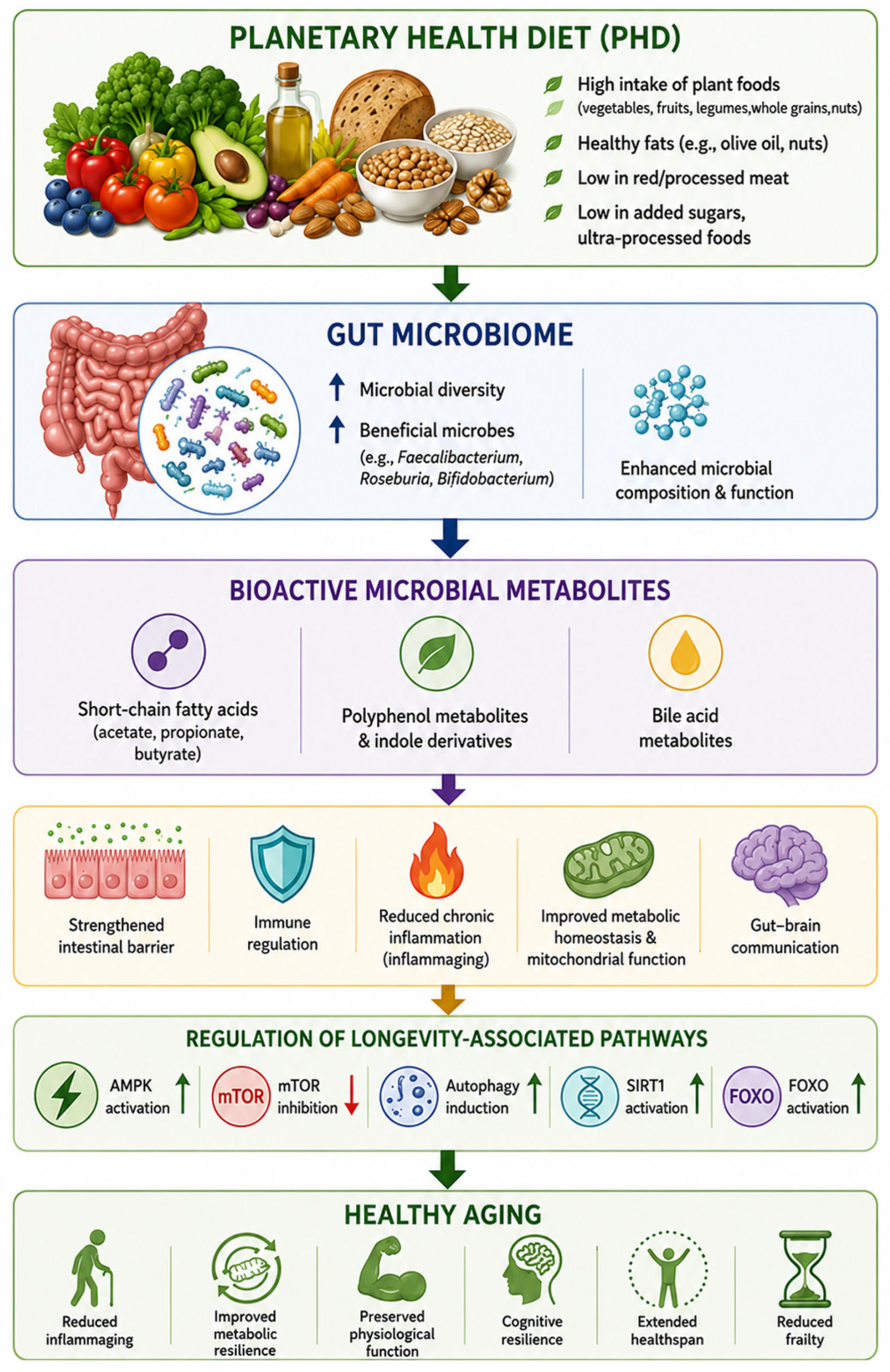
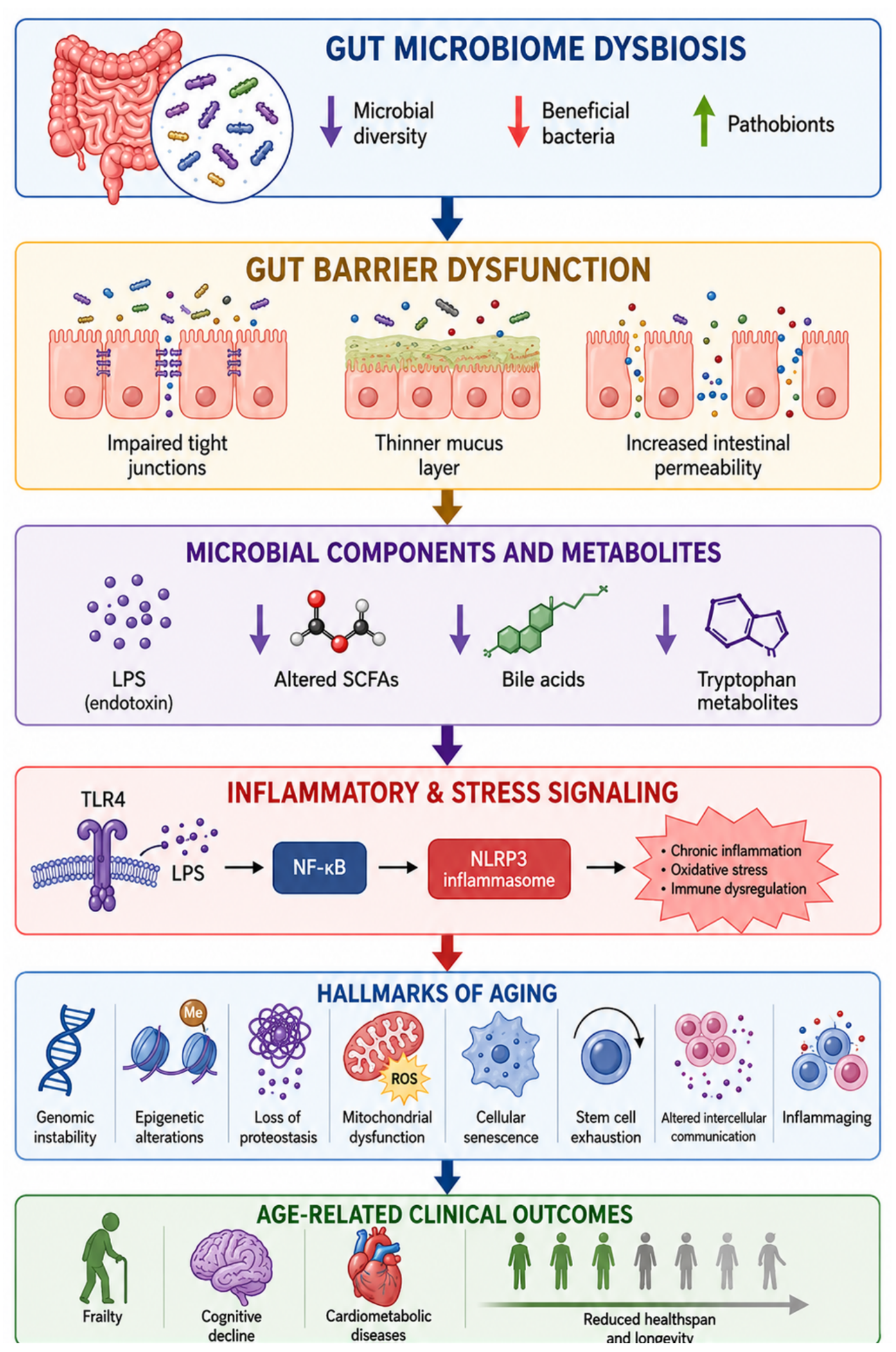
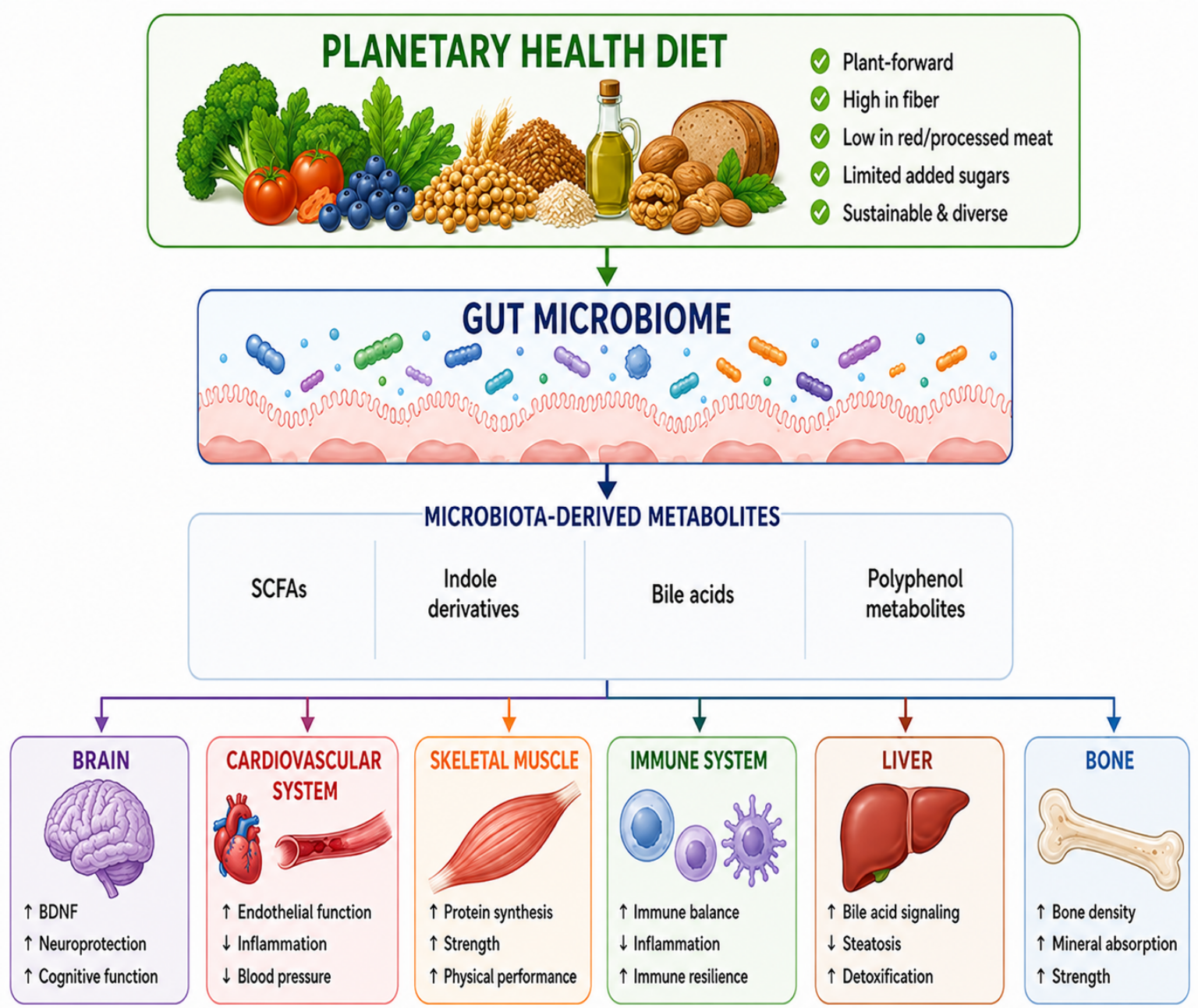

| PHD Component | Primary Microbiome Effect | Major Microbial Metabolites | Principal Host Pathways | Physiological Outcome |
|---|---|---|---|---|
| Plant diversity | Increased microbial diversity and ecosystem resilience | SCFAs | Immune and metabolic homeostasis | Healthy microbiome aging |
| Dietary fiber | Enhanced microbial fermentation | Butyrate, propionate, acetate | AMPK–mTOR–autophagy | Cellular homeostasis |
| Polyphenols | Microbial biotransformation | Urolithins, phenolic acids | SIRT1–FOXO | Mitochondrial homeostasis |
| Legumes | Enhanced prebiotic fermentation | SCFAs | GLP-1 signaling | Improved metabolic regulation |
| Nuts and seeds | Enrichment of Akkermansia muciniphila | Secondary bile acids | FXR/TGR5 signaling | Metabolic and immune homeostasis |
| Fermented foods | Exposure to live microorganisms and fermentation-derived metabolites | Postbiotics, SCFAs | Mucosal immune regulation | Improved intestinal barrier integrity |
| Reduced red and processed meat | Reduced microbial TMA production | ↓ TMAO | Reduced inflammatory signaling | Improved cardiometabolic health |
| Healthy fats | Remodeling of gut microbial ecology | SCFAs, lipid-derived metabolites | Mitochondrial homeostasis | Enhanced cellular resilience |
| Longevity-Associated Pathway | Major Microbiome-Derived Regulators | Key Cellular Functions | Potential Contribution to Healthy Aging | Predominant Evidence Base |
|---|---|---|---|---|
| AMPK | Butyrate, propionate, secondary bile acids | Energy sensing; fatty acid oxidation; autophagy; mitochondrial homeostasis | Improved metabolic flexibility, reduced inflammation, and greater cellular resilience | Mainly animal and in vitro studies, with indirect human evidence from fiber-rich and plant-based dietary interventions; limited direct PHD-specific evidence |
| mTOR | SCFAs; altered nutrient availability; microbiome-derived metabolites | Nutrient sensing; protein synthesis; autophagy regulation | Improved proteostasis and maintenance of tissue homeostasis | Mainly animal and in vitro evidence, with indirect human evidence from protein-composition and plant-rich dietary studies; no direct PHD-specific microbiome evidence |
| IGF-1 | SCFAs; microbiome-mediated nutrient metabolism | Insulin/IGF-1 signaling; anabolic regulation | Improved metabolic regulation and balance between growth and cellular repair | Human observational evidence, complemented by animal and mechanistic studies; limited direct microbiome and PHD-specific evidence |
| SIRT1 | Butyrate, urolithin A, phenolic metabolites | NAD+-dependent signaling; mitochondrial quality control; stress adaptation; anti-inflammatory regulation | Improved mitochondrial function, metabolic homeostasis, and cellular resilience | Mainly animal and in vitro studies, with limited human intervention evidence for selected metabolites; no direct PHD-specific evidence |
| FOXO | Indole derivatives, SCFAs, polyphenol-derived metabolites | Oxidative stress resistance; DNA repair; apoptosis; cellular stress responses | Maintenance of cellular homeostasis and resilience to age-related stress | Mainly animal and in vitro evidence; human evidence is largely indirect and based on dietary, metabolic, or biomarker associations |
| Autophagy | Butyrate, urolithin A, secondary bile acids | Removal of damaged proteins and organelles; mitophagy; proteostasis | Preservation of cellular function and physiological resilience | Mainly animal and in vitro evidence, with limited human studies of selected microbial metabolites; no direct demonstration of PHD-induced autophagy through the gut microbiome |
| Organ System | Major Microbiota-Derived Mediators | Principal Molecular Targets | Major Aging-Related Outcomes |
|---|---|---|---|
| Brain (gut–brain axis) [301,302,303] | SCFAs, indole derivatives, tryptophan metabolites | Microglia, BDNF, vagal signaling, neuroinflammation | Cognitive aging, Alzheimer’s disease, Parkinson’s disease |
| Cardiovascular system [304,305,306,307] | SCFAs, TMAO, secondary bile acids | Endothelial function, blood pressure regulation, vascular inflammation | Atherosclerosis, heart failure, healthy vascular aging |
| Skeletal muscle (gut–muscle axis) [308,309,310,311,312] | SCFAs, amino acid metabolites | Mitochondrial function, protein synthesis, muscle metabolism | Frailty, sarcopenia, physical performance |
| Immune system [264,313,314] | SCFAs, indoles, microbial antigens | Treg differentiation, IL-10, IL-6, TNF-α, immune homeostasis | Immunosenescence, inflammaging, healthy immune aging |
| Liver (gut–liver axis) [104,315,316,317,318] | Secondary bile acids, SCFAs | FXR, TGR5, lipid metabolism, glucose homeostasis | MASLD, metabolic dysfunction, healthy liver aging |
| Bone (gut–bone axis) [319,320,321,322,323] | SCFAs, bile acids | Calcium absorption, osteoblast activity, osteoclast regulation | Osteoporosis prevention, healthy skeletal aging |
| Study | Population | Study Design | Dietary Pattern | Primary Outcome | Main Findings |
|---|---|---|---|---|---|
| Planetary Health Diet cohorts | |||||
| Wang et al., 2025 [198] | NHANES (42,947), UK Biobank (125,372), meta-analysis (37 cohorts; 3.24 million participants) | Prospective cohorts + meta-analysis | Planetary Health Diet | Mortality and chronic diseases | Greater adherence to the Planetary Health Diet was associated with lower all-cause mortality and reduced risks of cardiovascular disease, cancer, stroke, and type 2 diabetes. |
| Bui et al., 2024 [18] | NHS (66,692 women), NHS II (92,438 women), HPFS (47,274 men); 206,404 participants | Three prospective cohorts | Planetary Health Diet Index (PHDI) | All-cause and cause-specific mortality | Higher PHDI adherence was associated with 23% lower all-cause mortality and lower cardiovascular, cancer, respiratory, neurodegenerative, and infectious disease mortality, together with reduced environmental impacts. |
| Karavasiloglou et al., 2023 [324] | UK Biobank, 473,836 adults | Prospective cohort | EAT-Lancet reference diet | Incident cancer, major cardiovascular events, all-cause mortality | Higher adherence was associated with 9% lower incident cancer risk and 10% lower all-cause mortality, while no significant association was observed with major cardiovascular events. |
| Guzmán-Castellanos et al., 2024 [325] | 18,656 Spanish adults (SUN cohort) | Prospective cohort (median follow-up: 11.5 years) | Planetary Health Diet Index | Incident cardiovascular disease | Higher adherence to the Planetary Health Diet showed a non-significant trend toward lower CVD risk, but no statistically significant association was observed (HR 0.77, 95% CI 0.51–1.18). |
| Knuppel et al., 2019 (EPIC-Oxford) [326] | 46,069 UK adults | Prospective cohort (up to 23.6 years follow-up) | EAT-Lancet reference diet score | Ischaemic heart disease, stroke, type 2 diabetes, all-cause mortality | Greater adherence to the EAT-Lancet diet was associated with a lower risk of ischaemic heart disease (−28%) and type 2 diabetes (−59%), with no significant associations for stroke or all-cause mortality. |
| Healthy aging cohorts | |||||
| Tessier et al., 2025 [327] | 105,015 US adults (NHS, HPFS) | Prospective cohort, 30-year follow-up | AHEI, aMED, DASH, MIND, hPDI, PHDI, rEDIH, rEDIP | Healthy aging | Greater long-term adherence to healthy dietary patterns was consistently associated with higher odds of healthy aging. AHEI showed the strongest overall association, while higher ultra-processed food intake was inversely associated with healthy aging. |
| Maroto-Rodriguez et al., 2025 [328] | UK Biobank, 19,505 middle-aged and older adults | Prospective cohort (median follow-up: 6.25 years) | Planetary Health Diet Index (PHDI) | Healthy aging (intrinsic capacity and frailty) | Higher PHDI adherence was associated with greater intrinsic capacity and a lower risk of frailty, supporting the role of the Planetary Health Diet in promoting healthy aging. |
| Gómez-Cao et al., 2025 [194] | Seniors-ENRICA-1 and -2 cohorts, Spain (n = 2998 adults aged ≥ 60 years) | Prospective cohort (median follow-up: 2.6 years) | Planetary Health Diet Index (PHDI) | Intrinsic capacity | Higher adherence to the PHDI was associated with better preservation of intrinsic capacity, particularly hearing function, supporting a beneficial role of the Planetary Health Diet in healthy aging. |
| Related healthy aging cohorts | |||||
| Kim et al., 2024 [329] | Korean Frailty and Aging Cohort Study, 665 community-dwelling adults aged 70–84 years | 6-year prospective cohort | Healthy dietary patterns (variety of healthy foods vs. rice-based patterns) | Intrinsic capacity | Greater adherence to a healthy, diverse dietary pattern was associated with better preservation of intrinsic capacity, particularly psychological function, supporting the role of diet quality in healthy aging. |
| Gopinath et al., 2016 [330] | Blue Mountains Eye Study (Australia); 1609 adults aged ≥ 49 years | 10-year prospective cohort | Dietary carbohydrate quality (fiber, glycemic index, glycemic load) | Successful aging | Higher dietary fiber intake, particularly from whole grains and fruits, was independently associated with greater odds of successful aging over 10 years, whereas glycemic index, glycemic load, and total carbohydrate intake were not significantly associated with successful aging. |
| Wang et al., 2023 (Million Veteran Program) [331] | 315,919 US veterans aged 19–104 years | Prospective cohort | Overall, healthful, and unhealthful plant-based diet indices (PDI, hPDI, uPDI) | All-cause and cause-specific mortality | Greater adherence to overall and healthful plant-based diets was associated with lower all-cause, cardiovascular, and cancer mortality, whereas greater adherence to an unhealthful plant-based diet was associated with increased mortality risk. |
| Wang et al., 2018 [332] | 10,210 older adults from five prospective cohorts (six studies overall) | Systematic review and meta-analysis | Mediterranean diet | Incident frailty | Higher adherence to the Mediterranean diet was associated with a 44% lower risk of incident frailty (RR 0.56, 95% CI 0.36–0.89), with an even greater reduction among Western populations, supporting Mediterranean-style dietary patterns for healthy aging and frailty prevention. |
| Mediterranean diet RCTs (indirect supportive evidence) | |||||
| Estruch et al., 2018 (PREDIMED) [333] | 7447 Spanish adults at high cardiovascular risk | Randomized controlled trial (median follow-up: 4.8 years) | Mediterranean diet supplemented with extra-virgin olive oil or nuts | Major cardiovascular events | Compared with a low-fat diet, Mediterranean diet interventions reduced the incidence of major cardiovascular events by approximately 30%, providing robust evidence for the cardiovascular benefits of a Mediterranean/PHD-like dietary pattern. |
| Delgado-Lista et al., 2022 (CORDIOPREV) [334] | 1002 adults (20–75 years) with established coronary heart disease, Spain | Randomized controlled trial (median follow-up: 7 years) | Mediterranean diet vs. low-fat diet | Major cardiovascular events (secondary prevention) | Compared with a low-fat diet, the Mediterranean diet reduced the risk of recurrent major cardiovascular events by approximately 28% (adjusted HR 0.72–0.75), demonstrating superior long-term efficacy for secondary cardiovascular prevention. |
| Salas-Salvadó et al., 2011 (PREDIMED-Reus) [335] | 418 adults at high cardiovascular risk without diabetes | Randomized controlled trial (4-year follow-up) | Mediterranean diet + EVOO or nuts vs. low-fat diet | Incident type 2 diabetes | Mediterranean diet reduced incident type 2 diabetes by 52% versus a low-fat diet, independent of weight loss or physical activity, supporting its role in diabetes prevention. |
| Martínez-Lapiscina et al., 2013 (PREDIMED-NAVARRA) [336] | 522 older adults at high cardiovascular risk | Randomized controlled trial (6.5-year follow-up) | Mediterranean diet supplemented with extra-virgin olive oil or nuts vs. low-fat diet | Global cognitive function | Mediterranean diet significantly improved global cognitive performance (MMSE and Clock Drawing Test) compared with a low-fat diet, supporting long-term cognitive benefits. |
| Valls-Pedret et al., 2015 (PREDIMED) [337] | 447 older adults at high cardiovascular risk | Randomized clinical trial (median follow-up 4.1 years) | Mediterranean diet + extra-virgin olive oil or nuts vs. low-fat diet | Cognitive function | Mediterranean diet improved memory, executive function, and global cognition, attenuating age-related cognitive decline compared with the control diet. |
| Evidence synthesis | |||||
| Dinu et al., 2018 [338] | >12.8 million participants from observational studies and randomized controlled trials | Umbrella review of 29 meta-analyses | Mediterranean diet | Multiple healthy aging outcomes | High adherence to the Mediterranean diet was consistently associated with lower all-cause mortality, cardiovascular disease, coronary heart disease, myocardial infarction, overall cancer incidence, neurodegenerative diseases, and type 2 diabetes, providing robust evidence for broad health benefits. |
| Martínez-González et al., 2015 (PREDIMED) [339] | PREDIMED trial (7447 high-risk adults) and supporting prospective cohorts | Narrative review | Mediterranean diet | Cardiometabolic outcomes | Summarized evidence from the PREDIMED trial and large prospective cohorts demonstrating that Mediterranean dietary patterns reduce major cardiovascular events, type 2 diabetes, and cardiometabolic risk through anti-inflammatory and antioxidant mechanisms, supporting their role as a sustainable healthy aging dietary model. |
Disclaimer/Publisher’s Note: The statements, opinions and data contained in all publications are solely those of the individual author(s) and contributor(s) and not of MDPI and/or the editor(s). MDPI and/or the editor(s) disclaim responsibility for any injury to people or property resulting from any ideas, methods, instructions or products referred to in the content. |
© 2026 by the authors. Licensee MDPI, Basel, Switzerland. This article is an open access article distributed under the terms and conditions of the Creative Commons Attribution (CC BY) license.
Share and Cite
Jarecsny, T.; Lehoczki, A.; Csípő, T.; Fazekas-Pongor, V.; Mózes, N.; Csík, B.; Zábó, V.; Lipécz, Á.; Nyáry, D.; Fekete, M. The Gut Microbiome as a Mechanistic Link Between the Planetary Health Diet and Healthy Aging. Nutrients 2026, 18, 2864. https://doi.org/10.3390/nu18172864
Jarecsny T, Lehoczki A, Csípő T, Fazekas-Pongor V, Mózes N, Csík B, Zábó V, Lipécz Á, Nyáry D, Fekete M. The Gut Microbiome as a Mechanistic Link Between the Planetary Health Diet and Healthy Aging. Nutrients. 2026; 18(17):2864. https://doi.org/10.3390/nu18172864
Chicago/Turabian StyleJarecsny, Tamás, Andrea Lehoczki, Tamás Csípő, Vince Fazekas-Pongor, Noémi Mózes, Boglárka Csík, Virág Zábó, Ágnes Lipécz, Dorottya Nyáry, and Mónika Fekete. 2026. "The Gut Microbiome as a Mechanistic Link Between the Planetary Health Diet and Healthy Aging" Nutrients 18, no. 17: 2864. https://doi.org/10.3390/nu18172864
APA StyleJarecsny, T., Lehoczki, A., Csípő, T., Fazekas-Pongor, V., Mózes, N., Csík, B., Zábó, V., Lipécz, Á., Nyáry, D., & Fekete, M. (2026). The Gut Microbiome as a Mechanistic Link Between the Planetary Health Diet and Healthy Aging. Nutrients, 18(17), 2864. https://doi.org/10.3390/nu18172864

