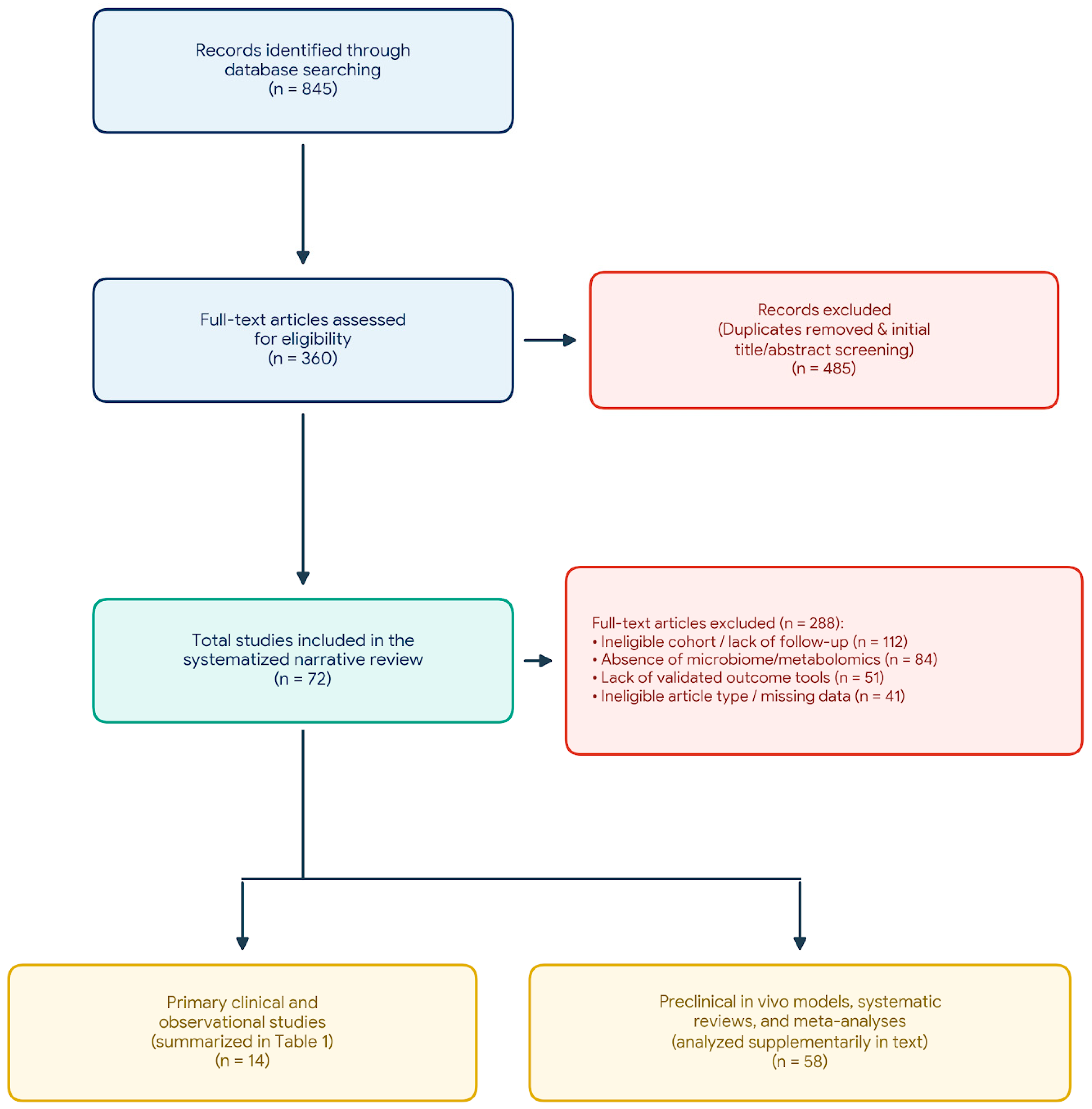
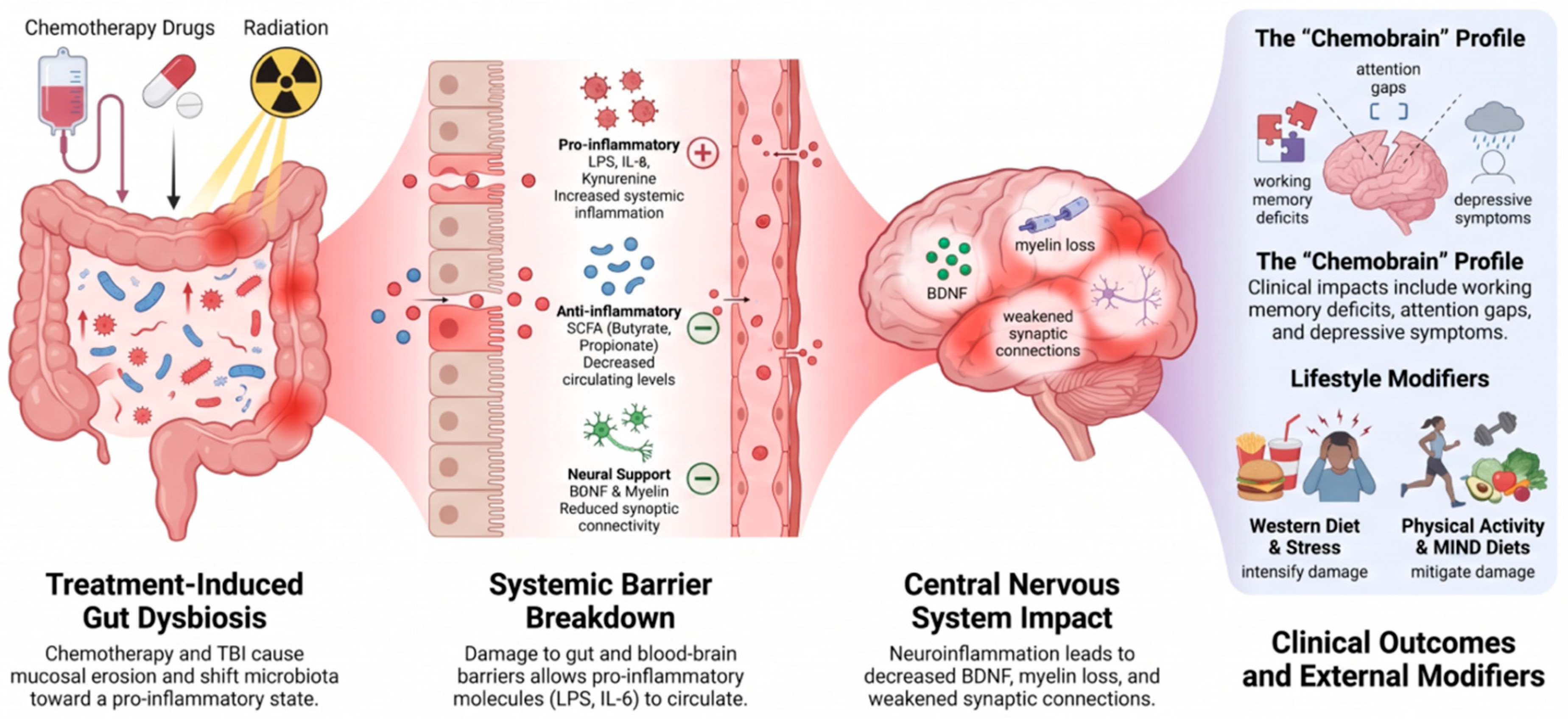
The Gut–Brain Axis and Dietary Patterns in Shaping Long-Term Neurocognitive and Psychosocial Outcomes in Adolescent and Young Adult Survivors of Childhood Cancer: A Systematized Narrative Review
 , , , and
Abstract
1. Introduction
2. Materials and Methods
2.1. Literature Search Strategy
2.1.1. Timeframe and Language Criteria
2.1.2. Keywords and Query Construction
2.2. Inclusion and Exclusion Criteria
2.2.1. Inclusion Criteria
- (1)
- Clinical and observational studies: randomized controlled trials (RCTs), long-term cohort studies (both prospective and retrospective), and cross-sectional studies evaluating the population of adolescent (10 to 19 years old) and young adult (up to 25 years of age) survivors of childhood cancer.
- (2)
- Preclinical and experimental studies: animal model studies, such as murine models of chemotherapy-induced cognitive impairment commonly known as chemobrain, providing mechanistic evidence elucidating the impact of the microbiota and its metabolites (e.g., short-chain fatty acids and tryptophan pathways) on neurogenesis, blood–brain barrier integrity, and neuroinflammation.
- (3)
- Review articles and meta-analyses: utilized as reference sources to identify additional key publications via the snowballing approach.
2.2.2. Exclusion Criteria
- (1)
- Case reports and letters to the editor that did not contribute novel primary data.
- (2)
- Studies focusing exclusively on patients during the acute phase of oncological treatment without an evaluation of long-term sequelae.
- (3)
- Publications lacking full-text availability, conference abstracts, and articles in non-peer-reviewed journals.
- (4)
- Studies lacking validated tools for cognitive function assessment or reliable methods for microbiota and dietary profiling.
2.3. Study Selection and Data Extraction Process
2.3.1. Study Selection
2.3.2. Data Extraction
2.4. Data Synthesis Methods
3. Results
3.1. Cognitive Impairment During Antineoplastic Treatment in the Pediatric Population
3.2. Psychosocial Dimensions of Late Effects in Childhood Cancer
3.3. Gut Microbiota and Oncological Treatment
3.4. The Gut–Brain Axis in the Development of Chemobrain: Ascending and Descending Signals
3.5. Dietary Patterns in Survivors and Neurocognitive and Psychosocial Disorders
3.6. Therapeutic Strategies Based on the Microbiome and Health Promotion
4. Study Limitations
5. Perspectives and Future Research Directions
6. Conclusions
Author Contributions
Funding
Institutional Review Board Statement
Informed Consent Statement
Data Availability Statement
Conflicts of Interest
Abbreviations
| ALL | Acute lymphoblastic leukemia |
| APOEε4 | Apolipoprotein E epsilon 4 allele |
| AYA | Adolescent and young adult |
| BBB | Blood–brain barrier |
| BDNF | Brain-derived neurotrophic factor |
| CCSs | Childhood cancer survivors |
| CD4+ | Cluster of differentiation 4 |
| CD8+ | Cluster of differentiation 8 |
| CNS | Central nervous system |
| DHA | Docosahexaenoic acid |
| DSM-5 | Diagnostic and Statistical Manual of Mental Disorders, Fifth Edition |
| EPA | Eicosapentaenoic acid |
| GABA | Gamma-aminobutyric acid |
| HLA-DR | Human Leukocyte Antigen-DR isotype |
| HPA | Hypothalamic–pituitary–adrenal |
| HSCT | Hematopoietic stem cell transplantation |
| Iba-1 | Ionized calcium-binding adapter molecule 1 |
| IL-1β | Interleukin 1 beta |
| IL-6 | Interleukin 6 |
| LPS | Lipopolysaccharide |
| MeSH | Medical Subject Headings |
| MIND | Mediterranean-DASH Intervention for Neurodegenerative Delay |
| NMDA | N-methyl-D-aspartate |
| PedsQL | Pediatric Quality of Life Inventory |
| PEO | Population, Exposure, and Outcomes |
| QoL | Quality of life |
| RCTs | Randomized controlled trials |
| SANRA | Scale for the Assessment of Narrative Review Articles |
| SCFAs | Short-chain fatty acids |
| TBI | Total body irradiation |
| TNF-α | Tumor necrosis factor alpha |
References
- Olsson, I.T.; Brinkman, T.M.; Hyun, G.; Banerjee, P.; Mulrooney, D.A.; Huang, I.-C.; Green, D.M.; Srivastava, D.; Robison, L.L.; Hudson, M.M.; et al. Neurocognitive Outcomes in Long-Term Survivors of Wilms Tumor: A Report from the St. Jude Lifetime Cohort. J. Cancer Surviv. 2019, 13, 570–579. [Google Scholar] [CrossRef] [Scilit]
- Institute of Medicine (US) and National Research Council (US) National Cancer Policy Board. Childhood Cancer Survivorship: Improving Care and Quality of Life; Hewitt, M., Weiner, S.L., Simone, J.V., Eds.; National Academies Press (US): Washington, DC, USA, 2003. [Google Scholar] [PubMed]
- Rotz, S.J.; Sangwan, N.; Nagy, M.; Tzeng, A.; Jia, M.; Moncaliano, M.; Majhail, N.S.; Eng, C. Fecal Microbiota of Adolescent and Young Adult Cancer Survivors and Metabolic Syndrome: An Exploratory Study. Pediatr. Hematol. Oncol. 2022, 39, 629–643. [Google Scholar] [CrossRef] [Scilit]
- Christou, A.I.; Kalfadeli, G.; Tsermentseli, S.; Bacopoulou, F. Neurocognitive and Emotional Outcomes in Childhood Cancer: A Developmental Perspective. Curr. Oncol. 2025, 32, 611. [Google Scholar] [CrossRef] [Scilit]
- Tini, S.; Baima, J.; Pigni, S.; Antoniotti, V.; Caputo, M.; De Palma, E.; Cerbone, L.; Grosso, F.; La Vecchia, M.; Bona, E.; et al. The Microbiota–Diet–Immunity Axis in Cancer Care: From Prevention to Treatment Modulation and Survivorship. Nutrients 2025, 17, 2898. [Google Scholar] [CrossRef] [Scilit]
- Prasad, P.K.; Hardy, K.K.; Zhang, N.; Edelstein, K.; Srivastava, D.; Zeltzer, L.; Stovall, M.; Seibel, N.L.; Leisenring, W.; Armstrong, G.T.; et al. Psychosocial and Neurocognitive Outcomes in Adult Survivors of Adolescent and Early Young Adult Cancer: A Report From the Childhood Cancer Survivor Study. J. Clin. Oncol. 2015, 33, 2545–2552. [Google Scholar] [CrossRef] [Scilit]
- Webster, C.I.; Withycombe, J.S.; Bhutada, J.S.; Bai, J. Review of the Microbiome and Metabolic Pathways Associated with Psychoneurological Symptoms in Children with Cancer. Asia-Pac. J. Oncol. Nurs. 2024, 11, 100535. [Google Scholar] [CrossRef] [Scilit]
- McGranahan, T.M.; Figuracion, K.C.; Goldberg, M.; Sheppard, D.P. Neurologic Complications in Adult Cancer Survivorship. Semin. Neurol. 2024, 44, 90–101. [Google Scholar] [CrossRef] [Scilit]
- Országhová, Z.; Mego, M.; Chovanec, M. Long-Term Cognitive Dysfunction in Cancer Survivors. Front. Mol. Biosci. 2021, 8, 770413. [Google Scholar] [CrossRef] [Scilit]
- Bielik, V.; Hric, I.; Smahová, S.; Tkačiková, M.; Hlaváčová, V.; Nechalová, L.; Ugrayová, S.; Kolenová, A. The Effect of Physical Exercise and Dairy Probiotics (Lactobacillus casei) on Gut Microbiome in Childhood Cancer Survivors. Neoplasma 2023, 70, 588–596. [Google Scholar] [CrossRef] [Scilit]
- Cheung, Y.T.; Ma, C.T.; Li, M.C.H.; Zhou, K.R.; Loong, H.H.F.; Chan, A.S.Y.; Wong, K.C.; Li, C.K. Associations between Lifestyle Factors and Neurocognitive Impairment among Chinese Adolescent and Young Adult (AYA) Survivors of Sarcoma. Cancers 2023, 15, 799. [Google Scholar] [CrossRef] [Scilit]
- Chua, L.L.; Rajasuriar, R.; Lim, Y.A.L.; Woo, Y.L.; Loke, P.; Ariffin, H. Temporal Changes in Gut Microbiota Profile in Children with Acute Lymphoblastic Leukemia Prior to Commencement-, during-, and Post-Cessation of Chemotherapy. BMC Cancer 2020, 20, 151. [Google Scholar] [CrossRef] [Scilit]
- Cohen, J.; Goddard, E.; Brierley, M.-E.; Bramley, L.; Beck, E. Poor Diet Quality in Children with Cancer During Treatment. J. Pediatr. Oncol. Nurs. 2021, 38, 313–321. [Google Scholar] [CrossRef] [Scilit]
- Ng, D.Q.; Ritt-Olson, A.; Freyer, D.R.; Miller, K.A.; Thomas, S.M.; Milam, J.; Chan, A. Substance Use Among Young Adult Survivors of Childhood Cancer With Cognitive Impairment: An Analysis of the Project Forward Cohort. JCO Oncol. Pract. 2023, 19, e345–e354. [Google Scholar] [CrossRef] [Scilit]
- O’Connor, K. Pediatric Cancer Survivors Found to Have Higher Lifetime Risk of MH Disorders. Psychiatr. News 2023, 58. [Google Scholar] [CrossRef] [Scilit]
- Peled, J.U.; Gomes, A.L.C.; Devlin, S.M.; Littmann, E.R.; Taur, Y.; Sung, A.D.; Weber, D.; Hashimoto, D.; Slingerland, A.E.; Slingerland, J.B.; et al. Microbiota as Predictor of Mortality in Allogeneic Hematopoietic-Cell Transplantation. N. Engl. J. Med. 2020, 382, 822–834. [Google Scholar] [CrossRef] [Scilit]
- Phillips, N.S.; Stratton, K.L.; Williams, A.M.; Ahles, T.; Ness, K.K.; Cohen, H.J.; Edelstein, K.; Yasui, Y.; Oeffinger, K.; Chow, E.J.; et al. Late-Onset Cognitive Impairment and Modifiable Risk Factors in Adult Childhood Cancer Survivors. JAMA Netw. Open 2023, 6, e2316077. [Google Scholar] [CrossRef] [Scilit]
- Shono, Y.; Docampo, M.D.; Peled, J.U.; Perobelli, S.M.; Velardi, E.; Tsai, J.J.; Slingerland, A.E.; Smith, O.M.; Young, L.F.; Gupta, J.; et al. Increased GVHD-Related Mortality with Broad-Spectrum Antibiotic Use after Allogeneic Hematopoietic Stem Cell Transplantation in Human Patients and Mice. Sci. Transl. Med. 2016, 8, 339ra71. [Google Scholar] [CrossRef] [Scilit]
- Tonning Olsson, I.; Lundgren, J.; Hjorth, L.; Munck Af Rosenschöld, P.; Hammar, Å.; Perrin, S. Neurocognitive Development after Pediatric Brain Tumor—A Longitudinal, Retrospective Cohort Study. Child Neuropsychol. 2024, 30, 22–44. [Google Scholar] [CrossRef] [Scilit]
- Zheng, D.J.; Bhatia, S.; Mirzaei, S.; Aplenc, R.; Armstrong, G.T.; Bona, K.; Brinkman, T.M.; Brouwers, P.; Edelstein, K.; Getz, K.; et al. Neurocognitive Impairment and Financial Hardship in Adult Survivors of Childhood Cancer: A Report from the Childhood Cancer Survivor Study. J. Natl. Cancer Inst. 2026, djaf383. [Google Scholar] [CrossRef] [Scilit]
- Kremer, L.C.M.; Mulder, R.L.; Oeffinger, K.C.; Bhatia, S.; Landier, W.; Levitt, G.; Constine, L.S.; Wallace, W.H.; Caron, H.N.; Armenian, S.H.; et al. A Worldwide Collaboration to Harmonize Guidelines for the Long-Term Follow-up of Childhood and Young Adult Cancer Survivors: A Report from the International Late Effects of Childhood Cancer Guideline Harmonization Group. Pediatr. Blood Cancer 2013, 60, 543–549. [Google Scholar] [CrossRef] [Scilit]
- Stavinoha, P.L.; Askins, M.A.; Powell, S.K.; Pillay Smiley, N.; Robert, R.S. Neurocognitive and Psychosocial Outcomes in Pediatric Brain Tumor Survivors. Bioengineering 2018, 5, 73. [Google Scholar] [CrossRef] [Scilit]
- Bienenstock, J.; Kunze, W.; Forsythe, P. Microbiota and the Gut-Brain Axis. Nutr. Rev. 2015, 73, 28–31. [Google Scholar] [CrossRef] [Scilit]
- Kameri, E.; Jepsen, V.H.; Stachura, P.; Rüchel, N.; Bhave, R.; Benitez, L.; Crispi, F.; Gratacos, E.; Dragano, N.; Janssen, S.; et al. A Gut Instinct for Childhood Leukemia Prevention: Microbiome-Targeting Recommendations Aimed at Parents and Caregivers. Front. Public Health 2025, 12, 1445113. [Google Scholar] [CrossRef] [Scilit]
- Oh, L.; Ab Rahman, S.; Dubinsky, K.; Azanan, M.S.; Ariffin, H. Manipulating the Gut Microbiome as a Therapeutic Strategy to Mitigate Late Effects in Childhood Cancer Survivors. Technol. Cancer Res. Treat. 2023, 22, 15330338221149799. [Google Scholar] [CrossRef] [Scilit]
- Pawłowski, P.; Zaj, N.; Iwaniszczuk, K.; Grzelka, I.; Makuch, W.; Samardakiewicz-Kirol, E.; Kościołek, A.; Samardakiewicz, M. Personalizing Nutritional Therapy in Pediatric Oncology: The Role of Gut Microbiome Profiling and Metabolomics in Mitigating Mucositis and Enhancing Immune Response to Chemotherapy. Children 2026, 13, 293. [Google Scholar] [CrossRef] [Scilit]
- Staffas, A.; Burgos da Silva, M.; van den Brink, M.R.M. The Intestinal Microbiota in Allogeneic Hematopoietic Cell Transplant and Graft-versus-Host Disease. Blood 2017, 129, 927–933. [Google Scholar] [CrossRef] [Scilit]
- Andermann, T.M.; Peled, J.U.; Ho, C.; Reddy, P.; Riches, M.; Storb, R.; Teshima, T.; van den Brink, M.R.M.; Alousi, A.; Balderman, S.; et al. The Microbiome and Hematopoietic Cell Transplantation: Past, Present, and Future. Biol. Blood Marrow Transplant. 2018, 24, 1322–1340. [Google Scholar] [CrossRef] [Scilit]
- Holler, E.; Butzhammer, P.; Schmid, K.; Hundsrucker, C.; Koestler, J.; Peter, K.; Zhu, W.; Sporrer, D.; Hehlgans, T.; Kreutz, M.; et al. Metagenomic Analysis of the Stool Microbiome in Patients Receiving Allogeneic Stem Cell Transplantation: Loss of Diversity Is Associated with Use of Systemic Antibiotics and More Pronounced in Gastrointestinal Graft-versus-Host Disease. Biol. Blood Marrow Transplant. 2014, 20, 640–645. [Google Scholar] [CrossRef] [Scilit]
- Caserta, S.; Martino, E.A.; Skafi, M.; Vigna, E.; Bruzzese, A.; Amodio, N.; Fiorillo, M.; Lucia, E.; D’Arrigo, G.; Olivito, V.; et al. The Gut Microbiota in Hematologic Malignancies: Mechanisms, Clinical Associations, and Translational Opportunities. Nutrients 2026, 18, 1400. [Google Scholar] [CrossRef] [Scilit]
- Buchbinder, D.; Kelly, D.L.; Duarte, R.F.; Auletta, J.J.; Bhatt, N.; Byrne, M.; Gabriel, M.; Mahindra, A.; Norkin, M.; Schoemans, H.; et al. Neurocognitive Dysfunction in Hematopoietic Cell Transplant Recipients: Expert Review from the Late Effects and Quality of Life Working Committee of the CIBMTR and Complications and Quality of Life Working Party of the EBMT. Bone Marrow Transplant. 2018, 53, 535–555. [Google Scholar] [CrossRef] [Scilit]
- Mayer, E.A.; Nance, K.; Chen, S. The Gut-Brain Axis. Annu. Rev. Med. 2022, 73, 439–453. [Google Scholar] [CrossRef] [Scilit]
- Bourassa, M.W.; Alim, I.; Bultman, S.J.; Ratan, R.R. Butyrate, Neuroepigenetics and the Gut Microbiome: Can a High Fiber Diet Improve Brain Health? Neurosci. Lett. 2016, 625, 56–63. [Google Scholar] [CrossRef] [Scilit]
- Bajic, J.E.; Johnston, I.N.; Howarth, G.S.; Hutchinson, M.R. From the Bottom-Up: Chemotherapy and Gut-Brain Axis Dysregulation. Front. Behav. Neurosci. 2018, 12, 104. [Google Scholar] [CrossRef] [Scilit]
- Tan, A.; Chen, J.; Zhang, J.; Tong, J.; Jiang, Z. Probiotic Supplementation Attenuated Early-Life Chemotherapy-Induced Brain Development Impairment in Mice. Front. Behav. Neurosci. 2025, 19, 1697727. [Google Scholar] [CrossRef] [Scilit]
- Thapa, M.; Kumari, A.; Chin, C.-Y.; Choby, J.E.; Akbari, E.; Bogati, B.; Jin, F.; Furr, E.; Chopyk, D.M.; Koduri, N.; et al. Translocation of Bacteria from the Gut to the Brain in Mice. PLoS Biol. 2026, 24, e3003652. [Google Scholar] [CrossRef] [Scilit]
- Chmielarz, M.; Sobieszczańska, B.; Środa-Pomianek, K. Metabolic Endotoxemia: From the Gut to Neurodegeneration. Int. J. Mol. Sci. 2024, 25, 7006. [Google Scholar] [CrossRef] [Scilit]
- Gulas, E.; Wysiadecki, G.; Strzelecki, D.; Gawlik-Kotelnicka, O.; Polguj, M. Jak Mikrobiologia Może Wpływać Na Psychiatrię? Powiązania Między Florą Bakteryjną Jelit a Zaburzeniami Psychicznymi. Psychiatr. Pol. 2018, 52, 1023–1039. [Google Scholar]
- Strandwitz, P.; Kim, K.H.; Terekhova, D.; Liu, J.K.; Sharma, A.; Levering, J.; McDonald, D.; Dietrich, D.; Ramadhar, T.R.; Lekbua, A.; et al. GABA Modulating Bacteria of the Human Gut Microbiota. Nat. Microbiol. 2019, 4, 396–403. [Google Scholar] [CrossRef] [Scilit] [PubMed]
- Wefel, J.S.; Schagen, S.B. Neuropsychological Sequelae of Cancer and Cancer Therapy. J. Clin. Exp. Neuropsychol. 2025, 47, 701–706. [Google Scholar] [CrossRef] [Scilit]
- Patel, C.; Diglio, F.; Durham, B.H.; Cole, P.D. Influence of ApoE Genotype on Doxorubicin-Induced Cognitive Impairment in Juvenile Rats. Sci. Rep. 2025, 15, 44620. [Google Scholar] [CrossRef] [Scilit]
- Mishra, Y.; Ranjan, A.; Mishra, V.; Chattaraj, A.; Aljabali, A.A.A.; El-Tanani, M.; Hromić-Jahjefendić, A.; Uversky, V.N.; Tambuwala, M.M. The Role of the Gut Microbiome in Gastrointestinal Cancers. Cell. Signal. 2024, 115, 111013. [Google Scholar] [CrossRef] [Scilit]
- McCaffrey, D.; Gates, P.; Dhillon, H.M.; Wilson, C.; Vardy, J.L.; Weickert, C.S.; Walker, A.K. Cognitive Impairment Is Associated with Altered Blood Cell Profiles in Aggressive Lymphoma. Support. Care Cancer 2026, 34, 120. [Google Scholar] [CrossRef] [Scilit]
- Demers, C.; Higgins, J.; Kerba, J.; Bouchard, I.; Meloche, C.; Curnier, D.; Marcil, V.; Sultan, S.; Laverdière, C.; Sinnett, D.; et al. Acceptability and Functional Benefits of a Health Promotion Program in Pediatric Oncology: A Mixed-Methods Study. Front. Pediatr. 2026, 14, 1753530. [Google Scholar] [CrossRef] [Scilit]
- Curtis, A.R.; Tan, S.Y.; Boltong, A.; Cohen, J.; Kiss, N. The Influence of Pediatric Cancer Treatment on Taste Perception and Food Hedonics: A Systematic Review. Nutr. Rev. 2024, 82, 1741–1755. [Google Scholar] [CrossRef] [Scilit]
- Kunin-Batson, A.S.; Klosky, J.L.; Carlson-Green, B.; Brinkman, T.M. Health Behaviors and Neurocognitive Function in Survivors of Childhood Cancer. J. Clin. Oncol. 2021, 39, 1786–1794. [Google Scholar] [CrossRef] [Scilit]
- Clarke, E.; Pugh, G.; van den Heuvel, E.; Kavanagh, E.; Cheung, P.; Wood, A.; Winstanley, M.; Braakhuis, A.; Lovell, A.L. Navigating Nutrition as a Childhood Cancer Survivor: Understanding Patient and Family Needs for Nutrition Interventions or Education. Nutr. Diet. 2023, 80, 494–510. [Google Scholar] [CrossRef] [Scilit]
- Cares, K.; Bryner, A.; DiPiazza, B.; Chakos, K.; Schmidt, M.L.; Gabel, K. Diet and Exercise Interventions in Pediatric Cancer Survivors and Effects on Cardiometabolic Disease Risk and Inflammaging Biomarkers: A Systematic Review. Adv. Nutr. 2026, 17, 100605. [Google Scholar] [CrossRef] [Scilit]
- Joffe, L.; Ladas, E.J. Nutrition during Childhood Cancer Treatment: Current Understanding and a Path for Future Research. Lancet Child Adolesc. Health 2020, 4, 465–475. [Google Scholar] [CrossRef] [Scilit]
- Corley, C.; McElroy, T.; Sridharan, B.; Trujillo, M.; Simmons, P.; Kandel, S.; Sykes, D.J.; Robeson, M.S.; Allen, A.R. Physiological and Cognitive Changes after Treatments of Cyclophosphamide, Methotrexate, and Fluorouracil: Implications of the Gut Microbiome and Depressive-like Behavior. Front. Neurosci. 2023, 17, 1212791. [Google Scholar] [CrossRef] [Scilit]
- Karakuła-Juchnowicz, H. Znaczenie, zapomnianego narządu”—mikrobioty jelitowej—w rozwoju i terapii zaburzeń neuropsychiatrycznych. Gastroenterol. Klin. Postępy Stand. 2020, 12, 123–137. [Google Scholar]
- von Grundherr, J.; Elmers, S.; Samland, L.; Mühlberg, R.; Dwinger, S.; Baumann, J.; Koch, B.; Wolters, F.; Hail, L.-A.; Escherich, G.; et al. Dietary Intervention among Young Cancer Survivors within the CARE for CAYA Program. J. Cancer Surviv. 2026. [Google Scholar] [CrossRef] [Scilit]
- Cohen, J.E.; Wakefield, C.E.; Cohn, R.J. Nutritional Interventions for Survivors of Childhood Cancer. Cochrane Database Syst. Rev. 2016, CD009678. [Google Scholar] [CrossRef] [Scilit]
- Batarseh, N.; Abdulla, F.A. Mediterranean-DASH Intervention for Neurodegenerative Delay (MIND) Diet and Brain Health: A Systematic Review. Nutr. Neurosci. 2026, 29, 909–934. [Google Scholar] [CrossRef] [Scilit]
- Tanabe, M.; Kunisawa, K.; Saito, I.; Ojika, H.; Saito, K.; Nabeshima, T.; Mouri, A. High-Cellulose Diet Ameliorates Cognitive Impairment by Modulating Gut Microbiota and Metabolic Pathways in Mice. J. Nutr. 2025, 155, 1689–1699. [Google Scholar] [CrossRef] [Scilit]
- Hayat, S.; Ahmad, J.; Naeem, S.; Yaseen, F.; Aamir, S.; Guida, F.; Luongo, L.; Maione, S. The Impact of Diet on Long-Term Oncological Outcomes: Investigating Nutritional Mechanisms in Cancer Prevention Management and Prognosis. Nutrients 2026, 18, 881. [Google Scholar] [CrossRef] [Scilit]
- Sbai, O.; Perrone, L.; Poucheret, P. The Role of Polyphenols on Cognitive Function and Dementia Through Gut–Microbiota–Brain Axis Modulation: A Narrative Review. Nutrients 2026, 18, 1697. [Google Scholar] [CrossRef] [Scilit]
- Crowder, S.L.; Gudenkauf, L.M.; Hoogland, A.I.; Han, H.S.; Small, B.J.; Carson, T.L.; Parker, N.H.; Booth-Jones, M.; Jim, H.S.L. Cancer-Related Cognitive Impairment and the Potential of Dietary Interventions for the Prevention and Mitigation of Neurodegeneration. Cancer Res. 2025, 85, 203–217. [Google Scholar] [CrossRef] [Scilit]
- Podpeskar, A.; Crazzolara, R.; Kropshofer, G.; Hetzer, B.; Meister, B.; Müller, T.; Salvador, C. Omega-3 Fatty Acids and Their Role in Pediatric Cancer. Nutrients 2021, 13, 1800. [Google Scholar] [CrossRef] [Scilit]
- Maldonado-Salinas, R.; Caballero-Salazar, S.; Castillejos-López, M.; Aquino-Gálvez, A.; Velasco-Hidalgo, L.; García-Guzmán, A.; Pliego-Villanueva, C.; Alavez-Pérez, N.S.; Montesinos-Correa, H.; Torres-Espíndola, L.M. Omega-3 Fatty Acids and Chemotherapy-Induced Toxicities: Mechanisms and Emerging Evidence with a Pediatric Focus. Nutr. Metab. 2025, 22, 150. [Google Scholar] [CrossRef] [Scilit]
- von Schacky, C. Importance of EPA and DHA Blood Levels in Brain Structure and Function. Nutrients 2021, 13, 1074. [Google Scholar] [CrossRef] [Scilit]
- Li, M.; Li, Z.; Fan, Y. Omega-3 Fatty Acids: Multi-Target Mechanisms and Therapeutic Applications in Neurodevelopmental Disorders and Epilepsy. Front. Nutr. 2025, 12, 1598588. [Google Scholar] [CrossRef] [Scilit]
- Lupu, V.V.; Nedelcu, A.H.; Miron, I.; Anton, S.C.; Sasaran, M.O.; Frasinariu, O.E.; Jechel, E.; Bozomitu, L.I.; Chisnoiu, T.; Anton, C.R.; et al. Early Gut Microbiota and Neurodevelopmental Trajectories: Implications for Pediatric Neuropsychiatric Vulnerability—A Narrative Review. Nutrients 2026, 18, 1541. [Google Scholar] [CrossRef] [Scilit]
- Jabbari Shiadeh, S.M.; Chan, W.K.; Rasmusson, S.; Hassan, N.; Joca, S.; Westberg, L.; Elfvin, A.; Mallard, C.; Ardalan, M. Bidirectional Crosstalk between the Gut Microbiota and Cellular Compartments of Brain: Implications for Neurodevelopmental and Neuropsychiatric Disorders. Transl. Psychiatry 2025, 15, 278. [Google Scholar] [CrossRef] [Scilit] [PubMed]
- Marano, G.; Sfratta, G.; Marzo, E.M.; Cozzo, G.; Abate, F.; Traversi, G.; Mazza, O.; Capristo, E.; Gaetani, E.; Mazza, M. The Pediatric Microbiota–Gut–Brain Axis: Implications for Neuropsychiatric Development and Intervention. Children 2025, 12, 1561. [Google Scholar] [CrossRef] [Scilit]
- Cares, K.; Lima Oliveira, M.; Bryner, A.; Man, B.; Chen, Z.; Bernabé, B.P.; Schmidt, M.L.; Fitzgibbon, M.; Gabel, K. Time-Restricted Eating and Prebiotic Supplementation Demonstrate Feasibility and Acceptability in Young Adult Pediatric Cancer Survivors: A Randomized Controlled Pilot Trial. Nutrients 2025, 17, 3306. [Google Scholar] [CrossRef] [Scilit]
- Understanding the Molecular Mechanisms of Doxorubicin-Induced Memory Loss—ProQuest. Available online: https://www.proquest.com/openview/295cd7cce62ea2b7548cf974d34d898f (accessed on 26 July 2026).
- Bai, J.; Behera, M.; Bruner, D.W. The Gut Microbiome, Symptoms, and Targeted Interventions in Children with Cancer: A Systematic Review. Support. Care Cancer 2018, 26, 427–439. [Google Scholar] [CrossRef] [Scilit]
- Wardill, H.R.; Secombe, K.R.; Bryant, R.V.; Hazenberg, M.D.; Costello, S.P. Adjunctive Fecal Microbiota Transplantation in Supportive Oncology: Emerging Indications and Considerations in Immunocompromised Patients. eBioMedicine 2019, 44, 730–740. [Google Scholar] [CrossRef] [Scilit]
- Le, T.T.; Hoang, T.N.; Do, D.H.; Nguyen, X.-H.; Huynh, C.; Viet, H.D.; Dat, V.Q.; Zengler, K.; Gilbert, J.A.; Avedissian, S.N.; et al. Current State of Microbiota Clinical Applications in Neonatal and Pediatric Bacterial Infections. Gut Microbes 2025, 17, 2529400. [Google Scholar] [CrossRef] [Scilit]
- Ciernikova, S.; Sevcikova, A.; Stevurkova, V.; Mego, M. Diet-Driven Microbiome Changes and Physical Activity in Cancer Patients. Front. Nutr. 2023, 10, 1285516. [Google Scholar] [CrossRef] [Scilit]
- Vasconcelos, C.; Sousa, P. Effects of Combined Interventions of Physical Activity and Diet in Childhood Cancer Survivors: A Systematic Review. Children 2024, 11, 853. [Google Scholar] [CrossRef] [Scilit]



| Author & Year | Study Design | Population & Cancer Type | Sample Size (N) | Exposure Assessment (e.g., Microbiome/Diet) | Outcome Assessment (Neurocognitive/Psychosocial) | Main Findings |
|---|---|---|---|---|---|---|
| Bielik et al., 2023 [10] | Clinical intervention/observational study | Childhood cancer survivors | N = 32 (16 patients vs. 16 controls) | Physical exercise program and dairy probiotics (Lactobacillus casei) | Gut microbiome diversity, SCFA production | Demonstrated that combining moderate physical exercise with specific probiotic supplementation positively modulated the gut microbiome and stimulated protective butyrate production [10]. |
| Cheung et al., 2023 [11] | Cross-sectional observational study | Chinese AYA survivors of sarcoma | N = 116 | Lifestyle factors (physical activity, daily working hours) | Neurocognitive impairment (attention, processing speed, cognitive flexibility) | 34.5% exhibited processing speed deficits; low physical activity and working >9 h/day significantly exacerbated the depletion of neurocompensatory reserves [11]. |
| Chua et al., 2020 [12] | Longitudinal observational study | Children with Acute Lymphoblastic Leukemia (ALL) | N = 14 (7 patients vs. 7 controls) | Chemotherapy timeline (prior, during, and post-cessation) | Temporal changes in gut microbiota profile (16S rRNA) | Confirmed sustained depletion of commensal strains and unnatural overgrowth of Actinobacteria (e.g., Corynebacterium) persisting long after therapy cessation [12]. |
| Cohen et al., 2021 [13] | Observational cross-sectional study | Children actively undergoing cancer treatment | N = 36 | Dietary intake (food records and nutritional tracking) | Diet quality, early nutritional status | Revealed that pediatric patients rapidly develop poor diet quality during active therapy, establishing detrimental eating patterns that persist into the survivorship phase [13]. |
| Ng et al., 2023 [14] | Retrospective cohort analysis (Project Forward) | Young adult survivors of childhood cancer | N = 1106 | Self-reported cognitive impairment status | Substance use prevalence (e.g., e-cigarettes/vaping) | 13% reported severe memory problems; cognitive impairment correlated with a >2-fold increased risk of vaping as a maladaptive coping mechanism (OR = 2.26) [14]. |
| O’Connor, 2023 [15] | Clinical cohort analysis | Pediatric cancer survivors | N > 3.1 million (GWAS data context) | History of childhood cancer treatment | Mental health disorders prevalence | Survivors exhibit significantly higher rates of poor mental health compared to the general population, marked by lowered self-esteem and alienation [15]. |
| Olsson et al., 2019 [1] | Retrospective cohort study (St. Jude Lifetime Cohort) | Long-term survivors of Wilms tumor | N = 158 survivors (vs. N = 354 controls) | History of solid tumor antineoplastic treatment | Neurocognitive testing (memory, verbal fluency, mathematics) | Survivors achieved significantly lower cognitive scores than healthy peers; cognitive impairment correlated with a >2-fold higher risk of failing to complete higher education (OR = 2.23) [1]. |
| Peled et al., 2020 [16] | Clinical observational cohort study | Patients undergoing allogeneic hematopoietic cell transplantation | N = 606 | Gut microbiota composition (16S rRNA sequencing) | Overall survival, treatment-related mortality | Identified that lower baseline intestinal microbiota diversity is a significant independent predictor of increased mortality and adverse outcomes post-transplantation [16]. |
| Phillips et al., 2023 [17] | Retrospective cohort study | Adult childhood cancer survivors | N = 1413 | Modifiable lifestyle risk factors (diet, physical inactivity) | Late-onset cognitive impairment prevalence | Found significant associations between poor modifiable risk factors (including suboptimal diet and sedentary lifestyle) and the emergence of late-onset cognitive impairment [17]. |
| Prasad et al., 2015 [6] | Retrospective cohort study (CCSs cohort) | Adult survivors of adolescent and early young adult cancer | N = 6192 survivors (vs. N = 390 siblings) | Exposure to intensive antineoplastic therapy | Psychosocial and neurocognitive outcomes | Established the clinical reality of “sleeper effects,” wherein delayed neurocognitive deficits and psychosocial burdens manifest prominently in early adulthood [6]. |
| Rotz et al., 2022 [3] | Exploratory cross-sectional study | AYA cancer survivors (mixed solid/hematological) | N = 35 survivors (vs. N = 32 controls) | Fecal microbiota profiling (16S rRNA sequencing) | Metabolic syndrome criteria, systemic inflammatory markers | Demonstrated persistent late-onset dysbiosis; reduced alpha/beta diversity and depleted Faecalibacterium correlated with elevated IL-6, CRP, and metabolic syndrome [3]. |
| Shono et al., 2016 [18] | Retrospective clinical analysis | Allogeneic HSCT recipients | N = 857 (Total cohort across studies) | Broad-spectrum antibiotic administration | GVHD severity, gut microbiota composition | Broad-spectrum antibiotics severely disrupted commensal flora, which correlated with an increased incidence of severe gastrointestinal GVHD and GVHD-related mortality [18]. |
| Tonning Olsson et al., 2024 [19] | Longitudinal, retrospective cohort study | Pediatric brain tumor survivors | N = 199 | Oncological treatment protocols (cranial irradiation) | Standardized neurocognitive testing (intelligence quotient, working memory) | Documented progressive IQ decline (up to 20–50 points) and profound attention/working memory deficits exacerbating long-term psychosocial isolation [19]. |
| Zheng et al., 2026 [20] | Retrospective cohort study (CCSs cohort) | Adult survivors of childhood cancer | N = 3023 | Neurocognitive impairment | Financial hardship, socioeconomic capabilities | Highlighted financial toxicity; neurocognitive deficits hindered patients’ ability to navigate healthcare systems, secondarily burdening the HPA axis through chronic stress [20]. |
| History of Neoplasm Type | Prevalence of Memory and Learning Disorders | Characteristic Psychosocial and Cognitive Complications |
|---|---|---|
| Central nervous system tumors | 25.4% [14] | Progressive decline in intelligence quotient, profound attention and working memory deficits, low self-esteem, high risk of unemployment and isolation [14]. |
| Leukemias (e.g., acute lymphoblastic leukemia) | 13.3% [14] | Executive function disorders manifesting during puberty, reduced capacity to undertake complex tasks associated with methotrexate impact. |
| Sarcomas (bone and soft tissue) | Below 10% (general symptoms) [11] | Reduced processing speed in 34.5% of patients, decreased cognitive flexibility. Exacerbation of symptoms with low physical activity [14]. |
| Wilms tumor | Below 10% (general symptoms) [1] | Lower scores in verbal fluency and mathematics tests, higher risk of university non-completion. Correlation with secondary nervous system disorders [1]. |
| Gut–Brain Axis Communication Pathway | Microbiological or Metabolic Component | Translation to Neurocognitive and Psychosocial Symptoms in CCSs |
|---|---|---|
| Neuroimmunological | Bacterial toxins (LPS), cytokines (IL-1β, IL-6) [34]. | Disruption of the blood–brain barrier, microglial activation, cortical neuroinflammation, and the phenomenon of brain fog [34]. |
| Metabolomic (SCFAs) | Decreased production of butyrate and propionate resulting from the depletion of Firmicutes [34]. | Reduced synthesis of brain-derived neurotrophic factor, impaired neurogenesis, and progressive problems with attention and memory consolidation [34]. |
| Afferent pathways and HPA axis | Cortisol production in response to psychological stress in childhood cancer survivors [14,20,34]. | Intestinal epithelial damage, selection of pathobionts utilizing cortisol as a growth factor, chronic stress, and anxiety intensification [34]. |
| Tryptophan-Kynurenine pathway | Overgrowth of Intestinibacterand Megasphaera species [7]. | Shifting the serotonin pathway toward neurotoxic kynurenine, leading to neuronal apoptosis and profound depressive states [7]. |
| Dietary Component and Nutritional Intervention | Gut Microbiome Modulation | Benefits for Neurocognitive and Psychosocial Health of CCSs |
|---|---|---|
| Fiber and Cellulose (MIND Diet) | Provision of substrates for massive SCFA production. Stabilization of the Firmicutes to Bacteroidetes ratio [51,52,53,54]. | Restoration of blood–brain barrier integrity, prevention of neuronal apoptosis, and improvement in focus and memory [51,52,53,54]. |
| Fermented Products (Yogurts, Pickles) | Supply of live Lactobacillus and Bifidobacterium cultures [63,64,65,66]. | Redirection of the metabolic pathway toward GABA and serotonin synthesis; alleviation of anxiety and insomnia [63,64,65,66]. |
| Antioxidants and Anthocyanidins (Berries) | Suppression of oxidative stress in the intestinal lumen and protection of beneficial bacterial strains [44]. | Abolition of the intracranial neuroinflammation phenomenon, accompanied by direct pro-cognitive and antidepressant effects [5]. |
| Omega-3 Fatty Acids (Marine Fish, Nuts) | Systemic anti-inflammatory action and restriction of pathogen overgrowth [59,60,61,62]. | Reconstruction of cell membrane structures in the cortical and hippocampal regions, and alleviation of fatigue syndrome [59,60,61,62]. |
Disclaimer/Publisher’s Note: The statements, opinions and data contained in all publications are solely those of the individual author(s) and contributor(s) and not of MDPI and/or the editor(s). MDPI and/or the editor(s) disclaim responsibility for any injury to people or property resulting from any ideas, methods, instructions or products referred to in the content. |
© 2026 by the authors. Licensee MDPI, Basel, Switzerland. This article is an open access article distributed under the terms and conditions of the Creative Commons Attribution (CC BY) license.
Share and Cite
Pawłowski, P.; Kościołek, O.; Jeżak, M.; Jakubik, K.; Kościołek, A.; Samardakiewicz, M. The Gut–Brain Axis and Dietary Patterns in Shaping Long-Term Neurocognitive and Psychosocial Outcomes in Adolescent and Young Adult Survivors of Childhood Cancer: A Systematized Narrative Review. Nutrients 2026, 18, 2773. https://doi.org/10.3390/nu18172773
Pawłowski P, Kościołek O, Jeżak M, Jakubik K, Kościołek A, Samardakiewicz M. The Gut–Brain Axis and Dietary Patterns in Shaping Long-Term Neurocognitive and Psychosocial Outcomes in Adolescent and Young Adult Survivors of Childhood Cancer: A Systematized Narrative Review. Nutrients. 2026; 18(17):2773. https://doi.org/10.3390/nu18172773
Chicago/Turabian StylePawłowski, Piotr, Otylia Kościołek, Mikołaj Jeżak, Karol Jakubik, Aneta Kościołek, and Marzena Samardakiewicz. 2026. "The Gut–Brain Axis and Dietary Patterns in Shaping Long-Term Neurocognitive and Psychosocial Outcomes in Adolescent and Young Adult Survivors of Childhood Cancer: A Systematized Narrative Review" Nutrients 18, no. 17: 2773. https://doi.org/10.3390/nu18172773
APA StylePawłowski, P., Kościołek, O., Jeżak, M., Jakubik, K., Kościołek, A., & Samardakiewicz, M. (2026). The Gut–Brain Axis and Dietary Patterns in Shaping Long-Term Neurocognitive and Psychosocial Outcomes in Adolescent and Young Adult Survivors of Childhood Cancer: A Systematized Narrative Review. Nutrients, 18(17), 2773. https://doi.org/10.3390/nu18172773