This is an early access version, the complete PDF, HTML, and XML versions will be available soon.
Article

Medical Nutrition Therapy with Meal Sequence and Divided Carbohydrate Intake: Associations with Ketonuria Resolution and Neonatal Outcomes in Gestational Diabetes Mellitus


1
Department of Food and Nutrition, Kyoto Women’s University, 35, Kitahiyoshi-cho, Imakumano, Higashiyama-ku, Kyoto 605-8501, Japan
2
Kajiyama Clinic, Kyoto Gojyo Clinic Building, 20-1, Higashionmaeda-cho, Nishinanajyo, Shimogyo-ku, Kyoto 600-8898, Japan
3
Department of Endocrinology and Metabolism, Graduate School of Medical Science, Kyoto Prefectural University of Medicine, 465 Kajii-cho, Kawaramachi-Hirokoji, Kamigyo-ku, Kyoto 602-8566, Japan
4
Osaka Metropolitan University Hospital, 1-5-7, Asahi-cho, Abeno-ku, Osaka 545-0051, Japan
5
Department of Diabetes and Endocrinology, Matsushita Memorial Hospital, 5-55, Sotojima-cho, Morigu-chi-shi, Osaka 570-8540, Japan
6
Osaka General Hospital of West Japan Railway Company, 1-2-22, Matsuzaki-cho, Abeno-ku, Osaka 545-0053, Japan
*
Author to whom correspondence should be addressed.
Nutrients 2026, 18(16), 2665; https://doi.org/10.3390/nu18162665 (registering DOI)
Submission received: 7 July 2026 / Revised: 11 August 2026 / Accepted: 13 August 2026 / Published: 14 August 2026

Abstract

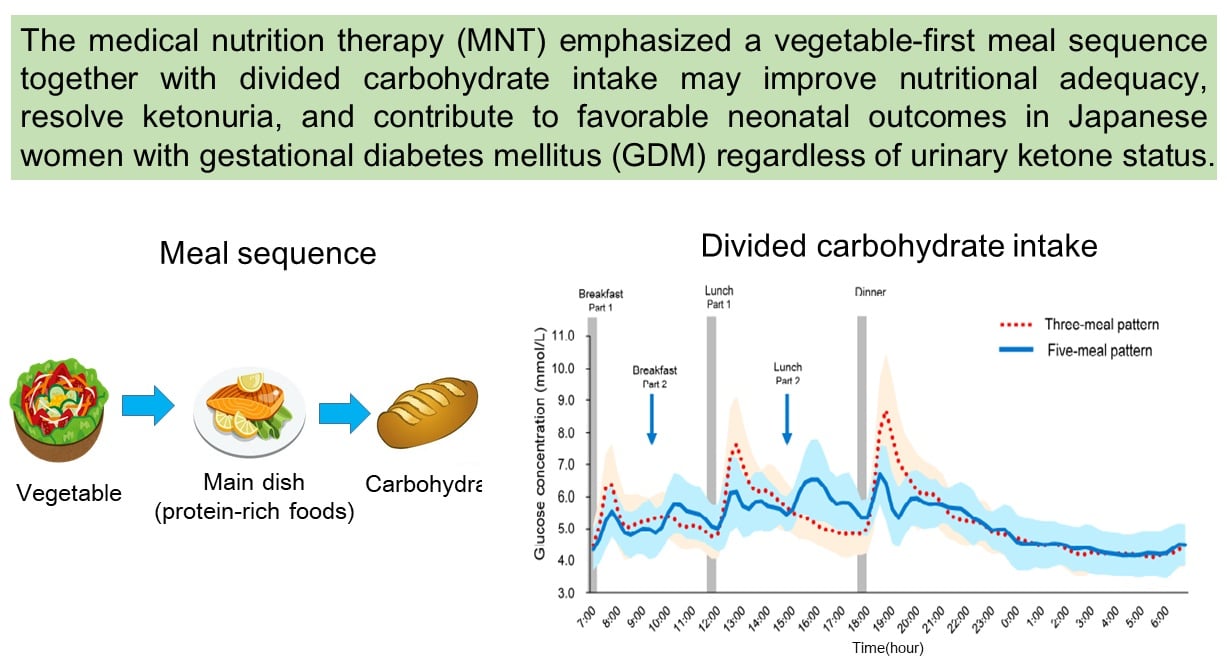
Background/Objectives: Ketonuria is frequently observed in women with gestational diabetes mellitus (GDM), particularly when energy and carbohydrate intake is inadequate. This retrospective study evaluated nutritional status and neonatal outcomes following dietitian-led medical nutrition therapy (MNT) in 517 Japanese women with GDM with and without ketonuria. Methods: Dietary counseling emphasized a meal sequence in which vegetables were consumed before protein-rich foods and carbohydrates were consumed last, together with divided carbohydrate intake (4–5 meals/day), to attenuate postprandial glucose excursions while ensuring adequate energy and carbohydrate intake. Clinical characteristics, dietary intake, and neonatal outcomes were compared between women with and without ketonuria. Results: Among the participants, 143 (27.7%) exhibited ketonuria. The 60-min plasma glucose concentration during the OGTT was significantly higher in the ketonuria-positive group, whereas age, pre-pregnancy BMI, HbA1c, and glycated albumin did not differ between groups. Energy and carbohydrate intakes were significantly lower in the ketonuria-positive group before and after GDM diagnosis. Following GDM diagnosis, dietary intake decreased further in both groups; however, after MNT, energy and carbohydrate intakes increased significantly, and ketonuria resolved in all affected women. Birth weight, cesarean section rates, and the prevalence of congenital anomalies did not differ significantly between groups. None of the participants subsequently required insulin therapy during pregnancy. Conclusions: These findings suggest that dietitian-led MNT incorporating meal sequence and divided carbohydrate intake was associated with improved nutritional adequacy and resolution of ketonuria, with favorable neonatal outcomes observed in Japanese women with GDM regardless of urinary ketone status.
Keywords: gestational diabetes mellitus; diabetes mellitus; medical nutrition therapy; ketonuria; dietitian; meal-sequence; food order; divided meal; neonatal; vegetable gestational diabetes mellitus; diabetes mellitus; medical nutrition therapy; ketonuria; dietitian; meal-sequence; food order; divided meal; neonatal; vegetable
Graphical Abstract