Review

Gastric Microbiota Dysbiosis and Microbiome-Based Interventions in Chronic Atrophic Gastritis
1
College of Basic Medical Science, Dalian Medical University, Dalian 116044, China
2
CapitalBio Technology (Liaoning) Co., Ltd., Dalian 116016, China
3
School of Nursing, Dalian Medical University, Dalian 116044, China
4
Beijing Key Laboratory of Cancer Invasion and Metastasis Research, Department of Medical Genetics and Developmental Biology, School of Basic Medical Science, Capital Medical University, Beijing 100069, China
5
Department of Gastroenterology, First Affiliated Hospital of Dalian Medical University, Dalian 116011, China
*
Authors to whom correspondence should be addressed.
These authors contributed equally to this work.
Nutrients 2026, 18(13), 2165; https://doi.org/10.3390/nu18132165
Submission received: 16 May 2026 / Revised: 28 June 2026 / Accepted: 1 July 2026 / Published: 3 July 2026
(This article belongs to the Section Prebiotics, Probiotics and Postbiotics)

Abstract

Chronic atrophic gastritis (CAG) is a pivotal precancerous condition in gastric carcinogenesis, with progression typically following the classic Correa cascade. Although Helicobacter pylori (H. pylori) infection is widely recognized as the principal etiological factor, the persistence of gastric cancer (GC) risk in a subset of patients after successful eradication suggests that gastric microbiota dysbiosis may also contribute to CAG progression. In recent years, high-throughput sequencing technologies have revealed distinct microbial restructuring in patients with CAG, characterized by decreased microbial diversity, depletion of commensal taxa, and enrichment of opportunistic pathogens. These compositional changes are accompanied by metabolic dysfunction, activation of inflammatory signaling pathways, and disruption of immune homeostasis, which may contribute to a microenvironment permissive for precancerous transformation of the gastric mucosa. Probiotics and related microbiome-based therapeutics, including prebiotics, synbiotics, and postbiotics, have emerged as promising adjunctive strategies for H. pylori eradication and disease management. Their beneficial effects are mediated through multiple mechanisms, including remodeling of the microbial community, inhibition of pathogen colonization, modulation of host immune responses, and restoration of mucosal barrier integrity. However, whether these interventions can reverse established atrophic or metaplastic lesions remains unclear. In addition, how strain specificity, dose dependency, and interindividual heterogeneity influence clinical efficacy has yet to be fully elucidated. In this review, we summarize the compositional and functional features of gastric microbiota dysbiosis in patients with CAG, as well as the mechanisms and clinical applications of microbiome-based interventions. We further highlight current limitations in the field and discuss future directions for precision microecological therapies integrating multi-omics approaches, engineered probiotics, and artificial intelligence. These advances may provide a theoretical framework and practical guidance for the diagnosis and management of CAG and the prevention of GC.

1. Introduction

Atrophic gastritis (AG) is a chronic inflammatory disorder of the gastric mucosa characterized by loss of native gastric glands, mucosal thinning, and intestinal metaplasia (IM) [1]. Among its clinical forms, chronic atrophic gastritis (CAG) is the most frequently encountered and is most commonly associated with persistent Helicobacter pylori (H. pylori) infection or autoimmune gastritis [2]. Environmental and lifestyle factors, including high salt intake, tobacco and alcohol consumption, may also increase disease susceptibility [3,4]. As a key node in the Correa carcinogenic cascade, CAG may progress to intestinal metaplasia, dysplasia, and even gastric cancer, making it a core target for primary prevention of gastric cancer. However, existing standard therapies—primarily H. pylori eradication and acid suppression—have limited efficacy in reversing established gastric atrophy and intestinal metaplasia. This limitation creates an urgent need to identify new therapeutic targets based on emerging pathogenic mechanisms.
The stomach was long considered a virtually sterile organ, owing to the potent bactericidal activity of gastric acid. However, the advent of high-throughput 16S rRNA gene sequencing and shotgun metagenomics has fundamentally reshaped this view by revealing a low-biomass yet compositionally diverse microbial community within the gastric niche [5]. Consequently, the field has shifted from an H. pylori-centered, single-pathogen model to a broader ecological framework that examines how the gastric microbiota contributes to the maintenance or disruption of mucosal immune homeostasis [6].
In recent years, comparative profiling studies and meta-analyses have shown that the gastric microbiota undergoes progressive restructuring along the histological continuum from healthy mucosa to CAG and ultimately to gastric carcinoma, characterized by reduced microbial diversity, depletion of putatively beneficial commensals (e.g., Rothia and Neisseria), and enrichment of oral-derived taxa such as Streptococcus, Veillonella, and Prevotella, as well as opportunistic pathogens including Fusobacterium, particularly under hypochlorhydric and atrophic conditions [7,8,9]. This dysbiotic pattern has been repeatedly observed in CAG and at other precancerous stages along the Correa cascade and may provide important insights into the microbial ecology associated with disease progression.
Importantly, while gastric dysbiosis has traditionally been interpreted as a consequence of disease progression, emerging evidence suggests that it may actively contribute to CAG pathogenesis through functional reprogramming of microbial communities and bidirectional interactions between host and microbiota. Growing evidence further suggests that the stomach is embedded within a dynamic oral–gastric–intestinal microbial network. Bidirectional crosstalk along the gastric–gut axis may contribute to CAG pathogenesis [10], while oral microorganisms continuously enter the stomach through swallowing. Moreover, gastric microbiota is not an isolated ecosystem but is shaped by continuous microbial exchange between the oral cavity and the intestine. Oral swallowing constitutes a major source of oral-derived bacteria in the stomach, including Fusobacterium nucleatum and Porphyromonas gingivalis. Conversely, CAG-associated hypochlorhydria, impaired gastric motility, and bile reflux may facilitate the retrograde colonization of intestinal microbiota, thereby promoting microbial translocation across organ boundaries. Such cross-organ microbial flow may contribute not only to the enrichment of opportunistic pathogens but also to mucosal injury through metabolic reprogramming, such as nitrosamine production, and activation of innate immune pathways. However, the pathophysiological significance of this microbial translocation remains incompletely defined.
Given the central role of gastrointestinal microbial dysbiosis in CAG, microecological interventions have attracted increasing attention. Current evidence suggests that microbiota-targeted interventions may not only suppress pathogenic microorganisms but also restore depleted commensal taxa and their associated ecological functions. Probiotics and prebiotics have shown potential in alleviating gastric mucosal inflammation and enhancing H. pylori eradication efficacy [10]. Preclinical studies support these mechanisms, while recent randomized controlled trials and meta-analyses have demonstrated that probiotics can improve H. pylori eradication rates and reduce antibiotic-associated adverse effects [11,12]. In addition, probiotics and prebiotics have shown emerging potential in the management of gastric precancerous lesions [11].
However, whether these interventions can reverse or halt established atrophic and metaplastic lesions and thereby improve long-term clinical outcomes remains unclear, as current evidence remains limited and, in some cases, inconsistent [10,12]. Future studies are also needed to clarify how strain specificity, dose–response relationships, and interindividual heterogeneity jointly influence therapeutic efficacy [13,14]. Beyond conventional probiotic approaches, increasing attention has been directed toward the targeted supplementation of functionally relevant commensal microorganisms and broader microbiota reconstruction strategies aimed at restoring ecological niches and microbial metabolic networks. Nevertheless, most current studies still conceptualize the stomach as an isolated therapeutic target and rarely evaluate intervention outcomes within the integrated framework of oral–gastric–intestinal microbial interactions, which may partially explain the incomplete mechanistic understanding of microbiota-based therapies in CAG.
In this review, we summarize recent advances in the characterization of gastric and gastrointestinal microbial alterations in CAG, the mechanisms linking dysbiosis and cross-organ microbial translocation to disease progression, and the emerging clinical evidence supporting probiotic and prebiotic interventions. By integrating local gastric microbial ecology with oral–gastric–intestinal microbial interactions, we aim to provide a more comprehensive framework for understanding the microbial pathogenesis of CAG and to discuss how these insights may inform microbiota-based diagnosis, precision intervention, and future microbiota reconstruction strategies.

2. Methods

This narrative review was conducted through a systematic search of the PubMed/MEDLINE and Web of Science databases, with additional manual screening of reference lists from retrieved articles to identify relevant studies not captured by the primary search. The literature search was initiated in October 2025 and updated in June 2026 prior to submission of the revised manuscript, covering publications from inception through May 2026, with priority given to articles published between 2017 and 2026 to ensure that recent advances were comprehensively represented; seminal earlier studies were included where they provided essential mechanistic or historical context.
The following keywords and Boolean combinations were used: (“chronic atrophic gastritis” OR “atrophic gastritis” OR “gastric atrophy”) AND (“gastric microbiota” OR “gastric microbiome” OR “gastric dysbiosis”); (“Helicobacter pylori” OR “H. pylori”) AND (“microbiota” OR “dysbiosis” OR “eradication”); (“Correa cascade” OR “intestinal metaplasia” OR “gastric carcinogenesis”) AND (“microbiome” OR “microbial composition”); (“probiotics” OR “prebiotics” OR “synbiotics” OR “postbiotics”) AND (“atrophic gastritis” OR “H. pylori” OR “gastric mucosa”); (“gastric-gut axis” OR “oral-gastric microbiota” OR “microbial translocation”) AND (“gastric disease” OR “stomach”); and (“SCFA” OR “short-chain fatty acids” OR “bile acids” OR “NF-κB” OR “NLRP3”) AND (“gastric microbiota” OR “atrophic gastritis”).
Eligible study types included original research articles (randomized controlled trials, observational studies, cohort studies, and experimental studies using cell or animal models), systematic reviews, meta-analyses, and narrative reviews published in peer-reviewed English-language journals. Studies were included if they addressed one or more of the following topics: (1) the composition and functional characteristics of the gastric microbiota in health and disease; (2) mechanisms linking gastric microbial dysbiosis to CAG pathogenesis; (3) the gastric-gut axis and inter-organ microbial interactions; or (4) clinical or preclinical evidence for microecological interventions in CAG or H. pylori infection. Studies were excluded if they focused exclusively on non-gastric gastrointestinal diseases without relevance to gastric microecology, were published in languages other than English, or lacked sufficient methodological detail for quality assessment. Preprints were not included.
Titles and abstracts were screened for relevance, and full texts were retrieved for all potentially eligible articles. A total of 219 references were ultimately included in this review.

3. Epidemiology and Pathogenesis of CAG

3.1. Epidemiology of CAG: Global Burden and Emerging Trends

CAG is a major precancerous lesion of GC and imposes a substantial global disease burden. The number of individuals affected by gastritis and duodenitis worldwide reached 31 million in 2019, representing an increase of 12 million compared to 1990 [15]. Across the sequential stages of gastric precancerous lesions, the global prevalence of AG, IM, and dysplasia, also referred to as intraepithelial neoplasia, has been estimated to be 25.4%, 16.2%, and 2.0%, respectively [16]. CAG affects approximately 25% of the examined population [17]. Recent evidence suggests not only an increasing prevalence of CAG but also a shift toward a younger age at diagnosis. A 10-year retrospective study from southern China reported that the prevalence of CAG increased from 18.78% in 2011–2015 to 22.30% in 2016–2020 [18], accompanied by a parallel increase in the proportion of patients younger than 45 years [15]. Over the same period, the prevalence of autoimmune atrophic gastritis (AAG) increased from 13.57% to 30.11% [18]. Among the etiological factors implicated in CAG, H. pylori infection remains the strongest known risk factor and is associated with a 2.4-fold higher risk than that in uninfected individuals [17]. However, some patients remain at risk of malignant transformation even after successful H. pylori eradication, indicating that the pathogenesis of CAG involves a complex interplay of multiple factors beyond infection alone. These observations further suggest that additional microbial, immunological, and ecological mechanisms may contribute to disease persistence and progression, highlighting the need to move beyond a pathogen-centric view of CAG pathogenesis.

3.2. Pathogenesis of CAG

3.2.1. Etiological Factors and Immune-Inflammatory Mechanisms

The pathogenesis of CAG involves multiple interconnected pathways. In H. pylori-associated CAG, the bacterium promotes mucosal atrophy through at least two complementary mechanisms. First, at the level of direct cytotoxicity, the type IV secretion system (T4SS) delivers the virulence factor Cytotoxin-associated gene A (CagA) into host epithelial cells, where it perturbs multiple intracellular signaling pathways and induces proinflammatory responses. Vacuolating cytotoxin A (VacA), in turn, causes cellular vacuolation and disrupts mitochondrial function and cell death pathways, thereby directly impairing epithelial homeostasis and barrier integrity [19]. Second, H. pylori urease hydrolyzes urea to generate ammonia, creating a relatively alkaline microenvironment that facilitates bacterial survival and colonization. Under conditions of hypochlorhydria or established mucosal atrophy, the increase in intragastric pH and weakening of the acid barrier further diminish colonization resistance. This permits ectopic colonization and relative enrichment of oral-derived bacteria, such as Streptococcus and Veillonella, whereas genera with putative protective effects are reduced in abundance, thereby exacerbating gastric mucosal injury [20]. Such dysbiosis may act together with virulence factor-mediated injury to accelerate the atrophic process [20].
Importantly, gastric dysbiosis is increasingly recognized as a consequence of altered microbial exchange within the oral–gastric–intestinal axis rather than an isolated gastric phenomenon. Continuous microbial influx from the oral cavity through swallowing, together with potential retrograde migration of intestinal microorganisms under conditions of hypochlorhydria, impaired gastric motility, or bile reflux, may contribute to the accumulation of non-native microbial populations within the stomach. These translocated microorganisms may further aggravate mucosal injury through inflammatory activation, metabolic reprogramming, and disruption of microbial ecological balance. In addition, bile reflux, long-term proton pump inhibitor (PPI) use, and other factors may further promote atrophic progression by altering the gastric microenvironment and disrupting microbial homeostasis [21,22].
In CAG, although anti-parietal cell antibodies (APCAs) and anti-intrinsic factor antibodies (AIFAs) are important diagnostic markers, the principal driver of oxyntic mucosal destruction is a CD4+ Th1-dominant cellular immune response directed against the parietal cell H+/K+-ATPase. This immune response leads to progressive loss of parietal cells and eventual loss of acid-secretory function. Proinflammatory cytokines, including transforming growth factor-β (TGF-β), tumor necrosis factor-α (TNF-α), and interleukin-6 (IL-6), further amplify inflammation and sustain local immune-mediated tissue injury [21,22].
At the effector stage of inflammation, pathogen-associated molecular patterns (PAMPs) derived from H. pylori and microorganisms associated with secondary dysbiosis engage pattern recognition receptors (PRRs), particularly Toll-like receptors (TLRs), thereby triggering and sustaining activation of proinflammatory signaling pathways such as NF-κB [23,24]. Concurrently, inflammatory cell infiltration and epithelial stress are accompanied by increased oxidative stress, including elevated levels of reactive oxygen species (ROS) and reactive nitrogen species (RNS) [25,26], which further aggravate epithelial injury and disrupt glandular repair homeostasis [24]. These pathways are not entirely independent. It has been proposed that molecular mimicry between H. pylori antigens and the H+/K+-ATPase may trigger cross-reactive immune responses in genetically susceptible individuals carrying specific MHC class II haplotypes. Consequently, immune-mediated mucosal injury or an atrophic phenotype may persist even after successful bacterial eradication [27,28]. Beyond these immune-mediated mechanisms, bile reflux, iatrogenic hypochlorhydria associated with long-term PPI use, and the accompanying microecological alterations may, individually or in combination, disrupt mucosal homeostasis and promote atrophic changes [29,30]. Collectively, microbial infection, chronic inflammation, and microecological dysregulation interact to drive progressive deterioration of gastric mucosal structure and function, ultimately promoting the development and progression of premalignant lesions.

3.2.2. Inflammation-Driven Metaplastic Reprogramming and Neoplastic Progression

Regardless of the initiating insult, loss of parietal cells disrupts the homeostatic environment of gastric glands. Mature chief cells undergo transdifferentiation through an orderly reprogramming process known as paligenosis, giving rise to spasmolytic polypeptide-expressing metaplasia (SPEM), which is characterized by high expression of trefoil factor family 2 (TFF2). This metaplastic transition is initiated by the interleukin-13 (IL-13) signaling axis driven by group 2 innate lymphoid cells(ILC2s) and is maintained by M2-polarized macrophages within a chronic inflammatory microenvironment [31,32]. CAG represents a critical precursor lesion in gastric carcinogenesis, with disease progression typically following the classical Correa cascade: chronic non-atrophic gastritis → CAG → IM → dysplasia → invasive adenocarcinoma [33]. At the molecular level, H. pylori infection activates signaling pathways involving NF-κB and TLRs, thereby sustaining the production of proinflammatory cytokines, such as interleukin-1β (IL-1β), IL-6, and interleukin-8 (IL-8). The resulting oxidative stress, DNA damage, and epigenetic alterations collectively promote malignant transformation of the gastric epithelium [34,35,36,37]. However, accumulating evidence indicates that a subset of patients continues to exhibit gastric mucosal inflammation and remains at an increased risk of neoplastic progression, even after successful H. pylori eradication, suggesting that microbial factors beyond H. pylori also contribute to the initiation and progression of CAG [38,39]. Given the established role of CAG as a pivotal precursor to GC, elucidating its pathogenic mechanisms and identifying effective preventive and therapeutic strategies are of considerable public health importance.

4. Gastric Microbiota: Composition, Dysbiosis, and Disease

4.1. Composition and Function of the Gastric Microbiota

4.1.1. Bacterial Diversity and Community Structure of the Gastric Microbiota

The gastric lumen is traditionally regarded as a virtually sterile environment because of its low pH and continuous acid secretion. The discovery of H. pylori in the 1980s was the first major challenge to this view, demonstrating that a specific microorganism could colonize the highly acidic gastric niche and initiate disease. However, at that time, research relied mainly on culture-based methods; therefore, investigations were limited to a small number of cultivable bacterial species. This methodological constraint reinforced the long-standing assumption that the gastric microbial community was extremely sparse [40,41].
The emergence of high-throughput sequencing technologies in the early 21st century, particularly 16S rRNA gene sequencing, has markedly advanced our understanding of gastric microecosystems. These approaches have revealed that the healthy human stomach harbors a low-biomass but taxonomically diverse microbial community that was previously underappreciated [42,43]. The gastric microbiota is primarily dominated by the phyla Firmicutes, Proteobacteria, Bacteroidetes, Actinobacteria, and Fusobacteria, whereas the commonly detected genera include Lactobacillus, Bifidobacterium, Helicobacter pylori (typically at low relative abundance), and Staphylococcus [44]. Rather than representing a passive microbial background, these communities are increasingly recognized as functionally relevant components of the gastric ecosystem, potentially contributing to mucosal barrier maintenance, modulation of local immune responses, and region-specific metabolic activities.

4.1.2. The Gastric Mycobiome and Virome: Emerging Components of the Gastric Microecosystem

Continuous advances in molecular technologies along with growing evidence indicate that the gastric microbial ecosystem extends beyond bacteria, with fungi and viruses representing important components of gastric microecology. Regarding the mycobiome, although fungi account for only 0.01–0.1% of the gastrointestinal microbial community, their relatively large cell size and distinct immunomodulatory properties suggest that their role in the gastric microenvironment should not be overlooked [45]. Using internal transcribed spacer (ITS) sequencing, investigators have identified multiple fungal genera in gastric mucosal tissues, including Candida, Aspergillus, Alternaria, and Malassezia, suggesting that the stomach may harbor a distinct fungal niche despite its acidic environment [46,47]. Intriguingly, animal studies have reported that, in contrast to bacterial communities, gastric fungal diversity may be relatively preserved or even enriched under highly acidic conditions, suggesting that gastric physicochemical properties may selectively shape fungal colonization and ecological adaptation [48]. Regarding the virome, the gastrointestinal tract is also a major reservoir for human-associated viruses, containing an estimated 108–1010 virus-like particles (VLPs) per gram of intestinal contents. Among these, bacteriophages predominate, accounting for approximately 97.7% of the viral population, whereas eukaryotic and archaeal viruses constitute only minor fractions [49]. Recent transcriptomic and metagenomic analyses have detected diverse viral signatures in gastric mucosal samples, including bacteriophages as well as eukaryotic viruses such as human cytomegalovirus (HCMV) and human herpesvirus 6 (HHV-6), suggesting that the gastric virome may represent a previously underappreciated component of mucosal microbial ecology [50,51]. However, the functional roles of the gastric mycobiome and virome in mucosal homeostasis, host immunity, and disease progression remain largely unexplored, and their causal contribution to CAG pathogenesis is still speculative.

4.1.3. Functional Roles of the Commensal Gastric Microbiota

In addition to compositional characteristics, the gastric microbiota exhibits context-dependent ecological and immunometabolic activities that collectively contribute to mucosal homeostasis. At the functional level, commensal microbial communities represent key ecological components that contribute to host microbe homeostasis under physiological conditions [52]. For example, Lactobacillus species can produce lactic acid and bacteriocin-like compounds that contribute to local ecological resistance against colonization by opportunistic pathobionts [53]. In addition, gastric microbial communities may participate in mucosal immune modulation, including regulation of secretory IgA responses, shaping of Treg/Th17 balance, and interaction with pattern recognition receptor pathways such as Toll-like receptors (TLRs), thereby contributing to immune equilibrium within the gastric mucosa [54,55]. Commensal microorganisms locally generate short-chain fatty acids (SCFAs), vitamins, and other bioactive metabolites, which provide energy substrates and cytoprotective signals for the gastric epithelium while also influencing gastric acid secretion and mucosal barrier integrity. However, these effects are highly context-dependent and may vary according to microbial composition and gastric physiological conditions [56,57]. Collectively, the stability of commensal-dominated microbial communities is associated with mucosal homeostasis under physiological conditions, whereas dysbiosis characterized by loss of beneficial taxa and expansion of pathobionts has been linked to increased susceptibility to gastritis, peptic ulcer disease, and gastric carcinogenesis [58,59].
Overall, the gastric microbial community, particularly commensal-dominated bacterial assemblages together with fungal and viral components, should be conceptualized as a dynamic ecological system that contributes to mucosal homeostasis through context-dependent immune, metabolic, and barrier-related functions.

4.1.4. Methodological Challenges and Current Limitations

Despite these advances, several methodological limitations continue to constrain our understanding of the gastric microecosystem. In recent years, research on the gastric microecosystem has achieved substantial progress at the bacterial level; however, studies on the gastric mycobiome and virome remain comparatively limited. This imbalance reflects a combination of methodological challenges, limitations of current sequencing technologies, and barriers related to clinical sampling [60]. Technological limitations have also contributed to this knowledge gap. Before high-throughput sequencing became available, microbiological studies largely depended on conventional culture-based methods. Because most gastric fungi and viruses cannot be stably cultured in vitro, early work focused mainly on a small number of cultivable bacterial species, and fungal and viral components were therefore largely overlooked. Even with metagenomic sequencing, fungal DNA typically represents less than 1% of gastrointestinal samples and is easily masked by host DNA and bacterial reads, which reduces detection sensitivity [60]. Meanwhile, virome research is further hindered by the so-called “viral dark matter” problem, whereby approximately 80–90% of enteric viral sequences cannot be reliably annotated using current reference databases, thereby substantially restricting functional interpretation and ecological analysis [61,62]. This annotation bottleneck is likely more pronounced in the stomach, where viral abundance is intrinsically low and reference database coverage remains insufficient [63]. From the perspective of clinical sampling, the rapid development of intestinal microecology research, particularly studies of colonic microbiota, has been facilitated in part by the ease of fecal sample collection. Fecal sampling is noninvasive, readily repeatable, and provides a practical proxy for luminal microbial composition [64]. In contrast, the characterization of the gastric microbiota relies largely on endoscopic biopsy, an inherently invasive procedure that limits the recruitment of healthy control subjects and introduces the possibility of contamination by oral or esophageal microbiota during instrument passage [65,66]. In addition, biopsy specimens yield only limited amounts of tissue, which often cannot meet the simultaneous requirements of metagenomic, transcriptomic, and viral enrichment workflows needed for integrated multi-omics analyses [67]. Together, these factors constrain large-scale population-based studies of the gastric mycobiome and virome. Because human gastric mucosal specimens are difficult to obtain, animal models have become important tools for overcoming these sampling limitations and enabling direct analysis of gastric mucosal fungi and viruses. For instance, preliminary characterization of gastric mucosal fungal communities has been achieved in piglet and murine models, and the potential roles of trans-kingdom fungal–bacterial interactions in regulating the gastric microenvironment have begun to emerge [48,68].
Taken together, continued advances in ITS sequencing, metagenomics, and viromics, along with methodological improvements in endoscopic sampling and the development of noninvasive surrogate approaches, are expected to facilitate a deeper understanding of how intragastric fungi and viruses contribute to CAG progression and gastric carcinogenesis. Specific pathogenic fungi, such as Candida albicans, and oncogenic viruses, such as Epstein–Barr virus(EBV), may serve as novel biomarkers for monitoring CAG progression and as potential targets for therapeutic intervention.

4.2. Gastric Microbiota Dysbiosis and Associated Diseases

With the continued development of sequencing technologies, from 16S rRNA gene profiling to metagenomic sequencing and integrated multi-omics approaches, it has become evident that the stomach is not a “sterile organ” in the traditional sense, but rather a complex multi-kingdom ecosystem composed of bacteria, fungi, and viruses [69]. The remodeling of this ecological network is closely associated with a broad spectrum of gastric diseases, and its pathogenic significance can no longer be attributed to any single microorganism. Instead, it reflects a pathological process driven by disruption of overall microecological homeostasis.

4.2.1. Gastric Cancer

During gastric carcinogenesis, dysbiosis of the gastric microbiota exhibits increasingly complex multi-kingdom features. In addition to bacterial dysbiosis, increasing evidence suggests that fungal and viral components also play important roles in gastric carcinogenesis. Beyond H. pylori, several metagenomic studies have revealed that aberrant enrichment of non-Helicobacter taxa, including Lactobacillus, Streptococcus, and Fusobacterium, is closely associated with metabolic reprogramming of tumor tissues and the establishment of a proinflammatory microenvironment [69,70]. Gastric microbiota also undergoes substantial remodeling in GC, characterized by the enrichment of opportunistic fungi, such as Candida, Malassezia, and Cutaneotrichosporon, along with the relative depletion of commensal fungi normally present in healthy gastric mucosa. This fungal dysbiosis may contribute to tumor progression by modulating mucosal immune responses, exacerbating barrier disruption, and amplifying inflammatory signaling [47]. In addition, alterations in the gastric virome have attracted growing attention. EBV infection is closely linked to approximately 10% of gastric adenocarcinomas and is associated with a distinct DNA hypermethylation phenotype, frequent PIK3CA mutations, and overexpression of PD-L1 and PD-L2 [71,72]. Changes in bacteriophage community structure may also indirectly shape the tumor-associated microenvironment by altering bacterial community stability and metabolic networks [69]. However, compared with bacteria, functional evidence supporting the roles of fungi and viruses in gastric carcinogenesis remains largely correlative, and the underlying causal mechanisms require further elucidation.
The Gastric Mycobiome and Its Associations with Gastric Disease
The limited number of studies available on the gastric mycobiome has already yielded several intriguing observations. Zhong et al. characterized fungal dysbiosis in GC based on ITS sequencing and showed that Candida albicans was significantly enriched in gastric carcinoma tissues. Moreover, in this single study, Candida albicans enrichment was closely associated with reduced fungal diversity and richness within the stomach and showed preliminary discriminatory potential for distinguishing malignant from normal gastric mucosa [73]; this finding awaits validation in independent cohorts before Candida albicans can be considered a candidate fungal biomarker. Using ITS2 sequencing, Zhang et al. further profiled the gastric fungal microbiome in GC tissues, adjacent non-cancerous tissues, and healthy control samples, identifying 10 phyla and 301 genera. Fungal dysbiosis associated with GC was marked by an increased Basidiomycota-to-Ascomycota ratio, expansion of opportunistic fungal pathobionts such as Cutaneotrichosporon and Malassezia, and depletion of putatively beneficial genera, including Rhizopus and Rhodotorula. These compositional alterations were significantly associated with intragastric concentrations of both proinflammatory and anti-inflammatory cytokines [47]. Of particular interest, Yan et al. reported a landmark study in Cell in 2024, in which large-scale culturomics was used to establish a human Cultured Gut Fungi (CGF) catalog comprising 760 fungal genomes from 48 families and 206 species, including 69 previously undescribed taxa [74]. By integrating this resource with more than 11,000 fecal metagenomes, the authors systematically mapped the gut mycobiome across healthy individuals and multiple disease states, thereby providing a valuable genome resource and methodological framework for future studies of the gastric mycobiome.
The Gastric Virome and Its Role in Gastric Carcinogenesis
Compared to the gastric mycobiome, the gastric virome remains even less well characterized, although emerging evidence suggests that it may play an important role in gastric disease. EBV infects gastric mucosal epithelial cells and is associated with approximately 10% of gastric adenocarcinomas; accordingly, it has been classified by the International Agency for Research on Cancer (IARC) as a Group I carcinogen [72]. Approximately 8–10% of gastric adenocarcinomas harbor monoclonal EBV DNA. Integrative molecular analyses by the Cancer Genome Atlas (TCGA) have established EBV-associated gastric cancer (EBVaGC) as a distinct molecular subtype characterized by frequent PIK3CA mutations, extensive DNA hypermethylation, overexpression of JAK2, PD-L1, and PD-L2, and abundant immune cell infiltration. EBVaGC is generally associated with a more favorable prognosis than EBV-negative GC [72,75]. Recent studies have also begun to reveal interactions between EBV infection and the gastric microecosystem. EBV-positive GC tissues exhibit markedly reduced bacterial abundance and diversity, whereas pathobionts such as Shigella, Salmonella, and Klebsiella appear to be relatively enriched, suggesting that EBV infection may remodel the gastric microenvironment and promote a proinflammatory tumor milieu [76]. In addition to eukaryotic viruses, bacteriophages, which constitute the dominant component of the virome, have also attracted increasing attention. In a murine model of H. pylori-driven colorectal carcinogenesis, Luo et al. used metagenomic profiling to identify a marked expansion of temperate phages during the early stage of infection. These phages carry virulence-associated genes and infect cancer-associated bacteria (e.g., Enterococcus faecalis), pointing to a possible role for phage-bacterium interactions in H. pylori-related tumorigenesis [77]. Using metagenomic sequencing, Wang et al. further examined the effects of H. pylori eradication therapy on the intestinal virome. They observed sustained contraction of viral communities and enhanced phage-bacterium interactions after antibiotic treatment, and these alterations were not fully recovered at six months after therapy. These findings underscore the long-term impact of gastrointestinal antimicrobial therapy on the virome [78]. A major advance in this field was the publication of the Metagenomic Gut Virus (MGV) catalog by Nayfach et al. in Nature Microbiology in 2021 [79]. This resource assembled 189,680 viral genomes from more than 11,800 fecal metagenomes and identified 54,118 candidate viral species, 92% of which were previously undescribed. By substantially expanding the reference database for the gut virome, it has provided an important genomic and methodological foundation for future studies of the gastric virome [79]. Nevertheless, direct and systematic studies of the gastric virome remain scarce. The composition, temporal dynamics, and functional contributions of gastric phage communities during the progression from precancerous lesions to GC therefore require much closer investigation.

4.2.2. Gastric Mucosa-Associated Lymphoid Tissue Lymphoma

In gastric mucosa-associated lymphoid tissue (MALT) lymphoma, chronic H. pylori infection remains the best-established etiological factor. However, accumulating evidence indicates that lymphomagenesis is not driven by the pathogen alone, but is also closely associated with persistent microbiota dysbiosis and remodeling of the local immune microenvironment [80,81]. Under chronic inflammatory conditions, sustained antigenic stimulation can induce aberrant clonal expansion of B cells, while disruption of the gastric microbial community may further promote abnormal lymphoid proliferation through modulation of T-cell responses and cytokine signaling networks. This disease process exemplifies immune-related tumorigenesis in the setting of gastric microecological disturbance [80,82].

4.2.3. Other Diseases

In addition to the above conditions, gastric microbiota dysbiosis has also been implicated in functional dyspepsia, gastric ulcer disease, and gastric disorders associated with long-term PPI use. Prolonged acid suppression weakens the gastric acid barrier and facilitates the colonization of the stomach by bacteria, fungi, and even viruses of intestinal origin, which in turn further disrupts the microbial community and sustains a state of low-grade inflammation [83,84]. These observations suggest that gastric microbiota dysbiosis may represent a common pathological basis underlying the development and progression of multiple gastric disorders.

4.3. Gastric Microbiota Dysbiosis in CAG

The compositional and mechanistic findings summarized in the following sections should be interpreted in the context of several methodological limitations inherent to the current literature. Most studies investigating gastric microbiota alterations in CAG are cross-sectional in design, which precludes inference of temporal or causal relationships. In addition, sample sizes are often limited, and substantial heterogeneity exists in sampling approaches, including endoscopic biopsy, gastric juice aspiration, and mucosal brushing, which capture distinct microbial fractions and are not directly comparable. Moreover, variability arises from differences in sequencing platforms and bioinformatic pipelines, introducing technical heterogeneity that complicates cross-study integration. Beyond these methodological issues, important confounders such as proton pump inhibitor use, prior antibiotic exposure, dietary patterns, geographic origin, age, smoking, and alcohol consumption are inconsistently controlled across studies.
Therefore, in this review, findings from observational studies are interpreted primarily as associations; mechanistic interpretations are reserved for experimental evidence; and causal statements are limited to longitudinal or interventional studies.
With these caveats in mind, although multiple studies have identified H. pylori as the principal etiological factor in CAG [7,33,34], eradication of the organism does not invariably restore ecological homeostasis within the gastric mucosa. Rather than representing only structural loss of glandular tissue caused by H. pylori infection, CAG may also be considered a “microecological transition phase” characterized by reduced microbial diversity and upregulation of proinflammatory and procarcinogen metabolic pathways [6,85].

4.3.1. Gastric Microbiota Profiles in CAG

CAG can be regarded as a transitional microecological state between a healthy stomach and GC. Studies have demonstrated that the α-diversity of the intragastric microbiota declines progressively along the pathological continuum from normal gastric mucosa to CAG and ultimately to GC [7,86]. This reduction in α-diversity reflects concomitant decreases in both species richness and evenness within the mucosa-associated microbial community, resulting in a more homogeneous ecosystem with a diminished capacity to resist perturbation and re-establish homeostasis. Beyond indicating a loss of microecological complexity, declining diversity is associated with a broader shift in the mucosal microenvironment toward a state characterized by features of chronic inflammation. Whether this association reflects a causal relationship or parallel responses to shared upstream insults remains to be established.
Characteristic Alterations in Microbiota Composition During the CAG Stage

Expansion of pathobionts and opportunistic pathogens. During the CAG stage, the relative abundance of Helicobacter, predominantly H. pylori, increases. Concurrently, as gastric acid secretion declines and the mucosal barrier becomes compromised, acid-tolerant, facultatively anaerobic bacteria and oral-derived opportunistic pathogens expand markedly [87]. Representative taxa include Streptococcus anginosus and Veillonella within the phylum Firmicutes, as well as Fusobacterium nucleatum within the phylum Fusobacteria [88,89]. Notably, Streptococcus may account for more than 20% of the intragastric microbiota in patients with CAG, an observation that has been replicated across multiple independent cohorts using endoscopic biopsy sampling [90].
Depletion of commensal taxa. Genera that normally predominate in the healthy stomach, such as Rothia (Actinobacteria) and Neisseria, show reduced abundance in CAG [43,91]. The directional change in Prevotella is inconsistently reported across studies: several biopsy-based studies have reported its depletion in CAG [7,91], whereas other cohorts, particularly those examining later disease stages or using gastric juice samples, have reported enrichment [92]. This discrepancy likely reflects differences in sampling site, disease stage, and geographic origin, highlighting the influence of methodological context on Prevotella abundance profiles.
Collectively, the microecological signature of CAG is characterized by reduced community diversity, loss of commensal taxa, and enrichment of opportunistic pathogens. These compositional features are consistently observed across multiple independent cohorts, though their functional contributions to mucosal inflammation and precancerous transformation vary in the strength of supporting evidence. The cross-study reproducibility of key microbial findings is summarized in Table 1.
Table 1. Cross-study reproducibility of major gastric microbial alterations in chronic atrophic gastritis (CAG): consistency assessment across independent cohorts.
TaxonDirection of Change
(CAG/GC vs. Controls)
Cohorts Reporting Consistent FindingsDiscrepant or Null ReportsPrimary Confounders Driving Between-Study VariabilityEvidence Type
(Human/Animal/In Vitro)
Predominant Sampling MethodOverall Reproducibility
Streptococcus↑ Enriched along Correa cascade; consistently enriched at CAG, IM, and GC stagesConti et al. 2021 [7]; Fu et al. 2024 [20]; Miao et al. 2022 [58]; Liu C et al. 2022 meta-analysis [92]; Zhang X et al. 2021 [93]; Coker et al. 2018 [94]Few; inconsistency mainly at species levelH. pylori status; PPI use; geographic origin; disease stageHuman (cross-sectional, multi-cohort); Animal model—causal evidence in mice (Fu et al. 2024 [20])Endoscopic biopsyHigh
Lactobacillus↑ Enriched; progressively elevated across CAG, IM, and GC stages; quantitative data in Table 2Liu C et al. 2022 meta-analysis [92]; Zhang X et al. 2021 [93]; Coker et al. 2018 [94]; Ferreira et al. 2018 [95]Some cohorts report no significant change; one meta-analysis showed wide confidence intervalsDietary habits; antibiotic exposure; H. pylori eradication status; geographic originHuman (cross-sectional); metabolic pathway inferences from predictive profiling only—no direct in vitro or animal validation in gastric tissueEndoscopic biopsyModerate–High
Veillonella↑ Enriched; elevated at CAG/IM stage; remains elevated in GC in most cohorts; quantitative data in Table 2Liu C et al. 2022 meta-analysis [92]; Coker et al. 2018 [94]; He et al. 2022 [96]; Zhang SM et al. 2024 [97]Some variability across geographic cohortsPPI use; geographic origin; sampling site (gastric juice vs. biopsy)Human (cross-sectional); in vitro co-culture confirms lactate cross-feeding with Streptococcus/Lactobacillus [97]—in vivo gastric validation lackingEndoscopic biopsy/gastric juiceModerate
PrevotellaInconsistent:
↓ Depleted in most biopsy-based CAG studies
↑ Enriched in studies of advanced disease or gastric juice samples
Depletion: Conti et al. 2021 [7]; Tokunaga et al. 2025 [8]; Ma et al. 2025 [87]; Yang et al. 2021 [91];
Enrichment: Liu C et al. 2022 [92]; Coker et al. 2018 [94]
Fundamentally contradictory directional changes across studiesSampling site (biopsy vs. gastric juice); disease stage; geographic origin; oral microbiota contamination during endoscopyHuman (cross-sectional only); no animal or in vitro mechanistic evidence specific to gastric PrevotellaEndoscopic biopsy/gastric juiceInconsistent
Bifidobacterium↓ Depleted; progressive decline along the Correa cascade; quantitative data in Table 2Liu C et al. 2022 meta-analysis [92]; Coker et al. 2018 [94]; Jeong et al. 2024 [98]; Huo et al. 2025 [99];Few discrepant reportsAge; dietary fiber intake; prior antibiotic exposureHuman (cross-sectional, multi-cohort); animal model evidence for anti-tumorigenic effects (xenograft); mechanistic data largely extrapolated from intestinal researchEndoscopic biopsyModerate
Bacteroides↓ Depleted in human cohorts; Bacteroidetes phylum reduced by 60–80% at GC stage; quantitative data in Table 2Ferreira et al. 2018 [95]; Wang Y et al. 2024 [100]; Wexler and Goodman 2017 [101]INS-GAS mouse model suggests procarcinogenic role—contradicts human cohort data [102]H. pylori status; host genetics; disease stageHuman (cross-sectional); Animal model (INS-GAS mice—contradictory to human data [102]); no in vitro gastric-specific evidenceEndoscopic biopsyModerate; animal model data contradictory
Fusobacterium↑Enriched, predominantly at GC stageAviles-Jimenez et al. 2014 [90]; Liu C et al. 2022 meta-analysis [92]; Ferreira et al. 2018 [95] Some geographic variabilityGeographic origin; sequencing platform; H. pylori statusHuman (cross-sectional); limited animal or in vitro gastric-specific mechanistic dataEndoscopic biopsyModerate
Helicobacter pyloriNonlinear:
↑ Peak at CAG stage
↓ Declines at IM and GC stages; quantitative data in Table 2
Zhang Z et al. 2025 [103]; Fu Q et al. 2025 [104]; Raza et al. 2025 [105]; multiple independent cohortsFew; nonlinear pattern consistently replicatedDisease stage; eradication history; CagA virulence statusHuman (epidemiological cohorts + RCTs—strongest etiological evidence available); animal models confirm carcinogenic mechanismsEndoscopic biopsyHigh
Escherichia coli↑ Enriched; increases progressively from healthy stomach to GC stage; quantitative data in Table 2Huo et al. 2025 [99]; Castaño-Rodríguez et al. 2017 [106]; Pienaar et al. 2019 [107]; Limited CAG-specific cohort data; not systematically examinedGastric pH; antibiotic history; disease stageHuman (cross-sectional, limited cohorts); in vitro evidence for acid survival [107]; retrograde translocation in human CAG not formally demonstratedEndoscopic biopsyLow–Moderate
RothiaBidirectional:
↓ Depleted in H. pylori-positive CAG
↑ Enriched in H. pylori-negative CAG/IM
Sung et al. 2020 [38]; Yang et al. 2021 [91]; Direction entirely dependent on H. pylori infection statusH. pylori infection status; oral microbiota contamination during endoscopic samplingHuman (cross-sectional only); no animal or in vitro gastric-specific mechanistic evidenceEndoscopic biopsyLow
Note: Reproducibility was assessed based on directional consistency of findings across independent cohorts as cited in the main text, and does not constitute a formal systematic review or meta-analysis. Criteria—High: consistent findings across ≥5 independent cohorts or confirmed by meta-analysis; Moderate: consistent in 3–4 cohorts with some discrepant reports; Low: ≤2 cohorts or substantial methodological heterogeneity; Inconsistent: contradictory directional changes with no consensus. Other recognized confounders (age, smoking, alcohol consumption) may further influence microbial composition but have not been systematically evaluated for individual taxa in the available literature. None of the taxa listed has been validated as a clinical biomarker for routine CAG diagnosis; all findings remain at the exploratory stage. Arrow notation: ↑ indicates an increase or enrichment in relative abundance; ↓ indicates a decrease or depletion in relative abundance. Abbreviations: CAG, chronic atrophic gastritis; GC, gastric cancer; IM, intestinal metaplasia; PPI, proton pump inhibitor; RCT, randomized controlled trial.
Table 2. Trends in the relative abundance of major gastric microbial taxa along the Correa cascade.
TaxonTypical
Colonization
Niche
Healthy → GastritisGastritis →
CAG
CAG →
IM
IM →
Dysplasia
Dysplasia →
GC
Representative Quantitative Data (Key Source)Reference
(First Author,
Year)
Firmicutes
StreptococcusOral-derived opportunistic pathobiont↑/–>20%↑↑↑↑↑↑↑↑↑↑Accounts for >20% of intragastric microbiota in some CAG cohorts [90]Miao (2022 [58]);
Zhang (2021) [93];
Aviles-Jimenez (2014) [90]
LactobacillusOral-derived; selectively enriched under hypochlorhydria↑/–10.4%≈10.4%↑↑↑11.7%2.9% (healthy) → 10.4% (CAG/IM) → 11.7% (GC) [94]; additional 2.2-fold increase from CAG to GC in a Chinese cohort [93]Zhang (2021) [93];
Coker (2018) [94];
Ferreira (2018) [95]
VeillonellaOral-derived opportunistic pathobiont3.8%≈3.8%↑↑↑↑↑↑/–0.7% (healthy) → 3.8% (CAG/IM); remains elevated in GC in most cohorts; linked to lactate and propionate metabolic pathways by functional pathway analysisCoker (2018) [94];
He (2022) [96];
Zhang (2024) [97]
Bacteroidetes
PrevotellaOral-derived commensal; direction of change contested across studies—/variable↑/↓↑/↓↑/↓↑/↓Inconsistent; see Note † and Table 1. Enrichment reported in gastric juice–inclusive meta-analysis (3–5% in healthy → ~15–20% in GC) [92]; depletion reported in most biopsy-based cohort studies [7,8,87,91]Liu (2022) [92];
Liu (2024) [86]
BacteroidesGut commensal; obligate intestinal symbiont5–8%↓↓↓↓↓2–3%10–15% (healthy) → 5–8% (CAG) → 2–3% (GC); Bacteroidetes phylum overall reduced by 60–80% at GC stage; depletion observed in both H. pylori-positive and -negative GC [95,100] Wang (2024) [100];
Wexler (2017) [101];
Lertpiriyapong (2014) [102];
Ferreira (2018) [95]
Actinobacteria
BifidobacteriumGut-derived commensal with probiotic potential4–6%↓↓↓↓↓1–2%8–12% (healthy) → 4–6% (CAG) → 1–2% (GC) [92,98]Liu (2022) [92];
Jeong (2024) [98];
Huo (2025) [99]
Proteobacteria
Helicobacter pylori
(H. pylori)
Gastric-specific colonizer↑↑70–90% (peak)40–50%↓↓10–20%
(almost absent)
Detection rate: ~0–50% (healthy/asymptomatic) → 70–90% (CAG, peak) → 40–50% (IM) → 10–20% (GC) [103,104]; CagA+ strains: 4–6-fold increased carcinogenic risk [105]Zhang (2025) [103];
Fu Q (2025) [104];
Raza (2025) [105]
Escherichia coli
(E. coli)
Gut-derived; retrograde colonization under hypochlorhydria3–5%↑↑↑↑↑8–12%0.5–1% (healthy) → 3–5% (CAG) → 8–12% (GC) [99,108]; intragastric pH rise from ~1.5–2.0 to 4.0–5.0 in CAG creates permissive conditions for retrograde colonization [106,107]Huo (2025) [99]; Chen Z (2025) [108]; Castaño-Rodríguez N (2017) [106];
Pienaar (2019) [107]
Fusobacteria
FusobacteriumOral-derived opportunistic pathobiont↑/–↑↑↑↑↑Predominantly enriched at the GC stage; quantitative abundance data vary across geographic cohorts and sequencing platforms [88,90,92,95]Li H (2024) [88]; Aviles-Jimenez (2014) [90];
Liu (2022) [92]; Ferreira (2018) [95]
Arrow notation: ↑ modest increase; ↑↑ moderate increase; ↑↑↑ marked increase; ↑↑↑↑ pronounced increase; ↓ modest decrease; ↓↓ moderate decrease; ↓↓↓ marked decrease;—no consistent directional change reported; / discrepant findings across studies. H. pylori nonlinear pattern: Detection rate peaks at the CAG stage (~70–90%), then declines progressively as atrophy advances, reaching only 10–20% at the GC stage. This nonlinear trajectory reflects progressive remodeling of the gastric niche—including glandular epithelial loss, intragastric pH elevation, and immune reshaping—which together render the environment increasingly unfavorable for H. pylori persistence. † Prevotella inconsistency: Direction of change is not consistent across studies. Enrichment has been reported in meta-analyses incorporating gastric juice samples [92]; depletion in most biopsy-based cohort studies [7,8,87,91]. No consensus trajectory can be established from current cross-sectional data. For a full assessment of between-study variability and confounders, see Table 1. Note: Rothia bidirectional pattern: Direction is entirely dependent on H. pylori infection status: depleted in H. pylori-positive CAG, enriched in H. pylori-negative CAG/IM [38,91]. No quantitative cross-stage data are currently available. See Table 1 for details. Abbreviations: CAG, chronic atrophic gastritis; GC, gastric cancer; IM, intestinal metaplasia.
Changes in Gastric Microbiota Composition Along the Correa Cascade
In healthy individuals, the intragastric microbiota is dominated by commensal taxa from the phyla Firmicutes, Actinobacteria, Bacteroidetes, and Proteobacteria.
Within Firmicutes, the predominant genera include Streptococcus, Lactobacillus, and Veillonella, most of which are oral in origin and remain at relatively low abundance in the healthy acid-secreting stomach. Under conditions of reduced gastric acidity, these taxa appear to gain a colonization advantage, an observation consistently replicated across multiple independent cohorts. Multiple studies published between 2018 and 2024 have reported the persistent enrichment of Streptococcus across the stages of CAG, IM, and GC (p < 0.05) [58,93]. Beyond compositional enrichment, Streptococcus anginosus has been shown to activate proinflammatory MAPK signaling and promote gastric atrophy and tumorigenesis in murine models [20], providing mechanistic plausibility for a contributory role in disease progression; however, direct causal evidence in humans remains lacking. Coker et al. demonstrated that the relative abundance of Lactobacillus increased approximately three- to fourfold along the Correa cascade, rising from 2.9% in healthy individuals to 10.4% in patients with CAG or IM and further to 11.7% in those with GC (p < 0.01) [94]. Consistent with this, Shen et al. reported in a Chinese cohort that Lactobacillus abundance was significantly elevated at the CAG stage and showed a further 2.2-fold increase with progression to GC (p < 0.05), with enrichment positively associated with lactate-related metabolic pathways as annotated in KEGG [93]. These findings are consistent with the view that the hypochlorhydric environment of atrophic mucosa creates permissive conditions for Lactobacillus enrichment [94], and suggest a possible association between this genus and metabolic shifts in the gastric mucosa during disease progression, though direct mechanistic evidence in human gastric tissue remains limited [95]. Coker et al. also found that the relative abundance of Veillonella rose from 0.7% in healthy controls to 3.8% in patients with CAG or IM and remained elevated in GC [94]. Functional pathway analyses further linked Veillonella abundance to the enrichment of lactate and propionate metabolism, as well as short-chain fatty acid biosynthesis pathways [96]. These observations suggest that Veillonella may participate in metabolic cross-feeding with lactate-producing genera such as Streptococcus and Lactobacillus, thereby contributing to shifts in intragastric energy metabolism along the Correa cascade [97]. This inference is supported by in vitro co-culture data and functional pathway analyses; direct in vivo validation in human gastric tissue is currently lacking.
Actinobacteria are mainly represented by Rothia and Bifidobacterium, both of which exhibit distinct patterns of abundance change along the Correa cascade. Rothia, a commensal genus of oral origin, shows a bidirectional pattern that is entirely dependent on H. pylori infection status. In H. pylori-positive CAG, Rothia abundance is typically reduced, whereas in H. pylori-negative CAG and IM it tends to be enriched [38,91]. This context-dependent behavior underscores the importance of H. pylori status as a key confounder when interpreting the abundance profiles of individual taxa. Bifidobacterium is increasingly recognized as a potentially protective probiotic taxon in the gastric niche because of its well-established immunomodulatory and mucosal-protective functions, despite being primarily derived from the intestine. Its relative abundance declines progressively along the Correa cascade, decreasing from 8 to 12% in the healthy stomach to 4–6% at the CAG stage and further to only 1–2% in GC [92,98]. The progressive depletion of Bifidobacterium has been associated with a reduction in the immunoregulatory and anti-inflammatory functions attributed to this genus, which may contribute to a shift toward a more proinflammatory gastric microenvironment [99]. Whether this relationship is causal or reflects a parallel response to shared upstream drivers, such as mucosal atrophy and intragastric pH elevation, requires further experimental investigation.
Bacteroidetes are chiefly represented by Prevotella and Bacteroides, both of which contribute to gastric mucosal homeostasis through the production of metabolites such as lactate and SCFAs [42,109]. The abundance trajectory of Prevotella across the Correa cascade is among the most inconsistently reported findings in gastric microbiome research. In a meta-analysis of 825 samples from six independent studies, Liu et al. reported a progressive increase in intragastric Prevotella abundance, from 3 to 5% in the healthy stomach to approximately 15–20% in GC (p < 0.05), and proposed a possible opportunistic role for this genus at advanced disease stages [92]. A co-occurrence pattern with H. pylori at the IM stage has also been described in at least one cohort, suggesting a possible synergistic association during the gastritis-to-carcinoma transition [86]. However, multiple biopsy-based studies have reported the opposite pattern, with Prevotella significantly depleted in CAG relative to healthy controls [7,8,87,91]. This directional discrepancy most likely reflects methodological heterogeneity—including differences in sampling site (gastric juice versus mucosal biopsy), disease stage, geographic origin, and the risk of oral microbiota contamination during endoscopic sampling—rather than a genuine biological inconsistency. As summarized in Table 2, the overall abundance trajectory of Prevotella across the Correa cascade cannot be reliably established from current cross-sectional data, and no firm conclusions regarding its functional role in CAG pathogenesis can be drawn at this stage. In contrast, the relative abundance of Bacteroides follows a more consistent opposing trajectory, declining from 10–15% in the healthy stomach to 5–8% during CAG and further to 2–3% in GC. At the phylum level, Bacteroidetes show an overall reduction of 60–80% [95]. This decline has been observed in both H. pylori-positive and H. pylori-negative GC patients, indicating that the loss of Bacteroides may represent a key commensal depletion event in GC that is not strictly dependent on H. pylori status [100]. As an obligate intestinal symbiont adapted to a stable enteric environment, Bacteroides is likely poorly suited to the progressively altered acidity and inflammatory conditions of the atrophic stomach, and its mucosal-protective functions may diminish accordingly [95,101]. Notably, studies using the INS-GAS mouse model have suggested a procarcinogenic role for Bacteroides in that experimental context [102], a finding that contrasts with the protective associations observed in human cohorts and highlights the importance of species-specific and host-specific differences when interpreting microbiota–disease relationships across model systems.
Proteobacteria are mainly represented by Helicobacter and Escherichia. As the Correa cascade progresses, declining gastric acid secretion, impairment of mucosal barrier integrity, and immune dysregulation collectively remodel the gastric ecological niche, creating conditions associated with Proteobacteria enrichment [90,110]. Enrichment of Proteobacteria-associated pathobionts, particularly H. pylori and E. coli, has been associated with mucosal immune activation and oxidative stress through the release of bacterial virulence factors and endotoxins such as urease-derived ammonia and lipopolysaccharide (LPS), which may contribute to the perpetuation of chronic gastric inflammation [94,95,111]. The relative abundance of H. pylori follows a characteristic nonlinear pattern along the Correa cascade, rising from a detection rate of 0–50% in asymptomatic healthy individuals to 70–90% at the CAG stage (peak detection), then declining to 40–50% at the IM stage and further to only 10–20% in GC [103,104]. This nonlinear pattern is thought to reflect progressive remodeling of the gastric niche as atrophy advances, which gradually renders the environment less favorable for H. pylori persistence, consistent with a “hit-and-run” model of carcinogenic initiation [103]. Strains carrying the CagA virulence factor are associated with a four- to sixfold increase in carcinogenic risk [105]. Even when eradication is performed at the IM or dysplasia stage, H. pylori eradication may still reduce GC risk by approximately 55% [105]. In contrast, E. coli accounts for only 0.5–1% of the intragastric microbial community in the healthy stomach, but increases to 3–5% at the CAG stage and rises further to 8–12% in GC(p < 0.001) [99,108]. The rise in intragastric pH from approximately 1.5–2.0 to 4.0–5.0 in the setting of hypochlorhydria has been proposed as a key permissive factor for retrograde translocation of intestinal bacteria, including E. coli, into the gastric lumen [106,107]; this inference is supported by in vitro acid-survival data and observational human studies, though formal mechanistic confirmation in human gastric tissue remains limited.
Within Fusobacteria, Fusobacterium nucleatum has been identified as an oral-derived opportunistic pathobiont associated with gastric carcinogenesis. Its enrichment is predominantly observed at the GC stage, with limited evidence of significant accumulation at earlier stages of the Correa cascade [88,90]. Enrichment relative to healthy controls has been confirmed in at least three independent cohorts, including a meta-analysis [90,92,95], though quantitative abundance data vary considerably across geographic cohorts and sequencing platforms, and gastric-specific mechanistic evidence remains limited.
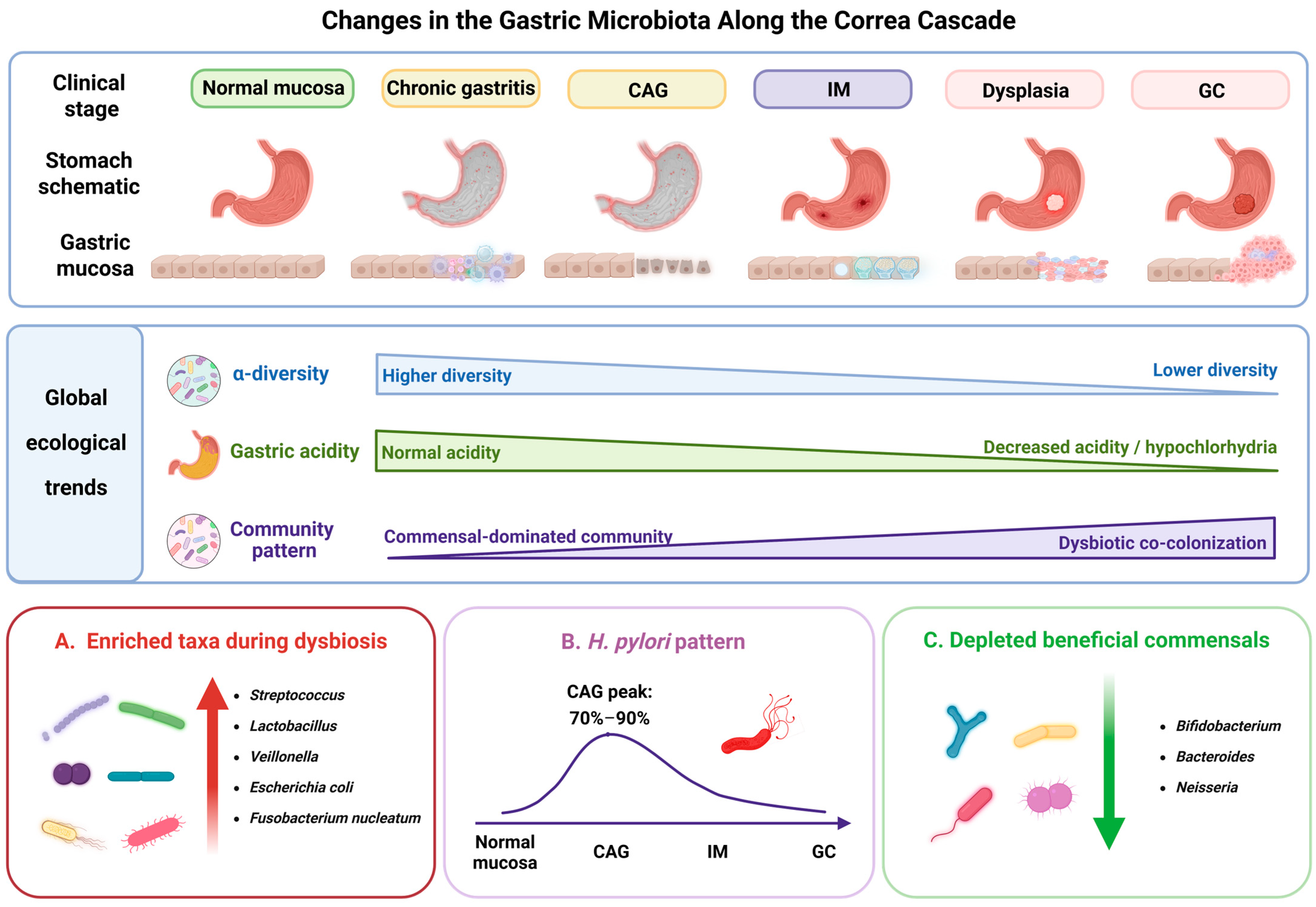
Taken together, available cross-sectional evidence indicates that as the gastric mucosa progresses from a healthy state through CAG and IM to GC, the intragastric microbiota undergoes substantial restructuring, transitioning from a relatively simple community in which H. pylori is the principal pathobiont to a more complex ecosystem characterized by co-colonization of oral- and intestinal-derived taxa. Several oral-associated genera within Firmicutes, including Streptococcus, Lactobacillus, and Veillonella, become progressively enriched, whereas protective commensals such as Bifidobacterium and Bacteroides decline substantially. Importantly, the directional changes reported for individual taxa—particularly Prevotella and Rothia—remain contested across studies, reflecting methodological heterogeneity and the confounding influence of H. pylori status, sampling approach, and geographic origin. The cross-study reproducibility of these findings is documented in Table 1, and stage-resolved quantitative trends along the Correa cascade are presented in Table 2. The compositional shifts are schematically illustrated in Figure 1.

4.3.2. Mechanistic Roles of Gastric Microbiota Dysbiosis in the Pathogenesis of CAG

Metabolic Remodeling: Disruption of SCFA and Bile Acid Homeostasis
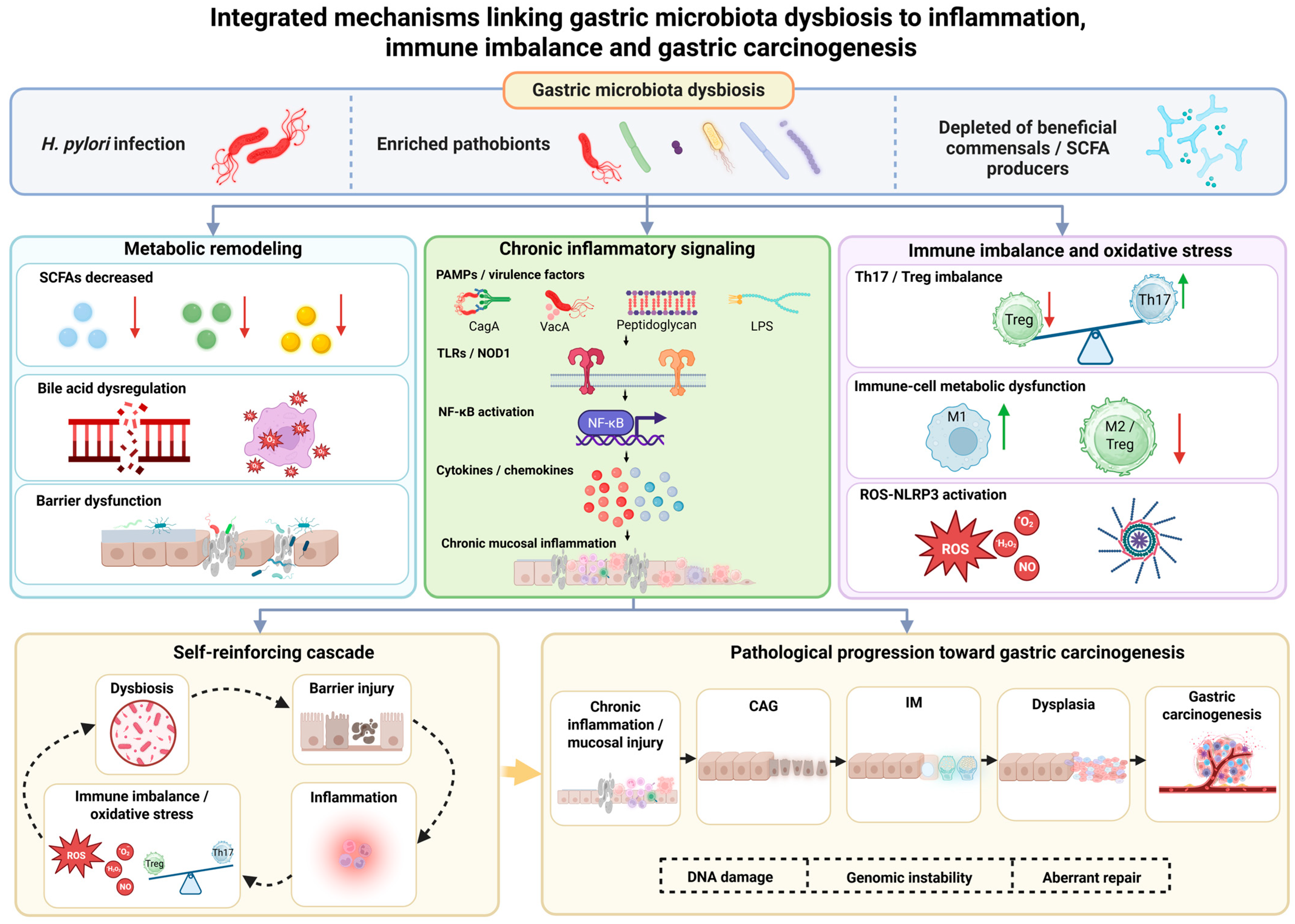
Metabolic dysfunction driven by gastric microbiota dysbiosis represents an important mechanistic component in the pathogenesis of CAG. In 2017, Parsons et al. used 16S rRNA sequencing combined with predictive functional profiling and found upregulation of pathways related to glucose-6-phosphate dehydrogenase and D-lactate dehydrogenase in the gastric microbiota of patients with H. pylori-associated AG [44]. These metabolic alterations have previously been linked to poor prognosis in GC. The same study further showed increased expression of fumarate reductase together with reduced succinate dehydrogenase activity in patients with both autoimmune and H. pylori-associated AG, suggesting disruption of the tricarboxylic acid (TCA) cycle [44]. In a 2025 study, Otani et al. performed metabolomic profiling and found that patients with AAG exhibited suppressed glycolytic and TCA cycle activity, accompanied by activation of alternative metabolic pathways [112]. These findings indicate substantial reprogramming of energy metabolism and suggest that such alterations are closely associated with disease progression and increased risk of malignant transformation.
Aberrant SCFA metabolism represents a key feature of microbiota-related functional disruption in CAG. SCFAs, mainly acetate, propionate, and butyrate, are generated by anaerobic bacterial fermentation of dietary fiber in the gut and play essential roles in maintaining epithelial barrier integrity, regulating energy metabolism, and limiting inflammatory responses [113]. It should be noted that the mechanistic evidence for SCFA-mediated mucosal protection cited in this section derives primarily from intestinal epithelial cell models and animal models of intestinal inflammation; while emerging evidence from murine gastric tissue models suggests that SCFAs can also act directly on gastric epithelial cells, direct validation in human gastric tissue remains limited. The discussion below therefore represents a framework of biological plausibility that requires gastric-specific human validation. The protective effects of SCFAs are mediated through several distinct mechanisms. Butyrate enhances the expression of tight-junction proteins, including claudin-1, zonula occludens-1 (ZO-1), and occludin, thereby helping to preserve epithelial barrier function. Butyrate also upregulates mucin 2 expression and promotes the thickening of the mucus layer. Beyond barrier protection, SCFAs regulate gene expression by inhibiting histone deacetylases (HDACs) and exert immunoregulatory effects via activation of G protein-coupled receptors, particularly GPR41/FFAR3 and GPR43/FFAR2. In CAG, depletion of SCFA-producing commensal bacteria may lead to a deficiency of these protective metabolites, which has been hypothesized to aggravate mucosal injury and perpetuate inflammatory cascades, though direct evidence in human gastric tissue remains limited. Clinical evidence further indicates that fecal SCFA levels and the composition of SCFA-producing bacterial communities undergo significant alterations in patients with gastric lesions after H. pylori eradication [114].
Bile acid metabolic dysregulation represents another prominent consequence of microbiota-related functional imbalance. Intestinal bacteria convert primary bile acids synthesized in the liver into secondary bile acids. Together, these bile acid species not only facilitate lipid digestion but also regulate inflammation, metabolic homeostasis, and epithelial integrity through receptors such as farnesoid X receptor (FXR) and Takeda G protein-coupled receptor 5 (TGR5) [115]. When gastrointestinal microbial homeostasis is disrupted or when bile reflux exposes the gastric mucosa to excessive bile acids, aberrant bile acid accumulation may directly damage the mucosa, induce DNA injury and oxidative stress, and reshape barriers and immune functions in ways that favor the progression along the atrophy–intestinal metaplasia–carcinoma sequence [116]. In the setting of CAG, such bile acid perturbations may further aggravate mucosal injury and contribute to the establishment of a protumorigenic microenvironment through interconnected metabolic and signaling pathways. Taken together, reduced SCFA availability and disturbed bile acid metabolism may constitute a critical mechanistic link between microecological dysbiosis and pathological progression of the gastric mucosa in CAG.
Chronic Activation of Inflammatory Signaling Pathways
Gastric microecological dysbiosis may sustain activation of inflammatory signaling pathways through multiple converging mechanisms, thereby forming a pivotal molecular link between microbial perturbation and chronic mucosal inflammation. H. pylori, together with opportunistic pathogens enriched under dysbiotic conditions (e.g., Streptococcus spp.), engages host innate immune receptors through virulence factors and PAMPs [7,20]. Concurrently, depletion of commensal taxa, including Lactobacillus spp., weakens tonic suppression of the NF-κB pathway. In this regard, L. plantarum suppresses NF-κB activation by blocking IκBα degradation and inhibiting p65 phosphorylation [117], whereas the concomitant reduction in SCFA production may further diminish GPR43-mediated restraint of NF-κB signaling through HDAC-related mechanisms [118]. In addition, dysbiosis-associated impairment of the mucosal barrier permits greater translocation of microbial components across the epithelium, thereby amplifying innate immune activation in the lamina propria [119].
Driven by microbiota dysbiosis, the NF-κB signaling pathway serves as a central hub linking gastric microecological imbalance to chronic inflammation. This pathway undergoes sustained activation and plays a critical role in H. pylori-associated gastric pathology and gastrointestinal tumorigenesis [120]. H. pylori infection activates host cell surface pattern recognition receptors (PRRs), including TLRs and NOD1, through virulence-associated components such as CagA, peptidoglycan, and VacA. This process triggers the IKK complex, leading to phosphorylation and proteasomal degradation of IκB, which in turn releases NF-κB for nuclear translocation and transcriptional activation of proinflammatory gene programs [121,122]. Importantly, non-H. pylori pathobionts enriched during the dysbiotic phase of CAG, such as Streptococcus anginosus, can also activate proinflammatory signaling pathways, including MAPK signaling, through direct interaction between bacterial surface proteins and receptors on gastric epithelial cells [20]. PAMPs produced by these bacteria, particularly LPS, may further amplify NF-κB activation via the TLR4 axis [123], making NF-κB signaling under dysbiotic conditions both multifactorial and persistent. Once activated, NF-κB transcriptionally upregulates a broad range of proinflammatory mediators, including cytokines (IL-8, TNF-α, and IL-1β), chemokines (CXCL1 and CXCL2), and adhesion molecules (ICAM-1 and VCAM-1). These factors collectively recruit neutrophils and monocytes into the gastric mucosa, thereby aggravating inflammatory tissue injury [124].
In patients with CAG and long-standing H. pylori infection, NF-κB activity is markedly increased and positively correlated with neutrophil infiltration, inflammatory severity, and the degree of glandular atrophy in the gastric mucosa, underscoring the central role of this dysbiosis-related pathway in maintaining a chronic inflammatory microenvironment and promoting pathological progression [120]. Consistent with these findings, gastric microbiota diversity is substantially reduced in CAG, whereas Streptococcus abundance is increased and positively associated with more advanced OLGA/OLGIM staging [7], suggesting that the enrichment of opportunistic pathobionts may contribute to NF-κB-driven inflammatory progression. Importantly, NF-κB activation induced by microbiota dysbiosis extends beyond acute and chronic inflammation and immune activation. It also contributes to genomic instability by promoting R-loop formation and DNA double-strand breaks, thereby providing a molecular basis for inflammation-associated cellular transformation and carcinogenesis [125]. Collectively, microecological imbalance perpetuates a self-reinforcing cycle of “inflammation, injury, and aberrant repair” through recurrent or sustained NF-κB activation, thereby serving as a critical mechanistic bridge in the progression from CAG to IM and more advanced neoplastic stages.
Persistent activation of inflammatory signaling pathways driven by microbiota dysbiosis ultimately leads to the sustained release of proinflammatory cytokines, thereby providing a biological basis for chronic mucosal inflammation. Within the dysbiotic microenvironment, sustained colonization by pathogenic microorganisms, together with the loss of protective functions normally provided by commensal bacteria, has been associated with sustained elevation of proinflammatory mediators, such as TGF-β, TNF-α, and IL-6, each of which has been implicated in the development and progression of CAG in human observational and experimental studies [22]. At the molecular level, sustained immune activation triggered by microbiota disruption drives several key cytokines to promote atrophy and intestinal metaplasia through distinct pathways. Interferon-γ (IFN-γ) directly induces gastric epithelial cell death and accelerates the metaplastic process [126]. In contrast, IL-1β promotes glandular atrophy by suppressing parietal cell-associated Sonic Hedgehog signaling and reducing proton pump activity [127]. In addition, enhanced Th17 cell polarization under dysbiotic conditions has been reported in both human gastric tissue studies and murine H. pylori infection models [128], and elevated IL-17A has been associated with parietal cell apoptosis, atrophic lesions, and metaplastic changes, primarily based on in vitro and animal model evidence [129]. H. pylori-derived extracellular vesicles and outer membrane vesicles (EVs/OMVs), enriched in virulence factors such as CagA and VacA, have been shown to be internalized by epithelial and immune cells, stimulating the production of proinflammatory cytokines including TNF-α, IL-6, IL-1β, and IL-8, as demonstrated primarily using in vitro co-culture systems [130]. Environmental and dietary factors may further modulate this cytokine cascade. For example, a high-salt diet has been shown to markedly potentiate the inflammatory response induced by H. pylori infection, increasing the expression of TNF-α, IL-1β, IL-6, and IFN-γ, aggravating mucosal injury, and accelerating pathological progression [131].
Immune Imbalance and Oxidative Stress
Microbiota dysbiosis represents an important upstream driver of immune imbalance and oxidative stress in CAG. As discussed above, the gastric microbiota in CAG is characterized by the enrichment of pathogenic bacteria and depletion of commensal organisms. This dysbiosis disrupts the immune system and redox homeostasis through multiple interconnected pathways. On one hand, pathogenic bacteria and their products, including LPS and peptidoglycan, continuously activate innate immunity via PRRs, thereby disrupting the Th17/Treg balance and sustaining chronic inflammation [132]. In contrast, the loss of commensal bacteria leads to a deficiency in immunomodulatory metabolites, particularly SCFAs, which impairs the differentiation and functional maintenance of regulatory T cells (Tregs). Furthermore, sustained immune activation induced by dysbiosis markedly increases the generation of ROS and activates the NLRP3 inflammasome, establishing a vicious cycle of “microbiota dysbiosis, immune imbalance, oxidative stress, tissue injury, and further microbiota dysbiosis.” The following sections discuss this process from three dimensions: imbalance of the Th17/Treg axis, metabolic reprogramming of immune cells, and oxidative stress-mediated activation of the NLRP3 inflammasome.
  • Th17/Treg Axis Dysregulation
Gastric microbiota dysbiosis has been associated with Th17/Treg axis imbalance. Under homeostatic conditions, commensal bacteria have been shown to promote the differentiation of naïve CD4+ T cells into Foxp3+ Tregs through the production of SCFAs, particularly butyrate, which activates GPR43 and inhibits histone deacetylase (HDAC) activity [133]. This mechanistic pathway is well established in murine intestinal models and human immune cell systems, including studies using human dendritic cell–T cell co-culture; however, direct evidence from human gastric tissue is currently lacking, and whether this mechanism operates within the gastric mucosal microenvironment at physiologically relevant SCFA concentrations remains to be determined. In this context, depletion of butyrate-producing bacteria, such as Faecalibacterium and Roseburia, which primarily inhabit the intestinal tract but have been reported to be altered in the gastrointestinal microenvironment of CAG patients, has been associated with reduced butyrate availability, which may impair Treg induction. Direct evidence that these genera are specifically depleted within the gastric mucosal niche itself, rather than within the broader intestinal compartment of CAG patients, has not been established. Concurrently, H. pylori and other enriched pathogenic taxa, including Streptococcus and Prevotella, activate dendritic cells through PAMPs, promoting the secretion of Th17-polarizing cytokines, such as IL-6 and IL-23, which, in turn, drive excessive differentiation of Th17 cells and increased release of IL-17 [134]. This dysbiosis-mediated dual imbalance, characterized by insufficient Treg induction and Th17 activation, represents a central feature of immune pathology in patients with CAG.
The imbalance of the Th17/Treg axis constitutes a central mechanism in the immunoregulation of CAG. In a seminal 2008 study, Stummvoll et al. were the first to systematically delineate the distinct roles of different T-cell subsets in autoimmune gastritis and their differential susceptibility to suppression by Tregs [135]. Using a transgenic TCR mouse model (TxA23), the authors transferred fully differentiated Th1, Th2, and Th17 cells recognizing the parietal cell antigen H+/K+-ATPase into immunodeficient recipients and demonstrated that all three effector lineages were capable of inducing autoimmune gastritis, albeit with markedly distinct pathological patterns. Among them, Th17 cells induced the most destructive disease, characterized by eosinophil-predominant cellular infiltration and markedly elevated serum IgE levels. More importantly, polyclonal Tregs showed markedly different suppressive capacities toward the three effector lineages: they effectively inhibited Th1-mediated disease, moderately suppressed Th2-driven pathology, but were able to restrain Th17-mediated disease only at early time points. These findings indicate that Th17 cells possess distinctive pathogenicity and relative resistance to immunoregulatory suppression in CAG. These observations derive from an antigen-specific murine model and await validation in human autoimmune atrophic gastritis cohorts before direct clinical extrapolation.
Subsequently, Huter et al. (2009) demonstrated in a murine adoptive transfer model that antigen-specific induced regulatory T cells (iTregs) have greater suppressive capacity than polyclonal Tregs and can effectively prevent both Th1- and Th17-mediated autoimmune gastritis, providing an experimental basis for Treg-based cellular immunotherapy; human clinical validation of this approach in autoimmune atrophic gastritis has not yet been reported [136]. In a comprehensive review published in 2024, Vavallo et al. summarized recent advances and emphasized that, in addition to Th1 cells, Th2 cells, Th17 cells, macrophages, epithelial cells, and their derived mediators and cytokines, including IL-4, IL-9, IL-12, and IL-17, may all contribute to the pathogenesis of AAG [137].
Disruption of the Th17/Treg balance is observed not only in AAG, but is also of substantial pathological relevance in H. pylori-associated CAG. Importantly, this imbalance is closely linked to microbiota dysbiosis: H. pylori infection not only directly activates pathways driving Th17 differentiation but also indirectly amplifies Th17 responses by reshaping the gastric microecological environment, for instance, by reducing microbial diversity and promoting the enrichment of proinflammatory bacteria. Concurrently, depletion of SCFAs and tryptophan-derived metabolites caused by microbiota dysbiosis further impairs the maintenance of Treg numbers and their suppressive function [138], reducing their ability to counterbalance overactivated effector T cells and ultimately establishing a vicious cycle of chronic inflammation and tissue injury. Understanding this proposed mechanistic link between microbiota dysbiosis and immune imbalance may provide important guidance for the development of immunotherapeutic strategies based on microecological modulation.
  • Immune Cell Metabolic Reprogramming and Functional Impairment
Microbiota dysbiosis profoundly influences the metabolic reprogramming of immune cells by altering the supply of metabolic substrates and the signaling microenvironment. The mechanistic framework described in this subsection is largely derived from studies of systemic and intestinal immunity; direct evidence for dysbiosis-driven immunometabolic reprogramming specifically within the gastric mucosal microenvironment remains limited and largely inferential at present. In the normal gastric mucosa, SCFAs produced by commensal bacteria, particularly butyrate and propionate, serve as critical fuels for mitochondrial oxidative phosphorylation and act as HDAC inhibitors, playing essential roles in the metabolic maintenance of Tregs and the polarization of M2-type macrophages [139]. The depletion of SCFA-producing bacteria in the stomachs of patients with chronic atrophic gastritis (CAG) directly results in insufficient substrates for oxidative phosphorylation (OXPHOS) and fatty acid oxidation (FAO) pathways, which Tregs depend on to maintain their suppressive function. Concurrently, LPS and other pro-inflammatory molecules generated by the overgrowth of pathogenic bacteria continuously activate macrophages and effector T cells, forcing them to sustain a highly glycolytic metabolic state and accelerating metabolic exhaustion. Furthermore, local nutrient competition (for glutamine, arginine, and tryptophan) and lactate accumulation caused by dysbiosis further disrupt the metabolic adaptation of immune cells, establishing a microbiota-driven state of immunometabolic dysfunction.
The metabolic state of immune cells closely determines their functional performance, and aberrant metabolic reprogramming represents a critical mechanism underlying immune imbalance in CAG. Immune cell activation requires a metabolic shift from an OXPHOS-dominated to a glycolysis-dominated mode, a transition coordinated by key transcription factors, including hypoxia-inducible factor 1α (HIF-1α), mTOR, and NF-κB. A comprehensive review by Morris et al. systematically elucidated how redox mechanisms regulate the metabolic reprogramming of immune cells. The authors demonstrated that ROS can function as signaling molecules to promote HIF-1α stabilization and the glycolytic switch, while simultaneously impairing the mitochondrial electron transport chain, thereby inducing metabolic imbalance. This dual role of ROS is particularly prominent in chronic inflammatory microenvironments [140].
In the inflammatory microenvironment of CAG, the metabolic reprogramming of macrophages is particularly pronounced and intimately associated with microbiota dysbiosis. Sustained stimulation by pathogen-derived PAMPs, such as LPS, drives macrophage polarization toward the proinflammatory M1 phenotype. M1-polarized macrophages predominantly rely on glycolysis and the pentose phosphate pathway (PPP) for energy production and biosynthetic precursors, whereas their tricarboxylic acid (TCA) cycle undergoes characteristic disruption, leading to the accumulation of succinate and citrate. Succinate accumulation promotes the transcription of pro-inflammatory cytokines, such as IL-1β, through the stabilization of HIF-1α, whereas citrate provides substrates for fatty acid synthesis that support the production of inflammatory mediators [141]. Conversely, anti-inflammatory M2-type macrophages depend on an intact TCA cycle and FAO to sustain their function, and SCFAs produced by commensal bacteria represent key substrates supporting the M2 metabolic phenotype. The reduction in SCFAs resulting from dysbiosis exacerbates the imbalance in M1/M2 polarization [142].
The metabolic reprogramming of T cells is subject to precise regulation. Activated effector T cells (including the Th1, Th2, and Th17 subsets) must upregulate glycolysis and glutamine metabolism to meet the demands of rapid proliferation and effector molecule synthesis, whereas Tregs primarily depend on OXPHOS and FAO to maintain their suppressive function and long-term survival. Recent studies have demonstrated that T cells in chronic inflammatory environments may undergo metabolic exhaustion, characterized by mitochondrial dysfunction, reduced glycolytic capacity, and impairment of antioxidant defense systems. This metabolic exhaustion is closely associated with immunosenescence, resulting in impaired immune cell function and reduced pathogen clearance capacity [143].
In CAG, persistent H. pylori infection and the consequent microbiota dysbiosis collectively drive metabolic disturbances in both T cells and macrophages. The depletion of critical amino acids, such as glutamine and arginine, restricts the proliferative capacity of effector T cells, whereas nutrient competition compromises the immunosuppressive function of Tregs. Moreover, lactate accumulation within the inflammatory microenvironment lowers local pH and inhibits the mTOR signaling pathway, further impairing the metabolic adaptability of T cells. These microbiota dysbiosis-driven metabolic impairments not only attenuate anti-infection immune responses but may also promote the survival of autoreactive T cells through disruption of central immune tolerance mechanisms, thereby exacerbating tissue damage.
  • Oxidative Stress and Activation of the NLRP3 Inflammasome
Microbiota dysbiosis may contribute to exacerbated oxidative stress in CAG. Under healthy conditions, antioxidant metabolites derived from commensal bacteria, such as butyrate, which activates the NRF2 pathway [144], and indole derivatives with direct ROS-scavenging capacity, cooperate with the host’s endogenous antioxidant defense system to maintain redox homeostasis. However, gastric commensal depletion in patients with CAG substantially weakens microbiota-derived antioxidant protection. Concurrently, enriched pathogenic bacteria, including H. pylori through its CagA and VacA virulence factors, and certain Streptococcus and Escherichia–Shigella species via LPS and other endotoxins, persistently activate the respiratory burst of neutrophils and macrophages, resulting in the massive release of ROS and RNS. This convergence of weakened antioxidant defense and intensified pro-oxidative assault drives the gastric mucosa into a state of sustained oxidative stress, which further amplifies inflammatory damage through the activation of the NLRP3 inflammasome.
Oxidative stress plays a dual role in the development and progression of atrophic gastritis, serving not only as a direct mediator of tissue injury but also as an important driver of immune dysregulation. Excessive production of ROS and reactive nitrogen species (RNS) can directly damage gastric mucosal epithelial cells, causing oxidative DNA damage, lipid peroxidation, and protein modification, thereby promoting cellular apoptosis and tissue atrophy. Chronic oxidative stress leads to intracellular ROS accumulation in T cells, accompanied by reduced levels of antioxidant enzymes, including catalase, Cu/Zn-SOD, and Mn-SOD, ultimately resulting in T cell dysfunction and apoptosis [145].
The NLRP3 inflammasome plays a pivotal role in oxidative stress-induced immune activation. The review by Bai et al. systematically explained how ROS activate the NLRP3 inflammasome [146]. This review highlighted that ROS are among the earliest intermediate products generated by many NLRP3 inflammasome activators, triggering inflammasome assembly and activation through multiple mechanisms. Specifically, ROS induce the dissociation of thioredoxin-interacting protein (TXNIP) from thioredoxin (TRX), after which TXNIP directly binds to NLRP3 to initiate inflammasome assembly. The activated NLRP3 inflammasome promotes caspase-1 activation, which in turn catalyzes the maturation and release of pro-IL-1β and pro-IL-18, triggering a robust inflammatory response.
Kodi et al. further elucidated the complex regulatory network governing NLRP3 inflammasome activation [147]. This review noted that NLRP3 inflammasome activation requires two sequential signals: the first (the priming signal) activates the NF-κB pathway via TLRs, upregulating the expression of NLRP3 and pro-IL-1β; the second (the activation signal) is provided by diverse stimuli, including potassium efflux, mitochondrial dysfunction, mitochondrial ROS (mtROS) release, and lysosomal rupture. In atrophic gastritis, H. pylori infection can simultaneously provide both signals through its virulence factors (such as CagA and VacA), thereby activating the NLRP3 inflammasome within the gastric mucosa. It should be noted that direct evidence for NLRP3 inflammasome activation triggered specifically by non-H. pylori microbiota dysbiosis in human gastric tissue remains limited; the mechanistic framework described above is primarily informed by in vitro inflammasome assembly assays and H. pylori-specific experimental models.
Notably, a positive feedback loop exists between oxidative stress and NLRP3 inflammasome activation. ROS directly activate the NLRP3 inflammasome, while the subsequent release of IL-1β and IL-18 stimulates immune cells and epithelial cells to generate additional ROS, thereby perpetuating a vicious cycle of oxidative stress and inflammation. A review by Liu et al. underscored that mitochondrial dysfunction constitutes the pivotal nexus of this vicious cycle [148]. Oxidative damage to mitochondrial DNA (mtDNA) and the mitochondrial permeability transition lead to the massive release of mtROS and leakage of mtDNA into the cytosol; the latter activates type I interferon responses through the cGAS-STING pathway, further amplifying the inflammatory cascade.
Regarding antioxidant defense in atrophic gastritis, the nuclear factor erythroid 2-related factor 2 (Nrf2) system serves as a critical protective mechanism. Nrf2 is the master transcription factor governing cellular antioxidant responses by upregulating the expression of multiple antioxidant enzymes, including glutamate-cysteine ligase, superoxide dismutase, catalase, and heme oxygenase-1 (HO-1). However, chronic oxidative stress and sustained inflammatory stimulation can impair the function of the Nrf2 system or induce compensatory dysregulation, thereby compromising host ROS-scavenging capacity. Furthermore, an antagonistic relationship exists between Nrf2 activation and NLRP3 inflammasome activity, in which Nrf2 activation suppresses NLRP3 inflammasome assembly, whereas excessive NLRP3 inflammasome activation may compromise Nrf2 function [149], suggesting that the balance between these two pathways is essential for maintaining gastric mucosal homeostasis. From a microecological therapeutic perspective, probiotic-mediated restoration of commensal communities, which augments the supply of SCFAs and indole metabolites, has the potential to simultaneously reinforce the Nrf2 antioxidant pathway and restrain excessive NLRP3 inflammasome activation, offering a new therapeutic strategy for interrupting the vicious cycle of dysbiosis, oxidative stress, and inflammation in atrophic gastritis.
In summary, gastric microbiota dysbiosis may participate in the onset and progression of CAG through the synergistic interplay of metabolic functional remodeling, sustained inflammatory signaling activation, and the convergence of immune dysregulation with oxidative stress. The depletion of SCFA-producing beneficial bacteria, together with aberrant bile acid metabolism, weakens mucosal barrier protection and immunoregulatory capacity. Concurrently, pathogen enrichment and commensal depletion result in multifactorial and persistent activation of inflammatory pathways, such as NF-κB, driving sustained proinflammatory cytokine release. In parallel, dysbiosis disrupts the Th17/Treg balance, causes metabolic reprogramming defects in immune cells, and establishes a positive feedback loop through excessive ROS production and NLRP3 inflammasome activation. These three mechanisms are intimately interconnected and progressively amplify one another, collectively establishing a self-reinforcing pathological cascade spanning microbiota dysbiosis, metabolic derangement, chronic inflammation, immune dysregulation, oxidative damage, and progression toward gastric carcinogenesis. This integrated framework advances our understanding of CAG pathogenesis from a microecological perspective and provides a conceptual basis for the development of targeted microbiota-directed interventions. These integrated mechanisms are schematically illustrated in Figure 2.

4.3.3. The Gastric-Gut Axis and Inter-Organ Microecological Dysregulation

The mechanisms discussed above primarily focus on the pathogenic role of local gastric microecological dysbiosis. However, an accumulating body of evidence indicates the existence of a bidirectional microecological regulatory network between the stomach and the intestine, termed the “gastric-gut axis,” whose functional disruption may constitute an integral component of microecological disturbance in CAG [150]. Dysbiosis of the intestinal microbiota may influence the progression of gastric lesions through microbial metabolite signaling and immunomodulatory pathways.
Influence of the Stomach on the Intestinal Microbiota
Under normal physiological conditions, gastric acid (pH 1.5–3.5) serves as the first microbial barrier of the digestive tract, functioning as an “ecological filter” that efficiently eliminates exogenous microorganisms ingested orally and thereby maintains the structural stability of downstream intestinal communities [151]. In patients with CAG, however, progressive loss of parietal cells leads to hypochlorhydria, substantially compromising this ecological filtering capacity. In a preliminary cross-sectional study, Filardo et al. demonstrated a significant positive correlation between intragastric pH and duodenal microbiota α-diversity across patients with varying degrees of gastric mucosal alteration; hypochlorhydria, which was most prevalent in CAG patients, was most strongly associated with increased duodenal microbial diversity [152].The hypoacidic environment was further associated with the presence of oral-derived bacteria in the duodenal microbiota, including Rothia mucilaginosa, Streptococcus salivarius, and Granulicatella adiacens, suggesting that a low-acid gastric milieu may act as a contributive factor for duodenal dysbiosis. These findings require replication in larger prospective cohorts before definitive conclusions can be drawn. One clinical study further reported a small intestinal bacterial overgrowth (SIBO) detection rate of 57.5% among patients with CAG and hypochlorhydria [153], causing symptoms including abdominal distension, diarrhea, and malabsorption that collectively exacerbate the overall disease burden; this finding requires confirmation in independent cohorts given the considerable methodological variability in SIBO diagnostic criteria across studies. Beyond the acid-dependent pathway, H. pylori infection exerts systemic effects on the distal intestinal microbiota through alterations in gastric acidity and the local immune microenvironment. Multiple studies have demonstrated that the fecal microbiota of H. pylori-infected individuals differs significantly from that of uninfected controls, manifesting as compositional shifts and an overall increase in diversity [154,155]. Moreover, systemic antibiotic regimens employed for H. pylori eradication can transiently alter the composition of the intestinal microbiota, typically manifesting as an expansion of Proteobacteria and a concomitant reduction in Actinobacteria in the short term (within 1–3 months following treatment completion). Evidence from multiple eradication studies and their meta-analyses suggests that these perturbations largely resolve within 6 months to 1 year, with no significant phylum-level differences detectable at ≥1-year follow-up [156].
Influence of the Intestinal Microbiota on the Stomach
The evidence presented above demonstrates that alterations in the gastric environment can profoundly reshape downstream intestinal microbiota composition. Notably, this influence is bidirectional. Metabolites derived from intestinal microbiota can, in turn, act on the gastric mucosa through multiple pathways, thereby constituting a bidirectional regulatory network of gastrointestinal microecology. The most representative of these pathways involves bile acid–microbiota interactions. Primary bile acids synthesized by the liver undergo biotransformation by intestinal bacteria into secondary bile acids, including deoxycholic acid and lithocholic acid, which can reflux into the gastric lumen under conditions of duodenogastric reflux (DGR). Huang et al. found that bile reflux significantly increased gastric mucosal microbial diversity and altered community structure in patients with atrophic gastritis, an effect substantially more pronounced than that observed in patients with non-atrophic gastritis. This disparity is attributable to a synergistic elevation of intragastric pH resulting from the convergence of atrophy-induced hypochlorhydria and the alkaline properties of refluxed bile [157]. Wang et al. conducted an integrated study combining clinical gastric juice analysis, in vitro GES-1 cell assays, and murine models, demonstrating that taurodeoxycholic acid (TDCA), enriched in the gastric juice of bile reflux gastritis and GC patients, was significantly and positively correlated with the abundance of LPS-producing bacteria such as Prevotella melaninogenica. In vitro, TDCA promoted GES-1 proliferation through activation of the IL-6/JAK1/STAT3 pro-inflammatory signaling axis, and promotion of gastric precancerous progression was further corroborated in murine gavage and surgical bile reflux models [158]. These findings are consistent with the hypothesis that secondary bile acids derived from intestinal microbiota may contribute to gastric precancerous progression via the reflux route, though direct causal demonstration in human CAG patients remains limited to correlational evidence. In addition, intestinal dysbiosis has been associated with increased systemic translocation of LPS and proinflammatory cytokines, including IL-1β, IL-6, and TNF-α, as demonstrated primarily in animal models of intestinal permeability and human observational studies of metabolic endotoxemia. These circulating mediators have been proposed to act upon the gastric mucosa via the systemic circulation, potentially activating inflammatory cascades including the NF-κB pathway and thereby synergizing with the local mechanisms described in Section Chronic Activation of Inflammatory Signaling Pathways [24]; however, direct evidence specifically linking intestinal dysbiosis-derived systemic mediators to gastric mucosal NF-κB activation in human CAG patients has not been established. SCFAs produced through fermentation of dietary fiber by intestinal bacteria exert well-documented anti-inflammatory and mucosal barrier-protective effects. Dysbiosis-associated reductions in SCFA production may therefore attenuate systemic anti-inflammatory tone and indirectly aggravate gastric mucosal injury [159].
In summary, current observational and experimental evidence is consistent with the existence of a cross-organ bidirectional dysregulation in CAG: loss of the gastric acid barrier has been associated with intestinal dysbiosis, which may in turn generate aberrant metabolites that reach the stomach via bile reflux and systemic circulation, potentially aggravating gastric mucosal damage. It should be noted that direct causal evidence for this proposed feedback dynamic in human CAG patients remains limited, with most mechanistic support derived from animal models and cross-sectional observational studies. This conceptual framework underscores that microecological intervention in CAG should not be confined to the gastric compartment alone. Rather, a holistic perspective encompassing the gastric-gut axis is warranted, with concurrent attention directed toward the coordinated restoration of both gastric and intestinal microbial communities.

5. Microecological Therapeutics for CAG: From Mechanistic Insights to Clinical Applications

5.1. Therapeutic Limitations in CAG and the Clinical Rationale for Microecological Intervention

5.1.1. Conventional Therapeutic Approaches for CAG and Their Limitations

The clinical management of CAG remains centered on etiological treatment and symptomatic supportive care [2]. For CAG associated with H. pylori infection, antibiotic eradication is the recommended first-line strategy [2]. Currently, the most commonly used H. pylori eradication regimens include bismuth-containing quadruple therapy (a PPI, a bismuth salt, and two antibiotics) and standard triple therapy (a PPI and two antibiotics) [160]. In traditional Chinese medicine (TCM) practice, spleen-strengthening and qi-replenishing formulations, such as Huangqi Jianzhong Tang and Sijunzi Tang, have demonstrated some efficacy in improving clinical symptoms and gastric mucosal pathological changes in patients with CAG [161,162,163].
Conventional therapies have important limitations. The growing prevalence of antibiotic resistance poses a major challenge to H. pylori eradication, as resistance rates to agents such as clarithromycin and levofloxacin continue to rise, leading to declining eradication success [164]. In addition, triple or quadruple regimens inevitably cause intestinal microecological disturbance. In antibiotic-treated CAG rat models, the abundance and diversity of gastric microbiota were markedly reduced; notably, Firmicutes, the predominant phylum prior to treatment, decreased from 85.1% to 21.9% [1]. Eradication therapy is frequently accompanied by gastrointestinal adverse effects, with approximately 20–30% of patients experiencing at least one symptom, such as diarrhea, nausea, or abdominal pain, thereby compromising quality of life and treatment adherence [165,166,167]. Probiotic supplementation has been shown to significantly reduce the incidence of these antibiotic-associated adverse effects, including diarrhea and nausea, in multiple RCTs and meta-analyses [168,169]. Beyond antibiotic-induced disturbance, long-term PPI use independently alters the composition of the gastric and gut microbiota, characterized by reduced microbial diversity and a relative expansion of oral- and intestinal-derived taxa [83,170]. Such microbiota alterations have been observationally associated with an elevated risk of GC in multiple epidemiological studies and meta-analyses [171,172,173]; however, all available evidence derives from observational designs and is susceptible to confounding by indication and reverse causation, as patients prescribed long-term PPIs frequently harbor pre-existing gastric pathology. Whether PPI-induced dysbiosis constitutes an independent mechanistic contributor to gastric carcinogenesis, or primarily reflects the confounding influence of the underlying disease burden, remains unresolved and warrants prospective investigation. Evidence from in vitro co-culture experiments [174], animal models [175,176], and human randomized controlled trials [177] collectively indicates that selected probiotic strains can suppress H. pylori colonization and attenuate gastric mucosal inflammation through competitive exclusion, production of antimicrobial substances, and modulation of host immune responses [178,179]. The strength of this evidence varies across study types, and findings from cell or animal models cannot be uncritically extrapolated to the human gastric environment. Consistent with these mechanistic findings, recent randomized controlled trials (RCTs) and meta-analyses have indicated that probiotic co-administration as an adjunct to H. pylori eradication regimens significantly improves eradication rates while reducing antibiotic-associated adverse effects [168,169].
In summary, the strongest current evidence supports probiotic supplementation as an adjunct to H. pylori eradication regimens, where it modestly improves eradication rates and reduces antibiotic-associated adverse effects [168,169]. Evidence that microecological interventions can independently reverse established gastric atrophy or intestinal metaplasia, or meaningfully reduce long-term gastric cancer risk, remains scarce and methodologically limited. These evidence gaps highlight the need for rigorously designed trials incorporating histological endpoints before microecological strategies can be formally integrated into CAG management guidelines.

5.1.2. Current Clinical Evidence and Advances in Microecological Interventions for CAG

Published studies investigating probiotic or microbiota-based interventions in CAG or H. pylori-associated models predominantly involve Lactobacillus and Bifidobacterium strains, evaluated across in vitro, animal, and human study designs. Intervention modalities include in vitro coculture, oral gavage in animal models, and oral capsule administration in human trials, with the oral route being the most commonly employed. Considerable heterogeneity exists among studies with respect to strain selection, dosage, dosing frequency, intervention duration, and follow-up period, and a standardized protocol remains lacking. For human studies, the primary endpoint is explicitly specified to distinguish histological outcomes, such as atrophy or intestinal metaplasia regression, from symptomatic endpoints, since symptom improvement alone does not indicate reversal of mucosal atrophy or metaplasia. These representative experimental and clinical studies are summarized in Table 3.

5.2. Potential Applications of Microecological Agents in CAG

In recent years, the concept of microecological agents has expanded beyond traditional live bacterial preparations (probiotics) to encompass a broader product portfolio that includes prebiotics, synbiotics, and postbiotics [167,181]. Probiotics are live microorganisms that, when administered in adequate amounts, confer health benefits on the host [182]. The genera most widely studied in the gastric context include Lactobacillus, Bifidobacterium, selected species of Streptococcus, and the yeast Saccharomyces boulardii. In contrast, prebiotics are non-digestible dietary substrates that selectively stimulate the growth and metabolic activity of beneficial commensals, particularly Lactobacillus and Bifidobacterium species. Representative compounds include inulin, fructo-oligosaccharides (FOS), galacto-oligosaccharides (GOS), and xylooligosaccharides (XOS), each of which has been shown to reshape gastrointestinal community structure and functional output [183,184]. Synbiotics are composite formulations that combine probiotics with prebiotics. Through the synergistic pairing of beneficial organisms with their cognate substrates, synbiotics enhance the colonization capacity and metabolic activity of both exogenous and endogenous probiotic strains within the gastrointestinal tract, offering a more effective approach to restoring host microecological structure and function [185,186,187]. Postbiotics are non-viable microbial preparations comprising inactivated microorganisms, cellular structural components, and metabolic byproducts such as SCFAs, bacteriocins, peptides, and cell wall polysaccharides. Owing to their superior stability, favorable safety profile, and relatively well-characterized mechanisms of action, postbiotics are increasingly recognized as a promising frontier in microecological intervention [185,188,189].
In the context of CAG prevention and management, the aforementioned microecological agents each demonstrate distinct potential value, though their clinical evidence bases differ considerably in maturity and CAG specificity. Among the four categories, probiotics possess the most robust clinical evidence base in the CAG context, supported by multiple RCTs and meta-analyses [168,169,190]. Probiotics colonize the gastric mucosa and intestinal tract, where they suppress opportunistic pathogens, facilitate the restoration of beneficial commensal communities, and enhance the production of functional metabolites such as SCFAs. These combined actions improve the gastric mucosal microenvironment, attenuate inflammatory responses, and serve as adjunctive therapy during H. pylori eradication, with probiotic supplementation shown to increase eradication rates by 10–15% and reduce antibiotic-associated adverse effects [190]. Prebiotics selectively promote the expansion of endogenous beneficial bacteria, thereby reinforcing gastrointestinal barrier function and metabolic activity while reducing dependence on exogenous live bacterial supplementation [183,184]; however, CAG-specific RCT evidence for prebiotics remains limited, and their anti-inflammatory benefits in the gastric context are considered indirect, primarily mediated through SCFA production. Synbiotics achieve synergistic enhancement through the coordinated delivery of probiotics with their corresponding substrates, simultaneously modulating community structure and stimulating the generation of functional metabolites, including SCFAs and lactic acid, which further optimize the gastric mucosal microenvironment and immune homeostasis [187]; nonetheless, current evidence for synbiotics in CAG is largely extrapolated from probiotic trials, and synbiotic-specific clinical data in CAG remain limited. Postbiotics circumvent the inherent limitations of live bacterial colonization by directly delivering bioactive molecules to the host. This property enables postbiotics to exert immunomodulatory, anti-inflammatory, and mucosal protective effects under conditions of aberrant gastric acid secretion, immunosuppression, or concurrent antibiotic therapy. In addition, postbiotics carry a lower risk of bacteremia and translocation infection, conferring a more favorable safety profile in elderly patients and those with underlying comorbidities [191,192]. Nevertheless, human CAG-specific clinical evidence for postbiotics is currently lacking, and the available evidence remains largely preclinical.
Accordingly, these four categories of microecological agents differ considerably in their definitions, core components, mechanisms of action, stability, safety profiles, and evidence bases; yet they also exhibit a degree of functional complementarity that may inform precision microecological intervention strategies in CAG. A systematic comparison of their characteristics, mechanisms, evidence levels, and potential clinical applications across the four categories is provided in Table 4. An overview of these four categories, their representative agents, shared mechanistic axes, and current evidence and gaps in CAG is presented in Figure 3.

5.3. Molecular Mechanisms Underlying Probiotic Effects in CAG

The development and progression of CAG is a complex, multifactorial, and multistage pathological process involving several core mechanisms, including gastric microecological dysbiosis, sustained chronic inflammation, and mucosal barrier damage. Probiotics, defined as live microorganisms that confer health benefits on the host when administered in adequate amounts [182], have emerged as a major focus of current research regarding their therapeutic mechanisms in CAG. Building on the clinical and experimental evidence outlined in Section 5.1, this section systematically elucidates the molecular mechanisms and functional pathways underlying probiotic interventions in CAG from three key dimensions: microecological modulation, immunoinflammatory regulation, and mucosal barrier restoration.

5.3.1. Restoring Gastric Microecological Homeostasis: From Dysbiosis to Ecological Equilibrium

H. pylori infection is the principal initiating factor in CAG, driving gastric glandular atrophy and intestinal metaplasia through chronic inflammation and the release of virulence proteins, including CagA and VacA. Numerous studies have documented the antagonistic effects of probiotics against H. pylori [201]. Lactobacillus reuteri can directly inhibit H. pylori growth through the production of reuterin while competitively blocking its adhesion to gastric epithelial cells [202]. A meta-analysis by Zhou et al., encompassing eight randomized controlled trials with a total of 1087 patients, demonstrated that L. reuteri supplementation in standard eradication regimens significantly improved H. pylori eradication rates [203]. Similarly, a meta-analysis by Zhang et al. showed that probiotic supplementation combined with standard triple or quadruple therapy increased H. pylori eradication rates by 10–15% and significantly reduced the incidence of antibiotic-associated adverse effects [190]. Furthermore, bacteriocins and organic acids (including lactic and acetic acids) secreted by probiotics lower intragastric pH, inhibit H. pylori urease activity, and disrupt its survival advantage in acidic environments.
In addition to directly inhibiting pathogen proliferation, probiotics can promote the growth of other beneficial bacteria through cross-feeding mechanisms. For example, SCFAs generated by Bifidobacterium through dietary fiber fermentation can be utilized by other commensal bacteria such as Butyrivibrio, forming a mutualistic symbiotic network. As highlighted by Ouwehand et al. in their review, this “ecological niche reconstruction” effect is a key mechanism by which probiotics achieve long-term colonization and exert sustained protective effects [204].
Gastric microecological dysbiosis is manifested not only by alterations in microbial community structure but, more importantly, by disruptions in metabolic function. In patients with CAG, beneficial metabolites such as SCFAs and tryptophan metabolites are significantly reduced in the gastric lumen, whereas inflammation-associated metabolites are aberrantly elevated. Probiotic interventions can reshape the intragastric metabolite profile and restore metabolic homeostasis. First, SCFAs, as core metabolic products of probiotics, play a pivotal role in mucosal barrier repair. The SCFA family comprises acetate, propionate, and butyrate, among which butyrate exhibits the most prominent biological activity. As a primary energy source for gastrointestinal epithelial cells, butyrate promotes cellular proliferation and differentiation while enhancing mucosal barrier function. Butyrate suppresses carcinogenesis and inflammation by blocking NF-κB signaling activation and by promoting the differentiation of IL-10-producing T cells and Tregs, an effect in which its HDAC-inhibitory activity is also implicated [205]. Butyrate also functions as a broad HDAC inhibitor, suppressing tumor cell proliferation, inducing apoptosis, and inhibiting tumor progression; whether these effects operate at effective concentrations within the human gastric lumen in CAG patients remains to be directly established [205]. In vitro studies have further demonstrated that butyrate at physiologically relevant concentrations promotes gastric epithelial cell proliferation and upregulates tight junction protein expression, including Occludin, thereby supporting mucosal barrier reinforcement [205]. Additionally, tryptophan derivatives produced through probiotic metabolism, including indole-3-propionic acid and indole-3-acetic acid, activate the aryl hydrocarbon receptor (AhR) and modulate mucosal immune cell function. Polyamines generated by probiotics, such as putrescine, spermine, and spermidine, participate in the regulation of basal cellular metabolism, cell cycle control, and antioxidant defense, contributing to the reversal of the senescent phenotype in atrophic mucosa [206]. Beyond direct probiotic fermentation, dietary polyphenols and oligosaccharides may represent additional modulators of gastrointestinal SCFAs biosynthesis. Emerging evidence suggests that polyphenols and oligosaccharides may interact to influence gut microbial community structure and are associated with alterations in SCFA production (including acetate, propionate, and butyrate), potentially through multiple complementary mechanisms, such as prebiotic-like effects and selective modulation of microbial taxa, with downstream immunomodulatory consequences [207]. These polyphenol-oligosaccharide-SCFA interactions have been primarily characterized in intestinal and early-life immune contexts; whether similar dynamics contribute to SCFA-mediated mucosal protection in chronic atrophic gastritis remains to be elucidated.

5.3.2. Modulating Immunoinflammatory Responses: From Proinflammatory Cascades to Immune Homeostasis

The immunopathological hallmarks of CAG include a skewed balance among helper T-cell subsets, characterized by excessive activation of Th1/Th17 lineages and concurrent functional impairment of Tregs. Probiotics can reshape T cell differentiation trajectories by engaging dendritic cells (DCs) within mesenteric lymph nodes. Kwon et al. demonstrated that Lactobacillus sakei WIKIM30 induces bone marrow-derived dendritic cells (BMDCs) to upregulate tolerogenic DC markers, including PD-L1 and CD103, while simultaneously stimulating secretion of IL-10 and TGF-β. These conditioned DCs promoted the polarization of naïve CD4+ T cells toward Foxp3+ Tregs, significantly elevating the Treg proportion in the mesenteric lymph nodes compared to untreated controls in a murine atopic dermatitis model [200]. The same group further reported that L. sakei WIKIM30-conditioned DCs markedly attenuated Th1, Th2, and Th17 responses while potentiating Treg-associated signaling, thereby correcting the Th17/Treg imbalance [200]; these findings, however, derive from an atopic dermatitis model, and direct validation in CAG-relevant gastric inflammation models is required before extrapolation to the gastric mucosal context.
The NLRP3 inflammasome, a multiprotein complex central to innate immune activation, remains persistently engaged during CAG pathogenesis, driving the maturation and release of IL-1β and IL-18. Li et al. revealed that Lactobacillus rhamnosus GR-1 (LGR-1) upregulates the autophagy-related proteins PINK1, Parkin, and LC3-II, thereby activating PINK1/Parkin-mediated mitophagy. This selective clearance of damaged mitochondria curtails ROS generation and impedes NLRP3 inflammasome assembly [199]. In an in vitro model using bovine mammary epithelial cells, LGR-1 pretreatment substantially reduced the activation of NLRP3, ASC, and caspase-1 in Escherichia coli-challenged cells, with a concomitant decrease in IL-1β secretion [199]. SiRNA-mediated PINK1 knockdown abolished these protective effects, confirming that PINK1/Parkin-dependent mitophagy is the principal suppressive mechanism [199]. Although this evidence derives from a non-gastric epithelial cell model, the PINK1/Parkin-NLRP3 axis is mechanistically conserved across epithelial tissues, and the documented hyperactivation of NLRP3 in CAG gastric mucosa suggests this pathway represents a plausible mechanistic target; direct evidence in gastric epithelial cells remains to be established. In addition to intact bacterial cells, probiotic-derived EVs contribute to immunomodulation. These nanoscale membrane-bound vesicles carry bioactive cargo, including proteins, lipids, and nucleic acids, and directly act on immune cells. Through TLR2-mediated signaling, probiotic EVs promote the anti-inflammatory reprogramming of macrophages and DCs [208].

5.3.3. Repairing the Gastric Mucosal Barrier and Antioxidant Defense

The structural integrity of the gastric mucosal epithelial barrier depends on tight junctions, and disruption of these junctional complexes typically occurs early in CAG pathogenesis. TJs are assembled from transmembrane proteins, including occludin, claudins, and junctional adhesion molecules (JAMs), together with cytoplasmic scaffolding proteins such as ZO-1 and ZO-2. Accumulating evidence indicates that probiotics can restore gastric mucosal barrier function by modulating the expression of these key structural components. Miyauchi et al. showed that Lactobacillus rhamnosus OLL2838 markedly upregulated ZO-1 expression (by 4.8-fold) and myosin light-chain kinase expression (by 3.1-fold) in intestinal epithelial cells, leading to functional recovery of the intestinal barrier [209]. In a complementary line of investigation, Liu et al. identified a novel postbiotic designated HM0539, derived from Lactobacillus rhamnosus GG, that reinforced intestinal barrier integrity by upregulating mucin MUC2 and the tight junction protein ZO-1; this postbiotic also conferred significant protection in a dextran sulfate sodium (DSS)-induced colitis model [210]. Collectively, these findings support the concept that probiotics strengthen the gastric mucosal barrier by promoting tight junction protein expression.
The gastric mucus layer constitutes the first line of defense, shielding the underlying epithelium from hydrochloric acid and pepsin. Its principal structural components, the gel-forming mucins MUC5AC and MUC6, are secreted by gastric mucous cells. In patients with CAG, the mucus layer is characteristically attenuated and mucous cell density is reduced. Wang et al. demonstrated that p40, a secreted protein from Lactobacillus rhamnosus GG, activates the epidermal growth factor receptor (EGFR) and its downstream effector Akt, thereby substantially upregulating MUC2 gene expression and mucin production in LS174T cells. In vivo, p40 administration significantly augmented mucin output in the colonic epithelium of wild-type mice and produced a visibly thicker colonic mucus layer. This effect was abolished in Egfrwa5 mice harboring a dominant-negative mutation in the EGFR kinase domain, establishing the dependence of p40-mediated mucosal protection on intact EGFR signaling [197]. These data indicate that probiotics can enhance mucus barrier function through EGFR-dependent stimulation of mucin biosynthesis. More recently, Chen et al. reported that Lacticaseibacillus casei T1 significantly attenuated the H. pylori-induced overexpression of MUC5AC, IL-6, IL-8, and TNF-α in GES-1 cells and ameliorated H. pylori-driven gastric mucosal injury [198].
Rapid turnover of the gastric mucosal epithelium is a critical prerequisite for reversing atrophic lesions. Yan et al. elucidated the molecular mechanism by which p40 stimulates epithelial cell proliferation: p40 enhances the catalytic activity of a disintegrin and metalloproteinase domain-containing protein 17 (ADAM17), triggering the ectodomain shedding of heparin-binding epidermal growth factor-like growth factor (HB-EGF) from intestinal epithelial cells. The released HB-EGF in turn transactivates EGFR in a paracrine manner. ADAM17-deficient colonic epithelial cells failed to exhibit p40-induced EGFR transactivation; however, reintroduction of wild-type ADAM17 fully rescued this response. Conversely, knockdown of HB-EGF abrogated the capacity of p40 to transactivate EGFR and Akt, preventing apoptosis and preserving tight junction integrity [211].
Taken together, the evidence reviewed above suggests that probiotics may influence CAG-associated pathological processes through the coordinated engagement of three mechanistic axes: microecological remodeling, immunoinflammatory regulation, and mucosal barrier repair. At the microecological level, probiotics produce antimicrobial substances, including reuterin, bacteriocins, and organic acids, that exert antagonistic effects against H. pylori. Simultaneously, competitive adhesion and metabolic cross-feeding help reshape the community architecture of the gastric microbiota and restore homeostasis in metabolic circuits linked to SCFAs, tryptophan catabolites, and polyamines. At the immunological level, probiotics modulate mucosal immune tone by engaging tolerance-associated pathways, inducing a tolerogenic DC-like phenotype, and potentiating Foxp3+ T regulatory cell responses, thereby alleviating the Th17/Treg imbalance. Probiotics further suppress excessive NLRP3 inflammasome activation through PINK1/Parkin-mediated mitophagy, curtailing the release of pro-inflammatory mediators such as IL-1β. At the mucosal barrier level, probiotics and their derived components or metabolites (e.g., the secreted protein p40 and the postbiotic HM0539) upregulate tight-junction proteins, including ZO-1 and occludin, to preserve epithelial barrier integrity. These agents also stimulate mucin biosynthesis, particularly MUC2, via the EGFR/Akt signaling axis, thereby thickening the protective mucus layer. In parallel, transactivation of EGFR through the ADAM17/HB-EGF cascade drives epithelial proliferation and accelerates mucosal renewal. Overall, these mechanisms are more likely to operate not in isolation but as a coupled, self-reinforcing process spanning microecological reconstitution, immune homeostasis restoration, and mucosal barrier fortification. This integrated framework provides a mechanistic foundation for understanding the potential intervention value of probiotics and their metabolites in CAG and offers a theoretical basis for the development of precision microecological strategies targeting defined strains or specific bioactive components. These mechanisms are schematically illustrated in Figure 4.

5.4. Targeted Microecological Modulation in Integrative Chinese-Western Medicine

Microecological and systems biology tools increasingly enable systematic investigation of the multi-component, multi-target, and multi-pathway therapeutic logic of TCM in CAG. An increasing number of studies have demonstrated that classical TCM formulae reshape gastrointestinal microbial architecture and its metabolic output, thereby recalibrating host inflammatory and immune homeostatic circuits and reversing mucosal pathological damage. Zhou et al. integrated metabolomic profiling with 16S rRNA gene sequencing and showed that the Huazhuo Jiedu formula (HZJD) attenuated gastric mucosal lesions in CAG model rats by remodeling the intestinal microbial community and its metabolite milieu [212]. Their study offers a compelling template for dissecting TCM mechanisms in CAG across interconnected microecological, metabolic, and host-response axes.
The convergence of systems biology and network pharmacology has enabled the decoding, at the molecular level, of the basis of integrative Chinese–Western treatment strategies for CAG. Weng et al. combined meta-analysis with network pharmacological modeling to evaluate TCM efficacy in CAG, pinpointing 90 shared drug-disease target genes; KEGG pathway enrichment and molecular docking further showed that naringenin, luteolin, and quercetin bind MAPK1 and MAPK3 with high affinity [213]. In contrast, Wang et al. mined 6253 traditional Chinese medicine electronic medical records, constructed a patient–symptom similarity network (PSN), and applied community detection algorithms to stratify patients with CAG into clinically coherent subgroups; network pharmacology then mapped syndrome-specific symptom profiles onto corresponding herbal prescriptions and their molecular targets, furnishing data-driven support for precision syndrome differentiation [214]. Together, these studies validate the internal logic linking syndrome classification, targeted herbal medication, and molecular mechanisms at the population scale and lay the groundwork for integrating microecological regulatory principles into precision combinatorial therapies for CAG.
Overall, accumulating preclinical and clinical evidence suggests that TCM formulae can modulate the gastric and intestinal microbiota while simultaneously reinforcing the gastric mucosal barrier and regulating inflammatory and immune responses through bioactive constituents such as naringenin, luteolin, and quercetin [215]. The robustness of this evidence, however, is currently limited by small trial sizes, heterogeneous study designs, and the near-absence of microbiome-specific primary endpoints in published clinical trials. Rigorously designed prospective trials incorporating standardized microbiome sampling and histological endpoints are needed to establish the microecological basis of integrative Chinese-Western strategies before they can be recommended as evidence-based interventions for CAG.

6. Summary and Future Perspectives: Key Findings and Limitations of Current Research

This review provides a systematic overview of the pivotal role of gastric microecological dysbiosis in CAG pathogenesis and the therapeutic potential of microecological agents. Available evidence indicates that the intragastric microbiota undergoes directional restructuring along the continuum from healthy mucosa through CAG to GC. Alpha diversity declines progressively, oral-derived taxa and facultatively anaerobic opportunistic pathobionts become enriched, and traditionally commensal genera are markedly depleted. This evolutionary pattern, characterized by commensal attrition, pathobiont expansion, and functional reprogramming of the microecological network, constitutes a critical ecological foundation for the neoplastic progression of CAG.
Microecologica0l interventions have demonstrated clear efficacy in augmenting H. pylori eradication, attenuating gastric mucosal inflammation, and alleviating clinical symptomatology. Whether probiotics can reverse or delay established CAG lesions and improve long-term outcomes remains uncertain because the available evidence is limited. A conceptual parallel exists in cancer immunotherapy research, where the gut microbiota has been proposed as a prerequisite threshold for therapeutic responsiveness rather than a mere efficacy enhancer, a framework that may help explain similar sources of variability in CAG [216]. The effects of strain specificity, dose, baseline microbia composition, host genetics, and habitual diet on intervention efficacy also require further investigation. Because gastric microecological dysbiosis represents a central component of CAG pathogenesis, microecology-directed strategies may offer new opportunities for both prevention and treatment. Notably, artificial intelligence and machine learning are increasingly being applied across two complementary dimensions of CAG research. In the diagnostic domain, deep learning models trained on endoscopic image datasets have demonstrated sensitivity and specificity exceeding 90% for CAG recognition, with performance comparable to or surpassing that of experienced endoscopists, and have further shown capacity for automated OLGA staging in prospective clinical cohorts [217,218]. In parallel, ML-based integration of microbiome sequencing data has enabled the construction of microbial feature panels capable of discriminating CAG and GC from healthy controls with high accuracy, offering a potential framework for non-invasive risk stratification along the Correa cascade [219]. Despite these advances, critical barriers including limited external validation, dataset heterogeneity, and the absence of prospective intervention trials constrain the current translational readiness of AI-guided microecological diagnostics and therapeutic decision-making in CAG. As multi-omics technologies, synthetic biology, artificial intelligence, and integrative Chinese-Western medical research continue to advance, a precision, individualized microecological diagnostic and therapeutic framework will assume an increasingly prominent role in CAG management and GC prevention, ultimately contributing to the reduction in the global GC burden.
Beyond these general directions, several unmet research needs warrant priority attention. Well-designed longitudinal cohort studies, rather than the predominantly cross-sectional designs currently available, are needed to clarify the temporal relationship between microbial restructuring and the progression of atrophic and metaplastic lesions, thereby helping to distinguish whether dysbiosis represents a cause or a consequence of mucosal injury. This temporal resolution would be strengthened by multi-center validation cohorts incorporating standardized sampling protocols, including consistent biopsy sites, processing procedures, and sequencing platforms, which may reduce methodological heterogeneity and improve cross-study comparability and biomarker robustness. Complementary integration of metagenomic and metabolomic approaches may further help link microbial compositional changes with functional metabolic outputs, allowing better discrimination between causally relevant and incidental alterations. Ultimately, interventional trials targeting premalignant lesions, with histological regression of atrophy or intestinal metaplasia as primary endpoints rather than symptomatic improvement or H. pylori eradication alone, will be required before microecological strategies can be more confidently translated into clinical management frameworks for CAG.

Author Contributions

A.L. and Y.H. conceived the study, drafted the manuscript, and prepared the figures. B.W., A.S. and J.Z. collected the data and performed linguistic and figure refinement. Q.W., X.Z. and C.L. contributed to data curation and analysis. Y.L. revised the manuscript. S.L. and M.L. revised the manuscript and provided overall supervision. All authors have read and agreed to the published version of the manuscript.

Funding

This work was supported by the Dalian Science and Technology Innovation Project (2024YF18PT036, 2024JJ212PT014). Liaoning Provincial Department of Education Basic Scientific Research Project for Higher Education Institutions (LJ212510161035).

Institutional Review Board Statement

Not applicable.

Informed Consent Statement

Not applicable.

Data Availability Statement

No new data were created or analyzed in this study.

Conflicts of Interest

Authors Yang He (Postdoctoral Researchers) and Qian Wang were employed by the company CapitalBio Technology (Liaoning) Co., Ltd. The remaining authors declare that the research was conducted in the absence of any commercial or financial relationships that could be construed as a potential conflict of interest.

Abbreviations

AbbreviationFull Term
AAGAutoimmune atrophic gastritis
ADAM17A disintegrin and metalloproteinase 17
AGAtrophic gastritis
CAGChronic atrophic gastritis
DGRDuodenogastric reflux
EBVEpstein–Barr virus
EGFREpidermal growth factor receptor
EVsExtracellular vesicles
FAOFatty acid oxidation
FOSFructo-oligosaccharides
FXRFarnesoid X receptor
GCGastric cancer
GOSGalacto-oligosaccharides
GPRG protein-coupled receptor
H. pyloriHelicobacter pylori
HB-EGFHeparin-binding EGF-like growth factor
HDACsHistone deacetylases
HIF-1αHypoxia-inducible factor 1-alpha
ILC2sGroup 2 innate lymphoid cells
IMIntestinal metaplasia
LPSLipopolysaccharide
MGVMetagenomic Gut Virus catalog
MOIMultiplicity of infection
mTORMechanistic target of rapamycin
NF-κBNuclear factor kappa B
NLRP3NOD-like receptor family pyrin domain-containing 3
OMVsOuter membrane vesicles
OXPHOSOxidative phosphorylation
PPIProton pump inhibitor
PRRsPattern recognition receptors
RCTRandomized controlled trial
RNSReactive nitrogen species
ROSReactive oxygen species
SCFAsShort-chain fatty acids
SIBOSmall intestinal bacterial overgrowth
SPEMSpasmolytic polypeptide-expressing metaplasia
TCA cycleTricarboxylic acid cycle
TCGAThe Cancer Genome Atlas
TCMTraditional Chinese medicine
TFF2Trefoil factor family 2
TGR5Takeda G protein-coupled receptor 5
Th17T helper 17 cells
TLRsToll-like receptors
TregsRegulatory T cells
XOSXylo-oligosaccharides
ZO-1Zonula occludens-1
PAMPsPathogen-associated molecular patterns

References

  1. Huang, M.; Li, S.; He, Y.; Lin, C.; Sun, Y.; Li, M.; Zheng, R.; Xu, R.; Lin, P.; Ke, X. Modulation of gastrointestinal bacterial in chronic atrophic gastritis model rats by Chinese and west medicine intervention. Microb. Cell Fact. 2021, 20, 31. [Google Scholar] [CrossRef] [PubMed]
  2. Lahner, E.; Carabotti, M.; Annibale, B. Treatment of Helicobacter pylori infection in atrophic gastritis. World J. Gastroenterol. 2018, 24, 2373–2380. [Google Scholar] [CrossRef] [PubMed]
  3. Song, J.H.; Kim, Y.S.; Heo, N.J.; Lim, J.H.; Yang, S.Y.; Chung, G.E.; Kim, J.S. High Salt Intake Is Associated with Atrophic Gastritis with Intestinal Metaplasia. Cancer Epidemiol. Biomark. Prev. 2017, 26, 1133–1138. [Google Scholar] [CrossRef] [PubMed]
  4. Fang, X.; Ding, W.; Xu, X.; Chen, H.; Pei, B.; Zhang, Y.; Song, B.; Li, X.; Yao, L. Efficacy and validation of a clinical predictive model for chronic atrophic gastritis in patients: A multi-center retrospective analysis. Front. Med. 2025, 12, 1570893. [Google Scholar] [CrossRef] [PubMed]
  5. Zhou, S.; Li, C.; Liu, L.; Yuan, Q.; Miao, J.; Wang, H.; Ding, C.; Guan, W. Gastric microbiota: An emerging player in gastric cancer. Front. Microbiol. 2023, 14, 1130001. [Google Scholar] [CrossRef] [PubMed]
  6. Wen, J.; Lau, H.C.; Peppelenbosch, M.; Yu, J. Gastric Microbiota beyond H. pylori: An Emerging Critical Character in Gastric Carcinogenesis. Biomedicines 2021, 9, 1680. [Google Scholar] [CrossRef] [PubMed]
  7. Conti, L.; Borro, M.; Milani, C.; Simmaco, M.; Esposito, G.; Canali, G.; Pilozzi, E.; Ventura, M.; Annibale, B.; Lahner, E. Gastric microbiota composition in patients with corpus atrophic gastritis. Dig. Liver Dis. 2021, 53, 1580–1587. [Google Scholar] [CrossRef] [PubMed]
  8. Tokunaga, K.; Miyoshi, S.; Hojo, F.; Yonezawa, H.; Ida, Y.; Oka, K.; Takahashi, M.; Kamiya, S.; Miyoshi, J.; Hisamatsu, T.; et al. Comparative study of gastric microbiota between patients with autoimmune gastritis and those with atrophic gastritis. Sci. Rep. 2025, 15, 27658. [Google Scholar] [CrossRef] [PubMed]
  9. Xia, M.; Lei, L.; Zhao, L.; Xu, W.; Zhang, H.; Li, M.; Hu, J.; Cheng, R.; Hu, T. The dynamic oral-gastric microbial axis connects oral and gastric health: Current evidence and disputes. npj Biofilms Microbiomes 2025, 11, 1. [Google Scholar] [CrossRef] [PubMed]
  10. Koga, Y. Microbiota in the stomach and application of probiotics to gastroduodenal diseases. World J. Gastroenterol. 2022, 28, 6702–6715. [Google Scholar] [CrossRef] [PubMed]
  11. Huang, Z.; Zhu, J.; Bu, X.; Lu, S.; Luo, Y.; Liu, T.; Duan, N.; Wang, W.; Wang, Y.; Wang, X. Probiotics and prebiotics: New treatment strategies for oral potentially malignant disorders and gastrointestinal precancerous lesions. npj Biofilms Microbiomes 2025, 11, 55. [Google Scholar] [CrossRef] [PubMed]
  12. Kuang, W.; Xu, J.; Xu, F.; Huang, W.; Majid, M.; Shi, H.; Yuan, X.; Ruan, Y.; Hu, X. Current study of pathogenetic mechanisms and therapeutics of chronic atrophic gastritis: A comprehensive review. Front. Cell Dev. Biol. 2024, 12, 1513426. [Google Scholar] [CrossRef] [PubMed]
  13. McFarland, L.V.; Evans, C.T.; Goldstein, E.J.C. Strain-Specificity and Disease-Specificity of Probiotic Efficacy: A Systematic Review and Meta-Analysis. Front. Med. 2018, 5, 124. [Google Scholar] [CrossRef] [PubMed]
  14. Suez, J.; Zmora, N.; Zilberman-Schapira, G.; Mor, U.; Dori-Bachash, M.; Bashiardes, S.; Zur, M.; Regev-Lehavi, D.; Ben-Zeev Brik, R.; Federici, S.; et al. Post-Antibiotic Gut Mucosal Microbiome Reconstitution Is Impaired by Probiotics and Improved by Autologous FMT. Cell 2018, 174, 1406–1423.e16. [Google Scholar] [CrossRef] [PubMed]
  15. Liu, Y.; Zhang, J.; Guo, Y.; Tian, S.; Wu, Y.; Liu, C.; Huang, X.; Zhang, S.; Dong, W. Global burden and risk factors of gastritis and duodenitis: An observational trend study from 1990 to 2019. Sci. Rep. 2024, 14, 2697. [Google Scholar] [CrossRef] [PubMed]
  16. Chitapanarux, T.; Kongkarnka, S.; Wannasai, K.; Sripan, P. Prevalence and factors associated with atrophic gastritis and intestinal metaplasia: A multivariate, hospital-based, statistical analysis. Cancer Epidemiol. 2023, 82, 102309. [Google Scholar] [CrossRef] [PubMed]
  17. Yin, Y.; Liang, H.; Wei, N.; Zheng, Z. Prevalence of chronic atrophic gastritis worldwide from 2010 to 2020: An updated systematic review and meta-analysis. Ann. Palliat. Med. 2022, 11, 3697–3703. [Google Scholar] [CrossRef] [PubMed]
  18. Zhang, Z.; Zhang, X. Chronic atrophic gastritis in different ages in South China: A 10-year retrospective analysis. BMC Gastroenterol. 2023, 23, 37. [Google Scholar] [CrossRef] [PubMed]
  19. Yamaoka, Y. Mechanisms of disease: Helicobacter pylori virulence factors. Nat. Rev. Gastroenterol. Hepatol. 2010, 7, 629–641. [Google Scholar] [CrossRef] [PubMed]
  20. Fu, K.; Cheung, A.H.K.; Wong, C.C.; Liu, W.; Zhou, Y.; Wang, F.; Huang, P.; Yuan, K.; Coker, O.O.; Pan, Y.; et al. Streptococcus anginosus promotes gastric inflammation, atrophy, and tumorigenesis in mice. Cell 2024, 187, 882–896.e817. [Google Scholar] [CrossRef] [PubMed]
  21. Lenti, M.V.; Rugge, M.; Lahner, E.; Miceli, E.; Toh, B.H.; Genta, R.M.; De Block, C.; Hershko, C.; Di Sabatino, A. Autoimmune gastritis. Nat. Rev. Dis. Primers 2020, 6, 56. [Google Scholar] [CrossRef] [PubMed]
  22. Cascetta, G.; Colombo, G.; Eremita, G.; Garcia, J.G.N.; Lenti, M.V.; Di Sabatino, A.; Travelli, C. Pro- and anti-inflammatory cytokines: The hidden keys to autoimmune gastritis therapy. Front. Pharmacol. 2024, 15, 1450558. [Google Scholar] [CrossRef] [PubMed]
  23. Cheok, Y.Y.; Tan, G.M.Y.; Lee, C.Y.Q.; Abdullah, S.; Looi, C.Y.; Wong, W.F. Innate Immunity Crosstalk with Helicobacter pylori: Pattern Recognition Receptors and Cellular Responses. Int. J. Mol. Sci. 2022, 23, 7561. [Google Scholar] [CrossRef] [PubMed]
  24. Zha, T.; Ding, Y.; Xu, X.; Zhang, Y.; Guo, J.; Ge, H.; Xu, L. The oral-gut axis in chronic atrophic gastritis: Current perspectives and integrated strategies. Front. Immunol. 2025, 16, 1699501. [Google Scholar] [CrossRef] [PubMed]
  25. Han, L.; Shu, X.; Wang, J. Helicobacter pylori-Mediated Oxidative Stress and Gastric Diseases: A Review. Front. Microbiol. 2022, 13, 811258. [Google Scholar] [CrossRef] [PubMed]
  26. Sah, D.K.; Arjunan, A.; Lee, B.; Jung, Y.D. Reactive Oxygen Species and H. pylori Infection: A Comprehensive Review of Their Roles in Gastric Cancer Development. Antioxidants 2023, 12, 1712. [Google Scholar] [CrossRef] [PubMed]
  27. Rugge, M.; Genta, R.M.; Malfertheiner, P.; Dinis-Ribeiro, M.; El-Serag, H.; Graham, D.Y.; Kuipers, E.J.; Leung, W.K.; Park, J.Y.; Rokkas, T.; et al. RE.GA.IN.: The Real-world Gastritis Initiative-updating the updates. Gut 2024, 73, 407–441. [Google Scholar] [CrossRef] [PubMed]
  28. Neumann, W.L.; Coss, E.; Rugge, M.; Genta, R.M. Autoimmune atrophic gastritis--pathogenesis, pathology and management. Nat. Rev. Gastroenterol. Hepatol. 2013, 10, 529–541. [Google Scholar] [CrossRef] [PubMed]
  29. Xiao, X.; Zhang, X.; Wang, J.; Liu, Y.; Yan, H.; Xing, X.; Yang, J. Proton pump inhibitors alter gut microbiota by promoting oral microbiota translocation: A prospective interventional study. Gut 2024, 73, 1098–1109. [Google Scholar] [CrossRef] [PubMed]
  30. Kim, Y.S.; Unno, T.; Park, S.Y.; Chung, J.O.; Choi, Y.D.; Lee, S.M.; Cho, S.H.; Kim, D.H.; Kim, H.S.; Jung, Y.D. Effect of bile reflux on gastric juice microbiota in patients with different histology phenotypes. Gut Pathog. 2024, 16, 26. [Google Scholar] [CrossRef] [PubMed]
  31. Goldenring, J.R.; Mills, J.C. Cellular Plasticity, Reprogramming, and Regeneration: Metaplasia in the Stomach and Beyond. Gastroenterology 2022, 162, 415–430. [Google Scholar] [CrossRef] [PubMed]
  32. Petersen, C.P.; Weis, V.G.; Nam, K.T.; Sousa, J.F.; Fingleton, B.; Goldenring, J.R. Macrophages promote progression of spasmolytic polypeptide-expressing metaplasia after acute loss of parietal cells. Gastroenterology 2014, 146, 1727–1738.e8. [Google Scholar] [CrossRef] [PubMed]
  33. Correa, P.; Piazuelo, M.B. The gastric precancerous cascade. J. Dig. Dis. 2012, 13, 2–9. [Google Scholar] [CrossRef] [PubMed]
  34. Polk, D.B.; Peek, R.M., Jr. Helicobacter pylori: Gastric cancer and beyond. Nat. Rev. Cancer 2010, 10, 403–414. [Google Scholar] [CrossRef] [PubMed]
  35. Wroblewski, L.E.; Peek, R.M., Jr.; Wilson, K.T. Helicobacter pylori and gastric cancer: Factors that modulate disease risk. Clin. Microbiol. Rev. 2010, 23, 713–739. [Google Scholar] [CrossRef] [PubMed]
  36. Lamb, A.; Chen, L.F. The many roads traveled by Helicobacter pylori to NFκB activation. Gut Microbes 2010, 1, 109–113. [Google Scholar] [CrossRef] [PubMed]
  37. Duan, Y.; Xu, Y.; Dou, Y.; Xu, D. Helicobacter pylori and gastric cancer: Mechanisms and new perspectives. J. Hematol. Oncol. 2025, 18, 10. [Google Scholar] [CrossRef] [PubMed]
  38. Sung, J.J.Y.; Coker, O.O.; Chu, E.; Szeto, C.H.; Luk, S.T.Y.; Lau, H.C.H.; Yu, J. Gastric microbes associated with gastric inflammation, atrophy and intestinal metaplasia 1 year after Helicobacter pylori eradication. Gut 2020, 69, 1572–1580. [Google Scholar] [CrossRef] [PubMed]
  39. Tan, M.C.; Graham, D.Y. Gastric cancer risk stratification and surveillance after Helicobacter pylori eradication: 2020. Gastrointest. Endosc. 2019, 90, 457–460. [Google Scholar] [CrossRef] [PubMed]
  40. Sheh, A.; Fox, J.G. The role of the gastrointestinal microbiome in Helicobacter pylori pathogenesis. Gut Microbes 2013, 4, 505–531. [Google Scholar] [CrossRef] [PubMed]
  41. Ianiro, G.; Molina-Infante, J.; Gasbarrini, A. Gastric Microbiota. Helicobacter 2015, 20, 68–71. [Google Scholar] [CrossRef] [PubMed]
  42. Bik, E.M.; Eckburg, P.B.; Gill, S.R.; Nelson, K.E.; Purdom, E.A.; Francois, F.; Perez-Perez, G.; Blaser, M.J.; Relman, D.A. Molecular analysis of the bacterial microbiota in the human stomach. Proc. Natl. Acad. Sci. USA 2006, 103, 732–737. [Google Scholar] [CrossRef] [PubMed]
  43. Nardone, G.; Compare, D. The human gastric microbiota: Is it time to rethink the pathogenesis of stomach diseases? United Eur. Gastroenterol. J. 2015, 3, 255–260. [Google Scholar] [CrossRef] [PubMed]
  44. Parsons, B.N.; Ijaz, U.Z.; D’Amore, R.; Burkitt, M.D.; Eccles, R.; Lenzi, L.; Duckworth, C.A.; Moore, A.R.; Tiszlavicz, L.; Varro, A.; et al. Comparison of the human gastric microbiota in hypochlorhydric states arising as a result of Helicobacter pylori-induced atrophic gastritis, autoimmune atrophic gastritis and proton pump inhibitor use. PLoS Pathog. 2017, 13, e1006653. [Google Scholar] [CrossRef] [PubMed]
  45. Huang, H.; Wang, Q.; Yang, Y.; Zhong, W.; He, F.; Li, J. The mycobiome as integral part of the gut microbiome: Crucial role of symbiotic fungi in health and disease. Gut Microbes 2024, 16, 2440111. [Google Scholar] [CrossRef] [PubMed]
  46. Yang, P.; Zhang, X.; Xu, R.; Adeel, K.; Lu, X.; Chen, M.; Shen, H.; Li, Z.; Xu, Z. Fungal Microbiota Dysbiosis and Ecological Alterations in Gastric Cancer. Front. Microbiol. 2022, 13, 889694. [Google Scholar] [CrossRef] [PubMed]
  47. Zhang, Z.; Feng, H.; Qiu, Y.; Xu, Z.; Xie, Q.; Ding, W.; Liu, H.; Li, G. Dysbiosis of Gastric Mucosal Fungal Microbiota in the Gastric Cancer Microenvironment. J. Immunol. Res. 2022, 2022, 6011632. [Google Scholar] [CrossRef] [PubMed]
  48. Arfken, A.M.; Frey, J.F.; Ramsay, T.G.; Summers, K.L. Yeasts of Burden: Exploring the Mycobiome-Bacteriome of the Piglet GI Tract. Front. Microbiol. 2019, 10, 2286. [Google Scholar] [CrossRef] [PubMed]
  49. Pargin, E.; Roach, M.J.; Skye, A.; Papudeshi, B.; Inglis, L.K.; Mallawaarachchi, V.; Grigson, S.R.; Harker, C.; Edwards, R.A.; Giles, S.K. The human gut virome: Composition, colonization, interactions, and impacts on human health. Front. Microbiol. 2023, 14, 963173. [Google Scholar] [CrossRef] [PubMed]
  50. Xiang, D.; Li, S.; Zuo, J.; Mao, C.; Lin, Y.; Long, C.; Cai, P.; Liu, W.; Lu, X.; Xiao, M.; et al. Deciphering the viral landscape in gastric cancer: Comprehensive characterization and identification of the gastric cancer virome. mBio 2025, 16, e0055125. [Google Scholar] [CrossRef] [PubMed]
  51. Salyakina, D.; Tsinoremas, N.F. Viral expression associated with gastrointestinal adenocarcinomas in TCGA high-throughput sequencing data. Hum. Genom. 2013, 7, 23. [Google Scholar] [CrossRef] [PubMed]
  52. Fukuda, S.; Toh, H.; Hase, K.; Oshima, K.; Nakanishi, Y.; Yoshimura, K.; Tobe, T.; Clarke, J.M.; Topping, D.L.; Suzuki, T.; et al. Bifidobacteria can protect from enteropathogenic infection through production of acetate. Nature 2011, 469, 543–547. [Google Scholar] [CrossRef] [PubMed]
  53. Saxelin, M.; Tynkkynen, S.; Mattila-Sandholm, T.; de Vos, W.M. Probiotic and other functional microbes: From markets to mechanisms. Curr. Opin. Biotechnol. 2005, 16, 204–211. [Google Scholar] [CrossRef] [PubMed]
  54. Guo, Y.; Cao, X.S.; Zhou, M.G.; Yu, B. Gastric microbiota in gastric cancer: Different roles of Helicobacter pylori and other microbes. Front. Cell. Infect. Microbiol. 2022, 12, 1105811. [Google Scholar] [CrossRef] [PubMed]
  55. Pereira-Marques, J.; Ferreira, R.M.; Pinto-Ribeiro, I.; Figueiredo, C. Helicobacter pylori Infection, the Gastric Microbiome and Gastric Cancer. Adv. Exp. Med. Biol. 2019, 1149, 195–210. [Google Scholar] [CrossRef] [PubMed]
  56. Koh, A.; De Vadder, F.; Kovatcheva-Datchary, P.; Bäckhed, F. From Dietary Fiber to Host Physiology: Short-Chain Fatty Acids as Key Bacterial Metabolites. Cell 2016, 165, 1332–1345. [Google Scholar] [CrossRef] [PubMed]
  57. Rooks, M.G.; Garrett, W.S. Gut microbiota, metabolites and host immunity. Nat. Rev. Immunol. 2016, 16, 341–352. [Google Scholar] [CrossRef] [PubMed]
  58. Miao, Y.; Tang, H.; Zhai, Q.; Liu, L.; Xia, L.; Wu, W.; Xu, Y.; Wang, J. Gut Microbiota Dysbiosis in the Development and Progression of Gastric Cancer. J. Oncol. 2022, 2022, 9971619. [Google Scholar] [CrossRef] [PubMed]
  59. Albush, A.; Yassine, F.; Abbas, H.; Hanna, A.; Saba, E.; Bilen, M. The impact of Helicobacter pylori infection and eradication therapies on gut microbiota: A systematic review of microbial dysbiosis and its implications in gastric carcinogenesis. Front. Cell. Infect. Microbiol. 2025, 15, 1592977. [Google Scholar] [CrossRef] [PubMed]
  60. Hallen-Adams, H.E.; Suhr, M.J. Fungi in the healthy human gastrointestinal tract. Virulence 2017, 8, 352–358. [Google Scholar] [CrossRef] [PubMed]
  61. Reyes, A.; Haynes, M.; Hanson, N.; Angly, F.E.; Heath, A.C.; Rohwer, F.; Gordon, J.I. Viruses in the faecal microbiota of monozygotic twins and their mothers. Nature 2010, 466, 334–338. [Google Scholar] [CrossRef] [PubMed]
  62. Shkoporov, A.N.; Hill, C. Bacteriophages of the Human Gut: The “Known Unknown” of the Microbiome. Cell Host Microbe 2019, 25, 195–209. [Google Scholar] [CrossRef] [PubMed]
  63. Cao, Z.; Sugimura, N.; Burgermeister, E.; Ebert, M.P.; Zuo, T.; Lan, P. The gut virome: A new microbiome component in health and disease. EBioMedicine 2022, 81, 104113. [Google Scholar] [CrossRef] [PubMed]
  64. The Human Microbiome Project Consortium. Structure, function and diversity of the healthy human microbiome. Nature 2012, 486, 207–214. [Google Scholar] [CrossRef] [PubMed]
  65. Tang, Q.; Jin, G.; Wang, G.; Liu, T.; Liu, X.; Wang, B.; Cao, H. Current Sampling Methods for Gut Microbiota: A Call for More Precise Devices. Front. Cell. Infect. Microbiol. 2020, 10, 151. [Google Scholar] [CrossRef] [PubMed]
  66. Spiegelhauer, M.R.; Kupcinskas, J.; Johannesen, T.B.; Urba, M.; Skieceviciene, J.; Jonaitis, L.; Frandsen, T.H.; Kupcinskas, L.; Fuursted, K.; Andersen, L.P. Transient and Persistent Gastric Microbiome: Adherence of Bacteria in Gastric Cancer and Dyspeptic Patient Biopsies after Washing. J. Clin. Med. 2020, 9, 1882. [Google Scholar] [CrossRef] [PubMed]
  67. Zhang, C.; Cleveland, K.; Schnoll-Sussman, F.; McClure, B.; Bigg, M.; Thakkar, P.; Schultz, N.; Shah, M.A.; Betel, D. Identification of low abundance microbiome in clinical samples using whole genome sequencing. Genome Biol. 2015, 16, 265. [Google Scholar] [CrossRef] [PubMed]
  68. Iliev, I.D.; Leonardi, I. Fungal dysbiosis: Immunity and interactions at mucosal barriers. Nat. Rev. Immunol. 2017, 17, 635–646. [Google Scholar] [CrossRef] [PubMed]
  69. Zhang, L.; Zhao, M.; Fu, X. Gastric microbiota dysbiosis and Helicobacter pylori infection. Front. Microbiol. 2023, 14, 1153269. [Google Scholar] [CrossRef] [PubMed]
  70. Kim, H.N.; Kim, M.J.; Jacobs, J.P.; Yang, H.J. Gastric Microbiota Associated with Gastric Precancerous Lesions in Helicobacter pylori-Negative Patients. Microorganisms 2025, 13, 81. [Google Scholar] [CrossRef] [PubMed]
  71. Zhao, Y.; Zhang, J.; Cheng, A.S.L.; Yu, J.; To, K.F.; Kang, W. Gastric cancer: Genome damaged by bugs. Oncogene 2020, 39, 3427–3442. [Google Scholar] [CrossRef] [PubMed]
  72. Salnikov, M.Y.; MacNeil, K.M.; Mymryk, J.S. The viral etiology of EBV-associated gastric cancers contributes to their unique pathology, clinical outcomes, treatment responses and immune landscape. Front. Immunol. 2024, 15, 1358511. [Google Scholar] [CrossRef] [PubMed]
  73. Zhong, M.; Xiong, Y.; Zhao, J.; Gao, Z.; Ma, J.; Wu, Z.; Song, Y.; Hong, X. Candida albicans disorder is associated with gastric carcinogenesis. Theranostics 2021, 11, 4945–4956. [Google Scholar] [CrossRef] [PubMed]
  74. Yan, Q.; Li, S.; Yan, Q.; Huo, X.; Wang, C.; Wang, X.; Sun, Y.; Zhao, W.; Yu, Z.; Zhang, Y.; et al. A genomic compendium of cultivated human gut fungi characterizes the gut mycobiome and its relevance to common diseases. Cell 2024, 187, 2969–2989.e24. [Google Scholar] [CrossRef] [PubMed]
  75. The Cancer Genome Atlas Research Network; Bass, A.J.; Thorsson, V.; Shmulevich, I.; Reynolds, S.M.; Miller, M.; Bernard, B.; Hinoue, T.; Laird, P.W.; Curtis, C.; et al. Comprehensive molecular characterization of gastric adenocarcinoma. Nature 2014, 513, 202–209. [Google Scholar] [CrossRef] [PubMed]
  76. Carneiro, K.O.; Araújo, T.M.T.; Da Silva Mourão, R.M.; Casseb, S.M.M.; Demachki, S.; Moreira, F.C.; Dos Santos, Â.K.C.R.; Ishak, G.; Da Costa, D.S.A.; Magalhães, L.; et al. Transcriptional and microbial profile of gastric cancer patients infected with Epstein-Barr virus. Front. Oncol. 2025, 15, 1530430. [Google Scholar] [CrossRef] [PubMed]
  77. Luo, S.; Ru, J.; Mirzaei, M.K.; Xue, J.; Peng, X.; Ralser, A.; Mejías-Luque, R.; Gerhard, M.; Deng, L. Gut virome profiling identifies an association between temperate phages and colorectal cancer promoted by Helicobacter pylori infection. Gut Microbes 2023, 15, 2257291. [Google Scholar] [CrossRef] [PubMed]
  78. Wang, L.; Yao, H.; Morgan, D.C.; Lau, K.S.; Leung, S.Y.; Ho, J.W.K.; Leung, W.K. Altered human gut virome in patients undergoing antibiotics therapy for Helicobacter pylori. Nat. Commun. 2023, 14, 2196. [Google Scholar] [CrossRef] [PubMed]
  79. Nayfach, S.; Páez-Espino, D.; Call, L.; Low, S.J.; Sberro, H.; Ivanova, N.N.; Proal, A.D.; Fischbach, M.A.; Bhatt, A.S.; Hugenholtz, P.; et al. Metagenomic compendium of 189,680 DNA viruses from the human gut microbiome. Nat. Microbiol. 2021, 6, 960–970. [Google Scholar] [CrossRef] [PubMed]
  80. Martin, A.; Jauvain, M.; Bergsten, E.; Demontant, V.; Lehours, P.; Barau, C.; Levy, M.; Rodriguez, C.; Sobhani, I.; Amiot, A. Gastric microbiota in patients with gastric MALT lymphoma according to Helicobacter pylori infection. Clin. Res. Hepatol. Gastroenterol. 2024, 48, 102247. [Google Scholar] [CrossRef] [PubMed]
  81. Vlăduţ, C.; Ciocîrlan, M.; Costache, R.S.; Jinga, M.; Balaban, V.D.; Costache, D.O.; Diculescu, M. Is mucosa-associated lymphoid tissue lymphoma an infectious disease? Role of Helicobacter pylori and eradication antibiotic therapy (Review). Exp. Ther. Med. 2020, 20, 3546–3553. [Google Scholar] [CrossRef] [PubMed]
  82. Ferrand, J.; Roumanes, D.; Pitard, V.; Moreau, J.F.; Mégraud, F.; Lehours, P. Modulation of lymphocyte proliferation induced by gastric MALT lymphoma-associated Helicobacter pylori strains. Helicobacter 2008, 13, 167–173. [Google Scholar] [CrossRef] [PubMed]
  83. Sterbini, F.P.; Palladini, A.; Masucci, L.; Cannistraci, C.V.; Pastorino, R.; Ianiro, G.; Bugli, F.; Martini, C.; Ricciardi, W.; Gasbarrini, A.; et al. Effects of Proton Pump Inhibitors on the Gastric Mucosa-Associated Microbiota in Dyspeptic Patients. Appl. Environ. Microbiol. 2016, 82, 6633–6644. [Google Scholar] [CrossRef] [PubMed]
  84. Macke, L.; Schulz, C.; Koletzko, L.; Malfertheiner, P. Systematic review: The effects of proton pump inhibitors on the microbiome of the digestive tract-evidence from next-generation sequencing studies. Aliment. Pharmacol. Ther. 2020, 51, 505–526. [Google Scholar] [CrossRef] [PubMed]
  85. Liu, D.; Zhang, R.; Chen, S.; Sun, B.; Zhang, K. Analysis of gastric microbiome reveals three distinctive microbial communities associated with the occurrence of gastric cancer. BMC Microbiol. 2022, 22, 184. [Google Scholar] [CrossRef] [PubMed]
  86. Liu, Z.; Zhang, D.; Chen, S. Unveiling the gastric microbiota: Implications for gastric carcinogenesis, immune responses, and clinical prospects. J. Exp. Clin. Cancer Res. CR 2024, 43, 118. [Google Scholar] [CrossRef] [PubMed]
  87. Ma, Y.; Jiang, J.; Yang, Z.; Li, Y.; Bai, H.; Liu, Z.; Zhang, S.; Zhi, Z.; Yang, Q. Changes of gastric microflora and metabolites in patients with chronic atrophic gastritis. J. Transl. Med. 2025, 23, 537. [Google Scholar] [CrossRef] [PubMed]
  88. Li, H.; Hu, Y.; Huang, Y.; Ding, S.; Zhu, L.; Li, X.; Lan, M.; Huang, W.; Lin, X. The mutual interactions among Helicobacter pylori, chronic gastritis, and the gut microbiota: A population-based study in Jinjiang, Fujian. Front. Microbiol. 2024, 15, 1365043. [Google Scholar] [CrossRef] [PubMed]
  89. Lei, L.; Zhao, L.Y.; Cheng, R.; Zhang, H.; Xia, M.; Chen, X.L.; Kudriashov, V.; Liu, K.; Zhang, W.H.; Jiang, H.; et al. Distinct oral-associated gastric microbiota and Helicobacter pylori communities for spatial microbial heterogeneity in gastric cancer. mSystems 2024, 9, e0008924. [Google Scholar] [CrossRef] [PubMed]
  90. Aviles-Jimenez, F.; Vazquez-Jimenez, F.; Medrano-Guzman, R.; Mantilla, A.; Torres, J. Stomach microbiota composition varies between patients with non-atrophic gastritis and patients with intestinal type of gastric cancer. Sci. Rep. 2014, 4, 4202. [Google Scholar] [CrossRef] [PubMed]
  91. Yang, J.; Zhou, X.; Liu, X.; Ling, Z.; Ji, F. Role of the Gastric Microbiome in Gastric Cancer: From Carcinogenesis to Treatment. Front. Microbiol. 2021, 12, 641322. [Google Scholar] [CrossRef] [PubMed]
  92. Liu, C.; Ng, S.K.; Ding, Y.; Lin, Y.; Liu, W.; Wong, S.H.; Sung, J.J.; Yu, J. Meta-analysis of mucosal microbiota reveals universal microbial signatures and dysbiosis in gastric carcinogenesis. Oncogene 2022, 41, 3599–3610. [Google Scholar] [CrossRef] [PubMed]
  93. Zhang, X.; Li, C.; Cao, W.; Zhang, Z. Alterations of Gastric Microbiota in Gastric Cancer and Precancerous Stages. Front. Cell. Infect. Microbiol. 2021, 11, 559148. [Google Scholar] [CrossRef] [PubMed]
  94. Coker, O.O.; Dai, Z.; Nie, Y.; Zhao, G.; Cao, L.; Nakatsu, G.; Wu, W.K.; Wong, S.H.; Chen, Z.; Sung, J.J.Y.; et al. Mucosal microbiome dysbiosis in gastric carcinogenesis. Gut 2018, 67, 1024–1032. [Google Scholar] [CrossRef] [PubMed]
  95. Ferreira, R.M.; Pereira-Marques, J.; Pinto-Ribeiro, I.; Costa, J.L.; Carneiro, F.; Machado, J.C.; Figueiredo, C. Gastric microbial community profiling reveals a dysbiotic cancer-associated microbiota. Gut 2018, 67, 226–236. [Google Scholar] [CrossRef] [PubMed]
  96. He, C.; Peng, C.; Shu, X.; Wang, H.; Zhu, Z.; Ouyang, Y.; Yang, X.; Xie, C.; Hu, Y.; Li, N.; et al. Convergent dysbiosis of gastric mucosa and fluid microbiome during stomach carcinogenesis. Gastric Cancer 2022, 25, 837–849. [Google Scholar] [CrossRef] [PubMed]
  97. Zhang, S.M.; Hung, J.H.; Yen, T.N.; Huang, S.L. Mutualistic interactions of lactate-producing lactobacilli and lactate-utilizing Veillonella dispar: Lactate and glutamate cross-feeding for the enhanced growth and short-chain fatty acid production. Microb. Biotechnol. 2024, 17, e14484. [Google Scholar] [CrossRef] [PubMed]
  98. Jeong, S.; Liao, Y.T.; Tsai, M.H.; Wang, Y.K.; Wu, I.C.; Liu, C.J.; Wu, M.S.; Chan, T.S.; Chen, M.Y.; Hu, P.J.; et al. Microbiome signatures associated with clinical stages of gastric Cancer: Whole metagenome shotgun sequencing study. BMC Microbiol. 2024, 24, 139. [Google Scholar] [CrossRef] [PubMed]
  99. Huo, S.; Lv, K.; Han, L.; Zhao, Y.; Jiang, J. Gut microbiota in gastric cancer: From pathogenesis to precision medicine. Front. Microbiol. 2025, 16, 1606924. [Google Scholar] [CrossRef] [PubMed]
  100. Wang, Y.; Wang, Y.; Han, W.; Han, M.; Liu, X.; Dai, J.; Dong, Y.; Sun, T.; Xu, J. Intratumoral and fecal microbiota reveals microbial markers associated with gastric carcinogenesis. Front. Cell. Infect. Microbiol. 2024, 14, 1397466. [Google Scholar] [CrossRef] [PubMed]
  101. Wexler, A.G.; Goodman, A.L. An insider’s perspective: Bacteroides as a window into the microbiome. Nat. Microbiol. 2017, 2, 17026. [Google Scholar] [CrossRef] [PubMed]
  102. Lertpiriyapong, K.; Whary, M.T.; Muthupalani, S.; Lofgren, J.L.; Gamazon, E.R.; Feng, Y.; Ge, Z.; Wang, T.C.; Fox, J.G. Gastric colonisation with a restricted commensal microbiota replicates the promotion of neoplastic lesions by diverse intestinal microbiota in the Helicobacter pylori INS-GAS mouse model of gastric carcinogenesis. Gut 2014, 63, 54–63. [Google Scholar] [CrossRef] [PubMed]
  103. Zhang, Z.; Chen, S.; Li, S.; Zheng, Y.; Mai, L.; Zhang, X. Association of Helicobacter pylori related chronic atrophic gastritis and gastric cancer risk: A literature review. Front. Med. 2025, 12, 1504749. [Google Scholar] [CrossRef] [PubMed]
  104. Fu, Q.; Yu, H.; Liu, M.; Chen, L.; Chen, W.; Wang, Z.; Li, W. Effect of Helicobacter pylori eradication on gastric cancer risk in patients with intestinal metaplasia or dysplasia: A meta-analysis of randomized controlled trials. Front. Microbiol. 2025, 16, 1530549. [Google Scholar] [CrossRef] [PubMed]
  105. Raza, Y.; Mubarak, M.; Memon, M.Y.; Alsulaimi, M.S. Update on molecular pathogenesis of Helicobacter pylori-induced gastric cancer. World J. Gastrointest. Pathophysiol. 2025, 16, 107052. [Google Scholar] [CrossRef] [PubMed]
  106. Castaño-Rodríguez, N.; Goh, K.L.; Fock, K.M.; Mitchell, H.M.; Kaakoush, N.O. Dysbiosis of the microbiome in gastric carcinogenesis. Sci. Rep. 2017, 7, 15957. [Google Scholar] [CrossRef] [PubMed]
  107. Pienaar, J.A.; Singh, A.; Barnard, T.G. Acid-happy: Survival and recovery of enteropathogenic Escherichia coli (EPEC) in simulated gastric fluid. Microb. Pathog. 2019, 128, 396–404. [Google Scholar] [CrossRef] [PubMed]
  108. Chen, Z.; Jin, D.; Hu, J.; Guan, D.; Bai, Q.; Gou, Y. Microbiota and gastric cancer: From molecular mechanisms to therapeutic strategies. Front. Cell. Infect. Microbiol. 2025, 15, 1563061. [Google Scholar] [CrossRef] [PubMed]
  109. Delgado, S.; Cabrera-Rubio, R.; Mira, A.; Suárez, A.; Mayo, B. Microbiological survey of the human gastric ecosystem using culturing and pyrosequencing methods. Microb. Ecol. 2013, 65, 763–772. [Google Scholar] [CrossRef] [PubMed]
  110. Eun, C.S.; Kim, B.K.; Han, D.S.; Kim, S.Y.; Kim, K.M.; Choi, B.Y.; Song, K.S.; Kim, Y.S.; Kim, J.F. Differences in gastric mucosal microbiota profiling in patients with chronic gastritis, intestinal metaplasia, and gastric cancer using pyrosequencing methods. Helicobacter 2014, 19, 407–416. [Google Scholar] [CrossRef] [PubMed]
  111. Amieva, M.; Peek, R.M., Jr. Pathobiology of Helicobacter pylori-Induced Gastric Cancer. Gastroenterology 2016, 150, 64–78. [Google Scholar] [CrossRef] [PubMed]
  112. Otani, K.; Nakatsu, G.; Fujimoto, K.; Miyaoka, D.; Sato, N.; Nadatani, Y.; Nishida, Y.; Maruyama, H.; Ominami, M.; Fukunaga, S.; et al. Development of gastric mucosa-associated microbiota in autoimmune gastritis with neuroendocrine tumors. J. Gastroenterol. 2025, 60, 1481–1495. [Google Scholar] [CrossRef] [PubMed]
  113. Fusco, W.; Lorenzo, M.B.; Cintoni, M.; Porcari, S.; Rinninella, E.; Kaitsas, F.; Lener, E.; Mele, M.C.; Gasbarrini, A.; Collado, M.C.; et al. Short-Chain Fatty-Acid-Producing Bacteria: Key Components of the Human Gut Microbiota. Nutrients 2023, 15, 2211. [Google Scholar] [CrossRef] [PubMed]
  114. Hu, Y.; Xu, X.; Ouyang, Y.B.; He, C.; Li, N.S.; Xie, C.; Peng, C.; Zhu, Z.H.; Shu, X.; Xie, Y.; et al. Altered Gut Microbiota and Short-Chain Fatty Acids After Vonoprazan-Amoxicillin Dual Therapy for Helicobacter pylori Eradication. Front. Cell. Infect. Microbiol. 2022, 12, 881968. [Google Scholar] [CrossRef] [PubMed]
  115. Tsuei, J.; Chau, T.; Mills, D.; Wan, Y.J. Bile acid dysregulation, gut dysbiosis, and gastrointestinal cancer. Exp. Biol. Med. 2014, 239, 1489–1504. [Google Scholar] [CrossRef] [PubMed]
  116. Phelan, J.P.; Reen, F.J.; Caparros-Martin, J.A.; O’Connor, R.; O’Gara, F. Rethinking the bile acid/gut microbiome axis in cancer. Oncotarget 2017, 8, 115736–115747. [Google Scholar] [CrossRef] [PubMed]
  117. Wu, S.; Luo, Y.; Wei, F.; Li, Y.; Fan, J.; Chen, Y.; Zhang, W.; Li, X.; Xu, Y.; Chen, Z.; et al. Lactic acid bacteria target NF-κB signaling to alleviate gastric inflammation. Food Funct. 2025, 16, 3101–3119. [Google Scholar] [CrossRef] [PubMed]
  118. Facchin, S.; Bertin, L.; Bonazzi, E.; Lorenzon, G.; De Barba, C.; Barberio, B.; Zingone, F.; Maniero, D.; Scarpa, M.; Ruffolo, C.; et al. Short-Chain Fatty Acids and Human Health: From Metabolic Pathways to Current Therapeutic Implications. Life 2024, 14, 559. [Google Scholar] [CrossRef] [PubMed]
  119. Macura, B.; Kiecka, A.; Szczepanik, M. Intestinal permeability disturbances: Causes, diseases and therapy. Clin. Exp. Med. 2024, 24, 232. [Google Scholar] [CrossRef] [PubMed]
  120. Peng, C.; Ouyang, Y.; Lu, N.; Li, N. The NF-κB Signaling Pathway, the Microbiota, and Gastrointestinal Tumorigenesis: Recent Advances. Front. Immunol. 2020, 11, 1387. [Google Scholar] [CrossRef] [PubMed]
  121. Suarez, G.; Romero-Gallo, J.; Piazuelo, M.B.; Wang, G.; Maier, R.J.; Forsberg, L.S.; Azadi, P.; Gomez, M.A.; Correa, P.; Peek, R.M., Jr. Modification of Helicobacter pylori Peptidoglycan Enhances NOD1 Activation and Promotes Cancer of the Stomach. Cancer Res. 2015, 75, 1749–1759. [Google Scholar] [CrossRef] [PubMed]
  122. Hatakeyama, M. Structure and function of Helicobacter pylori CagA, the first-identified bacterial protein involved in human cancer. Proc. Jpn. Acad. Ser. B 2017, 93, 196–219. [Google Scholar] [CrossRef] [PubMed]
  123. Lopes, C.; Almeida, T.C.; Pimentel-Nunes, P.; Dinis-Ribeiro, M.; Pereira, C. Linking dysbiosis to precancerous stomach through inflammation: Deeper than and beyond imaging. Front. Immunol. 2023, 14, 1134785. [Google Scholar] [CrossRef] [PubMed]
  124. Fazeli, Z.; Alebouyeh, M.; Tavirani, M.R.; Azimirad, M.; Yadegar, A. Helicobacter pylori CagA induced interleukin-8 secretion in gastric epithelial cells. Gastroenterol. Hepatol. Bed Bench 2016, 9, S42–S46. [Google Scholar] [PubMed]
  125. He, Y.; Pasupala, N.; Zhi, H.; Dorjbal, B.; Hussain, I.; Shih, H.M.; Bhattacharyya, S.; Biswas, R.; Miljkovic, M.; Semmes, O.J.; et al. NF-κB-induced R-loop accumulation and DNA damage select for nucleotide excision repair deficiencies in adult T cell leukemia. Proc. Natl. Acad. Sci. USA 2021, 118, e2005568118. [Google Scholar] [CrossRef] [PubMed]
  126. Osaki, L.H.; Bockerstett, K.A.; Wong, C.F.; Ford, E.L.; Madison, B.B.; DiPaolo, R.J.; Mills, J.C. Interferon-γ directly induces gastric epithelial cell death and is required for progression to metaplasia. J. Pathol. 2019, 247, 513–523. [Google Scholar] [CrossRef] [PubMed]
  127. Waghray, M.; Zavros, Y.; Saqui-Salces, M.; El-Zaatari, M.; Alamelumangapuram, C.B.; Todisco, A.; Eaton, K.A.; Merchant, J.L. Interleukin-1beta promotes gastric atrophy through suppression of Sonic Hedgehog. Gastroenterology 2010, 138, 562–572.e2. [Google Scholar] [CrossRef] [PubMed]
  128. Shen, Y.; Fan, N.; Ma, S.X.; Cheng, X.; Yang, X.; Wang, G. Gut Microbiota Dysbiosis: Pathogenesis, Diseases, Prevention, and Therapy. MedComm 2025, 6, e70168. [Google Scholar] [CrossRef] [PubMed]
  129. Bockerstett, K.A.; Osaki, L.H.; Petersen, C.P.; Cai, C.W.; Wong, C.F.; Nguyen, T.M.; Ford, E.L.; Hoft, D.F.; Mills, J.C.; Goldenring, J.R.; et al. Interleukin-17A Promotes Parietal Cell Atrophy by Inducing Apoptosis. Cell. Mol. Gastroenterol. Hepatol. 2018, 5, 678–690.e1. [Google Scholar] [CrossRef] [PubMed]
  130. Choi, H.I.; Choi, J.P.; Seo, J.; Kim, B.J.; Rho, M.; Han, J.K.; Kim, J.G. Helicobacter pylori-derived extracellular vesicles increased in the gastric juices of gastric adenocarcinoma patients and induced inflammation mainly via specific targeting of gastric epithelial cells. Exp. Mol. Med. 2017, 49, e330. [Google Scholar] [CrossRef] [PubMed]
  131. Gaddy, J.A.; Radin, J.N.; Loh, J.T.; Zhang, F.; Washington, M.K.; Peek, R.M., Jr.; Algood, H.M.; Cover, T.L. High dietary salt intake exacerbates Helicobacter pylori-induced gastric carcinogenesis. Infect. Immun. 2013, 81, 2258–2267. [Google Scholar] [CrossRef] [PubMed]
  132. Li, G.; Xiong, Y.; Li, Z.; Yu, Q.; Li, S.; Xie, J.; Zeng, S.; Yu, D.; Yang, Y.; Yu, J. Gut microbiota-derived metabolites modulate Treg/Th17 balance: Novel therapeutic targets in autoimmune diseases. Front. Immunol. 2025, 16, 1710733. [Google Scholar] [CrossRef] [PubMed]
  133. Yang, W.; Yu, T.; Huang, X.; Bilotta, A.J.; Xu, L.; Lu, Y.; Sun, J.; Pan, F.; Zhou, J.; Zhang, W.; et al. Intestinal microbiota-derived short-chain fatty acids regulation of immune cell IL-22 production and gut immunity. Nat. Commun. 2020, 11, 4457. [Google Scholar] [CrossRef] [PubMed]
  134. Dooyema, S.D.R.; Noto, J.M.; Wroblewski, L.E.; Piazuelo, M.B.; Krishna, U.; Suarez, G.; Romero-Gallo, J.; Delgado, A.G.; Peek, R.M. Helicobacter pylori actively suppresses innate immune nucleic acid receptors. Gut Microbes 2022, 14, 2105102. [Google Scholar] [CrossRef] [PubMed]
  135. Stummvoll, G.H.; DiPaolo, R.J.; Huter, E.N.; Davidson, T.S.; Glass, D.; Ward, J.M.; Shevach, E.M. Th1, Th2, and Th17 effector T cell-induced autoimmune gastritis differs in pathological pattern and in susceptibility to suppression by regulatory T cells. J. Immunol. 2008, 181, 1908–1916. [Google Scholar] [CrossRef] [PubMed]
  136. Huter, E.N.; Stummvoll, G.H.; DiPaolo, R.J.; Glass, D.D.; Shevach, E.M. Pre-differentiated Th1 and Th17 effector T cells in autoimmune gastritis: Ag-specific regulatory T cells are more potent suppressors than polyclonal regulatory T cells. Int. Immunopharmacol. 2009, 9, 540–545. [Google Scholar] [CrossRef] [PubMed]
  137. Vavallo, M.; Cingolani, S.; Cozza, G.; Schiavone, F.P.; Dottori, L.; Palumbo, C.; Lahner, E. Autoimmune Gastritis and Hypochlorhydria: Known Concepts from a New Perspective. Int. J. Mol. Sci. 2024, 25, 6818. [Google Scholar] [CrossRef] [PubMed]
  138. Zheng, D.; Liwinski, T.; Elinav, E. Interaction between microbiota and immunity in health and disease. Cell Res. 2020, 30, 492–506. [Google Scholar] [CrossRef] [PubMed]
  139. Schulthess, J.; Pandey, S.; Capitani, M.; Rue-Albrecht, K.C.; Arnold, I.; Franchini, F.; Chomka, A.; Ilott, N.E.; Johnston, D.G.W.; Pires, E.; et al. The Short Chain Fatty Acid Butyrate Imprints an Antimicrobial Program in Macrophages. Immunity 2019, 50, 432–445.e7. [Google Scholar] [CrossRef] [PubMed]
  140. Morris, G.; Gevezova, M.; Sarafian, V.; Maes, M. Redox regulation of the immune response. Cell. Mol. Immunol. 2022, 19, 1079–1101. [Google Scholar] [CrossRef] [PubMed]
  141. Domblides, C.; Lartigue, L.; Faustin, B. Metabolic Stress in the Immune Function of T Cells, Macrophages and Dendritic Cells. Cells 2018, 7, 68. [Google Scholar] [CrossRef] [PubMed]
  142. Li, X.; Wang, C.; Zhu, J.; Lin, Q.; Yu, M.; Wen, J.; Feng, J.; Hu, C. Sodium Butyrate Ameliorates Oxidative Stress-Induced Intestinal Epithelium Barrier Injury and Mitochondrial Damage through AMPK-Mitophagy Pathway. Oxidative Med. Cell. Longev. 2022, 2022, 3745135. [Google Scholar] [CrossRef] [PubMed]
  143. Zhou, N.J.; Bao, W.Q.; Zhang, C.F.; Jiang, M.L.; Liang, T.L.; Ma, G.Y.; Liu, L.; Pan, H.D.; Li, R.Z. Immunometabolism and oxidative stress: Roles and therapeutic strategies in cancer and aging. npj Aging 2025, 11, 59. [Google Scholar] [CrossRef] [PubMed]
  144. Guo, W.; Liu, J.; Sun, J.; Gong, Q.; Ma, H.; Kan, X.; Cao, Y.; Wang, J.; Fu, S. Butyrate alleviates oxidative stress by regulating NRF2 nuclear accumulation and H3K9/14 acetylation via GPR109A in bovine mammary epithelial cells and mammary glands. Free. Radic. Biol. Med. 2020, 152, 728–742. [Google Scholar] [CrossRef] [PubMed]
  145. Bhattacharyya, S.; Saha, J. Tumour, Oxidative Stress and Host T Cell Response: Cementing the Dominance. Scand. J. Immunol. 2015, 82, 477–488. [Google Scholar] [CrossRef] [PubMed]
  146. Bai, B.; Yang, Y.; Wang, Q.; Li, M.; Tian, C.; Liu, Y.; Aung, L.H.H.; Li, P.F.; Yu, T.; Chu, X.M. NLRP3 inflammasome in endothelial dysfunction. Cell Death Dis. 2020, 11, 776. [Google Scholar] [CrossRef] [PubMed]
  147. Kodi, T.; Sankhe, R.; Gopinathan, A.; Nandakumar, K.; Kishore, A. New Insights on NLRP3 Inflammasome: Mechanisms of Activation, Inhibition, and Epigenetic Regulation. J. Neuroimmune Pharmacol. 2024, 19, 7. [Google Scholar] [CrossRef] [PubMed]
  148. Xu, X.; Pang, Y.; Fan, X. Mitochondria in oxidative stress, inflammation and aging: From mechanisms to therapeutic advances. Signal Transduct. Target. Ther. 2025, 10, 190. [Google Scholar] [CrossRef] [PubMed]
  149. Bian, Z.; Zhang, Q.; Qin, Y.; Sun, X.; Liu, L.; Liu, H.; Mao, L.; Yan, Y.; Liao, W.; Zha, L.; et al. Sodium Butyrate Inhibits Oxidative Stress and NF-κB/NLRP3 Activation in Dextran Sulfate Sodium Salt-Induced Colitis in Mice with Involvement of the Nrf2 Signaling Pathway and Mitophagy. Dig. Dis. Sci. 2023, 68, 2981–2996. [Google Scholar] [CrossRef] [PubMed]
  150. Engelsberger, V.; Gerhard, M.; Mejías-Luque, R. Effects of Helicobacter pylori infection on intestinal microbiota, immunity and colorectal cancer risk. Front. Cell. Infect. Microbiol. 2024, 14, 1339750. [Google Scholar] [CrossRef] [PubMed]
  151. Beasley, D.E.; Koltz, A.M.; Lambert, J.E.; Fierer, N.; Dunn, R.R. The Evolution of Stomach Acidity and Its Relevance to the Human Microbiome. PLoS ONE 2015, 10, e0134116. [Google Scholar] [CrossRef] [PubMed]
  152. Filardo, S.; Scalese, G.; Virili, C.; Pontone, S.; Di Pietro, M.; Covelli, A.; Bedetti, G.; Marinelli, P.; Bruno, G.; Stramazzo, I.; et al. The Potential Role of Hypochlorhydria in the Development of Duodenal Dysbiosis: A Preliminary Report. Front. Cell. Infect. Microbiol. 2022, 12, 854904. [Google Scholar] [CrossRef] [PubMed]
  153. Ardatskaia, M.D.; Loginov, V.A.; Minushkin, O.N. Syndrome of bacterial overgrowth in patients with the reduced stomach acid secretion: Some aspects of the diagnosis. Eksperimental’naia I Klin. Gastroenterol. 2014, 30–36. [Google Scholar] [PubMed]
  154. Frost, F.; Kacprowski, T.; Rühlemann, M.; Bang, C.; Franke, A.; Zimmermann, K.; Nauck, M.; Völker, U.; Völzke, H.; Biffar, R.; et al. Helicobacter pylori infection associates with fecal microbiota composition and diversity. Sci. Rep. 2019, 9, 20100. [Google Scholar] [CrossRef] [PubMed]
  155. Fakharian, F.; Asgari, B.; Nabavi-Rad, A.; Sadeghi, A.; Soleimani, N.; Yadegar, A.; Zali, M.R. The interplay between Helicobacter pylori and the gut microbiota: An emerging driver influencing the immune system homeostasis and gastric carcinogenesis. Front. Cell. Infect. Microbiol. 2022, 12, 953718. [Google Scholar] [CrossRef] [PubMed]
  156. Li, Y.; He, C.; Lu, N. Impacts of Helicobacter pylori infection and eradication on gastrointestinal microbiota: An up-to-date critical review and future perspectives. Chin. Med. J. 2024, 137, 2833–2842. [Google Scholar] [CrossRef] [PubMed]
  157. Huang, G.; Wang, S.; Wang, J.; Tian, L.; Yu, Y.; Zuo, X.; Li, Y. Bile reflux alters the profile of the gastric mucosa microbiota. Front. Cell. Infect. Microbiol. 2022, 12, 940687. [Google Scholar] [CrossRef] [PubMed]
  158. Wang, S.; Kuang, J.; Zhang, H.; Chen, W.; Zheng, X.; Wang, J.; Huang, F.; Ge, K.; Li, M.; Zhao, M.; et al. Bile Acid-Microbiome Interaction Promotes Gastric Carcinogenesis. Adv. Sci. 2022, 9, e2200263. [Google Scholar] [CrossRef] [PubMed]
  159. Venegas, D.P.; De la Fuente, M.K.; Landskron, G.; González, M.J.; Quera, R.; Dijkstra, G.; Harmsen, H.J.M.; Faber, K.N.; Hermoso, M.A. Corrigendum: Short Chain Fatty Acids (SCFAs)-Mediated Gut Epithelial and Immune Regulation and Its Relevance for Inflammatory Bowel Diseases. Front. Immunol. 2019, 10, 1486. [Google Scholar] [CrossRef] [PubMed]
  160. Chey, W.D.; Leontiadis, G.I.; Howden, C.W.; Moss, S.F. ACG Clinical Guideline: Treatment of Helicobacter pylori Infection. Am. J. Gastroenterol. 2017, 112, 212–239. [Google Scholar] [CrossRef] [PubMed]
  161. Wei, Y.; Ma, L.X.; Yin, S.J.; An, J.; Wei, Q.; Yang, J.X. Huangqi Jianzhong Tang for Treatment of Chronic Gastritis: A Systematic Review of Randomized Clinical Trials. Evid.-Based Complement. Altern. Med. eCAM 2015, 2015, 878164. [Google Scholar] [CrossRef] [PubMed]
  162. Dai, Y.K.; Zhang, Y.Z.; Li, D.Y.; Ye, J.T.; Zeng, L.F.; Wang, Q.; Hu, L. The efficacy of Jianpi Yiqi therapy for chronic atrophic gastritis: A systematic review and meta-analysis. PLoS ONE 2017, 12, e0181906. [Google Scholar] [CrossRef] [PubMed]
  163. Gan, D.; Xu, A.; Du, H.; Ye, Y. Chinese Classical Formula Sijunzi Decoction and Chronic Atrophic Gastritis: Evidence for Treatment Approach? Evid.-Based Complement. Altern. Med. eCAM 2017, 2017, 9012929. [Google Scholar] [CrossRef] [PubMed]
  164. Malfertheiner, P.; Megraud, F.; O’Morain, C.A.; Gisbert, J.P.; Kuipers, E.J.; Axon, A.T.; Bazzoli, F.; Gasbarrini, A.; Atherton, J.; Graham, D.Y.; et al. Management of Helicobacter pylori infection-the Maastricht V/Florence Consensus Report. Gut 2017, 66, 6–30. [Google Scholar] [CrossRef] [PubMed]
  165. Liu, L.; Nahata, M.C. Newer Therapies for Refractory Helicobacter pylori Infection in Adults: A Systematic Review. Antibiotics 2024, 13, 965. [Google Scholar] [CrossRef] [PubMed]
  166. Zhao, Y.; Yang, Y.; Aruna; Xiao, J.; Song, J.; Huang, T.; Li, S.; Kou, J.; Huang, L.; Ji, D.; et al. Saccharomyces boulardii Combined With Quadruple Therapy for Helicobacter pylori Eradication Decreased the Duration and Severity of Diarrhea: A Multi-Center Prospective Randomized Controlled Trial. Front. Med. 2021, 8, 776955. [Google Scholar] [CrossRef] [PubMed]
  167. Wang, F.; Feng, J.; Chen, P.; Liu, X.; Ma, M.; Zhou, R.; Chang, Y.; Liu, J.; Li, J.; Zhao, Q. Probiotics in Helicobacter pylori eradication therapy: Systematic review and network meta-analysis. Clin. Res. Hepatol. Gastroenterol. 2017, 41, 466–475. [Google Scholar] [CrossRef] [PubMed]
  168. Tanashat, M.; Abuelazm, M.; Abouzid, M.; Al-Ajlouni, Y.A.; Ramadan, A.; Alsalah, S.; Sharaf, A.; Ayman, D.; Elharti, H.; Zhana, S.; et al. Efficacy of probiotics regimens for Helicobacter pylori eradication: A systematic review, pairwise, and network meta-analysis of randomized controlled trials. Clin. Nutr. ESPEN 2025, 65, 424–444. [Google Scholar] [CrossRef] [PubMed]
  169. Yang, Z.; Zhou, Y.; Han, Z.; He, K.; Zhang, Y.; Wu, D.; Chen, H. The effects of probiotics supplementation on Helicobacter pylori standard treatment: An umbrella review of systematic reviews with meta-analyses. Sci. Rep. 2024, 14, 10069. [Google Scholar] [CrossRef] [PubMed]
  170. Imhann, F.; Bonder, M.J.; Vich Vila, A.; Fu, J.; Mujagic, Z.; Vork, L.; Tigchelaar, E.F.; Jankipersadsing, S.A.; Cenit, M.C.; Harmsen, H.J.; et al. Proton pump inhibitors affect the gut microbiome. Gut 2016, 65, 740–748. [Google Scholar] [CrossRef] [PubMed]
  171. Abrahami, D.; McDonald, E.G.; Schnitzer, M.E.; Barkun, A.N.; Suissa, S.; Azoulay, L. Proton pump inhibitors and risk of gastric cancer: Population-based cohort study. Gut 2022, 71, 16–24. [Google Scholar] [CrossRef] [PubMed]
  172. Wan, Q.Y.; Wu, X.T.; Li, N.; Du, L.; Zhou, Y. Long-term proton pump inhibitors use and risk of gastric cancer: A meta-analysis of 926 386 participants. Gut 2019, 68, 762–764. [Google Scholar] [CrossRef] [PubMed]
  173. Cheung, K.S.; Chan, E.W.; Wong, A.Y.S.; Chen, L.; Wong, I.C.K.; Leung, W.K. Long-term proton pump inhibitors and risk of gastric cancer development after treatment for Helicobacter pylori: A population-based study. Gut 2018, 67, 28–35. [Google Scholar] [CrossRef] [PubMed]
  174. Song, H.; Zhou, L.; Liu, D.; Ge, L.; Li, Y. Probiotic effect on Helicobacter pylori attachment and inhibition of inflammation in human gastric epithelial cells. Exp. Ther. Med. 2019, 18, 1551–1562. [Google Scholar] [CrossRef] [PubMed]
  175. Yu, Y.Y.; Wu, L.Y.; Sun, X.; Gu, Q.; Zhou, Q.Q. Effect of Lactobacillus plantarum ZFM4 in Helicobacter pylori-infected C57BL/6 mice: Prevention is better than cure. Front. Cell. Infect. Microbiol. 2023, 13, 1320819. [Google Scholar] [CrossRef] [PubMed]
  176. Yu, J.; Chen, Z.; Zhou, Q.; Li, P.; Wu, S.; Zhou, T.; Gu, Q. Exopolysaccharide from Lacticaseibacillus paracasei alleviates gastritis in Helicobacter pylori-infected mice by regulating gastric microbiota. Front. Nutr. 2024, 11, 1426358. [Google Scholar] [CrossRef] [PubMed]
  177. Yang, Y.J.; Wu, C.T.; Cheng, H.C.; Chen, W.Y.; Tseng, J.T.; Chang, W.L.; Sheu, B.S. Probiotics ameliorate H. pylori-associated gastric β-catenin and COX-2 carcinogenesis signaling by regulating miR-185. J. Biomed. Sci. 2025, 32, 55. [Google Scholar] [CrossRef] [PubMed]
  178. Ji, J.; Yang, H. Using Probiotics as Supplementation for Helicobacter pylori Antibiotic Therapy. Int. J. Mol. Sci. 2020, 21, 1136. [Google Scholar] [CrossRef] [PubMed]
  179. Liang, B.; Yuan, Y.; Peng, X.J.; Liu, X.L.; Hu, X.K.; Xing, D.M. Current and future perspectives for Helicobacter pylori treatment and management: From antibiotics to probiotics. Front. Cell. Infect. Microbiol. 2022, 12, 1042070. [Google Scholar] [CrossRef] [PubMed]
  180. Minoretti, P.; Riera, M.L.; Sáez, A.S.; Serrano, M.G.; Martín, Á.G. Probiotic Supplementation With Saccharomyces boulardii and Enterococcus faecium Improves Gastric Pain and Bloating in Airline Pilots With Chronic Non-atrophic Gastritis: An Open-Label Study. Cureus 2024, 16, e52502. [Google Scholar] [CrossRef] [PubMed]
  181. Vaghef-Mehrabany, E.; Maleki, V.; Behrooz, M.; Ranjbar, F.; Ebrahimi-Mameghani, M. Can psychobiotics “mood” ify gut? An update systematic review of randomized controlled trials in healthy and clinical subjects, on anti-depressant effects of probiotics, prebiotics, and synbiotics. Clin. Nutr. 2020, 39, 1395–1410. [Google Scholar] [CrossRef] [PubMed]
  182. Russo, F.; Linsalata, M.; Orlando, A. Probiotics against neoplastic transformation of gastric mucosa: Effects on cell proliferation and polyamine metabolism. World J. Gastroenterol. 2014, 20, 13258–13272. [Google Scholar] [CrossRef] [PubMed]
  183. Markowiak, P.; Śliżewska, K. Effects of Probiotics, Prebiotics, and Synbiotics on Human Health. Nutrients 2017, 9, 1021. [Google Scholar] [CrossRef] [PubMed]
  184. Roberfroid, M.; Gibson, G.R.; Hoyles, L.; McCartney, A.L.; Rastall, R.; Rowland, I.; Wolvers, D.; Watzl, B.; Szajewska, H.; Stahl, B.; et al. Prebiotic effects: Metabolic and health benefits. Br. J. Nutr. 2010, 104, S1–S63. [Google Scholar] [CrossRef] [PubMed]
  185. Smolinska, S.; Popescu, F.D.; Zemelka-Wiacek, M. A Review of the Influence of Prebiotics, Probiotics, Synbiotics, and Postbiotics on the Human Gut Microbiome and Intestinal Integrity. J. Clin. Med. 2025, 14, 3673. [Google Scholar] [CrossRef] [PubMed]
  186. Zhao, J.; Chen, J.; Wang, Y.; Zhu, C.; Xia, C.; Yang, W. The role of probiotic supplementation in reducing Helicobacter pylori recurrence after classic quadruple therapy. Front. Pharmacol. 2025, 16, 1621090. [Google Scholar] [CrossRef] [PubMed]
  187. Kolida, S.; Gibson, G.R. Synbiotics in health and disease. Annu. Rev. Food Sci. Technol. 2011, 2, 373–393. [Google Scholar] [CrossRef] [PubMed]
  188. Amobonye, A.; Pillay, B.; Hlope, F.; Asong, S.T.; Pillai, S. Postbiotics: An insightful review of the latest category in functional biotics. World J. Microbiol. Biotechnol. 2025, 41, 293. [Google Scholar] [CrossRef] [PubMed]
  189. Sanders, M.E.; Hill, C. The microbiome: An actor or stage for the beneficial action of probiotics, prebiotics, synbiotics, and postbiotics? Cell Host Microbe 2025, 33, 777–789. [Google Scholar] [CrossRef] [PubMed]
  190. Zhang, M.M.; Qian, W.; Qin, Y.Y.; He, J.; Zhou, Y.H. Probiotics in Helicobacter pylori eradication therapy: A systematic review and meta-analysis. World J. Gastroenterol. 2015, 21, 4345–4357. [Google Scholar] [CrossRef] [PubMed]
  191. Tsilingiri, K.; Rescigno, M. Postbiotics: What else? Benef. Microbes 2013, 4, 101–107. [Google Scholar] [CrossRef] [PubMed]
  192. Piqué, N.; Berlanga, M.; Miñana-Galbis, D. Health Benefits of Heat-Killed (Tyndallized) Probiotics: An Overview. Int. J. Mol. Sci. 2019, 20, 2534. [Google Scholar] [CrossRef] [PubMed]
  193. Alli, S.R.; Gorbovskaya, I.; Liu, J.C.W.; Kolla, N.J.; Brown, L.; Müller, D.J. The Gut Microbiome in Depression and Potential Benefit of Prebiotics, Probiotics and Synbiotics: A Systematic Review of Clinical Trials and Observational Studies. Int. J. Mol. Sci. 2022, 23, 4494. [Google Scholar] [CrossRef] [PubMed]
  194. Mosca, A.; Abreu, Y.A.A.T.; Gwee, K.A.; Ianiro, G.; Tack, J.; Nguyen, T.V.H.; Hill, C. The clinical evidence for postbiotics as microbial therapeutics. Gut Microbes 2022, 14, 2117508. [Google Scholar] [CrossRef] [PubMed]
  195. Swanson, K.S.; Gibson, G.R.; Hutkins, R.; Reimer, R.A.; Reid, G.; Verbeke, K.; Scott, K.P.; Holscher, H.D.; Azad, M.B.; Delzenne, N.M.; et al. The International Scientific Association for Probiotics and Prebiotics (ISAPP) consensus statement on the definition and scope of synbiotics. Nat. Rev. Gastroenterol. Hepatol. 2020, 17, 687–701. [Google Scholar] [CrossRef] [PubMed]
  196. Roy, S.; Dhaneshwar, S. Correction to “Role of prebiotics, probiotics, and synbiotics in management of inflammatory bowel disease: Current perspectives”. World J. Gastroenterol. 2023, 29, 5178–5179. [Google Scholar] [CrossRef] [PubMed]
  197. Wang, L.; Cao, H.; Liu, L.; Wang, B.; Walker, W.A.; Acra, S.A.; Yan, F. Activation of epidermal growth factor receptor mediates mucin production stimulated by p40, a Lactobacillus rhamnosus GG-derived protein. J. Biol. Chem. 2014, 289, 20234–20244. [Google Scholar] [CrossRef] [PubMed]
  198. Yu, Z.; Cao, M.; Peng, J.; Wu, D.; Li, S.; Wu, C.; Qing, L.; Zhang, A.; Wang, W.; Huang, M.; et al. Lacticaseibacillus casei T1 attenuates Helicobacter pylori-induced inflammation and gut microbiota disorders in mice. BMC Microbiol. 2023, 23, 39. [Google Scholar] [CrossRef] [PubMed]
  199. Li, Y.; Zhu, Y.; Chu, B.; Liu, N.; Chen, S.; Wang, J. Lactobacillus rhamnosus GR-1 Prevents Escherichia coli-Induced Apoptosis Through PINK1/Parkin-Mediated Mitophagy in Bovine Mastitis. Front. Immunol. 2021, 12, 715098. [Google Scholar] [CrossRef] [PubMed]
  200. Kwon, M.S.; Lim, S.K.; Jang, J.Y.; Lee, J.; Park, H.K.; Kim, N.; Yun, M.; Shin, M.Y.; Jo, H.E.; Oh, Y.J.; et al. Lactobacillus sakei WIKIM30 Ameliorates Atopic Dermatitis-Like Skin Lesions by Inducing Regulatory T Cells and Altering Gut Microbiota Structure in Mice. Front. Immunol. 2018, 9, 1905. [Google Scholar] [CrossRef] [PubMed]
  201. Emara, M.H.; Elhawari, S.A.; Yousef, S.; Radwan, M.I.; Abdel-Aziz, H.R. Emerging Role of Probiotics in the Management of Helicobacter pylori Infection: Histopathologic Perspectives. Helicobacter 2016, 21, 3–10. [Google Scholar] [CrossRef] [PubMed]
  202. Emara, M.H.; Mohamed, S.Y.; Abdel-Aziz, H.R. Lactobacillus reuteri in management of Helicobacter pylori infection in dyspeptic patients: A double-blind placebo-controlled randomized clinical trial. Ther. Adv. Gastroenterol. 2014, 7, 4–13. [Google Scholar] [CrossRef] [PubMed]
  203. Li, M.; Wang, X.; Dong, X.; Teng, G.; Dai, Y.; Wang, W. Lactobacillus reuteri compared with placebo as an adjuvant in Helicobacter pylori eradication therapy: A meta-analysis of randomized controlled trials. Ther. Adv. Gastroenterol. 2024, 17, 17562848241258021. [Google Scholar] [CrossRef]
  204. Ouwehand, A.C.; Salminen, S.; Isolauri, E. Probiotics: An overview of beneficial effects. Antonie Van Leeuwenhoek 2002, 82, 279–289. [Google Scholar] [CrossRef] [PubMed]
  205. Zhou, Y.; Ji, X.; Chen, J.; Fu, Y.; Huang, J.; Guo, R.; Zhou, J.; Cen, J.; Zhang, Q.; Chu, A.; et al. Short-chain fatty acid butyrate: A novel shield against chronic gastric ulcer. Exp. Ther. Med. 2021, 21, 329. [Google Scholar] [CrossRef] [PubMed]
  206. Konjar, Š.; Pavšič, M.; Veldhoen, M. Regulation of Oxygen Homeostasis at the Intestinal Epithelial Barrier Site. Int. J. Mol. Sci. 2021, 22, 9170. [Google Scholar] [CrossRef]
  207. den Elzen, C.C.M.; Carvalho, A.; Bazan-Socha, S.; Jeurink, P.V.; Wygrecka, M.; Kool, M.; Garssen, J.; Potaczek, D.P.; Garn, H.; van Esch, B. Human milk oligosaccharides and polyphenols: Mechanisms, effects, and applications in allergies. J. Allergy Clin. Immunol. 2026, 157, 18–37. [Google Scholar] [CrossRef] [PubMed]
  208. Morishita, M.; Horita, M.; Higuchi, A.; Marui, M.; Katsumi, H.; Yamamoto, A. Characterizing Different Probiotic-Derived Extracellular Vesicles as a Novel Adjuvant for Immunotherapy. Mol. Pharm. 2021, 18, 1080–1092. [Google Scholar] [CrossRef] [PubMed]
  209. Miyauchi, E.; Morita, H.; Tanabe, S. Lactobacillus rhamnosus alleviates intestinal barrier dysfunction in part by increasing expression of zonula occludens-1 and myosin light-chain kinase in vivo. J. Dairy Sci. 2009, 92, 2400–2408. [Google Scholar] [CrossRef] [PubMed]
  210. Gao, J.; Li, Y.; Wan, Y.; Hu, T.; Liu, L.; Yang, S.; Gong, Z.; Zeng, Q.; Wei, Y.; Yang, W.; et al. A Novel Postbiotic From Lactobacillus rhamnosus GG With a Beneficial Effect on Intestinal Barrier Function. Front. Microbiol. 2019, 10, 477. [Google Scholar] [CrossRef] [PubMed]
  211. Yan, F.; Liu, L.; Dempsey, P.J.; Tsai, Y.H.; Raines, E.W.; Wilson, C.L.; Cao, H.; Cao, Z.; Liu, L.; Polk, D.B. A Lactobacillus rhamnosus GG-derived soluble protein, p40, stimulates ligand release from intestinal epithelial cells to transactivate epidermal growth factor receptor. J. Biol. Chem. 2013, 288, 30742–30751. [Google Scholar] [CrossRef] [PubMed]
  212. Zhou, P.; Hao, X.; Liu, Y.; Yang, Z.; Xu, M.; Liu, S.; Zhang, S.; Yang, T.; Wang, X.; Wang, Y. Determination of the protective effects of Hua-Zhuo-Jie-Du in chronic atrophic gastritis by regulating intestinal microbiota and metabolites: Combination of liquid chromatograph mass spectrometer metabolic profiling and 16S rRNA gene sequencing. Chin. Med. 2021, 16, 37. [Google Scholar] [CrossRef] [PubMed]
  213. Weng, J.; Wu, X.F.; Shao, P.; Liu, X.P.; Wang, C.X. Medicine for chronic atrophic gastritis: A systematic review, meta- and network pharmacology analysis. Ann. Med. 2023, 55, 2299352. [Google Scholar] [CrossRef] [PubMed]
  214. Wang, Y.M.; Sun, J.H.; Sun, R.X.; Liu, X.Y.; Li, J.F.; Li, R.Z.; Du, Y.R.; Zhou, X.Z. Treating chronic atrophic gastritis: Identifying sub-population based on real-world TCM electronic medical records. Front. Pharmacol. 2024, 15, 1444733. [Google Scholar] [CrossRef] [PubMed]
  215. Wang, L.; Lian, Y.J.; Dong, J.S.; Liu, M.K.; Liu, H.L.; Cao, Z.M.; Wang, Q.N.; Lyu, W.L.; Bai, Y.N. Traditional Chinese medicine for chronic atrophic gastritis: Efficacy, mechanisms and targets. World J. Gastroenterol. 2025, 31, 102053. [Google Scholar] [CrossRef] [PubMed]
  216. Su, X.; Li, A.; Liu, J.; Guo, Y.; Yu, H.; Yu, J.; Wang, R.; Garza, D.R.; Qu, J.; Wen, B.; et al. From microbes to molecules: Gut microbiota as a prerequisite threshold determinant for cancer immunotherapy efficacy. Microbiol. Res. 2026, 309, 128539. [Google Scholar] [CrossRef] [PubMed]
  217. Shi, Y.; Wei, N.; Wang, K.; Tao, T.; Yu, F.; Lv, B. Diagnostic value of artificial intelligence-assisted endoscopy for chronic atrophic gastritis: A systematic review and meta-analysis. Front. Med. 2023, 10, 1134980. [Google Scholar] [CrossRef] [PubMed]
  218. Zhao, Q.; Jia, Q.; Chi, T. U-Net deep learning model for endoscopic diagnosis of chronic atrophic gastritis and operative link for gastritis assessment staging: A prospective nested case-control study. Ther. Adv. Gastroenterol. 2023, 16, 17562848231208669. [Google Scholar] [CrossRef] [PubMed]
  219. Azhdarimoghaddam, A.; Bigloo, A.M.; Meigoli, M.S.S.; Abdelbaset, M.; Narimani, M.; Tehrani, F.D.; Anar, M.A.; Abdolvand, F.; Goudarzi, P.; Ghazizadeh, Y.; et al. Artificial intelligence at the gut-oral microbiota frontier: Mapping machine learning tools for gastric cancer risk prediction. Biomed. Eng. Online 2025, 24, 151. [Google Scholar] [CrossRef] [PubMed]
Figure 1. Changes in the Gastric Microbiota along the Correa cascade. Schematic overview of compositional shifts in major gastric bacterial taxa across the clinical continuum from normal mucosa through chronic gastritis, chronic atrophic gastritis (CAG), intestinal metaplasia (IM), dysplasia, and gastric cancer (GC), including representative relative-abundance ranges for Helicobacter pylori and qualitative directional trends for Streptococcus, Lactobacillus, Veillonella, Escherichia coli, Fusobacterium nucleatum, Bacteroides, Bifidobacterium, and Neisseria, alongside global trends in α-diversity, gastric acidity, and community pattern. Values represent approximate relative-abundance ranges or qualitative directional trends summarized from the studies cited in the main text (see Table 1 and Table 2); unreported stage-specific values were intentionally omitted. Prevotella and Rothia are not depicted with a single directional trend in this figure, as their abundance trajectories are inconsistently reported across studies (see Table 1 and Section Changes in Gastric Microbiota Composition along the Correa Cascade for details). Created in BioRender. https://BioRender.com/37pjwzg (accessed on 28 June 2026).
Nutrients 18 02165 g001
Figure 2. Integrated mechanisms linking gastric microbiota dysbiosis to inflammation, immune imbalance and gastric carcinogenesis. H. pylori infection, enrichment of opportunistic/pathobiont taxa (e.g., Streptococcus spp., Escherichia coli, Fusobacterium nucleatum), and depletion of beneficial commensals/SCFA producers collectively drive three converging mechanistic axes: metabolic remodeling (SCFA depletion, bile acid dysregulation, barrier dysfunction), chronic inflammatory signaling (PAMP/virulence factor-driven PRR activation, NF-κB pathway activation, and downstream cytokine and chemokine upregulation), and immune imbalance with oxidative stress (Th17/Treg imbalance, immune-cell metabolic dysfunction, and ROS-driven NLRP3 inflammasome activation). These pathways converge to sustain a self-reinforcing cascade of dysbiosis, barrier damage, chronic inflammation, and immune/oxidative dysregulation, contributing to progression along the CAG–IM–dysplasia continuum toward gastric carcinogenesis, with cumulative DNA damage, genomic instability, and aberrant tissue repair representing key molecular substrates underlying this transition. Created in BioRender. https://BioRender.com/g0r9krk (accessed on 28 June 2026).
Nutrients 18 02165 g002
Figure 3. Microbiome-based interventions for chronic atrophic gastritis (CAG). Comparison of probiotics, prebiotics, synbiotics, and postbiotics with respect to representative agents, proposed mechanistic value, and current evidence in CAG. All four categories converge on three shared mechanistic axes: microecological remodeling, immunoinflammatory regulation, and mucosal barrier support/repair. Among the four categories, probiotic supplementation as an adjunct to H. pylori eradication has the strongest CAG-specific clinical support; evidence for direct reversal of gastric atrophy remains limited, preliminary clinical evidence for regression of intestinal metaplasia derives from a single small randomized controlled trial, and evidence for long-term gastric cancer prevention is currently insufficient. These persistent evidence gaps highlight the need for standardized trials incorporating histological endpoints to clarify the long-term disease-modifying potential of microecological interventions in CAG. Abbreviations: SCFA, short-chain fatty acid; IM, intestinal metaplasia; GC, gastric cancer. Created in BioRender. https://BioRender.com/izo3mi2 (accessed on 28 June 2026).
Nutrients 18 02165 g003
Figure 4. Molecular mechanisms underlying probiotic effects in chronic atrophic gastritis (CAG). Probiotics exert therapeutic effects in CAG through coordinated regulation of microecology, immunity, and mucosal barrier integrity. They remodel the gastric microbiota by inhibiting Helicobacter pylori, lowering pH and urease activity, and promoting beneficial microbial interactions. Metabolically, probiotics enhance the production of SCFAs, tryptophan derivatives, and polyamines while reducing pro-inflammatory metabolites. Immunologically, probiotics and their extracellular vesicles activate TLR signaling, increase anti-inflammatory cytokines (IL-10, TGF-β), restore the Treg/Th17 balance, and suppress ROS generation and NLRP3 inflammasome activation. In parallel, they strengthen epithelial barrier function via EGFR/Akt signaling, upregulate tight junction proteins, and promote mucin production and epithelial renewal. Collectively, these effects contribute to reduced inflammation, improved mucosal healing, and delayed progression of CAG. Created in BioRender. https://BioRender.com/bvtv07m (accessed on 28 June 2026).
Nutrients 18 02165 g004
Table 3. Representative Studies of Microbiome-Based Interventions in CAG and H. pylori–Associated Gastric Disease: In Vitro, Animal, and Human Evidence.
Intervention
Type
StudyPopulation/ModelInterventionDosage and DurationPrimary EndpointKey OutcomesEffect on H. pyloriEffect on Atrophy/IM
In vitro Studies
ProbioticsSong H (2019) [174]H. pylori–challenged AGS cellsL. rhamnosus GG, L. acidophilus LA5, L. casei DN-114001, B. bifidum BB12, L. plantarum 299v1 × 108–109 CFU/mL; AGS cells pre-incubated with probiotics for 1 h, followed by addition of H. pylori (1 × 10⁸ CFU/mL) and co-culture for 6 hH. pylori adhesion and growth inhibition; IL-8 suppressionInhibition of H. pylori growth and adhesion; downregulation of IL-8 in epithelial cellsAdhesion inhibited; growth suppressed in vitroN/A (in vitro model; no atrophy or IM endpoint)
ProbioticsYang YJ (2025)
—in vitro arm [177]
H. pylori–challenged GES-1 (human normal gastric epithelial) and AGS (human gastric adenocarcinoma) cellsLactobacillus acidophilus + Bifidobacterium lactisMOI 100; 4 h probiotic pre-treatment followed by 24 h H. pylori co-cultureMechanistic pathway analysis: Wnt/β-catenin signaling, COX-2 expression, miRNA profilingDownregulation of Wnt/β-catenin and COX-2 pathways; altered miRNA expression; provides mechanistic rationale for IM reversal observed in clinical arm H. pylori–challenged model; downstream inflammatory and oncogenic pathway modulation assessedMechanistic basis for IM-associated pathway reversal demonstrated in vitro
Animal Studies
ProbioticsYu YY (2023) [175]H. pylori–infected C57BL/6 miceLactobacillus plantarum ZFM4Oral gavage: 1 × 10⁹ CFU/mL, 400 μL/day. Prophylactic regimen: 4-week probiotic treatment → 4-week H. pylori administration (every other day). Therapeutic regimen: 4-week H. pylori → 4-week probiotic treatmentH. pylori colonization load; inflammatory cytokines (IL-1β, IL-6, TNF-α); histopathology; mucosal barrier proteinsH. pylori load ↓; ↓ IL-1β, IL-6, TNF-α; improved histopathology scores; enhanced mucosal barrier protein expressionColonization reduced (prophylactic administration more effective than therapeutic)Histopathological scores improved; IM not specifically assessed
PostbioticsYu J (2024) [176]H. pylori–infected female C57BL/6 mice (6 weeks, 16–18 g)Lacticaseibacillus paracasei ZFM54 exopolysaccharide (EPS54)2/4/8 mg/day (5/10/20 g/L), 400 μL/day, oral gavage, once daily; 2-week infection establishment + 4-week treatmentGastric histopathology; inflammatory cytokine regulation; gastric microbiota compositionHistopathological improvement; ↓ inflammatory cytokines; gastric microbiota modulationH. pylori–associated inflammation attenuated; eradication not an endpointHistopathological improvement; IM not specifically assessed
Human Studies
ProbioticsYang YJ (2025)
— clinical arm [177]
RCT (n = 58; 32 probiotic vs. 26 control); H. pylori–eradicated patients with residual IMLactobacillus acidophilus + Bifidobacterium lactis, oralOral probiotic treatment; IM regression evaluated after 6 months of interventionHistological: IM regressionIM regression observed; consistent with mechanistic findings from in vitro arm Post-eradication cohort; independent eradication efficacy not assessedIM regression demonstrated; preliminary finding from a single small RCT (n = 58); requires confirmation in larger, adequately powered trials
ProbioticsMinoretti P (2024) [180]Open-label clinical trial; H. pylori–negative pilots with chronic non-atrophic gastritisSaccharomyces boulardii (6 × 10⁹ CFU/day) + Enterococcus faecium (2 × 10⁹ CFU/day), compound probiotic capsuleOral, twice daily (before meals); low dose: 1 capsule/dose; high dose: 2 capsules/dose; 4 weeks (28 days)Symptom improvement only (VAS gastric symptom score; GIQLI); no histological endpoint included↑ VAS symptom score; ↓ gastric discomfort rate; ↑ GIQLI quality-of-life score; well toleratedN/A (H. pylori–negative population)Not assessed; non-atrophic gastritis population; symptom improvement cannot be interpreted as evidence of atrophy or IM reversal
Primary Endpoint: For human studies, primary endpoints are explicitly specified to differentiate histological outcomes (atrophy or intestinal metaplasia regression) from symptomatic endpoints. Symptom improvement alone does not constitute evidence of mucosal atrophy or metaplasia reversal. Arrow notation: ↑ indicates an increase; ↓ indicates a decrease. Note: No CAG-specific interventional studies were identified for prebiotics or synbiotics within the search period of this review; evidence for these categories in CAG remains limited to mechanistic and observational data. Abbreviations: CAG, chronic atrophic gastritis; IM, intestinal metaplasia; H. pylori, Helicobacter pylori; RCT, randomized controlled trial; MOI, multiplicity of infection; CFU, colony-forming unit; VAS, visual analog scale; GIQLI, Gastrointestinal Quality of Life Index; N/A, not applicable.
Table 4. Comparison of Probiotics, Prebiotics, Synbiotics, and Postbiotics in CAG: Characteristics, Evidence Levels, and Potential Clinical Applications.
ProbioticsPrebioticsSynbioticsPostbiotics
Representative ComponentsLactobacillus, Bifidobacterium,
S. boulardii, Streptococcus thermophilus [185]
FOS, GOS, inulin, XOS, resistant starch [184]Live microorganisms: Lactobacillus, Bifidobacterium, S. boulardii;
Substrates: FOS, GOS, inulin, XOS [193]
Inactivated bacteria: Heat-killed Lactobacillus; Metabolites: SCFAs, bacteriocins, peptides [194]
StabilityLow: Requires refrigeration (2–8 °C), has a relatively short shelf-life, and is sensitive to heat and acid [185]High: Stable at room temperature, not dependent on bacterial survival [183]Low: Requires refrigeration (2–8 °C), has a relatively short shelf life, and is sensitive to heat and acids [195].High: Can be stored at room temperature, has a long shelf-life (up to 2 years), and is heat- and acid-resistant [188].
SafetyCaution required: Potential Risk in immunocompromised individuals, potential gene transfer, and possible interference with neonatal gut colonization [185]High: Generally safe, no risk of live bacterial infection, suitable for all populations [183]Caution required: potential risk in immunocompromised individuals, antibiotic resistance gene transfer, and possible interference with neonatal gut colonization [195].High: No risk of live bacterial infection, no bacterial translocation, and suitable for vulnerable populations [191].
Mode of ActionColonization-dependent microbiota modulation [185]Selective stimulation of beneficial microbes [184]Combined microbial and substrate effectsDirect delivery of bioactive molecules [194].
Gastric Mucosal ProtectionBarrier enhancement, pathogen inhibition, immune regulation [196,197,198]SCFA-mediated barrier support and microbiota modulationCombined barrier-protective and immunomodulatory effects [185,196]Direct anti-inflammatory and epithelial repair effects
Evidence in CAG Supported by multiple RCTs and meta-analyses; represents the strongest CAG-specific clinical evidence base among the four categories [168,169,190]Primarily mechanistic and observational studies; CAG-specific RCT evidence is currently limitedEmerging evidence, largely extrapolated from probiotic trials; synbiotic-specific RCT data in CAG are limitedMainly preclinical studies; human CAG-specific clinical evidence is currently lacking
Effect on H. pylori Eradication Adjunct supplementation increases eradication rates by 10–15% and reduces antibiotic-associated adverse effects [190]Indirect support through promotion of beneficial microbiota; no direct evidence of improved eradication rates in clinical studiesPotential additive benefit from combined probiotic and prebiotic components; direct CAG-specific evidence is limitedNot established
Effect on Gastric InflammationAttenuation of proinflammatory cytokines (IL-1β, IL-6, TNF-α); NLRP3 inflammasome suppression via PINK1/Parkin-mediated mitophagy [199]; immune reprogramming via tolerogenic DC induction (murine model) [200]SCFA-mediated indirect anti-inflammatory effects; no direct gastric-specific clinical evidence in CAGCombined anti-inflammatory potential from probiotic and prebiotic components; limited CAG-specific dataPreclinical evidence of anti-inflammatory effects in a murine H. pylori model using exopolysaccharide (EPS54) [176]; human CAG-specific clinical data are currently lacking
Effect on Gastric AtrophyLimited evidence of direct reversal; may help delay further progression when used as adjunct to H. pylori eradication therapyNot establishedNot establishedNot established
Effect on Intestinal MetaplasiaPreliminary clinical evidence of IM regression reported in one small RCT (n = 58; 6-month intervention) [177]; findings require confirmation in larger, adequately powered trialsNot establishedNot establishedNot established
AdvantagesSustained colonization-mediated effects; microbiota and immune modulation; extensive clinical validation.Safe, stable, and suitable for long-term microbiota support.Synergistic microbiota modulation with combined probiotic and prebiotic benefits.Highly safe and stable; rapid bioactivity; suitable for use with antibiotics and in vulnerable populations.
DisadvantagesColonization-dependent; storage-sensitive; potential safety concerns in immunocompromised hosts.Indirect mechanism and delayed onset; requires continuous intake.Dependent on probiotic viability and colonization; similar safety considerations as probiotics.Limited clinical evidence; may require repeated administration; higher manufacturing costs.
Potential Application in CAGAdjunct to H. pylori eradication and symptom managementLong-term microbiota supportRestoration of microbial homeostasis following eradication therapyPotential anti-inflammatory strategy for vulnerable populations
Entries marked “Not established” indicate that no CAG-specific clinical or preclinical evidence addressing that outcome was identified within the search scope of this review, rather than evidence of an absence of effect. Several applications listed for prebiotics, synbiotics, and postbiotics, particularly under “Potential Application in CAG,” are extrapolated from probiotic trials, other gastrointestinal conditions, or preclinical models rather than supported by CAG-specific clinical evidence; readers should interpret these entries in conjunction with the corresponding “Evidence in CAG” row above. Abbreviations: CAG, chronic atrophic gastritis; H. pylori, Helicobacter pylori; IM, intestinal metaplasia; RCT, randomized controlled trial; FOS, fructo-oligosaccharides; GOS, galacto-oligosaccharides; XOS, xylo-oligosaccharides; S. boulardii, Saccharomyces boulardii; SCFAs, short-chain fatty acids; IL-1β, interleukin-1β; IL-6, interleukin-6; TNF-α, tumor necrosis factor-α; NLRP3, NOD-like receptor family pyrin domain-containing 3; DC, dendritic cell; EPS54, exopolysaccharide 54.
Disclaimer/Publisher’s Note: The statements, opinions and data contained in all publications are solely those of the individual author(s) and contributor(s) and not of MDPI and/or the editor(s). MDPI and/or the editor(s) disclaim responsibility for any injury to people or property resulting from any ideas, methods, instructions or products referred to in the content.