1. Introduction
Restrained eating refers to the intentional and continuous restriction of calorie intake to maintain or lose weight, thereby limiting one’s eating behavior and tendencies [
1]. This practice is considered maladaptive and associated with a range of negative health consequences, such as eating disorders [
2], anxiety [
3], reduced body satisfaction and self-esteem, an elevated body mass index (BMI) [
4], and negative emotions [
5]. It acts as a critical transitional link between dysfunctional body-related cognition and subsequent unhealthy eating behaviors [
6]. Notably, restrained eating markedly raises vulnerability to clinical eating pathology [
6], which may progress to severe conditions such as anorexia nervosa [
7,
8] or bulimia nervosa [
9,
10]. Excessive rumination over weight and physical appearance often triggers body dissatisfaction—individuals may perceive themselves as overweight despite possessing a healthy BMI range—which further reinforces restrained eating patterns and forms a cyclic psychological pathway [
11,
12]. Furthermore, long-term dietary restriction raises risks of micronutrient deficiency, posing tangible harm to physical development among young populations [
13].
In recent years, restrained eating has become prevalent among young Chinese college students [
11,
14,
15]. College students, as a pivotal youth group, are in a critical transition and adaptation stage from adolescence to young adulthood [
16]. This period entails heightened responsibility for food choices and serves as a critical window for developing independence and establishing long-term healthy behavioral patterns [
17].Therefore, it is important to identify the key influencing factors and mechanisms of restrained eating, which will contribute to the early prevention of unhealthy eating behaviors. Currently, a multitude of scholarly investigations have explored the etiology of restrained eating. Several studies found biological (e.g., BMI [
18]), psychological (e.g., self-esteem [
19,
20,
21], self-objectification [
22,
23]), and sociocultural influences (e.g., weight-related teasing [
24], media [
14,
25]) to predict restrained eating. Given the high prevalence and detrimental health consequences of restrained eating, scholars have continued to explore its antecedents across global contexts [
26,
27]. Sociocultural pressures regarding appearance (e.g., appearance-based teasing) have emerged as one of the most robust predictors of restrained eating across cultures. However, the nuanced associations between multi-source sociocultural pressure and restrained eating remain inadequately clarified. Thus, it is meaningful to explore sociocultural-related influencing factors linked to restrained eating.
1.1. Perceived Sociocultural Pressure and Restrained Eating
The Tripartite Influence Model of sociocultural theory [
28,
29,
30] systematically identifies three core sources of appearance-related sociocultural influence: media, friends, and family. Grounded in this framework, accumulated evidence confirms that perceived sociocultural appearance pressure is closely correlated with restrained eating [
31].
Driven by rapid internet development and ubiquitous digital information exposure, public focus on physical appearance has intensified in recent years, accompanied by growing body-related social pressure among young adults. Specifically, media-derived sociocultural pressure, including frequent social media engagement, internalized media pressure [
27], repeated selfie browsing [
14], and online appearance comparison and body-focused interaction on social platforms [
25,
32], has been found to correlate with restrained eating.
In parallel, peer-related sociocultural pressure also plays a vital role. Peer relationship dynamics [
15], appearance-based teasing [
24,
33], appearance-related cyberbullying [
34], and perceived appearance pressure from friends [
35,
36] are significantly linked to restrained eating tendencies.
While direct research exploring the association between family appearance pressure and restrained eating remains scarce, the family environment is strongly correlated with individuals’ long-term eating patterns [
37,
38]. Existing research has verified that parental eating behaviors [
39,
40] and household structural characteristics [
41] are relevant predictors of restrained eating in young people.
To summarize, sociocultural pressures from different sources show significant correlations with restrained eating. However, it remains unclear whether sociocultural pressures originating from distinct sources exert differential correlational strengths on restrained eating. Therefore, the present study will examine the association between sociocultural pressures and restrained eating by analyzing each dimension of sociocultural pressure separately. We propose Hypothesis 1: perceived sociocultural pressure is positively correlated with restrained eating.
1.2. The Mediating Role of Self-Objectification
Self-objectification involves perceiving and conceptualizing one’s body from the perspective of an external observer, wherein individuals assess themselves based on their appearance [
42]. Individuals with high levels of self-objectification tend to engage in weight-control behaviors including restrained eating [
43]. Self-objectification is pervasive among college students and shows close correlational links with restrained eating as a proximal variable [
2,
23,
44]. Furthermore, perceived sociocultural appearance pressure is significantly associated with self-objectification [
45]. Specifically, external sociocultural pressure facilitates the internalization of societal thin ideals, which correlates with elevated self-objectification tendencies [
46]. A systematic review further indicated that maternal influences, peer interactions, media exposure, and pubertal development can all predict self-objectification experiences [
47]. Rooted in Objectification Theory, existing frameworks demonstrate that sociocultural and psychological factors collectively correlate with restrained eating [
48]. Accordingly, grounded in Objectification Theory and prior empirical results, we propose Hypothesis 2: self-objectification mediates the association between perceived sociocultural pressure and restrained eating.
1.3. The Mediating Role of Body-Esteem
Body-esteem reflects individuals’ positive subjective evaluation of multiple physical attributes of their body [
49,
50,
51]. Cumulative research has confirmed significant correlations among weight, body-esteem, and restrained eating [
20,
52,
53,
54,
55], and low body-esteem is closely associated with restrained eating [
12]. This construct consists of three subdimensions: weight-esteem, appearance-esteem, and attribution-esteem. Among these dimensions, weight-esteem serves as a powerful mediator in pathways relevant to restrained eating [
56], and reduced weight-esteem can mediate the association between excessive social media engagement and restrained eating [
57]. In addition, consistent associations have been documented between perceived sociocultural pressure and body-esteem. Prior research has validated the mediating role of weight-esteem in the linkage between sociocultural pressure and disordered eating tendencies [
58], and elevated perceived thin-ideal sociocultural pressure has been found to correlate with diminished body-esteem [
59]. In light of existing empirical evidence, we propose Hypothesis 3: body-esteem mediates the association between perceived sociocultural pressure and restrained eating.
1.4. The Serial Mediating Role of Self-Objectification and Body-Esteem
Prospective research has confirmed that self-objectification is significantly correlated with reduced body-esteem [
60]. From the perspective of Objectification Theory, external appearance pressure first prompts individuals to conduct outward appearance monitoring, manifested as increased self-objectification; this sustained appearance-centered evaluation further relates to the decline of positive physical self-assessment (body-esteem), which theoretically supports the rationale for selecting the two variables as sequential mediators instead of parallel mediators. In particular, appearance pressures from parents, friends, and the media (e.g., the pressure to be thin) align with mainstream appearance ideals (e.g., thin is beautiful), which correlate with elevated individual self-objectification, body dissatisfaction, and weight concern, sequentially associating with lower body-esteem and weight-esteem. Further, self-objectification is closely correlated with body-esteem and weight concerns [
61], indicating that self-objectification and body-esteem may be closely related. Based on this, we further propose Hypothesis 4: self-objectification and body-esteem play a role in the serial statistical mediation of the relationship between perceived sociocultural pressure and restrained eating.
1.5. This Study
This study aims to address existing research gaps regarding the association between perceived sociocultural pressure and restrained eating. By integrating the Tripartite Influence Model and Objectification Theory, the current research explores the underlying correlational pathways toward restrained eating, so as to offer theoretical support for future practical intervention design. Based on a large sample of Chinese college students (N = 1774), we examine the correlation between perceived sociocultural pressure and restrained eating, alongside the serial mediating roles of self-objectification and body-esteem within this pathway.
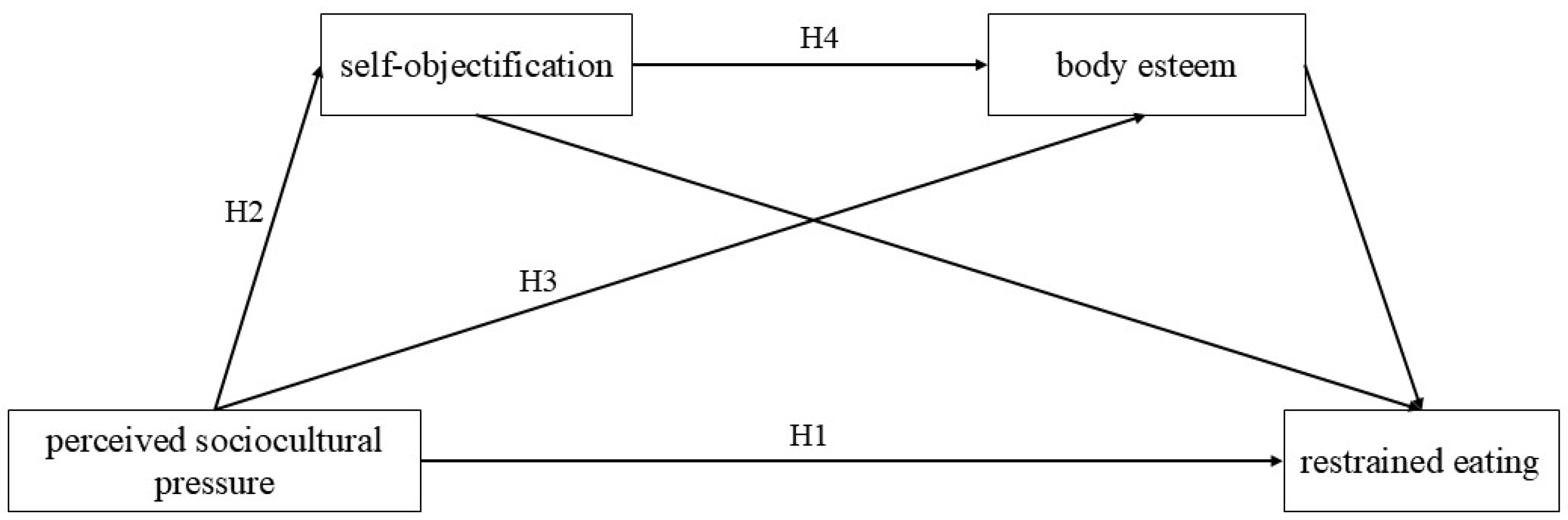
This study further distinguishes distinct dimensions of sociocultural pressure correlated with restrained eating and identifies variables correlated with restrained eating to support the development of targeted prevention strategies and intervention programs. The hypothesized serial mediation model based on the total score of perceived sociocultural pressure is displayed in
Figure 1. Subsequent supplementary analyses will further examine the correlational effects of its four subdimensions separately.
Furthermore, abundant empirical evidence reveals prominent gender disparities in body image responses to sociocultural appearance pressure among young adults [
62,
63]. Females tend to internalize thin ideals from social media more readily and experience higher levels of self-objectification, while males are shaped by unique masculine appearance norms. Accordingly, we carry out exploratory multi-group serial mediation analyses to test gender heterogeneity in subsequent statistical tests.
We adopted a serial multiple mediator model rather than a parallel multiple mediator model based on integrated theoretical considerations. The Tripartite Influence Model defines external multi-source sociocultural triggers including media, friends, and family appearance pressure, whereas Objectification Theory explains the internal cognitive progression from external appearance monitoring to subjective physical self-evaluation. This integrated external–internal pathway is consistent with the biopsychosocial framework of body image proposed by Rodgers et al. [
64], which jointly justifies the sequential order of self-objectification and body-esteem as serial mediators rather than parallel mediators. The Tripartite Influence Model and Objectification Theory jointly suggest a sequential associative process in which sociocultural pressure correlates with elevated appearance monitoring (self-objectification), which is further associated with lower body-esteem, and ultimately links to restrained eating. This theorized sequential ordering (sociocultural pressure → self-objectification → body-esteem → restrained eating) aligns conceptually with a serial mediation specification. Although we acknowledge that alternative variable orderings and competing models are statistically plausible, our primary model was determined by this theoretical framework rather than data-driven model selection.
Research Hypotheses
H1: Perceived sociocultural pressure is positively correlated with restrained eating.
H2: Self-objectification acts as a statistical mediator between sociocultural pressure and restrained eating.
H3: Body-esteem acts as a statistical mediator between sociocultural pressure and restrained eating.
H4: Self-objectification and body-esteem sequentially serve as serial statistical mediators linking perceived sociocultural pressure to restrained eating.
4. Discussion
The primary aim of this study was to examine the correlational pathway linking perceived sociocultural pressure to restrained eating, as well as the serial mediating roles of self-objectification and body-esteem within this pathway. The current results verified that elevated perceived sociocultural appearance pressure correlates with higher levels of restrained eating among Chinese college students, which is consistent with previous empirical evidence [
31]. Within the prevailing thin-ideal aesthetic culture, external sociocultural pressure drives individuals to pursue slim body standards intensely [
74], and weight-loss-related perceived pressure has been widely proven to associate positively with restrained eating behaviors [
75]. Moreover, the results showed that perceived sociocultural pressure, whether from family, friends, generalized others, or the media, was associated with restrained eating. This indicates that restrained eating may stem from multiple reasons [
76].
Sociocultural pressure from the family may exert a pervasive and cumulative influence on restrained eating through subtle yet persistent mechanisms embedded in daily life experiences. According to social learning theory [
77], eating behaviors can also be learned through observation and imitation. The pursuit of “thinness” (e.g., dieting, weight commentary) by family members (especially parents) becomes an object of observation for children, leading to imitation of restrained eating [
78]. In addition, social norm theory [
79] can explain the influence of friends and other people’s pressures to be thin on restrained eating. This theory holds that individuals tend to adjust their behaviors to conform to perceived norms within their social groups. When a friend group regards “thinness” as the ideal body type and openly promotes it, individuals will follow this norm by adopting restrictive diets (such as dieting and calorie counting) to avoid being excluded or to gain social acceptance. Crandall [
80] found that restrained eating among female undergraduates exhibits obvious social contagion and interpersonal weight criticism substantially increases individual dieting frequency. From the media perspective, social comparison theory illustrates that mass media constantly broadcasts idealized thin body images of celebrities and models, which readily induces upward appearance comparison among audiences [
81,
82]. This exposure triggers upward social comparisons, which are particularly detrimental when individuals internalize perceived discrepancies between their own bodies and these narrowly defined media standards, and can further lead to restrained eating [
83].
This study focused on the impact of sociocultural pressure from different perspectives, combining social learning theory, social norms theory, and social comparison theory to further identify the potential mechanisms between perceived sociocultural pressure and restrained eating. Consistent with a previous study [
2], this study also demonstrated that self-objectification is a mediating variable for perceived sociocultural pressure and restrained eating. Rooted in Objectification Theory, self-objectification is recognized as a critical psychological risk factor for disordered eating and restrained eating [
42,
43,
84]. Chronic outward appearance monitoring induced by self-objectification easily triggers body shame and excessive appearance evaluation; compared with individuals with low self-objectification, those scoring higher are more likely to engage in restrained eating to improve physical appearance and attractiveness [
85,
86,
87]. Notably, these dominant appearance standards are largely disseminated by media and reinforced by family and peer feedback [
88], which jointly constitute key antecedents of self-objectification.
This study also verified the independent mediating role of body-esteem in the association between sociocultural pressure and restrained eating. Consistent with the core viewpoint of the Tripartite Influence Model [
30,
89], sociocultural appearance norms are core predictors of body-related self-evaluation. Adolescents experiencing heightened body dissatisfaction are prone to restrictive dieting to alleviate negative body perceptions [
90,
91]. It is necessary to clarify that although body-esteem is closely related to body dissatisfaction and both reflect physical self-evaluation [
69], body-esteem specifically represents positive subjective satisfaction toward one’s physique rather than negative dissatisfaction [
56], which aligns with our definition of body-esteem in the Introduction section and effectively avoids conceptual confusion. The negative correlation between sociocultural pressure and body-esteem, as well as the negative association between body-esteem and restrained eating, fully supports Hypothesis 3. Practically, enhancing positive body-esteem can serve as a promising intervention target to relieve restrained eating risks among young adults.
Most existing studies based on Objectification Theory only test the single mediating role of self-objectification or separately discuss body-esteem as an outcome variable. The present study innovatively constructs a complete serial chain, sociocultural pressure → self-objectification → body-esteem → restrained eating, which clarifies the sequential statistical associative order of two core body image variables, rather than treating them as parallel influencing factors. This result can partly explain inconsistent conclusions in the previous literature: some scholars reported weak direct effects of self-objectification on restrained eating, because body-esteem acts as an indispensable intermediate buffer variable that cannot be omitted from the pathway.
Furthermore, most Western studies under the Tripartite Influence Model focus heavily on media and peer pressure, while this research confirms that family pressure has equally strong predictive effects in Chinese college student samples. The collectivistic cultural background of China makes family aesthetic values exert more lasting implicit influence on youth body cognition compared with Western individualistic contexts, which reflects the localized adaptation of the Tripartite Influence Model in Eastern cultural settings. Combined with the biopsychosocial framework proposed [
92], this research supplements environmental social factors and internal cognitive processes in the Chinese youth population, expanding the external applicability of the classic body image theoretical system.
Most importantly, self-objectification and body-esteem were confirmed to function as sequential serial mediators in the target pathway, echoing the correlation between the two psychological constructs reported in existing research [
60]. From a theoretical perspective, this serial chain enriches the application scope of Objectification Theory within Chinese youth samples, demonstrating that body-esteem acts as a vital protective buffer between self-objectification and restrained eating. Body-esteem is a core positive dimension of body image, consisting of positive affective attitudes toward one’s own physical features, which is conceptually distinct from body dissatisfaction [
93,
94]. As proposed by Objectification Theory [
42], persistent self-objectification focuses attention exclusively on outward appearance evaluation, which tends to reduce positive body-esteem and aggravate body dissatisfaction simultaneously. The complete external-to-internal sequential path constructed in this study perfectly matches the biopsychosocial framework of body image proposed by Rodgers et al. [
92], which systematically integrates environmental sociocultural factors and internal cognitive-emotional processes and further validates the rationality of our serial mediation model design instead of a parallel mediation structure.
Beyond full-sample findings, exploratory multi-group analyses clearly identified significant gender heterogeneity across the hypothesized pathway, which aligns with the gender disparity characteristics of body image and appearance pressure summarized in recent empirical research by Nerini et al. [
62,
63]. Specifically, female college students reported significantly higher levels of perceived sociocultural pressure, self-objectification, and restrained eating, accompanied by lower body-esteem, relative to male participants. The correlation patterns also presented prominent gender differences: the associations between self-objectification and body-esteem/restrained eating were statistically significant only in the female subgroup. Serial mediation results demonstrated that the complete sequential pathway (perceived sociocultural pressure → self-objectification → body-esteem → restrained eating) held significant exclusively for females. For males, only the indirect path mediated by body-esteem remained effective, while the self-objectification-linked chain failed to reach significance. Moderated mediation analysis further confirmed that gender significantly moderated the direct path from sociocultural pressure to restrained eating and the indirect pathway via body-esteem. Although body-esteem acted as a reliable protective mediator for both genders, its buffering effect was markedly stronger among females, whereas the indirect effect of self-objectification showed no meaningful gender difference.
The gendered pattern can be reasonably interpreted based on Objectification Theory: women in Chinese society face far more frequent external appearance scrutiny from daily social environments, which readily induces trait self-objectification; sustained appearance monitoring sequentially erodes positive body-esteem and ultimately correlates with increased restrained eating behaviors. In contrast, mainstream social norms impose far less appearance evaluation pressure on men, which explains why the self-objectification-mediated pathway becomes non-significant for the male subgroup. Nevertheless, body-esteem maintains stable protective effects across both genders, which is highly consistent with our overall full-sample mediation results. Consistent with the research conclusions of Nerini et al. [
62], males are mainly affected by internal physical competence evaluation rather than outward appearance objectification, which fundamentally leads to gender divergence in the psychological mechanism of restrained eating. In line with Objectification Theory, Chinese young women endure more pervasive societal appearance evaluation, which easily triggers self-objectification and sequentially damages body-esteem to promote restrained eating. In contrast, males are less affected by appearance-related social norms, resulting in a non-functional self-objectification pathway. Still, body-esteem acts as a consistent protective mediator across genders, consistent with our main full-sample results.
Notably, these gender analyses are post hoc exploratory supplements.
Given the cross-sectional design, causal conclusions cannot be confirmed, and future research with balanced gender samples may further verify these gender-specific mechanisms.
5. Implications and Limitations
At the theoretical level, the present study yields two key advancements. First, this study clarifies the direct association between multi-source perceived sociocultural pressure and restrained eating among Chinese college students, expanding the applicability of the acceptance model of restrained eating to Eastern young adult samples. Second, this study validates the serial mediating pathway of self-objectification and body-esteem, which realizes the organic integration of the Tripartite Influence Model and Objectification Theory. Combined with the biopsychosocial body image framework proposed by Rodgers et al. [
92], this research clarifies the external–internal sequential mechanism from environmental appearance pressure to maladaptive eating behaviors and clarifies the sequential rather than parallel predictive effect of self-objectification and body-esteem, supplementing empirical evidence for body image mechanism research in Chinese collectivist cultural contexts.
On a practical level, current findings provide hierarchical, gender-differentiated targeted intervention strategies to mitigate college students’ restrained eating behaviors. Universally, body-esteem acts as a stable protective factor against restrained eating [
27], so enhancing positive body-esteem should be regarded as a core intervention target. Specifically, body function identification therapy can be adopted to guide young adults to focus on physical functionality rather than superficial appearance, which effectively lowers self-objectification levels [
95] and further alleviates restrained eating tendencies [
96]. Beyond body-esteem cultivation, targeted coping strategies toward sociocultural appearance pressure are indispensable. Psychological interventions can help college students rebuild positive self-talk and appearance acceptance mechanisms, replace negative body-related criticism, break the restriction–gluttony vicious cycle, and reduce the risk of clinical eating pathology [
97]. Additionally, improving critical media literacy helps individuals deconstruct internalized thin-ideal norms; relevant stakeholders can advocate body-diverse media content and reduce the dissemination of ultra-thin aesthetic images to weaken the adverse effects of sociocultural beauty standards.
Moreover, verified gender heterogeneity enables precise gender-specific intervention design. For female college students who are vulnerable to external appearance evaluation, intervention programs should prioritize reducing appearance self-monitoring and self-objectification, alongside systematic body-esteem education. For male college students, the self-objectification-related pathway is non-significant, so intervention plans can focus on improving overall physical competence evaluation instead of appearance-oriented aesthetic guidance. Furthermore, joint efforts from multiple environments are required: families are suggested to reduce inappropriate weight-related comments, peer communities advocate diversified body aesthetics, and university mental health courses integrate positive body image education to prevent unhealthy restrained eating on campus.
This study has some limitations. First, the cross-sectional designs prevents us from confirming the temporal sequence and causal directions among variables. Although we tested the theoretically proposed serial mediation pathway from perceived sociocultural pressure to restrained eating, alternative model specifications including reverse causal paths are statistically plausible. Longitudinal multi-wave data are needed in future studies to verify the directional relationships and compare competing models. Second, our sample only covers full-time Chinese college students aged 18–24, restricting the generalization of conclusions to adolescents, working adults, or non-Asian populations. Subsequent research can expand sampling ranges to test whether the serial mediation and gender moderation effects remain stable across age groups and cultural backgrounds. Third, this study only examined gender as a moderator; future work can further explore potential moderators such as body mass index, self-compassion, and family socioeconomic status to build a more comprehensive moderated mechanism model. Fourth, the measurement of perceived sociocultural pressure in this study focused only on the pressure to be thin and could not fully represent sociocultural pressure. Future research should focus on the influence of different aspects of sociocultural pressure (e.g., social desirability, social adaptiveness, and thin-ideal internalization) on restrained eating to further expand the prevention and intervention of restrained eating. Meanwhile, all data relied on self-report questionnaires, which may bring response bias. Future research could combine objective behavioral indicators to collect more robust evidence.