


Abstract
Background: Data on the nutritional adequacy of unsupplemented vegetarians in Northeast China are limited. Methods: We compared dietary intake, body composition, and serum biomarkers among vegans, lacto-ovo-vegetarians, and omnivores. This cross-sectional study included 356 adults (all diet ≥ 2 years, no supplements). Dietary intake was assessed using a validated semi-quantitative FFQ, body composition by BIA, and serum biomarkers. Kruskal–Wallis tests with Bonferroni correction were used. Results: Vegans had lower BMI (22.0 vs. 24.6 kg/m2), body fat (24.5% vs. 28.0%), and visceral fat (0.65 vs. 1.05 L) than omnivores (all p < 0.002). Vegans consumed more fiber (38.5 vs. 18.0 g/d) and vitamin C (180 vs. 85 mg/d), but less vitamin B12 (0.3 vs. 4.2 μg/d), vitamin D (0.5 vs. 3.2 μg/d), calcium (520 vs. 720 mg/d), iodine (65 vs. 130 μg/d), and selenium (45 vs. 85 μg/d). Serum vitamin B12, 25-(OH)D, ferritin, and selenium were significantly lower in vegans, while homocysteine was higher. The proportion of vegans with dietary intake below the recommendation reached 100% for vitamin B12 and 97% for vitamin D, whereas omnivores showed excessive sodium (75%) and SFA (70%) intake. Conclusions: In this Northeast China cohort, unsupplemented vegetarian diets offered favorable macronutrient profiles and body composition but were associated with a high prevalence of dietary intakes below recommendations for vitamin B12, vitamin D, iodine, selenium, zinc, and calcium. These findings underscore the need for targeted supplementation and food fortification strategies for individuals adhering to plant-based diets without supplement use in this region.
1. Introduction
Shifting away from animal-based foods toward plant-predominant eating patterns has gained global momentum, spurred by health considerations, ethical objections to animal farming, and concerns over the environmental toll of high meat production [1,2].
Within China, the proportion of adults identifying as vegetarian has climbed rapidly, especially among younger, city-dwelling, and university-educated groups [3,4,5,6]. In line with this trend, the Chinese government has promoted plant-forward dietary patterns through the updated Dietary Guidelines for Chinese Residents (2022), emphasizing increased consumption of legumes, vegetables, fruits, and whole grains [7].
Numerous large-scale cohort studies have linked well-designed vegetarian and vegan regimens to reduced risks of obesity, type 2 diabetes, hypertension, ischemic heart disease, and certain cancers [8,9,10]. These protective associations are generally credited to lower consumption of saturated fat and cholesterol, coupled with higher intakes of dietary fiber, unsaturated fats, antioxidant vitamins (C and E), folate, magnesium, and various phytochemicals [11,12]. At the same time, concerns persist about whether such diets—particularly when no supplements are used—can provide all essential micronutrients. Animal products are either the sole or primary sources of several nutrients; therefore, unsupplemented plant-based eating may lead to suboptimal status of vitamin B12, vitamin D, calcium, iron, zinc, iodine, selenium, and long-chain n-3 fatty acids [13,14,15,16].
The northeastern region of China has its own distinctive food culture characterized by high consumption of red meat, pickled vegetables, fermented soy products, and high-temperature cooking with vegetable oils [17,18]. Winters here are long and harsh, with very limited sunlight, which virtually halts endogenous vitamin D synthesis for several months. In addition, the soils in this area are naturally poor in iodine and selenium [19,20]. Against this background, surprisingly little is known about the nutritional status of vegetarians living in Northeast China. Most available studies have been conducted on Buddhist vegetarian communities in Taiwan or Shanghai [21,22,23], who differ substantially from Northeast populations in diet and lifestyle. Moreover, a recent cross-sectional study from Russia reported similar patterns of nutrient inadequacy among vegans and vegetarians, but no such data exist for Northeast China [24]. Therefore, the present study was designed to compare dietary intake, body composition, and serum biomarkers across three groups—vegans, lacto-ovo-vegetarians, and omnivores—in this under-studied region and to offer practical evidence-based suggestions for optimizing plant-based eating.
2. Methods
2.1. Study Design and Participants
This cross-sectional study was conducted from March 2023 to December 2025 in Northeast China. Participants were recruited via social media postings, university bulletin boards, and community health center announcements. Inclusion criteria: age 18–55 years; adherence to a vegan, lacto-ovo-vegetarian, or omnivorous diet for ≥2 years; self-reported good health without chronic diseases; no use of any dietary supplements for the past 6 months (a deliberate design choice to assess diet-alone adequacy); non-pregnant or lactating; and BMI 18.5–30.0 kg/m2. We excluded current smokers, heavy drinkers, persons taking medications that affect nutrient metabolism, those with acute infections, and individuals with known malabsorption syndromes.
Sample size calculation was based on detecting a difference of 140 pmol/L in serum vitamin B12 (assuming a standard deviation of 95 pmol/L) with 80% power and a two-sided α = 0.05. To account for three-group comparisons, a Bonferroni-corrected α = 0.017 was applied, yielding a minimum of 66 participants per group. This calculation guided the recruitment target for the primary outcome (serum vitamin B12). However, this power calculation was specific to the primary outcome; secondary outcomes (e.g., phase angle, serum zinc, micronutrient intake comparisons) may not be adequately powered for small effect sizes and should, therefore, be interpreted as exploratory.
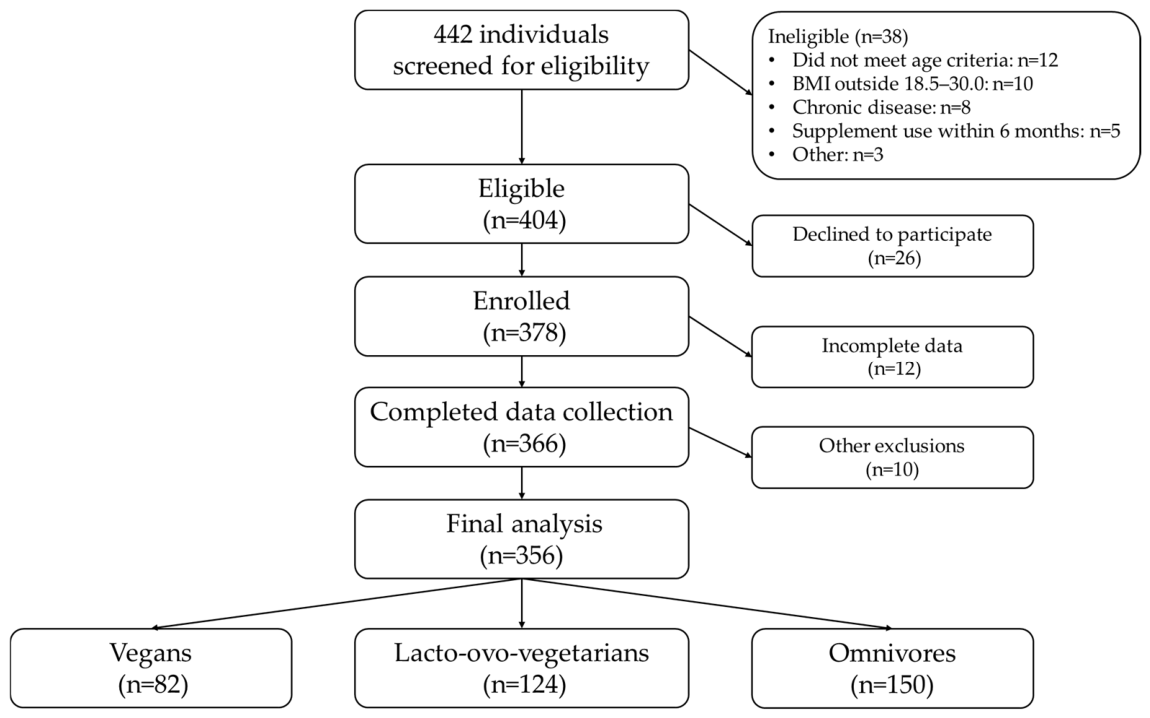
Figure 1 presents the STROBE (Strengthening the Reporting of Observational Studies in Epidemiology) flow diagram for participant recruitment and exclusion. After screening 442 individuals, 86 were excluded for the following reasons: 38 did not meet inclusion criteria, 26 declined to participate, 12 had incomplete data, and 10 were excluded for other reasons (e.g., change in dietary pattern during the study period, missing blood samples). The remaining 356 met the criteria and were enrolled: 82 vegans (35 men, 47 women), 124 lacto-ovo-vegetarians (54 men, 70 women), and 150 omnivores (70 men, 80 women). Although group sizes were unequal (82/124/150), all groups exceeded the minimum required sample size of 66 participants per group. The study protocol received approval from the Ethics Committee of Qiqihar University (No. QU-2023-037, date of approval: 20 January 2023) and adhered to the principles of the Declaration of Helsinki. The study is reported in accordance with the STROBE guidelines for cross-sectional studies.
Figure 1.
STROBE flow diagram of participant recruitment and exclusion.
2.2. Dietary Assessment
Usual food intake over the year before enrollment was evaluated with a semi-quantitative food frequency questionnaire (SQFFQ) previously validated for vegetarians and omnivores in Northeast China [25]. The SQFFQ included 159 food items aggregated into 22 food groups. For each item, participants reported frequency (from “never” to “≥4 times/day”) and portion size using standard household measures and food photographs. Nutrient calculations used the Chinese Food Composition Tables [26] and were adjusted for total energy intake using the residual method. Validation against three 24 h recalls showed Spearman correlation coefficients of 0.48–0.82, indicating acceptable validity; reproducibility was also satisfactory.
2.3. Anthropometric and Body Composition Measurements
Height was measured to the nearest 0.1 cm using a wall-mounted stadiometer (SECA 216, SECA GmbH & Co. KG, Hamburg, Germany) and weight to 0.1 kg on a digital scale (SECA 874, SECA GmbH & Co. KG, Hamburg, Germany). BMI was calculated as weight (kg)/height2 (m2). Waist circumference was measured at the midpoint between the lowest rib margin and the iliac crest. Body composition was assessed by multi-frequency bioelectrical impedance analysis (SECA mBCA 515, SECA GmbH & Co. KG, Hamburg, Germany), providing fat mass (FM), fat-free mass (FFM), body fat percentage (BF%), visceral adipose tissue (VAT), and phase angle (PhA).
2.4. Biochemical Analyses
Fasting venous blood was collected after a 12 h overnight fast. Blood draws occurred across all seasons; the distribution of draw months did not differ significantly among groups (autumn/winter draws: vegans 48%, lacto-ovo-vegetarians 45%, omnivores 50%, p = 0.34). Serum lipids, glucose, insulin, high-sensitivity C-reactive protein (hs-CRP), and liver and kidney function markers were measured using an automatic analyzer (AU5800, Beckman Coulter, Inc., Brea, CA, USA). Nutritional biomarkers were assayed as follows: serum vitamin B12 by chemiluminescent immunoassay; folate and 25-(OH) D by electrochemiluminescence; ferritin and homocysteine by enzymatic methods; and selenium, zinc, and copper by inductively coupled plasma mass spectrometry (ICP-MS; 8800 Triple Quadrupole, Agilent Technologies, Santa Clara, CA, USA).
2.5. Statistical Analysis
Statistical analyses were performed using SPSS 29.0 (IBM Corp., Armonk, NY, USA). Because most continuous variables were non-normally distributed, data were presented as medians with interquartile ranges (IQR). Three-group comparisons employed Kruskal–Wallis H tests. For pairwise comparisons, generalized linear models (GLM) adjusted for age, sex, BMI, physical activity (MET-h/week), and total energy intake (for nutrients) were used, with Bonferroni correction for multiple comparisons (adjusted p < 0.017 considered significant). The Padj values reported in all tables were derived from these GLM models. Dunn’s tests were used for unadjusted exploratory analyses only. Given the large number of outcomes tested (~40 variables), the potential for Type I error was acknowledged. Findings with marginal significance (e.g., phase angle Padj = 0.041; serum zinc p = 0.008) should be interpreted as exploratory. False discovery rate (FDR)-adjusted q-values for all primary comparisons are provided in Supplementary Table S1. The proportion of participants with intake below the recommendation was calculated using Chinese Dietary Reference Intakes (2022) [7]. For nutrients with a Recommended Nutrient Intake (RNI), the proportion with intake <75% of RNI was reported. For nutrients with an Adequate Intake (AI) but no RNI (calcium, iodine), the proportion with intake below the AI was reported. These figures represent the proportion with dietary intake below the recommendation, not the formal prevalence of inadequacy (which would require the EAR cut-point method using multiple days of dietary data). All comparisons across groups were performed using logistic regression adjusted for age, sex, and BMI. Spearman correlations assessed associations between dietary intakes and serum biomarkers; all correlations are exploratory and have not been adjusted for multiple comparisons. All tests were two-sided with p < 0.05 indicating statistical significance.
3. Results
3.1. Participants’ Characteristics
Table 1 summarizes participants’ characteristics. Age (median 34–39 years), sex distribution, education, occupation, and physical activity did not differ significantly among groups (Poveral > 0.05). BMI differed significantly across groups (Poverall < 0.001). Median duration of veganism was 4.5 years for vegans and 5.0 years for lacto-ovo-vegetarians.
Table 1.
Baseline characteristics of participants (median, IQR or n (%)).
3.2. Body Composition
Body composition parameters are shown in Table 2. Vegans had significantly lower body weight, BMI, waist circumference, fat mass, body fat percentage, and visceral adipose tissue than omnivores (all Padj < 0.003). Lacto-ovo-vegetarians also had significantly lower values than omnivores for most parameters. Fat-free mass did not differ significantly among groups. Phase angle was significantly lower in vegans (5.12°) than in omnivores (5.43°, Padj = 0.041).
Table 2.
Body composition parameters (median, IQR).
3.3. Macronutrients and Energy Intake
Table 3 shows energy and macronutrient intakes. Total energy intake did not differ between groups. Vegans had significantly lower protein intake as a percentage of energy (%E) (12.6%E vs. omnivores 15.3%E, Padj < 0.001) but all groups met the Chinese recommendation (10–15%E). Fat intake (%E) was lowest in vegans (29.7%) and highest in omnivores (36.5%, Padj = 0.002). Saturated fatty acid intake was dramatically lower in vegans (11.9 g/d) than in omnivores (25.2 g/d, Padj < 0.001), while polyunsaturated fatty acid intake was higher in vegans (18.7 vs. 12.2 g/d, Padj < 0.001). The estimated omega-6/omega-3 ratio was significantly higher in vegans (16.3, IQR: 12.4–22.1) than in omnivores (8.3, IQR: 6.3–11.5, Padj < 0.001). Dietary fiber intake was much higher in vegans (39.6 g/d) than in omnivores (17.0 g/d, Padj < 0.001), far exceeding the Chinese recommendation.
Table 3.
Daily energy and macronutrient intakes (median, IQR).
3.4. Micronutrient Intake
Table 4 shows daily micronutrient intakes. Vegans had significantly higher intakes of fiber, vitamin C, vitamin E, folate, magnesium, potassium, and copper than omnivores (all Padj < 0.001), but significantly lower intakes of vitamin B12 (0.3 vs. 4.5 μg/d), vitamin D (0.5 vs. 3.6 μg/d), calcium (513 vs. 737 mg/d), zinc (8.5 vs. 11.5 mg/d), iodine (65 vs. 130 μg/d), and selenium (46 vs. 87 μg/d) (all Padj < 0.001). Lacto-ovo-vegetarians had intermediate values.
Table 4.
Daily micronutrient intakes (median, IQR).
3.5. Proportion of Participants with Dietary Intake Below Recommendations
Table 5 shows the proportion of participants with intakes below the Chinese recommendations. Vegans had 100% inadequacy for vitamin B12, 97% for vitamin D, 87% for iodine, 70% for selenium, 85% for calcium, and 67% for zinc. Omnivores showed a higher prevalence of excess sodium (75%) and saturated fat (70%). Iron deficiency did not differ among groups (p = 0.325), but serum ferritin was significantly lower in vegans (see Section 3.6).
Table 5.
Proportion of participants with dietary intake below recommendations by dietary group (%).
3.6. Serum Biomarkers
Serum biomarkers are presented in Table 6. Vegans had significantly lower serum vitamin B12 (186 pmol/L) than omnivores (336 pmol/L, Padj < 0.001) and higher homocysteine (14.3 vs. 10.1 μmol/L, Padj < 0.001). Serum 25-(OH) D was lowest in vegans (36 nmol/L) and highest in omnivores (63 nmol/L, Padj < 0.001). Serum ferritin was significantly lower in vegans (33 μg/L) than in omnivores (86 μg/L, Padj < 0.001), despite vegans having the highest dietary iron intake. Serum selenium and zinc were also significantly lower in vegans. Lipid profiles were most favorable in vegans: total cholesterol (3.7 vs. 4.8 mmol/L), LDL-C (2.2 vs. 3.0 mmol/L), and triglycerides (0.75 vs. 1.20 mmol/L) were lower, while HDL-C was higher (1.58 vs. 1.36 mmol/L) (all Padj < 0.01). hs-CRP did not differ significantly.
Table 6.
Serum biomarkers (median, IQR).
3.7. Correlations Between Dietary Intake and Serum Biomarkers
Spearman correlations (Table 7) showed strong positive correlations between dietary and serum vitamin B12 (r = 0.65) and selenium (r = 0.53). Dietary vitamin B12 was inversely correlated with homocysteine (r = −0.47). Dietary vitamin D was moderately correlated with 25(OH)D (r = 0.48). Dietary iron was not correlated with ferritin (r = 0.07, p = 0.142), illustrating the bioavailability issue. Fiber intake was weakly inversely correlated with hs-CRP (r = −0.25, p = 0.003).
Table 7.
Spearman correlation coefficients between dietary intake and serum biomarkers.
4. Discussion
This cross-sectional study provided a comprehensive assessment of the nutritional status of unsupplemented vegans, lacto-ovo-vegetarians, and omnivores in Northeast China.
4.1. Body Composition and Cardiovascular Benefits
The vegans and, to a lesser extent, lacto-ovo-vegetarians had substantially more favorable body composition and cardiovascular risk profiles than omnivores, with lower BMI, body fat, visceral fat, total and LDL cholesterol, triglycerides, and higher HDL cholesterol. These results align with large Western cohorts [8,9] and extend them to the distinct dietary and environmental context of Northeast China. These differences remained significant after adjustment for age, sex, and physical activity, supporting a genuine dietary effect. The magnitude of difference in BMI (2.7 kg/m2) and LDL-C (0.8 mmol/L) was clinically meaningful; in previous cohort studies and randomized trials, an LDL-C reduction of this magnitude has been associated with an estimated 15–20% reduction in cardiovascular risk [27,28], suggesting that the observed differences between vegans and omnivores in our study were clinically meaningful. The phase angle data (5.12° in vegans vs. 5.43° in omnivores, p = 0.041) suggested subtle differences in cellular integrity. However, both values fall within the normal range for healthy adults (5–7°), and the absolute difference is small (0.31°). This difference may partly reflect intergroup differences in body composition—particularly lower fat mass in vegans—rather than a direct indication of clinically meaningful cellular damage. Moreover, this comparison was secondary and exploratory; after FDR correction for multiple comparisons, the q-value for this finding was 0.115, which does not reach the conventional FDR significance threshold (q < 0.05); therefore, this finding should be interpreted with caution and requires confirmation in future studies with larger sample sizes.
4.2. Macronutrient and Fiber Adequacy
Despite common public concerns about protein inadequacy in plant-based diets, vegan protein intake (12.6%E) met the Chinese RNI (10–15%E) [7]; however, the quality and amino acid profile of plant proteins deserve attention [29,30]. The main protein sources in the vegan diet included soy products (tofu, soy milk, tempeh), seitan, legumes (lentils, chickpeas), nuts, and whole grains. Soy protein is of high quality with a digestible indispensable amino acid score (DIAAS) comparable to animal proteins, while other plant proteins may be limited in lysine or methionine; complementary protein strategies can address these limitations (Supplementary Table S2). Fiber intake in vegans (39.6 g/d) far exceeded national recommendations (25–35 g/d) [7], which might protect against colorectal cancer, cardiovascular disease, and type 2 diabetes [31,32]. The low SFA and high PUFA intake in vegans was commendable. However, the estimated omega-6/omega-3 ratio was significantly higher in vegans (16.3) than in omnivores (8.3). A high omega-6/omega-3 ratio has been associated with increased pro-inflammatory states and may be a marker of elevated cardiovascular risk. This ratio warrants attention in dietary guidance for vegans, who may benefit from increased intake of alpha-linolenic acid-rich sources such as flaxseed, chia seeds, and walnuts.
4.3. Critical Micronutrient Deficiencies
While the cardiovascular advantages of plant-based diets are well recognized, our data reveal strikingly high rates of micronutrient inadequacy, especially among vegans. Importantly, these deficits are not simply a consequence of avoiding animal products; they are exacerbated by local environmental and behavioral factors specific to Northeast China. Furthermore, because the supplement users were excluded, the high figures (e.g., 100% for B12, 97% for vitamin D) reflect the diet-alone scenario and should not be extrapolated to all vegans, many of whom use supplements in practice. Vitamin B12 inadequacy was virtually universal among vegans (100%) and very high among lacto-ovo-vegetarians (79%), accompanied by low serum vitamin B12 and elevated homocysteine. In China, plant-based milks are rarely fortified with vitamin B12, and mandatory fortification of staples was absent [33,34]; therefore, supplementation was the only practical solution. Vitamin D inadequacy was also extremely common, especially in vegans (97%), due to the high latitude where cutaneous synthesis was impossible in winter and the lack of mandatory vitamin D fortification in China [35,36]. Unlike many Western countries, China has no mandatory vitamin D fortification of dairy or plant-based milks. Consequently, all residents—regardless of diet—are at risk, but vegans are most severely affected. Iodine and selenium deficiencies were particularly prominent in this study. Iodine and selenium are naturally low in the soils of Northeast China. In our study, 87% of vegans had inadequate iodine intake and 70% had inadequate selenium intake. Vegans often reduce iodized salt use (replacing it with “natural” sea salt) and do not consume selenium-rich animal products (fish, organ meats). Iodine and selenium deficiencies can impair thyroid function, especially when both are low [37,38]. However, the urinary iodine was not measured; these iodine findings are based on SQFFQ estimates and should be interpreted with particular caution. A daily supplementation of 150 μg of iodine and 50–100 μg of selenium is, therefore, reasonable for vegans living in this region. Calcium inadequacy (85%) and zinc inadequacy (67%) were also major concerns for vegans in this region. Furthermore, the bioavailability of plant-derived calcium and zinc was inhibited by phytate and oxalate, necessitating the selection of low-oxalate calcium sources (such as calcium-set tofu, bok choy) and the use of soaking, sprouting, or fermentation to reduce phytate content. Consistent with the lower dietary zinc intake, serum zinc was also significantly lower in vegans compared to omnivores (Padj = 0.008). However, after FDR correction for multiple comparisons, the q-value was 0.062, which was above the conventional FDR significance threshold (q < 0.05); thus, this finding should be considered exploratory and interpreted with caution. Vegans had the highest dietary iron intake (18.6 mg/d) and yet the lowest serum ferritin (33 µg/L); a classic demonstration of poor non-heme iron bioavailability due to phytate and polyphenols, despite ample vitamin C [39,40]. In this study, the absence of a correlation between dietary iron and ferritin (r = 0.07, p = 0.142) confirmed that iron status in vegetarians could not be assessed from intake alone; ferritin measurement was essential. It was recommended to consume iron-rich foods together with vitamin C and to use traditional fermentation (e.g., in tofu, tempeh) to improve iron absorption. Nearly two-thirds of omnivores had sodium intake exceeding the UL (2300 mg/d), and 70% exceeded the SFA recommendation (<10%E). This reflected the typical Northeast Chinese diet: rich in processed meat products, pickled vegetables, fried foods, and cooking oils [4,41,42]. These factors contribute to hypertension and cardiovascular disease. Our findings were consistent with national data showing high sodium and fat intakes in northern Chinese populations.
4.4. Comparison with Other Studies
Compared with Western vegetarian studies [43], our participants had lower vitamin B12 and iodine intakes, likely due to less fortification and lower use of iodized salt, but higher fiber and vitamin C intakes, reflecting the traditional northeast diet rich in vegetables and fermented soy products [18]. Compared with Taiwanese Buddhist vegetarians [21], our participants had poorer calcium and vitamin D status, consistent with lower dairy consumption and less sun exposure. Our results closely parallel those of Galchenko et al. (2025) [24], who examined vegans, lacto-ovo-vegetarians, and omnivores in Moscow. Both studies found that vegans had superior lipid profiles and lower body weight but severe deficiencies in vitamin B12, vitamin D, and selenium. However, important differences exist: our participants had lower vitamin D status (median 36 vs. ~50 nmol/L), likely due to Northeast China’s higher latitude (though Moscow is further north, its winter sun exposure is similarly limited; the difference may arise from lifestyle factors). Moreover, our vegan group had higher fiber intake (39.6 vs. ~36 g/d) but lower calcium intake (513 vs. ~776 mg/d), reflecting lower dairy consumption and fewer calcium-fortified foods in China. These comparisons highlight the importance of regional dietary and policy contexts in shaping nutritional outcomes.
5. Strengths and Limitations
The main strengths of this study include the following: (1) This was a comprehensive evaluation of unsupplemented vegans, lacto-ovo-vegetarians, and omnivores in Northeast China, combining validated SQFFQ, BIA, and multiple biomarkers. (2) Exclusion of supplement users allowed for the evaluation of dietary adequacy without confounding variables. (3) We rigorously adjusted for multiple confounders and multiple comparisons.
Limitations: (1) The cross-sectional design precluded causal inference. (2) Despite validation of the SQFFQ, recall bias might still exist. (3) Urinary iodine, the gold standard indicator of iodine status, was not measured. (4) Convenience/volunteer sampling likely recruited a more health-conscious population, which may limit generalizability.
6. Conclusions
In this Northeast China cohort, unsupplemented vegetarian and vegan diets were associated with favorable macronutrient profiles, body composition, and cardiovascular biomarkers. However, high proportions of participants—especially vegans—had dietary intakes below recommendations for vitamin B12 (100% of vegans), vitamin D (97%), iodine (87%), selenium (70%), zinc (67%), and calcium (85%). These figures reflect the diet-alone scenario among unsupplemented individuals and should not be extrapolated to all vegans, many of whom use supplements in practice. These coexisting benefits and risks indicated that plant-based diets could not be simplistically labeled as “completely healthy.” Responsible practice required targeted supplementation (vitamin B12 25–100 μg/d, vitamin D 15–25 μg/d in winter, iodine 150 μg/d, selenium 50–100 μg/d) and informed food choices. Public health policies should update dietary guidelines and promote food fortification to support the growing number of plant-based dieters and prevent subclinical micronutrient deficiencies.
Supplementary Materials
The following supporting information can be downloaded at: https://www.mdpi.com/article/10.3390/nu18132109/s1, Table S1: FDR-adjusted q-values for primary comparisons; Table S2: Major food sources of key nutrients based on the SQFFQ.
Author Contributions
Data curation, X.L.; Investigation, X.L. and A.L.; Methodology, X.L., A.L. and M.A.; Formal analysis, M.A. and H.W. (Hongyan Wu); Visualization, H.W. (Hongyan Wu) and H.W. (Huan Wang); Writing—original draft, X.L.; Writing—review and editing, C.S.; Project administration, C.S.; Funding acquisition, C.S. All authors have read and agreed to the published version of the manuscript.
Funding
This research was funded by the Key Scientific and Technological Projects in Advantageous and Characteristic Disciplines of Plant-based Food Processing Technology in Heilongjiang Province (grant number YSTSXK202407) and the Basic Scientific Research Funding Program for Provincial Universities in Heilongjiang Province (grant number 145309212).
Institutional Review Board Statement
The study was conducted in accordance with the Declaration of Helsinki and approved by the Ethics Committee of Qiqihar University (No. QU-2023-045, date of approval: 20 January 2023).
Informed Consent Statement
All subjects signed written informed consent before participating in this study.
Data Availability Statement
The data presented in this study are available on request from the corresponding author.
Acknowledgments
We sincerely thank all participants for their participation in the study and all authors for their contributions to the manuscript.
Conflicts of Interest
The authors declared no conflicts of interest.
References
- Walter, W.; Johan, R.; Brent, L.; Marco, S.; Tim, L.; Sonja, V.; Tara, G.; David, T.; Fabrice, D.; Amanda, W.; et al. Food in the anthropocene: The EAT–lancet commission on healthy diets from sustainable food systems. Lancet Comm. 2019, 393, 447–492. [Google Scholar] [CrossRef] [Scilit]
- Dinu, M.; Abbate, R.; Gensini, G.F.; Casini, A.; Sofi, F. Vegetarian, vegan diets and multiple health outcomes: A systematic review with meta-analysis of observational studies. Crit. Rev. Food. Sci. Nutr. 2017, 57, 3640–3649. [Google Scholar] [CrossRef] [Scilit] [PubMed]
- Lei, Q. Dietary Nutritional Status of 282 Vegetarians in Shanghai and Correlation Between Vegetarian Diet and Obesity Related Metabolic Indicators; Shanghai Jiao Tong University: Shanghai, China, 2020. [Google Scholar]
- Zhang, J.; Guo, Z.; Xue, Z.; Sun, Z.; Zhang, M.; Wang, L.; Wang, G.; Wang, F.; Xu, J.; Cao, H.; et al. A phylo-functional core of gut microbiota in healthy young Chinese cohorts across lifestyles, geography and ethnicities. ISME J. Multidiscip. J. Microb. Ecol. 2015, 9, 1979–1990. [Google Scholar] [CrossRef] [Scilit]
- Huang, Y.; Jigeer, G.; Lv, Y.; Wang, K.; Ma, X.; Zou, J.; Xia, R.; Shen, X.; Shi, X.; Li, Y.; et al. Association between vegetarian diet and risk of frailty in Chinese older adults: A prospective study. BMC Med. 2025, 23, 352. [Google Scholar] [CrossRef] [Scilit] [PubMed]
- Li, Y.; Ma, Y.; Zhao, Q.; Zhao, M.; Zhang, Y.; Wu, Q.; Ning, S. Weight loss dietary knowledge, attitudes, and practices among different body weight groups in Northeast China. Sci. Rep. 2025, 15, 18562. [Google Scholar] [CrossRef] [Scilit] [PubMed]
- Chinese Nutrition Society. Dietary Guidelines for Chinese Residents (2022); People’s Medical Publishing House: Beijing, China, 2022. [Google Scholar]
- Tonstad, S.; Butler, T.; Yan, R.; Fraser, G.E. Type of vegetarian diet, body weight, and prevalence of type 2 diabetes. Diabetes Care 2009, 32, 791–796. [Google Scholar] [CrossRef] [Scilit] [PubMed]
- Appleby, P.N.; Key, T.J. The long-term health of vegetarians and vegans. Proc. Nutr. Soc. 2016, 75, 287–293. [Google Scholar] [PubMed]
- Honoria, O.; Giacomo, B.; Davide, R.; Federica, N.; Maria Vittoria, C.; Giulia, L.; Dario, G. Association of Vegetarian and Vegan Diets with Cardiovascular Health: An Umbrella Review of Meta-Analysis of Observational Studies and Randomized Trials. Nutrients 2023, 15, 4103. [Google Scholar] [CrossRef] [Scilit]
- Turner-Mcgrievy, G.; Mandes, T.; Crimarco, A. A plant-based diet for overweight and obesity prevention and treatment. J. Geriatr. Cardiol. 2017, 14, 369–374. [Google Scholar] [CrossRef] [Scilit] [PubMed]
- Ivanova, S.; Delattre, C.; Karcheva-Bahchevanska, D.; Benbasat, N.; Nalbantova, V.; Ivanov, K. Plant-based diet as a strategy for weight control. Foods 2021, 10, 3052. [Google Scholar] [CrossRef] [Scilit] [PubMed]
- Bakaloudi, D.R.; Halloran, A.; Rippin, H.L.; Oikonomidou, A.C.; Dardavesis, T.I.; Williams, J.; Wickramasinghe, K.; Breda, J.; Chourdakis, M. Intake and adequacy of the vegan diet: A systematic review of the evidence. Clin. Nutr. 2020, 40, 3503–3521. [Google Scholar] [PubMed]
- Anna Liisa, E.; Georg, A.; Iris, E.; Hanna, K.; Annukka, P.; Irma, S.; Ursula, T.; Sari, V.; Juha, L. Food and nutrient intake and nutritional status of finnish vegans and non-vegetarians. PLoS ONE 2016, 11, e0151296. [Google Scholar] [CrossRef] [Scilit]
- Klein, L.; Dawczynski, C.; Schwarz, M.; Maares, M.; Kipp, K.; Haase, H.; Kipp, A.P. Selenium, Zinc, and Copper Status of Vegetarians and Vegans in Comparison to Omnivores in the Nutritional Evaluation (NuEva) Study. Nutrients 2023, 15, 3538. [Google Scholar] [CrossRef] [Scilit] [PubMed]
- Christine, D.; Thomas, W.; Cora, R.; Peter, S.; Kristin, D.; Michael, K. Nutrient Intake and Nutrition Status in Vegetarians and Vegans in Comparison to Omnivores—The Nutritional Evaluation (NuEva) Study. Front. Nutr. 2022, 9, 819106. [Google Scholar]
- Zhou, C.; Li, M.; Liu, L.; Zhao, F.; Cong, W.; Zhang, F. Food consumption and dietary patterns of local adults living on the Tibetan Plateau: Results from 14 Countries along the Yarlung Tsangpo River. Nutrients 2021, 13, 2444. [Google Scholar] [CrossRef] [Scilit] [PubMed]
- Sun, C.; Li, A.; Xu, C.; Ma, J.; Wang, H.; Jiang, Z.; Hou, J. Comparative analysis of fecal microbiota in vegetarians and omnivores. Nutrients 2023, 15, 2358. [Google Scholar] [CrossRef] [Scilit] [PubMed]
- Pobilat, A.E.; Voloshin, E.I. Monitoring of iodine in the soil-plant system (review). Environ. Sci. Agric. Food Sci. 2020, 10, 101–108. [Google Scholar]
- Eveleigh, E.R.; Coneyworth, L.; Welham, S.J.M. Systematic review and meta-analysis of iodine nutrition in modern vegan and vegetarian diets. Br. J. Nutr. 2023, 130, 1580–1594. [Google Scholar] [CrossRef] [Scilit] [PubMed]
- Shen, Y.-C.; Chang, C.-E.; Lin, M.-N.; Lin, C.-L. Vegetarian diet Is associated with lower risk of depression in Taiwan. Nutrients 2021, 13, 1059. [Google Scholar] [CrossRef] [Scilit] [PubMed]
- Chiu, T.H.; Huang, H.Y.; Chen, K.J.; Wu, Y.R.; Chiu, J.P.; Li, Y.H.; Chiu, B.C.; Lin, C.L.; Lin, M.N. Relative validity and reproducibility of a quantitative FFQ for assessing nutrient intakes of vegetarians in Taiwan. Public Health Nutr. 2014, 17, 1459–1466. [Google Scholar] [PubMed]
- Hung, C.-J.; Huang, P.-C.; Lu, S.-C.; Li, Y.-H.; Huang, H.-B.; Lin, B.-F.; Chang, S.-J.; Chou, H.-F. Plasma homocysteine levels in Taiwanese vegetarians are higher than those of omnivores. J. Nutr. 2002, 132, 152–158. [Google Scholar] [CrossRef] [Scilit] [PubMed]
- Alexey Vladimirovich, G.; Gianluca, R.; Luciana, B. Nutrient intakes in vegans, lacto-ovo-vegetarians, orthodox fasters, and omnivores in Russia: A cross-sectional study. Foods 2025, 14, 1062. [Google Scholar] [CrossRef] [Scilit]
- Sun, C.; Wang, Q.; Xu, C.; Wang, W.; Ma, J.; Gu, L.; Liu, Z.; Hou, J.; Jiang, Z. Reproducibility and validity of a semi-quantitative food frequency questionnaire for assessing dietary intake of vegetarians and omnivores in Harbin, China. Nutrients 2022, 14, 3975. [Google Scholar] [CrossRef] [Scilit] [PubMed]
- Yang, Y. Chinese Food Composition Table, 6th ed.; Peking University Medical Press: Beijing, China, 2025. [Google Scholar]
- Wang, F.; Zheng, J.; Yang, B.; Jiang, J.; Fu, Y.; Li, D. Effects of vegetarian diets on blood lipids: A systematic review and meta-analysis of randomized controlled trials. J. Am. Heart Assoc. 2015, 4, e002408. [Google Scholar] [PubMed]
- Koch, C.A.; Kjeldsen, E.W.; Frikke-Schmidt, R. Vegetarian or vegan diets and blood lipids: A meta-analysis of randomized trials. Eur. Heart J. 2023, 44, 2609–2622. [Google Scholar] [CrossRef] [Scilit] [PubMed]
- Mariotti, F.; Gardner, C.D. Dietary protein and amino acids in vegetarian diets—A review. Nutrients 2019, 11, 2661. [Google Scholar] [CrossRef] [Scilit] [PubMed]
- Soh, B.X.P.; Smith, N.W.; von Hurst, P.R.; McNabb, W.C. Achieving High Protein Quality Is a Challenge in Vegan Diets: A Narrative Review. Nutr. Rev. 2024, 83, e2063–e2081. [Google Scholar] [CrossRef] [Scilit]
- Soliman, G.A. Dietary fiber, atherosclerosis, and cardiovascular disease. Nutrients 2019, 11, 1155. [Google Scholar] [CrossRef] [Scilit] [PubMed]
- Barber, T.M.; Kabisch, S.; Pfeiffer, A.F.H.; Weickert, M.O. The health benefits of dietary fibre. Nutrients 2020, 12, 3209. [Google Scholar] [CrossRef] [Scilit] [PubMed]
- Rizzo, G.; Laganà, A.S.; Rapisarda, A.M.C.; La Ferrera, G.M.G.; Buscema, M.; Rossetti, P.; Nigro, A.; Muscia, V.; Valenti, G.; Sapia, F.; et al. Vitamin B12 among vegetarians: Status, assessment and supplementation. Nutrients 2016, 8, 767. [Google Scholar] [CrossRef] [Scilit] [PubMed]
- Niklewicz, A.; Hannibal, L.; Warren, M.; Ahmadi, K.R. A systematic review and meta-analysis of functional vitamin B12 status among adult vegans. Nutr. Bull. 2024, 49, 463–479. [Google Scholar] [PubMed]
- Matthias, W.; Holick, M.F. Sunlight and vitamin D: A global perspective for health. Dermato-Endocrinology 2013, 5, 51–108. [Google Scholar]
- Yan, X.; Thomson, J.S.; Zhao, R.; Zhu, R.; Wang, Z.; Zhang, N.; Coad, J. Vitamin D Status of Residents in Taiyuan, China and Influencing Factors. Nutrients 2017, 9, 898. [Google Scholar] [CrossRef] [Scilit] [PubMed]
- Tea, D.; Sandra Karanović, Š. Iodine in health and disease: A comprehensive review. Nutrients 2026, 18, 1262. [Google Scholar] [CrossRef] [Scilit]
- Bath, S.C. Iodine deficiency in the UK—Should we take it with a pinch of salt? Proc. Nutr. Soc. 2026, 1–8. [Google Scholar] [CrossRef] [Scilit] [PubMed]
- Hunt, J.R. Bioavailability of iron, zinc, and other trace minerals from vegetarian diets. Am. J. Clin. Nutr. 2003, 78, 633–639. [Google Scholar] [CrossRef] [Scilit]
- Kose, T.; de Bie, T.; Wang, R.; Eilander, A.; Wanders, A.J.; Sharp, P.A. The effect of fortification on in vitro iron and zinc bioavailability in plant-based meat alternatives. J. Food Compos. Anal. 2025, 146, 107951. [Google Scholar] [CrossRef] [Scilit]
- Ma, Z.; Hao, X.; Wang, D.; Wang, X.; Sun, Y.; Li, H. Evolution and distribution of dietary patterns in China and the research progress of its correlation with health. Sci. Technol. Food Ind. 2023, 44, 396–405. [Google Scholar]
- Qiu, M.; Fang, Y.; Lian, Y.; He, Y. Distribution of regional dietary pattern in adults Chinese residents. Food Nutr. China 2023, 29, 62–66. [Google Scholar]
- Eveleigh, E.R.; Coneyworth, L.J.; Avery, A.; Welham, S.J.M. Vegans, vegetarians, and omnivores: How does dietary choice influence iodine intake? A systematic review. Nutrients 2020, 12, 1606. [Google Scholar] [CrossRef] [Scilit] [PubMed]

Disclaimer/Publisher’s Note: The statements, opinions and data contained in all publications are solely those of the individual author(s) and contributor(s) and not of MDPI and/or the editor(s). MDPI and/or the editor(s) disclaim responsibility for any injury to people or property resulting from any ideas, methods, instructions or products referred to in the content. |
© 2026 by the authors. Licensee MDPI, Basel, Switzerland. This article is an open access article distributed under the terms and conditions of the Creative Commons Attribution (CC BY) license.