This is an early access version, the complete PDF, HTML, and XML versions will be available soon.
Article

Green Tea Consumption and Risk of All-Cause Mortality: Findings from a Prospective Cohort Study

1
Institute of Research and Development, Duy Tan University, Da Nang 550000, Vietnam
2
Department of Clinical Research, Vinmec Healthcare System, Hanoi 100000, Vietnam
3
University of Pittsburgh Medical Center Hillman Cancer Center, Pittsburgh, PA 15232, USA
4
Dr. Mary and Ron Neal Cancer Center, Houston Methodist Research Institute, Houston, TX 77030, USA
5
Department of Cardiovascular Diseases, Hanoi Medical University, Hanoi 100000, Vietnam
6
Laboratory of Embryology and Genetics of Human Malformation, Imagine Institute, INSERM UMR (National Institute of Health and Medical Research, Mixed Research Unit), 75015 Paris, France
7
Department of Occupational Health, Institute for Preventive Medicine and Public Health, Hanoi Medical University, Hanoi 100000, Vietnam
8
General Daycare Inpatient Department, Hanoi Oncology Hospital, Hanoi 100000, Vietnam
9
Department of Epidemiology and Preventive Medicine, Graduate School of Medical and Dental Science, Kagoshima University, Kagoshima 890-8544, Japan
10
Department of Computer Science, Wayne State University, Detroit, MI 48202, USA
11
Department of Industrial and Systems Engineering, Wayne State University, Detroit, MI 48202, USA
12
Karmanos Cancer Institute, Wayne State University, Detroit, MI 48201, USA
13
VinUni Big Data Research Institute, VinUniversity, Hanoi 100000, Vietnam
14
LSU-LCMC Health Cancer Center, Louisiana State University Health Sciences Center, New Orleans, LA 70112, USA
15
Department of Population and Quantitative Health Sciences, Case Western Reserve University School of Medicine, Cleveland, OH 44106, USA
16
Department of Medicine, Weill Cornell Medicine, Cornell University, New York, NY 10065, USA
*
Authors to whom correspondence should be addressed.
These authors contributed equally to this work as the co-lead authors.
These authors contributed equally to this work as the senior authors.
Nutrients 2026, 18(12), 1937; https://doi.org/10.3390/nu18121937 (registering DOI)
Submission received: 31 March 2026 / Revised: 7 June 2026 / Accepted: 11 June 2026 / Published: 15 June 2026
(This article belongs to the Section Nutritional Epidemiology)

Abstract

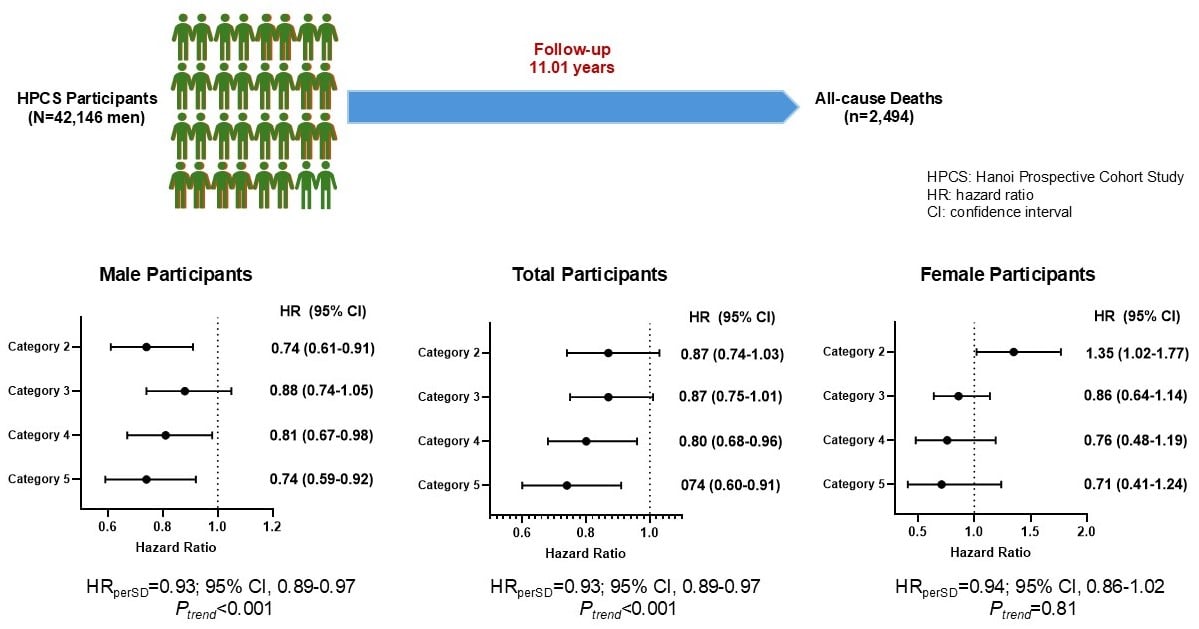
Background/Objectives: There has been a growing concern about excessive caffeine consumption among heavy green tea drinkers on health outcomes, such as cardiovascular diseases or cancer. We evaluated the association between green tea consumption and risk of all-cause mortality in Vietnam. Methods: We used data from the Hanoi Prospective Cohort Study, an ongoing study comprising 42,146 participants aged 10 or older in Northern Vietnam who have been followed up between 2007 and 2019. Green tea intake was derived from a validated semi-quantitative food frequency questionnaire. We performed a Cox proportional hazard regression model to calculate the hazard ratio (HR) and respective 95% confidence intervals (95% CIs) for the association between green tea consumption and risk of all-cause mortality, adjusted for potential confounding factor. Results: After a median follow-up of 11 years (range: 0.13–11.64 years), we identified 2494 deaths. Overall, there was an inverse association between green tea intake and risk of all-cause mortality (HRperSDincrement = 0.93; 95% CI, 0.89–0.97, Ptrend < 0.001). This pattern was more pronounced in males (HRperSDincrement = 0.93; 95% CI, 0.89–0.97, Ptrend < 0.001) but not in females (HRperSDincrement = 0.94; 95% CI, 0.86–1.02, Ptrend = 0.12; Pheterogeneity = 0.81). In stratified analysis, the inverse association pattern was seen in both younger and old age groups, in individuals with BMI < 23 kg/m2, in both ever and never smokers, among ever alcohol drinkers and never coffee drinkers, and in individuals with and without history of type 2 diabetes (Pheterogeneity = 0.31). Conclusions: Findings from the current study, the first prospective cohort study in Vietnam, suggest a protective effect of green tea consumption on risk of all-cause mortality. Further studies are warranted to validate our findings in similar population and settings.
Keywords: green tea; risk; all-cause mortality; prospective cohort study; Vietnam green tea; risk; all-cause mortality; prospective cohort study; Vietnam
Graphical Abstract