Designing a Food Frequency Questionnaire for a Vegetarian Population in Germany by Means of Mixed-Integer Linear Programming


Abstract
1. Introduction
- To develop an optimization framework for FFQs by means of MILP, applied to a vegetarian population in Germany.
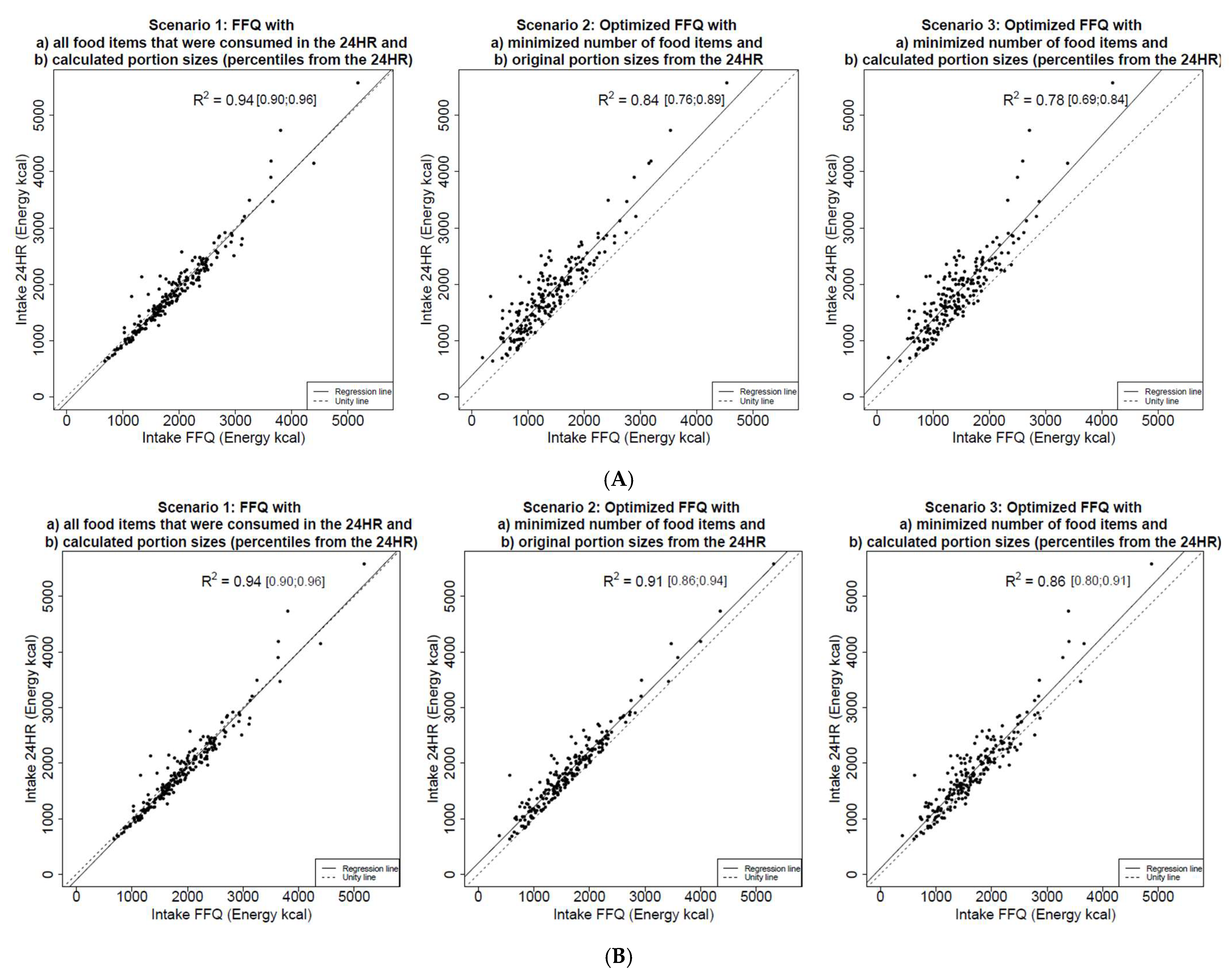
- To calculate portion sizes for the optimized FFQs and to estimate dietary intake based on three different scenarios for FFQs:
- FFQ with
- (a)
- All food items that were consumed in the 24HR.
- (b)
- Calculated portion sizes (percentiles from the 24HR).
- Optimized FFQ with
- (a)
- Minimized number of food items.
- (b)
- Original portion sizes from the 24HR.
- Optimized FFQ with
- (a)
- Minimized number of food items.
- (b)
- Calculated portion sizes (percentiles from the 24HR).
- To compare R2 from the three different scenarios for FFQs.
2. Materials and Methods
2.1. Study Population
2.2. Dietary Assessment
2.3. Optimization with MILP
| ∈ {0,1} and ∈ {0,1} n = specific food item at aggregation level 1 m = specific food item at aggregation level 2 for n ∈ {1, …, N} for aggregation level 1 with N = 123 and m ∈ {1, …, M} for aggregation level 2 with M = 421 is a binary decision variable indicating whether food item n is in the food list = 1, food item n is included, if = 0, food item n is not included is a binary decision variable indicating whether food item m is in the food list = 1, food item m is included, if = 0, food item m is not included | |
⋮ ⋮ | for j ∈ {1, …, 41} j = specific nutrient = percentual contribution of food item n to the overall intake of nutrient j = percentual contribution of food item m to the overall intake of nutrient j intake of nutrient j from food item n over all individuals i = 1, …, 288 intake of nutrient j from food item m over all individuals i = 1, …, 288 = arbitrary threshold, where b ∈ [0,1] with b ∈ {0.80, 0.85, 0.90, 0.95} in this study |
⋮ ⋮ | = percentual contribution of food item n to the sum of variances of the overall intake of nutrient j = percentual contribution of food item m to the sum of variances of the overall intake of nutrient j for i ∈ {1, …, I} i = individuals with I = 288 total number of individuals intake of nutrient j from food item n by person i intake of nutrient j from food item m by person i |
| ∀n∈ {1, …, N}, ∀m ∈ G(n) | G(n) = set of food items at lower aggregation level corresponding to n |
2.4. Performance Evaluation
- Effect of categorizing food quantities
- FFQ with
- (a)
- All food items that were consumed in the 24HR.
- (b)
- Calculated portion sizes (percentiles from the 24HR).
- 2.
- Effect of selecting food items
- Optimized FFQ with
- (a)
- Minimized number of food items.
- (b)
- Original portion sizes from the 24HR.
- 3.
- Effect of selecting food items and categorizing food quantities
- Optimized FFQ with
- (a)
- Minimized number of food items.
- (b)
- Calculated portion sizes (percentiles from the 24HR).
3. Results
3.1. Optimization
3.2. Calculation of Nutrient Intakes and R2 for FFQs
4. Discussion
4.1. Data
4.2. Number of Food Items
4.3. Aggregation of Food Items
4.4. Portion Sizes
5. Conclusions
Author Contributions
Funding
Institutional Review Board Statement
Informed Consent Statement
Data Availability Statement
Conflicts of Interest
Abbreviations
| FFQ | Food Frequency Questionnaire |
| 24HR | 24 h recall |
| MILP | Mixed-Integer Linear Programming |
| NVS II | Second German National Nutrition Survey |
Appendix A

| Nutrients |
|---|
| Energy (kcal) |
| Carbohydrates |
| Protein |
| Fat |
| SFA |
| MUFA |
| PUFA |
| n6 PUFA |
| n3 PUFA |
| Cholesterol |
| Starch |
| Total sugars |
| Glucose |
| Galactose |
| Fructose |
| Sucrose |
| Maltose |
| Lactose |
| Fibre |
| Alcohol |
| Sodium |
| Potassium |
| Calcium |
| Magnesium |
| Phosphorus |
| Iron |
| Zinc |
| Iodine |
| Retinol equivalent |
| Carotene |
| Thiamin |
| Niacin equivalent |
| Pantothenate |
| Riboflavin |
| Folate |
| Vitamin B6 |
| Vitamin B12 |
| Biotin |
| Vitamin C |
| Vitamin D |
| Vitamin E |
| Nutrients | Scenario 1: FFQ with
| Scenario 2: Optimized FFQ with
| Scenario 3: Optimized FFQ with
|
|---|---|---|---|
| Energy (kcal) | 0.94 [0.90;0.96] | 0.84 [0.76;0.89] | 0.78 [0.69;0.84] |
| Carbohydrates | 0.91 [0.86;0.94] | 0.80 [0.73;0.87] | 0.72 [0.63;0.80] |
| Protein | 0.96 [0.93;0.97] | 0.82 [0.74;0.89] | 0.79 [0.69;0.86] |
| Fat | 0.96 [0.94;0.97] | 0.85 [0.77;0.90] | 0.81 [0.74;0.87] |
| SFA | 0.96 [0.94;0.97] | 0.84 [0.76;0.89] | 0.81 [0.73;0.87] |
| MUFA | 0.95 [0.93;0.97] | 0.87 [0.79;0.92] | 0.82 [0.74;0.87] |
| PUFA | 0.95 [0.93;0.97] | 0.86 [0.78;0.91] | 0.82 [0.72;0.89] |
| n6 PUFA | 0.95 [0.92;0.97] | 0.86 [0.77;0.91] | 0.81 [0.72;0.88] |
| n3 PUFA | 0.98 [0.96;0.99] | 0.88 [0.62;0.96] | 0.86 [0.55;0.96] |
| Cholesterol | 0.97 [0.95;0.98] | 0.92 [0.87;0.95] | 0.88 [0.83;0.92] |
| Starch | 0.93 [0.91;0.95] | 0.78 [0.70;0.85] | 0.72 [0.63;0.80] |
| Total sugars | 0.90 [0.83;0.95] | 0.80 [0.69;0.89] | 0.71 [0.61;0.81] |
| Glucose | 0.91 [0.86;0.97] | 0.77 [0.65;0.88] | 0.69 [0.59;0.78] |
| Galactose | 0.96 [0.95;0.98] | 0.79 [0.61;0.92] | 0.76 [0.58;0.89] |
| Fructose | 0.91 [0.85;0.96] | 0.90 [0.84;0.94] | 0.81 [0.74;0.87] |
| Sucrose | 0.90 [0.84;0.95] | 0.78 [0.61;0.89] | 0.70 [0.56;0.82] |
| Maltose | 0.96 [0.93;0.98] | 0.98 [0.95;0.99] | 0.93 [0.88;0.96] |
| Lactose | 0.95 [0.92;0.98] | 0.91 [0.87;0.94] | 0.85 [0.81;0.90] |
| Fibre | 0.95 [0.92;0.98] | 0.91 [0.87;0.94] | 0.87 [0.83;0.91] |
| Alcohol | 0.91 [0.87;0.97] | 0.76 [0.51;0.88] | 0.60 [0.38;0.70] |
| Sodium | 0.94 [0.92;0.97] | 0.89 [0.81;0.93] | 0.84 [0.76;0.90] |
| Potassium | 0.90 [0.84;0.95] | 0.91 [0.87;0.94] | 0.81 [0.75;0.88] |
| Calcium | 0.93 [0.91;0.95] | 0.77 [0.64;0.82] | 0.70 [0.60;0.79] |
| Magnesium | 0.92 [0.88;0.95] | 0.88 [0.82;0.92] | 0.83 [0.75;0.89] |
| Phosphorus | 0.96 [0.94;0.97] | 0.87 [0.80;0.91] | 0.84 [0.77;0.89] |
| Iron | 0.95 [0.93;0.97] | 0.82 [0.72;0.90] | 0.79 [0.67;0.88] |
| Zinc | 0.95 [0.92;0.97] | 0.78 [0.70;0.85] | 0.76 [0.67;0.83] |
| Iodine | 0.96 [0.92;0.98] | 0.79 [0.62;0.89] | 0.77 [0.61;0.87] |
| Retinol equivalent | 0.93 [0.91;0.97] | 0.97 [0.92;0.99] | 0.90 [0.85;0.93] |
| Carotene | 0.93 [0.91;0.97] | 0.98 [0.93;0.99] | 0.90 [0.85;0.94] |
| Thiamin | 0.96 [0.93;0.98] | 0.95 [0.90;0.97] | 0.91 [0.84;0.95] |
| Niacin equivalent | 0.94 [0.92;0.96] | 0.85 [0.78;0.91] | 0.80 [0.72;0.88] |
| Pantothenate | 0.87 [0.73;0.97] | 0.92 [0.86;0.95] | 0.80 [0.66;0.90] |
| Riboflavin | 0.95 [0.93;0.97] | 0.89 [0.82;0.93] | 0.85 [0.78;0.90] |
| Folate | 0.95 [0.93;0.97] | 0.87 [0.82;0.92] | 0.83 [0.76;0.89] |
| Vitamin B6 | 0.94 [0.88;0.97] | 0.95 [0.91;0.97] | 0.89 [0.81;0.94] |
| Vitamin B12 | 0.97 [0.96;0.99] | 0.73 [0.59;0.84] | 0.69 [0.54;0.81] |
| Biotin | 0.96 [0.91;0.98] | 0.97 [0.93;0.99] | 0.94 [0.87;0.97] |
| Vitamin C | 0.89 [0.79;0.97] | 0.93 [0.87;0.96] | 0.81 [0.72;0.90] |
| Vitamin D | 0.98 [0.97;0.99] | 0.87 [0.67;0.94] | 0.82 [0.64;0.91] |
| Vitamin E | 0.92 [0.84;0.96] | 0.87 [0.79;0.93] | 0.80 [0.71;0.88] |
References
- Bundesministerium für Ernährung und Landwirtschaft. Ernährungsreport 2023: Deutschland, wie es isst.; Bundesministerium für Ernährung und Landwirtschaft: Berlin, Germany, 2023; Available online: https://www.bmel.de/DE/themen/ernaehrung/ernaehrungsreport2023.html (accessed on 1 February 2026).
- Blaurock, J.; Kaiser, B.; Stelzl, T.; Weech, M.; Fallaize, R.; Franco, R.Z.; Hwang, F.; Lovegrove, J.; Finglas, P.M.; Gedrich, K. Dietary Quality in Vegetarian and Omnivorous Female Students in Germany: A Retrospective Study. Int. J. Environ. Res. Public Health 2021, 18, 1888. [Google Scholar] [CrossRef]
- Cade, J.; Thompson, R.; Burley, V.; Warm, D. Development, validation and utilisation of food-frequency questionnaires—A review. Public Health Nutr. 2002, 5, 567–587. [Google Scholar] [CrossRef]
- Nanri, A.; Fujiwara, A.; Miyake, H.; Kashino, I.; Mizoue, T. Development, Relative Validity, and Reproducibility of a Short Food Frequency Questionnaire for the Japanese. Nutrients 2022, 14, 4394. [Google Scholar] [CrossRef]
- Nöthlings, U.; Hoffmann, K.; Bergmann, M.M.; Boeing, H. Fitting portion sizes in a self-administered food frequency questionnaire. J. Nutr. 2007, 137, 2781–2786. [Google Scholar] [CrossRef]
- Pérez Rodrigo, C.; Aranceta, J.; Salvador, G.; Varela-Moreiras, G. Food frequency questionnaires. Nutr. Hosp. 2015, 31, 49–56. [Google Scholar] [CrossRef] [PubMed]
- McNutt, S.; Zimmerman, T.P.; Hull, S.G. Development of food composition databases for food frequency questionnaires (FFQ). J. Food Compos. Anal. 2008, 21, S20–S26. [Google Scholar] [CrossRef]
- Avital, K.; Tepper, S.; Ben-Avraham, S.; Shahar, D.R. Development and validation of the MY-VEG-FFQ: A modular web-based food-frequency questionnaire for vegetarians and vegans. PLoS ONE 2024, 19, e0299515. [Google Scholar] [CrossRef] [PubMed]
- Kwiatkowska, I.; Olszak, J.; Formanowicz, P.; Formanowicz, D. Nutritional Status and Habits among People on Vegan, Lacto/Ovo-Vegetarian, Pescatarian and Traditional Diets. Nutrients 2022, 14, 4591. [Google Scholar] [CrossRef]
- Frisch, A.; Toeller, M.; Müller-Wieland, D. Ernährungserhebungsmethoden in der Ernährungsepidemiologie. Diabetol. Und Stoffwechs. 2010, 5, 301–308. [Google Scholar] [CrossRef]
- Pennington, J.A.T.; Stumbo, P.J.; Murphy, S.P.; McNutt, S.W.; Eldridge, A.L.; McCabe-Sellers, B.J.; Chenard, C.A. Food composition data: The foundation of dietetic practice and research. J. Am. Diet. Assoc. 2007, 107, 2105–2113. [Google Scholar] [CrossRef]
- Gazan, R.; Vieux, F.; Darmon, N.; Maillot, M. Structural Validation of a French Food Frequency Questionnaire of 94 Items. Front. Nutr. 2017, 4, 62. [Google Scholar] [CrossRef]
- Gerdessen, J.C.; Souverein, O.W.; van ‘t Veer, P.; de Vries, J.H. Optimising the selection of food items for FFQs using Mixed Integer Linear Programming. Public Health Nutr. 2015, 18, 68–74. [Google Scholar] [CrossRef]
- Blaurock, J.; Heuer, T.; Gedrich, K. Optimization of a Food List for Food Frequency Questionnaires Using Mixed Integer Linear Programming: A Proof of Concept Based on Data from the Second German National Nutrition Survey. Nutrients 2023, 15, 5098. [Google Scholar] [CrossRef] [PubMed]
- Heuer, T.; Krems, C.; Moon, K.; Brombach, C.; Hoffmann, I. Food consumption of adults in Germany: Results of the German National Nutrition Survey II based on diet history interviews. Br. J. Nutr. 2015, 113, 1603–1614. [Google Scholar] [CrossRef] [PubMed]
- Crispim, S.P.; Nicolas, G.; Casagrande, C.; Knaze, V.; Illner, A.-K.; Huybrechts, I.; Slimani, N. Quality assurance of the international computerised 24 h dietary recall method (EPIC-Soft). Br. J. Nutr. 2014, 111, 506–515. [Google Scholar] [CrossRef]
- Eisinger-Watzl, M.; Straßburg, A.; Ramünke, J.; Krems, C.; Heuer, T.; Hoffmann, I. Comparison of two dietary assessment methods by food consumption: Results of the German National Nutrition Survey II. Eur. J. Nutr. 2015, 54, 343–354. [Google Scholar] [CrossRef]
- Hartmann, B.M.; Heuer, T.; Hoffmann, I. The German Nutrient Database: Effect of different versions on the calculated energy and nutrient intake of the German population. J. Food Compos. Anal. 2015, 42, 26–29. [Google Scholar] [CrossRef]
- Dehne, L.I.; Klemm, C.; Henseler, G.; Hermann-Kunz, E. The German Food Code and Nutrient Data Base (BLS II.2). Eur. J. Epidemiol. 1999, 15, 355–359. [Google Scholar] [CrossRef] [PubMed]
- Wood, M. Statistical Inference using Bootstrap Confidence Intervals. Significance 2004, 1, 180–182. [Google Scholar] [CrossRef]
- Ohtani, K. Bootstrapping R2 and adjusted R2 in regression analysis. Econ. Model. 2000, 17, 473–483. [Google Scholar] [CrossRef]
- Kurek, M.A.; Onopiuk, A.; Pogorzelska-Nowicka, E.; Szpicer, A.; Zalewska, M.; Półtorak, A. Novel Protein Sources for Applications in Meat-Alternative Products-Insight and Challenges. Foods 2022, 11, 957. [Google Scholar] [CrossRef]
- Hu, F.B. Dietary pattern analysis: A new direction in nutritional epidemiology. Curr. Opin. Lipidol. 2002, 13, 3–9. [Google Scholar] [CrossRef]
- Subar, A.F.; Midthune, D.; Kulldorff, M.; Brown, C.C.; Thompson, F.E.; Kipnis, V.; Schatzkin, A. Evaluation of alternative approaches to assign nutrient values to food groups in food frequency questionnaires. Am. J. Epidemiol. 2000, 152, 279–286. [Google Scholar] [CrossRef]
- Tabacchi, G.; Filippi, A.R.; Amodio, E.; Jemni, M.; Bianco, A.; Firenze, A.; Mammina, C. A meta-analysis of the validity of FFQ targeted to adolescents. Public Health Nutr. 2016, 19, 1168–1183. [Google Scholar] [CrossRef]
- Molag, M.L.; de Vries, J.H.M.; Duif, N.; Ocké, M.C.; Dagnelie, P.C.; Goldbohm, R.A.; van’t Veer, P. Selecting informative food items for compiling food-frequency questionnaires: Comparison of procedures. Br. J. Nutr. 2010, 104, 446–456. [Google Scholar] [CrossRef]
- Shai, I.; Shahar, D.R.; Vardi, H.; Fraser, D. Selection of food items for inclusion in a newly developed food-frequency questionnaire. Public Health Nutr. 2004, 7, 745–749. [Google Scholar] [CrossRef]
- Eussen, S.J.; van Dongen, M.C.; Wijckmans, N.E.; Meijboom, S.; am Brants, H.; de Vries, J.H.; Bueno-de-Mesquita, H.B.; Geelen, A.; Sluik, D.; Feskens, E.J.; et al. A national FFQ for the Netherlands (the FFQ-NL1.0): Development and compatibility with existing Dutch FFQs. Public Health Nutr. 2018, 21, 2221–2229. [Google Scholar] [CrossRef]
- Scott Stryker, W.; Salvini, S.; Stampfer, M.J.; Sampson, L.; Colditz, G.A.; Willett, W.C. Contributions of specific foods to absolute intake and between-person variation of nutrient consumption. J. Am. Diet. Assoc. 1991, 91, 172–178. [Google Scholar] [CrossRef]
- Thompson, F.E.; Subar, A.F.; Brown, C.C.; Smith, A.F.; Sharbaugh, C.O.; Jobe, J.B.; Mittl, B.; Gibson, J.T.; Ziegler, R.G. Cognitive research enhances accuracy of food frequency questionnaire reports: Results of an experimental validation study. J. Am. Diet. Assoc. 2002, 102, 212–225. [Google Scholar] [CrossRef] [PubMed]
- Dehne, L.I.; Klemm, C.; Henseler, G.; Bögl, K.W.; Hermann-Kunz, E. Der Bundeslebensmittelschlüssel (BLS II.2). Bundesgesundhbl 1997, 40, 203–206. [Google Scholar] [CrossRef][Green Version]
- Ross, B.H.; Murphy, G.L. Food for thought: Cross-classification and category organization in a complex real-world domain. Cogn. Psychol. 1999, 38, 495–553. [Google Scholar] [CrossRef]
- Steinemann, N.; Grize, L.; Ziesemer, K.; Kauf, P.; Probst-Hensch, N.; Brombach, C. Relative validation of a food frequency questionnaire to estimate food intake in an adult population. Food Nutr. Res. 2017, 61, 1305193. [Google Scholar] [CrossRef] [PubMed]
- Køster-Rasmussen, R.; Siersma, V.; Halldorsson, T.I.; de Fine Olivarius, N.; Henriksen, J.E.; Heitmann, B.L. Missing portion sizes in FFQ--alternatives to use of standard portions. Public Health Nutr. 2015, 18, 1914–1921. [Google Scholar] [CrossRef] [PubMed]
- Welten, D.C.; Carpenter, R.A.; McPherson, R.S.; Brodney, S.; Douglass, D.; Kampert, J.B.; Blair, S.N. Comparison of a dietary record using reported portion size versus standard portion size for assessing nutrient intake. Public Health Nutr. 2000, 3, 151–158. [Google Scholar] [CrossRef]
- Kim, M.K.; Youl Choi, B. The influence of portion size data on the agreement of classification of individuals according to nutrient estimates by food frequency questionnaire in a rural area of Korea. Nutr. Res. 2002, 22, 271–281. [Google Scholar] [CrossRef]

| b * = 0.80 | b = 0.85 | b = 0.90 | b = 0.95 | |
|---|---|---|---|---|
| Energy intake (kcal) | ||||
| Total number of food items | 44 | 50 | 60 | 76 |
| Number of food items at aggregation level 1 ** (% ***) | 41 (93.2%) | 47 (94%) | 55 (91.7%) | 67 (88.2%) |
| Number of food items at aggregation level 2 ** (% ***) | 3 (6.8%) | 3 (6%) | 5 (8.3%) | 9 (11.8%) |
| 41 nutrients | ||||
| Total number of food items | 66 | 75 | 87 | 105 |
| Number of food items at aggregation level 1 ** (% ***) | 50 (75.8%) | 59 (78.7%) | 65 (74.7%) | 79 (75.2%) |
| Number of food items at aggregation level 2 ** (% ***) | 16 (24.2%) | 16 (21.3%) | 22 (25.3%) | 26 (24.8%) |
| b * = 0.80 | b = 0.85 | b = 0.90 | b = 0.95 | |
|---|---|---|---|---|
| Energy intake (kcal) | ||||
| Total number of food items | 114 | 136 | 167 | 223 |
| 41 nutrients | ||||
| Total number of food items | 140 | 163 | 195 | 248 |
Disclaimer/Publisher’s Note: The statements, opinions and data contained in all publications are solely those of the individual author(s) and contributor(s) and not of MDPI and/or the editor(s). MDPI and/or the editor(s) disclaim responsibility for any injury to people or property resulting from any ideas, methods, instructions or products referred to in the content. |
© 2026 by the authors. Licensee MDPI, Basel, Switzerland. This article is an open access article distributed under the terms and conditions of the Creative Commons Attribution (CC BY) license.
Share and Cite
Blaurock, J.; Heuer, T.; Gedrich, K. Designing a Food Frequency Questionnaire for a Vegetarian Population in Germany by Means of Mixed-Integer Linear Programming. Nutrients 2026, 18, 1587. https://doi.org/10.3390/nu18101587
Blaurock J, Heuer T, Gedrich K. Designing a Food Frequency Questionnaire for a Vegetarian Population in Germany by Means of Mixed-Integer Linear Programming. Nutrients. 2026; 18(10):1587. https://doi.org/10.3390/nu18101587
Chicago/Turabian StyleBlaurock, Julia, Thorsten Heuer, and Kurt Gedrich. 2026. "Designing a Food Frequency Questionnaire for a Vegetarian Population in Germany by Means of Mixed-Integer Linear Programming" Nutrients 18, no. 10: 1587. https://doi.org/10.3390/nu18101587
APA StyleBlaurock, J., Heuer, T., & Gedrich, K. (2026). Designing a Food Frequency Questionnaire for a Vegetarian Population in Germany by Means of Mixed-Integer Linear Programming. Nutrients, 18(10), 1587. https://doi.org/10.3390/nu18101587