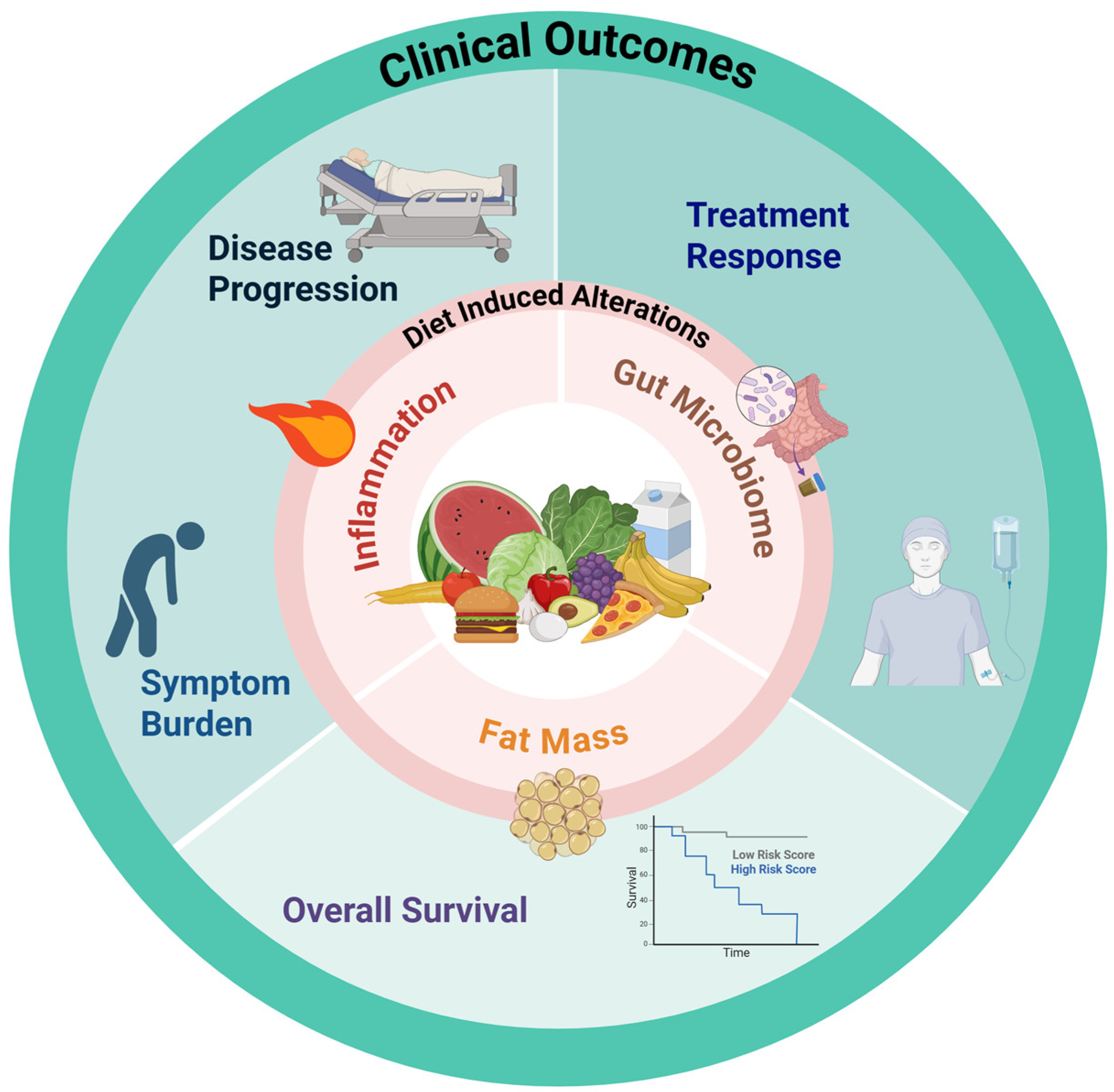
Leveraging Dietary Interventions to Benefit Patients with Hematologic Malignancies and Clonal Hematopoiesis

Abstract
1. Introduction
2. Inflammation and Hematologic Malignancies
2.1. Hematologic Malignancies Are Fueled by Inflammation
2.2. Dietary Interventions to Lessen Inflammation

| Diet | Defining Features | Approx. Macronutrient Distribution | Duration/Timing in Clinical Use | Proposed Mechanism in Heme Malignancy | Hematologic Application |
|---|---|---|---|---|---|
| Mediterranean | Extra-virgin olive oil as principal fat; ≥3 servings fruit/day; ≥2 servings vegetables/day; ≥3 servings legumes/wk; ≥3 servings fish/wk; nuts ≥ 3 servings/wk; moderate red wine; minimal red and processed meat | ~35–40% fat (mostly MUFA), ~40–50% carb, ~15–20% protein | Sustained pattern; trials typically 12–15 wk to demonstrate adherence and biomarker change | Reduces CRP, IL-6, monocyte activation; supports butyrate-producing taxa; addresses cardiovascular risk in JAK2V617F MPN and CHIP | MPN: NUTRIENT [35], virtual MPN diet study [36] |
| Whole-food plant-based | Whole grains, legumes, fruits, vegetables, nuts, seeds; minimization or exclusion of animal products, refined grains, added sugars, and oils | ~10–15% fat, ~70–75% carb (high fiber), ~10–15% protein | Sustained pattern; NUTRIVENTION used 12 wk catered meals plus 24 wk coaching | Increases fermentable fiber substrate, butyrate, microbial alpha diversity; improves insulin resistance and inflammatory monocyte subsets | MM precursors: NUTRIVENTION [37]; MM on lenalidomide: Shah 2022 [31] |
| Calorie-restricted | 15–30% reduction in total energy intake from baseline while maintaining balanced macronutrient proportions; typically combined with macronutrient restriction in oncology trials | Macronutrient ratios preserved at population norms (~30% fat, ~50% carb, ~20% protein) but at reduced absolute intake | Most often deployed during a defined treatment window (e.g., the induction phase of chemotherapy) | Lowers circulating IGF-I and insulin; raises adiponectin; may increase chemotherapy sensitivity in lymphoid disease | B-ALL: IDEAL 1 trial [38] |
| Fasting-mimicking diet | 5-day plant-based, low-protein, low-sugar regimen designed to mimic the metabolic effects of water-only fasting; refeeding between cycles | ~1100 kcal day 1, ~700 kcal days 2–5; very low protein (~9–10% of energy) and very low sugar; predominantly plant fats and complex carbohydrates | Cyclical, typically administered for 5 days every 3–4 weeks, often timed to chemotherapy cycles | Reduces IGF-I, glucose, and leptin; differentially sensitizes tumor cells to cytotoxic therapy; reshapes antitumor immunity | Solid tumor data [39]; not yet tested in completed heme malignancy trials |
| Ketogenic | Very-low-carbohydrate, high-fat regimen sufficient to induce sustained nutritional ketosis; can be lard-based or plant-based depending on fat source | ~70–80% fat, ~5–10% carb, ~15–20% protein | Used as a sustained pattern or in defined treatment windows; preclinical AML data used 3 wk dosing around FLT3 inhibition | Shifts host and tumor lipid metabolism, increases ketone bodies and PUFA 2:MUFA 3 ratio, modulates FLT3 signaling and lipid biosynthesis to enhance targeted therapy | FLT3-ITD AML preclinical [40] |
3. Dietary Interventions to Mitigate Obesity-Associated Risks Within Hematologic Malignancies
3.1. Obesity Increases Risk for the Development of Hematologic Malignancies
3.2. Mechanisms by Which Obesity Drives Hematologic Malignancies
3.3. Obesity Influences Outcomes for Patients with Hematologic Malignancies
3.4. Dietary Interventions for Obesity and Hematologic Malignancies
4. The Gut Microbiome as a Mediator of Dietary Effects in Hematologic Malignancies
4.1. Gut Dysbiosis Promotes Inflammation and Drives Clonal Hematopoiesis
4.2. Dietary Fiber, Butyrate, and Gut Barrier Function
4.3. Dietary Micronutrients with Disease-Specific Relevance
4.4. Chemotherapy and Antibiotics as Disruptors of the Gut Microbiome
4.5. Dietary Strategies to Restore and Maintain a Healthy Microbiome: Prebiotics and Probiotics
5. Completed and Ongoing Dietary Interventions in Heme Malignancies
5.1. Multiple Myeloma
5.2. Acute Lymphoblastic Leukemia
5.3. Myeloproliferative Neoplasms
6. Conclusions: Looking to the Future of Dietary Interventions in Clonal Hematologic Disorders
Author Contributions
Funding
Data Availability Statement
Conflicts of Interest
References
- Caffa, I.; Spagnolo, V.; Vernieri, C.; Valdemarin, F.; Becherini, P.; Wei, M.; Brandhorst, S.; Zucal, C.; Driehuis, E.; Ferrando, L.; et al. Fasting-mimicking diet and hormone therapy induce breast cancer regression. Nature 2020, 583, 620–624. [Google Scholar] [CrossRef]
- Maddocks, O.D.K.; Athineos, D.; Cheung, E.C.; Lee, P.; Zhang, T.; van den Broek, N.J.F.; Mackay, G.M.; Labuschagne, C.F.; Gay, D.; Kruiswijk, F.; et al. Modulating the therapeutic response of tumours to dietary serine and glycine starvation. Nature 2017, 544, 372–376. [Google Scholar] [CrossRef]
- de van der Schueren, M.A.E.; Laviano, A.; Blanchard, H.; Jourdan, M.; Arends, J.; Baracos, V.E. Systematic review and meta-analysis of the evidence for oral nutritional intervention on nutritional and clinical outcomes during chemo(radio)therapy: Current evidence and guidance for design of future trials. Ann. Oncol. 2018, 29, 1141–1153. [Google Scholar] [CrossRef]
- Mello, A.T.; Borges, D.S.; de Lima, L.P.; Pessini, J.; Kammer, P.V.; Trindade, E. Effect of oral nutritional supplements with or without nutritional counselling on mortality, treatment tolerance and quality of life in head-and-neck cancer patients receiving (chemo)radiotherapy: A systematic review and meta-analysis. Br. J. Nutr. 2021, 125, 530–547. [Google Scholar] [CrossRef]
- Dambrós, B.F.; Kobus, R.A.; da Rosa, R.; Pereira, L.J.; Hinnig, P.F.; Di Pietro, P.F.; Kunradi Vieira, F.G. The effect of oral dietary interventions on nutritional status and treatment tolerance in patients with hematologic neoplasms receiving chemotherapy: A systematic review. Nutr. Rev. 2024, 82, 1771–1783. [Google Scholar] [CrossRef]
- de Jong, M.M.E.; Chen, L.; Raaijmakers, M.; Cupedo, T. Bone marrow inflammation in haematological malignancies. Nat. Rev. Immunol. 2024, 24, 543–558. [Google Scholar] [CrossRef]
- Kanagal-Shamanna, R.; Beck, D.B.; Calvo, K.R. Clonal Hematopoiesis, Inflammation, and Hematologic Malignancy. Annu. Rev. Pathol. 2024, 19, 479–506. [Google Scholar] [CrossRef]
- Carey, A.; Edwards, D.K.; Eide, C.A.; Newell, L.; Traer, E.; Medeiros, B.C.; Pollyea, D.A.; Deininger, M.W.; Collins, R.H.; Tyner, J.W.; et al. Identification of Interleukin-1 by Functional Screening as a Key Mediator of Cellular Expansion and Disease Progression in Acute Myeloid Leukemia. Cell Rep. 2017, 18, 3204–3218. [Google Scholar] [CrossRef]
- Sanchez-Correa, B.; Bergua, J.M.; Campos, C.; Gayoso, I.; Arcos, M.J.; Bañas, H.; Morgado, S.; Casado, J.G.; Solana, R.; Tarazona, R. Cytokine profiles in acute myeloid leukemia patients at diagnosis: Survival is inversely correlated with IL-6 and directly correlated with IL-10 levels. Cytokine 2013, 61, 885–891. [Google Scholar] [CrossRef]
- Ronner, L.; Podoltsev, N.; Gotlib, J.; Heaney, M.L.; Kuykendall, A.T.; O’Connell, C.; Shammo, J.; Fleischman, A.G.; Scherber, R.M.; Mesa, R.; et al. Persistent leukocytosis in polycythemia vera is associated with disease evolution but not thrombosis. Blood 2020, 135, 1696–1703. [Google Scholar] [CrossRef]
- Fleischman, A.G.; Aichberger, K.J.; Luty, S.B.; Bumm, T.G.; Petersen, C.L.; Doratotaj, S.; Vasudevan, K.B.; LaTocha, D.H.; Yang, F.; Press, R.D.; et al. TNFα facilitates clonal expansion of JAK2V617F positive cells in myeloproliferative neoplasms. Blood 2011, 118, 6392–6398. [Google Scholar] [CrossRef]
- Jaiswal, S.; Fontanillas, P.; Flannick, J.; Manning, A.; Grauman, P.V.; Mar, B.G.; Lindsley, R.C.; Mermel, C.H.; Burtt, N.; Chavez, A.; et al. Age-related clonal hematopoiesis associated with adverse outcomes. New Engl. J. Med. 2014, 371, 2488–2498. [Google Scholar] [CrossRef]
- Lee-Six, H.; Øbro, N.F.; Shepherd, M.S.; Grossmann, S.; Dawson, K.; Belmonte, M.; Osborne, R.J.; Huntly, B.J.P.; Martincorena, I.; Anderson, E.; et al. Population dynamics of normal human blood inferred from somatic mutations. Nature 2018, 561, 473–478. [Google Scholar] [CrossRef]
- Genovese, G.; Kahler, A.K.; Handsaker, R.E.; Lindberg, J.; Rose, S.A.; Bakhoum, S.F.; Chambert, K.; Mick, E.; Neale, B.M.; Fromer, M.; et al. Clonal hematopoiesis and blood-cancer risk inferred from blood DNA sequence. New Engl. J. Med. 2014, 371, 2477–2487. [Google Scholar] [CrossRef]
- Xie, M.; Lu, C.; Wang, J.; McLellan, M.D. Age-related mutations associated with clonal hematopoietic expansion and malignancies. Nat. Med. 2014, 20, 1472–1478. [Google Scholar] [CrossRef]
- Abelson, S.; Collord, G.; Ng, S.W.K.; Weissbrod, O.; Mendelson Cohen, N.; Niemeyer, E.; Barda, N.; Zuzarte, P.C.; Heisler, L.; Sundaravadanam, Y.; et al. Prediction of acute myeloid leukaemia risk in healthy individuals. Nature 2018, 559, 400–404. [Google Scholar] [CrossRef]
- Cook, E.K.; Izukawa, T.; Young, S.; Rosen, G.; Jamali, M.; Zhang, L.; Johnson, D.; Bain, E.; Hilland, J.; Ferrone, C.K.; et al. Comorbid and inflammatory characteristics of genetic subtypes of clonal hematopoiesis. Blood Adv. 2019, 3, 2482–2486. [Google Scholar] [CrossRef]
- Bick, A.G.; Weinstock, J.S.; Nandakumar, S.K.; Fulco, C.P.; Bao, E.L.; Zekavat, S.M.; Szeto, M.D.; Liao, X.; Leventhal, M.J.; Nasser, J.; et al. Inherited causes of clonal haematopoiesis in 97,691 whole genomes. Nature 2020, 586, 763–768. [Google Scholar] [CrossRef]
- Busque, L.; Sun, M.; Buscarlet, M.; Ayachi, S.; Feroz Zada, Y.; Provost, S.; Bourgoin, V.; Mollica, L.; Meisel, M.; Hinterleitner, R.; et al. High-sensitivity C-reactive protein is associated with clonal hematopoiesis of indeterminate potential. Blood Adv. 2020, 4, 2430–2438. [Google Scholar] [CrossRef]
- Hormaechea-Agulla, D.; Matatall, K.A.; Le, D.T.; Kain, B.; Long, X.; Kus, P.; Jaksik, R.; Challen, G.A.; Kimmel, M.; King, K.Y. Chronic infection drives Dnmt3a-loss-of-function clonal hematopoiesis via IFNγ signaling. Cell Stem Cell 2021, 28, 1428–1442.e6. [Google Scholar] [CrossRef]
- Cull, A.H.; Snetsinger, B.; Buckstein, R.; Wells, R.A.; Rauh, M.J. TET2 restrains inflammatory gene expression in macrophages. Exp. Hematol. 2017, 55, 56–70.e13. [Google Scholar] [CrossRef] [PubMed]
- Fuster, J.J.; MacLauchlan, S.; Zuriaga, M.A.; Polackal, M.N.; Ostriker, A.C.; Chakraborty, R.; Wu, C.L.; Sano, S.; Muralidharan, S.; Rius, C.; et al. Clonal hematopoiesis associated with TET2 deficiency accelerates atherosclerosis development in mice. Science 2017, 355, 842–847. [Google Scholar] [CrossRef]
- Mooney, L.; Goodyear, C.S.; Chandra, T.; Kirschner, K.; Copland, M.; Petrie, M.C.; Lang, N.N. Clonal haematopoiesis of indeterminate potential: Intersections between inflammation, vascular disease and heart failure. Clin. Sci. 2021, 135, 991–1007. [Google Scholar] [CrossRef]
- Jaiswal, S.; Natarajan, P.; Silver, A.J.; Gibson, C.J.; Bick, A.G.; Shvartz, E.; McConkey, M.; Gupta, N.; Gabriel, S.; Ardissino, D.; et al. Clonal Hematopoiesis and Risk of Atherosclerotic Cardiovascular Disease. N. Engl. J. Med. 2017, 377, 111–121. [Google Scholar] [CrossRef] [PubMed]
- Dinu, M.; Pagliai, G.; Casini, A.; Sofi, F. Mediterranean Diet and Multiple Health Outcomes: An Umbrella Review of Meta-Analyses of Observational Studies and Randomised Trials. Eur. J. Clin. Nutr. 2018, 72, 30–43. [Google Scholar] [CrossRef]
- Estruch, R. Anti-inflammatory effects of the Mediterranean diet: The experience of the PREDIMED study. Proc. Nutr. Soc. 2010, 69, 333–340. [Google Scholar] [CrossRef] [PubMed]
- Estruch, R.; Ros, E.; Salas-Salvadó, J.; Covas, M.-I.; Corella, D.; Arós, F.; Gómez-Gracia, E.; Ruiz-Gutiérrez, V.; Fiol, M.; Lapetra, J.; et al. Primary Prevention of Cardiovascular Disease with a Mediterranean Diet Supplemented with Extra-Virgin Olive Oil or Nuts. New Engl. J. Med. 2018, 378, e34. [Google Scholar] [CrossRef]
- Mena, M.P.; Sacanella, E.; Vazquez-Agell, M.; Morales, M.; Fitó, M.; Escoda, R.; Serrano-Martínez, M.; Salas-Salvadó, J.; Benages, N.; Casas, R.; et al. Inhibition of circulating immune cell activation: A molecular antiinflammatory effect of the Mediterranean diet. Am. J. Clin. Nutr. 2009, 89, 248–256. [Google Scholar] [CrossRef]
- Sköldstam, L.; Hagfors, L.; Johansson, G. An experimental study of a Mediterranean diet intervention for patients with rheumatoid arthritis. Ann. Rheum. Dis. 2003, 62, 208–214. [Google Scholar] [CrossRef]
- Constantin, M.M.; Nita, I.E.; Olteanu, R.; Constantin, T.; Bucur, S.; Matei, C.; Raducan, A. Significance and impact of dietary factors on systemic lupus erythematosus pathogenesis. Exp. Ther. Med. 2019, 17, 1085–1090. [Google Scholar] [CrossRef]
- Shah, U.A.; Maclachlan, K.H.; Derkach, A.; Salcedo, M.; Barnett, K.; Caple, J.; Blaslov, J.; Tran, L.; Ciardiello, A.; Burge, M.; et al. Sustained Minimal Residual Disease Negativity in Multiple Myeloma Is Associated with Stool Butyrate and Healthier Plant-Based Diets. Clin. Cancer Res. 2022, 28, 5149–5155. [Google Scholar] [CrossRef]
- Spencer, C.N.; McQuade, J.L.; Gopalakrishnan, V.; McCulloch, J.A.; Vetizou, M.; Cogdill, A.P.; Khan, M.A.W.; Zhang, X.; White, M.G.; Peterson, C.B.; et al. Dietary fiber and probiotics influence the gut microbiome and melanoma immunotherapy response. Science 2021, 374, 1632–1640. [Google Scholar] [CrossRef]
- Benatar, J.R.; Stewart, R.A.H. The Association of Plant-Based Diet with Cardiovascular Disease and Mortality: A Meta-Analysis and Systematic Review of Prospect Cohort Studies. Front. Cardiovasc. Med. 2021, 8, 756810. [Google Scholar] [CrossRef]
- Threapleton, D.E.; Greenwood, D.C.; Evans, C.E.L.; Cleghorn, C.L.; Nykjaer, C.; Woodhead, C.; Burley, V.J. Dietary fibre intake and risk of cardiovascular disease: Systematic review and meta-analysis. BMJ 2013, 347, f6879. [Google Scholar] [CrossRef]
- Mendez Luque, L.F.; Avelar-Barragan, J.; Nguyen, H.; Nguyen, J.; Soyfer, E.M.; Liu, J.; Chen, J.H.; Mehrotra, N.; Huang, X.; Kosiorek, H.E.; et al. The NUTRIENT Trial (NUTRitional Intervention among myEloproliferative Neoplasms): Results from a Randomized Phase I Pilot Study for Feasibility and Adherence. Cancer Res. Commun. 2024, 4, 660–670. [Google Scholar] [CrossRef] [PubMed]
- Fleischman, A.; Li, J.; Tabban, A.; Cai, S.; Odegaard, A. Telehealth-Delivered Dietary Counseling in Myeloproliferative Neoplasms: A Randomized Feasibility Study. Nutrients 2026, 18, 1158. [Google Scholar] [CrossRef]
- Shah, U.A.; Cogrossi, L.L.; Garcés, J.J.; Policastro, A.; Castro, F.; Derkach, A.; Fei, T.; DeWolf, S.; Grioni, M.; Sisti, S.; et al. A High-Fiber, Plant-Based Diet in Myeloma Precursor Disorders: Results from the NUTRIVENTION Clinical Trial and Preclinical Vk*MYC Model. Cancer Discov. 2026, 16, 697–720. [Google Scholar] [CrossRef] [PubMed]
- Orgel, E.; Framson, C.; Buxton, R.; Kim, J.; Li, G.; Tucci, J.; Freyer, D.R.; Sun, W.; Oberley, M.J.; Dieli-Conwright, C.; et al. Caloric and Nutrient Restriction to Augment Chemotherapy Efficacy for Acute Lymphoblastic Leukemia: The Ideal Trial. Blood Adv. 2021, 5, 1853–1861. [Google Scholar] [CrossRef] [PubMed]
- Vernieri, C.; Fucà, G.; Ligorio, F.; Huber, V.; Vingiani, A.; Iannelli, F.; Raimondi, A.; Rinchai, D.; Frigè, G.; Belfiore, A.; et al. Fasting-Mimicking Diet Is Safe and Reshapes Metabolism and Antitumor Immunity in Patients with Cancer. Cancer Discov. 2022, 12, 90–107. [Google Scholar] [CrossRef]
- Goupille, L.; Boudet, A.; Lauture, L.; Sahal, A.; Gautier-Renard, G.; Chu-Van, E.; Nguyen, A.L.; Chollet, C.; Alcazar, C.; Bernard, I.; et al. Targeting systemic and tumor metabolic balances with ketogenic diets enhance efficacy of therapy in FLT3-ITD acute myeloid leukemia. Cell Rep. 2026, 45, 117185. [Google Scholar] [CrossRef]
- Hotamisligil, G.S.; Shargill, N.S.; Spiegelman, B.M. Adipose expression of tumor necrosis factor-alpha: Direct role in obesity-linked insulin resistance. Science 1993, 259, 87–91. [Google Scholar] [CrossRef]
- Kershaw, E.E.; Flier, J.S. Adipose tissue as an endocrine organ. J. Clin. Endocrinol. Metab. 2004, 89, 2548–2556. [Google Scholar] [CrossRef] [PubMed]
- Ibrahim, M.M. Subcutaneous and visceral adipose tissue: Structural and functional differences. Obes. Rev. 2010, 11, 11–18. [Google Scholar] [CrossRef] [PubMed]
- Fontana, L.; Eagon, J.C.; Trujillo, M.E.; Scherer, P.E.; Klein, S. Visceral fat adipokine secretion is associated with systemic inflammation in obese humans. Diabetes 2007, 56, 1010–1013. [Google Scholar] [CrossRef] [PubMed]
- Pischon, T.; Boeing, H.; Hoffmann, K.; Bergmann, M.; Schulze, M.B.; Overvad, K.; van der Schouw, Y.T.; Spencer, E.; Moons, K.G.M.; Tjonneland, A.; et al. General and abdominal adiposity and risk of death in Europe. New Engl. J. Med. 2008, 359, 2105–2120. [Google Scholar] [CrossRef]
- Poynter, J.N.; Richardson, M.; Blair, C.K.; Roesler, M.A.; Hirsch, B.A.; Nguyen, P.; Cioc, A.; Warlick, E.; Cerhan, J.R.; Ross, J.A. Obesity over the life course and risk of acute myeloid leukemia and myelodysplastic syndromes. Cancer Epidemiol. 2016, 40, 134–140. [Google Scholar] [CrossRef]
- Larsson, S.C.; Wolk, A. Overweight and obesity and incidence of leukemia: A meta-analysis of cohort studies. Int. J. Cancer 2008, 122, 1418–1421. [Google Scholar] [CrossRef]
- Leiba, A.; Duek, A.; Afek, A.; Derazne, E.; Leiba, M. Obesity and related risk of myeloproliferative neoplasms among israeli adolescents. Obesity 2017, 25, 1187–1190. [Google Scholar] [CrossRef]
- Rolles, B.; Sekar, A.; Serrano-Ron, L.; Ameerul Faiz, N.M.; Perry, A.; Hillerbrandt, A.C.; Hem, J.; Jutzi, J.; Marneth, A.E.; Niroula, A.; et al. Mutation-Specific Differences in the Relationship between Obesity and Clonal Hematopoiesis, with a Focus on JAK2V617F and MPN Prevention. Blood 2024, 144, 872. [Google Scholar] [CrossRef]
- Molle, N.; Krichevsky, S.; Kermani, P.; Silver, R.T.; Ritchie, E.; Scandura, J.M. Ruxolitinib can cause weight gain by blocking leptin signaling in the brain via JAK2/STAT3. Blood 2020, 135, 1062–1066. [Google Scholar] [CrossRef]
- Lee, D.J.; El-Khoury, H.; Tramontano, A.C.; Alberge, J.B.; Perry, J.; Davis, M.I.; Horowitz, E.; Redd, R.; Sakrikar, D.; Barnidge, D.; et al. Mass spectrometry-detected MGUS is associated with obesity and other novel modifiable risk factors in a high-risk population. Blood Adv. 2024, 8, 1737–1746. [Google Scholar] [CrossRef]
- McTiernan, A. Mechanisms linking physical activity with cancer. Nat. Rev. Cancer 2008, 8, 205–211. [Google Scholar] [CrossRef]
- Hallsson, S.; Gunnarsdottir, I.; Thordardottir, M.; Thorsteinsdottir, S.; Torfadottir, J.E.; Olafsson, I.; Thorsteinsdottir, I.; Oskarsson, J.T.; Olafsson, A.; Love, T.J.; et al. Dietary intake and the risk of monoclonal gammopathy of undetermined significance: Results from the population-based iStopMM screening study. Blood Cancer J. 2026. [Google Scholar] [CrossRef] [PubMed]
- Pasupuleti, S.K.; Ramdas, B.; Burns, S.S.; Palam, L.R.; Kanumuri, R.; Kumar, R.; Pandhiri, T.R.; Dave, U.P.; Yellapu, N.K.; Zhou, X.; et al. Obesity-induced inflammation exacerbates clonal hematopoiesis. J. Clin. Investig. 2023, 133, e163968. [Google Scholar] [CrossRef] [PubMed]
- Haring, B.; Reiner, A.P.; Liu, J.; Tobias, D.K.; Whitsel, E.; Berger, J.S.; Desai, P.; Wassertheil-Smoller, S.; LaMonte, M.J.; Hayden, K.M.; et al. Healthy Lifestyle and Clonal Hematopoiesis of Indeterminate Potential: Results from the Women’s Health Initiative. J. Am. Heart Assoc. 2021, 10, e018789. [Google Scholar] [CrossRef]
- Komic, L.; Kumric, M.; Urlic, H.; Rizikalo, A.; Grahovac, M.; Kelam, J.; Tomicic, M.; Rusic, D.; Ticinovic Kurir, T.; Bozic, J. Obesity and Clonal Hematopoiesis of Indeterminate Potential: Allies in Cardiovascular Diseases and Malignancies. Life 2023, 13, 1365. [Google Scholar] [CrossRef]
- Calle, E.E.; Kaaks, R. Overweight, obesity and cancer: Epidemiological evidence and proposed mechanisms. Nat. Rev. Cancer 2004, 4, 579–591. [Google Scholar] [CrossRef]
- Vishwamitra, D.; George, S.K.; Shi, P.; Kaseb, A.O.; Amin, H.M. Type I insulin-like growth factor receptor signaling in hematological malignancies. Oncotarget 2017, 8, 1814–1844. [Google Scholar] [CrossRef]
- Salvadori, G.; Mirisola, M.G.; Longo, V.D. Intermittent and Periodic Fasting, Hormones, and Cancer Prevention. Cancers 2021, 13, 4587. [Google Scholar] [CrossRef]
- de Heredia, F.P.; Gómez-Martínez, S.; Marcos, A. Obesity, inflammation and the immune system. Proc. Nutr. Soc. 2012, 71, 332–338. [Google Scholar] [CrossRef]
- Christ, A.; Günther, P.; Lauterbach, M.A.R.; Duewell, P.; Biswas, D.; Pelka, K.; Scholz, C.J.; Oosting, M.; Haendler, K.; Baßler, K.; et al. Western Diet Triggers NLRP3-Dependent Innate Immune Reprogramming. Cell 2018, 172, 162–175.e114. [Google Scholar] [CrossRef]
- Scherber, R.M.; Langlais, B.T.; Geyer, H.; Dueck, A.; Kosoriek, H.; Johnston, C.; Padrnos, L.; Palmer, J.; Fleischman, A.G.; Mesa, R.A. Nutrition and Supplement Use Characteristics in the Myeloproliferative Neoplasms: Results from the Nutrient Survey. Blood 2017, 130, 2193. [Google Scholar]
- Craver, B.M.; El Alaoui, K.; Scherber, R.M.; Fleischman, A.G. The Critical Role of Inflammation in the Pathogenesis and Progression of Myeloid Malignancies. Cancers 2018, 10, 104. [Google Scholar] [CrossRef] [PubMed]
- Egnell, C.; Ranta, S.; Banerjee, J.; Merker, A.; Niinimäki, R.; Lund, B.; Mogensen, P.R.; Jonsson, Ó.G.; Vaitkeviciene, G.; Lepik, K.; et al. Impact of body mass index on relapse in children with acute lymphoblastic leukemia treated according to Nordic treatment protocols. Eur. J. Haematol. 2020, 105, 797–807. [Google Scholar] [CrossRef]
- Orgel, E.; Genkinger, J.M.; Aggarwal, D.; Sung, L.; Nieder, M.; Ladas, E.J. Association of body mass index and survival in pediatric leukemia: A meta-analysis. Am. J. Clin. Nutr. 2016, 103, 808–817. [Google Scholar] [CrossRef]
- Egnell, C.; Heyman, M.; Jónsson, Ó.G.; Raja, R.A.; Niinimäki, R.; Albertsen, B.K.; Schmiegelow, K.; Stabell, N.; Vaitkeviciene, G.; Lepik, K.; et al. Obesity as a predictor of treatment-related toxicity in children with acute lymphoblastic leukaemia. Br. J. Haematol. 2022, 196, 1239–1247. [Google Scholar] [CrossRef]
- Wadhwa, A.; Chen, Y.; Hageman, L.; Hoppmann, A.L.; Angiolillo, A.; Dickens, D.S.; Lew, G.; Neglia, J.P.; Ravindranath, Y.; Ritchey, A.K.; et al. Body mass index during maintenance therapy and relapse risk in children with acute lymphoblastic leukemia: A Children’s Oncology Group report. Cancer 2023, 129, 151–160. [Google Scholar] [CrossRef]
- Shimony, S.; Flamand, Y.; Valtis, Y.K.; Place, A.E.; Silverman, L.B.; Vrooman, L.M.; Brunner, A.M.; Sallan, S.E.; Stone, R.M.; Wadleigh, M.; et al. Effect of BMI on toxicities and survival among adolescents and young adults treated on DFCI Consortium ALL trials. Blood Adv. 2023, 7, 5234–5245. [Google Scholar] [CrossRef]
- Dhakal, P.; Lyden, E.; Lee, A.; Michalski, J.; Al-Kadhimi, Z.S.; Maness, L.J.; Gundabolu, K.; Bhatt, V.R. Effects of Obesity on Overall Survival of Adults with Acute Myeloid Leukemia. Clin. Lymphoma Myeloma Leuk. 2020, 20, e131–e136. [Google Scholar] [CrossRef]
- Castillo, J.J.; Mulkey, F.; Geyer, S.; Kolitz, J.E.; Blum, W.; Powell, B.L.; George, S.L.; Larson, R.A.; Stone, R.M. Relationship between obesity and clinical outcome in adults with acute myeloid leukemia: A pooled analysis from four CALGB (alliance) clinical trials. Am. J. Hematol. 2016, 91, 199–204. [Google Scholar] [CrossRef] [PubMed]
- Calle, E.E.; Rodriguez, C.; Walker-Thurmond, K.; Thun, M.J. Overweight, obesity, and mortality from cancer in a prospectively studied cohort of U.S. adults. New Engl. J. Med. 2003, 348, 1625–1638. [Google Scholar] [CrossRef]
- Christensen, S.F.; Scherber, R.M.; Brochmann, N.; Goros, M.; Gelfond, J.; Andersen, C.L.; Flachs, E.M.; Mesa, R. Body Mass Index and Total Symptom Burden in Myeloproliferative Neoplasms Discovery of a U-shaped Association. Cancers 2020, 12, 2202. [Google Scholar] [CrossRef]
- Yu, W.; Lei, Q.; Yang, L.; Qin, G.; Liu, S.; Wang, D.; Ping, Y.; Zhang, Y. Contradictory roles of lipid metabolism in immune response within the tumor microenvironment. J. Hematol. Oncol. 2021, 14, 187. [Google Scholar] [CrossRef] [PubMed]
- Diamantaras, A.A.; Dessypris, N.; Sergentanis, T.N.; Ntouvelis, E.; Athanasiadou-Piperopoulou, F.; Baka, M.; Fragandrea, I.; Moschovi, M.; Polychronopoulou, S.; Stiakaki, E.; et al. Nutrition in early life and risk of childhood leukemia: A case-control study in Greece. Cancer Causes Control 2013, 24, 117–124. [Google Scholar] [CrossRef] [PubMed]
- Skupa, S.A.; Hernandez, J.B.; Smith, A.L.; Drengler, E.M.; Seth, A.K.; Rai, S.N.; Clayton, J.B.; D’Angelo, C.R.; El-Gamal, D. Impact of high-fat Western diet on chronic lymphocytic leukemia disease progression and gut microbiome profile in Eμ-TCL1 mice. bioRxiv 2026. [Google Scholar] [CrossRef]
- Bhattacharya, R.; Zekavat, S.M.; Uddin, M.M.; Pirruccello, J.; Niroula, A.; Gibson, C.; Griffin, G.K.; Libby, P.; Ebert, B.L.; Bick, A.; et al. Association of Diet Quality with Prevalence of Clonal Hematopoiesis and Adverse Cardiovascular Events. JAMA Cardiol. 2021, 6, 1069–1077. [Google Scholar] [CrossRef] [PubMed]
- Hoare, J.K.; Jebeile, H.; Garnett, S.P.; Lister, N.B. Novel dietary interventions for adolescents with obesity: A narrative review. Pediatr. Obes. 2021, 16, e12798. [Google Scholar] [CrossRef]
- Goss, A.M.; Dowla, S.; Pendergrass, M.; Ashraf, A.; Bolding, M.; Morrison, S.; Amerson, A.; Soleymani, T.; Gower, B. Effects of a carbohydrate-restricted diet on hepatic lipid content in adolescents with non-alcoholic fatty liver disease: A pilot, randomized trial. Pediatr. Obes. 2020, 15, e12630. [Google Scholar] [CrossRef]
- Peng, L.; Xiang, L.; Xu, Z.; Gu, H.; Zhu, Z.; Tang, Y.; Jiang, Y.; He, H.; Wang, Y.; Zhao, X. Association between low-fat diet and liver cancer risk in 98,455 participants: Results from a prospective study. Front. Nutr. 2022, 9, 1013643. [Google Scholar] [CrossRef]
- Chlebowski, R.T.; Aragaki, A.K.; Anderson, G.L.; Thomson, C.A.; Manson, J.E.; Simon, M.S.; Howard, B.V.; Rohan, T.E.; Snetselar, L.; Lane, D.; et al. Low-Fat Dietary Pattern and Breast Cancer Mortality in the Women’s Health Initiative Randomized Controlled Trial. J. Clin. Oncol. Off. J. Am. Soc. Clin. Oncol. 2017, 35, 2919–2926. [Google Scholar] [CrossRef]
- Aronson, W.J.; Barnard, R.J.; Freedland, S.J.; Henning, S.; Elashoff, D.; Jardack, P.M.; Cohen, P.; Heber, D.; Kobayashi, N. Growth inhibitory effect of low fat diet on prostate cancer cells: Results of a prospective, randomized dietary intervention trial in men with prostate cancer. J. Urol. 2010, 183, 345–350. [Google Scholar] [CrossRef]
- Cha, M.C.; Meckling, K.A.; Stewart, C. Dietary docosahexaenoic acid levels influence the outcome of arabinosylcytosine chemotherapy in L1210 leukemic mice. Nutr. Cancer 2002, 44, 176–181. [Google Scholar] [CrossRef]
- Andersen, S.; Henden, A.; Staudacher, H.; Kennedy, G.; Gavin, N. Fibre intake and supplementation during treatment for haematological malignancies: A scoping review. J. Hum. Nutr. Diet. 2023, 36, 1982–1991. [Google Scholar] [CrossRef]
- Kelly, C.J.; Zheng, L.; Campbell, E.L.; Saeedi, B.; Scholz, C.C.; Bayless, A.J.; Wilson, K.E.; Glover, L.E.; Kominsky, D.J.; Magnuson, A.; et al. Crosstalk between microbiota-derived short-chain fatty acids and intestinal epithelial HIF augments tissue barrier function. Cell Host Microbe 2015, 17, 662–671. [Google Scholar] [CrossRef]
- Meisel, M.; Hinterleitner, R.; Pacis, A.; Chen, L.; Earley, Z.M.; Mayassi, T.; Pierre, J.F.; Ernest, J.D.; Galipeau, H.J.; Thuille, N.; et al. Microbial signals drive pre-leukaemic myeloproliferation in a TET2-deficient host. Nature 2018, 557, 580–584. [Google Scholar] [CrossRef]
- Agarwal, P.; Sampson, A.; Hueneman, K.; Choi, K.; Jakobsen, N.A.; Uible, E.; Ishikawa, C.; Yeung, J.; Bolanos, L.; Zhao, X.; et al. Microbial metabolite drives ageing-related clonal haematopoiesis via ALPK1. Nature 2025, 642, 201–211. [Google Scholar] [CrossRef] [PubMed]
- Lyon, P.D.; Leesang, T.E.; Brabson, J.P.; Do, K.; Dalzell, M.; Nivelo, L.A.; Lam, M.Q.; Peci, A.; Fang, B.; Strippoli, V.; et al. B12 promotes gut dysbiosis and an inflammatory microenvironment that potentiates TET2-deficient hematopoiesis. bioRxiv 2025. [Google Scholar] [CrossRef]
- Rivière, A.; Selak, M.; Lantin, D.; Leroy, F.; De Vuyst, L. Bifidobacteria and Butyrate-Producing Colon Bacteria: Importance and Strategies for Their Stimulation in the Human Gut. Front. Microbiol. 2016, 7, 979. [Google Scholar] [CrossRef] [PubMed]
- Desai, M.S.; Seekatz, A.M.; Koropatkin, N.M.; Kamada, N.; Hickey, C.A.; Wolter, M.; Pudlo, N.A.; Kitamoto, S.; Terrapon, N.; Muller, A.; et al. A dietary fiber-deprived gut microbiota degrades the colonic mucus barrier and enhances pathogen susceptibility. Cell 2016, 167, 1339–1353. [Google Scholar] [CrossRef] [PubMed]
- Cimmino, L.; Dolgalev, I.; Wang, Y.; Yoshimi, A.; Martin, G.H.; Wang, J.; Ng, V.; Xia, B.; Witkowski, M.T.; Mitchell-Flack, M.; et al. Restoration of TET2 Function Blocks Aberrant Self-Renewal and Leukemia Progression. Cell 2017, 170, 1079–1095.e1020. [Google Scholar] [CrossRef]
- Guan, Y.; Greenberg, E.F.; Hasipek, M.; Chen, S.; Liu, X.; Kerr, C.M.; Gackowski, D.; Zarakowska, E.; Radivoyevitch, T.; Gu, X.; et al. Context dependent effects of ascorbic acid treatment in TET2 mutant myeloid neoplasia. Commun. Biol. 2020, 3, 493. [Google Scholar] [CrossRef]
- Block, K.I.; Koch, A.C.; Mead, M.N.; Tothy, P.K.; Newman, R.A.; Gyllenhaal, C. Impact of antioxidant supplementation on chemotherapeutic efficacy: A systematic review of the evidence from randomized controlled trials. Cancer Treat. Rev. 2007, 33, 407–418. [Google Scholar] [CrossRef]
- Nickels, E.M.; Morimoto, L.M.; Kang, A.Y.; Metayer, C.; Wiemels, J.L. The impact of periconceptional folate on the DNA methylome of acute lymphoblastic leukemia. Leukemia 2026. [Google Scholar] [CrossRef]
- D’Angelo, C.R.; Sudakaran, S.; Callander, N.S. Clinical effects and applications of the gut microbiome in hematologic malignancies. Cancer 2021, 127, 679–687. [Google Scholar] [CrossRef]
- Fernandez Sanchez, J.; Baldridge, M.T. Blood and guts: How the intestinal microbiome shapes hematopoiesis and treatment of hematologic disease. Blood 2024, 143, 1689–1701. [Google Scholar] [CrossRef] [PubMed]
- Ziegler, M.; Han, J.H.; Landsburg, D.; Pegues, D.; Reesey, E.; Gilmar, C.; Gorman, T.; Bink, K.; Moore, A.; Kelly, B.J. Impact of levofloxacin for the prophylaxis of bloodstream infection on the gut microbiome in patients with hematologic malignancy. Open Forum Infect. Dis. 2019, 6, ofz252. [Google Scholar] [CrossRef] [PubMed]
- Pflug, N.; Kluth, S.; Vehreschild, J.J.; Bahlo, J.; Tacke, D.; Biehl, L.; Eichhorst, B.; Fischer, K.; Cramer, P.; Fink, A.M.; et al. Efficacy of antineoplastic treatment is associated with the use of antibiotics that modulate intestinal microbiota. Oncoimmunology 2016, 5, e1150399. [Google Scholar] [CrossRef]
- Shah, U.A.; Alicea, D.; Adintori, P.A.; Burge, M.; Blaslov, J.; Derkach, A.; Mailankody, S.; Korde, N.; Tan, C.; Hultcrantz, M.; et al. A Pilot Plant-Based Dietary Intervention in Overweight and Obese Patients with Monoclonal Gammopathy of Undetermined Significance and Smoldering Multiple Myeloma- the Nutrition Prevention (NUTRIVENTION) Study. Blood 2021, 138, 4759. [Google Scholar] [CrossRef]
- Piazzi, G.; Prossomariti, A.; Baldassarre, M.; Montagna, C.; Vitaglione, P.; Fogliano, V.; Biagi, E.; Candela, M.; Brigidi, P.; Balbi, T.; et al. A Mediterranean Diet Mix Has Chemopreventive Effects in a Murine Model of Colorectal Cancer Modulating Apoptosis and the Gut Microbiota. Front. Oncol. 2019, 9, 140. [Google Scholar] [CrossRef]
- Zhang, F.F.; Kelly, M.; Du, M.; Welch, J.G.; Santacruz, N.; Rhoades, J.; Kamins, C.L.; Dreyer, Z.; Scheurer, M.E. Early Lifestyle Intervention for Obesity Prevention in Pediatric Survivors of Acute Lymphoblastic Leukemia. Nutrients 2019, 11, 2631. [Google Scholar] [CrossRef] [PubMed]
- Shah, U.A.; Parikh, R.; Castro, F.; Bellone, M.; Lesokhin, A.M. Dietary and microbiome evidence in multiple myeloma and other plasma cell disorders. Leukemia 2023, 37, 964–980. [Google Scholar] [CrossRef] [PubMed]
- Munshi, N.C.; Avet-Loiseau, H.; Anderson, K.C.; Neri, P.; Paiva, B.; Samur, M.; Dimopoulos, M.; Kulakova, M.; Lam, A.; Hashim, M.; et al. A large meta-analysis establishes the role of MRD negativity in long-term survival outcomes in patients with multiple myeloma. Blood Adv. 2020, 4, 5988–5999. [Google Scholar] [CrossRef]
- Hosgood, H.D., 3rd; Baris, D.; Zahm, S.H.; Zheng, T.; Cross, A.J. Diet and risk of multiple myeloma in Connecticut women. Cancer Causes Control 2007, 18, 1065–1076. [Google Scholar] [CrossRef]
- Thordardottir, M.; Lindqvist, E.K.; Lund, S.H.; Costello, R.; Burton, D.; Steingrimsdottir, L.; Korde, N.; Mailankody, S.; Eiriksdottir, G.; Launer, L.J.; et al. Dietary intake is associated with risk of multiple myeloma and its precursor disease. PLoS ONE 2018, 13, e0206047. [Google Scholar] [CrossRef] [PubMed]
- Traore, K.; Castro, F.; Derkach, A.; Gorshein, E.; Serrano, E.; Taneja, A.; Hurtado Martínez, J.A.; Lesokhin, A.M.; Sahagun Sanchez Aldana, A.M.; Flores Pérez, P.A.; et al. Dietary patterns among individuals with plasma cell disorders- opportunities for targeted interventions. Blood Cancer J. 2026, 16, 42. [Google Scholar] [CrossRef]
- Parkin, D.M.; Stiller, C.A.; Draper, G.J.; Bieber, C.A. The international incidence of childhood cancer. Int. J. Cancer 1988, 42, 511–520. [Google Scholar] [CrossRef]
- Iughetti, L.; Bruzzi, P.; Predieri, B.; Paolucci, P. Obesity in patients with acute lymphoblastic leukemia in childhood. Ital. J. Pediatr. 2012, 38, 4. [Google Scholar] [CrossRef]
- Stern, M.; Lamanna, J.; Russell, C.C.; Ewing, L.J.; Thompson, A.L.; Trapp, S.K.; Bitsko, M.J.; Mazzeo, S.E. Adaptation of an obesity intervention program for pediatric cancer survivors (NOURISH-T). Clin. Pract. Pediatr. Psychol. 2013, 1, 264–275. [Google Scholar] [CrossRef]
- Mesa, R.A.; Niblack, J.; Wadleigh, M.; Verstovsek, S.; Camoriano, J.; Barnes, S.; Tan, A.D.; Atherton, P.J.; Sloan, J.A.; Tefferi, A. The burden of fatigue and quality of life in myeloproliferative disorders (MPDs): An international Internet-based survey of 1179 MPD patients. Cancer 2007, 109, 68–76. [Google Scholar] [CrossRef] [PubMed]
- Harrison, C.N.; Koschmieder, S.; Foltz, L.; Guglielmelli, P.; Flindt, T.; Koehler, M.; Mathias, J.; Komatsu, N.; Boothroyd, R.N.; Spierer, A.; et al. The impact of myeloproliferative neoplasms (MPNs) on patient quality of life and productivity: Results from the international MPN Landmark survey. Ann. Hematol. 2017, 96, 1653–1665. [Google Scholar] [CrossRef]
- Avelar-Barragan, J.; Mendez Luque, L.F.; Nguyen, J.; Nguyen, H.; Odegaard, A.O.; Fleischman, A.G.; Whiteson, K.L. Characterizing the microbiome of patients with myeloproliferative neoplasms during a Mediterranean diet intervention. mBio 2023, 14, e0230823. [Google Scholar] [CrossRef] [PubMed]
- Oliver, A.; El Alaoui, K.; Haunschild, C.; Avelar-Barragan, J.; Mendez Luque, L.F.; Whiteson, K.; Fleischman, A.G. Fecal Microbial Community Composition in Myeloproliferative Neoplasm Patients Is Associated with an Inflammatory State. Microbiol. Spectr. 2022, 10, e0003222. [Google Scholar] [CrossRef] [PubMed]

| Disease | Trial/Study | Intervention | N | Design | Key Finding |
|---|---|---|---|---|---|
| MM precursors | NUTRIVENTION (Shah 2026) [37] | High-fiber plant-based diet, 12 wk catered + 24 wk coaching | 23 | Single-arm | Feasible; improved BMI, insulin resistance, microbiome diversity, inflammation; 2 with improved disease trajectory |
| MM on lenalidomide | Shah 2022 [31] | Plant-based diet, 3 mo | Cohort | Observational | Sustained MRD negativity associated with higher stool butyrate, butyrate producers, alpha diversity |
| B-ALL (high risk) | IDEAL (Orgel 2021) [38] | Caloric and macronutrient restriction during induction | 40 | Single-arm vs. historical control | Reduced end-of-induction MRD risk; increased adiponectin; reduced insulin resistance; no fat-mass change |
| Pediatric ALL survivors | Zhang 2019 [100] | Family lifestyle intervention, 3 mo | 13 | Single-arm feasibility | Improved Healthy Eating Index; reduced added sugar; no change in physical activity or BMI |
| MPN | NUTRIENT (Mendez Luque 2024) [35] | Mediterranean diet vs. USDA guidelines, 15 wk | 28 | Randomized phase I pilot | ~80% Mediterranean adherence; 53% achieved >50% reduction in MPN-SAF TSS vs. 31% control |
| MPN | Virtual MPN diet study (Fleischman 2026) [36] | Mediterranean vs. DASH, online | 30 | Randomized feasibility | Higher compliance in Mediterranean arm; symptom reduction in both arms |
Disclaimer/Publisher’s Note: The statements, opinions and data contained in all publications are solely those of the individual author(s) and contributor(s) and not of MDPI and/or the editor(s). MDPI and/or the editor(s) disclaim responsibility for any injury to people or property resulting from any ideas, methods, instructions or products referred to in the content. |
© 2026 by the authors. Licensee MDPI, Basel, Switzerland. This article is an open access article distributed under the terms and conditions of the Creative Commons Attribution (CC BY) license.
Share and Cite
Brzechffa, C.; Fleischman, A.G. Leveraging Dietary Interventions to Benefit Patients with Hematologic Malignancies and Clonal Hematopoiesis. Nutrients 2026, 18, 1562. https://doi.org/10.3390/nu18101562
Brzechffa C, Fleischman AG. Leveraging Dietary Interventions to Benefit Patients with Hematologic Malignancies and Clonal Hematopoiesis. Nutrients. 2026; 18(10):1562. https://doi.org/10.3390/nu18101562
Chicago/Turabian StyleBrzechffa, Camille, and Angela G. Fleischman. 2026. "Leveraging Dietary Interventions to Benefit Patients with Hematologic Malignancies and Clonal Hematopoiesis" Nutrients 18, no. 10: 1562. https://doi.org/10.3390/nu18101562
APA StyleBrzechffa, C., & Fleischman, A. G. (2026). Leveraging Dietary Interventions to Benefit Patients with Hematologic Malignancies and Clonal Hematopoiesis. Nutrients, 18(10), 1562. https://doi.org/10.3390/nu18101562