From Family Patterns to Eating Disorder Risk: The Role of Social Media, Appearance Ideals, and Body Image Among Emerging and Young Adults

Abstract
1. Introduction
1.1. Differentiation of Self
1.2. Problematic Social Media Use and Internalization of Appearance Ideals
1.3. Negative Body Image
1.4. Risk of Eating Disorders
1.5. Emerging and Young Adulthood
1.6. The Present Study
1.7. Research Hypotheses
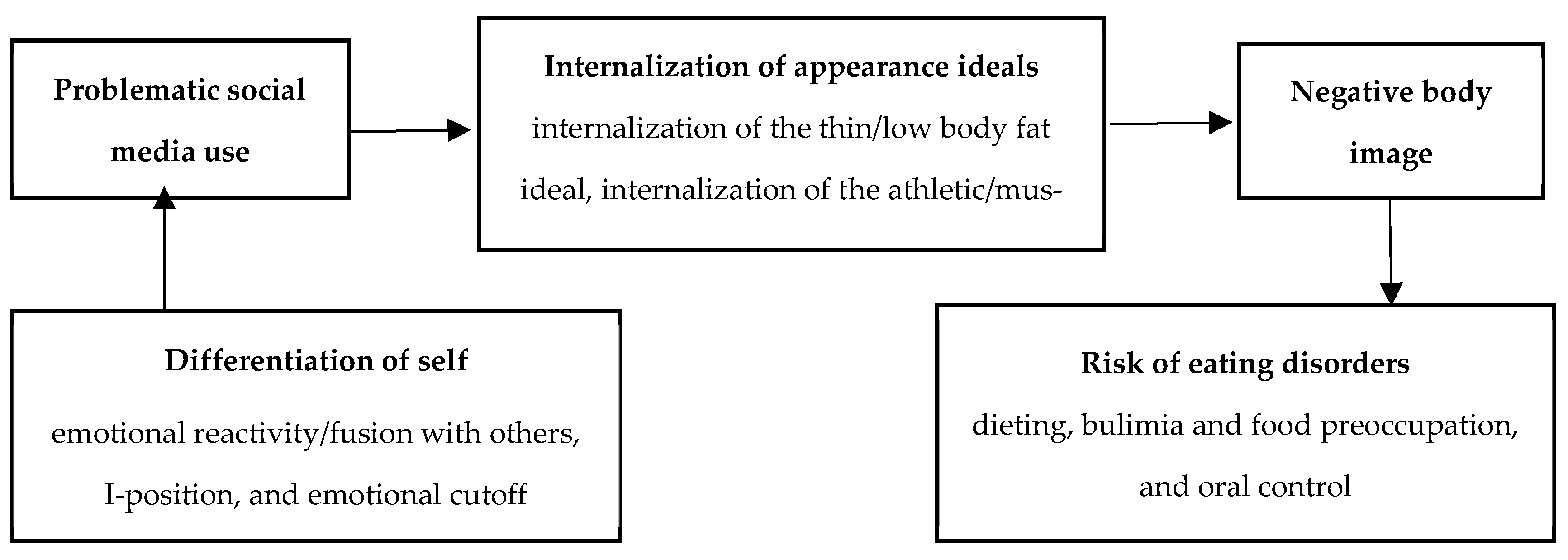
- The relationship between DoS (emotional reactivity, I-position, emotional cutoff, and fusion with others) and the risk of EDs (dieting, bulimia and food preoccupation, and oral control) will be serially mediated through the following variables: problematic social media use, internalization of appearance ideals (including internalization of the thin/low body fat ideal, internalization of the athletic/muscular ideal, family pressure, peer pressure, and media pressure), and negative body image (see Figure 1). Specifically, the following:
- Problematic social media use will mediate the relationship between DoS and the internalization of appearance ideals.
- Internalization of appearance ideals will mediate the relationship between problematic social media use and negative body image.
- Negative body image will mediate the relationship between internalization of appearance ideals and the risk of EDs.
- Age differences will be found, with emerging adults (18–25) reporting higher problematic social media use, greater internalization of appearance ideals, higher negative body image, and higher levels of risk of EDs than young adults (26–40).
- Gender differences will be found, with women reporting higher levels of emotional reactivity/fusion with others, internalization of appearance ideals, negative body image, and the risk of EDs, while men will report a higher level of emotional cutoff and internalization of the athletic/muscular ideal.
- Clinical differences will be found, with participants scoring above the clinical cutoff on the EAT-26 showing lower DoS, higher problematic social media use, greater internalization of appearance ideals, and more negative body image than those not meeting clinical criteria.
2. Method
2.1. Participants
2.2. Instruments
2.3. Procedure
2.4. Data Analysis
3. Results
3.1. Descriptive Results
3.2. Preliminary Analyses: Associations Between Study Variables and Demographic Variables
Gender Differences
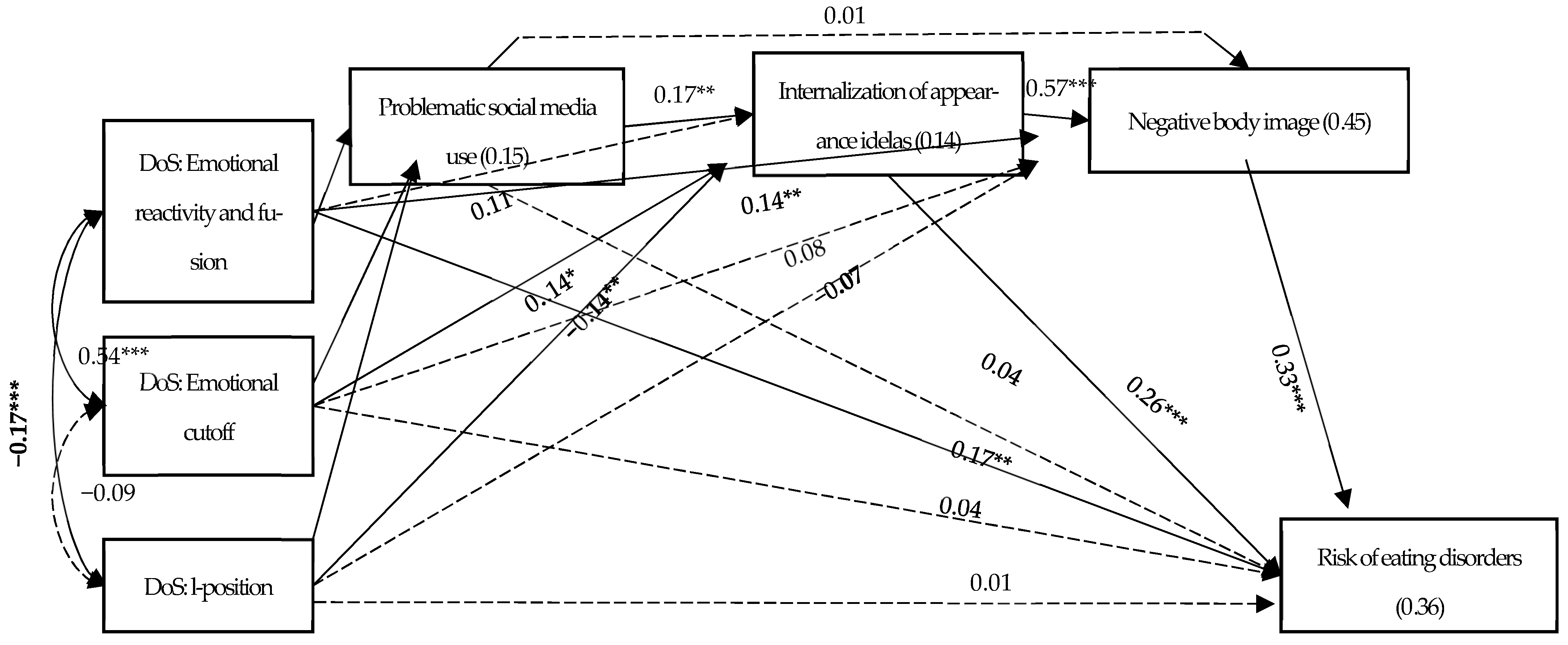
3.3. The Study Model
3.4. Eating Disorder Risk: The Cutoff Point
4. Discussion
4.1. The Mediation Model
4.2. Differences Between Research Groups
4.3. Demographic Characteristics
4.4. Profile of Participants at Risk of EDs
5. Limitations
- Contributions
- Practical Contributions
Author Contributions
Funding
Institutional Review Board Statement
Informed Consent Statement
Data Availability Statement
Acknowledgments
Conflicts of Interest
References
- López-Gil, J.F.; García-Hermoso, A.; Smith, L.; Firth, J.; Trott, M.; Mesas, A.E.; Jiménez-López, E.; Gutiérrez-Espinoza, H.; Tárraga-López, P.; Victoria-Montesinos, D. Global proportion of disordered eating in children and adolescents: A systematic review and meta-analysis. JAMA Pediatr. 2023, 177, 363–372. [Google Scholar] [CrossRef]
- Peleg, O.; Boniel-Nissim, M.; Tzischinsky, O. Adolescents at Risk of Eating Disorders: The mediating role of emotional distress in the relationship between differentiation of self and the risk of eating disorders among young adults. Clin. Psychiatry 2022, 8, 144. [Google Scholar] [CrossRef]
- World Health Organization. Mental Disorders. Available online: https://www.who.int/news-room/fact-sheets/detail/mental-disorders (accessed on 30 September 2025).
- Peleg-Gabay, M. Eating Disorders Treatment System in Israel; Knesset Research and Information Center: Jerusalem, Israel, 2022. [Google Scholar]
- Thompson, J.K.; Heinberg, L.J.; Altabe, M.; Tantleff-Dunn, S. Exacting Beauty: Theory, Assessment, and Treatment of Body Image Disturbance; American Psychological Association: Washington, DC, USA, 1999. [Google Scholar]
- Roberts, S.R.; Maheux, A.J.; Hunt, R.A.; Ladd, B.A.; Choukas-Bradley, S. Incorporating social media and muscular ideal internalization into the tripartite influence model of body image: Towards a modern understanding of adolescent girls’ body dissatisfaction. Body Image 2022, 41, 239–247. [Google Scholar] [CrossRef]
- Thai, H.; Davis, C.G.; Mahboob, W.; Perry, S.; Adams, A.; Goldfield, G.S. Reducing social media use improves appearance and weight esteem in youth with emotional distress. Psychol. Pop. Media 2023, 13, 162–169. [Google Scholar] [CrossRef]
- Peleg, O.; Tzischinsky, O. Risk factors for eating disorders among Jewish and Arab young adults. Int. J. Nutr. Food Sci. 2022, 11, 149–158. [Google Scholar] [CrossRef]
- Bowen, M. Family Therapy in Clinical Practice; Jason Aronson: New York, NY, USA, 1978. [Google Scholar]
- Kerr, M.E.; Bowen, M. Family Evaluation; Norton: New York, NY, USA, 1988. [Google Scholar]
- Peleg, M.; Peleg, O. Personality and family risk factors for poor mental well-being. Int. J. Environ. Res. Public Health 2023, 20, 839. [Google Scholar] [CrossRef]
- Sadeghi, M.; Barahmand, U.; Roshannia, S. Differentiation of self and hope mediated by resilience: Gender differences. Can. J. Fam. Youth 2020, 12, 20–43. [Google Scholar] [CrossRef]
- Calatrava, M.; Martins, M.V.; Schweer-Collins, M.; Duch-Ceballos, C.; Rodríguez-González, M. Differentiation of self: A scoping review of Bowen Family Systems Theory’s core construct. Clin. Psychol. Rev. 2022, 91, 102101. [Google Scholar] [CrossRef] [PubMed]
- Cohen, A.; Peleg, O.; Sarhana, A.; Lam, S.; Haimov, I. Depressive symptoms mediate the relationship between emotional cutoff and type 2 diabetes mellitus. Int. J. Behav. Med. 2019, 26, 591–599. [Google Scholar] [CrossRef]
- Beigi, M.; Mousavi, R.; Mostafa, V. Investigating the mediating role of self-differentiation in the relationship between self-esteem and body image in women. J. Woman Fam. Stud. 2022, 10, 133–156. [Google Scholar] [CrossRef]
- Kursuncu, M.A. The mediating roles of smartphone addiction and resilience in the relationship between triangling and differentiation of self. Int. J. Contemp. Educ. Res. 2023, 10, 834–844. [Google Scholar] [CrossRef]
- Peleg, O.; Boniel-Nissim, M. Exploring the personality and relationship factors that mediate the connection between differentiation of self and phubbing. Sci. Rep. 2024, 14, 6572. [Google Scholar] [CrossRef] [PubMed]
- Tas, I.; Bilgin, O. Relationship pattern between internet addiction, attachment styles and selfdifferentiation in university students: A structural equation modelling. Int. J. Educ. Technol. Sci. Res. 2019, 4, 458–475. [Google Scholar] [CrossRef]
- Yousef, A.M.F.; Alshamy, A.; Tlili, A.; Metwally, A.H.S. Demystifying the new dilemma of brain rot in the digital era: A review. Brain Sci. 2025, 15, 283. [Google Scholar] [CrossRef]
- Ferdowsi, M.H.; Shahvalipoor, Z. The effect of media literacy on eating disorders of female athletes with the mediating role of body image. Iran. J. Health Sci. 2023, 11, 175–186. [Google Scholar] [CrossRef]
- Israel Central Bureau of Statistics. The Digital Age. The Social Survey 2020. 2022; 42 (Hebrew). Available online: https://www.cbs.gov.il/he/publications/Pages/2022/%D7%94%D7%A1%D7%A7%D7%A8%D7%94%D7%97%D7%91%D7%A8%D7%AA%D7%99-2020.aspx (accessed on 3 October 2022).
- Mari, E.; Biondi, S.; Varchetta, M.; Cricenti, C.; Fraschetti, A.; Pizzo, A.; Barchielli, B.; Roma, P.; Vilar, M.M.; Gonzàlez Sala, F.; et al. Gender differences in internet addiction: A study on variables related to its possible development. Comput. Hum. Behav. Rep. 2023, 9, 100247. [Google Scholar] [CrossRef]
- Casale, S.; Akbari, M.; Seydavi, M.; Benucci, S.B.; Fioravanti, G. Has the prevalence of problematic social media use increased over the past six years and since the start of the COVID-19 Pandemic? A meta-analysis of the studies published since the development of the Bergen Social Media Addiction Scale. Addict. Behav. 2023, 147, 107838. [Google Scholar] [CrossRef]
- American Psychiatric Association. Diagnostic and Statistical Manual of Mental Disorders, 5th ed.; text rev.; APA: Washington, DC, USA, 2022. [Google Scholar]
- Przepiorka, A.; Blachnio, A.; Cudo, A. Procrastination and problematic new media use: The mediating role of future anxiety. Curr. Psychol. 2023, 42, 5169–5177. [Google Scholar] [CrossRef]
- Choukas-Bradley, S.; Roberts, S.R.; Maheux, A.J.; Nesi, J. The perfect storm: A developmental-sociocultural framework for the role of social media in adolescent girls’ body image concerns and mental health. Clin. Child Fam. Psychol. Rev. 2022, 25, 681–701. [Google Scholar] [CrossRef]
- Krupa-Kotara, K.; Grajek, M.; Rozmiarek, M.; Malchrowicz-Mośko, E.; Staśkiewicz, W.; León-Guereño, P.; Castañeda-Babarro, A. The role of social media in internalizing body knowledge: A cross-sectional study among women with different food preferences. Int. J. Environ. Res. Public Health 2023, 20, 2069. [Google Scholar] [CrossRef]
- Scheiber, R.; Diehl, S.; Karmasin, M. Socio-cultural power of social media on orthorexia nervosa: An empirical investigation on the mediating role of thin-ideal and muscular internalization, appearance comparison, and body dissatisfaction. Appetite 2023, 185, 106522. [Google Scholar] [CrossRef] [PubMed]
- Fredrickson, B.L.; Roberts, T.A. Objectification theory: Toward understanding women’s lived experiences and mental health risks. Psychol. Women Q. 1997, 21, 173–206. [Google Scholar] [CrossRef]
- Costa, A.; Fornabaio, C. Exploring the relationship between social media use and body image disturbances in young adults. Arch. Clin. Psychiatry 2023, 50, 24–30. [Google Scholar] [CrossRef]
- Convertino, A.D.; Elbe, C.I.; Mendoza, R.R.; Calzo, J.P.; Brown, T.A.; Siegel, J.A.; Jun, H.-J.; Corliss, H.L.; Blashill, A.J. Internalization of muscularity and thinness ideals: Associations with body dissatisfaction, eating disorder symptoms, and muscle dysmorphic symptoms in at risk sexual minority men. Int. J. Eat. Disord. 2022, 55, 1765–1776. [Google Scholar] [CrossRef]
- Wilksch, S.M.; O’Shea, A.; Ho, P.; Byrne, S.; Wade, T.D. The relationship between social media use and disordered eating in young adolescents. Int. J. Eat. Disord. 2020, 53, 96–106. [Google Scholar] [CrossRef]
- Hawes, T.; Zimmer-Gembeck, M.J.; Campbell, S.M. Unique associations of social media use and online appearance preoccupation with depression, anxiety, and appearance rejection sensitivity. Body Image 2020, 33, 66–76. [Google Scholar] [CrossRef]
- Rounsefell, K.; Gibson, S.; McLean, S.; Blair, M.; Molenaar, A.; Brennan, L.; Truby, H.; McCaffrey, T.A. Social media, body image and food choices in healthy young adults: A mixed methods systematic review. Nutr. Diet. 2020, 77, 19–40. [Google Scholar] [CrossRef]
- So, B.; Kwon, K.H. The impact of thin-ideal internalization, appearance comparison, social media use on body image and eating disorders: A literature review. J. Evid. Based Soc. Work 2023, 20, 55–71. [Google Scholar] [CrossRef]
- Cash, T.F. Body image: Past, present, and future. Body Image 2004, 1, 1–5. [Google Scholar] [CrossRef]
- Rodrigues, E.C.G.; Neris, R.R.; Nascimento, L.C.; de Oliveira-Cardoso, É.A.; Dos Santos, M.A. Body image experience of women with breast cancer: A meta-synthesis. Scand. J. Caring Sci. 2023, 37, 20–36. [Google Scholar] [CrossRef] [PubMed]
- Smirles, K.E.S.; Wilson, J.M. Being able to describe how one thinks and feels may (partly) attenuate the association between perceived body image discrepancy and body dissatisfaction: Preliminary evidence in young women. Sex Roles 2023, 89, 202–216. [Google Scholar] [CrossRef]
- Zhao, Y.; Zhang, K.; Zhou, X.; Xu, M. The effects of negative body image, self-acceptance, and resilience on depression in Chinese adolescents: Testing a moderated mediation model. Curr. Psychol. 2023, 42, 11704–11713. [Google Scholar] [CrossRef]
- Hartmann, A.S.; Rieger, E.; Vocks, S. Sex and gender differences in body image. Front. Psychol. 2019, 10, 1696. [Google Scholar] [CrossRef]
- Rafati, F.; Dehdashti, N.; Sadeghi, A. The relationship between Instagram use and body dissatisfaction, drive for thinness, and internalization of beauty ideals: A correlational study of Iranian women. Fem. Media Stud. 2023, 23, 361–377. [Google Scholar] [CrossRef]
- Rodgers, R.F.; Laveway, K.; Campos, P.; de Carvalho, P.H.B. Body image as a global mental health concern. Glob. Ment. Health 2023, 10, e9. [Google Scholar] [CrossRef]
- Barakat, S.; McLean, S.A.; Bryant, E.; Le, A.; Marks, P.; Touyz, S.; Maguire, S. Risk factors for eating disorders: Findings from a rapid review. J. Eat. Disord. 2023, 11, 8. [Google Scholar] [CrossRef]
- Van-Hoeken, D.; Hoek, H.W. Review of the burden of eating disorders: Mortality, disability, costs, quality of life, and family burden. Curr. Opin. Psychiatry 2020, 33, 521–527. [Google Scholar] [CrossRef]
- Latzer, Y.; Adatto, R.; Neumark-Sztainer, D. Addressing eating disorders through legislation: The Israeli “Models’’ Law—Process, enactment, and dilemmas. Dialogues Health 2022, 1, 100001. [Google Scholar] [CrossRef]
- Qian, J.; Wu, Y.; Liu, F.; Zhu, Y.; Jin, H.; Zhang, H.; Yu, D. An update on the prevalence of eating disorders in the general population: A systematic review and meta-analysis. Eat. Weight Disord. Stud. Anorex. Bulim. Obes. 2021, 27, 415–428. [Google Scholar] [CrossRef] [PubMed]
- Hewlings, S.J. Eating disorders and dietary supplements: A review of the science. Nutrients 2023, 15, 2076. [Google Scholar] [CrossRef] [PubMed]
- Sharma, A.; Vidal, C. A scoping literature review of the associations between highly visual social media use and eating disorders and disordered eating: A changing landscape. J. Eat. Disord. 2023, 11, 170. [Google Scholar] [CrossRef] [PubMed]
- Friars, D.; Walsh, O.; McNicholas, F. Assessment and management of cardiovascular complications in eating disorders. J. Eat. Disord. 2023, 11, 1–12. [Google Scholar] [CrossRef]
- Hornberger, L.L.; Lane, M.A.; Lane, M.; Breuner, C.C.; Alderman, E.M.; Grubb, L.K.; Baumberger, J. Identification and management of eating disorders in children and adolescents. Pediatrics 2021, 147, e2020040279. [Google Scholar] [CrossRef] [PubMed]
- Silén, Y.; Keski-Rahkonen, A. Worldwide prevalence of DSM-5 eating disorders among young people. Curr. Opin. Psychiatry 2022, 35, 362–371. [Google Scholar] [CrossRef] [PubMed]
- Arnett, J.J. Emerging adulthood: What is it, and what is it good for? Child Dev. Perspect. 2007, 1, 68–73. [Google Scholar] [CrossRef]
- Tanner, J.L.; Arnett, J.J. The emergence of emerging adulthood: The new life stage between adolescence and young adulthood. In Routledge Handbook of Youth and Young Adulthood, 2nd ed.; Furlong, A., Ed.; Routledge: London, UK, 2016; pp. 50–56. [Google Scholar]
- Arnett, J.J. Emerging Adulthood: The Winding Road from The Late Teens Through the Twenties, 3rd ed.; Oxford University Press: Oxford, UK, 2023. [Google Scholar]
- Wood, D.; Crapnell, T.; Lau, L.; Bennett, A.; Lotstein, D.; Ferris, M.; Kuo, A. Emerging adulthood as a critical stage in the life course. In Handbook of Life Course Health Development; Halfon, N., Forrest, C.B., Lerner, R.M., Faustman, E.M., Eds.; Springer: Cham, Switzerland, 2018; pp. 123–143. [Google Scholar]
- Petropoulos Petalas, D.; Konijn, E.A.; Johnson, B.K.; Veldhuis, J.; Bij de Vaate, N.A.J.D.; Burgers, C.; Droog, E.; Międzobrodzka, E.; Balint, K.E.; van de Schoot, R. Plurality in the measurement of social media use and mental health: An exploratory study among adolescents and young adults. Soc. Media Soc. 2021, 7, 1–19. [Google Scholar] [CrossRef]
- Shannon, H.; Bush, K.; Villeneuve, P.J.; Hellemans, K.G.; Guimond, S. Problematic social media use in adolescents and young adults: Systematic review and meta-analysis. JMIR Ment. Health 2022, 9, e33450. [Google Scholar] [CrossRef]
- Åberg, E.; Koivula, A.; Kukkonen, I. A feminine burden of perfection? Appearance-related pressures on social networking sites. Telemat. Inform. 2020, 46, 101319. [Google Scholar] [CrossRef]
- Vandenbosch, L.; Fardouly, J.; Tiggemann, M. Social media and body image: Recent trends and future directions. Curr. Opin. Psychol. 2022, 45, 101289. [Google Scholar] [CrossRef]
- Skowron, E.A.; Friedlander, M.L. The Differentiation of Self-Inventory: Development and initial validation. J. Couns. Psychol. 1998, 45, 235. [Google Scholar] [CrossRef]
- Skowron, E.A.; Schmitt, T.A. Assessing interpersonal fusion: Reliability and validity of a new DSI fusion with others subscale. J. Marital Fam. Ther. 2003, 29, 209–222. [Google Scholar] [CrossRef]
- Peleg, O. Children’s test anxiety and family interaction patterns. Anxiety Stress Coping 2002, 15, 45–59. [Google Scholar] [CrossRef]
- Peleg, O. The relation between differentiation of self and marital satisfaction: What can be learned from married people over the course of life? Am. J. Fam. Ther. 2008, 36, 388–401. [Google Scholar] [CrossRef]
- Van den Eijnden, R.J.; Lemmens, J.S.; Valkenburg, P.M. The Social Media Disorder Scale. Comput. Hum. Behav. 2016, 61, 478–487. [Google Scholar] [CrossRef]
- Boniel-Nissim, M.; Bersia, M.; Canale, N.; Lahti, H.; Ojala, K.; Ercan, O.; Dzielska, A.; Inchley, J.; Dalmasso, P. Different categories of social media use and their association with body image among adolescents in 42 countries. Int. J. Public Health 2024, 69, 1606944. [Google Scholar] [CrossRef]
- Schaefer, L.M.; Burke, N.L.; Thompson, J.K.; Dedrick, R.F.; Heinberg, L.J.; Calogero, R.M.; Bardone-Cone, A.M.; Higgins, M.K.; Frederick, D.A.; Kelly, M.; et al. Development and validation of the Sociocultural Attitudes Towards Appearance Questionnaire-4 (SATAQ-4). Psychol. Assess. 2015, 27, 54. [Google Scholar] [CrossRef]
- Evans, C.; Dolan, B. Body Shape Questionnaire: Derivation of shortened “alternate forms.”. Int. J. Eat. Disord. 1993, 13, 315–321. [Google Scholar] [CrossRef]
- Cooper, P.J.; Taylor, M.J.; Cooper, Z.; Fairbum, C.G. The development and validation of the Body Shape Questionnaire. Int. J. Eat. Disord. 1987, 6, 485–494. [Google Scholar] [CrossRef]
- Garner, D.M.; Olmsted, M.P.; Bohr, Y.; Garfinkel, P.E. The Eating Attitudes Test: Psychometric features and clinical correlates. Psychol. Med. 1982, 12, 871–878. [Google Scholar] [CrossRef] [PubMed]
- Koslowsky, M.; Scheinberg, Z.; Bleich, A.; Mark, M.; Apter, A.; Danon, Y.; Solomon, Z. The factor structure and criterion validity of the short form of the Eating Attitudes Test. J. Personal. Assess. 1992, 58, 27–35. [Google Scholar] [CrossRef]
- Spivak-Lavi, Z.; Latzer, Y.; Stein, D.; Peleg, O.; Tzischinsky, O. Differences in the factor structure of the Eating Attitude Test-26 (EAT-26) among clinical vs. non-clinical adolescent Israeli females. Nutrients 2023, 15, 4168. [Google Scholar] [CrossRef]
- IBM. IBM SPSS Statistics for Windows, Version 27.0; Computer software; IBM Corporation: New York, NY, USA, 2020.
- Hayes, A.F. Introduction to Mediation, Moderation, and Conditional Process Analysis, 3rd ed.; Guilford Press: New York, NY, USA, 2022. [Google Scholar]
- Hosack, L.L.; Welton, G.L.; Homan, K.J. Differentiation of self and internal distress: The mediating roles of vulnerable narcissism and maladaptive perfectionism. Clin. Soc. Work J. 2023, 51, 65–75. [Google Scholar] [CrossRef]
- Dane, A.; Bhatia, K. The social media diet: A scoping review to investigate the association between social media, body image and eating disorders amongst young people. PLoS Glob. Public Health 2023, 3, e0001091. [Google Scholar] [CrossRef]
- Wang, Y.; Geng, J.; Di, K.; Chu, X.; Lei, L. Body talk on social network sites and body dissatisfaction among college students: The mediating roles of appearance ideals internalization and appearance comparison. Cyberpsychology J. Psychosoc. Res. Cyberspace 2022, 16, 2. [Google Scholar] [CrossRef]
- Bi, X.; Liang, Q.; Jiang, G.; Deng, M.; Cui, H.; Ma, Y. The cost of the perfect body: Influence mechanism of internalization of media appearance ideals on eating disorder tendencies in adolescents. BMC Psychol. 2024, 12, 138. [Google Scholar] [CrossRef] [PubMed]
- Tiggemann, M.; Anderberg, I. Social media is not real: The effect of “Instagram vs reality” images on women’s social comparison and body image. New Media Soc. 2020, 22, 2183–2199. [Google Scholar] [CrossRef]
- Convertino, A.D.; Helm, J.L.; Pennesi, J.L.; Gonzales, I.V.M.; Blashill, A.J. Integrating minority stress theory and the tripartite influence model: A model of eating disordered behavior in sexual minority young adults. Appetite 2021, 163, 105204. [Google Scholar] [CrossRef]
- Aparicio-Martinez, P.; Perea-Moreno, A.J.; Martinez-Jimenez, M.P.; Redel-Macías, M.D.; Pagliari, C.; Vaquero-Abellan, M. Social media, thin-ideal, body dissatisfaction and disordered eating attitudes: An exploratory analysis. Int. J. Environ. Res. Public Health 2019, 16, 4177. [Google Scholar] [CrossRef] [PubMed]
- Schaefer, L.M.; Burke, N.L.; Thompson, J.K. Thin-ideal internalization: How much is too much? Eat. Weight. Disord. Stud. Anorex. Bulim. Obes. 2019, 24, 933–937. [Google Scholar] [CrossRef]
- Li, J.; Zhou, Y.; Lv, X.; Leng, X.; Jiang, X.; Gao, X. A network analysis approach to core symptoms and symptom relationships of problematic social media use among young adults. Inf. Commun. Soc. 2024, 27, 1229–1246. [Google Scholar] [CrossRef]
- Duan, C.; Lian, S.; Yu, L.; Niu, G.; Sun, X. Photo activity on social networking sites and body dissatisfaction: The roles of thin-ideal internalization and body appreciation. Behav. Sci. 2022, 12, 280. [Google Scholar] [CrossRef]
- Vincente-Benito, I.; Ramírez-Durán, M.D.V. Influence of social media use on body image and well-being among adolescents and young adults: A systematic review. J. Psychosoc. Nurs. Ment. Health Serv. 2023, 61, 11–18. [Google Scholar] [CrossRef] [PubMed]
- Varchetta, M.; Fraschetti, A.; Mari, E.; Giannini, A.M. Adicción a redes sociales, Miedo a perderse experiencias (FOMO) y Vulnerabilidad en línea en estudiantes universitarios. Rev. Digit. Investig. Docencia Univ. 2020, 14, e1187. [Google Scholar] [CrossRef]
- Frederick, D.A.; Pila, E.; Malcarne, V.L.; Compte, E.J.; Nagata, J.M.; Best, C.R.; Cook-Cottone, C.P.; Brown, T.A.; Convertino, L.; Crerand, C.E.; et al. Demographic predictors of objectification theory and tripartite influence model constructs: The US Body Project I. Body Image 2022, 40, 182–199. [Google Scholar] [CrossRef] [PubMed]
- Ramos-Luna, M.E.; Oliver, J. Relationship between differentiation of self, emotional intelligence, and self-esteem in a Spanish sample. Curr. Psychol. 2024, 42, 6797–6806. [Google Scholar] [CrossRef]
- Chaplin, T.M. Gender and emotion expression: A developmental contextual perspective. Emot. Rev. 2015, 7, 14–21. [Google Scholar] [CrossRef]
- Schneider, J.; Pegram, G.; Gibson, B.; Talamonti, D.; Tinoco, A.; Craddock, N.; Matheson, E.; Forshaw, M. A mixed-studies systematic review of the experiences of body image, disordered eating, and eating disorders during the COVID-19 pandemic. Int. J. Eat. Disord. 2023, 56, 26–67. [Google Scholar] [CrossRef]
- Yuryeva, L.; Ogorenko, B.; Shornikov, A.; Kokashynskyi, V. Relationships between binge eating disorder anxiety depression in medical students during military conflict. Psychosom. Med. Gen. Pract. 2022, 7, e0701355. [Google Scholar] [CrossRef]
- Atmor, N.; Moskovich, Y.; Liberman, I. Social solidarity during the Pandemic: The Israeli experience. Isr. Stud. Rev. 2023, 38, 127–147. [Google Scholar] [CrossRef]
- Hunter, L.; Gerritsen, S.; Egli, V. Changes in eating behaviors due to crises, disasters and pandemics: A scoping review. Nutr. Food Sci. 2023, 53, 358–390. [Google Scholar] [CrossRef]
- Mac-Ginty, S.; Lira, D.; Lillo, I.; Moraga, E.; Caceres, C.; Araya, R.; Prina, M. Association between socioeconomic position and depression, anxiety and eating disorders in university students: A systematic review. Adolesc. Res. Rev. 2024, 9, 435–451. [Google Scholar] [CrossRef]



| M (SD) | 1. | 2. | 3. | 4. | 5. | 6. | |
|---|---|---|---|---|---|---|---|
| 1. DoS: emotional reactivity/fusion with others | 3.42 (0.93) | ||||||
| 2. DoS: emotional cutoff | 2.56 (0.88) | 0.57 *** | |||||
| 3. DoS: I-position | 3.65 (0.90) | −0.15 ** | −0.07 | ||||
| 4. Problematic social media use | 2.79 (2.09) | 0.35 *** | 0.28 *** | −0.18 *** | |||
| 5. Internalization of appearance ideals | 2.27 (0.75) | 0.26 *** | 0.25 *** | −0.20 *** | 0.28 *** | ||
| 6. Negative body image | 89.36 (43.70) | 0.34 *** | 0.31 *** | −0.23 *** | 0.24 *** | 0.65 *** | |
| 7. Risk of EDs | 10.28 (11.02) | 0.36 *** | 0.28 *** | −0.12 * | 0.13 * | 0.49 *** | 0.54 *** |
| Total M (SD) | Males M (SD) | Females M (SD) | t(df) (p) | DoS: Emotional Reactivity/Fusion with Others | Dos: Emotional Cutoff | DoS: I-Position | Problematic Social Media use | Negative Body Image | Risk of EDs | |
|---|---|---|---|---|---|---|---|---|---|---|
| Internalization of the thin/low body fat ideal | 2.75 (1.10) | 2.49 (0.95) | 2.91 (1.15) | t(302.83) = 3.60 (p < 0.001) | 0.23 *** | 0.18 ** | −0.21 *** | 0.14 * | 0.66*** | 0.54 *** |
| Internalization of the athletic/muscular ideal | 2.41 (1.09) | 2.56 (1.08) | 2.31 (1.09) | t(331) = −2.07 (p = 0.039) | −0.04 | 0.06 | −0.06 | 0.10 | 0.17 ** | 0.26 *** |
| Family pressure | 2.11 (1.13) | 2.03 (1.02) | 2.16 (1.20) | t(295.36) = 1.05 (p = 0.295) | 0.23 *** | 0.24 *** | −0.07 | 0.25 *** | 0.44 *** | 0.30 *** |
| Peer pressure | 1.49 (0.80) | 1.63 (0.88) | 1.39 (0.74) | t(230.90) = −2.56 (p = 0.011) | 0.07 | 0.18 ** | −0.10 | 0.22*** | 0.30 *** | 0.12 * |
| Media pressure | 2.46 (1.40) | 1.77 (1.05) | 2.89 (1.42) | t(317.93) = 8.26 (p < 0.001) | 0.36 *** | 0.21 *** | −0.22 *** | 0.26 *** | 0.56 *** | 0.35 *** |
| Independent Variables | Mediators | Indirect Effect | SE | p | 95%CI |
|---|---|---|---|---|---|
| DoS: emotional reactivity/fusion with others | Problematic social media use ⟶ Internalization of appearance ideals ⟶ Negative body image | 0.008 | 0.004 | <0.001 | 0.003, 0.018 |
| DoS: emotional cutoff | Problematic social media use ⟶ Internalization of appearance ideals ⟶ Negative body image | 0.004 | 0.003 | 0.011 | 0.001, 0.012 |
| DoS: I-position | Problematic social media use ⟶ Internalization of appearance ideals ⟶ Negative body image | −0.004 | 0.002 | 0.003 | −0.011, −0.001 |
| Problematic social media use | Internalization of appearance ideals ⟶ Negative body image | 0.030 | 0.012 | 0.001 | 0.012, 0.058 |
| Internalization of appearance ideals | Negative body image | 0.176 | 0.035 | <0.001 | 0.113, 0.253 |
| DoS: emotional cutoff | Internalization of appearance ideals ⟶ Negative body image | 0.024 | 0.012 | 0.018 | 0.005, 0.054 |
| DoS: I-position | Internalization of appearance ideals ⟶ Negative body image | −0.025 | 0.011 | 0.004 | −0.051, −0.008 |
| DoS: emotional reactivity/fusion with others | Negative body image | 0.044 | 0.018 | 0.002 | 0.015, 0.084 |
| DoS: emotional reactivity/fusion with others | Problematic social media use ⟶ Internalization of appearance ideals | 0.011 | 0.005 | <0.001 | 0.004, 0.025 |
| DoS: emotional cutoff | Problematic social media use ⟶ Internalization of appearance ideals | 0.006 | 0.004 | 0.011 | 0.001, 0.016 |
| DoS: I-position | Problematic social media use ⟶ Internalization of appearance ideals | −0.006 | 0.003 | 0.003 | −0.015, −0.001 |
| DoS: emotional cutoff | Internalization of appearance ideals | 0.033 | 0.017 | 0.017 | 0.006, 0.076 |
| DoS: I-position | Internalization of appearance ideals | −0.034 | 0.015 | 0.004 | −0.071, −0.011 |
| Problematic social media use | Internalization of appearance ideals | 0.041 | 0.016 | <0.001 | 0.015, 0.081 |
| OR | p | 95%CI | |
|---|---|---|---|
| DoS: emotional reactivity/fusion with others | 1.54 | 0.031 | 1.04, 2.28 |
| DoS: emotional cutoff | 1.41 | 0.051 | 0.99, 2.00 |
| DoS: I-position | 0.60 | 0.007 | 0.42, 0.87 |
| Problematic social media use | 0.97 | 0.704 | 0.82, 1.14 |
| Internalization of appearance ideals | 5.67 | <0.001 | 3.27, 9.82 |
| Negative body image | 111.97 | <0.001 | 28.83, 434.82 |
| Internalization of appearance ideals subscales: | |||
| Internalization of the thin/low body fat ideal | 4.56 | <0.001 | 2.93, 7.10 |
| Internalization of the athletic/muscular ideal | 1.80 | <0.001 | 1.33, 2.45 |
| Family pressure | 3.73 | <0.001 | 1.87, 7.45 |
| Peer pressure | 3.29 | 0.049 | 1.01, 10.77 |
| Media pressure | 1.74 | <0.001 | 1.33, 2.26 |
Disclaimer/Publisher’s Note: The statements, opinions and data contained in all publications are solely those of the individual author(s) and contributor(s) and not of MDPI and/or the editor(s). MDPI and/or the editor(s) disclaim responsibility for any injury to people or property resulting from any ideas, methods, instructions or products referred to in the content. |
© 2026 by the authors. Licensee MDPI, Basel, Switzerland. This article is an open access article distributed under the terms and conditions of the Creative Commons Attribution (CC BY) license.
Share and Cite
Gendelman, L.; Peleg, O.; Hadar, E. From Family Patterns to Eating Disorder Risk: The Role of Social Media, Appearance Ideals, and Body Image Among Emerging and Young Adults. Nutrients 2026, 18, 1497. https://doi.org/10.3390/nu18101497
Gendelman L, Peleg O, Hadar E. From Family Patterns to Eating Disorder Risk: The Role of Social Media, Appearance Ideals, and Body Image Among Emerging and Young Adults. Nutrients. 2026; 18(10):1497. https://doi.org/10.3390/nu18101497
Chicago/Turabian StyleGendelman, Lior, Ora Peleg, and Efrat Hadar. 2026. "From Family Patterns to Eating Disorder Risk: The Role of Social Media, Appearance Ideals, and Body Image Among Emerging and Young Adults" Nutrients 18, no. 10: 1497. https://doi.org/10.3390/nu18101497
APA StyleGendelman, L., Peleg, O., & Hadar, E. (2026). From Family Patterns to Eating Disorder Risk: The Role of Social Media, Appearance Ideals, and Body Image Among Emerging and Young Adults. Nutrients, 18(10), 1497. https://doi.org/10.3390/nu18101497