Influence of Diet on the Bioaccessibility of Zn from Dietary Supplements: Findings from an In Vitro Digestion Model and Analytical Determinations

 , , ,
, , ,  and
and 
Abstract
1. Introduction
2. Materials and Methods
2.1. Chemicals and Reagents
2.2. Materials
2.2.1. Reconstructed Diet Duplicates
2.2.2. Dietary Supplements
2.3. The Gastrointestinal Enzymatic Model of In Vitro Digestion
2.3.1. Preparation of Dialysis Membranes
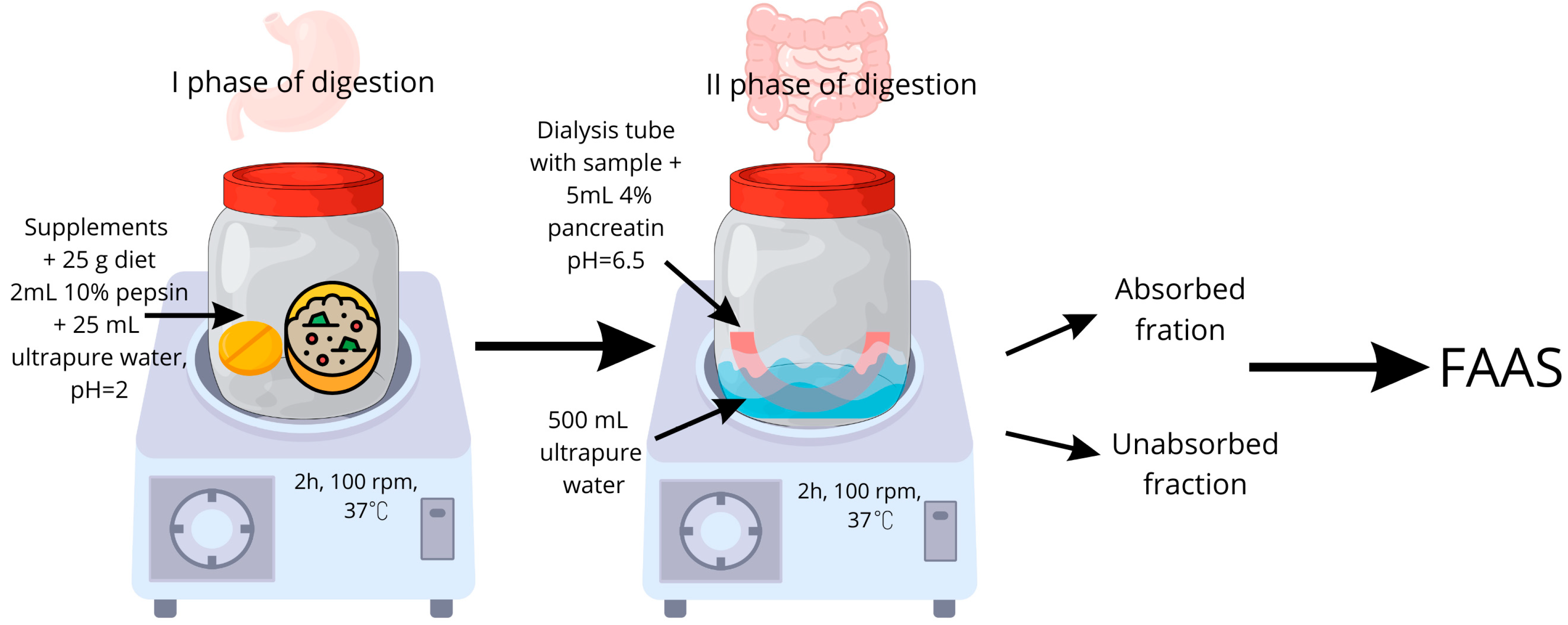
2.3.2. Two-Phase Model of In Vitro Digestion
- Enzymatic control sample: only 25 mL of ultrapure water (no diet; no dietary supplements).
- Diet sample: 25 g of homogenized diet to assess the bioaccessibility of the tested diet.
- Supplement-only sample: The manufacturer’s recommended portion of the dietary supplement mixed with 25 mL of ultrapure water, representing the bioaccessibility of the supplement under fasting conditions.
- Diet + supplement sample: The manufacturer’s recommended portion of the dietary supplement combined with 25 g of homogenized diet to evaluate the effect of the diet on Zn bioaccessibility from the dietary supplement.
2.4. Mineralization Process
2.5. Analytical Determination of Zn by the FAAS Method
2.6. Calculation of the Bioaccessibility Value
2.7. Statistical Analysis
3. Results
3.1. The Bioaccessibility of Zn from Dietary Supplements Under the Influence of Various Types of Diets
3.2. The Bioaccessibility of Zn from Dietary Supplements—Differences Between Particular Products
3.3. The Bioaccessibility of Zn from Dietary Supplements—Impact of Pharmaceutical Formula
4. Discussion
5. Conclusions
Supplementary Materials
Author Contributions
Funding
Institutional Review Board Statement
Informed Consent Statement
Data Availability Statement
Conflicts of Interest
References
- Sanna, A.; Firinu, D.; Zavattari, P.; Valera, P. Zinc Status and Autoimmunity: A Systematic Review and Meta-Analysis. Nutrients 2018, 10, 68. [Google Scholar] [CrossRef] [Scilit] [PubMed]
- Costa, M.I.; Sarmento-Ribeiro, A.B.; Gonçalves, A.C. Zinc: From Biological Functions to Therapeutic Potential. Int. J. Mol. Sci. 2023, 24, 4822. [Google Scholar] [CrossRef] [Scilit] [PubMed]
- Maret, W. Zinc in Cellular Regulation: The Nature and Significance of “Zinc Signals”. Int. J. Mol. Sci. 2017, 18, 2285. [Google Scholar] [CrossRef] [Scilit] [PubMed]
- Chasapis, C.T.; Loutsidou, A.C.; Spiliopoulou, C.A.; Stefanidou, M.E. Zinc and Human Health: An Update. Arch. Toxicol. 2012, 86, 521–534. [Google Scholar] [CrossRef] [Scilit]
- Beyersmann, D.; Haase, H. Functions of Zinc in Signaling, Proliferation and Differentiation of Mammalian Cells. Biometals 2001, 14, 331–341. [Google Scholar] [CrossRef] [Scilit]
- Ahmad, R.; Shaju, R.; Atfi, A.; Razzaque, M.S. Zinc and Diabetes: A Connection between Micronutrient and Metabolism. Cells 2024, 13, 1359. [Google Scholar] [CrossRef] [Scilit]
- Chen, Y.; Wang, X.; Zhou, J.; Wang, G.; Gao, T.; Wei, H.; Che, Y.; Li, T.; Zhang, Z.; Wang, S.; et al. Association of Seminal Plasma Zinc Levels with Human Semen Quality and Its Toxic Effects on Sperm Motility. Ecotoxicol. Environ. Saf. 2024, 284, 116889. [Google Scholar] [CrossRef] [Scilit]
- Benarroch, E. What Are the Functions of Zinc in the Nervous System? Neurology 2023, 101, 714–720. [Google Scholar] [CrossRef] [Scilit]
- Wang, B.; Fang, T.; Chen, H. Zinc and Central Nervous System Disorders. Nutrients 2023, 15, 2140. [Google Scholar] [CrossRef] [Scilit]
- Kunachowicz, H.; Przygodna, B.; Nadolna, I.; Iwanow, K. Tabele Składu i Wartości Odżywczej Żywności, 2nd ed.; PZWL Wydawnictwo Lekarskie: Warsaw, Poland, 2017. [Google Scholar]
- de Castro Cardoso Pereira, P.M.; Vicente, A.F.D.R.B. Meat Nutritional Composition and Nutritive Role in the Human Diet. Meat Sci. 2013, 93, 586–592. [Google Scholar] [CrossRef] [Scilit]
- da Paixão Teixeira, J.L.; Baptista, D.P.; Orlando, E.A.; Gigante, M.L.; Pallone, J.A.L. Effect of Processing on the Bioaccessibility of Essential Minerals in Goat and Cow Milk and Dairy Products Assessed by Different Static In Vitro Digestion Models. Food Chem. 2022, 374, 131739. [Google Scholar] [CrossRef] [Scilit]
- Suliburska, J.; Krejpcio, Z. Evaluation of the Content and Bioaccessibility of Iron, Zinc, Calcium and Magnesium from Groats, Rice, Leguminous Grains and Nuts. J. Food Sci. Technol. 2014, 51, 589–594. [Google Scholar] [CrossRef] [Scilit] [PubMed]
- Kot, A.; Zaręba, S.; Wyszogrodzka-Koma, L. Ocena Zawartości Miedzi i Cynku w Wybranych Produktach Zbożowych. Bromat. Chem. Toksykol. 2011, 44, 32–37. [Google Scholar]
- Tokarczyk, J.; Koch, W. Dietary Zn—Recent Advances in Studies on Its Bioaccessibility and Bioavailability. Molecules 2025, 30, 2742. [Google Scholar] [CrossRef] [Scilit] [PubMed]
- Bawiec, P.; Sawicki, J.; Łasińska-Pracuta, P.; Czop, M.; Sowa, I.; Helon, P.; Pietrzak, K.; Koch, W. In Vitro Evaluation of Bioavailability of Cr from Daily Food Rations and Dietary Supplements from the Polish Market. Nutrients 2024, 16, 1022. [Google Scholar] [CrossRef] [Scilit]
- Grases, F.; Simonet, B.M.; Perelló, J.; Costa-Bauzá, A.; Prieto, R.M. Effect of Phytate on Element Bioavailability in the Second Generation of Rats. J. Trace Elem. Med. Biol. 2004, 17, 229–234. [Google Scholar] [CrossRef] [Scilit]
- Grases, F.; Costa-Bauza, A. Key Aspects of Myo-Inositol Hexaphosphate (Phytate) and Pathological Calcifications. Molecules 2019, 24, 4434. [Google Scholar] [CrossRef] [Scilit]
- Mathers, J.C. Dietary Fibre and Health: The Story so Far. Proc. Nutr. Soc. 2023, 82, 120–129. [Google Scholar] [CrossRef] [Scilit]
- Vucenik, I. Anticancer Properties of Inositol Hexaphosphate and Inositol: An Overview. J. Nutr. Sci. Vitaminol. 2019, 65, S18–S22. [Google Scholar] [CrossRef] [Scilit]
- Kiewlicz, J.; Rybicka, I. Minerals and Their Bioavailability in Relation to Dietary Fiber, Phytates and Tannins from Gluten and Gluten-Free Flakes. Food Chem. 2020, 305, 125452. [Google Scholar] [CrossRef] [Scilit]
- Alnaimat, A.S.; Barciela-Alonso, M.C.; Herbello-Hermelo, P.; Domínguez-González, R.; Bermejo-Barrera, P. In Vitro Assessment of Major and Trace Element Bioaccessibility in Tea Samples. Talanta 2021, 225, 122083. [Google Scholar] [CrossRef] [Scilit] [PubMed]
- Moreda-Piñeiro, J.; Moreda-Piñeiro, A.; Bermejo-Barrera, P. In Vivo and In Vitro Testing for Selenium and Selenium Compounds Bioavailability Assessment in Foodstuff. Crit. Rev. Food Sci. Nutr. 2017, 57, 805–833. [Google Scholar] [CrossRef] [Scilit] [PubMed]
- Fairweather-Tait, S.J.; Sesmaisons, A. de Approaches Used to Estimate Bioavailability When Deriving Dietary Reference Values for Iron and Zinc in Adults. Proc. Nutr. Soc. 2019, 78, 27–33. [Google Scholar] [CrossRef] [Scilit] [PubMed]
- Hall, A.G.; King, J.C. The Molecular Basis for Zinc Bioavailability. Int. J. Mol. Sci. 2023, 24, 6561. [Google Scholar] [CrossRef] [Scilit]
- Dima, C.; Assadpour, E.; Dima, S.; Jafari, S.M. Bioavailability and Bioaccessibility of Food Bioactive Compounds; Overview and Assessment by In Vitro Methods. Compr. Rev. Food Sci. Food Saf. 2020, 19, 2862–2884. [Google Scholar] [CrossRef] [Scilit]
- Ośko, J.; Pierlejewska, W.; Grembecka, M. Comparison of the Potential Relative Bioaccessibility of Zinc Supplements—In Vitro Studies. Nutrients 2023, 15, 2813. [Google Scholar] [CrossRef] [Scilit]
- Brodkorb, A.; Egger, L.; Alminger, M.; Alvito, P.; Assunção, R.; Ballance, S.; Bohn, T.; Bourlieu-Lacanal, C.; Boutrou, R.; Carrière, F.; et al. INFOGEST Static In Vitro Simulation of Gastrointestinal Food Digestion. Nat. Protoc. 2019, 14, 991–1014. [Google Scholar] [CrossRef] [Scilit]
- Carbonell-Capella, J.M.; Buniowska, M.; Barba, F.J.; Esteve, M.J.; Frígola, A. Analytical Methods for Determining Bioavailability and Bioaccessibility of Bioactive Compounds from Fruits and Vegetables: A Review. Compr. Rev. Food Sci. Food Saf. 2014, 13, 155–171. [Google Scholar] [CrossRef] [Scilit]
- Sajkowska, S.; Moskwa, J.; Socha, K.; Leśniewska, B. Evaluation of the Bioaccessibility of Essential and Toxic Trace Elements in Basil, Peppermint, and Rosemary Using an In Vitro Gastrointestinal Digestion Model. J. Agric. Food Chem. 2025, 73, 6189–6204. [Google Scholar] [CrossRef] [Scilit]
- Moskwa, J.; Naliwajko, S.K.; Puścion-Jakubik, A.; Soroczyńska, J.; Socha, K.; Koch, W.; Markiewicz-Żukowska, R. In Vitro Assessment of the Bioaccessibility of Zn, Ca, Mg, and Se from Various Types of Nuts. Foods 2023, 12, 4453. [Google Scholar] [CrossRef] [Scilit]
- Menezes, E.A.; Oliveira, A.F.; França, C.J.; Souza, G.B.; Nogueira, A.R.A. Bioaccessibility of Ca, Cu, Fe, Mg, Zn, and Crude Protein in Beef, Pork and Chicken after Thermal Processing. Food Chem. 2018, 240, 75–83. [Google Scholar] [CrossRef] [Scilit]
- Moreda-Piñeiro, J.; Herbello-Hermelo, P.; Domínguez-González, R.; Bermejo-Barrera, P.; Moreda-Piñeiro, A. Bioavailability Assessment of Essential and Toxic Metals in Edible Nuts and Seeds. Food Chem. 2016, 205, 146–154. [Google Scholar] [CrossRef] [Scilit] [PubMed]
- Gomez, B.G.; Perez-Corona, M.T.; Madrid, Y. Availability of Zinc from Infant Formula by In Vitro Methods (Solubility and Dialyzability) and Size-Exclusion Chromatography Coupled to Inductively Coupled Plasma-Mass Spectrometry. J. Dairy Sci. 2016, 99, 9405–9414. [Google Scholar] [CrossRef] [Scilit] [PubMed]
- Bawiec, P.; Sawicki, J.; Łasińska-Pracuta, P.; Czop, M.; Sowa, I.; Iłowiecka, K.; Koch, W. In Vitro Evaluation of Bioavailability of Se from Daily Food Rations and Dietary Supplements. Nutrients 2023, 15, 1511. [Google Scholar] [CrossRef] [Scilit] [PubMed]
- Bawiec, P.; Jaworowska, A.; Sawicki, J.; Czop, M.; Szalak, R.; Koch, W. In Vitro Evaluation of Bioavailability of Mg from Daily Food Rations, Dietary Supplements and Medicinal Products from the Polish Market. Nutrients 2025, 17, 748. [Google Scholar] [CrossRef] [Scilit]
- Hotz, C. Evidence for the Usefulness of in Vitro Dialyzability, Caco-2 Cell Models, Animal Models, and Algorithms to Predict Zinc Bioavailability in Humans. Int. J. Vitam. Nutr. Res. 2013, 75, 423–435. [Google Scholar] [CrossRef] [Scilit]
- Hambidge, K.M.; Miller, L.V.; Westcott, J.E.; Sheng, X.; Krebs, N.F. Zinc Bioavailability and Homeostasis1234. Am. J. Clin. Nutr. 2010, 91, 1478S–1483S. [Google Scholar] [CrossRef] [Scilit]
- Puścion-Jakubik, A.; Bielecka, J.; Grabia, M.; Mielech, A.; Markiewicz-Żukowska, R.; Mielcarek, K.; Moskwa, J.; Naliwajko, S.K.; Soroczyńska, J.; Gromkowska-Kępka, K.J.; et al. Consumption of Food Supplements during the Three COVID-19 Waves in Poland—Focus on Zinc and Vitamin, D. Nutrients 2021, 13, 3361. [Google Scholar] [CrossRef] [Scilit]
- Ciborowska, H.; Ciborowski, A. Dietetyka. Żywienie Zdrowego i Chorego Człowieka, 5th ed.; PZWL Wydawnictwo Lekarskie: Warszawa, Poland, 2022; ISBN 978-83-200-6480-3. [Google Scholar]
- Gertig, H.; Przysławski, J. Bromatologia—Zarys Nauki o Żywności i Żywieniu, 1st ed.; PZWL Wydawnictwo Lekarskie: Warszawa, Poland, 2015; ISBN 978-83-200-3603-9. [Google Scholar]
- Koch, W.; Czop, M.; Nawrocka, A.; Wiącek, D. Contribution of Major Groups of Food Products to the Daily Intake of Selected Elements-Results from Analytical Determinations Supported by Chemometric Analysis. Nutrients 2020, 12, 3412. [Google Scholar] [CrossRef] [Scilit]
- Koch, W.; Czop, M.; Iłowiecka, K.; Nawrocka, A.; Wiącek, D. Dietary Intake of Toxic Heavy Metals with Major Groups of Food Products—Results of Analytical Determinations. Nutrients 2022, 14, 1626. [Google Scholar] [CrossRef] [Scilit]
- Nadolna, I.; Kunachowicz, H.; Iwanow, K. Dishes, Composition and Nutritional Value; National Food and Nutrition Institute: Warsaw, Poland, 1994. [Google Scholar]
- Minekus, M.; Alminger, M.; Alvito, P.; Ballance, S.; Bohn, T.; Bourlieu, C.; Carrière, F.; Boutrou, R.; Corredig, M.; Dupont, D.; et al. A Standardised Static In Vitro Digestion Method Suitable for Food—An International Consensus. Food Funct. 2014, 5, 1113–1124. [Google Scholar] [CrossRef] [Scilit] [PubMed]
- Miller, D.D.; Schricker, B.R.; Rasmussen, R.R.; Van Campen, D. An In Vitro Method for Estimation of Iron Availability from Meals. Am. J. Clin. Nutr. 1981, 34, 2248–2256. [Google Scholar] [CrossRef] [Scilit] [PubMed]
- Zagórska, J.; Pietrzak, K.; Kukula-Koch, W.; Czop, M.; Laszuk, J.; Koch, W. Influence of Diet on the Bioavailability of Active Components from Zingiber Officinale Using an In Vitro Digestion Model. Foods 2023, 12, 3897. [Google Scholar] [CrossRef] [Scilit]
- Livingstone, C. Zinc: Physiology, Deficiency, and Parenteral Nutrition. Nutr. Clin. Pract. 2015, 30, 371–382. [Google Scholar] [CrossRef] [Scilit] [PubMed]
- King, J.C.; Shames, D.M.; Lowe, N.M.; Woodhouse, L.R.; Sutherland, B.; Abrams, S.A.; Turnlund, J.R.; Jackson, M.J. Effect of Acute Zinc Depletion on Zinc Homeostasis and Plasma Zinc Kinetics in Men. Am. J. Clin. Nutr. 2001, 74, 116–124. [Google Scholar] [CrossRef] [Scilit]
- Marze, S. Bioavailability of Nutrients and Micronutrients: Advances in Modeling and In Vitro Approaches. Annu. Rev. Food Sci. Technol. 2017, 8, 35–55. [Google Scholar] [CrossRef] [Scilit]
- Maares, M.; Haase, H. A Guide to Human Zinc Absorption: General Overview and Recent Advances of In Vitro Intestinal Models. Nutrients 2020, 12, 762. [Google Scholar] [CrossRef] [Scilit]
- Ollig, J.; Kloubert, V.; Weßels, I.; Haase, H.; Rink, L. Parameters Influencing Zinc in Experimental Systems In Vivo and In Vitro. Metals 2016, 6, 71. [Google Scholar] [CrossRef] [Scilit]
- Hunt, J.R.; Matthys, L.; Johnson, L. Zinc Absorption, Mineral Balance, and Blood Lipids in Women Consuming Controlled Lactoovovegetarian and Omnivorous Diets for 8 Wk. Am. J. Clin. Nutr. 1998, 67, 421–430. [Google Scholar] [CrossRef] [Scilit]
- Foster, M.; Karra, M.; Picone, T.; Chu, A.; Hancock, D.P.; Petocz, P.; Samman, S. Dietary Fiber Intake Increases the Risk of Zinc Deficiency in Healthy and Diabetic Women. Biol. Trace Elem. Res. 2012, 149, 135–142. [Google Scholar] [CrossRef] [Scilit]
- Latunde-Dada, G.O.; Kajarabille, N.; Rose, S.; Arafsha, S.M.; Kose, T.; Aslam, M.F.; Hall, W.L.; Sharp, P.A. Content and Availability of Minerals in Plant-Based Burgers Compared with a Meat Burger. Nutrients 2023, 15, 2732. [Google Scholar] [CrossRef] [Scilit] [PubMed]
- Mayer Labba, I.-C.; Steinhausen, H.; Almius, L.; Bach Knudsen, K.E.; Sandberg, A.-S. Nutritional Composition and Estimated Iron and Zinc Bioavailability of Meat Substitutes Available on the Swedish Market. Nutrients 2022, 14, 3903. [Google Scholar] [CrossRef] [Scilit] [PubMed]
- Fredlund, K.; Isaksson, M.; Rossander-Hulthén, L.; Almgren, A.; Sandberg, A.-S. Absorption of Zinc and Retention of Calcium: Dose-Dependent Inhibition by Phytate. J. Trace Elem. Med. Biol. 2006, 20, 49–57. [Google Scholar] [CrossRef] [Scilit] [PubMed]
- World Health Organization. Vitamin and Mineral Requirements in Human Nutrition, 2nd ed.; World Health Organization: Geneva, Switzerland, 2004; ISBN 92-4-154612-3. [Google Scholar]
- European Food Safety Authority. EFSA Panel on Dietetic Products, Nutrition and Allergies (NDA) Scientific Opinion on Dietary Reference Values for Zinc. EFSA J. 2014, 12, 3844. [Google Scholar] [CrossRef] [Scilit]
- Li, X.; Lau, H.C.H.; Yu, J. Microbiota-Mediated Phytate Metabolism Activates HDAC3 to Contribute Intestinal Homeostasis. Signal Transduct. Target. Ther. 2020, 5, 211. [Google Scholar] [CrossRef] [Scilit]
- Chen, X.; Jiang, Y.; Wang, Z.; Chen, Y.; Tang, S.; Wang, S.; Su, L.; Huang, X.; Long, D.; Wang, L.; et al. Alteration in Gut Microbiota Associated with Zinc Deficiency in School-Age Children. Nutrients 2022, 14, 2895. [Google Scholar] [CrossRef] [Scilit]
- Ran, X.; Hu, G.; He, F.; Li, K.; Li, F.; Xu, D.; Liu, J.; Fu, S. Phytic Acid Improves Hepatic Steatosis, Inflammation, and Oxidative Stress in High-Fat Diet (HFD)-Fed Mice by Modulating the Gut–Liver Axis. J. Agric. Food Chem. 2022, 70, 11401–11411. [Google Scholar] [CrossRef] [Scilit]
- Yin, N.; Cai, X.; Chen, X.; Du, H.; Xu, J.; Wang, L.; Sun, G.; Cui, Y. Investigation of Bioaccessibility of Cu, Fe, Mn, and Zn in Market Vegetables in the Colon Using PBET Combined with SHIME. Sci. Rep. 2017, 7, 17578. [Google Scholar] [CrossRef] [Scilit]
- Bertinato, J.; Griffin, P.; Huliganga, E.; Matias, F.M.G.; Dam, D.; Brooks, S.P.J. Calcium Exacerbates the Inhibitory Effects of Phytic Acid on Zinc Bioavailability in Rats. J. Trace Elem. Med. Biol. 2020, 62, 126643. [Google Scholar] [CrossRef] [Scilit]
- Forbes, R.M.; Parker, H.M.; Erdman, J.W. Effects of Dietary Phytate, Calcium and Magnesium Levels on Zinc Bioavailability to Rats. J. Nutr. 1984, 114, 1421–1425. [Google Scholar] [CrossRef] [Scilit]
- Miller, L.V.; Krebs, N.F.; Hambidge, K.M. Mathematical Model of Zinc Absorption: Effects of Dietary Calcium, Protein and Iron on Zinc Absorption. Br. J. Nutr. 2013, 109, 695–700. [Google Scholar] [CrossRef] [Scilit] [PubMed]
- Hunt, J.R.; Beiseigel, J.M. Dietary Calcium Does Not Exacerbate Phytate Inhibition of Zinc Absorption by Women from Conventional Diets23. Am. J. Clin. Nutr. 2009, 89, 839–843. [Google Scholar] [CrossRef] [Scilit] [PubMed]
- Lo, G.S.; Settle, S.L.; Steinke, F.H.; Hopkins, D.T. Effect of Phytate:Zinc Molar Ratio and Isolated Soybean Protein on Zinc Bioavailability. J. Nutr. 1981, 111, 2223–2235. [Google Scholar] [CrossRef] [Scilit] [PubMed]
- Sreenivasulu, K.; Raghu, P.; Nair, K.M. Polyphenol-Rich Beverages Enhance Zinc Uptake and Metallothionein Expression in Caco-2 Cells. J. Food Sci. 2010, 75, H123–H128. [Google Scholar] [CrossRef] [Scilit]
- Brnić, M.; Wegmüller, R.; Zeder, C.; Senti, G.; Hurrell, R.F. Influence of Phytase, EDTA, and Polyphenols on Zinc Absorption in Adults from Porridges Fortified with Zinc Sulfate or Zinc Oxide. J. Nutr. 2014, 144, 1467–1473. [Google Scholar] [CrossRef] [Scilit]
- KIM, E.-Y.; PAI, T.-K.; HAN, O. Bioactive Dietary Polyphenols on Zinc Transport across the Intestinal Caco-2 Cell Monolayers. J. Agric. Food Chem. 2011, 59, 3606–3612. [Google Scholar] [CrossRef] [Scilit]
- Sauer, A.K.; Pfaender, S.; Hagmeyer, S.; Tarana, L.; Mattes, A.-K.; Briel, F.; Küry, S.; Boeckers, T.M.; Grabrucker, A.M. Characterization of Zinc Amino Acid Complexes for Zinc Delivery In Vitro Using Caco-2 Cells and Enterocytes from hiPSC. BioMetals 2017, 30, 643–661. [Google Scholar] [CrossRef] [Scilit]
- Zhang, R.; Li, Y.; Xu, Y.; Zang, Z.; Li, H.; Wang, L. Effects of Dietary Supplements on the Bioaccessibility of Se, Zn and Cd in Rice: Preliminary Observations from In Vitro Gastrointestinal Simulation Tests. Int. J. Environ. Res. Public Health 2020, 17, 4978. [Google Scholar] [CrossRef] [Scilit]
- Barrie, S.A.; Wright, J.V.; Pizzorno, J.E.; Kutter, E.; Barron, P.C. Comparative Absorption of Zinc Picolinate, Zinc Citrate and Zinc Gluconate in Humans. Agents Actions 1987, 21, 223–228. [Google Scholar] [CrossRef] [Scilit]
- DiSilvestro, R.A.; Swan, M. Comparison of Four Commercially Available Zinc Supplements for Performance in a Zinc Tolerance Test. FASEB J. 2008, 22, 693.3. [Google Scholar] [CrossRef] [Scilit]
- Narayan, R.; Sharma, M.; Yadav, R.; Biji, A.; Khatun, O.; Kaur, S.; Kanojia, A.; Joy, C.M.; Rajmani, R.; Sharma, P.R.; et al. Picolinic Acid Is a Broad-Spectrum Inhibitor of Enveloped Virus Entry That Restricts SARS-CoV-2 and Influenza a Virus In Vivo. Cell Rep. Med. 2023, 4, 101127. [Google Scholar] [CrossRef] [Scilit] [PubMed]
- Schoofs, H.; Schmit, J.; Rink, L. Zinc Toxicity: Understanding the Limits. Molecules 2024, 29, 3130. [Google Scholar] [CrossRef] [Scilit] [PubMed]
- Devarshi, P.P.; Mao, Q.; Grant, R.W.; Hazels Mitmesser, S. Comparative Absorption and Bioavailability of Various Chemical Forms of Zinc in Humans: A Narrative Review. Nutrients 2024, 16, 4269. [Google Scholar] [CrossRef] [Scilit]
- Youn, S.-M.; Choi, S.-J. Food Additive Zinc Oxide Nanoparticles: Dissolution, Interaction, Fate, Cytotoxicity, and Oral Toxicity. Int. J. Mol. Sci. 2022, 23, 6074. [Google Scholar] [CrossRef] [Scilit] [PubMed]
- Avramescu, M.-L.; Rasmussen, P.E.; Chénier, M.; Gardner, H.D. Influence of pH, Particle Size and Crystal Form on Dissolution Behaviour of Engineered Nanomaterials. Environ. Sci. Pollut. Res. 2017, 24, 1553–1564. [Google Scholar] [CrossRef] [Scilit]
- Cardoso, D.; Narcy, A.; Durosoy, S.; Bordes, C.; Chevalier, Y. Dissolution Kinetics of Zinc Oxide and Its Relationship with Physicochemical Characteristics. Powder Technol. 2021, 378, 746–759. [Google Scholar] [CrossRef] [Scilit]
- Guillem, A.; Alegría, A.; Barberá, R.; Farré, R.; Lagarda, M.J.; Clemente, G. In Vitro Dialyzability of Zinc from Different Salts Used in the Supplementation of Infant Formulas. Biol. Trace Element Res. 2000, 75, 11–19. [Google Scholar] [CrossRef] [Scilit]
- Wolfe, S.A.; Gibson, R.S.; Gadowsky, S.L.; O’Connor, D.L. Zinc Status of a Group of Pregnant Adolescents at 36 Weeks Gestation Living in Southern Ontario. J. Am. Coll. Nutr. 1994, 13, 154–164. [Google Scholar] [CrossRef] [Scilit]
- Rosado, J.L.; Díaz, M.; Muñoz, E.; Westcott, J.L.; González, K.E.; Krebs, N.F.; Caamaño, M.C.; Hambidge, M. Bioavailability of Zinc Oxide Added to Corn Tortilla Is Similar to That of Zinc Sulfate and Is Not Affected by Simultaneous Addition of Iron. Food Nutr. Bull. 2012, 33, 261–266. [Google Scholar] [CrossRef] [Scilit]
- Hotz, C.; DeHaene, J.; Woodhouse, L.R.; Villalpando, S.; Rivera, J.A.; King, J.C. Zinc Absorption from Zinc Oxide, Zinc Sulfate, Zinc Oxide + EDTA, or Sodium-Zinc EDTA Does Not Differ When Added as Fortificants to Maize Tortillas. J. Nutr. 2005, 135, 1102–1105. [Google Scholar] [CrossRef] [Scilit]
- Herman, S.; Griffin, I.J.; Suwarti, S.; Ernawati, F.; Permaesih, D.; Pambudi, D.; Abrams, S.A. Cofortification of Iron-Fortified Flour with Zinc Sulfate, but Not Zinc Oxide, Decreases Iron Absorption in Indonesian Children. Am. J. Clin. Nutr. 2002, 76, 813–817. [Google Scholar] [CrossRef] [Scilit]
- de Romaña, D.L.; Lönnerdal, B.; Brown, K.H. Absorption of Zinc from Wheat Products Fortified with Iron and Either Zinc Sulfate or Zinc Oxide. Am. J. Clin. Nutr. 2003, 78, 279–283. [Google Scholar] [CrossRef] [Scilit] [PubMed]
- Schlegel, P.; Windisch, W. Bioavailability of Zinc Glycinate in Comparison with Zinc Sulphate in the Presence of Dietary Phytate in an Animal Model with Zn Labelled Rats. J. Anim. Physiol. Anim. Nutr. 2006, 90, 216–222. [Google Scholar] [CrossRef] [Scilit] [PubMed]
- Sapota, A.; Daragó, A.; Skrzypińska-Gawrysiak, M.; Nasiadek, M.; Klimczak, M.; Kilanowicz, A. The Bioavailability of Different Zinc Compounds Used as Human Dietary Supplements in Rat Prostate: A Comparative Study. Biometals 2014, 27, 495–505. [Google Scholar] [CrossRef] [Scilit] [PubMed]
- Del Rio, E.A.; Valenzano, M.C.; DiGuilio, K.M.; Rybakovsky, E.; Kjelstrom, S.; Montone, G.; Mercogliano, G.; Newman, G.; Wong, P.; Albert, N.; et al. Orally Administered Zinc Gluconate Induces Tight Junctional Remodeling and Reduces Passive Transmucosal Permeability Across Human Intestine in a Patient-Based Study. Int. J. Mol. Sci. 2025, 26, 8540. [Google Scholar] [CrossRef] [Scilit]
- DiSilvestro, R.A.; Koch, E.; Rakes, L. Moderately High Dose Zinc Gluconate or Zinc Glycinate: Effects on Plasma Zinc and Erythrocyte Superoxide Dismutase Activities in Young Adult Women. Biol. Trace Elem. Res. 2015, 168, 11–14. [Google Scholar] [CrossRef] [Scilit]
- Gandia, P.; Bour, D.; Maurette, J.-M.; Donazzolo, Y.; Duchène, P.; Béjot, M.; Houin, G. A Bioavailability Study Comparing Two Oral Formulations Containing Zinc (Zn Bis-Glycinate vs. Zn Gluconate) After a Single Administration to Twelve Healthy Female Volunteers. Int. J. Vitam. Nutr. Res. 2007, 77, 243–248. [Google Scholar] [CrossRef] [Scilit]
- Wegmüller, R.; Tay, F.; Zeder, C.; Brnić, M.; Hurrell, R.F. Zinc Absorption by Young Adults from Supplemental Zinc Citrate Is Comparable with That from Zinc Gluconate and Higher than from Zinc Oxide. J. Nutr. 2014, 144, 132–136. [Google Scholar] [CrossRef] [Scilit]
- Johnson, E.J.; Vishwanathan, R.; Rasmussen, H.M.; Lang, J.C. Bioavailability of AREDS1 Micronutrients from Softgel Capsules and Tablets: A Pilot Study. Mol. Vis. 2014, 20, 1228–1242. [Google Scholar]
- Shkembi, B.; Huppertz, T. Influence of Dairy Products on Bioavailability of Zinc from Other Food Products: A Review of Complementarity at a Meal Level. Nutrients 2021, 13, 4253. [Google Scholar] [CrossRef] [Scilit]
- Kruger, J.; Taylor, J.R.N.; Du, X.; De Moura, F.F.; Lönnerdal, B.; Oelofse, A. Effect of Phytate Reduction of Sorghum, through Genetic Modification, on Iron and Zinc Availability as Assessed by an in Vitro Dialysability Bioaccessibility Assay, Caco-2 Cell Uptake Assay, and Suckling Rat Pup Absorption Model. Food Chem. 2013, 141, 1019–1025. [Google Scholar] [CrossRef] [Scilit]
- Johnston, N.; Dettmar, P.W.; Bishwokarma, B.; Lively, M.O.; Koufman, J.A. Activity/Stability of Human Pepsin: Implications for Reflux Attributed Laryngeal Disease. Laryngoscope 2007, 117, 1036–1039. [Google Scholar] [CrossRef] [Scilit]
- Zhang, J.; Ye, Z. Pentapeptide-Zinc Chelate from Sweet Almond Expeller Amandin Hydrolysates: Structural and Physicochemical Characteristics, Stability and Zinc Transport Ability In Vitro. Molecules 2022, 27, 7936. [Google Scholar] [CrossRef] [Scilit]
- Christensen, B.; Krüger, T.F.; Hjorth, T.P.; Buhl, E.H.; Sørensen, E.S. Milk Osteopontin Mediates Zinc Uptake in Intestinal Cells in the Presence of Phytic Acid. Int. Dairy J. 2025, 161, 106113. [Google Scholar] [CrossRef] [Scilit]
- Dong, S.; Zhang, B.; Ma, Y.; Chang, H.; Zheng, Z.; Zhao, X. Pumpkin Skin Polysaccharide–Zn(II) Complex: Preparation, Characterization, and Suppression of Inflammation in Zebrafish. Foods 2022, 11, 2610. [Google Scholar] [CrossRef] [Scilit]
- Dong, J.; Li, H.; Min, W. Preparation, Characterization and Bioactivities of Athelia rolfsii Exopolysaccharide-Zinc Complex (AEPS-Zinc). Int. J. Biol. Macromol. 2018, 113, 20–28. [Google Scholar] [CrossRef] [Scilit]


| Parameter | Diet | |||
|---|---|---|---|---|
| Basic | Standard | High-Fiber | ||
| Energy (kcal) | 2268 | 2035 | 2130 | |
| Total weight (g) | 2470 | 2705 | 2845 | |
| Proteins (g) | 109.3 (19.3% of E *) | 93.8 (18.7% of E) | 94.6 (17.9% of E) | |
| Fats (g) | 94.2 (36.7% of E) | 63.4 (27.5% of E) | 74.3 (30.8% of E) | |
| Carbohydrates (g) | 286.2 (44% of E) | 302.4 (53.8% of E) | 328 (51.3% of E) | |
| Fiber (g) | 41.2 | 32.7 | 60 | |
| Vitamins | A (µg) | 586.4 | 1677.2 | 705.4 |
| C (mg) | 136.8 | 273.6 | 146.4 | |
| E (mg) | 14.9 | 15.2 | 100 | |
| Mineral components (mg) | Na | 2900 | 2689.7 | 2194.4 |
| K | 4360 | 4940 | 4645.7 | |
| Ca | 943 | 612.6 | 1625.4 | |
| Mg | 514.4 | 487.2 | 767.1 | |
| Fe | 16.9 | 15 | 21.7 | |
| Zn | 17.9 | 10.6 | 20 | |
| Dietary Supplement | Chemical Form | Zn Content Declared by Producer [mg] | Pharmaceutical Form | Supplement Type |
|---|---|---|---|---|
| P1 | zinc gluconate | 5.3 | tablet | mineral |
| P2 | zinc gluconate | 15 | tablet | single mineral |
| P3 | zinc gluconate | 10 | coated tablet | single mineral |
| P4 | zinc gluconate | 15 | tablet | single mineral |
| P5 | zinc bisglicynate | 10 | tablet | vitamin-mineral with plant extracts |
| P6 | zinc lactate | 15 | tablet | single mineral |
| P7 | zinc picolinate | 22 | capsule | single mineral |
| P8 | zinc citrate | 15 | tablet | vitamin-mineral |
| P9 | zinc sulfate | 2.5 | capsule | vitamin-mineral with plant extracts |
| P10 | zinc oxide | 10 | tablet | vitamin-mineral with plant extract |
| Parameter | Zn |
|---|---|
| Theoretical value (mg/kg) | 24 |
| Determined value (mg/kg) | 25.7 |
| 25.8 | |
| 22.7 | |
| 24.3 | |
| 22.9 | |
| 24.3 | |
| Average | 24.3 |
| SD | 1.21 |
| RSD (%) | 4.98 |
| Recovery (%) | 101.0 |
| LOD (µg/kg) | 41 |
| LOQ (µg/kg) | 152 |
| Dietary Supplement | Chemical Form | Without Diet a (n = 9) X ± SD | Standard Diet b (n = 9) X ± SD | Basic Diet c (n = 9) X ± SD | High-Fiber Diet d (n = 9) X ± SD | ANOVA p |
|---|---|---|---|---|---|---|
| Without (0) | - | - | 19.43 ± 0.72 d (1,2,4,5,6,7,8,9,10) | 16.18 ± 0.20 d (1,2,3,4,5,6,7,8,9,10) | 8.12 ± 0.85 b,c (1,2,7,8,10) | <0.0001 |
| P1 (1) | zinc gluconate | 5.79 ± 0.17 b,d (2,4,5,6,7,8,9) | 7.54 ± 0.38 a,c,d (0,3,7,9,10) | 5.86 ± 0.71 b,d (0,2,6,7,9,10) | 3.63 ± 0.56 a,b,c (0,3,4,6,7,9,10) | <0.0001 |
| P2 (2) | zinc gluconate | 9.90 ± 1.50 d (1,3,4,5,6,7,8,9,10) | 9.94 ± 1.67 d (0,3,7,9,10) | 8.01 ± 0.17 d (0,1,7,8,9,10) | 4.49 ± 0.66 a,b,c (0,3,7,9,10) | <0.0001 |
| P3 (3) | zinc gluconate | 5.40 ± 0.95 b,c,d (2,4,5,6,7,8,9) | 16.53 ± 0.62 a,c,d (1,2,4,5,6,7,8,9,10) | 7.76 ± 0.75 a,b (0,7,8,9,10) | 7.61 ± 0.53 a,b (1,2,7,8,10) | <0.0001 |
| P4 (4) | zinc gluconate | 13.92 ± 1.08 b,c,d (1,2,3,5,6,7,8,9,10) | 9.08 ± 0.65 a,c,d (0,3,7,9,10) | 7.23 ± 0.49 a,b (0,7,8,10) | 6.10 ± 0.34 a,b (1,7,8,9,10) | <0.0001 |
| P5 (5) | zinc bisglycinate | 19.35 ± 1.30 b,c,d (1,2,3,4,6,7,8,9,10) | 9.75 ± 0.63 a,c,d (0,3,7,9,10) | 7.22 ± 0.37 a,b (0,7,8,10) | 5.6 ± 0.13 a,b (7,9,10) | <0.0001 |
| P6 (6) | zinc lactate | 3.17 ± 0.46 b,c,d (1,2,3,4,5,7,10) | 6.83 ± 0.19 a,c (0,3,10) | 8.74 ± 1.34 a,b,d (0,1,7,8,9,10) | 6.53 ± 0.84 a,c (1,7,8,9,10) | <0.0001 |
| P7 (7) | zinc picolinate | 44.30 ± 1.35 b,c,d (1,2,3,4,5,6,8,9,10) | 36.09 ± 4.17 a (0,1,2,3,4,5,6,8,9,10) | 35.86 ± 1.9 a (0,1,2,3,4,5,6,8,9,10) | 35.94 ± 1.75 a (0,1,2,3,4,5,6,8,9,10) | <0.0001 |
| P8 (8) | zinc citrate | 2.24 ± 0.29 b,c,d (1,2,3,4,5,7,10) | 9.07 ± 0.59 a,c,d (0,3,7,9,10) | 5.02 ± 0.79 a,b,d (0,2,3,4,5,6,7,10) | 3.53 ± 0.46 a,b,c (0,3,4,6,7,9,10) | <0.0001 |
| P9 (9) | zinc sulfate | 2.00 ± 0.17 b,c,d (1,2,3,4,5,7,10) | 4.30 ± 0.88 a,d (0,2,3,4,5,7,8) | 5.30 ± 0.10 a,d (0,2,3,6,7,10) | 8.75 ± 1.69 a,b,c (1,2,4,5,6,7,8,10) | <0.0001 |
| P10 (10) | zinc oxide | 6.89 ± 0.84 b,c,d (2,4,5,6,7,8,9) | 1.77 ± 0.05 a (0,1,2,3,4,5,6,7,8,) | 1.05 ± 0.13 a (0,1,2,3,4,5,6,7,8,9) | 1.37 ± 0.06 a (0,1,2,3,4,5,6,7,8,9) | <0.0001 |
| ANOVA p | - | <0.0001 | <0.0001 | <0.0001 | <0.0001 |
| Pharmaceutical Formula | Without Diet (a) N Me (Q1–Q3) | Standard Diet (b) N Me (Q1–Q3) | Basic Diet (c) N Me (Q1–Q3) | High-Fiber Diet (d) N Me (Q1–Q3) | Kruskal–Wallis ANOVA p |
|---|---|---|---|---|---|
| Tablets (1) | 63 6.9 (3.52–12.71) (d) | 63 8.4 (6.95–9.74) (d) (2) | 63 6.8 (4.97–7.84) (d) | 63 4.25 (3.46–5.73) (a,b,c) (2,3) | <0.0001 |
| Coated tablets (2) | 9 4.8 (4.77–6.64) (b,c) | 9 16.5 (15.8–17.2) (a,c) (1) | 9 7.8 (6.84–8.49) | 9 7.44 (7.13–8.26) (1) | <0.0001 |
| Capsules (3) | 18 22.41 (1.99–44.49) | 18 17.88 (4.42–38.41) | 18 19.79 (5.3–35.08) | 18 22.5 (7.75–35.82) (1) | 0.8491 |
| Kruskal–Wallis ANOVA p | 0.516 | <0.0001 | 0.0300 | <0.0001 |
Disclaimer/Publisher’s Note: The statements, opinions and data contained in all publications are solely those of the individual author(s) and contributor(s) and not of MDPI and/or the editor(s). MDPI and/or the editor(s) disclaim responsibility for any injury to people or property resulting from any ideas, methods, instructions or products referred to in the content. |
© 2025 by the authors. Licensee MDPI, Basel, Switzerland. This article is an open access article distributed under the terms and conditions of the Creative Commons Attribution (CC BY) license.
Share and Cite
Tokarczyk, J.; Jaworowska, A.; Kowalczyk, D.; Kasprzak, M.; Jagielski, P.; Koch, W. Influence of Diet on the Bioaccessibility of Zn from Dietary Supplements: Findings from an In Vitro Digestion Model and Analytical Determinations. Nutrients 2026, 18, 94. https://doi.org/10.3390/nu18010094
Tokarczyk J, Jaworowska A, Kowalczyk D, Kasprzak M, Jagielski P, Koch W. Influence of Diet on the Bioaccessibility of Zn from Dietary Supplements: Findings from an In Vitro Digestion Model and Analytical Determinations. Nutrients. 2026; 18(1):94. https://doi.org/10.3390/nu18010094
Chicago/Turabian StyleTokarczyk, Joanna, Agnieszka Jaworowska, Dawid Kowalczyk, Monika Kasprzak, Paweł Jagielski, and Wojciech Koch. 2026. "Influence of Diet on the Bioaccessibility of Zn from Dietary Supplements: Findings from an In Vitro Digestion Model and Analytical Determinations" Nutrients 18, no. 1: 94. https://doi.org/10.3390/nu18010094
APA StyleTokarczyk, J., Jaworowska, A., Kowalczyk, D., Kasprzak, M., Jagielski, P., & Koch, W. (2026). Influence of Diet on the Bioaccessibility of Zn from Dietary Supplements: Findings from an In Vitro Digestion Model and Analytical Determinations. Nutrients, 18(1), 94. https://doi.org/10.3390/nu18010094