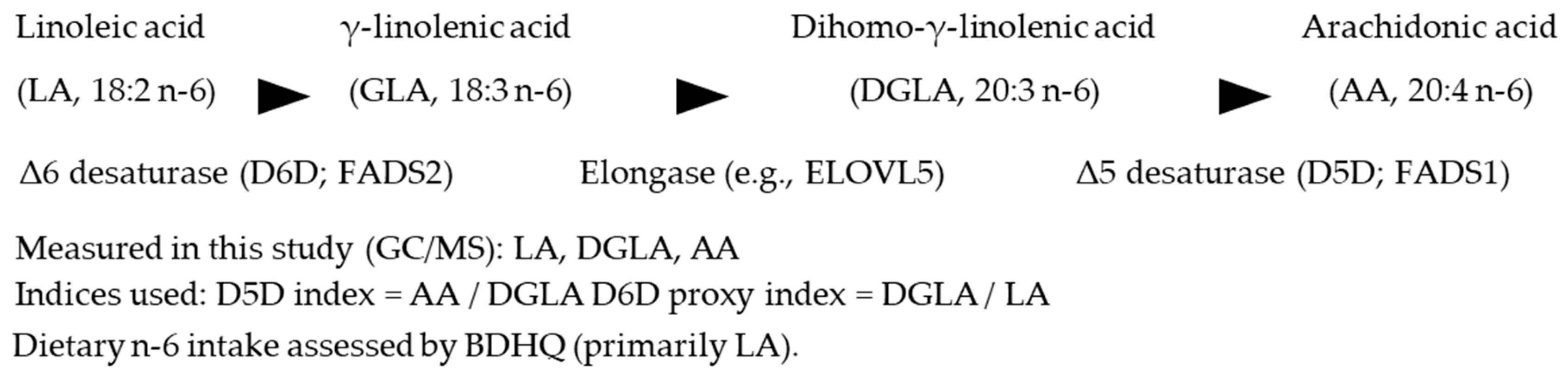
Dihomo-γ-Linolenic Acid Elevation with Desaturase Imbalance in Metabolic Dysfunction-Associated Steatotic Liver Disease in a Japanese Health Checkups Cohort: HOZUGAWA Study, a Multi-Omic, Diet Adjusted Analysis
 ,
,  , , , , ,
  , ,
, ,  and
and 
Abstract
Share and Cite
Kawai, S.; Okada, H.; Okamoto, H.; Yashiki, R.; Minamida, M.; Shinagawa, N.; Ichikawa, T.; Yamamoto, S.; Kitagawa, N.; Hashimoto, Y.; et al. Dihomo-γ-Linolenic Acid Elevation with Desaturase Imbalance in Metabolic Dysfunction-Associated Steatotic Liver Disease in a Japanese Health Checkups Cohort: HOZUGAWA Study, a Multi-Omic, Diet Adjusted Analysis. Nutrients 2026, 18, 57. https://doi.org/10.3390/nu18010057
Kawai S, Okada H, Okamoto H, Yashiki R, Minamida M, Shinagawa N, Ichikawa T, Yamamoto S, Kitagawa N, Hashimoto Y, et al. Dihomo-γ-Linolenic Acid Elevation with Desaturase Imbalance in Metabolic Dysfunction-Associated Steatotic Liver Disease in a Japanese Health Checkups Cohort: HOZUGAWA Study, a Multi-Omic, Diet Adjusted Analysis. Nutrients. 2026; 18(1):57. https://doi.org/10.3390/nu18010057
Chicago/Turabian StyleKawai, Sayaka, Hiroshi Okada, Hideto Okamoto, Ren Yashiki, Megumi Minamida, Natsuko Shinagawa, Takahiro Ichikawa, Shinta Yamamoto, Noriyuki Kitagawa, Yoshitaka Hashimoto, and et al. 2026. "Dihomo-γ-Linolenic Acid Elevation with Desaturase Imbalance in Metabolic Dysfunction-Associated Steatotic Liver Disease in a Japanese Health Checkups Cohort: HOZUGAWA Study, a Multi-Omic, Diet Adjusted Analysis" Nutrients 18, no. 1: 57. https://doi.org/10.3390/nu18010057
APA StyleKawai, S., Okada, H., Okamoto, H., Yashiki, R., Minamida, M., Shinagawa, N., Ichikawa, T., Yamamoto, S., Kitagawa, N., Hashimoto, Y., Sasano, R., Yagi, K., Hamaguchi, M., & Fukui, M. (2026). Dihomo-γ-Linolenic Acid Elevation with Desaturase Imbalance in Metabolic Dysfunction-Associated Steatotic Liver Disease in a Japanese Health Checkups Cohort: HOZUGAWA Study, a Multi-Omic, Diet Adjusted Analysis. Nutrients, 18(1), 57. https://doi.org/10.3390/nu18010057