Beetroot Juice and Exercise for Clinical Health and Athletic Performance: A Narrative Review

 ,
,  ,
,  , , , ,
  and
and
Abstract
1. Introduction
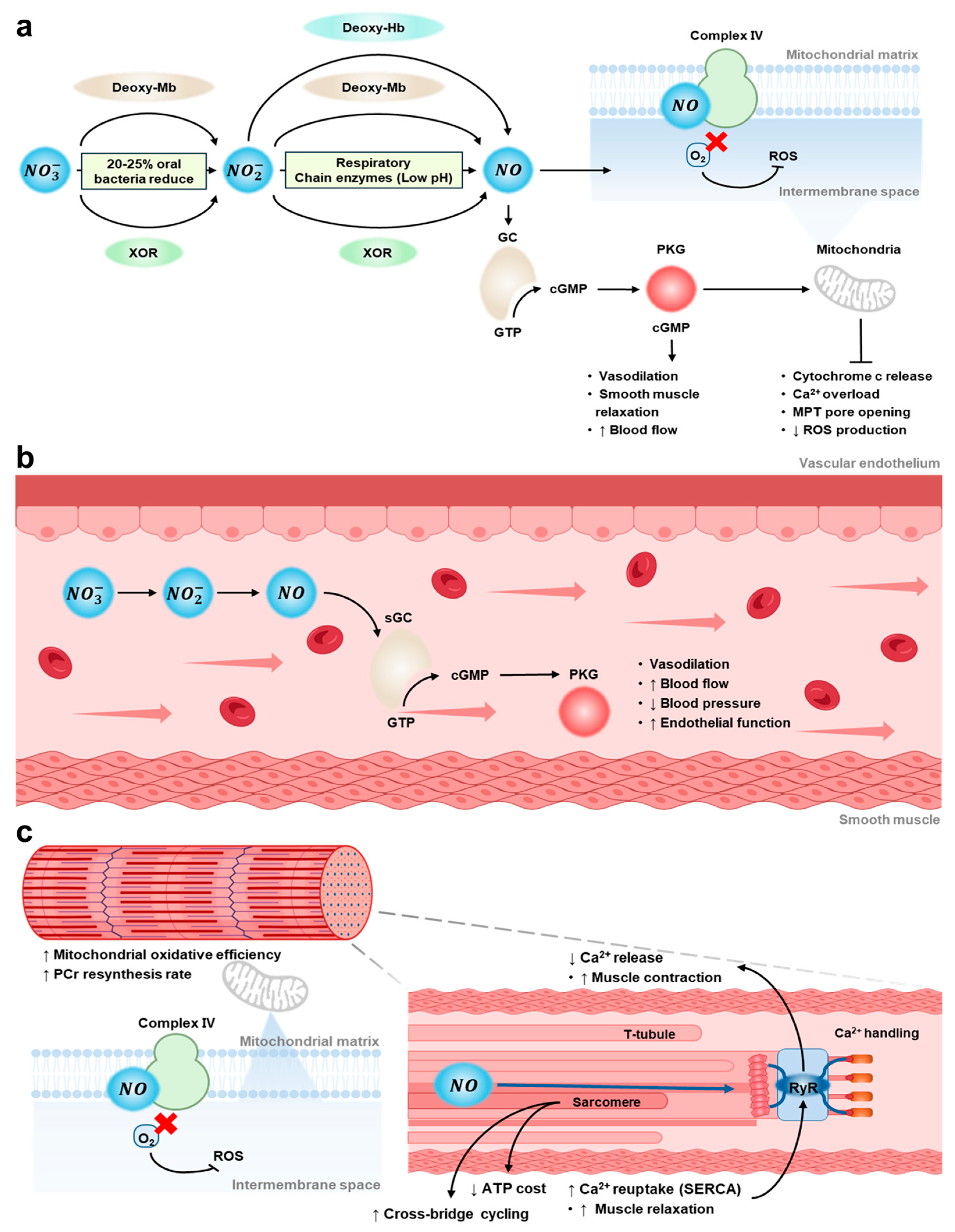
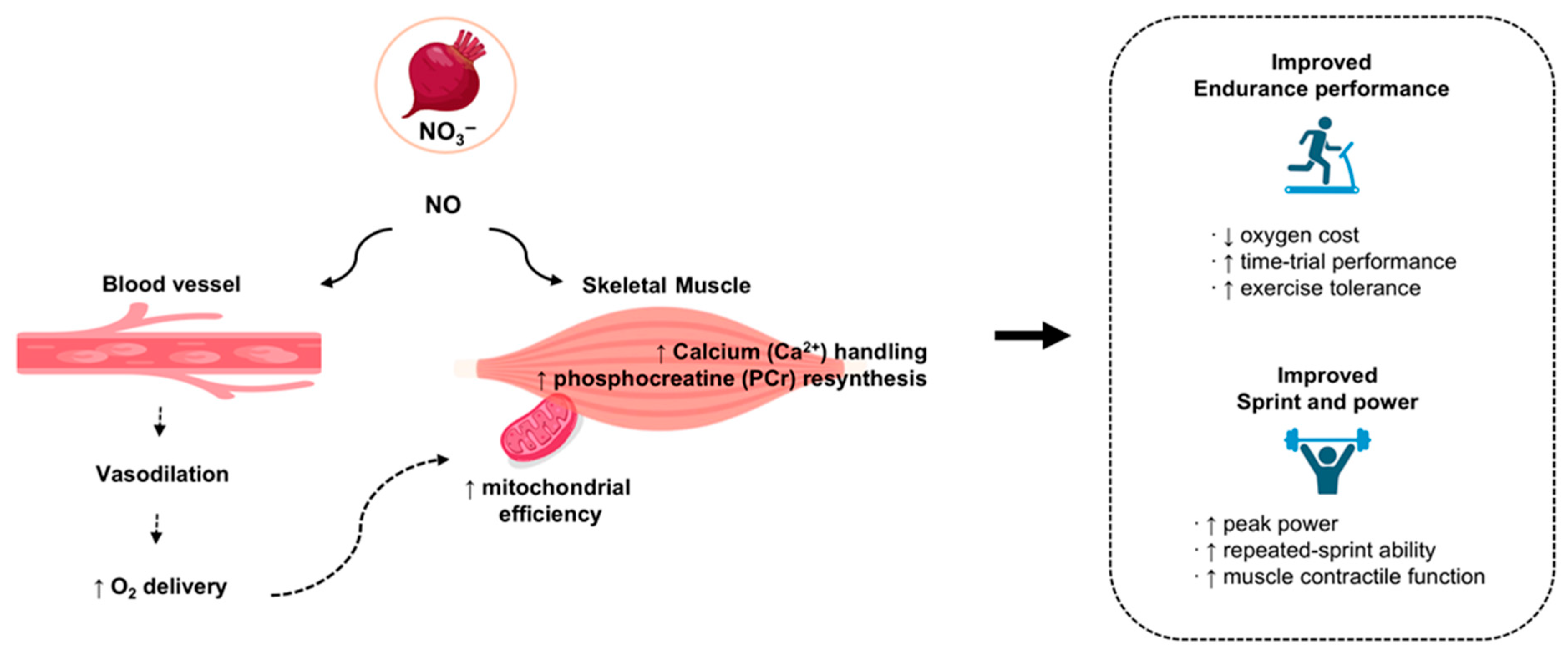
2. Physiological Mechanisms Underlying the Effects of Beetroot Juice
3. Practical Considerations for Beetroot Juice Supplementation
3.1. Timing Strategies for Exercise Settings
3.2. Dose–Response and Population-Specific Responsiveness
3.3. Considerations Related to Oral Microbiome Preservation
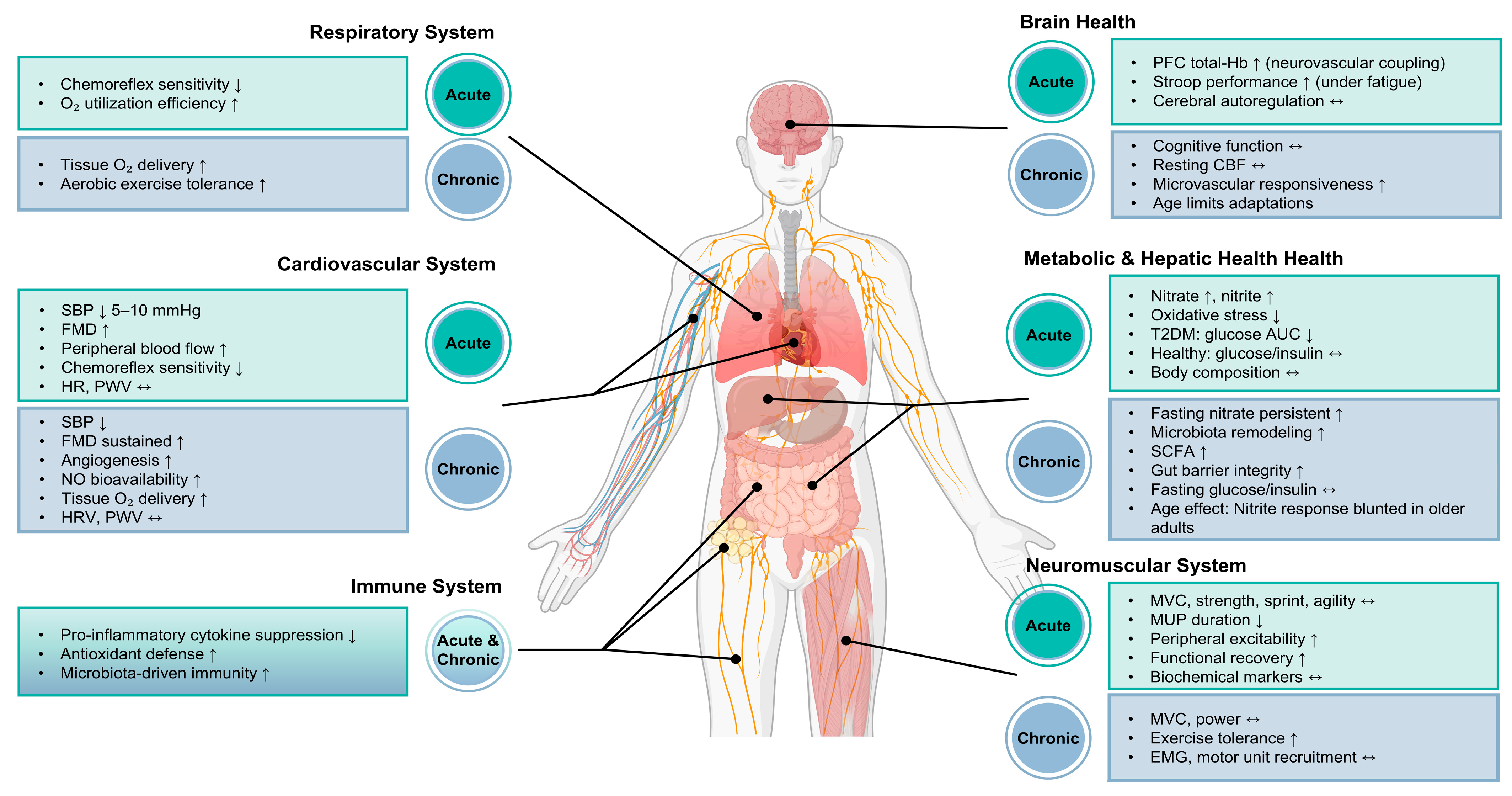
4. Effects of Beetroot Juice in Health and Exercise
4.1. Metabolic Health

| Reference | Participants | Experimental Conditions | Supplementation Protocol | Supplement Source | Variables | Results |
|---|---|---|---|---|---|---|
| Fuchs et al. [44] | M, obese, insulin-resistant (n = 16) | EC1: BRJ EC2: CON | EC1: BRJ 70 mL/day (4.8 mmol) (180 min before)/1 day | Beet It (James White Drinks Ltd., Ipswich, UK) | Glucose homeostasis, Conduit Artery Blood Flow, Vascular occlusion plethysmography, NIRS, BP | Vascular resistance ↓ Postprandial glucose ↔ Postprandial insulin ↔ |
| Garnacho-Castaño et al. [41] | M, healthy with ≥ 2 years of crossfit experience (n = 12) | EC1: BRJ EC2: PLA | EC1: BRJ 140 mL/day (12.8 mmol) (180 min before)/1 day | Beet It (James White Drinks Ltd., Ipswich, UK) | Workout of the day Test (CrossFit), Blood Sampling, SpO2, CMJ | (1st) Number of Repetitions ↑ (2nd) Number of Repetitions ↔ Serum Cortisol SpO2 ↓ Muscle Fatigue ↓ Serum Testosterone ↔ Testosterone/cortisol Ratio ↔ Blood Lactate ↔ |
| Giampaoli et al. [49] | M (n = 2) and W (n = 5) healthy adult (n = 7) | EC1: BRJ EC2: BRJ + EXE EC3: PLA + EXE | EC1: BRJ 200 mL/day (9.7 mmol) (60 min before)/1 day EC2: BRJ 200 mL/day (9.7 mmol) (60 min before)/1 day EC3: BRJ 20 mL/day (1.8 mmol) (60 min before)/1 day | Commercial BRJ (Aureli Mario SS Agricola, Ortucchio, Italy) | Cycle Ergometer, Urine Sampling, Gas Exchange | Dopamin-3-O-sulfate ↑ 4-methylpyridine-2-carboxylic acid ↔ |
| Heredia-Martínez et al. [43] | M (n = 7) and W (n = 8) hemodialysis (n = 8) and healthy adult (n = 15) | EC1: BRJ (HD) EC2: BRJ EC3: PLA (HD) EC4: PLA | EC1: BRJ 70 mL/day (6.4 mmol) (NR)/1 day EC2: BRJ 70 mL/day (6.4 mmol) (NR)/1 day | Beetroot Juice (James White Drinks Ltd., Ipswich, UK) | Blood Sampling, Dialysate Sampling, Saliva Sampling, BP | (EC1 vs. EC2) Plasma NO2− & NO3− ↑ (EC1 vs. EC2) Plasma NO2− AUClast ↑ (EC1) Plasma NO2− AUClast & t ½ ↑ (EC1 vs. EC2) BP and Plasma cGMP ↔ (EC1) Potassium and Safety and Tolerability ↔ |
| Jurga et al. [42] | M (n = 3) and W (n = 5) healthy adult (n = 8) | EC1: BRJ EC2: NIT | EC1: BRJ 2 × 70 mL/day (12.9 mmol) (60 min before)/1 day | Beet It Sport (James White Drinks) | Blood Sampling, Flow-mediated skin fluorescence | Plasma NOx ↑ Plasma Betaine/Choline ↑ Trimethylamine/ Trimethylamine N-oxide ↔ |
| Rowland et al. [53] | M, healthy adult (n = 12) | EC1: BRJ (MORN) EC2: BRJ (AFT) EC3: BRJ (EVE) EC4: PLA (MORN) EC5: PLA (AFT) EC6: PLA (EVE) | EC1: BRJ 2 × 70 mL/day (13 mmol) (morning)/1 day EC2: BRJ 2 × 70 mL/day (13 mmol) (mid-day)/1 day EC3: BRJ 2 × 70 mL/day (13 mmol) (evening)/1 day | Beet It (James White Drinks Ltd., Ipswich, UK) | Cycle Ergometer Severe-Intensity Exercise, TTE, Urine Sampling, Saliva Sampling, BP, PWV | (EC1 & EC2 & EC3) NO3− Metabolism ↑ (Time) NO3− Metabolism ↔ (EC1 & EC2 & EC3) Central SBP ↓ (Time) SBP ↔ (EC1 & EC2 & EC3 vs. Time) Brachial SBP ↔ (EC1 & EC2 & EC3 vs. Time) TTE ↔ |
| Shepherd et al. [46] | M (n = 19) and W (n = 12) healthy younger and older (n = 31) | EC1: BRJ (YN) EC: BRJ (OLD) EC3: PLA (YN) EC4: PLA (OLD) | EC1: BRJ 140 mL/day (11.9 mmol) (morning)/1 day EC2: BRJ 140 mL/day (11.9 mmol) (morning)/1 day | Beet It (James White Drinks., Ipswich, UK) | Magnetic resonance imaging, Incretin and C-peptide, Blood Sampling | (EC1 & EC2) Plasma NO2− ↑ (EC1 & EC2) Plasma NO2− ↑ (EC1 & EC2) Portal vein flux ↔ (EC1) Portal vein velocity ↓ (EC2) Portal vein velocity ↔ (EC1 & EC2) Plasma glucose, Total GLP-1, Active GLP-1, C-peptide, SBP, DBP ↔ |
| Tyler et al. [45] | M (n = 2) and W (n = 5) T2D adult (n = 7) | EC1: BRJ EC2: PLA | EC1: BRJ 70 mL/day (6.4 mmol) (120 min before)/1 day | Beetroot Juice (James White Drinks, Ipswich., UK) | Blood Sampling, OGTT, BP | Glucose AUG ↓ ΔSVR ↓ Salivary NO2− & NO3− ↑ SBP & DBP ↔ HOMA-IR & QUICKI ↔ |
| Reference | Participants | Experimental Conditions | Supplementation Protocol | Supplement Source | Variables | Results |
|---|---|---|---|---|---|---|
| Alharbi et al. [48] | M (n = 7) and W (n = 22) obesity mid-age and older (n = 29) | EC1: CR + BRJ EC2: CR | EC1: BRJ 70 mL/day (6.4 mmol) (morning)/2 weeks | Beet It (James White Ltd., Ashbocking, Suffolk, UK) | BP, REE, Handgrip Strength, Skin microvascular blood flow, IPAQ, Urine Sampling, Saliva Sampling | Average Microvascular Flux ↑ NO-dependent Endothelial Activity ↑ SBP ↓ Cognitive Function ↑ Oxidative Stress ↑ NO bioavailability ↑ Physical Strength ↑ Metabolic Adaptation ↔ Body composition ↔ |
| Babateen et al. [47] | M (n = 24) and W (n = 38) overweight/obese older adults (n = 62) | EC1: High BRJ EC2: Medium BRJ EC3: Low BRJ EC4: PLA | EC1: BRJ 2 × 70 mL/day (12.9 mmol) (morning, evening)/13 weeks EC2: BRJ 70 mL/day (6.45 mmol) (evening)/13 weeks EC3: BRJ 35 mL/day (3.23 mmol) (evening)/13 weeks | Beet It Sports (James White Drinks, UK) | Blood Sampling, Urine Sampling | (EC1, EC2) Plasma NO3− ↑ (EC3) Plasma NO3− ↔ (EC1, EC3) Plasma NO2− ↑ (EC2) Plasma NO2− ↔ (EC1, EC2) Saliva NO3− ↑ (EC3) Saliva NO3− ↔ (EC1, EC2) Saliva NO2− ↑ (EC3) Saliva NO2− ↔ (EC1, EC2) Urine NO3− ↑ (EC3, time points) Urine NO3− ↔ (EC1, EC2, EC3) Urine NO2− ↔ |
| Fejes et al. [54] | M (NR) and W (NR) hypertension older (n = 15) | EC1: BRJ EC2: PLA | EC1: BRJ 2 × 70 mL/day (12.9 mmol) (NR)/4 weeks | Beet It (James White Drinks Ltd., Ipswich, UK) | Blood Sampling, Salivary nitrate, FBF, Clinic BP, Home BP | (3H post) Plasma NO3−, NO2− ↑ Salivary NO3−, NO2− ↑ FBF AUC ratio ↑ BP ↔ (4-week post) Plasma NO3−, NO2− ↑ Salivary NO3−, NO2− ↑ FBF AUC ratio ↔ BP ↔ |
| Miller et al. [39] | M (n = 3) and W (n = 10) healthy middle-aged and older (n = 13) | EC1: BRJ EC2: PLA | EC1: BRJ 70 mL/day (6.1 mmol) (morning)/12 weeks | Beet It Sports (James White Drinks Ltd.; Ipswich, UK) | Blood Sampling | (90 min) Plasma NO3− ↑ (90 min) Plasma NO2− ↑ Fasting Plasma NO3− ↑ Fasting Plasma NO2− ↑ Plasma NO2− Change Variability ↑ |
| Vanhatalo et al. [51] | M (NR) and W (NR) healthy younger and older (n = 75) | EC1: BRJ (YN) EC2: BRJ (OLD) EC3: PLA (YN) EC4: PLA (OLD) | EC1: BRJ 2 × 70 mL/day (12.1 mmol) (morning and evening)/2 weeks EC2: BRJ 2 × 70 mL/day (12.1 mmol) (morning and evening)/2 weeks | Beetroot Juice | Tongue Scarping, Blood Sampling, Peripheral blood pressure, Central blood pressure, FMD | (EC2) MAP ↓ (EC1) MAP ↔ (EC2) ΔNO2− ↑ (EC1) ΔNO2− ↔ (EC2, EC4) ΔMAP & ΔNO2− ↑ (EC1, EC3) ΔMAP & ΔNO2− ↔ (EC2, EC4) NO2− and oral microbes ↔ (EC1, EC3) NO2− and oral microbes ↔ |
| Wang et al. [52] | M (NR) and W (NR) healthy adults (n = 18) | EC1: BRJ | EC1: BRJ 270 mL/day (2.7 mmol) (morning and evening)/2 weeks | Red Beetroot Juice (Hartley Wintney, UK) | Stool Sampling | (Day3) Akkermansia muciniphila ↑ (Day3) Bacteroides fragilis ↓ (Day3, Day14) Total SCFAs ↑ (Day3, Day14) Butyric acid ↑ α- & β-diversity ↔ |
4.2. Cardiovascular Health
4.3. Neuromuscular Function
| Reference | Participants | Experimental Conditions | Supplementation Protocol | Supplement Source | Variables | Results |
|---|---|---|---|---|---|---|
| Benjamim et al. [82] | W, systemic arterial hypertension postmenopausal adult (n = 14) | EC1: BRJ (1st D) EC2: BRJ | EC1: BRJ 2 × 70 mL/day (12.8 mmol) (morning)/1 week EC2: BRJ 70 mL/day (6.4 mmol) (morning)/1 week | Beet It Sports (James White Drinks Ltd., Ipswich, UK) | FMD, HRV, HR, BP, Blood Sampling | (EC1) SBP ↓ (EC2) SBP ↔ (EC1 vs. EC2) FMD ↑ (EC1 vs. EC2) HRV ↑ (EC1 vs. EC2) HR ↔ (EC1 & EC2) Plasma NO3− ↑ (EC1 & EC2) Plasma NO2− ↑ |
| Curry et al. [59] | W, healthy adult (n = 10) | EC1: BRJ EC2: Orange Juice | EC1: BRJ 500 mL/day (12 mmol) (120 min before)/1 day | Beetroot Juice (CAJ Food Products, Inc., Fishers, IN, USA) | Electronically braked leg cycle ergometer (40 & 80% VO2peak for 5 min), BP, HR, Transcranial Doppler, CO | Blood NO ↑ SBP ↓ DBP & HR ↔ CAIx ↓ (Rest) CAIx ↔ PIx & RIx ↔ |
| Chapman et al. [61] | M (n = 7) and W (n = 7) healthy adult (n = 14) | EC1: BRJ EC2: PLA | EC1: BRJ 500 mL/day (9.68 mmol) (180 min before)/1 day | Commercial BRJ (Biotta Beet Juice, Fishers, IN, USA) | Breathe CO2 for 5 min, Treadmill Walking Test, BP, Microcirculatory endothelial function | Renal/Segmental Artery blood velocity ↔ Vascular resistance ↔ Microcirculatory endothelial function ↔ |
| Engan et al. [83] | M (n = 5) and W (n = 3) healthy adult (n = 8) | EC1: BRJ EC2: PLA | EC1: BRJ 70 mL/day (5 mmol) (120 min before)/1 day | Beetroot Juice (James White Drinks Ltd., Ipswich, UK) | Apnea Test, SpO2, HR, Spleen Maximal Diameters, Blood Sampling | Spleen Volume ↓ Hb Concentration ↑ Apnea Apleen Concentration ↔ Elevated Hb during Apnea ↔ Max Apnea Duration ↔ HR Drop during Apnea ↔ SpO2 Max ↔ |
| Fejes et al. [71] | M (n = 10) and W (n = 5) older adults with medically treated hypertension (n = 15) | EC1: BRJ EC2: PLA | EC1: BRJ 70 mL/day (6.4 mmol) (morning)/1 day | Beet It (James White Drinks Ltd., Ipswich, UK) | Blood Sampling, FMD, BP | Plasma NO2− ↑ Plasma NO3− ↑ SBP, DBP ↔ Cardiovascular function ↔ |
| Fuchs et al. [44] | M, obese, insulin-resistant (n = 16) | EC1: BRJ EC2: CON | EC1: BRJ 70 mL/day (4.8 mmol) (180 min before)/1 day | Beet It (James White Drinks Ltd., Ipswich, UK) | Glucose homeostasis, Conduit Artery Blood Flow, Vascular occlusion plethysmography, NIRS, BP | Vascular resistance ↓ Postprandial glucose ↔ Postprandial insulin ↔ |
| Hayes et al. [84] | M, healthy adult (n = 15) | EC1: BRJ EC2: PLA | EC1: BRJ 140 mL/day (14 mmol) (morning)/1 day | Beet It Sport (James White Drinks Ltd., Ipswich, UK) | Blood Sampling, BP | Plasma NO3− ↑ Plasma NO2− ↑ SBP ↓ DBP ↓ |
| Heredia-Martinez et al. [43] | M (n = 7) and W (n = 8) hemodialysis (n = 8) and healthy adult (n = 15) | EC1: BRJ(HD) EC2: BRJ EC3: PLA(HD) EC4: PLA | EC1: BRJ 70 mL/day (6.4 mmol) (NR)/1 day EC2: BRJ 70 mL/day (6.4 mmol) (NR)/1 day | Beetroot Juice (James White Drinks Ltd., Ipswich, UK) | Blood Sampling, Dialysate Sampling, Saliva Sampling, BP | (EC1 vs. EC2) Plasma NO2−& NO3− ↑ (EC1 vs. EC2) Plasma NO2− AUClast ↑ (EC1) Plasma NO2− AUClast & t ½ ↑ (EC1 vs. EC2) BP & Plasma cGMP ↔ (EC1) Potassium & Safety and Tolerability ↔ |
| Horiuchi et al. [85] | M, healthy adult (n = 12) | EC1: BRJ (Normoxia) EC2: BRJ (Hypoxia) EC3: PLA (Normoxia) EC4: PLA (Hypoxia) | EC1: BRJ 2 × 70 mL/day (12.9 mmol) (NR)/4 days EC2: BRJ 2 × 70 mL/day (12.9 mmol) (NR)/4 days | Beet It (James White Drinks, Ipswich, UK) | Blood Sampling, DCA, Internal carotid artery, SpO2, MAP, VE, PETCO2 | (EC1, EC2 vs. EC3, EC4) Circulating NO3 ↑ (EC2, EC4 vs. EC1, EC3) DCA-RoR ↓ (EC1 vs. EC3) DCA-RoR ↔ (EC2 vs. EC4) DCA-RoR ↔ (EC2, EC4 vs. EC1, EC3) Internal carotid artery Diameter, Velocity, or Flow ↔ |
| Jurga et al. [42] | M (n = 3) and W (n = 5) healthy adult (n = 8) | EC1: BRJ EC2: NIT | EC1: BRJ 2 × 70 mL/day (12.9 mmol) (60 min before)/1 day | Beet It Sport (James White Drinks) | Blood Sampling, Flow-mediated skin fluorescence | Plasma NOx ↑ Plasma Betaine/Choline ↑ Trimethylamine/ Trimethylamine N-oxide ↔ |
| Kelly et al. [86] | M (n = 6) and W (n = 6) healthy older adult (n = 12) | EC1: BRJ EC2: PLA | EC1: BRJ 2 × 70 mL/day (9.6 mmol) (morning and mid-day)/1 day | Beet It Sports (James White Drinks, Ipswich, UK) | Moderate Treadmill Walking, Low/High-Intensity Kness Extension, 6MWT, Blood Sampling, BP, HR, Serial Sevens Subtraction Test | (EC1) SBP ↓ (EC1) DBP ↓ (EC1 & EC2) MAP ↓ (EC1) VO2 Mean Response Time ↓ 6MWT, Muscle Metabolism, Cognition, Brain Metabolism ↔ |
| Londono-Hoyos et al. [87] | M (n = 14) and W (n = 2) HFpEF Patients (n = 16) | EC1: BRJ EC2: PLA | EC1: BRJ 140 mL/day (12.9 mmol) (120 min before)/1 day | Beet It Sport (James White Drinks Ltd., Ipswich, UK | Echo, Doppler ultrasound, BP | MAP, HR, CSA, Acute hemodynamic, Carotid Hydraulic Power, Carotid Power Penetration, Carotid Energy Penetration ↔ CO ↓ |
| Pedrinolla et al. [67] | M (NR) and W (NR) younger (n = 10) and older (n = 10) and AD (n = 10) (n = 30) | EC1: BRJ (YN) EC2: BRJ (OLD) EC3: BRJ (AD) EC4: PLA (YN) EC5: PLA (OLD) EC6: PLA (AD) | EC1: BRJ 70 mL/day (6.4 mmol) (morning)/1 day EC2: BRJ 70 mL/day (6.4 mmol) (morning)/1 day EC3: BRJ 70 mL/day (6.4 mmol) (morning)/1 day | Beet It Sports (James White Drinks, Ipswich, UK) | Blood Sampling | (EC3 vs. EC1, EC2) Baseline Plasma NO3 ↓ (EC2 vs. EC1) Baseline Plasma NO3− ↔ (EC1) Baseline Plasma NO3− ↔ (EC3, EC1, EC2) Baseline Plasma NO2− ↔ (EC3, EC1, EC2) Δ Plasma NO3− ↑ (EC3, EC1, EC2) Δ Plasma NO2− ↑ (EC3, EC1, EC2) Δ Vascular Responsiveness ↑ (EC3 vs EC1, EC2) Absolute Vascular Responsiveness ↓ (EC2 vs EC1) Absolute Vascular Responsiveness ↔ (EC1) Absolute Vascular Responsiveness ↔ |
| Raubenheimer et al. [88] | M (n = 5) and W (n = 7) healthy older adults (n = 12) | EC1: High BRJ EC2: PLA | EC1: BRJ 140 mL/day (12.9 mmol) (morning)/1 day | Beet It (James White Drinks, UK) | BP, Flow cytometry, Thromboelastometry, Blood Sampling | (3 h EC1) SBP ↓, DBP ↓, MAP ↓ (3 h) Monocyte-platelet aggregates ↓ (3 h) CD11b+ granulocytes ↓ (3 h) Intrinsic pathway ↓ (6 h) Aprotinin-test ↓ |
| Richards et al. [58] | M (n = 11) and W (n = 7) healthy young adults (n = 18) | EC1: BRJ-280 EC2: BRJ-210 EC3: PLA-280 EC4: PLA-210 | EC1: BRJ 280 mL/day (16.8 mmol) (120 min before)/1 day EC2: BRJ 210 mL/day (12.6 mmol) (12 min before)/1 day | Beet It Sports (James White Drinks, Ipswich, UK) | FBF, Forced vital capacity, Forearm VO2, Handgrip Exercise | FBF ↑ Forced vital capacity ↑ Forearm VO2 ↑ |
| Rogerson et al. [89] | M (NR) and W (NR) younger (n = 18) and older (n = 7) (n = 25) | EC1: BRJ (YN) EC2: BRJ (OLD) EC3: PLA (YN) EC4: PLA (OLD) | EC1: BRJ 70 mL/day (6.4 mmol) (NR)/1 day | Beetroot Juice (James White Drinks Company suffolk, UK) | Blood Sampling, Urine Sampling, BP, Microcirculatory endothelial function | (3 h, EC1 & EC2) NO3− Metabolism ↑ (24 h, EC1) NO3− Metabolism ↑ (EC1 & EC2) SBP, DBP ↔ (EC1 & EC2) Microcirculatory endothelial function ↔ |
| Rowland et al. [53] | M, healthy adult (n = 12) | EC1: BRJ (MORN) EC2: BRJ (AFT) EC3: BRJ (EVE) EC4: PLA (MORN) EC5: PLA (AFT), EC6: PLA (EVE), | EC1: BRJ 2 × 70 mL/day (13 mmol) (morning)/1 day EC2: BRJ 2 × 70 mL/day (13 mmol) (mid-day)/1 day EC3: BRJ 2 × 70 mL/day (13 mmol) (evening)/1 day | Beet It (James White Drinks Ltd., Ipswich, UK) | Cycle Ergometer Severe-Intensity Exercise, TTE, Urine Sampling, Saliva Sampling, BP, PWV | (EC1 & EC2 & EC3) NO3− Metabolism ↑ (Time) NO3− Metabolism ↔ (EC1 & EC2 & EC3) Central SBP ↓ (Time) SBP ↔ (EC1 & EC2 & EC3 vs. Time) Brachial SBP ↔ (EC1 & EC2 & EC3 vs. Time) TTE ↔ |
| Stanaway et al. [70] | M (n = 12) and W (n = 12) healthy younger and older (n = 24) | EC1: BRJ (YN) EC2: BRJ (OLD) EC3: PLA (YN) EC4: PLA (OLD) | EC1: BRJ 150 mL/day (10.5 mmol) (morning)/1 day EC2: BRJ 150 mL/day (10.5 mmol) (morning)/1 day | Beetroot Juice | Treadmill Walking (low-intensity aerobic exercise), Blood Sampling, Cognitive Measurements, BP, Choice Reaction Test, RVIP, Stroop test, Mood and Perceptual | (EC1 & EC2) SBP ↓ (EC2) DBP ↓ (EC1 & EC2 & EC3 & EC4) Stroop reaction time ↑ (EC1 & EC2) Plasma NO3− ↑ (EC1 & EC2) Plasma NO2− ↑ (EC1 & EC2) Cognitive Function ↑ |
| Tyler et al. [45] | M (n = 2) and W (n = 5) T2D adult (n = 7) | EC1: BRJ EC2: PLA | EC1: BRJ 70 mL/day (6.4 mmol) (120 min before)/1 day | Beetroot Juice (James White Drinks, Ipswich., UK) | Blood Sampling, OGTT, BP | Glucose AUG ↓ ΔSVR ↓ Salivary NO2− & NO3− ↑ SBP & DBP ↔ HOMA-IR & QUICKI ↔ |
| Vanhatalo et al. [51] | M (NR) and W (NR) healthy younger and older (n = 75) | EC1: BRJ (YN) EC2: BRJ (OLD) EC3: PLA (YN) EC4: PLA (OLD) | EC1: BRJ 2 × 70 mL/day (12.1 mmol) (morning and evening)/2 weeks EC2: BRJ 2 × 70 mL/day (12.1 mmol) (morning and evening)/2 weeks | Beetroot Juice | Tongue Scarping, Blood Sampling, Peripheral blood pressure, Central blood pressure, FMD | (EC2) MAP ↓ (EC1) MAP ↔ (EC2) ΔNO2− ↑ (EC1) ΔNO2− ↔ (EC2, EC4) ΔMAP & ΔNO2− ↑ (EC1, EC3) ΔMAP & ΔNO2− ↔ (EC2, EC4) NO2− and oral microbes ↔ (EC1, EC3) NO2− and oral microbes ↔ |
| van der Avoort et al. [56] | M (n = 15) and W (n = 15) healthy adults (n = 30) | EC1: BRJ EC2: VEG | EC1: BRJ (NR) (6.5 mmol) (mid-day)/1 week | Beet It (James White Drinks, UK) | Blood Sampling, BP | Plasma NO3−/NO2− ↑ SBP ↓ DBP ↓ |
| Volino-Souza et al. [57] | W, Healthy pregnant (n = 12) | EC1: BRJ EC2: PLA | EC1: BRJ 140 mL/day (8.95 mmol) (150 min before)/1 day | Beetroot Juice (processed in-lab) | Urine Sampling, FMD, NIRS | FMD ↑ Urinary NO3− ↑ StO2 ↔ |
| Wei et al. [76] | M (n = 8) and W (n = 3) healthy adult (n = 11) | EC1: High BRJ EC2: Medium BRJ EC3: Low BRJ EC4: PLA | EC1: BRJ 210 mL/day (19.2 mmol) (150 min before)/1 day EC2: BRJ 140 mL/day (12.8 mmol) (150 min before)/1 day EC3: BRJ 70 mL/day (6.4 mmol) (150 min before)/1 day | Beet It (James White Drinks Ltd., Ipswich, UK) | BP, 5 min all-out maximal voluntary knee extension test | (EC1) SBP ↓ (EC2, EC3) SBP ↔ (EC1) DBP ↓ (EC1, EC2) DBP ↔ (EC1) MAP ↓ (EC1, EC2) MAP ↔ (EC1, EC2) Peak Torque ↑ (EC3) Peak Torque ↔ (EC1, EC2) Torque Impulse ↑ (EC1, EC2) Torque Impulse ↑ (EC3) RTD ↑ (EC1, EC2) RTD ↓ Whole Blood[S-nitrosothiol] ↑ RBC[S-nitrosothiol] ↑ (EC1, EC2, EC3) Muscle NO3− ↑ (EC1, EC2, EC3) Muscle NO2− ↔ |
| Worley et al. [60] | M (n = 8) and W (n = 5) healthy adult (n = 13) | EC1: BRJ EC2: PLA | EC1: 500 m/day (12.1 mmol) (180 min before)/1 day | Beetroot Juice (Biotta, Carmel, IN, USA) | LBNP, Cerebral artery blood velocity, HR, BP, cBRS | VLF Coherence ↑ VLF Phase ↔ VLF Gain ↔ LF Coherence ↔ LF Phase ↔ LF Gain ↓ Static-LBNP ↔ cBRS ↔ |
| Wylie et al. [35] | M, healthy adult (n = 10) | EC1: High BRJ EC2: Medium BRJ EC3: Low BRJ EC4: PLA | EC1: BRJ 280 mL/day (16.8 mmol) (150 min before)/1 day EC2: BRJ 140 mL/day (8.4 mmol) (150 min before)/1 day EC3: BRJ 70 mL/day (4.2 mmol) (150 min before)/1 day | Beet It (James White Drinks, Ipswich, UK) | Moderate- and severe-intensity cycling, BP, Blood Sampling | (EC1, EC2, EC3) Plasma NO3− ↔ (EC1, EC2, EC3) Plasma NO2− ↑ SBP ↓ DBP ↓ MAP ↓ (EC1, EC2, EC3) VO2 amplitude ↓ (EC1, EC2, EC3) Time to task ↑ |
| Reference | Participants | Experimental Conditions | Supplementation Protocol | Supplement Source | Variables | Results |
|---|---|---|---|---|---|---|
| Alharbi et al. [48] | M (n = 7) and W (n = 22) obesity mid-age and older (n = 29) | EC1: CR + BRJ EC2: CR | EC1: BRJ 70 mL/day (6.4 mmol) (morning)/2 weeks | Beet It (James White Ltd., Ashbocking, Suffolk, UK) | BP, REE, Handgrip Strength, Skin microvascular blood flow, IPAQ, Urine Sampling, Saliva Sampling | Average Microvascular Flux ↑ NO-dependent Endothelial Activity ↑ SBP ↓ Cognitive Function ↑ Oxidative Stress ↑ NO bioavailability ↑ Physical Strength ↑ Metabolic Adaptation ↔ Body composition ↔ |
| Babateen et al. [47] | M (n = 24) and W (n = 38) overweight/obese older adults (n = 62) | EC1: High BRJ EC2: Medium BRJ EC3: Low BRJ EC4: PLA | EC1: BRJ 2 × 70 mL/day (12.9 mmol) (morning, evening)/13 weeks EC2: BRJ 70 mL/day (6.45 mmol) (evening)/13 weeks EC3: BRJ 35 mL/day (3.23 mmol) (evening)/13 weeks | Beet It Sports (James White Drinks, UK) | Blood Sampling, Urine Sampling | (EC1, EC2) Plasma NO3− ↑ (EC3) Plasma NO3− ↔ (EC1, EC3) Plasma NO2− ↑ (EC2) Plasma NO2− ↔ (EC1, EC2) Saliva NO3− ↑ (EC3) Saliva NO3− ↔ (EC1, EC2) Saliva NO2− ↑ (EC3) Saliva NO2− ↔ (EC1, EC2) Urine NO3− ↑ (EC3, time points) Urine NO3− ↔ (EC1, EC2, EC3) Urine NO2− ↔ |
| Babateen et al. [90] | M (n = 24) and W (n = 38) Overweight/Obese older adults (n = 62) | EC1: High BRJ, EC2: Medium BRJ, EC3: Low BRJ, EC4: PLA | EC1: BRJ 2 × 70 mL/day (12.9 mmol) (morning, evening)/13 weeks EC2: BRJ 70 mL/day (6.45 mmol) (evening)/13 weeks EC3: BRJ 35 mL/day (3.23 mmol)/13 weeks | Beetroot Juice (James White Company, UK) | BP, Endothelial Function | (EC2, EC3) SBP ↓ (EC1) SBP ↔ (EC1, EC2, EC3) DBP ↔ (EC1, EC2, EC3) Home BP ↔ (EC2, EC3) Endothelial function ↑ (EC1) Endothelial function ↔ |
| Bock et al. [62] | M (n = 12) and W (n = 11) healthy younger and older (n = 23) | EC1: BRJ EC2: PLA | EC1: BRJ 190 mL/day (4 mmol) (NR)/4 weeks | Superbeets (HumanN Inc., Austin, TX, USA) | BP, HR, BP, cBRS, Peripheral chemoreceptor sensitivity | (EC1, post) Plasma NO3− ↑ (EC2 post) Plasma NO3− ↔ (EC1) SBP ↓ (EC2) SBP ↔ (EC1) MAP ↓ (EC2) MAP ↔ (EC1, EC2) HR ↔ (EC1) Chemoreflex sensitivity Ve ↓ (EC2) Chemoreflex sensitivity Ve ↔ (EC1, EC2) Chemoreflex sensitivity HR ↔ (EC1, EC2) cBRS ↔ |
| Delgado Spicuzza et al. [66] | W, early & late-postmenopausal adult (n = 25) | EC1: BRJ (EPM) EC2: BRJ (LPM) EC3: PLA (EPM) EC4: PLA (LPM) | EC1: BRJ 70 mL/day (6.4 mmol) (NR)/1 week EC2: BRJ 70 mL/day (6.4 mmol) (NR)/1 week | Beet It Organic (James White Drinks Ltd., Ipswich, UK) | BP, HR, baPWV, Blood Sampling, Macrovascular Function | (Rest, EC1, EC2 vs. EC3, EC4) ΔFMD ↑ (Rest, 24 h pre) ΔFMD ↑ (EC1, EC2 vs EC3, EC4) SBP/DBP ↔ (24 h pre) SBP/DBP↔ (EC1, EC2 vs EC3, EC4) Plasma NO3− ↑ (24 h pre) Plasma NO2− ↑ (EC1, EC2 vs EC3, EC4) Plasma NO2− ↔ (24 h pre) Plasma NO2− ↔ (EC1, EC2 vs EC3, EC4) Ischemia–reperfusion injury FMD ↔ (24 h pre) Ischemia–reperfusion injury FMD ↔ |
| Fejes, Pilat et al. [71] | M (n = 10) and W (n = 5) hypertension older (n = 15) | EC1: BRJ EC2: PLA | EC1: BRJ 2 × 70 mL/day (12.9 mmol) (morning and evening)/4 weeks | Beetroot Juice | BP, Urine Sampling, Fasting Blood | (4WK POST) oxLDL/NOx ratio ↓ GSH/GSSG ratio ↑ (vs. Baseline) High-sensitivity CRP ↓ |
| Fejes et al. [50] | M (n = 10) and W (n = 5) hypertension older (n = 15) | EC1: BRJ EC2: PLA | EC1: BRJ 2 × 70 mL/day (12.9 mmol) (morning and evening)/4 weeks | Beet It (James White Drinks Ltd., Ipswich, UK) | BP, FBF, Blood Sampling, 24 h Ambulatory BP monitoring | Plasma NO3− /NO2− ↑ Salivary NO3−/ NO2− ↑ Acetylcholine, Nitroglycerin ↔ FBF-AUC Ratio ↔ SBP, MAP ↔ Home BP ↔ 24 h Ambulatory BP monitoring ↔ |
| Jones et al. [65] | M (NR) and W (NR) healthy older (n = 20) | EC1: BRJ EC2: PLA | EC1: BRJ 70 mL/day (6.4 mmol) (morning)/4 weeks | Beet It Sport (James White Drinks Ltd., Ipswich, UK) | BP FMD, Microvascular function, Tongue Scarping, Blood Sampling | FMD ↑ SBP ↓ DBP ↓ Microvascular function ↔ |
| Osman et al. [69] | W, planning to conceive (n = 29) | EC1: BRJ EC2: BRJ + EXE EC3: EXE EC4: CON | EC1: BRJ 70 mL/day (6.4 mmol) (morning)/12 weeks EC2: BRJ 70 mL/day (6.4 mmol) (morning)/12 weeks | BRJ Supplementation Juice (James White Drinks Ltd., Ipswich, UK) | Resistance and Endurance exercise, BP, CO, TPR | (EC3) TPR ↓ (EC3) CO ↑ (EC2) DBP ↓ (EC2) CO ↑ |
| Reference | Participants | Experimental Conditions | Supplementation Protocol | Supplement Source | Variables | Results |
|---|---|---|---|---|---|---|
| Acute | ||||||
| Berlanga et al. [72] | M, amateur sports climber (n = 10) | EC1: BRJ EC2: PLA | EC1: BRJ 70 mL/day (6.4 mmol) (150 min before)/1 day | Beet-It Pro Elite Shot (James White Drinks Ltd., Ipswich, UK) | Maximal Isometric Half Crimp Test, Pull-Up Failure Test, IHS, CMJ, SJ, Saliva Sampling | CMJ height ↔ SJ height ↔ IHS ↔ Pull-up test to failure ↔ Half crimp test ↔ Salivary NO3− and NO2− ↑ |
| Clifford et al. [26] | M, healthy, recreationally active (n = 29) | EC1: High BRJ EC2: Low BRJ EC3: PLA | EC1: BRJ 250 mL/day (4 mmol) (morning and evening)/3 days EC2: BRJ 250 mL/day (2 mmol) (morning and evening)/3 days | Love Beets Super Tasty Beet Juice (Gs Fresh Ltd., Cambridgeshire, UK) | Drop Jump, MIVC, CMJ, PPT, CK | (EC1, EC2) MIVC recovery ↑ CMJ recovery ↑ CK ↓ PPT ↓ |
| Garnacho-Castano et al. [41] | M, healthy with ≥ 2 years of crossfit experience (n = 12) | EC1: BRJ EC2: PLA | EC1: BRJ 140 mL/day (12.8 mmol) (180 min before)/1 day | Beet It (James White Drinks Ltd., Ipswich, UK) | Workout of the day Test (CrossFit), Blood Sampling, SpO2, CMJ | (1st) Number of Repetitions ↑ (2nd) Number of Repetitions ↔ Serum Cortisol SpO2 ↓ Muscle Fatigue ↓ Serum Testosterone ↔ Testosterone/cortisol Ratio ↔ Blood Lactate ↔ |
| Lopez-Samanes et al. [91] | M, young basketball player (n = 10) | EC1: BRJ EC2: PLA | EC1: BRJ 140 mL/day (12.8 mmol) (180 min before)/1 day | Beet-It Pro Elite Shot (James White Drinks Ltd., Ipswich, UK) | Simulated Basketball game and Neuromuscular Performance Test | (EC1 vs. EC2) CMJ ↑ (EC1 vs. EC2) Sprint ↑ (EC1 vs. EC2) Handgrip ↑ (EC1 vs. EC2) Agility T-test ↑ match physical activity ↔ |
| Lopez-Samanes et al. [73] | M, highly competitive tennis player (n = 13) | EC1: BRJ EC2: PLA | EC1: BRJ 70 mL/day (6.4 mmol) (180 min before)/1 day | Beet-It Pro Elite Shot (James White Drinks Ltd., Ipswich, UK) | RPE, Serve velocity test, CMJ, ISH, 5-0-5 agility, 10 m | Serve velocity test ↑ CMJ ↑ IHS ↑ 5-0-5 agility dominant ↓ 5-0-5 agility non-dominant side↓ 10 m ↓ |
| Lopez-Samanes et al. [75] | W, semi-professional rugby player (n = 14) | EC1: BRJ EC2: PLA | EC1: BRJ 140 mL/day (12.8 mmol) (150 min before)/1 day | Beet-It Pro Elite Shot (James White Drinks Ltd., Ipswich, UK) | CMJ, IHS, 10 m and 30 m Sprint Test, Modified agility T-test, Bronco endurance test | CMJ ↑ IHS ↔ 10 m & 30 m Sprint ↔ Agility T-test ↔ Bronco endurance test ↔ |
| Lopez-Samanes et al. [74] | W, elite field hockey player (n = 11) | EC1: BRJ EC2: PLA | EC1: BRJ 70 mL/day (6.4 mmol) (180 min before)/1 day | Beet-It Pro Elite Shot (James White Drinks Ltd., Ipswich, UK) | CMJ, IHS, 20 m-sprint, RSA | CMJ ↔ Handgrip ↔ 20 m Sprint ↔ RSA ↔ Match GPS metrics ↔ |
| Rowland et al. [53] | M, healthy adult (n = 12) | EC1: BRJ (MORN) EC2: BRJ (AFT) EC3: BRJ (EVE) EC4: PLA (MORN) EC5: PLA (AFT) EC6: PLA (EVE) | EC1: BRJ 2 × 70 mL/day (13 mmol) (morning)/1 day EC2: BRJ 2 × 70 mL/day (13 mmol) (mid-day)/1 day EC3: BRJ 2 × 70 mL/day (13 mmol) (evening)/1 day | Beet It (James White Drinks Ltd., Ipswich, UK) | Cycle Ergometer Severe-Intensity Exercise, TTE, Urine Sampling, Saliva Sampling, BP, PWV | (EC1 & EC2 & EC3) NO3− Metabolism ↑ (Time) NO3− Metabolism ↔ (EC1 & EC2 & EC3) Central SBP ↓ (Time) SBP ↔ (EC1 & EC2 & EC3 vs. Time) Brachial SBP ↔ (EC1 & EC2 & EC3 vs. Time) TTE ↔ |
| Tan et al. [81] | M, healthy and resistance-trained (n = 18) | EC1: High BRJ EC2: Medium BRJ EC3: Low BRJ EC4: PLA | EC1: BRJ 4 × 70 mL/day (24 mmol) (150 min before)/1 day EC2: BRJ 2 × 70 mL/day (12 mmol) (150 min before)/1 day EC3: BRJ 70 mL/day (6 mmol) (150 min before)/1 day | Beet It (James White Drinks Ltd., Ipswich, UK) | CMJ: 1 set × 5 reps (40% 1RM) Squat & Bench: 1 set × 3 reps (50% 1RM) + 1 set × 3 reps (75% 1RM), Liner position transducer, Blood Sampling, Brunel mood scale | CMJ ↔ Squat ↔ Bench Press ↔ (EC1, EC2, EC3) Plasma NO3− ↔ (EC1, EC2, EC3) Plasma NO2− ↑ Mood ↔ |
| Wei et al. [76] | M (n = 8) and W (n = 3) healthy adult (n = 11) | EC1: High BRJ EC2: Medium BRJ EC3: Low BRJ EC4: PLA | EC1: BRJ 210 mL/day (19.2 mmol) (150 min before)/1 day EC2: BRJ 140 mL/day (12.8 mmol) (150 min before)/1 day EC3: BRJ 70 mL/day (6.4 mmol) (150 min before)/1 day | Beet It (James White Drinks Ltd., Ipswich, UK) | BP, 5 min all-out maximal voluntary knee extension test, | (EC1) SBP ↓ (EC2, EC3) SBP ↔ (EC1) DBP ↓ (EC1, EC2) DBP ↔ (EC1) MAP ↓ (EC1, EC2) MAP ↔ (EC1, EC2) Peak Torque ↑ (EC3) Peak Torque ↔ (EC1, EC2) Torque Impulse ↑ (EC1, EC2) Torque Impulse ↑ (EC3) RTD ↑ (EC1, EC2) RTD ↓ Whole Blood[S-nitrosothiol] ↑ RBC[S-nitrosothiol] ↑ (EC1, EC2, EC3) Muscle NO3− ↑ (EC1, EC2, EC3) Muscle NO2− ↔ |
| Wylie et al. [35] | M, healthy adult (n = 10) | EC1: High BRJ EC2: Medium BRJ EC3: Low BRJ EC4: PLA | EC1: BRJ 280 mL/day (16.8 mmol) (150 min before)/1 day EC2: BRJ 140 mL/day (8.4 mmol) (150 min before)/1 day EC3: BRJ 70 mL/day (4.2 mmol) (150 min before)/1 day | Beet It (James White Drinks, Ipswich, UK) | Moderate- and severe-intensity cycling, BP, Blood Sampling | (EC1, EC2, EC3) Plasma NO3− ↔ (EC1, EC2, EC3) Plasma NO2− ↑ SBP ↓ DBP ↓ MAP ↓ (EC1, EC2, EC3) VO2 amplitude ↓ (EC1, EC2, EC3) Time to task (severe) ↑ |
| Chronic | ||||||
| Daab et al. [92] | M, semi-professional soccer player (n = 13) | EC1: BRJ EC2: PLA | EC1: 2 × 150 mL/day (8 mmol) (morning and evening)/1 week | Natural Beetroot Juice (Homemade, freshly processed) | Intermittent Shuttle Running, MVC, Qtw,pot, Voluntary activation | MVC ↓ Qtw,pot ↓ Voluntary activation ↓ |
| Esen et al. [78] | M (n = 10) and W (n = 6) healthy, physically active young adult (n = 16) | EC1: BRJ EC2: PLA | EC1: BRJ 2 × 70 mL/day (12.8 mmol) (morning and evening)/5 days | Beet-It Pro Elite Shot (James White Drinks Ltd., Ipswich, UK) | Isometric knee extension at 25% MVC with BFR | Plasma NO2− ↑ MUP duration ↓ MUFR, MUP area ↔ |
| Esen et al. [77] | M, healthy, recreationally active (n = 14) | EC1: BRJ EC2: PLA | EC1: BRJ 2 × 70 mL/day (12.8 mmol) (morning and evening)/5 days | Beet It (James White Drinks, Ipswich, UK) | Kness-Entensor Strength Test, Intramuscular EMG, Isometric contractions, Blood Sampling | MUP duration ↓ Area, MUFR ↔ Plasma NO2− ↑ |
| Munoz et al. [80] | M, semi-professional handball player (n = 12) | EC1: BRJ EC2: PLA | EC1: 70 mL/day (6.4 mmol) (mid-day)/3 days | Beet-It Pro Elite Shot (James White Drinks Ltd., Ipswich, UK) | IHS, CMJ, Throwing velocity, Agility T-test, RSA | IHS ↑ CMJ Height ↑ Throwing velocity ↔ Agility T-test↔ RSA ↔ |
4.4. Brain Health and Cognitive Function
5. Effects of Beetroot Juice and Exercise on Athletic Performance
| Reference | Participants | Experimental Conditions | Supplementation Protocol | Supplement Source | Variables | Results |
|---|---|---|---|---|---|---|
| Acute | ||||||
| Curry et al. [59] | W, healthy (n = 10) | EC1: BRJ EC2: Orange Juice | EC1: BRJ 500 mL/day (12 mmol) (120 min before)/1 day | Beetroot Juice (CAJ Food Products, Inc., Fishers, IN, USA) | Electronically braked leg cycle ergometer (40 & 80% VO2peak for 5 min), BP, HR, Transcranial Doppler, CO | Blood NO ↑ SBP ↓ DBP & HR ↔ CAIx ↓ (Rest) CAIx ↔ PIx & RIx ↔ |
| Horiuchi et al. [85] | M, healthy adult (n = 12) | EC1: BRJ (Normoxia), EC2: BRJ (Hypoxia) EC3: PLA (Normoxia) EC4: PLA (Hypoxia) | EC1: BRJ 2 × 70 mL/day (12.9 mmol) (NR)/4 days EC2: BRJ 2 × 70 mL/day (12.9 mmol) (NR)/4 days | Beet It (James White Drinks, UK) | Blood Sampling, DCA, Internal carotid artery, SpO2, MAP, VE, PETCO2 | (EC1, EC2 vs. EC3, EC4) Circulating NO3− ↑ (EC2, EC4 vs. EC1, EC3) DCA-RoR ↓ (EC1 vs. EC3) DCA-RoR ↔ (EC2 vs. EC4) DCA-RoR ↔ (EC2, EC4 vs. EC1, EC3) Internal carotid artery Diameter, Velocity, or Flow ↔ |
| Londono-Hoyos et al. [87] | M (n = 14) and W (n = 2) HFpEF patients (n = 16) | EC1: BRJ EC2: PLA | EC1: BRJ 140 mL/day (12.9 mmol) (120 min before)/1 day | Beet It Sport (James White Drinks Ltd., UK) | Echo, Echo, BP | MAP, HR, CSA, Acute hemodynamic, Carotid Hydraulic Power, Carotid Power Penetration, Carotid Energy Penetration ↔ Cardiac Output ↓ |
| Miraftabi et al. [93] | M, trained taekwondo athletes (n = 8) | EC1: BRJ-800 EC2: BRJ-400 EC3: PLA EC4: CON | EC1: BRJ 120 mL/day (12.9 mmol) (150 min before)/1 day EC2: BRJ 120 mL/day (6.4 mmol) (150 min before)/1 day | Red Beet Vinitrox Shot (Sponsor Ltd., Germany) | High-intensity Intermittent Exercise, PSTT, Multiple frequency speed of kick test, CMJ, Stroop Test, Finger-Prick Blood Sampling | PSTT, Multiple frequency speed of kick test ↔ (EC2, after PSTT) Stroop test ↑ CMJ Height ↔ HR ↔ RPE ↔ Blood Lactate ↔ |
| Pedrinolla et al. [67] | M (NR) and W (NR) younger (n = 10) and older (n = 10) and AD (n = 10) (n = 30) | EC1: BRJ (YN) EC2: BRJ (OLD) EC3: BRJ (AD) EC4: PLA (YN) EC5: PLA (OLD) EC6: PLA (AD) | EC1: BRJ 70 mL/day (5.0 mmol) (morning)/1 day EC2: BRJ 70 mL/day (5.0 mmol) (morning)/1 day EC3: BRJ 70 mL/day (5.0 mmol) (morning)/1 day | Beet It Sports (James White Drinks, Ipswich, UK) | Blood Sampling | (EC3 vs. EC1, EC2) Baseline Plasma NO3− ↓ (EC2 vs. EC1) Baseline Plasma NO3− ↔ (EC1) Baseline Plasma NO3− ↔ (EC3, EC1, EC2) Baseline Plasma NO2− ↔ (EC3, EC1, EC2) Δ Plasma NO3− ↑ (EC3, EC1, EC2) Δ Plasma NO2− ↑ (EC3, EC1, EC2) Δ Vascular Responsiveness ↑ (EC3 vs EC1, EC2) Absolute Vascular Responsiveness ↓ (EC2 vs EC1) Absolute Vascular Responsiveness ↔ (EC1) Absolute Vascular Responsiveness ↔ |
| Stanaway et al. [70] | M (n = 12) and W (n = 12) healthy younger and older (n = 24) | EC1: BRJ (YN) EC2: BRJ (OLD) EC3: PLA (YN) EC4: PLA (OLD) | EC1: BRJ 150 mL/day (10.5 mmol) (morning)/1 day EC2: BRJ 150 mL/day (10.5 mmol) (morning)/1 day | Beetroot Juice | Treadmill Walking (low-intensity aerobic exercise), Blood Sampling, Cognitive Measurements, BP, RVIP, Stroop test, Mood and Perceptual | (EC1, EC2) SBP ↓ (EC2) DBP ↓ (EC1, EC2, EC3, EC4) Stroop reaction time ↑ (EC1, EC2) Plasma NO3− ↑ (EC1, EC2) Plasma NO2− ↑ (EC1, EC2) Cognitive Function ↑ |
| Thompson et al. [94] | M, healthy and active (n = 16) | EC1: BRJ EC2: PLA | EC1: BRJ 450 mL/day (5 mmol) (90 min before)/1 day | Beet It (James White Ltd., Ipswich, UK) | Electronically Braked leg Cycle Ergometer (RPE, Brunel mood scale, BP, Finger-Prick Blood Sampling, Cerebral NIRS, Muscle NIRS, Intramuscular EMG, RVIP) Stroop Test | Plasma Nitrate ↑ SBP ↓ VO2 ↔ HHb muscle ↓ HHb cerebral ↓ TTE ↑ RVIP ↔ RPE ↔ Mental Fatigue ↔ (pre-EXE) Lactate ↑ |
| Wightman et al. [11] | M (n = 12) and W (n =28) healthy adult (n = 40) | EC1: BRJ EC2: PLA | EC1: 450 mL/day (5.5 mmol) (at test onset) | Beet It (James White Ltd., Ipswich, UK) | NIRS, Blood Sampling, RVIP | Plasma NO3− ↑ Cognitive Performance ↑ (pre) Cerebral blood flow ↑ (post) Cerebral blood flow ↓ (Total Hb during RVIP) Cerebral blood flow ↓ Deoxy-Hb ↔ SBP/DBP ↔ HR ↔ |
| Worley et al. [60] | M (n = 8) and W (n = 5) healthy adult (n = 13) | EC1: BRJ EC2: PLA | EC1: 500 m/day (12.1 mmol) (180 min before)/1 day | Beetroot Juice (Biotta, Carmel, IN, USA) | LBNP, Cerebral artery blood velocity, HR, BP, cBRS | VLF Coherence ↑ VLF Phase ↔ VLF Gain ↔ LF Coherence ↔ LF Phase ↔ LF Gain ↓ Static-LBNP ↔ cBRS ↔ |
| Chronic | ||||||
| Alharbi et al. [48] | M (n = 7) and W (n = 22) obesity mid-age and older (n = 29) | EC1: CR + BRJ EC2: CR | EC1: BRJ 70 mL/day (6.4 mmol) (morning)/2 weeks | Beet It (James White Ltd., Ashbocking, Suffolk, UK) | BP, REE, Handgrip Strength, Skin microvascular blood flow, IPAQ, Urine Sampling, Saliva Sampling | Average Microvascular Flux ↑ NO-dependent Endothelial Activity ↑ SBP ↓ Cognitive Function ↑ Oxidative Stress ↑ NO bioavailability ↑ Physical Strength ↑ Metabolic Adaptation ↔ Body composition ↔ |
| Babateen et al. [47] | M (n = 24) and W (n = 38) overweight/obese older adults (n = 62) | EC1: High BRJ EC2: Medium BRJ EC3: Low BRJ EC4: PLA | EC1: BRJ 2 × 70 mL/day (12.9 mmol) (morning, evening)/13 weeks EC2: BRJ 70 mL/day (6.45 mmol) (evening)/13 weeks EC3: BRJ 35 mL/day (3.23 mmol) (evening)/13 weeks | Beet It Sports (James White Drinks, UK) | Blood Sampling, Urine Sampling | (EC1, EC2) Plasma NO3− ↑ (EC3) Plasma NO3− ↔ (EC1, EC3) Plasma NO2− ↑ (EC2) Plasma NO2− ↔ (EC1, EC2) Saliva NO3− ↑ (EC3) Saliva NO3− ↔ (EC1, EC2) Saliva NO2− ↑ (EC3) Saliva NO2− ↔ (EC1, EC2) Urine NO3− ↑ (EC3, time points) Urine NO3− ↔ (EC1, EC2, EC3) Urine NO2− ↔ |
| Babateen et al. [95] | M (n = 24) and W (n = 38) overweight/obese older adults (n = 62) | EC1: High BRJ EC2: Medium BRJ EC3: Low BRJ EC4: PLA | EC1: BRJ 2 × 70 mL/day (12.9 mmol) (morning, evening)/13 weeks EC2: BRJ 70 mL/day (6.45 mmol) (evening)/13 weeks EC3: BRJ 35 mL/day (3.23 mmol)/13 weeks | Beetroot Juice (James White Company, Ashbocking, Suffolk, UK) | qNIRS, Cognitive Function | Cognitive Function ↔ Cerebral blood flow ↔ (EC3) Plasma NO3− ↔ (EC1, EC3) Plasma NO2− ↑ |
| Kelly et al. [86] | M (n = 6) and W (n = 6) healthy older adult (n = 12) | EC1: BRJ EC2: PLA | EC1: BRJ 2 × 70 mL/day (9.6 mmol) (morning and mid-day)/1 day | Beet It Sports (James White Drinks, UK) | Moderate Treadmill Walking, Low/High-Intensity Kness Extension, 6MWT, Blood Sampling, BP, HR, Serial Sevens, Subtraction Test | (EC1) SBP ↓, (EC1) DBP ↓ (EC1 & EC2) MAP, (EC1) VO 2 Mean Response Time ↓ 6MWT, Muscle Metabolism, Cognition, Brain Metabolism ↔ |
5.1. Endurance Athletes
5.2. Sprint and Power Athletes
5.3. Team-Sport Athletes
| Reference | Participants | Experimental Conditions | Supplementation Protocol | Supplement Source | Variables | Results |
|---|---|---|---|---|---|---|
| Ahmadpour et al. [98] | M, expert alpine Skiers (n = 10) | EC1: BRJ EC2: PLA | EC1: BRJ 220 mL/day (8.9 mmol) (150 min before)/1 day | Beetroot Juice (Zarghan, Lepoi Fars, Shiraz, Iran) | 90 s box jump, Hexagonal agility jump, wall-sit test, slalom runs at 15 min intervals | 90 s box jump ↑ Wall-sit endurance ↑ Hex jump time ↓ Slalom run time ↔ |
| Aucouturier et al. [104] | M, physically Active (n = 12) | EC1: BRJ EC2: PLA | EC1: BRJ 500 mL/day (9.3 mmol) (120 min before)/3 days | Beetroot juice (Pajottenlander, Belgium) | 15 s at 170% MAP + 30 s passive rest repeated to exhaustion (Number of repetitions to exhaustion, RBC, VO2, lactate, MVC) | Number of repetitions to exhaustion ↑ RBC ↑ VO2, lactate, MVC ↔ |
| Garnacho-Castaño et al. [97] | M, master rowers (n = 10) | EC1: BRJ EC2: PLA | EC1: BRJ 140 mL/day (12.8 mmol) (180 min before)/1 day | Beet it (James White Drinks Ltd., Ipswich, UK) | 2000 m rowing ergometer test (TT time, mean power output, strokes/min, meters/stroke, VO2 (absolute & relative), HR max & mean, VE·VCO2−1 slope, blood lactate, SpO2, RPE) | TT time ↓ VO2 (absolute & relative) ↑ HR max & HR mean ↑ VE·VCO2−1 slope ↔ Blood lactate ↔ SpO2 ↔ RPE ↔ Mean power output ↔ Strokes/min ↔ Meters/stroke ↔ |
| Lansley et al. [14] | M, competitive cyclists (n = 9) | EC1: BRJ EC2: PLA | EC1: BRJ 500 mL/day (6.2 mmol) (180 min before)/1 day, EC2: BRJ 500 mL/day (0.0047 mmol) (180 min before)/1 day | Beet It (James White Drinks Ltd., UK) | 4 km and 16.1 km cycling time-trial (TT time, power output, VO2, HR, RPE) | TT time ↓ Power output ↑ VO2 ↓ HR ↔ RPE ↔ |
| Moreno et al. [115] | M (n = 7) and W (n = 6) competitive swimmers (n = 13) | EC1: BRJ EC2: PLA | EC1: BRJ 70 mL/day (6.4 mmol) (180 min before)/1 day EC2: BRJ 70 mL/day (0.04 mmol) (180 min before)/1 day | Beet-It-Pro Elite Shot (James White Drinks Ltd., Ipswich, UK) | 6 × 100 m repeated maximal-effort swimming test (front-crawl) with 7 min rest between sprints (Time per 100 m, RPE, TQR scale, blood lactate concentration | Time per 100 m ↔ RPE ↓ TQR ↑ Blood lactate ↔ |
| Moreno-Heredero et al. [116] | M (n = 9) and W (n = 9) competitive swimmers (n = 18) | EC1: BRJ EC2: PLA | EC1: BRJ 70 mL/day (6.4 mmol) (120 min before)/1 day EC2: PLA 70 mL/day (0.04 mmol) (120 min before)/1 day | Beet-It-Pro Elite Shot; James White Drinks Ltd., Ipswich, UK | 6 × 100 m front-crawl interval swimming with 5 min rest between repetitions (time per 100 m, RPE, TQR, HR, blood lactate) | Time per 100 m ↔ RPE ↔ TQR ↔ HR ↔ Blood lactate ↔ |
| Zhang et al. [117] | W, recreationally active young (n = 13) | EC1: High BRJ EC2: Low BRJ EC3: PLA | EC1: BRJ 140 mL/day (12.9 mmol) (150 min before)/1 day EC2: BRJ 140 mL/day (6.45 mmol) (150 min before)/1 day | Beet It Sport (James White Drinks Ltd., Suffolk, England, UK) | High intensity interval training (PPO, HR, RPE, Plasma NO3−·NO2−) | (EC1, EC2) PPO ↔ TTE ↔ HR ↓ RPE ↓ Plasma NO3−, NO2− ↑ |
| Reference | Participants | Experimental Conditions | Supplementation Protocol | Supplement Source | Variables | Results |
|---|---|---|---|---|---|---|
| Boorsma et al. [107] | M, elite 1500 m runners (n = 8) | EC1: BRJ EC2: PLA | EC1: BRJ 210 mL (19.5 mmol NO3−) 150 min before on days 1 and 8 + 140 mL/day (13.0 mmol NO3−) on days 2–7 (8 days total). EC2: PLA 140 mL (0.065-mmol NO3−) on 2–7 day | Beet It Sport (James White Drinks, Ipswich, UK) | Submaximal treadmill running at 50, 65, 80% VO2peak (VO2, HR, etc.), 1500 m time-trial performance, plasma [NO3−]. | Plasma NO3− ↑ submax VO2 ↔ HR ↔ 1500 m TT time ↔ |
| Carriker et al. [118] | M, high fit (n =6) and low Fit (n =5), (n =11) | EC1: BRJ EC2: PLA | EC1: BRJ 70 mL/day (6.2 mmol) (150 min before)/4 days | Beet it (James White Drinks, Ltd., Ipswich, UK) | Submaximal treadmill bouts at 45%, 60%, 70%, 80%, 85% of VO2max (VO2, HR, RER, RPE) | VO2 ↓ VO2 ↔ HR ↔ RER ↔ RPE ↔ |
| Pinna et al. [119] | M, master swimmers (n = 14) | EC1: BRJ, EC2: PLA | EC1: BRJ 500 mL/day (5.5 mmol) (a set time each day)/6 days | Reed Beet Juice, (Aureli, Ortucchio, Italy) | Control Swimming Test (VO2, VCO2, VE, Aerobic exergy expenditure) | Aerobic energy expenditure ↓ VO2 ↔ VCO2 ↔ VE ↔ |
| Rasica et al. [103] | M (n = 2) and W (n = 8) obese adolescents (n = 10) | EC1: BRJ EC2: PLA | EC1: BRJ 2 × 70 mL/day (10 mmol) (a set time each day)/6 days | Beet It (James White Drinks, Ipswich, UK) | Moderate-intensity endurance (6 min × 2), Severe-intensity endurance (to exhaustion) (MRT, primary VO2, VO2 gain, VO2 slow component, End-exercise VO2, HR, lactate, TTE) | MRT ↓ VO2 ↔ VO2 gain ↔ VO2 slow component ↓ End-exercise VO2 ↔ HR ↔ Lactate ↔ TTE ↑ |
| Tan et al. [102] | M, recreationally active (n = 12) | EC1: BRJ + BRJ EC2: BRJ + PLA EC3: PLA + PLA | EC1: BRJ 2 × 70 mL/day (12.8 mmol) (150 min before, 60 min after)/3 days EC2: BRJ 2 × 70 mL (12.8 mmol NO3−) (150 min before)/3 days | Beet it (James White Drinks, Ipswich, UK) | Moderate-intensity endurance Cycling (2 × 15 min) (VO2, VO2 drift, O2 cost, HR, RPE, Lactate, Plasma NO2−) | (EC1) VO2 drift ↓ O2 cost ↓ Mean VO2 ↔ HR ↔ RPE ↔ Lactate ↔ Muscle glycogen ↔ (EC1, EC2) Muscle ATP ↓ (EC1, EC2) Plasma NO2− ↑ |
| Reference | Participants | Experimental Conditions | Supplementation Protocol | Supplement Source | Variables | Results |
|---|---|---|---|---|---|---|
| Cuenca et al. [108] | M, healthy resistance-trained (n = 15) | EC1: BRJ EC2: PLA | EC1: BRJ 70 mL/day (6.4 mmol) (180 min before)/1 day | Beet-It-Pro Elite Shot (Beet IT; James White Drinks Ltd., Ipswich, UK) | 30 s Wingate sprint (Peak power, Mean power, Time-to-peak, fatigue index, CMJ, EMG, Lactate, HR, RPE) | Peak power ↑ Mean power ↑ Time-to-peak ↓ Fatigue index ↔ CMJ ↔ EMG fatigue ↔ Lactate/HR/RPE ↔ |
| Demirli et al. [111] | M, recreational adolescent judokas (n = 35) | EC1: BRJ EC2: PLA | EC1: BRJ 140 mL/day (12.8 mmol) (120 min before)/1 day | Beet It Sport (James White Drinks Ltd., Suffolk, England, UK) | 4 min randori + Sargent jump + Back strength + Handgrip + SJFT (throws, index, 1 min HR) | Jump height ↑ Back strength ↑ Handgrip strength SJFT throws ↑ 1 min post-SJFT HR ↓ SJFT index ↓ Immediate post HR ↔ RPE ↔ |
| Esen et al. [120] | M, trained rugby players (n = 12) | EC1: BRJ EC2: PLA | EC1: BRJ 140 mL/day (12.8 mmol) (120 min before)/1 day EC1: BRJ 140 mL/day (0.08 mmol) (180 min before)/1 day | Beet It (James White Drinks Ltd., Ipswich, UK) | YYIR1 (distance, HR, RPE, lactate, CMJ, IMTP, blood pressure) | Distance ↔ HR ↔ Lactate ↔ RPE ↔, CMJ ↔ IMTP ↔ BP ↔ |
| Jurado-Castro et al. [110] | W, physically active athletes (n = 14) | EC1: BRJ EC2: PLA | EC1: BRJ 70 mL/day (6.4 mmol) (120 min before)/1 day | Beet It Sport (James White Drinks Ltd., Suffolk, England, UK) | Isometric mid-thigh pull test, CMJ, back-squat velocity test, NIRS (IMTP peak force, IMTP RFD, CMJ height, CMJ peak power, CMJ peak velocity, squat mean propulsive velocity, squat peak velocity) | IMTP peak force ↑ IMTP RFD ↑ CMJ peak power ↑ CMJ height/peak velocity/peak force ↔ 50% 1RM_Squat velocity ↑ 75% 1RM_Squat velocity ↔ |
| Lopez-Samanes et al. [91] | M, young basketball players (n = 10) | EC1: BRJ EC2: PLA | EC1: BRJ 140 mL/day (12.8 mmol) (180 min before)/1 day | Beet It Sport (James White Drinks Ltd., Suffolk, England, UK) | Simulated 5-on-5 match + battery test (CMJ, 10 m sprint, 20 m sprint, handgrip test, agility T-test) | CMJ ↔ 10 m sprint time ↔ 20 m sprint time ↔ Handgrip strength ↔ Agility time ↔ |
| Lopez-Samanes et al. [73] | M, well-trained tennis players (n = 13) | EC1: BRJ EC2: PLA | EC1: BRJ 70 mL/day (6.4 mmol) (180 min before)/1 day | Beetroot juice (Beet IT; James White Drinks Ltd., Ipswich, UK) | CMJ, Handgrip, 5–0–5 agility, 10 m sprint, Tennis serve test (CMJ height, CMJ, handgrip strength, agility time, 10-m sprint time, serve velocity, HR, RPE) | CMJ ↔ Handgrip ↔ Agility time ↔ 10 m sprint ↔ Serve velocity ↔ HR/RPE ↔ |
| Lopez-Samanes et al. [75] | W, semi-pro rugby players (n = 14) | EC1: BRJ EC2: PLA | EC1: BRJ 140 mL/day (12.8 mmol) (150 min before)/1 day EC2: PLA 140 mL/day (0.08 mmol) (150 min before)/1 day | Beet-It-Pro Elite Shot, James White Drinks Ltd., Ipswich, UK | CMJ, handgrip strength, 10 m sprint, 30 m sprint, modified agility T-test, Bronco test (CMJ, handgrip strength, 10-m sprint time, 30-m sprint time, agility time, Bronco time) | CMJ↑ Handgrip strength ↔ 10 m sprint time ↔ 30 m sprint time ↔ Agility time ↔ Bronco time ↔ |
| López-Samanes et al. [74] | W, elite female field hockey players (n =11) | EC1: BRJ EC2: PLA | EC1: BRJ 70 mL/day (6.4 mmol) (150 min before)/1 day EC2: BRJ 70 mL/day (0 mmol) (150 min before)/1 day | Beet-It-Pro Elite Shot, James White Drinks Ltd., Ipswich, UK | CMJ, isometric handgrip strength, 20 m sprint, repeated sprint ability test, simulated match play (CMJ height, handgrip strength, 20-m sprint time, repeated sprint ability mean time, total distance, high-intensity distance) | CMJ height ↔ Handgrip strength ↔ 20 m sprint time ↔ Repeated sprint ability mean time ↔ Total distance ↔ High-intensity distance ↔ |
| Montalvo-Alonso et al. [121] | M, resistance-trained (n = 13) | EC1: CAF EC2: BRJ EC3: CAF + BRJ EC4: PLA | EC2: BRJ 70 mL/day (6.5 mmol) (180 min before)/1 day EC4: BRJ 70 mL/day (0.04 mmol) (150 min before)/1 day | Beet IT (James White Drinks Ltd., Ipswich, UK) | Back squat & bench press strength/power test + endurance at 65% 1RM (Back-squat & bench-press 25/50/75/90/100%1RM mean & peak velocity/power; endurance reps, mean velocity, mean power; plus, load) | (EC1, EC2, EC3) Back squat mean velocity & mean power ↑ Bench press ↔ (EC1, EC2, EC3) Endurance (65% 1RM back squat) ↑ Endurance (bench press) ↔ |
| Rimer et al. [109] | M, trained athletes (n = 13) | EC1: BRJ EC2: PLA | EC1: BRJ 70 mL/day (11.2 mmol) (150 min before)/1 day | BEET It Sport (James White Drinks Ltd., Ipswich, UK) | 3–4 s maximal sprint, 30 s maximal isokinetic cycling test (Maximal power, Optimal cadence, 30-s peak power, total work, fatigue index) | Maximal power ↑ Optimal cadence ↑ 30 s peak power ↔ Total work ↔ Fatigue index ↔ |
| Shannon et al. [99] | M, runners or triathletes (n = 8) | EC1: BRJ + 1500 m TT EC2: PLA + 1500 m TT EC3: BRJ + 10,000 m TT EC4: PLA + 10,000 m TT | EC1, EC3: BRJ 140 mL/day (12.5 mmol) (180 min before)/1 day EC2, EC4: PLA 140 mL/day (0.01 mmol) (180 min before)/1 day | Beet It (James White Ltd., Ipswich, UK) | 1500 m TT, 10,000 m TT (time-to-complete, post-exercise blood lactate) | (EC1) 1500 m TT time ↓, Lactate ↑ (EC3) 10,000 m TT time ↔ Lactate ↔ |
| Wang et al. [122] | M, college bodybuilders (n = 16) | EC1: BRJ EC2: PLA | EC1: BRJ 250 mL/day (12.48 mmol) (150 min before)/1 day EC2: BRJ 250 mL/day (0.0005 mmol) (150 min before)/1 day | beetroot powder (Felicific Inc., New York, NY, USA) | Isometric circuit endurance test targeting elbow flexors, core muscles, forearm muscles, knee extensors (MVIC × 70% until fatigue) (MVIC peak torque, serum NO3−, NO2−, endurance, HR, RPE, lactate, RMS EMG) | Serum NO3− ↑ Serum NO2− ↑ MVIC peak torque ↔ Endurance ↑ HR ↔ RPE ↔ Lactate ↔ RMS EMG ↔ |
| Reference | Participants | Experimental Conditions | Supplementation Protocol | Supplement Source | Variables | Results |
|---|---|---|---|---|---|---|
| Hemmatinafar et al. [123] | W, semi-professional volleyball players (n = 12) | EC1: BRJ EC2: PLA | EC1: BRJ 400 mL/day (4.1 mmol) (120 min–38 h after)/2 days | Beetroot juice (red beet, Zarghan Lepoi Farms, Shiraz, Iran) | Wall-sit endurance, V-Sit reach flexibility test, Vertical jump height, PPT, Thigh swelling test | Wall-sit endurance ↑ V-Sit reach flexibility ↑ Vertical jump height ↔ PPT ↑ Thigh swelling ↓ |
| Jonvik et al. [124] | M, recreational cyclists (n = 20), national talent speed-skaters (n = 22), Olympic track cyclists (n =10) (n = 52) | EC1: BRJ EC2: PLA | EC1: BRJ 140 mL/day (12.9 mmol) (morning)/6 days EC2: BRJ 140 mL/day (0.008 mmol) (morning)/6 days | Beet it (James White Drinks Ltd., Ipswich, UK) | 3 × 30 s Wingate tests (cycle ergometer) (peak power, mean power, time to peak power, plasma NO3−, plasma NO2−) | Peak power ↔ Mean power ↔ Time to peak power ↓ Plasma NO3− ↑ Plasma NO2− ↑ |
| Nyakayiru et al. [125] | M, trained amateur league soccer players (n = 32) | EC1: BRJ EC2: PLA | EC1: BRJ 140 mL/day (12.9 mmol) (evening)/6 days EC2: BRJ 140 mL/day (0 mmol) (evening)/6 days | Beet It (James White Drinks Ltd., Ipswich, UK) | Yo-Yo IR1 (total distance, peak HR, mean HR, post-test blood lactate, RPE, plasma NO3−/NO2−, saliva NO3−/NO2−) | Total distance ↑ Peak HR ↔ Mean HR ↔ Blood lactate ↔ RPE ↔ Plasma & saliva nitrate/nitrite ↑ |
| Thompson et al. [126] | M (n = 18) and W (n = 12) Recreationally active adults (n = 30) | EC1: SIT EC2: SIT + BRJ EC3: SIT + potassium NO3−; KNO3 | EC2: BRJ 2 × 70 mL/day (12.8 mmol) (morning, evening)/4 weeks | Beet it, James White Drinks, Ipswich, UK | 4-week SIT: 3 sessions/week × 4 weeks (VO2peak, time-to-task failure, muscle lactate (3 min), plasma NO3− response during severe exercise, phosphocreatine recovery time constant) | (EC2) VO2peak ↑ Time-to-task failure ↑ Muscle lactate↓ Plasma NO3− fall during severe exercise ↓ PCr recovery time constant ↔ |
| Yang et al. [127] | M, college athletes (n = 21) | EC1: BFR EC2: BFR + BRJ | EC2: BRJ 80 mL/day (8 mmol) (a set time each day)/4 weeks | Beetroot juice (M-ACTION, Shanghai, China) | Isokinetic BFR knee-extensor training: 5 sets (1 × 30 + 4 × 15 reps), 30% peak torque, 120°/s angular velocity, 40% limb occlusion (peak torque, peak power, average power, fatigue index, torque/power decline rate, 30 s anaerobic power) | Peak torque ↑ Peak power ↑ Average power ↑ Fatigue index ↓ Torque/power decline rate ↓ 30 s anaerobic power ↑ |
| Reference | Participants | Experimental Conditions | Supplementation Protocol | Supplement Source | Variables | Results |
|---|---|---|---|---|---|---|
| Martin et al. [114] | M (n = 9) and W (n = 7) moderately trained team-sport athletes (n = 16) | EC1: BRJ EC2: PLA | EC1: BRJ 70 mL/day (4.8 mmol) (120 min before)/1 day EC2: PLA 70 mL/day (120 min before)/1 day | Beet It (James White Drinks Ltd., Ipswich, UK) | Repeated 8 s maximal sprints, 30 s active recovery, individualized workload (200% peak ramp test), to exhaustion (Completed sprints, total work, mean/peak power, VO2, HR, lactate, RPE) | Sprint completed ↓ Total work ↓ Mean power ↔ Peak power ↔ HR ↔ RPE ↔ |
| Clifford et al. [112] | M, team-sport players, soccer (n = 10), rugby (n = 5), basketball (n = 2) hockey (n = 2), handball (n = 1), (n = 20) | EC1: BRJ EC2: PLA | EC1: BRJ 2 × 250 mL/day (6.2 mmol) (morning, evening)/3 days | Love Beets Super Tasty Beetroot Juice (Gs Fresh Ltd., Cambridgeshire, UK) | Repeated Sprint Test, 30 s rest, forced deceleration zone 10 m, performed twice (CMJ height, Reactive Strength Index, PPT, sprint time, fatigue index) | CMJ height ↑ Reactive Strength Index ↑ PPT↑ Sprint time ↔ Fatigue index ↔ |
| Thompson et al. [113] | M, recreational team-sport players (local field hockey, football and rugby) (n = 16) | EC1: BRJ EC2: PLA | EC1: BRJ 2 × 70 mL/day (6.4 mmol) (morning, evening)/7 days EC2: BRJ 2 × 70 mL/day (0.04 mmol) (morning, evening)/7 days | Beet it, James White Drinks Ltd., Ipswich, UK | Intermittent sprint test (peak power, mean power, fatigue index, VO, HR, RPE), choice reaction test, stroop, RVIP | Peak power ↑ Mean power ↑ Total work ↑ Fatigue index ↔ VO2 ↓ HR/RPE ↔ Choice reaction time ↑ Stroop ↑ Stroop ↔ RVIP↑ |
| Thompson et al. [13] | M, team-sport players (local football, rugby and hockey teams) (n = 36) | EC1: BRJ EC2: PLA | EC1: BRJ 70 mL/day (6.4 mmol) (150 min before)/5 days EC2: BRJ 70 mL/day (0.04 mmol) (150 min before)/5 days | Beet it (James White Drinks Ltd., Ipswich, UK) | 5 × 20 m maximal sprints (30 s walk recovery) + Yo-Yo IR1 (2 × 20 m shuttles, 10 s active recovery; to exhaustion) (5/10/20 m split times, reaction time, Stroop test, Yo-Yo IR1 distance, lactate, HR, RPE) | 5 m split ↔ 10 m split ↑ 20 m split ↑ Reaction time ↑ Stroop performance ↑ Yo-Yo IR1 distance ↑ Lactate/HR/RPE ↔ |
| Wylie et al. [38] | M, team-sport players (n = 10) | EC1: BRJ EC2: PLA | EC1: BRJ 2 × 70 mL/day (4.1 mmol) (morning, evening)/5 days EC2: BRJ 2 × 70 mL/day (0.04 mmol) (morning, evening)/5 days | Beet It (James White Drinks Ltd., Ipswich, UK) | 24 × 6 s all-out sprints (24 s rest) + 7 × 30 s all-out (240 s rest) + 6 × 60 s self-paced (60 s rest) (mean power, total work, fatigue index, pulmonary gas exchange, blood lactate, plasma NO2−) | plasma NO2− ↑ Mean power ↑ 7 × 30 s protocol ↔ 6 × 60 s protocol ↔ VO2 ↓ Blood lactate ↔ |
6. Conclusions and Future Directions
Author Contributions
Funding
Institutional Review Board Statement
Informed Consent Statement
Data Availability Statement
Acknowledgments
Conflicts of Interest
Abbreviations
| 1RM | One-repetition maximum |
| 6MWT | Six-minute walk test |
| AD | Alzheimer’s disease |
| AFT | Afternoon |
| ATP | Adenosine triphosphate |
| AUClast | Area under the concentration-time curve to the last measurable concentration |
| AUG | Area under the glucose curve |
| baPWV | Brachial-ankle pulse wave velocity |
| BFR | Blood flow restriction |
| BP | Blood pressure |
| BRJ | Beetroot juice |
| Ca2+ | Calcium ion |
| CAIx | Cerebral augmentation index |
| cBRS | Cardiovagal baroreflex sensitivity |
| CD11b | Cluster of differentiation 11b |
| cGMP | Cyclic guanosine monophosphate |
| CAF | Caffeine-supplemented group |
| CRP | C-reactive protein |
| CK | Creatine kinase |
| CMJ | Countermovement jump |
| CO | Cardiac output |
| CO2 | Carbon dioxide |
| CON | Controlled |
| CR | Caloric restriction |
| CSA | Cross-section area |
| DBP | Diastolic blood pressure |
| DCA | Dynamic cerebral autoregulation |
| Deoxy-Hb | Deoxygenated hemoglobin |
| Deoxy-Mb | Deoxygenated myoglobin |
| DOMS | Delayed onset muscle soreness |
| EMG | Electromyography |
| EPM | Early postmenopausal |
| EVE | Evening |
| EXE | Exercise |
| FBF | Forearm blood-flow |
| FMD | Flow-mediated dilation |
| GLP-1 | Glucagon-like peptide-1 |
| GPS | Global positioning system |
| GSH | Reduced glutathione |
| GSSG | Oxidized glutathione |
| GTP | Guanosine triphosphate |
| Hb | Hemoglobin |
| HD | Hemodialysis |
| HF | High-frequency |
| HFpEF | Heart failure and preserved ejection fraction |
| HHb | Deoxyhemoglobin |
| HOMA-IR | Homeostatic model assessment-insulin resistance |
| HR | Heart rate |
| HRV | Heart rate variability |
| IHS | Isometric handgrip strength |
| IMTP | Isometric mid-thigh pull |
| IL-6 | Interleukin-6 |
| IPAQ | International physical activity questionnaire |
| LBNP | Lower-body negative pressure |
| LF | Low frequency |
| LPM | Late postmenopausal |
| M | Male participants |
| MAP | Mean arterial pressure |
| MIVC | Maximal isometric voluntary contraction |
| MORN | Morning |
| MPT | Mitochondrial permeability transition |
| MUFR | Motor unit firing rate |
| MUP | Motor unit potential |
| MVC | Maximal voluntary contraction |
| MVIC | Maximal voluntary isometric contraction |
| NF jiggle | Neuromuscular firing instability |
| NIRS | Near-infrared spectroscopy |
| NIT | Nitrate-supplemented group |
| NO | Nitric oxide |
| NOS | Nitric oxide synthase |
| NO2- | Nitrite |
| NO3- | Nitrate |
| NOx | Nitric oxide metabolites |
| NR | Not reported |
| O2 | Oxygen |
| OGTT | Oral glucose tolerance test |
| OLD | Older group |
| oxLDL | Oxidized low-density lipoprotein |
| PCr | Phosphocreatine |
| PETCO2 | Partial pressure of end-tidal carbon dioxide |
| PFC | Prefrontal Cortex |
| pH | Power of Hydrogen |
| PIx | Pulsatility indices |
| PKG | Protein kinase G |
| PLA | Placebo |
| PPO | Peak power output |
| PPT | Pain pressure threshold |
| PSTT | Progressive specific taekwondo test |
| PWV | Pulse wave variable |
| qNIRS | Quantitative near-infrared spectroscopy |
| Qtw,pot | Potentiated quadriceps twitch force |
| QUICKI | Quantitative insulin sensitivity check index |
| RBC | Red blood cell |
| REE | Resting energy expenditure |
| RER | Respiratory exchange ratio |
| RFD | Rate of force development |
| RIx | Resistivity indices |
| RMS | Root Mean Square |
| RoR | Retinoic acid-related orphan receptor |
| ROS | Reactive oxygen species |
| RPE | Rating of perceived exertion |
| RTD | Rate of torque development |
| RVIP | Rapid visual information processing |
| RyR | Ryanodine receptor |
| SBP | Systolic blood pressure |
| SCFAs | Short-chain fatty acids |
| SERCA | Sarco/endoplasmic reticulum Ca2+-ATPase |
| sGC | Soluble guanylate cyclase |
| SIT | Sprint interval training |
| SJ | Squat jump |
| SJFT | Sargent jump fatigue test |
| SpO2 | Peripheral oxygen saturation |
| StO2 | Tissue oxygen saturation |
| SVR | Systemic vascular resistance |
| T2D | Type 2 diabetes |
| TPR | Total peripheral resistance |
| TQR | Total quality recovery |
| TT | Time-trial |
| TTE | Time to exhaustion |
| VE | Minute ventilation |
| VEG | Vegetable-supplemented group |
| VE/VCO2 | Ventilatory equivalent for carbon dioxide |
| VE/VO2 | Ventilatory equivalent for oxygen |
| VLF | Very-low-frequency |
| VO2 | Oxygen consumption |
| VO2peak | Peak oxygen consumption |
| W | Female participant |
| XOR | Xanthine oxidoreductase |
| YYIR1 | Yo-Yo Intermittent Recovery Test Level 1 |
| YN | Younger group |
References
- Jones, A.M. Dietary nitrate supplementation and exercise performance. Sports Med. 2014, 44, 35–45. [Google Scholar] [CrossRef]
- Lundberg, J.O.; Weitzberg, E.; Gladwin, M.T. The nitrate-nitrite-nitric oxide pathway in physiology and therapeutics. Nat. Rev. Drug Discov. 2008, 7, 156–167. [Google Scholar] [CrossRef]
- Stamler, J.S.; Meissner, G. Physiology of nitric oxide in skeletal muscle. Physiol. Rev. 2001, 81, 209–237. [Google Scholar] [CrossRef]
- Zamani, H.; De Joode, M.E.J.R.; Hossein, I.J.; Henckens, N.F.T.; Guggeis, M.A.; Berends, J.E.; De Kok, T.M.C.M.; Van Breda, S.G.J. The benefits and risks of beetroot juice consumption: A systematic review. Crit. Rev. Food Sci. Nutr. 2021, 61, 788–804. [Google Scholar] [CrossRef]
- Hadipour, E.; Taleghani, A.; Tayarani-Najaran, N.; Tayarani-Najaran, Z. Biological effects of red beetroot and betalains: A review. Phytother. Res. 2020, 34, 1847–1867. [Google Scholar] [CrossRef] [PubMed]
- Lundberg, J.O.; Carlstrom, M.; Weitzberg, E. Metabolic Effects of Dietary Nitrate in Health and Di sease. Cell Metab. 2018, 28, 9–22. [Google Scholar] [CrossRef]
- Webb, A.J.; Patel, N.; Loukogeorgakis, S.; Okorie, M.; Aboud, Z.; Misra, S.; Rashid, R.; Miall, P.; Deanfield, J.; Benjamin, N.; et al. Acute blood pressure lowering, vasoprotective, and antiplatelet properties of dietary nitrate via bioconversion to nitrite. Hypertension 2008, 51, 784–790. [Google Scholar] [CrossRef] [PubMed]
- Kapil, V.; Khambata, R.S.; Robertson, A.; Caulfield, M.J.; Ahluwalia, A. Dietary nitrate provides sustained blood pressure lowering in hypertensive patients: A randomized, phase 2, double-blind, placebo-controlled study. Hypertension 2015, 65, 320–327. [Google Scholar] [CrossRef]
- Larsen, F.J.; Schiffer, T.A.; Borniquel, S.; Sahlin, K.; Ekblom, B.; Lundberg, J.O.; Weitzberg, E. Dietary inorganic nitrate improves mitochondrial efficiency in humans. Cell Metab. 2011, 13, 149–159. [Google Scholar] [CrossRef] [PubMed]
- Hernandez, A.; Schiffer, T.A.; Ivarsson, N.; Cheng, A.J.; Bruton, J.D.; Lundberg, J.O.; Weitzberg, E.; Westerblad, H. Dietary nitrate increases tetanic [Ca2+]i and contractile force in mouse fast-twitch muscle. J. Physiol. 2012, 590, 3575–3583. [Google Scholar] [CrossRef]
- Wightman, E.L.; Haskell-Ramsay, C.F.; Thompson, K.G.; Blackwell, J.R.; Winyard, P.G.; Forster, J.; Jones, A.M.; Kennedy, D.O. Dietary nitrate modulates cerebral blood flow parameters and cognitive performance in humans: A double-blind, placebo-controlled, crossover investigation. Physiol. Behav. 2015, 149, 149–158. [Google Scholar] [CrossRef]
- Wylie, L.J.; Mohr, M.; Krustrup, P.; Jackman, S.R.; Ermiotadis, G.; Kelly, J.; Black, M.I.; Bailey, S.J.; Vanhatalo, A.; Jones, A.M. Dietary nitrate supplementation improves team sport-specific intense intermittent exercise performance. Eur. J. Appl. Physiol. 2013, 113, 1673–1684. [Google Scholar] [CrossRef]
- Thompson, C.; Vanhatalo, A.; Jell, H.; Fulford, J.; Carter, J.; Nyman, L.; Bailey, S.J.; Jones, A.M. Dietary nitrate supplementation improves sprint and high-intensity intermittent running performance. Nitric Oxide 2016, 61, 55–61. [Google Scholar] [CrossRef] [PubMed]
- Lansley, K.E.; Winyard, P.G.; Bailey, S.J.; Vanhatalo, A.; Wilkerson, D.P.; Blackwell, J.R.; Gilchrist, M.; Benjamin, N.; Jones, A.M. Acute dietary nitrate supplementation improves cycling time trial performance. Med. Sci. Sports Exerc. 2011, 43, 1125–1131. [Google Scholar] [CrossRef] [PubMed]
- Govoni, M.; Jansson, E.Å.; Weitzberg, E.; Lundberg, J.O. The increase in plasma nitrite after a dietary nitrate load is markedly attenuated by an antibacterial mouthwash. Nitric Oxide 2008, 19, 333–337. [Google Scholar] [CrossRef]
- Clements, W.T.; Lee, S.R.; Bloomer, R.J. Nitrate ingestion: A review of the health and physical performance effects. Nutrients 2014, 6, 5224–5264. [Google Scholar] [CrossRef] [PubMed]
- Forstermann, U.; Sessa, W.C. Nitric oxide synthases: Regulation and function. Eur. Heart J. 2012, 33, 829–837. [Google Scholar] [CrossRef]
- Lidder, S.; Webb, A.J. Vascular effects of dietary nitrate (as found in green leafy vegetables and beetroot) via the nitrate-nitrite-nitric oxide pathway. Br. J. Clin. Pharmacol. 2013, 75, 677–696. [Google Scholar] [CrossRef]
- Hezel, M.P.; Weitzberg, E. The oral microbiome and nitric oxide homoeostasis. Oral Dis. 2015, 21, 7–16. [Google Scholar] [CrossRef]
- Modin, A.; Bjorne, H.; Herulf, M.; Alving, K.; Weitzberg, E.; Lundberg, J.O. Nitrite-derived nitric oxide: A possible mediator of ‘acidic-metabolic’ vasodilation. Acta Physiol. Scand. 2001, 171, 9–16. [Google Scholar] [CrossRef]
- Arnold, W.P.; Mittal, C.K.; Katsuki, S.; Murad, F. Nitric oxide activates guanylate cyclase and increases guanosine 3′:5′-cyclic monophosphate levels in various tissue preparations. Proc. Natl. Acad. Sci. USA 1977, 74, 3203–3207. [Google Scholar] [CrossRef]
- Ignarro, L.J.; Buga, G.M.; Wood, K.S.; Byrns, R.E.; Chaudhuri, G. Endothelium-derived relaxing factor produced and released from artery and vein is nitric oxide. Proc. Natl. Acad. Sci. USA 1987, 84, 9265–9269. [Google Scholar] [CrossRef]
- Ferguson, S.K.; Hirai, D.M.; Copp, S.W.; Holdsworth, C.T.; Allen, J.D.; Jones, A.M.; Musch, T.I.; Poole, D.C. Impact of dietary nitrate supplementation via beetroot juice on exercising muscle vascular control in rats. J. Physiol. 2013, 591, 547–557. [Google Scholar] [CrossRef] [PubMed]
- Casey, D.P.; Treichler, D.P.; Ganger, C.T.t.; Schneider, A.C.; Ueda, K. Acute dietary nitrate supplementation enhances compensatory vasodilation during hypoxic exercise in older adults. J. Appl. Physiol. 2015, 118, 178–186. [Google Scholar] [CrossRef]
- Velmurugan, S.; Kapil, V.; Ghosh, S.M.; Davies, S.; McKnight, A.; Aboud, Z.; Khambata, R.S.; Webb, A.J.; Poole, A.; Ahluwalia, A. Antiplatelet effects of dietary nitrate in healthy volunteers: Involvement of cGMP and influence of sex. Free Radic. Biol. Med. 2013, 65, 1521–1532. [Google Scholar] [CrossRef]
- Clifford, T.; Bell, O.; West, D.J.; Howatson, G.; Stevenson, E.J. Antioxidant-rich beetroot juice does not adversely affect acute neuromuscular adaptation following eccentric exercise. J. Sports Sci. 2017, 35, 812–819. [Google Scholar] [CrossRef] [PubMed]
- McNally, B.; Griffin, J.L.; Roberts, L.D. Dietary inorganic nitrate: From villain to hero in metabolic disease? Mol. Nutr. Food Res. 2016, 60, 67–78. [Google Scholar] [CrossRef]
- Lee, J.M.; Johnson, J.A. An important role of Nrf2-ARE pathway in the cellular defense mechanism. J. Biochem. Mol. Biol. 2004, 37, 139–143. [Google Scholar] [CrossRef] [PubMed]
- Ma, Q. Role of nrf2 in oxidative stress and toxicity. Annu. Rev. Pharmacol. Toxicol. 2013, 53, 401–426. [Google Scholar] [CrossRef]
- Vidal, P.J.; Lopez-Nicolas, J.M.; Gandia-Herrero, F.; Garcia-Carmona, F. Inactivation of lipoxygenase and cyclooxygenase by natural betalains and semi-synthetic analogues. Food Chem. 2014, 154, 246–254. [Google Scholar] [CrossRef]
- Vulic, J.J.; Cebovic, T.N.; Canadanovic, V.M.; Cetkovic, G.S.; Djilas, S.M.; Canadanovic-Brunet, J.M.; Velicanski, A.S.; Cvetkovic, D.D.; Tumbas, V.T. Antiradical, antimicrobial and cytotoxic activities of commercial beetroot pomace. Food Funct. 2013, 4, 713–721. [Google Scholar] [CrossRef]
- Raish, M.; Ahmad, A.; Ansari, M.A.; Alkharfy, K.M.; Ahad, A.; Khan, A.; Ali, N.; Ganaie, M.A.; Hamidaddin, M.A.A. Beetroot juice alleviates isoproterenol-induced myocardial damage by reducing oxidative stress, inflammation, and apoptosis in rats. 3 Biotech 2019, 9, 147. [Google Scholar] [CrossRef] [PubMed]
- Detopoulou, P.; Panagiotakos, D.B.; Antonopoulou, S.; Pitsavos, C.; Stefanadis, C. Dietary choline and betaine intakes in relation to concentrations of inflammatory markers in healthy adults: The ATTICA study. Am. J. Clin. Nutr. 2008, 87, 424–430. [Google Scholar] [CrossRef]
- Bailey, S.J.; Wilkerson, D.P.; Dimenna, F.J.; Jones, A.M. Influence of repeated sprint training on pulmonary O2 uptake and muscle deoxygenation kinetics in humans. J. Appl. Physiol. 2009, 106, 1875–1887. [Google Scholar] [CrossRef]
- Wylie, L.J.; Kelly, J.; Bailey, S.J.; Blackwell, J.R.; Skiba, P.F.; Winyard, P.G.; Jeukendrup, A.E.; Vanhatalo, A.; Jones, A.M. Beetroot juice and exercise: Pharmacodynamic and dose-response relationships. J. Appl. Physiol. 2013, 115, 325–336. [Google Scholar] [CrossRef] [PubMed]
- Bailey, S.J.; Winyard, P.; Vanhatalo, A.; Blackwell, J.R.; Dimenna, F.J.; Wilkerson, D.P.; Tarr, J.; Benjamin, N.; Jones, A.M. Dietary nitrate supplementation reduces the O2 cost of low-intensity exercise and enhances tolerance to high-intensity exercise in humans. J. Appl. Physiol. 2009, 107, 1144–1155. [Google Scholar] [CrossRef]
- Vanhatalo, A.; Bailey, S.J.; Blackwell, J.R.; DiMenna, F.J.; Pavey, T.G.; Wilkerson, D.P.; Benjamin, N.; Winyard, P.G.; Jones, A.M. Acute and chronic effects of dietary nitrate supplementation on blood pressure and the physiological responses to moderate-intensity and incremental exercise. Am. J. Physiol.-Regul. Integr. Comp. Physiol. 2010, 299, R1121–R1131. [Google Scholar] [CrossRef] [PubMed]
- Wylie, L.J.; Bailey, S.J.; Kelly, J.; Blackwell, J.R.; Vanhatalo, A.; Jones, A.M. Influence of beetroot juice supplementation on intermittent exercise performance. Eur. J. Appl. Physiol. 2016, 116, 415–425. [Google Scholar] [CrossRef]
- Miller, G.D.; Collins, S.; Ives, J.; Williams, A.; Basu, S.; Kim-Shapiro, D.B.; Berry, M.J. Efficacy and Variability in Plasma Nitrite Levels during Long-Term Supplementation with Nitrate Containing Beetroot Juice. J. Diet. Suppl. 2023, 20, 885–910. [Google Scholar] [CrossRef]
- Wilkerson, D.P.; Hayward, G.M.; Bailey, S.J.; Vanhatalo, A.; Blackwell, J.R.; Jones, A.M. Influence of acute dietary nitrate supplementation on 50 mile time trial performance in well-trained cyclists. Eur. J. Appl. Physiol. 2012, 112, 4127–4134. [Google Scholar] [CrossRef]
- Garnacho-Castano, M.V.; Palau-Salva, G.; Serra-Paya, N.; Ruiz-Hermosel, M.; Berbell, M.; Vinals, X.; Bataller, M.G.; Carbonell, T.; Vilches-Saez, S.; Cobo, E.P.; et al. Understanding the effects of beetroot juice intake on CrossFit performance by assessing hormonal, metabolic and mechanical response: A randomized, double-blind, crossover design. J. Int. Soc. Sports Nutr. 2020, 17, 56. [Google Scholar] [CrossRef]
- Jurga, J.; Samborowska, E.; Zielinski, J.; Olek, R.A. Effects of Acute Beetroot Juice and Sodium Nitrate on Selected Blood Metabolites and Response to Transient Ischemia: A Crossover Randomized Clinical Trial. J. Nutr. 2024, 154, 491–497. [Google Scholar] [CrossRef]
- Heredia-Martinez, A.; Rosa-Diez, G.; Ferraris, J.R.; Sohlenius-Sternbeck, A.K.; Nihlen, C.; Olsson, A.; Lundberg, J.O.; Weitzberg, E.; Carlstrom, M.; Krmar, R.T. Plasma Nitrate and Nitrite Kinetics after Single Intake of Beetroot Juice in Adult Patients on Chronic Hemodialysis and in Healthy Volunteers: A Randomized, Single-Blind, Placebo-Controlled, Crossover Study. Nutrients 2022, 14, 2480. [Google Scholar] [CrossRef] [PubMed]
- Fuchs, D.; Nyakayiru, J.; Draijer, R.; Mulder, T.P.; Hopman, M.T.; Eijsvogels, T.M.; Thijssen, D.H. Impact of flavonoid-rich black tea and beetroot juice on postprandial peripheral vascular resistance and glucose homeostasis in obese, insulin-resistant men: A randomized controlled trial. Nutr. Metab. 2016, 13, 34. [Google Scholar] [CrossRef]
- Tyler, A.P.; Linder, B.A.; Ricart, K.; Behrens, C.E.; Ovalle, F.; Patel, R.P.; Fisher, G. The Effects of Acute Beetroot Juice Intake on Glycemic and Blood Pressure Responses When Controlling for Medication in Individuals with Type 2 Diabetes: A Pilot Study. Nutrients 2024, 16, 2636. [Google Scholar] [CrossRef] [PubMed]
- Shepherd, A.I.; Wilkerson, D.P.; Fulford, J.; Winyard, P.G.; Benjamin, N.; Shore, A.C.; Gilchrist, M. Effect of nitrate supplementation on hepatic blood flow and glucose homeostasis: A double-blind, placebo-controlled, randomized control trial. Am. J. Physiol.-Gastrointest. Liver Physiol. 2016, 311, G356–G364. [Google Scholar] [CrossRef] [PubMed]
- Babateen, A.M.; Shannon, O.M.; O’Brien, G.M.; Okello, E.; Khan, A.A.; Rubele, S.; Wightman, E.; Smith, E.; McMahon, N.; Olgacer, D.; et al. Acceptability and Feasibility of a 13-Week Pilot Randomised Controlled Trial Testing the Effects of Incremental Doses of Beetroot Juice in Overweight and Obese Older Adults. Nutrients 2021, 13, 769. [Google Scholar] [CrossRef]
- Alharbi, M.; Chiurazzi, M.; Nasti, G.; Muscariello, E.; Mastantuono, T.; Koechl, C.; Stephan, B.C.M.; Shannon, O.M.; Colantuoni, A.; Siervo, M. Caloric Restriction (CR) Plus High-Nitrate Beetroot Juice Does Not Amplify CR-Induced Metabolic Adaptation and Improves Vascular and Cognitive Functions in Overweight Adults: A 14-Day Pilot Randomised Trial. Nutrients 2023, 15, 890. [Google Scholar] [CrossRef]
- Giampaoli, O.; Ieno, C.; Sciubba, F.; Spagnoli, M.; Miccheli, A.; Tomassini, A.; Aureli, W.; Fattorini, L. Metabolic Biomarkers of Red Beetroot Juice Intake at Rest and after Physical Exercise. Nutrients 2023, 15, 2026. [Google Scholar] [CrossRef]
- Fejes, R.; Seneca, J.; Pjevac, P.; Lutnik, M.; Weisshaar, S.; Pilat, N.; Steiner, R.; Wagner, K.H.; Woodman, R.J.; Bondonno, C.P.; et al. Increased Nitrate Intake from Beetroot Juice Over 4 Weeks Changes the Composition of the Oral, But Not the Intestinal Microbiome. Mol. Nutr. Food Res. 2025, 69, e70156. [Google Scholar] [CrossRef]
- Vanhatalo, A.; L’Heureux, J.E.; Black, M.I.; Blackwell, J.R.; Aizawa, K.; Thompson, C.; Williams, D.W.; van der Giezen, M.; Winyard, P.G.; Jones, A.M. Ageing modifies the oral microbiome, nitric oxide bioavailability and vascular responses to dietary nitrate supplementation. Free Radic. Biol. Med. 2025, 238, 682–696. [Google Scholar] [CrossRef]
- Wang, Y.; Do, T.; Marshall, L.J.; Boesch, C. Effect of two-week red beetroot juice consumption on modulation of gut microbiota in healthy human volunteers—A pilot study. Food Chem. 2023, 406, 134989. [Google Scholar] [CrossRef]
- Rowland, S.N.; James, L.J.; O’Donnell, E.; Bailey, S.J. Influence of acute dietary nitrate supplementation timing on nitrate metabolism, central and peripheral blood pressure and exercise tolerance in young men. Eur. J. Appl. Physiol. 2023, 124, 1381–1396. [Google Scholar] [CrossRef] [PubMed]
- Fejes, R.; Lutnik, M.; Weisshaar, S.; Pilat, N.; Wagner, K.H.; Stuger, H.P.; Peake, J.M.; Woodman, R.J.; Croft, K.D.; Bondonno, C.P.; et al. Increased nitrate intake from beetroot juice over 4 weeks affects nitrate metabolism, but not vascular function or blood pressure in older adults with hypertension. Food Funct. 2024, 15, 4065–4078. [Google Scholar] [CrossRef] [PubMed]
- Bonilla Ocampo, D.; Paipilla, A.; Marín, E.; Vargas-Molina, S.; Petro, J.; Pérez-Idárraga, A. Dietary Nitrate from Beetroot Juice for Hypertension: A Systematic Review. Biomolecules 2018, 8, 134. [Google Scholar] [CrossRef]
- van der Avoort, C.M.T.; Jonvik, K.L.; Nyakayiru, J.; van Loon, L.J.C.; Hopman, M.T.E.; Verdijk, L.B. A Nitrate-Rich Vegetable Intervention Elevates Plasma Nitrate and Nitrite Concentrations and Reduces Blood Pressure in Healthy Young Adults. J. Acad. Nutr. Diet. 2020, 120, 1305–1317. [Google Scholar] [CrossRef]
- Volino-Souza, M.; de Oliveira, G.V.; Alvares, T.S. A single dose of beetroot juice improves endothelial function but not tissue oxygenation in pregnant women: A randomised clinical trial. Br. J. Nutr. 2018, 120, 1006–1013. [Google Scholar] [CrossRef] [PubMed]
- Richards, J.C.; Racine, M.L.; Hearon, C.M., Jr.; Kunkel, M.; Luckasen, G.J.; Larson, D.G.; Allen, J.D.; Dinenno, F.A. Acute ingestion of dietary nitrate increases muscle blood flow via local vasodilation during handgrip exercise in young adults. Physiol. Rep. 2018, 6, e13572. [Google Scholar] [CrossRef]
- Curry, B.H.; Bond, V.; Pemminati, S.; Gorantla, V.R.; Volkova, Y.A.; Kadur, K.; Millis, R.M. Effects of a Dietary Beetroot Juice Treatment on Systemic and Cerebral Haemodynamics- A Pilot Study. J. Clin. Diagn. Res. 2016, 10, CC01–CC05. [Google Scholar] [CrossRef]
- Worley, M.L.; Reed, E.L.; Chapman, C.L.; Kueck, P.; Seymour, L.; Fitts, T.; Zazulak, H.; Schlader, Z.J.; Johnson, B.D. Acute beetroot juice consumption does not alter cerebral autoregulation or cardiovagal baroreflex sensitivity during lower-body negative pressure in healthy adults. Front. Hum. Neurosci. 2023, 17, 1115355. [Google Scholar] [CrossRef]
- Chapman, C.L.; Schlader, Z.J.; Reed, E.L.; Worley, M.L.; Johnson, B.D. Acute Beetroot Juice Ingestion Does Not Alter Renal Hemodynamics during Normoxia and Mild Hypercapnia in Healthy Young Adults. Nutrients 2021, 13, 1986. [Google Scholar] [CrossRef]
- Bock, J.M.; Ueda, K.; Schneider, A.C.; Hughes, W.E.; Limberg, J.K.; Bryan, N.S.; Casey, D.P. Inorganic nitrate supplementation attenuates peripheral chemoreflex sensitivity but does not improve cardiovagal baroreflex sensitivity in older adults. Am. J. Physiol. Heart Circ. Physiol. 2018, 314, H45–H51. [Google Scholar] [CrossRef] [PubMed]
- Siervo, M.; Lara, J.; Jajja, A.; Sutyarjoko, A.; Ashor, A.W.; Brandt, K.; Qadir, O.; Mathers, J.C.; Benjamin, N.; Winyard, P.G.; et al. Ageing modifies the effects of beetroot juice supplementation on 24-hour blood pressure variability: An individual participant meta-analysis. Nitric Oxide 2015, 47, 97–105. [Google Scholar] [CrossRef] [PubMed]
- Bahadoran, Z.; Mirmiran, P.; Kabir, A.; Azizi, F.; Ghasemi, A. The Nitrate-Independent Blood Pressure-Lowering Effect of Beetroot Juice: A Systematic Review and Meta-Analysis. Adv. Nutr. 2017, 8, 830–838. [Google Scholar] [CrossRef]
- Jones, T.; Dunn, E.L.; Macdonald, J.H.; Kubis, H.-P.; McMahon, N.; Sandoo, A. The effects of beetroot juice on blood pressure, microvascular function and large-vessel endothelial function: A randomized, double-blind, placebo-controlled pilot study in healthy older adults. Nutrients 2019, 11, 1792. [Google Scholar] [CrossRef] [PubMed]
- Delgado Spicuzza, J.M.; Gosalia, J.; Zhong, L.; Bondonno, C.; Petersen, K.S.; De Souza, M.J.; Alipour, E.; Kim-Shapiro, D.B.; Somani, Y.B.; Proctor, D.N. Seven-day dietary nitrate supplementation clinically significantly improves basal macrovascular function in postmenopausal women: A randomized, placebo-controlled, double-blind, crossover clinical trial. Front. Nutr. 2024, 11, 1359671. [Google Scholar] [CrossRef]
- Pedrinolla, A.; Dorelli, G.; Porcelli, S.; Burleigh, M.; Mendo, M.; Martignon, C.; Fonte, C.; Dalle Carbonare, L.G.; Easton, C.; Muti, E.; et al. Increasing nitric oxide availability via ingestion of nitrate-rich beetroot juice improves vascular responsiveness in individuals with Alzheimer’s Disease. Nitric Oxide 2025, 156, 50–56. [Google Scholar] [CrossRef]
- Alvares, T.S.; Pinheiro, V.; Proctor, D.N.; Junior, C.A.C.; Soares, R.N. Twelve-week nitrate-rich beetroot extract supplementation improves lower limb vascular function and serum angiogenic potential in postmenopausal women. Am. J. Physiol.-Hear. Circ. Physiol. 2025, 329, H1047–H1054. [Google Scholar] [CrossRef]
- Osman, M.M.A.; Mullins, E.; Kleprlikova, H.; Wilkinson, I.B.; Lees, C. Beetroot juice, exercise, and cardiovascular function in women planning to conceive. J. Hypertens. 2023, 42, 101–108. [Google Scholar] [CrossRef]
- Stanaway, L.; Rutherfurd-Markwick, K.; Page, R.; Wong, M.; Jirangrat, W.; Teh, K.H.; Ali, A. Acute Supplementation with Nitrate-Rich Beetroot Juice Causes a Greater Increase in Plasma Nitrite and Reduction in Blood Pressure of Older Compared to Younger Adults. Nutrients 2019, 11, 1683. [Google Scholar] [CrossRef]
- Fejes, R.; Pilat, N.; Lutnik, M.; Weisshaar, S.; Weijler, A.M.; Kruger, K.; Draxler, A.; Bragagna, L.; Peake, J.M.; Woodman, R.J.; et al. Effects of increased nitrate intake from beetroot juice on blood markers of oxidative stress and inflammation in older adults with hypertension. Free Radic. Biol. Med. 2024, 222, 519–530. [Google Scholar] [CrossRef]
- Berlanga, L.A.; Lopez-Samanes, A.; Martin-Lopez, J.; de la Cruz, R.M.; Garces-Rimon, M.; Roberts, J.; Bertotti, G. Dietary Nitrate Ingestion Does Not Improve Neuromuscular Performance in Male Sport Climbers. J. Hum. Kinet. 2023, 87, 47–57. [Google Scholar] [CrossRef]
- López-Samanes, Á.; Pérez-López, A.; Moreno-Pérez, V.; Nakamura, F.Y.; Acebes-Sánchez, J.; Quintana-Milla, I.; Sánchez-Oliver, A.J.; Moreno-Pérez, D.; Fernández-Elías, V.E.; Domínguez, R. Effects of Beetroot Juice Ingestion on Physical Performance in Highly Competitive Tennis Players. Nutrients 2020, 12, 584. [Google Scholar] [CrossRef] [PubMed]
- López-Samanes, Á.; Pérez-Lopez, A.; Morencos, E.; Muñoz, A.; Kühn, A.; Sánchez-Migallón, V.; Moreno-Pérez, V.; González-Frutos, P.; Bach-Faig, A.; Roberts, J.; et al. Beetroot juice ingestion does not improve neuromuscular performance and match-play demands in elite female hockey players: A randomized, double-blind, placebo-controlled study. Eur. J. Nutr. 2023, 62, 1123–1130. [Google Scholar] [CrossRef] [PubMed]
- Lopez-Samanes, A.; Ramos-Alvarez, J.J.; Miguel-Tobal, F.; Gaos, S.; Jodra, P.; Arranz-Munoz, R.; Dominguez, R.; Montoya, J.J. Influence of Beetroot Juice Ingestion on Neuromuscular Performance on Semi-Professional Female Rugby Players: A Randomized, Double-Blind, Placebo-Controlled Study. Foods 2022, 11, 3614. [Google Scholar] [CrossRef] [PubMed]
- Wei, C.; Vanhatalo, A.; Black, M.I.; Rajaram, R.; Massey, G.; Jones, A.M. Dose-response relationship between dietary nitrate intake and nitric oxide congeners in various blood compartments and skeletal muscle: Differential effects on skeletal muscle torque and velocity. Free Radic. Biol. Med. 2025, 229, 520–533. [Google Scholar] [CrossRef]
- Esen, O.; Bailey, S.J.; Stashuk, D.W.; Howatson, G.; Goodall, S. Influence of nitrate supplementation on motor unit activity during recovery following a sustained ischemic contraction in recreationally active young males. Eur. J. Nutr. 2024, 63, 2379–2387. [Google Scholar] [CrossRef]
- Esen, O.; Faisal, A.; Zambolin, F.; Bailey, S.J.; Callaghan, M.J. Effect of nitrate supplementation on skeletal muscle motor unit activity during isometric blood flow restriction exercise. Eur. J. Appl. Physiol. 2022, 122, 1683–1693. [Google Scholar] [CrossRef]
- Jones, L.; Bailey, S.J.; Rowland, S.N.; Alsharif, N.; Shannon, O.M.; Clifford, T. The Effect of Nitrate-Rich Beetroot Juice on Markers of Exercise-Induced Muscle Damage: A Systematic Review and Meta-Analysis of Human Intervention Trials. J. Diet. Suppl. 2022, 19, 749–771. [Google Scholar] [CrossRef]
- Munoz, A.; de la Rubia, A.; Lorenzo-Calvo, J.; Karayigit, R.; Garces-Rimon, M.; Lopez-Moreno, M.; Dominguez, R.; Scanlan, A.T.; Lopez-Samanes, A. Multiday Beetroot Juice Ingestion Improves Some Aspects of Neuromuscular Performance in Semi-Professional, Male Handball Players: A Randomized, Double-Blind, Placebo-Controlled, Crossover Study. Int. J. Sport Nutr. Exerc. Metab. 2025, 35, 140–149. [Google Scholar] [CrossRef]
- Tan, R.; Lincoln, I.G.; Paniagua, K.K.; Foster, J.M.; Wideen, L.E.; Gerardo, R.T.; Ornelas, N.J.; Tchaprazian, I.; Li, J.; Egiazarian, M.; et al. The effect of dietary nitrate supplementation on resistance exercise performance: A dose–response investigation. Eur. J. Appl. Physiol. 2025, 125, 2869–2883. [Google Scholar] [CrossRef]
- Benjamim, C.J.R.; da Silva, L.S.L.; Sousa, Y.B.A.; Rodrigues, G.D.S.; Pontes, Y.M.M.; Rebelo, M.A.; Goncalves, L.D.S.; Tavares, S.S.; Guimaraes, C.S.; da Silva Sobrinho, A.C.; et al. Acute and short-term beetroot juice nitrate-rich ingestion enhances cardiovascular responses following aerobic exercise in postmenopausal women with arterial hypertension: A triple-blinded randomized controlled trial. Free Radic. Biol. Med. 2024, 211, 12–23. [Google Scholar] [CrossRef]
- Engan, H.; Patrician, A.; Lodin-Sundstrom, A.; Johansson, H.; Melin, M.; Schagatay, E. Spleen contraction and Hb elevation after dietary nitrate intake. J. Appl. Physiol. 2020, 129, 1324–1329. [Google Scholar] [CrossRef] [PubMed]
- Hayes, E.; Alhulaefi, S.; Siervo, M.; Whyte, E.; Kimble, R.; Matu, J.; Griffiths, A.; Sim, M.; Burleigh, M.; Easton, C.; et al. Inter-individual differences in the blood pressure lowering effects of dietary nitrate: A randomised double-blind placebo-controlled replicate crossover trial. Eur. J. Nutr. 2025, 64, 101. [Google Scholar] [CrossRef]
- Horiuchi, M.; Rossetti, G.M.; Oliver, S.J. Dietary nitrate supplementation effect on dynamic cerebral autoregulation in normoxia and acute hypoxia. J. Cereb. Blood Flow. Metab. 2022, 42, 486–494. [Google Scholar] [CrossRef]
- Kelly, J.; Fulford, J.; Vanhatalo, A.; Blackwell, J.R.; French, O.; Bailey, S.J.; Gilchrist, M.; Winyard, P.G.; Jones, A.M. Effects of short-term dietary nitrate supplementation on blood pressure, O2 uptake kinetics, and muscle and cognitive function in older adults. Am. J. Physiol. Regul. Integr. Comp. Physiol. 2013, 304, R73–R83. [Google Scholar] [CrossRef]
- Londono-Hoyos, F.; Zamani, P.; Beraun, M.; Vasim, I.; Segers, P.; Chirinos, J.A. Effect of organic and inorganic nitrates on cerebrovascular pulsatile power transmission in patients with heart failure and preserved ejection fraction. Physiol. Meas. 2018, 39, 044001. [Google Scholar] [CrossRef]
- Raubenheimer, K.; Hickey, D.; Leveritt, M.; Fassett, R.; Ortiz de Zevallos Munoz, J.; Allen, J.D.; Briskey, D.; Parker, T.J.; Kerr, G.; Peake, J.M.; et al. Acute Effects of Nitrate-Rich Beetroot Juice on Blood Pressure, Hemostasis and Vascular Inflammation Markers in Healthy Older Adults: A Randomized, Placebo-Controlled Crossover Study. Nutrients 2017, 9, 1270. [Google Scholar] [CrossRef] [PubMed]
- Rogerson, D.; Aguilar Mora, F.A.; Young, J.S.; Klonizakis, M. No effect of nitrate-rich beetroot juice on microvascular function and blood pressure in younger and older individuals: A randomised, placebo-controlled double-blind pilot study. Eur. J. Clin. Nutr. 2022, 76, 1380–1386. [Google Scholar] [CrossRef]
- Babateen, A.M.; Shannon, O.M.; O’Brien, G.M.; Olgacer, D.; Koehl, C.; Fostier, W.; Mathers, J.C.; Siervo, M. Moderate doses of dietary nitrate elicit greater effects on blood pressure and endothelial function than a high dose: A 13-week pilot study. Nutr. Metab. Cardiovasc. Dis. 2023, 33, 1263–1267. [Google Scholar] [CrossRef] [PubMed]
- Lopez-Samanes, A.; Gomez Parra, A.; Moreno-Perez, V.; Courel-Ibanez, J. Does Acute Beetroot Juice Supplementation Improve Neuromuscular Performance and Match Activity in Young Basketball Players? A Randomized, Placebo-Controlled Study. Nutrients 2020, 12, 188. [Google Scholar] [CrossRef]
- Daab, W.; Zghal, F.; Nassis, G.P.; Rebai, H.; Moalla, W.; Bouzid, M.A. Chronic beetroot juice supplementation attenuates neuromuscular fatigue etiology during simulated soccer match play. Appl. Physiol. Nutr. Metab. 2024, 49, 105–113. [Google Scholar] [CrossRef]
- Miraftabi, H.; Avazpoor, Z.; Berjisian, E.; Sarshin, A.; Rezaei, S.; Dominguez, R.; Reale, R.; Franchini, E.; Samanipour, M.H.; Koozehchian, M.S.; et al. Effects of Beetroot Juice Supplementation on Cognitive Function, Aerobic and Anaerobic Performances of Trained Male Taekwondo Athletes: A Pilot Study. Int. J. Environ. Res. Public Health 2021, 18, 10202. [Google Scholar] [CrossRef]
- Thompson, K.G.; Turner, L.; Prichard, J.; Dodd, F.; Kennedy, D.O.; Haskell, C.; Blackwell, J.R.; Jones, A.M. Influence of dietary nitrate supplementation on physiological and cognitive responses to incremental cycle exercise. Respir. Physiol. Neurobiol. 2014, 193, 11–20. [Google Scholar] [CrossRef]
- Babateen, A.M.; Shannon, O.M.; O’Brien, G.M.; Okello, E.; Smith, E.; Olgacer, D.; Koehl, C.; Fostier, W.; Wightman, E.; Kennedy, D.; et al. Incremental Doses of Nitrate-Rich Beetroot Juice Do Not Modify Cognitive Function and Cerebral Blood Flow in Overweight and Obese Older Adults: A 13-Week Pilot Randomised Clinical Trial. Nutrients 2022, 14, 1052. [Google Scholar] [CrossRef] [PubMed]
- Gao, C.; Gupta, S.; Adli, T.; Hou, W.; Coolsaet, R.; Hayes, A.; Kim, K.; Pandey, A.; Gordon, J.; Chahil, G.; et al. The effects of dietary nitrate supplementation on endurance exercise performance and cardiorespiratory measures in healthy adults: A systematic review and meta-analysis. J. Int. Soc. Sports Nutr. 2022, 18, 55. [Google Scholar] [CrossRef] [PubMed]
- Garnacho-Castaño, M.V.; Pleguezuelos-Cobo, E.; Berbel, M.; Irurtia, A.; Carrasco-Marginet, M.; Castizo-Olier, J.; Veiga-Herreros, P.; Faundez-Zanuy, M.; Serra-Payá, N. Effects of acute beetroot juice intake on performance, maximal oxygen uptake, and ventilatory efficiency in well-trained master rowers: A randomized, double-blinded crossover study. J. Int. Soc. Sports Nutr. 2024, 21, 2373170. [Google Scholar] [CrossRef] [PubMed]
- Ahmadpour, A.; Fashi, M.; Hemmatinafar, M. Consuming Beetroot Juice Improves Slalom Performance and Reduces Muscle Soreness in Alpine Skiers under Hypoxic Conditions. Curr. Dev. Nutr. 2024, 8, 104408. [Google Scholar] [CrossRef]
- Shannon, O.M.; Barlow, M.J.; Duckworth, L.; Williams, E.; Wort, G.; Woods, D.; Siervo, M.; O’Hara, J.P. Dietary nitrate supplementation enhances short but not longer duration running time-trial performance. Eur. J. Appl. Physiol. 2017, 117, 775–785. [Google Scholar] [CrossRef]
- Muggeridge, D.J.; Howe, C.; Spendiff, O.; Pedlar, C.; James, P.E.; Easton, C. A single dose of beetroot juice enhances cycling performance in simulated altitude. Med. Sci. Sports Exerc. 2014, 46, 143–150. [Google Scholar] [CrossRef]
- Lowings, S.; Shannon, O.M.; Deighton, K.; Matu, J.; Barlow, M.J. Effect of dietary nitrate supplementation on swimming performance in trained swimmers. Int. J. Sport Nutr. Exerc. Metab. 2017, 27, 377–384. [Google Scholar] [CrossRef]
- Tan, R.; Wylie, L.J.; Thompson, C.; Blackwell, J.R.; Bailey, S.J.; Vanhatalo, A.; Jones, A.M. Beetroot juice ingestion during prolonged moderate-intensity exercise attenuates progressive rise in O2 uptake. J. Appl. Physiol. 2018, 124, 1254–1263. [Google Scholar] [CrossRef]
- Rasica, L.; Porcelli, S.; Marzorati, M.; Salvadego, D.; Vezzoli, A.; Agosti, F.; De Col, A.; Tringali, G.; Jones, A.M.; Sartorio, A.; et al. Ergogenic effects of beetroot juice supplementation during severe-intensity exercise in obese adolescents. Am. J. Physiol.-Regul. Integr. Comp. Physiol. 2018, 315, R453–R460. [Google Scholar] [CrossRef]
- Aucouturier, J.; Boissiere, J.; Pawlak-Chaouch, M.; Cuvelier, G.; Gamelin, F.X. Effect of dietary nitrate supplementation on tolerance to supramaximal intensity intermittent exercise. Nitric Oxide 2015, 49, 16–25. [Google Scholar] [CrossRef]
- Neteca, J.; Veseta, U.; Liepina, I.; Volgemute, K.; Dzintare, M.; Babarykin, D. Effect of Beetroot Juice Supplementation on Aerobic Capacity in Female Athletes: A Randomized Controlled Study. Nutrients 2024, 17, 63. [Google Scholar] [CrossRef] [PubMed]
- Porcelli, S.; Ramaglia, M.; Bellistri, G.; Pavei, G.; Pugliese, L.; Montorsi, M.; Rasica, L.; Marzorati, M. Aerobic Fitness Affects the Exercise Performance Responses to Nitrate Supplementation. Med. Sci. Sports Exerc. 2015, 47, 1643–1651. [Google Scholar] [CrossRef]
- Boorsma, R.K.; Whitfield, J.; Spriet, L.L. Beetroot juice supplementation does not improve performance of elite 1500-m runners. Med. Sci. Sports Exerc. 2014, 46, 2326–2334. [Google Scholar] [CrossRef]
- Cuenca, E.; Jodra, P.; Pérez-López, A.; González-Rodríguez, L.G.; Fernandes Da Silva, S.; Veiga-Herreros, P.; Domínguez, R. Effects of Beetroot Juice Supplementation on Performance and Fatigue in a 30-s All-Out Sprint Exercise: A Randomized, Double-Blind Cross-Over Study. Nutrients 2018, 10, 1222. [Google Scholar] [CrossRef] [PubMed]
- Rimer, E.G.; Peterson, L.R.; Coggan, A.R.; Martin, J.C. Increase in Maximal Cycling Power with Acute Dietary Nitrate Supplementation. Int. J. Sports Physiol. Perform. 2016, 11, 715–720. [Google Scholar] [CrossRef] [PubMed]
- Jurado-Castro, J.M.; Campos-Perez, J.; Ranchal-Sanchez, A.; Duran-Lopez, N.; Dominguez, R. Acute Effects of Beetroot Juice Supplements on Lower-Body Strength in Female Athletes: Double-Blind Crossover Randomized Trial. Sports Health 2022, 14, 812–821. [Google Scholar] [CrossRef]
- Demirli, A.; Gokcelik, E.; Moghanlou, A.E.; Ocak, M.H.; Terzi, M.; Yamaner, E.; Atici, M.; Akyuz, O.; Toy, A.B. Acute beetroot juice supplementation enhances judo-specific performance, explosive power, and muscular strength in recreational adolescent judokas: A randomized crossover trial. Front. Nutr. 2025, 12, 1669799. [Google Scholar] [CrossRef]
- Clifford, T.; Berntzen, B.; Davison, G.W.; West, D.J.; Howatson, G.; Stevenson, E.J. Effects of Beetroot Juice on Recovery of Muscle Function and Performance between Bouts of Repeated Sprint Exercise. Nutrients 2016, 8, 506. [Google Scholar] [CrossRef]
- Thompson, C.; Wylie, L.J.; Fulford, J.; Kelly, J.; Black, M.I.; McDonagh, S.T.J.; Jeukendrup, A.E.; Vanhatalo, A.; Jones, A.M. Dietary nitrate improves sprint performance and cognitive function during prolonged intermittent exercise. Eur. J. Appl. Physiol. 2015, 115, 1825–1834. [Google Scholar] [CrossRef] [PubMed]
- Martin, K.; Smee, D.; Thompson, K.G.; Rattray, B. No improvement of repeated-sprint performance with dietary nitrate. Int. J. Sports Physiol. Perform. 2014, 9, 845–850. [Google Scholar] [CrossRef] [PubMed]
- Moreno, B.; Morencos, E.; Vicente-Campos, D.; Munoz, A.; Gonzalez-Garcia, J.; Veiga, S. Effects of beetroot juice intake on repeated performance of competitive swimmers. Front. Physiol. 2022, 13, 1076295. [Google Scholar] [CrossRef]
- Moreno-Heredero, B.; Morencos, E.; Morais, J.; Barbosa, T.M.; Veiga, S. A Single Dose of Beetroot Juice not Enhance Performance during Intervallic Swimming Efforts. J. Sports Sci. Med. 2024, 23, 228–235. [Google Scholar] [CrossRef]
- Zhang, J.; Dai, Z.; Heung-Sang Wong, S.; Zheng, C.; Tsz-Chun Poon, E. Acute effects of various doses of nitrate-rich beetroot juice on high-intensity interval exercise responses in women: A randomized, double-blinded, placebo-controlled, crossover trial. J. Int. Soc. Sports Nutr. 2024, 21, 2334680. [Google Scholar] [CrossRef]
- Carriker, C.R.; Vaughan, R.A.; Vandusseldorp, T.A.; Johnson, K.E.; Beltz, N.M.; McCormick, J.J.; Cole, N.H.; Gibson, A.L. Nitrate-Containing Beetroot Juice Reduces Oxygen Consumption During Submaximal Exercise in Low but Not High Aerobically Fit Male Runners. J. Exerc. Nutr. Biochem. 2016, 20, 27–34. [Google Scholar] [CrossRef] [PubMed]
- Pinna, M.; Roberto, S.; Milia, R.; Marongiu, E.; Olla, S.; Loi, A.; Migliaccio, G.M.; Padulo, J.; Orlandi, C.; Tocco, F.; et al. Effect of beetroot juice supplementation on aerobic response during swimming. Nutrients 2014, 6, 605–615. [Google Scholar] [CrossRef] [PubMed]
- Esen, O.; Karayigit, R.; Peart, D.J. Acute beetroot juice supplementation did not enhance intermittent running performance in trained rugby players. Eur. J. Sport Sci. 2023, 23, 2321–2328. [Google Scholar] [CrossRef]
- Montalvo-Alonso, J.J.; Del Val-Manzano, M.; Ferragut, C.; Valadés, D.; López-Samanes, Á.; Domínguez, R.; Pérez-López, A. Single and combined effect of beetroot juice and caffeine intake on muscular strength, power and endurance performance in resistance-trained males. Sci. Rep. 2025, 15, 16781. [Google Scholar] [CrossRef]
- Wang, L.; Zhao, R.; Yan, Y.; Zhang, H.; Yan, R.; Zhu, Y.; Han, Z.; Qu, Y.; Wang, R.; Li, Y.; et al. Effects of dietary nitrate supplementation on isometric performance and physiological responses in college bodybuilders: A randomized, double-blind, crossover study. Front. Nutr. 2025, 12, 1576712. [Google Scholar] [CrossRef] [PubMed]
- Hemmatinafar, M.; Zaremoayedi, L.; Koushkie Jahromi, M.; Alvarez-Alvarado, S.; Wong, A.; Niknam, A.; Suzuki, K.; Imanian, B.; Bagheri, R. Effect of Beetroot Juice Supplementation on Muscle Soreness and Performance Recovery after Exercise-Induced Muscle Damage in Female Volleyball Players. Nutrients 2023, 15, 3763. [Google Scholar] [CrossRef] [PubMed]
- Jonvik, K.L.; Nyakayiru, J.; Van Dijk, J.W.; Maase, K.; Ballak, S.B.; Senden, J.M.G.; Van Loon, L.J.C.; Verdijk, L.B. Repeated-sprint performance and plasma responses following beetroot juice supplementation do not differ between recreational, competitive and elite sprint athletes. Eur. J. Sport Sci. 2018, 18, 524–533. [Google Scholar] [CrossRef]
- Nyakayiru, J.; Jonvik, K.; Trommelen, J.; Pinckaers, P.; Senden, J.; Van Loon, L.; Verdijk, L. Beetroot Juice Supplementation Improves High-Intensity Intermittent Type Exercise Performance in Trained Soccer Players. Nutrients 2017, 9, 314. [Google Scholar] [CrossRef]
- Thompson, C.; Vanhatalo, A.; Kadach, S.; Wylie, L.J.; Fulford, J.; Ferguson, S.K.; Blackwell, J.R.; Bailey, S.J.; Jones, A.M. Discrete physiological effects of beetroot juice and potassium nitrate supplementation following 4-wk sprint interval training. J. Appl. Physiol. 2018, 124, 1519–1528. [Google Scholar] [CrossRef]
- Yang, X.; Lu, Y.; Xu, H.; Liu, Q.; Yun, D.H.; Moon, Y.J.; Quan, H.; Lee, S.K. Synergistic effects of blood flow restriction training and beetroot juice supplementation on knee extensor strength and fatigue resistance in college athletes. Biol. Sport 2025, 42, 211–222. [Google Scholar] [CrossRef] [PubMed]


Disclaimer/Publisher’s Note: The statements, opinions and data contained in all publications are solely those of the individual author(s) and contributor(s) and not of MDPI and/or the editor(s). MDPI and/or the editor(s) disclaim responsibility for any injury to people or property resulting from any ideas, methods, instructions or products referred to in the content. |
© 2026 by the authors. Licensee MDPI, Basel, Switzerland. This article is an open access article distributed under the terms and conditions of the Creative Commons Attribution (CC BY) license.
Share and Cite
Lee, E.; Park, H.-Y.; Sun, Y.; Choi, J.-H.; Woo, S.; Cho, S.; Kim, S.; Zheng, Y.; Kim, S.-W.; Lim, K. Beetroot Juice and Exercise for Clinical Health and Athletic Performance: A Narrative Review. Nutrients 2026, 18, 151. https://doi.org/10.3390/nu18010151
Lee E, Park H-Y, Sun Y, Choi J-H, Woo S, Cho S, Kim S, Zheng Y, Kim S-W, Lim K. Beetroot Juice and Exercise for Clinical Health and Athletic Performance: A Narrative Review. Nutrients. 2026; 18(1):151. https://doi.org/10.3390/nu18010151
Chicago/Turabian StyleLee, Eunjoo, Hun-Young Park, Yerin Sun, Jae-Ho Choi, Seungyeon Woo, Sohyang Cho, Suyoung Kim, Yuanning Zheng, Sung-Woo Kim, and Kiwon Lim. 2026. "Beetroot Juice and Exercise for Clinical Health and Athletic Performance: A Narrative Review" Nutrients 18, no. 1: 151. https://doi.org/10.3390/nu18010151
APA StyleLee, E., Park, H.-Y., Sun, Y., Choi, J.-H., Woo, S., Cho, S., Kim, S., Zheng, Y., Kim, S.-W., & Lim, K. (2026). Beetroot Juice and Exercise for Clinical Health and Athletic Performance: A Narrative Review. Nutrients, 18(1), 151. https://doi.org/10.3390/nu18010151