Fish Consumption and the Risk of Depression: A Systematic Review and Meta-Analysis of Observational Studies



Abstract
1. Introduction
2. Materials and Methods
2.1. Search Strategy
2.2. Study Criteria
2.3. Extraction of Data
2.4. Quality Assessment
2.5. Statistical Analysis
3. Results
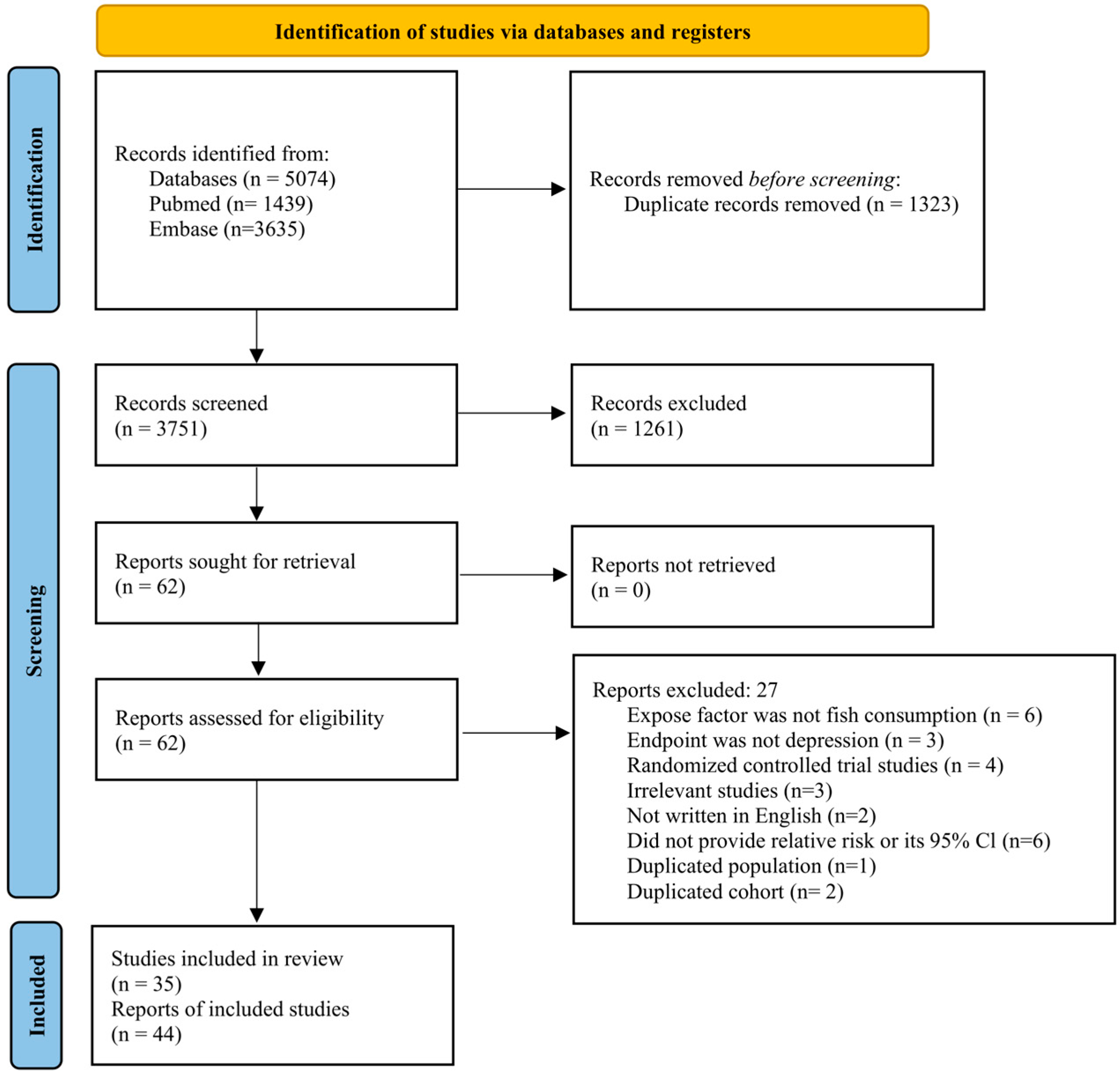
3.1. Literature Search
3.2. Study Characteristics
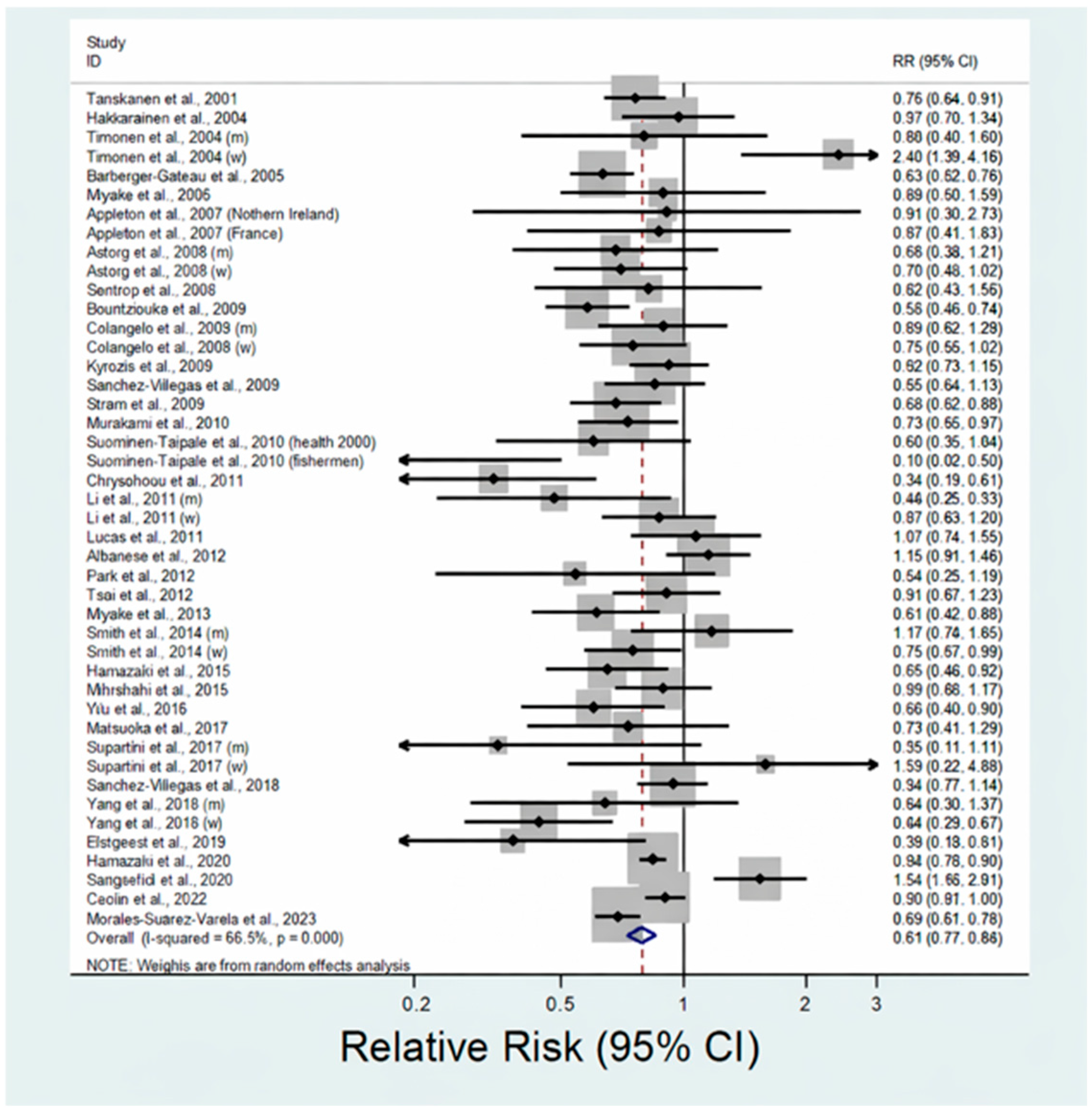
3.3. Pooled Relative Risk Estimates for Comparisons Between High and Low Intakes
3.4. Dose–Response Analyses
3.5. Meta-Analysis and Sensitivity Analysis
3.6. Publication Bias
4. Discussion
5. Conclusions
Supplementary Materials
Author Contributions
Funding
Data Availability Statement
Conflicts of Interest
Abbreviations
| WHO | World Health Organization |
| COVID-19 | corona virus disease 19 |
| PUFA | polyunsaturated fatty acid |
| RR | relative risk |
| HR | hazard ratio |
| OR | odds ratio |
| CI | confidence interval |
| FFQ | food frequency questionnaires |
| BMI | body mass index |
References
- World Health Organization. Suicide Worldwide in 2019: Global Health Estimates; World Health Organization: Geneva, Switzerland, 2021.
- Chisholm, D.; Sweeny, K.; Sheehan, P.; Rasmussen, B.; Smit, F.; Cuijpers, P.; Saxena, S. Scaling-up treatment of depression and anxiety: A global return on investment analysis. Lancet Psychiatry 2016, 3, 415–424. [Google Scholar] [CrossRef]
- Daniali, H.; Martinussen, M.; Flaten, M.A. A global meta-analysis of depression, anxiety, and stress before and during COVID-19. Health Psychol. 2023, 42, 124. [Google Scholar] [CrossRef]
- Mahmud, S.; Mohsin, M.; Dewan, M.N.; Muyeed, A. The global prevalence of depression, anxiety, stress, and insomnia among general population during COVID-19 pandemic: A systematic review and meta-analysis. Trends Psychol. 2023, 31, 143–170. [Google Scholar] [CrossRef]
- Seighali, N.; Abdollahi, A.; Shafiee, A.; Amini, M.J.; Teymouri Athar, M.M.; Safari, O.; Faghfouri, P.; Eskandari, A.; Rostaii, O.; Salehi, A.H.; et al. The global prevalence of depression, anxiety, and sleep disorder among patients coping with Post COVID-19 syndrome (long COVID): A systematic review and meta-analysis. BMC Psychiatry 2024, 24, 105. [Google Scholar] [CrossRef]
- Logan, A.C. Neurobehavioral aspects of omega-3 fatty acids: Possible mechanisms and therapeutic value in major depression. Altern. Med. Rev. 2003, 8, 410–425. [Google Scholar]
- Krogh, J.; Nordentoft, M.; Sterne, J.A.; Lawlor, D.A. The effect of exercise in clinically depressed adults: Systematic review and meta-analysis of randomized controlled trials. J. Clin. Psychiatry 2010, 71, 5500. [Google Scholar] [CrossRef]
- Pearce, M.; Garcia, L.; Abbas, A.; Strain, T.; Schuch, F.B.; Golubic, R.; Kelly, P.; Khan, S.; Utukuri, M.; Laird, Y.; et al. Association between physical activity and risk of depression: A systematic review and meta-analysis. JAMA Psychiatry 2022, 79, 550–559. [Google Scholar] [CrossRef] [PubMed]
- Boden, J.M.; Fergusson, D.M. Alcohol and depression. Addiction 2011, 106, 906–914. [Google Scholar] [CrossRef]
- Nucci, D.; Fatigoni, C.; Amerio, A.; Odone, A.; Gianfredi, V. Red and processed meat consumption and risk of depression: A systematic review and meta-analysis. Int. J. Environ. Res. Public Health 2020, 17, 6686. [Google Scholar] [CrossRef] [PubMed]
- Saghafian, F.; Malmir, H.; Saneei, P.; Milajerdi, A.; Larijani, B.; Esmaillzadeh, A. Fruit and vegetable consumption and risk of depression: Accumulative evidence from an updated systematic review and meta-analysis of epidemiological studies. Br. J. Nutr. 2018, 119, 1087–1101. [Google Scholar] [CrossRef] [PubMed]
- Grosso, G.; Micek, A.; Marventano, S.; Castellano, S.; Mistretta, A.; Pajak, A.; Galvano, F. Dietary n-3 PUFA, fish consumption and depression: A systematic review and meta-analysis of observational studies. J. Affect. Disord. 2016, 205, 269–281. [Google Scholar] [CrossRef]
- Li, F.; Liu, X.; Zhang, D. Fish consumption and risk of depression: A meta-analysis. J. Epidemiol. Community Health 2016, 70, 299–304. [Google Scholar] [CrossRef] [PubMed]
- Yang, Y.; Kim, Y.; Je, Y. Fish consumption and risk of depression: Epidemiological evidence from prospective studies. Asia-Pac. Psychiatry 2018, 10, e12335. [Google Scholar] [CrossRef]
- World Health Organization. Depression and Other Common Mental Disorders: Global Health Estimates; World Health Organization: Geneva, Switzerland, 2017.
- Burt, V.K.; Stein, K. Epidemiology of depression throughout the female life cycle. J. Clin. Psychiatry 2002, 63, 9–15. [Google Scholar] [PubMed]
- Wang, Z.; Liu, J.; Shuai, H.; Cai, Z.; Fu, X.; Liu, Y.; Xiao, X.; Zhang, W.; Krabbendam, E.; Liu, S.; et al. Mapping global prevalence of depression among postpartum women. Transl. Psychiatry 2021, 11, 543. [Google Scholar] [CrossRef]
- Bai, Z.-G.; Bo, A.; Wu, S.-J.; Gai, Q.-Y.; Chi, I. Omega-3 polyunsaturated fatty acids and reduction of depressive symptoms in older adults: A systematic review and meta-analysis. J. Affect. Disord. 2018, 241, 241–248. [Google Scholar] [CrossRef]
- Leung, B.M.; Kaplan, B.J. Perinatal depression: Prevalence, risks, and the nutrition link—A review of the literature. J. Am. Diet. Assoc. 2009, 109, 1566–1575. [Google Scholar] [CrossRef] [PubMed]
- Ramakrishnan, U. Fatty acid status and maternal mental health. Matern. Child Nutr. 2011, 7, 99–111. [Google Scholar] [CrossRef] [PubMed]
- Albanese, E.; Lombardo, F.L.; Dangour, A.D.; Guerra, M.; Acosta, D.; Huang, Y.; Jacob, K.S.; de Rodriguez, J.J.L.; Salas, A.; Schönborn, C.; et al. No association between fish intake and depression in over 15,000 older adults from seven low and middle income countries-the 10/66 study. PLoS ONE 2012, 7, e38879. [Google Scholar] [CrossRef]
- Barberger-Gateau, P.; Jutand, M.A.; Letenneur, L.; Larrieu, L.; Tavernier, B.; Berr, C. Correlates of regular fish consumption in French elderly community dwellers: Data from the Three-City study. Eur. J. Clin. Nutr. 2005, 59, 817–825. [Google Scholar] [CrossRef]
- Bountziouka, V.; Polychronopoulos, E.; Zeimbekis, A.; Papavenetiou, E.; Ladoukaki, E.; Papairakleous, N.; Gotsis, E.; Metallinos, G.; Lionis, C.; Panagiotakos, D. Long-term fish intake is associated with less severe depressive symptoms among elderly men and women: The MEDIS (MEDiterranean ISlands Elderly) epidemiological study. J. Aging Health 2009, 21, 864–880. [Google Scholar] [CrossRef]
- Ceolin, G.; Rockenbach, G.; Confortin, S.C.; d’Orsi, E.; Moreira, J.D. Association between the consumption of omega-3-rich fish and depressive symptoms in older adults living in a middle-income country: EpiFloripa Aging cohort study. Cad. Saude Publica 2022, 38, e00011422. [Google Scholar] [CrossRef]
- Chrysohoou, C.; Tsitsinakis, G.; Siassos, G.; Psaltopoulou, T.; Galiatsatos, N.; Metaxa, V.; Lazaros, G.; Miliou, A.; Giakoumi, E.; Mylonakis, C.; et al. Fish consumption moderates depressive symptomatology in elderly men and women from the IKARIA study. Cardiol. Res. Pract. 2011, 1, 219578. [Google Scholar] [CrossRef]
- Hamazaki, K.; Natori, T.; Kurihara, S.; Murata, N.; Cui, Z.G.; Kigawa, M.; Morozumi, R.; Inadera, H. Fish consumption and depressive symptoms in undergraduate students: A cross-sectional analysis. Eur. Psychiatry 2015, 30, 983–987. [Google Scholar] [CrossRef] [PubMed]
- Miyake, Y.; Tanaka, K.; Okubo, H.; Sasaki, S.; Arakawa, M. Fish and fat intake and prevalence of depressive symptoms during pregnancy in Japan: Baseline data from the Kyushu Okinawa Maternal and Child Health Study. J. Psychiatr. Res. 2013, 47, 572–578. [Google Scholar] [CrossRef] [PubMed]
- Morales-Suárez-Varela, M.; Amezcua-Prieto, C.; Llopis-Gonzalez, A.; Ayan Perez, C.; Mateos-Campos, R.; Hernández-Segura, N.; Ortiz-Moncada, R.; Almaraz, A.; Alguacil, J.; Delgado Rodríguez, M.; et al. Prevalence of Depression and Fish Consumption among First Year Spanish University Students: UniHcos Project. Nutrients 2023, 15, 2757. [Google Scholar] [CrossRef]
- Murakami, K.; Miyake, Y.; Sasaki, S.; Tanaka, K.; Arakawa, M. Fish and n-3 polyunsaturated fatty acid intake and depressive symptoms: Ryukyus child health study. Pediatrics 2010, 126, e623–e630. [Google Scholar] [CrossRef]
- Sánchez-Villegas, A.; Álvarez-Pérez, J.; Toledo, E.; Salas-Salvadó, J.; Ortega-Azorín, C.; Zomeño, M.D.; Vioque, J.; Martínez, J.A.; Romaguera, D.; Pérez-López, J.; et al. Seafood consumption, omega-3 fatty acids intake, and life-time prevalence of depression in the PREDIMED-plus trial. Nutrients 2018, 10, 2000. [Google Scholar] [CrossRef]
- Sangsefidi, Z.S.; Mirzaei, M.; Hosseinzadeh, M. The relation between dietary intakes and psychological disorders in Iranian adults: A population-based study. BMC Psychiatry 2020, 20, 257. [Google Scholar] [CrossRef]
- Sontrop, J.; Avison, W.R.; Evers, S.E.; Speechley, K.N.; Campbell, M.K. Depressive symptoms during pregnancy in relation to fish consumption and intake of n-3 polyunsaturated fatty acids. Paediatr. Perinat. Epidemiol. 2008, 22, 389–399. [Google Scholar] [CrossRef] [PubMed]
- Suominen-Taipale, A.L.; Partonen, T.; Turunen, A.W.; Männistö, S.; Jula, A.; Verkasalo, P.K. Fish consumption and Omega-3 polyunsaturated fatty acids in relation to depressive episodes: A cross-sectional analysis. PLoS ONE 2010, 5, e10530. [Google Scholar] [CrossRef]
- Supartini, A.; Oishi, T.; Yagi, N. Sex differences in the relationship between sleep behavior, fish consumption, and depressive symptoms in the general population of South Korea. Int. J. Environ. Res. Public Health 2017, 14, 789. [Google Scholar] [CrossRef] [PubMed]
- Tanskanen, A.; Hibbeln, J.R.; Tuomilehto, J.; Uutela, A.; Haukkala, A.; Viinamäki, H.; Lehtonen, J.; Vartiainen, E. Fish consumption and depressive symptoms in the general population in Finland. Psychiatr. Serv. 2001, 52, 529–531. [Google Scholar] [CrossRef]
- Wu, D.; Feng, L.; Gao, Q.; Li, J.L.; Rajendran, K.S.; Wong, J.C.; Kua, E.H.; Ng, T.P. Association between Fish Intake and Depressive Symptoms among Community-living Older Chinese Adults in Singapore: A Cross-sectional Study. J. Nutr. Health Aging 2016, 20, 404–407. [Google Scholar] [CrossRef] [PubMed]
- Yang, Y.; Je, Y. Fish consumption and depression in Korean adults: The Korea National Health and Nutrition Examination Survey, 2013–2015. Eur. J. Clin. Nutr. 2018, 72, 1142–1149. [Google Scholar] [CrossRef]
- Appleton, K.M.; Peters, T.J.; Hayward, R.C.; Heatherley, S.V.; McNaughton, S.A.; Rogers, P.J.; Gunnell, D.; Ness, A.R.; Kessler, D. Depressed mood and n-3 polyunsaturated fatty acid intake from fish: Non-linear or confounded association? Soc. Psychiatry Psychiatr. Epidemiol. 2007, 42, 100–104. [Google Scholar] [CrossRef]
- Astorg, P.; Couthouis, A.; Bertrais, S.; Arnault, N.; Meneton, P.; Guesnet, P.; Alessandri, J.M.; Galan, P.; Hercberg, S. Association of fish and long-chain n-3 polyunsaturated fatty acid intakes with the occurrence of depressive episodes in middle-aged French men and women. Prostaglandins Leukot. Essent. Fat. Acids 2008, 78, 171–182. [Google Scholar] [CrossRef]
- Colangelo, L.A.; He, K.; Whooley, M.A.; Daviglus, M.L.; Liu, K. Higher dietary intake of long-chain ω-3 polyunsaturated fatty acids is inversely associated with depressive symptoms in women. Nutrition 2009, 25, 1011–1019. [Google Scholar] [CrossRef] [PubMed]
- Elstgeest, L.E.M.; Visser, M.; Penninx, B.; Colpo, M.; Bandinelli, S.; Brouwer, I.A. Bidirectional associations between food groups and depressive symptoms: Longitudinal findings from the Invecchiare in Chianti (InCHIANTI) study. Br. J. Nutr. 2019, 121, 439–450. [Google Scholar] [CrossRef]
- Hakkarainen, R.; Partonen, T.; Haukka, J.; Virtamo, J.; Albanes, D.; Lönnqvist, J. Is Low Dietary Intake of Omega-3 Fatty Acids Associated with Depression? Am. J. Psychiatry 2004, 161, 567–569. [Google Scholar] [CrossRef]
- Hamazaki, K.; Matsumura, K.; Tsuchida, A.; Kasamatsu, H.; Tanaka, T.; Ito, M.; Inadera, H. Dietary intake of fish and n-3 polyunsaturated fatty acids and risk of postpartum depression: A nationwide longitudinal study—The Japan Environment and Children’s Study (JECS). Psychol. Med. 2020, 50, 2416–2424. [Google Scholar] [CrossRef]
- Kyrozis, A.; Psaltopoulou, T.; Stathopoulos, P.; Trichopoulos, D.; Vassilopoulos, D.; Trichopoulou, A. Dietary lipids and geriatric depression scale score among elders: The EPIC-Greece cohort. J. Psychiatr. Res. 2009, 43, 763–769. [Google Scholar] [CrossRef] [PubMed]
- Li, Y.; Dai, Q.; Ekperi, L.I.; Dehal, A.; Zhang, J. Fish consumption and severely depressed mood, findings from the first national nutrition follow-up study. Psychiatry Res. 2011, 190, 103–109. [Google Scholar] [CrossRef] [PubMed]
- Lucas, M.; Mirzaei, F.; O’Reilly, E.J.; Pan, A.; Willett, W.C.; Kawachi, I.; Koenen, K.; Ascherio, A. Dietary intake of n-3 and n-6 fatty acids and the risk of clinical depression in women: A 10-y prospective follow-up study. Am. J. Clin. Nutr. 2011, 93, 1337–1343. [Google Scholar] [CrossRef] [PubMed]
- Matsuoka, Y.J.; Sawada, N.; Mimura, M.; Shikimoto, R.; Nozaki, S.; Hamazaki, K.; Uchitomi, Y.; Tsugane, S. Dietary fish, n-3 polyunsaturated fatty acid consumption, and depression risk in Japan: A population-based prospective cohort study. Transl. Psychiatry 2017, 7, e1242. [Google Scholar] [CrossRef]
- Mihrshahi, S.; Dobson, A.J.; Mishra, G.D. Fruit and vegetable consumption and prevalence and incidence of depressive symptoms in mid-age women: Results from the Australian longitudinal study on women’s health. Eur. J. Clin. Nutr. 2015, 69, 585–591. [Google Scholar] [CrossRef]
- Miyake, Y.; Sasaki, S.; Yokoyama, T.; Tanaka, K.; Ohya, Y.; Fukushima, W.; Saito, K.; Ohfuji, S.; Kiyohara, C.; Hirota, Y.; et al. Risk of postpartum depression in relation to dietary fish and fat intake in Japan: The Osaka Maternal and Child Health Study. Psychol. Med. 2006, 36, 1727–1735. [Google Scholar] [CrossRef]
- Sánchez-Villegas, A.; Delgado-Rodríguez, M.; Alonso, A.; Schlatter, J.; Lahortiga, F.; Serra Majem, L.; Martínez-González, M.A. Association of the Mediterranean dietary pattern with the incidence of depression: The Seguimiento Universidad de Navarra/University of Navarra follow-up (SUN) cohort. Arch. Gen. Psychiatry 2009, 66, 1090–1098. [Google Scholar] [CrossRef]
- Smith, K.J.; Sanderson, K.; McNaughton, S.A.; Gall, S.L.; Dwyer, T.; Venn, A.J. Longitudinal associations between fish consumption and depression in young adults. Am. J. Epidemiol. 2014, 179, 1228–1235. [Google Scholar] [CrossRef]
- Strøm, M.; Mortensen, E.L.; Halldorsson, T.I.; Thorsdottir, I.; Olsen, S.F. Fish and long-chain n-3 polyunsaturated fatty acid intakes during pregnancy and risk of postpartum depression: A prospective study based on a large national birth cohort. Am. J. Clin. Nutr. 2009, 90, 149–155. [Google Scholar] [CrossRef]
- Timonen, M.; Horrobin, D.; Jokelainen, J.; Laitinen, J.; Herva, A.; Räsänen, P. Fish consumption and depression: The Northern Finland 1966 birth cohort study. J. Affect. Disord. 2004, 82, 447–452. [Google Scholar] [CrossRef] [PubMed]
- Tsai, A.C.; Chang, T.L.; Chi, S.H. Frequent consumption of vegetables predicts lower risk of depression in older Taiwanese—Results of a prospective population-based study. Public Health Nutr. 2012, 15, 1087–1092. [Google Scholar] [CrossRef]
- Park, Y.; Kim, M.; Baek, D.; Kim, S.H. Erythrocyte n-3 polyunsaturated fatty acid and seafood intake decrease the risk of depression: Case-control study in Korea. Ann. Nutr. Metab. 2012, 61, 25–31. [Google Scholar] [CrossRef]
- Page, M.J.; McKenzie, J.E.; Bossuyt, P.M.; Boutron, I.; Hoffmann, T.C.; Mulrow, C.D.; Shamseer, L.; Tetzlaff, J.M.; Akl, E.A.; Brennan, S.E.; et al. The PRISMA 2020 statement: An updated guideline for reporting systematic reviews. BMJ 2021, 372, n71. [Google Scholar] [CrossRef]
- Greenland, S. Quantitative methods in the review of epidemiologic literature. Epidemiol. Rev. 1987, 9, 1–30. [Google Scholar] [CrossRef]
- DerSimonian, R.; Laird, N. Meta-analysis in clinical trials revisited. Contemp. Clin. Trials 2015, 45, 139–145. [Google Scholar] [CrossRef] [PubMed]
- Cochran, W.G. The combination of estimates from different experiments. Biometrics 1954, 10, 101–129. [Google Scholar] [CrossRef]
- Higgins, J.P.; Thompson, S.G.; Deeks, J.J.; Altman, D.G. Measuring inconsistency in meta-analyses. BMJ 2003, 327, 557–560. [Google Scholar] [CrossRef]
- Orsini, N.; Bellocco, R.; Greenland, S. Generalized least squares for trend estimation of summarized dose–response data. Stata J. 2006, 6, 40–57. [Google Scholar] [CrossRef]
- Orsini, N.; Li, R.; Wolk, A.; Khudyakov, P.; Spiegelman, D. Meta-analysis for linear and nonlinear dose-response relations: Examples, an evaluation of approximations, and software. Am. J. Epidemiol. 2012, 175, 66–73. [Google Scholar] [CrossRef]
- He, K.; Song, Y.; Daviglus, M.L.; Liu, K.; Van Horn, L.; Dyer, A.R.; Greenland, P. Accumulated evidence on fish consumption and coronary heart disease mortality: A meta-analysis of cohort studies. Circulation 2004, 109, 2705–2711. [Google Scholar] [CrossRef]
- Begg, C.B.; Mazumdar, M. Operating characteristics of a rank correlation test for publication bias. Biometrics 1994, 50, 1088–1101. [Google Scholar] [CrossRef]
- Egger, M.; Smith, G.D.; Schneider, M.; Minder, C. Bias in meta-analysis detected by a simple, graphical test. BMJ 1997, 315, 629–634. [Google Scholar] [CrossRef] [PubMed]
- Cisneros-Montemayor, A.M.; Pauly, D.; Weatherdon, L.V.; Ota, Y. A global estimate of seafood consumption by coastal indigenous peoples. PLoS ONE 2016, 11, e0166681. [Google Scholar] [CrossRef] [PubMed]
- Jacka, F.N.; Pasco, J.A.; Mykletun, A.; Williams, L.J.; Hodge, A.M.; O’Reilly, S.L.; Nicholson, G.C.; Kotowicz, M.A.; Berk, M. Association of western and traditional diets with depression and anxiety in women. Am. J. Psychiatry 2010, 167, 305–311. [Google Scholar] [CrossRef] [PubMed]
- Lassale, C.; Batty, G.D.; Baghdadli, A.; Jacka, F.; Sánchez-Villegas, A.; Kivimäki, M.; Akbaraly, T. Healthy dietary indices and risk of depressive outcomes: A systematic review and meta-analysis of observational studies. Mol. Psychiatry 2019, 24, 965–986. [Google Scholar] [CrossRef]
- Hibbeln, J.R.; Umhau, J.C.; George, D.T.; Shoaf, S.E.; Linnoila, M.; Salem, N., Jr. Plasma total cholesterol concentrations do not predict cerebrospinal fluid neurotransmitter metabolites: Implications for the biophysical role of highly unsaturated fatty acids. Am. J. Clin. Nutr. 2000, 71, 331S–338S. [Google Scholar] [CrossRef]
- Freeman, M.P.; Hibbeln, J.R.; Wisner, K.L.; Davis, J.M.; Mischoulon, D.; Peet, M.; Keck, P.E., Jr.; Marangell, L.B.; Richardson, A.J.; Lake, J.; et al. Omega-3 fatty acids: Evidence basis for treatment and future research in psychiatry. J. Clin. Psychiatry 2006, 67, 1954. [Google Scholar] [CrossRef]
- Vaváková, M.; Ďuračková, Z.; Trebatická, J. Markers of oxidative stress and neuroprogression in depression disorder. Oxidative Med. Cell. Longev. 2015, 2015, 898393. [Google Scholar] [CrossRef]
- Furtado, M.; Katzman, M.A. Examining the role of neuroinflammation in major depression. Psychiatry Res. 2015, 229, 27–36. [Google Scholar] [CrossRef]
- Farooqui, A.A. n-3 fatty acid-derived lipid mediators in the brain: New weapons against oxidative stress and inflammation. Curr. Med. Chem. 2012, 19, 532–543. [Google Scholar] [CrossRef]
- Ortega, M.A.; Fraile-Martínez, Ó.; García-Montero, C.; Alvarez-Mon, M.A.; Lahera, G.; Monserrat, J.; Llavero-Valero, M.; Gutiérrez-Rojas, L.; Molina, R.; Rodríguez-Jimenez, R.; et al. Biological role of nutrients, food and dietary patterns in the prevention and clinical management of major depressive disorder. Nutrients 2022, 14, 3099. [Google Scholar] [CrossRef]
- Blok, W.L.; Katan, M.B.; van der Meer, J.W. Modulation of inflammation and cytokine production by dietary (n-3) fatty acids. J. Nutr. 1996, 126, 1515–1533. [Google Scholar] [CrossRef]
- Calder, P. Immunoregulatory and anti-inflammatory effects of n-3 polyunsaturated fatty acids. Braz. J. Med. Biol. Res. 1998, 31, 467–490. [Google Scholar] [CrossRef]
- Whooley, M.A.; Wong, J.M. Depression and cardiovascular disorders. Annu. Rev. Clin. Psychol. 2013, 9, 327–354. [Google Scholar] [CrossRef]
- Nicholson, A.; Kuper, H.; Hemingway, H. Depression as an aetiologic and prognostic factor in coronary heart disease: A meta-analysis of 6362 events among 146,538 participants in 54 observational studies. Eur. Heart J. 2006, 27, 2763–2774. [Google Scholar] [CrossRef] [PubMed]
- Pan, A.; Sun, Q.; Okereke, O.I.; Rexrode, K.M.; Hu, F.B. Depression and risk of stroke morbidity and mortality: A meta-analysis and systematic review. JAMA 2011, 306, 1241–1249. [Google Scholar] [CrossRef] [PubMed]
- Halaris, A. Inflammation, heart disease, and depression. Curr. Psychiatry Rep. 2013, 15, 400. [Google Scholar] [CrossRef]
- Anglin, R.E.; Samaan, Z.; Walter, S.D.; McDonald, S.D. Vitamin D deficiency and depression in adults: Systematic review and meta-analysis. Br. J. Psychiatry 2013, 202, 100–107. [Google Scholar] [CrossRef]
- Xie, F.; Huang, T.; Lou, D.; Fu, R.; Ni, C.; Hong, J.; Ruan, L. Effect of vitamin D supplementation on the incidence and prognosis of depression: An updated meta-analysis based on randomized controlled trials. Front. Public Health 2022, 10, 903547. [Google Scholar] [CrossRef] [PubMed]
- Ralston, N.V.; Raymond, L.J. Dietary selenium’s protective effects against methylmercury toxicity. Toxicology 2010, 278, 112–123. [Google Scholar] [CrossRef]
- Zhai, L.; Zhang, Y.; Zhang, D. Sedentary behaviour and the risk of depression: A meta-analysis. Br. J. Sports Med. 2015, 49, 705–709. [Google Scholar] [CrossRef]
- Wu, Y.; Zhang, L.; Li, S.; Zhang, D. Associations of dietary vitamin B1, vitamin B2, vitamin B6, and vitamin B12 with the risk of depression: A systematic review and meta-analysis. Nutr. Rev. 2022, 80, 351–366. [Google Scholar] [CrossRef]
- Lee, A.R.Y.B.; Tariq, A.; Lau, G.; Tok, N.W.K.; Tam, W.W.S.; Ho, C.S.H. Vitamin E, alpha-tocopherol, and its effects on depression and anxiety: A systematic review and meta-analysis. Nutrients 2022, 14, 656. [Google Scholar] [CrossRef]
- Bender, A.; Hagan, K.E.; Kingston, N. The association of folate and depression: A meta-analysis. J. Psychiatr. Res. 2017, 95, 9–18. [Google Scholar] [CrossRef] [PubMed]
- Freeman, M.P.; Hibbeln, J.; Wisner, K.; Brumbach, B.; Watchman, M.; Gelenberg, A. Randomized dose-ranging pilot trial of omega-3 fatty acids for postpartum depression. Acta Psychiatr. Scand. 2006, 113, 31–35. [Google Scholar] [CrossRef]
- Freeman, M.P.; Hibbeln, J.R.; Wisner, K.L.; Watchman, M.; Gelenberg, A.J. An open trial of omega-3 fatty acids for depression in pregnancy. Acta Neuropsychiatr. 2006, 18, 21–24. [Google Scholar] [CrossRef]
- Su, K.-P.; Huang, S.-Y.; Chiu, T.-H.; Huang, K.-C.; Huang, C.-L.; Chang, H.-C.; Pariante, C.M. Omega-3 fatty acids for major depressive disorder during pregnancy: Results from a randomized, double-blind, placebo-controlled trial. J. Clin. Psychiatry 2008, 69, 644. [Google Scholar] [CrossRef] [PubMed]
- Hamazaki, K.; Hamazaki, T.; Inadera, H. Fatty acid composition in the postmortem amygdala of patients with schizophrenia, bipolar disorder, and major depressive disorder. J. Psychiatr. Res. 2012, 46, 1024–1028. [Google Scholar] [CrossRef] [PubMed]
- Hamazaki, K.; Maekawa, M.; Toyota, T.; Iwayama, Y.; Dean, B.; Hamazaki, T.; Yoshikawa, T. Fatty acid composition and fatty acid binding protein expression in the postmortem frontal cortex of patients with schizophrenia: A case–control study. Schizophr. Res. 2016, 171, 225–232. [Google Scholar] [CrossRef]
- Hoekzema, E.; Barba-Müller, E.; Pozzobon, C.; Picado, M.; Lucco, F.; García-García, D.; Soliva, J.C.; Tobeña, A.; Desco, M.; Crone, E.A.; et al. Pregnancy leads to long-lasting changes in human brain structure. Nat. Neurosci. 2017, 20, 287–296. [Google Scholar] [CrossRef] [PubMed]
- Levant, B.; Radel, J.D.; Carlson, S.E. Reduced brain DHA content after a single reproductive cycle in female rats fed a diet deficient in N-3 polyunsaturated fatty acids. Biol. Psychiatry 2006, 60, 987–990. [Google Scholar] [CrossRef] [PubMed]
- Horrocks, L.A.; Farooqui, A.A. Docosahexaenoic acid in the diet: Its importance in maintenance and restoration of neural membrane function. Prostaglandins Leukot. Essent. Fat. Acids 2004, 70, 361–372. [Google Scholar] [CrossRef]



| Author, Year; Study Design (Follow-Up) | Country | Participants Characteristics | No. of Subjects | Exposure Assessment | Outcome Measure | Amount of Fish Intake | RR or β Coefficient (95% CI) |
|---|---|---|---|---|---|---|---|
| Tanskanen et al., 2001 [35]; cross-sectional | Finland | General population; age: 25–64 | 3204 | FFQ | BDI | Rare eaters vs. regular eaters | 1.31 (1.10, 1.56) |
| Hakkarainen et al., 2004 [42]; cohort (5–8 y) | Finland | General population; age: 50–69 | 29,133 | FFQ | Hospital treatment | Quartile3 vs. Quartile1 | 0.97 (0.70, 1.33) |
| Timonen et al., 2004 [53]; cohort (31 y) | Finland | General population; age: <31 | 5689 | FFQ | HSCL-25 and diagnosis by medical doctor | regular eaters vs. rare eaters | Men: 0.8 (0.4, 1.6) Women: 2.4 (1.4, 4.2) |
| Barberger-Gateau et al., 2005 [22]; cross-sectional | France | Community dwellers; age: ≥65 | 9280 | FFQ | CES-D | >1 time/week vs. 1 time/week | 0.63 (0.52, 0.75) |
| Miyake et al., 2006 [49]; cohort (2–9 m) | Japan | Pregnant women; age: <32 | 865 | FFQ | EPDS | 72.9 g/day vs. 23.1 g/day | 0.89 (0.50, 1.59) |
| Appleton et al., 2007 [38]; cohort (5 y) | Northern Ireland and France | General population (men); age: 50–59 | 10,602 | FFQ | Welsh Pure Depression subscale | Linear term | Northern Ireland: −0.09 (−2.25, −0.01) France: −0.14 (−2.73, −1.17) |
| Astorg et al., 2008 [39]; cohort (2 y) | France (SU.VI.MAX cohort study) | General population; age 35–60 | 3748 | 24 h dietary recall | Antidepressant | Men: 87.9 ± 29.5 g/day vs. 14.9 ± 8.9 g/day Women: 71.6 ± 24.8 g/day vs. 10.7 ± 7.1 g/day | Men: 0.68 (0.38, 1.21) Women: 0.70 (0.48, 1.02) |
| Sontrop et al., 2008 [32]; cross-sectional | Canada | Pregnant women (10- and 22-week gestation) | 2061 | FFQ | CES-D | ≥1 serving/week vs. <1 serving/week | −0.2 (−0.9, 0.4) |
| Bountziouka et al., 2009 [23]; cross-sectional | Greece and Cyprus | Elderly general population; age ≥65 | 1190 | FFQ | GDS (self-report) | Linear term (1 portion of fish increase per week) | 0.58 (0.45, 0.73) |
| Colangelo et al., 2009 [40]; cohort (10 y) | US | General population; age 24–42 | 3317 | FFQ | CES-D | Quartile5 vs. Quartile1 | Men: 0.89 (0.62, 1.28) Women: 0.75 (0.55, 1.01) |
| Kyrozis et al., 2009 [44]; cohort (6–13 y) | Greece | Elderly general population; age ≥60 | 610 | FFQ | GDS | Linear term | −0.08 (−0.30, 0.15) |
| Sánchez-Villegas, 2009 [50]; cohort (4.4 y) | Spain | General population; age 38 (mean) | 10,094 | FFQ | Self-reported physician diagnosis, antidepressant medication usage | Quartile5 vs. Quartile1 | 0.85 (0 64, 1.13) |
| Strøm et al., 2009 [52]; cohort (1 y) | Denmark | Women; age 25–40 | 54,202 | FFQ | Hospital admission of post-partum depression, medicament prescription | 0–3 g/day (1.1 g/day) vs. >30 g/day (38.0 g/day) | 1.10 (0.87, 1.38) |
| Murakami et al., 2010 [29]; cross-sectional | Japan | Adolescents (school students); age 12–15 | 6517 | FFQ | CES-D | 29.1 g/1000 kcal vs. 9.1 g/1000 kcal | 0.73 (0.55, 0.97) |
| Suominen-Taipale et al., 2010 [33]; cross-sectional | Finland | General population; age 45–74 | 5492 | FFQ | M-CIDI | 76 g/day vs. 11 g/day | 0.6 (0.3, 0.9) |
| Suominen-Taipale et al., 2010 [33]; cross-sectional | Finland | Fishermen with their families | 1265 | FFQ | CIDI-SF | Quartile4 vs. Quartile1 | 0.1 (0.02, 0.5) |
| Chrysohoou et al., 2011 [25]; cross-sectional | Greece | Elderly population; age >65 | 673 | FFQ | GDS (self-report) | ≥3 times week vs. never/rare | 0.34 (0.19, 0.61) |
| Li et al., 2011 [45]; cohort (10.6 y) | US | General population; age 25–74 | 5068 | FFQ | CES-D | <1 time/week vs. ≥1 time/week | Men: 2.08 (1.08, 4.09) Women: 1.15 (0.83, 1.59) |
| Lucas et al., 2011 [46]; cohort (10 y) | US | Nurses (women); age 50–77 | 54,632 | FFQ | Physician-diagnosed depression, antidepressant usage | ≥5 times/week vs. 1 time/month | 1.07 (0.74, 1.55) |
| Albanese et al., 2012 [21]; cross-sectional | Multicenter | Community dwellers; age ≥65 | 14,926 | Standardized questions | ICD-10 | Never vs. some days vs. most days | Never: 0.93 (0.78, 1.10) Some days: 1 (reference) Most days: 1.07 (0.85, 1.36) |
| Park et al., 2012 [55]; case–control | Korea | Patients diagnosed with a score ≥ 25 on the CES-D-K and controls without a chronic disease | 80 patients and 88 controls | FFQ | CES-D-K | >9.62 serving/week vs. ≤2.57 serving/week | 0.54 (0.19, 0.92) |
| Tsai et al., 2012 [54]; cohort (5 y) | Taiwan | Elderly population; age ≥65 | 1609 | FFQ | CES-D | ≥3 times/week vs. <3 times/week | 0.91 (0.62, 1.14) |
| Miyake et al., 2013 [27]; cross-sectional | Japan | Pregnant women | 1745 | FFQ | CES-D | 71.7 g/day vs. 22.8 g/day | 0.61 (0.42, 0.87) |
| Smith et al., 2014 [51]; cohort (5 y) | Australia | General population; age 26–36 | 1386 | FFQ | DSM-IV | ≥2 times/week vs. <2 times/week | Men: 1.17 (0.74, 1.86) Women: 0.75 (0.57, 0.99) |
| Hamazaki et al., 2015 [26]; cross-sectional | Japan | University students; age 18–44 | 4190 | FFQ | CES-D | Almost every day vs. almost never | 0.65 (0.46, 0.92) |
| Mihrshahi et al., 2015 [48]; cohort (6 y) | Australia | Mid-age women; age 45–50 | 5117 | FFQ | CES-D | >0 g/day vs. 0 g/day | 0.89 (0.68, 1.17) |
| Wu et al., 2016 [36]; cross-sectional | Singapore | Senior ethnic Chinese residents of Singapore; age ≥55 | 2034 | FFQ | GDS-15 (self-report) | ≥3 times/week vs. ≤2 times/week | 0.60 (0.40, 0.90) |
| Matsuoka et al., 2017 [47]; cohort (25 y) | Japan | General population; age 63–82 | 1181 | FFQ | CES-D | 152.6 g/day vs. 57.2 g/day | 0.73 (0.41, 1.28) |
| Supartini et al., 2017 [34]; cross-sectional | Korea | General population; age 20–69 | 600 | FFQ | CES-D | Frequently vs. occasionally | Men: 0.35 (0.11, 1.10) Women: 1.59 (0.52, 4.90) |
| Sánchez-Villegas et al., 2018 [30]; cross-sectional | Spain | General population; men age 55–75; women age 60–75 | 6587 | FFQ | BDI-II, self-reported depression, use of antidepressants | 155.28 g/day vs. 67.95 g/day | 0.94 (0.77, 1.14) |
| Yang et al., 2018 [37]; cross-sectional | Korea | General population; age 19–64 | 9183 | FFQ | Diagnosed with depression by a physician | ≥4 times/week vs. <1 times/week | Men: 0.64 (0.30, 1.37) Women: 0.44 (0.29, 0.67) |
| Elstgeest et al., 2019 [41]; cohort (3, 6, 9 y) | Italy | General population; age 20–102 | 1058 | FFQ | CES-D | Quartile4 vs. Quartile1 | −0.97 (−1.74, −0.21) |
| Hamazaki et al., 2020 [43]; cohort (3 y) | Japan | Pregnant women | 84,181 | FFQ | EPDS | 69.3 g/day vs. 5.2 g/day | 0.84 (0.78, 0.90) |
| Sangsefidi et al., 2020 [31]; cross-sectional | Iran | General population; age 20–69 | 9965 | FFQ | DASS 21 | ≥1 serving/week vs. never | 1.54 (1.18, 2.01) |
| Ceolin et al., 2022 [24]; cross-sectional | Brazil | Elderly general population; age ≥60 | 1130 | FFQ | GDS-15 | twice a week or more vs. none | 0.90 (0.81, 1.01) |
| Morales-Suárez-Varela et al., 2023 [28]; cross-sectional | Multicenter | University students | 11,485 | FFQ | Diagnosis of depression by a professional | Non-compliant vs. compliant | 1.45 (1.28, 1.64) |
| No. of Studies | RR (95% CI) | Heterogeneity | p for Difference | ||
|---|---|---|---|---|---|
| I2 (%) | p | ||||
| Highest vs. lowest fish intake | |||||
| All studies | 44 | 0.79 (0.73, 0.86) | 66.5 | <0.001 | |
| Region | |||||
| Europe | 18 | 0.75 (0.64, 0.87) | 68.8 | <0.001 | 0.084 |
| Asia | 14 | 0.75 (0.63, 0.90) | 69.9 | <0.001 | |
| America | 7 | 0.88 (0.80, 0.96) | 0.0 | 0.473 | |
| Multicenter | 2 | 0.88 (0.53, 1.45) | 92.9 | <0.001 | |
| Oceania | 3 | 0.87 (0.71, 1.08) | 26.4 | 0.257 | |
| Pregnancy-relatedness | |||||
| Yes | 5 | 0.78 (0.69, 0.89) | 20.8 | 0.282 | 0.702 |
| No | 39 | 0.79 (0.72, 0.87) | 69.1 | <0.001 | |
| Study design | |||||
| Cross-sectional | 20 | 0.72 (0.63, 0.83) | 79.0 | <0.001 | 0.066 |
| Case–control | 1 | 0.54 (0.25, 1.19) | - | - | |
| Cohort | 23 | 0.85 (0.78, 0.93) | 31.5 | 0.076 | |
| Gender | |||||
| Men and women | 21 | 0.77 (0.68, 0.87) | 76.9 | <0.001 | 0.826 |
| Men | 9 | 0.81 (0.66, 0.99) | 0.0 | 0.439 | |
| Women | 14 | 0.81 (0.71, 0.93) | 61.1 | 0.001 | |
| Only elderly population | |||||
| Yes | 9 | 0.75 (0.62, 0.91) | 79.5 | <0.001 | 0.924 |
| No | 35 | 0.80 (0.73, 0.88) | 61.9 | <0.001 | |
| Highest category of fish consumption a | |||||
| Lower intake level | 14 | 0.83 (0.69, 1.01) | 80.0 | <0.001 | 0.399 |
| Higher intake level | 14 | 0.75 (0.67, 0.84) | 39.9 | 0.062 | |
| Difference in fish intake between the highest and lowest categories b | |||||
| Smaller intake difference | 14 | 0.85 (0.72, 1.02) | 77.9 | <0.001 | 0.369 |
| Larger intake difference | 14 | 0.72 (0.63, 0.83) | 53.2 | 0.010 | |
| Increase of 15g/d (~1 serving/week) | |||||
| All studies | 14 | 0.94 (0.92, 0.96) | 36.0 | 0.088 | |
| Region | |||||
| Europe | 4 | 0.92 (0.88, 0.96) | 0.0 | 0.929 | 0.216 |
| Asia | 7 | 0.94 (0.92, 0.97) | 50.9 | 0.057 | |
| America | 3 | 0.89 (0.75, 1.04) | 56.3 | 0.102 | |
| Pregnancy-relatedness | |||||
| Yes | 3 | 0.93 (0.89, 0.98) | 59.6 | 0.084 | 0.079 |
| No | 11 | 0.94 (0.91, 0.96) | 18.6 | 0.266 | |
| Study design | |||||
| Cross-sectional | 7 | 0.93 (0.90, 0.96) | 29.4 | 0.204 | 0.072 |
| Cohort | 7 | 0.94 (0.92, 0.97) | 30.1 | 0.198 | |
| Gender | |||||
| Men and women | 5 | 0.95 (0.93, 0.97) | 0.0 | 0.931 | 0.588 |
| Men | 3 | 0.90 (0.80, 1.02) | 39.7 | 0.190 | |
| Women | 6 | 0.91 (0.87, 0.96) | 66.8 | 0.010 | |
| Only elderly population | |||||
| Yes | 2 | 0.96 (0.93, 0.99) | 0.0 | 0.919 | 0.800 |
| No | 12 | 0.93 (0.90, 0.95) | 45.7 | 0.042 | |
Disclaimer/Publisher’s Note: The statements, opinions and data contained in all publications are solely those of the individual author(s) and contributor(s) and not of MDPI and/or the editor(s). MDPI and/or the editor(s) disclaim responsibility for any injury to people or property resulting from any ideas, methods, instructions or products referred to in the content. |
© 2025 by the authors. Licensee MDPI, Basel, Switzerland. This article is an open access article distributed under the terms and conditions of the Creative Commons Attribution (CC BY) license (https://creativecommons.org/licenses/by/4.0/).
Share and Cite
Kim, E.; Je, Y. Fish Consumption and the Risk of Depression: A Systematic Review and Meta-Analysis of Observational Studies. Nutrients 2025, 17, 3965. https://doi.org/10.3390/nu17243965
Kim E, Je Y. Fish Consumption and the Risk of Depression: A Systematic Review and Meta-Analysis of Observational Studies. Nutrients. 2025; 17(24):3965. https://doi.org/10.3390/nu17243965
Chicago/Turabian StyleKim, Eunje, and Youjin Je. 2025. "Fish Consumption and the Risk of Depression: A Systematic Review and Meta-Analysis of Observational Studies" Nutrients 17, no. 24: 3965. https://doi.org/10.3390/nu17243965
APA StyleKim, E., & Je, Y. (2025). Fish Consumption and the Risk of Depression: A Systematic Review and Meta-Analysis of Observational Studies. Nutrients, 17(24), 3965. https://doi.org/10.3390/nu17243965