Supplementation with Polyunsaturated Fatty Acids as the Main Dietary Factor Is Associated with the Omega-3 Index in Lithuanian Professional Athletes



Abstract
1. Introduction
2. Materials and Methods
2.1. Study Design, Participants and Data Collection
2.2. Characteristics of the Athletes
2.3. Assessment of Dietary Habits and Use of Nutritional Supplements
2.4. Dietary Intake Assessment
2.5. Indirect Omega-3 Index Assessment
2.6. Anthropometric Measures
2.7. Statistical Data Analysis
3. Results
3.1. Body Composition of Athletes
3.2. Dietary Habits and Supplementation
3.3. Nutritional Intake
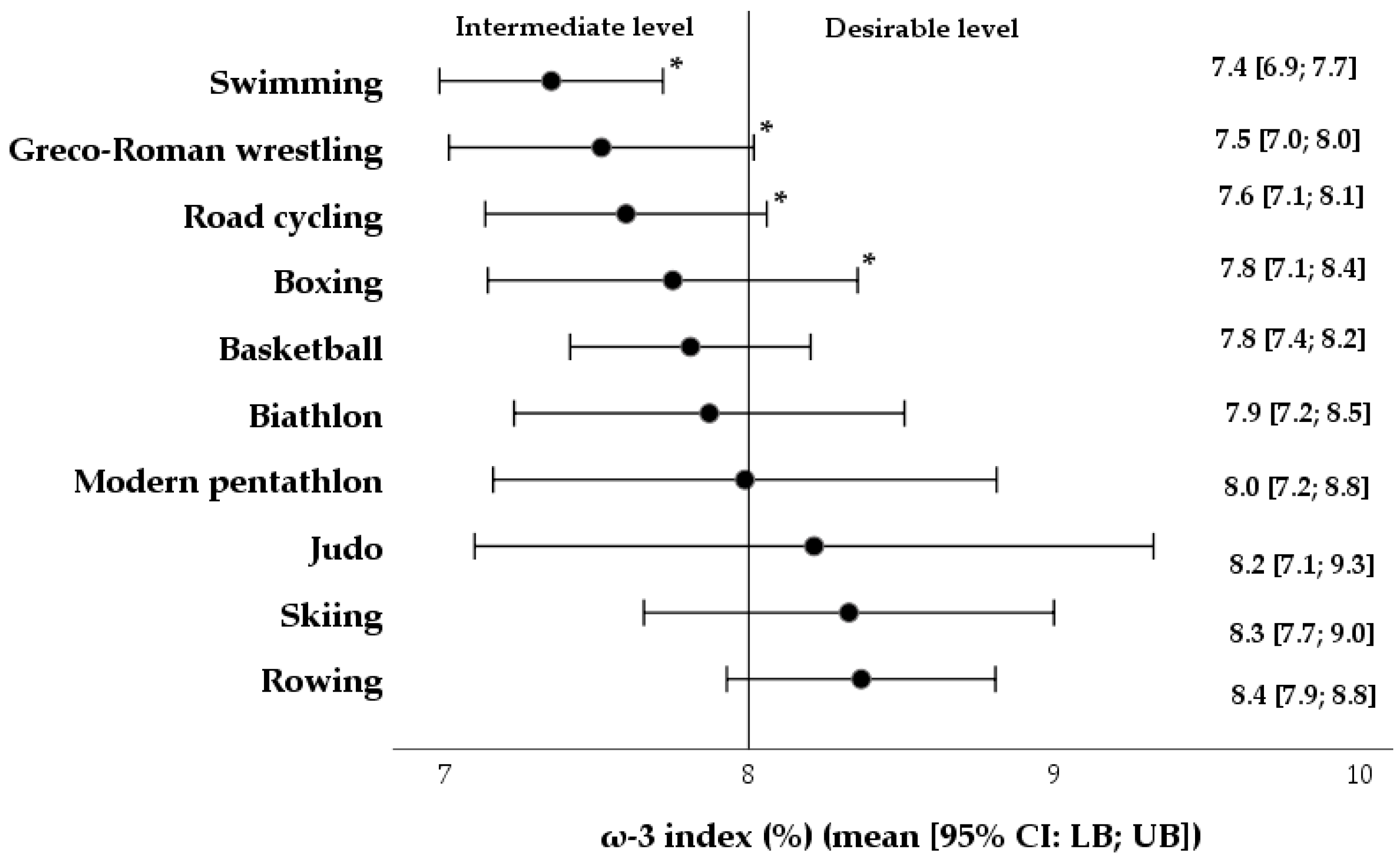
3.4. Indirect Omega-3 Index
3.5. Omega-3 Index in Association with Nutritional Factors, Dietary Habits and Supplementation
4. Discussion
4.1. Dietary Habits, Nutritional Intake and Supplementation
4.2. Omega-3 Index in Relation to Dietary Habits, Nutritional Intake and Supplementation
4.3. Omega-3 Index and Omega-6/Omega-3 Fatty Acid Ratio
4.4. Strengths, Recommendations and Limitations
5. Conclusions
Author Contributions
Funding
Institutional Review Board Statement
Informed Consent Statement
Data Availability Statement
Conflicts of Interest
Abbreviations
| AER | Aerobic |
| ANA | Anaerobic |
| ARA | Arachidonic acid |
| ATP–PC | Adenosine triphosphate–phosphocreatine |
| BIA | Bioelectrical impedance analysis |
| Bpm | Beats per minute |
| BW | Body weight |
| CI | Confidence interval |
| D | Effect size |
| DHA | Docosahexaenoic acid |
| EI | Energy intake |
| EPA | Eicosapentaenoic acid |
| FA | Fatty acids |
| LAK | Lactate level |
| LB | Lower bound |
| LTOK | National Olympic Committee |
| M | Mean |
| PR | Pulse rate |
| PUFA | Polyunsaturated fatty acids |
| RBC | Red blood cells |
| SD | Standard deviation |
| SE | Standard error |
| SFA | Saturated fatty acids |
| STROBE | Strengthening the reporting of observational studies in epidemiology |
| UB | Upper bound |
| VIF | Variance inflation factor |
| WHO | World Health Organization |
| ω-3I | Omega-3 index |
References
- World Health Organization. Healthy Diet; World Health Organization: Geneva, Switzerland, 2020; Available online: https://www.who.int/news-room/fact-sheets/detail/healthy-diet (accessed on 11 March 2022).
- Djuricic, I.; Calder, P.C. Beneficial outcomes of omega-6 and omega-3 polyunsaturated fatty acids on human health: An update for 2021. Nutrients 2021, 13, 2421. [Google Scholar] [CrossRef]
- FAO. European//Inland Fisheries and Aquaculture Advisory Commission (EIFAAC). 2024. Available online: https://www.fao.org/eifaac/data/en (accessed on 20 October 2025).
- University of Porto. National Food, Nutrition, and Physical Activity Survey of the Portuguese General Population, IAN-AF 2015–2016. 2018. Available online: https://ian-af.up.pt/sites/default/files/IAN-AF%20Summary%20of%20Results_0.pdf (accessed on 11 November 2025).
- Leclercq, C.; Arcella, D.; Piccinelli, R.; Sette, S.; Le Donne, C.; Turrini, A. The Italian national food consumption survey INRAN-SCAI 2005-06: Main results in terms of food consumption. Public Health Nutr. 2009, 12, 2504–2532. [Google Scholar] [CrossRef]
- Mertens, E.; Kuijsten, A.; Dofková, M.; Mistura, L.; D‘Addezio, L.; Turrini, A.; Dubuisson, C.; Favret, S.; Havard, S.; Trolle, E.; et al. Geographic and socioeconomic diversity of food and nutrient intakes: A comparison of four European countries. Eur. J. Nutr. 2019, 58, 1475–1493. [Google Scholar] [CrossRef] [PubMed]
- Helldan, A.; Raulio, S.; Kosola, M.; Tapanainen, H.; Ovaskainen, M.L.; Virtanen, S. The National FINDIET 2012 Survey: National Institute for Health and Wellfare, Juvenes Print—Suomen Yliopistopaino Oy, Tampere, Finland, 2013. Available online: https://www.julkari.fi/bitstream/handle/10024/110839/THL_RAP2013_016_%26sliitteet.pdf?sequence=1&isAllowed=y (accessed on 10 November 2025).
- Barzda, A.; Bartkevičiūtė, R.; Baltušytė, I.; Stukas, R.; Bartkevičiūtė, S. Actual nutrition and nutrition habits of adults and elderly of Lithuania. Public Health 2016, 72, 85–94. [Google Scholar]
- Blomhoff, R.; Andersen, R.; Arnesen, E.K.; Christensen, J.J.; Eneroth, H.; Erkkola, M.; Gudanavičiene, I.; Halldorsson, T.I.; Høyer-Lund, A.; Lemming, E.W.; et al. Nordic nutrition recommendations 2023: Nordic Council of Ministers, Copenhagen, Denmark, 2023. Available online: https://pub.norden.org/nord2023-003/nord2023-003.pdf (accessed on 15 November 2025).
- Ministry of Health of the Republic of Lithuania. Nutritional Status of the Lithuanian Population. Available online: https://sam.lrv.lt/lt/veiklos-sritys/visuomenes-sveikatos-prieziura/mityba-ir-fizinis-aktyvumas-2/mityba/lietuvos-gyventoju-mitybos-bukle/ (accessed on 10 November 2025).
- Institute of Hygiene. Recommendations for Healthy and Sustainable Nutrition: Vilnius, Lithuania, 2025. Available online: https://sam.lrv.lt/public/canonical/1749129998/27794/Sveikos%20ir%20tvarios%20mitybos%20rekomendacijos2025.pdf (accessed on 12 October 2025).
- Cholewski, M.; Tomczykowa, M.; Tomczyk, M. A comprehensive review of chemistry, sources and bioavailability of omega-3 fatty acids. Nutrients 2018, 10, 1662. [Google Scholar] [CrossRef]
- National Library of Medicine. Pubchem. Available online: https://pubchem.ncbi.nlm.nih.gov (accessed on 19 March 2025).
- Saini, R.K.; Keum, Y.S. Omega-3 and omega-6 polyunsaturated fatty acids: Dietary sources, metabolism, and significance—A review. Life Sci. 2018, 203, 255–267. [Google Scholar] [CrossRef]
- Hopp, D.C.; Still, P.; Shurtleff, D. Omega-3 Supplements: What You Need to Know; National Center for Complementary and Integrative Health: Bethesda, MD, USA, 2024. Available online: https://www.nccih.nih.gov/health/omega3-supplements-what-you-need-to-know (accessed on 16 November 2025).
- National Institutes of Health. Fact Sheet for Health Professionals: Office of Dietary Supplements, Bethesda, MD, USA, 2025. Available online: https://ods.od.nih.gov/factsheets/Omega3FattyAcids-HealthProfessional/ (accessed on 10 November 2025).
- Harnack, K.; Andersen, G.; Somoza, V. Quantitation of alpha-linolenic acid elongation to eicosapentaenoic and docosahexaenoic acid as affected by the ratio of n6/n3 fatty acids. Nutr. Metab. 2009, 6, 8. [Google Scholar] [CrossRef]
- Shahidi, F.; Ambigaipalan, P. Omega-3 polyunsaturated fatty acids and their health benefits. Annu. Rev. Food Sci. Technol. 2025, 9, 345–381. [Google Scholar] [CrossRef]
- Avallone, R.; Vitale, G.; Bertolotti, M. Omega-3 fatty acids and neurodegenerative diseases: New evidence in clinical trials. Int. J. Mol. Sci. 2019, 20, 4256. [Google Scholar] [CrossRef] [PubMed]
- Simopoulos, A.P. The importance of the omega-6/omega-3 fatty acid ratio in cardiovascular disease and other chronic diseases. Exp. Biol. Med. 2008, 233, 674–688. [Google Scholar] [CrossRef] [PubMed]
- Catalá, A. Five decades with polyunsaturated fatty acids: Chemical synthesis, enzymatic formation, lipid peroxidation and its biological effects. J. Lipids 2013, 2013, 710290. [Google Scholar] [CrossRef]
- Nikolaidis, M.G.; Mougios, V. Effects of exercise on the fatty-acid composition of blood and tissue lipids. Sports Med. 2004, 34, 1051–1076. [Google Scholar] [CrossRef]
- Martorell, M.; Capó, X.; Bibiloni, M.M.; Sureda, A.; Mestre-Alfaro, A.; Batle, J.M.; Llompart, I.; Tur, J.A.; Pons, A. Docosahexaenoic acid supplementation promotes erythrocyte antioxidant defense and reduces protein nitrosative damage in male athletes. Lipids 2015, 50, 131–148. [Google Scholar] [CrossRef] [PubMed]
- Holloszy, J.O.; Kohrt, W.M. Regulation of carbohydrate and fat metabolism during and after exercise. Annu. Rev. Nutr. 1996, 16, 121–138. [Google Scholar] [CrossRef]
- Tepsic, J.; Vucic, V.; Arsic, A.; Blazencic-Mladenovic, V.; Mazic, S.; Glibetic, M. Plasma and erythrocyte phospholipid fatty acid profile in professional basketball and football players. Eur. J. Appl. Physiol. 2009, 107, 359–365. [Google Scholar] [CrossRef]
- Ney, J.G.; Koury, J.C.; Azeredo, V.B.; Casimiro-Lopes, G.; Trugo, N.M.F.; Torres, A.G. Associations of n-6 and n-3 polyunsaturated fatty acids and tocopherols with proxies of membrane stability and subcutaneous fat sites in male elite swimmers. Nutr. Res. 2009, 29, 623–630. [Google Scholar] [CrossRef]
- Santos, V.C.; Levada-Pires, A.C.; Alves, S.R.; Pithon-Curi, T.C.; Curi, R.; Cury-Boaventura, M.F. Effects of DHA-rich fish oil supplementation on lymphocyte function before and after a marathon race. Int. J. Sport Nutr. Exerc. Metab. 2013, 23, 161–169. [Google Scholar] [CrossRef]
- Siriwardhana, N.; Kalupahana, N.S.; Moustaid-Moussa, N. Health benefits of n-3 polyunsaturated fatty acids: Eicosapentaenoic acid and docosahexaenoic acid. Adv. Food Nutr. Res. 2012, 65, 211–222. [Google Scholar]
- Shei, R.-J.; Lindley, M.R.; Mickleborough, T.D. Omega-3 polyunsaturated fatty acids in the optimization of physical performance. Mil. Med. 2014, 179, 144–156. [Google Scholar] [CrossRef] [PubMed]
- Kamolrat, T.; Gray, S.R. The effect of eicosapentaenoic and docosahexaenoic acid on protein synthesis and breakdown in murine C2C12 myotubes. Biochem. Biophys. Res. Commun. 2013, 432, 593–598. [Google Scholar] [CrossRef] [PubMed]
- Philpott, J.D.; Witard, O.C.; Galloway, S.D.R. Applications of omega-3 polyunsaturated fatty acid supplementation for sport performance. Res. Sports Med. 2019, 27, 219–237. [Google Scholar] [CrossRef]
- McBurney, M.I.; Tintle, N.L.; Harris, W.S. Omega-3 index is directly associated with a healthy red blood cell distribution width. Prostaglandins Leukot. Essent. Fat. Acids 2022, 176, 102376. [Google Scholar] [CrossRef]
- Davinelli, S.; Corbi, G.; Righetti, S.; Casiraghi, E.; Chiappero, F.; Martegani, S.; Pina, R.; De Vivo, I.; Simopoulos, A.P.; Scapagnini, G. Relationship between distance run per week, omega-3 index, and arachidonic acid (AA)/eicosapentaenoic acid (EPA) ratio: An observational retrospective study in non-elite runners. Front. Physiol. 2019, 10, 435605. [Google Scholar] [CrossRef]
- Gammone, M.A.; Gemello, E.; Riccioni, G.; D’Orazio, N. Marine bioactives and potential application in sports. Mar. Drugs 2014, 12, 2357–2382. [Google Scholar] [CrossRef]
- Lanza, I.R.; Blachnio-Zabielska, A.; Johnson, M.L.; Schimke, J.M.; Jakaitis, D.R.; Lebrasseur, N.K.; Jensen, M.D.; Sreekumaran Nair, K.; Zabielski, P. Influence of fish oil on skeletal muscle mitochondrial energetics and lipid metabolites during high-fat diet. Am. J. Physiol. Endocrinol. Metab. 2013, 304, E1391–E1403. [Google Scholar] [CrossRef]
- Watt, M.J.; Heigenhauser, G.J.F.; Dyck, D.J.; Spriet, L.L. Intramuscular triacylglycerol, glycogen and acetyl group metabolism during 4 h of moderate exercise in man. J. Physiol. 2002, 541, 969. [Google Scholar] [CrossRef]
- Kawabata, F.; Neya, M.; Hamazaki, K.; Watanabe, Y.; Kobayashi, S.; Tsuji, T. Supplementation with eicosapentaenoic acid-rich fish oil improves exercise economy and reduces perceived exertion during submaximal steady-state exercise in normal healthy untrained men. Biosci. Biotechnol. Biochem. 2014, 78, 2081–2088. [Google Scholar] [CrossRef]
- Tomczyk, M.; Jost, Z.; Chroboczek, M.; Urbański, R.; Calder, P.C.; Fisk, H.L.; Sprengel, M.; Antosiewicz, J. Effects of 12 wk of omega-3 fatty acid supplementation in long-distance runners. Med. Sci. Sports Exerc. 2023, 55, 216–224. [Google Scholar] [CrossRef] [PubMed]
- Gravina, L.; Brown, F.F.; Alexander, L.; Dick, J.; Bell, G.; Witard, O.C.; Galloway, S.D.R. n-3 fatty acid supplementation during 4 weeks of training leads to improved anaerobic endurance capacity, but not maximal strength, speed, or power in soccer players. Int. J. Sport Nutr. Exerc. Metab. 2017, 27, 305–313. [Google Scholar] [CrossRef] [PubMed][Green Version]
- McGlory, C.; Galloway, S.D.R.; Hamilton, D.L.; McClintock, C.; Breen, L.; Dick, J.R.; Bell, J.G.; Tipton, K.D. Temporal changes in human skeletal muscle and blood lipid composition with fish oil supplementation. Prostaglandins Leukot. Essent. Fat. Acids 2014, 90, 199–206. [Google Scholar] [CrossRef] [PubMed]
- Harris, W.S.; Pottala, J.V.; Varvel, S.A.; Borowski, J.J.; Ward, J.N.; McConnell, J.P. Erythrocyte omega-3 fatty acids increase and linoleic acid decreases with age: Observations from 160,000 patients. Prostaglandins. Leukot. Essent. Fatty Acids 2013, 88, 257–263. [Google Scholar] [CrossRef]
- Von Schacky, C.; Fischer, S.; Weber, P.C. Long-term effects of dietary marine omega-3 fatty acids upon plasma and cellular lipids, platelet function, and eicosanoid formation in humans. J. Clin. Investig. 1985, 76, 1626–1631. [Google Scholar] [CrossRef]
- Harris, W.S.; Thomas, R.M. Biological variability of blood omega-3 biomarkers. Clin. Biochem. 2010, 43, 338–340. [Google Scholar] [CrossRef]
- Herter-Aeberli, I.; Graf, C.; Vollenweider, A.; Häberling, I.; Srikanthan, P.; Hersberger, M.; Berger, G.; Mathis, D. Validation of a food frequency questionnaire to assess intake of n-3 polyunsaturated fatty acids in Switzerland. Nutrients 2019, 11, 1863. [Google Scholar] [CrossRef] [PubMed]
- Harris, W.S.; Von Schacky, C. The omega-3 index: A new risk factor for death from coronary heart disease? Prev. Med. 2004, 39, 212–220. [Google Scholar] [CrossRef] [PubMed]
- Davinelli, S.; Intrieri, M.; Corbi, G.; Scapagnini, G. Metabolic indices of polyunsaturated fatty acids: Current evidence, research controversies, and clinical utility. Crit. Rev. Food Sci. Nutr. 2021, 61, 259–274. [Google Scholar] [CrossRef] [PubMed]
- Drobnic, F.; Rueda, F.; Pons, V.; Banquells, M.; Cordobilla, B.; Domingo, J.C. Erythrocyte omega-3 fatty acid content in elite athletes in response to omega-3 supplementation: A dose-response pilot study. J. Lipids 2017, 2017, 1472719. [Google Scholar] [CrossRef]
- Flock, M.R.; Skulas-Ray, A.C.; Harris, W.S.; Etherton, T.D.; Fleming, J.A.; Kris-Etherton, P.M. Determinants of erythrocyte omega-3 fatty acid content in response to fish oil supplementation: A dose–response randomized controlled trial. J. Am. Heart Assoc. 2013, 2, e000513. [Google Scholar] [CrossRef]
- Ritz, P.P.; Rogers, M.B.; Zabinsky, J.S.; Hedrick, V.E.; Rockwell, J.A.; Rimer, E.G.; Kostelnik, S.B.; Hulver, M.W.; Rockwell, M.S. Dietary and biological assessment of the omega-3 status of collegiate athletes: A cross-sectional analysis. PLoS ONE 2020, 15, e0228834. [Google Scholar] [CrossRef]
- Walker, A.J.; McFadden, B.A.; Sanders, D.J.; Rabideau, M.M.; Hofacker, M.L.; Arent, S.M. Biomarker response to a competitive season in division female soccer players. J. Strength Cond. Res. 2019, 33, 2622–2628. [Google Scholar] [CrossRef]
- Walker, R.E.; Jackson, K.H.; Tintle, N.L.; Shearer, G.C.; Bernasconi, A.; Masson, S.; Latini, R.; Heydari, B.; Kwong, R.Y.; Flock, M.; et al. Predicting the effects of supplemental EPA and DHA on the omega-3 index. Am. J. Clin. Nutr. 2019, 110, 1034–1040. [Google Scholar] [CrossRef]
- Wilson, P.B.; Madrigal, L.A. Associations between whole blood and dietary omega-3 polyunsaturated fatty acid levels in collegiate athletes. Int. J. Sport Nutr. Exerc. Metab. 2016, 26, 497–505. [Google Scholar] [CrossRef]
- Mickleborough, T.D. Omega-3 polyunsaturated fatty acids in physical performance optimization. Int. J. Sport Nutr. Exerc. Metab. 2013, 23, 83–96. [Google Scholar] [CrossRef]
- Bryhn, M. Prevention of sports injuries by marine omega-3 fatty acids. J. Am. Coll. Nutr. 2015, 34, 60–61. [Google Scholar] [CrossRef] [PubMed]
- Abbott, S.K.; Else, P.L.; Atkins, T.A.; Hulbert, A.J. Fatty acid composition of membrane bilayers: Importance of diet polyunsaturated fat balance. Biochim. Biophys. Acta 2012, 1818, 1309–1317. [Google Scholar] [PubMed]
- Sullivan, K.M. Open Source Statistics for Public Health. Available online: https://www.openepi.com/SampleSize/SSPropor.htm (accessed on 15 February 2020).
- Baranauskas, M. Assessment of Actual Nutrition and Dietary Habits of Athletes During the 2008–2012 Olympic Period. Ph.D. Thesis, Faculty of Medicine of Vilnius University, Vilnius, Lithuania, 2012; pp. 229–233. Available online: https://epublications.vu.lt/object/elaba:1947737/ (accessed on 30 November 2022).
- Deakin, V.; Kerr, D.; Boushey, C. Measuring nutritional status of athletes: Clinical and research perspectives. In Clinical Sports Nutrition, 5th ed.; Burke, L.M., Deakin, V., Eds.; McGraw-Hill: North Ryde, Australia, 2015; pp. 27–53. [Google Scholar]
- Barzda, A.; Bartkevičiūtė, R.; Viseckienė, V.; Abaravičius, A.J.; Stukas, R. Atlas of Foodstuffs and Dishes; Republican Nutrition Center, Vilnius University Faculty of Medicine: Vilnius, Lithuania, 2007; pp. 7–42. Available online: https://www.hi.lt/uploads/Products/product_324/Maisto_produkt_ir_patiekal_porcij_nuotrauk_atlasas_2007_m..pdf (accessed on 20 March 2021).
- Nutrition Surveys and Calculations. Available online: http://www.nutrisurvey.de/ (accessed on 11 January 2021).
- Sučilienė, S.; Abaravičius, A. Food Product Composition; Ministry of Health of the Republic of Lithuania: Vilnius, Lithuania, 2002; pp. 10–315. [Google Scholar]
- Kerksick, C.M.; Arent, S.; Schoenfeld, B.J.; Stout, J.R.; Campbell, B.; Wilborn, C.D.; Taylor, L.; Kalman, D.; Smith-Ryan, A.E.; Kreider, R.B.; et al. International Society of Sports Nutrition position stand: Nutrient timing. J. Int. Soc. Sports Nutr. 2017, 14, 33. [Google Scholar] [CrossRef] [PubMed]
- Aragon, A.A.; Schoenfeld, B.; Wildman, R.; Kleiner, S.; Vandusseldorp, T.; Taylor, L.; Earnest, C.P.; Arciero, P.J.; Wilborn, C.; Kalman, D.S.; et al. International Society of Sports Nutrition position stand: Diets and body composition. J. Int. Soc. Sports Nutr. 2017, 14, 16. [Google Scholar] [CrossRef] [PubMed]
- Mountjoy, M.; Sundgot-Borgen, J.; Burke, L.; Ackerman, K.E.; Blauwet, C.; Constantini, N.; Lebrun, C.; Lundy, B.; Melin, A.; Meyer, N.; et al. International Olympic Committee (IOC) consensus statement on relative energy deficiency in sport (RED-S): 2018 update. Int. J. Sport Nutr. Exerc. Metab. 2018, 28, 316–331. [Google Scholar] [CrossRef]
- Kerksick, C.M.; Wilborn, C.D.; Roberts, M.D.; Smith-Ryan, A.; Kleiner, S.M.; Jäger, R.; Collins, R.; Cooke, M.; Davis, J.N.; Galvan, E.; et al. ISSN exercise & sports nutrition review update: Research & recommendations. J. Int. Soc. Sports Nutr. 2018, 15, 8. [Google Scholar] [CrossRef]
- Maughan, R.J.; Burke, L.M.; Dvorak, J.; Larson-Meyer, D.E.; Peeling, P.; Phillips, S.M.; Rawson, E.S.; Walsh, N.P.; Garthe, I.; Geyer, H.; et al. IOC consensus statement: Dietary supplements and the high-performance athlete. Int. J. Sport. Nutr. Exerc. Metab. 2018, 28, 104–125. [Google Scholar] [CrossRef]
- Berger, M.E.; Smesny, S.; Kim, S.W.; Davey, C.G.; Rice, S.; Sarnyai, Z.; Schlögelhofer, M.; Schäfer, M.R.; Berk, M.; McGorry, P.D.; et al. Omega-6 to omega-3 polyunsaturated fatty acid ratio and subsequent mood disorders in young people with at-risk mental states: A 7-year longitudinal study. Transl. Psychiatry 2017, 7, e1220. [Google Scholar] [CrossRef]
- Harris, J.; Benedict, F. A Biometric Study of Basal Metabolism in Man; Lippincott: Philadelphia, PA, USA, 1919. [Google Scholar]
- Ainsworth, B.E.; Haskell, W.L.; Herrmann, S.D.; Meckes, N.; Bassett, D.R.; Tudor-Locke, C.; Greer, J.L.; Vezina, J.; Whitt-Glover, M.C.; Leon, A.S. Compendium of physical activities: A second update of codes and MET values. Med. Sci. Sports Exerc. 2011, 43, 1575–1581. [Google Scholar] [CrossRef]
- Thomas, D.T.; Erdman, K.A.; Burke, L.M. American college of sports medicine joint position statement. Nutrition and athletic performance. Med. Sci. Sports Exerc. 2016, 48, 543–568. [Google Scholar] [PubMed]
- FAO/WHO/UNU. Human Energy Requirements: Principles and Definitions. Report of a Joint FAO/WHO/UNU Expert Consultation. 2001. Available online: https://www.fao.org/4/y5686e/y5686e00.htm (accessed on 13 December 2021).
- Shearer, G.C.; Chen, J.; Chen, Y.; Harris, W.S. Myocardial infarction does not affect fatty-acid profiles in rats. Prostaglandins. Leukot. Essent. Fatty Acids 2009, 81, 411–416. [Google Scholar] [CrossRef]
- Von Schacky, C. Omega-3 fatty acids in cardiovascular disease—An uphill battle. Prostaglandins. Leukot. Essent. Fatty Acids 2015, 92, 41–47. [Google Scholar] [CrossRef] [PubMed]
- Von Schacky, C. Omega-3 index and cardiovascular health. Nutrients 2014, 6, 799–814. [Google Scholar] [CrossRef]
- Lohman, T.G.; Roche, A.F.; Martorell, R. Anthropometric Standardization Reference Manual; Human Kinetics Books: Champaign, IL, USA, 1988. [Google Scholar]
- Holmes, C.J.; Racette, S.B. The utility of body composition assessment in nutrition and clinical practice: An overview of current methodology. Nutrients 2021, 13, 2493. [Google Scholar] [CrossRef] [PubMed]
- EN ISO 13488:2000; Quality Systems—Medical Devices—Particular Requirements for the Application of EN ISO 9002 (Revision of EN 46002:1996) (Identical to ISO 13488:1996). ISO: Geneva, Switzerland, 2000.
- Brewer, G.J.; Blue, M.N.; Hirsch, K.R.; Saylor, H.E.; Gould, L.M.; Nelson, A.G.; Smith-Ryan, A.E. Validation of InBody 770 bioelectrical impedance analysis compared to a four-compartment model criterion in young adults. Clin. Physiol. Funct. I. 2021, 41, 317–325. [Google Scholar] [CrossRef]
- Kyle, U.G.; Bosaeus, I.; De Lorenzo, A.D.; Deurenberg, P.; Elia, M.; Gómez, J.M.; Heitmann, B.L.; Kent-Smith, L.; Melchior, J.C.; Pirlich, M.; et al. Bioelectrical im-pedance analysis—Part I: Review of principles and methods. Clin. Nutr. 2004, 23, 1226–1243. [Google Scholar] [CrossRef]
- Skernevičius, J.; Milašius, K.; Raslanas, A.; Dadelienė, R. Fitness Training. In Athlete Skills and Training Them, 1st ed.; Čepulėnas, A., Saplinskas, J., Paulauskas, R., Eds.; Lithuanian University of Educational Sciences Press: Vilnius, Lithuania, 2011; pp. 165–217. [Google Scholar]
- Al-Khelaifi, F.; Diboun, I.; Donati, F.; Botrè, F.; Alsayrafi, M.; Georgakopoulos, C.; Suhre, K.; Yousri, N.A.; Elrayess, M.A. A pilot study comparing the metabolic profiles of elite-level athletes from different sporting disciplines. Sports Med. Open 2018, 4, 2. [Google Scholar] [CrossRef]
- Karastergiou, K.; Smith, S.R.; Greenberg, A.S.; Fried, S.K. Sex differences in human adipose tissues—The biology of pear shape. Biol. Sex Differ. 2012, 3, 13. [Google Scholar]
- Strengthening the Reporting of Observational Studies in Epidemiology (STROBE). Available online: https://www.strobe-statement.org/ (accessed on 15 November 2024).
- Noormohammadpour, P.; Mazaheri, R.; Abarashi, M.; Halabchi, F.; Barghi, T.; Alizadeh, Z. Body composition and dietary pattern of Iranian male soccer players, a large national study. Asian J. Sports Med. 2019, 10, e83684. [Google Scholar]
- Farajian, P.; Kavouras, S.A.; Yannakoulia, M.; Sidossis, L.S. Dietary intake and nutritional practices of elite Greek aquatic athletes. Int. J. Sport Nutr. Exerc. Metab. 2004, 14, 574–585. [Google Scholar] [CrossRef]
- Machefer, G.; Groussard, C.; Zouhal, H.; Vincent, S.; Youssef, H.; Faure, H.; Malardé, L.; Gratas-Delamarche, A. Nutritional and plasmatic antioxidant vitamins status of ultra endurance athletes. J. Am. Coll. Nutr. 2007, 26, 311–316. [Google Scholar] [CrossRef] [PubMed]
- Aerenhouts, D.; Hebbelinck, M.; Poortmans, J.R.; Clarys, P. Nutritional habits of Flemish adolescent sprint athletes. Int. J. Sport Nutr. Exerc. Metab. 2008, 18, 509–523. [Google Scholar] [CrossRef] [PubMed]
- Anyżewska, A.; Dzierżanowski, I.; Woźniak, A.; Leonkiewicz, M.; Wawrzyniak, A. Rapid weight loss and dietary inadequacies among martial arts practitioners from Poland. Int. J. Environ. Res. Public Health 2018, 15, 2476. [Google Scholar] [CrossRef] [PubMed]
- Tyrała, F.; Frączek, B. Dietary patterns and nutritional status of polish elite athletes. Nutrients 2025, 17, 2685. [Google Scholar] [CrossRef]
- Gacek, M. Selected personal conditions determining the frequency of consuming groups of products among athletes professionally training individual sports disciplines. Hum. Mov. 2019, 20, 56–65. [Google Scholar] [CrossRef]
- Nunes, C.L.; Matias, C.N.; Santos, D.A.; Morgado, J.P.; Monteiro, C.P.; Sousa, M.; Minderico, C.S.; Rocha, P.M.; St-Onge, M.-P.; Sardinha, L.B.; et al. Characterization and comparison of nutritional intake between preparatory and competitive phase of highly trained athletes. Medicina 2018, 54, 41. [Google Scholar] [CrossRef] [PubMed]
- Noakes, T.D. Physiological models to understand exercise fatigue and the adaptations that predict or enhance athletic performance. Scand. J. Med. Sci. Sport. 2000, 10, 123–145. [Google Scholar]
- Baranauskas, M.; Tubelis, L.; Stukas, R.; Švedas, E.; Samsonienė, L.; Karanauskienė, D. Some aspects of nutrition and moderate body weight reduction in Lithuanian Olympic Sport Centre female basketball players. Balt. J. Sport Health Sci. 2011, 2, 3–9. [Google Scholar] [CrossRef]
- Zhang, J.; Chen, J.; Sui, X.; Drenowatz, C.; Wang, Q. Association between different types of exercise and intake of nutrients including carbohydrate, fat, protein, and B vitamins in young adults. Nutrients 2023, 15, 806. [Google Scholar] [CrossRef] [PubMed]
- Jenner, S.L.; Buckley, G.L.; Belski, R.; Devlin, B.L.; Forsyth, A.K. Dietary intakes of professional and semi-professional team sport athletes do not meet sport nutrition recommendations—A systematic literature review. Nutrients 2019, 11, 1160. [Google Scholar] [PubMed]
- Devlin, B.L.; Leveritt, M.D.; Kingsley, M.; Belski, R. Dietary intake, body composition, and nutrition knowledge of Australian football and soccer players: Implications for sports nutrition professionals in practice. Int. J. Sport Nutr. Exerc. Metab. 2017, 27, 130–138. [Google Scholar] [CrossRef] [PubMed]
- Tooley, E.; Bitcon, M.; Briggs, M.A.; West, D.J.; Russell, M. Estimates of energy intake and expenditure in professional rugby league players. Int. J. Sports Sci. Coach. 2015, 10, 551–560. [Google Scholar] [CrossRef]
- Jenner, S.L.; Trakman, G.; Coutts, A.; Kempton, T.; Ryan, S.; Forsyth, A.; Belski, R. Dietary intake of professional Australian football athletes surrounding body composition assessment. J. Int. Soc. Sports Nutr. 2018, 15, 43. [Google Scholar] [CrossRef]
- Gibson-Smith, E.; Storey, R.; Ranchordas, M. Dietary intake, body composition and iron status in experienced and elite climbers. Front. Nutr. 2020, 7, 122. [Google Scholar] [CrossRef]
- Conejos, C.; Giner, A.; Mañes, J.; Soriano, J.M. Energy and nutritional intakes in training days of soccer players according to their playing positions. Arch. Med. Deporte 2011, 28, 29–35. [Google Scholar]
- Potgieter, S.; Visser, J.; Croukamp, I.; Markides, M.; Nascimento, J.; Scott, K. Body composition and habitual and match-day dietary intake of the FNB Maties Varsity Cup rugby players. S. Afr. J. Sports Med. 2014, 26, 35–43. [Google Scholar] [CrossRef]
- Molina-López, J.; Molina, J.M.; Chirosa, L.J.; Florea, D.; Sáez, L.; Jiménez, J.; Planells, P.; Pérez de la Cruz, A.; Planells, E. Implementation of a nutrition education program in a handball team; consequences on nutritional status. Nutr. Hosp. 2013, 28, 1065–1076. [Google Scholar]
- Valliant, M.W.; Pittman Emplaincourt, H.; Wenzel, R.K.; Garner, B.H. Nutrition education by a registered dietitian im-proves dietary intake and nutrition knowledge of a NCAA female volleyball team. Nutrients 2012, 4, 506–516. [Google Scholar] [CrossRef]
- Bradley, W.J.; Cavanagh, B.P.; Douglas, W.; Donovan, T.F.; Morton, J.P.; Close, G.L. Quantification of training load, energy intake, and physiological adaptations during a rugby preseason: A case study from an elite european rugby union squad. J. Strength Cond. Res. 2015, 29, 534–544. [Google Scholar] [CrossRef]
- Sesbreno, E.; Dziedzic, C.E.; Sygo, J.; Blondin, D.P.; Haman, F.; Leclerc, S.; Brazeau, A.-S.; Mountjoy, M. Elite male volleyball players are at risk of insufficient energy and carbohydrate intake. Nutrients 2021, 13, 1435. [Google Scholar] [CrossRef] [PubMed]
- Stukas, R.; Pečiukonienė, M.; Kemerytė-Riaubienė, E.; Baškienė, V. Some aspects of fat metabolism in an athlete’s body. Sport Sci. 2009, 2, 44–49. [Google Scholar]
- Fung, T.T.; Rimm, E.B.; Spiegelman, D.; Rifai, N.; Tofler, G.H.; Willett, W.C.; Hu, F.B. Association between dietary patterns and plasma biomarkers of obesity and cardiovascular disease risk. Am. J. Clin. Nutr. 2001, 73, 61–67. [Google Scholar] [CrossRef]
- Rousseau, A.S.; Robin, S.; Roussel, A.M.; Ducros, V.; Margaritis, I. Plasma homocysteine is related to foliate intake but not training status. Nutr. Metab. Cardiovasc. Dis. 2005, 15, 125–133. [Google Scholar] [CrossRef]
- Kennedy, A.; Martinez, K.; Chuang, C.C.; LaPoint, K.; McIntosh, M. Saturated fatty acid-mediated inflammation and insulin resistance in adipose tissue: Mechanisms of action and implications. J. Nutr. 2009, 139, 1–4. [Google Scholar] [CrossRef]
- Burke, L.M.; Cato, L. Supplements and Sports Foods. In Clinical Sports Nutrition, 5th ed.; Burke, L.M., Deakin, V., Eds.; McGraw-Hill Pty Ltd.: North Ryde, Australia, 2015; pp. 493–591. [Google Scholar]
- Schuchardt, J.P.; Cerrato, M.; Ceseri, M.; DeFina, L.F.; Delgado, G.E.; Gellert, S.; Hahn, A.; Howard, B.V.; Kadota, A.; Kleber, M.E.; et al. Red blood cell fatty acid patterns from 7 countries: Focus on the omega-3 index. Prostaglandins Leukot. Essent. Fatty Acids 2022, 179, 102418. [Google Scholar] [CrossRef]
- Heileson, J.; Sergi, T.; de Souza, L.C. The omega-3 index in athletes: Brief review. J. Exerc. Nutr. 2025, 8, 12. [Google Scholar] [CrossRef]
- Medoro, A.; Buonsenso, A.; Centorbi, M.; Calcagno, G.; Scapagnini, G.; Fiorilli, G.; Davinelli, S. Omega-3 index as a sport biomarker: Implications for cardiovascular health, injury prevention, and athletic performance. J. Funct. Morphol. Kinesiol. 2024, 9, 91. [Google Scholar] [CrossRef]
- Wagner, A.; Simon, C.; Morio, B.; Dallongeville, J.; Ruidavets, J.B.; Haas, B.; Laillet, B.; Cottel, D.; Ferrières, J.; Arveiler, D. Omega-3 index levels and associated factors in a middle-aged French population: The MONA LISA-NUT Study. Eur. J. Clin. Nutr. 2015, 69, 436–441. [Google Scholar] [CrossRef]
- Harris, W.S.; Pottala, J.V.; Lacey, S.M.; Vasan, R.S.; Larson, M.G.; Robins, S.J. Clinical correlates and heritability of erythrocyte eicosapentaenoic and docosahexaenoic acid content in the Framingham Heart Study. Atherosclerosis 2012, 225, 425–431. [Google Scholar] [CrossRef]
- Block, R.C.; Harris, W.S.; Pottala, J.V. Determinants of blood cell omega-3 fatty acid content. Open Biomark. J. 2008, 1, 1–6. [Google Scholar] [CrossRef]
- Itomura, M.; Fujioka, S.; Hamazaki, K.; Kobayashi, K.; Nagasawa, T.; Sawazaki, S.; Kirihara, Y.; Hamazaki, T. Factors influencing EPA+DHA levels in red blood cells in Japan. In Vivo 2008, 22, 131–135. [Google Scholar]
- de Groot, R.H.; van Boxtel, M.P.; Schiepers, O.J.; Hornstra, G.; Jolles, J. Age dependence of plasma phospholipid fatty acid levels: Potential role of linoleic acid in the age-associated increase in docosahexaenoic acid and eicosapentaenoic acid concentrations. Br. J. Nutr. 2009, 102, 1058–1064. [Google Scholar] [CrossRef]
- Kalsbeek, A.; Veenstra, J.; Westra, J.; Disselkoen, C.; Koch, K.; McKenzie, K.A.; O’Bott, J.; Vander Woude, J.; Fischer, K.; Shearer, G.C.; et al. A genome-wide association study of red-blood cell fatty acids and ratios incorporating dietary covariates: Framingham Heart Study Offspring Cohort. PLoS ONE 2018, 13, e0194882. [Google Scholar] [CrossRef] [PubMed]
- Sands, S.A.; Reid, K.J.; Windsor, S.L.; Harris, W.S. The impact of age, body mass index, and fish intake on the EPA and DHA content of human erythrocytes. Lipids 2005, 40, 343–347. [Google Scholar] [CrossRef] [PubMed]
- Tepsic, J.; Vucic, V.; Arsic, A.; Mazic, S.; Djelic, M.; Glibetic, M. Unfavourable plasma and erythrocyte phospholipid fatty acid profile in elite amateur boxers. Eur. J. Sport Sci. 2013, 13, 414–421. [Google Scholar] [CrossRef]
- Baranauskas, M.; Kupčiūnaitė, I.; Stukas, R. The Association between rapid weight loss and body composition in elite combat sports athletes. Healthcare 2022, 10, 665. [Google Scholar] [CrossRef]
- Heileson, J.L.; McGowen, J.M.; Moris, J.M.; Chapman-Lopez, T.J.; Torres, R.; Funderburk, L.K.; Forsse, J.S. Body composition, eicosapentaenoic acid, and vitamin D are associated with army combat fitness test performance. J. Int. Soc. Sports Nutr. 2022, 19, 349–365. [Google Scholar] [CrossRef] [PubMed]
- Ramadoss, R.; Nichols, Q.; Volpe, S. Dietary intake patterns of omega fatty acid profiles in athletes. Curr. Dev. Nutr. 2021, 5, 1297. [Google Scholar] [CrossRef]
- Zhang, Q.; Xu, Q.; Tian, H.; Chu, Y.; Qiu, J.; Sun, M. Serum and diet long-chain omega-3 fatty acid nutritional status in Chinese elite athletes. Lipids 2023, 58, 33–40. [Google Scholar]
- Fujibayashi, M.; Nirengi, S.; Segawa, T.; Furuno, S.; Sakane, N. Dietary and biological assessment of omega-3 status in university rugby football players: A case-control study. Asian J. Sports Med. 2024, 15, e134931. [Google Scholar] [CrossRef]
- Patterson, E.; Wall, R.; Fitzgerald, G.F.; Ross, R.P.; Stanton, C. Health implications of high dietary omega-6 polyunsaturated fatty acids. J. Nutr. Metab. 2012, 2012, 539426. [Google Scholar] [CrossRef] [PubMed]
- Calder, P.C. Omega-3 polyunsaturated fatty acids and inflammatory processes: Nutrition or pharmacology? Br. J. Clin. Pharmacol. 2013, 75, 645–662. [Google Scholar] [CrossRef]
- Baranauskas, M.; Kupčiūnaitė, I.; Lieponienė, J.; Stukas, R. Dietary fat intake and indices of blood profiles in high-performance athletes: An exploratory study focusing on platelet variables. Nutrients 2025, 17, 3418. [Google Scholar] [CrossRef]
- Moon, J.R. Body composition in athletes and sports nutrition: An examination of the bioimpedance analysis technique. Eur. J. Clin. Nutr. 2013, 67, S54–S59. [Google Scholar] [CrossRef]
- Santos, H.O.; May, T.L.; Bueno, A.A. Eating more sardines instead of fish oil supplementation: Beyond omega-3 polyunsaturated fatty acids, a matrix of nutrients with cardiovascular benefits. Front. Nutr. 2023, 10, 1107475. [Google Scholar] [CrossRef] [PubMed]
- Stonehouse, W.; Pauga, M.R.; Kruger, R.; Thomson, C.D.; Wong, M.; Kruger, M.C. Consumption of salmon v. salmon oil capsules: Effects on n-3 PUFA and selenium status. Br. J. Nutr. 2011, 106, 1231–1239. [Google Scholar] [CrossRef] [PubMed]
- Simopoulos, A.P. The importance of the ratio of omega-6/omega-3 essential fatty acids. Biomed. Pharmacother. 2002, 56, 365–379. [Google Scholar] [CrossRef]



| Characteristics of Athletes | Anaerobic Sports | Aerobic Sports | d a | d b | ||
|---|---|---|---|---|---|---|
| ♂ (n = 68) | ♀ (n = 8) | ♂ (n = 85) | ♀ (n = 39) | |||
| Examination month | May–June | March–August | — | — | ||
| Age (in years) | 19.8 [19.2; 20.4] | 20.5 [16.6; 24.4] | 19.8 [19.3; 20.3] | 19.9 [19.1; 20.7] | 0.01 | 0.2 |
| Training experience (in years) | 8.5 [7.6; 9.4] | 8.2 [3.7; 12.6] | 7.9 [7.0; 8.7] | 7.3 [5.9; 8.6] | 0.2 | 0.2 |
| Exercise per week (in days) | 5.9 [5.7; 6.1] | 5.0 [3.6; 6.4] | 5.9 [5.7; 6.0] | 6.1 [5.9; 6.3] | 0.1 | −0.1 |
| Single exercise sessions per day | 1.7 [1.6; 1.9] | 1.4 [0.8; 1.9] | 1.6 [1.5; 1.7] | 1.5 [1.4; 1.7] | 0.2 | −0.2 |
| Duration of training (min per day) | 184 [169; 199] | 131 [86; 177] | 185 [171; 200] | 173 [155; 191] | −0.02 | −0.2 |
| Five training zones of intensity (%) | ||||||
| 1. AER strength endurance (PR: 120–140 bpm; LAK: <2 mmol/L) | 12–18 1 | 18–36 1 | — | — | ||
| 2. AER strength (PR: 140–160 bpm; LAK: 2–4 mmol/L) | 26–42 1 | 37–42 1 | — | — | ||
| 3. Cross AER + ANA glycolytic strength (PR: 160–180 bpm; LAK: 4–12 mmol/L) | 32–49 1 | 15–35 1 | — | — | ||
| 4. ANA glycolytic strength (PR: ≥181 bpm; LAK: <21 mmol/L) | 5–10 1 | 3–10 1 | — | — | ||
| 5. ATP−PC power (LAK: 1.5–6.0 mmol/L) | 2–4 1 | 1–3 1 | — | — | ||
| Anthropometric Characteristics | Anaerobic Sports | Aerobic Sports | Norm | d a | d b | |||
|---|---|---|---|---|---|---|---|---|
| ♂ (n = 68) | ♀ (n = 8) | ♂ (n = 85) | ♀ (n = 39) | ♂ | ♀ | |||
| Height (cm) | 188 [184; 192] * | 170 [160; 180] | 184 [182; 186] | 168 [166; 170] | — | — | 0.4 | 0.2 |
| Body weight (kg) | 80.4 [76.7; 84.1] | 61.7 [52.5; 70.8] | 76.6 [74.3; 78.9] | 59.1 [56.6; 61.7] | — | — | 0.2 | 0.2 |
| Fatfree mass (kg) | 66.4 [63.9; 68.9] | 47.2 [41.6; 52.8] | 63.2 [61.6; 64.8] | 45.7 [44.0; 47.3] | — | — | 0.4 | 0.3 |
| Fat-free mass (% of BW)BIA | 83.2 [82; 84.3] * | 76.8 [73; 80.7] | 82.7 [81.9; 83.4] | 77.0 [75.9; 78.2] | 75–85 | 70–80 | 0.1 | −0.1 |
| Body fat (kg) | 14.1 [12.6; 15.6] | 14.5 [10.1; 18.8] | 13.5 [12.6; 14.4] | 13.5 [12.3; 14.6] | — | — | 0.1 | 0.2 |
| Body fat (% of BW)BIA | 16.8 [15.6; 17.9] | 23.3 [19.5; 27.1] | 17.3 [16.5; 18.0] | 22.5 [21.3; 23.7] | 10–14 | 20–24 | −0.1 | 0.2 |
| Nutrient Intake | Anaerobic Sports (n = 76) | Aerobic Sports (n = 124) | Requirements | d a | d b | d c |
|---|---|---|---|---|---|---|
| Energy intake (kcal/day) | 3900 [3602; 4199] * | 3338 [3144; 3530] | 3547 | 0.5 | 0.3 | −0.2 |
| Carbohydrates (g/kg of BW/day) | 5.7 [5.3; 6.2] | 5.3 [4.9; 5.7] | 7–10 (8.5 1) | 0.2 | −1.5 | −1.6 |
| Carbohydrates (% of EI) | 45.6 [44.1; 47.1] | 45.2 [43.7; 46.7] | 45–65 (55 1) | 0.1 | −1.4 | −1.2 |
| Protein (g/kg of BW/day) | 1.8 [1.6; 1.9] | 1.7 [1.6; 1.8] | 1.4–2.0 (1.7 1) | 0.1 | 0.3 | 0.2 |
| Protein (% of EI) | 14.1 [13.5; 14.7] | 14.5 [13.9; 15.1] | 12–20 (16 1) | −0.1 | −0.8 | −0.5 |
| Fat (g/kg of BW/day) | 2.2 [2.1; 2.4] | 2.1 [1.9; 2.3] | — | 0.2 | — | — |
| Fat (% of EI) | 40.3 [38.8; 41.8] | 40.4 [38.9; 41.7] | 25–35 (30 1) | 0.01 | 1.6 | 1.3 |
| SFA (g/day) | 59.7 [55.4; 64.0] * | 51.3 [47.2; 55.4] | — | 0.4 | — | — |
| SFA (% of EI) | 14.1 [13.5; 14.7] | 13.7 [13.1; 14.4] | ≤10 | 0.1 | 1.6 | 1.0 |
| PUFA (g/day) | 27.2 [24.6; 29.8] | 23.8 [21.3; 26.3] | — | 0.2 | — | — |
| PUFA (% of EI) | 6.2 [5.9; 6.6] | 6.2 [5.8; 6.7] | 6–10 (8 1) | 0.01 | −1.2 | −0.7 |
| ω-3 FA (g/day) | 1.4 [1.3; 1.5] | 1.3 [1.1; 1.4] | — | 0.2 | — | — |
| ω-3 FA (% of EI) | 0.3 [0.3; 0.4] | 0.3 [0.3; 0.4] | ≥2 | 0.02 | −12 | −6.0 |
| ω-6 FA (g/day) | 25.2 [22.7; 27.8] * | 21.8 [19.4; 24.2] | — | 0.3 | — | — |
| ω-6 FA (% of EI) | 5.8 [5.4; 6.1] | 5.7 [5.2; 6.1] | 5–8 (6.5 1) | 0.04 | −0.5 | −0.3 |
| ω-6/ω-3 FA ratio | 18.5 [16.9; 20.1] | 18.3 [16.9; 19.7] | 4 | 0.02 | 2.1 | 1.8 |
| Independent Variables | β (SE) | 95% CI [LB; UB] | VIF | p |
|---|---|---|---|---|
| ω-3 FA (% of EI) | 0.8 (0.4) | [0.1; 1.6] | 4.6 | 0.049 |
| ω-6 FA (% of EI) | 0.01 (0.04) | [−0.1; 0.1] | 3.4 | 0.768 |
| ω-6/ω-3 FA ratio | −0.01 (0.01) | [−0.03; 0.02] | 4.4 | 0.576 |
| Duration of PUFA supplementation | 1.5 (0.1) | [1.3; 1.6] | 1.0 | <0.001 |
| Frequency of fish products consumption | 1.1 (0.1) | [1.0; 1.2] | 1.0 | <0.001 |
Disclaimer/Publisher’s Note: The statements, opinions and data contained in all publications are solely those of the individual author(s) and contributor(s) and not of MDPI and/or the editor(s). MDPI and/or the editor(s) disclaim responsibility for any injury to people or property resulting from any ideas, methods, instructions or products referred to in the content. |
© 2025 by the authors. Licensee MDPI, Basel, Switzerland. This article is an open access article distributed under the terms and conditions of the Creative Commons Attribution (CC BY) license (https://creativecommons.org/licenses/by/4.0/).
Share and Cite
Baranauskas, M.; Kupčiūnaitė, I.; Lieponienė, J.; Stukas, R. Supplementation with Polyunsaturated Fatty Acids as the Main Dietary Factor Is Associated with the Omega-3 Index in Lithuanian Professional Athletes. Nutrients 2025, 17, 3840. https://doi.org/10.3390/nu17243840
Baranauskas M, Kupčiūnaitė I, Lieponienė J, Stukas R. Supplementation with Polyunsaturated Fatty Acids as the Main Dietary Factor Is Associated with the Omega-3 Index in Lithuanian Professional Athletes. Nutrients. 2025; 17(24):3840. https://doi.org/10.3390/nu17243840
Chicago/Turabian StyleBaranauskas, Marius, Ingrida Kupčiūnaitė, Jurgita Lieponienė, and Rimantas Stukas. 2025. "Supplementation with Polyunsaturated Fatty Acids as the Main Dietary Factor Is Associated with the Omega-3 Index in Lithuanian Professional Athletes" Nutrients 17, no. 24: 3840. https://doi.org/10.3390/nu17243840
APA StyleBaranauskas, M., Kupčiūnaitė, I., Lieponienė, J., & Stukas, R. (2025). Supplementation with Polyunsaturated Fatty Acids as the Main Dietary Factor Is Associated with the Omega-3 Index in Lithuanian Professional Athletes. Nutrients, 17(24), 3840. https://doi.org/10.3390/nu17243840