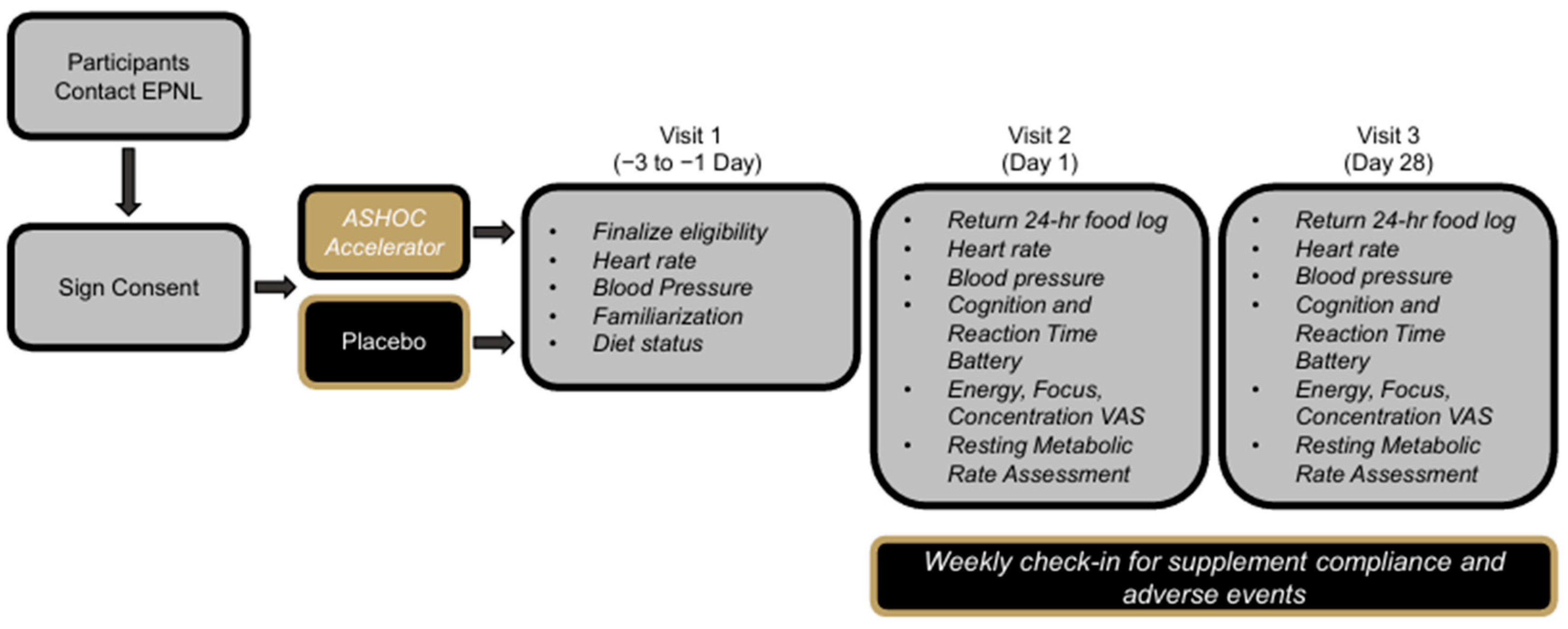
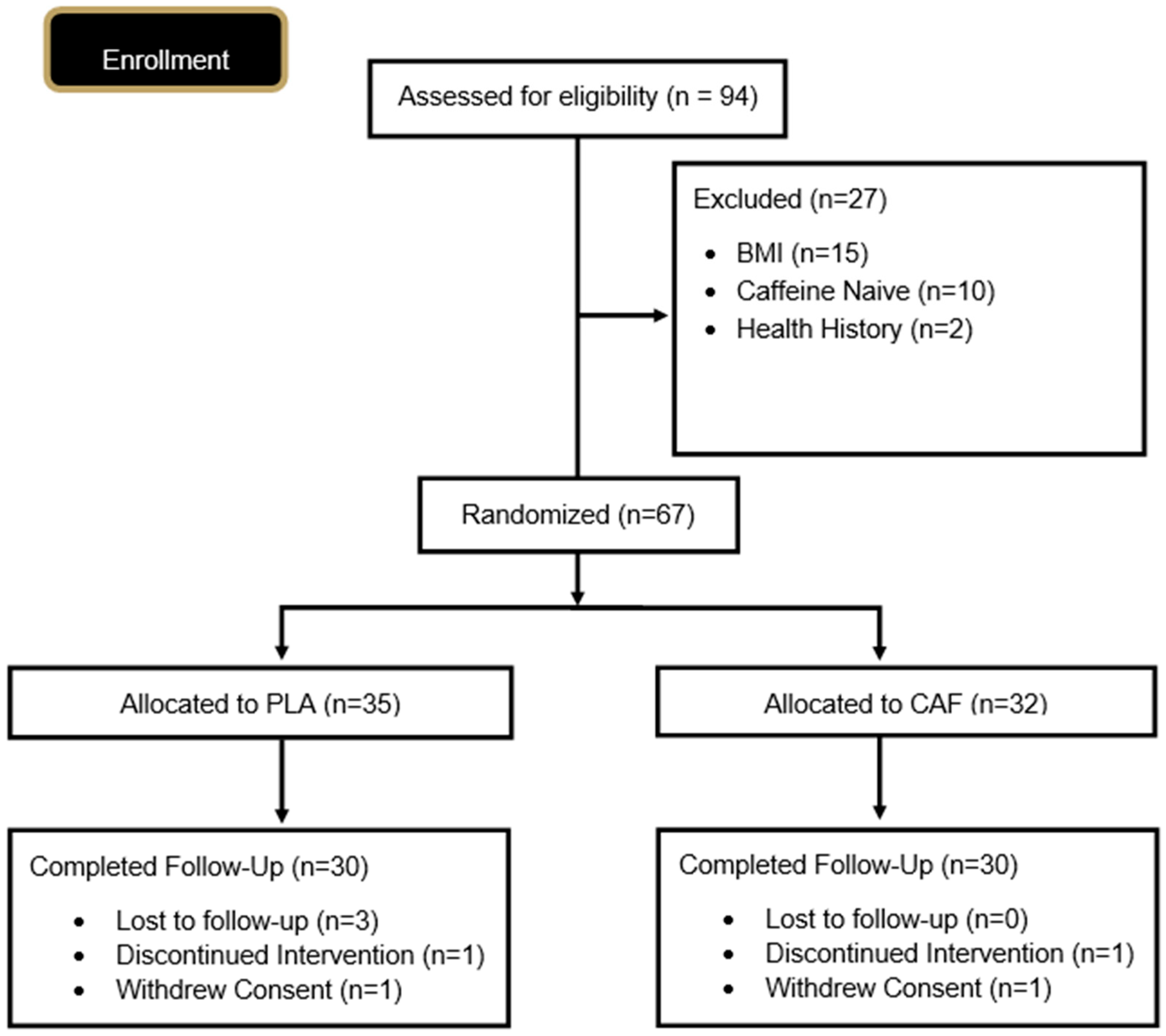
Compliance to the supplementation regimen was calculated at 98.9% and 99.2% for CAF and PLA, respectively. The post-blinding questionnaire indicated that 56.7% of participants taking CAF were able to accurately detect their assigned product while 43.3% were either incorrect or unsure. Relatedly, 60.0% of participants taking PLA were able to accurately detect their assigned product while 40.0% were either incorrect or unsure.
3.2. Energy Expenditure and Fat Oxidation
Table 2 contains energy expenditure and rate of fat oxidation data. For energy expenditure, on Day 1, a significant group × time interaction (
p < 0.001) indicating a differential time-course between groups. Planned Δ-contrasts confirmed significantly greater increases in energy expenditure with CAF at 30 (
p = 0.011, d = 0.33), 60 (
p = 0.004, d = 0.41), 90 (
p = 0.005, d = 0.83), and 120 min (
p < 0.001, d = 1.06) post-ingestion compared to PLA. CAF also produced a large acute thermogenic response (iAUC;
p = 0.001, d = 0.96) compared to PLA. On Day 28, a significant Group × Time interaction (
p = 0.011) again indicated a differential time course between groups. Planned Δ-contrasts showed that CAF remained greater than PLA at 30 (
p = 0.002, d = 0.44), 60 (
p = 0.038, d = 0.30), and 90 min (
p = 0.011, d = 0.37), with a trend at 120 min (
p = 0.072, d = 0.23). CAF also demonstrated a moderate acute thermogenic response (iAUC;
p = 0.002, d = 0.41) compared with PLA. Finally, comparisons between Day 28 and Day 1 revealed a small trend for higher baseline REE in CAF at 0 min (
p = 0.064, d = 0.28). CAF also showed a greater total post-ingestion energy expenditure (AUC;
p = 0.049, d = 0.31) compared with PLA, indicating higher overall metabolic output after 28-day supplementation. In contrast, the change in incremental AUC (iAUC), reflecting the acute thermogenic rise above baseline was not different between groups, suggesting that while total metabolic output increased, the relative post-dose excursion was maintained, providing no evidence of thermogenic habituation.
Regarding fat oxidation, on Day 1, a significant Group × Time interaction (p = 0.005) indicated a differential time course between groups. Planned Δ-contrasts confirmed significantly greater increases in fat oxidation with CAF at 60 min (p = 0.039, d = 0.63), 90 min (p = 0.022, d = 0.76), and 120 min (p = 0.035, d = 0.68) post-ingestion compared with PLA. CAF also produced a moderate acute fat-oxidation response (iAUC; p = 0.023, d = 0.68). On Day 28, no significant Group × Time interaction was observed, and the planned Δ-contrasts revealed no differences between groups at any post-ingestion timepoint. Similarly, no acute fat-oxidation response was detected for iAUC. Comparisons between Day 28 and Day 1 showed no change in resting fat oxidation, total post-ingestion fat oxidation (AUC), or incremental AUC (iAUC).
3.3. Cognition Tests
Table 3 contains Dynavision Choice Reaction, Serial Sevens, and TMT-A and TMT-B data. For Dyanvision Choice Reaction correct hits, on Day 1, a non-significant Group × Time interaction was observed (
p = 0.782), and the planned Δ-contrasts revealed no differences between groups at any post-ingestion timepoint. Similarly, no acute response was detected for iAUC. On Day 28, a significant Group × Time interaction was observed (
p = 0.029), indicating a differential time course between groups. Planned Δ-contrasts showed that CAF was greater than PLA at 60 min (
p = 0.006, d = 0.39) and 120 min (
p = 0.006, d = 0.37) post-ingestion. CAF also demonstrated a moderate acute response (iAUC;
p = 0.003, d = 0.42) compared with PLA. Comparisons between Day 28 and Day 1 showed no change in baseline scores or total post-ingestion correct hits (AUC); however, CAF exhibited a moderately greater iAUC (
p = 0.006, d = 0.40) relative to PLA.
Regarding Dynavision missed hits during the Choice reaction test, on Day 1, a non-significant Group × Time interaction was observed (p = 0.708), and the planned Δ-contrasts revealed no differences between groups at any post-ingestion timepoint. On Day 28, a trend toward a Group × Time interaction was observed (p = 0.076), suggesting a potential differential time course between groups. Planned Δ-contrasts indicated that CAF participants made fewer misses than PLA at both 60 min (p = 0.009, d = 0.37) and 120 min (p = 0.009, d = 0.35) post-ingestion. CAF also demonstrated a moderate acute improvement in performance (iAUC; p = 0.004, d = 0.41) compared with PLA. Comparisons between Day 28 and Day 1 showed no change in baseline scores or total post-ingestion misses (AUC); however, CAF exhibited a moderately lower iAUC (p = 0.019, d = 0.36) relative to PLA.
Dyanvision average reaction time during the choice reaction test, on Day 1, a trend for the Group × Time interaction was observed (p = 0.064), and the planned Δ-contrasts revealed trends that indicated potential faster reaction times in CAF compared to PLA at 60 min (p = 0.096, d = 0.50) and 120 min (p = 0.096, d = 0.53), and a trend for faster acute improvements in performance (iAUC; p = 0.068, d = 0.57). On Day 28, a non-significant Group × Time interaction was observed (p = 0.782), and the planned Δ-contrasts revealed no differences between groups at any post-ingestion timepoint. Similarly, no acute response was detected for iAUC. Comparisons between Day 28 and Day 1 showed no change in performance, total post-ingestion performance (AUC), or incremental AUC (iAUC).
Serial Sevens, on Day 1, a non-significant Group × Time interaction was observed (p = 0.199), and the planned Δ-contrasts revealed no differences between groups at any post-ingestion timepoint. On Day 28, a non-significant Group × Time interaction was observed (p = 0.109), and the planned Δ-contrasts revealed no differences between groups at any post-ingestion timepoint. Comparisons between Day 28 and Day 1 showed no change in performance, total post-ingestion performance (AUC), or incremental AUC (iAUC).
TMT-A completion times, on Day 1, a non-significant Group × Time interaction was observed (p = 0.655), and the planned Δ-contrasts revealed no differences between groups at any post-ingestion timepoint. On Day 28, a non-significant Group × Time interaction was observed (p = 0.188), and the planned Δ-contrasts revealed no differences between groups at any post-ingestion timepoint. Comparisons between Day 28 and Day 1 showed no change in baseline performance or iAUC. A small trend was observed for total post-ingestion performance (AUC; p = 0.089, d = 0.284), potentially, indicating that caffeine may influence processing speed or task efficiency at either visit.
TMT-A errors, on Day 1, a non-significant Group × Time interaction was observed (p = 0.608), and the planned Δ-contrasts revealed no differences between groups at any post-ingestion timepoint. On Day 28, a non-significant Group × Time interaction was observed (p = 0.195), and the planned Δ-contrasts revealed no differences between groups at any post-ingestion timepoint. Comparisons between Day 28 and Day 1 showed no change in performance, total post-ingestion performance (AUC), or incremental AUC (iAUC).
TMT-B completion times, on Day 1, a non-significant Group × Time interaction was observed (p = 0.855), and the planned Δ-contrasts revealed no differences between groups at any post-ingestion timepoint. On Day 28, a non-significant Group × Time interaction was observed (p = 0.344), and the planned Δ-contrasts revealed no differences between groups at any post-ingestion timepoint. Comparisons between Day 28 and Day 1 showed no change in performance, total post-ingestion performance (AUC), or incremental AUC (iAUC).
TMT-B errors, on Day 1, a non-significant Group × Time interaction was observed (p = 0.944), and the planned Δ-contrasts revealed no differences between groups at any post-ingestion timepoint. On Day 28, a non-significant Group × Time interaction was observed (p = 0.829), and the planned Δ-contrasts revealed no differences between groups at any post-ingestion timepoint. Comparisons between Day 28 and Day 1 showed no change in performance, total post-ingestion performance (AUC), or incremental AUC (iAUC).
3.4. Visual Analog Scales
Table 4 contains visual analog scores for perceived indications of energy, fatigue, focus, and concentration. Energy, on Day 1, a non-significant Group × Time interaction was observed (
p = 0.398), and the planned Δ-contrasts revealed no differences between groups at any post-ingestion timepoint. On Day 28, a significant Group × Time interaction was observed (
p = 0.003), indicating a differential time course between groups. Planned Δ-contrasts revealed that CAF participants reported moderately higher energy at 60 min (
p = 0.029, d = 0.77) and 120 min (
p = 0.029, d = 0.59) compared with PLA. CAF also produced a moderate acute energy response (iAUC;
p = 0.001, d = 0.75) compared to PLA. Comparisons between Day 28 and Day 1 showed no change in baseline ratings, total post-ingestion energy (AUC), or incremental AUC (iAUC), suggesting that while caffeine acutely increased perceived energy after 28 days of supplementation, this effect did not further augment over time.
Fatigue, on Day 1, a non-significant Group × Time interaction was observed (p = 0.511), and the planned Δ-contrasts revealed no differences between groups at any post-ingestion timepoint. On Day 28, a non-significant Group × Time interaction was observed (p = 0.887), and the planned Δ-contrasts revealed no differences between groups at any post-ingestion timepoint. Comparisons between Day 28 and Day 1 showed no change in fatigue, total post-ingestion fatigue (AUC), or incremental AUC (iAUC).
Focus, on Day 1, a non-significant Group × Time interaction was observed (p = 0.703), and the planned Δ-contrasts revealed no differences between groups at any post-ingestion timepoint. On Day 28, a significant Group × Time interaction was observed (p = 0.007), indicating a differential time course between groups. Planned Δ-contrasts revealed that CAF participants reported moderately higher focus at 60 min (p = 0.021, d = 0.69) and 120 min (p = 0.027, d = 0.60) compared with PLA. CAF also produced a moderate acute focus response (iAUC; p = 0.019, d = 0.70) relative to PLA. Comparisons between Day 28 and Day 1 showed no change in baseline ratings, total post-ingestion focus (AUC), or incremental AUC (iAUC), suggesting that while caffeine acutely increased perceived focus after 28 days of daily supplementation, this effect did not further augment over time.
Concentration, on Day 1, a non-significant Group × Time interaction was observed (p = 0.524), and the planned Δ-contrasts revealed no differences between groups at any post-ingestion timepoint. On Day 28, a trend for the Group × Time interaction was observed (p = 0.097), indicating a potential differential time course between groups. Planned Δ-contrasts revealed that CAF participants trended towards a small higher concentration at 60 min (p = 0.093, d = 0.22) and 120 min (p = 0.065, d = 0.28) compared with PLA. However, no differences were observed for acute concentration response (iAUC). Comparisons between Day 28 and Day 1 showed no change in baseline ratings, total post-ingestion focus (AUC), or incremental AUC (iAUC), suggesting that while caffeine acutely increased perceived concentration after 28 days of supplementation, this effect did not further augment over time.



 ,
,