


Abstract
Background: This study examined the association between specific unhealthy eating behaviors and sleep quality among university students. Understanding how dietary habits affect sleep during significant lifestyle transitions associated with university experience can inform health promotion strategies. Methods: A cross-sectional design was employed using a self-reported questionnaire to assess eating behaviors, timing of meals, and sleep-related behavior among a sample of international university students. Sleep quality was measured using the Pittsburgh Sleep Quality Index (PSQI) tool. Statistical analyses were used to assess the relationship between eating patterns, overall sleep quality, and its components. Results: More than half of the students had poor sleep quality (51.7%). Daytime dysfunction was significantly more common in females than in males (27.9% vs. 8.3%, respectively; p < 0.001). Conversely, poor sleep efficiency was more prevalent among males than females (27.5% vs. 15.8%; p = 0.008). Multivariate logistic regression revealed that, compared to students who did not frequently consume heavy evening meals, those who did were more likely to experience poor sleep quality (OR = 2.73, 95% CI: 1.575–4.731). Similarly, those who frequently substitute snacks for main meals were more likely to experience poor sleep quality than those who did not (OR = 2.68, 95% CI: 1.465–4.895). Finally, students who ate within three hours of bedtime had higher odds of poor sleep quality compared to those who had their last meal more than three hours before bedtime (OR = 2.06, 95% CI: 1.173–3.629). Conclusions: Unhealthy dietary habits, such as consuming heavy evening meals, substituting snacks for main meals, and having a short meal-to-bedtime interval, were significantly associated with poor sleep quality. Interventions promoting healthier dietary patterns and appropriate meal timing could help improve sleep in this population.
1. Introduction
Poor sleep quality (SQ) is a significant public health concern, associated with increased risk of morbidity and mortality [1]. Research indicates that it negatively impacts cognitive functions, such as concentration and memory, exacerbates physical and mental health problems, and ultimately raises healthcare costs [2,3].
Sleep disturbances, including insomnia, are more prevalent in young adults, especially university students, than in the general population [4,5,6]. The high incidence of sleep problems among students might be due to the exceptional demands of university life. There is often increased academic pressure, irregular schedules for classes, and active engagement in social life [7,8,9,10]. Furthermore, standard lifestyle changes, characterized by increased caffeine consumption and screen time, may alter circadian regulation and sleep architecture [11,12]. Subsequently, these impairments lead to the development of unhealthy dietary habits and diminished sleep quality [13,14].
Sleep quality (SQ) is multidimensional and includes the individual’s subjective evaluation of their sleep, depending on factors such as sleep duration, efficiency, latency, and nighttime awakenings [15]. Many tools, such as the Pittsburgh Sleep Quality Index (PSQI), have been widely used and validated to measure these characteristics [15,16].
A growing body of research has examined the complex interactions between dietary patterns and sleep quality and duration [17]. For example, Melo et al. found that higher food consumption in the evening was associated with increased nocturnal alertness, poorer sleep efficiency, and greater apnea-hypopnea index (AHI) [18,19]. In a further investigation, participants were classified according to the timing of their food intake into early eaters, late eaters, and meal skippers. The findings showed worse sleep quality (SQ) and more daytime sleepiness in late eaters than in early eaters [20]. Choi et al. also demonstrated that eating late at night and skipping breakfast were correlated with poorer sleep quality (SQ) and a higher prevalence of obstructive sleep apnea [21]. Together, these findings highlight the significant influence of dietary timing on sleep outcomes.
Chrono-nutrition is defined by three key aspects of human dietary habits: timing, regularity, and frequency of food intake [22,23,24,25]. In 1986, Alain Delabos proposed this concept, emphasizing that eating at certain times of the day should ideally harmonize with the body’s endogenous circadian rhythms, which are regulated by a central pacemaker located in the suprachiasmatic nucleus (SCN) of the hypothalamus. This central clock harmonizes the peripheral oscillators in various metabolic organs, such as the liver, pancreas, and adipose tissues. The timing of meals acts as a powerful zeitgeber (time-giver) that enables these clocks to function optimally. When eating aligns with the circadian cycle (primarily during daylight hours), metabolic processes such as lipid metabolism and glucose regulation are optimized, helping to maintain a stable sleep–wake cycle [26].
Conversely, mistimed eating patterns desynchronize peripheral clocks from the central SCN pacemaker, which can suppress nocturnal melatonin secretion, raise core body temperature and sympathetic nervous system activity when the body is in a state preparing for rest, which impairs sleep onset and maintenance, and cause many health consequences such as increased risk of type 2 diabetes mellitus, cardiometabolic diseases, obesity, and poor sleep quality [18,19,26,27,28,29,30,31].
Due to the global population of international students having substantially increased, going from 2 million in 2000 to over 6 million in 2021, as the World Migration Report indicates, it is critical to investigate how the distinct dietary and lifestyle habits of this group can be associated with their sleep quality [32,33,34]. These habits include skipping breakfast, late-night snacking, irregular meal timing, and substituting snacks for main meals.
The aim of this study was to explore the association between detrimental dietary behaviors and sleep quality among international university students. Specifically, eating close to bedtime, substituting snacks for main meals, late-night snacking, skipping breakfast, consuming heavy evening meals, and irregular eating schedules. We hypothesized that the aforementioned dietary patterns are associated with poorer sleep quality among international university students.
2. Materials and Methods
2.1. Methodology
The research design, performance, and writing adhered to the guiding principles introduced in the Strengthening the Reporting of Observational Studies in Epidemiology (STROBE) guidelines [35].
2.2. Study Design
This cross-sectional quantitative study was conducted between September and November 2024 at the University of Pécs, Hungary, using a self-administered questionnaire that included the validated Pittsburgh Sleep Quality Index (PSQI).
2.3. Participants
All international students (approximately 5000), aged 18 years or older, and enrolled in the fall semester of the 2024/2025 academic year at the University of Pécs, were considered eligible for participation [36]. Those who did not meet these criteria were deemed ineligible. Students were invited to participate through convenience sampling, a technique selected for its practicality, cost-effectiveness, and suitability for research within relatively homogeneous populations, such as university student cohorts [37].
A total of 422 students were approached; 32 declined to participate, and 390 initially completed the survey. Following data screening, the final dataset comprised 385 complete questionnaires, while a small number of responses (n = 5) were excluded due to missing data (the entire PSQI section was blank). Given the small proportion and non-systematic nature of the missingness, this exclusion was not expected to introduce significant bias.
2.4. Data Collection
Data were collected through on-site visits to the University of Pécs campuses. Students were approached and provided with a detailed explanation of the study’s objectives. After obtaining informed consent, a paper-based questionnaires were given to the participants to complete. Participation was voluntary.
2.5. Sample Size
World Health Organization (WHO) guidelines for prevalence studies formula was used to determine the required sample size [38,39]:
Based on the following parameters: a 95% confidence level, a Z-score of 1.96 (corresponding to the 95% confidence level), a 5% margin of error (d), and an assumed population proportion (p) of 0.5 to maximize the sample size, a minimum sample size of 385 participants was determined.
2.6. Questionnaire Tool
The study utilized a self-administered questionnaire available in English. It comprised 41 items divided into two main sections.
The first section (22 items) collected baseline information, including sociodemographic characteristics, lifestyle factors, physical characteristics, and dietary behaviors. Sociodemographic characteristics included (age, sex, marital status, nationality, residential setting, academic faculty, academic level, and year of study). Lifestyle factors included (alcohol and coffee consumption, smoking status, perceived stress levels, physical activity, and napping habits). The participants also self-reported their height and weight. Dietary behaviors assessed usual mealtime regularity, breakfast skipping, consumption of late-night snacks (defined as after 10 p.m.), substituting snacks for main meals, tendency to consume heavier evening meals, and the typical time interval between the last meal and bedtime.
The second section (19 items) consisted of the validated tool Pittsburgh Sleep Quality Index (PSQI), which was used to assess overall sleep quality and its components [16]. Dietary habit questions and categorization methods for sleep components were informed by and adapted from previous research by Faris et al. (2022), as discussed in the following sections [40]. A detailed classification of all questionnaire items is provided in Supplemental File S1.
The draft questionnaire underwent a pilot test with a small sample (n = 20) of international students to check the clarity and comprehensibility of the dietary and lifestyle practice questions. Minor changes were made to the wording of some questions. The internal consistency of the Pittsburgh Sleep Quality Index in this sample was acceptable (Cronbach’s α = 0.76).
2.6.1. Anthropometric Assessment
Students self-reported their height (cm) and weight (kg), from which Body Mass Index (BMI) was calculated and categorized according to the standard classifications: underweight (BMI < 18.5 kg/m2), normal weight (BMI: 18.5–24.9 kg/m2), overweight (BMI: 25–29.9 kg/m2), obesity class I (BMI: 30–34.9 kg/m2), obesity class II (BMI: 35–39.9 kg/m2), and obesity class III (BMI > 40 kg/m2) [41].
Given the known differences in body composition, specific BMI classifications were applied to Asian students: underweight (BMI < 18.5 kg/m2), normal weight (BMI: 18.5–22.9 kg/m2), overweight (BMI: 23–24.9 kg/m2), obesity class I (BMI: 25–29.9 kg/m2), obesity class II (BMI: 30–34.9 kg/m2), and obesity class III (BMI ≥ 35 kg/m2) [42,43].
2.6.2. Sleep Quality Assessment
The Pittsburgh Sleep Quality Index (PSQI) was used to assess participants’ sleep quality and patterns over the preceding month. The reliability and validity of the PSQI are well-established [16].
PSQI consists of 19 items categorized into seven parameters related to sleep, including sleep duration, sleep latency, subjective sleep quality, sleep disturbances, sleep efficiency, daytime dysfunction and use of sleeping medication.
The students rated these parameters on a scale from 0 to 3 individually, where 0 represented the best quality of sleep and 3 the worst quality of sleep. The individual component scores were then summed to yield a global PSQI score of 0 to 21. Higher global scores indicate worse sleep quality; 0 represents no sleep problems, whereas 21 indicates severe problems in all sleep components [16].
2.6.3. Eating Habits Assessment
Respondents answered a set of questions about their eating behaviors in the previous month. These questions included inquiries about frequent breakfast skipping, late-night snack consumption (snack intake after 10:00 p.m.), and substituting snacks for main meals (breakfast, lunch, and dinner). Students were also asked about eating heavier evening meals (in terms of caloric density) and meal timing regularity (having main meals at the same time regularly). To elucidate, participants were provided with a list of snacks, including calorically dense items such as chips, baked goods, sweets, processed meats, cheeses, and beverages, excluding diet drinks, water, tea, and plain coffee. Participants responded with either yes or no to the presented options.
In addition, participants were instructed to report the interval between their last meal of the day and bedtime, choosing from defined categories of either 0–2 h, or greater than or equal to 3 h.
2.6.4. Coding and Categorization of Variables
Ordinal scores of the global PSQI (ranging from 0 to 21) and each sleep component (ranging from 0 to 3) were converted into categorical variables. The PSQI global score was dichotomized: a score greater than 5 was identified as poor overall quality of sleep, while a score of 5 or less as good overall quality of sleep [16].
The PSQI subcomponents scores were categorized as either adequate or inadequate. For subjective sleep quality, scores of 0 or 1 were classified as adequate (representing high or medium quality), and scores of 2 or 3 were considered inadequate (representing low or very low quality). Similarly, sleep latency was categorized as adequate for scores of 0 or 1 (indicating a duration of 30 min or less to fall asleep) and inadequate for scores of 2 or 3 (indicating a duration of more than 30 min). For sleep efficiency (defined as the % of actual time spent asleep in bed), an efficiency of 75% or more (scores of 0 or 1) was classified as adequate, while an efficiency of 74% or less (scores of 2 or 3) was deemed inadequate. Sleep duration was considered adequate for six hours or more (scores of 0 or 1) and inadequate for less than six hours (scores of 2 or 3).
Sleep disturbance (assessed by the frequency of various sleep-related problems such as waking up at night, breathing issues, or experiencing bad dreams that interfere with sleep quality) was categorized as adequate when the sum of scores was less than 10 out of 27 on the PSQI sleep disturbance component score (representing no or low levels of disturbance), and inadequate when the sum of scores was 10 or more (representing medium or high levels). The need for sleep medication was deemed adequate with no or low usage (scores of 0 or 1) if participants reported using it less than once per week, and inadequate with medium or high usage (scores of 2 or 3) if used once per week or more.
Daytime dysfunction was classified as adequate for no or low levels of dysfunction; scores of 0 or 1 (indicating a lack of or only a slight problem with remaining alert during daily activities and maintaining sufficient motivation to complete tasks), and inadequate for scores of 2 or 3 for medium or high levels (indicating that the problem was sometimes or very frequently an issue). Finally, the time interval between the last meal and bedtime was considered adequate if it was three hours or more, and inadequate if it was less than three hours [40].
2.7. Ethical Approval
Ethical approval for this study was obtained from the Institutional Review Board of the University of Pécs (No.9568-PTE 2023).
2.8. Statistical Analysis
Statistical analyses were conducted using SPSS software (version 27). Categorical variables were presented as frequencies and percentages, while quantitative data were summarized using means and standard deviations (SD). Descriptive statistics were generated to characterize sociodemographic data and overall sleep quality. Sleep components and sex were compared using Pearson Chi-squared test.
Cross-tabulation and assessment of the strength of association were conducted between sleep components and eating habits, with results presented as odds ratios (OR), 95% confidence intervals (CI), and p-values. Multivariate logistic regression analysis was performed to calculate the odds ratio (OR), 95% confidence intervals (CI), and p-value, thereby assessing the association of dietary habits with overall sleep quality (as measured by the PSQI). The results were adjusted for the following demographic and lifestyle factors: age, sex, marital status, residential setting, academic faculty, academic level, year of study, nationality, BMI, smoking, physical activity, stress level, napping frequency, alcohol and coffee consumption. Statistical significance was defined as a p-value < 0.05. The logistic regression model was tested for multicollinearity using the Variance Inflation Factor (VIF). All VIF values were below 5, indicating that multicollinearity was not a critical concern in the model.
2.9. Consideration of Potential Bias
Several potential biases were considered. The use of convenience sampling introduces the risk of selection bias, as students with a particular interest in health might have been more likely to participate in the study. To mitigate this, recruitment was conducted across diverse campuses and faculties.
The use of self-reported data for dietary habits and anthropometrics is subject to recall, social desirability, and measurement biases. The use of the validated PSQI instrument helped standardize the primary outcome and reduce measurement bias for sleep quality.
3. Results
A total of 385 students were included in the present study, drawn from a population of approximately 5000 international students. The participants’ sociodemographic profiles are summarized in Table 1. The majority of the students (68.8%) were females, and most students (71.7%) were between 18 and 24 years of age. These participants originated from one of four broad regions: the Middle East and North Africa (MENA), Europe/Americas, Central, Eastern and South Asia, and Sub-Saharan Africa. A significant proportion (82.3%) of the students were single. Regarding academic enrollment, 68.6% were in faculties related to medicine, health sciences, and pharmacy. Another 19.5% were enrolled in engineering and sciences faculties, with the remaining 11.9% in business, humanities, law, music, or visual arts.
Table 1.
General characteristics and sleep quality of the students (n = 385).
The majority of the students (70.1%) were pursuing undergraduate degrees, while 15.6% were in master’s programs and 14.3% in doctoral programs. A large proportion (70.4%) were in their first or second year of study. In terms of residential status, 79.7% lived off-campus. Smoking was reported by a minority (13.8%), while regular alcohol consumption (54.8%) and coffee or caffeinated beverage intake (50.6%) were common. Regular physical activity was reported by a smaller group (39.7%). Regarding body weight, (60.3%) had a normal BMI, while (30.1%) were classified as overweight or obese. Severe stress was reported by one-quarter of participants (25.7%). Additionally, a considerable proportion of participants reported poor sleep quality (51.7%), and the majority indicated daily napping (73.8%).
Table 2 presents the significant differences in sleep quality components based on sex.
Table 2.
Comparison of sleep quality and its components between male and female students.
For example, males reported poor sleep efficiency more often than females (27.5% vs. 15.8%, p = 0.008). Conversely, females more frequently experienced daytime dysfunction compared to males (27.9% vs. 8.3%, p < 0.001)
Table 3 presents the associations between specific eating behaviors and the global Pittsburgh Sleep Quality Index (PSQI) score, as well as its components. The results revealed that several eating behaviors were significantly associated with poorer sleep outcomes among the students. Specifically, frequent breakfast skipping was associated with an increased likelihood of longer sleep latency (OR = 1.53, 95% CI (1.00, 2.33), p = 0.048), increased odds of sleep medication use (OR = 3.12, 95% CI (1.48, 6.57), p = 0.002), and daytime dysfunction (OR = 1.67, 95% CI (1.03, 2.72), p = 0.038) as compared to breakfast consumption. Similarly, late-night snacking (after 10:00 p.m.) showed greater odds of poor overall sleep quality (OR = 1.59, 95% CI (1.06, 2.38), p = 0.024), prolonged sleep latency (OR = 1.54, 95% CI (1.00, 2.35), p = 0.046), and reduced sleep efficiency (OR = 2.10, 95% CI (1.23, 3.58), p = 0.006) compared to no late-night snacking.
Table 3.
Cross-tabulation and association measures of eating habit factors with poor overall sleep and its components (OR, and 95% CI).
Students who substituted snacks for main meals demonstrated significant associations with adverse sleep outcomes, including increased odds of poor overall sleep quality (OR = 3.00, 95% CI (1.97, 4.55), p < 0.001), poor subjective sleep quality (OR = 2.07, 95% CI (1.31, 3.26), p = 0.002), prolonged sleep latency (OR = 2.64, 95% CI (1.72, 4.06), p < 0.001), reduced sleep efficiency (OR = 2.17, 95% CI (1.29, 3.63), p = 0.003), and shorter sleep duration (OR = 2.50, 95% CI (1.61, 3.87), p < 0.001). The likelihood of sleep medication use (OR = 4.50, 95% CI (1.99, 10.19), p < 0.001) and daytime dysfunction (OR = 2.15, 95% CI (1.31, 3.52), p = 0.002) was also substantially higher in this group compared to students who did not.
Irregular meal timing was linked with adverse sleep parameters, including poor subjective sleep quality (OR = 2.68, 95% CI (1.17, 6.15), p = 0.016) and prolonged sleep latency (OR = 2.59, 95% CI (1.26, 5.34), p = 0.008) compared to regular meal timing. Furthermore, students who habitually consumed heavier evening meals showed significantly increased odds of poor overall sleep quality (OR = 2.10, 95% CI (1.39, 3.15), p < 0.001), poor subjective sleep quality (OR = 1.65, 95% CI (1.04, 2.61), p = 0.033), reduced sleep efficiency (OR = 2.23, 95% CI (1.30, 3.83), p = 0.003), and increased sleep medication use (OR = 3.15, 95% CI (1.39, 7.13), p = 0.004) compared to students who did not.
Finally, consuming a meal within three hours before bedtime was associated with poor overall sleep quality (OR = 2.38, 95% CI (1.58, 3.61), p < 0.001), poor subjective sleep quality (OR = 2.50, 95% CI (1.58, 3.96), p < 0.001), prolonged sleep latency (OR = 2.02, 95% CI (1.32, 3.08), p = 0.001), reduced sleep duration (OR = 1.61, 95% CI (1.05, 2.48), p = 0.028), and diminished sleep efficiency (OR = 1.99, 95% CI (1.19, 3.31), p = 0.008). This eating behavior was also linked to higher odds of sleep medication use (OR = 2.07, 95% CI (1.02, 4.21), p = 0.041) and daytime dysfunction (OR = 2.14, 95% CI (1.31, 3.50), p = 0.002) compared to consuming the last meal more than three hours before bedtime.
Table 4 presents the relationship between dietary habits and overall sleep quality (measured by the Pittsburgh Sleep Quality Index, PSQI).
Table 4.
Adjusted multiple logistic regression showing eating habits associated with overall poor sleep quality.
These analyses were conducted while statistically accounting for the influence of multiple demographic and lifestyle confounders, including age, sex, marital status, nationality, residential setting, academic level, academic faculty, year of study, caffeine intake, smoking status, alcohol consumption, physical activity, stress levels, napping habits, and body mass index. Multiple logistic regression analysis identified heavy evening meals (OR = 2.73, 95% CI (1.58, 4.73), p < 0.001), substituting snacks for main meals (OR = 2.68, 95% CI (1.47, 4.90), p = 0.001), and consuming the last meal within three hours before bedtime (OR = 2.06, 95% CI (1.17, 3.63), p = 0.012) as the strongest factors associated with poor sleep quality.
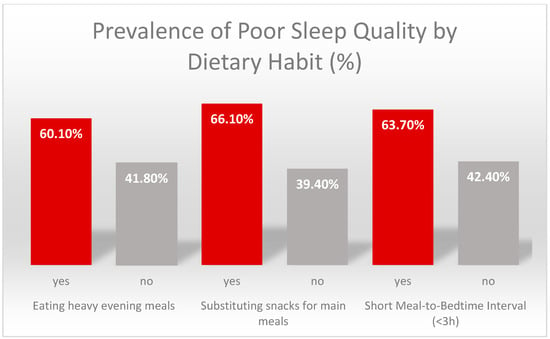
The strong associations between these key dietary habits and poor sleep quality are summarized in Figure 1.
Figure 1.
Prevalence of Poor Sleep Quality by Dietary Habit. The figure outlines the percentage of students with poor sleep quality (Global PSQI > 5) among those who reported engaging in specific unhealthy dietary behaviors versus those who did not. After controlling for key demographic and lifestyle confounders, the adjusted odds ratios (aOR) for these associations were: short meal to bedtime interval, aOR = 2.06, replacing meals with snacks, aOR = 2.68, and heavy evening meals, aOR = 2.73.
4. Discussion
This study investigated the association of specific unhealthy dietary behaviors with sleep quality among international university students in Pécs, Hungary. According to the findings, over half of the students surveyed experienced poor sleep quality. The high rate of poor sleep quality found in this sample reflects the stressful university environment and the accompanying lifestyle changes students face during this period [7,8,9,10]. For international students, cultural adaptation, language barriers, and isolation from support systems pose additional stressors.
Notably, sex-based variations in sleep quality were observed, with female students reporting poorer sleep quality than male students. This is consistent with prior research in Australia (65.1% vs. 49.8%), New Zealand (63.1% vs. 44.5%), and Spain (55.7% vs. 37.0%), where female university students reported poorer overall sleep quality than males [44,45,46]. Biological factors are extremely important; hormonal alterations throughout the menstrual cycle might strongly impact sleep architecture by their effect on core body temperature and the regulation of sleep-promoting hormones, such as melatonin [47]. Psychosocial factors also have a strong effect, as young adult women regularly report higher levels of perceived depression, stress, and anxiety, possibly affecting cognitive hyperarousal and rumination prior to sleep, which could ultimately affect sleep onset and sleep maintenance [48]. Furthermore, lifestyle and social factors might be implicated, as women have a greater load of emotional and household labor, which would constrain their opportunities to have restorative and deep sleep [49,50]. Hence, the observed differences are most likely due to the interplay of physiological, social, and psychological factors [51].
Differences in sleep parameters depending on sex were also evident, with male students having lower sleep efficiency and female students having significantly higher levels of daytime dysfunction. Targeted strategies are needed to address the unique sleep quality variations across both groups.
The results further identified a strong association between poor sleep quality and its parameters (such as daytime dysfunction, sleep duration, efficiency, latency, disturbance, subjective sleep quality, and sleep medication usage) and key unhealthy dietary patterns. These dietary habits included irregular meal timing, substituting snacks for main meals, late-night snacking, consuming heavy evening meals, breakfast skipping, and short meal-to-bedtime intervals.
4.1. Mealtime and Sleep Quality
The findings of this study add to the mounting evidence demonstrating a robust link between chrono-nutrition and sleep quality by identifying three independent dietary factors associated with poor sleep quality: short interval between the last meal and bedtime, substituting snacks for main meals, and heavy evening meals. The association of these dietary habits with poor sleep quality remained statistically significant after controlling for potential confounders, indicating a strong and independent association with poor sleep outcomes.
4.1.1. Short Meal-to-Bedtime Interval (<3 h)
Having a meal within three hours of bedtime was independently and significantly associated with poorer sleep quality, which is consistent with previous research illustrating negative associations of excessive food intake prior to bedtime with several aspects of sleep quality [52,53].
In addition to directly disturbing sleep processes, eating shortly before sleep time may elevate core body temperature, which could subsequently evoke a phase delay in the circadian rhythm, which can impact the timing and quality of sleep onset and maintenance [30]. Furthermore, consuming food within a short time frame prior to sleep is associated with gastrointestinal problems, most significantly gastroesophageal reflux disease (GERD), eventually influencing sleep quality.
In a case–controlcase-control study, participants with a dinner-to-bed interval of less than three hours had an increased odds ratio of 7.45 for GERD compared to those with at least a four-hour dinner-to-bed interval [54]. A recent systematic review and a cross-sectional study support this finding, confirming that a short meal-to-sleep interval is a significant risk factor for GERD. Overall, this suggests a minimum three-hour digestion window before sleep onset [55,56].
4.1.2. Substituting Snacks for Main Meals
Substituting main meals for snacks had a robust association with sleep quality. This is in line with a previous cross-sectional survey of 498 university students, which reported a positive association between substituting snacks for main meals and a higher risk of poor sleep quality [40]. This can be explained by the generally high energy density of snacks; previous studies in animals and humans have found that excess caloric consumption, specifically from fats, negatively affects circadian gene expression, consequently worsening sleep quality outcomes [57].
A study conducted on American women aged 35 to 74 years suggested that greater reliance on substituting snacks for meals and a lower tendency to eat at conventional mealtimes were associated with greater energy intake from fat and sweets and lower intake of fruits and vegetables [58]. Such eating patterns may result in deficiencies in several key sleep regulation nutrients, including magnesium, tryptophan, and zinc [59]. Another European study conducted in Denmark exhibited a direct correlation between the frequency of energy-dense sugary snacks consumption and poor sleep outcomes (e.g., short sleep duration and irregular sleep patterns) [60].
4.1.3. Heavy Evening Meals
Consuming heavy evening meals was significantly associated with worse sleep quality, consistent with earlier studies; for example, Charlotte et al. (2024) demonstrated an association between greater evening food intake and worse sleep quality [61].
The timing of food consumption acts as an important zeitgeber for our complex circadian rhythms; consuming heavy evening meals can lead to desynchronization between the central pacemaker and peripheral clocks, consequently disturbing metabolic processes and the sleep-wake cycle [31].
4.2. Other Dietary Habits and Their Associations with Sleep Components
Certain dietary behaviors were not identified as statistically significant association factors with overall poor sleep quality in the adjusted model; however, they demonstrated some meaningful associations with individual sleep parameters in the cross-tabulations analysis.
4.2.1. Skipping Breakfast
Breakfast skipping did not demonstrate a significant independent correlation with overall poor sleep in the multivariate analysis; however, it showed associations with multiple adverse sleep outcomes. In particular, the results suggested that breakfast skipping correlates with increased sleep medication usage, higher levels of daytime dysfunction, and longer sleep onset latency. These results are in line with those reported in the literature. Researchers have regularly found an association between breakfast skipping and poor quality of sleep components among university students [62]. Similarly, a randomized crossover design study found that participants of university students had shorter sleep latency with breakfast consumption compared to longer sleep latency with breakfast skipping [63].
Daytime dysfunction has been characterized by altered mood, reduced cognitive functioning, energy, and overall productivity. In line with this, a review demonstrated associations between skipping breakfast and mood swings and midday fatigue, likely due to a drop in blood sugar [64], which corroborates our findings. Furthermore, college students who skipped breakfast had significantly lower scores on cognitive tests evaluating attentiveness, reaction time, alertness and overall performance than individuals who regularly consumed breakfast [65]. In another intervention study, researchers observed that those who regularly consumed breakfast experienced reduced daytime dysfunction and improved sleep quality compared to those who regularly skipped breakfast [66].
Although there is insufficient research documenting a direct causal relationship between breakfast omission and the use of sleep medications, chronic sleep problems due to skipping breakfast may coincide with seeking sleep aids, thereby increasing the likelihood of using sleep medications.
Breakfast skipping is defined as the intentional or unintentional omission of breakfast at least once a week. Despite the well-established benefits of regular breakfast consumption, the high prevalence of skipping this meal remains a significant public health concern. Estimates have shown that breakfast skipping among young children and adolescents globally is 10% to 30%, with this figure rising dramatically to over 50% among university students; for instance, in Bangladesh, 52.8% of university students reported skipping breakfast, and those with poor sleep quality were three times more likely to skip breakfast than their peers. Additionally, female university students were more likely to skip breakfast than male university students, a trend potentially linked to concerns about body image and weight control [67,68].
4.2.2. Late-Night Snacking (After 10:00 p.m.)
Although the multivariate model did not identify late-night snacking as an independent factor associated with poor sleep, cross-tabulation analysis demonstrated an association between late-night snacking and increased sleep latency and reduced sleep efficiency. Overall, these results support past research suggesting that consuming food, including snacks late at night (after 10:00 p.m.), is associated with a greater risk of compromised sleep quality [40].
The mechanisms underpinning this association are likely multifactorial. University students often consume snacks such as chips, sweets, and confectionery [69]. These highly processed, energy-dense foods are easily overconsumed, leading to increased overall caloric and fat intake. This dietary pattern has been directly linked to poorer sleep outcomes. For example, a clinical study demonstrated a negative association between the consumption of saturated, polyunsaturated, trans, and total fats and sleep duration [70]. Another study conducted by Carvalho et al. (2020) among night-shift workers revealed that pre-sleep food intake with high fat and carbohydrate content increased sleep onset latency [71]. Conversely, Bravo et al. (2012) found that a special pre-sleep snack, such as cereals with high tryptophan content, would shorten sleep latency, which contradicts our results [72]. This indicates the importance of both the type and timing of pre-sleep food consumption in determining sleep outcomes.
Late-night snack consumption could also indirectly affect sleep outcomes by changing the subsequent food consumption schedule, for example, increasing the likelihood of skipping breakfast, which has been shown previously to correlate with poorer sleep quality [73,74,75]. In a trial of sixteen adults, sleep restriction resulted in a statistically significant increase in caloric intake (42% increase) from post-dinner, carbohydrate, protein, and fiber-rich snack consumption [76]. This suggests a bidirectional relationship where poor sleep could drive late-night snack consumption, and vice versa.
4.2.3. Irregular Meal Timing
Regression analysis did not demonstrate statistical significance for irregular meal timing. Yet, the consistency of the observed associations with sleep parameters warrants additional investigation. Irregular meal schedules were associated with prolonged sleep latency and diminished subjective sleep quality, likely due to the impact of regular mealtime on the circadian rhythm synchronization [77].
Irregular mealtime patterns can disrupt metabolic regulation, causing circadian misalignment [78]. Supporting this, Hatori et al. (2012) revealed that irregular feeding patterns dysregulate circadian rhythms, while regular feeding schedules help entrain them [79]. Later research also showed a significant association between irregular meal patterns and poorer sleep quality [80]. Similarly, a cross-sectional study reported a strong relationship between irregular mealtimes and longer sleep latency [40].
A key strength of this study is the use of a well-validated tool that evaluates several sleep parameters (PSQI) [16]. Additionally, the sample size used in this study; the study recruited a large sample size of students reinforcing the statistical power regarding the prevalence of poor sleep quality. Furthermore, targeting international students, a demographic that frequently experiences extreme changes in lifestyle and eating patterns, provides strong insights into the sleep problems facing this vulnerable population. Finally, the study considered several potential lifestyle and demographic confounding variables in the multivariate regression analysis, thereby enhancing the validity of the findings.
However, several limitations should be acknowledged. A key weakness of this study is its cross-sectional methodology, which allowed for exploration of the associations between unhealthy eating behaviors and poor sleep quality, but could not establish causality. Additionally, the restricted inclusion of students using a convenience sample from a single university might be susceptible to self-selection bias and compromise the external validity of the findings. Furthermore, dietary patterns assessment relied on self-reported, non-validated questions, introducing the potential for measurement bias. Moreover, although we controlled for several lifestyle factors, these were measured with broad categories (e.g., regular/irregular physical activity/coffee drinker), and the lack of data on intensity, duration, or precise timing may have limited our ability to fully account for their confounding effects. Finally, this research did not account for several established confounders in chrono-nutrition research, including individual chronotype, diet type, detailed nutrient composition and caloric intake, and data on environmental factors, such as light and noise, and mental health status were not collected.
Future longitudinal studies with larger sample sizes should incorporate objective measures, detailed dietary assessment, and consider confounding variables to confirm these results and investigate the influence of culture and age on the diet-sleep relationship, providing a more comprehensive assessment of factors influencing sleep quality outcomes
4.3. Practical Implications and Future Directions
First: enhance university health services; health centers should systematically screen for sleep problems and provide access to dietitians and doctors for personalized consultations on the identified risk factors. Second: develop accessible digital educational tools; create mobile applications to provide support and education on healthy eating behavior and sleep hygiene. In addition, include principles of chrono-nutrition in university workshops and health promotion programs, advising students to limit heavy evening meals and maintain a meal-to-bedtime interval of at least three hours. Third: restructure the campus environment; provide healthier, appealing snacks and meals in vending machines and cafeterias to reduce the substitution of energy-dense, nutrient-poor snacks for main meals, and provide healthy beverages as affordable alternatives to sugary drinks and high-caffeine energy drinks. Fourth: provide practical skill-building support; offer dorm-friendly meal and snack preparation workshops to teach simple, healthy meal and snack preparation skills to reduce reliance on convenience, unhealthy snacks. Finally: combine sleep hygiene education with time-management workshops to help students organize their schedules for consistent meals and sufficient sleep.
5. Conclusions
Unhealthy dietary habits, particularly consuming heavy evening meals, substituting snacks for main meals, and a short meal-to-bedtime interval, are significantly associated with poor sleep quality among international university students. These results demonstrate the important relationship between chrono-nutrition and sleep health in this population.
Interventions promoting appropriate meal timing and healthier eating patterns as part of comprehensive health promotion strategies could be an effective strategy to improve sleep quality in this population.
Supplementary Materials
The following supporting information can be downloaded at: https://www.mdpi.com/article/10.3390/nu17223580/s1, Supplementary Material File S1; The self-administered questionnaire used for data collection, including sociodemographic, dietary behavior, and Pittsburgh Sleep Quality Index (PSQI) sections.
Author Contributions
Conceptualization, M.A.-J.; methodology, M.A.-J. and S.C.; software, M.A.-J.; validation, M.A.-J.; formal analysis, M.A.-J.; investigation, M.A.-J.; resources, M.A.-J.; data curation, M.A.-J.; writing—original draft preparation, M.A.-J.; writing—review and editing, I.C. and S.L.; visualization, M.A.-J.; supervision, S.L.; project administration, M.A.-J. All authors have read and agreed to the published version of the manuscript.
Funding
This research did not receive any specific grant from funding agencies in the public, commercial, or not-for-profit sectors. However, M.A.-J. was supported by the Stipendium Hungaricum Scholarship Programme (Tempus Public Foundation, Hungary). S.L. acknowledges funding from the National Research, Development and Innovation Office, Hungary (grant no. NKFIH_FK_143633).
Institutional Review Board Statement
The study was conducted in accordance with the Declaration of Helsinki, and approved by the Institutional Review Board of the University of Pécs (No.9568-PTE 2023, dated 31 March 2023).
Informed Consent Statement
Informed consent was obtained from all subjects involved in the study.
Data Availability Statement
The data presented in this study are available upon request to the corresponding author.
Acknowledgments
The authors would like to gratefully acknowledge the support of all the students who participated in the current study.
Conflicts of Interest
The authors declare no conflicts of interest.
Abbreviations
The following abbreviations are used in this manuscript:
| SQ | Sleep Quality |
| PSQI | Pittsburgh Sleep Quality Index |
| OR | Odds Ratio |
| MENA | Middle Eastern & North African |
| AHI | Apnea-Hypopnea Index |
| STROBE | Strengthening the reporting of observational studies in epidemiology |
| WHO | World Health Organisation |
| P | Population Proportion |
| GERD | Gastroesophageal Reflux Disease |
References
- Stranges, S.; Tigbe, W.; Gómez-Olivé, F.X.; Thorogood, M.; Kandala, N.B. Sleep problems: An emerging global epidemic? Findings from the INDEPTH WHO-SAGE study among more than 40,000 older adults from 8 countries across Africa and Asia. Sleep 2012, 35, 1173–1181. [Google Scholar] [CrossRef] [Scilit]
- Daley, M.; Morin, C.M.; LeBlanc, M.; Grégoire, J.P.; Savard, J. The economic burden of insomnia: Direct and indirect costs for individuals with insomnia syndrome, insomnia symptoms, and good sleepers. Sleep 2009, 32, 55–64. [Google Scholar] [CrossRef] [Scilit] [PubMed]
- Chattu, V.K.; Manzar, M.D.; Kumary, S.; Burman, D.; Spence, D.W.; Pandi-Perumal, S.R. The Global Problem of Insufficient Sleep and Its Serious Public Health Implications. Healthcare 2018, 7, 1. [Google Scholar] [CrossRef] [Scilit] [PubMed]
- Ohayon, M.M. Epidemiology of insomnia: What we know and what we still need to learn. Sleep Med. Rev. 2002, 6, 97–111. [Google Scholar] [CrossRef] [Scilit]
- Samaranayake, C.B.; Arroll, B.; Fernando, A.T. Sleep disorders, depression, anxiety and satisfaction with life among young adults: A survey of university students in Auckland, New Zealand. N. Z. Med. J. 2014, 127, 13–22. [Google Scholar] [PubMed]
- Jiang, X.L.; Zheng, X.Y.; Yang, J.; Ye, C.P.; Chen, Y.Y.; Zhang, Z.G.; Xiao, Z.J. A systematic review of studies on the prevalence of Insomnia in university students. Public Health 2015, 129, 1579–1584. [Google Scholar] [CrossRef] [Scilit]
- Lund, H.G.; Reider, B.D.; Whiting, A.B.; Prichard, J.R. Sleep Patterns and Predictors of Disturbed Sleep in a Large Population of College Students. J. Adolesc. Health 2010, 46, 124–132. [Google Scholar] [CrossRef] [Scilit] [PubMed]
- Dreidi, M.; Asmar, I. Sleep Hygiene and Academic Achievement among University Students in Palestine. Psychol. Educ. J. 2021, 58, 4138–4143. [Google Scholar]
- Siddiqui, A.F.; Al-Musa, H.; Al-Amri, H.; Al-Qahtani, A.; Al-Shahrani, M.; Al-Qahtani, M. Sleep Patterns and Predictors of Poor Sleep Quality among Medical Students in King Khalid University, Saudi Arabia. Malays. J. Med. Sci. 2016, 23, 94–102. [Google Scholar] [CrossRef] [Scilit]
- Hershner, S.; Chervin, R. Causes and consequences of sleepiness among college students. Nat. Sci. Sleep 2014, 73, 73–84. [Google Scholar] [CrossRef] [Scilit]
- O’Callaghan, F.; Muurlink, O.; Reid, N. Effects of caffeine on sleep quality and daytime functioning. Risk Manag. Healthc. Policy 2018, 11, 263–271. [Google Scholar] [CrossRef] [Scilit]
- Chang, A.M.; Aeschbach, D.; Duffy, J.F.; Czeisler, C.A. Evening use of light-emitting eReaders negatively affects sleep, circadian timing, and next-morning alertness. Proc. Natl. Acad. Sci. USA 2015, 112, 1232–1237. [Google Scholar] [CrossRef] [Scilit] [PubMed]
- Al Khatib, H.K.; Harding, S.V.; Darzi, J.; Pot, G.K. The effects of partial sleep deprivation on energy balance: A systematic review and meta-analysis. Eur. J. Clin. Nutr. 2017, 71, 614–624. [Google Scholar] [CrossRef] [Scilit]
- Dashti, H.S.; Scheer, F.A.; Jacques, P.F.; Lamon-Fava, S.; Ordovás, J.M. Short Sleep Duration and Dietary Intake: Epidemiologic Evidence, Mechanisms, and Health Implications. Adv. Nutr. 2015, 6, 648–659. [Google Scholar] [CrossRef] [Scilit] [PubMed]
- Nelson, K.L.; Davis, J.E.; Corbett, C.F. Sleep quality: An evolutionary concept analysis. Nurs. Forum. 2022, 57, 144–151. [Google Scholar] [CrossRef] [Scilit]
- Buysse, D.J.; Reynolds, C.F.; Monk, T.H.; Berman, S.R.; Kupfer, D.J. The Pittsburgh Sleep Quality Index: A new instrument for psychiatric practice and research. Psychiatry Res. 1989, 28, 193–213. [Google Scholar] [CrossRef] [Scilit]
- Çakir, B.; Nişancı Kılınç, F.; Özata Uyar, G.; Özenir, Ç.; Ekici, E.M.; Karaismailoğlu, E. The relationship between sleep duration, sleep quality and dietary intake in adults. Sleep Biol. Rhythm. 2020, 18, 49–57. [Google Scholar] [CrossRef] [Scilit]
- de Melo, C.M.; Del Re, M.P.; Dos Santos Quaresma, M.V.L.; Moreira Antunes, H.K.; Togeiro, S.M.; Lima Ribeiro, S.M.; Tufik, S.; de Mello, M.T. Relationship of evening meal with sleep quality in obese individuals with obstructive sleep apnea. Clin. Nutr. ESPEN 2019, 29, 231–236. [Google Scholar] [CrossRef] [Scilit] [PubMed]
- Keser, M.G.; Yüksel, A. An overview of the relationship between meal timing and sleep. J. Turk. Sleep Med. 2024, 11, 20–25. [Google Scholar] [CrossRef] [Scilit]
- Lopes, T.V.C.; Borba, M.E.; Lopes, R.V.C.; Fisberg, R.M.; Paim, S.L.; Teodoro, V.V.; Zimberg, I.Z.; Crispim, C.A. Eating Late Negatively Affects Sleep Pattern and Apnea Severity in Individuals with Sleep Apnea. J. Clin. Sleep Med. 2019, 15, 383–392. [Google Scholar] [CrossRef] [Scilit]
- Choi, Y.; Son, B.; Shin, W.C.; Nam Suk Lee, J.; Lim, J.; Kim, S.; Yang, C.; Lee, H. Association of Dietary Behaviors with Poor Sleep Quality and Increased Risk of Obstructive Sleep Apnea in Korean Military Service Members. Nat. Sci. Sleep 2022, 14, 1737–1751. [Google Scholar] [CrossRef] [Scilit]
- Almoosawi, S.; Vingeliene, S.; Gachon, F.; Voortman, T.; Palla, L.; Johnston, J.D.; Van Dam, R.M.; Darimont, C.; Karagounis, L.G. Chronotype: Implications for Epidemiologic Studies on Chrono-Nutrition and Cardiometabolic Health. Adv. Nutr. 2019, 10, 30–42. [Google Scholar] [CrossRef] [Scilit] [PubMed]
- Crispim, C.A.; Mota, M.C. New perspectives on chrononutrition. Biol. Rhythm. Res. 2019, 50, 63–77. [Google Scholar] [CrossRef] [Scilit]
- Flanagan, A.; Bechtold, D.A.; Pot, G.K.; Johnston, J.D. Chrono-nutrition: From molecular and neuronal mechanisms to human epidemiology and timed feeding patterns. J. Neurochem. 2021, 157, 53–72. [Google Scholar] [CrossRef] [Scilit]
- Pot, G.K. Chrono-nutrition—An emerging, modifiable risk factor for chronic disease? Nutr. Bull. 2021, 46, 114–119. [Google Scholar] [CrossRef] [Scilit]
- Delabos, A. Mincir sur Mesure Grâce à la Chrono-Nutrition. In Beograd: Vulkan izdavaštvo; Albin Michel: Paris, France, 2016; 20p, Available online: https://www.knjizara.com/pdf/147598.pdf (accessed on 27 May 2025).
- Tarquini, R.; Mazzoccoli, G. Clock Genes, Metabolism, and Cardiovascular Risk. Heart Fail. Clin. 2017, 13, 645–655. [Google Scholar] [CrossRef] [Scilit]
- Thomas, E.A.; Zaman, A.; Cornier, M.A.; Catenacci, V.A.; Tussey, E.J.; Grau, L.; Arbet, J.; Broussard, J.L.; Rynders, C.A. Later Meal and Sleep Timing Predicts Higher Percent Body Fat. Nutrients 2021, 13, 73. [Google Scholar] [CrossRef] [Scilit]
- Dashti, H.S.; Gómez-Abellán, P.; Qian, J.; Esteban, A.; Morales, E.; Scheer, F.A.; Garaulet, M. Late eating is associated with cardiometabolic risk traits, obesogenic behaviors, and impaired weight loss. Am. J. Clin. Nutr. 2021, 113, 154–161. [Google Scholar] [CrossRef] [Scilit] [PubMed]
- Brown, R.F.; Thorsteinsson, E.B.; Smithson, M.; Birmingham, C.L.; Aljarallah, H.; Nolan, C. Can body temperature dysregulation explain the co-occurrence between overweight/obesity, sleep impairment, late-night eating, and a sedentary lifestyle? Eat. Weight. Disord. 2017, 22, 599–608. [Google Scholar] [CrossRef] [Scilit]
- Reinke, H.; Asher, G. Crosstalk between metabolism and circadian clocks. Nat. Rev. Mol. Cell Biol. 2019, 20, 227–241. [Google Scholar] [CrossRef] [Scilit] [PubMed]
- Doo, M.; Wang, C. Associations among Sleep Quality, Changes in Eating Habits, and Overweight or Obesity after Studying Abroad among International Students in South Korea. Nutrients 2020, 12, 2020. [Google Scholar] [CrossRef] [Scilit]
- UNESCO. Facts and Figures, Mobility in Higher Education, UNESCO. Available online: http://data.uis.unesco.org (accessed on 25 May 2025).
- International Organization for Migration. World Migration Report 2024: Chapter 2—International Students, International Organization for Migration (IOM). Available online: https://worldmigrationreport.iom.int/what-we-do/world-migration-report-2024-chapter-2/international-students (accessed on 27 May 2025).
- Lachat, C.; Hawwash, D.; Ocké, M.C.; Berg, C.; Forsum, E.; Hörnell, A.; Larsson, C.L.; Sonestedt, E.; Wirfält, E.; Åkesson, A.; et al. Strengthening the Reporting of Observational Studies in Epidemiology—Nutritional epidemiology (STROBE-nut): An extension of the STROBE statement. Nutr. Bull. 2016, 41, 240–251. [Google Scholar] [CrossRef] [Scilit]
- University of Pécs. About the University of Pécs. Available online: https://international.pte.hu/university/about-university-pecs (accessed on 5 January 2025).
- Jager, J.; Putnick, D.L.; Bornstein, M.H. II. More than just convenient: The scientific merits of homogeneous convenience samples. Monogr. Soc. Res. Child 2017, 82, 13–30. [Google Scholar] [CrossRef] [Scilit] [PubMed]
- Alwafi, H.; Alwafi, R.; Naser, A.Y.; Samannodi, M.; Aboraya, D.; Salawati, E.; Alqurashi, A.; Ekram, R.; Alzahrani, A.R.; Aldhahir, M.A. The Impact of Social Media Influencers on Food Consumption in Saudi Arabia, a Cross-Sectional Web-Based Survey. J. Multidiscip. Healthc. 2022, 15, 2129–2139. [Google Scholar] [CrossRef] [Scilit] [PubMed]
- Naing, N.N. Determination of sample size. Malays. J. Med. Sci. 2003, 10, 84–86. [Google Scholar] [PubMed]
- Faris, M.E.; Vitiello, M.V.; Abdelrahim, D.N.; Cheikh Ismail, L.; Jahrami, H.A.; Khaleel, S.; Khan, M.S.; Shakir, A.Z.; Yusuf, A.M.; Masaad, A.A.; et al. Eating habits are associated with subjective sleep quality outcomes among university students: Findings of a cross-sectional study. Sleep Breath. 2022, 26, 1365–1376. [Google Scholar] [CrossRef] [Scilit]
- Nuttall, F.Q. Body Mass Index: Obesity, BMI, and Health: A Critical Review. Nutr. Today 2015, 50, 117–128. [Google Scholar] [CrossRef] [Scilit]
- World Health Organization. Regional Office for the Western Pacific. In The Asia-Pacific Perspective: Redefining Obesity and Its Treatment [Internet]; Health Communications Australia: Sydney, Australia, 2000; ISBN 978-0-9577082-1-1. Available online: https://iris.who.int/handle/10665/206936 (accessed on 5 January 2025).
- Haam, J.H.; Kim, B.T.; Kim, E.M.; Kwon, H.; Kang, J.H.; Park, J.H.; Kim, K.-K.; Rhee, S.Y.; Kim, Y.-H.; Lee, K.Y. Diagnosis of Obesity: 2022 Update of Clinical Practice Guidelines for Obesity by the Korean Society for the Study of Obesity. J. Obes. Metab. Synd. 2023, 32, 121–129. [Google Scholar] [CrossRef] [Scilit]
- Fatima, Y.; Doi, S.A.R.; Najman, J.M.; Mamun, A.A. Exploring Gender Difference in Sleep Quality of Young Adults: Findings from a Large Population Study. Clin. Med. Res. 2016, 14, 138–144. [Google Scholar] [CrossRef] [Scilit]
- Galland, B.C.; Gray, A.R.; Penno, J.; Smith, C.; Lobb, C.; Taylor, R.W. Gender differences in sleep hygiene practices and sleep quality in New Zealand adolescents aged 15 to 17 years. Sleep Health 2017, 3, 77–83. [Google Scholar] [CrossRef] [Scilit]
- Ramón-Arbués, E.; Granada-López, J.M.; Martínez-Abadía, B.; Echániz-Serrano, E.; Antón-Solanas, I.; Jerue, B.A. The Association between Diet and Sleep Quality among Spanish University Students. Nutrients 2022, 14, 3291. [Google Scholar] [CrossRef] [Scilit]
- Baker, F.C.; Driver, H.S. Circadian rhythms, sleep, and the menstrual cycle. Sleep Med. 2007, 8, 613–622. [Google Scholar] [CrossRef] [Scilit]
- Baglioni, C.; Spiegelhalder, K.; Lombardo, C.; Riemann, D. Sleep and emotions: A focus on insomnia. Sleep Med. Rev. 2010, 14, 227–238. [Google Scholar] [CrossRef] [Scilit]
- Hisler, G.; Krizan, Z. Sleepiness and Behavioral Risk-Taking: Do Sleepy People Take More or Less Risk? Behav. Sleep Med. 2019, 17, 364–377. [Google Scholar] [CrossRef] [Scilit]
- Maume, D.J. Social Ties and Adolescent Sleep Disruption. J. Health Soc. Behav. 2013, 54, 498–515. [Google Scholar] [CrossRef] [Scilit] [PubMed]
- Mallampalli, M.P.; Carter, C.L. Exploring Sex and Gender Differences in Sleep Health: A Society for Women’s Health Research Report. J. Womens Health 2014, 23, 553–562. [Google Scholar] [CrossRef] [Scilit] [PubMed]
- Crispim, C.A.; Zimberg, I.Z.; Dos Reis, B.G.; Diniz, R.M.; Tufik, S.; De Mello, M.T. Relationship between Food Intake and Sleep Pattern in Healthy Individuals. J. Clin. Sleep Med. 2011, 7, 659–664. [Google Scholar] [CrossRef] [Scilit] [PubMed]
- Tahara, Y.; Makino, S.; Suiko, T.; Nagamori, Y.; Iwai, T.; Aono, M.; Shibata, S. Association between Irregular Meal Timing and the Mental Health of Japanese Workers. Nutrients 2021, 13, 2775. [Google Scholar] [CrossRef] [Scilit]
- Fujiwara, Y.; Machida, A.; Watanabe, Y.; Shiba, M.; Tominaga, K.; Watanabe, T.; Oshitani, N.; Higuchi, K.; Arakawa, T. Association Between Dinner-to-Bed Time and Gastro-Esophageal Reflux Disease. Am. J. Gastroenterol. 2005, 100, 2633. [Google Scholar] [CrossRef] [Scilit]
- Zhang, M.; Hou, Z.K.; Huang, Z.B.; Chen, X.L.; Liu, F.B. Dietary and Lifestyle Factors Related to Gastroesophageal Reflux Disease: A Systematic Review. Ther. Clin. Risk Manag. 2021, 17, 305–323. [Google Scholar] [CrossRef] [Scilit]
- Nagata, C.; Wada, K.; Yamakawa, M.; Nakashima, Y.; Sugino, M.; Mori, T.; Nagao, Y.; Ishihara, K.; Yamamoto, S. Associations of the timing of sleep and meals with the presence of gastroesophageal reflux disease in community-dwelling women in Japan. J. Hum. Nutr. Diet. 2023, 36, 2026–2035. [Google Scholar] [CrossRef] [Scilit]
- Tahara, Y.; Shibata, S. Chronobiology and nutrition. Neuroscience 2013, 253, 78–88. [Google Scholar] [CrossRef] [Scilit] [PubMed]
- Kim, S.; DeRoo, L.A.; Sandler, D.P. Eating patterns and nutritional characteristics associated with sleep duration. Public Health Nutr. 2011, 14, 889–895. [Google Scholar] [CrossRef] [Scilit]
- Binks, H.E.; Vincent, G.; Gupta, C.; Irwin, C.; Khalesi, S. Effects of Diet on Sleep: A Narrative Review. Nutrients 2020, 12, 936. [Google Scholar] [CrossRef] [Scilit]
- Kjeldsen, J.S.; Hjorth, M.F.; Andersen, R.; Michaelsen, K.F.; Tetens, I.; Astrup, A.; Chaput, J.-P.; Sjödin, A. Short sleep duration and large variability in sleep duration are independently associated with dietary risk factors for obesity in Danish school children. Int. J. Obes. 2014, 38, 32–39. [Google Scholar] [CrossRef] [Scilit]
- Griffith, C.A.; Leidy, H.J.; Gwin, J.A. Indices of Sleep Health Are Associated With Timing and Duration of Eating in Young Adults. J. Acad. Nutr. Diet. 2024, 124, 1051–1057. [Google Scholar] [CrossRef] [Scilit] [PubMed]
- Pengpid, S.; Peltzer, K. Skipping Breakfast and Its Association with Health Risk Behaviour and Mental Health Among University Students in 28 Countries. Diabetes Metab. Syndr. Obes. 2020, 13, 2889–2897. [Google Scholar] [CrossRef] [Scilit] [PubMed]
- Gwin, J.A.; Leidy, H.J. Breakfast Consumption Augments Appetite, Eating Behavior, and Exploratory Markers of Sleep Quality Compared with Skipping Breakfast in Healthy Young Adults. Curr. Dev. Nutr. 2018, 2, nzy074. [Google Scholar] [CrossRef] [Scilit]
- Ak, M. Skipping Breakfast Everyday Keeps Well-being Away. J. Food Sci. Nutr. Res. 2018, 1, 18–30. [Google Scholar] [CrossRef] [Scilit]
- Dutta, P.; Nayak, V.K.R. Effect of skipping breakfast on cognition and learning in young adults. Biomedicine 2022, 42, 1285–1289. [Google Scholar] [CrossRef] [Scilit]
- Hirofumi, M.; Hasebe, H.; Ishihara, K.; Suga, Y. Changes in Subjective Questionnaires of Sleep Quality and Mood States When Breakfast Skippers Consistently Eat Breakfast in Japanese Office Worker. JFN 2023, 9, 103. [Google Scholar] [CrossRef] [Scilit]
- Monzani, A.; Ricotti, R.; Caputo, M.; Solito, A.; Archero, F.; Bellone, S.; Prodam, F. A Systematic Review of the Association of Skipping Breakfast with Weight and Cardiometabolic Risk Factors in Children and Adolescents. What Should We Better Investigate in the Future? Nutrients 2019, 11, 387. [Google Scholar] [CrossRef] [Scilit]
- Khan, M.S.I.; Paul, T.; Al Banna, M.d.H.; Hamiduzzaman, M.; Tengan, C.; Kissi-Abrokwah, B.; Tetteh, J.K.; Hossain, F.; Islam, S.; Brazendale, K. Skipping breakfast and its association with sociodemographic characteristics, night eating syndrome, and sleep quality among university students in Bangladesh. BMC Nutr. 2024, 10, 46. [Google Scholar] [CrossRef] [Scilit]
- Ertaş Öztürk, Y.; Uzdil, Z. Ultra-processed food consumption is linked to quality of life and mental distress among university students. PeerJ 2025, 13, e19931. [Google Scholar] [CrossRef] [Scilit]
- Grandner, M.A.; Kripke, D.F.; Naidoo, N.; Langer, R.D. Relationships Among Dietary Nutrients and Subjective Sleep, Objective Sleep, and Napping in Women. Sleep Med. 2010, 11, 180–184. Available online: https://pubmed.ncbi.nlm.nih.gov/20005774/ (accessed on 27 May 2025). [CrossRef] [Scilit] [PubMed]
- Nogueira, L.F.R.; Pellegrino, P.; Cipolla-Neto, J.; Moreno, C.R.C.; Marqueze, E.C. Timing and Composition of Last Meal before Bedtime Affect Sleep Parameters of Night Workers. Clocks Sleep. 2021, 3, 536–546. Available online: https://pubmed.ncbi.nlm.nih.gov/34698111/ (accessed on 27 May 2025). [CrossRef] [Scilit] [PubMed]
- Bravo, R.; Matito, S.; Cubero, J.; Paredes, S.D.; Franco, L.; Rivero, M.; Rodríguez, A.B.; Barriga, C. Tryptophan-enriched cereal intake improves nocturnal sleep, melatonin, serotonin, and total antioxidant capacity levels and mood in elderly humans. Age 2013, 35, 1277–1285. [Google Scholar] [CrossRef] [Scilit]
- Teixeira, G.P.; Mota, M.C.; Crispim, C.A. Eveningness is associated with skipping breakfast and poor nutritional intake in Brazilian undergraduate students. Chronobiol. Int. 2018, 35, 358–367. [Google Scholar] [CrossRef] [Scilit] [PubMed]
- Okada, C.; Imano, H.; Muraki, I.; Yamada, K.; Iso, H. The Association of Having a Late Dinner or Bedtime Snack and Skipping Breakfast with Overweight in Japanese Women. J. Obes. 2019, 2019, 2439571. [Google Scholar] [CrossRef] [Scilit]
- Tambalis, K.D.; Panagiotakos, D.B.; Psarra, G.; Sidossis, L.S. Insufficient Sleep Duration Is Associated With Dietary Habits, Screen Time, and Obesity in Children. J. Clin. Sleep Med. 2018, 14, 1689–1696. [Google Scholar] [CrossRef] [Scilit]
- Markwald, R.R.; Melanson, E.L.; Smith, M.R.; Higgins, J.; Perreault, L.; Eckel, R.H.; Wright, K.P. Impact of insufficient sleep on total daily energy expenditure, food intake, and weight gain. Proc. Natl. Acad. Sci. USA 2013, 110, 5695–5700. [Google Scholar] [CrossRef] [Scilit] [PubMed]
- Panda, S. Circadian physiology of metabolism. Science 2016, 354, 1008–1015. [Google Scholar] [CrossRef] [Scilit] [PubMed]
- Gill, S.; Panda, S. A Smartphone App Reveals Erratic Diurnal Eating Patterns in Humans that Can Be Modulated for Health Benefits. Cell Metab. 2015, 22, 789–798. [Google Scholar] [CrossRef] [Scilit]
- Hatori, M.; Vollmers, C.; Zarrinpar, A.; DiTacchio, L.; Bushong, E.A.; Gill, S.; Leblanc, M.; Chaix, A.; Joens, M.; Fitzpatrick, J.A.; et al. Time-restricted feeding without reducing caloric intake prevents metabolic diseases in mice fed a high-fat diet. Cell Metab. 2012, 15, 848–860. [Google Scholar] [CrossRef] [Scilit]
- St-Onge, M.P.; Mikic, A.; Pietrolungo, C.E. Effects of Diet on Sleep Quality. Adv. Nutr. 2016, 7, 938–949. [Google Scholar] [CrossRef] [Scilit] [PubMed]

Disclaimer/Publisher’s Note: The statements, opinions and data contained in all publications are solely those of the individual author(s) and contributor(s) and not of MDPI and/or the editor(s). MDPI and/or the editor(s) disclaim responsibility for any injury to people or property resulting from any ideas, methods, instructions or products referred to in the content. |
© 2025 by the authors. Licensee MDPI, Basel, Switzerland. This article is an open access article distributed under the terms and conditions of the Creative Commons Attribution (CC BY) license (https://creativecommons.org/licenses/by/4.0/).