Impact of Diverse Dietary Patterns on Cognitive Health: Cumulative Evidence from Prospective Cohort Studies


Abstract
1. Introduction
2. Materials and Methods
2.1. Information Sources and Search Strategy
2.2. Study Selection and Eligibility Criteria
2.3. Data Extraction
2.4. Quality Assessment
3. Results
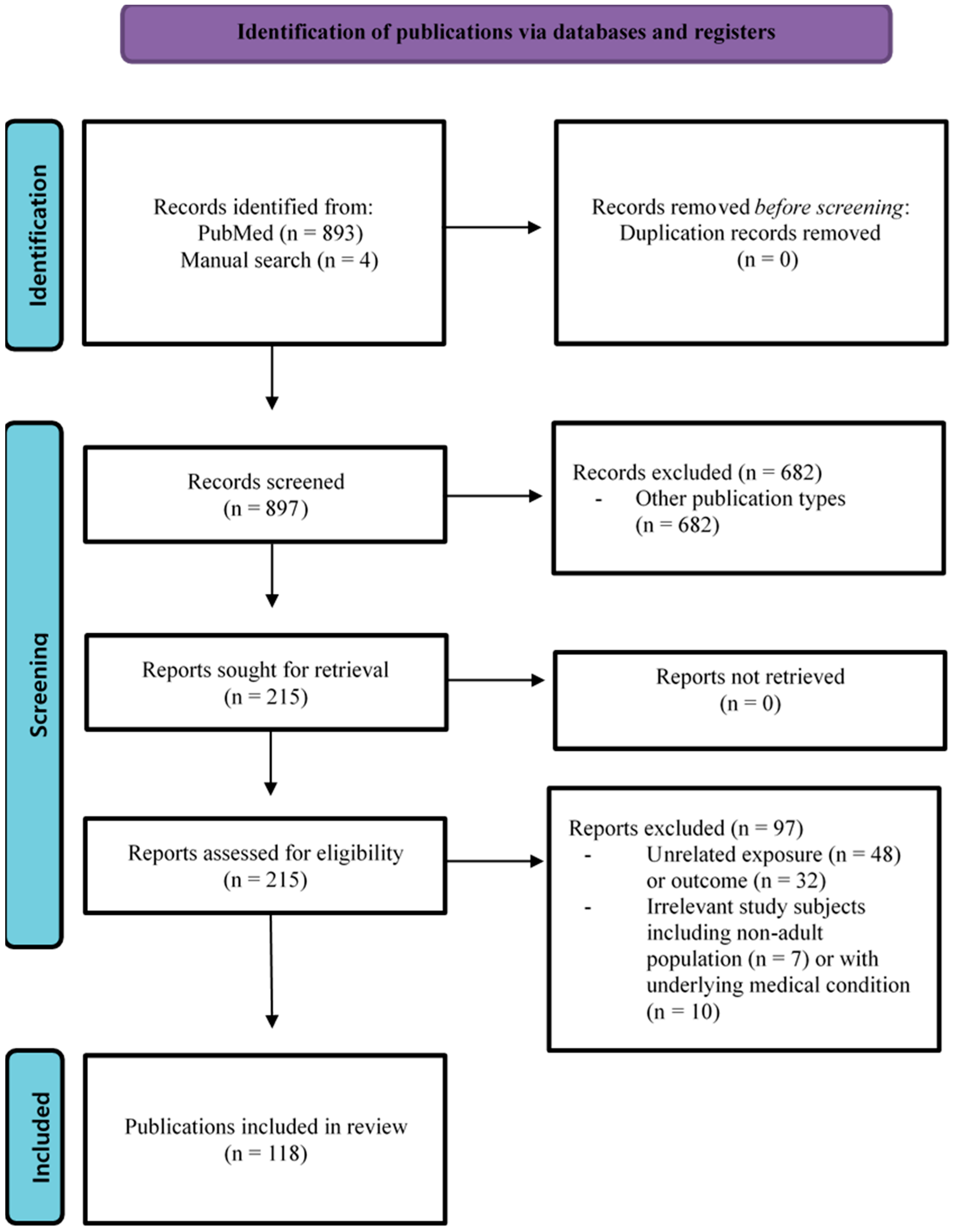
3.1. Study Selection
3.2. Overview of Study Characteristics
3.3. Dietary Patterns
3.3.1. Mediterranean-Dietary Approaches to Stop Hypertension Intervention for Neurodegenerative Delay (MIND) Diet
3.3.2. Mediterranean (MED) Diet
3.3.3. Dietary Approaches to Stop Hypertension (DASH) Diet
3.3.4. Healthy Eating Index (HEI)
3.3.5. Plant-Based Dietary Pattern
3.3.6. Another Healthy Dietary Pattern
3.3.7. Western Dietary Pattern (WDP)
3.3.8. Other Dietary Patterns
4. Discussion
5. Conclusions
Author Contributions
Funding
Data Availability Statement
Conflicts of Interest
Abbreviations
| 3C | Three-City |
| 3MS | Modified Mini-Mental State examination |
| 7MS | Seven-minute screening |
| AD | Alzheimer’s disease |
| AGEs | Advanced glycation end products |
| AHEI | Alternative Healthy Eating Index |
| AHS-2 | Adventist Health Study-2 |
| AIBL | Australian Imaging, Biomarkers and Lifestyle study of ageing |
| AREDS | Age-Related Eye Disease Study |
| ARIC | Atherosclerosis Risk in Communities |
| AusDiab | Australian Diabetes, Obesity and Lifestyle |
| BPRHS | Boston Puerto Rican Health Study |
| B-proof | B-vitamins for the Prevention of Osteoporotic Fractures |
| CCMS | Cache County Memory Study |
| CHAP | Chicago Health and Aging Project |
| CHNS | China Health and Nutrition Survey |
| CI | Confidence interval |
| CLHLS | Chinese Longitudinal Healthy Longevity Surveys |
| DASH | Dietary Approaches to Stop Hypertension |
| DHA | Docosahexaenoic acid |
| DO-HEALTH | VitaminD3–Omega3–Home Exercise–Healthy Ageing and Longevity Trial |
| EPAD LCS | European Prevention of Alzheimer’s Dementia Longitudinal Cohort Study |
| EPIC | European Prospective Investigation into Cancer and Nutrition |
| FHS | Framingham Heart Study |
| FRGS | Fundamental Research Grant Scheme |
| GRAS | Geisinger Rural Aging Study |
| HAICDDS | History-Based Artificial Intelligent Clinical Dementia Diagnostic System |
| HCHS/SOL | Hispanic Community Health Study/Study of Latinos |
| Health ABC | Health, Aging, and Body Composition |
| HEI | Healthy Eating Index |
| HELIAD | Hellenic Epidemiological Longitudinal Investigation of Aging and Diet |
| hPDI | Healthy plant-based dietary index |
| HPFS | Health Professionals’ Follow-up Study |
| HRS | Health and Retirement Study |
| HR | Hazard ratio |
| InCHIANTI | Invecchiare in Chianti, aging in the Chianti area |
| LDL | Low-density lipoprotein |
| LRGS-TUA | Long-Term Research Grant Scheme-Towards Useful Aging |
| MAP | Rush Memory and Aging Project |
| MAS | Sydney Memory and Ageing Study |
| MCI | Mild cognitive impairment |
| MDCS | Malmö Diet and Cancer study |
| MDS | Mediterranean diet score |
| MED | Mediterranean |
| MESA | Multi-Ethnic Study of Atherosclerosis |
| MMSE | Mini-Mental State Examination |
| MrOS | Osteoporotic Fractures in Men |
| MSLS | Maine-Syracuse Longitudinal Study |
| NA | Not available |
| NHS | Nurses’ Health Study |
| NILS-LSA | National Institute for Longevity Sciences—Longitudinal Study of Aging |
| NuAge | Quebec Longitudinal Study on Nutrition and Successful Aging |
| OR | Odds ratio |
| PATH | Personality and Total Health Through Life Cohort |
| PDI | Plant-based dietary index |
| PIVUS | Prospective Investigation of the Vasculature in Uppsala Seniors |
| PREDIMED | PREvención con DIeta MEDiterránea |
| PUFA | Polyunsaturated fatty acid |
| RBS | Rancho Bernardo Study |
| RCT | Randomized controlled clinical trial |
| REGARDS | REasons for Geographic and Racial Differences in Stroke |
| RNA-Seq | Ribonucleic acid sequencing |
| ROS | Religious Orders Study |
| SCHS | Singapore Chinese Health Study |
| SDGS | Swedish dietary guidelines score |
| SIMPLER | Swedish Infrastructure for Medical Population-based Life-course Environmental Research, previously the Swedish Mammography Cohort and the Cohort of Swedish Men |
| SNAC-K | Swedish National Study on Aging and Care in Kungsholmen |
| SOL–INCA | Latinos–Investigation of Neurocognitive Aging |
| SU.VI.MAX | Supplementation with Vitamins and Mineral Antioxidants |
| SUN | Seguimiento Universidad de Navarra |
| TCVS | Tzu Chi Vegetarian Study |
| TLSA | Taiwan Longitudinal Study of Aging |
| TMAO | Trimethylamine N-oxide |
| TwinsUK | United Kingdom Adult Twin Registry |
| UK | United Kingdom |
| uPDI | Unhealthy plant-based dietary index |
| USA | United States of America |
| WACS | Women’s Antioxidant Cardiovascular Study |
| WDP | Western dietary pattern |
| WELL | Wellbeing Eating and Exercise for a Long Life |
| WHICAP | Washington Heights–Inwood Columbia Aging Project |
| WHIMS | Women’s Health Initiative Memory Study |
| WII | Whitehall II study |
References
- Lee, J.; Kim, H.J. Normal Aging Induces Changes in the Brain and Neurodegeneration Progress: Review of the Structural, Biochemical, Metabolic, Cellular, and Molecular Changes. Front. Aging Neurosci. 2022, 14, 931536. [Google Scholar] [CrossRef] [Scilit] [PubMed]
- American Psychiatric Association. Diagnostic and Statistical Manual of Mental Disorders: DSM-5; American Psychiatric Association: Washington, DC, USA, 2013. [Google Scholar]
- Collaborators, G.D.F. Estimation of the global prevalence of dementia in 2019 and forecasted prevalence in 2050: An analysis for the Global Burden of Disease Study 2019. Lancet Public Health 2022, 7, e105–e125. [Google Scholar] [CrossRef]
- Livingston, G.; Huntley, J.; Liu, K.Y.; Costafreda, S.G.; Selbæk, G.; Alladi, S.; Ames, D.; Banerjee, S.; Burns, A.; Brayne, C.; et al. Dementia prevention, intervention, and care: 2024 report of the Lancet standing Commission. Lancet 2024, 404, 572–628. [Google Scholar] [CrossRef] [Scilit]
- Seblova, D.; Berggren, R.; Lövdén, M. Education and age-related decline in cognitive performance: Systematic review and meta-analysis of longitudinal cohort studies. Ageing Res. Rev. 2020, 58, 101005. [Google Scholar] [CrossRef] [Scilit] [PubMed]
- Kuiper, J.S.; Zuidersma, M.; Oude Voshaar, R.C.; Zuidema, S.U.; Van Den Heuvel, E.R.; Stolk, R.P.; Smidt, N. Social relationships and risk of dementia: A systematic review and meta-analysis of longitudinal cohort studies. Ageing Res. Rev. 2015, 22, 39–57. [Google Scholar] [CrossRef] [Scilit]
- Yu, R.-C.; Proctor, D.; Soni, J.; Pikett, L.; Livingston, G.; Lewis, G.; Schilder, A.; Bamiou, D.; Mandavia, R.; Omar, R. Adult-onset hearing loss and incident cognitive impairment and dementia—A systematic review and meta-analysis of cohort studies. Ageing Res. Rev. 2024, 98, 102346. [Google Scholar] [CrossRef] [Scilit] [PubMed]
- Shang, X.; Zhu, Z.; Wang, W.; Ha, J.; He, M. The association between vision impairment and incidence of dementia and cognitive impairment: A systematic review and meta-analysis. Ophthalmology 2021, 128, 1135–1149. [Google Scholar] [CrossRef] [Scilit] [PubMed]
- Wilker, E.H.; Osman, M.; Weisskopf, M.G. Ambient air pollution and clinical dementia: Systematic review and meta-analysis. BMJ 2023, 381, e071620. [Google Scholar] [CrossRef] [Scilit] [PubMed]
- Chowdhary, N.; Barbui, C.; Anstey, K.J.; Kivipelto, M.; Barbera, M.; Peters, R.; Zheng, L.; Kulmala, J.; Stephen, R.; Ferri, C.P.; et al. Reducing the Risk of Cognitive Decline and Dementia: WHO Recommendations. Front. Neurol. 2021, 12, 765584. [Google Scholar] [CrossRef] [Scilit]
- Yassine, H.N.; Samieri, C.; Livingston, G.; Glass, K.; Wagner, M.; Tangney, C.; Plassman, B.L.; Ikram, M.A.; Voigt, R.M.; Gu, Y.; et al. Nutrition state of science and dementia prevention: Recommendations of the Nutrition for Dementia Prevention Working Group. Lancet Healthy Longev. 2022, 3, e501–e512. [Google Scholar] [CrossRef] [Scilit]
- Schulz, C.A.; Oluwagbemigun, K.; Nöthlings, U. Advances in dietary pattern analysis in nutritional epidemiology. Eur. J. Nutr. 2021, 60, 4115–4130. [Google Scholar] [CrossRef] [Scilit]
- Tapsell, L.C.; Neale, E.P.; Satija, A.; Hu, F.B. Foods, Nutrients, and Dietary Patterns: Interconnections and Implications for Dietary Guidelines. Adv. Nutr. 2016, 7, 445–454. [Google Scholar] [CrossRef] [Scilit] [PubMed]
- Wells, G.A.; Shea, B.; O’Connell, D.; Peterson, J.; Welch, V.; Losos, M.; Tugwell, P. The Newcastle-Ottawa Scale (NOS) for assessing the quality of nonrandomised studies in meta-analyses. Available online: http://www.ohri.ca/programs/clinical_epidemiology/oxford.asp (accessed on 30 October 2024).
- Li, J.; Capuano, A.W.; Agarwal, P.; Arvanitakis, Z.; Wang, Y.; De Jager, P.L.; Schneider, J.A.; Tasaki, S.; de Paiva Lopes, K.; Hu, F.B.; et al. The MIND diet, brain transcriptomic alterations, and dementia. Alzheimer’s Dement. 2024, 20, 5996–6007. [Google Scholar] [CrossRef] [Scilit]
- O’Reilly, S.; Gouldson, A.; Wirth, J.; Cherbuin, N.; Eramudugolla, R.; Anstey, K.J. Onset of cognitive impairment, diet quality and adherence to dietary guidelines over 12 years: The Personality and Total Health Cohort Study. Br. J. Nutr. 2024, 1–8. [Google Scholar] [CrossRef] [Scilit] [PubMed]
- Sawyer, R.P.; Blair, J.; Shatz, R.; Manly, J.J.; Judd, S.E. Association of Adherence to a MIND-Style Diet with the Risk of Cognitive Impairment and Decline in the REGARDS Cohort. Neurology 2024, 103, e209817. [Google Scholar] [CrossRef] [Scilit]
- Agarwal, P.; Barnes, L.L.; Dhana, K.; Liu, X.; Zhang, Y.; Beck, T.; Cornelis, M.C.; Tangney, C.; Rajan, K.B. Association of MIND diet with cognitive decline among Black and White older adults. Alzheimer’s Dement. 2024, 20, 8461–8469. [Google Scholar] [CrossRef] [Scilit]
- Seago, E.R.; Davy, B.M.; Davy, K.P.; Katz, B. Neuroprotective Dietary Patterns and Longitudinal Changes in Cognitive Function in Older Adults. J. Acad. Nutr. Diet. 2024, 125, 785–795.e9. [Google Scholar] [CrossRef] [Scilit]
- Bhave, V.M.; Oladele, C.R.; Ament, Z.; Kijpaisalratana, N.; Jones, A.C.; Couch, C.A.; Patki, A.; Garcia Guarniz, A.L.; Bennett, A.; Crowe, M.; et al. Associations Between Ultra-Processed Food Consumption and Adverse Brain Health Outcomes. Neurology 2024, 102, e209432. [Google Scholar] [CrossRef] [Scilit]
- Thomas, A.; Ryan, C.P.; Caspi, A.; Liu, Z.; Moffitt, T.E.; Sugden, K.; Zhou, J.; Belsky, D.W.; Gu, Y. Diet, Pace of Biological Aging, and Risk of Dementia in the Framingham Heart Study. Ann. Neurol. 2024, 95, 1069–1079. [Google Scholar] [CrossRef] [Scilit]
- Zapawi, M.M.M.; You, Y.X.; Shahar, S.; Shahril, M.R.; Malek Rivan, N.F.; Nik Mohd Fakhruddin, N.N.I.; Yap, A.X.W. Development of Malaysian-MIND diet scores for prediction of mild cognitive impairment among older adults in Malaysia. BMC Geriatr. 2024, 24, 387. [Google Scholar] [CrossRef] [Scilit] [PubMed]
- Sager, R.; Gaengler, S.; Willett, W.C.; Orav, E.J.; Mattle, M.; Habermann, J.; Geiling, K.; Schimmer, R.C.; Vellas, B.; Kressig, R.W.; et al. Adherence to the MIND diet and the odds of mild cognitive impairment in generally healthy older adults: The 3-year DO-HEALTH study. J. Nutr. Health Aging 2024, 28, 100034. [Google Scholar] [CrossRef] [Scilit]
- Lin, W.; Zhou, X.; Liu, X. Association of adherence to the Chinese version of the MIND diet with reduced cognitive decline in older Chinese individuals: Analysis of the Chinese Longitudinal Healthy Longevity Survey. J. Nutr. Health Aging 2024, 28, 100024. [Google Scholar] [CrossRef] [Scilit]
- McEvoy, C.T.; Jennings, A.; Steves, C.J.; Macgregor, A.; Spector, T.; Cassidy, A. Diet patterns and cognitive performance in a UK Female Twin Registry (TwinsUK). Alzheimer’s Res. Ther. 2024, 16, 17. [Google Scholar] [CrossRef] [Scilit]
- Zhang, J.; Cao, X.; Li, X.; Li, X.; Hao, M.; Xia, Y.; Huang, H.; Høj Jørgensen, T.S.; Agogo, G.O.; Wang, L.; et al. Associations of Midlife Dietary Patterns with Incident Dementia and Brain Structure: Findings from the UK Biobank Study. Am. J. Clin. Nutr. 2023, 118, 218–227. [Google Scholar] [CrossRef] [Scilit]
- Chen, H.; Dhana, K.; Huang, Y.; Huang, L.; Tao, Y.; Liu, X.; Melo van Lent, D.; Zheng, Y.; Ascherio, A.; Willett, W.; et al. Association of the Mediterranean Dietary Approaches to Stop Hypertension Intervention for Neurodegenerative Delay (MIND) Diet with the Risk of Dementia. JAMA Psychiatry 2023, 80, 630–638. [Google Scholar] [CrossRef] [Scilit]
- Huang, L.; Tao, Y.; Chen, H.; Chen, X.; Shen, J.; Zhao, C.; Xu, X.; He, M.; Zhu, D.; Zhang, R.; et al. Mediterranean-Dietary Approaches to Stop Hypertension Intervention for Neurodegenerative Delay (MIND) Diet and Cognitive Function and its Decline: A Prospective Study and Meta-analysis of Cohort Studies. Am. J. Clin. Nutr. 2023, 118, 174–182. [Google Scholar] [CrossRef] [Scilit]
- de Crom, T.O.E.; Mooldijk, S.S.; Ikram, M.K.; Ikram, M.A.; Voortman, T. MIND diet and the risk of dementia: A population-based study. Alzheimer’s Res. Ther. 2022, 14, 8. [Google Scholar] [CrossRef] [Scilit] [PubMed]
- Cornelis, M.C.; Agarwal, P.; Holland, T.M.; van Dam, R.M. MIND Dietary Pattern and Its Association with Cognition and Incident Dementia in the UK Biobank. Nutrients 2022, 15, 32. [Google Scholar] [CrossRef] [Scilit] [PubMed]
- Vu, T.H.T.; Beck, T.; Bennett, D.A.; Schneider, J.A.; Hayden, K.M.; Shadyab, A.H.; Rajan, K.B.; Morris, M.C.; Cornelis, M.C. Adherence to MIND Diet, Genetic Susceptibility, and Incident Dementia in Three US Cohorts. Nutrients 2022, 14, 2759. [Google Scholar] [CrossRef] [Scilit] [PubMed]
- Thomas, A.; Lefèvre-Arbogast, S.; Féart, C.; Foubert-Samier, A.; Helmer, C.; Catheline, G.; Samieri, C. Association of a MIND Diet with Brain Structure and Dementia in a French Population. J. Prev. Alzheimer’s Dis. 2022, 9, 655–664. [Google Scholar] [CrossRef] [Scilit]
- Boumenna, T.; Scott, T.M.; Lee, J.S.; Zhang, X.; Kriebel, D.; Tucker, K.L.; Palacios, N. MIND Diet and Cognitive Function in Puerto Rican Older Adults. J. Gerontol. A Biol. Sci. Med. Sci. 2022, 77, 605–613. [Google Scholar] [CrossRef] [Scilit]
- Dhana, K.; James, B.D.; Agarwal, P.; Aggarwal, N.T.; Cherian, L.J.; Leurgans, S.E.; Barnes, L.L.; Bennett, D.A.; Schneider, J.A. MIND Diet, Common Brain Pathologies, and Cognition in Community-Dwelling Older Adults. J. Alzheimer’s Dis. 2021, 83, 683–692. [Google Scholar] [CrossRef] [Scilit] [PubMed]
- Melo van Lent, D.; O’Donnell, A.; Beiser, A.S.; Vasan, R.S.; DeCarli, C.S.; Scarmeas, N.; Wagner, M.; Jacques, P.F.; Seshadri, S.; Himali, J.J.; et al. Mind Diet Adherence and Cognitive Performance in the Framingham Heart Study. J. Alzheimer’s Dis. 2021, 82, 827–839. [Google Scholar] [CrossRef] [Scilit]
- Nishi, S.K.; Babio, N.; Gómez-Martínez, C.; Martínez-González, M.; Ros, E.; Corella, D.; Castañer, O.; Martínez, J.A.; Alonso-Gómez, Á.M.; Wärnberg, J.; et al. Mediterranean, DASH, and MIND Dietary Patterns and Cognitive Function: The 2-Year Longitudinal Changes in an Older Spanish Cohort. Front. Aging Neurosci. 2021, 13, 782067. [Google Scholar] [CrossRef] [Scilit] [PubMed]
- Munoz-Garcia, M.I.; Toledo, E.; Razquin, C.; Dominguez, L.J.; Maragarone, D.; Martinez-Gonzalez, J.; Martinez-Gonzalez, M.A. “A priori” Dietary Patterns and Cognitive Function in the SUN Project. Neuroepidemiology 2020, 54, 45–57. [Google Scholar] [CrossRef] [Scilit]
- Hosking, D.E.; Eramudugolla, R.; Cherbuin, N.; Anstey, K.J. MIND not Mediterranean diet related to 12-year incidence of cognitive impairment in an Australian longitudinal cohort study. Alzheimer’s Dement. 2019, 15, 581–589. [Google Scholar] [CrossRef] [Scilit]
- Adjibade, M.; Assmann, K.E.; Julia, C.; Galan, P.; Hercberg, S.; Kesse-Guyot, E. Prospective association between adherence to the MIND diet and subjective memory complaints in the French NutriNet-Santé cohort. J. Neurol. 2019, 266, 942–952. [Google Scholar] [CrossRef] [Scilit] [PubMed]
- Berendsen, A.M.; Kang, J.H.; Feskens, E.J.M.; de Groot, C.; Grodstein, F.; van de Rest, O. Association of Long-Term Adherence to the MIND Diet with Cognitive Function and Cognitive Decline in American Women. J. Nutr. Health Aging 2018, 22, 222–229. [Google Scholar] [CrossRef] [Scilit]
- Shakersain, B.; Rizzuto, D.; Larsson, S.C.; Faxén-Irving, G.; Fratiglioni, L.; Xu, W.L. The Nordic Prudent Diet Reduces Risk of Cognitive Decline in the Swedish Older Adults: A Population-Based Cohort Study. Nutrients 2018, 10, 229. [Google Scholar] [CrossRef] [Scilit]
- Morris, M.C.; Tangney, C.C.; Wang, Y.; Sacks, F.M.; Barnes, L.L.; Bennett, D.A.; Aggarwal, N.T. MIND diet slows cognitive decline with aging. Alzheimer’s Dement. 2015, 11, 1015–1022. [Google Scholar] [CrossRef] [Scilit]
- Feng, Y.; Wang, J.; Zhang, R.; Wang, Y.; Wang, J.; Meng, H.; Cheng, H.; Zhang, J. Mediterranean diet related to 3-year incidence of cognitive decline: Results from a cohort study in Chinese rural elders. Nutr. Neurosci. 2024, 27, 1351–1362. [Google Scholar] [CrossRef] [Scilit]
- Shannon, O.M.; Ranson, J.M.; Gregory, S.; Macpherson, H.; Milte, C.; Lentjes, M.; Mulligan, A.; McEvoy, C.; Griffiths, A.; Matu, J.; et al. Mediterranean diet adherence is associated with lower dementia risk, independent of genetic predisposition: Findings from the UK Biobank prospective cohort study. BMC Med. 2023, 21, 81. [Google Scholar] [CrossRef] [Scilit]
- Vlachos, G.S.; Yannakoulia, M.; Anastasiou, C.A.; Kosmidis, M.H.; Dardiotis, E.; Hadjigeorgiou, G.; Charisis, S.; Sakka, P.; Stefanis, L.; Scarmeas, N. The role of Mediterranean diet in the course of subjective cognitive decline in the elderly population of Greece: Results from a prospective cohort study. Br. J. Nutr. 2022, 128, 2219–2229. [Google Scholar] [CrossRef] [Scilit]
- Gregory, S.; Ritchie, C.W.; Ritchie, K.; Shannon, O.; Stevenson, E.J.; Muniz-Terrera, G. Mediterranean diet score is associated with greater allocentric processing in the EPAD LCS cohort: A comparative analysis by biogeographical region. Front. Aging 2022, 3, 1012598. [Google Scholar] [CrossRef] [Scilit]
- Mamalaki, E.; Charisis, S.; Anastasiou, C.A.; Ntanasi, E.; Georgiadi, K.; Balomenos, V.; Kosmidis, M.H.; Dardiotis, E.; Hadjigeorgiou, G.; Sakka, P.; et al. The Longitudinal Association of Lifestyle with Cognitive Health and Dementia Risk: Findings from the HELIAD Study. Nutrients 2022, 14, 2818. [Google Scholar] [CrossRef] [Scilit]
- Moustafa, B.; Trifan, G.; Isasi, C.R.; Lipton, R.B.; Sotres-Alvarez, D.; Cai, J.; Tarraf, W.; Stickel, A.; Mattei, J.; Talavera, G.A.; et al. Association of Mediterranean Diet with Cognitive Decline Among Diverse Hispanic or Latino Adults From the Hispanic Community Health Study/Study of Latinos. JAMA Netw. Open 2022, 5, e2221982. [Google Scholar] [CrossRef] [Scilit]
- Chen, X.; Liu, Z.; Sachdev, P.S.; Kochan, N.A.; O’Leary, F.; Brodaty, H. Association of Dietary Patterns with Cognitive Function and Cognitive Decline in Sydney Memory and Ageing Study: A Longitudinal Analysis. J. Acad. Nutr. Diet. 2022, 122, 949–960.e15. [Google Scholar] [CrossRef] [Scilit] [PubMed]
- Yuan, C.; Cao, Y.; Ascherio, A.; Okereke, O.I.; Zong, G.; Grodstein, F.; Hofman, A.; Willett, W.C. Long-term diet quality and its change in relation to late-life subjective cognitive decline. Am. J. Clin. Nutr. 2022, 115, 232–243. [Google Scholar] [CrossRef] [Scilit]
- Muñoz-García, M.I.; Martínez-González, M.A.; Razquin, C.; Fernández-Matarrubia, M.; Guillén-Grima, F.; Toledo, E. Exploratory dietary patterns and cognitive function in the “Seguimiento Universidad de Navarra” (SUN) Prospective Cohort. Eur. J. Clin. Nutr. 2022, 76, 48–55. [Google Scholar] [CrossRef] [Scilit] [PubMed]
- Glans, I.; Sonestedt, E.; Nägga, K.; Gustavsson, A.M.; González-Padilla, E.; Borne, Y.; Stomrud, E.; Melander, O.; Nilsson, P.M.; Palmqvist, S.; et al. Association Between Dietary Habits in Midlife with Dementia Incidence over a 20-Year Period. Neurology 2023, 100, e28–e37. [Google Scholar] [CrossRef] [Scilit] [PubMed]
- Wade, A.T.; Elias, M.F.; Murphy, K.J. Adherence to a Mediterranean diet is associated with cognitive function in an older non-Mediterranean sample: Findings from the Maine-Syracuse Longitudinal Study. Nutr. Neurosci. 2021, 24, 542–553. [Google Scholar] [CrossRef] [Scilit]
- Nicoli, C.; Galbussera, A.A.; Bosetti, C.; Franchi, C.; Gallus, S.; Mandelli, S.; Marcon, G.; Quadri, P.; Riso, P.; Riva, E. The role of diet on the risk of dementia in the oldest old: The Monzino 80-plus population-based study. Clin. Nutr. 2021, 40, 4783–4791. [Google Scholar] [CrossRef] [Scilit]
- Corley, J.; Deary, I.J. Dietary patterns and trajectories of global- and domain-specific cognitive decline in the Lothian Birth Cohort 1936. Br. J. Nutr. 2021, 126, 1237–1246. [Google Scholar] [CrossRef] [Scilit] [PubMed]
- Agarwal, P.; Dhana, K.; Barnes, L.L.; Holland, T.M.; Zhang, Y.; Evans, D.A.; Morris, M.C. Unhealthy foods may attenuate the beneficial relation of a Mediterranean diet to cognitive decline. Alzheimer’s Dement. 2021, 17, 1157–1165. [Google Scholar] [CrossRef] [Scilit]
- Nooyens, A.C.J.; Yildiz, B.; Hendriks, L.G.; Bas, S.; van Boxtel, M.P.J.; Picavet, H.S.J.; Boer, J.M.A.; Verschuren, W.M.M. Adherence to dietary guidelines and cognitive decline from middle age: The Doetinchem Cohort Study. Am. J. Clin. Nutr. 2021, 114, 871–881. [Google Scholar] [CrossRef] [Scilit]
- Charisis, S.; Ntanasi, E.; Yannakoulia, M.; Anastasiou, C.A.; Kosmidis, M.H.; Dardiotis, E.; Hadjigeorgiou, G.; Sakka, P.; Scarmeas, N. Mediterranean diet and risk for dementia and cognitive decline in a Mediterranean population. J. Am. Geriatr. Soc. 2021, 69, 1548–1559. [Google Scholar] [CrossRef] [Scilit]
- Andreu-Reinón, M.E.; Chirlaque, M.D.; Gavrila, D.; Amiano, P.; Mar, J.; Tainta, M.; Ardanaz, E.; Larumbe, R.; Colorado-Yohar, S.M.; Navarro-Mateu, F.; et al. Mediterranean Diet and Risk of Dementia and Alzheimer’s Disease in the EPIC-Spain Dementia Cohort Study. Nutrients 2021, 13, 700. [Google Scholar] [CrossRef] [Scilit] [PubMed]
- Hu, E.A.; Wu, A.; Dearborn, J.L.; Gottesman, R.F.; Sharrett, A.R.; Steffen, L.M.; Coresh, J.; Rebholz, C.M. Adherence to Dietary Patterns and Risk of Incident Dementia: Findings from the Atherosclerosis Risk in Communities Study. J. Alzheimer’s Dis. 2020, 78, 827–835. [Google Scholar] [CrossRef] [Scilit]
- Keenan, T.D.; Agrón, E.; Mares, J.A.; Clemons, T.E.; van Asten, F.; Swaroop, A.; Chew, E.Y. Adherence to a Mediterranean diet and cognitive function in the Age-Related Eye Disease Studies 1 & 2. Alzheimer’s Dement. 2020, 16, 831–842. [Google Scholar] [CrossRef] [Scilit]
- Shannon, O.M.; Stephan, B.C.M.; Granic, A.; Lentjes, M.; Hayat, S.; Mulligan, A.; Brayne, C.; Khaw, K.T.; Bundy, R.; Aldred, S.; et al. Mediterranean diet adherence and cognitive function in older UK adults: The European Prospective Investigation into Cancer and Nutrition-Norfolk (EPIC-Norfolk) Study. Am. J. Clin. Nutr. 2019, 110, 938–948. [Google Scholar] [CrossRef] [Scilit] [PubMed]
- Mattei, J.; Bigornia, S.J.; Sotos-Prieto, M.; Scott, T.; Gao, X.; Tucker, K.L. The Mediterranean Diet and 2-Year Change in Cognitive Function by Status of Type 2 Diabetes and Glycemic Control. Diabetes Care 2019, 42, 1372–1379. [Google Scholar] [CrossRef] [Scilit] [PubMed]
- Wu, J.; Song, X.; Chen, G.C.; Neelakantan, N.; van Dam, R.M.; Feng, L.; Yuan, J.M.; Pan, A.; Koh, W.P. Dietary pattern in midlife and cognitive impairment in late life: A prospective study in Chinese adults. Am. J. Clin. Nutr. 2019, 110, 912–920. [Google Scholar] [CrossRef] [Scilit]
- Tanaka, T.; Talegawkar, S.A.; Jin, Y.; Colpo, M.; Ferrucci, L.; Bandinelli, S. Adherence to a Mediterranean Diet Protects from Cognitive Decline in the Invecchiare in Chianti Study of Aging. Nutrients 2018, 10, 2007. [Google Scholar] [CrossRef] [Scilit]
- Bhushan, A.; Fondell, E.; Ascherio, A.; Yuan, C.; Grodstein, F.; Willett, W. Adherence to Mediterranean diet and subjective cognitive function in men. Eur. J. Epidemiol. 2018, 33, 223–234. [Google Scholar] [CrossRef] [Scilit]
- Richard, E.L.; Laughlin, G.A.; Kritz-Silverstein, D.; Reas, E.T.; Barrett-Connor, E.; McEvoy, L.K. Dietary Patterns and Cognitive Function among Older Community-Dwelling Adults. Nutrients 2018, 10, 1088. [Google Scholar] [CrossRef] [Scilit] [PubMed]
- Larsson, S.C.; Wolk, A. The Role of Lifestyle Factors and Sleep Duration for Late-Onset Dementia: A Cohort Study. J. Alzheimer’s Dis. 2018, 66, 579–586. [Google Scholar] [CrossRef] [Scilit] [PubMed]
- Haring, B.; Wu, C.; Mossavar-Rahmani, Y.; Snetselaar, L.; Brunner, R.; Wallace, R.B.; Neuhouser, M.L.; Wassertheil-Smoller, S. No Association between Dietary Patterns and Risk for Cognitive Decline in Older Women with 9-Year Follow-Up: Data from the Women’s Health Initiative Memory Study. J. Acad. Nutr. Diet. 2016, 116, 921–930.e1. [Google Scholar] [CrossRef] [Scilit]
- Olsson, E.; Karlström, B.; Kilander, L.; Byberg, L.; Cederholm, T.; Sjögren, P. Dietary patterns and cognitive dysfunction in a 12-year follow-up study of 70 year old men. J. Alzheimer’s Dis. 2015, 43, 109–119. [Google Scholar] [CrossRef] [Scilit]
- Galbete, C.; Toledo, E.; Toledo, J.B.; Bes-Rastrollo, M.; Buil-Cosiales, P.; Marti, A.; Guillén-Grima, F.; Martínez-González, M.A. Mediterranean diet and cognitive function: The SUN project. J. Nutr. Health Aging 2015, 19, 305–312. [Google Scholar] [CrossRef] [Scilit]
- Gardener, S.L.; Rainey-Smith, S.R.; Barnes, M.B.; Sohrabi, H.R.; Weinborn, M.; Lim, Y.Y.; Harrington, K.; Taddei, K.; Gu, Y.; Rembach, A.; et al. Dietary patterns and cognitive decline in an Australian study of ageing. Mol. Psychiatry 2015, 20, 860–866. [Google Scholar] [CrossRef] [Scilit]
- Trichopoulou, A.; Kyrozis, A.; Rossi, M.; Katsoulis, M.; Trichopoulos, D.; La Vecchia, C.; Lagiou, P. Mediterranean diet and cognitive decline over time in an elderly Mediterranean population. Eur. J. Nutr. 2015, 54, 1311–1321. [Google Scholar] [CrossRef] [Scilit]
- Koyama, A.; Houston, D.K.; Simonsick, E.M.; Lee, J.S.; Ayonayon, H.N.; Shahar, D.R.; Rosano, C.; Satterfield, S.; Yaffe, K. Association between the Mediterranean diet and cognitive decline in a biracial population. J. Gerontol. A Biol. Sci. Med. Sci. 2015, 70, 354–359. [Google Scholar] [CrossRef] [Scilit]
- Qin, B.; Adair, L.S.; Plassman, B.L.; Batis, C.; Edwards, L.J.; Popkin, B.M.; Mendez, M.A. Dietary Patterns and Cognitive Decline Among Chinese Older Adults. Epidemiology 2015, 26, 758–768. [Google Scholar] [CrossRef] [Scilit]
- Tangney, C.C.; Li, H.; Wang, Y.; Barnes, L.; Schneider, J.A.; Bennett, D.A.; Morris, M.C. Relation of DASH- and Mediterranean-like dietary patterns to cognitive decline in older persons. Neurology 2014, 83, 1410–1416. [Google Scholar] [CrossRef] [Scilit]
- Samieri, C.; Okereke, O.I.; Devore, E.E.; Grodstein, F. Long-term adherence to the Mediterranean diet is associated with overall cognitive status, but not cognitive decline, in women. J. Nutr. 2013, 143, 493–499. [Google Scholar] [CrossRef] [Scilit] [PubMed]
- Samieri, C.; Grodstein, F.; Rosner, B.A.; Kang, J.H.; Cook, N.R.; Manson, J.E.; Buring, J.E.; Willett, W.C.; Okereke, O.I. Mediterranean diet and cognitive function in older age. Epidemiology 2013, 24, 490–499. [Google Scholar] [CrossRef] [Scilit] [PubMed]
- Tsivgoulis, G.; Judd, S.; Letter, A.J.; Alexandrov, A.V.; Howard, G.; Nahab, F.; Unverzagt, F.W.; Moy, C.; Howard, V.J.; Kissela, B.; et al. Adherence to a Mediterranean diet and risk of incident cognitive impairment. Neurology 2013, 80, 1684–1692. [Google Scholar] [CrossRef] [Scilit]
- Wengreen, H.; Munger, R.G.; Cutler, A.; Quach, A.; Bowles, A.; Corcoran, C.; Tschanz, J.T.; Norton, M.C.; Welsh-Bohmer, K.A. Prospective study of Dietary Approaches to Stop Hypertension- and Mediterranean-style dietary patterns and age-related cognitive change: The Cache County Study on Memory, Health and Aging. Am. J. Clin. Nutr. 2013, 98, 1263–1271. [Google Scholar] [CrossRef] [Scilit]
- Kesse-Guyot, E.; Andreeva, V.A.; Lassale, C.; Ferry, M.; Jeandel, C.; Hercberg, S.; Galan, P. Mediterranean diet and cognitive function: A French study. Am. J. Clin. Nutr. 2013, 97, 369–376. [Google Scholar] [CrossRef] [Scilit]
- Titova, O.E.; Ax, E.; Brooks, S.J.; Sjögren, P.; Cederholm, T.; Kilander, L.; Kullberg, J.; Larsson, E.M.; Johansson, L.; Ahlström, H.; et al. Mediterranean diet habits in older individuals: Associations with cognitive functioning and brain volumes. Exp. Gerontol. 2013, 48, 1443–1448. [Google Scholar] [CrossRef] [Scilit] [PubMed]
- Vercambre, M.N.; Grodstein, F.; Berr, C.; Kang, J.H. Mediterranean diet and cognitive decline in women with cardiovascular disease or risk factors. J. Acad. Nutr. Diet. 2012, 112, 816–823. [Google Scholar] [CrossRef] [Scilit]
- Cherbuin, N.; Anstey, K.J. The Mediterranean diet is not related to cognitive change in a large prospective investigation: The PATH Through Life study. Am. J. Geriatr. Psychiatry 2012, 20, 635–639. [Google Scholar] [CrossRef] [Scilit] [PubMed]
- Tangney, C.C.; Kwasny, M.J.; Li, H.; Wilson, R.S.; Evans, D.A.; Morris, M.C. Adherence to a Mediterranean-type dietary pattern and cognitive decline in a community population. Am. J. Clin. Nutr. 2011, 93, 601–607. [Google Scholar] [CrossRef] [Scilit] [PubMed]
- Féart, C.; Samieri, C.; Rondeau, V.; Amieva, H.; Portet, F.; Dartigues, J.F.; Scarmeas, N.; Barberger-Gateau, P. Adherence to a Mediterranean diet, cognitive decline, and risk of dementia. JAMA 2009, 302, 638–648. [Google Scholar] [CrossRef] [Scilit]
- Scarmeas, N.; Stern, Y.; Mayeux, R.; Manly, J.J.; Schupf, N.; Luchsinger, J.A. Mediterranean diet and mild cognitive impairment. Arch. Neurol. 2009, 66, 216–225. [Google Scholar] [CrossRef] [Scilit]
- Psaltopoulou, T.; Kyrozis, A.; Stathopoulos, P.; Trichopoulos, D.; Vassilopoulos, D.; Trichopoulou, A. Diet, physical activity and cognitive impairment among elders: The EPIC-Greece cohort (European Prospective Investigation into Cancer and Nutrition). Public Health Nutr. 2008, 11, 1054–1062. [Google Scholar] [CrossRef] [Scilit] [PubMed]
- Daniel, G.D.; Chen, H.; Bertoni, A.G.; Rapp, S.R.; Fitzpatrick, A.L.; Luchsinger, J.A.; Wood, A.C.; Hughes, T.M.; Burke, G.L.; Hayden, K.M. DASH diet adherence and cognitive function: Multi-ethnic study of atherosclerosis. Clin. Nutr. ESPEN 2021, 46, 223–231. [Google Scholar] [CrossRef] [Scilit]
- Tong, E.H.; Lai, J.S.; Whitton, C.; Neelakantan, N.; Zhou, Y.; Chen, C.; van Dam, R.M.; Feng, L.; Pan, A.; Chong, M.F.; et al. Changes in Diet Quality from Mid- to Late Life Are Associated with Cognitive Impairment in the Singapore Chinese Health Study. J. Nutr. 2021, 151, 2800–2807. [Google Scholar] [CrossRef] [Scilit]
- Berendsen, A.A.; Kang, J.H.; van de Rest, O.; Feskens, E.J.; de Groot, L.C.; Grodstein, F. The dietary approaches to stop hypertension diet, cognitive function, and cognitive decline in American older women. J. Am. Med. Dir. Assoc. 2017, 18, 427–432. [Google Scholar] [CrossRef] [Scilit]
- Akbaraly, T.N.; Singh-Manoux, A.; Dugravot, A.; Brunner, E.J.; Kivimäki, M.; Sabia, S. Association of Midlife Diet with Subsequent Risk for Dementia. JAMA 2019, 321, 957–968. [Google Scholar] [CrossRef] [Scilit]
- Shatenstein, B.; Ferland, G.; Belleville, S.; Gray-Donald, K.; Kergoat, M.J.; Morais, J.; Gaudreau, P.; Payette, H.; Greenwood, C. Diet quality and cognition among older adults from the NuAge study. Exp. Gerontol. 2012, 47, 353–360. [Google Scholar] [CrossRef] [Scilit] [PubMed]
- de Crom, T.O.E.; Steur, M.; Ikram, M.K.; Ikram, M.A.; Voortman, T. Plant-based dietary patterns and the risk of dementia: A population-based study. Age Ageing 2023, 52, afad178. [Google Scholar] [CrossRef] [Scilit]
- van Soest, A.P.M.; van de Rest, O.; Witkamp, R.F.; van der Velde, N.; de Groot, L. The association between adherence to a plant-based diet and cognitive ageing. Eur. J. Nutr. 2023, 62, 2053–2062. [Google Scholar] [CrossRef] [Scilit] [PubMed]
- Wu, H.; Gu, Y.; Meng, G.; Wu, H.; Zhang, S.; Wang, X.; Zhang, J.; Huang, T.; Niu, K. Quality of plant-based diet and the risk of dementia and depression among middle-aged and older population. Age Ageing 2023, 52, afad070. [Google Scholar] [CrossRef] [Scilit]
- Liu, X.; Dhana, K.; Barnes, L.L.; Tangney, C.C.; Agarwal, P.; Aggarwal, N.; Holland, T.M.; Beck, T.; Evans, D.A.; Rajan, K.B. A healthy plant-based diet was associated with slower cognitive decline in African American older adults: A biracial community-based cohort. Am. J. Clin. Nutr. 2022, 116, 875–886. [Google Scholar] [CrossRef] [Scilit]
- Zhu, A.; Yuan, C.; Pretty, J.; Ji, J.S. Plant-based dietary patterns and cognitive function: A prospective cohort analysis of elderly individuals in China (2008–2018). Brain Behav. 2022, 12, e2670. [Google Scholar] [CrossRef] [Scilit]
- Liang, F.; Fu, J.; Turner-McGrievy, G.; Wang, Y.; Qiu, N.; Ding, K.; Zeng, J.; Moore, J.B.; Li, R. Association of Body Mass Index and Plant-Based Diet with Cognitive Impairment among Older Chinese Adults: A Prospective, Nationwide Cohort Study. Nutrients 2022, 14, 3132. [Google Scholar] [CrossRef] [Scilit] [PubMed]
- Rogers-Soeder, T.S.; Patel, S.; Shikany, J.M.; Langsetmo, L.; Judd, S.E.; Ensrud, K.E.; LeBlanc, E.; Cauley, J.A.; Redline, S.; Fink, H.A.; et al. Associations of empirically derived dietary patterns and cognitive performance in older men: Results of the Osteoporotic Fractures in Men (MrOS) study. Maturitas 2024, 186, 108030. [Google Scholar] [CrossRef] [Scilit]
- Samuelsson, J.; Najar, J.; Wallengren, O.; Kern, S.; Wetterberg, H.; Mellqvist Fässberg, M.; Zetterberg, H.; Blennow, K.; Lissner, L.; Rothenberg, E.; et al. Interactions between dietary patterns and genetic factors in relation to incident dementia among 70-year-olds. Eur. J. Nutr. 2022, 61, 871–884. [Google Scholar] [CrossRef] [Scilit]
- Parrott, M.D.; Carmichael, P.H.; Laurin, D.; Greenwood, C.E.; Anderson, N.D.; Ferland, G.; Gaudreau, P.; Belleville, S.; Morais, J.A.; Kergoat, M.J.; et al. The Association Between Dietary Pattern Adherence, Cognitive Stimulating Lifestyle, and Cognitive Function Among Older Adults From the Quebec Longitudinal Study on Nutrition and Successful Aging. J. Gerontol. B Psychol. Sci. Soc. Sci. 2021, 76, 444–450. [Google Scholar] [CrossRef] [Scilit]
- Shakersain, B.; Santoni, G.; Larsson, S.C.; Faxén-Irving, G.; Fastbom, J.; Fratiglioni, L.; Xu, W. Prudent diet may attenuate the adverse effects of Western diet on cognitive decline. Alzheimer’s Dement. 2016, 12, 100–109. [Google Scholar] [CrossRef] [Scilit]
- Tsai, H.J. Dietary patterns and cognitive decline in Taiwanese aged 65 years and older. Int. J. Geriatr. Psychiatry 2015, 30, 523–530. [Google Scholar] [CrossRef] [Scilit] [PubMed]
- Parrott, M.D.; Shatenstein, B.; Ferland, G.; Payette, H.; Morais, J.A.; Belleville, S.; Kergoat, M.J.; Gaudreau, P.; Greenwood, C.E. Relationship between diet quality and cognition depends on socioeconomic position in healthy older adults. J. Nutr. 2013, 143, 1767–1773. [Google Scholar] [CrossRef] [Scilit]
- Wu, W.; Shang, Y.; Dove, A.; Guo, J.; Calderón-Larrañaga, A.; Rizzuto, D.; Xu, W. The Nordic prudent diet prolongs survival with good mental and physical functioning among older adults: The role of healthy lifestyle. Clin. Nutr. 2021, 40, 4838–4844. [Google Scholar] [CrossRef] [Scilit]
- Malek Rivan, N.F.; Shahar, S.; Fakhruddin, N.; You, Y.X.; Che Din, N.; Rajikan, R. The effect of dietary patterns on mild cognitive impairment and dementia incidence among community-dwelling older adults. Front. Nutr. 2022, 9, 901750. [Google Scholar] [CrossRef] [Scilit]
- Fan, S.M.; Chiu, P.Y.; Liu, C.H.; Liao, Y.C.; Chang, H.T. Predictive value of hypercholesterolemia, vegetarian diet, and hypertension for incident dementia among elderly Taiwanese individuals with low educational levels. Ther. Adv. Chronic Dis. 2023, 14, 20406223231171549. [Google Scholar] [CrossRef] [Scilit]
- Tomata, Y.; Sugiyama, K.; Kaiho, Y.; Honkura, K.; Watanabe, T.; Zhang, S.; Sugawara, Y.; Tsuji, I. Dietary Patterns and Incident Dementia in Elderly Japanese: The Ohsaki Cohort 2006 Study. J. Gerontol. A Biol. Sci. Med. Sci. 2016, 71, 1322–1328. [Google Scholar] [CrossRef] [Scilit]
- Chen, X.; Liu, Z.; Sachdev, P.S.; Kochan, N.A.; Brodaty, H.; O’Leary, F. Association of adherence to the Australian Dietary Guidelines with cognitive performance and cognitive decline in the Sydney Memory and Ageing Study: A longitudinal analysis. J. Nutr. Sci. 2021, 10, e86. [Google Scholar] [CrossRef] [Scilit] [PubMed]
- Milte, C.M.; Ball, K.; Crawford, D.; McNaughton, S.A. Diet quality and cognitive function in mid-aged and older men and women. BMC Geriatr. 2019, 19, 361. [Google Scholar] [CrossRef] [Scilit] [PubMed]
- Zhang, S.; Otsuka, R.; Nishita, Y.; Tange, C.; Tomida, M.; Ando, F.; Shimokata, H.; Arai, H. Twenty-year prospective cohort study of the association between a Japanese dietary pattern and incident dementia: The NILS-LSA project. Eur. J. Nutr. 2023, 62, 1719–1729. [Google Scholar] [CrossRef] [Scilit]
- Lu, Y.; Matsuyama, S.; Sugawara, Y.; Sone, T.; Tsuji, I. Changes in a specific dietary pattern and incident dementia: A prospective cohort study. Clin. Nutr. 2021, 40, 3495–3502. [Google Scholar] [CrossRef] [Scilit]
- Chen, Y.C.; Jung, C.C.; Chen, J.H.; Chiou, J.M.; Chen, T.F.; Chen, Y.F.; Tang, S.C.; Yeh, S.J.; Lee, M.S. Association of Dietary Patterns with Global and Domain-Specific Cognitive Decline in Chinese Elderly. J. Am. Geriatr. Soc. 2017, 65, 1159–1167. [Google Scholar] [CrossRef] [Scilit] [PubMed]
- Ashby-Mitchell, K.; Peeters, A.; Anstey, K.J. Role of dietary pattern analysis in determining cognitive status in elderly Australian adults. Nutrients 2015, 7, 1052–1067. [Google Scholar] [CrossRef] [Scilit] [PubMed]
- Flores, A.C.; Jensen, G.L.; Mitchell, D.C.; Na, M.; Wood, G.C.; Still, C.D.; Gao, X. Prospective Study of Diet Quality and the Risk of Dementia in the Oldest Old. Nutrients 2023, 15, 1282. [Google Scholar] [CrossRef] [Scilit] [PubMed]
- Schulz, C.A.; Weinhold, L.; Schmid, M.; Nöthen, M.M.; Nöthlings, U. Analysis of associations between dietary patterns, genetic disposition, and cognitive function in data from UK Biobank. Eur. J. Nutr. 2023, 62, 511–521. [Google Scholar] [CrossRef] [Scilit]
- Zhang, X.; Huang, F.; Zhang, J.; Wei, Y.; Bai, J.; Wang, H.; Jia, X. Association between Micronutrient-Related Dietary Pattern and Cognitive Function among Persons 55 Years and Older in China: A Longitudinal Study. Nutrients 2023, 15, 481. [Google Scholar] [CrossRef] [Scilit]
- Shang, X.; Hodge, A.M.; Hill, E.; Zhu, Z.; He, M. Associations of Dietary Pattern and Sleep Duration with Cognitive Decline in Community-Dwelling Older Adults: A Seven-Year Follow-Up Cohort Study. J. Alzheimer’s Dis. 2021, 82, 1559–1571. [Google Scholar] [CrossRef] [Scilit]
- Gatto, N.M.; Garcia-Cano, J.; Irani, C.; Jaceldo-Siegl, K.; Liu, T.; Chen, Z.; Paul, J.; Fraser, G.; Wang, C.; Lee, G.J. Vegetarian Dietary Patterns and Cognitive Function among Older Adults: The Adventist Health Study-2. J. Nutr. Gerontol. Geriatr. 2021, 40, 197–214. [Google Scholar] [CrossRef] [Scilit]
- Ozawa, M.; Ninomiya, T.; Ohara, T.; Doi, Y.; Uchida, K.; Shirota, T.; Yonemoto, K.; Kitazono, T.; Kiyohara, Y. Dietary patterns and risk of dementia in an elderly Japanese population: The Hisayama Study. Am. J. Clin. Nutr. 2013, 97, 1076–1082. [Google Scholar] [CrossRef] [Scilit]
- Tsai, J.H.; Huang, C.F.; Lin, M.N.; Chang, C.E.; Chang, C.C.; Lin, C.L. Taiwanese Vegetarians Are Associated with Lower Dementia Risk: A Prospective Cohort Study. Nutrients 2022, 14, 588. [Google Scholar] [CrossRef] [Scilit]
- Melo van Lent, D.; Samieri, C.; Grodstein, F.; Seshadri, S. Empirical Dietary Inflammatory Pattern Scores Are Not Associated with Worse Cognitive Performance in the Nurses’ Health Study. J. Nutr. 2022, 152, 2526–2533. [Google Scholar] [CrossRef] [Scilit]
- D’Amico, D.; Parrott, M.D.; Greenwood, C.E.; Ferland, G.; Gaudreau, P.; Belleville, S.; Laurin, D.; Anderson, N.D.; Kergoat, M.J.; Morais, J.A.; et al. Sex differences in the relationship between dietary pattern adherence and cognitive function among older adults: Findings from the NuAge study. Nutr. J. 2020, 19, 58. [Google Scholar] [CrossRef] [Scilit] [PubMed]
- Dearborn-Tomazos, J.L.; Wu, A.; Steffen, L.M.; Anderson, C.A.M.; Hu, E.A.; Knopman, D.; Mosley, T.H.; Gottesman, R.F. Association of Dietary Patterns in Midlife and Cognitive Function in Later Life in US Adults Without Dementia. JAMA Netw. Open 2019, 2, e1916641. [Google Scholar] [CrossRef] [Scilit]
- Hu, W.; Zhang, H.; Ni, R.; Cao, Y.; Fang, W.; Chen, Y.; Pan, G. Interaction between the animal-based dietary pattern and green space on cognitive function among Chinese older adults: A prospective cohort study. Int. J. Hyg. Environ. Health 2023, 250, 114147. [Google Scholar] [CrossRef] [Scilit]
- Zhang, S.; Xiao, Y.; Cheng, Y.; Ma, Y.; Liu, J.; Li, C.; Shang, H. Associations of sugar intake, high-sugar dietary pattern, and the risk of dementia: A prospective cohort study of 210,832 participants. BMC Med. 2024, 22, 298. [Google Scholar] [CrossRef] [Scilit] [PubMed]
- Xu, C.; Cao, Z.; Huang, X.; Wang, X. Associations of healthy lifestyle with depression and post-depression dementia: A prospective cohort study. J. Affect. Disord. 2023, 327, 87–92. [Google Scholar] [CrossRef] [Scilit] [PubMed]
- Shi, Z.; El-Obeid, T.; Li, M.; Xu, X.; Liu, J. Iron-related dietary pattern increases the risk of poor cognition. Nutr. J. 2019, 18, 48. [Google Scholar] [CrossRef] [Scilit]
- Xu, X.; Parker, D.; Shi, Z.; Byles, J.; Hall, J.; Hickman, L. Dietary Pattern, Hypertension and Cognitive Function in an Older Population: 10-Year Longitudinal Survey. Front. Public. Health 2018, 6, 201. [Google Scholar] [CrossRef] [Scilit]
- Mazza, E.; Fava, A.; Ferro, Y.; Moraca, M.; Rotundo, S.; Colica, C.; Provenzano, F.; Terracciano, R.; Greco, M.; Foti, D.; et al. Impact of legumes and plant proteins consumption on cognitive performances in the elderly. J. Transl. Med. 2017, 15, 109. [Google Scholar] [CrossRef] [Scilit]
- Ozawa, M.; Shipley, M.; Kivimaki, M.; Singh-Manoux, A.; Brunner, E.J. Dietary pattern, inflammation and cognitive decline: The Whitehall II prospective cohort study. Clin. Nutr. 2017, 36, 506–512. [Google Scholar] [CrossRef] [Scilit]
- Fekete, M.; Varga, P.; Ungvari, Z.; Fekete, J.T.; Buda, A.; Szappanos, Á.; Lehoczki, A.; Mózes, N.; Grosso, G.; Godos, J. The role of the Mediterranean diet in reducing the risk of cognitive impairement, dementia, and Alzheimer’s disease: A meta-analysis. Geroscience 2025, 47, 3111–3130. [Google Scholar] [CrossRef] [Scilit]
- Roberts, R.O.; Geda, Y.E.; Cerhan, J.R.; Knopman, D.S.; Cha, R.H.; Christianson, T.J.; Pankratz, V.S.; Ivnik, R.J.; Boeve, B.F.; O’Connor, H.M. Vegetables, unsaturated fats, moderate alcohol intake, and mild cognitive impairment. Dement. Geriatr. Cogn. Disord. 2010, 29, 413–423. [Google Scholar] [CrossRef] [Scilit]
- Chan, R.; Chan, D.; Woo, J. A cross sectional study to examine the association between dietary patterns and cognitive impairment in older Chinese people in Hong Kong. J. Nutr. Health Aging 2013, 17, 757–765. [Google Scholar] [CrossRef] [Scilit] [PubMed]
- Gardener, S.; Gu, Y.; Rainey-Smith, S.R.; Keogh, J.B.; Clifton, P.M.; Mathieson, S.; Taddei, K.; Mondal, A.; Ward, V.K.; Scarmeas, N. Adherence to a Mediterranean diet and Alzheimer’s disease risk in an Australian population. Transl. Psychiatry 2012, 2, e164. [Google Scholar] [CrossRef] [Scilit]
- Tor-Roca, A.; Sánchez-Pla, A.; Korosi, A.; Pallàs, M.; Lucassen, P.J.; Castellano-Escuder, P.; Aigner, L.; González-Domínguez, R.; Manach, C.; Carmona, F. A Mediterranean Diet-Based Metabolomic Score and Cognitive Decline in Older Adults: A Case–Control Analysis Nested within the Three-City Cohort Study. Mol. Nutr. Food Res. 2024, 68, 2300271. [Google Scholar] [CrossRef] [Scilit] [PubMed]
- Talhaoui, A.; Aboussaleh, Y.; Bikri, S.; Rouim, F.Z.; Ahami, A. The relationship between adherence to a Mediterranean diet and cognitive impairment among the elderly in Morocco. Acta Neuropsychol. 2023, 21, 125–138. [Google Scholar] [CrossRef] [Scilit]
- Godos, J.; Grosso, G.; Ferri, R.; Caraci, F.; Lanza, G.; Al-Qahtani, W.H.; Caruso, G.; Castellano, S. Mediterranean diet, mental health, cognitive status, quality of life, and successful aging in southern Italian older adults. Exp. Gerontol. 2023, 175, 112143. [Google Scholar] [CrossRef] [Scilit]
- Anastasiou, C.A.; Yannakoulia, M.; Kosmidis, M.H.; Dardiotis, E.; Hadjigeorgiou, G.M.; Sakka, P.; Arampatzi, X.; Bougea, A.; Labropoulos, I.; Scarmeas, N. Mediterranean diet and cognitive health: Initial results from the Hellenic Longitudinal Investigation of Ageing and Diet. PLoS ONE 2017, 12, e0182048. [Google Scholar] [CrossRef] [Scilit]
- Mueller, K.D.; Norton, D.; Koscik, R.L.; Morris, M.C.; Jonaitis, E.M.; Clark, L.R.; Fields, T.; Allison, S.; Berman, S.; Kraning, S. Self-reported health behaviors and longitudinal cognitive performance in late middle age: Results from the Wisconsin Registry for Alzheimer’s Prevention. PLoS ONE 2020, 15, e0221985. [Google Scholar] [CrossRef] [Scilit]
- Zhang, J.; Cao, X.; Li, X.; Li, X.; Sun, X.; Yang, G.; Hao, M.; Sun, C.; Xia, Y.; Huang, H. Associations of Midlife Diet Quality with Incident Dementia and Brain Structure: Findings from the UK Biobank Study. medRxiv 2022. [Google Scholar] [CrossRef] [Scilit]
- Morris, M.C.; Tangney, C.C.; Wang, Y.; Sacks, F.M.; Bennett, D.A.; Aggarwal, N.T. MIND diet associated with reduced incidence of Alzheimer’s disease. Alzheimer’s Dement. 2015, 11, 1007–1014. [Google Scholar] [CrossRef] [Scilit]
- Lee, K.H.; Cha, M.; Lee, B.H. Neuroprotective effect of antioxidants in the brain. Int. J. Mol. Sci. 2020, 21, 7152. [Google Scholar] [CrossRef] [Scilit]
- Morris, M.C.; Wang, Y.; Barnes, L.L.; Bennett, D.A.; Dawson-Hughes, B.; Booth, S.L. Nutrients and bioactives in green leafy vegetables and cognitive decline: Prospective study. Neurology 2018, 90, e214–e222. [Google Scholar] [CrossRef] [Scilit]
- Chen, H.; Liu, S.; Ge, B.; Zhou, D.; Li, M.; Li, W.; Ma, F.; Liu, Z.; Ji, Y.; Huang, G. Effects of folic acid and vitamin B12 supplementation on cognitive impairment and inflammation in patients with Alzheimer’s disease: A randomized, single-blinded, placebo-controlled trial. J. Prev. Alzheimer’s Dis. 2021, 8, 249–256. [Google Scholar] [CrossRef] [Scilit]
- Willis, L.M.; Shukitt-Hale, B.; Joseph, J.A. Recent advances in berry supplementation and age-related cognitive decline. Curr. Opin. Clin. Nutr. Metab. Care 2009, 12, 91–94. [Google Scholar] [CrossRef] [Scilit]
- Devore, E.E.; Kang, J.H.; Breteler, M.M.; Grodstein, F. Dietary intakes of berries and flavonoids in relation to cognitive decline. Ann. Neurol. 2012, 72, 135–143. [Google Scholar] [CrossRef] [Scilit] [PubMed]
- Wu, A.; Ying, Z.; Gomez-Pinilla, F. Vitamin E protects against oxidative damage and learning disability after mild traumatic brain injury in rats. Neurorehabilit. Neural Repair 2010, 24, 290–298. [Google Scholar]
- Badgujar, P.C.; Pawar, N.N.; Chandratre, G.A.; Telang, A.; Sharma, A. Fipronil induced oxidative stress in kidney and brain of mice: Protective effect of vitamin E and vitamin C. Pestic. Biochem. Physiol. 2015, 118, 10–18. [Google Scholar] [CrossRef] [Scilit]
- Alzoubi, K.H.; Khabour, O.F.; Salah, H.A.; Hasan, Z. Vitamin E prevents high-fat high-carbohydrates diet-induced memory impairment: The role of oxidative stress. Physiol. Behav. 2013, 119, 72–78. [Google Scholar] [CrossRef] [Scilit] [PubMed]
- Mehrabadi, S.; Sadr, S.S. Administration of Vitamin D3 and E supplements reduces neuronal loss and oxidative stress in a model of rats with Alzheimer’s disease. Neurol. Res. 2020, 42, 862–868. [Google Scholar] [CrossRef] [Scilit]
- Jahanshahi, M.; Nikmahzar, E.; Sayyahi, A. Vitamin E therapy prevents the accumulation of congophilic amyloid plaques and neurofibrillary tangles in the hippocampus in a rat model of Alzheimer’s disease. Iran. J. Basic Med. Sci. 2020, 23, 86. [Google Scholar]
- Morris, M.C.; Schneider, J.A.; Li, H.; Tangney, C.C.; Nag, S.; Bennett, D.A.; Honer, W.G.; Barnes, L.L. Brain tocopherols related to Alzheimer’s disease neuropathology in humans. Alzheimer’s Dement. 2015, 11, 32–39. [Google Scholar] [CrossRef] [Scilit]
- Zhang, Y.; Chen, J.; Qiu, J.; Li, Y.; Wang, J.; Jiao, J. Intakes of fish and polyunsaturated fatty acids and mild-to-severe cognitive impairment risks: A dose-response meta-analysis of 21 cohort studies. Am. J. Clin. Nutr. 2016, 103, 330–340. [Google Scholar] [CrossRef] [Scilit]
- Johnson, E.J.; Schaefer, E.J. Potential role of dietary n− 3 fatty acids in the prevention of dementia and macular degeneration. Am. J. Clin. Nutr. 2006, 83, 1494S–1498S. [Google Scholar] [CrossRef] [Scilit] [PubMed]
- Gustafson, D.R.; Bäckman, K.; Scarmeas, N.; Stern, Y.; Manly, J.J.; Mayeux, R.; Gu, Y. Dietary fatty acids and risk of Alzheimer’s disease and related dementias: Observations from the Washington Heights–Hamilton Heights–Inwood Columbia Aging Project (WHICAP). Alzheimer’s Dement. 2020, 16, 1638–1649. [Google Scholar] [CrossRef] [Scilit] [PubMed]
- Chu, C.-S.; Hung, C.-F.; Ponnusamy, V.K.; Chen, K.-C.; Chen, N.-C. Higher serum DHA and slower cognitive decline in patients with Alzheimer’s disease: Two-year follow-up. Nutrients 2022, 14, 1159. [Google Scholar] [CrossRef] [Scilit]
- Luchtman, D.W.; Song, C. Cognitive enhancement by omega-3 fatty acids from child-hood to old age: Findings from animal and clinical studies. Neuropharmacology 2013, 64, 550–565. [Google Scholar] [CrossRef] [Scilit]
- Wen, J.; Satyanarayanan, S.K.; Li, A.; Yan, L.; Zhao, Z.; Yuan, Q.; Su, K.-P.; Su, H. Unraveling the impact of Omega-3 polyunsaturated fatty acids on blood-brain barrier (BBB) integrity and glymphatic function. Brain Behav. Immun. 2024, 115, 335–355. [Google Scholar] [CrossRef] [Scilit]
- Korat, A.V.A.; Duscova, E.; Shea, M.K.; Jacques, P.F.; Sebastiani, P.; Wang, M.; Mahdavi, S.; Eliassen, A.H.; Willett, W.C.; Sun, Q. Dietary Carbohydrate Intake, Carbohydrate Quality, and Healthy Aging in Women. JAMA Netw. Open 2025, 8, e2511056. [Google Scholar] [CrossRef] [Scilit]
- Taylor, M.K.; Sullivan, D.K.; Morris, J.K.; Vidoni, E.D.; Honea, R.A.; Mahnken, J.D.; Burns, J.M. High glycemic diet is related to brain amyloid accumulation over one year in preclinical Alzheimer’s disease. Front. Nutr. 2021, 8, 741534. [Google Scholar] [CrossRef] [Scilit] [PubMed]
- Gentreau, M.; Chuy, V.; Féart, C.; Samieri, C.; Ritchie, K.; Raymond, M.; Berticat, C.; Artero, S. Refined carbohydrate–rich diet is associated with long–term risk of dementia and Alzheimer’s disease in apolipoprotein E ε4 allele carriers. Alzheimer’s Dement. 2020, 16, 1043–1053. [Google Scholar] [CrossRef] [Scilit]
- Power, S.E.; O’Connor, E.M.; Ross, R.P.; Stanton, C.; O’Toole, P.W.; Fitzgerald, G.F.; Jeffery, I.B. Dietary glycaemic load associated with cognitive performance in elderly subjects. Eur. J. Nutr. 2015, 54, 557–568. [Google Scholar] [CrossRef] [Scilit]
- Garber, A.; Csizmadi, I.; Friedenreich, C.M.; Sajobi, T.T.; Longman, R.S.; Tyndall, A.V.; Drogos, L.L.; Davenport, M.H.; Poulin, M.J. Association between glycemic load and cognitive function in community-dwelling older adults: Results from the Brain in Motion study. Clin. Nutr. 2018, 37, 1690–1699. [Google Scholar] [CrossRef] [Scilit]
- Rajaram, S.; Jones, J.; Lee, G.J. Plant-based dietary patterns, plant foods, and age-related cognitive decline. Adv. Nutr. 2019, 10, S422–S436. [Google Scholar] [CrossRef] [Scilit]
- Chen, X.; Huang, Y.; Cheng, H. Lower intake of vegetables and legumes associated with cognitive decline among illiterate elderly Chinese: A 3-year cohort study. J. Nutr. Health Aging 2012, 16, 549–552. [Google Scholar] [CrossRef] [Scilit]
- Travica, N.; D’cunha, N.M.; Naumovski, N.; Kent, K.; Mellor, D.D.; Firth, J.; Georgousopoulou, E.N.; Dean, O.M.; Loughman, A.; Jacka, F. The effect of blueberry interventions on cognitive performance and mood: A systematic review of randomized controlled trials. Brain Behav. Immun. 2020, 85, 96–105. [Google Scholar] [CrossRef] [Scilit]
- Nooyens, A.C.; Bueno-de-Mesquita, H.B.; van Boxtel, M.P.; van Gelder, B.M.; Verhagen, H.; Verschuren, W.M. Fruit and vegetable intake and cognitive decline in middle-aged men and women: The Doetinchem Cohort Study. Br. J. Nutr. 2011, 106, 752–761. [Google Scholar] [CrossRef] [Scilit] [PubMed]
- Arab, L.; Ang, A. A cross sectional study of the association between walnut consumption and cognitive function among adult US populations represented in NHANES. J. Nutr. Health Aging 2015, 19, 284–290. [Google Scholar] [CrossRef] [Scilit] [PubMed]
- Rita Cardoso, B.; Apolinário, D.; da Silva Bandeira, V.; Busse, A.L.; Magaldi, R.M.; Jacob-Filho, W.; Cozzolino, S.M.F. Effects of Brazil nut consumption on selenium status and cognitive performance in older adults with mild cognitive impairment: A randomized controlled pilot trial. Eur. J. Nutr. 2016, 55, 107–116. [Google Scholar] [CrossRef] [Scilit]
- Baker, L.D.; Espeland, M.A.; Whitmer, R.A.; Snyder, H.M.; Leng, X.; Lovato, L.; Papp, K.V.; Yu, M.; Kivipelto, M.; Alexander, A.S. Structured vs. self-guided multidomain lifestyle interventions for global cognitive function: The US POINTER randomized clinical trial. JAMA 2025, 334, 681–691. [Google Scholar] [CrossRef] [Scilit] [PubMed]
- Ornish, D.; Madison, C.; Kivipelto, M.; Kemp, C.; McCulloch, C.E.; Galasko, D.; Artz, J.; Rentz, D.; Lin, J.; Norman, K.; et al. Effects of intensive lifestyle changes on the progression of mild cognitive impairment or early dementia due to Alzheimer’s disease: A randomized, controlled clinical trial. Alzheimer’s Res. Ther. 2024, 16, 122. [Google Scholar] [CrossRef] [Scilit]
- Ngandu, T.; Lehtisalo, J.; Korkki, S.; Solomon, A.; Coley, N.; Antikainen, R.; Bäckman, L.; Hänninen, T.; Lindström, J.; Laatikainen, T.; et al. The effect of adherence on cognition in a multidomain lifestyle intervention (FINGER). Alzheimer’s Dement. 2022, 18, 1325–1334. [Google Scholar] [CrossRef] [Scilit]
- Więckowska-Gacek, A.; Mietelska-Porowska, A.; Wydrych, M.; Wojda, U. Western diet as a trigger of Alzheimer’s disease: From metabolic syndrome and systemic inflammation to neuroinflammation and neurodegeneration. Ageing Res. Rev. 2021, 70, 101397. [Google Scholar] [CrossRef] [Scilit]
- Samuelsson, J.; Kern, S.; Zetterberg, H.; Blennow, K.; Rothenberg, E.; Wallengren, O.; Skoog, I.; Zettergren, A. A Western–style dietary pattern is associated with cerebrospinal fluid biomarker levels for preclinical Alzheimer’s disease—A population–based cross–sectional study among 70-year-olds. Alzheimer’s Dement. Transl. Res. Clin. Interv. 2021, 7, e12183. [Google Scholar] [CrossRef] [Scilit]
- Noble, E.E.; Olson, C.A.; Davis, E.; Tsan, L.; Chen, Y.-W.; Schade, R.; Liu, C.; Suarez, A.; Jones, R.B.; de La Serre, C. Gut microbial taxa elevated by dietary sugar disrupt memory function. Transl. Psychiatry 2021, 11, 194. [Google Scholar] [CrossRef] [Scilit] [PubMed]
- Chen, K.Q.; Cao, W.-J.; Liu, Z.; Liu, R.-z. Mini-review: Processed red meat intake and risk of neurodegenerative diseases. Front. Nutr. 2025, 12, 1663647. [Google Scholar] [CrossRef] [Scilit] [PubMed]
- Xie, H.; Jiang, J.; Cao, S.; Xu, X.; Zhou, J.; Zhang, R.; Huang, B.; Lu, P.; Peng, L.; Liu, M. The Role of Gut Microbiota-Derived Trimethylamine N-Oxide in the Pathogenesis and Treatment of Mild Cognitive Impairment. Int. J. Mol. Sci. 2025, 26, 1373. [Google Scholar] [CrossRef] [Scilit] [PubMed]
- Li, D.; Ke, Y.; Zhan, R.; Liu, C.; Zhao, M.; Zeng, A.; Shi, X.; Ji, L.; Cheng, S.; Pan, B. Trimethylamine-N-oxide promotes brain aging and cognitive impairment in mice. Aging Cell 2018, 17, e12768. [Google Scholar] [CrossRef] [Scilit]
- Samanta, S.; Akhter, F.; Xue, R.; Sosunov, A.A.; Wu, L.; Chen, D.; Arancio, O.; Yan, S.F.; Yan, S.S. Synaptic mitochondria glycation contributes to mitochondrial stress and cognitive dysfunction. Brain 2025, 148, 262–275. [Google Scholar] [CrossRef] [Scilit]
- Akhter, F.; Chen, D.; Akhter, A.; Sosunov, A.A.; Chen, A.; McKhann, G.M.; Yan, S.F.; Yan, S.S. High dietary advanced glycation end products impair mitochondrial and cognitive function. J. Alzheimer’s Dis. 2020, 76, 165–178. [Google Scholar] [CrossRef] [Scilit]
- Alassaf, M.; Rajan, A. Diet-induced glial insulin resistance impairs the clearance of neuronal debris in Drosophila brain. PLoS Biol. 2023, 21, e3002359. [Google Scholar] [CrossRef] [Scilit] [PubMed]
- Kellar, D.; Craft, S. Brain insulin resistance in Alzheimer’s disease and related disorders: Mechanisms and therapeutic approaches. Lancet Neurol. 2020, 19, 758–766. [Google Scholar] [CrossRef] [Scilit] [PubMed]
- Arnold, S.E.; Arvanitakis, Z.; Macauley-Rambach, S.L.; Koenig, A.M.; Wang, H.-Y.; Ahima, R.S.; Craft, S.; Gandy, S.; Buettner, C.; Stoeckel, L.E. Brain insulin resistance in type 2 diabetes and Alzheimer disease: Concepts and conundrums. Nat. Rev. Neurol. 2018, 14, 168–181. [Google Scholar] [CrossRef] [Scilit]
- Kawano, Y.; Edwards, M.; Huang, Y.; Bilate, A.M.; Araujo, L.P.; Tanoue, T.; Atarashi, K.; Ladinsky, M.S.; Reiner, S.L.; Wang, H.H. Microbiota imbalance induced by dietary sugar disrupts immune-mediated protection from metabolic syndrome. Cell 2022, 185, 3501–3519.e3520. [Google Scholar] [CrossRef] [Scilit]
- Guo, Y.; Zhu, X.; Zeng, M.; Qi, L.; Tang, X.; Wang, D.; Zhang, M.; Xie, Y.; Li, H.; Yang, X. A diet high in sugar and fat influences neurotransmitter metabolism and then affects brain function by altering the gut microbiota. Transl. Psychiatry 2021, 11, 328. [Google Scholar] [CrossRef] [Scilit] [PubMed]


| Exposure (#1) | Outcome (#2) | #3 | |
|---|---|---|---|
| MIND | AND | cognition | #1 AND #2 |
| DASH | cognitive function | ||
| HEI | cognitive decline | ||
| AHEI | cognitive impairment | ||
| Mediterranean diet | mild cognitive impairment | ||
| Vegetarian diet | dementia | ||
| Ketogenic diet | |||
| Plant-based diet | |||
| Animal-based diet | |||
| Dairy-based diet | |||
| Processed meat diet | |||
| Fruit and vegetable diet | |||
| Western diet |
| Category | Inclusion Criteria | Exclusion Criteria |
|---|---|---|
| Date of publication |
|
|
| Language |
|
|
| Publication type |
|
|
| Study subjects |
|
|
| Age of study subjects |
|
|
| Exposure |
|
|
| Outcomes |
|
|
| Health status of study subjects |
|
|
| Author, Year, Region | Study Name | Adherence | Subjects | Study Period (Follow-Up Years) | Outcomes | Study Quality | ||||
|---|---|---|---|---|---|---|---|---|---|---|
| Total (n) | Female (%) | Age (Range or Mean/SD or Median) (Years) | Average Follow-Up (Year) | Cognitive Function | Cognitive Impairment or MCI | Dementia | ||||
| Li et al., 2024, USA [15] | ROS and MAP | MIND diet score | 1204 All participants with RNA-Seq data | 68.0 | 80.8 ± 6.9 | 8.8 | ↔MCI in the fully adjusted model OR (95% CI; p value) 0.94 (0.81, 1.10; p = 0.48) | ↓Dementia risk in the fully adjusted model OR (95% CI; p value) 0.77 (0.67, 0.88; p = 0.0002) | 7 | |
| 444 Subset of participants with dietary and RNA-Seq data | 70.5 | 82.5 ± 6.0 | 9.1 | ↓MCI in the fully adjusted model OR (95% CI; p value) 0.76 (0.59, 0.91; p = 0.003) | ↓Dementia risk in the fully adjusted model OR (95% CI; p value) 0.66 (0.52, 0.84; p = 0.0009) | 7 | ||||
| 722 Independent set of participants with RNA-Seq data | 66.3 | 79.7 ± 7.2 | 8.3 | ↔MCI in the fully adjusted model OR (95% CI; p value) 0.89 (0.72, 1.11; p = 0.3). | ↓Dementia risk in the fully adjusted model OR (95% CI; p value) 0.76 (0.59, 0.97; p = 0.03) | 7 | ||||
| O’Reilly et al., 2024, Australia [16] | PATH study | MIND diet score | 1753 | Low: 45 Medium: 53 High: 57 | 60–64 | 12 | ↓MCI in the fully adjusted model comparing highest vs. lowest intake OR (95% CI) T1 1 (Ref) T2 0.65 (0.41, 1.03) T3 0.60 (0.37, 0.99) | 7 | ||
| Sawyer et al., 2024, USA [17] | REGARDS | MIND diet score | 14,145 | 56.7 | 64.0 ± 9.0 | 10.92 | ↓Cognitive impairment in the fully adjusted model comparing highest vs. lowest intake OR (95% CI; p value) T1 (Ref) T2 0.93 (0.82, 1.06; p = 0.91) T3 0.85 (0.74, 0.99; p = 0.06) | 8 | ||
| Agarwal et al., 2024, USA [18] | CHAP | MIND diet score | 5259 | 62 | 73.5 ± 6.0 | 7.8 | ↑Cognitive function in the fully adjusted model comparing highest vs. lowest intake β (95% CI) T1 (Ref) T2 0.0044 (−0.002, 0.012) T3 0.0083 (0.002, 0.015) | 7 | ||
| Seago et al., 2024, USA [19] | HRS | MIND diet score | 5143 | 60 | 69 ± 10 | 7 | ↔Cognitive function in the fully adjusted model β (95% CI; p value) 0.02 (0, 0.04; p = 0.094) | 6 | ||
| Bhave et al., 2024, USA [20] | REGARDS | MIND diet score | 14,175 | Non-cases: 57.9 Cases: 59.6 | Non-cases: 63.4 ± 8.6 Cases: 65.8 ± 8.8 | Non-cases: 10.9 Cases: 7.5 | ↓Cognitive impairment in the fully adjusted model HR (95% CI; p value) 0.91 (0.87, 0.95; p < 0.00001) | 8 | ||
| Thomas et al., 2024, USA [21] | FHS Offspring cohort | MIND diet score | 1644 | 54 | 69.6 ± 6.9 | 14 | ↓Dementia incidence for each 1-SD increase in MIND diet score per 10,000 person-years of follow-up SD (95% CI) −33.6 (−55.6, −11.7) | 6 | ||
| M. Zapawi et al., 2024, Malaysia [22] | LRGS-TUA and FRGS | MY-MINDD scores | 810 | 67.9 ± 4.7 | NA | ↓MCI in the fully adjusted model OR (95% CI) Q1 1 (Ref) Q2 0.52 (0.33, 0.84) Q3 0.50 (0.33, 0.77) Q4 0.43 (0.26, 0.72) | 6 | |||
| Sager et al., 2024, European countries (Switzerland, Germany, Austria, France, and Portugal) [23] | DO-HEALTH clinical trial | MIND diet score | 2028 | 60.5 | 74.88 ± 4.42 | 3 | ↔MCI in the fully adjusted model MoCA< 26 OR (95% CI; p value) 0.99 (0.94, 1.04; p = 0.62) MoCA < 24 1.03 (0.96, 1.1; p = 0.426) | 6 | ||
| Lin et al., 2024, China [24] | CLHLS | cMIND diet score | 6411 | 51.0 | 80.61 ± 10.0 | 3 | ↓Cognitive impairment in fully adjusted model comparing highest vs. lowest intake OR (95% CI) Q1 1 (Ref) Q2 0.94 (0.76, 1.17) Q3 0.87 (0.71, 1.07) Q4 0.77 (0.60, 0.97) | 7 | ||
| McEvoy et al., 2024, UK and Ireland [25] | TwinsUK | MIND diet score | 220 | 100 | 51.9 ± 12.5 | 10 | ↑Cognitive function per 1-point increase in MIND diet score in the fully adjusted model PAL β (95% CI; p value) −1.75 (−2.96, −0.54; p = 0.005) | 6 | ||
| Zhang et al., 2023, UK [26] | UK Biobank Study | MIND diet score | 114,684 | 55.5 | 56.8 ± 7.77 | 9.4 | ↔Dementia incidence in the fully adjusted model comparing highest vs. lowest intake HR (95% CI; p value) T1 (Ref) T2 0.91 (0.73, 1.14; p = 0.4) T3 0.89 (0.71, 1.12; p = 0.3) | 9 | ||
| Chen et al., 2023, USA [27] | WII | MIND diet score | 8358 | 30.9 | 62.2 ± 6.0 | 12.9 | ↔Dementia incidence in the fully adjusted model comparing highest vs. lowest intake HR (95% CI) T1 (Ref) T2 1.03 (0.73, 1.45) T3 0.96 (0.66, 1.38) | 7 | ||
| HRS | 6758 | 58.7 | 66.5 ± 10.4 | 5.0 | ↔Dementia incidence in the fully adjusted model comparing highest vs. lowest intake HR (95% CI) T1 (Ref) T2 0.95 (0.73, 1.25) T3 0.83 (0.63, 1.09) | 8 | ||||
| FHS Offspring cohort | 3020 | 54.6 | 64.2 ± 9.1 | 10.7 | ↔Dementia incidence in the fully adjusted model comparing highest vs. lowest intake HR (95% CI) T1 (Ref) T2 0.96 (0.70, 1.33) T3 0.69 (0.48, 0.99) | 8 | ||||
| Huang et al., 2023, China [28] | CHNS | MIND diet score | 4066 | 50.5 | 62.2 | 3 | ↑Cognitive function in the fully adjusted model comparing highest vs. lowest intake β (95% CI) 0.010 (0.000, 0.020) | 8 | ||
| de Crom et al., 2022, The Netherlands [29] | Rotterdam Study | MIND diet score | Baseline I: 5375 | Baseline I: 59.0 | Baseline I: 67.7 ± 7.8 | Baseline I: 15.6 | ↔Dementia risk in Baseline I in the fully adjusted model comparing highest vs. lowest intake HR (95% CI) 0.99 (0.94, 1.05) | 9 | ||
| Baseline II: 2861 | Baseline II: 57.4 | Baseline II: 75.3 ± 5.9 | Baseline II: 5.9 | ↓Dementia risk in Baseline II in the fully adjusted model comparing highest vs. lowest intake HR (95% CI) 0.79 (0.70, 0.91) | 9 | |||||
| Cornelis et al., 2022, UK [30] | UK Biobank Study | MIND diet score | 120,661 | 56.5 | T1: 57.3 ± 8.0 T2: 57.9 ± 7.9 T3: 58.3 ± 7.7 | 10.5 | ↑Cognitive function in the fully adjusted model comparing highest vs. lowest intake -FI test β (95% CI; p value) T1 (Ref) T2 −0.03 (−0.07, 0.007; p = 0.12) T3 −0.14 (−0.18, −0.10; p < 0.0001) -Pairs matching test T1 (Ref) T2 0.01 (0.001, 0.02; p = 0.03) T3 0.03 (0.02, 0.04; p < 0.0001) -SDS test T1 (Ref) T2 −0.07 (−0.15, 0.02; p = 0.16) T3 −0.25 (−0.33, −0.16; p < 0.0001) -Trail A test T1 (Ref) T2 0.005 (−0.001, 0.01; p = 0.0002) T3 0.01 (0.007,0.02; p < 0.0001) -Trail B test T1 (Ref) T2 0.01 (0.005,0.02; p = 0.0002) T3 0.02 (0.02,0.03; p < 0.0001) | ↔Dementia Incidence in the fully adjusted model comparing highest vs. lowest intake HR (95%CI; p value) T1 (Ref) T2 1.06 (0.90,1.24; p = 0.51) T3 0.90 (0.74,1.09; p = 0.27) | 9 | |
| Vu et al., 2022, USA [31] | CHAP-white | MIND diet score | 2449 | T1: 52 T2: 65 T3: 67 | T1: 74.0 ± 6.3 T2: 74.2 ± 6.3 T3: 72.2 ± 5.7 | 20 | ↔Cognitive function in the fully adjusted model comparing highest vs. lowest intake β (95% CI; p value) T1 (Ref) T2 0.0001 (−0.01, 0.01; p = 0.99) T3 −0.0008 (−0.01, 0.01; p = 0.89) | ↔Dementia incidence in the fully adjusted model comparing highest vs. lowest intake OR (95% CI) T1 (Ref) T2 0.87 (0.30, 2.54) T3 1.23 (0.47, 3.18) | 8 | |
| CHAP-black | 2449 | T1: 54 T2: 66 T3: 69 | T1: 71.7 ± 4.6 T2: 71.9 ± 4.5 T3: 71.1 ± 4.1 | 20 | ↔Cognitive function in the fully adjusted model comparing highest vs. lowest intake β (95% CI; p value) T1 (Ref) T2 0.0003 (−0.01, 0.01; p = 0.95) T3 −0.003 (−0.01, 0.01; p = 0.51) | ↔Dementia incidence in the fully adjusted model comparing highest vs. lowest intake OR (95% CI) T1 (Ref) T2 0.86 (0.36, 2.05) T3 1.48 (0.51, 4.27) | 8 | |||
| MAP | 725 | T1: 73 T2: 74 T3: 77 | T1: 82.3 ± 7.2 T2: 82.5 ± 6.5 T3: 80.3 ± 6.8 | 20 | ↑Cognitive function in the fully adjusted model comparing highest vs. lowest intake β (95% CI; p value) T1 (Ref) T2 0.006 (−0.01, 0.02; p = 0.5) T3 0.03 (0.01, 0.05; p = 0.001) | ↓Dementia incidence in the fully adjusted model comparing highest vs. lowest intake HR (95% CI; p value) T1 (Ref) T2 0.85 (0.62, 1.16; p = 0.31) T3 0.63 (0.42, 0.92; 0.02) | 7 | |||
| WHIMS | 5308 | 100 | T1: 69.8 ± 3.8 T2: 70.2 ± 3.85 T3: 70.3 ± 3.8 | 20 | ↓Dementia incidence in the fully adjusted model comparing highest vs. lowest intake HR (95% CI; p value) T1 (Ref) T2 0.87 (0.79, 0.97; p = 0.008) T3 0.80 (0.72, 0.89; p < 0.0001) | 7 | ||||
| Thomas et al., 2022, France [32] | 3C Bordeaux study | French-adapted MIND diet score | 1412 | 63.0 | 75.8 ± 4.8 | 9.7 | ↓Dementia incidence in the fully adjusted model comparing highest vs. lowest intake HR (95% CI) T1 (Ref) T2 0.93 (0.73, 1.17) T3 0.73 (0.55, 0.97) HR for 1-point score (95% CI) 0.90 (0.83, 0.96) | 8 | ||
| Boumenna et al., 2022, USA [33] | BPRHS | MIND diet score | 573 | 70 | 57.2 ± 7.9 | 8 | ↑Cognitive function in the fully adjusted model comparing highest vs. lowest intake β (95% CI) Q1 (Ref) Q2 0.005 (−0.053, 0.064) Q3 0.006 (−0.043, 0.055) Q4 0.047 (−0.006, 0.099) Q5 0.093 (0.035, 0.152) p trend = 0.0019 | 8 | ||
| Dhana et al., 2021, USA [34] | MAP | MIND diet score | 569 | 70.5 | age at death: 90.8 ± 6.1 | ↑Global cognition proximate to death in higher MIND diet score β (SE; p value) 0.119 (0.040; p = 0.003) | 5 | |||
| Melo van Lent et al., 2021, USA [35] | FHS | MIND diet score | 1584 | 54 | 61 ± 9 | 6.6 ± 1.1 | ↔Global Cognition β (SE; p value) −0.002 (0.02; p = 0.87) | 8 | ||
| Nishi et al., 2021, Spain [36] | PREDIMED-Plus trial | MIND diet score | 4674 | 48 | 65 | 2 | ↑Cognitive function for DST-B β (95% CI; p trend) 0.058 (0.002, 0.114; p trend = 0.045) ↔MMSE, GCF, CDT, VFT-a, VFT-p, TMT-a, TMT-b, DST-f | 7 | ||
| Munoz-Garcia et al., 2020, Spain [37] | SUN cohort study | MIND diet score | 806 | 34 | 67 | 6 | ↔Cognitive function for STICS-m score change in the fully adjusted model comparing highest vs. lowest intake β (95% CI) T1 0 (Ref) T2 0.17 (−0.28, 0.62) T3 0.47 (−0.07, 1.02) ↑Cognitive function for each 1.5 points (0–15) in the fully adjusted model β (95% CI; p value) 0.27 (0.05, 0.48; p < 0.05) | 7 | ||
| Hosking et al., 2019, Australia [38] | PATH study | MIND diet score | 1220 | T1: 42 T2: 51 T3: 60 | T1: 62.4 ± 1.5 T2: 62.5 ± 1.5 T3: 62.5 ± 1.5 | 12 | ↓MCI in the fully adjusted model comparing highest vs. lowest intake OR (95% CI) T1 (Ref) T2 0.94 (0.57, 1.56) T3 0.47 (0.24, 0.91) | 7 | ||
| Adjibade et al., 2019, France [39] | NutriNet-Santé study | MIND diet score | 6011 | 60 | 64.4 ± 4.3 | 6 | ↔SMC in the fully adjusted model comparing highest vs. lowest intake HR (95% CI) T1 (Ref) T2 0.97 (0.84, 1.12) T3 0.94 (0.79, 1.11) | 8 | ||
| Berendsen et al., 2018, USA [40] | NHS | MIND diet score | 16,058 | 100 | 74.3 ± 2.3 | 6 | ↑Verbal memory score comparing highest vs. lowest intake MD (95% CI; p trend) 0.04 (0.01, 0.07; p-trend = 0.02) ↔Global cognitive and/or TICS scores ↔Global cognitive, verbal memory, and/or TICS score in long-term effect | 7 | ||
| Shakersain et al., 2018, Sweden [41] | SNAC-K | MIND diet score | 2223 | 60.8 | Men: 69.5 ± 8.6 Women: 71.3 ± 9.1 | 6 | ↑MMSE score in the fully adjusted model β (95% CI; p value) Moderate intake: 0.075 (0.012, 0.138; p = 0.019) High intake: 0.126 (0.064, 0.188; p < 0.001) | 8 | ||
| Morris et al., 2015, USA [42] | MAP | MIND diet score | 960 | 75 | 81.4 ± 7.2 | 4.7 | ↑Cognitive function β (SE; p value) 0.0092 (0.0022; p < 0.0001) | 6 | ||
| Author, Year, Region | Study Name | Adherence | Subjects | Study Period (Follow-Up Years) | Outcomes | Study Quality | ||||
|---|---|---|---|---|---|---|---|---|---|---|
| Total (n) | Female (%) | Age (Range or Mean/SD or Median) (Years) | Average Follow-Up (Year) | Cognitive Function | Cognitive Impairment or MCI | Dementia | ||||
| Seago et al., 2024, USA [19] | HRS | MDS | 6154 | 60 | 69 ± 10 | 7 | ↑Cognitive function β (95% CI; p value) 0.03 (0.01, 0.05; p = 0.002) | 6 | ||
| Bhave et al., 2024, USA [20] | REGARDS | MDS | 14,175 | Non-cases: 57.9 Cases: 59.6 | Non-cases: 63.4 ± 8.6 Cases: 65.8 ± 8.8 | Non-cases: 10.9 Cases: 7.5 | ↔Cognitive impairment in the fully adjusted model | 8 | ||
| McEvoy et al., 2024, UK and Ireland [25] | TwinsUK | MDS | 220 | 100 | 51.9 ± 12.5 | 10 | ↑Cognitive function per 1-point increase in MDS in the fully adjusted model ▪PAL β (95% CI; p value) −1.67 (−2.71, −0.65; p < 0.01) | 6 | ||
| Feng et al., 2024, China [43] | NA | MDS | 1648 | 49 | ≥60 | 3 | ↑Cognitive function in the fully adjusted model β (SE; p value) MMSE −0.020 (0.009; p = 0.026) | 8 | ||
| Zhang et al., 2023, UK [26] | UK Biobank Study | MDS | 114,684 | 55.5 | 56.8 ± 7.77 | 9.4 | ↔Dementia incidence in the fully adjusted model comparing highest vs. lowest intake HR (95% CI; p value) T1 (Ref) T2 0.99 (0.81, 1.22; p = 0.937) T3 0.94 (0.74, 1.19; p = 0.609) | 9 | ||
| Shannon et al., 2023, UK [44] | UK Biobank study | MEDAS Score | 60,298 | 48.5 | 63.8 ± 2.7 | 9.1 | ↓Dementia incidence in the fully adjusted model HR (95% CI) T1 (Ref) T2 0.90 (0.79, 1.08) T3 0.77 (0.65, 0.91) | 9 | ||
| PYRAMID score | ↓Dementia incidence in the fully adjusted model HR (95% CI) T1 (Ref) T2 0.99 (0.85, 1.16) T3 0.86 (0.73, 1.02) | |||||||||
| de Crom et al., 2022, The Netherlands [29] | Rotterdam Study | MDS | Baseline I: 5375 | Baseline I: 59.0 | Baseline I: 67.7 ± 7.8 | Baseline I: 15.6 | ↔Dementia incidence during Baseline I in the fully adjusted model HR (95% CI) 1.04 (0.97, 1.10) | 9 | ||
| Baseline II: 2861 | Baseline II: 57.4 | Baseline II: 75.3 ± 5.9 | Baseline II: 5.9 | ↓Dementia incidence during Baseline II in the fully adjusted model HR (95% CI) 0.75 (0.66, 0.86) | 9 | |||||
| Vlachos et al., 2022, Greece [45] | HELIAD study | MDS | 939 | 60.8 | 72.96 ± 4.95 | 3.1 | ↑Cognitive function in the fully adjusted model β (MDS × time), p value −0.007 (p = 0.005) | 7 | ||
| Gregory et al., 2022, Europe [46] | EPAD LCS | MEDAS scores | 1826 | 56.2 | 65.69 ± 7.42 | 5 | ↑Cognitive function in the fully adjusted model ▪ FMT β (95% CI; p value) 0.10 (0.04, 0.17; p = 0.002) | 7 | ||
| Mamalaki et al., 2022, Greece [47] | HELIAD study | MDS | 1018 | 60 | 73.1 ± 5.0 | 3 | ↑Global cognition score in the fully adjusted model comparing highest vs. lowest intake β (95% CI; p value) Q1 (Ref) Q2 −0.010 (−0.040, 0.021; p = 0.534) Q3 0.018 (−0.010, 0.047; p = 0.208) Q4 0.054 (0.030, 0.078; p < 0.001) | ↓Dementia incidence RR (95% CI; p value) Q1 (Ref) Q2 0.977 (0.961, 0.994; p = 0.007) Q3 0.984 (0.967, 1.001; p = 0.065) Q4 0.968 (0.955, 0.982; p < 0.001) | 7 | |
| Moustafa et al., 2022, USA [48] | HCHS/SOL study of SOL–INCA | MDS | 6321 | 57.8 | 56.1 ± 0.18 | 7 | ↑Cognitive function in the fully adjusted model comparing highest vs. lowest intake β (95% CI) ▪B-SEVLT Sum 0.12 (0.05, 0.20) ▪B-SEVLT Recall 0.14 (0.05, 0.23) ↔Global cognition score 0.04 (−0.01, 0.09) ↔Word fluency −0.05 (−0.12, 0.02) ↔DSST score −0.01 (−0.06, 0.04) | 9 | ||
| Chen et al., 2022, Australia [49] | MAS | MDS | 1037 | 55.2 | 78.8 ± 4.8 | 6 | ↔Global cognition ↔Cognitive function ↔Specific domain scores | 8 | ||
| Yuan et al., 2022, USA [50] | NHS | aMDS | 49,493 | 100 | 48 ± 7 | 31 | ↑Cognitive function in the fully adjusted model comparing highest vs. lowest intake ▪Moderate SCD OR (95% CI) Q1 1.00 (Ref) Q2 0.97 (0.92, 1.04) Q3 0.94 (0.89, 1.01) Q4 0.93 (0.87, 1.00) Q5 0.81 (0.75, 0.87) ▪Severe SCD Q1 1.00 (Ref) Q2 0.87 (0.79, 0.96) Q3 0.82 (0.74, 0.90) Q4 0.74 (0.67, 0.83) Q5 0.57 (0.51, 0.64) | 7 | ||
| Muñoz-García et al., 2022, Spain [51] | SUN cohort study | MDP | 806 | 30 | 66 ± 5.5 | 6 | ↓Cognitive function for STICS-m score change in the fully adjusted model comparing highest vs. lowest intake ▪STICS-m score β (95% CI; p value) T1 0 (Ref) T2 0.16 (−0.34, 0.66) T3 0.71 (0.15, 1.26; p = 0.01) | 7 | ||
| Glans et al., 2023, Sweden [52] | MDCS | mMDS: 0–10 | 28,025 | 60.7 | 58.1 ± 7.6 | 19.8 | ↔Dementia incidence in the fully adjusted model HR (95% CI) 0.95 (0.76, 1.18) | 9 | ||
| Wade et al., 2021, USA [53] | MSLS | MDS | 530 | 62.8 | 61.6 ± 11.8 | 5 | ↑GCF in the fully adjusted model (≥ 70 years) β (p value) −0.63 (p = 0.03) ↔GCF in the fully adjusted model (<70 years) β (p value) −0.03 (p = 0.79) | 8 | ||
| Nicoli et al., 2021, Italy [54] | Monzino 80-plus study | MDS | 512 | Non-cases: 62.8 Cases: 75.8 | Non-cases: 91.9 ± 5.2 Cases: 92.1 ± 5.5 | 3.6 | ↔Dementia incidence in the fully adjusted model HR (95% CI) T1 (Ref) T2 1.17 (0.82, 1.66) T3 1.20 (0.82, 1.76) | 7 | ||
| Nishi et al., 2021, Spain [36] | NA (23 Spanish health centers) | MDS: 0–14 | Baseline: 6647 Analysis: 5714 | Baseline: 48% | Baseline: 65.0 ± 4.10 | 2 | ↑Cognitive function in the fully adjusted model β (95% CI; p-trend) ▪ ↑MMSE 0.070 (0.014, 0.175; p-trend = 0.011) ▪ ↓TMT-a −0.054 (−0.11, −0.002; p-trend = 0.047) ▪ ↓TMT-b −0.079 (−0.134, −0.024; p-trend = 0.004) ▪ ↔GCF, CDT, VFT-a, VFT-p, DST-f, DST-B | 7 | ||
| Corley et al., 2021, Scotland [55] | Lothian Birth Cohort 1936 study | MDP | 863 | 49.7 | 69.5 ± 0.8 | 12.5 ± 0.5 | ↑Verbal ability in the fully adjusted model β (SE, p value) −0.003(0.001, p = 0.008) | 8 | ||
| Agarwal et al., 2021, USA [56] | CHAP | MDP | 5001 | 63 | 74 ± 6.0 | 6.3 ± 2.8 | ↑Cognitive function in the fully adjusted model comparing highest vs. lowest intake β (95%CI) T1 (Ref) T2 0.014 (0.003, 0.025) T3 0.022 (0.010, 0.033) | 7 | ||
| Nooyens et al., 2021, The Netherlands [57] | Doetinchem Cohort Study | mMDS | 3644 | 51 | 56 ± 7 | 15 | ↑GCF in the fully adjusted model comparing highest vs. lowest intake Mean (95% CI) 7.4% (1.0, 14.9%) | 8 | ||
| Charisis et al., 2021, Greece [58] | HELIAD study | MDP | 1046 | 60 | 73.1 ± 5 | 3.1 ± 0.9 | ↓Dementia incidence in the fully adjusted model comparing highest vs. lowest intake HR (95% CI) T1 1 (Ref) T2 0.71 (0.36, 1.40) T3 0.75 (0.39, 1.43) T4 0.28 (0.10, 0.76) | 8 | ||
| Andreu-Reinón et al., 2021, Spain [59] | EPIC-Spain Dementia Cohort study | rMDS | 16,160 | 59 | 30–70 | 21.6 ± 3.4 | ↓Dementia incidence for per 2-point increase in rMDS in the fully adjusted model comparing highest vs. lowest intake HR (95% CI; p-trend) 0.92 (0.85, 0.99; p-trend = 0.021) | 9 | ||
| Munoz-Garcia et al., 2020, Spain [37] | SUN cohort study | MDS: 0–14 | 806 | 30.3 | 61 ± 6 | 6 ± 3 | ↔Cognitive function for STICS-m score change in the fully adjusted model comparing highest vs. lowest intake OR (95% CI) T1 0 (Ref) T2 0.28 (−0.25, 0.80) T3 0.43 (−0.40, 1.26) | 7 | ||
| Hu et al., 2020, USA [60] | ARIC study | aMDS | 13,630 | 56 | 54 ± 6 | 27 | ↔Dementia incidence in the fully adjusted model comparing highest vs. lowest intake HR (95% CI) Q1 1 (Ref) Q2 1.04 (0.90, 1.20) Q3 1.02 (0.88, 1.17) Q4 0.99 (0.86, 1.15) Q5 1.01 (0.88, 1.16) | 9 | ||
| Keenan et al., 2020, USA [61] | AREDS, AREDS2 | aMDS | 7756 | AREDS: 68.7 AREDS2: 57.8 | AREDS: 68.7 ± 4.9 AREDS2: 72.9 ± 7.7 | 5–10 | ↔Cognitive function in the fully adjusted model comparing highest vs. lowest intake | 7 | ||
| Hosking et al., 2019, Australia [38] | PATH study | 9-point MDS: 0–9 Greek MDS: 0–50 | 1220 | 9-point MDS T1: 53 T2: 51 T3: 47 Greek MDS T1: 45 T2: 53 T3: 53 | 9-point MDS T1: 62.5 ± 1.5 T2: 62.4 ± 1.4 T3: 62.5 ± 1.5 Greek MDS T1: 62.3 ± 1.4 T2: 62.5 ± 1.5 T3: 62.5 ± 1.5 | 12 | ↔Cognitive impairment in the fully adjusted model comparing highest vs. lowest intake ▪ 9-point MDS T1 1 (Ref) T2 0.87 (0.47, 1.62) T31.30 (0.79, 2.15) ▪ Greek MDS T1 1 (Ref) T2 0.77 (0.45, 1.30) T3 0.77 (0.43, 1.39) | 7 | ||
| Shannon et al., 2019, UK [62] | EPIC-Norfolk Study | Pyramid MDS | 8009 | 56 | 40–92 | 13–18 | ↑Cognitive function in the fully adjusted model comparing highest vs. lowest intake ▪↑Global cognition β (SE; p value) −0.012 (0.002; p < 0.001) ▪↑Verbal episodic memory −0.009 (0.002; p < 0.001) ↑Simple processing speed −0.002 (0.001; p = 0.013) ▪↑Verbal episodic memory OR (95% CI; p value) 0.784 (0.641, 0.959; p = 0.018) ▪↑Complex processing speed 0.739 (0.601, 0.907; p = 0.004) ▪↑Prospective memory 0.841 (0.724, 0.977; p = 0.023) | 8 | ||
| Mattei et al., 2019, USA [63] | BPRHS | MDS | 557 | 73.6 | 56.0 ± 7.7 | 2 | ↑Memory function in the fully adjusted model β (SE; p value) 0.047 (0.02; p = 0.016) | 7 | ||
| Wu et al., 2019, Singapore [64] | SCHS | aMDS | 16,948 | 59.2 | 53.5 ± 6.2 | 19.7 | ↓Cognitive impairment in the fully adjusted model comparing highest vs. lowest intake OR (95% CI) Q1 1 (Ref) Q2 0.85 (0.75, 0.96) Q3 0.75 (0.66, 0.86) Q4 0.67 (0.59, 0.77) | 7 | ||
| Shakersain et al., 2018, Sweden [41] | SNAC-K | MDS | 2223 | 60.8 | Men: 69.5 ± 8.6 Women: 71.3 ± 9.1 | ↑Cognitive function in the fully adjusted model β (95% CI; p value) ▪ MMSE continuous score 0.006 (0.002, 0.009; p = 0.002) Moderate intake 0.063 (−0.002, 0.129; p = 0.057) High intake 0.099 (0.036, 0.163; p = 0.002) | 8 | |||
| Tanaka et al., 2018, Italy [65] | InCHIANTI study | MDS | 1139 | 56.5 | 75.4 ± 7.6 | 10.1 | ↑Cognitive function in the fully adjusted model comparing highest vs. lowest intake HR (95% CI; p value) 0.59 (0.39, 0.88; p = 0.011) | 8 | ||
| Bhushan et al., 2018, USA [66] | HPFS | aMDS | 51,529 | 0 | 40–75 | 26 | ↑Cognitive function in the fully adjusted model comparing highest vs. lowest intake OR (95% CI) Q1 1 (Ref) Q2 0.95 (0.81, 1.10) Q3 0.74 (0.64, 0.86) Q4 0.67 (0.57, 0.78) Q5 0.64 (0.55, 0.75) | 7 | ||
| Richard et al., 2018, USA [67] | RBS of Healthy Aging study | aMDS | 1499 | 58 | 73.2 ± 9.2 | 9 ± 7.7 | ↑Cognitive function in the fully adjusted model comparing highest vs. lowest intake ▪MMSE β (95% CI) T1 (Ref) T2 0.19 (−0.006, 0.38) T3 0.33 (0.11, 0.55) | 8 | ||
| Larsson et al., 2018, Sweden [68] | SIMPLER study | aMDS | 28,775 | 47 | 71.6 ± 4.5 | 12.6 | ↔Dementia incidence in the fully adjusted model comparing highest vs. lowest intake HR (95% CI) Q1 1 (Ref) Q2 1.03 (0.88, 1.21) Q3 1.11 (0.95, 1.31) Q4 1.12 (0.96, 1.31) | 8 | ||
| Haring et al., 2016, USA [69] | WHIMS | aMDS | 6425 | 100 | 65–79 | 9.11 | ↔MCI in the fully adjusted model comparing highest vs. lowest intake HR (95% CI) Q1 1 (Ref) Q2 1.26 (0.94, 1.68) Q3 1.08 (0.80, 1.46) Q4 0.98 (0.70, 1.35) Q5 0.82 (0.59, 1.14) | ↔Dementia incidence in the fully adjusted model comparing highest vs. lowest intake HR (95% CI) Q1 1 (Ref) Q2 0.97 (0.67, 1.40) Q3 1.47 (1.05, 2.06) Q4 1.07 (0.73, 1.56) Q5 1.13 (0.79, 1.63) | 7 | |
| Olsson et al., 2015, Sweden [70] | Uppsala longitudinal study | mMDS 0–8 | 1038 | 0 | 71 ± 0.6 | Median: 11.6 | ↔Cognitive impairment in the fully adjusted model comparing highest vs. lowest intake OR (95% CI) T1 (Ref) T2 1.32 (0.82, 2.15) T3 0.64 (0.31, 1.30) | ↔Dementia incidence in the fully adjusted model comparing highest vs. lowest intake HR (95% CI) T1 (Ref) T2 1.05 (0.67, 1.66) T3 0.85 (0.44, 1.62) | 8 | |
| Galbete et al., 2015, Spain [71] | SUN cohort study | aMDS | 823 | 27 | 61.9 ± 6.0 | 4 | ↑Cognitive function in the fully adjusted model comparing highest vs. lowest intake β (95% CI; p value) −0.56 (−0.99, −0.13; p = 0.01) | 5 | ||
| Gardener et al., 2015, Australia [72] | AIBL study | AusMDS | 527 | 60.2 | 69.3 ± 6.4 | 3 | ↓Executive function cognitive domain APOE in ε4 allele carriers | 6 | ||
| Trichopoulou et al., 2015, Greece [73] | EPIC- Greece study | MDS | 401 | 64 | ≥65 | 6.6 | ↑Cognitive function in the fully adjusted model comparing highest vs. lowest intake ▪Mildly lower MMSE score OR (95% CI; p value) T1 (Ref) T2 0.75 (0.41, 1.37; p = 0.348) T3 0.46 (0.25, 0.87; p = 0.017) ▪Substantially lower MMSE score T1 (Ref) T2 0.72 (0.31, 1.65; p = 0.441) T3 0.34 (0.13, 0.89; p = 0.029) | 9 | ||
| Koyama et al., 2015, USA [74] | Health ABC study | MDS | 2326 | 51.3 | 74.6 ± 2.9 | 8 | ↑Cognitive function in MMSE points per year in the fully adjusted model MD (95% CI; p value) 0.22 (0.05, 0.39; p = 0.01) | 9 | ||
| Qin et al., 2015, China [75] | CHNS | aMDS | 1650 | Low intake: 52 Medium intake: 52 High intake: 47 | Low intake: 64.0 Medium intake: 63.6 High intake: 62.9 | 5 | ↑Cognitive function per 1-point increase in aMDS in the fully adjusted model comparing highest vs. lowest intake β (95% CI) Low intake: 0 (Ref) Medium intake: 0.13 (−0.11, 0.38) High intake: 0.28 (0.02, 0.54) ↑Cognitive function in campsite scores per 1-point increase in aMDS in the fully adjusted model comparing highest vs. lowest intake β (95% CI) Low intake: 0 (Ref) Medium intake: 0.018 (−0.019, 0.056) High intake: 0.042 (0.002, 0.081) | 9 | ||
| Tangney et al., 2014, USA [76] | MAP | MDS | 826 | 74 | 81.5 ± 7.1 | 4.1 | ↑Cognitive function β = 0.002, SEE = 0.001, p = 0.01) | 5 | ||
| Samieri et al., 2013, USA [77] | NHS | aMDS | 16,058 | 100 | 74.3 ± 2.3 | 13 | ↑Cognitive function MDs (95% CI) ▪TICS Q1 (Ref) Q2 0.02 (20.02, 0.07) Q3 0.03 (20.01, 0.08) Q4 0.06 (0.02, 0.11) Q5 0.06 (0.01, 0.11) ▪Global score Q1 (Ref) Q2 0.02 (20.01, 0.05) Q3 0.03 (20.00, 0.06) Q4 0.04 (0.01, 0.07) Q5 0.05 (0.01, 0.08) ▪Verbal memory score Q1 (Ref) Q2 0.01 (20.03, 0.04) Q3 0.03 (−0.01, 0.06) Q4 0.04 (0.01, 0.08) Q5 0.06 (0.03, 0.10) | 7 | ||
| Samieri et al., 2013, USA [78] | Women’s Health Study | aMDS | 6174 | 100 | 71.9 ± 4.1 | 4 | ↔Cognitive function | 6 | ||
| Tsivgoulis et al., 2013, USA [79] | REGARDS | MDS | 17,478 | 57 | 64.4 ± 9.1 | 4.0 ± 1.5 | ↓Cognitive impairment OR (95% CI; p value) 0.87 (0.76, 1.00; p = 0.046) | 7 | ||
| Wengreen et al., 2013, USA [80] | CCMS | MDS | 716 | 57 | 74 ± 9.7 | 11 | ↑Cognitive function 3MS Means ± SEs Q2 0.68 ± 0.29 Q3 0.62 ± 0.29 Q4 0.83 ± 0.29 Q5 0.94 ± 0.29 (P-quintile 5 compared with 1 = 0.0014) | 8 | ||
| Kesse-Guyot et al., 2013, France [81] | SU.VI.MAX study | MDS, MSDPS | 3083 | 46 | 65.4 ± 4.6 | 13 | ↑Cognitive performance ▪Backward digit span ·MDS MD (95% CI) Q1 (Ref) Q2 0.03 (−0.81, 0.86) Q3 −0.64 (−1.60, 0.32) ▪Phonemic fluency task ·MSDPS Q1 (Ref) Q2 −0.61 (−1.45, 0.22) Q3 −1.00 (−1.85, −0.15) | 8 | ||
| Titova et al., 2013, Sweden [82] | PIVUS | MDS | 194 | 50 | 70.1 ± 0.01 | 5 | ↔Cognitive function for 7MS in the fully adjusted model comparing highest vs. lowest intake β (p value) 0.11 (p = 0.13) | 8 | ||
| Vercambre et al., 2012, USA [83] | WACS | MDS | 1557 | 100 | 66.1–91.2 | 5.4 | ↔Cognitive function ▪Global composite MD (95% CI) 0.01 (−0.01, 0.02) | 6 | ||
| Cherbuin et al., 2012, Australia [84] | PATH study | MDS | 1528 | 51 | 60–69 | 4 | ↔MCI OR (95%CI) 1.41 (0.95, 2.10) | ↔CDR OR (95% CI) 1.18 (0.88, 1.57) | 6 | |
| Tangney et al., 2011, USA [85] | CHAP | MDS | 3790 | 61.7 | 75.4 ± 6.2 | 7.6 | ↑Cognitive function β (SEE; p value) 0.0014 (0.0004, p = 0.0004) | 7 | ||
| Féart et al., 2009, France [86] | 3C study | MDS | 1410 | 60 | 75.9 | 4.1 | ↑Cognitive function in the fully adjusted model comparing highest vs. lowest intake β (95% CI; p value) ▪MMSE errors −0.03 (−0.05, −0.001; p = 0.04) ▪FCSRT 0.21 (0.008, 0.41; p = 0.04) | ↔Dementia incidence in the fully adjusted model comparing highest vs. lowest intake HR (95% CI; p value) 1.12 (0.60, 2.10; p = 0.72) | 8 | |
| Scarmeas et al., 2009, USA [87] | WHICAPstudy | MDP | 1393 | 69 | 76.7 ± 6.58 | 4.5 ± 2.7 | ↔MCI in the fully adjusted model comparing highest vs. lowest intake HR (95% CI; p value) 0.72 (0.52 1.00; p = 0.05) | 8 | ||
| Psaltopoulou et al., 2008, Greece [88] | EPIC-Greece study | MDS | 732 | 62 | 20–86 | 6–13 | ↔Cognitive function MMSE score β (95%CI) 0.05 (−0.09, 0.19) | 7 | ||
| Author, Year, Region | Study Name | Adherence | Subjects | Study Period (Follow-Up Years) | Outcomes | Study Quality | ||||
|---|---|---|---|---|---|---|---|---|---|---|
| Total (n) | Female (%) | Age (Range or Mean/SD or Median) (Years) | Average Follow-Up (Year) | Cognitive Function | Cognitive Impairment or MCI | Dementia | ||||
| Seago et al., 2024, USA [19] | HRS | DASH diet score | 6154 | 60 | 69 ± 10 | 8 | ↑Cognitive function in the fully adjusted model β (95% CI; p value) 0.04 (0.01, 0.07; p = 0.004) | 6 | ||
| Bhave et al., 2024, USA [20] | REGARDS | DASH diet score | 14,175 | Non-cases: 57.9 Cases: 59.6 | Non-cases: 63.4 ± 8.6 Cases: 65.8 ± 8.8 | Non-cases: 10.9 Cases: 7.5 | ↓Cognitive impairment in the fully adjusted model HR (95% CI; p value) 0.96 (0.95, 0.98; p < 0.00005) | 8 | ||
| Chen et al., 2022, Australia [49] | MAS | DASH diet score | 1037 | 55.2 | 78.8 ± 4.8 | 6 | ↔Global cognition in the fully adjusted model β (95% CI; p value) −0.001 (−0.010, 0.008; p = 0.781) | 8 | ||
| Yuan et al., 2022, USA [50] | NHS | DASH diet score | 49,493 | 100 | 48 ± 7 | 31 | ↑Cognitive function in the fully adjusted model comparing highest vs. lowest intake ▪Moderate SCD OR (95% CI) Q1 1.00 (Ref) Q2 1.00 (0.94, 1.06) Q3 0.91 (0.86, 0.97) Q4 0.92 (0.86, 0.98) Q5 0.76 (0.71, 0.82) ▪Severe SCD Q1 1.00 (Ref) Q2 0.93 (0.84, 1.02) Q3 0.76 (0.68, 0.84) Q4 0.77 (0.69, 0.85) Q5 0.61 (0.55, 0.68) | 7 | ||
| Nishi et al., 2021, Spain [36] | NA (23 Spanish health centers) | DASH diet score: 8–40 | baseline: 6647 analysis: 5714 | 48 | 65.0 ± 4.11 | 2 | ↔Cognitive function for MMSE, GCF, CDT, VFT-a, VFT-p, TMT-a, TMT-b, DST-B, DST-f in the fully adjusted model | 7 | ||
| Daniel et al., 2021, USA [89] | MESA cohort study | DASH diet score | 4169 | 52.9 | 60.4 ± 9.5 | 2 | ↔Cognitive function in the fully adjusted model | 6 | ||
| Tong et al., 2021, Singapore [90] | SCHS | DASH diet score | 14,683 | 59.1 | 72.9 ± 6.3 | 3 | ↓Cognitive impairment in the fully adjusted model comparing highest vs. lowest intake OR (95% CI) Q1 1.00 (Ref) Q2 0.82 (0.70, 0.96) Q3 0.65 (0.55, 0.76) Q4 0.67 (0.56, 0.80) Q5 0.50 (0.42, 0.59) | 9 | ||
| Munoz-Garcia et al., 2020, Spain [37] | SUN cohort study | DASH diet score: 8–40 | 806 | 30.3 | 61 ± 6 | 6 ± 3 | ↔Cognitive function for STICS-m score change in the fully adjusted model comparing highest vs. lowest intake β (95% CI) Q1 0 (Ref) Q2 −0.01 (−0.63, 0.60) Q3 −0.23 (−0.84, 0.38) Q4 −0.07 (−0.72, 0.58) Q5 0.30 (−0.35, 0.96) | 7 | ||
| Hu et al., 2020, USA [60] | ARIC study | DASH diet score | 13,630 | 56 | 54 ± 6 | 27 | ↔Dementia incidence in the fully adjusted model comparing highest vs. lowest intake HR (95% CI) 1.10 (0.96, 1.26) | 9 | ||
| Mattei et al., 2019, USA [63] | BPRHS | DASH diet score | 557 | 73.6 | 56.0 ± 7.7 | 2 | ↑Memory function in the fully adjusted model β (SE; p value) 0.24 (0.008; p = 0.003) ↑Word list learning 0.224 (0.097; p = 0.021) ↑Stroop 0.271 (0.091; p = 0.003) | 7 | ||
| Wu et al., 2019, Singapore [64] | SCHS | DASH diet score | 16,948 | 59.2 | 53.5 ± 6.2 | 19.7 | ↓Cognitive impairment in the fully adjusted model comparing highest vs. lowest intake OR (95% CI) Q1 1.00 (Ref) Q2 0.84 (0.74, 0.95) Q3 0.73 (0.64, 0.83) Q4 0.71 (0.62, 0.81) | 7 | ||
| Shakersain et al., 2018, Sweden [41] | SNAC-K | DASH diet score | 2223 | 60.8 | Men: 69.5 ± 8.6 Women: 71.3 ± 9.1 | 6 | ↔MMSE in the fully adjusted model | 8 | ||
| Larsson et al., 2018, Sweden [68] | SIMPLER study | DASH diet score | 28,775 | 47 | 71.6 ± 4.5 | 12.6 | ↔Dementia incidence in the fully adjusted model comparing highest vs. lowest intake HR (95% CI) Q1 1.00 (Ref) Q2 0.96 (0.88, 1.06) Q3 0.94 (0.85, 1.03) Q4 0.96 (0.87, 1.05) | 8 | ||
| Berendsen et al., 2017, USA [91] | NHS | DASH diet score | 16,144 | 100 | 74.3± 2.3 | 4.1 | ↑Global cognitive score in the fully adjusted model comparing highest vs. lowest intake Mean (95% CI) Q1 (Ref) Q2 0.02 (−0.01, 0.05) Q3 0.01 (−0.02, 0.04) Q4 0.03 (0.00, 0.06) Q5 0.04 (0.01, 0.07) ↑Verbal memory score in the fully adjusted model comparing highest vs. lowest intake Q1 (Ref) Q2 0.02 (−0.01, 0.05) Q3 0.00 (−0.03, 0.04) Q4 0.03 (0.00, 0.07) Q5 0.04 (0.01, 0.07) ↑TICS score in the fully adjusted model comparing highest vs. lowest intake Q1 (Ref) Q2 0.10 (−0.03, 0.22) Q3 0.08 (−0.05, 0.20) Q4 0.09 (−0.04, 0.22) Q5 0.16 (0.03, 0.29) | 6 | ||
| Haring et al., 2016, USA [69] | WHIMS | DASH diet score | 6425 | 100 | 65–79 | 9.11 | ↔MCI in the fully adjusted model comparing highest vs. lowest intake HR (95% CI) Q1 1 (Ref) Q2 0.94 (0.69, 1.28) Q3 0.98 (0.81, 1.36) Q4 0.82 (0.60, 1.12) Q5 0.72 (0.52, 1.02) | ↔Dementia incidence in the fully adjusted model comparing highest vs. lowest intake HR (95% CI) Q1 1 (Ref) Q2 1.12 (0.75, 1.66) Q3 1.17 (0.77, 1.76) Q4 1.40 (0.96, 2.05) Q5 1.28 (0.86, 1.91) | 7 | |
| Tangney et al., 2014, USA [76] | MAP | DASH diet score | 826 | 74 | 81.5 ± 7.1 | 4.1 | ↑Cognitive function in the fully adjusted model β (SEE; p value) 0.007 (0.003; p = 0.03) | 5 | ||
| Wengreen et al., 2013, USA [80] | CCMS | DASH diet score | 716 | 57 | 74 ± 9.7 | 11 | ↑Cognitive function in the fully adjusted model comparing highest vs. lowest intake ▪3MS Means ± SEs Q2 0.35 ± 0.29 Q3 0.68 ± 0.29 Q4 0.96 ± 0.29 Q5 0.97 ± 0.29 (P-quintile 5 compared with 1) | 8 | ||
| Author, Year, Region | Study Name | Adherence | Subjects | Study Period (Follow-Up Years) | Outcomes | Study Quality | ||||
|---|---|---|---|---|---|---|---|---|---|---|
| Total (n) | Female (%) | Age (Range or Mean/SD or Median) (Years) | Average Follow-Up (Year) | Cognitive Function | Cognitive Impairment or MCI | Dementia | ||||
| Cornelis et al., 2022, UK [30] | UK Biobank study | AHEI-2010 score | 120,661 | 56.5 | T1: 56.9 ± 8.1 T2: 58.1 ± 7.8 T3: 58.6 ± 7.6 | 10.5 | ↑Cognitive function in the fully adjusted model comparing highest vs. lowest intake ▪FI test β (95% CI; p value) T1 (Ref) T2 −0.05 (−0.09, −0.008; p = 0.02) T3 −0.17 (−0.21, −0.13; p < 0.0001) ▪Reaction Time T1 (Ref) T2 1.23 (−0.12, 2.57; p = 0.07) T3 2.77 (1.37, 4.16; p < 0.0001) ▪Pairs matching test T1 (Ref) T2 0.03 (0.02, 0.04; p < 0.0001) T3 0.04 (0.03, 0.05; p < 0.0001) ▪SDS test T1 (Ref) T2 −0.19 (−0.27, −0.11; p < 0.0001) T3−0.40 (−0.49, −0.32; p < 0.0001) ▪Trail A test T1 (Ref) T2 0.009 (0.003, 0.01; p = 0.002) T3 0.02 (0.01, 0.03; p < 0.0001) ▪Trail B test T1 (Ref) T2 0.015 (0.009, 0.021; p < 0.0001) T3 0.034 (0.028, 0.039; p < 0.0001) ▪Prospective Memory Test T1 (Ref) T2 0.89 (0.84, 0.95; p = 0.0003) T3 0.90 (0.85, 0.96; p = 0.002) | ↔Dementia incidence in the fully adjusted model comparing highest vs. lowest intake HR (95% CI; p value) T1 (Ref) T2 0.93 (0.78, 1.10; p = 0.38) T3 0.89 (0.75, 1.06; p = 0.20) | 9 | |
| Yuan et al., 2022, USA [50] | NHS | AHEI-2010 score: 0–110 | 49,493 | 100 | 48 ± 7 | 31 | ↑Cognitive function in the fully adjusted model comparing highest vs. lowest intake ▪Moderate SCD OR (95% CI) Q1 1.00 (Ref) Q2 0.97 (0.92, 1.04) Q3 0.99 (0.93, 1.06) Q4 0.93 (0.87, 0.99) Q5 0.93 (0.87, 0.99) ▪Severe SCD Q1 1.00 (Ref) Q2 0.88 (0.80, 0.96) Q3 0.90 (0.82, 0.99) Q4 0.84 (0.76, 0.93) Q5 0.81 (0.73, 0.90) | 7 | ||
| Munoz-Garcia et al., 2020, Spain [37] | SUN cohort study | AHEI-2010 score: 0–110 | 806 | 30.3 | 61 ± 6 | 6 ± 3 | ↑Cognitive function for STICS-m score change in the fully adjusted model comparing highest vs. lowest intake β (95% CI) Q1 0 (Ref) Q2 0.43 (−0.18, 1.04) Q3 0.42 (−0.23, 1.07) Q4 0.30 (−0.33, 0.93) Q5 0.81 (0.17, 1.45; p < 0.05) ↑Cognitive function for each 9 points (0–110) in the fully adjusted model β (95% CI; p value) 0.25 (0.04, 0.45; p < 0.05) | 7 | ||
| Hu et al., 2020, USA [60] | ARIC study | AHEI-2010 score | 13,630 | 56 | 54 ± 6 | 27 | ↔Dementia incidence with AHEI-2010 in the fully adjusted model comparing highest vs. lowest intake HR (95% CI) 1.04 (0.91, 1.20) | 9 | ||
| HEI-2015 score | ↓Dementia incidence with HEI-2015 in the fully adjusted model comparing highest vs. lowest intake HR (95% CI) 0.86 (0.74, 0.99) | |||||||||
| Mattei et al., 2019, USA [63] | BPRHS | AHEI-2010 score | 557 | 73.6 | 56.0 ± 7.7 | 2 | ↑Memory function in the fully adjusted model 0.012 (0.004; p = 0.001) ↑Word recognition in the fully adjusted model 0.062 (0.021; p = 0.004) | 7 | ||
| HEI-2005 score | ▪HEI-2005 ↑Memory function in the fully adjusted model β (SE; p value) 0.011 (0.003; p = 0.002) ↑Word recognition in the fully adjusted model 0.063 (0.02; p = 0.002) | |||||||||
| Wu et al., 2019, Singapore [64] | SCHS | AHEI-2010 score | 16,948 | 59.2 | 53.5 ± 6.2 | 19.7 | ↓Cognitive impairment in the fully adjusted model comparing highest vs. lowest intake OR (95% CI) Q1 1 (Ref) Q2 0.87 (0.77, 0.99) Q3 0.80 (0.70, 0.90) Q4 0.75 (0.66, 0.85) | 7 | ||
| Akbaraly et al., 2019, UK [92] | WII | AHEI-2010 score: 0–110 | 8225 | 30.9 | 50.2 | 24.8 | ↔Cognitive function for 18 years between per 1-SD increase in HFDP in the fully adjusted model β (95% CI; p value) 0.01 (−0.01, 0.03; p = 0.23) | ↔Dementia incidence in the fully adjusted model comparing highest vs. lowest intake HR (95% CI) ▪AHEI in 1991–1993 T1 1 (Ref) T2 0.95 (0.73, 1.23) T3 0.93 (0.71, 1.22) Per 1-SD (10-point) in increase: 0.97 (0.87, 1.08) ▪AHEI in 1997–1999 T1 1 (Ref) T2 0.98 (0.69, 1.38) T3 0.95 (0.67, 1.35) Per 1-SD (10-point) in increase: 0.97 (0.83, 1.12) ▪AHEI in 2002–2004 T1 1 (Ref) T2 0.81 (0.58, 1.15) T3 0.73 (0.51, 1.05) Per 1-SD (10-point) in increase: 0.87 (0.75, 1.00) | 7 | |
| Richard et al., 2018, USA [67] | RBS of Healthy Aging study | AHEI-2010 score | 1499 | 58 | 73.2 ± 9.2 | 9 ± 7.7 | ↔Cognitive function in the fully adjusted model comparing highest vs. lowest intake MMSE β (95% CI) T1 (Ref) T2 0.18 (−0.02, 0.37) T3 0.11 (−0.09, 0.31) | 8 | ||
| Haring et al., 2016, USA [69] | WHIMS | AHEI-2010 score: 0–110 | 6425 | 100 | 65–79 | 9.11 | ↔MCI in the fully adjusted model comparing highest vs. lowest intake HR (95% CI) Q1 1 (Ref) Q2 0.97 (0.73, 1.29) Q3 0.98 (0.72, 1.33) Q4 0.96 (0.71, 1.29) Q5 0.75 (0.54, 1.03) | ↔Dementia incidence in the fully adjusted model comparing highest vs. lowest intake HR (95% CI) Q1 1 (Ref) Q2 1.05 (0.74, 1.48) Q3 1.22 (0.86, 1.75) Q4 1.28 (0.91, 1.81) Q5 1.01 (0.71, 1.46) | 7 | |
| Shatenstein et al., 2012 Canada [93] | NuAge study | C-HEI | 1488 | 52.6 | men: 74.05 ± 4.09 women: 74.36 ± 4.21 | 3 | ↔Cognitive function in the fully adjusted model comparing highest vs. lowest intake | 6 | ||
| Tangney et al., 2011, USA [85] | CHAP | HEI-2005 score | 3790 | 61.7 | 75.4 ± 6.2 | 7.6 | ↔Cognitive function in the fully adjusted model β (SEE; p value) 0.0002 (0.0002; p = 0.214) | 7 | ||
| Author, Year, Region | Study Name | Adherence | Subjects | Study Period (Follow-Up Years) | Outcomes | Study Quality | ||||
|---|---|---|---|---|---|---|---|---|---|---|
| Total (n) | Female (%) | Age (Range or Mean/SD or Median) (Years) | Average Follow-Up (Year) | Cognitive Function | Cognitive Impairment or MCI | Dementia | ||||
| Zhang et al., 2023, UK [26] | UK Biobank Study | hPDI | 114,684 | 55.5 | 56.8 ± 7.77 | 9.4 | ↔Dementia incidence in the fully adjusted model comparing highest vs. lowest intake HR (95% CI; p value) T1 1 (Ref) T2 1.02 (0.81, 1.27; p = 0.88) T3 0.77 (0.77, 1.22; p = 0.78) | 9 | ||
| de Crom et al., 2023, The Netherlands [94] | Rotterdam Study | hPDI score | 9543 | 58 | 64.1 ± 8.6 | 14.5 | ↓Dementia incidence with hPDI in men HR (95% CI) 0.86 (0.75, 0.99) ↓Dementia incidence with hPDI in APOE ε4 carriers 0.83 (0.73, 0.95) | 9 | ||
| van Soest et al., 2023, The Netherlands [95] | B-proof | hPDI | 314 | 47 | 72.1 ± 5.4 | 2.0 | ↔GCF in the fully adjusted model comparing highest vs. lowest intake β (95% CI; p value) 0.05 (−0.03, 0.12; p = 0.21) | 6 | ||
| uPDI | ↔GCF in the fully adjusted model comparing highest vs. lowest intake β (95% CI; p value) −0.04 (−0.11, 0.04; p = 0.33) | |||||||||
| Wu et al., 2023, UK [96] | UK Biobank study | PDI | 180,532 | Q1: 52.3 Q3: 56.1 Q5: 56.2 | Q1: 56.0 Q3: 57.0 Q5: 57.0 | 10 | ↔Dementia incidence in the fully adjusted model comparing highest vs. lowest intake HR (95% CI) 1.03 (0.87, 1.23) | 9 | ||
| hPDI | Q1: 43.4 Q3: 56.4 Q5: 66.7 | Q1: 54.0 Q3: 57.0 Q5: 58.0 | ↓Dementia incidence in the fully adjusted model comparing highest vs. lowest intake HR (95% CI) Q1 1 (Ref) Q2 0.98 (0.83, 1.17) Q3 0.88 (0.73, 1.05) Q4 0.80 (0.67, 0.96) Q5 0.82 (0.68, 0.98) | |||||||
| uPDI | Q1: 57.5 Q3: 55.6 Q5: 51.2 | Q1: 58.0 Q3: 57.0 Q5: 53.0 | ↑Dementia incidence in the fully adjusted model comparing highest vs. lowest intake HR (95% CI) Q1 1 (Ref) Q2 0.96 (0.81, 1.16) Q3 1.05 (0.89, 1.23) Q4 1.21 (1.02, 1.45) Q5 1.29 (1.08, 1.53) | |||||||
| Liu et al., 2022, USA [97] | CHAP | PDI | 3337 | 64.0 | 73.7 ± 5.7 | NA | ↔Cognitive function in the fully adjusted model comparing highest vs. lowest intake | 7 | ||
| hPDI | ↑Cognitive function for African American subjects in the fully adjusted model comparing highest vs. lowest intake β (SE; p value) 0.0183 (0.0086; p = 0.032) | |||||||||
| uPDI | ↔Cognitive function in the fully adjusted model comparing highest vs. lowest intake | |||||||||
| Zhu et al., 2022, China [98] | CLHLS | PDI | 6136 | 46.3 | 80 ± 9.83 | 10.0 | ↓Cognitive impairment in the fully adjusted model comparing highest vs. lowest intake OR (95% CI; p value) Q1 1 (Ref) Q2 0.90 (0.81, 1.01; p = 0.64) Q3 0.64 (0.57, 0.72; p < 0.001) Q4 0.45 (0.39, 0.52; p < 0.001) | 8 | ||
| hPDI | ↓Cognitive impairment in the fully adjusted model comparing highest vs. lowest intake OR (95% CI; p value) Q1 1 (Ref) Q2 0.90 (0.81, 1.00; p = 0.044) Q3 0.76 (0.67, 0.85; p < 0.001) Q4 0.61 (0.54, 0.70; p < 0.001) | |||||||||
| uPDI | ↑Cognitive impairment in the fully adjusted model comparing highest vs. lowest intake OR (95% CI; p value) Q1 1 (Ref) Q2 1.17 (1.03, 1.33; p = 0.014) Q3 1.47 (1.30, 1.66; p < 0.001) Q4 2.03 (1.79, 2.31; p < 0.001) | |||||||||
| Liang et al., 2022, China [99] | CLHLS | PDI | 4792 | 49.4 | 80.70 ± 9.58 | PY: 24,156 | ↓Cognitive impairment in the fully adjusted model comparing highest vs. lowest intake HR (95% CI; p value) 1.32 (1.16, 1.50; p < 0.001) | 8 | ||
| hPDI | ↓Cognitive impairment in the fully adjusted model comparing highest vs. lowest intake HR (95% CI; p value) 1.46 (1.29, 1.66; p < 0.001) | |||||||||
| uPDI | ↑Cognitive impairment in the fully adjusted model comparing highest vs. lowest intake HR (95% CI; p value) 1.21 (1.06, 1.38; p = 0.004) | |||||||||
| Wu et al., 2019, Singapore [64] | SCHS | PDI | 16,948 | 59.2 | 53.5 ± 6.2 | 19.7 | ↓Cognitive impairment in the fully adjusted model comparing highest vs. lowest intake OR (95% Cl) Q1 1 (Ref) Q2 0.87 (0.77, 0.98) Q3 0.75 (0.66, 0.86) Q4 0.82 (0.71, 0.94) | 7 | ||
| hPDI | ↓Cognitive impairment in the fully adjusted model comparing highest vs. lowest intake OR (95% Cl) Q1 1 (Ref) Q2 0.88 (0.77, 1.00) Q3 0.85 (0.75, 0.97) Q4 0.78 (0.68, 0.90) | |||||||||
| Dietary Pattern | Author, Year, Region | Study Name | Adherence | Subjects | Study Period (Follow-Up Years) | Outcomes | Study Quality | ||||
|---|---|---|---|---|---|---|---|---|---|---|---|
| Total (n) | Female (%) | Age (Range or Mean/SD or Median) (Years) | Average Follow-Up (Year) | Cognitive Function | Cognitive Impairment or MCI | Dementia | |||||
| Dutch dietary guidelines | de Crom et al., 2022, The Netherlands [29] | Rotterdam Study | DDG score | Baseline I: 5375 | Baseline I: 59.0 | Baseline I: 67.7 ± 7.8 | Baseline I: 15.6 | ↔Dementia incidence in the fully adjusted model comparing highest vs. lowest intake | 9 | ||
| Baseline II: 2861 | Baseline II: 57.4 | Baseline II: 75.3 ± 5.9 | Baseline II: 5.9 | ↔Dementia incidence in the fully adjusted model comparing highest vs. lowest intake | 9 | ||||||
| Nooyens et al., 2021, The Netherlands [57] | Doetinchem Cohort Study | mDHD15-index | 3644 | 51 | 56 ± 7 | 15 | ↑GCF in the fully adjusted model comparing highest vs. lowest intake Mean (95% CI) 6.5% (0.6, 13.6) ↑Cognitive flexibility in the fully adjusted model comparing highest vs. lowest intake Mean (95% CI) 10.3% (3.7, 18.3) | 8 | |||
| Australian Dietary Guidelines | Chen et al., 2021, Australia [110] | MAS | ADG | 1037 | 55.2 | 78.8 ± 4.8 | 6 | ↔Global cognition in the fully adjusted model comparing highest vs. lowest intake β (95% CI) 0.000 (−0.007, 0.007) | 7 | ||
| Milte et al., 2019, Australia [111] | WELL study | Diet quality (Australian DGI-2013) | 617 | 51 | 60.2 ± 3.14 | 5 | ↑Cognitive function in the fully adjusted model in men β (95% CI) 0.03 (0.00, 0.07; p = 0.07) | 5 | |||
| Japanese diet pattern | Zhang et al., 2023, Japan [112] | NILS-LSA project | wJDI9 score: −1 to 12 | 1504 | 51 | 65–82 | 11.4 | ↓Dementia incidence in the fully adjusted model comparing highest vs. lowest intake HR (95% CI; p value) 0.56 (0.34, 0.93; p = 0.024) | 8 | ||
| Lu et al., 2020, Japan [113] | Ohsaki Cohort Study and Ohsaki Cohort 2006 Study | JDI8 score | 3146 | 54 | ≥65 years | 5.0 ± 1.4 | ↓Dementia incidence in the fully adjusted model comparing highest vs. lowest intake HR (95% CI) ▪Great decreased JDI8 scores: 1.72 (1.13, 2.62) ▪Moderate decreased JDI8 scores: 1.10 (0.73, 1.66) ▪Great increased JDI8 0.62 (0.38, 1.02) ▪Moderate increased JDI8 0.82 (0.54, 1.25) (p-trend < 0.0001) | 8 | |||
| Tomata et al., 2016, Japan [109] | Ohsaki Cohort 2006 Study | Japanese dietary pattern | 14,402 | 56 | 73.8 ± 5.9 | 4.9 ± 1.5 | ↓Dementia incidence in the fully adjusted model comparing highest vs. lowest intake HR (95% CI) Q1 1 (Ref) Q2 0.95 (0.81, 1.11) Q3 0.85 (0.71, 1.01) Q4 0.80 (0.66, 0.97) | 8 | |||
| Nordic Prudent Dietary Pattern | Wu et al., 2021, Sweden [106] | SNAC-K | NPDP | 2290 | 60.8 | 70.8 ± 9.1 | 10 | ↑Dementia incidence in the fully adjusted model comparing highest vs. lowest intake HR (95% CI) T1 1 (Ref) T2 1.02 (0.81, 1.12) T3 1.19 (1.04, 1.34) | 8 | ||
| Shakersain et al., 2018, Sweden [41] | SNAC-K | NPDP | 2223 | 60.8 | men: 69.5 ± 8.6 women: 71.3 ± 9.1 | 6 | ↑Cognitive function for MMSE in the fully adjusted model comparing highest vs. lowest intake ▪Moderate intake β (95% CI; p value) 0.139 (0.077, 0.201; p < 0.001) ▪High intake 0.238 (0.175, 0.300; p < 0.001) | 8 | |||
| Baltic Sea Diet | Shakersain et al., 2018, Sweden [41] | SNAC-K | Baltic Sea Diet indices | 2223 | 60.8 | men: 69.5 ± 8.6 women: 71.3 ± 9.1 | 6 | ↔Cognitive function for MMSE in the fully adjusted model | 8 | ||
| Fruits and/or vegetables | Rivan et al., 2022, Malaysia [107] | LRGS-TUA | Tropical fruits-oats dietary pattern | 280 | 48.6 | 67.3 ± 5 | 5 | ↔MCI in the fully adjusted model comparing highest vs. lowest intake OR (95% CI; p value) 1.728 (0.568, 5.258; p = 0.335) | ↓Dementia incidence in the fully adjusted model comparing highest vs. lowest intake OR (95% CI; p value) 0.101 (0.011, 0.967; p = 0.047) | 8 | |
| Chen et al., 2017, Taiwan [114] | NA (elderly health checkup program at National Taiwan University Hospital, Taipei, Taiwan) | Vegetable dietary pattern | 475 | 52 | ≥65 | 2 | ↑Cognitive function for Logical Memory-Recall I in the fully adjusted model comparing highest vs. lowest intake β (95% CI) T1 (Ref) T2 0.18 (0.03, 0.33) T3 0.16 (0.01, 0.32) OR (95% CI) T1 1.00 T2 0.48 (0.28, 0.83) T3 0.42 (0.24, 0.74) ↔Global cognition in the fully adjusted model comparing highest vs. lowest intake | 5 | |||
| Ashby-Mitchell et al., 2015, Australia [115] | AusDiab study | Fruit and vegetable pattern | 577 | 49.22 | 66.07 ± 4.85 | 3 | ↓Cognitive impairment in the fully adjusted model comparing highest vs. lowest intake OR (95% CI; p value) 1.061 (1.006, 1.118; p = 0.03) | 6 | |||
| Titova et al., 2013, Sweden [82] | PIVUS | Vegetable & legumes | 194 | 50 | 70.1 ± 0.01 | 5 | ↔Cognitive function for 7MS in the fully adjusted model comparing highest vs. lowest intake β (p value) 0.10 (p = 0.21) | 8 | |||
| Healthy dietary pattern | O’Reilly et al., 2024, Australia [16] | PATH study | DGI, IDQ | 1753 | Low: 45 Medium: 53 High: 57 | 60–64 | 12 | ↔Cognitive impairment in the fully adjusted model comparing highest vs. lowest intake ▪DGI OR (95% Cl) T1 (Ref) T2 0.69 (0.42, 1.11) T3 0.76 (0.48, 1.22) ▪IDQ OR (95% Cl) T1 (Ref) T2 0.99 (0.61, 1.62) T3 1.20 (0.73, 1.98) | 7 | ||
| Rogers-Soeder et al., 2024, USA [100] | MrOS | PDP scores | 4231 | 0 | 72 ± 5.5 | 4.6 ± 0.3 | ↔Cognitive function in the fully adjusted model comparing highest vs. lowest intake | 6 | |||
| Flores et al., 2023, USA [116] | GRAS | Diet quality | 2232 | 59 | 84 ± 3.7 | 6.9 | ↔Dementia incidence in the fully adjusted model comparing highest vs. lowest intake HR (95% CI) 1.01 (0.79, 1.29) | 9 | |||
| Schulz et al., 2023, UK [117] | UK Biobank study | Diet score: A higher score means a healthier diet | 104,895 | 54 | 57.1 ± 8.0 | 7.3 | ↔Cognitive function in the fully adjusted model comparing highest vs. lowest intake | 7 | |||
| Zhang et al., 2023, China [118] | CHNS | “Vegetable-pork” dietary score | 6308 | 52 | ≥55 | 22 | ↑Global cognitive score in the fully adjusted model comparing highest vs. lowest intake OR (95% CI) Q1 1 (Ref) Q2 0.82 (0.73, 0.93) Q3 0.79 (0.69, 0.91) Q4 0.74 (0.63, 0.86) | 9 | |||
| Glans et al., 2023, Sweden [52] | MDCS | SDGS score: 0–5 | 28,025 | 60.7 | 58.1 ± 7.6 | 19.8 | ↔Dementia incidence in the fully adjusted model comparing highest vs. lowest intake | 9 | |||
| Samuelsson et al., 2022, Sweden [101] | Gothenburg H70 birth cohort study | HDP | 602 | 64 | 70.6 ± 0.3 | 12.8 | ↓Dementia incidence for APOE ε4 non-carriers in the fully adjusted model comparing highest vs. lowest intake HR (95% CI; p value) 0.77 (0.61, 0.98; p = 0.03) | 9 | |||
| Nooyens et al., 2021, The Netherlands [57] | Doetinchem Cohort Study | HDI | 3644 | 51 | 56 ± 7 | 15 | ↑GCF in the fully adjusted model comparing highest vs. lowest intake Mean (95% CI) 6.5% (0.3, 13.7) | 8 | |||
| Parrott et al., 2021, Canada [102] | NuAge study | PDP | 350 | 54 | 73.7 ± 3.8 | 4 | ↔GCF in the fully adjusted model comparing highest vs. lowest intake β (SE; p value) −0.06 (0.06; p = 0.339) ↔Executive function in the fully adjusted model comparing highest vs. lowest intake −0.01 (0.27; p = 0.984) | 6 | |||
| Shang et al., 2021, China [119] | CHNS | HDP | 2307 | 50.8 | 70.2 ± 6.9 | 7 | ↑Cognitive function in the fully adjusted model comparing highest vs. lowest intake OR (95% CI) 0.61 (0.42, 0.89) | 9 | |||
| Akbaraly et al., 2019, UK [92] | WII | HFDP | 8225 | 30.9 | 50.2 | 24.8 | ↑Cognitive function for 18 years between per 1-SD increase in HFDP in the fully adjusted model β (95% CI; p value) −0.03 (−0.05, −0.01; p = 0.007) | ↔Dementia incidence in the fully adjusted model comparing highest vs. lowest intake ▪HFDP in 1991–1993 HR (95% CI) T1 1 (Ref) T2 1.01 (0.77, 1.34) T3 0.97 (0.73, 1.30) Per 1-SD (10-point) in increase: 0.93 (0.83, 1.05) ▪HFDP in 1997–1999 T1 1 (Ref) T2 0.95 (0.67, 1.35) T3 0.83 (0.56, 1.22) Per 1-SD (10-point) in increase: 0.86 (0.72, 1.02) ▪HFDP in 2002–2004 T1 1 (Ref) T2 0.88 (0.61, 1.25) T3 0.70 (0.47, 1.05) Per 1-SD (10-point) in increase: 0.90 (0.76, 1.07) | 7 | ||
| Shakersain et al., 2016, Sweden [103] | SNAC-K | PDP | 2223 | 60.8 | 70.6 ± 8.9 | 6 | ↑Cognitive function for MMSE in the fully adjusted model comparing highest vs. lowest intake β (95% CI; p value) 0.106 (0.024, 0.189; p = 0.011) | 8 | |||
| Olsson et al., 2015, Sweden [70] | Uppsala longitudinal study | HDI | 1038 | 0 | 71 ± 0.6 | 11.6 | ↔Cognitive impairment in the fully adjusted model comparing highest vs. lowest intake | ↔Dementia incidence in the fully adjusted model comparing highest vs. lowest intake | 8 | ||
| LCHP | ↔Cognitive impairment in the fully adjusted model comparing highest vs. lowest intake | ↔Dementia incidence in the fully adjusted model comparing highest vs. lowest intake | |||||||||
| Gardener et al., 2015, Australia [72] | AIBL study | PD score | 527 | 60.2 | 69.3 ± 6.4 | 3 | ↔Cognitive function for composite cognitive domain of APOE ε4 allele carriers in the fully adjusted model | 6 | |||
| Tsai et al., 2015, Taiwan [104] | TLSA study | HDP | 2988 | 45.7 | 73 ± 6 | 8 | ↔Cognitive function in the fully adjusted model comparing highest vs. lowest intake OR (95% CI) 1.13 (0.53, 2.41) | 7 | |||
| Parrott et al., 2013, Canada [105] | NuAge study | PDP | 1099 | 49.4 | 74.1 ± 4.1 | 3 | ↑Cognitive function comparing highest vs. lowest intake β (p value) β (95% CI; p value) PDP with high education 0.44 (0.080, 0.80; p = 0.017) PDP with high income 0.56 (0.11, 1.01; p = 0.015) PDP with high composite SEP 0.37 (0.045, 0.70; p = 0.026) | 6 | |||
| Ozawa et al., 2013, Japan [121] | Hisayama study | DP high in soybeans, vegetables, algae, and milk and dairy and low in rice | 1006 | 57 | 68 | 15 | ↓Dementia incidence in the fully adjusted model comparing highest vs. lowest intake HR (95% CI) Q1 1 (Ref) Q2 0.85 (0.61, 1.19) Q3 0.72 (0.50, 1.02) Q4 0.66 (0.46, 0.95) | 8 | |||
| Vegetarian diet | Fan et al., 2023, Taiwan [108] | HAICDDS Project | Vegetarian diet | 1285 | 53 | mean = 72.36 | Mean follow-up duration = 2.33 years (days) Incident dementia = 428.07 ± 234.94 Without incident dementia = 1264.80 ± 437.34 Incident Alzheimer’s dementia = 425 ± 209.31 Incident vascular dementia = 425 ± 259.19 | ↑Dementia incidence in the fully adjusted model comparing highest vs. lowest intake HR (95% CI; p value) 1.95 (1.12, 4.30; p < 0.0001) | 9 | ||
| Tsai et al., 2022, Taiwan [122] | TCVS | Taiwanese vegetarian diet | 5710 | 63.1 | 57.8 ± 6.5 | 9.2 | ↓Dementia incidence in the fully adjusted model comparing highest vs. lowest intake HR (95% CI; p value) 0.671 (0.452, 0.996; p < 0.005) | 7 | |||
| Gatto et al., 2021, USA and Canada [120] | AHS-2 cohort | Vegetarian Dietary Patterns | 132 | 58 | 75.1 ± 8.1 | 10 | ↔Cognitive function in the fully adjusted model comparing highest vs. lowest intake | 6 | |||
| Munoz-Garcia et al., 2020, Spain [37] | SUN cohort study | PVD score: 12–60 | 806 | 30.3 | 61 ± 6 | 6 ± 3 | ↔Cognitive function for STICS-m score change in the fully adjusted model comparing highest vs. lowest intake β (95% CI) Q1 0 (Ref) Q2 −0.19 (−0.87, 0.48) Q3 −0.09 (−0.74, 0.56) Q4 0.22 (−0.49, 0.93) Q5 0.41 (−0.56, 1.38) ↔Cognitive function for each 6 points (12–60) in the fully adjusted model β (95% CI; p value) 0.19 (−0.03, 0.40; p > 0.05) | 7 | |||
| Author, Year, Region | Study Name | Adherence | Subjects | Study Period (Follow-Up Years) | Outcomes | Study Quality | ||||
|---|---|---|---|---|---|---|---|---|---|---|
| Total (n) | Female (%) | Age (Range or Mean/SD or Median) (Years) | Average Follow-Up (Year) | Cognitive Function | Cognitive Impairment or MCI | Dementia | ||||
| Rogers-Soeder et al., 2024, USA [100] | MrOS | WDP | 4231 | 0 | 72 ± 5.5 | 4.6 ± 0.3 | ↓Cognitive function in the fully adjusted model comparing highest vs. lowest intake ▪3MS scores β (95% CI; p value) Q1 (Ref) Q2 −0.09 (−0.16, −0.02; p = 0.01) Q3 −0.05 (0.15, −0.08; p = 0.13) Q4 −0.01 (−0.08, 0.05; p = 0.68) ▪Trail B test time β (95% CI; p value) Q1 (Ref) Q2 0.43 (−0.05, 1.00; p = 0.08) Q3 0.08 (−0.38, 0.63; p = 0.75) Q4 0.3 (−0.19, 0.88; p = 0.25) | 6 | ||
| Muñoz-García et al., 2022, Spain [51] | SUN cohort study | WDP | 806 | 30 | 66 ± 5.5 | 6 | ↓Cognitive function for STICS-m score change in the fully adjusted model comparing highest vs. lowest intake β (95% CI) T1 (Ref) T2 −0.49 (−1.03, 0.05) T3 −0.80 (−1.51, −0.08) | 7 | ||
| Samuelsson et al., 2022, Sweden [101] | Gothenburg H70 birth cohort study | WDP | 602 | 64 | 70.6 ± 0.3 | 12.8 | ↑Dementia incidence for APOE ε4 carriers in the fully adjusted model comparing highest vs. lowest intake HR (95% CI; p value) 1.37 (1.05, 1.78; p = 0.02) | 9 | ||
| Melo van Lent et al., 2022, USA [123] | NHS | EDIP score | 16,058 | 100 | 74 ± 2 | 6 | ↓GCF in the fully adjusted model comparing highest vs. lowest intake β (95% CI) Q1 (Ref) Q2 −0.004 (−0.03, 0.03) Q3 0.01 (−0.02, 0.04) Q4 −0.04 (−0.07, 0.01) Q5 −0.01 (−0.04, 0.02) | 7 | ||
| Parrott et al., 2021, Canada [102] | NuAge Study | WDP | 350 | 54 | 73.7 ± 3.8 | 4 | ↓Cognitive function in the fully adjusted model comparing highest vs. lowest intake ▪Global cognition β (95% CI; p value) −0.16 (0.06; p = 0.009) ▪Executive function −0.60 (0.27; p = 0.027) | 6 | ||
| D’Amico et al., 2020, Canada [124] | NuAge study | WDP | 1276 | 52 | 74.16 ± 4.16 | 3 | ↔Cognitive function in the fully adjusted model comparing highest vs. lowest intake | 6 | ||
| Akbaraly et al., 2019, UK [92] | WII | WDP | 8225 | 30.9 | 50.2 ± 6.1 | 24.8 | ↔Cognitive function for 18 years between per 1-SD increase in WDP in the fully adjusted model β (95% CI; p value) −0.01 (−0.04, 0.02; p = 0.62) | ↔Dementia incidence in the fully adjusted model comparing highest vs. lowest intake ▪WDP in 1991–1993 HR (95% CI) T1 1 (Ref) T2 0.86 (0.64, 1.16) T3 1.00 (0.70, 1.43) Per 1-SD (10-point) in increase: 0.99 (0.83, 1.17) ▪WDP in 1997–1999 T1 1 (Ref) T2 0.80 (0.53, 1.19) T3 0.96 (0.60, 1.54) Per 1-SD (10-point) in increase: 1.03 (0.82, 1.30) ▪WDP in 2002–2004 T1 1 (Ref) T2 0.81 (0.55, 1.19) T3 0.80 (0.50, 1.28) Per 1-SD (10-point) in increase: 0.89 (0.71, 1.12) | 7 | |
| Dearborn-Tomazos et al., 2019, USA [125] | ARIC study | WDP | 13,588 | 55.9 | 54.6 ± 5.7 | 20 | ↔Cognitive function in the fully adjusted model comparing highest vs. lowest intake | 8 | ||
| Shakersain et al., 2016, Sweden [103] | SNAC-K | WDP | 2223 | 60.8 | 70.6 ± 8.9 | 6 | ↓Cognitive function for MMSE in the fully adjusted model comparing highest vs. lowest intake β (95% CI; p value) −0.156 (−0.24, −0.073; p < 0.001) | 8 | ||
| Gardener et al., 2015, Australia [72] | AIBL study | WD score | 527 | 60.2 | 69.3 ± 6.4 | 3 | ↓Visuospatial functioning for APOE ε4 allele carriers ↔Cognitive decline in the fully adjusted model comparing highest vs. lowest intake | 6 | ||
| Tsai et al., 2015, Taiwan [104] | TLSA study | WDP | 2988 | 45.7 | 73 ± 6 | 8 | ↓Cognitive function in the fully adjusted model comparing highest vs. lowest intake OR (95% CI) 4.35 (1.52, 12.50) | 7 | ||
| Parrott et al., 2013, Canada [105] | NuAge study | WDP | 1099 | 49.4 | 74.1 ± 4.1 | 3 | ↓Cognitive function WDP with low education comparing highest vs. lowest intake β (95% CI; p value) −0.23 (−0.43, −0.032; p = 0.023) | 6 | ||
| Dietary Pattern | Author, Year, Region | Study Name | Adherence | Subjects | Study Period (Follow-Up Years) | Outcomes | Study Quality | ||||
|---|---|---|---|---|---|---|---|---|---|---|---|
| Total (n) | Female (%) | Age (Range or Mean/SD or Median) (Years) | Average Follow-Up (Year) | Cognitive Function | Cognitive Impairment or MCI | Dementia | |||||
| Animal-based patterns | Hu et al., 2023, China [126] | CLHLS | ADI | 17,827 | 53.24 | 86.35 ± 10.20 | 1998–2018 | ↑Cognitive impairment in the fully adjusted model comparing highest vs. lowest intake HR (95% CI; p value) T1 1 (Ref) T2 1.35 (1.19, 1.53; p < 0.001) T3 1.64 (1.38, 1.96; p < 0.001) | 7 | ||
| Chen et al., 2017, Taiwan [114] | NA (elderly health checkup program at National Taiwan University Hospital, Taipei, Taiwan) | Meat dietary pattern | 475 | 52 | ≥65 | 2 | ↓Cognitive function for verbal fluency—total score and digit span—reverse score in the fully adjusted model comparing highest vs. lowest intake ▪↓Verbal fluency—total score β (95% CI) T1 (Ref) T2 −0.10 (−0.24, 0.04) T3 −0.19 (−0.35, −0.02) ▪↓Digit span—reverse β (95% CI) T1 (Ref) T2 0.20 (0.04, 0.36) T3 0.22 (0.04, 0.41) ↔Global cognition in the fully adjusted model comparing highest vs. lowest intake | 5 | |||
| Tomata et al., 2016, Japan [109] | Ohsaki Cohort 2006 Study | Animal dietary pattern | 14,402 | 56 | 73.8 ± 5.9 | 4.9 ± 1.5 | ↔Dementia incidence in the fully adjusted model comparing highest vs. lowest intake HR (95% CI) Q1 1 (Ref) Q2 1.09 (0.93, 1.28) Q3 1.13 (0.95, 1.33) Q4 1.12 (0.92, 1.36) | 8 | |||
| Titova et al., 2013, Sweden [82] | PIVUS | Meat & meat products | 194 | 50 | 70.1 ± 0.01 | 5 | ↓Cognitive function for 7MS in the fully adjusted model comparing highest vs. lowest intake β (p value) −0.26 (p < 0.001) | 8 | |||
| Sugar dietary pattern | Zhang et al., 2024, UK [127] | UK Biobank study | High-sugar dietary score | 210,832 | 55 | 56.08 ± 7.99 | 11.80 ± 1.66 | ↑All-cause dementia risk in the fully adjusted model comparing highest vs. lowest intake HR (95% CI) Q1 (Ref) Q2 0.914 (0.778, 1.074) Q3 0.964 (0.822, 1.132) Q4 1.255 (1.078, 1.462) | 9 | ||
| Poor dietary pattern | Xu et al., 2023, UK [128] | UK Biobank study | Poor dietary pattern | 497,533 | 54.4 | 56.5 ± 8.1 | 14.8 | ↔Dementia HR (95% CI) 1.04 (0.99, 1.09) | 8 | ||
| Iron-related dietary pattern | Shi et al., 2019, China [129] | CHNS | Iron-related dietary pattern | 4852 | 52 | ≥55 | 16 | ↔Cognitive function in the fully adjusted model comparing highest vs. lowest intake OR (95% CI) Q1 1 (Ref) Q2 1.06 (0.86, 1.30) Q3 1.24 (0.99, 1.54) Q4 1.50 (1.17, 1.93) | 9 | ||
| Traditional dietary pattern | Corley et al., 2021, Scotland [55] | Lothian Birth Cohort 1936 study | Traditional dietary pattern | 863 | 49.7 | 69.5 ± 0.8 | 12.5 ± 0.5 | ↔Cognitive function in the fully adjusted model | 8 | ||
| Traditional Chinese dietary pattern | Xu et al., 2018, China [130] | CHNS | Traditional Chinese dietary pattern (heavily on rice, pork, and fish, and inversely on wheat and whole grain) | 4847 | 52 | ≥55 | 10 | ↑Cognitive function in the fully adjusted model comparing highest vs. lowest intake β (95% CI) ▪Global score Q1 1 (Ref) Q2 1.10 (0.70, 1.50) Q3 0.86 (0.43, 1.28) Q4 1.32 (0.90, 1.73) | 8 | ||
| Protein-rich dietary pattern | Protein-rich dietary pattern | ↑Cognitive function in the fully adjusted model comparing highest vs. lowest intake β (95% CI) ▪Global score Q1 1 (Ref) Q2 0.72 (0.32, 1.12) Q3 1.66 (1.24, 2.08) Q4 2.28 (1.80, 2.76) ▪Verbal memory score Q1 1 (Ref) Q2 0.41 (0.12, 0.70) Q3 0.99 (0.69, 1.30) Q4 1.36 (1.01, 1.71) | |||||||||
| Starch-rich dietary pattern | Starch-rich dietary pattern (high intake of salted vegetables, legumes, whole grain, and tubers) | ↓Cognitive function in the fully adjusted model comparing highest vs. lowest intake β (95% CI) ▪Global score Q1 1 (Ref) Q2 −0.20 (−0.57, 0.18) Q3 −0.12 (−0.50, 0.26) Q4 −0.31 (−0.70, 0.08) ▪Verbal memory score Q1 1 (Ref) Q2 −0.17 (−0.44, 0.10) Q3 −0.22 (−0.49, 0.05) Q4 −0.43 (−0.71, −0.15) | |||||||||
| Traditional Chinese dietary pattern | Chen et al., 2017, Taiwan [114] | NA (elderly health checkup program at National Taiwan University Hospital, Taipei, Taiwan) | Traditional Chinese dietary pattern (pickled vegetables and fermented foods) | 475 | 52 | ≥65 | 2 | ↑Cognitive function for Logical Memory-Recall I in the fully adjusted model comparing highest vs. lowest intake ▪↑Logical Memory-Recall I β (95% CI) T1 (Ref) T2 0.06 (0.10, 0.21) T3 0.18 (0.02, 0.33) ↔Global cognition in the fully adjusted model comparing highest vs. lowest intake | 5 | ||
| Legumes pattern | Mazza et al., 2017, Italy [131] | NA | Legumes pattern | 214 | NA | 70 ± 4 | 1 | ↑Cognitive function for MMSE and ADAS-cog in the fully adjusted model comparing highest vs. lowest intake β (95% CI) ▪MMSE 0.25 (0.07, 0.44) ▪ADAS-cog −0.10 (−0.79, −0.30) | 5 | ||
| Taiwan’s traditional dietary pattern | Tsai et al., 2015, Taiwan [104] | TLSA study | Taiwan’s traditional dietary pattern (more soy, rice, wheat, and salt but less meat and milk products than WDP) | 2988 | 45.7 | 73 ± 6 | 8 | ↔Cognitive function in the fully adjusted model comparing highest vs. lowest intake OR (95% CI) 1.37 (0.85, 2.21) | 7 | ||
| Inflammatory dietary pattern | Ozawa et al., 2017, UK [132] | WII | IDP | 5083 | 28.7 | 45–79 | 10 | ↓Reasoning in the fully adjusted model comparing highest vs. lowest intake T1 −0.31 (−0.34, −0.28) T2 −0.36 (−0.39, −0.33) T3 −0.37 (−0.40, −0.33) ↓Global cognition in the fully adjusted model comparing highest vs. lowest intake T1 −0.31 (−0.33, −0.28) T2 −0.35 (−0.37, −0.32) T3 −0.35 (−0.38, −0.32) | 7 | ||
| High dairy dietary pattern | Tomata et al., 2016, Japan [109] | Ohsaki Cohort 2006 Study | High dairy dietary pattern | 14,402 | 56 | 73.8 ± 5.9 | 4.9 ± 1.5 | ↔Dementia incidence in the fully adjusted model comparing highest vs. lowest intake HR (95% CI) Q1 1 (Ref) Q2 0.88 (0.76, 1.03) Q3 0.99 (0.84, 1.16) Q4 0.97 (0.83, 1.15) | 8 | ||
| Fish, legumes, and vegetables pattern | Ashby-Mitchell et al., 2015, Australia [115] | AusDiab study | Fish, legumes, and vegetables pattern | 577 | 49.22 | 66.07 ± 4.85 | 3 | ↓Cognitive impairment in the fully adjusted model comparing highest vs. lowest intake OR (95% CI; p value) 1.032 (1.001, 1.064; p = 0.04) | 6 | ||
| Dairy, cereal, and eggs pattern | Ashby-Mitchell et al., 2015, Australia [115] | AusDiab study | Dairy, cereal, and eggs pattern | 577 | 49.22 | 66.07 ± 4.85 | 3 | ↓Cognitive impairment in the fully adjusted model comparing highest vs. lowest intake 1.020 (1.007, 1.033; p = 0.003) | 6 | ||
Disclaimer/Publisher’s Note: The statements, opinions and data contained in all publications are solely those of the individual author(s) and contributor(s) and not of MDPI and/or the editor(s). MDPI and/or the editor(s) disclaim responsibility for any injury to people or property resulting from any ideas, methods, instructions or products referred to in the content. |
© 2025 by the authors. Licensee MDPI, Basel, Switzerland. This article is an open access article distributed under the terms and conditions of the Creative Commons Attribution (CC BY) license (https://creativecommons.org/licenses/by/4.0/).
Share and Cite
Kim, Y.; Je, M.; Kang, K.; Kim, Y. Impact of Diverse Dietary Patterns on Cognitive Health: Cumulative Evidence from Prospective Cohort Studies. Nutrients 2025, 17, 3469. https://doi.org/10.3390/nu17213469
Kim Y, Je M, Kang K, Kim Y. Impact of Diverse Dietary Patterns on Cognitive Health: Cumulative Evidence from Prospective Cohort Studies. Nutrients. 2025; 17(21):3469. https://doi.org/10.3390/nu17213469
Chicago/Turabian StyleKim, Youngyo, Minkyung Je, Kyeonghoon Kang, and Yoona Kim. 2025. "Impact of Diverse Dietary Patterns on Cognitive Health: Cumulative Evidence from Prospective Cohort Studies" Nutrients 17, no. 21: 3469. https://doi.org/10.3390/nu17213469
APA StyleKim, Y., Je, M., Kang, K., & Kim, Y. (2025). Impact of Diverse Dietary Patterns on Cognitive Health: Cumulative Evidence from Prospective Cohort Studies. Nutrients, 17(21), 3469. https://doi.org/10.3390/nu17213469