Article

Diet Diversity and Adherence to a Mediterranean Diet Pattern in Pregnancy Is Protective Against the Development of Early-Childhood Atopic Dermatitis


by
Kristina Nadine Heye
1,*,
Leonie Helen Bogl
2,
Mari Sasaki
3,
Remo Frei
3,4,5,
Anna Breunig
1,4,
Neeta Bühler
1,4,
Christian Raphael Kahlert
1,
Mehmet Goekkaya
6,7,
Claudia Traidl-Hoffmann
4,6,7,
Roger Lauener
1,4,
CK-CARE study group
and
Caroline Roduit
1,3,4
1
Division of Pneumology and Allergology, Children’s Hospital of Eastern Switzerland, 9006 St. Gallen, Switzerland
2
Department Nutrition and Dietetics, Faculty of Health Professions, Bern University of Applied Sciences, 3008 Bern, Switzerland
3
Division of Respiratory Medicine and Allergology, Department of Pediatrics, Inselspital, University of Bern, 3010 Bern, Switzerland
4
Christine Kühne-Center for Allergy Research and Education (CK-CARE), 7265 Davos, Switzerland
5
Department of Biomedical Research, University of Bern, 3010 Bern, Switzerland
6
Institute of Environmental Medicine, Helmholtz Munich—German Research Center for Environmental Health, 86156 Augsburg, Germany
7
Institute of Environmental Medicine and Integrative Health, Faculty of Medicine, University Hospital Augsburg, 86156 Augsburg, Germany
*
Author to whom correspondence should be addressed.
CK-CARE Study Group: Thomas Bieber, Peter Schmid-Grendelmeier, Cezmi A. Akdis, Marie-Charlotte Brüggen, Claudio Rhyner.
Nutrients 2025, 17(13), 2243; https://doi.org/10.3390/nu17132243
Submission received: 14 June 2025 / Revised: 30 June 2025 / Accepted: 3 July 2025 / Published: 7 July 2025

Abstract

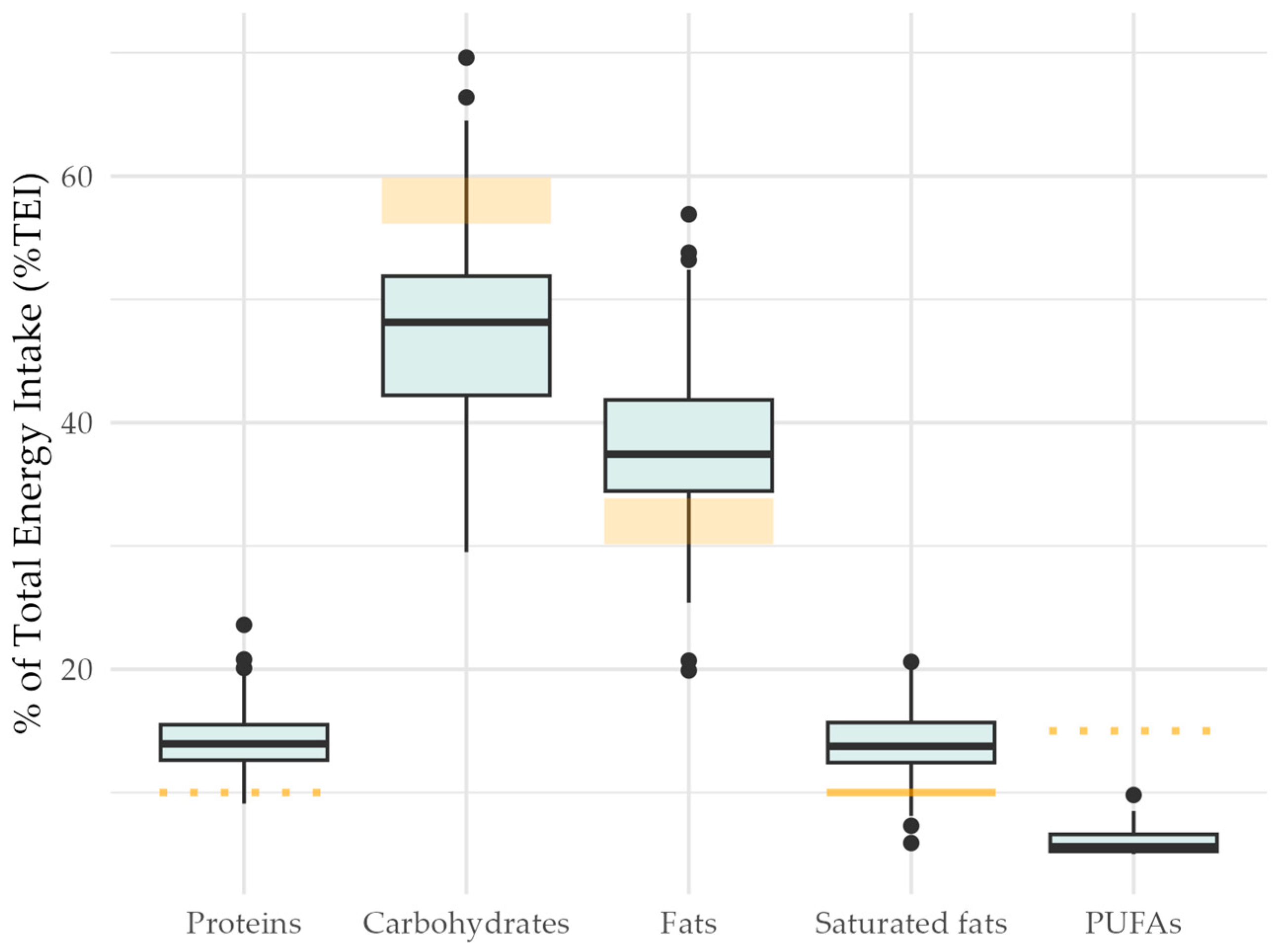
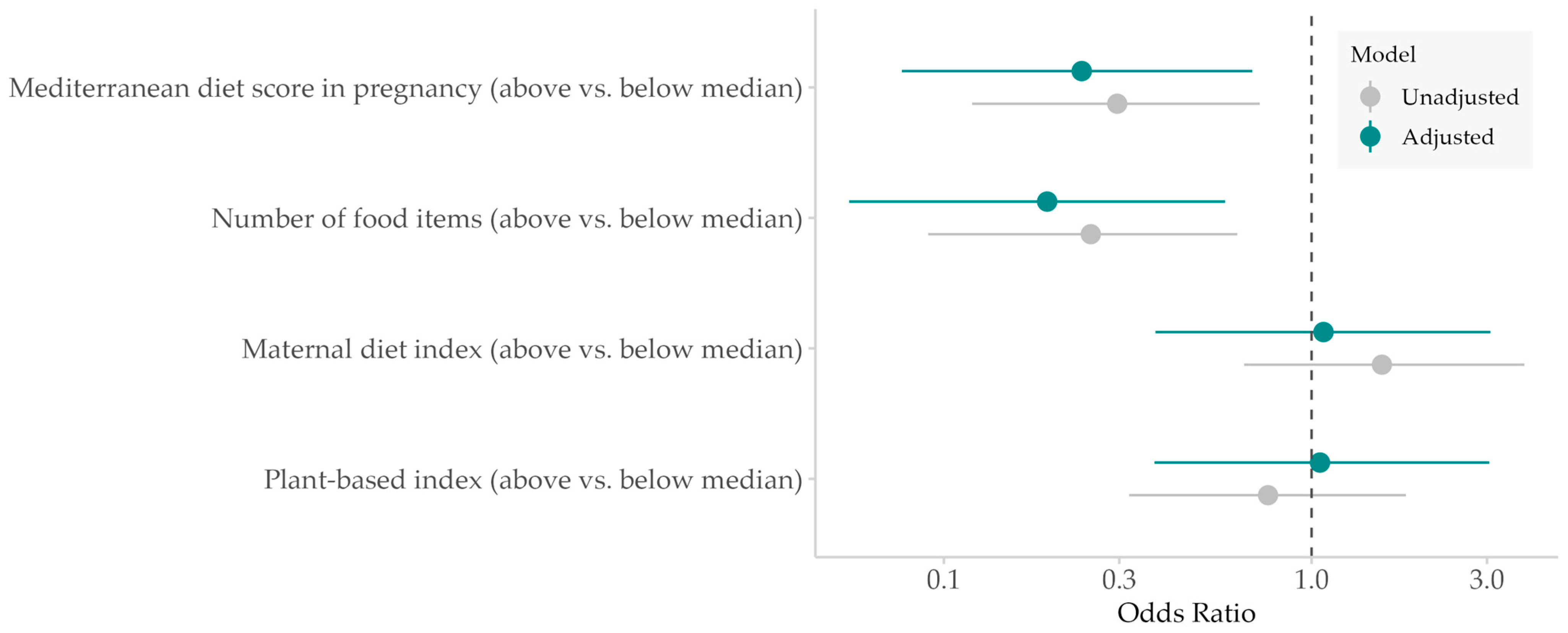
Background/Objectives: The role of maternal diet in atopic dermatitis (AD) requires better understanding, as AD often manifests early in life and precedes other allergic diseases. We evaluated the association between maternal diet and AD up to 2 years of age. Methods: A total of 116 mother–child dyads from the CARE birth cohort study were included. Maternal diet during pregnancy was assessed with a validated self-administered 97-item food frequency questionnaire, and dietary scores were calculated. AD was evaluated at ages 4 months, 1 year, and 2 years. The associations between maternal dietary patterns and AD were examined by logistic regression analysis adjusting for total energy intake, gender of the child, maternal antibiotic therapy during pregnancy, and history of atopic disease among both parents. Results: Of the 116 children, 27 (23.3%) developed AD by 2 years, 11 of whom (40.7%) had persistent AD within the first 2 years. AD risk was reduced with a higher Mediterranean diet score during pregnancy (upper median > 3 points versus lower median: adjusted OR 0.24, 95% CI 0.08–0.69, p = 0.009) and with greater dietary diversity, as measured by the number of items consumed (upper median > 53 items versus lower median: OR 0.19, 95% CI 0.06–0.58, p = 0.005). No association was found with macronutrients and micronutrients. Red meat consumption showed a positive association with the persistent AD phenotype (adjusted OR 5.04, 95% CI 1.47 to 31.36, p = 0.034). Conclusions: Adherence to a Mediterranean diet and a diverse diet during pregnancy may decrease the risk of developing early childhood AD. This highlights the synergistic role of nutrients in dietary patterns as they modulate immune development and disease susceptibility.
Keywords: maternal diet; food frequency questionnaire; atopic dermatitis; food diversity; Mediterranean diet; pregnancy maternal diet; food frequency questionnaire; atopic dermatitis; food diversity; Mediterranean diet; pregnancy