


Addressing Food Insecurity: A Qualitative Study of Undergraduate Students’ Perceptions of Food Access Resources
 , , ,
, , ,
Abstract
1. Introduction
2. Methods
2.1. Study Design
2.2. Participants and Recruitment
2.3. Procedures
2.4. Data Analysis
3. Results
4. Discussion
Limitations
5. Implications for Research and Practice
Recommendations
6. Conclusions
Author Contributions
Funding
Institutional Review Board Statement
Informed Consent Statement
Acknowledgments
Conflicts of Interest
References
- Gundersen, C.; Ziliak, J.P. Food Insecurity Research in the United States: Where We Have Been and Where We Need to Go. Appl. Econ. Perspect. Policy 2018, 40, 119–135. [Google Scholar] [CrossRef] [Scilit]
- Bruening, M.; Van Woerden, I.; Todd, M.; Laska, M.N. Hungry to learn: The prevalence and effects of food insecurity on health behaviors and outcomes over time among a diverse sample of university freshmen. Int. J. Behav. Nutr. Phys. Act. 2018, 15, 9. [Google Scholar] [CrossRef] [Scilit] [PubMed]
- Coleman-Jensen, A.; Rabbitt, M.P.; Gregory, C.A.; Singh, A. Household Food Security in the United States in 2018; Economic Research Report, No. 270; Economic Research Service, United States Department of Agriculture: Washington, DC, USA, 2018. [Google Scholar]
- Bruening, M.; Argo, K.; Payne-Sturges, D.; Laska, M.N. The Struggle Is Real: A Systematic Review of Food Insecurity on Postsecondary Education Campuses. J. Acad. Nutr. Diet. 2017, 117, 1767–1791. [Google Scholar] [CrossRef] [Scilit] [PubMed]
- Laska, M.N.; Fleischhacker, S.; Petsoulis, C.; Bruening, M.; Stebleton, M.J. Addressing College Food Insecurity: An Assessment of Federal Legislation Before and During Coronavirus Disease-2019. J. Nutr. Educ. Behav. 2020, 52, 982–987. [Google Scholar] [CrossRef] [Scilit] [PubMed]
- Alaimo, K. Food Insecurity in the United States: An overview. Top. Clin. Nutr. 2005, 20, 281–298. [Google Scholar] [CrossRef] [Scilit]
- Gaines, A.; Robb, C.A.; Knol, L.L.; Sickler, S. Examining the role of financial factors, resources and skills in predicting food security status among college students. Int. J. Consum. Stud. 2014, 38, 374–384. [Google Scholar] [CrossRef] [Scilit]
- Martinez, S.; Maynard, K.; Ritchie, L. University of California: Global Food Initiative. Student Food Access and Security Study. Available online: https://www.ucop.edu/global-food-initiative/best-practices/food-access-security/student-food-access-and-security-study.pdf (accessed on 18 March 2019).
- Brothers, S.; Lin, J.; Schonberg, J.; Drew, C.; Auerswald, C. Food insecurity among formerly homeless youth in supportive housing: A social-ecological analysis of a structural intervention. Soc. Sci. Med. 2000, 245, 112724. [Google Scholar] [CrossRef] [Scilit]
- Henry, L. Understanding Food Insecurity Among College Students: Experience, motivation, and local solutions. Ann. Anthropol. Pract. 2017, 41, 6–19. [Google Scholar] [CrossRef] [Scilit]
- McArthur, L.H.; Ball, L.; Danek, A.C.; Holbert, D. A High Prevalence of Food Insecurity Among University Students in Appalachia Reflects a Need for Educational Interventions and Policy Advocacy. J. Nutr. Educ. Behav. 2018, 50, 564–572. [Google Scholar] [CrossRef] [Scilit]
- Knol, L.L.; Robb, C.A.; McKinley, E.M.; Wood, M. Food Insecurity, Self-rated Health, and Obesity among College Students. Am. J. Health Educ. Behav. 2017, 48, 248–255. [Google Scholar] [CrossRef] [Scilit]
- Patton-López, M.M.; López-Cevallos, D.F.; Cancel-Tirado, D.I.; Vazquez, L. Prevalence and Correlates of Food Insecurity Among Students Attending a Midsize Rural University in Oregon. J. Nutr. Educ. Behav. 2014, 46, 209–214. [Google Scholar] [CrossRef] [Scilit]
- Payne-Sturges, D.C.; Tjaden, A.; Caldeira, K.M.; Vincent, K.B.; Arria, A.M. Student Hunger on Campus: Food Insecurity among College Students and Implications for Academic Institutions. Am. J. Health Promot. 2018, 32, 349–354. [Google Scholar] [CrossRef] [Scilit]
- Watson, T.D.; Malan, H.; Glik, D.; Martinez, S.M. College students identify university support for basic needs and life skills as key ingredient in addressing food insecurity on campus. Calif. Agric. 2017, 71, 130–145. [Google Scholar] [CrossRef] [Scilit]
- Hughes, R.; Serebryanikova, I.; Donaldson, K.; Leveritt, M. Student food insecurity: The skeleton in the university closet. Nutr. Diet. 2011, 68, 27–32. [Google Scholar] [CrossRef] [Scilit]
- Breen, R.L. A Practical Guide to Focus-Group Research. J. Geogr. High. Educ. 2006, 30, 463–475. [Google Scholar] [CrossRef] [Scilit]
- Smyth, J.D.; Dillmann, D.A.; Christian, L.M.; Mcbride, M. Open-ended questions in web surveys: Can increasing the size of answer boxes and providing extra verbal instructions improve response quality? Public Opin. Q. 2009, 73, 325–337. [Google Scholar] [CrossRef] [Scilit]
- Boddy, C.R. Sample size for qualitative research. Qual. Mark. Res. 2016, 19, 425–432. [Google Scholar] [CrossRef] [Scilit]
- Zoellner, J.; Harris, J.E. Mixed-Methods Research in Nutrition and Dietetics. J. Acad. Nutr. Diet. 2017, 117, 683–697. [Google Scholar] [CrossRef] [Scilit]
- Nagle, B.; Williams, N. Methodology Brief: Introduction to Focus Groups. Center for Assessment, Planning, and Accountability. Available online: http://www.mmgconnect.com/projects/userfiles/file/focusgroupbrief.pdf (accessed on 15 November 2019).
- Economic Research Service USDA. Survey Tools. 2012. Available online: https://www.ers.usda.gov/media/8282/short2012.pdf (accessed on 17 August 2022).
- Maguire, M.; Delahunt, B. Doing a thematic analysis: A practical step-by-step guide for learning and teaching scholars. All Irel. J. Teach. Learn. High. Educ. 2017, 8, 3351–33514. [Google Scholar]
- Braun, V.; Clarke, V. Using thematic analysis in psychology. Qual. Res. Psychol. 2006, 3, 77–101. [Google Scholar] [CrossRef] [Scilit]
- Braun, V.; Clarke, V. What Can “Thematic Analysis” Offer Health and Wellbeing Researchers? Int. J. Qual. Stud. Health Wellbeing 2014, 9, 26152. [Google Scholar] [CrossRef] [Scilit] [PubMed]
- McLaren, L. Ecological perspectives in health research. J. Epidemiol. Community Health 2005, 59, 6–14. [Google Scholar] [CrossRef] [Scilit] [PubMed]
- Charmaz, K. Constructing Grounded Theory: A Practical Guide through Qualitative Analysis; Sage Publications: London, UK, 2006. [Google Scholar]
- Green-LaPierre, R.J.; Williams, P.L.; Glanville, N.T.; Norris, D.; Hunter, H.C.; Watt, C.G. Learning from “Knocks in Life”: Food Insecurity among Low-Income Lone Senior Women. J. Aging Res. 2012, 2012, 450630. [Google Scholar] [CrossRef] [Scilit] [PubMed]
- Chaparro, M.P.; Zaghloul, S.S.; Holck, P.; Dobbs, J. Food insecurity prevalence among college students at the University of Hawai’i at Mānoa. Public Health Nutr. 2009, 12, 2097–2103. [Google Scholar] [CrossRef] [Scilit] [PubMed]
- Davidson, A.A.; Morrell, J.S. Food insecurity prevalence among university students in New Hampshire. J. Hunger Environ. Nutr. 2018, 15, 118–127. [Google Scholar] [CrossRef] [Scilit]
- Morris, L.M.; Smith, S.; Davis, J.; Null, D.B. The Prevalence of Food Security and Insecurity Among Illinois University Students. J. Nutr. Educ. Behav. 2016, 48, 376–382.e1. [Google Scholar] [CrossRef] [Scilit]
- Maroto, M.E.; Snelling, A.; Linck, H. Food Insecurity Among Community College Students: Prevalence and Association with Grade Point Average. Community Coll. J. Res. Pract. 2015, 39, 515–526. [Google Scholar] [CrossRef] [Scilit]
- Cady, C.L. Food insecurity as a student issue. J. Coll. Character 2014, 15, 265–271. [Google Scholar] [CrossRef] [Scilit]
- Harris, J.E.; Gleason, P.M.; Sheean, P.M.; Boushey, C.; Beto, J.A.; Bruemmer, B. An Introduction to Qualitative Research for Food and Nutrition Professionals. J. Am. Diet. Assoc. 2009, 109, 80–90. [Google Scholar] [CrossRef] [Scilit]
- Heying, E. O7 More for Your Money? Understanding Campus Meal Plan Choice in Relation to Food Insecurity Risk at a Rural Liberal Arts Institution. J. Nutr. Educ. Behav. 2019, 51, S3–S4. [Google Scholar] [CrossRef] [Scilit]

| Initial Statement/Question | Prompt | Probe |
|---|---|---|
| Tell me about your food situation in college and if you have enough food or struggle to have enough food. | How do you feel about your food situations? | Do you think your experience is much different or similar to other students’ experiences with food security? |
| Why do you think having enough food can be a struggle for you or other college students at times? | What are some factors that impact students’ ability to have enough food? | Do you think having enough food is different for college students compared to when someone is not currently attending college? |
| Tell me how you go about having food to eat as a college student. | What are some things you do to try and have enough food? | Do you seek ways to gain money for food? Do you seek any support from friends or family for food? Are there any activities on campus or in the community you seek out to help you have more food to eat? Do you have ways that you stretch your food dollars? |
| Tell me about resources that are available to students to help them have enough food to eat. | What do you know about available food pantries in the area? What do you know about the Block-by-Block Meal Program at Mississippi State University? Are you aware of any government food programs that are available to eligible students? | Have you ever used any of these resources? What was your experience like? How did you feel about using the resources? What are some reasons students might not use these resources? |
| What could be done to better help students have consistent access to healthy food? | Do you feel there is a need for more resources or assistance for students to help them have enough food? | Whose responsibility is this? How would this impact students? What barriers might there be to helping students have adequate food available? Would students be receptive to resources and participate in available programs? Why or why not? |
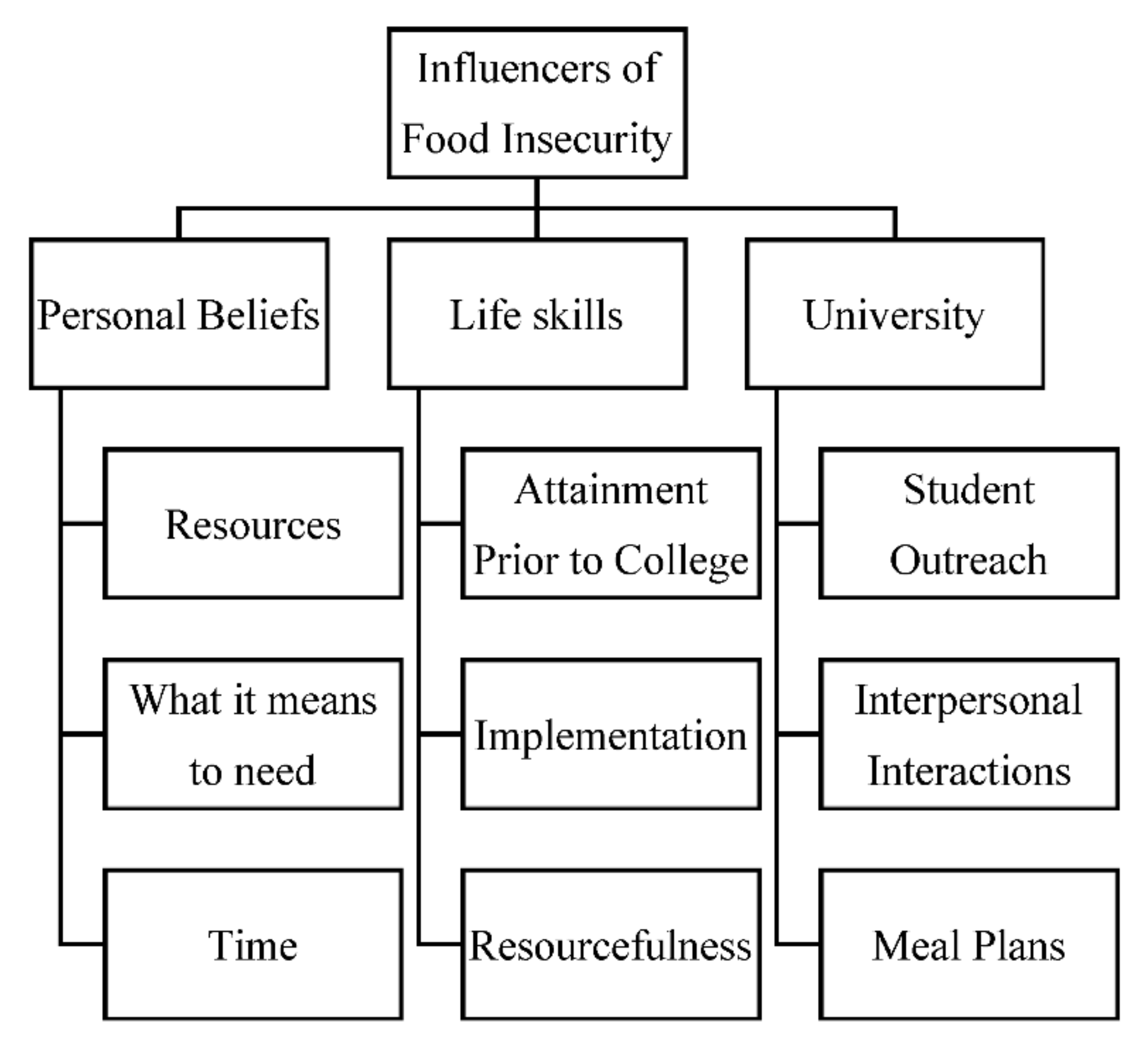
| Theme | Sub-Theme | Illustrative Quote |
|---|---|---|
| Personal Beliefs | Resources | “I think if people just knew about [resources], and if the university talked about food resources as much as they talk about, like, the writing center, yeah. I mean, then if a student is struggling, they remember that information. If the resources are just something that are normal on a college campus and you use it like you use the library, I don’t know, it’s would just be easier to talk about and do” |
| “Getting it presented to me by someone with authority is nice, but like getting a personal testimony from students who are like using [a resource] or have done it and they like certify that it is legit and that it helps … that would be a homerun for me”. | ||
| Personal Beliefs | What it means to “need” | “There are people who obviously need this more than I do, why should I go get the help?” |
| “There’s probably not many external barriers to getting food, but there are definitely still internal barriers, meaning you have to get past any embarrassment and shame and stigma you may feel when going to the pantry to get food”. | ||
| “There is a lot of stigma attached to that sort of thing. I know that when I was a kid I was much more well off and my dad pretty much drilled it into my head that this is not a thing that we need, that we do. We help other people, but we do not require help. It is really difficult to try to get past that mind set, even fifteen years later”. | ||
| “It is hard for students to express it to their friends. It is kind of joked about I guess. Like, ‘Oh, college kids, we are just living off of Ramen’. … And it is discouraging to even mention to your other friends, when one minute everyone is joking about how broke they are, and saying ‘I’m on the Ramen diet’, or just making the broke college kid jokes, when the next they are doing things that are like, things they would clearly not do if they were broke”. | ||
| “So, it’s just kind of becomes one of those things people joke about and don’t really think about those who are truly affected, like, when the words literally mean it … right?” | ||
| Personal Beliefs | Time | “I mean, your classes end at five and you have class from ten to five, five days a week. But then you have two hundred pages of reading for each class each week, and then you have like two ten-page essays due at the end of the semester and then three other essays due. So, then you don’t have free time. You read on your phone the book you are supposed to be reading, and you are sort of cooking whatever dinner you are supposed to have. But you don’t have free time to prep anything, or work more, or even use some of the stuff out there that is supposed to be helping you have food”. |
| “And sometimes [resource organizers] are not considerate of other people’s time, but they are insisting that this is a great thing that you guys need to do”. | ||
| “So, in college, I’m definitely like, time is money”. | ||
| Life Skills | Attainment prior to college | “So, like I would go grocery shopping with [my mom]. I would see how she would like, buy things, how she would, like use, like, rice, five different ways. You know, so definitely. I learned that from my mom growing up”. |
| “But my friends will buy a frozen pizza and that is pretty much is. But I know that you can buy, like, frozen chicken breast, and a five-pound bag of potatoes and tons of canned vegetables. You just have to know how to shop on a budget. It is a mindset. But it does take knowing how to cook … and stretch it … just stuff like that. The frozen pizza is one meal, and it is gone”. | ||
| “Access to resources and how to cook or grocery shop or purchase food on a budget is needed—students don’t know how to do that stuff. It is a shift and they’ve never dealt with it before. But now, they have to”. | ||
| Life Skills | Implementation | “I keep track of how many block meals I have and how many weeks I have left and then divide. So, I divide and am like, okay, I can use this many block meals per week. So, like every week I make sure I know. So, I count beforehand and plan”. |
| “I have friends who say they are struggling with food, but I know they blew their meal plan at the beginning just buying junk food …” | ||
| “We would find ways to maximize the meal plan, but that would use up a lot of time figuring it all out”. | ||
| “It is very hard to get used to a meal plan. I remember my freshman year, I was like, so these places you can go after nine [o’clock], these places you can’t, you can do the things where you can go to these buffet places and use your meal plan again at Chick-fil-a, and then use two block meals, It was just…hard. You have to figure it out to make it work”. | ||
| “It takes time to get food and prepare the food we want”. | ||
| Life Skills | Resourcefulness | “Well, for me, I have time to cook for myself, I just don’t have money. It is a lot cheaper to stretch a can of beef stew and a cup of rice out for two days than it is to have three square meals a day”. |
| “Rice. It is a God send. It stretches so well, and it lasts forever so it won’t go bad. “The first freshman week to campus is great! There is food everywhere!” | ||
| “Sometimes they will have these events and they will just say, like, ‘free food’ at the bottom. So, sometimes I will go.” | ||
| “I know a lot of churches have free food. Really, any of the churches in [town] Starkville. Just check and you can usually get free food from there”. | ||
| “The first freshman week on campus is great. There is food everywhere!” | ||
| “I sneak food from work. Crackers and stale pieces of bread that would have been thrown away. I’m not proud of this”. | ||
| University | Student Outreach | “I think the university can ask more about students needing food. Send an email and ask and just give them a number to call for those who need it. Make it easy. And nobody has to know. Everyone got the email. Nobody knows if you call”. |
| “I think that many students do not know about how to ask for help when they don’t have enough food. Therefore, I think the university should have flyers or more ways for students to ask for help in a more private manner so that they don’t feel embarrassed” | ||
| “I think emails from the university are helpful. But not just from them. The organizations I am involved in, they send out follow-up emails or either a group message notification saying, ‘Hey, this is what they just sent out. Make sure you read it, share it with others”. | ||
| University | Personal Interactions | “Me, I just have learned about what is offered on campus because we just talk about it in the different clubs I am in”. |
| “It helps when the programs can be talked about in classes. It helps to try to bring the real world in with, like, what we are learning. So, like, talking about these programs, and it may be because of the classes I am taking, but classes are a good place because students are already involved in class and have to hear about it. So, students who are involved learn about things, but hit the things that students are involved in, like, for sure”. | ||
| “This is about our time and what we are paying for. I mean, make [telling about a resource] a part of the discussion where we can use it”. | ||
| “For me, a personal connection makes [a resource] mean more”. | ||
| “I know if I had my band director tell me something, I’m like, ‘Oh, I should probably do this’. But if my meat science teacher is telling me, I’m probably not going to listen”. | ||
| “Sometimes the university does programs to make themselves look good. This is just my hot take on it. But I think, sometimes if they aren’t being considerate of other people’s time, it seems fake … I think maybe it is your RA’s [residence hall assistant] responsibility or those who are leaders in your social circles, or people who are supposed to be there for you”. | ||
| University | Meal Plans | “It is definitely easier to get food having a meal plan. I was more likely to go eat because it had already been paid for and it was one less thing to think about”. |
| “Meal plans do help you have access to food. But they are too expensive when you are not required to have it”. | ||
| “The meal plans are too expensive. I am paying my own way through college and deciding if I wanted to pay that much for a meal plan was hard to choose”. | ||
| “So, like, the Student Association, they do this Block by Block meal thing. So, you can donate a meal plan which I think is so interesting. Because we say all the time that we have an overabundance with the unlimited meal plan, yet they do this thing for people who are, like, food insecure. And I am like, this is really cool, but I am also like, it means there is something inefficient with our meal plans if they are always asking us to donate”. | ||
| “Students should be able to donate more of their unused meals since they already paid for it”. | ||
| “They don’t let you swipe a meal for a friend and share, but they tell you to donate, but you can only donate a certain amount”. | ||
| “Instead of making Block by Block optional, the university should automatically take the leftover blocks and donate them to food insecure students the next semester”. | ||
| “Being limited to only two block meals that can be donated makes people feel as though they aren’t making a difference and, some of my friends have been turned off from donating”. |
Publisher’s Note: MDPI stays neutral with regard to jurisdictional claims in published maps and institutional affiliations. |
© 2022 by the authors. Licensee MDPI, Basel, Switzerland. This article is an open access article distributed under the terms and conditions of the Creative Commons Attribution (CC BY) license (https://creativecommons.org/licenses/by/4.0/).
Share and Cite
Conrad, A.G.; Tolar-Peterson, T.; Gardner, A.J.; Wei, T.; Evans, M.W., Jr. Addressing Food Insecurity: A Qualitative Study of Undergraduate Students’ Perceptions of Food Access Resources. Nutrients 2022, 14, 3517. https://doi.org/10.3390/nu14173517
Conrad AG, Tolar-Peterson T, Gardner AJ, Wei T, Evans MW Jr. Addressing Food Insecurity: A Qualitative Study of Undergraduate Students’ Perceptions of Food Access Resources. Nutrients. 2022; 14(17):3517. https://doi.org/10.3390/nu14173517
Chicago/Turabian StyleConrad, Amanda G., Terezie Tolar-Peterson, Antonio J. Gardner, Tianlan Wei, and Marion W. Evans, Jr. 2022. "Addressing Food Insecurity: A Qualitative Study of Undergraduate Students’ Perceptions of Food Access Resources" Nutrients 14, no. 17: 3517. https://doi.org/10.3390/nu14173517
APA StyleConrad, A. G., Tolar-Peterson, T., Gardner, A. J., Wei, T., & Evans, M. W., Jr. (2022). Addressing Food Insecurity: A Qualitative Study of Undergraduate Students’ Perceptions of Food Access Resources. Nutrients, 14(17), 3517. https://doi.org/10.3390/nu14173517

