


The Effect of Mediterranean Diet on Cognitive Functions in the Elderly Population


Abstract
1. Introduction
2. Materials and Methods
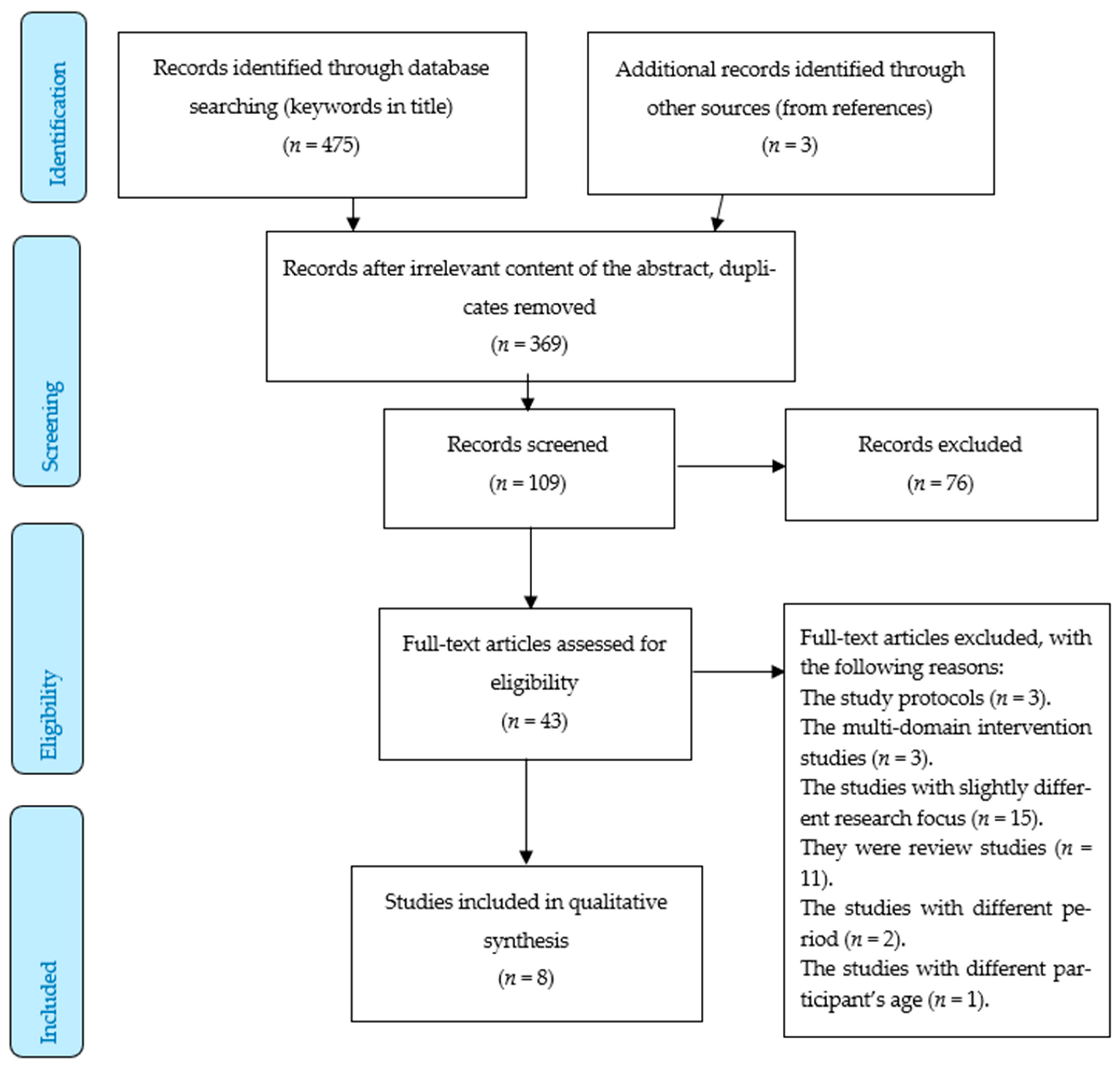
- Assess and discuss the recent randomized clinical trials (RCT) and cohort studies dealing with the impact of healthy diet on cognitive performance in both cognitively unimpaired and impaired seniors;
- Discuss the most recent findings regarding this research topic.
- The review period was limited to 1 January 2016 and 28 February 2021.
- The articles had to be published in peer-review English written journals.
- Only randomized controlled trials and cohort studies were included into the review.
- The primary results had to focus on the impact of MedDiet on cognitive functions among elderly people.
- The subjects had to be at the age 55+ years old.
- The exclusion criteria were as follows:
3. Results
4. Discussion
Author Contributions
Funding
Institutional Review Board Statement
Informed Consent Statement
Data Availability Statement
Acknowledgments
Conflicts of Interest
References
- World Population Ageing. Available online: https://www.un.org/en/development/desa/population/publications/pdf/ageing/WorldPopulationAgeing2019-Highlights.pdf (accessed on 17 April 2020).
- Fortunato, S.; Forli, F.; Guglielmi, V.; De Corso, E.; Paludetti, G.; Berrettini, S.; Fetoni, A.R. A review of new insights on the association between hearing loss and cognitive decline in ageing. Acta Otorhinolaryngol. Ital. 2016, 36, 155–166. [Google Scholar] [CrossRef]
- Glisky, E.L. Changes in Cognitive Function in Human Aging. Available online: https://www.ncbi.nlm.nih.gov/books/NBK3885/ (accessed on 17 April 2020).
- NIH. What Is Dementia? Symptoms, Types, and Diagnosis. Available online: https://www.nia.nih.gov/health/what-dementia-symptoms-types-and-diagnosis (accessed on 17 April 2020).
- Klimova, B.; Maresova, P.; Kuca, K. Non-pharmacological approaches to the prevention and treatment of Alzheimer´s disease with respect to the rising treatment costs. Curr. Alzheimer Res. 2016, 13, 1249–1258. [Google Scholar] [CrossRef] [PubMed]
- Szeto, J.Y.; Lewis, S.J. Current treatment options for Alzheimer’s disease and Parkinson’s disease dementia. Curr. Neuropharmacol. 2016, 14, 326–338. [Google Scholar] [CrossRef] [PubMed]
- Klimova, B.; Maresova, P.; Valis, M.; Hort, J.; Kuca, K. Alzheimer´s disease and language impairments: Social intervention and medical treatment. Clin. Interv. Aging 2015, 10, 1401–1408. [Google Scholar]
- Klimova, B.; Valis, M.; Kuca, K. Cognitive decline in normal aging and its prevention: A review on non-pharmacological lifestyle strategies. Clin. Interv. Aging 2017, 12, 903–910. [Google Scholar] [CrossRef] [PubMed]
- Ngandu, T.; Lehtisalo, J.; Solomon, A.; Levalahti, E.; Ahtiluoto, S.; Antikainen, R.; Bäckman, L.; Hänninen, T.; Jula, A.; Laatikainen, T.; et al. A 2 year multidomain intervention of diet, exercise, cognitive training, and vascular risk monitoring versus control to prevent cognitive decline in at-risk elderly people (FINGER): A randomised controlled trial. Lancet 2015, 385, 2255–2263. [Google Scholar] [CrossRef]
- Klimova, B.; Valis, M. Nutritional interventions as beneficial strategies to delay cognitive decline in healthy older individuals. Nutrients 2018, 10, 905. [Google Scholar] [CrossRef]
- Lourida, I.; Soni, M.; Thompson-Coon, J.; Purandare, N.; Lang, I.A.; Ukoumunne, O.C.; Llewellyn, D.J. Mediterranean diet, cognitive function, and dementia: A systematic review. Epidemiology 2013, 24, 479–489. [Google Scholar] [CrossRef]
- Singh, B.; Parsaik, A.K.; Mielke, M.M.; Erwin, P.J.; Knopman, D.S.; Petersen, R.C.; Roberts, R.O. Association of Mediterranean diet with mild cognitive impairment and Alzheimer’s disease: A systematic review and meta-analysis. J. Alzheimer’s Dis. 2014, 39, 271–282. [Google Scholar] [CrossRef]
- Petersson, S.D.; Philippou, E. Mediterranean diet, cognitive function, and dementia: A systematic review of the evidence. Adv. Nutr. 2016, 7, 889–904. [Google Scholar] [CrossRef]
- Tuttolomondo, A.; Simonetta, I.; Daidone, M.; Mogavero, A.; Ortello, A.; Pinto, A. Metabolic and vascular effect of the Mediterranean diet. Int. J. Mol. Sci. 2019, 20, 4716. [Google Scholar] [CrossRef] [PubMed]
- Martucci, M.; Ostan, R.; Biondi, F.; Bellavista, E.; Fabbri, C.; Bertarelli, C.; Salvioli, S.; Capri, M.; Franceschi, C.; Santoro, A. Mediterranean diet and inflammaging within the hormesis paradigm. Nutr. Rev. 2017, 75, 442–455. [Google Scholar] [CrossRef] [PubMed]
- Capurso, C.; Bellanti, F.; Lo Buglio, A.; Vendemiale, G. The Mediterranean diet slows down the progression of aging and helps to prevent the onset of frailty: A narrative review. Nutrients 2019, 12, 35. [Google Scholar] [CrossRef]
- Roman-Viñas, B.; Serra-Majem, L. Mediterranean diet to promote healthy aging. Curr. Geriatr. Rep. 2018, 7, 115–124. [Google Scholar] [CrossRef]
- Critselis, E.; Panagiotakos, D. Adherence to the Mediterranean diet and healthy ageing: Current evidence, biological pathways, and future directions. Crit. Rev. Food Sci. Nutr. 2020, 60, 2148–2157. [Google Scholar] [CrossRef] [PubMed]
- Buglio, A.L.; Bellanti, F.; Vendemiale, G. Adherence to Mediterranean diet and nutritional status: Impact on clinical outcomes in hospitalized elderly patients. J. Endocrinol. Sci. 2020, 2, 6–10. [Google Scholar]
- McMaster, M.; Kim, S.; Clare, L.; Torres, S.J.; Cherbuin, N.; D’Este, C.; Anstey, K.J. Lifestyle risk factors and cognitive outcomes from the multidomain dementia risk reduction randomized controlled trial, Body Brain Life for Cognitive Decline (BBL-CD). J. Am. Geriatr. Soc. 2020, 68, 2629–2637. [Google Scholar] [CrossRef]
- Rolandi, E.; Dodich, A.; Galluzzi, S.; Ferrari, C.; Mandelli, S.; Ribaldi, F.; Munaretto, G.; Ambrosi, C.; Gasparotti, R.; Violi, D.; et al. Randomized controlled trial on the efficacy of a multilevel non-pharmacologic intervention in older adults with subjective memory decline: Design and baseline findings of the E.Mu.N.I. study. Aging Clin. Exp. Res. 2020, 32, 817–826. [Google Scholar] [CrossRef]
- Recio-Rodríguez, J.I.; Lugones-Sanchez, C.; Agudo-Conde, C.; González-Sánchez, J.; Tamayo-Morales, O.; Gonzalez-Sanchez, S.; Fernandez-Alonso, C.; Maderuelo-Fernandez, J.A.; Mora-Simon, S.; Gómez-Marcos, M.A.; et al. Combined use of smartphone and smartband technology in the improvement of lifestyles in the adult population over 65 years: Study protocol for a randomized clinical trial (EVIDENT-Age study). BMC Geriatr. 2019, 19, 19. [Google Scholar] [CrossRef]
- Tussing-Humphreys, L.; Lamar, M.; Blumenthal, J.A.; Babyak, M.; Fantuzzi, G.; Blumstein, L.; Schiffer, L.; Fitzgibbon, M.L. Building research in diet and cognition: The BRIDGE randomized controlled trial. Contemp. Clin. Trials. 2017, 59, 87–97. [Google Scholar] [CrossRef]
- Bhushan, A.; Fondell, E.; Ascherio, A.; Yuan, C.; Grodstein, F.; Willett, W. Adherence to Mediterranean diet and subjective cognitive function in men. Eur. J. Epidemiol. 2018, 33, 223–234. [Google Scholar] [CrossRef]
- De Amicis, R.; Leone, A.; Foppiani, A.; Osio, D.; Lewandowski, L.; Giustizieri, V.; Cornelio, P.; Cornelio, F.; Fusari Imperatori, S.; Cappa, S.F.; et al. Mediterranean diet and cognitive status in free-living elderly: A cross-sectional study in northern Italy. J. Am. Coll. Nutr. 2018, 37, 494–500. [Google Scholar] [CrossRef]
- De la Rubia Ortí, J.E.; García-Pardo, M.P.; Drehmer, E.; Sancho Cantus, D.; Julián Rochina, M.; Aguilar, M.A.; Hu Yang, I. Improvement of main cognitive functions in patients with Alzheimer’s disease after treatment with coconut oil enriched Mediterranean diet: A pilot study. J. Alzheimer’s Dis. 2018, 65, 577–587. [Google Scholar] [CrossRef] [PubMed]
- Karstens, A.J.; Tussing-Humphreys, L.; Zhan, L.; Rajendran, N.; Cohen, J.; Dion, C.; Zhou, X.J.; Lamar, M. Associations of the Mediterranean diet with cognitive and neuroimaging phenotypes of dementia in healthy older adults. Am. J. Clin. Nutr. 2019, 109, 361–368. [Google Scholar] [CrossRef]
- Mantzorou, M.; Vadikolias, K.; Pavlidou, E.; Tryfonos, C.; Vasios, G.; Serdari, A.; Giaginis, C. Mediterranean diet adherence is associated with better cognitive status and less depressive symptoms in a Greek elderly population. Aging Clin. Exp. Res. 2020. [Google Scholar] [CrossRef] [PubMed]
- Marseglia, A.; Xu, W.; Fratiglioni, L.; Fabbri, C.; Berendsen, A.A.M.; Bialecka-Debek, A.; Jennings, A.; Gillings, R.; Meunier, N.; Caumon, E.; et al. Effect of the NU-AGE diet on cognitive functioning in older adults: A randomized controlled trial. Front. Physiol. 2018, 9, 349. [Google Scholar] [CrossRef]
- Mazza, E.; Fava, A.; Ferro, Y.; Rotundo, S.; Romeo, S.; Bosco, D.; Pujia, A.; Montalcini, T. Effect of the replacement of dietary vegetable oils with a low dose of extravirgin olive oil in the Mediterranean Diet on cognitive functions in the elderly. J. Transl. Med. 2018, 16, 10. [Google Scholar] [CrossRef] [PubMed]
- Paknahadab, Z.; Sheklabadiab, E.; Derakhshanc, Y.; Bagherniyad, M.; Chitsaze, A. The effect of the Mediterranean diet on cognitive function in patients with Parkinson’s disease: A randomized clinical controlled trial. Complement. Ther. Med. 2020, 50, 102366. [Google Scholar] [CrossRef]
- Wade, A.T.; Davis, C.R.; Dyer, K.A.; Hodgson, J.M.; Woodman, R.J.; Keage, H.A.D.; Murphy, K.J. A Mediterranean Diet with fresh, lean pork improves processing speed and mood: Cognitive findings from the MedPork randomised controlled trial. Nutrients 2019, 11, 1521. [Google Scholar] [CrossRef] [PubMed]
- Loughrey, D.G.; Lavecchia, S.; Brennan, S.; Lawlor, B.A.; Kelly, M.E. The impact of the Mediterranean diet on the cognitive functioning of healthy older adults: A systematic review and meta-analysis. Adv. Nutr. 2017, 8, 571–586. [Google Scholar] [CrossRef] [PubMed]
- Féart, C.; Samieri, C.; Barberger-Gateau, P. Mediterranean diet and cognitive function in older adults. Curr. Opin. Clin. Nutr. Metab. Care 2010, 13, 14–18. [Google Scholar] [CrossRef] [PubMed]
- Okubo, H.; Inagaki, H.; Gondo, Y.; Kamide, K.; Ikebe, K.; Masui, Y.; Arai, Y.; Ishizaki, T.; Sasaki, S.; Nakagawa, T.; et al. Association between dietary patterns and cognitive function among 70-year-old Japanese elderly: A cross-sectional analysis of the SONIC study. Nutr. J. 2017, 16, 56. [Google Scholar] [CrossRef] [PubMed]
- Cremonini, A.L.; Caffa, I.; Cea, M.; Nencioni, A.; Odetti, P.; Monacelli, F. Nutrients in the prevention of Alzheimer’s disease. Oxidative Med. Cell. Longev. 2019, 9874159. [Google Scholar] [CrossRef]
- Dodd, G.F.; Williams, C.M.; Butler, L.T.; Spencer, J.P.E. Acute effects of flavonoid-rich blueberry on cognitive and vascular function in healthy older adults. Nutr. Healthy Aging 2019, 5, 119–132. [Google Scholar] [CrossRef]
- Masana, M.F.; Koyanagi, A.; Haro, J.M.; Tyrovolas, S. N-3 fatty acids, Mediterranean diet and cognitive function in normal aging: A systematic review. Exp. Gerontol. 2017, 91, 39–50. [Google Scholar] [CrossRef] [PubMed]
- Gu, Y.; Brickman, A.M.; Stern, Y.; Habeck, C.G.; Razlighi, Q.R.; Luchsinger, J.A.; Manly, J.J.; Schupf, N.; Mayeux, R.; Scarmeas, N. Mediterranean diet and brain structure in a multiethnic elderly cohort. Neurology 2015, 85, 1744–1751. [Google Scholar] [CrossRef] [PubMed]
- Strike, S.C.; Carlisle, A.; Gibson, E.L.; Dyall, S.C. A high omega-3 fatty acid multinutrient supplement benefits cognition and mobility in older women: A randomized, double-blind, placebo-controlled pilot study. J. Gerontol. A Biol. Sci. Med. Sci. 2016, 71, 236–242. [Google Scholar] [CrossRef] [PubMed]
- Barberger-Gateau, P.; Letenneur, L.; Deschamps, V.; Pérès, K.; Dartigues, J.-F.; Renaud, S. Fish, meat, and risk of dementia: Cohort study. BMJ 2002, 325, 932–933. [Google Scholar] [CrossRef] [PubMed]
- Engelhart, M.J.; Geerlings, M.I.; Ruitenberg, A.; van Swieten, J.C.; Hofman, A.; Witteman, J.C.M.; Breteler, M.M.B. Diet and risk of dementia: Does fat matter?: The Rotterdam Study. Neurology 2002, 59, 1915–1921. [Google Scholar] [CrossRef]
- Galasso, C.; Orefice, I.; Pellone, P.; Cirino, P.; Miele, R.; Ianora, A.; Brunet, C.; Sansone, C. On the neuroprotective role of astaxanthin: New perspectives? Mar. Drugs 2018, 16, 247. [Google Scholar] [CrossRef]
- Klimova, B.; Novotný, M.; Kuca, K.; Valis, M. Effect of an extra-virgin olive oil intake on the delay of cognitive decline: Role of secoiridoid oleuropein? Neuropsychiatr. Dis. Treat. 2019, 15, 3033–3040. [Google Scholar] [CrossRef]
- Martínez-Lapiscina, E.H.; Clavero, P.; Toledo, E.; Estruch, R.; Salas-Salvadó, J.; San Julián, B.; Sanchez-Tainta, A.; Ros, E.; Valls-Pedret, C.; Martinez-Gonzalez, M.Á. Mediterranean diet improves cognition: The PREDIMED-NAVARRA randomised trial. J. Neurol. Neurosurg. Psychiatry 2013, 84, 1318–1325. [Google Scholar] [CrossRef] [PubMed]
- Biessels, G.J.; Staekenborg, S.; Brunner, E.; Brayne, C.; Scheltens, P. Risk of dementia in diabetes mellitus: A systematic review. Lancet Neurol. 2006, 5, 64–74. [Google Scholar] [CrossRef]
- Violi, F.; Loffredo, L.; Pignatelli, P.; Angelico, F.; Bartimoccia, S.; Nocella, C.; Cangemi, R.; Petruccioli, A.; Monticolo, R.; Pastori, D.; et al. Extra virgin olive oil use is associated with improved post-prandial blood glucose and ldl cholesterol in healthy subjects. Nutr. Diabetes 2015, 5, e172. [Google Scholar] [CrossRef]
- Amieva, H.; Le Goff, M.; Millet, X.; Orgogozo, J.M.; Pérès, K.; Barberger-Gateau, P.; Jacqmin-Gadda, H.; Dartigues, J.F. Prodromal Alzheimer’s disease: Successive emergence of the clinical symptoms. Ann. Neurol. 2008, 64, 492–498. [Google Scholar] [CrossRef] [PubMed]
- Tsigalou, C.; Konstantinidis, T.; Paraschaki, A.; Stavropoulou, E.; Voidarou, C.; Bezirtzoglou, E. Mediterranean diet as a tool to combat inflammation and chronic diseases. An overview. Biomedicines 2020, 8, 201. [Google Scholar] [CrossRef] [PubMed]
- Gepner, Y.; Shelef, I.; Schwarzfuchs, D.; Zelicha, H.; Tene, L.; Yaskolka Meir, A.; Tsaban, G.; Cohen, N.; Bril, N.; Rein, M.; et al. Effect of distinct lifestyle interventions on mobilization of fat storage pools: CENTRAL magnetic resonance imaging randomized controlled trial. Circulation 2018, 137, 1143–1157. [Google Scholar] [CrossRef]
- Chen, X.; Maguire, B.; Brodaty, H.; O’Leary, F. Dietary patterns and cognitive health in older adults: A systematic review. J. Alzheimer’s Dis. 2019, 67, 583–619. [Google Scholar] [CrossRef]
- Shakersain, B.; Rizzuto, D.; Larsson, S.C.; Faxén-Irving, G.; Fratiglioni, L.; Xu, W.L. The Nordic prudent diet reduces risk of cognitive decline in the Swedish older adults: A population-based cohort study. Nutrients 2018, 10, 229. [Google Scholar] [CrossRef] [PubMed]
- Tierney, A.C.; Zabetakis, I. Changing the Irish dietary guidelines to incorporate the principles of the Mediterranean diet: Proposing the MedÉire diet. Public Health Nutr. 2018, 15, 1–7. [Google Scholar] [CrossRef]
- Xu, R.; Gao, T.; Cai, J.; Zhang, H.; Zhou, H.; Ding, K.; Chen, L.; Zhong, F.; Ma, A. Food consumption and mild cognitive impairment in Qingdao rural elderly: A cross-sectional study. Asia Pac. J. Clin. Nutr. 2020, 29, 867–875. [Google Scholar] [PubMed]
- Pérez-Tasigchana, R.F.; León-Muñoz, L.M.; López-García, E.; Banegas, J.R.; Rodríguez-Artalejo, F.; Guallar-Castillón, P. Mediterranean diet and health-related quality of life in two cohorts of community-dwelling older adults. PLoS ONE 2016, 11, e0155171. [Google Scholar]
- Hill, E.; Szoeke, C.; Dennerstein, L.; Campbell, S.; Clifton, P. Adherence to the Mediterranean diet is not related to beta-amyloid deposition: Data from the women’s healthy ageing project. J. Prev. Alzheimer’s Dis. 2018, 5, 137–141. [Google Scholar] [CrossRef]

| Author and Type of the Study | Aim of the Study | Characteristics of the Research Sample and MedDiet | Outcome Measures | Findings |
|---|---|---|---|---|
| de Amicis et al. [25] cohort study-cross-sectional Italy | To examine the impact of MedDiet on cognitive performance of older Italian people. | 279 subjects, aged 65+ years (80 men, 199 women), conducted between June 2015 and December 2016. | 14-item questionnaire, Mini-Mental State Examination (MMSE). | The MedDiet is associated with a lower risk of cognitive impairment (odds ratio (OR) = 0.39; 95% confidence interval (CI), 0.15–0.99; p = 0.045). |
| de la Rubia et al. [26] RCT Spain | To identify modifications in the main cognitive functions of patients with AD after following a coconut oil enriched Mediterranean diet. | 44 patients with AD, aged 65 to 85 years old, an experimental group (22 patients) followed a coconut oil enriched Mediterranean diet, and a control group (22 patients) followed a Mediterranean-style diet. It lasted 21 days. | 7 min screen, which analyses temporal orientation, visuospatial and visuoconstructive abilities, and semantic and episodic memory. | The experimental group improved in episodic, temporal orientation, and semantic memory and it seems that the positive effect is more evident in women with mild-moderate state, although other improvements in males and severe state were also shown. |
| Karstens et al. [27] cohort study-cross-sectional USA | To explore cross-sectional associations between the MedDiet and cognitive and neuroimaging phenotypes associated with AD and VaD (separately) among cognitively unimpaired seniors. | 82 healthy seniors at the age of 68.8 years, 50% males and 50% females; participants were divided into high and low (median split) adherence groups. | Block Food Frequency Questionnaire 2005, standardized cognitive assessment battery of tests (i.e., the California Verbal Learning Tests, trail making tests—Part A, Part B, and the Wechsler Test of Adult Reading), MRI, T1-weighted images, FreeSurfer 6.0 segmentation pipeline. | The high MedDiet group was better at learning and memory performance (β = 0.52, SE = 0.21, t (74) = 2.53, p = 0.01, d = 1.23). |
| Mantzorou et al. [28] Cohort study Greece | To assess MedDiet adherence of older Greeks on their cognitive functions and mental state. | 2092 males and females, both cognitively healthy and unhealthy, mean age 74.97 ± 8.41 years, from seven different Greek cities. | Mini-Mental State Examination (MMSE), Geriatric Depression Scale (GDS), and Mediterranean Diet Score (MedDietScore) questionnaires. | Higher MD adherence is strongly associated with better cognitive status and less depressive symptomatology. |
| Marseglia et al. [29] RCT China, France, Italy, Netherlands, Poland, Sweden, UK | To explore the impact of NU-AGE’s dietary intervention on age-related cognitive decline. | 1279 healthy seniors, age range: 65–79 years, from five European centers, a control group 638, was adhered to MedDiet and an intervention group 641, was adhered to habitual diet. | CERAD—neuropsychological battery, MMSE, Babcock Story Recall Test, pattern comparisons, digit cancellation, trail making tests, word list memory, 15-items Boston Naming Test, Constructional Praxis Test, category fluency. Assessed cognitive domains: global cognition, perceptual speed, executive function, episodic memory, verbal abilities, and constructional praxis. | Subjects with higher adherence to the NU-AGE diet experienced considerable improvements in global cognition (β 0.20 (95% CI 0.004, 0.39), p-value = 0.046) and episodic memory (β 0.15 (95% CI 0.02, 0.28), p-value = 0.025) after 1 year, compared to those adults with lower adherence to NU-AGE diet. Both groups of subjects improved in global cognition and in all cognitive domains after 1 year. |
| Mazza et al. [30] RCT Italy | To examine whether the replacement of all vegetable oils with a lower amount of extra-virgin olive oil, in the contest of a Mediterranean Diet, would improve cognitive performances, among elderly Italian individuals. | 110 participants, mean age was 70 ± 4 years; an experimental group had MedDiet in which all vegetable oils (including olive oil, high-oleic sunflower oil, high-oleic sunflower oil, canola oil and hydrogenated vegetable oils) were substituted by extra-virgin OO at dose of 20–30 g per day, and a control MedDiet alone. It lasted 1 year. | Neuropsychological tests (MMSE and ADAS-cog), anthropometric measurements and cardiovascular risk factors assessment, dietary intake data were assessed by a 24-h recall and a 7-day food record and calculated using nutritional software MetaDieta, biochemical evaluation. | A higher reduction of ADAS-cog scores (improved test) after 1 year in the seniors of the MedDiet plus low dose of extra-virgin OO group than that observed with a MedDiet alone (−3.0 ± 0.4 Vs. −1.6 ± 0.4 respectively). |
| Paknahad et al. [31] RCT Iran | To examine the impact of the Mediterranean diet on cognitive functions in patients with PD. | 80 patients, mean age-60 years, the experimental group followed MedDiet (n = 40) or control (n = 40) group. It lasted 10 weeks. | Montreal Cognitive Assessment (MoCA) test, BMI test, Nutritionist IV software. | The mean score of the dimensions of executive function, language, attention, concentration, and active memory and the total score of cognitive assessment significantly increased in the intervention compared with the control group (p < 0.05, for all). |
| Wade et al. [32] RCT Australia | To explore the cognitive effects of MedDiet with additional red meat. | A 24-week parallel crossover design compared MedDiet with 2–3 weekly servings of fresh, lean pork (MedPork) and a low-fat (LF) control diet. 35 participants aged between 45 and 80 years and at risk of cardiovascular disease followed each intervention for 8 weeks, separated by an 8-week washout period. | Cambridge Neuropsychological Test Automated Battery, SF-36 Health Survey, Profile of Mood States. | Compared to LF, the MedPork intervention led to higher processing speed performance (p = 0.01) and emotional role functioning (p = 0.03). |
Publisher’s Note: MDPI stays neutral with regard to jurisdictional claims in published maps and institutional affiliations. |
© 2021 by the authors. Licensee MDPI, Basel, Switzerland. This article is an open access article distributed under the terms and conditions of the Creative Commons Attribution (CC BY) license (https://creativecommons.org/licenses/by/4.0/).
Share and Cite
Klimova, B.; Novotny, M.; Schlegel, P.; Valis, M. The Effect of Mediterranean Diet on Cognitive Functions in the Elderly Population. Nutrients 2021, 13, 2067. https://doi.org/10.3390/nu13062067
Klimova B, Novotny M, Schlegel P, Valis M. The Effect of Mediterranean Diet on Cognitive Functions in the Elderly Population. Nutrients. 2021; 13(6):2067. https://doi.org/10.3390/nu13062067
Chicago/Turabian StyleKlimova, Blanka, Michal Novotny, Petr Schlegel, and Martin Valis. 2021. "The Effect of Mediterranean Diet on Cognitive Functions in the Elderly Population" Nutrients 13, no. 6: 2067. https://doi.org/10.3390/nu13062067
APA StyleKlimova, B., Novotny, M., Schlegel, P., & Valis, M. (2021). The Effect of Mediterranean Diet on Cognitive Functions in the Elderly Population. Nutrients, 13(6), 2067. https://doi.org/10.3390/nu13062067

