Article

Detecting Tree Stems from Volumetric TLS Data in Forest Environments with Rich Understory
Swiss Federal Institute for Forest, Snow and Landscape Research WSL, Zürcherstraße 111, 8903 Birmensdorf, Switzerland
*
Author to whom correspondence should be addressed.
Remote Sens. 2017, 9(1), 9; https://doi.org/10.3390/rs9010009
Submission received: 19 August 2016 / Revised: 15 December 2016 / Accepted: 21 December 2016 / Published: 28 December 2016

Abstract

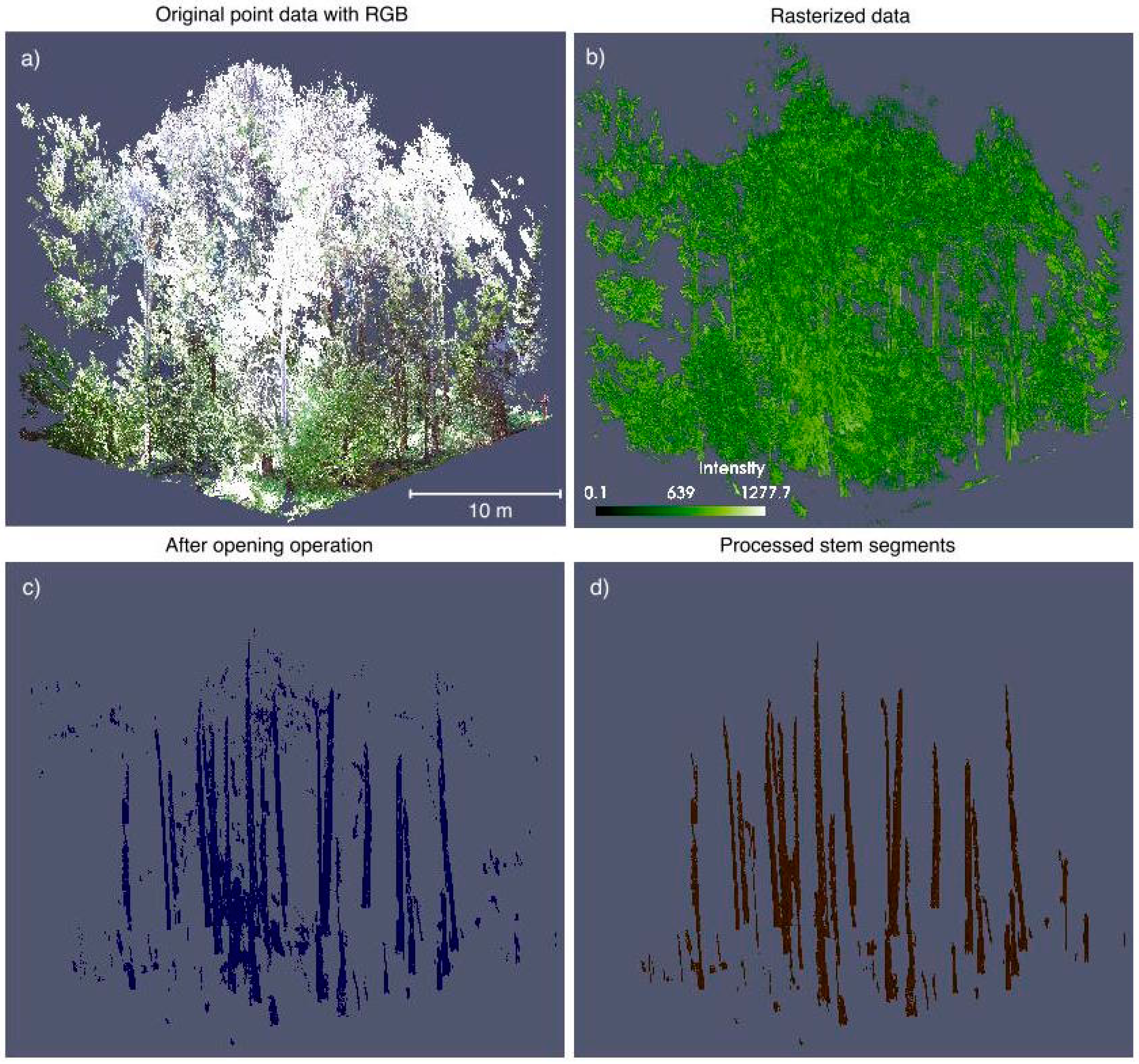
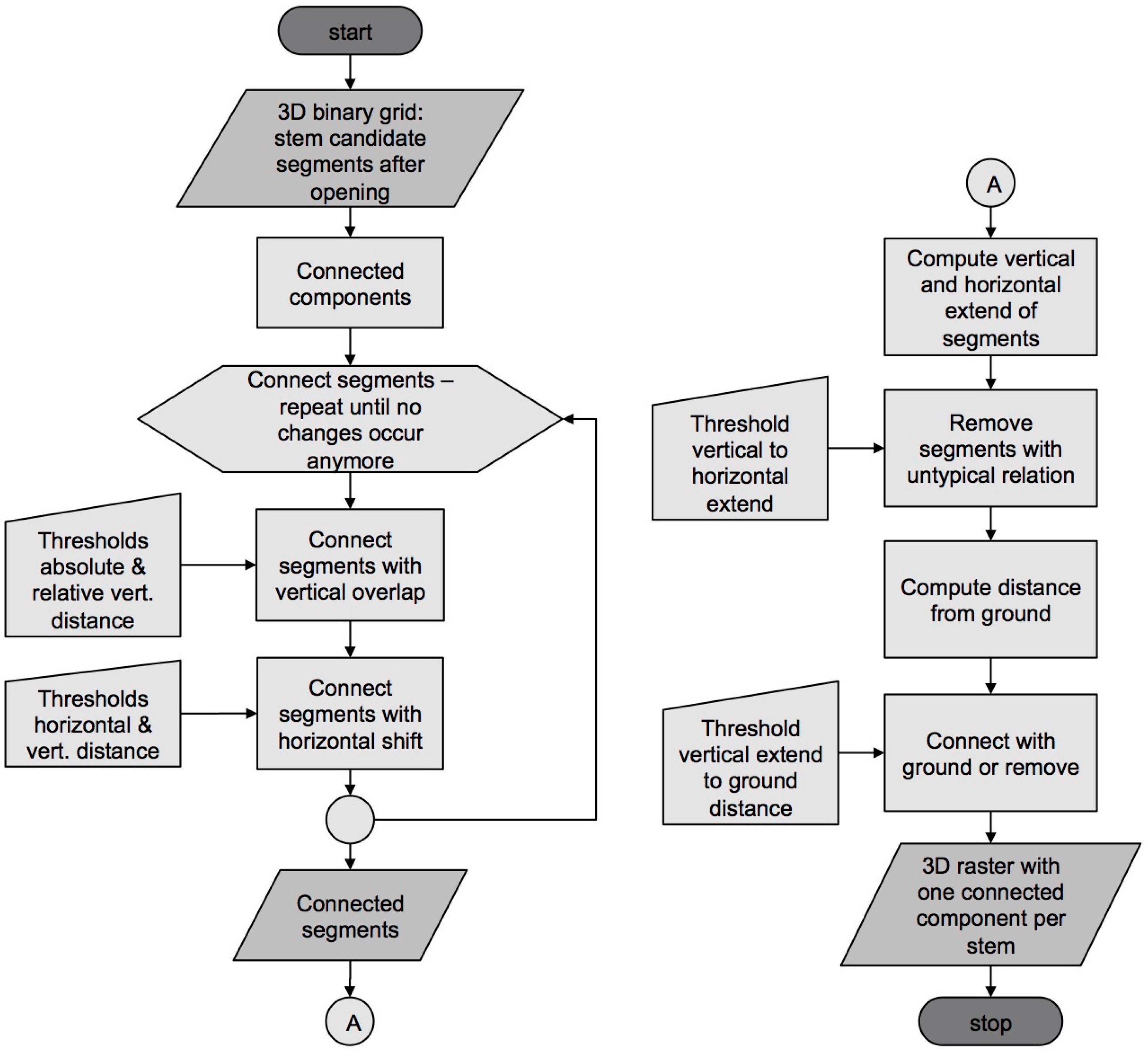
The present study introduces a method to identify tree stems from terrestrial laser scanning (TLS) data. We focused on forest environments of diverse and layered structure, which were technically characterized by strong occlusion effects with regards to laser scanning. The number and distribution of tree stems are important information for the management of protective forests against natural hazards, for forest inventory, and for ecological studies. Our approach builds upon a three-dimensional (3D) voxel grid transformation of the original point cloud data, followed by two major steps of processing. Firstly, a series of morphological operations removed leaves and branches and left only potential stem segments. Secondly, the stem segments of each tree were combined by a multipart workflow, which uses shape and neighborhood criteria. At the same time, erroneous fragments and noise were removed from the dataset. As a result, each object in the voxel grid was represented by a single connected component referring to one specific tree stem. Testing the method on nine spatially independent plots provided detection rates of 97% for the number and location of stems from mature trees with a diameter >= 12 cm and 84% for smaller trees with a minimum of 130 cm total tree height. In summary, we obtained a dataset covering the number and locations of the stems from both mature and understory trees, while not aiming at a precise reconstruction of the stem shape.
Keywords: terrestrial laser scanning; regeneration; mathematical morphology; occluded tree stems; tree position; forest inventory; 1. Introduction terrestrial laser scanning; regeneration; mathematical morphology; occluded tree stems; tree position; forest inventory; 1. Introduction