Article

Assessing Power System Reliability Using Anomaly Detection in Daily Nighttime Light Data

1
State Key Laboratory of Remote Sensing and Digital Earth, Faculty of Geographical Science, Beijing Normal University, Beijing 100875, China
2
Moganshan Geospatial Information Laboratory, Deqing 313200, China
*
Author to whom correspondence should be addressed.
Remote Sens. 2026, 18(9), 1417; https://doi.org/10.3390/rs18091417
Submission received: 10 March 2026 / Revised: 20 April 2026 / Accepted: 1 May 2026 / Published: 3 May 2026

Highlights

What are the main findings?
  • We developed a novel, self-adaptive framework for detecting power outages from daily satellite nighttime light data, eliminating the need for prior event knowledge or fixed regional thresholds.
  • The derived satellite-based reliability index (NTPRI) shows a significant correlation with ground-measured grid reliability, validating its use as a scalable proxy metric.
What are the implications of the main findings?
  • The framework provides a transferable, remote sensing-based tool for large-scale, long-term monitoring of electricity supply reliability, which is particularly valuable for data-scarce regions.
  • It enables rapid impact assessment of power systems following disasters and supports the tracking of infrastructure progress toward related Sustainable Development Goals (e.g., SDG 7).

Abstract

Power-system reliability is crucial for sustainable development, but large-scale, long-term monitoring remains challenging. Existing nighttime light (NTL)-based outage detection methods often rely on fixed thresholds or prior information, limiting cross-regional application. To address this, we develop an adaptive thresholding framework using daily NASA Black Marble data. Observations are grouped by view angle to mitigate radiometric instability, and a per-pixel dynamic baseline is constructed from high-radiance statistics, enabling robust anomaly detection without prior outage timing. From the detected anomalies, we formulate a population-weighted NTL power reliability index (NTPRI) to quantify regional electricity service reliability. Validation across six diverse outage events yields an F1 score of 0.807. National-scale analysis shows NTPRI correlates significantly with the World Bank’s System Average Interruption Duration Index (SAIDI). The derived Light Anomaly Rate (LAR) further supports pixel-level frequency analysis. Together, this framework provides a transferable remote-sensing tool for large-scale power-reliability assessment in data-scarce regions, supporting disaster impact evaluation and energy vulnerability analysis.

1. Introduction

Sustainable Development Goal 7 (SDG 7) [1], which aims to “ensure access to affordable, reliable, sustainable and modern energy for all,” underscores the importance of “expanding infrastructure and upgrading technology to improve energy efficiency and provide sustainable modern energy services for all.” As electricity increasingly constitutes a significant portion of final energy demand, securing a reliable electricity supply is crucial for delivering a wide array of services essential to modern society [2]. The reliability of power systems is fundamental to advancing SDG 7 and ensuring the efficient, continuous operation of contemporary power networks. The World Bank provides the most comprehensive global datasets on reliability statistics, including the System Average Interruption Duration Index (SAIDI) and the System Average Interruption Frequency Index (SAIFI) for numerous regions and countries; however, updates ceased in 2021, resulting in a severe deficiency of long-term reliability data across large areas. This lack of comprehensive spatiotemporal reliability records arises from the significant human and financial resources required for data collection and reporting. Mainstream indicators, such as SAIDI, SAIFI, and the Customer Average Interruption Duration Index (CAIDI), are often dispersed across utility consumer reports, national statistical yearbooks, and non-governmental publications [3]. In regions where power infrastructure is frequently compromised and equipment is aging, the timely acquisition, recording, and updating of reliability indicators becomes increasingly challenging, leading to the neglect of areas that require assessment the most. Hence, it is crucial to develop a method that allows for an objective, consistent, large-scale, and long-term assessment of power reliability, which is essential for global energy security monitoring and sustainable development evaluations.
Nighttime light remote sensing (NTL) facilitates the extensive monitoring of artificial light sources and has found widespread applications in studies related to urbanization, socioeconomic assessments, disaster monitoring, environmental changes, and the impacts of light pollution [4,5,6]. With the advancement of NTL sensors, prominent satellites such as DMSP/OLS and NPP/VIIRS have been utilized for investigating power reliability [7,8,9]. Similar to reliability metrics focused on consumers in power systems research [10], NTL-based reliability evaluation also concentrates on outage occurrences. To match the sampling frequency commonly used in power systems statistics, daily products are generally employed. In NTL applications, outage frequency is frequently utilized as an indicator of power reliability, where a power reliability (stability) index is formulated by comparing outage detections to the total NTL observations [7,11]. Alternatively, Min et al. suggested that regions with unreliable power experience more outages, resulting in unusual light fluctuations. Consequently, they proposed an index that measures unexpected variability in NTL time series as an indicator of power reliability [9]. These studies collectively suggest that accurately identifying the spatiotemporal characteristics of outages poses the primary challenge in evaluating power reliability through NTL.
Current approaches for detecting power outages using NTL remote sensing data can be broadly classified into threshold-based decision methods and classification/prediction methods. Threshold-based approaches encompass both relative and absolute thresholds, typically selecting a reference day or year prior to the outage period to establish a decision threshold from nighttime light (NTL) statistics, including the mean, z-score, quantiles, and standard deviation. For instance, Xu utilized NTL observations from the year preceding an ice-storm-induced outage as a reference, constructing a linear threshold formulation based on the mean and standard deviation [12]. In contrast, Chen referenced a stable year before power rationing, adopting the lower quartile of that year as the threshold [7]. Elvidge et al. employed a detection limit of 1 nW as an absolute threshold to identify outage occurrences [13]. While fixed-threshold schemes are straightforward and computationally efficient, their transferability is constrained due to the variability of reference values with outage timing. Additionally, differences in surface conditions and sensor responses result in spatially heterogeneous radiance detection limits, making it challenging to generalize a single threshold across diverse regions and events. To enhance generalization, several studies have utilized machine learning and deep learning models to classify outage and non-outage samples or to predict grid-level outage counts, subsequently employing a trained model for inference. Shah et al. calculated NTL z-scores as input features and implemented both a random forest model and a logistic regression model for classification [14]. Cole et al. assessed outage probability by examining the relative drop in NTL before and after an outage event [15]. While classification and prediction models offer conceptual support for generalizability, the development of supervised models is heavily reliant on the spatiotemporal resolution and quality of ground-truth labels. Furthermore, publicly available outage label datasets typically encompass limited spatial and temporal extents, which restricts outage identification in multi-region, long-term contexts and ultimately constrains the downstream estimation of power reliability.
In summary, a significant gap exists in the availability of a large-area, robust outage-detection method that can adapt across regions without relying on prior outage information. This study seeks to develop a self-adaptive-based threshold detection framework utilizing daily nighttime light (NTL) data. The principal innovations include: (1) view-angle grouping to minimize fluctuations caused by observation geometry; and (2) the dynamic construction of per-pixel reference baselines and decision thresholds based on the statistical characteristics of high-brightness samples, which reduces reliance on regional background conditions and prior information typical of fixed-threshold methods. Building upon this foundation, we quantify the temporal features of light anomalies and create a population-weighted NTL-based power reliability index for regional-scale assessments. The proposed method provides a transferable remote-sensing solution for long-term power reliability monitoring at global or regional scales, even in the absence of ground statistics. The resulting dataset and tools can facilitate energy infrastructure investment decisions, disaster response and recovery planning, and the evaluation of progress toward the Sustainable Development Goals (particularly SDG 7) for governments, international organizations, and NGOs.

2. Data and Preprocessing

2.1. Cross-Scenario Spatiotemporal Outage Dataset

2.1.1. Outage Sample Selection

To validate the effectiveness of the proposed method for power outage detection, reference outage samples are required. However, the acquisition of such data is constrained by multiple factors, making it difficult to obtain a systematically recorded spatiotemporal dataset of real-world outage events. To overcome this limitation, this study used the spatiotemporal information from the EM-DAT disaster database and reports on large-scale power outages to select six representative outage cases associated with different types of hazard drivers (Table 1). Within the corresponding spatiotemporal extents of these cases, 65 sample points were manually collected, and outage periods were annotated along the temporal dimension. It should be noted that a sample point refers to the geographic location of a sample and is spatially represented as a point vector. Its corresponding value is the nighttime light radiance of the pixel in which the point is located.
Meanwhile, to examine whether the proposed method has a certain degree of generalizability at the global scale, these samples were selected from national and regional settings with markedly different levels of power system development (Figure 1). The World Bank dataset on per capita electricity generation (EGPC) was used as a proxy for the level of power system development [16].

2.1.2. Manual Identification of Outage Samples

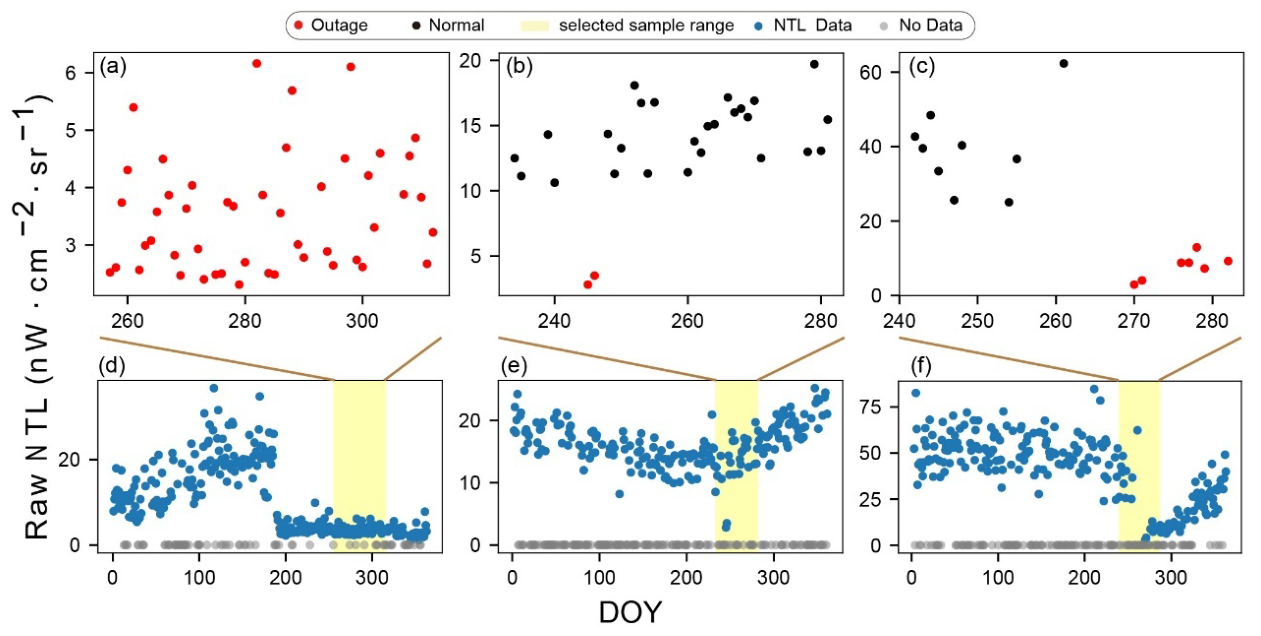
During sample annotation, three representative anomaly types were identified according to the annual temporal variations in nighttime lights and the corresponding event information: (1) persistently low values (Figure 2d), (2) short-term low values (Figure 2e), and (3) abrupt declines in nighttime light radiance (Figure 2f). To maintain a more balanced distribution of positive and negative samples, a three-week time window centered on each recorded outage event was used for sample selection. Within this window, samples were labeled as positive or negative by integrating the event records with the temporal variation characteristics of nighttime lights.

2.1.3. Outage Sample Description

This section summarizes the diverse outage scenarios selected to validate the proposed methodology across varying socioeconomic and geographical contexts.
  • Chungcheongbuk-do and Gyeonggi-do, South Korea: This high-development region typically maintains a stable and dense power grid. In August 2020, extreme precipitation and landslides triggered significant outages across several districts, illustrating the susceptibility of advanced infrastructure to extraordinary natural hazards [17].
  • Louisiana and Texas, USA: As a highly industrialized and urbanized region, these states are representative of mature power systems. Hurricane Nicholas in September 2021 caused extensive outages throughout the area, highlighting the severe impact of extreme climate phenomena on modernized energy networks [18].
  • Zhejiang, China: This province represents a mid-to-high level of socioeconomic development with a robust disaster response mechanism. Floods caused by Typhoon In-fa in July 2021 disrupted the regional electricity supply, though efficient local repairs led to a rapid recovery [19].
  • Aguadilla and San Juan, Puerto Rico: Despite its medium development level, this region possesses fragile infrastructure prone to systemic failure. Hurricane Maria in 2017 caused a catastrophic island-wide outage characterized by complete darkness and a prolonged recovery period, exposing the vulnerability of aging grids [20].
  • Raqqa, Al-Hasakah, and Aleppo, Syria: In this low-development region, the power grid remains incomplete and highly fragile due to ongoing conflict. Airstrikes on critical infrastructure in October 2023 caused widespread outages, demonstrating the destructive impact of armed conflict on vulnerable energy services [21,22].
  • Chennai, India: This emerging industrial center features a grid that remains vulnerable to seasonal climate variability. During the floods of November 2017, authorities implemented preventive outages to manage safety risks, revealing the unique supply challenges faced by South Asian megacities [23].

2.2. National-Scale Validation Data for Power Reliability Assessment

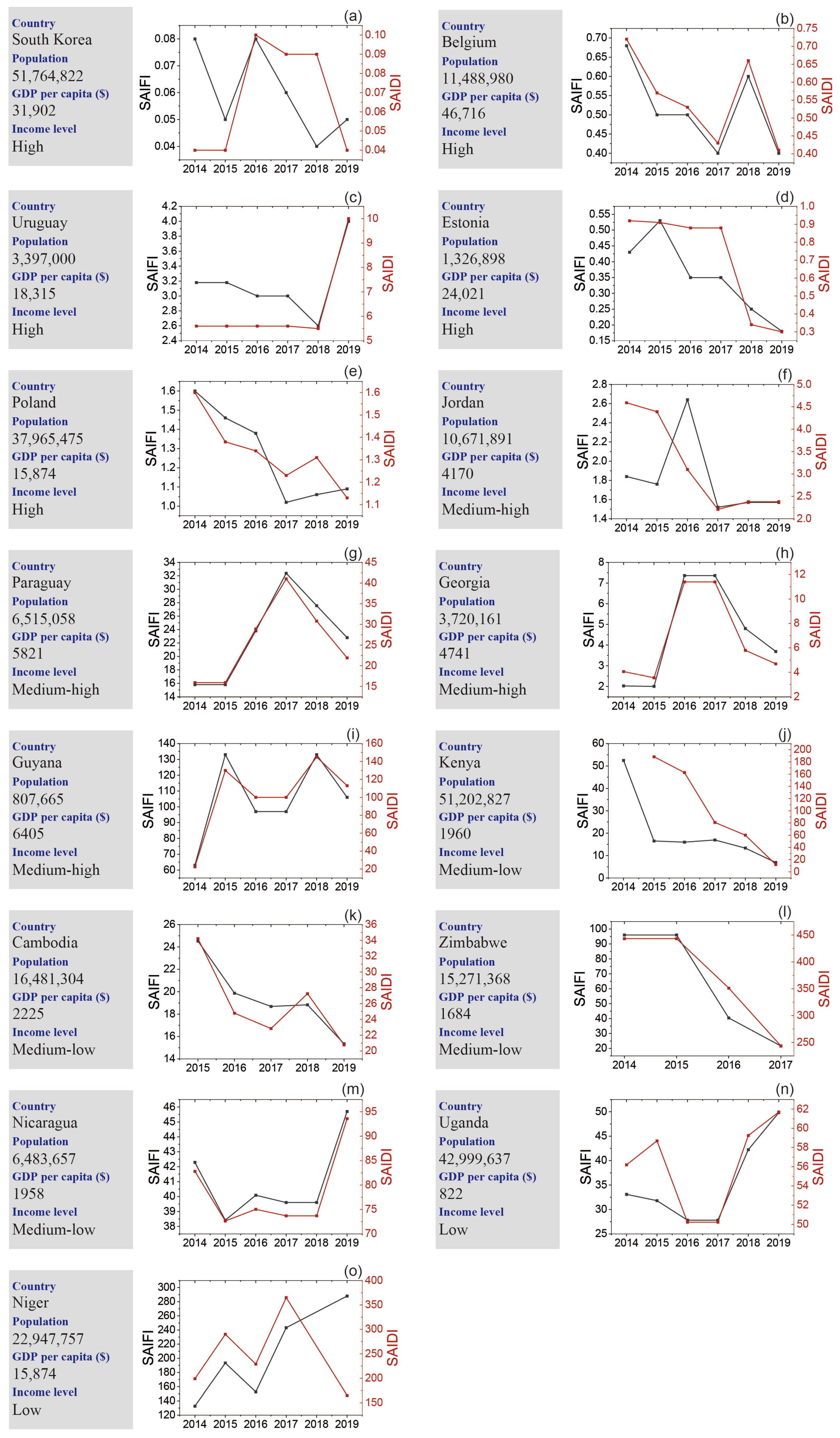
We employed annual, country- and region-level power reliability indicators, specifically SAIDI and SAIFI, sourced from the World Bank (https://archive.doingbusiness.org/en/data/exploretopics/getting-electricity (accessed on 1 April 2026)), to examine the correlation between the remote-sensing reliability index and established power system reliability metrics. To our knowledge, this dataset represents the only publicly accessible and systematic compilation of power reliability indicators. For national-scale validation, we selected 15 representative countries, ensuring broad geographic coverage that includes Africa (Niger, Zimbabwe, Uganda, Kenya), Asia (South Korea, Cambodia, Jordan, Georgia), Europe (Belgium, Poland, Estonia), South America (Guyana, Paraguay, Uruguay), and North America (Nicaragua). This selection also considered population size and levels of economic development. As illustrated in Figure 3, the sampled countries encompass the World Bank’s income classifications: low, lower-middle, upper-middle, and high income (https://datatopics.worldbank.org/world-development-indicators/the-world-by-income-and-region.html (accessed on 1 April 2026)). Niger and Uganda are categorized as low-income; Zimbabwe, Nicaragua, Kenya, and Cambodia fall under lower-middle-income; Jordan, Georgia, Paraguay, and Guyana are classified as upper-middle-income; and Poland, Uruguay, Estonia, South Korea, and Belgium are designated as high-income economies.
In high-income countries (Figure 3a–e), the System Average Interruption Frequency Index (SAIFI) consistently remains below 5 interruptions per customer per year, while the System Average Interruption Duration Index (SAIDI) is consistently below 10 h per customer per year. These two indicators exhibit broadly consistent temporal variations and generally demonstrate declining trends, reflecting high reliability and steady improvement. In contrast, upper-middle- and lower-middle-income countries (Figure 3f–m) display much wider ranges for SAIFI and SAIDI, with SAIFI varying from 2 to 140 interruptions per customer per year and SAIDI ranging from 2 to 450 h per customer per year. Among these cases, Georgia records the lowest values for both SAIFI and SAIDI, while Guyana shows the highest SAIFI, and Zimbabwe reports the highest SAIDI. Georgia’s exceptional reliability is attributed to grid modernization driven by institutional reforms and the regulatory capacity afforded by high-quality hydropower resources [24,25]. Conversely, Guyana’s elevated SAIFI is primarily linked to insufficient generation capacity, fragile transmission and distribution networks, and a combination of various external factors [26]. Zimbabwe’s extraordinarily high SAIDI reflects a structural collapse on the supply side, driven by hydropower stagnation due to climatic drought [27,28] and forced load shedding exacerbated by aging infrastructure [29].

2.3. Black Marble Data

We utilized the VNP46A1 and VNP46A2 datasets from NASA’s Black Marble product suite (available at https://blackmarble.gsfc.nasa.gov (accessed on 23 April 2025)). These datasets are derived from the Visible Infrared Imaging Radiometer Suite (VIIRS) Day/Night Band (DNB) aboard the Suomi National Polar-orbiting Partnership (S-NPP) and the Joint Polar Satellite System (JPSS), offering 15-arcsecond spatial resolution with daily global coverage since 2012. To enhance the reliability of NPP-VIIRS/DNB data for time-series applications, VNP46A2 incorporates external factors such as clouds, snow, aerosols, lunar illumination, seasonal vegetation changes, and auroras. It implements routine corrections for lunar Bidirectional Reflectance Distribution Function (BRDF), cloud effects, terrain, atmospheric influences, airglow, and stray light, while also enhancing sensitivity to low-light structures, thereby significantly improving the quality of raw VIIRS nighttime light (NTL) imagery [30]. We selected the BRDF-corrected radiance layer from VNP46A2. To minimize interference from clouds, snow, moonlight, and outliers, we initially filtered observations using a lunar illumination fraction of less than 60% to concentrate on conditions with diminished moonlight, thereby enhancing the efficacy of the cloud-mask strategy. Subsequently, we eliminated cloud and snow contamination using cloud masks and snow-cover flags, selected high-quality retrievals based on quality flags, and applied a threshold of 0.3 nW/cm2/sr to discard low-light background noise [30,31]. Although the BRDF layer maintains high quality, practical applications continue to encounter uncertainties arising from view-angle effects. Variations in view angle can lead to fluctuations in radiance from the same light source, influenced by differences in building height and vegetation cover [32]. Consequently, we utilized the VZA layer in VNP46A1 to mitigate view-angle effects during outage anomaly detection.

2.4. Ancillary Data

In addition to NTL data and validation data, we incorporated two types of ancillary datasets. First, we employed masks to concentrate on regions with high electricity demand, specifically populated and built-up areas, where reliability signals are typically more pronounced and representative. This approach also mitigates the influence of natural light sources, such as wildfires, and non-target anthropogenic lights, such as agricultural burning. We utilized the Esri global 10 m land-cover dataset (ESRI/LULC) as a built-up mask. This dataset, generated from 10 m Sentinel-2 multispectral imagery using deep learning techniques (U-Net), encompasses 10 land-cover classes. To represent population concentration, we used the 2015 EU GHS-SMOD (Global Human Settlement Layer—Settlement Model grid) to indicate settlement intensity. GHS-SMOD integrates built-up surfaces extracted from Landsat and Sentinel-2 imagery (GHS-BUILT-S R2023) and population data from CIESIN GPW v4.11 (GHS-POP R2023), providing 1 km grids in Mollweide projection and updated at five-year intervals [33]. The grid classes adhere to the UN global urbanization framework based on population density, proximity, and size [34]. We selected urban centers (label 30), dense urban clusters (label 23), semi-dense urban clusters (label 22), and peri-urban/suburban areas (label 21) to create a mask for high population concentration. Due to differences in spatial resolution and projection between ESRI/LULC, GHS-SMOD, and VNP46A2, we resampled the former two datasets using majority aggregation for down-sampling and nearest-neighbor interpolation for up-sampling, respectively, to ensure alignment with VNP46A2 for subsequent masking. Additionally, we utilized the gridded population dataset LandScan to construct regional reliability indices. LandScan Global provides an approximate spatial resolution of 30 arc-seconds (∼1 km at the equator) and offers annually updated global population distributions by integrating census data, ancillary geospatial inputs, and spatial modeling techniques [35,36]. The dataset is produced by Oak Ridge National Laboratory and is accessible at https://landscan.ornl.gov/ (accessed on 22 May 2025).

3. Methods

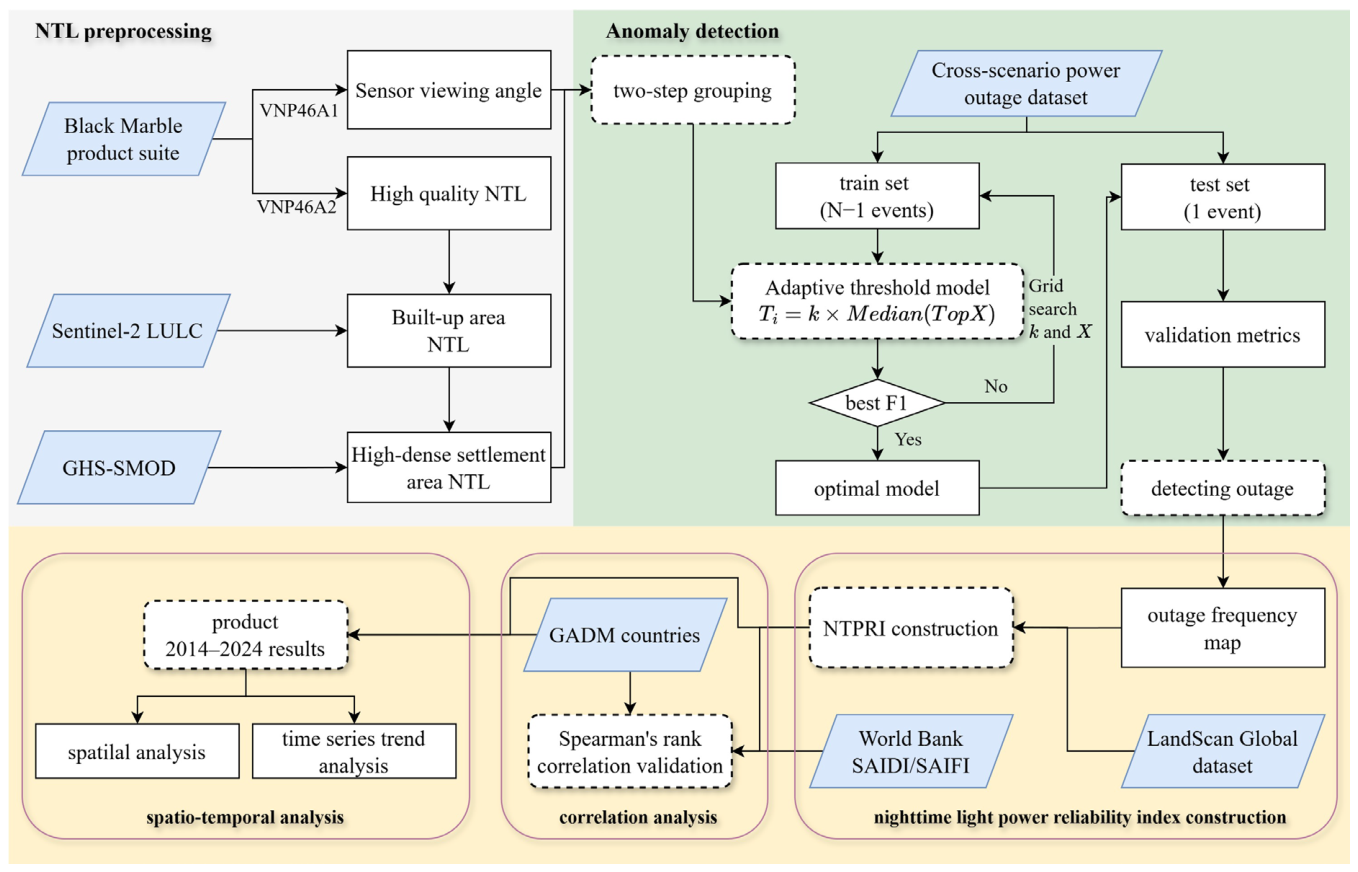
Our reliability assessment consists of three main components. Initially, we conducted quality screening and applied masks (specifically targeting built-up and high-density settlement areas) to the BRDF-corrected radiance in VNP46A2. Following view angle mitigation through a two-step grouping process, we developed a self-adaptive-based threshold method with two parameters to detect outages. The optimization of these parameters was achieved through grid search on the cross-scenario outage dataset. Subsequently, we assessed the performance using LOEO (Leave-One-Event-Out Cross-Validation, LOEO) and implemented the optimized model for outage detection across wider spatiotemporal scopes. In the third component, we calculated the outage frequency per pixel to create outage-frequency maps. By adhering to the definitions of SAIDI and SAIFI and incorporating gridded population data, we formulated an NTL-based power reliability index known as the Nighttime-light Power Stability Index (NTPRI). We then examined its correlation with World Bank statistics. The subsequent sections elaborate on the assessment framework and analyses, accompanied by a methodological flowchart presented in Figure 4.

3.1. Cross-Scenario Power Anomaly Detection Method

3.1.1. Mitigation of Angular Effects

We utilized daily NPP/VIIRS DNB data, which offer the longest temporal coverage and most timely updates among existing daily nighttime light (NTL) products. Nonetheless, these data are subject to various uncertainties, including cloud contamination, lunar illumination interference, and radiance fluctuations associated with seasonal vegetation changes [30]. As a result, early studies on outage detection were largely exploratory, typically concentrating on characteristics of individual outage events, such as regional declines in total light output [37] or employing very low absolute thresholds to signify outages [13], often without quantitative validation against actual outage data. The introduction of NASA’s Black Marble products has significantly mitigated the effects of moonlight, clouds, and seasonal variability, leaving view-angle effects and spatial heterogeneity in surface reflectance as the primary sources of interference in outage detection [30,32,38]. View-angle effects occur because variations in observation angle can lead to fluctuations in the same light source, influenced by building height and vegetation cover [31,39]. Even stable light sources can exhibit seasonal or periodic variations, which might be mistaken for anomalies, leading to increased false alarms and obscuring anomaly patterns for algorithms. Therefore, addressing view-angle effects in Black Marble data is crucial. Previous studies have suggested various per-pixel strategies, such as a zenith-angle–radiance quadratic model (ZRQ) [12], a two-step view-angle grouping method [7], a self-adaptive mean filtering and angle correction algorithm (SFAC) [32] and fixed-interval grouping [40], all designed to improve short-term outage signals. These endeavors aim to decrease uncertainty in long NTL time series and facilitate the efficient utilization of temporal information for outage detection. We implemented the two-step view-angle grouping method introduced by Chen et al. to categorize the within-year daily NTL observations for each pixel. This approach minimizes radiance discrepancies among view geometries and diminishes the impact of within-group angle effects on genuine anomaly signals [7]. The two-step grouping method first partitions annual observations into 1° viewing zenith angle (VZA) intervals, and then further refines these groups through clustering within the angle-stratified samples, extending the fixed grouping strategy by allowing observations with similar angular characteristics to be assigned to more consistent groups. This strategy preserves the physical information associated with viewing geometry, makes fuller use of continuous VZA information, alleviates the issue of insufficient samples caused by rigid angle intervals, and directly relies on grouped original observations rather than coefficient-rescaled values as in SFAC, thereby avoiding additional scaling errors and providing more stable performance for anomaly detection.

3.1.2. Self-Adaptive Threshold

Previous studies indicate that outages can be identified by comparing nighttime lights (NTL) radiance during outage periods with radiance under normal conditions, referred to as the baseline [12]. However, in complex real-world scenarios, the absence of prior outage timing complicates the determination of the baseline, thereby hindering the generalization of fixed-reference thresholding across different regions. To address this challenge, we propose a self-adaptive-based threshold method that does not depend on a specific reference year. The formulation is presented in Equation (1), where Thresholdi represents the threshold for the i-th NTL group within the optimal view zenith angle (VZA) grouping. The optimal VZA grouping refers to the final adaptive grouping scheme generated by the two-step grouping method proposed by Chen et al. It is an intermediate result derived from the preceding processing steps and subsequently used for anomaly detection. Specifically, clear-sky annual observations are first partitioned into 1° VZA intervals to form fine-scale initial groups. These groups are then further merged through hierarchical clustering, with the optimal number of groups and corresponding VZA interval combinations determined using clustering evaluation metrics, including the silhouette coefficient and Davies–Bouldin index. The final grouping scheme minimizes within-group variance while maximizing between-group separability, thereby achieving a more effective balance between angular consistency and sufficient sample size for robust statistical estimation [7].
T h r e s h o l d i = k × M e d i a n ( X t o p ) ,
where Xtop refers to samples of nighttime light (NTL) in group i that exceed the X-th percentile for a given pixel (i.e., NTL values that are greater than or equal to the percentile X value). The term Median(Xtop) represents the median of these samples. This median value mitigates the influence of low-value anomalies, such as outages or transient cloud cover, as well as extreme high values, such as festive lighting, thereby reflecting the baseline radiance of the pixel under specific angle observation geometry. The variable k serves as a dynamic scaling factor that adjusts the decision threshold: a smaller k results in stricter anomaly detection, while a larger k allows for a more permissive approach. Both X and k are determined through an iterative search process rather than being selected arbitrarily. We define Xtop ∈ {50, 60, 70, 80, 90} and k ∈ [0.1, 0.9] with increments of 0.1, computed thresholds to identify outage anomalies within the samples, assessed overall detection performance, and selected the (Xtop, k) combination that maximizes the F1 score as the optimal parameter setting for future applications.

3.1.3. Accuracy Assessment

To objectively evaluate the performance of the adaptive thresholding method in multi-regional power anomaly detection and to determine the optimal coefficient combination, a confusion matrix was employed for quantitative assessment. In the context of outage detection, accuracy measures the overall correctness of the model in distinguishing outage from normal power states. Precision indicates the reliability of the detection results, that is, the proportion of true outage events among the samples classified as anomalous; a higher precision suggests a lower false-alarm rate caused by residual view-angle effects or atmospheric interference. Recall measures the model’s ability to identify outage events, with a higher value indicating a lower risk of missed detections. The F1 score, defined as the harmonic mean of precision and recall, was used as a comprehensive metric to balance detection sensitivity against false-alarm control.
To assess the generalizability of the proposed framework under cross-scenario conditions, a Leave-One-Event-Out Cross-Validation (LOEO) strategy was employed. The basic unit of cross-validation was defined as the outage event rather than the individual sample point. Given the six representative outage events selected in this study, samples from five events were used in each iteration as the training set. Coefficient combinations were exhaustively explored within predefined parameter ranges, and the adaptive threshold yielding the highest F1 score was identified. The remaining event was treated as an independent test set, and the optimal parameters derived from that iteration were directly applied for outage detection without further training.
The procedure was repeated over six rounds so that each event was used once as an independent test case. The model’s spatiotemporal generalizability and stability under unseen geographic settings and varying background radiance conditions were then quantitatively evaluated by summarizing the mean performance metrics and the corresponding confusion matrices across all six test rounds.

3.2. Construction of a Remote-Sensing-Based Power Reliability Index

The overpass-time sampling of the VIIRS sensor provides a critical temporal snapshot for the construction of the power reliability indicator. Although the sensor conducts instantaneous observations around 01:30 local time, capturing the nighttime state at that specific moment, this temporal phase has been shown to be highly representative of daily supply dynamics. To validate this representativeness in the absence of continuous field measurements, this study refers to the empirical research by Mann et al. [41]. By analyzing high-frequency power supply data from Maharashtra, India, their work demonstrated a robust correlation of 0.85 between outage frequencies during daytime hours (6:00 a.m. to 6:00 p.m.) and those during the SNPP overpass period (midnight to 2:00 a.m.). This strong statistical link justifies the use of VIIRS nighttime light data as a reliable proxy for overall power reliability. Consequently, the following sections detail the development of an indicator based on these observations to characterize regional electricity supply stability.
Currently, a unified and comprehensive global dataset on power reliability does not exist. Furthermore, the most commonly utilized consumer-side indicators, SAIDI and SAIFI, exhibit data gaps in certain regions, attributable to social instability and inadequate maintenance of power infrastructure. These limitations hinder the ability to track and compare power-system reliability on a global scale. Chen et al. introduced the Light Anomaly Ratio (LAR) to characterize the spatial distribution of power reliability [7]. This metric is calculated as the ratio of outage days (Na) to valid observation days (No) within a given year (Equation (2)), representing the per-pixel outage frequency [7].
L A R = N a N o .
However, LAR is based exclusively on satellite observations and does not account for the affected population, which complicates its alignment with reliability indicators commonly utilized in the power industry. To address the deficiency in regional reliability assessments, we propose a regional nighttime-light power reliability index NTPRI that constructs a spatially and temporally continuous reliability metric using publicly available data. Given that SAIDI and SAIFI are defined with outages as the central parameter and directly correspond to remote-sensing outage signals, we adopt their framework: SAIDI is defined as the total duration of customer interruptions divided by the number of customers, while SAIFI is the total number of customer interruptions divided by the number of customers. Consequently, NTPRI is defined as Equation (3):
N T P R I =   i = 1 N L A R i × P O P i i = 1 N P O P i ,
where POPi denotes the population of the i-th pixel in the Landscan dataset, and N signifies the number of pixels within the region. The numerator quantifies the total service loss attributable to power anomalies across all pixels, with each pixel’s anomaly rate weighted by population (electricity demand density). This weighting ensures that anomalies in densely populated areas exert a greater influence on the overall index. The denominator serves as a normalization factor for total electricity demand, allowing the index to reflect regional reliability rather than being skewed by anomalies in sparsely populated areas. Lower NTPRI values indicate greater reliability in meeting the electricity demand of the population, while higher values suggest reduced reliability. Ultimately, the reliability index encapsulates the overall severity of outage impacts on individuals.

3.3. Long-Term Assessment of Power Reliability

3.3.1. Correlation Analysis with Conventional Reliability Indicators

Before applying the index, we first validate the association between the NTPRI and traditional power system reliability indicators, specifically SAIDI and SAIFI, to determine whether the NTPRI can serve as a complementary proxy for global reliability assessment. Given that the SAIDI and SAIFI values for the 15 countries vary significantly and demonstrate a non-normal distribution, parametric measures such as Pearson correlation may be unduly influenced by extreme values, potentially misrepresenting the true association. Consequently, we employed Spearman’s rank correlation coefficient (Spearman’s ρ), which is appropriate for non-normal data. The value of ρ ranges from −1 to 1: a ρ of −1 indicates a perfect negative association, a ρ of 0 signifies no association, and a ρ of 1 denotes a perfect positive association. The objective is to assess whether the NTPRI and SAIDI/SAIFI exhibit consistent co-variation and to evaluate the potential of NTPRI to complement traditional indicators.

3.3.2. Analysis of Long-Term Changes in Power Reliability

The NTPRI, derived from nighttime light data, enables a consistent assessment of power reliability across large spatial extents and over long time periods. Accordingly, we selected 15 countries representing substantial differences in population size, economic development, and income level, and constructed annual national NTPRI series for 2014–2024. These series enable us to quantify temporal changes in reliability and compare patterns across different income groups. To support this assessment, the threshold applied here is the optimal pixel-level threshold determined by the best-performing parameter combination (Xtop = 70, k = 0.6), which was obtained through grid search. The resulting outage maps were then aggregated to derive the national-scale NTPRI.
To estimate long-term change while limiting the influence of unusual years, we used a non-parametric trend approach. For each country, we computed the Theil–Sen slope β as the median of all pairwise slopes β i j = ( x j x i ) / ( t j t i ) , which provides a robust estimate of average annual change. Then, we use the Mann–Kendall test to assess whether each annual series exhibits a monotonic trend. The test statistic is S = Σ i < j s i g n ( x j x i ) , which summarizes the overall direction of change by counting increasing versus decreasing pairs across years. Under the null hypothesis of no trend, S is standardized to z, and the corresponding p-value is used to evaluate the significance of the monotonic trend.

4. Results

4.1. Optimal Parameters of the Self-Adaptive Threshold

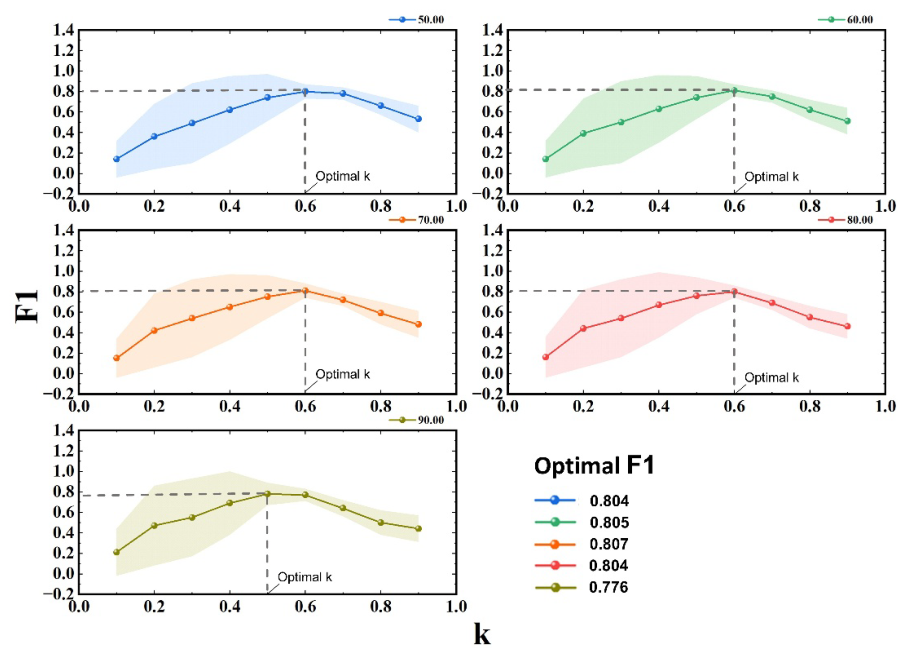
The results (Figure 5) show that the optimal coefficient combination is Xtop = 70, k = 0.6. Under all tested strategies, the F1 score curves exhibit an inverted U-shaped pattern. As the scaling factor k increases, model performance initially improves because of enhanced noise suppression, but subsequently declines as an excessively high threshold leads to reduced accuracy. The standard deviation intervals further indicate that when the parameter values are close to the lower end, the performance metrics fluctuate substantially and the model becomes highly unstable, with the maximum F1 often occurring at k = 0.2 or 0.3 . For example, when Xtop = 50, k = 0.3, the mean F1 score is 0.487 with a standard deviation of 0.389, corresponding to a fluctuation magnitude of up to 80%. By contrast, when k falls within and beyond the optimal range of 0.5–0.6, the variation in F1 becomes much smaller and the model performance is relatively stable. The optimal scaling coefficient identified in this study can be interpreted as indicating that outage events can be stably and accurately detected when the radiance declines to 40% below the baseline level.
Across the different baseline selection ranges, the Xtop = 70 scheme achieved the best performance, with a peak F1 score of 0.807. This value was 0.003 higher than those obtained under the Xtop = 50 and Xtop = 80 strategies, and 0.02 higher than that under Xtop = 60. In contrast, the Xtop = 90 scheme performed the worst, with an F1 score of only 0.776, substantially lower than those of the other strategies. These results suggest that selecting samples from a moderately high radiance range is more effective in achieving a reasonable balance between background noise suppression and the preservation of meaningful signals.

4.2. Sensitivity Analysis of the Scaling Coefficient k

Under the baseline scheme of Xtop = 70 (Table 2), when k takes a relatively small value, such as k = 0.4, the model tends to emphasize false-alarm control. Although the overall accuracy reaches its highest value of 0.929 and the precision is also as high as 0.893, the recall is only 0.586, indicating a relatively evident missed-detection problem under this threshold setting. As k increases to 0.6, the model reaches a more balanced state between detection sensitivity and result reliability, with the F1 score attaining the global maximum of 0.807. Meanwhile, precision remains high at 0.881, and recall increases markedly to 0.888. When k is further increased to 0.9, recall rises to 0.983; however, the lower threshold leads to more false alarms, causing precision to decline to 0.470 and resulting in a clear deterioration in the overall detection performance.

4.3. Long-Term Temporal Analysis of Power Reliability

4.3.1. National-Scale Evaluation

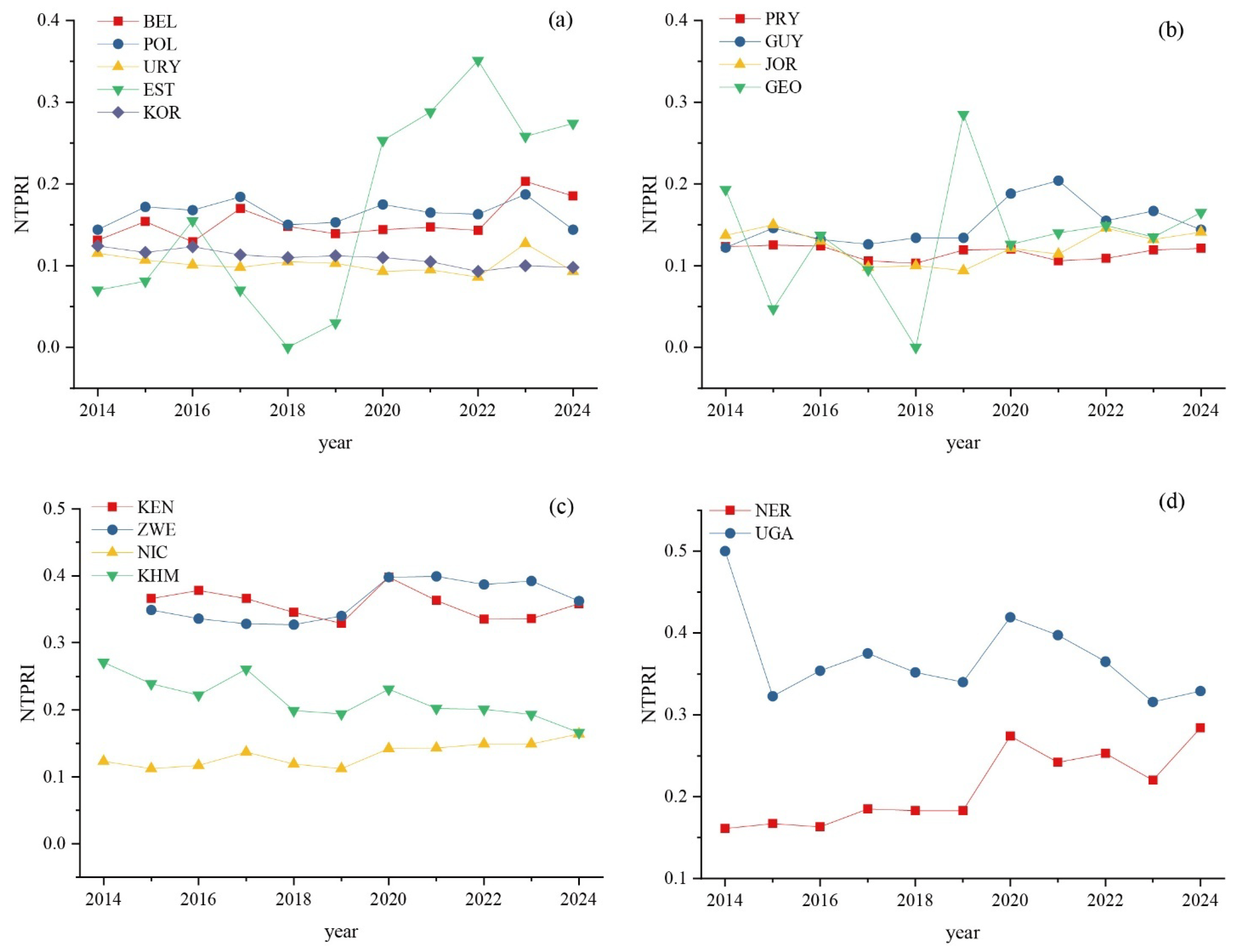
Figure 6 depicts the temporal evolution of NTPRI (2014–2024) by income group and reveals a systematic gradient in power system stability, with lower NTPRI values representing higher reliability. High-income countries generally maintain comparatively low and stable NTPRI levels, mostly between 0.10 and 0.20, indicating relatively stable electricity systems, although Estonia’s increase from approximately 0.08 in 2014 to above 0.25 after 2021 suggests growing instability in that case. Upper-middle-income countries fluctuate around 0.10–0.20 with visible interannual variability, reflecting moderate stability accompanied by episodic disturbances. Medium-low-income countries exhibit wider dispersion, with Zimbabwe and Kenya reaching 0.35–0.40 in certain years, corresponding to elevated instability, while Cambodia declines from about 0.27 in 2014 to below 0.20 after 2020, signaling improved stability. Low-income countries remain at comparatively higher NTPRI levels overall, indicating weaker stability, although Niger’s rise from roughly 0.16 to nearly 0.28 reflects increasing instability, whereas Uganda fluctuates between 0.30 and 0.42 before moderating. Collectively, the results indicate that higher income levels are generally associated with lower average NTPRI values and thus stronger power system reliability, while temporal fluctuations highlight the sensitivity of national systems to investment dynamics, governance effectiveness, and external shocks.
Table 3 summarizes the Theil–Sen slope β estimates and Mann–Kendall significance tests, providing quantitative evidence of national reliability trajectories, where increasing trends indicate rising instability in power systems and decreasing trends reflect enhanced stability, given that lower NTPRI values correspond to more reliable electricity supply. Estonia records the largest significant increase, followed by Niger and Nicaragua, implying a statistically significant intensification of power system instability over the study period. Guyana also exhibits a positive and significant trend. Belgium, Poland, Jordan, and Georgia present positive but non-significant slopes, suggesting mild upward tendencies in instability without robust monotonic signals. In contrast, Korea shows a significant decline, Uruguay a marginal decrease, and Cambodia the most pronounced significant reduction, indicating measurable improvements in power system stability. Uganda and Kenya also display downward but non-significant slopes, reflecting modest stabilization trends without strong statistical support.

4.3.2. Second-Level Administrative Division Scale Evaluation

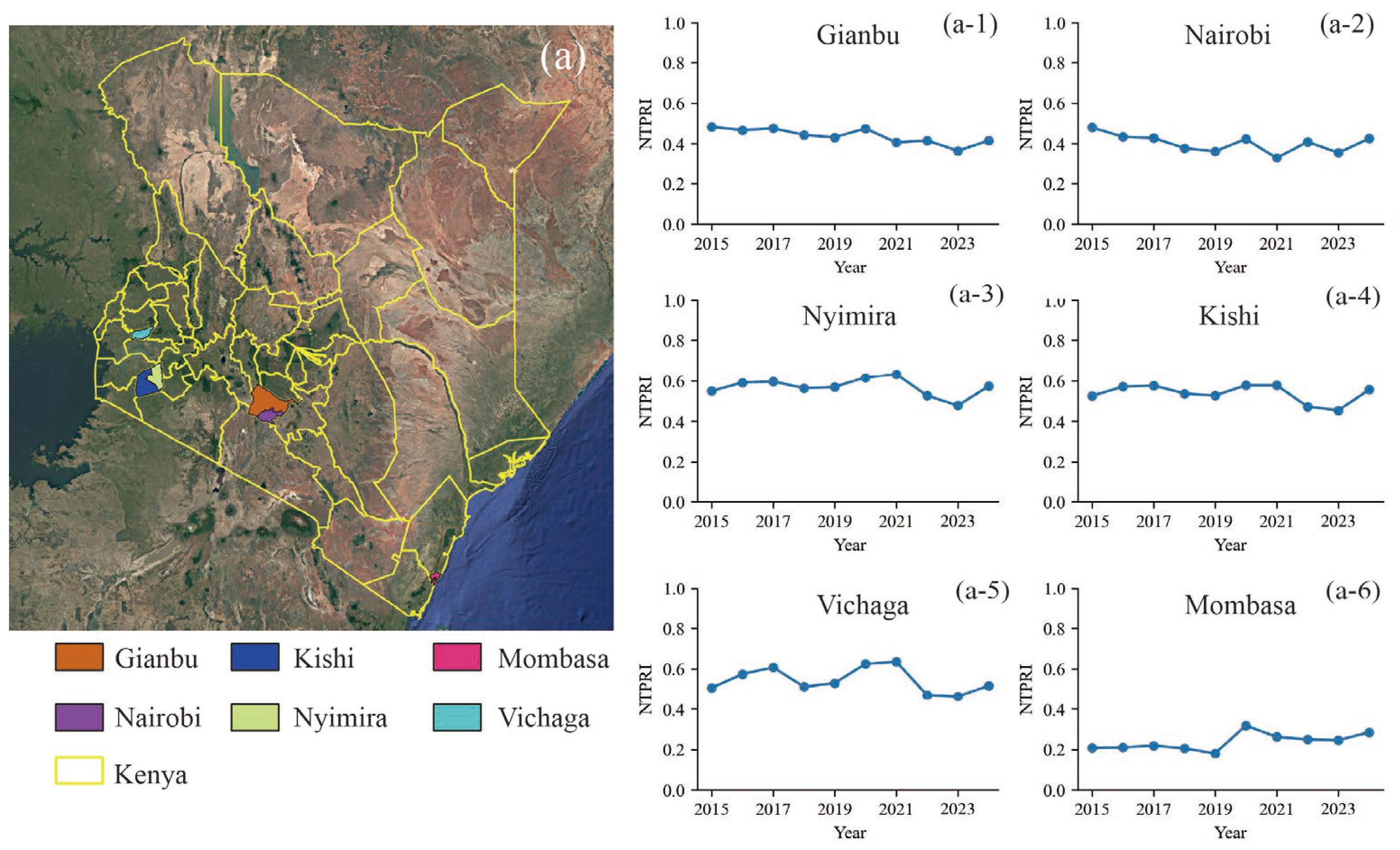
As a regional power reliability indicator, NTPRI presents advantages in cross-scale assessment, enabling the evaluation of power reliability at both national and provincial levels. Using Kenya as a case study, this research demonstrates the application potential of NTPRI at the provincial scale. The IEA reported in its publication that Kenya’s electricity access rate rose from 37% to 70% between 2013 and 2023 [42], indicating remarkable progress in electricity accessibility and improved power supply capacity. Nevertheless, substantial population growth and deficiencies in power infrastructure quality have led to a persistent and large electricity demand gap in Kenya; according to the IEA’s 2024 assessment, Kenya’s SAIDI in 2023 remained above 100 h per year, far exceeding the global median of 3 h [42], while statistics from the Energy and Petroleum Regulatory Authority of Kenya for the first half of the 2024–2025 fiscal year revealed that the duration of power outages has increased over the past three years [43]. Given the small number of densely populated second-level administrative regions in Kenya and scarce data in sparsely populated areas, this study selected the top six second-level administrative regions by average population during 2014–2024—Nairobi (5847), Mombasa (4074), Vihiga (1031), Kisii (832), Kitbuang (786), and Nyamira (690)—with population data derived from the LandScan Global gridded image dataset. Figure 7 illustrates that the overall variation in NTPRI across the six second-level administrative regions is not obvious, with slight improvements in power reliability observed in Kitbuang and Nairobi, where NTPRI decreased from around 0.5 to approximately 0.4; NTPRI fluctuated at roughly 0.6 in Nyamira, Kisii, and Vihiga; and in Mombasa, NTPRI jumped from 0.2 to 0.4 in 2020 and remained at a similar level thereafter, which may be attributed to severe heavy rainfall and flooding events in Mombasa in 2020 [44] coupled with a large-scale nationwide power outage [45], both of which degraded the performance of the power infrastructure system. Mombasa maintains a higher level of power reliability compared with other regions owing to its role as a coastal economic center with a high urbanization rate and stronger guarantees for power infrastructure. However, the power reliability levels in these regions did not improve during the 2022–2024 period, which is consistent with official and news records of frequent system disturbances, widespread blackouts, and high SAIDI/SAIFI values, particularly around 2023, when intensive events such as nationwide power outages, airport blackouts, and transmission failures occurred [46,47,48,49], thus preventing a decline in NTPRI.

4.4. Spatial-Scale Analysis

NTPRI, as a regional statistical indicator derived from nighttime light data, captures the overall stability of power systems at national or subnational scales and enables consistent cross-country comparison. To further enrich this assessment, the study incorporates LAR to provide pixel-level information on abnormal light variations, thereby revealing detailed spatial patterns of power supply disturbances. Through this integration, NTPRI offers a robust aggregated evaluation of regional reliability, while LAR supplements it with fine-grained spatial diagnostics. The complementary strengths of regional integration and spatial resolution jointly support a more comprehensive and nuanced framework for assessing electricity supply stability, and provide a unified methodological approach for large-scale and globally comparable reliability evaluation.
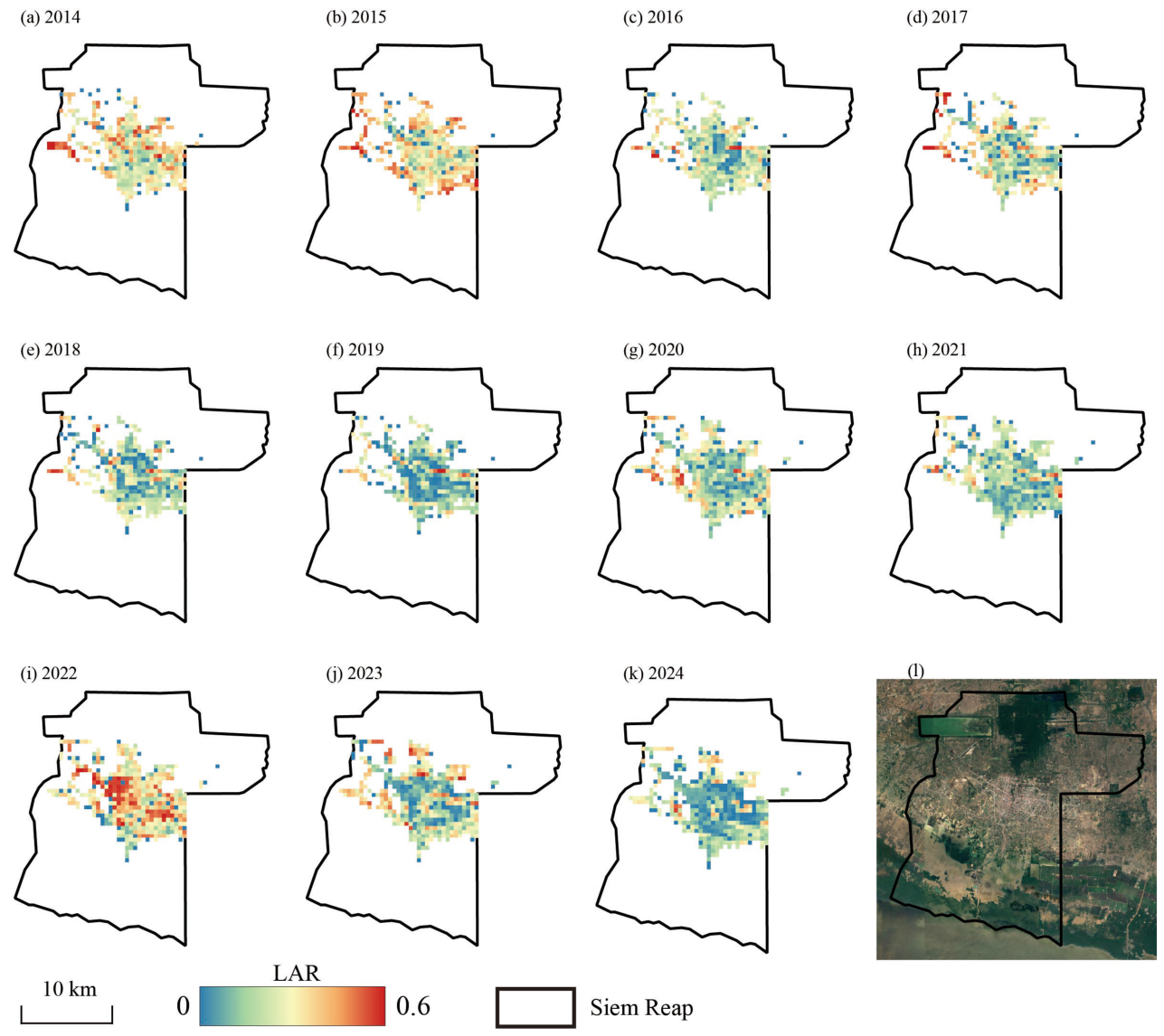
Figure 8 exhibits the spatial distribution of LAR in Siem Reap District. From 2014 to 2019, the overall LAR in Siem Reap decreased, with the large high LAR areas observed in 2014–2015 shrinking to a limited spatial extent, suggesting an improvement in power reliability. In terms of spatial distribution, LAR is higher at the urban periphery than within the urban core. In 2019, a severe drought reduced Cambodia’s subsequent hydropower supply capacity; correspondingly, LAR increased overall in 2020–2021 as shown in Figure 8. In 2022, frequent climate disasters during September and October were associated with an overall increase in LAR, and a clear concentration of high outage frequency emerged within the urban area. After 2022, LAR returned to a lower level. Overall, the spatial distribution of power-system reliability in Siem Reap shows an improving trend.

5. Discussion

5.1. Comparison of Angular Effect Mitigation Methods

The angular effect in Black Marble data significantly impacts outage-detection accuracy and can indirectly affect the correlation between remote-sensing and statistical reliability indicators. To address this, we compared three mainstream view-angle correction strategies within the self-adaptive-based threshold framework: fixed grouping, SFAC and the two-step grouping method utilized in this study. The three angle-effect correction methods differ in the way they address radiance variability caused by changes in viewing geometry. The fixed grouping method partitions observations into predefined VZA intervals and conducts the subsequent analysis within each group (e.g., 0–20°, 20–40°, 40–60°), thereby reducing angular heterogeneity under fixed angle ranges [40]. The SFAC method groups observations according to revisit-angle patterns and rescales the radiance values within each group using correction coefficients derived from group statistics, thereby improving the inter-group comparability of the time series [50]. The two-step grouping method initially divides observations into 1° VZA intervals and then adaptively merges these intervals through clustering, resulting in data-driven groups with improved within-group consistency [7].
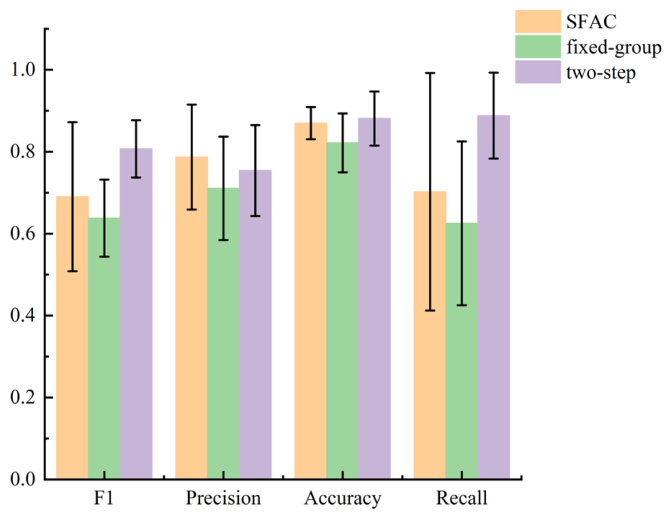
As illustrated in Figure 9, the two-step grouping method achieves the best overall performance under the optimal parameter setting, delivering the highest F1 score (0.807 ± 0.070), accuracy (0.881 ± 0.066), and recall (0.888 ± 0.105). SFAC ranks second, with an F1 score of 0.680 ± 0.182, a precision of 0.787 ± 0.128, a recall of 0.702 ± 0.290, and an accuracy of 0.870 ± 0.039, whereas fixed grouping performs worst, with a precision of 0.711 ± 0.126, a recall of 0.625 ± 0.200, an accuracy of 0.822 ± 0.072, and an F1 score of 0.638 ± 0.094. These differences follow directly from how each method treats the observation sequence. The two-step grouping approach performs baseline estimation and anomaly identification on the original radiance measurements within angle-consistent groups, thereby preserving the physical structure of the observations while alleviating sample sparsity in angular ranges constrained by viewing geometry; it further adapts the number of groups to the local angle range and enforces a minimum cluster size, ensuring sufficient samples per group for statistically reliable baseline construction and thus improving recall. By contrast, SFAC generates a daily continuous series through self-adaptive normalization, which reshapes the variance structure of the original radiance values and reduces the separability between low-value anomaly signals and background fluctuations, making high-precision detection more challenging in complex backgrounds. Fixed-interval grouping, as in the 20° VZA binning scheme, ignores geographic heterogeneity in local angle distributions, leaving some predefined bins with too few observations for robust baseline estimation and consequently weakening anomaly identification.
Furthermore, the two-step grouping method has primarily been utilized for planned load-shedding in Johannesburg, South Africa [7]. This study quantitatively validates its applicability and robustness by analyzing multiple unplanned outage events, thereby demonstrating its effectiveness in capturing a variety of power-interruption signals across different scenarios.

5.2. Discussion of Threshold Design

The proposed framework ensures cross-regional applicability through four key design mechanisms that move beyond static, location-specific assumptions:
Firstly, the method accounts for angular inconsistencies across urban morphologies. By implementing the two-step VZA grouping strategy, the threshold dynamically adjusts to radiance variations caused by different observation geometries and local surface structures. This ensures that the detection sensitivity remains consistent regardless of the regional viewing conditions.
Secondly, the pixel-specific design accommodates diverse socioeconomic backgrounds. Rather than applying a global fixed value, the reference baseline is derived from the historical time series of each individual pixel. This allows the method to adapt to baseline radiance levels ranging from high-intensity urban centers to dim rural environments, ensuring effective outage detection across various development stages.
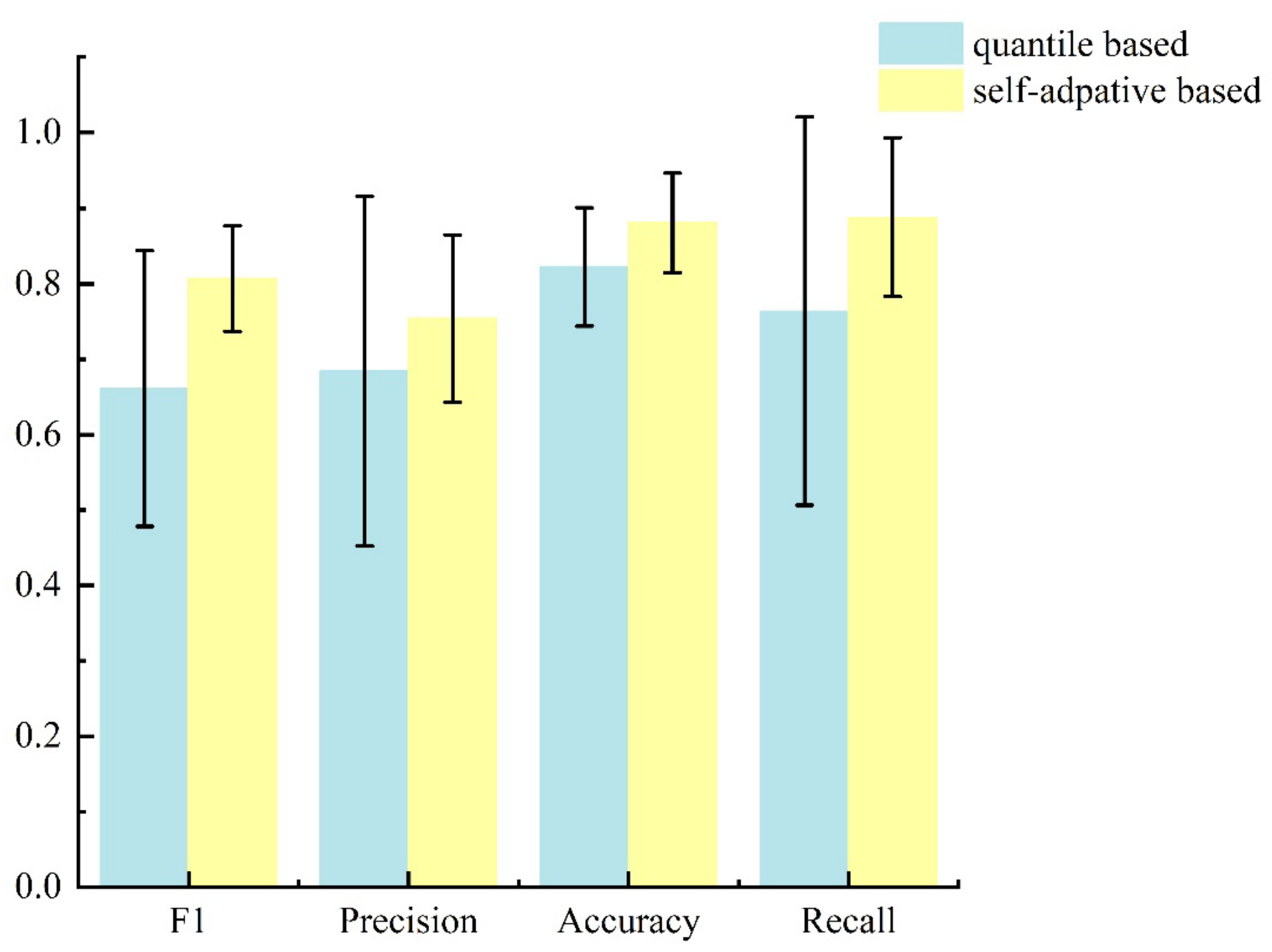
Figure 10 indicates that the proposed self-adaptive threshold method outperforms the conventional quantile-based approach in both accuracy and robustness. Using the median of the top 70% of samples as the reference baseline, the self-adaptive method achieves better performance than the quantile threshold approach, which attains a precision of 0.684 ± 0.232, a recall of 0.764 ± 0.257, an accuracy of 0.823 ± 0.079, and an F1-score of 0.661 ± 0.183. The inferior performance of quantile-based thresholding is due to its reliance on the full-series distribution, making it sensitive to “complex low values” induced by background noise, unstable low-radiance sensor responses, and subtle lighting fluctuations; this sensitivity limits its generalization across spatiotemporal settings. In contrast, by focusing on the high-brightness subset (top 70%), the self-adaptive method suppresses non-stationary variations in the low-value range and derives a physically meaningful baseline that represents normal supply conditions. This design enables more sensitive detection of radiance drops associated with power failures without requiring prior outage information, highlighting the robustness and physical interpretability of the proposed strategy.
Thirdly, the statistical filtering improves the robustness of the baseline. By calculating the mean of the upper 70th percentile of the time series, the model effectively suppresses non-stationary low-value disturbances such as residual cloud contamination and seasonal fluctuations. This design ensures that the baseline represents the stable radiance level under normal power supply conditions.
Finally, the multi-scenario training provides empirical evidence for generalization. The optimal parameters were derived from a diverse global dataset encompassing different disaster types and development levels. The stable performance observed under LOEO cross-validation further confirms that the framework maintains its reliability when applied to independent, previously unseen regions.
However, it should also be noted that the optimal parameter combination identified in this study, namely Xtop = 70 and k = 0.6, was derived from a limited set of representative outage events and therefore should not be regarded as universally optimal. When applying the framework to new regions or time periods, the parameters can be recalibrated following the same LOEO-based validation procedure used in this study, by introducing locally representative outage events and repeating the grid search within the predefined parameter space. In this way, parameter selection remains event-based and can be evaluated for stability under new observational and regional conditions. Therefore, the current parameter setting is better understood as an empirically supported solution under the present dataset rather than a fixed configuration for all applications.

5.3. Correlation with National-Scale Power Reliability Indicators

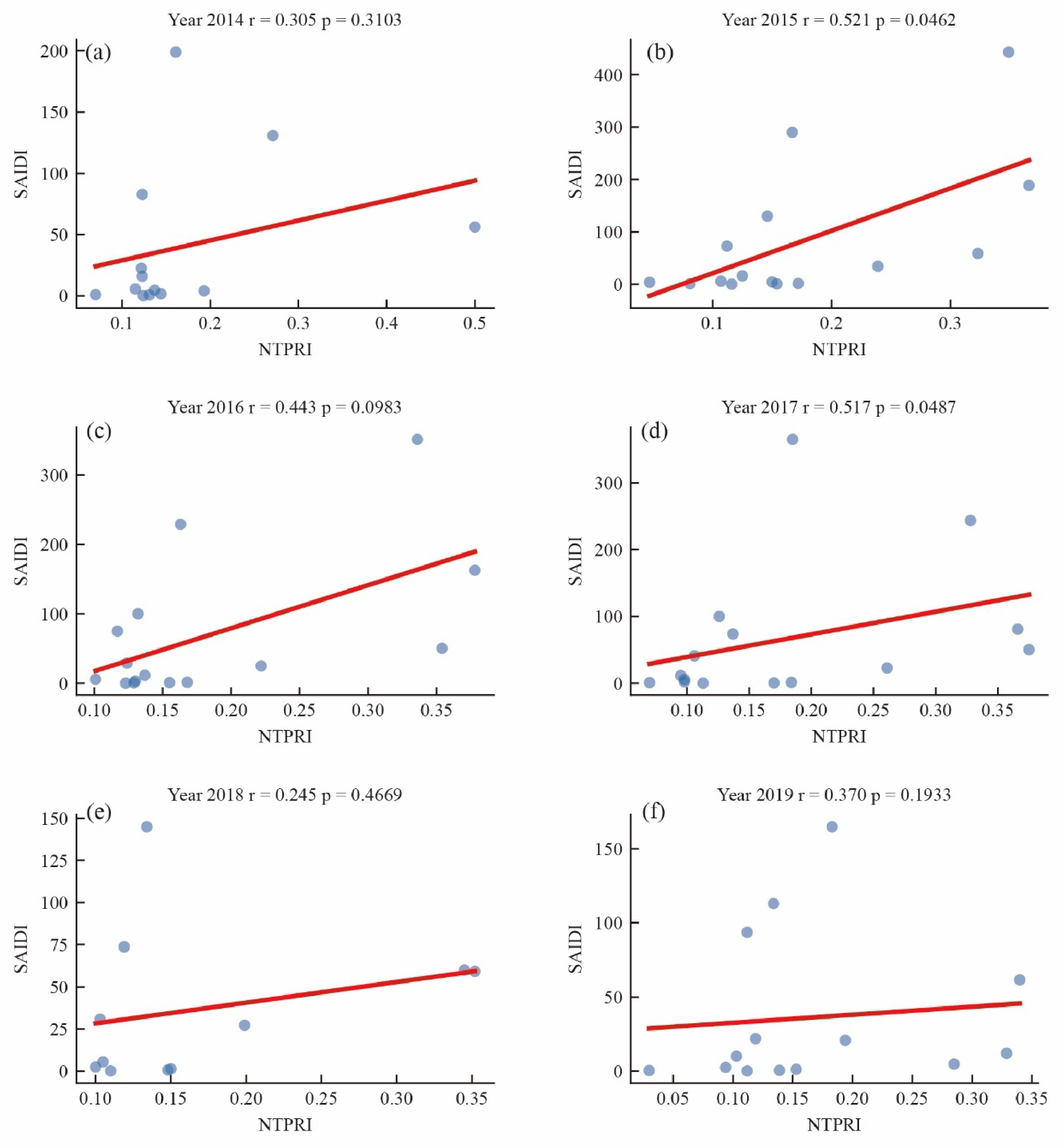
Figure 11 illustrates the annual national-scale correlations between NTPRI and SAIDI from 2014 to 2019. Overall, the correlation coefficients are positive in all years, indicating that increases in NTPRI are generally accompanied by increases in SAIDI, and that the two metrics show a certain degree of consistency in cross-country ranking. In other words, countries with lower power reliability tend to exhibit higher NTPRI values, suggesting that the nighttime-light-based index corresponds directionally with conventional statistical reliability measures. In terms of interannual variation, the correlations are relatively stronger in 2015 and 2017, with coefficients of 0.521 and 0.517, respectively, both reaching the 5% significance level. This indicates a clearer monotonic relationship between NTPRI and SAIDI in these two years. In 2016, the correlation coefficient is 0.443, indicating a moderate association. Although it does not meet the 5% significance threshold, it remains statistically significant at the 10% level, suggesting that a certain degree of correspondence still exists between the two metrics.
The correlations in the remaining years are comparatively weaker. The coefficients in 2014, 2018, and 2019 are 0.305, 0.245, and 0.370, respectively, none of which pass the significance test, indicating that the statistical association between the two metrics is less stable in these years. In particular, 2018 shows the lowest correlation coefficient and a relatively large p value, implying that the ability of NTPRI to explain differences in SAIDI-based ranking is weakest in that year. These interannual differences suggest that the relationship between NTPRI and SAIDI may be influenced by year-specific sample composition and cross-country heterogeneity. Nevertheless, such statistical fluctuations do not alter their overall positive co-variation. Since the correlation coefficients remain positive in all years and reach statistical significance in several years, NTPRI can be considered capable, to some extent, of capturing cross-country differences in reliability in a manner comparable to SAIDI. From the perspective of long-term and cross-regional comparison, NTPRI therefore shows potential as a complementary measure to conventional power reliability indicators.
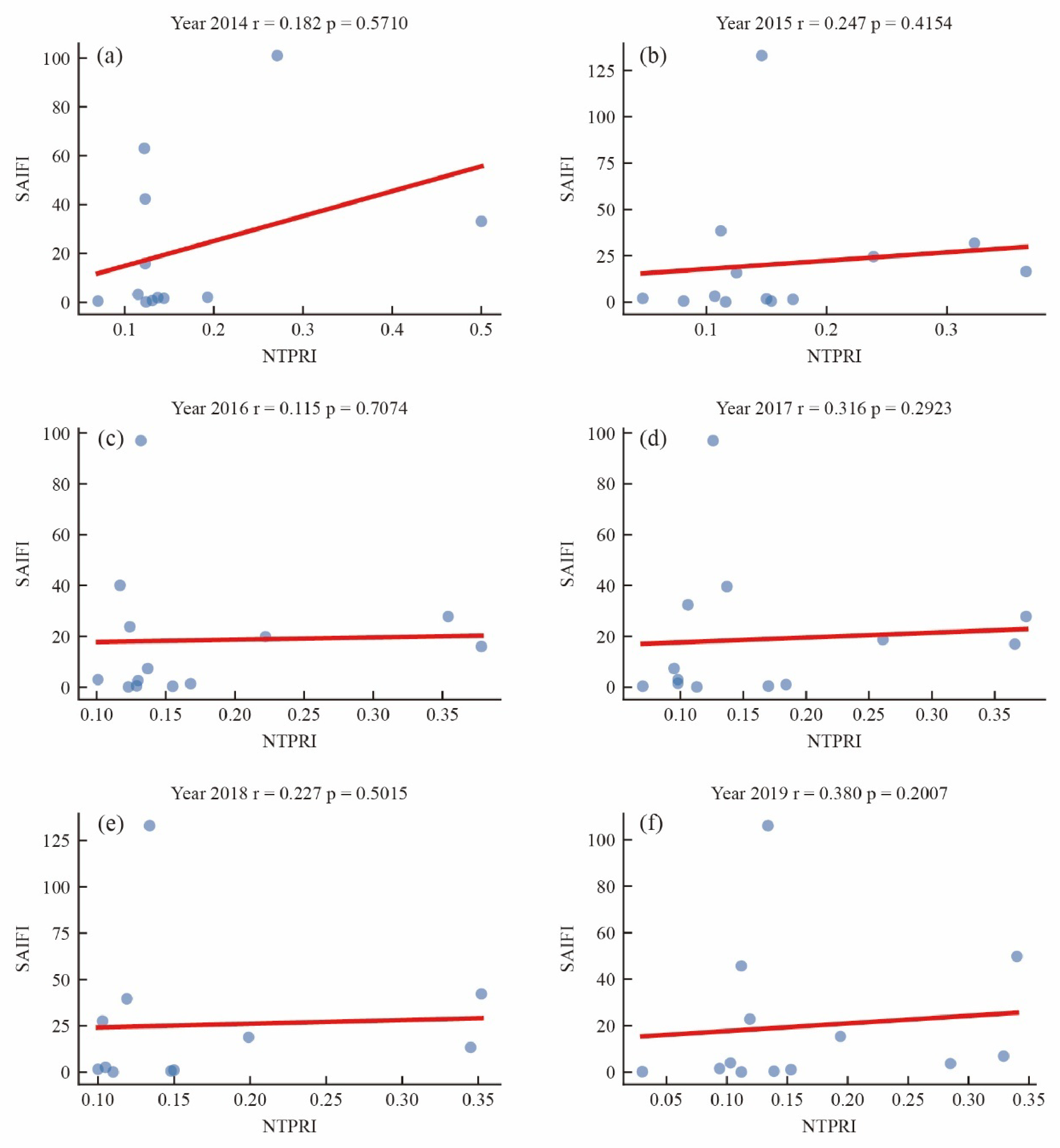
Figure 12 shows that NTPRI and SAIFI remain positively correlated during 2014 to 2019, although the association is consistently weak and does not reach statistical significance in any year. The annual correlation coefficients range from 0.115 to 0.380, with all p values greater than 0.1. While these results do not provide sufficient statistical evidence for a significant relationship, the consistently positive coefficients still suggest a modest directional correspondence between the two indicators.
This weak relationship should be understood as a methodological boundary of the NTPRI framework rather than a failure of validation. Because NTPRI is derived from nighttime light anomalies observed at a fixed nocturnal overpass time, it is inherently more sensitive to outages with longer duration and more sustained impacts. By contrast, SAIFI emphasizes interruption frequency, including short duration events that may occur outside the satellite overpass window, recover rapidly, or affect only limited areas. As a result, many high frequency outages may not produce stable or detectable nighttime light anomalies. In this sense, NTPRI is structurally more responsive to duration-related outage characteristics than to outage frequency, which provides a reasonable explanation for its weak association with SAIFI.

5.4. Limitations

Despite achieving the expected performance in cross-scenario power reliability assessment, this study still has several limitations.

5.4.1. Validation Dataset

Validation was primarily constrained by the lack of systematic utility outage records, necessitating the manual labeling of 65 representative samples. To ensure a robust evaluation, these cases were selected to encompass diverse socioeconomic contexts and power system development levels across various spatial scales and durations. Despite this representative selection, the limited sample size introduces inherent uncertainty into the results. This uncertainty arises primarily from a sample imbalance that favors large-scale and long-duration outages, specifically those lasting longer than one day. In contrast, short-duration and small-area outages, such as disruptions affecting individual neighborhoods for only a few hours, remain underrepresented in the current study. This distribution pattern is closely linked to the observational characteristics of nighttime light remote sensing. Specifically, large-scale outages typically yield stable and pronounced radiance reductions, whereas transient outages generate weaker signals that are easily confounded by cloud cover, viewing angle effects, and daily radiance fluctuations. Consequently, these factors significantly increase the difficulty of reliable manual labeling for minor events. Nevertheless, the current sample composition remains highly relevant to the study objective, which focuses on characterizing regional electricity supply stability through outage-related patterns detected from NTL observations. Regions experiencing extensive or prolonged outages are generally more likely to face pronounced electricity reliability problems; therefore, such events provide meaningful evidence for evaluating the proposed indicators. To address the remaining gaps, future work should incorporate systematic utility outage records to build larger and higher-frequency validation datasets. By improving temporal synchronization and spatial matching, such data will support a more rigorous assessment of short-duration and small-area outages and further strengthen the evaluation of remote sensing-based power reliability indicators.

5.4.2. Imbalance of Observational Samples

The utility of satellite-based nighttime light (NTL) observations is frequently constrained by limited and spatially uneven data availability. In equatorial regions or during meteorological disasters, cloud cover significantly reduces valid measurements compared to other regions or event types. Furthermore, limitations in cloud detection within NASA’s Black Marble products can lead to residual clouds being misclassified as anomalous NTL radiance perturbations. Such data scarcity in persistently cloudy regions not only compromises the robustness of anomaly detection but also necessitates stringent screening measures. While these quality control measures ensure input reliability, they inevitably exclude a significant portion of spatiotemporal observations. This results in an uneven spatial distribution of clear-sky pixels and insufficient sample support for pixel-level analysis, ultimately introducing systematic biases in anomaly rate statistics relative to actual electricity supply conditions.
Gap-filling is essential for capturing short-term NTL dynamics, yet quantitative accuracy remains elusive. Standard filled products often prioritize visualization over radiometric integrity [51], while existing spatiotemporal reconstruction frameworks [52,53] struggle with dense data loss and residual cloud contamination. The primary bottleneck lies in severe data scarcity: the lack of valid “similar pixels” constrains the effectiveness of decomposition algorithms (e.g., BEAST), hindering the detection of short-duration outages. Therefore, current gap-filling strategies may insufficiently represent abrupt lighting changes during extreme meteorological events.

5.4.3. Limitations in VZA Grouping and Sample Allocation

The VZA grouping strategy requires further refinement. The current two-step scheme determines the number of groups primarily according to the VZA, yet it does not explicitly enforce a balanced allocation of samples across groups. Consequently, the resulting bins may contain markedly different sample sizes, leading to uneven data distributions that can propagate into subsequent thresholding procedures. Since these procedures are often based on quantiles, the estimates become highly sensitive to the underlying sample distribution within each group. Such effects are likely to introduce additional uncertainties for pixels located in complex built environments, where outage detection requires higher precision. Future work should therefore focus on improving sliding-window mechanisms and developing adaptive grouping strategies. By better accounting for both angular characteristics and sample distribution, these improvements will provide a more robust representation of spatially heterogeneous pixels.

6. Conclusions

This study examines the application of nighttime light remote sensing to evaluate power system reliability. To mitigate the significant reliance of conventional outage detection methods on prior information and their restricted threshold generalizability, we propose an adaptive-threshold power anomaly detection method utilizing daily NTL data. Additionally, we develop the remote-sensing power reliability index NTPRI, which facilitates an objective characterization of supply stability in the absence of ground statistics.
Results indicate that view-angle grouping effectively mitigates angular effects. Additionally, constructing per-pixel adaptive baselines based on the statistical characteristics of high-brightness samples suppresses background variability in NTL time series and enhances the detectability of anomaly signals resulting from actual power interruptions. Validation across multiple representative outage events, characterized by diverse hazard mechanisms and power-development contexts, demonstrates stable performance and supports cross-regional applicability. Furthermore, national-scale analysis reveals significant consistency between NTPRI and the World Bank’s SAIDI over multiple years, thereby confirming the utility of NTPRI as a reliable indicator of supply reliability.
In contrast to methods that depend on fixed thresholds or manually labeled samples, the proposed framework eliminates the need for prior outage timing information. This characteristic renders it particularly advantageous for extensive, long-term monitoring of power reliability. Such an advantage holds significant promise for data-scarce regions, conflict zones, and swift post-disaster assessments, thereby providing additional evidence for analyses of energy infrastructure vulnerability, evaluations of disaster impacts, and monitoring of Sustainable Development Goals (SDGs).
Several limitations need to be acknowledged regarding the proposed framework. Nighttime light variations can be influenced by socioeconomic activities, seasonal lighting patterns, and atmospheric conditions, which may affect the precise isolation of outage signals. Furthermore, the current validation relies on a manually labeled dataset that favors large-scale and long-duration outages, meaning the detection of transient or localized events requires more extensive assessment. The stability of the indicators in regions with persistent cloud cover or imbalanced VZA sample distributions also warrants further investigation. Subsequent research could incorporate multi-source data and adaptive grouping strategies to enhance the characterization of short-duration outages across more diverse geographical and development contexts.

Author Contributions

Conceptualization, X.C.; methodology, N.X., X.C. and M.C.; software, N.X. and M.C.; validation, N.X.; formal analysis, N.X. and M.C.; investigation, N.X., X.C. and M.C.; resources, N.X. and M.C.; data curation, N.X. and M.C.; writing—original draft preparation, N.X.; writing—review and editing, X.C.; visualization, N.X.; supervision, X.C.; project administration, X.C.; funding acquisition, X.C. All authors have read and agreed to the published version of the manuscript.

Funding

This research was funded by the National Natural Science Foundation of China, grant number 42371334 and 42192584.

Data Availability Statement

The data that support the findings of this study are available from the corresponding authors upon reasonable request.

Conflicts of Interest

The authors declare no conflicts of interest.

References

  1. United Nations. The Sustainable Development Goals Report 2024; United Nations: New York, NY, USA, 2024.
  2. Çam, E.; Casanovas, M.; Moloney, J. Electricity 2025: Analysis and Forecast to 2027; IEA: Paris, France, 2025.
  3. Billinton, R.; Wojczynski, E. Distributional Variation Of Distribution System Reliability Indices. IEEE Trans. Power Appar. Syst. 1985, PAS-104, 3151–3160. [Google Scholar] [CrossRef]
  4. Bennett, M.M.; Smith, L.C. Advances in Using Multitemporal Night-Time Lights Satellite Imagery to Detect, Estimate, and Monitor Socioeconomic Dynamics. Remote Sens. Environ. 2017, 192, 176–197. [Google Scholar] [CrossRef]
  5. Zhu, Z.; Zhou, Y.; Seto, K.C.; Stokes, E.C.; Deng, C.; Pickett, S.T.A.; Taubenböck, H. Understanding an Urbanizing Planet: Strategic Directions for Remote Sensing. Remote Sens. Environ. 2019, 228, 164–182. [Google Scholar] [CrossRef]
  6. Zhao, M.; Zhou, Y.; Li, X.; Cao, W.; He, C.; Yu, B.; Li, X.; Elvidge, C.D.; Cheng, W.; Zhou, C. Applications of Satellite Remote Sensing of Nighttime Light Observations: Advances, Challenges, and Perspectives. Remote Sens. 2019, 11, 1971. [Google Scholar] [CrossRef]
  7. Chen, M.; Hu, Y.; Cao, X.; Li, S.; Liu, L. Assessing Electricity Supply Reliability by Detection of Anomalies in Daily Nighttime Light. IEEE J. Sel. Top. Appl. Earth Obs. Remote Sens. 2025, 18, 2990–2999. [Google Scholar] [CrossRef]
  8. Dugoua, E.; Kennedy, R.; Shiran, M.; Urpelainen, J. Assessing Reliability of Electricity Grid Services from Space: The Case of Uttar Pradesh, India. Energy Sustain. Dev. 2022, 68, 441–448. [Google Scholar] [CrossRef]
  9. Min, B.; O’Keeffe, Z.; Zhang, F. Whose Power Gets Cut? Using High-Frequency Satellite Images to Measure Power Supply Irregularity; World Bank: Washington, DC, USA, 2017. [Google Scholar]
  10. Allan, R.N. Reliability Evaluation of Power Systems; Springer: New York, NY, USA, 1996; ISBN 978-0-306-45259-8. [Google Scholar]
  11. He, M.; Xu, Q.; Wang, W.; Shao, Z.; Li, X. Multiscale Estimation of Electrification Rate Using Night-Time Light Imagery. IEEE J. Sel. Top. Appl. Earth Obs. Remote Sens. 2023, 16, 8960–8968. [Google Scholar] [CrossRef]
  12. Xu, J.; Qiang, Y.; Cai, H.; Zou, L. Power Outage and Environmental Justice in Winter Storm Uri: An Analytical Workflow Based on Nighttime Light Remote Sensing. Int. J. Digit. Earth 2023, 16, 2259–2278. [Google Scholar] [CrossRef]
  13. Elvidge, C.D.; Hsu, F.-C.; Zhizhin, M.; Ghosh, T.; Taneja, J.; Bazilian, M. Indicators of Electric Power Instability from Satellite Observed Nighttime Lights. Remote Sens. 2020, 12, 3194. [Google Scholar] [CrossRef]
  14. Shah, Z.; Klugman, N.; Cadamuro, G.; Hsu, F.-C.; Elvidge, C.D.; Taneja, J. The Electricity Scene from above: Exploring Power Grid Inconsistencies Using Satellite Data in Accra, Ghana. Appl. Energy 2022, 319, 119237. [Google Scholar] [CrossRef]
  15. Cole, T.A.; Wanik, D.W.; Molthan, A.L.; Román, M.O.; Griffin, R.E. Synergistic Use of Nighttime Satellite Data, Electric Utility Infrastructure, and Ambient Population to Improve Power Outage Detections in Urban Areas. Remote Sens. 2017, 9, 286. [Google Scholar] [CrossRef]
  16. Per Capita Electricity Generation. Available online: https://ourworldindata.org/grapher/per-capita-electricity-generation (accessed on 1 April 2026).
  17. Flash Floods, Mudslides Kill 13 People in South Korea. Available online: https://www.aljazeera.com/news/2020/8/4/flash-floods-mudslides-kill-13-people-in-south-korea (accessed on 8 January 2026).
  18. The Associated Press Nicholas Weakens to Tropical Depression, Makes Slow Crawl over Texas and Louisiana. Available online: https://www.cbc.ca/news/world/hurricane-nicholas-landfall-texas-1.6174794 (accessed on 8 January 2026).
  19. Reuters East China Braces for Typhoon In-Fa After Flooding in Country’s Center. Available online: https://www.cnn.com/2021/07/25/china/typhoon-in-fa-china-landfall-intl-hnk (accessed on 8 January 2026).
  20. Baggu, M. Puerto Rico Grid and Recovery Post Hurricane Maria; National Renewable Energy Laboratory (NREL): Golden, CO, USA, 2022.
  21. Ali, I.; Hayatsever, H. US Jet Shoots down Turkish Drone in Syria, Pentagon Says. Available online: https://www.reuters.com/world/turkish-officials-says-ground-operation-into-syria-an-option-after-bombing-2023-10-05/ (accessed on 8 January 2026).
  22. bne Intellinews. Turkey Accused of Bombing Critical Civilian Infrastructure in Syria during October Drone Blitz. Available online: https://www.intellinews.com/turkey-accused-of-bombing-critical-civilian-infrastructure-in-syria-during-october-drone-blitz-298835/ (accessed on 8 January 2026).
  23. S, V. Cyclone Fengal: Heavy Rainfall Causes Widespread Power Outages Across Chennai and Suburbs. Available online: https://timesofindia.indiatimes.com/city/chennai/chennai-rainfall-causes-widespread-power-outages-across-city-and-suburbs/articleshow/115839767.cms (accessed on 8 January 2026).
  24. TEPCO Renewable Power, Incorporated TEPCO Renewable Power to Participate in Dariali Hydropower Project in Georgia- Company’s Second Hydropower Project Overseas. Available online: https://www.tepco.co.jp/en/rp/about/newsroom/press/archives/2020/20200428_01.html (accessed on 29 January 2026).
  25. Cekuta, R.F. Tamta Gegechkori Georgia’s Hydropower Dilemma. Available online: https://www.caspianpolicy.org/research/energy/georgias-hydropower-dilemma (accessed on 29 January 2026).
  26. Morrison, F. External Factors Responsible for 49 Percent of Power Outages Last Year—Guyana Chronicle. Available online: https://guyanachronicle.com/2025/03/14/external-factors-responsible-for-49-percent-of-power-outages-last-year/ (accessed on 30 January 2026).
  27. Newsday Kariba Dam Faces Shutdown. Available online: https://bulawayo24.com/index-id-news-sc-national-byo-245232.html (accessed on 29 January 2026).
  28. Hansrod, Z. Record Low Kariba Dam Levels See Zimbabwe, Zambia Facing Drastic Power Cuts. Available online: https://www.rfi.fr/en/africa/20221212-record-low-levels-at-kariba-dam-leave-zimbabwe-zambia-facing-drastic-power-cuts (accessed on 29 January 2026).
  29. Buwerimwe, S. Load Shedding Here to Stay, Says Zesa. Available online: https://www.newsday.co.zw/thestandard/news/article/200036350/load-shedding-here-to-stay-says-zesa (accessed on 18 February 2026).
  30. Román, M.O.; Wang, Z.; Sun, Q.; Kalb, V.; Miller, S.D.; Molthan, A.; Schultz, L.; Bell, J.; Stokes, E.C.; Pandey, B. NASA’s Black Marble Nighttime Lights Product Suite. Remote Sens. Environ. 2018, 210, 113–143. [Google Scholar] [CrossRef]
  31. Hu, T.; Wang, T.; Yan, Q.; Chen, T.; Jin, S.; Hu, J. Modeling the Spatiotemporal Dynamics of Global Electric Power Consumption (1992–2019) by Utilizing Consistent Nighttime Light Data from DMSP-OLS and NPP-VIIRS. Appl. Energy 2022, 322, 119473. [Google Scholar] [CrossRef]
  32. Hu, Y.; Zhou, X.; Yamazaki, D.; Chen, J. A Self-Adjusting Method to Generate Daily Consistent Nighttime Light Data for the Detection of Short-Term Rapid Human Activities. Remote Sens. Environ. 2024, 304, 114077. [Google Scholar] [CrossRef]
  33. Schiavina, M.; Melchiorri, M.; Pesaresi, M. GHS-SMOD R2023A-GHS Settlement Layers, Application of the Degree of Urbanisation Methodology (Stage I) to GHS-POP R2023A and GHS-BUILT-S R2023A, Multitemporal (1975–2030). Available online: http://data.europa.eu/89h/a0df7a6f-49de-46ea-9bde-563437a6e2ba (accessed on 1 April 2026).
  34. Harmonised Global Definition of Cities and Settlements. Available online: https://human-settlement.emergency.copernicus.eu/degurbaDefinitions.php (accessed on 18 February 2026).
  35. Dobson, J.E.; Bright, E.A.; Coleman, P.R.; Durfee, R.C.; Worley, B.A. LandScan: A Global Population Database for Estimating Populations at Risk. Photogramm. Eng. Remote Sens. 2000, 66, 849–857. [Google Scholar]
  36. Bright, E.; Rose, A.; Urban, M. LandScan Global 2014. Available online: https://landscan.ornl.gov/ (accessed on 21 February 2026).
  37. Cao, C.; Shao, X.; Uprety, S. Detecting Light Outages After Severe Storms Using the S-NPP/VIIRS Day/Night Band Radiances. IEEE Geosci. Remote Sens. Lett. 2013, 10, 1582–1586. [Google Scholar] [CrossRef]
  38. Wang, Z.; Román, M.O.; Shrestha, R.; Yao, T.; Kalb, V. Black Marble User Guide (Collection 2.0). Available online: https://viirsland.gsfc.nasa.gov/PDF/BlackMarbleUserGuide_Collection2.0.pdf (accessed on 2 March 2026).
  39. Li, X.; Ma, R.; Zhang, Q.; Li, D.; Liu, S.; He, T.; Zhao, L. Anisotropic Characteristic of Artificial Light at Night—Systematic Investigation with VIIRS DNB Multi-Temporal Observations. Remote Sens. Environ. 2019, 233, 111357. [Google Scholar] [CrossRef]
  40. Li, T.; Zhu, Z.; Wang, Z.; Román, M.O.; Kalb, V.L.; Zhao, Y. Continuous Monitoring of Nighttime Light Changes Based on Daily NASA’s Black Marble Product Suite. Remote Sens. Environ. 2022, 282, 113269. [Google Scholar] [CrossRef]
  41. Mann, M.L.; Melaas, E.K.; Malik, A. Using VIIRS Day/Night Band to Measure Electricity Supply Reliability: Preliminary Results from Maharashtra, India. Remote Sens. 2016, 8, 711. [Google Scholar] [CrossRef]
  42. International Energy Agency. Kenya 2024; International Energy Agency: Paris, France, 2025. [Google Scholar]
  43. Energy and Petroleum Regulatory Authority. Biannual Energy & Petroleum Statistics Report, Financial Year 2024/2025; Energy and Petroleum Regulatory Authority: Nairobi, Kenya, 2025.
  44. Kenya: Floods and Landslides—Apr 2020|ReliefWeb. Available online: https://reliefweb.int/disaster/fl-2020-000128-ken (accessed on 25 March 2026).
  45. Kenya Power Restores Electricity After Nationwide Blackout. Available online: https://www.the-star.co.ke/news/2020-05-09-kenya-power-restores-electricity-after-nationwide-blackout (accessed on 25 March 2026).
  46. Reuters Kenya Suffers Second Major Blackout in Week, 70% of Power Restored. Available online: https://www.reuters.com/business/energy/kenya-suffers-second-major-blackout-week-some-power-back-2024-09-06/ (accessed on 2 February 2026).
  47. Reuters Power Restored to Parts of Kenya After Nationwide Blackout. Available online: https://www.reuters.com/world/africa/power-restored-parts-kenya-after-nationwide-blackout-2023-03-04/ (accessed on 14 July 2025).
  48. Reuters Kenyan Minister Apologises After Main Airport Terminal Loses Power in Blackout. Available online: https://www.reuters.com/world/africa/kenyan-minister-apologises-after-main-airport-loses-power-blackout-2023-08-26/ (accessed on 14 July 2025).
  49. Reuters Power Restored in Kenya After Nationwide Blackout. Available online: https://www.reuters.com/world/africa/kenya-suffers-nationwide-blackout-after-major-transmission-line-breaks-2022-01-11/ (accessed on 14 July 2025).
  50. Wang, Z.; Shrestha, R.M.; Roman, M.O.; Kalb, V.L. NASA’s Black Marble Multiangle Nighttime Lights Temporal Composites. IEEE Geosci. Remote Sens. Lett. 2022, 19, 1–5. [Google Scholar] [CrossRef]
  51. Tan, X.; Zhu, X. CRYSTAL: A Novel and Effective Method to Remove Clouds in Daily Nighttime Light Images by Synergizing Spatiotemporal Information. Remote Sens. Environ. 2023, 295, 113658. [Google Scholar] [CrossRef]
  52. Hao, X.; Liu, J.; Heiskanen, J.; Maeda, E.E.; Gao, S.; Li, X. A Robust Gap-Filling Method for Predicting Missing Observations in Daily Black Marble Nighttime Light Data. GIScience Remote Sens. 2023, 60, 2282238. [Google Scholar] [CrossRef]
  53. Zheng, Q.; Mu, T.; Zhu, X.; Tan, X.; Zhou, Y.; Li, J.; He, S.Y. Robust Reconstruction of Seamless Daily VIIRS Nighttime Light Imagery with Cloud Mask Refinement and Multi-Strategy Spatiotemporal Gap-Filling. Remote Sens. Environ. 2026, 337, 115328. [Google Scholar] [CrossRef]
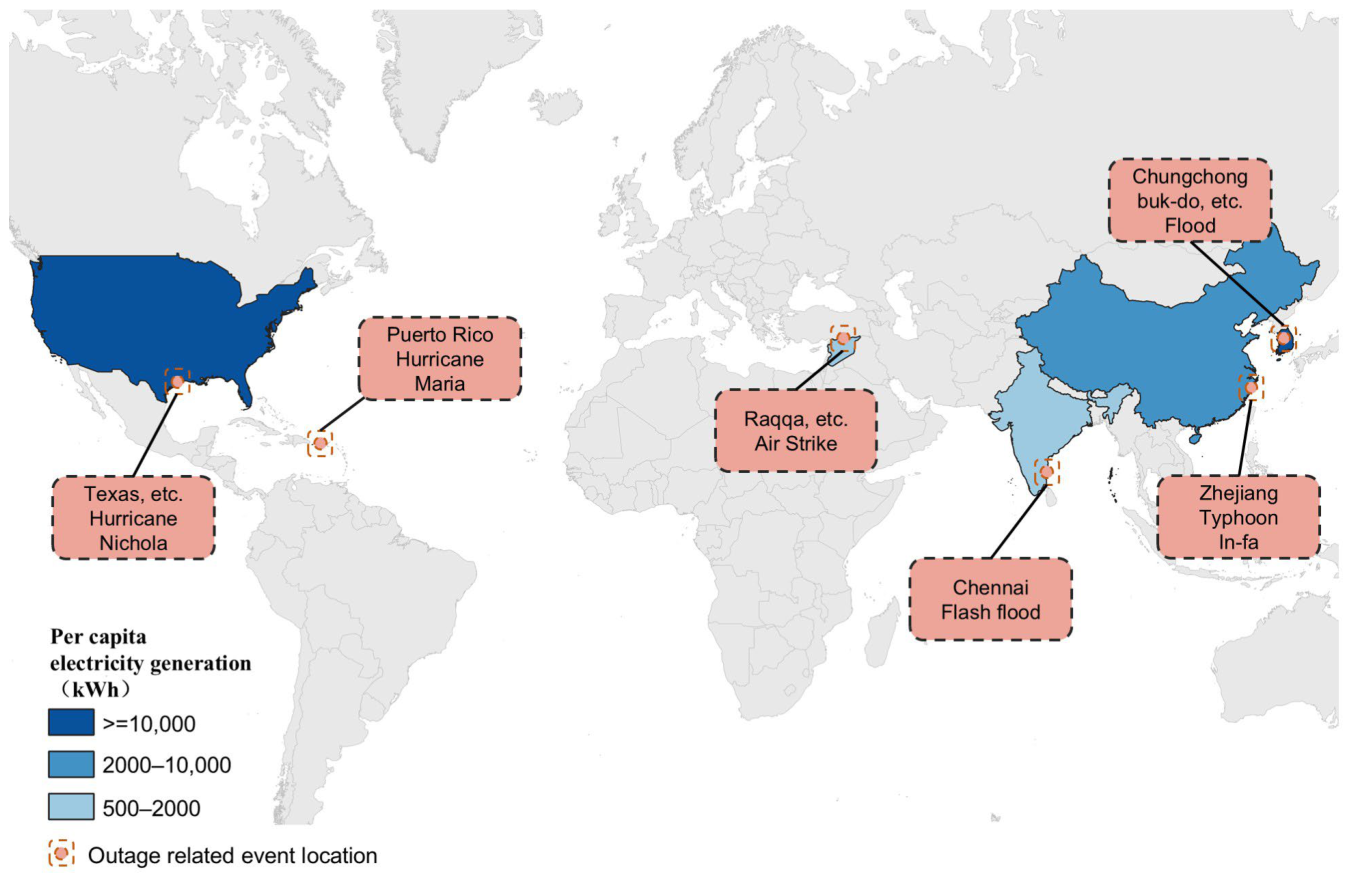
Figure 1. The location and cause of the power outage events related to the selected samples, as well as the EGPC level in the area where they are located.
Remotesensing 18 01417 g001
Figure 2. Schematic illustration of the time-series data and positive/negative labeling process for outage sample points. Panels (df) show the annual raw NTL time series for three representative sample points, where blue dots denote valid NTL observations, gray dots indicate missing data, and the yellow shaded band marks the selected sampling window used for labeling. Panels (ac) are enlarged views of the corresponding yellow shaded windows in panels (df), respectively, and display the samples extracted within each window. In panels (ac), red dots represent outage samples and black dots represent normal samples. Panels (a) and (d) correspond to the conflict-related outage case represented by Event 18, whereas panels (b) and (e), as well as (c) and (f), correspond to the natural-hazard-related outage cases represented by Events 11 and 24, respectively.
Remotesensing 18 01417 g002
Figure 3. Representative countries: overview of socioeconomic indicators and line charts of the power reliability statistics (SAIFI and SAIDI). For each country, the left panel summarizes population, GDP per capita, and income level, while the right panel presents annual SAIFI (left axis) and SAIDI (right axis) from 2014 to 2019. Subfigures (ao) correspond to different countries.
Remotesensing 18 01417 g003
Figure 4. Research framework diagram.
Remotesensing 18 01417 g004
Figure 5. The F1 score result of the combination of coefficients X and k.
Remotesensing 18 01417 g005
Figure 6. Long-term evolution of NTPRI from 2014 to 2024 across income groups: (a) high-income countries; (b) upper-middle-income countries; (c) lower-middle-income countries; and (d) low-income countries.
Remotesensing 18 01417 g006
Figure 7. Interannual variations in NTPRI for the top six populous second-level administrative regions in Kenya. (a) Spatial distribution of the selected regions within Kenya. Subfigures (a-1a-6) show the annual NTPRI time series for Kiambu, Nairobi, Nyamira, Kisii, Vihiga, and Mombasa, respectively.
Remotesensing 18 01417 g007
Figure 8. (ak) Spatial distribution of LAR in Siem Reap District, Cambodia, from 2014 to 2024; (l) Google Earth basemap.
Remotesensing 18 01417 g008
Figure 9. Performance comparison among different angular-effect mitigation methods.
Remotesensing 18 01417 g009
Figure 10. Performance comparison between quantile-based and self-adaptive-based threshold methods.
Remotesensing 18 01417 g010
Figure 11. Interannual Rank Correlation between NTPRI and SAIDI (2014–2019). Points represent country-level observations for each year, and the red line indicates the linear fit. Subfigures (af) correspond to the years 2014–2019, with the correlation coefficient (r) and p-value reported in each panel.
Remotesensing 18 01417 g011
Figure 12. Interannual Rank Correlation between NTPRI and SAIFI (2014–2019). Points represent country-level observations for each year, and the red line indicates the linear fit. Subfigures (af) correspond to the years 2014–2019, with the correlation coefficient (r) and p-value reported in each panel.
Remotesensing 18 01417 g012
Table 1. Information on the area where the power-off samples are located.
Per Capita Electricity Generation (kWh)Event IdLocationCountryEventPeriodNumber of Samples
>= 10,00025Chungchongbuk-do, Kyonggi-doSouth KoreaFlood1 August 2020–12 August 202012
9Louisiana, TexasAmericaHurricane Nichola12 September 2021–17 September 202113
2000–10,00011ZhejiangChinaTyphoon In-fa21 July 2021–28 July 202110
24Aguadilla, San JuanPuerto RicoHurricane ‘Maria’19 September 2017–21 September 20179
500–200018Raqqa, Hassakeh, AleppoSyrianAir strike5 October 2023–20 October 20239
23ChennaiIndiaFlash flood30 October 2017–8 November 201712
Table 2. Sensitivity analysis of the k value of the Top70 baseline.
kF1AccuracyPrecisionRecall
0.1 0.147 0.667 0.762 0.090
0.2 0.418 0.830 0.835 0.321
0.3 0.537 0.807 0.871 0.463
0.4 0.652 0.929 0.893 0.586
0.5 0.750 0.868 0.900 0.725
0.6 0.807 0.754 0.881 0.888
0.7 0.723 0.590 0.812 0.956
0.8 0.588 0.429 0.660 0.976
0.9 0.483 0.328 0.470 0.983
Table 3. Theil–Sen and Mann–Kendall trend analysis results of various countries.
CountrySlopeSignificanceTrend
KOR−0.0026 ***decrease
BEL0.0033 NSincrease
EST0.0291 **increase
POL0.0005 NSincrease
JOR0.0004 NSincrease
NER0.0115 ***increase
NIC0.0046 ***increase
GEO0.0080 NSincrease
URY−0.0020 *decrease
PRY−0.0004 NSdecrease
GUY0.0038 **increase
UGA−0.0047 NSdecrease
KHM−0.0081 ***decrease
ZWE0.0054 NSincrease
KEN−0.0025 NSdecrease
*** p < 0.01, ** p < 0.05, * p < 0.1; NS: Not Significant.
Disclaimer/Publisher’s Note: The statements, opinions and data contained in all publications are solely those of the individual author(s) and contributor(s) and not of MDPI and/or the editor(s). MDPI and/or the editor(s) disclaim responsibility for any injury to people or property resulting from any ideas, methods, instructions or products referred to in the content.