


Highlights
What are the main findings?
- Daytime clear-air echo heights are coupled with the lifting condensation level (LCL), while nocturnal clear-air echo heights exhibit a significant lagged correlation with their daytime counterparts, providing key thermodynamic priors for guiding the deep learning model.
- The proposed PhySNet framework achieves superior performance, reaching a 98.28% probability of detection (POD) with a 1.18% false-alarm rate (FAR) for meteorological echoes, and a 95.87% POD with a 5.92% FAR for clear-air echoes.
What are the implications of the main findings?
- Integrating thermodynamic priors with spatiotemporal radar features advances radar quality control beyond purely data-driven models, enhancing the physical interpretability of the algorithm.
- The ECH-based dynamic post-processing establishes a closed-loop physics-guided framework by using the model’s own predictions to constrain filtering regions. This design optimizes the balance between signal retention and clutter removal, while also offering valuable insights for atmospheric boundary layer research.
Abstract
Accurate echo classification is crucial for Millimeter-wave Cloud Radar (MMCR) data quality control. Existing approaches, however, often struggle to generalize across complex scenes or lack physical interpretability. Here we propose PhySNet, a physics-guided network that combines thermodynamic priors with spatiotemporal radar features, embedding physical information across the full pipeline from feature extraction to final outputs. Based on the coupling between the lifting condensation level (LCL) and daytime clear-air echo heights, and the lagged correlation between nocturnal clear-air echo heights and their daytime counterparts, we design a physics-constrained gating block (PCGB). The PCGB extracts thermodynamic states and evolution trends from collocated surface observations, generating a clear-air echo probability map that weights the initial radar features. Building on this, we add a parallel regression branch of effective-clutter-height (ECH). This branch fuses thermodynamic features with radar spatiotemporal features, enabling the model to learn to predict the clear-air echo boundary. Finally, we apply an adaptive height filter using the predicted ECH sequence to refine the classification results. Evaluated on a multi-region, multi-season dataset from China, PhySNet achieves a probability of detection (POD) of 98.28% for meteorological echoes and 95.87% for clear-air echoes, outperforming conventional methods. By coupling data-driven learning with physical rules, our approach provides a high-accuracy, interpretable solution for cloud radar clear-air echo identification.
1. Introduction
Millimeter-wave Cloud Radar (MMCR) can capture the microphysical structures of clouds particles sensitively, with high spatiotemporal resolutions that makes them a core instrument in cloud precipitation physics research, nowcasting and weather modification scenarios. However, this high sensitivity makes them vulnerable to clear-air echoes caused by insects, dust, and turbulence [1], which severely limit the performance of retrieval algorithms and the application of downstream products.
Traditional quality control schemes for clear-air echoes rely on empirical rules and shallow machine learning. Fixed-threshold methods typically use reflectivity (Z) and the linear depolarization ratio (LDR) [2]. They compute efficiently, yet are sensitive to changing atmospheric conditions. Morphological filtering uses convolution kernels designed from echo geometry [3], and these methods struggle to process complex sheet-like clutter or clutter contiguous with meteorological echoes.
Machine learning is increasingly used to overcame the limitations of manual parameter selection. Early studies applied neural networks to weather radar data [4,5,6], and later work explored feature selection algorithms combined with shallow neural networks to separate echoes [7]. Hou et al. [8] integrated the LightGBM algorithm with dynamic neighborhood filtering, showing that ensemble methods can balance clutter removal and signal retention. More recently, deep learning has gained traction in meteorology. By treating radar profiles as 2D images, the quality control task is transformed into a semantic segmentation problem. Purely data-driven deep learning models, such as the CR-Unet architecture developed by Liu et al. [9], stack multiple radar variables into feature channels to directly segment echoes, eliminating the need for manual feature selection.
Despite their strong feature extraction power, these purely data-driven models face distinct challenges when dealing with clear-air echoes. Unlike static ground clutter, clear-air echoes are highly dynamic, and their formation and dissipation depend strongly on near-surface thermodynamic conditions [10]. In complex scenarios where meteorological and clear-air echoes heavily overlap in the feature space, models lacking awareness of this environmental background may learn false correlations and produce results that violate physical common sense.
Recently, physics-aware deep learning paradigms that integrate physical knowledge into the model construction process have been developed. Examples include theory-guided data science [11] and physics-informed neural networks [12]. This type of approach effectively enhances the performance and physical interpretability of the constructed model [13,14]. Weather forecasting tasks [15,16,17] are also shifting from purely data-driven models to physics-integrated frameworks [18]. Inspired by this, we propose a deep learning framework that combines thermodynamic priors with spatiotemporal radar features. We embed physical information throughout the entire pipeline to deeply integrate data-driven learning and physical rules. The rest of this paper is organized as follows: Section 2 introduces the employed data and preprocessing approach. Section 3 details the PhySNet framework. Section 4 analyzes the experimental results. Section 5 provides a summary and a discussion.
2. Data Sources and Preprocessing
In this study, a multisource fusion dataset comprising base MMCR data, collocated conventional surface observations, and pixel-level manual annotations is constructed.
2.1. Multisource Observational Data
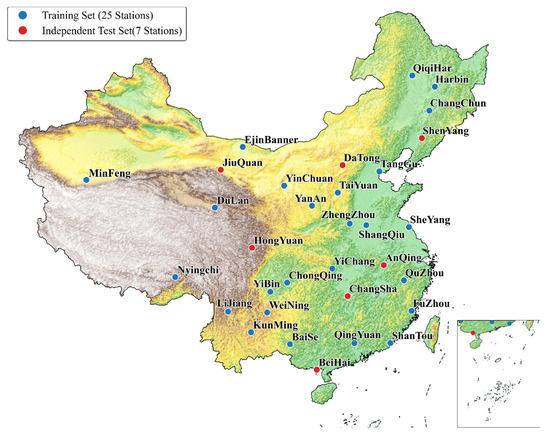
For the data quality control task, we choose radar reflectivity (Z) as the main target. The algorithm produces a mask with the same dimensions as those of Z; all the observation variables share this quality control flag. The target instrument in this study is the vertically pointing Ka-band cloud radar. Its center frequency is 35 GHz (wavelength ~8.6 mm) and its antenna beamwidth is 0.4°. As shown in Figure 1 and Table 1, the data come from 32 representative stations across China and cover the whole year of 2025. These stations span a wide geographical range, from coastal areas to inland deserts and from the margins of the Qinghai–Tibet Plateau to the humid plains of eastern China, covering arid, semi-arid, humid, and plateau climate zones.
Figure 1.
Research area and geographical distribution of the cloud radar stations. Blue markers: the stations used for model training and validation. Red markers: independent test stations. Note: The base map is derived from the standard map GS(2020)3184 downloaded from the Ministry of Natural Resources of the P.R.C., without any modification to the boundaries.
Table 1.
Overview of the multisource fusion dataset constructed in this study.
Radar observations alone cannot capture the large-scale thermodynamic background of the target task—information key for separating echoes with different physical origins. While ERA5 reanalysis or sounding data provide vertical profiles [19], their low temporal resolution fails to match minute-level radar observations, and forced interpolation may introduce uncontrollable artificial errors [20,21].
This study focuses on clear-air echoes, which primarily occur within the atmospheric boundary layer, with their growth and decay trends strongly linked to near-surface thermodynamic states. Sharing the same temporal resolution as cloud radar data, surface observations can capture the thermodynamic evolution at the bottom of the boundary layer [22].
2.2. Labeling and Data Preprocessing
To provide a reliable training baseline, we constructed a manually annotated dataset of high quality. The annotation procedure combined visual interpretation of cloud radar elements Z, V, W and the LDR with collocated observations from all-sky cameras, aerosol lidars, and present weather sensors. The labeling process was conducted on our dataset platform, where each sample was independently labeled by a pair of meteorological experts. Statistical analysis of the platform logs indicates an average pixel-level labeling agreement rate of 93.7%; any discrepancies were resolved by a third expert. On the basis of these results, we divided all the pixels into three classes, labeling clear-air echoes as 0, meteorological echoes (clouds, fog, and precipitation) as 1, and invalid values as 2.
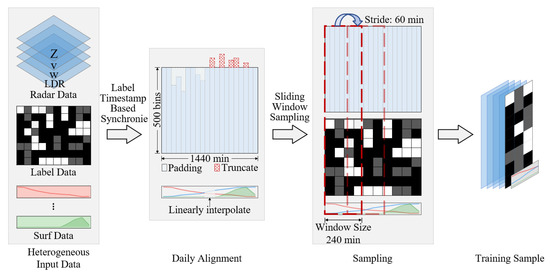
To satisfy the model input requirements, the multi-source data need to be aligned and standardized. Vertically, we truncated or padded all the radar data into 500 range bins; temporally, we used a 1 min baseline to strictly match the radar and surface data at a 1:1 ratio, yielding daily matrices with dimensions of [500, 1440]. Also, we filled any missing radar data with invalid values that the model can automatically mask to ensure data completeness. Considering the slow physical variation in surface observations, we applied linear interpolation to short-term gaps, maintaining the continuity of the thermodynamic environment. For long-term missing, we discarded the corresponding radar samples to prevent the accumulation of errors. To fit within GPU memory limits and maintain temporal continuity, we applied a sliding window-based sampling strategy. Thus, the daily data were sliced into sample sequences with dimensions of [500, 240], setting the window length to 240 min and the step size to 60 min. The data preprocessing and sample construction workflow is shown in Figure 2.
Figure 2.
Data preprocessing and sample construction workflow.
3. Methodology
3.1. Physical Modeling Mechanism
Studies have shown that the vertical extent of clear-air echoes depends mainly on the atmospheric boundary layer height (ABLH) [23]. In practice, obtaining high-resolution and accurate ground-truth ABLH values is very difficult. LCL represents near-surface moisture and thermodynamic trends and possesses the same thermodynamic drivers as ABLH does—both depend on the daily changes exhibited by surface sensible and latent heat fluxes and the land–atmosphere coupling strength [24]. Su and Zhang [25] confirmed this concept in their deep learning-based ABLH retrieval study, reporting that the LCL is a key factor, second only to temperature profiles. More importantly, we can calculate minute-level LCLs using routine surface observations and Bolton’s formula [26], a strategy that sharply captures real-time changes in the thermodynamic structure of the boundary layer [27].
In the real atmosphere, clear-air echo heights often exhibit nonlinear deviations from the theoretical LCL due to complex factors such as strong convective mixing, terrain variations, and biological activity [28]. Nevertheless, as a strong derivative of surface thermodynamic states, the LCL still provides a vital thermodynamic reference for defining the vertical extent of clear-air echoes. Therefore, we propose the concept of the effective clutter height (ECH). It builds a physical upper bound that dynamically adapts to the current moisture and thermodynamic conditions, and represents the maximum vertical extent of clear-air echoes in the boundary layer.
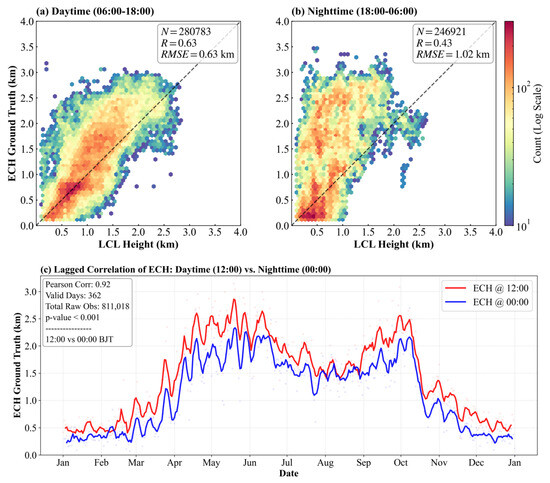
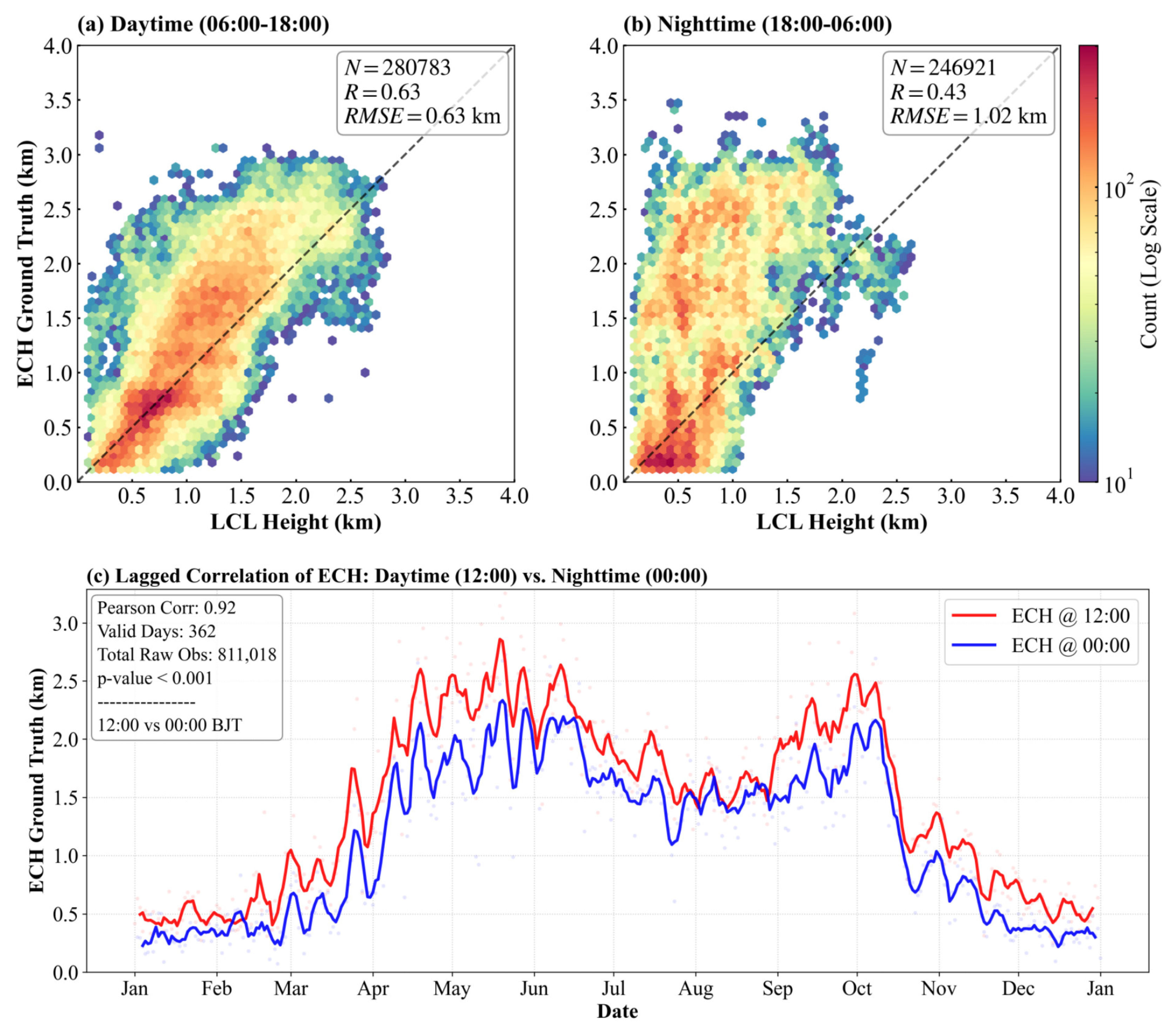
While the ECH and LCL originate from different microphysical processes, both are macroscopically controlled by the thermodynamic structure of the boundary layer. To test how closely the LCL indicates the ECH, we established minute-level ECH ground truth from manual labels (see Section 4.1.1) and examined their correlation. The results, shown in Figure 3, reveal two distinct coupling regimes. During daytime convection (Figure 3a), the ECH and LCL are positively correlated (R = 0.63): despite a systematic bias, the high-density sample points are mostly distributed around the 1:1 diagonal line, indicating that the LCL can serve as a highly informative physical feature for deep learning. However, they decouple significantly at night (R = 0.43, Figure 3b). As surface radiative cooling causes the LCL to decrease rapidly, the ECH remains at a high level, indicating residual layer features consistent with the findings of Liu and Liang [29]. We analyze the correlation between the ECHs at 00:00 and 12:00 (Figure 3c), revealing a strong lagged correlation (R = 0.92) between the nocturnal and daytime states. This suggests that the nocturnal ECH is strongly influenced by the dynamic inertia of the earlier boundary layer development, rather than being a random drift [30].
Figure 3.
A correlation analysis of the ECH and the LCL. (a) Scatter distribution during the daytime convective period (based on a 5% random sample of the full dataset). (b) Distribution during the nocturnal stable period, where the LCL decreases rapidly while the ECH remains high. (c) A lagged correlation analysis of the ECH, revealing a strong correlation between the nocturnal ECH and the daytime state. Statistical metrics are calculated from the raw data, with the curves representing 3-day rolling averages.
These facts lead us to establish a modeling mechanism that combines thermodynamic priors and spatiotemporal radar features. We embed the surface-derived LCL into the network as an environmental indicator. During the day, the model relies more on thermodynamic guidance, while at night, it focuses more on spatiotemporal radar features. Temporal information is further incorporated to express atmospheric dynamic inertia and reconstruct the ECH.
3.2. Physics-Guided Network Architecture
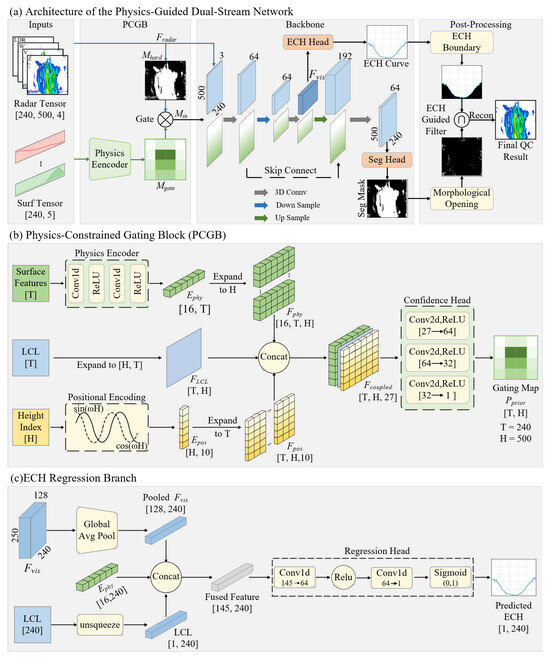
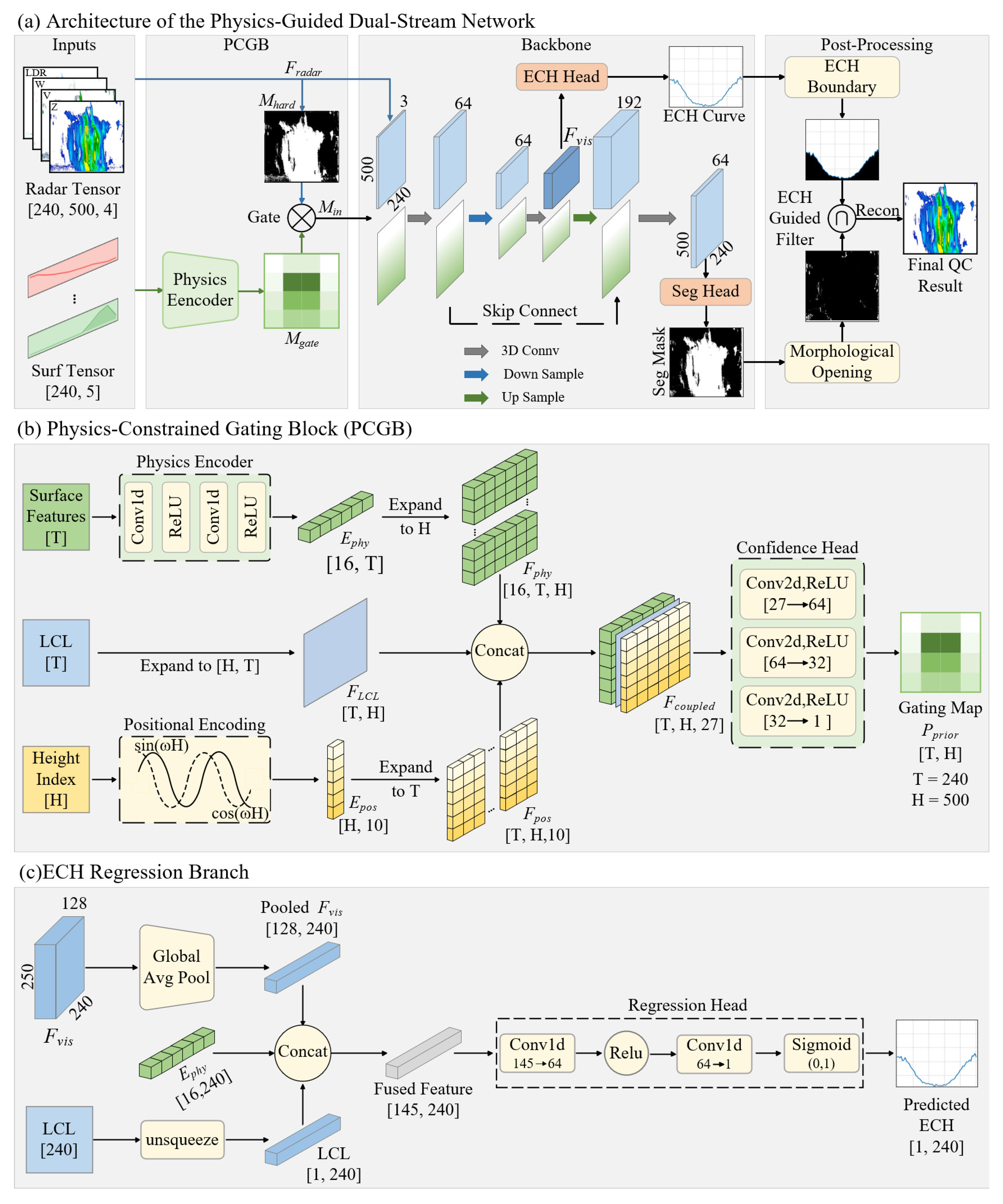
The deep learning framework proposed in this study adopts a dual-stream encoder–decoder architecture [31] that is designed to internalize domain-specific physical knowledge as prior constraints within the constructed deep neural network [32]. As shown in Figure 4a, the model comprises three core components: a physics-constrained gating block (PCGB) to extract the thermodynamic background from surface observations; a backbone network, which is responsible for extracting the spatiotemporal features of cloud radar echoes; and a multitask output head for simultaneous pixel-level echo classification and ECH regression.
Figure 4.
Overall architecture of PhySNet. (a) The dual-stream input network structure that fuses thermodynamic priors and radar spatiotemporal features. (b) The physics-constrained gating block (PCGB), which extracts atmospheric evolution trends via 1D convolution and generates adaptive gating weights. (c) The ECH regression branch, which uses spatiotemporal radar features to perform residual correction on thermodynamic priors and outputs the estimated boundaries of clear-air echoes.
To capture the physical link between the daytime and nocturnal ECH, our model implements joint convolution on the time-height (T-H) plane [33,34]. The model first rearranges the input dimensions, treating ‘time’ and ‘vertical height’ as the width and height of a 2D feature map, respectively. It then uses 3D convolutions within a U-Net architecture to process spatial structures and temporal information together.
Operating on a 4 h calculation window, PhySNet does not aim to track continuous cloud motions akin to a video. Instead, the model uses a 3 × 3 convolution kernel; its receptive field captures localized echo variations across the T-H plane. We apply a physical soft mask that is generated from thermodynamic data to suppress the inherent radar clutter during the feature extraction stage. This mask dynamically normalizes the convolution results, forcing the network to focus on high-confidence meteorological echo regions. This design enables PhySNet to learn the lagged statistical correlations of the clear-air echoes within this continuous window.
3.2.1. Physics-Constrained Gating Block
To filter radar features using surface thermodynamic information, we design a physics-constrained gating block (PCGB), as shown in Figure 4b. The module takes surface weather observation sequences that are collocated with the target cloud radar as its inputs. The model first uses a two-layer cascaded 1D convolutional neural network to extract the temporal evolution features of surface variables [35], outputting a physical feature embedding vector Ephy with the full sequence length.
Because surface observation data lack vertical height information, applying Ephy directly to the radar profile would cause a spatial mismatch. Therefore, the model explicitly injects a fixed positional encoding [36] Epos based on sine and cosine functions during the feature fusion stage, converting discrete range bin indices into vertical relative position information. Afterward, the model concatenates the vertically expanded LCL, Ephy, and Epos along the channel dimension, generating a thermodynamic-spatial coupled feature map Fcoupled.
The model uses a confidence head composed of a multilayer perceptron and a sigmoid activation function to process Fcoupled and outputs a probability distribution map Pprior. Based on this, we construct a dynamic physical gating mechanism, as defined in Equations (1) and (2). We define Mhard as the binarized mask of the raw radar data (1 for valid, 0 for invalid). Weighting it by yields a continuous-value mask Min bounded in [0, 1], which reflects how likely each radar data point is a true meteorological echo given the current feature representation.
Through these operations, the PCGB performs an initial attention modulation on the radar features conditioned on the surface thermodynamic state [37]. This physical guidance mechanism runs through the full feature extraction network, with Min propagating forward alongside the radar data. At every convolution step, the radar features are first modulated by Min to suppress low-confidence clutter. The network also applies a separate convolution to Min itself, producing what we call the normalization factor. Dividing the radar convolution results by this factor dynamically compensates for sparse meteorological echoes: it prevents true signals from being excessively diluted by the surrounding suppressed clutter, so that high-confidence features are retained and strengthened. As the network encodes, downsamples, upsamples, and decodes, this mechanism ensures that thermodynamic priors guide radar feature extraction at every scale.
3.2.2. ECH Regression Branch
To predict the ECH, we add a parallel regression branch at the bottleneck of the backbone network. This branch has three inputs: the thermodynamic vector Ephy derived from the physics encoder, which represents the temporal evolution of the surface thermodynamic state; the radar feature Fvis extracted at the bottleneck, which characterizes the high-dimensional abstract morphological textures of radar echoes; and the LCL, which serves as a physical anchor representing the theoretical macroscopic boundary.
Global average pooling is first applied to flatten Fvis into a 1D vector. Afterward, this vector is concatenated with Ephy and LCL along the channel dimension and fed into a multilayer perceptron to output the predicted ECH. During this regression procedure, the network learns a nonlinear mapping from Ephy (the thermodynamic features) and Fvis (the radar features) to the true clutter boundary.
As stated earlier, when the boundary layer becomes stable at night, the LCL becomes a poor indicator of the clutter height. The model therefore relies on the lagged correlation, extracted by the 3D convolution along the temporal dimension, to correct the theoretical bias of the LCL and output the nocturnal ECH.
The model uses a joint loss function Ltotal to train the echo classification and ECH regression tasks simultaneously. Ltotal is the weighted sum of the classification loss Lcls and the regression loss Lreg. is a hyperparameter that balances the loss weights between the two tasks, and it can be adjusted based on specific requirements to bias the model toward a particular objective, such as decreasing its value to prioritize classification. Lcls uses the focal loss [38] to solve the class imbalance problem posed by echo samples, while Lreg uses the mean squared error (MSE) to compute the error between the predicted height and the true ECH.
3.3. ECH-Based Dynamic Postprocessing Strategy
Although PhySNet performs stably in most scenes, it still leaves a few isolated noise points during complex weather processes, which requires postprocessing to correct the model output. The traditional global and fixed-height threshold filtering schemes easily delete sparse weak meteorological echoes by mistake. To reduce this false deletion output, we design a dynamic postprocessing algorithm based on the ECH. This algorithm uses the minute-level ECH sequence predicted by the model to dynamically limit the active range of morphological filtering.
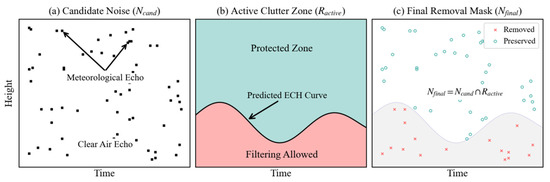
The specific processing, as illustrated in Figure 5, has three steps. First, we apply a global morphological opening operation [39] to the classification result output by the model. The difference between the opened result and the original result defines the candidate noise set Ncand, which represents isolated and tiny spots in the target image. At this stage, we have not distinguished whether they are clutter or true meteorological signals.
Figure 5.
Schematic diagram of the dynamic postprocessing strategy based on ECH constraints. (a) The candidate noise set Ncand generated by global morphological opening. (b) The dynamic processing region Ractive constructed from the ECH predicted by the model. (c) The final decision mask Nfinal.
The normalized ECH sequence predicted by the model is mapped back to the physical height Hlimit to serve as the upper limit of filtering at each moment, which defines the dynamic active region Ractive.
A spatial intersection operation is performed between Ncand and Ractive. Only when a candidate noise point is located below the current ECH (i.e., ) can we judge it as clutter and remove it; otherwise, points above the ECH are retained as meteorological echoes. Through this minute-level and profile-level judgment procedure, this strategy not only filters out clear-air echoes but also effectively reduces the false deletion rate of true meteorological echoes.
4. Experiments and Results
4.1. Dataset Construction and Experimental Setup
4.1.1. Dataset Splitting and Ground Truth Generation
The experimental data came from the preprocessed samples in Section 2. Since the numbers of clear-air echoes and cloud-precipitation echoes were not balanced, the model may easily overfit the majority class [40]. Therefore, we used a nonuniform sampling strategy during the training phase to increase the sampling weights of highly difficult samples, such as mixed echoes and complex boundaries. In addition, we selected 7 stations to construct an independent test set. These data were completely excluded from the model training process, and were used only to evaluate the generalization performance of the model on unknown samples.
As Section 2.2 states, the experts labeled all the stations and periods using collocated aerosol lidars and all-sky cameras for assistance. The classification task directly used the generated three-class labels, while the ECH regression branch needed to calculate the statistical ground truth of the ECH on the basis of these classification labels. The classification and the regression tasks defined clear-air echoes in different dimensions. The classification task involved identifying all clear-air echoes in the field of view, whereas the ECH regression task targeted the macroscopic clutter envelope controlled by thermal boundary-layer turbulence.
Actual observations showed that mid- to high-altitude discrete clear-air echoes often detached from the ground. Their vertical distributions were extremely random and also decoupled from the thermodynamic boundary-layer structure. Therefore, the model needed to extract the main clear-air echo body with physical consistency, leading us to adopt a strategy based on main connected domain extraction [41]. Let the clear-air echo height set on the Z profile at time t be the ordered sequence . We defined the cutoff index of the main connected layer as the first breakpoint that destroyed the vertical continuity.
Here, is the vertical spacing threshold. We performed a statistical analysis on the vertical spacings of all the samples. The results showed that the spacing distribution had a significant long-tailed feature, with an inflection point appearing in the 300 m to 600 m range. Spacings smaller than 300 m mainly originated from turbulence inhomogeneity inside the boundary layer, whereas the long tails larger than 600 m were random discrete echoes that were decoupled from the thermodynamic structure. Based on this physical fact, we set the threshold to 500 m.
4.1.2. Evaluation Metrics
In this study, independent pixel-level evaluations were performed for meteorological echoes and clear-air echoes. For any target category, the model outputs were classified into three states: true positives (TPs), representing correctly identified target pixels; false negatives (FNs), representing target pixels that were misclassified as belonging to the opposing category; and false positives (FPs), representing nontarget pixels that were misclassified as belonging to the target category. On this basis, the critical success index (CSI), probability of detection (POD), and false-alarm ratio (FAR) were employed for evaluation purposes. The CSI comprehensively balances the model’s correct detections, false alarms, and missed targets. The POD reflects the model’s ability to capture the target echoes, while the FAR characterizes the frequency of misidentifying nontargets as the target category. These metrics are defined as follows:
Given the operational orientation of the cloud radar quality control process, this study placed particular emphasis on the POD. It directly quantifies how well the algorithm retains target meteorological echoes while suppressing clear-air echoes, which is a core requirement for the model’s operational application.
4.1.3. Experimental Environment and Hyperparameters
The model was implemented in PyTorch 2.7.1 [42] and trained on NVIDIA GPUs. To optimize the training process, we paired the Adam optimizer [43] with a cosine annealing schedule, which gradually reduced the learning rate from an initial value of 0.001. The loss function was a weighted combination of the focal loss and the MSE loss. The hyperparameters for the focal loss were set to and . The MSE loss was normalized to maintain a consistent gradient magnitude with the classification task. Therefore, the weight in Equation (3) was set to 1.0 here to guarantee equal weighting and prevent gradient dominance.
4.2. Analysis of the Experimental Results
4.2.1. Spatiotemporal Robustness Analysis
To evaluate PhySNet, we reproduced the threshold method and Relief-BPNN. The specific thresholds employed by the threshold method are taken from the operational environment (Z: −40 to −34 dBZ; LDR: −22 dB to −18 dB) and were applied without any dataset-specific tuning. We also trained a U-Net model using only radar data as the baseline. Table 2 reports the quantitative results of all four methods on the same test set.
Table 2.
Quantitative performance comparison among different methods on the test set.
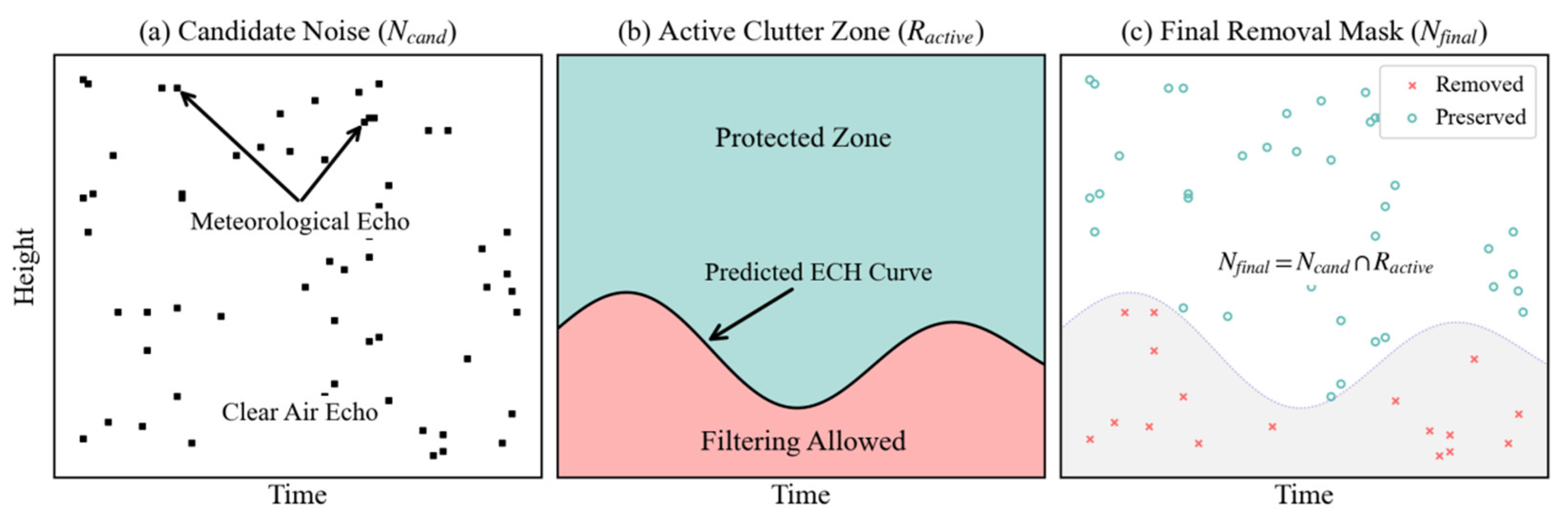
In terms of overall performance, the threshold method maintained a low meteorological echo FAR, yet its clear-air echo FAR reached 35.19% due to the erroneous filtering of massive meteorological echoes, resulting in a CSI of only 0.8395. Relief-BPNN introduced multidimensional spectral parameters, controlling the meteorological echo FAR at the lowest level. However, it classified pixels independently, which limited its ability to improve the clear-air echo misjudgment rate, with no obvious improvement in the overall CSI. The baseline used spatial context features, reducing the number of missed detections of meteorological echoes and increasing the POD to 95.14%. This method, however, lacked physical constraints and failed to distinguish clouds and clutter with similar textures, causing the meteorological echo FAR to increase to 7.28%. In contrast, PhySNet increased the meteorological echo POD to 98.28% and reduced the FAR to 1.18%, achieving the best overall performance for both types of echoes. The data in Figure 6 further verify the robustness of our algorithm.
Figure 6.
Analysis of the spatiotemporal robustness and performance tradeoffs exhibited by different methods. (a) Annual POD curve. (b) Spatial generalization. (c) Performance tradeoff between the meteorological echo POD and clear-air echo POD.
Temporal stability: The annual trends of the PODs yielded by different algorithms are shown in Figure 6a. The performance curve of the threshold method clearly has a zigzag shape, indicating that seasonal changes easily affect it. The meteorological echo POD curve of Relief-BPNN has an inverted U shape. It performed acceptably during the strong convection season (April to September), but clearly decreased during the other months. The performance curve of PhySNet remained close to the high range of 0.95 to 1.00 throughout the year, and showed no obvious fluctuations with respect to the season, demonstrating high temporal robustness.
Spatial generalization: The meteorological echo CSI distribution densities of the three methods in different regions are shown in Figure 6b. The threshold method and Relief-BPNN generally produced distributions with sharp ends and wide middles, and these distributions were strongly dispersed. The median of Relief-BPNN improved relative to that of the threshold method but its distribution span was longer, and low-value tailings appeared in some regions. This finding highlights the generalizability of shallow machine learning methods under complex conditions. PhySNet yielded compact and high-level distribution features in all regions. Its main body remained stable above 0.95, proving that the model effectively overcame environmental differences and exhibited excellent spatial generalization.
Performance tradeoffs: Figure 6c illustrates the tradeoff between the meteorological and clear-air echo PODs. The distribution of the threshold method was discrete. Relief-BPNN performed well in terms of identifying clear-air echoes but a very large number of samples scattered in the left region because of a low meteorological echo POD. The sample points of PhySNet were highly clustered in the top-right ideal region, forming an obvious dominant cluster that achieves the best balance for identifying the two types of echoes.
4.2.2. Visual Analysis of Typical Weather Processes
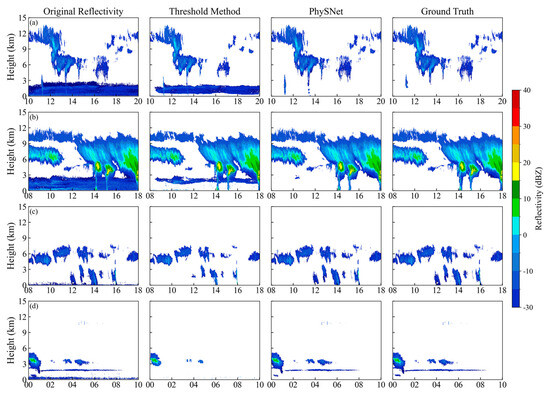
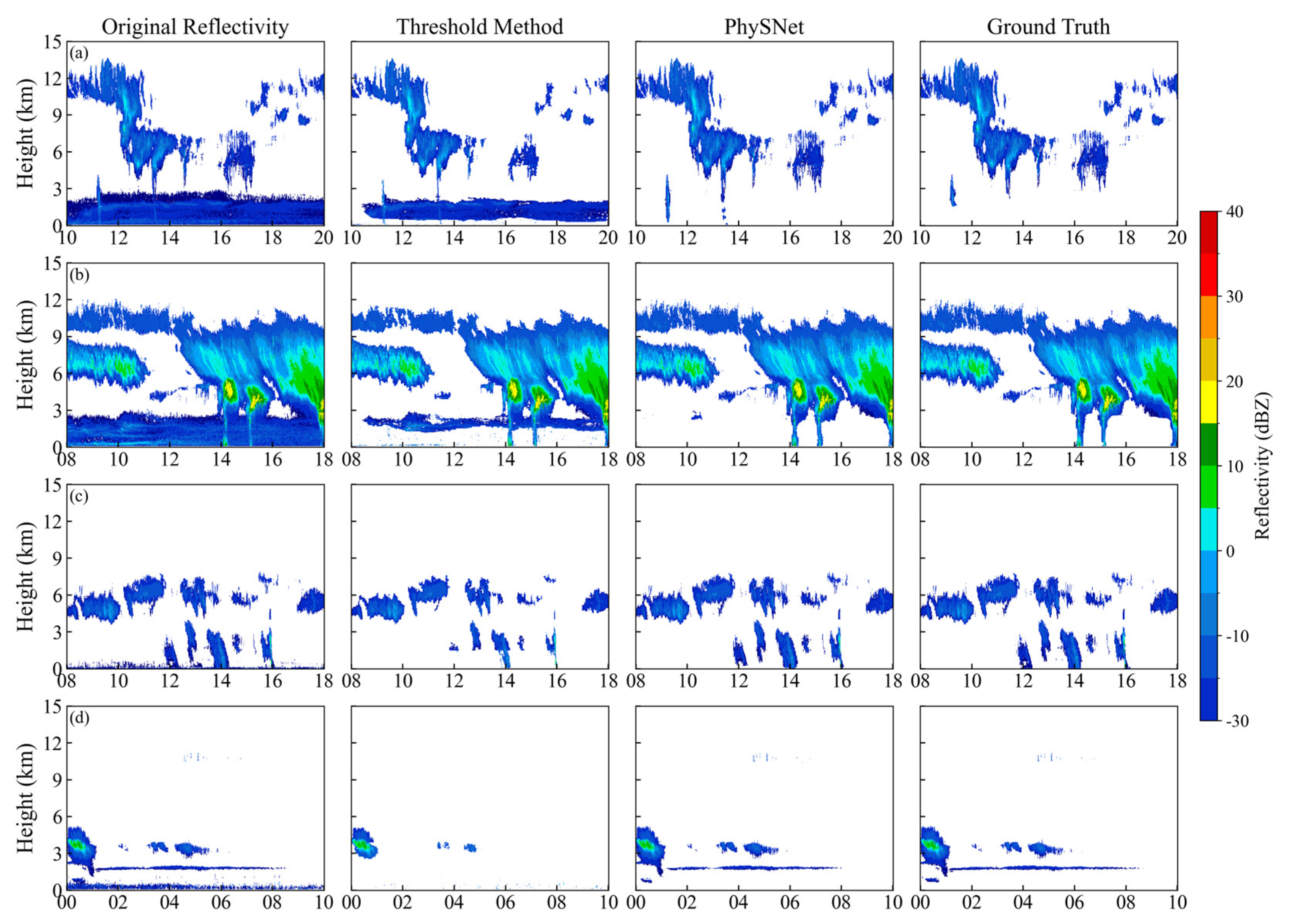
The quality control effects induced under different weather backgrounds are shown in Figure 7, and four typical cases were selected for comparison purposes.
Figure 7.
Visual comparison of quality control results under different weather conditions. (a) Strong clear-air echo scene. (b) Mixed precipitation and clear-air echo scene. (c) Multicloud scene. (d) Weak echo scene. In each panel, from left to right: original reflectivity factor, threshold method result, PhySNet result, and ground truth.
Strong clear-air echo scene: Figure 7a shows the continuous and thick clear-air echoes produced at the bottom. The threshold method failed to distinguish them, leading to massive residual clutter. In contrast, PhySNet removed the clutter and retained short-term cloud echoes within the clear-air echo region.
Mixed precipitation and clear-air echo scene: Figure 7b shows an intermittent short-term precipitation process, with thick clear-air echoes appearing below 3 km. The threshold method left approximately one-third of the clutter at the top, the shape of which resembled that of low- to mid-level thin clouds and interfered with operational interpretation; salt-and-pepper noise also appeared at the bottom after conducting threshold filtering. PhySNet suppressed the clear-air echoes and preserved the edge details of intermittent precipitation.
Multicloud scene: Figure 7c contains multiple low- to mid-level and near-surface cloud clusters, where sparse clutter existed near the ground. The threshold method incorrectly removed the near-surface clouds, causing obvious truncation at the cloud edges. In contrast, PhySNet removed the clutter and preserved the shape of the scattered cloud clusters.
Weak echo scene: In Figure 7d, a low-level thin cloud layer existed at 2 km for approximately 8 h, accompanied by continuous clear-air echoes of similar thickness near the ground. The threshold method failed to remove the clear-air echoes, and also erased low-level thin clouds, leading to the loss of meteorological information. PhySNet extracted weak texture features and applied physical constraints to the ECH, removing the clutter and retaining most of the thin cloud layer.
4.3. Ablation Study of the Core Modules
To verify the effectiveness of each module, Table 3 presents the performance gains achieved after sequentially superimposing the physics-constrained gating block (PCGB), the ECH regression branch, and the ECH-guided dynamic postprocessing strategy on the U-Net baseline.
Table 3.
Ablation study results obtained for the core modules.
4.3.1. PCGB Gain Analysis
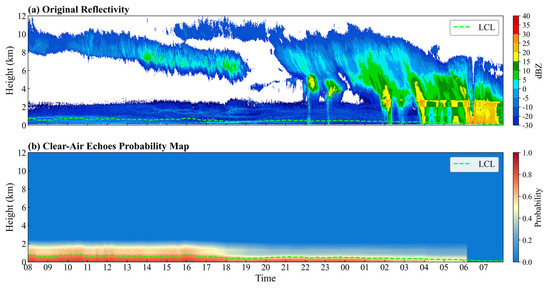
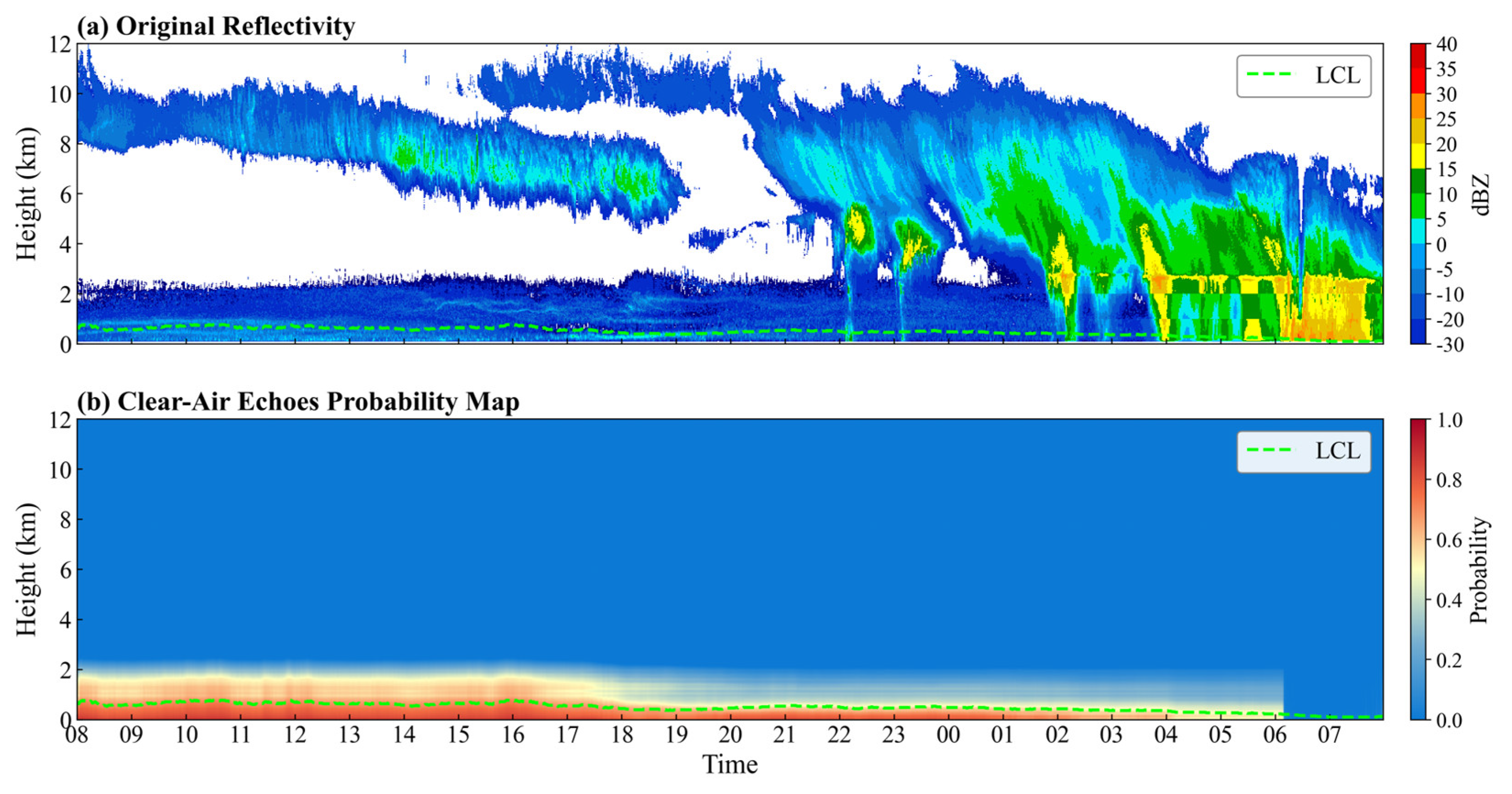
A comparison between the first and second rows reveals that the performance improved after the introduction of the PCGB. This finding indicates that the feature modulation process guided by thermodynamic priors introduces independent environmental constraints. To verify the physical consistency of the PCGB, we performed an ablation test. The model used only surface observations and the LCL as inputs, with the radar data masked. The generated clutter probability distribution and the actual reflectivity factor are compared in Figure 8.
Figure 8.
Clutter probability distribution output by the PCGB relying solely on surface data. (a) True radar reflectivity factor map. (b) Prior probability map output by the PCGB.
The results show that during the day, the high-probability region derived from the PCGB elevated with the LCL and exceeded the LCL height, indicating that the module did not directly map the LCL, but instead used multiple surface observations to estimate the thermodynamic height. At night, the LCL decreased rapidly, while the PCGB maintained its output at the residual layer position on the basis of temporal features and decreased the probability value. This pattern confirms that the module responded to the atmospheric state transition from thermal forcing to dynamic inertia, and provided a basis for the subsequent network to use radar features for identification purposes. During precipitation, the PCGB responded to sudden signals such as humidity saturation and suppressed the clutter probability at all heights. It provided hard constraints during coupled thermodynamic periods and soft guidance using inertia in decoupled periods, ensuring that its output remained consistent with atmospheric physics.
4.3.2. Analysis of the ECH Regression Branch Gain
This branch converts the probability distribution derived from the PCGB into a specific echo height boundary. After the ECH regression branch was added, the meteorological echo POD increased to 98.61%, and the CSI reached 0.9657. This result indicates that the height prediction task helps the network learn features that are related to physical boundaries.
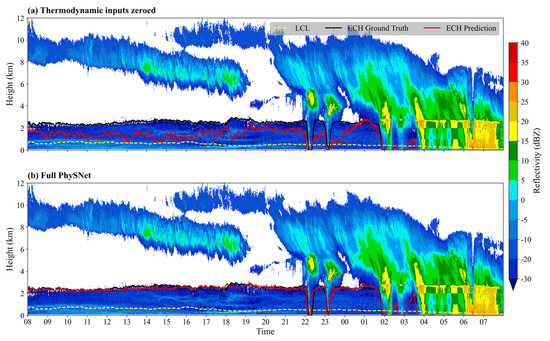
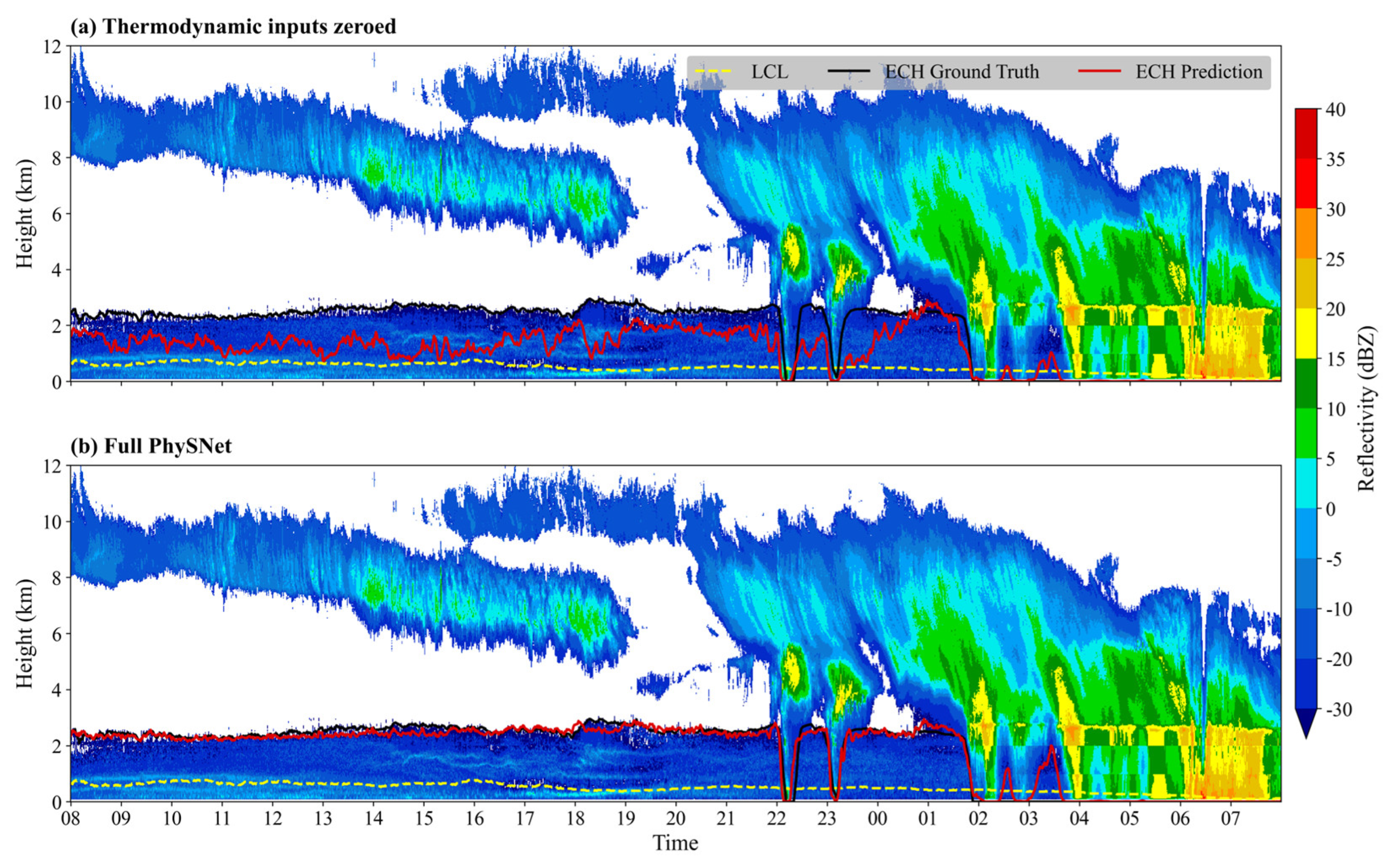
We designed a comparison experiment to verify the necessity of thermodynamic information by keeping the positional encoding but removing the surface observations and LCL input. After the thermodynamic input was removed (Figure 9a), the predicted curve significantly oscillated, while the full model (Figure 9b) nearly matched the true values. This finding indicates that static priors are insufficient for stable prediction, and the thermodynamic trends provided by the PCGB are key to ensuring high prediction accuracy.
Figure 9.
Comparison between the predicted ECH time series. (a) Output with the thermodynamic input of the PCGB masked. (b) Output of the full PhySNet model.
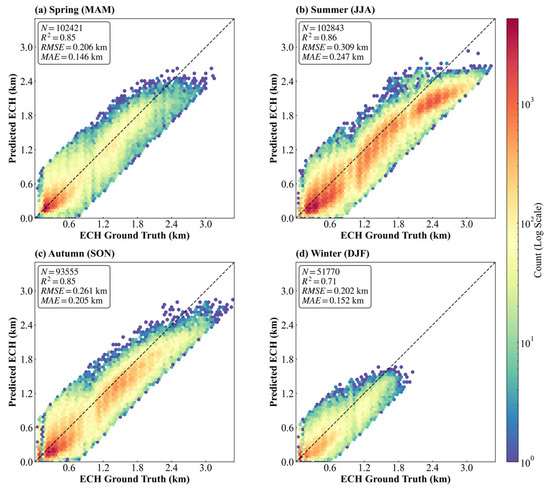
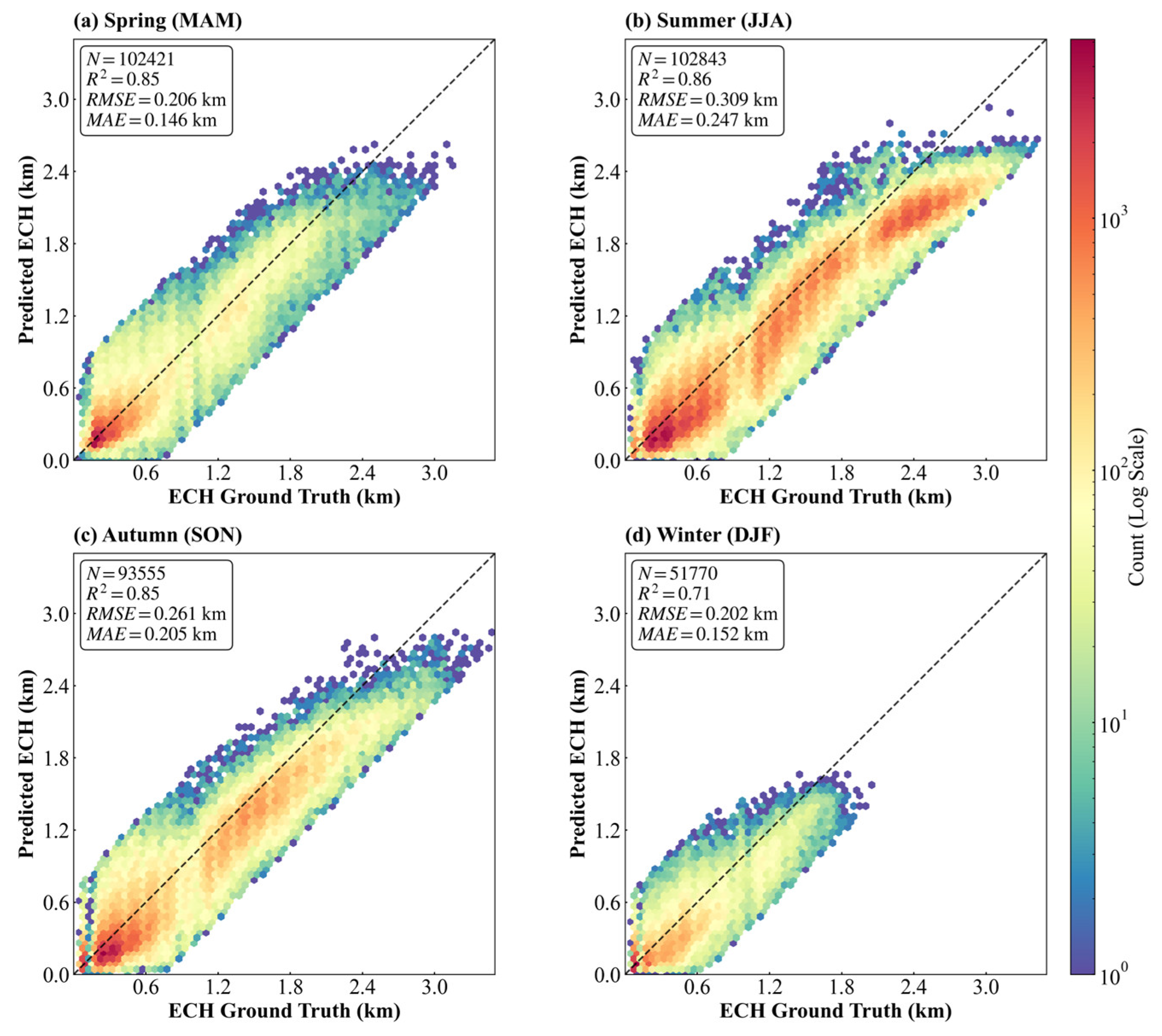
The correlation between the predicted ECHs and the true values across different seasons is shown in Figure 10. We excluded samples without clutter to avoid inflating the metrics. Except during winter, the coefficients of determination were above 0.85, and the RMSEs were between 200 and 300 m. This finding demonstrates that the model continuously tracked the effective clutter height, with the ECH distribution also exhibiting seasonality. In summer, the high-density area was between 0 and 3 km, while in winter, it was less than 1.8 km because of temperature inversions. Although the narrower dynamic range in winter led to a lower coefficient of determination, its RMSE was the smallest, indicating the highest prediction accuracy.
Figure 10.
Seasonal correlation between the predicted and ground-truth effective clutter heights (ECHs).
4.3.3. Performance Tradeoff Achieved by Dynamic Postprocessing
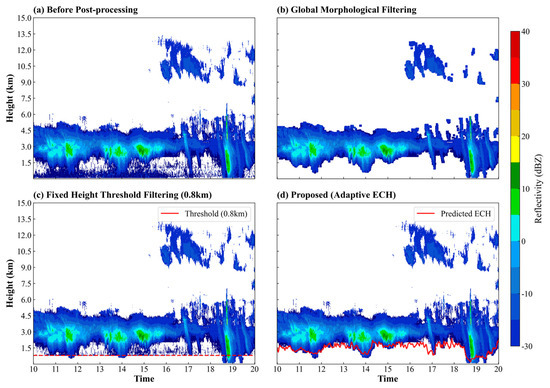
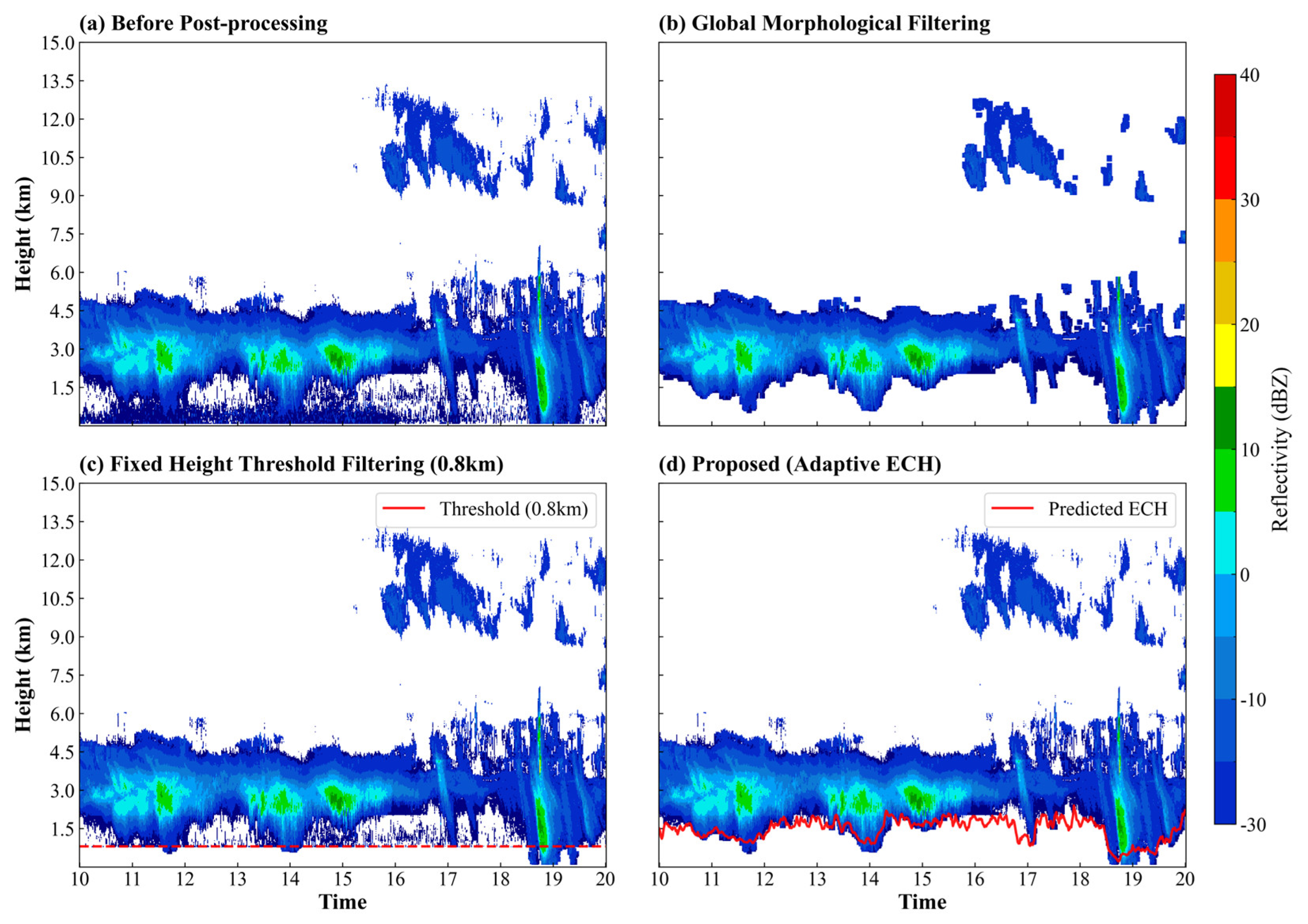
After dynamic postprocessing with ECH constraints was introduced, the meteorological echo POD decreased by 0.33%, whereas the clear-air echo POD increased by 1.61%, yielding the highest CSI value. The three strategies are compared in Figure 11. Global morphological filtering (Figure 11b) removed weak meteorological echoes because it lacks height limits. Fixed-height threshold filtering (Figure 11c) could not adapt to the diurnal changes in the boundary layer, leaving residual clutter above the threshold while still removing meteorological echoes. The ECH constraint strategy (Figure 11d) created an adaptive filtering boundary based on the predicted height, avoiding the oversmoothing of global filtering and the rigidity of fixed thresholds. ECH-guided postprocessing combined physical boundary constraints with morphological processing to optimize its clutter removal ability.
Figure 11.
Comparison among the effects of different postprocessing strategies. (a) Reflectivity before post-processing. (b) Global morphological filtering. (c) Fixed-height threshold filtering. (d) ECH-based dynamic constraint strategy.
5. Discussion
In this study, Ka-band cloud radar data are mainly used. Differences in band sensitivity to Bragg and Rayleigh scattering and variations in scanning modes may limit the direct applicability of the framework to other radar frequencies. To adapt PhySNet to a new frequency, the main requirement is re-normalizing the radar input features to reflect the scattering properties and data distributions specific to that band. The feature extraction backbone and the physics-constrained gating block (PCGB) would also need to be fine-tuned to recalibrate the mapping between the frequency-independent thermodynamic priors and the distinct echo boundaries of the new frequency.
Although the current model is trained on data from China, PhySNet functions as a general physics-guided quality control paradigm. Researchers in other regions can adopt this framework and achieve strong local performance by training it with their own regional meteorological and radar data.
6. Conclusions
In this paper, we propose PhySNet, a physics-guided network that integrates thermodynamic priors with radar features. It addresses the difficult echo separation and poor physical interpretability issues that are encountered in millimeter-wave cloud radar quality control tasks. Based on the results of multistation experiments, we conclude the following:
Through the PCGB module and the ECH regression branch, PhySNet learns the diurnal evolution of the boundary layer. At night, when thermodynamic features decouple from the clutter, the model uses temporal features to estimate the clutter boundary.
PhySNet achieves a meteorological echo POD of 98.28% and an FAR of 1.18%. With ECH-based dynamic postprocessing, the algorithm balances its meteorological echo retention and clear-air echo removal capabilities. Intermediate variables, such as clutter probability maps and ECH curves, offer useful physical references for boundary layer research.
At present, the framework primarily focuses on identifying clear-air echoes. Future work will extend the network to detect ground clutter, radio frequency interference, and pulse compression sidelobes, and in doing so verify the broader applicability of the framework.
Author Contributions
Writing—original draft, J.W.; Methodology, J.W. and J.H.; Software, J.W.; Formal analysis, J.W.; Writing—review & editing, S.H.; Conceptualization, S.H.; Supervision, S.H.; Data curation, J.W., S.H., J.H., J.Y., R.Y., Q.Z. and A.Y.; funding acquisition, J.H. All authors have read and agreed to the published version of the manuscript.
Funding
This work was funded by the Key Laboratory of Intelligent Meteorological Observation Technology, China Meteorological Administration (grant no. ZNGC2024QN14), the Innovation Team of Shandong Meteorological Bureau (grant no. SDCXTD2023-1), and the Shandong Provincial Natural Science Foundation (grant nos. ZR2025LQX005 and ZR2025LQX009).
Data Availability Statement
The sample data relevant to the presented cases are available from the corresponding author upon reasonable request. The source code will be made publicly available on GitHub after the publication of this paper.
Conflicts of Interest
Author Jie Huang was employed by the company China Huayun Meteorological Technology Group Co., Ltd. The remaining authors declare that the research was conducted in the absence of any commercial or financial relationships that could be construed as a potential conflict of interest.
Abbreviations
The following abbreviations are used in this manuscript:
| 1D | One-Dimensional |
| 2D | Two-Dimensional |
| 3D | Three-Dimensional |
| ABLH | Atmospheric Boundary Layer Height |
| CSI | Critical Success Index |
| ECH | Effective Clutter Height |
| ERA5 | ECMWF Reanalysis v5 |
| FAR | False-Alarm Rate |
| FN | False Negative |
| FP | False Positive |
| GPU | Graphics Processing Unit |
| LCL | Lifting Condensation Level |
| LDR | Linear Depolarization Ratio |
| MMCR | Millimeter-wave Cloud Radar |
| MSE | Mean Squared Error |
| PCGB | Physics-Constrained Gating Block |
| POD | Probability of Detection |
| PRE | Precipitation |
| ResNet | Residual Network |
| RHU | Relative Humidity |
| RMSE | Root Mean Square Error |
| TEM | Temperature |
| T-H | Time-Height |
| TP | True Positive |
References
- Sauvageot, H.; Despaux, G. The clear-air coastal vespertine radar bands. Bull. Am. Meteorol. Soc. 1996, 77, 673–682. [Google Scholar] [CrossRef] [Scilit]
- Zeng, Z.M.; Zheng, J.F.; Yang, H.; Zheng, M.; Zeng, Y.T. Quality control and evaluation on non-cloud echo of Ka-band cloud radar. J. Appl. Meteorol. Sci. 2021, 32, 347–357. (In Chinese) [Google Scholar] [CrossRef]
- Nie, D.Y.; Xiao, A.; Xia, H.J. Study on radar echo image quality control based on improved convolution technology. Torrential Rain Disasters 2022, 41, 598–606. (In Chinese) [Google Scholar] [CrossRef]
- Lakshmanan, V.; Stumpf, G.; Smith, T.; Hondl, K.; Stumpf, G.J. Quality control of weather radar data using texture features and a neural network. In Proceedings of the 31st Conference on Radar Meteorology, Seattle, WA, USA, 6–12 August 2003; pp. 522–525. [Google Scholar]
- Lakshmanan, V.; Karstens, C.; Krause, J.; Tang, L. Quality control of weather radar data using polarimetric variables. J. Atmos. Ocean. Technol. 2014, 31, 1234–1249. [Google Scholar] [CrossRef] [Scilit]
- Husnoo, N.; Darlington, T.; Torres, S.; Warde, D. A neural network quality-control scheme for improved quantitative precipitation estimation accuracy on the U.K. weather radar network. J. Atmos. Ocean. Technol. 2021, 38, 1157–1172. [Google Scholar] [CrossRef] [Scilit]
- Yang, L.; Wang, Y.; Wang, Z.; Yang, Q.; Fan, X.; Tao, F.; Zhen, X.; Yang, Z. Automatic identification of clear-air echoes based on millimeter-wave cloud radar measurements. Adv. Atmos. Sci. 2020, 37, 912–924. [Google Scholar] [CrossRef] [Scilit]
- Hou, C.; Liu, W.; Tao, F.; Hu, S. A Quality-Control Fusion Algorithm for Cloud-Radar Data in Complex Weather Scenarios Integrating LightGBM and Neighborhood Filtering. Remote Sens. 2026, 18, 691. [Google Scholar] [CrossRef] [Scilit]
- Liu, X.; Xiao, A.; Li, X. Deep learning-based quality control of clear-sky echoes from millimeter-wave cloud radars. Acta Meteorol. Sin. 2026, 84, 146–158. [Google Scholar] [CrossRef]
- Fa, T.; Li, G.; Zheng, X.; Huang, S.; Yang, L.; Ma, Q. Vertical structure and variation characteristics of clear-air echo of Ka-band cloud radar. J. Appl. Meteorol. Sci. 2020, 31, 727–738. (In Chinese) [Google Scholar] [CrossRef]
- Karpatne, A.; Atluri, G.; Faghmous, J.H.; Steinbach, M.; Banerjee, A.; Ganguly, A.; Shekhar, S.; Samatova, N.; Kumar, V. Theory-guided data science: A new paradigm for scientific discovery from data. IEEE Trans. Knowl. Data Eng. 2017, 29, 2318–2331. [Google Scholar] [CrossRef] [Scilit]
- Raissi, M.; Perdikaris, P.; Karniadakis, G.E. Physics-informed neural networks: A deep learning framework for solving forward and inverse problems involving nonlinear partial differential equations. J. Comput. Phys. 2019, 378, 686–707. [Google Scholar] [CrossRef] [Scilit]
- Kashinath, K.; Mustafa, M.; Albert, A.; Wu, J.; Jiang, C.; Esmaeilzadeh, S.; Azizzadenesheli, K.; Wang, R.; Chattopadhyay, A.; Singh, A.; et al. Physics-informed machine learning: Case studies for weather and climate modelling. Philos. Trans. R. Soc. A 2021, 379, 20200093. [Google Scholar] [CrossRef] [Scilit] [PubMed]
- Chen, C.; Zhu, X.; Wang, F.; Xu, Y.; Zhang, W. Comprehensive review of physics-guided deep learning: Advancements, challenges, and perspectives. J. Front. Comput. Sci. Technol. 2025, 19, 277–318. (In Chinese) [Google Scholar] [CrossRef]
- Shi, X.J.; Chen, Z.R.; Wang, H.; Yeung, D.Y.; Wong, W.K.; Woo, W.C. Convolutional LSTM network: A machine learning approach for precipitation nowcasting. In Advances in Neural Information Processing Systems 28; Cortes, C., Lawrence, N., Lee, D., Sugiyama, M., Garnett, R., Eds.; Curran Associates, Inc.: Red Hook, NY, USA, 2015; pp. 802–810. [Google Scholar]
- Bi, K.; Xie, L.; Zhang, H.; Chen, X.; Gu, X.; Tian, Q. Accurate medium-range global weather forecasting with 3D neural networks. Nature 2023, 619, 533–538. [Google Scholar] [CrossRef] [Scilit]
- Zhang, Y.; Long, M.; Chen, K.; Xing, L.; Jin, R.; Jordan, M.I.; Wang, J. Skilful nowcasting of extreme precipitation with NowcastNet. Nature 2023, 619, 526–532. [Google Scholar] [CrossRef] [Scilit]
- Zhou, K.; Zheng, Y.; Yang, B.; Sheng, J.; Zhang, X.; Tian, F.; Tang, W. Objective nowcasting of severe convective weather: Technological progress and outlook. Acta Meteorol. Sin. 2025, 83, 798–812. (In Chinese) [Google Scholar] [CrossRef] [Scilit]
- Hersbach, H.; Bell, B.; Berrisford, P.; Hirahara, S.; Horányi, A.; Muñoz-Sabater, J.; Nicolas, J.; Peubey, C.; Radu, R.; Schepers, D.; et al. The ERA5 global reanalysis. Q. J. R. Meteorol. Soc. 2020, 146, 1999–2049. [Google Scholar] [CrossRef] [Scilit]
- Yang, Y.; He, N.; Yu, X. Comparison of summer convective parameters calculated from ERA5 reanalysis data and soundings in Beijing. J. Appl. Meteorol. Sci. 2025, 36, 705–718. (In Chinese) [Google Scholar] [CrossRef]
- Gou, Y.; Zhang, J.; Wang, W.; Huang, K.; Zhang, S. Intercomparison of tropopause height climatologies: High-resolution radiosonde measurements versus ERA5 reanalysis. Atmos. Chem. Phys. 2025, 25, 17319–17330. [Google Scholar] [CrossRef] [Scilit]
- Stull, R.B. An Introduction to Boundary Layer Meteorology; Kluwer Academic Publishers: Dordrecht, The Netherlands, 1988. [Google Scholar]
- Wilson, J.W.; Weckwerth, T.M.; Vivekanandan, J.; Wakimoto, R.M.; Russell, R.W. Boundary layer clear-air radar echoes: Origin of echoes and accuracy of derived winds. J. Atmos. Ocean. Technol. 1994, 11, 1184–1206. [Google Scholar] [CrossRef] [Scilit]
- Santanello, J.A.; Roundy, J.; Dirmeyer, P.A. Quantifying the land–atmosphere coupling behavior in modern reanalysis products over the U.S. Southern Great Plains. J. Clim. 2015, 28, 5813–5829. [Google Scholar] [CrossRef] [Scilit]
- Su, T.; Zhang, Y. Deep-learning-derived planetary boundary layer height from conventional meteorological measurements. Atmos. Chem. Phys. 2024, 24, 6477–6493. [Google Scholar] [CrossRef] [Scilit]
- Bolton, D. The computation of equivalent potential temperature. Mon. Weather Rev. 1980, 108, 1046–1053. [Google Scholar] [CrossRef] [Scilit]
- Lachenmeier, E.; Mahmood, R.; Phillips, C.; Nair, U.; Rappin, E.; Pielke, R.A.; Brown, W.; Oncley, S.; Wurman, J.; Kosiba, K.; et al. Irrigated agriculture significantly modifies seasonal boundary layer atmosphere and lower-tropospheric convective environment. J. Appl. Meteorol. Climatol. 2024, 63, 245–264. [Google Scholar] [CrossRef] [Scilit]
- Reynolds, D.R.; Chapman, J.W.; Edwards, A.S.; Smith, A.D.; Wood, C.R.; Woiwod, I.P. Radar studies of the vertical distribution of insects migrating over southern Britain: The influence of temperature inversions on nocturnal layer concentrations. Bull. Entomol. Res. 2005, 95, 259–274. [Google Scholar] [CrossRef] [Scilit]
- Liu, S.; Liang, X.Z. Observed diurnal cycle climatology of planetary boundary layer height. J. Clim. 2010, 23, 5790–5809. [Google Scholar] [CrossRef] [Scilit]
- Tan, Z.M.; Fang, J.; Wu, R.S. Ekman boundary layer dynamic theories. Acta Meteorol. Sin. 2005, 63, 543–555. (In Chinese) [Google Scholar] [CrossRef]
- Ronneberger, O.; Fischer, P.; Brox, T. U-Net: Convolutional networks for biomedical image segmentation. In Proceedings of the Medical Image Computing and Computer-Assisted Intervention (MICCAI), Munich, Germany, 5–9 October 2015; Navab, N., Hornegger, J., Wells, W.M., Frangi, A.F., Eds.; Springer: Cham, Switzerland, 2015; pp. 234–241. [Google Scholar] [CrossRef] [Scilit]
- Reichstein, M.; Camps-Valls, G.; Stevens, B.; Jung, M.; Denzler, J.; Carvalhais, N.; Prabhat. Deep learning and process understanding for data-driven Earth system science. Nature 2019, 566, 195–204. [Google Scholar] [CrossRef] [Scilit]
- Ji, S.; Xu, W.; Yang, M.; Yu, K. 3D convolutional neural networks for human action recognition. IEEE Trans. Pattern Anal. Mach. Intell. 2013, 35, 221–231. [Google Scholar] [CrossRef] [Scilit] [PubMed]
- Çiçek, Ö.; Abdulkadir, A.; Lienkamp, S.S.; Brox, T.; Ronneberger, O. 3D U-Net: Learning dense volumetric segmentation from sparse annotation. In Proceedings of the Medical Image Computing and Computer-Assisted Intervention (MICCAI), Athens, Greece, 17–21 October 2016; Springer: Cham, Switzerland, 2016; pp. 424–432. [Google Scholar] [CrossRef] [Scilit]
- Wang, Z.; Yan, W.; Oates, T. Time series classification from scratch with deep neural networks: A strong baseline. In Proceedings of the 2017 International Joint Conference on Neural Networks (IJCNN), Anchorage, AK, USA, 14–19 May 2017; pp. 1578–1585. [Google Scholar] [CrossRef] [Scilit]
- Vaswani, A.; Shazeer, N.; Parmar, N.; Uszkoreit, J.; Jones, L.; Gomez, A.N.; Kaiser, L.; Polosukhin, I. Attention is all you need. In Advances in Neural Information Processing Systems 30; Guyon, I., Luxburg, U.V., Bengio, S., Wallach, H., Fergus, R., Vishwanathan, S., Garnett, R., Eds.; Curran Associates, Inc.: Red Hook, NY, USA, 2017; pp. 5998–6008. [Google Scholar]
- Woo, S.; Park, J.; Lee, J.-Y.; Kweon, I.S. CBAM: Convolutional block attention module. In Proceedings of the European Conference on Computer Vision (ECCV), Munich, Germany, 8–14 September 2018; pp. 3–19. [Google Scholar] [CrossRef] [Scilit]
- Lin, T.-Y.; Goyal, P.; Girshick, R.; He, K.; Dollár, P. Focal loss for dense object detection. In Proceedings of the IEEE International Conference on Computer Vision (ICCV), Venice, Italy, 22–29 October 2017; pp. 2980–2988. [Google Scholar] [CrossRef] [Scilit]
- Soille, P. Morphological Image Analysis: Principles and Applications, 2nd ed.; Springer: Berlin/Heidelberg, Germany, 2003. [Google Scholar]
- He, H.; Garcia, E.A. Learning from imbalanced data. IEEE Trans. Knowl. Data Eng. 2009, 21, 1263–1284. [Google Scholar] [CrossRef] [Scilit]
- Gonzalez, R.C.; Woods, R.E. Digital Image Processing, 4th ed.; Pearson: New York, NY, USA, 2018. [Google Scholar]
- Paszke, A.; Gross, S.; Massa, F.; Lerer, A.; Bradbury, J.; Chanan, G.; Killeen, T.; Lin, Z.; Gimelshein, N.; Antiga, L.; et al. PyTorch: An imperative style, high-performance deep learning library. In Advances in Neural Information Processing Systems 32; Wallach, H., Larochelle, H., Beygelzimer, A., d’Alché-Buc, F., Fox, E., Garnett, R., Eds.; Curran Associates, Inc.: Red Hook, NY, USA, 2019; pp. 8024–8035. [Google Scholar]
- Kingma, D.P.; Ba, J. Adam: A method for stochastic optimization. arXiv 2014, arXiv:1412.6980. [Google Scholar]

Disclaimer/Publisher’s Note: The statements, opinions and data contained in all publications are solely those of the individual author(s) and contributor(s) and not of MDPI and/or the editor(s). MDPI and/or the editor(s) disclaim responsibility for any injury to people or property resulting from any ideas, methods, instructions or products referred to in the content. |
© 2026 by the authors. Licensee MDPI, Basel, Switzerland. This article is an open access article distributed under the terms and conditions of the Creative Commons Attribution (CC BY) license.