Article

Spatial–Spectral Mamba Model Integrating Topographic Information for Pegmatite Dike Segmentation in Deeply Incised Terrain


1
State Key Laboratory of Ecological Safety and Sustainable Development in Arid Lands, Xinjiang Institute of Ecology and Geography, Chinese Academy of Sciences, Urumqi 830011, China
2
Xinjiang Laboratory of Mineral Resources and Digital Geology, Urumqi 830011, China
3
University of Chinese Academy of Sciences, Beijing 100049, China
4
Sunwoda Electronic Co., Ltd., Shenzhen 518108, China
*
Author to whom correspondence should be addressed.
Remote Sens. 2026, 18(8), 1215; https://doi.org/10.3390/rs18081215
Submission received: 12 March 2026 / Revised: 14 April 2026 / Accepted: 16 April 2026 / Published: 17 April 2026
(This article belongs to the Topic Big Data and AI for Geoscience)

Highlights

What are the main findings?
  • A remote sensing segmentation method for pegmatite dikes integrating topographic information was proposed. A high-resolution DEM was incorporated into the Spatial–Spectral Mamba framework to enable the joint use of spectral and terrain information for dike identification in deeply incised mountainous areas.
  • Experiments conducted in the Xichanggou lithium deposit of the Altyn region showed that the proposed method achieved high segmentation accuracy under complex terrain conditions (OA = 98.15%, AA = 98.30%, Kappa = 0.9725) and improved the spatial continuity of the identified dikes.
What are the implications of the main findings?
  • The consistency between remote sensing results and the actual geological spatial structure was enhanced, enabling traditional two-dimensional pegmatite dike identification to evolve toward a terrain-integrated recognition paradigm.
  • Technical support is provided for lithium exploration using remote sensing in complex mountainous regions.

Abstract

Lithium is a rare metal widely used in the renewable energy industry. The Altyn region in Xinjiang, China, contains abundant granitic pegmatite-type lithium resources; however, the deeply incised and complex terrain limits the accuracy of conventional two-dimensional remote sensing approaches for dike identification and segmentation. To address this limitation, a remote sensing segmentation method incorporating terrain information was proposed. A digital elevation model (DEM) derived from LiDAR data, together with its associated topographic factors, was integrated into the Spatial–Spectral Mamba framework to enable the joint utilization of spectral and terrain features. Rather than performing explicit three-dimensional geometric modeling, the proposed approach enhances a two-dimensional segmentation framework by introducing elevation-derived information, allowing the model to capture terrain-related spatial variations of pegmatite dikes. This design enables improved representation of both the planar distribution and terrain-influenced morphological characteristics of dikes under deeply incised conditions. The Xichanggou lithium deposit in the Altyn region is a large-scale, economically valuable pegmatite-type lithium deposit, and was therefore selected as the study area for pegmatite dike segmentation. The results demonstrated that, compared with conventional two-dimensional approaches and representative machine learning methods, the proposed method achieved higher segmentation accuracy in complex terrain. Improvements were also observed in the continuity and spatial consistency of the extracted dike patterns. Field verification indicated that the major pegmatite dikes delineated by the model were highly consistent with their actual surface exposures. Sampling analyses further confirmed the validity and reliability of the identification results. Overall, the terrain-integrated remote sensing segmentation approach exhibited good applicability and robustness under deeply incised and complex geomorphological conditions.

1. Introduction

Lithium is an important metal resource that is widely used in aerospace engineering, electronic technology, the nuclear industry, and biomedicine. It is also widely regarded as the “energy metal of the twenty-first century,” and global demand for lithium resources continues to grow with the expansion of the renewable energy sector [1,2,3,4,5,6,7]. Granitic pegmatite-type lithium deposits represent one of the principal sources of metallic lithium. Lithium is typically concentrated in pegmatite dikes in the form of spodumene, lepidolite, and related minerals, and its spatial distribution is closely associated with the geometry and emplacement patterns of these dikes [8,9]. Such deposits are genetically related to pegmatitic intrusions, which commonly occur as banded, dike-like, or tabular bodies. They are frequently developed along the margins of large granitic plutons and are characterized by distinct internal zonation [10,11,12]. In the exploration of lithium deposits, remote sensing techniques can exploit the diagnostic spectral absorption features of lithium-bearing minerals within pegmatite dikes to delineate their spatial distribution [13,14]. This capability provides important data support for mineral exploration and resource assessment.
Granitic pegmatite-type lithium resources are abundant in Xinjiang, China. In particular, pegmatites are widely developed in the Altyn region along the northern margin of the Qinghai–Tibet Plateau. Since 2018, several medium-sized deposits, including the Washixia South lithium deposit, the Qiadake lithium deposit, and the Tugeman lithium–beryllium deposit, have been identified in this region [15], indicating considerable metallogenic potential for lithium and beryllium. However, the natural conditions of the area are complex, and the terrain is deeply incised, which significantly constrains the efficiency of conventional geological exploration. There is therefore a need to develop cost-effective remote sensing techniques that are adaptable to high-altitude and deeply incised environments for the accurate identification and delineation of pegmatite dikes. Such approaches would improve exploration efficiency, reduce prospecting costs, and provide technical support for further exploration and development of lithium–beryllium resources in the Altyn region.
However, the identification of geological targets in complex environments remains a challenging task [16]. In the field of geological remote sensing, many studies have attempted to utilize multi-source remote sensing data to identify and extract geological targets under complex environmental conditions. For example, Chatterjee et al. (2003) [17] integrated real topographic relief information with hyperspectral imagery and high-spatial resolution panchromatic imagery. This integration compensated for limitations caused by illumination conditions and spatial resolution, enhanced lithological boundaries, folds, and linear structural features, and significantly improved the comprehensive interpretation of geological information derived from remote sensing data. Similarly, Bellian et al. (2007) [18] combined AVIRIS hyperspectral imagery with LiDAR data to perform remote mineralogical identification in the Franklin Mountains of Texas. Through hyperspectral image processing and shape/texture analysis of LiDAR data, a three-dimensional lithofacies map was successfully generated, revealing the spatial distribution of dolomite and calcite. Other studies [19,20,21] have further demonstrated the considerable potential of integrating hyperspectral data with LiDAR technology for improving the accuracy and efficiency of remote lithological mapping in complex geological environments. In addition, Thiele et al. (2021a) [22] employed an unmanned aerial vehicle (UAV) equipped with a shortwave infrared (SWIR) hyperspectral camera to produce a high-resolution geological map of the steep terrain at Gusela del Nuvolau, Italy, successfully identifying different lithologies and mineral alteration zones. Huynh et al. (2021) [23] proposed a carbonate outcrop modeling approach that combines hyperspectral mapping with UAV-derived three-dimensional models, enabling more accurate measurements of dike lithology and thickness. Booysen et al. (2022) [24] developed a multi-sensor and multi-scale data integration approach to successfully identify the distribution of lithium-bearing minerals within the Uis pegmatite deposit in Namibia. Chen Yanting et al. (2024) [25] integrated UAV multispectral imagery, radar point cloud data, and ground-based hyperspectral measurements to establish a multi-parameter information model of ore bodies, providing new insights for mineral exploration in complex geological environments.
The aforementioned approaches were primarily conducted at the scale of local outcrops or small, targeted mining areas, and therefore exhibit certain limitations when applied to large-scale prospecting in deeply incised terrains. In extensive, deeply incised regions such as the Altyn area, terrain slopes and relief variations cause pixels to project onto inclined surfaces rather than flat horizontal areas. As a result, the actual ground coverage and orientation of each pixel vary, making it difficult to precisely locate pegmatite dikes. Consequently, new remote sensing approaches are required to accurately delineate the true spatial distribution of pegmatite dikes over large and topographically complex areas. In this study, we proposed a terrain-integrated segmentation framework and employ WorldView-3 multispectral imagery to enable rapid and effective identification of pegmatite dikes in deeply incised and complex terrain. The pronounced topographic variability and complex geometric patterns of dike emplacement make it difficult for conventional two-dimensional image segmentation methods to faithfully represent their three-dimensional spatial configuration. To address this issue, a high-resolution DEM derived from LiDAR data was integrated into the Spatial–Spectral Mamba model [26] through the introduction of a deeply incised terrain fusion module. By incorporating elevation-sensitive components and a terrain-aware loss function, topographic information was embedded into the training process, thereby constraining the segmentation results to better reflect the actual spatial geometry of pegmatite dikes.

2. Materials and Methods

2.1. Study Area

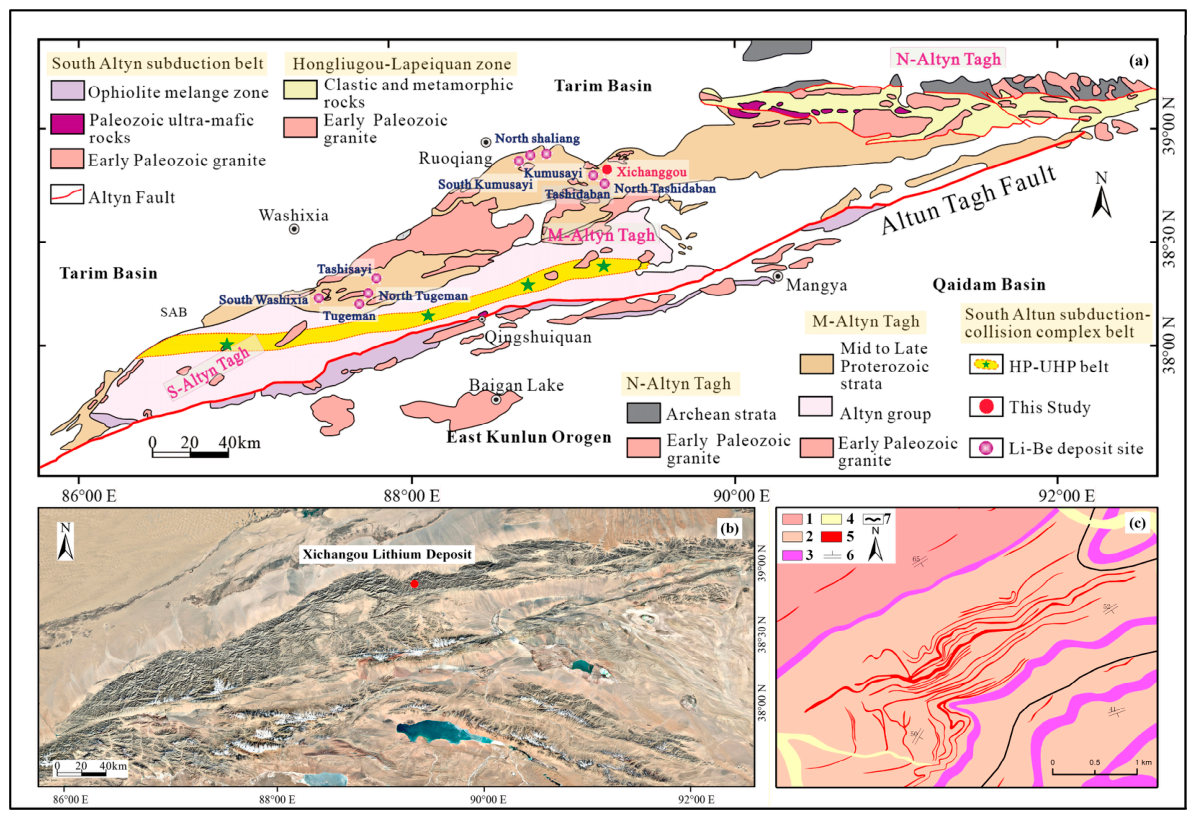
The Altyn Orogenic Belt constitutes an important component of the Proto-Tethyan tectonic domain and trends predominantly in a northeast direction. It is bounded by the Qaidam Basin to the south and the Tarim Basin to the north. A geological map of the Altyn region is shown in Figure 1a, and a satellite remote sensing image of the orogenic belt is presented in Figure 1b. The belt is composed of five principal tectonic units distributed from northeast to southwest: the Abei Block, the Hongliugou–Lapeiquan Mélange Belt, the Azhong Block, the Qingshuiquan–Yinggelisayi Ultrahigh-Pressure Metamorphic Belt, and the Anan Block. These units collectively record a complex and relatively complete tectonic evolution from the Precambrian to the Early Paleozoic [27,28,29]. The Abei Block is primarily composed of the Archean Milan Group and TTG (tonalite–trondhjemite–granodiorite) suites, characterized by amphibolite–granulite facies metamorphic complexes with ages ranging from 2500 to 2800 Ma. It is generally regarded as part of the Precambrian crystalline basement of the Tarim Craton [30]. The Hongliugou–Lapeiquan Mélange Belt is characterized by Early Paleozoic ophiolites, high-pressure–low-temperature metamorphic rocks, and weakly metamorphosed sedimentary rocks. Blueschist and eclogite within this belt, dated at 491–520 Ma, indicate subduction and accretion of ancient oceanic crust [31]. The Azhong Block contains multiple Paleoproterozoic to Neoproterozoic sedimentary–metamorphic sequences, including the Group, the Bashkurgan Group, and the Taxidaban Group, with depositional ages mainly spanning the late Mesoproterozoic to early Neoproterozoic [32]. The Qingshuiquan–Yinggelisayi Ultrahigh-Pressure Metamorphic Belt is dominated by eclogite and garnet gneiss and records three stages of metamorphism—high-pressure to ultrahigh-pressure eclogite facies, granulite facies, and granulite–amphibolite facies—between 490 and 440 Ma, reflecting deep subduction followed by rapid exhumation [33]. The Anan Block is mainly composed of the Paleoproterozoic Altyn Group and is characterized by amphibolite- to granulite-facies metamorphism. The recent identification of pyroxene granulite further constrains the deep crustal evolution of this block [34,35]. The Altyn Orogenic Belt has experienced intense tectonic activity and extensive magmatism, providing favorable conditions for rare metal mineralization. In recent years, a series of pegmatite-type lithium deposits, including Washixia South, Tugeman, and Qiadake, have been discovered within this metallogenic belt, substantially expanding the exploration potential for lithium resources in the region [36].
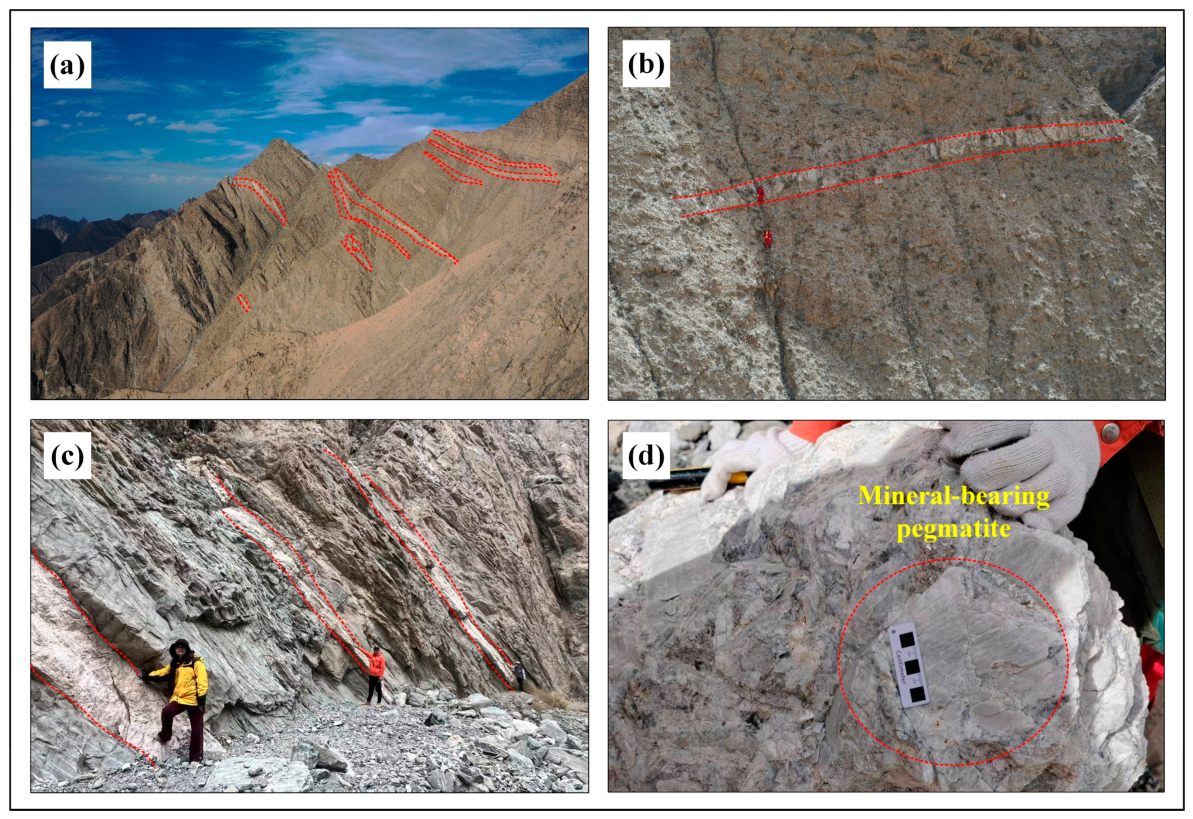
The Xichanggou lithium deposit in the Altyn region was selected as the study area. Located along the northern margin of the Altyn Mountains, it has been confirmed as a super-large pegmatite-type lithium deposit. The mining area is characterized by high-altitude, deeply incised mountainous terrain with significant relief, providing favorable conditions for remote sensing identification and spatial analysis of pegmatite dikes. Figure 2 shows the pegmatite dikes and ore bodies in the study area. Figure 2a presents a field panoramic view of a pegmatite dike; Figure 2b presents another field panoramic view of a pegmatite dike; Figure 2c presents a field close-up view of a pegmatite dike; and Figure 2d presents a field photograph of lithium-bearing pegmatite.The deposit is controlled by a monoclinic structural framework with well-developed foliation and joint systems. The exposed strata mainly consist of metamorphic rocks from the Mesoproterozoic Changcheng System Bashkurgan Group, which serves as the primary host for granitic pegmatite dikes and lithium–beryllium mineralization [37]. Lithologies are dominated by schist and granoblastic rocks with minor marble. The strata generally strike northeast with moderate dip angles. The region has undergone intense tectonic activity, mainly faulting, with a major ductile detachment fault acting as a key structural boundary. These structural features jointly controlled the distribution of strata and emplacement of pegmatite dikes, facilitating lithium mineralization.
A large spodumene-bearing granitic pegmatite dike swarm is well exposed in the mining area, extending about 4.5 km in length and 1.0 km in width. The dikes are generally concordant with surrounding strata, showing a stratiform distribution. Multiple lithium ore bodies have been identified, mostly trending northeast–southwest. A major central ore body is accompanied by several smaller ones, forming a relatively continuous mineralized belt. Ore bodies are mainly tabular or stratiform, with good lateral continuity and lengths ranging from hundreds of meters to several kilometers. Thickness varies from a few to tens of meters, with local branching or pinching. Vertically, ore bodies extend along the strata to depths of several hundred meters. The pegmatite dikes exhibit clear contacts with host rocks and relatively regular geometries. Regional metamorphism is well developed, reaching upper greenschist facies [38,39].
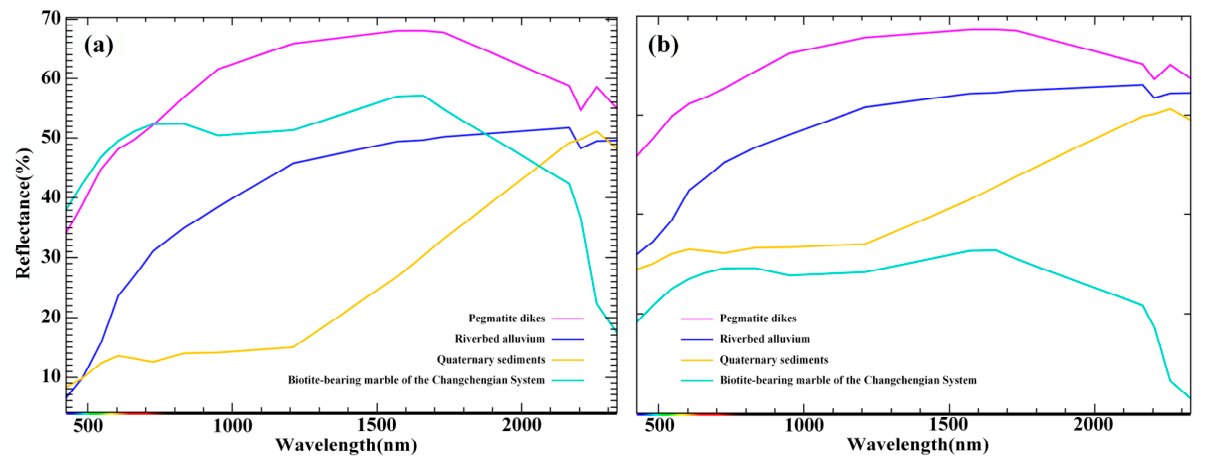
Based on the actual geological characteristics and surface cover types of the study area, the geological classes were classified into four classes: biotite-bearing marble of the Changcheng System, Quaternary sediments, fluvial alluvium, and pegmatite veins. As shown in Figure 3, the satellite-derived spectra of these four representative classes exhibited pronounced differences across the VNIR–SWIR wavelength range. Among them, pegmatite veins showed the highest reflectance over the entire spectral range. Their reflectance increased continuously from the visible to the near-infrared and shortwave infrared regions, with a distinct absorption feature around 2200 nm, followed by a variation near 2260 nm, indicative of characteristic Al–OH mineral absorption. Fluvial alluvium exhibited a moderate to high overall reflectance, gradually increasing with wavelength. Its spectral curve remained relatively smooth within the 1500–2100 nm range, lacking prominent absorption features, except for a noticeable absorption near 2205 nm. Quaternary sediments displayed relatively low reflectance in the visible to early near-infrared region, with a weak absorption feature around 725 nm. The reflectance increased significantly after 1200 nm, without showing distinct absorption minima. In contrast, the reflectance spectrum of the Changcheng biotite-bearing marble showed a clear “increase–decrease” pattern, characterized by a broad absorption feature between 832 and 1730 nm. The reflectance reached a local maximum near 1730 nm and then declined, forming a distinct absorption feature around 2260 nm. Overall, significant differences were observed among the four geological classes in terms of reflectance magnitude, spectral curve shape, and the position of key absorption features. In particular, absorption features in the SWIR region, especially around 2200 nm, provided critical diagnostic information for distinguishing Al–OH-bearing lithologies (e.g., pegmatite veins and biotite-bearing marble), while reflectance variations in the visible to near-infrared range facilitated the identification of sedimentary materials.

2.2. Data

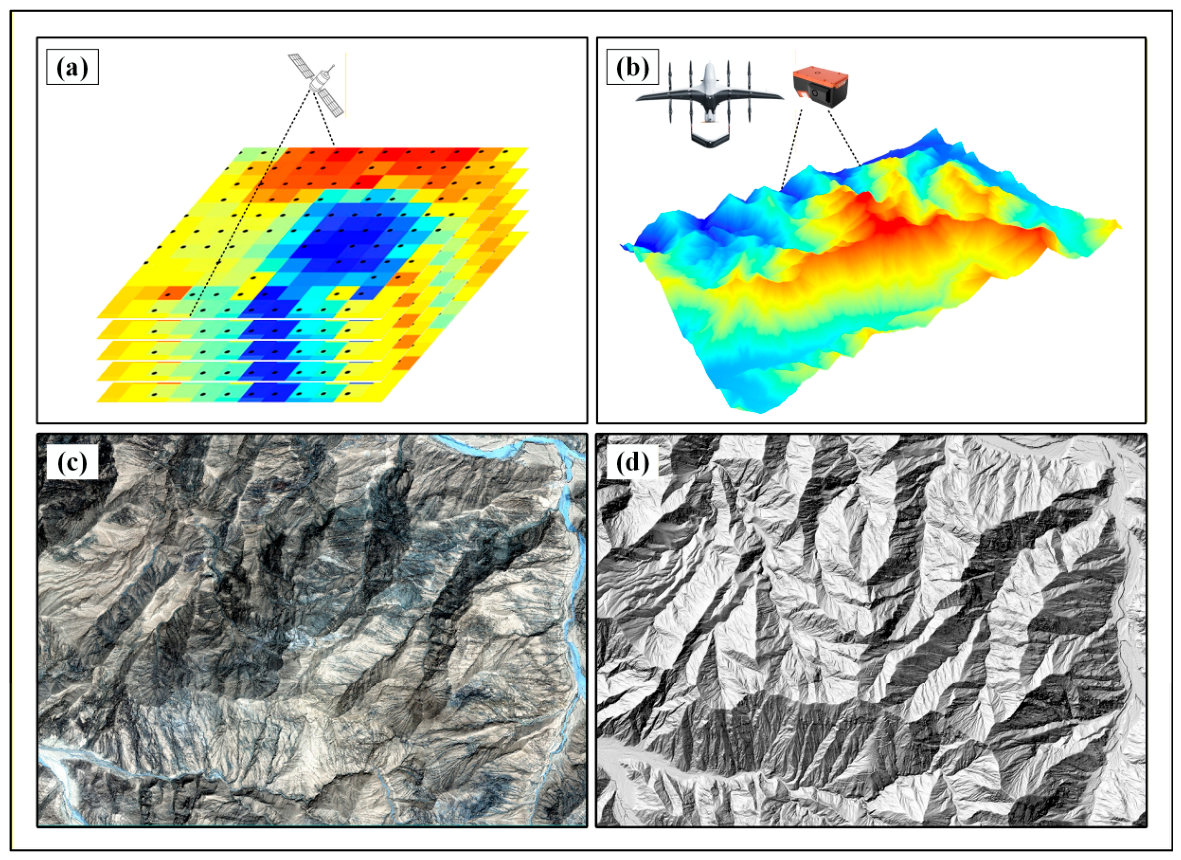
In this study, WorldView-3 satellite imagery was selected as the primary optical data source. WorldView-3, developed and operated by Maxar Technologies (USA), is a high-resolution commercial Earth observation satellite [40]. The satellite is equipped with a multispectral sensor covering the spectral range of 400–2365 nm, comprising 16 bands that enable effective discrimination of surface lithological variations. In terms of spatial resolution, the panchromatic band provides a resolution of 0.3 m. The sub-meter spatial resolution facilitates detailed characterization of the geometry and spatial distribution of pegmatite dikes, thereby providing a reliable data foundation for subsequent fine-scale segmentation and identification [41]. Prior to analysis, the WorldView-3 imagery was subjected to radiometric calibration to convert the original digital number (DN) values into at-sensor radiance. Subsequently, atmospheric correction was performed using the FLAASH model to reduce the effects of atmospheric scattering and absorption and to transform apparent reflectance into surface reflectance [42]. Finally, the imagery was topographically corrected using the high-precision DEM to mitigate radiometric biases caused by variations in slope and aspect on solar incidence angles. The images were also radiometrically normalized, thereby reducing the impact of shadow effects on the spectral consistency of the same geological classes and providing more stable input data for subsequent pegmatite dike segmentation. The WorldView-3 dataset used in this study covers an area of approximately 28 km2. The data acquisition process is illustrated in Figure 4a,c, and the detailed parameters are summarized in Table 1.
To obtain high-precision topographic information and three-dimensional structure, an airborne LiDAR survey was conducted using a Pegasus V1 UAV equipped with a long-range laser scanner (DV-LiDAR60). The UAV provided long endurance and wide coverage. DTMs derived from satellite stereo imagery may suffer from elevation errors in areas with strong relief. These errors are mainly caused by terrain occlusion and image-matching uncertainty. In contrast, LiDAR provides active sensing, is less affected by terrain shadowing, and directly acquires accurate three-dimensional point clouds. Therefore, it is more suitable for detailed terrain mapping in complex mountainous regions. The DV-LiDAR60 used in this study has a maximum range of 4000 m. The acquired point cloud density is approximately 2 points/m2. After trajectory processing and filtering, a DEM was generated from the point cloud. Its spatial resolution is consistent with that of the multispectral data. This DEM provides an accurate geometric basis for analyzing the three-dimensional distribution of pegmatite dikes. Satellite imagery and UAV-based LiDAR data were then integrated. This enabled multi-source and multi-modal data fusion. The combination of spectral and topographic information improved the accuracy and reliability of pegmatite dike segmentation. The LiDAR acquisition process is shown in Figure 4b,d, and system parameters are listed in Table 1.

2.3. Methods

2.3.1. Model Construction

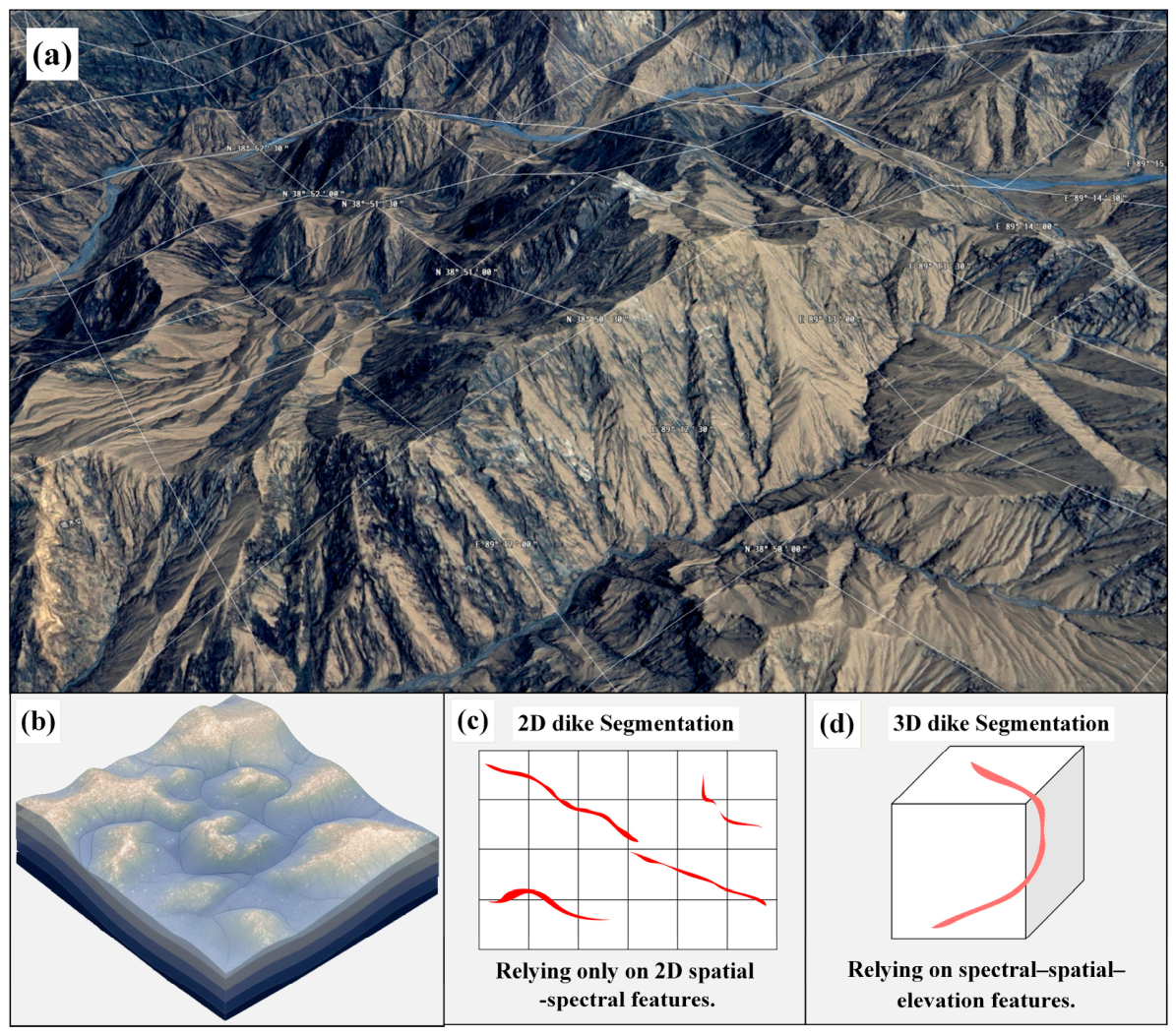
The Altyn Li-rich Gully deposit studied here is a super-large lithium ore body. It covers a wide area and is strongly influenced by complex topography. Traditional two-dimensional remote sensing segmentation methods usually treat images as flat pixel collections. They rely only on spectral features and two-dimensional neighborhood relationships to identify ore bodies [43]. These methods work reasonably well in gently undulating terrains. However, in deeply incised regions, slope orientation changes and variable observation geometry often cause spatial discontinuities or misalignments in segmentation results. To address this problem, topographic elevation information was incorporated into the multispectral segmentation model. This allowed the pegmatite dikes to be segmented in a way that better matches the actual terrain [44,45]. The proposed approach improves both segmentation accuracy and spatial consistency by integrating three-dimensional terrain information. It is important to note that this does not constitute traditional geological three-dimensional modeling. The method focuses on using DEM-derived elevation data to assist the deep learning segmentation framework. This enhances the continuity of dikes and their conformity to the terrain under complex, deeply incised conditions. In this study, the LiDAR-derived DEM provided each pixel with a unique and stable vertical position, supporting the extension of two-dimensional images into three-dimensional space. By combining elevation z with spectral–spatial features, the model captures not only the planar distribution of the dikes but also their vertical continuity and variations. A schematic of the pegmatite dike segmentation is shown in Figure 5.
The spatial distribution of pegmatite veins is typically strongly constrained by topographic conditions, and their elongate forms exhibit pronounced continuity in three-dimensional space. Consequently, reliance solely on two-dimensional spectral–spatial features is insufficient to accurately reconstruct their true distribution patterns. To address this limitation, a digital elevation model (DEM) was incorporated as a “height dimension” into the feature space, establishing a topography-assisted spectral–spatial modeling framework. This approach enabled the model to simultaneously consider spectral information and topographic constraints during training, thereby enhancing its ability to represent the actual spatial morphology of pegmatite veins.
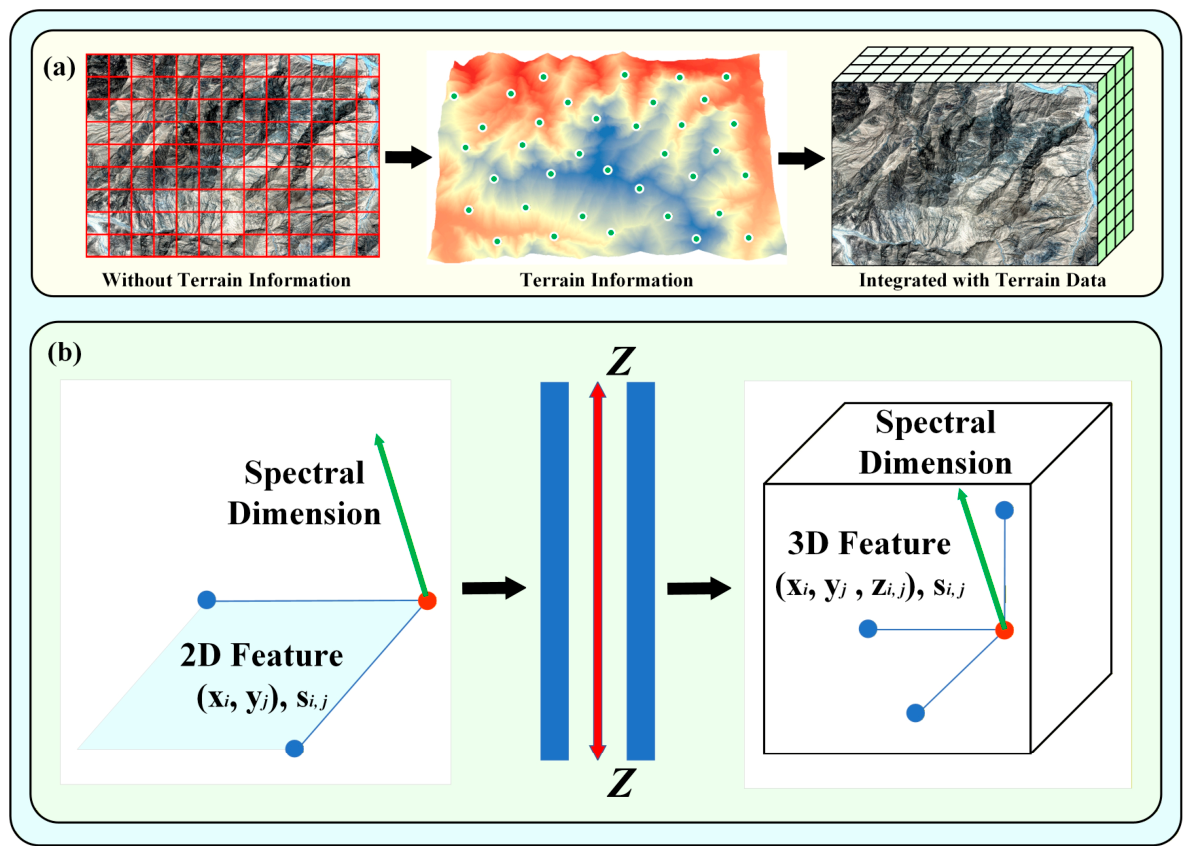
Let the original multispectral image be represented as a tensor X R H × W × C , where H and W denote the spatial dimensions, and C represents the number of spectral bands. To capture the continuous vertical variations of the surface, an elevation field Z R H × W was introduced (Figure 6).
First, the elevation data were normalized as follows:
Z = Z Z m i n Z m a x Z m i n
Here, Z denotes the normalized elevation data, ranging from 0 to 1. Z represents the actual elevation values of each pixel within the study area, while Z m i n and Z m a x correspond to the minimum and maximum elevations, respectively. The normalized elevation field was then expanded into a three-dimensional tensor Z R H × W × 1 to match the image channels and concatenated along the channel dimension to form the fused input representation:
X = c o n c a t ( X , Z ) R H × W × ( C + 1 )
Within the patch-level modeling framework, the fused input was partitioned into local windows: X p R P × P × ( C + 1 ) and subsequently mapped to a sequence representation through a linear projection (Patch Embedding):
T spa = P a t c h E m b e d ( X p ) R N × D
where N denotes the number of patches and D represents the embedding dimension. This sequence was fed into the Spatial–Spectral Mamba encoder for feature modeling, allowing the model to explicitly incorporate topographic information at the initial feature extraction stage, thereby enhancing its ability to represent complex terrain structures.
To further improve the model’s capacity for nonlinear vertical variation, an elevation-based positional encoding (PE) was introduced at the feature level. For any pixel i j , the enhanced feature representation was defined as
x i , j = c o n c a t s ( i , j ) ,   P E z i , j
where concat ( ) denotes vector concatenation, and P E ( ) maps the continuous elevation information into a high-dimensional feature space, thereby improving the model’s sensitivity to vertical variations. Compared to directly using raw elevation values, the positional encoding effectively enhances the expression of nonlinear topographic changes and increases discriminability across different elevation ranges.
Through this feature augmentation, the representation of each pixel was no longer limited to two-dimensional spectral–spatial information but also included vertical terrain information. This enabled the model to jointly capture the intrinsic relationships among spectral differences, spatial location, and elevation variation. Consequently, the predicted segmentation boundaries were constrained not only in the two-dimensional plane x y but also along the vertical z direction, thereby better preserving the spatial continuity of pegmatite veins within complex terrain.
Formally, the conventional two-dimensional representation can be expressed as
f 2 D ( i , j ) ( x i , y j , s i j )
After introducing elevation information, the representation was extended to a three-dimensional feature vector:
f 3 D ( i , j ) ( x i , y j , z i j , s i j )
where z i j = Z ( x i , y j ) , and the symbol “≜” denotes “defined as.” This extension effectively elevated the original two-dimensional spectral–spatial modeling framework to a three-dimensional spatial–spectral joint modeling framework, enabling the model to simultaneously perceive lateral surface variations and vertical structural features. As a result, the learned discriminative boundaries more accurately reflect the true distribution of pegmatite veins under deeply incised terrain conditions.
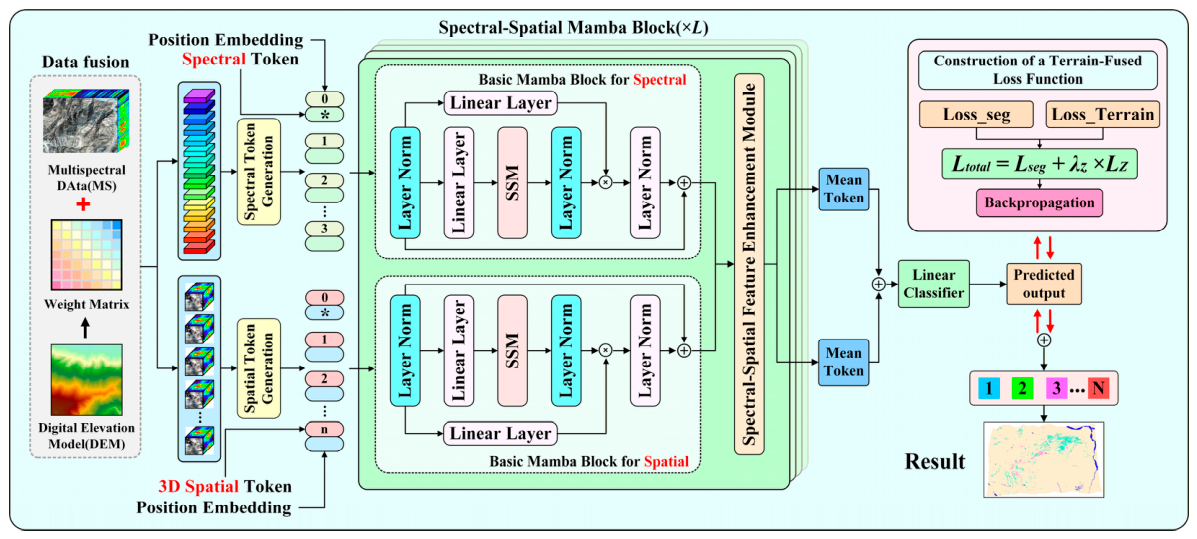
By introducing a terrain fusion module, a terrain-aware Spatial–Spectral Mamba model was developed in this study (Figure 7). Mamba is a novel sequence modeling approach capable of efficiently capturing long-range dependencies with linear computational complexity, making it suitable for deep fusion of multimodal features and extraction of critical information [46,47]. Consequently, the Mamba model demonstrated superior applicability for tasks requiring both extensive long-range modeling and computational efficiency, such as large-scale pegmatite segmentation. The Spatial–Spectral Mamba model was employed to perform pegmatite segmentation, with the overall architecture comprising a spectral branch, a spatial branch, and stacked multi-layer Spatial–Spectral Mamba modules. Through the state-space modeling mechanism, the network effectively captured long-range dependencies along both spectral and spatial dimensions, accommodating the continuous distribution patterns of pegmatites in multispectral imagery. However, although embedding elevation information at the feature level enhanced the model’s capacity to represent complex terrain, it remained insufficient to fully constrain spatial consistency from an optimization perspective. In particular, in regions with dramatic topographic variation, the model still produced discrete artifacts inconsistent with geological reality. To address this limitation, a terrain-based loss function was incorporated during model training, imposing constraints on the predictions and thereby achieving synergistic improvements in both feature learning and result optimization. Based on this rationale, a joint loss function was constructed for network training as follows:
L total   =   L seg   +   λ z L z
The segmentation loss L seg was formulated as a weighted cross-entropy to alleviate class imbalance:
L seg = 1 N i = 1 N k = 1 K w k   y i k   log y ^ i k
where K denotes the total number of classes, w k is the class weight, y i k is the one-hot encoded ground truth label, and y ^ i k represents the predicted probability for class k at pixel i .
The terrain loss L z was introduced to leverage elevation information in guiding the model, ensuring that the predicted results better conformed to actual topographic conditions. By embedding DEM information into the feature space, the model was enabled to perceive vertical variations in the terrain, thereby producing segmentation results consistent with the true elevation distribution. The terrain constraint was defined as
L z = 1 N i = 1 N P i f ( z i )
where P i is the predicted probability of pegmatite occurrence, z i is the normalized elevation of the corresponding pixel, and f ( z i ) represents the prior probability of pegmatite occurrence conditioned on elevation z i . Minimizing the discrepancy between the prediction and this prior distribution effectively suppressed anomalous predictions inconsistent with the terrain, enhancing the plausibility of the segmentation results.
To evaluate the effect of incorporating terrain information into the Spatial–Spectral Mamba model, an ablation study was conducted, varying the weight coefficient λ z in the combined loss function. Here, λ z controls the contribution of the terrain term relative to the supervised segmentation loss. Setting λ z = 0 effectively excluded terrain information, whereas larger values increased the influence of prior constraints derived from incised topography.
The results of the ablation experiments are summarized in Table 2. Incorporating the terrain module consistently improved model performance compared to the original Spatial–Spectral Mamba. Specifically, increasing λ z from 0 to 0.5 led to progressive improvements in overall accuracy (OA), average accuracy (AA), and the Kappa coefficient, with the highest metrics achieved at λ z = 0.5 (OA = 98.15%, AA = 98.30%, Kappa = 0.9725). Further increasing λ z to 0.8 resulted in a sharp decrease in performance, indicating that excessive weighting of the terrain term can be detrimental. These findings demonstrate that integrating terrain information significantly enhances segmentation accuracy and stability, and that λ z = 0.5 represents an optimal balance between spectral and topographic contributions in this study.
As illustrated in Figure 7, after model construction and ablation experiments, the model with λ = 0.5 was selected as the final configuration. The input data on the left-hand side of Figure 7 consist of multispectral remote sensing imagery fused with deeply incised DEM terrain information, providing the model with both spectral and geometric information. The two Basic Mamba blocks are arranged in a parallel manner and correspond to the spectral and spatial branches, respectively. In the input stage, elevation information was embedded into spatial tokens via an independent channel to characterize geometric relationships and spatial continuity across different locations, while spectral tokens were designed to capture spectral variations across different bands at the same spatial position. Subsequently, the spectral and spatial tokens were fed into a Spatial–Spectral Mamba encoder composed of multiple stacked Mamba blocks. Each Mamba block consisted of a linear projection layer, a state space model (SSM) unit [48], and a layer normalization module, where the SSM was responsible for efficiently modeling long-range dependencies in the input sequences. Through the selective scan mechanism, long-range dependencies were effectively captured in both spatial and spectral sequences, thereby overcoming the limitations of conventional convolutional methods in terms of receptive field.
Within the multi-layer Spatial–Spectral Mamba architecture, the spectral and spatial branches were progressively fused at higher feature levels, forming joint representations that simultaneously encoded spatial structural information and spectral discriminative features. After multiple layers of stacking, the output features exhibited enhanced semantic representation of the overall morphology of pegmatite veins while maintaining strong spatial continuity. In the output stage, global aggregation of spatial and spectral features was performed using a mean token, followed by a linear classification head to predict the class label of each patch, ultimately generating regional-scale pegmatite segmentation results. During training, cross-entropy loss was employed to supervise classification, while an additional spatial consistency-related loss term was introduced to further enhance the smoothness and physical plausibility of the predictions. The structure of the SSM (State Space Model) core module is shown in Table 3.

2.3.2. Model Training and Evaluation Indicators

Based on field investigation and lithological survey results from the Xichanggou mining area, the principal geological classes in the WorldView-3 multispectral imagery were systematically interpreted and annotated. A deep learning dataset for pegmatite dike segmentation under deeply incised and topographically complex conditions was thereby established (Table 4). According to the geological characteristics and surface cover types of the study area, the geological units were classified into four classes: Changchengian biotite-bearing marble, quaternary sediments, fluvial alluvium, and pegmatite dikes. Among these, pegmatite dikes typically occur as narrow, elongated, or discontinuous bands. They are characterized by small spatial scales and complex geometries and are strongly affected by pronounced topographic relief and shadow effects. Consequently, they represent the most challenging target class for segmentation in deeply incised terrains. In terms of sample construction, labeled samples were generated based on actual geological conditions to support supervised learning, while explicitly considering the issue of spatial autocorrelation commonly present in remote sensing imagery. To avoid the potential spatial overlap between training and validation samples caused by random partitioning, a region-based dataset construction strategy was adopted. The dataset was divided into spatially independent subregions, with approximately 80% of the regions allocated for training and the remaining 20% reserved for validation. By dividing the dataset into spatially independent regions for training and validation, the region-based partitioning strategy ensured that the model was tested on previously unseen areas, thereby providing a more realistic evaluation of its generalization ability and stability under deeply incised and complex terrain conditions.
The proposed Spatial–Spectral Mamba model integrating deeply incised terrain information was employed to train the remote sensing imagery of the study area. The model was trained for 200 epochs to ensure adequate parameter convergence and stable optimization during the training process. To systematically evaluate the segmentation performance and effectiveness of the proposed method, comparative experiments were conducted between the pegmatite dike segmentation model incorporating the deeply Incised terrain module and the original Spatial–Spectral Mamba (SS-Mamba), as well as several widely used baseline approaches. The comparison methods included Support Vector Machine (SVM) [49], K-Nearest Neighbors (KNN) [50], two-dimensional Convolutional Neural Network (2D CNN) [51], three-dimensional Convolutional Neural Network (3D CNN) [52], the hybrid 2D–3D convolutional network HybridSN [53], and the Spatial–Spectral Transformer Network (SSTN) [54].
The parameter settings of all models are presented in Table 5. The listed parameters correspond to the optimal configurations obtained through empirical tuning for each model. Meanwhile, all deep learning models were trained with the same number of epochs to ensure fairness and consistency in the comparison. The differences in input data formats among the models mainly arise from their inherent architectural characteristics and the types of data representations they are designed to exploit. In particular, the proposed method incorporates additional terrain information into the input, with the aim of validating the effectiveness of the introduced terrain fusion module in improving model performance.
Model performance was assessed using three widely adopted evaluation metrics: Overall Accuracy (OA), Average Accuracy (AA), and the Kappa coefficient. In addition, class-wise accuracies for individual geological classes—Biotite-bearing marble of the Changchengian System, Quaternary sediments, Riverbed alluvium, and Pegmatite dikes—were analyzed to provide a comprehensive evaluation [55]. These metrics objectively quantify segmentation reliability from multiple perspectives, including overall agreement, inter-class balance, and correction for chance agreement.
The evaluation metrics were defined as follows:
OA   =   TP + TN TP + TN + FP + FN
AA = 1 K i = 1 K Ac c i
Kappa = p o p e 1 p e
where True Positive (TP) denotes the number of samples that belong to a given class and are correctly predicted as that class; True Negative (TN) represents the number of samples that do not belong to the class and are correctly predicted as non-members; False Positive (FP) indicates the number of samples that do not belong to the class but are incorrectly predicted as belonging to it; and False Negative (FN) refers to the number of samples that belong to the class but are incorrectly predicted as another class. K represents the total number of classes, and Acc i denotes the classification accuracy of the i-th class. The term p o represents the observed agreement between predicted and reference labels, while p e denotes the expected agreement under random classification.

3. Results

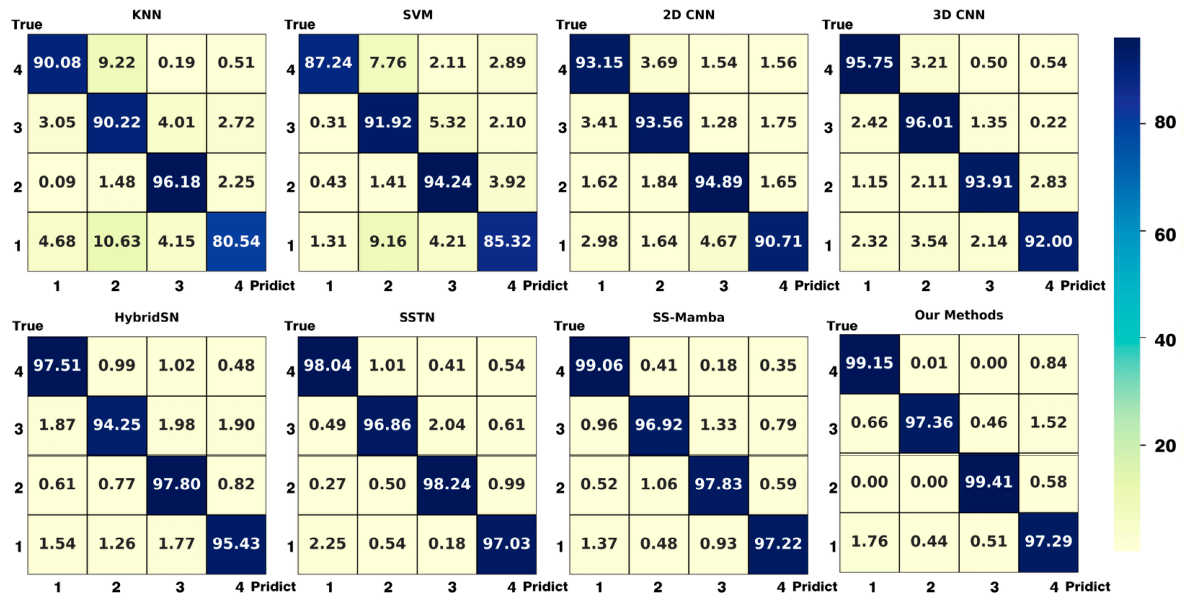
As shown in Table 6, the performance of different methods for pegmatite dike segmentation in the study area was systematically evaluated using several metrics, including class-wise accuracy, Overall Accuracy (OA), Average Accuracy (AA), and the Kappa coefficient. From the perspective of class-wise accuracy, traditional machine learning methods (KNN and SVM) exhibited relatively lower performance overall. The classification accuracies for pegmatite dikes were only 80.54% and 85.32%, respectively. In comparison, convolutional neural network–based approaches were able to extract spatial features more effectively. The 2D-CNN improved classification performance across all four classes, achieving a pegmatite dike recognition accuracy of 90.71%. Furthermore, the 3D-CNN jointly modeled spatial and spectral information, leading to additional improvements in classification accuracy. HybridSN achieved effective feature fusion between 2D and 3D convolutional structures, resulting in an overall accuracy of 96.19%. The SSTN model obtained relatively high accuracies across all four classes, indicating that Transformer-based spatial–spectral classification methods can contribute to improved segmentation continuity. The original Spatial–Spectral Mamba model further enhanced classification performance while maintaining relatively low computational complexity. It achieved an OA of 97.44% and an AA of 97.76%, outperforming most of the comparative methods overall.
On this basis, the proposed Spatial–Spectral Mamba model integrating deeply incised terrain information further introduced DEM-based terrain constraints into the original SS-Mamba architecture. This modification enabled the model to incorporate terrain variation during the learning of spatial–spectral features. As a result, the highest or near-highest recognition accuracies were achieved across all classes. The classification accuracies for the Biotite-bearing marble of the Changchengian System (Class 1), Quaternary sediments (Class 2), riverbed alluvium (Class 3), and pegmatite dikes (Class 4) reached 99.15%, 97.36%, 99.41%, and 97.29%, respectively. In particular, for the pegmatite dike class (Class 4), the proposed model achieved substantially higher accuracy than traditional machine learning approaches and outperformed both 3D-CNN and HybridSN. These results indicate that the incorporation of elevation constraints improves the model’s ability to delineate dike boundaries and maintain spatial continuity in complex terrain. From the stability of the model’s performance across different classes and the consistency of overall evaluation metrics, the proposed method demonstrated a certain degree of generalization ability under complex terrain conditions. The classification accuracies were generally high and relatively well balanced among classes, and the close agreement between OA and AA indicates that no significant performance bias existed across different categories.
From the perspective of overall evaluation metrics, the proposed method achieved an OA of 98.15%, which is higher than those of KNN (90.62%) and SVM (91.27%), and also exceeds the performance of 2D-CNN (93.52%), 3D-CNN (94.74%), HybridSN (96.19%), and SSTN (97.39%). This indicates that the integration of three-dimensional terrain information improved the overall classification consistency of the model. The AA reached 98.30%, representing an improvement of 0.71% compared with the original SS-Mamba (97.59%). The Kappa coefficient increased from 0.9620 to 0.9725, suggesting a higher level of agreement between the predicted results and the reference labels. These results indicate that incorporating three-dimensional terrain information into the SS-Mamba framework enhanced both the overall classification consistency and class balance, thereby demonstrating the effectiveness of the terrain information fusion strategy. The observed performance improvement can be attributed to two main factors. First, by embedding DEM-derived elevation information into the feature space, the original two-dimensional spectral–spatial representation was extended to a three-dimensional spatial–spectral representation. This allowed the model to capture both planar distribution patterns and vertical continuity during the segmentation process, thereby reducing misclassification and fragmentation caused by slope variation and shadow effects in deeply incised terrain. Second, the long-range dependency modeling capability of the Mamba state space architecture strengthened the global representation of spatial–spectral sequences while maintaining linear computational complexity. This property enabled elongated structures such as pegmatite dikes to be more consistently represented at the regional scale.
Overall, the experimental results demonstrate the effectiveness of the Spatial–Spectral Mamba model with integrated three-dimensional terrain information for pegmatite dike segmentation in deeply incised and complex terrain. The proposed approach achieved improvements in overall accuracy metrics and showed enhanced stability and spatial continuity in the identification of complex target classes. The resulting segmentation patterns more realistically reflect the spatial distribution of pegmatite dikes. Consequently, the method provides a reliable technical approach for regional-scale lithium exploration and the refined delineation of prospective targets.
The confusion matrices (Figure 8) further reveal noticeable differences in the class discrimination capability among the compared methods. Traditional approaches such as KNN and SVM exhibited evident confusion between the Great Wall System biotite-bearing marble (Class 1) and Quaternary sediments (Class 2), indicating that classification based solely on spectral information or shallow spatial features was insufficient to clearly distinguish these categories. For the 2D CNN, 3D CNN, and HybridSN models, the values along the diagonal of the confusion matrices increased overall, suggesting that classification accuracies across the categories became more balanced and that inter-class confusion was partially reduced. The SSTN and SS-Mamba models further improved the stability of class discrimination, with a continued decrease in the proportion of misclassified samples. In comparison, the proposed method maintained consistently high values along the diagonal elements for all classes, while the off-diagonal elements were significantly reduced. In particular, the misclassification rates between previously confusing class pairs were markedly lowered. This indicates that, after incorporating elevation information, the model was able to more effectively capture the spatial distribution differences among classes under complex terrain conditions, thereby substantially mitigating inter-class confusion.
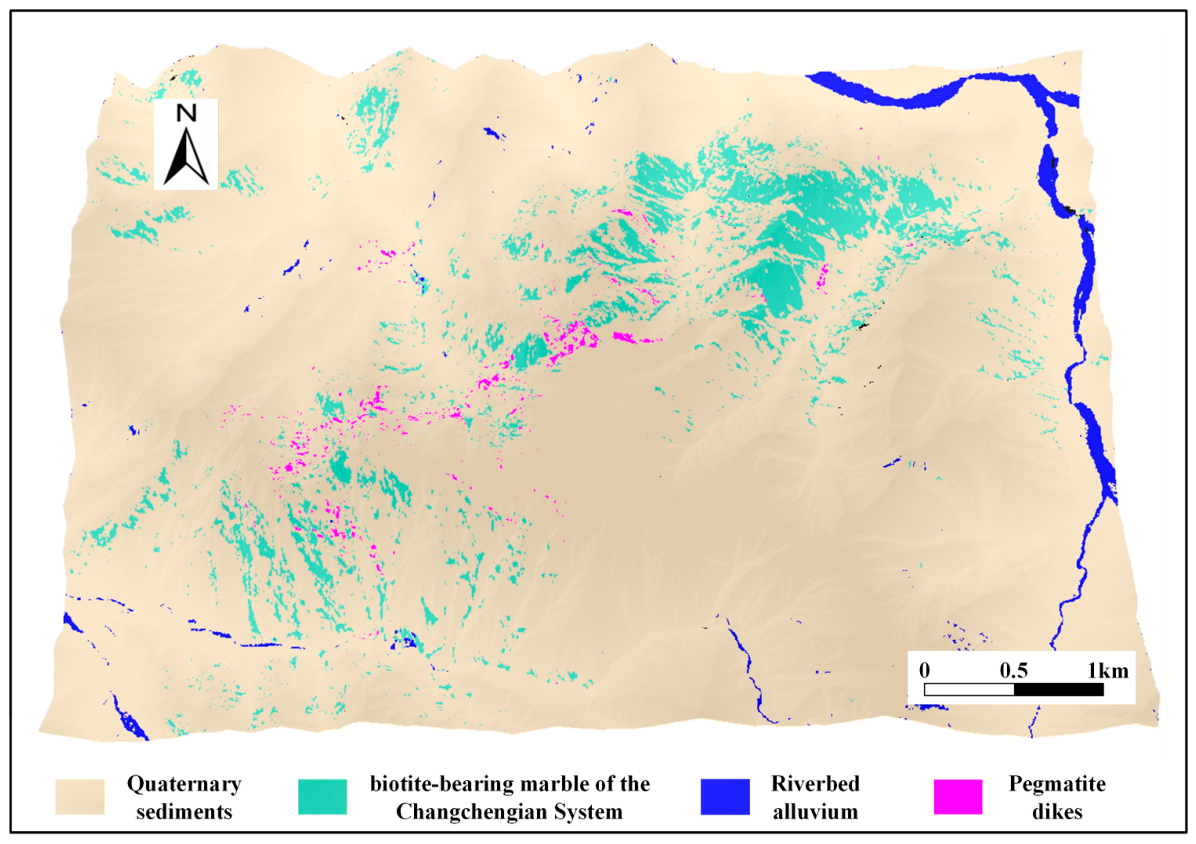
Figure 9 presents the terrain-integrated segmentation results of four geological classes predicted by the trained model, including Quaternary sediments, Biotite-bearing marble of the Changchengian System, Riverbed alluvium, and Pegmatite dikes. Overall, Quaternary sediments are distributed continuously over large areas within the study region, exhibiting relatively complete spatial coverage. Biotite-bearing marble of the Changchengian System is mainly exposed in mountainous and structurally developed zones, where it appears as sheet-like or banded extensions. Riverbed alluvium is distributed linearly or in elongated strips along valleys and drainage systems, showing good correspondence with actual geomorphological features. The segmentation results for Pegmatite dikes display distinct banded patterns in space, with overall continuity along preferred orientations that are generally consistent with regional structural trends and topographic relief. In areas characterized by pronounced terrain undulation, the predicted pegmatite dikes maintain relatively clear spatial boundaries, without exhibiting extensive fragmentation or irregular dispersion. Combined with the previously discussed class-specific accuracies and overall evaluation metrics, these results indicate that the proposed model demonstrates strong discrimination capability for different geological classes under complex geomorphological backgrounds. In particular, within deeply incised areas characterized by significant slope variations, the segmentation outputs preserve spatial continuity and structural coherence, suggesting that the model maintains stability and applicability for pegmatite dike segmentation under complex topographic conditions.
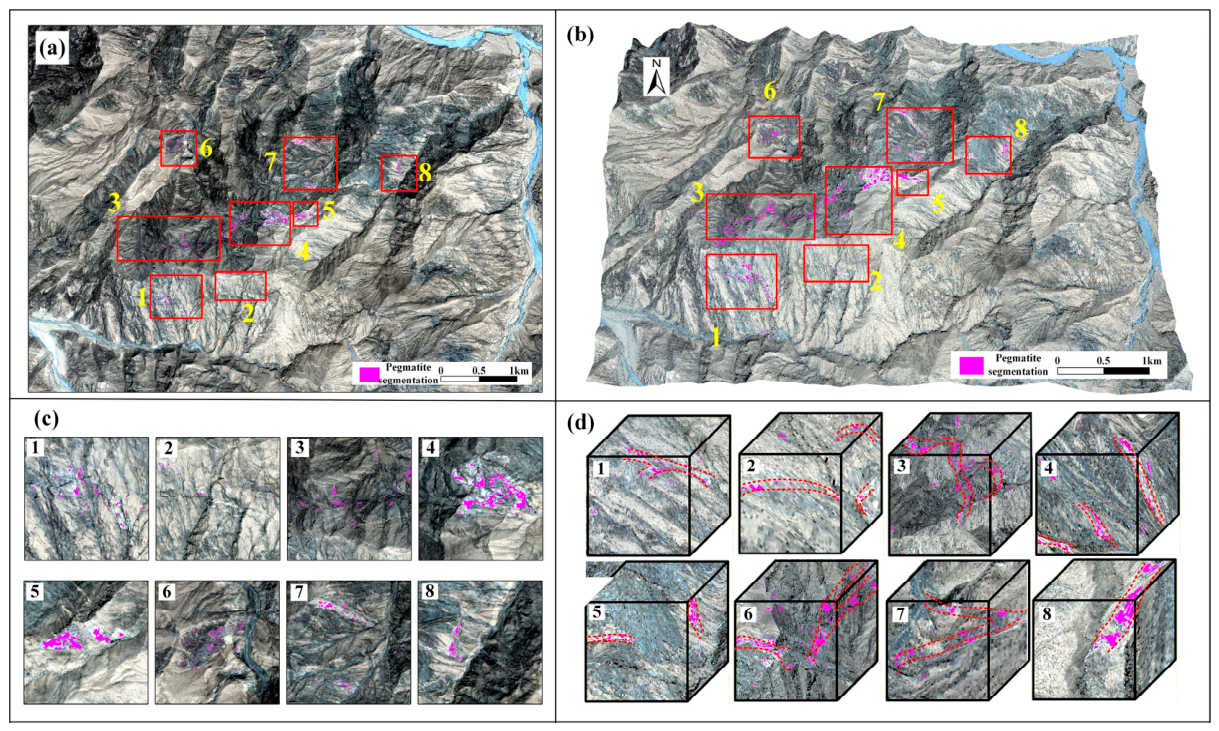
Figure 10 illustrates the two-dimensional and three-dimensional segmentation results of pegmatite dikes in the deeply incised terrain. Among all comparative methods, the Spatial–Spectral Mamba model achieved the best performance in terms of classification accuracy and was therefore selected as a representative model for comparison. In this study, the two-dimensional segmentation results of this model were used as the baseline for analysis. It should be noted that the original Spatial–Spectral Mamba model does not incorporate the three-dimensional terrain embedding module and performs feature learning based solely on spatial–spectral information. Specifically, Figure 10a presents the overall distribution of the two-dimensional segmentation results, while Figure 10c shows an enlarged view of a local area. The results indicate that, prior to the integration of terrain information, the complex topographic conditions of the study area—characterized by significant elevation variations and complex slope orientations—led to discontinuities or omissions in some pegmatite dikes in regions such as Areas 1, 3, and 5. As a result, the identified dike distribution appears relatively reduced. Further observations from the enlarged local view reveal that, because terrain information was not incorporated into the two-dimensional segmentation process, the model relied only on spatial–spectral features derived from the imagery. Consequently, it was difficult to accurately represent the true spatial distribution patterns of pegmatite dikes under complex terrain conditions.
As shown in Figure 10b, after the introduction of the three-dimensional terrain model, the segmentation results were extended from the original two-dimensional planar representation to a three-dimensional spatial framework. This enabled the results to be spatially mapped according to terrain variations, thereby reflecting the actual distribution of pegmatite dikes under different elevation, slope, and aspect conditions. Through this representation, pegmatite dikes are no longer expressed solely as linear or patch-like features on a planar surface but instead appear as spatial structures that conform to the terrain surface. Consequently, the relationship between dike orientation and geomorphological features becomes more intuitive. Compared with conventional two-dimensional segmentation results, the three-dimensional representation better preserves the spatial continuity of pegmatite dikes in areas with significant topographic variation, such as steep slopes, valleys, and slope break zones. This approach also reduces boundary displacement caused by terrain occlusion or projection distortion. In addition, the spatial connections of dikes across different elevation levels are preserved, which facilitates the identification of their overall extension trends and local morphological variations.
Figure 10d presents locally enlarged three-dimensional views of eight representative regions to further analyze the spatial distribution characteristics of pegmatite dikes under different topographic conditions. The three-dimensional visualizations show that pegmatite dikes generally occur as banded, lenticular, or irregular strip-like bodies. In most cases, their extension directions are broadly consistent with the slope orientation or the regional structural trend. From the overall spatial perspective, pegmatite dikes in different geomorphological units commonly exhibit banded or strip-like distributions along the slope surface, with relatively consistent extension directions, indicating a certain degree of spatial orientation. Across different terrain positions—including ridge crests, relatively intact slopes, and both sides of valleys—the dikes adjust to terrain variations, and local features such as bending, turning, or branching can be observed, reflecting a certain level of geometric complexity. In some areas, however, the dike extension direction appears relatively uniform, and the morphology is comparatively regular.
The three-dimensional segmentation results allow the continuity of dikes across different elevation levels to be more clearly identified, as well as variations in their inclination along the slope surface. Compared with conventional two-dimensional planar representations, the three-dimensional results simultaneously display the relationships among elevation, slope, and planar position, thereby providing a more complete representation of the spatial distribution characteristics of pegmatite dikes.
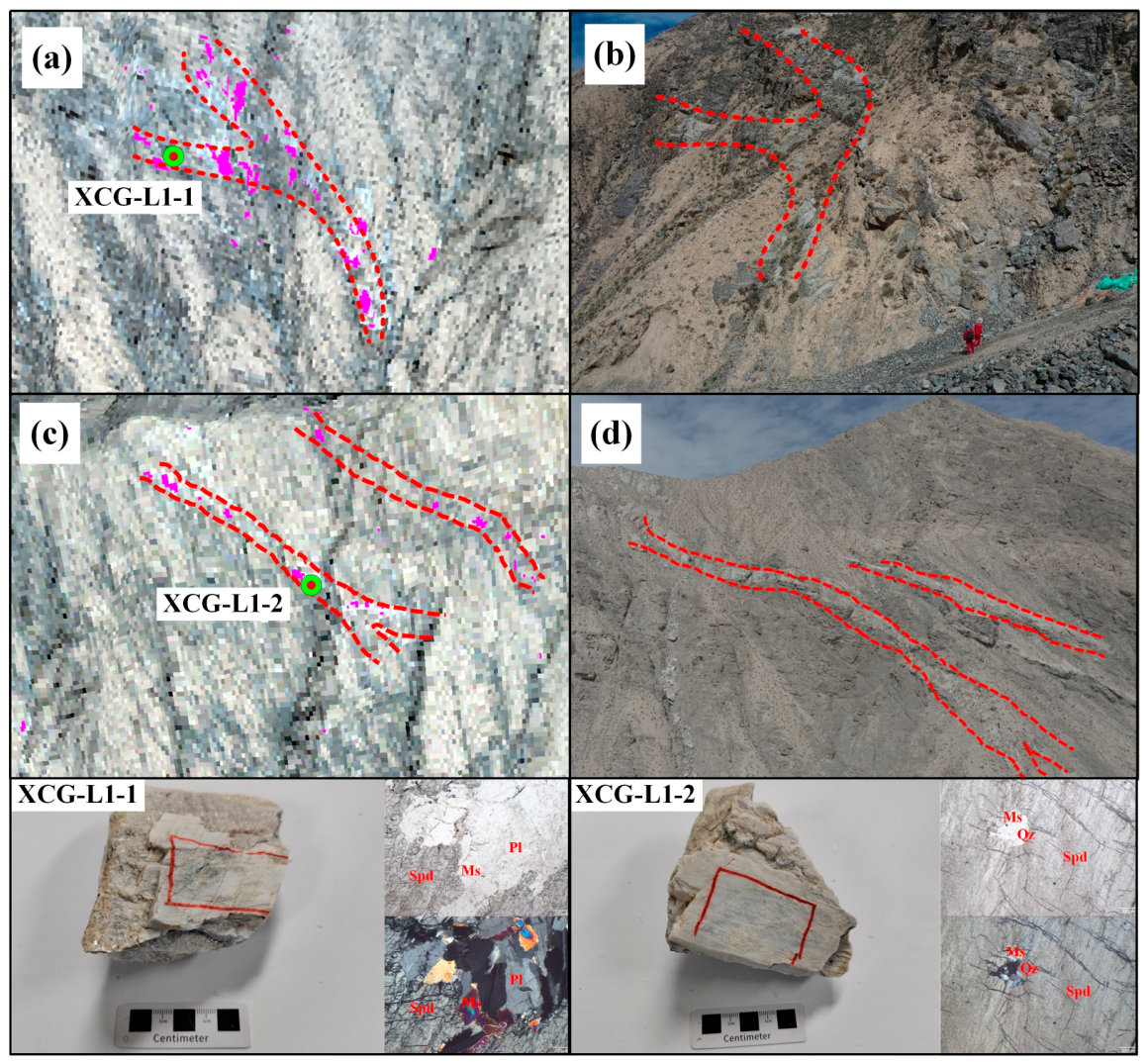
To further evaluate the practical effectiveness of the proposed terrain-integrated pegmatite dike segmentation method, two areas within the study region (corresponding to Areas 1 and 2 in Figure 10) were selected as field validation sites for comparative analysis (Figure 11). After completing the pegmatite dike segmentation from the remote sensing imagery, the segmentation results were compared with the actual field exposures based on on-site observations. The field investigation indicates that two major pegmatite dikes within the validation areas were successfully identified in the remote sensing segmentation results. Their spatial locations are generally consistent with the observed outcrop positions, and the overall extension directions agree with field observations. In steep slope areas, the segmented dikes were found to extend along the slope surface, showing good agreement with the actual distribution patterns of the dikes on the terrain. No significant large-scale displacement or systematic misclassification was observed. At the same time, a certain degree of local discontinuity or patchiness can be observed in the segmentation results. Field verification suggests that this phenomenon is primarily related to the inherent discontinuity of pegmatite outcrops and variations in spectral responses, rather than large-scale misclassification or confusion between categories.
To verify the mineralogical characteristics of the segmented targets, representative samples were collected from the identified pegmatite dike areas, and rock thin sections were prepared for microscopic petrographic examination. The microscopic analysis indicates that the samples are lithium-bearing pegmatites, with the main mineral assemblage including spodumene and other lithium-bearing minerals. This mineralogical composition is consistent with the known mineralization characteristics of the region, thereby confirming the authenticity of the targets identified by the remote sensing segmentation results. By integrating the remote sensing segmentation results with field verification and petrographic identification, it can be observed that the proposed method is capable of effectively identifying the spatial locations and extension directions of pegmatite dikes under complex terrain conditions. Although some local discontinuities remain in certain areas, the overall segmentation results are generally consistent with the actual geological conditions. This suggests that the method demonstrates good stability and applicability for pegmatite dike identification in deeply incised geomorphological environments.

4. Discussion

This study proposed a Spatial–Spectral Mamba model integrating deep-cut terrain information, which was applied for high-precision segmentation of pegmatite dikes in the Altyn Li-rich Gully under complex, deeply incised topography. Experimental results demonstrated that the method outperformed multiple representative deep learning models in overall accuracy (OA), average accuracy (AA), and Kappa coefficient, showing particular superiority in the continuity and spatial plausibility of the pegmatite dike segmentation. These findings indicate that incorporating LiDAR-derived DEM and its elevation derivatives into remote sensing segmentation models not only enhanced the model’s perception of the vertical structure of pegmatite dikes but also mitigated the limitations imposed by deeply incised terrain on two-dimensional spectral–spatial feature extraction.
The main contributions of this study are threefold. First, by extending conventional two-dimensional spatial features to spatial–spectral features enriched with deep-cut terrain information, the model was enabled to jointly represent spectral variations, spatial locations, and elevation changes, thereby more accurately characterizing the true distribution of pegmatite dikes in complex terrain. Second, the incorporation of elevation-based positional encoding improved the model’s ability to capture nonlinear vertical variations, enhancing discrimination across different elevation ranges. Third, the introduction of a terrain-constrained loss during training ensured that the predicted results were spatially continuous and geologically consistent, providing a dual-level optimization framework for remote sensing segmentation in deeply incised regions.
Field validation further demonstrated that the major pegmatite dikes identified by the method corresponded closely to their actual outcrop locations, with both the extension patterns and spatial scales of the dikes effectively recovered. In addition, thin-section petrographic analysis confirmed that these dikes are lithium-bearing pegmatites containing spodumene mineral assemblages, further verifying the validity of the model. This not only highlights the critical role of terrain information in improving segmentation accuracy and spatial plausibility but also demonstrates the applicability of the model under large-scale, complex geomorphological conditions. Compared with conventional two-dimensional approaches, the terrain-fusion strategy shows clear advantages in suppressing discontinuities, misalignments, and anomalous predictions, providing a reliable data foundation for analyzing mineralization spatial patterns and supporting subsequent geological modeling.
Nevertheless, certain limitations remain. The accuracy of the DEM directly affects the model’s ability to capture vertical features of pegmatite dikes. In regions with drastic elevation changes or dense vegetation, sparse LiDAR point clouds may result in insufficient elevation information, thereby influencing segmentation performance. Moreover, the model still relies on relatively large, annotated datasets during training, and its transferability to unannotated areas or alternative geological settings requires further assessment.
Future research could focus on several directions: (i) integrating hyperspectral imagery and multi-source remote sensing data to further enhance pegmatite dike discrimination, particularly for fine mineral identification; (ii) self-supervised or weakly supervised learning strategies can be explored to reduce the reliance on large-scale labeled datasets, and to systematically investigate the model’s generalization ability across different geological settings and regional scales, thereby improving its stability and adaptability for cross-regional applications; and (iii) incorporating geological structural constraints or lithological priors to enable joint modeling driven by both data and geological knowledge, thereby increasing robustness and reliability under extremely complex terrain conditions.
Overall, the proposed three-dimensional terrain-fusion segmentation approach demonstrated significant advantages in complex topographic settings, improving both the recognition accuracy and spatial continuity of pegmatite dikes. It provides a new technical pathway for large-scale lithium deposit remote sensing identification, mineralization pattern analysis, and geological modeling, offering valuable guidance for remote sensing exploration in high-altitude, deeply incised mining areas.

5. Conclusions

Under deeply incised topographic conditions, remote sensing-based segmentation of pegmatite dikes is highly susceptible to terrain effects. To address this issue, this study developed a terrain-integrated remote sensing segmentation method for pegmatite dikes. By incorporating the Digital Elevation Model (DEM) and its derived topographic factors into the input features of a deep learning framework, the proposed approach enables the joint utilization of spectral and terrain information. This integration effectively reduces the interference caused by slope, aspect, and other topographic variables, thereby enhancing the stability and reliability of dike identification in complex terrains. Compared with several representative machine learning methods, the proposed approach achieved the highest recognition accuracy. Analysis of the confusion matrix and evaluation metrics demonstrates that, after integrating terrain information, misclassification rates among different categories decreased significantly, particularly in areas characterized by steep slopes and pronounced shadow effects, where recognition accuracy improved markedly. Projecting the two-dimensional segmentation results onto a three-dimensional terrain model further reveals that the method effectively preserves the spatial continuity of pegmatite dikes under complex geomorphological conditions. At the same time, it clearly reflects their geometric characteristics and spatial distribution patterns along slopes, providing a reliable spatial basis for subsequent geological analysis.
Field validation conducted in representative areas shows that the main pegmatite dikes identified by the segmentation results correspond closely with their actual outcrop locations observed in the field, confirming the applicability of the method under real terrain conditions. Rock samples collected from the identified dikes were analyzed through thin-section petrography and determined to be lithium-bearing pegmatites containing spodumene mineral assemblages. This petrographic evidence further verifies the validity and reliability of the segmentation results. Although the proposed method achieved generally stable segmentation performance, certain local discontinuities remain. These are likely related to the intrinsic discontinuous exposure of the dikes and variations in remote sensing spectral responses. To further improve the completeness and spatial continuity of segmentation results at finer scales, future research may incorporate higher-resolution remote sensing data, multi-temporal imagery, or structural geological constraints.
Overall, the terrain-integrated pegmatite dike segmentation method proposed in this study demonstrates strong applicability and robustness under deeply incised and geomorphologically complex conditions. It provides important technical support and a reliable data foundation for remote sensing-based lithium mineral exploration in mountainous regions, investigation of mineralization spatial patterns, and subsequent geological modeling efforts.

Author Contributions

J.J.: Writing—original draft, resources, methodology, software, validation. N.Z.: Writing—review and editing, conceptualization, resources, supervision. H.G.: Writing—review and editing, validation. H.Z.: Writing—review and editing, validation. L.C.: Formal analysis. J.C.: Formal analysis. J.T.: Formal analysis. Y.Y.: Writing—review and editing, validation. S.L.: Writing—review and editing, validation. All authors have read and agreed to the published version of the manuscript.

Funding

This study was supported by the National Natural Science Foundation of China (42572391) and the Key Research and Development Program of the Xinjiang Uygur Autonomous Region, China (2024B03008-2, 2024B03010-2, 2024B03006-3).

Data Availability Statement

The data presented in this study are available on request from the corresponding author. As the high-resolution topographic data of the study area used in this work are confidential, the data are not publicly available.

Acknowledgments

We are sincerely grateful to the reviewers and editors for their constructive comments on the improvement of the manuscript.

Conflicts of Interest

Author Hongzhong Guan was employed by Sunwoda Electronic Co., Ltd. The remaining authors declare that the research was conducted in the absence of any commercial or financial relationships that could be construed as a potential conflict of interest.

Abbreviations

The following abbreviations are used in this manuscript:
DEMDigital Elevation Model
UAVUnmanned Aerial Vehicle
VNIRVisible and Near-Infrared
SWIRShort-Wave Infrared
DNDigital Number
2DTwo-Dimensional
3DThree-Dimensional
SSMState Space Model
KNNK-Nearest Neighbors
SVMSupport Vector Machine
CNNConvolutional Neural Network
HybridSNHybrid Spectral–Spatial Network
SSTNSpectral–Spatial Transformer Network
SS-MambaSpatial–Spectral Mamba
OAOverall Accuracy
AAAverage Accuracy
TPTrue Positive
TNTrue Negative
FPFalse Positive
FNFalse Negative

References

  1. Li, J.; Liu, X.; Wang, D. The Metallogenic Regularity of Lithium Deposits in China. Acta Geol. Sin. 2014, 88, 2269–2283. [Google Scholar]
  2. Wen, J.; Dai, H.; Chen, C.; Li, X.; Liu, S.; Wang, C.; Gao, Y. The Supply and Demand Status and Resource Guarantee Degree of Lithium in China. Geol. Bull. China 2025, 44, 245–258. [Google Scholar]
  3. Wang, D.; Dai, H.; Liu, S.; Li, J.; Wang, C.; Lou, D.; Yang, Y.; Li, P. New Progress and Trend in Ten Aspects of Lithium Exploration Practice and Theoretical Research in China in the Past Decade. J. Geol. 2022, 28, 743–764. [Google Scholar]
  4. Zheng, M.; Liu, L.; Yu, M.; Lin, Y. Lithium Resources Safety Assessment and Early Warning of China. Geol. Bull. China 2024, 43, 197–205. [Google Scholar]
  5. Balaram, V.; Santosh, M.; Satyanarayanan, M.; Srinivas, N.; Gupta, H. Lithium: A Review of Applications, Occurrence, Exploration, Extraction, Recycling, Analysis, and Environmental Impact. Geosci. Front. 2024, 15, 101868. [Google Scholar] [CrossRef]
  6. Schulz, K.J.; DeYoung, J.H.; Seal, R.R.; Bradley, D.C. Critical Mineral Resources of the United States: Economic and Environmental Geology and Prospects for Future Supply; Geological Survey: Reston, VA, USA, 2017.
  7. Gruber, P.W.; Medina, P.A.; Keoleian, G.A.; Kesler, S.E.; Everson, M.P.; Wallington, T.J. Global Lithium Availability: A Constraint for Electric Vehicles? J. Ind. Ecol. 2011, 15, 760–775. [Google Scholar] [CrossRef]
  8. Ye, X.-Y.; Li, B.; Chen, X.-D.; Lei, J.; Lu, A.-H.; Zhao, L.; Li, X.; Tan, D.-B.; Xiao, Y. Lithium Isotopic Systematics and Numerical Simulation for Highly-Fractionated Granite-Pegmatite System: Implications for the Pegmatite-Type Rare-Metal Mineralization. Ore Geol. Rev. 2023, 163, 105722. [Google Scholar] [CrossRef]
  9. Müller, A.; Brönner, M.; Menuge, J.; Williamson, B.; Haase, C.; Tassis, G.; Pohl, C.; Brauch, K.; Saalmann, K.; Teodoro, A. The Greenpeg Project Toolset to Explore for Buried Pegmatites Hosting Lithium, High-Purity Quartz, and Other Critical Raw Materials. Econ. Geol. 2025, 120, 745–778. [Google Scholar] [CrossRef]
  10. Tang, J. A Brief Analysis of Metallogenic Characteristics of Typical Pegmatite-Type Lithium Deposits. Nonferr. Met. World 2020, 14, 143–144. [Google Scholar]
  11. Hong, T.; Hu, M.; Tang, J.; Jiang, Z.; Zhang, Z.; Gao, J.; Xu, X. Metallogenic Characteristics of Superimposed Deformation and Mineralization of the Dahongliutan Granite–Pegmatite-Type Lithium Deposit Belt in West Kunlun, Xinjiang. Acta Petrol. Sin. 2024, 40, 553–570. [Google Scholar]
  12. Deng, J.; Li, J.; Zhang, D.; Chou, I.M.; Yan, Q.; Xiong, X. Origin of Pegmatitic Melts from Granitic Magmas in the Formation of the Jiajika Lithium Deposit in the Eastern Tibetan Plateau. J. Asian Earth Sci. 2022, 229, 105147. [Google Scholar] [CrossRef]
  13. Zhang, Q.; Mei, J.; Lin, L.; Liu, L.; Wen, H.; Wang, L. Sorting Carbonate Clay-Type Lithium Ores Using a Deep Learning Model with Adaptive Spectral-Texture Feature Fusion. Geosci. Front. 2026, 17, 102185. [Google Scholar] [CrossRef]
  14. Liu, L.; Yin, C.; Wen, H.; Zhang, G. Mapping Lithium Hosting Claystone Using WorldView-3 Image and Deep Learning Method. Gondwana Res. 2026, 151, 18–35. [Google Scholar] [CrossRef]
  15. Wang, H.; Ma, H.; Zhang, S.; Du, X.; Huang, L.; Cai, M.; Chen, G.; Zhu, B.; Wang, Q.; Wang, K.; et al. Discovery of the Huanglongling Giant Lithium Pegmatite Deposit in Altyn Tagh, Xinjiang, China. Acta Petrol. Sin. 2023, 39, 3307–3318. [Google Scholar] [CrossRef]
  16. Hartley, R.; Zisserman, A. Multiple View Geometry in Computer Vision; Cambridge University Press: Cambridge, UK, 2003. [Google Scholar]
  17. Chatterjee, R.S.; Prabakaran, B.; Jha, V.K. Fusion of Surface Relief Data with High Spectral and Spatial Resolution Satellite Remote Sensor Data for Deciphering Geological Information in a Mature Topographic Terrain. Int. J. Remote Sens. 2003, 24, 4761–4775. [Google Scholar] [CrossRef]
  18. Bellian, J.A.; Beck, R.; Kerans, C. Analysis of Hyperspectral and Lidar Data: Remote Optical Mineralogy and Fracture Identification. Geosphere 2007, 3, 491–500. [Google Scholar] [CrossRef]
  19. Kurz, T.H.; Buckley, S.J.; Howell, J.A.; Schneider, D. Geological Outcrop Modelling and Interpretation Using Ground-Based Hyperspectral and Laser Scanning Data Fusion. Int. Arch. Photogramm. Remote Sens. Spat. Inf. Sci. 2008, 37, 1229–1234. [Google Scholar]
  20. Kurz, T.H.; Buckley, S.J.; Howell, J.A.; Schneider, D. Close Range Hyperspectral and Lidar Data Integration for Geological Outcrop Analysis. In Proceedings of the 2009 First Workshop on Hyperspectral Image and Signal Processing: Evolution in Remote Sensing, Grenoble, France, 26–28 August 2009. [Google Scholar]
  21. Kurz, T.H.; Buckley, S.J.; Howell, J.A.; Schneider, D. Integration of Panoramic Hyperspectral Imaging with Terrestrial Lidar Data. Photogramm. Rec. 2011, 26, 212–228. [Google Scholar] [CrossRef]
  22. Thiele, S.T.; Bnoulkacem, Z.; Lorenz, S.; Bordenave, A.; Menegoni, N.; Madriz, Y.; Dujoncquoy, E.; Gloaguen, R.; Kenter, J. Mineralogical Mapping with Accurately Corrected Shortwave Infrared Hyperspectral Data Acquired Obliquely from UAVs. Remote Sens. 2021, 14, 5. [Google Scholar] [CrossRef]
  23. Huynh, H.H.; Yu, J.; Wang, L.; Kim, N.H.; Lee, B.H.; Koh, S.-M.; Cho, S.; Pham, T.H. Integrative 3D Geological Modeling Derived from SWIR Hyperspectral Imaging and UAV-Based 3D Models. Remote Sens. 2021, 13, 3037. [Google Scholar] [CrossRef]
  24. Booysen, R.; Lorenz, S.; Thiele, S.T.; Fuchsloch, W.C.; Marais, T.; Nex, P.A.M.; Gloaguen, R. Accurate Hyperspectral Imaging of Mineralised Outcrops: Example from Lithium-Bearing Pegmatites at Uis, Namibia. Remote Sens. Environ. 2022, 269, 112790. [Google Scholar] [CrossRef]
  25. Chen, Y.; Chen, Y.; Wang, G.; Huang, L.; Han, R.; Zuo, L.; Chen, M.; Chen, Y.; Liu, W.; Li, G.; et al. Big Data Mining and Intelligent Management of Mines: Example of Hebei Yanshan Iron Deposit. Earth Sci. Front. 2024, 1–24. [Google Scholar] [CrossRef]
  26. Huang, L.; Chen, Y.; He, X. Spectral-Spatial Mamba for Hyperspectral Image Classification. Remote Sens. 2024, 16, 2449. [Google Scholar] [CrossRef]
  27. Liu, L.; Kang, L.; Cao, Y.; Yang, W. Early Paleozoic Granitic Magmatism in South Altyn. Sci. China Earth Sci. 2015, 58, 1513–1522. [Google Scholar] [CrossRef]
  28. Wang, C.; Liu, L.; Yang, W.; Zhu, X.; Cao, Y.; Kang, L.; Chen, S.; Li, R.; He, S. Provenance and Ages of the Altyn Complex. Precambrian Res. 2013, 230, 193–208. [Google Scholar] [CrossRef]
  29. Xu, N.; Wu, C.; Zheng, K.; Gao, D. Petrogenesis of Mangya A-Type Granites. Acta Geol. Sin. 2020, 94, 1431–1449. [Google Scholar]
  30. Lu, S.; Yuan, G. Geochronology of Precambrian Magmatism in Altyn Tagh. Acta Geol. Sin. 2003, 1, 61–68. [Google Scholar]
  31. Zhang, J.; Meng, F.; Yu, S.; Chen, W.; Chen, S. 40Ar/39Ar Geochronology of Blueschist. Geol. China 2007, 4, 558–564. [Google Scholar]
  32. Gehrels, G.E.; Yin, A.; Wang, X. Detrital-Zircon Geochronology. Geol. Soc. Am. Bull. 2003, 115, 881–896. [Google Scholar] [CrossRef]
  33. Dong, J.; Wei, C.; Chen, J.; Zhang, J. P–T–T Path of Garnetites. J. Geophys. Res. 2020, 125, e2019JB018881. [Google Scholar] [CrossRef]
  34. Dong, J.; Wei, C.; Clarke, G.L.; Zhang, J. Metamorphic Evolution of Continental Crust. J. Petrol. 2018, 59, 1965–1990. [Google Scholar]
  35. Xu, X.; Hong, T.; Zhang, P.; Liu, S.; Yang, Z.; Ma, Y.; Kang, K.; Li, H. Metallogeny of Lithium–Beryllium Granites. Acta Petrol. Sin. 2024, 40, 2679–2702. [Google Scholar]
  36. Huo, H.; Chen, Z.; Zhang, Q.; Wang, Y.; Han, F.; Wang, W.; Du, X.; Zhuang, M.; Meng, X.; Li, C.; et al. Coupling of Tectonic Evolution and Lithium Mineralization. Ore Geol. Rev. 2025, 187, 106946. [Google Scholar] [CrossRef]
  37. Chen, D.; Chen, J.; Liu, B.; Chen, H.; Chen, J.; Dai, H. Genetic Analysis of Pegmatite Lithium Deposits. Xinjiang Geol. 2024, 42, 259–263. [Google Scholar]
  38. Zhang, B.; Du, X.; Li, B.; Liu, L.; He, H.; Yu, W.; Wang, H. Geochronology of Huanglongling Lithium Deposit. Ore Geol. Rev. 2025, 187, 107002. [Google Scholar] [CrossRef]
  39. Zhang, S.; Wang, H.; Liu, J.; Zhang, X.; Huang, L.; Wang, K.; Du, X.; Cai, M.; Shen, M. Geology of Huanglongling Lithium Deposit. Ore Geol. Rev. 2025, 184, 106692. [Google Scholar] [CrossRef]
  40. Cantrell, S.J.; Christopherson, J.; Anderson, C.; Stensaas, G.L.; Chandra, S.N.R.; Kim, M.; Park, S. System Characterization Report on the WorldView-3 Imager; USGS: Reston, Virginia, 2021.
  41. Fang, F.; McNeil, B.E.; Warner, T.A.; Maxwell, A.E.; Dahle, G.A.; Eutsler, E.; Li, J. Tree Species Classification Using WorldView-3. Remote Sens. Environ. 2020, 246, 111811. [Google Scholar] [CrossRef]
  42. Pancorbo, J.L.; Lamb, B.T.; Quemada, M.; Hively, W.D.; Gonzalez-Fernandez, I.; Molina, I. Atmospheric Correction for Sentinel-2 and WorldView-3. ISPRS J. Photogramm. 2021, 173, 166–180. [Google Scholar] [CrossRef]
  43. Xi, X. Research on a Model-Based Three-Dimensional Target Recognition System. Ph.D. Thesis, National University of Defense Technology, Changsha, China, 2000. [Google Scholar]
  44. Meyer, G.P.; Charland, J.; Hegde, D.; Laddha, A.; Vallespi-Gonzalez, C. Sensor Fusion for 3D Object Detection. In Proceedings of the IEEE/CVF CVPR Workshops, Long Beach, CA, USA, 15–20 June 2019. [Google Scholar]
  45. Robert, D.; Raguet, H.; Landrieu, L. Efficient 3D Semantic Segmentation. In Proceedings of the IEEE/CVF ICCV, Paris, France, 1–6 October 2023. [Google Scholar]
  46. Gu, A.; Dao, T. Mamba: Linear-Time Sequence Modeling with Selective State Spaces. In Proceedings of the Conference on Language Modeling, Philadelphia, PA, USA, 7–9 October 2024. [Google Scholar]
  47. Liu, X.; Zhang, C.; Huang, F.; Xia, S.; Wang, G.; Zhang, L. Vision Mamba: A Comprehensive Survey and Taxonomy. IEEE Trans. Neural Netw. Learn. Syst. 2025, 37, 505–525. [Google Scholar] [CrossRef]
  48. Ma, C.; Najarian, K. Rethinking Long-Range Dependency in Mamba Models. arXiv 2025, arXiv:2509.04226. [Google Scholar]
  49. Melgani, F.; Bruzzone, L. Classification of Hyperspectral Images with SVM. IEEE Trans. Geosci. Remote Sens. 2004, 42, 1778–1790. [Google Scholar] [CrossRef]
  50. Huang, K.; Li, S.; Kang, X.; Fang, L. Spectral–Spatial Classification Based on KNN. Sens. Imaging 2016, 17, 1. [Google Scholar] [CrossRef]
  51. Wang, Q.; Yuan, Z.; Du, Q.; Li, X. GETNET: CNN for Hyperspectral Change Detection. IEEE Trans. Geosci. Remote Sens. 2019, 57, 3–13. [Google Scholar] [CrossRef]
  52. Li, Y.; Zhang, H.; Shen, Q. 3D CNN for Hyperspectral Classification. Remote Sens. 2017, 9, 67. [Google Scholar] [CrossRef]
  53. Roy, S.K.; Krishna, G.; Dubey, S.R.; Chaudhuri, B.B. HybridSN for Hyperspectral Classification. IEEE Geosci. Remote Sens. Lett. 2019, 17, 277–281. [Google Scholar] [CrossRef]
  54. He, X.; Chen, Y.; Lin, Z. Spatial-Spectral Transformer. Remote Sens. 2021, 13, 498. [Google Scholar] [CrossRef]
  55. Kang, X.; Xiang, X.; Li, S.; Benediktsson, J.A. PCA-Based Edge-Preserving Features. IEEE Trans. Geosci. Remote Sens. 2017, 55, 7140–7151. [Google Scholar] [CrossRef]
Figure 1. Geological maps of the Altyn region and the study area. (a) Geological map of the Altyn Fault zone. (b) Satellite image of the Altyn Fault zone. (c) Geological map of the Xichanggou lithium deposit. Legend for (c): 1. Changcheng System biotite-quartz schist; 2. Changcheng System biotite-bearing marble; 3. Marble; 4. Quaternary sediments; 5. Pegmatite dikes; 6. Pegmatite dikes; 7. Ductile fault.
Remotesensing 18 01215 g001
Figure 2. Pegmatite dikes and ore-bearing pegmatites in the Xichanggou mining area. (a) Field panoramic view of a pegmatite dike. (b) Field panoramic view of a pegmatite dike. (c) Field close-up view of a pegmatite dike. (d) Field photograph of lithium-bearing pegmatite.
Remotesensing 18 01215 g002
Figure 3. Four geological classes spectral curves: (a) Reflectance spectra. (b) Stacked spectral curves.
Remotesensing 18 01215 g003
Figure 4. Acquisition process of satellite and topographic data. (a) Schematic diagram of multispectral image acquisition. (b) Schematic diagram of topographic data acquisition. (c) Multispectral imagery. (d) High-resolution topographic data.
Remotesensing 18 01215 g004
Figure 5. Schematic illustration of pegmatite dike segmentation. (a) Three-dimensional terrain of the study area; (b) conceptual diagram of 3D topography; (c) schematic representation of conventional 2D dike segmentation; (d) schematic representation of 3D dike segmentation. The red color in (c,d) indicates the pegmatite dikes.
Remotesensing 18 01215 g005
Figure 6. Three-dimensional terrain fusion module. (a) Integration process of multispectral imagery and topographic information; (b) schematic illustration of spectral–topographic feature fusion.
Remotesensing 18 01215 g006
Figure 7. Spatial–Spectral Mamba model with integrated topographic information.
Remotesensing 18 01215 g007
Figure 8. Confusion matrices of different models.
Remotesensing 18 01215 g008
Figure 9. Terrain-aware segmentation results of four geological classes.
Remotesensing 18 01215 g009
Figure 10. Pegmatite dike segmentation results. (a) Overview of 2D segmentation results. (b) Local zoom of 2D segmentation results. (c) Overview of terrain-aware segmentation results. (d) Local zoom of terrain-aware segmentation results. (The red dashed lines indicate pegmatite dike boundaries.).
Remotesensing 18 01215 g010
Figure 11. Field validation of pegmatite dike segmentation results. (a) Segmentation results in validation area 1. (b) Field validation results in validation area 1. (c) Segmentation results in validation area 2. (d) Field validation results in validation area 2. The red dashed lines indicate pegmatite dike boundaries.
Remotesensing 18 01215 g011
Table 1. Main Parameters of Multi-Source Remote Sensing Data.
CategoryParameterSpecification
WorldView-3 SatelliteOrbital altitude617 km
Swath width13.1 km
Radiometric resolutionPan/VNIR: 11 bit; SWIR: 14 bit
Spatial resolution0.3 m
Number of spectral bands16
Spectral range400–2365 nm
Image coverage area28 km2
UAV PlatformPower systemHybrid fuel–electric propulsion
Maximum take-off weight150 kg
Maximum payload40 kg
Cruise speed120 km/h
Flight endurance2.5 h
Take-off elevation3000 m
Flight altitude1500 m
DV-LiDAR 60Scanning angle100°
Operating wavelength1550 nm
Number of returns15
Pulse repetition frequency50 kHz–2000 kHz
Maximum ranging distance4000 m
Point cloud density2 points/m2
Table 2. Ablation Study of the Spatial–Spectral Mamba Model.
Model Architecture L z Used λ z OA%AA%Kappa
Original Spatial–Spectral MambaNo-97.4497.760.9620
Spatial–Spectral Mamba + Terrain ModuleYes097.4797.920.9654
Spatial–Spectral Mamba + Terrain ModuleYes0.197.8597.910.9671
Spatial–Spectral Mamba + Terrain ModuleYes0.398.0298.210.9708
Spatial–Spectral Mamba + Terrain ModuleYes0.598.1598.300.9725
Spatial–Spectral Mamba + Terrain ModuleYes0.895.9495.120.9396
Table 3. Structure of the SSM Core Module.
Layer/ModuleInput ShapeOutput ShapeDescription
Input Projection(B,L, d_model)(B, L, d_inner2)Upscale
x/z Split(B,L, d_inner2)x, z:(B, L, d_inner)Split features
x Projection(B×L, d_inner)(B×L, dt_rank+2d_state)Generate params
dt Projection(dt_rank)(d_inner, BL)Init dt
A_logParameter(d_inner, d_state)(d_inner, d_state)State matrix
D Parameter(d_inner)(d_inner)Skip connection
Selective Scanx:(B, d_inner,L), dt, A, B, C, D(B, d_inner, L)State recursion
Nonlinear Fusion(B, L, d_inner)(B, L, d_inner)Fuse aux info
Layer Norm(B, L, d_inner)(B, L, d_inner)Normalize
Output Projection(B, L, d_inner)(B, L, d_model)Restore dim
Table 4. Deep learning dataset for pegmatite dike segmentation experiments.
No.ClassTotal PixelsTraining (80%)Validation (20%)
Class 1Biotite-bearing marble of the Changchengian System23,89419,1154779
Class 2Quaternary sediments119,24395,39413,849
Class 3Riverbed alluvium82,02165,61716,404
Class 4Pegmatite dikes39,17931,3437836
Table 5. Ablation experiment parameters and results.
MethodsKNNSVM2D-CNN3D-CNNHybridSNSSTNSS-MambaOur Method
Input TypeSpectralSpectralSpectralSpatial +
Spectral
Spatial +
Spectral
Spatial +
Spectral
Spatial +
Spectral
Spatial+
Spectral+
Terrain
Learning Rate--1 × 10−31 × 10−31 × 10−35 × 10−45 × 10−45 × 10−4
Batch size--12812825664512512
Epochs--200200200200200200
Loss
Function
--LsegLsegLsegLsegLsegLseg + Lz
Table 6. Comparison of segmentation accuracy among different methods.
MethodsKNNSVM2D-CNN3D-CNNHybridSNSSTNSS-MambaOur Method
Class 190.0889.2493.3195.7597.5198.0499.0699.15
Class 290.2291.9293.5696.0194.2596.8696.9297.36
Class 396.1894.2494.8993.9197.8098.2497.8399.41
Class 480.5485.3290.7192.0095.4397.0397.2297.29
OA (%)90.6291.2793.5294.7496.1997.3997.4498.15
AA (%)89.2689.6893.0894.4296.2597.5497.7698.30
Kappa0.86040.86990.90400.92230.94600.94850.96200.9725
Disclaimer/Publisher’s Note: The statements, opinions and data contained in all publications are solely those of the individual author(s) and contributor(s) and not of MDPI and/or the editor(s). MDPI and/or the editor(s) disclaim responsibility for any injury to people or property resulting from any ideas, methods, instructions or products referred to in the content.