Article

Accurate Regional Above-Ground Biomass Mapping: Canopy Height-Constrained Upscaling from In Situ to Satellite Data


College of Geoscience and Surveying Engineering, China University of Mining and Technology-Beijing, Beijing 100083, China
*
Author to whom correspondence should be addressed.
Remote Sens. 2026, 18(8), 1170; https://doi.org/10.3390/rs18081170
Submission received: 9 March 2026 / Revised: 3 April 2026 / Accepted: 10 April 2026 / Published: 14 April 2026

Highlights

This study proposes a forest canopy height-constrained kriging method to effectively bridge in situ observations with satellite remote sensing data, aiming to improve the estimation accuracy of regional forest above-ground biomass (AGB). The research systematically investigates the impact of scale effects on the AGB upscaling process and optimizes the performance of the upscaling model through sensitivity analysis of moving window parameters. The results show that the AGB upscaling results based on UAV data are significantly better than those derived directly from GF-2 satellite imagery, demonstrating the reliability and superiority of the method in balancing detail preservation and regional coverage.
What are the main findings?
  • A forest canopy height-constrained kriging method to link in situ and satellite data.
  • Exploring the influence of scale effects on forest AGB upscaling.
  • UAV-AGB upscaling results are more accurate than direct GF-2 estimates.
  • The sensitivity to moving windows in the AGB upscaling process was investigated.
What are the implications of the main findings?
  • Provides a scalable methodological framework for multi-scale forest carbon monitoring.
  • Defines the critical impact of scale effects on biomass upscaling accuracy, offering a scientific basis for optimizing regional mapping schemes.
  • Validates the superiority of the “UAV as an intermediate layer” fusion strategy, refining the technical pathway of remote sensing monitoring systems.
  • Supplies direct technical support for precise carbon sink quantification in service of carbon trading.

Abstract

Accurate estimation of forest above-ground biomass (AGB) is essential for quantifying forest carbon stocks and supporting regional carbon accounting. However, regional AGB mapping requires the integration of field observations with satellite data, and the associated scale transformation often causes the loss of spatial detail and reduced estimation consistency. To address this issue, this study proposes a forest canopy height-constrained area-to-area regression kriging (CCAM) method for upscaling UAV-derived AGB and generating a high-precision wall-to-wall AGB map for artificial forests in the sandy lands of northwest Liaoning Province, China. The framework integrates RFE-SVM-based feature selection, XGBoost-based UAV-AGB modeling, and CHM-constrained residual correction within a Regression-then-Kriging (R-K) strategy, while also evaluating the effects of moving-window size, scale transition, and the order of regression and kriging on upscaling performance. The results showed that the reconstructed UAV-AGB model achieved the highest accuracy, with R2 = 0.91 and rRMSE = 0.12, providing a reliable 0.1 m AGB baseline for subsequent upscaling. Among the tested moving-window sizes, the 7 × 7 window was identified as optimal. Under this setting, CCAM achieved R2 = 0.81 and rRMSE = 0.08, substantially outperforming direct GF-2-based estimation (R2 = 0.49, rRMSE = 0.24). The final 2 m regional AGB map further attained a validation accuracy of R2 = 0.79 and rRMSE = 0.18. These results demonstrate that CCAM can effectively preserve fine-scale UAV-derived biomass information during scale transformation and provide a reliable pathway for linking UAV and satellite observations in regional forest AGB mapping.

1. Introduction

Forests represent the largest carbon pool in terrestrial ecosystems, with above-ground biomass (AGB) serving as a key parameter for quantifying vegetation carbon storage [1,2,3,4]. Accurate estimation of forest AGB is therefore essential for understanding the global carbon cycle, assessing ecosystem services, and informing climate change mitigation policies [5,6,7]. However, reliably estimating AGB from local sample plots to regional scales remains a persistent challenge, often described as a “scale gap” [6]. Traditional ground-based methods, such as allometric equations, can provide accurate estimates at the plot scale [8]. Yet, they rely on labor-intensive field measurements, are subject to tree-level errors, and are difficult to extrapolate over large areas [9,10,11]. Remote sensing technology, particularly satellite observation, provides a fundamental approach for large-scale and periodic AGB monitoring [12,13]. However, medium-to-low-resolution satellite data (such as Landsat, MODIS) are often limited by mixed pixels [14], which hampers accurate detection of internal details within heterogeneous forest stands [15,16]. Furthermore, the scale mismatch between satellite pixels and ground validation plots introduces significant uncertainties in validation and scale transformation [17,18]. Consequently, establishing a reliable bridge between high-precision ground observations and regional satellite information remains a pressing scientific challenge in forest remote sensing [12,19,20].
In recent years, unmanned aerial vehicle (UAV) remote sensing, through the integration of high-resolution optical, multispectral, and LiDAR sensors, has provided an important opportunity to bridge the scale gap between field observations and satellite-based AGB estimation [21,22]. UAV can capture forest structural and spectral information at centimeter- to sub-meter-level resolutions, often achieving accuracy comparable to or even exceeding that of traditional ground surveys [23,24]. More importantly, UAV-derived products such as canopy height models and high-resolution AGB maps can provide sub-pixel-level information for satellite imagery and thus serve as an intermediate scale for calibration, sample generation, and validation [25,26,27]. Existing studies have demonstrated this potential. For example, Wang and Jiao [19] improved regional plantation AGB mapping by using UAV-LiDAR-derived AGB as an intermediate reference, while Lu et al. [22] enhanced wetland vegetation AGB estimation by integrating UAV and Sentinel-2 data. These studies confirm the practical value of UAVs as a scale bridge, but also highlight the persistent difficulty of transferring fine-resolution UAV information to coarser satellite scales. At present, regional AGB mapping mainly relies on empirical regression models, machine learning algorithms, geostatistical interpolation, and hybrid regression-kriging frameworks. Although these approaches have shown good reliability under specific conditions, they remain sensitive to scale mismatch, spatial heterogeneity, and uncertainty propagation during cross-scale transformation. Therefore, a key methodological challenge remains how to upscale high-resolution UAV-derived information to the target satellite resolution in a reliable, interpretable, and quantitatively robust manner [28].
Current upscaling methods often follow a simple “aggregation-smoothing” logic [11]. The direct averaging approach aggregates high-resolution pixel values to match satellite pixels, but this process overlooks the inherent spatial heterogeneity of surface parameters [29,30]. In complex environments such as forests, this can easily lead to information distortion and estimation error [10]. Geostatistical methods, such as Kriging, can utilize spatial correlations, yet their application in forest AGB upscaling still faces important limitations [31]. On the one hand, traditional interpolation methods may cause excessive smoothing of canopy structural details and thereby underestimate local variation. On the other hand, the lack of constraints related to AGB formation mechanisms may cause the upscaled results to deviate from ecological rationality. Therefore, developing an adaptive upscaling method that can simultaneously preserve high-resolution spatial patterns, incorporate ecological and physical constraints, and systematically quantify uncertainty is key to enhancing the robustness and credibility of the UAV-satellite cross-scale AGB estimation chain [32].
This study addresses the methodological bottleneck of scale integration described above and aims to develop and validate a systematic and traceable multi-scale forest AGB estimation framework. The overall objective is to construct a high-precision, spatially continuous AGB reference map for a typical artificial sand-fixing forest region in Northeast China by integrating UAV-LiDAR and multispectral data. Based on this reference, an adaptive upscaling method accounting for spatial heterogeneity is developed to achieve high-fidelity information transfer from the UAV scale to the Gaofen-2 (GF-2) satellite scale, ultimately generating a regional AGB map. Specifically, this study focuses on three aspects: (1) generating a 0.1 m resolution AGB baseline map from multi-source UAV data and evaluating its accuracy as a reliable reference for subsequent analysis, (2) proposing and validating an adaptive upscaling method incorporating canopy height constraints to achieve robust conversion of UAV-derived AGB to the GF-2 scale, and (3) integrating the baseline and upscaling method to produce a 2 m resolution regional AGB map and clarify the impact of scale effects. The main innovation of this study is the development and validation of an adaptive upscaling algorithm that preserves fine-scale structural information and reduces over-smoothing during the transfer of UAV-derived AGB to satellite scale. This work provides a transparent and reliable methodological framework for high-precision and interpretable regional forest carbon stock monitoring using domestic high-resolution satellite data.

2. Materials

2.1. Study Area

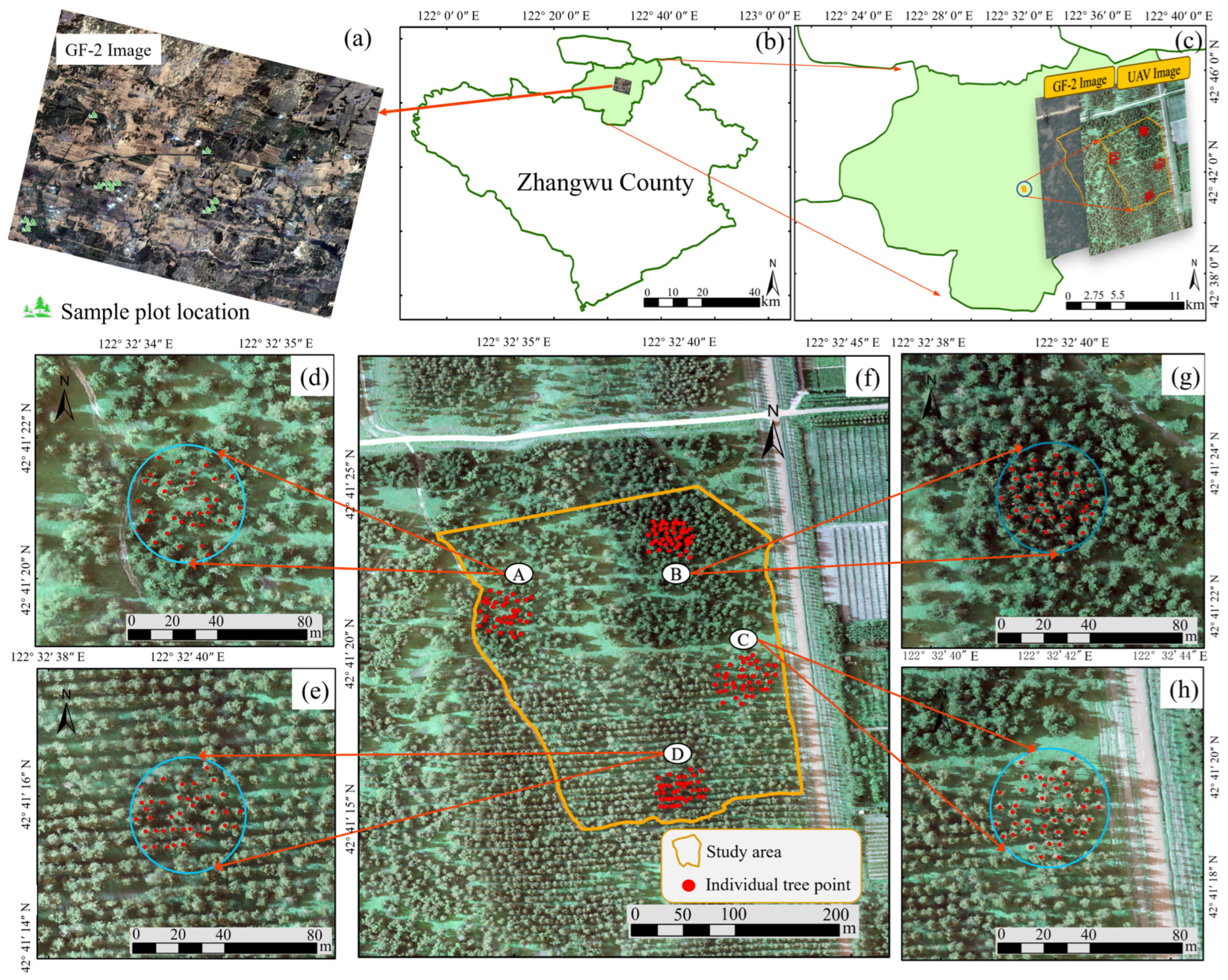
This study was conducted in Zhanggutai Town, Zhangwu County, Fuxin City, Liaoning Province, China (42°07′–42°51′N, 121°53′–122°58′E; total area 260 km2). The area is located on the southern edge of the Horqin Sandy Land. The terrain is generally flat with no significant mountainous relief. The region experiences a typical temperate continental monsoon climate, characterized by cold, dry winters and warm, rainy summers. The mean annual precipitation is approximately 450–550 mm, and the mean annual temperature ranges from 5 to 7 °C. Zhanggutai National Forest Park is the only national-level sandy land forest park in Northeast China. It also serves as Liaoning Province’s first forest carbon neutrality demonstration zone, featuring a unique ecological landscape where artificial sand-fixing forests intertwine with sandy land ecosystems. The area hosts approximately 15 common tree and shrub species, primarily Mongolian pine (Pinus sylvestris var. mongolica), Larch (Larix gmelinii (Ruprecht) Kuzeneva) and Chinese pine (Pinus tabuliformis). Mongolian pine, owing to its rapid growth and strong tolerance to drought, cold, and saline–alkaline conditions, is a key species for stabilizing the Horqin Sandy Land. Figure 1c illustrates the location of this representative sample plot within the broader region, while Figure 1f shows the spatial distribution of four sample plots within the selected sample area and the locations of the individual trees in these plots. The northern part of this sample area is mainly dominated by Larch, whereas the southern part is primarily covered by Mongolian pine [8].

2.2. Data

2.2.1. In Situ Data

Ground sampling was conducted in 11–14 August 2023 in 12 sample plots within the GF-2 image coverage shown in Figure 1a. Among them, the four plots within a representative sample area are presented in Figure 1f as an example. Specifically, two plots were established in the Larch-dominated forest in the northern part of this sample area, and two plots were established in the Mongolian pine-dominated forest in the southern part [33]. Field measurements and UAV data acquisition for each plot were carried out during the same period to ensure temporal consistency between ground observations and UAV-derived information. To derive a reliable ground-reference AGB value for each tree, the estimates obtained from three different allometric equations were averaged (Table 1), thereby reducing potential bias associated with any single model [34]. Each plot was designed as a circular area with a diameter of 30 m for measuring tree height (H), diameter at breast height (DBH), and crown diameter (CD), as well as for the corresponding UAV survey. The plots were spaced sufficiently apart to reduce spatial autocorrelation, and prominent markers were placed at the plot centers to facilitate accurate co-registration between the UAV data and ground measurements.
During the field survey, each tree was assigned a unique identification number. After the UAV-derived digital orthophoto map (DOM) was generated, all trees were digitally marked, and the precise coordinates of each plot center were recorded. Field measurements included diameter at breast height (DBH), measured with a diameter tape; tree height (H), measured with a laser hypsometer; and crown diameters in the north–south (CDns) and east–west (CDew) directions, measured with a tape. All measurements of H, DBH, and crown diameter were recorded by designated team members following a unified field protocol. The statistical characteristics of the plots are provided in Appendix A.

2.2.2. UAV Data and Pre-Processing

The UAV survey was conducted in 11–14 August 2023 using a DJI Matrice 300 RTK platform (DJI, Shenzhen, China) equipped with a Zenmuse L1 LiDAR sensor (DJI, Shenzhen, China) and an ULTRIS X20 hyperspectral imaging sensor (Cubert GmbH, Ulm, Baden-Wuirttemberg, Germany). The UAV data for the 12 sample plots were not necessarily acquired on the same day. However, for each sample plot, UAV acquisition and field measurements were carried out during the same period to ensure temporal consistency between the ground observations and the corresponding UAV data. Because all datasets were collected within the same month, the influence of temporal differences among sample plots on the subsequent analysis is expected to be limited. In this study, the hyperspectral data were not used in full. Instead, the near-infrared band was extracted from the ULTRIS X20 Plus data and combined with the RGB bands to construct multispectral information for subsequent analysis.
Flights were conducted at a relative altitude of 50 m with 50% forward overlap and 50% side overlap. The flight speed was set to 5 m/s, and it was further reduced in areas of dense canopy or complex understory conditions to improve point-cloud quality. Before each flight, a standard reflectance panel was used for sensor calibration, and cross-flight lines were adopted to reduce illumination-related errors. Based on the built-in radiometric calibration coefficients of the ULTRIS X20 Plus system, the digital orthophoto map (DOM) was converted to surface reflectance. Data pre-processing included data import, trajectory correction, aerial triangulation, and three-dimensional reconstruction, from which the DOM and digital surface model (DSM) were generated. The canopy height model (CHM) was subsequently derived from the DSM. All UAV-derived products were referenced to the WGS 84 coordinate system with a spatial resolution of 0.1 m.

2.2.3. GF-2 Data and Pre-Processing

The GF-2 satellite, launched on 19 August 2014, is China’s first independently developed civilian optical satellite with sub-meter spatial resolution. It provides 0.8 m panchromatic imagery and 4 m multispectral imagery, with a revisit cycle of 5 days. In this study, a GF-2 image acquired on 15 June 2023 with less than 10% cloud cover was selected. This image was chosen because it was the only available cloud-free scene during the 2023 growing season that could provide suitable regional optical data for subsequent AGB mapping and upscaling analysis. Although the GF-2 acquisition date was earlier than the field and UAV surveys conducted in August 2023, all datasets were collected within the same growing season, and the temporal difference was considered acceptable for the regional-scale analysis in this study.
The GF-2 image was then co-registered with the UAV data through manual tie-point selection and visual alignment. To enhance the spatial detail of the multispectral data, the Gram–Schmidt pan-sharpening method was applied to fuse the 4 m multispectral bands with the 0.8 m panchromatic band, resulting in a fused multispectral product with a spatial resolution of 2 m. This resolution was adopted as the target scale for subsequent AGB modeling and regional mapping. Although 1 m fusion is technically feasible, the objective of this study was to assess the significance of AGB upscaling across meaningfully different spatial scales. Relative to the original 0.1 m UAV-derived AGB data, the scale difference from 0.1 m to 1 m is limited, whereas 2 m provides a clearer and more representative scale transition for evaluating the upscaling framework. To link the ground-measured AGB with satellite spectral information, spectral features were extracted for each 30 m diameter circular plot. Using the coordinates of each plot center, all 2 m pixels within a 15 m radius were extracted, and their mean reflectance was used as the representative spectral feature value for that plot.

3. Method

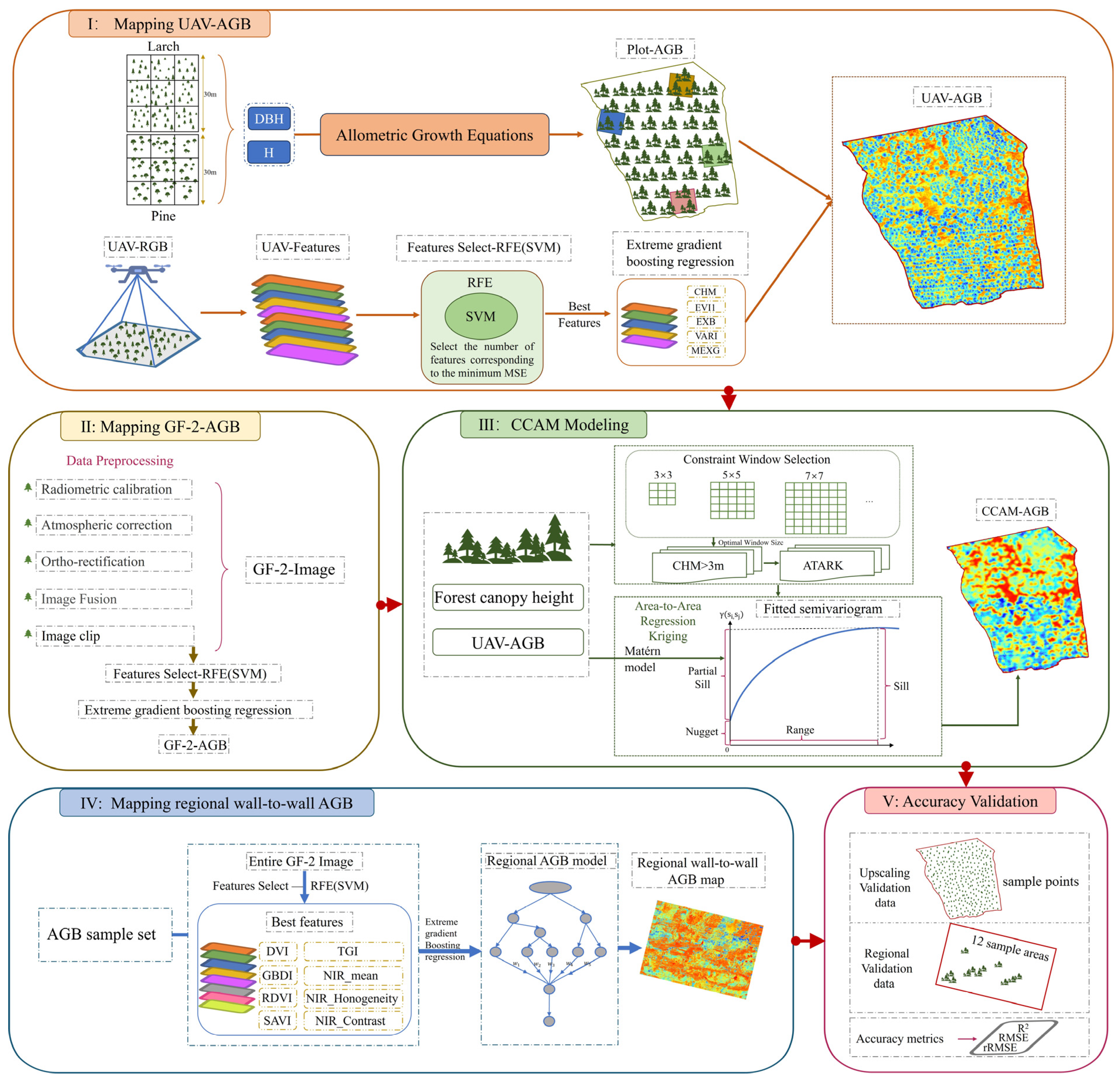
Figure 2 presents the overall workflow of the proposed multi-scale forest AGB estimation framework. First, a UAV-scale AGB baseline map is generated using field measurements, allometric equations, UAV-derived features, RFE-SVM feature selection, and machine learning modeling. Second, a direct GF-2-based AGB model is developed at the 2 m scale for comparison. Third, the UAV-derived AGB map is upscaled to the GF-2 scale using the proposed forest canopy height-constrained area-to-area regression kriging (CCAM) framework. Fourth, the optimized relationship is applied to the full GF-2 image to produce a regional wall-to-wall AGB map. Finally, the upscaling and regional mapping results are evaluated using independent validation data and accuracy metrics.

3.1. Establishment of AGB Model

This study employed Recursive Feature Elimination with Support Vector Machine (RFE-SVM) for feature selection, using the mean squared error (MSE) as the evaluation metric and stopping criterion (Equation (1)). In the implementation, the SVM kernel was set to the radial basis function. A 5-fold cross-validation strategy was specifically used in the feature-selection stage to assess the performance of each candidate feature subset [35]. Features were recursively removed with a step size of 1, eliminating the feature with the smallest absolute weight in each iteration. The number of retained features and the corresponding cross-validated MSE were recorded at each step. The optimal feature subset was identified as the one yielding the minimum MSE. Using MSE as the constraint effectively controls the number of selected features and reduces the variance inherent in wrapper methods due to randomness, thereby enhancing the stability and reproducibility of the feature-selection process.
M S E = 1 n i = 1 n ( y ^ i y i ) 2
where y ^ i is the predicted value of the variable and y i is the measured value of the variable.
A total of 26 features were considered as feature candidates for selection (Table 2).
Following feature selection, AGB modeling was conducted at both the UAV scale and the GF-2 scale. The UAV-scale model was used to generate a seamless 0.1 m AGB baseline map from UAV-derived structural and spectral information, whereas the GF-2-scale model was used to directly produce a 2 m resolution AGB distribution map from satellite-derived features. At both scales, five algorithms, including multiple linear regression (MLR), random forest regression (RFR), support vector regression (SVR) [19], ridge regression (Ridge) [8], and extreme gradient boosting (XGBoost) regression [47,48], were evaluated, and the optimal model was selected based on predictive accuracy. Direct GF-2-based modeling was necessary because, before evaluating the effectiveness of the proposed upscaling framework, it was essential to compare it with the conventional approach of estimating AGB directly from 2 m resolution satellite data. Thus, the GF-2-scale model served both as the basis for regional wall-to-wall mapping and as a benchmark for assessing the value of the upscaling framework (Figure 2).

3.2. Construction of CCAM

UAV data bridge the scale between ground-based measurements and GF-2 imagery. To achieve this linkage, a forest canopy height-constrained area-to-area regression kriging method (CCAM) was developed to upscale UAV-AGB to the GF-2 spatial resolution. This method follows the Regression-then-Kriging (R-K) strategy, and the CCAM framework consists of four main steps.
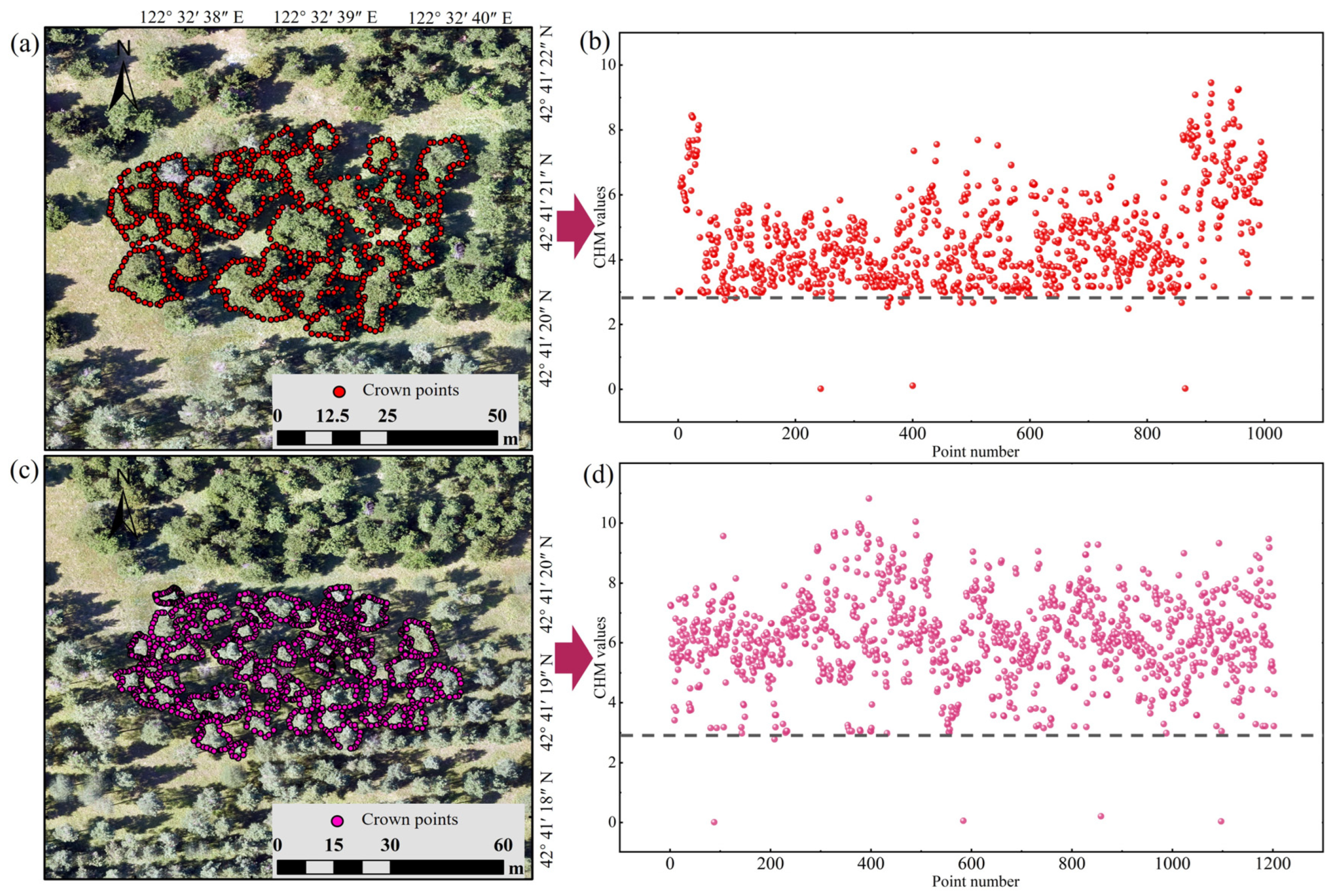
Step 1. The wall-to-wall UAV-derived AGB surface was first constrained using the CHM to reduce the inadequate representation of surface heterogeneity and the systematic uncertainty caused by limited ground AGB samples. A CHM threshold of 3 m, determined through statistical analysis of manually selected canopy points in representative plots (Figure 3), was used to distinguish canopy areas (CHM > 3 m) from ground areas (CHM < 3 m). Based on this constraint, the original 0.1 m UAV-derived AGB surface was subsequently aggregated to a 2 m target resolution corresponding to the GF-2 scale.
During this upscaling process, CHM-based weighted averaging was performed using a series of candidate moving-window kernels defined as:
( 2 ω + 1 ) × ( 2 ω + 1 ) ω [ 1 , 15 ]
where w is the window radius on the original 0.1 m grid, and the corresponding candidate window sizes range from 3 × 3 to 31 × 31 pixels. These candidate windows are used to perform CHM-constrained weighted averaging and to determine the optimal aggregation kernel. The optimized window size refers to the aggregation kernel used in this step, whereas 2 m denotes the target output resolution.
Step 2. Regression models are built using the 2-m resolution AGB estimates as the dependent variable and the corresponding features extracted from GF-2 imagery as independent variables (detailed in Section 3.1). A quantitative relationship between AGB values and GF-2 remote sensing features was established, and the regression error between predicted and actual AGB values is calculated.
Step 3. Spatial semivariance modeling was performed on the calculated regression errors, based on the geostatistical prerequisites, including the assumptions of stationarity and the intrinsic hypothesis [32,49]. The relationship between the variogram γ(h) and the covariance function C(h) is given as follows:
γ ( h ) = C ( 0 ) C ( h )
where γ h is the variogram function corresponding to the AGB, and C(0) is the value of the covariance taken by the AGB corresponding to a distance of 0, which is the sill value γ . C(h) is the value of the covariance taken by the AGB corresponding to a distance of h.
To estimate γ h , an appropriate theoretical variogram model is selected to determine nugget, partial sill, and range parameters. Common models include linear, spherical, exponential, logit, Gaussian, and Matérn [50]. The Matérn model is favored for its flexibility in capturing spatial variability at multiple scales and smoothness, expressed as:
γ ( h , ν , λ ) = 2 1 ν Γ ( ν ) ( 2 ν h a ) ν K ν ( 2 ν h a )
h = ( x i x j ) 2 + ( y i y j ) 2
where γ h is the Matérn variogram function that represents the correlation between two points. h is the distance between two points. ν is the smoothness parameter which determines the smoothness of the Matérn model. As ν tends to infinity, the Matérn model converges to a Gaussian model. λ is the range parameter, and a is the scale parameter that controls the horizontal distance of the variation. Γ ν is the gamma function and K ν is the modified Bessel function. We choose the method of maximum likelihood estimation for model fitting and parameter optimization of the Matérn variational function model [32]. Assuming Ζ N ( u 1 , C ) , the likelihood function is defined as:
L ( h , ν , λ | Ζ , u ) = ( 2 π ) n / 2 C n / 2 exp [ 1 2 ( Ζ u 1 ) T C 1 ( Ζ u 1 ) ]
Take the logarithm of the likelihood function first to get the log-likelihood function. Then the parameter values can be found by taking partial derivatives of the parameters μ , ν , λ respectively.
Step4. The final AGB upscaling for the study area was achieved by integrating the regression residuals from Step 3 with the 2 m aggregated AGB baseline. The simulated residual surface, derived using the optimized Matérn variogram parameters, was combined with the initial 2 m AGB estimate through pixel-wise addition. This step was implemented on the 2 m AGB product generated in Step 1 using the optimal aggregation window. The resulting product was a seamless 2 m resolution wall-to-wall AGB map compatible with the GF-2 imagery.

3.3. Regional AGB Mapping

The UAV-AGB was upscaled to the GF-2 spatial scale using the CCAM method, enabling high-precision, wall-to-wall AGB estimation over a broader area. From the resulting 2-m resolution AGB map, a representative dataset of 832 sample points was extracted to serve as the GF-2 scale reference for model training and validation. Feature selection was then performed using the RFE-SVM method, with MSE used as the evaluation criterion, as described in Section 3.1. In this step, 32 Gray Level Co-occurrence Matrix (GLCM) texture features were incorporated, covering the red, green, blue, and near-infrared (NIR) bands of the GF2 imagery, and including statistical metrics such as mean, variance, homogeneity, contrast, dissimilarity, entropy, angular second moment, and correlation [8]. The incorporation of these texture features enhances the model’s capability to capture fine-scale spatial variations in forest structure and improves its sensitivity to surface heterogeneity. The final feature subset was used to train an XGBoost model. Following hyperparameter optimization via cross-validation, the model was applied to the full GF-2 imagery to generate the final regional AGB distribution map, extrapolating the 2-m scale relationship established by CCAM.

3.4. Accuracy Assessment

The UAV-derived AGB map was used as the reference for constructing the accuracy assessment framework, which combined cross-validation with sensitivity analysis of sampling strategies to evaluate both the performance of the XGBoost model and the reliability of the AGB upscaling process. A 10-fold cross-validation strategy was used for hyperparameter tuning to reduce overfitting and improve model generalization.
Sensitivity analysis was conducted for four sampling strategies: random sampling, and stratified sampling with 1, 3, and 5 strata. Sample size ranged from 30 to 500, increasing in steps of 30. For each sample size, 100 replicate runs were performed quantify uncertainty. The optimal moving window size was determined by validating against 300 randomly selected points representing both canopy and ground surfaces. The accuracy of the three resulting AGB maps (derived from direct GF-2 regression, the area-to-area regression kriging (ATARK) method, and the CCAM method) was evaluated through point-by-point comparison with the UAV-based reference map. An independent validation was further conducted using 656 in situ measurement points from 12 plots within the GF-2 scene coverage. Model performance was quantified using three standard metrics: the coefficient of determination (R2), the root mean square error (RMSE), and the relative RMSE (rRMSE), as defined in Equations (7)–(9):
R 2 = 1 i = 1 n ( y i y ^ i ) 2 i = 1 n ( y i y ¯ ) 2
R M S E = 1 n i = 1 n ( y ^ i y i ) 2
r R M S E = R M S E y × 100 %
where, y ^ i is the predicted value of the variable, y i is the measured value of the variable, y ¯ is the mean value of the measurements, n is the total number of sample points in the validation set.

4. Results

4.1. Comparison of AGB Estimation Results Across Multiple Scales

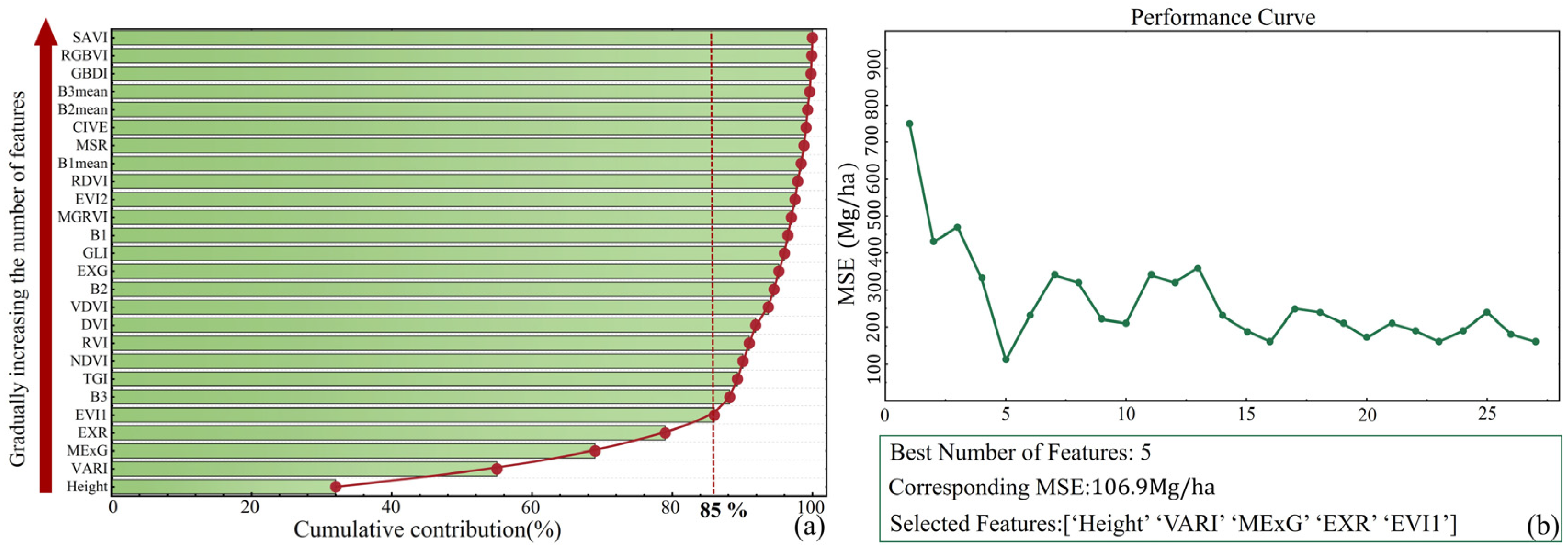
RFE-SVM constrained by MSE was applied to select the optimal feature subset from 26 candidate variables (Figure 4). The minimum MSE was achieved when five features were retained. The feature importance ranking indicated that the H metric contributed the most (31.2%), followed by vegetation indices VARI, MExG, EXR, and EVI1. The cumulative importance of these five features exceeded 85% (Figure 4a).
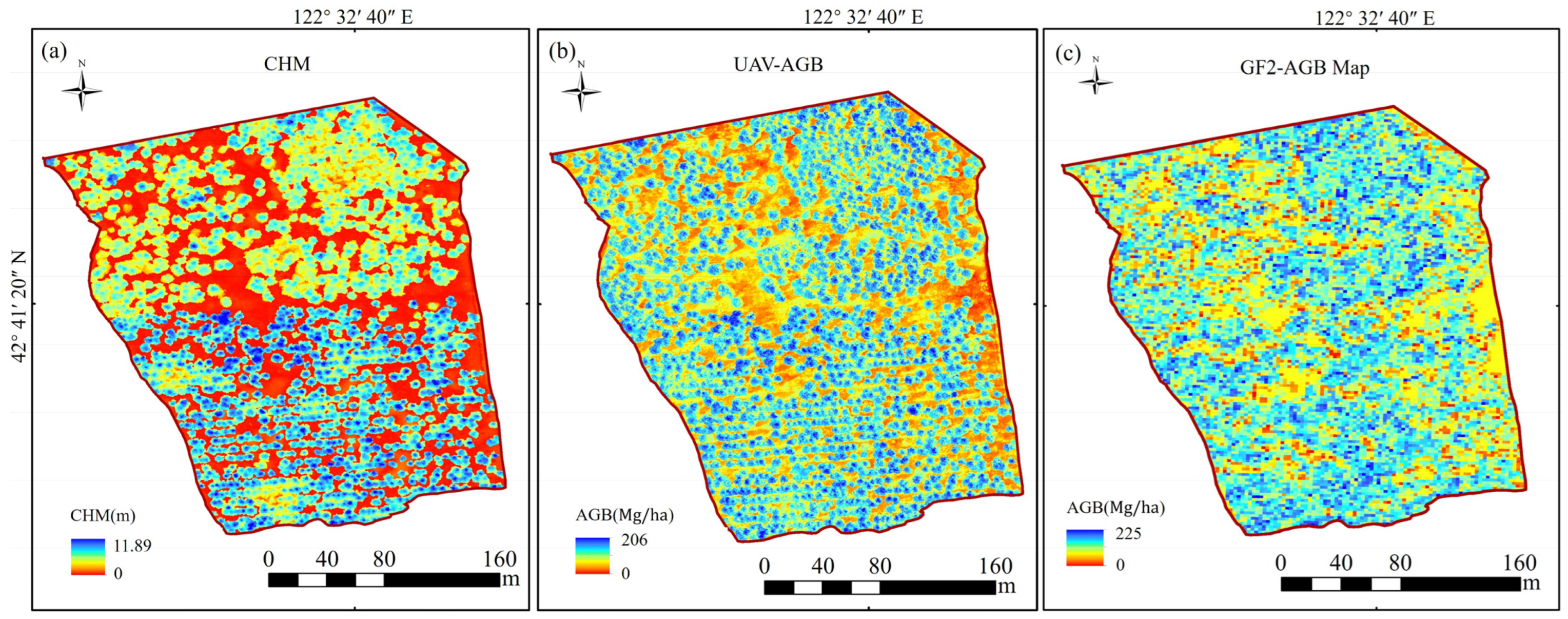
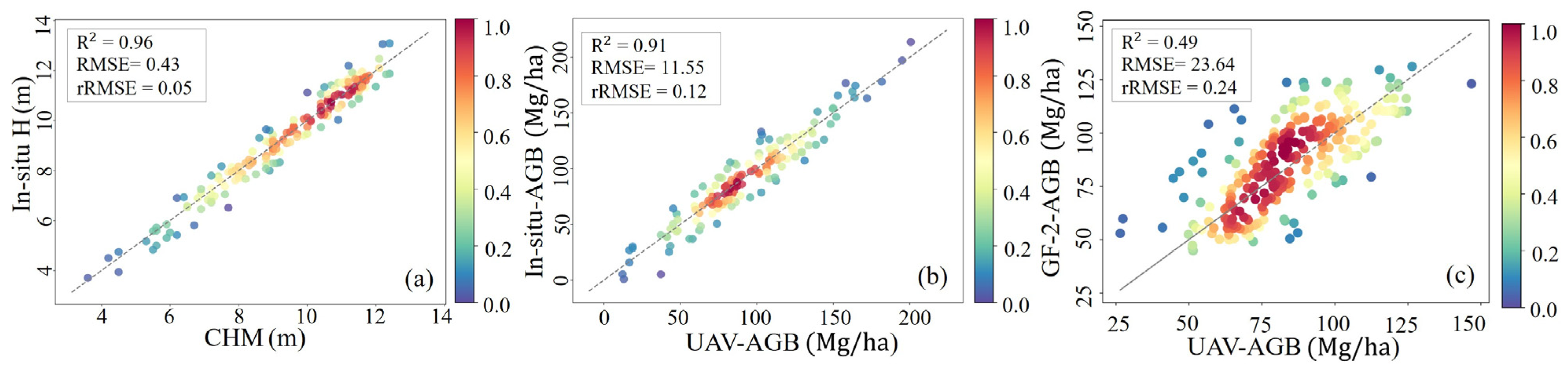
Using the optimal feature subset selected in the previous RFE-SVM procedure, five regression models were subsequently evaluated using 10-fold cross-validation. Among the tested models, XGBoost demonstrated superior performance (R2 = 0.91, RMSE = 11.55, rRMSE = 0.12; Table 3) compared with RFR, SVR, Ridge, and MLR. After hyperparameter optimization via grid search, the XGBoost model was applied to generate a seamless 0.1-m resolution AGB map (Figure 5b), with a maximum AGB of 206 Mg/ha. The corresponding CHM (Figure 6a) accurately represented the tree-height distribution and effectively separated canopy from ground points. The resulting AGB map exhibited spatial texture patterns positively correlated with canopy height.
To demonstrate the irreplaceable value of high-resolution UAV data for fine-scale AGB estimation, the 0.1-m resolution UAV-AGB map was used as a reference and compared with the map retrieved from GF-2 imagery (Figure 5c). The GF-2 map, while preserving some spatial patterns, exhibited weaker textural definition and discontinuous pixel patterns (R2 = 0.49, RMSE = 23.64, rRMSE = 0.24; Figure 6b). This comparison confirms that medium-to-low-resolution satellite data are insufficient for fine-scale AGB estimation, thereby underscoring the necessity and value of the CCAM upscaling method developed in this study.

4.2. Upscaling Results of AGB Based on CCAM

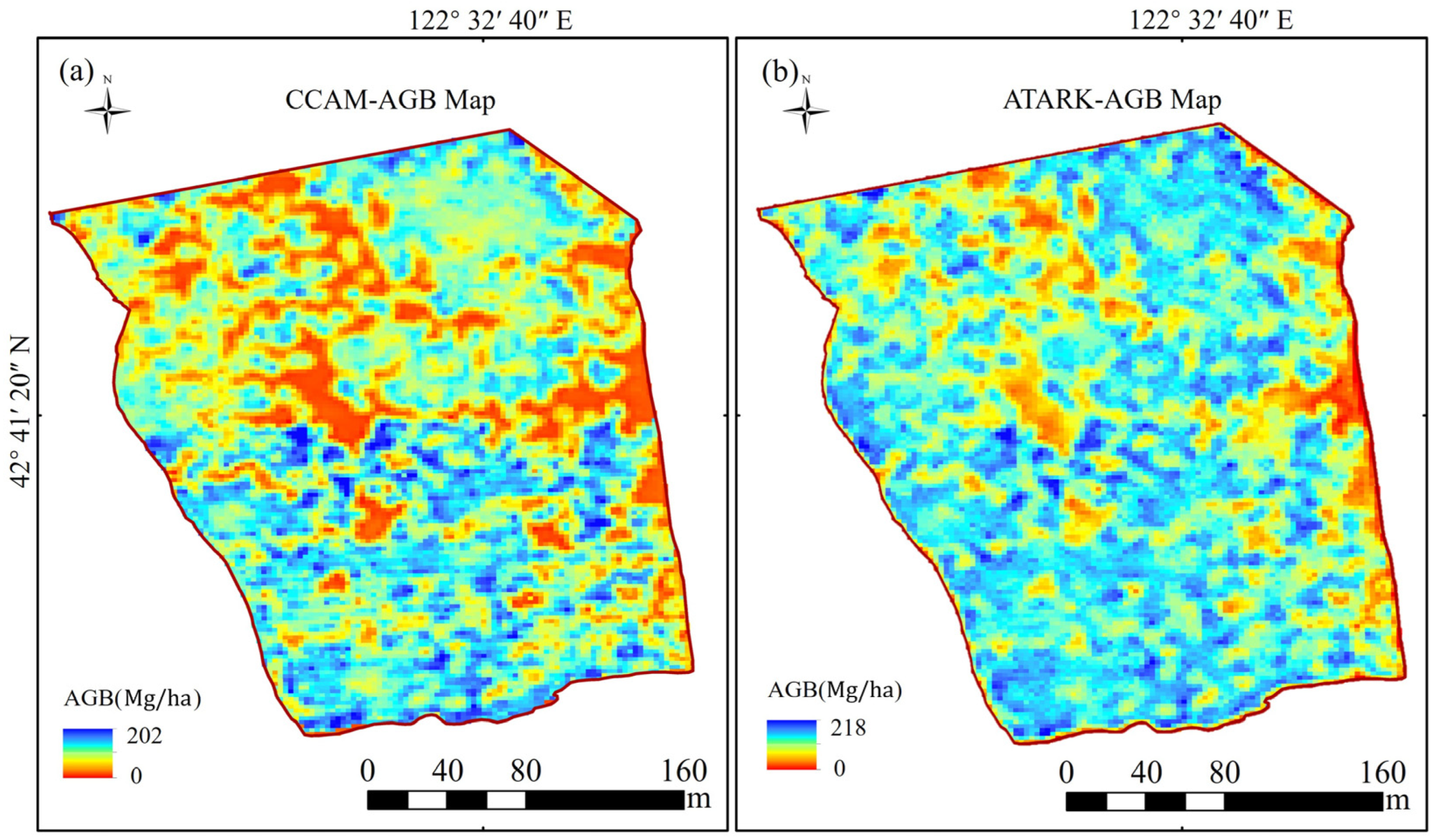
The AGB was upscaled using the CCAM method. A Matérn model fitted to the variogram of regression residuals via maximum likelihood estimation yielded an optimal smoothness parameter of ν = 1.78 and a practical range of 71.2 m. Among the 15 candidate moving-window kernels tested during the CHM-constrained weighted aggregation process, the 7 × 7 pixel window on the original 0.1 m UAV-derived AGB grid was identified as optimal because it minimized the constraint error. After CHM-constrained weighted aggregation, the regression residuals between the 2 m XGBoost predictions and the original UAV-AGB were modeled with a semivariogram, and a robust residual field was obtained by averaging 100 conditional simulations. The resulting 2 m CCAM-AGB map (Figure 7a) closely reproduced the spatial pattern, canopy boundaries, and value range of the original 0.1 m UAV-AGB and clearly outperformed direct GF-2 regression. In contrast, the ATARK method showed overestimation, particularly in areas with CHM < 3 m, together with blurred textures, less distinct canopy boundaries, and stronger over-smoothing (Figure 7b). These results indicate that CCAM more effectively preserves fine-scale spatial information during AGB upscaling.

4.3. Regional Wall-to-Wall AGB Mapping

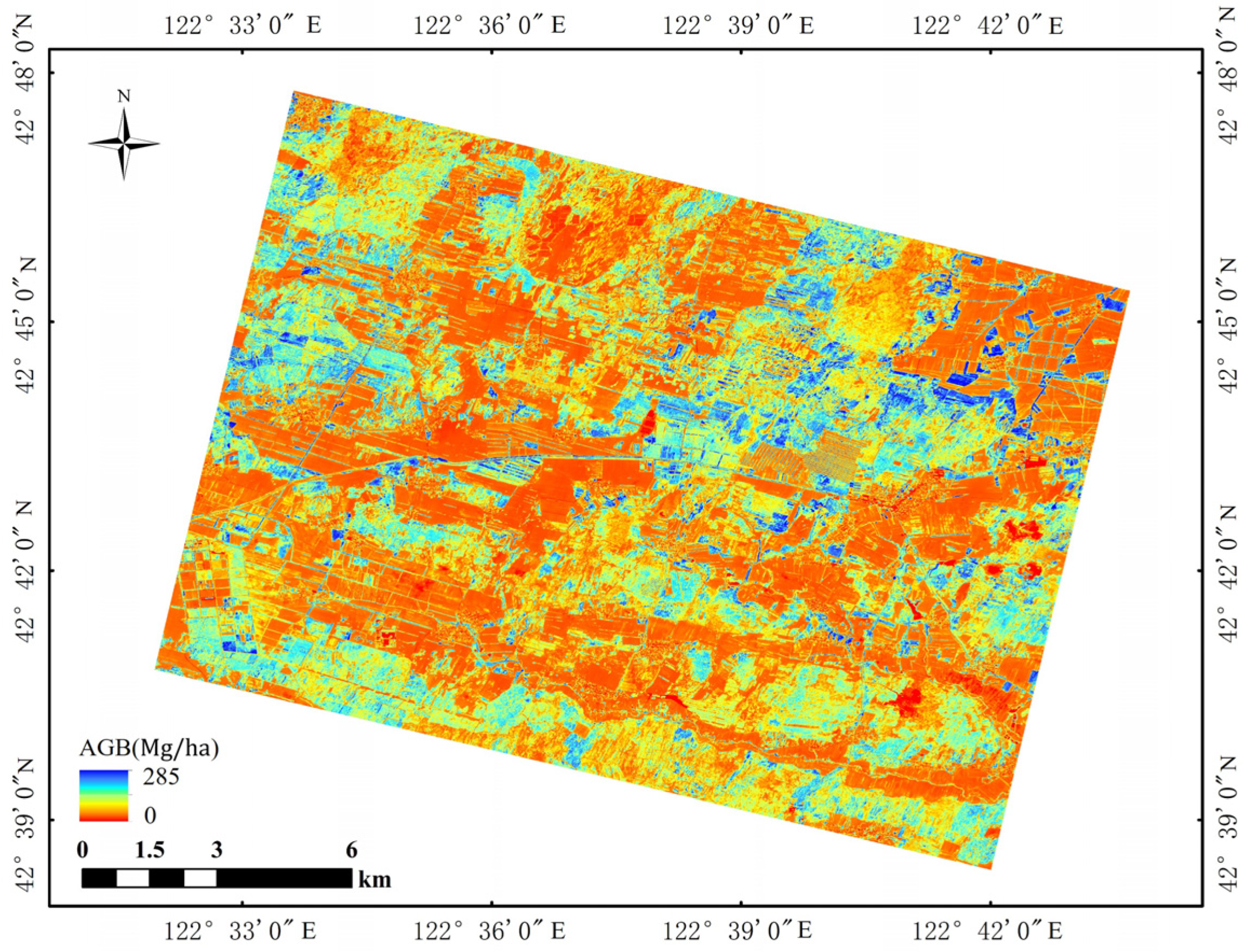
Using MSE constrained RFE-SVM feature selection (Section 3.1), eight key features were selected, including five vegetation indices (DVI, GBDI, RDVI, SAVI, TGI) and three GLCM texture features (NIR_mean, NIR_Homogeneity, NIR_Contrast). Texture features accounted for 37.5% (3/8), higher than their weight in UAV modeling, indicating they better capture inter-pixel spatial relationships and forest structural heterogeneity at GF-2’s coarser resolution. An XGBoost model trained on these features was applied to the full GF2 imagery to generate a 2-m resolution wall-to-wall AGB map (Figure 8). Areas with high AGB values (200–285 Mg/ha) were predominantly located in the mature pine forests in the northeast, while low-value areas (<50 Mg/ha) were concentrated in the sparse woodlands and farmland mosaics in the southwest. The spatial pattern closely matched actual forest stand distribution, confirming that the CCAM-derived regression relationship retains good stability across the broader GF-2 coverage.

4.4. Accuracy Validation Result

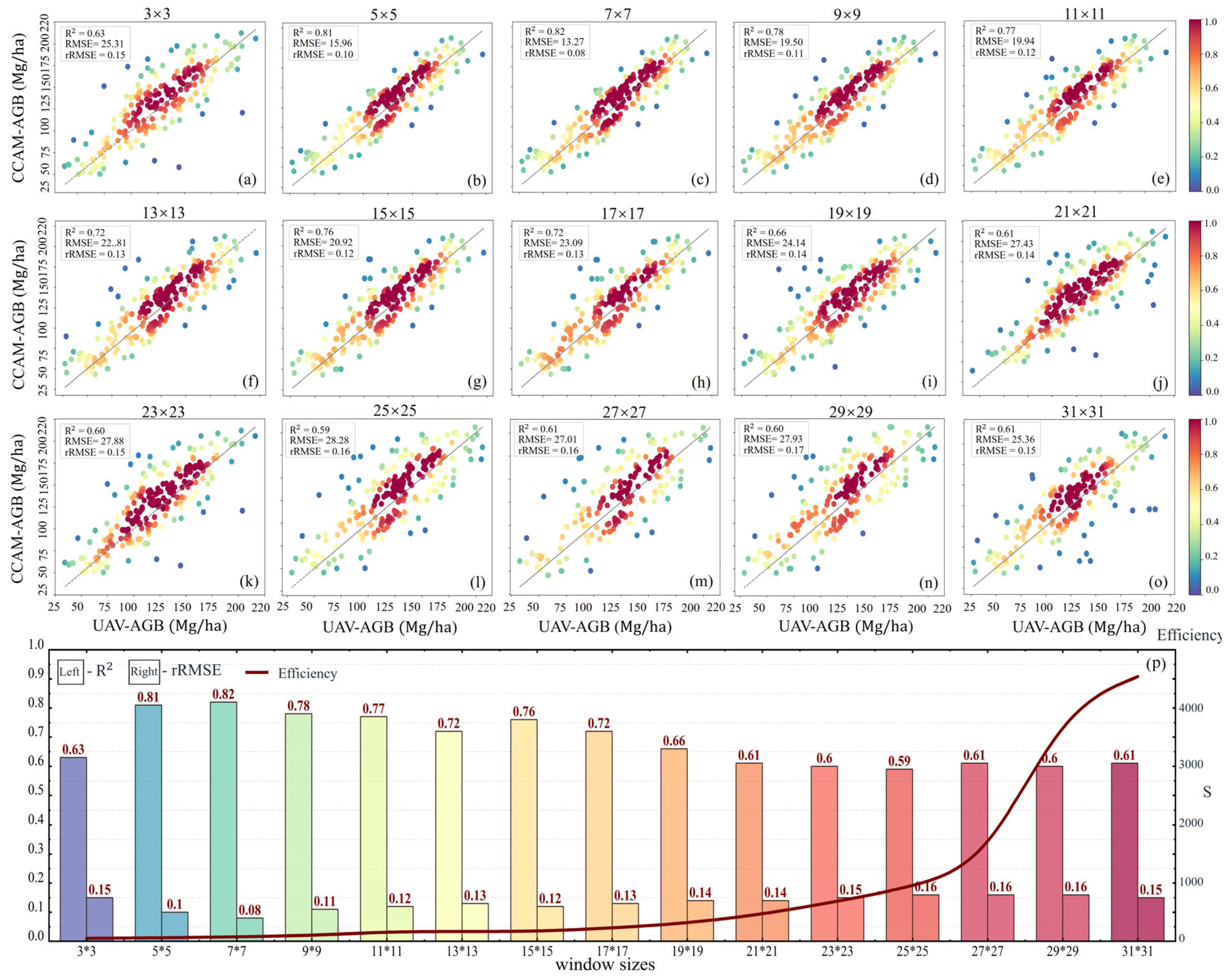
The effect of moving-window size on upscaling accuracy is shown in Figure 9. Among the 15 tested window sizes, the 7 × 7 window achieved the best performance, with R2 = 0.82, RMSE = 13.27 Mg/ha, and rRMSE = 0.08. In comparison, the 3 × 3 window yielded a lower accuracy (R2 = 0.63, RMSE = 25.31 Mg/ha, rRMSE = 0.15), while the accuracy gradually declined again when the window size exceeded 9 × 9. The 21 × 21 window produced only R2 = 0.61, with RMSE = 27.43 Mg/ha and rRMSE = 0.14, while window sizes larger than 21 ×Corrected. 21 led to increasingly stable fine-scale spatial structure, reduced local variability, and consequently more stable upscaling results [51,52,53].
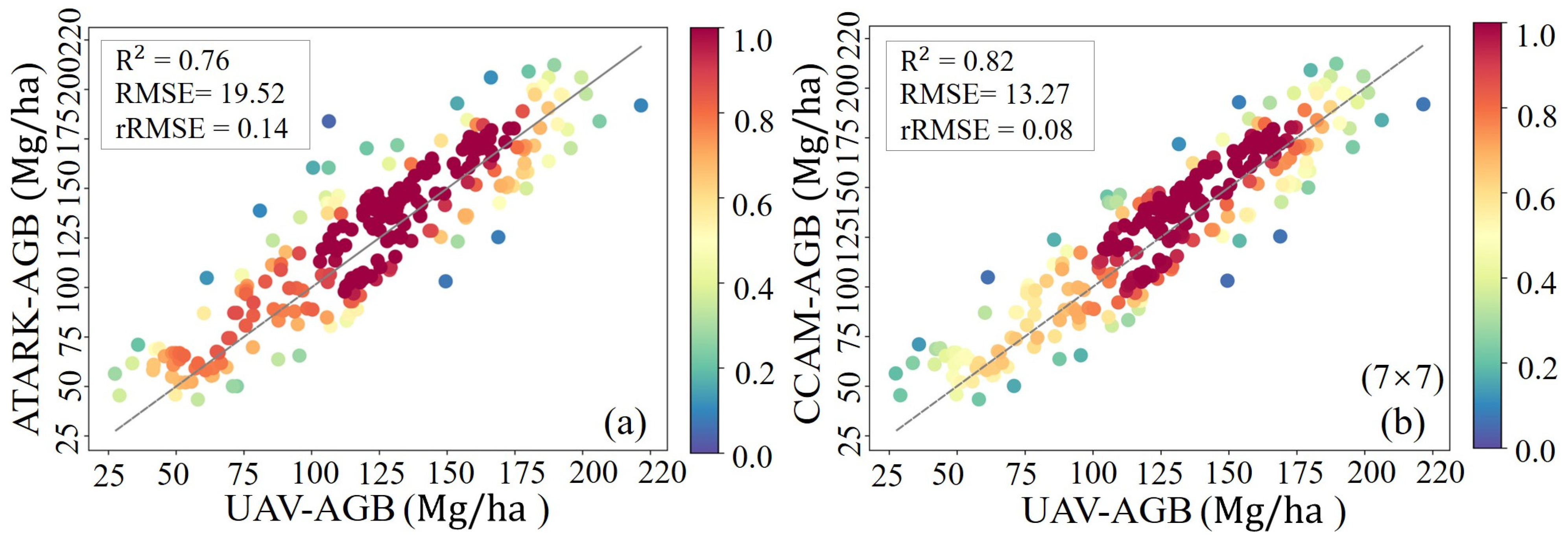
The validation scatter plots in Figure 10 further show that the CCAM method outperformed ATARK. Specifically, ATARK achieved R2 =0.76, RMSE = 19.52 Mg/ha, and rRMSE = 0.14, whereas CCAM improved the accuracy to R2 = 0.82, reduced RMSE to 13.27 Mg/ha, and lowered rRMSE to 0.08. Compared with ATARK, CCAM increased R2 by 0.06, reduced RMSE by 6.25 Mg/ha, and reduced rRMSE by 0.06, indicating a clearer advantage in preserving the UAV-derived AGB pattern during the upscaling process.
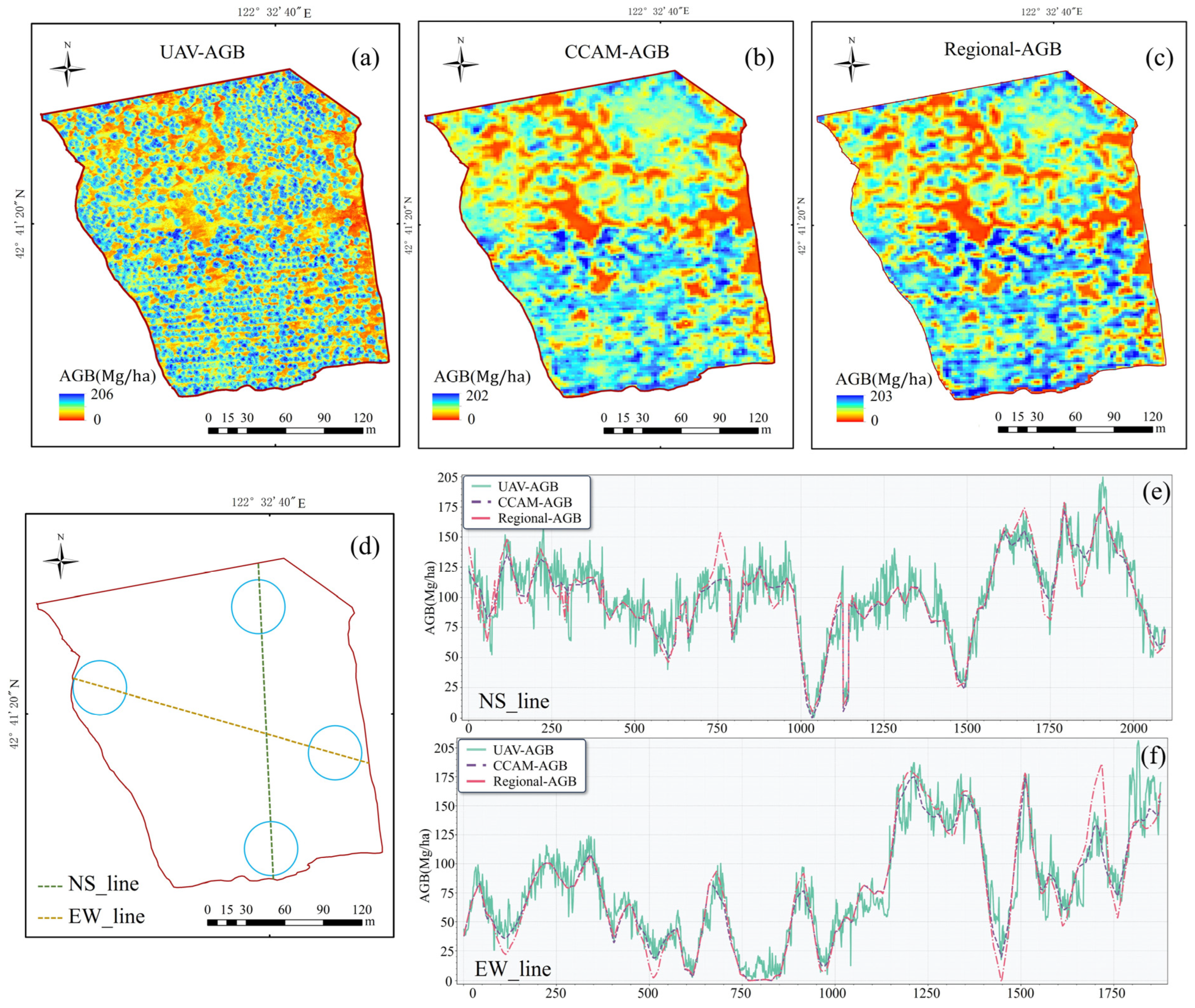
At the regional scale, the final AGB product also showed good validation performance. As listed in Table 4, the regional AGB map achieved R2 =0.79, RMSE = 16.15 Mg/ha, and rRMSE = 0.18, indicating that the upscaling framework maintained satisfactory accuracy after extension to the broader GF-2 coverage [54]. The profile comparisons in Figure 11 provide additional support for this result. Along both the north–south and east–west transects, the CCAM-AGB and Regional-AGB profiles closely followed the overall variation pattern of the UAV-AGB profile. The CCAM-AGB profile showed particularly strong agreement with the UAV-AGB profile in terms of local peaks, troughs, and inflection points, while the regional AGB profile remained consistent at the broader scale with only limited local smoothing. This indicates that the upscaling chain effectively preserved the major spatial structure of the original UAV-derived AGB data.
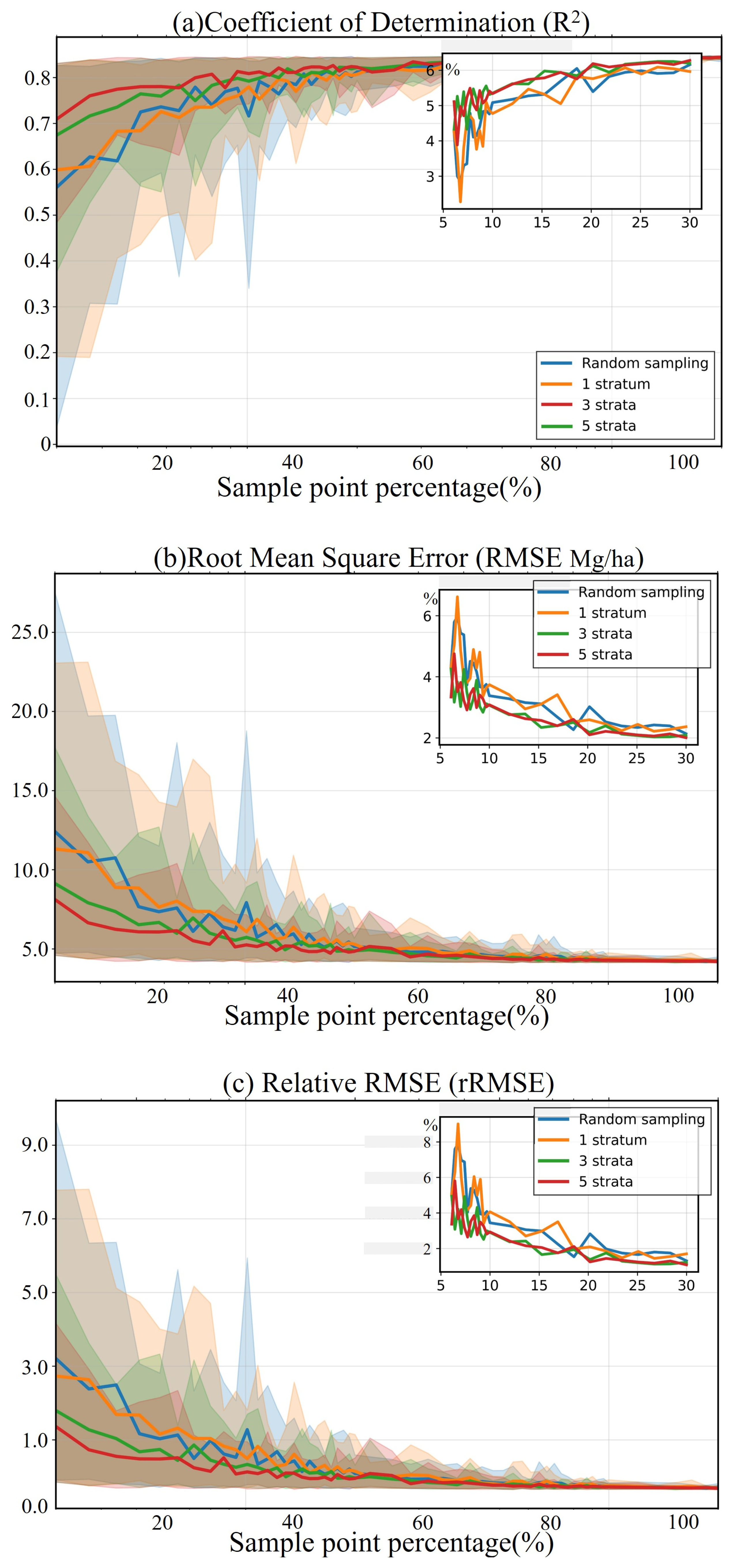
The sensitivity of the CCAM method to sample size and sampling strategy was evaluated by comparing random sampling with stratified sampling using 1, 3, and 5 strata. Sample sizes ranged from 30 to 500, with an increment of 30, and 100 repeated runs were performed for each configuration (Figure 12a–c). As sample size increased, mean R2 rose rapidly and then stabilized, whereas RMSE and rRMSE decreased and converged. Among the four strategies, the 3-strata approach achieved the highest accuracy. R2 increased from about 0.2–0.4 at low sample sizes (<20%) to nearly 0.8, with diminishing returns beyond approximately 40% sample size. The uncertainty range was relatively wide (0.2–0.3) at low sample sizes but narrowed to below 0.05 at larger sample sizes, indicating improved stability.
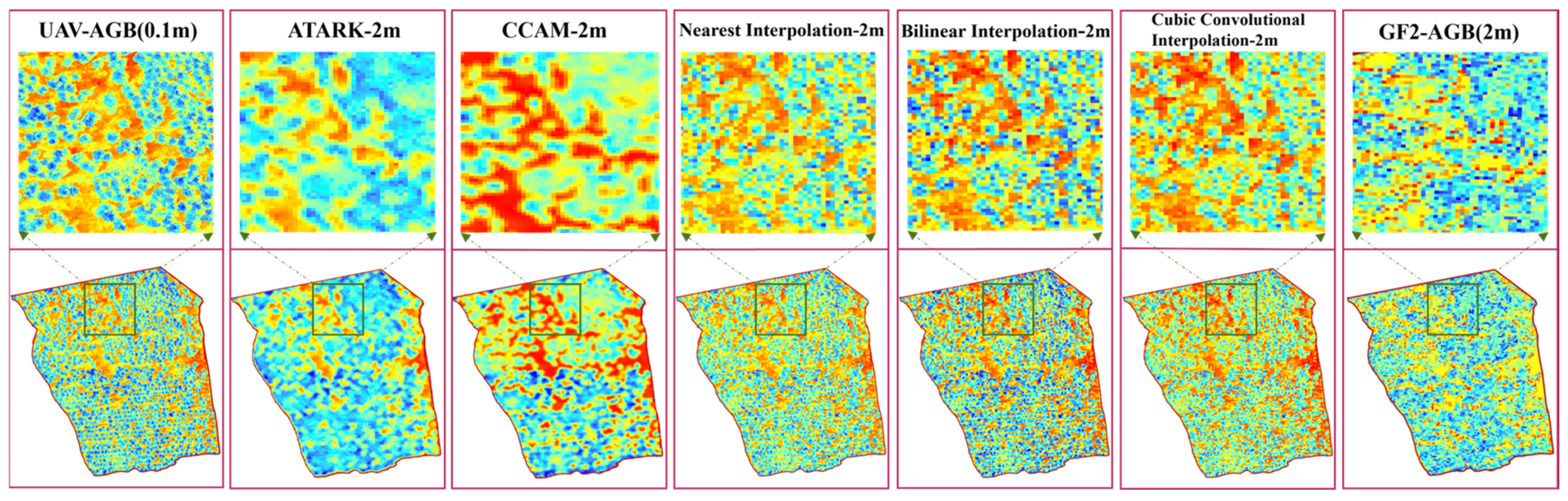
A comparison with other common upscaling methods is shown in Figure 13. Both ATARK and CCAM preserved substantially more spatial detail from the original 0.1 m UAV-derived AGB map than the nearest neighbor, bilinear, and cubic convolution interpolation methods. However, CCAM produced lower and more reasonable AGB values in ground or low-canopy areas, whereas ATARK tended to yield inflated values in these locations. This result further indicates that the CHM-constrained framework is more effective in suppressing over-smoothing and preserving ecologically meaningful spatial variation during AGB upscaling.

5. Discussion

5.1. Heterogeneity in the Upscaling Process

Spatial heterogeneity is one of the main challenges in forest AGB upscaling. Although kriging-based methods have been applied in other geoscientific scaling studies, their use in forest AGB remains relatively limited. Compared with variables such as heat flux [49,55], forest AGB has stronger spatial discontinuity and more complex structural dependence because it is jointly affected by canopy architecture, crown overlap, stand density, and local site conditions. Therefore, when fine-resolution UAV-derived AGB products are transferred to coarser satellite scales, substantial spatial heterogeneity may be smoothed or distorted, leading to systematic bias during the upscaling process [19].
In this study, the heterogeneity mainly results from the mismatch between the detailed canopy information resolved by UAV data and the coarser support of GF-2 pixels [56]. The CHM constraint in CCAM helps alleviate this problem by distinguishing canopy-dominated and ground-dominated areas before weighted aggregation, thereby introducing a structurally meaningful constraint into the scale-transition process. This reduces the inflation of AGB values in ground or sparse-canopy areas and improves the ecological plausibility of the aggregated AGB surface. In contrast, conventional kriging-based methods such as ATARK can improve spatial continuity, but they do not explicitly incorporate canopy structural constraints and are therefore more prone to over-smoothing and loss of local spatial variability. The advantage of CCAM thus lies not only in improved numerical accuracy but also in its stronger ability to preserve the ecological and spatial integrity of forest AGB patterns during upscaling.

5.2. Comparisons of “Regression-Then-Kriging” Method and “Kriging-Then-Regression” Method

The difference between the Regression-then-Kriging (R-K) and Kriging-then-Regression (K-R) frameworks lies in how trend and residual information are separated during upscaling. In the R-K framework, regression first captures the dominant AGB pattern, and kriging is then applied to the remaining spatially autocorrelated residuals. This makes the correction more targeted because it is performed on unresolved local error rather than on the full signal. In contrast, the K-R framework introduces kriging before the regression relationship is fully established, which weakens the distinction between deterministic variation and residual spatial dependence and reduces the effectiveness of the final correction.
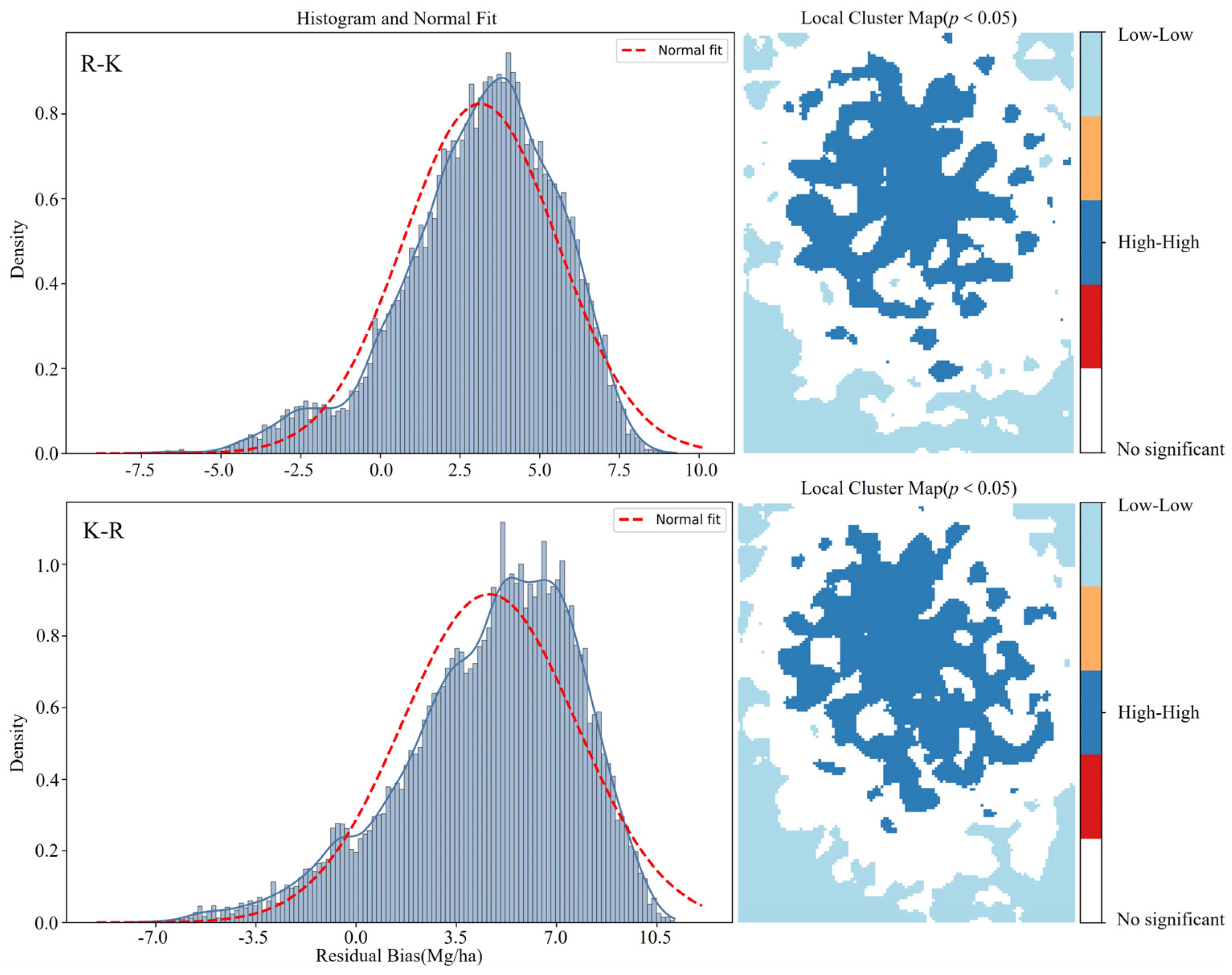
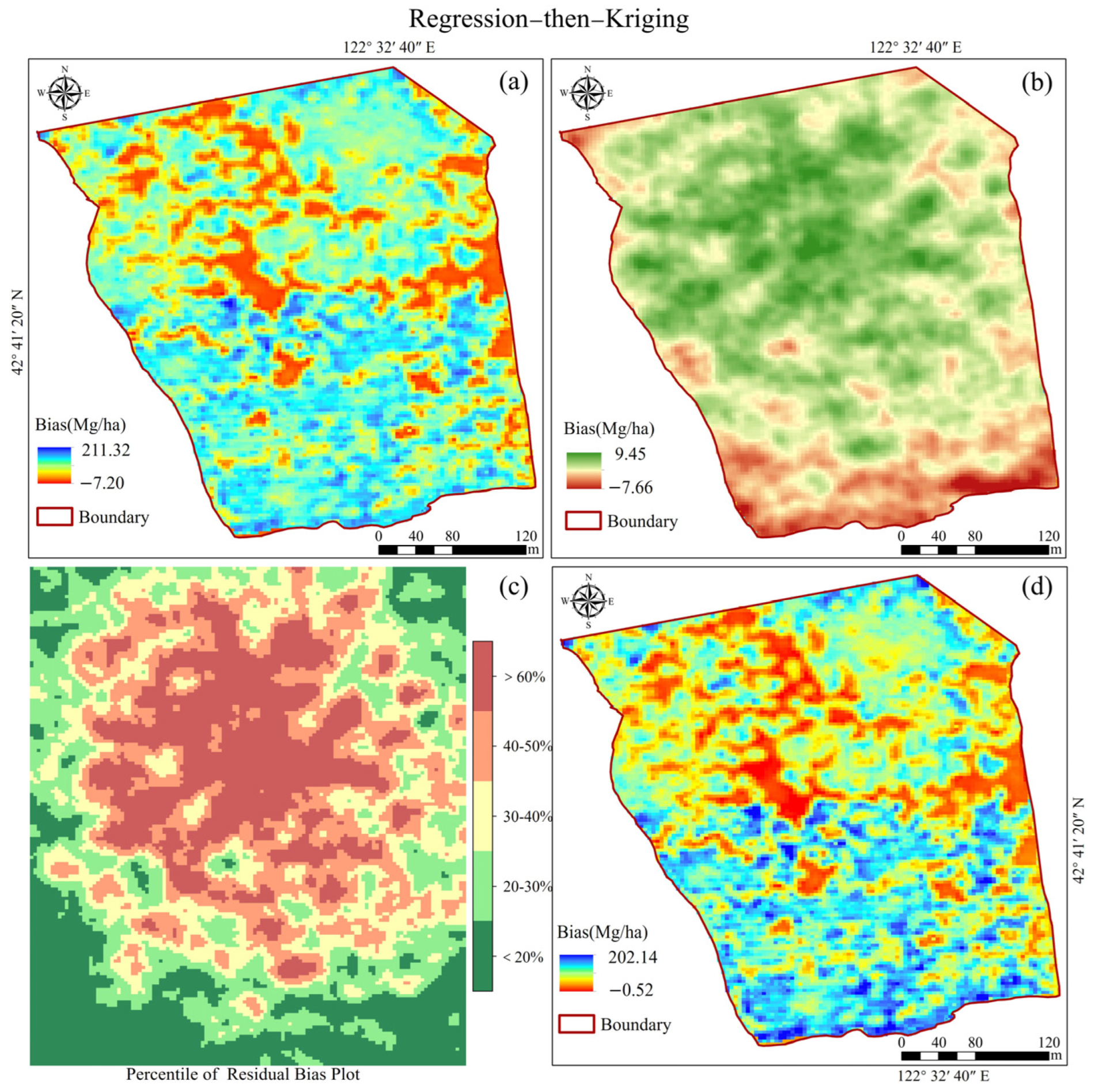
This difference explains the better performance of the R-K framework in the present study. By allowing kriging to act as a residual refinement rather than as a compensatory smoothing process [57], the R-K strategy provides stronger control over heterogeneity-induced errors and better preserves the spatial structure of the AGB surface [58]. This interpretation is supported by the residual patterns in Figure 14, the process illustration in Figure 15, and the squared error analysis in Appendix B. Overall, the R-K framework is more suitable for the present study because it more effectively preserves both biomass magnitude and spatial pattern during cross-scale transformation.

6. Conclusions

To address the key challenges of spatial detail loss and systematic error accumulation during the integration of high-resolution UAV-derived AGB with satellite data, this study developed a CCAM method. By combining fine-scale structural information from UAV data with the broad spatial coverage of GF-2 imagery, CCAM performs CHM-constrained weighted aggregation, models the spatial structure of regression residuals using a Matérn variogram, and conducts upscaling within a Regression-then-Kriging (R-K) framework. As a result, CCAM substantially improves both the accuracy and spatial consistency of regional AGB estimation. For UAV-AGB modeling, XGBoost achieved the best performance. Following the selection of five key features using RFE-SVM, the reconstructed UAV-AGB model achieved a cross-validated R2 of 0.91 and an rRMSE of 0.12, thereby establishing a reliable 0.1 m AGB baseline for subsequent upscaling. The CCAM framework effectively mitigated the over-smoothing inherent in traditional methods by incorporating the CHM constraint with the optimal 7 × 7 window. The resulting 2 m resolution AGB map showed high fidelity to the UAV reference data in spatial pattern, canopy boundary, and value range, while preserving important local details. This result confirms that CCAM outperformed conventional interpolation methods, including nearest neighbor and bilinear interpolation, as well as the ATARK method. In addition, the sensitivity analysis indicated that the model achieved the best performance under the 3-strata stratified sampling design, and that the marginal gain in explanatory power became limited once the sample proportion exceeded 40%, providing practical guidance for sampling design in similar studies. Overall, this study demonstrates that integrating CHM constraints with residual spatial modeling provides an effective solution for bridging the observational scale gap among in situ measurements, UAV data, and GF-2 imagery. The proposed CCAM approach successfully preserves fine-scale structural information from UAV-derived AGB while making full use of the regional coverage advantage of satellite observations. Consequently, the final 2 m resolution regional AGB map provides a reliable data basis for regional carbon stock assessment, ecological security monitoring, and the evaluation of afforestation effectiveness.

Author Contributions

Q.G. was responsible for the conceptualization, formal analysis, investigation, methodology development, validation, visualization, and preparation of both the original draft and the revised manuscript. J.J. contributed to funding acquisition and project administration. X.Q. contributed to the investigation and manuscript revision. K.L., as the corresponding author, participated in the review and editing of the manuscript. X.Y. participated in the investigation and methodological development. Y.Z. contributed to the field investigation. All authors have read and agreed to the published version of the manuscript.

Funding

This research was funded by the Beijing Natural Science Foundation, grant number L241035.

Data Availability Statement

The original data supporting this study are owned by China University of Mining and Technology-Beijing, and not publicly available due to substantial human and material investment in collection. Research code are available and deposited in a public repository (https://github.com/GQY-kiwi/CCAM, accessed on 8 March 2026).

Conflicts of Interest

The authors declare no conflicts of interest.

Appendix A

Table A1. Statistical characteristics of all sample plots, including dominant tree species, mean tree height (H), mean diameter at breast height (DBH), and mean crown diameter (CD).
Sample Area IDPlot IDDominant Tree SpeciesMean H (m)Mean DBH (cm)Mean CD (m)
ZW010101Larch8.6020.105.97
0102Larch7.3822.105.83
0103Mongolian Pine10.2324.505.73
0104Mongolian Pine10.1921.304.79
ZW020201Larch7.9516.306.16
0202Mongolian Pine12.9119.504.83
ZW030301Mongolian Pine10.9215.705.12
ZW040401Mongolian Pine11.4118.905.22
ZW050501Larch7.8811.505.53
0502Larch8.3617.305.22
ZW060602Mongolian Pine10.6619.104.62
0603Larch9.6117.805.75

Appendix B. Error Analysis of R-K Method and K-R Method

The regression relationship is assumed to remain invariant across resolutions during the upscaling process [58]. It can be expressed as:
A G B h = f ( ρ h ) + ε h A G B ^ l = f ( ρ l ) + ε h
where A G B h is the high-resolution AGB value, f is the regression model, ρ h is the eigenvalue at high resolution, and ε h is the residual between the true AGB value and the predicted AGB value at high resolution. A G B l ^ is the AGB value at AGB upscaling to low resolution, and ρ l is the eigenvalue at low resolution. At this point CCAM can be simplified and expressed as:
At this point CCAM can be simplified and expressed as:
A G B l = i = 1 n λ i A G B h ( X i ) i = 1 n λ i = 1
where λ i is the weight value of each point calculated by the variance function in CCAM, and the weight sum of each point in the window is 1. X i is the AGB value corresponding to each position.
The implementation of the R-K method begins with the establishment of regression relationships at high resolution:
A G B h , R = f ( ρ h ) + ε h
where A G B h , R is the wall-to-wall AGB value after regression.
Substitute into CCAM:
A G B l , K = i = 1 n λ i A G B h , R ( X i ) i = 1 n λ i = 1
where A G B l , K   ^ is the biomass after upscaling by CCAM.
The implementation details of the K-R method also include two steps. Unlike the R-K method, the K-R method first performs CCAM operations on individual features after feature selection before regression. In this process, the CCAM model is constructed first:
ρ l , K = i = 1 n λ i ρ h ( X i ) i = 1 n λ i = 1
where ρ l , K ^   is each eigenvalue after CCAM.
The results of each feature after upscaling are then used as inputs to the regression model, which can be written as:
A G B h , R = f ( ρ h , K ) + ε R
where A G B l , R ^   is the final AGB value obtained by the K-R method and ε R is the residuals from the regression process.
Then, we analyzed the error of these two methods. Firstly, the error of the R-K method can be expressed as:
δ R K = A G B ^ l , K A G B ¯ l = i = 1 n λ i A G B h , R ( X i ) A G B ¯ l = i = 1 n λ i A G B h ( X i ) + Δ θ A G B , K A G B ¯ l δ R K
In this process by the law of conservation of mass then we can get i = 1 n λ i A G B h X i = A G B l ¯ . So δ R F = Δ θ A G B , K .
Secondly, the error of the K-R method can be expressed as:
δ K R = A G B ^ l , R A G B ¯ l = f ( ρ l , K ) + ε R A G B ¯ l = f [ i = 1 n λ i ρ h ( X i ) ] + ε R A G B ¯ l
When the results after CCAM operations on each feature are used as inputs to the regression model then it is stated that the error in its kriging model is negligible. Then f ρ l , K A G B l ¯ , so δ K R = ε R .
The SE is widely used to describe the performance of various methods. The difference between the R-K method and the K-R method for predicting AGB described by the SE can be written as:
S E = ( A G B p r e A G B t u r e )
where A G B p r e is the upscaled result of AGB and A G B t u r e is the true value of AGB at low resolution. Corresponding to the two methods in this study, the errors of R-K and K-R are compared:
S E R K S E K R = δ R K 2 δ K R 2 = Δ θ A G B , K 2 ε R 2
where S E R K   is the squared error of R-K method, S E K R   is the squared error of K-R method. δ R K   is the error of R-K method, δ K R is the error of K-R method. Δ θ A G B , K is the residuals of CCAM, and ε R is the regression error.
Here, we compare the SE of the R-F and F-R methods according to Equation (A10). When the regression error satisfies Equation (A11), the SE of the R-K method is greater than the SE of the K-R method.
Δ θ A G B , K 2 > ε R 2
On the contrary, when the regression error satisfies Equation (A12), the SE of the R-K method is smaller than that of the K-R method.
Δ θ A G B , K 2 < ε R 2

References

  1. Hu, Y.; Zhou, W.; Zhang, B.; Li, D.; Yao, X. Aboveground forest biomass generally increases with elevation gradients in China’s qinling–daba mountains. Forests 2025, 16, 796. [Google Scholar] [CrossRef]
  2. Su, Y.; Mura, M.; Zheng, X.; Chen, Q.; Wei, X.; Qiu, Y.; Li, M.; Ren, Y. More accurately estimating aboveground biomass in tropical forests with complex forest structures and regions of high-aboveground biomass. JGR Biogeosci. 2024, 129, e2023JG007864. [Google Scholar] [CrossRef]
  3. Wang, C.; Zhang, W.; Ji, Y.; Marino, A.; Li, C.; Wang, L.; Zhao, H.; Wang, M. Estimation of aboveground biomass for different forest types using data from sentinel-1, sentinel-2, ALOS PALSAR-2, and GEDI. Forests 2024, 15, 215. [Google Scholar] [CrossRef]
  4. Xu, X.; Yang, J.; Qi, S.; Ma, Y.; Liu, W.; Li, L.; Lu, X.; Liu, Y. Estimation of forest aboveground biomass using sentinel-1/2 synergized with extrapolated parameters from LiDAR data and analysis of its ecological driving factors. Remote Sens. 2025, 17, 2358. [Google Scholar] [CrossRef]
  5. Chen, A.; Zhao, P.; Li, Y.; He, H.; Zhang, G.; Li, T.; Liu, Y.; Wen, X. Estimation and spatial distribution of individual tree aboveground biomass in a Chinese fir plantation in the dabieshan mountains of western anhui, China. Forests 2024, 15, 1743. [Google Scholar] [CrossRef]
  6. Yang, P.; Peng, S.; Benani, N.; Dong, L.; Li, X.; Liu, R.; Mao, G. An integrated evaluation on China’s provincial carbon peak and carbon neutrality. J. Clean. Prod. 2022, 377, 134497. [Google Scholar] [CrossRef]
  7. Schüle, M.; Heinken, T. Allometric estimation models for aboveground and belowground biomass of pre-fire and post-fire vegetation in Scots pine forests. For. Int. J. For. Res. 2025, 98, 84–97. [Google Scholar] [CrossRef]
  8. Guo, Q.; Du, S.; Jiang, J.; Guo, W.; Zhao, H.; Yan, X.; Zhao, Y.; Xiao, W. Combining GEDI and sentinel data to estimate forest canopy mean height and aboveground biomass. Ecol. Inform. 2023, 78, 102348. [Google Scholar] [CrossRef]
  9. Zhao, Y.; Du, S.; Li, K.; Jiang, J.; Guo, Q.; Xiao, W. Estimation of canopy height based on multi-source remote sensing data using forest structure aided sample selection. Int. J. Remote Sens. 2024, 45, 2235–2268. [Google Scholar] [CrossRef]
  10. Qin, S.; Wang, H.; Li, X.; Gao, J.; Jin, J.; Li, Y.; Lu, J.; Meng, P.; Sun, J.; Song, Z.; et al. Enhancing Landsat image based aboveground biomass estimation of black locust with scale bias-corrected LiDAR AGB map and stratified sampling. Geo-Spat. Inf. Sci. 2024, 27, 1475–1488. [Google Scholar] [CrossRef]
  11. Yang, L.; Huang, C.; Feng, T.; Duan, R.; Guo, W.; Dou, P.; Hou, J.; Zhang, Y. Mapping above-ground biomass and canopy mean height in high mountainous forest areas with sentinel-2 multi-spectral image based on machine learning algorithms. Int. J. Digit. Earth 2025, 18, 2558924. [Google Scholar] [CrossRef]
  12. Zhang, W.; Wang, M.; Shi, J.; Yang, F.; Zhang, W.; Marino, A.; Tian, Y.; Ji, Y.; Zhao, H. Optimizing KNN and multi-features extracted from GF-1 and GF-3 for forest above-ground biomass (AGB) estimation. Int. J. Digit. Earth 2025, 18, 2547287. [Google Scholar] [CrossRef]
  13. Ma, S.; Zhang, H.; Wang, Z.; Zou, H.; Xu, X. Drivers of aboveground biomass in quercus wutaishanica mayr forests based on random forest and structural equation modeling: A cross-scale analysis. Ecol. Model. 2025, 505, 111113. [Google Scholar] [CrossRef]
  14. Mao, P.; Ding, J.; Jiang, B.; Qin, L.; Qiu, G.Y. How can UAV bridge the gap between ground and satellite observations for quantifying the biomass of desert shrub community? ISPRS J. Photogramm. Remote Sens. 2022, 192, 361–376. [Google Scholar] [CrossRef]
  15. Zhang, R.; Zhou, X.; Ouyang, Z.; Avitabile, V.; Qi, J.; Chen, J.; Giannico, V. Estimating aboveground biomass in subtropical forests of China by integrating multisource remote sensing and ground data. Remote Sens. Environ. 2019, 232, 111341. [Google Scholar] [CrossRef]
  16. Zhai, Y.; Wang, L.; Yao, Y.; Jia, J.; Li, R.; Ren, Z.; He, X.; Ye, Z.; Zhang, X.; Chen, Y.; et al. Spatially continuous estimation of urban forest aboveground biomass with UAV-LiDAR and multispectral scanning: An allometric model of forest structural diversity. Agric. For. Meteorol. 2025, 360, 110301. [Google Scholar] [CrossRef]
  17. Forkuor, G.; Benewinde Zoungrana, J.-B.; Dimobe, K.; Ouattara, B.; Vadrevu, K.P.; Tondoh, J.E. Above-ground biomass mapping in West African dryland forest using Sentinel-1 and 2 datasets—A case study. Remote Sens. Environ. 2020, 236, 111496. [Google Scholar] [CrossRef]
  18. Zhen, Z.; Li, X.; Ma, Y.; Zhao, Y.; Wang, X. A hybrid method for forest aboveground biomass estimation: Fusion of individual tree- and area-based approaches over northeast China. GISci. Remote Sens. 2025, 62, 2497629. [Google Scholar] [CrossRef]
  19. Wang, X.; Jiao, H. Spatial Scaling of Forest Aboveground Biomass Using Multi-Source Remote Sensing Data. IEEE Access 2020, 8, 178870–178885. [Google Scholar] [CrossRef]
  20. Gong, M.; Kou, W.; Lu, N.; Chen, Y.; Sun, Y.; Lai, H.; Chen, B.; Wang, J.; Li, C. Individual Tree AGB Estimation of Malania oleifera Based on UAV-RGB Imagery and Mask R-CNN. Forests 2023, 14, 1493. [Google Scholar] [CrossRef]
  21. Liang, Y.; Kou, W.; Lai, H.; Wang, J.; Wang, Q.; Xu, W.; Wang, H.; Lu, N. Improved estimation of aboveground biomass in rubber plantations by fusing spectral and textural information from UAV-based RGB imagery. Ecol. Indic. 2022, 142, 109286. [Google Scholar] [CrossRef]
  22. Lu, L.; Luo, J.; Xin, Y.; Duan, H.; Sun, Z.; Qiu, Y.; Xiao, Q. How can UAV contribute in satellite-based Phragmites australis aboveground biomass estimating? Int. J. Appl. Earth Obs. Geoinf. 2022, 114, 103024. [Google Scholar] [CrossRef]
  23. Reyes-Palomeque, G.; Dupuy, J.M.; Johnson, K.D.; Castillo-Santiago, M.A.; Hernández-Stefanoni, J.L. Combining LiDAR data and airborne imagery of very high resolution to improve aboveground biomass estimates in tropical dry forests. For. Int. J. For. Res. 2019, 92, 599–615. [Google Scholar] [CrossRef]
  24. Olschofsky, K.; Mues, V.; Köhl, M. Operational assessment of aboveground tree volume and biomass by terrestrial laser scanning. Comput. Electron. Agric. 2016, 127, 699–707. [Google Scholar] [CrossRef]
  25. Zhao, Y.; Liu, X.; Wang, Y.; Zheng, Z.; Zheng, S.; Zhao, D.; Bai, Y. UAV-based individual shrub aboveground biomass estimation calibrated against terrestrial LiDAR in a shrub-encroached grassland. Int. J. Appl. Earth Obs. Geoinf. 2021, 101, 102358. [Google Scholar] [CrossRef]
  26. Ribas-Costa, V.A.; Cook, R.L.; Gastón, A. Modeling structural traits of Aleppo pine (Pinus halepensis Mill.) forests with low-density LiDAR. Eur. J. Remote Sens. 2024, 57, 2344569. [Google Scholar] [CrossRef]
  27. Mukhopadhyay, R.; Ekström, M.; Lindberg, E.; Persson, H.J.; Saarela, S.; Nilsson, M. Computation of prediction intervals for forest aboveground biomass predictions using generalized linear models in a large-extent boreal forest region. For. Int. J. For. Res. 2024, cpae006. [Google Scholar] [CrossRef]
  28. Campbell, M.J.; Dennison, P.E.; Kerr, K.L.; Brewer, S.C.; Anderegg, W.R.L. Scaled biomass estimation in woodland ecosystems: Testing the individual and combined capacities of satellite multispectral and lidar data. Remote Sens. Environ. 2021, 262, 112511. [Google Scholar] [CrossRef]
  29. Hao, D.; Xiao, Q.; Wen, J.; You, D.; Wu, X.; Lin, X.; Wu, S. Advances in upscaling methods of quantitative remote sensing. Natl. Remote Sens. Bull. 2018, 22, 408–423. [Google Scholar]
  30. Maack, J.; Kattenborn, T.; Fassnacht, F.E.; Enßle, F.; Hernández, J.; Corvalán, P.; Koch, B. Modeling forest biomass using Very-High-Resolution data—Combining textural, spectral and photogrammetric predictors derived from spaceborne stereo images. Eur. J. Remote Sens. 2015, 48, 245–261. [Google Scholar] [CrossRef]
  31. Berterretche, M.; Hudak, A.T.; Cohen, W.B.; Maiersperger, T.K.; Gower, S.T.; Dungan, J. Comparison of regression and geostatistical methods for mapping Leaf Area Index (LAI) with Landsat ETM+ data over a boreal forest. Remote Sens. Environ. 2005, 96, 49–61. [Google Scholar] [CrossRef]
  32. Li, J.; Heap, A.D. A Review of Spatial Interpolation Methods for Environmental Scientists; Geoscience Australia: Canberra, Australia, 2008.
  33. Deng, C.; Zhang, S.; Lu, Y.; Froese, R.E.; Ming, A.; Li, Q. Thinning Effects on the Tree Height–Diameter Allometry of Masson Pine (Pinus massoniana Lamb.). Forests 2019, 10, 1129. [Google Scholar] [CrossRef]
  34. Ferreira, M.P.; Martins, G.B.; De Almeida, T.M.H.; Da Silva Ribeiro, R.; Da Veiga Júnior, V.F.; Da Silva Rocha Paz, I.; De Siqueira, M.F.; Kurtz, B.C. Estimating aboveground biomass of tropical urban forests with UAV-borne hyperspectral and LiDAR data. Urban For. Urban Green. 2024, 96, 128362. [Google Scholar] [CrossRef]
  35. Xia, S.; Yang, Y. A model-free feature selection technique of feature screening and random forest based recursive feature elimination. Int. J. Intell. Syst. 2023, 2023, 2400194. [Google Scholar] [CrossRef]
  36. Torres-Sánchez, J.; Peña, J.M.; De Castro, A.I.; López-Granados, F. Multi-temporal mapping of the vegetation fraction in early-season wheat fields using images from UAV. Comput. Electron. Agric. 2014, 103, 104–113. [Google Scholar] [CrossRef]
  37. Roujean, J.-L.; Breon, F.-M. Estimating PAR absorbed by vegetation from bidirectional reflectance measurements. Remote Sens. Environ. 1995, 51, 375–384. [Google Scholar] [CrossRef]
  38. Huete, A.; Didan, K.; Miura, T.; Rodriguez, E.P.; Gao, X.; Ferreira, L.G. Overview of the radiometric and biophysical performance of the MODIS vegetation indices. Remote Sens. Environ. 2002, 83, 195–213. [Google Scholar] [CrossRef]
  39. Jiang, Z.; Huete, A.; Didan, K.; Miura, T. Development of a two-band enhanced vegetation index without a blue band. Remote Sens. Environ. 2008, 112, 3833–3845. [Google Scholar] [CrossRef]
  40. Guoxiang, S.; Yongbo, L.; Xiaochan, W.; Guyue, H.; Xuan, W.; Yu, Z. Image segmentation algorithm for greenhouse cucumber canopy under various natural lighting conditions. Int. J. Agric. Biol. Eng. 2016, 9, 130–138. [Google Scholar]
  41. Hunt, E.R.; Doraiswamy, P.C.; McMurtrey, J.E.; Daughtry, C.S.T.; Perry, E.M.; Akhmedov, B. A visible band index for remote sensing leaf chlorophyll content at the canopy scale. Int. J. Appl. Earth Obs. Geoinf. 2013, 21, 103–112. [Google Scholar] [CrossRef]
  42. Honda, Y.; Konda, A.; Kajiwara, K. Vegetation monitoring using ADEOS-II GLI data, in: IEEE International Geoscience and Remote Sensing Symposium. In Proceedings of the IEEE International Geoscience and Remote Sensing Symposium. IGARSS 2002, Toronto, ON, Canada, 24–28 June 2002; IEEE: Toronto, ON, Canada, 2002; pp. 9–12. [Google Scholar]
  43. Bendig, J.; Yu, K.; Aasen, H.; Bolten, A.; Bennertz, S.; Broscheit, J.; Gnyp, M.L.; Bareth, G. Combining UAV-based plant height from crop surface models, visible, and near infrared vegetation indices for biomass monitoring in barley. Int. J. Appl. Earth Obs. Geoinf. 2015, 39, 79–87. [Google Scholar] [CrossRef]
  44. Li, Z.; Wang, J.; Xu, X.; Zhao, C.; Jin, X.; Yang, G.; Feng, H. Assimilation of Two Variables Derived from Hyperspectral Data into the DSSAT-CERES Model for Grain Yield and Quality Estimation. Remote Sens. 2015, 7, 12400–12418. [Google Scholar] [CrossRef]
  45. Du, M.; Noguchi, N. Multi-temporal Monitoring of Wheat Growth through Correlation Analysis of Satellite Images, Unmanned Aerial Vehicle Images with Ground Variable. IFAC-PapersOnLine 2016, 49, 5–9. [Google Scholar] [CrossRef]
  46. Kandaswamy, U.; Adjeroh, D.A.; Lee, M.C. Efficient texture analysis of SAR imagery. IEEE Trans. Geosci. Remote Sens. 2005, 43, 2075–2083. [Google Scholar] [CrossRef]
  47. Chen, A.; Xu, C.; Zhang, M.; Guo, J.; Xing, X.; Yang, D.; Xu, B.; Yang, X. Cross-scale mapping of above-ground biomass and shrub dominance by integrating UAV and satellite data in temperate grassland. Remote Sens. Environ. 2024, 304, 114024. [Google Scholar] [CrossRef]
  48. Jia, Z.; Zhang, Z.; Cheng, Y.; Borjigin, S.; Quan, Z. Grassland biomass spatiotemporal patterns and response to climate change in eastern Inner Mongolia based on XGBoost model estimates. Ecol. Indic. 2024, 158, 111554. [Google Scholar] [CrossRef]
  49. Hu, M.; Wang, J.; Ge, Y.; Liu, M.; Liu, S.; Xu, Z.; Xu, T. Scaling Flux Tower Observations of Sensible Heat Flux Using Weighted Area-to-Area Regression Kriging. Atmosphere 2015, 6, 1032–1044. [Google Scholar] [CrossRef]
  50. Tonini, F.; Dillon, W.W.; Money, E.S.; Meentemeyer, R.K. Spatio-temporal reconstruction of missing forest microclimate measurements. Agric. For. Meteorol. 2016, 218–219, 1–10. [Google Scholar] [CrossRef]
  51. Liao, Z.; He, B.; Quan, X. Potential of texture from SAR tomographic images for forest aboveground biomass estimation. Int. J. Appl. Earth Obs. Geoinf. 2020, 88, 102049. [Google Scholar] [CrossRef]
  52. Duan, M.; Zhang, X. Using remote sensing to identify soil types based on multiscale image texture features. Comput. Electron. Agric. 2021, 187, 106272. [Google Scholar] [CrossRef]
  53. Tan, S.; Mortensen, A.K.; Ma, X.; Boelt, B.; Gislum, R. Assessment of grass lodging using texture and canopy height distribution features derived from UAV visual-band images. Agric. For. Meteorol. 2021, 308–309, 108541. [Google Scholar] [CrossRef]
  54. Zhao, Y.; Jiang, J.; Hou, P.; Li, K.; Jiang, Y.; Qiao, X. Downscaling photosynthetically active radiation based on two-step conversions with consideration of vegetation forms. IEEE Trans. Geosci. Remote Sens. 2025, 63, 4410116. [Google Scholar] [CrossRef]
  55. Ge, Y.; Liang, Y.; Wang, J.; Zhao, Q.; Liu, S. Upscaling Sensible Heat Fluxes with Area-to-Area Regression Kriging. IEEE Geosci. Remote Sens. Lett. 2015, 12, 656–660. [Google Scholar]
  56. Zhu, Y.; Liu, K.; WMyint, S.; Du, Z.; Li, Y.; Cao, J.; Liu, L.; Wu, Z. Integration of GF2 Optical, GF3 SAR, and UAV Data for Estimating Aboveground Biomass of China’s Largest Artificially Planted Mangroves. Remote Sens. 2020, 12, 2039. [Google Scholar] [CrossRef]
  57. Chen, X.; Liu, M.; Zhu, X.; Chen, J.; Zhong, Y.; Cao, X. “Blend-then-Index” or “Index-then-Blend”: A Theoretical Analysis for Generating High-resolution NDVI Time Series by STARFM. Photogramm. Eng. Remote Sens. 2018, 84, 65–73. [Google Scholar] [CrossRef]
  58. Xia, H.; Chen, Y.; Zhao, Y.; Chen, Z. “Regression-then-Fusion” or “Fusion-then-Regression”? A Theoretical Analysis for Generating High Spatiotemporal Resolution Land Surface Temperatures. Remote Sens. 2018, 10, 1382. [Google Scholar] [CrossRef]
Figure 1. Study area, sample-plot distribution, and detailed views of representative plots. (a) shows the spatial distribution of the sample plots within the GF-2 image. (b) shows the location of Zhangwu County. (c) shows the layout of sample plots within a representative sample area based on GF-2 and UAV images. (f) shows the UAV RGB image of the study area, and (d,e,g,h) show enlarged UAV views of representative sample plots.
Remotesensing 18 01170 g001
Figure 2. Overall workflow of the proposed method. (I), UAV-derived AGB mapping; (II), GF-2-based AGB mapping; (III), CCAM-based upscaling from UAV-AGB to 2 m resolution; (IV), regional wall-to-wall forest AGB mapping; and (V), accuracy validation.
Remotesensing 18 01170 g002
Figure 3. Selection of canopy points and corresponding CHM statistics for Larch and Mongolian pine. (a) shows the selected canopy points for Larch (1000 points), (b) shows the corresponding scatter plot of CHM values for Larch, (c) shows the selected canopy points for Mongolian pine (1203 points), and (d) shows the corresponding scatter plot of CHM values for Mongolian pine. The gray dashed lines in the two right panels indicate the 3 m threshold.
Remotesensing 18 01170 g003
Figure 4. Feature selection results obtained using RFE-SVM under the MSE constraint. (a) shows the cumulative contribution of candidate features, and (b) shows the corresponding MSE performance curve. The optimal feature subset was determined by combining the criterion of cumulative contribution greater than 85% with the minimum MSE.
Remotesensing 18 01170 g004
Figure 5. Spatial distribution of the CHM and AGB maps in the study area. (a) shows the CHM map of the study area, (b) shows the AGB distribution map estimated from UAV data, and (c) shows the AGB distribution map estimated from GF-2 data.
Remotesensing 18 01170 g005
Figure 6. Multi-level validation of remote-sensing-derived parameters. (a) shows the relationship between CHM and in situ tree height, (b) shows the relationship between UAV-derived AGB and in situ AGB, and (c) shows the relationship between GF-2-derived AGB and UAV-derived AGB.
Remotesensing 18 01170 g006
Figure 7. Comparison of the 2 m AGB maps obtained by two upscaling methods from the original 0.1 m UAV-derived AGB map. (a) shows the 2 m AGB map generated by the CCAM method, and (b) shows the 2 m AGB map generated by the ATARK method.
Remotesensing 18 01170 g007
Figure 8. Final regional wall-to-wall AGB map derived from GF-2 imagery. The color gradient represents AGB values ranging from 0 to 285 Mg/ha.
Remotesensing 18 01170 g008
Figure 9. Evaluation of moving-window sizes for CHM-constrained AGB upscaling. (ao) show scatter plots for moving-window sizes ranging from 3 × 3 to 31 × 31, based on 300 validation points. (p) summarizes the corresponding R2, rRMSE, and efficiency values for each moving-window size.
Remotesensing 18 01170 g009
Figure 10. Accuracy-validation scatter plots for the ATARK and CCAM upscaling results. (a) shows the validation scatter plot for ATARK-based upscaling, and (b) shows the validation scatter plot for CCAM-based upscaling.
Remotesensing 18 01170 g010
Figure 11. Spatial distribution and profile comparison of multi-scale AGB maps. (a) shows the UAV-derived AGB map at 0.1 m resolution, (b) shows the CCAM-upscaled AGB map at 2 m resolution, (c) shows the regional wall-to-wall AGB map derived from GF-2 imagery at 2 m resolution, and (d) shows the locations of the profile transects. (e,f) show the corresponding AGB profiles along the NS and EW transects, respectively.
Remotesensing 18 01170 g011
Figure 12. Variation in AGB model accuracy metrics with sample point percentage under different sampling strategies. (ac) show R2, RMSE (Mg/ha), and rRMSE, respectively, for random sampling, 1-stratum sampling, 3-strata sampling, and 5-strata sampling. Solid lines represent the mean values, and the colored shading indicates the range of the observed values. The insets in each graph show the variation of the corresponding metric within the lower sample point percentage range.
Remotesensing 18 01170 g012
Figure 13. Comparison of overall and detailed AGB maps at different resolutions and by different upscaling methods. Column 1 shows the UAV-derived AGB map at 0.1 m resolution. Columns 2–7 show the 2 m resolution AGB maps generated by ATARK, CCAM, nearest neighbor interpolation, bilinear interpolation, cubic convolution interpolation, and direct GF-2-based estimation, respectively.
Remotesensing 18 01170 g013
Figure 14. Residual distributions with histogram-based normal fits and local Moran’s I cluster maps (p < 0.05) for AGB upscaling results under the Regression-then-Kriging (R-K) and Kriging-then-Regression (K-R) methods.
Remotesensing 18 01170 g014
Figure 15. Workflow and intermediate results of AGB upscaling using the Regression-then-Kriging (R-K) method. (a) shows the preliminary 2 m AGB distribution map after regression, (b) shows the spatial distribution of residuals, (c) shows the percentile map of residual bias, and (d) shows the final 2 m AGB distribution map after residual correction.
Remotesensing 18 01170 g015
Table 1. Allometric equations used in this study.
SpeciesGroupOrganEquations of AGB
Larch(1)Stem W S = 0.01594 D 2.949
(2)Branch W B = 0.05577 D 2.483
(3)Foliage W L = 0.00011 D 4.293
(4)Cortex W P = 0.6301 D 0.759
Mongolian Pine(1)Total W T = 0.15279 ( D 2 H ) 0.74238
Larch(1)Stem W S = 0.0281 ( D 2 H ) 0.9207
(2)Branch W B = 0.0420 D 1.8504
(3)Foliage W L = 0.0420 D 1.4522
Mongolian Pine(1)Stem W S = 0.0429 D 2.4567
(2)Branch W B = 0.0260 D 2.4380
(3)Foliage W L = 0.0120 D 2.0955
Larch(1)Total W T = 0.046238 ( D 2 H ) 0.905002
Mongolian Pine(1)Stem W S = 0.3364 D 2.0067
(2)Branch W B = 0.2983 D 1.144
(3)Foliage W L = 0.2931 D 0.8486
Table 2. Candidate feature set used in this study, including 19 vegetation indices (VIs), 3 band features (B1, B2, and B3), 1 height feature (H), and 3 texture features, for a total of 26 features.
No.IndexFormulaUAVGF-2Reference
1B1/
2B2/
3B3/
4Vegetation Color Index (CIVE) 0.441 R 0.881 G + 0.385 B + 18.787 [36]
5Difference Vegetation Index (DVI) N I R R [37]
6Enhanced Vegetation Index1 (EVI1) 2.5 × N I R × R N I R + 6 × R 7.5 × B + 1 [38]
7Enhanced Vegetation Index2 (EVI2) 2.5 × N I R × R N I R + 2.4 × R + 1 [39]
8Excess Green Index (EXG) 2 G R B [36]
9Excess Red Index (EXR) 1.4 R B [40]
10Green Blue Difference Index (GBDI) G B [41]
11Green Leaf Index (GLI) ( G R ) × ( G + R ) 2 × G + R + B [42]
12Modified Excess Green Index (MExG) 1.262 × G 0.844 × R 0.311 × B [40]
13Modified Green Red Vegetation Index (MGRVI) G 2 R 2 G 2 + R 2 [43]
14Modified Simple Ratio (MSR) ( N I R / R ) 1 ( ( N I R / R ) + 1 ) 1 2 [44]
15Normalized Difference Vegetation Index (NDVI) N I R R N I R + R [38]
16Renormalized Difference Vegetation Index (RDVI) N D V I + D V I [37]
17Red Green Blue Vegetation Index (RGBVI) G 2 B × R G 2 + B × R [43]
18Ratio Vegetation Index (RVI) R N I R [41]
19Source Address Validation Improvement (SAVI) ( 1 + 0.5 ) N I R R N I R + R + 0.5 [39]
20Triangular greenness index (TGI) G 0.39 × R 0.61 × B [41]
21Visible Atmospherically Resistant Index (VARI) G R G + R B [41]
22Visible-band Difference Vegetation Index (VDVI) 2 G ( R + B ) 2 G + ( R + B ) [45]
23H/
24B1_mean[46]
25B2_mean[46]
26B3_mean[46]
Table 3. Performance comparison of the five models. A higher R2 indicates greater explanatory power, a lower RMSE reflects higher absolute accuracy, and a lower rRMSE denotes better relative precision.
MethodR2RMSE (Mg/ha)rRMSE
MLR0.3030.150.39
Ridge0.2633.210.22
RFR0.6819.270.21
SVR0.5421.540.23
XGBoost0.9111.550.12
Table 4. Features selected when extended to the whole GF-2 imagery, modelling approach and R2 and rRMSE of the final validation set.
FeaturesMethodR2RMSE (Mg/ka)rRMSE
VIsDVIXGBoost0.7916.150.18
GBDI
RDVI
SAVI
TGI
TexturesNIR_mean
NIR_Honogeneity
NIR_Contrast
Disclaimer/Publisher’s Note: The statements, opinions and data contained in all publications are solely those of the individual author(s) and contributor(s) and not of MDPI and/or the editor(s). MDPI and/or the editor(s) disclaim responsibility for any injury to people or property resulting from any ideas, methods, instructions or products referred to in the content.