Article

An Autonomous Orbit Prediction Approach for BDS MEO Satellites Using a Short-Sequence Adaptive Model

1
State Key Laboratory of Optical Field Manipulation Science and Technology, Institute of Optics and Electronics, Chinese Academy of Sciences, Chengdu 610209, China
2
School of Electronic, Electrical and Communication Engineering, University of Chinese Academy of Sciences, Beijing 100149, China
3
Institute of Optics and Electronics, Chinese Academy of Sciences, Chengdu 610209, China
4
University of Chinese Academy of Sciences, Beijing 100149, China
5
Innovation Academy for Microsatellites, Chinese Academy of Sciences, Shanghai 201304, China
*
Author to whom correspondence should be addressed.
Remote Sens. 2026, 18(8), 1146; https://doi.org/10.3390/rs18081146
Submission received: 2 March 2026 / Revised: 3 April 2026 / Accepted: 4 April 2026 / Published: 12 April 2026
(This article belongs to the Special Issue Autonomous Space Navigation (Second Edition))

Highlights

What are the main findings?
  • An integrated orbit prediction approach combining traditional dynamic and deep learning models is proposed to realize autonomous high-precision orbit prediction for BDS MEO satellites.
  • The improved network structure generates high-information-density feature representations, significantly enhancing the prediction performance under short-sequence scenarios.
What are the implications of the main findings?
  • This study provides a more efficient solution for orbit prediction and verifies the feasibility of deep learning models in satellite autonomous navigation.
  • It alleviates the dependence of temporal network performance on input sequence length and improves the autonomy of satellites in complex space environments.

Abstract

The new-generation global navigation satellite system (GNSS) demands enhanced satellite autonomy, where high-precision orbit prediction plays a pivotal role. Traditional dynamic models depend heavily on long-term on-orbit observations, making hybrid deep-learning-based orbit prediction models an efficient alternative. Although existing studies have validated that temporal networks can effectively capture orbit error variations, improving prediction accuracy under short input sequences remains a critical challenge. To address this issue, this paper proposes an improved short-sequence-adaptive Bidirectional Long Short-Term Memory (BiLSTM) network to enhance orbit prediction performance of BeiDou Medium Earth Orbit satellites. Specifically, we design a scale-aware hybrid convolution module and an attention-driven feature fusion module to generate feature representations with high information density, which outperform the standalone BiLSTM under short input sequences. Experiments on the BeiDou system (BDS) C19 satellite demonstrate that our method reduces the mean residual rates from 54.03%, 41.18%, 80.10% to 4.36%, 6.12%, 5.39% in the X, Y, and Z axes, respectively, surpassing BiLSTM alone by over 85% across all metrics. Notably, the proposed method exhibits robust generalization capabilities across similar satellites with similar orbital configurations and dynamic environments.

1. Introduction

The rapid development of global navigation satellite systems (GNSSs) is profoundly transforming human lifestyles and work patterns. Taking China’s BeiDou Satellite Navigation System as an example, its constellation scale has expanded from regional coverage to global service, with the number of satellites increasing from a few initially to several dozen currently, providing global users with high-precision positioning, navigation, and timing services [1,2,3]. However, the growing number of satellites in navigation constellations has imposed significant pressure on ground monitoring and control systems. At present, ground stations are required to process petabytes (PB) of satellite data daily [4], leading to challenges such as resource allocation constraints, high operational costs, and limited response speeds [5,6]. Under the immense data load, the cost of frequently uploading navigation information to satellites is extremely high, and the risk of errors is also elevated [7]. Therefore, it is imperative for satellite constellations to adopt autonomous navigation technologies to replace the current ground-based upload mode, which is crucial for maintaining the accuracy and reliability of satellite services [8,9,10,11]. As a critical component of autonomous navigation, the precision and stability of orbit prediction directly determine whether satellites can maintain their intended trajectories in complex space environments [12,13]. Consequently, researching high-precision orbit prediction methods is of significant importance for enhancing the autonomy of satellite constellations.
Traditional orbit prediction methods are based on physical models derived from Newton’s laws of motion and perturbation theory, employing numerical integration or analytical approaches to determine the motion state of satellites [14]. To enhance orbit prediction accuracy, researchers typically focus on improving perturbation models, such as the Earth’s gravitational field model [15,16], atmospheric drag model [17,18], tidal perturbation model [19], and solar radiation pressure model [20,21,22]. While these optimized dynamic models have improved orbit prediction accuracy to some extent, their limitations cannot be overlooked. Dynamic models are often tailored to specific missions and environments, making them less adaptable to diverse mission requirements. Additionally, precise dynamic models require extensive experimental data and parameter optimization, resulting in prolonged development cycles that struggle to meet rapidly evolving mission demands. In summary, although optimizing dynamic models can enhance orbit prediction accuracy to a certain degree, their inherent limitations render traditional methods inadequate for meeting the high-precision and high-efficiency orbit prediction needs of next-generation navigation constellations. Consequently, exploring novel orbit prediction methods has become a critical research direction.
The accuracy of orbit prediction is influenced by multiple factors, including the precision of initial orbit state, the completeness of dynamic models, truncation errors in numerical integration, and coordinate system transformations, all of which introduce errors into the prediction process. This results in a highly complex and nonlinear error function, making it difficult to manually specify its inherent characteristics. In recent years, machine learning methods, particularly deep neural networks, have emerged as powerful tools for addressing complex nonlinear problems due to their strong feature extraction capabilities and adaptability. Their successful applications in various aerospace scenarios, such as space object recognition [23,24], spacecraft fault diagnosis [25], and mission planning [26], have sparked interest in their application to orbit prediction. In existing research, physics-informed neural networks (PINNs) [27] have been demonstrated as a powerful tool for orbit prediction. By embedding orbital dynamics equations into the neural network’s loss function, PINNs ensure that the predicted results adhere to physical laws while reducing reliance on extensive observational data. However, their reliability in forecasting future states still requires further enhancement [28,29]. Additionally, Peng and Bai utilized support vector machines [30], artificial neural networks [31], and Gaussian processes [32] to fit orbit propagation errors, constructing hybrid orbit prediction models that effectively compensated for prediction results. They also compared and summarized the advantages and disadvantages of these methods [33]. However, in their proposed framework, the machine learning methods treat orbit errors as static input–output pairs along the time axis, neglecting their dynamic temporal evolution patterns, thereby limiting the model’s generalization capability. The satellite orbit propagation error at fixed time intervals is inherently time-series data. Most current research is based on Long Short-Term Memory (LSTM) networks and their variants, where a certain length of historical orbit error data is used to learn the temporal dependencies of orbit errors and recursively predict future orbit errors [34,35,36,37,38,39,40,41,42]. These methods have been proven to be efficient and effective.
However, existing studies have not systematically investigated the impact of sequence length on the orbit error prediction performance of temporal networks. Time-series data typically exhibit temporal dependencies, meaning that longer sequences often contain more comprehensive historical information and critical contextual information. If the sequence length is too short, it may fail to reflect long-term trends, periodicity, and complex dynamic variations in the data, preventing the model from capturing the underlying patterns for effective prediction—especially in cases with significant noise, where the model may learn incorrect patterns, leading to larger prediction biases. For on-orbit satellites, sudden factors such as orbital maneuvers, tracking anomalies, transmission interruptions, and external disturbances may prevent the acquisition of long, continuous historical orbit data. Therefore, studying how to enhance the ability of temporal networks to capture the complex variation patterns of orbit errors under short-sequence conditions holds significant theoretical and practical value.
To address these challenges, building on our preliminary research on mining the variation patterns of orbit prediction errors with BiLSTM network [43], this paper focuses on an in-depth investigation into orbit error prediction performance under short-input-sequence scenarios. Through the targeted optimization design of the network structure, this study aims to strengthen the model’s capability of feature extraction and representation for short-sequence data. It ultimately achieves orbit error prediction accuracy superior to that under long-input-sequence scenarios, thereby providing an effective technical approach to address the orbit prediction problem caused by limited access to on-orbit satellite orbit data. The main contributions of this paper are summarized as follows:
(1)
A high-information-density feature representation is constructed for short sequences, which significantly improves the quality of feature representation.
(2)
Superior autonomous orbit prediction performance for BDS MEO satellites is achieved under short-input-sequence conditions compared with long input sequences.
(3)
The robust generalization ability of the proposed method on satellites with similar orbital configurations and dynamic environments is verified in multi-satellite scenarios.
The remainder of this paper is organized as follows: Section 2 establishes the theoretical foundations. Section 3 systematically presents the architecture and principles of the network proposed. Section 4 details the experimental setup, including data preparation and evaluation metrics. Section 5 empirically examines the impact of sequence length and validates the effectiveness and generalization capability of the proposed method. Section 6 concludes this paper with key findings and discussions.

2. Theoretical Foundations

2.1. Orbit Propagation Based on the Dynamic Model

Orbit propagation is performed using dynamic models that describe satellite motion under various perturbative forces, including the Earth’s gravitation, atmospheric drag, solar radiation pressure, and third-body gravitational effects. In the inertial coordinate frame, the equations of perturbed motion can be derived from Newton’s second law:
d 2 r d t 2 = F E + F P
where r represents the satellite position vector, t represents time, F E represents the central gravitational force of the Earth, and F P represents the perturbing forces in the perturbed two-body problem, which can be expressed as follows:
F P = F N S + F N B + F S R + F T D + F A D + F E l s e
where F N S is the Earth’s non-spherical gravitational force, F N B is the gravitational forces from celestial bodies such as the Sun, Moon, and planets, F S R is the solar radiation pressure, F T D is tidal forces, F A D is atmospheric drag, and F E l s e includes other perturbing forces.
The equations of perturbed satellite motion constitute a complex system of second-order differential equations. Due to the involvement of multiple perturbing factors beyond the idealized two-body problem, obtaining rigorous analytical solutions is generally infeasible. Moreover, certain perturbations cannot be precisely described by exact mathematical expressions. Therefore, to meet the high-precision requirements for orbit determination in space missions, numerical methods have become the primary approach for solving perturbed equations. This is particularly relevant in mission scenarios where only discrete state vectors at specific epochs are required, rather than continuous solutions. In such cases, numerical methods can efficiently provide discrete solutions that satisfy mission accuracy requirements. In satellite orbit propagation, the essence of numerical integration lies in applying ordinary differential equation solution techniques. Starting from known initial states, these methods progressively compute the right-hand functions of the dynamic equations at predefined time steps, thereby achieving prediction of satellite trajectories. By appropriately selecting integration step sizes, the satellite’s precise state at any given epoch can be determined. Numerical integration algorithms are widely adopted in orbit propagation due to their formulaic simplicity and capability to achieve extremely high computational precision.
Currently, the RKF7(8) method is commonly employed for orbit propagation. As an adaptive step-size numerical integration technique based on the Runge–Kutta framework, it belongs to the Runge–Kutta–Fehlberg family. This method estimates the local truncation error by simultaneously computing 7th-order and 8th-order approximate solutions and dynamically adjusts the integration step size based on the error, thereby improving computational efficiency and accuracy. For the satellite perturbed motion equation in Equation (1), let x = O Pro   V Pro T , where:
O Pro = r V Pro = r ˙
The recursive formula for solving the ordinary differential equation using RKF7(8) is as follows:
k i = f t n + c i h , x n + h j = 1 i 1 α i j k j , i = 1 , 2 , 13
x n + 1 ( 7 ) = x n + h i = 1 13 b i ( 7 ) k i
x n + 1 ( 8 ) = x n + h i = 1 13 b i ( 8 ) k i
where t n denotes the independent variable value at the n-th step and x n is the corresponding numerical solution. h is the step size for numerical calculation. k i represents the increment at the i-th stage, c i is the independent variable offset coefficient corresponding to the stage increment k i , α i j is the weighting coefficient for stage increments. b i ( 7 ) denotes the weight coefficient of the 7th-order main formula, b i ( 8 ) is the weight coefficient of the 8th-order auxiliary formula. x n + 1 ( 7 ) stands for the numerical solution at the ( n + 1 ) -th step, and x n + 1 ( 8 ) is the solution of the auxiliary formula, which is only used for the estimation of truncation error.
In summary, given a satellite’s initial position and velocity vectors, the perturbed equations of motion can be numerically integrated to propagate the satellite’s state vector to any specified future epoch. This process yields the propagated orbit state, from which the complete trajectory can be reconstructed.

2.2. Hybrid Orbit Prediction Model

A hybrid orbit prediction model represents an advanced methodology that integrates dynamic models with data-driven techniques, aiming to achieve high-precision orbit prediction through the fusion of physical principles and data characteristics. Traditional dynamic models, based on Newton’s laws of motion, can accurately describe satellite motion under various perturbative forces. However, due to model simplifications and parameter uncertainties, propagated errors tend to accumulate in long-term forecasts. Data-driven techniques, particularly deep learning methods, demonstrate the capability to learn nonlinear characteristics of orbit errors from historical data, thereby compensating for and correcting the predictions generated by dynamical models.
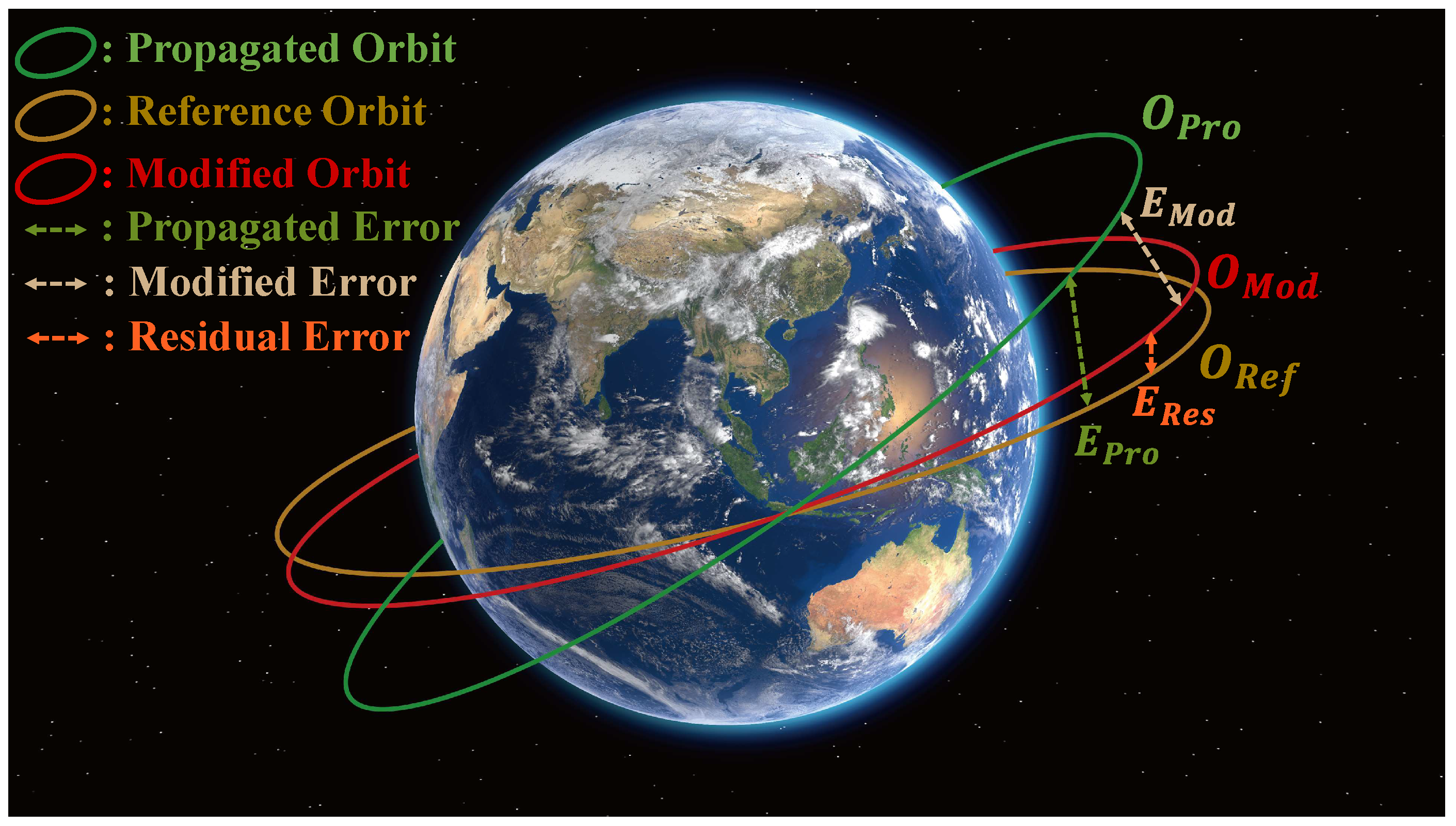
The conceptual framework of the hybrid orbit prediction model is illustrated in Figure 1. O Pro represents the propagated orbit derived from the dynamic model, O Ref represents the reference orbit describing the satellite’s true trajectory, and O Mod represents the modified orbit after applying the hybrid model. Correspondingly, E Pro represents the propagated error based on dynamic model, E Mod represents the modified error output by the hybrid model, and E Res represents the residual error after modification. At the same time sequence point n, their mathematical relationships can be expressed as follows:
E Pro n = O Ref n O Pro n
O Mod n = O Pro n + E Mod n
E Res n = O Ref n O Mod n
In this paper, the dynamic orbit propagation adopts a physically consistent closed-loop orbit propagation scheme based on a fixed initial state. The propagated orbit is generated by the high-precision orbit propagator under complete perturbation constraints, which strictly follows the orbital dynamic equations and guarantees physical consistency.
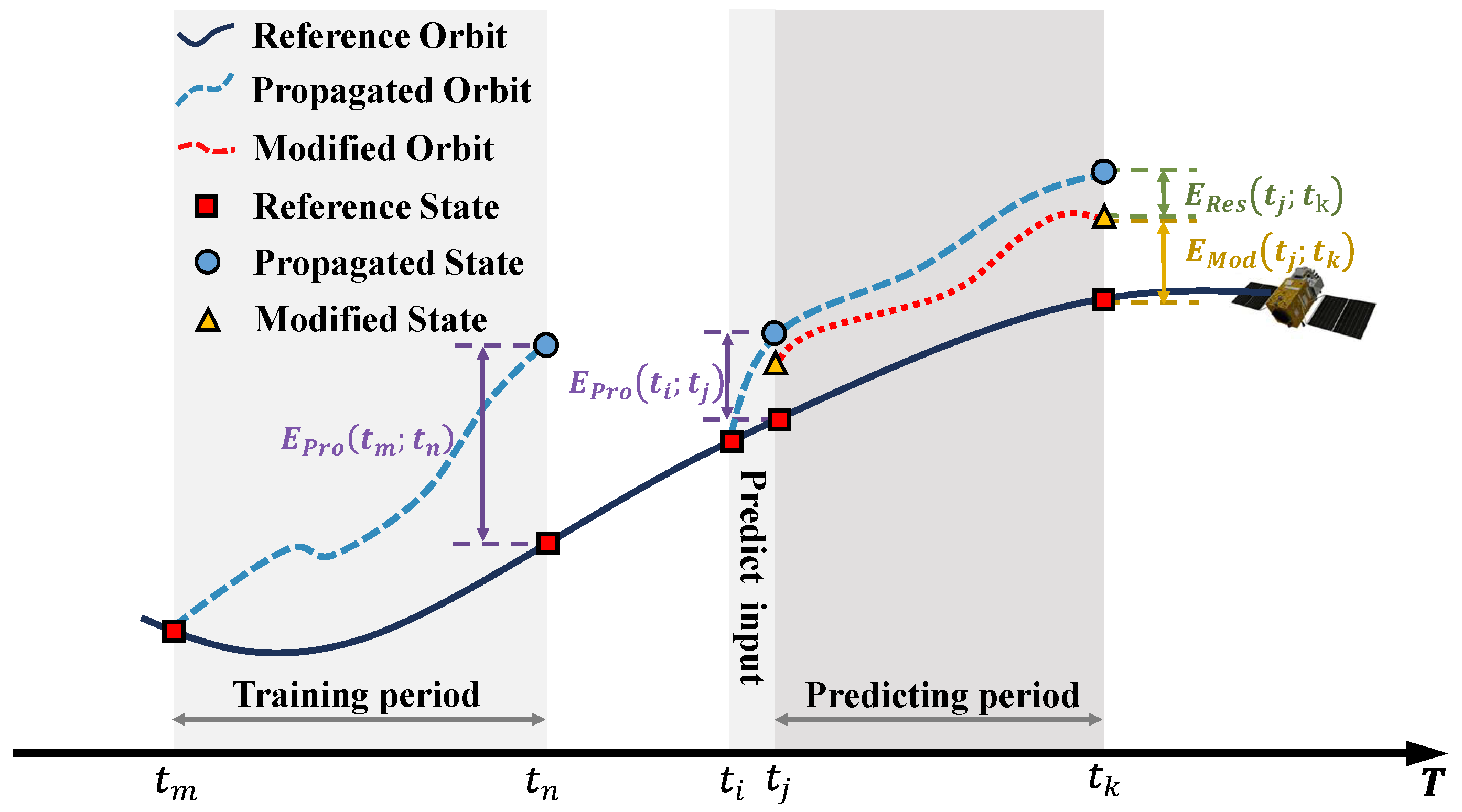
In the recursive forecasting stage, the propagated orbit O P r o used for error comparison is always derived from this physically consistent closed-loop propagation starting from the definite initial state, rather than re-propagating from the intermediate modified orbit O M o d . The trained deep learning model iteratively predicts the modified error E M o d step by step, as illustrated in the schematic diagram of data composition during the predicting period (Section 4.1). The final modified orbit O M o d is obtained by adding the iteratively predicted modified error E M o d to the physically consistent closed-loop propagated orbit O P r o at each corresponding epoch.
The hybrid orbit prediction model employs data-driven methods to construct a function f that learns the characteristics of the propagated error. This function generates modified errors, E Mod , which are applied to produce the modified orbit. The optimization objective of this process is to minimize the absolute value of residual errors, mathematically expressed as follows:
f * = arg min f E Res
The core concept of the hybrid orbit prediction model lies in utilizing the dynamic model to provide physical constraints while employing data-driven techniques to capture error patterns, ultimately achieving more precise orbit predictions.

2.3. Problem Formulation

In temporal networks, sequence length serves as a critical hyperparameter that significantly influences prediction accuracy. From a theoretical perspective, the selection of sequence length directly determines the temporal patterns that the model can capture. An insufficiently short sequence may fail to provide adequate historical context, thereby impairing the model’s ability to extract essential temporal features and degrading prediction performance. Conversely, excessively long sequences may introduce noise or redundant information, ultimately leading to similar performance degradation. Consequently, optimal sequence length selection significantly enhances model performance. To validate the above theoretical analysis, a comparative experiment was conducted based on a set of propagation error data. Due to the involvement of data preparation and the interpretation of evaluation metrics, the results will be presented in Section 5.1.
According to theoretical analysis, within a certain range, as the sequence length increases, the prediction accuracy of the model significantly improves. However, in practical application scenarios, uncontrollable factors such as orbital maneuvers, tracking anomalies, data transmission interruptions, and external interferences may prevent the acquisition of long-term continuous historical orbit data, thereby limiting the choice of sequence length.
To address these challenges, this study will further investigate optimized model architectures capable of achieving prediction performance comparable or superior to longer-sequence models under length-constrained conditions. This research not only carries substantial theoretical significance but also offers potential solutions to real-world orbit prediction challenges in engineering applications.

3. Method

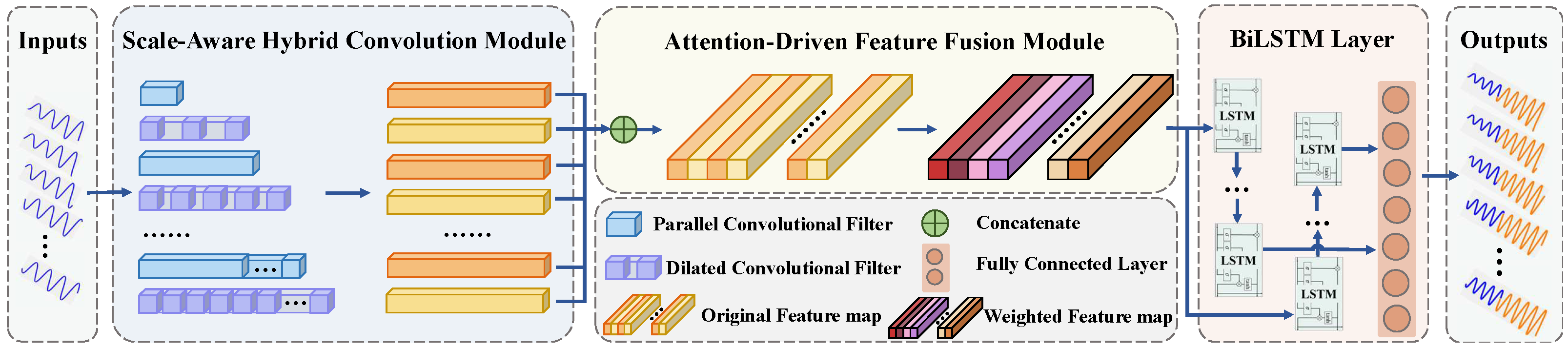
To address the performance degradation of BiLSTM network in orbit error prediction under short-sequence conditions, this paper proposes an improved network architecture as illustrated in Figure 2. The architecture designs a Scale-Aware Hybrid Convolution Module (SAHConvMod) that employs multi-scale convolutional operations with distinct receptive fields to simultaneously capture both short-term local patterns and long-term global dependencies within the sequence, thereby effectively compensating for information loss caused by insufficient sequence length. Furthermore, to optimize the fusion of multi-scale features, we introduce an Attention-Driven Feature Fusion Module (ADFFusMod) that utilizes an adaptive weighting mechanism to enhance the representation weights of critical features while suppressing irrelevant or noisy features, which significantly improves the quality of feature representations. Finally, the BiLSTM layer performs bidirectional temporal modeling on the high-information-density features generated by the aforementioned modules to capture temporal dependencies within the sequence. Through the synergistic operation of these modules, the model demonstrates the capability to produce accurate and robust satellite orbit error predictions even when dealing with short sequences. The subsequent sections will provide detailed explanations of each module’s operational principles.

3.1. Scale-Aware Hybrid Convolution Module

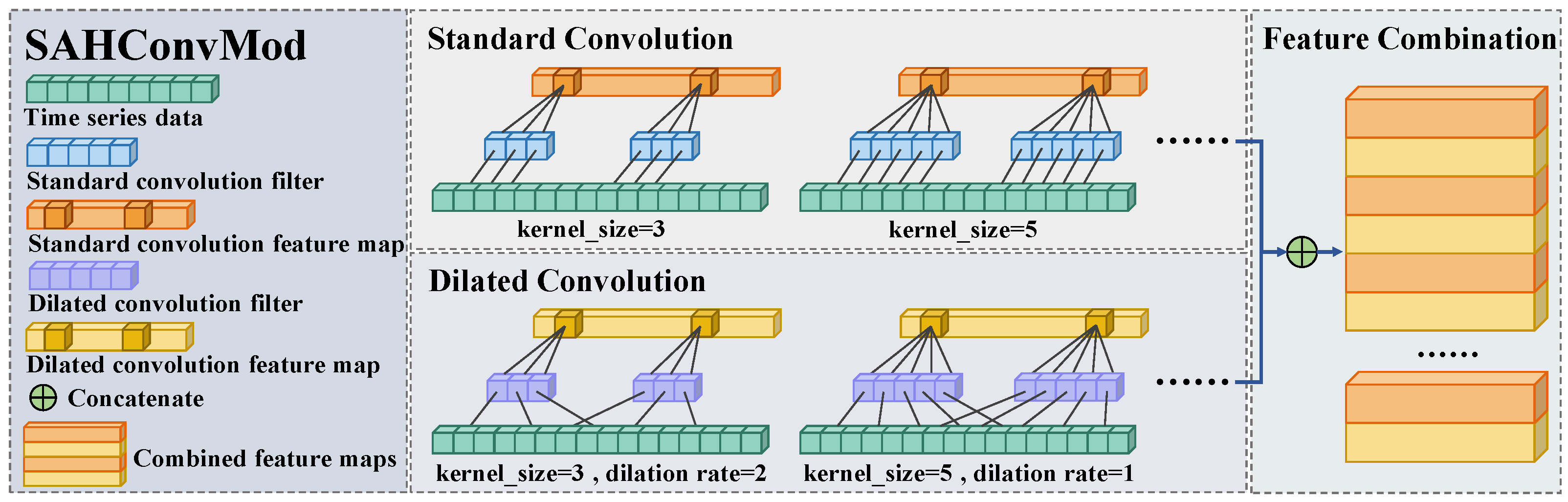
To effectively model the correlation features of data across different spatial ranges in short input sequences, we integrate standard convolutions and dilated convolutions; this paper designs the SAHConvMod, as illustrated in Figure 3. This design enables the network to extract rich and diverse local and global temporal dependencies from the short sequence, deeply uncovering the implicit data variation patterns embedded within the sequence and compensating for the explicit feature deficiency caused by insufficient sequence length.
By employing convolution kernels of different sizes, standard convolution can capture the variation patterns of data across the continuous temporal variation ranges of the input sequence. For an input sequence x = x 1 , x 2 , x 3 , , x N , the operation of standard convolution can be defined as follows:
F std n = k = 0 K 1 w k · x p a d d e d n + k K 1 2
x p a d d e d n = 0 , n < 0 x n , 0 n < N 0 , n N
where n is the sequence index, k is the kernel index, N is the length of the input sequence, K is the size of the convolution kernel, w is the convolution kernel, x p a d d e d is the input sequence after padding and F std is the output of standard convolution.
The elements of a convolution kernel in standard convolution are arranged continuously, while dilated convolution introduces fixed gaps, known as dilation rates, between the kernel elements. This enables it to effectively expand the receptive field without altering the kernel size, thereby capturing contextual information over a broader range. Unlike standard convolution, which focuses on extracting the variation patterns of data within continuous temporal ranges, dilated convolution can effectively capture the cross-temporal correlation features of time-series data. The operation of dilated convolution can be defined as follows:
F dil n = k = 0 K 1 w k · x p a d d e d n + d · k d K 1 2
where d is the dilation rate, and F dil is the output of dilated convolution. The definitions of other parameters are the same as in standard convolution. Dilated convolution enables the model to expand its receptive field while maintaining computational efficiency. By setting different dilation rates, the model’s capability to capture multi-scale temporal features is further enhanced.
Finally, the outputs of standard convolution and dilated convolution are concatenated to form a combined feature representation F combined :
F combined = [ F std , 1 , F std , 2 , F std , 3 , , F dil , 1 , F dil , 2 , F dil , 3 , ]
By concatenating these outputs, the module generates a combined feature representation that integrates multi-mode and multi-scale temporal information. This combined feature representation demonstrates remarkable capability in preserving the complete temporal evolution patterns of orbit errors even when processing length-constrained sequences.

3.2. Attention-Driven Feature Fusion Module

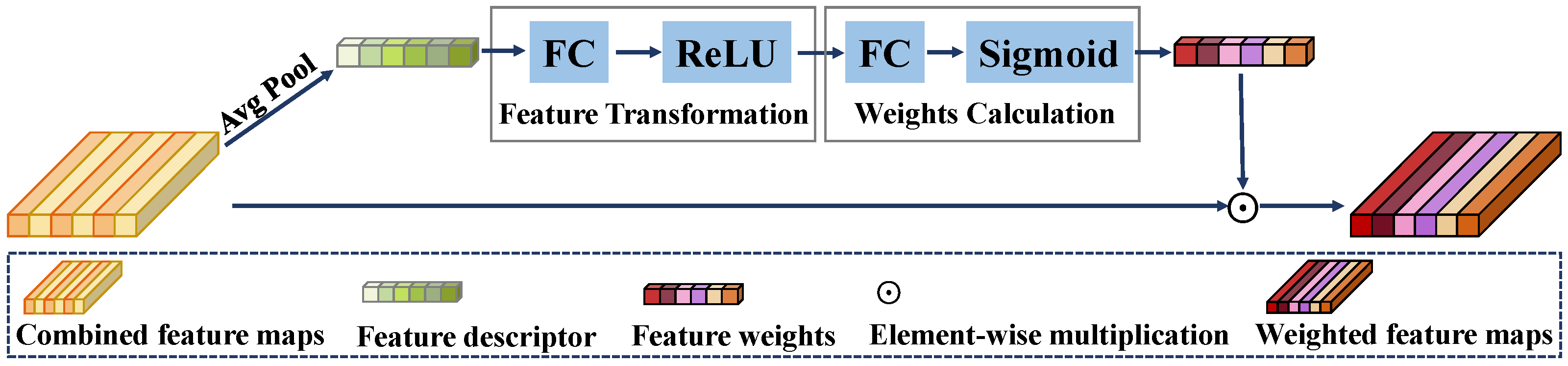
For the combined features extracted by the SAHConvMod, the ADFFusMod draws inspiration from the channel attention mechanism [44], dynamically weighting the importance of different features in the combined representation. This enables the network to focus on the features most relevant to the prediction task, thereby improving overall performance. The structure of the module is illustrated in Figure 4.
The ADFFusMod is implemented using a global average pooling layer and two fully connected layers. The operation of global average pooling is defined as follows:
z i = 1 T t = 1 T F combined , i t
where F combined , i is the i-th feature map in the combined features, and z i is the corresponding feature descriptor. By applying global average pooling to the combined features obtained from the SAHConvMod, a scalar value representing the global information of each feature is derived and fed into the fully connected layers to compute the attention weights for each feature. The calculation of feature attention weights is as follows:
a = σ W 2 · ReLU W 1 · z
σ ( x ) = 1 1 + e x
where W 1 and W 2 are the weights of the fully connected layers, σ is the sigmoid activation function, z is the feature descriptor vector, and a is the weight vector.
In these two fully connected layers, the first layer maps the feature descriptors to a low-dimensional embedding space through dimensionality reduction, achieving further abstraction and compression of the combined features. Additionally, the ReLU activation function introduces nonlinear transformations while zeroing out negative values. This sparsity property enables the filtering of non-essential feature information while retaining more critical features for the current task, thereby enhancing the model’s feature selection capability. The second fully connected layer remaps the low-dimensional features back to the original high-dimensional space, ensuring that the generated weights match the number of features in the combined representation. This upscaling operation assigns a corresponding weight to each feature, enabling adaptive weighting of the original combined features. The feature weighting process is expressed as follows:
F w e i g h t e d = F c o m b i n e d a
where F w e i g h t e d represents the weighted combined features, and ⊙ represents element-wise multiplication.
Through this design, the module dynamically enhances the representation of key features while suppressing irrelevant or redundant features, further improving the quality of feature representation. This provides robust informational support for the high-precision prediction of the subsequent BiLSTM network.

3.3. BiLSTM Layer

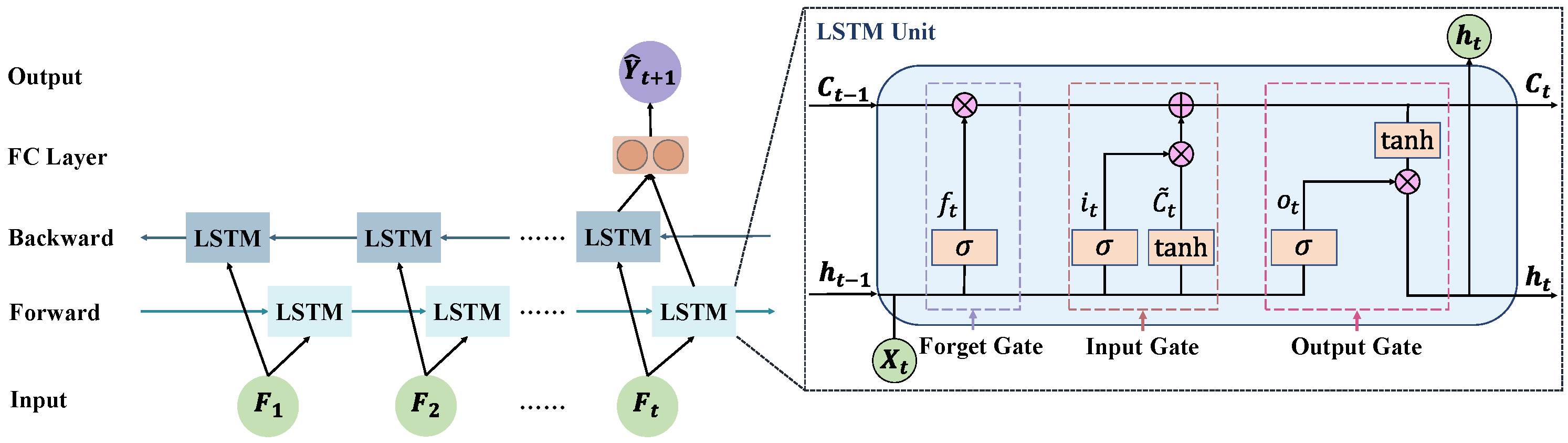
A Long Short-Term Memory (LSTM) network [45] effectively addresses the vanishing and exploding gradient problems inherent in traditional recurrent neural networks during training through the introduction of gate mechanisms. This architecture demonstrates superior performance in processing complex time-series sequence tasks, establishing itself as a fundamental tool for time-series data processing in deep learning. The principles of LSTM are as follows:
f t = σ ( W f · h t 1 , x t + b f )
i t = σ ( W i · h t 1 , x t + b i )
C ˜ t = tanh W c · h t 1 , x t + b c
C t = f t C t 1 + i t C ˜ t
o t = σ ( W o · h t 1 , x t + b o )
h t = o t tanh C t
tanh ( x ) = 1 e 2 x 1 + e 2 x
where f t is the forget gate, which controls the retention or discarding of information, i t is the input gate, which determines which information from the current input should be updated to the memory cell, and o t is the output gate, which controls the output of information from the memory cell to the hidden state. C t is the cell state, C ˜ t is the candidate cell state, and h t is the hidden state. W f , W i , W c and W o are weight matrices, while b f , b i , b c and b o are bias terms. x t is the input at the current time step, σ is the sigmoid activation function, and tanh is the hyperbolic tangent activation function.
In the standard LSTM architecture, the transmission of the cell state is unidirectional, meaning it only flows from past time steps to future time steps. As a result, traditional LSTM can only learn historical features from sequence. To overcome this limitation, a forward LSTM and a backward LSTM are combined, and their hidden states are concatenated for output. This bidirectional structure enables the model to simultaneously capture both historical and future information in the sequence data, thereby achieving bidirectional modeling of the contextual information in the sequence. This significantly enhances the model’s ability to represent complex temporal features [46]. The processing of the weighted features F w e i g h t , t obtained by ADFFusMod through the BiLSTM layer is illustrated in Figure 5. The computational method of BiLSTM is as follows:
h t = L S T M f o r w a r d F w e i g h t , t , h t 1
h t = L S T M backward F w e i g h t , t , h t + 1
h t = h t , h t
where h t and h t are the hidden states of the forward and backward LSTMs, respectively, and ht is the hidden state of the BiLSTM.
Finally, by applying a fully connected layer with an output dimension of one to the final timestep of the BiLSTM, the predicted value y ^ T + 1 for the next timestep given the input sequence x = x 1 , x 2 , x 3 , , x T is obtained as follows:
y ^ T + 1 = W FC · h T + b FC
where W FC and b FC are the weight matrix and bias term of the fully connected layer, and h T is the final hidden state of the BiLSTM.

4. Experimental Setup

4.1. Data Preparation

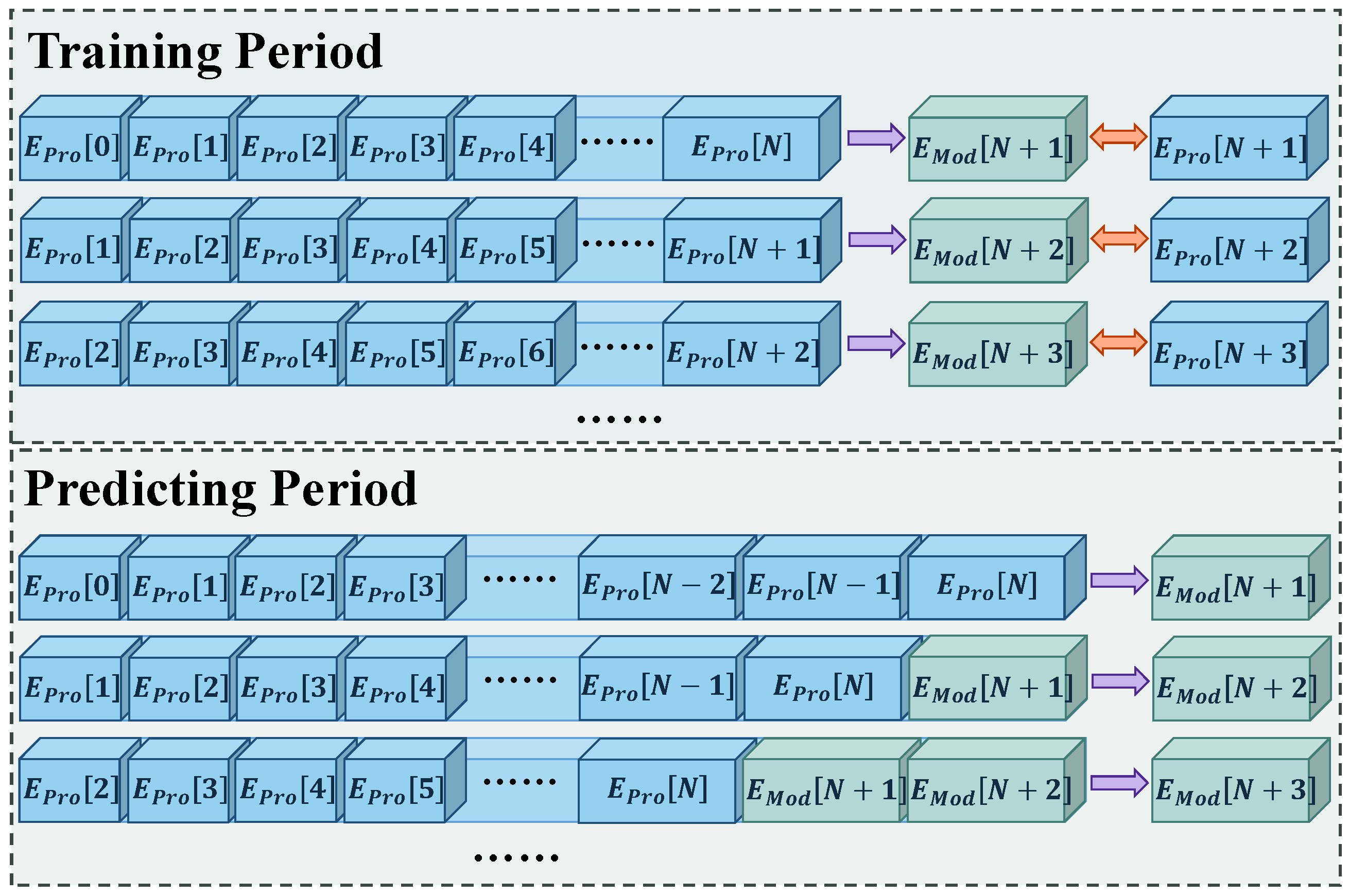
To validate the effectiveness of the proposed method, the experiment utilized precise ephemeris and dynamic orbits as data sources to generate orbit propagated error samples. Figure 6 illustrates the composition of the data during the network training and predicting period, which will be described in detail below.
Precise ephemeris refers to high-accuracy satellite orbit data derived from ground-based observations including laser ranging and GNSS measurements. Characterized by centimeter- to millimeter-level precision, these data record satellite positions at regular time intervals, serving as the primary reference for orbit accuracy evaluation. The International GNSS Service provides the most authoritative precise ephemeris products globally. This study employs BeiDou MEO satellite ephemeris from Wuhan University’s IGS Analysis Center, which offers multi-GNSS Experiment Product at 5 min intervals, yielding 288 discrete position records per day for GPS, GLONASS, Galileo and BeiDou constellations.
Dynamic orbits are generated using satellite dynamic models. This study employs the High Precision Orbit Propagator (HPOP) module in the Satellite Tool Kit (STK v12) software to generate dynamic propagated orbits. As the core tool for high-precision orbit propagation in STK, the HPOP module comprehensively considers the effects of various perturbations on satellites. Additionally, the HPOP module implements high-order numerical integration techniques to ensure prediction accuracy. Table 1 specifies the complete dynamic orbit propagation configuration for BeiDou MEO satellites, including force model parameters and the integration method. For solar radiation pressure, the satellite is modeled as a sphere with a radiation pressure coefficient is 1.0 and an area-to-mass ratio of 0.02 m2/kg. For atmospheric drag, the drag coefficient is set to 2.2, and the Jacchia–Roberts model is used with fixed space environment parameters: daily F10.7 = 150, average F10.7 = 150, and geomagnetic index = 3. All calculations are carried out in the J2000 inertial coordinate system, and all orbit data are aligned with IGS precise ephemerides at 5 min intervals. The numerical integration adopts the adaptive step size strategy based on RKF7(8). The minimum step size is set to 1 s, the maximum step size is 60 s, and the position–velocity integration accuracy tolerance is controlled at 1 × 10 9 km to ensure high-precision numerical calculation while maintaining computational efficiency.
The orbit propagation error samples were constructed by comparing the reference orbits with the dynamic orbits. As illustrated in Figure 7, during the training period, historical propagation errors of fixed sequence length were sequentially fed into the network. Through forward propagation, the model predicted the error at the subsequent time step, and the backpropagation algorithm updated the network parameters based on the difference between predicted and true errors, progressively improving the model’s predictive capability. In the training period, we use a 7-day sequence sampled at 5 min intervals, giving a total of 2016 time points for orbit error data. The training samples are constructed using a sliding window strategy with fixed window length and fixed stride. Specifically, each input sequence consists of 288 consecutive time points, and the sliding stride between adjacent windows is set to 1 time point, which results in a high overlap between neighboring training samples. During model training, teacher forcing is applied as the supervised learning strategy, which effectively guides the model to learn the correct sequential mapping from historical error observations to future error corrections. For prediction, we adopt the single-step recursive prediction mode. During the prediction period, the data construction follows a similar approach to the training data, employing the same single-step prediction methodology. However, unlike the training period, only forward propagation is executed during prediction without parameter updates. After each single-step prediction, the network’s output is incorporated into the input sequence for subsequent predictions, implementing an iterative forecasting process. This recursive prediction approach effectively simulates real-world operational scenarios, ensuring the model’s generalization capability and robustness when handling unseen data.

4.2. Evaluation Metrics

To comprehensively evaluate the modification effect of the proposed method on orbit propagated errors, this study employs evaluation metrics including Maximum Absolute Error (MaxAE), Mean Absolute Error (MAE), Root Mean Square Error (RMSE), and Mean Residual Rate (MRR). All the metrics are calculated based on absolute values of orbit error components to avoid sign cancellation issues. Their calculation methods are as follows:
M a x A E ξ = max E Res , ξ n
M A E ξ = 1 N n = 1 N E Res , ξ n
R M S E ξ = 1 N n = 1 N E Res , ξ n 2
M R R ξ = 1 N n = 1 N E Res , ξ n E Pro , ξ n × 100 %
where N is the total number of samples and ξ x , y , z represents different axes. For all the above evaluation metrics, smaller values indicate better performance of the network in modifying orbit errors.
Furthermore, to quantitatively evaluate the performance improvement of the proposed method compared to the baseline method, we calculated the improvement rate of the proposed method for each evaluation metric relative to the BiLSTM with an input sequence length of 288. The specific calculation formula is as follows:
I R ξ = M e t r i c BiLSTM 288 , ξ M e t r i c Ours , ξ M e t r i c BiLSTM 288 , ξ × 100 %
where I R ξ represents the improvement rate of different axes. M e t r i c BiLSTM 288 represents the performance evaluation metric value of the BiLSTM network with a sequence length of 288, and M e t r i c Ours represents the performance evaluation metric value of the proposed method.

4.3. Training Details

To ensure the reproducibility of the proposed deep-learning-based orbit prediction framework, complete training configurations and implementation details are provided in this section.
The input orbit propagated error sequences and output modified error are normalized to the range 1 , 1 using the Min–Max scaler. This zero-centered range matches the gradient behavior of Adam optimization, and improves the training stability of the network. The original kilometer-level error values are directly scaled without sign modification to preserve the physical interpretability required for orbit modification. All network parameters are initialized with the default PyTorch (V2.4.0) Kaiming uniform initialization for both convolutional and linear layers.
The model is optimized using the Adam optimizer with an initial learning rate of 1 × 10 4 . A step learning rate decay strategy is applied with a decay factor of 0.1, where the learning rate is decayed once at the 800th epoch during the total 1200 training epochs to stabilize model convergence. The batch size is set to 32. The loss function is mean squared error (MSE), which is consistent with the objective of minimizing residual orbit errors as defined in Equation (10). The main training hyperparameters are summarized in Table 2.

5. Results and Analysis

5.1. Performance Comparison of Different Sequence Lengths

To investigate the impact of varying sequence lengths on the hybrid orbit prediction model, this section presents a comprehensive experimental analysis. We construct the hybrid orbit prediction model using identical dynamic parameters and a standalone BiLSTM architecture, systematically comparing model performance across different sequence lengths.
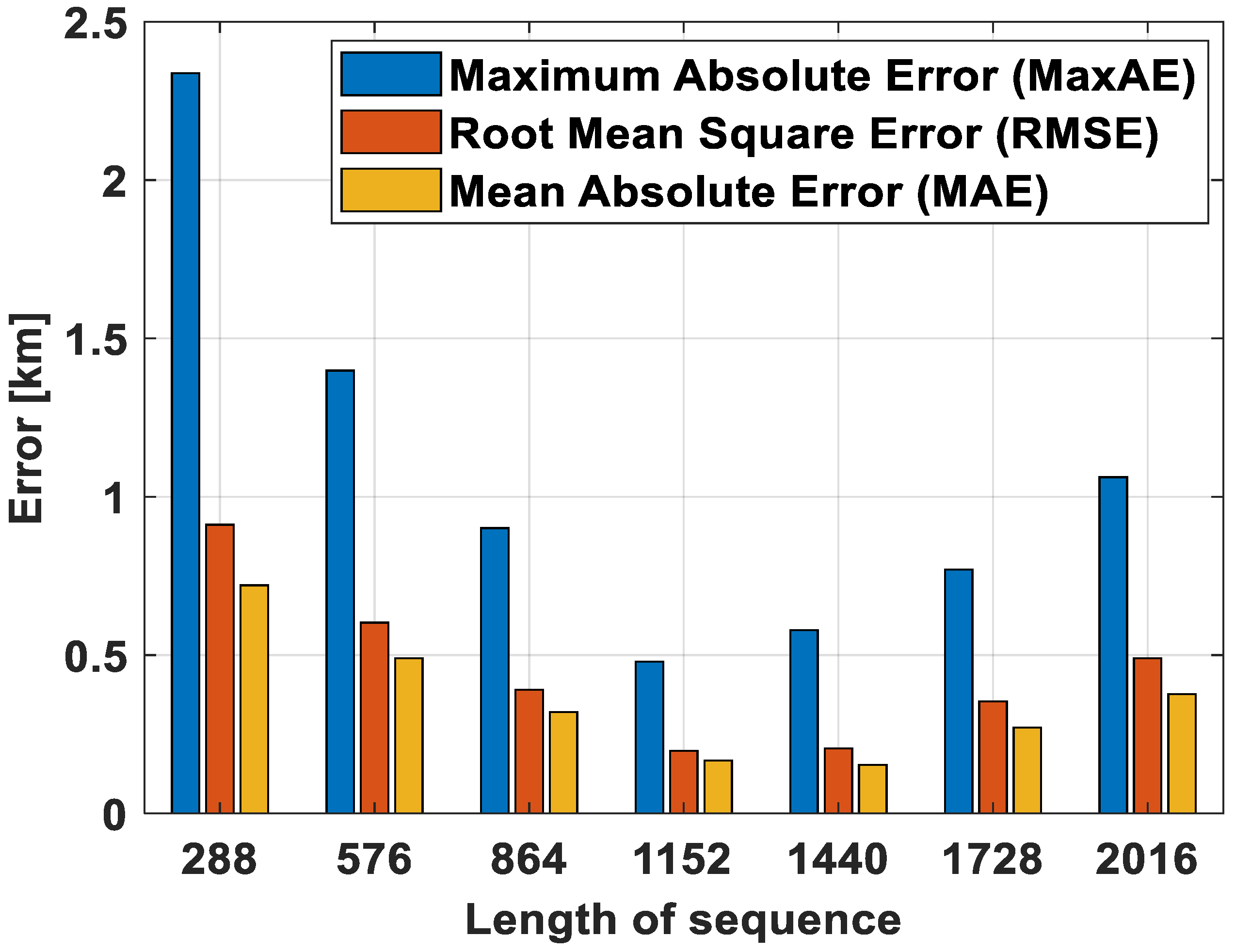
Building upon the aforementioned data preparation framework, and considering the availability of 288 orbital samples per day, we progressively increase the sequence length in daily increments for experimental evaluation. In the training period, the prediction error data for the subsequent 7 days starting from UTC 2022-12-31 23:59:42 are selected as the training samples. For testing purposes, we generate orbit propagation error sequences of varying lengths, all originating from UTC 2023-01-20 23:59:42. These sequences serve as network inputs for subsequent 7-day orbit predictions, enabling systematic evaluation of sequence length effects on prediction performance. The comparative performance metrics of the hybrid orbit prediction model based on BiLSTM network under different input sequence lengths are presented in Figure 8, with detailed experimental results provided in Table 3.
The experimental results demonstrate that the sequence length significantly impacts the performance of BiLSTM networks in time-series prediction tasks. When the sequence length increases progressively from 288 to 1152, the network’s prediction performance improves accordingly. However, further increases in sequence length result in degraded prediction performance instead of improvement. These experimental findings fully validate the theoretical analysis presented in Section 2.3 regarding the impact of sequence length on network performance. Moreover, they substantiate both the theoretical value and innovative significance of this paper’s research for enhancing prediction performance under short-sequence conditions.

5.2. Performance Breakthroughs Under Sequence Constraints

Taking the BDS MEO C19 satellite as the research object, this paper designs relevant experiments to verify the effectiveness of the proposed method. In the model training period, UTC 2022-12-31 23:59:42 is selected as the starting time, and the orbit propagation error data for the subsequent 7 days are collected to construct the training dataset. In the orbit error prediction period, 288 sets of orbit prediction error data starting from UTC 2023-01-14 23:59:42 are used as the input for model prediction. On this basis, three independent network models are trained to accurately predict the orbit prediction errors of the satellite along the X, Y and Z axes in the Earth-Centered Inertial coordinate system for the next 7 days, and the predicted values of the orbit based on the dynamic model are compensated and corrected by the prediction results.
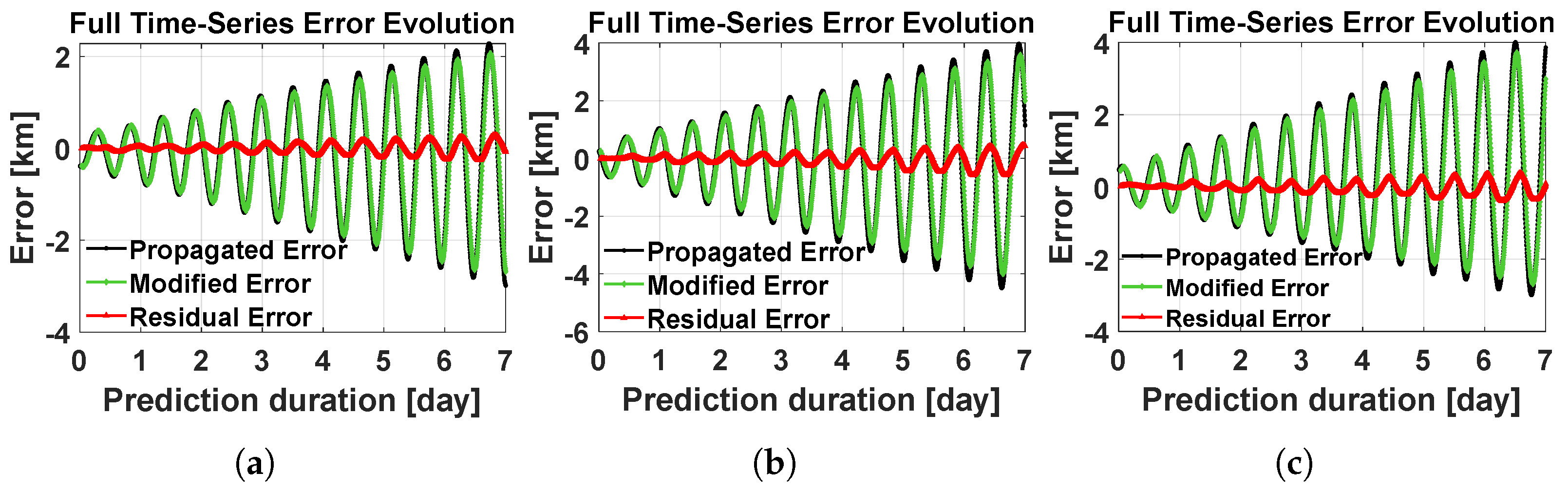
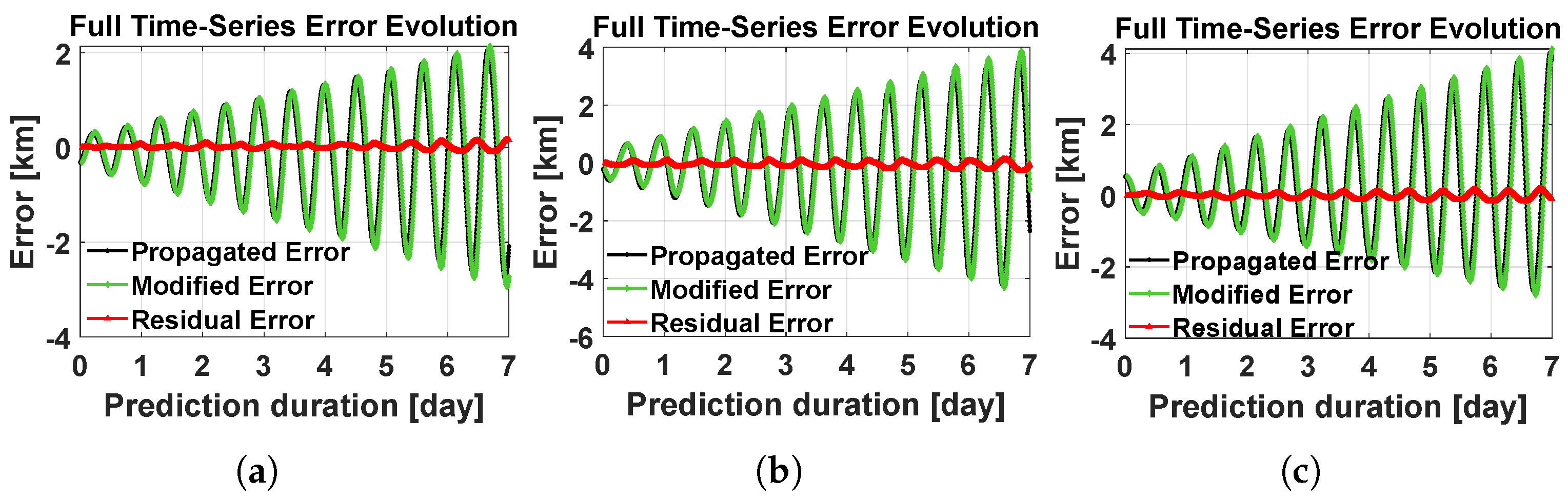
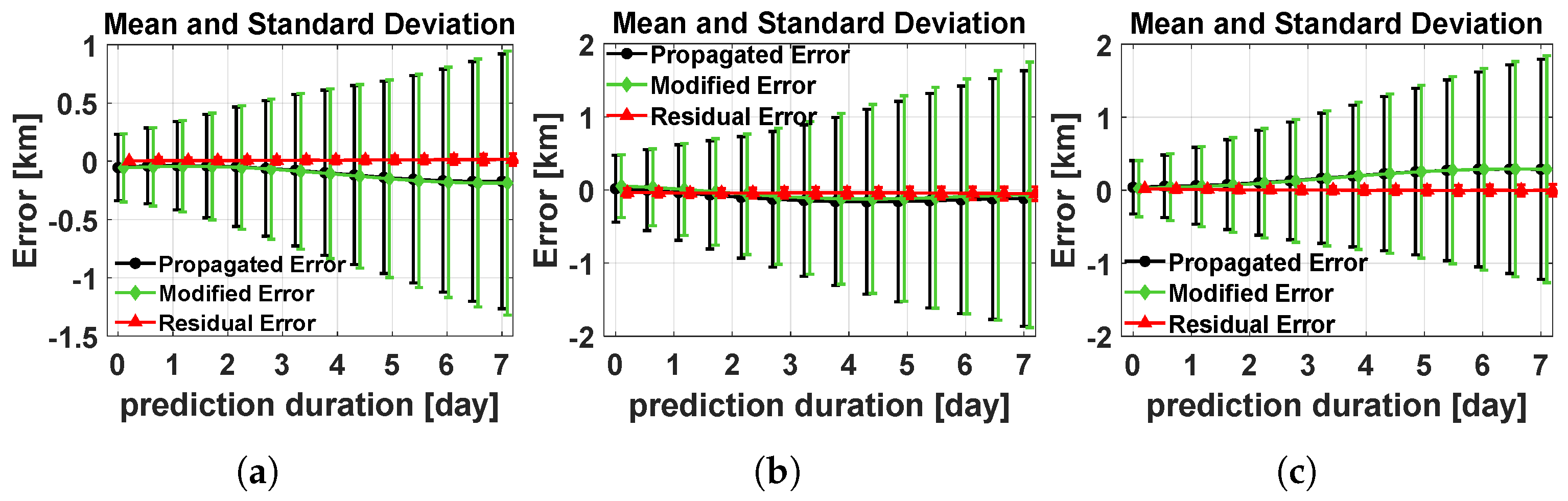
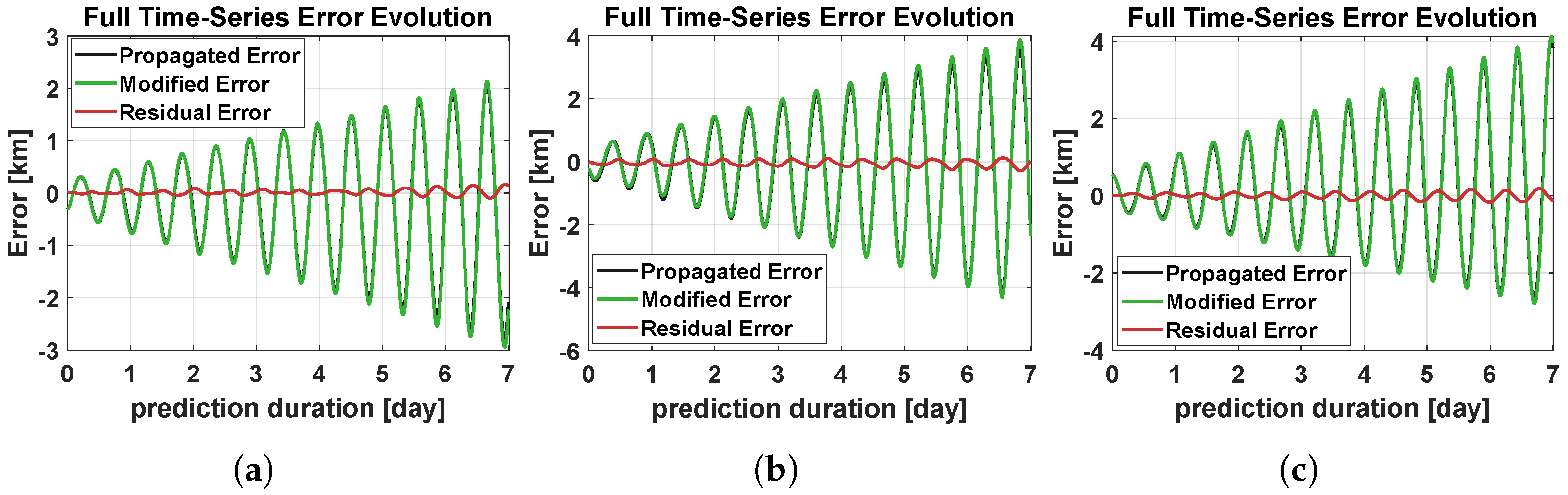
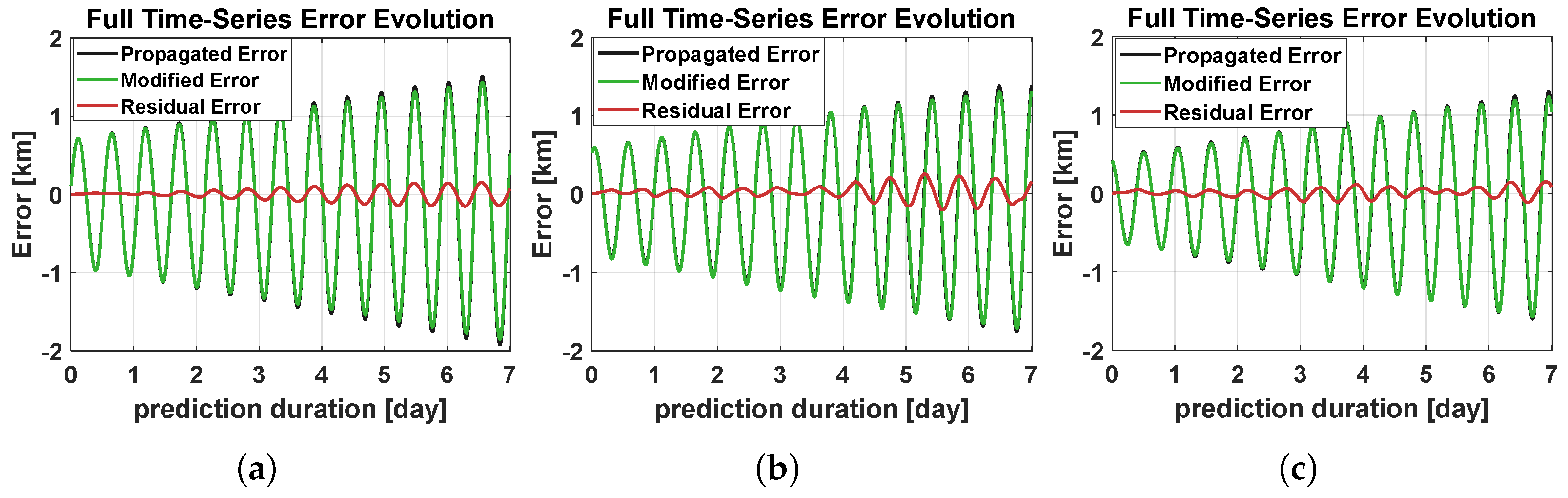
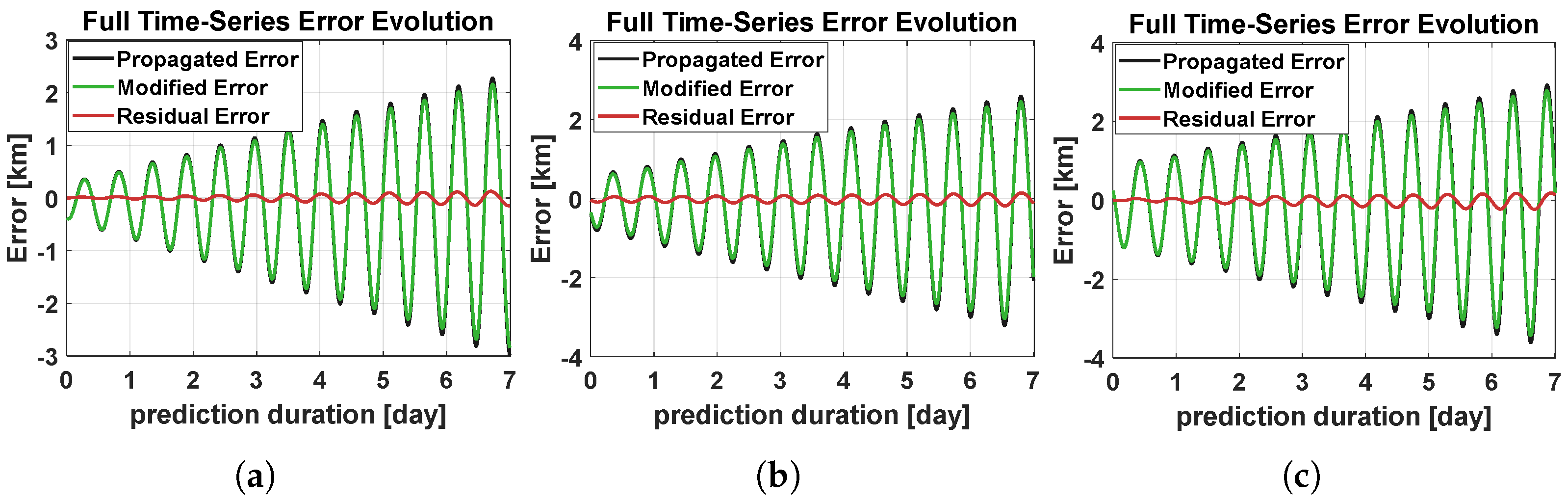
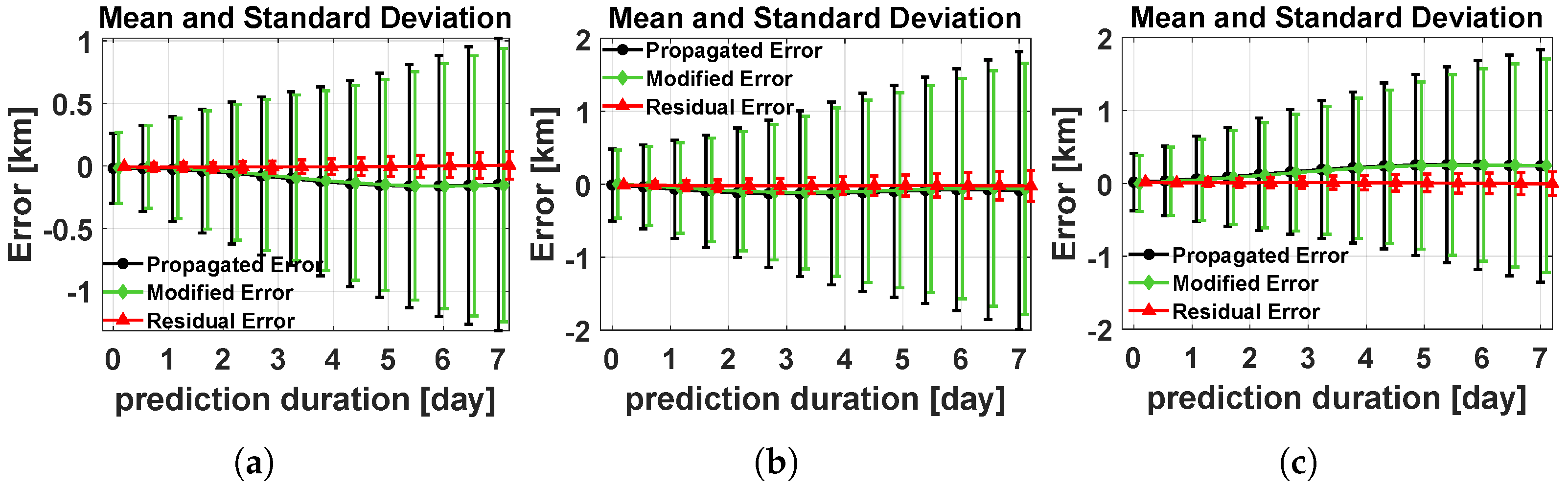
As shown in Figure 9 and Figure 10, the black curves represent the true propagated errors, the green curves represent the modified errors predicted by the network, and the red curves represent the residual errors after modification. To clearly demonstrate the method’s prediction capability and temporal evolution characteristics of orbit errors, data analysis points were established at 0.5-day intervals throughout the 7-day prediction window. For each analysis point, both the mean value (indicated by solid markers) and ± 1 σ standard deviation range (represented by vertical error bars) of orbit errors were calculated from the initial time point to the current analysis point. The results clearly show that, after modification, the residual errors are significantly reduced and maintained at a low level, with their divergence characteristics effectively suppressed.
As demonstrated in Table 4, when operating with a sequence length of 288, the proposed method achieves a substantial performance improvement across all three axes in the inertial frame: the maximum absolute errors are decreased from 1.5040/2.5002/3.3130 km to 0.1652/0.2929/0.1902 km, while the mean absolute errors are decreased from 0.4845/0.5905/0.9899 km to 0.0391/0.0878/0.0666 km. Furthermore, the root mean square errors are decreased from 0.6022/0.8165/1.2474 km to 0.0525/0.1057/0.0800 km, with corresponding reductions in the mean residual rates from 54.03%/41.18%/80.10% to 4.36%/6.12%/5.39%, collectively demonstrating the method’s superior performance in orbit error modification with shorter input sequences. Notably, our method also outperforms the BiLSTM-1152 configuration across all evaluation metrics, effectively overcoming the sequence length limitation.
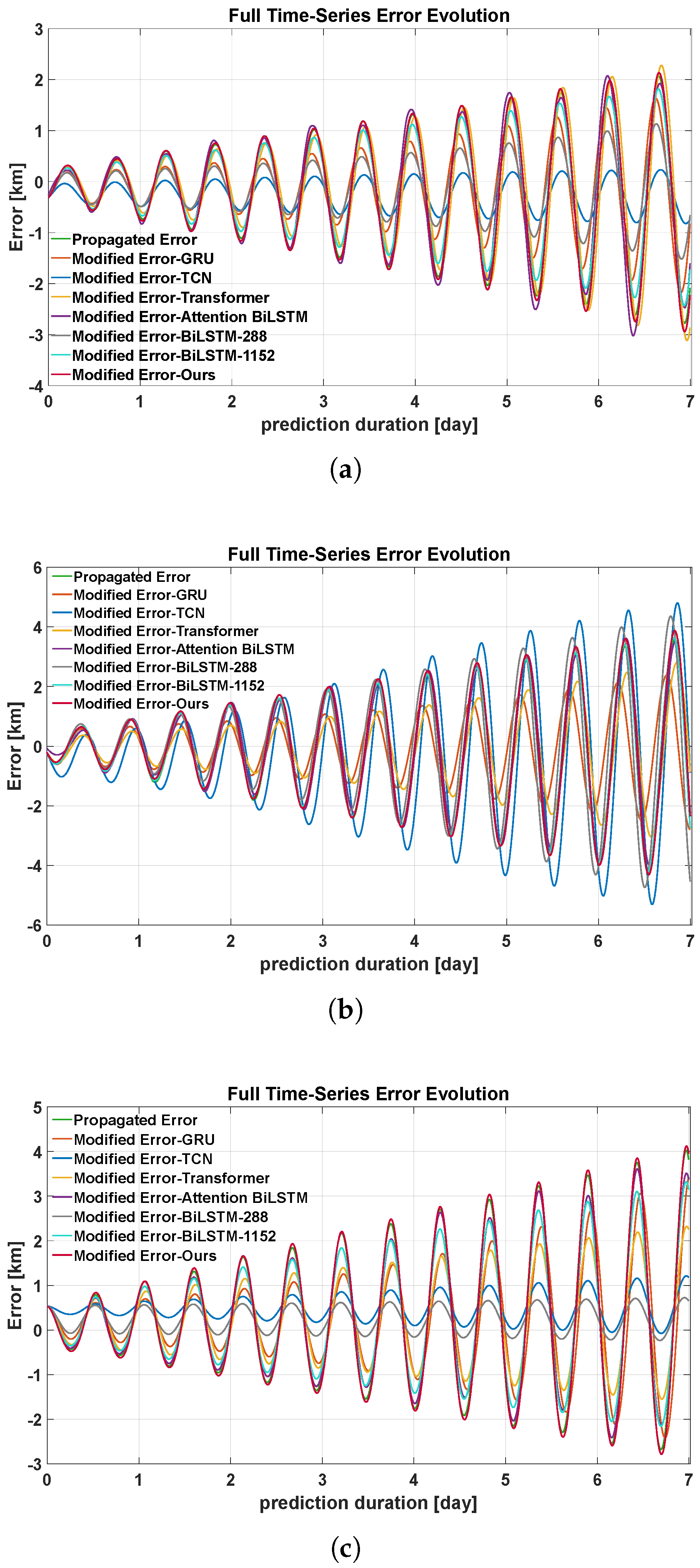
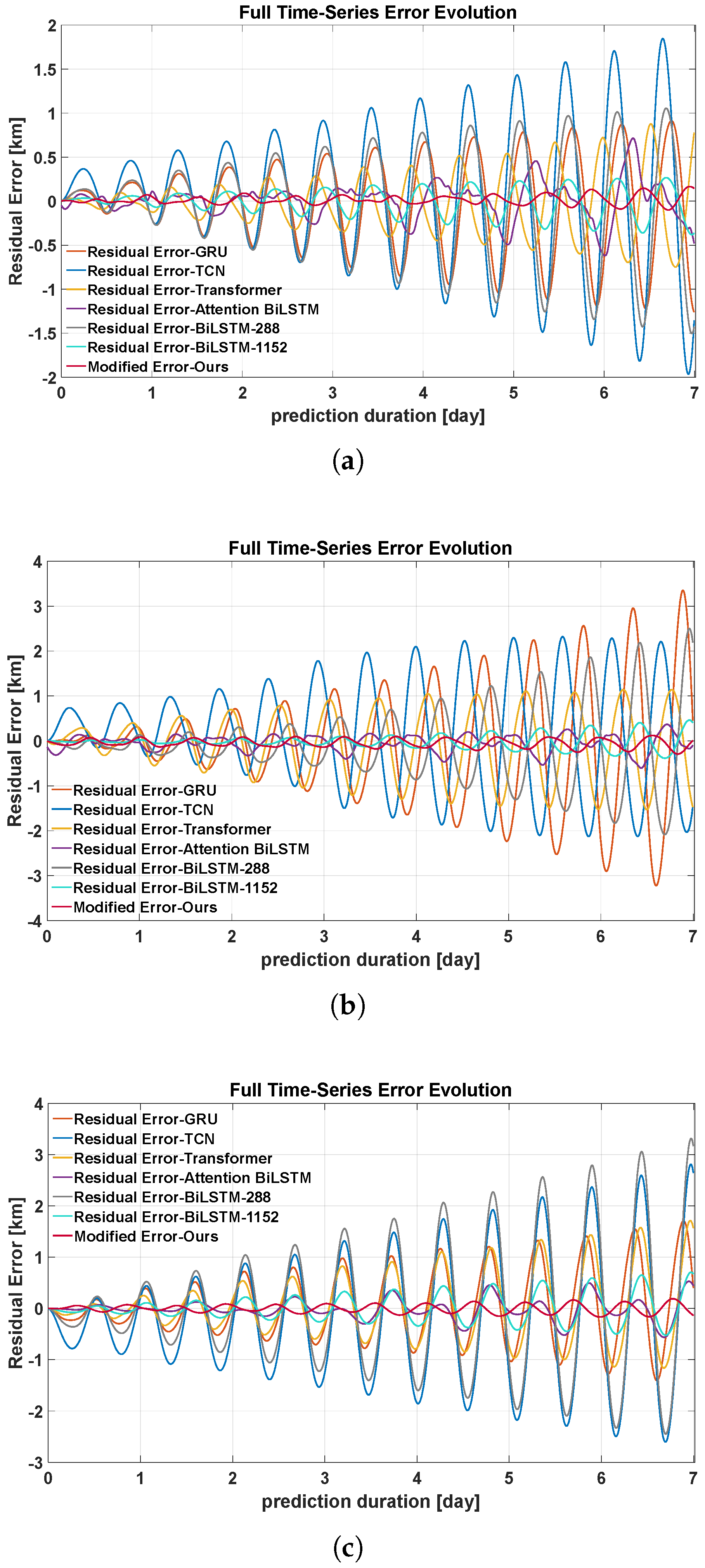
As shown in Figure 11 and Figure 12, the original orbit propagated error (green curve) exhibits a typical pattern of periodic oscillation superimposed with long-term cumulative drift, with its amplitude continuously increasing as the prediction duration extends from 0 to 7 days. A comprehensive comparison of the baseline models reveals clear performance stratification: Among all baselines, BiLSTM-1152 and Attention-BiLSTM achieve relatively strong prediction performance, effectively fitting the phase and amplitude variations in the orbit propagation error. The Transformer and GRU models show moderate performance, with a noticeable deficiency in predicting error amplitude in the late prediction stage as time progresses. The TCN and BiLSTM-288 models fail to adequately learn the temporal evolution law of orbit propagation errors, resulting in significant discrepancies in error amplitude prediction. Notably, the proposed method (crimson curve) achieves the closest alignment with the ground-truth propagated error curve among all models. This demonstrates that the proposed method effectively captures both the periodic error components and long-term drift in orbit propagated errors, realizing precise phase alignment for periodic errors and effective suppression of long-term drift.
Furthermore, we observe that the prediction errors of all models exhibit a divergent trend as the prediction duration increases. We attribute this phenomenon to the recursive single-step prediction mechanism of orbit prediction tasks: the prediction output at the current time step is used as the input for the next time step, causing minor prediction errors in the early stage to gradually accumulate in subsequent predictions, thereby amplifying the overall error. For poorly performing models such as GRU, TCN, and BiLSTM-288, unsatisfactory initial predictions directly lead to increasing deviations from the ground truth in later steps, exacerbating the divergence of orbit errors. In contrast, the proposed method achieves the best prediction performance in the early stage of orbit prediction, laying a solid foundation for sustained high-precision prediction over a longer period, and maintains the optimal performance throughout the entire prediction horizon.
To verify the model performance over different time periods, we have conducted prediction experiments across three independent periods: 15–21 January 2023, 30 January–5 February 2023, and 18–24 February 2023. The same trained model was directly applied to these separate epochs without retuning, and the corresponding prediction results are summarized in Table 5. We have visualized the temporal evolution of orbit errors, as presented in Figure 13, Figure 14 and Figure 15. As can be observed from the figures, the temporal evolution patterns of orbit propagated errors differ slightly across the three independent prediction periods, indicating marginally different orbital dynamic conditions and perturbation environments in different time periods. Despite these variations, the proposed method consistently provides accurate and reliable fitting to the ground-truth propagated error in all test periods. Meanwhile, the residual errors of our method remain continuously suppressed at a remarkably low level throughout the entire 7 day prediction horizon, without obvious error accumulation or divergence in the late prediction stage. These visualization results, together with the quantitative metrics in Table 5, consistently confirm that the proposed method maintains stable and reliable prediction performance across different prediction periods. The experimental results confirm that the model is not sensitive to a specific epoch and can achieve reliable performance over multiple independent periods, which strongly supports its feasibility for practical autonomous navigation applications.
From Table 6, it can be observed that for the 7-day orbit prediction of the C19 satellite, the proposed method achieves an improvement of over 85% in all evaluation metrics compared to the BiLSTM network with the sequence length of 288 in each coordinate axis. The most notable improvement is observed in the Z-axis direction, where the improvement rates for MaxAE, MAE, RMSE, and MRR reach 94.26%, 93.27%, 93.58%, and 93.27%, respectively. These results further validate the effectiveness and superiority of the proposed method under short sequences, providing a more robust and efficient solution for satellite orbit error compensation.
We have supplemented additional statistical validation experiments to demonstrate the stability and reliability of the proposed model. Specifically, we conducted multiple independent training and testing runs with different random seeds under the same experimental setup.The evaluation results in terms of MaxAE, MAE, RMSE, and MRR for the X, Y, and Z axes are summarized as mean ± standard deviation. X-axis: MaxAE: 0.1603 ± 0.0075 km; MAE: 0.0346 ± 0.0041 km; RMSE: 0.0522 ± 0.0035 km; MRR: 4.2529 ± 0.2081%. Y-axis: MaxAE: 0.2922 ± 0.0058 km; MAE: 0.0854 ± 0.0063 km; RMSE: 0.1092 ± 0.0044 km; MRR: 6.1943 ± 0.1828%. Z-axis: MaxAE: 0.1836 ± 0.0055 km; MAE: 0.0679 ± 0.0045 km; RMSE: 0.0808 ± 0.0041 km; MRR: 4.9543 ± 0.3406%.
To verify the effectiveness of each key component in our model, a comprehensive ablation study is conducted. The baseline is formed by a single BiLSTM network without SAHConvMod and ADFFusMod. On this basis, the standard convolution is introduced to construct the BiLSTM+StandardConv variant, while the BiLSTM+DilatedConv variant only incorporates dilated convolution instead. By combining standard convolution and dilated convolution, we obtain the BiLSTM+HybridConv variant, which still excludes ADFFusMod. Our full model integrates BiLSTM, SAHConvMod and ADFFusMod together. By gradually adding key modules to the baseline in a controlled manner, we can separately validate the contributions of standard convolution, dilated convolution, hybrid convolution, and the attention-based feature fusion mechanism to the final prediction performance. The experimental results are shown in Table 7. The experimental results show that the model outperforms the versions with partial modules removed across all evaluation metrics under the synergistic effect of all modules, fully verifying the superiority of the proposed method in the task of orbit error compensation.
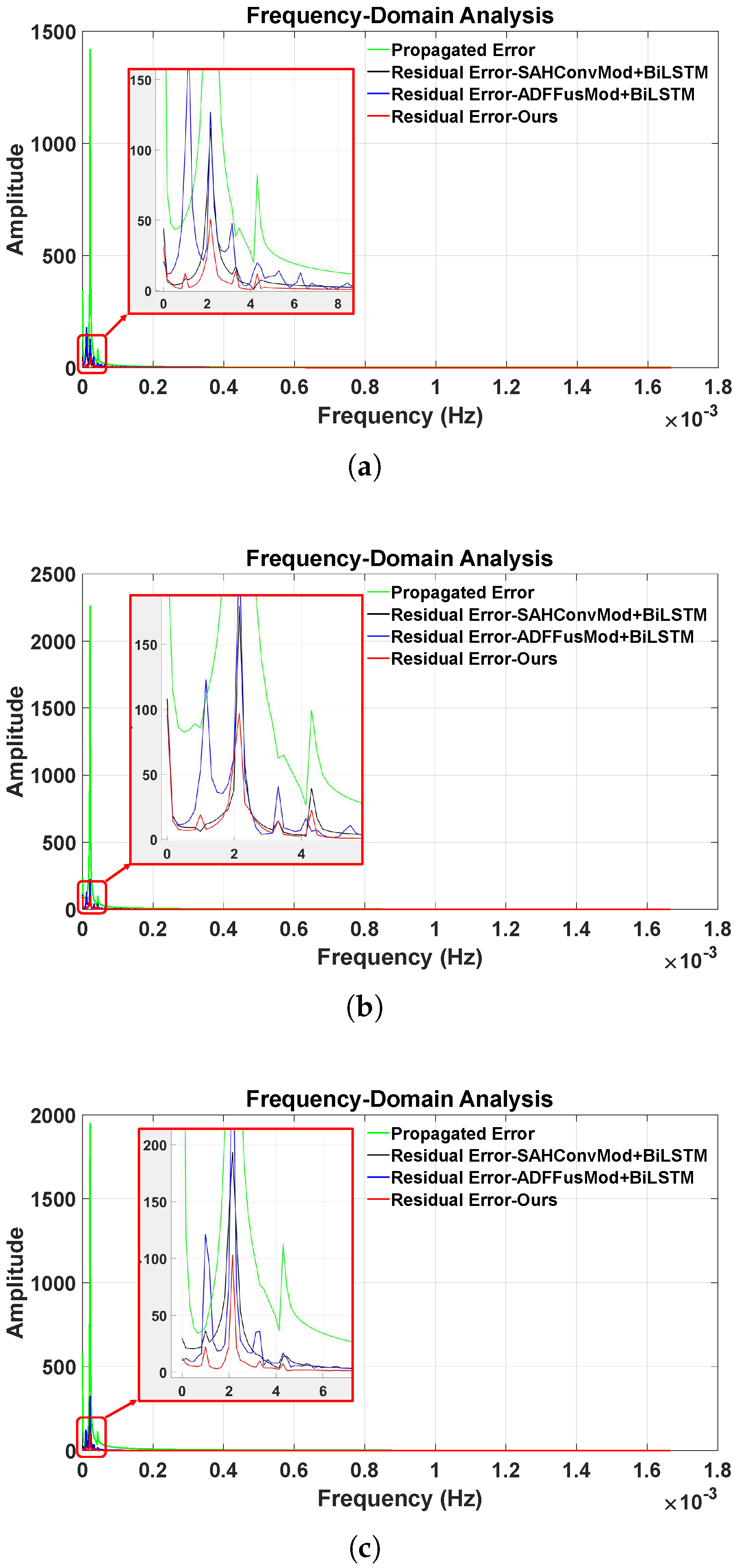
To provide rigorous quantitative evidence and enhance the interpretability of the proposed modules, we have carried out frequency-domain analysis based on Fast Fourier Transform (FFT) to compare the spectral characteristics of different error components. We analyzed the original orbit propagated error from the dynamic model, the residual error of SAHConvMod+BiLSTM, the residual error of ADFFusMod+BiLSTM, and the residual error of our full proposed method, as illustrated in Figure 16. Through observing the spectral characteristics, we find that the original orbit propagated error exhibits a prominent and high-amplitude peak in the ultra-low-frequency region near 0 Hz, indicating the presence of an evident slow-varying, long-term trend without a fixed period. We think this component corresponds to the cumulative drift error in dynamic orbit propagation, which mainly arises from unmodeled dynamics, and numerical integration truncation. Second, several discrete, sharp, and narrow peaks are observed to the right of 0 Hz, which we regard as typical periodic perturbation components. By comparing the spectral differences among different ablation configurations, we can clearly verify the respective functions and complementary mechanisms of the two key modules. The combination of ADFFusMod and BiLSTM (blue curve) significantly suppresses the high amplitude in the ultra-low-frequency band near 0 Hz while showing limited effectiveness on the periodic peaks in the low- and middle- frequency bands. This quantitatively confirms that the ADFFusMod module is specifically designed to model and eliminate long-term cumulative drift and slowly varying error components. In contrast, the combination of SAHConvMod and BiLSTM (black curve) achieves remarkable suppression on the discrete periodic peaks in the low- and middle-frequency bands, while its influence on the ultra-low-frequency drift component is less significant than that of ADFFusMod. This verifies that the SAHConvMod module is specialized in capturing and compensating for periodic oscillation components induced by various orbital perturbations. In summary, the proposed ADFFusMod and SAHConvMod exhibit a clear and complementary division of labor: ADFFusMod focuses on mitigating long-term drift and error divergence, while SAHConvMod targets periodic oscillation components. The full proposed method integrates the advantages of both modules, enabling comprehensive and accurate orbit error modification across the entire effective frequency band and throughout the prediction horizon.

5.3. Assessment of Generalization Capability

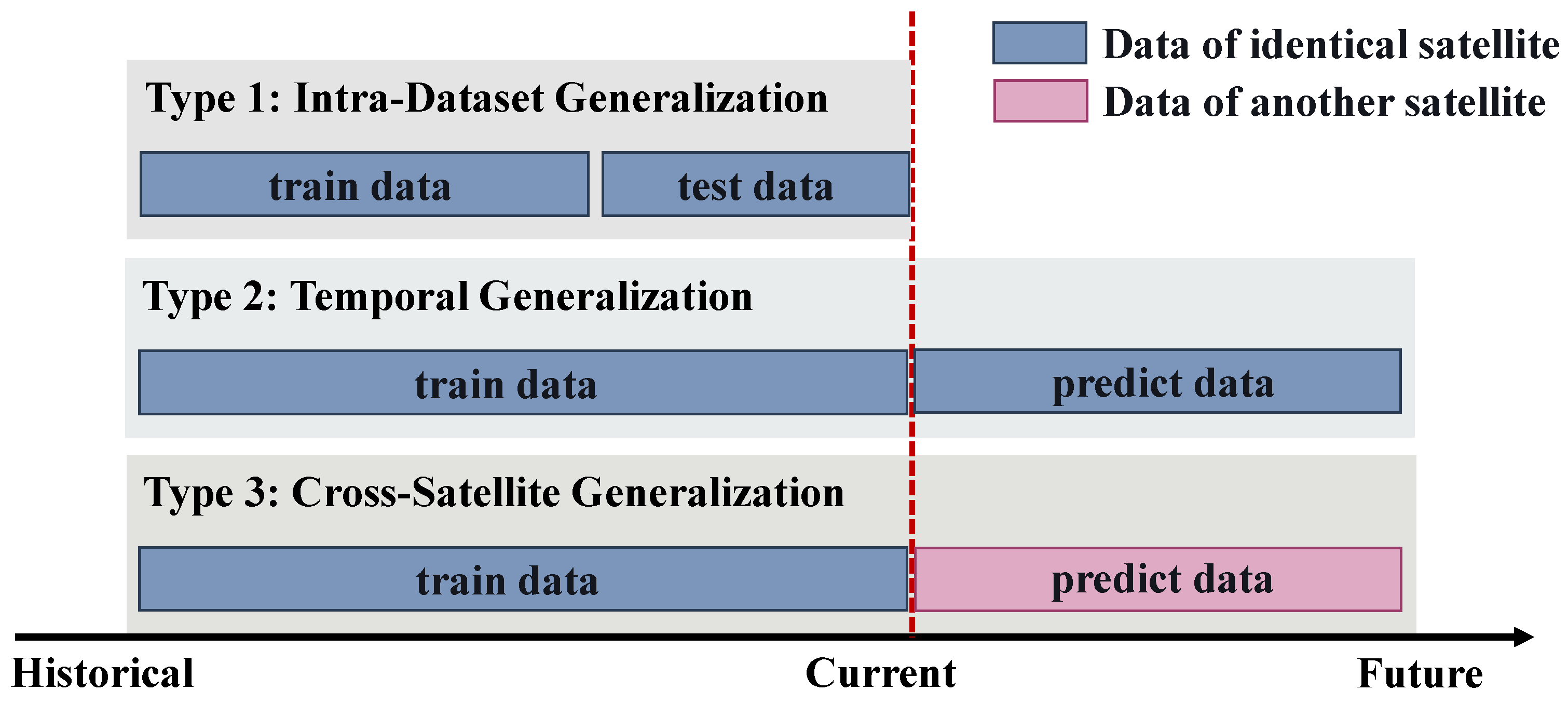
For the problem of orbit error prediction, hybrid orbit prediction methods exhibit three types of generalization capabilities [33], as illustrated in Figure 17.
Type 1: Intra-Dataset Generalization
Evaluates model performance through random train-test splits within a single dataset, assessing fitting capability and distributional generalization. While standard in machine learning, this approach cannot validate temporal extrapolation required for practical orbit prediction.
Type 2: Temporal Generalization
Tests prediction accuracy on strictly future time periods relative to training data, directly validating the model’s time-extrapolation capability. It is a critical requirement for operational orbit prediction systems. The above experimental results demonstrate the superior performance of the proposed method in this critical scenario.
Type 3: Cross-Satellite Generalization
Examines transferability to different satellites of identical type by learning universal orbital change patterns. Since satellite constellations are typically composed of multiple homogeneous satellites with similar orbital characteristics and dynamic behaviors, this capability enables the construction of a universal orbit prediction framework by sharing common features, and thus provides significant operational advantages for multi-satellite systems.
Type 1 evaluates the model fitting ability under a known data distribution via random train–test splitting, which is a conventional protocol in general machine learning scenarios. However, for practical satellite orbit prediction, this random-split validation cannot reflect the real time-extrapolation performance when predicting future orbital states. In actual on-orbit missions, we always use historical orbit error data for training and strictly predict orbit errors at future time steps. This realistic setting is exactly Type 2, which is consistent with the mainstream experimental protocols in the orbit prediction literature. On this basis, we further carried out Type 3 verification. The purpose of this experiment is to further validate whether the proposed method can establish a relatively universal orbit prediction framework and thus support its practical application in satellite constellations.
To further validate the generalization capability of the proposed method, this study conducted verification experiments on the BDS C22 satellite, which is also in a medium Earth orbit, using the model trained on the C19 satellite. Figure 18 and Figure 19 demonstrate the modification performance of the proposed method on orbit errors along the X, Y, and Z axes after transferring the model to the C22 satellite.
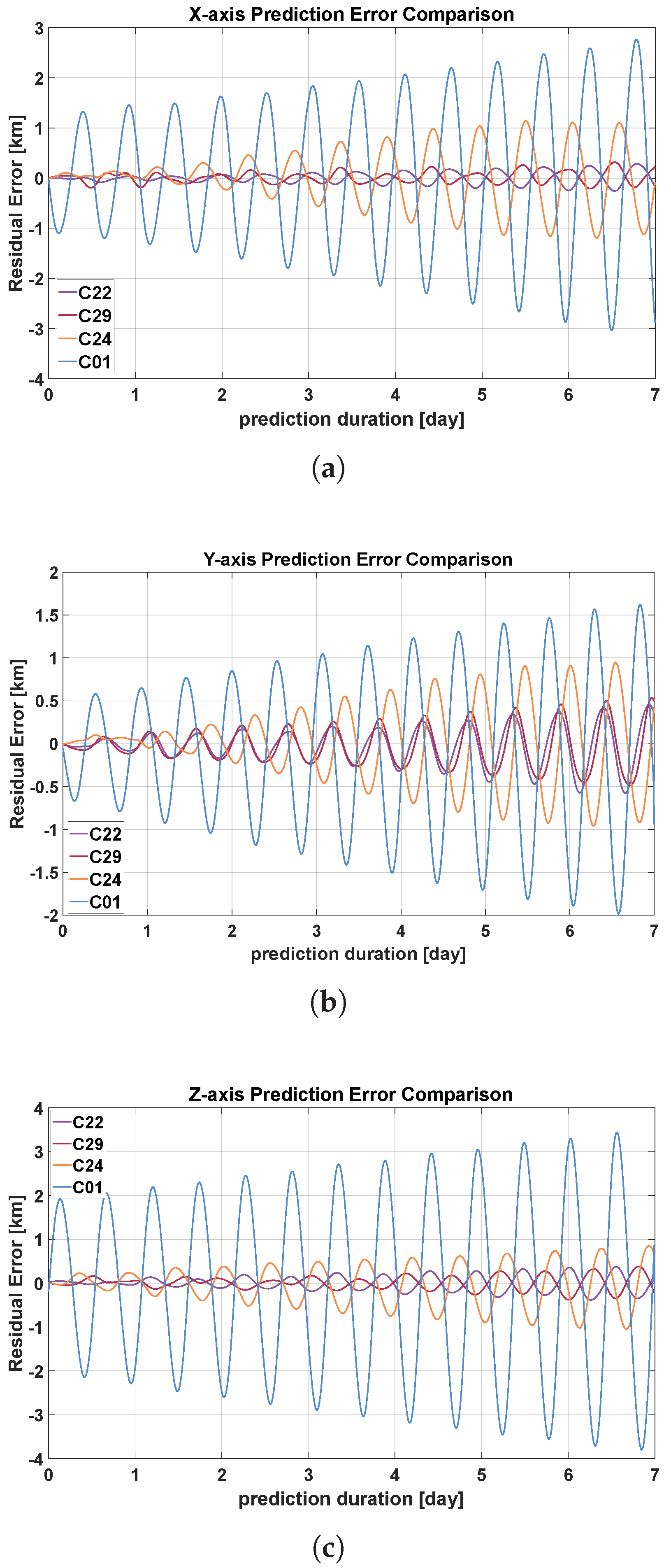
In addition, we have supplemented extensive cross-satellite experiments based on BDS C19 by selecting additional satellites according to orbital altitude (MEO/GEO), orbital plane (same/different within MEO), and platform type (BDS-3M-CAST/BDS-3M-SECM). Specifically, four representative satellites are used for validation: C22 (same MEO altitude, orbital plane, and platform type as C19), C29 (same MEO altitude and orbital plane but different platform type), C24 (same MEO altitude but different orbital plane), and C01 (a GEO satellite with a distinct orbital regime). As shown in Figure 20, the proposed method yields strong and stable generalization performance on C22 and C29, while accuracy decreases moderately for C24 and drops noticeably for the GEO satellite C01. This performance variation arises from the mechanism of the hybrid dynamic-learning framework: for C24, the accuracy reduction stems from divergent perturbations such as solar radiation pressure and third-body gravity across orbital planes, leading to different propagation error evolutions from C19 under the fixed dynamic model; more generally, the propagation errors learned from MEO orbits cannot be directly applied to GEO satellites due to their fundamentally different dynamic characteristics. In contrast, within the same orbital altitude, the method avoids detailed modeling of subtle satellite parameters and can learn error trends caused by unmodeled dynamics via the data-driven network, enabling reliable cross-satellite generalization among MEO satellites despite differences between CAST and SECM platforms.

6. Discussion

Most existing methods focus on improving the performance of time-series models or exploring the application of novel network architectures in orbit prediction. In contrast, this work focuses on the dependency of sequence length in time-series prediction models. Aiming at the performance degradation of existing BiLSTM-based hybrid orbit prediction models with short input sequences, this paper proposes an improved network architecture. For the BiLSTM layer, the architecture is designed with a scale-aware hybrid convolution module and an attention-driven feature fusion module, which are dedicated to extracting high-information-density features from short sequences, thereby compensating for the information loss caused by insufficient sequence length. Based on the proposed method, a 7-day orbit prediction experiment is conducted for the BDS MEO C19 satellite. The results demonstrate that at a sequence length of 288, the novel network architecture achieves significant performance improvements over the standalone BiLSTM across all three axes in the inertial reference frame, with the average residual rates substantially decreasing from 54.03%, 41.18%, 80.10% to 4.36%, 6.12%, 5.39%, respectively. The proposed method also outperformed the BiLSTM-1152 configuration across all evaluation metrics, effectively overcoming the limitations associated with sequence length. Furthermore, the method exhibited excellent performance when transferred to the BDS MEO C22 satellite of the same type, validating its generalization capability in multi-satellite scenarios.
Regarding the mechanism by which the proposed method improves prediction accuracy, we believe that this remarkable accuracy improvement mainly originates from the ability of the designed network structure to effectively learn and compensate for orbit propagation errors that are difficult to model accurately using traditional dynamic methods. Specifically, although the BiLSTM network has a certain ability to extract temporal evolutionary features from sequential data, we further design the SAHConvMod module on this basis. By combining standard convolutions with different kernel sizes and dilated convolutions with different dilation rates, this module possesses a strong advantage in capturing both local detailed features and long-range temporal dependencies simultaneously, enabling the model to extract periodic error components induced by the Earth’s non-spherical gravity, third-body perturbations, and solar radiation pressure effects more efficiently. Meanwhile, the introduction of the ADFFusMod module further enhances the feature selection ability of the model, which, in turn, strengthens the network’s sensitivity to slowly varying error trends. This allows the model to more accurately model and suppress long-term error drift mainly caused by numerical integration truncation, atmospheric drag modeling bias, and continuous deviations in solar radiation pressure coefficients. In addition, the comprehensive nonlinear errors caused by coordinate frame transformation errors and unmodeled small perturbations are difficult to separate or express analytically, yet they can be effectively approximated and compensated for by the proposed data-driven deep learning model. These mechanisms work synergistically so that the model can learn the superimposed evolutionary patterns of periodic errors, long-term drift, and other nonlinear errors directly from data. By compensating for these error components in the propagated orbit, the proposed method achieves a substantial improvement in orbit prediction accuracy.
However, the potential limitations of this study still need to be examined objectively. In this paper, three models are trained independently to predict the orbit errors of the three axes respectively. During the research, an attempt was also made to use a single network to realize the joint prediction of the three-axis errors simultaneously. The prediction results of this method have been significantly improved compared with the original BiLSTM network, and this improvement is attributed to the network architecture optimization strategy proposed in this paper. Nevertheless, the performance of the three-axis joint prediction is still inferior to the prediction accuracy of the single-axis independent modeling. Through analysis, it can be concluded that under the condition of short sequence input, the model does not yet possess the ability to accurately capture the variation patterns of the three-axis errors simultaneously. This problem also points out the direction for future research, namely how to further optimize the network structure to enhance the model’s capability of capturing multi-dimensional data features. Meanwhile, due to constraints in data availability, the training dataset only covers a 7-day time span. How to identify richer orbital perturbation patterns under limited training data and thus enhance the model’s performance under different dynamic conditions remains a topic worthy of further investigation. In addition, the proposed method can generalize reliably among BDS MEO satellites with similar orbital setups and dynamic environments, rather than under arbitrary orbital conditions. The development of a universal algorithm capable of adapting to various satellite platforms, different orbital regimes, and multiple GNSSs is an important direction for future work. This universal algorithm will focus on overcoming the constraints of fixed dynamic models and enhancing the model’s adaptability to diverse orbital dynamic environments.
In summary, this paper provides an effective solution to the problem of high-precision orbit prediction under short-sequence conditions. The proposed network architecture significantly enhances the capability of BiLSTM network to capture the complex variational relationships among data in short sequences. Meanwhile, this processing method can offer referential insights for other aerospace tasks, such as satellite fault diagnosis and attitude control optimization. In addition, the verified generalization capability of the model enables it to adapt to different satellites of the same type, thus providing technical support for the efficient management of large-scale satellite constellations.

Author Contributions

Conceptualization, Y.Z. and Y.M.; methodology, Y.Z. and X.L.; software, Y.Z.; validation, Y.M.; formal analysis, Y.Z.; investigation, H.L.; resources, X.L.; data curation, Y.Z.; writing—original draft preparation, Y.Z.; writing—review and editing, H.L. and Y.M.; visualization, Y.Z.; supervision, R.Z.; project administration, Y.M.; funding acquisition, Y.M. and R.Z. All authors have read and agreed to the published version of the manuscript.

Funding

This work was supported by the Sichuan Science and Technology Program (grant No. 2025ZNSFSC1504).

Data Availability Statement

The data generated in this study are not publicly available due to their use in an ongoing study by the authors but can be made available from the corresponding author upon reasonable request.

Acknowledgments

The authors would like to thank their colleagues in the Institute of Optics and Electronics and Innovation Academy for Microsatellites, Chinese Academy of Sciences, for their valuable support during this research.

Conflicts of Interest

The authors declare no conflicts of interest.

References

  1. Gao, W.; Chen, L.; Lv, F.; Zhan, X.; Chen, L.; Liu, Y.; Dai, Y.; Jin, Y. Initial Design for Next-Generation BeiDou Integrity Subsystem: Space–Ground Integrated Integrity Monitoring. Remote Sens. 2024, 16, 4333. [Google Scholar] [CrossRef]
  2. Gao, W.; Zhou, W.; Tang, C.; Li, X.; Yuan, Y.; Hu, X. High-precision services of BeiDou navigation satellite system (BDS): Current state, achievements, and future directions. Satell. Navig. 2024, 5, 20. [Google Scholar] [CrossRef]
  3. Zhu, Y.; Zhang, Q.; Mao, Y.; Cui, X.; Cai, C.; Zhang, R. Comprehensive performance review of BDS-3 after one-year official operation. Adv. Space Res. 2023, 71, 883–899. [Google Scholar] [CrossRef]
  4. Wilkinson, R.; Mleczko, M.; Brewin, R.; Gaston, K.; Mueller, M.; Shutler, J.; Yan, X.; Anderson, K. Environmental impacts of earth observation data in the constellation and cloud computing era. Sci. Total Environ. 2024, 909, 168584. [Google Scholar] [CrossRef]
  5. Vasisht, D.; Shenoy, J.; Chandra, R. L2D2: Low latency distributed downlink for LEO satellites. In Proceedings of the 2021 ACM SIGCOMM 2021 Conference; Association for Computing Machinery: New York, NY, USA, 2021; pp. 151–164. [Google Scholar]
  6. Ben-Larbi, M.K.; Pozo, K.F.; Haylok, T.; Choi, M.; Grzesik, B.; Haas, A.; Krupke, D.; Konstanski, H.; Schaus, V.; Fekete, S.P.; et al. Towards the automated operations of large distributed satellite systems. Part 1: Review and paradigm shifts. Adv. Space Res. 2021, 67, 3598–3619. [Google Scholar] [CrossRef]
  7. Li, X.; Guo, R.; Chen, G.; Zhou, S.; Sha, H.; Ma, Q.; Zhao, Y.; Zhang, L.; Wu, S.; Guo, J.; et al. Space–Ground Joint Support Method in Autonomous Orbit Determination of BeiDou Satellites. Remote Sens. 2025, 17, 3267. [Google Scholar] [CrossRef]
  8. Fisher, S.C.; Ghassemi, K. GPS IIF-the next generation. Proc. IEEE 1999, 87, 24–47. [Google Scholar] [CrossRef]
  9. Yu, F.; He, Z.; Xu, N. Autonomous navigation for GPS using inter-satellite ranging and relative direction measurements. Acta Astronaut. 2019, 160, 646–655. [Google Scholar] [CrossRef]
  10. Zhou, W.; Gao, W.; Lin, X.; Hu, X.; Ren, Q.; Tang, C. Emerging errors in the orientation of the constellation in GNSS autonomous orbit determination based on inter-satellite link measurements. Adv. Space Res. 2022, 70, 3156–3172. [Google Scholar] [CrossRef]
  11. Zhou, W.; Cai, H.; Li, Z.; Tang, C.; Hu, X.; Liu, W. Research on the rotational correction of distributed autonomous orbit determination in the satellite navigation constellation. Remote Sens. 2022, 14, 3309. [Google Scholar] [CrossRef]
  12. Ren, X.; Yang, Y.; Zhu, J.; Xu, T. Orbit determination of the Next-Generation Beidou satellites with Intersatellite link measurements and a priori orbit constraints. Adv. Space Res. 2017, 60, 2155–2165. [Google Scholar] [CrossRef]
  13. Xu, H.; Liao, J.; Luo, Y.; Meng, Y. A VMD-SVM method for LEO satellite orbit prediction with space weather parameters. Remote Sens. 2025, 17, 746. [Google Scholar] [CrossRef]
  14. Song, C.; Geng, S.; Chen, L.; An, X.; Ma, H. Calculating global navigation satellite system satellite velocities and accelerations by utilizing the orbit fitting and orbit integration methods. Remote Sens. 2024, 16, 2366. [Google Scholar] [CrossRef]
  15. Tapley, B.D.; Bettadpur, S.; Watkins, M.; Reigber, C. The gravity recovery and climate experiment: Mission overview and early results. Geophys. Res. Lett. 2004, 31, 4. [Google Scholar] [CrossRef]
  16. Pavlis, N.K.; Holmes, S.A.; Kenyon, S.C.; Factor, J.K. The development and evaluation of the Earth Gravitational Model 2008 (EGM2008). J. Geophys. Res. Solid Earth 2012, 117, B04406. [Google Scholar] [CrossRef]
  17. Bruinsma, S.; Boniface, C. The operational and research DTM-2020 thermosphere models. J. Space Weather Space Clim. 2021, 11, 47. [Google Scholar] [CrossRef]
  18. Ding, Y.; Li, Z.; Liu, C.; Kang, Z.; Sun, M.; Sun, J.; Chen, L. Analysis of the impact of atmospheric models on the orbit prediction of space debris. Sensors 2023, 23, 8993. [Google Scholar] [CrossRef]
  19. Leonard, J.; Forbes, J.M.; Born, G.H. Impact of tidal density variability on orbital and reentry predictions. Space Weather 2012, 10, S12003. [Google Scholar] [CrossRef]
  20. Springer, T.; Beutler, G.; Rothacher, M. A new solar radiation pressure model for GPS satellites. GPS Solut. 1999, 2, 50–62. [Google Scholar] [CrossRef]
  21. Duan, B.; Hugentobler, U. Enhanced solar radiation pressure model for GPS satellites considering various physical effects. GPS Solut. 2021, 25, 42. [Google Scholar] [CrossRef]
  22. Chen, X.; Ge, M.; Liu, Y.; He, L.; Schuh, H. Adapting empirical solar radiation pressure model for BDS-3 medium Earth orbit satellites. GPS Solut. 2023, 27, 183. [Google Scholar] [CrossRef]
  23. Zhang, H.; Ai, H.; Xue, D.; He, Z.; Zhu, H.; Liu, D.; Cao, J.; Mei, C. Gat-enhanced yolov8_l with dilated encoder for multi-scale space object detection. Remote Sens. 2025, 17, 2119. [Google Scholar] [CrossRef]
  24. AlDahoul, N.; Karim, H.A.; De Castro, A.; Tan, M.J.T. Localization and classification of space objects using EfficientDet detector for space situational awareness. Sci. Rep. 2022, 12, 21896. [Google Scholar] [CrossRef] [PubMed]
  25. Peng, Y.; Jia, S.; Xie, L.; Shang, J. Accurate Satellite Operation Predictions Using Attention-BiLSTM Model with Telemetry Correlation. Aerospace 2024, 11, 398. [Google Scholar] [CrossRef]
  26. Li, P.; Wang, H.; Zhang, Y.; Pan, R. Mission planning for distributed multiple agile Earth observing satellites by attention-based deep reinforcement learning method. Adv. Space Res. 2024, 74, 2388–2404. [Google Scholar] [CrossRef]
  27. Raissi, M.; Perdikaris, P.; Karniadakis, G.E. Physics-informed neural networks: A deep learning framework for solving forward and inverse problems involving nonlinear partial differential equations. J. Comput. Phys. 2019, 378, 686–707. [Google Scholar] [CrossRef]
  28. Scorsoglio, A.; Ghilardi, L.; Furfaro, R. A physic-informed neural network approach to orbit determination. J. Astronaut. Sci. 2023, 70, 25. [Google Scholar] [CrossRef]
  29. Loshelder, G.E.; Sood, R.; Su, W. Orbit Determination Using Physics-Informed Neural Networks. In Proceedings of the AIAA SCITECH 2025 Forum; AIAA: Reston, VA, USA, 2025; p. 1931. [Google Scholar]
  30. Peng, H.; Bai, X. Improving orbit prediction accuracy through supervised machine learning. Adv. Space Res. 2018, 61, 2628–2646. [Google Scholar] [CrossRef]
  31. Peng, H.; Bai, X. Artificial neural network–based machine learning approach to improve orbit prediction accuracy. J. Spacecr. Rocket. 2018, 55, 1248–1260. [Google Scholar] [CrossRef]
  32. Peng, H.; Bai, X. Gaussian Processes for improving orbit prediction accuracy. Acta Astronaut. 2019, 161, 44–56. [Google Scholar] [CrossRef]
  33. Peng, H.; Bai, X. Comparative evaluation of three machine learning algorithms on improving orbit prediction accuracy. Astrodynamics 2019, 3, 325–343. [Google Scholar] [CrossRef]
  34. Zhang, Z.; Shi, Y.; Zheng, Z. Improving angle-only orbit determination accuracy for Earth–Moon libration orbits using a neural-network-based approach. Remote Sens. 2024, 16, 3287. [Google Scholar] [CrossRef]
  35. Chen, Y.; Wang, K. Prediction of satellite time series data based on long short term memory-autoregressive integrated moving average model (LSTM-ARIMA). In Proceedings of the 2019 IEEE 4th International Conference on Signal and Image Processing (ICSIP); IEEE: New York, NY, USA, 2019; pp. 308–312. [Google Scholar]
  36. Osama, A.; Raafat, M.; Darwish, A.; Abdelghafar, S.; Hassanien, A.E. Satellite orbit prediction based on recurrent neural network using two line elements. In Proceedings of the 2022 5th International Conference on Computing and Informatics (ICCI); IEEE: New York, NY, USA, 2022; pp. 298–302. [Google Scholar]
  37. Ren, H.; Chen, X.; Guan, B.; Wang, Y.; Liu, T.; Peng, K. Research on satellite orbit prediction based on neural network algorithm. In Proceedings of the 2019 3rd High Performance Computing and Cluster Technologies Conference; Association for Computing Machinery: New York, NY, USA, 2019; pp. 267–273. [Google Scholar]
  38. Shin, Y.; Park, E.J.; Woo, S.S.; Jung, O.; Chung, D. Selective tensorized multi-layer lstm for orbit prediction. In Proceedings of the 31st ACM International Conference on Information & Knowledge Management; Association for Computing Machinery: New York, NY, USA, 2022; pp. 3495–3504. [Google Scholar]
  39. Zhou, X.; Qin, T.; Ji, M.; Qiao, D. A LSTM assisted orbit determination algorithm for spacecraft executing continuous maneuver. Acta Astronaut. 2023, 204, 568–582. [Google Scholar] [CrossRef]
  40. Jadala, G.; Meedinti, G.N.; Delhibabu, R. Satellite Orbit Prediction Using a Machine Learning Approach. In Proceedings of the ICAI Workshops, Arequipa, Peru, 27–29 October 2022; pp. 28–46. [Google Scholar]
  41. Mahmud, M.S.; Zhou, Z.; Xu, B. LSTM-Driven Prediction of Orbital Parameters for Accurate LEO Opportunistic Navigation. In Proceedings of the 37th International Technical Meeting of the Satellite Division of The Institute of Navigation (ION GNSS+ 2024), Baltimore, MD, USA, 16–20 September 2024; pp. 3542–3555. [Google Scholar]
  42. Lin, C.; Chen, J.; Zhu, H. A method for compensating prediction errors to improve the orbit prediction accuracy of Starlink satellites. GPS Solut. 2025, 29, 17. [Google Scholar] [CrossRef]
  43. Zhao, Y.; Ma, Y.; Long, H.; Zhao, R. A High-Precision Orbit Prediction Method for BeiDou MEO Satellites Based on Bidirectional Long Short-Term Memory Network. In Proceedings of the International Conference on Autonomous Unmanned Systems; Springer: Berlin/Heidelberg, Germany, 2024; pp. 277–289. [Google Scholar]
  44. Hu, J.; Shen, L.; Sun, G. Squeeze-and-excitation networks. In Proceedings of the IEEE Conference on Computer Vision and Pattern Recognition; IEEE: New York, NY, USA, 2018; pp. 7132–7141. [Google Scholar]
  45. Hochreiter, S.; Schmidhuber, J. Long short-term memory. Neural Comput. 1997, 9, 1735–1780. [Google Scholar] [CrossRef] [PubMed]
  46. Schuster, M.; Paliwal, K.K. Bidirectional recurrent neural networks. IEEE Trans. Signal Process. 1997, 45, 2673–2681. [Google Scholar] [CrossRef]
Figure 1. The conceptual framework of the hybrid orbit prediction model. O Pro is the propagated orbit derived from the dynamic model, O Ref describes the satellite’s true trajectory, and O Mod is the modified orbit after applying the hybrid model. E Pro is the propagated error based on dynamic model, E Mod is the modified error output by the hybrid model, and E Res is the residual error after modification.
Remotesensing 18 01146 g001
Figure 2. The framework of the proposed network architecture. It consists of three main modules, namely: Scale-Aware Hybrid Convolution Module, Attention-Driven Feature Fusion Module and BiLSTM Layer. Specifically, the blue and purple blocks represent different types of convolution kernels; the orange and yellow cuboids denote the original feature maps obtained by two kinds of convolutions, and the colored cuboids represent the weighted feature maps, in which the varying weight coefficients are visualized with different colors.
Remotesensing 18 01146 g002
Figure 3. Structural schematic of the Scale-Aware Hybrid Convolution Module. It integrates a hybrid of standard convolution and dilated convolution, enabling effective modeling of data correlations across distinct spatial ranges in short input sequences.
Remotesensing 18 01146 g003
Figure 4. Structural schematic of the Attention-Driven Feature Fusion Module. It is primarily implemented by a global average pooling layer and two fully connected layers.
Remotesensing 18 01146 g004
Figure 5. Schematic diagram of the BiLSTM Layer processing flow.
Remotesensing 18 01146 g005
Figure 6. Schematic of data organization for model training and predicting.
Remotesensing 18 01146 g006
Figure 7. Schematic diagram of data composition during the training and predicting period. In the predicting period, a single-step recursive prediction method is adopted to adapt to the actual orbit prediction scenarios.
Remotesensing 18 01146 g007
Figure 8. Comparative performance metrics of the hybrid prediction model across different sequence lengths. Within a certain range, as the sequence length increases, the prediction accuracy of the model significantly improves.
Remotesensing 18 01146 g008
Figure 9. Time-series evolution of orbit error along X, Y, and Z axes for the C19 satellite. (a) X-axis. (b) Y-axis. (c) Z-axis. After modification, the residual errors are significantly reduced and maintained at a low level, with their divergence characteristics effectively suppressed.
Remotesensing 18 01146 g009
Figure 10. Modification performance of the proposed method on orbit errors along the X, Y and Z axes for the C19 satellite. (a) X-axis. (b) Y-axis. (c) Z-axis. It once again confirms that the orbit errors have been effectively modified and the residual errors remain at a relatively low level.
Remotesensing 18 01146 g010
Figure 11. Prediction of the different methods on modified errors along the X, Y and Z axes for the C19 satellite. (a) X-axis. (b) Y-axis. (c) Z-axis.
Remotesensing 18 01146 g011
Figure 12. Residual errors of the different methods along the X, Y and Z axes for the C19 satellite. (a) X-axis. (b) Y-axis. (c) Z-axis.
Remotesensing 18 01146 g012
Figure 13. Orbit error evolution in the X, Y, and Z axes during the prediction period from 15 January 2023 to 21 January 2023. (a) X-axis. (b) Y-axis. (c) Z-axis.
Remotesensing 18 01146 g013
Figure 14. Orbit error evolution in the X, Y, and Z axes during the prediction period from 30 January 2023 to 5 February 2023. (a) X-axis. (b) Y-axis. (c) Z-axis.
Remotesensing 18 01146 g014
Figure 15. Orbit error evolution in the X, Y, and Z axes during the prediction period from 18 February 2023 to 24 February 2023. (a) X-axis. (b) Y-axis. (c) Z-axis.
Remotesensing 18 01146 g015
Figure 16. Frequency-domain analysis of orbit errors. We performed frequency-domain analysis on the orbit propagated error based on the dynamic model and the orbit residual errors under different ablation configurations (SAHConvMod+BiLSTM, ADFFusMod+BiLSTM, and our full proposed method). These errors are represented by the green, black, blue, and red curves, respectively. (a) X-axis. (b) Y-axis. (c) Z-axis.
Remotesensing 18 01146 g016
Figure 17. Three categories of generalization performance in orbit prediction. Type 2 is consistent with the mainstream experimental protocols in the orbit prediction literature.
Remotesensing 18 01146 g017
Figure 18. Modification performance of the proposed method on orbit errors along the X, Y and Z axes for the C22 satellite. (a) X-axis. (b) Y-axis. (c) Z-axis. The proposed method can effectively correct the orbital errors of the C22 satellite.
Remotesensing 18 01146 g018
Figure 19. Modification performance of the proposed method on orbit errors along the X, Y and Z axes for the C22 satellite. (a) X-axis. (b) Y-axis. (c) Z-axis. It once again confirms that the proposed method can effectively reduce the residual error of the C22 satellite to a relatively low level.
Remotesensing 18 01146 g019
Figure 20. Comparison of generalization performance of the model across different satellites. The red, purple, orange, and blue curves represent the orbit prediction performance for satellites C22, C29, C24, and C01, respectively. (a) X-axis; (b) Y-axis; (c) Z-axis. It shows that the proposed method can generalize reliably among BDS MEO satellites with similar orbital setups and dynamic environments, rather than under arbitrary orbital conditions.
Remotesensing 18 01146 g020
Table 1. Dynamic orbit propagation configuration for BeiDou MEO satellites.
ParameterConfiguration
Central Body Gravity36 × 36 EGM2008
N-Body Gravitational Forcethe Sun and Moon in JPL DE403
Tidal PerturbationSolid Tide
Solar Radiation PressureSpherical Model
Atmospheric Density ModelJacchia-Roberts
Integration MethodRKF7(8)
Table 2. Training hyperparameters of the deep learning model.
ItemSetting
OptimizerAdam
Batch size32
Training epochs1200
Initial learning rate 1 × 10 4
Learning rate schedulerStep decay, factor = 0.1 at epoch 800
Loss functionMean Squared Error
Table 3. Experimental results on hybrid orbit prediction performance across sequence lengths.
Sequence LengthMaxAE [km]RMSE [km]MAE [km]
2882.33760.91170.7208
5761.39850.60280.4900
8640.90110.39100.3201
11520.35230.13010.1027
14400.57910.20570.1531
17280.77070.35390.2720
20161.06180.49040.3773
Table 4. Performance comparison of different methods on the C19 satellite.
MethodXYZ
MaxAEMAERMSEMRRMaxAEMAERMSEMRRMaxAEMAERMSEMRR
[km][km][km][%][km][km][km][%][km][km][km][%]
GRU1.25940.42430.522047.323.35220.94481.265965.901.70620.55750.685645.12
TCN1.96590.66610.825574.272.32130.99951.203969.712.81151.02231.234282.72
Transformer0.87700.25580.326628.521.53010.60810.729442.211.71310.49160.629139.78
Attention-BiLSTM0.71440.14090.200015.710.60620.14360.190210.010.56070.13860.199911.22
BiLSTM-2881.50400.48450.602254.032.50020.59050.816541.183.31300.98991.247480.10
BiLSTM-11520.38010.16800.194311.350.46180.18150.21227.520.70540.18870.23259.19
Ours0.16520.03910.05254.360.29290.08780.10576.120.19020.06660.08005.39
Table 5. Prediction performance of the trained model across different test periods on the C19 satellite.
Prediction PeriodXYZ
MaxAEMAERMSEMRRMaxAEMAERMSEMRRMaxAEMAERMSEMRR
[km][km][km][%][km][km][km][%][km][km][km][%]
2023.01.15–2023.01.210.16520.03910.05254.360.29290.08780.10576.120.19020.06660.08005.39
2023.01.30–2023.02.050.17880.06310.08213.110.30000.07930.10654.370.17610.05140.06503.20
2023.02.18–2023.02.240.14960.04610.05834.810.18300.07010.08136.020.23160.08230.10055.93
Table 6. Performance improvement of the proposed method on the C19 satellite.
MetrixIR_X [%]IR_Y [%]IR_Z [%]
MaxAE89.03%88.28%94.26%
MAE91.93%85.13%93.27%
RMSE91.28%87.05%93.58%
MRR91.93%85.14%93.27%
Table 7. Experimental results of ablation study.
MethodXYZ
MaxAEMAERMSEMRRMaxAEMAERMSEMRRMaxAEMAERMSEMRR
[km][km][km][%][km][km][km][%][km][km][km][%]
BiLSTM1.50400.48450.602254.032.50020.59050.816541.183.31300.98991.247480.10
BiLSTM+StandardConv0.31530.10980.131512.250.39790.10050.13527.010.41110.15180.177412.28
BiLSTM+DilatedConv0.40720.10100.135011.270.72290.23340.288116.280.66670.22370.269018.10
BiLSTM+HybridConv0.38390.08170.11869.110.37810.15050.177310.500.73420.20770.278516.81
Ours0.16520.03910.05254.360.29290.08780.10576.120.19020.06660.08005.39
Disclaimer/Publisher’s Note: The statements, opinions and data contained in all publications are solely those of the individual author(s) and contributor(s) and not of MDPI and/or the editor(s). MDPI and/or the editor(s) disclaim responsibility for any injury to people or property resulting from any ideas, methods, instructions or products referred to in the content.