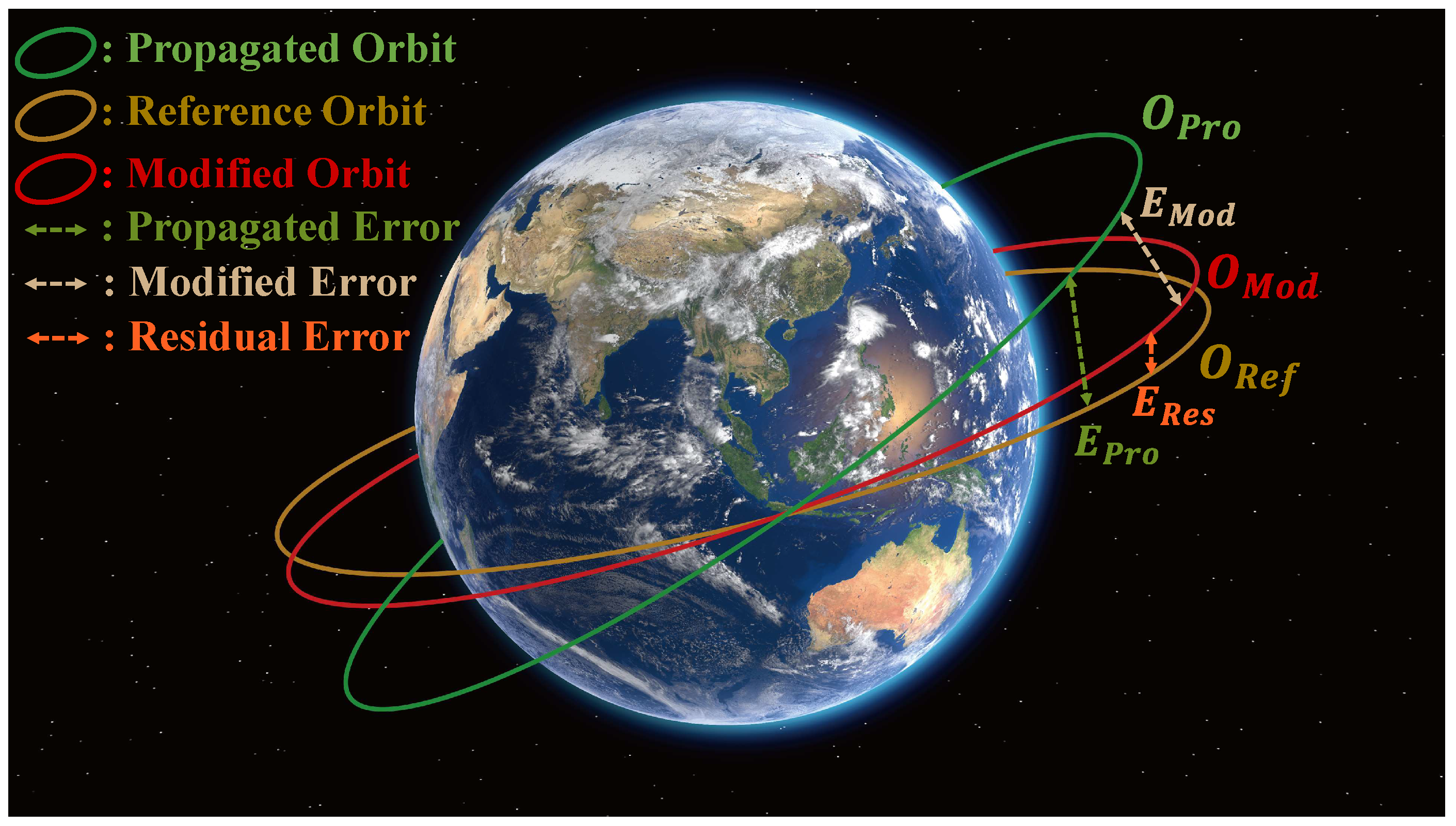
Figure 1.
The conceptual framework of the hybrid orbit prediction model. is the propagated orbit derived from the dynamic model, describes the satellite’s true trajectory, and is the modified orbit after applying the hybrid model. is the propagated error based on dynamic model, is the modified error output by the hybrid model, and is the residual error after modification.
Figure 1.
The conceptual framework of the hybrid orbit prediction model. is the propagated orbit derived from the dynamic model, describes the satellite’s true trajectory, and is the modified orbit after applying the hybrid model. is the propagated error based on dynamic model, is the modified error output by the hybrid model, and is the residual error after modification.
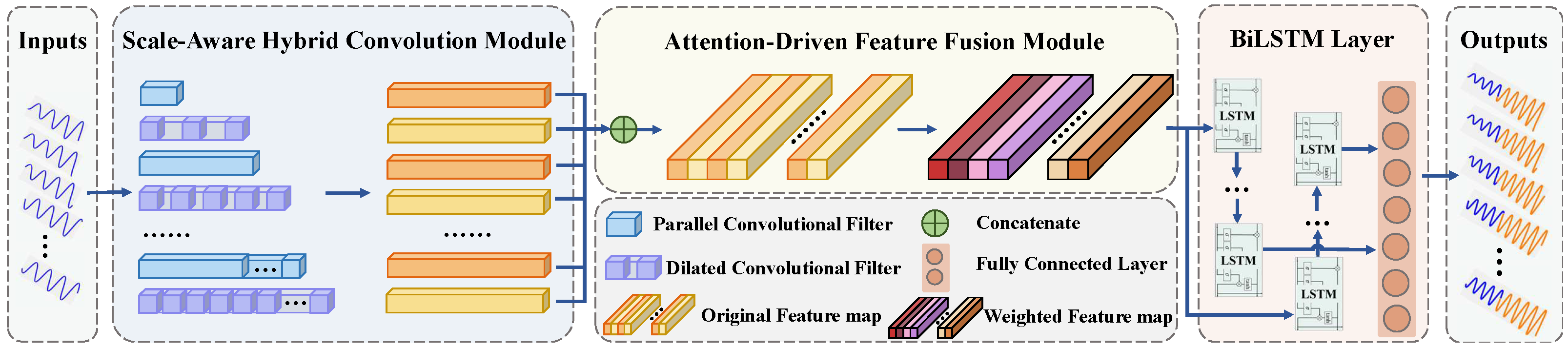
Figure 2.
The framework of the proposed network architecture. It consists of three main modules, namely: Scale-Aware Hybrid Convolution Module, Attention-Driven Feature Fusion Module and BiLSTM Layer. Specifically, the blue and purple blocks represent different types of convolution kernels; the orange and yellow cuboids denote the original feature maps obtained by two kinds of convolutions, and the colored cuboids represent the weighted feature maps, in which the varying weight coefficients are visualized with different colors.
Figure 2.
The framework of the proposed network architecture. It consists of three main modules, namely: Scale-Aware Hybrid Convolution Module, Attention-Driven Feature Fusion Module and BiLSTM Layer. Specifically, the blue and purple blocks represent different types of convolution kernels; the orange and yellow cuboids denote the original feature maps obtained by two kinds of convolutions, and the colored cuboids represent the weighted feature maps, in which the varying weight coefficients are visualized with different colors.
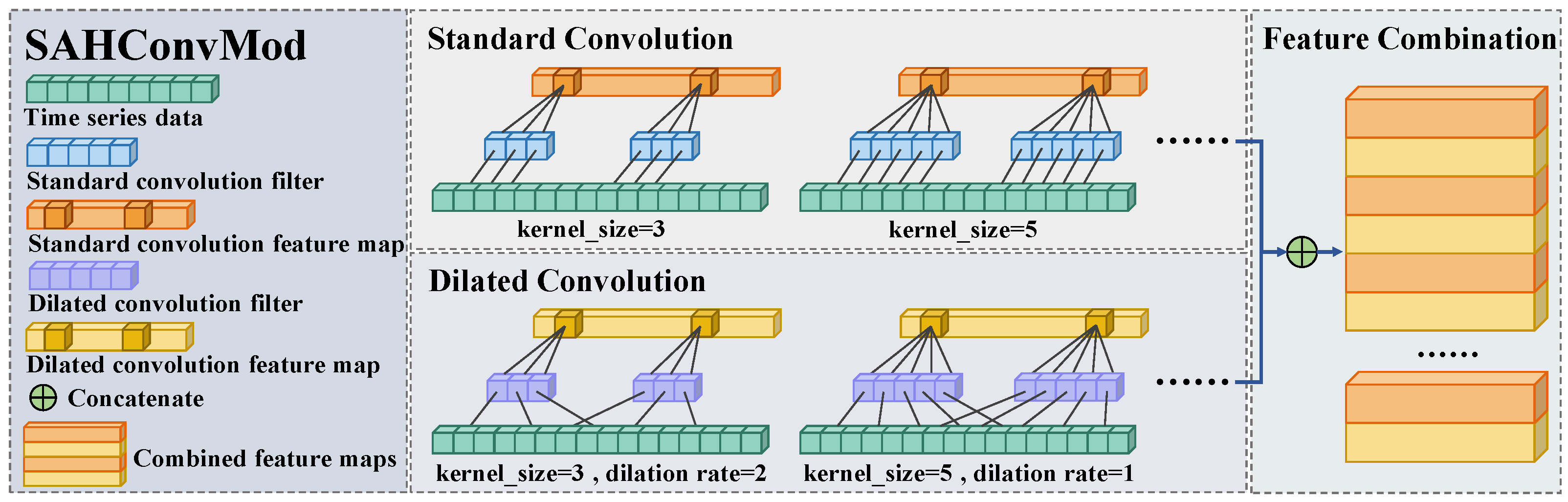
Figure 3.
Structural schematic of the Scale-Aware Hybrid Convolution Module. It integrates a hybrid of standard convolution and dilated convolution, enabling effective modeling of data correlations across distinct spatial ranges in short input sequences.
Figure 3.
Structural schematic of the Scale-Aware Hybrid Convolution Module. It integrates a hybrid of standard convolution and dilated convolution, enabling effective modeling of data correlations across distinct spatial ranges in short input sequences.
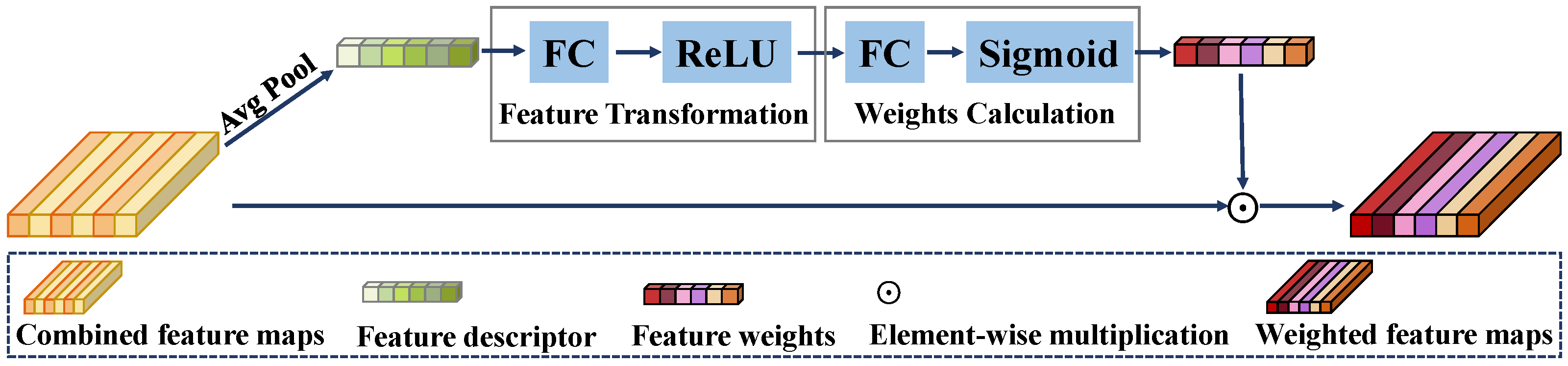
Figure 4.
Structural schematic of the Attention-Driven Feature Fusion Module. It is primarily implemented by a global average pooling layer and two fully connected layers.
Figure 4.
Structural schematic of the Attention-Driven Feature Fusion Module. It is primarily implemented by a global average pooling layer and two fully connected layers.
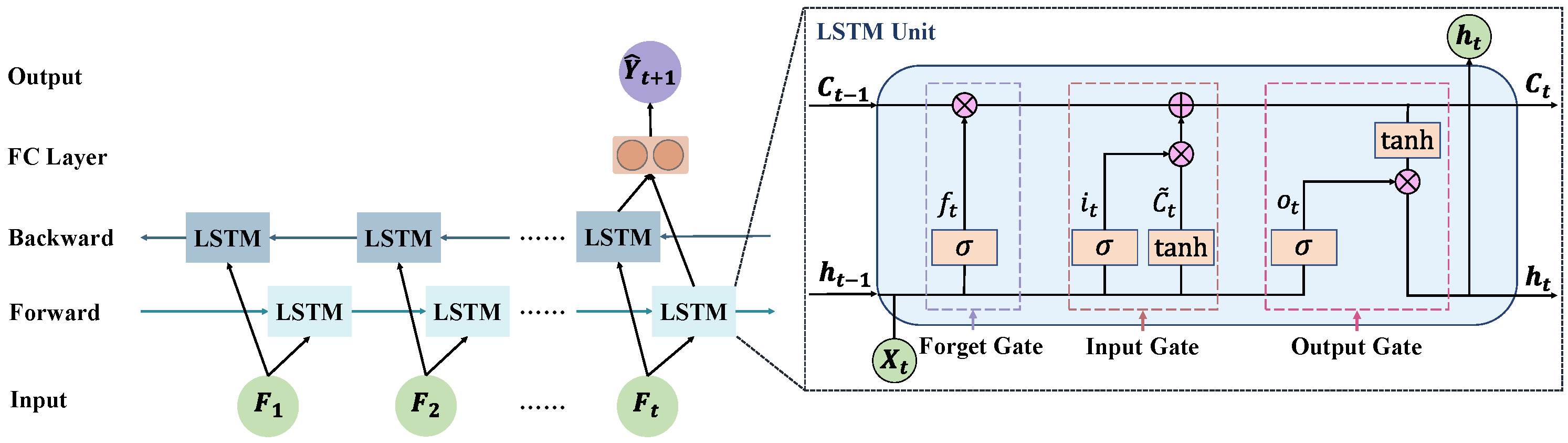
Figure 5.
Schematic diagram of the BiLSTM Layer processing flow.
Figure 5.
Schematic diagram of the BiLSTM Layer processing flow.
Figure 6.
Schematic of data organization for model training and predicting.
Figure 6.
Schematic of data organization for model training and predicting.
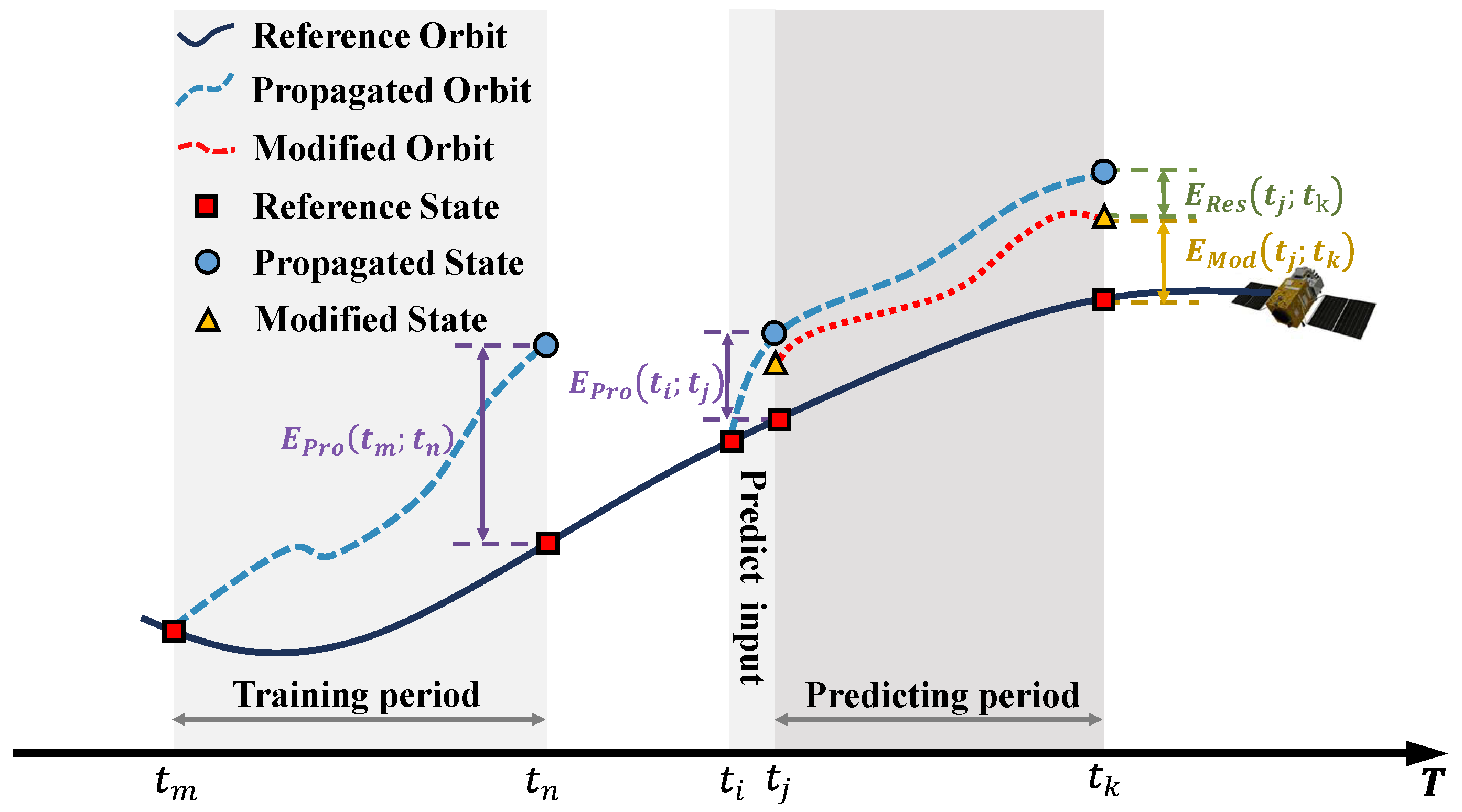
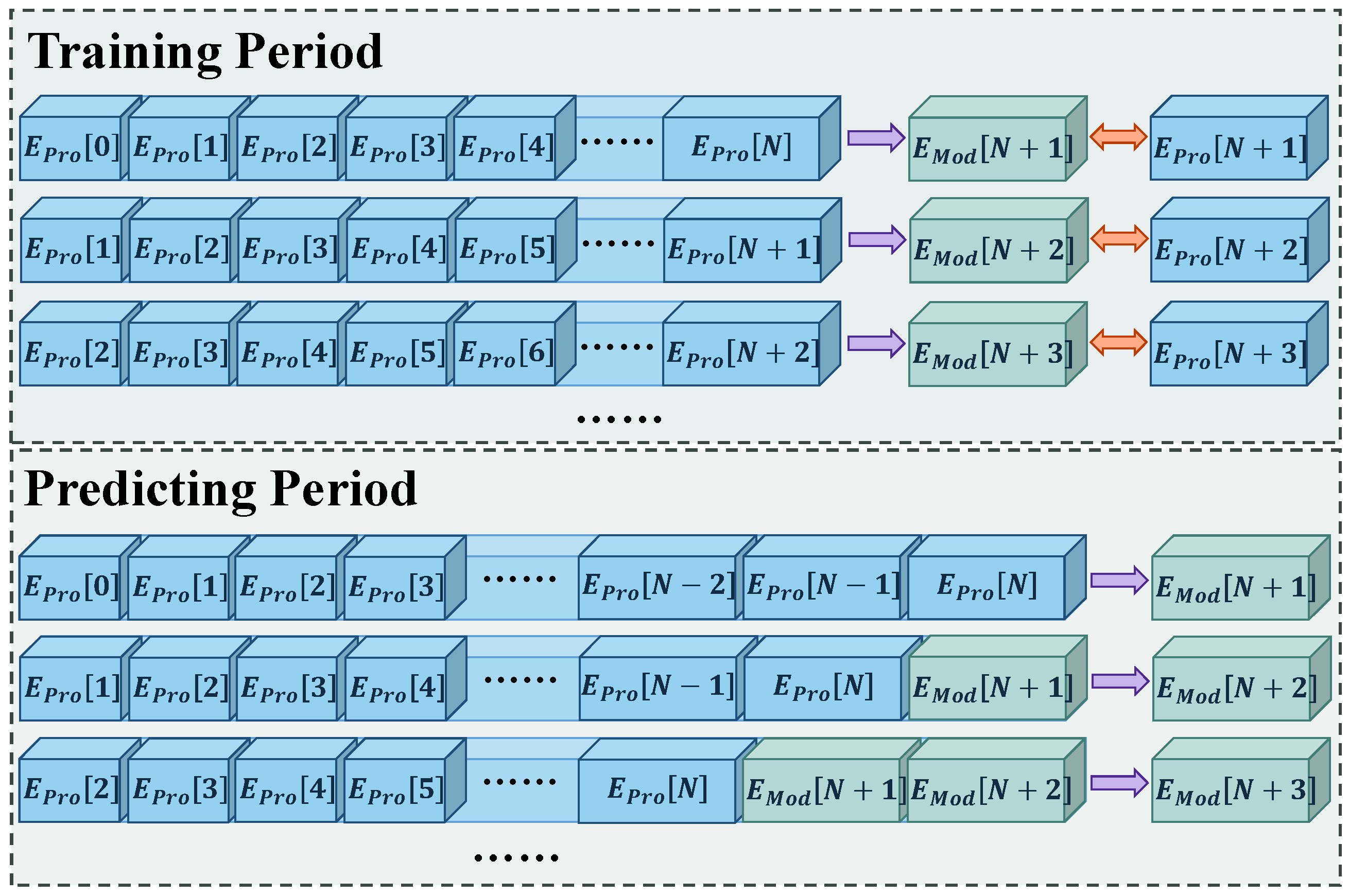
Figure 7.
Schematic diagram of data composition during the training and predicting period. In the predicting period, a single-step recursive prediction method is adopted to adapt to the actual orbit prediction scenarios.
Figure 7.
Schematic diagram of data composition during the training and predicting period. In the predicting period, a single-step recursive prediction method is adopted to adapt to the actual orbit prediction scenarios.
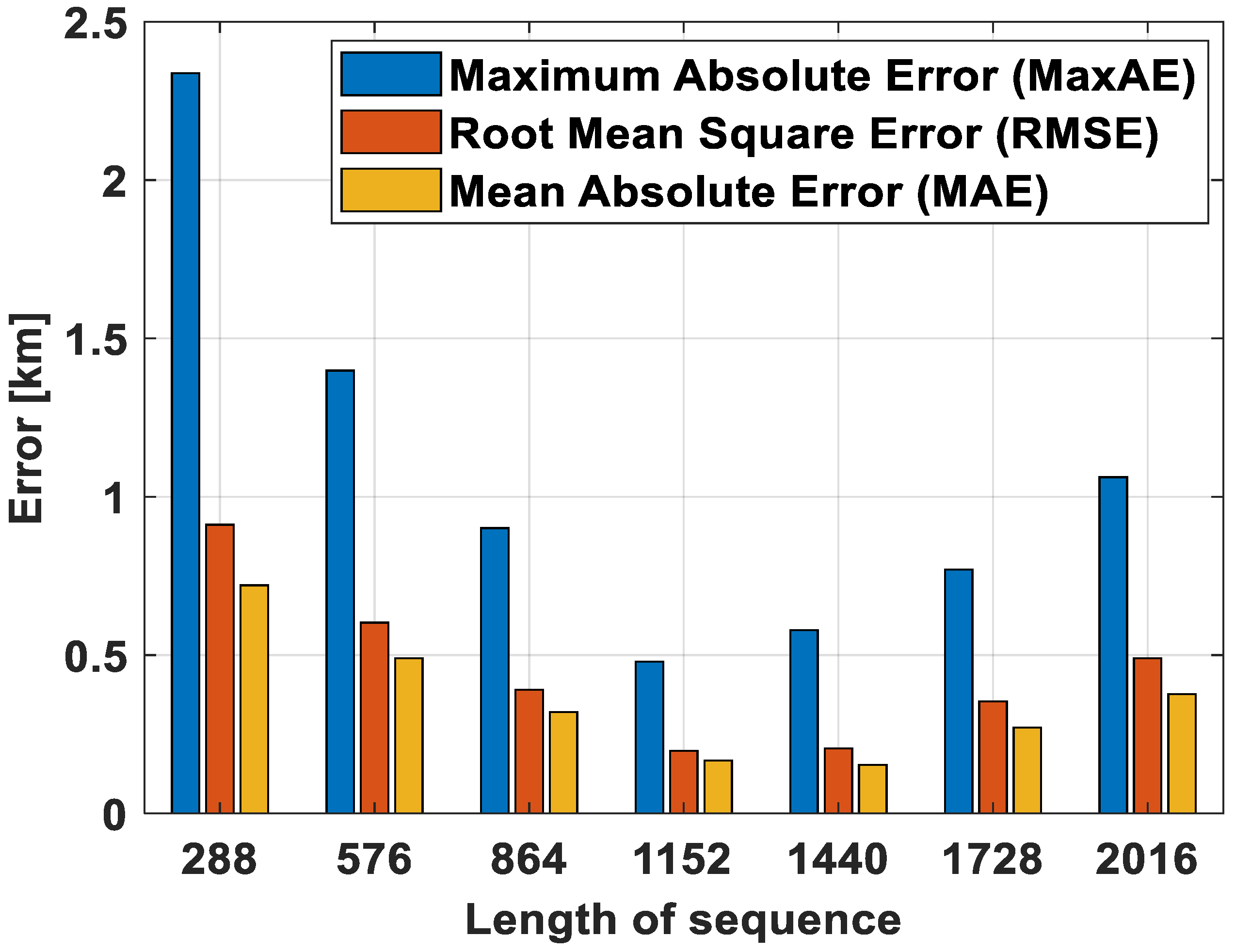
Figure 8.
Comparative performance metrics of the hybrid prediction model across different sequence lengths. Within a certain range, as the sequence length increases, the prediction accuracy of the model significantly improves.
Figure 8.
Comparative performance metrics of the hybrid prediction model across different sequence lengths. Within a certain range, as the sequence length increases, the prediction accuracy of the model significantly improves.
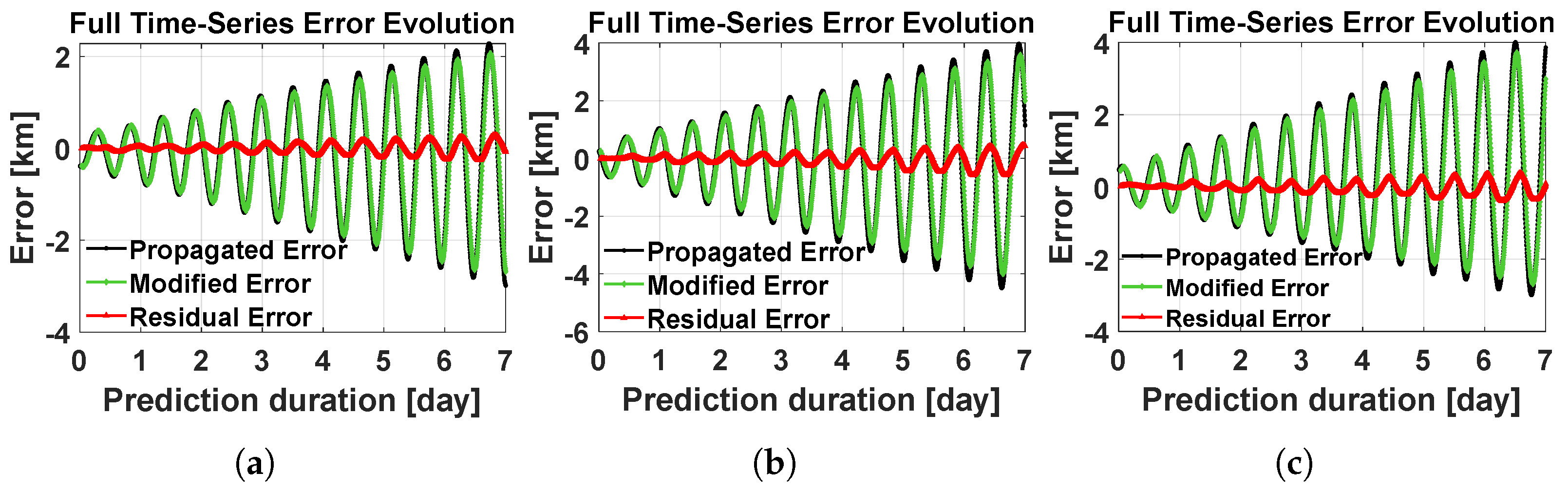
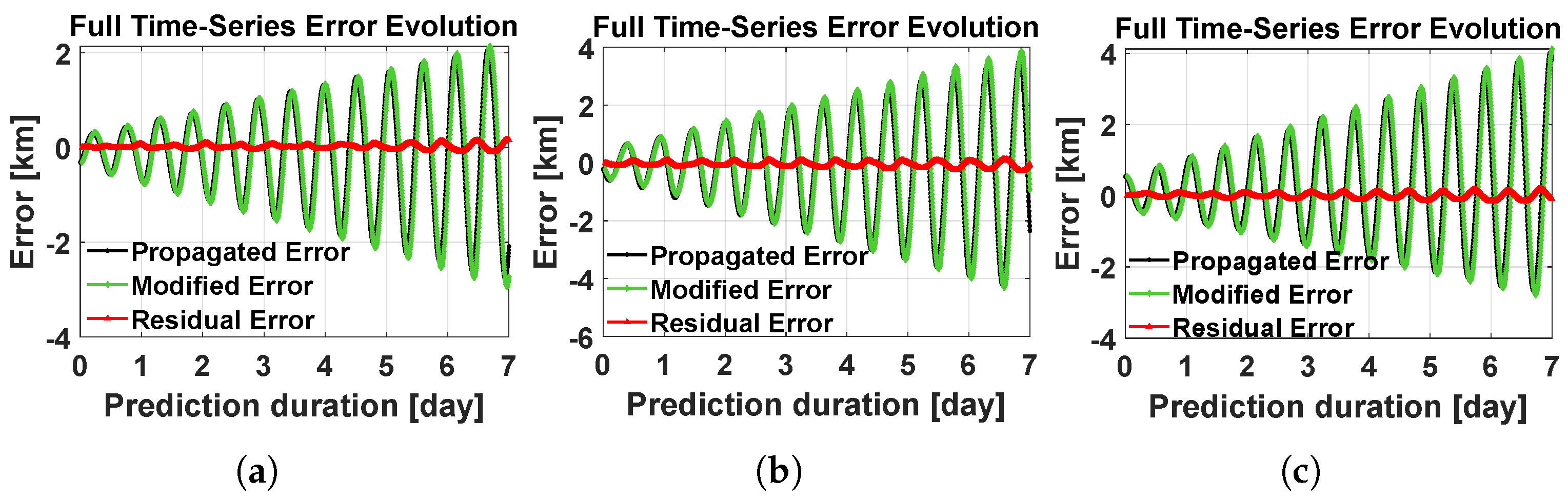
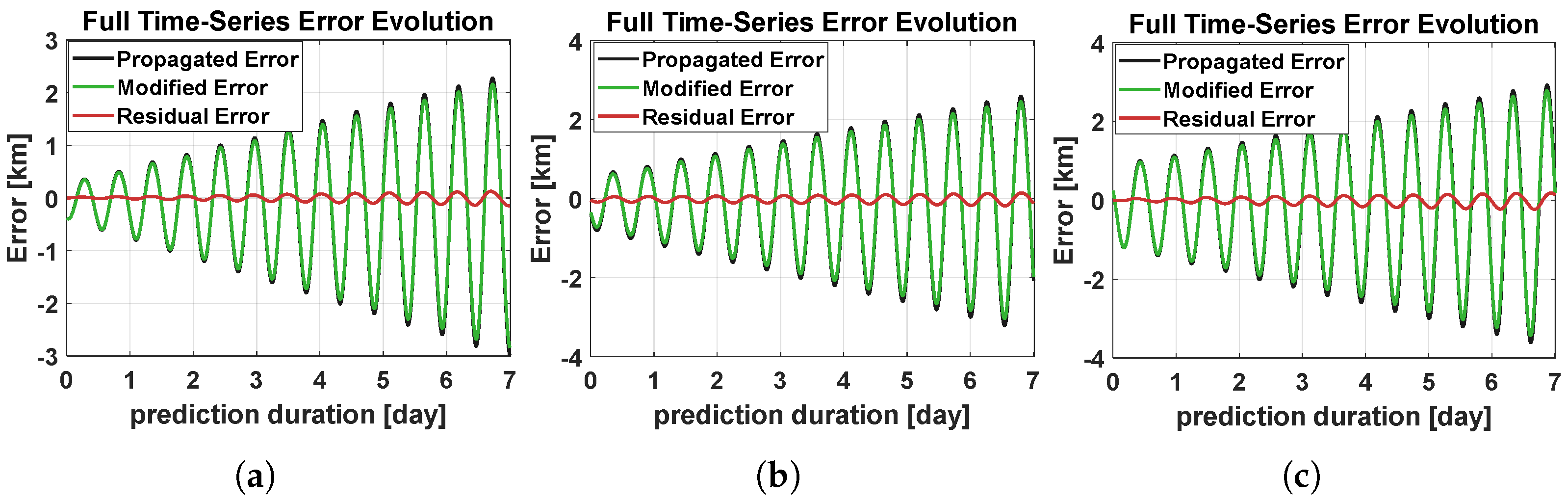
Figure 9.
Time-series evolution of orbit error along X, Y, and Z axes for the C19 satellite. (a) X-axis. (b) Y-axis. (c) Z-axis. After modification, the residual errors are significantly reduced and maintained at a low level, with their divergence characteristics effectively suppressed.
Figure 9.
Time-series evolution of orbit error along X, Y, and Z axes for the C19 satellite. (a) X-axis. (b) Y-axis. (c) Z-axis. After modification, the residual errors are significantly reduced and maintained at a low level, with their divergence characteristics effectively suppressed.
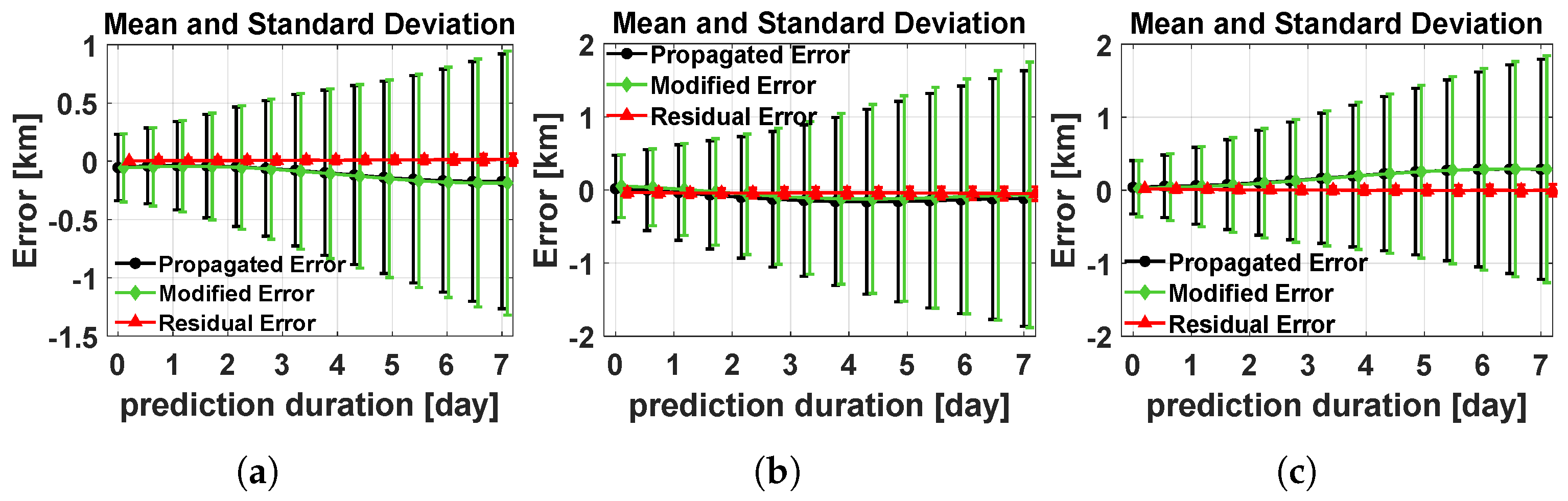
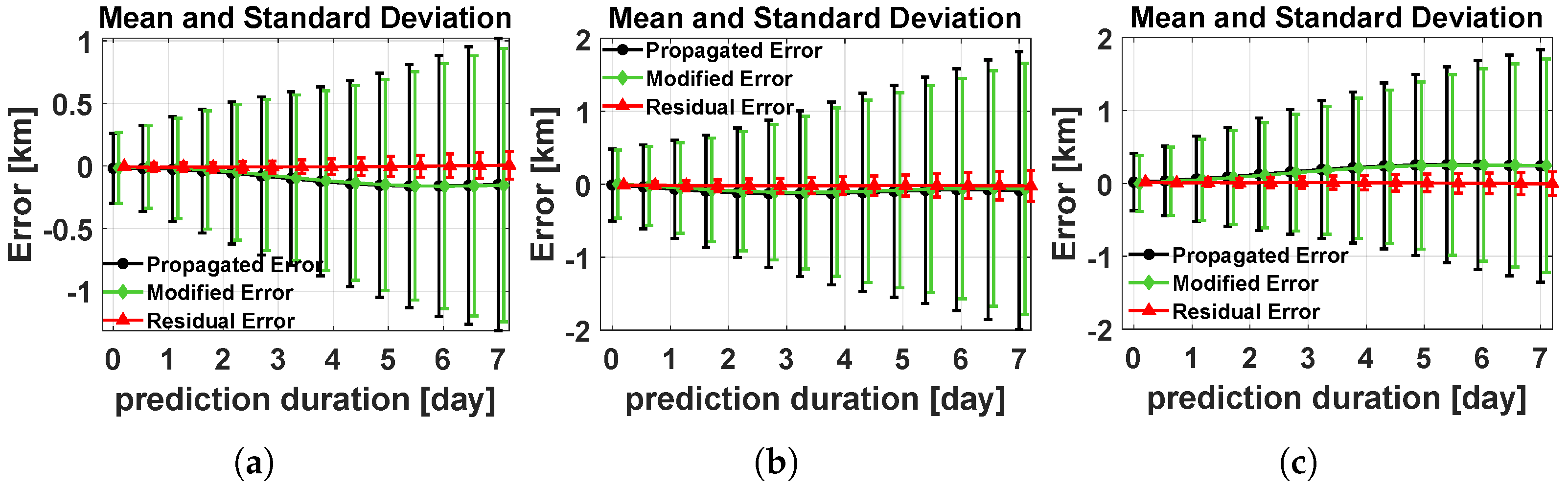
Figure 10.
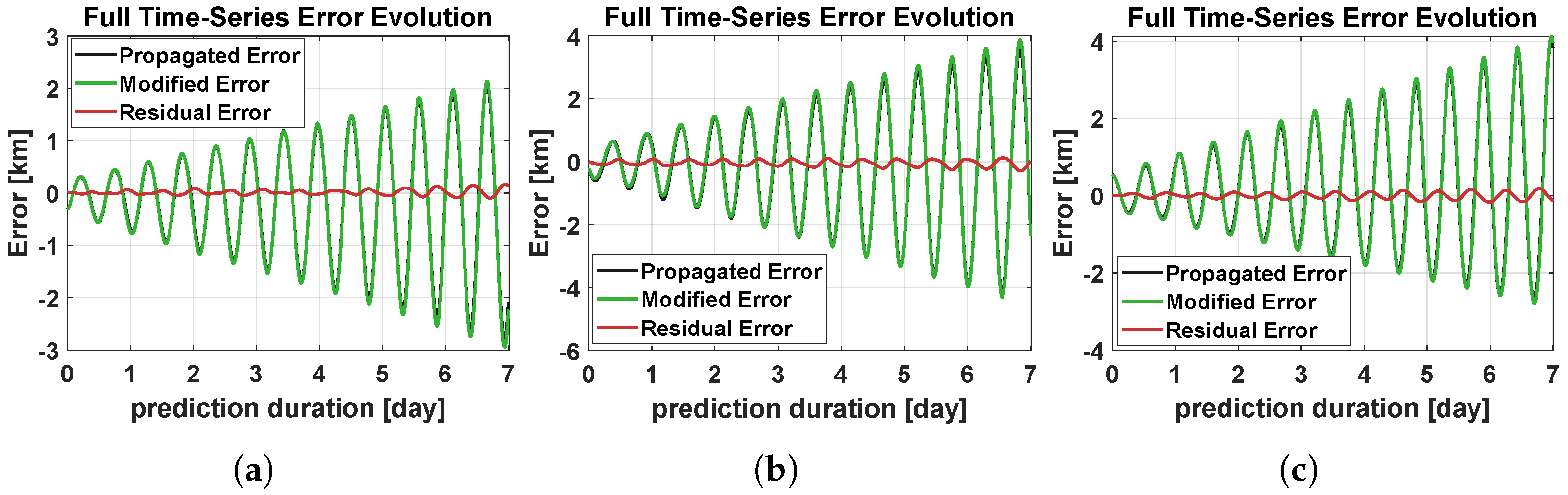
Modification performance of the proposed method on orbit errors along the X, Y and Z axes for the C19 satellite. (a) X-axis. (b) Y-axis. (c) Z-axis. It once again confirms that the orbit errors have been effectively modified and the residual errors remain at a relatively low level.
Figure 10.
Modification performance of the proposed method on orbit errors along the X, Y and Z axes for the C19 satellite. (a) X-axis. (b) Y-axis. (c) Z-axis. It once again confirms that the orbit errors have been effectively modified and the residual errors remain at a relatively low level.
Figure 11.
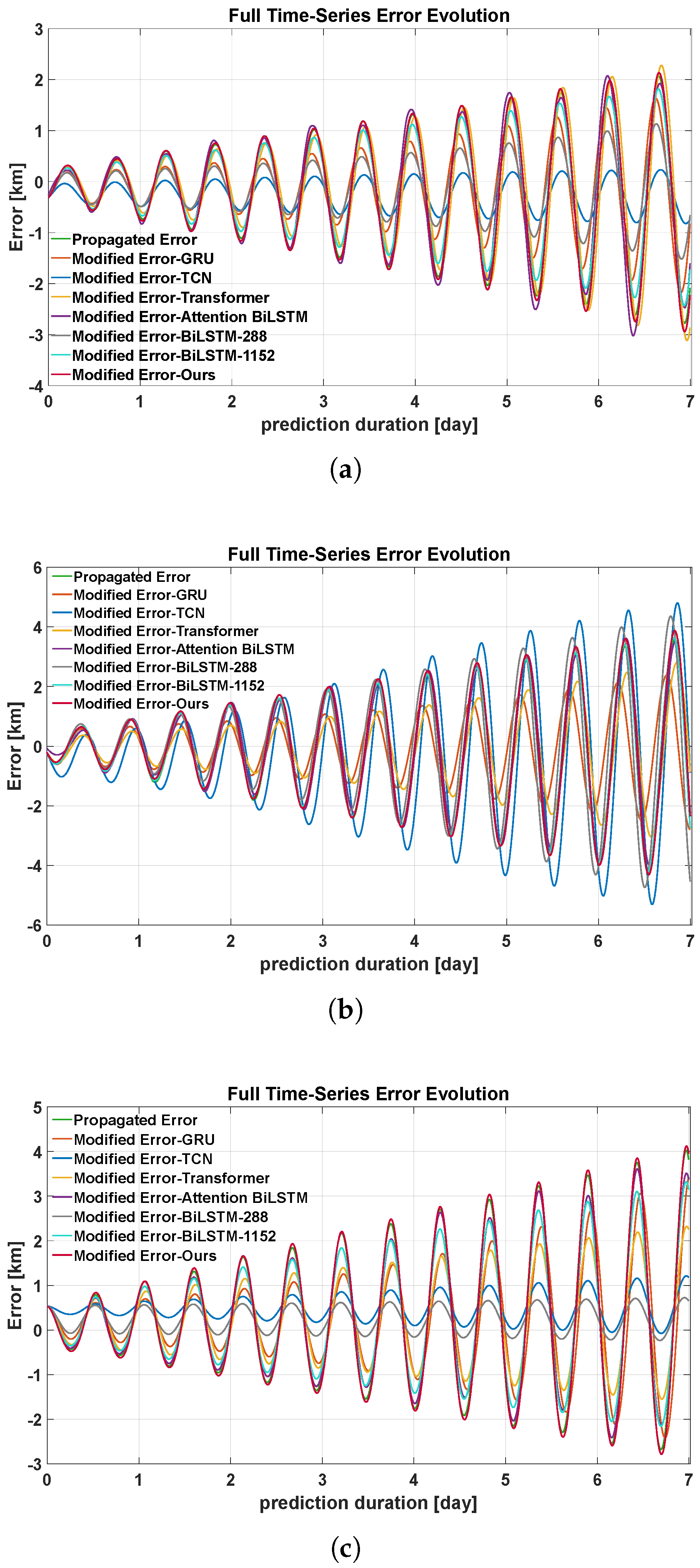
Prediction of the different methods on modified errors along the X, Y and Z axes for the C19 satellite. (a) X-axis. (b) Y-axis. (c) Z-axis.
Figure 11.
Prediction of the different methods on modified errors along the X, Y and Z axes for the C19 satellite. (a) X-axis. (b) Y-axis. (c) Z-axis.
Figure 12.
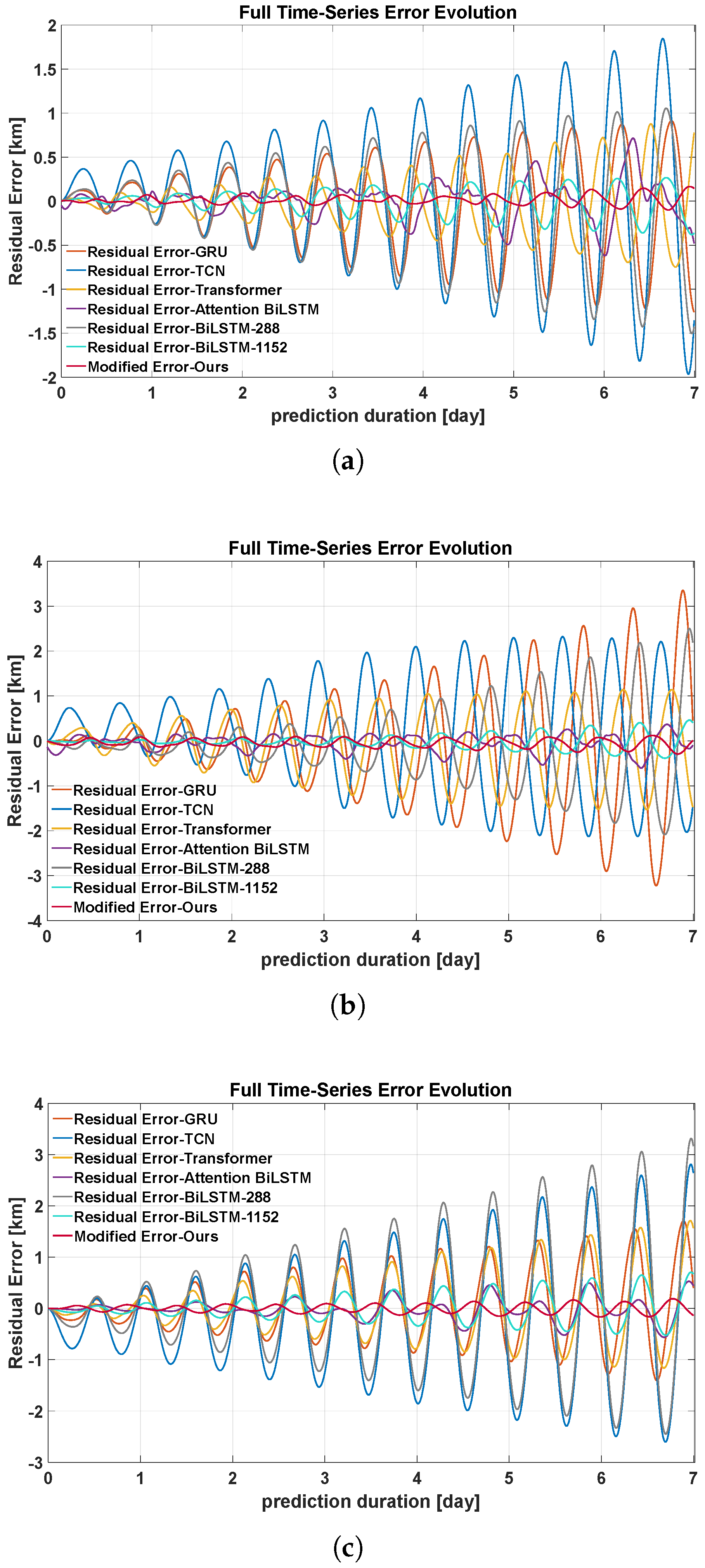
Residual errors of the different methods along the X, Y and Z axes for the C19 satellite. (a) X-axis. (b) Y-axis. (c) Z-axis.
Figure 12.
Residual errors of the different methods along the X, Y and Z axes for the C19 satellite. (a) X-axis. (b) Y-axis. (c) Z-axis.
Figure 13.
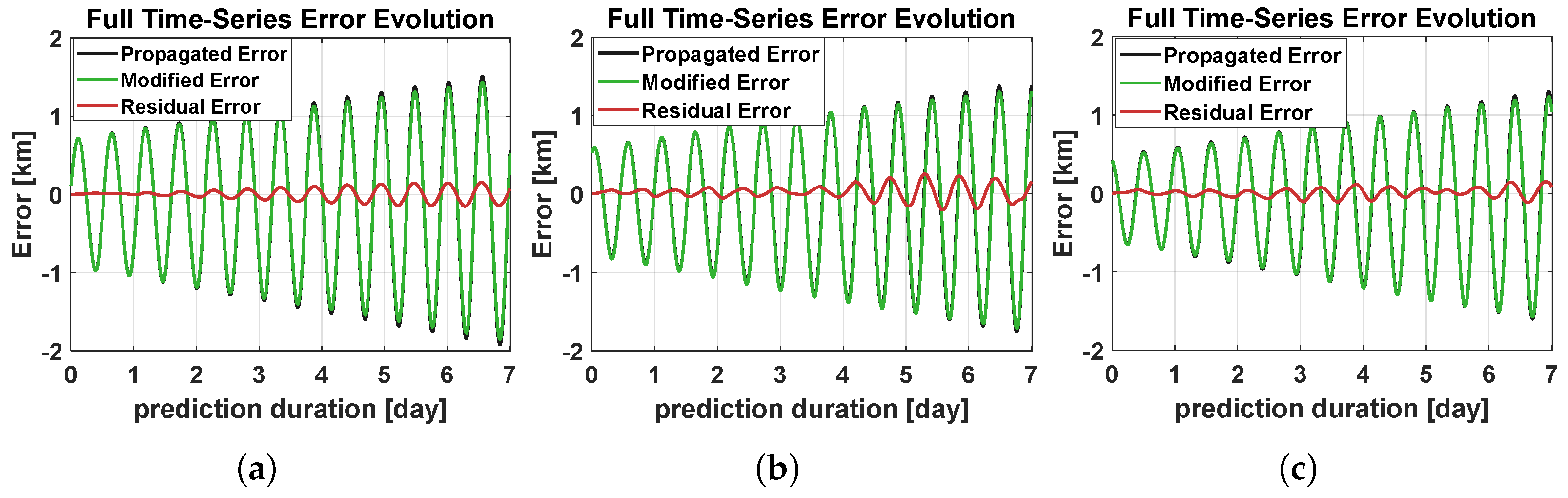
Orbit error evolution in the X, Y, and Z axes during the prediction period from 15 January 2023 to 21 January 2023. (a) X-axis. (b) Y-axis. (c) Z-axis.
Figure 13.
Orbit error evolution in the X, Y, and Z axes during the prediction period from 15 January 2023 to 21 January 2023. (a) X-axis. (b) Y-axis. (c) Z-axis.
Figure 14.
Orbit error evolution in the X, Y, and Z axes during the prediction period from 30 January 2023 to 5 February 2023. (a) X-axis. (b) Y-axis. (c) Z-axis.
Figure 14.
Orbit error evolution in the X, Y, and Z axes during the prediction period from 30 January 2023 to 5 February 2023. (a) X-axis. (b) Y-axis. (c) Z-axis.
Figure 15.
Orbit error evolution in the X, Y, and Z axes during the prediction period from 18 February 2023 to 24 February 2023. (a) X-axis. (b) Y-axis. (c) Z-axis.
Figure 15.
Orbit error evolution in the X, Y, and Z axes during the prediction period from 18 February 2023 to 24 February 2023. (a) X-axis. (b) Y-axis. (c) Z-axis.
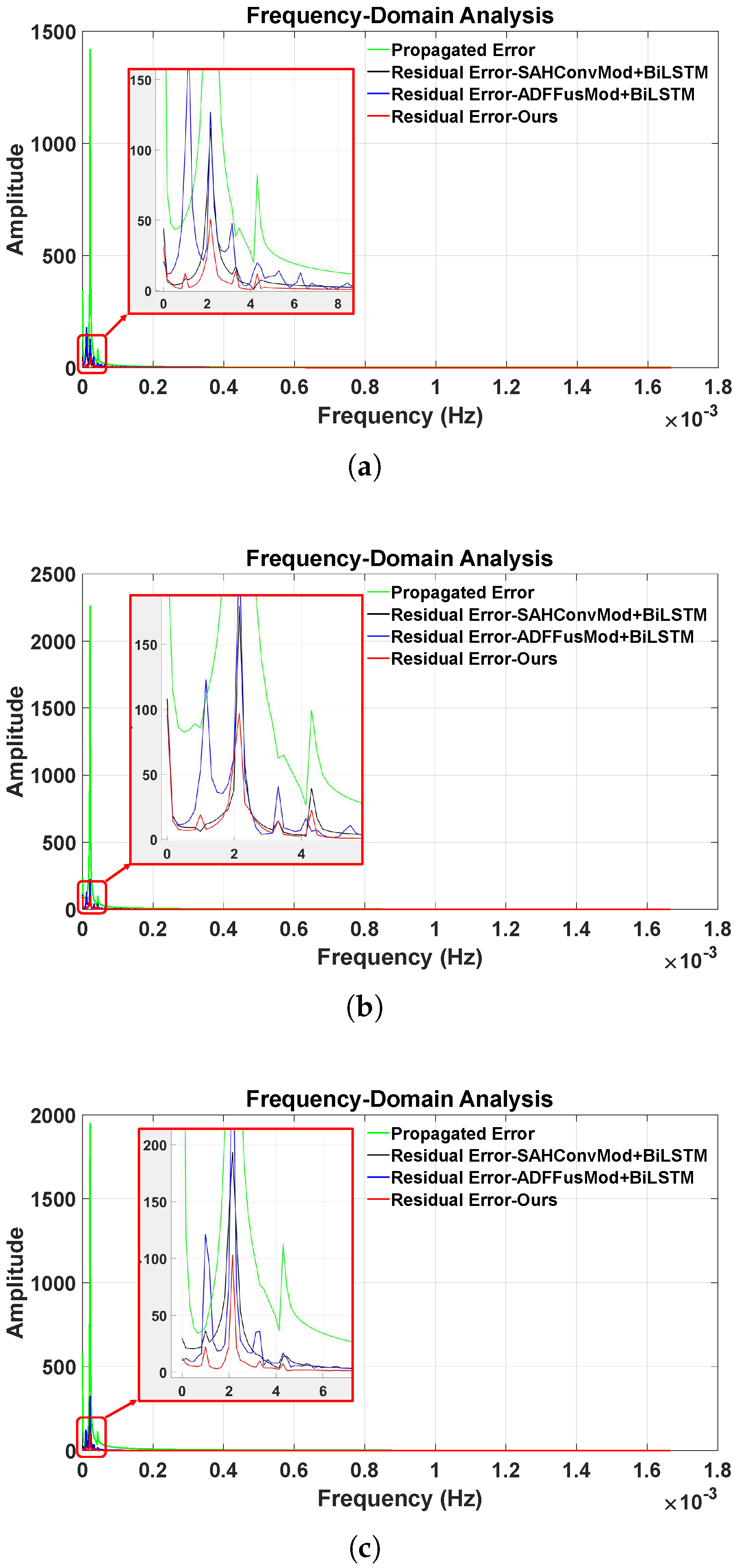
Figure 16.
Frequency-domain analysis of orbit errors. We performed frequency-domain analysis on the orbit propagated error based on the dynamic model and the orbit residual errors under different ablation configurations (SAHConvMod+BiLSTM, ADFFusMod+BiLSTM, and our full proposed method). These errors are represented by the green, black, blue, and red curves, respectively. (a) X-axis. (b) Y-axis. (c) Z-axis.
Figure 16.
Frequency-domain analysis of orbit errors. We performed frequency-domain analysis on the orbit propagated error based on the dynamic model and the orbit residual errors under different ablation configurations (SAHConvMod+BiLSTM, ADFFusMod+BiLSTM, and our full proposed method). These errors are represented by the green, black, blue, and red curves, respectively. (a) X-axis. (b) Y-axis. (c) Z-axis.
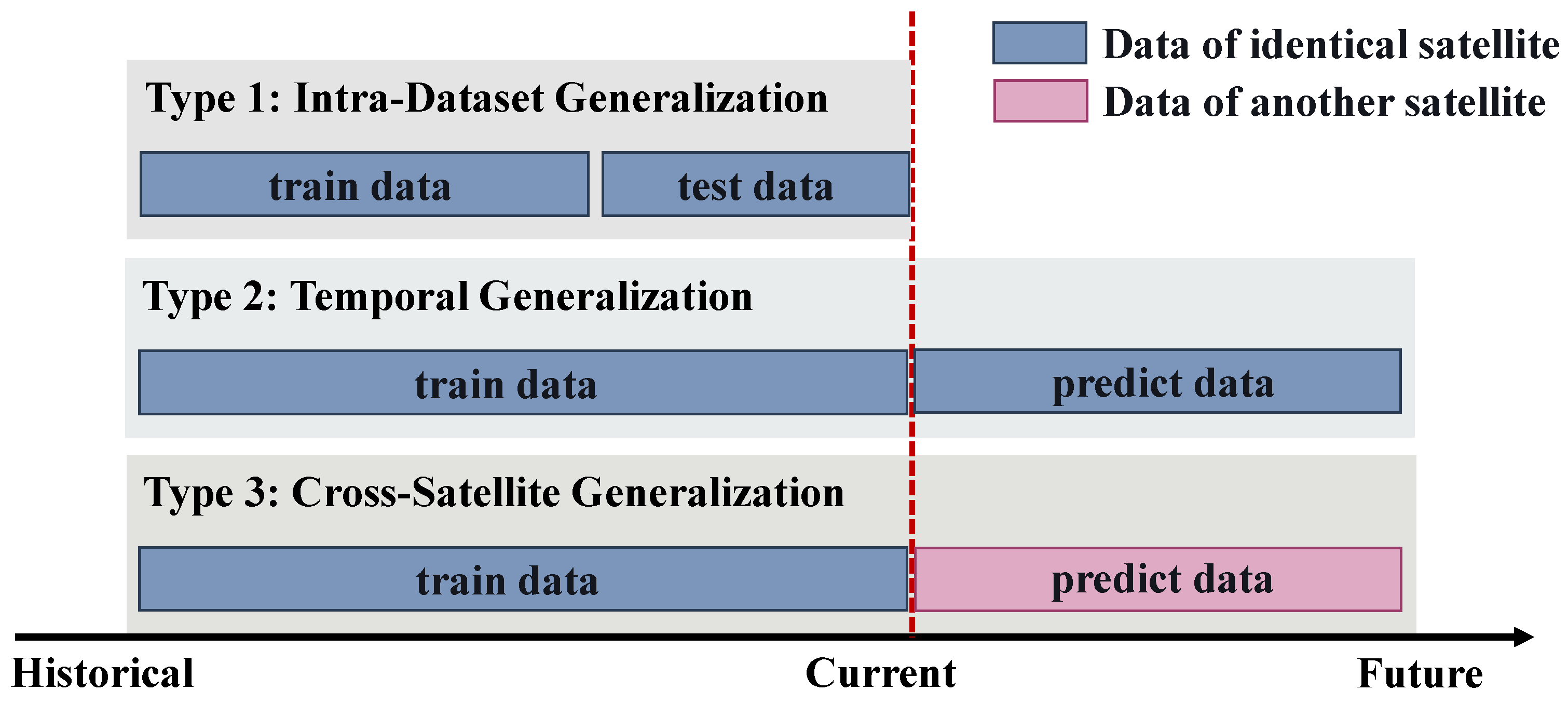
Figure 17.
Three categories of generalization performance in orbit prediction. Type 2 is consistent with the mainstream experimental protocols in the orbit prediction literature.
Figure 17.
Three categories of generalization performance in orbit prediction. Type 2 is consistent with the mainstream experimental protocols in the orbit prediction literature.
Figure 18.
Modification performance of the proposed method on orbit errors along the X, Y and Z axes for the C22 satellite. (a) X-axis. (b) Y-axis. (c) Z-axis. The proposed method can effectively correct the orbital errors of the C22 satellite.
Figure 18.
Modification performance of the proposed method on orbit errors along the X, Y and Z axes for the C22 satellite. (a) X-axis. (b) Y-axis. (c) Z-axis. The proposed method can effectively correct the orbital errors of the C22 satellite.
Figure 19.
Modification performance of the proposed method on orbit errors along the X, Y and Z axes for the C22 satellite. (a) X-axis. (b) Y-axis. (c) Z-axis. It once again confirms that the proposed method can effectively reduce the residual error of the C22 satellite to a relatively low level.
Figure 19.
Modification performance of the proposed method on orbit errors along the X, Y and Z axes for the C22 satellite. (a) X-axis. (b) Y-axis. (c) Z-axis. It once again confirms that the proposed method can effectively reduce the residual error of the C22 satellite to a relatively low level.
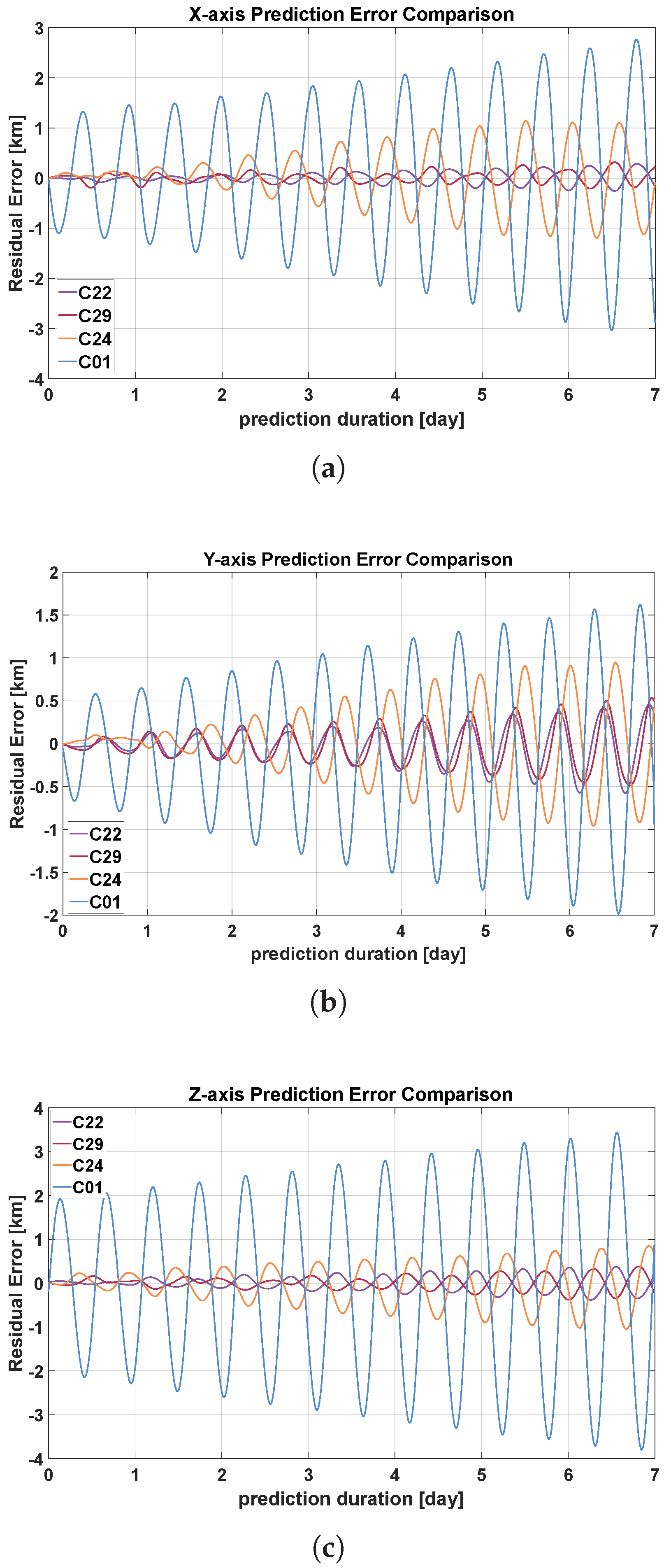
Figure 20.
Comparison of generalization performance of the model across different satellites. The red, purple, orange, and blue curves represent the orbit prediction performance for satellites C22, C29, C24, and C01, respectively. (a) X-axis; (b) Y-axis; (c) Z-axis. It shows that the proposed method can generalize reliably among BDS MEO satellites with similar orbital setups and dynamic environments, rather than under arbitrary orbital conditions.
Figure 20.
Comparison of generalization performance of the model across different satellites. The red, purple, orange, and blue curves represent the orbit prediction performance for satellites C22, C29, C24, and C01, respectively. (a) X-axis; (b) Y-axis; (c) Z-axis. It shows that the proposed method can generalize reliably among BDS MEO satellites with similar orbital setups and dynamic environments, rather than under arbitrary orbital conditions.
Table 1.
Dynamic orbit propagation configuration for BeiDou MEO satellites.
Table 1.
Dynamic orbit propagation configuration for BeiDou MEO satellites.
| Parameter | Configuration |
|---|
| Central Body Gravity | 36 × 36 EGM2008 |
| N-Body Gravitational Force | the Sun and Moon in JPL DE403 |
| Tidal Perturbation | Solid Tide |
| Solar Radiation Pressure | Spherical Model |
| Atmospheric Density Model | Jacchia-Roberts |
| Integration Method | RKF7(8) |
Table 2.
Training hyperparameters of the deep learning model.
Table 2.
Training hyperparameters of the deep learning model.
| Item | Setting |
|---|
| Optimizer | Adam |
| Batch size | 32 |
| Training epochs | 1200 |
| Initial learning rate | |
| Learning rate scheduler | Step decay, factor = 0.1 at epoch 800 |
| Loss function | Mean Squared Error |
Table 3.
Experimental results on hybrid orbit prediction performance across sequence lengths.
Table 3.
Experimental results on hybrid orbit prediction performance across sequence lengths.
| Sequence Length | MaxAE [km] | RMSE [km] | MAE [km] |
|---|
| 288 | 2.3376 | 0.9117 | 0.7208 |
| 576 | 1.3985 | 0.6028 | 0.4900 |
| 864 | 0.9011 | 0.3910 | 0.3201 |
| 1152 | 0.3523 | 0.1301 | 0.1027 |
| 1440 | 0.5791 | 0.2057 | 0.1531 |
| 1728 | 0.7707 | 0.3539 | 0.2720 |
| 2016 | 1.0618 | 0.4904 | 0.3773 |
Table 4.
Performance comparison of different methods on the C19 satellite.
Table 4.
Performance comparison of different methods on the C19 satellite.
| Method | X | Y | Z |
|---|
| MaxAE | MAE | RMSE | MRR | MaxAE | MAE | RMSE | MRR | MaxAE | MAE | RMSE | MRR |
|---|
| [km] | [km] | [km] | [%] | [km] | [km] | [km] | [%] | [km] | [km] | [km] | [%] |
|---|
| GRU | 1.2594 | 0.4243 | 0.5220 | 47.32 | 3.3522 | 0.9448 | 1.2659 | 65.90 | 1.7062 | 0.5575 | 0.6856 | 45.12 |
| TCN | 1.9659 | 0.6661 | 0.8255 | 74.27 | 2.3213 | 0.9995 | 1.2039 | 69.71 | 2.8115 | 1.0223 | 1.2342 | 82.72 |
| Transformer | 0.8770 | 0.2558 | 0.3266 | 28.52 | 1.5301 | 0.6081 | 0.7294 | 42.21 | 1.7131 | 0.4916 | 0.6291 | 39.78 |
| Attention-BiLSTM | 0.7144 | 0.1409 | 0.2000 | 15.71 | 0.6062 | 0.1436 | 0.1902 | 10.01 | 0.5607 | 0.1386 | 0.1999 | 11.22 |
| BiLSTM-288 | 1.5040 | 0.4845 | 0.6022 | 54.03 | 2.5002 | 0.5905 | 0.8165 | 41.18 | 3.3130 | 0.9899 | 1.2474 | 80.10 |
| BiLSTM-1152 | 0.3801 | 0.1680 | 0.1943 | 11.35 | 0.4618 | 0.1815 | 0.2122 | 7.52 | 0.7054 | 0.1887 | 0.2325 | 9.19 |
| Ours | 0.1652 | 0.0391 | 0.0525 | 4.36 | 0.2929 | 0.0878 | 0.1057 | 6.12 | 0.1902 | 0.0666 | 0.0800 | 5.39 |
Table 5.
Prediction performance of the trained model across different test periods on the C19 satellite.
Table 5.
Prediction performance of the trained model across different test periods on the C19 satellite.
| Prediction Period | X | Y | Z |
|---|
| MaxAE | MAE | RMSE | MRR | MaxAE | MAE | RMSE | MRR | MaxAE | MAE | RMSE | MRR |
|---|
| [km] | [km] | [km] | [%] | [km] | [km] | [km] | [%] | [km] | [km] | [km] | [%] |
|---|
| 2023.01.15–2023.01.21 | 0.1652 | 0.0391 | 0.0525 | 4.36 | 0.2929 | 0.0878 | 0.1057 | 6.12 | 0.1902 | 0.0666 | 0.0800 | 5.39 |
| 2023.01.30–2023.02.05 | 0.1788 | 0.0631 | 0.0821 | 3.11 | 0.3000 | 0.0793 | 0.1065 | 4.37 | 0.1761 | 0.0514 | 0.0650 | 3.20 |
| 2023.02.18–2023.02.24 | 0.1496 | 0.0461 | 0.0583 | 4.81 | 0.1830 | 0.0701 | 0.0813 | 6.02 | 0.2316 | 0.0823 | 0.1005 | 5.93 |
Table 6.
Performance improvement of the proposed method on the C19 satellite.
Table 6.
Performance improvement of the proposed method on the C19 satellite.
| Metrix | IR_X [%] | IR_Y [%] | IR_Z [%] |
|---|
| MaxAE | 89.03% | 88.28% | 94.26% |
| MAE | 91.93% | 85.13% | 93.27% |
| RMSE | 91.28% | 87.05% | 93.58% |
| MRR | 91.93% | 85.14% | 93.27% |
Table 7.
Experimental results of ablation study.
Table 7.
Experimental results of ablation study.
| Method | X | Y | Z |
|---|
| MaxAE | MAE | RMSE | MRR | MaxAE | MAE | RMSE | MRR | MaxAE | MAE | RMSE | MRR |
|---|
| [km] | [km] | [km] | [%] | [km] | [km] | [km] | [%] | [km] | [km] | [km] | [%] |
|---|
| BiLSTM | 1.5040 | 0.4845 | 0.6022 | 54.03 | 2.5002 | 0.5905 | 0.8165 | 41.18 | 3.3130 | 0.9899 | 1.2474 | 80.10 |
| BiLSTM+StandardConv | 0.3153 | 0.1098 | 0.1315 | 12.25 | 0.3979 | 0.1005 | 0.1352 | 7.01 | 0.4111 | 0.1518 | 0.1774 | 12.28 |
| BiLSTM+DilatedConv | 0.4072 | 0.1010 | 0.1350 | 11.27 | 0.7229 | 0.2334 | 0.2881 | 16.28 | 0.6667 | 0.2237 | 0.2690 | 18.10 |
| BiLSTM+HybridConv | 0.3839 | 0.0817 | 0.1186 | 9.11 | 0.3781 | 0.1505 | 0.1773 | 10.50 | 0.7342 | 0.2077 | 0.2785 | 16.81 |
| Ours | 0.1652 | 0.0391 | 0.0525 | 4.36 | 0.2929 | 0.0878 | 0.1057 | 6.12 | 0.1902 | 0.0666 | 0.0800 | 5.39 |