Article

A Generative Augmentation and Physics-Informed Network for Interpretable Prediction of Mining-Induced Deformation from InSAR Data

1
School of Earth and Environment, Anhui University of Science and Technology, Huainan 232001, China
2
School of Geomatics, Anhui University of Science and Technology, Huainan 232001, China
3
School of Geospatial Engineering and Science, Sun Yat-sen University, Zhuhai 519082, China
4
State Key Laboratory of Information Engineering in Surveying, Mapping and Remote Sensing, Wuhan University, Wuhan 430070, China
*
Author to whom correspondence should be addressed.
Remote Sens. 2026, 18(7), 987; https://doi.org/10.3390/rs18070987
Submission received: 29 January 2026 / Revised: 19 March 2026 / Accepted: 20 March 2026 / Published: 25 March 2026

Highlights

What are the main findings?
  • TCN-TimeGAN augments sparse InSAR deformation series with synthetic sequences that better match the observed distribution and temporal structure.
  • Physics-informed PI-KAN improves forecast robustness via subsidence-consistency and smoothness priors while preserving spline-based interpretability and temporal attribution.
What are the implications of the main findings?
  • The integrated framework enables reliable short-term subsidence forecasting under small-sample constraints and can be adapted to other deformation hazards with task-specific priors.
  • Physics-aware regularization combined with interpretability reduces reliance on black-box predictors and supports operational monitoring and early warning.

Abstract

Accurate forecasting of mining-induced surface deformation is critical for coal-mine safety assessment and hazard mitigation. InSAR deformation time series are often short, temporally sparse, and strongly nonlinear. These characteristics can make purely data-driven predictors unreliable in small-sample settings. To address this issue, we propose a generation–prediction–interpretation framework that combines generative augmentation with physics-informed forecasting. We first develop a TCN-TimeGAN model to synthesize high-fidelity deformation sequences and expand the training set. Recurrent modules in the generator and discriminator are replaced with causal TCN residual blocks, and a temporal self-attention layer is further stacked on top of the TCN backbone to adaptively reweight informative time steps. We then construct a physics-informed Kolmogorov–Arnold Network, termed PI-KAN. Subsidence-consistency and smoothness priors are embedded in the learning objective to promote physically plausible predictions while retaining spline-based interpretability. Experiments on SBAS-InSAR deformation series from the Guqiao coal mine show that the framework achieves an RMSE of 0.825 mm and an R2 of 0.968. It outperforms TGAN-KAN, CNN-BiGRU, and BiGRU under the same evaluation protocol. Visualizations of the learned spline-based edge functions further reveal stronger nonlinear responses for lagged inputs closer to the forecast horizon, providing interpretable evidence of short-term temporal sensitivity under sparse observations.

1. Introduction

Surface deformation monitoring is vital for disaster prevention and safety assessment in mining and urban environments. Over the past decades, Interferometric Synthetic Aperture Radar (InSAR) has emerged as a primary technique for deformation monitoring due to its wide spatial coverage and high measurement precision [1,2]. InSAR-derived deformation time series not only support retrospective analysis but also provide a fundamental basis for forecasting future surface motion, which is crucial for early warning and risk mitigation. In mining areas, surface deformation is typically continuous and dynamic, and time-series analysis enables researchers to track deformation trends, detect abnormal variations, and identify potential subsidence-related hazards in a timely manner [3].
Classical statistical and physical models, such as least-squares inversion methods [4] and finite element methods [5], typically rely on restrictive assumptions and fixed governing equations to simulate deformation. These models can perform well when sufficient data are available but often become unstable on small-sample or incomplete datasets due to unreliable parameter estimation and potential overfitting [6]. With the rapid advancement of deep learning, approaches including Recurrent Neural Networks (RNNs) [7], Long Short-Term Memory networks (LSTMs) [8], Gated Recurrent Units (GRUs) [9], and Convolutional Neural Networks (CNNs) [10] have been widely applied to surface deformation prediction and generally outperform traditional models. Recent studies further extend these models to more complex settings, including Transformer-based frameworks for long-term deformation prediction [11], hybrid CNN–RNN architectures with attention mechanisms for step-like or large-scale displacement modeling [12,13,14], and spatio-temporal networks for landslide deformation prediction and early warning [15,16]. In mining scenarios, SBAS-InSAR combined with deep sequence models has also demonstrated promising subsidence forecasting performance [17,18]. Nevertheless, most deep learning models still require sufficiently dense and informative time series, and they may suffer from unstable training and limited interpretability under sparse observations and small-sample conditions.
Although InSAR is effective for monitoring mining-induced deformation, temporal sampling density and the availability of high-quality deformation time series remain limited in practice. For instance, Sentinel-1 acquisitions are constrained by revisit intervals and may be further affected by decorrelation and data gaps, leading to sparsely sampled deformation sequences in many monitoring scenarios [19]. As a consequence, the observed time series often contain missing observations and uneven temporal spacing, which increases uncertainty and constrains data-driven forecasting models [20,21]. Deep learning models generally require sufficient, temporally continuous, and information-rich time-series inputs to ensure stable training and reliable generalization. Under small-sample settings, predictive accuracy and robustness can be significantly degraded due to inadequate temporal information and weakened representation learning [22,23].
To mitigate data scarcity, generative approaches have been introduced to augment time-series datasets [24]. Time-series Generative Adversarial Networks (TimeGANs) have demonstrated strong capability in synthesizing high-fidelity temporal samples while preserving key dynamic characteristics. TimeGAN-based augmentation has been explored in various small-sample forecasting and diagnostic tasks, including fault diagnosis [25], degradation-sequence generation [26], photovoltaic power forecasting [27], and infrastructure strain prediction [28], as well as financial time-series prediction [29]. These studies suggest that generative augmentation can alleviate the adverse impact of limited observations on model training. However, data augmentation alone does not guarantee reliable and physically plausible deformation forecasting, because black-box predictors may still produce unrealistic oscillations or trend reversals. Moreover, the systematic use of TimeGAN for mining-area surface deformation forecasting remains limited, especially when strong nonlinearity must be reconciled with interpretability requirements.
Therefore, beyond improving data representativeness, it is crucial to develop a forecasting model that is both physically plausible and interpretable for safety-critical deformation prediction. Kolmogorov–Arnold Networks (KANs) have recently emerged as an interpretable alternative to multi-layer perceptron (MLP)-based architectures due to their spline-based functional representations, enabling transparent nonlinear modeling [30]. Representative applications include renewable-energy and meteorological forecasting, such as solar radiation and temperature prediction [31], electricity demand forecasting in power systems [32], and financial time-series analysis where interpretability is emphasized [33]. In addition, for general multivariate time-series prediction problems, empirical evidence has further confirmed the feasibility of KAN in capturing complex temporal dependencies [34]. These advances provide a solid foundation for applying KAN to time-series forecasting; however, in mining-induced deformation scenarios governed by explicit physical constraints, the stability and physical consistency of KAN-based models remain to be systematically investigated.
In this study, we propose a generation–prediction–interpretation framework for mining-induced deformation forecasting under sparse and small-sample InSAR observations. The framework integrates a TCN-enhanced TimeGAN for deformation-sequence augmentation and a physics-informed KAN-based predictor for physically plausible and interpretable forecasting. Experiments on InSAR time series from the mining area demonstrate that the proposed approach improves prediction accuracy and stability while also enabling transparent analysis of temporal contributions.

2. Materials and Methodology

2.1. Study Area

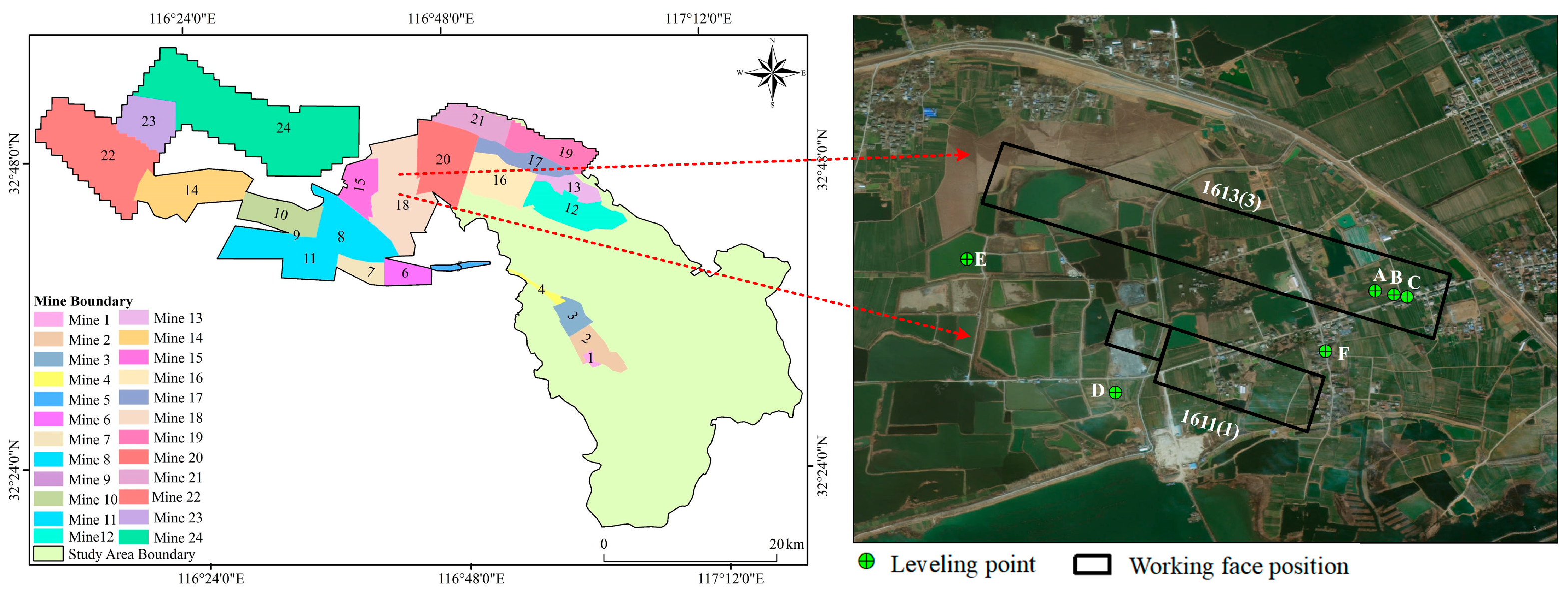
The study area is located at the Guqiao Coal Mine in Fengtai County, Huainan City, Anhui Province, China, as shown in Figure 1. This site is a typical coal mining area where longwall extraction has induced continuous surface deformation, posing potential risks to nearby infrastructures. Therefore, accurate characterization of surface deformation is essential for subsequent subsidence analysis and forecasting.
The experiment focuses on two adjacent longwall panels, 1613 (3) and 1611 (1), whose combined mining activities control the deformation pattern observed at the surface. The 1611 (1) working face is located about 520 m south of 1613 (3) underground. After 24 February 2022, retreat mining at panel 1611 (1) had a noticeable influence on the southern part of the 1613 (3) observation line; therefore, the surface deformation in this area is interpreted as the superposition of the two panels.
For panel 1613 (3), mining was conducted by fully mechanized retreat longwall extraction, with full-seam mining and caving roof control. The panel was mined from July 2021 to June 2022. The coal seam depth is about 520–630 m, and the coal thickness is 3.6–4.9 m, with an average mining height of 4.48 m. The overburden includes a thick Quaternary loose layer of approximately 420 m. The ground surface above the panel is relatively flat, with elevations of about 18–23 m, and is mainly covered by farmland, roads, and ditches. The site is bounded by a dam to the north and a water body to the south. Accurate subsidence characterization is therefore important for safety assessment.

2.2. Datasets

This study used C-band SAR data acquired by the European Space Agency’s Sentinel-1A mission. A total of 49 single look complex (SLC) images were collected from 10 July 2021 to 18 February 2023. All scenes were acquired on an ascending track with VV polarization. The nominal revisit interval is 12 days, and the center incidence angle is 39.16°. The relevant acquisition parameters are summarized in Table 1.
To support interferometric time-series deformation retrieval, the 30 m Shuttle Radar Topography Mission (SRTM) DEM was used to remove the topographic phase [35], and Sentinel-1 precise orbit products (POD) were used for orbit refinement. In addition, six leveling benchmarks (Points A–F in Figure 1) were surveyed during the SAR observation period and used to validate the InSAR-derived deformation time series.
For reproducibility, the key processing settings for SBAS time-series retrieval are summarized here [36]. Interferometric pairs were formed using temporal and perpendicular baseline thresholds of 60 days and 200 m, respectively. Phase unwrapping was performed using the Minimum Cost Flow (MCF) algorithm. Reference points were selected in a presumed stable area based on a coherence threshold greater than 0.5. Residual atmospheric artifacts and noise were mitigated using multi-temporal spatio-temporal filtering during the time-series processing.

2.3. Methodology

2.3.1. TCN-TimeGAN Model

TimeGAN, introduced by Yoon et al. [37], is a generative framework for realistic time-series synthesis via adversarial learning. It contains an embedder/recovery pair for latent representation learning and a generator–supervisor–discriminator triad for adversarial training and temporal dynamics modeling [38]. Let X = { x t } t = 1 T T × d denote a real time series segment, and X ^ its reconstruction produced by the embedder and recovery networks. The reconstruction loss is used to train the embedder–recovery mapping, and to ensure that the latent space retains the key temporal information of X:
L re = E X X ^ 2 2
To improve training stability and mitigate mode collapse under small-sample conditions, we adopt the Wasserstein GAN with gradient penalty (WGAN-GP) [39]. The adversarial loss is defined in Equation (2):
L a d = E D ( X ˜ ) E D ( X ) + λ gp E X ¯ D ( X ¯ ) 2 1 2
Here, D represents the discriminator function, which determines the authenticity of the input data. X ˜ is the generated sequence. The gradient penalty is computed as X ¯ D ( X ¯ ) 2 1 2 . The supervision module harnesses temporal dependencies from real data to steer the generator toward latent representations with authentic dynamics, assessed via the supervised loss function in Equation (3).
L sup = E p t p ^ t 2 2
Here, p t represents the latent representation of the real data, while p ^ t represents the latent representation generated by the generator. The final loss function is formulated as shown in Equation (4).
L total = λ 1 L re + λ 2 L sup + λ 3 L ad
Here, λ 1 , λ 2 , and λ 3 are hyperparameters that weight the individual loss components, helping to balance their contributions to the total loss. In this study, the hyperparameters were set to λ 1 = 1, λ 2 = 1, and λ 3 = 0.1, to maintain a balanced influence between reconstruction consistency and adversarial learning while preventing the supervised term from dominating the training process.
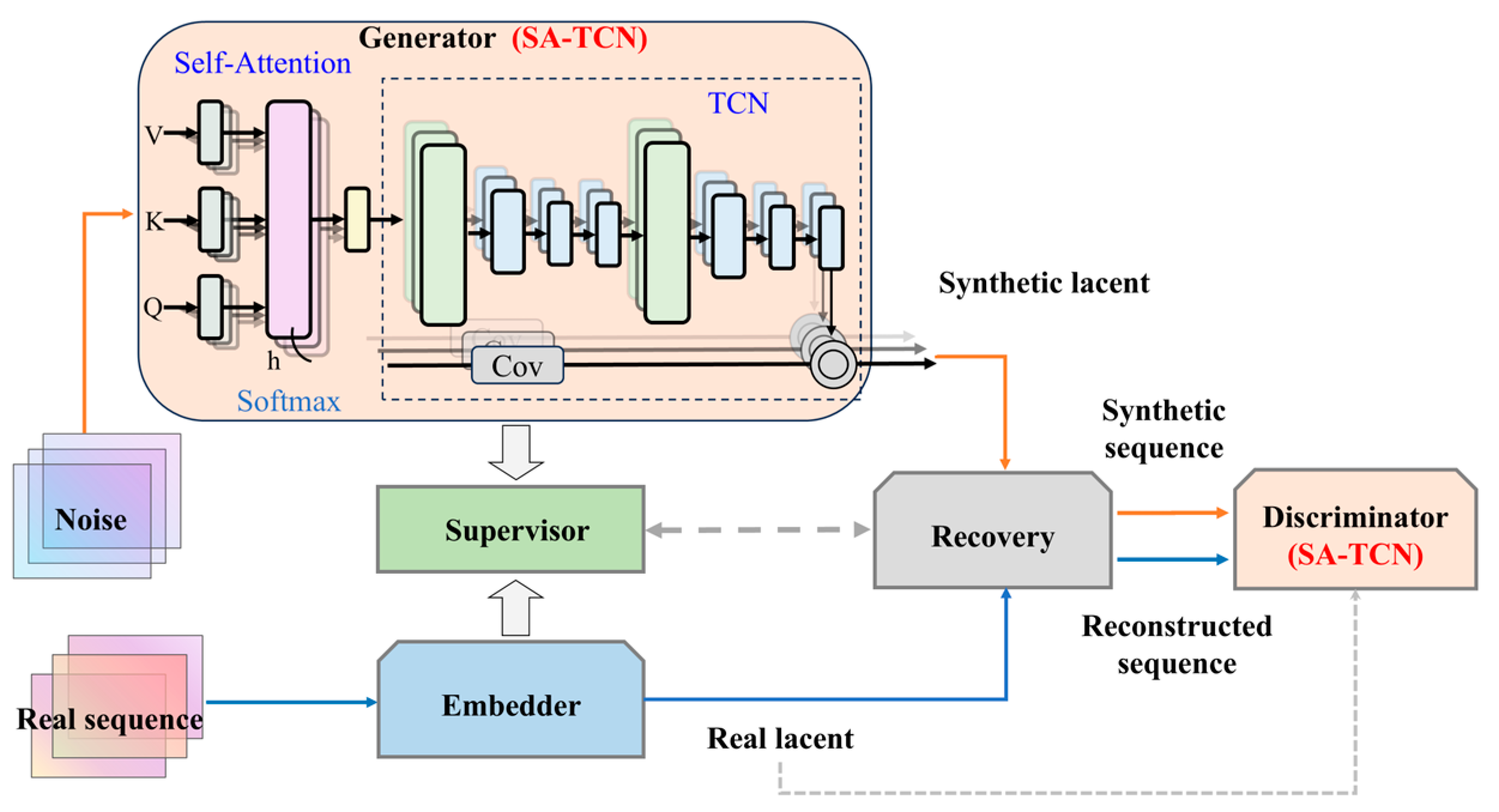
Building upon our previous work, we enhance the standard TimeGAN by introducing a TCN backbone and a self-attention module to strengthen long-range temporal modeling [40]. Specifically, we replace the recurrent blocks in the generator and discriminator with causal TCN residual blocks to capture multi-scale temporal patterns. A self-attention layer is appended after the TCN feature extractor along the time dimension to reweight informative time steps. After training, the proposed TCN-TimeGAN is used to synthesize deformation sequences, which are then mixed with real samples to augment the training set for the downstream predictor. The overall architecture is depicted in Figure 2.

2.3.2. KAN Model

The multi-layer perceptron (MLP) is a common baseline for nonlinear regression [41]. In practice, deep MLPs may be required to model complex deformation dynamics, which can lead to higher computational cost and limited interpretability. To address these limitations, we adopt the Kolmogorov–Arnold Network (KAN) proposed by Liu et al. [42]. KAN differs from conventional MLPs in that it assigns a learnable univariate function to each connection, rather than using fixed activation functions at neurons. The output of each node is obtained by summing the edge functions applied to its inputs, which improves interpretability because each edge function can be visualized.
In time-series forecasting, KAN learns a nonlinear mapping from a historical deformation window to the target future deformation value [43]. Its key difference from MLPs is that KAN assigns a learnable univariate function to each connection. The layer output is obtained by summing these edge functions. For a KAN layer, the j-th output is computed by aggregating edge functions applied to the corresponding inputs, as shown in Equation (5).
x j ( l + 1 ) = i = 1 n l ϕ i , j ( l ) x i ( l )
Here, x ( l ) represents the layer input, and ϕ i , j ( l ) is a continuously differentiable univariate function. Each ϕ i , j ( l ) can be visualized, which supports model interpretation.
Following common KAN implementations, we parameterize each edge function using spline basis functions [44]. Specifically, we adopt B-splines on a predefined knot grid { t m } . In this study, a cubic B-spline (order = 3) is used, as it provides a good balance between approximation flexibility and numerical stability and has been widely adopted in existing KAN implementations. The edge function is expressed as defined in Equation (6).
ϕ i , j ( l ) ( x ) = m = 1 M c i , j , m ( l ) B m , k ( x )
where B m , k ( x ) is the m-th B-spline basis function of order k, and c i , j , m ( l ) are learnable coefficients. The B-spline bases are computed from the knot sequence using the standard recursive definition.
The B-spline basis functions are defined in Equation (7).
B m , 0 ( x ) = 1 , t m x < t m + 1 0 , otherwise
Higher-order B-spline basis functions can be defined recursively, as shown in Equation (8).
B m , k ( x ) = x t m t m + k t m B m , k 1 ( x ) + t m + k + 1 x t m + k + 1 t m + 1 B m + 1 , k 1 ( x )
Here, t represents the grid points, which are the nodes of the B-spline basis functions. k denotes the order of the spline, indicating the complexity of the spline function.

2.3.3. Construction of the Physics-Informed KAN Model

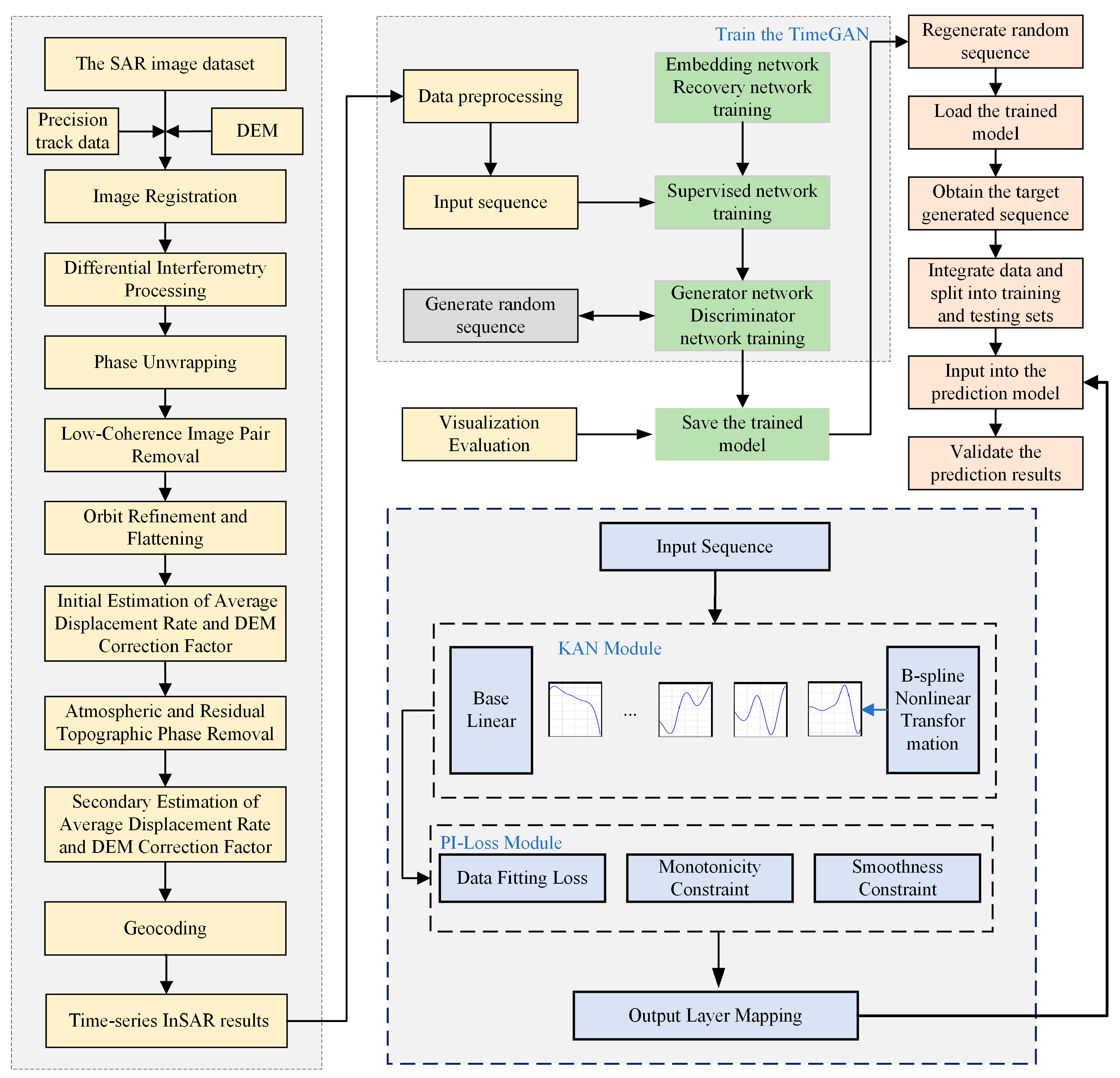
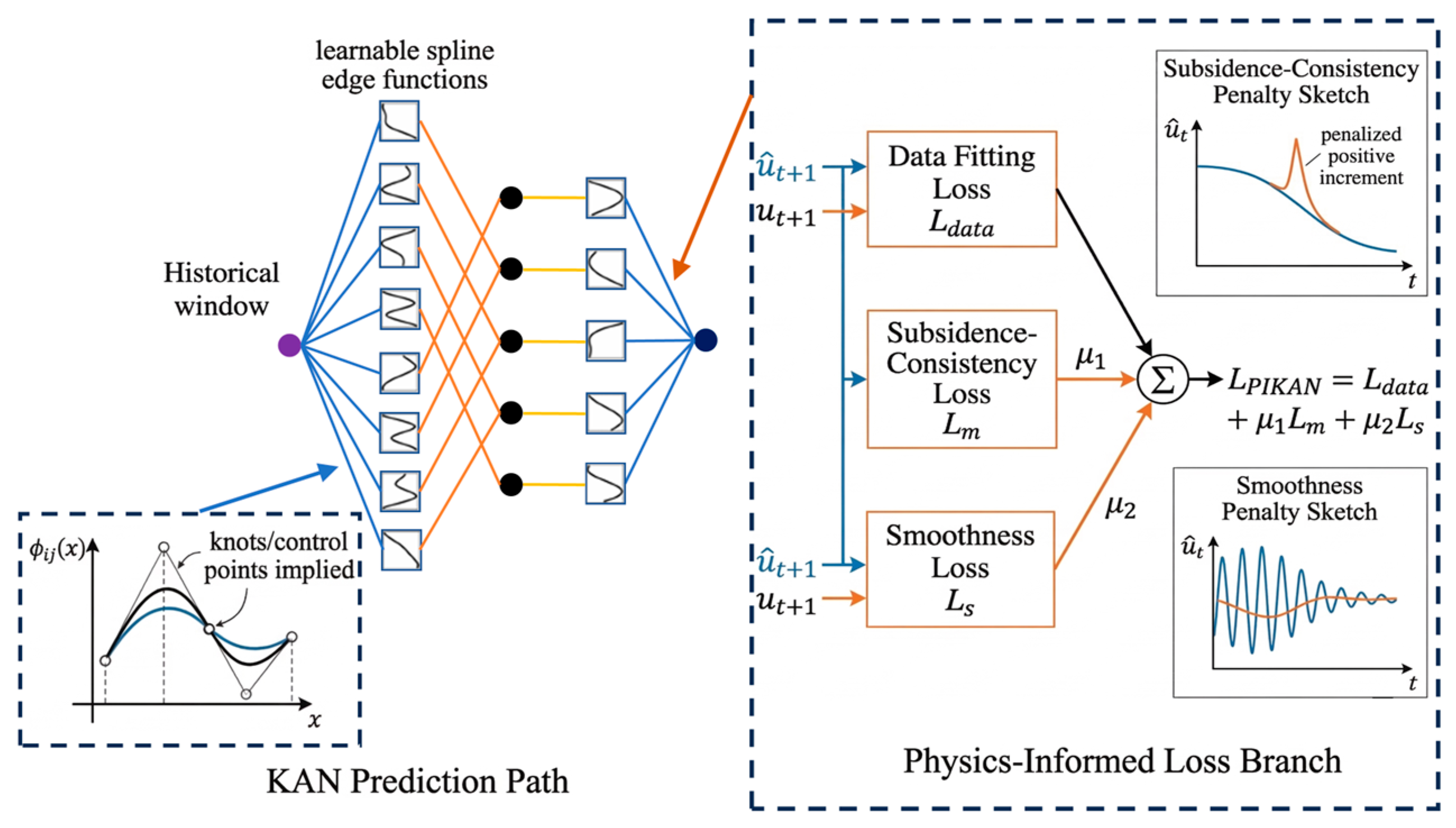
In mining-induced subsidence scenarios, deformation is governed by clear physical constraints. Without physical priors, model predictions may deviate from physically realistic behavior and produce artifacts such as high-frequency oscillations or anomalous local uplift. To address this limitation, we develop a physics-informed KAN (PI-KAN) model on top of the original KAN architecture. The overall architecture and physics-informed design of the proposed PI-KAN are illustrated in Figure 3. The model consists of a KAN prediction path and two physics-informed regularization branches corresponding to the subsidence-consistency and smoothness constraints.
PI-KAN adds physics-based regularization, derived from mining-subsidence dynamics, to the data-fitting loss. This integration couples data-driven learning with domain-specific physical constraints, ensuring that the predicted deformation series adhere more closely to actual deformation processes. The overall loss is given in Equation (9):
L PIKAN = L data + μ 1 L m + μ 2 L s
Here, L data is the KAN data-fitting loss, whereas L m and L s denote the physics-informed regularization terms representing monotonicity and smoothness constraints, respectively. μ 1 and μ 2 specify the relative weights associated with the respective physical constraints. In this study, the coefficients were empirically set to μ 1 = 0.5 and μ 2 = 0.1 to balance prediction accuracy and physical consistency. These values were determined through validation-set tuning to ensure that the physical constraints effectively suppress non-physical oscillations while preserving the model’s ability to fit the observed deformation data. The computation of L data is provided in Equation (10).
L data = 1 T t = 1 T u ^ t u t 2
Here, u t denotes the true deformation value, u ^ t the predicted deformation value, and T the total number of time steps.
After mining extraction, surface deformation typically follows a monotonic subsidence trend. Although minor rebounds may occur locally because of environmental disturbances, the dominant post-extraction trend remains monotonic subsidence. To enforce this behavior and suppress noise-induced non-physical uplifts, a subsidence constraint is incorporated into the loss function to limit positive increments in the predicted deformation. The specific formulation is provided in Equation (11).
L m = 1 T 1 t = 1 T 1 max 0 , Δ u ^ t ε 2
Here, Δ u ^ t = u ^ t + 1 u ^ t denotes the predicted deformation increment at time t, and ε is the allowable small-rebound threshold. In this study, ε is set using the 95th percentile of positive increments estimated from the training set. A small lower bound is additionally imposed to accommodate measurement noise.
Surface subsidence typically evolves through an initial slow phase, a subsequent acceleration phase, and a final stabilization stage. Accordingly, the deformation process should exhibit a reasonable degree of temporal smoothness. Frequent oscillations or abrupt changes in the predicted curve often indicate that the model has failed to capture the underlying physical trend of subsidence. To mitigate this issue, a smoothness constraint based on second-order differences is introduced into the loss function to suppress non-physical high-frequency fluctuations and promote smoother temporal variations in the predicted deformation. The specific formulation is provided in Equation (12).
L s = 1 T 2 t = 3 T u ^ t 2 u ^ t 1 + u ^ t 2 Q a 2
In this study, Q a is defined as the 95th percentile of the absolute second-order differences of the ground-truth sequence, estimated from the training set only. We use Q a as a normalization factor to keep the smoothness constraint on a comparable scale across different locations.
Building on the proposed framework, this study integrates generative data augmentation with KAN to achieve interpretable prediction of mining-induced surface deformation. First, SBAS-InSAR is used to derive deformation time series at key monitoring points in the study area, forming the base dataset. Next, a generative model is trained to augment the limited samples and produce synthetic sequences that preserve the temporal patterns and statistical characteristics of the real data. The generated sequences are then combined with the original observations to construct a hybrid training set. This hybrid dataset is used to train and validate the PI-KAN prediction model. Model performance is finally evaluated on an independent real test set. All deep learning models were implemented in PyTorch 2.0 with Python 3.9 and trained on a workstation equipped with an NVIDIA RTX 3090 GPU, 24 GB (NVIDIA Corporation, Santa Clara, CA, USA), Intel i9-class CPU (Intel Corporation, Santa Clara, CA, USA), and 64 GB RAM (CUDA 11.8). The workflow includes generated-data quality assessment, model setup, prediction accuracy evaluation, and interpretability analysis. The overall procedure is shown in Figure 4.

3. Experiment and Results

3.1. InSAR Monitoring Results

This section first validates the accuracy of the SBAS-InSAR deformation estimates using leveling observations. On this basis, the spatial distribution and temporal evolution of mining-induced deformation over the study area are then analyzed. Unless otherwise stated, negative values indicate subsidence, and the deformation rate is estimated from the SBAS displacement time series.
Six leveling benchmarks were established across the study area. Points A to C were located within the working face, point D was placed near the water body, and points E and F followed the longitudinal profile. Third-order leveling was carried out from 10 July 2021 to 18 February 2023 to assess the SBAS-InSAR deformation estimates. For each benchmark, the InSAR displacement was sampled from the nearest pixel and referenced to the same baseline date. The comparison results are summarized in Table 2.
Table 2 shows that the absolute differences between SBAS-InSAR and leveling range from 3.71 to 7.12 mm, with a mean absolute error of 5.23 mm and a root mean square error of 5.45 mm. These results indicate good agreement between the two datasets and confirm that the InSAR-derived deformation estimates are sufficiently reliable for the subsequent deformation analysis. After confirming the reliability of the SBAS-InSAR results, we next analyze the spatial pattern and temporal evolution of surface deformation in the study area.
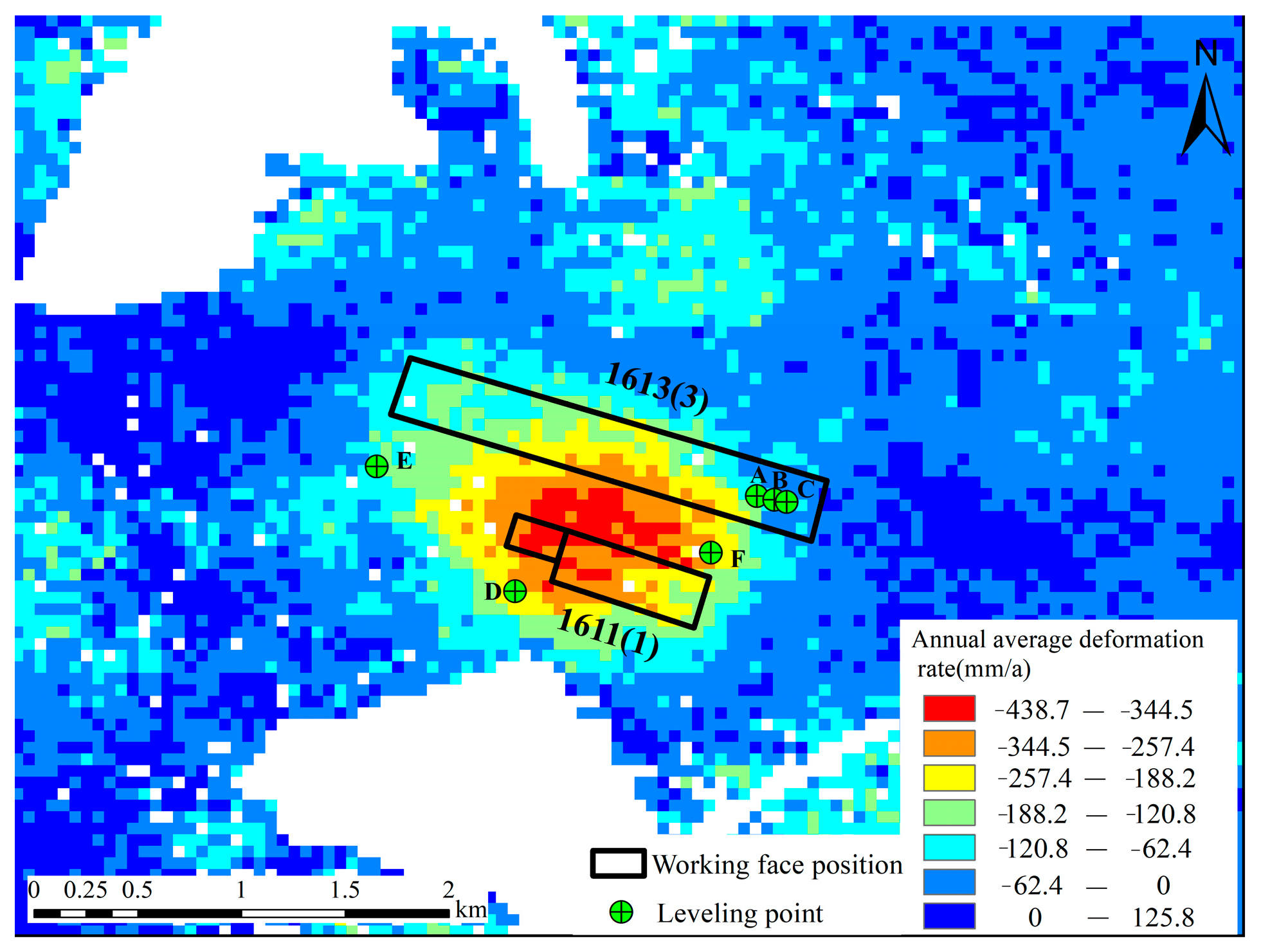
Figure 5 presents the annual mean deformation rate. A pronounced subsidence bowl is evident above the goaf of the 1611 (1) working face. The rate is derived from the SBAS displacement time series and reported in the line-of-sight direction. Negative values represent subsidence, while near-zero to positive values are shown in separate classes in the revised map for clearer physical interpretation. The strongest subsidence is confined to the 1611 (1) goaf, where the peak rate reaches −438.7 mm per year.
Moderate subsidence is mainly distributed in the southern sector of the 1613 (3) working face. This pattern is likely associated with the superposed influence of the retreat of 1611 (1). Elsewhere within 1613 (3), deformation remains minor, indicating generally stable surface conditions during the observation period. The corresponding cumulative deformation is shown in Figure 6.
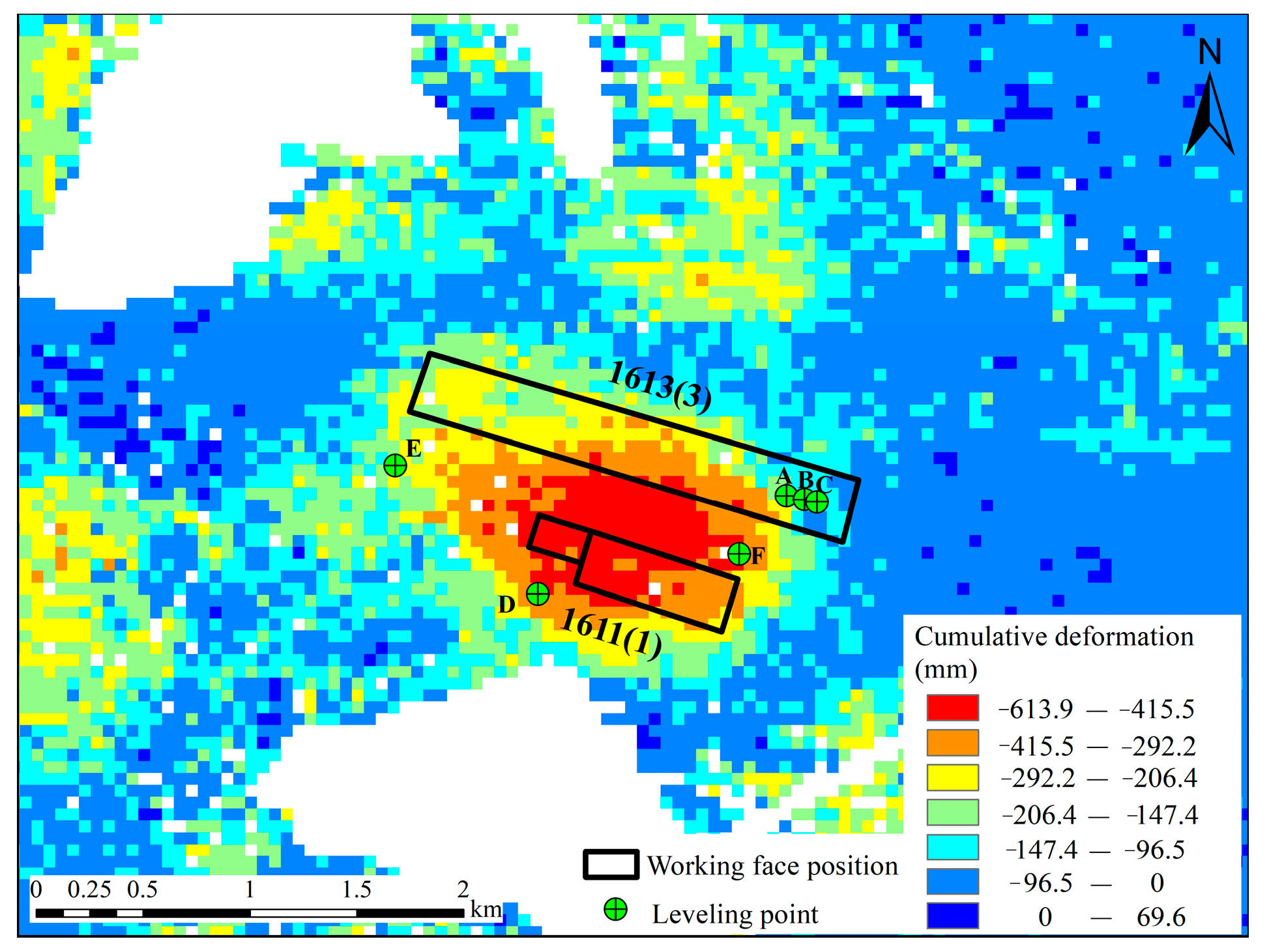
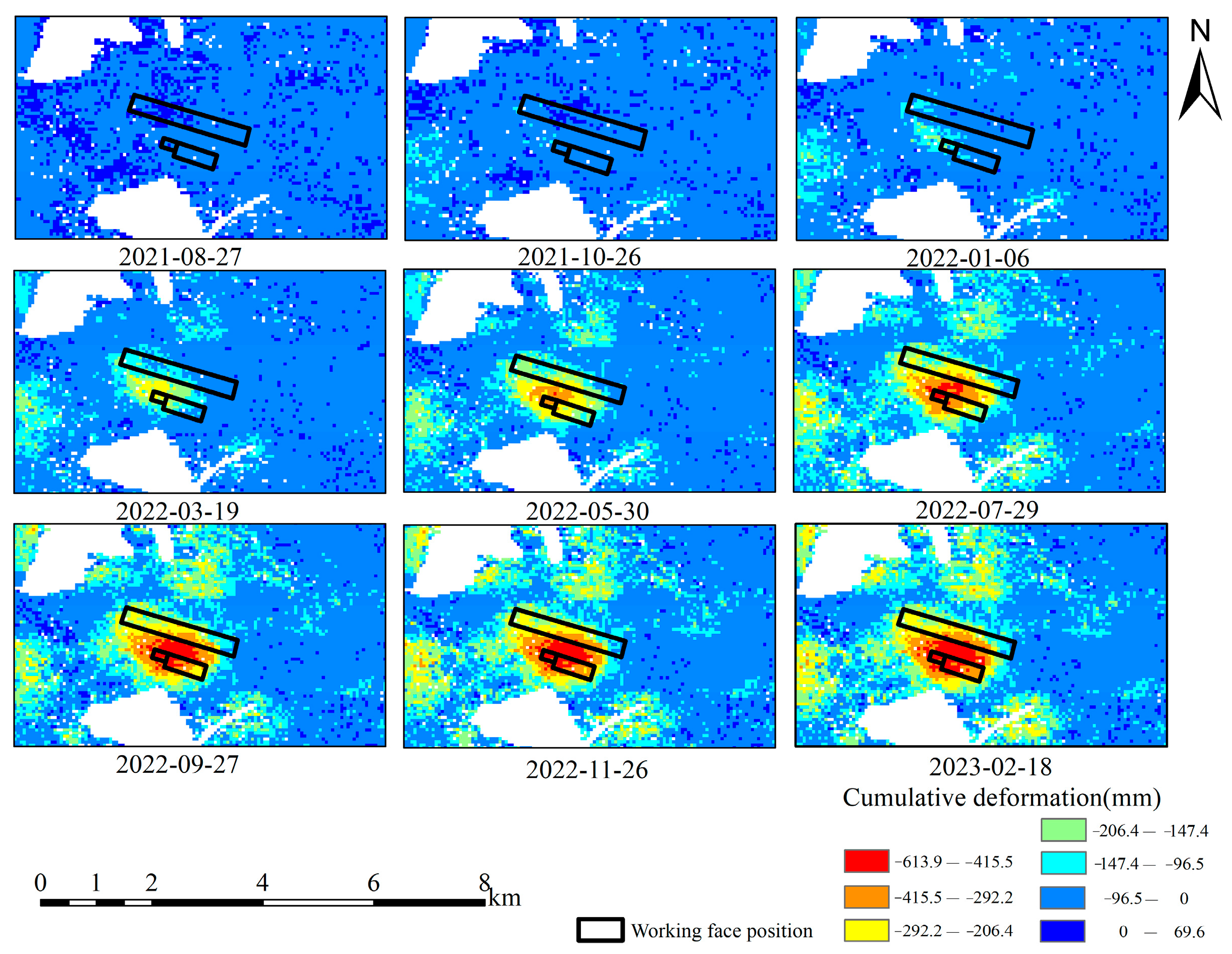
Figure 6 shows that the maximum cumulative deformation occurs in the zone between the 1613 (3) and 1611 (1) working faces, where a clear subsidence bowl has developed. Over the study period, the cumulative line of sight displacement spans from −613.9 mm to 69.6 mm. Positive values are mainly found near the margins and in areas with weak deformation. They do not represent the same physical process as the negative subsidence signal, but mainly reflect relative motion with respect to the chosen reference area and local residual variability. To better track the temporal evolution, we provide nine cumulative deformation maps at roughly 2–3-month intervals in Figure 7. All maps are referenced to the baseline date of 10 July 2021.
Figure 7 depicts the spatiotemporal evolution of cumulative deformation at roughly three-month intervals, with all maps referenced to 10 July 2021. Between August and October 2021, deformation is weak and shows no coherent spatial pattern. A localized subsidence center emerges near the working face in early 2022. From March to May 2022, the subsidence bowl intensifies and expands along the strike of the working face.
After mid-2022, the spatial footprint of the bowl changes little, whereas the cumulative displacement continues to grow. The maximum deformation is reached on 18 February 2023. In general, deformation clusters around the goaf and its surrounding area, supporting a mining-related origin.
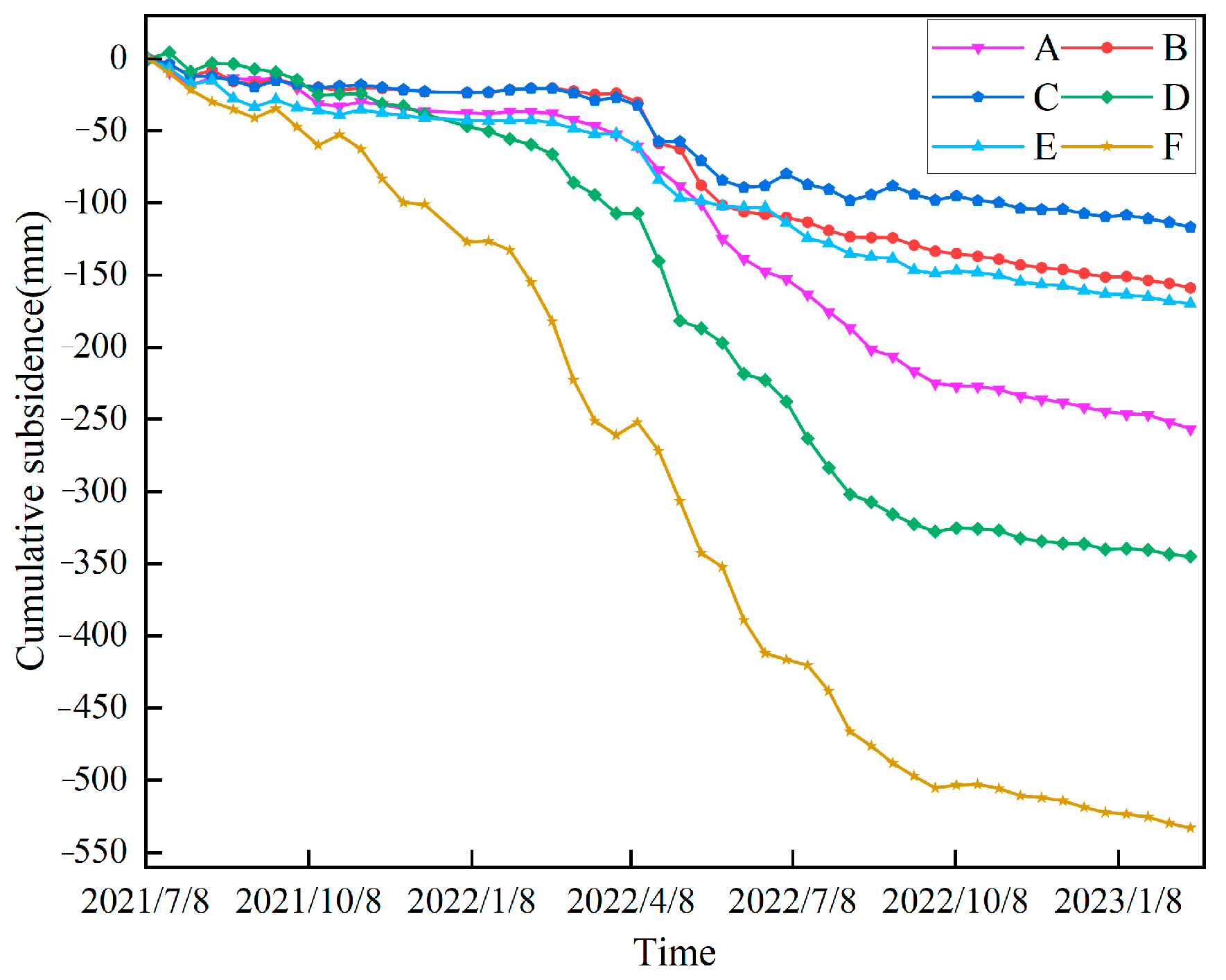
The cumulative deformation time series for all six benchmarks are presented in Figure 8.
Figure 8 further reveals clear spatial differences: Point F shows the greatest subsidence, followed by Point D, while Point A is moderate and Points B, E, and C exhibit smaller deformations. These variations reflect the spatial heterogeneity caused by mining activities and indicate that the subsidence at these points is representative of the study area’s overall deformation pattern. This provides a reliable data basis for the subsequent experiments and modeling.

3.2. Effectiveness of the Generative Model

Each InSAR monitoring point provides only 49 observations, which is limited for training deep sequence models and increases the risk of overfitting. To mitigate this issue, we apply the proposed TCN-TimeGAN to augment the training data at each point. For each site, the generator produces approximately four times as many synthetic training sequences as real ones, and the downstream predictor is trained on a mixed dataset consisting of real and generated sequences with an approximate ratio of 1:4. This augmentation ratio was adopted to substantially increase training diversity under the small-sample setting while avoiding excessive reliance on synthetic data, which may introduce distributional bias. The generator is trained on the training split only and outputs synthetic sequences with the same window length as the real samples. We first assessed generation quality using t-distributed Stochastic Neighbor Embedding (t-SNE) visualization [45].
Hyperparameters were selected to balance capacity and stability under small-sample InSAR series (49 observations per site). We kept a compact model (hidden_dim = 8 with shallow stacks) and a moderate window length (16) to preserve temporal context while maintaining enough training windows. Larger hidden dimensions were also tested during pilot runs but tended to overfit due to the limited number of training samples. The noise dimension (noise_dim = 16) controls the diversity of the latent noise vector used to generate synthetic sequences; a moderate value was adopted to provide sufficient variability while maintaining stable adversarial training. The learning rate (0.005), batch size (16), and number of attention heads (4) were selected based on pilot experiments using the same generation-quality criteria, with the aim of achieving stable convergence and high-fidelity sequence synthesis. The specific network hyperparameter configurations are detailed in Table 3.
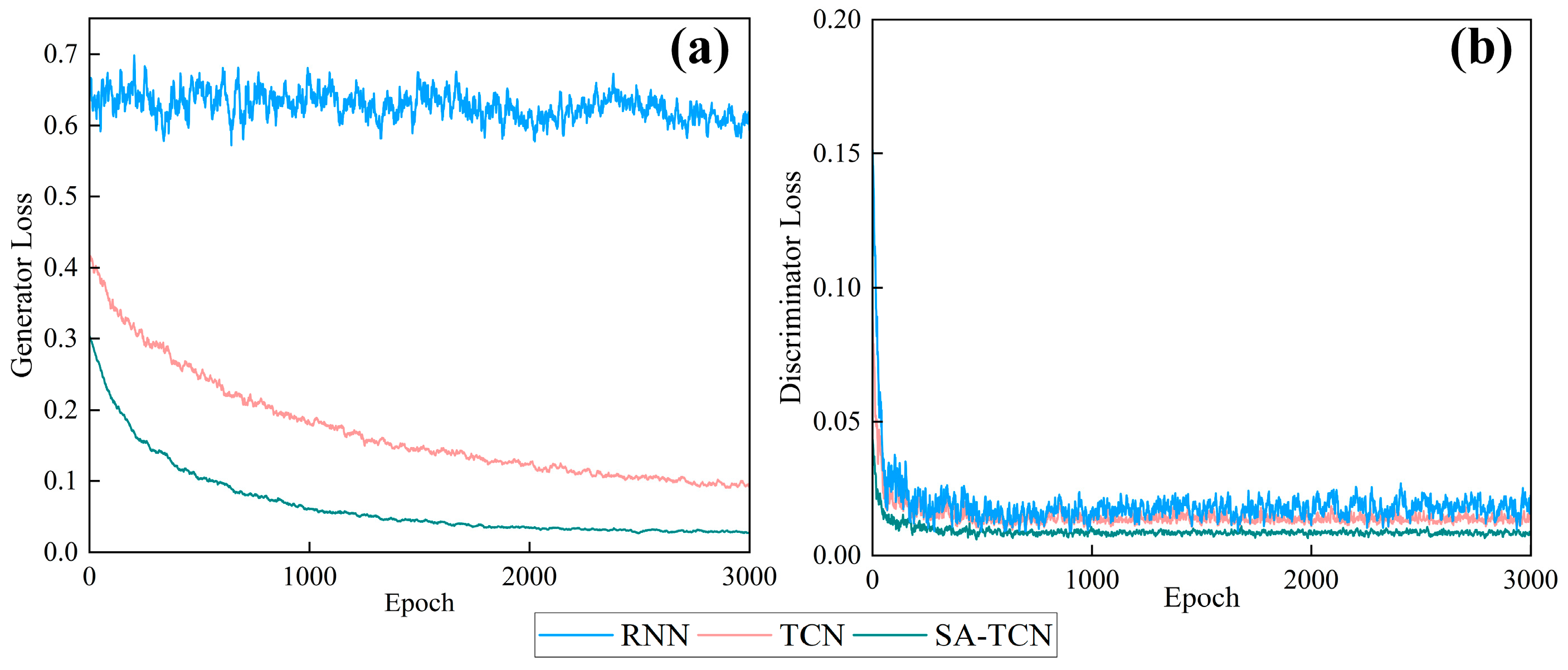
To assess the contribution of the key architectural components in TCN-TimeGAN, we conduct a staged ablation study on the temporal modeling backbone used in both the generator and discriminator. Starting from an RNN-based backbone as the baseline, we replace it with a TCN to enlarge the temporal receptive field, and then add a self-attention layer on top of the TCN (SA-TCN). All other settings follow Table 3, so the observed differences can be attributed to the backbone design. Figure 9 shows the loss convergence trajectories of all variants during training.
As shown in Figure 9, introducing TCN and SA-TCN leads to faster and more stable loss reduction than the RNN baseline, and the final steady level is also lower. The recurrent baseline exhibits pronounced oscillations in both generator and discriminator losses, together with slower convergence, suggesting less stable optimization when modeling long-range dependencies under adversarial learning. After replacing the backbone with TCN, the oscillation amplitude decreases markedly and the convergence rate improves, which is consistent with the benefit of an enlarged temporal receptive field. When self-attention is further added on top of TCN, the loss decreases again and oscillations are suppressed more effectively, indicating additional gains from global dependency modeling beyond convolutional context aggregation.
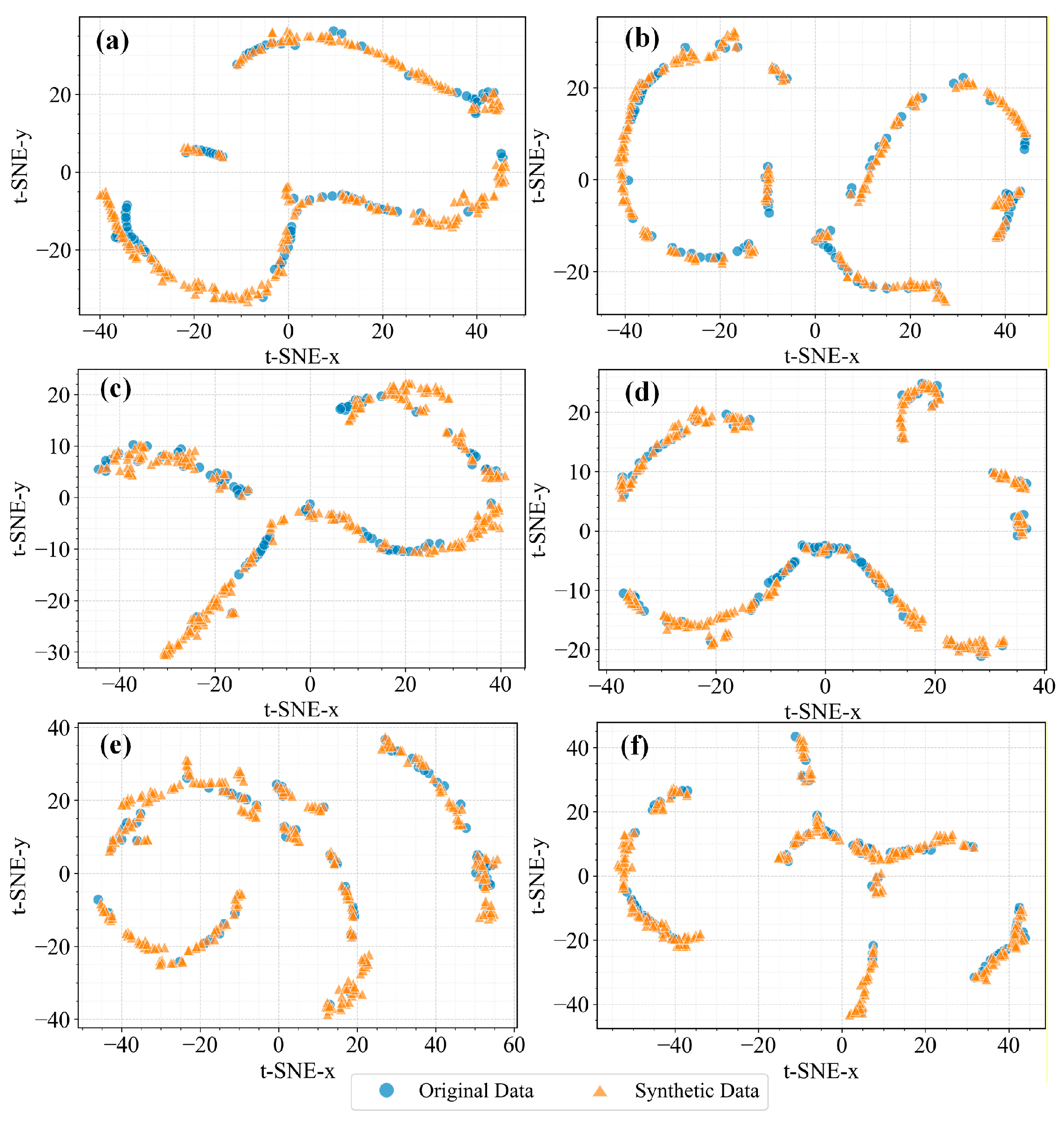
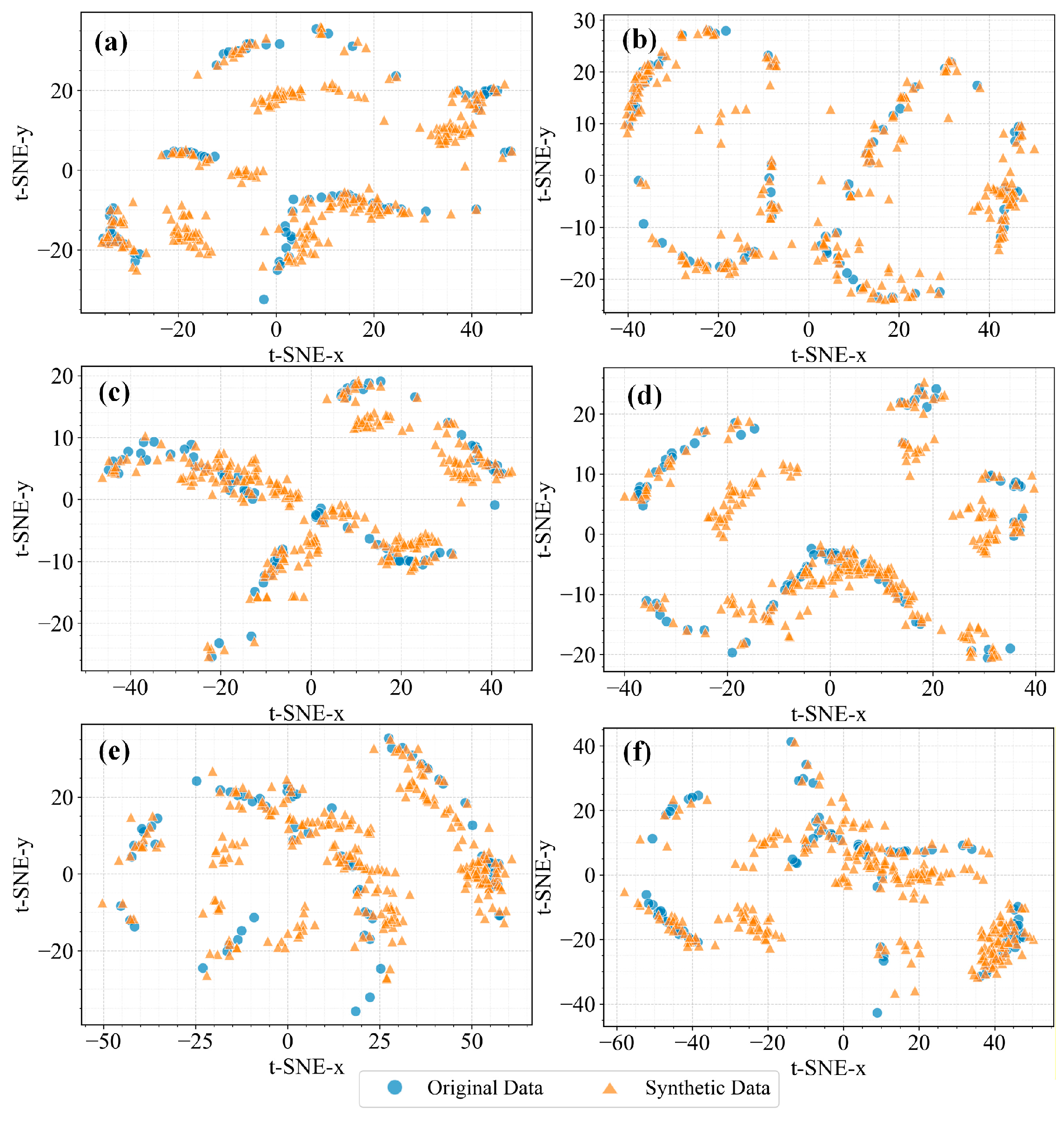
With the improved adversarial training stability validated above, we next evaluate the fidelity and distribution alignment of the generated sequences using t-SNE visualization. To assess the effectiveness of the proposed design, we compare it with standard TimeGAN as a baseline. Feature visualizations contrasting the augmented and original sequences at each monitoring site are shown in Figure 10 and Figure 11. For visualization clarity, the t-SNE plots are generated using randomly sampled subsets of both real and synthetic sequences rather than the entire augmented dataset. This sampling strategy keeps the point densities comparable and improves visual interpretability.
Figure 10 shows the t-SNE projections of the synthetic sequences generated by the traditional TimeGAN alongside the original sequences at six monitoring sites. The traditional model reproduces the general distributional patterns of the real data; however, noticeable discrepancies persist at several sites, including distributional shifts, local cluster misalignment, and insufficient fitting near the boundaries. These issues indicate that the traditional TimeGAN has limited capability in capturing complex deformation patterns.
In contrast, the improved TimeGAN demonstrates markedly more stable behavior across all monitoring sites, as illustrated in Figure 11. The synthetic samples closely match the original data in terms of local geometric structures, overall trajectory trends, and boundary contours. The overlap in the feature space is markedly improved, demonstrating that the generated samples effectively capture the intrinsic manifold of the real deformation series.
We additionally employed three quantitative fidelity metrics to rigorously evaluate generation quality: (1) Maximum Mean Discrepancy (MMD) to measure distributional similarity between real and generated data [46]; (2) Dynamic Time Warping (DTW) to quantify temporal alignment with the nearest real sequence [47]; and (3) Coverage to evaluate how well the synthetic data span the real distribution [48]. The quantitative results of these metrics are reported in Table 4.
Table 4 shows that TCN-TimeGAN outperforms the conventional TimeGAN at all six monitoring points. It yields lower MMD and DTW and higher Coverage throughout. On average, MMD drops by about 68 percent, indicating a closer match between the synthetic samples and the real data distribution. The mean DTW decreases from 0.48 to 0.29, reflecting better alignment of temporal patterns. Coverage also improves, rising from 0.78 to 0.91 on average, which suggests broader support over the real data space. Taken together, these gains point to synthetic sequences that are both more realistic and more diverse than those produced by the baseline. This provides a stronger augmented dataset for the subsequent prediction experiments.
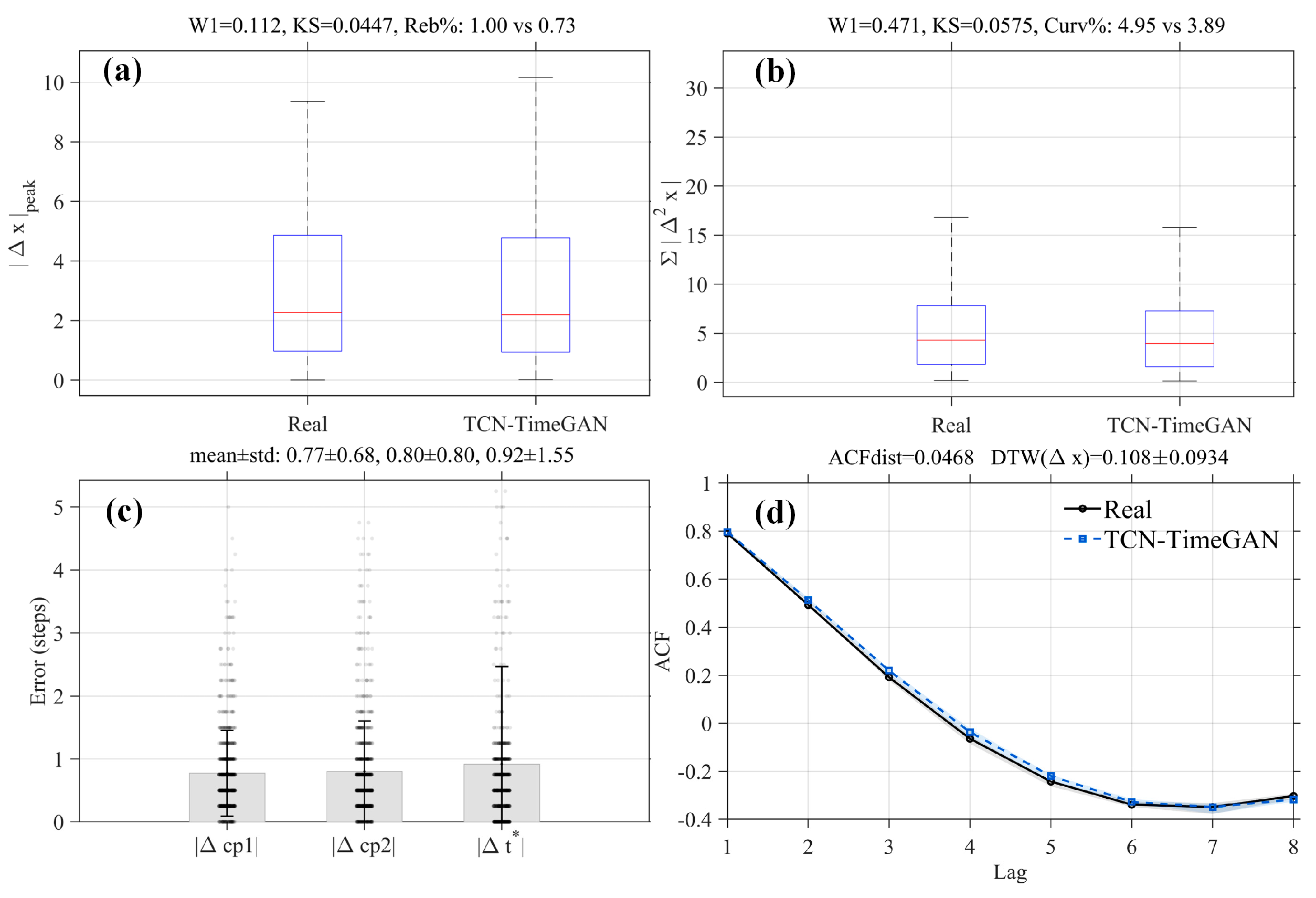
When the generation quality is evaluated only by t-SNE visualization together with statistical metrics such as MMD, DTW, and Coverage, synthetic sequences may appear statistically similar to real data while still failing to reproduce the underlying temporal dynamics. To further examine whether the sequences generated by TCN-TimeGAN preserve the essential dynamic characteristics of the real subsidence process, an additional diagnostic analysis based on sliding windows with a length of 16 is conducted, as illustrated in Figure 12. Real and synthetic samples are compared from four aspects, including rate magnitude, smoothness behavior, stage structure, and short-term autocorrelation. All synthetic sequences are generated using models trained only on the training portion of the data.
Figure 12 compares the dynamic behavior of the real subsidence sequences with that of the TCN-TimeGAN-generated samples from four perspectives, including rate magnitude, smoothness, stage evolution, and short-term temporal dependence. In Figure 12a,b, the synthetic sequences show distributions of peak subsidence rate and smoothness that remain close to those of the real data, with small W1 and KS distances and low violation rates. This suggests that the generated samples preserve the main intensity and regularity of short-term deformation without introducing obvious unrealistic fluctuations.
Figure 12c,d further examine whether the temporal evolution is maintained. The estimated changepoint locations and peak-rate timing exhibit similar error distributions between real and synthetic sequences, indicating that the principal stage structure of the subsidence process is broadly retained. In addition, the autocorrelation curves of the rate series remain close, and both ACF distance and DTW statistics stay small, supporting the consistency of short-term temporal dynamics. Taken together, these results suggest that TCN-TimeGAN does not merely reproduce the overall distribution of the training data, but also captures the main dynamic characteristics of the subsidence process.

3.3. Parameter Efficiency and Robustness Analysis of KAN

We examine how prediction performance changes with model capacity and assess the robustness of KAN against conventional neural architectures. In standard multilayer perceptrons, nonlinear mapping is realized mainly through stacked fully connected layers, which can lead to parameter redundancy. KAN adopts a different parameterization. It models nonlinearity with learnable univariate functions placed on edges and aggregates their contributions by summation. This structure improves interpretability and can reduce redundant degrees of freedom.
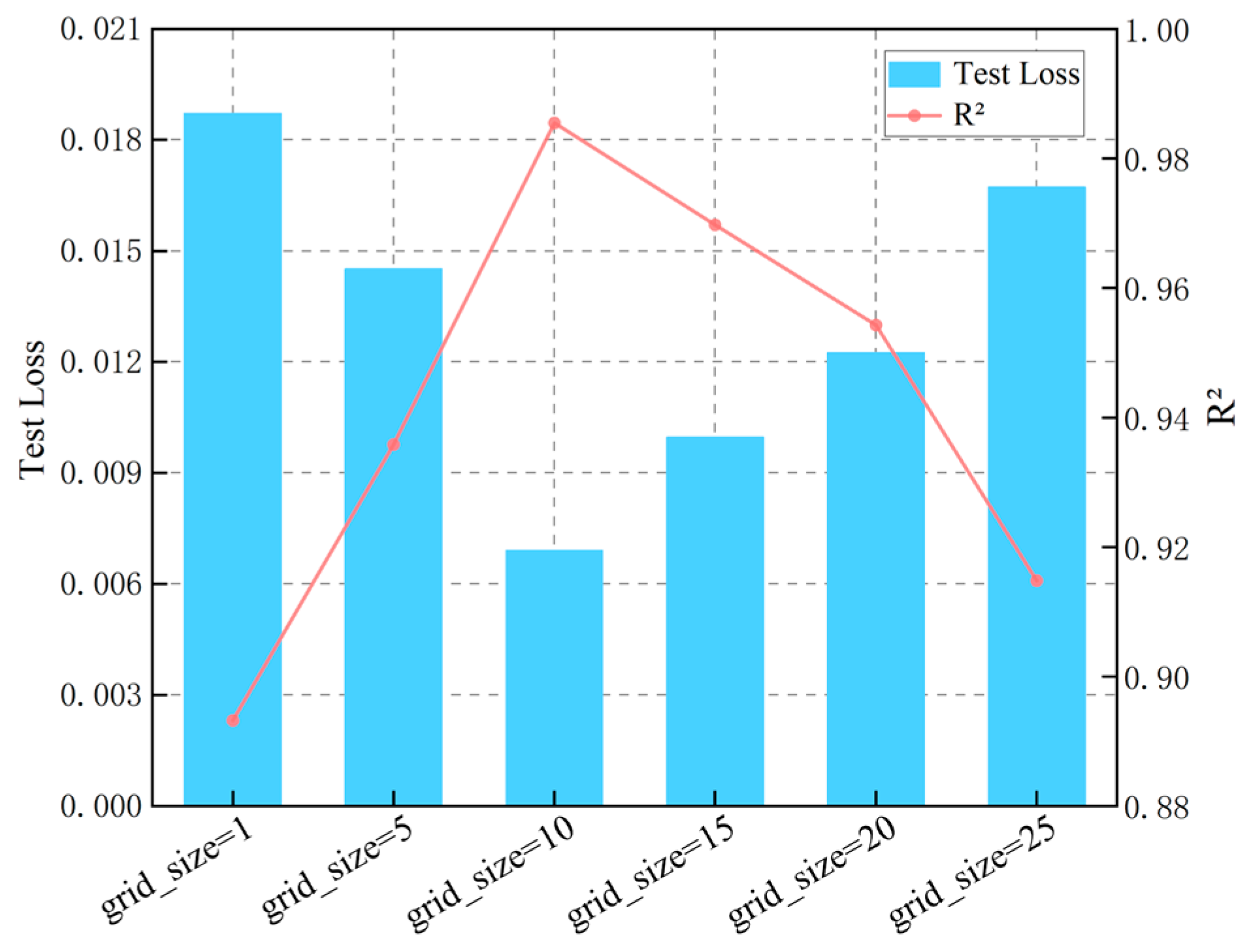
In the KAN model, grid size is a crucial parameter that represents the number of segments for each input feature in the spline function. This parameter directly impacts the model’s expressive power and computational efficiency. Specifically, a larger grid size results in a finer spline function, which can capture more intricate patterns and nonlinear relationships in input features. However, an excessively large grid size may lead to overfitting, increased computational costs, and slower training speeds.
Conversely, a smaller grid size produces a smoother and coarser spline function, speeding up computation but potentially failing to learn detailed features in the time series data, resulting in underfitting. To determine the optimal grid size, we conducted experiments with grid sizes of 1, 5, 10, 15, 20, and 25. The evaluation was based on test loss and R2 scores to identify the optimal grid size. We selected the TCN-TimeGAN augmented dataset at point A as the experimental dataset. After normalizing the data, 80% of the dataset was used as the training set, 10% as the validation set, and the remaining 10% as the test set. The detailed settings of the model’s parameters are listed in Table 5.
And the experimental results are shown in Figure 13.
As shown in Figure 13, the test loss first decreases and then increases as the grid size increases. When the grid size is 1 or 5, the model fails to effectively learn the temporal features of the data, resulting in a relatively high test loss. At a grid size of 10, the model achieves the lowest test loss. For grid sizes of 15, 20, and 25, although the model’s fitting capability improves, overfitting occurs, leading to a decline in generalization performance and an increase in test loss. The corresponding R2 values show a similar trend, reaching near-maximum values at a grid size of 15, indicating that the model best fits the overall trend at this grid size. Therefore, in subsequent experiments, the grid size was set to 10.
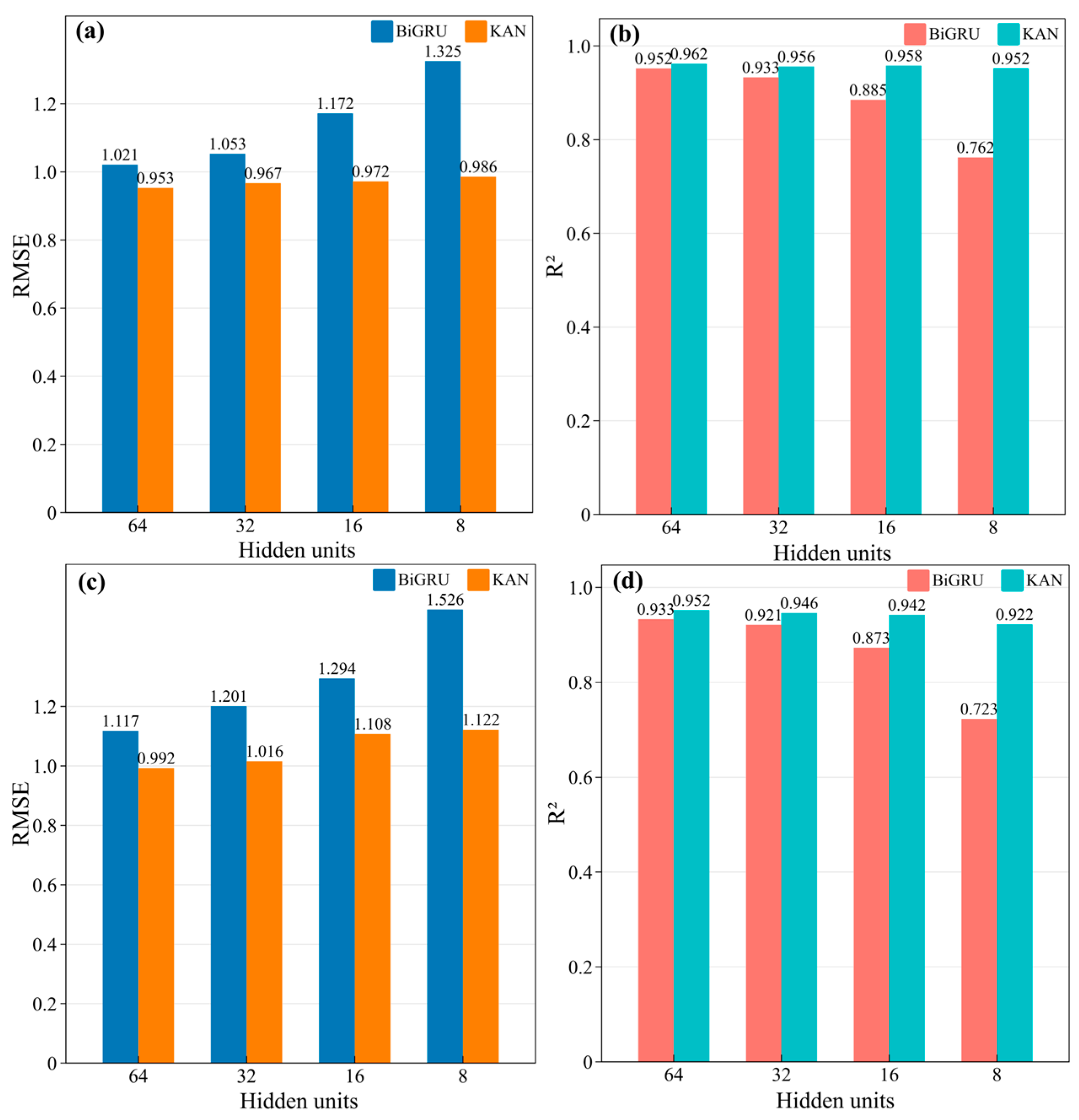
In our setting, capacity is largely controlled by network width, measured by the number of neurons per layer. We therefore test whether KAN preserves accuracy when the width is constrained. This provides an empirical view of its robustness under limited capacity. BiGRU is widely used for time-series prediction [49,50,51]. This experiment is designed to address two questions. First, we test whether KAN achieves higher accuracy than BiGRU under the same protocol. Second, we examine how KAN performs when model capacity is constrained by a small width.
This split is used only for the capacity-sensitivity analysis. We use the TCN-TimeGAN augmented datasets from monitoring points B and E as representative cases. After normalization, each dataset is split chronologically into 80 percent for training, 10 percent for validation, and 10 percent for testing to prevent temporal leakage. The same split and evaluation procedure are used for both models to ensure a fair comparison.
For KAN, the core configuration is kept fixed across all runs. For the BiGRU baseline, we set the dropout rate to 0.3 and keep the remaining settings consistent with the protocol. We vary the neuron count at 8, 16, 32, and 64. Here, neuron count denotes the layer width in KAN and the hidden size in BiGRU. Performance is evaluated using RMSE and R2. The results are summarized in Figure 14.
Figure 14 demonstrates a consistent advantage of KAN over BiGRU across all tested capacities, with the largest gains at the smallest neuron counts. At point B with 8 neurons, KAN attains an RMSE of 0.986 mm and an R2 of 0.952, whereas BiGRU yields 1.325 mm and 0.762. At point E under the same setting, KAN reports 1.122 mm and 0.922, compared with 1.526 mm and 0.723 for BiGRU. These gaps correspond to RMSE increases of 34.4% and 36.0% for BiGRU at points B and E, respectively. Collectively, the results indicate that BiGRU is more sensitive to capacity reduction, while KAN preserves accuracy more effectively in the low-capacity regime.
At 64 neurons, BiGRU largely closes the gap to KAN. RMSE is 0.953 mm for KAN and 1.021 mm for BiGRU at point B, and 0.992 mm versus 1.117 mm at point E. The remaining differences are 6.7% and 11.2%, respectively. Capacity therefore benefits BiGRU more strongly. Yet KAN still leads under the same neuron budget, with lower RMSE and higher R2 on both datasets. This pattern indicates greater width robustness for KAN and suggests that BiGRU requires larger hidden states to match its accuracy. KAN is thus well suited to the small-sample, low-capacity setting considered here.

3.4. Effectiveness Analysis of Surface Deformation Prediction

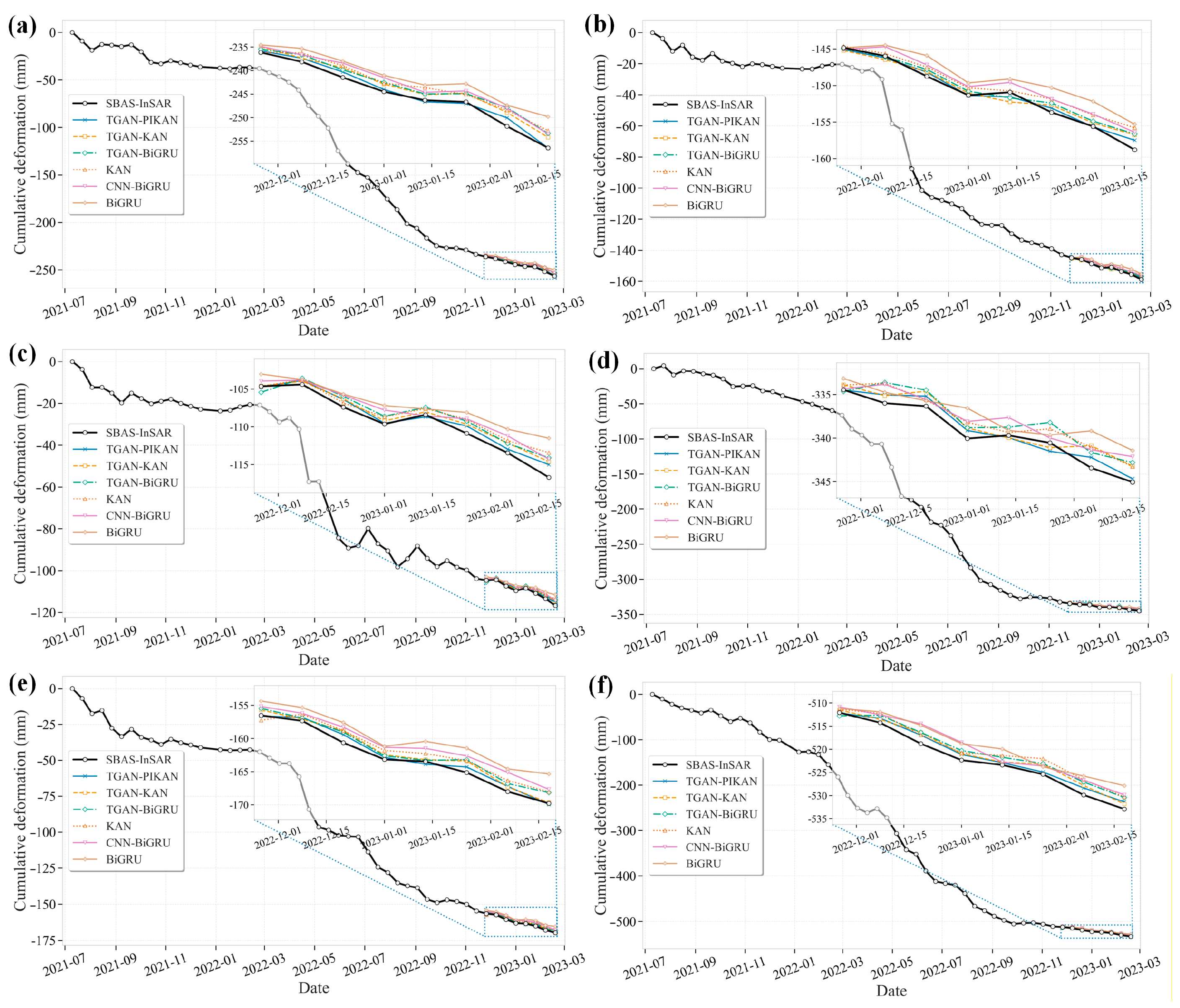
Following the validation of the generative module and the KAN architecture, Experiment 3.4 evaluates the comprehensive performance of the proposed TGAN-PIKAN framework on real-world deformation forecasting tasks. For this task, we used the final eight periods of surface deformation data (from 26 November 2022, to 18 February 2023) as the test set, with the remaining data as the training set. Unlike the capacity-sensitivity analysis, this fixed hold-out setting is designed to mimic a realistic deployment scenario with a strictly future test segment.
To prevent temporal data leakage, a strict ‘split-then-train’ protocol was adopted. The training and test sets were first separated chronologically, and all normalization parameters were fitted using the training split only and then applied to both splits. The TCN-TimeGAN was trained exclusively on the training split, and the synthetic samples were used only to augment the training data for forecasting; the test split was reserved solely for final evaluation. For each site, we considered two training sets: (i) original and (ii) augmented (generated per site). We conducted predictions on the original training set using KAN, BiGRU, and the widely used CNN-BiGRU model. On the augmented set, we evaluated KAN, BiGRU, and the proposed PI-KAN. The results for these predictions are denoted as TGAN-KAN, TGAN-BiGRU, and TGAN-PIKAN, respectively. The prediction results for each point are shown in Figure 15.
As shown in Figure 15, the BiGRU, CNN-BiGRU, and KAN models trained on the original dataset generally reproduce the overall trends of surface deformation. However, noticeable deviations emerge during periods of rapid subsidence or near inflection points because of the limited number of training samples. Owing to its one-dimensional decomposition and B-spline-based nonlinear approximation, the KAN model shows stronger robustness, whereas CNN-BiGRU enhances local feature extraction during specific stages. Nevertheless, both models remain constrained by the limited sample size when characterizing complex, nonlinear, time-varying deformation features.
With the introduction of generative data augmentation, the overall prediction accuracy improves markedly. Both TGAN-KAN and TGAN-BiGRU outperform their counterparts trained on the original dataset, indicating that the generated samples compensate for deficiencies in the original sequences and enhance the models’ ability to learn more complete deformation patterns. Building on this improvement, incorporating physical constraints into the KAN architecture further enhances the stability of PI-KAN predictions, yielding smoother temporal variations and deformation trends that better reflect the actual deformation process. Experimental results show that, when supported by the augmented data, PI-KAN achieves the best performance in trend fitting and phase-specific deformation responses, while also showing superior agreement with the ground-truth SBAS-InSAR sequences.
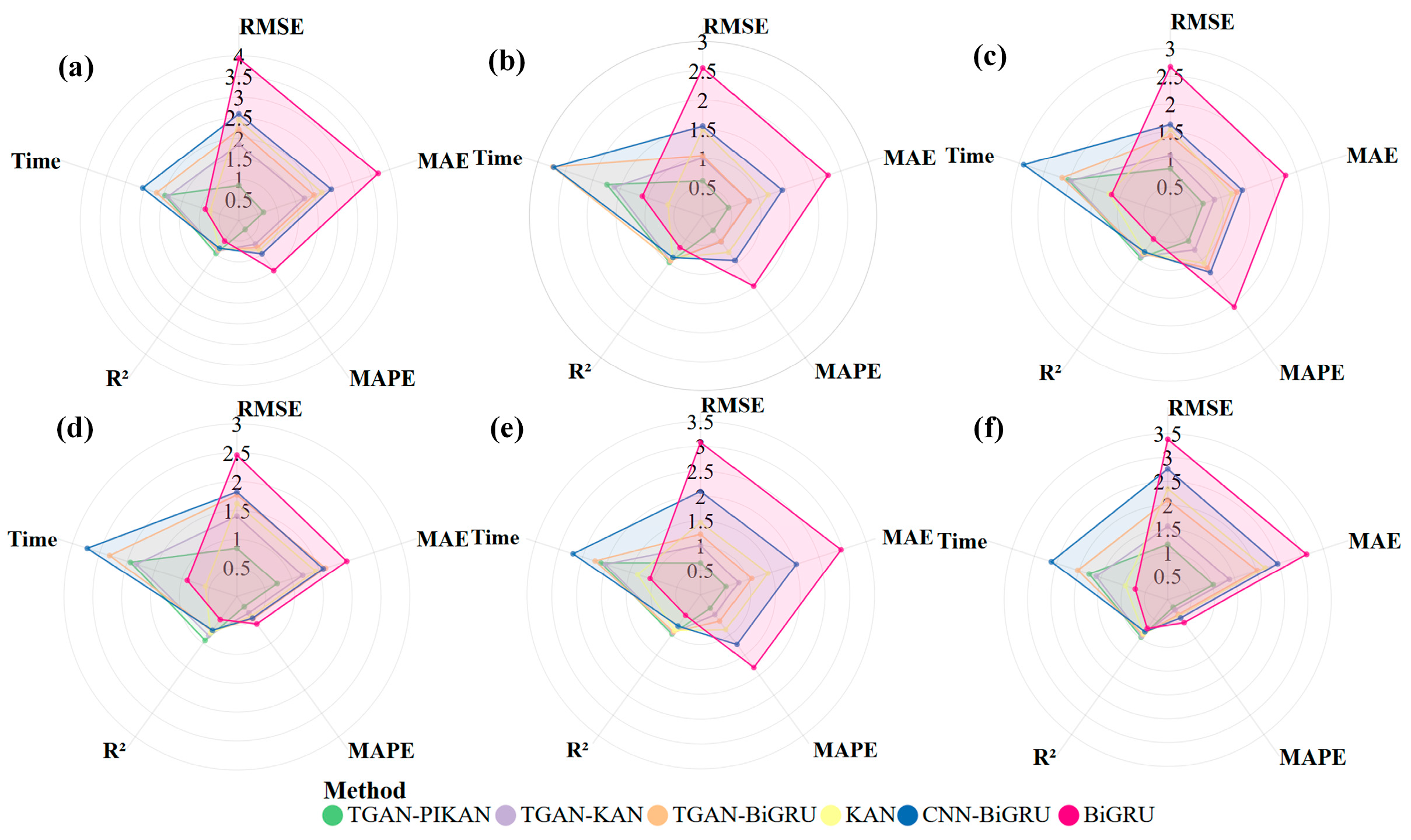
In earlier experimental phases, we primarily examined the prediction curves of the models on the test set. To quantify each method’s strengths and weaknesses from multiple perspectives, we gathered various quantitative metrics for each model’s predictions. Specifically, we assessed the models using five metrics: RMSE, MAE, MAPE, R2, and Runtime. For TGAN-KAN, TGAN-BiGRU, and our proposed method, the computational cost of the TCN-TimeGAN training was explicitly incorporated into the total runtime metric. This approach offers a more comprehensive view of the time and resource requirements in a complete prediction workflow under practical conditions. The detailed quantitative comparisons of the models at each point appear in Figure 16.
Figure 16 summarizes point-wise prediction performance at the six monitoring sites using five criteria, including error measures, goodness of fit, and runtime. Smaller errors and shorter runtime are preferred, while a higher R2 indicates a better fit.
Across sites, TGAN-PIKAN provides the strongest overall balance. It reduces errors and improves R2 at most locations. Relative to KAN trained on the original samples, TGAN-KAN achieves lower errors, suggesting that generative augmentation improves generalization when observations are limited. Adding physics-informed regularization in TGAN-PIKAN brings a further gain and yields more stable site-level predictions. By comparison, BiGRU produces larger errors at several sites, and CNN-BiGRU is the most time-consuming. The average quantitative metrics for the overall experimental setup are summarized in Table 6.
As shown in Table 6, both TGAN-KAN and TGAN-BiGRU yield substantially lower average errors than the original KAN and BiGRU models without data augmentation. For instance, the RMSE of TGAN-KAN decreases to 1.317, and its MAPE drops from 0.741 (KAN) to 0.523. Its R2 increases to 0.920, with TGAN-BiGRU achieving 0.875—both markedly higher than the baseline values. These results suggest that generative augmentation alleviates small-sample limitations. Building on these improvements, the proposed PI-KAN model delivers the best performance across all metrics. Although the training phase requires more time than original models, the added computational cost is justified by the significant gains in accuracy and reliability. Overall, the method shows clear advantages for small-sample time-series prediction.

3.5. Model Interpretability Analysis

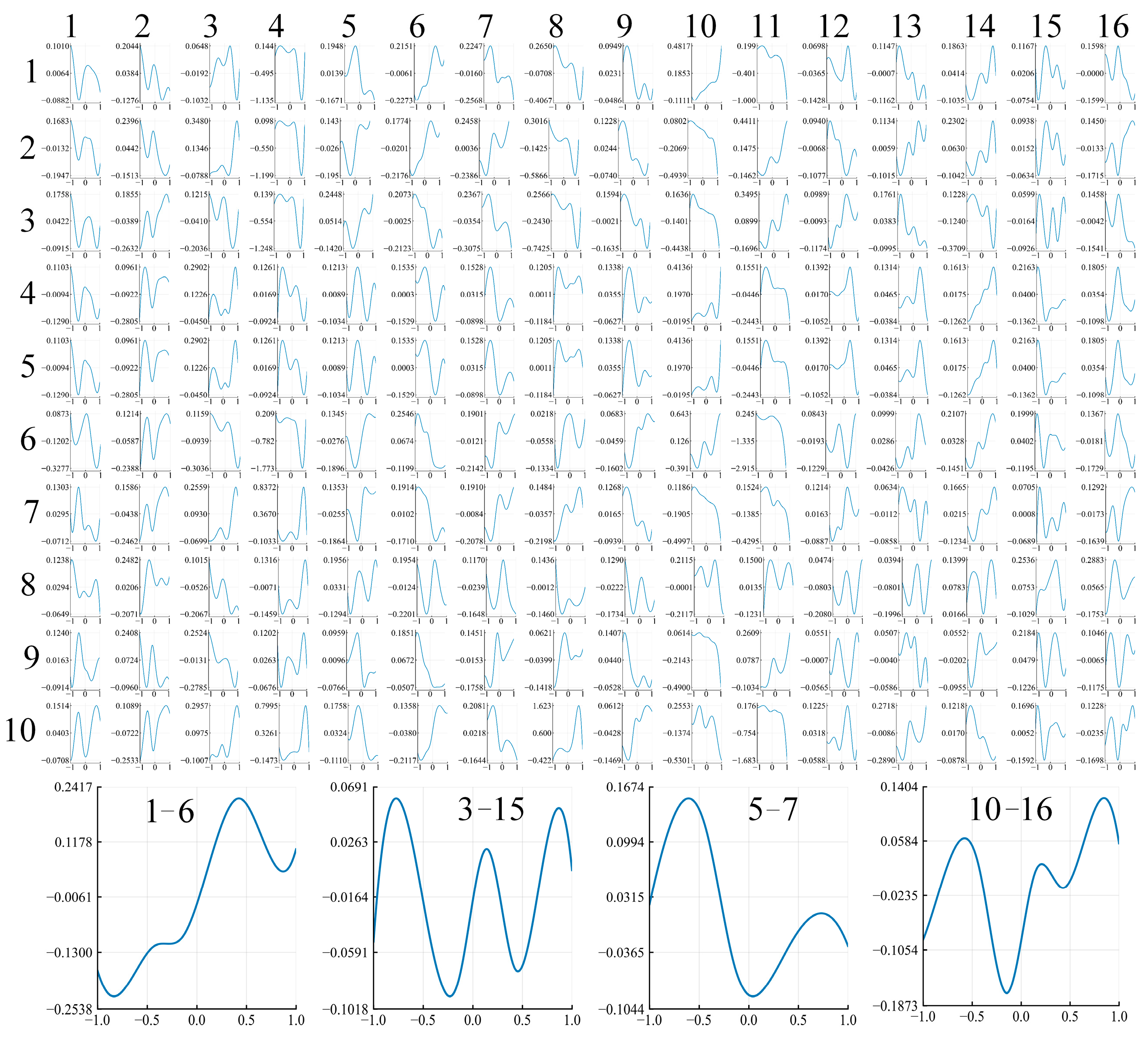
KAN improves interpretability by parameterizing nonlinear transformations with learnable univariate functions defined on network edges. In our forecasting setup, each lagged deformation value in the input window is treated as a separate input dimension. Its contribution is transmitted to the hidden units through edge functions. Each edge function is represented by B-spline basis functions defined on a fixed knot grid.
This experiment uses an input window length of 16, matching Experiment 3.4. For monitoring point A, we visualize the first-layer edge functions learned by PI-KAN. With a hidden width of 10, the first layer contains 160 univariate edge functions, corresponding to the 16 by 10 lag to hidden connections. Figure 17 arranges these functions as a grid. The horizontal axis shows the normalized value of the relevant lagged input, and the vertical axis shows the output of the learned edge function. This view makes the nonlinear transformation applied to each lag explicit before the network aggregates the contributions.
Figure 17 offers an interpretable view of the spline mappings learned by PI-KAN across the input window. Each panel corresponds to one lagged time step and one spline channel. The curve shape and magnitude indicate how that temporal component is transformed before it contributes to the final deformation estimate. Large, structured responses imply a stronger nonlinear contribution, whereas nearly flat curves suggest a limited marginal effect.
The internal mappings are consistent with the physics-informed design of PI-KAN. The subsidence-oriented constraint discourages non-physical uplift responses, and the smoothness term reduces sharp curvature and high-frequency oscillations. Together, these regularizers promote stable mappings that remain physically plausible.
The enlarged panels at the bottom provide representative examples. Mappings at earlier time steps are typically smoother and less complex, consistent with an emphasis on longer-term background trends. By contrast, mappings closer to the forecast horizon show richer nonlinear structure, indicating a greater reliance on short-term dynamics when subsidence accelerates or changes regime. Overall, Figure 17 illustrates how PI-KAN distributes temporal influence while preserving physically consistent trend evolution.

4. Discussion

4.1. Core Findings and Framework Positioning

Our results outline a coherent generation–prediction–interpretation pipeline for sparse InSAR time series. TCN-TimeGAN-augmented training combined with physics-informed PI-KAN yields the most accurate and stable forecasts for sparse InSAR deformation time series, while preserving interpretability through spline-based internal mappings that reveal stronger short-term influence near the forecast horizon.
Recent studies have increasingly adopted attention-based and Transformer-based models for InSAR deformation forecasting to capture long-range temporal dependencies [52,53]. Such models are often effective when sequences are long, information-rich, and supplemented with additional covariates.
The setting addressed here is different. We focus on site-level forecasting from short and temporally sparse InSAR time series, with 49 observations per site. In this regime, the empirical training distribution is narrow, and purely data-driven black-box predictors can be sensitive to sampling variability. Our framework counters this limitation in two ways. Generative augmentation broadens the representativeness of the training set. Physics-informed learning then regularizes the predictor through subsidence-consistency and smoothness priors. The accuracy and stability gains in Table 6 suggest that these inductive biases are especially valuable when data are limited.
Future work will include stronger Transformer baselines evaluated under identical data splits and input information. This will help clarify the trade-off between attention models that typically benefit from richer data and physics-informed, parameter-efficient predictors designed for low-data forecasting.

4.2. Mechanism Analysis of the Physics-Informed Regularization

The effectiveness of the proposed framework can also be understood from the roles played by its different components. In PI-KAN, physics is introduced through soft penalties that discourage non-physical uplift and overly large curvature. This differs from classical physics-informed neural networks, which often enforce governing equations through PDE residuals. For mining subsidence forecasting with sparse line-of-sight observations, soft constraints are a practical choice. Fully specified geomechanical models typically require parameters that are difficult to identify from InSAR alone. In addition, InSAR time series can show small apparent uplifts caused by reference-point selection and residual atmospheric effects. Monotonicity and smoothness should therefore be viewed as stabilizing priors, not as strict physical laws.
These priors can be unsuitable when genuine rebound is present or when observation biases dominate. Examples include groundwater recovery and backfilling operations. In such cases, stage-aware or piecewise constraints that allow different regimes are preferable. Another promising direction is to incorporate explicit mechanical priors, including Probability Integral Method formulations and constitutive relations, when auxiliary mining and geotechnical information is available.
In this study, we monitor augmentation quality with MMD, DTW, and Coverage in Table 4. These criteria are useful, but they do not guarantee dynamic realism. For deployment, we recommend a more defensive workflow. All augmentation and regularization thresholds should be set using the training data only. Synthetic sequences should be screened to remove outliers, using DTW to the nearest real sequence or discriminator-based plausibility scores. Performance should also be stress-tested against the proportion of synthetic data used for training. These checks reduce the risk of unrealistic transitions, especially near segment boundaries and during rapid deformation.

4.3. Methodological Advantages and Practical Relevance

From a deployment perspective, the runtime in Table 6 is dominated by training the generative module. This is consistent with the well-known cost of adversarial training. For near-real-time use, the overhead can be reduced by adopting lighter generator designs, exploiting parallel computation, and moving most training to periodic offline updates with incremental refresh. The predictor can then remain lightweight for online inference.
The spline-based KAN structure is also appealing for resource-limited settings. It can retain competitive accuracy at modest widths and provides transparent internal mapping.
In areas where leveling or GNSS ground truth is unavailable, prediction reliability can still be examined through time-split hindcast using held-out InSAR observations. Additional diagnostics can be performed using the same physical priors adopted in PI-KAN, such as monotonic subsidence tendency within a tolerance and smooth deformation evolution. When available, these checks may also be complemented by spatial consistency across neighboring monitoring points or consistency with mining activity records. These aspects will be explored in future multi-area deployments to further improve robustness.

4.4. Limitations and Future Directions

This study was evaluated using data from the Guqiao Coal Mine only; therefore, the generalizability of the proposed framework to other mining districts with different seam depths, overburden structures, and mining methods remains to be verified. However, the six monitoring benchmarks are not confined to a single local setting. They are distributed across the subsidence basin influenced by two adjacent mining panels and exhibit clear differences in deformation magnitude and temporal evolution. This spatial heterogeneity provides a preliminary assessment of the model’s robustness under varying subsidence intensities.
Evidence beyond the Guqiao site is also suggested by our related study in the Banji mining area, where generative-model-based data augmentation was shown to improve small-sample InSAR time-series prediction [40]. Although that work did not employ the full framework proposed here, it provides additional support for the transferability of the augmentation concept. A systematic cross-mine evaluation of the complete framework, such as training on one mine and testing on another or performing leave-one-mine-out validation, will be pursued when multi-area datasets become available.
In this study, each benchmark provides 49 InSAR observations, which allows a sliding-window strategy to construct sufficient training segments. When the time series becomes extremely sparse, for example when fewer than 20 observations are available, the number of usable windows and the information available to constrain temporal dynamics are substantially reduced. As a result, the performance of both the generative and predictive components may deteriorate. Although generative augmentation improves performance in our experiments, it cannot guarantee improvement in all situations. Time-series GANs may propagate or amplify noise when the seed observations contain significant errors, and the generation process may smooth rare but important deformation behaviors if it is not sufficiently constrained.
In practice, missing acquisitions often lead to irregular temporal sampling. The current implementation treats the input as a sequence indexed by discrete time steps and therefore implicitly assumes regular sampling. When irregular intervals occur, the observations can be mapped onto a regular temporal grid through resampling or interpolation. A more general extension would be to incorporate the time gap between consecutive observations as an additional input feature so that the model can account for varying temporal intervals.
Future work will validate the framework across diverse mining conditions and other deformation processes. It will also investigate conditional generation and forecasting that incorporate external drivers such as mining schedules, groundwater level, and rainfall. Robustness should be assessed under missing observations and varying revisit intervals.


5. Conclusions

This study presents a generation–prediction framework for forecasting mining-induced deformation from sparse InSAR time series. To address the small-sample regime, we employ a TCN-enhanced TimeGAN to synthesize additional deformation sequences for training. For forecasting, we introduce a physics-informed Kolmogorov–Arnold Network, termed PI-KAN, in which subsidence-consistency and smoothness priors are embedded into the learning objective. This design improves physical plausibility while preserving spline-based interpretability through visualizable edge functions.
Experiments on SBAS-InSAR time series from the Guqiao coal mine demonstrate improved site-level forecasting accuracy under the same data split and input-window setting. The proposed framework outperforms deep-learning baselines and KAN variants. Generative augmentation reduces prediction errors relative to training on the original samples alone, while physics-informed regularization further stabilizes the forecasts by suppressing non-physical fluctuations. The learned spline mappings also provide interpretable insight into the temporal sensitivity of lagged inputs. Overall, the proposed framework delivers more accurate and physically consistent forecasts for short and sparse InSAR deformation time series.

Author Contributions

Conceptualization, Y.H.; Methodology, Y.H. and J.Y.; Validation, Y.H.; Data curation, Y.H. and J.Y.; Writing—original draft, Y.H.; Writing—review and editing, J.Y., M.S. and L.L.; Funding acquisition J.Y. All authors have read and agreed to the published version of the manuscript.

Funding

This research was funded by Scientific Research Foundation for High-level Talents of Anhui University of Science and Technology, grant number 2022yjrc66 and Coal Industry Engineering Research Center of Mining Area Environmental and Disaster Cooperative Monitoring (Anhui University of Science and Technology), grant number KSXTJC202207.

Data Availability Statement

This study uses both public and restricted data. Public inputs include Sentinel-1A SAR imagery, the 30 m SRTM DEM, and Precise Orbit Determination (POD) data provided by the European Space Agency; these resources are openly available from ESA repositories and were used to derive the InSAR time-series products in this study. The processed, site-specific deformation time series, leveling observations at points A–F, georeferenced InSAR products for the Guqiao coal mine, and project metadata were obtained under a collaboration agreement with the mining partner and contain sensitive information about critical infrastructure and operations. Disclosing these data publicly would contravene contractual confidentiality obligations and could raise safety and privacy concerns. Accordingly, these materials cannot be deposited in a public repository. Deidentified and aggregated derivatives and analysis code sufficient to reproduce the figures and metrics can be shared for non-commercial academic research upon reasonable request to the corresponding author Jiajia Yuan (yuanjiajia@aust.edu.cn), subject to approval by the partner institution and the authors’ institutional office. Requests will be evaluated to ensure that data sharing does not violate ethical, privacy, security, or contractual requirements.

Acknowledgments

We express our sincere appreciation to all who supported this research. We gratefully acknowledge the European Space Agency for providing the Sentinel-1A SAR data essential to this study, as well as the providers of the Shuttle Radar Topography Mission (SRTM) Digital Elevation Model and Precise Orbit Determination (POD) data. Any errors or omissions remain the responsibility of the authors.

Conflicts of Interest

The authors declare no conflicts of interest.

References

  1. Li, Y.X.; Yang, K.M.; Zhang, J.H.; Hou, Z.X.; Wang, S.; Ding, X.M. Research on time series InSAR monitoring method for multiple types of surface deformation in mining area. Nat. Hazards 2022, 114, 2479–2508. [Google Scholar] [CrossRef]
  2. Tao, R.; Lau, A.; Mossefin, M.E.; Kong, G.; Nordal, S.; Pan, Y. Monitoring of ground displacement-induced railway anomalies using PS-InSAR techniques. Measurement 2025, 248, 116863. [Google Scholar] [CrossRef]
  3. Ma, P.; Jiao, Z.; Wu, Z. Robust time-series InSAR deformation monitoring by integrating variational mode decomposition and gated recurrent units. IEEE J. Sel. Top. Appl. Earth Obs. Remote Sens. 2024, 18, 3208–3221. [Google Scholar] [CrossRef]
  4. Yang, Z.; Li, Z.; Zhu, J.; Wang, Y.; Wu, L. Use of SAR/InSAR in mining deformation monitoring, parameter inversion, and forward predictions: A review. IEEE Geosci. Remote Sens. Mag. 2020, 8, 71–90. [Google Scholar] [CrossRef]
  5. Hu, Y.; Lei, H.; Zheng, G.; Shi, L.; Zhang, T.; Shen, Z.; Jia, R. Assessing the deformation response of double-track overlapped tunnels using numerical simulation and field monitoring. J. Rock Mech. Geotech. Eng. 2022, 14, 436–447. [Google Scholar] [CrossRef]
  6. Xue, F.; Lv, X.; Dou, F.; Yun, Y. A review of time-series interferometric SAR techniques: A tutorial for surface deformation analysis. IEEE Geosci. Remote Sens. Mag. 2020, 8, 22–42. [Google Scholar] [CrossRef]
  7. Chen, B.; Yu, H.; Zhang, X.; Li, Z.; Kang, J.; Yu, Y.; Qin, L. Time-varying surface deformation retrieval and prediction in closed mines through integration of SBAS InSAR measurements and LSTM algorithm. Remote Sens. 2022, 14, 788. [Google Scholar] [CrossRef]
  8. Li, C.; Xi, X.; Zhang, G.; Song, X.; Shan, X. A deep-learning neural network for postseismic deformation reconstruction from InSAR time series. IEEE Trans. Geosci. Remote Sens. 2024, 62, 4505214. [Google Scholar] [CrossRef]
  9. Zhang, W.; Li, H.; Tang, L.; Gu, X.; Wang, L.; Wang, L. Displacement prediction of Jiuxianping landslide using gated recurrent unit (GRU) networks. Acta Geotech. 2022, 17, 1367–1382. [Google Scholar] [CrossRef]
  10. Anantrasirichai, N.; Biggs, J.; Kelevitz, K.; Sadeghi, Z.; Wright, T.; Thompson, J.; Bull, D. Detecting ground deformation in the built environment using sparse satellite InSAR data with a convolutional neural network. IEEE Trans. Geosci. Remote Sens. 2020, 59, 2940–2950. [Google Scholar] [CrossRef]
  11. Wang, J.; Li, C.; Li, L.; Huang, Z.; Wang, C.; Zhang, H.; Zhang, Z. InSAR time-series deformation forecasting surrounding Salt Lake using deep transformer models. Sci. Total Environ. 2023, 858, 159744. [Google Scholar] [CrossRef]
  12. Huo, T.; He, Y.; Zhang, L.; Yang, W.; Tang, J.; Zhang, Q.; Zhang, Y. GLER-BiGRUnet: A surface deformation prediction model fusing multiscale features of InSAR deformation information and environmental factors. IEEE J. Sel. Top. Appl. Earth Obs. Remote Sens. 2024, 17, 14848–14861. [Google Scholar] [CrossRef]
  13. Meng, S.; Shi, Z.; Peng, M.; Li, G.; Zheng, H.; Liu, L.; Zhang, L. Landslide displacement prediction with step-like curve based on convolutional neural network coupled with bi-directional gated recurrent unit optimized by attention mechanism. Eng. Appl. Artif. Intell. 2024, 133, 108078. [Google Scholar] [CrossRef]
  14. Yao, S.; Jing, C.; He, X.; He, Y.; Zhang, L. A TDFC-RNNs framework integrated temporal convolutional attention mechanism for InSAR surface deformation prediction: A case study in Beijing Plain. Int. J. Appl. Earth Obs. Geoinf. 2024, 134, 104199. [Google Scholar] [CrossRef]
  15. Khalili, M.A.; Guerriero, L.; Pouralizadeh, M.; Calcaterra, D.; Di Martire, D. Monitoring and prediction of landslide-related deformation based on the GCN-LSTM algorithm and SAR imagery. Nat. Hazards 2023, 119, 39–68. [Google Scholar] [CrossRef]
  16. Yang, H.; Liu, Y.; Han, Q.; Xu, L.; Zhang, T.; Wang, Z.; Ao, Y.; Zhao, S.; Han, J.; Wang, Y. Improved landslide deformation prediction using convolutional neural network–gated recurrent unit and spatial–temporal data. Remote Sens. 2025, 17, 727. [Google Scholar] [CrossRef]
  17. Zhu, M.; Yu, X.; Tan, H.; Yuan, J.; Chen, K.; Xie, S.; Han, Y.; Long, W. High-precision monitoring and prediction of mining area surface subsidence using SBAS-InSAR and CNN-BiGRU-Attention model. Sci. Rep. 2024, 14, 28968. [Google Scholar] [CrossRef]
  18. Xiao, Y.; Tao, Q.; Hu, L.; Liu, R.; Li, X. A deep learning-based combination method of spatio-temporal prediction for regional mining surface subsidence. Sci. Rep. 2024, 14, 19139. [Google Scholar] [CrossRef] [PubMed]
  19. Chen, Y.; Shi, Z.; Eziz, A.; Zheng, S.; Ilniyaz, O.; Azadi, H.; Van de Voorde, T.; Kurban, A. Improving altitudinal accuracy of Sentinel-1 InSAR DEM in arid flat terrain: A machine learning approach with UAV photogrammetry and multi-source data. Geo-spat. Inf. Sci. 2025, 28, 1–23. [Google Scholar] [CrossRef]
  20. Wang, T.; Zhang, Q.; Wu, Z. A deep-learning-facilitated, detection-first strategy for operationally monitoring localized deformation with large-scale InSAR. Remote Sens. 2023, 15, 2310. [Google Scholar] [CrossRef]
  21. Lyu, M.; Li, X.; Ke, Y.; Jiang, J.; Lin, Z.; Guo, L.; Gong, H.; Chen, B.; Xu, Z.; Zhang, K.; et al. Reconstruction of spatially continuous time-series land subsidence based on PS-InSAR and improved MLS-SVR in Beijing Plain area. GISci. Remote Sens. 2023, 60, 2230689. [Google Scholar] [CrossRef]
  22. Eldele, E.; Ragab, M.; Chen, Z.; Wu, M.; Kwoh, C.-K.; Li, X. Label-efficient time series representation learning: A review. arXiv 2023, arXiv:2302.06433. [Google Scholar] [CrossRef]
  23. Zhang, H.K.; Camps-Valls, G.; Liang, S.; Tuia, D.; Pelletier, C.; Zhu, Z. Preface: Advancing deep learning for remote sensing time series data analysis. Remote Sens. Environ. 2025, 322, 114711. [Google Scholar] [CrossRef]
  24. Meng, A.; Zhang, H.; Yin, H.; Xian, Z.; Chen, S.; Zhu, Z.; Wang, X. A novel multi-gradient evolutionary deep learning approach for few-shot wind power prediction using time-series GAN. Energy 2023, 283, 129139. [Google Scholar] [CrossRef]
  25. Gao, H.; Zhang, X.; Gao, X.; Li, F.; Han, H. ICoT-GAN: Integrated convolutional transformer GAN for rolling bearings fault diagnosis under limited data condition. IEEE Trans. Instrum. Meas. 2023, 72, 3515114. [Google Scholar] [CrossRef]
  26. Shangguan, A.; Xie, G.; Fei, R.; Mu, L.; Hei, X. Train wheel degradation generation and prediction based on the time series generation adversarial network. Reliab. Eng. Syst. Saf. 2023, 229, 108816. [Google Scholar] [CrossRef]
  27. Li, Q.; Zhang, X.; Ma, T.; Liu, D.; Wang, H.; Hu, W. A multi-step ahead photovoltaic power forecasting model based on TimeGAN, Soft DTW-based K-medoids clustering, and a CNN-GRU hybrid neural network. Energy Rep. 2022, 8, 10346–10362. [Google Scholar] [CrossRef]
  28. Yao, H.; Zhao, S.; Gao, Z.; Xue, Z.; Song, B.; Li, F.; Li, J.; Liu, Y.; Hou, Y.; Wang, L. Data-driven analysis on the subbase strain prediction: A deep data augmentation-based study. Transp. Geotech. 2023, 40, 100957. [Google Scholar] [CrossRef]
  29. Kim, W.; Jeon, J.; Kim, S.; Jang, M.; Lee, H.; Yoo, S.; Oh, K.J. Prediction of index futures movement using TimeGAN and 3D-CNN: Empirical evidence from Korea and the United States. Appl. Soft Comput. 2025, 171, 112748. [Google Scholar] [CrossRef]
  30. Wang, Y.; Sun, J.; Bai, J.; Anitescu, C.; Eshaghi, M.S.; Zhuang, X.; Rabczuk, T.; Liu, Y. Kolmogorov–Arnold-Informed neural network: A physics-informed deep learning framework for solving forward and inverse problems based on Kolmogorov–Arnold Networks. Comput. Methods Appl. Mech. Eng. 2025, 433, 117518. [Google Scholar] [CrossRef]
  31. Gao, Y.; Hu, Z.; Chen, W.-A.; Liu, M.; Ruan, Y. A revolutionary neural network architecture with interpretability and flexibility based on Kolmogorov–Arnold for solar radiation and temperature forecasting. Appl. Energy 2025, 378, 124844. [Google Scholar] [CrossRef]
  32. Zhang, Y.; Cui, L.; Yan, W. Integrating Kolmogorov–Arnold Networks with Time Series Prediction Framework in Electricity Demand Forecasting. Energies 2025, 18, 1365. [Google Scholar] [CrossRef]
  33. Cho, S.-Y.; Lee, S.; Kim, H.-G. Forecasting VIX using interpretable Kolmogorov-Arnold networks. Expert Syst. Appl. 2025, 294, 128781. [Google Scholar] [CrossRef]
  34. Long, Y.; Qin, X. A multivariate time series prediction model based on the KAN network. Sci. Rep. 2025, 15, 23621. [Google Scholar] [CrossRef]
  35. Meadows, M.; Jones, S.; Reinke, K. Vertical Accuracy Assessment of Freely Available Global DEMs (FABDEM, Copernicus DEM, NASADEM, AW3D30 and SRTM) in Flood-Prone Environments. Int. J. Digit. Earth 2024, 17, 2308734. [Google Scholar] [CrossRef]
  36. Xie, Y.; Bagan, H.; Tan, L.; Te, T.; Damdinsuren, A.; Wang, Q. Time-Series Analysis of Mining-Induced Subsidence in the Arid Region of Mongolia Based on SBAS-InSAR. Remote Sens. 2024, 16, 2166. [Google Scholar] [CrossRef]
  37. Yoon, J.; Jarrett, D.; Van der Schaar, M. Time-series generative adversarial networks. Adv. Neural Inf. Process. Syst. 2019, 32, 5508–5518. [Google Scholar]
  38. Qi, S.; Chen, J.; Chen, P.; Wen, P.; Niu, X.; Xu, L. An efficient GAN-based predictive framework for multivariate time series anomaly prediction in cloud data centers. J. Supercomput. 2024, 80, 1268–1293. [Google Scholar] [CrossRef]
  39. Gu, X.; See, K.W.; Liu, Y.; Arshad, B.; Zhao, L.; Wang, Y. A time-series Wasserstein GAN method for state-of-charge estimation of lithium-ion batteries. J. Power Sources 2023, 581, 233472. [Google Scholar] [CrossRef]
  40. Han, Y.; Yu, X.; Yuan, J.; Zhu, M.; Xie, S. Small-sample InSAR time-series data prediction method based on generative models. Nat. Resour. Res. 2025, 34, 815–838. [Google Scholar] [CrossRef]
  41. Afzal, S.; Ziapour, B.M.; Shokri, A.; Shakibi, H.; Sobhani, B. Building energy consumption prediction using multilayer perceptron neural network-assisted models: Comparison of different optimization algorithms. Energy 2023, 282, 128446. [Google Scholar] [CrossRef]
  42. Liu, Z.; Wang, Y.; Vaidya, S.; Ruehle, F.; Halverson, J.; Soljačić, M.; Tegmark, M. Kan: Kolmogorov-Arnold networks. arXiv 2024, arXiv:2404.19756. [Google Scholar] [CrossRef]
  43. Sulaiman, M.H.; Mustaffa, Z.; Saealal, M.S.; Saari, M.M.; Ahmad, A.Z. Utilizing the Kolmogorov-Arnold networks for chiller energy consumption prediction in commercial building. J. Build. Eng. 2024, 96, 110475. [Google Scholar] [CrossRef]
  44. Sulaiman, M.H.; Mustaffa, Z.; Mohamed, A.I.; Samsudin, A.S.; Rashid, M.I.M. Battery state of charge estimation for electric vehicle using Kolmogorov-Arnold networks. Energy 2024, 311, 133417. [Google Scholar] [CrossRef]
  45. Sun, E.D.; Ma, R.; Zou, J. Dynamic visualization of high-dimensional data. Nat. Comput. Sci. 2023, 3, 86–100. [Google Scholar] [CrossRef]
  46. Li, J.; Cairns, B.J.; Li, J.; Zhu, T. Generating synthetic mixed-type longitudinal electronic health records for artificial intelligent applications. NPJ Digit. Med. 2023, 6, 98. [Google Scholar] [CrossRef] [PubMed]
  47. Jeng, S.-L. Generative adversarial network for synthesizing multivariate time-series data in electric vehicle driving scenarios. Sensors 2025, 25, 749. [Google Scholar] [CrossRef]
  48. Deshpande, R.; Kelkar, V.A.; Gotsis, D.; Kc, P.; Zeng, R.; Myers, K.J.; Brooks, F.J.; Anastasio, M.A. Report on the AAPM grand challenge on deep generative modeling for learning medical image statistics. Med. Phys. 2025, 52, 4–20. [Google Scholar] [CrossRef]
  49. Jin, J.; Jin, Q.; Chen, J.; Wang, C.; Li, M.; Yu, L. Prediction of the tunnelling advance speed of a super-large-diameter shield machine based on a KF-CNN-BiGRU hybrid neural network. Measurement 2024, 230, 114517. [Google Scholar] [CrossRef]
  50. Ma, J.; Huang, X.; Wu, H.; Wang, B.; Dai, L. Bidirectional gated recurrent unit (BiGRU)-based model for concrete gravity dam displacement prediction. Sustainability 2025, 17, 7401. [Google Scholar] [CrossRef]
  51. Jiang, Z.; Tan, Q.; Li, N.; Che, J.; Tan, X. A novel BiGRU multi-step wind power forecasting approach based on multi-label integration random forest feature selection and neural network clustering. Energy Convers. Manag. 2024, 319, 118904. [Google Scholar] [CrossRef]
  52. Shu, C.; Meng, Z.; Yang, Y.; Wang, Y.; Liu, S.; Zhang, X.; Zhang, Y. Deep Learning-Based InSAR Time-Series Deformation Prediction in Coal Mine Areas. Geo-Spat. Inf. Sci. 2025, 28, 2119–2141. [Google Scholar] [CrossRef]
  53. Hu, B.; Li, W.; Lu, W.; Zhao, F.; Li, Y.; Li, R. Integrating InSAR Data and LE-Transformer for Foundation Pit Deformation Prediction. Remote Sens. 2025, 17, 1106. [Google Scholar] [CrossRef]
Figure 1. Basic overview of the study area.
Remotesensing 18 00987 g001
Figure 2. Framework of the self-attention-based TCN-TimeGAN.
Remotesensing 18 00987 g002
Figure 3. Architecture and physics-informed training design of the proposed PI-KAN.
Remotesensing 18 00987 g003
Figure 4. Overall workflow of the proposed framework.
Remotesensing 18 00987 g004
Figure 5. Annual average deformation rate results of the study area.
Remotesensing 18 00987 g005
Figure 6. Cumulative deformation in the study area.
Remotesensing 18 00987 g006
Figure 7. Temporal cumulative deformation results.
Remotesensing 18 00987 g007
Figure 8. Cumulative deformation time series results at the study points.
Remotesensing 18 00987 g008
Figure 9. Loss convergence curves for the ablation of the temporal backbone in the generator and discriminator: (a) Generator loss; (b) Discriminator loss.
Remotesensing 18 00987 g009
Figure 10. t-SNE visualization of real sequences and sequences generated by the traditional TimeGAN at six monitoring points. (a) Point A; (b) Point B; (c) Point C; (d) Point D; (e) Point E; (f) Point F.
Remotesensing 18 00987 g010
Figure 11. t-SNE visualization of real sequences and sequences generated by the improved TCN-TimeGAN at six monitoring points. (a) Point A; (b) Point B; (c) Point C; (d) Point D; (e) Point E; (f) Point F.
Remotesensing 18 00987 g011
Figure 12. Diagnostics of short-term temporal consistency for real and synthetic subsidence sequences. (a) Peak subsidence rate distribution with W1, KS, and rebound violation rate (Reb%); (b) Smoothness indicator distribution | Δ 2 x | with W1, KS, and curvature violation rate (Curv%); (c) Stage consistency errors derived from two-changepoint segmentation, including boundary estimates cp1, cp2 and peak-rate timing t * ; (d) Short-term temporal dependence: ACF distance and DTW of Δ x trajectories; ACFdist denotes the normalized distance between the real and synthetic ACF curves.
Remotesensing 18 00987 g012
Figure 13. Impact of different grid sizes on KAN performance.
Remotesensing 18 00987 g013
Figure 14. Performance comparison between KAN and BiGRU under different hidden widths. (a) RMSE at Point B; (b) R2 at Point B; (c) RMSE at Point E; (d) R2 at Point E.
Remotesensing 18 00987 g014
Figure 15. Site-level forecasting results of different models at six monitoring points. (a) Point A; (b) Point B; (c) Point C; (d) Point D; (e) Point E; (f) Point F.
Remotesensing 18 00987 g015
Figure 16. Radar-chart comparison of point-wise prediction metrics across different models. (a) Point A; (b) Point B; (c) Point C; (d) Point D; (e) Point E; (f) Point F.
Remotesensing 18 00987 g016
Figure 17. Visualization of PI-KAN activation function results.
Remotesensing 18 00987 g017
Table 1. Sentinel-1A data details.
ParametersSentinel-1A
BandC
Direction of orbitAscending
Wavelength/cm5.6
Incidence angle/°39.16
Polarization modeVV
Period/d12
Number of SLCs49
Table 2. Accuracy assessment of SBAS-InSAR processing results.
PointSBAS-InSAR (mm)Leveling (mm)Absolute Error (mm)
A−138.58−143.004.42
B−106.04−109.753.71
C−89.24−94.705.46
D−218.45−223.885.43
E−103.17−97.955.22
F−372.78−379.907.12
Table 3. Network parameters for TCN-TimeGAN training.
ParametersSettings
Sequence length16
Number of sequences2
Hidden_dim8
Noise_dim16
Epochs3000
Batch_size16
Learning_rate0.005
Generator layers3
Supervisor layers2
Discriminator layers3
Embedder layers3
Recovery layers3
Attention heads4
Table 4. Comparison of Generated Data Fidelity between Traditional TimeGAN and Proposed Method.
PointModelMMDDTWCoverage
ATraditional0.1240.450.82
Improved0.0450.280.92
BTraditional0.1580.520.76
Improved0.0470.310.90
CTraditional0.1420.480.79
Improved0.0470.320.89
DTraditional0.1350.490.78
Improved0.0500.330.88
ETraditional0.1100.410.85
Improved0.0410.270.92
FTraditional0.1650.550.70
Improved0.0370.220.96
AverageTraditional0.1390.480.78
Improved0.0450.290.91
Table 5. Hyperparameters of the KAN model.
ParametersSettings
Spline order3
Scale noise0.05
Scale base0.5
Spline Weight Scaling Factor0.5
Smoothing Coefficient0.01
Epochs500
Batch_size32
Table 6. Average quantitative metrics of prediction results from different models.
MethodRMSE/mmMAE/mmMAPER2Time/min
TGAN-PIKAN0.8250.6790.3170.9681.923
TGAN-KAN1.3171.1390.5230.9201.853
TGAN-BiGRU1.6331.4740.6750.8752.398
KAN1.8201.6070.7410.8550.911
CNN-BiGRU2.0761.8980.8980.8112.708
BiGRU3.0132.3911.3380.5960.977
Disclaimer/Publisher’s Note: The statements, opinions and data contained in all publications are solely those of the individual author(s) and contributor(s) and not of MDPI and/or the editor(s). MDPI and/or the editor(s) disclaim responsibility for any injury to people or property resulting from any ideas, methods, instructions or products referred to in the content.