CED-LSTM: A Coherence-Conditioned Encoder–Decoder Network for Robust InSAR Time-Series Deformation Extraction in Open-Pit Mines
 , , , and
Highlights
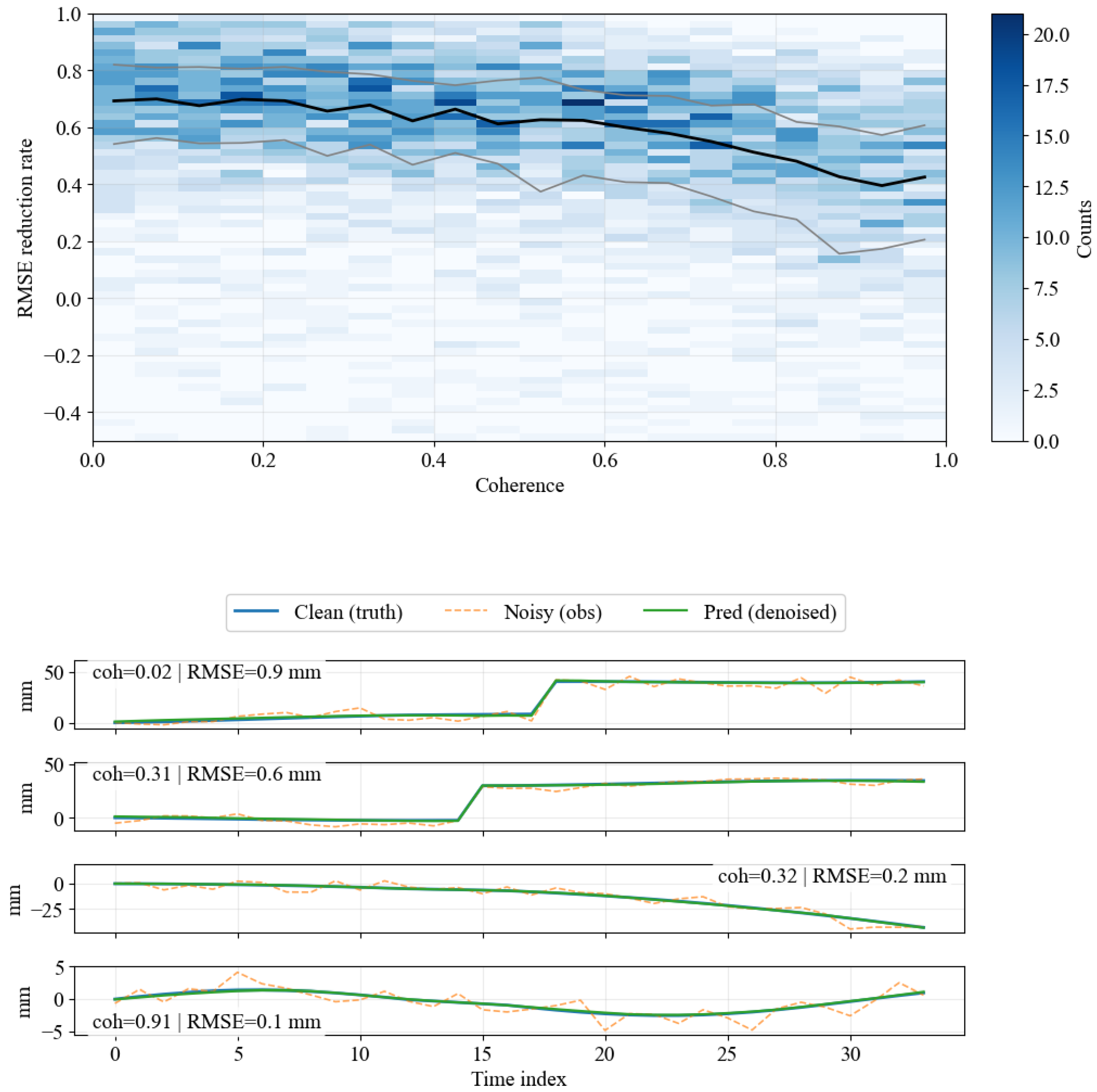
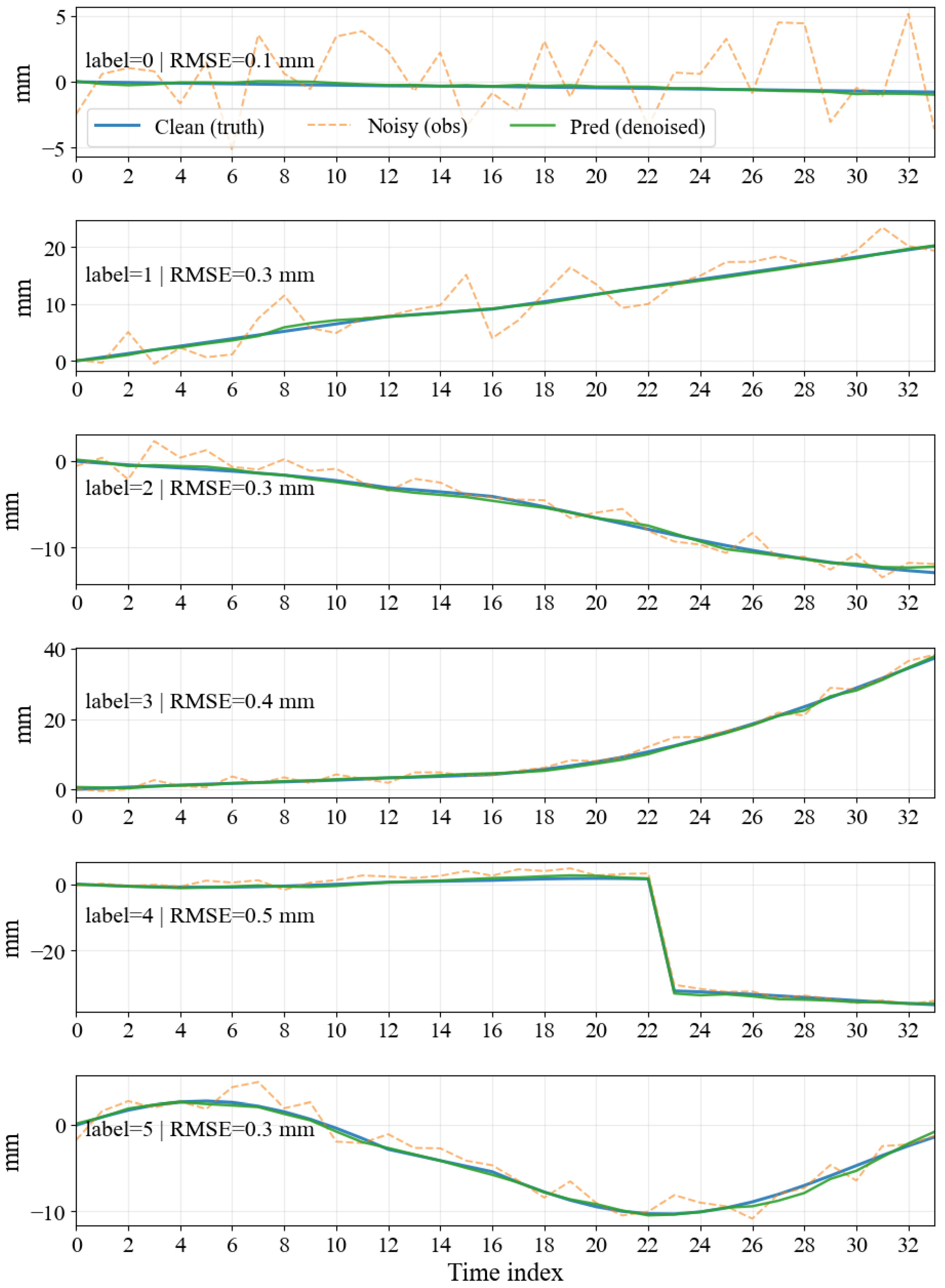
- A coherence-conditioned CED-LSTM denoiser is developed for InSAR deformation time series, reducing noise while preserving deformation signals.
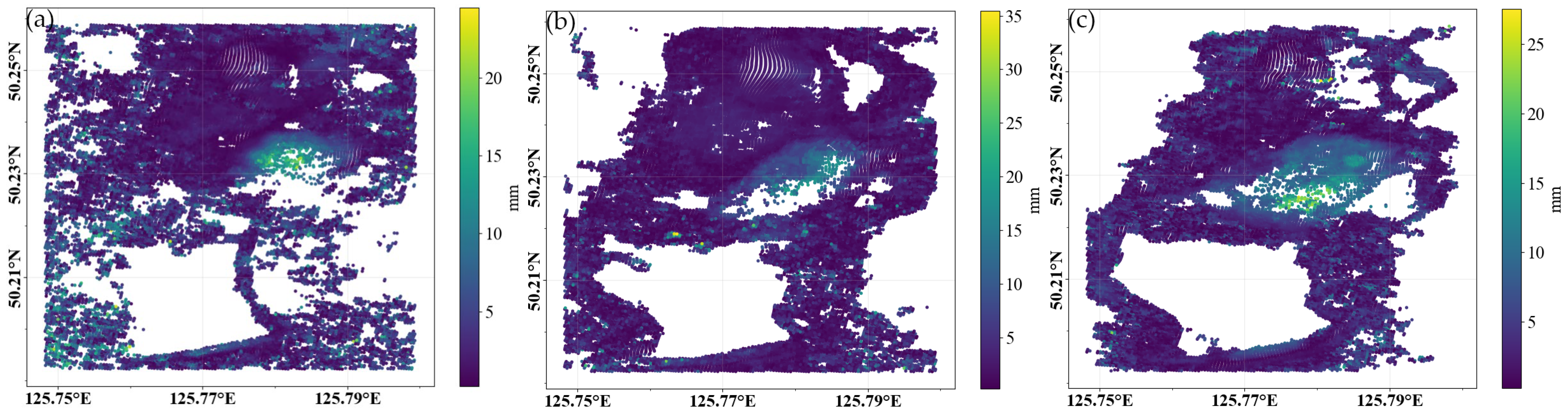
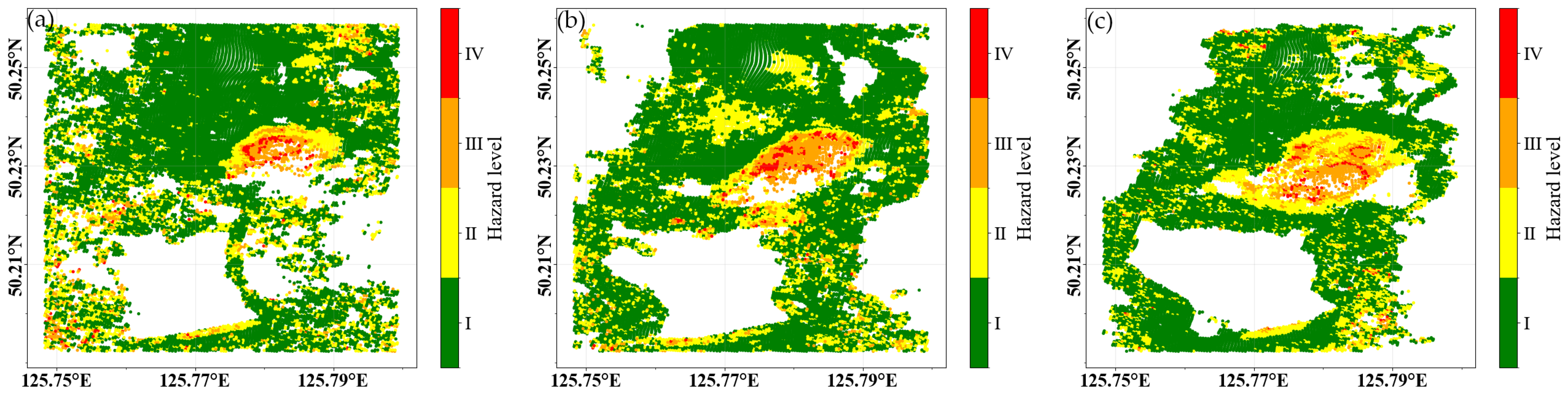
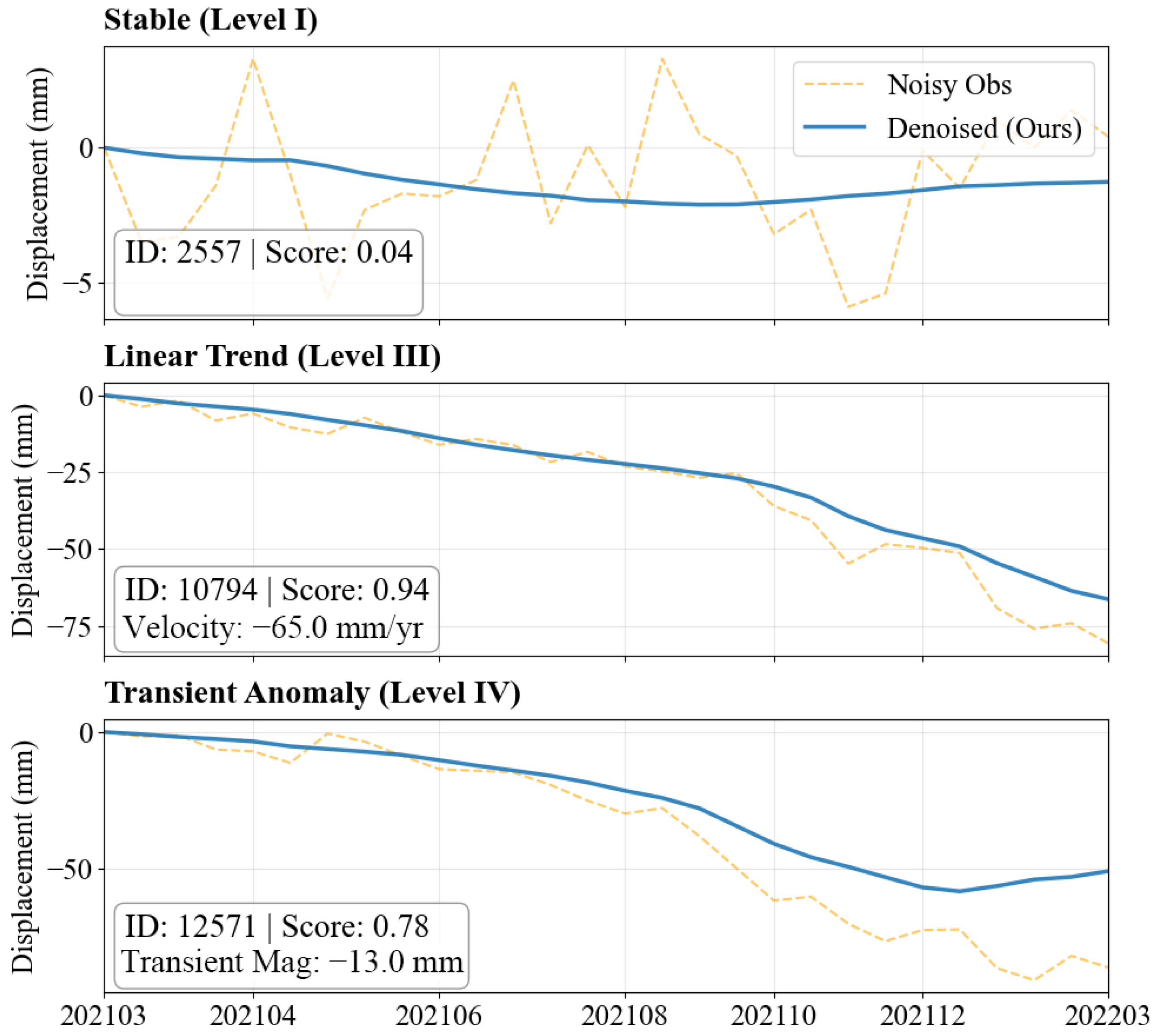
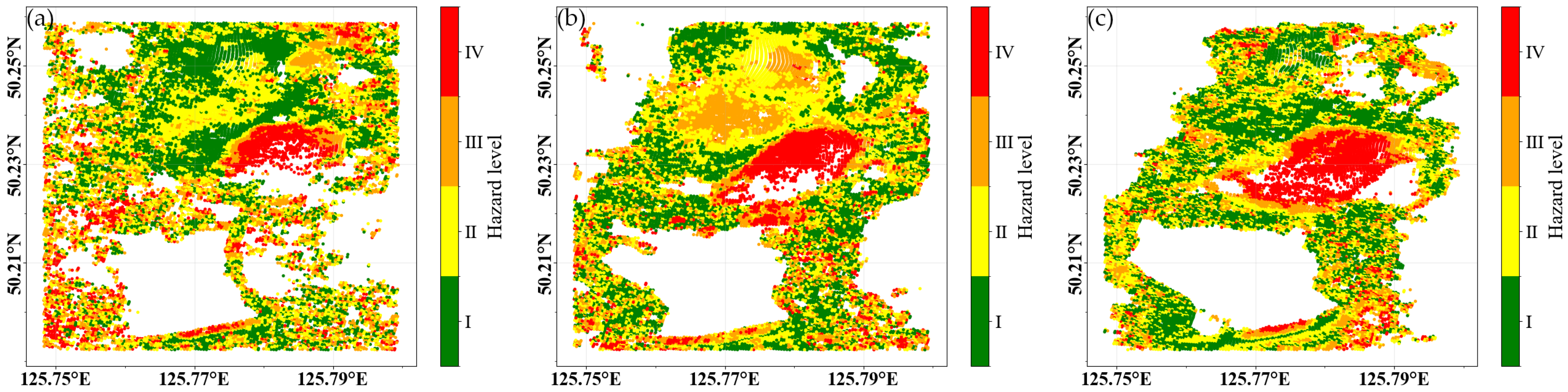
- The method performs well on synthetic data and, on the open-pit mine, supports deformation-level classification mapping and highlights localized level IV zones.
- It improves efficiency and objectivity for regional hazard assessment, reducing reliance on manual interpretation.
- The score and level framework is easy to transfer and update across different periods and areas with varying deformation patterns.
Abstract
1. Introduction
2. Study Area and Datasets
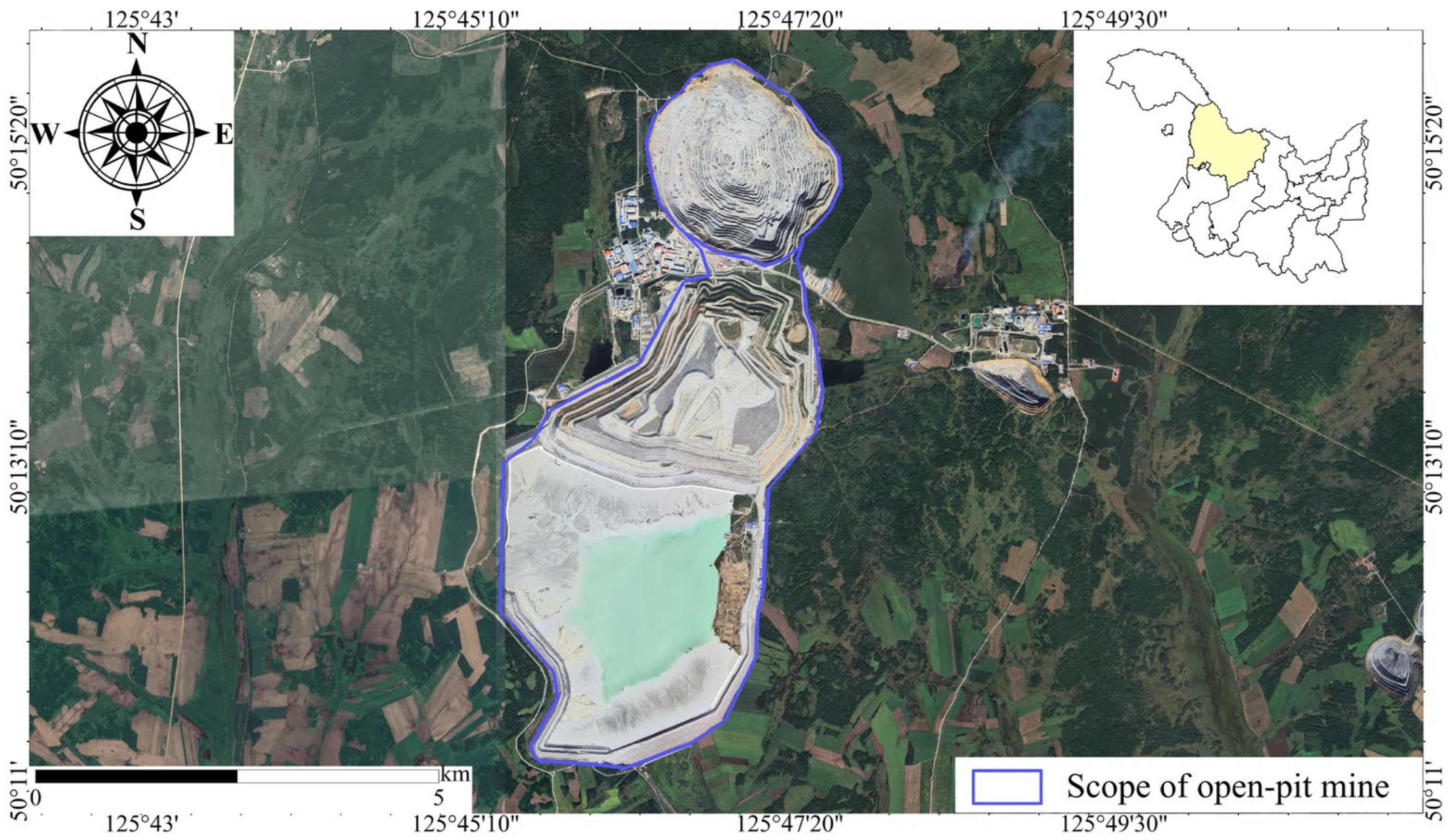
2.1. Study Area
2.2. Datasets
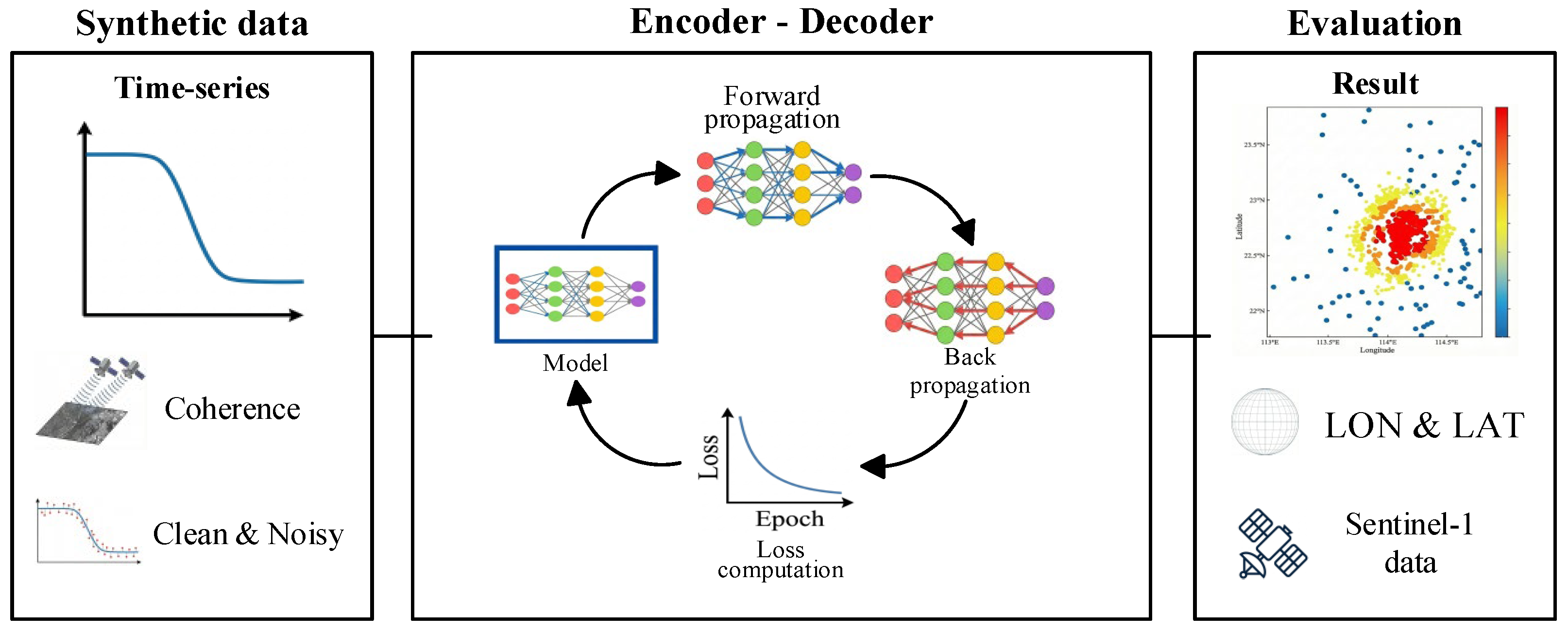
3. Methodology
3.1. Synthetic InSAR Time Series Data Generation
3.1.1. Kinematic Deformation Model
3.1.2. Physics-Aware Noise Simulation Strategy
3.2. CED-LSTM Denoising Network
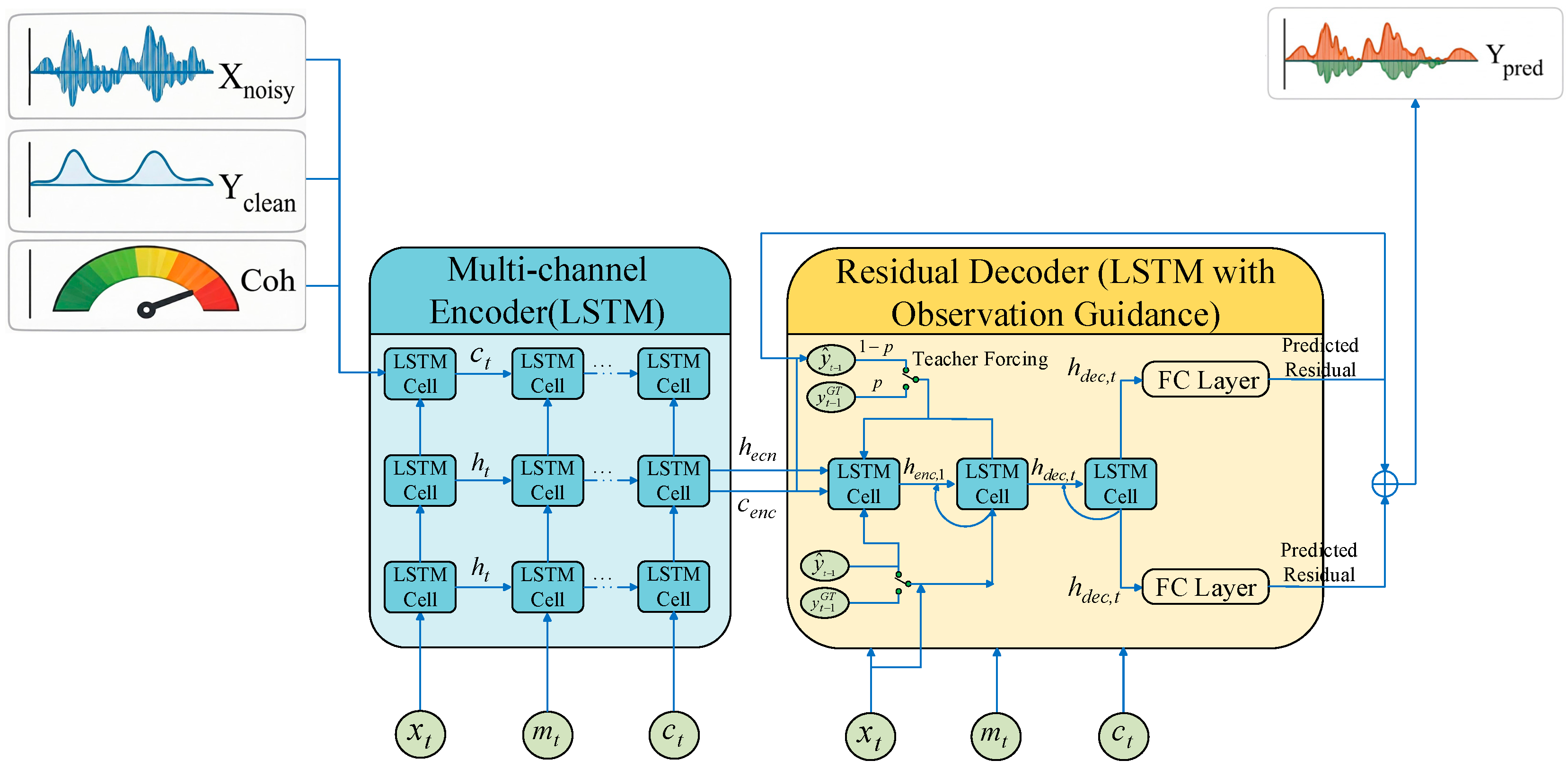
3.2.1. Network Architecture
3.2.2. Physics-Aware Adaptive Loss Function
3.2.3. Training Strategy
3.3. Deformation-Level Evaluation Based on Denoised InSAR Time Series Data
3.3.1. Spatiotemporal Deformation Feature Extraction
3.3.2. Adaptive Deformation-Level Classification Framework
4. Results and Analysis
4.1. Construction of Coherence-Based Synthetic Datasets
4.1.1. Statistical Calibration Using Real Data
4.1.2. Denoising Performance Evaluation on Synthetic Data
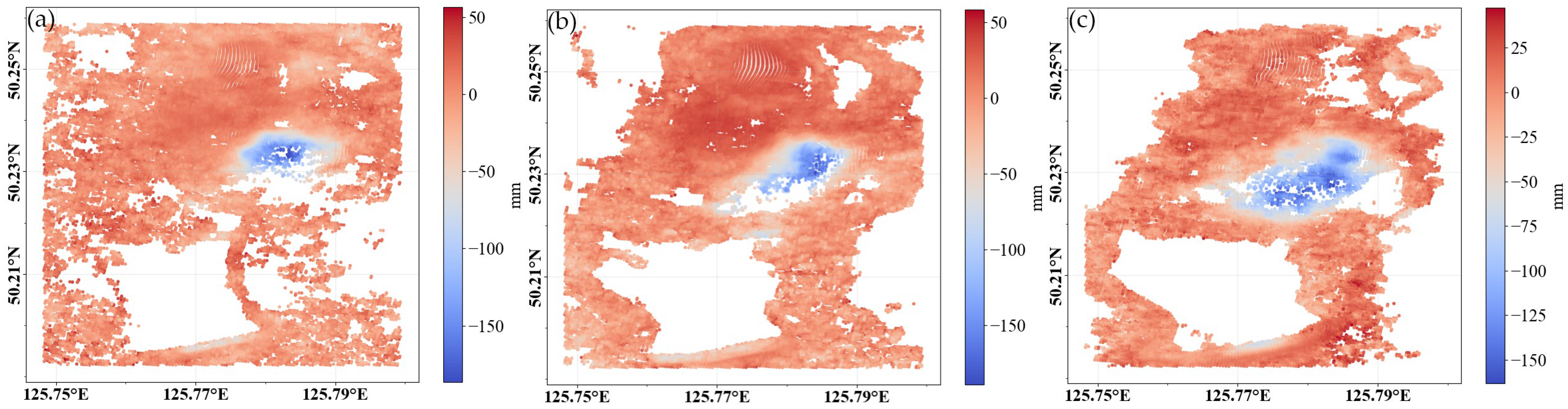
4.2. Application to Real InSAR Observations in the Open-Pit Mine
4.3. Deformation-Level Classification Results
5. Discussion
5.1. Denoising Performance
5.2. Engineering Applicability Analysis
6. Conclusions
Author Contributions
Funding
Data Availability Statement
Acknowledgments
Conflicts of Interest
References
- Du, S.; Li, W.; Li, J.; Du, S.; Zhang, C.; Sun, Y. Open-Pit Mine Change Detection from High Resolution Remote Sensing Images Using DA-UNet++ and Object-Based Approach. Int. J. Min. Reclam. Environ. 2022, 36, 512–535. [Google Scholar] [CrossRef]
- Guo, J.; Li, Q.; Xie, H.; Li, J.; Qiao, L.; Zhang, C.; Yang, G.; Wang, F. Monitoring of Vegetation Disturbance and Restoration at the Dumping Sites of the Baorixile Open-Pit Mine Based on the LandTrendr Algorithm. Int. J. Environ. Res. Public Health 2022, 19, 9066. [Google Scholar] [CrossRef]
- Massonnet, D.; Rossi, M.; Carmona, C.; Adragna, F.; Peltzer, G.; Feigl, K.; Rabaute, T. The displacement field of the Landers earthquake mapped by radar interferometry. Nature 1993, 364, 138–142. [Google Scholar] [CrossRef]
- Bhattacharya, A.; Mukherjee, K. Review on InSAR based displacement monitoring of Indian Himalayas: Issues, challenges and possible advanced alternatives. Geocarto Int. 2017, 32, 298–321. [Google Scholar] [CrossRef]
- Pedretti, L.; Bordoni, M.; Vivaldi, V.; Figini, S.; Parnigoni, M.; Grossi, A.; Lanteri, L.; Tararbra, M.; Negro, N.; Meisina, C. InterpolatiON of InSAR Time series for the dEtection of ground deforMatiOn eVEnts (ONtheMOVE): Application to slow-moving landslides. Landslides 2023, 20, 1797–1813. [Google Scholar] [CrossRef]
- Du, S.; Du, S.; Liu, B.; Zhang, X. Incorporating DeepLabv3+ and Object-Based Image Analysis for Semantic Segmentation of Very High Resolution Remote Sensing Images. Int. J. Digit. Earth 2021, 14, 357–378. [Google Scholar] [CrossRef]
- Wang, C.; Chang, L.; Zhao, L.; Niu, R. Automatic Identification and Dynamic Monitoring of Open-Pit Mines Based on Improved Mask R-CNN and Transfer Learning. Remote Sens. 2020, 12, 3474. [Google Scholar] [CrossRef]
- Bai, Z.; Zhao, F.; Wang, J.; Li, J.; Wang, Y.; Li, Y.; Lin, Y.; Shen, W. Revealing Long-Term Displacement and Evolution of Open-Pit Coal Mines Using SBAS-InSAR and DS-InSAR. Remote Sens. 2025, 17, 1821. [Google Scholar] [CrossRef]
- Ferretti, A.; Prati, C.; Rocca, F. Permanent scatterers in SAR interferometry. IEEE Trans. Geosci. Remote Sens. 2001, 39, 8–20. [Google Scholar] [CrossRef]
- Berardino, P.; Fornaro, G.; Lanari, R.; Sansosti, E. A new algorithm for surface deformation monitoring based on small baseline differential SAR interferograms. IEEE Trans. Geosci. Remote Sens. 2002, 40, 2375–2383. [Google Scholar] [CrossRef]
- Hooper, A.; Zebker, H.; Segall, P.; Kampes, B. A new method for measuring deformation on volcanoes and other natural terrains using InSAR persistent scatterers. Geophys. Res. Lett. 2004, 31, L23611. [Google Scholar] [CrossRef]
- Crosetto, M.; Monserrat, O.; Cuevas-González, M.; Devanthéry, N.; Crippa, B. Persistent Scatterer Interferometry: A review. ISPRS J. Photogramm. Remote Sens. 2016, 115, 78–89. [Google Scholar] [CrossRef]
- Poggi, F.; Caleca, F.; Nardini, O.; Barbadori, F.; Del Soldato, M.; De Luca, C.; Casu, F.; Bonano, M.; Lanari, R.; Tofani, V.; et al. Sentinel-1 imagery for wide-scale quantitative landslide vulnerability assessment of buildings. Remote Sens. Environ. 2026, 115199, 0034–4257. [Google Scholar] [CrossRef]
- Liu, X.; Zhao, C.; Zhang, Q.; Lu, Z.; Li, Z.; Yang, C.; Zhu, W.; Liu-Zeng, J.; Chen, L.; Liu, C. Integration of Sentinel-1 and ALOS/PALSAR-2 SAR datasets for mapping active landslides along the Jinsha River corridor, China. Eng. Geol. 2021, 284, 106033. [Google Scholar] [CrossRef]
- Di Martire, D.; Paci, M.; Confuorto, P.; Costabile, S.; Guastaferro, F.; Verta, A.; Calcaterra, D. A nation-wide system for landslide mapping and risk management in Italy: The second Not-ordinary Plan of Environmental Remote Sensing. Int. J. Appl. Earth Obs. Geoinf. 2017, 63, 143–157. [Google Scholar] [CrossRef]
- Wang, L.; Yang, L.; Wang, W.; Chen, B.; Sun, X. Monitoring Mining Activities Using Sentinel-1A InSAR Coherence in Open-Pit Coal Mines. Remote Sens. 2021, 13, 4485. [Google Scholar] [CrossRef]
- Li, X.; Zhang, X.; Shen, W.; Zeng, Q.; Chen, P.; Qin, Q.; Li, Z. Research on the Mechanism and Control Technology of Coal Wall Sloughing in the Ultra-Large Mining Height Working Face. Int. J. Environ. Res. Public Health 2023, 20, 868. [Google Scholar] [CrossRef]
- Zhao, Z.; Wu, Z.; Zheng, Y.; Ma, P. Recurrent neural networks for atmospheric noise removal from InSAR time series with missing values. ISPRS J. Photogramm. Remote Sens. 2021, 180, 227–237. [Google Scholar] [CrossRef]
- Ronneberger, O.; Fischer, P.; Brox, T. U-Net: Convolutional Networks for Biomedical Image Segmentation. In Proceedings of the MICCAI 2015, Munich, Germany, 5–9 October 2015; pp. 234–241. [Google Scholar]
- He, K.; Zhang, X.; Ren, S.; Sun, J. Deep Residual Learning for Image Recognition. In Proceedings of the IEEE Conference on Computer Vision and Pattern Recognition (CVPR), Las Vegas, NV, USA, 27–30 June 2016; pp. 770–778. [Google Scholar]
- Hochreiter, S.; Schmidhuber, J. Long Short-Term Memory. Neural Comput. 1997, 9, 1735–1780. [Google Scholar] [CrossRef]
- Vaswani, A.; Shazeer, N.; Parmar, N.; Uszkoreit, J.; Jones, L.; Gomez, A.N.; Kaiser, Ł.; Polosukhin, I. Attention Is All You Need. In Advances in Neural Information Processing Systems 30 (NeurIPS 2017); Curran Associates, Inc.: Red Hook, NY, USA, 2017. [Google Scholar]
- Ghorbanzadeh, O.; Blaschke, T.; Gholamnia, K.; Meena, S.R.; Tiede, D.; Aryal, J. Evaluation of Different Machine Learning Methods and Deep-Learning Convolutional Neural Networks for Landslide Detection. Remote Sens. 2019, 11, 196. [Google Scholar] [CrossRef]
- Chen, C.; Dai, K.; Tang, X.; Cheng, J.; Pirasteh, S.; Wu, M.; Shi, X.; Zhou, H.; Li, Z. Removing InSAR Topography-Dependent Atmospheric Effect Based on Deep Learning. Remote Sens. 2022, 14, 4171. [Google Scholar] [CrossRef]
- Zhou, H.; Dai, K.; Tang, X.; Xiang, J.; Li, R.; Wu, M.; Peng, Y.; Li, Z. Time-Series InSAR with Deep-Learning-Based Topography-Dependent Atmospheric Delay Correction for Potential Landslide Detection. Remote Sens. 2023, 15, 5287. [Google Scholar] [CrossRef]
- Sun, X.; Zimmer, A.; Mukherjee, S.; Kottayil, N.K.; Ghuman, P.; Cheng, I. DeepInSAR—A Deep Learning Framework for SAR Interferometric Phase Restoration and Coherence Estimation. Remote Sens. 2020, 12, 2340. [Google Scholar] [CrossRef]
- Zhu, X.X.; Tuia, D.; Mou, L.; Xia, G.S.; Zhang, L.; Xu, F.; Fraundorfer, F. Deep Learning in Remote Sensing: A Comprehensive Review and List of Resources. IEEE Geosci. Remote Sens. Mag. 2017, 5, 8–36. [Google Scholar] [CrossRef]
- Murdaca, G.; Rucci, A.; Prati, C. Deep Learning for InSAR Phase Filtering: An Optimized Framework for Phase Unwrapping. Remote Sens. 2022, 14, 4956. [Google Scholar] [CrossRef]
- Ball, J.E.; Anderson, D.T.; Chan, C.S. Comprehensive Survey of Deep Learning in Remote Sensing: Theories, Tools, and Challenges for the Community. J. Appl. Remote Sens. 2017, 11, 042609. [Google Scholar] [CrossRef]
- Zhu, X.; Montazeri, S.; Ali, M.; Hua, Y.; Wang, Y.; Mou, L.; Shi, Y.; Xu, F.; Bamler, R. Deep Learning Meets SAR: Concepts, Models, Pitfalls, and Perspectives. IEEE Geosci. Remote Sens. Mag. 2021, 9, 143–172. [Google Scholar] [CrossRef]
- Vijay Kumar, S.; Sun, X.; Wang, Z.; Goldsbury, R.; Cheng, I. A U-Net Approach for InSAR Phase Unwrapping and Denoising. Remote Sens. 2023, 15, 5081. [Google Scholar] [CrossRef]
- Wang, J.; Li, C.; Li, L.; Huang, Z.; Wang, C.; Zhang, H.; Zhang, Z. InSAR Time-Series Deformation Forecasting Surrounding Salt Lake Using Deep Transformer Models. Sci. Total Environ. 2023, 858, 159744. [Google Scholar] [CrossRef]
- Zhao, Z.; Qiao, K.; Liu, Y.; Chen, J.; Li, C. Geochemical Data Mining by Integrated Multivariate Component Data Analysis: The Heilongjiang Duobaoshan Area (China) Case Study. Minerals 2022, 12, 1035. [Google Scholar] [CrossRef]
- Torres, R.; Snoeij, P.; Geudtner, D.; Bibby, D.; Davisson, M.; Attema, E.; Potin, P.; Rommen, B.; Floury, N.; Brown, M.; et al. GMES Sentinel-1 mission. Remote Sens. Environ. 2012, 120, 9–24. [Google Scholar] [CrossRef]
- Ho Tong Minh, D.; Hanssen, R.; Rocca, F. Radar interferometry: 20 years of development in time series techniques and future perspectives. Remote Sens. 2020, 12, 1364. [Google Scholar] [CrossRef]
- Just, D.; Bamler, R. Phase Statistics of Interferograms with Applications to Synthetic Aperture Radar. Appl. Opt. 1994, 33, 4361–4368. [Google Scholar] [CrossRef]
- Emardson, T.R.; Simons, M.; Webb, F.H. Neutral atmospheric delay in interferometric synthetic aperture radar applications: Statistical description and mitigation. J. Geophys. Res. 2003, 108, 2231. [Google Scholar] [CrossRef]
- Chen, C.; Zebker, H. Phase unwrapping for large SAR interferograms: Statistical segmentation and generalized network models. IEEE Trans. Geosci. Remote Sens. 2002, 40, 1709–1719. [Google Scholar] [CrossRef]
- Cui, H.-Z.; Tong, B.; Wang, T.; Dou, J.; Ji, J. A hybrid data-driven approach for rainfall-induced landslide susceptibility mapping: Physically-based probabilistic model with convolutional neural network. J. Rock Mech. Geotech. Eng. 2025, 17, 4933–4951. [Google Scholar] [CrossRef]
- Musaib, A.; Aparna, V.; Divya, P.V. Integrating TRIGRS and RAMMS for the spatiotemporal prediction of rainfall induced landslides and landslide trajectory: A case study. Nat. Hazards 2026, 122, 97. [Google Scholar] [CrossRef]







| Parameter | Value |
|---|---|
| Flight direction | Ascending |
| Beam mode | IW |
| Polarization | VV |
| Wave band | C |
| Wavelength/cm | 5.6 |
| Number of images | 92 |
| Monitored period | March 2019–March 2022 |
| Metric | Domain | Q5 | Q50 | Q95 | Q99 |
|---|---|---|---|---|---|
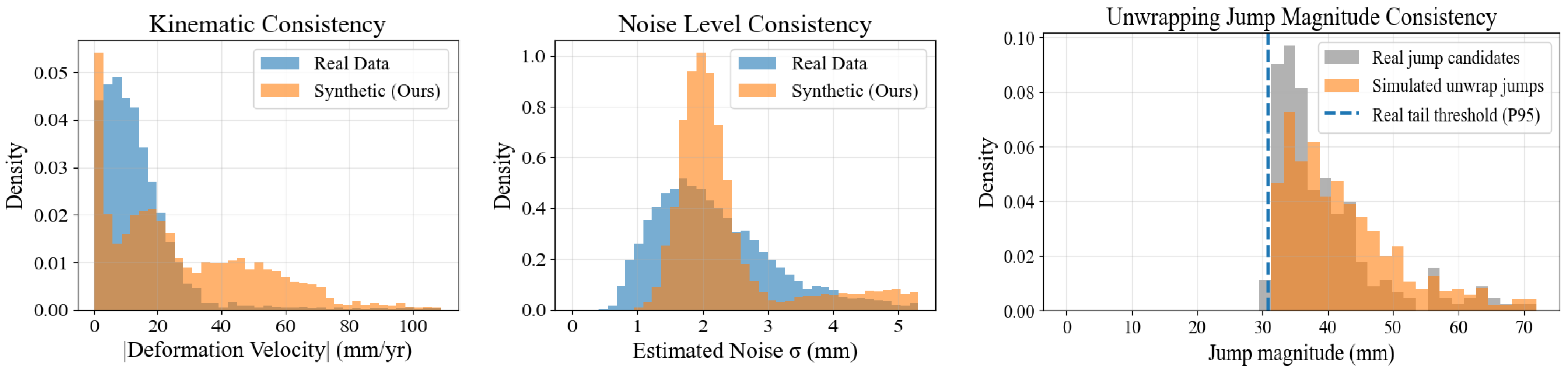
| /(mm/yr) | Real | 1.1 | 11.0 | 35.9 | 108.8 |
| /(mm/yr) | Synthetic | 0.7 | 21.6 | 72.9 | 107.5 |
| /(mm/yr) | Offset | +0.4 | −10.5 | −37.0 | +1.2 |
| from 2nd diff/(mm) | Real | 1.0 | 2.0 | 4.4 | 5.9 |
| from 2nd diff/(mm) | Synthetic | 1.5 | 2.1 | 5.6 | 7.2 |
| from 2nd diff/(mm) | Offset | −0.5 | −0.1 | −1.3 | −1.2 |
| Variant | RMSE/mm | MAE/mm | F1 |
|---|---|---|---|
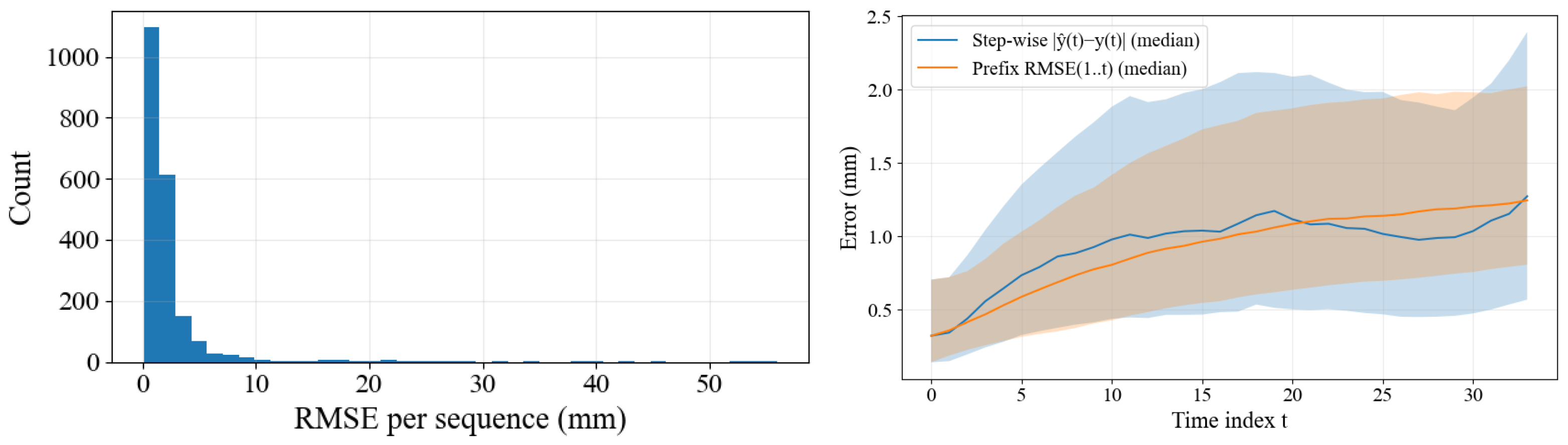
| Baseline LSTM | 2.3 | 1.9 | 0.86 |
| CED-LSTM without adaptive loss function | 2.7 | 2.1 | 0.29 |
| CED-LSTM | 2.2 | 1.8 | 0.86 |
| RMSE/mm | MAE/mm | F1 | |
|---|---|---|---|
| 0 | 2.8 | 2.2 | 0.24 |
| 0.001 | 2.7 | 2.1 | 0.36 |
| 0.01 | 2.4 | 1.9 | 0.66 |
| 0.1 | 2.2 | 1.8 | 0.86 |
| 0.3 | 2.5 | 2.1 | 0.87 |
| Monitored Period | Mean (Score) | P95 (Score) | Ratio (Score ≥ 0.6) |
|---|---|---|---|
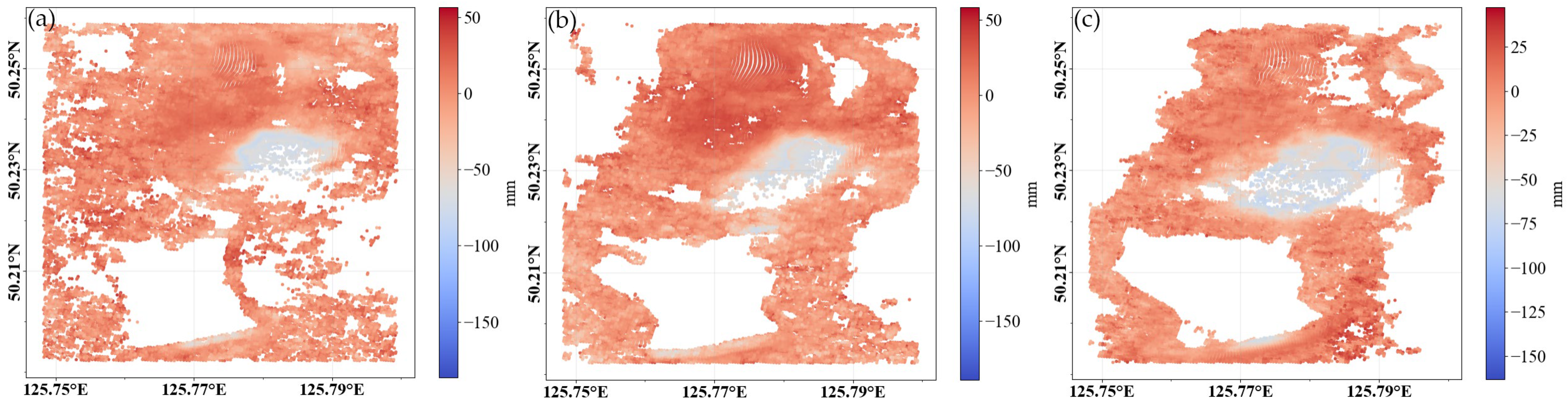
| March 2019–March 2020 | 0.3353 | 0.7405 | 0.1200 |
| March 2020–March 2021 | 0.3667 | 0.7999 | 0.1412 |
| March 2021–March 2022 | 0.3282 | 0.8019 | 0.1358 |
Disclaimer/Publisher’s Note: The statements, opinions and data contained in all publications are solely those of the individual author(s) and contributor(s) and not of MDPI and/or the editor(s). MDPI and/or the editor(s) disclaim responsibility for any injury to people or property resulting from any ideas, methods, instructions or products referred to in the content. |
© 2026 by the authors. Licensee MDPI, Basel, Switzerland. This article is an open access article distributed under the terms and conditions of the Creative Commons Attribution (CC BY) license.
Share and Cite
Wang, Y.; Kong, X.; Bai, Z.; Li, Y.; Lu, Y.; Tang, W.; Lin, Y.; Shen, W.; Cai, G. CED-LSTM: A Coherence-Conditioned Encoder–Decoder Network for Robust InSAR Time-Series Deformation Extraction in Open-Pit Mines. Remote Sens. 2026, 18, 984. https://doi.org/10.3390/rs18070984
Wang Y, Kong X, Bai Z, Li Y, Lu Y, Tang W, Lin Y, Shen W, Cai G. CED-LSTM: A Coherence-Conditioned Encoder–Decoder Network for Robust InSAR Time-Series Deformation Extraction in Open-Pit Mines. Remote Sensing. 2026; 18(7):984. https://doi.org/10.3390/rs18070984
Chicago/Turabian StyleWang, Yanping, Xiangbo Kong, Zechao Bai, Yang Li, Yao Lu, Weikai Tang, Yun Lin, Wenjie Shen, and Guanjun Cai. 2026. "CED-LSTM: A Coherence-Conditioned Encoder–Decoder Network for Robust InSAR Time-Series Deformation Extraction in Open-Pit Mines" Remote Sensing 18, no. 7: 984. https://doi.org/10.3390/rs18070984
APA StyleWang, Y., Kong, X., Bai, Z., Li, Y., Lu, Y., Tang, W., Lin, Y., Shen, W., & Cai, G. (2026). CED-LSTM: A Coherence-Conditioned Encoder–Decoder Network for Robust InSAR Time-Series Deformation Extraction in Open-Pit Mines. Remote Sensing, 18(7), 984. https://doi.org/10.3390/rs18070984