Article

Spatial-Variant Delay-Doppler Imagery of Airborne Wide-Beam Radar Altimeter for Contour Extraction of Undulating Terrain


1
The Institute of Electronic Engineering, China Academy of Engineering Physics, Mianyang 621000, China
2
Tianjin Key Laboratory for Advanced Signal Processing, Civil Aviation University of China, Tianjin 300300, China
*
Author to whom correspondence should be addressed.
Remote Sens. 2026, 18(7), 1039; https://doi.org/10.3390/rs18071039
Submission received: 1 February 2026 / Revised: 20 March 2026 / Accepted: 28 March 2026 / Published: 30 March 2026
(This article belongs to the Section Remote Sensing Image Processing)

Highlights

What are the main findings?
  • It is found that under large dynamic flight conditions, including non-horizontal and non-constant speed flight tracks, the synthetic aperture radar altimeter (SARAL) with a narrow-beam design is highly susceptible to attitude disturbances, which can lead to the loss of the nadir echo signal. Although upgrading to a wide-beam architecture improves robustness against large dynamic motion, it introduces pronounced spatial-variant delay effects. As a result, conventional SARAL imaging algorithms become inadequate for accurate imaging under large dynamic and wide-beam flight conditions.
What are the implications of the main findings?
  • Under wide-beam illumination, the imaging processing of SARAL must explicitly account for spatial-variant delay effects. If left unaddressed, these effects degrade imaging performance and, consequently, reduce the accuracy of terrain elevation extraction. To this end, a spatial-variant Delay-Doppler (SVDD) method is developed in this work.
  • With accurate elevation extraction achieved, the resulting elevation information provides a reliable foundation for terrain matching and localization. When GNSS-based positioning systems are degraded or unavailable due to interference, this information can effectively support localization solutions. This is particularly important during complicated maneuvers, such as takeoff and landing, where robust and reliable positioning is required.

Abstract

Synthetic aperture radar altimeter (SARAL) directs the radar beam toward the nadir point of the flight trajectory. It is capable of capturing elevation variations in the terrain of interest. To ensure that the nadir point remains within the beam coverage under complicated flight attitudes, a wide beamwidth is necessary. However, the wide beamwidth introduces a spatial-variant delay problem with respect to different scatters in the along-track direction, which degrades the accuracy in obtaining the terrain elevation contour. To this end, a spatial-variant Delay-Doppler (SVDD) algorithm is proposed in this paper. The core advantage of the proposed algorithm is that an analytical spectrum is obtained through rigorous mathematical derivation for the wide-beam SARAL geometry. Accordingly, all correction functions are implemented via complicated multiplications without interpolation operations. High computational efficiency is therefore ensured. To address the spatial-variant delay problem, a direct geometric relationship is first established between the Doppler frequency and the azimuthal position. Based on this relationship, the spatial-variant characteristic is mapped from the spatial domain to the Doppler domain. This mapping is then directly employed to construct the spatial-variant delay correction function. At the same time, range walk correction and range curve correction are carried out. In such cases, the variation of the undulating terrain can be recovered from the Delay-Doppler Map (DDM). Both simulated and raw data of the radar altimeter are applied to verify the effectiveness of the proposed SVDD algorithm. Comparisons with the conventional algorithm are also performed to demonstrate the superiority of the SVDD algorithm.

1. Introduction

Radar altimeter is an active microwave remote sensor that can continuously monitor the wave height estimation of the ocean on a global scale [1,2,3,4]. Compared with visible light and infrared remote sensors, radar altimeters can operate all day and in all weather [5,6]. Since conventional radar altimeters work in real aperture mode, their spatial resolution is strictly limited by the physical antenna aperture, and the larger the antenna aperture, the higher the spatial resolution. However, due to the influence of atmospheric turbulence, the antenna aperture cannot be greatly improved, making it difficult to improve the azimuth resolution of the radar altimeter [7,8]. At the same time, the height measurement of the radar altimeter is also susceptible to various unfavorable factors such as environmental noise and atmospheric disturbances, resulting in limitations in measurement accuracy. Synthetic aperture radar altimeter (SARAL) introduces a virtual and large aperture in the along-track direction, fully accounting for the Doppler bandwidth produced by the movement of the platform, which significantly enhances the along-track resolution [9,10].
The radar altimeter transmits wideband pulses toward the nadir point and improves range resolution through range compression while maintaining a high signal-to-noise ratio, thereby obtaining the single-look echo of the target [11]. Compared with synthetic aperture radar (SAR), SARAL operates in a nadir-looking mode [12,13]. SARAL transmits multiple pulses to the nadir point within a pulse burst. After Doppler beam sharpening, the two-dimensional echo signal of SARAL is transformed into the range–Doppler domain to achieve the point scatter response, which significantly improves the azimuth resolution compared with conventional radar altimeters [14]. At the same time, SARAL performs range compression and range migration correction on the echo signal, obtaining multiple echoes of the same target. By applying incoherent integration, multi-look echoes of the target are generated, which effectively improve the echo signal-to-noise ratio compared with single-look echoes, thereby enhancing the accuracy of target height measurement [15]. Since the echo signal of the range–Doppler domain can reflect terrain undulations, the echo signal processing of SARAL is referred to as SARAL imaging. The echo signal of the range–Doppler domain is usually called DDM. Therefore, SARAL imaging is also known as Delay-Doppler imaging [3].
The DDM contains the terrain elevation information, which is capable of reflecting the elevation variation in high spatial resolution [3]. While the movement of the aircraft brings about high along-track resolution, it also introduces a range migration problem. The range between the aircraft and a fixed ground point scatter varies as the aircraft moves, affecting the DDM image. To this end, SARAL utilizes azimuth Doppler information to remove the range migration [16,17]. Compared with conventional radar altimeters, SARAL can obtain continuous terrain elevations. By matching the terrain undulations derived from SARAL with a Digital Elevation Model (DEM), it plays an important role in enabling autonomous localization of aircraft. Therefore, studying the DDM imaging of SARAL is of significant importance.
Localization requires matching with the terrain contour information. To extract the terrain information, tracking processing is necessary. Due to the influence of echo noise and instrumental thermal noise on the radar echo signal, it is necessary to perform tracking processing on the echoes to obtain estimates of the observed parameters from the noisy echoes [18]. Echo tracking can be divided into two parts, namely elevation tracking and elevation retracking [19]. The purpose of elevation tracking is to capture the echo signal and achieve coarse tracking of the elevation. Retracking involves further processing, using the energy distribution or shape of the echo to achieve more accurate elevation measurements. Utilizing the echo tracking, the radar altimeter can determine the aboveground level between the radar and the nadir point, thereby obtaining the elevation of the ground terrain.
In conventional SARAL, a narrow beamwidth is preferred to avoid interference. However, for a fixed single-antenna system, complicated flight trajectories may cause the nadir point to fall outside the beam coverage. In addition, conventional echo tracking is built for flat terrains. In undulating terrains, the models become mismatched, resulting in elevation tracking failure [20]. To address this, the tracking gate can be pre-adjusted by detecting large-scale terrain information using a wide beam, reducing the loss rate and improving tracking performance. However, a wide beamwidth introduces a significant azimuth spatial-variant problem. The core limitation of the conventional SARAL imaging algorithm [15] lies in neglecting the spatial-variant delay introduced by wide beam illumination. Under narrow-beam conditions, the slant range variation with azimuth is negligible. However, with a wide beamwidth, the slant range varies significantly with azimuth position. Consequently, pronounced spatial-variant delay is introduced. When applied to wide-beam systems, the conventional algorithm therefore suffers from azimuth defocusing and geometric distortion in the DDM.
Mature algorithms have been developed in SAR imaging to correct spatial-variant phase errors caused by high squint angles [21,22,23,24,25,26,27,28,29,30]. However, these algorithms address the coupling between azimuth frequency and range induced by squint. In SARAL, the problem is the spatial-variant delay in the range dimension itself. Such a delay arises purely from geometry, since different scatters within a wide nadir-pointing beam have different slant ranges even at identical elevations. Therefore, existing SAR algorithms are not suitable for the SARAL scenario. A dedicated algorithm for wide-beam SARAL imaging is accordingly required. A preliminary concept for wide-beam SARAL imaging was introduced in the authors’ previous work [31]. However, that study was limited to a simplified motion model without acceleration and relied solely on simulated point targets for validation. In practice, during takeoff and landing, aircraft do not maintain horizontal flight and exhibit acceleration. This makes range migration more challenging than under typical flight conditions. Motion errors can be partially corrected by onboard inertial navigation systems for envelope errors, while phase errors are compensated using autofocus methods [32,33,34,35].
In this paper, an SVDD algorithm is proposed to accommodate the wide beamwidth of SARAL and non-typical flight conditions, including non-horizontal and non-constant speed flight tracks. The paper first derives a full spectrum for SARAL under the condition of the wide beamwidth. Utilizing the spectrum, the effects of multiple conditions can be removed in turn. Aiming at the range migration problem of non-typical flight conditions, the range walk correction function and range curve correction function are derived in this paper. Accurate range migration correction is possible. At the same time, range compression and Doppler center compensation can also be achieved during the range migration correction process. For the problem of the wide beamwidth, a spatial-variant delay correction function is constructed based on the relationship between the Doppler frequency and azimuthal position for each Doppler channel in this paper. It successfully eliminates the impact of the wide beamwidth on imaging. After step-by-step corrections, accurate DDM imaging can be achieved. The elevation variation can be recovered even for the undulating terrain. In the experiments, the effectiveness and superiority of the proposed SVDD algorithm are verified by the simulated data and raw data of the radar altimeter compared with the conventional algorithm.

2. Geometry and Signal Model of Airborne Synthetic Aperture Radar Altimeter

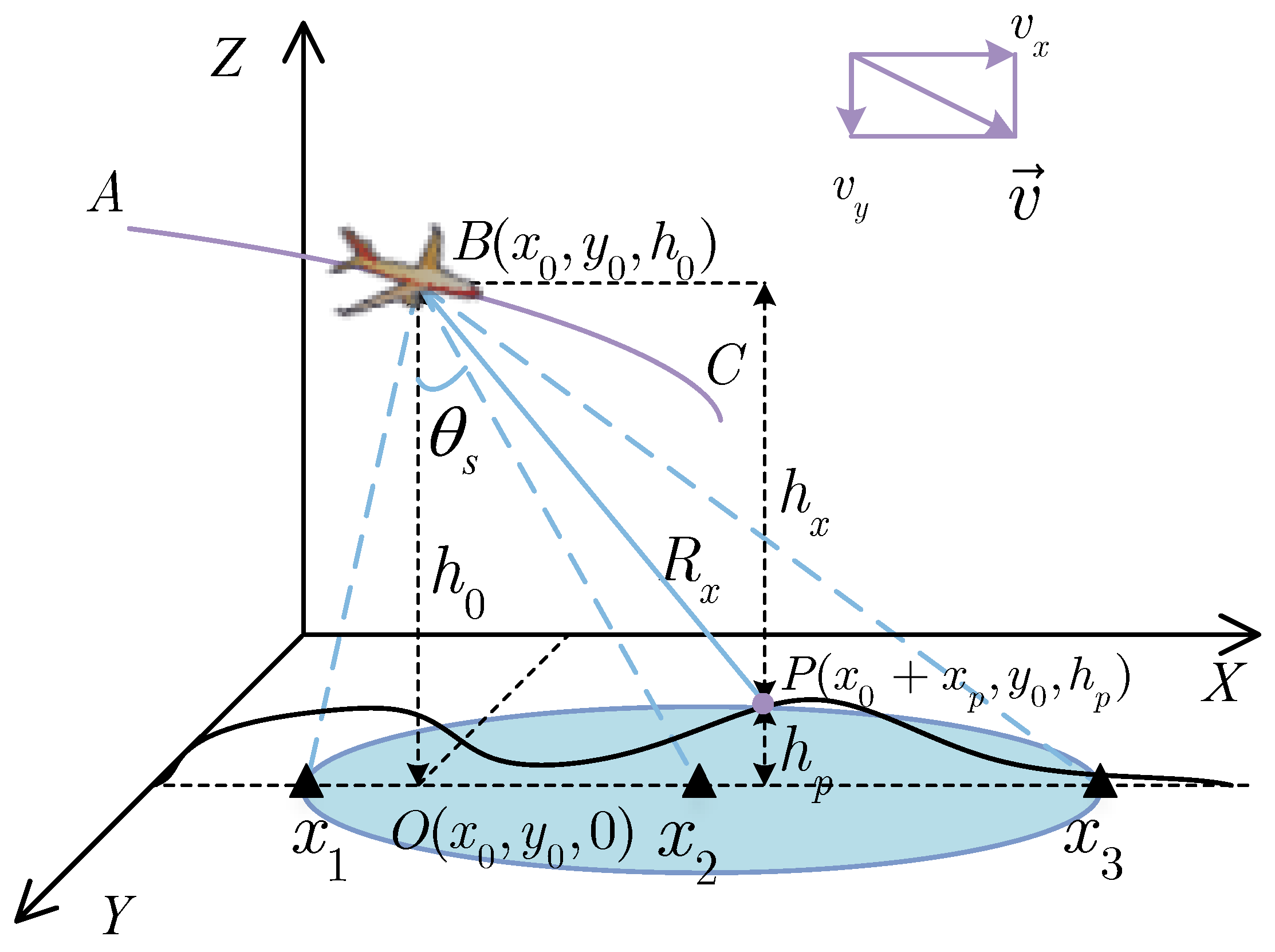
Figure 1 demonstrates the geometry of airborne SARAL in a non-linear trajectory. The aircraft moves along the curve A B C . Under the “Stop-Go” assumption, the range to fast time is denoted as τ , the azimuth to slow time is denoted as η . In practice, the aircraft may be in non-horizontal and non-constant speed flight. The non-linear trajectory increases the complexity of the aircraft’s motion characteristics. Therefore, these characteristics must be carefully accounted for in the imaging algorithm to ensure accurate recovery of the elevation variation in the intended Delay-Doppler domain.
In the non-linear trajectory, the velocity may be in an arbitrary direction, which can be denoted as v x and v z , as shown in Figure 1 in an instantaneous plane on X O Z . When η = 0 , the aircraft is located at position B, the coordinate is x 0 , y 0 , h 0 , where the velocity vector is v x 0 , 0 , v z 0 , and the acceleration vector is a x , 0 , a z . At this time, the nadir point of the aircraft is O, the coordinate is x 0 , y 0 , 0 . For the sake of detection flexibility, the radar beam in this paper can also be directed to any point in the along-track direction. In Figure 1, R x denotes the slant range between the radar and target at azimuth position x p , θ s denotes the angle between the center of the beam and the nadir point, h p is the ground elevation of point scatter P. For any point scatter P on the ground, the coordinate is x 0 + x p , y 0 , h p . The definitions and units of all symbols used in this paper are summarized in Table A1 in Appendix A. The aboveground level h x can be expressed as
h x = h 0 h p
where h 0 denotes the initial flight elevation of the aircraft. When the aboveground level h x is achieved accurately, the ground elevation h p can be obtained as h p = h 0 h x . By measuring sequential h x , SARAL can obtain the ground elevation variation.
The instantaneous range between the radar and the point scatter R can be expressed as
R ( η ) = v x 0 η + 1 2 a x η 2 x p 2 + ( h x + v z 0 η + 1 2 a z η 2 ) 2 = R x 2 + μ 1 η + μ 2 η 2 + μ 3 η 3 + μ 4 η 4
where the second equation is expanded up to η 4 in the square root, with the coefficients expressed as
R x = x p 2 + h x 2 μ 1 = 2 ( v x 0 x p v z 0 h x ) μ 2 = v x 0 2 + v z 0 2 a x x p + a z h x μ 3 = v x 0 a x + v z 0 a z μ 4 = 1 4 ( a x 2 + a z 2 )
To facilitate the following range migration correction, the range equation in (2) is further approximated out of the square root and up to η 2 . The range model can be expressed as
R ( η ) R x + A η + B η 2
where the high orders are ignored, and there are
A = μ 1 2 R x B = μ 2 2 R x μ 1 2 8 R x 3
where A denotes the range walk rate, and B denotes the range curve rate. It can be seen that the range walk rate and range curve rate are affected by the speed and acceleration of the aircraft.
In order to evaluate the error caused by the approximation in (4), a numerical evaluation is performed. The approximation error in (4) can be expressed as the envelope error and phase error. The envelope error and the phase error can be respectively expressed as
Δ R = R η R x + A η + B η 2
Δ φ = 4 π λ R ( η ) 4 π λ R x + A η + B η 2
where λ denotes the wavelength. Commonly, the SARAL is supposed to operate in the X band. The pulse bandwidth of SARAL is 10 MHz. The aircraft is flying at an elevation of three kilometers and at a speed of 150 m/s. According to the calculation, it can be seen that the envelope error generated by the approximation is on the order of 10 6 m. The envelope error is much less than the one-quarter range resolution unit (6 m). Again, the phase error is on the order of 10 2 , far less than π π 4 4 . Therefore, the approximation in (4) is accurate enough and will not affect the image quality.
It can be noted from (5) that the range walk rate A is related to azimuthal position x p and changes along the range with x p . A range walk rate varying with azimuthal position will lead to different range walk momentum of scatters in different azimuths. To evaluate the effect of spatial-variant range walk, the range walk difference requires detailed analysis. The range walk difference between the nearest point and the farthest point of the scene can be expressed as
Δ R w x p , η = A x p = x max · η A x p = 0 · η
where x max denotes the position at the farthest end of the scene. When the range walk difference between the farthest and nearest points in the scene exceeds the one-quarter range resolution unit, a range response widening phenomenon will occur. The widening phenomenon caused by the spatial-variant range walk can be prevented by using different range walk correction on the data of different range gates during imaging processing. However, the spatial-variant range walk correction will increase the complexity of the operation. Therefore, the synthetic aperture length can be adjusted in synthetic aperture imaging to ensure that the range walk difference Δ R w x p , η does not exceed the one-quarter range resolution unit. In such a case, the spatial-variant range walk error can be neglected. It allows for utilizing the range walk rate at the nearest range R r e f for completing the range walk correction.
In order to analyze the effect of spatial-variant caused by the wide beamwidth, the range difference within the beam between the nearest and farthest points in the scene is given as
Δ R x = R x x max R x 0
Conventionally, the beamwidth is narrow, and the spatial-variant range difference within the beam is less than one-quarter range resolution unit, which can be neglected. However, when the beamwidth is wide, the spatial-variant range difference within the beam cannot be ignored and requires further correction. It is necessary to develop a spatial-variant delay correction function in the wide-beam applications.

3. Spatial-Variant Delay-Doppler Imagery for Synthetic Aperture Radar Altimeter

Since this paper considers wide-beam imaging under non-horizontal flight conditions, it is necessary to correct the spatial-variant range differences caused by the wide beamwidth, as described in (9). Before performing the spatial-variant delay correction, we also need to remove the range walk and range curve mentioned in (4). In the following, we provide a detailed derivation of the imaging correction under wide-beam conditions. The focus is on the derivation of spatial-variant delay correction and its effective compensation.
In general, the SARAL transmits linear frequency modulated pulses to the terrain of interest, and the echoes are collected. The demodulated echo signal for a given point scatter within the terrain of interest can be expressed as
s 0 ( τ , η ) = w r τ 2 R ( η ) c w a η · exp j 4 π f 0 R ( η ) c exp j π K r τ 2 R η c 2
where R η denotes the instantaneous range between the radar and the point scatter under different slow time conditions, w r · denotes the range envelope. Commonly, after range compression, w r · is a S i n c function [36]. In (10), w a · denotes the azimuth envelope. w a · is determined by the azimuth antenna pattern and is generally a S i n c function [36]. K r is the modulation frequency of the linear frequency modulated signal, f 0 is the carrier frequency, and c is the speed of light.
The following provides a detailed derivation of the SVDD algorithm. The SVDD algorithm consists of four modules, namely range walk correction, range curve correction, spatial-variant delay correction and DDM image formation.

3.1. Range Walk Correction

Firstly, to decouple the linear coupling between the range–frequency and azimuth–time domain, range walk correction is required. In (4), A η is considered to be a range walk. To achieve the range walk correction, a range walk correction function needs to be constructed. To construct this function, it is necessary to perform a range fast Fourier transform (FFT) on the echo signal represented by (10). The echo signal in the range compression domain can be expressed as
s 0 ( f τ , η ) = W r ( f τ ) w a ( η ) · exp j 4 π ( f 0 + f τ ) R ( η ) c exp j π f τ 2 K r
where f τ denotes the range frequency, W r ( f τ ) denotes the frequency-domain expression of w r ( τ ) . The first phase in (11) represents the target position term, reflecting the distance information between the radar and the target, while also containing the effect of the range walk. The second phase is the range modulation term, which needs to be removed using range compression. Since range compression can be achieved through a frequency domain filter in the range compression domain, it can be performed simultaneously with range walk correction. Then, the function for range walk correction can be expressed as
H 1 f τ , η = exp j 4 π ( f τ + f 0 ) c A r e f η exp j π f τ 2 K r
where A r e f denotes the range walk rate at the nearest range R r e f . The function for the range walk correction can effectively reduce the linear coupling and shift the Doppler spectrum closer to the zero frequency. The range compression can be simultaneously executed. Then multiplying (11) and (12), the echo signal in the range compression domain can be given as
s 1 ( f τ , η ) = W r ( f τ ) w a ( η ) · exp j 4 π ( f 0 + f τ ) R ( η ) A r e f η c
Substituting the approximated range equation in (4) into (13), the echo signal can be expressed as
s 1 ( f τ , η ) = W r ( f τ ) w a ( η ) · exp j 4 π ( f 0 + f τ ) R x + A η + B η 2 A r e f η c
Commonly, since the range walk difference between the nearest point and the farthest point of the scene does not exceed one-quarter range resolution unit, the range walk difference can be ignored. Therefore, (14) can be expressed as
s 1 ( f τ , η ) = W r ( f τ ) w a ( η ) · exp j 4 π ( f 0 + f τ ) R x 2 + 2 R x B η 2 c
It can be noted from (15) that the range walk in the range compression domain has been removed. The next step is to perform range curve correction, secondary range compression and cubic phase compensation to further correct the range migration and remove the range defocusing.

3.2. Range Curve Correction

Secondly, to ensure the accuracy of the imaging, range curve correction needs to be completed. In (4), B η 2 is considered to be a range curve. A range curve correction function needs to be constructed. Since range curve correction is performed in the two-dimensional frequency domain, the principle of the stationary phase is utilized to perform FFT in the azimuth domain on (15). Therefore, the spectrum in the two-dimensional frequency domain of a point scatter of interest can be obtained as
S 1 ( f τ , f η ; R x ) = W r ( f τ ) W a ( f η ) · exp j 4 π R x f τ + f 0 c 2 f η 2 2 R x B 2
where f η denotes the azimuth frequency, W a ( f η ) denotes the frequency-domain expression of w a ( η ) . To facilitate subsequent range curve correction, the phase in (16) is expanded around f τ = 0 using a Taylor series. The expansion is valid under the large time-bandwidth product condition. Let D = c f η / ( 2 2 R x B ) . The phase can be rewritten as
Φ = 4 π R x c ( f 0 + f τ ) 1 D f 0 + f τ 2 .
Define α = D / f 0 and expand 1 / ( 1 + f τ / f 0 ) as
1 1 + f τ / f 0 = 1 f τ f 0 + f τ 2 f 0 2 f τ 3 f 0 3 + .
Expand the square root term using the binomial series 1 x = 1 1 2 x 1 8 x 2 , retaining terms up to f τ 3 . After multiplication and collecting terms of the same power in f τ , the following expression is obtained as
Φ ( f τ , f η ; R x ) = ϕ 0 ( f η ; R x ) + ϕ 1 ( f η ; R x ) f τ + ϕ 2 ( f η ; R x ) f τ 2 + ϕ 3 ( f η ; R x ) f τ 3 + .
The explicit expressions for ϕ 0 through ϕ 3 can be expressed as
S 1 ( f τ , f η ; R x ) = W r ( f τ ) W a ( f η ) · exp j ϕ 0 ( f η ; R x ) + ϕ 1 ( f η ; R x ) f τ + ϕ 2 ( f η ; R x ) f τ 2 + ϕ 3 ( f η ; R x ) f τ 3
where ϕ 0 f η ; R x , ϕ 1 f η ; R x , ϕ 2 f η ; R x and ϕ 3 f η ; R x are the azimuth modulation term, the range migration term, the secondary range compression term, and the cubic term. The specific expressions are given as
ϕ 0 f η ; R x = 2 π R x 2 R x B 2 R x B 2 f 0 c 2 f η 2 ϕ 1 f η ; R x = 4 π c R x 1 f η M ϕ 2 f η ; R x = 2 π R x f η M c f 0 1 f η M 3 2 ϕ 3 f η ; R x = 2 π R x f η M c f 0 2 1 f η M 5 2
where f η M = c 2 f η 2 / ( 8 R x B f 0 2 ) is a dimensionless composite variable introduced to simplify the expression and to evaluate the validity of the binomial expansion. It represents the normalized square of the Doppler frequency relative to the system parameters.
The reference range R r e f can be used to construct a secondary range compression term and compensate for the cubic phase to remove range defocusing. According to (20), the secondary range compression and cubic phase compensation function can be given as
H 2 f τ , f η = exp j ϕ 2 f η ; R r e f f τ 2 · exp j ϕ 3 f η ; R r e f f τ 3
After range walk correction is completed by (12), and given that the spatial-variant range curve effect is negligible, the residual range migration term ϕ 1 f η ; R x by using binomial expansion can be approximated as
ϕ 1 f η ; R x = 4 π c R x 1 f η M 4 π c R x + 1 2 R r e f f η M
According to (23), the range curve correction function can be given as
H 3 f τ , f η = exp 2 π c R r e f f η M f τ
Then, multiplying (20), (22) and (24), the spectrum expression after secondary range compression, cubic phase compensation, and range curve correction can be given as
S 3 f τ , f η ; R x = W r f τ W a f η · exp j 4 π R x c f τ ϕ 0 f η ; R x

3.3. Spatial-Variant Delay Correction

Thirdly, in this paper, the spatial variant caused by the wide beam is the most important problem that needs to be addressed. A correction function also needs to be constructed to address this problem, as shown in (29). Before constructing the function, it is necessary to perform the range inverse fast Fourier transform (IFFT) on (25) to transform the signal to the Delay-Doppler domain. The Delay-Doppler domain signal can be expressed as
s 3 τ , f η ; R x = p r τ 2 R x c W a f η exp j ϕ 0 f η ; R x
where p r · denotes the range envelope after range compression and secondary range compression. Commonly, p r · is a S i n c function with a narrower main lobe [36]. It can be noted from (26) that the delay of point scatter echoes at different azimuthal positions is located at the range gate R x after secondary range compression, cubic phase compensation, and range curve correction. The range of the point scatter varies with the azimuthal position x p . Point scatters with the same range unit yet different azimuthal positions will appear in different range units after processing. Consequently, the spatial variant will lead to geometric deformation in the range direction. In order to solve the spatial-variant problem, it is necessary to correct point scatters in different azimuth positions to the same range unit by the spatial-variant delay correction.
The spatial-variant delay correction function is constructed according to the relationship between the Doppler frequency and the azimuth position. The coarse Doppler frequency for point scatters located at different range units can be expressed as
f η = 2 v cos θ λ
where v and θ denote the flight speed of the aircraft and the squint angle of each point scatter. As shown in Figure 1, the geometric relationship between the azimuthal position and the Doppler frequency can be expressed as
x p = tan θ s arccos f η λ 2 v h 0
According to the relationship between x p and f η , the spatial-variant delay correction function H 4 can be written as
H 4 f τ , f η = exp j 4 π h 0 2 + tan θ s arccos f η λ 2 v h 0 2 h 0 c f τ
Then, by applying the IFFT to process the product of (25) and (29) along the range direction, the echo signal can be derived as
s 4 ( τ , f η ) = p r τ 2 h x c W a f η exp ϕ 0 f η ; R r e f
It can be noted from (30) that the echo delay is located at h x , where h x denotes a series of continuous aboveground level heights. The echo delay is only related to the aboveground level h x , but not to the azimuthal position x p . The geometric deformation in the range direction caused by the wide beamwidth is removed.

3.4. DDM Image Formation

Finally, to obtain an accurate DDM, the DDM image formation module is achieved. According to (10), after the correction of H 1 f τ , η in (12), H 2 f τ , f η in (22), H 3 f τ , f η in (24), and H 4 f τ , f η in (29), (30) can be obtained, and the range migration of the echo signal has been fully corrected. Further compensation for the residual phase can then be applied to achieve DDM image formation.
To construct the residual phase correction function, performing azimuth IFFT on the signal is required to transform the signal into the two-dimensional time domain. The signal in the two-dimensional time domain can be given as
s 4 ( τ , η ) = p r τ 2 h x c w a η exp j 4 π R 0 + B η 2 λ
According to (31), the phase that performs the azimuth Dechirp and compensates for the residual phase of the echo signal can be expressed as
H 5 τ , η = exp j 4 π R 0 + B η 2 λ
Next, by applying the azimuth FFT to process the product of (31) and (32), the echo signal can be derived as
s 5 ( τ , f η ) = p r τ 2 h x c W a f η
The DDM image can be obtained as in (33), where h x denotes a series of continuous aboveground level heights, f η denotes the Doppler frequency representing the azimuthal position. Then, the terrain elevation information can be obtained according to h p = h 0 h x .

4. Processing Procedure of Spatial-Variant Delay-Doppler Imagery

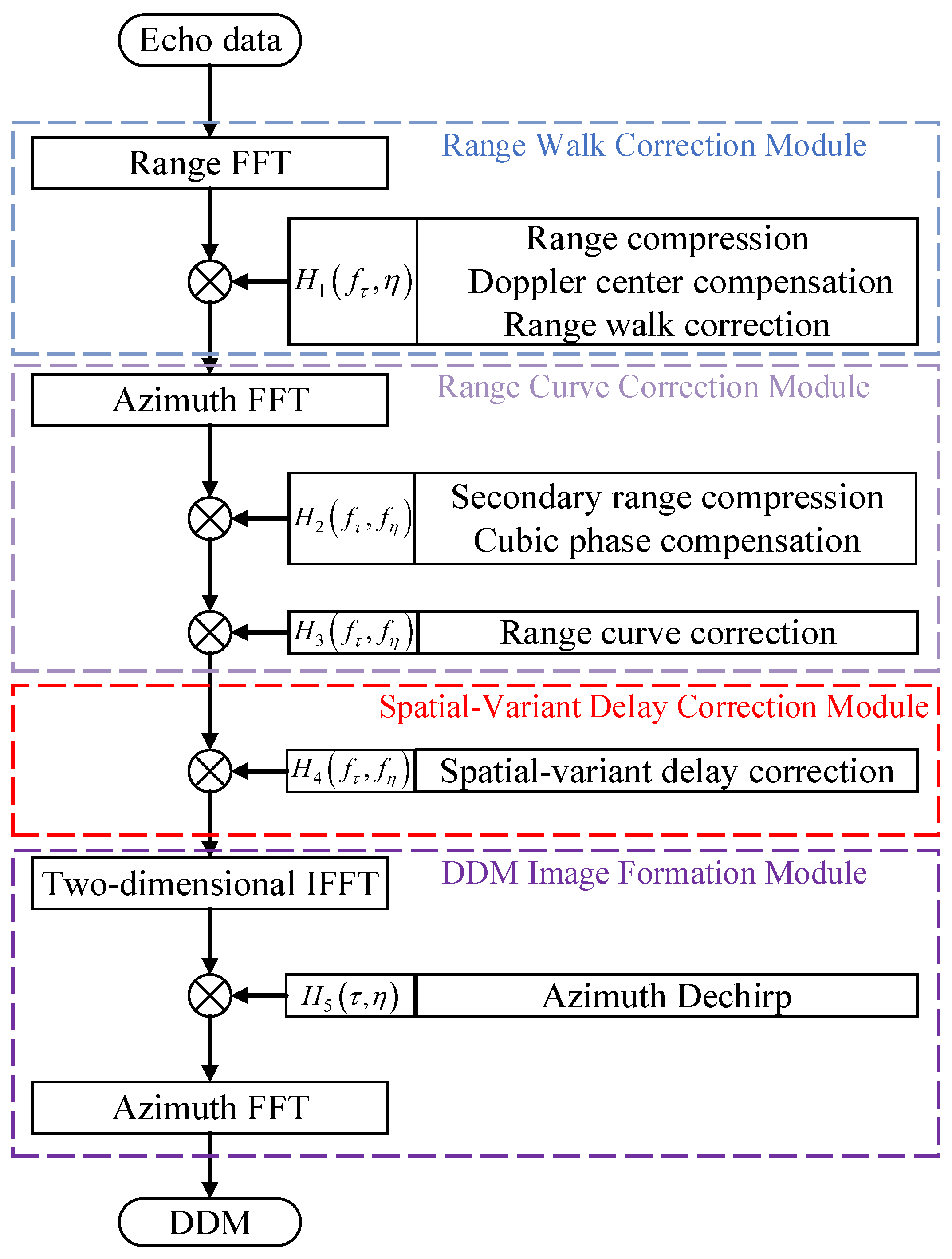
Figure 2 demonstrates the processing procedure of the proposed SVDD algorithm. The algorithm framework consists of four modules, namely range walk correction, range curve correction, spatial-variant delay correction and DDM image formation. The demodulated echo data, after being processed through four modules, can yield a DDM image that reflects the undulations of the terrain. Details about the processing procedure in each module are as follows.

4.1. Range Walk Correction

The range walk correction module achieves range compression, Doppler center compensation, and range walk correction. Through range FFT, the echo data in (10) is first converted to the range compression domain. Then, the correction function H 1 f τ , η in (12) is used to implement the correction processing.

4.2. Range Curve Correction

The range curve correction module achieves secondary range compression, cubic phase compensation, and range curve correction. Through azimuth FFT, the range compression domain signal processed by the range walk module is converted to the two-dimensional frequency domain. The correction function H 2 f τ , f η in (22) is used to realize secondary range compression and cubic phase compensation. The range curve correction is performed using the correction function H 3 f τ , f η in (24).

4.3. Spatial-Variant Delay Correction

The spatial-variant delay correction module realizes the spatial-variant delay correction. It can remove the influence of spatial-variant caused by the wide beamwidth on the DDM image. The two-dimensional frequency signal processed by the range curve module is multiplied with the correction function H 4 f τ , f η in (29) to realize the spatial-variant delay correction.

4.4. DDM Image Formation

The purpose of the DDM image formation module is to obtain the final DDM image. Therefore, it is necessary to carry out two-dimensional IFFT for the two-dimensional frequency domain signal processed by the spatial-variant delay correction module. In the two-dimensional time domain, the residual phase is compensated using the correction function H 5 τ , η in (32). Through azimuth FFT, the compensated signal is transformed into the Delay-Doppler domain to obtain the DDM.
After processing through the four modules, the corrected DDM can be obtained, with the spatial-variant caused by the wide beam already corrected. In the following, the effectiveness and superiority of the proposed algorithm are experimentally validated using both simulated and raw data.

5. Experiments

In this section, the effectiveness and superiority of the SVDD algorithm will be validated by using simulated data and raw data. The effectiveness is validated by comparing the terrain extracted from the DDM after processing with the real terrain, and the superiority is verified through a comparison with conventional algorithms. In the simulated data experiments, the point scatter imaging experiments are carried out first to image the different point scatter in the flat scene. Then, the Digital Elevation Model (DEM) is used to generate the simulated data of the real terrain. The simulated imaging experiments are carried out. At the same time, experiments under long coherent conditions were also added to ensure the rigor of the validation. In the raw data experiments, the collected echoes are processed to verify the performance of the proposed SVDD algorithm.

5.1. Simulated Data Experiments

5.1.1. Point Scatter Simulation Experiments

To validate the effectiveness of the azimuth imaging of the proposed algorithm in the case of the wide beamwidth, the point scatter experiments are carried out for the center point and edge points of the beam. The simulated radar parameters are given in Table 1. The proposed algorithm is compared with the conventional SARAL imaging algorithm [15]. The simulation scenario depicting a point scatter for the airborne SARAL is illustrated in Figure 1. The flight path is equipped with three point scatters, where x 1 and x 3 represent the edge point scatters, while x 2 represents the beam center point scatter. The elevation of the aircraft is 3100 m, and the distance between point scatters is 2000 m.
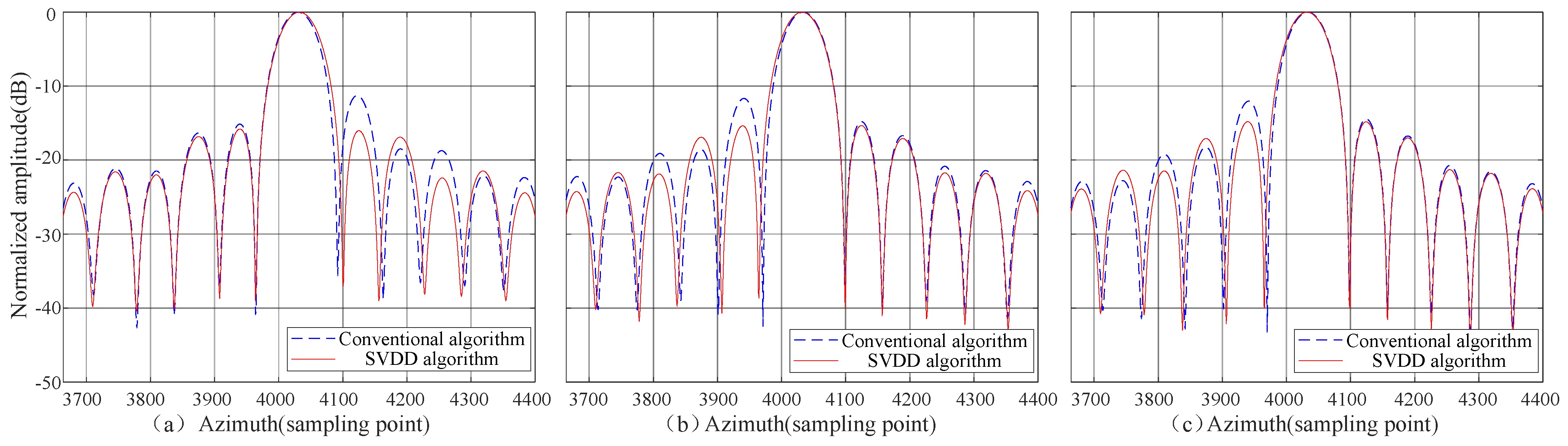
The imaging results of scene edge points x 1 and x 3 , as well as the scene center point x 2 , were analyzed in order to validate the imaging focusing performance. Figure 3 shows the azimuth profile results of scene edge points x 1 , x 3 and the scene center point x 2 obtained by the conventional algorithm and the SVDD algorithm. It can be seen from the azimuth profile of the conventional algorithm that the neglect of azimuth spatial-variant in echo delay leads to the increase of the first zero point and first sidelobe. The increase causes the loss of peak sidelobe ratio (PSLR) and integrated sidelobe ratio (ISLR), thereby impacting the azimuth resolution. The first sidelobe of the azimuth profile obtained by the conventional algorithm is asymmetrical. The most important difference between the proposed SVDD algorithm and the conventional algorithm lies in the spatial-variant delay correction. By considering the influence of azimuth spatial-variant on echo delay, both the first sidelobe and the first zero point are effectively reduced. The first sidelobe of the azimuth profile obtained by the SVDD algorithm is symmetrical.
The performance evaluation of the conventional algorithm and the SVDD algorithm is presented in Table 2, which includes the PSLR and the ISLR for both point scatters at the center and edge of the scene. It can be observed that for both PSLR or ISLR, the value obtained by the SVDD algorithm is smaller than that obtained by the conventional algorithm. The result demonstrates the effectiveness of the proposed SVDD algorithm.
In general, it can be seen from the point scatter experiments that the proposed SVDD algorithm is superior to the conventional algorithm in effect. In the next step, the DEM-based simulation experiments will be carried out to further verify the superiority of the proposed SVDD algorithm.

5.1.2. DEM-Based Simulation Experiments

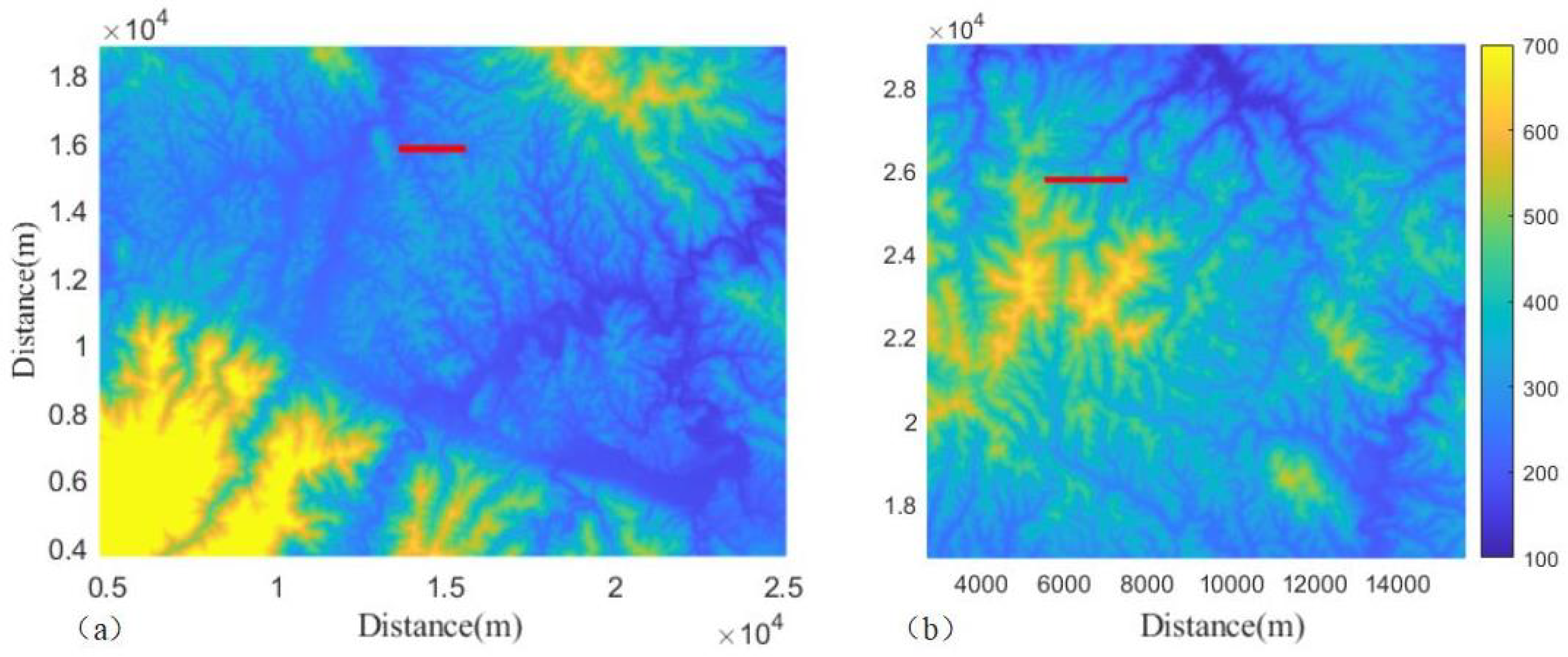
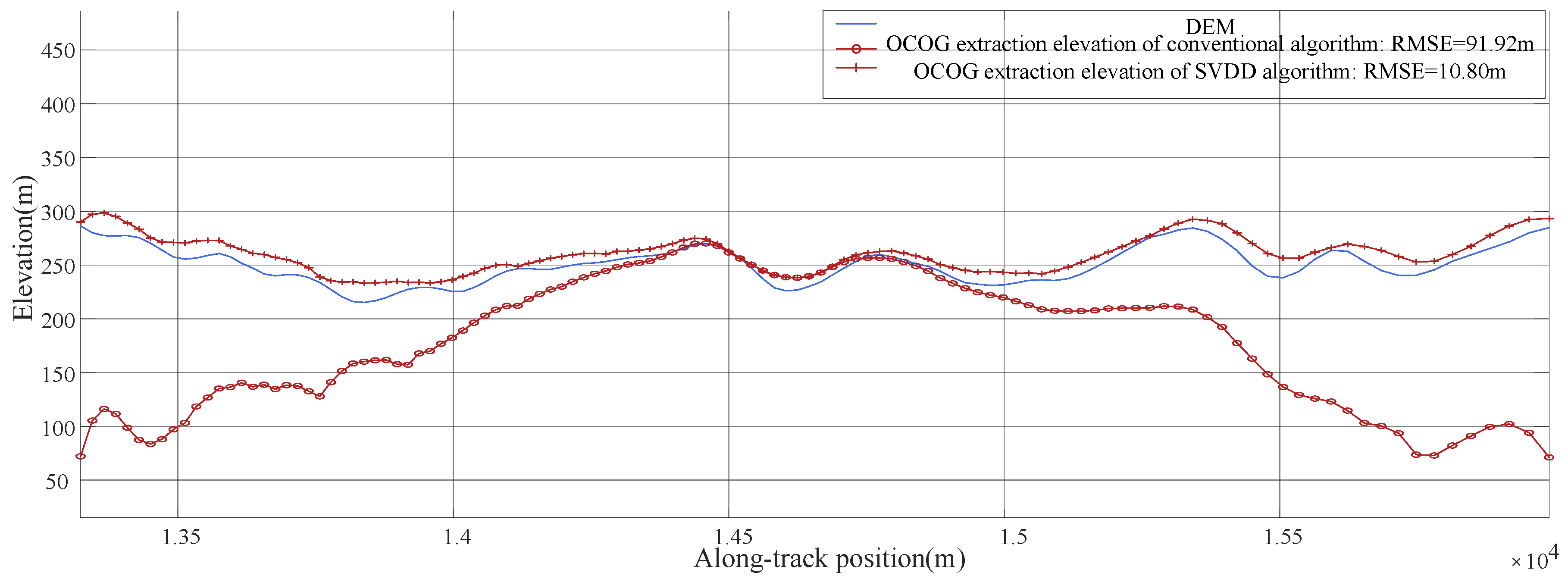
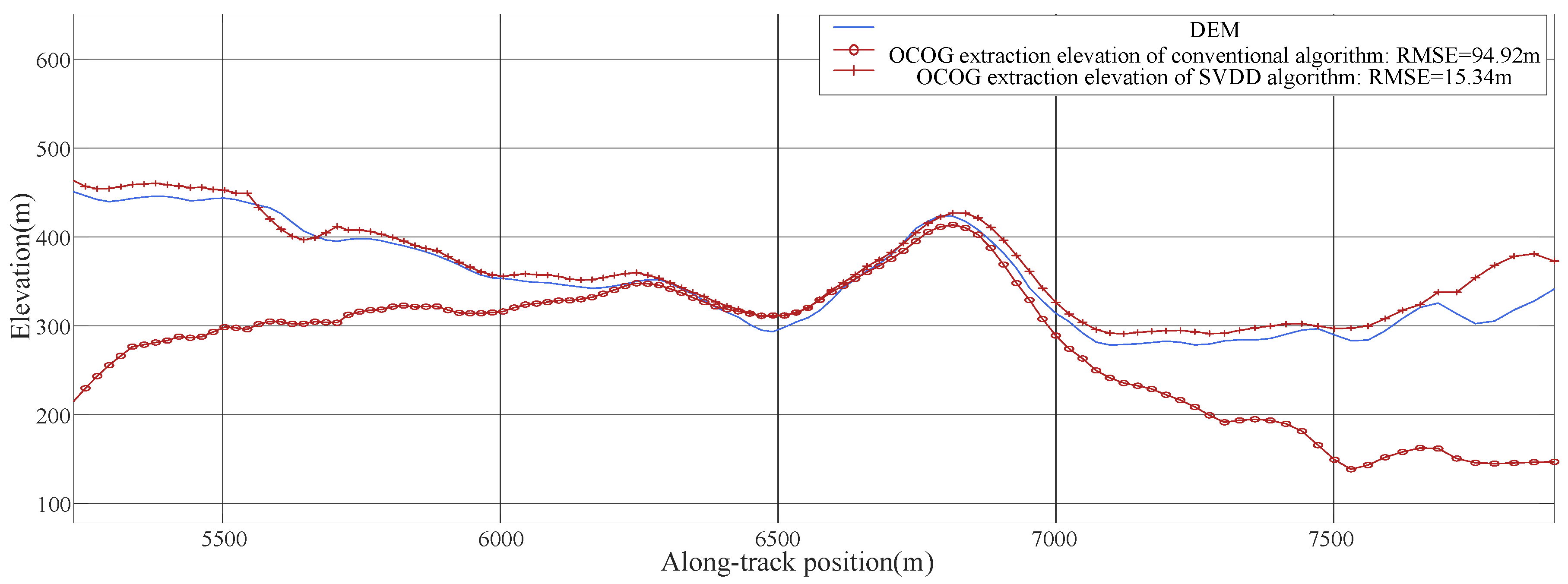
In order to further verify the effectiveness of the SVDD algorithm, the proposed algorithm is used to process the DEM-based simulated data. The simulated data is generated from the real ground elevation in the DEM. By processing the simulated data, DDM reflecting the ground elevation variation can be obtained. The performance of the imaging algorithm can be verified by comparing the real ground elevation variation with the extracted ground elevation variation from the DDM. The experimental parameters are the same as the parameters of the point scatter experiments in Table 1. The number of coherent pulses is 128. The conventional SARAL imaging algorithm [15] is compared with the SVDD algorithm in this paper. The simulation experiments are carried out for the terrain with small undulation and large undulation, respectively. Figure 4 demonstrates the DEMs of two terrains used in the experiments, where the indicated line represents the flight path of the aircraft.
To verify the imaging quality, elevation retracking is necessary after imaging to compare the extracted contour with the real ground elevation variation. Different from the conventional SARAL retracking process, in order to obtain the continuous terrain contour, the elevation of each Doppler channel is extracted instead of multi-view processing. Retracking methods can be divided into parametric model-based methods and non-parametric energy-based methods. The parametric model-based method fits the echo with the model and inverts the model parameters to obtain the elevation data. The most commonly used model is the Brown model at present [37,38]. Common fitting methods include Least Squares (LS) and the Maximum A Posteriori (MAP) method, which can effectively extract ground elevations [18,39,40,41,42]. Non-parametric energy-based methods often use the Offset Center of Gravity (OCOG) method, which only fits according to echo energy [43]. Since retracking algorithms are not the focus of this paper, the subsequent experiments adopt the OCOG algorithm for elevation retracking.
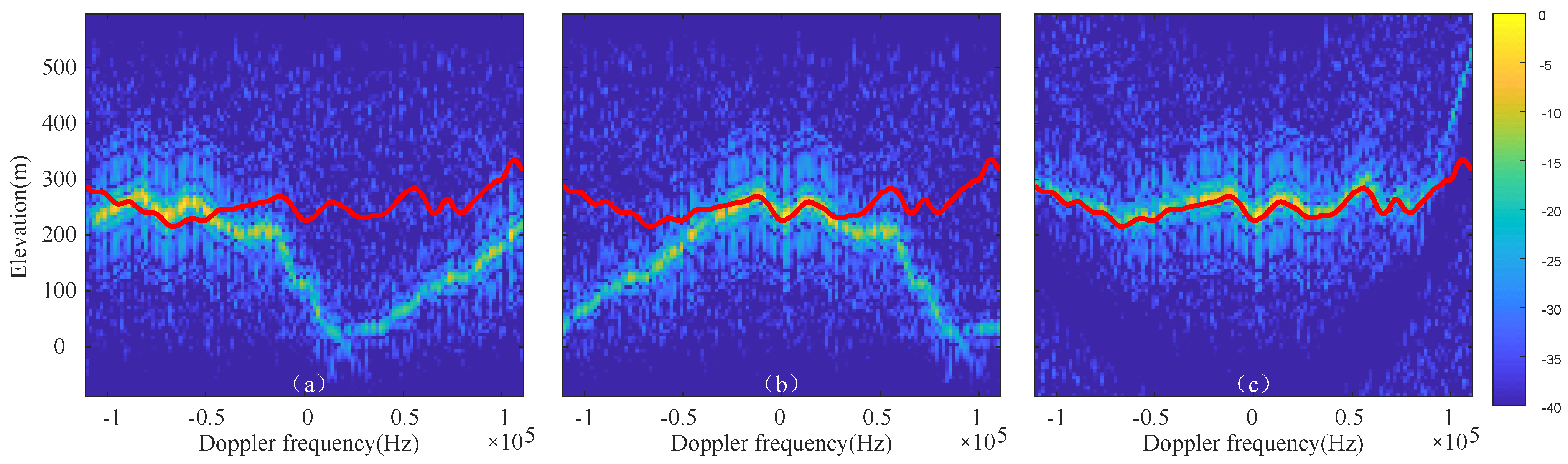
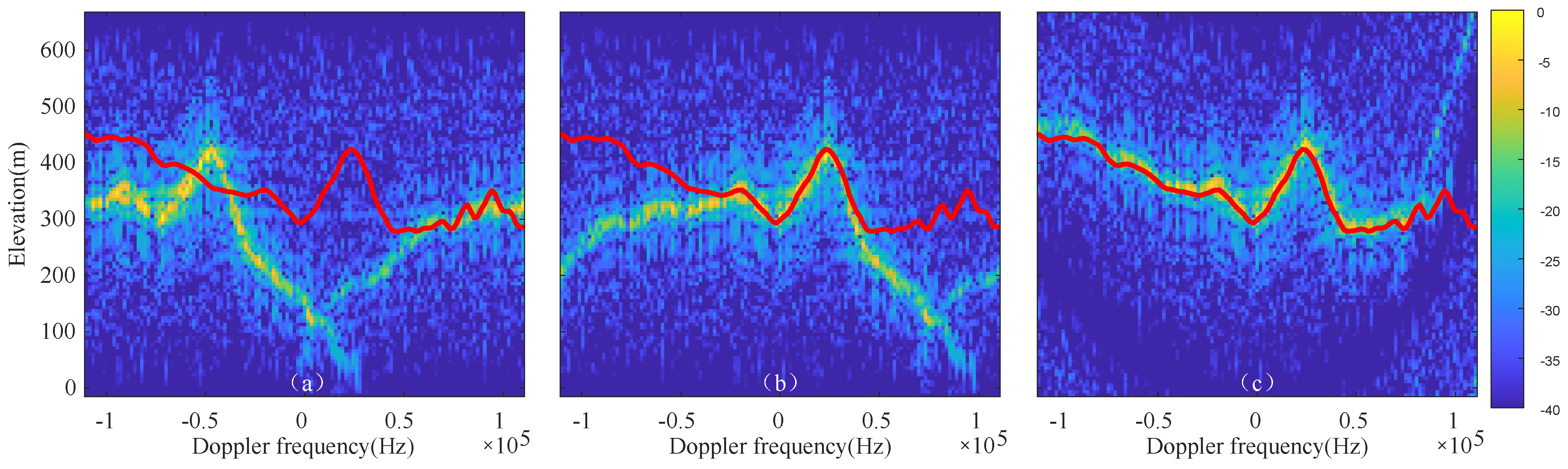
Figure 5 shows the imaging results of the terrain with small undulation. Figure 5a is the original DDM after range compression only. Figure 5b,c are the DDM images sequentially processed by the two functions H 1 and H 4 presented in the proposed SVDD algorithm, respectively. To more intuitively demonstrate the imaging effects, the red auxiliary line is added to indicate the truth of the ground terrain variation. Figure 6 shows the imaging results of the terrain with large undulation. It can be seen that after each correction function, DDM is gradually closer to the real terrain elevation. After the H 1 function correction, the Doppler center frequency is moved to the zero Doppler position. After the H 4 correction, the azimuth spatial-variant delay is corrected effectively. In the short-CPI case, the main factors affecting imaging quality are range walk correction and spatial-variant delay correction. The effects of secondary range compression and range curve correction are negligible in this scenario. Due to Doppler bandwidth ambiguity, the terrain variation on the right side of DDM is different from the real terrain variation. Figure 7 shows the elevation retracking results after the conventional algorithm and the SVDD algorithm of the terrain with small undulation. Figure 8 shows the elevation retracking results of the terrain with large undulation.
Table 3 shows the Root Mean Square Error (RMSE) results of contour extraction for two kinds of terrain. It can be seen that the RMSE of the terrain with small undulation and large undulation after SVDD processing is smaller than that after conventional processing. The conventional algorithm only carries out Doppler center correction and range migration correction, and does not consider the spatial-variant of the wide beamwidth. Consequently, the imaging effect is poor. It results in a big difference between the extracted contour and the real ground contour. The SVDD algorithm removes the spatial-variant delay; the extracted contour is consistent with the real ground contour.
Experimental results show that the SVDD algorithm has the advantage of imaging under the condition of the wide beamwidth, and can reflect elevation variation with a DDM.

5.1.3. Long Coherent Processing Interval Experiment

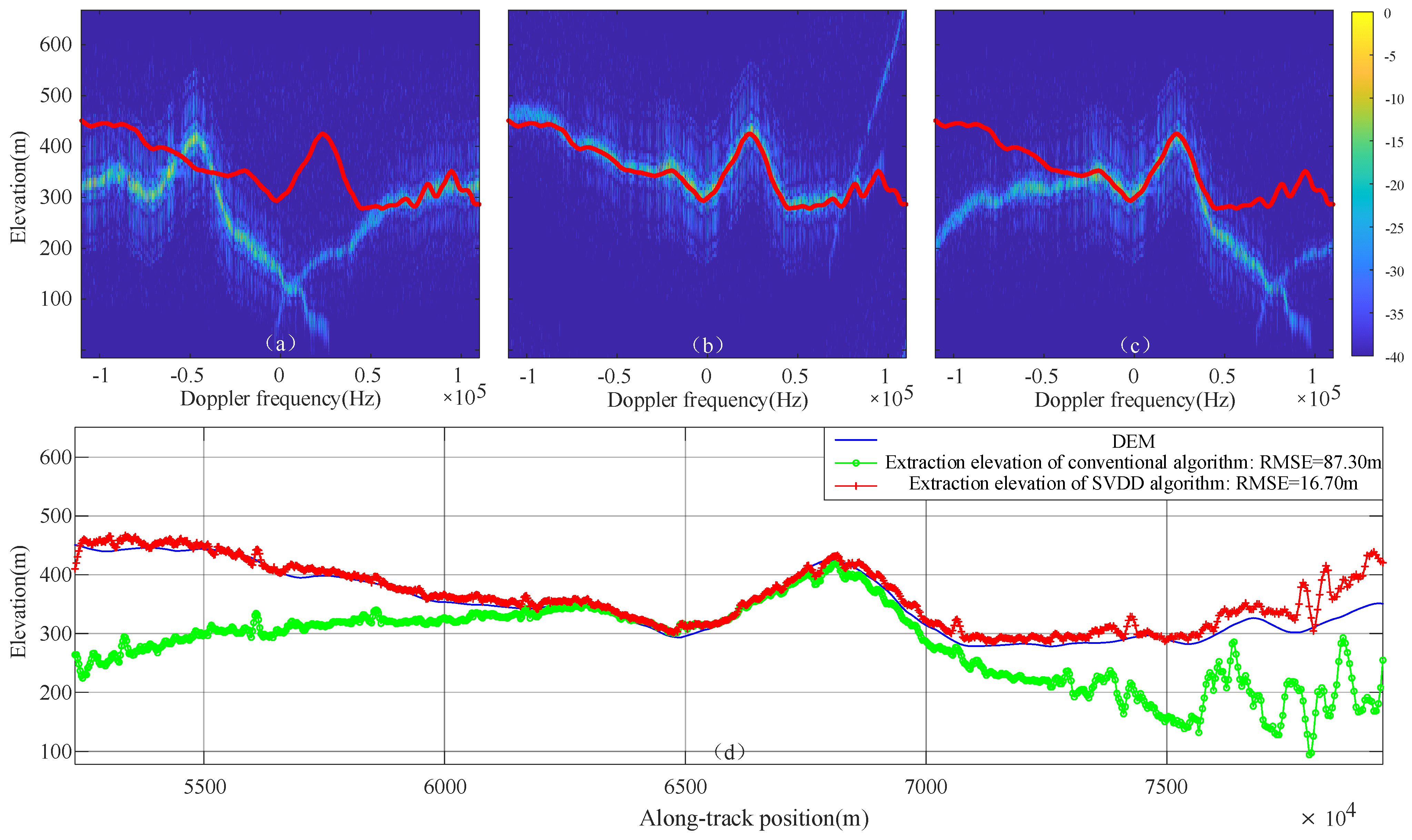
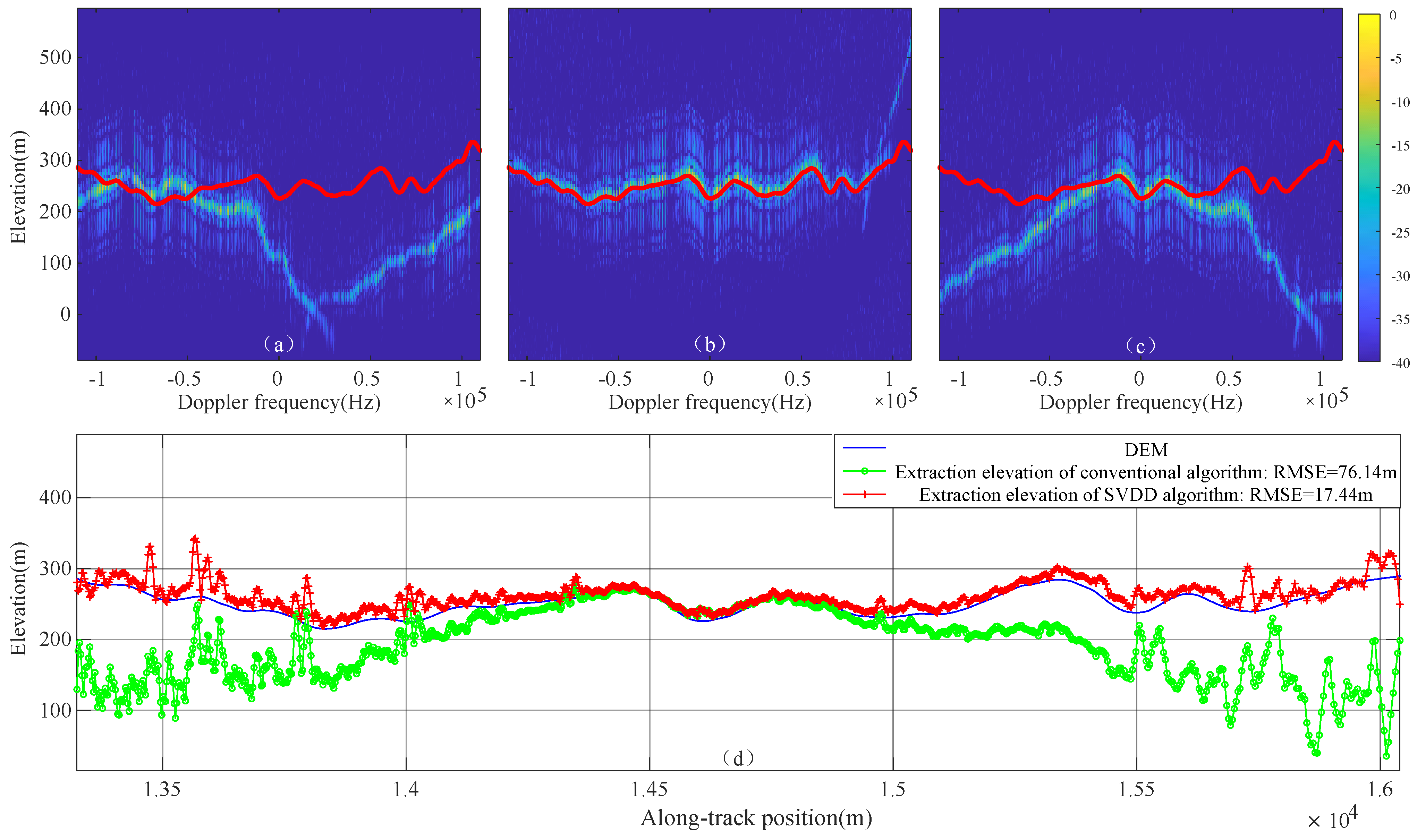
In order to verify the performance of the imaging algorithm with a long coherent processing interval (CPI), experiments with 1024 coherent pulses are carried out. The OCOG method is used for elevation retracking. The experimental parameters are the same as the parameters of the point scatter experiments in Table 1. Figure 9 shows the experimental results of the terrain with a small undulation of long CPI. Figure 9a shows the DDM after range compression only. Figure 9b shows the DDM after processing by the SVDD algorithm. Figure 9c shows the DDM after processing by the conventional algorithm. The added red auxiliary line represents the truth of the ground terrain variation. Figure 9d shows the comparison results between the extracted ground contour and the real ground contour. Figure 10 shows the experimental results of the terrain with a large undulation of long CPI.
Table 4 shows the contour extraction results of DDM after two imaging processes. The RMSE of the SVDD algorithm is smaller than that of the conventional algorithm. For the terrain with small undulation, the RMSE of the extracted elevation is 17.44 m, while for the terrain with large undulation, the RMSE is 16.70 m. This slight decrease in extraction accuracy for larger undulations can be attributed to two primary factors. First, a longer coherent integration time increases the sensitivity to residual uncorrected motion errors and phase noise. Such errors, while negligible under short-CPI conditions, accumulate over longer integration periods. Consequently, a slight degradation in DDM quality is observed for highly complicated terrain. Second, the OCOG retracking algorithm, though robust, is a non-parametric method whose performance is directly influenced by the shape of the returned echo. In highly undulating terrain, the returned echo often exhibits a multi-peak nature because multiple scattering centers at different elevations are simultaneously illuminated within the same wide beam. This introduces ambiguities in leading-edge detection, to which the energy-based OCOG algorithm is particularly susceptible. Despite this slight decrease, the extracted elevations still show high similarity to the real terrain elevation and can effectively reflect the ground elevation variation. Compared with short CPI, the terrain coverage in long CPI has little change, as the extraction range is mainly determined by beamwidth. However, the number of Doppler channels in long CPI is larger, enabling a more detailed representation of ground elevation variation.
In general, the results provide empirical evidence for the effectiveness of the proposed SVDD algorithm. The proposed SVDD algorithm can realize SARAL imaging under the condition of the wide beamwidth in both long and short CPI. The obtained high-accuracy DDM can reflect the ground elevation variation, which can be extracted by the OCOG method.

5.2. Raw Data Experiments

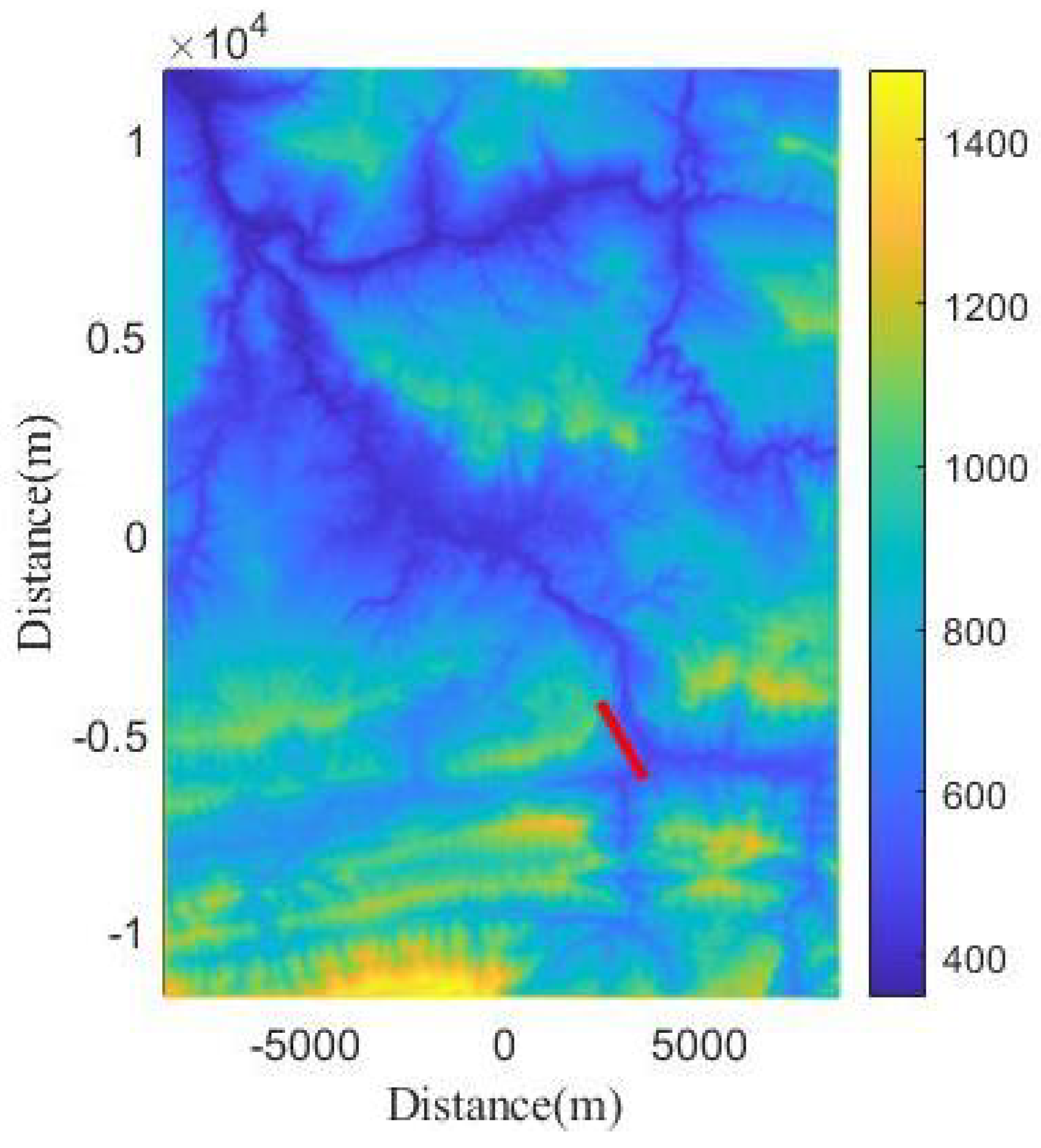
In the experiments, the raw data is utilized to verify the superior imagery performance of the proposed SVDD algorithm. The radar parameters are given in Table 5. Figure 11 demonstrates the DEM in the experiments, where the indicated line represents the flight path of the aircraft.
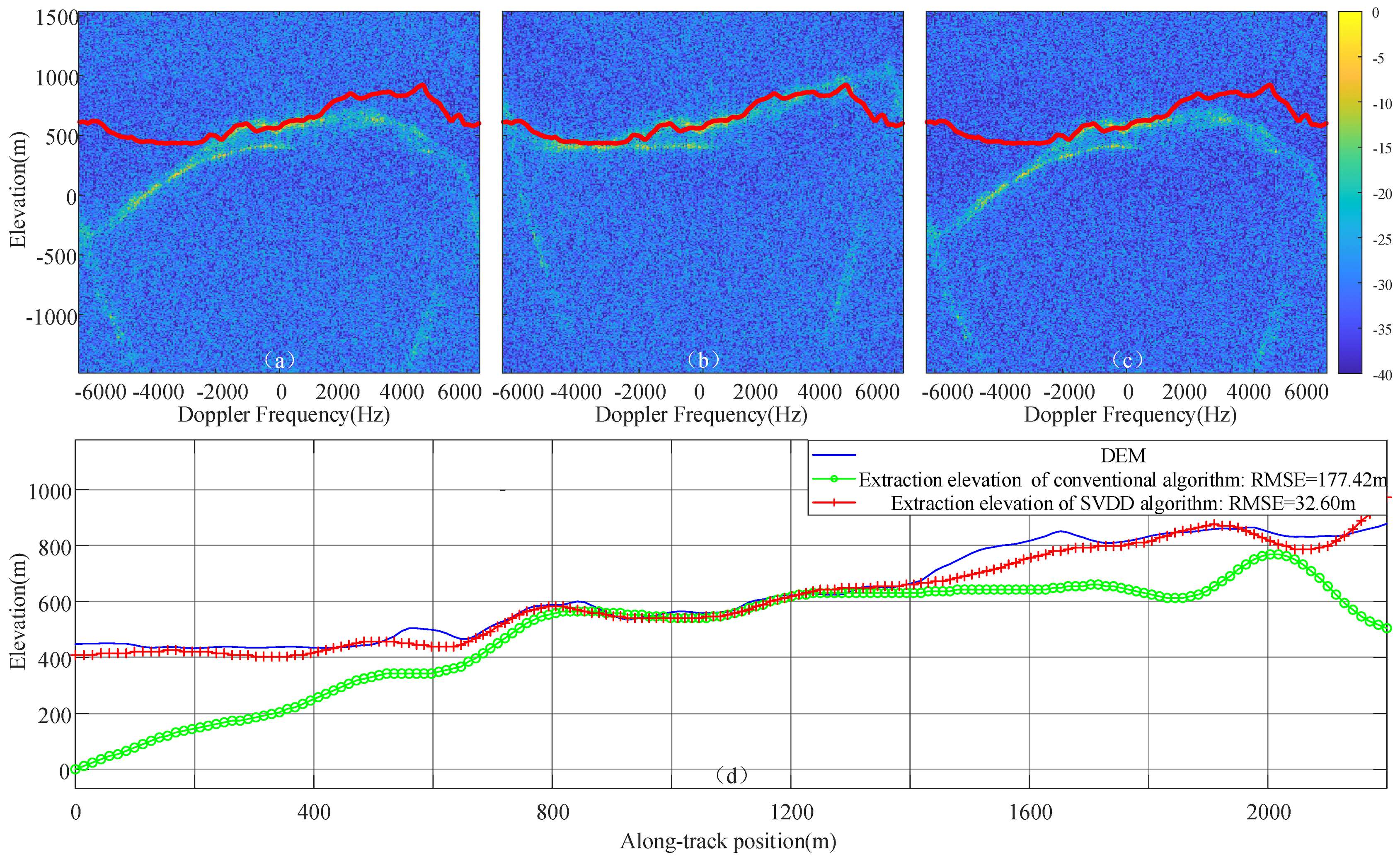
Figure 12 shows the experimental results of the raw data. Figure 12a shows the DDM after range compression only. Figure 12b shows the DDM after the SVDD algorithm processing. Figure 12c shows the DDM after the conventional algorithm processing. The added red auxiliary line represents the truth of the ground terrain variation. Figure 12d shows the comparison results between the extracted ground contour by the OCOG method and the real ground contour. Because Doppler band ambiguities exist in the DDM, elevation retracking during contour extraction is performed only on Doppler channels that are free of ambiguity. The results show that the DDM obtained using the conventional algorithm is quite similar to the DDM after range compression. The aircraft is in level flight, and the movement distance is short. Therefore, the range migration caused by motion had a minor impact on the DDM. The conventional imaging algorithm only considered the range migration caused by motion, leading to poorer imaging quality. In contrast, the SVDD algorithm takes into account the spatial-variant caused by the wide beamwidth, enabling accurate DDM imaging that reflects the real undulations of the ground. The RMSE of contour extraction using the conventional algorithm is 177.42 m, while the RMSE of contour extraction using the SVDD algorithm is 32.60 m. It can be seen that, even when applied to the raw data, the processing flow presented in this paper remains effective. The obtained ground elevation variations are consistent with the real elevation variation.

6. Conclusions

Aiming at the spatial-variant problem of airborne SARAL under wide beamwidth conditions, the proposed SVDD algorithm realizes azimuth spatial-variant delay correction and obtains accurate DDM images. The DDM obtained by the SVDD algorithm is consistent with the real elevation variation. The algorithm involves no interpolation and features a modular design with analytically derived pre-computed correction functions. Consequently, it imposes low demands on computational hardware, as the core operations are based on FFTs and complicated multiplications without interpolation. However, the storage of pre-computed correction functions and the modular architecture require sufficient memory capacity. The algorithm is well-suited for non-horizontal and non-constant speed flight conditions, particularly during takeoff and landing phases. Combined with elevation extraction and matching positioning algorithms, autonomous aircraft positioning can be achieved without external references. The effectiveness and practicability of the proposed algorithm are verified through simulated data experiments and raw data experiments.

Author Contributions

Conceptualization, Y.L., F.L. and L.Y.; methodology, Y.L., S.Y. and B.H.; software, S.Y., Y.W. and G.L.; validation, Y.W., F.L. and L.T.; formal analysis, Y.L. and S.Y.; investigation, B.H., G.J. and L.Y.; resources, Y.W. and L.T.; data curation, S.Y. and G.L.; writing—original draft preparation, F.L.; writing—review and editing, Y.L. and S.Y.; visualization, B.H.; supervision, G.J., B.H. and L.Y.; project administration, Y.L. and F.L.; funding acquisition, Y.L. and L.Y. All authors have read and agreed to the published version of the manuscript.

Funding

This research was funded in part by the National Natural Science Foundation of China under Grant 62271487 and in part by the Fundamental Research Funds for the Central Universities under Grant 3122023PY07.

Data Availability Statement

The data used in this study can be obtained by contacting the corresponding author.

Conflicts of Interest

The authors declare no conflicts of interest.

Appendix A

Table A1. Nomenclature.
SymbolMeaningUnit
η Azimuth slow times
τ Range fast times
f 0 Carrier frequencyHz
f τ Range frequencyHz
f η Azimuth frequencyHz
f η M Normalized azimuth frequency square1
R x Slant range between radar and target at x p m
R r e f Reference range at nadir ( x p = 0 )m
h x Vertical height between radar and targetm
h 0 Aircraft altitude above reference planem
x p Azimuth position of target relative to nadirm
v x 0 , v z 0 Initial velocity components in X and Z directionsm/s
a x , a z Acceleration components in X and Z directions m/s 2
θ s Angle between the beam center direction and the nadir pointrad
λ Wavelengthm
cSpeed of lightm/s
K r Range chirp rateHz/s
ARange walk ratem/s
BRange curve rate m/s 2
ϕ 0 Azimuth modulation term in 2D spectrumrad
ϕ 1 Range migration term in 2D spectrumrad
ϕ 2 Secondary range compression term in 2D spectrumrad
ϕ 3 Cubic phase term in 2D spectrumrad

References

  1. Yuan, T.; Lee, H.; Yu, H.; Jung, H.C.; Madson, A.; Sheng, Y.; Beighley, E. Mapping Forested Floodplain Topography Using InSAR and Radar Altimetry. IEEE J. Sel. Top. Appl. Earth Obs. Remote Sens. 2019, 12, 5189–5198. [Google Scholar] [CrossRef]
  2. Wang, Z.; Liu, Y.; Zhang, J.; Fan, C. Sea Surface Imaging Simulation for 3D Interferometric Imaging Radar Altimeter. IEEE J. Sel. Top. Appl. Earth Obs. Remote Sens. 2021, 14, 62–74. [Google Scholar] [CrossRef]
  3. Shi, L.; Xu, K.; Liu, P.; Yang, S.; Wang, L.; YU, X. Height Precision of SAR Altimeter and Conventional Radar Altimeter Based on Flight Experimental Data. IEEE J. Sel. Top. Appl. Earth Obs. Remote Sens. 2016, 9, 2676–2686. [Google Scholar] [CrossRef]
  4. Lu, C.; Yang, T.; Zhang, B.; Yu, H. Spaceborne Altimeter Calibration System With Calibration Satellites. IEEE J. Sel. Top. Appl. Earth Obs. Remote Sens. 2024, 17, 18613–18621. [Google Scholar] [CrossRef]
  5. Amani, M.; Mohseni, F.; Layegh, N.F.; Nazari, M.E.; Fatolazadeh, F.; Salehi, A.; Ahmadi, S.A.; Ebrahimy, H.; Ghorbanian, A.; Jin, S.; et al. Remote Sensing Systems for Ocean: A Review (Part 2: Active Systems). IEEE J. Sel. Top. Appl. Earth Obs. Remote Sens. 2022, 15, 1421–1453. [Google Scholar] [CrossRef]
  6. Su, X.; Li, X.; Su, Q.; Ma, J.; Song, W.; Xu, J. Research progress in application of synthetic aperture radar altimeter. Water Resour. Hydropower Eng. 2023, 54, 103–114. [Google Scholar] [CrossRef]
  7. Halimi, A.; Mailhes, C.; Tourneret, J.Y. Cramér-Rao bounds and estimation algorithms for delay/Doppler and conventional altimetry. In 21st European Signal Processing Conference (EUSIPCO 2013); IEEE: New York, NY, USA, 2013; pp. 1–5. [Google Scholar]
  8. Tournadre, J.; Chaprono, B. Altimeter as an Imager of the Sea Surface Roughness: Comparison of SAR and LRM Modes. In IGARSS 2020—2020 IEEE International Geoscience and Remote Sensing Symposium; IEEE: New York, NY, USA, 2020; pp. 3541–3544. [Google Scholar] [CrossRef]
  9. Liu, P.; Xu, K.; Wang, L.; Shi, L.; Yu, X. Precision comparison and airborne experiment validation between SAR altimeter and conventional altimeter. J. Electron. Inf. Technol. 2016, 38, 2495–2501. [Google Scholar]
  10. Quilfen, Y.; Chapron, B. On denoising satellite altimeter measurements for high-resolution geophysical signal analysis. Adv. Space Res. 2021, 68, 875–891. [Google Scholar] [CrossRef]
  11. Yang, S.; Zhai, Z.; Xu, K.; Wang, Z.; Shi, L.; Wang, L.; Cui, H.; Xu, X. The ground process segment of SAR altimeter. Remote Sens. Technol. Appl. 2017, 32, 1083–1092. [Google Scholar]
  12. Dhote, P.R.; Agarwal, A.; Singhal, G.; Calmant, S.; Thakur, P.K.; Oubanas, H.; Paris, A.; Singh, R.P. River Water Level and Water Surface Slope Measurement From Spaceborne Radar and LiDAR Altimetry: Evaluation and Implications for Hydrological Studies in the Ganga River. IEEE J. Sel. Top. Appl. Earth Obs. Remote Sens. 2024, 17, 7825–7840. [Google Scholar] [CrossRef]
  13. Lu, Y.; Song, A.; Liu, G.; Tan, L.; Xu, Y.; Li, F.; Wang, Y.; Jiang, G.; Yang, L. TMP-Net: Terrain Matching and Positioning Network by Highly Reliable Airborne Synthetic Aperture Radar Altimeter. Remote Sens. 2024, 16, 2966. [Google Scholar] [CrossRef]
  14. Wan, Y.; Zhang, R.; Pan, X.; Fan, C.; Dai, Y. Evaluation of the significant wave height data quality for the Sentinel-3 Synthetic aperture radar altimeter. Remote Sens. 2020, 12, 3107. [Google Scholar] [CrossRef]
  15. Liu, X.; Wang, K.; Sun, H.; Lu, Y. Ka-band SAR altimeter airborne data processing. Syst. Eng. Electron. 2022, 44, 2800–2808. [Google Scholar]
  16. Liu, X.; Wang, K.; Sun, H.; Lu, Y. SAR Altimeter Data Processing and Airborne Experiment. In 2021 CIE International Conference on Radar (Radar); IEEE: New York, NY, USA, 2021; pp. 535–538. [Google Scholar] [CrossRef]
  17. Jain, M.; Martin-Puig, C.; Andersen, O.B.; Stenseng, L.; Dall, J. Evaluation of SAMOSA3 adapted retracker using Cryosat-2 SAR altimetry data over the Arctic ocean. In 2014 IEEE Geoscience and Remote Sensing Symposium; IEEE: New York, NY, USA, 2014; pp. 5115–5118. [Google Scholar] [CrossRef]
  18. Halimi, A.; Mailhes, C.; Tourneret, J.Y.; Thibaut, P.; Boy, F. A Semi-Analytical Model for Delay/Doppler Altimetry and Its Estimation Algorithm. IEEE Trans. Geosci. Remote Sens. 2014, 52, 4248–4258. [Google Scholar] [CrossRef]
  19. Yang, L.; Zhou, H.; Huang, B.; Liao, X.; Xia, Y. Elevation Estimation for Airborne Synthetic Aperture Radar Altimetry Based on Parameterized Bayesian Learning. J. Electron. Inf. Technol. 2023, 45, 1254–1264. [Google Scholar]
  20. Martin, T.V.; Zwally, H.J.; Brenner, A.C.; Bindschadler, R.A. Analysis and retracking of continental ice sheet radar altimeter waveforms. J. Geophys. Res. Ocean. 1983, 88, 1608–1616. [Google Scholar] [CrossRef]
  21. Li, D.; Lin, H.; Liu, H.; Wu, H.; Tan, X. Focus Improvement for Squint FMCW-SAR Data Using Modified Inverse Chirp-Z Transform Based on Spatial-Variant Linear Range Cell Migration Correction and Series Inversion. IEEE Sens. J. 2016, 16, 2564–2574. [Google Scholar] [CrossRef]
  22. Tang, Y.; Zhang, B.; Xing, M.; Bao, Z.; Guo, L. The Space-Variant Phase-Error Matching Map-Drift Algorithm for Highly Squinted SAR. IEEE Geosci. Remote Sens. Lett. 2013, 10, 845–849. [Google Scholar] [CrossRef]
  23. Dang, Y.; Liang, Y.; Bie, B.; Ding, J.; Zhang, Y. A Range Perturbation Approach for Correcting Spatially Variant Range Envelope in Diving Highly Squinted SAR With Nonlinear Trajectory. IEEE Geosci. Remote Sens. Lett. 2018, 15, 858–862. [Google Scholar] [CrossRef]
  24. Chen, J.; Li, M.; Yu, H.; Xing, M. Full-Aperture Processing of Airborne Microwave Photonic SAR Raw Data. IEEE Trans. Geosci. Remote Sens. 2023, 61, 5218812. [Google Scholar] [CrossRef]
  25. Zhang, G.; Liu, Y.; Li, Q.; Liang, Y. Accurate Elimination Method of 3-D Acceleration for Highly Squinted TOPS SAR with Curved Trajectory. In 2021 2nd China International SAR Symposium (CISS); IEEE: New York, NY, USA, 2021; pp. 1–4. [Google Scholar] [CrossRef]
  26. Sun, Z.; Wu, J.; Li, Z.; Huang, Y.; Yang, J. Highly Squint SAR Data Focusing Based on Keystone Transform and Azimuth Extended Nonlinear Chirp Scaling. IEEE Geosci. Remote Sens. Lett. 2015, 12, 145–149. [Google Scholar] [CrossRef]
  27. Li, N.; Sun, G.C.; Xing, M. Unambiguous Signal Reconstruction Algorithm for High Squint Multichannel SAR Mounted on High Speed Maneuvering Platforms. In IGARSS 2020—2020 IEEE International Geoscience and Remote Sensing Symposium; IEEE: New York, NY, USA, 2020; pp. 2125–2128. [Google Scholar] [CrossRef]
  28. Yu, H.; Xing, M.; Yuan, Z. Baseline design for multibaseline InSAR system: A review. IEEE J. Miniaturization Air Space Syst. 2020, 2, 17–24. [Google Scholar] [CrossRef]
  29. Zhang, T.; Ding, Z.; Tian, W.; Zeng, T.; Yin, W. A 2-D Nonlinear Chirp Scaling Algorithm for High Squint GEO SAR Imaging Based on Optimal Azimuth Polynomial Compensation. IEEE J. Sel. Top. Appl. Earth Obs. Remote Sens. 2017, 10, 5724–5735. [Google Scholar] [CrossRef]
  30. Tang, S.; Zhang, L.; Guo, P.; Liu, G.; Sun, G.C. Acceleration Model Analyses and Imaging Algorithm for Highly Squinted Airborne Spotlight-Mode SAR with Maneuvers. IEEE J. Sel. Top. Appl. Earth Obs. Remote Sens. 2015, 8, 1120–1131. [Google Scholar] [CrossRef]
  31. Yuan, W.; Xu, H.; Yu, S.; Hu, Y.; Yang, L. Wide-Beam Synthetic Aperture Radar Down-Look Imaging. In 2024 IEEE International Conference on Signal, Information and Data Processing (ICSIDP); IEEE: New York, NY, USA, 2024; pp. 1–5. [Google Scholar]
  32. Fang, C.; Sun, M.; Huang, B.; Guan, F.; Zhou, H.; Liao, X.; Yang, L. Altimetric Parameter Estimation in Long Coherent Processing by Airborne Delay/Doppler Altimetry Based on Bayesian Learning. IEEE J. Sel. Top. Appl. Earth Obs. Remote Sens. 2023, 16, 8135–8148. [Google Scholar] [CrossRef]
  33. Zhu, S.; Yue, J.; Jiang, W. SAS autofocus based on phase gradient autofocus. In 2011 Fourth International Workshop on Chaos-Fractals Theories and Applications; IEEE: New York, NY, USA, 2011; pp. 298–301. [Google Scholar]
  34. Yu, H.; Lan, Y.; Yuan, Z.; Xu, J.; Lee, H. Phase unwrapping in InSAR: A review. IEEE Geosci. Remote Sens. Mag. 2019, 7, 40–58. [Google Scholar] [CrossRef]
  35. Wahl, D.E.; Eichel, P.; Ghiglia, D.; Jakowatz, C. Phase gradient autofocus-a robust tool for high resolution SAR phase correction. IEEE Trans. Aerosp. Electron. Syst. 2002, 30, 827–835. [Google Scholar] [CrossRef]
  36. Cumming, I.G.; Wong, F.H. Digital Processing of Synthetic Aperture Radar Data: Algorithms and Implementation; Artech House Publishers: Boston, MA, USA, 2005. [Google Scholar]
  37. Brown, G. The average impulse response of a rough surface and its applications. IEEE Trans. Antennas Propag. 1977, 25, 67–74. [Google Scholar] [CrossRef]
  38. Brown, G. A useful approximation for the flat surface impulse response. IEEE Trans. Antennas Propag. 1989, 37, 764–767. [Google Scholar] [CrossRef]
  39. Garcia, E.S.; Sandwell, D.T.; Smith, W.H. Retracking CryoSat-2, Envisat and Jason-1 radar altimetry waveforms for improved gravity field recovery. Geophys. J. Int. 2013, 196, 1402–1422. [Google Scholar] [CrossRef]
  40. Wang, J.; Xu, K.; Jiang, M. Design and Verification of Retracking Estimator for Synthetic Aperture Altimeter Based on Weighted Least Squares. J. Electron. Inf. Technol. 2022, 44, 2135–2142. [Google Scholar]
  41. Shu, S.; Liu, H.; Frappart, F.; Kang, E.L.; Yang, B.; Xu, M.; Huang, Y.; Wu, B.; Yu, B.; Wang, S.; et al. Improving Satellite Waveform Altimetry Measurements With a Probabilistic Relaxation Algorithm. IEEE Trans. Geosci. Remote Sens. 2021, 59, 4733–4748. [Google Scholar] [CrossRef]
  42. Halimi, A.; Mailhes, C.; Tourneret, J.Y.; Snoussi, H. Bayesian Estimation of Smooth Altimetric Parameters: Application to Conventional and Delay/Doppler Altimetry. IEEE Trans. Geosci. Remote Sens. 2016, 54, 2207–2219. [Google Scholar] [CrossRef]
  43. Yang, L.; Lin, M.; Liu, Q.; Pan, D. Retracking strategy based on waveform Classification and sub-waveform extraction for coastal altimetry along China coastal seas. In 2010 IEEE International Geoscience and Remote Sensing Symposium; IEEE: New York, NY, USA, 2010; pp. 632–635. [Google Scholar] [CrossRef]
Figure 1. Imaging geometry of airborne SARAL.
Remotesensing 18 01039 g001
Figure 2. Processing procedure of proposed spatial-variant Delay-Doppler algorithm.
Remotesensing 18 01039 g002
Figure 3. The azimuth profile results of the points obtained by conventional algorithm and SVDD algorithm. (a) Point x 1 . (b) Point x 2 . (c) Point x 3 .
Remotesensing 18 01039 g003
Figure 4. DEM of the terrain. (a) Small undulation. (b) Large undulation.
Remotesensing 18 01039 g004
Figure 5. The terrain with small undulation imaging result of short coherent processing interval (128 coherent pulses). (a) Imaging result before processing. (b) Imaging result after function H 1 processing. (c) Imaging result after function H 4 processing.
Remotesensing 18 01039 g005
Figure 6. The terrain with large undulation imaging result of short coherent processing interval (128 coherent pulses). (a) Imaging result before processing. (b) Imaging result after function H 1 processing. (c) Imaging result after function H 4 processing.
Remotesensing 18 01039 g006
Figure 7. Contour extraction results of the terrain with small undulation.
Remotesensing 18 01039 g007
Figure 8. Contour extraction results of the terrain with large undulation.
Remotesensing 18 01039 g008
Figure 9. The terrain with small undulation imaging result of long coherent processing interval (1024 coherent pulses). (a) Imaging result before processing. (b) Imaging result after SVDD processing. (c) Imaging result after conventional processing. (d) Contour extraction results.
Remotesensing 18 01039 g009
Figure 10. The terrain with large undulation imaging result of long coherent processing interval (1024 coherent pulses). (a) Imaging result before processing. (b) Imaging result after SVDD processing. (c) Imaging result after conventional processing. (d) Contour extraction results.
Remotesensing 18 01039 g010
Figure 11. DEM of raw data experiments.
Remotesensing 18 01039 g011
Figure 12. Raw data imaging result. (a) Imaging result before processing. (b) Imaging result after SVDD processing. (c) Imaging result after conventional processing. (d) Contour extraction results.
Remotesensing 18 01039 g012
Table 1. Parameters of simulated data experiments.
ParameterValue
Centered FrequencyX-band
Pulse Repetition Frequency (PRF)220 kHz
Pulse Width0.9 μs
Pulse Bandwidth10 MHz
Imaging Squint Angle 10
Radar Beamwidth 50
Signal-to-noise Ratio10 dB
Vertical Initial Speed 50 m/s
Horizontal Initial Speed87 m/s
Vertical Acceleration 4.9   m/s 2
Horizontal Acceleration 4.9   m/s 2
Flight Elevation3.1 km
Table 2. Results of imaging quality indices for point scatters.
IndexScatterConventionalProposed
PSLR (dB) x 1 −11.27−15.78
x 2 −11.66−15.31
x 3 −12.02−14.79
ISLR (dB) x 1 −9.29−11.29
x 2 −9.49−11.06
x 3 −9.61−10.75
Table 3. RMSE results of contour extraction for two imaging algorithms under short coherent processing interval.
Terrain TypeConventionalSVDD
Terrain with small undulation91.92 m10.80 m
Terrain with large undulation94.92 m15.34 m
Table 4. RMSE results of contour extraction for two imaging algorithms under long coherent processing interval.
Terrain TypeConventionalSVDD
Terrain with small undulation76.14 m17.44 m
Terrain with large undulation87.30 m16.70 m
Table 5. System parameters for the raw data.
ParameterValue
BandX-band
Pulse Repetition Frequency (PRF)12.5 kHz
Pulse Width0.9 μs
Pulse Bandwidth10 MHz
Imaging Squint Angle 0
Imaging Beamwidth 50
Vertical Initial Speed0 m/s
Horizontal Initial Speed33 m/s
Vertical Acceleration 0   m/s 2
Horizontal Acceleration 0   m/s 2
Flight Elevation3 km
Disclaimer/Publisher’s Note: The statements, opinions and data contained in all publications are solely those of the individual author(s) and contributor(s) and not of MDPI and/or the editor(s). MDPI and/or the editor(s) disclaim responsibility for any injury to people or property resulting from any ideas, methods, instructions or products referred to in the content.