Urban Expansion-Driven Cropland NPP Change in the Beijing-Tianjin-Hebei Region, China (2001–2020): Spatiotemporal Patterns, Ecological Selectivity, and Spatially Varying Driver Effects



Highlights
- Urban land in the Beijing–Tianjin–Hebei (BTH) region expanded by 45.2% between 2001 and 2020.
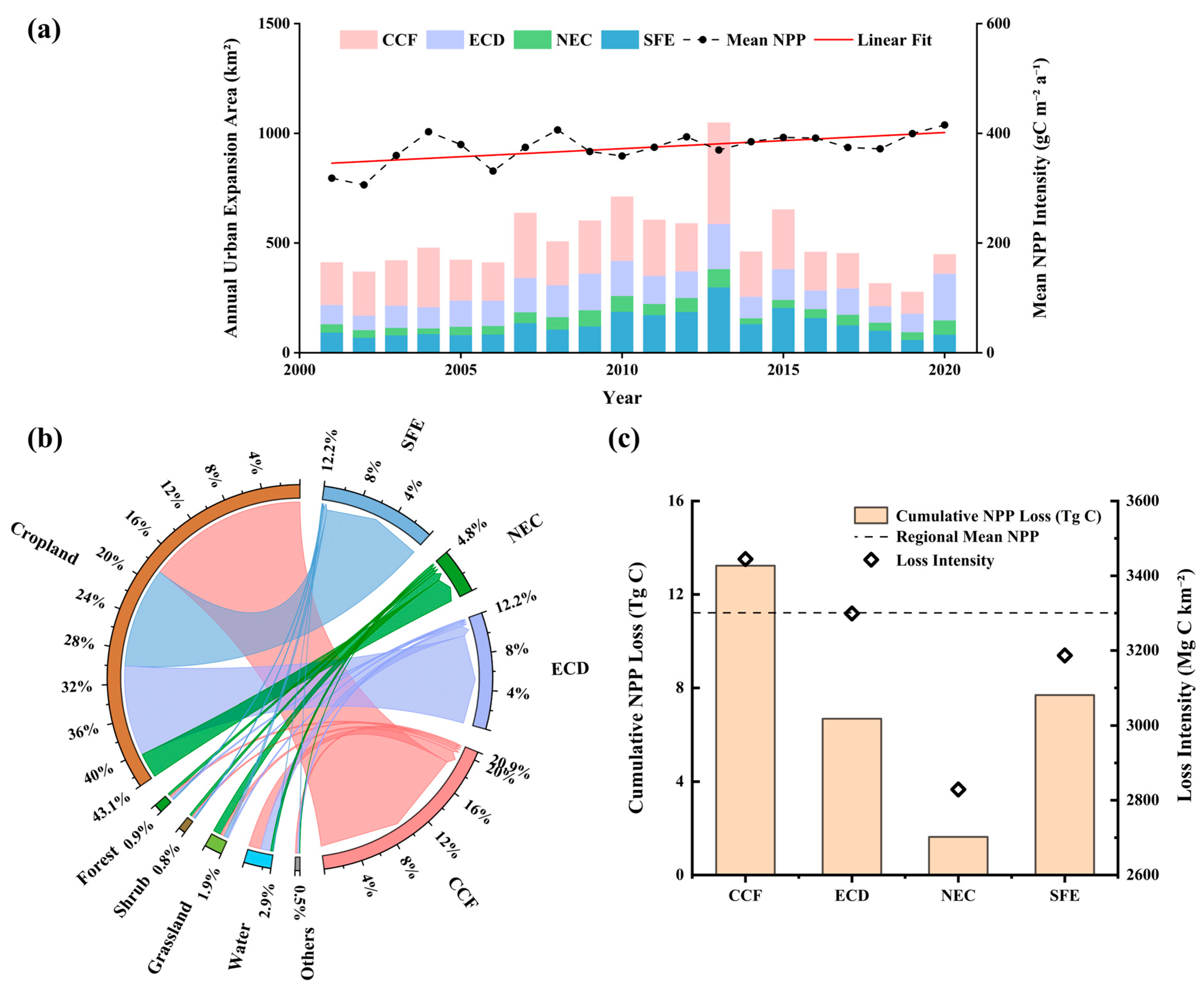
- Cropland conversion dominates urban growth: 91.04% of newly urbanized land came from cropland, causing a time-weighted cumulative cropland net primary productivity (NPP) loss of 29.24 Tg C.
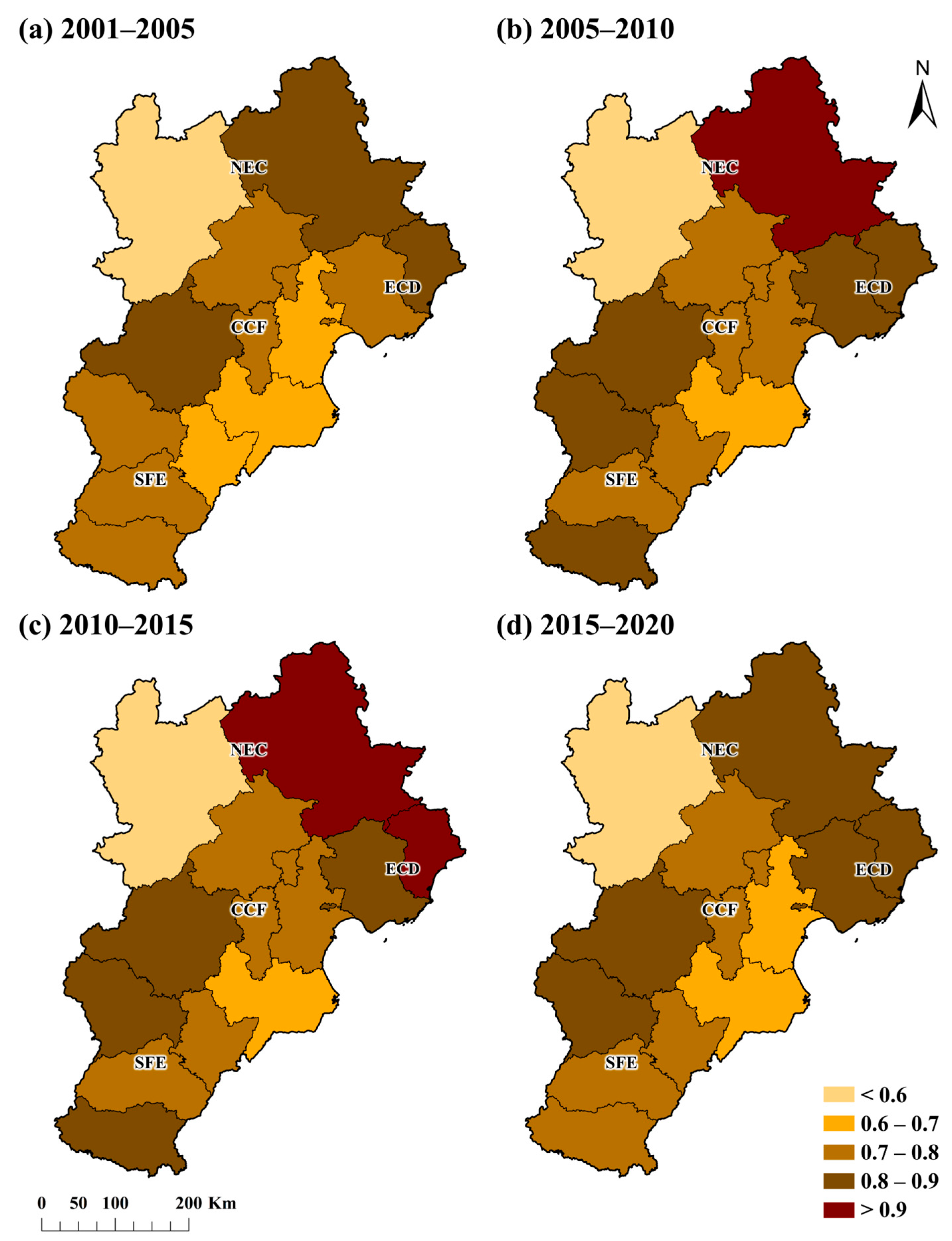
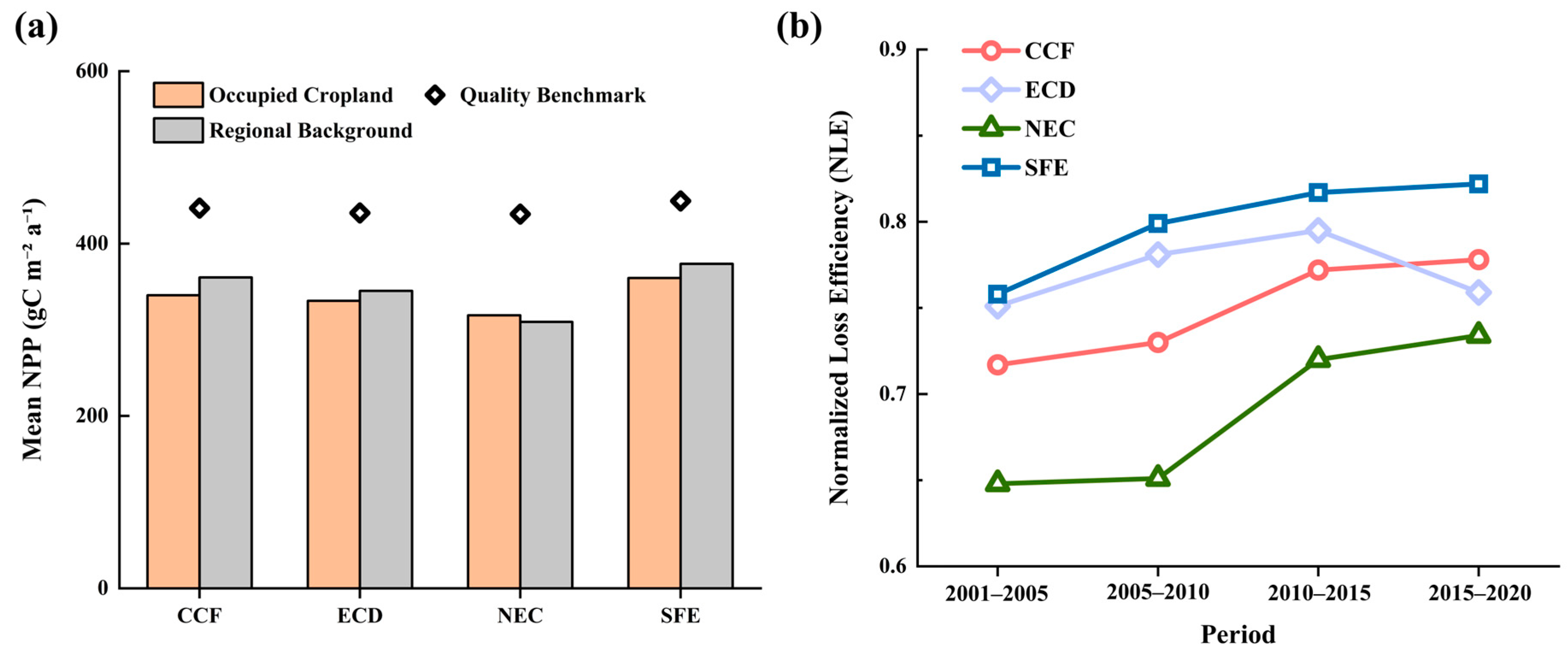
- The proposed Normalized Loss Efficiency (NLE) indicator quantifies the selectivity toward high-productivity cropland and peaks at 0.822 in the Southern Functional Expansion Zone (SFE).
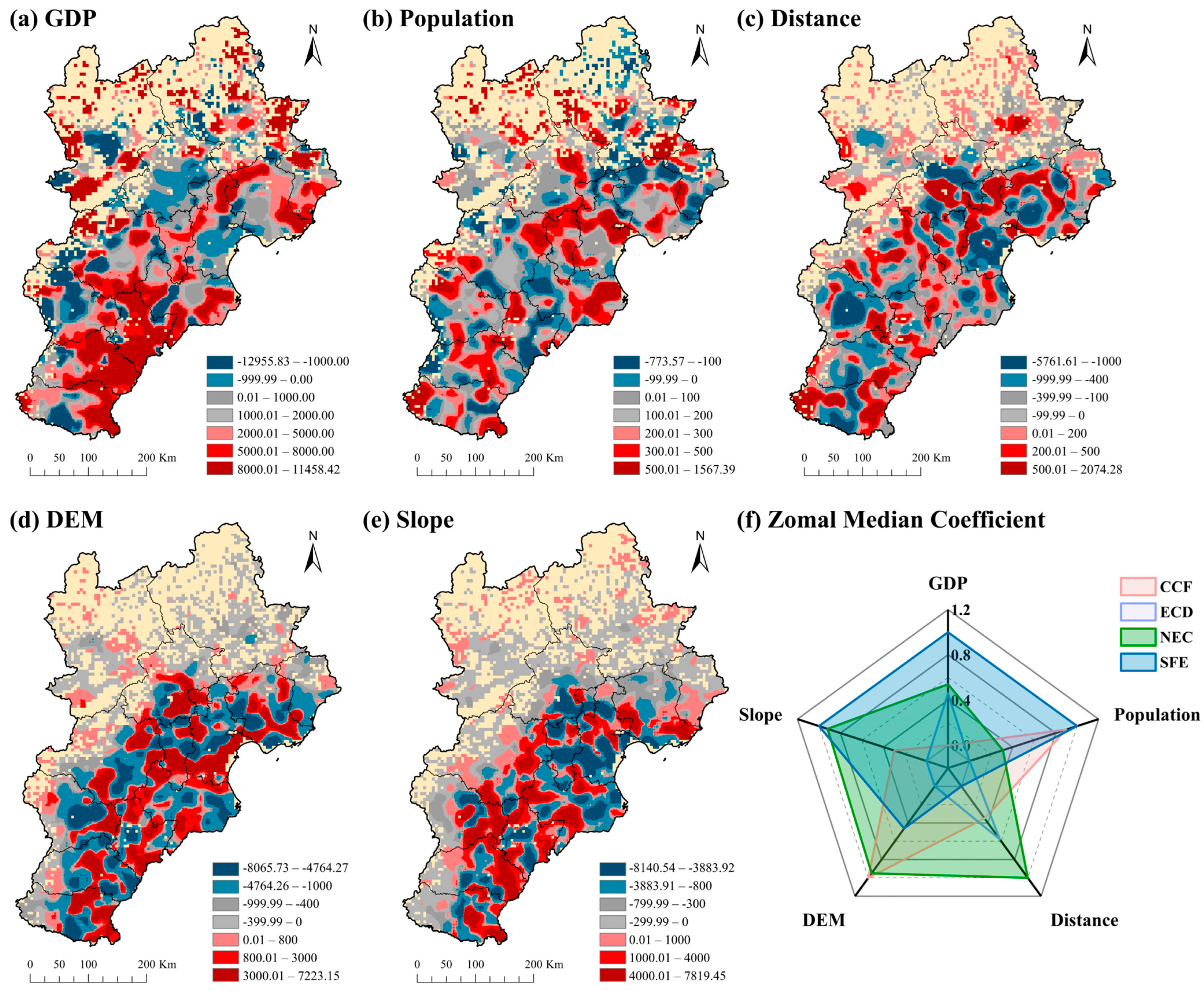
- Geographically Weighted Regression (GWR) reveals spatially non-stationary driver effects across functional zones, supporting differentiated spatial controls rather than a one-size-fits-all land management approach.
Abstract
1. Introduction
2. Materials and Methods
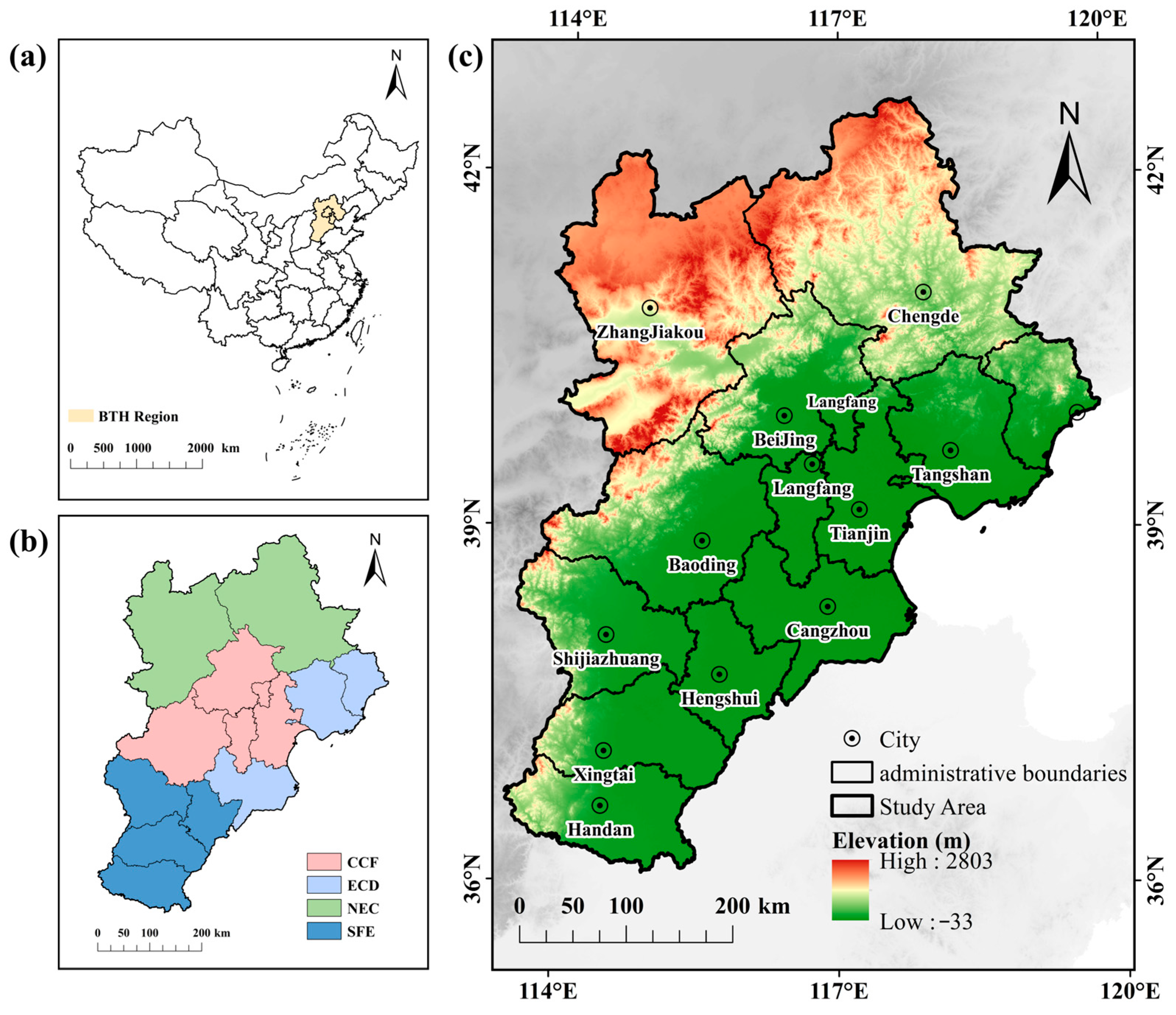
2.1. Study Area
2.2. Data Sources and Processing
2.3. Methods
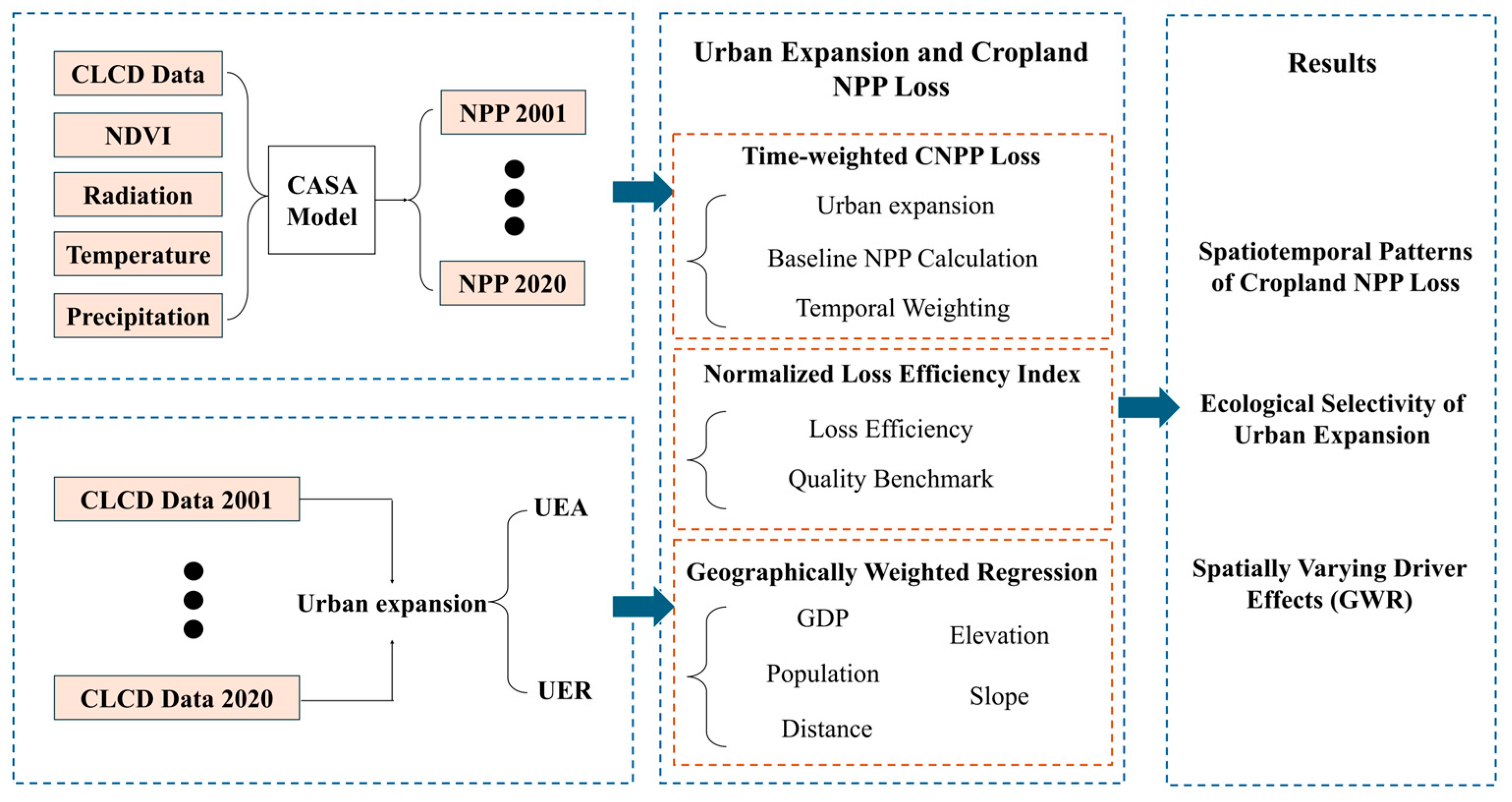
2.3.1. Estimating NPP Using the CASA Model
2.3.2. Quantifying the Urban Expansion Dynamics
2.3.3. Measuring the Impact of Urban Expansion on Cropland NPP
2.3.4. Assessing Ecological Selectivity of Urban Expansion Across Functional Zones
2.3.5. Analysis of Driving Factors Using Geographically Weighted Regression
3. Results
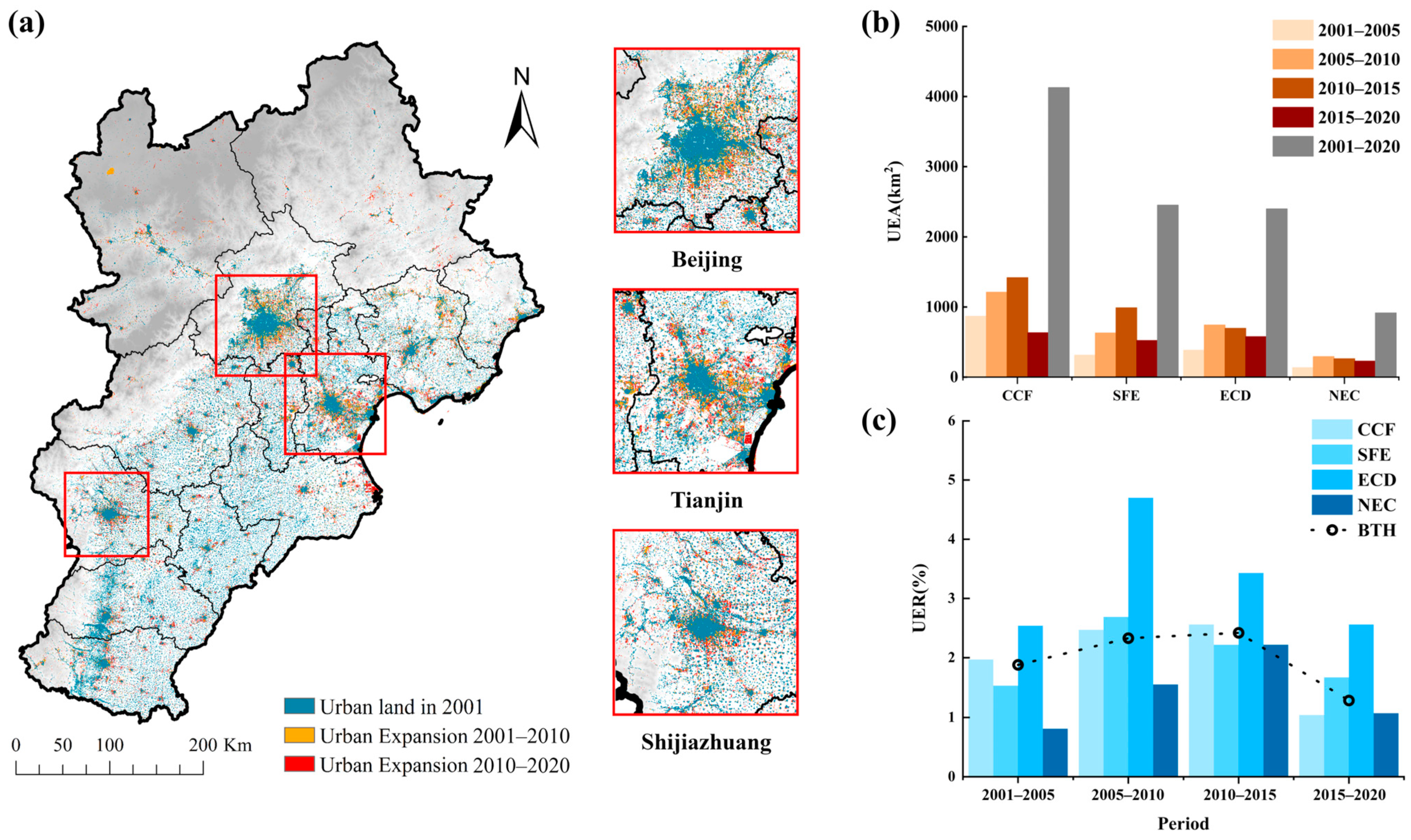
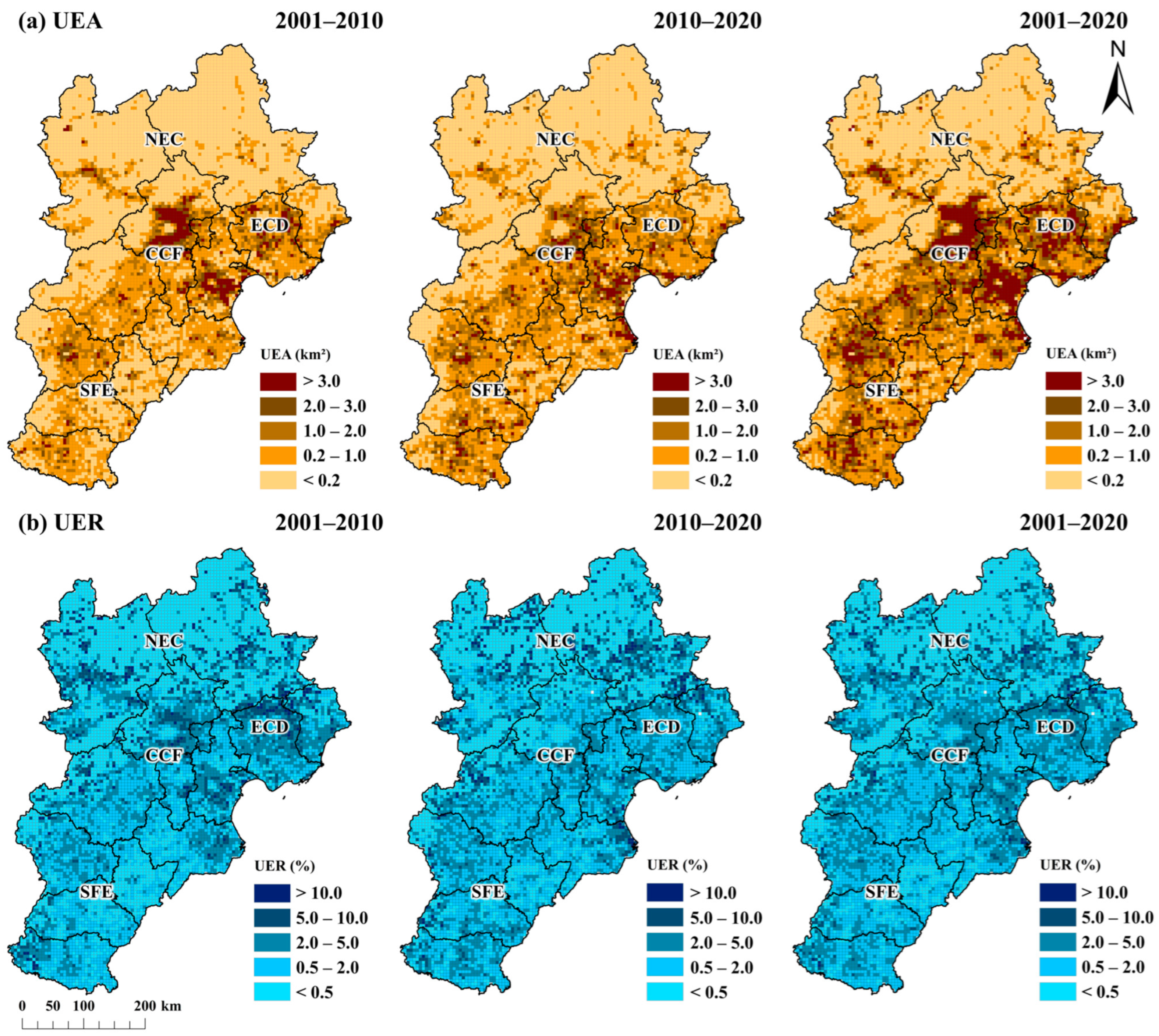
3.1. Spatiotemporal Dynamics of Urban Expansion in the BTH Region
3.2. Impact of Urbanization on Cropland NPP
3.2.1. Characteristics of Cropland Occupied by Urban Expansion
3.2.2. Temporal Dynamics of Cropland NPP Loss
3.2.3. Spatial Disparities of Cropland NPP Loss Across Functional Zones
3.3. Spatiotemporal Evolution of Ecological Selectivity in Urban Expansion
3.4. Determinants of Urban Expansion-Induced Cropland NPP Loss Patterns
4. Discussion
4.1. Evaluation of NPP Simulation Results
4.2. Ecological Selectivity of Urban Expansion and Food Security Impact
4.3. Differentiated Policy Implications for Functional Zones
4.4. Limitations and Future Perspectives
5. Conclusions
Author Contributions
Funding
Data Availability Statement
Acknowledgments
Conflicts of Interest
Abbreviations
| AICc | Akaike Information Criterion corrected |
| BTH | Beijing-Tianjin-Hebei |
| CASA | Carnegie–Ames–Stanford Approach |
| CCF | Central Core Functional Zone |
| CLCD | China Land Cover Dataset |
| DEM | Digital Elevation Model |
| ECD | Eastern Coastal Development Zone |
| GDP | Gross Domestic Product |
| GWR | Geographically Weighted Regression |
| LISA | Local Indicators of Spatial Association |
| LULC | Land Use and Land Cover |
| MODIS | Moderate Resolution Imaging Spectroradiometer |
| NLE | Normalized Loss Efficiency |
| NDVI | Normalized Difference Vegetation Index |
| NEC | Northern Ecological Conservation Zone |
| NPP | Net Primary Productivity |
| UEA | Urban Expansion Area |
| UER | Urban Expansion Rate |
| VIF | Variance Inflation Factor |
Appendix A

| Prefecture-Level Unit | Province/Municipality | Functional Zone |
|---|---|---|
| Beijing | Beijing Municipality | CCF |
| Tianjin | Tianjin Municipality | CCF |
| Baoding | Hebei Province | CCF |
| Langfang | Hebei Province | CCF |
| Tangshan | Hebei Province | ECD |
| Qinhuangdao | Hebei Province | ECD |
| Cangzhou | Hebei Province | ECD |
| Chengde | Hebei Province | NEC |
| Zhangjiakou | Hebei Province | NEC |
| Shijiazhuang | Hebei Province | SFE |
| Hengshui | Hebei Province | SFE |
| Xingtai | Hebei Province | SFE |
| Handan | Hebei Province | SFE |
| Year | Cropland Area (θ = 0.5, km2) | Cropland Area (θ = 0.7, km2) | Area Difference (km2) | Relative Difference (%) | Disagreement Pixels (Count) | Disagreement (%) |
|---|---|---|---|---|---|---|
| 2001 | 108,249.5106 | 96,577.3209 | 11,672.1896 | 10.78 | 196,455 | 5.43 |
| 2005 | 104,906.2219 | 93,143.1287 | 11,763.0932 | 11.21 | 197,985 | 5.47 |
| 2010 | 100,983.8837 | 89,176.8836 | 11,807.0002 | 11.69 | 198,724 | 5.49 |
| 2015 | 97,224.8748 | 84,992.7076 | 12,232.1672 | 12.58 | 205,880 | 5.69 |
| 2020 | 97,029.8184 | 84,448.7125 | 12,581.1059 | 12.97 | 211,753 | 5.85 |
| Component | Equation/Rule | Parameter Settings Used in This Study | Reference |
|---|---|---|---|
| Temperature stress 1 | : temperature at which NDVI reaches its maximum during the growing season | Potter et al. [40] | |
| Temperature stress 2 | : monthly mean air temperature (°C) at pixel x | ||
| Moisture stress | EET/PET capped to [0, 1] before applying the formula | ||
| EET and PET | PET and EET were computed using the CASA water-balance submodel (Potter et al. [40]) driven by monthly temperature and precipitation. |
| Functional Zone | Valid Baseline Cropland Cells (n) | Qz20 | Qz30 | Qz40 | NLE20 (2001–2020) | NLE30 (2001–2020) |
|---|---|---|---|---|---|---|
| CCF | 465,362 | 457.37 | 441.21 | 428.28 | 0.723 | 0.749 |
| ECD | 382,070 | 452.92 | 435.53 | 422.09 | 0.742 | 0.772 |
| NEC | 335,284 | 462.10 | 434.27 | 411.17 | 0.647 | 0.688 |
| SFE | 499,306 | 463.85 | 449.57 | 437.48 | 0.774 | 0.799 |
| Model | AICc | R2 | Adj. R2 | Residual Moran’s I | z-Score | p-Value |
|---|---|---|---|---|---|---|
| OLS | 93150.396 | 0.257 | 0.256 | 0.3049 | 83.667 | <0.001 |
| GWR | 10565.915 | 0.791 | 0.713 | −0.0048 | −1.271 | 0.204 |
| Neighbors (N) | AICc | R2 | Adj. R2 | Sigma | ENP | Invalid Diagnostic Points (COND NoData) |
|---|---|---|---|---|---|---|
| 30 | 5213.542 | 0.894 | 0.809 | 164.251 | 171.760 | 279 (≈4.571%) |
| 40 | 7852.889 | 0.849 | 0.774 | 186.928 | 193.222 | 158 (≈2.589%) |
| 50 | 10,565.915 | 0.792 | 0.713 | 211.920 | 210.152 | 13 (≈0.213%) |
| 60 | 12,689.049 | 0.787 | 0.704 | 216.009 | 212.730 | 0 |
| 80 | 16,893.719 | 0.753 | 0.699 | 239.430 | 215.192 | 0 |
| 100 | 19,892.132 | 0.733 | 0.688 | 254.410 | 203.409 | 0 |
| Neighbors (N) | Study Area | Period | Method | Mean Cropland NPP (g C m−2 a−1) |
|---|---|---|---|---|
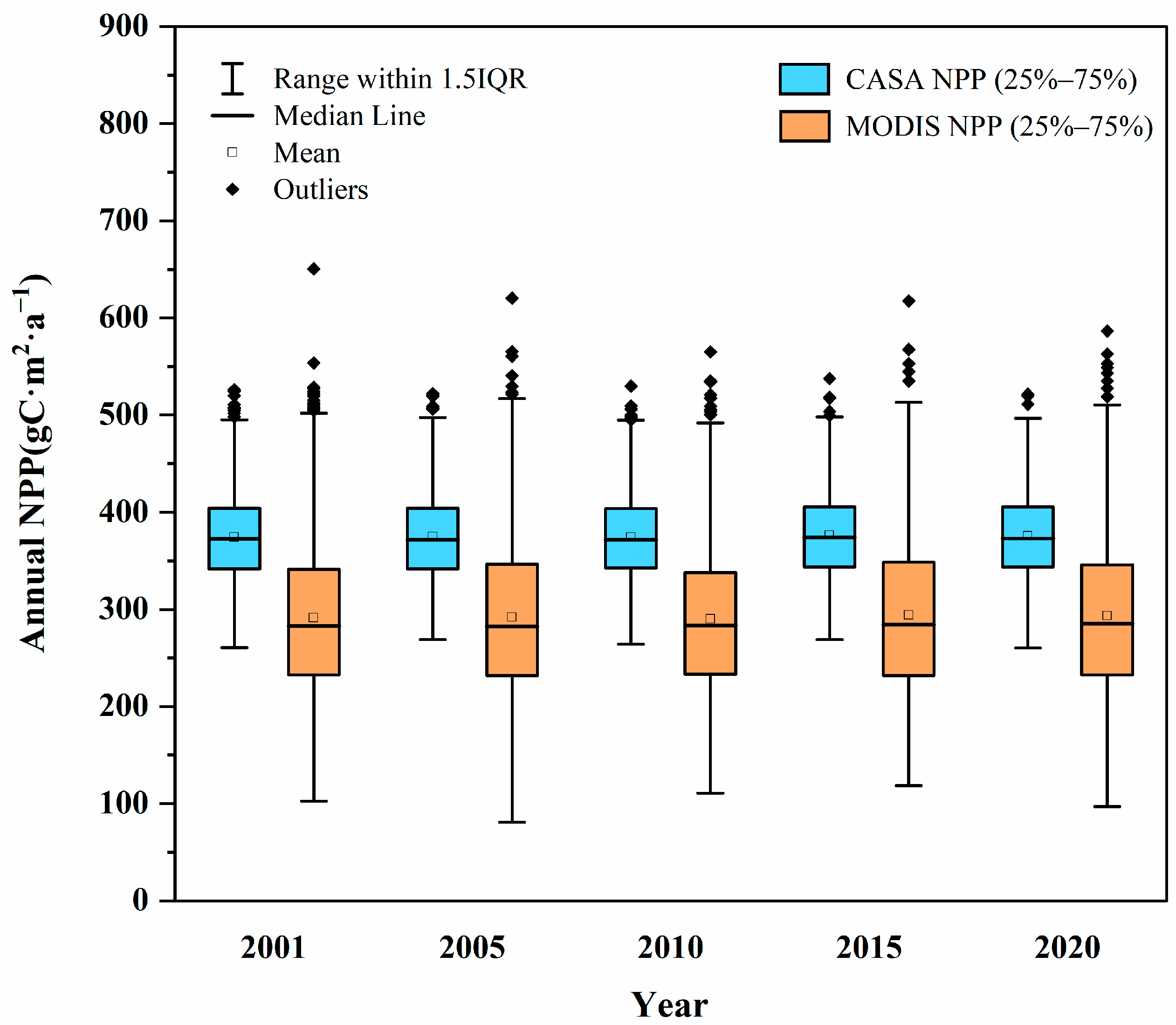
| This study | BTH Region | 2001–2020 | CASA | 375.15 |
| Zou et al. (2022) [66] | BTH Region | 2001–2020 | MODIS | 386.57 |
| Chen et al. (2024) [34] | Beijing | 2000–2020 | CASA | 342.14 |
| Long et al. (2024) [67] | North China Plain | 2013–2017 | DNDC | 510.00 |
References
- Seto, K.C.; Güneralp, B.; Hutyra, L.R. Global Forecasts of Urban Expansion to 2030 and Direct Impacts on Biodiversity and Carbon Pools. Proc. Natl. Acad. Sci. USA 2012, 109, 16083–16088. [Google Scholar] [CrossRef] [Scilit]
- Bren d’Amour, C.; Reitsma, F.; Baiocchi, G.; Barthel, S.; Güneralp, B.; Erb, K.-H.; Haberl, H.; Creutzig, F.; Seto, K.C. Future Urban Land Expansion and Implications for Global Croplands. Proc. Natl. Acad. Sci. USA 2017, 114, 8939–8944. [Google Scholar] [CrossRef] [Scilit]
- Milesi, C.; Elvidge, C.D.; Nemani, R.R.; Running, S.W. Assessing the Impact of Urban Land Development on Net Primary Productivity in the Southeastern United States. Remote Sens. Environ. 2003, 86, 401–410. [Google Scholar] [CrossRef] [Scilit]
- Houghton, R.A.; House, J.I.; Pongratz, J.; van der Werf, G.R.; DeFries, R.S.; Hansen, M.C.; Le Quéré, C.; Ramankutty, N. Carbon Emissions from Land Use and Land-Cover Change. Biogeosciences 2012, 9, 5125–5142. [Google Scholar] [CrossRef] [Scilit]
- He, C.; Liu, Z.; Xu, M.; Ma, Q.; Dou, Y. Urban Expansion Brought Stress to Food Security in China: Evidence from Decreased Cropland Net Primary Productivity. Sci. Total Environ. 2017, 576, 660–670. [Google Scholar] [CrossRef] [Scilit] [PubMed]
- Xu, Y.; Lu, Y.-G.; Zou, B.; Xu, M.; Feng, Y.-X. Unraveling the Enigma of NPP Variation in Chinese Vegetation Ecosystems: The Interplay of Climate Change and Land Use Change. Sci. Total Environ. 2024, 912, 169023. [Google Scholar] [CrossRef] [Scilit] [PubMed]
- Imhoff, M.L.; Bounoua, L.; DeFries, R.; Lawrence, W.T.; Stutzer, D.; Tucker, C.J.; Ricketts, T. The Consequences of Urban Land Transformation on Net Primary Productivity in the United States. Remote Sens. Environ. 2004, 89, 434–443. [Google Scholar] [CrossRef] [Scilit]
- Zhang, L.; Yang, L.; Zohner, C.M.; Crowther, T.W.; Li, M.; Shen, F.; Guo, M.; Qin, J.; Yao, L.; Zhou, C. Direct and Indirect Impacts of Urbanization on Vegetation Growth across the World’s Cities. Sci. Adv. 2022, 8, eabo0095. [Google Scholar] [CrossRef] [Scilit]
- Pei, F.; Li, X.; Liu, X.; Wang, S.; He, Z. Assessing the Differences in Net Primary Productivity between Pre- and Post-Urban Land Development in China. Agric. For. Meteorol. 2013, 171–172, 174–186. [Google Scholar] [CrossRef] [Scilit]
- Lv, G.; Li, X.; Fang, L.; Peng, Y.; Zhang, C.; Yao, J.; Ren, S.; Chen, J.; Men, J.; Zhang, Q.; et al. Disentangling the Influential Factors Driving NPP Decrease in Shandong Province: An Analysis from Time Series Evaluation Using MODIS and CASA Model. Remote Sens. 2024, 16, 1966. [Google Scholar] [CrossRef] [Scilit]
- Zhang, Z.; Huo, L.; Su, Y.; Shen, H.; Yang, G. Estimation of Corn Net Primary Productivity and Carbon Sequestration Based on the CASA Model: A Case Study of the Fen River Basin. Sustainability 2024, 16, 2942. [Google Scholar] [CrossRef] [Scilit]
- Zhang, L.; Dong, C.; Zhang, R.; Shi, K.; Wang, Y.; Li, B. Estimation of Carbon Sequestration Capacity of Cultivated Land Based on Improved CASA-CGC Model—A Case Study of Anhui Province. Agriculture 2025, 15, 2462. [Google Scholar] [CrossRef] [Scilit]
- Peng, J.; Shen, H.; Wu, W.; Liu, Y.; Wang, Y. Net Primary Productivity (NPP) Dynamics and Associated Urbanization Driving Forces in Metropolitan Areas: A Case Study in Beijing City, China. Landsc. Ecol. 2016, 31, 1077–1092. [Google Scholar] [CrossRef] [Scilit]
- Liu, J.; Kuang, W.; Zhang, Z.; Xu, X.; Qin, Y.; Ning, J.; Zhou, W.; Zhang, S.; Li, R.; Yan, C.; et al. Spatiotemporal Characteristics, Patterns, and Causes of Land-Use Changes in China since the Late 1980s. J. Geogr. Sci. 2014, 24, 195–210. [Google Scholar] [CrossRef] [Scilit]
- Bai, X.; Shi, P.; Liu, Y. Society: Realizing China’s Urban Dream. Nature 2014, 509, 158–160. [Google Scholar] [CrossRef] [Scilit]
- Chen, H.; Tan, Y.; Xiao, W.; Li, G.; Meng, F.; He, T.; Li, X. Urbanization in China Drives Farmland Uphill under the Constraint of the Requisition–Compensation Balance. Sci. Total Environ. 2022, 831, 154895. [Google Scholar] [CrossRef] [Scilit]
- Chen, M.; Liu, W.; Lu, D. Challenges and the Way Forward in China’s New-Type Urbanization. Land Use Policy 2016, 55, 334–339. [Google Scholar] [CrossRef] [Scilit]
- Yang, H.; Li, X. Cultivated Land and Food Supply in China. Land Use Policy 2000, 17, 73–88. [Google Scholar] [CrossRef] [Scilit]
- Jiang, G.; Zhang, R.; Ma, W.; Zhou, D.; Wang, X.; He, X. Cultivated Land Productivity Potential Improvement in Land Consolidation Schemes in Shenyang, China: Assessment and Policy Implications. Land Use Policy 2017, 68, 80–88. [Google Scholar] [CrossRef] [Scilit]
- Zhou, Y.; Li, X.; Liu, Y. Cultivated Land Protection and Rational Use in China. Land Use Policy 2021, 106, 105454. [Google Scholar] [CrossRef] [Scilit]
- Miao, Y.; Liu, J.; Wang, R.Y. Occupation of Cultivated Land for Urban–Rural Expansion in China: Evidence from National Land Survey 1996–2006. Land 2021, 10, 1378. [Google Scholar] [CrossRef] [Scilit]
- Liang, C.; Penghui, J.; Wei, C.; Manchun, L.; Liyan, W.; Yuan, G.; Yuzhe, P.; Nan, X.; Yuewei, D.; Qiuhao, H. Farmland Protection Policies and Rapid Urbanization in China: A Case Study for Changzhou City. Land Use Policy 2015, 48, 552–566. [Google Scholar] [CrossRef] [Scilit]
- Qiu, B.; Li, H.; Tang, Z.; Chen, C.; Berry, J. How Cropland Losses Shaped by Unbalanced Urbanization Process? Land Use Policy 2020, 96, 104715. [Google Scholar] [CrossRef] [Scilit]
- Tu, Y.; Chen, B.; Yu, L.; Song, Y.; Wu, S.; Li, M.; Wei, H.; Chen, T.; Lang, W.; Gong, P.; et al. Raveling the Nexus between Urban Expansion and Cropland Loss in China. Landsc. Ecol. 2023, 38, 1869–1884. [Google Scholar] [CrossRef] [Scilit]
- Chen, J. Rapid Urbanization in China: A Real Challenge to Soil Protection and Food Security. CATENA 2007, 69, 1–15. [Google Scholar] [CrossRef] [Scilit]
- Tang, L.; Ke, X.; Zhou, T.; Zheng, W.; Wang, L. Impacts of Cropland Expansion on Carbon Storage: A Case Study in Hubei, China. J. Environ. Manag. 2020, 265, 110515. [Google Scholar] [CrossRef] [Scilit] [PubMed]
- Deng, X.; Xu, X.; Cai, H.; Li, J. Assessment the Impact of Urban Expansion on Cropland Net Primary Productivity in Northeast China. Ecol. Indic. 2024, 159, 111698. [Google Scholar] [CrossRef] [Scilit]
- Song, W.; Pijanowski, B.C. The Effects of China’s Cultivated Land Balance Program on Potential Land Productivity at a National Scale. Appl. Geogr. 2014, 46, 158–170. [Google Scholar] [CrossRef] [Scilit]
- Kuang, W.; Liu, J.; Tian, H.; Shi, H.; Dong, J.; Song, C.; Li, X.; Du, G.; Hou, Y.; Lu, D.; et al. Cropland Redistribution to Marginal Lands Undermines Environmental Sustainability. Natl. Sci. Rev. 2022, 9, nwab091. [Google Scholar] [CrossRef] [Scilit]
- Zhu, W.; Pan, Y.; He, H.; Yu, D.; Hu, H. Simulation of Maximum Light Use Efficiency for Some Typical Vegetation Types in China. Chin. Sci. Bull. 2006, 51, 457–463. [Google Scholar] [CrossRef] [Scilit]
- Chen, Y.; Zhang, Z.; Tao, F.; Wang, P.; Wei, X. Spatio-Temporal Patterns of Winter Wheat Yield Potential and Yield Gap during the Past Three Decades in North China. Field Crops Res. 2017, 206, 11–20. [Google Scholar] [CrossRef] [Scilit]
- Tan, M.; Li, X.; Xie, H.; Lu, C. Urban Land Expansion and Arable Land Loss in China—A Case Study of Beijing–Tianjin–Hebei Region. Land Use Policy 2005, 22, 187–196. [Google Scholar] [CrossRef] [Scilit]
- Zeng, L.; Yang, L.; Su, L.; Hu, H.; Feng, C. The Impact of Policies on Land Use and Land Cover Changes in the Beijing–Tianjin–Hebei Region in China. Environ. Impact Assess. Rev. 2025, 110, 107676. [Google Scholar] [CrossRef] [Scilit]
- Chen, Y.; Lu, D.; Xu, B.; Ren, R.; Wang, Z.; Feng, Z. Determining the Dominant Contributions between Direct and Indirect Impacts of Long-Term Urbanization on Plant Net Primary Productivity in Beijing. Remote Sens. 2024, 16, 444. [Google Scholar] [CrossRef] [Scilit]
- Ma, Z.; Wu, J.; Yang, H.; Hong, Z.; Yang, J.; Gao, L. Assessment of Vegetation Net Primary Productivity Variation and Influencing Factors in the Beijing-Tianjin-Hebei Region. J. Environ. Manag. 2024, 365, 121490. [Google Scholar] [CrossRef] [Scilit] [PubMed]
- Yang, J.; Huang, X. The 30 m Annual Land Cover Dataset and Its Dynamics in China from 1990 to 2019. Earth Syst. Sci. Data 2021, 13, 3907–3925. [Google Scholar] [CrossRef] [Scilit]
- Peng, S.; Ding, Y.; Liu, W.; Li, Z. 1 Km Monthly Temperature and Precipitation Dataset for China from 1901 to 2017. Earth Syst. Sci. Data 2019, 11, 1931–1946. [Google Scholar] [CrossRef] [Scilit]
- Muñoz-Sabater, J.; Dutra, E. ERA5-Land: A State-of-the-Art Global Reanalysis Dataset for Land Applications. Earth Syst. Sci. Data 2021, 13, 4349–4383. [Google Scholar] [CrossRef] [Scilit]
- Liu, H.; Jiang, D.; Yang, X.; Luo, N. Spatialization Approach to 1 km Grid GDP Supported by Remote Sensing. J. Geo-Inf. Sci. 2005, 7, 120–123. [Google Scholar]
- Potter, C.S.; Randerson, J.T.; Field, C.B.; Matson, P.A.; Vitousek, P.M.; Mooney, H.A.; Klooster, S.A. Terrestrial Ecosystem Production: A Process Model Based on Global Satellite and Surface Data. Glob. Biogeochem. Cycles 1993, 7, 811–841. [Google Scholar] [CrossRef] [Scilit]
- Running, S.W.; Nemani, R.R.; Heinsch, F.A.; Zhao, M.; Reeves, M.; Hashimoto, H. A Continuous Satellite-Derived Measure of Global Terrestrial Primary Production. BioScience 2004, 54, 547–560. [Google Scholar] [CrossRef] [Scilit]
- Huang, Q.; Liu, Z.; He, C.; Gou, S.; Bai, Y.; Wang, Y.; Shen, M. The Occupation of Cropland by Global Urban Expansion from 1992 to 2016 and Its Implications. Environ. Res. Lett. 2020, 15, 084037. [Google Scholar] [CrossRef] [Scilit]
- Li, Z.; Liu, S.; Tan, Z.; Bliss, N.B.; Young, C.J.; West, T.O.; Ogle, S.M. Comparing Cropland Net Primary Production Estimates from Inventory, a Satellite-Based Model, and a Process-Based Model in the Midwest of the United States. Ecol. Model. 2014, 277, 1–12. [Google Scholar] [CrossRef] [Scilit]
- Csikós, N.; Szabó, B.; Hermann, T.; Laborczi, A.; Matus, J.; Pásztor, L.; Szatmári, G.; Takács, K.; Tóth, G. Cropland Productivity Evaluation: A 100 m Resolution Country Assessment Combining Earth Observation and Direct Measurements. Remote Sens. 2023, 15, 1236. [Google Scholar] [CrossRef] [Scilit]
- Brunsdon, C.; Fotheringham, A.S.; Charlton, M.E. Geographically Weighted Regression: A Method for Exploring Spatial Nonstationarity. Geogr. Anal. 1996, 28, 281–298. [Google Scholar] [CrossRef] [Scilit]
- Brunsdon, C.; Fotheringham, S.; Charlton, M. Geographically Weighted Regression. J. R. Stat. Soc. Ser. D (Stat.) 1998, 47, 431–443. [Google Scholar] [CrossRef] [Scilit]
- Wang, S.; Shi, C.; Fang, C.; Feng, K. Examining the Spatial Variations of Determinants of Energy-Related CO2 Emissions in China at the City Level Using Geographically Weighted Regression Model. Appl. Energy 2019, 235, 95–105. [Google Scholar] [CrossRef] [Scilit]
- Wang, Q.; Ni, J.; Tenhunen, J. Application of a Geographically-Weighted Regression Analysis to Estimate Net Primary Production of Chinese Forest Ecosystems. Glob. Ecol. Biogeogr. 2005, 14, 379–393. [Google Scholar] [CrossRef] [Scilit]
- Central Committee of the Communist Party of China; State Council of the People’s Republic of China. Outline of Coordinated Development of the Beijing-Tianjin-Hebei Region; The Political Bureau of the CPC Central Committee: Beijing, China, 2015. [Google Scholar]
- Turner, D.P.; Ritts, W.D.; Cohen, W.B.; Gower, S.T.; Running, S.W.; Zhao, M.; Costa, M.H.; Kirschbaum, A.A.; Ham, J.M.; Saleska, S.R.; et al. Evaluation of MODIS NPP and GPP Products across Multiple Biomes. Remote Sens. Environ. 2006, 102, 282–292. [Google Scholar] [CrossRef] [Scilit]
- Sun, J.; Yue, Y.; Niu, H. Evaluation of NPP Using Three Models Compared with MODIS-NPP Data over China. PLoS ONE 2021, 16, e0252149. [Google Scholar] [CrossRef] [Scilit]
- Pan, J.; Dong, L. Spatio-Temporal Variation in Vegetation Net Primary Productivity and Its Relationship with Climatic Factors in the Shule River Basin from 2001 to 2010. Hum. Ecol. Risk Assess. Int. J. 2018, 24, 797–818. [Google Scholar] [CrossRef] [Scilit]
- Li, M.; Cao, Y.; Dai, J.; Song, J.; Liang, M. A Comprehensive Review of Urban Expansion and Its Driving Factors. Land 2025, 14, 1534. [Google Scholar] [CrossRef] [Scilit]
- Song, W.; Pijanowski, B.C.; Tayyebi, A. Urban Expansion and Its Consumption of High-Quality Farmland in Beijing, China. Ecol. Indic. 2015, 54, 60–70. [Google Scholar] [CrossRef] [Scilit]
- Sheng, S.; Huang, J. Urban Expansion and the Loss of Potential Crop Yield in the North China Plain: Implications for Regional Food Security (1980–2020). Front. Sustain. Food Syst. 2025, 9, 1545907. [Google Scholar] [CrossRef] [Scilit]
- Huang, Z.; Wei, Y.D.; He, C.; Li, H. Urban Land Expansion under Economic Transition in China: A Multi-Level Modeling Analysis. Habitat Int. 2015, 47, 69–82. [Google Scholar] [CrossRef] [Scilit]
- Godfray, H.C.J.; Beddington, J.R.; Crute, I.R.; Haddad, L.; Lawrence, D.; Muir, J.F.; Pretty, J.; Robinson, S.; Thomas, S.M.; Toulmin, C. Food Security: The Challenge of Feeding 9 Billion People. Science 2010, 327, 812–818. [Google Scholar] [CrossRef] [Scilit]
- Fei, L.; Shuang, M.; Xiaolin, L. Changing Multi-Scale Spatiotemporal Patterns in Food Security Risk in China. J. Clean. Prod. 2023, 384, 135618. [Google Scholar] [CrossRef] [Scilit]
- Molotoks, A.; Smith, P.; Dawson, T.P. Impacts of Land Use, Population, and Climate Change on Global Food Security. Food Energy Secur. 2021, 10, e261. [Google Scholar] [CrossRef] [Scilit]
- Liu, C.; Liu, D.; Li, P.; Li, X.; Liu, Z.; Zhao, Y. Assessment of Occupation of Natural Habitat by Urban Expansion and Its Impact on Crucial Ecosystem Services in China’s Coastal Zone. Ecol. Indic. 2023, 154, 110682. [Google Scholar] [CrossRef] [Scilit]
- Ke, X.; van Vliet, J.; Zhou, T.; Verburg, P.H.; Zheng, W.; Liu, X. Direct and Indirect Loss of Natural Habitat Due to Built-up Area Expansion: A Model-Based Analysis for the City of Wuhan, China. Land Use Policy 2018, 74, 231–239. [Google Scholar] [CrossRef] [Scilit]
- McDonald, R.I.; Mansur, A.V.; Ascensão, F.; Colbert, M.; Crossman, K.; Elmqvist, T.; Gonzalez, A.; Güneralp, B.; Haase, D.; Hamann, M.; et al. Research Gaps in Knowledge of the Impact of Urban Growth on Biodiversity. Nat. Sustain. 2020, 3, 16–24. [Google Scholar] [CrossRef] [Scilit]
- Andrade, J.F.; Cassman, K.G.; Rattalino Edreira, J.I.; Agus, F.; Bala, A.; Deng, N.; Grassini, P. Impact of Urbanization Trends on Production of Key Staple Crops. Ambio 2022, 51, 1158–1167. [Google Scholar] [CrossRef] [Scilit]
- Zhang, D.; Huang, Q.; He, C.; Wu, J. Impacts of Urban Expansion on Ecosystem Services in the Beijing-Tianjin-Hebei Urban Agglomeration, China: A Scenario Analysis Based on the Shared Socioeconomic Pathways. Resour. Conserv. Recycl. 2017, 125, 115–130. [Google Scholar] [CrossRef] [Scilit]
- Zhang, Y.; Lu, X.; Liu, B.; Wu, D. Impacts of Urbanization and Associated Factors on Ecosystem Services in the Beijing-Tianjin-Hebei Urban Agglomeration, China: Implications for Land Use Policy. Sustainability 2018, 10, 4334. [Google Scholar] [CrossRef] [Scilit]
- Zou, Y.; Chen, W.; Li, S.; Wang, T.; Yu, L.; Xu, M.; Singh, R.P.; Liu, C.-Q. Spatio-Temporal Changes in Vegetation in the Last Two Decades (2001–2020) in the Beijing–Tianjin–Hebei Region. Remote Sens. 2022, 14, 3958. [Google Scholar] [CrossRef] [Scilit]
- Long, X.; Han, Y.; Wang, Q.Y.; Li, X.K.; Feng, T.; Wang, Y.C.; Wang, Y.; Zhang, S.L.; Han, Y.M.; Li, G.H.; et al. Adverse Effects of Ozone Pollution on Net Primary Productivity in the North China Plain. Geophys. Res. Lett. 2024, 51, e2023GL105209. [Google Scholar] [CrossRef] [Scilit]





| Functional Zone | UEA (km2) | UER (%) | Cropland Contribution (%) | Total Cropland NPP Loss (Tg C) | Cumulative Loss Intensity (Mg C·km−2) | ||||
|---|---|---|---|---|---|---|---|---|---|
| 2001–2010 | 2010–2020 | 2001–2020 | 2001–2010 | 2010–2020 | 2001–2020 | ||||
| CCF | 2077.25 | 2050.94 | 4128.19 | 2.47 | 1.80 | 2.01 | 93.90 | 13.23 | 3444.64 |
| ECD | 1125.88 | 1272.38 | 2398.26 | 2.11 | 1.95 | 2.03 | 89.26 | 6.69 | 3299.16 |
| NEC | 426.00 | 489.19 | 915.19 | 3.63 | 2.99 | 3.30 | 62.98 | 1.63 | 2828.92 |
| SFE | 941.25 | 1511.00 | 2452.25 | 1.18 | 1.65 | 1.41 | 98.46 | 7.69 | 3186.65 |
| BTH (Total) | 4570.38 | 5323.50 | 9893.88 | 2.10 | 1.86 | 1.98 | 91.04 | 29.24 | 3301.22 |
| Functional Zone | Quality Benchmark | Zone Cropland Mean NPP | Normalized Loss Efficiency (NLE) | |||
|---|---|---|---|---|---|---|
| g C·m−2·a−1 | g C·m−2·a−1 | 2001–2005 | 2005–2010 | 2010–2015 | 2015–2020 | |
| CCF | 441.21 | 360.71 | 0.717 | 0.730 | 0.772 | 0.778 |
| ECD | 435.53 | 345.07 | 0.751 | 0.781 | 0.795 | 0.759 |
| NEC | 434.27 | 309.23 | 0.648 | 0.651 | 0.720 | 0.734 |
| SFE | 449.57 | 376.51 | 0.758 | 0.799 | 0.817 | 0.822 |
| Functional Zone | Socio-Economic Drivers | Physical and Locational Constraints | |||
|---|---|---|---|---|---|
| GDP | Population | Distance | Elevation | Slope | |
| CCF | 682.9 | 134.3 | −92.1 | −83.3 | −136.2 |
| ECD | 2352.3 | 108.3 | −58.3 | −413.3 | −183.2 |
| NEC | 2625.3 | 117.1 | 5.3 | −99.3 | −41.3 |
| SFE | 4283.6 | 137.4 | −144.3 | −260.1 | −27.5 |
| BTH (Total) | 2486 | 124.3 | −72.4 | −214 | −97.1 |
Disclaimer/Publisher’s Note: The statements, opinions and data contained in all publications are solely those of the individual author(s) and contributor(s) and not of MDPI and/or the editor(s). MDPI and/or the editor(s) disclaim responsibility for any injury to people or property resulting from any ideas, methods, instructions or products referred to in the content. |
© 2026 by the authors. Licensee MDPI, Basel, Switzerland. This article is an open access article distributed under the terms and conditions of the Creative Commons Attribution (CC BY) license.
Share and Cite
Liang, J.; Li, H.; Jiao, A.; Lv, H.; Feng, Z. Urban Expansion-Driven Cropland NPP Change in the Beijing-Tianjin-Hebei Region, China (2001–2020): Spatiotemporal Patterns, Ecological Selectivity, and Spatially Varying Driver Effects. Remote Sens. 2026, 18, 933. https://doi.org/10.3390/rs18060933
Liang J, Li H, Jiao A, Lv H, Feng Z. Urban Expansion-Driven Cropland NPP Change in the Beijing-Tianjin-Hebei Region, China (2001–2020): Spatiotemporal Patterns, Ecological Selectivity, and Spatially Varying Driver Effects. Remote Sensing. 2026; 18(6):933. https://doi.org/10.3390/rs18060933
Chicago/Turabian StyleLiang, Jiahua, Huan Li, Ao Jiao, Haoyuan Lv, and Zhongke Feng. 2026. "Urban Expansion-Driven Cropland NPP Change in the Beijing-Tianjin-Hebei Region, China (2001–2020): Spatiotemporal Patterns, Ecological Selectivity, and Spatially Varying Driver Effects" Remote Sensing 18, no. 6: 933. https://doi.org/10.3390/rs18060933
APA StyleLiang, J., Li, H., Jiao, A., Lv, H., & Feng, Z. (2026). Urban Expansion-Driven Cropland NPP Change in the Beijing-Tianjin-Hebei Region, China (2001–2020): Spatiotemporal Patterns, Ecological Selectivity, and Spatially Varying Driver Effects. Remote Sensing, 18(6), 933. https://doi.org/10.3390/rs18060933