Article

Driving Mechanisms and Adaptive Governance for Cultivated Land in Agro-Pastoral Ecotones: A 40-Year Empirical Study of Yulin City, China


1
School of Human Settlements and Civil Engineering, Xi’an Jiaotong University, Xi’an 710049, China
2
Department of Land, Air and Water Resources, The University of California, Davis, CA 95616, USA
3
Key Laboratory for Geohazard in Loess Area of Ministry of Natural Resources, Xi’an Center of China Geological Survey, Xi’an 710054, China
4
Shaanxi Spatial Planning Research Institute Co., Ltd., Xi’an 710077, China
*
Author to whom correspondence should be addressed.
Remote Sens. 2026, 18(5), 833; https://doi.org/10.3390/rs18050833
Submission received: 21 January 2026 / Revised: 25 February 2026 / Accepted: 5 March 2026 / Published: 8 March 2026

Highlights

What are the main findings?
  • A spatially explicit diagnostic framework integrating process–trend–mechanism is established using multi-period LULC data to quantify the spatiotemporal evolution of CL in a typical agro-pastoral ecotone over the past four decades.
  • Policy regulation and socioeconomic transformation are identified as the primary drivers of cultivated land change in the farming–pastoral ecotone, exhibiting pronounced nonlinear interactive effects that surpass those of natural constraints.
What are the implications of the main findings?
  • Beyond enhancing the interpretability of CL change mechanisms through multi-source remote sensing and spatial interaction detection, this approach fosters a system-level understanding of coupled human–land interactions across ecologically fragile transition zones.
  • The proposed ZOS framework offers a transferable strategy for adaptive governance of cultivated land in globally fragile transition zones under water–energy–food constraints and climate change.

Abstract

The northern agro-pastoral ecotone of China faces persistent trade-offs among cultivated land (CL) protection, energy development, water constraints, and ecological restoration, posing challenges for sustainable human–land interactions. Focusing on Yulin City from 1980 to 2020, this study develops an integrated diagnostic framework coupling pattern–process–trend–mechanism modules to analyze the spatiotemporal evolution, transition pathways, and driving forces of CL change. Results show that CL dynamics over four decades were shaped by nonlinear interactions among natural conditions, policies, economic development, and technological progress. Spatially, CL changes exhibited a distinct divergence, with ecological-driven contraction in the southern region and sandy land-based compensation in the north. Temporally, the transformation evolved from a gradual, nature-dominated stage to a policy-intensive phase characterized by abrupt shifts, followed by a refined regulation stage with multi-factor synergies. Policy interventions and economic incentives emerged as dominant drivers of CL spatial heterogeneity, with interacting factors exerting bidirectional effects. Building on these findings, a Zoning–Optimization–Synergy (ZOS) framework is proposed to support adaptive land governance, emphasizing differentiated management and cross-sector coordination. This study offers a transferable diagnostic approach for understanding CL dynamics in fragile ecotones and provides insights for managing the water–energy–food nexus under ecological transition and climate change.

1. Introduction

Global agricultural systems are confronting intensifying sustainability pressures as climate change, resource depletion, and ecological degradation pose escalating threats to both food security and ecological equilibrium [1,2,3]. Agro-pastoral ecotones in arid and semi-arid regions represent critical transitional zones characterized by the interplay of CL and grassland systems. These areas are globally recognized for their high ecological sensitivity and pronounced socioeconomic vulnerability. Beyond their dual role in providing food and livestock products, these ecotones deliver vital ecosystem services, including soil and water conservation, biodiversity preservation, and carbon sequestration [4]. Nevertheless, intensive human–nature interactions in these zones have led to widespread environmental issues, such as desertification, soil erosion, and CL degradation, elevating the sustainable governance of agro-pastoral ecotones into a pivotal, interdisciplinary research frontier spanning geography, ecology, and agricultural sciences [5,6,7]. As highlighted in the IPCC (Intergovernmental Panel on Climate Change) Special Report, climate warming amplifies land degradation risks in arid and semi-arid regions, with agro-pastoral ecotones being disproportionately affected [8]. Consequently, reconciling the conflict between agricultural development with ecological conservation, and identifying viable pathways for the sustainable use of cultivated land (CL) resources in these environmentally fragile areas, has become a core challenge in achieving the United Nations Sustainable Development Goals (SDGs) [9,10].
China, given its status as a major developing nation and an agricultural powerhouse, places high strategic importance on CL security and its sustainable management, both of which are fundamental to national food security and the integrity of ecological security frameworks [11,12]. Since the 1980s, a period marked by rapid urbanization, heightened climate change impacts, and ongoing agricultural adjustments, China’s CL resources have undergone a significant transition. This evolution progressed from a phase of “rapid decline” to “gradual stabilization”, and eventually to the current policy of “strictly safeguarding the minimum area threshold” [13], accompanied by a discernible westward and northward shift in the nation’s core grain production zones [14]. A central challenge in contemporary CL protection is the coexistence of rigid constraints on quantity and more flexible, less effective constraints on land quality. A particular issue in northern China is the persistent practice of “compensating for the loss of high-quality CL with land of inferior quality” under the CL Requisition-Compensation Balance Policy [15]. Furthermore, since the CL lost to urban expansion is frequently compensated within agro-pastoral ecotones, ecological fragility in these regions is further intensified. As a result, problems such as land degradation and desertification, CL non-agriculturalization and spatial fragmentation, and a widening imbalance between productive and ecological functions are becoming increasingly severe [16,17,18]. These challenges are compounded by inherent regional vulnerabilities, including water scarcity and highly erodible soils, which collectively undermine agricultural sustainability and hinder the harmonious human–land relationship in this ecologically sensitive region [19].
Over the past four decades, China’s northern agro-pastoral ecotone has experienced an overall contraction—but localized optimization—of arable land, alongside a shift in ecosystem service functions from marked imbalance to emerging synergy [20]. Although recent transitions toward more intensive and multifunctional CL use signal a move toward sustainable production systems [21], the sustainable utilization of CL resources continues to pose a critical challenge to the security and resilience of agricultural systems in Northwestern China. Given projections that climate change could further depress future grain yields [22,23], understanding the spatiotemporal dynamics of CL in this ecologically sensitive zone is therefore critical for identifying development pathways that jointly sustain food production and ecological integrity, advancing knowledge of human–land system interactions, and informing national strategies for sustainable agricultural development.
In response to these challenges, rapid advances in remote sensing and GIS have greatly enhanced the ability to characterize CL dynamics. Approaches such as land use transition matrices, change intensity analysis, landscape pattern metrics, gravity center migration models, and land mosaic analysis have been widely used to reveal the patterns and processes of CL change [24,25] and their linkages with ecological processes [26]. Statistical and simulation tools—including the Geo-detector and the CLUE-S model—have further improved understanding of the drivers behind land use transitions [20,27], while machine learning techniques such as random forests and convolutional neural networks have significantly advanced the accuracy of land classification and change detection [22,28]. Nevertheless, most existing studies focus on isolated drivers and offer limited insight into the coupled effects of natural, economic, policy, and technological factors in shaping CL trajectories in the agro-pastoral ecotone. System-wide assessments that integrate multi-dimensional drivers and draw upon long-term, multi-scale empirical evidence remain scarce [13,29,30]. Given China’s emphasis on promoting harmony between humans and nature, developing an integrated, multi-model analytical framework to systematically elucidate the drivers and sustainability pathways of CL use transitions is urgently needed to support differentiated land protection strategies and to enhance both food production and ecological security in fragile dryland regions.
Amid the growing tensions between CL protection and urban expansion, energy development and ecological restoration, and the water resource constraints that increasingly limit agricultural production, reconciling human–land relationships in ecologically fragile regions have become an urgent requirement for achieving sustainable agricultural development. In this context, this study focuses on a representative area of China’s northern agro-pastoral ecotone—Yulin City in Shaanxi Province—and utilizes eight phases of land use remote sensing data from 1980 to 2020 to construct an integrated “pattern–process–trend–mechanism” analytical framework. This framework couples land use transition matrices, information mapping, kernel density estimation, gravity center models, and the Geo-detector to systematically characterize the spatiotemporal evolution and dominant processes of CL change over the past four decades. It further quantifies the interactive driving mechanisms of natural, policy, economic, and technological factors through a comprehensive framework. Building on these analyses, we develop a diagnostic system for assessing land system dynamics in the agro-pastoral ecotone and, aligned with the United Nations SDGs, propose a “zoning-optimization-synergy” (ZOS) adaptive governance framework tailored to the sustainable management of agriculture in ecologically fragile regions. The findings are expected to provide scientific guidance for territorial space optimization and sustainable agricultural development in Yulin and similar regions, with potential implications for climate change mitigation and adaptation at broader scales.

2. Materials and Methods

2.1. Study Area

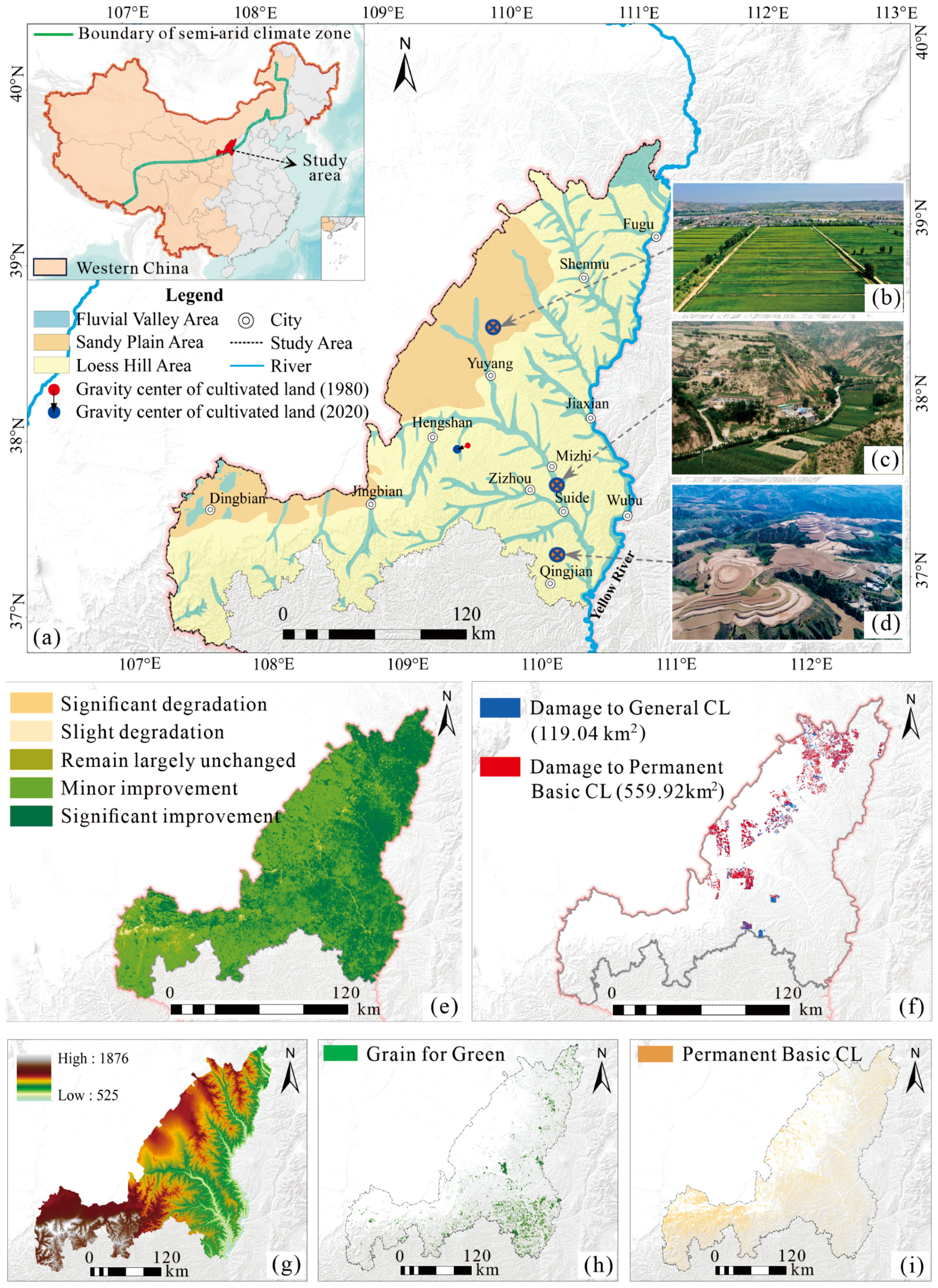
Building on this regional context, we focus on Yulin City in Shaanxi Province, China as a representative case within China’s northern agro-pastoral ecotone (Figure 1a). Situated at the transition between the Loess Plateau and the Mu Us Sandy Land (107°28′–111°15′ E, 36°57′–39°34′ N), Yulin spans roughly 43,000 km2 and comprises three major geomorphological units—sandy plains, river valleys, and loess hilly landscapes (Figure 1b–d). The area is characterized by an ecologically fragile and highly sensitive environment. In addition to its role as a typical agro-pastoral ecotone, Yulin forms a core part of the “Northern Shaanxi National Energy and Chemical Base” due to its substantial coal, petroleum, and natural gas reserves. The convergence of its ecologically fragile, agro-pastoral transitional, and energy-rich attributes creates an exceptionally complex human–land system. This complexity amplifies competing pressures on land use—most notably, the spatial trade-offs between CL protection and ecological restoration, alongside the water resource constraints that impose a marginal balance on agricultural development [16,31]. These conditions make Yulin a critical setting for understanding the mechanisms, trajectories, and sustainability pathways of CL use transitions in ecologically fragile regions.
The spatiotemporal dynamics of CL in Yulin reflect the complex interplay and strategic orientation of national-level ecological, agricultural, and energy policies. During the 1980s–1990s, agricultural expansion policies aimed at boosting grain production triggered extensive land reclamation, resulting in a marked increase in CL area but also intensifying soil erosion and desertification [32]. After 1999, the implementation of major ecological programs—including the Grain-for-Green Project and small watershed rehabilitation—gradually converted large areas of steeply sloped and degraded CL into forest or grassland [33], substantially increasing vegetation cover across the region (see Figure 1e). Since the early 2000s, the rapid development of the national energy and chemical base has become the dominant force reshaping land systems in Yulin. Intensive coal mining, petrochemical construction, and accompanying urbanization have driven pronounced landscape disturbance—manifested in land subsidence, groundwater decline, direct land occupation, and CL fragmentation—often surpassing the restorative effects of ecological programs in affected subregions (Figure 1f). More recently, the full enforcement of the country’s strictest CL protection regime, along with the CL Requisition–Compensation Balance Policy, has helped curb further rapid CL loss. Simultaneously, CL has increasingly aggregated in plains and gentler slopes, reflecting an optimized spatial arrangement. Consequently, balancing CL protection with energy development has emerged as a critical issue [34]. In essence, the evolution of CL in Yulin illustrates how the national strategies of ecological restoration, food security, and energy development intersect, compete, and re-balance within a vulnerable agro-pastoral ecotone. Conducting a systematic analysis of its underlying mechanisms offers valuable scientific basis for guiding land resource allocation, safeguarding ecological security, and promoting sustainable agriculture—not only for Yulin, but also for ecologically fragile, policy-sensitive regions around the world.

2.2. Data Sources and Preprocessing

The data used in this study consist primarily of two categories: land use/land cover data and driving factor data, which together support a systematic analysis of the spatiotemporal CL dynamics and its driving mechanisms in a typical agro-pastoral ecotone. The land use/land cover (LULC) data were obtained from China’s Multi-Temporal Land Use/Land Cover Remote Sensing Monitoring Database released by the Resource and Environmental Science Data Centre of the Chinese Academy of Sciences (RESDC), covering eight periods—1980, 1990, 1995, 2000, 2005, 2010, 2015, and 2020—with a spatial resolution of 30 m (http://www.resdc.cn). The dataset includes six primary land use categories (CL, forest, grassland, water bodies, built-up land, and unused land, coded as 1 to 6), and its overall accuracy exceeds 90%. These products were validated through human–computer interactive visual interpretation based on Landsat TM/ETM+/OLI imagery [35,36]. Given their high temporal consistency and spatial precision, these datasets have been widely used in ecosystem service assessment, territorial spatial planning, and sustainability-oriented policy research in China [11].
The driving-factor dataset encompasses four dimensions—natural constraints (N), policy regulation (P), economic drivers (E), and technological status (T)—constituting the NPET analytical framework. Specifically, they include:
  • Natural constraints factors (N): These variables characterize topographic and climatic constraints and include a digital elevation model (DEM; Figure 1g), annual precipitation, and soil erosion intensity. The 12.5 m DEM was obtained from the Shaanxi Provincial Department of Natural Resources; soil erosion data were sourced from the Geographic Data Sharing Infrastructure (www.gis5g.com, accessed on 14 August 2025). Annual precipitation was obtained from the “1-km monthly precipitation dataset for China (1901–2024)” released by the National Tibetan Plateau/Third Pole Environment Data Center [37].
  • Policy regulation factors (P): These quantify the effects of national spatial control policies, including the boundaries of the “Grain for Green” program and the Permanent Basic CL protection areas (Figure 1h,i). Both datasets are polygon patch boundaries. The Grain for Green boundary was derived from the LULC data and represents a time-varying (dynamic) boundary; for example, the 2000–2005 Grain for Green layer delineates areas where CL in 2000 was converted to forest land by 2005. The Permanent Basic CL protection areas is a static boundary for 2020, obtained from the Natural Resources Bureau of Shaanxi Province.
  • Economic driving factors (E): These variables reflect structural transformations in the agricultural economy, represented by agricultural output value and degree of mechanization, with data obtained from regional statistical yearbooks (2018–2023).
  • Technological status factors (T): Agricultural technological advancement was proxied by the coverage of dryland-farming techniques, quantified as the proportion of CL suitable for dryland cultivation (quality grades 11–12) after excluding irrigated land. Data on CL quality grades were obtained from Shaanxi Provincial Department of Natural Resources.
All datasets were standardized within the ArcGIS 10.8 platform through projection transformation, resampling to 1 km grid units, and spatial alignment, ensuring consistency and comparability across data sources. Using the collected 1 km precipitation dataset as the common target resolution, we interpolated village-based observations of investment intensity of land consolidation, agricultural mechanization level, dryland farming technology adoption rate, and urbanization rate across the entire study area using ordinary kriging to generate 1 km gridded surfaces. The Grain for Green layer for each period was encoded as a binary raster (1 = pixels where cultivated land at the beginning of the period was converted to forest land by the end of the period; 0 = otherwise) and resampled from 30 m to the 1 km analysis grid in ArcGIS. Based on these processed datasets, we applied the Geo-detector to compute the q-statistics for each individual factor to quantify its independent explanatory power for the spatial differentiation of cultivated land and conducted interaction detection to assess the joint explanatory power of any pair of factors, thereby elucidating the driving mechanisms underlying the spatial heterogeneity of cultivated land.

2.3. A Methodology for Multi-Model Coupling Analysis

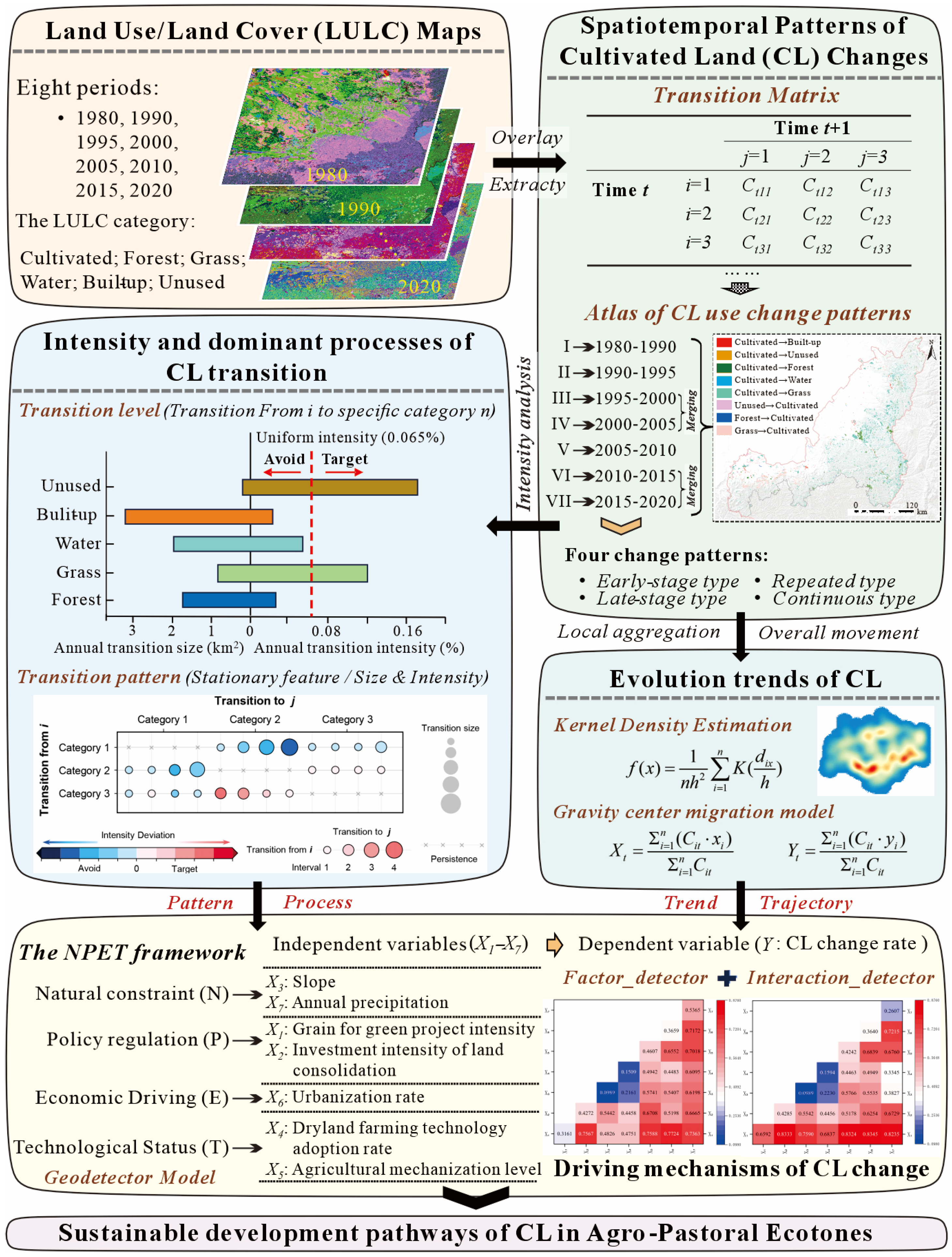
To systematically characterize the spatiotemporal evolution patterns and driving mechanisms of CL in a typical agro-pastoral ecotone, we developed an integrated multi-model framework integrating “Pattern–Process–Trend–Mechanism” (Figure 2). First, a land use transition matrix was used to quantify the direction, magnitude, and net balance of conversions between CL and other land types across multiple time periods. Through information atlas-based spatialization and visualization, these numerical changes were further translated into clear spatiotemporal patterns. Second, we applied intensity analysis based on the land use transition matrix to diagnose the activity and stability of CL conversions at different hierarchical levels, enabling the identification of dominant land-change processes. Third, kernel density estimation and a gravity center migration model were employed to quantify the evolution of local hotspots and the temporal trajectory of CL centroid shifts, reflecting both local clustering and overall directional movement. Finally, the Geo-detector was used to disentangle the dominant and interactive effects of natural constraints (N), policy regulation (P), economic drivers (E), and technological status (T) in shaping the spatial differentiation of CL. Collectively, this analytical framework advances a systematic interpretation of human–land coupling processes in agro-pastoral ecotones and offers critical insights to support sustainable agricultural development and efficient, intensive land use management.

2.3.1. Spatiotemporal Changes in CL

The combination of land use transition matrix and evolution-pattern mapping enables a quantitative depiction of CL change dynamics. As a widely used analytical tool, the land use transition matrix systematically captures the direction and magnitude of land use conversions [20]. By constructing an n × n matrix S, we precisely captured the inter-category transitions during each time interval from 1980 to 2020, thereby revealing the stage-specific effects of policy interventions and economic restructuring on CL loss (e.g., conversion to built-up land) and CL supplementation (e.g., development of unused land). The matrix can be expressed as
S i j t = S 11 t S 21 t S n 1 t S 12 t S 22 t S n 2 t S 1 n t S 2 n t S n n t
where S i j t denotes the area (km2) converted from land use type i at the beginning of period t to land use type j at the end of the same period, where the superscript t represents the time interval and n is the total number of land use categories. The row sum j = 1 n S i j t corresponds to the total area of type i at the beginning of period t, while the column sum i = 1 n S i j t represents the total area of type j at the end of that period. This approach enables a direct quantification of CL gains (entries in the CL column j) and CL losses (entries in the cropland row i), as well as the specific sources and destinations of these transitions.
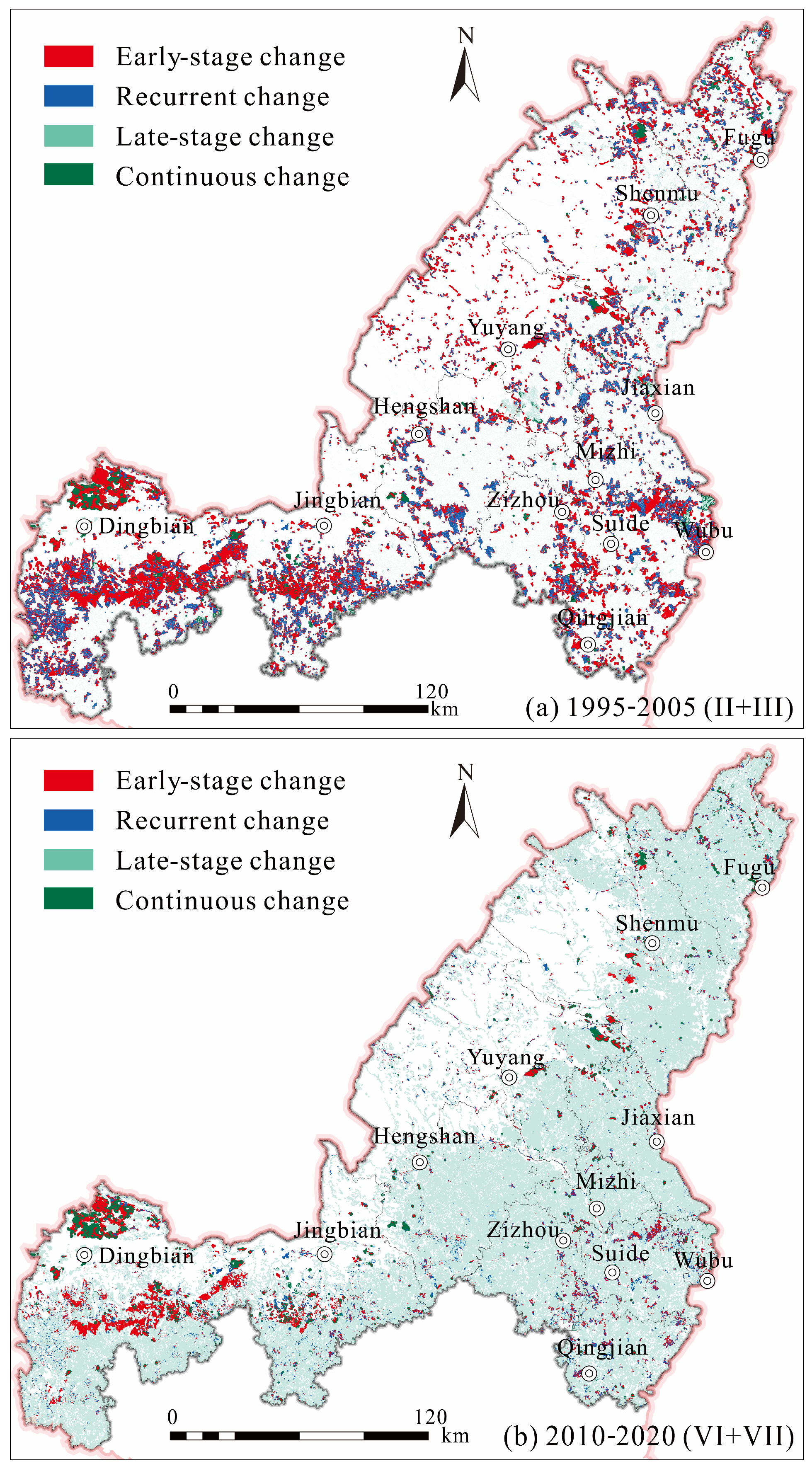
To further spatialize the quantitative information derived from the transition matrix, we constructed an evolution pattern atlas of CL use, which differs conceptually from the conventional change atlas of land (CL) use. The pattern atlas captures not only the magnitude but also the spatiotemporal processes of CL change. The construction involves three steps. First, following the principles of traditional land use change atlases, we generated atlas units for each adjacent pair of time periods between 1980 and 2020—namely seven intervals including 1980–1990, 1990–1995, 1995–2000, 2000–2005, 2005–2010, 2010–2015, and 2015–2020 (labeled I–VII). Second, atlas units from two specific intervals were merged—for example, combining units II (1995–2000) and III (2000–2005)—to produce a pattern atlas for a longer time window (e.g., 1995–2005, expressed as II + III). By specifying targeted transition modes across these merged units, we delineated spatially explicit patterns of land use evolution. Third, to capture the effects of major policy phases—such as the “Grain for Green” program, CL Requisition–Compensation Balance, and rapid urbanization—we constructed two key CL use pattern atlases: one for the ecological restoration period (1995–2005) and one for the rapid urbanization period (2010–2020). These maps explicitly represent the spatial–attribute–process characteristics of CL transitions under contrasting policy and development regimes.
Figure 2. A multi-model coupling framework for analyzing spatiotemporal evolution characteristics of cultivated land (CL). This framework integrates methodologies including transition matrix, information atlas, kernel density estimation, gravity center migration model, and Geo-detector analysis, serving to elucidate the patterns, processes, trends, and mechanisms of CL within the case study. The NPET framework refers to an interactive detection system that considers multi-dimensional factors: Natural constraints (N), Policy regulation (P), Economic drivers (E), and Technological status (T).
Remotesensing 18 00833 g002
Notably, we categorized the evolution pattern atlas of CL use into four principal types: early-stage change, late-stage change, recurrent change, and continuous change patterns. These patterns capture distinct temporal rhythms of CL dynamics, ranging from one-off loss to cyclical fluctuation. The early-stage change pattern refers to CL that was converted during the early stage of the study period and did not recover (e.g., CL → built-up land → built-up land). The late-stage change pattern describes CL that remained stable initially but was converted in the later stage (e.g., CL → CL → built-up land). The recurrent change pattern reflects a dynamic cycle in which CL was first lost and subsequently reclaimed (e.g., CL → forest → CL). The continuous change pattern denotes land parcels that experienced two distinct transitions during the study period (e.g., CL → forest → grassland). By mapping these evolution patterns, our aim extends beyond identifying the dominant atlas types and transition characteristics. More importantly, this approach translates abstract drivers—such as policy interventions and economic restructuring—into explicit, spatially traceable trajectories, enabling a clearer understanding of how multi-dimensional forces shape CL use transitions over time.

2.3.2. Intensity and Dominance of Land Transition Processes

To elucidate the underlying dynamics of CL transitions, we incorporated the intensity analysis framework based on land use transition matrix to diagnose whether conversions from a focal category (e.g., CL) to other land types exhibit anomalously high activity or dormancy [38]. This is a top–bottom hierarchical framework consisting of interval level, category level, and transition level. Our analysis focuses on the transition level, which distinguishes whether other land categories demonstrate disproportionately strong tendencies to convert to or from the focal category during a given time interval. In essence, it answers the question: which transitions are particularly intensive within a specific interval? Specifically, for time interval t, the transition intensity ( R t r a n s i j ) from category i (e.g., CL) to category j is expressed as
R t r a n s i j = S i j t S i t 1 ÷ D t × 100 %
where S i j t denotes the area converted from category i to category j during interval t (i.e., the corresponding element in the transition matrix); S i t 1 is the total area of category i at the beginning of interval t (t1); D t is the duration of interval t in years; and R t r a n s i j measures the proportion of the annualized transition from category i to category j relative to the initial extent of category i. To assess whether a transition exhibits unusually high activity, a benchmark intensity is required for comparison with R t r a n s i j .
In this study, the benchmark L t o t a l i is defined as the total loss intensity of land category i over period t, computed as follows:
L t o t a l i = j = 1 , j i n S i j t S i t 1 ÷ D t × 100 %
The decision criterion is as follows: if R t r a n s i j > L t o t a l i , the transition from category i to category j is considered active, meaning that this pathway is statistically more intense than the average loss process of category i. Such transitions are referred to as targeting modals. Conversely, when R t r a n s i j < L t o t a l i , the transition is classified as an avoiding modal. This approach enables the precise identification of dominant transition pathways driving CL dynamics during the study period—for example, the intensity of conversions from CL to built-up land.

2.3.3. Evolution Trends of CL

To quantify the spatial evolution patterns of CL, this study analyzes both local clustering and overall displacement. From the perspective of local clustering, kernel density estimation (KDE) approach [39] is applied to generate a continuous spatial density surface, enabling the identification of hotspots (high-density cluster) and cold spots (low-density clusters) of CL change. This work was calculated using the Spatial Analyst tool in ArcGIS 10.8 software. This provides insights into the spatial coupling effects of policy interventions (e.g., Permanent Basic CL protection) and natural constraints (e.g., slopes > 25°), particularly under the constraints imposed by administrative boundaries. The KDE is expressed as
f ( x ) = 1 P h 2 i = 1 P K ( d i x h )
where f(x) represents the estimated density at location x, reflecting the density of CL per unit area; P is the total number of CL patches (or their centroids); K() denotes the kernel function, a distance-decaying weighting function; dix is the Euclidean distance between sample point i and location x; and h is the bandwidth (>0), a key parameter controlling the degree of smoothing. Larger values of h produce smoother surfaces with fewer local details, whereas smaller values yield sharper density peaks. The output is a continuous density surface where high-density zones indicate hotspots of CL aggregation. Building on this, we selected two representative intervals (1995–2010 and 2005–2020) and performed differential analysis to explicitly capture the expansion and contraction of CL hotspots over time.
From the perspective of overall displacement, a centroid shift model was employed to characterize the trajectory, direction, and distance of CL distribution centers across different periods, thereby capturing the overall evolution of spatial patterns [14]. The geographic coordinates of the CL centroid (latitude and longitude) are calculated as
X t = Σ i = 1 P ( C i t x i ) Σ i = 1 P C i t
Y t = Σ i = 1 P ( C i t y i ) Σ i = 1 P C i t
where Xt and Yt denote the longitude and latitude of the CL centroid in year t; Cit is the area of CL patch i at time t; and xi and yi are the coordinates of the geometric center of CL patch i. By sequentially connecting the centroid coordinates (Xt, Yt) across different periods, the complete migration trajectory and displacement magnitude of CL over the study period can be obtained. The migration distance is calculated by using D = ( X t + 1 X t ) 2 + ( Y t + 1 Y t ) 2 , and the migration direction is determined by the azimuth angle.

2.3.4. Driving Mechanisms of CL Change

To identify the drivers underlying the spatial heterogeneity and temporal evolution of CL, we employed the Factor_detector and Interaction_detector modules of the Geo-detector model [27]. Four groups of explanatory variables were considered—natural constraints (N), policy regulation (P), economic drivers (E), and technological status (T). This approach overcomes the limitations of traditional regression-based models by capturing spatial discontinuities and non-linear shifts induced by policy shocks. The core statistic of Geo-detector, the q-value, quantifies the extent to which a driving factor, X, explains the variation in CL change rate Y. It is defined as
q = 1 h = 1 L N h σ h 2 N σ 2
where h denotes a stratum (category or zone) of the driving factor X (h = 1, 2, …, L); Nh and N represent the number of spatial units within stratum h and within the entire region, respectively; and σh2 and σ2 denote the variance of the dependent variable Y within stratum h and across the whole region, capturing data dispersion at their respective scales. The q-value ranges from 0 to 1, where a higher value indicates stronger explanatory power of factor X for the spatial heterogeneity of Y. A value of q = 0 indicates no association between X and Y, whereas q = 1 indicates that X fully accounts for the Y spatial distribution.
Given the complexity of geographical driving mechanisms, seven key factors (X1–X7) were selected for the Geo-detector analysis based on the principles of representativeness, dominant influence, and data availability, corresponding to the four dimensions of the NPET framework (Table 1). These drivers were used to disentangle the mechanisms underlying the spatiotemporal differentiation of CL. Specifically: (i) Slope (X3) and mean annual precipitation (X7) represent the most direct natural constraints on CL. Slope acts as a rigid boundary shaping the distribution, conversion pathways, and stability of CL, while precipitation determines agro-ecological suitability and crop productivity. In dryland farming systems, precipitation regimes influence land abandonment and marginalization. (ii) Grain-for-Green Project implementation (X1) and investment intensity of land consolidation (X2) capture policy regulation processes that directly reshape the quantity and spatial configuration of CL. The former quantifies the spatial constraint imposed by ecological restoration policies on the loss of CL, and the latter indicates how capital-intensive interventions promote spatial optimization. (iii) Urbanization rate (X6) serves as an economic driver that reflects regional development stages, labor migration, and land use competition. It encapsulates the macro-level impacts of socioeconomic transformation on the reallocation and functional restructuring of CL. (iv) Dryland farming technology adoption rate (X4) and agricultural mechanization level (X5) represent technological factors influencing land use efficiency and cultivation modes. While improved dryland practices reduce ecological pressure through resource-efficient farming, mechanization facilitates labor substitution, scale management, and intensification. Additionally, the Geo-detector requires categorical strata for each explanatory factor. For each of the eight periods, continuous predictors (X2X7) were discretized using the Jenks natural breaks method. We evaluated the sensitivity of the results to discretization by testing k = 5, 6, and 7 classes; the dominant factors and the primary interaction types were stable across these settings. Therefore, results reported in the main text are based on k = 6. The Grain-for-Green factor (X1) was treated as a period-specific binary policy layer derived from LULC transitions (1 = CL converted to forest land within the period; 0 = otherwise).
The Geo-detector analysis was implemented in four steps. First, the dependent variable (Y; e.g., CL change rate derived from eight time periods) and the independent variables (X; the seven drivers listed in Table 1) were converted into raster datasets with consistent spatial resolution and alignment. Second, the Factor_detector module was executed to calculate the q-statistic for each driver X, quantifying its individual power to explain the spatial heterogeneity of Y and thus identifying the dominant factors. Third, the Interaction_detector module was used to assess how pairs of drivers (e.g., X1 and X3) jointly influence Y. By comparing q(X1X3) with q(X1) and q(X3), we evaluated whether the interaction is independent, weakening, or non-linearly enhancing. For example, if q(X1X3) > Max[q(X1), q(X3)], the two drivers exhibit a synergistic enhancement effect. Finally, the results of Factor_detector and Interaction_detector were synthesized to reveal the coupled “natural–economic–policy” mechanisms governing CL dynamics in the agro-pastoral ecotone, a region characterized by marked ecological vulnerability.

3. Results

3.1. Spatiotemporal Patterns of CL Change

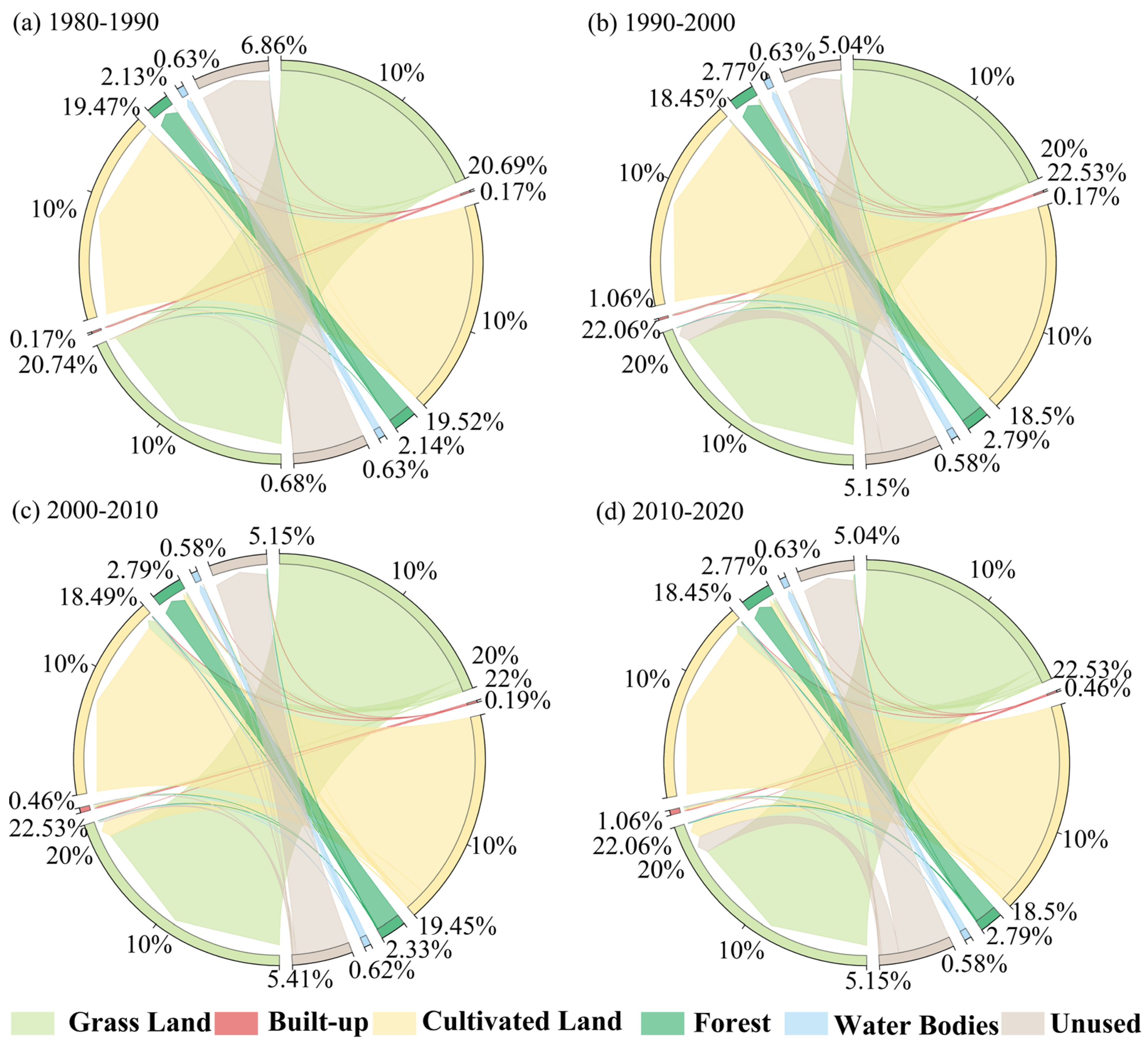
Drawing on long-term land use transition matrix and evolution pattern atlas of CL use for 1980–2020 (Figure 3; Table 2), CL dynamics in the study area exhibit clear phase-dependent characteristics that closely track shifts in China’s macro-level land governance policies. Temporally, CL expanded slightly and then declined between 1980 and 2010, resulting in a net loss of 837.29 km2 over the period. This long-term decline reflects the combined effects of the nationwide Grain for Green Program launched in 1999 and the subsequent acceleration of urbanization. CL peaked in 1995 (17,249.87 km2), followed by substantial outflows in 2000, 2005 and 2010 (550.50 km2, 391.59 km2 and 432.16 km2, respectively), predominantly to grassland (958.53 km2), forest (334.93 km2) and built-up land (63.85 km2). At the same time, programs for sandy land rehabilitation and the implementation of the CL “Requisition–Compensation Balance” policy generated a cumulative gain of 215.00 km2 through the conversion of unused land. After 2010, however, this trajectory reversed. By 2015, CL registered a small net increase (7.62 km2), indicating the emerging effectiveness of strengthened CL protection measures during the late period. Spatially, the hotspots of CL losses were located around urban centers and ecologically fragile zones, whereas newly added CL primarily originated from the reclamation of unused land and grassland. This produced a characteristic “loss near towns, compensation at the periphery” pattern, reinforcing the fragmentation of the CL mosaic across the agro-pastoral ecotone.
Figure 4 illustrates the evolution of CL use transition patterns during two policy-critical periods: 1995–2005 and 2010–2020. During 1995–2005, CL dynamics were strongly shaped by policy interventions, with “early-stage change” patterns (e.g., CL → grassland → grassland; 780.23 km2) and “late-stage change” patterns (e.g., CL → CL → grassland; 470.21 km2) dominating the landscape. These large-scale, unidirectional CL losses align closely with the implementation of the Grain for Green Program initiated in 1999, reflecting the primacy national ecological protection objectives during this period and a land system that responded predominantly to a single ecological policy signal. By contrast, the 2010–2020 period exhibits a qualitatively different transition regime under the “Cultivated Land Redline” policy and the tightened CL protection system. The dominant pattern is the “late-stage change” trajectory, covering 693.60 km2 in 1995–2005 and expanding to 788.81 km2 in 2010–2020, which points to persistent exogenous forces shaping CL transformation. At the same time, the “recurrent change” pathway increased sharply from 38.29 km2 to 185.03 km2 (4.83×), whereas the “continuous change” pathway contracted from 35.36 km2 to 4.72 km2 (−7.49×), the fastest shift among all modes. Together, these opposing trends imply two successive, linear degradation processes in which CL was converted out under distinct phases, consistent with adaptive adjustments to misaligned land change policies. Notably, conversion to built-up land within the “late-stage change” trajectory remained substantial (107.23 km2), underscoring the continuing tension between rigid urbanization demand and red-line constraints on land protection. In this period, land use change was not merely a passive response to a single policy. Instead, within an increasingly complex governance regime—shaped by spatial planning instruments such as the “Three Zones and Three Control Lines”—it emerged as a more targeted, adaptive form of management aimed at simultaneously safeguarding food security and ecological security while accommodating development.
Taken together, CL dynamics in the study area have crystallized into a distinct spatial pattern: ecological retirement in the south and compensatory reclamation in the north. In the southern hilly area, CL has continued to contract under large-scale ecological restoration programs such as the Grain for Green Program, whereas in the north, new CL has been reclaimed primarily from southern margin of the Mu Us Sandy Land. This evolution signifies a strategic shift from an initial phase of drastic, ecology-centric adjustment to a subsequent phase of targeted, multi-objective governance where food security is paramount. Looking forward, cultivated land protection must evolve beyond a singular focus on conserving areas. Greater emphasis should be placed on enhancing land quality, integrating ecological functions, and ultimately transitioning towards spatial pattern optimization and systemic resilience enhancement.

3.2. Intensity and Dominant Processes of Land Transition

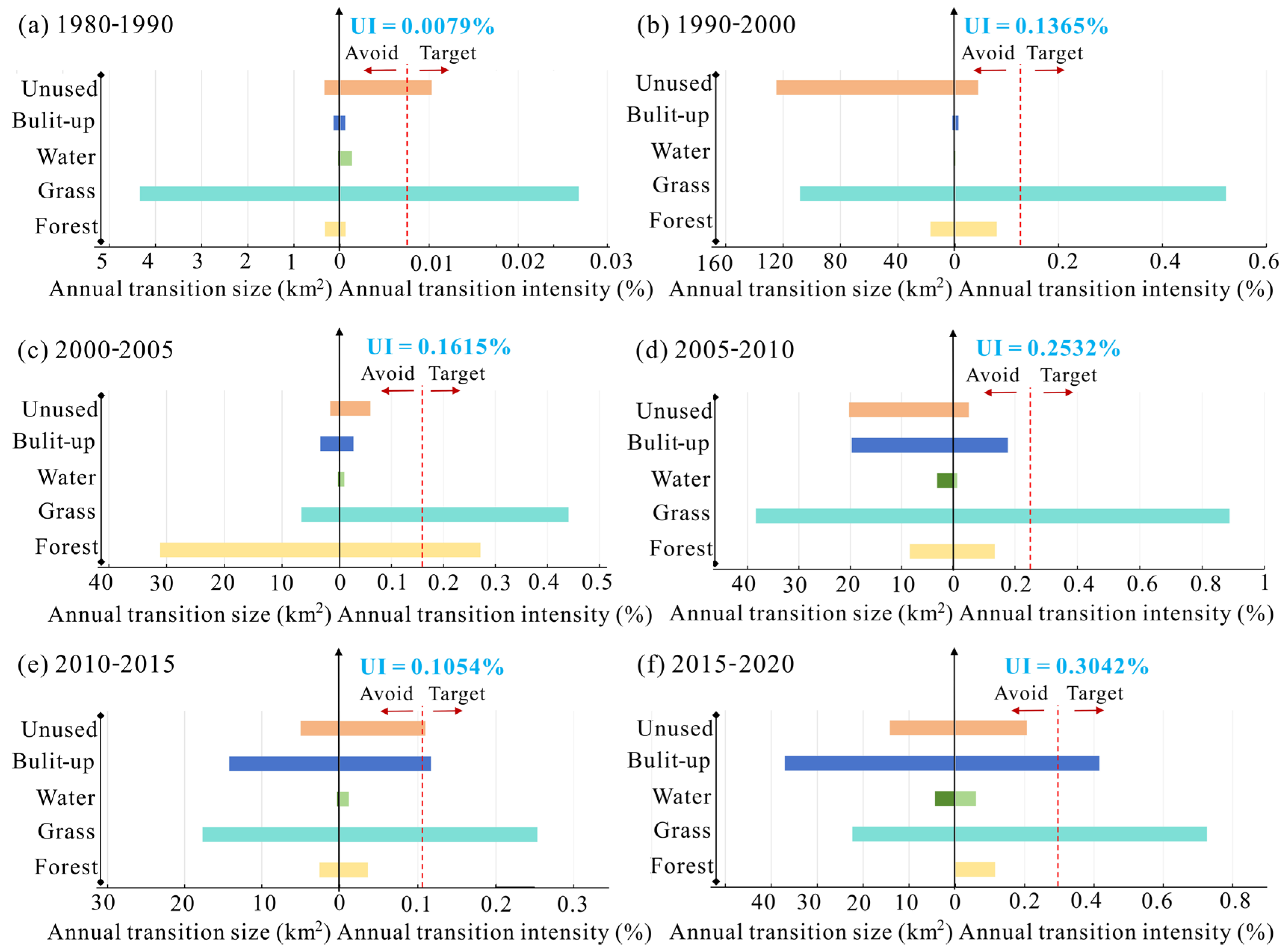
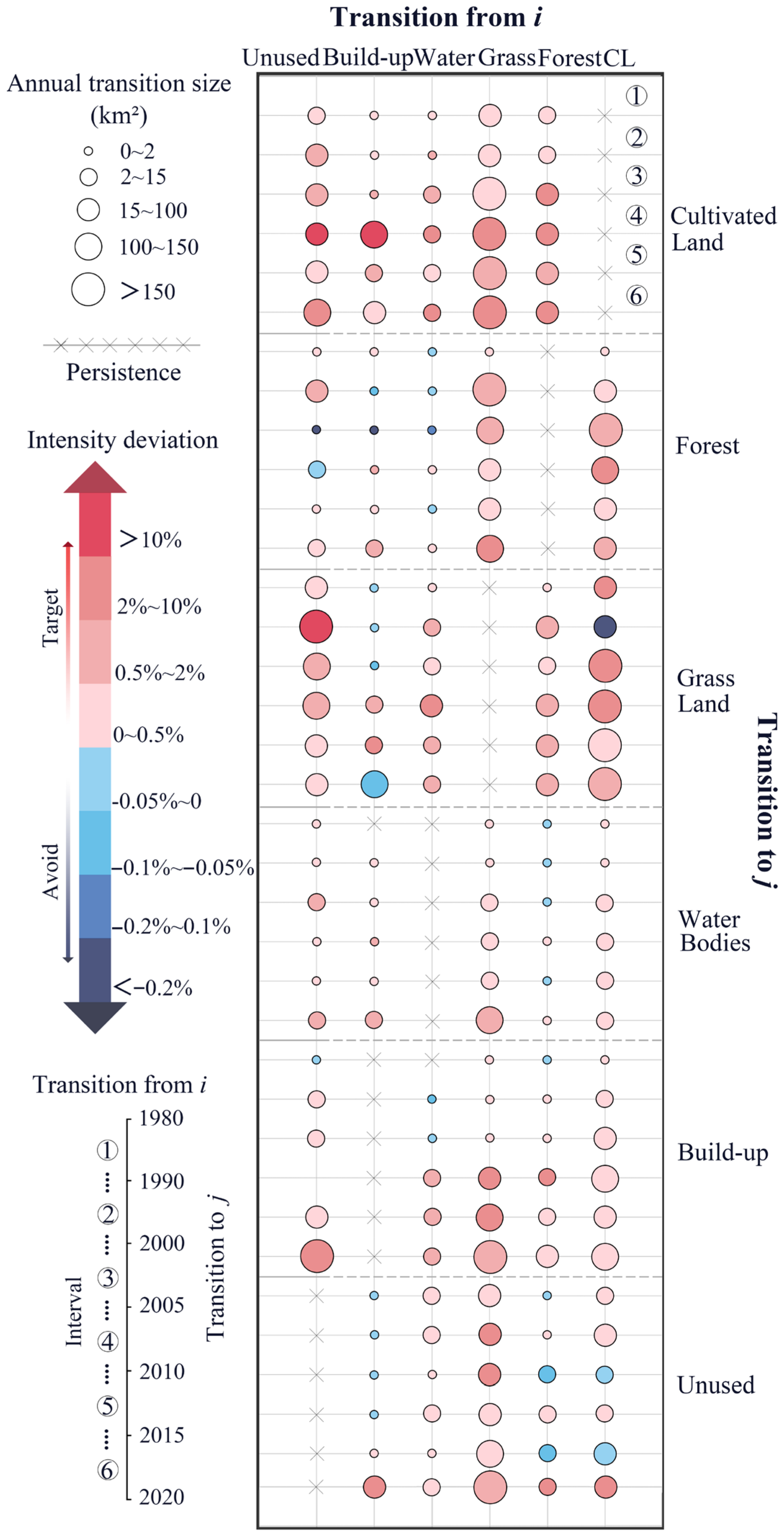
Figure 5 and Figure 6 illustrate the intensity and dominant trajectories of CL conversion across six intervals from 1980 to 2020. The results show pronounced temporal heterogeneity and clear stage-wise dominance in Yulin’s CL transition processes, with the principal driving pathways shifting from natural-factor dominance in the early period to a regime jointly shaped by human activities and policy interventions. Overall conversion intensity accelerated markedly, with the annual average conversion rate increasing from 0.0079% in 1980–1990 to 0.3042% in 2015–2020—an increase of more than thirty-eight-fold (Figure 5a,f). This rapid escalation highlights the sharply rising pressure on CL retention over the past two decades.
The specifics of CL transition stages are shown in Figure 6: (i) The 1980–1990 period. CL loss remained extremely weak, with the intensity deviations of all transition types close to zero or slightly positive (e.g., 0.0019% for conversion to built-up land). This indicates a largely stable CL system with no directional transitions, reflecting the early reform-era context in which land use changes were shaped mainly by natural factors and modest agricultural adjustments, while large-scale human-driven conversions had yet to emerge. (ii) The 1990–2000 period. The intensity deviation of CL-to-grassland conversion shifted to negative (–0.3283%), indicating a clear avoidance pathway, whereas conversion to unused land showed a positive deviation (0.1659%). Combined with its substantial annual conversion magnitude (–124.73 km2/yr), this pattern points to widespread reclamation of unused land into CL, which in turn helped slow CL loss to forest (intensity deviation 0.0362%). (iii) The 2000–2005 period. The intensity deviations of CL-to-forest and grassland-to-forest conversions increased by an average of 578%, far exceeding other pathways. This sharp escalation marks the “Grain-for-Green” program as the dominant and highly targeted driver, replacing natural or economic factors as the primary force governing land transitions during this period. (iv) The 2005–2010 period. CL-to-grassland conversion became an avoidance process, whereas transitions from forest and unused land to built-up land (0.2172% and 1.0466%, respectively), along with water-to-CL conversion (2.0343%), emerged as targeted pathways. These patterns reflect a co-driven mechanism of ecological restoration and accelerating urban expansion. (v) The 2010–2015 period. Although CL-to-built-up conversion still exhibited a positive deviation (0.0614%), its intensity fell below that of CL-to-unused land conversion (–0.0003%). Meanwhile, built-up-to-CL conversion follows a targeted pathway (1.0507%). Together, these patterns suggest that under land use intensification and the CL “Requisition–Compensation Balance” policy, the rate of urban expansion was increasingly constrained, while land degradation and the abandonment of marginal CL became more prominent. (vi) The 2015–2020 period. The intensity deviation of CL-to-built-up conversion surged to 0.2946%, re-emerging as the dominant targeted pathway. CL-to-water transitions also became active (0.0830%), likely associated with the construction of water conservancy infrastructure and ecological water supplementation projects.

3.3. Evolution Trends: Hotspots and Centroid Migration of CL

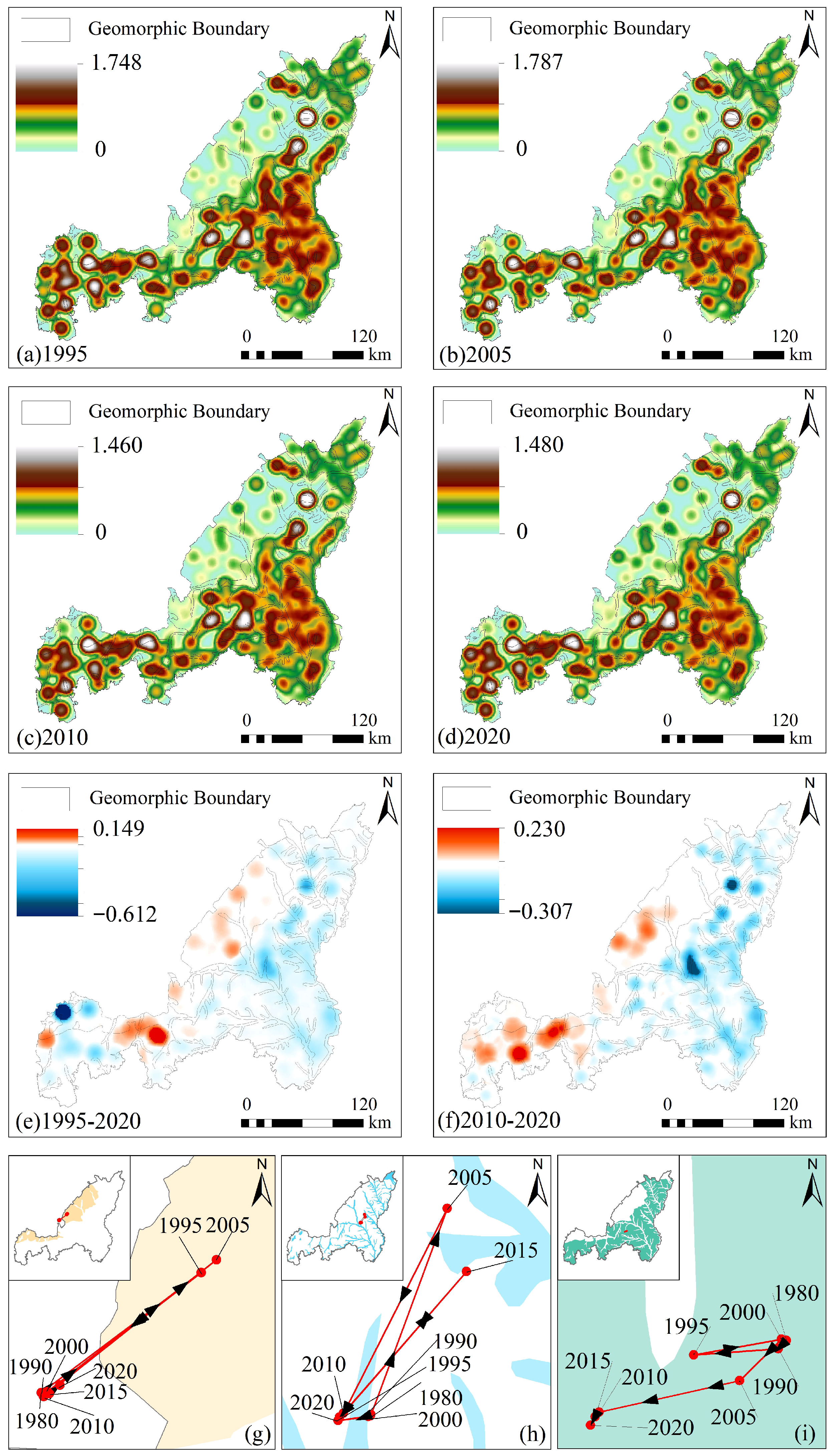
Figure 7 depicts CL density hotspots and centroid migration trajectories across multiple periods. From 1980 to 2020, CL spatial dynamics in the study area exhibited pronounced north–south differentiation and strong policy-driven signals. In the northern sandy plain area, point-like CL expansion emerged as the dominant pattern. High kernel density values (>0.28) were concentrated along the southern margin of the Mu Us Sandy Land, particularly in Dingbian County, Jingbian County, and northern Yuyang District—areas prioritised for sand control and land rehabilitation (Figure 7a–f). This expansion coincided with a northeastward shift in the CL centroid, with an average migration rate of 5.6 km/yr during 2005–2010 (Figure 7g–i), indicating a strategic relocation of agricultural production space driven by ecological restoration programs. In contrast, CL in the central river valley area exhibited a linear yet fragmented configuration. Over the 40-year period, its centroid shifted by less than 3 km, suggesting relative spatial stability. Kernel density changes analysis shows that CL-to-built-up conversions propagated along major valley corridors, such as the Wuding and Kuye rivers, closely aligning with patterns of urban, industrial, and mining development. This process resulted in the loss of approximately 23 km2 of high-quality valley CL and a 32% increase in low-density areas (Figure 7e,f), highlighting the compressive effects of rapid urbanization on prime agricultural land. Notably, the implementation of the “Three zones and Three control lines” policy after 2010 effectively curtailed the uncontrolled spread of fragmentation, enhanced the spatial resilience of valley CL, and contributed to the stabilization of the centroid following its northward shift after 2005. In the southern Loess hilly area, CL experienced persistent contraction (shown in blue in Figure 7e,f). Between 1995 and 2010, high-intensity loss hotspots (>0.2) emerged across six counties, including Suide and Mizhi. The CL centroid in this zone migrated continuously northwestward, with a cumulative displacement exceeding 12 km, closely corresponding to priority areas of the Grain for Green Program. This migration reflects a stepwise policy-driven process: ecologically vulnerable steep slopes (>25°) were retired from cultivation, while subsequent soil water conservation and specialty crop initiatives fostered agricultural intensification and consolidation in more suitable areas.
Notably, during 1995–2010, the concurrent CL expansion in the northern sandy plain areas, land occupation driven by energy-base development in the central region, and ecologically induced CL contraction in the southern Loess hills jointly triggered an abrupt shift in the CL centroid. This burst-like displacement constitutes a pronounced spatial trajectory of policy resonance, reflecting the simultaneous operation of multiple, and sometimes competing, land-use agendas (Figure 7g–i). Multi-regional integrated analysis indicates that CL spatial evolution in Yulin is not merely a manifestation of its natural geographic endowment, but rather the outcome of four decades of spatial balancing among ecological restoration, CL protection, and regional development strategies. This dynamic interplay underscores the inherent complexity of human–land relationships in ecologically fragile regions and highlights the necessity of coordinated, adaptive, and sustainability-oriented land governance.

3.4. Driving Mechanisms Underlying the Spatial Heterogeneity of CL

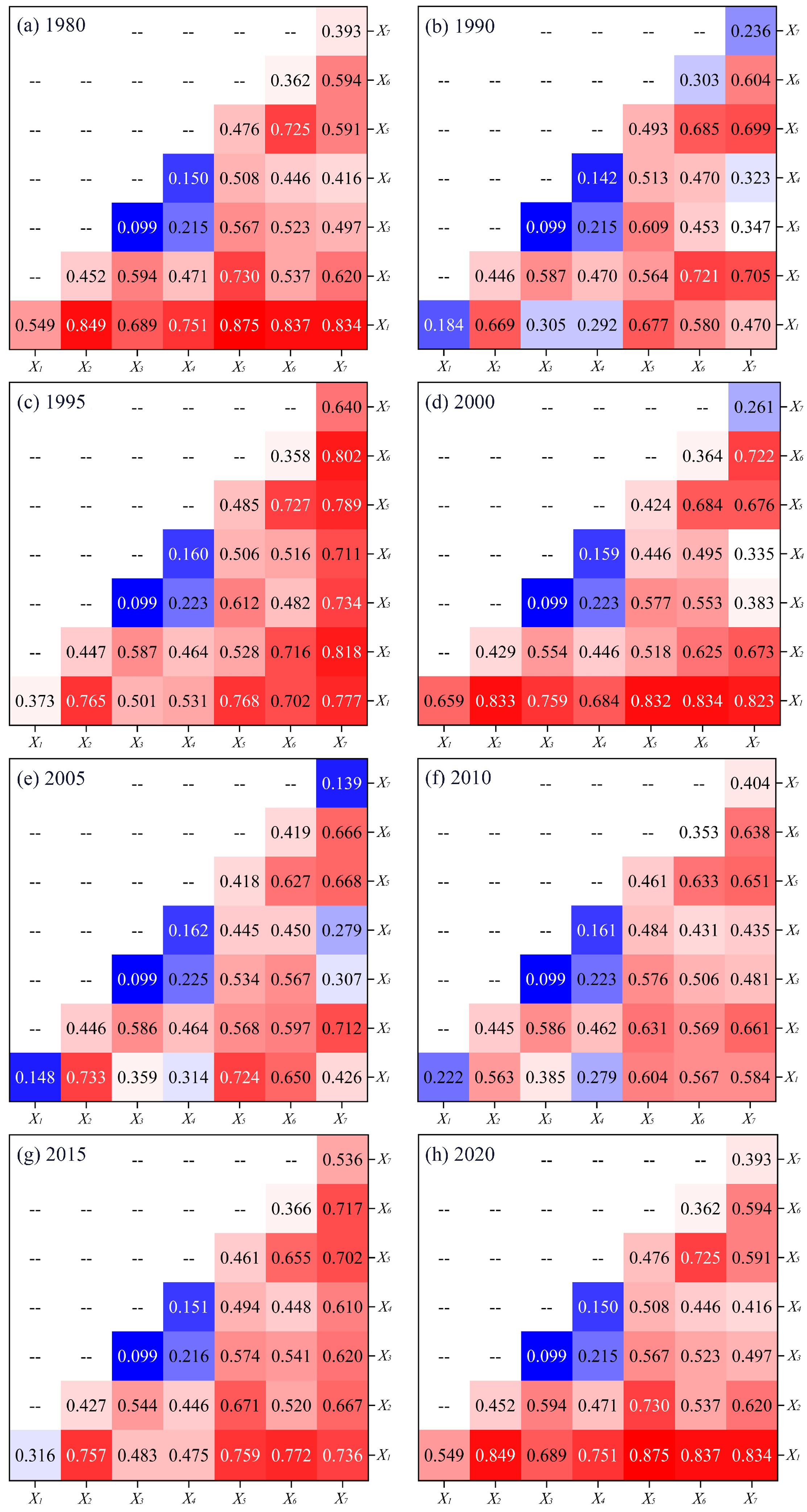
Over the past four decades (1980–2020), the complexity and synergistic nature of the driving mechanisms underlying CL spatial heterogeneity in the study area are manifested through the nonlinear enhancement effects generated by multi-factor interactions. The dominant drivers gradually shifted from natural constraints in the early period to policy interventions and anthropogenic activities in the later stages, while the explanatory power of individual factors exhibited pronounced temporal variability (Table 3; Figure 8). Among all factors, X2 and X5 consistently maintained high and statistically significant explanatory power throughout the entire study period (q > 0.4), indicating their role as persistent core drivers of CL spatial differentiation. The influence of X1 was relatively weak in the early stage but increased sharply after 1995, reaching its peak in 2000 (q = 0.659), followed by a gradual decline before rising again to 0.549 by 2020. This trajectory highlights the profound impact of major ecological policies and illustrates that top-down policy interventions can exert strong, yet sometimes stage-specific, effects on land use patterns. In contrast, X3 exhibited consistently low explanatory power (q = 0.099), suggesting that it functions primarily as a fundamental constraint rather than a dynamic driving force. Meanwhile, the steadily increasing influence of X4 and X6 reflects improvements in agricultural management associated with socioeconomic development, as well as the context-dependent nature of their effects. Collectively, the temporal evolution of these single-factor influences reveals a clear transition in CL dynamics within the agro-pastoral ecotone, from a system predominantly governed by natural background conditions to one driven by the synergistic interplay of policy, economic, and technological forces.
The interaction detector results indicate that CL spatial heterogeneity does not arise from the independent effects of single drivers, but rather from nonlinear synergies among multiple factors. Across all study periods, the explanatory power of any pairwise interaction exceeded that of each individual factor. This pervasive pattern is characterized as a “bivariate enhancement” nonlinear interaction (Figure 8). For instance, the interaction between X1 and X2 yielded a q value of 0.849 in 2020, substantially higher than the explanatory power of either factor alone. Notably, even natural constraint variables with weak individual effects—such as X3—exhibited strong explanatory power when interacting with policy or economic drivers. For example, during 2000–2010, the interaction between X1 and X3 consistently produced q values exceeding 0.75, indicating that steep terrain markedly amplified the vertical differentiation of CL retirement, thereby forming a synergistic mechanism between policy targeting and topographic constraints. Similarly, the interaction between X4 and X7 reached a q value of 0.812 during 2010–2020, revealing the stabilizing role of water-saving technologies in arid and semi-arid regions. This coupling effect mitigated spatial disparities in CL quality induced by water stress. The interaction between X1 and X4 exhibited a nonlinear enhancement during 2005–2015 (q = 0.798), suggesting that coordinated implementation of ecological restoration and technological upgrading facilitated the transition of sloping CL toward more efficient dryland farming systems in the Loess hilly region. Moreover, the sustained high explanatory power of the interaction between X2 and X5, with q values consistently above 0.75 after 2010, reflects the synergistic role of CL protection policies and technological modernization in promoting spatial consolidation and quality improvement of CL, while effectively constraining non-grain-oriented land use.
The pervasive nonlinear enhancement observed among interacting drivers indicates that CL spatial heterogeneity in the study area cannot be adequately explained by linear, single-factor models. Understanding and managing this heterogeneity therefore requires a holistic, system-oriented perspective that moves beyond isolated factor attribution. Overall, the spatial differentiation of CL in Yulin represents a nonlinear evolutionary outcome driven by the co-action of multiple factors and processes. Specifically, ecological restoration policies such as the Grain for Green Program have guided CL withdrawal in the southern region by amplifying inherent natural constraints, particularly slope-related limitations on cultivation. In contrast, land consolidation and agricultural technologies have facilitated CL expansion in the northern sandy areas by alleviating environmental constraints such as water scarcity and soil fragility. Meanwhile, economic and social drivers indirectly regulate both the intensity and direction of CL transition through their interactions with policy instruments and technological conditions. These findings highlight that future CL sustainability governance must prioritize cross-sectoral policy coordination and spatially differentiated implementation. By aligning ecological restoration, agricultural modernization, and regional development strategies with local biophysical conditions, differentiated management regimes can be designed to balance food security, ecosystem functions, and long-term regional sustainability within heterogeneous land systems.

4. Discussion: Sustainable Pathways for Land Systems in Global Agro-Pastoral Ecotones

4.1. A Diagnostic System for Land Dynamics

The integrated “pattern–process–trend–mechanism” framework developed in this study provides a robust analytical pathway for diagnosing the complexity of land system dynamics. By sequentially coupling land use transition matrix, information atlas, kernel density estimation, gravity center migration model, and the Geo-detector analysis, the framework enables a chained interpretation that links quantitative change, spatial configuration, and underlying driving mechanisms. For instance, the widely observed “southward retreat–northward expansion” pattern of CL is explicitly characterized as a differentiated policy response—most notably to the Grain for Green Program—operating under heterogeneous environmental conditions, such as steep slopes in the southern loess hills versus sandy land in the northern desert–steppe transition zone. More importantly, interaction detection within the Geo-detector framework reveals pervasive nonlinear enhancement effects among driving factors (e.g., between policy intervention [X1] and technological adoption [X4]). This indicates that land system evolution emerges from complex feedback and cross-scale interactions rather than from the linear superposition of isolated drivers.
Nevertheless, a more comprehensive diagnostic framework should further integrate multi-model coupled diagnosis, scenario-based simulation, and artificial intelligence–driven data mining [25,40]. While the Geo-detector is particularly effective in disentangling spatial heterogeneity and identifying nonlinear interaction effects among driving factors, its strength lies primarily in ex post diagnosis rather than ex ante prediction. Therefore, future research should incorporate two complementary models to enhance the predictive and anticipatory capacity of the framework. First, land use change simulation models (e.g., FLUS, CA–Markov) can be employed to project future land-cover configurations under alternative scenarios such as extreme climate conditions or policy adjustments, based on the identified key driving factors. These models can substantially improve the decision-support relevance of land system analyses by translating diagnosed mechanisms into plausible future trajectories [41]. Second, artificial intelligence approaches—including random forests and convolutional neural networks—offer powerful tools for handling high-dimensional and strongly nonlinear data. Beyond improving the accuracy of land use classification and change detection [42], such methods can uncover latent and previously unrecognized relationships through techniques such as feature importance ranking and partial dependence analysis. In this respect, AI-based models may even surpass Geo-detectors in capturing complex nonlinear dependencies among variables [43], thereby providing novel, data-driven insights into land use change mechanisms. Against this backdrop, the chained analytical strategy developed in this study represents an essential first step toward such an integrated, predictive, and intelligent land system assessment framework.

4.2. The CL Transition and Its Implications for SDGs

At present, global agriculture is confronted with the compounded pressures of climate change, resource depletion, and population growth, making a transition toward sustainable intensification—characterized by high resource use efficiency, environmental friendliness, and ecological harmony—an inevitable pathway for future agricultural development [44]. Against this backdrop, the phenomenon of “compensating inferior land for superior land” revealed by the Yulin case is far from a localized anomaly; rather, it represents a microcosm of the intensified global competition among agricultural, urban, and ecological spaces [12,45]. This pattern serves as a critical warning that CL protection strategies focusing solely on quantitative balance risk masking the implicit loss of high-quality CL. Such hidden degradation ultimately undermines national food security and poses significant challenges to the achievement of key SDGs, particularly SDG 2 (Zero Hunger) and SDG 12 (Responsible Consumption and Production).
China’s CL protection strategy must undergo a fundamental transition from a quantity-oriented approach toward an integrated paradigm that prioritizes quality enhancement, spatial optimization, and systemic resilience. This shift requires placing CL quality improvement, ecological infrastructure maintenance, and climate adaptation capacity on an equal footing with quantity-based control. The optimization strategy proposed in this study for the “southward retreat–northward expansion” pattern essentially reallocates agricultural production toward regions with higher compatibility between water and soil resources, while restoring ecologically fragile areas to natural systems. This approach closely aligns with the core principles of Nature-based Solutions (NbS) [46] and offers a viable pathway for jointly advancing SDG 15 (Life on Land) and SDG 13 (Climate Action). Looking forward, the future of agriculture lies in the convergence of smart agriculture, ecological agriculture, and climate-adaptive farming systems, for which this study provides critical spatial planning and scientific evidence.

4.3. A Transferable Adaptive Governance Framework: Zoning–Optimization–Synergy

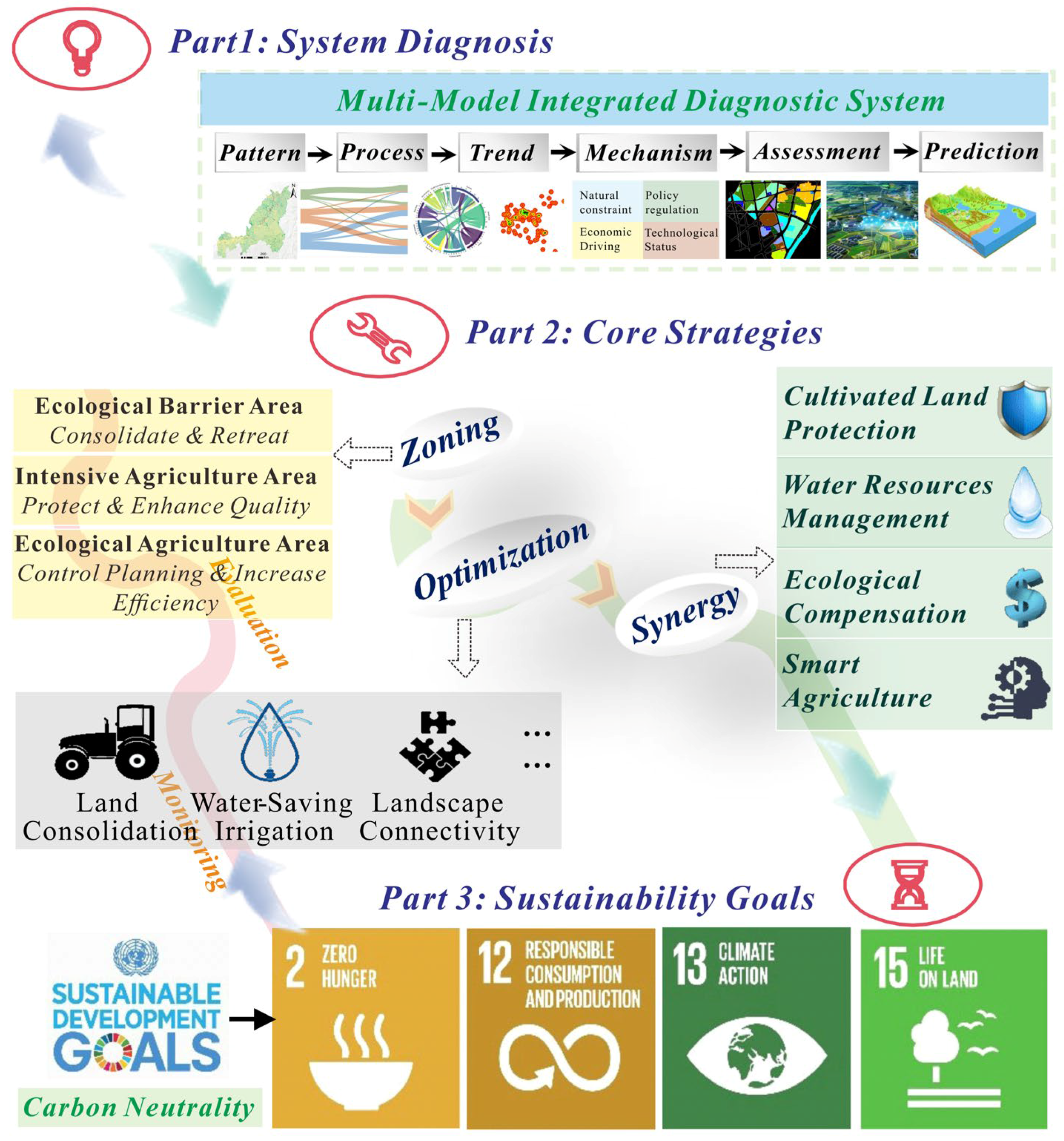
Building on the empirical evidence from Yulin and its relevance to global sustainability challenges, this study proposes an adaptive governance framework applicable to agro-pastoral ecotones and similar ecological transition regions worldwide: the Zoning–Optimization–Synergy (ZOS) framework (Figure 9). The internal logic and core components of the framework are articulated as follows.
  • Zoning provides the spatial foundation for targeted governance. Ecological transition zones globally—from the African Sahel to the margins of the South American Pampas—are characterized by pronounced environmental gradients and socio-economic heterogeneity. Effective governance therefore requires function-oriented spatial zoning grounded in integrated, multi-model diagnostic assessments. This involves delineating zones with differentiated ecological functions and agricultural development roles (e.g., ecological buffer zones, intensive agricultural zones, and eco-agricultural transition zones, as exemplified in Yulin), and assigning corresponding management thresholds and policy instruments. In this way, the principle of “working with nature” is operationalized within spatial planning and land use governance.
  • Optimization enhances system performance within zoning constraints. While zoning addresses the question of where different land use functions should be prioritized, optimization responds to how these functions can be effectively realized. This includes improving CL quality and productivity through land consolidation, high-standard farmland construction, and water-saving irrigation technologies, as well as strengthening ecological security by enhancing landscape connectivity and ecological corridors. Such optimization increases the system’s resistance and recovery capacity under climate change and external disturbances, thereby enhancing overall resilience.
  • Synergy ensures spatial zoning and local optimization generate positive outcomes at the system level. The challenges faced by agro-pastoral ecotones fundamentally arise from mismatches among policy, economic incentives, and ecological processes. Addressing these challenges requires breaking sectoral silos and fostering horizontal coordination among policies related to ecological compensation, agricultural subsidies, spatial planning, and water resource management. At the same time, vertical integration can be strengthened through digital technologies such as remote sensing, big data, and artificial intelligence. This synergistic governance mode amplifies policy and technological leverage, supporting the joint achievement of food security, ecological security, and climate resilience.
In summary, the ZOS framework establishes a closed-loop governance logic linking diagnostic assessment, spatial zoning, technological optimization, and institutional safeguarding. It emphasizes that adaptive management must be achieved through systematic diagnostics, differentiated interventions, and cross-sectoral synergy. Although derived from the Yulin case, the core principles of the framework are broadly applicable to ecologically fragile regions worldwide that face similar trade-offs between development and conservation, offering a transferable pathway toward sustainable land system governance.

5. Summary and Conclusions

By developing an integrated pattern–process–trend–mechanism multi-model framework, this study systematically disentangles the spatio-temporal dynamics, dominant transition processes, and driving mechanisms of CL change in Yulin City—a representative agro-pastoral ecotone in northern China—over the period 1980–2020. We demonstrate that CL transition use in this region is fundamentally the spatial manifestation of macro-level policy and socio-economic drivers operating under heterogeneous natural constraints, mediated through complex feedback and interactions. At the spatial level, CL evolution exhibits a divergence manifested as “ecological-driven CL contraction in the south and sandy land-based compensation in the north”. In the southern hilly area, CL has continued to contract under large-scale ecological restoration programs such as the Grain for Green Program, whereas in the north, new CL has been reclaimed primarily from southern margin of the Mu Us Sandy Land. This pattern reflects an explicit spatial trade-off between ecological restoration and food security objectives under contrasting environmental conditions. In terms of processes and trends, CL dynamics followed three distinct stages: (i) a period of slow, largely nature-driven change; (ii) a phase of rapid, policy-dominated transition driven by large-scale interventions such as the Grain for Green Program and Requisition–Compensation Balance Policy; and (iii) a more recent stage of refined regulation shaped by the synergistic effects of natural, economic, and technological factors.
Critically, this study not only demonstrated the diagnostic efficacy of the multi-model coupled framework for complex land system dynamics but also quantified the interactive driving mechanisms within the NPET framework. The widespread presence of bi-factor enhancement effects—such as the synergies between ecological restoration policies and dryland farming technologies (X1 ∩ X4), and between land consolidation investments and agricultural mechanization (X2 ∩ X5)—demonstrates that CL system evolution in agro-pastoral ecotones is not the result of isolated drivers, but of reinforcing, competing, and amplifying interactions among multiple forces. These findings underscore that the evolution of human–land systems in ecotones is a complex emergent property arising from the synergy, competition, and potentiation of multiple forces. Consequently, in ecologically sensitive regions like Yulin, the outcome of any single policy is contingent upon its interaction with other factors, necessitating integrated governance that synergistically combines ecological compensation, agricultural incentives, and spatial planning.
Building on these insights, this study proposes an adaptive governance framework for sustainable agricultural management—the Zoning–Optimization–Synergy (ZOS) framework. Grounded in multi-model diagnostic evidence, the ZOS framework emphasizes spatially differentiated zoning for targeted regulation, functional optimization to enhance system performance, and policy–technology synergy to align agricultural production, ecological protection, and climate adaptation goals. By explicitly linking regional land management to the SDGs, the framework offers a transferable governance logic for balancing CL protection, national food security, and ecological integrity in fragile transition zones worldwide. As such, it provides a novel perspective and decision-support pathway for addressing coupled food–water–energy challenges under global environmental change.
Despite these contributions, the generality of the findings remains to be further tested across different types and scales of ecological transition zones. Future research should (i) integrate land use change predictive models and AI techniques to improve scenario-based forecasting under climate and policy uncertainties, thereby enhancing proactive management, and (ii) incorporate multi-dimensional indicators such as CL quality, ecosystem service flows, and carbon sequestration to develop more comprehensive sustainability assessment frameworks. These extensions would help advance more generalizable theories and actionable tools for governing CL systems in ecologically vulnerable regions.

Author Contributions

Conceptualization, H.L.; methodology, L.F.; software, S.Y.; validation, L.F. and C.Y.; formal analysis, H.L., M.Z., L.F. and F.Z.; investigation, S.Y., F.Z. and C.Y.; resources, M.Z.; data curation, H.L. and S.Y.; writing—original draft preparation, H.L.; writing—review and editing, M.Z. and L.F.; visualization, S.Y.; supervision, M.Z.; funding acquisition, M.Z. and L.F. All authors have read and agreed to the published version of the manuscript.

Funding

This research was funded by the National Natural Science Foundation of China, grant numbers 42330719 and 42107209, and the research project on Risks Investigation of Coal Mining Subsidence and Coal Seam Fire Areas in Yulin City, China, grant number HXDSH20240285.

Data Availability Statement

The Land Use/Land Cover Remote Sensing Monitoring Database can be found in the Resource and Environmental Science Data Centre of the Chinese Academy of Sciences (http://www.resdc.cn, accessed on 20 March 2025). The soil erosion data can be found in the Geographic Data Sharing Infrastructure, global resources data cloud (www.gis5g.com, accessed on 14 August 2025). The annual precipitation data is sourced from the “1-km monthly precipitation dataset for China (1901–2024)” published by the National Tibetan Plateau/Third Pole Environment Data Center (https://data.tpdc.ac.cn/zh-hans/data/faae7605-a0f2-4d18-b28f-5cee413766a2, accessed on 21 November 2024). Other data, such as Digital Elevation Model (DEM) and Permanent Basic Farmland Protection Area, will be made available upon request.

Acknowledgments

We gratefully thank the editor and reviewers for their valuable time and constructive comments.

Conflicts of Interest

Author Shaoqi Yun was employed by the company Shaanxi Spatial Planning Research Institute Co., Ltd. The remaining authors declare that the research was conducted in the absence of any commercial or financial relationships that could be construed as a potential conflict of interest.

Abbreviations

The following abbreviations are used in this manuscript:
CLCultivated land
ZOSA Zoning–optimization–synergy framework for agricultural sustainable development in agro-pastoral ecotones
SDGsSustainable Development Goals
IPCCIntergovernmental Panel on Climate Change

References

  1. Campbell, B.M.; Hansen, J.; Rioux, J.; Stirling, C.M.; Twomlow, S.; Lini Wollenberg, E. Urgent Action to Combat Climate Change and Its Impacts (SDG 13): Transforming Agriculture and Food Systems. Curr. Opin. Environ. Sustain. 2018, 34, 13–20. [Google Scholar] [CrossRef]
  2. Newbold, T.; Hudson, L.N.; Hill, S.L.L.; Contu, S.; Lysenko, I.; Senior, R.A.; Börger, L.; Bennett, D.J.; Choimes, A.; Collen, B.; et al. Global Effects of Land Use on Local Terrestrial Biodiversity. Nature 2015, 520, 45–50. [Google Scholar] [CrossRef]
  3. Turner, B.L.; Kasperson, R.E.; Matson, P.A.; McCarthy, J.J.; Corell, R.W.; Christensen, L.; Eckley, N.; Kasperson, J.X.; Luers, A.; Martello, M.L.; et al. A Framework for Vulnerability Analysis in Sustainability Science. Proc. Natl. Acad. Sci. USA 2003, 100, 8074–8079. [Google Scholar] [CrossRef] [PubMed]
  4. Zabel, F.; Delzeit, R.; Schneider, J.M.; Seppelt, R.; Mauser, W.; Václavík, T. Global Impacts of Future Cropland Expansion and Intensification on Agricultural Markets and Biodiversity. Nat. Commun. 2019, 10, 2844. [Google Scholar] [CrossRef]
  5. Bardgett, R.D.; Bullock, J.M.; Lavorel, S.; Manning, P.; Schaffner, U.; Ostle, N.; Chomel, M.; Durigan, G.; Fry, E.L.; Johnson, D.; et al. Combatting Global Grassland Degradation. Nat. Rev. Earth Environ. 2021, 2, 720–735. [Google Scholar] [CrossRef]
  6. Smith, P.; Davis, S.J.; Creutzig, F.; Fuss, S.; Minx, J.; Gabrielle, B.; Kato, E.; Jackson, R.B.; Cowie, A.; Kriegler, E.; et al. Biophysical and Economic Limits to Negative CO2 Emissions. Nat. Clim. Change 2016, 6, 42–50. [Google Scholar] [CrossRef]
  7. Reynolds, J.F.; Smith, D.M.S.; Lambin, E.F.; Turner, B.L.; Mortimore, M.; Batterbury, S.P.J.; Downing, T.E.; Dowlatabadi, H.; Fernández, R.J.; Herrick, J.E.; et al. Global Desertification: Building a Science for Dryland Development. Science 2007, 316, 847–851. [Google Scholar] [CrossRef]
  8. IPCC Climate Change and Land: An IPCC Special Report on Climate Change, Desertification, Land Degradation, Sustainable Land Management, Food Security, and Greenhouse Gas Fluxes in Terrestrial Ecosystems. 2019. Available online: https://digitallibrary.un.org/record/3893424?v=pdf (accessed on 17 December 2025).
  9. UNEP Becoming #GenerationRestoration: Ecosystem Restoration for People, Nature and Climate (2022). Food and Agriculture Organization of the United Nations. Available online: https://www.unep.org/interactive/ecosystem-restoration-people-nature-climate/en/index.php (accessed on 17 December 2025).
  10. Bennett, E.; Carpenter, S.R.; Gordon, L.; Ramankutty, N.; Balvanera, P.; Campbell, B.; Cramer, W.; Foley, J.; Folke, C.; Karlberg, L.; et al. Toward a more resilient agriculture. Solutions 2014, 5, 65–75. [Google Scholar]
  11. Chen, Y.; Wang, K.; Lin, Y.; Shi, W.; Song, Y.; He, X. Balancing Green and Grain Trade. Nat. Geosci. 2015, 8, 739–741. [Google Scholar] [CrossRef]
  12. Bryan, B.A.; Gao, L.; Ye, Y.; Sun, X.; Connor, J.D.; Crossman, N.D.; Stafford-Smith, M.; Wu, J.; He, C.; Yu, D.; et al. China’s Response to a National Land-System Sustainability Emergency. Nature 2018, 559, 193–204. [Google Scholar] [CrossRef]
  13. Wu, R.; Li, Z.; Wang, S. The Varying Driving Forces of Urban Land Expansion in China: Insights from a Spatial-Temporal Analysis. Sci. Total Environ. 2021, 766, 142591. [Google Scholar] [CrossRef] [PubMed]
  14. Li, X.; Zhang, X.; Jin, X. Spatio-Temporal Characteristics and Driving Factors of Cultivated Land Change in Various Agricultural Regions of China: A Detailed Analysis Based on County-Level Data. Ecol. Indic. 2024, 166, 112485. [Google Scholar] [CrossRef]
  15. Zhang, D.; Liu, J.; Li, D.; Batchelor, W.D.; Wu, D.; Zhen, X.; Ju, H. Future Climate Change Impacts on Wheat Grain Yield and Protein in the North China Region. Sci. Total Environ. 2023, 902, 166147. [Google Scholar] [CrossRef]
  16. Kang, S.; Hao, X.; Du, T.; Tong, L.; Su, X.; Lu, H.; Li, X.; Huo, Z.; Li, S.; Ding, R. Improving Agricultural Water Productivity to Ensure Food Security in China under Changing Environment: From Research to Practice. Agric. Water Manag. 2017, 179, 5–17. [Google Scholar] [CrossRef]
  17. Bai, Z.; Caspari, T.; Gonzalez, M.R.; Batjes, N.H.; Mäder, P.; Bünemann, E.K.; de Goede, R.; Brussaard, L.; Xu, M.; Ferreira, C.S.S.; et al. Effects of Agricultural Management Practices on Soil Quality: A Review of Long-Term Experiments for Europe and China. Agric. Ecosyst. Environ. 2018, 265, 1–7. [Google Scholar] [CrossRef]
  18. Liu, J.; Kuang, W.; Zhang, Z.; Xu, X.; Qin, Y.; Ning, J.; Zhou, W.; Zhang, S.; Li, R.; Yan, C.; et al. Spatiotemporal Characteristics, Patterns, and Causes of Land-Use Changes in China since the Late 1980s. J. Geogr. Sci. 2014, 24, 195–210. [Google Scholar] [CrossRef]
  19. Huang, Z.; Li, S.; Peng, J.; Ma, X.; Ding, H.; Cheng, F.; Bi, R. Assessing Ecosystem Service Dynamics and Drivers for Sustainable Management in the Agro-Pastoral Ecotone of Northern China: A Spatiotemporal Analysis. Ecol. Indic. 2024, 165, 112213. [Google Scholar] [CrossRef]
  20. Yang, Y.; Wang, K.; Liu, D.; Zhao, X.; Fan, J. Effects of Land-Use Conversions on the Ecosystem Services in the Agro-Pastoral Ecotone of Northern China. J. Clean. Prod. 2020, 249, 119360. [Google Scholar] [CrossRef]
  21. Ke, X.; Chen, J.; Zuo, C.; Wang, X. The Cropland Intensive Utilisation Transition in China: An Induced Factor Substitution Perspective. Land Use Policy 2024, 141, 107128. [Google Scholar] [CrossRef]
  22. Zhang, Y.; Zhang, L.; Wang, J.; Dong, G.; Wei, Y. Quantitative Analysis of NDVI Driving Factors Based on the Geographical Detector Model in the Chengdu-Chongqing Region, China. Ecol. Indic. 2023, 155, 110978. [Google Scholar] [CrossRef]
  23. Bren d’Amour, C.; Reitsma, F.; Baiocchi, G.; Barthel, S.; Güneralp, B.; Erb, K.-H.; Haberl, H.; Creutzig, F.; Seto, K.C. Future Urban Land Expansion and Implications for Global Croplands. Proc. Natl. Acad. Sci. USA 2017, 114, 8939–8944. [Google Scholar] [CrossRef] [PubMed]
  24. Li, Q.; Huang, Y.; Sun, J.; Chen, S.; Zou, J. Balancing Urban Expansion and Food Security: A Spatiotemporal Assessment of Cropland Loss and Productivity Compensation in the Yangtze River Delta, China. Land 2025, 14, 1476. [Google Scholar] [CrossRef]
  25. Verburg, P.H.; Crossman, N.; Ellis, E.C.; Heinimann, A.; Hostert, P.; Mertz, O.; Nagendra, H.; Sikor, T.; Erb, K.-H.; Golubiewski, N.; et al. Land System Science and Sustainable Development of the Earth System: A Global Land Project Perspective. Anthropocene 2015, 12, 29–41. [Google Scholar] [CrossRef]
  26. Fu, B.; Wang, S.; Liu, Y.; Liu, J.; Liang, W.; Miao, C. Hydrogeomorphic Ecosystem Responses to Natural and Anthropogenic Changes in the Loess Plateau of China. Annu. Rev. Earth Planet. Sci. 2017, 45, 223–243. [Google Scholar] [CrossRef]
  27. Wang, J.-F.; Hu, Y. Environmental Health Risk Detection with GeogDetector. Environ. Model. Softw. 2012, 33, 114–115. [Google Scholar] [CrossRef]
  28. Zhu, X.X.; Tuia, D.; Mou, L.; Xia, G.-S.; Zhang, L.; Xu, F.; Fraundorfer, F. Deep Learning in Remote Sensing: A Comprehensive Review and List of Resources. IEEE Geosci. Remote Sens. Mag. 2017, 5, 8–36. [Google Scholar] [CrossRef]
  29. Li, Y.; Wang, J.; Han, X.; Guo, M.; Cheng, S.; Qiao, M.; Zhao, X. Coupling between the Grain for Green Program and a Household Level-Based Agricultural Eco-Economic System in Ansai, Shaanxi Province of China. J. Arid Land 2020, 12, 199–214. [Google Scholar] [CrossRef]
  30. Ju, F.; Ouyang, W.; Zhang, C.; Zhang, J. Impact of the Grassland Ecological Compensation Policy on Pastoral Production Efficiency—Evidence from Pastoral China. PLoS ONE 2025, 20, e0330059. [Google Scholar] [CrossRef]
  31. Tang, Z.; Zhou, Z.; Wang, D.; Luo, F.; Bai, J.; Fu, Y. Impact of Vegetation Restoration on Ecosystem Services in the Loess Plateau, a Case Study in the Jinghe Watershed, China. Ecol. Indic. 2022, 142, 109183. [Google Scholar] [CrossRef]
  32. Zhao, G.; Mu, X.; Wen, Z.; Wang, F.; Gao, P. Soil Erosion, Conservation, and Eco-environment Changes in the Loess Plateau of China. Land Degrad. Dev. 2013, 24, 499–510. [Google Scholar] [CrossRef]
  33. Yu, Z.; Deng, X.; Cheshmehzangi, A. The Grain for Green Program Enhanced Synergies between Ecosystem Regulating Services in Loess Plateau, China. Remote Sens. 2022, 14, 5940. [Google Scholar] [CrossRef]
  34. Zhou, Y.; Li, X.; Liu, Y. Cultivated Land Protection and Rational Use in China. Land Use Policy 2021, 106, 105454. [Google Scholar] [CrossRef]
  35. Ning, J.; Liu, J.; Kuang, W.; Xu, X.; Zhang, S.; Yan, C.; Li, R.; Wu, S.; Hu, Y.; Du, G.; et al. Spatiotemporal Patterns and Characteristics of Land-Use Change in China during 2010–2015. J. Geogr. Sci. 2018, 28, 547–562. [Google Scholar] [CrossRef]
  36. Xu, X.L.; Liu, J.Y.; Zhang, S.W.; Li, R.D.; Yan, C.Z.; Wu, S.X. China’s Multi-Period Land Use Land Cover Remote Sensing Monitoring Dataset (CNLUCC). Available online: https://www.resdc.cn/DOI/DOI.aspx?DOIid=54 (accessed on 17 December 2025).
  37. Peng, S. 1-Km Monthly Precipitation Dataset for China (1901–2024). Available online: https://zenodo.org/records/3114194 (accessed on 17 December 2025).
  38. Aldwaik, S.Z.; Pontius, R.G. Intensity Analysis to Unify Measurements of Size and Stationarity of Land Changes by Interval, Category, and Transition. Landsc. Urban Plan. 2012, 106, 103–114. [Google Scholar] [CrossRef]
  39. Brandes, G.; Sieg, C.; Sander, M.; Henze, R. Driving Domain Classification Based on Kernel Density Estimation of Urban Land Use and Road Network Scaling Models. Urban Sci. 2024, 8, 48. [Google Scholar] [CrossRef]
  40. Runge, J.; Gerhardus, A.; Varando, G.; Eyring, V.; Camps-Valls, G. Causal Inference for Time Series. Nat. Rev. Earth Environ. 2023, 4, 487–505. [Google Scholar] [CrossRef]
  41. Liang, X.; Guan, Q.; Clarke, K.C.; Liu, S.; Wang, B.; Yao, Y. Understanding the Drivers of Sustainable Land Expansion Using a Patch-Generating Land Use Simulation (PLUS) Model: A Case Study in Wuhan, China. Comput. Environ. Urban Syst. 2021, 85, 101569. [Google Scholar] [CrossRef]
  42. Zhong, L.; Hu, L.; Zhou, H. Deep Learning Based Multi-Temporal Crop Classification. Remote Sens. Environ. 2019, 221, 430–443. [Google Scholar] [CrossRef]
  43. Reichstein, M.; Camps-Valls, G.; Stevens, B.; Jung, M.; Denzler, J.; Carvalhais, N. Prabhat Deep Learning and Process Understanding for Data-Driven Earth System Science. Nature 2019, 566, 195–204. [Google Scholar] [CrossRef]
  44. Rockström, J.; Williams, J.; Daily, G.; Noble, A.; Matthews, N.; Gordon, L.; Wetterstrand, H.; DeClerck, F.; Shah, M.; Steduto, P.; et al. Sustainable Intensification of Agriculture for Human Prosperity and Global Sustainability. Ambio 2017, 46, 4–17. [Google Scholar] [CrossRef]
  45. Liang, M.; Liang, Y.; Song, Y.; Hong, J.; Lu, Y.; Wang, L. China’s Arable Land under Threat. Nat. Food 2025, 6, 417–418. [Google Scholar] [CrossRef]
  46. Cohen-Shacham, E.; Walters, G.; Janzen, C.; Maginnis, S. Nature-Based Solutions to Address Global Societal Challenges; Cohen-Shacham, E., Walters, G., Janzen, C., Maginnis, S., Eds.; IUCN International Union for Conservation of Nature: Gland, Switzerland, 2016. [Google Scholar]
Figure 1. Geographic setting and key characteristics of the study area. (a) Geomorphology map showing the distribution of sandy plain area (20.63%), fluvial valley area (18.07%), and loess hilly area (61.30%), with corresponding representative field photographs of these landforms shown in panels (bd). (e) Temporal changes in vegetation coverage from 2000 to 2020. (f) Distribution of cultivated land damaged by coal mining operations. (g) Digital Elevation Model (DEM; 12.5 m resolution). (h,i) delineate the implementation boundaries of the Grain for Green Program and Permanent Basic Cultivated Land preservation areas, respectively.
Remotesensing 18 00833 g001
Figure 3. Land Use Transition Chord Diagram in the Study Area (1980–2020).
Remotesensing 18 00833 g003
Figure 4. Evolution pattern atlas of cultivated land (CL) use for the 1995–2005 and 2010–2020 Periods. Taking subfigure (a) as an example: the map was prepared by synthesizing the change atlas of CL use from two periods: 1995–2000 (Phase II) and 2000–2005 (Phase III). By defining four change patterns (i.e., the early-stage change, late-stage change, recurrent change, and continuous change), the evolution pattern atlas of CL use for 1995–2005 was constructed. Detailed definitions of the four change patterns are provided in Section 2.3.1. Subfigure (b) synthesizes the change atlas of CL use from two periods: 2010–2015 (Phase VI) and 2015–2020 (Phase VII).
Remotesensing 18 00833 g004
Figure 5. Annual transition size and annual transition intensity of cultivated land (CL) converted into other categories at six intervals (af) during the period of 1980–2020.
Remotesensing 18 00833 g005
Figure 6. Transition modes of land use intensity during the 1980–2020 period across six intervals. Note: (i) Each bubble represents the transition from category i to j within a given interval. Intervals 1–6 correspond to the periods 1980–1990, 1990–2000, 2000–2005, 2005–2010, 2010–2015, and 2015–2020, respectively. (ii) The bubble size represents the annual transition magnitude, with larger bubbles indicating more intensive changes. (iii) The bubble color denotes the transition mode: red hues correspond to stationary targeting mode (i.e., positive intensity deviation), while blue hues represent stationary avoiding mode (negative intensity deviation). (iv) Intensity deviation is calculated as the annual transition intensity ( R t r a n s i j ) minus the uniform intensity ( L t o t a l i ).
Remotesensing 18 00833 g006
Figure 7. Cultivated land (CL) hotspots and their gravity center migration trajectories across different periods. (ad) present the kernel density analysis of CL distribution for the four time points of 1995, 2005, 2010, and 2020, respectively; (e,f) display the kernel density difference analysis for the two periods of 1995–2010 and 2005–2020, respectively; (gi) illustrate the migration characteristics of the gravity centers of CL distribution within the three geomorphic units (sandy plain area, river valley area, and loess hilly area) of the study area from 1980 to 2020, respectively.
Remotesensing 18 00833 g007
Figure 8. Multi-factor interaction detection affecting the spatial heterogeneity of cultivated land (CL) distribution within the study area during 1980–2020. Note: In each matrix cell, the color and value represent the interaction strength and explanatory power (q-statistic), respectively, between a pair of factors. Warmer colors (e.g., red) indicate stronger interactions, while larger values denote greater explanatory power. The factors X1 to X7 are defined as follows: Grain for Green Project intensity (X1), investment intensity of land consolidation (X2), slope (X3), adoption rate of dryland farming technology (X4), agricultural mechanization level (X5), urbanization rate (X6), and mean annual precipitation (X7). Among these factors, X3 and X7 are categorized as Natural constraint (N), X1 and X2 as Policy regulation (P), X6 as Economic driving (E), and X4 and X5 as Technological status (T), forming a systematic NPET framework.
Remotesensing 18 00833 g008
Figure 9. The Zoning–Optimization–Synergy (ZOS) Framework for Sustainable Cultivated Land Management Oriented Towards Adaptive Governance. Note: This framework illustrates an adaptive governance solution for the sustainable management of agriculture in the agro-pastoral ecotone. Following the identification of key issues and driving mechanisms through a multi-model integrated diagnostic system, spatial precision regulation is achieved via Zoning, system functionality is enhanced through Optimization, and policies and technologies are integrated via Synergy. Ultimately, the management outcomes are aligned with global SDGs, forming a feedback and optimization loop through continuous monitoring and evaluation.
Remotesensing 18 00833 g009
Table 1. Driving factors system for controlling cultivated land change under the NPET framework.
DimensionFactor CodeFactor Name/UnitData Processing and DescriptionExpected Impact Direction
Natural Constraint (N)X3Slope (°)Extracted from DEM data (time-invariant).Negative: Cultivated land decreases with increasing slope due to lower suitability.
X7Annual Precipitation (mm)Spatially interpolated data of multi-year average precipitation (time-invariant).Positive: moisture conditions as the fundamental role in agricultural production on cultivated land
Policy Regulation (P)X1Grain for Green Project implementation (0/1)A period-specific binary layer derived from LULC transitions: 1 = pixels where CL at the beginning of the period was converted to forest land by the end; 0 = otherwise. Resampled from 30 m to 1 km grid.Negative: Cultivated land decreases in policy implementation zones.
X2Investment Intensity of Land Consolidation (¥104 yuan/km2)Investment allocated across project areas, followed by spatialization and interpolation (ordinary kriging) to generate 1 km gridded surfaces for each period.Positive/Non-linear: Enhancement of cultivated land quantity and quality in investment zones.
Economic Driving (E)X6Urbanization Rate (%)Urban population/Total population; spatialized at the township level and interpolated (ordinary kriging) to 1 km grids for each period.Negative: Urbanization absorbs agricultural labor, potentially leading to CL abandonment.
Technological Status (T)X4Dryland Farming Technology Adoption Rate (%)The CL area using water-saving/drought-resistant techniques/Total CL area; spatialized and interpolated (ordinary kriging) to 1 km grids for each period.Positive: Increases yield per unit area, potentially reducing the need for expansion.
X5Agricultural Mechanization Level (kW/ha)Total agricultural machinery power/Total CL area; spatialized and interpolated (ordinary kriging) to 1 km grids for each period.Positive: Compensates for labor shortages and supports farming efficiency.
Note: Continuous variables (X2X7) were discretized using Jenks natural breaks for Geo-detector analysis; sensitivity tests were conducted with number of classes k = 5 , 6 , and 7 . The dominant factors and interaction types remained stable across these settings, and results reported in the main text are based on k = 6 . X1 is a binary policy layer and thus not discretized.
Table 2. Directions (Outflow/Inflow) and Areas (km2) of the transition from Cultivated Land to other categories in 1980–2020. (Note: Taking grassland as an example, a value of −52.17 indicates that 52.17 km2 of cultivated land was converted to grassland (i.e., outflow from cultivated land) between 1990 and 1980. Similarly, a value of 12 denotes that 12 km2 of grassland was converted to cultivated land (i.e., inflow to cultivated land) during the same period.)
PeriodFlow
Direction
Grass LandBuilt-UpForestWater BodiesUnusedNet Change
1980–1990Outflow−52.17−1.05−0.55−2.07−11.64−44.5
Inflow12.000.022.871.057.08
1990–1995Outflow−422.79−16.27−35.33−13.13−11.32537
Inflow822.026.2272.686.18128.71
1995–2000Outflow−822.2−9.51−76.58−3.72−109.65−550
Inflow406.746.7532.3913.911.39
2000–2005Outflow−492.33−18.74−206.03−3.64−5.95−392
Inflow287.180.7319.3811.1516.65
2005–2010Outflow−946.49−70.2−139.08−7.59−11.41−432
Inflow608.5727.1134.9913.6858.26
2010–2015Outflow−268.3−28.28−23.76−8.47−17.367.62
Inflow286.585.1928.333.230.49
2015–2020Outflow−715.7−112.84−67.38−22.59−68.27−49.1
Inflow662.3252.763.9613.72145.03
Table 3. Multi-factor detection affecting the spatial heterogeneity of cultivated land (CL) distribution within the study area during 1980–2020. Note: The factors X1 to X7 represent Grain for green project intensity (X1), investment intensity of land consolidation (X2), slope (X3), adoption rate of dryland farming technology (X4), agricultural mechanization level (X5), urbanization rate (X6), and annual precipitation (X7). Among these factors, X3 and X7 are categorized as Natural constraint (N), X1 and X2 as Policy regulation (P), X6 as an Economic driving (E), and X4 and X5 as Technological status (T), forming a systematic NPET framework.
YearX1X2X3X4X5X6X7
19800.0080.453 0.099 0.142 0.505 0.261 0.176
19900.184 0.446 0.099 0.142 0.493 0.303 0.236
19950.373 0.447 0.099 0.160 0.485 0.358 0.640
20000.659 0.429 0.099 0.159 0.424 0.364 0.261
20050.148 0.446 0.099 0.162 0.418 0.419 0.139
20100.222 0.445 0.099 0.161 0.461 0.353 0.404
20150.316 0.427 0.099 0.151 0.461 0.366 0.536
20200.549 0.452 0.099 0.150 0.476 0.362 0.393
Disclaimer/Publisher’s Note: The statements, opinions and data contained in all publications are solely those of the individual author(s) and contributor(s) and not of MDPI and/or the editor(s). MDPI and/or the editor(s) disclaim responsibility for any injury to people or property resulting from any ideas, methods, instructions or products referred to in the content.