Review

Application and Technological Evolution of GNSS in Natural Hazard Research: A Comprehensive Analysis Based on a Hybrid Review Approach


1
National Institute of Natural Hazards, Ministry of Emergency Management of China, Beijing 100085, China
2
Key Laboratory of Compound and Chained Natural Hazards Dynamics, Ministry of Emergency Management of China, Beijing 100085, China
3
School of Earth Sciences and Resources, China University of Geoscience, Beijing 100083, China
4
School of Emergency Management Science and Engineering, University of Chinese Academy of Sciences, Beijing 100049, China
5
School of Geophysics and Space Exploration, East China University of Technology, Nanchang 330013, China
*
Author to whom correspondence should be addressed.
Remote Sens. 2026, 18(6), 887; https://doi.org/10.3390/rs18060887
Submission received: 15 January 2026 / Revised: 27 February 2026 / Accepted: 12 March 2026 / Published: 13 March 2026

Highlights

What are the main findings?
  • GNSS applications in natural hazard research have expanded from single deformation monitoring to integrated multi-hazard observation.
  • Three key GNSS capabilities support hazard monitoring: deformation sensing, environmental sensing, and early real-time warning.
What are the implications of the main findings?
  • The integration of GNSS with multi-sensor observations and data-driven methods enhances our capability for natural hazard monitoring.
  • GNSS functions as a critical multi-sphere sensor that links lithospheric, atmospheric, and hydrospheric processes, enabling a deeper understanding of coupled hazard evolution mechanisms.

Abstract

Global Navigation Satellite Systems (GNSS), benefiting from global coverage, all-weather operation, high precision, and high temporal resolution, have progressively become a key technology in natural hazard monitoring and early warning systems. This paper adopts a hybrid review strategy that integrates scientometric analysis with a systematic review to examine the development trajectory, research hotspots, and technological evolution of GNSS applications in natural hazard studies based on the existing literature. From a technological perspective, three core capabilities of GNSS in hazard monitoring are identified: high-precision, multi-scale deformation sensing; multi-sphere environmental sensing based on signals of opportunity; and real-time monitoring supporting rapid early warning and emergency response. The paper further reviews the development of GNSS in conjunction with multi-sensor collaborative observation and its integration with data-driven methods such as machine learning. Representative applications of GNSS and its integrated techniques are summarized across major hazard types, including earthquakes, tsunamis, landslides, land subsidence, hydrometeorological hazards, and volcanic activity, and further discussions are provided on methodological considerations, the commonalities and differences in GNSS applications across different hazards, and future development directions. The review demonstrates that GNSS applications in natural hazard research are evolving from single-source deformation monitoring toward multi-source integration, intelligent sensing, and operational early warning support systems. This work provides a reference for the further development of GNSS technologies in natural hazard monitoring and risk mitigation.

1. Introduction

Ongoing global climate change and the intensification of human activities are profoundly reshaping the spatiotemporal patterns of natural hazards, with multiple hazard types exhibiting increasing frequency, stronger coupling, and cascading evolutionary processes, thereby posing growing threats to densely populated areas, critical infrastructure, and regional sustainable development [1]. Against this backdrop, achieving comprehensive sensing, identification, and response across the full hazard lifecycle—from initiation and triggering to subsequent evolution—has become a critical scientific challenge and a key technological demand in international natural hazard monitoring and risk mitigation research [2]. This demand extends beyond post-event characterization of hazard outcomes, placing greater emphasis on the coordinated enhancement of continuous monitoring, process-based understanding, and risk early warning capabilities across multiple temporal scales of hazard system evolution.
Traditional engineering monitoring and single-source remote sensing approaches exhibit clear limitations in spatial coverage, temporal resolution, multidimensional deformation detection, and adaptability to extreme environments, making it difficult to meet the integrated observation requirements of multi-scale and multi-mechanism natural hazards [3]. By contrast, GNSS, benefiting from global coverage, all-weather operation, high-precision positioning, and high temporal resolution, has progressively emerged as a key space-based observation technology for monitoring the Earth’s surface and atmospheric environment. GNSS can continuously and reliably provide three-dimensional deformation measurements with centimeter-level accuracy and, under favorable conditions, an accuracy of a few millimeters, while the propagation characteristics of GNSS signals in the troposphere and ionosphere enable the retrieval of key atmospheric parameters and the sensing of surface and atmospheric conditions through reflection and radio occultation techniques, thereby offering a unified data foundation for the monitoring, early warning, and process-based investigation of diverse natural hazards [4,5,6].
Over the past two decades, with the maturation of multi-constellation and multi-frequency observations and the deployment of high-sampling-rate continuous station networks, GNSS applications in natural hazard research have expanded from single-purpose positioning or deformation measurements to an integrated sensing framework encompassing surface deformation as well as atmospheric and ionospheric disturbances, while the research paradigm has evolved from descriptive analyses toward mechanism-constrained interpretation and from offline processing to near-real-time warning and operational implementation [5,6,7]. In earthquake and tsunami monitoring, GNSS has become a key data source for capturing co-seismic displacements, constraining rupture models, and supporting rapid early warning systems [8,9]. In landslide and mountainous hazard studies, the combined use of GNSS with Interferometric Synthetic Aperture Radar (InSAR) and ground-based sensors has significantly enhanced the capability to identify deformation fields [10,11]. In ground subsidence studies, GNSS provides a long-term and stable deformation reference for monitoring surface deformation induced by groundwater extraction and resource exploitation [12,13]. In hydrometeorological hazard research, precipitable water vapor(PWV) and ionospheric parameters derived from GNSS are widely used for the analysis of heavy rainfall events and tropical cyclones [14,15]. In volcanic activity studies, GNSS provides critical constraints for revealing magma chamber adjustments and associated surface deformation [16,17].
However, despite the widespread application of GNSS in natural hazard research, existing review studies largely focus on individual hazard types or specific technical approaches, and comprehensive analyses that characterize the overall development of the field from a literature-driven perspective remain limited. The evolution of research hotspots and patterns of cross-disciplinary integration in GNSS-based hazard studies has not yet been quantitatively characterized. In addition, the technological evolution of GNSS in hazard monitoring—from deformation-centered observations toward integrated frameworks encompassing multi-source environmental sensing, real-time early warning, and intelligent analysis—has not been systematically synthesized. These gaps highlight the need for an integrated review framework that combines scientometric analysis with systematic review methods to summarize the development trajectory, core capabilities, and application modes of GNSS in natural hazard research.
Based on this motivation, this paper presents a hybrid review of GNSS applications in natural hazards, focusing on literature characteristics, core technological capabilities, pathways of multi-source and intelligent integration, and hazard-specific applications. Section 2 introduces research methods and data sources. Section 3 analyzes the overall development pattern of GNSS-based hazard research in terms of annual publication output, evolutionary stages, and research hotspots based on bibliographic data. Section 4 systematically summarizes three core GNSS capabilities in natural hazard monitoring from a technological perspective. Section 5 discusses the construction of GNSS-centered multi-sensor collaborative observation systems and methodological innovations arising from the integration of GNSS with artificial intelligence and data-driven approaches. Section 6 reviews representative application outcomes and practical experiences of GNSS and its integrated technologies across major hazard types. Section 7, building on the preceding analyses, discusses relevant methodological issues, the similarities and differences in GNSS applications among various hazards, and future research directions. Finally, Section 8 summarizes the main findings of the study.
This paper provides a multi-perspective synthesis of the research characteristics and application value of GNSS in natural hazards, offering a reference for the continued development of GNSS technologies in this field.

2. Methods and Data

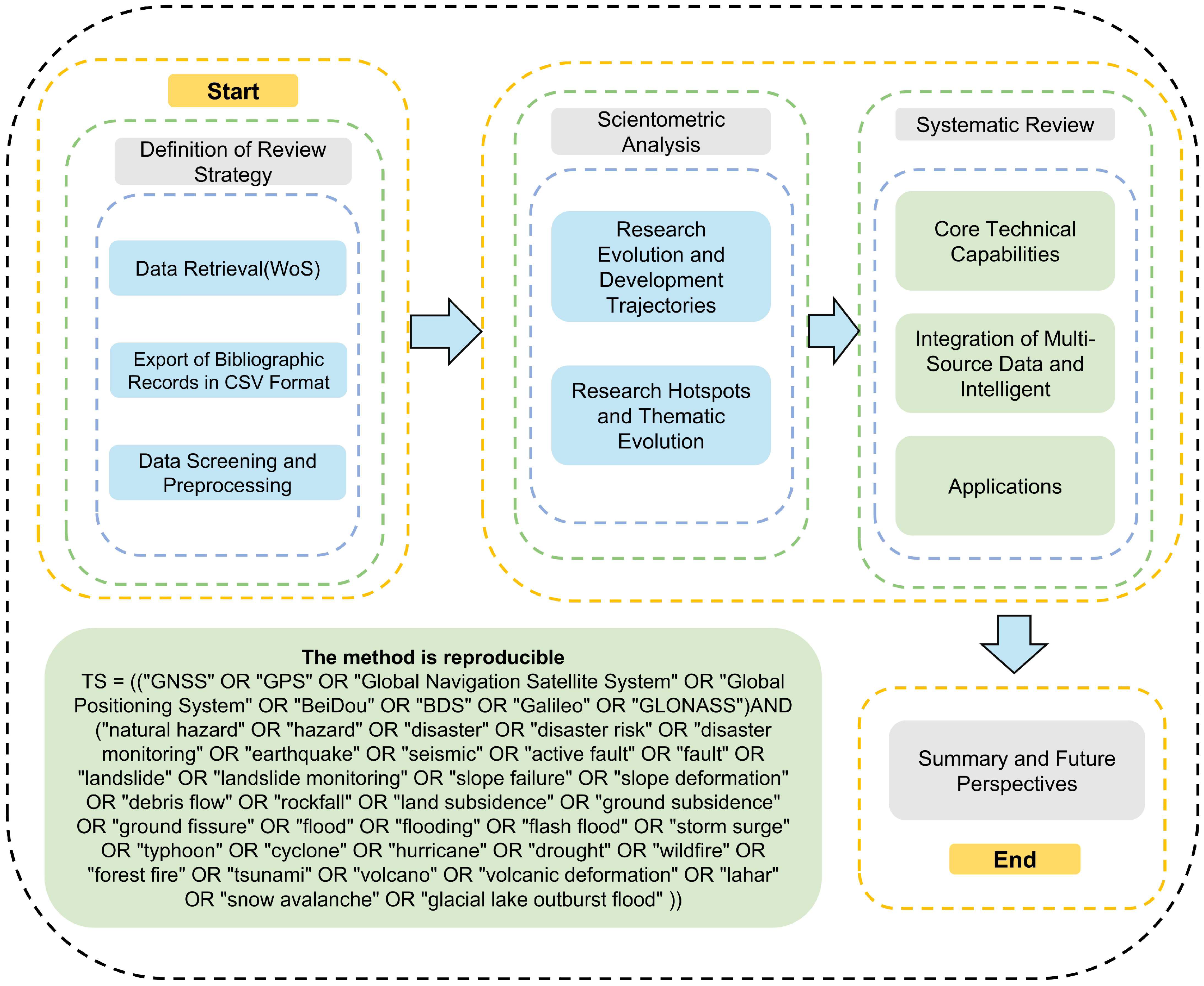
This study adopts a hybrid review strategy that integrates scientometric analysis with systematic review methods. The purpose of this approach is to enhance the rigor and reporting quality of systematic reviews by incorporating quantitative insights derived from scientometric analysis [18]. Scientometric analysis is applied to the literature dataset to identify the field’s developmental trajectory and research hotspots, thereby providing an objective basis for defining the focus of the subsequent systematic review. On this basis, systematic review methods are further employed to synthesize the evidence in depth; the workflow is illustrated in Figure 1.
To characterize the overall landscape and developmental trajectory of GNSS research in natural hazards, the scientometric analysis was based on the literature retrieved from the Web of Science (WoS) Core Collection. The search strategy followed a dual-dimensional framework combining technical and hazard-related terms to balance completeness and specificity. The technical dimension focused on the Global Navigation Satellite System and its major constellations and common designations, including GNSS, the Global Positioning System (GPS), BeiDou, Galileo, and GLONASS. The hazard dimension centered on natural hazards and incorporated representative hazard types and related terms to capture the principal application scenarios of GNSS in natural hazard research.
Following these principles, search queries were constructed in the WoS database by logically combining GNSS-related and natural hazard-related keywords. The document type was restricted to “Article,” and the time span was set from 1 January 1995 to 3 December 2025, encompassing both the early exploratory phase of GNSS applications in hazard studies and recent advances in multi-hazard monitoring, data integration, and real-time early warning. Under these criteria, a total of 4409 publications were retrieved, forming the raw dataset for subsequent scientometric analysis and thematic exploration.

3. Scientometric Analysis

3.1. Evolution of Annual Publication Output

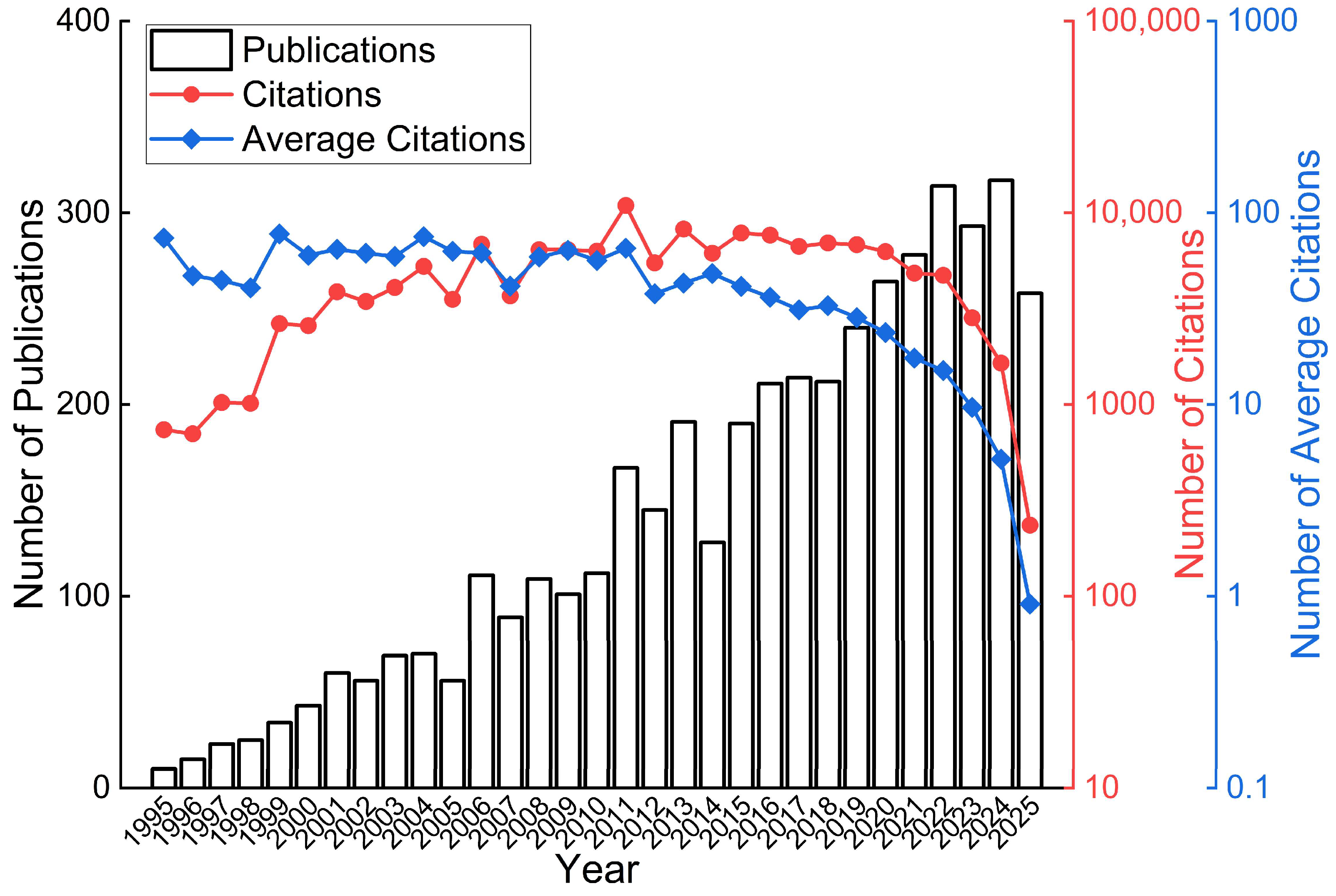
A total of 4409 publications related to GNSS in natural hazard research were identified. After excluding four “Early Access” records scheduled for publication in 2026 to avoid statistical bias, 4405 valid articles published between 1995 and 2025 were retained for analysis. Based on this dataset, annual publication output, citation performance, and research stage evolution were examined (please see Figure 2). Overall, the field exhibits a pronounced growth trend: annual publications increased from 10 in 1995 to 317 in 2024, representing an approximately 31.7-fold increase. This growth indicates a sustained expansion of GNSS natural hazard research over the past three decades, accompanied by an increasingly active research community and output.
From a temporal perspective, the period 1995–2000 represents an initial stage, during which annual publications rose steadily from 10 to 43 but remained limited in scale. The years 2001–2005 constitute an accumulation phase, with annual output stabilizing between 56 and 70 articles, reflecting the emergence of a more consistent research output. A marked increase occurred in 2006, when publications rose sharply from 56 to 111. Thereafter, output continued to grow between 2006 and 2011, reaching 167 publications in 2011 and indicating a transition toward a more mature research stage. During 2012–2018, annual publication numbers remained relatively high (128–214) with moderate fluctuations. Since 2019, the field has entered a high-output phase, with more than 240 publications per year from 2019 to 2025 and a peak of 317 publications in 2024, suggesting that GNSS-based natural hazard research has become a major growth area within GNSS applications and is increasingly aligned with demands for hazard monitoring, assessment, and process studies. Although the number of publications in 2025 (258) is lower than in 2024, this decrease is more likely attributable to incomplete annual indexing and database update delays rather than a definitive decline in research activity.
Citation metrics further reveal temporal differences in research impact. Early and mid-period publications show notably higher average citation rates—for example, approximately 77.62 citations per article in 1999, 75.06 in 2004, and 74 in 1995—indicating that foundational and pioneering studies produced during the formative stages of the field have continued to exert long-term influence. In parallel, total annual citations peaked in 2011 at 10,933, reflecting not only increased publication volume but also the emergence of highly influential contributions during the rapid growth phase. In contrast, despite the sharp rise in publication output since 2019, average citations per article have declined (e.g., ~15.04 in 2022, ~5.18 in 2024, and ~0.91 in 2025). This pattern primarily reflects the shorter citation accumulation time for recently published articles and does not necessarily imply a reduction in research quality or academic impact.

3.2. Analysis of Research Hotspots

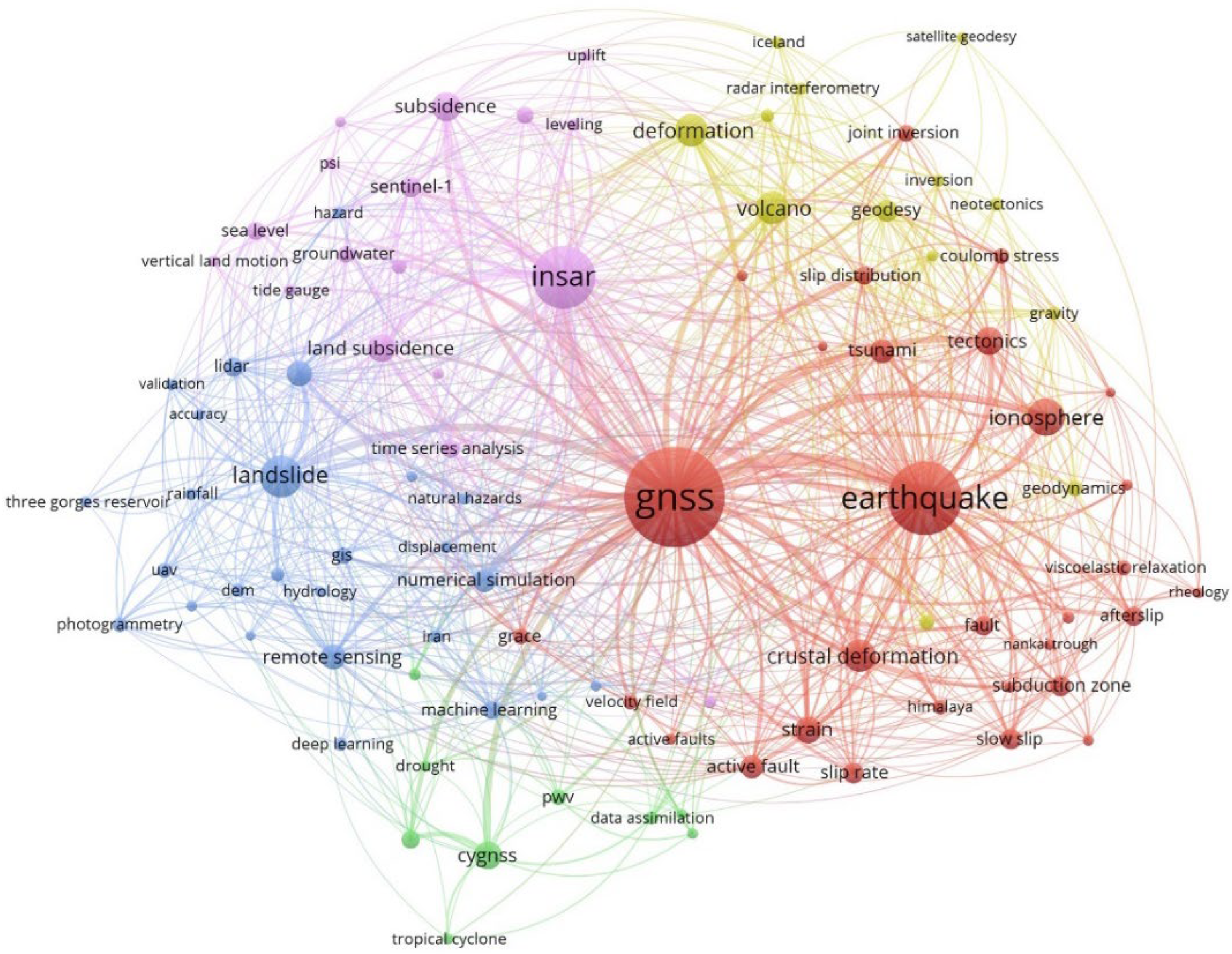
Based on the sampled literature, author keywords were statistically analyzed, and high-frequency keywords occurring more than ten times over the entire study period were selected. A keyword co-occurrence network was then constructed to reveal the core research themes and their interrelationships with GNSS-based natural hazard research, as presented in Figure 3.
The results show that GNSS occupies a central position in the network, exhibiting the highest connectivity and a pronounced hub role. Multiple interconnected yet thematically distinct research clusters have emerged around this central node, reflecting the parallel development of several research directions within the field. The red cluster, represented by keywords such as earthquake, fault, crustal deformation, strain, and slow slip, primarily focuses on earthquakes and tectonic deformation, emphasizing the use of GNSS observations to quantify crustal deformation, fault slip, and post-seismic processes. This cluster represents one of the most mature application domains of GNSS in natural hazard research.
The purple cluster, centered on keywords including InSAR, deformation, subsidence, and uplift, highlights the growing integration of GNSS with remote sensing techniques such as InSAR. Studies in this cluster mainly address surface deformation monitoring, ground subsidence, and uplift, underscoring the advantages of multi-source observations in improving spatial coverage and deformation inversion accuracy. In addition, the blue cluster, composed of keywords such as landslide, remote sensing, hydrology, rainfall, and numerical simulation, reflects GNSS applications in landslide and hydro-meteorological hazard monitoring and process studies, emphasizing integrated approaches that link environmental forcing, surface displacement responses, and numerical modeling.
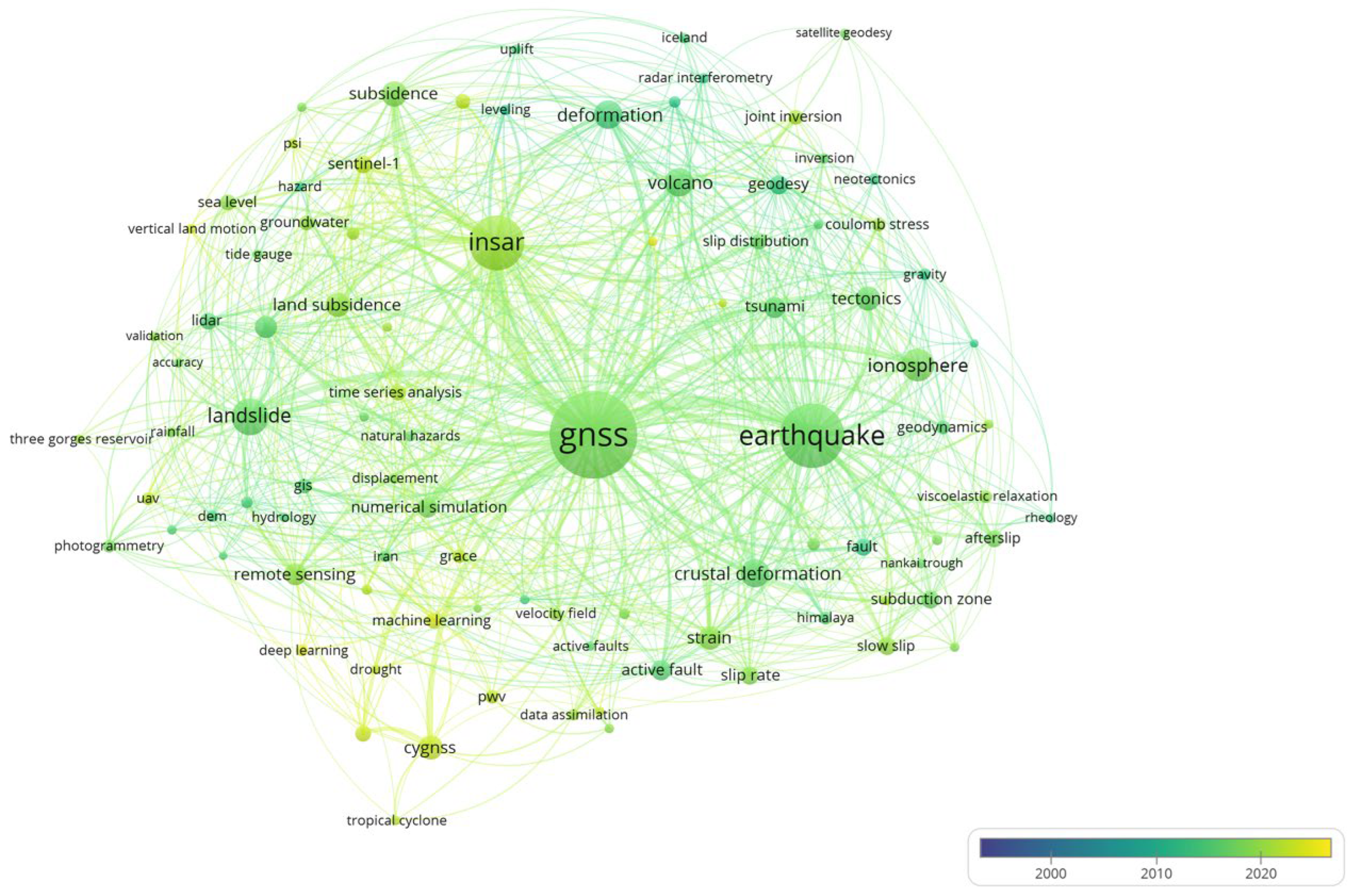
Notably, the green cluster, characterized by keywords such as machine learning, deep learning, CYGNSS, and data assimilation, indicates an emerging research direction that integrates GNSS with data-driven methods and novel satellite observation technologies. As shown in Figure 4, this cluster has developed rapidly in recent years, primarily supporting applications in hazard detection, parameter inversion, and predictive early warning, and illustrating a clear shift in research hotspots from conventional deformation monitoring toward more intelligent and integrated approaches.
The keyword co-occurrence network clearly reveals the central role of GNSS in natural hazard research and its close links with studies on earthquakes and tectonics, surface deformation, landslide and mountainous hazards, hydrometeorological processes, and intelligent methods. This structure provides a clear contextual background and guidance for the subsequent technology-oriented systematic review of GNSS-related studies.
To complement Figure 4 and examine the stage-wise evolution of research hotspots, the study period was divided into three phases—1995–2005, 2006–2015, and 2016–2025—and technical keywords were excluded to focus on hazard-related themes. As summarized in Table 1, GNSS research in natural hazards exhibits a distinct phased evolution: the early stage is dominated by tectonic deformation and earthquake-related topics; the middle stage maintains this core while introducing multi-source technological integration; and the recent stage shows continued strengthening of the “deformation–earthquake” axis alongside substantial expansion in both methodological approaches and application domains.
The period 1995–2005 represents the initial stage, with high-frequency keywords concentrated on fundamental issues of tectonic deformation and earthquake observation. Deformation (151) and earthquake (107) occupy central positions, while frequent occurrences of fault (44), subduction zone (31), tectonics (25), plate (22), strain (19), and geodesy (20) indicate a focus on crustal deformation monitoring, tectonic motion interpretation, and earthquake-related mechanisms in plate boundary and active tectonic settings. Meanwhile, the appearance of InSAR (17) and radar interferometry (11) suggests the early adoption of multi-source remote sensing techniques.
The period 2006–2015 exhibits pronounced diversification. On the one hand, core themes continue to intensify, with deformation (441), earthquake (381), and fault (103) remaining dominant, accompanied by increasing frequencies of keywords related to fault slip and rupture processes, such as slip (95), rupture (42), kinematics (47), and strain (45). On the other hand, both technical pathways and research targets expand markedly. The sharp increase in InSAR (109), together with frequent occurrences of inversion (54), model (98), and constraints (45), reflects the growing prominence of GNSS–InSAR integration and inversion-based modeling. In addition, hazard-specific terms such as volcano (71), landslide (81), subsidence (46), and tsunami (48) become prominent, indicating an expansion of GNSS applications from earthquakes to multiple hazard types. The emergence of the ionosphere (56) further suggests increasing attention to environmental effects in GNSS observations.
The period 2016–2025 is characterized by both high research productivity and deeper thematic development, with hotspots becoming simultaneously more concentrated and more diverse. In terms of frequency, deformation (958) and earthquake (755) remain the dominant themes, confirming that deformation monitoring and earthquake process studies continue to form the most stable backbone of the field. Meanwhile, InSAR (475) maintains a high frequency, indicating that GNSS–InSAR integration has become a mature and routine configuration. More importantly, method- and computation-oriented themes gain prominence, with model (252), inversion (115), constraints (77), and algorithm (76) ranking highly, reflecting a shift toward model-based representation, parameter inversion, constraint optimization, and algorithm development. Hazard types also diversify further, with rapid increases in subsidence (234) and landslide (154), while volcano (88) and ionosphere (90) remain active, highlighting the broadening scope of GNSS applications in natural hazard research.
Taken together, the three phases reveal several consistent trends: (1) the “deformation–earthquake” axis remains the most central and stable research backbone; (2) at the technological level, a transition from single-sensor approaches toward multi-source integration is evident, with InSAR rapidly integrated after 2006 and becoming a key support by 2016, reflecting a shift toward more comprehensive and spatially extensive observation systems; (3) the research paradigm has gradually evolved from observation and identification toward quantitative data–model coupling, as indicated by the growing prominence of inversion, modeling, constraint, and algorithm-related keywords; and (4) research targets have expanded from primarily earthquake and tectonic hazards to a broader range of hazards, including landslides, ground subsidence, volcanoes, tsunamis, and associated environmental effects, demonstrating the continuous broadening of GNSS application boundaries in natural hazard research.
Through scientometric analysis, the development trends and research hotspots of GNSS in natural hazard studies are examined from a literature-based perspective, clarifying the overall characteristics and focal areas of the field. The results indicate that GNSS applications in natural hazards have consistently centered on surface deformation monitoring and earthquake–tectonic processes, while progressively expanding to multiple hazard types, including landslides, ground subsidence, hydrometeorological hazards, and volcanic activity. Meanwhile, the research paradigm has evolved from single-sensor observations toward multi-source integration and from empirical analyses toward model-constrained and data-driven approaches. These patterns suggest that GNSS has gradually formed a stable, multi-layered system of technological capabilities for natural hazard monitoring. On this basis, the next section synthesizes the core technical capabilities of GNSS from a technological perspective, providing a foundation for subsequent application-oriented analysis.

4. Core Technological Capabilities

GNSS has evolved from a positioning and navigation tool into one of the core sensing sources providing critical support for integrated natural hazard monitoring and early warning systems [6,7]. Its key technological capabilities can be summarized into three interrelated aspects:
(1)
The ability to directly measure surface deformation and provide multi-scale spatiotemporal reference frames based on continuous high-precision positioning;
(2)
The capability to retrieve multi-sphere environmental parameters related to the atmosphere and hydrosphere by exploiting the physical propagation characteristics of GNSS signals in the atmosphere and over the Earth’s surface, functioning as a passive remote sensing technique based on signals of opportunity;
(3)
The capability to enable real-time and dynamic monitoring that supports rapid early warning and emergency response based on the aforementioned observation capacities.
The evolution and integration of these capabilities allow GNSS to continuously provide observational information during key stages of hazard initiation, triggering, and evolution, thereby offering essential data support for process understanding, risk assessment, and disaster prevention and mitigation [6,20].

4.1. Deformation Sensing Capability

The most fundamental and core capability of GNSS lies in its ability to directly measure three-dimensional positional changes in surface points with high precision and continuity, enabling continuous observation of key deformation processes of potential hazard bodies at different evolutionary stages [21].
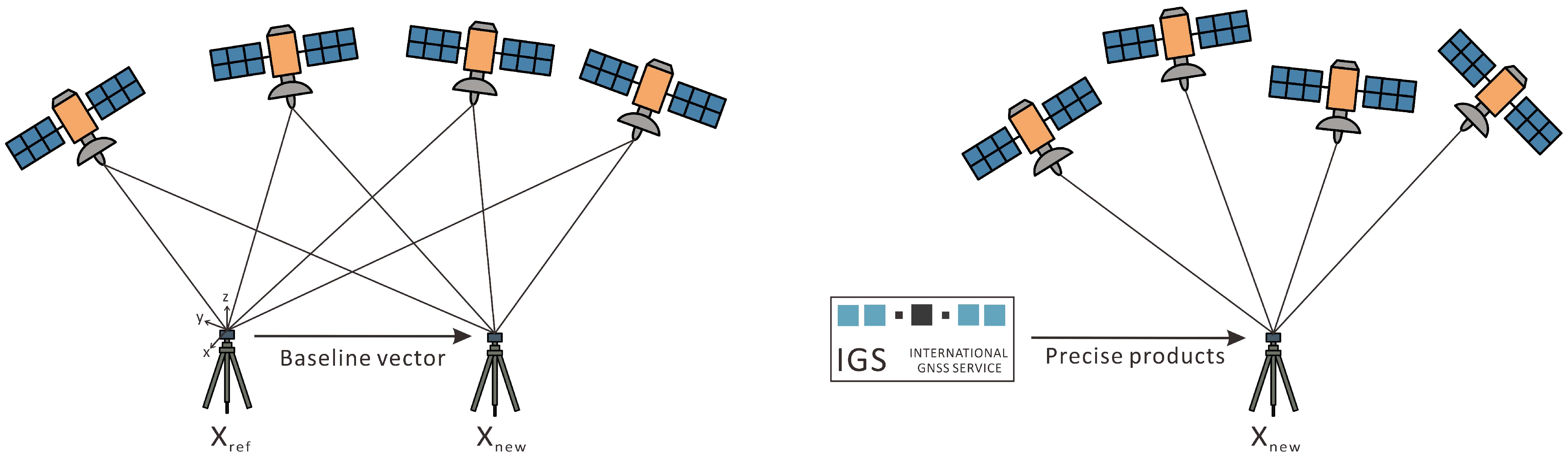
In geodetic applications, centimeter-level positioning accuracy and, under favorable conditions, an accuracy of a few millimeters can typically be achieved using high-precision techniques based on carrier-phase observations. Depending on the positioning models and error treatment strategies, these techniques mainly include relative (differential) positioning based on carrier-phase differencing and carrier-phase-based precise point positioning constrained by precise satellite orbit and clock products, as illustrated in Figure 5. Techniques such as Precise Point Positioning (PPP) and Real-Time Kinematic (RTK) positioning enable stable monitoring of slow processes, including long-term crustal strain accumulation, landslide creep, and ground subsidence [5,6]. For example, in landslide monitoring, the long-term stability of PPP can be combined with the real-time high precision of RTK to jointly measure landslide displacement; under favorable observation conditions and sufficient observation duration, millimeter-level accuracy can be achieved [22].
In terms of temporal resolution, GNSS sampling rates can be flexibly configured according to monitoring objectives, ranging from one observation every several days (for plate motion, slow landslides, and long-term subsidence) to 1 Hz or even higher than 10 Hz (for capturing dynamic seismic waveforms), thereby enabling continuous coverage from multi-year to second-level timescales [23,24]. Spatially, GNSS can monitor strain accumulation along plate boundaries over hundreds of kilometers using dense networks (e.g., the GNSS Earth Observation Network System, GEONET), while also supporting targeted deployments on individual landslides, bridges, or dams, allowing adaptive observations from global and regional scales down to local engineering sites [20,25,26,27].
This high-precision, multi-scale capability for direct deformation measurement provides a critical observational basis for the quantitative inversion of hazard-related mechanical processes. Whether constraining co-seismic displacements for fault slip modeling, analyzing time series of ground subsidence to infer aquifer compaction mechanisms, or identifying the evolutionary stage of a landslide, GNSS data offer direct and reliable observational evidence.

4.2. Environmental Sensing Capability

During signal propagation, GNSS signals interact with the atmosphere, ionosphere, and surface media, giving rise to a class of environmental sensing techniques collectively referred to as GNSS remote sensing (GNSS-RS). Among these, the two most representative approaches are GNSS reflectometry (GNSS-R) and GNSS radio occultation (GNSS-RO), which enable GNSS to function as a passive environmental remote sensing technique based on signals of opportunity [5,28,29].
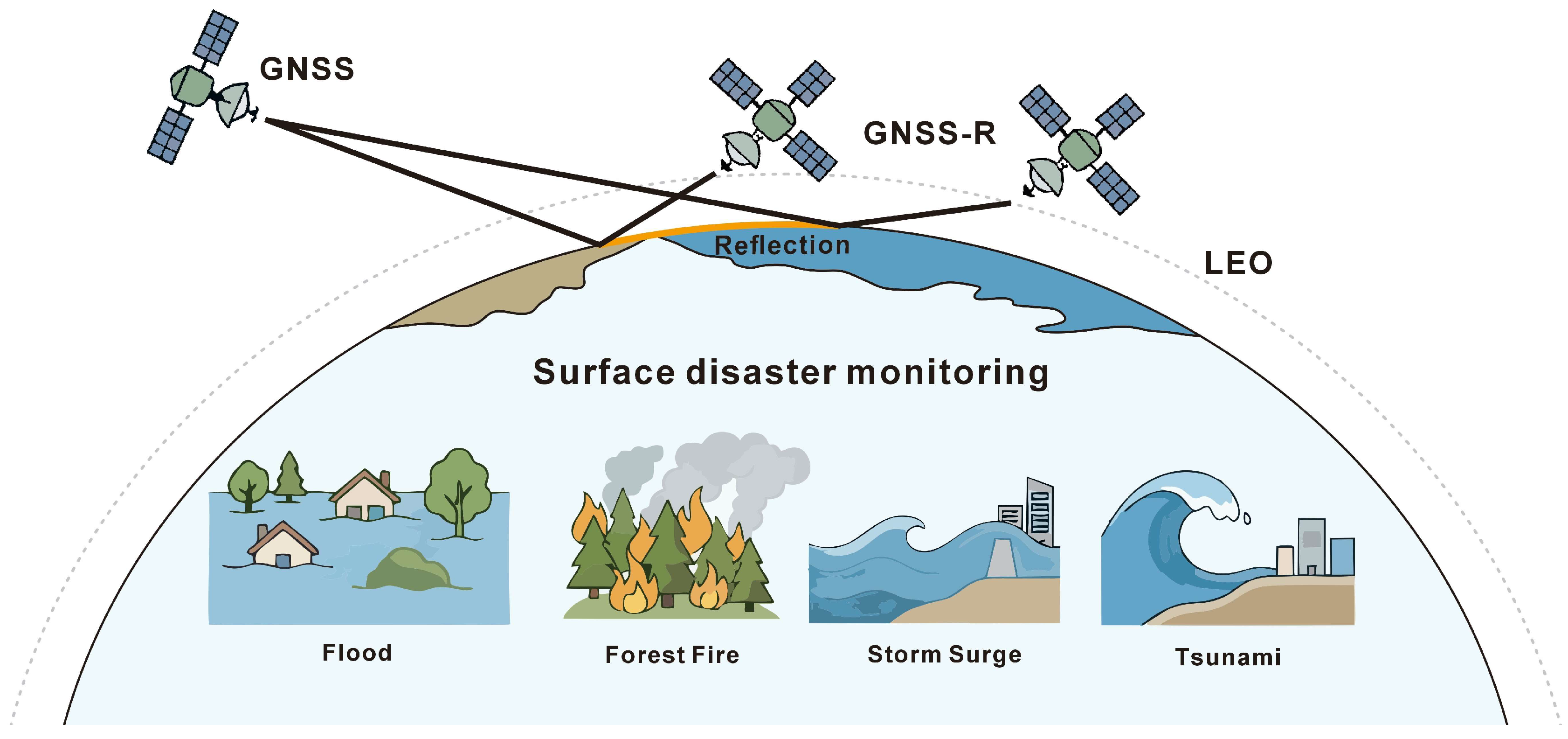
GNSS-R retrieves key surface environmental parameters by analyzing the scattering and reflection characteristics of satellite signals from land and water surfaces, as well as the interference effects that emerge under specific observation conditions [30,31]. As illustrated in Figure 6, this technique provides important information support for monitoring various types of hydrometeorological hazards. Using observables such as signal-to-noise ratio (SNR) and delay–Doppler mapping (DDM), GNSS-R enables high-temporal-resolution retrieval of soil moisture content (SMC) and sensitive tracking of drought onset and evolution. Comparative studies between Cyclone Global Navigation Satellite System (CYGNSS) and the Soil Moisture Active Passive (SMAP) mission demonstrate that GNSS-R–derived products show good agreement and significant correlation with model results in both temporal variability and spatial distribution [32].By analyzing spatiotemporal variations in reflected signals, GNSS-R can also be applied to monitoring vegetation cover change, vegetation water content, biomass, and cumulative burned area, and can be coupled with deep learning models such as convolutional neural networks (CNN) to improve the accuracy and timeliness of wildfire detection [33,34]. For flood monitoring, spaceborne GNSS-R missions exhibit distinct advantages. Studies have shown that processing CYGNSS reflected power or SNR point data enables dynamic identification and mapping of inundated areas under extreme weather and persistently cloudy or rainy conditions where optical and some radar observations are limited, with results cross-validated against multi-source sensors such as SMAP, the Moderate Resolution Imaging Spectroradiometer (MODIS), and Synthetic Aperture Radar (SAR), providing robust support for tracking flood duration and evolution [35].
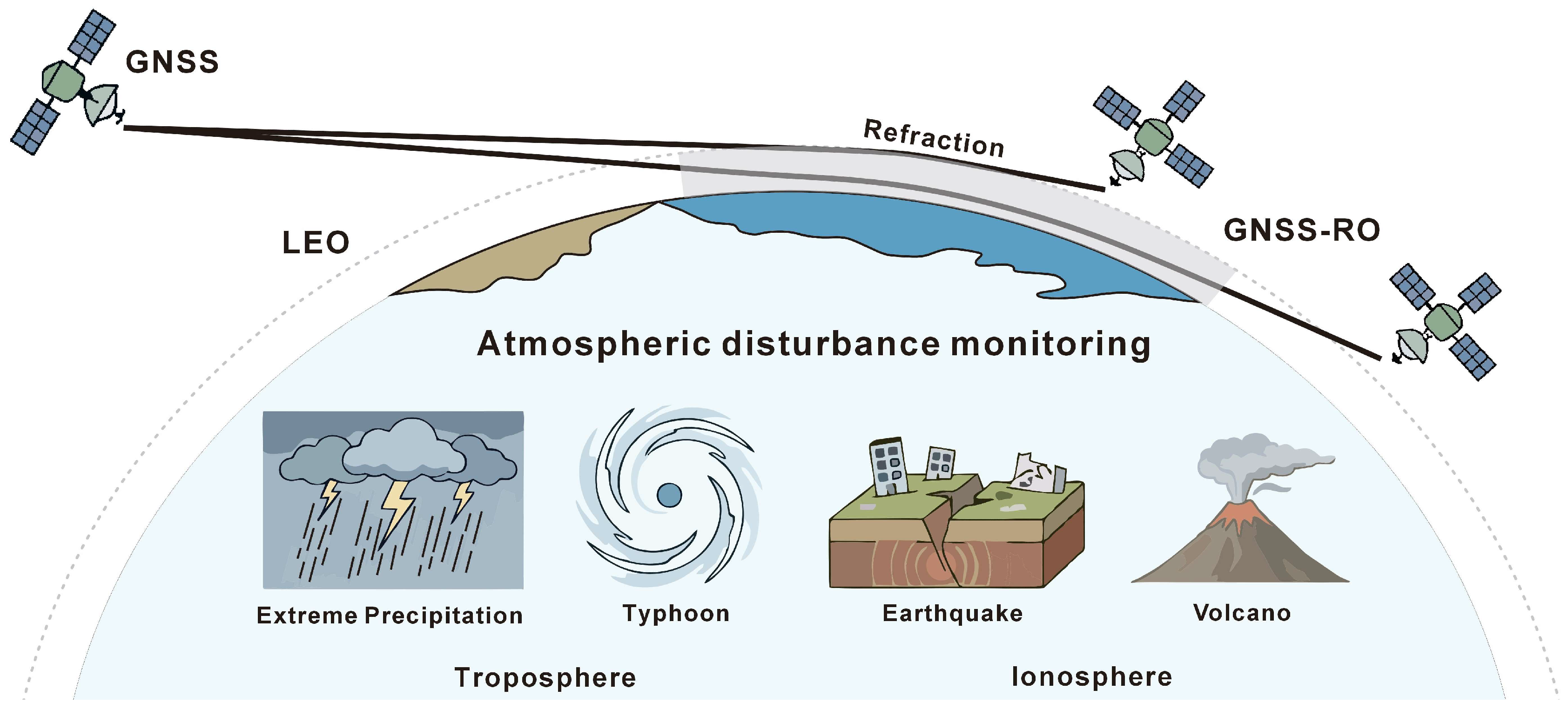
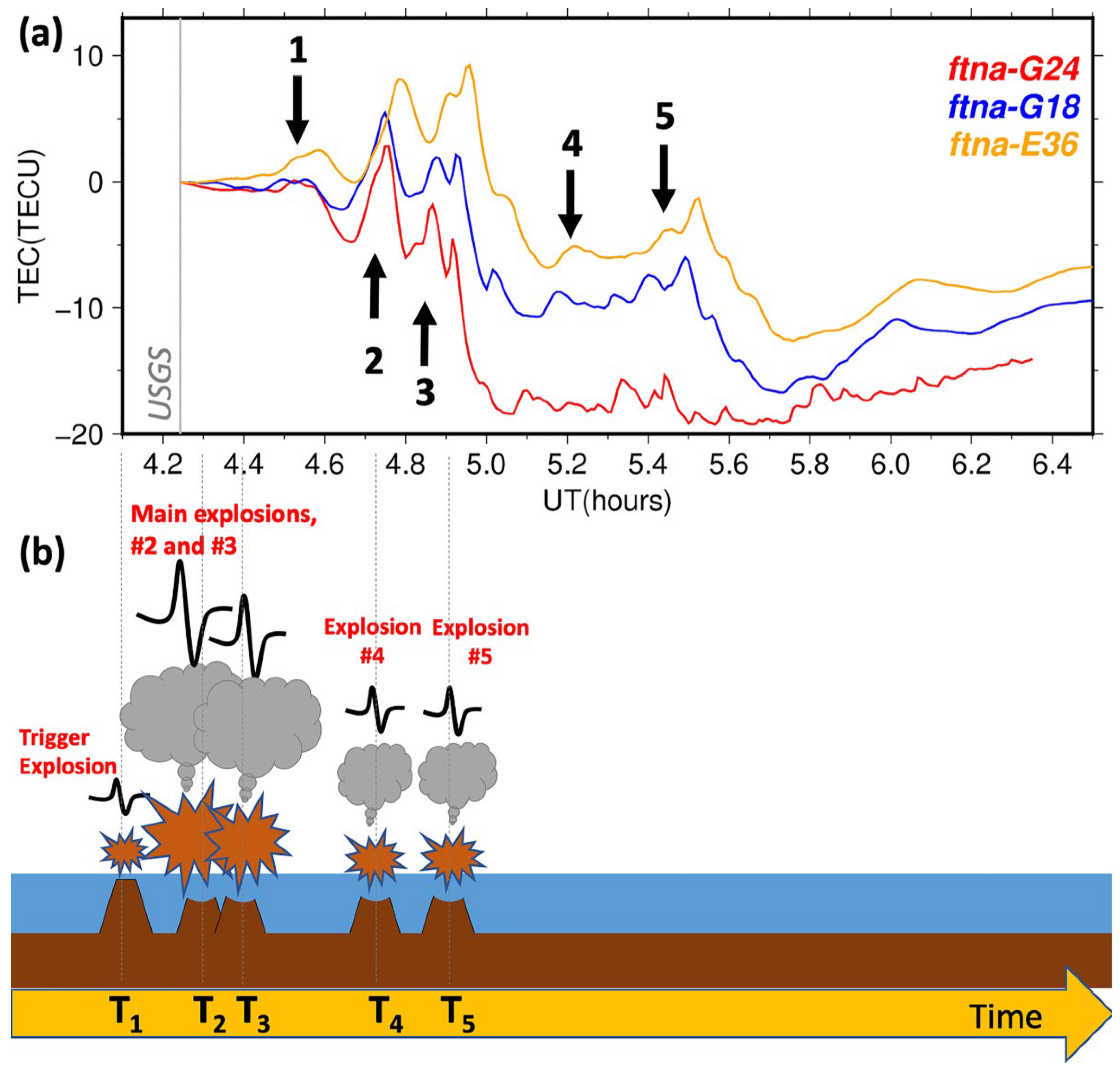
GNSS-RO retrieves atmospheric refractivity with high precision by receiving GNSS signals propagating through the atmospheric limb, and further derives vertically resolved profiles of PWV, temperature, pressure, and humidity [28,36]. Assimilation of GNSS-RO–derived atmospheric profiles into numerical weather prediction (NWP) models has been shown to significantly improve short-term weather forecasts and simulations of heavy precipitation and flood processes at both regional and global scales [37,38]. In addition, continuous GNSS-based monitoring of ionospheric total electron content (TEC), while widely used in space weather research, has also been applied to detect and investigate anomalous disturbances associated with earthquakes and tsunamis, offering a new observational perspective for hazard chain analysis [39,40,41]. The schematic diagram of GNSS-RO for natural hazard monitoring is shown in Figure 7.

4.3. Emergency Response Capability

Real-time capabilities have driven GNSS technologies to evolve from post-event monitoring toward pre-event early warning and in-event response [42,43]. This capability spans the entire technical chain, from high-rate data acquisition and real-time precise processing to dynamic parameter inversion and rapid information dissemination for decision support, making GNSS a critical sensing and information backbone for building adaptive and intelligent hazard warning–response systems [44,45,46].
In earthquake early warning, real-time high-rate GNSS can directly measure both static and dynamic co-seismic displacements and is not affected by signal saturation that may occur in strong-motion sensors during intense shaking. This gives GNSS a unique advantage in rapid parameter inversion for large earthquakes, positioning it as an essential complement to strong-motion instruments and an indispensable tool for rapid magnitude estimation and source parameter determination [6,47]. Representative systems such as the GSeisRT platform developed by Wuhan University support real-time multi-constellation Precise Point Positioning with Ambiguity Resolution (PPP-AR), achieving centimeter- to sub-centimeter-level positioning accuracy over wide areas. This capability enables rapid and stable constraints on earthquake magnitude and co-seismic displacement fields, providing strong support for earthquake monitoring and early warning [48].
In geohazard monitoring, GNSS can operate collaboratively with various in situ Internet-of-Things (IoT) sensors to acquire key indicators in real time, including three-dimensional surface displacement, rainfall, and surface crack development. Enabled by communication technologies, these multi-source monitoring data can be transmitted at high speed and visualized in real time through data platforms. Combined with hierarchical warning schemes, deformation rate–time curves, and embedded spatial information products (e.g., geomorphological remote sensing maps, geological cross-sections, and sensor distribution maps), such systems can deliver risk-level-specific warning guidance, thereby supporting real-time early warning and emergency decision-making for geological hazards [49].
In meteorological hazard early warning, the advantages of GNSS lie in its real-time sensing of rapid variations in the ionosphere and troposphere. In the ionosphere, GNSS-derived TEC can capture upper-atmospheric disturbances induced by tsunamis, volcanic eruptions, and intense convective storms. The GNSS-based Upper Atmospheric Realtime Disaster Information and Alert Network (GUARDIAN) has enabled continuous multi-constellation TEC monitoring and rapid anomaly detection, with the resulting information integrated into tsunami early warning systems [50]. In the troposphere, GNSS-derived PWV provides high-frequency characterization of the spatiotemporal evolution of atmospheric moisture and serves as a key parameter for identifying heavy rainfall onset, changes in hurricane intensity, and track prediction. Studies have shown that PWV often exhibits pronounced increases prior to heavy precipitation events, and its temporal trends can be used to indicate potential rainfall location and intensity several hours in advance [51,52]. Overall, supported by real-time GNSS data processing chains, key ionospheric and tropospheric variables can be rapidly assimilated into forecasting models and warning systems, making GNSS a highly time-sensitive observational source for meteorological hazard monitoring.
Taken together, GNSS has established a multi-layered technological capability framework for natural hazard monitoring, centered on deformation sensing, environmental sensing, and real-time response. These capabilities do not operate in isolation but are continuously strengthened and expanded through multi-source observation systems and intelligent methods. On this basis, the next section further discusses the synergistic integration of GNSS with multi-sensor observations and data-driven approaches.

5. Integration of Multi-Source Data and Intelligent Methods

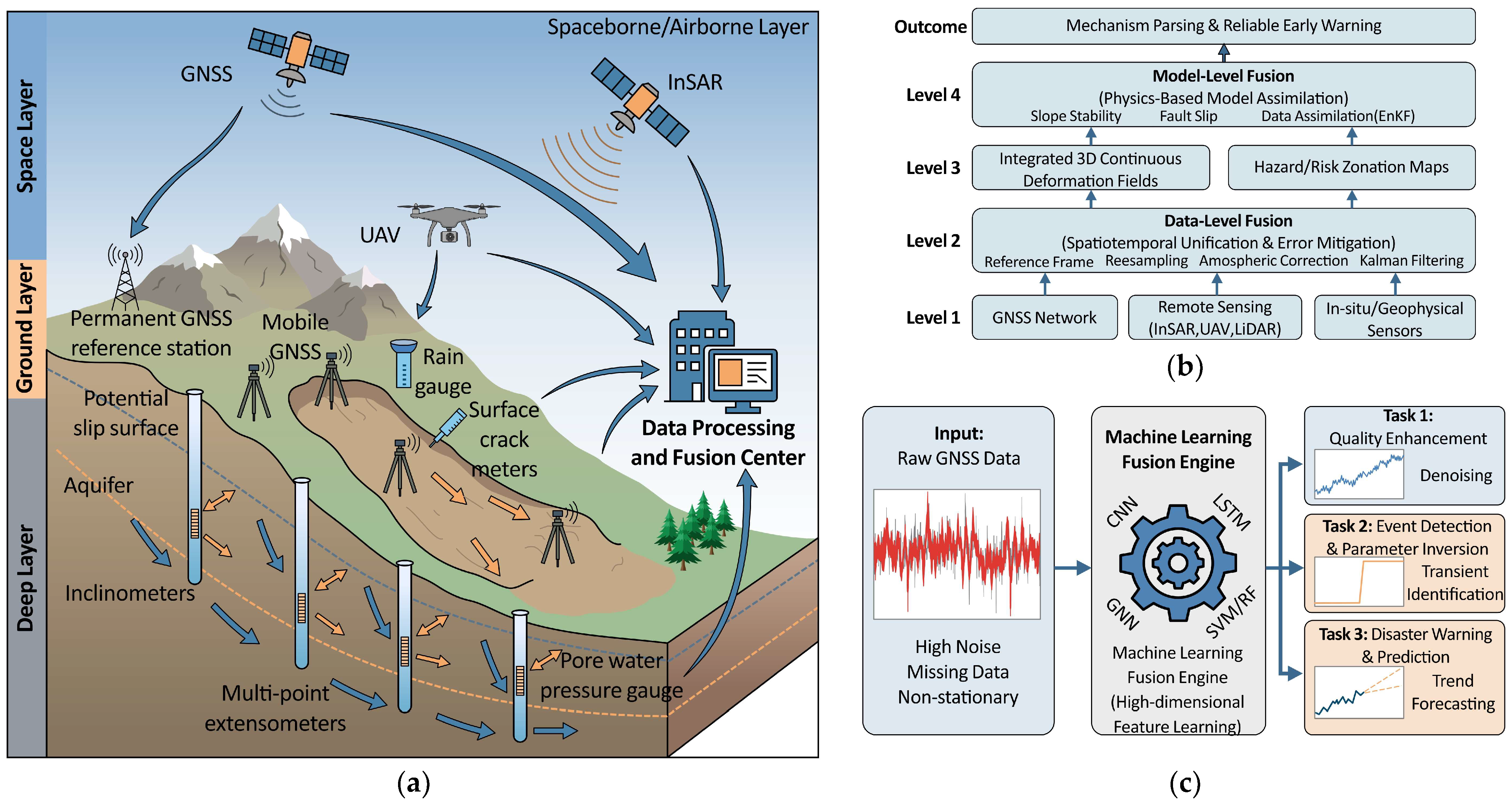
Although GNSS offers unique and largely irreplaceable advantages in natural hazard monitoring, a single GNSS technique still has inherent limitations in terms of spatial coverage, the diversity of observable physical variables, and the depth of information interpretation [5,53]. Current technological developments are therefore advancing in two complementary directions. On the one hand, at the level of physical observation, GNSS is increasingly deployed in coordination with multi-source sensing hardware to achieve multi-scale, integrated sensing of hazard systems—from surface to subsurface, and from environmental forcing to mechanical response. On the other hand, at the level of information processing, deep integration with artificial intelligence and data-driven methods is enhancing the extraction of salient features, event detection, and mechanism interpretation from complex GNSS observations. Figure 8 illustrates the overall framework and internal logic of these two technological pathways. This section elaborates on these two key directions.

5.1. Collaboration with Multi-Source Sensors

Taking landslides as an example, their initiation and evolution typically follow a multi-physical process chain of “driving forces–state–response.” External factors such as rainfall, snowmelt, reservoir water level regulation, and seismic shaking can alter groundwater conditions and pore water pressure fields, leading to stress–strain redistribution and strength degradation in geomaterials, which ultimately manifests as accelerated surface or subsurface displacement and, in extreme cases, overall failure [54,55,56]. A single sensor type is unable to simultaneously capture these key processes at different levels. Therefore, constructing a multi-source collaborative observation system with GNSS as the spatiotemporal reference—integrating remote sensing, surface and subsurface geophysical measurements, and hydrogeological and geotechnical sensors—is essential for three-dimensional monitoring and process-based interpretation of the full hazard lifecycle.
Reference [10] describes the multidisciplinary collaborative framework adopted by the European Geological Surveys (EGS) for landslide detection, which integrates remote sensing, geotechnical engineering, geodesy, geophysics, hydrology, and cartography (Table 2). Notably, EGS member institutions provide open access to extensive national-scale datasets through the European Geological Data Infrastructure (EGDI) platform. This open-data mechanism has substantially facilitated the integration and cross-use of multi-source observations, offering an important exemplar for detailed hazard studies and comprehensive analyses.
Within multi-source collaborative observation systems, GNSS provides high-precision three-dimensional displacement time series with a unified reference frame, serving as the spatiotemporal backbone of the monitoring network. InSAR and Unmanned Aerial Vehicle (UAV) observations offer wide-area surface deformation information with high spatial resolution, while instruments such as inclinometers, seismometers, rain gauges, crack meters, accelerometers, and pore water pressure sensors complement GNSS by capturing additional physical variables at different depths. Together, these sensors form an integrated “space–air–ground–subsurface” multi-source sensing network for natural hazard monitoring [10,57,58].
From the perspective of observational complementarity, the first aspect lies in point–area integration across spatial scales. Continuous GNSS stations and discrete GNSS benchmarks capture true three-dimensional displacement processes and form the basis for quantitatively assessing deformation rates and cumulative deformation, whereas techniques such as InSAR, UAV photogrammetry, and airborne Light Detection and Ranging (LiDAR) provide spatially continuous deformation fields and detailed topographic reconstructions with high spatial resolution [59,60]. By integrating GNSS point displacements with InSAR-derived areal deformation through joint inversion or cooperative interpolation, the spatial continuity and reliability of deformation fields can be significantly improved. Such approaches have been widely applied in earthquake monitoring, and a comprehensive review of InSAR techniques and deformation inversion methods is provided in [5].
Complementarity is also evident in the spectral and sensitivity domains. High-rate GNSS can directly measure displacements without signal saturation under strong ground motion and without baseline drift, thereby compensating for the long-term drift commonly introduced when displacements are derived from integrated accelerometer records [6,47]. Multi-sensor fusion techniques, such as Kalman filtering, GNSS, and strong-motion data, can be combined to obtain broadband, high-precision deformation time series [61]. In contrast, tiltmeters and strain meters are highly sensitive to nano-radian–level tilt changes and micro-strain signals, offering clear advantages for detecting landslide creep and other slow deformation precursors [62,63]. This multi-scale collaborative observation mode, spanning high-frequency dynamic processes and low-frequency quasi-static evolution, provides critical support for revealing hazard evolution mechanisms and constructing reliable early warning indicators.
A further level of complementarity exists in terms of physical variables and depth. Rain gauges, soil moisture sensors, and pore water pressure sensors monitor external and internal hydrological conditions, while borehole inclinometers, multi-level displacement meters, and subsurface crack meters characterize displacement and mechanical behavior along slip surfaces and weak layers. In contrast, GNSS and InSAR primarily record surface geometric responses. In deep-seated landslide systems, critical increases in pore water pressure often precede pronounced surface acceleration; joint monitoring using GNSS, piezometers, and inclinometers can therefore provide a reliable early warning window prior to macroscopic sliding. Through integrated analysis of multiple sensors, causal linkages between rainfall or reservoir level changes, groundwater pressure increases, and acceleration of deep and surface displacements can be established, enabling identification of triggering thresholds and associated lag effects [64,65,66].
Multi-sensor collaborative monitoring is commonly organized as a top-down hierarchical fusion structure [67]. At the data level, unified temporal and spatial referencing is emphasized by projecting raw observations from different sensors into a common reference frame through coordinate transformation, resampling, and modeling of atmospheric and multipath noise [68]. For key issues such as tightly coupled GNSS–accelerometer integration, GNSS-assisted atmospheric correction for InSAR, and GNSS-based drift calibration of tiltmeters, filtering and error decomposition methods have been developed, demonstrating that joint solutions can substantially reduce systematic errors inherent to individual observation types [61,69,70,71].
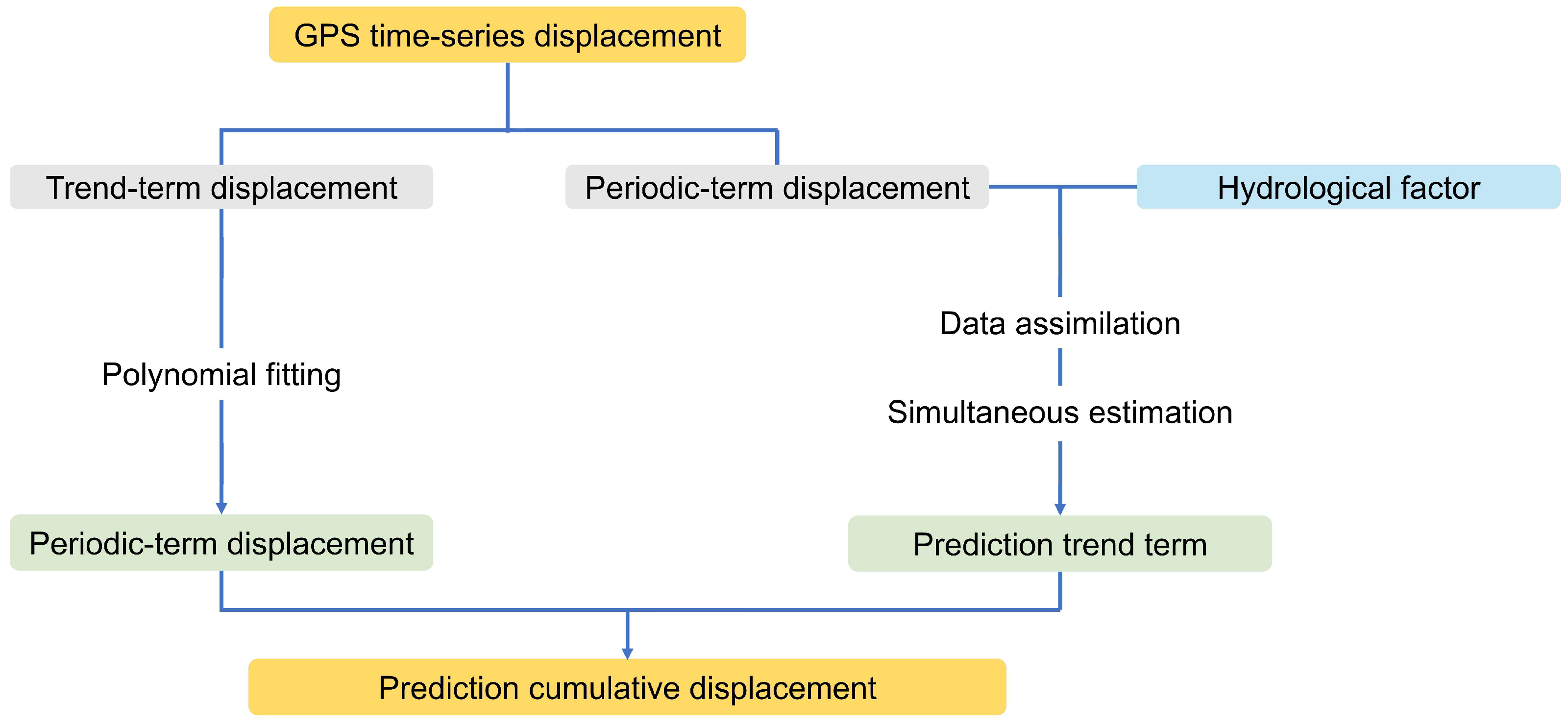
At the product level, GNSS point displacements are typically integrated with InSAR, LiDAR, and UAV data in space and time to generate continuous deformation fields and hazard zonation maps that directly support risk assessment [72,73]. At a higher level, model-based fusion is commonly achieved through data assimilation or inversion techniques to reconstruct hazard evolution mechanisms. For landslide monitoring, given the significant differences among multi-source observations in spatial scale, noise characteristics, and uncertainty, Liu et al. [74] proposed a three-dimensional variational assimilation framework that integrates GNSS and borehole inclinometer data to constrain displacement evolution of the Xishancun landslide in Sichuan, China. Using a similar approach, Wang et al. [75] applied data assimilation in the same region to synchronously estimate state parameters of rainfall-induced landslide displacement, with the workflow illustrated in Figure 9. In earthquake studies, data assimilation is primarily applied to fault slip processes, with a focus on slow deformation phenomena such as post-seismic afterslip and deformation [76], inter-seismic fault coupling [77], and long-term slow slip events [78]. In volcanic hazard monitoring, dynamic dual-magma-chamber models combined with ensemble Kalman filter assimilation of GNSS and InSAR deformation observations enable real-time constraints on magma overpressure and key dynamic parameters, supporting process-based forecasting of magma system evolution and eruption potential [79]. In studies of ground subsidence and groundwater–drought interactions, GNSS vertical displacement is often jointly analyzed with Gravity Recovery and Climate Experiment (GRACE) and InSAR data and incorporated into hydromechanical models through inversion or Bayesian frameworks to characterize groundwater depletion, land subsidence, and drought evolution [80,81,82].
GNSS can operate collaboratively with multi-source sensors and form complementary relationships with other sensing techniques in several aspects. Through data fusion, heterogeneous observational information can be systematically integrated, thereby establishing a comprehensive observation chain that provides reliable support for mechanism analysis of hazard evolution processes and for risk assessment.

5.2. Integration with Machine Learning

With the continued development of multi-source collaborative observations, monitoring data have become increasingly voluminous and heterogeneous, and are influenced by diverse temporal characteristics [83,84], posing significant challenges for traditional analysis methods. In addition, GNSS time series are commonly affected by high noise levels, strong non-stationarity, and weak signal amplitudes, which substantially constrain the extraction of subtle deformation signals in hazard studies [85]. Owing to their strengths in high-dimensional feature learning, nonlinear modeling, and weak signal enhancement, machine learning approaches offer new technical pathways for analyzing complex GNSS time series [86] and have been increasingly applied to GNSS data processing and hazard identification.
Although existing studies differ in specific algorithmic implementations, their core ideas can be broadly categorized into three groups: time-series quality enhancement [87,88], event detection and parameter inversion [89,90], and hazard-oriented early warning and prediction [20,91]. The application domains span multiple representative hazard types, and the employed machine learning techniques include support vector machines (SVM), random forests (RF), gradient boosting methods, as well as deep learning models such as CNN, long short-term memory networks (LSTM), and graph neural networks (GNN). Table 3 summarizes representative recent studies on the integration of machine learning and GNSS across different hazard types, including their application tasks, data sources, and methodological frameworks.
Denoising, decomposition, and component separation of GNSS time series are key steps for enhancing the detectability of weak deformation signals. For single-station GNSS time series, high noise levels and strong non-stationarity often hinder the identification of tectonic signals. In recent years, neural networks have been introduced into denoising tasks, leveraging their ability to learn the statistical characteristics of noise in observational sequences and thereby enhance the visibility of underlying tectonic deformation signals. Mastella et al. [92] proposed a deep-learning-based denoising approach for GNSS daily displacement time series aimed at near-real-time applications. The core idea is to represent the observed GNSS displacement time series as the superposition of a modelable trajectory signal and high-frequency noise, expressed as follows:
x ( t ) = S ( t ) + ξ ( t )
where x ( t ) denotes the observed displacement, S ( t ) represents a smooth trajectory model composed of tectonic motion, seasonal terms, and transient deformation, and   ξ ( t ) corresponds to the high-frequency residual containing noise. To generate high-quality samples for deep learning training, the authors constructed synthetic GNSS displacement time series using an extended parametric trajectory model. Building upon conventional linear trends and periodic components, this model incorporates multiple transient terms, including step functions, logarithmic decay functions, arctangent functions, and Gaussian functions. Its general form can be expressed as follows:
x t = m t + q + k = 1 n k s k sin w k t + c k cos w k t + j = 1 n j b j H t t j + i = 1 n i A i H t t i log 10 1 + t t i T R + s = 1 n s tan 1 t t s D s + g = 1 n g F g exp t t g 2 2 E g 2
In the equation, m and q denote the linear tectonic velocity and the initial displacement constant, respectively; s k and c k are the sine and cosine amplitudes of the kth periodic component; and w k is the corresponding angular frequency, used to describe seasonal variations such as annual and semiannual signals. H denotes the Heaviside step function, and b j represents the amplitude of a displacement step occurring at time t j , which is used to characterize discontinuities caused by co-seismic offsets or equipment changes. A i is the amplitude parameter of post-seismic deformation, and T R is the characteristic timescale of logarithmic decay, describing the temporal decay of post-seismic deformation. In the arctangent function term, t s denotes the occurrence time of a slow slip event, and D s controls the event duration and the smoothness of the transition, characterizing the temporal evolution of slow slip events. In the Gaussian function term, F g , t g and E g represent the amplitude, occurrence time, and temporal scale of transient events, respectively, and are used to describe volcanic activity or other short-term localized deformation processes. The summation limits n k , n j , n i , n s and n g denote the number of signals or events of the corresponding types.
The authors employed a generative adversarial network (GAN) trained on residuals from approximately 5000 GNSS stations worldwide to generate noise terms ξ ( t ) with realistic spectral characteristics, which were then superimposed on synthetic trajectories to construct a large-scale training dataset. The denoising framework consists of two cascaded deep learning models. First, a convolutional autoencoder is used to identify displacement discontinuities in the time series. Subsequently, under this prior constraint, a bidirectional LSTM network is applied to predict the noise component ξ ( t ) , which is then removed from the original series. Experimental results show that, without relying on spatial correlation information, this method can significantly reduce high-frequency noise in daily GNSS displacement time series. Compared with common-mode filtering and traditional frequency-based filtering methods, it exhibits clear advantages in noise suppression performance, control of time delay, and near-real-time identification of transient tectonic signals such as slow slip events. This provides a new technical pathway for machine learning–driven GNSS tectonic deformation monitoring and earthquake precursor identification.
Compared with single-station processing approaches, joint spatiotemporal denoising strategies for regional GNSS networks can further exploit spatial correlations among stations to enhance the separation of weak deformation signals. The SSEdenoiser model proposed by Costantino et al. [88] is a representative work in this direction, in which a regional GNSS network is represented as a graph composed of station nodes, and multi-station observations are modeled as follows:
ξ i ( t ) = n i ( t ) + d i ( t )
where ξ i ( t ) denotes the multi-component GNSS displacement time series at the ith station, and d i ( t ) represents the tectonic deformation signal induced by slow slip events (SSE). This approach employs graph neural networks to characterize the spatial correlation structure among stations and incorporates a temporal attention mechanism to capture long-range temporal dependencies during SSE evolution, enabling joint denoising of GNSS time series at the regional scale. Case studies demonstrate that the model can recover SSE-related displacements with an accuracy of a few millimeters, and that the identified events show spatiotemporal distributions consistent with tectonic tremor independently observed by seismic data, thereby enhancing the detectability of weak tectonic deformation signals.
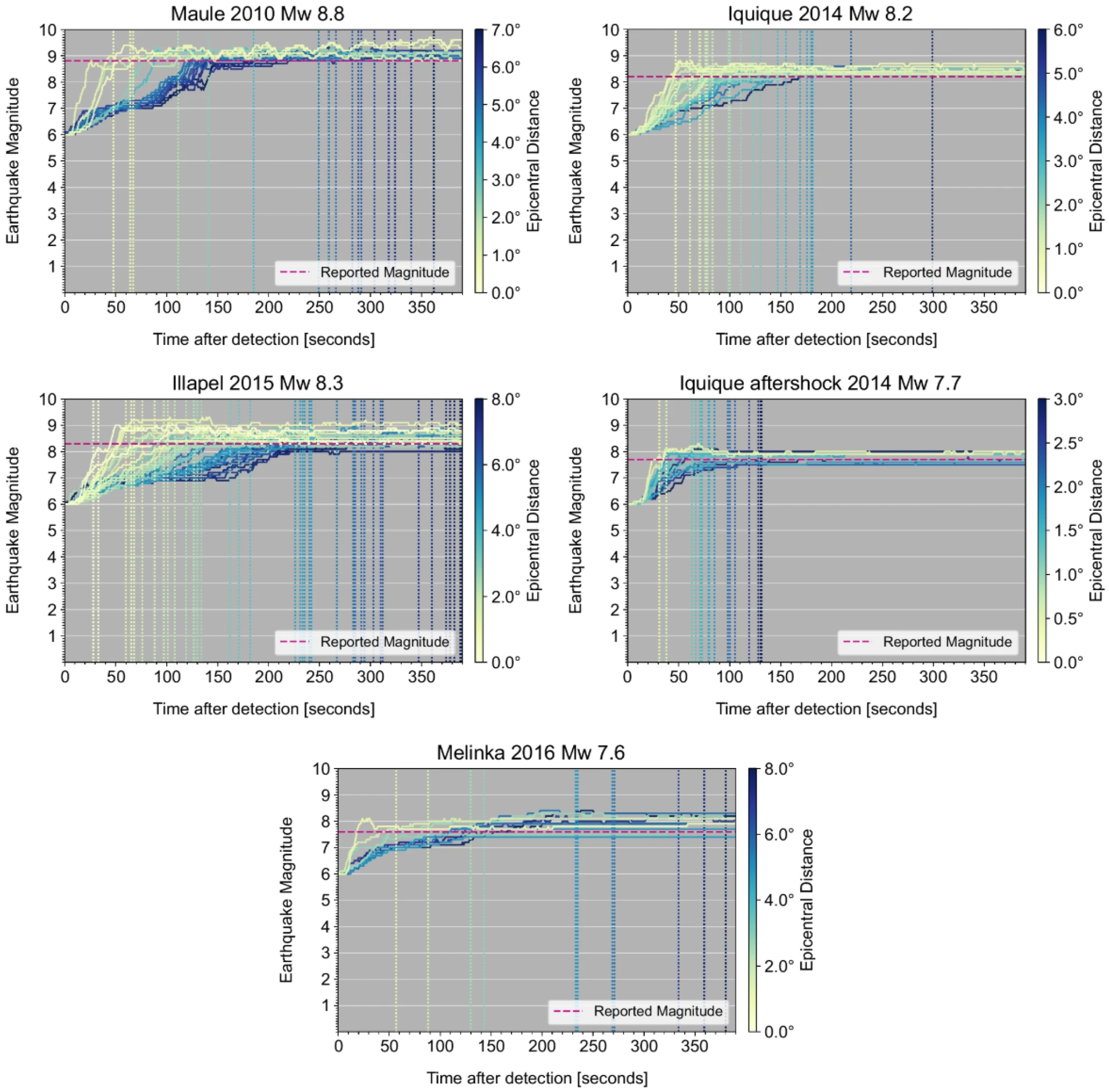
In terms of deformation event identification, the above approaches have demonstrated clear improvements through time-series quality enhancement. With respect to parameter inversion and near-real-time applications, Quinteros-Cartaya et al. [106] combined high-rate GNSS data with deep convolutional neural networks to demonstrate the temporal convergence of magnitude estimation. Figure 10 shows the evolution of magnitude predictions updated on a second-by-second basis after event detection for several large earthquakes in Chile. The results indicate that the model converges to values close to the final reported magnitudes within approximately 30 s to 2 min after the earthquake, with good consistency across different station-distance conditions. This suggests that even during the early stage when fault rupture has not yet fully terminated, dynamic deformation features contained in high-rate GNSS displacement time series are sufficient to provide reliable constraints on source size, highlighting the potential of deep learning methods for rapid magnitude estimation and earthquake/tsunami early warning.
Using GNSS-R as an example, Jia et al. [107] proposed a physics-guided artificial neural network model to retrieve sea surface wind speed under tropical cyclone conditions from CYGNSS observations. This approach is based on CYGNSS Level 1 DDM measurements and integrates storm-centered coordinate information, reflection geometry parameters, and physical model constraints, embedding physical priors from geophysical model functions into a data-driven framework. In this way, robust inversion of wind speed in typhoon high-wind regions is achieved. The results show that the proposed model significantly outperforms existing CYGNSS operational products under high wind speed conditions, particularly maintaining low systematic bias and root-mean-square error when wind speeds exceed 35 m/s, demonstrating the clear advantages of machine learning methods for GNSS parameter inversion and near-real-time applications under complex nonlinear conditions.
In disaster early warning and risk prediction, the underlying idea is to combine the high precision and continuity of GNSS observations with the capability of machine learning to model nonlinearity, weak signals, and multi-source feature fusion, thereby extracting key information related to hazard triggering or evolution within shorter time windows and producing predictive variables suitable for decision support. Taking rapid earthquake response as an example, Dittmann et al. [108] input high-rate GNSS velocity and displacement data into a supervised learning framework to enable rapid identification and discrimination of strong ground motion-related signals, providing data-driven support for near-field earthquake rapid assessment and early warning chains. In tsunami early warning, Rim et al. [109] used GNSS observations acquired within minutes after earthquake occurrence as inputs to train convolutional neural networks to rapidly predict subsequent tsunami waveforms, achieving faster near-real-time warning without relying on a complete source inversion workflow. For landslides and other geological hazards, GNSS displacement time series often exhibit superimposed trend, periodic, and random residual components. Wang et al. [110] proposed a landslide displacement prediction framework based on Complete Ensemble Empirical Mode Decomposition with Adaptive Noise- Attention Mechanism with Long Short Time Memory Neural Network (CEEMDAN-AMLSTM). In this approach, cumulative displacement is first decomposed into trend, periodic, and residual components to represent long-term creep deformation, periodic responses driven by external triggers such as rainfall and reservoir water level fluctuations, and random disturbance components, respectively. These components are then modeled and predicted using recurrent neural networks combined with attention mechanisms. Application to the Baishuihe landslide in the Three Gorges Reservoir area shows that the model can stably reproduce landslide displacement evolution trends and significantly outperforms traditional statistical models and single neural network approaches in prediction accuracy, providing more reliable displacement forecasts for GNSS-based landslide early warning using displacement thresholds. In addition, for short-term meteorological and hydrological risk forecasting, atmospheric water vapor parameters such as PWV retrieved from GNSS can serve as precursor information for heavy rainfall and hazard processes. Profetto et al. [101] combined random forest and LSTM models to conduct hourly precipitation forecasting, supporting early warning and risk management of heavy rainfall and flooding.
The multi-source integration and intelligent development of GNSS in natural hazard monitoring reflect a continuous evolution from single observations toward comprehensive sensing and information synergy. By providing a stable and unified high-precision spatiotemporal reference, GNSS plays a central supporting role in multi-sensor collaborative observation systems, enabling effective integration of observations across different scales and physical variables within a unified framework. At the same time, machine learning and data-driven methods demonstrate significant potential in GNSS data processing, event identification, and early warning applications, particularly for weak signal extraction under complex noise conditions.

6. Applications in Natural Hazards

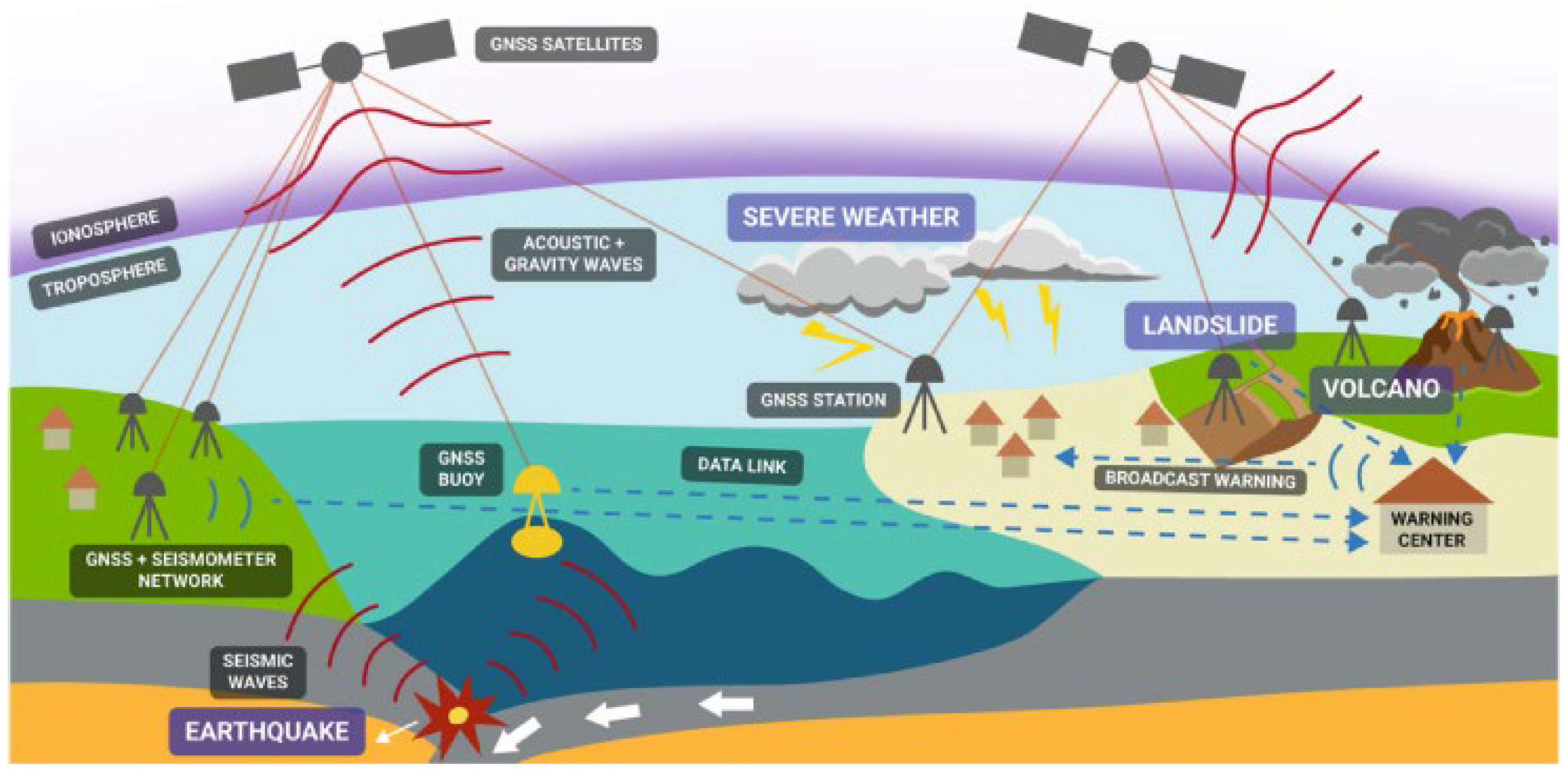
Building on the preceding systematic synthesis of the core technological capabilities of GNSS in natural hazard monitoring, as well as its multi-source integration and intelligent development pathways, it is necessary to further summarize research progress from an application-oriented perspective across different hazard types. Differences in initiation mechanisms, evolutionary processes, and monitoring requirements among natural hazards lead to distinct application modes, observation targets, and integration strategies of GNSS for each hazard category. Figure 11 provides an overview of representative GNSS application scenarios in major natural hazards, including earthquakes, tsunamis, landslides, volcanoes, and extreme meteorological events, illustrating the overall framework through which GNSS contributes to hazard monitoring, early warning, and information dissemination via surface deformation monitoring, atmospheric and ionospheric sensing, and land–sea coordinated observations. On this basis, this section presents a categorized review of representative applications of GNSS and its integrated technologies across major natural hazard types, systematically summarizing their functional roles and research characteristics in different hazard contexts.

6.1. Earthquake and Tsunami Hazards

6.1.1. Earthquake Hazards

Earthquakes, as one of the most abrupt natural hazards with wide damage ranges and profound socio-economic impacts, are characterized by preparation, occurrence, and evolution processes involving clear multi-timescale and multi-physical coupling, which impose long-term and stable requirements for continuous, high-precision deformation observations.
In inter-seismic monitoring, GNSS can be used to assess regional seismic hazard by inverting fault locking degrees and tectonic stress accumulation patterns based on long-term high-precision velocity and strain fields. Following the Ms 7.9 earthquake that occurred in Myanmar on 28 March 2025, Xu et al. [111] analyzed GNSS profiles and slip-rate deficits, showing that the Sagaing Fault is overall in a highly locked state and that a seismic gap has developed in its central segment, indicating tectonic potential for generating earthquakes larger than M7.5. Wei et al. [112] reanalyzed GNSS velocity fields and showed that partial creep exists along this segment, with shallow creep rates of approximately 2.3 mm/yr extending to depths of ~9.5 km, suggesting that the seismic hazard of this fault section deserves attention. Wang et al. [113] used multi-year continuous GNSS observations to constrain the along-strike coupling distribution of the Maidan Fault in the Tianshan region, identified locked and creeping segments, and compared the actual rupture locations of earthquakes with pre-earthquake locked zones, verifying the controlling role of inter-seismic coupling in strong-earthquake generation. Mochizuki and Mitsui [114] constructed a crustal strain field using ten years of three-component GNSS data and analyzed strain accumulation rates along the main rupture segment of the 2016 Kumamoto earthquake. Ohzono et al. [115] further analyzed the temporal evolution of strain around fault systems and identified potential hazardous areas characterized by time-varying strain concentration. Figueroa et al. [116] identified deep slow-slip phenomena through differencing GNSS velocities before and after earthquakes, indicating that part of the accumulated stress is released through long-term creep rather than large earthquakes. Lin et al. [117] combined GNSS deformation and fault geometry to calculate Coulomb stress changes and evaluated seismic hazard across different tectonic units from a stress loading–unloading perspective. These studies indicate that fault coupling states, strain accumulation, and creep characteristics constrained by GNSS during the inter-seismic stage provide important indications of the locations and rupture potential of strong earthquakes.
When inter-seismic stress accumulation is released in the form of a strong earthquake, GNSS plays a dual role during co-seismic deformation and rupture processes. On the one hand, static co-seismic displacement fields can be constructed from three-dimensional coordinate differences before and after the earthquake; on the other hand, dynamic rupture processes can be captured using high-sampling-rate observations. In this context, Geng et al. [118] used 1 Hz multi-constellation GNSS data to record near-field seismic waveforms and permanent displacements of the Mw 7.9 Nepal earthquake in real time. The results showed that high-rate GNSS observations are highly consistent with strong-motion records and exhibit greater stability in long-period and displacement components. Based on the capability of high-rate GNSS to capture co-seismic signals, Li et al. [119] demonstrated a rapid source modeling workflow dominated by high-rate GNSS data in real earthquake cases, enabling estimation of rupture extent, strike, and slip distribution within minutes after earthquake occurrence. Similarly, Zheng et al. [120] proposed a rapid inversion framework based on a line-source model, using high-rate GNSS data to achieve near-real-time constraints on rupture length, rupture directivity, and energy release processes. Beyond GNSS-only approaches, joint inversion strategies further enhance the characterization of rupture processes. Sakkas [121] improved the spatial resolution of shallow slip by combining GNSS and InSAR observations. Using a similar multi-sensor strategy, Chen et al. [122] revealed bidirectional slip-pulse rupture patterns and their termination behavior at branching faults under combined GNSS and InSAR constraints, highlighting the important role of GNSS in resolving complex rupture geometries. Overall, high-sampling-rate GNSS enables stable characterization of rupture processes and displacement release during the co-seismic stage, providing a foundation for subsequent post-seismic deformation analysis and investigations of deep rheological mechanisms.
After co-seismic rupture, continuous GNSS observations provide key constraints on post-seismic deformation and deep rheological processes, particularly afterslip and viscous relaxation. Post-seismic deformation is commonly driven by the combined effects of afterslip along fault interfaces and viscous relaxation in the lower crust and upper mantle, with different mechanisms exhibiting distinct temporal scales and spatial characteristics. By applying multi-component fitting to GNSS time series, these processes can be distinguished observationally. Ohtate et al. [123] used two dense GNSS networks and found that afterslip dominates post-seismic displacement; neglecting afterslip would lead to a severe underestimation of post-earthquake slip release. Gunawan et al. [124] focused on early post-seismic slip following moderate-magnitude events and demonstrated that earthquakes of Mw 5–6 can also generate observable afterslip. In addition to monitoring afterslip, Nurrohmah et al. [125] used GNSS observations to characterize deep viscous relaxation, constrain mantle viscosity, and explain far-field slow deformation. Jiang et al. [126] systematically analyzed the impacts of co-seismic and post-seismic deformation on stress redistribution and future seismic hazard in a multi-earthquake region in New Zealand. These studies provide a foundation for subsequent earthquake early warning and hazard assessment.
In earthquake early warning and rapid damage assessment, real-time high-rate GNSS is increasingly becoming an important complement to conventional seismic early warning systems. For example, Ruhl et al. [8] systematically evaluated the role of GNSS in early warning systems and pointed out that real-time displacement measurements and magnitude estimation are critical for improving the reliability of warnings for large earthquakes. At the regional application, Schlesinger et al. [127] proposed a GNSS-integrated earthquake early warning framework for southwestern Canada and verified its feasibility through simulations and case studies. In terms of operational applications, Kawamoto et al. [128] demonstrated the performance of a real-time processing system based on the GEONET network in Japan during actual earthquakes, marking important progress in the operational deployment of GNSS-based earthquake early warning. From a methodological perspective, Gao et al. [129] and Li et al. [119] showed, from the viewpoints of magnitude estimation and source modeling, respectively, that high-sampling-rate GNSS data are fully capable of supporting rapid source inversion and earthquake damage assessment. In addition, Berglund et al. [130] analyzed the effects of strong ground motion on GNSS tracking quality from a receiver engineering perspective, providing practical guidance for GNSS station deployment and equipment selection in high-intensity seismic regions.
In earthquake research and risk mitigation, GNSS observations span the entire earthquake cycle, including the inter-seismic, co-seismic, and post-seismic stages, providing constraints on earthquake preparation, rupture, and subsequent evolution [131], and further supporting operational applications such as earthquake early warning and rapid damage assessment. Therefore, GNSS plays an irreplaceable role in the field of earthquake hazards.

6.1.2. Tsunami Hazards

Tsunamis, as major secondary hazards triggered by submarine tectonic events such as earthquakes, are characterized by rapid propagation, wide impact ranges, and very limited warning times in coastal areas. These features place stringent demands on timeliness, spatial coverage, and multi-source integration capability of observation systems.
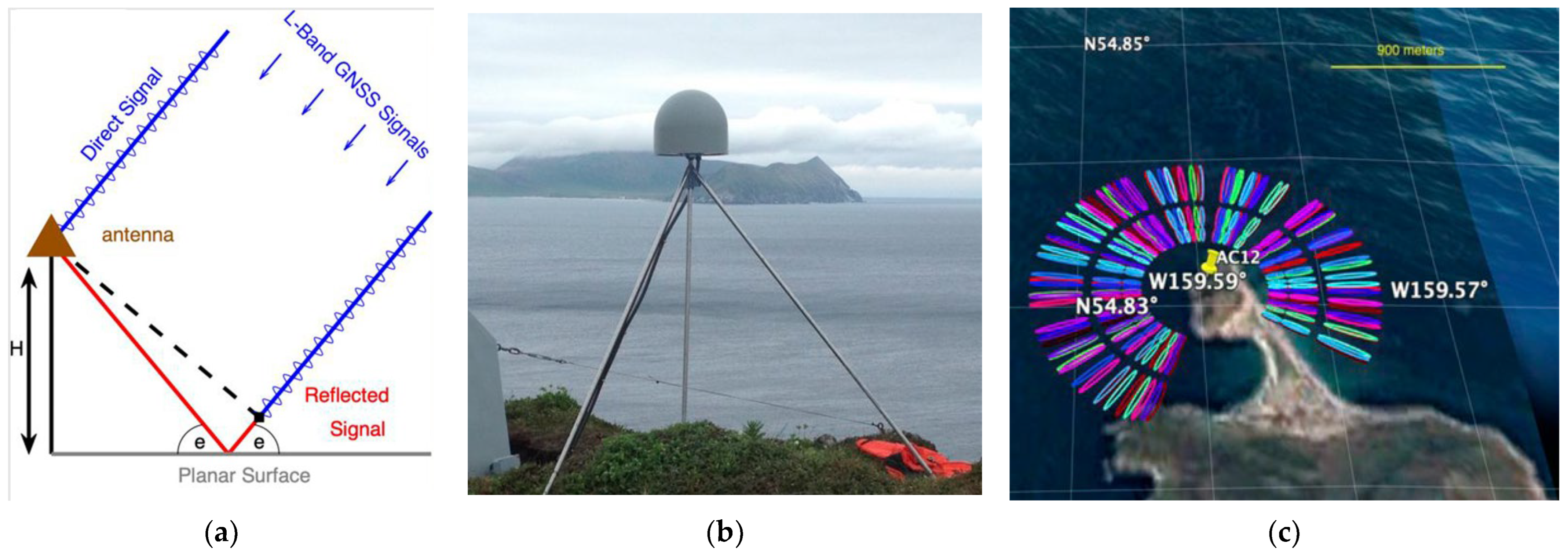
In nearshore monitoring, GNSS-R can effectively exploit multipath signals generated by reflections from the sea surface and is well-suited for deployment at low-elevation coastal continuous stations. Kim et al. [132] evaluated the monitoring capability of GNSS interferometric reflectometry (GNSS-IR) for various coastal hazards, including tsunamis and storm surges, and analyzed its major error sources, showing that GNSS-R-based water level inversion methods can be applied to the monitoring of extreme coastal events such as tsunamis and storm surges. Larson et al. [133] further demonstrated that GNSS can serve as a cost-effective complementary technique to enhance the spatial sampling of tsunami-induced coastal resonance and storm surge processes, highlighting its integrated advantages for monitoring multiple types of marine extreme events. Figure 12 illustrates the principle of GNSS-IR and its applications in nearshore environments.
In the open ocean, GNSS buoys and shipborne PPP/RTK techniques provide important complements to traditional tide gauges and the limited number of deep-ocean pressure sensors. Daud et al. [134] demonstrated, through long-baseline near-real-time RTK positioning experiments, the feasibility and accuracy of GPS buoys for early tsunami warning, and analyses of multiple historical tsunami events showed that GNSS buoys can stably retrieve tsunami wave height, period, and dispersion characteristics. Similarly, Manaster et al. [135] pointed out that shipborne PPP can function as a “mobile tsunami sensor” to detect landslide-induced local tsunamis, offering a new approach for opportunistic observations in regions with sparse fixed monitoring stations.
In addition to direct observations of sea surface deformation, GNSS can also achieve far-field tsunami monitoring by sensing upper atmospheric and ionospheric responses excited by tsunami waves. Liu et al. [136] and Alfonsi et al. [137] systematically characterized typical TEC responses associated with tectonic tsunamis, while Ghent and Crowell [138] further showed that volcanic–tsunami events can also leave distinct spectral signatures in the ionosphere. At the methodological level, Yang et al. [139] and M. Sithartha Muthu Vijayan [140] improved the robustness and reliability of TEC-based tsunami observations by enhancing signal extraction and noise suppression algorithms. In addition, Li et al. [141] analyzed TEC responses from multiple great earthquakes and proposed a rapid tsunami potential classification scheme based on disturbance energy and its spatial distribution.
In joint inversion and tsunami numerical modeling, high-precision crustal and seafloor deformation observations provided by GNSS offer key constraints on fault slip distributions and initial tsunami water surface conditions. Kim et al. [9] jointly inverted seafloor pressure gauge data and onshore GNSS observations to estimate the slip distribution of the 2003 Tokachi-oki earthquake and validated the effectiveness of multi-source joint inversion through tsunami simulations, revealing pronounced slip near the epicenter. Ohno et al. [142] proposed using real-time GNSS data to rapidly invert slip distributions and quantify uncertainties immediately after earthquakes, directly supporting tsunami inundation prediction. Kubo et al. [143] and Ulutas [144] further emphasized that adopting heterogeneous slip models under GNSS constraints can significantly improve tsunami simulation accuracy.
In tsunami early warning applications, Rim et al. [109] trained convolutional neural networks using large sets of synthetic sources and GNSS deformation data to achieve rapid discrimination of tsunami potential within minutes after earthquakes. Tsushima et al. [145] incorporated offshore tsunami observations and onshore GNSS deformation into a real-time data assimilation framework to dynamically update numerical forecasts, significantly improving the timeliness and accuracy of near-field tsunami prediction. In open-ocean settings, Chen et al. [146] discussed the application potential of the BeiDou system and its integration with GPS for tsunami early warning in the South China Sea, indicating that multi-constellation systems can enhance regional tsunami monitoring capability.
GNSS enables the formation of a comprehensive tsunami monitoring technology chain encompassing near-field observations, far-field sensing, joint inversion, and rapid forecasting.

6.2. Landslides and Mountain Hazards

For the detection of landslides and mountain hazards, GNSS offers clear advantages over intermittent measurement techniques by providing stable displacement time series and a consistent spatial reference framework. It can be used not only to identify creeping motion, episodic sliding, and accelerating deformation prior to failure, but also to serve as the core control framework for integrating multi-source remote sensing and ground-based observations. Consequently, GNSS has become one of the most widely applied foundational technologies for slope deformation detection and mechanism analysis.
In terms of continuous GNSS monitoring, its technical feasibility and achievable accuracy have been extensively validated. In a seminal study, Gili et al. [22] deployed a GPS network on the Vallcebre landslide, and continuous observations demonstrated that a precision of a few millimeters is sufficient to effectively identify creeping behavior and rapid deformation events, establishing the technical foundation for GNSS-based continuous landslide monitoring. Subsequent studies extended the application scope to other mountain hazards such as debris flows. Malet et al. [147] verified, at the Super-Sauze debris-flow landslide, that GPS technology can clearly capture debris-flow motion signals and that the results are highly consistent with observations from conventional geodetic instruments such as theodolites, electronic distance measurement devices, and wire extensometers. Building on these findings, research has also addressed the scalability and cost adaptability of GNSS in engineering applications. Bellone et al. [148] showed that even low-cost GNSS receivers, when combined with optimized data processing strategies, can achieve centimeter-level or higher accuracy in rapid deformation monitoring, demonstrating the practical feasibility of real-time GNSS observations for small- and medium-sized landslides and slope engineering projects. Furthermore, for long-term monitoring and deformation mechanism analysis, Mantovani et al. [149] combined 14 years of GNSS displacement time series with numerical simulations to quantitatively characterize the deformation mechanisms and potential hazards of a slow lateral spreading landslide. From a comprehensive review perspective, Uhlemann et al. [57] systematically compared the applicability, advantages, and limitations of GNSS and other ground-based monitoring techniques, clearly establishing the fundamental role of GNSS in providing high-precision continuous displacement time series to support landslide mechanism analysis and early warning decision-making. Together, these studies form a mutually reinforcing chain of evidence from feasibility, robustness, engineering applicability, and long-term mechanical constraints, demonstrating that continuous GNSS observations offer irreplaceable advantages for revealing progressive landslide deformation mechanisms.
On the basis of the high-precision temporal constraints provided by continuous GNSS monitoring, further studies have combined GNSS with multi-source observations to achieve refined reconstruction of three-dimensional deformation fields for landslides and mountain hazards, as discussed in Section 5.1. Qi et al. [150] deployed BeiDou/GNSS stations in combination with corner reflectors on reservoir slopes along the Jinsha River, enabling millimeter-level three-dimensional deformation monitoring and providing a new technical pathway for slope deformation observation in canyon-type reservoir areas. Jin et al. [151] integrated shipborne photogrammetry, GNSS positioning, and water level fluctuation data to reconstruct the three-dimensional geometric evolution of landslides in the drawdown zone of the Three Gorges Reservoir, effectively identifying the influence of water level variations on slope stability. Under engineering and environmental change scenarios, GNSS-based integrated monitoring has also demonstrated strong adaptability. Gül et al. [152] combined GNSS control points with UAV-based three-dimensional reconstruction to monitor deformation of open-pit marble quarry slopes, revealing slope displacement characteristics induced by excavation activities. Alexiou et al. [153] integrated GNSS, UAV photogrammetry, and terrestrial LiDAR in post-fire mountainous environments to quantitatively characterize slope erosion and material redistribution processes. These studies indicate that the core value of GNSS in multi-source integrated monitoring lies in its provision of a unified, high-precision three-dimensional coordinate reference and temporal constraint, enabling comprehensive analysis of slope geometry and time-dependent deformation within a common reference framework.
At the regional scale, landslide and mountain hazard risk assessments commonly rely on factors such as topography, elevation, lithology, tectonics, and hydrology, incorporating 3S technologies and hazard interpretation results for quantitative modeling. Zhang et al. [154,155] conducted comprehensive hazard assessments and mitigation planning for multiple representative debris-flow gullies near the Wudongde Hydropower Station along the Jinsha River, emphasizing the critical role of high-resolution topographic data and slope stability analysis in engineering site selection and risk management in steep river valleys, and developed a large-scale debris-flow susceptibility evaluation model to characterize watershed-scale mountain hazard risk patterns. Scuderi et al. [156] and Mahmood et al. [157] investigated earthquake-induced rockfall distributions and landslide susceptibility along mountainous highway corridors, respectively, revealing the controlling influence of tectonic activity and topographic conditions on the spatial distribution of mountain hazards. Although such studies rely less directly on GNSS observations, their susceptibility–hazard analysis frameworks are highly compatible with the long-term deformation constraints provided by GNSS, offering a methodological basis for incorporating GNSS-derived deformation fields into regional risk assessment.
In deformation prediction, intelligent analysis, and early warning response, GNSS time series have gradually become core data sources for landslide displacement prediction models and intelligent warning systems. Jing Wang [110] combined GNSS displacement series with recurrent neural networks to achieve high-accuracy short-term displacement prediction for representative landslides. Luo et al. [158] proposed a hybrid model coupling local mean decomposition, exponential smoothing, and temporal convolutional networks to effectively decompose and predict multi-scale components of landslide displacement. Huang et al. [159] and Zhang et al. [160] applied TCN and GRU models, respectively, to prediction experiments on typical landslide GPS time series, demonstrating the clear advantages of deep learning methods in capturing nonlinear deformation processes. From a physics-constrained perspective, Dai et al. [161] applied geographically weighted regression and least-squares methods to invert GNSS deformation data from slopes, enabling back-calculation of slip surface locations and mechanical parameters and improving the reliability of numerical models and scenario simulations. In addition, Lau et al. [162] integrated GNSS sensors into an Internet of Things platform and combined them with rainfall, pore water pressure, and other multi-source data and big-data analytics to construct a real-time monitoring and early warning system for rainfall-induced landslides, marking the evolution of GNSS-based landslide monitoring systems toward networked and intelligent operation.
From continuous three-dimensional deformation monitoring, through high-precision deformation field reconstruction under multi-source integration, to regional risk characterization and time-series-based deformation prediction and intelligent early warning, GNSS has become a fundamental observation platform supporting a comprehensive understanding and management of mountain hazards.

6.3. Ground Subsidence

Land subsidence is a typical, slowly evolving geological hazard whose development often spans years to decades and is jointly controlled by multiple factors, including groundwater extraction, resource exploitation, stratigraphic conditions, and engineering activities. The classic review by Galloway et al. [163], Land subsidence in the United States, systematically summarizes the causes, impacts, and monitoring systems of various subsidence regions in the United States, emphasizing that the establishment of stable, continuous, and traceable deformation benchmarks and long-term observation networks is a key prerequisite for risk control and governance assessment. This perspective provides the overall technical background for the application of GNSS in land subsidence studies.
In terms of acquiring regional spatiotemporal patterns, GNSS has been closely integrated with InSAR to establish high-resolution subsidence fields in typical urban areas and basins. For example, Liu and Bai [12] developed an InSAR–GNSS joint observation framework in the Xiong’an New Area, using multi-temporal radar deformation results constrained by a limited number of high-precision GNSS control points to characterize subsidence rates and their evolution across different functional zones, demonstrating that GNSS reference stations can significantly improve the absolute accuracy and stability of regional subsidence inversion. At a larger spatial scale, Lin et al. [164] introduced GNSS-derived tropospheric delay corrections to InSAR data in the Guangdong–Hong Kong–Macao Greater Bay Area, identifying subsidence bowls and differential subsidence belts within urban agglomerations while maintaining both wide-area coverage and high precision. Over longer timescales, Kim et al. [165] used multi-sensor InSAR time-series analysis to derive nearly two decades of subsidence fields in the Tucson area of the United States and jointly constrained basin-scale subsidence rate distributions and their temporal evolution using GNSS and long-term ground observations.
At the scale of key targets such as engineering facilities and resource extraction areas, GNSS likewise plays a critical role in benchmark control. Wang et al. [166] investigated subsidence at Beijing Daxing International Airport by integrating multi-source optical and radar observations and introducing GNSS control points to unify geometric and temporal references, revealing spatial differences in foundation deformation around runways and terminal buildings. Samsonov and Baryakh [167] identified surface deformation intensity changes in the Berezniki potash mining area in Russia using interferometric SAR, while GNSS point measurements provided key constraints for absolute calibration of the subsidence field. These studies collectively indicate that GNSS–InSAR integration has become the mainstream technical approach for acquiring high-precision spatiotemporal patterns of land subsidence.
Based on the characterization of subsidence distributions, further studies have coupled GNSS displacement time series with groundwater or stratigraphic models to quantitatively constrain subsidence mechanisms. Agarwal et al. [168] combined InSAR and GRACE gravity data with GNSS observations in the London area to reveal the nonlinear coupling between long-term subsidence induced by groundwater extraction and rebound during recharge periods, providing evidence for distinguishing reversible elastic deformation from irreversible compaction. In central Chilean basins, Orellana et al. [169] identified seasonal aquifer deformation rates exceeding −10 mm/yr and long-term compaction trends through joint InSAR and GNSS monitoring, indicating that excessive groundwater extraction has led to irreversible loss of storage capacity. Such studies mark a transition in land subsidence research from purely descriptive deformation monitoring toward mechanism interpretation and physical parameter inversion, laying the foundation for physically driven subsidence prediction models.
In time-series analysis and multi-factor-driven modeling, GNSS data have gradually become important inputs for subsidence prediction and risk assessment. Bo et al. [13] developed a dynamic prediction model based on the Hook function using long-term mining-induced subsidence observations, which can describe the evolution of subsidence from initial development through growth to stabilization, and provides a practical tool for predicting subsidence magnitude in mining areas. Guo et al. [170] further introduced a stochastic differential equation framework, treating mining-induced subsidence as a dynamic process driven by random disturbances and fitting model parameters using deformation time-series data, thereby offering a more physically meaningful representation of complex nonlinear subsidence processes.
In terms of spatial risk distribution and susceptibility analysis, Kim et al. [171,172] focused on abandoned underground coal mining areas and incorporated subsidence observations, geological conditions, goaf distributions, and land-use types into statistical spatial models and GIS frameworks to produce subsidence hazard maps. They further combined ANN with GIS environments to assess subsidence risk in the goaf areas of Samcheok City, South Korea. Building on these monitoring and modeling efforts, Zhang and Zhang [173] introduced ensemble Kalman filtering to dynamically update future subsidence states, representing a typical example of integrated “observation–model–forecast” approaches. Chen et al. [174], from an optimization and decision-making perspective, linked subsidence prediction results with mining scheme design, illustrating the potential for extending subsidence models toward engineering decision support and risk management.
GNSS-based land subsidence research has established a mature technical pathway centered on deep GNSS–InSAR integration, enabling high-precision, spatiotemporally continuous subsidence monitoring. This has promoted a shift from descriptive monitoring toward mechanism interpretation, parameter inversion, prediction, and risk assessment, forming a complete closed loop from phenomenon recognition to decision support and reflecting the transformation of geoscience research toward quantitative, model-driven, and service-oriented applications.

6.4. Hydrometeorological Hazards

Hydrometeorological hazards involve coupled processes across multiple Earth system components, including the atmosphere, water bodies, and the land surface. These hazards are characterized by rapid evolution, broad spatial impacts, and stringent requirements on warning timeliness. In related monitoring and assessment efforts, GNSS and its derived techniques are increasingly used to obtain observational information from multiple physical layers—such as atmospheric water vapor, surface water dynamics, and land deformation—thereby providing important complementary support for hazard process monitoring and risk assessment.
With respect to characterizing atmospheric water vapor processes before and after hazardous weather events, numerous studies have demonstrated the feasibility of using GNSS-derived water vapor parameters for severe weather monitoring. Song and Grejner-Brzezinska [175] were among the first to show that GPS-retrieved PWV can effectively capture severe weather processes, laying a methodological foundation for subsequent studies of hazardous precipitation. Building on this work, research has gradually expanded from single water vapor indices to refined characterization of three-dimensional water vapor structures. Mateus et al. [176] reconstructed the spatiotemporal evolution of the three-dimensional water vapor field over the Houston area during Hurricane Harvey using continuous GNSS observations, demonstrating that GNSS tomography can effectively capture moisture transport pathways and the formation of moisture plumes prior to extreme precipitation events. As the stability and reliability of GNSS water vapor products have improved, their operational potential in NWP has become increasingly evident. Wang et al. [14] assimilated ground-based GNSS-retrieved PWV into a real-time data assimilation system, significantly improving forecasts of precipitation structure and track for a landfalling typhoon. Yang and Zou [177] further showed that high spatiotemporal resolution refractivity and temperature–humidity profiles provided by the Tianmu-1 radio occultation constellation can substantially enhance typhoon track prediction accuracy. At the same time, GNSS water vapor observations have begun to be combined with intelligent algorithms for short-term nowcasting applications. Asaly et al. [178] integrated GNSS PWV, surface pressure, and lightning observations into a machine learning framework to forecast flash floods in the eastern Mediterranean region, highlighting the application potential of GNSS atmospheric observations in rapid warning scenarios. Together, these studies indicate that GNSS has evolved from an independent water vapor monitoring tool into a key information source supporting severe weather forecasting and nowcasting.
In terms of sensing water bodies and land surface states, spaceborne and ground-based GNSS-R/IR techniques provide new observational perspectives on hydrometeorological hazards such as floods, storm surges, and ocean surface processes by detecting changes in reflected signal strength, coherence, and interference patterns. For flood hazards triggered by extreme precipitation, Zhang et al. [15] used CYGNSS reflected signals in conjunction with optical imagery and topographic data to rapidly map inundation extents in urban and agricultural areas during the 2021 extreme rainfall event in Henan Province, China. Wan et al. [179] further demonstrated that CYGNSS can continuously track large-scale flood evolution under typhoon and heavy rainfall conditions, compensating for the limitations of traditional optical remote sensing under cloudy and rainy conditions. In complex terrain or hydrological settings, GNSS-R applications have advanced toward more refined analyses. Unnithan et al. [35] proposed integrating GNSS-R reflected signal intensity with high-resolution topographic data for flood mapping, significantly improving inundation identification accuracy. Yang et al. [180] demonstrated the capability of GNSS-R to achieve daily-scale dynamic flood monitoring. For nearshore water level and storm surge monitoring, Zhang et al. [181] and Purnell et al. [182] achieved high-temporal-resolution monitoring of hurricane-induced storm surges and river water levels by analyzing GNSS-IR reflected signals. Regarding ocean surface processes, several studies have evaluated the applicability of GNSS-R for sea surface height and wave parameter retrieval. Cheng et al. [183], Qiu and Jin [184], and Hammond et al. [185] assessed the accuracy and applicability of multi-constellation GNSS-R for sea surface height and wave retrieval, while Peng and Jin [186] demonstrated that GNSS-R reflected signals can be used to estimate significant wave height. In addition, Rodriguez-Alvarez et al. [187] and Dong and Jin [188] extended GNSS-R reflectometry to soil moisture and drought monitoring, highlighting its potential for land surface water status retrieval. These studies collectively indicate that GNSS-R/IR has evolved from an event-based monitoring tool into an important means for continuous sensing of water bodies and land surface processes.
In addition to directly observing atmospheric and surface water processes, continuous GNSS vertical displacement measurements have been widely used to constrain regional water storage variations and the associated hydrogeological responses, thereby forming a natural link with land subsidence studies. Chen et al. [189] revealed a strong correlation between GNSS-derived vertical displacements and groundwater level changes, identifying groundwater overexploitation as the dominant controlling factor of land subsidence in alluvial fan regions. Their results provide quantitative evidence for assessing hydrogeological hazards induced by excessive aquifer exploitation. Rateb and Hermas [190] related GNSS vertical deformation to hydrological variations during the long rainy season in Kenya, showing that persistent rainfall and groundwater storage adjustments can induce significant ground deformation. This finding suggests that extreme precipitation events may feed back into elastic crustal responses through groundwater systems. Under drought conditions, GNSS deformation likewise serves as an effective proxy for water storage changes. Pintori and Serpelloni [191] used GNSS vertical displacements in river basins to identify drought-induced surface uplift and water storage loss, validating the feasibility of inferring basin-scale water storage variations from deformation signals. K. Wang et al. [192] further pointed out that even land subsidence with relatively small amplitudes and slow evolution can substantially amplify future coastal inundation risk when combined with relative sea-level rise and storm surge scenarios, thereby tightly linking GNSS deformation observations with long-term risk management.
At the level of integrated applications, GNSS-derived observations of the atmosphere, water surfaces, and ground deformation are increasingly incorporated into weather forecasting systems, hydrological models, and disaster assessment frameworks, with the aim of improving the simulation of hazard processes and the quantitative evaluation of risks. Miller and Shirzaei [193] combined GNSS-derived subsidence information with numerical simulations of sea-level rise and storm surges to construct future flood scenarios at different time horizons, thereby enabling a quantitative assessment of regional flood hazards. Mahmood et al. [194] integrated multi-source observations with hydrological analyses to systematically evaluate the triggering factors and potential losses associated with flash floods, further emphasizing the importance of incorporating GNSS-derived deformation, precipitation, and land-surface processes into comprehensive disaster analysis frameworks. Such studies indicate that the application of GNSS in hydrometeorological hazards is transitioning from the provision of independent observational variables toward deep integration within forecasting and risk assessment systems.
Overall, GNSS has enabled the construction of a comprehensive technical chain for hydrometeorological hazard research. By retrieving atmospheric water vapor and wind fields, GNSS enhances extreme weather forecasting capability; through reflectometry and deformation observations, it supports continuous monitoring of floods, storm surges, and water-level variations; over longer timescales, it constrains changes in water storage and relative sea level. Ultimately, through data assimilation and scenario-based modeling, GNSS observations contribute to the development of integrated risk management and early warning systems for river basins and coastal regions.

6.5. Volcanic Hazards

Volcanic hazards are characterized by long preparation phases, complex evolutionary processes, and strong coupling among multiple geospheric layers. Their monitoring and early warning, therefore, rely heavily on continuous, high-precision deformation observations. By providing stable three-dimensional displacement time series, together with derived atmospheric and ionospheric information, GNSS plays a key supporting role in long-term volcanic deformation monitoring, magma system inversion, identification of multi-sphere responses, and the construction of monitoring networks. As such, GNSS has become a core observational component of modern volcanic hazard monitoring systems.
In terms of constraining long-term volcanic deformation and magma system evolution, multi-year continuous GNSS displacement time series provide the fundamental observational basis for identifying cyclic deformation patterns and inverting magma chamber pressure sources and geometries. Long-term studies have revealed both steady-state evolution and periodic behavior of volcanic systems. Munekane [195], using Japan’s dense GNSS network, systematically analyzed nearly 20 years of coordinate time series at Kusatsu-Shirane and Asama volcanoes. After removing plate-scale deformation and large earthquake effects, multiple cyclic processes were identified, indicating the presence of multi-level magma reservoirs beneath the volcanoes and their coupled interactions. Similarly, Ávila-Barrientos et al. [196], Murray and Wooller [197], Camitz and Sigmundsson [198], and Parks et al. [17], based on long-term GNSS and other geodetic observations, documented persistent uplift or slow subsidence trends at volcanoes such as Ceboruco, Colima, and Askja. These results suggest that magma pathways, shallow reservoir structures, and extensional plate boundary processes jointly control mid- to shallow-depth deformation patterns.
Building on these long-term observations, high-temporal-resolution GNSS time series have increasingly been used to resolve more complex time-varying processes. At Hawaiian volcanoes, for example, Ellis et al. [199] and Segall et al. [200] demonstrated that continuous GNSS observations can distinguish magma intrusion events at different depths, caldera collapse processes, and slow flank creep, thereby enabling comprehensive characterization of pre-eruptive “silent inflation,” rapid deformation during eruptions, and post-eruptive relaxation. At the same time, the joint use of GNSS with InSAR has significantly improved spatial constraints. Lagios et al. [201] and Cabral-Cano et al. [202] combined GNSS three-dimensional point displacements with InSAR line-of-sight deformation fields to identify relationships between shallow inflation sources and ring-fault systems at Nisyros, Ceboruco, and Colima volcanoes, substantially enhancing constraints on magma chamber depth, geometry, and spatiotemporal evolution. Further, Dzurisin et al. [203], Kohno et al. [204], and Furuya et al. [205] integrated GNSS, precise leveling, and InSAR data across different volcanic systems to construct multi-source-constrained pressure-source models. From a mass-balance perspective, these studies quantitatively estimated magma supply and discharge rates, revealing contrasting magma system behaviors during eruptive and quiescent periods. In large volcanic systems with more complex tectonic and gravitational processes, GNSS observations have shown heightened sensitivity to coupled mechanisms. Pezzo et al. [16], Mannini et al. [206], and Bonforte and Puglisi [207] demonstrated strong coupling among volcanic flank gravitational sliding, magma intrusion processes, and basement tectonic stress variations, highlighting the unique capability of GNSS to capture slow flank creep and precursory signals of rapid instability. For short-term instabilities dominated by magma–hydrothermal systems, Daud et al. [208,209] used joint GNSS–InSAR inversions to characterize multi-level magma conduit structures and transient uplift events at Ol Doinyo Lengai volcano, linking short-lived deformation pulses to magma–volatile mixing processes and changes in magma viscosity. In the Andean volcanic belt, Boixart et al. [210] constructed contrasting pressure-source models for eruptive and inter-eruptive phases at Sabancaya volcano using GNSS and DInSAR data, showing that variations in magma supply rate and gas content produce clear deformation signatures, thereby providing quantitative criteria for eruption classification.
Beyond surface deformation, GNSS has also played an important role in investigating atmospheric and ionospheric multi-sphere responses triggered by volcanic eruptions, with particularly prominent contributions during the 2022 ultra-powerful eruption of the submarine volcano Hunga Tonga–Hunga Ha’apai. TEC analyses indicate that the volcano erupted at least five times (Figure 13), with the main explosion releasing energy equivalent to approximately 9–37 Mt of TNT [211]. Chen et al. [212], using GNSS-derived tropospheric refractivity changes and ionospheric TEC, analyzed multi-scale acoustic–gravity waves and traveling ionospheric disturbances (TID) propagating from the troposphere to the ionosphere after the eruption, revealing relationships between wave propagation characteristics and eruption energy release. Pradipta et al. [213] further employed global GNSS networks and ionospheric observations to systematically characterize the global propagation paths of ionospheric disturbances following the eruption. Similarly, Yue et al. [214] demonstrated how atmospheric gravity waves generated by the La Soufrière eruption in St. Vincent were jointly detected in the middle and upper atmosphere, as well as the ionosphere, using GNSS TEC and meteorological satellite observations.
Building on these multi-sphere response studies, GNSS applications have further expanded to the identification of secondary risks associated with volcanic eruptions. In volcanic plume and aviation hazard monitoring, indirect GNSS applications have also advanced. Grapenthin et al. [215] used GPS signal-to-noise ratio and phase perturbations to identify volcanic hail during the Grímsvötn eruption, showing that high concentrations of solid particles in volcanic clouds can significantly alter electromagnetic wave propagation and be inferred from GNSS signal anomalies. Larson [216] proposed identifying volcanic plume locations and their evolution based on signal strength and multipath characteristics from multiple GNSS receivers, providing an effective complement for plume monitoring under cloud-covered or nighttime conditions.
In terms of monitoring system construction and real-time early warning, multiple studies have clarified the foundational role of GNSS within volcanic monitoring networks. Peci et al. [217] and Abella et al. [218] established integrated monitoring networks combining GNSS, tiltmeters, and seismic instruments at Deception Island volcano in Antarctica, achieving automated deformation processing and anomaly detection. Krietemeyer and Van Dalfsen [219] evaluated the applicability of low-cost GNSS equipment for deformation monitoring at Saba volcano, demonstrating that centimeter-level accuracy and, under appropriate deployment and data processing strategies, an accuracy of a few millimeters can be achieved, thereby offering feasible solutions for resource-limited regions. Miller and Jolly [220] and Hanson et al. [221] further discussed, from the perspectives of monitoring strategy and data governance, how to optimize the collective performance of GNSS and other multi-source observations within frameworks of threat assessment, station deployment, data sharing, and multi-agency coordination.
These studies indicate that applications in volcanic hazards encompass long-term deformation constraints, analysis of magma system evolution, detection of eruption-induced atmospheric and ionospheric responses, investigation of secondary hazards, and the development of monitoring networks and early warning systems.

7. Discussion

7.1. Methodological Value and Reflections

Compared with approaches that rely solely on narrative reviews or single bibliometric analyses, the hybrid review framework enables a complementary integration between macro-level trend identification and detailed technical interpretation [18,222]. By combining these perspectives, it establishes a linkage between data-driven macro insights and technology-oriented in-depth analysis, allowing the review outcomes to be both comprehensive and interpretable.
Nevertheless, the methodological approach adopted in this study still has several limitations. First, the scientometric analysis was conducted based on the Web of Science Core Collection database. Although this database provides high reliability in terms of academic literature coverage, citation relationship analysis, and thematic evolution identification, its scope is primarily limited to peer-reviewed journal publications. Engineering practice reports, technical standards, monitoring project reports, and some technical documents released by governmental or institutional organizations are comparatively underrepresented. As a result, certain GNSS monitoring achievements with substantial engineering relevance or practical value—particularly those derived from long-term network operations, national hazard monitoring programs, and technical white papers—may not have been fully incorporated into the analytical framework, which may, to some extent, affect the representation of progress in the “engineering and operational application” stage.
Second, the literature dataset constructed using keywords and search strategies may be influenced by factors such as terminology selection, disciplinary differences in expression, and the evolving nomenclature of emerging technologies. For instance, some emerging research directions—such as low-cost GNSS monitoring [219,223], edge computing platforms [224], and operational early warning systems [225]—may have appeared under varying technical terms during their early stages, leading to potential underrepresentation in scientometric statistics. In addition, citation lag effects may cause rapidly developing research topics in recent years to be insufficiently reflected in bibliometric analyses.
From a methodological perspective, future GNSS hazard review studies should therefore extend beyond conventional literature databases by incorporating multi-source information, including engineering monitoring project reports, technical standards and specifications, open-data platform outputs, and interdisciplinary application studies, to construct a more comprehensive and engineering-oriented knowledge framework. Moreover, integrating expert knowledge and domain experience to provide interpretative calibration of bibliometric results would further enhance the applicability of review findings to practical monitoring and operational early-warning scenarios.

7.2. Commonalities and Differences in GNSS Applications Across Different Hazards

As discussed in Section 6, GNSS has been widely applied to various natural hazard scenarios. However, different hazard types exhibit substantial differences in their formation mechanisms, temporal and spatial scales, and observation objectives [5,6,226], resulting in a strong context dependence in GNSS application patterns. At the same time, studies across different hazards demonstrate highly consistent observational logic and technical pathways. A comparative analysis of these commonalities and differences helps to reveal the overall value of GNSS as a unified geophysical observation platform.
From the perspective of temporal scale, different hazards impose distinct requirements on GNSS observation frequency and response capability. Earthquake processes are characterized by abrupt onset and short-duration dynamics, requiring high-rate GNSS observations to capture co-seismic displacements and rupture evolution. Landslides and land subsidence generally evolve slowly and rely more on long-term continuous monitoring and trend identification. Volcanic activity combines long-term deformation with episodic acceleration, demanding sustained observations and anomaly detection. Hydrometeorological hazards, in contrast, emphasize the real-time retrieval of atmospheric parameters with high temporal resolution. Despite these differences, all hazard types depend on continuous and stable deformation or environmental observation time series, which constitute the common foundation for GNSS applications.
In terms of spatial scale, GNSS observations also vary across hazards. Earthquake studies often focus on regional or even plate-scale deformation fields; landslides and engineering geological hazards are typically concentrated at local slopes or engineering sites; land subsidence commonly occurs at basin and urban scales; and volcanic studies center on volcanic edifices and surrounding areas. Regardless of scale differences, GNSS provides a unified three-dimensional coordinate reference and high-precision displacement constraints, serving as a geodetic benchmark within multi-scale observation systems and complementing InSAR, LiDAR, and UAV-based observations.
Regarding observation targets and physical processes, different hazards exhibit distinct deformation characteristics and controlling mechanisms. Earthquake research focuses on fault slip and stress release; landslide studies emphasize slope stability evolution and displacement acceleration; land subsidence involves groundwater extraction and stratigraphic compaction; and volcanic activity primarily reflects magma-induced surface deformation. Nevertheless, deformation remains the core response variable across these processes and is closely coupled with multi-sphere physical interactions. By providing continuous three-dimensional deformation measurements, GNSS enables comparability among different hazards at the observational level and establishes a unified data foundation for cross-hazard mechanism studies and integrated risk assessment.
A further comparison of technical pathways reveals a highly consistent developmental trajectory in GNSS applications across hazard types. GNSS has evolved from single-source deformation monitoring to multi-sensor collaborative observation, from offline analysis to real-time monitoring, and from experience-based interpretation to model- and data-driven analysis. In earthquake studies, GNSS has progressed from co-seismic displacement measurements to real-time magnitude inversion and early warning. In landslide and subsidence research, GNSS has been integrated with InSAR and ground-based sensors to reconstruct three-dimensional deformation and derive early-warning indicators. In volcanic and meteorological hazard studies, GNSS applications have expanded toward multi-sphere environmental sensing and real-time forecasting support. This cross-hazard convergence indicates that GNSS is not merely a standalone technical tool but a foundational platform supporting integrated hazard observation systems.
In summary, differences in temporal scale, spatial scale, and physical mechanisms determine the specific application modes and technical configurations of GNSS across hazard types. Meanwhile, shared characteristics—such as continuous observation, deformation constraints, multi-source integration, and early-warning support—underscore the central role of GNSS as a unified Earth observation infrastructure. By providing a common spatiotemporal reference framework and key observational variables, GNSS enables the integration of multi-hazard studies within a single observation system and promotes the transition from “single-hazard technical applications” to a “multi-hazard integrated observation platform.” This cross-hazard integrative capability represents one of the most fundamental and strategically significant advantages of GNSS in natural hazard research.

7.3. Challenges and Limitations

Although GNSS has developed into a relatively mature technological framework for natural hazard monitoring and early warning, demonstrating substantial value across multiple hazard types, its application still faces several critical challenges and limitations from a system-level perspective.
With respect to observational capability, GNSS relies on discrete station networks, and its spatial coverage is highly dependent on station density. In regions characterized by strongly heterogeneous deformation or complex topographic conditions, GNSS alone is often insufficient to reconstruct continuous deformation fields and therefore requires integration with InSAR, remote sensing techniques, and ground-based sensors. Moreover, rapid dynamic processes—such as co-seismic displacements during strong earthquakes or accelerated phases of landslides—impose stringent requirements on real-time processing performance. Although techniques such as PPP-AR have significantly improved positioning accuracy, limitations remain in terms of convergence speed, real-time stability, and computational resource demands.
In terms of environmental sensing, techniques such as GNSS-R and GNSS-RO are essentially indirect retrieval approaches based on signal propagation characteristics, and their results are strongly influenced by surface conditions, atmospheric states, and model assumptions [227]. For instance, surface roughness, vegetation cover, and multipath effects can affect the stability of GNSS-R retrievals. In addition, TEC anomalies may occur under various geophysical processes, including earthquakes, volcanic activity, and space weather events, leading to non-unique physical interpretations. These factors constrain the robustness and reliability of GNSS-derived environmental parameters when used as potential hazard precursors.
Multi-source data integration further faces challenges related to scale matching and uncertainty propagation. Differences between GNSS, InSAR, remote sensing systems, ground-based sensors, and numerical models in terms of temporal resolution, spatial scale, and noise structure mean that the fusion process involves not only data combination but also rigorous error modeling and information weighting. In the absence of a unified spatiotemporal reference framework and a stable integration mechanism, systematic biases may be introduced, thereby compromising the reliability of monitoring results [228]. Consequently, a central challenge in multi-source collaborative monitoring lies in establishing consistent reference frameworks and robust data fusion strategies.
From a data-driven perspective, the increasing application of machine learning methods in GNSS data processing has expanded the technical boundaries of signal identification, parameter inversion, and hazard prediction. Nevertheless, limitations remain, including insufficient model generalization capability, weak physical constraints, and limited interpretability [229]. Many deep learning models rely on large volumes of high-quality training samples [230], whereas GNSS-based hazard monitoring data are often characterized by limited sample size, uneven spatial distribution, and low event frequency, which may lead to overfitting and reduced transferability across regions and hazard types [231].
Overall, the challenges associated with GNSS in natural hazard monitoring are not confined to isolated technical issues but rather reflect systemic constraints spanning observational capability, data integration, and information interpretation. These limitations indicate that the development of GNSS-based hazard monitoring is transitioning from a primary focus on improving positioning precision toward enhancing multi-scale information integration and complex system interpretability. The core bottleneck is gradually shifting from measurement accuracy to system-level integration and mechanism-oriented understanding.

7.4. Future Directions

The above challenges provide important guidance for future development pathways. The future evolution of GNSS will depend not only on continuous improvements in observational accuracy and real-time capability, but also on breakthroughs in system integration and methodological frameworks. Overall, the evolution of GNSS in natural hazard research is expected to follow a systematic trajectory characterized by enhanced observational capability, deeper multi-source integration, strengthened intelligent analysis, and the advancement of operational applications.
From a technological perspective, GNSS-based hazard monitoring is moving toward higher precision and stronger real-time performance [232,233]. Advances in multi-constellation and multi-frequency observations, real-time precise positioning techniques, and high-rate data processing capabilities enable GNSS to more effectively capture rapid deformation processes and anomalous signals. Meanwhile, the development of low-cost receivers provides a foundation for constructing high-density observation networks, allowing GNSS to achieve finer spatial constraints in landslide, subsidence, and engineering geological hazard monitoring. In addition, the integration of GNSS with Internet of Things (IoT) communication, edge computing, and cloud platforms is forming an integrated technical chain of “real-time acquisition–rapid processing–dynamic analysis–risk dissemination,” promoting a shift from traditional post-processing approaches to real-time dynamic monitoring and response.
At the observation-system level, the initiation and evolution of natural hazards often involve the coupling of multiple factors, including tectonic activity, fluid processes, meteorological dynamics, and human activities, making it difficult for any single technique to comprehensively characterize their mechanisms. Future GNSS development will increasingly rely on multi-source collaborative observation, integrating InSAR, LiDAR, UAV remote sensing, subsurface monitoring instruments, and meteorological and hydrological data to construct multi-scale and multi-dimensional observation systems. Through data fusion and model assimilation, hazard evolution processes can be reconstructed within a unified spatiotemporal reference framework, thereby enhancing the interpretability of complex hazard systems. At the same time, deeper interdisciplinary integration among geophysics, remote sensing science, geotechnical engineering, and data science will further promote the transformation of GNSS from an observational technology into a comprehensive analytical platform, functioning as a key multi-sphere sensor linking processes across the lithosphere, atmosphere, and hydrosphere and advancing the understanding of coupled hazard evolution mechanisms.
From a methodological perspective, future research should emphasize the deep integration of physical models and data-driven approaches. By incorporating mechanical, hydrological, and geophysical constraints, it will be possible to develop interpretable intelligent analytical frameworks and strengthen uncertainty assessment and reliability analysis, thereby enhancing their value in hazard early warning and risk evaluation.
With increasing technological maturity, the role of GNSS in natural hazards is gradually shifting from scientific observation toward operational and engineering applications. In the future, GNSS is expected to become a core infrastructure component in national hazard monitoring networks, regional risk early-warning platforms, and major engineering safety monitoring systems. Through integration with communication systems and intelligent decision-support platforms, multi-source data sharing and rapid dissemination of risk information can be achieved, supporting graded early warning and emergency management.
Despite significant progress in GNSS-based research across multiple hazard types, several key issues still require further attention. These include the reliable detection of weak deformation signals in complex environments, the observation and interpretation of multi-sphere coupled processes, the propagation and assessment of uncertainties in multi-source data, and the stable operation of monitoring systems under extreme conditions. In addition, under the combined influence of climate change and intensified human activities, hazard occurrence patterns may shift, increasing the complexity of long-term monitoring and prediction. Developing robust monitoring and early-warning models capable of operating under uncertainty will therefore become an important direction for GNSS-based hazard research.
In summary, with continuous technological innovation, deeper multi-source integration, and the advancement of engineering applications, GNSS will play an increasingly important role in hazard risk identification, process understanding, and early-warning response, providing fundamental support for integrated natural hazard monitoring and risk governance systems. From a broader systems perspective, the evolution of GNSS reflects a paradigm shift in hazard monitoring—from single-sensor observation to multi-sphere integrated sensing, from post-event analysis to real-time response, and from localized mechanism interpretation to complex system modeling. This transformation will determine its strategic importance in future hazard science and risk governance.

8. Conclusions

This study reviews and analyzes nearly three decades of GNSS development, technical capabilities, and application practices in natural hazard research using a hybrid strategy that integrates scientometric analysis with a systematic review. The results show that GNSS has evolved from an early tool primarily serving crustal deformation monitoring into a foundational infrastructure supporting multi-hazard risk assessment and early warning. From a bibliographic perspective, the field has progressed through initial, accumulation, and rapid growth phases, consistently centered on the “deformation–earthquake” axis while expanding toward landslides, land subsidence, hydrometeorological hazards, and volcanic activity, with increasing diversification in monitoring objectives and application modes across different hazard types. The research paradigm has shifted from single-source observations to multi-sensor collaboration, and from descriptive analyses to model-constrained and data-driven approaches, reflecting a transition toward process-oriented and mechanism-informed hazard research.
From a technological standpoint, GNSS has established three core capability systems: (1) High-precision, multi-scale deformation sensing that provides a benchmark for inverting hazard mechanics; (2) multi-sphere environmental sensing based on signals of opportunity, extending monitoring to atmospheric and hydrological hazard drivers; and (3) real-time dynamic response capabilities that fundamentally transform monitoring from post-event analysis to pre-event warning and in-event emergency response. The coordinated development of these capabilities has further strengthened the role of GNSS as an integrative observational backbone within multi-source hazard monitoring systems. In terms of applications, through deep integration with InSAR, remote sensing, and ground-based sensors, as well as coupling with machine learning and other artificial intelligence methods, GNSS has enabled significant advances in earthquake rupture inversion, landslide displacement prediction, urban subsidence monitoring, heavy rainfall–flood process tracking, and volcanic magma system imaging, thereby enhancing three-dimensional hazard sensing, mechanism interpretation, and early risk warning. At the same time, differences in hazard initiation mechanisms, evolutionary dynamics, and monitoring requirements imply that GNSS application pathways need to be adapted to hazard-specific contexts rather than relying on uniform technical solutions.
Looking ahead, the development of GNSS in natural hazard research will depend not only on continuous improvements in observational accuracy and real-time capability but also on innovations in methodological frameworks, multi-source collaborative observation, and the expansion of operational and engineering applications. The integration of multi-constellation positioning, low-cost sensing technologies, IoT communication, and intelligent data analysis will support the construction of dense real-time monitoring networks and enhance early-warning capability. GNSS can also evolve into a key multi-sphere sensor linking lithospheric, atmospheric, and hydrospheric processes, playing an important role in revealing coupled hazard evolution mechanisms through multi-source data fusion and interdisciplinary integration. At the same time, further efforts are required to address methodological challenges such as data scarcity, model interpretability, uncertainty propagation, and system reliability in complex environments. As GNSS gradually transitions from research-oriented applications to stable operational services, it is expected to become a standardized component of integrated hazard monitoring and decision-support systems, providing fundamental support for natural hazard risk mitigation and governance.

Author Contributions

Conceptualization, Y.Y.; methodology, Y.Y.; software, Y.Y., and Q.Y.; validation, Y.Y.; investigation, Y.Y., and H.D.; resources, Y.Y.; data curation, Q.Y.; writing—original draft preparation, Y.Y.; writing—review and editing, C.X. and Y.H.; visualization, Y.Y.; supervision, C.X. and X.X.; project administration, C.X.; funding acquisition, C.X. All authors have read and agreed to the published version of the manuscript.

Funding

Chongqing Water Resources Bureau, China (grant number CQS24C00836) and the National Institute of Natural Hazards, Ministry of Emergency Management of China (grant number ZDJ2025-54).

Data Availability Statement

The data presented in this study are available upon request from the corresponding author.

Acknowledgments

During the preparation of this manuscript, the authors used the Nano Banana Pro model for the creation of several illustrative figures. The authors have reviewed and edited the generated content and take full responsibility for the accuracy and integrity of all figures and the overall content of this publication.

Conflicts of Interest

The authors declare no conflicts of interest.

Abbreviations

The following abbreviations are used in this manuscript:
ANNArtificial Neural Network
CNNConvolutional Neural Networks
CYGNSSCyclone Global Navigation Satellite System
DDMDelay-Doppler Mapping
DInSARDifferential Interferometric Synthetic Aperture Radar
DNNDeep Neural Network
EGDIEuropean Geological Data Infrastructure
EGSEuropean Geological Surveys
GNSSGlobal Navigation Satellite System
GNSS-IRGNSS Interferometric Reflectometry
GNSS-RGNSS Reflectometry
GNSS-ROGNSS Radio Occultation
GNNGraph Neural Network
GPSGlobal Positioning System
GRACEGravity Recovery and Climate Experiment
GUARDIANGNSS-based Upper Atmospheric Realtime Disaster Information and Alert Network
InSARInterferometric Synthetic Aperture Radar
IoTInternet of Things
LiDARLight Detection and Ranging
LSTMLong Short-Term Memory
MODISModerate Resolution Imaging Spectroradiometer
NWPNumerical Weather Prediction
PPPPrecise Point Positioning
PPP-ARPrecise Point Positioning with Ambiguity Resolution
PWVPrecipitable Water Vapor
RFRandom Forest
RTKReal-Time Kinematic
SARSynthetic Aperture Radar
SMAPSoil Moisture Active Passive
SSESlow Slip Events
SVMSupport Vector Machine
TECTotal Electron Content
WoSWeb of Science
XGBoosteXtreme Gradient Boosting

References

  1. Stalhandske, Z.; Steinmann, C.B.; Meiler, S.; Sauer, I.J.; Vogt, T.; Bresch, D.N.; Kropf, C.M. Global Multi-Hazard Risk Assessment in a Changing Climate. Sci. Rep. 2024, 14, 5875. [Google Scholar] [CrossRef]
  2. Akhyar, A.; Asyraf Zulkifley, M.; Lee, J.; Song, T.; Han, J.; Cho, C.; Hyun, S.; Son, Y.; Hong, B.-W. Deep Artificial Intelligence Applications for Natural Disaster Management Systems: A Methodological Review. Ecol. Indic. 2024, 163, 112067. [Google Scholar] [CrossRef]
  3. Samadzadegan, F.; Toosi, A.; Dadrass Javan, F. A Critical Review on Multi-Sensor and Multi-Platform Remote Sensing Data Fusion Approaches: Current Status and Prospects. Int. J. Remote Sens. 2025, 46, 1327–1402. [Google Scholar] [CrossRef]
  4. Gleisner, H.; Ringer, M.A.; Healy, S.B. Monitoring Global Climate Change Using GNSS Radio Occultation. npj Clim. Atmos. Sci. 2022, 5, 6–10. [Google Scholar] [CrossRef]
  5. Bock, Y.; Wdowinski, S. GNSS Geodesy in Geophysics, Natural Hazards, Climate, and the Environment. In Position, Navigation, and Timing Technologies in the 21st Century; Morton, Y.T.J., Diggelen, F., Spilker, J.J., Parkinson, B.W., Lo, S., Gao, G., Eds.; Wiley: Hoboken, NJ, USA, 2020; pp. 741–820. ISBN 978-1-119-45841-8. [Google Scholar]
  6. Natural-Hazard Monitoring with Global Navigation Satellite Systems (GNSS). In Advances in Geophysics; Elsevier: Amsterdam, The Netherlands, 2024; Volume 65, pp. 1–123. ISBN 978-0-443-31460-5.
  7. Bock, Y.; Melgar, D. Physical Applications of GPS Geodesy: A Review. Rep. Prog. Phys. 2016, 79, 106801. [Google Scholar] [CrossRef]
  8. Ruhl, C.J.; Melgar, D.; Grapenthin, R.; Allen, R.M. The Value of Real-Time GNSS to Earthquake Early Warning. Geophys. Res. Lett. 2017, 44, 8311–8319. [Google Scholar] [CrossRef]
  9. Kim, S.; Saito, T.; Kubota, T.; Chang, S.-J. Joint Inversion of Ocean-Bottom Pressure and GNSS Data from the 2003 Tokachi-Oki Earthquake. Earth Planets Space 2023, 75, 113–128. [Google Scholar] [CrossRef]
  10. Auflič, M.J.; Herrera, G.; Mateos, R.M.; Poyiadji, E.; Quental, L.; Severine, B.; Peternel, T.; Podolszki, L.; Calcaterra, S.; Kociu, A.; et al. Landslide Monitoring Techniques in the Geological Surveys of Europe. Landslides 2023, 20, 951–965. [Google Scholar] [CrossRef]
  11. Kumar Maurya, V.; Dwivedi, R.; Ranjan Martha, T. Site Scale Landslide Deformation and Strain Analysis Using MT-InSAR and GNSS Approach—A Case Study. Adv. Space Res. 2022, 70, 3932–3947. [Google Scholar] [CrossRef]
  12. Liu, S.; Bai, M. Spatiotemporal Characteristics of Ground Subsidence in Xiong’an New Area Revealed by a Combined Observation Framework Based on InSAR and GNSS Techniques. Remote Sens. 2025, 17, 2654. [Google Scholar] [CrossRef]
  13. Bo, H.; Lu, G.; Li, H.; Guo, G.; Li, Y. Development of a Dynamic Prediction Model for Underground Coal-Mining-Induced Ground Subsidence Based on the Hook Function. Remote Sens. 2024, 16, 377–398. [Google Scholar] [CrossRef]
  14. Wang, H.; Liu, Y.; Liu, Y.; Cao, Y.; Liang, H.; Hu, H.; Liang, J.; Tu, M. Assimilation of GNSS PWV with NCAR-RTFDDA to Improve Prediction of a Landfall Typhoon. Remote Sens. 2022, 14, 178–192. [Google Scholar] [CrossRef]
  15. Zhang, S.; Ma, Z.; Li, Z.; Zhang, P.; Liu, Q.; Nan, Y.; Zhang, J.; Hu, S.; Feng, Y.; Zhao, H. Using CYGNSS Data to Map Flood Inundation during the 2021 Extreme Precipitation in Henan Province, China. Remote Sens. 2021, 13, 5181. [Google Scholar] [CrossRef]
  16. Pezzo, G.; Palano, M.; Beccaro, L.; Tolomei, C.; Albano, M.; Atzori, S.; Chiarabba, C. Coupling Flank Collapse and Magma Dynamics on Stratovolcanoes: The Mt. Etna Example from InSAR and GNSS Observations. Remote Sens. 2023, 15, 847–864. [Google Scholar] [CrossRef]
  17. Parks, M.M.; Sigmundsson, F.; Drouin, V.; Hreinsdóttir, S.; Hooper, A.; Yang, Y.; Ófeigsson, B.G.; Sturkell, E.; Hjartardóttir, Á.R.; Grapenthin, R.; et al. 2021–2023 Unrest and Geodetic Observations at Askja Volcano, Iceland. Geophys. Res. Lett. 2024, 51, e2023GL106730. [Google Scholar] [CrossRef]
  18. Ebrahim, K.M.P.; Gomaa, S.M.M.H.; Zayed, T.; Alfalah, G. Recent Phenomenal and Investigational Subsurface Landslide Monitoring Techniques: A Mixed Review. Remote Sens. 2024, 16, 385. [Google Scholar] [CrossRef]
  19. Van Eck, N.J.; Waltman, L. Software Survey: VOSviewer, a Computer Program for Bibliometric Mapping. Scientometrics 2010, 84, 523–538. [Google Scholar] [CrossRef] [PubMed]
  20. Advanced GIScience in Hydro-Geological Hazards: Applications, Modelling and Management (GIScience and Geo-environmental Modelling); Rahman, M.R., Rahman, A., Saha, S.K., Eds.; Springer Nature: Cham, Switzerland, 2025; ISBN 978-3-031-76188-1. [Google Scholar]
  21. Bürgmann, R.; Thatcher, W. Space Geodesy: A Revolution in Crustal Deformation Measurements of Tectonic Processes. In The Web of Geological Sciences: Advances, Impacts, and Interactions; Geological Society of America: Boulder, CO, USA, 2013; ISBN 978-0-8137-2500-0. [Google Scholar]
  22. Gili, J.A.; Corominas, J.; Rius, J. Using Global Positioning System Techniques in Landslide Monitoring. Eng. Geol. 2000, 55, 167–192. [Google Scholar] [CrossRef]
  23. Prescott, W.H.; Davis, J.L.; Svarc, J.L. Global Positioning System Measurements for Crustal Deformation: Precision and Accuracy. Science 1989, 244, 1337–1340. [Google Scholar] [CrossRef]
  24. Larson, K.M. GPS Seismology. J. Geod. 2009, 83, 227–233. [Google Scholar] [CrossRef]
  25. Sagiya, T. A Decade of GEONET: 1994–2003—The Continuous GPS Observation in Japan and Its Impact on Earthquake Studies. Earth Planets Space 2014, 56, xxix–xli. [Google Scholar] [CrossRef]
  26. Xi, R.; He, Q.; Meng, X. Bridge Monitoring Using Multi-GNSS Observations with High Cutoff Elevations: A Case Study. Measurement 2021, 168, 108303. [Google Scholar] [CrossRef]
  27. Barzaghi, R.; Cazzaniga, N.; De Gaetani, C.; Pinto, L.; Tornatore, V. Estimating and Comparing Dam Deformation Using Classical and GNSS Techniques. Sensors 2018, 18, 756–767. [Google Scholar] [CrossRef]
  28. Kursinski, E.R.; Hajj, G.A.; Schofield, J.T.; Linfield, R.P.; Hardy, K.R. Observing Earth’s Atmosphere with Radio Occultation Measurements Using the Global Positioning System. J. Geophys. Res. Atmos. 1997, 102, 23429–23465. [Google Scholar] [CrossRef]
  29. Lowe, S.T.; Zuffada, C.; Chao, Y.; Kroger, P.; Young, L.E.; LaBrecque, J.L. 5-Cm-Precision Aircraft Ocean Altimetry Using GPS Reflections. Geophys. Res. Lett. 2002, 29, 13-1–13-4. [Google Scholar] [CrossRef]
  30. Xie, J.; Bu, J.; Li, H.; Wang, Q. Spaceborne GNSS Reflectometry for Vegetation and Inland Water Monitoring: Progress, Challenges, Opportunities, and Potential. Remote Sens. 2025, 17, 1199. [Google Scholar] [CrossRef]
  31. Rodriguez-Alvarez, N.; Munoz-Martin, J.F.; Morris, M. Latest Advances in the Global Navigation Satellite System—Reflectometry (GNSS-R) Field. Remote Sens. 2023, 15, 2157. [Google Scholar] [CrossRef]
  32. Edokossi, K.; Jin, S.; Mazhar, U.; Molina, I.; Calabia, A.; Ullah, I. Monitoring the Drought in Southern Africa from Space-Borne GNSS-R and SMAP Data. Nat. Hazards 2024, 120, 7947–7967. [Google Scholar] [CrossRef]
  33. Motte, E.; Zribi, M.; Fanise, P.; Egido, A.; Darrozes, J.; Al-Yaari, A.; Baghdadi, N.; Baup, F.; Dayau, S.; Fieuzal, R.; et al. GLORI: A GNSS-R Dual Polarization Airborne Instrument for Land Surface Monitoring. Sensors 2016, 16, 732–753. [Google Scholar] [CrossRef]
  34. Wang, X.; Yao, W. GNSS-R-Based Wildfire Detection: A Novel and Accurate Method. Eur. J. Remote Sens. 2024, 57, 2413993. [Google Scholar] [CrossRef]
  35. Unnithan, S.L.K.; Biswal, B.; Rüdiger, C. Flood Inundation Mapping by Combining GNSS-R Signals with Topographical Information. Remote Sens. 2020, 12, 3026. [Google Scholar] [CrossRef]
  36. Hajj, G.A.; Kursinski, E.R.; Romans, L.J.; Bertiger, W.I.; Leroy, S.S. A Technical Description of Atmospheric Sounding by GPS Occultation. J. Atmospheric Sol.-Terr. Phys. 2002, 64, 451–469. [Google Scholar] [CrossRef]
  37. Huang, C.-Y.; Kuo, Y.-H.; Chen, S.-Y.; Terng, C.-T.; Chien, F.-C.; Lin, P.-L.; Kueh, M.-T.; Chen, S.-H.; Yang, M.-J.; Wang, C.-J.; et al. Impact of GPS Radio Occultation Data Assimilation on Regional Weather Predictions. GPS Solut. 2010, 14, 35–49. [Google Scholar] [CrossRef]
  38. Chien, F.-C.; Kuo, Y.-H. Impact of FORMOSAT-3/COSMIC GPS Radio Occultation and Dropwindsonde Data on Regional Model Predictions during the 2007 Mei-Yu Season. GPS Solut. 2010, 14, 51–63. [Google Scholar] [CrossRef]
  39. Garner, T.W.; Gaussiran Ii, T.L.; Tolman, B.W.; Harris, R.B.; Calfas, R.S.; Gallagher, H. Total Electron Content Measurements in Ionospheric Physics. Adv. Space Res. 2008, 42, 720–726. [Google Scholar] [CrossRef]
  40. Liu, J.Y.; Chen, Y.I.; Chen, C.H.; Liu, C.Y.; Chen, C.Y.; Nishihashi, M.; Li, J.Z.; Xia, Y.Q.; Oyama, K.I.; Hattori, K.; et al. Seismoionospheric GPS Total Electron Content Anomalies Observed before the 12 May 2008 Mw 7.9 Wenchuan Earthquake. J. Geophys. Res. Space Phys. 2009, 114, 2008JA013698. [Google Scholar] [CrossRef]
  41. Galvan, D.A.; Komjathy, A.; Hickey, M.P.; Stephens, P.; Snively, J.; Tony Song, Y.; Butala, M.D.; Mannucci, A.J. Ionospheric Signatures of Tohoku-Oki Tsunami of March 11, 2011: Model Comparisons near the Epicenter. Radio Sci. 2012, 47, 2012RS005023. [Google Scholar] [CrossRef]
  42. Rea, R.; Colombelli, S.; Elia, L.; Zollo, A. Retrospective Performance Analysis of a Ground Shaking Early Warning System for the 2023 Turkey–Syria Earthquake. Commun. Earth Environ. 2024, 5, 332–340. [Google Scholar] [CrossRef]
  43. Bai, Z.; Huang, G.; Zhang, Q. Landslide Deformation Velocity Real-Time Monitoring Based on Time-Differenced Carrier Phase and Its Fault Detection Method. Measurement 2025, 243, 116333. [Google Scholar] [CrossRef]
  44. Reichstein, M.; Benson, V.; Blunk, J.; Camps-Valls, G.; Creutzig, F.; Fearnley, C.J.; Han, B.; Kornhuber, K.; Rahaman, N.; Schölkopf, B.; et al. Early Warning of Complex Climate Risk with Integrated Artificial Intelligence. Nat. Commun. 2025, 16, 2564. [Google Scholar] [CrossRef]
  45. Saunders, K.R.; Forbes, O.; Hopf, J.K.; Patterson, C.R.; Vollert, S.A.; Brown, K.; Browning, R.; Canizares, M.A.; Cottrell, R.S.; Li, L.; et al. Data-Driven Recommendations for Enhancing Real-Time Natural Hazard Warnings. One Earth 2025, 8, 101274. [Google Scholar] [CrossRef]
  46. Allen, R.M.; Barski, A.; Berman, M.; Bosch, R.; Cho, Y.; Jiang, X.S.; Lee, Y.-L.; Malkos, S.; Mousavi, S.M.; Robertson, P.; et al. Global Earthquake Detection and Warning Using Android Phones. Science 2025, 389, 254–259. [Google Scholar] [CrossRef]
  47. Shan, X.J.; Yin, H.; Liu, X.D.; Wang, Z.J.; Qu, C.Y.; Zhang, G.H.; Zhang, Y.F.; Li, Y.C.; Wang, C.S.; Jiang, Y. High-rate real-time GNSS seismology and earthquake early warning. Chin. J. Geophys. 2019, 62, 3043–3052. (In Chinese) [Google Scholar] [CrossRef]
  48. Geng, J.; Zhang, K.; Xin, S.; Guo, J.; Mencin, D.; Wang, T.; Riquelme, S.; D’Anastasio, E.; Al Kautsar, M. GSeisRT: A Continental BDS/GNSS Point Positioning Engine for Wide-Area Seismic Monitoring in Real Time. Engineering 2025, 47, 57–69. [Google Scholar] [CrossRef]
  49. Li, Z.; Fang, L.; Sun, X.; Peng, W. 5G IoT-Based Geohazard Monitoring and Early Warning System and Its Application. EURASIP J. Wirel. Commun. Netw. 2021, 2021, 160–176. [Google Scholar] [CrossRef]
  50. Martire, L.; Krishnamoorthy, S.; Vergados, P.; Romans, L.J.; Szilágyi, B.; Meng, X.; Anderson, J.L.; Komjáthy, A.; Bar-Sever, Y.E. The GUARDIAN System-a GNSS Upper Atmospheric Real-Time Disaster Information and Alert Network. GPS Solut. 2023, 27, 32–45. [Google Scholar] [CrossRef]
  51. Yao, Y.; Shan, L.; Zhao, Q. Establishing a Method of Short-Term Rainfall Forecasting Based on GNSS-Derived PWV and Its Application. Sci. Rep. 2017, 7, 12465. [Google Scholar] [CrossRef]
  52. Fan, L.; Zhou, L.; Cao, Y.; Shi, C.; Liang, H.; Wang, Y. BDS-Retrieved Minute-Level Atmospheric Stability Indices for Convective Event Monitoring. Atmos. Res. 2026, 331, 108660. [Google Scholar] [CrossRef]
  53. Tralli, D.M.; Blom, R.G.; Zlotnicki, V.; Donnellan, A.; Evans, D.L. Satellite Remote Sensing of Earthquake, Volcano, Flood, Landslide and Coastal Inundation Hazards. ISPRS J. Photogramm. Remote Sens. 2005, 59, 185–198. [Google Scholar] [CrossRef]
  54. Jakob, M. Landslides in a Changing Climate. In Landslide Hazards, Risks, and Disasters; Elsevier: Amsterdam, The Netherlands, 2022; pp. 505–579. ISBN 978-0-12-818464-6. [Google Scholar]
  55. Xia, M.; Ren, G.M.; Zhu, S.S.; Ma, X.L. Relationship between Landslide Stability and Reservoir Water Level Variation. Bull. Eng. Geol. Environ. 2015, 74, 909–917. [Google Scholar] [CrossRef]
  56. Keefer, D.K. Investigating Landslides Caused by Earthquakes—A Historical Review. Surv. Geophys. 2002, 23, 473–510. [Google Scholar] [CrossRef]
  57. Uhlemann, S.; Smith, A.; Chambers, J.; Dixon, N.; Dijkstra, T.; Haslam, E.; Meldrum, P.; Merritt, A.; Gunn, D.; Mackay, J. Assessment of Ground-Based Monitoring Techniques Applied to Landslide Investigations. Geomorphology 2016, 253, 438–451. [Google Scholar] [CrossRef]
  58. Zeybek, M.; Şanlıoğlu, İ.; Özdemir, A. Monitoring Landslides with Geophysical and Geodetic Observations. Environ. Earth Sci. 2015, 74, 6247–6263. [Google Scholar] [CrossRef]
  59. Nikolakopoulos, K.G.; Kyriou, A.; Koukouvelas, I.K.; Tomaras, N.; Lyros, E. UAV, GNSS, and InSAR Data Analyses for Landslide Monitoring in a Mountainous Village in Western Greece. Remote Sens. 2023, 15, 2870. [Google Scholar] [CrossRef]
  60. Wang, K.-L.; Lin, J.-T.; Chu, H.-K.; Chen, C.-W.; Lu, C.-H.; Wang, J.-Y.; Lin, H.-H.; Chi, C.-C. High-Resolution LiDAR Digital Elevation Model Referenced Landslide Slide Observation with Differential Interferometric Radar, GNSS, and Underground Measurements. Appl. Sci. 2021, 11, 11389. [Google Scholar] [CrossRef]
  61. Zhang, Y.; Nie, Z.; Wang, Z.; Zhang, G.; Shan, X. Integration of High-Rate GNSS and Strong Motion Record Based on Sage–Husa Kalman Filter with Adaptive Estimation of Strong Motion Acceleration Noise Uncertainty. Remote Sens. 2024, 16, 2000. [Google Scholar] [CrossRef]
  62. Zhang, L.; Cui, Y.; Zhu, H.; Wu, H.; Han, H.; Yan, Y.; Shi, B. Shear Deformation Calculation of Landslide Using Distributed Strain Sensing Technology Considering the Coupling Effect. Landslides 2023, 20, 1583–1597. [Google Scholar] [CrossRef]
  63. Damiano, E.; Battipaglia, M.; De Cristofaro, M.; Ferlisi, S.; Guida, D.; Molitierno, E.; Netti, N.; Valiante, M.; Olivares, L. Innovative Extenso-Inclinometer for Slow-Moving Deep-Seated Landslide Monitoring in an Early Warning Perspective. J. Rock Mech. Geotech. Eng. 2025, 17, 5359–5371. [Google Scholar] [CrossRef]
  64. Lissak, C.; Maquaire, O.; Davidson, R.; Malet, J.-P. Piezometric Thresholds for Triggering Landslides along the Normandy Coast, France. Geomorphol. Relief Process. Environ. 2014, 20, 145–158. [Google Scholar] [CrossRef]
  65. Thirard, G.; Grandjean, G.; Thiery, Y.; Maquaire, O.; François, B.; Lissak, C.; Costa, S. Hydrogeological Assessment of a Deep-Seated Coastal Landslide Based on a Multi-Disciplinary Approach. Geomorphology 2020, 371, 107440. [Google Scholar] [CrossRef]
  66. Kang, X.; Wang, S.; Wu, W.; Xu, G.; Zhao, J.; Liu, F. Soil–Water Interaction Affecting a Deep-Seated Landslide: From Field Monitoring to Experimental Analysis. Bull. Eng. Geol. Environ. 2022, 81, 82–98. [Google Scholar] [CrossRef]
  67. Liu, Y.; Tang, X.; Yu, X. Multi-Sensor Fusion in Autonomous Driving. In Proceedings of the 2025 2nd International Conference on Electrical Engineering and Intelligent Control (EEIC 2025), Auckland, New Zealand, 3–4 July 2025; Moshayedi, A.J., Ed.; Advances in Engineering Research; Atlantis Press International BV: Dordrecht, Netherlands, 2025; Volume 279, pp. 912–923. ISBN 978-94-6463-863-9. [Google Scholar]
  68. Zhang, H.; Chen, C.-C.; Vallery, H.; Barfoot, T.D. GNSS/Multi-Sensor Fusion Using Continuous-Time Factor Graph Optimization for Robust Localization. IEEE Trans. Robot. 2024, 40, 4003–4023. [Google Scholar] [CrossRef]
  69. Song, X.; Venuti, G.; Monti-Guarnieri, A.V.; Manzoni, M. Augmented Iterative Tropospheric Decomposition Strategy for GNSS-Based Zenith Tropospheric Delay Map Generation. Environ. Model. Softw. 2025, 194, 106669. [Google Scholar] [CrossRef]
  70. Dai, Q.; Wan, R.; Han, S.-Y.; Xiao, G.-R. A Novel Adaptive Gaussian Sum Cubature Kalman Filter with Time-Varying Non-Gaussian Noise for GNSS/SINS Tightly Coupled Integrated Navigation System. Front. Astron. Space Sci. 2025, 12, 1436270. [Google Scholar] [CrossRef]
  71. Kinoshita, Y. Development of InSAR Neutral Atmospheric Delay Correction Model by Use of GNSS ZTD and Its Horizontal Gradient. IEEE Trans. Geosci. Remote Sens. 2022, 60, 3188988. [Google Scholar] [CrossRef]
  72. Toschi, I.; Allocca, M.; Remondino, F. Geomatics Mapping of Natural Hazards: Overview and Experiences. Int. Arch. Photogramm. Remote Sens. Spat. Inf. Sci. 2018, XLII-3/W4, 505–512. [Google Scholar] [CrossRef]
  73. Kyriou, A.; Nikolakopoulos, K.; Koukouvelas, I.; Lampropoulou, P. Repeated UAV Campaigns, GNSS Measurements, GIS, and Petrographic Analyses for Landslide Mapping and Monitoring. Minerals 2021, 11, 300–326. [Google Scholar] [CrossRef]
  74. Liu, C.; Shao, X.; Li, W. Multi-Sensor Observation Fusion Scheme Based on 3D Variational Assimilation for Landslide Monitoring. Geomat. Nat. Hazards Risk 2019, 10, 151–167. [Google Scholar] [CrossRef]
  75. Wang, J.; Nie, G.; Gao, S.; Xue, C. Simultaneous State–Parameter Estimation of Rainfall-Induced Landslide Displacement Using Data Assimilation. Nat. Hazards Earth Syst. Sci. 2019, 19, 1387–1398. [Google Scholar] [CrossRef]
  76. Fukuda, J.; Johnson, K.M. Bayesian Inversion for a Stress-Driven Model of Afterslip and Viscoelastic Relaxation: Method and Application to Postseismic Deformation Following the 2011 MW 9.0 Tohoku-Oki Earthquake. J. Geophys. Res. Solid Earth 2021, 126, e2020JB021620. [Google Scholar] [CrossRef]
  77. Marsman, C.P.; Vossepoel, F.C.; van Dinther, Y.; Govers, R. Estimating Geodynamic Model Parameters from Geodetic Observations Using a Particle Method. Geophys. J. Int. 2024, 236, 1183–1205. [Google Scholar] [CrossRef]
  78. Kano, M.; Tanaka, Y.; Sato, D.; Iinuma, T.; Hori, T. Data Assimilation for Fault Slip Monitoring and Short-Term Prediction of Spatio-Temporal Evolution of Slow Slip Events: Application to the 2010 Long-Term Slow Slip Event in the Bungo Channel, Japan. Earth Planets Space 2024, 76, 57–69. [Google Scholar] [CrossRef]
  79. Bato, M.G.; Pinel, V.; Yan, Y. Assimilation of Deformation Data for Eruption Forecasting: Potentiality Assessment Based on Synthetic Cases. Front. Earth Sci. 2017, 5, 48–71. [Google Scholar] [CrossRef]
  80. Carlson, G.; Werth, S.; Shirzaei, M. A Novel Hybrid GNSS, GRACE, and InSAR Joint Inversion Approach to Constrain Water Loss during a Record-Setting Drought in California. Remote Sens. Environ. 2024, 311, 114303. [Google Scholar] [CrossRef]
  81. Yao, C.; Shum, C.K.; Luo, Z.; Li, Q.; Lin, X.; Xu, C.; Zhang, Y.; Chen, J.; Huang, Q.; Chen, Y. An Optimized Hydrological Drought Index Integrating GNSS Displacement and Satellite Gravimetry Data. J. Hydrol. 2022, 614, 128647. [Google Scholar] [CrossRef]
  82. Li, X.; Zhong, B.; Li, J.; Liu, R. Joint Inversion of GNSS and GRACE/GFO Data for Terrestrial Water Storage Changes in the Yangtze River Basin. Geophys. J. Int. 2023, 233, 1596–1616. [Google Scholar] [CrossRef]
  83. Mohr, M.; Pebesma, E.; Dries, J.; Lippens, S.; Janssen, B.; Thiex, D.; Milcinski, G.; Schumacher, B.; Briese, C.; Claus, M.; et al. Federated and Reusable Processing of Earth Observation Data. Sci. Data 2025, 12, 194–207. [Google Scholar] [CrossRef]
  84. Peng, H.; Kitagawa, G.; Takanami, T.; Matsumoto, N. State-Space Modeling for Seismic Signal Analysis. Appl. Math. Model. 2014, 38, 738–746. [Google Scholar] [CrossRef]
  85. Costantino, G.; Giffard-Roisin, S.; Radiguet, M.; Dalla Mura, M.; Marsan, D.; Socquet, A. Multi-Station Deep Learning on Geodetic Time Series Detects Slow Slip Events in Cascadia. Commun. Earth Environ. 2023, 4, 435–448. [Google Scholar] [CrossRef]
  86. Siemuri, A.; Selvan, K.; Kuusniemi, H.; Valisuo, P.; Elmusrati, M.S. A Systematic Review of Machine Learning Techniques for GNSS Use Cases. IEEE Trans. Aerosp. Electron. Syst. 2022, 58, 5043–5077. [Google Scholar] [CrossRef]
  87. Xiong, K.; Liu, Z.; Niu, Y. GNSS-RTK Time Series Denoising Based on Deep Learning and Mode Decomposition Techniques for Offshore Platform. GPS Solut. 2025, 29, 132–151. [Google Scholar] [CrossRef]
  88. Costantino, G.; Giffard-Roisin, S.; Dalla Mura, M.; Socquet, A. Denoising of Geodetic Time Series Using Spatiotemporal Graph Neural Networks: Application to Slow Slip Event Extraction. IEEE J. Sel. Top. Appl. Earth Obs. Remote Sens. 2024, 17, 17567–17579. [Google Scholar] [CrossRef]
  89. Costantino, G.; Giffard-Roisin, S.; Marsan, D.; Marill, L.; Radiguet, M.; Mura, M.D.; Janex, G.; Socquet, A. Seismic Source Characterization from GNSS Data Using Deep Learning. J. Geophys. Res. Solid Earth 2023, 128, e2022JB024930. [Google Scholar] [CrossRef]
  90. Yang, C.; Yin, Y.; Zhang, J.; Ding, P.; Liu, J. A Graph Deep Learning Method for Landslide Displacement Prediction Based on Global Navigation Satellite System Positioning. Geosci. Front. 2024, 15, 101690. [Google Scholar] [CrossRef]
  91. Kang, J.; Wan, B.; Gao, Z.; Zhou, S.; Chen, H.; Shen, H. Research on Machine Learning Forecasting and Early Warning Model for Rainfall-Induced Landslides in Yunnan Province. Sci. Rep. 2024, 14, 14049. [Google Scholar] [CrossRef] [PubMed]
  92. Mastella, G.; Bedford, J.; Corbi, F.; Funiciello, F. Denoising Daily Displacement GNSS Time Series Using Deep Neural Networks in a near Real-Time Framing: A Single-Station Method. Geophys. J. Int. 2025, 242, ggaf207. [Google Scholar] [CrossRef]
  93. Donoso, F.; Yáñez, V.; Ortega-Culaciati, F.; Moreno, M. A Machine Learning Approach for Slow Slip Event Detection Using GNSS Time-Series. J. South Am. Earth Sci. 2023, 132, 104680. [Google Scholar] [CrossRef]
  94. Wang, J.; Chen, K.; Michel, S.; Dal Zilio, L.; Zhu, H.; Xia, L.; Xie, J.; Hu, S. Secondary Acceleration of Slip Fronts Driven by Slow Slip Event Coalescence in Subduction Zones. Nat. Commun. 2025, 16, 9561. [Google Scholar] [CrossRef]
  95. Lin, J.-T.; Melgar, D.; Sahakian, V.J.; Thomas, A.M.; Searcy, J. Real-Time Fault Tracking and Ground Motion Prediction for Large Earthquakes with HR-GNSS and Deep Learning. J. Geophys. Res. Solid Earth 2023, 128, e2023JB027255. [Google Scholar] [CrossRef]
  96. Fuso, F.; Crocetti, L.; Ravanelli, M.; Soja, B. Machine Learning-Based Detection of TEC Signatures Related to Earthquakes and Tsunamis: The 2015 Illapel Case Study. GPS Solut. 2024, 28, 106–120. [Google Scholar] [CrossRef]
  97. Zheng, C.X. Research on intelligent landslide early warning models driven by satellite communication net-work optimization and multi-source data fusion. Beidou Spat. Inf. Appl. Technol. 2025, 5, 22–25. (In Chinese) [Google Scholar]
  98. Haji-Aghajany, S.; Tasan, M.; Izanlou, S.; Rohm, W. TropoDeep: A Deep Learning-Based Model for InSAR Tropospheric Correction on Large-Scale Interferograms Using GNSS and WRF Outputs. J. Geod. 2025, 99, 76–98. [Google Scholar] [CrossRef]
  99. Tasan, M.; Ghorbaninasab, Z.; Haji-Aghajany, S.; Ghiasvand, A. Leveraging GNSS Tropospheric Products for Machine Learning-Based Land Subsidence Prediction. Earth Sci. Inform. 2023, 16, 3039–3056. [Google Scholar] [CrossRef]
  100. Liu, Y.; Zhao, Q.; Li, Z.; Yao, Y.; Li, X. GNSS-Derived PWV and Meteorological Data for Short-Term Rainfall Forecast Based on Support Vector Machine. Adv. Space Res. 2022, 70, 992–1003. [Google Scholar] [CrossRef]
  101. Profetto, L.; Antonini, A.; Fibbi, L.; Ortolani, A.; Dimitri, G.M. A Two-Step Machine Learning Approach Integrating GNSS-Derived PWV for Improved Precipitation Forecasting. Entropy 2025, 27, 1034. [Google Scholar] [CrossRef]
  102. Łoś, M.; Smolak, K.; Guerova, G.; Rohm, W. GNSS-Based Machine Learning Storm Nowcasting. Remote Sens. 2020, 12, 2536. [Google Scholar] [CrossRef]
  103. Haji-Aghajany, S.; Rohm, W.; Hadas, T.; Bosy, J. Machine Learning-Based Tropospheric Delay Prediction for Real-Time Precise Point Positioning under Extreme Weather Conditions. GPS Solut. 2025, 29, 36–51. [Google Scholar] [CrossRef]
  104. Ten, A.; Sorokin, A.; Shestakov, N.; Ohzono, M.; Titkov, N. Detecting Covolcanic Ionospheric Disturbances Using GNSS Data and a Machine Learning Algorithm. Adv. Space Res. 2025, 75, 1052–1065. [Google Scholar] [CrossRef]
  105. Hammouti, M.; Gencarelli, C.N.; Sterlacchini, S.; Biondi, R. Volcanic Clouds Detection Applying Machine Learning Techniques to GNSS Radio Occultations. GPS Solut. 2024, 28, 116–127. [Google Scholar] [CrossRef]
  106. Quinteros-Cartaya, C.; Quintero-Arenas, J.; Padilla-Lafarga, A.; Moraila, C.; Faber, J.; Li, W.; Köhler, J.; Srivastava, N. A Deep Learning Pipeline for Large Earthquake Analysis Using High-Rate Global Navigation Satellite System Data. Earth Sci. Inform. 2025, 18, 516–532. [Google Scholar] [CrossRef]
  107. Jia, T.; Xu, J.; Weng, F.; Huang, F. Retrieval of Sea Surface Wind Speed From CYGNSS Data in Tropical Cyclone Conditions Using Physics-Guided Artificial Neural Network and Storm-Centric Coordinate Information. IEEE J. Sel. Top. Appl. Earth Obs. Remote Sens. 2025, 18, 6746–6759. [Google Scholar] [CrossRef]
  108. Dittmann, T.; Liu, Y.; Morton, Y.; Mencin, D. Supervised Machine Learning of High Rate GNSS Velocities for Earthquake Strong Motion Signals. J. Geophys. Res. Solid Earth 2022, 127, e2022JB024854. [Google Scholar] [CrossRef]
  109. Rim, D.; Baraldi, R.; Liu, C.M.; LeVeque, R.J.; Terada, K. Tsunami Early Warning from Global Navigation Satellite System Data Using Convolutional Neural Networks. Geophys. Res. Lett. 2022, 49, e2022GL099511. [Google Scholar] [CrossRef]
  110. Wang, J.; Nie, G.; Gao, S.; Wu, S.; Li, H.; Ren, X. Landslide Deformation Prediction Based on a GNSS Time Series Analysis and Recurrent Neural Network Model. Remote Sens. 2021, 13, 1055. [Google Scholar] [CrossRef]
  111. Xu, B.-B.; Zhang, Y.-P.; Lu, L.-J.; Tian, Q.-Y.; Yang, X.; Wang, Y.; Zhang, P.-Z. Study on the seismogenic tectonics of the 2025 Myanmar MS7.9 earth-quake. Seismol. Geol. 2025, 47, 649–670. (In Chinese) [Google Scholar]
  112. Wei, S.; Wang, X.; Li, C.; Zeng, H.; Ma, Z.; Shi, Q.; Chen, H.; Huang, Y.; Lyu, M.; Liao, J.; et al. Supershear Rupture Sustained through a Thick Fault Zone in the 2025 Mw 7.8 Mandalay Earthquake. Science 2025, 390, 468–475. [Google Scholar] [CrossRef] [PubMed]
  113. Wang, X.; Xu, C.; Wen, Y.; Zhao, X.; Wang, S.; Xu, G. Distribution of Interseismic Coupling along the Maidan Fault in Tianshan before the 2024 Mw 7.0 Wushi Earthquake. Geophys. Res. Lett. 2024, 51, e2024GL111472. [Google Scholar] [CrossRef]
  114. Mochizuki, K.; Mitsui, Y. Crustal Deformation Model of the Beppu-Shimabara Graben Area, Central Kyushu, Japan, Based on Inversion of Three-Component GNSS Data in 2000–2010. Earth Planets Space 2016, 68, 177–186. [Google Scholar] [CrossRef]
  115. Ohzono, M.; Takahashi, H.; Ito, C. Spatiotemporal Crustal Strain Distribution around the Ishikari-Teichi-Toen Fault Zone Estimated from Global Navigation Satellite System Data. Earth Planets Space 2019, 71, 50–58. [Google Scholar] [CrossRef]
  116. Figueroa, M.A.; Sobrero, F.S.; Gómez, D.D.; Smalley, R.; Bevis, M.G.; Griffith, W.A.; Caccamise, D.J.; Kendrick, E.C. Creep on the Argentine Precordillera Décollement Following the 2015 Illapel, Chile, Earthquake: Implications for Andean Seismotectonics. Geophys. Res. Lett. 2024, 51, e2024GL110945. [Google Scholar] [CrossRef]
  117. Lin, L.-C.J.; Chuang, R.Y.; Nishimura, T. Exploring Coulomb Stress Changes on Active Structures in Taiwan Inferred from Decadal GNSS Observations. Earth Planets Space 2025, 77, 88–102. [Google Scholar] [CrossRef]
  118. Geng, T.; Xie, X.; Fang, R.; Su, X.; Zhao, Q.; Liu, G.; Li, H.; Shi, C.; Liu, J. Real-Time Capture of Seismic Waves Using High-Rate Multi-GNSS Observations: Application to the 2015 mw 7.8 Nepal Earthquake. Geophys. Res. Lett. 2016, 43, 161–167. [Google Scholar] [CrossRef]
  119. Li, Z.; Zang, J.; Fan, S.; Wen, Y.; Xu, C.; Yang, F.; Peng, X.; Zhao, L.; Zhou, X. Real-Time Source Modeling of the 2022 Mw 6.6 Menyuan, China Earthquake with High-Rate GNSS Observations. Remote Sens. 2022, 14, 5378. [Google Scholar] [CrossRef]
  120. Zheng, J.; Fang, R.; Li, M.; Lv, H.; Liu, J. Line-Source Model Based Rapid Inversion for Deriving Large Earthquake Rupture Characteristics Using High-Rate GNSS Observations. Geophys. Res. Lett. 2022, 49, e2021GL097460. [Google Scholar] [CrossRef]
  121. Sakkas, V. Ground Deformation Modelling of the 2020 Mw6.9 Samos Earthquake (Greece) Based on InSAR and GNSS Data. Remote Sens. 2021, 13, 1665. [Google Scholar] [CrossRef]
  122. Chen, K.; Avouac, J.-P.; Geng, J.; Liang, C.; Zhang, Z.; Li, Z.; Zhang, S. The 2021 Mw 7.4 Madoi Earthquake: An Archetype Bilateral Slip-Pulse Rupture Arrested at a Splay Fault. Geophys. Res. Lett. 2022, 49, e2021GL095243. [Google Scholar] [CrossRef]
  123. Ohtate, M.; Ohta, Y.; Mitsui, Y. Significant Afterslip Contribution to Postseismic Deformation in Sado Island Following the 2024 Noto Peninsula Earthquake: Insights from Two Dense GNSS Observation Networks. Earth Planets Space 2025, 77, 74–87. [Google Scholar] [CrossRef]
  124. Gunawan, E.; Hanifa, N.R.; Natawidjaja, D.H.; Nishimura, T.; Widiyantoro, S.; Sugiarto, B.; Shomim, A.F.; Ohzono, M. Early Postseismic Slip of the 21 November 2022 Mw 5.6 Cianjur, Indonesia, Earthquake Based on GPS Measurements. N. Z. J. Geol. Geophys. 2025, 68, 929–940. [Google Scholar] [CrossRef]
  125. Nurrohmah, L.; Widiyantoro, S.; Gunawan, E. Syamsuddin Postseismic Deformation Analysis of the 2018 Lombok, Indonesia, Earthquake Inferred from GNSS Data. Adv. Space Res. 2025, 76, 2720–2730. [Google Scholar] [CrossRef]
  126. Jiang, Z.; Huang, D.; Yuan, L.; Hassan, A.; Zhang, L.; Yang, Z. Coseismic and Postseismic Deformation Associated with the 2016 Mw 7.8 Kaikoura Earthquake, New Zealand: Fault Movement Investigation and Seismic Hazard Analysis. Earth Planets Space 2018, 70, 62–76. [Google Scholar] [CrossRef]
  127. Schlesinger, A.; Kukovica, J.; Rosenberger, A.; Heesemann, M.; Pirenne, B.; Robinson, J.; Morley, M. An Earthquake Early Warning System for Southwestern British Columbia. Front. Earth Sci. 2021, 9, 684084. [Google Scholar] [CrossRef]
  128. Kawamoto, S.; Hiyama, Y.; Ohta, Y.; Nishimura, T. First Result from the GEONET Real-Time Analysis System (REGARD): The Case of the 2016 Kumamoto Earthquakes. Earth Planets Space 2016, 68, 190–202. [Google Scholar] [CrossRef]
  129. Gao, Z.; Li, Y.; Shan, X.; Zhu, C. Earthquake Magnitude Estimation from High-Rate GNSS Data: A Case Study of the 2021 Mw 7.3 Maduo Earthquake. Remote Sens. 2021, 13, 4478. [Google Scholar] [CrossRef]
  130. Berglund, H.T.; Blume, F.; Prantner, A. Effects of Earthquake Ground Motion on Tracking Characteristics of New Global Navigation Satellite System Receivers. Geophys. Res. Lett. 2015, 42, 3282–3288. [Google Scholar] [CrossRef]
  131. Wang, P.; Liu, J.; Liu, X.; Liu, Z. Application of GNSS in the Study of Earth Surface Processes. Geomat. Inf. Sci. Wuhan Univ. 2024, 49, 2159–2180. (In Chinese) [Google Scholar] [CrossRef]
  132. Kim, S.-K.; Lee, E.; Park, J.; Shin, S. Feasibility Analysis of GNSS-Reflectometry for Monitoring Coastal Hazards. Remote Sens. 2021, 13, 976–998. [Google Scholar] [CrossRef]
  133. Larson, K.M.; Lay, T.; Yamazaki, Y.; Cheung, K.F.; Ye, L.; Williams, S.D.P.; Davis, J.L. Dynamic Sea Level Variation from GNSS: 2020 Shumagin Earthquake Tsunami Resonance and Hurricane Laura. Geophys. Res. Lett. 2021, 48, e2020GL091378. [Google Scholar] [CrossRef]
  134. Daud, M.E.; Sagiya, T.; Kimata, F.; Kato, T. Long-Baseline Quasi-Real Time Kinematic GPS Data Analysis for Early Tsunami Warning. Earth Planets Space 2008, 60, 1191–1195. [Google Scholar] [CrossRef][Green Version]
  135. Manaster, A.E.; Sheehan, A.F.; Goldberg, D.E.; Barnhart, K.R.; Roth, E.H. Detection of Landslide-Generated Tsunami by Shipborne GNSS Precise Point Positioning. Geophys. Res. Lett. 2025, 52, e2024GL112472. [Google Scholar] [CrossRef]
  136. Liu, J.-Y.; Lin, C.-Y.; Chen, Y.-I.; Wu, T.-R.; Chung, M.-J.; Liu, T.-C.; Tsai, Y.-L.; Chang, L.C.; Chao, C.-K.; Ouzounov, D.; et al. The Source Detection of 28 September 2018 Sulawesi Tsunami by Using Ionospheric GNSS Total Electron Content Disturbance. Geosci. Lett. 2020, 7, 11–18. [Google Scholar] [CrossRef]
  137. Alfonsi, L.; Cesaroni, C.; Hernandez-Pajares, M.; Astafyeva, E.; Bufféral, S.; Elias, P.; Belehaki, A.; Ioanna, T.; Yang, H.; Guerra, M. Ionospheric Response to the 2020 Samos Earthquake and Tsunami. Earth Planets Space 2024, 76, 13–27. [Google Scholar] [CrossRef]
  138. Ghent, J.N.; Crowell, B.W. Spectral Characteristics of Ionospheric Disturbances over the Southwestern Pacific from the 15 January 2022 Tonga Eruption and Tsunami. Geophys. Res. Lett. 2022, 49, e2022GL100145. [Google Scholar] [CrossRef]
  139. Yang, H.; Monte Moreno, E.; Hernández-Pajares, M. ADDTID: An Alternative Tool for Studying Earthquake/Tsunami Signatures in the Ionosphere. Case of the 2011 Tohoku Earthquake. Remote Sens. 2019, 11, 1894. [Google Scholar] [CrossRef]
  140. Sithartha Muthu Vijayan, M.; Shimna, K. Detecting Aliasing and Artifact Free Co-Seismic and Tsunamigenic Ionospheric Perturbations Using GPS. Adv. Space Res. 2022, 69, 951–975. [Google Scholar] [CrossRef]
  141. Li, J.; Chen, K.; Chai, H.; Wei, G. Rapid Tsunami Potential Assessment Using GNSS Ionospheric Disturbance: Implications from Three Megathrusts. Remote Sens. 2022, 14, 2018. [Google Scholar] [CrossRef]
  142. Ohno, K.; Ohta, Y.; Hino, R.; Koshimura, S.; Musa, A.; Abe, T.; Kobayashi, H. Rapid and Quantitative Uncertainty Estimation of Coseismic Slip Distribution for Large Interplate Earthquakes Using Real-Time GNSS Data and Its Application to Tsunami Inundation Prediction. Earth Planets Space 2022, 74, 24–42. [Google Scholar] [CrossRef]
  143. Kubo, H.; Kubota, T.; Suzuki, W.; Nakamura, T. On the Use of Tsunami-Source Data for High-Resolution Fault Imaging of Offshore Earthquakes. Earth Planets Space 2023, 75, 125–138. [Google Scholar] [CrossRef]
  144. Ulutas, E. Comparison of the Seafloor Displacement from Uniform and Non-Uniform Slip Models on Tsunami Simulation of the 2011 Tohoku–Oki Earthquake. J. Asian Earth Sci. 2013, 62, 568–585. [Google Scholar] [CrossRef]
  145. Tsushima, H.; Hino, R.; Ohta, Y.; Iinuma, T.; Miura, S. tFISH/RAPiD: Rapid Improvement of near-Field Tsunami Forecasting Based on Offshore Tsunami Data by Incorporating Onshore GNSS Data. Geophys. Res. Lett. 2014, 41, 3390–3397. [Google Scholar] [CrossRef]
  146. Chen, K.; Zamora, N.; Babeyko, A.; Li, X.; Ge, M. Precise Positioning of BDS, BDS/GPS: Implications for Tsunami Early Warning in South China Sea. Remote Sens. 2015, 7, 15955–15968. [Google Scholar] [CrossRef]
  147. Malet, J.-P.; Maquaire, O.; Calais, E. The Use of Global Positioning System Techniques for the Continuous Monitoring of Landslides: Application to the Super-Sauze Earthflow (Alpes-de-Haute-Provence, France). Geomorphology 2002, 43, 33–54. [Google Scholar] [CrossRef]
  148. Bellone, T.; Dabove, P.; Manzino, A.M.; Taglioretti, C. Real-Time Monitoring for Fast Deformations Using GNSS Low-Cost Receivers. Geomat. Nat. Hazards Risk 2016, 7, 458–470. [Google Scholar] [CrossRef]
  149. Mantovani, M.; Bossi, G.; Dykes, A.P.; Pasuto, A.; Soldati, M.; Devoto, S. Coupling Long-Term GNSS Monitoring and Numerical Modelling of Lateral Spreading for Hazard Assessment Purposes. Eng. Geol. 2022, 296, 106466. [Google Scholar] [CrossRef]
  150. Qi, Z.; Mao, Y.; Tang, Z.; Li, T.; Fang, R.; Mou, Y.; Du, X.; Peng, Z. Fusing BDS and Dihedral Corner Reflectors for High-Precision 3D Deformation Measurement: A Case Study in the Jinsha River Reservoir Area. Remote Sens. 2025, 17, 3000. [Google Scholar] [CrossRef]
  151. Jin, D.; Li, J.; Gong, J.; Li, Y.; Zhao, Z.; Li, Y.; Li, D.; Yu, K.; Wang, S. Shipborne Mobile Photogrammetry for 3D Mapping and Landslide Detection of the Water-Level Fluctuation Zone in the Three Gorges Reservoir Area, China. Remote Sens. 2021, 13, 1007. [Google Scholar] [CrossRef]
  152. Gül, Y.; Hastaoğlu, K.Ö.; Poyraz, F. Using the GNSS Method Assisted with UAV Photogrammetry to Monitor and Determine Deformations of a Dump Site of Three Open-Pit Marble Mines in Eliktekke Region, Amasya Province, Turkey. Environ. Earth Sci. 2020, 79, 248–268. [Google Scholar] [CrossRef]
  153. Alexiou, S.; Papanikolaou, I.; Schneiderwind, S.; Kehrle, V.; Reicherter, K. Monitoring and Quantifying Soil Erosion and Sedimentation Rates in Centimeter Accuracy Using UAV-Photogrammetry, GNSS, and t-LiDAR in a Post-Fire Setting. Remote Sens. 2024, 16, 802–831. [Google Scholar] [CrossRef]
  154. Zhang, W.; Li, H.-Z.; Chen, J.; Zhang, C.; Xu, L.; Sang, W. Comprehensive Hazard Assessment and Protection of Debris Flows along Jinsha River Close to the Wudongde Dam Site in China. Nat. Hazards 2011, 58, 459–477. [Google Scholar] [CrossRef]
  155. Zhang, W.; Chen, J.; Wang, Q.; An, Y.; Qian, X.; Xiang, L.; He, L. Susceptibility Analysis of Large-Scale Debris Flows Based on Combination Weighting and Extension Methods. Nat. Hazards 2013, 66, 1073–1100. [Google Scholar] [CrossRef]
  156. Scuderi, L.A.; Onyango, E.A.; Nagle-McNaughton, T. A Remote Sensing and GIS Analysis of Rockfall Distributions from the 5 July 2019 Ridgecrest (MW7.1) and 24 June 2020 Owens Lake (MW5.8) Earthquakes. Remote Sens. 2023, 15, 1962. [Google Scholar] [CrossRef]
  157. Mahmood, S.; Atique, F.; Rehman, A.; Mayo, S.M.; Ahamad, M.I. Rockfall Susceptibility Assessment along M-2 Motorway in Salt Range, Pakistan. J. Appl. Geophys. 2024, 222, 105312. [Google Scholar] [CrossRef]
  158. Luo, W.; Dou, J.; Fu, Y.; Wang, X.; He, Y.; Ma, H.; Wang, R.; Xing, K. A Novel Hybrid LMD–ETS–TCN Approach for Predicting Landslide Displacement Based on GPS Time Series Analysis. Remote Sens. 2022, 15, 229. [Google Scholar] [CrossRef]
  159. Huang, D.; He, J.; Song, Y.; Guo, Z.; Huang, X.; Guo, Y. Displacement Prediction of the Muyubao Landslide Based on a GPS Time-Series Analysis and Temporal Convolutional Network Model. Remote Sens. 2022, 14, 2656. [Google Scholar] [CrossRef]
  160. Zhang, Y.; Tang, J.; He, Z.; Tan, J.; Li, C. A Novel Displacement Prediction Method Using Gated Recurrent Unit Model with Time Series Analysis in the Erdaohe Landslide. Nat. Hazards 2021, 105, 783–813. [Google Scholar] [CrossRef]
  161. Dai, W.; Dai, Y.; Xie, J. Back-Analysis of Slope GNSS Displacements Using Geographically Weighted Regression and Least Squares Algorithms. Remote Sens. 2023, 15, 759–780. [Google Scholar] [CrossRef]
  162. Lau, Y.M.; Wang, K.L.; Wang, Y.H.; Yiu, W.H.; Ooi, G.H.; Tan, P.S.; Wu, J.; Leung, M.L.; Lui, H.L.; Chen, C.W. Monitoring of Rainfall-Induced Landslides at Songmao and Lushan, Taiwan, Using IoT and Big Data-Based Monitoring System. Landslides 2023, 20, 271–296. [Google Scholar] [CrossRef]
  163. U.S. Department of the Interior; U.S. Geological Survey. Land Subsidence in the United States; Galloway, D.L., Jones, D.R., Ingebritsen, S.E., Eds.; U.S. Geological Survey: Reston, VA, USA, 1999; ISBN 978-0-607-92696-5.
  164. Lin, C.; Chen, K.; Liang, C.; Zhu, H.; Cui, W.; Chai, H.; Li, M.; Xue, C.; Zheng, Z.; Qing, Z. Subsidence Detection in Southwest Guangdong–Hong Kong–Macao Greater Bay Area Using InSAR with GNSS Corrected Tropospheric Delays. Adv. Space Res. 2025, 75, 190–204. [Google Scholar] [CrossRef]
  165. Kim, J.-W.; Lu, Z.; Jia, Y.; Shum, C.K. Ground Subsidence in Tucson, Arizona, Monitored by Time-Series Analysis Using Multi-Sensor InSAR Datasets from 1993 to 2011. ISPRS J. Photogramm. Remote Sens. 2015, 107, 126–141. [Google Scholar] [CrossRef]
  166. Wang, Y.; Wen, F.; Yu, Q.; Zhao, X.; Wang, Z.; Chen, Y.; Song, C. Monitoring Ground Subsidence at Beijing Daxing International Airport by Integrating Sentinel-1 and TerraSAR-X Data. Adv. Space Res. 2025, 76, 6086–6096. [Google Scholar] [CrossRef]
  167. Samsonov, S.; Baryakh, A. Estimation of Deformation Intensity above a Flooded Potash Mine near Berezniki (Perm Krai, Russia) with SAR Interferometry. Remote Sens. 2020, 12, 3215. [Google Scholar] [CrossRef]
  168. Agarwal, V.; Kumar, A.; Gomes, R.L.; Marsh, S. Monitoring of Ground Movement and Groundwater Changes in London Using InSAR and GRACE. Appl. Sci. 2020, 10, 8599. [Google Scholar] [CrossRef]
  169. Orellana, F.; Rivera, D.; Montalva, G.; Arumi, J.L. InSAR-Based Early Warning Monitoring Framework to Assess Aquifer Deterioration. Remote Sens. 2023, 15, 1786. [Google Scholar] [CrossRef]
  170. Guo, W.; Ma, S.; Teng, L.; Liao, X.; Pei, N.; Chen, X. Stochastic Differential Equation Modeling of Time-Series Mining Induced Ground Subsidence. Front. Earth Sci. 2023, 10, 1026895. [Google Scholar] [CrossRef]
  171. Kim, K.-D.; Lee, S.; Oh, H.-J.; Choi, J.-K.; Won, J.-S. Assessment of Ground Subsidence Hazard near an Abandoned Underground Coal Mine Using GIS. Environ. Geol. 2006, 50, 1183–1191. [Google Scholar] [CrossRef]
  172. Kim, K.-D.; Lee, S.; Oh, H.-J. Prediction of Ground Subsidence in Samcheok City, Korea Using Artificial Neural Networks and GIS. Environ. Geol. 2009, 58, 61–70. [Google Scholar] [CrossRef]
  173. Zhang, S.; Zhang, J. Ground Subsidence Monitoring in a Mining Area Based on Mountainous Time Function and EnKF Methods Using GPS Data. Remote Sens. 2022, 14, 6359. [Google Scholar] [CrossRef]
  174. Chen, Z.; Ren, F.; Huang, Z.; Wang, C.; Ma, C.; Wang, P.; Cai, M.; Lin, L.; Chen, X. A Novel Optimization Model of Mining-Induced Ground Subsidence: A Case Study in the Hainan-Shilu Iron Mine, Hainan Province, China. Environ. Earth Sci. 2025, 84, 614–633. [Google Scholar] [CrossRef]
  175. Song, D.-S.; Grejner-Brzezinska, D.A. Remote Sensing of Atmospheric Water Vapor Variation from GPS Measurements during a Severe Weather Event. Earth Planets Space 2009, 61, 1117–1125. [Google Scholar] [CrossRef]
  176. Mateus, P.; Catalão, J.; Fernandes, R.; Miranda, P.M.A. Atmospheric Water Vapor Variability over Houston: Continuous GNSS Tomography in the Year of Hurricane Harvey (2017). Remote Sens. 2024, 16, 3205. [Google Scholar] [CrossRef]
  177. Yang, S.; Zou, X. Assimilating Tianmu-1 RO Data from a 23-Satellite Constellation to Enhance the Track Forecasts of Typhoon Gaemi (2024). Geophys. Res. Lett. 2025, 52, e2025GL115679. [Google Scholar] [CrossRef]
  178. Asaly, S.; Gottlieb, L.-A.; Yair, Y.; Price, C.; Reuveni, Y. Predicting Eastern Mediterranean Flash Floods Using Support Vector Machines with Precipitable Water Vapor, Pressure, and Lightning Data. Remote Sens. 2023, 15, 2916. [Google Scholar] [CrossRef]
  179. Wan, W.; Liu, B.; Zeng, Z.; Chen, X.; Wu, G.; Xu, L.; Chen, X.; Hong, Y. Using CYGNSS Data to Monitor China’s Flood Inundation during Typhoon and Extreme Precipitation Events in 2017. Remote Sens. 2019, 11, 854–863. [Google Scholar] [CrossRef]
  180. Yang, W.; Gao, F.; Xu, T.; Wang, N.; Tu, J.; Jing, L.; Kong, Y. Daily Flood Monitoring Based on Spaceborne GNSS-R Data: A Case Study on Henan, China. Remote Sens. 2021, 13, 4561. [Google Scholar] [CrossRef]
  181. Zhang, R.; Liu, K.; Wang, X.; Li, Z.; Xie, T.; Chen, Q.; Chang, X. Assessing the Performance of GNSS-IR for Sea Level Monitoring during Hurricane-Induced Storm Surges. Remote Sens. 2025, 17, 3132. [Google Scholar] [CrossRef]
  182. Purnell, D.; Gomez, N.; Minarik, W.; Langston, G. Real-Time Water Levels Using GNSS-IR: A Potential Tool for Flood Monitoring. Geophys. Res. Lett. 2024, 51, e2023GL105039. [Google Scholar] [CrossRef]
  183. Cheng, Z.; Jin, T.; Chang, X.; Li, Y.; Wan, X. Evaluation of Spaceborne GNSS-R Based Sea Surface Altimetry Using Multiple Constellation Signals. Front. Earth Sci. 2023, 10, 1079255. [Google Scholar] [CrossRef]
  184. Qiu, H.; Jin, S. Global Mean Sea Surface Height Estimated from Spaceborne Cyclone-GNSS Reflectometry. Remote Sens. 2020, 12, 356–372. [Google Scholar] [CrossRef]
  185. Hammond, M.L.; Foti, G.; Gommenginger, C.; Srokosz, M. An Assessment of CyGNSS v3.0 Level 1 Observables over the Ocean. Remote Sens. 2021, 13, 3500. [Google Scholar] [CrossRef]
  186. Peng, Q.; Jin, S. Significant Wave Height Estimation from Space-Borne Cyclone-GNSS Reflectometry. Remote Sens. 2019, 11, 584–597. [Google Scholar] [CrossRef]
  187. Rodriguez-Alvarez, N.; Misra, S.; Podest, E.; Morris, M.; Bosch-Lluis, X. The Use of SMAP-Reflectometry in Science Applications: Calibration and Capabilities. Remote Sens. 2019, 11, 2442. [Google Scholar] [CrossRef]
  188. Dong, Z.; Jin, S. Evaluation of the Land GNSS-Reflected DDM Coherence on Soil Moisture Estimation from CYGNSS Data. Remote Sens. 2021, 13, 570–587. [Google Scholar] [CrossRef]
  189. Chen, C.-H.; Wang, C.-H.; Hsu, Y.-J.; Yu, S.-B.; Kuo, L.-C. Correlation between Groundwater Level and Altitude Variations in Land Subsidence Area of the Choshuichi Alluvial Fan, Taiwan. Eng. Geol. 2010, 115, 122–131. [Google Scholar] [CrossRef]
  190. Rateb, A.; Hermas, E. The 2018 Long Rainy Season in Kenya: Hydrological Changes and Correlated Land Subsidence. Remote Sens. 2020, 12, 1390. [Google Scholar] [CrossRef]
  191. Pintori, F.; Serpelloni, E. Drought-Induced Vertical Displacements and Water Loss in the Po River Basin (Northern Italy) from GNSS Measurements. Earth Space Sci. 2024, 11, e2023EA003326. [Google Scholar] [CrossRef]
  192. Wang, K.; Chen, J.; Valseth, E.; Wells, G.; Bettadpur, S.; Jones, C.E.; Dawson, C. Subtle Land Subsidence Elevates Future Storm Surge Risks along the Gulf Coast of the United States. J. Geophys. Res. Earth Surf. 2024, 129, e2024JF007858. [Google Scholar] [CrossRef]
  193. Miller, M.M.; Shirzaei, M. Assessment of Future Flood Hazards for Southeastern Texas: Synthesizing Subsidence, Sea-Level Rise, and Storm Surge Scenarios. Geophys. Res. Lett. 2021, 48, e2021GL092544. [Google Scholar] [CrossRef]
  194. Mahmood, S.; Khan, A.U.H.; Ullah, S. Assessment of 2010 Flash Flood Causes and Associated Damages in Dir Valley, Khyber Pakhtunkhwa Pakistan. Int. J. Disaster Risk Reduct. 2016, 16, 215–223. [Google Scholar] [CrossRef]
  195. Munekane, H. Modeling Long-Term Volcanic Deformation at Kusatsu-Shirane and Asama Volcanoes, Japan, Using the GNSS Coordinate Time Series. Earth Planets Space 2021, 73, 192–207. [Google Scholar] [CrossRef]
  196. Ávila-Barrientos, L.; Cabral-Cano, E.; Nava Pichardo, F.A.; Reinoza, C.E.; Salazar-Tlaczani, L.; Fernández-Torres, E. Surface Deformation of Ceboruco Volcano, Nayarit, Mexico. J. Volcanol. Geotherm. Res. 2021, 418, 107338. [Google Scholar] [CrossRef]
  197. Murray, J.B.; Wooller, L.K. Persistent Summit Subsidence at Volcan de Colima, Mexico, 1982–1999: Strong Evidence against Mogi Deflation. J. Volcanol. Geotherm. Res. 2002, 117, 69–78. [Google Scholar] [CrossRef]
  198. Camitz, J.; Sigmundsson, F. Plate Boundary Deformation and Continuing Deflation of the Askja Volcano, North Iceland, Determined with GPS, 1987–1993. Bull. Volcanol. 1995, 57, 136–145. [Google Scholar] [CrossRef]
  199. Ellis, A.P.; Johanson, I.A.; Poland, M.P. Deformation of Mauna Loa before, during, and after Its 2022 Eruption. Bull. Volcanol. 2024, 87, 8–29. [Google Scholar] [CrossRef]
  200. Segall, P.; Anderson, K.; Wang, T.A. Could Kilauea’s 2020 Post Caldera-Forming Eruption Have Been Anticipated? Geophys. Res. Lett. 2022, 49, e2022GL099270. [Google Scholar] [CrossRef]
  201. Lagios, E.; Sakkas, V.; Parcharidis, I.; Dietrich, V. Ground Deformation of Nisyros Volcano (Greece) for the Period 1995–2002: Results from DInSAR and DGPS Observations. Bull. Volcanol. 2005, 68, 201–214. [Google Scholar] [CrossRef]
  202. Cabral-Cano, E.; Ávila-Barrientos, L.; Nava Pichardo, F.A.; Reinoza, C.E.; Arciniega-Ceballos, A.; Salazar-Tlaczani, L.; Fernández-Torres, E.; Solano-Rojas, D. Colima Volcano, Mexico, Deformation from GNSS and InSAR Time Series. J. South Am. Earth Sci. 2025, 165, 105725. [Google Scholar] [CrossRef]
  203. Dzurisin, D.; Lisowski, M.; Wicks, C.W.; Poland, M.P.; Endo, E.T. Geodetic Observations and Modeling of Magmatic Inflation at the Three Sisters Volcanic Center, Central Oregon Cascade Range, USA. J. Volcanol. Geotherm. Res. 2006, 150, 35–54. [Google Scholar] [CrossRef]
  204. Kohno, Y.; Matsushima, T.; Shimizu, H. Pressure Sources beneath Unzen Volcano Inferred from Leveling and GPS Data. J. Volcanol. Geotherm. Res. 2008, 175, 100–109. [Google Scholar] [CrossRef]
  205. Furuya, M.; Okubo, S.; Kimata, F.; Miyajima, R.; Meilano, I.; Sun, W.; Tanaka, Y.; Miyazaki, T. Mass Budget of the Magma Flow in the 2000 Volcano-Seismic Activity at Izu-Islands, Japan. Earth Planets Space 2014, 55, 375–385. [Google Scholar] [CrossRef]
  206. Mannini, S.; Ruch, J.; Hazlett, R.W.; Downs, D.T.; Parcheta, C.E.; Lundblad, S.P.; Anderson, J.L.; Perroy, R.; Oestreicher, N. Tracking Magma Pathways and Surface Faulting in the Southwest Rift Zone and the Koaʻe Fault System (Kīlauea Volcano, Hawai ‘i) Using Photogrammetry and Structural Observations. Bull. Volcanol. 2024, 86, 45–66. [Google Scholar] [CrossRef]
  207. Bonforte, A.; Puglisi, G. Dynamics of the Eastern Flank of Mt. Etna Volcano (Italy) Investigated by a Dense GPS Network. J. Volcanol. Geotherm. Res. 2006, 153, 357–369. [Google Scholar] [CrossRef]
  208. Daud, N.; Stamps, D.S.; Battaglia, M.; Huang, M.-H.; Saria, E.; Ji, K.-H. Elucidating the Magma Plumbing System of Ol Doinyo Lengai (Natron Rift, Tanzania) Using Satellite Geodesy and Numerical Modeling. J. Volcanol. Geotherm. Res. 2023, 438, 107821. [Google Scholar] [CrossRef]
  209. Daud, N.; Stamps, D.S.; Ji, K.-H.; Saria, E.; Huang, M.-H.; Adams, A. Detecting Transient Uplift at the Active Volcano Ol Doinyo Lengai in Tanzania with the TZVOLCANO Network. Geophys. Res. Lett. 2024, 51, e2023GL108097. [Google Scholar] [CrossRef]
  210. Boixart, G.; Cruz, L.F.; Miranda Cruz, R.; Euillades, P.A.; Euillades, L.D.; Battaglia, M. Source Model for Sabancaya Volcano Constrained by DInSAR and GNSS Surface Deformation Observation. Remote Sens. 2020, 12, 1852. [Google Scholar] [CrossRef]
  211. Astafyeva, E.; Maletckii, B.; Mikesell, T.D.; Munaibari, E.; Ravanelli, M.; Coisson, P.; Manta, F.; Rolland, L. The 15 January 2022 Hunga Tonga Eruption History as Inferred from Ionospheric Observations. Geophys. Res. Lett. 2022, 49, e2022GL098827. [Google Scholar] [CrossRef]
  212. Chen, C.-H.; Zhang, X.; Sun, Y.-Y.; Wang, F.; Liu, T.-C.; Lin, C.-Y.; Gao, Y.; Lyu, J.; Jin, X.; Zhao, X.; et al. Individual Wave Propagations in Ionosphere and Troposphere Triggered by the Hunga Tonga-Hunga Ha’apai Underwater Volcano Eruption on 15 January 2022. Remote Sens. 2022, 14, 2179. [Google Scholar] [CrossRef]
  213. Pradipta, R.; Carter, B.A.; Currie, J.L.; Choy, S.; Wilkinson, P.; Maher, P.; Marshall, R. On the Propagation of Traveling Ionospheric Disturbances from the Hunga Tonga-Hunga Ha’apai Volcano Eruption and Their Possible Connection with Tsunami Waves. Geophys. Res. Lett. 2023, 50, e2022GL101925. [Google Scholar] [CrossRef]
  214. Yue, J.; Miller, S.D.; Straka, W.C.; Noh, Y.; Chou, M.; Kahn, R.; Flower, V. La Soufriere Volcanic Eruptions Launched Gravity Waves Into Space. Geophys. Res. Lett. 2022, 49, e2022GL097952. [Google Scholar] [CrossRef]
  215. Grapenthin, R.; Hreinsdóttir, S.; Van Eaton, A.R. Volcanic Hail Detected with GPS: The 2011 Eruption of Grímsvötn Volcano, Iceland. Geophys. Res. Lett. 2018, 45, 12236–12243. [Google Scholar] [CrossRef]
  216. Larson, K.M. A New Way to Detect Volcanic Plumes. Geophys. Res. Lett. 2013, 40, 2657–2660. [Google Scholar] [CrossRef]
  217. Peci, L.M.; Berrocoso, M.; Páez, R.; Fernández-Ros, A.; De Gil, A. IESID: Automatic System for Monitoring Ground Deformation on the Deception Island Volcano (Antarctica). Comput. Geosci. 2012, 48, 126–133. [Google Scholar] [CrossRef]
  218. Abella, R.; Fernández-García, A.; Blanca, S.; Carmona, E.; Martín, R.; Sosa, G.; Contreras, G.; Martín Guijarro, V.; Abella Lasa, M.; Antón, R.; et al. New Spanish Volcanic Monitoring Network for Deception Island (Antarctica). Antarct. Sci. 2025, 37, 470–487. [Google Scholar] [CrossRef]
  219. Krietemeyer, A.; Van Dalfsen, E. Cost-Effective GNSS as a Tool for Monitoring Volcanic Deformation: A Case Study on Saba in the Lesser Antilles. J. Volcanol. Geotherm. Res. 2025, 459, 108263. [Google Scholar] [CrossRef]
  220. Miller, C.A.; Jolly, A.D. A Model for Developing Best Practice Volcano Monitoring: A Combined Threat Assessment, Consultation and Network Effectiveness Approach. Nat. Hazards 2014, 71, 493–522. [Google Scholar] [CrossRef]
  221. Hanson, J.B.; Sherburn, S.; Behr, Y.; Britten, K.M.; Hughes, E.C.; Jarvis, P.A.; Lamb, O.D.; Mazot, A.; Fitzgerald, R.H.; Scott, B.J.; et al. Twenty Years of Volcano Data at GeoNet—Collection, Custodianship, and Evolution of Open Data on New Zealand’s Volcanoes. Bull. Volcanol. 2024, 86, 81–97. [Google Scholar] [CrossRef]
  222. Donthu, N.; Kumar, S.; Mukherjee, D.; Pandey, N.; Lim, W.M. How to Conduct a Bibliometric Analysis: An Overview and Guidelines. J. Bus. Res. 2021, 133, 285–296. [Google Scholar] [CrossRef]
  223. Adewumi, A.S.; Dan, S.; Mandal, R.; Bose, A. An Evaluation of Compact, Low-Cost GNSS Receiver for Estimating High-Quality Tropospheric Parameters. NIPES J. Sci. Technol. Res. 2025, 7, 874–880. [Google Scholar] [CrossRef]
  224. Rosas, E.; Arratia, B.; Martín Furones, Á.; Prades, J.; Manzoni, P.; Cecilia, J.M. Edge-Enabled GNSS-IR for Efficient Water Level Monitoring in Harsh Environments. Internet Things 2025, 34, 101766. [Google Scholar] [CrossRef]
  225. Budakoğlu, E.; Tunç, S.; Tunç, B.; Çaka, D. Magnitude Scaling and Real-Time Performance Assessment for an ElarmS-Based Early Warning System: The Case of the 2025 Silivri (Istanbul) Earthquake (Mw = 6.2). Appl. Sci. 2026, 16, 677–697. [Google Scholar] [CrossRef]
  226. Vergados, P.; Komjathy, A.; Meng, X. GNSS Observation for Detection, Monitoring, and Forecasting Natural and Man-Made Hazardous Events. In Position, Navigation, and Timing Technologies in the 21st Century; Morton, Y.T.J., Diggelen, F., Spilker, J.J., Parkinson, B.W., Lo, S., Gao, G., Eds.; Wiley: Hoboken, NJ, USA, 2020; pp. 939–969. ISBN 978-1-119-45841-8. [Google Scholar]
  227. Jin, S.; Wu, X.; Qiu, H. GNSS-Reflectometry: Fundamentals, Methods and Applications; Satellite Navigation Technology; Springer Nature: Singapore, 2025; ISBN 978-981-96-4803-0. [Google Scholar]
  228. Woolliams, E.; Cox, M.; Loizeau, X.; Mittaz, J.; Mota, B.; De Vis, P.; Cobb, A.; Gardiner, T.; Robinson, R.; Hunt, S.; et al. A Metrological Framework for Addressing Uncertainty in Satellite and In Situ Earth Environmental Observations. Surv. Geophys. 2025. [Google Scholar] [CrossRef]
  229. Valente, M.; Dias, T.C.; Guerra, V.; Ventura, R. Physics-Consistent Machine Learning with Output Projection onto Physical Manifolds. Commun. Phys. 2025, 8, 433–443. [Google Scholar] [CrossRef]
  230. Singh, P. Systematic Review of Data-Centric Approaches in Artificial Intelligence and Machine Learning. Data Sci. Manag. 2023, 6, 144–157. [Google Scholar] [CrossRef]
  231. Harder, P.; Schmidt, L.; Pelletier, F.; Ludwig, N.; Chantry, M.; Lessig, C.; Hernandez-Garcia, A.; Rolnick, D. Benchmarking the Geographic Generalization of Deep Learning Models for Precipitation Downscaling. Sci. Rep. 2026, 16, 3733. [Google Scholar] [CrossRef] [PubMed]
  232. Cecere, G.; De Martino, P.; Riccardi, U.; Di Maio, R. Evaluation of Trimble Centerpoint RTX Correction Service for Real-Time GNSS Monitoring: A Field-Based Comparison with RTK Positioning. Discov. Appl. Sci. 2025, 7, 1331. [Google Scholar] [CrossRef]
  233. Huang, G.; Du, S.; Wang, D. GNSS Techniques for Real-Time Monitoring of Landslides: A Review. Satell. Navig. 2023, 4, 5–14. [Google Scholar] [CrossRef]
Figure 1. Workflow of the hybrid review approach combining scientometric analysis and systematic review methods.
Remotesensing 18 00887 g001
Figure 2. Annual publication output of GNSS-related research in natural hazard studies.
Remotesensing 18 00887 g002
Figure 3. Keyword co-occurrence structure and temporal evolution of GNSS research in natural hazard studies. Keyword co-occurrence network constructed from the WoS dataset and visualized using VOSviewer (www.vosviewer.com, accessed on 11 March 2026) [19]. Node size represents keyword frequency, links indicate co-occurrence relationships among keywords, and different colors denote distinct research theme clusters.
Remotesensing 18 00887 g003
Figure 4. Temporal overlay visualization of the keyword co-occurrence network, in which node color represents the average year of keyword occurrence (from earlier to later, as indicated by the color scale), revealing the temporal evolution of major research themes in GNSS-based natural hazard research.
Remotesensing 18 00887 g004
Figure 5. Schematic illustration of the principles of relative (differential) positioning (left) and Precise Point Positioning (PPP, right), adapted from [6].
Remotesensing 18 00887 g005
Figure 6. Conceptual diagram of GNSS-R for surface disaster monitoring. Reflected GNSS signals from land and water surfaces are used to retrieve environmental parameters and support the monitoring of hazards such as floods, forest fires, storm surges, and tsunamis.
Remotesensing 18 00887 g006
Figure 7. Conceptual diagram of GNSS-RO for atmospheric disturbance monitoring. Atmospheric refraction of GNSS signals is used to retrieve tropospheric and ionospheric parameters and support the monitoring of extreme precipitation, typhoons, earthquakes, and volcanic activity.
Remotesensing 18 00887 g007
Figure 8. Schematic framework of GNSS-enabled multi-source collaborative monitoring, data fusion, and intelligent analysis. (a) Integrated “space–air–surface–subsurface” hazard monitoring system, illustrated with a landslide example. Blue arrows represent hydrological processes or information transfer, while orange arrows indicate mechanical responses and deformation; (b) multi-source data collaboration and fusion framework, showing a hierarchical workflow from multi-source data acquisition (Level 1), through data fusion and error suppression (Level 2), product integration (Level 3), to physical model assimilation and mechanism reconstruction (Level 4), ultimately supporting mechanism analysis and reliable early warning; (c) GNSS–machine learning integrated processing workflow for data quality enhancement, event detection, parameter inversion, and early hazard warning and trend prediction.
Remotesensing 18 00887 g008
Figure 9. Workflow of the simultaneous state and parameter estimation (SSPE) strategy for landslide monitoring.
Remotesensing 18 00887 g009
Figure 10. Second-by-second evolution of magnitude estimates for five major earthquakes in Chile using observations from different GNSS stations. Adapted from [106].
Remotesensing 18 00887 g010
Figure 11. Schematic overview of GNSS-based natural hazard monitoring and early warning. The inset illustration was created by M. Jobst and adapted from [6].
Remotesensing 18 00887 g011
Figure 12. Nearshore GNSS reflectometry [133]. (a) Schematic illustration of the GNSS-IR measurement principle; (b) nearshore ground-based GNSS receiver; (c) reflection footprint for water-level measurements.
Remotesensing 18 00887 g012
Figure 13. Tonga eruption chronology inferred from TEC observations [211]. (a) Ionospheric disturbances corresponding to five explosions that most likely took place on 15 January 2022; (b) Suggested scenario and the timeline of the HTHH volcano explosions of 15 January 2022. Each explosion emits an acoustic pulse of different amplitude as illustrated. Vertical dotted lines correspond to the ionospherically determined onset times of the explosions.
Remotesensing 18 00887 g013
Table 1. Top 20 most frequent keywords in each study period.
1995–20052006–20152016–2025
KeywordCountKeywordCountKeywordCount
deformation151deformation441earthquake755
earthquake107earthquake381deformation958
fault44InSAR109InSAR475
subduction zone31fault103model252
motion25evolution102subsidence234
tectonics25model98evolution173
model23slip95landslide154
plate22tectonics86fault189
geodesy20landslide81slip141
evolution19volcano71tectonics129
strain19subduction zone60subduction zone127
InSAR17ionosphere56strain126
slip16inversion54inversion115
volcano14tsunami48ionosphere90
kinematics13kinematics47volcano88
landslide13subsidence46motion82
collision12constraints45constraints77
inversion12strain45rupture77
Active fault11motion43algorithm76
radar interferometry11rupture42kinematics75
Table 2. Landslide detection techniques, adapted from [10].
Technical CategoriesMethods
Remote SensingOptical
Radar
LiDAR ALS
GB-InSAR
LiDAR TLS
Airborne Geophysics
UAV Photogrammetry
Geotechnical techniquesInclinometer
Extensometer
Strain Meter
Geophones
Tiltmeter
Crackmeter
Geodetic techniquesTachymetric
Terrestrial
GNSS
GeophysicsSeismic Refraction
VES
Thermal Conductivity
GPR
Crosshole Seismics
ERT
Hydrological techniquesRain Gauge
Piezometer
Pore Water Pressure
Snow Cover
Soil Humidity Sensor
Water Discharge
MappingGeological
Geomorphological
Engineering Geological
Hydrogeological
Hazard, Risk, Elements at Risk
Table 3. Representative studies on the integration of GNSS and machine learning in natural hazards.
Hazard TypeStudyApplication TasksData TypeMethod
EarthquakeMastella et al. [92]GNSS time-series denoisingGNSS displacementDeep Neural Network (DNN)
Costantino et al. [88]GNSS denoising and slow slip event extractionGNSS displacement (Multi-Statio)GNN
Donoso et al. [93]Slow slip event detectionGNSS displacement time seriesSVM and Artificial Neural Networks (ANN)
Costantino et al. [85]Slow slip event detectionGNSS displacement time seriesDeep Learning
Wang et al. [94]Slow slip event detection and spatio-temporal evolution analysisGNSS displacement time seriesDeep Learning
Costantino et al. [89]Seismic source parameter inversionGNSS displacementDeep Learning
Lin et al. [95]Earthquake early warningHR-GNSSCNN
Earthquake and TsunamiFuso et al. [96]Earthquake/Tsunami-induced ionospheric disturbance detectionGNSS-TECRF/eXtreme Gradient Boosting (XGBoost)
LandslideYang et al. [90]Landslide displacement predictionGNSS displacementGraph Deep Learning
Kang et al. [91]Landslide warningGNSS and meteorological dataRF/SVM
Zheng et al. [97]Intelligent early warning of a landslideGNSS and multi-source remote sensingMachine Learning
Ground SubsidenceHaji-Aghajany et al. [98]Tropospheric correctionGNSS and InSARDeep Learning
Tasan et al. [99]Settlement forecastGNSS and InSARLSTM
HydrometeorologyLiu et al. [100]Short-imminent forecast of heavy rainfallGNSS and PWVSVM
Profetto et al. [101]Heavy rainfall predictionGNSS and PWVRF + LSTM
Łos et al. [102]Short-term and impending forecast of severe convective stormsGNSSRF
Haji-Aghajany et al. [103]Determination of tropospheric delay in extreme weatherGNSSLSTM
VolcanoTen et al. [104]Volcano-induced ionospheric disturbance detectionGNSS-TECGradient Boosting
Hammouti et al. [105]Volcanic cloud detectionGNSS-ROSVM
Disclaimer/Publisher’s Note: The statements, opinions and data contained in all publications are solely those of the individual author(s) and contributor(s) and not of MDPI and/or the editor(s). MDPI and/or the editor(s) disclaim responsibility for any injury to people or property resulting from any ideas, methods, instructions or products referred to in the content.