Article

National Digital Infrastructure: Clustering Open-Source Solutions for Sovereign Monitoring of the Environment


1
Department of Geography and Earth Sciences, Aberystwyth University, Aberystwyth SY23 3DB, UK
2
EnviroSPACE Laboratory, Institute for Environmental Sciences, University of Geneva, 66 Boulevard Carl-Vogt, 1205 Geneva, Switzerland
3
Environmental Intelligence Group, Plymouth Marine Laboratory, Plymouth PL1 3DH, UK
4
UN Environment Programme/GRID-Geneva, 1219 Châtelaine, Switzerland
5
Conservation Ecology Center, Smithsonian’s National Zoo and Conservation Biology Institute, Front Royal, VA 22630, USA
6
Natural Resources Wales, Cardiff CF10 3NQ, UK
7
Welsh Government, Aberystwyth SY23 3UR, UK
*
Author to whom correspondence should be addressed.
Remote Sens. 2026, 18(6), 847; https://doi.org/10.3390/rs18060847
Submission received: 7 January 2026 / Revised: 25 February 2026 / Accepted: 3 March 2026 / Published: 10 March 2026

Highlights

What are the main findings?
  • Well-designed National Digital Infrastructures (NDIs) enable sovereign environmental monitoring and reporting, including through Earth Observations.
  • Living Earth can operate through NDIs to deliver scalable, policy-aligned knowledge on national landscape states and dynamics.
What are the implications of the main findings?
  • Using Wales (United Kingdom) as demonstration, the NDI has promoted collaboration, transparency, reproducibility, and scalable mapping.
  • Open, authoritative geospatial datasets support evidence-based policy and land management decisions.

Abstract

The UN General Assembly (2015) emphasizes sustainable pathways to enhance resilience for people and nature, with future development driven by data and evidence. Sustainable development frameworks (e.g., the UN 2030 Agenda and the 2016 Paris Climate Agreement) highlight the importance of data and evidence in assessment and decision-making that respects national policies and priorities. Global advances in Earth observation (EO) data provision and digital solutions that increase efficiencies, timeliness, and affordability are making major contributions. However, many existing platforms rely on externally hosted cloud infrastructures and generic global classifications of environments that may not align with domestic statutory definitions, limiting national control over data governance, methodological standards, and regulatory reporting. These constraints have raised growing concerns regarding data and technological sovereignty for countries seeking authoritative, policy-ready environmental information. Using Wales (United Kingdom; UK) as an exemplar, this study showcases the design and implementation of a flexible, sovereign National Digital Infrastructure (NDI) that uses the Open Data Cube (ODC) to apply Living Earth, a novel and customizable approach for EO-focused environmental monitoring. Outputs are time series of land cover and habitat maps and change products, including post-event (e.g., fire, flood) management, which address key policy requirements and support land and water resource management (from freshwater to marine environments), while ensuring public dissemination. Major advantages include the sharing of consistent datasets across governments and partner organizations, minimizing duplication of effort, improving transparency, traceability, and reproducibility, fostering collaboration between diverse stakeholders and communities, promoting inclusivity in environmental management decision-making, and supporting sustainable outcomes.

1. Introduction

As emphasized by the United Nations (UN) General Assembly [1], the World needs to shift to more sustainable pathways and ensure resilience of people and nature to adverse change. In support, future development strategies and decision-making need to be data-driven and evidence-based. Collectively, both (a) allow better identification of issues compromising achievement, (b) inform decision-making and formulation of solutions, including through policy and land management changes, (c) ensure greater transparency and accountability of actions and responsibilities, and (d) facilitate monitoring of progress towards goals and ambitions and effectiveness of proposed solutions and actions [1].
Numerous sustainable development and global priority agendas have emphasized the importance of data to support evidence needs. These include the UN 2030 Agenda for Sustainable Development [2,3,4], Sendai Framework for Disaster Risk Reduction [5], UN System of Environmental Economic Accounting (SEEA) [6,7] and Paris Climate Agreement [8,9]. By setting global targets, monitoring requirements, and reporting obligations, these frameworks have directly driven the need for countries to develop data-driven strategies and robust national digital infrastructures that can transform broad international commitments into actionable, policy-relevant information at the national level. Implementing such infrastructures requires integrated management of environmental systems (land, water, and atmosphere), while ensuring alignment with domestic policies and priorities [1].
To meet the growing demand for actionable and policy-relevant data, geospatial information from Earth Observations (EO) has become indispensable, providing the high-resolution, timely, and comprehensive measurements of environmental conditions that are critical for operationalizing national digital infrastructures and supporting evidence-based governance. Since the launch of the Landsat-1 Multispectral Scanner System (MSS) in 1972, EO sensors have steadily improved in spatial, spectral, and temporal resolution, while diversifying across optical, thermal, radar, and lidar technologies. Parallel efforts to increase data openness and ensure continuity of observation streams over the past two decades have further expanded the availability and uptake of EO data within national monitoring and statistical systems [10,11,12]. However, this rapid technological progress has also generated significant challenges.
The growing volume, velocity, and variety of EO data [13] have led to an exponential increase in ‘Big Earth Data’ [14,15,16,17]. Big Data (which includes those obtained through EO) are “sets of information that are too large or too complex to handle, analyze or use with standard methods” [18]. As a result, a new issue of having to search, access, process and/or analyze these data and other technological challenges have limited routine uptake of EO by many end-users across multiple sectors and regions. Hence, their uptake in decision-making processes related to policy and environmental management (of land, water and air) has been variable [19].
The need for novel technologies and approaches to deal with Big Earth Data management and analysis has been recognized, and several solutions have been proposed and developed based on the ‘moving code’ paradigm [20]. This paradigm relies on moving algorithms from the client to a specific service instance, where data are stored and code runs and provides its execution outputs through Web Service interfaces, with these replacing more traditional and often cumbersome direct download and processing through individual computers/servers [21]. Organizations providing these solutions have developed cloud-computing platforms such as Amazon Web Services [22], the European Commission-funded Data and Information Access Services (DIAS) [23], Google Earth Engine [24,25], the System for Earth Observation Data Access Processing and Analysis for Land Monitoring (SEPAL) [26] and Microsoft’s Planetary Computer [27,28]. These platforms continue to gather interest as they concurrently provide high-performance computing resources and tools to access and process Big Earth Data via the internet [20,29]. However, end-users need to thoroughly assess their specific local requirements when selecting a solution, giving consideration (where appropriate) to governance prerequisites, institutional capabilities, geospatial analytics proficiency, associated expenses and the long-term viability of EO analysis platforms and tool(s) [30]. Acknowledging that these solutions can have drawbacks and might not meet the requirements of users is also important [31].
In an overview and comparison of platforms for Big Earth Data management and analysis, Gomes et al. [20] highlighted that most currently operating cloud-computing platforms rely on proprietary closed source software. This limits capacity for users to add new tools that utilize within-platform storage and processing modules. Furthermore, they can restrict collaborative development or participation in governance by members external to responsible teams. The UN General Assembly [1], in its 2030 Agenda for Sustainable Development, recognized that “there are different approaches, visions, models and tools available to each country, in accordance with its national circumstances and priorities, to achieve sustainable development”. Therefore, being able to integrate additional national datasets, tools and/or models (public or otherwise) is crucial. It is also important to consider potential challenges such as interoperability limitations, difficulties in sharing workflows and infrastructure replicability, as well as hidden costs, limited access to well-documented datasets, unclear decision-making processes and varying or opaque business models [20,31,32]. These elements are especially decisive when data and platforms are used by governments and other agencies when developing local to national policies (including visions for the future) and making decisions. While cloud-based platforms such as Google Earth Engine provide powerful tools for processing Big Earth Data, they rely on external services, creating a structural tension between technical scalability and national data sovereignty. In the context of constantly evolving international geo-economic and techno-scientific environments and growing geopolitical uncertainties, the concept of and concerns regarding data and technology sovereignty have gained prominence in recent national and international debates [33].
Data/technological sovereignty is crucial for national governments and agencies, as it emphasizes the right of a country to control access (including confidentiality), storage and processing of data within its jurisdiction [34]. This is key to preserving the ability of countries to govern national internal affairs without external interference [35,36] or one-sided structural dependency [37]. Consequently, country reliance on one or more global cloud-computing platforms, including those mentioned above, could lead to loss of control and potentially jeopardize national reporting obligations, strategies, autonomy and security. From an end-user perspective, repeated analyses within the same limited area (often sub-national) are commonplace and do not require high-performance computing platforms nor access to large area (regional to global) datasets [31].
The National Digital Infrastructure (NDI) addresses this challenge by ensuring that all data ingestion, processing, and storage are conducted under national control, thereby preserving methodological and technological sovereignty while supporting policy-relevant environmental monitoring. In this paper, we present a framework that integrates globally available open-source solutions to establish a flexible NDI for characterizing, mapping, monitoring, and planning environmental systems in support of national policy, management decisions, and reporting obligations. Drawing on lessons from existing national and sub-national digital infrastructures, we demonstrate this approach for Wales, a devolved country of the United Kingdom, where it is being used to enhance capacity to characterize, map and monitor its national landscape from space. The benefits of this NDI, including open provision of information, traceability, sharing and interoperability, as well as limitations are conveyed.
The NDI has been implemented and successfully operationalized by the Welsh Government. This is timely and relevant, as the changing legislative and policy environments in Wales requires a more holistic, cooperative, and proactive approach that addresses targets and goals set for the environment. Most targets are legally binding and require regular reporting and monitoring to ensure progress is being made by all parties involved (i.e., from government to farmers). In responding to these, the Welsh Government must ensure that decisions made are in line with local priorities and values and, therefore, must have control over national digital infrastructures. These need to be sufficiently flexible to allow country-wide requirements to be addressed whilst retaining local relevance. Based on consultations with the Welsh Government and its agencies, the framework incorporates several key elements: adherence to national sovereignty; openness, transparency and interoperability; provision of ready-to-use products and functionalities at appropriate spatial scales (nominally 10–20 m) that support policymaking and reporting obligations; and minimization of in-house maintenance and cost.

2. Materials and Methods

2.1. Study Area

2.1.1. Physical and Natural Environments

Wales’ land area occupies 20,782 km2, with 2700 km of coastline separating it from the 15,946 km2 of inshore sea, with these associated with the Atlantic biogeographical region [38]. The diversities of topographies across Wales play a crucial role in creating a range of environmental settings that support 55 habitats of principal importance including upland oak woodlands, heathlands and blanket bogs, purple moorgrass and rush pastures, and coastal saltmarshes and intertidal mudflats [39,40]. Despite representing only 8% of the United Kingdom area, Wales is home to an estimated 50,000 species of the 70,000 found in the UK [41,42].

2.1.2. Policy and Land Management in Wales

In a forward-thinking approach, the Well-Being of Future Generations (Wales) Act 2015 was introduced in 2015. In doing so, Wales became the first and only country in the World to pass a legally binding law that requires public bodies to consider the long-term impacts on current and future generations with specific well-being goals and duties to act on [43]. This legislative framework emphasizes the importance of sustainable development. A Future Generations Commissioner is mandated as a formal institutional guardian for future interests. In a reform of the planning process, the Planning (Wales) Act 2015 has made it easier for communities to have a say in local development projects [44]. To better protect and enhance the natural environment, the Environment (Wales) Act 2016 was passed, with this including measures to maintain and enhance biodiversity, promote ecosystem resilience and improve water and air quality [45,46]. One crucial aspect of the legislative change has been the United Kingdom’s departure from the European Union [47]. Following this departure, the Agriculture (Wales) Act 2023 was implemented to ensure that Welsh agriculture complies with the new legislative framework, and especially with the Well-Being of Future Generations (Wales) Act 2015 and Environment (Wales) Act 2016 [48]. Together, these acts represent a commitment to building a more resilient and environmentally conscious Wales.
The introduction of these acts has had a significant impact on national environmental policies and reporting obligations in Wales. For example, the Natural Resources Policy marks a significant step forward in the enforcement of the Environment (Wales) Act 2016 [49], with this seeking to ensure responsible management and protection of Wales’s natural resources for current and future generations. Other strategies have been revised and updated. As examples, the National Strategy for Flood and Coastal Erosion Risk Management [50] addresses the increasing threat of extreme weather events, and the Woodlands for Wales strategy [51] aims to promote sustainable management of woodlands and forests. In terms of land management, the Agriculture (Wales) Act 2023 has introduced the Sustainable Land Management framework, which focuses on encouraging sustainable land management and protecting biodiversity [45,48]. To assist farmers in adopting this framework, the Sustainable Farming Scheme (SFS) has now replaced the subsidies previously provided by the European Union through the Common Agricultural Policy (CAP). The SFS was co-developed with farmers, agricultural experts, environmental organizations and government officials, and intends to adhere fully to the principles of co-design (i.e., transparency, inclusivity, shared power and participation; [52]). The scheme specifically aims to empower farmers to take ownership of their sustainability practices and drive positive change towards a more environmentally friendly and socially responsible farming sector in Wales.
Despite these advances, significant challenges remain for Wales’s flora and fauna. The 2023 State of Nature report [53] reported that 18% (one-sixth) of Welsh species are at risk of extinction, and species’ abundance has decreased on average by 20% since 1994. The main pressures are associated with land management practices and climate change. In Wales, 90% of the land area is used for agriculture [54], but only 11% is protected, with just 35% being in a favorable condition [53]. In response, Welsh Parliament declared a nature and climate emergency in June 2021 and called on the Welsh Government to “introduce legally binding requirement to reverse biodiversity loss through statutory targets” and “legislate to establish an independent environmental governance body for Wales” [55].

2.2. National Digital Infrastructure (NDI) for Wales

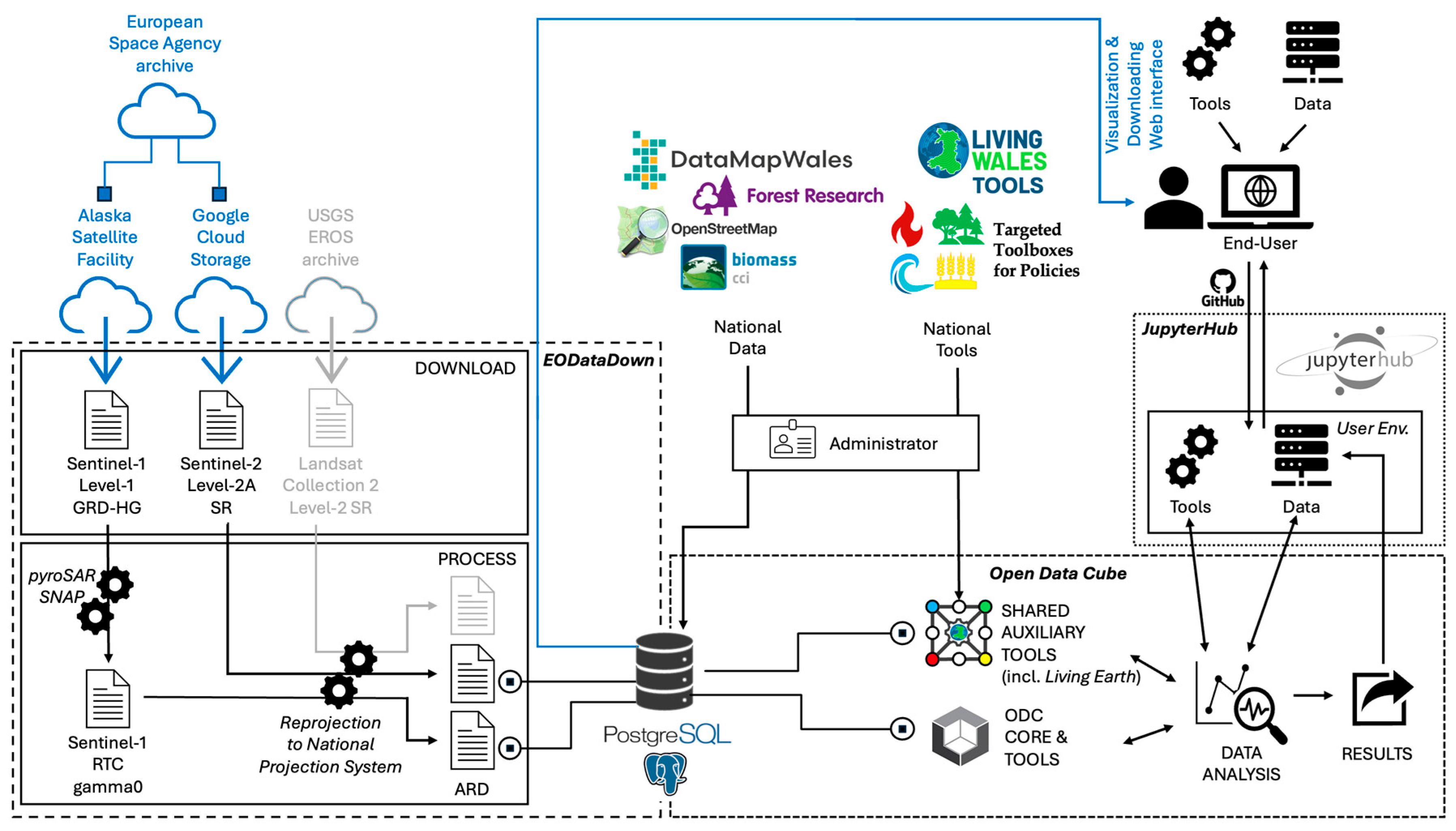
The design and development of the NDI for Wales and core technologies (Figure 1) are described in the following sections, with this outlining the open-source components and their integration in support of management, planning, monitoring and reporting on the national landscape of Wales.

2.2.1. Open Data Cube: Infrastructural Sovereignty

The management and analysis solution selected for the NDI was the Open Data Cube (ODC), which is a free open-source architecture for handling big geospatial data, including Big Earth Observation Data [56]. The ODC project provides publicly accessible documents that outline the platform’s governance process (https://github.com/opendatacube/governance (accessed on 10 February 2025)) and offers guidance on creating or integrating new features into the platform [20]. Originally developed by Geoscience Australia in collaboration with several partners, including the Committee on Earth Observation Satellites (CEOS) [15,57,58], several countries (e.g., Australia, Mexico, Switzerland, Colombia, Tanzania, Armenia) have already adopted this technology to manage national data [58,59,60,61,62,63,64,65]. The ODC utilizes a PostgreSQL database and a range of in-built and expanding sets of tools and functionalities that allow for efficient spatio-temporal querying, visualization, and analysis of indexed (i.e., catalogued) data. The ODC can easily be deployed and run on either a local machine or server via a Docker container (https://github.com/opendatacube/datacube-core (accessed on 10 February 2025)). The scalable architecture supports parallel processing and distributed computing, making it ideal for handling complex geospatial analyses. The modular design allows for customization and integration with other tools and libraries (Figure 1), enabling users to build tailored solutions for their specific requirements.

2.2.2. EODataDown: Automation of Analysis-Ready Data

EO data in an analysis-ready data (ARD) format are at the core of and underpin any data cube deployment [66,67,68,69,70]. The ODC allows EO and other geospatial data to be analyzed efficiently and effectively. However, to allow EO from various sources (i.e., different sensors) to be consistently used and analyzed, pre-processing (i.e., processing chains and/or algorithms) needs to be standardized using appropriate and recognized methods. In the context of national sovereign environmental monitoring, integrated tools and software need to support the generation of ARD in compliance with nationally and ideally internationally recognized standards.
The Earth Observation Data Downloader (EODataDown) Free/Libre Open Source Software v2.3.2 [71], written in Python 3.5-3.8, provided an opportunity to automatically download EO data from a specific list of sensors (i.e., Sentinel-2, Sentinel-1, Landsat 1-8, GEDI, ICESAT-2) and archives (e.g., Alaska Satellite Facility (ASF), Google Cloud) and pre-process to an ARD format. Its modular design allowed for customization and integration with other data and tools, enabling users to build tailored solutions for their specific requirements [72,73]. In EODataDown, and as with the ODC, the downloaded and processed data are automatically indexed within a PostgreSQL database. This shared technology facilitated the connection of these two open-source solutions into one infrastructure (Figure 1). EODataDown further offers a web interface which allows visualization and direct desk downloading of the ARD indexed in the PostgreSQL database [74].

2.2.3. JupyterHub: Secure Multi-User Access

JupyterHub was considered a mechanism to offer free and open-source access to data for multiple users through a shared environment [75,76]. By integrating it into the NDI framework using Zero to JupyterHub (https://z2jh.jupyter.org/ (accessed on 10 February 2025)) with Kubernetes, the JupyterHub was established to give users easy access to the ODC through a web browser. Each registered user is provided with their personalized environment through individual Docker containers, ensuring a secured space to operate in without disrupting others. This setup also granted individuals specific computational resources for running applications (e.g., CPU, memory, storage). Within their private workspace, users were given permission to write and execute code that interacts with the ODC datasets, allowing them to manipulate and analyze the data in a collaborative and interactive environment. Options for uploading/downloading external data, libraries and tools to/from the private workspaces of users through the JupyterLab interface was also provided (see Figure 1). All uploaded data/tools and generated outputs remain under the user’s control, preserving data ownership and privacy. Each can be used as standalone, or with any of the tools/data available in the NDI to all users, thereby providing a fully flexible and tailored solution. Several user authentication methods were developed for use with JupyterHub, including local authentication, the Pluggable Authentication Module (PAM) and the lightweight directory access protocol (LDAP). In the Welsh NDI, authentication was configured to allow users to sign in using their credentials from other OAuth providers, including GitHub (https://github.com (accessed on 10 February 2025)).

2.2.4. Living Earth: Customizable and Environmentally Relevant Products

Living Earth v1.1.0 is a free and open-source software package, under Apache 2.0 license (https://bitbucket.org/au-eoed/livingearth_lccs (accessed on 10 February 2025)), which allows characterization, mapping and monitoring of land and water [77,78,79,80]. Developed in collaboration with Australia (Geoscience Australia) and Wales (UK; Aberystwyth University), the system classifies land cover according to the internationally recognized and globally applicable United Nations Food and Agricultural Organization’s (FAO) Land Cover Classification System Version 2 (LCCS-2; [81]). Living Earth has been optimized for EO data [77] and can be run as standalone or implemented in various technological facilities, including data cubes (e.g., DEA), High-Performance Computing infrastructures (e.g., Australia’s National Computational Infrastructure (NCI), Supercomputing Wales) or cloud services [77,82]. The flexibility and scalability of Living Earth are its main advantages, as the system gives users access to tailored ready-to-use products with which to characterize, map and monitor the environment through globally applicable but locally relevant taxonomies, thereby informing policy review and development, decision-making with regard to land management, and obligatory reporting of environmental states and conditions at national levels (including those relevant to SDGs; [77]). Contrary to most land cover classification systems, Living Earth does not provide a static two-dimensional map. Instead, the system stacks environmental descriptors (EDs) to physically describe the environment. In this respect, users can add as many EDs as they need to characterize an area, including those not originally included in the FAO LCCS taxonomy (e.g., water temperature, plant species type or biomass). To ensure full flexibility and compliance with national sovereignty requirements, options are available for modifying the original FAO land cover classes (e.g., by including different categorical divisions of continuous variables such as annual water persistence). Finally, by using EDs with pre-defined units or categories, classifications can be applied across space and time, allowing Living Earth to be used with any of the spatial resolutions and temporal frequencies of observing sensors. All these functionalities ensure that Living Earth is fully flexible for describing and mapping land covers, monitoring change, and generating ready-to-use products that align with local priorities and values as well as national sovereignty principles.

2.3. Tailoring the NDI

In addition to the embedded functionalities provided by the core technologies of the NDI, such as ODC tools or capacity to download Sentinel-1 Level-1 data from the ASF platform (using the EODataDown system), the entire NDI was tailored to meet Welsh national requirements whilst also achieving national data/digital sovereignty of the core digital infrastructure, data and applications.

2.3.1. Enhancing User Access and Experience

In developing an NDI, an understanding of user needs was critical. In Wales, some users still require and request capacity to download a few scenes on their personal/professional computer. This was achieved by implementing a web interface for EODataDown that allowed visualization and desk downloading of the indexed data (c.f., Figure 1). To improve the user experience, the JupyterHub was configured using GitHub for authentication. This eliminated the need for users to create and remember another set of login credentials and concurrently provided secure authentication mechanisms (including two-factor authentication) and capacity for administrators with specified roles to easily manage user access and permissions.

2.3.2. Minimizing Maintenance and Cost

The list of requirements set by the Welsh Government included reliance on open and interoperable solutions within the NDI, with minimum in-house maintenance and cost. For this reason, EODataDown was modified to allow generation of ARD using the free open-source solutions developed, provided and maintained by official Space programs (where existing), including the European Space Agency’s (ESA) Sentinel Applications Platform (SNAP) for processing Synthetic Aperture Radar (SAR) data. SNAP is an open-source and globally recognized architecture for ESA Toolboxes. In the Welsh NDI version of EODataDown, SNAP was integrated via the pyroSAR Python library (https://pyrosar.readthedocs.io/en/latest/ (accessed on 10 February 2025)), which provides a Python wrapper to SNAP [83] and allows parsing of various options for tailored solutions.
EODataDown has been further customized to directly ingest freely available CEOS-ARD certified EO data. For this purpose, a pipeline for downloading and reprojecting (to the national projection system) the Sentinel-2 Level-2A surface reflectance product from Google Cloud Storage (gs://gcp-public-data-sentinel-2/L2/ (accessed on 10 February 2025)) was developed and implemented (Figure 1). Download from Google Cloud Storage was preferred, as, at the time, ESA only allowed a maximum of two concurrent downloads on its platform [84]. However, flexibility for downloading data directly from the official ESA platform exists. Capacity to download 30 m CEOS-ARD Landsat Collection 2 Level-2 data via the USGS/EROS M2M API (https://m2m.cr.usgs.gov/ (accessed on 10 February 2025)) and reproject to the national projection system (i.e., as for Sentinel-2), was also developed (Figure 1) but not yet implemented in the operational Welsh NDI. This was partly because the use of “high resolution (10–20 m)” was one of the requirements set by the Welsh Government.

2.3.3. Tailoring Earth Observation Downloading and Pre-Processing

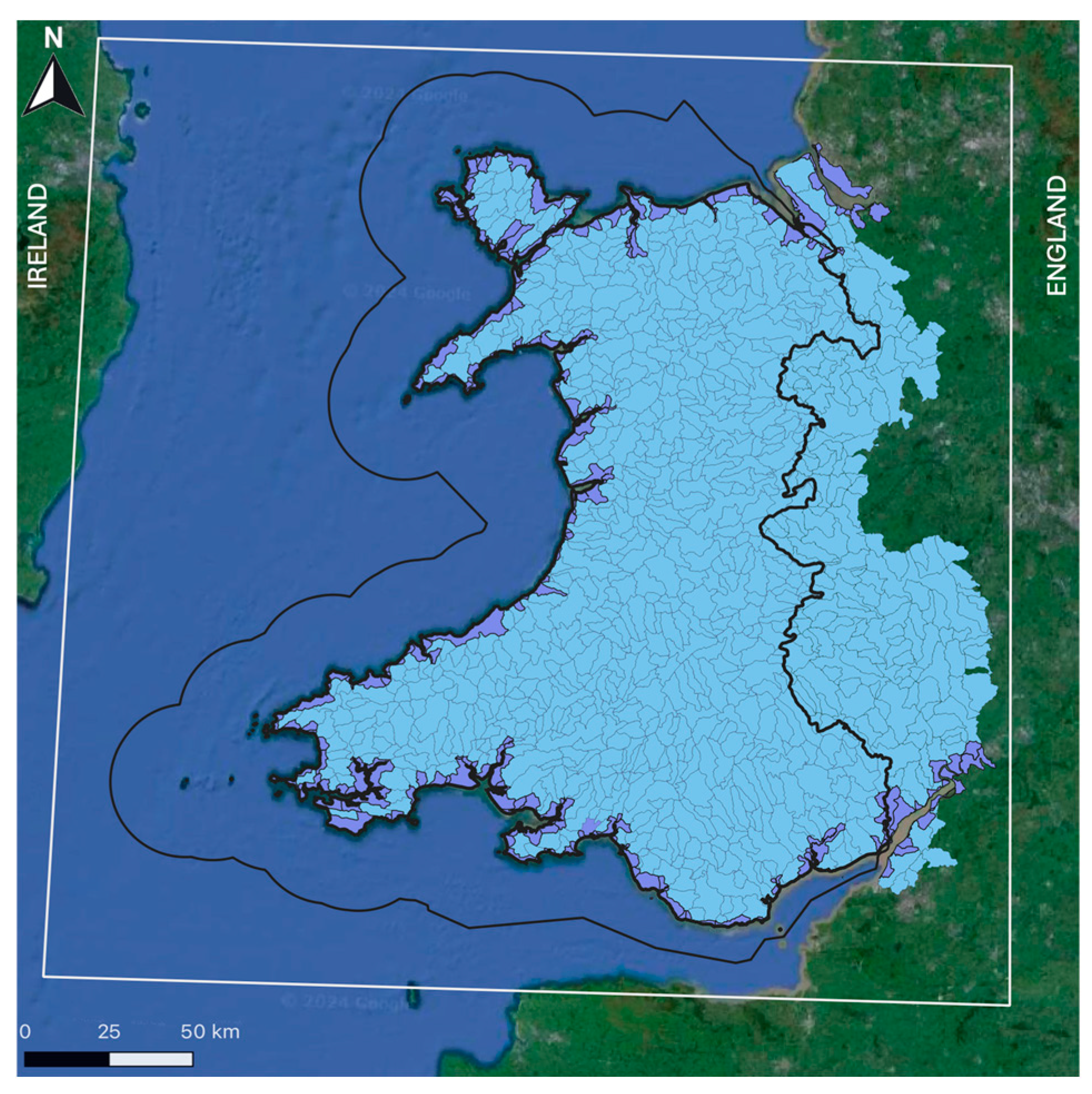
All EO data were and continue to be downloaded automatically and pre-processed through EODataDown and then indexed into the PostgreSQL server shared with the ODC. In the Welsh NDI, free and open-source Sentinel-2 optical and Sentinel-1 SAR data acquired over Wales were automatically downloaded (Figure 2). The Sentinel-2 Level-2A surface reflectance products downloaded are automatically reprojected to the British National Grid projection system, and quicklooks generated. In addition, for Sentinel-1, Ground Range Detected (GRD) downloaded scenes were converted to radiometrically terrain corrected (RTC) gamma nought backscatter, i.e., the CEOS-ARD compliant format. Sentinel-2 scenes were downloaded for tiles overlapping with the Welsh land area but also with the watersheds of rivers where the source or outflows are in Wales (including the River Wye and River Severn), with this benefiting, for example, flood applications and avoiding differences in cross-border land classifications. Given the large volume of data associated with Sentinel-1, these were cropped to the bounding box extent of Wales (Figure 2), which also included these catchments.

2.3.4. Auxiliary Public Data of National Interest

The modular design of the NDI allowed for customization and integration with other tools and libraries, as well as datasets. This was developed to enable end-users (individuals, groups or organizations operating from local to national levels) to build tailored solutions for their specific requirements. As previously mentioned, options for adding private data or applications through a JupyterLab interface were provided to suit specific requirements. However, to fully address the challenges of sovereign environmental monitoring, a unified approach to data access and reported information was considered crucial.
To facilitate this, the Welsh NDI was developed to provide a publicly shared space that gives real-time access to relevant data with focus on those used as national reference, as EDs (to construct and/or describe land covers), as contextual information (supporting translation from land cover to habitats), or as sub-pixel layers (trees and hedgerows, urban areas and hydrological networks). These datasets were obtained primarily from DataMapWales, which is the national Geographic Information System developed by the Welsh Government (https://datamap.gov.wales/ (accessed on 10 February 2025)) that gives access to a wide range of data and maps from the Welsh public sector. As with the NDI, the aim of DataMapWales is to make information about Wales easily accessible and usable for a wide range of users, including policymakers, researchers, businesses, and the general public. Data in the catalogue can be downloaded to desktops for further analysis, noting that not all are publicly available.
Open environmental maps distributed by the Welsh Government and its environmental executive agency (i.e., Natural Resources Wales; NRW) through DataMapWales were identified as important for monitoring and reporting obligations in Wales. Several of these were integrated into the Welsh NDI to allow access to historical maps that were frequently referenced by a wide range of stakeholders, including the Phase 1 Habitat map [85,86,87], which was developed alongside the Habitat Survey of Wales and currently remains the national reference provided by NRW. A range of environmental descriptors (EDs) were also integrated, including NRW’s Saltmarsh Extent, National Forest Inventory (NFI) woodlands provided by Forest Research, a Wales-wide Digital Terrain Model (DTM; and derived slope) obtained primarily from the Historic LiDAR Archive, and the ESA Climate Change Initiative (CCI) Woody Above Ground Biomass (Mg·ha−1; [88,89]). Contextual layers to assist classification of habitats were added, with these being the updated peatlands of Wales [90] and the Mean High Water Spring tides (MHWS), representing the maximum tidal area reached during spring tides; [91]). Many of these layers contained key information for national reporting obligations. All datasets (Table 1) were rasterized or rescaled to 10-meter spatial resolution prior to integration within the PostgreSQL database of the ODC by the Welsh NDI administrators and made available to all users as ARD as part of the shared infrastructure (Figure 1).

2.3.5. Publicly Shared Tools and Applications for Monitoring and Reporting

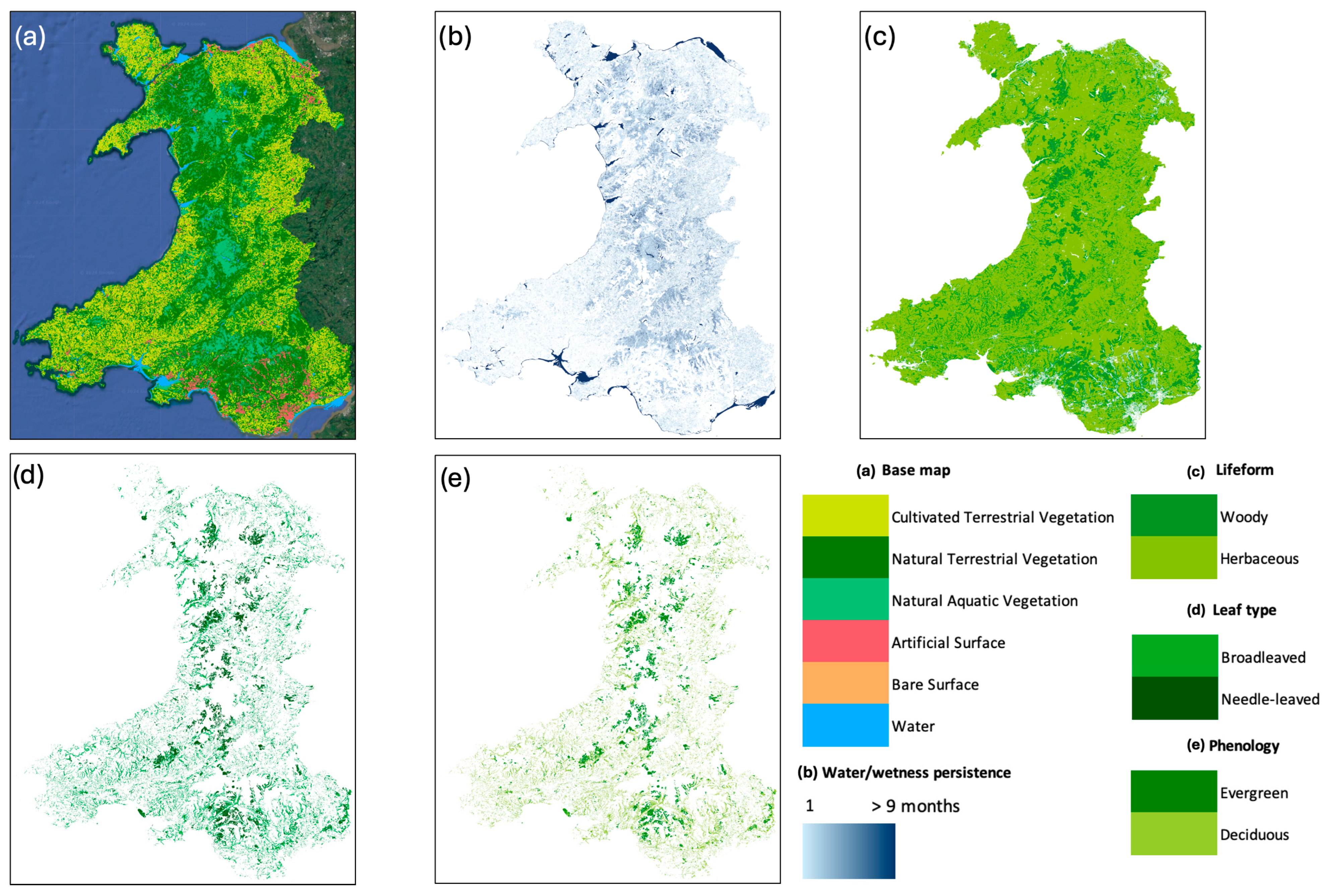
In Wales, through Living Wales (https://livingearthhub.org/europe/wales/ (accessed on 10 February 2025); [78]), algorithms have been developed to retrieve or classify key EDs required by Living Earth to construct the land cover maps according to the FAO LCCS. These algorithms (Table 2) required Sentinel-1 and/or Sentinel-2 ARD, as well as auxiliary datasets that had been made available in the publicly shared space of the Welsh NDI (see Table 1). In addition to the mandatory overarching EDs (i.e., vegetated, aquatic, cultivated, artificial), algorithms specific to Wales were also developed to retrieve lifeform (i.e., woody, herbaceous), leaf type, phenology and water persistence and seasonality EDs (see Table 2). To ensure full flexibility and compliance with principles of national sovereignty, some of the original FAO LCCS classes were modified within the Living Earth (v1.1.0) software.
Specifically, the EDs of water persistence and seasonality were merged into an ED termed water/wetness persistence. Water/wetness persistence classes were permitted in all vegetated areas, and the non-perennial class (i.e., <9 months) was discretized into one-month rather than three-month range categories. Knowledge of the persistence of open water alongside soil wetness in vegetated areas is particularly relevant to Wales given the large expanse of aquatic vegetation and water. Furthermore, increases in the lengths and number of intense rainfall events [93] result in soils that are often at or beyond saturation point for extended periods (NFU Cymru, 2024 [94]). With climate change, this trend is expected to continue [95]. Being able to monitor water/wetness persistence, particularly in terrestrial cultivated areas, is key for Wales, as this has had a significant impact on cropping systems and hence agricultural productivity. Living Earth and the associated Living Wales plugins for ED retrieval and land cover map generation are all available as part of the publicly shared infrastructure (Figure 1 and Figure A1). Summaries of EDs (e.g., water/wetness persistence) and land cover maps have been generated annually from 2018, which was the starting year of the Living Wales project. National-level accuracy assessment has been undertaken using an area-based random stratified approach [96,97]. To ensure that the delivered applications/products are fully compatible with the Welsh national ambitions and can be used for reporting obligations, an application allowing the translation of the Living Wales land cover maps to habitat types aligning with the Phase-1 Habitat Taxonomy was developed and included in the Welsh NDI. The application has been used to generate annual habitat maps (both detailed and broad) for Wales from 2020. Detailed explanations about the translation scheme are provided by Punalekar et al. [87]. All annually derived products (i.e., EDs and land cover and habitat maps) are indexed in the PostgreSQL server and available to all users (Figure 1). Additional EDs (i.e., crop type [98]) have also been integrated into the Welsh NDI.
Finally, in addition to Living Earth-related plugins/products, a series of applications allowing the generation of ready-to-use products have been developed and made available in the publicly shared space of the infrastructure, including for post-event monitoring (PEM; e.g., following fires or floods) and relevant report writing (see Section 3). These have been developed to ensure that the Welsh NDI provides a complete range of ready-to-use products and functionalities that can contribute to policy and land management following and in preparation for such events.

3. Results

3.1. Operational Performance and Temporal Coverage of the Welsh NDI

3.1.1. Infrastructure Performance and Automated Processing

The NDI was initially deployed on dedicated national hardware (20-core 2.5 GHz CPU, 256 GB RAM, 4 × 18 TB storage), ensuring fully domestic control over data ingestion, processing, and storage. The system architecture enables configurable selection of EO data providers, processing levels, and analytical tools. A fully automated workflow (CronJob-based scheduling) performs data discovery, download, preprocessing to ARD, storage, and indexing twice daily (03:00 and 15:00). The resulting ARD are automatically indexed in a PostgreSQL server and feed into the ODC (see Figure 1). The ARD products were typically available within 24 h of satellite acquisition. Processing times averaged ~10 min per Sentinel-2 scene, reflecting ingestion of Level-2A surface reflectance products requiring reprojection and quicklook generation only. Sentinel-1 scenes required ~30 min per scene, including conversion to ARD using SNAP with full CPU utilization. To optimize storage efficiency, all datasets were stored as cloud-optimized GeoTIFFs using lossless compression. Derived products (e.g., NDVI) were computed as needed (‘On-the-Fly’ computation) via the NDI interface rather than pre-generated and archived. Automated clean-up routines removed temporary processing artefacts, ensuring stable long-term system performance.

3.1.2. Data Volume, Temporal Coverage, and Revisit Frequency

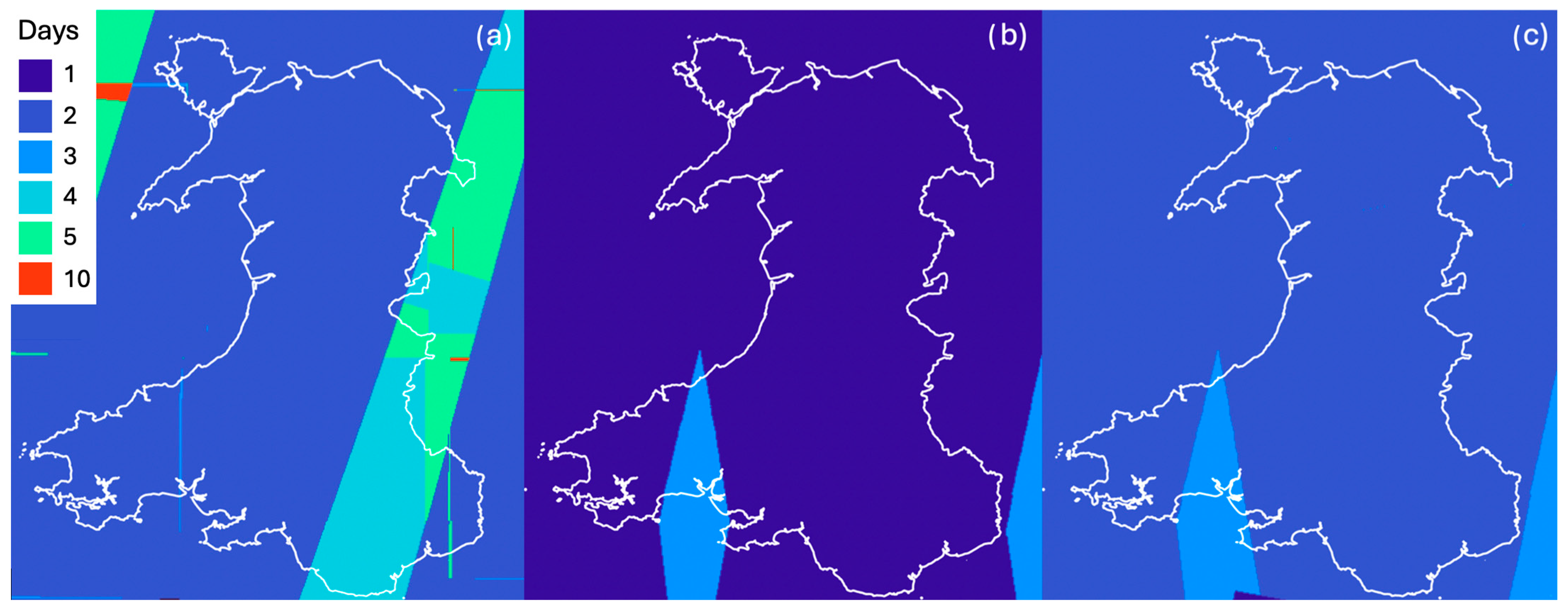
For the period between 14 November 2014 and 31 December 2024, the NDI pre-processed and indexed 8176 Sentinel-1 scenes (15 TB) and 19,508 Sentinel-2 scenes (22 TB). For years with complete mission overlap, annual data volumes reached up to 5 TB of downloaded, processed, and locally stored Sentinel data. During 2018–2021, concurrent operation of Sentinel-1A/1B and Sentinel-2A/2B maximized temporal density. Overlapping orbital tracks resulted in revisit intervals of 2–5 days for Sentinel-2 (Figure 3a) and 1–3 days for Sentinel-1 (two satellites; Figure 3b). Following the cessation of Sentinel-1B acquisitions in December 2021, the remaining orbital configuration of Sentinel-1A has continued to provide a 2–3 day revisit interval over Wales (Figure 3c). For Sentinel-2, most of Wales benefits from 2–3 day effective coverage due to orbital overlap. However, areas aligned along a northeast–southwest diagonal exhibit a 5-day revisit frequency, corresponding to the nominal dual-satellite interval (Figure 3a), increasing sensitivity to single-sensor outages in these regions.
In addition to satellite EO ARD, the Welsh NDI hosts a suite of openly accessible, ready-to-use products for environmental monitoring within its publicly shared workspace. These include annual Living Wales national land cover and habitat maps and associated EDs derived primarily from Sentinel-1 and Sentinel-2 ARD for each year from 2018 onwards. Products are generated using the Living Earth application and Living Wales plugins through an automated workflow executed each January for the preceding year (e.g., 2023 products generated in January 2024). Following automated production, outputs are indexed in the PostgreSQL database and made immediately available to end-users as analysis-ready, nationally consistent baseline datasets. Although a detailed description of this assessment is beyond the scope of this paper, examples of resulting land cover maps and ED products are provided in Appendix A (Figure A1), with summary accuracy metrics reported in Table A1. Annual land cover base maps achieved an overall accuracy (OA) of 90.2%, and essential ED products exceeded 94% OA. In addition to Living Wales EO-derived products, the NDI stores and provides nationally significant geospatial datasets required for statutory reporting (c.f., Table 1), including Natural Resources Wales (NRW) Saltmarsh Extent, national peatland inventories, and Mean High Water Spring (MHWS) tidal boundaries, with each summarized to 10 m resolution. Collectively, the Living Wales ready-to-use products and auxiliary nationally mandated datasets represented 50 GB of additional managed data within the infrastructure.

3.2. Annual Monitoring for Key Reporting Obligations

To support national policy development and reporting obligations, the Welsh NDI provides openly accessible, ready-to-use environmental monitoring products and tools. These include annually updated land cover maps, EDs, and habitat maps generated from Sentinel-1/2 ARD datasets (from 2018 onwards) using the Living Earth software and Living Wales plugins. Together, these spatially explicit datasets form a common, publicly available resource to support environmental monitoring and national reporting requirements.

3.2.1. Using the Welsh NDI for Sustainable Farming Scheme Compliance Monitoring

The Sustainable Farming Scheme (SFS) is one of the key measures introduced under the Agriculture (Wales) Act 2023. It includes various initiatives and incentives to encourage farmers to adopt more sustainable management practices, such as agri-environmental schemes, to improve water quality, reduce greenhouse gas emissions and support bio-diversity conservation [99]. The SFS has been developed to replace the subsidies previously provided by the European Union through the Common Agricultural Policy (CAP) and is structured around three layers of actions, namely those that are (a) universal and mandatory for all SFS participants; (b) optional; and (c) collaborative, which provide opportunities for participants to work with others to implement broader changes [100]. Each year, Rural Payments Wales (RPW) selects a portion of scheme applications for inspection to ensure compliance with the scheme’s regulations, including the essential baseline requirements [101]. In addition, the Welsh Government aims to perform spot checks that utilize both physical inspections and EO methods, including remote sensing where applicable [100].
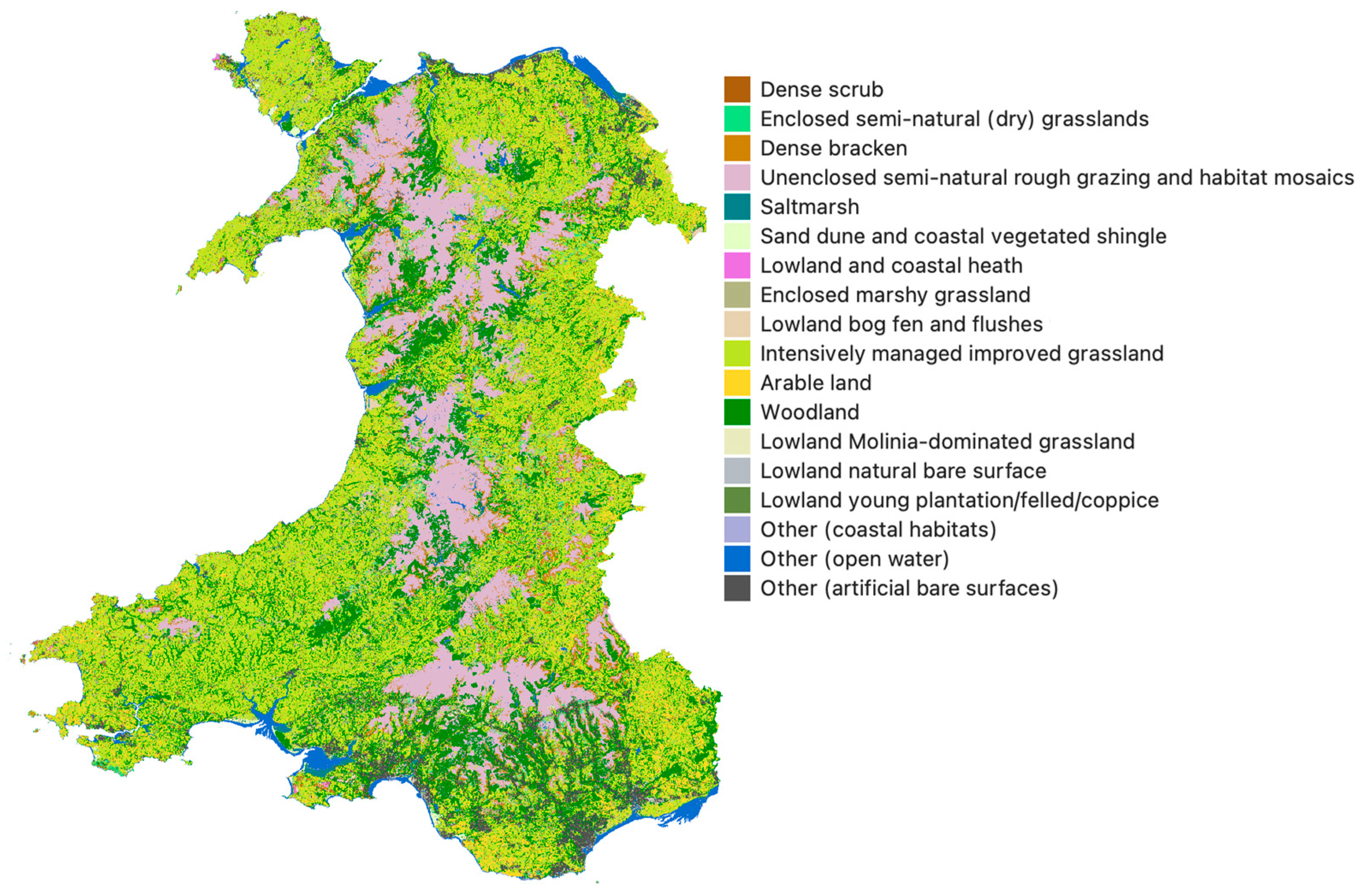
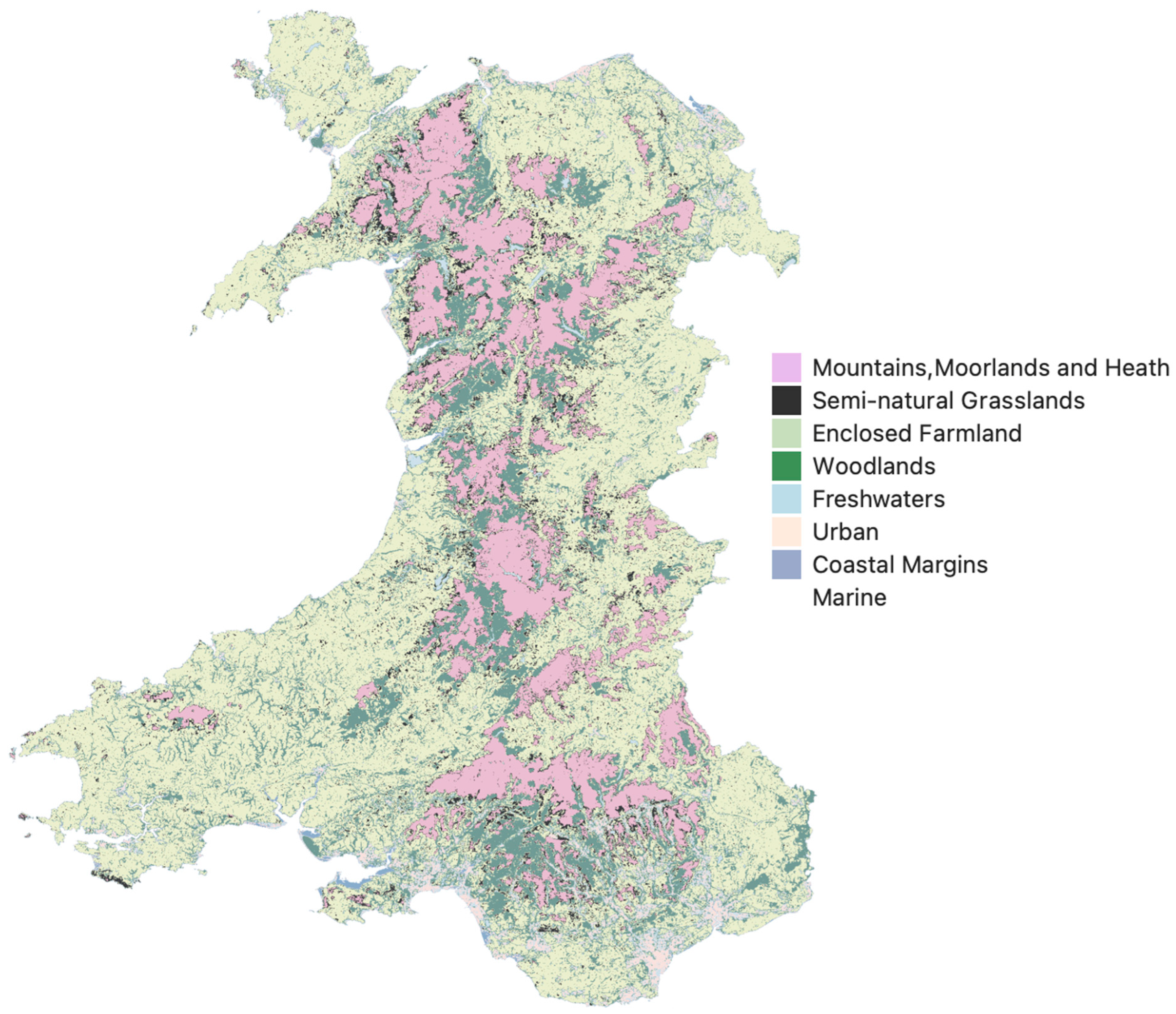
During the testing phase of the Welsh NDI, its capacity to support SFS monitoring and compliance verification was evaluated using operationally relevant workflows. Results demonstrated that the NDI infrastructure can directly support verification of the SFS Universal Actions, particularly those related to habitat management. This was achieved by leveraging the annually updated Living Wales land cover maps and EDs, derived from Sentinel-1/2 ARD, which are openly available within the NDI public workspace. A key outcome of the testing phase was the successful integration of private and public datasets within the NDI’s modular architecture. A Welsh Government user (“User A”) incorporated (i) a privately licensed layer delineating enclosed farmland boundaries and (ii) a bespoke algorithm designed to translate Living Wales land cover products into an SFS-compatible habitat taxonomy (Table A2). The results confirmed that EO-derived Living Wales products can be systematically reclassified to align with SFS habitat categories (Figure 4). Overall, the testing phase confirmed the technical feasibility of using the Welsh NDI to support SFS compliance checks, including potential EO-based spot checks to complement physical inspections undertaken by Rural Payments Wales. The results highlight the operational readiness of the NDI to contribute to policy implementation, monitoring, and reporting under the SFS framework.

3.2.2. Supporting State of Natural Resources Reporting Through the Welsh NDI

In parallel with the SFS, the Welsh Government, through NRW, has statutory reporting obligations requiring systematic monitoring of semi-natural habitats, including woodlands and enclosed farmland [102]. During the testing phase of the Welsh NDI, its capacity to support the State of Natural Resources Report (SoNaRR) and broader Sustainable Management of Natural Resources (SMNR) reporting was evaluated. The EO-derived annual products available within the Welsh NDI were able to be operationally adapted to support SoNaRR-compatible habitat reporting. An NRW user (“User B”) implemented a bespoke algorithm within a secure private NDI workspace to translate Living Wales land cover outputs into a SoNaRR-aligned habitat taxonomy (Table A3). This workflow was executed in combination with a privately licensed governmental spatial layer, demonstrating the ability of the NDI to integrate public EO products with restricted administrative datasets. The testing confirmed the technical feasibility of generating SoNaRR-compatible habitat maps directly from Living Wales annual products (Figure 5). The modular architecture of the NDI facilitated secure interoperability between public and private datasets, enabling NRW to tailor outputs to statutory reporting requirements while maintaining data governance constraints.
Importantly, the availability of annual time series products (from 2018 onwards) enables consistent, spatially explicit assessments aligned with the SMNR aims [103]). In particular, the system supports evaluation of ecosystem resilience (SMNR Aim 2 [104]) by enabling quantification of changes in the diversity, extent, condition proxy indicators, and spatial configuration of semi-natural habitats. The time series products allow assessment of key SoNaRR questions, including
(a) Changes in the diversity, extent, and connectivity of semi-natural habitats;
(b) Land-use transitions and the spatial distribution of modified habitats;
(c) The extent and spatial arrangement of qualifying habitats within protected sites.
Collectively, the Welsh NDI has been shown to provide an operationally viable evidence base to support SoNaRR reporting and contributes to multiple cross-cutting themes, including ecosystem resilience, biodiversity, woodland, coastal margins, semi-natural grassland, and enclosed farmland. The findings highlight the system’s capacity to underpin statutory environmental reporting through reproducible, EO-derived, and annually updated spatial products.

3.3. Leveraging the Welsh NDI for Post-Event Monitoring and Analysis

In addition to the annual Living Wales products, a suite of applications has been developed and integrated into the publicly shared space of the Welsh NDI to generate ready-to-use, event-based analytical outputs. These currently include four thematic toolboxes (flood, fire, forest, and crop monitoring; Table 3), with each designed to support rapid assessment, post-event analysis and reporting workflows.
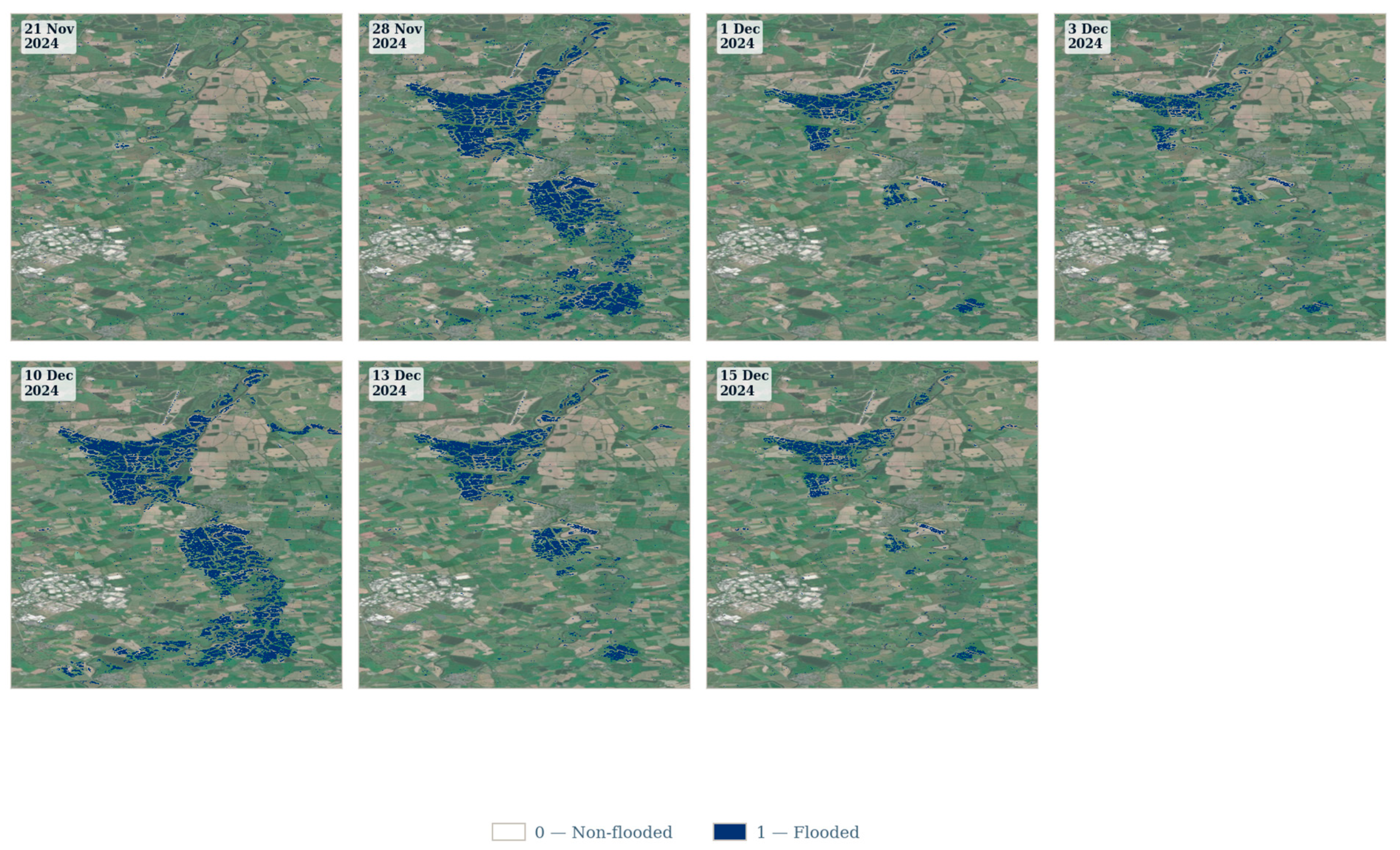
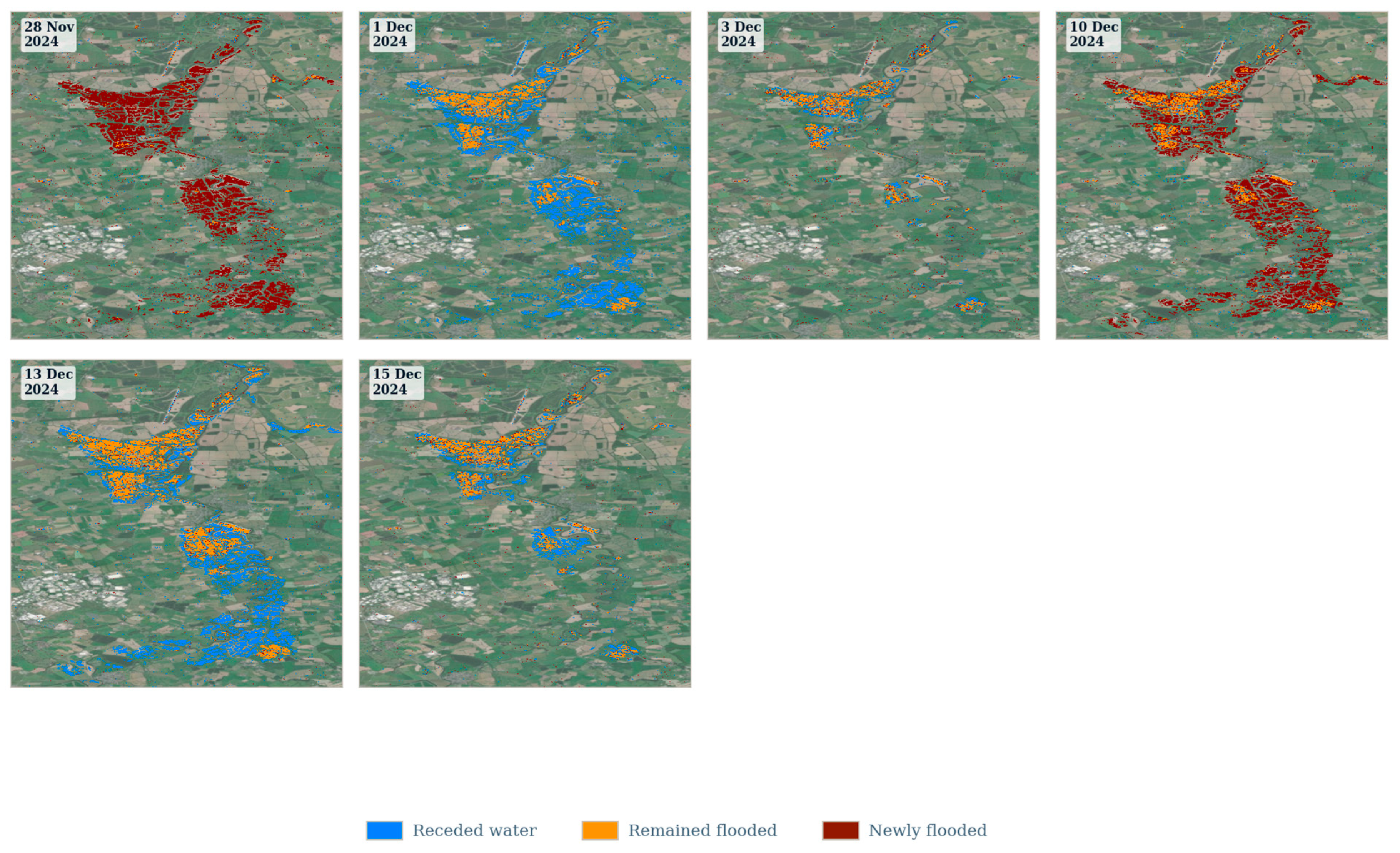
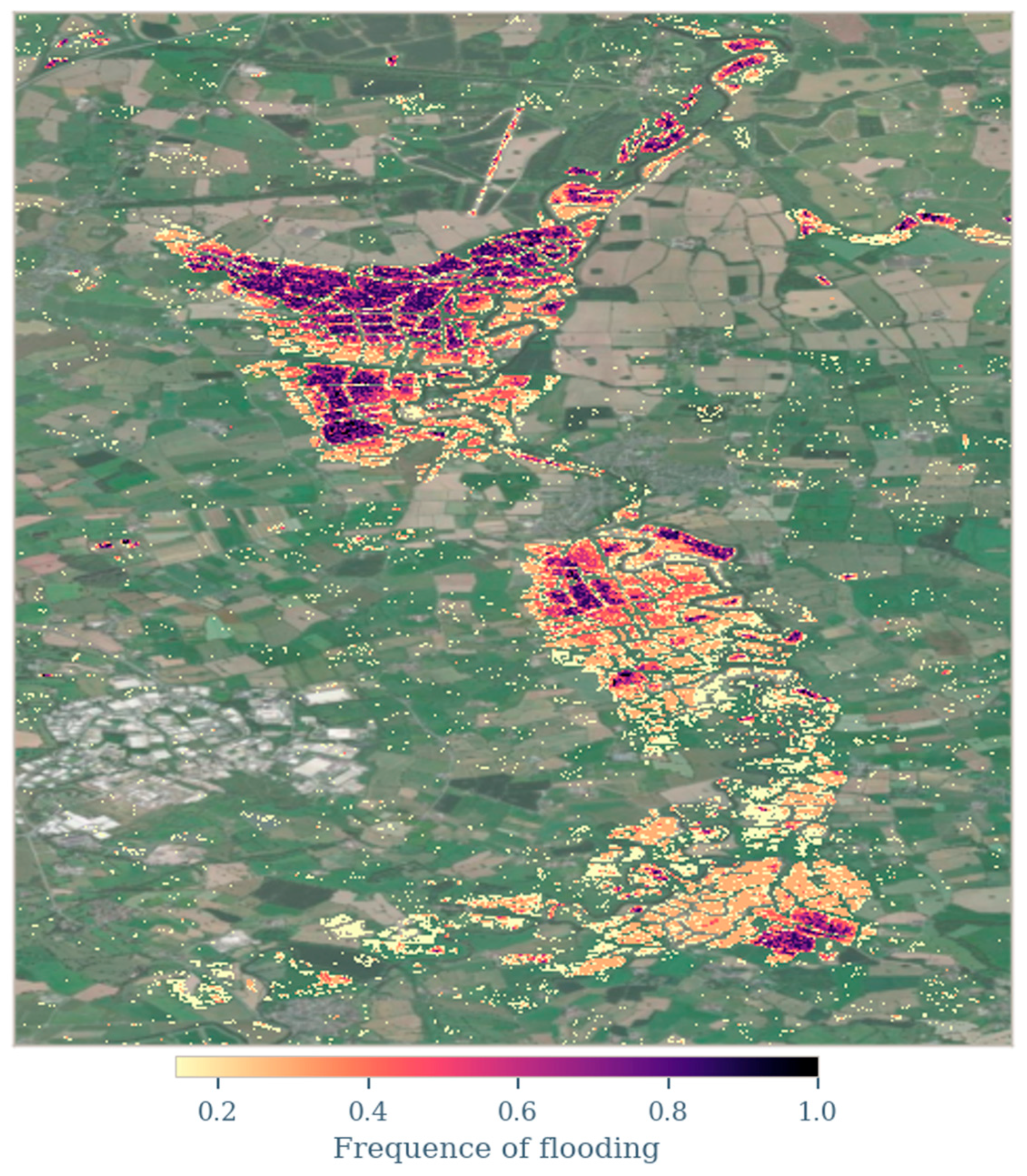
The flood monitoring toolbox was developed and evaluated using Sentinel-1 ARD available within the NDI framework. The application enabled (i) historical flood reconstruction, (ii) post-event flood extent mapping (Figure 6), (iii) temporal progression analysis (Figure 7), and (iv) spatially explicit flood frequency assessment (Figure 8) for any area and period covered by the EO archive. The workflow provided consistent delineation of inundation patterns across multiple time steps, facilitating both retrospective and operational analyses. The flood frequency outputs provide cumulative and trend-based information derived from multi-year time series, enabling identification of recurrent flood-prone zones and spatial variability in flood occurrence. Such products offer a reproducible evidence base to support statutory flood investigation and reporting obligations under Welsh legislation (Table 3). Importantly, the historical trend analyses generated through the toolbox demonstrate potential to inform updates to national flood risk mapping, improve understanding of past flood dynamics, and support forward-looking risk assessment.
In addition to natural process and risk watching and understanding, post-event monitoring also provides valuable tools for detecting illicit activities and responding promptly to mitigate environmental harm. The fire monitoring toolbox was implemented using Sentinel-2 ARD and the Living Wales habitat maps available within the NDI. Results demonstrate that the toolbox enables (i) mapping of fire scars, (ii) post-fire recovery assessment, and (iii) generation of habitat-specific impact statistics (e.g., burned area, affected habitat types) for any area and period covered by the EO archive (Figure 2). The workflow allowed consistent delineation of burned areas and tracking of ecological recovery, supporting both retrospective analyses of fire events and post-event monitoring for operational response. Outputs from the toolbox provide spatially explicit information on fire extent and affected habitats, allowing identification of areas impacted by uncontrolled or unauthorized burning, as well as evaluation of recovery following controlled or prescribed burns. These products offer a reproducible evidence base to support regulatory oversight under the Conservation of Habitats and Species (Wales) Regulations 2017 and the Heather and Grass Burning Code for Wales 2008 (Table 3), enabling authorities to track compliance, mitigate environmental harm, and inform habitat management planning.
Finally, the Welsh NDI can also be useful to assess progress towards the national and international environmental goals and targets. The forest monitoring toolbox was applied using Sentinel-1 ARD to map annual forest extent and detect clear-felling events. Results demonstrate that the ARD-based infrastructure reliably identifies forest cover transitions and harvesting activities across Wales. Outputs provide spatially explicit information on forest condition and management practices, supporting assessment of progress toward the objectives outlined in the Woodlands for Wales strategy and alignment with the Well-being of Future Generations (Wales) Act 2015 and Environment (Wales) Act 2016 (Table 3). Similarly, the crop monitoring toolbox leverages EO time series available through the Welsh NDI to assess agricultural land-use dynamics, including crop distribution, rotations, and seasonal variability. The outputs provide spatially explicit information relevant to sustainable farming practices that enhance carbon storage, promote biodiversity, and improve soil health, in line with the Agriculture (Wales) Act 2023 and Environment (Wales) Act 2016 (Table 3).
Collectively, these studies have demonstrated that the Welsh NDI can deliver operational EO-based monitoring across multiple environmental domains. The integrated toolboxes generate harmonized EO-derived outputs that are reproducible, spatially explicit, scalable, and suitable for integration into national monitoring, regulatory, and policy workflows. The applications and toolboxes included in the current version of the Welsh NDI are not a definitive list but serve as examples demonstrating how the system can be utilized for national sovereign monitoring of the environment. The Welsh NDI is a flexible and adaptative infrastructure and therefore is regularly being updated to meet the needs of the country and policy framework.

4. Discussion

4.1. Independence

A key contribution of the NDI is the alignment of automated processing chains with internationally recognized and nationally compliant ARD standards. Despite major advances through initiatives improving access to standard satellite products (e.g., CEOS ARD; [69,105,106]), sovereign environmental monitoring is often constrained by the complexity and opacity of EO preprocessing workflows [107,108,109]. Many countries continue to depend on externally hosted, pre-generated ARD datasets that are hosted in global archives [63,110,111], which limits transparency in algorithm selection, parameterization and versioning, reduces flexibility in adapting processing to national requirements and constrains control over data continuity, latency, and updates. In regulatory and reporting contexts, where reproducibility, auditability, methodological traceability and long-term continuity are critical, such dependencies can reduce confidence in derived indicators and undermine long-term monitoring outputs [112]. Furthermore, these ARD products may not fully accommodate context-specific corrections (e.g., terrain adjustments for complex topography or radiometric normalization aligned with domestic baselines) that are a common prerequisite of countries [15,66]. Integration and interoperability with other EO-relevant data into harmonized monitoring frameworks poses further technical challenges, with common examples being national airborne LiDAR [113], very high resolution (VHR) commercial imagery (e.g., PlanetScope; [114]) acquired under national agreements (e.g., as in the case of Welsh Government) and in situ reference observations [115].
As a consequence of these considerations, countries with NDIs often favor domestic preprocessing of data to ensure compliance with national standards and interoperability. As examples, Switzerland operationalized the LiMES framework to generate ARD from Landsat and Sentinel missions [59,62,116,117], while Australia adopted Digital Earth Australia (DEA) ARD standards incorporating BRDF normalization and terrain illumination correction [15,66]. However, as noted by Lewis et al. [118], many end-users lack the technical capacity and knowledge to implement and maintain such complex preprocessing chains. The NDI described, and demonstrated for Wales, directly addresses these sovereignty, standardization and processing challenges by embedding ARD production within nationally controlled, automated and scalable infrastructures. Rather than relying exclusively on externally generated products, the system enables countries to generate their own ARD datasets in alignment with nationally relevant but internationally recognized standards (e.g., CEOS ARD). This ensures full transparency in the algorithms used and addresses key requirements for environmental regulation, national to international reporting and long-term policy evaluation. By automating end-to-end preprocessing chains through integration of existing open-source solutions, the NDI reduces the technical and knowledge barriers associated with EO data preparation. Automation minimizes human intervention, lowers the risk of inconsistent processing, and ensures systematic ingestion of newly acquired data into standardized time-series archives. This is particularly critical for operational applications such as monitoring landscape changes, including in water environments, where temporally consistent and uninterrupted data streams are essential [119,120,121].
Importantly, the open-source nature of clustered technologies (e.g., EODataDown, ODC) and their integration into a nationally controlled infrastructure addresses the digital sovereignty concerns associated with exclusive reliance on commercial cloud services. Many countries have opted for a hybrid solution, using both data cube technology and cloud services. For example, in Australia, DEA hosts data on the Simple Storage Service (S3) of Amazon Web Services (AWS; [122]), whilst Brazil uses AWS for processing EO data [123]. Cloud-based platforms provide scalability and convenience, particularly for countries with a large land mass, such as Australia and Brazil [61]. However, they can create financial, legal, and geopolitical constraints because control over infrastructure [124,125], data residency and platform continuity ultimately rests with private foreign providers [126]. When national infrastructures rely fully or partially on such platforms, they depend on externally owned systems and proprietary governance frameworks, placing key factors such as availability, pricing and terms of access outside of direct state control [127]. These dependencies can expose governments to changes in data residency rules, pricing structures or long-term service availability. Such shifts are not uncommon: For example, Google Earth Engine (GEE) has repeatedly modified its policies over the past decade. In 2022, it introduced paid plans for governments and businesses [128], in 2024, data extraction started to be priced [129] and, in 2026, it moved from an unrestricted free model for non-commercial users to a quota-based system [130]. Through use of the ODC, the developed NDI can be deployed with cloud service platforms such as Microsoft Azure [131,132] but easily transferred to domestically hosted servers. This ensures a viable and flexible alternative in the event of, for example, cloud-service shutdowns or price increases, a major advantage of a well-designed and implemented NDI.
There are other benefits of a domestically-hosted NDI. The use of locally archived datasets has been shown to significantly improve computational performance compared with on-the-fly access to cloud-hosted data, with implications for the scalability and reliability of operational monitoring systems [132]. Also, hosting the infrastructure domestically ensures that sensitive geospatial data can remain under national jurisdiction as required (e.g., when certain datasets are subject to privacy protections, security restrictions, or specific licensing conditions) [133]. This is particularly relevant for VHR imagery (e.g., national airborne datasets), cadastral information, critical infrastructure layers or georeferenced socio-economic datasets that may contain personally identifiable or strategically sensitive information. In such contexts, states may hesitate to upload, process or integrate data within foreign cloud environments due to concerns over data sovereignty, extraterritorial access provisions, contractual incompatibilities or shifting geopolitical conditions [134]. These concerns may be amplified during periods of international tension, when continuity of access to externally hosted services cannot be fully guaranteed [135,136]. A nationally hosted, open-source infrastructure strengthens legal certainty and operational resilience by embedding data governance within domestic institutional and regulatory frameworks. Beyond storage location, sovereignty considerations extend to the analytical layer. The use of locally deployed environments, such as JupyterLab, within secured national infrastructures enables controlled and auditable data analysis workflows [75,76]. User authentication, role-based access control, encrypted connections and logging mechanisms can be implemented to ensure that only authorized personnel access sensitive datasets [137,138]. In the JupyterHub environment, each user has an isolated workspace where uploaded data, whether licensed or proprietary, remain under the user’s control, and any derived outputs are also retained by the user; the platform does not claim ownership, ensuring that institutional and individual data rights are preserved. By combining domestic hosting, individual data control, open-source transparency, and secure analytical environments, an NDI secures continuity of critical environmental monitoring functions, such as post-event response and management, land-use regulation, and reporting obligations, while safeguarding sensitive information. This integrated approach enhances resilience, legal certainty and long-term operational independence, thereby supporting both data and digital sovereignty.

4.2. National Capacity

Whilst providing formal independence at the international level, sovereignty also addresses the practical capacity of the state to govern effectively within its jurisdiction. This functional dimension of sovereignty depends on institutional coordination, administrative coherence and the ability to generate comprehensive knowledge surrounding national conditions [139]. Where governance structures are fragmented and state capacity to coordinate is reduced, sovereignty is operationally weakened. A key mechanism through which such weakening occurs is data fragmentation [140]. When ministries, agencies or regional authorities hold isolated and/or non-interoperable datasets, information becomes siloed within institutional boundaries. In areas such as environmental monitoring, responding to post-event situations or managing resources, this can result in delayed decisions, inconsistent policies or regulatory gaps. For example, in Wales, the Environment (Wales) Act 2016 concerns various sectors (e.g., natural resources, land management, climate change) and stakeholders (e.g., public authorities, land managers, farmers) who currently use different data sources to report on similar elements, often with varying timelines. This has led to inconsistencies in statistics across reports and spatial analyses. For instance, the most recent State of Nature Wales report [53] indicated that 90% of peatlands were in poor condition, drawing on conclusions from the JNCC [141]. However, by the time this report was published, the National Peatlands Action Programme (2020–2025) had already made significant progress, restoring 3000 hectares of peatland [142], which approximated 60% of its targets to restore a minimum of 5000 hectares of peatlands (and 25% of the most modified) and ensure all peatlands with semi-natural vegetation were subject to favorable management/restoration by 2025 [143]. This progress was reflected in the SoNaRR 2025 report [144,145]. The discrepancy between reports does not necessarily indicate error; rather, it highlights structural issues associated with asynchronous data cycles, competing datasets and fragmented reporting mechanisms. When different institutions produce parallel assessments using distinct baselines or temporal reference points, inconsistencies arise that can obscure policy progress and complicate accountability. In extreme cases, such fragmentation may weaken the perceived credibility of environmental governance and hinder strategic decision-making. The implementation of the NDI framework in Wales has allowed mutualized information to be provided that can be used as a common and publicly accessible data source for fulfilling a range of national reporting obligations, thereby limiting inconsistencies between reports and duplication of information, resources and effort (including financial and staff time).
While data fragmentation and lack of interoperability weaken the coherence of state action, outdated national reference datasets further constrain its sovereignty. In Wales, the Phase 1 Habitat Map, developed in the 1990s, remains the national reference dataset for habitat classification and environmental reporting [85]. Although foundational at the time of its production, the static nature of this dataset limits its capacity to reflect three decades of land-use change, ecological succession, restoration activities, and climate-related impacts. When national data infrastructures are not routinely updated or systematically integrated, governmental agencies and regional authorities may resort to alternative sources to fill analytical gaps. These may include externally hosted platforms, international remote sensing products or foreign technical assistance initiatives [111]. While such resources can provide valuable insights, dependence on externally produced datasets may gradually shift strategic knowledge production beyond national institutional control, potentially exposing the country to external influence over methodologies and standards [146]. From a governance perspective, sovereignty is thus partly contingent upon the ability to maintain authoritative, current and internally governed datasets that underpin regulatory decisions and international reporting commitments. The implementation of the developed NDI framework in Wales has provided open, authoritative and up-to-date spatially explicit land cover, EDs and habitat maps that meet the national methodology and standard requirements and are available as a timely source of information for fulfilling a range of national reporting obligations. Importantly, these datasets are not merely technically updated; they are embedded within nationally defined classification schemes and quality assurance processes, ensuring coherence with statutory obligations and policy instruments.

4.3. Local Considerations

The availability of timely and spatially relevant information at local scales further enhances the state’s practical capacity to govern effectively and independently. Up-to-date information at relevant spatial scales and temporal frequencies allows local authorities and agencies to make faster evidence-based decisions without relying on external datasets or delayed reporting cycles. This improves post-crisis response (e.g., floods, wildfires), regulatory enforcement (illegal fires or forest clear cuts) and long-term planning [147,148,149]. Moreover, accurate and up-to-date local data increase policy coherence between local, regional, national. and international levels, reducing inconsistencies and strengthening institutional credibility both domestically and internationally. Through its toolboxes, and as illustration, the NDI in Wales has enabled the delivery of timely local information to support the management of post-event situations while operating within a nationally governed and methodologically consistent evidence framework.
Human activities and natural events and processes occurring locally (e.g., at the household or farm) scale through to the national level [150]. These interactions are mediated by collaborative ventures (e.g., businesses, farming cooperatives,) or governance units such as local government areas (LGAs), watersheds or protected sites. While local collective actions influence landscape composition and dynamics, national policies and economic drivers determine the broader trajectory of environmental change. In turn, these actions generate evidence and feedback that inform decision-making across governance scales [150,151,152]. In most cases, consequential impacts on environmental quality occur. However, other forces beyond the sole control of individual countries (e.g., increased GHG concentrations) are increasingly leading to natural events (e.g., storms, fires) and processes (e.g., drought) that occur within or across national borders, with many adversely impacting both people and nature. In this regard, international influences (e.g., on climate, biodiversity, air quality) need to be considered. These are particularly relevant to the well-being of current and future generations, and international agreements (e.g., the UNFCCC, Convention on Biological Diversity, Sustainable Development Goals) also have an effective moderating influence on human impacts on the landscapes of countries. Understanding the complex multi-directional relationships that interact from local to global levels is challenging for national governments and people, not least because the breadth of short- to long-term and future impacts on landscapes are difficult to encapsulate and comprehend by the majority, as are the design and effectiveness of response pathways [153,154]. As illustration, local land managers may be implementing conservation or sustainable land-use practices whilst being unaware of 30 × 30 biodiversity CBD targets or the Well-Being of Future Generations Act [155,156]. On the other hand, governments committed to such targets strive to develop initiatives (e.g., the Sustainable Farming Scheme) or legislation that allows their commitments and obligations to be fulfilled. These can be difficult to translate to landholders and communities, and discussions at the local levels are often partial or biased, with the result being sub-optimal implementation and outcomes [154]. Hence, multi-dependencies are critical to address, but sovereign NDIs, and associated frameworks, can play a key role. For communication and long-term sustainability, inclusion of consistent environmental monitoring and planning frameworks that are based on globally applicable and locally relevant taxonomies (including terms and definitions) is important, with Living Earth being a prime example.
The importance of sovereignty and self-governance of the NDI should be recognized, as these both give a sense of shared ownership. However, the NDI should be developed collaboratively with strict criteria in terms of robustness and reliability in order to gain trust and ensure data integrity and transparency. Credible and verifiable information also underpins effective policy implementation and reinforces confidence in reporting processes across levels (local to international). This augments principles of shared power, co-development, and collaborative decision-making in land-use and environmental governance already embedded in legislative frameworks. In Wales, these include the Well-being of Future Generations (Wales) Act 2015, the Environment (Wales) Act 2016, and the Agriculture (Wales) Act 2023 [52,157,158].
Facilitating open communication of landscape states and dynamics for Wales is critical to ensure positive futures. To advance this concept, the Rural Development Programme (RDP)-funded Living Land Management project in southeast Wales (Monmouthshire) explored capacity with the Welsh NDI to provide open web-based access to Living Wales annual products and statistics for several pre-defined landholdings. The intention was to provide a coordinated platform for integrating local land management data into broader planning and monitoring systems [159,160]. Through an exploratory secured web interface, landowners were given secure access to information about their holdings, with this allowing tracking and demonstration of environmental outcomes through Living Wales’ maps and derived reports. Importantly, the same baseline data used by government and regulatory agencies were accessed. Successful demonstration, and feedback from initial workshops, has led to the development of the forthcoming Living Wales Insights Tool. This web-based dashboard extends the selection of any area in Wales based on pre-selections of areas (e.g., nature reserves or catchments) or user uploads (e.g., farm boundaries) in return for maps and information extracted from Living Wales’ products. The tool was developed with the ambition of openly communicating landscape states and dynamics (since 2018 and including sub-annually) to the entire population of Wales, with this giving new understanding of the Welsh landscape and opportunities to track or inform progress towards planned futures that build on local to international goals and ambitions. In the long term, the Insights Tool is expected to strengthen mutual trust between people (e.g., land managers) and authorities, including in regard to payment schemes such as the SFS. The approach is also anticipated to enhance the credibility of locally generated evidence within sovereign monitoring frameworks, promote greater acceptance of decisions [161,162], and support more coherent and accountable environmental governance across scales.
Individually, the technologies incorporated within the NDI framework address distinct dimensions of vulnerability in sovereign environmental monitoring, namely infrastructural control, methodological authority and operational responsiveness. However, when deployed in isolation, their contribution remains partial, as each addresses only one or a few components of a broader sovereignty challenge. For example, EODataDown enhances operational autonomy by automating satellite data discovery, acquisition, and preprocessing. By reducing the latency between satellite overpass and national analysis, it strengthens rapid response capacity in contexts such as floods or wildfires [163]. Nevertheless, automation alone does not ensure alignment with statutory reporting frameworks, nor does it provide mechanisms for cross-sector interoperability or policy integration. The ODC reinforces infrastructural sovereignty by enabling the management of geospatial datasets within nationally governed environments. However, alone, it does not inherently generate policy-ready thematic products or ensure automated, continuous updating of national datasets. Living Earth addresses methodological sovereignty by transforming raw EO data into land cover and ecosystem datasets aligned with domestic taxonomies and statutory definitions. In doing so, it provides a common evidence base for regulatory reporting and policy decision-making. Yet, its effectiveness depends on reliable upstream data acquisition systems and structured data infrastructures, and without integration, output products may remain siloed from broader governance systems. Taken together, these technologies illustrate that sovereign environmental monitoring cannot be achieved through isolated technical interventions. It is their coordinated integration within a unified NDI framework that enables interoperability, methodological coherence, operational timeliness, and cross-scale governance alignment. By clustering complementary capabilities, the proposed NDI framework transforms issue-specific technological solutions into a cohesive, interoperable system, thereby enabling a more holistic response to sovereign environmental monitoring.

4.4. Limitations, Challenges and Future Directions

Whilst limitations are evident, there are multiple pathways to address these. Full sovereignty over data production and management cannot be entirely decoupled from external dependencies, particularly when national datasets rely on international satellite EO data [164]. This does not render digital sovereignty unachievable, as [139] demonstrate that international cooperation is a key enabling condition for safeguarding national digital sovereignty across diverse governance contexts. In addition, as with any internet-based system, cybersecurity risks are an inherent challenge. These risks are mitigated in the Welsh NDI through domestic hosting of the platform, OAuth authentication via GitHub for secure, token-based and permission-limited access, and isolated JupyterHub workspaces, where uploaded data and derived outputs remain under the control of individual users or institutions, reinforcing national digital sovereignty. Formal user satisfaction data are not yet available due to the early stage of operationalization, and systematic assessment of user experience is planned as part of the next phase of platform development.
Beyond cybersecurity, further challenges remain in ensuring the transferability of methodologies across regions, the establishment of systematic in situ validation, and the long-term financial sustainability of the framework, all of which affect the enduring effectiveness of sovereign monitoring systems. In response to these constraints, the Welsh NDI is undergoing further technical and institutional development. Through the Horizon Europe LandShift project (https://landshift.eu/ (accessed on 25 February 2026)), the solution is advancing automated retrieval of overarching and essential EDs required by Living Earth, alongside the generation of a high-resolution land cover base map adaptable to diverse local contexts. This development responds to the present limitation whereby retrieval algorithms remain nation-specific and must be implemented by users, thereby constraining transferability across regions. In parallel, the forthcoming EarthTrack mobile application [165], combined with appropriate implementation strategies, is expected to strengthen systematic in situ validation, addressing the current need for robust and reliable ground-truth data to support environmental monitoring outputs. Finally, the establishment of a long-term national strategic and business plan aims to prevent duplication of payments and inefficient allocation of resources, mitigating the challenge of sustained, uninterrupted funding that is essential for NDI continuity but increasingly uncertain in the context of declining governmental budgets. Collectively, these developments enable the NDI framework to address a broader range of challenges related to sovereign environmental monitoring. However, its long-term effectiveness depends on sustained maintenance, regular updating, and continued institutional commitment to ensure that the system achieves and retains its full potential.

5. Conclusions

A flexible and sovereign National Digital Infrastructure (NDI) for environmental monitoring, land management, and regulatory reporting has been developed and successfully operationalized in Wales. By integrating open-source solutions such as the Open Data Cube, EODataDown, JupyterHub, and Living Earth, the framework ensures that all data ingestion, processing, and storage are conducted under national control, preserving methodological and technological sovereignty while supporting policy-relevant environmental monitoring. Hosting the NDI on domestic servers ensures that sensitive datasets remain under national jurisdiction, while secure and auditable workspaces allow licensed or proprietary data to be managed by individual users or institutions without transferring ownership.
Through Living Earth, the NDI delivers scalable, policy-aligned knowledge on national landscape states and dynamics, generating outputs that are transparent, reproducible, and directly usable for regulatory and policy applications. Integration with other EO and in situ datasets ensures monitoring is timely, context-specific, and methodologically coherent, from local to national scales. By clustering complementary technological capabilities within a unified platform, the NDI transforms individual tools into a cohesive system that supports continuous environmental monitoring, post-event response, and holistic, cross-sector decision-making.
The framework also promotes collaboration, transparency, and inclusivity, providing a common data infrastructure for governmental agencies, local authorities, environmental organizations, and communities. This mutualization of information reduces duplication, harmonizes reporting, and strengthens institutional capacity, enhancing the credibility and accountability of environmental governance. While challenges remain, particularly regarding transferability to other regions, long-term sustainability, and cybersecurity, the Welsh NDI demonstrates that domestically governed, automated, and interoperable digital infrastructures can substantially advance national environmental monitoring, support evidence-based policy, and deliver sustainable outcomes.

Author Contributions

Conceptualization: C.P., R.L., D.C., H.S., P.G. and C.H.; Data curation: C.P. and D.C.; Formal analysis: C.P., R.L., A.S., S.M.P., H.K. and P.G.; Funding acquisition: R.L., G.G. and C.H.; Project administration: R.L.; Supervision: R.L. and C.H.; Methodology: C.P., R.L. and D.C.; Resources: R.L., A.S., S.M.P., H.K., H.S., P.G. and C.H.; Software: C.P., D.C., G.G., B.C. and P.B.; Validation: C.P., S.C. and S.M.P.; Writing—original draft: C.P.; Writing—review and editing: R.L., D.C., S.C., G.G., B.C., P.B., H.K., H.S., P.G. and C.H. All authors have read and agreed to the published version of the manuscript.

Funding

This work was supported by the European Regional Development Fund (ERDF) Sêr Cymru II [grant numbers 80761-AU-108]; the Welsh Government funding [grant number: 13847]; and the Swiss National Science Foundation SPARK programme [grant CRSK-2_221323].

Data Availability Statement

Publicly available data used in this study are accessible via the National Digital Infrastructure for Wales, while data privately uploaded by users into their personal workspaces are available only upon request due to privacy and licensing restrictions.

Acknowledgments

The authors would like to acknowledge the funding received from the European Research Development Fund (ERDF) Sêr Cymru II programme award (80761-AU-108; Living Wales) and Welsh Government funding (13847; Living Wales Phase II). Carole Planque and Gregory Giuliani further acknowledge funding provided by the Swiss National Science Foundation SPARK programme (grant CRSK-2_221323; “DynamicLand-a Dynamic & Quantitative Land Environmental Description System” project). We extend our acknowledgements to the Monmouthshire County Council, Welsh Water, Natural Resources Wales, and the Welsh Government for their significant contributions, support for this work, and provision of access to essential datasets. We also wish to express our sincere gratitude to Aberystwyth University and Swansea University for their generous support with the hardware and the Supercomputing Wales infrastructure. We would also like to extend a special thanks to Colin Sauze, Cory Thomas and Thomas Pritchard for their invaluable assistance.

Conflicts of Interest

The authors declare no conflicts of interest.

Appendix A. Overview of Living Wales Products and Accuracy Assessment

Figure A1. Annual national 10 m Living Wales ready-to-use products available in the Welsh NDI (here: 2023), with (a) the land cover base map and (b) the water/wetness persistence, (c) lifeform, (d) leaf type, and (e) phenology environmental descriptors.
Remotesensing 18 00847 g0a1
Table A1. Accuracy assessment of the Living Wales 2023 land cover base map and qualitative environmental descriptors, where UA is the user’s accuracy, PA the producer’s accuracy, and OA the overall accuracy in %.
ProductClassUAPAOA
Base mapCultivated Terrestrial Vegetation98.683.190.2
Natural Terrestrial Vegetation86.793.9
Natural Aquatic Vegetation80.498.2
Artificial Surface89.195.0
Bare Surface86.793.1
Water90.998.3
LifeformWoody98.494.998.5
Herbaceous98.699.6
Leaf typeBroadleaved97.293.494.1
Needle-leaved89.195.2
PhenologyEvergreen91.692.194.6
Deciduous96.195.8

Appendix B. Translation Schemes for Integrating Living Wales Products in Welsh National Monitoring and Reporting Obligations

Table A2. Scheme to translate Living Wales habitat map to SFS-compatible taxonomy, where X1 indicates “in enclosure” and X0 indicates “not in enclosure”.
NoSFS ClassesLiving Wales Habitat CategoryEnclosure 1
1Dense ScrubUlex-dominated scrub
2Enclosed semi-natural (dry) grasslandsSemi-natural grassland (unclassified), Acid grassland, Neutral grassland, Calcareous grasslandX1
3Dense BrackenBracken
4Unenclosed semi-natural
rough grazing and
habitat mosaics
Semi-natural grassland (unclassified), Semi-natural herbaceous vegetation (unclassified), Juncus rushes, Molinia grassland, Young plantation/Felled/Coppice, Acid grassland, Neutral grassland, Calcareous grassland, Marsh/marshy grassland, Dry dwarf shrub heath, Wet dwarf shrub heath, Blanket sphagnum bog, Raised sphagnum bog, Modified bog, Fen, Peat-bare, Swamp, Natural rock exposure and waste, Inland cliff, Quarry, Natural bare surfacesX0
5SaltmarshSaltmarsh, Intertidal vegetation Generic
6Sand dune and coastal
vegetated shingle
Sand dune, Dune grassland, Dune heath, Dune scrub
7Lowland and coastal heathDry dwarf shrub heath, Wet dwarf shrub heathX1
8Enclosed Marshy
grassland
Juncus rushes, Marsh/marshy grasslandX1
89Lowland Molinia
dominated grasslands
Molinia grasslandX1
9Lowland bog, fen and
flushes
Blanket sphagnum bog, Raised sphagnum bog, Modified bog, Fen, Peat-bare, SwampX1
10Intensively managed
improved grassland
Improved grassland
Semi-natural herbaceous vegetation (Unclassified)X1
11Arable landArable crops
12WoodlandWoodland and scrub (Unclassified), Broadleaved woodland, Needle-leaved woodland
111Lowland natural bare
surface
Natural rock exposure and waste, Inland cliff, Quarry, Natural bare surfacesX1
113Lowland young plantation/felled/coppiceYoung plantations/Felled/CoppiceX1
209Other (coastal habitats)Intertidal Bare Generic, Maritime cliff and slope (unvegetated), Maritime cliff and slope (vegetated)
210Other (open water)Open Water
212Other (artificial bare
surfaces)
Artificial bare surfaces
1 The limit of enclosure is defined by Welsh Government, i.e., private/license data.
Table A3. Scheme to translate Living Wales products to SoNaRR-compatible taxonomy, where X1 indicates “in enclosure” and X0 indicates “not in enclosure”.
NoSoNaRR ClassesLiving Wales Habitat CategoryEnclosure 1
1Mountains, Moorlands and HeathSemi-natural grassland (unclassified), Semi-natural herbaceous vegetation (Unclassified), Juncus rushes, Molinia grassland, Ulex dominated scrub, Acid grassland, Marsh/marshy grassland, Blanket sphagnum bog, Raised sphagnum bog, Modified bog, Fen, Peat-bareX0
Bracken, Dry dwarf shrub heath, Wet dwarf shrub heath, Natural rock exposure and waste, Inland cliff
2Semi-natural GrasslandsSemi-natural grassland (unclassified), Juncus rushes, Molinia grassland, Acid grassland, Marsh/marshy grasslandX1
Neutral grassland, Calcareous grassland
3Enclosed FarmlandUlex dominated scrub, Semi-natural herbaceous vegetation (Unclassified)X1
Improved grassland, Arable crops
4WoodlandsYoung plantations/Felled/Coppice, Woodland and scrub (Unclassified), Broadleaved woodland, Needle-leaved woodland
5Open water, wetlands and floodplainsBlanket sphagnum bog, Raised sphagnum bog, Modified bog, Fen, Peat-bareX1
Swamp, Open Water
6UrbanQuarry, Natural bare surfaces, Artificial bare surfaces
7Coastal MarginsSaltmarsh, Sand dune, Dune grassland, Dune heath, Dune scrub, Maritime cliff and slope (unvegetated), Maritime cliff and slope (vegetated)
8MarineIntertidal vegetation Generic, Intertidal Bare Generic
1 The limit of enclosure is defined by Welsh Government, i.e., private/license data.

References

  1. United Nations General Assembly (UNGA). Transforming Our World: The 2030 Agenda for Sustainable Development; Resolution Adopted by the General Assembly on 25 September 2015 A/RES/70/1; United Nations: New York, NY, USA, 2015. [Google Scholar]
  2. Anderson, K.; Ryan, B.; Sonntag, W.; Kavvada, A.; Friedl, L. Earth observation in service of the 2030 Agenda for Sustainable Development. Geo-Spat. Inf. Sci. 2017, 20, 77–96. [Google Scholar] [CrossRef]
  3. Avtar, R.; Aggarwal, R.; Kharrazi, A.; Kumar, P.; Kurniawan, T.A. Utilizing geospatial information to implement SDGs and monitor their Progress. Environ. Monit. Assess. 2019, 192, 35. [Google Scholar] [CrossRef] [PubMed]
  4. O’Connor, B.; Moul, K.; Pollini, B.; de Lamo, X.; Simonson, W. Earth Observation for SDG. In Compendium of Earth Observation Contributions to the SDG Targets and Indicators; ESA: Paris, France, 2020; Available online: https://eo4society.esa.int/wp-content/uploads/2021/01/EO_Compendium-for-SDGs.pdf (accessed on 10 February 2025).
  5. Borges, D.; Ramage, S.; Green, D.; Justice, C.; Nakalembe, C.; Whitcraft, A.; Barker, B.; Becker-Reshef, I.; Balagizi, C.; Salvi, S.; et al. Earth Observations into Action: Systemic Integration of Earth Observation Applications into National Risk Reduction Decision Structures; Global Assessment Report on Disaster Risk Reduction; United Nations Office for Disaster Risk Reduction: Geneva, Switzerland, 2022; Available online: https://www.undrr.org/media/80183/download?startDownload=true (accessed on 10 February 2025).
  6. Vallecillo, S.; La Notte, A.; Kakoulaki, G.; Kamberaj, J.; Robert, N.; Dottori, F.; Feyen, L.; Rega, C.; Maes, J. Ecosystem services accounting. In Part II, Pilot Accounts for Crop and Timber Provision, Global Climate Regulation and Flood Control; Publications Office of the European Union: Luxembourg, 2019; Available online: https://data.europa.eu/doi/10.2760/631588 (accessed on 10 February 2025).
  7. La Notte, A.; Vallecillo, S.; Garcia-Bendito, E.; Grammatikopoulou, I.; Czùcz, B.; Ferrini, S.; Grizzetti, B.; Rega, C.; Herrando, S.; Villero, D.; et al. Ecosystem services accounting. In Part III, Pilot Accounts for Habitat and Species Maintenance, on-Site Soil Retention and Water Purification; Publications Office of the European Union: Luxembourg, 2021; Available online: https://data.europa.eu/doi/10.2760/636621 (accessed on 10 February 2025).
  8. ESA—European Space Agency. Supporting the Paris Agreement from Space. The European Space Agency. 25 May 2022. Available online: https://www.esa.int/Applications/Observing_the_Earth/Space_for_our_climate/Supporting_the_Paris_Agreement_from_space (accessed on 10 February 2025).
  9. Hegglin, M.I.; Bastos, A.; Bovensmann, H.; Buchwitz, M.; Fawcett, D.; Ghent, D.; Kulk, G.; Sathyendranath, S.; Shepherd, T.G.; Quegan, S.; et al. Space-based Earth observation in support of the UNFCCC Paris Agreement. Front. Environ. Sci. 2022, 10, 941490. [Google Scholar] [CrossRef]
  10. Paganini, M.; Petiteville, I.; Ward, S.; Dyke, G.; Steventon, M.; Harry, J.; Kerblat, F. Satellite Earth Observations in Support of the Sustainable Development Goals; ESA: Paris, France, 2018. [Google Scholar]
  11. Richards, A.; Lucas, R.; Ware, C.; Clewley, D.; Prober, S.; McInerney, P.; Schmidt, B. Account-Ready Data for Extent of Ecosystem Types and Condition States at Gunbower-Koondrook-Perricoota Forest Icon Site, v01.03.2021. 2022. Available online: https://data.csiro.au/collection/csiro:47814v10?redirected=true (accessed on 10 February 2025).
  12. Australian Bureau of Statistics. Measuring and Valuing Australia’s Ecosystems. 17 September 2024. Available online: https://www.abs.gov.au/statistics/detailed-methodology-information/information-papers/measuring-and-valuing-australias-ecosystems (accessed on 10 February 2025).
  13. Laney, D. 3D Data Management: Controlling Data Volume, Velocity and Variety; META Group Research Note File: 949; META Group: Stamford, CT, USA, 2001. [Google Scholar]
  14. Overpeck, J.T.; Meehl, G.A.; Bony, S.; Easterling, D.R. Climate Data Challenges in the 21st Century. Science 2011, 331, 700–702. [Google Scholar] [CrossRef]
  15. Lewis, A.; Oliver, S.; Lymburner, L.; Evans, B.; Wyborn, L.; Mueller, N.; Raevksi, G.; Hooke, J.; Woodcock, R.; Sixsmith, J.; et al. The Australian Geoscience Data Cube—Foundations and lessons learned. Remote Sens. Environ. 2017, 202, 276–292. [Google Scholar] [CrossRef]
  16. Guo, B.; Zhang, J.; Meng, X.; Xu, T.; Song, Y. Long-term spatio-temporal precipitation variations in China with precipitation surface interpolated by ANUSPLIN. Sci. Rep. 2020, 10, 81. [Google Scholar] [CrossRef] [PubMed]
  17. Guo, H.; Nativi, S.; Liang, D.; Craglia, M.; Wang, L.; Schade, S.; Corban, C.; He, G.; Pesaresi, M.; Li, J.; et al. Big Earth Data science: An information framework for a sustainable planet. Int. J. Digit. Earth 2020, 13, 743–767. [Google Scholar] [CrossRef]
  18. Oxford Advanced Learner’s Dictionary. Definition of Big Data Noun. Oxford Learner’s Dictionaries. Available online: https://www.oxfordlearnersdictionaries.com/definition/english/big-data (accessed on 18 July 2023).
  19. Mugo, M. Building Capacity in Using Earth Observations for Environmental Decision-Making. Global Partnership for Sustainable Development Data. 15 March 2023. Available online: https://www.data4sdgs.org/resources/building-capacity-using-earth-observations-environmental-decision-making (accessed on 10 February 2025).
  20. Gomes, V.C.F.; Queiroz, G.R.; Ferreira, K.R. An Overview of Platforms for Big Earth Observation Data Management and Analysis. Remote Sens. 2020, 12, 1253. [Google Scholar] [CrossRef]
  21. Müller, M.; Bernard, L.; Brauner, J. Moving Code in Spatial Data Infrastructures–Web Service Based Deployment of Geoprocessing Algorithms. Trans. GIS 2010, 14, 101–118. [Google Scholar] [CrossRef]
  22. AWS. Earth on AWS Opens Access to Large Geospatial Datasets. Amazon Web Services. 16 September 2016. Available online: https://aws.amazon.com/about-aws/whats-new/2016/09/earth-on-aws-opens-access-to-large-geospatial-datasets/ (accessed on 10 February 2025).
  23. Copernicus. The DIAS: User-friendly Access to Copernicus Data and Information. Copernicus. 2018. Available online: https://www.copernicus.eu/sites/default/files/Copernicus_DIAS_Factsheet_June2018.pdf (accessed on 10 February 2025).
  24. Moore, R.T.; Hansen, M.C. Google Earth Engine: A new cloud-computing platform for global-scale earth observation data and analysis. In Proceedings of the AGU Fall Meeting Abstracts; American Geophysical Union (AGU): San Francisco, CA, USA, 2011; Volume 2011, p. IN43C-02. [Google Scholar]
  25. Gorelick, N.; Hancher, M.; Dixon, M.; Ilyushchenko, S.; Thau, D.; Moore, R. Google Earth Engine: Planetary-scale geospatial analysis for everyone. Remote Sens. Environ. 2017, 202, 18–27. [Google Scholar] [CrossRef]
  26. Tondapu, G.; Markert, K.; Lindquist, E.J.; Wiell, D.; Díaz, A.S.P.; Johnson, G.; Ashmall, W.; Chishtie, F.; Ate, P.; Tenneson, K.; et al. A SERVIR FAO Open Source Partnership: Co-development of Open Source Web Technologies using Earth Observation for Land Cover Mapping. In Proceedings of the AGU Fall Meeting Abstracts; American Geophysical Union (AGU): Washington, DC, USA, 2018; Volume 2018, p. IN21B-27. [Google Scholar]
  27. Augspurger, T. Scalable Sustainability with the Planetary Computer. In Proceedings of the AGU Fall Meeting Abstracts; American Geophysical Union (AGU): New Orleans, LA, USA, 2021; Volume 2021, p. U51B-14. [Google Scholar]
  28. Di Leo, M.; Minghini, M.; Kona, A.; Spadaro, N.; Kotsev, A.; Dusart, J.; Lumnitz, S.; Ilie, C.M.; Kilsedar, C.E.; Tzotsos, A. Digital Earth Observation Infrastructures and Initiatives: A Review Framework Based on Open Principles. Int. Arch. Photogramm. Remote Sens. Spat. Inf. Sci. 2023, XLVIII-4/W7-2023, 33–40. [Google Scholar] [CrossRef]
  29. Wagemann, J.; Siemen, S.; Seeger, B.; Bendix, J. Users of open Big Earth data—An analysis of the current state. Comput. Geosci. 2021, 157, 104916. [Google Scholar] [CrossRef]
  30. Dhu, T.; Giuliani, G.; Juárez, J.; Kavvada, A.; Killough, B.; Merodio, P.; Minchin, S.; Ramage, S. National Open Data Cubes and Their Contribution to Country-Level Development Policies and Practices. Data 2019, 4, 144. [Google Scholar] [CrossRef]
  31. Sudmanns, M.; Augustin, H.; Killough, B.; Giuliani, G.; Tiede, D.; Leith, A.; Yuan, F.; Lewis, A. Think global, cube local: An Earth Observation Data Cube’s contribution to the Digital Earth vision. Big Earth Data 2022, 7, 831–859. [Google Scholar] [CrossRef]
  32. Schramm, M.; Pebesma, E.; Milenković, M.; Foresta, L.; Dries, J.; Jacob, A.; Wagner, W.; Mohr, M.; Neteler, M.; Kadunc, M.; et al. The openEO API–Harmonising the Use of Earth Observation Cloud Services Using Virtual Data Cube Functionalities. Remote Sens. 2021, 13, 1125. [Google Scholar] [CrossRef]
  33. Edler, J.; Blind, K.; Frietsch, R.; Kimpeler, S.; Kroll, H.; Lerch, C.; Reiss, T.; Roth, F. Technology Sovereignty: From Demand to Concept; Fraunhofer Institute for Systems And Innovation Research ISI: Karlsruhe, Germany, 2020. [Google Scholar]
  34. Hummel, P.; Braun, M.; Tretter, M.; Dabrock, P. Data sovereignty: A review. Big Data Soc. 2021, 8, 2053951720982012. [Google Scholar] [CrossRef]
  35. Hinsley, F.H. Sovereignty; CUP Archive: Cambridge, UK, 1986. [Google Scholar]
  36. James, A. Sovereign Statehood: The Basis of International Society; Allen & Unwin: London, UK, 1986; Available online: https://cir.nii.ac.jp/crid/1971993809775615235 (accessed on 10 February 2025).
  37. Edler, J.; Blind, K.; Kroll, H.; Schubert, T. Technology sovereignty as an emerging frame for innovation policy. Defining rationales, ends and means. Res. Policy 2023, 52, 104765. [Google Scholar] [CrossRef]
  38. European Environment Agency. Biogeographical Regions in Europe. European Environment Agency. 2017. Available online: https://www.eea.europa.eu/data-and-maps/figures/biogeographical-regions-in-europe-2 (accessed on 10 February 2025).
  39. Welsh Government. Environment (Wales) Act Section 7. 2016. Available online: https://www.biodiversitywales.org.uk/en/legislation-guidance/environment-wales-act/ (accessed on 1 March 2026).
  40. Boswell, J. Chapter 3. Summary of extent, condition and trends of natural resources and ecosystems in Wales. In The State of Natural Resources Report (SoNaRR): Assessment of the Sustainable Management of Natural Resources; Technical Report; Natural Resources Wales: Cardiff, UK, 2016. [Google Scholar]
  41. Noebels, M.; Moran, S.; Orford, K.; Debus, A. Biodiversity Research Briefing; Welsh Parliament Senedd Research: Cardiff, UK, 2023; Available online: https://research.senedd.wales/media/vdrd1zc5/23-23-biodiversity.pdf (accessed on 10 February 2025).
  42. Collins, L.; Lead, D.S.; Commission, G. 70,000 Species in the UK; Who Records Them, and Where Are They All? The Importance of Knowing What Species Are Where—Geospatial Insights. 25 May 2021. Available online: https://gdsgeospatial.blog.gov.uk/2021/05/25/70000-species-in-the-uk-who-records-them-and-where-are-they-all-the-importance-of-knowing-what-species-are-where/ (accessed on 10 February 2025).
  43. National Assembly for Wales. Well-Being of Future Generations (Wales) Act 2015. 2015. Available online: https://www.legislation.gov.uk/anaw/2015/2/section/4 (accessed on 10 February 2025).
  44. National Assembly for Wales. Planning (Wales) Act 2015. Statute Law Database. 2015. Available online: https://www.legislation.gov.uk/anaw/2015/4/contents (accessed on 10 February 2025).
  45. Welsh Government. Securing a Sustainable Future—Environmental Principles, Governance and Biodiversity Targets for a Greener Wales; Welsh Government: Cardiff, UK, 2024.
  46. National Assembly for Wales. Environment (Wales) Act 2016. Statute Law Database. 2016. Available online: https://www.legislation.gov.uk/anaw/2016/3/contents (accessed on 10 February 2025).
  47. UK Parliament. European Union (Withdrawal) Act 2018. Statute Law Database. 2018. Available online: https://www.legislation.gov.uk/ukpga/2018/16/contents (accessed on 10 February 2025).
  48. Welsh Government. The Agriculture (Wales) Act 2023—Introducing the Sustainable Land Management Framework; Welsh Government: Cardiff, UK, 2023.
  49. Welsh Government. Natural Resources Policy; Welsh Government: Cardiff, UK, 2017. Available online: https://www.gov.wales/sites/default/files/publications/2019-06/natural-resources-policy.pdf (accessed on 10 February 2025).
  50. Welsh Government. The National Strategy for Flood and Coastal Erosion Risk Management in Wales. 2020. Available online: https://www.gov.wales/sites/default/files/publications/2021-03/the-national-strategy-for-flood-and-coastal-erosion-risk-management-in-wales.pdf (accessed on 10 February 2025).
  51. Welsh Government. The Welsh Government’s Strategy for Woodlands and Trees. In Woodlands for Wales; Welsh Government: Cardiff, UK, 2018. [Google Scholar]
  52. Lyon, J.; Ellie, C.; Hardy, R. Sustainable Farming Scheme Co-Design Final Report. 2023. Available online: https://www.gov.wales/sustainable-farming-scheme-co-design-final-report (accessed on 1 March 2026).
  53. Smith, A.; Boswell, J.; Halliwell, E.; Birch, T.; Bradfer-Lawrence, T.; Burns, F.; Hughes, J. State of Nature Wales (The State of Nature Partnership). 2023. Available online: https://stateofnature.org.uk/wp-content/uploads/2023/09/TP26053-SoN-Wales-summary-report-v10.pdf (accessed on 10 February 2025).
  54. Welsh Government. Survey of Agriculture and Horticulture: Results for Wales. 2022. Available online: https://www.gov.wales/sites/default/files/statistics-and-research/2022-11/survey-agriculture-and-horticulture-june-2022-005.pdf (accessed on 10 February 2025).
  55. Welsh Parliament. Plenary-the Record. 2021. Available online: https://record.senedd.wales/Plenary/12320?lang=en-GB (accessed on 10 February 2025).
  56. Open Data Cube. Open Data Cube|Open Source. Open Data Cube. 2023. Available online: https://www.opendatacube.org (accessed on 10 February 2025).
  57. Killough, B. Overview of the Open Data Cube Initiative. In Proceedings of the IGARSS 2018-2018 IEEE International Geoscience and Remote Sensing Symposium; IEEE: Valencia, Spain, 2018; pp. 8629–8632. [Google Scholar] [CrossRef]
  58. Gavin, D.; Dhu, T.; Sagar, S.; Mueller, N.; Dunn, B.; Lewis, A.; Lymburner, L.; Minchin, S.; Oliver, S.; Ross, J.; et al. Digital Earth Australia—From Satellite Data to Better Decisions. In Proceedings of the IGARSS 2018-2018 IEEE International Geoscience and Remote Sensing Symposium; IEEE: Valencia, Spain, 2018; pp. 8633–8635. [Google Scholar] [CrossRef]
  59. Giuliani, G.; Chatenoux, B.; De Bono, A.; Rodila, D.; Richard, J.-P.; Allenbach, K.; Dao, H.; Peduzzi, P. Building an Earth Observations Data Cube: Lessons learned from the Swiss Data Cube (SDC) on generating Analysis Ready Data (ARD). Big Earth Data 2017, 1, 100–117. [Google Scholar] [CrossRef]
  60. Asmaryan, S.; Muradyan, V.; Tepanosyan, G.; Hovsepyan, A.; Saghatelyan, A.; Astsatryan, H.; Grigoryan, H.; Abrahamyan, R.; Guigoz, Y.; Giuliani, G. Paving the Way towards an Armenian Data Cube. Data 2019, 4, 117. [Google Scholar] [CrossRef]
  61. Ferreira, K.R.; Queiroz, G.R.; Vinhas, L.; Marujo, R.F.B.; Simoes, R.E.O.; Picoli, M.C.A.; Camara, G.; Cartaxo, R.; Gomes, V.C.F.; Santos, L.A.; et al. Earth Observation Data Cubes for Brazil: Requirements, Methodology and Products. Remote Sens. 2020, 12, 4033. [Google Scholar] [CrossRef]
  62. Chatenoux, B.; Richard, J.-P.; Small, D.; Roeoesli, C.; Wingate, V.; Poussin, C.; Rodila, D.; Peduzzi, P.; Steinmeier, C.; Ginzler, C.; et al. The Swiss data cube, analysis ready data archive using earth observations of Switzerland. Sci. Data 2021, 8, 295. [Google Scholar] [CrossRef]
  63. Yuan, F.; Lewis, A.; Leith, A.; Dhar, T.; Gavin, D. Analysis Ready Data for Africa. In Proceedings of the 2021 IEEE International Geoscience and Remote Sensing Symposium IGARSS; IEEE: Brussels, Belgium, 2021; pp. 1789–1791. [Google Scholar] [CrossRef]
  64. Killough, B.; Lubawy, A.; Dyke, G.; Rosenqvist, A. The Open Data Cube Sandbox: A Tool to Support Flood Disaster Response and Recovery. In Proceedings of the IGARSS 2022-2022 IEEE International Geoscience and Remote Sensing Symposium; IEEE: Kuala Lumpur, Malaysia, 2022; pp. 7807–7810. [Google Scholar] [CrossRef]
  65. Ornelas De Anda, J.L.; Camacho Pérez, J.C.; Sánchez Miranda, H.A. Open Data Cube for Natural Resources Mapping in Mexico. In Proceedings of the 1st International Conference on Geospatial Information Sciences, Mérida, Mexico, 15–17 November 2019; pp. 70–78. [Google Scholar] [CrossRef]
  66. Dhu, T.; Dunn, B.; Lewis, B.; Lymburner, L.; Mueller, N.; Telfer, E.; Lewis, A.; McIntyre, A.; Minchin, S.; Phillips, C. Digital earth Australia–unlocking new value from earth observation data. Big Earth Data 2017, 1, 64–74. [Google Scholar] [CrossRef]
  67. Strobl, P.; Baumann, P.; Lewis, A.; Szantoi, Z.; Killough, B.; Purss, M.; Craglia, M.; Nativi, S.; Held, A.; Dhu, T. The Six Faces of the Data Cube. In Proceedings of the 2017 Conference on Big Data from Space; Publications Office of the European Union: Toulouse, France, 2017; pp. 32–35. [Google Scholar] [CrossRef]
  68. Killough, B. The Impact of Analysis Ready Data in the Africa Regional Data Cube. In Proceedings of the IGARSS 2019-2019 IEEE International Geoscience and Remote Sensing Symposium; IEEE: Yokohama, Japan, 2019; pp. 5646–5649. [Google Scholar] [CrossRef]
  69. Killough, B.; Siqueira, A.; Dyke, G. Advancements in the Open Data Cube and Analysis Ready Data—Past, Present and Future. In Proceedings of the IGARSS 2020-2020 IEEE International Geoscience and Remote Sensing Symposium; IEEE: Waikoloa, HI, USA, 2020; pp. 3373–3375. [Google Scholar] [CrossRef]
  70. Killough, B.; Rizvi, S.; Lubawy, A. Advancements in the Open Data Cube and the Use of Analysis Ready Data in the Cloud. In Proceedings of the 2021 IEEE International Geoscience and Remote Sensing Symposium IGARSS; IEEE: Brussels, Belgium, 2021; pp. 1793–1795. [Google Scholar] [CrossRef]
  71. Bunting, P. Earth Observation Data Downloader (EODataDown); Aberystwyth University: Aberystwyth, UK, 2020. [Google Scholar]
  72. John, E.; Bunting, P.; Hardy, A.; Silayo, D.S.; Masunga, E. A Forest Monitoring System for Tanzania. Remote Sens. 2023, 13, 3081. [Google Scholar] [CrossRef]
  73. John, E.; Bunting, P.; Hardy, A.; Silayo, D.S.; Masunga, E. A Forest Monitoring System for Tanzania: Mapping Change and Extent; Aberystwyth University: Aberystwyth, UK, 2021; Available online: https://research.aber.ac.uk/en/studentTheses/a-forest-monitoring-system-for-tanzania (accessed on 10 February 2025).
  74. Rosenqvist, A.; Bunting, P.; Lucas, R.; Hilarides, L.; Thomas, N. Global Mangrove Watch. 2020. Available online: https://www.eorc.jaxa.jp/ALOS/en/kyoto/jan2020_kc26/pdf/1-13_PKC1_Bunting.pdf (accessed on 10 February 2025).
  75. Brown, J. Using Jupyterhub in the Classroom: Setup and Lessons Learned. Int. J. Softw. Eng. Appl. 2018, 9, 01–08. [Google Scholar] [CrossRef][Green Version]
  76. Perkel, J.M. Why Jupyter is data scientists’ computational notebook of choice. Nature 2018, 563, 145–146. [Google Scholar] [CrossRef]
  77. Owers, C.J.; Lucas, R.M.; Clewley, D.; Planque, C.; Punalekar, S.; Tissott, B.; Chua, S.M.T.; Bunting, P.; Mueller, N.; Metternicht, G. Living Earth: Implementing national standardised land cover classification systems for Earth Observation in support of sustainable development. Big Earth Data 2021, 5, 368–390. [Google Scholar] [CrossRef]
  78. Planque, C.; Punalekar, S.; Lucas, R.; Chognard, S.; Owers, C.J.; Clewley, D.; Bunting, P.; Sykes, H.; Horton, C. Living Wales–automatic and routine environmental monitoring using multi-source Earth observation data. In Proceedings of the Earth Resources and Environmental Remote Sensing/GIS Applications XI; Society of Photo-Optical Instrumentation Engineers: Bellingham, WA, USA, 2020; Volume 11534, p. 115340C. [Google Scholar] [CrossRef]
  79. Lucas, R.; Mueller, N.; Siggins, A.; Owers, C.; Clewley, D.; Bunting, P.; Kooymans, C.; Tissott, B.; Lewis, B.; Lymburner, L.; et al. Land Cover Mapping using Digital Earth Australia. Data 2019, 4, 143. [Google Scholar] [CrossRef]
  80. Lucas, R.; Bunting, P.; Horton, C. Living WALES—National Level Mapping and Monitoring Though Earth Observations, Ground Data and Models. In Proceedings of the IGARSS 2018-2018 IEEE International Geoscience and Remote Sensing Symposium; IEEE: Valencia, Spain, 2018; pp. 6608–6610. [Google Scholar] [CrossRef]
  81. Di Gregorio, A. Land Cover Classification System: Classification Concepts and User Manual: LCCS (Software Version 2); Food and Agriculture Organization of the United Nations: Rome, Italy; United Nations Environment Programme: Nairobi, Kenya, 2005. [Google Scholar]
  82. Owers, C.J.; Lucas, R.M.; Clewley, D.; Tissott, B.; Chua, S.M.T.; Hunt, G.; Mueller, N.; Planque, C.; Punalekar, S.M.; Bunting, P.; et al. Operational continental-scale land cover mapping of Australia using the Open Data Cube. Int. J. Digit. Earth 2022, 15, 1715–1737. [Google Scholar] [CrossRef]
  83. Truckenbrodt, J.; Freemantle, T.; Williams, C.; Jones, T.; Small, D.; Dubois, C.; Thiel, C.; Rossi, C.; Syriou, A.; Giuliani, G. Towards Sentinel-1 SAR Analysis-Ready Data: A Best Practices Assessment on Preparing Backscatter Data for the Cube. Data 2019, 4, 93. [Google Scholar] [CrossRef]
  84. Rigoli, R.; Castro, A.; Sarti, F. ESA EO Data Access Training Course. 2021. Available online: https://eo4society.esa.int/wp-content/uploads/2021/06/ESA-Data-Access_RRigoli_2021_v2.pdf (accessed on 1 March 2026).
  85. JNCC. Handbook for Phase 1 Habitat Survey—A Technique for Environmental Audit; JNCC: Peterborough, UK, 2010.
  86. Lucas, R.; Medcalf, K.; Brown, A.; Bunting, P.; Breyer, J.; Clewley, D.; Keyworth, S.; Blackmore, P. Updating the Phase 1 habitat map of Wales, UK, using satellite sensor data. ISPRS J. Photogramm. Remote Sens. 2011, 66, 81–102. [Google Scholar] [CrossRef]
  87. Punalekar, S.M.; Hurford, C.; Lucas, R.M.; Planque, C.; Chognard, S. Hierarchical-modular framework for habitat mapping through systematic and informed integration of remote sensing data with contextual information. Ecol. Inform. 2024, 82, 102714. [Google Scholar] [CrossRef]
  88. Hunka, N.; Santoro, M.; Armston, J.; Dubayah, R.; McRoberts, R.E.; Næsset, E.; Quegan, S.; Urbazaev, M.; Pascual, A.; May, P.B.; et al. On the NASA GEDI and ESA CCI biomass maps: Aligning for uptake in the UNFCCC global stocktake. Environ. Res. Lett. 2023, 18, 124042. [Google Scholar] [CrossRef]
  89. Santoro, M.; Cartus, O.; Kay, H.; Lucas, R.; Quegan, S. CCI BIOMASS Algorithm Theoretical Basis Document (ATBD), Version 4.0; ESA: Frascati, Italy, 2023; Available online: https://climate.esa.int/media/documents/D2_2_Algorithm_Theoretical_Basis_Document_ATBD_V4.0_20230317.pdf (accessed on 1 March 2026).
  90. Welsh Government. Production of the Peatlands of Wales Map. SPEP2020-21/03. Part of the Soil Policy Evidence Programme 2020-21. 2022. Available online: https://www.gov.wales/sites/default/files/publications/2022-03/production-peatlands-wales-map-spep2020-21-03.pdf (accessed on 10 February 2025).
  91. Welsh Government. Welsh National Marine Plan Areas. DatamapWales. 2024. Available online: https://datamap.gov.wales/layers/geonode:wnmp_areas (accessed on 10 February 2025).
  92. Punalekar, S.M.; Planque, C.; Lucas, R.M.; Evans, D.; Correia, V.; Owers, C.J.; Poslajko, P.; Bunting, P.; Chognard, S. National scale mapping of larch plantations for Wales using the Sentinel-2 data archive. For. Ecol. Manag. 2021, 501, 119679. [Google Scholar] [CrossRef]
  93. Kendon, M.; McCarthy, M.; Jevrejeva, S.; Matthews, A.; Sparks, T.; Garforth, J. State of the UK Climate 2020. Int. J. Climatol. 2021, 41, 1–76. [Google Scholar] [CrossRef]
  94. The Impacts of Wet Weather on Welsh Agriculture. NFU Cymru. 10 April 2024. Available online: https://www.nfu-cymru.org.uk/news-and-information/the-impacts-of-wet-weather-on-welsh-agriculture/ (accessed on 10 February 2025).
  95. Thompson, V.; Dunstone, N.J.; Scaife, A.A.; Smith, D.M.; Slingo, J.M.; Brown, S.; Belcher, S.E. High risk of unprecedented UK rainfall in the current climate. Nat. Commun. 2017, 8, 107. [Google Scholar] [CrossRef]
  96. Stehman, S.V.; Foody, G.M. Key issues in rigorous accuracy assessment of land cover products. Remote Sens. Environ. 2019, 231, 111199. [Google Scholar] [CrossRef]
  97. Olofsson, P.; Foody, G.M.; Herold, M.; Stehman, S.V.; Woodcock, C.E.; Wulder, M.A. Good practices for estimating area and assessing accuracy of land change. Remote Sens. Environ. 2014, 148, 42–57. [Google Scholar] [CrossRef]
  98. Planque, C.; Lucas, R.; Punalekar, S.; Chognard, S.; Hurford, C.; Owers, C.; Horton, C.; Guest, P.; King, S.; Williams, S.; et al. National Crop Mapping Using Sentinel-1 Time Series: A Knowledge-Based Descriptive Algorithm. Remote Sens. 2021, 13, 846. [Google Scholar] [CrossRef]
  99. Welsh Government. Sustainable Farming Scheme—Outline Proposals for 2025; WG45234; Welsh Government: Cardiff, UK, 2022.
  100. Darragh, M. The Welsh Government’s Sustainable Farming Scheme Consultation. 2024. Available online: https://ahdb.org.uk/trade-and-policy-the-welsh-governments-sustainable-farming-scheme-consultation (accessed on 10 February 2025).
  101. Welsh Parliament. Sustainable Farming Scheme: 2024 Update. 2024. Available online: https://research.senedd.wales/media/j2zp21lv/24-06-sustainable-farming-scheme-2024-update.pdf (accessed on 10 February 2025).
  102. NRW. Assessment of the Achievement of Sustainable Management of Natural Resources: Enclosed Farmland (The Second State of Natural Resources Report (SoNaRR2020)). 2020. Available online: https://naturalresources.wales/media/693343/sonarr2020-ecosystem-enclosed-farmland.pdf (accessed on 10 February 2025).
  103. NRW. State of Natural Resources Report (SoNaRR): Executive Summary. 2020. Available online: https://cdn.cyfoethnaturiol.cymru/695923/sonarr2020-executive-summary.pdf (accessed on 10 February 2025).
  104. NRW. Assessment of the Achievement of SMNR Aim 2: Ecosystems Are Resilient to Expected and Unforeseen Change. State of Natural Resources Report (SoNaRR). 2020. Available online: https://naturalresources.wales/media/695882/sonarr2020-aim-2-assessment.pdf (accessed on 10 February 2025).
  105. Dwyer, J.L.; Roy, D.P.; Sauer, B.; Jenkerson, C.B.; Zhang, H.K.; Lymburner, L. Analysis Ready Data: Enabling Analysis of the Landsat Archive. Remote Sens. 2018, 10, 1363. [Google Scholar] [CrossRef]
  106. Qiu, S.; Lin, Y.; Shang, R.; Zhang, J.; Ma, L.; Zhu, Z. Making Landsat Time Series Consistent: Evaluating and Improving Landsat Analysis Ready Data. Remote Sens. 2019, 11, 51. [Google Scholar] [CrossRef]
  107. Gaddipati, H.; Borowitz, M.; Rolls, G.; Li, X.; Chawla, G.; Patel, R.; Woodall, B. Challenges in using satellite data for non-remote sensing specialists, an exploratory case study. Data Policy 2025, 7, e28. [Google Scholar] [CrossRef]
  108. Baraldi, A.; Sapia, L.D.; Tiede, D.; Sudmanns, M.; Augustin, H.L.; Lang, S. Innovative Analysis Ready Data (ARD) product and process requirements, software system design, algorithms and implementation at the midstream as necessary-but-not-sufficient precondition of the downstream in a new notion of Space Economy 4.0—Part 1: Problem background in Artificial General Intelligence (AGI). Big Earth Data 2023, 7, 455–693. [Google Scholar] [CrossRef]
  109. Baraldi, A.; Sapia, L.D.; Tiede, D.; Sudmanns, M.; Augustin, H.; Lang, S. Innovative Analysis Ready Data (ARD) product and process requirements, software system design, algorithms and implementation at the midstream as necessary-but-not-sufficient precondition of the downstream in a new notion of Space Economy 4.0—Part 2: Software developments. Big Earth Data 2023, 7, 694–811. [Google Scholar] [CrossRef]
  110. Yuan, F.; Repse, M.; Leith, A.; Rosenqvist, A.; Milcinski, G.; Moghaddam, N.F.; Dhar, T.; Burton, C.; Hall, L.; Jorand, C.; et al. An Operational Analysis Ready Radar Backscatter Dataset for the African Continent. Remote Sens. 2022, 14, 351. [Google Scholar] [CrossRef]
  111. Nakalembe, C.; Devereux, T.; Ginsburg, A. Whose Priorities? Examining Inequities in Earth Observation Advancements Across Africa. Perspect. Earth Space Sci. 2024, 5, e2023CN000220. [Google Scholar] [CrossRef]
  112. Merchant, C.J.; Paul, F.; Popp, T.; Ablain, M.; Bontemps, S.; Defourny, P.; Hollmann, R.; Lavergne, T.; Laeng, A.; De Leeuw, G.; et al. Uncertainty information in climate data records from Earth observation. Earth Syst. Sci. Data 2017, 9, 511–527. [Google Scholar] [CrossRef]
  113. Gavilan-Acuna, G.; Coops, N.C.; Tompalski, P.; Roeser, D.; Varhola, A. The use and integration of airborne laser scanning and satellite time series data in precision forest management for plantations of fast-growing tree species. Ann. For. Sci. 2025, 82, 22. [Google Scholar] [CrossRef]
  114. Houborg, R.; McCabe, M.F. A Cubesat enabled Spatio-Temporal Enhancement Method (CESTEM) utilizing Planet, Landsat and MODIS data. Remote Sens. Environ. 2018, 209, 211–226. [Google Scholar] [CrossRef]
  115. Jiang, J.; Johansen, K.; Tu, Y.-H.; McCabe, M.F. Multi-sensor and multi-platform consistency and interoperability between UAV, Planet CubeSat, Sentinel-2, and Landsat reflectance data. GIScience Remote Sens. 2022, 59, 936–958. [Google Scholar] [CrossRef]
  116. Giuliani, G.; Dao, H.; De Bono, A.; Chatenoux, B.; Allenbach, K.; De Laborie, P.; Rodila, D.; Alexandris, N.; Peduzzi, P. Live Monitoring of Earth Surface (LiMES): A framework for monitoring environmental changes from Earth Observations. Remote Sens. Environ. 2017, 202, 222–233. [Google Scholar] [CrossRef]
  117. Giuliani, G.; Chatenoux, B.; Honeck, E.; Richard, J.-P. Towards Sentinel-2 Analysis Ready Data: A Swiss Data Cube Perspective. In Proceedings of the IGARSS 2018-2018 IEEE International Geoscience and Remote Sensing Symposium; IEEE: Valencia, Spain, 2018; pp. 8659–8662. [Google Scholar] [CrossRef]
  118. Lewis, A.; Lacey, J.; Mecklenburg, S.; Ross, J.; Siqueira, A.; Killough, B.; Szantoi, Z.; Tadono, T.; Rosenavist, A.; Goryl, P.; et al. CEOS Analysis Ready Data for Land (CARD4L) Overview. In Proceedings of the IGARSS 2018-2018 IEEE International Geoscience and Remote Sensing Symposium; IEEE: Valencia, Spain, 2018; pp. 7407–7410. [Google Scholar] [CrossRef]
  119. Wulder, M.A.; White, J.C.; Goward, S.N.; Masek, J.G.; Irons, J.R.; Herold, M.; Cohen, W.B.; Loveland, T.R.; Woodcock, C.E. Landsat continuity: Issues and opportunities for land cover monitoring. Remote Sens. Environ. 2008, 112, 955–969. [Google Scholar] [CrossRef]
  120. Wulder, M.A.; Roy, D.P.; Radeloff, V.C.; Loveland, T.R.; Anderson, M.C.; Johnson, D.M.; Healey, S.; Zhu, Z.; Scambos, T.A.; Pahlevan, N.; et al. Fifty years of Landsat science and impacts. Remote Sens. Environ. 2022, 280, 113195. [Google Scholar] [CrossRef]
  121. Vogelmann, J.E.; Gallant, A.L.; Shi, H.; Zhu, Z. Perspectives on monitoring gradual change across the continuity of Landsat sensors using time-series data. Remote Sens. Environ. 2016, 185, 258–270. [Google Scholar] [CrossRef]
  122. Geoscience Australia. Amazon Web Services—DEA Knowledge Hub. 2026. Available online: https://knowledge.dea.ga.gov.au/guides/setup/AWS/data_and_metadata/ (accessed on 25 February 2026).
  123. Ferreira, K.R.; Queiroz, G.R.; Marujo, R.F.B.; Costa, R.W. Building Earth Observation Data Cubes on Aws. Int. Arch. Photogramm. Remote Sens. Spat. Inf. Sci. 2022, XLIII-B3-2022, 597–602. [Google Scholar] [CrossRef]
  124. Almahameed, A.A.; Pelegrín-Borondo, J.; López-Galiacho Perona, J.L.; Arias-Oliva, M. Sovereignty, Surveillance, and the Cloud: Geopolitical and Ethical Issues of Global Cloud Computing. In Ethical and Social Impacts of Information and Communication Technology; Alvarez, I., Arias-Oliva, M., Dediu, A.-H., Silva, N., Eds.; Springer Nature: Cham, Switzerland, 2026; Volume 15939, pp. 79–91. [Google Scholar] [CrossRef]
  125. Alberto, S. Beyond the Hype: Strategic Cloud Infrastructure Choices for Tech Startups Balancing Innovation, Sustainability, and Resilience. Bachelor’s Thesis, Politecnico di Torino, Torino, Italy, 2025. Available online: https://webthesis.biblio.polito.it/37630/ (accessed on 25 February 2026).
  126. Amani, M.; Ghorbanian, A.; Ahmadi, S.A.; Kakooei, M.; Moghimi, A.; Mirmazloumi, S.M.; Moghaddam, S.H.A.; Mahdavi, S.; Ghahremanloo, M.; Parsian, S.; et al. Google Earth Engine Cloud Computing Platform for Remote Sensing Big Data Applications: A Comprehensive Review. IEEE J. Sel. Top. Appl. Earth Obs. Remote Sens. 2020, 13, 5326–5350. [Google Scholar] [CrossRef]
  127. Wyld, D.C. Moving to the Cloud: An Introduction to Cloud Computing in Government; IBM Center for the Business of Government: Washington, DC, USA, 2009. [Google Scholar]
  128. Moore, R. Introducing Earth Engine for Governments and Businesses. 28 June 2022. Available online: https://blog.google/products-and-platforms/products/earth/introducing-earth-engine-for-governments-and-businesses/ (accessed on 25 February 2026).
  129. Google Cloud. Announcement of Pricing Change for Egress Traffic|Virtual Private Cloud. Google Cloud. 2024. Available online: https://cloud.google.com/vpc/pricing-announce (accessed on 25 February 2026).
  130. Google Earth Engine. Earth Engine Noncommercial Tiers|Google Earth Engine. Google for Developers. 2025. Available online: https://developers.google.com/earth-engine/guides/noncommercial_tiers (accessed on 25 February 2026).
  131. Clewley, D.; Planque, C.; Lucas, R.; Sauze, C.; Chognard, S.; Punalekar, S.; Hurford, C.; Owers, C.; Sanders, A.; Bunting, P.; et al. Building the Welsh Data Cube. FOSS4G:UK Local, Swansea, UK. 2023. Available online: https://uk.osgeo.org/foss4guklocal2023/presentations/Swansea_clewley_3%20FOSS4G_Welsh_Data_Cube_Clewley.pdf (accessed on 25 February 2026).
  132. Baptist, J.R.; Yetkin, O.; Terry, B.; Killough, B.; Gowda, S. Integration of the Open Data Cube on Common Cloud Frameworks. In Proceedings of the IGARSS 2023-2023 IEEE International Geoscience and Remote Sensing Symposium; IEEE: Pasadena, CA, USA, 2023; pp. 272–275. [Google Scholar] [CrossRef]
  133. Irion, K. Government Cloud Computing and National Data Sovereignty. Policy Internet 2012, 4, 40–71. [Google Scholar] [CrossRef]
  134. Hutchinson, J.; Stilinovic, M.; Gray, J.E. Data sovereignty: The next frontier for internet policy? Policy Internet 2024, 16, 6–11. [Google Scholar] [CrossRef]
  135. Farrand, B.; Carrapico, H.; Turobov, A. The new geopolitics of EU cybersecurity: Security, economy and sovereignty. Int. Aff. 2024, 100, 2379–2397. [Google Scholar] [CrossRef]
  136. Baldoni, R.; Di Luna, G. Sovereignty in the Digital Era: The Quest for Continuous Access to Dependable Technological Capabilities. IEEE Secur. Priv. 2025, 23, 91–96. [Google Scholar] [CrossRef]
  137. Meem, F.I.; Mahdy, I.H.; Tisha, S.J.; Sohag, S.R. A Comprehensive Survey on Security Features and Vulnerabilities in Data Science Tools. Int. J. Comput. Sci. Secur. 2025, 19, 17. [Google Scholar]
  138. Cao, P. Jupyter Notebook Attacks Taxonomy: Ransomware, Data Exfiltration, and Security Misconfiguration (Version 1). arXiv 2024. [Google Scholar] [CrossRef]
  139. Qu, R.; Yuan, Y.; Xu, J. Pathways to Safeguarding Digital Sovereignty Within a Multi-Level Governance Framework: A Cross-National Comparative Study Based on the FsQCA Method. Policy Internet 2025, 17, e70009. [Google Scholar] [CrossRef]
  140. Cosentino, C. Data Fragmentation and Data Linking: A Threat and an Opportunity. Harv. Data Sci. Rev. 2022, 4. [Google Scholar] [CrossRef]
  141. JNCC. Article 17 Habitats Directive Report 2019. 2019. Available online: https://jncc.gov.uk/our-work/article-17-habitats-directive-report-2019 (accessed on 10 February 2025).
  142. Welsh Government. Inquiry on Biodiversity Halting and Reversing the Loss of Nature by 2030. 2024. Available online: https://business.senedd.wales/documents/s154220/Paper%20-%20Welsh%20Government.pdf (accessed on 10 February 2025).
  143. NRW. Storm Dennis to Bring Further Risk of Flooding. Natural Resources Wales. 14 February 2020. Available online: https://naturalresources.wales/about-us/news-and-blogs/news/storm-dennis-to-bring-further-risk-of-flooding/?lang=en (accessed on 1 March 2026).
  144. NRW. State of Natural Resources Report. In Interim Report 2024; Natural Resources Wales: Cardiff, UK, 2024. [Google Scholar]
  145. NRW. National Peatland Action Programme, 2020–2025. 2025. Available online: https://cdn.cyfoethnaturiol.cymru/media/692545/national-peatlands-action-programme.pdf (accessed on 10 February 2025).
  146. Kwentoa, I.K. Cybersecurity in Digital Sovereignty: Protecting National Digital Ecosystems against Foreign Cyber Infiltration in the Age of Decentralized Technology. J. Next-Gener. Res. 2025, 1. [Google Scholar] [CrossRef]
  147. Oddo, P.C.; Bolten, J.D. The Value of Near Real-Time Earth Observations for Improved Flood Disaster Response. Front. Environ. Sci. 2019, 7, 127. [Google Scholar] [CrossRef]
  148. Schumann, G.; Brakenridge, G.; Kettner, A.; Kashif, R.; Niebuhr, E. Assisting Flood Disaster Response with Earth Observation Data and Products: A Critical Assessment. Remote Sens. 2018, 10, 1230. [Google Scholar] [CrossRef]
  149. Berger, K.; Herold, M.; Szantoi, Z. Earth observation as enabler for implementing the EU regulation on deforestation-free products. npj Clim. Action 2025, 4, 68. [Google Scholar] [CrossRef]
  150. Cash, D.; Adger, W.N.; Berkes, F.; Garden, P.; Lebel, L.; Olsson, P.; Pritchard, L.; Young, O. Scale and Cross-Scale Dynamics: Governance and Information in a Multilevel World. Ecol. Soc. 2006, 11, 8. [Google Scholar] [CrossRef]
  151. Williams, B.K.; Brown, E.D. Adaptive Management: From More Talk to Real Action. Environ. Manag. 2014, 53, 465–479. [Google Scholar] [CrossRef]
  152. Berkes, F. Evolution of co-management: Role of knowledge generation, bridging organizations and social learning. J. Environ. Manag. 2009, 90, 1692–1702. [Google Scholar] [CrossRef]
  153. Young, O.R. Can practitioners and analysts join forces to address largescale environmental challenges? Glob. Public Policy Gov. 2021, 1, 61–77. [Google Scholar] [CrossRef]
  154. Bergtold, J.S.; Caldas, M.M.; Ramsey, S.M.; Sanderson, M.R.; Granco, G.; Mather, M.E. The gap between experts, farmers and non-farmers on perceived environmental vulnerability and the influence of values and beliefs. J. Environ. Manag. 2022, 316, 115186. [Google Scholar] [CrossRef]
  155. Collen, B. Biodiversity Monitoring and Conservation: Bridging the Gap Between Global Commitment and Local Action; John Wiley & Sons Inc: Chichester, UK, 2013. [Google Scholar]
  156. Watson, J.E.M.; Venegas-Li, R.; Grantham, H.; Dudley, N.; Stolton, S.; Rao, M.; Woodley, S.; Hockings, M.; Burkart, K.; Simmonds, J.S.; et al. Priorities for protected area expansion so nations can meet their Kunming-Montreal Global Biodiversity Framework commitments. Integr. Conserv. 2023, 2, 140–155. [Google Scholar] [CrossRef]
  157. Jenkins, V. Sustainable Management of Natural Resources: Lessons from Wales. J. Environ. Law 2018, 30, 399–423. [Google Scholar] [CrossRef]
  158. Welsh Government. Wales and the Sustainable Development Goals—Supplementary Report to the United Kingdom of Great Britain and Northern Ireland Voluntary National Review of Progress Towards the Sustainable Development Goals 2030. 2019. Available online: https://www.gov.wales/sites/default/files/publications/2019-07/supplementary-report-to-the-uk-review-of-progress-towards-the-sustainable-development-goals-2030_0.pdf (accessed on 10 February 2025).
  159. NRW. Wales Land Management Forum (WLMF) Minutes; 5 December 2022—Microsoft Teams Meeting; Natural Resources Wales: Cardiff, UK, 2022.
  160. Living Levels. Living Land Management Wales. 2023. Available online: https://www.livinglevels.org.uk/news-stories/2023/4/14/living-land-management-wales (accessed on 1 March 2026).
  161. Terwel, B.W.; Harinck, F.; Ellemers, N.; Daamen, D.D.L. Voice in political decision-making: The effect of group voice on perceived trustworthiness of decision makers and subsequent acceptance of decisions. J. Exp. Psychol. Appl. 2010, 16, 173–186. [Google Scholar] [CrossRef]
  162. Velten, S.; Schaal, T.; Leventon, J.; Hanspach, J.; Fischer, J.; Newig, J. Rethinking biodiversity governance in European agricultural landscapes: Acceptability of alternative governance scenarios. Land Use Policy 2018, 77, 84–93. [Google Scholar] [CrossRef]
  163. Schneibel, A.; Halbgewachs, M.; Groth, S.; Gstaiger, V.; Gähler, M. Web-based rapid mapping with earth observation and geospatial data supports flood response in Southern Germany in 2024. Discov. Appl. Sci. 2026, 8, 260. [Google Scholar] [CrossRef]
  164. Harris, R.; Baumann, I. Satellite Earth Observation and National Data Regulation. Space Policy 2021, 56, 101422. [Google Scholar] [CrossRef]
  165. Natural Apptitude Ltd. EarthTrack; [Mobile application]; Natural Apptitude Ltd.: Bristol, UK, 2024; Available online: https://play.google.com/store/apps/details?id=com.natural_apptitude.earthtrack&hl=en (accessed on 25 February 2026).
Figure 1. The National Digital Infrastructure (NDI) for Wales. The downloading and processing of Landsat Collection 2 Level-2 Surface Reflectance (SR) has been developed but not implemented in the operational Welsh NDI.
Remotesensing 18 00847 g001
Figure 2. Limits of the area for searching and downloading EO data for the Welsh NDI (in white). The black bold line delineates the land and inshore regions of Wales. The light blue and purple polygons indicate the river waterbody and coastal catchments for the Water Framework Directive in Wales, respectively.
Remotesensing 18 00847 g002
Figure 3. Frequency of data for Wales with (a) Sentinel-2A and B, (b) Sentinel-1A and B, and (c) only Sentinel-1A sensors.
Remotesensing 18 00847 g003
Figure 4. Annual national 10 m SFS-compatible habitat maps (here: 2020) obtained through the Welsh NDI, by using the data available in the publicly shared space alongside privately owned data (see Table A2).
Remotesensing 18 00847 g004
Figure 5. Annual national 10 m SoNaRR-compatible habitat maps (here: 2020) obtained through the Welsh NDI, by using the data available in the publicly shared space alongside privately owned data (see Table A3).
Remotesensing 18 00847 g005
Figure 6. Post-event mapping of flood extent (in blue) for the period 20 November–20 December 2024 in the River Dee catchment. Flood alerts were generated for 26 November and 10 December 2024.
Remotesensing 18 00847 g006
Figure 7. Post-event mapping of flood progression (with newly flooded areas in red, areas which remained flooded in orange and areas where flood waters have receded in blue) for the period 20 November–20 December 2024 in the River Dee catchment. Flood alerts were generated for 26 November and 10 December 2024.
Remotesensing 18 00847 g007
Figure 8. Flood frequency as mapped by the ‘flood frequency’ application for the period 20 November–20 December 2024 in the River Dee catchment and overlaid on an image base map.
Remotesensing 18 00847 g008
Table 1. Auxiliary datasets openly available in the shared space of the Welsh National Digital Infrastructure, with their data cube name, description, creation period and source provider. Providers are Natural Resources Wales (NRW), Welsh Government (WG), Open Street Map (OSM), Forest Research (FR), European Space Agency (ESA) and the Joint Nature Conservation Committee (JNCC).
DatasetData Cube NameDescriptionPeriodSource
Essential Reference layers
Phase 1 Habitatnrw_phase1_datamapHabitat type map70s–90sNRW 1
Environmental Descriptors
Linear featuresosm_free_geofabrikRoads, railways, buildings, and waterways2019OSM 2
Saltmarshesnrw_saltmarshes_lleExtent of saltmarsh in coastal and transitional waters2017NRW 3
National Forest
Inventory (NFI) woodlands
nfi_woodland_frWoodland type2017–2021FR 4
Biomassesa_biomass_cci_v6AGB from ESA CCI (annual)2007, 2010 and 2015–2022ESA 5
Topographyeoed_topo_eoedDTM and slopes derived from the
national LiDAR (0.25–2 m)
2002–2015NRW 6
Underwaterunderwater_static_
layers
Separate layers representing water surface and columnar properties, substrate and biota from
deconstructed products
StaticEU Seabed
JNCC 7
Contextual layers
Peatlandswg_peatlands_datamapDistribution of Welsh peatlands2022WG 8
Mean High Water Spring (MHWS) tideswg_mhws_datamapMaximum tidal area reached during spring2023WG 9
Table 2. Algorithms for retrieving or classifying Living Wales’ Environmental Descriptors (EDs) from EO data, where i is a scene and N the total number of scenes for the processed year.
EDVariableAlgorithm
Vegetation v e g e t a t _ v e g _ c a t v e g e t a t _ v e g _ c a t = f N D V I = 1 ,   max 4 month 10 N D V I m o n t h 0.4 0 ,   otherwise
Aquatic a q u a t i c _ w a t _ c a t a q u a t i c _ w a t _ c a t = f w a t e r b o d i e s , a q u a t i c V e g = w a t e r b o d i e s + a q u a t i c V e g
w a t e r b o d i e s w a t e r b o d i e s = f w e t n e s s f r e q A S C , w e t n e s s f r e q D S C = 1 ,   if   w e t n e s s f r e q A S C > 8     OR   w e t n e s s f r e q D S C > 8 0 ,   otherwise
w e t n e s s f r e q A S C w e t n e s s f r e q A S C = 12 i = 1 N w e t n e s s i A S C N
w e t n e s s f r e q D S C w e t n e s s f r e q D S C = 12 i = 1 N w e t n e s s i D S C N
w e t n e s s i A S C w e t n e s s i A S C = f V H i A S C = 1 ,   V H i A S C < 22 dB 0 ,   V H i A S C 22 dB
w e t n e s s i D S C w e t n e s s i D S C = f V H i D S C = 1 ,   V H i D S C < 22 dB 0 ,   V H i D S C 22 dB
a q u a t i c V e g a q u a t i c V e g = f s p e c i e s = 1 ,   species = s p e c i e s a q u a t i c 0 ,   otherwise
s p e c i e s c.f., Appendix A in Punalekar et al. [87]
Artificial
surfaces
a r t i f i c _ u r b _ c a t a r t i f i c _ u r b _ c a t = f t a l l n e s s f r e q A S C , t a l l n e s s f r e q D S C , N D B I m i n = 1 ,   if   t a l l n e s s f r e q A S C > 8     AND   t a l l n e s s f r e q D S C > 8     AND   N D B I m i n > 0.1 0 ,   otherwise
t a l l n e s s f r e q A S C t a l l n e s s f r e q A S C = 12 i = 1 N t a l l n e s s i A S C N
t a l l n e s s f r e q D S C t a l l n e s s f r e q D S C = 12 i = 1 N t a l l n e s s i D S C N
t a l l n e s s i A S C t a l l n e s s i A S C = f V H i A S C = 1 ,   V H i A S C > 15 dB 0 ,   V H i A S C 15 dB
t a l l n e s s i D S C t a l l n e s s i D S C = f V H i D S C = 1 ,   V H i D S C > 15 dB 0 ,   V H i D S C 15 dB
Cultivated
vegetation
c u l t m a n _ a g r _ c a t c.f., Appendix A in Punalekar et al. [87]
Lifeform l i f e f o r m _ v e g _ c a t l i f e f o r m _ v e g _ c a t = f w o o d y v a r = woody ,   w o o d y v a r 1 herbaceous ,   otherwise
w o o d y v a r w o o d y v a r = w o o d y S 1 + w o o d y N F I 2 c l e a r c u t S 2
w o o d y S 1 w o o d y S 1 = f t a l l n e s s f r e q A S C , t a l l n e s s f r e q D S C , v e g e t a t _ v e g _ c a t = 1 ,   if   t a l l n e s s f r e q A S C > 8     OR   t a l l n e s s f r e q D S C > 8     AND   vegetat _ veg _ cat = 1 0 ,   otherwise
w o o d y N F I w o o d y N F I = f n f i _ w o o d l a n d _ f r = 1 ,   1 nfi _ woodland _ fr 4 0 ,   otherwise
n f i _ w o o d l a n d _ f r c.f, Table 1
c l e a r c u t S 2 c l e a r c u t S 2 = f N D V I = 1 ,   mean 4 month 10 N D V I m o n t h 0.5 0 ,   otherwise
Leaf type/
Phenology
l e a f t y p e _ v e g _ c a t
p h e n o l o g _ v e g _ c a t
c.f., Punalekar et al. [92]
Water/
wetness
persistence
w a t e r p e r _ w a t _ c a t w a t e r p e r _ w a t _ c a t = f w e t n e s s f r e q A S C , w e t n e s s f r e q D S C = w e t n e s s f r e q A S C + w e t n e s s f r e q D S C 2
Table 3. List of the toolboxes and applications that are currently accessible in the publicly shared space of the Welsh National Digital Infrastructure, along with the key policies they pertain to.
ToolboxApplicationObjectiveKey Policies
Flood
monitoring
flood mappingMap the extent of waters for each Sentinel-1 scene available for a region and period of interestEnvironment (Wales) Act 2016

Flood and Water Management Act 2010

National Strategy for Flood and Coastal
Erosion Risk Management
flood progressionMap the progression of floods between consecutive dates for a region and period of interest
flood frequencyMap the frequency of floods for a region and period of interest
Fire
monitoring
burn mappingMap burnt areas for each Sentinel-2 scene available in a specified ROIConservation of Habitats and Species
(Wales) Regulations 2017

Heather and Grass Burning Code
for Wales 2008

Burning Management Plan
burn progressionMap the progression and recovery of burnt areas between consecutive dates
report burnt extentGenerate a report with the maximum extent of burnt area per year for an ROI, with respective date
report burnt habitatsGenerate a report of the type of habitats which were burnt for an ROI and period of interest
Forest
monitoring
forest mappingMap forest extent for each year using Sentinel ARD according to Living Wales (Table 2)
Environment (Wales) Act 2016

Well-Being of Future Generations
(Wales) Act 2015

Woodlands for Wales Strategy
clear-fells monitoringMap annual clear-fells in
forested areas
mapping clear-felling datesMap a summary of extent
and date of the clear-fells
clear-fell reportingAutomatized reporting on clear-fells for the period and region of interest
Crop
monitoring
parcel NRT
monitoring
Crops, and their growth stages, NRT monitoring at the parcel scale using Sentinel-1 ARD
Agriculture (Wales) Act 2023

Environment (Wales) Act 2016

Well-Being of Future Generations
(Wales) Act 2015
report crop type
area
Summarize the total area (in hectares) of each crop type on an annual basis for a selected farm
farm crop rotationDynamically map crop rotations over multiple years at the farm scale
parcel crop rotationVisualize crop rotation over multiple years at the parcel scale from Sentinel-1 ARD.
Disclaimer/Publisher’s Note: The statements, opinions and data contained in all publications are solely those of the individual author(s) and contributor(s) and not of MDPI and/or the editor(s). MDPI and/or the editor(s) disclaim responsibility for any injury to people or property resulting from any ideas, methods, instructions or products referred to in the content.