Improving the Data Consistency Between GPM and Weather Radar with Advection Correction

Highlights
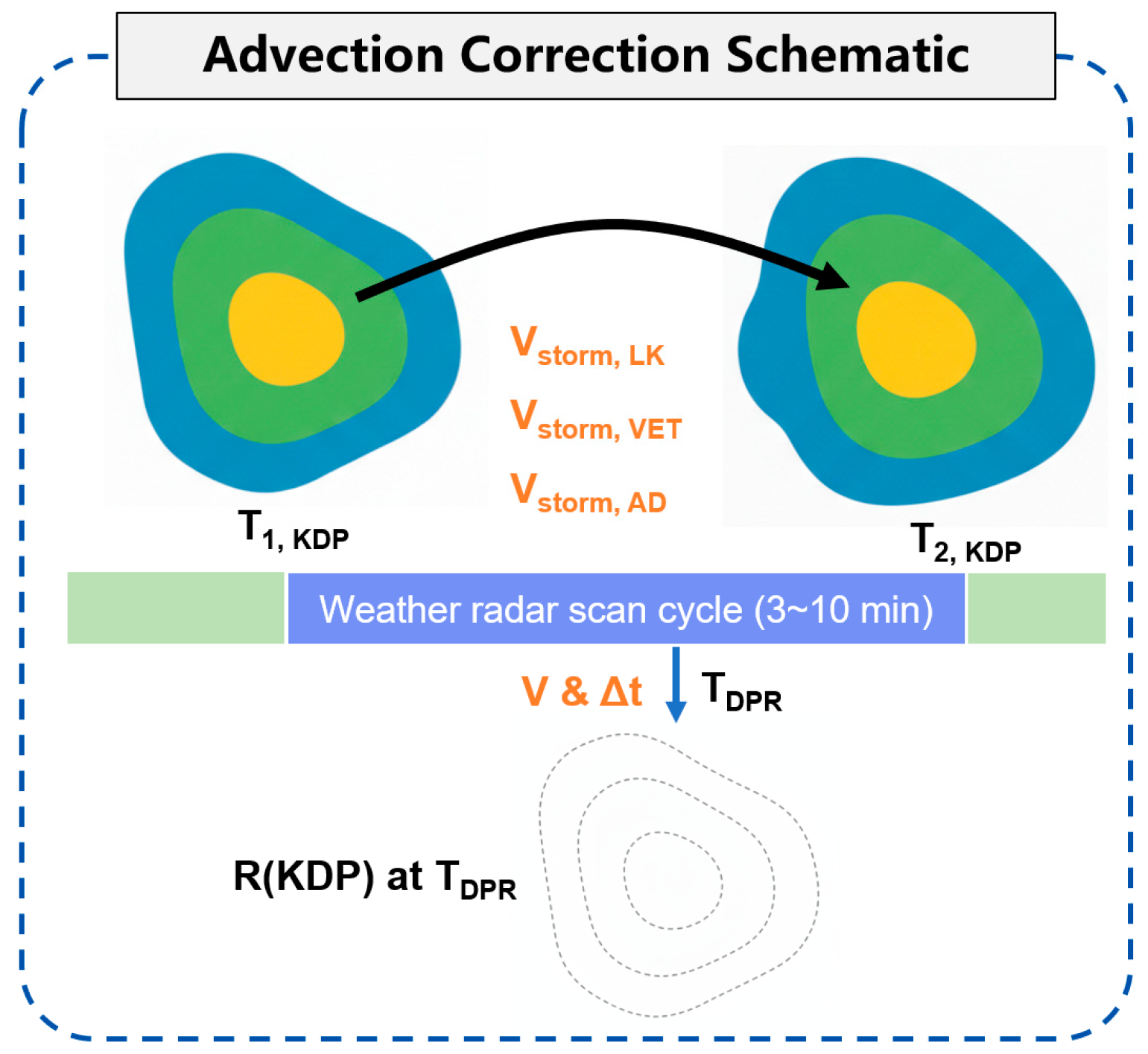
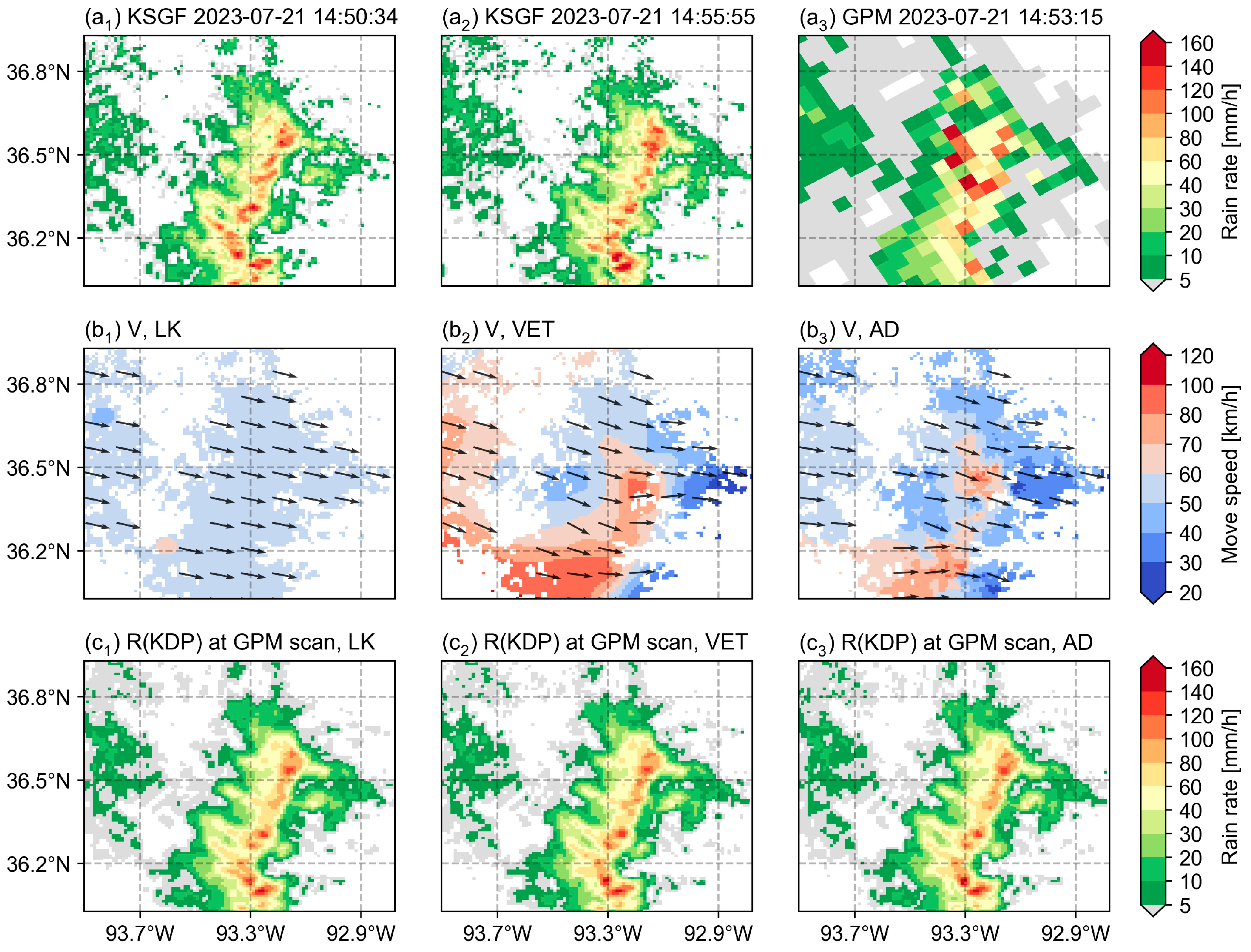
- Advection correction can effectively address the temporal mismatch in multi-source data.
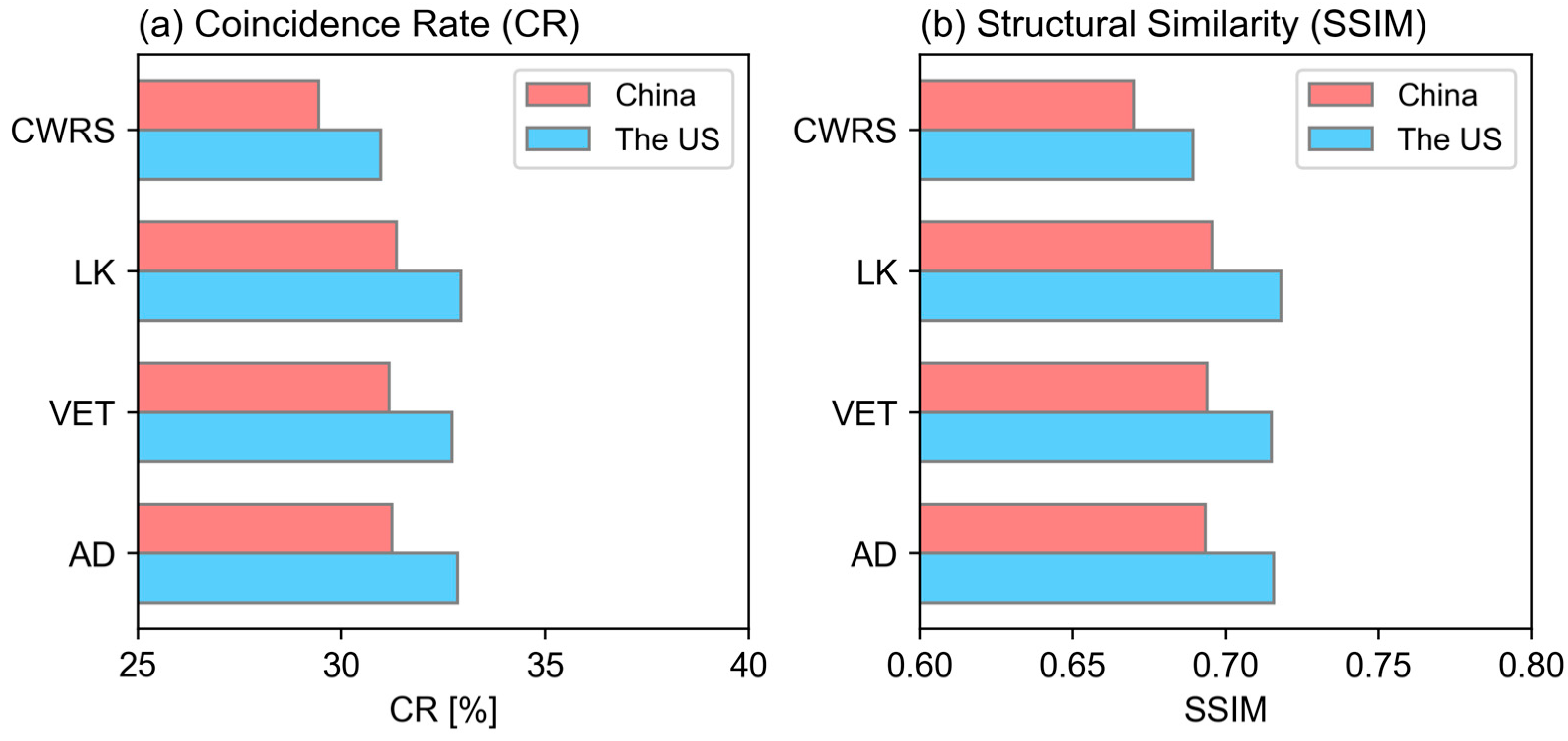
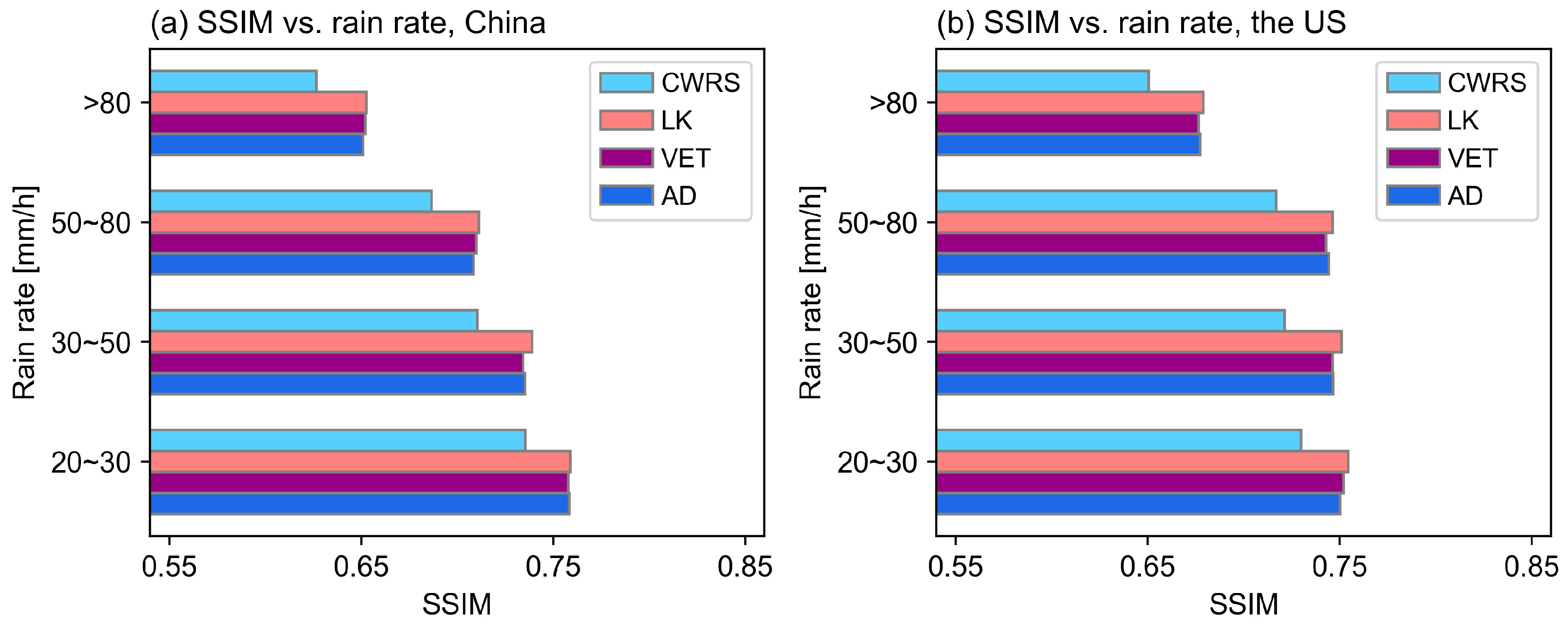
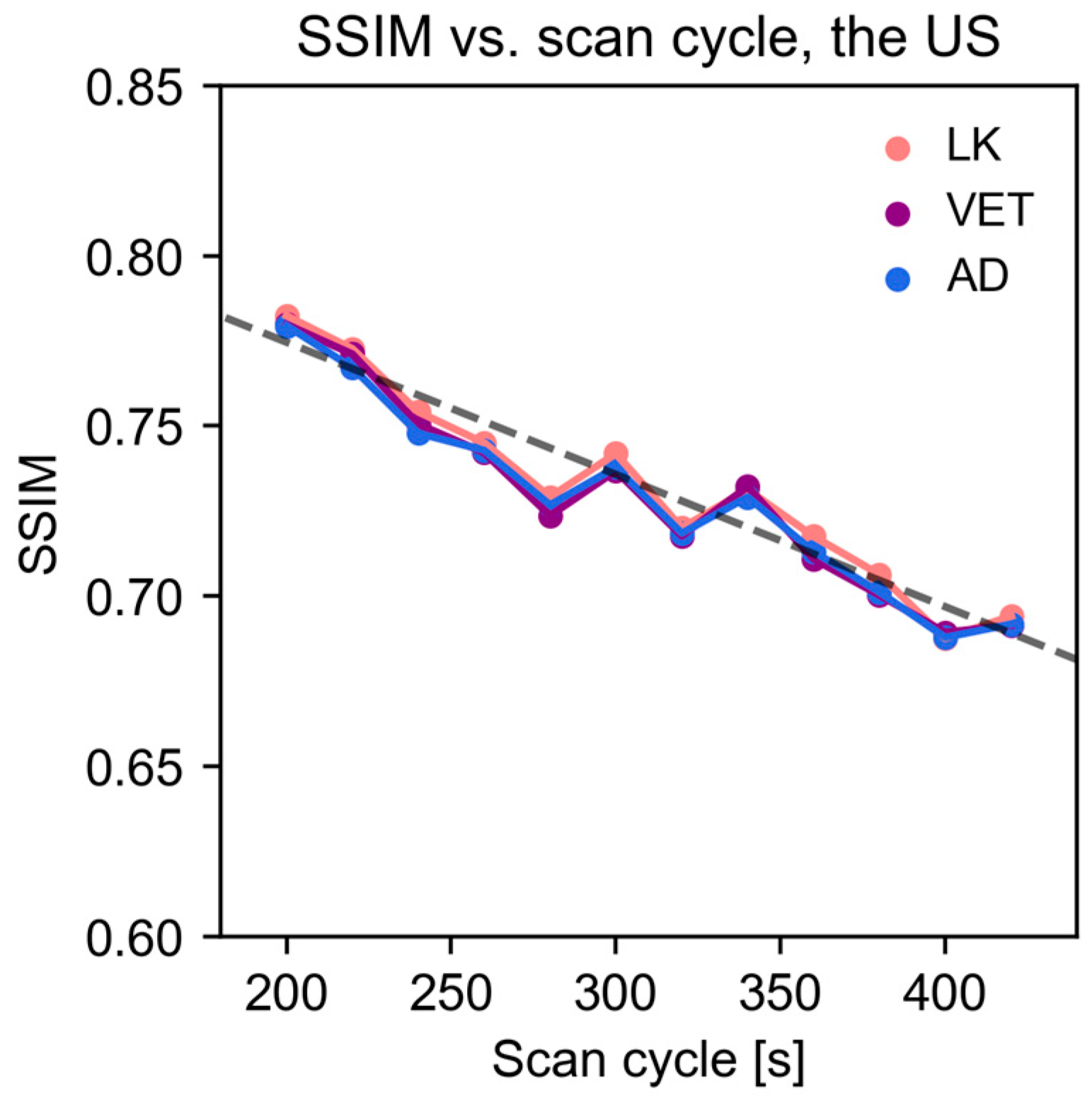
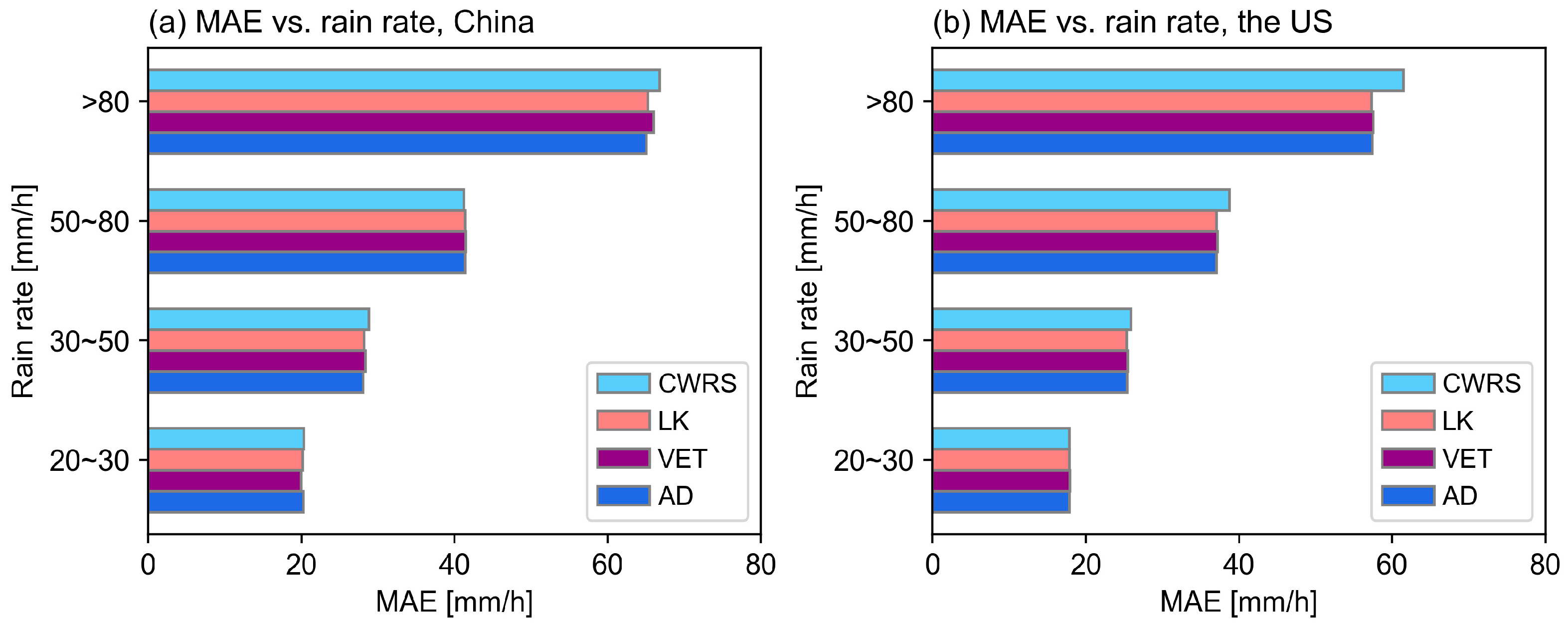
- The performances among the various advection correction methods are similar. Overall, the LK method performs slightly better than AD, followed by VET.
- When studying fast-moving convective storms, temporal mismatch among multi-source instruments should not be ignored.
- The choice of advection correction method has little impact on the performance of temporal matching.
Abstract
1. Introduction
2. Data and Methods
2.1. Polarimetric Rainfall Estimation
2.2. GPM DPR
2.3. Advection Correction
2.4. Evaluation Methodology
3. Results
3.1. Advection Correction for Temporal Match
3.2. Morphological Assessment of Rainfall Storms
3.3. Consistency Between Polarimetric Rainfall Estimates and DPR Retrievals
4. Conclusions and Discussion
Author Contributions
Funding
Data Availability Statement
Acknowledgments
Conflicts of Interest
Appendix A


| Region | Rain Rate | CWRS | LK | VET | AD |
|---|---|---|---|---|---|
| China | 20–30 mm/h | −0.073 | 0.431 | 0.046 | 0.474 |
| 30–50 mm/h | −6.155 | −4.754 | −4.506 | −4.960 | |
| 50–80 mm/h | −19.297 | −14.198 | −14.772 | −14.881 | |
| >80 mm/h | −43.231 | −37.262 | −39.648 | −36.374 | |
| The US | 20–30 mm/h | −5.266 | −3.412 | −3.562 | −3.680 |
| 30–50 mm/h | −11.648 | −10.424 | −10.408 | −10.490 | |
| 50–80 mm/h | −27.204 | −25.055 | −25.258 | −25.202 | |
| >80 mm/h | −51.391 | −44.970 | −45.865 | −45.445 |
References
- Ma, J.; Hu, Z.; Yang, M.; Li, S. Improvement of x-band polarization radar melting layer recognition by the bayesian method and its impact on hydrometeor classification. Adv. Atmos. Sci. 2020, 37, 105–116. [Google Scholar] [CrossRef] [Scilit]
- Hu, Z.; Liu, L.; Wu, L.; Wei, Q. A comparison of de-noising methods for differential phase shift and associated rainfall estimation. J. Meteorol. Res. 2015, 29, 315–327. [Google Scholar] [CrossRef] [Scilit]
- Ryzhkov, A.V.; Giangrande, S.E.; Schuur, T.J. Rainfall estimation with a polarimetric prototype of wsr-88d. J. Appl. Meteorol. 2005, 44, 502–515. [Google Scholar] [CrossRef] [Scilit]
- Bringi, V.N.; Seliga, T.A.; Aydin, K. Hail detection with a differential reflectivity radar. Science 1984, 225, 1145–1147. [Google Scholar] [CrossRef] [Scilit]
- Brandes, E.A.; Zhang, G.; Vivekanandan, J. Experiments in rainfall estimation with a polarimetric radar in a subtropical environment. J. Appl. Meteorol. 2002, 41, 674–685. [Google Scholar] [CrossRef] [Scilit]
- Ryzhkov, A.V.; Schuur, T.J.; Burgess, D.W.; Heinselman, P.L.; Giangrande, S.E.; Zrnic, D.S. The joint polarization experiment: Polarimetric rainfall measurements and hydrometeor classification. Bull. Am. Meteorol. Soc. 2005, 86, 809–824. [Google Scholar] [CrossRef] [Scilit]
- Chen, J.-Y.; Trömel, S.; Ryzhkov, A.; Simmer, C. Assessing the benefits of specific attenuation for quantitative precipitation estimation with a c-band radar network. J. Hydrometeorol. 2021, 22, 2617–2631. [Google Scholar] [CrossRef] [Scilit]
- Li, H.; Yin, J.; Kumjian, M. Z backwards arc: Evidence of multi-directional size sorting in the storm producing 201.9 mm hourly rainfall. Geophys. Res. Lett. 2024, 51, e2024GL109192. [Google Scholar] [CrossRef] [Scilit]
- Li, H.; Moisseev, D.; Luo, Y.; Liu, L.; Ruan, Z.; Cui, L.; Bao, X. Assessing specific differential phase (KDP)-based quantitative precipitation estimation for the record- breaking rainfall over Zhengzhou city on 20 July 2021. Hydrol. Earth Syst. Sci. 2023, 27, 1033–1046. [Google Scholar] [CrossRef] [Scilit]
- Figueras i Ventura, J.; Tabary, P. The new french operational polarimetric radar rainfall rate product. J. Appl. Meteorol. Climatol. 2013, 52, 1817–1835. [Google Scholar] [CrossRef] [Scilit]
- Zhang, J.; Howard, K.; Langston, C.; Vasiloff, S.; Kaney, B.; Arthur, A.; Van Cooten, S.; Kelleher, K.; Kitzmiller, D.; Ding, F.; et al. National mosaic and multi-sensor QPE (NMQ) system: Description, results, and future plans. Bull. Am. Meteorol. Soc. 2011, 92, 1321–1338. [Google Scholar] [CrossRef] [Scilit]
- Hou, A.Y.; Kakar, R.K.; Neeck, S.; Azarbarzin, A.A.; Kummerow, C.D.; Kojima, M.; Oki, R.; Nakamura, K.; Iguchi, T. The global precipitation measurement mission. Bull. Am. Meteorol. Soc. 2014, 95, 701–722. [Google Scholar] [CrossRef] [Scilit]
- Huang, X.; Wu, Z.; Xie, Y.; Zhang, Y.; Zhang, L.; Zheng, H.; Xiao, W. Precipitation microphysics of locally-originated typhoons in the south China sea based on GPM satellite observations. Remote Sens. 2023, 15, 2657. [Google Scholar] [CrossRef] [Scilit]
- Zhang, Y.; Wu, Z.; Zhang, L.; Zheng, H. A comparison of spectral bin microphysics versus bulk parameterization in forecasting typhoon in-fa (2021) before, during, and after its landfall. Remote Sens. 2022, 14, 2169. [Google Scholar] [CrossRef] [Scilit]
- Crisologo, I.; Warren, R.A.; Mühlbauer, K.; Heistermann, M. Enhancing the consistency of spaceborne and ground-based radar comparisons by using beam blockage fraction as a quality filter. Atmos. Meas. Tech. 2018, 11, 5223–5236. [Google Scholar] [CrossRef] [Scilit]
- Keem, M.; Seo, B.-C.; Krajewski, W.F.; Morris, K.R. Inter-comparison of reflectivity measurements between GPM DPR and NEXRAD radars. Atmos. Res. 2019, 226, 49–65. [Google Scholar] [CrossRef] [Scilit]
- Biswas, S.K.; Chandrasekar, V. Cross-validation of observations between the GPM dual-frequency precipitation radar and ground based dual-polarization radars. Remote Sens. 2018, 10, 1773. [Google Scholar] [CrossRef] [Scilit]
- Petracca, M.; D’aDderio, L.P.; Porcù, F.; Vulpiani, G.; Sebastianelli, S.; Puca, S. Validation of gpm dual-frequency precipitation radar (DPR) rainfall products over Italy. J. Hydrometeorol. 2018, 19, 907–925. [Google Scholar] [CrossRef] [Scilit]
- Anagnostou, E.N.; Krajewski, W.F. Real-time radar rainfall estimation. Part I: Algorithm formulation. J. Atmos. Ocean. Technol. 1999, 16, 189–197. [Google Scholar] [CrossRef] [Scilit]
- Reimel, K.J.; Kumjian, M. Evaluation of KDP estimation algorithm performance in rain using a known-truth framework. J. Atmos. Ocean. Technol. 2021, 38, 587–605. [Google Scholar] [CrossRef] [Scilit]
- Aldana, M.; Pulkkinen, S.; von Lerber, A.; Kumjian, M.R.; Moisseev, D. Benchmarking KDP in rainfall: A quantitative assessment of estimation algorithms using c-band weather radar observations. Atmos. Meas. Tech. 2025, 18, 793–816. [Google Scholar] [CrossRef] [Scilit]
- Giangrande, S.E.; Ryzhkov, A.V. Calibration of dual-polarization radar in the presence of partial beam blockage. J. Atmos. Ocean. Technol. 2005, 22, 1156–1166. [Google Scholar] [CrossRef] [Scilit]
- Ryzhkov, A.; Zhang, P.; Bukovčić, P.; Zhang, J.; Cocks, S. Polarimetric radar quantitative precipitation estimation. Remote Sens. 2022, 14, 1695. [Google Scholar] [CrossRef] [Scilit]
- Wang, Y.; Chandrasekar, V. Algorithm for estimation of the specific differential phase. J. Atmos. Ocean. Technol. 2009, 26, 2565–2578. [Google Scholar] [CrossRef] [Scilit]
- Melnikov, V.; Zrnić, D.; Mirković, D. Impacts of the differential phase of incident waves on the polarimetric variables from hail. IEEE Trans. Geosci. Remote Sens. 2024, 62, e2024GL109192. [Google Scholar] [CrossRef] [Scilit]
- Ryzhkov, A.V.; Kumjian, M.R.; Ganson, S.M.; Khain, A.P. Polarimetric radar characteristics of melting hail. Part I: Theoretical Simulations Using Spectral Microphysical Modeling. J. Appl. Meteorol. Clim. 2013, 52, 2849–2870. [Google Scholar] [CrossRef] [Scilit]
- Helmus, J.J.; Collis, S.M. The python arm radar toolkit (Py-ART), a library for working with weather radar data in the python programming language. J. Open Res. Softw. 2016, 4, 25. [Google Scholar] [CrossRef] [Scilit]
- Bolek, A.; Testik, F.Y. Rainfall microphysics influenced by strong wind during a tornadic storm. J. Hydrometeorol. 2022, 23, 733–746. [Google Scholar] [CrossRef] [Scilit]
- CMSA 0013 2019; The Grade of Rainfall in Short Time Weather Service. China Meteorological Service Association: Beijing, China, 2019.
- Hamada, A.; Takayabu, Y.N. Improvements in detection of light precipitation with the global precipitation measurement dual-frequency precipitation radar (GPM DPR). J. Atmos. Ocean. Technol. 2016, 33, 653–667. [Google Scholar] [CrossRef] [Scilit]
- Chase, R.J.; Nesbitt, S.W.; McFarquhar, G.M. A dual-frequency radar retrieval of two parameters of the snowfall particle size distribution using a neural network. J. Appl. Meteorol. Climatol. 2021, 60, 341–359. [Google Scholar] [CrossRef] [Scilit]
- Iguchi, T.; Seto, S.; Meneghini, R.; Yoshida, N.; Awaka, J.; Le, M.; Chandrasekar, V.; Kubota, T. GPM/DPR Level-2 Algorithm Theoretical Basis Document; NASA Goddard Space Flight Center: Greenbelt, MD, USA, 2010. [Google Scholar]
- Alfarano, A.; Maiano, L.; Papa, L.; Amerini, I. Estimating optical flow: A comprehensive review of the state of the art. Comput. Vis. Image Underst. 2024, 249, 104160. [Google Scholar] [CrossRef] [Scilit]
- Lucas, B.D.; Kanade, T. An iterative image registration technique with an application to stereo vision. In Proceedings of the International Joint Conference on Artificial Intelligence, Vancouver, BC, Canada, 24–28 August 1981. [Google Scholar]
- Germann, U.; Zawadzki, I. Scale-dependence of the predictability of precipitation from continental radar images. Part I: Description of the methodology. Weather Rev. 2002, 130, 2859–2873. [Google Scholar] [CrossRef] [Scilit]
- Laroche, S.; Zawadzki, I. Retrievals of horizontal winds from single-doppler clear-air data by methods of cross correlation and variational analysis. J. Atmos. Ocean. Technol. 1995, 12, 721–738. [Google Scholar] [CrossRef] [Scilit]
- Proesmans, M.; Van Gool, L.; Pauwels, E.; Oosterlinck, A. Determination of Optical Flow and its Discontinuities Using Non-Linear Diffusion. In Proceedings of the European Conference on Computer Vision—ECCV ’94, Stockholm, Sweden, 2–6 May 1994; Eklundh, J.-O., Ed.; Springer: Berlin/Heidelberg, Germany, 1994; pp. 294–304. [Google Scholar]
- Zhou, W.; Bovik, A.C.; Sheikh, H.R.; Simoncelli, E.P. Image quality assessment: From error visibility to structural similarity. IEEE Trans. Image Process. 2004, 13, 600–612. [Google Scholar] [CrossRef] [Scilit]
- Bessho, K.; Date, K.; Hayashi, M.; Ikeda, A.; Imai, T.; Inoue, H.; Kumagai, Y.; Miyakawa, T.; Murata, H.; Ohno, T.; et al. An introduction to himawari-8/9—Japan’s new-generation geostationary meteorological satellites. J. Meteorol. Soc. Japan. Ser. II 2016, 94, 151–183. [Google Scholar] [CrossRef] [Scilit]
- Schmit, T.J.; Griffith, P.; Gunshor, M.M.; Daniels, J.M.; Goodman, S.J.; Lebair, W.J. A closer look at the abi on the goes-r series. Bull. Am. Meteorol. Soc. 2017, 98, 681–698. [Google Scholar] [CrossRef] [Scilit]



| Radar Network | CINRAD | NEXRAD |
|---|---|---|
| Band | S-band | S-band |
| Peak power | 650 to 750 kW | 650 to 750 kW |
| Range resolution | 250 m | 250 m |
| Azimuth | 0 to 360 deg | 0 to 360 deg |
| Azimuth resolution | 1 deg | 1 deg |
| Elevation | Typical 0.5 to 19.5 deg | Typical 0.5 to 19.5 deg |
| Positioning error | ±0.05 deg | ±0.22 deg |
| Time resolution | 6 min | 3 to 10 min |
| Band | Ku-Band | Ka-Band |
|---|---|---|
| Frequency | 13.6 GHz | 35.547 GHz |
| Orbit height | 407 km | 407 km |
| Beam number | 49 normal scans | 25 matched and 24 interlaced scans |
| Spatial resolution | 5 km | 5 km |
| Swath width | 245 km | 120/245 km |
| Observable range | Surface to 20 km height | Surface to 20 km height |
| Range resolution | 250 m | 250/500 m |
| Sensitivity | 0.5 mm·h−1 | 0.2 mm·h−1 |
| Region | Index | CWRS | LK | VET | AD |
|---|---|---|---|---|---|
| The US | CC | 0.243 | 0.251 | 0.249 | 0.250 |
| RMSE | 35.71 | 35.52 | 35.69 | 35.51 | |
| MAE | 18.79 | 18.31 | 18.42 | 18.34 | |
| China | CC | 0.296 | 0.309 | 0.303 | 0.307 |
| RMSE | 39.51 | 39.45 | 39.68 | 39.38 | |
| MAE | 21.45 | 21.22 | 21.36 | 21.22 |
Disclaimer/Publisher’s Note: The statements, opinions and data contained in all publications are solely those of the individual author(s) and contributor(s) and not of MDPI and/or the editor(s). MDPI and/or the editor(s) disclaim responsibility for any injury to people or property resulting from any ideas, methods, instructions or products referred to in the content. |
© 2026 by the authors. Licensee MDPI, Basel, Switzerland. This article is an open access article distributed under the terms and conditions of the Creative Commons Attribution (CC BY) license.
Share and Cite
Kuang, Y.; Li, H. Improving the Data Consistency Between GPM and Weather Radar with Advection Correction. Remote Sens. 2026, 18, 782. https://doi.org/10.3390/rs18050782
Kuang Y, Li H. Improving the Data Consistency Between GPM and Weather Radar with Advection Correction. Remote Sensing. 2026; 18(5):782. https://doi.org/10.3390/rs18050782
Chicago/Turabian StyleKuang, Yijia, and Haoran Li. 2026. "Improving the Data Consistency Between GPM and Weather Radar with Advection Correction" Remote Sensing 18, no. 5: 782. https://doi.org/10.3390/rs18050782
APA StyleKuang, Y., & Li, H. (2026). Improving the Data Consistency Between GPM and Weather Radar with Advection Correction. Remote Sensing, 18(5), 782. https://doi.org/10.3390/rs18050782