1. Introduction
Angular dependence is one of the major effects in remote sensing science, whereby the measured reflectance varies with illumination and viewing geometry [
1]. Such angular dependence plays a critical role in radiometric calibration [
2], the characterization and inversion of surface structural and biophysical properties from multi-angle observations [
3,
4]. Ignoring angular effects can lead to systematic inconsistencies when comparing reflectance measurements acquired under different geometric conditions.
To describe and quantify these angular effects, a number of reflectance functions have been developed, among which the bidirectional reflectance distribution function (BRDF) is the most fundamental. Formally defined by Nicodemus et al. [
5], the BRDF is the ratio of reflected radiance in a given viewing direction to incident irradiance from a given illumination direction, and it provides a description of surface reflectance anisotropy [
1]. In practical remote sensing applications, the BRDF and its derived quantities form the theoretical basis for modeling angular reflectance behavior [
6]. These concepts underpin widely used products, such as NASA’s MODIS BRDF/Albedo dataset [
7], and enable the extraction of information related to surface structure and composition through multi-angle measurements, including vegetation biophysical parameters [
8,
9] and land-cover classification [
10,
11].
The directional reflectance measured in the field should be understood as an integrated response of all visible subcomponents within the sensor’s field of view, rather than the reflectance of a single uniform surface [
12,
13]. The measured HDRF (or HCRF) effectively represents a weighted combination of the reflectance of these subcomponents, where the weights depend on viewing geometry, solar illumination [
14], surface structure [
15], and local visibility conditions [
1,
16]. Consequently, angular variations observed in field-measured reflectance may reflect not only intrinsic scattering properties, but also changes in the effective scene composition sampled by different observation directions.
Despite this understanding, most field-based angular reflectance studies are conducted under moderate solar zenith angles, where illumination conditions are relatively stable [
17,
18]. Angular reflectance behavior under low solar elevation has received far less systematic attention, primarily due to the practical challenges associated with rapidly changing illumination geometry. This lack of field-based reference data is particularly relevant for satellite missions operating under dawn–dusk orbital configurations, such as FY-3E. They also apply to polar-orbiting sensors and high-latitude monitoring missions [
19,
20].
Unmanned aerial vehicles (UAVs) offer a powerful platform for acquiring multi-angle reflectance data in situ [
21]. Their small size and mobility allow rapid deployment and relocation to test sites, and they can operate at altitudes of ~100 m, enabling reflectance retrieval even over tall vegetation or complex terrain [
22]. UAVs can be equipped with diverse sensors (e.g., multispectral cameras, hyperspectral cameras [
23,
24,
25], non-imaging radiometers) [
26] and flown on flexible paths (fixed-altitude hover, variable-altitude loops, crisscross patterns) to sample a wide range of viewing angles. In recent studies, UAV-based multi-angle observations have been employed for vegetation classification and the inversion of canopy parameters such as leaf area index, chlorophyll content, and surface albedo [
27,
28]. These applications demonstrate that UAVs can deliver high-resolution, angle-resolved reflectance data for calibration, validation [
29], and parameter-retrieval tasks in remote sensing [
30,
31].
The choice of remote sensing payload critically affects data quality, angular sampling capability, and temporal consistency in UAV-based multi-angle observations. Snapshot imaging spectrometers capture a two-dimensional spatial image with full spectral information in a single integration, enabling the UAV to hover at a fixed position and acquire a complete spectral–spatial data cube instantaneously. This simplifies multi-angle acquisition by allowing the platform or camera to be reoriented between successive measurements. Multi-angle sampling with push-broom hyperspectral imagers typically relies on changes in platform pitch or flight geometry, making the acquisition more susceptible to variations in solar illumination over the course of a flight. Refs. [
14,
32,
33] show that non-imaging point spectrometers provide another alternative, offering excellent spectral resolution and calibration stability and allowing straightforward integration on small UAVs. Their main limitation lies in the small instantaneous footprint of each measurement, which necessitates repeated maneuvers to build up sufficient angular and spatial sampling. This challenge motivates the development of acquisition strategies capable of rapidly sampling angular reflectance while continuously accounting for illumination variability.
Many existing BRDF retrieval studies implicitly assume that illumination remains constant during the acquisition of multi-angle data. In controlled environments this may be achievable, but outdoor UAV campaigns often experience significant irradiance changes. For example, solar zenith angle continuously changes during even a short flight, and passing clouds can alter, direct and diffuse illumination. These fluctuations can introduce errors in HDRF measurement. It is noted that random variations in solar illumination between successive push-broom image strips lead to inconsistent irradiance levels, thereby degrading the radiometric consistency of BRDF estimation [
14]. In other words, if changing light conditions are not accounted for, the measured HDRF may be biased or noisy. This highlights the need for dynamic irradiance tracking or correction methods in outdoor multi-angle reflectance experiments.
A variety of BRDF models have been developed to describe surface reflectance. Empirical models fit observed data without strict physical constraints [
34], whereas physical models are derived from radiative transfer principles [
35]. A popular class is the kernel-driven (semi-empirical) models: these express the BRDF as a weighted sum of basis functions (kernels) that represent distinct scattering modes [
36,
37]. For instance, the widely used Ross–Li model combines a volumetric (“Ross”) kernel and a geometric (“Li-sparse”) kernel to capture diffuse canopy scattering and the bright backscatter hotspot respectively [
38]. Such models allow efficient inversion of kernel weights from multi-angle data [
37]. However, nearly all conventional BRDF models assume a single illumination source (the sun). Scenarios with multi-source illumination are seldom treated explicitly. This is a gap especially relevant to our study, as it affects how HDRF is interpreted when additional light sources are present.
The main focus of this study is to demonstrate a practical strategy for acquiring high-angular-resolution hyperspectral HDRF data under complex illumination conditions using a UAV-mounted non-imaging spectrometer. This approach combines the spectral accuracy of ground-based spectrometers with the angular flexibility and rapid coverage of UAV platforms. We apply the method at the Dunhuang Radiometric Calibration Site under low solar elevation and multi-source illumination, generating a dense HDRF dataset across the 400–850 nm range. The directional reflectance patterns are then analyzed and modeled using the Ross–Li BRDF framework to evaluate angular anisotropy and identify secondary illumination effects.
2. Materials and Methods
2.1. Equipment
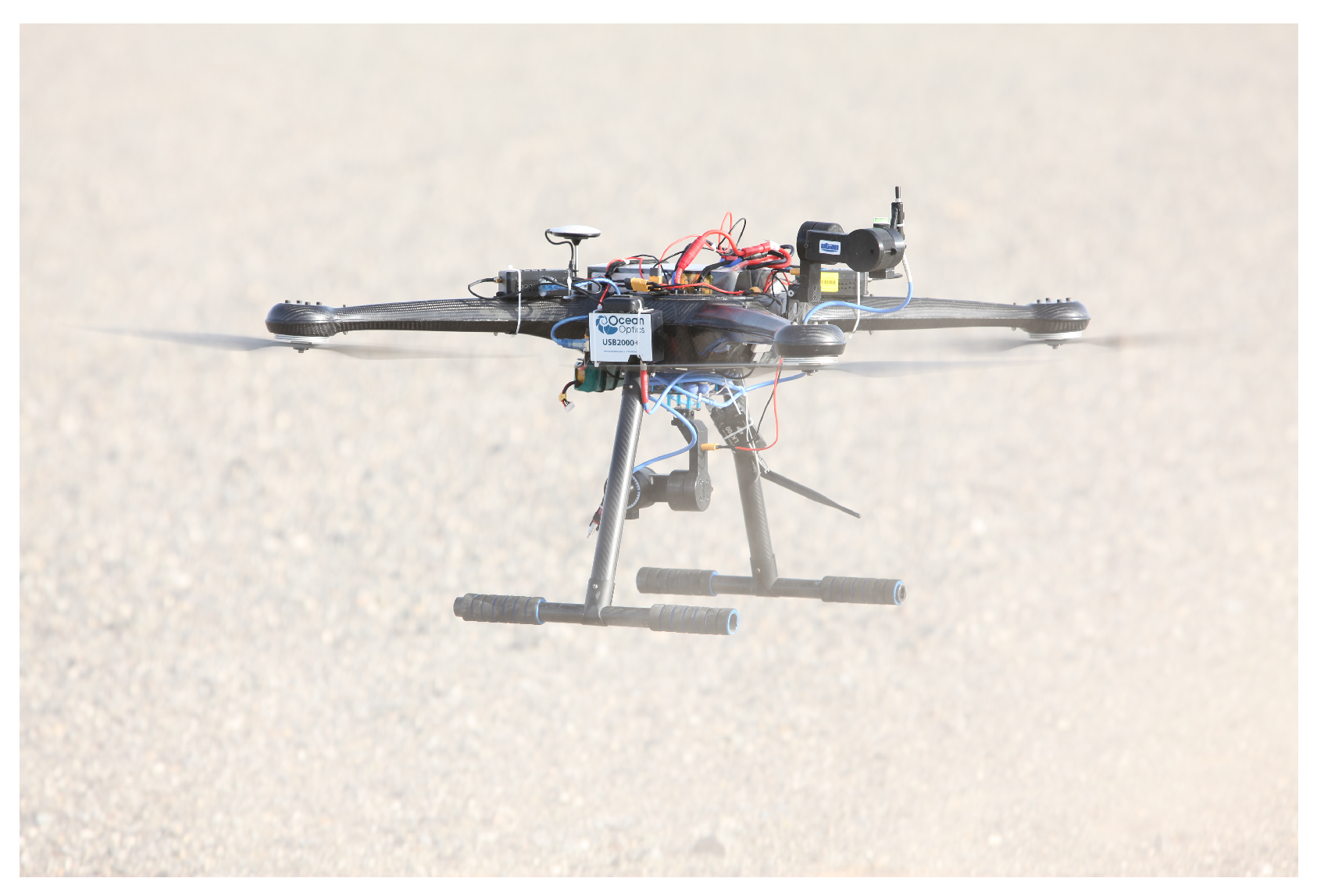
The airborne measurement system used in this study is based on a custom-built multirotor UAV platform (UT-X4850, Hangzhou Utan Technology Co., Ltd., Hangzhou, China), designed to provide stable flight performance and sufficient payload capacity for optical instrumentation (
Figure 1). A custom-stabilized gimbal is mounted beneath the UAV to support nadir-oriented observations. The gimbal allows controlled pitch adjustment from
(horizontal) to
(nadir), enabling flexible viewing geometry while maintaining stable pointing during flight.
Radiance measurements are acquired using a non-imaging fiber optic spectrometer (Ocean Optics USB2000+, Ocean Optics, Inc., Dunedin, FL, USA) mounted on the gimbal via an optical fiber probe (
Figure 2). The spectrometer is physically suspended below the UAV platform to ensure an unobstructed downward field of view. The USB2000+ is a miniature visible–near-infrared spectrometer equipped with a 2048-element CCD array, covering a spectral range of approximately 200–1100 nm with high optical resolution. Its fast readout capability enables continuous spectral sampling during UAV operations.
The spectrometer is interfaced with an onboard computer through a USB connection, which provides both power supply and data communication. A custom data-logging program was developed to control spectrometer operation during flight. This program supports continuous acquisition with automatically adjusted integration time to accommodate changing illumination conditions and prevent detector saturation. Each recorded spectrum is stored together with associated metadata, including UTC timestamp, UAV geographic position, altitude, and integration time, allowing accurate geolocation and subsequent alignment with observation geometry.
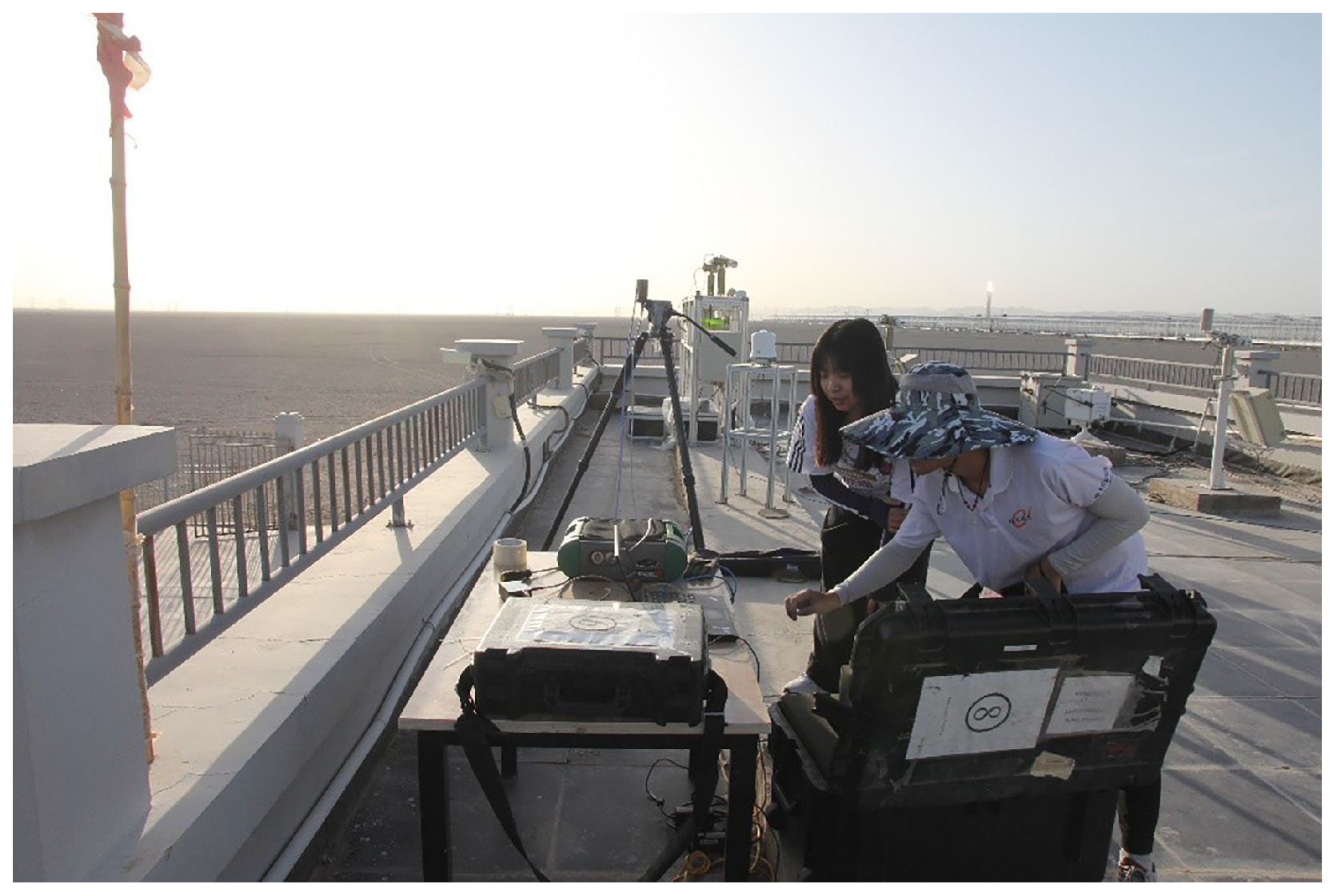
Ground-based reference measurements are obtained using an ASD FieldSpec 4 spectroradiometer (Malvern Panalytical Ltd., Malvern, UK) equipped with a cosine-corrected irradiance probe (Remote Cosine Receptor, RCR), as shown in
Figure 3. This instrument provides high-accuracy measurements of downwelling solar irradiance over a comparable spectral range and serves as an independent reference for radiometric normalization of the airborne observations. Both the UAV-mounted hyperspectral spectrometer and the ground-based ASD FieldSpec 4 irradiance spectrometer were calibrated prior to the field campaign.
UAV flight planning and control are performed using the Mission Planner software (version 1.3.73), which enables waypoint-based mission definition, parameter configuration, and real-time telemetry monitoring. The software provides a unified interface for defining flight paths and managing autonomous execution of measurement missions.
2.2. Theoretical Basis of BRDF and HDRF
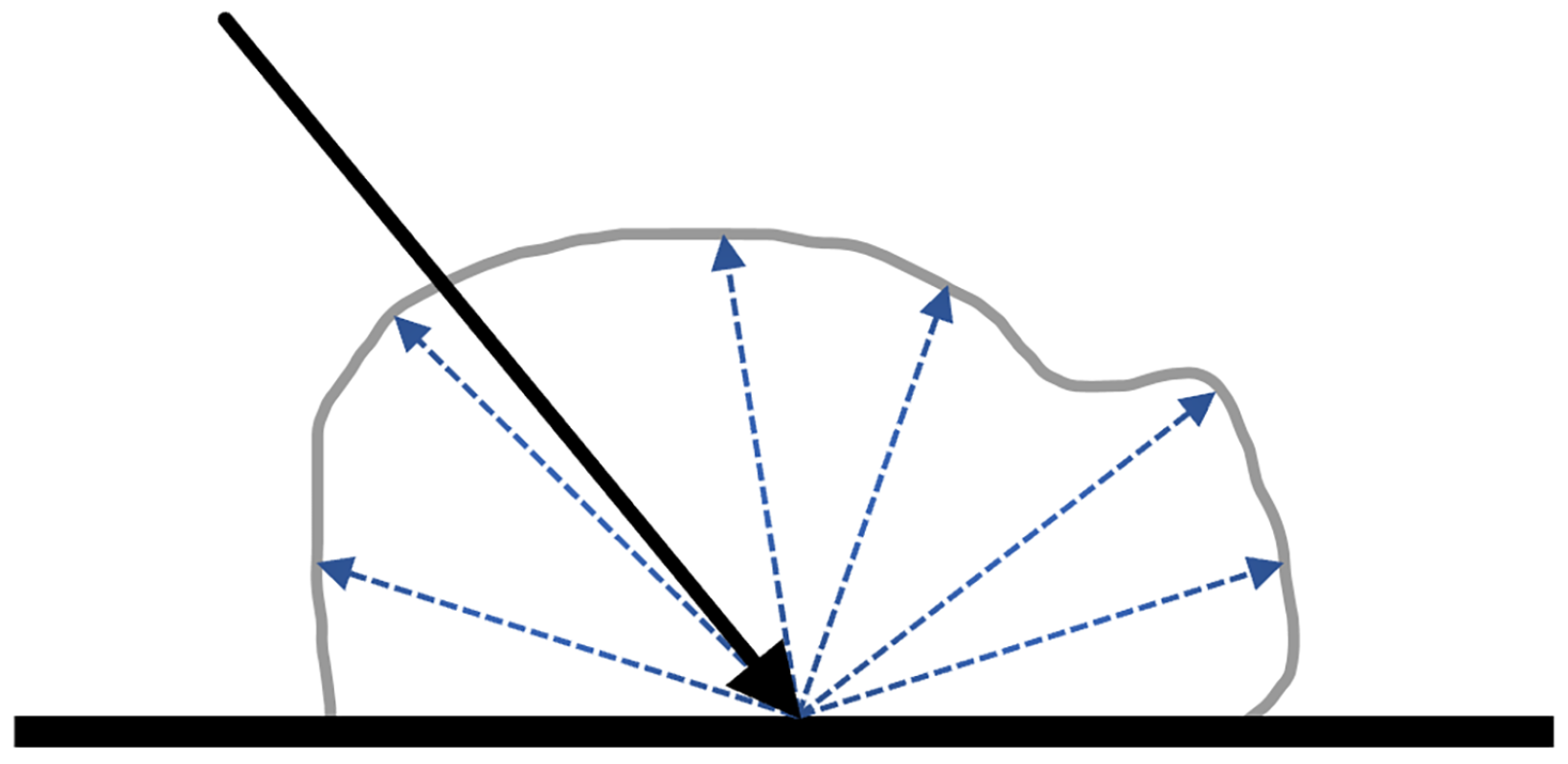
The apparent spectral reflectance of a natural surface is governed by two fundamental components: the intrinsic spectral response of the material and the angular dependence of scattering induced by surface structure. The intrinsic spectral response is determined by the material composition and constituent properties, which define the overall shape of the reflectance spectrum, whereas the angular dependence arises from the geometric arrangement, orientation, and roughness of surface elements, controlling how reflectance varies with illumination and viewing geometry. From a physical perspective, a surface can be conceptualized as an ensemble of microscopic facets, each characterized by its own orientation and local optical response. The reflectance observed in a given direction and wavelength results from the integrated contribution of all visible facets. In this framework, compositional and constituent factors primarily determine the spectral characteristics, while structural factors—such as facet orientation distribution, density, and mutual shadowing—govern the directional anisotropy of reflectance, as illustrated in
Figure 4. This concept can be expressed by representing surface reflectance as a weighted integration over individual surface elements:
where
denotes the apparent reflectance,
represents the reflectance of individual surface elements,
is a structural weighting factor, and
accounts for the angular contribution of each element.
It is formally described by the bidirectional reflectance distribution function (BRDF). The BRDF, denoted as
, is defined as the ratio of reflected radiance in direction
to incident irradiance from direction
on an infinitesimal surface element, as originally formulated by Nicodemus et al. [
5]:
where
and
denote the incident zenith and azimuth angles,
and
are the viewing zenith and azimuth angles,
is the differential incident irradiance, and
is the corresponding differential reflected radiance. The BRDF has units of
and encapsulates the intrinsic optical and structural properties of the surface, including multiple scattering, shadowing, and facet orientation effects. Importantly, the BRDF is an intrinsic surface property: for a given target, it characterizes scattering behavior independently of the external illumination environment.
In practice, direct measurement of the full BRDF under field conditions is extremely challenging. Comprehensive sampling of incident and viewing directions generally requires laboratory-based goniometers or conoscope systems. Consequently, field spectrometric measurements under natural illumination rely on alternative reflectance quantities [
1].
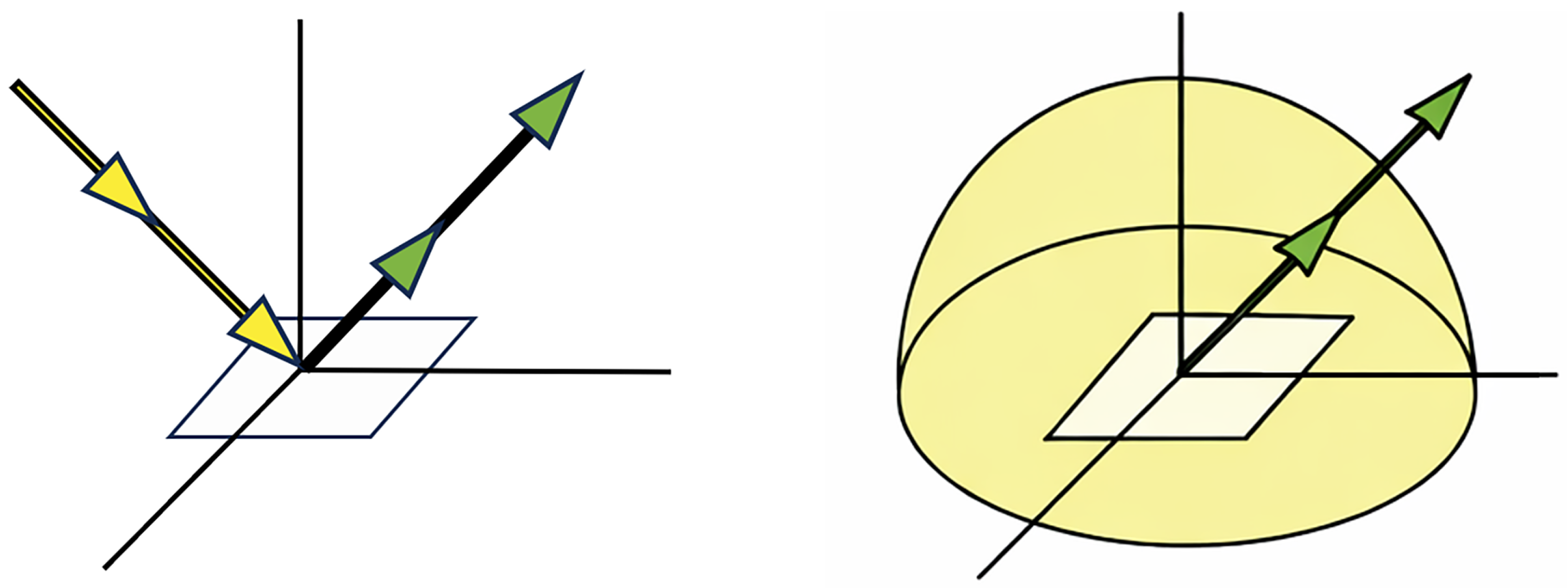
Under natural conditions, the surface is illuminated by the entire sky hemisphere, consisting of direct solar radiation, diffuse skylight, and contributions from the surrounding environment. Reflectance measurements acquired under such conditions are commonly expressed as the hemispherical–directional reflectance factor (HDRF), as illustrated in
Figure 5.
In an HDRF measurement, the incoming irradiance represents the hemispherical integral of all incident radiation over the sky dome, while the outgoing radiance is measured in a specified viewing direction. The HDRF can therefore be expressed as the ratio of directional reflected radiance to hemispherically integrated incident irradiance:
where
denotes the hemispherical incident radiant flux. Mathematically, the HDRF can be derived from the BRDF by integrating the latter over all incident directions in the upper hemisphere:
where the integration is performed over the incident sky hemisphere
, and
is the incident zenith angle.
In practical field measurements, spectrometers collect reflected radiance over a finite solid angle defined by the instrument field of view. The measured quantity is therefore more precisely described as the hemispherical–conical reflectance factor (HCRF), which represents an angular average of the HDRF over the viewing cone. When the sensor field of view is sufficiently small and surface reflectance varies smoothly with angle, the HCRF can be well approximated by the HDRF. In this study, the measured reflectance quantities are treated as HDRF under this commonly adopted approximation.
2.3. Measurement Principles for HDRF Acquisition
Practical UAV-based reflectance measurements differ fundamentally from the idealized BRDF formalism. Under natural illumination conditions, the true BRDF cannot be directly observed, as the surface is illuminated by the entire sky hemisphere rather than by a single collimated beam. Consequently, field measurements yield an HDRF (or more precisely an HCRF), which characterizes surface reflectance under hemispherical illumination and finite-view observation.
The first requirement is temporal consistency between downwelling irradiance and target-leaving radiance. This is achieved through a dual-spectrometer strategy, in which one instrument continuously measures downwelling irradiance while a second instrument simultaneously records reflected radiance from the target. Time synchronization ensures that each radiance spectrum is paired with a contemporaneous irradiance measurement.
The second requirement is spatial consistency of irradiance sampling. The irradiance sensor must observe an illumination field that is representative of that incident on the target area. This is ensured by positioning the irradiance sensor on level ground with an unobstructed hemispherical view of the sky.
Accurate HDRF characterization further requires an appropriate angular sampling strategy. By maintaining a constant viewing zenith angle while continuously varying the azimuth, the UAV system densely samples the directional dependence of reflectance. Repeating this procedure at multiple zenith angles enables systematic coverage of angular reflectance behavior.
Another important principle is radiometric linearity control. During UAV operations, reflected radiance levels can vary substantially with viewing geometry and surface properties. The spectrometer integration time is therefore adjusted dynamically to ensure that measurements remain within the linear operating range of the detector.
Together, these principles—temporal synchronization, spatially representative irradiance sampling, dense angular acquisition, and dynamic radiometric control—form the basis for reliable UAV-based HDRF measurements.
2.4. Test Site
The Dunhuang Radiometric Calibration Site (DRCS), located in northwestern China, was selected as the test site for the UAV-based hyperspectral HDRF measurements (
Figure 6). The site is situated on the alluvial fan of the Danghe River, approximately 20 km northwest of Dunhuang City, Gansu Province, China. The designated calibration area covers approximately 30 km × 30 km, with a central 500 m × 500 m core test region, and is located between latitudes 40.04–40.28°N and longitudes 94.17–94.50°E. The site lies at an elevation of about 1160 m above sea level and is characterized by extremely flat terrain.
The surface of the DRCS is remarkably homogeneous, consisting predominantly of uniformly distributed gravel and small pebbles with typical diameters ranging from approximately 0.2 to 8 cm. Fine-grained soil and vegetation cover are minimal. Owing to its uniform surface texture and near-Lambertian reflectance behavior, the site is well suited for radiometric calibration and angular reflectance studies.
Climatologically, the DRCS is located in an arid desert environment with consistently clear and stable atmospheric conditions. The region experiences very low annual precipitation (on the order of 40 mm) and long sunshine duration exceeding 3200 h per year. During the measurement campaign, atmospheric conditions were dry and cloud-free, with aerosol optical depth values typically in the range of 0.1–0.2 in the absence of dust events. Such conditions provide stable illumination and low atmospheric variability, which are favorable for precise radiometric measurements [
39].
The DRCS is a nationally recognized radiometric benchmark site widely used for satellite calibration activities in China. It is routinely employed by the China Centre for Resources Satellite Data and Application (CRESDA) for in situ calibration and validation, with official calibration coefficients released for multiple spaceborne sensors [
40,
41], including GaoFen-1 (WFV and PMS) [
42], GaoFen-2 (PMS), GaoFen-4 (VNIR), GaoFen-6 (WFV and PMS), and HJ-1 CCD [
43] instruments. As a long-term invariant target, the site serves as a common reference for absolute calibration, inter-sensor cross-calibration, and monitoring of radiometric stability over time.
The UAV-based field campaign reported in this study was conducted at the DRCS on 18 December 2020 under clear-sky conditions. The center of the measurement area was located at approximately 40.0915°N, 94.3957°E. A total of six UAV flights were performed using the same airborne platform and hyperspectral sensor system. The flights were conducted sequentially during the afternoon, from approximately 15:30 to 17:10 local time (UTC+8), covering progressively increasing solar zenith angles as the sun descended. This coordinated measurement strategy ensured consistent surface conditions and enabled the acquisition of directional reflectance data under stable and repeatable illumination geometries.
2.5. Data Acquisition Scheme
The field campaign was conducted using a UAV-based multi-angle observation protocol designed to acquire hyperspectral HDRF measurements under controlled viewing geometry. Circular flight paths were predefined using the Mission Planner software, allowing the UAV to orbit around a fixed ground reference point while maintaining a constant viewing zenith angle. Each mission was uploaded to the UAV prior to takeoff and executed autonomously. The predefined circular flight paths ensured stable observation geometry and repeatable angular sampling during the acquisition process (
Figure 7).
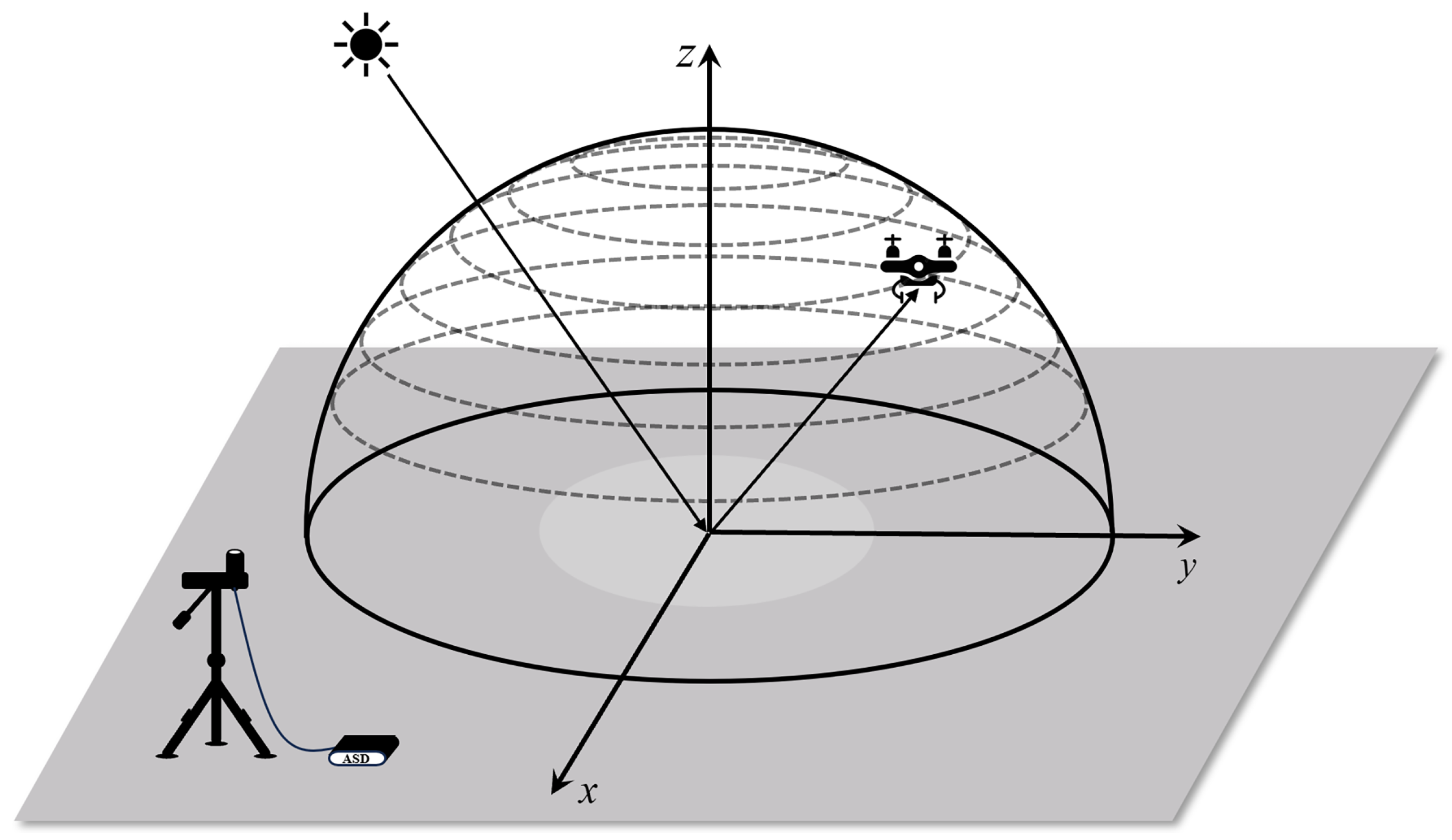
A total of six flight missions were carried out, corresponding to nominal viewing zenith angles of 10°, 20°, 30°, 40°, 50°, and 60°, respectively. For each viewing configuration, the UAV completed three full circular orbits at constant altitude and gimbal pitch, ensuring stable geometry throughout the acquisition. By maintaining a fixed viewing zenith angle while continuously varying the azimuth from 0° to 360°, the system achieved dense azimuthal sampling at each zenith angle. Repeating this procedure at multiple zenith angles enabled systematic sampling of the directional reflectance field under hemispherical illumination. A schematic illustration of the multi-angle observation geometry is shown in
Figure 8.
During each flight, hyperspectral radiance measurements were continuously recorded at 100 ms intervals using the UAV-mounted spectrometer described in
Section 2.1. Prior to each flight, the spectrometer was preheated to ensure thermal stabilization, and a dark current reference was collected by fully covering the fiber optic input. In-flight dark current behavior was further tracked using masked detector pixels. The spectrometer integration time was dynamically adjusted to maintain the recorded signal within the linear radiometric response range.
Simultaneously, downwelling solar irradiance was measured on the ground using an ASD FieldSpec 4 spectroradiometer equipped with a cosine-corrected receptor. The instrument was preheated for at least 30 min prior to data acquisition to ensure thermal stability. Irradiance measurements were acquired at approximately 1 s intervals and temporally interpolated to match the timestamps of the UAV spectra, ensuring temporal consistency between radiance and irradiance measurements for HDRF estimation.
The full campaign was conducted on 18 December 2020 between approximately 15:35 and 17:10 local time (UTC+8), during which the solar zenith angle increased as the sun approached the horizon. The six flight missions were performed sequentially under clear-sky conditions, allowing directional reflectance measurements to be acquired under comparable surface conditions while sampling a range of solar geometries. Key parameters of the six UAV flight missions, including flight time, altitude, viewing zenith angle, sampling density, and solar zenith angle range, are summarized in
Table 1.
3. Results
3.1. Overview of Acquired HDRF Dataset
This study produced a comprehensive multi-angular hyperspectral dataset characterizing the hemispherical–directional reflectance factor (HDRF) over a uniform desert calibration site. The measurements span the 400–850 nm spectral range with an effective spectral resolution of approximately 1.5 nm. Six UAV flight missions were conducted, each corresponding to a predefined viewing zenith angle (VZA) of 10°, 20°, 30°, 40°, 50°, and 60°. During each mission, the UAV performed a circular flight centered on the test site while the onboard hyperspectral sensor continuously recorded radiance measurements at a sampling interval of 100 ms.
The number of collected radiance spectra varied slightly among flights due to differences in flight duration and UAV speed. Approximately 1200 samples were acquired for the 10° VZA, and 2100, 1500, 900, 1400, and 1800 samples were obtained for the 20°, 30°, 40°, 50°, and 60° VZAs, respectively. As illustrated in
Figure 9, the resulting directional density distributions provide dense and nearly complete azimuthal coverage for all VZAs, ensuring the angular completeness required for reliable HDRF and BRDF characterization.
Ground-level downward irradiance was continuously measured throughout the experiment using an ASD FieldSpec 4 spectroradiometer equipped with a cosine-corrected receptor. As shown in
Figure 10, the absolute irradiance gradually decreased from approximately 15:35 to 17:10 local time as the solar elevation angle declined. This attenuation, however, does not compromise the radiometric consistency of the dataset, as the irradiance measurements were temporally interpolated from their native 1 s sampling interval to match the UAV sensor’s ∼100 ms timestamps and subsequently used to normalize the radiance data. The HDRF for each direction was calculated as the ratio of radiance to the corresponding interpolated irradiance, ensuring that the derived reflectance values remain insensitive to temporal illumination changes and predominantly reflect surface bidirectional properties.
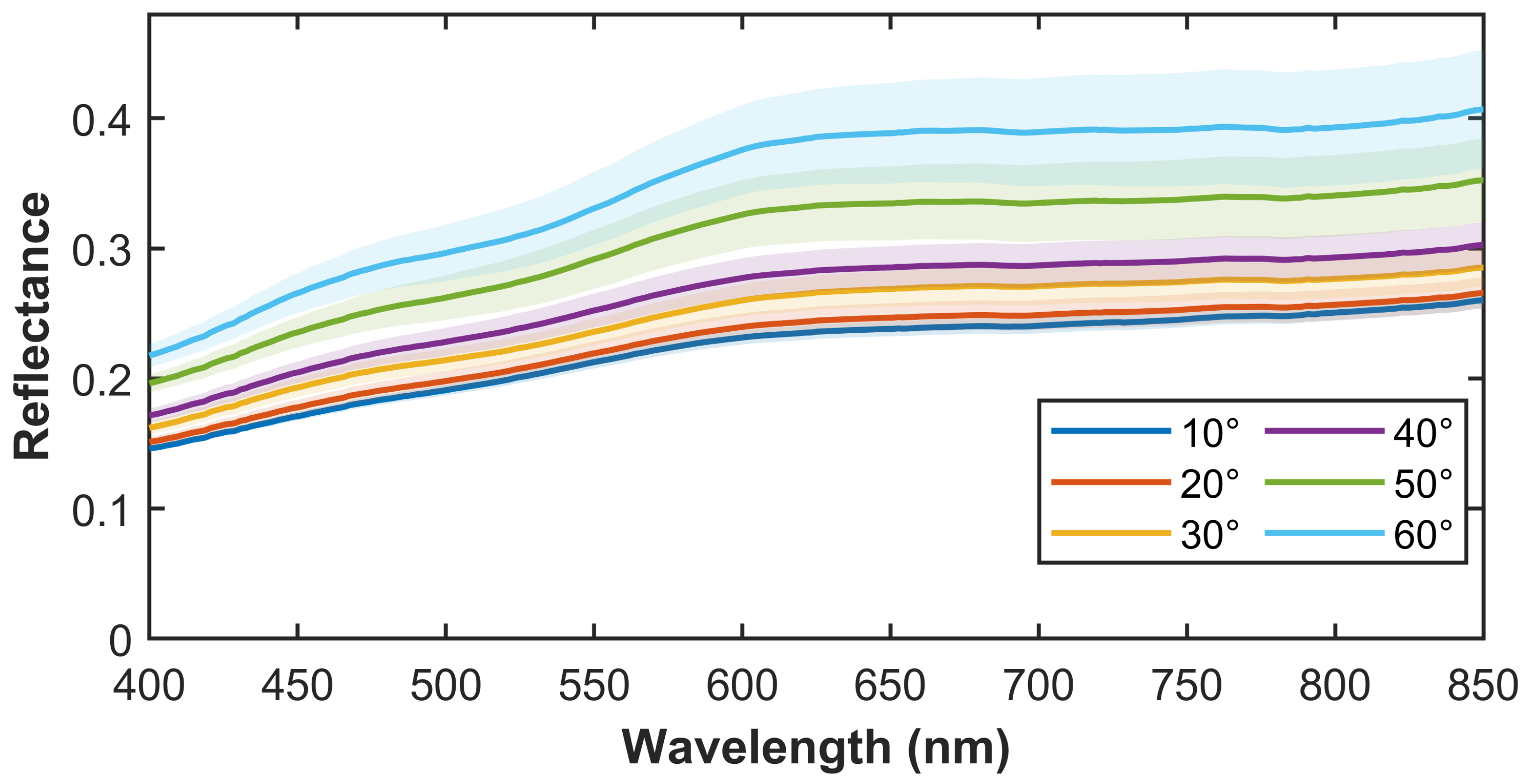
The spectral stability of the acquired HDRF measurements is summarized in
Figure 11. For each VZA, the mean reflectance spectrum and its intra-flight variability (±1 standard deviation) are shown. The directional variability is generally low for the first five flights, within ±2–8%, and increases to approximately ±15% for the final flight due to the significantly reduced solar elevation angle. These results provide a reliable basis for subsequent angular reflectance analyses presented in the following sections.
3.2. Angular Reflectance Characteristics
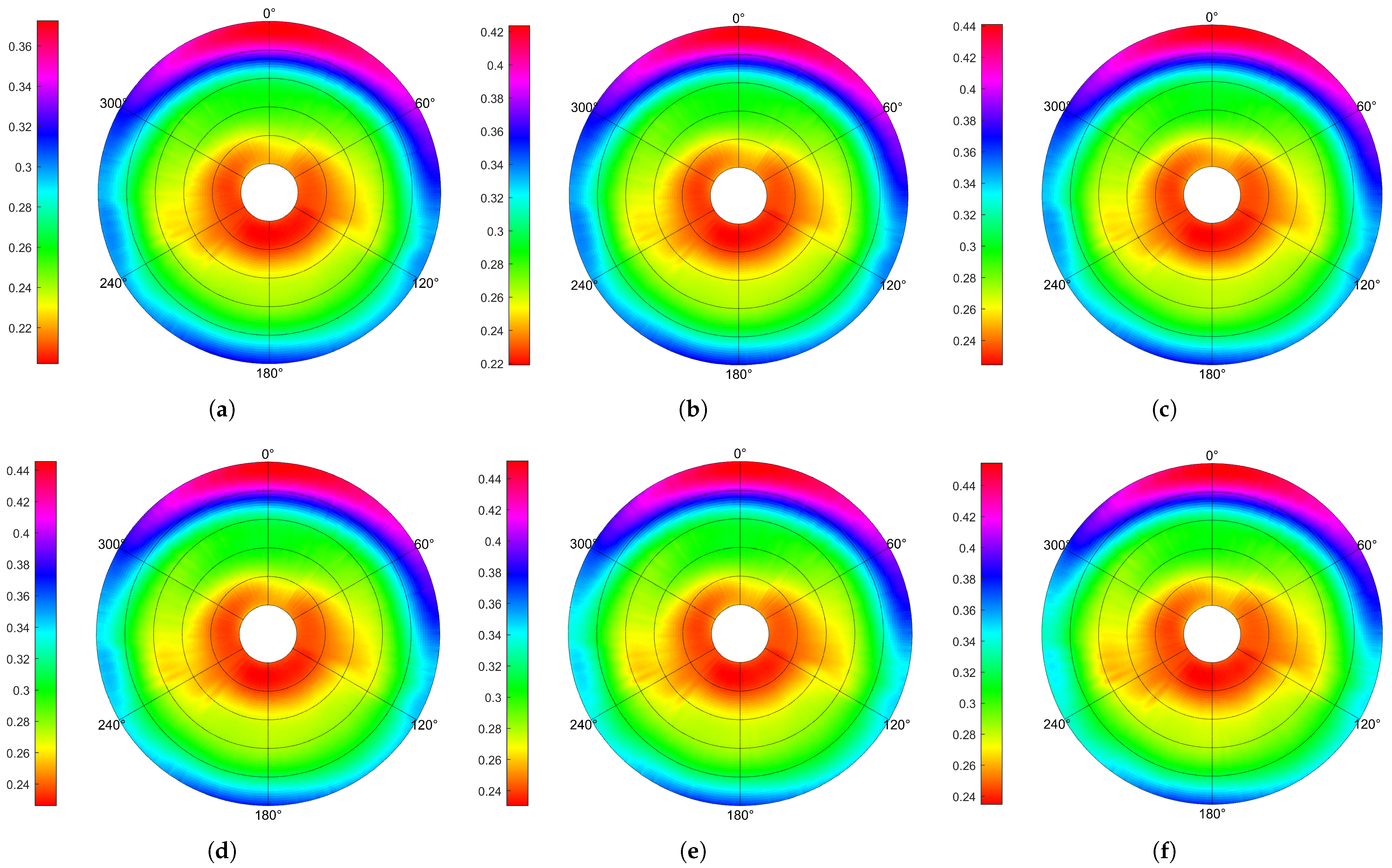
Figure 12 shows the polar representations of the measured HDRF at six representative wavelengths. In these plots, the radial coordinate corresponds to the viewing zenith angle (VZA), while the angular coordinate represents the relative azimuth angle, defined as the difference between the view azimuth angle and the solar azimuth angle. This relative-angular formulation enables HDRF measurements acquired under different solar geometries to be visualized within a unified reference frame. To enhance the visualization of continuous angular patterns, a smoothing operation was applied along the viewing zenith angle dimension.
The polar maps reveal a clear and consistent angular anisotropy of the HDRF across all wavelengths. Broad reflectance enhancements are observed in the backward-scattering region, centered around relative azimuth angles close to 0°, while the reflectance exhibits smooth and continuous variations with azimuth over the full angular range. In the radial direction, reflectance generally increases with viewing zenith angle, indicating a strong dependence of HDRF on observation geometry. Despite wavelength-dependent differences in absolute reflectance levels, the overall angular structures remain highly similar among the six wavelengths, suggesting that the observed anisotropy is primarily controlled by surface scattering characteristics rather than spectral effects.
It should be noted that, due to the use of relative azimuth angles and the temporal separation between different UAV flight missions, these polar representations emphasize large-scale and averaged angular trends rather than localized features tied to fixed absolute azimuth directions. Consequently, narrow azimuthal anomalies associated with specific environmental structures are not expected to be discernible in this representation. Nevertheless, the smooth and continuous angular patterns observed across all wavelengths confirm the angular completeness and radiometric consistency of the acquired HDRF dataset, providing a reliable foundation for the subsequent azimuth-resolved analyses.
Figure 13 shows the azimuthal variation in HDRF at 600 nm for the six UAV flights, corresponding to fixed viewing zenith angles (VZA) ranging from 10° to 60°. In each polar panel, the radial coordinate denotes reflectance, while the angular coordinate represents the absolute view azimuth angle. This representation complements the preceding relative azimuth analysis by explicitly resolving directional reflectance behavior with respect to fixed observation azimuths.
At low viewing zenith angles (10°–20°), the azimuthal HDRF profiles exhibit weak directional modulation and remain close to circular. With increasing viewing zenith angle, the azimuthal dependence becomes progressively more pronounced, and the HDRF patterns develop clear directional structure. At higher VZAs (40°–60°), reflectance is enhanced in both forward- and backward-scattering directions, reflecting the combined influence of observation geometry and surface anisotropy under oblique illumination.
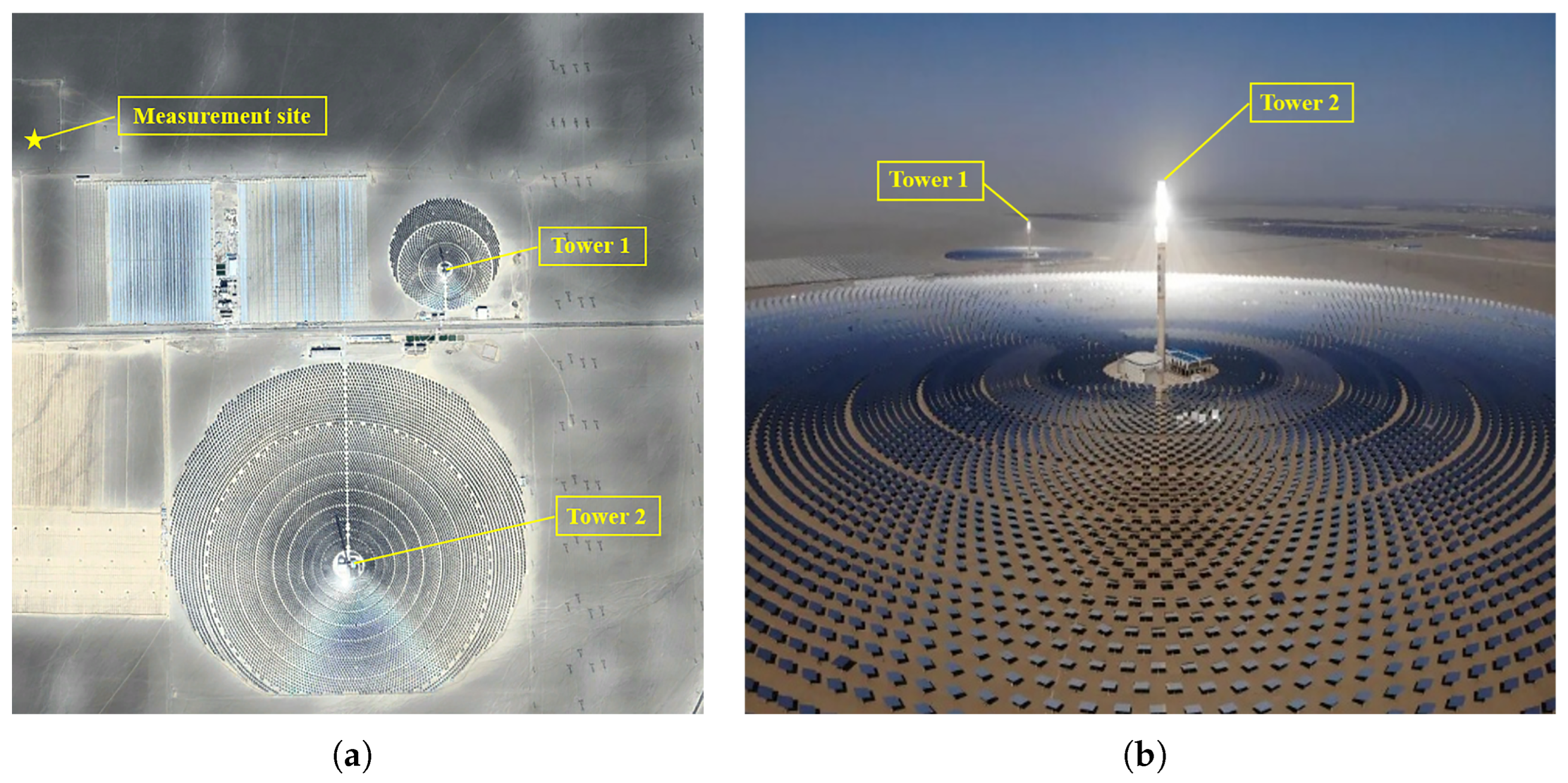
Beyond the large-scale azimuthal modulation, a localized extremum is consistently observed at an absolute azimuth angle of approximately 127° for the higher viewing zenith angles (50°–60°). This azimuthal position coincides with the direction of two nearby molten-salt solar power towers relative to the experimental site, as illustrated in
Figure 14. The persistence of this localized feature across multiple flights indicates that it represents a stable, direction-specific characteristic of the measured HDRF, rather than random variability or sampling artifacts.
Overall, the azimuth-resolved HDRF patterns at 600 nm demonstrate that the proposed UAV-based measurement strategy preserves both the global angular anisotropy and localized directional features in reflectance. These characteristics provide a critical basis for assessing the capability and limitations of kernel-driven reflectance models in the subsequent analysis.
3.3. Model Fitting and Residual Analysis
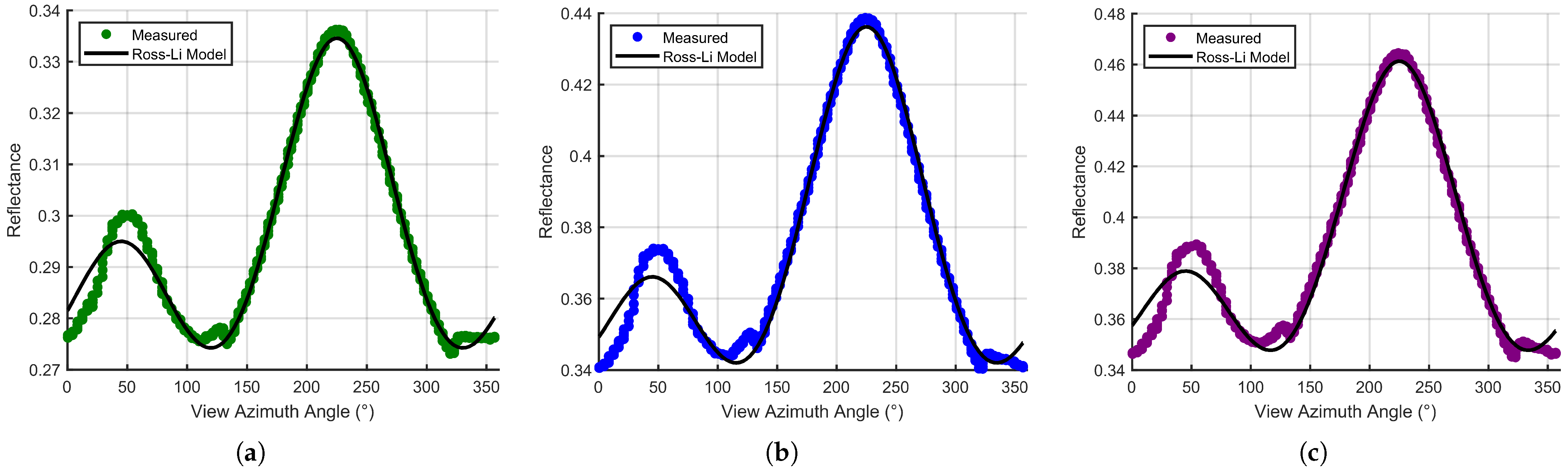
Figure 15 compares the measured azimuthal HDRF with the corresponding Ross–Li model predictions for the 500, 600, and 700 nm bands. The comparison is conducted at a fixed viewing zenith angle, with reflectance plotted as a function of absolute view azimuth angle. Overall, the Ross–Li model reproduces the dominant azimuthal variations in the measured HDRF with high fidelity across all three wavelengths.
The fitted model curves closely follow the measured reflectance profiles over most azimuthal directions, capturing both the large-scale angular modulation and the primary reflectance peaks. The coefficients of determination (
) exceed 0.968 for all bands (
Figure 16), indicating that the kernel-driven framework provides an effective representation of the main anisotropic characteristics of the surface reflectance under the given observation geometry.
Despite the high overall goodness-of-fit, small discrepancies between the model and measurements can be visually identified at specific azimuth angles. These deviations are localized and limited in angular extent, suggesting that while the Ross–Li model successfully captures the dominant scattering behavior, certain fine-scale directional features are not fully represented.
Figure 17 presents the residuals between the measured HDRF and the Ross–Li model predictions as a function of absolute view azimuth angle for the 500–700 nm bands. The residuals are defined as the difference between measured and modeled reflectance at a fixed viewing zenith angle, providing a detailed view of angular discrepancies that are not evident from the overall fitting performance alone.
Across most azimuthal directions, the residuals remain small and fluctuate around zero, indicating that the Ross–Li model successfully captures the dominant azimuthal behavior of the HDRF. Bands with higher reflectance inherently exhibit higher residual magnitudes under similar model deviations, which partially explains the small variations among bands. This observation is consistent across all three wavelengths, further confirming the robustness of the model in representing the large-scale anisotropic reflectance characteristics of the surface.
Two distinct angular features can be identified in the residual distributions. The first occurs around an azimuth angle of approximately 50°, where systematic deviations of consistent sign are observed across all wavelengths. The second feature appears as a localized residual extremum near THE 127° azimuth, which is narrow in angular extent and persistent among the different spectral bands. The coherence of these residual features across wavelengths suggests that they are associated with specific angular conditions rather than random noise or fitting instability.
Overall, the residual analysis reveals that, despite the high overall goodness-of-fit achieved by the Ross–Li model, certain localized angular behaviors remain unresolved. These residual patterns highlight the presence of fine-scale directional effects in the measured HDRF that extend beyond the representational capability of the kernel-driven model and motivate further discussion of their physical origins.
4. Discussion
4.1. Interpretation of Field-Measured HDRF at the Dunhuang Radiometric Calibration Site
The HDRF measured in this study represents the directional reflectance behavior of the Dunhuang Radiometric Calibration Site (DRCS) under realistic field conditions, rather than the idealized BRDF of a perfectly homogeneous surface. Although the DRCS is characterized by a flat and open Gobi landscape with high spatial uniformity, the measured HDRF inherently integrates contributions from all scene elements within the sensor’s instantaneous field of view. As the observation geometry varies, the effective composition of the viewed scene and the angular weighting of reflected radiance may change accordingly, leading to observable angular variations in HDRF. The angular reflectance characteristics presented in the Results demonstrate that the measured HDRF at the DRCS exhibits smooth but nontrivial dependence on both viewing zenith and azimuth angles. These variations are consistent across wavelengths and viewing configurations, indicating that they are dominated by geometric and radiative effects rather than random measurement noise. In this context, the observed localized angular features should be interpreted as physically meaningful components of the field-measured HDRF, reflecting the interaction between observation geometry, surface scattering behavior, and the surrounding environment.
In practical UAV-based field campaigns, acquiring a dense set of observation angles under a strictly fixed solar geometry is inherently challenging. In the present study, measurements from multiple UAV flights conducted under different solar zenith angles (SZAs) are jointly analyzed, with an emphasis on azimuthal reflectance behavior. As illustrated in
Figure 12, HDRF measurements acquired under six different SZAs are presented together to highlight the azimuthal dependence of surface reflectance. It should be noted that each individual reflectance spectrum corresponds to a unique combination of observation geometry and solar geometry. Moreover, the hotspot directions fall outside the sampled angular range, and their potential influence on the presented azimuthal patterns is therefore expected to be relatively limited.
These angular effects are not artifacts of the measurement system but rather intrinsic properties of HDRF acquired under real-world conditions. The ability to resolve such features provides a more detailed and physically grounded description of surface reflectance behavior than would be possible using sparse or heavily averaged angular observations.
4.2. Angular Reflectance Behavior Under Low Solar Elevation and Multi-Source Illumination
The reflectance collected in this study are strongly influenced by the low solar elevation during the UAV flights, with solar zenith angles approaching 80° in the later acquisition periods. Under such illumination conditions, the reflected radiance becomes highly sensitive to small changes in observation geometry, particularly in the azimuthal dimension. This enhanced geometric sensitivity manifests as pronounced angular modulation of HDRF with increasing viewing zenith angle.
The angular dependence show a very high correlation with the solar zenith angle due to multiple scattering effects over a desert site [
44]. Under such low-sun conditions, directional scattering effects arise from the surface’s microstructure and viewing geometry rather than from large-scale terrain shadowing. A prominent example is the hotspot effect—a sharp increase in reflectance when the illumination and viewing directions nearly coincide. This backscatter surge occurs because, at near-zero phase angle, surface elements hide their own cast shadows, and even coherent backscattering can enhance the returned radiance [
45]. As a result, reflectance tends to be higher at extreme viewing zenith angles in both the backward-scattering and forward-scattering directions under low sun illumination. Our observed enhancement of reflectance in both forward- and backward-scatter directions is consistent with these prior findings over homogeneous desert calibration sites [
46].
In addition to the solar-driven anisotropy, the presence of two nearby solar power towers introduces secondary directional illumination that affects the angular reflectance environment. These towers are located at azimuth angles of approximately 107° and 143° relative to the observation site, with the latter having a higher thermal output. While prior studies at the Dunhuang Radiometric Calibration Site have shown that scattered radiation from such structures contributes less than 1% to the overall hemispherical sky irradiance under typical conditions [
47], the present analysis focuses on directional reflectance, where even subtle secondary sources may produce detectable anisotropic effects.
In our measurements, a localized reflectance extremum appears at an azimuth angle of approximately 127°, aligning with the angular sector between the two towers. Although the secondary illumination is narrow in angular extent and limited in magnitude, its recurring presence across multiple viewing geometries suggests a stable, directional component in the measured HDRF. This result underscores the sensitivity of high-angular-resolution HDRF retrievals to localized and often overlooked illumination sources, highlighting the importance of accounting for multi-source lighting in realistic reflectance modeling. These environment-induced HDRF features indicate that the measured angular reflectance is not solely governed by intrinsic surface properties, but is partly influenced by local illumination conditions. As a result, when matching the HDRF dataset with satellite BRDF observations, particular attention should be paid to illumination conditions, as these factors may influence the observed angular reflectance.
4.3. Considerations for Error and Uncertainty
Radiometric measurement errors constitute a primary source of uncertainty in HDRF acquisition, particularly for the UAV-based spectrometer, which is more sensitive to environmental fluctuations—especially in terms of dark current behavior. Although the instrument was preheated before each flight to reduce thermal drift, the dark current still exhibited a certain degree of short-term drift during individual flights, particularly affecting spectral bands with relatively low radiometric signal levels.To mitigate this effect, a dark current reference was collected before takeoff by physically covering the fiber optic input, and in-flight drift was tracked using masked detector pixels. These procedures help reduce radiometric uncertainty during operation. Nevertheless, gradual variations in ambient temperature and internal heating during extended operation may still introduce minor systematic shifts in sensor response. In this study, the relatively short duration of each UAV flight helps limit the impact of such thermal drift, while more comprehensive thermal characterization will be considered in future work. In addition, measurements acquired under low solar elevation conditions, particularly during late-afternoon flights, may be affected by a reduced signal-to-noise ratio (SNR) due to decreased incoming irradiance. As the overall radiometric signal level diminishes, measurement noise becomes more pronounced, especially in spectral regions with inherently lower signal strength.
Angular uncertainties may arise from limitations in UAV attitude. To minimize the impact of platform instability on HDRF measurements, a two-axis gimbal was used to actively stabilize the spectrometer’s viewing direction. According to the gimbal specifications, pitch and roll deviations were controlled within ±1° during flight. While this stabilization does not fully eliminate angular error, it helps constrain view geometry uncertainty to a level acceptable for directional reflectance analysis.
Another important factor is the spatial footprint of the sensor. The non-imaging spectrometer used in this study has a 25° field of view (FOV). Under the largest viewing zenith angle of 60°, the circular flight path yields the maximum projected footprint radius of approximately 57.64 m. Although the Dunhuang Radiometric Calibration Site is well known for its spatial uniformity, care was taken during flight planning to further minimize potential artifacts. Specifically, we deliberately selected observation zones free of human activity, vehicle tracks, or surface disturbances, ensuring that the surface within a 100 m radius of each observation point was free of visible heterogeneity. These measures collectively reduced major sources of measurement error and uncertainty, enhancing the reliability of the field-measured HDRF and its subsequent analysis.
4.4. Considerations for Modeling
The Ross–Li model was shown to reproduce the dominant angular behavior of the measured HDRF with high overall accuracy, achieving coefficients of determination exceeding 0.968 across all analyzed bands from 400 nm to 850 nm. This confirms that kernel-driven BRDF models remain effective tools for capturing the large-scale anisotropic reflectance characteristics of relatively uniform surfaces under controlled observation geometries.
However, the residual analysis reveals that certain localized angular features are not fully represented by the Ross–Li framework. These discrepancies are not indicative of poor model performance, but rather reflect the inherent assumptions of kernel-driven models, including the dominance of a single illumination source and the use of smooth, statistical representations of surface scattering [
38]. Under low solar elevation and in the presence of additional directional illumination, these assumptions may be locally violated, leading to systematic residual patterns at specific azimuth angles.
Importantly, the observed model–measurement mismatches are confined to narrow angular ranges and do not compromise the model’s ability to describe the overall HDRF structure. Instead, they delineate the practical boundaries within which kernel-driven BRDF models can be expected to perform optimally when applied to field-measured HDRF data. Recognizing these boundaries is essential for the appropriate interpretation of model inversion results in complex real-world environments.
From the kernel coefficients (
Table 2), the consistently small magnitude of the geometric term indicates that large-scale geometric shadowing effects contribute only weakly to the measured HDRF at the Dunhuang site. This result is physically consistent with the characteristics of the Gobi surface, which lacks pronounced macroscopic structures capable of producing strong, organized shadowing. Consequently, the isotropic and volumetric-like terms dominate the angular reflectance signal, while the contribution associated with geometric shadowing remains limited. It should be noted, however, that the Ross–Li framework was originally developed to describe surfaces characterized by vegetation canopies (volumetric scattering) and rough surfaces with well-defined geometric shadowing. While the present results indicate that this framework is adequate for capturing the dominant angular structure of the measured HDRF, the development and evaluation of models that are more explicitly tailored to particulate and gravelly surfaces remain an important direction for future research. Furthermore, further field measurements designed to quantitatively characterize secondary illumination from the solar towers are expected to be highly beneficial. Such information would provide a sound basis for physically consistent simulations and improved modeling of secondary illumination effects in future work.
5. Conclusions
In this study, a high-angular-resolution hyperspectral HDRF dataset was acquired over the Dunhuang Radiometric Calibration Site using a UAV-based non-imaging spectrometer, covering the spectral range of 400–850 nm. The observation strategy was designed to hold view zenith angle constant while continuously scanning azimuth angles. For each of the six UAV flights (view zenith angles from 10° to 60°), full azimuthal coverage (0°–360°) was achieved within approximately 5 min, with angular resolution finer than 1°. The entire campaign was conducted under low solar elevation conditions, with solar zenith angles ranging from approximately 70° to 80°.
Directional reflectance was modeled using the Ross–Li kernel-driven BRDF model, yielding coefficients of determination (R2) exceeding 0.968 across the full 400–850 nm spectral range. Residual analysis highlighted two consistent discrepancy patterns. In the forward-scattering direction (peak near azimuth 50°), the model underrepresented the sharp reflectance increase, with largest residuals around 12.6° reaching up to 4.52%. A second residual feature appeared near 124.2°, corresponding to the sector between two nearby solar towers (107° and 143°), likely caused by secondary illumination. Elsewhere, errors remained below 2% across most azimuths at 700 nm, with similar trends in the other bands.
This study confirms the robustness of the proposed UAV-based strategy for capturing continuous, high-resolution HDRF under low solar elevation and non-ideal illumination. The HDRF data acquired in this campaign, with its fine angular and spectral resolution, provides a valuable benchmark for evaluating reflectance models and interpreting satellite observations acquired under similar low solar elevation or multi-source lighting conditions. The high angular fidelity of the dataset enables detailed interpretation of reflectance behavior, including the detection of subtle azimuthal features induced by secondary sources. Such measurements have the potential to support more precise and fine-scale quantitative remote sensing, with applications in radiometric calibration, model validation, and scene interpretation under complex observational geometries. This approach will not only contribute to improving the accuracy of quantitative satellite remote sensing products, but also provide more comprehensive tools and methods for analyzing the reflective characteristics of natural surfaces under multiple illumination conditions. In future work, we plan to extend the dataset to cover a wider range of solar elevation angles and include additional surface types to further improve the generality, reproducibility, and applicability of our approach.




 ,
,