Assessment of Vegetation Index Saturation Based on Vertically Stratified Aboveground Biomass in Temperate Meadow Steppe
 ,
,
Highlights
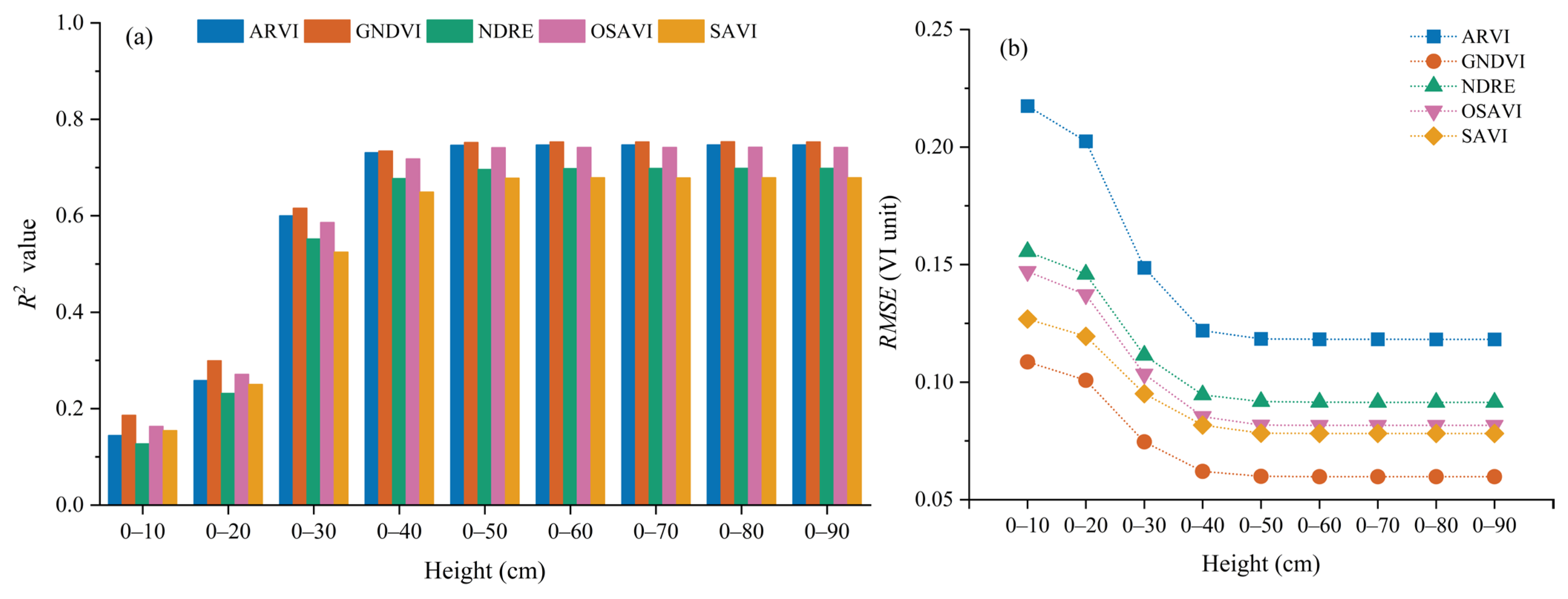
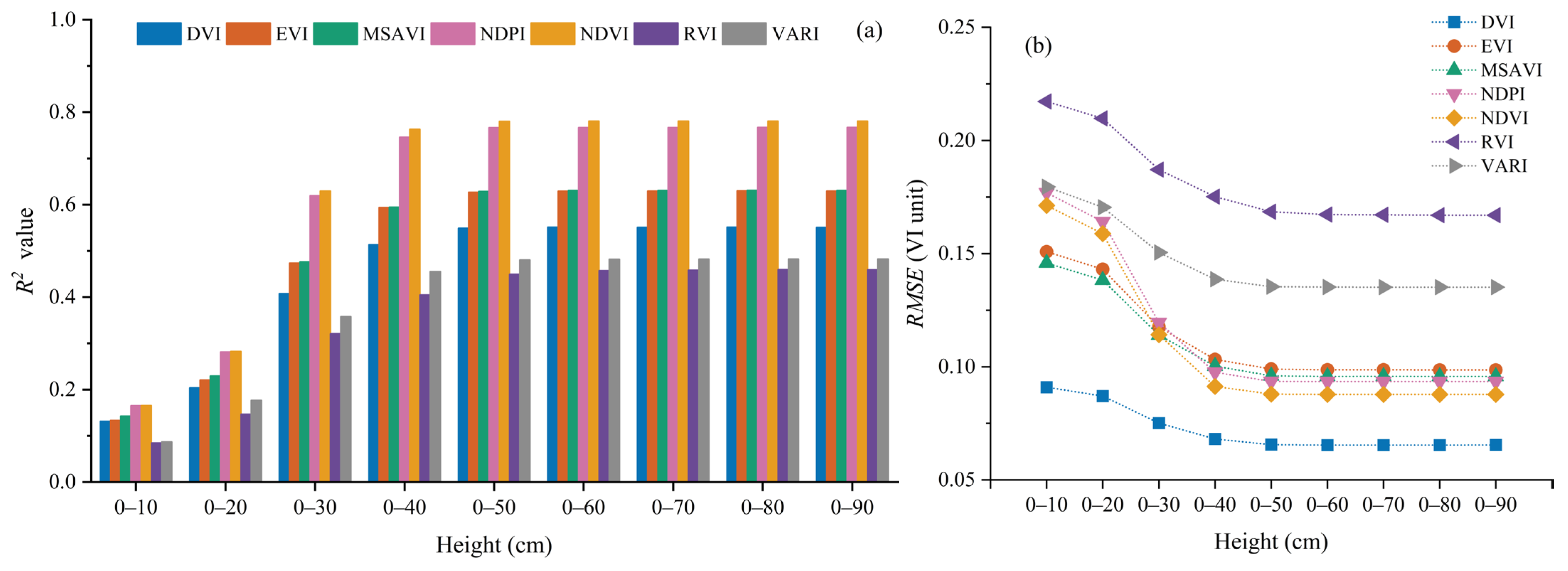
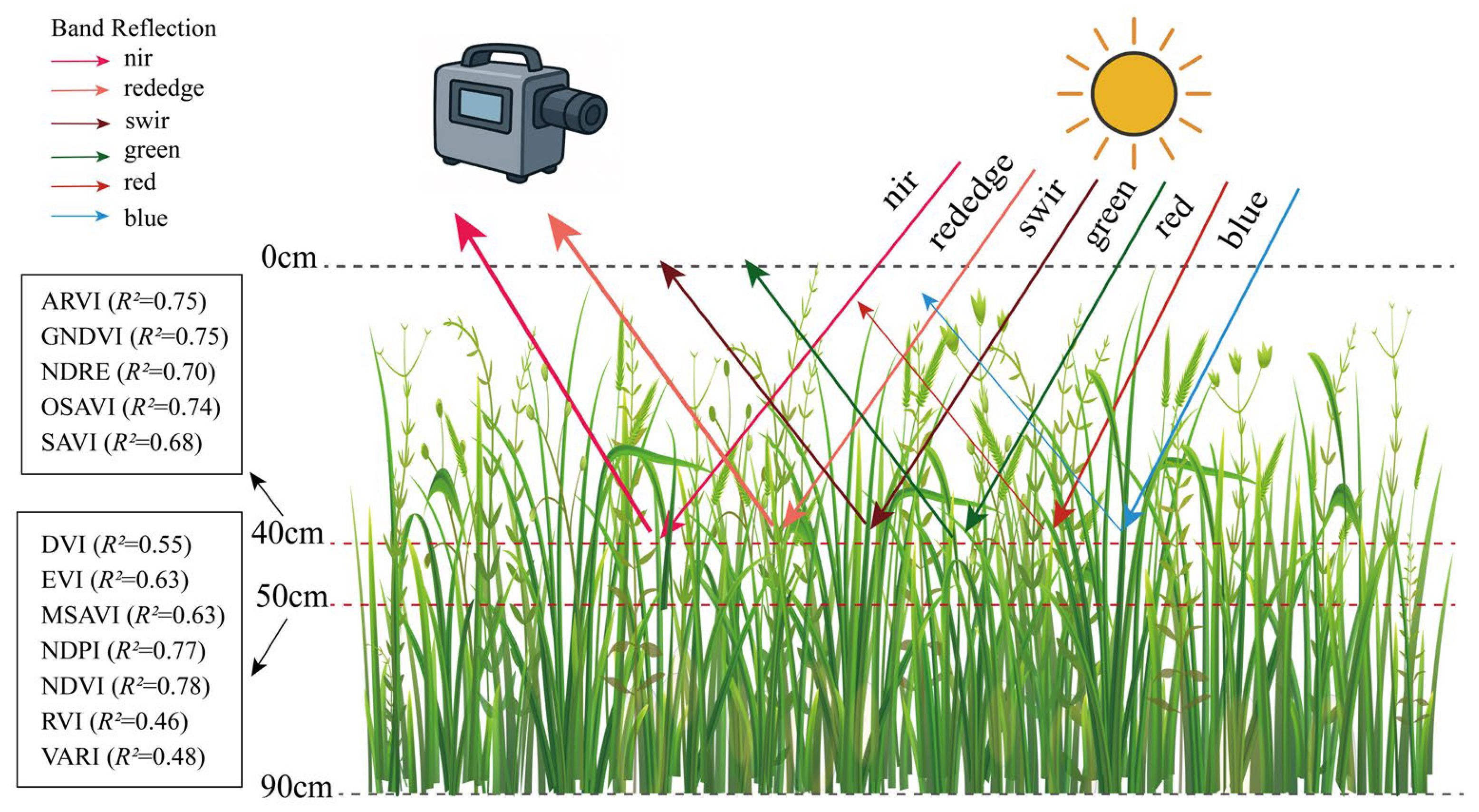
- We found that the saturation of 12 vegetation indices was strongly influenced by canopy height. ARVI, GNDVI, NDRE, OSAVI, and SAVI reached saturation at a canopy height of 40 cm, whereas DVI, EVI, MSAVI, NDPI, NDVI, RVI, and VARI remained sensitive up to 50 cm, indicating stronger resistance to saturation in the latter group.
- Gompertz models performed best for 10 of the 12 indices. NDVI and NDPI achieved the highest fitting accuracy and resistance to saturation among the 12 VIs.
- The identified saturation height provides a practical basis for choosing appropriate vegetation indices according to canopy-height conditions, improving the accuracy and reliability of aboveground biomass (AGB) estimation in a temperate meadow steppe.
- The unimodal vertical distribution of AGB, together with index-specific saturation thresholds, provides new insights for model development. These findings support the design of refined monitoring strategies and offer methodological guidance for improving AGB estimation in high-biomass environments.
Abstract
1. Introduction
2. Materials and Methods
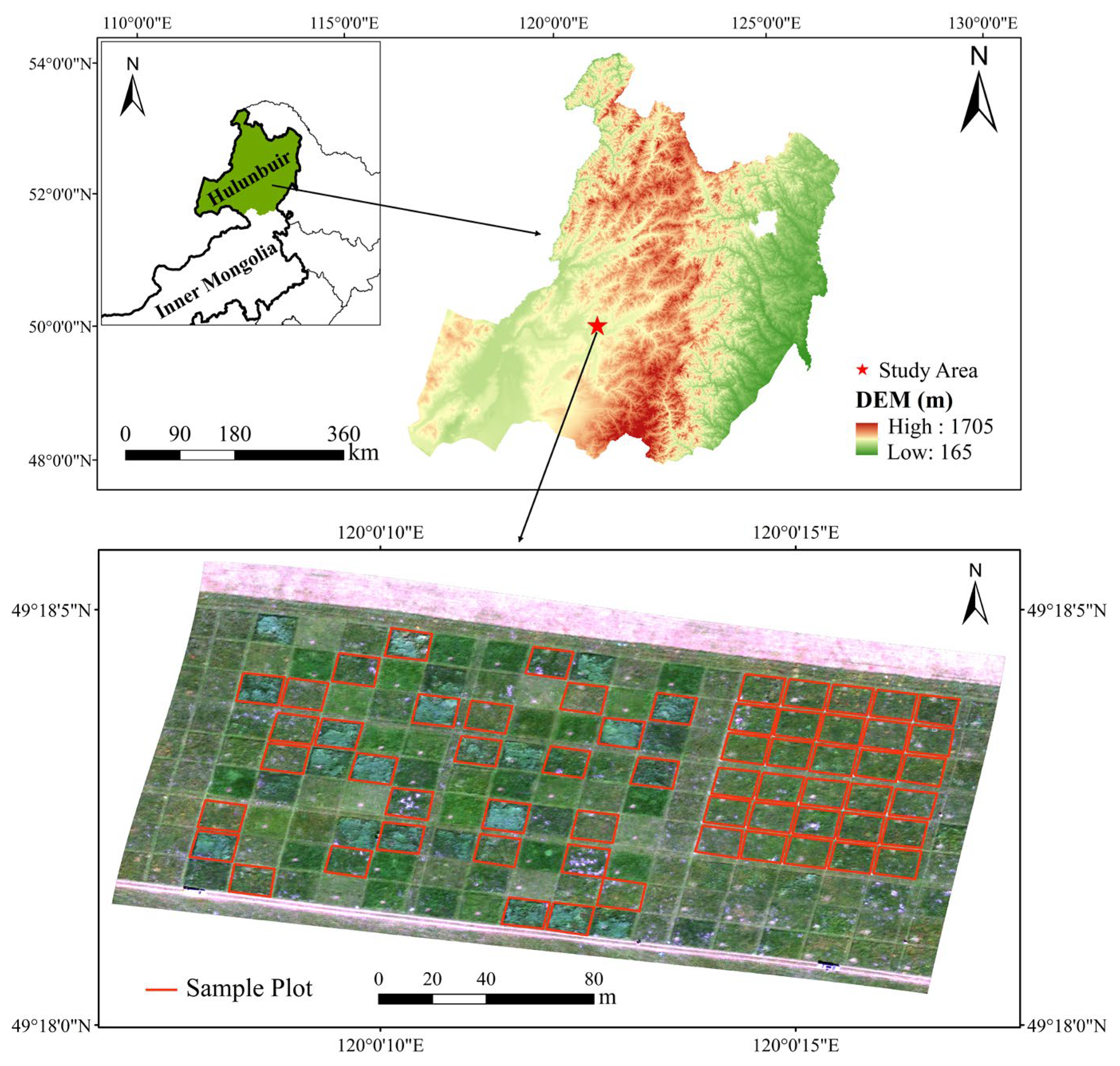
2.1. Study Area
2.2. Data Collection and Processing
2.2.1. Hyperspectral Data
2.2.2. Measured Data
2.3. Research Methods
2.3.1. Vegetation Index Extraction
2.3.2. Model Fitting
2.3.3. Model Selection
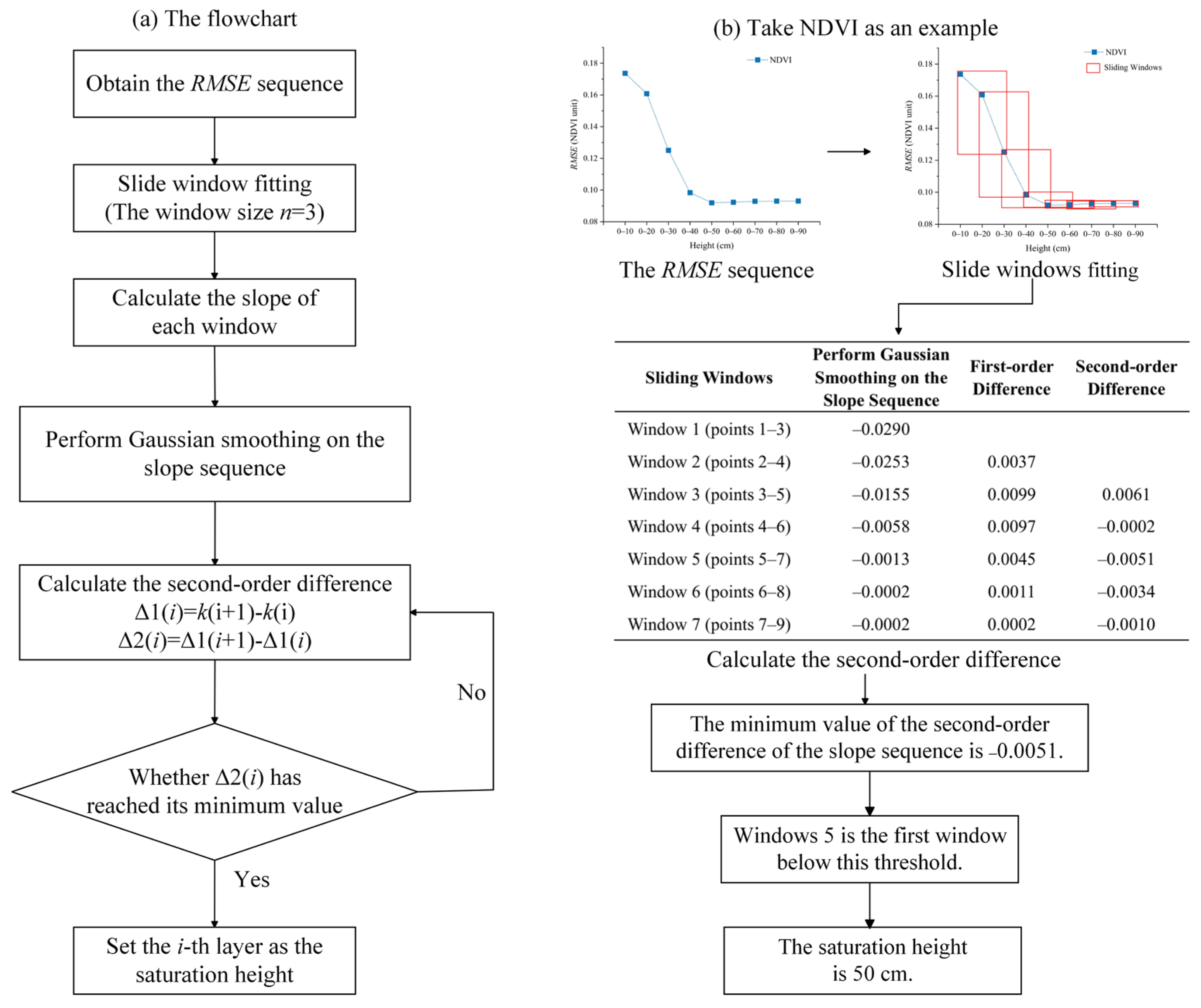
2.3.4. Determination of Saturation Height
3. Results
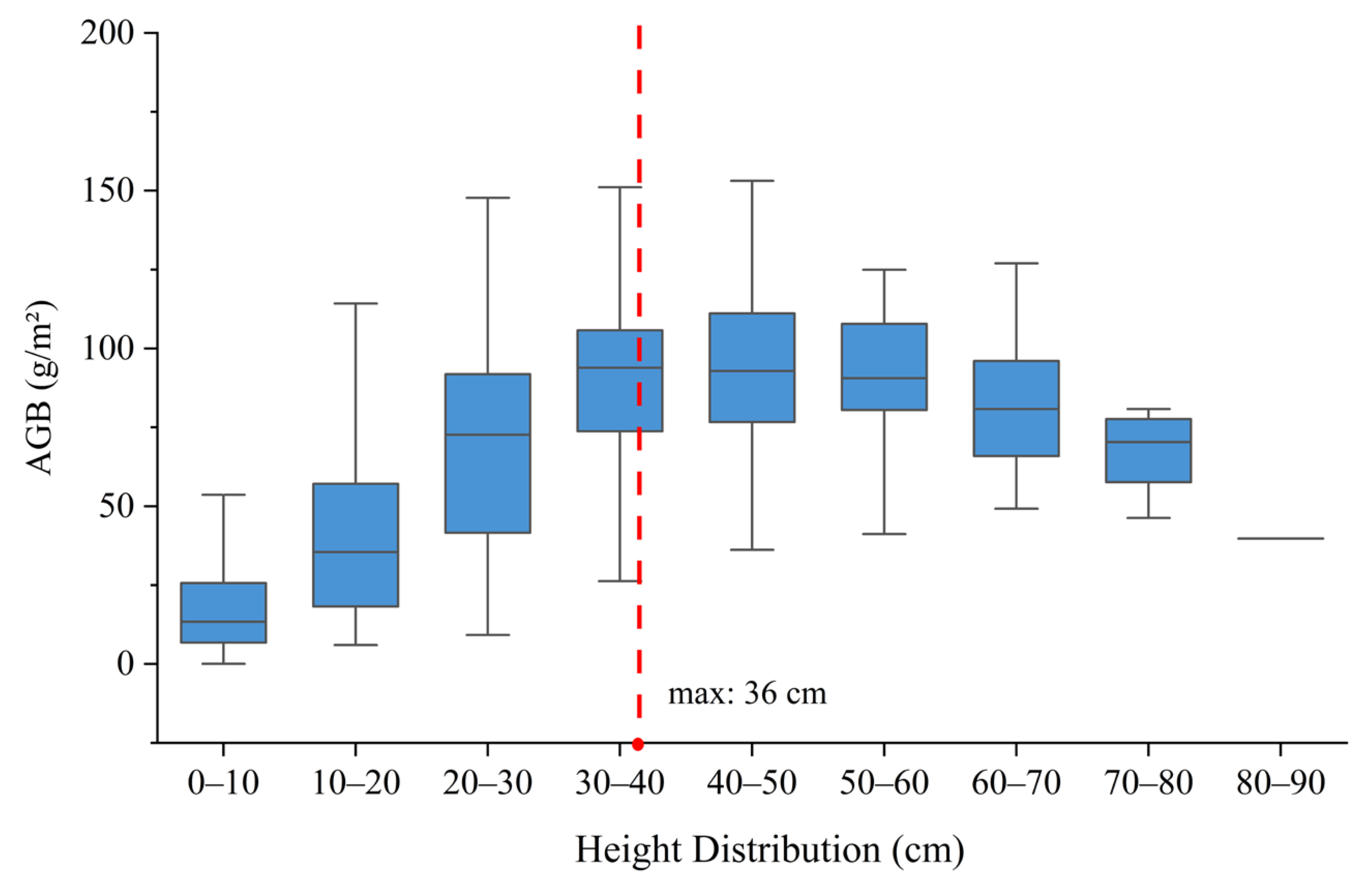
3.1. Vertical Distribution of Grassland Aboveground Biomass
3.2. Comparison of Saturation Effects Among Different Vegetation Indices
3.3. Saturation Heights of Different Vegetation Indices
4. Discussion
4.1. Vertical Distribution Characteristics of Grassland Aboveground Biomass
4.2. Differences in the Fitting Performing of Vegetation Indices
4.3. Differences in Saturation Among Vegetation Indices
4.4. Limitations
5. Conclusions
Author Contributions
Funding
Data Availability Statement
Acknowledgments
Conflicts of Interest
References
- Bai, Y.; Cotrufo, M.F. Grassland soil carbon sequestration: Current understanding, challenges, and solutions. Science 2022, 377, 603–608. [Google Scholar] [CrossRef]
- Bengtsson, J.; Bullock, J.; Egoh, B.; Everson, C.; Everson, T.; O’connor, T.; O’farrell, P.; Smith, H.; Lindborg, R. Grasslands—More important for ecosystem services than you might think. Ecosphere 2019, 10, e02582. [Google Scholar] [CrossRef]
- Wu, L.; Chen, H.; Chen, D.; Wang, S.; Wu, Y.; Wang, B.; Liu, S.; Yue, L.; Yu, J.; Bai, Y. Soil biota diversity and plant diversity both contributed to ecosystem stability in grasslands. Ecol. Lett. 2023, 26, 858–868. [Google Scholar] [CrossRef]
- Bardgett, R.D.; Bullock, J.M.; Lavorel, S.; Manning, P.; Schaffner, U.; Ostle, N.; Chomel, M.; Durigan, G.; Fry, E.L.; Johnson, D.; et al. Combatting global grassland degradation. Nat. Rev. Earth Environ. 2021, 2, 720–735. [Google Scholar] [CrossRef]
- Zhou, W.; Li, H.; Xie, L.; Nie, X.; Wang, Z.; Du, Z.; Yue, T. Remote sensing inversion of grassland aboveground biomass based on high accuracy surface modeling. Ecol. Indic. 2021, 121, 107215. [Google Scholar] [CrossRef]
- Ge, J.; Hou, M.; Liang, T.; Feng, Q.; Meng, X.; Liu, J.; Bao, X.; Gao, H. Spatiotemporal dynamics of grassland aboveground biomass and its driving factors in North China over the past 20 years. Sci. Total Environ. 2022, 826, 154226. [Google Scholar] [CrossRef]
- Zhang, X.; Bao, Y.; Wang, D.; Xin, X.; Ding, L.; Xu, D.; Hou, L.; Shen, J. Using UAV LiDAR to extract vegetation parameters of inner Mongolian grassland. Remote Sens. 2021, 13, 656. [Google Scholar] [CrossRef]
- Lobell, D.B. The use of satellite data for crop yield gap analysis. Field Crops Res. 2013, 143, 56–64. [Google Scholar] [CrossRef]
- Gao, T.; Xu, B.; Yang, X.; Jin, Y.; Ma, H.; Li, J.; Yu, H. Using MODIS time series data to estimate aboveground biomass and its spatio-temporal variation in Inner Mongolia’s grassland between 2001 and 2011. Int. J. Remote Sens. 2013, 34, 7796–7810. [Google Scholar] [CrossRef]
- Wei, R.; Shu, Q.; Li, Z.; Fu, L.; Xiang, Q.; Qin, C.; Rao, X.; Liu, J. Inversion of Grassland Aboveground Biomass in the Three Parallel Rivers Area Based on Genetic Programming Optimization Features and Machine Learning. Remote Sens. 2025, 17, 2936. [Google Scholar] [CrossRef]
- Lu, D. The potential and challenge of remote sensing-based biomass estimation. Int. J. Remote Sens. 2006, 27, 1297–1328. [Google Scholar] [CrossRef]
- Sinha, S.; Jeganathan, C.; Sharma, L.K.; Nathawat, M.S. A review of radar remote sensing for biomass estimation. Int. J. Environ. Sci. Technol. 2015, 12, 1779–1792. [Google Scholar] [CrossRef]
- Nordberg, M.-L.; Evertson, J. Monitoring change in mountainous dry-heath vegetation at a regional ScaleUsing multitemporal landsat TM data. AMBIO J. Hum. Environ. 2003, 32, 502–509. [Google Scholar] [CrossRef]
- Jin, Y.; Yang, X.; Qiu, J.; Li, J.; Gao, T.; Wu, Q.; Zhao, F.; Ma, H.; Yu, H.; Xu, B. Remote sensing-based biomass estimation and its spatio-temporal variations in temperate grassland, Northern China. Remote Sens. 2014, 6, 1496–1513. [Google Scholar] [CrossRef]
- Zhang, B.; Chen, Z.; Peng, D.; Benediktsson, J.A.; Liu, B.; Zou, L.; Li, J.; Plaza, A. Remotely sensed big data: Evolution in model development for information extraction [point of view]. Proc. IEEE 2019, 107, 2294–2301. [Google Scholar] [CrossRef]
- Yao, Y.; Ren, H. Estimation of grassland aboveground biomass in northern China based on topography-climate-remote sensing data. Ecol. Indic. 2024, 165, 112230. [Google Scholar] [CrossRef]
- Zou, L.; Li, H.; Zhang, J.; Chen, J.; Yang, H.; Gong, Z. Inversion of aboveground biomass of saltmarshes in coastal wetland using remote sensing. Acta Ecol. Sin. 2023, 20, 8532–8543. [Google Scholar]
- Liu, W.; Xu, C.; Zhang, Z.; De Boeck, H.; Wang, Y.; Zhang, L.; Xu, X.; Zhang, C.; Chen, G.; Xu, C. Machine learning-based grassland aboveground biomass estimation and its response to climate variation in Southwest China. Front. Ecol. Evol. 2023, 11, 1146850. [Google Scholar] [CrossRef]
- Viña, A.; Gitelson, A.A.; Nguy-Robertson, A.L.; Peng, Y. Comparison of different vegetation indices for the remote assessment of green leaf area index of crops. Remote Sens. Environ. 2011, 115, 3468–3478. [Google Scholar] [CrossRef]
- de Almeida, D.R.; Vedovato, L.B.; Fuza, M.; Molin, P.; Cassol, H.; Resende, A.F.; Krainovic, P.M.; de Almeida, C.T.; Amaral, C.; Haneda, L. Remote sensing approaches to monitor tropical forest restoration: Current methods and future possibilities. J. Appl. Ecol. 2025, 62, 188–206. [Google Scholar] [CrossRef]
- Gitelson, A.A. Wide dynamic range vegetation index for remote quantification of biophysical characteristics of vegetation. J. Plant Physiol. 2004, 161, 165–173. [Google Scholar] [CrossRef]
- Radočaj, D.; Plaščak, I.; Jurišić, M. Fusion of Sentinel-2 Phenology Metrics and Saturation-Resistant Vegetation Indices for Improved Correlation with Maize Yield Maps. Agronomy 2025, 15, 1329. [Google Scholar] [CrossRef]
- Zhu, X.; Chen, X.; Ma, L.; Liu, W. UAV and satellite synergies for mapping grassland aboveground biomass in Hulunbuir Meadow Steppe. Plants 2024, 13, 1006. [Google Scholar] [CrossRef]
- Ji, G.; Li, B.; Yin, H.; Liu, G.; Yuan, Y.; Cui, G. Non-utilization is not the best way to manage lowland meadows in Hulun Buir. Front. Plant Sci. 2021, 12, 704511. [Google Scholar] [CrossRef] [PubMed]
- Kaufman, Y.J.; Tanre, D. Atmospherically resistant vegetation index (ARVI) for EOS-MODIS. IEEE Trans. Geosci. Remote Sens. 1992, 30, 261–270. [Google Scholar] [CrossRef]
- Sripada, R.P.; Heiniger, R.W.; White, J.G.; Weisz, R. Aerial color infrared photography for determining late-season nitrogen requirements in corn. Agron. J. 2005, 97, 1443–1451. [Google Scholar] [CrossRef]
- Huete, A.; Didan, K.; Miura, T.; Rodriguez, E.P.; Gao, X.; Ferreira, L.G. Overview of the radiometric and biophysical performance of the MODIS vegetation indices. Remote Sens. Environ. 2002, 83, 195–213. [Google Scholar] [CrossRef]
- Daughtry, C.; Gallo, K.; Goward, S.; Prince, S.; Kustas, W. Spectral estimates of absorbed radiation and phytomass production in corn and soybean canopies. Remote Sens. Environ. 1992, 39, 141–152. [Google Scholar] [CrossRef]
- Qi, J.; Chehbouni, A.; Huete, A.R.; Kerr, Y.H.; Sorooshian, S. A modified soil adjusted vegetation index. Remote Sens. Environ. 1994, 48, 119–126. [Google Scholar] [CrossRef]
- Xu, D.; Wang, C.; Chen, J.; Shen, M.; Shen, B.; Yan, R.; Li, Z.; Karnieli, A.; Chen, J.; Yan, Y. The superiority of the normalized difference phenology index (NDPI) for estimating grassland aboveground fresh biomass. Remote Sens. Environ. 2021, 264, 112578. [Google Scholar] [CrossRef]
- Boiarskii, B.; Hasegawa, H. Comparison of NDVI and NDRE indices to detect differences in vegetation and chlorophyll content. J. Mech. Contin. Math. Sci. 2019, 4, 20–29. [Google Scholar] [CrossRef]
- Tucker, C.J. Red and photographic infrared linear combinations for monitoring vegetation. Remote Sens. Environ. 1979, 8, 127–150. [Google Scholar] [CrossRef]
- Rondeaux, G.; Steven, M.; Baret, F. Optimization of soil-adjusted vegetation indices. Remote Sens. Environ. 1996, 55, 95–107. [Google Scholar] [CrossRef]
- Jordan, C.F. Derivation of leaf-area index from quality of light on the forest floor. Ecology 1969, 50, 663–666. [Google Scholar] [CrossRef]
- Huete, A.R. A soil-adjusted vegetation index (SAVI). Remote Sens. Environ. 1988, 25, 295–309. [Google Scholar] [CrossRef]
- Stow, D.; Niphadkar, M.; Kaiser, J. MODIS-derived visible atmospherically resistant index for monitoring chaparral moisture content. Int. J. Remote Sens. 2005, 26, 3867–3873. [Google Scholar] [CrossRef]
- Keogh, E.; Chu, S.; Hart, D.; Pazzani, M. An online algorithm for segmenting time series. In Proceedings of the 2001 IEEE International Conference on Data Minin; IEEE Computer Society: San Jose, CA, USA, 2001; pp. 289–296. [Google Scholar]
- Milne-Thomson, L.M. The Calculus of Finite Differences; American Mathematical Soc.: Providence, RI, USA, 2000. [Google Scholar]
- Gallagher, N.B. Savitzky-golay smoothing and differentiation filter. Eig. Res. Inc. 2020, 2, 4. [Google Scholar]
- Cheney, W.; Kincaid, D. Numerical Mathematics and Computing; International Thomson Publishing: Belmont, CA, USA, 1998. [Google Scholar]
- Wu, B.; Ye, H.; Huang, W.; Wang, H.; Luo, P.; Ren, Y.; Kong, W. Monitoring the vertical distribution of maize canopy chlorophyll content based on multi-angular spectral data. Remote Sens. 2021, 13, 987. [Google Scholar] [CrossRef]
- Ye, H.; Huang, W.; Huang, S.; Wu, B.; Dong, Y.; Cui, B. Remote estimation of nitrogen vertical distribution by consideration of maize geometry characteristics. Remote Sens. 2018, 10, 1995. [Google Scholar] [CrossRef]
- Gao, S.; Zhong, R.; Yan, K.; Ma, X.; Chen, X.; Pu, J.; Gao, S.; Qi, J.; Yin, G.; Myneni, R.B. Evaluating the saturation effect of vegetation indices in forests using 3D radiative transfer simulations and satellite observations. Remote Sens. Environ. 2023, 295, 113665. [Google Scholar] [CrossRef]
- Myneni, R.; Ramakrishna, R.; Nemani, R.; Running, S. Estimation of global leaf area index and absorbed par using radiative transfer models. IEEE Trans. Geosci. Remote Sens. 1997, 35, 1380–1393. [Google Scholar] [CrossRef]
- Zou, X.; Mõttus, M. Sensitivity of common vegetation indices to the canopy structure of field crops. Remote Sens. 2017, 9, 994. [Google Scholar] [CrossRef]
- Glenn, E.P.; Huete, A.R.; Nagler, P.L.; Nelson, S.G. Relationship between remotely-sensed vegetation indices, canopy attributes and plant physiological processes: What vegetation indices can and cannot tell us about the landscape. Sensors 2008, 8, 2136–2160. [Google Scholar] [CrossRef]
- Lin, S.; Li, J.; Liu, Q.; Li, L.; Zhao, J.; Yu, W. Evaluating the effectiveness of using vegetation indices based on red-edge reflectance from Sentinel-2 to estimate gross primary productivity. Remote Sens. 2019, 11, 1303. [Google Scholar] [CrossRef]
- Hunt, E.R., Jr.; Yilmaz, M.T. Remote sensing of vegetation water content using shortwave infrared reflectances. In Proceedings of the Remote Sensing and Modeling of Ecosystems for Sustainability IV; Society of Photo-Optical Instrumentation Engineers: Bellingham, WA, USA, 2007; pp. 15–22. [Google Scholar]
- Verma, M.; Friedl, M.A.; Finzi, A.; Phillips, N. Multi-criteria evaluation of the suitability of growth functions for modeling remotely sensed phenology. Ecol. Model. 2016, 323, 123–132. [Google Scholar] [CrossRef]
- Gachoki, P.; Muraya, M.; Njoroge, G. Modelling plant growth based on Gompertz, logistic curve, extreme gradient boosting and light gradient boosting models using high-dimensional image-derived maize (Zea mays L.) phenomic data. Am. J. Appl. Math. Stat. 2022, 10, 52–64. [Google Scholar] [CrossRef]
- Jackson, R.D.; Huete, A.R. Interpreting vegetation indices. Prev. Vet. Med. 1991, 11, 185–200. [Google Scholar] [CrossRef]
- Li, F.; Miao, Y.; Feng, G.; Yuan, F.; Yue, S.; Gao, X.; Liu, Y.; Liu, B.; Ustin, S.L.; Chen, X. Improving estimation of summer maize nitrogen status with red edge-based spectral vegetation indices. Field Crops Res. 2014, 157, 111–123. [Google Scholar] [CrossRef]
- Li, H.; Li, F.; Xiao, J.; Chen, J.; Lin, K.; Bao, G.; Liu, A.; Wei, G. A machine learning scheme for estimating fine-resolution grassland aboveground biomass over China with Sentinel-1/2 satellite images. Remote Sens. Environ. 2024, 311, 114317. [Google Scholar] [CrossRef]
- Xu, C.; Wu, J.; Liang, Y.; Zhu, P.; Wang, S.; Wu, F.; Liu, W.; Mei, X.; Zheng, Z.; Zeng, Y. Comparative Assessment of Planar Density and Stereoscopic Density for Estimating Grassland Aboveground Fresh Biomass Across Growing Season. Remote Sens. 2025, 17, 3038. [Google Scholar] [CrossRef]



| Vegetation Index | Formula | Cite |
|---|---|---|
| ARVI | [25] | |
| DVI | [26] | |
| EVI | [27] | |
| GNDVI | [28] | |
| MSAVI | [29] | |
| NDPI | [30] | |
| NDRE | [31] | |
| NDVI | [32] | |
| OSAVI | [33] | |
| RVI | [34] | |
| SAVI | [35] | |
| VARI | [36] |
| Models | Formula | Parameters |
|---|---|---|
| Linear Model | a: Slope b: Intercept | |
| Logarithmic Model | a: Logarithmic response coefficient b: The constant term | |
| Power Function Model | a: Scaling coefficient b: Power exponent | |
| Gompertz Model | a: The final saturation value b: Control the growth rate c: Control the saturation rate |
| Vegetation Index | Linear Model | Logarithmic Model | Power Function Model | Gompertz Model | ||||
|---|---|---|---|---|---|---|---|---|
| R2 | RMSE | R2 | RMSE | R2 | RMSE | R2 | RMSE | |
| ARVI | 0.51 | 0.16 | 0.72 | 0.13 | 0.66 | 0.14 | 0.74 | 0.12 |
| DVI | 0.43 | 0.09 | 0.48 | 0.08 | 0.49 | 0.08 | 0.48 | 0.08 |
| EVI | 0.49 | 0.13 | 0.58 | 0.12 | 0.58 | 0.12 | 0.58 | 0.12 |
| GNDVI | 0.51 | 0.08 | 0.72 | 0.06 | 0.70 | 0.07 | 0.74 | 0.06 |
| MSAVI | 0.49 | 0.12 | 0.59 | 0.11 | 0.58 | 0.11 | 0.59 | 0.11 |
| NDPI | 0.51 | 0.14 | 0.70 | 0.11 | 0.66 | 0.12 | 0.72 | 0.11 |
| NDRE | 0.51 | 0.12 | 0.68 | 0.10 | 0.65 | 0.10 | 0.69 | 0.09 |
| NDVI | 0.51 | 0.13 | 0.74 | 0.10 | 0.70 | 0.10 | 0.77 | 0.09 |
| OSAVI | 0.53 | 0.11 | 0.70 | 0.10 | 0.68 | 0.09 | 0.71 | 0.09 |
| RVI | 0.41 | 0.20 | 0.44 | 0.20 | 0.44 | 0.20 | 0.45 | 0.19 |
| SAVI | 0.51 | 0.10 | 0.63 | 0.10 | 0.62 | 0.09 | 0.63 | 0.09 |
| VARI | 0.46 | 0.15 | 0.59 | 0.13 | 0.45 | 0.15 | 0.51 | 0.14 |
| Vegetation Index | Slope Threshold | Saturation Height | Vegetation Index | Slope Threshold | Saturation Height |
|---|---|---|---|---|---|
| ARVI | −0.0042 | 40 cm | NDRE | −0.0007 | 40 cm |
| DVI | −0.0011 | 50 cm | NDVI | −0.0051 | 50 cm |
| EVI | −0.0025 | 50 cm | OSAVI | −0.0059 | 40 cm |
| GNDVI | −0.0006 | 40 cm | RVI | −0.0053 | 50 cm |
| MSAVI | −0.0024 | 50 cm | SAVI | −0.0008 | 40 cm |
| NDPI | −0.0050 | 50 cm | VARI | −0.0021 | 50 cm |
Disclaimer/Publisher’s Note: The statements, opinions and data contained in all publications are solely those of the individual author(s) and contributor(s) and not of MDPI and/or the editor(s). MDPI and/or the editor(s) disclaim responsibility for any injury to people or property resulting from any ideas, methods, instructions or products referred to in the content. |
© 2026 by the authors. Licensee MDPI, Basel, Switzerland. This article is an open access article distributed under the terms and conditions of the Creative Commons Attribution (CC BY) license.
Share and Cite
Shi, Y.; Wang, Y.; Hao, Y.; Xu, C.; Yang, F.; Bai, Z.; Zhao, D.; Zhu, X.; Liu, W. Assessment of Vegetation Index Saturation Based on Vertically Stratified Aboveground Biomass in Temperate Meadow Steppe. Remote Sens. 2026, 18, 554. https://doi.org/10.3390/rs18040554
Shi Y, Wang Y, Hao Y, Xu C, Yang F, Bai Z, Zhao D, Zhu X, Liu W. Assessment of Vegetation Index Saturation Based on Vertically Stratified Aboveground Biomass in Temperate Meadow Steppe. Remote Sensing. 2026; 18(4):554. https://doi.org/10.3390/rs18040554
Chicago/Turabian StyleShi, Yuli, Yidi Wang, Yiqing Hao, Cong Xu, Fangwen Yang, Zhijie Bai, Dan Zhao, Xiaohua Zhu, and Wei Liu. 2026. "Assessment of Vegetation Index Saturation Based on Vertically Stratified Aboveground Biomass in Temperate Meadow Steppe" Remote Sensing 18, no. 4: 554. https://doi.org/10.3390/rs18040554
APA StyleShi, Y., Wang, Y., Hao, Y., Xu, C., Yang, F., Bai, Z., Zhao, D., Zhu, X., & Liu, W. (2026). Assessment of Vegetation Index Saturation Based on Vertically Stratified Aboveground Biomass in Temperate Meadow Steppe. Remote Sensing, 18(4), 554. https://doi.org/10.3390/rs18040554