Article

Assessment of Vegetation Index Saturation Based on Vertically Stratified Aboveground Biomass in Temperate Meadow Steppe

1
School of Remote Sensing and Geomatics Engineering, Nanjing University of Information Science and Technology, Nanjing 210044, China
2
Technology Innovation Center for Integration Applications in Remote Sensing and Navigation, Ministry of Natural Resources, Nanjing 210044, China
3
Jiangsu Province Engineering Center for Collaborative Navigation/Positioning and Smart Applications, Nanjing 210044, China
4
State Key Laboratory of Forage Breeding-by-Design and Utilization, Key Laboratory of Vegetation and Environmental Change, Institute of Botany, Chinese Academy of Sciences, Beijing 100093, China
5
University of Chinese Academy of Sciences, Beijing 100049, China
6
State Key Laboratory of Remote Sensing and Digital Earth, Aerospace Information Research Institute, Chinese Academy of Sciences, Beijing 100101, China
7
State Key Laboratory of Remote Sensing and Digital Earth, Faculty of Geographical Science, Beijing Normal University, Beijing 100875, China
8
Institute of Remote Sensing Science and Engineering, Faculty of Geographical Science, Beijing Normal University, Beijing 100875, China
9
Hulun Buir State Farm, Hulun Buir 021008, China
10
Aerospace Information Research Institute, Chinese Academy of Sciences, Beijing 100094, China
*
Author to whom correspondence should be addressed.
These authors contributed equally to this work.
Remote Sens. 2026, 18(4), 554; https://doi.org/10.3390/rs18040554
Submission received: 21 December 2025 / Revised: 30 January 2026 / Accepted: 3 February 2026 / Published: 10 February 2026

Highlights

What are the main findings?
  • We found that the saturation of 12 vegetation indices was strongly influenced by canopy height. ARVI, GNDVI, NDRE, OSAVI, and SAVI reached saturation at a canopy height of 40 cm, whereas DVI, EVI, MSAVI, NDPI, NDVI, RVI, and VARI remained sensitive up to 50 cm, indicating stronger resistance to saturation in the latter group.
  • Gompertz models performed best for 10 of the 12 indices. NDVI and NDPI achieved the highest fitting accuracy and resistance to saturation among the 12 VIs.
What are the implications of the main findings?
  • The identified saturation height provides a practical basis for choosing appropriate vegetation indices according to canopy-height conditions, improving the accuracy and reliability of aboveground biomass (AGB) estimation in a temperate meadow steppe.
  • The unimodal vertical distribution of AGB, together with index-specific saturation thresholds, provides new insights for model development. These findings support the design of refined monitoring strategies and offer methodological guidance for improving AGB estimation in high-biomass environments.

Abstract

Grassland aboveground biomass (AGB) is a key indicator of grassland ecosystem structure and function, and its accurate monitoring is of great importance for assessing grassland ecological conditions and supporting sustainable grassland management. Traditional biomass estimation methods based on vegetation indices (VIs) often suffer from saturation due to canopy shading. However, comparative studies on VI saturation and the saturation height of AGB detectable by different indices remain limited. In this study, we evaluated 12 commonly used VIs based on field-measured AGB and hyperspectral data in the Hulunbuir meadow steppe. Relationships between vertically accumulated biomass and VIs were analyzed to identify optimal AGB fitting models and to determine the saturation height of each index. Results showed that vertical distribution of AGB followed a unimodal pattern, with biomass peaking at approximately 36 cm in this region. This study employed four models (namely the Linear model, the Logarithmic model, the Power Function model and the Gompertz model) to fit the relationship between the vegetation index and AGB. Among them, Gompertz models consistently outperformed other models, indicating saturation across all indices. Based on saturation height, the 12 VIs were classified into two groups: ARVI, GNDVI, NDRE, OSAVI, and SAVI saturated at 40 cm, whereas DVI, EVI, MSAVI, NDPI, NDVI, RVI, and VARI maintained sensitivity up to 50 cm, demonstrating a stronger anti-saturation capacity. NDVI and NDPI exhibited the highest fitting accuracy and resistance to saturation. These findings validate the saturation limitations of VIs and provide guidance for selecting appropriate indices to improve the accuracy of grassland biomass retrieval.

1. Introduction

Grasslands are the largest terrestrial ecosystem on earth, covering approximately 40.5% of the global land surface and storing about 34% of terrestrial carbon [1]. They serve as a fundamental land resource for human survival and development, providing food and habitat for herbivores and forming a crucial basis for livestock production [2]. Furthermore, grassland ecosystems play a vital role in maintaining ecological balance and protecting the environment through functions such as soil and water conservation, climate regulation, and biodiversity preservation [3,4,5]. Aboveground biomass (AGB), defined as the total amount of organic material accumulated and stored in the aboveground parts of plant communities per unit area over a given period, typically expressed as dry or fresh weight [6], is a key indicator of vegetation growth and carbon sequestration potential [7]. Therefore, accurate knowledge of the spatial and temporal distribution of grassland AGB, as well as timely and precise predictions, is essential for evaluating grassland carrying capacity and ensuring ecosystem security [8,9].
Currently, grassland AGB monitoring primarily relies on ground-based measurements and remote-sensing techniques [10]. Ground-based measurement, also known as the direct harvest method, provides high-accuracy biomass data by directly clipping, drying, and weighing plant material, and is regarded as the most reliable reference standard. However, this approach has notable limitations: sample collection and processing are time- and labor-intensive [11], and in certain regions, it is constrained by terrain and environmental factors, making it unsuitable for long-term, large-scale biomass estimation [12]. In contrast, with the rapid advancement of remote-sensing technology, AGB estimation based on multi-source remote-sensing data has become the main approach for large-scale and high-frequency biomass monitoring [13,14], providing an effective technical support for grassland resource management.
Models commonly used for grassland biomass estimation include physical models and statistical models. Physical models estimate AGB by establishing the physical relationships between vegetation physiological parameters and canopy spectral reflectance [15]. However, these models are initiated from simulating the biophysical processes of vegetation, resulting in a high model complexity and numerous vegetation parameters, which limit their applicability for large-scale biomass estimation [16]. In contrast, statistical models relate remote-sensing data to grassland biomass through explicit parameterized expressions and have become one of the most widely applied modeling approaches [17]. Among their inputs, VIs are considered key input parameters due to their easy accessibility, simple computation, and strong correlation with vegetation growth [18]. VIs are composite indicators derived from mathematical operations on reflectance values of different spectral bands in remote-sensing imagery [19]. Different types of VIs are based on distinct spectral responses and offer various advantages in reflecting vegetation conditions such as vegetation coverage, chlorophyll content, and biomass. According to their mathematical formulations, commonly used VIs can be classified into several categories. These include normalized difference indices, such as Normalized Difference Vegetation Index (NDVI), Normalized Difference Red Edge Index (NDRE), Normalized Difference Phenology Index (NDPI), Green Normalized Difference Vegetation Index (GNDVI); soil-adjusted indices, including Soil Adjusted Vegetation Index (SAVI), Optimized Soil Adjusted Vegetation Index (OSAVI), Modified Soil Adjusted Vegetation Index (MSAVI); atmosphere-corrected indices, such as Atmospherically Resistant Vegetation Index (ARVI), Enhanced Vegetation Index (EVI), Visible Atmospherically Resistant Index (VARI); ratio-based indices, represented by Ratio Vegetation Index (RVI); and difference-based indices, such as Difference Vegetation Index (DVI).
However, a major limitation of using VIs for grassland AGB estimation lies in their saturation under conditions of high- or dense vegetation. VI saturation occurs when plant biomass exceeds a certain threshold, at which point the sensitivity of VIs to biomass change markedly declines, leading to little or no change in index values despite continued biomass accumulation [20,21]. This phenomenon arises from the nonlinear relationship between spectral reflectance and vegetation structure, including canopy height and leaf area index, and exerts a significance influence on biomass estimation in grasslands. As canopy height increases and leaves overlap, remote-sensing instruments are unable to detect spectral signals from lower vegetation layers, leading to saturation of spectral reflectance. Consequently, despite biomass continuing to increase, the VI remains relatively unchanged. This limitation poses significant challenges for accurately retrieving AGB in tall or dense grasslands, introducing considerable uncertainty into estimation models [22]. During key growth stages, particularly at the peak of plant growth, grassland AGB often reaches its maximum growth, coinciding with the period when VI saturation is most pronounced. As a result, AGB estimates derived from VIs during these periods tend to be underestimated. Similarly, in highly productive grasslands, where canopy height and plant density are high, VI saturation can hinder the performance of existing retrieval models, potentially compromising the scientific basis for grassland management decisions. Despite its importance, most studies have not systematically analyzed the sensitivity of different VIs to saturation. Therefore, a comparative analysis of VIs’ saturation characteristics, and the determination of saturation thresholds for different indices at varying canopy heights, is critical for improving AGB estimation accuracy.
This study was conducted in the temperate meadow steppe of Hulunbuir, Inner Mongolia. By collecting vertically stratified AGB and hyperspectral data, we established relationships between various VIs and AGB. Specifically, the study aimed to address the following scientific questions: (1) Do different VIs exhibit varying degrees of saturation when fitting VI = f(AGB) in the temperate meadow steppe? (2) Given the shading effect of upper canopy layers on lower vegetation, what is the saturation height of different VIs, and do these heights vary among indices? These findings provide a scientific basis for optimizing the selection of VIs and improving monitoring accuracy in regions with high biomass vegetation.

2. Materials and Methods

2.1. Study Area

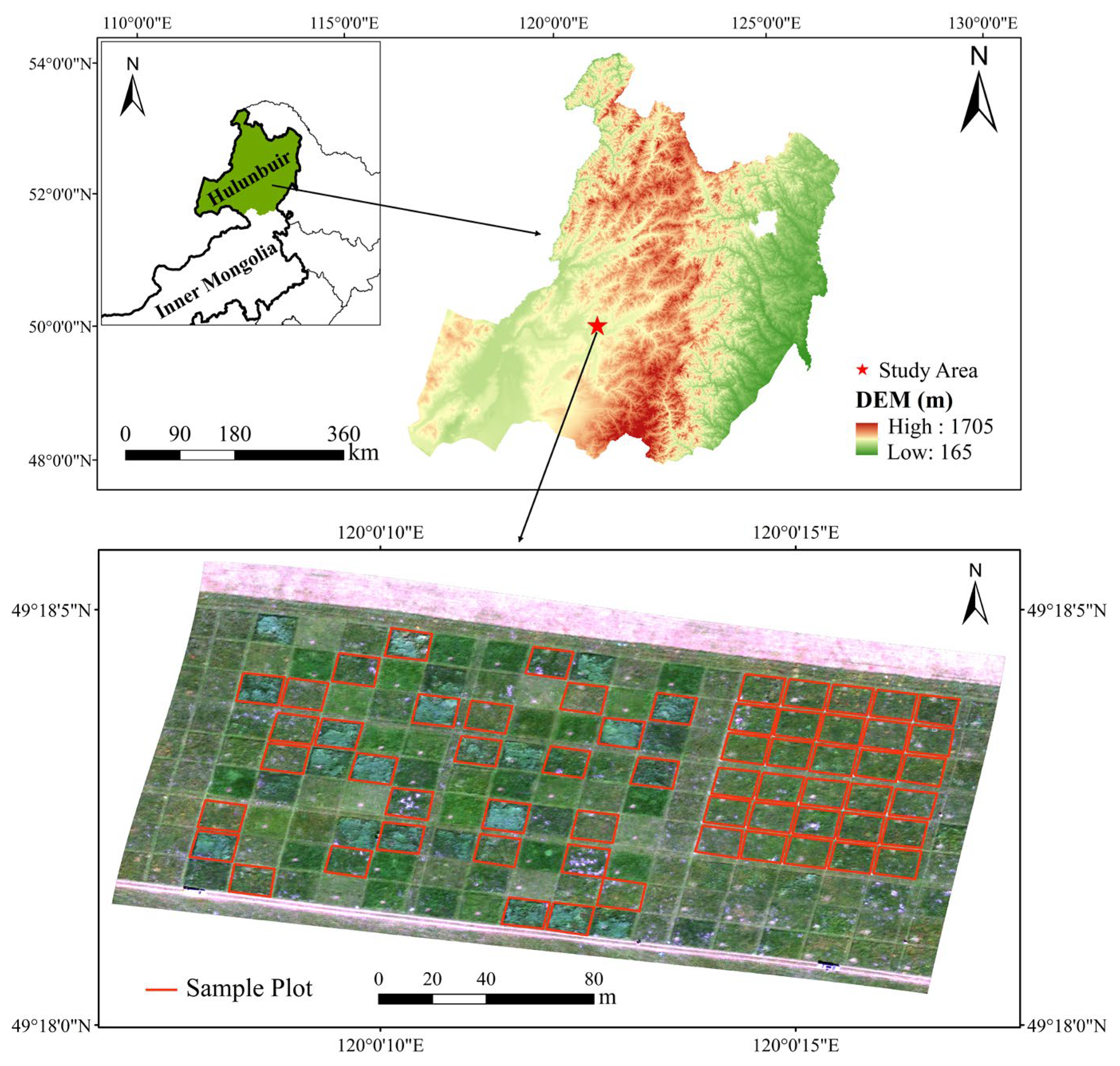
The study area is located in the Hulunbuir Grassland of northeastern Inner Mongolia Autonomous Region. The terrain generally slopes from east to west, with an elevation of approximately 650–700 m. This region represents the most concentrated and characteristic distribution of temperate meadow steppe in China. It is characterized by a temperate semi-humid continental climate, with a mean annual temperature ranging from −2 °C to 1 °C and a mean annual precipitation of 380–400 mm [23]. Precipitation is unevenly distributed, with the growing season (June–September) receiving about 77.5% of the annual total [24]. The dominant soil type is black calcareous soil. These climatic and edaphic conditions jointly promote the development of meadow steppe dominated by Leymus chinensis. Owing to its favorable natural conditions and high forage productivity, this region serves as a key pastoral area in northern China.
All field data used in this study were obtained from the Hulunbuir Degraded Grassland Restoration Technology Research Platform (49°18’N, 120°1’E). The platform, established in May 2021, is located at the Xiertala Farm of Hulunbuir State Farm and is composed of 900 plots, each measuring 10 m × 10 m (Figure 1). Various experimental treatments, including fertilization, mowing, and reseeding, have been conducted to create gradients of AGB. These conditions provide a robust basis for evaluating the saturation effects of different VIs. Although the samples were collected from a relatively limited area, the study included plots subjected to different nutrient treatment regimes, which resulted in substantial variations in species composition (7–30 species/m2) and biomass levels (136.37–854.01 g/m2) within the study site. Under this context, the platform can be considered representative of meadow steppes with similar ecological and management conditions.

2.2. Data Collection and Processing

2.2.1. Hyperspectral Data

In this experiment, 60 experimental plots within the research platform were selected for sampling. AGB was dynamically monitored throughout the growing season (May to September) in 2023. For sampling, five destructive 1 m × 1 m quadrats separated by 0.5 m were established in each plot, positioned 0.5 m from the plot boundary. Each month, spectral measurements were conducted on one quadrat. Canopy spectral data were collected using an ASD Field Spec 4 spectrometer to obtain synchronous spectral of target vegetation and soil. The spectral range covers 350–2500 nm, including visible, near-infrared, and shortwave-infrared bands, with a spectral resolution of 1 nm. Measurements were conducted in the late morning to early afternoon (10:00–14:00 local time) under clear, windless conditions. During observation, the probe was held vertically downward, approximately 1 m above the canopy to ensure that only the target quadrat was measured. Each quadrat was scanned nine times consecutively, and the mean of these scans was used as the final spectral value for that quadrat. Due to low signal-to-noise ratios, data in the 350–399 nm and 2401–2500 nm were excluded. Additionally, spectral bands corresponding to strong atmospheric and water vapor (1320–1480 nm and 1780–2040 nm) were removed to minimize signal distortion.

2.2.2. Measured Data

After the collection of spectral data, AGB was collected using the harvest method within the same quadrat. Each plot contained five quadrats, one of which was destructively sampled each month. Therefore, the sampling quadrats obtained each month were independent observations. After controlling for biomass effect in the model, the inclusion of month as a covariate did not result in a statistically significant (p > 0.5) influence on the VIs. To quantify the contributions of different vegetation height layers to total AGB, all plant materials within each quadrat were clipped at the ground level and immediately transported to the laboratory. The samples were then stratified at 10 cm intervals, and the fresh weight of each layer was recorded. The samples were deactivated at 105 °C for 0.5 h and oven-dried at 65 °C for 48 h. The dry weight of each height layer was measured using a balance with an accuracy of 0.01 g, yielding stratified AGB for each quadrat. Stratified biomass sampling was conducted at the end of each month in May, June, August, and September of 2023, while only total AGB was collected in 25th, July without height stratification. These plots encompassed different nutrient addition treatments and were arranged in a randomized block design, thereby generating gradients of AGB during the peak growing season in August. Due to limitations in data acquisition, some quadrats lacked measured biomass or spectral data. After removing invalid records, a total of 293 quadrat samples were obtained across the five months, of which 235 included height-stratified AGB data from top to bottom (excluding July).

2.3. Research Methods

2.3.1. Vegetation Index Extraction

Among all candidate VIs, 12 commonly used VIs for grassland biomass estimation were selected to compare their sensitivity in high-biomass regions. The 12 VIs include ARVI, DVI, EVI, GNDVI, MSAVI, NDPI, NDRE, NDVI, OSAVI, RVI, SAVI, and VARI. The definition of these VIs and their corresponding references are provided in Table 1. In the formulas, Rblue, Rgreen, Rred, Rrededge, Rnir, and Rswir denote the surface reflectance values in the blue (470 nm), green (550 nm), red (638 nm), red-edge (702 nm), near-infrared (866 nm) and shortwave-infrared (1600 nm) bands, respectively.

2.3.2. Model Fitting

In this study, four commonly used parametric models were employed: the Linear model, the Logarithmic model, the Power Function model and the Gompertz model. To examine the saturation effect of different VIs along the AGB gradient, VI was modeled as function of AGB, i.e., VI = f(AGB), with VI treated as the dependent variable and AGB as the independent variable. The formula of these models and the corresponding meanings of their parameters are presented in Table 2. The samples data were randomly divided into a training set and a testing set at a ratio of 7:3. Model parameters were calibrated using the training dataset, and model performance was evaluated based on the independent testing dataset, on which the optimal model was selected. Residual independence tests indicated that the relationships between AGB and VIs satisfied the fundamental assumptions of the models.
The error term ε is assumed to follow a normal distribution ε N ( 0 , σ 2 ) , satisfying independence, homoscedasticity, and normality assumptions. Parameters estimation for a and b in the Linear model and Logarithmic model are performed using Ordinary Least Squares (OLS). Meanwhile, Nonlinear Least Squares (NLS) is employed to estimate the parameters of the Power Function model and Gompertz model.

2.3.3. Model Selection

The coefficient of determination (R2) and root mean squared error (RMSE) of the validation model were used to assess the accuracy and goodness-of-fit of the model predictions relative to the observed values.
R 2 = 1 i = 1 n Y i Y i 2 i = 1 n Y i Y i ¯ 2    
R M S E = i = 1 n   Y i Y i 2 n
where Y i and Y i represent the observed and predicted VI values, respectively, Y i ¯   is the average value of measured VI and n is the number of samples. The coefficient R2 reflects the goodness-of-fit between the predicted VI and the measured VI. An R2 value closer to 1 indicates a stronger correlation and better model performance. The smaller the RMSE, the higher the prediction accuracy of the model.

2.3.4. Determination of Saturation Height

After selecting the optimal model, it was applied to analyze stratified accumulated AGB and to investigate the variation in vegetation height at which saturation occurred for different VIs. For each VI, cumulative biomass at different heights was used for model fitting. A total of 70% of the samples were randomly selected for model training, while the remaining 30% were reserved for model validation. In this study, the second-order difference in the RMSE sequence from the validation model was used to identify the saturation point of each VIs. During the initial stages of model development, as the canopy height increases, the model incorporates more biomass information, leading to a decrease in RMSE. However, once biomass (or canopy height) reaches a certain threshold, the VI values plateau. Further increases in biomass no longer improve the predictive capability of the model, and RMSE stabilizes, indicating that model performance has reached a plateau phase. The point at which the RMSE curve begins to stabilize is defined as the saturation point, representing the canopy height beyond which additional biomass does not enhance the predictive accuracy of the VI.
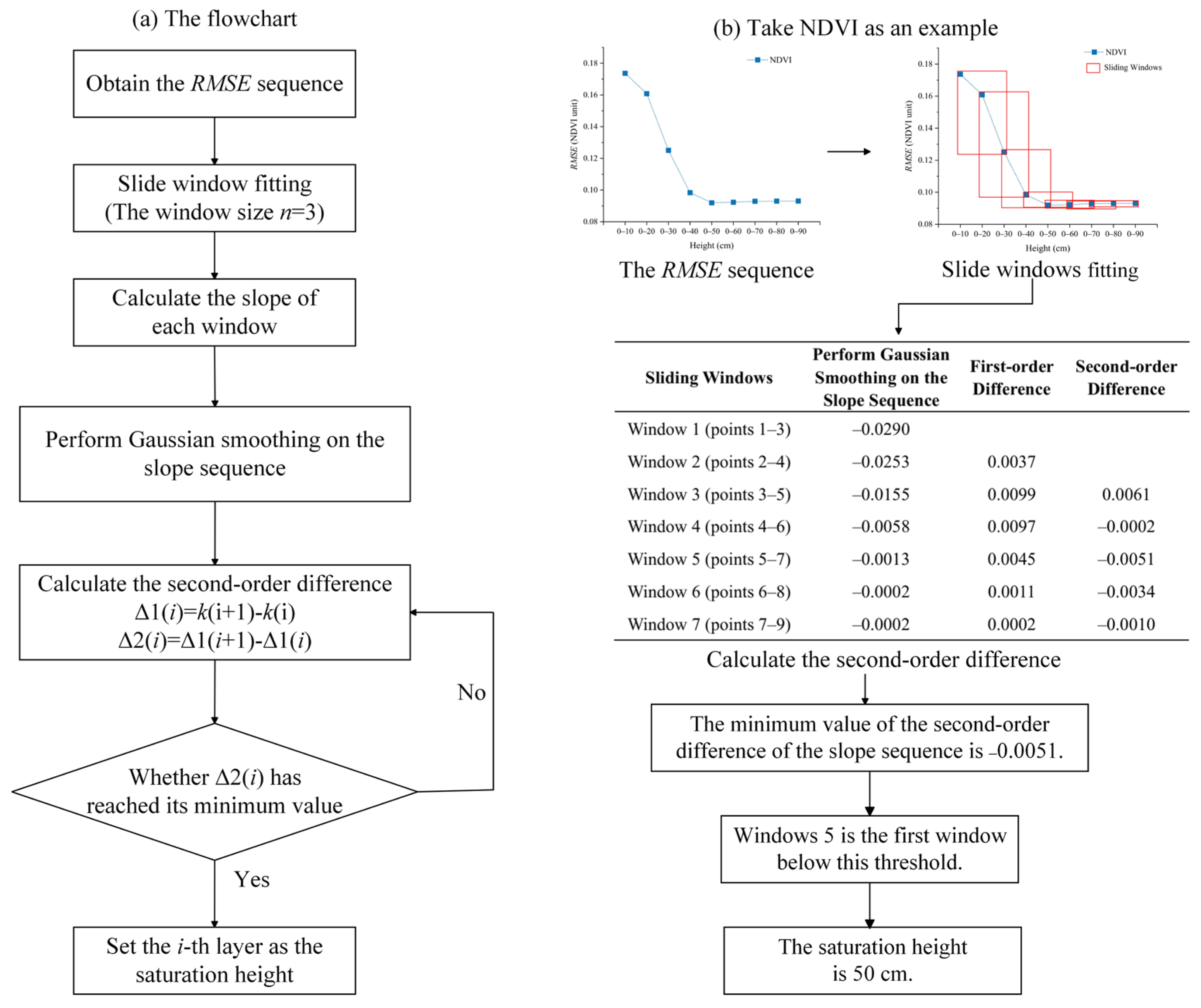
To objectively identify the stabilization phase of the RMSE curve, this study employed a method based on the sliding windows approach [37] and second-order differences [38]. The procedure consists of two core steps: linear fitting within sliding windows and the determination of a slope-based threshold (i.e., saturation height) (Figure 2a). To further illustrate the procedure for determining the saturation height of VI, NDVI was used as an illustrative example to demonstrate the procedure for identifying the saturation height (Figure 2b). Specifically, a sliding window of fixed size (n = 3) was applied to the RMSE sequence, where each window included RMSE values from three consecutive height levels. For each window, a linear regression was performed to characterize the trend of RMSE variation with height, and the corresponding slope was calculated. A steep slope indicates that RMSE still changes substantially with increasing height, whereas a slope approaching zero suggests that RMSE has become nearly stable.
Subsequently, the second-order difference method was applied to analyze the slope of the RMSE sequence to objectively determine the threshold at which variations in the discrete data become stable. The slopes derived from all sliding windows were arranged sequentially and smoothed using a Gaussian filter to reduce the influence of local fluctuations and noise on breakpoint detection [39]. Assuming the slope of RMSE sequence be denoted as ki (i = 1, 2, ..., n), the first-order difference is then defined as
Δ 1 ( i ) = k i + 1 k i
It calculates the difference between each pair of adjacent slope values, representing the rate of change in the slope. The second-order difference is defined as
Δ 2 ( i ) = Δ 1 ( i + 1 ) Δ 1 ( i )
The second-order difference ( Δ 2 ( i ) ) reflects the rate of change in the slope of the RMSE sequence [40]. At the initial stage, the slope of the RMSE sequence declines rapidly, resulting in relatively large Δ 2 ( i ) values. As canopy height increases, the rate of slope changes gradually slows and eventually stabilizes, causing Δ 2 ( i ) to decrease progressively. The minimum value of Δ 2 ( i ) typically corresponds to the point of the most pronounced slope decrease, indicating the saturation point. Beyond this point, the slope tends to stabilize. The slope at the saturation point is therefore adopted as a threshold to distinguish regions of significant change from those that are relatively stable. When Δ 2 ( i ) reaches its minimum, the slope corresponding to the first position of the associated sliding window is identified as the saturation point. The canopy height of the first sliding window whose slope falls below this threshold is subsequently defined as the saturation height of the VI.

3. Results

3.1. Vertical Distribution of Grassland Aboveground Biomass

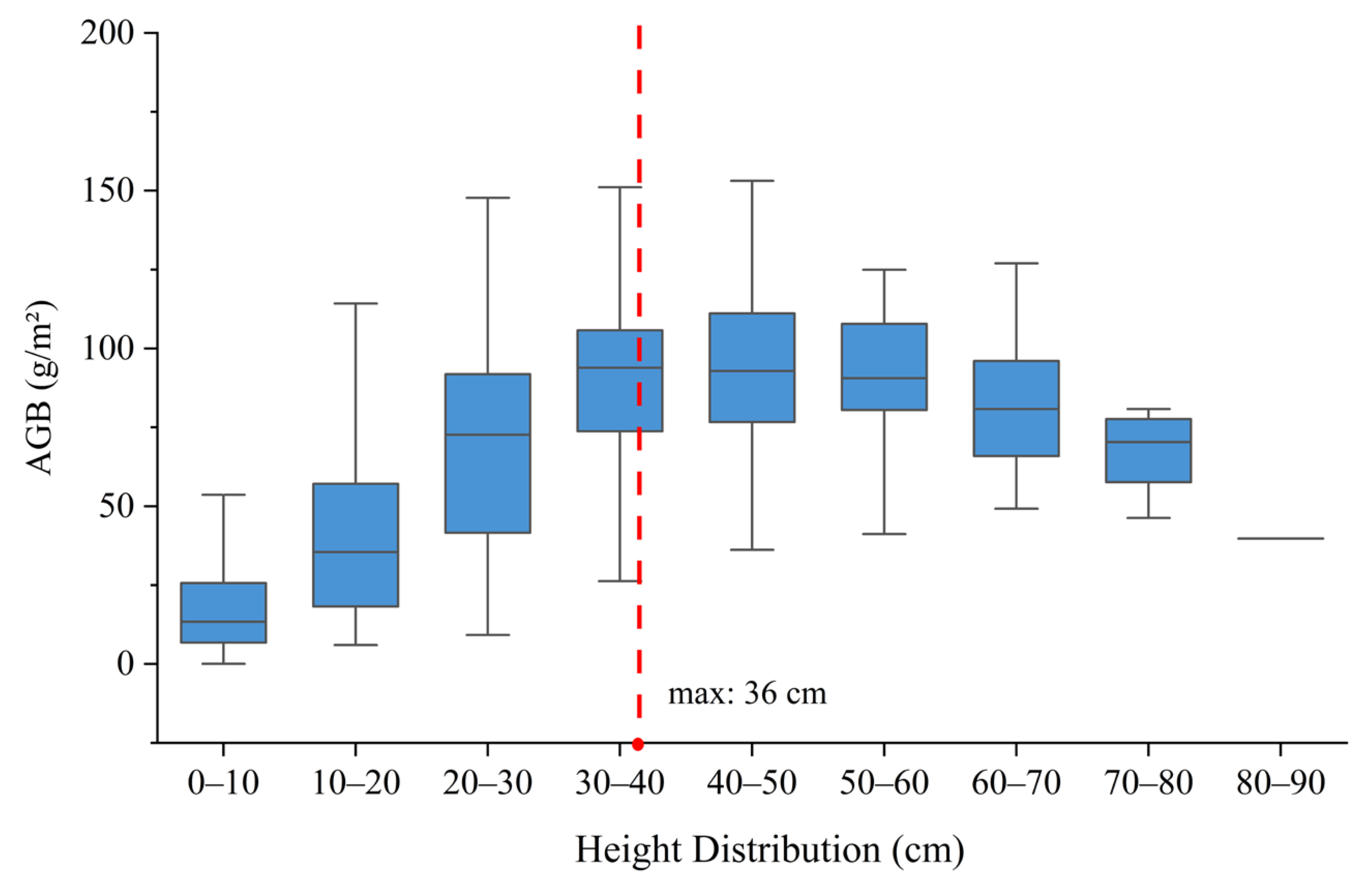
The vertical distribution of AGB in the temperate meadow steppe exhibited a distinct unimodal pattern along the canopy-height gradient, initially increasing to a maximum before declining (Figure 3). The relationship between AGB in each stratum and its mid-point height was best described by a quadratic function (R2 = 0.52, p < 0.05), with the maximum biomass occurring at a height of 36 cm.

3.2. Comparison of Saturation Effects Among Different Vegetation Indices

In this study, Linear models, Logarithmic models, Power Function models and Gompertz models were used to fit the relationships between 12 VIs and the total AGB of grassland. Overall, substantial differences were observed both among different VIs and models applied to the same VI (Table 3).
The performance of four regression models for different VIs is presented in Table 3. In general, the Nonlinear models showed improved performance compared with the Linear model, with higher R2 values and lower RMSE across all indices. Among them, the Gompertz model consistently achieved the best fit, with R2 values reaching 0.77 and RMSE generally below 0.10. The Logarithmic and Power Function models produced comparable but slightly lower accuracies, while the Linear model exhibited the lowest performance, with R2 values mostly below 0.53 and RMSE generally above 0.10.
Distinct differences in predictive performance among VIs were observed with the Gompertz model. NDVI yielded the highest accuracy (R2 = 0.77, RMSE = 0.09), followed by GNDVI, ARVI, and NDPI (R2 = 0.74–0.72). Indices designed to reduce soil background effects, such as OSAVI and SAVI, showed moderate performance (R2 = 0.63–0.71). In contrast, DVI and RVI resulted in lower accuracy, with R2 values below 0.50. These results demonstrate that both model selection and VI choice influence estimation performance.

3.3. Saturation Heights of Different Vegetation Indices

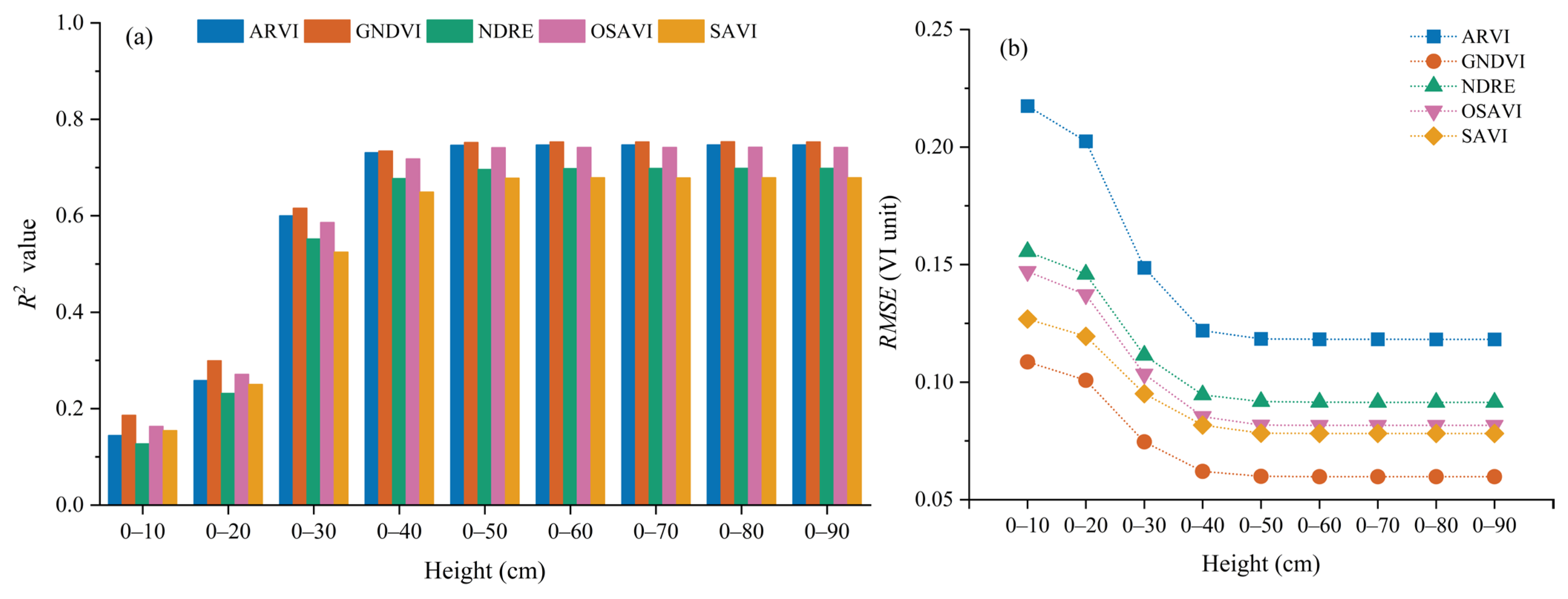
We analyzed the Gompertz models of VIs against cumulative AGB at different canopy heights, and evaluated model performance using R2 and RMSE. The results indicated that, for ARVI, GNDVI, NDRE, OSAVI, SAVI, canopy height has a significant impact on both the explanatory power and predictive accuracy of the models (Figure 4). Overall, the fitting accuracy of VIs improved with increasing height. R2 values increased from approximately 0.15 to above 0.70. With the increase in cumulative canopy height, the increase in R2 became marginal, showing that the indices had reached saturation and no longer responded proportionally to further increases in AGB. Correspondingly, RMSE first exhibited a pronounced decrease and then stabilized, further confirming the onset of saturation. Among them, GNDVI, OSAVI, and ARVI showed superior model performance compared with NDRE and SAVI. GNDVI consistently exhibited higher R2 and lower RMSE across all heights, indicating strong sensitivity to biomass variation, while OSAVI and ARVI achieved R2 values comparable to GNDVI but with higher RMSE. In contrast, NDRE and SAVI displayed lower overall model accuracy.
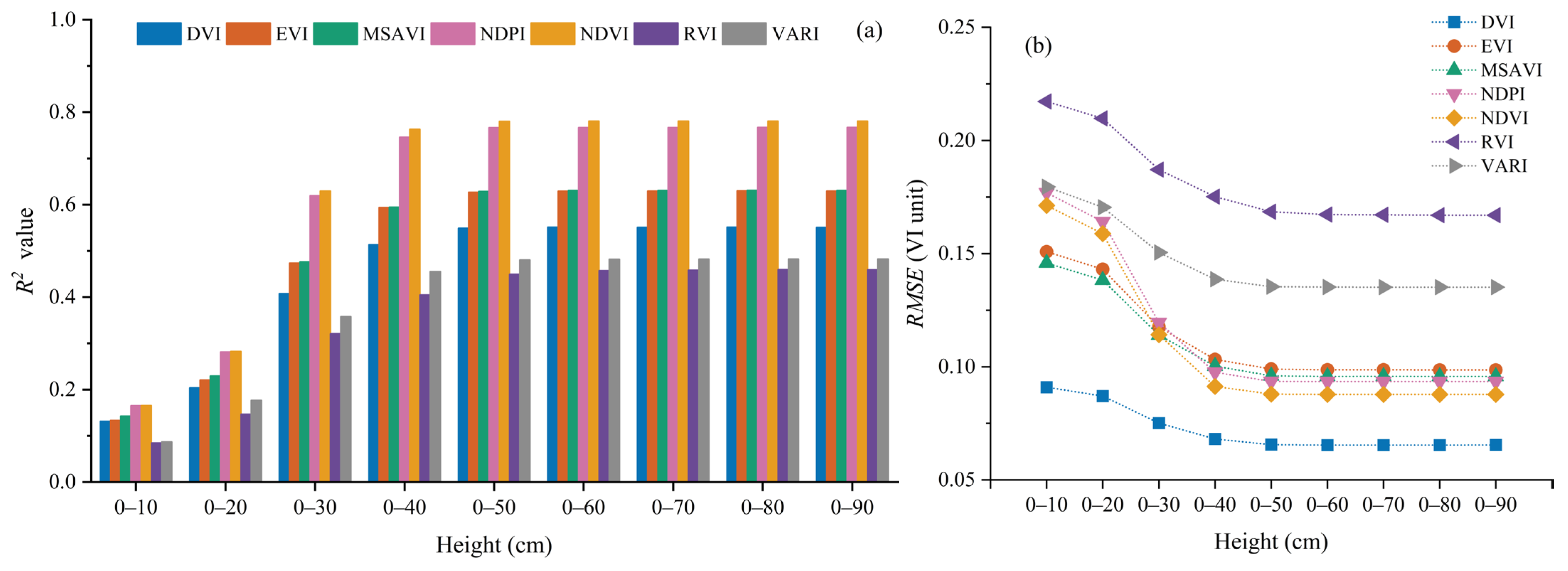
For DVI, EVI, MSAVI, NDPI, NDVI, RVI, and VARI, as canopy height increased, the fitting performance of these indices improved significantly, with R2 rising from 0.13 to 0.78. While RMSE decreased correspondingly and then stabilized, further increases in biomass did not improve the fit. As shown in Figure 5, the explanatory power of these seven indices varied noticeably. NDPI and NDVI exhibited higher R2 values than the other indices. These two indices effectively captured the cumulative changes in biomass and demonstrated the strongest model explanatory power. EVI and MSAVI showed moderate model performance (R2 = 0.63), suggesting that although these modified indices can reduce soil background and chlorophyll interference, they still experience partial saturation under high vegetation cover. VARI, DVI, and RVI showed relatively low model accuracy. However, DVI exhibited a significantly lower RMSE than RVI and VARI, suggesting that the DVI model controlled absolute errors more effectively.
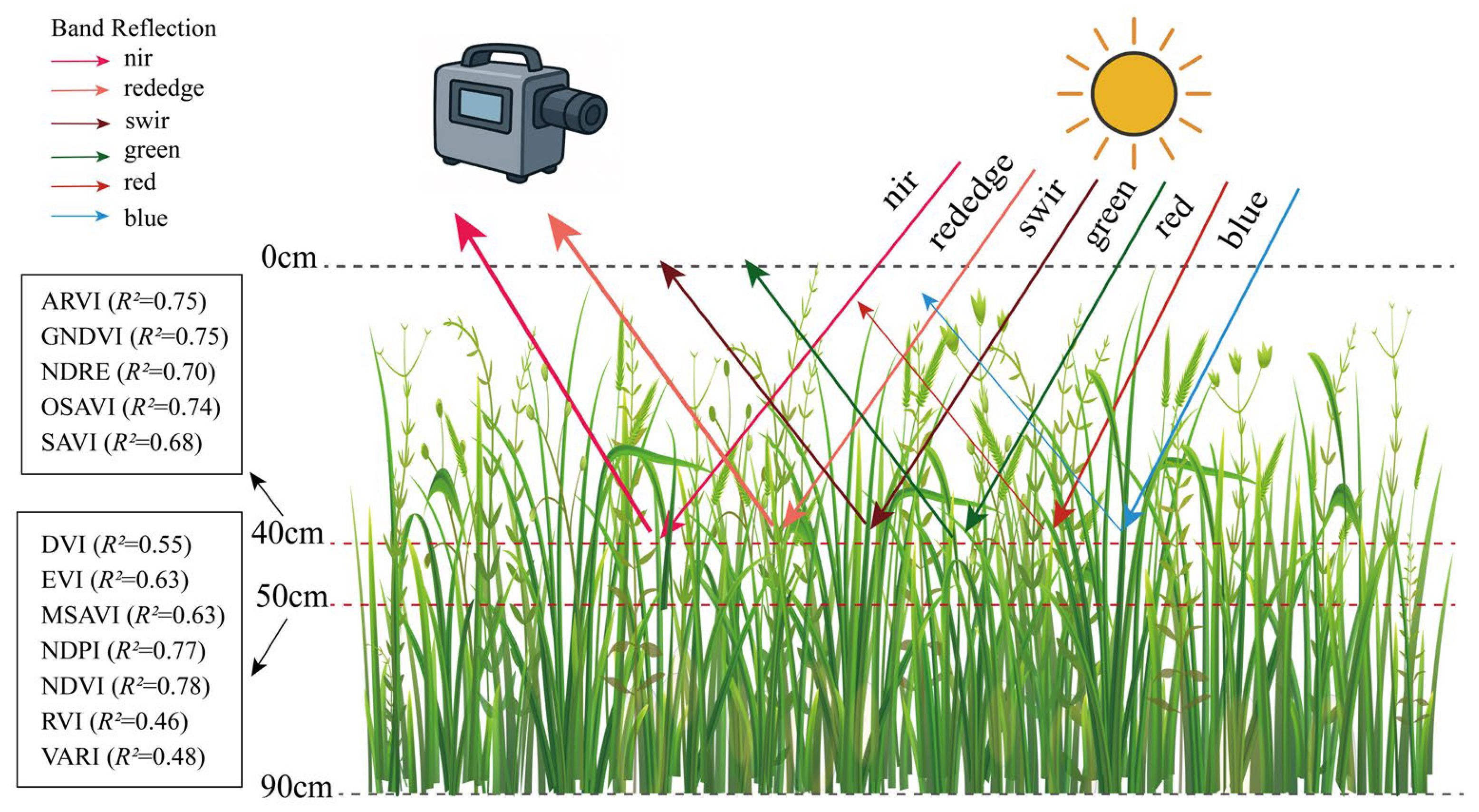
A method combining sliding windows with second-order differences was employed to identify saturation points of different VIs. For the Gompertz models relating VIs to AGB, the slopes derived from the RMSE sliding windows exhibited a monotonically decreasing trend with increasing canopy height. This pattern indicates that the sensitivity of each VI gradually declined with increasing biomass or vegetation, ultimately reaching a saturation state. Table 4 summarized the slope thresholds and corresponding saturation heights for the 12 VIs. Specifically, the 12 VIs can be classified into two categories based on the identified saturation heights. The first category included ARVI, GNDVI, NDRE, OSAVI, and SAVI, all of which showed slope values falling below their respective thresholds at relatively low canopy heights (40 cm). This indicated that these indices could reliably estimate grassland biomass primarily within the 0–40 cm height range, beyond which they began to exhibit saturation effects. The second category consisted of DVI, EVI, MSAVI, NDPI, NDVI, RVI, and VARI. For these indices, a noticeable decline in sensitivity occurred at approximately 50 cm, indicating a greater resistance to saturation and a broader effective range for biomass estimation.

4. Discussion

4.1. Vertical Distribution Characteristics of Grassland Aboveground Biomass

The vertical distribution of grassland biomass across different heights reflects the structural attributes of the plant community and directly influences the accuracy of VI-based biomass estimations. Moreover, current studies on the vertical structure of vegetation focus primarily on agricultural crops. These studies typically characterize crop growth—such as corn and wheat—through the vertical distribution of chlorophyll, nitrogen content, or AGB [41,42]. In contrast, research on the vertical distribution of AGB in grasslands remains relatively limited. The aboveground biomass observed in this study exhibits a unimodal vertical distribution (Figure 2), a structural feature that is fundamental for understanding the saturation behavior of VIs. From the perspective of canopy radiative transfer, VIs essentially represent an integrated response of light–vegetation interactions within the canopy, and their saturation is directly regulated by key structural traits [43]. First, the vertical distribution of leaf area and light attenuation: the unimodal biomass profile closely reflects the vertical distribution of leaf area density. According to the Beer–Lambert law, photosynthetically active radiation decreases exponentially with cumulative leaf area index (LAI), subjecting leaves in the lower canopy to significant light limitation [44]. VI signals primarily originate from leaf layers that are directly or diffusely illuminated. The observed saturation heights (~40–50 cm) effectively delineate the transition from a well-illuminated upper canopy layer to a light-limited lower layer. Below this critical depth, although biomass continues to increase, additional leaves contribute minimally to canopy reflectance, resulting in VI saturation. Second, leaf angle and canopy porosity: leaf angle distribution is another key structural parameter [45,46]. The plant community in this study is dominated by upright-leaved grasses (e.g., L. chinensis), which form a highly porous canopy that allows greater penetration of both direct and diffuse light into the mid-canopy. In summary, VI saturation is not solely determined by total biomass but is strongly influenced by the ‘effective optical depth’ of the canopy. This study advances the traditional discussion of VI saturation based on total biomass toward a mechanistic understanding rooted in the canopy vertical structure, providing a theoretical foundation for developing remote-sensing models that incorporate structural parameters to mitigate saturation effects.

4.2. Differences in the Fitting Performing of Vegetation Indices

Vegetation indices are fundamentally constructed based on the spectral reflectance characteristics of different bands, most of which estimate biomass by exploiting the differential reflectance between visible and near-infrared wavelengths in the vegetation canopy [22]. Traditional VIs, such as NDVI, mainly characterize AGB by leveraging the strong absorption of red light by chlorophyll and the high reflectance of near-infrared radiation by the internal leaf structure. With advancements in remote-sensing technology, a growing number of improved vegetation indices incorporate information from red-edge and shortwave-infrared bands to enhance sensitivity to plant physiological state, leaf structural properties, and water content [47,48]. When leaf area index or biomass is relatively low, the absorption and reflectance across relevant spectral bands increase substantially with the increase in biomass, resulting in an approximately linear relationship between VIs and biomass. However, once biomass exceeds a certain threshold, spectral absorption and reflectance tend to saturate. Dense canopies also cause upper-layer vegetation to overshadow lower strata, preventing VI values from further capturing the increase in biomass, which is more in line with the nonlinear relationship.
The observed differences in performance among the four regression models highlight the importance of selecting an appropriate model for AGB estimation. Nonlinear models, particularly the Gompertz model, consistently outperformed the Linear model, suggesting an inherently nonlinear and potentially asymptotic relationship between VIs and AGB. The Logarithmic and Power Function models provided moderate improvements over the Linear model, indicating that simple nonlinear transformations capture part of the response patterns but are less flexible than the Gompertz formulation. The superior performance of the Gompertz model aligns with previous studies reporting its effectiveness in modeling saturating growth processes in vegetation monitoring, and underscores the need to account for nonlinearity when estimating AGB from spectral data [49,50].
Within the Gompertz model, performance differences among VIs further emphasize the influence of spectral sensitivity on estimation accuracy. NDVI produced the highest predictive performance, likely attributable to its strong responsiveness to overall canopy greenness and structural variation. GNDVI and ARVI also performed well, reflecting the advantages of incorporating green-band information or atmospheric resistance under the given conditions. NDPI showed moderate-to-high performance, reflecting its sensitivity to nir and green/red bands that capture canopy greenness and leaf structure. Soil-adjusted indices such as OSAVI and SAVI showed moderate performance, suggesting that soil background correction can be beneficial but may not fully compensate under the study conditions. In contrast, DVI and RVI demonstrated limited predictive power, highlighting that raw or simple ratio-based indices may be less suitable for capturing the nonlinear dynamics represented by the Gompertz model. These findings collectively indicate that both model structure and VI selection are critical considerations for accurate estimation of vegetation properties from remote-sensing data.

4.3. Differences in Saturation Among Vegetation Indices

Differences among the 12 VIs primarily stem from their spectral band compositions and normalization strategies, which jointly determine their sensitivity to canopy structure and canopy penetration, soil background, and LAI. Traditional red–nir indices, such as NDVI, DVI, and RVI, are effective in detecting variations in vegetation cover at low to moderate vegetation densities [51]. Soil-adjusted indices, including SAVI and MSAVI, mitigate soil background effects and perform well in sparse vegetation [33]. Indices that incorporate enhanced near-infrared or red-edge information, such as EVI, ARVI, and NDRE, maintain sensitivity under moderate to high LAI by improving canopy penetration and reducing saturation effects. Structure-sensitive index VARI, relying solely on visible bands, is most suitable for sparse vegetation or data-limited scenarios, whereas NDPI, designed to enhance canopy structural sensitivity while minimizing background and illumination effects, is better suited for monitoring aboveground biomass and canopy structure in dense or heterogeneous vegetation.
The first category of VIs, including ARVI, GNDVI, NDRE, OSAVI, and SAVI, exhibits a saturation height around 40 cm. The fitted models diverge noticeably below this height but gradually converge above 40 cm, indicating the onset of saturation under high-biomass conditions. Specifically, ARVI is calculated as a ratio of red- to near-infrared reflectance. As canopy density increases, red-band absorption approaches saturation while near-infrared reflectance stabilizes, leading to a marked decrease in biomass sensitivity. GNDVI, which incorporates the green band, is sensitive during the mid-growth stage; however, the weaker absorption of the green band compared to red limits its dynamic range, leading to earlier saturation. Although NDRE, which incorporates the red-edge band, delays canopy structural saturation, its sensitivity still decreases under high chlorophyll content [52]. The soil-adjusted factors in SAVI and OSAVI enhance vegetation signals at low vegetation coverage but accelerate saturation under high coverage, due to their reliance on the red-near-infrared bands. Consequently, these VIs are primarily sensitive to AGB in the upper canopy (0–40 cm). Stratified biomass measurements indicate that biomass within this layer accounts for 74.66% of the total AGB, suggesting that roughly 25% of lower-layer vegetation is obscured by the upper canopy and insufficiently captured by optical signals. This effect contributes to the saturation of VIs and leads to an underestimation of total grassland biomass.
The second category of VIs includes DVI, EVI, MSAVI, NDPI, NDVI, RVI, and VARI, all of which reach a saturation point in model fitting at approximately 50 cm, indicating a delayed saturation effect compared with the first category. Specifically, NDVI quantifies the vegetation coverage using the strong absorption of red light and strong reflection of near-infrared light, maintaining sensitivity to canopy height increases up to relatively high LAI levels. DVI and RVI, constructed as difference and ratio indices, provide a broader dynamic range in the highly reflective near-infrared region. EVI, by incorporating the blue band and applying atmospheric- and canopy background correction coefficients, effectively mitigates saturation caused by red-light absorption under dense canopy conditions [27]. MSAVI reduces soil background interference through an adaptive soil adjustment term [29], maintaining sensitivity under high canopy coverage. NDPI, by incorporating the shortwave-infrared band, enhances sensitivity to leaf water content and canopy structure changes, alleviating chlorophyll saturation and improving canopy penetration. VARI, primarily based on visible bands, is more sensitive to canopy architectural variations and background reflectance, exhibiting a comparatively weaker saturation trend. Nevertheless, as grassland biomass continues to increase, shading by upper canopy leaves progressively limits signal penetration, ultimately leading to saturation. Notably, the 0–50 cm height layer accounts for 90.03% of the total AGB, indicating that about 10% of the biomass in the lower canopy remains undetected, leading to systematic underestimation of total biomass.
In summary, all traditional VIs exhibit saturation phenomena, although the canopy height at which saturation occurs varies among indices. These differences are primarily driven by variations in spectral structures (Figure 6). Among the 12 VIs examined, NDVI and NDPI exhibited the strongest resistance to saturation under high biomass conditions. This behavior is attributed to their ability to preserve sensitivity to near-infrared scattering associated with by canopy structural complexity, rather than relying primarily on visible-band absorption, which saturates at high LAI.

4.4. Limitations

This study primarily compares the saturation of 12 traditional VIs, and evaluates the differences in their relationships with grassland biomass, with particular emphasis on the maximum grassland canopy height each index can effectively capture. These findings provide a valuable reference for subsequent biomass monitoring. However, several critical issues remain to be addressed.
First, the data used in this study were derived from ground-based spectral observations collected within a small-scale region, which limits the spatial representativeness of the results. Future research should extend the application of this method to diverse grassland types and varying management practices. Such efforts will enhance the generalizability of the approach and provide a robust foundation for the development of regional-scale vegetation models. Differences in plant community composition can lead to variations in the vertical structure and consequently in the vertical distribution of biomass, resulting in distinct saturation heights among communities. Therefore, the patterns identified in this study may not be directly applicable to other grassland types. Future research should incorporate biomass partitioning across multiple species and functional groups to more comprehensively evaluate how community composition affects VIs’ saturation behavior across different vegetation types. Comparative analyses of the commonalities and differences in VI saturation phenomena across broader geographic scales and diverse ecological contexts will further improve the generalizability of the findings. Second, although this study highlights differences in height-related saturation sensitivity among VIs, it does not provide effective approaches to mitigate or correct saturation effects. Future research should focus on methodological advances in the following areas to improve the accuracy of biomass estimation: (1) implementing hierarchical inversion approaches and mixture models that utilize distinct indices or segmented models for different grassland coverage or biomass ranges [53]; (2) integrating multi-source remote-sensing data fusion techniques [54] to reduce occlusion effects in lower canopy layers; and (3) developing new spectral parameters and structural indices with enhanced sensitivity in high-biomass environments to improve biomass estimation under dense vegetation conditions. Third, this study characterizes the vertical saturation patterns of VIs using ground-based hyperspectral data. It should be noted that, due to differences in observation geometry, spatial resolution, and atmospheric effects, the specific saturation-height values obtained in this study cannot be directly extrapolated to the saturated canopy height at the satellite pixel scale. Nevertheless, the core finding—that different VIs exhibit varying sensitivities and effective detection depths for vertical canopy information—has cross-scale applicability. To bridge the gap between mechanism and application, future research should leverage Sentinel-2, Landsat, and other satellite datasets to systematically evaluate the performance of the ‘high-saturation’ and ‘low-saturation’ index types identified in this study for regional-scale biomass retrieval.
It is important to note that a model that fits V I = f ( A G B ) well does not necessarily imply that its inverse, A G B = f 1 ( V I ) , will yield biomass estimates with comparable accuracy. First, in the model V I = f ( A G B ) , the objective is to minimize the prediction error of VI. When this relationship is inverted, even small observational errors in VI can be greatly amplified, leading to substantial uncertainties in AGB estimates. Second, the inverse of the function chosen to describe saturation may not possess an optimal form for biomass prediction. Moreover, the saturation of the V I = f A G B curve in high-biomass regions indicates that VI is largely insensitive to changes in AGB within this range. Conversely, when using A G B = f 1 ( V I ) , even minor fluctuations in the VI can introduce significant uncertainty into the AGB estimates. Therefore, this study provides a framework for screening robust vegetation indices and identifying their saturation characteristics for biomass inversion. Future work should focus on constructing and optimizing A G B = f ( V I ) inversion models based on the selected indices and rigorously validating their predictive performance using independent field measurements.

5. Conclusions

This study investigated the saturation characteristics of various VIs and their corresponding saturation heights in the temperate meadow steppe. The results showed that vertically stratified AGB exhibited a unimodal distribution, with maximum biomass occurring at a canopy height of 30–40 cm. Linear regression models for different vegetation indices showed relatively low fitting accuracy (R2 = 0.41–0.53), whereas Logarithmic and Power Function models achieved higher accuracy. Among Gompertz models, significant differences were observed: NDVI achieved the highest accuracy (R2 = 0.77), while RVI showed the lowest accuracy (R2 = 0.45). Overall, all VIs exhibited saturation effects. By introducing the novel concept of “saturation height”, this study classified VIs into two categories: the first category, including ARVI, GNDVI, NDRE, OSAVI, and SAVI, reached saturation early at approximately 40 cm; the second category, comprising DVI, EVI, MSAVI, NDPI, NDVI, RVI, and VARI, exhibited stronger resistance to saturation, with saturation point delayed to around 50 cm. Considering both model accuracy and saturation height, NDVI and NDPI showed superior fitting performance and resistance to saturation. This study elucidates the limitations of different VIs in grassland biomass monitoring and provides a scientific basis for improving the accuracy of grassland biomass estimation. These findings hold substantial theoretical and practical value for the development of large-scale, high-precision models for grassland resource monitoring.

Author Contributions

Conceptualization, W.L. and Y.S.; Methodology, Y.W., W.L. and C.X.; Software, Y.W. and F.Y.; Formal Analysis, Y.W., Z.B., W.L., Y.S. and C.X.; Investigation, Y.H., W.L., X.Z., D.Z. and C.X.; Data Curation, Y.W.; Writing—Original Draft Preparation, Y.W.; Writing—Review and Editing, Y.W., W.L., Y.S. and C.X.; Supervision, W.L., Y.S. and C.X. All authors have read and agreed to the published version of the manuscript.

Funding

This research was funded by the National Key Research and Development Program of China (2022YFF1302100) and National Natural Science Foundation of China (U20A20981).

Data Availability Statement

The original contributions presented in this study are included in the article. Further inquiries can be directed to the corresponding author.

Acknowledgments

The authors are grateful for valuable comments from many researchers and colleagues.

Conflicts of Interest

The authors declare no conflicts of interest.

References

  1. Bai, Y.; Cotrufo, M.F. Grassland soil carbon sequestration: Current understanding, challenges, and solutions. Science 2022, 377, 603–608. [Google Scholar] [CrossRef]
  2. Bengtsson, J.; Bullock, J.; Egoh, B.; Everson, C.; Everson, T.; O’connor, T.; O’farrell, P.; Smith, H.; Lindborg, R. Grasslands—More important for ecosystem services than you might think. Ecosphere 2019, 10, e02582. [Google Scholar] [CrossRef]
  3. Wu, L.; Chen, H.; Chen, D.; Wang, S.; Wu, Y.; Wang, B.; Liu, S.; Yue, L.; Yu, J.; Bai, Y. Soil biota diversity and plant diversity both contributed to ecosystem stability in grasslands. Ecol. Lett. 2023, 26, 858–868. [Google Scholar] [CrossRef]
  4. Bardgett, R.D.; Bullock, J.M.; Lavorel, S.; Manning, P.; Schaffner, U.; Ostle, N.; Chomel, M.; Durigan, G.; Fry, E.L.; Johnson, D.; et al. Combatting global grassland degradation. Nat. Rev. Earth Environ. 2021, 2, 720–735. [Google Scholar] [CrossRef]
  5. Zhou, W.; Li, H.; Xie, L.; Nie, X.; Wang, Z.; Du, Z.; Yue, T. Remote sensing inversion of grassland aboveground biomass based on high accuracy surface modeling. Ecol. Indic. 2021, 121, 107215. [Google Scholar] [CrossRef]
  6. Ge, J.; Hou, M.; Liang, T.; Feng, Q.; Meng, X.; Liu, J.; Bao, X.; Gao, H. Spatiotemporal dynamics of grassland aboveground biomass and its driving factors in North China over the past 20 years. Sci. Total Environ. 2022, 826, 154226. [Google Scholar] [CrossRef]
  7. Zhang, X.; Bao, Y.; Wang, D.; Xin, X.; Ding, L.; Xu, D.; Hou, L.; Shen, J. Using UAV LiDAR to extract vegetation parameters of inner Mongolian grassland. Remote Sens. 2021, 13, 656. [Google Scholar] [CrossRef]
  8. Lobell, D.B. The use of satellite data for crop yield gap analysis. Field Crops Res. 2013, 143, 56–64. [Google Scholar] [CrossRef]
  9. Gao, T.; Xu, B.; Yang, X.; Jin, Y.; Ma, H.; Li, J.; Yu, H. Using MODIS time series data to estimate aboveground biomass and its spatio-temporal variation in Inner Mongolia’s grassland between 2001 and 2011. Int. J. Remote Sens. 2013, 34, 7796–7810. [Google Scholar] [CrossRef]
  10. Wei, R.; Shu, Q.; Li, Z.; Fu, L.; Xiang, Q.; Qin, C.; Rao, X.; Liu, J. Inversion of Grassland Aboveground Biomass in the Three Parallel Rivers Area Based on Genetic Programming Optimization Features and Machine Learning. Remote Sens. 2025, 17, 2936. [Google Scholar] [CrossRef]
  11. Lu, D. The potential and challenge of remote sensing-based biomass estimation. Int. J. Remote Sens. 2006, 27, 1297–1328. [Google Scholar] [CrossRef]
  12. Sinha, S.; Jeganathan, C.; Sharma, L.K.; Nathawat, M.S. A review of radar remote sensing for biomass estimation. Int. J. Environ. Sci. Technol. 2015, 12, 1779–1792. [Google Scholar] [CrossRef]
  13. Nordberg, M.-L.; Evertson, J. Monitoring change in mountainous dry-heath vegetation at a regional ScaleUsing multitemporal landsat TM data. AMBIO J. Hum. Environ. 2003, 32, 502–509. [Google Scholar] [CrossRef]
  14. Jin, Y.; Yang, X.; Qiu, J.; Li, J.; Gao, T.; Wu, Q.; Zhao, F.; Ma, H.; Yu, H.; Xu, B. Remote sensing-based biomass estimation and its spatio-temporal variations in temperate grassland, Northern China. Remote Sens. 2014, 6, 1496–1513. [Google Scholar] [CrossRef]
  15. Zhang, B.; Chen, Z.; Peng, D.; Benediktsson, J.A.; Liu, B.; Zou, L.; Li, J.; Plaza, A. Remotely sensed big data: Evolution in model development for information extraction [point of view]. Proc. IEEE 2019, 107, 2294–2301. [Google Scholar] [CrossRef]
  16. Yao, Y.; Ren, H. Estimation of grassland aboveground biomass in northern China based on topography-climate-remote sensing data. Ecol. Indic. 2024, 165, 112230. [Google Scholar] [CrossRef]
  17. Zou, L.; Li, H.; Zhang, J.; Chen, J.; Yang, H.; Gong, Z. Inversion of aboveground biomass of saltmarshes in coastal wetland using remote sensing. Acta Ecol. Sin. 2023, 20, 8532–8543. [Google Scholar]
  18. Liu, W.; Xu, C.; Zhang, Z.; De Boeck, H.; Wang, Y.; Zhang, L.; Xu, X.; Zhang, C.; Chen, G.; Xu, C. Machine learning-based grassland aboveground biomass estimation and its response to climate variation in Southwest China. Front. Ecol. Evol. 2023, 11, 1146850. [Google Scholar] [CrossRef]
  19. Viña, A.; Gitelson, A.A.; Nguy-Robertson, A.L.; Peng, Y. Comparison of different vegetation indices for the remote assessment of green leaf area index of crops. Remote Sens. Environ. 2011, 115, 3468–3478. [Google Scholar] [CrossRef]
  20. de Almeida, D.R.; Vedovato, L.B.; Fuza, M.; Molin, P.; Cassol, H.; Resende, A.F.; Krainovic, P.M.; de Almeida, C.T.; Amaral, C.; Haneda, L. Remote sensing approaches to monitor tropical forest restoration: Current methods and future possibilities. J. Appl. Ecol. 2025, 62, 188–206. [Google Scholar] [CrossRef]
  21. Gitelson, A.A. Wide dynamic range vegetation index for remote quantification of biophysical characteristics of vegetation. J. Plant Physiol. 2004, 161, 165–173. [Google Scholar] [CrossRef]
  22. Radočaj, D.; Plaščak, I.; Jurišić, M. Fusion of Sentinel-2 Phenology Metrics and Saturation-Resistant Vegetation Indices for Improved Correlation with Maize Yield Maps. Agronomy 2025, 15, 1329. [Google Scholar] [CrossRef]
  23. Zhu, X.; Chen, X.; Ma, L.; Liu, W. UAV and satellite synergies for mapping grassland aboveground biomass in Hulunbuir Meadow Steppe. Plants 2024, 13, 1006. [Google Scholar] [CrossRef]
  24. Ji, G.; Li, B.; Yin, H.; Liu, G.; Yuan, Y.; Cui, G. Non-utilization is not the best way to manage lowland meadows in Hulun Buir. Front. Plant Sci. 2021, 12, 704511. [Google Scholar] [CrossRef] [PubMed]
  25. Kaufman, Y.J.; Tanre, D. Atmospherically resistant vegetation index (ARVI) for EOS-MODIS. IEEE Trans. Geosci. Remote Sens. 1992, 30, 261–270. [Google Scholar] [CrossRef]
  26. Sripada, R.P.; Heiniger, R.W.; White, J.G.; Weisz, R. Aerial color infrared photography for determining late-season nitrogen requirements in corn. Agron. J. 2005, 97, 1443–1451. [Google Scholar] [CrossRef]
  27. Huete, A.; Didan, K.; Miura, T.; Rodriguez, E.P.; Gao, X.; Ferreira, L.G. Overview of the radiometric and biophysical performance of the MODIS vegetation indices. Remote Sens. Environ. 2002, 83, 195–213. [Google Scholar] [CrossRef]
  28. Daughtry, C.; Gallo, K.; Goward, S.; Prince, S.; Kustas, W. Spectral estimates of absorbed radiation and phytomass production in corn and soybean canopies. Remote Sens. Environ. 1992, 39, 141–152. [Google Scholar] [CrossRef]
  29. Qi, J.; Chehbouni, A.; Huete, A.R.; Kerr, Y.H.; Sorooshian, S. A modified soil adjusted vegetation index. Remote Sens. Environ. 1994, 48, 119–126. [Google Scholar] [CrossRef]
  30. Xu, D.; Wang, C.; Chen, J.; Shen, M.; Shen, B.; Yan, R.; Li, Z.; Karnieli, A.; Chen, J.; Yan, Y. The superiority of the normalized difference phenology index (NDPI) for estimating grassland aboveground fresh biomass. Remote Sens. Environ. 2021, 264, 112578. [Google Scholar] [CrossRef]
  31. Boiarskii, B.; Hasegawa, H. Comparison of NDVI and NDRE indices to detect differences in vegetation and chlorophyll content. J. Mech. Contin. Math. Sci. 2019, 4, 20–29. [Google Scholar] [CrossRef]
  32. Tucker, C.J. Red and photographic infrared linear combinations for monitoring vegetation. Remote Sens. Environ. 1979, 8, 127–150. [Google Scholar] [CrossRef]
  33. Rondeaux, G.; Steven, M.; Baret, F. Optimization of soil-adjusted vegetation indices. Remote Sens. Environ. 1996, 55, 95–107. [Google Scholar] [CrossRef]
  34. Jordan, C.F. Derivation of leaf-area index from quality of light on the forest floor. Ecology 1969, 50, 663–666. [Google Scholar] [CrossRef]
  35. Huete, A.R. A soil-adjusted vegetation index (SAVI). Remote Sens. Environ. 1988, 25, 295–309. [Google Scholar] [CrossRef]
  36. Stow, D.; Niphadkar, M.; Kaiser, J. MODIS-derived visible atmospherically resistant index for monitoring chaparral moisture content. Int. J. Remote Sens. 2005, 26, 3867–3873. [Google Scholar] [CrossRef]
  37. Keogh, E.; Chu, S.; Hart, D.; Pazzani, M. An online algorithm for segmenting time series. In Proceedings of the 2001 IEEE International Conference on Data Minin; IEEE Computer Society: San Jose, CA, USA, 2001; pp. 289–296. [Google Scholar]
  38. Milne-Thomson, L.M. The Calculus of Finite Differences; American Mathematical Soc.: Providence, RI, USA, 2000. [Google Scholar]
  39. Gallagher, N.B. Savitzky-golay smoothing and differentiation filter. Eig. Res. Inc. 2020, 2, 4. [Google Scholar]
  40. Cheney, W.; Kincaid, D. Numerical Mathematics and Computing; International Thomson Publishing: Belmont, CA, USA, 1998. [Google Scholar]
  41. Wu, B.; Ye, H.; Huang, W.; Wang, H.; Luo, P.; Ren, Y.; Kong, W. Monitoring the vertical distribution of maize canopy chlorophyll content based on multi-angular spectral data. Remote Sens. 2021, 13, 987. [Google Scholar] [CrossRef]
  42. Ye, H.; Huang, W.; Huang, S.; Wu, B.; Dong, Y.; Cui, B. Remote estimation of nitrogen vertical distribution by consideration of maize geometry characteristics. Remote Sens. 2018, 10, 1995. [Google Scholar] [CrossRef]
  43. Gao, S.; Zhong, R.; Yan, K.; Ma, X.; Chen, X.; Pu, J.; Gao, S.; Qi, J.; Yin, G.; Myneni, R.B. Evaluating the saturation effect of vegetation indices in forests using 3D radiative transfer simulations and satellite observations. Remote Sens. Environ. 2023, 295, 113665. [Google Scholar] [CrossRef]
  44. Myneni, R.; Ramakrishna, R.; Nemani, R.; Running, S. Estimation of global leaf area index and absorbed par using radiative transfer models. IEEE Trans. Geosci. Remote Sens. 1997, 35, 1380–1393. [Google Scholar] [CrossRef]
  45. Zou, X.; Mõttus, M. Sensitivity of common vegetation indices to the canopy structure of field crops. Remote Sens. 2017, 9, 994. [Google Scholar] [CrossRef]
  46. Glenn, E.P.; Huete, A.R.; Nagler, P.L.; Nelson, S.G. Relationship between remotely-sensed vegetation indices, canopy attributes and plant physiological processes: What vegetation indices can and cannot tell us about the landscape. Sensors 2008, 8, 2136–2160. [Google Scholar] [CrossRef]
  47. Lin, S.; Li, J.; Liu, Q.; Li, L.; Zhao, J.; Yu, W. Evaluating the effectiveness of using vegetation indices based on red-edge reflectance from Sentinel-2 to estimate gross primary productivity. Remote Sens. 2019, 11, 1303. [Google Scholar] [CrossRef]
  48. Hunt, E.R., Jr.; Yilmaz, M.T. Remote sensing of vegetation water content using shortwave infrared reflectances. In Proceedings of the Remote Sensing and Modeling of Ecosystems for Sustainability IV; Society of Photo-Optical Instrumentation Engineers: Bellingham, WA, USA, 2007; pp. 15–22. [Google Scholar]
  49. Verma, M.; Friedl, M.A.; Finzi, A.; Phillips, N. Multi-criteria evaluation of the suitability of growth functions for modeling remotely sensed phenology. Ecol. Model. 2016, 323, 123–132. [Google Scholar] [CrossRef]
  50. Gachoki, P.; Muraya, M.; Njoroge, G. Modelling plant growth based on Gompertz, logistic curve, extreme gradient boosting and light gradient boosting models using high-dimensional image-derived maize (Zea mays L.) phenomic data. Am. J. Appl. Math. Stat. 2022, 10, 52–64. [Google Scholar] [CrossRef]
  51. Jackson, R.D.; Huete, A.R. Interpreting vegetation indices. Prev. Vet. Med. 1991, 11, 185–200. [Google Scholar] [CrossRef]
  52. Li, F.; Miao, Y.; Feng, G.; Yuan, F.; Yue, S.; Gao, X.; Liu, Y.; Liu, B.; Ustin, S.L.; Chen, X. Improving estimation of summer maize nitrogen status with red edge-based spectral vegetation indices. Field Crops Res. 2014, 157, 111–123. [Google Scholar] [CrossRef]
  53. Li, H.; Li, F.; Xiao, J.; Chen, J.; Lin, K.; Bao, G.; Liu, A.; Wei, G. A machine learning scheme for estimating fine-resolution grassland aboveground biomass over China with Sentinel-1/2 satellite images. Remote Sens. Environ. 2024, 311, 114317. [Google Scholar] [CrossRef]
  54. Xu, C.; Wu, J.; Liang, Y.; Zhu, P.; Wang, S.; Wu, F.; Liu, W.; Mei, X.; Zheng, Z.; Zeng, Y. Comparative Assessment of Planar Density and Stereoscopic Density for Estimating Grassland Aboveground Fresh Biomass Across Growing Season. Remote Sens. 2025, 17, 3038. [Google Scholar] [CrossRef]
Figure 1. Study area location and field sampling plot distribution.
Remotesensing 18 00554 g001
Figure 2. The flowchart for determining saturation height.
Remotesensing 18 00554 g002
Figure 3. The relationship between aboveground biomass in each stratum and its mid-point height in temperate meadow steppe. Boxes: 25th–75th percentiles; central line: median value; upper and lower whisker: the range of 1.5 times the interquartile range (IQR). The red dashed line: canopy height corresponding to maximum stratified biomass.
Remotesensing 18 00554 g003
Figure 4. Performance comparison of vegetation index regression models by using cumulative canopy height: (a) R2; (b) RMSE. It contains vegetation indices (ARVI, GNDVI, NDRE, OSAVI and SAVI) with a saturation height of 40 cm. (VI unit presents vegetation index unit).
Remotesensing 18 00554 g004
Figure 5. Performance comparison of vegetation index regression models by using cumulative canopy height: (a) R2; (b) RMSE. It contains vegetation indices (DVI, EVI, MSAVI, NDPI, NDVI, RVI, and VARI) with a saturation height of 50 cm. (VI unit presents vegetation index unit).
Remotesensing 18 00554 g005
Figure 6. Conceptual diagram showing differences in saturation phenomenon among various vegetation indices.
Remotesensing 18 00554 g006
Table 1. Vegetation indices for AGB estimation used in this study.
Vegetation IndexFormulaCite
ARVI ( R n i r ( 2 × R r e d R b l u e ) ) ( R n i r + ( 2 × R r e d R b l u e ) ) [25]
DVI R n i r R r e d [26]
EVI G × R n i r R r e d R n i r + C 1 × R r e d C 2 × R b l u e + L
where   G = 2.5 ;   C 1 = 6 ;   C 2 = 7.5 ;   L = 1
[27]
GNDVI R n i r R g r e e n R n i r + R g r e e n [28]
MSAVI 1 2 × 2 × R n i r + 1 2 × R n i r + 1 2 8 × R n i r R r e d [29]
NDPI R n i r ( 0.74 × R r e d + 0.26 × R s w i r ) R n i r + ( 0.74 × R r e d + 0.26 × R s w i r ) [30]
NDRE R n i r R r e d e d g e R n i r + R r e d e d g e [31]
NDVI R n i r R r e d R n i r + R r e d [32]
OSAVI R n i r R r e d R n i r + R r e d + X
where   X = 0.16
[33]
RVI R n i r R r e d [34]
SAVI R n i r R r e d R n i r + R r e d + L × ( 1 + L )
where   L = 0.5
[35]
VARI R g r e e n R r e d R g r e e n + R r e d R b l u e [36]
Table 2. Models used to simulate the relationship between vegetation index and the aboveground biomass in this study.
ModelsFormulaParameters
Linear Model y = a x + b + ε a: Slope
b: Intercept
Logarithmic Model y = a l n x + b + ε a: Logarithmic response coefficient
b: The constant term
Power Function Model y = a x b + ε a: Scaling coefficient
b: Power exponent
Gompertz Model y = a e b e c x + ε a: The final saturation value
b: Control the growth rate
c: Control the saturation rate
Note: y presents vegetation index, x is the aboveground biomass.
Table 3. Comparison of model performance (R2 and RMSE) for different vegetation indices.
Vegetation IndexLinear ModelLogarithmic ModelPower Function ModelGompertz Model
R2RMSER2RMSER2RMSER2RMSE
ARVI0.510.160.720.130.660.140.740.12
DVI0.430.090.480.080.490.080.480.08
EVI0.490.130.580.120.580.120.580.12
GNDVI0.510.080.720.060.700.070.740.06
MSAVI0.490.120.590.110.580.110.590.11
NDPI0.510.140.700.110.660.120.720.11
NDRE0.510.120.680.100.650.100.690.09
NDVI0.510.130.740.100.700.100.770.09
OSAVI0.530.110.700.100.680.090.710.09
RVI0.410.200.440.200.440.200.450.19
SAVI0.510.100.630.100.620.090.630.09
VARI0.460.150.590.130.450.150.510.14
Note: The bold in the Table 3 represents the optimal values of the vegetation index models.
Table 4. Saturation thresholds and heights of different vegetation indices.
Vegetation
Index
Slope
Threshold
Saturation
Height
Vegetation
Index
Slope
Threshold
Saturation
Height
ARVI−0.004240 cmNDRE−0.000740 cm
DVI−0.001150 cmNDVI−0.005150 cm
EVI−0.002550 cmOSAVI−0.005940 cm
GNDVI−0.000640 cmRVI−0.005350 cm
MSAVI−0.002450 cmSAVI−0.000840 cm
NDPI−0.005050 cmVARI−0.002150 cm
Disclaimer/Publisher’s Note: The statements, opinions and data contained in all publications are solely those of the individual author(s) and contributor(s) and not of MDPI and/or the editor(s). MDPI and/or the editor(s) disclaim responsibility for any injury to people or property resulting from any ideas, methods, instructions or products referred to in the content.