Article

Tracking the Environmental Impact of Mine Residues and Tailings in Sardinia (Italy) Using Imaging Spectroscopy


1
Department of Civil, Construction and Environmental Engineering (DICEA), University of Rome ‘La Sapienza’, 00184 Rome, Italy
2
Interuniversity Department of Regional and Urban Studies and Planning (DIST), Polytechnic University of Turin, 10125 Turin, Italy
3
Department of Chemical and Geological Sciences, University of Cagliari, 09042 Cagliari, Italy
4
Helmholtz Centre Potsdam, GFZ German Research Centre for Geosciences, 14473 Potsdam, Germany
*
Author to whom correspondence should be addressed.
Remote Sens. 2026, 18(3), 499; https://doi.org/10.3390/rs18030499
Submission received: 15 December 2025 / Revised: 23 January 2026 / Accepted: 27 January 2026 / Published: 3 February 2026

Highlights

What are the main findings?
  • The environmental impact of the mine residues in the Montevecchio mining district, Sardinia, was analyzed using imaging and non-imaging reflectance spectroscopy for the first time.
  • EnMAP data can identify subtle geometrical changes in the spectral signatures of secondary minerals, which allow us to highlight areas most affected by acid mine drainage.
What are the implications of the main findings?
  • Thanks to the time- and cost-effectiveness of this technique, it is possible to easily monitor legacy mining sites, offering relevant information for heavy metal and contaminant mobility dynamics.
  • EnMAP data, despite its medium spatial resolution, is effective in providing rapid and preliminary information on the geochemical characteristics of small-scale mine sites.

Abstract
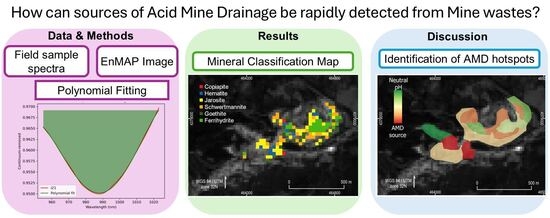
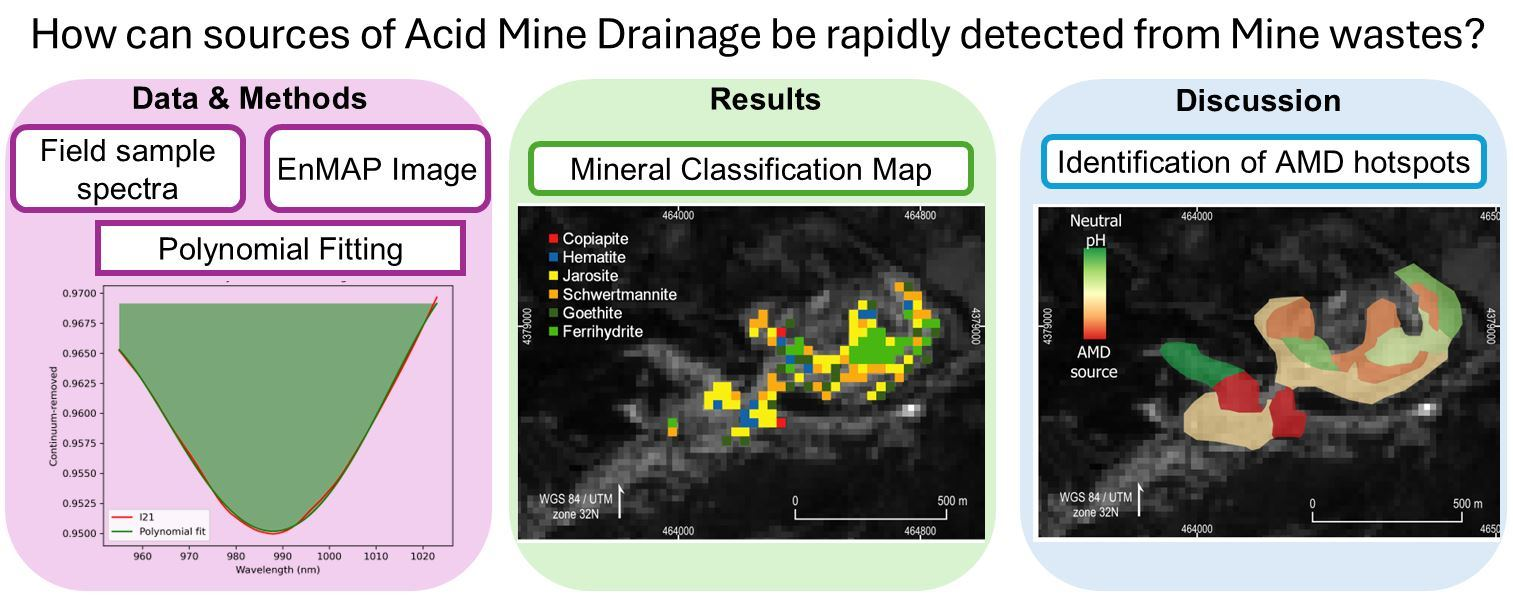
Italy is estimated to host thousands of abandoned mines, many of which contain large volumes of mine residues that negatively affect land and aquatic ecosystems, also posing a risk to human health. This study evaluates the effectiveness of spaceborne imaging spectroscopy combined with laboratory spectroscopy for characterizing the mineralogy and geochemistry of residues from the abandoned Montevecchio sulfide mine in southwestern Sardinia, a site recognized as a significant source of environmental pollution. Mine tailings and their downstream dispersion along the Rio Irvi River were systematically studied and sampled in the field. Collected samples were analyzed in the lab using an Analytical Spectral Device (ASD) spectroradiometer, complemented by powder X-ray Diffraction (XRD) for mineralogical characterization. Affected zones were subsequently mapped using the Environmental Mapping and Analysis Program (EnMAP) hyperspectral satellite data at a 30 m spatial resolution, by applying a polynomial fitting technique to the image spectra. The results reveal the presence of Fe- and Zn-bearing sulfates and oxy/hydroxides, indicative of acidic-to-circum-neutral drainage conditions in the mine tailings and along affected streams. Specifically, EnMAP was able to detect jarosite and subtle chemical and physical variations in Fe-hydroxides. This integrated approach enabled the delineation of environmental conditions and zones with varying acidity based on the spectral characteristics of secondary minerals. Overall, the study demonstrates the potential of EnMAP data for mapping acid mine drainage and assessing environmental impacts in legacy mining areas.

Graphical Abstract

1. Introduction

Mining of metals is fundamental for the social and economic development of humanity, and it has been practiced since ancient times. One of the major side effects of metal mining is acid mine drainage (AMD), seepage caused by the oxidation of metal sulfides, particularly pyrite [FeS2], which releases high concentrations of sulfuric acid upon interaction with atmospheric oxygen and water [1,2]. This phenomenon is particularly widespread in historical and abandoned mining sites, where the impact of mine waste on the environment has been overlooked. The interaction between AMD and river systems alters the chemistry and pH of the water, but as the rivers flow downstream, the AMD contribution is progressively diluted, leading to selective precipitation of sulfates and hydroxides that are stable under different acidity conditions [2,3,4,5]. Therefore, in extremely acidic environments close to the AMD source, such as on mine walls and tailings, minerals such as copiapite [Fe2+Fe3+4(SO4)6(OH)2 · 20H2O] and jarosite [KFe3+3(SO4)2(OH)6] form, with heavy metals generally remaining dissolved in the water. As the waters become progressively less acidic, poorly crystalline Fe3+-hydroxides and sulfates precipitate, such as schwertmannite [Fe3+16(OH,SO4)12-13O16 · 10-12H2O], ferrihydrite [Fe3+10O14(OH)2], goethite [Fe3+O(OH)] and hematite [Fe2O3] [1,3,4,5,6,7]. These phases can adsorb or incorporate heavy metals, acting as temporary sinks for these contaminants, but, at the same time, pollute river channels and floodplains for several kilometers downstream with the transport and sedimentation of such phases [8,9].
Italy has a long history of mining, with its territory being disseminated with historical and abandoned mines, whose residues are exposed to atmospheric agents, having a significant impact on land and water ecosystems. As of today, only some of these mining areas have been characterized from a mineralogical point of view, and a more in-depth assessment is needed to better understand their impact on the environment and on the health of communities living nearby [10].
Reflectance spectroscopy is a useful tool for rapidly mapping mine residues and their polluting potential. The method is based on the assumption that the secondary iron-bearing minerals forming on tailings and rock wastes have unique spectral signatures [11,12,13], allowing them to be distinguished using both non-imaging [14,15,16] and imaging hyperspectral systems [17,18,19,20,21,22,23,24]. Earlier studies have shown that this technique is particularly effective in mapping secondary minerals in acid [22,25,26], slightly acidic-to-circum-neutral [27,28], and alkaline conditions [29] in mine drainage systems. In many cases, target minerals include goethite, hematite, ferrihydrite, schwertmannite, jarosite, and copiapite [14,18,27,30,31,32], while some studies were able to identify soluble sulfates with airborne hyperspectral data, which are generally difficult to detect with remote sensing techniques [20,33]. Some authors have even used these minerals for predicting the pH in mining environments [19,20,22,23]. Differently from geochemical-analysis-driven assessments, based on discrete data collected in the field and analyzed in the lab, imaging spectroscopy has the advantage of providing continuous information on a spatial scale, also covering inaccessible areas which otherwise would not be sampled. This aspect allows us to thoroughly encompass an area of interest, underpinning a comprehensive understanding of the presence of and reasons for local accumulation of specific minerals [14]. This kind of analysis has proven to be time- and cost-effective, accelerating cleanup efforts by years and reducing costs of millions of U.S. dollars, as exemplified in Swayze et al. (2000) [25].
Airborne hyperspectral remote sensing has been the preferred approach for AMD mapping and monitoring [17,19,20,21,23,31,34,35,36] because it combines high spatial (~5 m in most HyMAP applications and ~20 m for the Airborne Visible/Infrared Imaging Spectrometer—AVIRIS) and spectral resolution (1–2 nm in the range between 350 and 2500 nm) data with the ability to provide homogeneous coverage over large areas. In recent years, there has been increasing use of unmanned aircraft systems (UASs) for environmental monitoring at a mine scale, thanks to the possibility of acquiring images at a very high spatial resolution (50–100 cm) [22,37,38,39]. However, this promising technology presents limitations, such as the need to acquire permissions to fly these instruments over mining areas and the relatively short lifespan of the battery, which allows us to acquire data for only 20–30 min, depending on the weight of the payloads [22]. Conversely, only a few studies have explored the applications of hyperspectral satellite systems for AMD mapping, largely due to the historical lack of high-quality orbital hyperspectral data and the typically coarse spatial resolution of available sensors, including Hyperion [40,41]. However, satellite imagery has proven fundamental for providing rapid, preliminary mineralogical and compositional assessments of mining areas [42]. Moreover, recent studies have successfully derived mineral maps of natural deposits, using new hyperspectral satellite systems such as PRISMA (PRecursore IperSpettrale della Missione Applicativa, [43]), EMIT (Earth Surface Mineral Dust Source Investigation, [44]), and EnMAP (the Environmental Mapping and Analysis Program, [45,46,47,48,49]). Nevertheless, as of today, only a couple of ongoing research projects are leveraging EnMAP data for characterizing mine wastes and detecting AMD-affected areas [50,51].
In this work, we present a reflectance spectroscopy investigation of the historical Pb-Zn mines of Montevecchio, in southwestern Sardinia, Italy. By analyzing laboratory-based spectra together with EnMAP satellite data using a polynomial fitting technique, we map the mineralogical variability of Fe-bearing precipitates and sulfate efflorescences in this carbonate-buffered abandoned Zn-Pb mine and track the downstream dispersion of mine residues along the Rio Irvi. Through comparison with field observations, we demonstrate for the first time the effectiveness of EnMAP data in identifying AMD sources, setting a baseline for further applications in the environmental monitoring and mine remediation domains.

2. Fe-Related Spectral Features

This study leverages the principles of reflectance spectroscopy to derive the secondary mineral assemblage associated with AMD. This section aims to provide background knowledge on the spectral interpretation of iron-bearing minerals, focusing on three main absorption features, centered at ~435, ~900, and ~2265 nm.
In reflectance spectroscopy, the spectral signature of minerals is the result of the selective absorption and reflection of light at different wavelengths, due to either electronic or vibrational processes occurring within the mineral’s crystal structure [52,53]. Iron, like other transition metals, is mainly detected in the visible–near-infrared (VNIR) wavelength range, between 400 and 1300 nm. In most of the secondary Fe3+-bearing minerals, iron cations occupy octahedral coordination sites, and the spectral absorptions related to their presence are due to electronic charge transfer processes, crystal field effects, and spin-forbidden electronic interactions [54,55,56]. The spectra of these minerals are characterized by a sharp reflectance drop towards the ultraviolet range, a broad band centered at ~900 nm, one at about 670 nm and, for some minerals, including jarosite and copiapite, a narrow band at around 430–440 nm [55].
The 435 nm absorption feature is particularly enhanced in jarosite due to its specific crystal structure and is therefore more persistent in reflectance spectra compared to other minerals containing this feature [57]. It is thus considered highly diagnostic for jarosite [58].
The broad ferric iron absorption feature centered at around ~900 nm is often used for distinguishing different iron-bearing minerals [55]. For instance, for jarosite it is centered at ~920 nm, for goethite at ~960 nm, and for hematite at ~870 nm (Ref. [11], Figure S1 in the Supplementary Materials). Grain size and crystallinity can play a role in determining the position of the ferric iron absorption feature [59]. Generally, there is a shift to longer wavelengths with decreasing particle size in cases of particles smaller than the wavelength, causing shifts up to 30 nm [12,55]. In hydroxides, this is generally coupled with a shift to longer wavelengths of the 670 nm absorption feature [11,60] and the steepening of the edge centered at 550 nm, due to their trans-opaque nature in the VNIR range [55] (Figure S1a).
In the shortwave infrared (SWIR) spectral range, mainly vibrational processes are responsible for the selective absorptions in mineral spectra. These are mostly related to the presence of water in the form of OH or H2O molecules, sulfate, or carbonate anions. In hydrated minerals, iron and magnesium may generate absorption between 2250 and 2290 nm related to Fe-O-H and Mg-O-H vibrational processes [52,61]. Jarosite has a diagnostic absorption feature centered between 2263 and 2267 nm [15,62], due to the combination of stretching of the hydroxyl anion and bending of the Fe-OH group [63]. When absorption occurs at shorter wavelengths, it is likely related to di-octahedral and tri-octahedral sheet silicates such as biotite [K(Fe2+/Mg)2(Al/Fe3+/Mg/Ti)([Si/Al/Fe]2Si2O10)(OH/F)2] or chlorite [Mg5Al(AlSi3O10)(OH)8] and is due to a combination of stretching and bending of the Al(Mg, Fe2+)OH group (Refs. [52,64], Figure S1b).

3. Geographic and Geological Setting

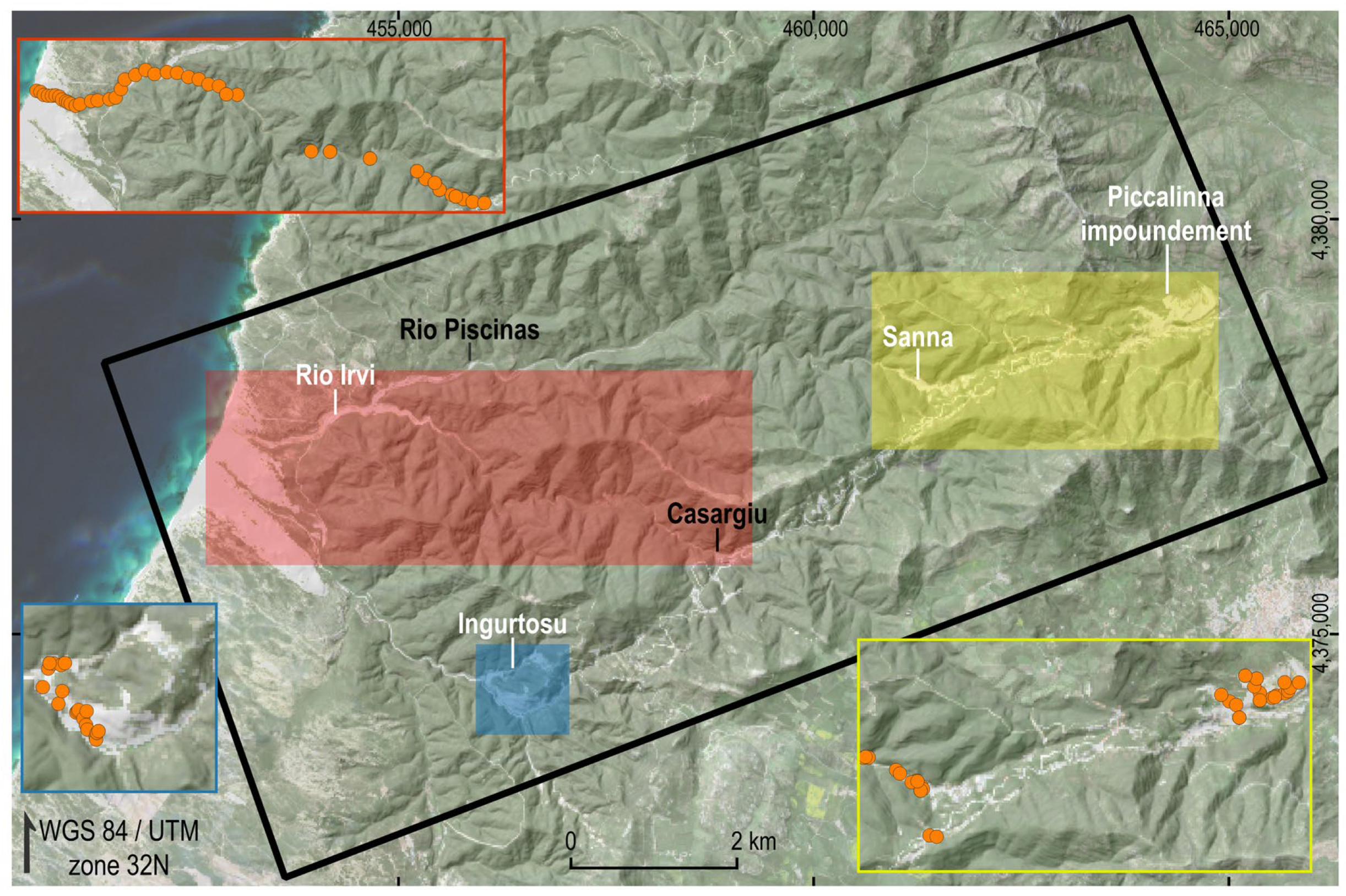
The Montevecchio–Ingurtosu mining district is located on the southwestern coast of Sardinia, surrounded by the municipalities of Guspini and Arbus and the Mediterranean Sea (Figure 1). The Montevecchio mines include the Piccalinna and Sanna mines, whose residues are investigated in this study, as well as the Telle and Casargiu mines. As shown in Figure 1, it is a hilly area, and the mine dumps appear to be distributed along two main valleys: the Montevecchio valley, where the Piccalinna impoundment is, and the Rio Roia Cani valley, where the Sanna residues are located. Meanwhile, from the Casargiu mine, located northeast of Ingurtosu, a stream flows into the Rio Irvi system and then directly to the Mediterranean Sea. These mines were exploited mainly for lead and zinc, extracted from mostly galena [PbS] and sphalerite [ZnS] since Roman times, but modern industrial activity started in 1848 and lasted 150 years until its closure in 1991 [65]. The area is characterized by dry climatic conditions throughout the year, with periods of intense heat and drought from May to September and a short rainy period during the winter, especially in November and December, which are the wettest months. Between 2018 and 2023 the average annual precipitation measured by the Guspini-Montevecchio rain gauge was 873 mm/year, with an average of 230 dry days per year [66], while in the period between 1922 and 2010 the average precipitation measured with the same rain gauge was 735 mm/year, with an average of 283 dry days [67]. The mean annual temperature is about 15 °C.
The ore is located in polymetallic veins of hydrothermal origin, which are part of the peripheral sector of the Arbus pluton, composed of leucogranite at the core and pyroxene and biotite-bearing granodiorite at the border [69,70]. These veins run roughly parallel to the outer border of the batholith, extending in a NNE-SSW direction for ~12 km in the northern sector of the igneous complex, and are hosted in sandstones of the Arburese Unit [65,70,71]. The primary ores are mainly composed of galena and sphalerite, with minor but still significant amounts of silver, chalcopyrite [CuFeS2], and arsenopyrite [FeAsS]. Alteration products of minerals include smithsonite [ZnCO3] (often iron-bearing), hemimorphite [Zn4Si2O7(OH)2 · H2O], goslarite [ZnSO4 · 7H2O], hydrozincite [Zn5(CO3)2(OH)6], greenockite [CdS], pyromorphite [Pb5(PO4)3Cl], and cerussite [PbCO3]. Gangue minerals include quartz [SiO2], barite [BaSO4], siderite [FeCO3], and minor amounts of ankerite [Ca(Fe2+,Mg)(CO3)2] and calcite [CaCO3]. The composition of mine residues in this area reflects that of the ore and host rock, as illustrated in Table 1.
When the mines closed, waste rock dumps and mine tailings were left along the banks of the rivers, exposed to atmospheric weathering. At the time, the consequences of the abandonment of mine residues and their consequent exposure to atmospheric agents for the environment and for human health were underestimated [67]. Since then, these deposits have continuously contaminated the aquatic system and the soils in the area [67,72,73,74,75]. Streams have high concentrations of heavy metals (Pb, Zn, and Cd) and, due to the alteration of sulfides, are affected by acid mine drainage, partly buffered by the presence of carbonates in the host rock, such as siderite, ankerite, and dolomite [CaMg(CO3)2]. Thus, the pH of the waters is slightly acidic to circum-neutral. This study investigates in depth the Rio Irvi, whose main source of water comes from the Casargiu mining tunnel. Its width varies between ~8 (in the upper stretch) and 25 m (at the estuary), and the stream’s flow rate is less than 10 L/s, causing it to be quite shallow [67]. When the Casargiu mine closed, the underground workings were filled with flotation tailings and flooded with groundwater after the arrest of the pumping system. At the adit, the pH is 5.8, and, after a slight increase to pH 6.4 in the first few hundred meters, due to the buffering effect of siderite, it progressively decreases non-linearly to 4.0 after the confluence with Rio Piscinas, downstream [67,74]. The stream is very rich in iron, as can be seen from the high abundance of ochreous precipitates in the riverbed, also visible with satellite images. These are amorphous Fe(III)-oxyhydroxides, which then evolve into low-crystallinity goethite or hematite. In the upstream part of the Rio Irvi, an amorphous phase, due to the flocculation of colloidal particles into layers, can be observed in the waters. This is called ‘green rust’ and consists of layered Fe(II)/Fe(III) oxy/hydroxides and sulfates, which, in atmospheric conditions, eventually oxidize and precipitate in Fe(III)-hydroxides [67,74,76]. This river is also characterized as having the highest concentrations of zinc of all the other mine-affected streams of the area, discharging about 2370 kg/day of zinc into the sea, 1580 kg/day of which is from the Casargiu adit [67,74].
Table 1. Mine waste composition by locality according to [70,72,77,78,79].
LocalityMine Waste Composition
Major ConstituentsSecondary MineralsGranulometry
Montevecchio Levante—Piccalinnaquartz, siderite, ankerite, white mica, and barite (pyrite, dolomite, sphalerite, and galena)cerussite, anglesite, pyromorphite, hemimorphite, smithsonite, hydrozincite, Fe-oxyhydroxides, and hydroxy-sulfates (e.g., ferrihydrite, schwertmannite, jarosite, goethite, and hematite)Flotation muds (three-fourths of the volume) and sandy mining products (one-fourth of the volume)
Montevecchio Ponente—Sannaquartz, siderite, ankerite, white mica, and barite (pyrite, marcasite, dolomite, sphalerite, and galena)anglesite, cerussite, Cu, Zn, and Fe-oxyhydroxidesClays, sands (flotation tailings), and gravel to coarse sand (jigging waste)
Montevecchio—Casargiusphalerite, pyrite, galena, quartz, siderite, ankerite, calcite, and dolomitecerussite, smithsonite, hemimorphite, goslarite, hydrozincite, and anglesitesands to clays for flotation tailings

4. Materials and Methods

4.1. Data

4.1.1. Field Samples

In total, 85 samples were collected during two field campaigns, which took place between 23 January and 3 February 2024 and between the 21 and 26 July 2024 in the area of interest. In the first campaign, Piccalinna and Sanna mine residues were assessed (Figure S2a,b in Supplementary Materials), while in the second one, Rio Irvi samples were collected (c). Waste rock, flotation tailing, and jigging tailing samples were collected in the areas of the Piccalinna impoundment (e,g) and Sanna dumps (d,g), as well as efflorescent sulfates and precipitates along the riverbed of Rio Irvi-Piscinas (f). Though the area of interest is mostly covered in mediterranean scrub, as evident from Figure 1, sampling locations were carefully chosen in unvegetated, open areas. Only the upper surface of the exposed soil was collected to ensure that the samples could be comparable to the satellite images. Due to limited funding, only thirty-one samples collected from the Piccalinna and Sanna mine residues were mineralogically characterized using X-ray Diffraction (XRD) with an X’Pert Pro PANalytical diffractometer (Malvern Panalytical, Malvern, UK) from the Department of Chemical and Geological Sciences of the University of Cagliari. The instrument is equipped with an X-ray tube with a Cu anticathode (Cu-Kα1) with a wavelength of 1.54060 Å, a nickel monochromator filter, and an X’Celerator detector. All diffractograms were acquired at 40 kV and 40 mA in an angular range of 5–70° 2θ. The measurements were performed on the same day as their collection in the field.
All samples collected in the January and July campaigns were measured with a portable spectroradiometer in the visible–near-infrared and shortwave infrared (VNIR-SWIR) wavelength ranges. The instrument was a FieldSpec®-3 Analytical Spectral Device (ASD) (Malvern Panalytical, Malvern, UK) mounted on the laboratory premises of the Helmholtz Center for Geosciences (GFZ), Potsdam, Germany. A contact probe was placed over each sample, and every measurement was the average of 50 scans, acquired with an integration time of 17 ms. To convert to reflectance, a white reference was initially measured and further collected every three samples. Three spectra were acquired for each sample and averaged to reduce random noise effects. For further noise removal, a Savitzky–Golay [80] smoothing filter was applied to the spectra with a window size of 5 and a second-order polynomial. Due to logistical reasons, reflectance spectra of the samples were acquired several weeks after their collection. Specifically, for those collected in January, the measurements occurred on the 23 April 2024, while those collected in July were measured on the 22 August 2024. This time delay may have led to phase transitions within the samples. Specifically, ferrihydrite and schwertmannite, which are poorly crystalline Fe3+-bearing metastable phases, may have transformed to goethite, while efflorescent minerals, which are highly hydrated, may have lost water molecules. During the time between the collection and the spectral measurements, the samples, each sealed in its own container, were stored in a box placed in a dark and dry environment at room temperature.

4.1.2. EnMAP Image

A cloudless EnMAP image of 28 April 2024 was downloaded from DLR’s EOWeb® portal (https://planning.enmap.org/, (accessed on 29 April 2024)) with 2A processing level over the Montevecchio mines with the following parameters: atmospheric correction for land surfaces in the summer season with cirrus and haze removal, and an ozone value of 330 in Dobson Units. The EnMAP system, from which the image was acquired, is a hyperspectral satellite carrying a push-broom type of imager, which has two sensors, covering the VNIR (420–1000 nm) and SWIR (900–2450 nm) ranges. Table 2 describes the technical specifications of this instrument. The image is characterized by a high signal-to-noise ratio (SNR) and a high spectral resolution. The image was clipped to the area of interest. The Normalized Difference Vegetation Index (NDVI) was used to mask water bodies and vegetated areas, according to Equation (1):
N D V I =   N I R R e d N I R + R e d   < 0   f o r   w a t e r > 0.15   f o r   v e g e t a t i o n
where NIR is band 75 and Red is band 48. The thresholds were chosen by trial and error, and the values between 0 and 0.15 represent bare land or sparsely vegetated pixels. The coastal dunes were masked out as they are outside of the scope of this study.
Within the image, mixed land–water pixels were identified by visual inspection, comparing the EnMAP image with a cloudless level-2A Sentinel-2B image from 5 May 2024, downloaded from the Copernicus Browser (https://browser.dataspace.copernicus.eu/, (accessed on 7 February 2025)), whose acquisition date is closest to the EnMAP image. Between EnMAP’s acquisition date and that of Sentinel-2B, there have not been significant rainfall events that have caused changes in the stream flow or in its route. Pixels overlapping with the streambed were flagged as mixed, while those falling in the dry sediments were considered land pixels. The average spectrum and standard deviation of mixed and unmixed pixels were calculated to understand the influence of the water on the final results.

4.2. Methodology—Polynomial Fitting

Sample spectra were analyzed with an iterative polynomial fitting technique, reproduced from Asadzadeh and Souza Filho (2016) [82], using Python (v3.9) and the SciPy library (v1.11.3) [83]. This method is based on the assumption that a spectral profile constitutes a combination of absorptions superimposed on a continuum curve. The technique allows for the extraction of spectral parameters, such as position, depth, and full width at half maximum (FWHM) of absorption features, which are essential for deriving the chemical composition, identity, and relative abundance of a geological target. After iterative straight-line continuum removal, each absorption feature is modeled with a polynomial curve. In this study we used a fourth-order polynomial according to Equation (2):
y = a x 4 + b x 3 + c x 2 + d x + e
where a, b, c, d, and e are the polynomial coefficients.
Fourth-order polynomials can model curves containing three extrema (minima and/or maxima), thus delineating not only the absorption minimum but also its shoulders. This aspect is particularly useful in cases where the absorption minimum shifts by tens of nanometers, also causing a shift in the shoulder positions. Compared to second-order polynomials, these are also able to handle curve asymmetries, thanks to parameter b. Furthermore, tests performed using lower-order polynomials resulted in higher residual errors and were hence not considered in this work.
In cases of features resulting from the combination of more than one absorption, the iterative polynomial fitting technique identifies just the deepest one. The polynomial coefficients a, b, c, d, and e are optimized through a least squares procedure until the residual error is below a specific threshold, here set to 0.0003 by trial-and-error. The residual is expressed as the root-mean-square error (RMSE) between the original and the fitted curves, as shown in Equation (3).
R M S E = 1 n ( x i x i ^ ) 2 < 0.0003
where x i is the i-th fitted point in the polynomial curve and x i ^ is the i-th point of the original curve.
For sample spectra, the position, depth, and FWHM of all the absorption features between 350 and 2500 nm were collected with this technique. Then, by comparing them with the USGS [84] and NASA RELAB [85] spectral libraries, as well as with previous studies [61,86], each feature was assigned to a specific mineral or phase. Table 3 lists the positions of the relevant mineral-specific absorption features used here for interpreting the spectra.
In a similar way, diagnostic spectral features identifiable with EnMAP data were modeled with a fourth-order polynomial curve. Differently from the approach used for ASD spectra, the straight-line continuum is not refined in an iterative way, due to the stronger instrumental noise of the satellite sensor, but is calculated from two points chosen by the user and representing the shoulder positions of the corresponding absorption feature (see Table 4). In total, three features were taken into consideration: the ferric iron absorption feature at ~900 nm to discriminate different iron-bearing secondary minerals, and the 435 nm and 2265 nm absorption features to locate potential areas of jarosite occurrence. As the ferric iron absorption feature is strongly affected by instrumental and atmospheric noise, it was mapped using fixed points, as indicated in Table 4. Only features with an RMSE of less than 0.003 between the original and fitted curves were considered. Additional rules, such as the thresholds related to the FWHM and wavelength position (λ), are based on the wavelength ranges of corresponding absorptions within the spectra of the samples collected in the field.
Mineral classification maps were obtained by observing the position of the ferric iron absorption feature. To define each class range, spectra of pure goethite, schwertmannite, ferrihydrite, hematite, copiapite, and jarosite from different spectral libraries [11,84,85] (Table S1 in the Supplementary Materials) were analyzed, and the position of the ferric iron feature was calculated through iterative polynomial fitting. This allowed us to select physically meaningful thresholds for the mineral map. The final thresholds are described in Table 5. The classification results obtained from the EnMAP image were validated with the spectra of the samples collected in the field. These were classified based on the criteria shown in Table 5, and a confusion matrix was built by comparing the image cells overlapping with or closest to the sample location, within a range of 15 m. Only classified pixels were considered in the confusion matrix. Three accuracy assessment metrics were used to evaluate the classification performance: overall accuracy (4), omission (5), and commission (6) errors for each class.
O v e r a l l   A c c u r a c y = T P N
O m i s s i o n   E r r o r = F P i N i
C o m m i s s i o n   E r r o r = F P i F P i + T P i
where TP is the total number of true positives, N is the total number of samples, FPi is the number of false positives of the i-th class, TPi is the number of true positives of the i-th class, and Ni is the number of samples of the i-th class.
Table 3. Positions of spectral absorption features used to identify the listed minerals, accompanied by the references reporting on the physical processes relating to such absorptions. Features flagged with an asterisk (*) indicate the position of a reflectance shoulder. Wavelengths in bold indicate the most relevant and most used features for mineral identification.
MineralDiagnostic Features
(nm)
References
Goethite425, 490, 670, 760 *, 965, 1450, 1935[11,61,84,85]
Ferrihydrite484, 770 *, 980–1000, 1437, 1920[11,61,84,85,87]
Hematite545, 660, 745 *, 880[11,84,85]
Jarosite380, 435, 721 *, 925, 1467, 1848, 2264[11,13,61,84,85]
Schwertmannite489, 730 *, 950
Copiapite430, 700 *, 860, 1450, 1937[11,13,85]
Epsomite988, 1203, 1453, 1577–1620, 1975, 2400[84,86]
Goslarite1480, 1680, 1955[88]
Gypsum990, 1200, 1447, 1488, 1530, 1740, 1940, 1970, 2219, 2270, 2430[13,84,85,86]
Chlorite1390–1400, 2250, 2330, 1450, 1550, 2000, 2100, 2290, 2350, 2400[64,84]
Siderite1050, 1260, 1950, 2330[84,89,90]
Biotite2250, 2330, 2385–2390[64,84,85]
Muscovite/Illite1412, 2200, 2345, 2440[84]
Table 4. Techniques and parameters used to analyze spectral features on EnMAP data. CR = continuum removal; PF = polynomial fitting; N/A = Not Applicable.
FeatureCR Range (nm)MethodFixed Bands
(nm)
Additional Rules
900 nm absorption750–1300Fixed points PF801.248, 871.683, 1025.66, 1081.79, and 1128.11 D e p t h     0.01 870 λ   1050
435 nm absorption418–460PF
(RMSE threshold: 0.003)
N/A D e p t h > = 0.01 16 F W H M 24 432 λ 440
2265 nm absorption2240–2285PF
(RMSE threshold: 0.003)
N/A D e p t h > 0.0
Table 5. Mineral classification criteria based on the position of ferric iron absorption.
MineralCentral Wavelength Ranges
Copiapite860–880 nm
Hematite880–900 nm
Jarosite900–935 nm
Schwertmannite935–950 nm
Goethite950–975 nm
Ferrihydrite975–1020 nm

5. Results

5.1. Point Spectra

Spectra of samples collected in the field appear smooth and not affected by instrumental noise, except at wavelengths below 500 nm. Most samples are iron-bearing, as evident by the prominent reflectance drop towards the ultraviolet wavelength range and by the broad absorption at about ~900 nm. Most also contain water in the form of H2O and OH, as can be observed by the presence of absorption features centered at 1400 and 1900 nm (see Figure S3).

5.1.1. Piccalinna and Sanna Mines

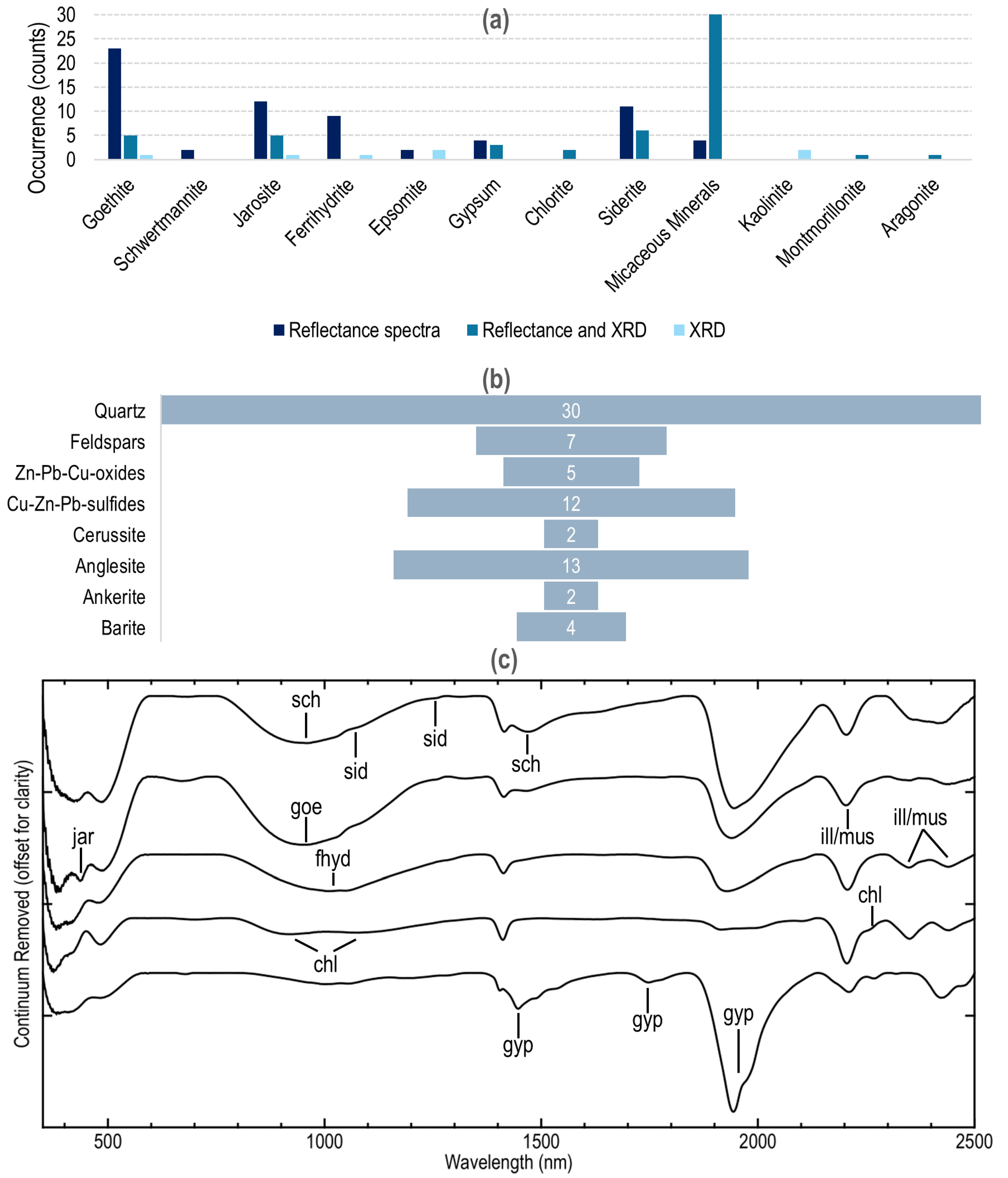
Figure 2a,b illustrate the occurrence of minerals identified in the samples collected in the Piccalinna impoundment and at the Sanna mine site. The most abundant minerals identified with XRD in the Piccalinna and Sanna areas are quartz, anglesite [PbSO4], and micaceous minerals, a category including muscovite [KAl2(AlSi3O10)(OH)2], illite [K0.65Al2.0[Al0.65Si3.35O10](OH)2], biotite, and phlogopite [KMg3(AlSi3O10)(OH)2]. These are the main constituents of the gangue, while ore minerals, such as galena and sphalerite, appear in minor amounts (Table S2). Reflectance spectroscopy also revealed widespread occurrence of goethite and ferrihydrite, as well as relatively consistent presence of jarosite and siderite. This mineralogical assemblage reflects the results obtained on the same mine wastes as in previous studies [72,77]. As can be noticed, iron-bearing minerals are not easily identified using XRD, partly due to the fluorescence effect generated when the copper target is used on iron, which significantly increases the background noise, and partly because many of the iron-bearing minerals in this area are amorphous or poorly crystalline. Kaolinite [Al2(Si2O5)(OH)4] has diagnostic absorption features in the SWIR spectral range, but it was not detected with reflectance spectroscopy because of its very low abundance compared to muscovite and illite. Figure 2c shows some examples of continuum-removed spectra and the absorption features used to identify different mineral phases. It is evident that some minerals partially mask the absorption features of others, as can be seen for goethite and schwertmannite, partially covering absorptions related to siderite at 1050 and 1260 nm. Similarly, in the sample containing jarosite, the ferric iron feature is shifted to longer wavelengths (~960 nm) due to the spectral dominance of goethite.
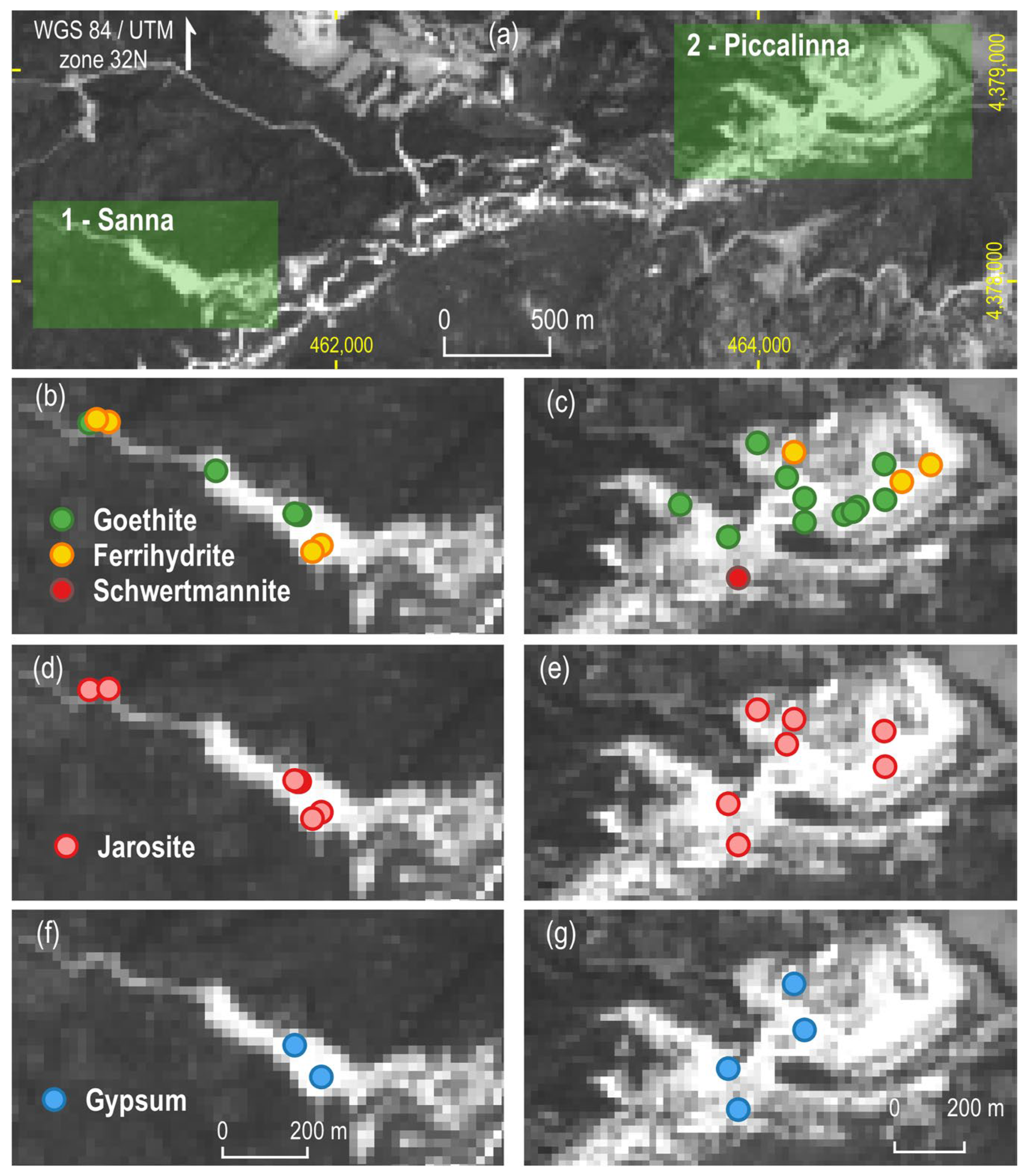
Figure 3 shows the distribution of secondary minerals in the Piccalinna and Sanna areas. Goethite (Figure 3b,c) is widespread across all residues, while ferrihydrite occurs close to the tailing ponds in the Piccalinna impoundment and mainly along the banks of the Rio Roia Cani in Sanna. Schwertmannite was identified only at one point of the Piccalinna impoundment (Figure 3b), though it is probably underestimated due to the spectral similarities with goethite and ferrihydrite (see Figure 2c). Jarosite (Figure 3d,e) occurs mainly in the northeastern part of the Piccalinna impoundment and along the banks of the Roia Cani stream in Sanna, where flotation tailings outcrop due to the stream’s erosional effect. Gypsum [CaSO4 · 2H2O] (Figure 3f,g) was instead detected in the southwestern part of the impoundment and in the eastern part of the Sanna tailings, in the upstream sector of the Rio Roia Cani.
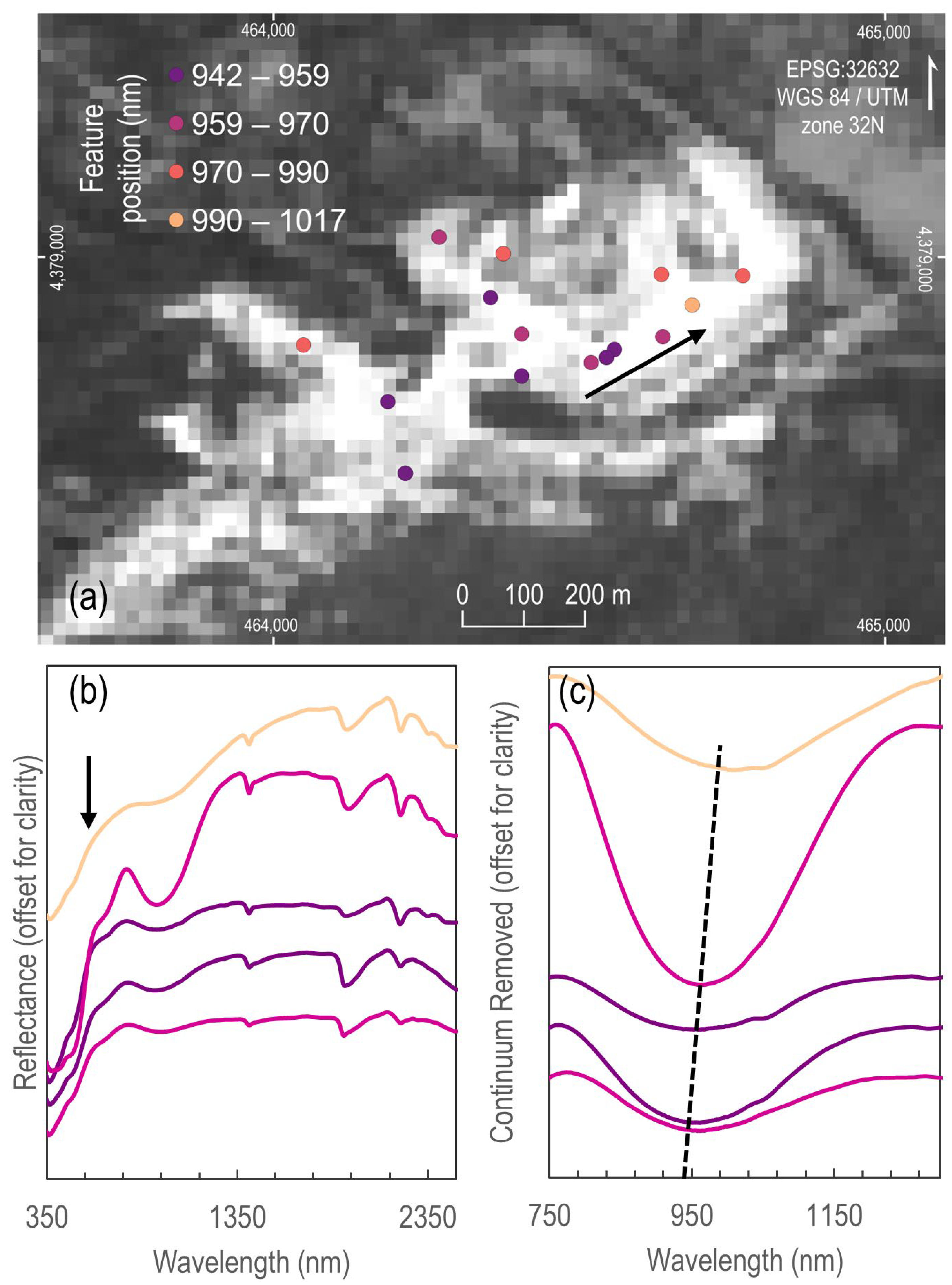
By mapping the position of the ferric iron absorption feature of each sample in the Piccalinna area, it is possible to observe a progressive shift longward in wavelength towards the northeastern sector of the impoundment, with the greatest values closest to the tailing ponds (Figure 4a,c). This is accompanied by a progressive longward shift and eventual disappearance of the 670 nm absorption feature and a steepening of the edge centered at 550 nm (Figure 4b), suggesting a progressive reduction in grain size and a likely transition from goethite to ferrihydrite.

5.1.2. Rio Irvi

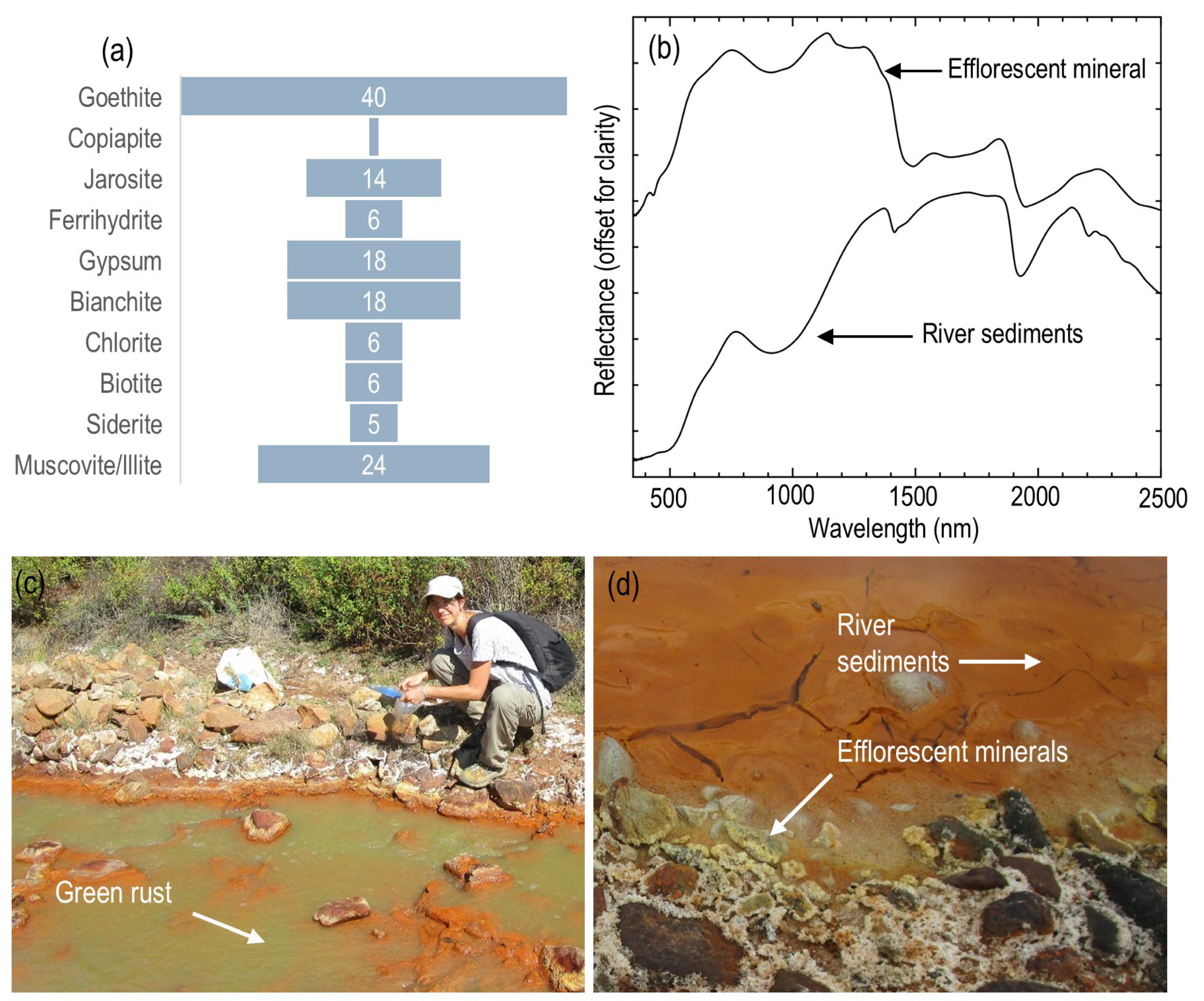
Figure 5 illustrates the mineral assemblage identified with reflectance spectroscopy along Rio Irvi (Figure 5a). Three types of materials were observed in this environment: stream sediments, efflorescent minerals (Figure 5b,d), and a green flocculating phase present in the water, hypothesized to be green rust, but not sampled (Figure 5c). The riverbed sediments are dominated by goethite with additional muscovite and illite, as well as gypsum. The efflorescent minerals are soluble sulfates, as illustrated by the general shape of the spectra, specifically by the geometry of the absorption features in the 1400 and 2000 nm range. Because Rio Irvi is very rich in Zn, these sulfates likely incorporate this metal in their structure and thus may be examples of bianchite [(Zn, Fe2+)SO4 · 6H2O], as also suggested by the broad absorption at ~1680 nm present also in goslarite [ZnSO4 · 7H2O] but not in epsomite [MgSO4 · 7H2O], its Mg-bearing equivalent (see Table 3). Unfortunately, other end-member references from a spectral library or database are lacking, and further mineralogical analyses should be carried out to confirm the validity of this hypothesis. In the VNIR range, these spectra also show the presence of iron, identified by the drop in the ultraviolet range and by sharp absorption at 435 nm accompanied by broader, though quite shallow, absorption at 880–900 nm (Figure 5b).
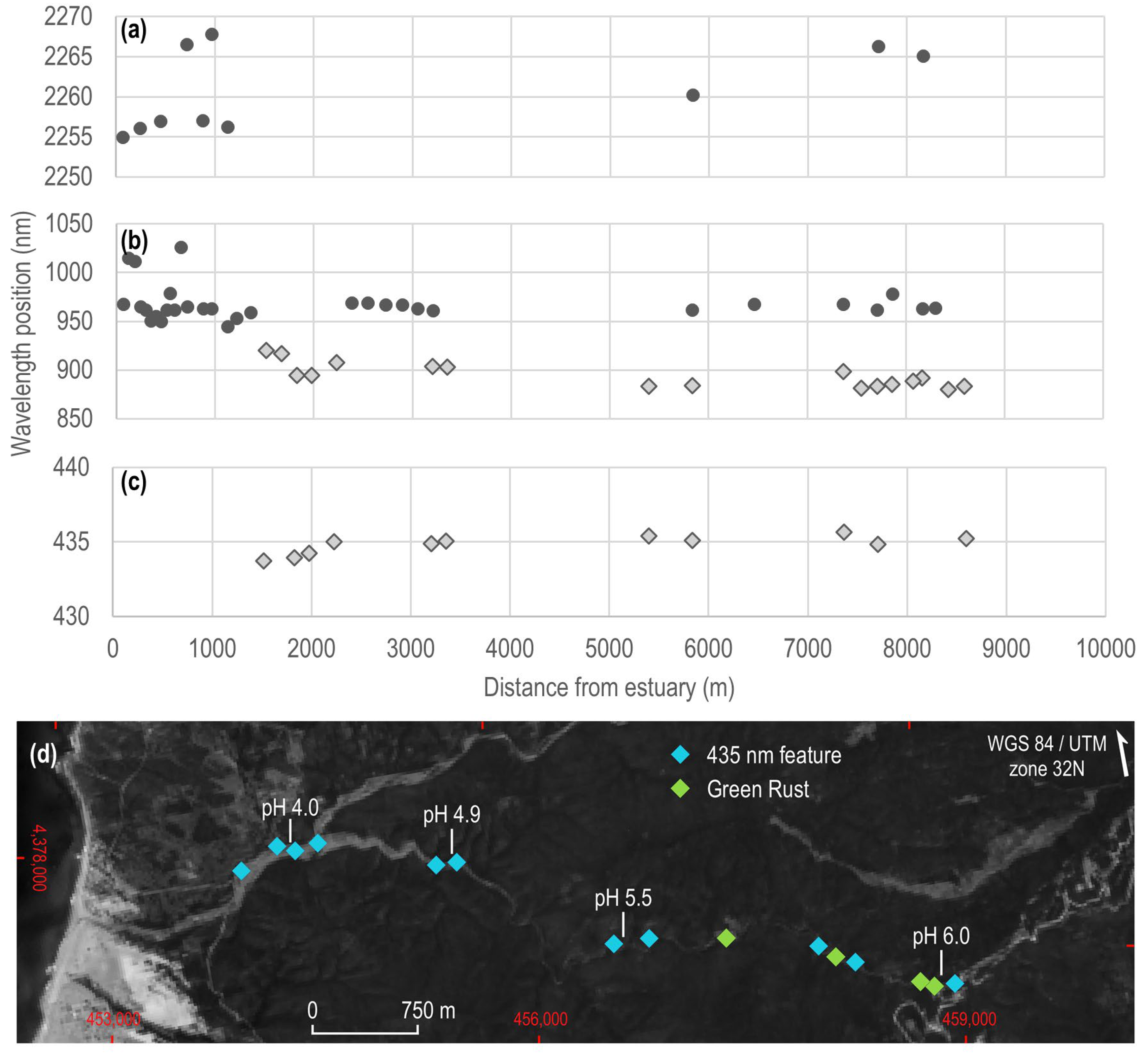
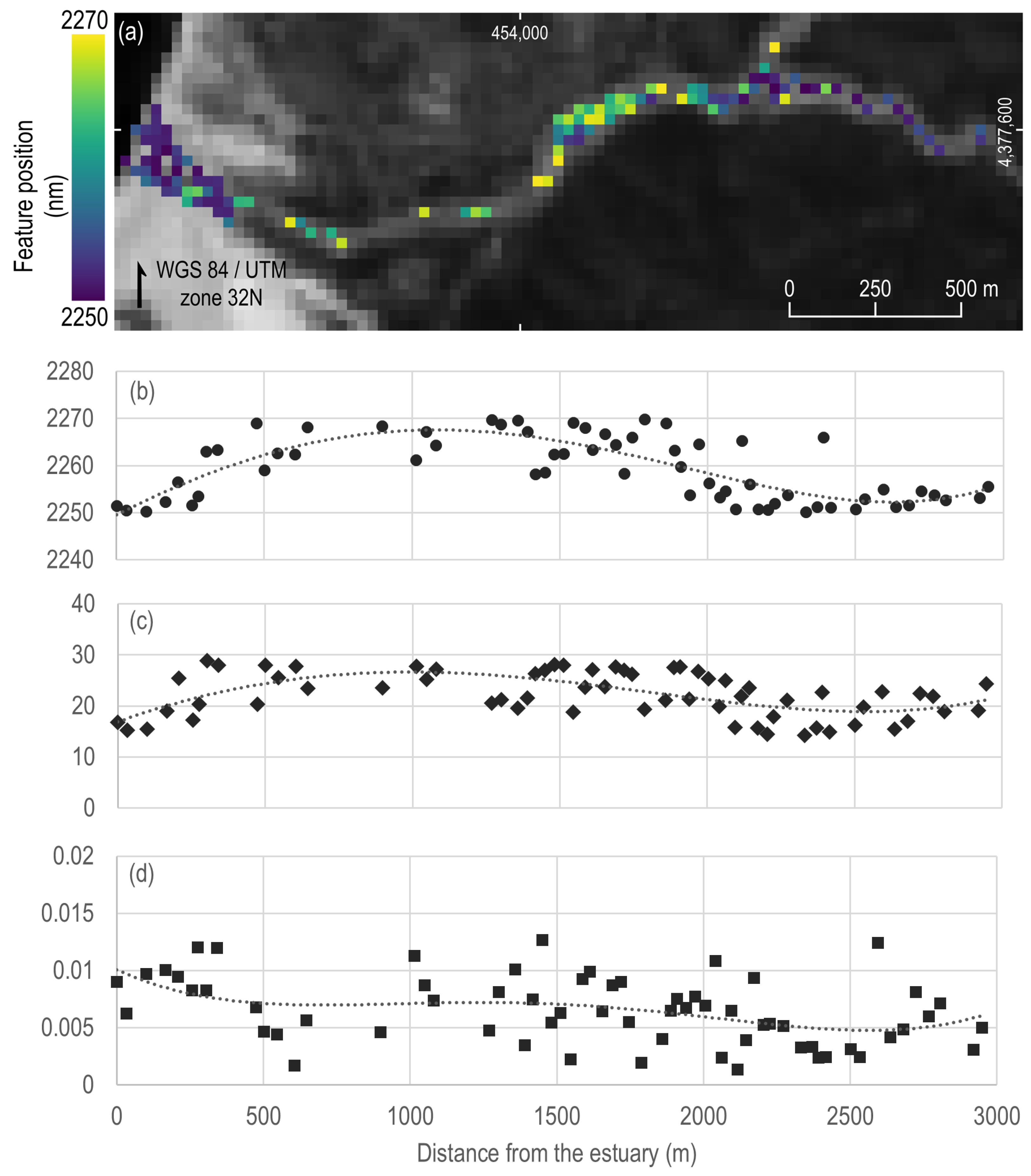
Along Rio Irvi, the positions of specific absorption features vary from the estuary to the source. The position of the 2265 nm feature present in river sediment spectra shows bimodal behavior, with a cluster centered below 2260 nm and another above 2265 nm, the latter present mainly close to the confluence with Rio Piscinas and close to the source of the stream (Figure 6a). The position of the ferric iron feature (Figure 6b, circles) is mostly constant at about 960 nm in river sediment samples, an indication of the spectral dominance of goethite, except at the estuary where it shifts towards wavelengths above 1000 nm, probably due to the occurrence of ferrihydrite and of other iron-bearing phases, such as siderite. In the efflorescent mineral samples, the same absorption feature is instead centered either at around 880 nm or at wavelengths greater than 900 nm, especially at the confluence with Rio Piscinas, where the pH is 4, and at the source of the stream (Figure 6b, diamonds). The 435 nm absorption feature is present in most efflorescent mineral spectra and remains centered at ~435–436 nm throughout the whole stretch of the stream, even in co-occurrence with the observed green rust-like phase under near-neutral pH conditions, as shown in Figure 6d. Combining the information obtained from the 435 and the 900 nm features in the efflorescent minerals, we hypothesize that samples with the ferric absorption feature centered at 880 nm indicate oxidized Fe-bearing bianchite, while those with a ferric absorption feature above 900 nm indicate a bianchite–jarosite mixture. This consideration constrains potential jarosite occurrences close to the confluence with Rio Piscinas.

5.2. EnMAP Image Analysis

Based on EnMAP data, the occurrence of iron-bearing minerals was investigated by detecting the position of the ferric iron absorption feature, while jarosite was detected by mapping the spatial distribution of the 435 and 2265 nm absorption features independently. As shown in Figure S4, these features are quite small and sharp, often having a depth that is less than 0.1 and a width of a few tens of nanometers. Along Rio Irvi, the average spectrum of mixed land–water pixels appears to have a slightly lower reflectance than that of land-only pixels, with the maximum reflectance difference being less than 2%, as shown in Figure S5. Moreover, the confidence band of the mixed pixels (Figure S5b) overlaps with that of the land pixels (Figure S5c) and the application of continuum removal to the spectra compensates for this slight reflectance drop.
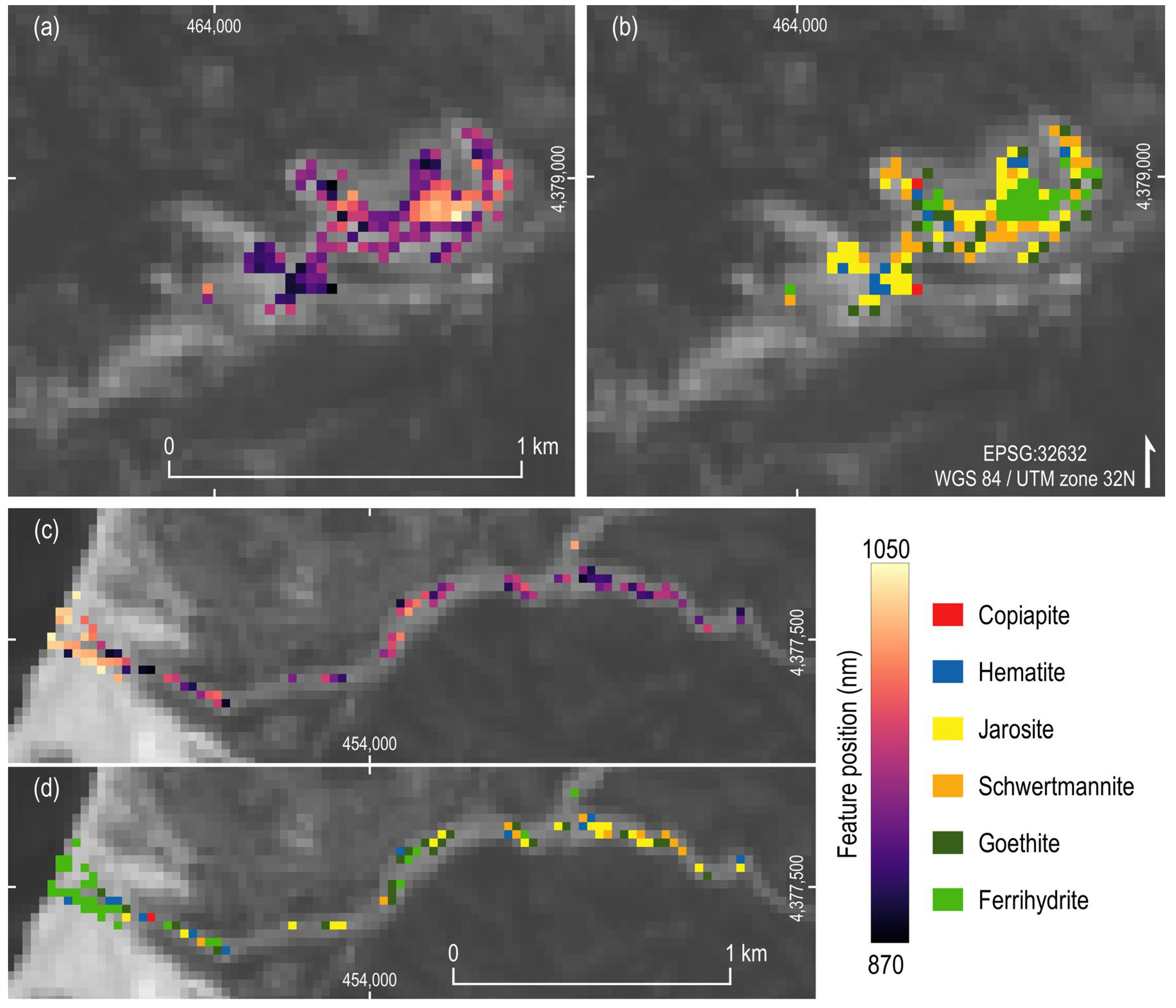
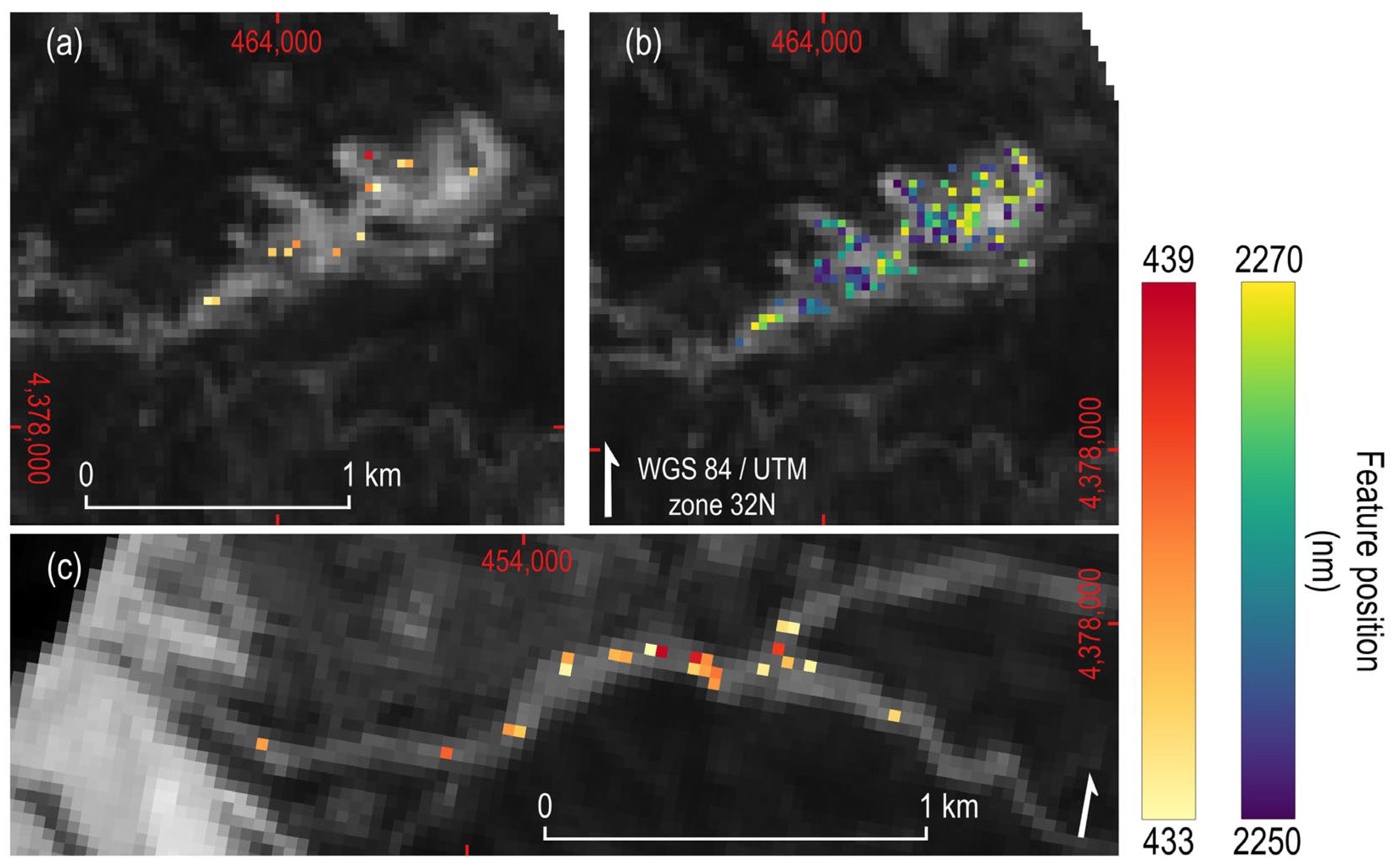
The position of the ferric iron feature, modeled on EnMAP with polynomial fitting, highlights spatial variations within the Piccalinna impoundment and in the Rio Irvi area (Figure 7a,d). In the former, a clear spot characterized by phases that have a ferric iron position shifted towards ~1000 nm emerges (Figure 7a). This result matches those obtained from the samples collected in that same area (Figure 4). Rio Irvi, instead, shows a progressive longward wavelength shift towards the estuary (Figure 7c). A mineral classification based on this absorption feature highlights how jarosite and schwertmannite are quite widespread in the Piccalinna impoundment (Figure 7b), occupying areas surrounding the ferrihydrite area, while schwertmannite is much less abundant along Rio Irvi, and jarosite seems to appear mainly at the confluence with Rio Piscinas (Figure 7d).
Table 6 illustrates the confusion matrix obtained with the spectral comparison of samples collected both in the Piccalinna and Sanna areas and along Rio Irvi with the EnMAP image. The classification appears to have 62.5% overall accuracy. The largest class is the goethite/ferrihydrite class, indicating that both Rio Irvi and the Montevecchio mine dumps are dominated by such secondary Fe3+-bearing hydroxides. Schwertmannite identified in the samples collected in the field is misclassified as jarosite, while areas mapped as schwertmannite appear as goethite/ferrihydrite in the field samples. Jarosite identified in the samples is mostly classified correctly, though there appears to be slight overestimation of this phase in the EnMAP image. Hematite and copiapite are more difficult to validate, as these phases were not found in the samples collected in the field. Ferrihydrite and goethite are aggregated into one class, because in the samples, there were likely transformations of ferrihydrite into goethite, due to the considerable time delay between the collection and the spectral measurements. However, a confusion matrix considering these phases as separate classes was computed, as shown in Table S3. Indeed, in the latter, it is apparent that the totality of commission errors emerging in the goethite and ferrihydrite classes are related to the confusion between these two minerals.
Figure 8 and Figure 9 show the distribution of image cells containing the 435 and the 2265 nm features in the Piccalinna impoundment and along the Rio Irvi. The 2265 nm feature is more widespread than the 435 nm one and has greater positional variability (20 nm as opposed to 7 nm for the 435 nm feature). In the Piccalinna impoundment, the 435 nm feature (Figure 8a) appears mainly in the central and northeastern part of the impoundment, close to the tailing ponds. On the other hand, the 2265 nm (Figure 8b) feature can be found in the whole impoundment (though the feature position shifts longwards in wavelength as we move closer to the tailing ponds) and in a small area in the southwestern part of the impoundment, suggesting the presence of jarosite in those areas. Along the Rio Irvi, these features show similar patterns: The 435 nm feature is mostly present in the surroundings of the confluence with Rio Piscinas and tends to also have wavelength positions closer to 434–436 nm (Figure 8c). The 2265 nm feature upstream and close to the estuary has features centered at lower wavelengths, while in the surroundings of the confluence and for about one kilometer downstream, the feature is shifted to higher wavelengths (2263–2268 nm, Figure 9a,b). This dual spectral behavior is also confirmed by the FWHM (Figure 9c), which reveals a double trend: pixels with widths between 19 and 25 nm are relative to features centered at around 2265 nm, indicating the occurrence of jarosite, and others with widths between 15 and 17 nm correspond to features centered below 2260 nm, likely related to the presence of phyllosilicates. The distribution of depth values (Figure 9d) is harder to interpret, because this feature comprises more than one type of mineral. However, there seem to be three points of maximum depth: at the estuary, slightly downstream of the confluence, and at about 3000 m from the estuary. The confluence area is also where there is a higher density of pixels containing the 435 nm feature. On the other hand, the FWHM of the 435 nm feature remains relatively constant at about 15–17 nm throughout the length of the stream.
Table 7 shows all the samples collected in areas visible to the masked EnMAP image, whose spectral signature is characterized by either the 435 nm or the 2265 nm feature. Their feature position value is compared with the EnMAP results. For the 435 nm feature, EnMAP successfully detects three of the six samples with positional differences of less than 3 nm. For the 2265 nm feature, EnMAP detects almost all of them, with generally good correspondence in values. Only sample I16 has a positional difference (8 nm) between the field sample and EnMAP, suggesting that the latter identified jarosite in the corresponding location. The 2265 nm feature was also detected in samples I22 and I23, along Rio Irvi, though this is likely due to the presence to detrital phyllosilicates.

6. Discussion

6.1. Methodological Advantages and Limitations

In this study, we show that imaging spectroscopy is a powerful tool for detecting AMD sources in mining areas and for tracking subtle mineralogical and geochemical variations from space. At the laboratory scale, reflectance spectroscopy proves to be superior to XRD in detecting and characterizing clays [91], gypsum [86,92], and, when using a Cu anticathode in the XRD system, iron-bearing minerals in both crystalline and amorphous structures. Indeed, of all the spectrally active minerals identified in this study, 52.3% were detected with reflectance spectroscopy only, 6.9% with XRD only, and 40.8% with both techniques. Conversely, reflectance spectroscopy is not suitable for tectosilicates and sulfides, which are not spectrally active or diagnostic in the VNIR-SWIR wavelength range [85], despite their widespread occurrence in the area.
From a landscape point of view, the Montevecchio district is an example of a small, highly vegetated legacy mining area, characterized by an articulated topography. These conditions are not considered ideal for the use of satellite-based imaging spectroscopy because of the generally low spatial resolution. In this study, EnMAP is used at the limit of its capabilities, but thanks to its high SNR and its narrow spectral band pass [81] we are able to leverage its potential over this area. Previous studies have already highlighted the significance of spectral over spatial resolution for detecting small and narrow absorption features, such as those related to rare earth elements [93]. However, in another geological context, we confirm this capability both in the VNIR and the SWIR ranges, especially for the detection of the sharp and narrow jarosite-related features (Table 7). In comparison with other currently operational hyperspectral satellite sensors, such as PRISMA and EMIT, EnMAP has the most suitable technical requirements for the present study. Despite having a comparable spectral sampling distance, EnMAP’s spatial resolution is higher than that of EMIT data, which has a 60 m × 60 m pixel size. While PRISMA data has the same spatial resolution as EnMAP, it has a lower SNR (>160 in the VNIR range and >100 in the SWIR range) [94] and has a higher geolocation error (up to 300 m or ~10 pixels, as opposed to EnMAP’s error of up to ~30 m or 1 pixel) [94,95]. Such geometrical characteristics are crucial for comparing image results with spectra of samples collected in the field.
Polynomial fitting proves to be an effective technique for modeling spectral features and minimizing the instrumental and geometrical noise contributions. For instance, despite the instrumental noise characterizing the 900–1000 nm region, the fixed-point polynomial fitting approach can effectively allow us to estimate the position of the ferric iron absorption feature, though it is limited in providing information on its shape and asymmetry. It is, however, important to stress that the accuracy of the feature position in this range is expected to be lower than in other parts of the VNIR-SWIR range. This aspect emerges in Table 6, where the modeled ferric iron absorption positions in some cases are slightly underestimated, causing downward misclassification into the adjacent lower class. As hyperspectral remote sensing is gaining momentum and sensor technology is progressively improving, new-generation satellite systems, such as EMIT and the upcoming CHIME (Copernicus Hyperspectral Imaging Mission for the Environment) mission [96], have already overcome this limitation by using one sensor for the whole VNIR-SWIR range, thus significantly reducing this kind of spectral disturbance.

6.2. Effects of Mineral Masking and Temporal and Spatial Resolution

Despite its advantages, there are limitations to this methodological approach, and these include spectral masking, time constraints, and spatial resolution.
One of the major challenges related to reflectance spectroscopy is the masking effect of minerals, both in the VNIR and the SWIR spectral ranges. Earlier studies have leveraged the ferric iron absorption feature to discriminate between different iron oxy/hydroxides [55]. Yet, this feature shifts considerably and changes shape when the phase related to it is in intimate mixture with other iron-bearing minerals (Refs. [53,58,61]; Harald Van der Werff, personal communication). Even in the SWIR range, 2265 nm jarosite absorption may disappear in co-existence with muscovite [14,31]. Using just one feature for mineral classification is often not enough to accurately identify target minerals, and the results must be confirmed by the presence of other diagnostic features or independent analytical techniques. This implies that an in-depth knowledge of the geology of the area is still necessary for correct interpretation of the results [20,97]. Further investigations on geometrical changes in spectral mixtures of different iron oxy/hydroxides with varying relative abundances could greatly improve the accuracy of spectroscopy-based studies for such geological contexts and better support mining companies in mitigating environmental impacts.
Time plays a crucial role in obtaining a comprehensive understanding of legacy mining environments. Although the sample spectra were directly compared with the EnMAP results, these were acquired in different seasons compared to the image. As these environments are highly dynamic, seasonal changes affecting temperature and humidity can significantly change the distribution of secondary minerals in the area. This may be a contributing factor for the limited correspondence between the sample spectra and EnMAP results illustrated in Table 6 and Table S3. Moreover, the significant delay between the field campaigns and the spectral measurements of the samples likely caused changes in the samples themselves. Figure S6 illustrates how spectra can vary after being acquired several months after their collection from the field. The efflorescences (Figure S6a) show the greatest difference, with the broad feature between 1600 and 1800 nm changing geometry, probably due to a loss of water molecules and therefore the transition to a less hydrated Zn-sulfate mineral. Figure S6b, c shows an increase in depth of the 480, 960, and 1950 nm features, probably indicating a further transformation from poorly crystalline to crystalline goethite, while the general increase in reflectance in Figure S6a, c is likely due to a loss in humidity of the samples. Within a month from the sample collection, ferrihydrite may have transformed to goethite as the samples were removed from the original environment [98,99,100,101,102], leading to a shift in the ferric iron feature to shorter wavelengths [11]. The effects of such phase transitions are reflected in the validation of the mineral classification map (Table S3), where areas mapped on EnMAP as ferrihydrite correspond to goethite-bearing samples. Phase transitions related to schwertmannite are more contentious. Some studies have observed transformation rates of schwertmannite into goethite of hundreds of days [103], while others have observed rates of just a week, at neutral pH [98]. The results of this study, however, show that the samples collected in areas classified as schwertmannite are all goethite-bearing, suggesting that within the samples, such a transformation occurred. Nevertheless, the overall accuracy obtained from the comparison of EnMAP data with the field spectra (Table 6 and Table 7), as well as the correspondence of spatial patterns between field and image results (e.g., Figure 4a and Figure 7a), allow us to effectively reconstruct the environmental conditions of the area of interest. Equally, the spectral changes in efflorescent minerals observed in Figure S6a do not entail positional shifts in absorption features, indicating that other cations besides water molecules are not lost from the crystal structure, thus remaining valid indicators of the chemical composition of the stream water. Nevertheless, a new campaign with samples collected in the same locations and measured with XRD and reflectance spectroscopy on the same day and after one month is planned for future development of this research project, in order to better understand the impact of such phase transitions on the results.
Despite the promising results obtained with EnMAP data, the spatial resolution is still too coarse for operational applications, since legacy mining lands are spatially inhomogeneous, with variations occurring within a meter or less. The morphology of the Montevecchio mining area’s landscape and its compositional variability expose the satellite-derived results to adjacency effects [104] or shadow effects due to local topographical changes [105]. In this study, we have shown that the influence of spectral mixing between land and water objects could be considered negligible for the purpose of this work, because of the limited width and depth of the analyzed stream. However, this aspect becomes non-negligible for larger water bodies or for carrying out quantification analyses, and mixed land–water pixels will need to be identified and handled separately in future work [106]. In general, these aspects need to be addressed more thoroughly before the implementation of this approach in mine monitoring programs. Ideally, sensors should have a spatial resolution of 2.5–15 m, meaning that aerial and UAS hyperspectral acquisitions are more suitable than satellite data [38,42]. However, recent studies are developing super-resolution techniques for improving the spatial resolution of hyperspectral sensors while preserving their spectral detail [107]. This methodology could potentially be beneficial for identifying compositional patterns with higher detail within the area.

6.3. Geochemical Considerations

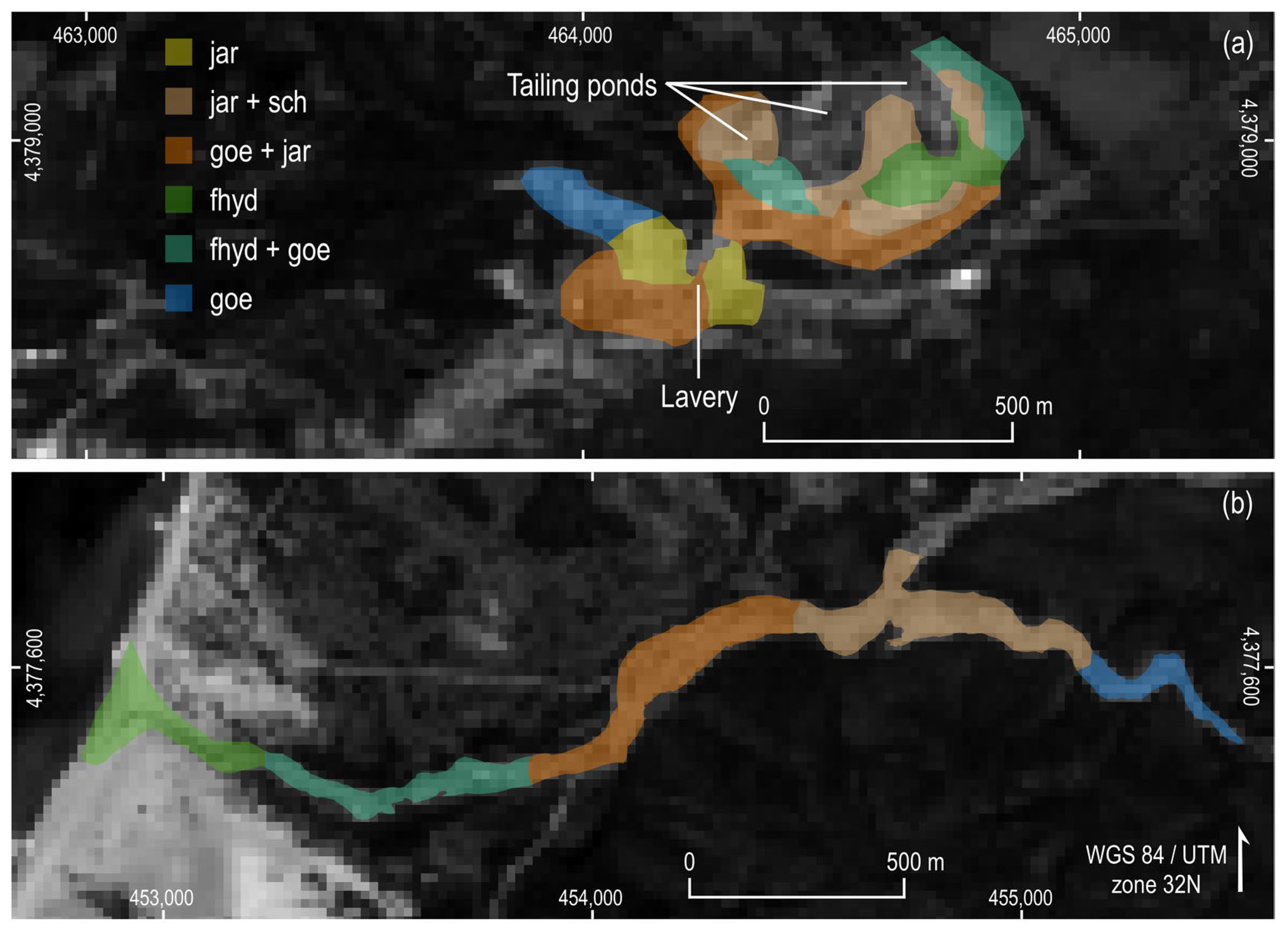
Combining the results from all sensors presented in this work, geochemical considerations can be made regarding the area of interest. In the Piccalinna impoundment, it is possible to delineate different acidity zones, based on the detection of secondary minerals (Figure 10a). The zonation is performed by visual analysis of the results combined with the authors’ knowledge of the area of interest and outlined manually, summarizing the results in a single graphic. The zonation reflects the pH-controlled precipitation of minerals described in other works [3,14,20,25]. Specifically, in areas where jarosite is the main Fe3+-bearing mineral (in tailing ponds and close to the treatment plant), there is a higher concentration of sulfides, and pH is expected to be below 3.5. Radially from the tailing ponds, jarosite, together with schwertmannite, and then jarosite and goethite (pH < 4.5), can be found, while in the peripheral zone, there is ferrihydrite and goethite or just goethite (pH > 6). Ferrihydrite is only found close to the tailing ponds. In the EnMAP-based mineral map (Figure 7b) hematite and copiapite appear, though these were not identified on the sample spectra. Their occurrence is nevertheless reported in the area, especially in the Piccalinna impoundment [72]. Poorly crystalline hematite forms as a result of ferrihydrite or goethite dehydration [1], but may also seasonally transform to goethite with varying temperature and humidity [100]. Equally, though seldom detected in field samples, schwertmannite occurs in the mineral maps. Especially along Rio Irvi, its occurrence, identified with EnMAP data, coincides with areas characterized by slightly acidic waters (pH ~ 4) [67], which are suitable environments for the formation and stability of this phase [3]. However, more extensive fieldwork and mineralogical analyses should be carried out to verify the presence of these minerals and better calibrate the classification workflow.
The samples detected along the banks of the Rio Irvi reflect the chemistry of the water in the stream [6,108]. Figure 10b shows that the jarosite-rich area is close to the Rio Piscinas confluence, stretching for one kilometer. Though this section of the stream is more acidic than upstream, the pH conditions analyzed in earlier studies [67,74] are, in principle, not ideal for its formation. However, the high content of Fe3+ dissolved in Rio Irvi contributes to the increase in water acidity. This factor, coupled with a high evaporation rate, may create extremely acidic microenvironments in sediment pore-water along the banks of the stream, perhaps mediated by bacterial activity (Ref. [109]; Frau, personal communication), ultimately favoring the precipitation of iron-bearing sulfates in dynamic equilibrium [1]. On the other hand, the more alkaline conditions encountered at the estuary of Rio Irvi favor the precipitation of ferrihydrite.
Besides identifying potential low-pH areas, the detection of secondary sulfates and precipitates is important because such minerals act as temporary sinks for heavy metals. For example, bianchite can also incorporate Cd [108], while green rust and the phases it transforms into can host in their structural elements, such as Zn, Cd, Ni, Co, and Mg. As these minerals are highly soluble, they release these elements upon dissolution, generating cyclic pulses of metal loads in the waters between wet and dry seasons [5,6,7,15,34,110,111]. However, spectral libraries containing many of these minerals are lacking. With the increasing use of hyperspectral systems in mining domains, it is of great importance to publish open-access spectral databases with minerals of primary, secondary, and tertiary generations, present in different mining environments.
Thanks to the results of this work, for the first time, the legacy mining district of Montevecchio has been characterized from a geochemical and mineralogical point of view with remote sensing. This is significant because previous works on this area are based on discrete-point field observations, while imaging spectroscopy allows us to provide a spatially continuous array of observations over the area of interest. Moreover, such a technique opens opportunities for monitoring such dynamical environments regularly in a cost- and time-effective way, allowing us to provide essential information for rehabilitation and mine monitoring purposes.

7. Conclusions

This study demonstrates the value of combining reflectance spectroscopy with hyperspectral remote sensing data for analyzing areas affected by slightly acidic to near-neutral mine drainage. The mining area of Montevecchio has previously been assessed with traditional geochemical techniques, while here we present a novel and rapid approach whose results are in line with earlier studies. By tracking secondary Fe-bearing minerals and Zn-rich efflorescences, we show that the newly available EnMAP data, despite its medium spatial resolution of 30 m, can be useful for mapping the environmental impact of small legacy mines. Our results highlight the sensor’s capability to detect subtle spectral variations in river sediments and tailings, which reliably indicate changes in environmental conditions such as pH and water chemistry.
The challenge of using satellite data in a small-scale mining environment with dense vegetation cover was partially mitigated by integrating field observations and laboratory spectroscopy with satellite data. Although the spatial resolution of satellite imagery is not optimal for detecting targets smaller than 15 to 20 m, the derived maps are still useful for providing authorities with preliminary insights into mineral distribution and potential pollution sources, as well as for monitoring contaminant and heavy metal dispersion, thereby guiding more detailed assessments and remediation efforts. This study has broader implications for mapping and monitoring mining activities across Europe, where many current and historic mining operations are of similar small to medium scale, contributing to better management and remediation of mining-impacted landscapes throughout the continent. Future developments will focus on addressing misclassifications due to mineral mixtures with vegetation and building a more comprehensive spectral library to improve the identification of metal sulfates from space.

Supplementary Materials

The following supporting information can be downloaded at: https://www.mdpi.com/article/10.3390/rs18030499/s1, Figure S1: Reflectance spectra of pure minerals detected in this study, obtained from the USGS spectral Library v7 [84]. (a) Goe = goethite (Goethite_GDS134_ASDFRb), fhyd = ferrihydrite (Ferrihydrite_GDS75_Syn_F6_BECKb), sch = schwertmannite (Schwertmannite_BZ93-1_BECKb). (b) Cop = copiapite (Copiapite_GDS21_BECKb), jar = jarosite (Jarosite_GDS98 K 90C BECKa), chl = chlorite (Chlorite SMR-13.e lt30um BECKb). Dashed red lines indicate absorption features discussed in the study; Figure S2: (a) View from above of the Piccalinna impoundment, (b) View of the Sanna mine dumps, (c) Rio Irvi stream, (d) flotation tailings in the Sanna minesite, (e) sandy mining products in the Piccalinna impoundment, (f) efflorescent sulfates and stream sediments along Rio Irvi, (g) samples of Sanna and Piccalinna minesites ready for spectral analyses in the lab; Table S1. Endmember spectra used as reference for the ferric iron feature position. Samples are from three sources, the NASA RELAB database [85], the USGS Spectral Library v7 [84] and the Spectral library from Ref. [11]; Table S1: Endmember spectra used as reference for the ferric iron feature position. Samples are from three sources, the NASA RELAB database [85], the USGS Spectral Library v7 [84] and the Spectral library from Ref. [11]; Figure S3: Reflectance spectra of samples collected in the Piccalinna impoundment and in the Sanna minesite (a), as well as along the Rio Irvi (b-c); Table S2: Minerals identified with Powder X-ray diffraction (XRD) in samples collected in the Piccalinna Impoundment (MVL_P*) and in the Sanna tailings (MVP_S*). Minerals in bold constitute 20% or more of the sample’s volume. The geographic coordinates refer to the location of collection; Figure S4: Continuum removed EnMAP spectra of the 435 nm feature (a) and the 2265 nm feature (b); Figure S5: (a) Average EnMAP spectral signatures of land pixels (green) and mixed land-water pixels (blue) along Rio Irvi. Average spectral signatures of mixed water-land pixels (b) and land pixels (c), respectively, with their corresponding confidence bands of one standard deviation.; Table S3: Confusion matrix obtained by comparing the classification results from the spectra of field samples (here considered as Reference) with those from the EnMAP image. Goethite and ferrihydrite are considered as separate classes. Values shaded in grey represent the true positives of the matrix. N/A = Not Applicable.; Figure S6: Spectra acquired 1 month (thick line) and 6 months (thin line) after the collection of samples. The samples here shown are: (a) I23, (b) I09, (c) I36b.

Author Contributions

Conceptualization, S.G.; methodology, S.G.; software, S.G.; investigation, S.G., L.S., M.C. and S.A.; validation, S.G. and L.S.; formal analysis, S.G.; resources, L.S. and S.A.; data curation, S.G.; writing—original draft preparation, S.G.; writing—review and editing, S.G., S.A., L.S., M.C. and P.B.; visualization, S.G.; supervision, P.B. and S.A.; funding acquisition, P.B. All authors have read and agreed to the published version of the manuscript.

Funding

This paper was prepared as part of the Ph.D. project of S. Grita within the framework of Italy’s National Ph.D. in Earth Observations (DNOT), funded by the European Union—NextGenerationEU (Mission 4, component 1, CUP B53C22004380006). S. Asadzadeh was supported by the M4Mining project of the European Union’s Horizon Europe program (grant agreement ID 101091462), with additional support from the EnMAP science program (grant number 50EE2401) under the DLR Space Agency.

Data Availability Statement

The raw data supporting the conclusions of this article will be made available by the authors on request.

Acknowledgments

The authors thank Vittorio Scolamiero, Daniele Sanmartino, and Constantin Sandu for their support in sample collection and field activities. They also thank Maria Teresa Melis, Stefano Naitza, and Giovanni de Giudici for the logistical support while in Sardinia, as well as for the fruitful discussions. The authors are also grateful to Franco Frau for the insightful advice on the geochemistry of the study area.

Conflicts of Interest

The authors declare no conflicts of interest. The funders had no role in the design of the study; in the collection, analyses, or interpretation of data; in the writing of the manuscript; or in the decision to publish the results.

References

  1. Nordstrom, D.; Alpers, C. The Geochemistry of Acid Mine Waters. In The Environmental Geochemistry of Mineral Deposits: Part A: Processes, Methods and Health Issues; Plumlee, G.S., Logsdon, M.J., Eds.; Society of Economic Geologists: Littleton, CO, USA, 1999; pp. 133–160. [Google Scholar] [CrossRef]
  2. Plumlee, G.S.; Smith, K.S.; Montour, M.R.; Ficklin, W.H.; Mosier, E.L. Geologic Controls on the Composition of Natural Waters and Mine Waters Draining Diverse Mineral-Deposit Types. In The Environmental Geochemistry of Mineral Deposits; Plumlee, G.S., Logsdon, M.J., Filipek, L.F., Eds.; Society of Economic Geologists: Littleton, CO, USA, 1997; pp. 373–432. ISBN 978-1-887483-50-6. [Google Scholar]
  3. Bigham, J.M.; Schwertmann, U.; Traina, S.J.; Winland, R.L.; Wolf, M. Schwertmannite and the Chemical Modeling of Iron in Acid Sulfate Waters. Geochim. Cosmochim. Acta 1996, 60, 2111–2121. [Google Scholar] [CrossRef]
  4. Jambor, J.L.; Nordstrom, D.K.; Alpers, C.N. Metal-Sulfate Salts from Sulfide Mineral Oxidation. Rev. Mineral. Geochem. 2000, 40, 303–350. [Google Scholar] [CrossRef]
  5. Alpers, C.; Blowes, D.W.; Nordstrom, D.; Jambor, J.L. Secondary Minerals and Acid Mine-Water Chemistry. In Environmental Geochemistry of Sulfide Mine-Wastes (Short Course Handbook, Volume 22); Blowes, D.W., Jambor, J.L., Eds.; Mineral Association of Canada: Sudbury, ON, Canada, 1994; pp. 247–270. [Google Scholar]
  6. Frau, F. The Formation-Dissolution-Precipitation Cycle of Melanterite at the Abandoned Pyrite Mine of Genna Luas in Sardinia, Italy: Environmental Implications. Mineral. Mag. 2000, 64, 995–1006. [Google Scholar] [CrossRef]
  7. Jerz, J.K.; Rimstidt, J.D. Efflorescent Iron Sulfate Minerals: Paragenesis, Relative Stability, and Environmental Impact. Am. Mineral. 2003, 88, 1919–1932. [Google Scholar] [CrossRef]
  8. Cidu, R.; Biddau, R.; Frau, F.; Wanty, R.B.; Naitza, S. Regional Occurrence of Aqueous Tungsten and Relations with Antimony, Arsenic and Molybdenum Concentrations (Sardinia, Italy). J. Geochem. Explor. 2021, 229, 106846. [Google Scholar] [CrossRef]
  9. Kučerová, G.; Majzlan, J.; Lalinská-Voleková, B.; Radková, A.; Bačík, P.; Michňová, J.; Šottník, P.; Jurkovič, L.; Klimko, T.; Steininger, R.; et al. MINERALOGY OF NEUTRAL MINE DRAINAGE IN THE TAILINGS OF SIDERITE-Cu ORES IN EASTERN SLOVAKIA. Can. Miner. 2014, 52, 779–798. [Google Scholar] [CrossRef]
  10. Agenzia per la Protezione dell’Ambiente e per i Servizi Tecnici (A.P.A.T.). Censimento dei Siti Minerari Abbandonati; Ministero dell’Ambiente e della Tutela del Territorio: Rome, Italy, 2006; p. 95. [Google Scholar]
  11. Crowley, J.K.; Williams, D.E.; Hammarstrom, J.M.; Piatak, N.; Chou, I.-M.; Mars, J.C. Spectral Reflectance Properties (0.4–2.5 Μm) of Secondary Fe-Oxide, Fe-Hydroxide, and Fe-Sulphate-Hydrate Minerals Associated with Sulphide-Bearing Mine Wastes. Geochem. Explor. Environ. Anal. 2003, 3, 219–228. [Google Scholar] [CrossRef]
  12. Morris, R.V.; Lauer, H.V., Jr.; Lawson, C.A.; Gibson, E.K., Jr.; Nace, G.A.; Stewart, C. Spectral and Other Physicochemical Properties of Submicron Powders of Hematite (α-Fe2O3), Maghemite (γ-Fe2O3), Magnetite (Fe3O4), Goethite (α-FeOOH), and Lepidocrocite (γ-FeOOH). J. Geophys. Res. Solid Earth 1985, 90, 3126–3144. [Google Scholar] [CrossRef]
  13. Cloutis, E.; Hawthorne, F.; Mertzman, S.; Krenn, K.; Craig, M.; Marcino, D.; Methot, M.; Strong, J.; Mustard, J.; Blaney, D. Detection and Discrimination of Sulfate Minerals Using Reflectance Spectroscopy. Icarus 2006, 184, 121–157. [Google Scholar] [CrossRef]
  14. Montero S., I.C.; Brimhall, G.H.; Alpers, C.N.; Swayze, G.A. Characterization of Waste Rock Associated with Acid Drainage at the Penn Mine, California, by Ground-Based Visible to Short-Wave Infrared Reflectance Spectroscopy Assisted by Digital Mapping. Chem. Geol. 2005, 215, 453–472. [Google Scholar] [CrossRef]
  15. Velasco, F.; Alvaro, A.; Suarez, S.; Herrero, J.-M.; Yusta, I. Mapping Fe-Bearing Hydrated Sulphate Minerals with Short Wave Infrared (SWIR) Spectral Analysis at San Miguel Mine Environment, Iberian Pyrite Belt (SW Spain). J. Geochem. Explor. 2005, 87, 45–72. [Google Scholar] [CrossRef]
  16. Riaza, A.; García-Meléndez, E.; Mueller, A. Spectral Identification of Pyrite Mud Weathering Products: A Field and Laboratory Evaluation. Int. J. Remote Sens. 2011, 32, 185–208. [Google Scholar] [CrossRef]
  17. Ferrier, G.; Rumsby, B.; Pope, R. Application of Hyperspectral Remote Sensing Data in the Monitoring of the Environmental Impact of Hazardous Waste Derived from Abandoned Mine Sites. Geol. Soc. Lond. Spec. Publ. 2007, 283, 107–116. [Google Scholar] [CrossRef]
  18. Farrand, W.H.; Harsanyi, J.C. Mapping the Distribution of Mine Tailings in the Coeur d’Alene River Valley, Idaho, through the Use of a Constrained Energy Minimization Technique. Remote Sens. Environ. 1997, 59, 64–76. [Google Scholar] [CrossRef]
  19. Ong, C.C.H.; Cudahy, T.J. Mapping Contaminated Soils: Using Remotely-sensed Hyperspectral Data to Predict pH. Eur. J. Soil Sci. 2014, 65, 897–906. [Google Scholar] [CrossRef]
  20. Zabcic, N.; Rivard, B.; Ong, C.; Mueller, A. Using Airborne Hyperspectral Data to Characterize the Surface pH and Mineralogy of Pyrite Mine Tailings. Int. J. Appl. Earth Obs. Geoinf. 2014, 32, 152–162. [Google Scholar] [CrossRef]
  21. Shang, J.; Morris, B.; Howarth, P.; Lévesque, J.; Staenz, K.; Neville, B. Mapping Mine Tailing Surface Mineralogy Using Hyperspectral Remote Sensing. Can. J. Remote Sens. 2009, 35, S126–S141. [Google Scholar] [CrossRef]
  22. Flores, H.; Lorenz, S.; Jackisch, R.; Tusa, L.; Contreras, I.; Zimmermann, R.; Gloaguen, R. UAS-Based Hyperspectral Environmental Monitoring of Acid Mine Drainage Affected Waters. Minerals 2021, 11, 182. [Google Scholar] [CrossRef]
  23. Kopačková, V. Using Multiple Spectral Feature Analysis for Quantitative pH Mapping in a Mining Environment. Int. J. Appl. Earth Obs. Geoinf. 2014, 28, 28–42. [Google Scholar] [CrossRef]
  24. Zabcic, N.; Rivard, B.; Ong, C.; Muller, A. Using Airborne Hyperspectral Data to Characterize the Surface pH of Pyrite Mine Tailings. In Proceedings of the 2009 First Workshop on Hyperspectral Image and Signal Processing: Evolution in Remote Sensing, Grenoble, France, 26–28 August 2009; pp. 1–4. [Google Scholar]
  25. Swayze, G.A.; Smith, K.S.; Clark, R.N.; Sutley, S.J.; Pearson, R.M.; Vance, J.S.; Hageman, P.L.; Briggs, P.H.; Meier, A.L.; Singleton, M.J.; et al. Using Imaging Spectroscopy To Map Acidic Mine Waste. Environ. Sci. Technol. 2000, 34, 47–54. [Google Scholar] [CrossRef]
  26. Quental, L.; Sousa, A.J.; Marsh, S. Low pH Detection in SPECIM EAGLE-HAWK Using Field Spectra at S. Domingos Mine, SE Portugal: Preliminary Results. In Proceedings of the 2011 3rd Workshop on Hyperspectral Image and Signal Processing: Evolution in Remote Sensing (WHISPERS), Lisbon, Portugal, 6–9 June 2011; pp. 1–4. [Google Scholar]
  27. Williams, D.J.; Bigham, J.M.; Cravotta, C.A., III; Traina, S.J.; Anderson, J.E.; Lyon, J.G. Assessing Mine Drainage pH from the Color and Spectral Reflectance of Chemical Precipitates. Appl. Geochem. 2002, 17, 1273–1286. [Google Scholar] [CrossRef]
  28. Sares, M.; Hauff, P.; Peters, D.; Coulter, D.; Bird, D.; Iii, F.; Prosh, E. Characterizing Sources of Acid Rock Drainage and Resulting Water Quality Impacts Using Hyperspectral Remote Sensing—Examples from the Upper Arkansas River Basin, Colorado. In Proceedings of the 2004 Advanced Integration of Geospatial Technologies in Mining and Reclamation, Atlanta, GA, USA, 7–9 December 2004. [Google Scholar]
  29. Pfitzner, K.S.; Harford, A.J.; Whiteside, T.G.; Bartolo, R.E. Mapping Magnesium Sulfate Salts from Saline Mine Discharge with Airborne Hyperspectral Data. Sci. Total Environ. 2018, 640–641, 1259–1271. [Google Scholar] [CrossRef] [PubMed]
  30. Ferrier, G. Application of Imaging Spectrometer Data in Identifying Environmental Pollution Caused by Mining at Rodaquilar, Spain. Remote Sens. Environ. 1999, 68, 125–137. [Google Scholar] [CrossRef]
  31. Farrand, W.H.; Bhattacharya, S. Tracking Acid Generating Minerals and Trace Metal Spread from Mines Using Hyperspectral Data: Case Studies from Northwest India. Int. J. Remote Sens. 2021, 42, 2920–2939. [Google Scholar] [CrossRef]
  32. Quental, L.; Sousa, A.J.; Marsh, S.; Abreu, M.M. Identification of Materials Related to Acid Mine Drainage Using Multi-Source Spectra at S. Domingos Mine, Southeast Portugal. Int. J. Remote Sens. 2013, 34, 1928–1948. [Google Scholar] [CrossRef]
  33. Buzzi, J.; Riaza, A.; García-Meléndez, E.; Carrère, V.; Holzwarth, S. Monitoring of River Contamination Derived From Acid Mine Drainage Using Airborne Imaging Spectroscopy (HyMap Data, South-West Spain). River Res. Appl. 2016, 32, 125–136. [Google Scholar] [CrossRef][Green Version]
  34. Riaza, A.; Müller, A. Hyperspectral Remote Sensing Monitoring of Pyrite Mine Wastes: A Record of Climate Variability (Pyrite Belt, Spain). Environ. Earth Sci. 2010, 61, 575–594. [Google Scholar] [CrossRef]
  35. Rockwell, B.W.; McDougal, R.R.; Gent, C.A. Remote Sensing for Environmental Site Screening and Watershed Evaluation in Utah Mine Lands—East Tintic Mountains, Oquirrh Mountains, and Tushar Mountains; U.S. Geological Survey: Reston, VA, USA, 2005; p. 84. [Google Scholar]
  36. Gläßer, C.; Groth, D.; Frauendorf, J. Monitoring of Hydrochemical Parameters of Lignite Mining Lakes in Central Germany Using Airborne Hyperspectral Casi-Scanner Data. Int. J. Coal Geol. 2011, 86, 40–53. [Google Scholar] [CrossRef]
  37. Jackisch, R.; Lorenz, S.; Zimmermann, R.; Möckel, R.; Gloaguen, R. Drone-Borne Hyperspectral Monitoring of Acid Mine Drainage: An Example from the Sokolov Lignite District. Remote Sens. 2018, 10, 385. [Google Scholar] [CrossRef]
  38. Chalkley, R.; Crane, R.A.; Eyre, M.; Hicks, K.; Jackson, K.-M.; Hudson-Edwards, K.A. A Multi-Scale Feasibility Study into Acid Mine Drainage (AMD) Monitoring Using Same-Day Observations. Remote Sens. 2022, 15, 76. [Google Scholar] [CrossRef]
  39. Barroso, A.; Henriques, R.; Cerqueira, Â.; Gomes, P.; Ribeiro Antunes, I.M.H.; Reis, A.P.M.; Valente, T.M. Acid Mine Drainage and Waste Dispersion in Legacy Mining Sites: An Integrated Approach Using UAV Photogrammetry and Geospatial Analysis. J. Hazard. Mater. 2025, 495, 138827. [Google Scholar] [CrossRef]
  40. Mielke, C.; Boesche, N.; Rogass, C.; Kaufmann, H.; Gauert, C.; De Wit, M. Spaceborne Mine Waste Mineralogy Monitoring in South Africa, Applications for Modern Push-Broom Missions: Hyperion/OLI and EnMAP/Sentinel-2. Remote Sens. 2014, 6, 6790–6816. [Google Scholar] [CrossRef]
  41. Riaza, A.; Buzzi, J.; García-Meléndez, E.; Vázquez, I.; Bellido, E.; Carrère, V.; Müller, A. Pyrite Mine Waste and Water Mapping Using Hymap and Hyperion Hyperspectral Data. Environ. Earth Sci. 2012, 66, 1957–1971. [Google Scholar] [CrossRef]
  42. Davies, G.E.; Calvin, W.M. Mapping Acidic Mine Waste with Seasonal Airborne Hyperspectral Imagery at Varying Spatial Scales. Environ. Earth Sci. 2017, 76, 432. [Google Scholar] [CrossRef]
  43. Sorrentino, A.; Chirico, R.; Corrado, F.; Laukamp, C.; Di Martire, D.; Mondillo, N. The Application of PRISMA Hyperspectral Satellite Imagery in the Delineation of Distinct Hydrothermal Alteration Zones in the Chilean Andes: The Marimaca IOCG and the Río Blanco-Los Bronces Cu-Mo Porphyry Districts. Ore Geol. Rev. 2024, 167, 105998. [Google Scholar] [CrossRef]
  44. Portela, B.; Van Der Werff, H.; Hecker, C.; Van Der Meijde, M. Characterising Mineral Chemistry Variation as a Proxy for Fluid Composition Using EMIT Spaceborne Hyperspectral Data. Ore Geol. Rev. 2025, 182, 106673. [Google Scholar] [CrossRef]
  45. Asadzadeh, S.; Zhou, X.; Chabrillat, S. Assessment of the Spaceborne EnMAP Hyperspectral Data for Alteration Mineral Mapping: A Case Study of the Reko Diq Porphyry Cu Au Deposit, Pakistan. Remote Sens. Environ. 2024, 314, 114389. [Google Scholar] [CrossRef]
  46. Elhaei, Y.; Asadzadeh, S. Mapping the Mineralogical Footprints of Petroleum Microseepage Systems in Redbeds of the Qom Region (Iran) Using EnMAP Hyperspectral Data. Remote Sens. 2025, 17, 2088. [Google Scholar] [CrossRef]
  47. Ghoneim, S.M.; Wang, C.; Abdelrahman, K.; Ali, H.F. Mapping Alteration Zones at Kab Amiri Area, Egypt: New Insights from the EnMAP Hyperspectral Satellite Data. J. Afr. Earth Sci. 2025, 228, 105666. [Google Scholar] [CrossRef]
  48. Shebl, A.; Abdellatif, M.; Abriha, D.; Dawoud, M.; Hussein Ali, M.A.; Mahmoud, A.S.; Kristály, F.; Csámer, Á. EnMap Hyperspectral Data in Geological Investigations: Evaluation for Lithological and Hydrothermal Alteration Mapping in Neoproterozoic Rocks. Gondwana Res. 2025, 143, 91–124. [Google Scholar] [CrossRef]
  49. Asadzadeh, S.; Chabrillat, S. Leveraging EnMAP Hyperspectral Data for Mineral Exploration: Examples from Different Deposit Types. Ore Geol. Rev. 2025, 186, 106912. [Google Scholar] [CrossRef]
  50. Tolentino, V. Multi-Scale Hyperspectral Imaging for Mineral Mapping and Environmental Monitoring in Legacy Mine Sites: A Case Study on the Mary Kathleen U-REE Deposit, Queensland, Australia. Master’s Thesis, Uppsala University, Uppsala, Sweden, 2024. [Google Scholar]
  51. Kirsch, M.; Lorenz, S.; Gloaguen, R.; Baciu, C.; Kerekes, A.-H.; Deaconu, L.-T.; Djaddaoui, F.; Monserrat, O.; Pavel, N. Satellite-Based, Integrated Environmental Monitoring of Mine Sites: An Example from the Rosia Poieni Copper Mine, Romania. In Proceedings of the EGU General Assembly 2025, Vienna, Austria, 27 April–2 May 2025. [Google Scholar]
  52. Laukamp, C.; Rodger, A.; LeGras, M.; Lampinen, H.; Lau, I.C.; Pejcic, B.; Stromberg, J.; Francis, N.; Ramanaidou, E. Mineral Physicochemistry Underlying Feature-Based Extraction of Mineral Abundance and Composition from Shortwave, Mid and Thermal Infrared Reflectance Spectra. Minerals 2021, 11, 347. [Google Scholar] [CrossRef]
  53. Clark, R.N. Spectroscopy of Rocks and Minerals, and Principles of Spectroscopy. In Manual of Remote Sensing; Rencz, A., Ed.; John Wiley and Sons, Inc: New York, NY, USA, 1999. [Google Scholar]
  54. Burns, R.G. Mineralogical Applications of Crystal Field Theory, 2nd ed.; Cambridge University Press: Cambridge, UK, 1993; ISBN 978-0-521-43077-7. [Google Scholar]
  55. Cudahy, T.J.; Ramanaidou, E.R. Measurement of the Hematite:Goethite Ratio Using Field Visible and Near-infrared Reflectance Spectrometry in Channel Iron Deposits, Western Australia. Aust. J. Earth Sci. 1997, 44, 411–420. [Google Scholar] [CrossRef]
  56. Sherman, D.M.; Waite, T.D. Electronic Spectra of Fe3+ Oxides and Oxide Hydroxides in the near IR to near UV. Am. Mineral. 1985, 70, 1262–1269. [Google Scholar]
  57. Vilas, F.; Hatch, E.C.; Larson, S.M.; Sawyer, S.R.; Gaffey, M.J. Ferric Iron in Primitive Asteroids: A 0.43-Μm Absorption Feature. Icarus 1993, 102, 225–231. [Google Scholar] [CrossRef]
  58. Hunt, G.R.; Ashley, R.P. Spectra of Altered Rocks in the Visible and near Infrared. Econ. Geol. 1979, 74, 1613–1629. [Google Scholar] [CrossRef]
  59. Rockwell, B. Spectral Variations in Rocks and Soils Containing Ferric Iron Hydroxide and(or) Sulfate Minerals as Seen by AVIRIS and Laboratory Spectroscopy; Open-File Report; U.S. Geological Survey: Denver, CO, USA, 2004; p. 24. [Google Scholar]
  60. Scheinost, A.C.; Chavernas, A.; Barrón, V.; Torrent, J. Use and Limitations of Second-Derivative Diffuse Reflectance Spectroscopy in the Visible to Near-Infrared Range to Identify and Quantify Fe Oxide Minerals in Soils. Clays Clay Miner. 1998, 46, 528–536. [Google Scholar] [CrossRef]
  61. Cull, S.; Cravotta, C.A.; Klinges, J.G.; Weeks, C. Spectral Masking of Goethite in Abandoned Mine Drainage Systems: Implications for Mars. Earth Planet. Sci. Lett. 2014, 403, 217–224. [Google Scholar] [CrossRef]
  62. Bell, J.H.; Bowen, B.B.; Martini, B.A. Imaging Spectroscopy of Jarosite Cement in the Jurassic Navajo Sandstone. Remote Sens. Environ. 2010, 114, 2259–2270. [Google Scholar] [CrossRef]
  63. Clark, R.N.; King, T.V.V.; Klejwa, M.; Swayze, G.A.; Vergo, N. High Spectral Resolution Reflectance Spectroscopy of Minerals. J. Geophys. Res. Solid Earth 1990, 95, 12653–12680. [Google Scholar] [CrossRef]
  64. Lypaczewski, P.; Rivard, B. Estimating the Mg# and AlVI Content of Biotite and Chlorite from Shortwave Infrared Reflectance Spectroscopy: Predictive Equations and Recommendations for Their Use. Int. J. Appl. Earth Obs. Geoinf. 2018, 68, 116–126. [Google Scholar] [CrossRef]
  65. Marcello, A.; Pretti, S.; Valera, P.; Boni, M.; Agus, M.; Fiori, M. Metallogeny in Sardinia (Italy): From the Cambrian to the Tertiary. In 32nd International Geological Congress Florence 20–28 August 2004—Field Trip Guide Book; Guerrieri, L., Rischio, I., Serva, L., Eds.; APAT–Italian Agency for the Environmental Protection and Technical Services: Rome, Italy, 2004; Volume 4, pp. 1–40. [Google Scholar]
  66. ARPA Sardegna Dati Meteorologici Rete Unica Regionale e Rete Primaria ARPAS 2016–2023. 2023. Available online: https://dati-annuali-rete-arpas-2021-arpas.hub.arcgis.com/pages/indice_dati_reti_stazioni (accessed on 18 November 2025).
  67. Frau, F.; Medas, D.; Da Pelo, S.; Wanty, R.B.; Cidu, R. Environmental Effects on the Aquatic System and Metal Discharge to the Mediterranean Sea from a Near-Neutral Zinc-Ferrous Sulfate Mine Drainage. Water Air Soil Pollut. 2015, 226, 55. [Google Scholar] [CrossRef]
  68. Tarquini, S.; Isola, I.; Favalli, M.; Battistini, A.; Dotta, G. TINITALY, A Digital Elevation Model of Italy with a 10 Meters Cell Size, Version 1.1; Istituto Nazionale di Geofisica e Vulcanologia (INGV): Pisa, Italy, 2023. [Google Scholar] [CrossRef]
  69. Secchi, F.A.; Brotzu, P.; Callegari, E. The Arburese Igneous Complex (SW Sardinia, Italy)—An Example of Dominant Igneous Fractionation Leading to Peraluminous Cordierite-Bearing Leucogranites as Residual Melts. Chem. Geol. 1991, 92, 213–249. [Google Scholar] [CrossRef]
  70. Moroni, M.; Naitza, S.; Ruggieri, G.; Aquino, A.; Costagliola, P.; De Giudici, G.; Caruso, S.; Ferrari, E.; Fiorentini, M.L.; Lattanzi, P. The Pb-Zn-Ag Vein System at Montevecchio-Ingurtosu, Southwestern Sardinia, Italy: A Summary of Previous Knowledge and New Mineralogical, Fluid Inclusion, and Isotopic Data. Ore Geol. Rev. 2019, 115, 103194. [Google Scholar] [CrossRef]
  71. Medas, D.; Podda, F.; Meneghini, C.; De Giudici, G. Stability of Biological and Inorganic Hemimorphite: Implications for Hemimorphite Precipitation in Non-Sulfide Zn Deposits. Ore Geol. Rev. 2017, 89, 808–821. [Google Scholar] [CrossRef]
  72. Cidu, R.; Frau, F.; Da Pelo, S. Drainage at Abandoned Mine Sites: Natural Attenuation of Contaminants in Different Seasons. Mine Water Environ. 2011, 30, 113–126. [Google Scholar] [CrossRef]
  73. De Giudici, G.; Wanty, R.B.; Podda, F.; Kimball, B.A.; Verplanck, P.L.; Lattanzi, P.; Cidu, R.; Medas, D. Quantifying Biomineralization of Zinc in the Rio Naracauli (Sardinia, Italy), Using a Tracer Injection and Synoptic Sampling. Chem. Geol. 2014, 384, 110–119. [Google Scholar] [CrossRef]
  74. De Giudici, G.; Medas, D.; Cidu, R.; Lattanzi, P.; Podda, F.; Frau, F.; Rigonat, N.; Pusceddu, C.; Da Pelo, S.; Onnis, P.; et al. Application of Hydrologic-Tracer Techniques to the Casargiu Adit and Rio Irvi (SW-Sardinia, Italy): Using Enhanced Natural Attenuation to Reduce Extreme Metal Loads. Appl. Geochem. 2018, 96, 42–54. [Google Scholar] [CrossRef]
  75. De Giudici, G.; Medas, D.; Cidu, R.; Lattanzi, P.; Rigonat, N.; Frau, I.; Podda, F.; Marras, P.A.; Dore, E.; Frau, F.; et al. Assessment of Origin and Fate of Contaminants along Mining-Affected Rio Montevecchio (SW Sardinia, Italy): A Hydrologic-Tracer and Environmental Mineralogy Study. Appl. Geochem. 2019, 109, 104420. [Google Scholar] [CrossRef]
  76. Simon, L.; François, M.; Refait, P.; Renaudin, G.; Lelaurain, M.; Génin, J.-M.R. Structure of the Fe(II-III) Layered Double Hydroxysulphate Green Rust Two from Rietveld Analysis. Solid State Sci. 2003, 5, 327–334. [Google Scholar] [CrossRef]
  77. Sedda, L.; De Giudici, G.; Fancello, D.; Podda, F.; Naitza, S. Unlocking Strategic and Critical Raw Materials: Assessment of Zinc and REEs Enrichment in Tailings and Zn-Carbonate in a Historical Mining Area (Montevecchio, SW Sardinia). Minerals 2023, 14, 3. [Google Scholar] [CrossRef]
  78. Caboi, R.; Cidu, R.; Cristini, A.; Fanfani, L.; Massoli-Novelli, R.; Zuddas, P. The Abandoned Pb-Zn Mine of Ingurtosu, Sardinia (Italy). Eng. Geol. 1993, 34, 211–218. [Google Scholar] [CrossRef]
  79. Biddau, R.; Da Pelo, S.; Dadea, C. The Abandoned Mining Area of Montevecchio-Ingurtosu. Rend. Semin. Fac. Sci. Univ. Cagliari 2001, 71, 109–123. [Google Scholar]
  80. Savitzky, A.; Golay, M.J.E. Smoothing and Differentiation of Data by Simplified Least Squares Procedures. Anal. Chem. 1964, 36, 1627–1639. [Google Scholar] [CrossRef]
  81. Chabrillat, S.; Guanter, L.; Kaufmann, H.; Förster, S.; Beamish, A.; Brosinsky, A.; Wulf, H.; Asadzadeh, S.; Bochow, M.; Bohn, N.; et al. EnMAP Science Plan; GFZ Data Services: Potsdam, Germany, 2022. [Google Scholar] [CrossRef]
  82. Asadzadeh, S.; de Souza Filho, C.R. Iterative Curve Fitting: A Robust Technique to Estimate the Wavelength Position and Depth of Absorption Features From Spectral Data. IEEE Trans. Geosci. Remote Sens. 2016, 54, 5964–5974. [Google Scholar] [CrossRef]
  83. Virtanen, P.; Gommers, R.; Oliphant, T.E.; Haberland, M.; Reddy, T.; Cournapeau, D.; Burovski, E.; Peterson, P.; Weckesser, W.; Bright, J.; et al. SciPy 1.0: Fundamental Algorithms for Scientific Computing in Python. Nat. Methods 2020, 17, 261–272. [Google Scholar] [CrossRef]
  84. Kokaly, R.F.; Clark, R.N.; Swayze, G.A.; Livo, K.E.; Hoefen, T.M.; Pearson, N.C.; Wise, R.A.; Benzel, W.; Lowers, H.A.; Driscoll, R.L.; et al. USGS Spectral Library Version 7; U.S. Geological Survey: Reston, VA, USA, 2017; p. 61. [Google Scholar]
  85. Milliken, R. RELAB Spectral Library Bundle; Brown University: Providence, RI, USA, 2014. [Google Scholar] [CrossRef]
  86. Crowley, J.K. Visible and Near-Infrared (0.4–2.5 Μm) Reflectance Spectra of Playa Evaporite Minerals. J. Geophys. Res. Solid Earth 1991, 96, 16231–16240. [Google Scholar] [CrossRef]
  87. Leone, N.; Mercurio, M.; Grilli, E.; Leone, A.P.; Langella, A.; Buondonno, A. Potential of Vis-NIR Reflectance Spectroscopy for the Mineralogical Characterization of Synthetic Gleys: A Preliminary Investigation. Period. Mineral. 2011, 80, 433–453. [Google Scholar] [CrossRef]
  88. McConachy, T.F.; Yang, K.; Boni, M.; Evans, N.J. Spectral Reflectance: Preliminary Data on a New Technique with Potential for Non-Sulphide Base Metal Exploration. Geochem. Explor. Environ. Anal. 2007, 7, 139–151. [Google Scholar] [CrossRef]
  89. Gaffey, S.J. Spectral Reflectance of Carbonate Minerals in the Visible and near Infrared (0.35–2.55 Um): Anhydrous Carbonate Minerals. J. Geophys. Res. 1987, 92, 1429–1440. [Google Scholar] [CrossRef]
  90. Bishop, J.L.; King, S.J.; Lane, M.D.; Brown, A.J.; Lafuente, B.; Hiroi, T.; Roberts, R.; Swayze, G.A.; Lin, J.-F.; Sánchez Román, M. Spectral Properties of Anhydrous Carbonates and Nitrates. Earth Space Sci. 2021, 8, e2021EA001844. [Google Scholar] [CrossRef]
  91. Sadrian, M.R.; Calvin, W.M.; McCormack, J. Contrasting Mineral Dust Abundances from X-Ray Diffraction and Reflectance Spectroscopy. Atmos. Meas. Tech. 2022, 15, 3053–3074. [Google Scholar] [CrossRef]
  92. Drake, N.A. Reflectance Spectra of Evaporite Minerals (400-2500 Nm): Applications for Remote Sensing. Int. J. Remote Sens. 1995, 16, 2555–2571. [Google Scholar] [CrossRef]
  93. Asadzadeh, S.; Koellner, N.; Chabrillat, S. Detecting Rare Earth Elements Using EnMAP Hyperspectral Satellite Data: A Case Study from Mountain Pass, California. Sci. Rep. 2024, 14, 20766. [Google Scholar] [CrossRef]
  94. Kim, M.; Park, S.; Anderson, C.; Stensaas, G. System Characterization Report on PRecursore IperSpettrale Della Missione Applicativa (PRISMA); Open-File Report; US Geological Survey: Reston, VA, USA, 2022; p. 36. [Google Scholar]
  95. Kim, M.; Park, S.; Anderson, C. System Characterization Report on the Environmental Mapping and Analysis Program (EnMAP); Open-File Report; US Geological Survey: Reston, VA, USA, 2025; p. 38. [Google Scholar]
  96. European Space Agency CHIME. Available online: https://sentiwiki.copernicus.eu/web/chime (accessed on 6 August 2025).
  97. Riaza, A.; Buzzi, J.; García-Meléndez, E.; Carrère, V.; Müller, A. Monitoring the Extent of Contamination from Acid Mine Drainage in the Iberian Pyrite Belt (SW Spain) Using Hyperspectral Imagery. Remote Sens. 2011, 3, 2166–2186. [Google Scholar] [CrossRef]
  98. Jönsson, J.; Persson, P.; Sjöberg, S.; Lövgren, L. Schwertmannite Precipitated from Acid Mine Drainage: Phase Transformation, Sulphate Release and Surface Properties. Appl. Geochem. 2005, 20, 179–191. [Google Scholar] [CrossRef]
  99. Das, S.; Hendry, M.J.; Essilfie-Dughan, J. Transformation of Two-Line Ferrihydrite to Goethite and Hematite as a Function of pH and Temperature. Environ. Sci. Technol. 2011, 45, 268–275. [Google Scholar] [CrossRef]
  100. Kämpf, N.; Schwertmann, U. Goethite and Hematite in a Climosequence in Southern Brazil and Their Application in Classification of Kaolinitic Soils. Geoderma 1983, 29, 27–39. [Google Scholar] [CrossRef]
  101. Lagroix, F.; Banerjee, S.K.; Jackson, M.J. Geological Occurrences and Relevance of Iron Oxides. In Iron Oxides; Faivre, D., Ed.; Wiley: Hoboken, NJ, USA, 2016; pp. 7–30. ISBN 978-3-527-33882-5. [Google Scholar]
  102. Yee, N.; Shaw, S.; Benning, L.G.; Nguyen, T.H. The Rate of Ferrihydrite Transformation to Goethite via the Fe(II) Pathway. Am. Mineral. 2006, 91, 92–96. [Google Scholar] [CrossRef]
  103. Schwertmann, U.; Carlson, L. The pH-Dependent Transformation of Schwertmannite to Goethite at 25 °C. Clay Miner. 2005, 40, 63–66. [Google Scholar] [CrossRef]
  104. Burazerovic, D.; Heylen, R.; Geens, B.; Sterckx, S.; Scheunders, P. Detecting the Adjacency Effect in Hyperspectral Imagery With Spectral Unmixing Techniques. IEEE J. Sel. Top. Appl. Earth Obs. Remote Sens. 2013, 6, 1070–1078. [Google Scholar] [CrossRef]
  105. Jiang, T.; Van Der Werff, H.; Van Ruitenbeek, F.; Bakker, W.H.; Van Der Meijde, M. Effects of Illumination and Moisture Variation on Outdoor Hyperspectral Measurements and Subsequent Spectral Classification. SSRN 2024, 27. [Google Scholar] [CrossRef]
  106. Jewell, D.A.; Campbell, L.M.; White, H.P. An Exploration of False Positives Following Multispectral Analysis of Mine Tailings Extent. Can. J. Remote Sens. 2024, 50, 2338357. [Google Scholar] [CrossRef]
  107. Naik, P.; Chakraborty, R.; Thiele, S.; Gloaguen, R. Scalable Hyperspectral Enhancement via Patch-Wise Sparse Residual Learning: Insights from Super-Resolved EnMAP Data. Remote Sens. 2025, 17, 1878. [Google Scholar] [CrossRef]
  108. Romero, A.; González, I.; Galán, E. The role of efflorescent sulfates in the storage of trace elements in stream waters polluted by acid mine-drainage: The case of Peña Del Hierro, southwestern Spain. Can. Mineral. 2006, 44, 1431–1446. [Google Scholar] [CrossRef]
  109. Dockrey, J.; Lindsay, M.; Mayer, K.; Beckie, R.; Norlund, K.; Warren, L.; Southam, G. Acidic Microenvironments in Waste Rock Characterized by Neutral Drainage: Bacteria–Mineral Interactions at Sulfide Surfaces. Minerals 2014, 4, 170–190. [Google Scholar] [CrossRef]
  110. Bril, H.; Zainoun, K.; Puziewicz, J.; Courtin-Nomade, A.; Vanaecker, M.; Bollinger, J.-C. Secondary phases from the alteration of a pile of zinc-smelting slag as indicators of environmental conditions: An example from Swietochlowice, Upper Silesia, Poland. Can. Mineral. 2008, 46, 1235–1248. [Google Scholar] [CrossRef]
  111. Hammarstrom, J.M.; Seal, R.R.; Meier, A.L.; Kornfeld, J.M. Secondary Sulfate Minerals Associated with Acid Drainage in the Eastern US: Recycling of Metals and Acidity in Surficial Environments. Chem. Geol. 2005, 215, 407–431. [Google Scholar] [CrossRef]
Figure 1. Area of interest: Montevecchio–Ingurtosu mining district located in south-western Sardinia. Labels in white are the residues and areas analyzed in this study, while those in black are other points of interest mentioned in this work. In the background is a true color composite from a Sentinel-2B of 5 May 2024, and the hillshade is derived from the Tinitaly v1.1 dataset [68]. The areas where the sampling campaigns took place are represented by the yellow (January 2024 campaing) and red (July 2024 campaign) shaded areas. In the inset maps, the orange markers indicate the location where tailings and sediment samples were collected.
Remotesensing 18 00499 g001
Figure 2. (a) Occurrence of spectrally active minerals identified using X-ray Diffraction (XRD), reflectance spectroscopy, or both. Micaceous minerals include muscovite, illite, biotite, and phlogopite, as these are not distinguishable with XRD. (b) Occurrence of other minerals identified by XRD, which were not identified with reflectance spectroscopy, either because they are not active in the visible-near infrared and shortwave infrared (VNIR-SWIR) range or do not have diagnostic absorption features in that range. (c) Examples of continuum-removed spectra from the Piccalinna and Sanna mines: goe = goethite; sch = schwertmannite; sid = siderite; ill/mus = illite/muscovite; chl = chlorite; and gyp = gypsum.
Remotesensing 18 00499 g002
Figure 3. Mineralogical characterization of samples collected in the field in the January campaign. (a) areas where samples were collected (green-shaded areas). Distribution of samples where goethite, ferrihydrite, and schwertmannite (b,c), jarosite (d,e), and gypsum (f,g) were identified in the Sanna (left column) and Piccalinna (right column) mine residues.
Remotesensing 18 00499 g003
Figure 4. (a) Variation in the 900 nm feature position for samples in the Piccalinna impoundment. The arrow indicates the 5 samples whose spectra are represented in (b,c). (b) Spectra of selected samples shown in (a). The arrow indicates the steepening of the edge at 550 nm. (c) The continuum-removed subset of the spectra shown in (b), representing ferric iron absorption. The dashed line shows the variation in the feature’s position at longer wavelengths.
Remotesensing 18 00499 g004
Figure 5. (a) Mineral assemblage along Rio Irvi in both sediments and efflorescent minerals. Values are related to the number of occurrences in the samples collected in the field. (b) Example of spectra of river sediments and efflorescent minerals. (c) Photo of hypothesized green rust in Rio Irvi waters. (d) Photo of examples of river sediments and efflorescent minerals, extensively sampled during July 2024.
Remotesensing 18 00499 g005
Figure 6. (a) Variation in the position of the 2265 nm (a), 900 nm (b), and 435 nm (c) absorption features for river sediments (circles) and efflorescent minerals (diamonds) along Rio Irvi. (d) Location along Rio Irvi of efflorescent mineral samples containing the ~435 nm absorption feature and points where green rust was observed in the stream waters. pH values are from earlier studies [67,74].
Remotesensing 18 00499 g006
Figure 7. Spatial variation in the 900 nm absorption feature position and a map of derived mineral classifications over the Piccalinna impoundment (a,b) and Rio Irvi (c,d), obtained from EnMAP data.
Remotesensing 18 00499 g007
Figure 8. Spatial variation in the 435 nm (a,c) and 2265 nm (b) absorption feature positions over the Piccalinna impoundment (a,b) and Rio Irvi (c), obtained from EnMAP data.
Remotesensing 18 00499 g008
Figure 9. Occurrence of the 2265 nm feature along the Rio Irvi. The graphs indicate the variation in the feature position ((a,b), circles),full width at half maximum (FHWM, diamonds) (c), and depth ((d), squares) with distance from the Rio Irvi estuary.
Remotesensing 18 00499 g009
Figure 10. Secondary Fe-bearing mineral zonation in the Piccalinna impoundment (a) and along Rio Irvi (b), derived from the combination of results obtained from sample spectra and the EnMAP image. jar = jarosite; sch = schwertmannite; goe = goethite; fhyd = ferrihydrite.
Remotesensing 18 00499 g010
Table 2. Environmental Mapping and Analysis Program (EnMAP) hyperspectral sensor’s technical specifications [81].
Technical SpecificationsEnMAP
Spectral Range420–2450 nm
Spectral sampling distance6.5 nm (VNIR)
10 nm (SWIR)
signal-to-noise ratio (SNR)>500 (at 495 nm; VNIR)
>150 (at 2200 nm; SWIR)
Radiometric resolution≥14 bits
Ground sample distance30 m × 30 m
Geometric co-registration<0.2 pixels (at Level 1C)
Table 6. Confusion matrix obtained by comparing the classification results from the spectra of field samples (here referred to as Reference) with those from the EnMAP image. Values shaded in grey represent the true positives of the matrix. Goethite and ferrihydrite classes are grouped together. N/A = Not Applicable.
EnMAP Data
CopHemJarSchGoe/FhydTotalOmission ErrorsCommission Errors
ReferenceCop000000N/A100.00%
Hem000000N/AN/A
Jar01200333.33%77.78%
Sch002002100.00%100.00%
Goe/Fhyd1155233534.29%0.00%
Total12952340Overall Accuracy62.50%
Table 7. Absorption positions of the 435 nm and the 2265 nm features obtained with polynomial fitting on sample spectra and EnMAP. EnMAP values refer to pixels directly overlapping the sample collection location or within a range of 15 m from it. Only samples observable on the EnMAP image are considered. n.d. = not detected.
435 nm2265 nm
Sample NameField
(nm)
EnMAP
(nm)
Field
(nm)
EnMAP
(nm)
Piccalinna
Impoundment
MVP001436.4435.6n.d.n.d.
MVP011433.3n.d.n.d.n.d.
MVP019434.1n.d.n.d.n.d.
Rio IrviI01n.d.n.d.2255.02254.4
I04n.d.n.d.2256.12256.6
I08an.d.n.d.2257.0n.d.
I15n.d.n.d.2267.82268.4
I16n.d.436.82256.32264.4
I19433.7n.d.n.d.2264.6
I22434.3436.0n.d.2259.4
I23435.0433.5n.d.2256.1
Disclaimer/Publisher’s Note: The statements, opinions and data contained in all publications are solely those of the individual author(s) and contributor(s) and not of MDPI and/or the editor(s). MDPI and/or the editor(s) disclaim responsibility for any injury to people or property resulting from any ideas, methods, instructions or products referred to in the content.